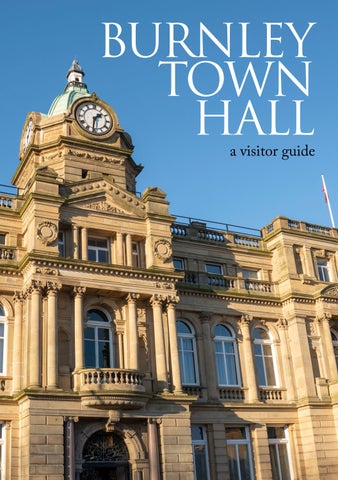
BURNLEY TOWN HALL
a visitor guide
WELCOME Opened in 1888, Burnley Town Hall has been part of town life for well over a century. It was built when Burnley was expanding rapidly through cotton, coal and engineering and brought council offices, a police station, Magistrates’ Court and public baths together under one roof. It is still a working Town Hall. During your tour, you will see the formal rooms designed to represent the borough as well as some of the practical spaces that kept the building running. This guide picks out the details worth noticing and explains what they tell us about Burnley and the people who have used the building.
Your tour
Your guide will take you through the entrance hall and staircase and into the Mayor’s Parlour, Reception Room and Council Chamber, before heading down to the historic police cells. Along the way, they will point out original features and share the stories behind them. As this is still a working Town Hall, the route may occasionally change.
AT A GLANCE
Opened: 27 October 1888 Architects: Holtom and Fox of Dewsbury Style: Renaissance-inspired civic architecture Heritage status: Grade II listed since 1977 Still here: the Council Chamber, civic rooms, original decorative features and police cells.
KEY DATES 1293–94 : A royal charter establishes Burnley’s market and annual fair.
1960 : Burnley celebrates as the Clarets win the First Division championship.
1819 : The first Burnley Improvement Act gives local commissioners powers to improve the town.
1974 : Local government reorganisation creates the present Borough of Burnley. The Council Chamber is altered to accommodate the enlarged council, and the William Thompson Recreation Centre opens.
1846 : The Improvement Commissioners acquire the town’s waterworks. 1854-55 : The Mechanics Institute is built to designs by James Green of Todmorden. 1861 : Burnley becomes a municipal borough. 1862 : Burnley’s old borough coat of arms is formally granted. 1868 : The Public Hall in Elizabeth Street becomes Burnley’s first Town Hall. 1884 : An architectural competition is held for a new Town Hall. 1888 : The present Town Hall opens on Manchester Road on 27 October. 1901 : Burnley Corporation acquires the tramways. 1902–03 : Burnley Corporation purchases Towneley Hall and Park. The Hall opens to the public as a museum and art gallery in 1903. 1914 : Burnley Football Club returns home with the FA Cup. 1924 : Burnley Corporation’s first bus service begins. During the same decade, the long-running construction of Hurstwood Reservoir is completed. 1930 : Thompson Park officially opens on 16 July. 1955 : Queen Elizabeth II and Prince Philip visit Burnley. The town’s silver-gilt mace is presented to commemorate the occasion, and the police move from the Town Hall to new headquarters in Parker Lane.
1975 : The Town Hall’s former public baths are demolished. 1977 : Burnley Town Hall is listed at Grade II. 1986 : The refurbished Mechanics Arts Centre reopens. 1987 : Queen Elizabeth II and Prince Philip return to Burnley, with the Queen touring the recently refurbished Mechanics. 1988 : The Council Chamber ceiling is restored during the Town Hall’s centenary year. 2001 : Thompson Park is added to the national Register of Parks and Gardens at Grade II. 2011 : Burnley marks 150 years since receiving its Charter of Incorporation. 2016–19 : Burnley Civic Trust receives the Burnley Express newspaper archive and establishes the Heritage Image Collection in the Town Hall’s former police station and Radio Lancashire rooms. Its online archive launches in 2019. 2019 : Restoration of the Town Hall clock tower is completed. 2023 : A major programme of repairs to the Town Hall is completed, including work to its roofs, clock tower, dome, stonework and Council Chamber ceiling. The Town Hall also hosts a civic reception for Burnley FC following the club’s promotion to the Premier League. Today : Burnley Town Hall remains the borough’s seat of local government, hosting Full Council meetings, civic occasions and heritage tours.
FROM MARKET TOWN TO TOWN HALL The Town Hall grew out of a period of extraordinary change. In less than a century, Burnley was transformed from a small market town into one of Britain’s major industrial centres. Burnley’s medieval market and fair were established by charter in 1293. For centuries the town remained relatively small, but the Industrial Revolution changed its scale and pace. Cotton manufacturing, coal mining and engineering expanded rapidly, drawing people, trade and investment into Burnley. Between 1816 and 1848, the town’s population trebled. Growth brought new responsibilities. Burnley’s first Improvement Act was passed in 1819, giving local commissioners powers to improve the town. In 1861, Queen Victoria granted Burnley a Charter of Incorporation as a municipal borough and the first council first met above the fire station at the corner of Manchester Road and Finsley Gate. In 1868, the council bought the Public Hall in Elizabeth Street for use as its first Town Hall. It soon proved too “inconvenient and incommodious’’ for the business of a growing borough. Burnley needed a purpose-built civic centre.
A new civic landmark
The council launched a design competition in 1884. The entries were judged by Alfred Waterhouse, architect of Manchester Town Hall, and the winning scheme came from Henry Holtom and George Arthur Fox of Dewsbury. The chosen site stood beside the Mechanics Institute, designed by James Green of Todmorden and built in 1854–55, helping to create the civic quarter we recognise today. The Town Hall was officially opened by the Mayor, Alderman George Sutcliffe, on 27th October 1888. It cost £50,000 to build, compared with an early estimate of £10,000. Even so, the Burnley Express reported that the public verdict was ‘decidedly favourable’.
LOOK CLOSER From Manchester Road, Burnley Town Hall presents its grandest face. Holtom and Fox designed it in a classical style inspired by 16th-century Italian architecture, with a symmetrical façade, carefully ordered rows of windows, columns, balconies and carved stone. Above it all rises the clock tower, topped by its copper-clad dome. The main walls are faced in Yorkshire stone, while polished pink granite columns frame the entrance. Inside, Bath stone was used for the stonework and the mosaic floors were crafted by Maw & Co. of Shropshire. The rear of the building is much plainer and asymmetrical. This reflects the original internal arrangement: the civic suite and principal offices occupied the front, while the court, police and service areas, along with the other working rooms, were placed behind them. The Town Hall could have looked grander still. The original design included a taller tower and two additional domes, but these were dropped for reasons of economy. Even so, the final cost was £50,000, five times the original estimate of £10,000. The Burnley Express reported that the “public verdict is decidedly favourable”.
Six details to spot 1.
At the entrance: the carved round-headed arch, polished granite columns and elaborate wrought-iron gates.
2.
Under your feet: original mosaic floors made by Maw and Co. of Shropshire.
3.
Along the walls: glazed tiles in buff and green, picked out with brown and red bands.
4.
In the windows: original stained and painted glass brings colour into the entrance hall and civic suite
5.
On the stairs: stone steps, cast-iron posts and flowing wrought-iron foliage.
6.
In the entrance lobby: the surviving wooden enquiry kiosk, a reminder of the building's everyday public role.
The Town Hall that might have been
The original design was even more dramatic. It included a higher central tower and two matching domed turrets above the end bays. They were left out to reduce the cost, so the Town Hall visitors see today is a grander idea brought back down to earth by a very practical budget decision. Look up at the roofline and imagine the missing pair. How different would Burnley’s skyline have looked?
THE COUNCIL CHAMBER The most elaborate room in the Town Hall is both a meeting place and a record of Burnley's civic identity. The chamber was designed as the centre of democratic life in the building. Its benches, raised dais and public gallery make its purpose clear, but it is the ceiling that first captures attention. The curved edge of the ceiling is divided into painted panels, while the centre is arranged in deep decorative coffers. Together they create one of the finest surviving interiors in the Town Hall.
A room still in use
The ceiling panels display Burnley's old borough arms alongside the coats of arms of other leading Lancashire towns. Below them, a painted frieze records milestones in Burnley's civic history. It begins with the first charter for a market and fair in 1293-94 and continues through the growth of public services to the acquisition of the tramways in 1901. The room itself becomes a timeline.
The mace is placed before the Mayor as a symbol of the council’s authority. It connects the formal traditions of civic government with decisions being made in the room today.
A history written around the room
Full Council continues to meet at Burnley Town Hall. The Mayor, as the borough’s First Citizen, presides from the raised dais and ensures that council business is carried out efficiently. Traditionally, the Mayor wears scarlet robes and the mayoral chain and badge of office, with the Deputy Mayor and Chief Executive seated alongside. Councillors occupy the benches facing the dais, while members of the public can follow proceedings from the gallery when meetings are open.
The mayoral robes are also worn at important civic occasions, including royal visits and Remembrance Day.
The chamber was altered after local government reorganisation in 1974 to accommodate the enlarged council. Its ceiling was restored in 1988, the centenary year of the Town Hall.
Look up
Find Burnley: Can you spot the stork, bees, lion and open hand in the old borough arms? Follow the dates: Look for 1293-94 at the beginning of the painted civic timeline. Look across Lancashire: How many other town coats of arms can you recognise?
SYMBOLS OF BURNLEY Burnley's coats of arms are packed with clues. Families, industries, landscape and local ideals are brought together in a visual story of the borough.
The old borough arms The arms of the former County Borough of Burnley were granted in 1862 and can be seen in the Council Chamber ceiling. Each symbol was chosen for a reason.
The stork: a reference to the locally prominent Starkie family. It holds a stone in its right foot, a traditional heraldic symbol of vigilance, and a cotton flower in its beak, representing Burnley’s cotton industry. The bees: represent Burnley’s industries and its industrious people. The diamond shapes: known in heraldry as fusils, they resemble spindles and represent the cotton spinning industry that brought Burnley much of its prosperity. The black lion: taken from the arms of the de Lacy family, the medieval Lords of Blackburnshire. The de Lacy lion was usually purple, but appears in black in Burnley’s old borough arms. The wavy black band: known in heraldry as a wavy chief, it represents the River Brun. The open hand: represents power, fairness, loyalty and justice. Its open form is also traditionally associated with generosity and liberality. The motto: “Pretium que Et Causa Laboris’’ is taken from Ovid’s Metamorphosis, the story of Perseus and Andromeda, and means ‘’The Reward and Cause of Labour.’’ Applied to Burnley, it means that the town or riches are the reward and reason for the work of its people.
The present borough arms
Local government changed in 1974, when the old borough was joined with Burnley Rural District and Padiham Urban District. A new coat of arms brought elements of all three councils together. Its English motto, Hold to the Truth, comes from the Towneley family’s medieval French motto, Tenez le Vrai.
The mace
Burnley’s silver-gilt mace was made in London and presented in 1955 by the Burnley and District Master Cotton Spinners and Manufacturers Association. It commemorates the visit of Queen Elizabeth II and Prince Philip that year. Displayed before the Mayor, it is the visible symbol of the council’s authority.
Also displayed in the Council Chamber are Burnley’s 1861 Charter of Incorporation, the documents granting the borough’s two coats of arms and historic badges of civic office. You may recognise some of these civic symbols from the badge of Burnley Football Club another reminder of how closely the town and its team are connected.
Did you know?
Burnley’s old borough arms were based on the seal used by the Burnley Improvement Commissioners. The earlier seal showed a crane, traditionally associated with vigilance; in the 1862 arms it became a stork, creating a link with the Starkie family.
BEHIND THE GRAND ROOMS The Town Hall was never only a showpiece. Behind its ceremonial front was a busy building where local government, justice, policing and public services worked side by side. When it opened, the building contained the Town Clerk’s office and departments responsible for health, markets, rates, accounts and surveying. It also held committee rooms, the Mayor’s Parlour, a police station, a Magistrates’ Court and public baths. A resident might come through its doors to ask a question, pay a rate, attend court, speak to an official or use the baths.
The courtroom and police cells
Most of the original courtroom fittings have been removed, but the panelled backdrop behind the bench, coved ceiling and large rectangular skylight survive. Original cells survive on the floor below the former Magistrates’ Court, and some retain much of their early form. Their plain, confined spaces are a striking contrast with the colour and ceremony of the Council Chamber above. They reveal another side of civic authority - immediate, practical and sometimes deeply personal. The former police station and court were later used for other purposes. The public baths were demolished in 1975, but the surviving cells remain one of the most memorable parts of the tour.
Rooms for ceremonies The Mayor’s Parlour and Reception Room were created for civic hospitality. Original panelling, doors, fireplaces, decorative plasterwork and ceilings survive in these rooms, showing how material, craft and comfort were used to signal their status.
Pause and imagine
How many different journeys through the Town Hall have begun at the same front door? The grandeur makes a statement, but the quieter rooms tell us how the building actually worked.
THE PEOPLE'S TOWN HALL
A WORKING TOWN HALL TODAY
For generations, the Town Hall has given Burnley a place to gather, welcome visitors, celebrate success and share important moments.
Burnley Town Hall remains a working civic building. Full Council continues to meet here, with the Mayor, as the borough’s First Citizen, presiding from the raised dais. The Executive also meets in the building. Members of the public can attend Full Council meetings, ask questions, make statements and present petitions, and the meetings are livestreamed online.
In 1914, the victorious Burnley Football Club team returned after winning the FA Cup. In 1955, Queen Elizabeth II and Prince Philip visited the town. Five years later, Burnley celebrated again when the Clarets won the First Division championship on the final day of the 1959-60 season. These headline occasions are part of the story, but so is the everyday life of the building, council staff at work, residents seeking help, councillors representing their communities, guests welcomed by the Mayor, and members of the public listening as local decisions are made. The Town Hall belongs to that wider history of people and public service.
A living local archive
The story of Burnley is still being collected at the Town Hall. Former police station and Radio Lancashire rooms at the rear of the building are now home to the Burnley Civic Trust Heritage Image Collection. Volunteers preserve and digitise photographs, newspaper negatives and other records of local life so that people in Burnley and around the world can explore them.
Add a memory
What does the Town Hall mean to you? Perhaps you remember a civic reception, a council meeting, a royal visit, a football celebration or simply passing the clock on Manchester Road. Burnley's heritage is made from personal memories as well as official records.
Council teams including Planning, Housing and Streetscene are still based at the Town Hall, while its rooms are also used for meetings and civic occasions. The Town Hall remains a gathering place when Burnley has something to celebrate. In May 2025, Burnley FC manager Scott Parker and the players appeared on the balcony following a civic reception, as thousands of supporters celebrated the club’s promotion to the Premier League. The building also opens its doors for heritage tours, giving visitors the chance to see the Council Chamber and former police cells for themselves. Burnley Town Hall has changed with the borough, but it has never stopped being a place of civic business. The building itself needs continuing care. A major programme of repairs completed in 2023 renewed roofs and traditional leadwork, repaired the clock tower and timber turret, replaced the copper cladding of the dome, and conserved damaged stonework on the facade. The work protected historic details while keeping the Town Hall operational.
Access information
If you have access needs, please tell us when you book so that we can explain the route and discuss any support or adjustments available.
Thank you for visiting We hope this guide has helped you look more closely at Burnley Town Hall and the people, decisions and stories it represents. Burnley Town Hall, Manchester Road, Burnley BB11 9SA To book a tour or plan your visit: Mayor@burnley.gov.uk