Spring 2019 Volume 1 Issue 2
BURMAN UNIVERSITY MAGAZINE
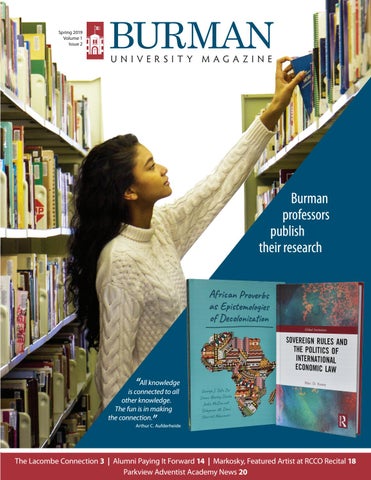
Burman professors publish their research
“All knowledge
is connected to all other knowledge. The fun is in making the connection.
”
Arthur C. Aufderheide
The Lacombe Connection 3 | Alumni Paying It Forward 14 | Markosky, Featured Artist at RCCO Recital 18 Parkview Adventist Academy News 20
BURMAN
& Parkview Adventist Academy News
UNIVERSITY MAGAZINE
VOLUME 1, NUMBER 2 SPRING 2019 Burman University is a Seventh-day Adventist institution. EDITOR Renate Krause WRITERS David Barritt Marc Froese Isaac Darko Luke Elloway
Jr Ferrer Shirley Freed Calin Gillespie Glen Graham
Marcus Heisler Louicius Michel Patti Smedley James Tetz
PHOTOGRAPHER Christian Lintan DESIGNER AND PHOTO EDITOR David J. Kinsey, Alexander & Sydney, UBA
Spring 2019 Volume 1 Issue 2
BURMAN UNIVERSITY MAGAZINE
16 Burman professors publish their research
“
All knowledge is connected to all other knowledge. The fun is in making the connection.
”
Arthur C. Aufderheide
The Lacombe Connection 3 | Alumni Paying It Forward 14 | Markosky, Featured Artist at RCCO Recital 18 Parkview Adventist Academy News 20
ABOUT THE COVER Professors Darko’s and Froese’s recent publications expand knowledge in their respective fields. TO MAKE A GIFT Gifts in support of Burman University may be made at www.burmanu.ca or phone 403.782.3381 x 4161
Feature Stories 3 The Lacombe Connection Lacombe’s town fathers invited the new Alberta Industrial Academy (now Burman University) to relocate in Alberta’s central valley to help grow Lacombe—and Burman did.
VISIT US ONLINE AT www.burmanu.ca Facebook: Burman University Instagram: @burmanuniversity Twitter: @burmanuniv Burman University Magazine is published two times yearly by the Burman University, Office of the President, 6730 University Drive, Lacombe, Alberta T4L 2E5. © Copyright 2019 Burman University Letters to the editor are welcome and may be considered for publication. They may be edited. Email messages to renatekrause@burmanu.ca
Lacombe Day Parade Lacombe celebrates its heritage and the values that were fostered by the founders with the annual Lacombe Day Parade.
Both observing and teaching were critical elements of the summer Burman servicelearning tour shared by Taylor Mathieu, Gabrielle Guderyan, Melissa Barritt, David Barritt, Dr. Shirley Freed and two local friends (pictured above left to right).
14 Alumni “Pay It Forward” Burman alumni started a scholarship fund with incentives for Burman students to become “well-rounded” and aspire to campus leadership. 16 Cambodia: Burman University Service-learning Experience Cambodia’s rural areas are struggling to provide a basic education for its children. On a recent visit, Burman students conducted skill-building workshops for over 100 teacher participants. 18 Program Highlights: Focus on Music Music professor Markosky drew praise for her masterful performance at the 2018 Calgary Organ Festival.
2
President’s Message
8
Changes to McKibbin Centre Learning Environment
9
Sakala Success Centre Offers Community Health Fair
10
Peace and Justice Through Public Education
11
Burman and Kettering College Partnership Benefits Nursing Students
12
Burman Professors Publish Two New Books
13
urriculum Changes at the C School of Education
14
New Disability Access to Ad Building
15
School of Business Offers Summer 2019 Continuing Education Classes
19
Burman: Where Medicine and Music Meet
20
Parkview Adventist Academy News
22
Alumni Profiles Special Feature: Schools for Afghanistan
23
Alumni Profiles— Continued
3 Waiting in anticipation of the Lacombe Day parade on the corner of Allan Street
The magnificent Ahrend pipe organ at the University of Calgary’s Rozsa Centre
18
23 Blake, Mikelle, Wendy and Griffin Wile find life exciting in the Canadian Northwest Territories.
1
Impossibles Becoming Possible Mildred D. Taylor, author of Roll of Thunder, Hear My Cry, wrote, “So many things are possible, as long as you don’t know they are impossible.” Her observation rings true. It resonates strongly throughout the stories in this magazine. Who could have anticipated the long-range impact of the 1908 invitation from Lacombe’s town fathers to relocate the fledgling Alberta Industrial Academy from Leduc to Lacombe? This issue recounts a very small, but important, part of that impact in “Lacombe Connection.” Who would have thought it possible that a tiny, denominational college-turned-university would have a global impact from Afghanistan to Cambodia to Jordan and much, much further? Read about a 14-year-old’s decision to run away from a poverty stricken and troubled home to attend academy; she went on to complete medical school. While still in school herself, she dreamed of and achieved building 101 classrooms for Afghan children. Read about four young education majors from Burman who presented best practices in educating young minds to more than 100 Cambodian teachers. And check out the “Profiles” to see how our alumni are shaping their world. Burman had a hand in nurturing their dreams, their commitment and determination, their characters and generous hearts. “Impossibles” became “possibles” for them. I am moved when I read letters from friends such as Dr. Jonathon Thorp, CEO at Scheer Memorial Adventist Hospital in Banepa, Nepal. Jonathon writes, The four years at CUC (now Burman) gave me the opportunity to learn important life skills such as developing my personal mission and vision, appreciating the value of perseverance, learning respect for authority and growing in my personal relationship with Christ. Burman’s 110-year history at Lacombe is itself a story of “impossibles” becoming “possibles.” The many inspirational and news-worthy stories in this second issue of our new Burman University Magazine bear witness to God’s leadership on this campus. As we plan for the future of the university, we are confident that “with God, all things are possible”—even the seemingly impossible ones.
Loren Agrey President
2
President Charles A. Burman must have glanced at his committee with delight as they gazed out over one of the most fertile valleys in Central Alberta. They had been invited by the town fathers to relocate the new Alberta Industrial Academy (AIA) to this lovely hilltop surrounded by numerous tiny lakes. On February 2, 1909, the Alberta Seventh-day Adventist Conference bought this land near Lacombe. Eighty-one students began the ’09-’10 school year and Lacombe became the home of AIA, now Burman University.
Lacombe The Burman Connection
A
fter Alberta had joined Confederation in 1905, the scattered small communities throughout the province competed to attract institutions and businesses that would help them grow. Lacombe had taken an active part.
3
A Brief History Lacombe was named after Father Albert Lacombe (1827–1916), a missionary to Cree and Blackfoot tribes. His indigenous ancestry had brought him to prominence during treaty negotiations. Ed Barnett, a Mountie, was the first permanent settler in 1883. He had established a “stopping house” for travellers on the Calgary-Edmonton Trail (C&E Trail) and invited family and friends to join him. The Canadian Pacific Railway, built along the C&E Trail in 1891,
increased access and brought more settlers. Ten years after Barnett put down roots, downtown was surveyed and the hamlet became a village. Incorporation followed in 1902. As the town fathers had anticipated, families of AIA students moved into the area—some to farm, others to establish businesses. Others came just to participate in the spiritual, economic and cultural resources the hilltop community offered. The Schafer, Chadwick, Ganson, Gimbel, Leiske, Paul and Olson families, plus many others, all contributed to Lacombe’s early development.
(Historical Society Ref # 90.1.1083)
The Tetz Family
courses that would prepare him for medical school, Wilf went to California for further education. That winter he married his high school sweetheart, Anne Krause, back in Lacombe.
The Albert and Blanche Tetz family moved to Lacombe in the early 1940s. Wilford was 20 years old at the time. He and his siblings, Alberta, Emmett, Bob and LouAnn, all attended the hilltop school. They and their families still make an annual trip to the Tetz homestead to reconnect with each other and their roots.
When he applied to the School of Medical Evangelists (CME, now Loma Linda University, a health sciences institution), the two made their home in Southern California. Wilford and Anne, December 29, 1946
Albert was a school teacher, so Wilford had spent up to grade 12 in Tennessee, in Alberta’s Peace River country, and in various country and town schools in the Beiseker, Alberta area before completing his missing Grade 11 and 12 requirements at Canadian Junior College (CJC, now Burman)—all except the language course. So, although he was on the student yearbook staff, he is not in the 1944 graduation photo! After a couple of cold (-40°) winter months cutting fence posts with Guy Sharman and at CJC working on
4
Tetz family Christmas, 1959. Raising their family of six was mainly Anne’s job. Wilf was busy with “24/7” doctoring job.
After completing medical studies, it wasn’t a difficult decision to return to Alberta since both Wilf ’s and Anne’s families lived at Lacombe. While still at CJC, he had become acquainted with Dr. John McKibbin who had set up his practice in Lacombe’s Flatiron Building. Now Wilf had an invitation to join him. First completing an internship in Edmonton at the University Hospital and then in Ponoka at the Psychiatric Hospital, Wilf and Anne with daughters Beverly and Carol Lynn returned to Lacombe in 1952.
A Lacombe Medical Practice
Memories
Lacombe had approximately 1,300 residents in 1950. Most, if not all, streets were yet unpaved. Steampowered trains chugged through the east part of town, and Wilf remembers people still coming to town on horseback. They tied their horses at the hitching posts at the junction of the main street and the C&E Trail (now Highway 2a) while taking care of business in town. Only one police officer was needed to keep the peace.
Dr. Tetz remembers a young woman who came to his office complaining of a sore throat. Standard procedure called for a blood test before the doctor saw her. The lab technician noted to his astonishment that the specimen had a very low platelet count. Had this not been brought to his attention, Wilf says he would have remained focused on finding either a bacterial or viral source of infection, missing the indications of undiagnosed leukemia. The patient was promptly sent to Edmonton for treatment and, as of Wilf ’s retirement, did not have a recurrence of cancer.
Lacombe is proud of its heritage and the values that were fostered by the founders.
Physicians were responsible to be “on call” for their own patients when they were admitted to the hospital for care. After-hour visits were “house calls.” Wilf would drive to a patient’s house if needed during evening hours or on weekends, when the patient was not able to get to the hospital.
Another recollection involves a family who were blessed with many children. They were very knowledgeable in the labour and delivery of piglets, since their farming operation included raising hogs. One of their daughters reported that her mother, after having had her tasks interrupted several times by false labour, refused to stop for the real one and had delivered their new baby on the kitchen floor. It seemed no “big deal” to anyone—except maybe their doctor.
Retirement
Dr. Tetz’s patients had great confidence in him.
Lacombe’s doctors clocked many hours in their office practices, long evening and weekend house calls, and hospital visits. Dr. Tetz’s maternity record book shows that he delivered an average of one baby a week for Lacombe and area families. In addition, Drs. McKibbin and Tetz provided free medical exams for CUC students. When a new hospital was built in the late 1960s, Wilf Tetz had the privilege of helping design a large addition.
Lacombe Days parades take place in late July.
After 46 years of serving the Lacombe area communities, Dr. Tetz retired in 1998. Lacombe residents honored the Tetzes with a huge party at Lacombe’s Memorial Centre. His past and present coworkers—fellow physicians, nurses, hospital administrators, technicians, etc.—were there to celebrate his life of committed service. Also present were school administrators and students, family friends, babies he had delivered that were now grown, business friends and more. Wilford Tetz had helped shape Lacombe, and Lacombe had helped shape the Tetz family.
5
Other Alumni: John Hubbard, Police Sergeant
Geri Kennedy, Hospital Administrator
Numerous other alumni have been and are part of Lacombe’s integrated fabric. One of these is Sergeant John Hubbard (’00). In October 2015, he received a standing invitation to Holly McKim’s birthday parties for the rest of her life.
Throughout the decades, students have come to Burman from around the world. Some choose to stay and build a life for themselves and their families in Lacombe.
Holly was just one year old when John, a Lacombe police officer, plucked her from her crib in her smoke-filled bedroom, snatched a blanket to cover her head and counted the three steps that would take him back to her bedroom door (the smoke was too heavy to see through) and out of the burning townhouse. Holly’s father claims, “If [John] hadn’t showed up at that exact time, I’m positive all three of us [Holly, her mother and I] would have been overwhelmed by the smoke. We wouldn’t have made it.” A neighbor recruited John Hubbard to the Lacombe force more than 12 years ago while John was employed as a constable by the City of Calgary. John enjoys the community-based work in Lacombe. He says, “It lets you interact with people and help them with all aspects of their lives. We don’t have the same numbers and resources that are readily available in some of the bigger cities, but this challenge keeps the job interesting as we are always thinking outside the box to keep the community a safe and vibrant place to live.” When John Hubbard isn’t working to meet daily challenges that are part of police work in Lacombe, he volunteers as a youth leader at his church. There he helps “create a safe environment for kids to learn and develop a personal relationship with God while getting the support they need as they grow and develop into adults.”
6
Sergeant John Hubbard with Holly McKim and her parents meet in front of the fire-damaged home that nearly took the family’s lives. Photo by Red Deer Advocate
Alumni Geri and Herb Kennedy enjoying retirement in Lacombe after a lifetime of service.
Loney and Ronda (Wombold) Ziakris are both Burman graduates.
Geri (Suelzle) Kennedy (’64) grew up on a farm in Beiseker, Alberta. In 2010 she retired after having worked at the Lacombe Hospital for 30 years. Initially hired after completing nurses training, she was promoted to leadership positions that ranged from team leader to “Site Lead” (i.e. administrator) of the hospital. Working in a small hospital had its challenges. One of these was being a voice for a rural facility and competing with larger hospitals for resources. Managing budgets of acute care, emergency management and pain management within the guidelines of the Alberta health care system presented another set of challenges. On the other hand, Geri also talks of the wealth of experience she gained in all areas of nursing, and of working closely with physicians and other health care professionals. She talks of her friendships with co-workers, community families and volunteers. And she recalls many opportunities assisting families with not only health care needs but also their social and economic needs. Geri and Herb Kennedy enjoy their retirement in Lacombe. They like meeting and greeting friends on the streets of Lacombe. They appreciate Lacombe’s progressive business community. And they treasure the scenic countryside of farmlands, lakes and the many walking trails. The icing on their cake is their proximity to Burman University where they have the opportunity of participating in the many cultural and educational programs Burman offers.
Leonidas (Loney) Ziakris, Lawyer A member at the law firm Cruickshank & Hemmingson, Loney Ziakris (’89) returned to Lacombe with his family in 2004. He writes, “There were many good reasons to return: a great career opportunity for me, our own fond memories of Lacombe and the desire to raise our family in this wonderful place. We haven’t been disappointed.” Loney grew up in North Vancouver. When he was 12 years old, his family moved to a small hamlet on the Sunshine Coast. After completing high school, Loney came to Lacombe and completed an education degree at CUC (now Burman).
A horse and buggy ride in Lacombe County (Historical Society ref. #90.1.274a)
Whenever the opportunity arises, Loney melds his law degree from the University of Alberta with his education degree. He presents seminars in and around Lacombe at banks and small businesses, and has taught classes at Burman University, Red Deer College and La Sierra University. Being a lawyer in Lacombe, rather than in a larger centre, has some significant advantages for Loney. He likes the less volatile, “dog eat dog” world. He also likes the collegial environment where judges “get to know us by name in a short time.”
Lacombe’s Blacksmith Shop Museum is the longest operating shop in Alberta.
Nanton Street circa 1930s (ref. #93.1.386)
Lacombe, Home of Burman University Lacombe’s story first intersected with the Burman story more than a century ago. Now the two not only exist side by side, they are intermingled—as shown by the Tetzes, Hubbards, Kennedys, Ziakrises . . . and others too numerous to include here. Neighbours? Yes. But more than neighbours: family and friends. Historical images provided by the Lacombe & District Historical Society. Reference numbers refer to the Society’s catalog. Current photos of Lacombe, courtesy of Lacombe Regional Tourism.
Downtown alleyways feature 34 murals of daily life from 1890s to 1940s. The project began in 2004.
7
CAMPUS NEWS
Campus News The long tables and heavy chairs most useful for the lecture mode of teaching—a traditional teachercentered approach—have now been replaced with tables that enable students to work both collectively and independently and with chairs that can move easily. These rooms support the active teaching methods that professors want to use and students need to learn.
Jill Woods, micro-teaching her peers (Lucy Lynett, Brianna Hermary and Elsy Cornejo) and modeling for them elementary school teaching techniques
A
cademic support can transform an average learning experience into an exceptional one. When faculty are given time and resources to redesign and develop course offerings that incorporate high-impact practice, transformation takes place. When students have access to state-of-theart scientific equipment, learning and research can be taken to new levels.
Gift Changes the Learning Environment in McKibbin Centre Grace Fedak’s and Elvin Saruk’s commitment to program enhancement at Burman over the past few years has resulted in innovation and excellence. Their latest gift of $35,000 has transformed two McKibbin Centre classrooms into what educators are calling “active learning” environments.
Lucy Lynett writes, “The new tables in the Mckibbin Centre make it so much easier for us education students to discuss topics as groups, collaborate, and practice the skills being taught in our courses. These tables help to create a stronger sense of community and class culture. They seem appropriate especially for education students!”
Such environments encourage teamwork and foster essential skills for group decision-making and problemsolving. When School of Education student Jill Woods heard about the new tables, she exclaimed, “We are getting new tables? That’s exciting! I think having round tables will encourage a more collaborative learning environment and will emphasize what we hope to encourage in our future classrooms.”
“Schools of education in particular need to model for their students the processes and strategies that demonstrate studentcentered patterns of instruction. We have known for decades that there are better ways of teaching than lecturing.” Dr. Shirley Freed Chair, School of Education
A gift transforms McKibbin Centre classrooms into active learning spaces.
The new McKibbin Centre environment promotes collaborative work.
8
Health Fair 2018 Attracts Hundreds of Participants
O
n November 18, 2018, more than 240 visitors plus numerous volunteers and community exhibitors participated in Burman's 4th Annual Health Fair, Commit to Be Fit. Several years ago, Carey McNorton, a religious studies student, had a dream of sharing Burman’s commitment to mental, physical, emotional and
spiritual health with the community. As a direct result of his vision, the Sakala Success Centre has organized and hosted the fair these past four years. One of the organizers, Crystal Johnson, reports that the 2018 fair focused on NEWSTART, a program aimed at promoting the eight natural laws of health and wellness. Crystal writes, “Dozens of volunteers (students, church and community members, and faculty and staff) hosted the NEWSTART booths and other exhibits. Staff members Gerald and Bonnie Goulet, for instance, hosted a nutrition booth and provided healthy food samples.”
Burman invited healthrelated community agencies and businesses to heighten awareness of community resources. More than 30 community booths from the Lacombe area were involved in the fair.
A collaborative event staffed by students, faculty and members of the community, the 2018 Health Fair emphasized the benefits of healthy living and offered health education and activities.
Eulaine Ndhlova, a psychology major, made sure that the children weren’t forgotten. She planned their own NEWSTART booths, a bouncy castle, a climbing wall and face painting activity. Will there be another health fair in 2019? Absolutely! Calin Gillespie, counselor at the Sakala Success Centre, writes, “It's always such a great time for the campus and community. We are committed to building bridges between the university and the central Alberta community. It’s great to see people of all ages coming out and learning more about health and wellness.”
Each year the Health Fair has grown and provides activities for both adults and children. The “bouncy castle” (upper right) kept children occupied while parents visited the wide array of booths.
Organizers from the Sakala Success Centre are currently in talks with other entities on campus, such as the Division of Science, as they plan to expand their 2019 outreach.
9
Campus News
A
community that is known for being welcoming, harmonious and inclusive is a community that tends to thrive. But earning such a reputation can be challenging. Through five highly successful public education initiatives, Burman University’s Centre for Peace and Justice (CPJ) is assisting communities in reaching their goals.
Peace and Justice through public education Professor Glen Graham, the Centre’s director, works with volunteer committees throughout Alberta that help administer the Centre’s programs. An advisory council of prominent local entrepreneurs and community leaders provides guidance on strategic planning and donor relations for five diverse, ground-breaking initiatives. Peacebuilders Peacebuilders is a leadership program. Young people ages 16 to 28 learn from various social, ethno-cultural and faith communities. They reflect on key diversity and human rights issues and explore Canadian history, identity and values. Working with local change-making organizations, participants learn to engage in advocacy. They develop communication, critical thinking and leadership skills. The first Peacebuilders group met in February, 2019 under the leadership of two local coordinators: Cheryl Wowk, a retired Red Deer School District councilor, and Spencer Page, a senior international studies major at Burman. Peacebuilders is a collaborative project of the John Humphrey Centre of Edmonton and the Burman Centre for Peace and Justice. Conflict Management The CPJ conflict management team helps individuals, organizations and businesses respond in creative and positive ways to everyday conflicts. The team provides staff training, group facilitation and workshops in Central Alberta. Participants learn to manage disputes, improve communication skills and build healthy relationships. In the fall of 2018, the team presented two well-attended community workshops in Lacombe. The first focused on “Strategies to De-escalate Interpersonal Conflict,” featuring Dr. Bruce Boyd, conflict management expert. The second, “Peacemaking Circles:
10
A
M E M O I R
Building Healthy Relationships and Interconnections,” was led by Agnes Struik, psychotherapist. Herr Lecture Series The Herr Lecture Series continues to bring leading experts to Central Alberta to address social and political issues facing Canadians today. In an age of extremism and widespread misinformation, the Herr Lecture Series provides an invaluable forum for reasoned and informed discussion. The most recent presentation was held at the Lacombe Memorial Centre on March 12. One of five guests for 2018/19, Kim Phuc told her story of running naked down a road, her skin on fire with napalm . . . a story captured in the photograph that changed world perception of the Vietnam War in 1972. The Associated Press photographer, later awarded a Pulitzer Prize for the photo, was so moved by the nineyear-old girl’s pain that he rushed her to a hospital. Against all odds, Kim Phuc survived and went on to become a renowned peace activist, author, UNESCO Goodwill Ambassador for the Culture of Peace, and founder of the Kim Phuc Foundation.
O F
H O P E
A Memoir of Hope tells the story of nine-year-old Kim Phuc (center). She had ripped off her burning clothes and is running down Route 1 near Trang Bang after an aerial napalm attack on suspected Viet Cong hiding places on June 8, 1972. Photo courtesy Kim Phuc Foundation
Humanitarian Leaders of Tomorrow Youth Conference The Humanitarian Leaders of Tomorrow Youth Conference, a biannual event, introduces youth and young adults to the humanitarian community of Central Alberta. Through a variety of lectures, workshops and activities led by prominent philanthropic trailblazers, it gives students tools for leadership in humanitarian causes. A collaborative project of A Better World Canada and the Centre for Peace and Justice, the first conference was held in May of 2018 with students attending from across Canada, including many from local public high schools.
Photojournalist Nick Ut and Kim Phuc, 40 years later, in Toronto, June 8, 2012. Photo courtesy Kim Phuc Foundation
Central Alberta Interfaith Network A collaborative project of the city of Red Deer’s Welcoming and Inclusive Community’s Network and the Centre for Peace and Justice, the Central Alberta Interfaith Network brings together community leaders of all faiths throughout Central Alberta to promote interfaith collaboration. For more information on the projects, visit burmanu.ca/ centreforpeaceandjustice
Burman Partners with Kettering College to Offer Nursing A new partnership opens a vast range of career opportunities to Burman students
O
n October 1, 2018, Burman University entered into an agreement with Kettering College in Dayton, Ohio to provide an opportunity for Burman University students to obtain a Bachelor of Science in Nursing (BSN) degree at Kettering College. One distinct advantage of this agreement is that for more than a year, nursing students can avail themselves of the significantly lower tuition rates at Burman. Another is the low studentteacher ratio, enabling students to benefit from much more personalized instruction. And a third advantage is the opportunity for students to practice and develop their leadership skills on a small campus before transferring to a much larger one. Students qualifying for the program can complete a prescribed curriculum consisting of three semesters of full-time study at Burman University and two years of full-time study at Kettering College. When applying to Burman for the first three semesters, students must meet the application requirements set by the university. When transferring to Kettering College for the final two years, students must meet the application requirements as outlined by Kettering. Applications for Fall 2019 are now being accepted. “We’re thrilled about this new partnership between Kettering College and Burman University,” states Kettering College President Nate Brandstater. “Kettering College looks for innovative ways that create unique opportunities for students to earn a healthcare degree, which also opens the door for future employment at Kettering Health Network.” Kettering nursing students have a pass rate of 93 percent on the National Council Licensure Examination. The United States average stands at 84.53 percent. Recent strategic curriculum improvements to Kettering’s nursing program have contributed to this significant difference. For more information visit www.burmanu.ca/nursing.
11
CAMPUS NEWS
Campus News of international development to be bogged down by too much legalese. Too many lawyers and judges would make the system too rigid. So problems such as trade frictions were solved through political compromise. Law was kept in the background as much as possible.
Professors Launch New Publications
P
With the growth of the economic order, however, international politics around trade and investment regulation increasingly takes place in a legal context. Laws protect and safeguard rights and freedoms. Economic interdependence requires rules, lawyers, judges and courts. The rules that structure the global economy are central to healthy and progressive societies in the 21st century.
rofessor of political science Marc Froese examines Canada’s experience with international dispute settlement in his book Sovereign Rules and the Politics of International Economic Law (Routledge 2018).
Isaac Darko, assistant professor, School of Education
Froese argues we need more integrated ways of understanding our increasingly complex and interconnected world. Silos of specialization separating international law from politics are arbitrary and not serving us well today. Since World War II, the business of international trade has grown. This global flow of trade and investment requires agreements, treaties and structures such as NAFTA (now USMCA), WTO and EU. These acronyms have proliferated and become common household terms. The original framers of the international economic order after World War II were careful to keep politics and law as separate as possible. They didn’t want the important work
12
I
saac Nortey Darko, assistant professor of education, co-authors African Proverbs as Epistemologies of Decolonization (Peter Lang 2018). The book highlights the educational and training relevance of African proverbs that, like western indigenous epistemologies, have faced rejection and neglect in the process of education.
Marc Froese, professor, International Studies
Froese writes, “The right rules may not completely protect us from making the mistakes that led to the Great Depression and the rise of Fascism. But they are a necessary tool if we wish to detect and avoid similar potential disasters in the 21st century.” His text, therefore, argues for the importance of a shift from politics and law, to the politics of economic law—a paradigm shift he calls the politics of international economic law.
This collection of proverbs serves to stimulate conversations around indigenous knowledge, power, equity, ethics and morality in a context of a dominant worldview. It asks, how does one develop a conscience for social responsibility? And how are students taught to embrace traditional notions of self-discipline, integrity and hard work? How do we frame an inclusive anti-colonial and anti-racist global future? What sort of education should be taking place in our schools, colleges and universities today? How do we refashion our role as critical learners to create a more relevant understanding of what it means to be human? By examining the literal and metaphorical meanings of proverbs, the book positions proverbs as valuable and salient epistemologies needed in academic success and social excellence.
ways the church can amend its dark history through Christian educational institutions.”
Curriculum Changes at School of Education
S
ince 1997, Alberta has had a Teaching Quality Standard (TQS) as a “framework for preparation, professional growth, supervision and evaluation of all teachers” (Alberta Education). Applying to all certified teachers in Alberta, a revised TQS will come into effect September 1, 2019. All teachers are expected to meet the TQS’s six competencies. Burman’s School of Education is updating all courses and program components to align with the TQS so that new graduates qualify for certification. Administration is collaborating with Alberta’s other nine post-secondary schools in a $150,000 grant (managed by the University of Calgary) to incorporate the new TQS into their curriculum.
Professor Keith Leavitt (left) and students participate in the Blanket activity, a simulation of how the First Nations people lost much of their land and culture.
The biggest changes are to the 5th Standard: “Applying Foundational Knowledge about First Nations, Metis and Inuit.” In anticipation of this required competency, all education faculty have attended at least one conference related to the indigenizing of the curriculum.
In consultation with Maskwacis Cultural College, located 30 km north of Burman, the 2018/19 education curriculum has integrated the following: The Blanket activity, a Sixties Scoop survivor (see sidebar) telling her story, an indigenous artist’s lecture about various art forms, a presentation by an indigenous speaker about literacy issues, inclusion of literature written and illustrated by indigenous authors and illustrators, and a number of assignments to increase knowledge of indigenous people. In October, nine deans of education programs from Alberta universities spent the day at Maskwacis Cultural College for a symposium on indigenous issues in higher education. The next day they met at Burman for their regularly scheduled annual meeting. Last November, Professor Isaac Darko presented “Indigenizing Christian Education” at Toronto’s 2018 Decolonization Conference: Dialoguing and Living Well Together. Darko “raised fundamental questions on the history of the Christian church and its continuing role in the lives of Aboriginal people in Canada” with the hope of “exploring
Curriculum changes at the School of Education will not ignore basic differences in beliefs and practices by both Christian and Aboriginal communities. At the same time, they are designed to foster the spirit of understanding and reconciliation that is fundamental to the teachings of Christ.
The Sixties Scoop The “Sixties Scoop,” although its name seems to suggest the decade of the 1960s only, began in the 1950s and continued into the 1980s when indigenous children were “scooped up” from their homes and were placed in foster homes or adopted with no consent. The term was coined by Patrick Johnston, author of Native Children and the Child Welfare System (1983). Johnston reported an epidemic of child apprehension. Social workers had no specific training in evaluating indigenous homes. They were unfamiliar with indigenous cultures and histories. Their own middleclass Euro-Canadian values often stood in direct contrast to what they encountered in the homes they visited. Consequently, a hugely disproportionate number of indigenous children were taken into custody and taught to suppress, even deny, their indigenous heritage.
13
Campus News
“Paying It Forward” Seeing education costs not as liabilities, but as investments, Burman alumni contributed to scholarships and awards (amounting to more than $179,590) that benefited 100 students last April.
C
Clock Tower Points to Improved Access
W
ith commitment to improved access to the Administration Building, the Committee of 100 provided funding for a new north entrance below the old smokestack.
an anyone afford a private Christian education? Burman’s alumni and friends answer with a resounding, Yes! One group of alumni that created a scholarship is the Legacy group. Marcus Heisler (’10), Luke Elloway (’10), Andrew Song (’10) and Faith Calaminos (’13) became friends at Burman where they studied together, played sports together and went on club outings together. When they were accepted into Loma Linda University School of Medicine they decided to initiate a scholarship at Burman . . . even if it was with student loan money. Marcus writes, “Each of us had been a beneficiary of one or several scholarships while studying at Burman, so the importance of scholarships from a student’s perspective was not lost on us.” One criterion they specified was that the recipient be “well-rounded”—that is, he or she must be contributing to the Burman community in significant ways. At Burman, each had held leadership positions on soccer, volleyball and basketball teams; in campus ministries, their dormitories, the student association and in various student clubs. They had also helped with academic tutoring. On top of that, Luke, for instance, had accompanied Burman’s choir in New York’s Carnegie Hall, had performed the part of the rat in The Wind in the Willows play and had done research at the Lacombe research facility. They had modeled what “well-rounded” students (even while studying for admission into medical school) look like! Faith Calaminos joined the group a little later. She had received the Everett Dick scholarship, the Presidential Award for the Division of Science and the Legend scholarship. She says, “The scholarships helped relieve some of my financial burdens. Being chosen was also empowering—like an encouragement to keep going and trying your best.” Marcus writes, “We’re still quite a way from reaching our own goals with this scholarship, but this is a beginning.” So every year now, the Legacy Scholarship recipient receives a cheque—and with it the encouragement—because a group of grateful alumni have chosen to “pay it forward.” A Footnote Luke completed a family medicine allopathic residency in Florida and is working in urgent care. Andrew graduated in 2018 with dual degrees (MD and PhD) and is in the neurosurgery residency program at Loma Linda University. Marcus trained in family medicine and preventive medicine. He works in a public hospital district in rural western Washington and is the district’s only preventive medicine physician. Faith, now married to Marcus, is in a family medicine residency program. She chose her broad-based program to prepare for “working in underserved communities, hopefully overseas.”
14
While some final tasks needed to be deferred until spring due to early snowfall in September and October, the north entrance and handicap parking have been open since mid-December. Campus Family Circle (CFC) funding transformed the old smokestack into an attractive clock tower.
Alumni, we’d like to hear from you! Online alumni@burmanu.ca By Mail
Alumni Association Burman University 6730 University Drive Lacombe, AB Canada T4L 2E5
• S end digital photos by email in jpg, tif or eps file format. Files of one megabyte or more are best • Space is limited, so your message may be edited • Include your graduation or attendance dates
School of Business
Continuing Education 2019 Class Schedule
Bookkeeping Designed to train administrative staff to prepare their company’s books and to qualify them to prepare books for others. May 6-8 Kirsha Campbell | CPA May 29-31 Virginia Irrgang | Adjunct Prof. Branding Your Church Open to all denominations. Define who you are as a church and how that relates to those you are trying to reach. June 3-5 Robert Opoku | Mkt. Specialist Budgeting Acquaints learners with tools of both operating and capital budgets. Presents basic elements of budgeting for private, public and NGO organizations. July 16-18 Darrell Huether | VP Finance
Professional. non-credit courses designed to help managers’ performance in the work place
Entrepreneurship The art and science of recognizing, evaluating and pursuing innovative business ideas. June 18-20 David Jeffrey | Asst. Professor July 3-5 Naveen Anand | MS Mutual Funds/Investments $750 All other courses $500 Courses are subject to minimum participants.
Investments How the markets work and what tools are needed to analyze and manage investments are the focus of this course. June 24-26 Mark Cerezo | Mgr. Desjardins Securities Louicious Michel | Chair, School of Business Information Systems Security Protecting data, dealing with threats and eliminating the incidence of breaches are among the issues associated with IT technology. June 3-5 Ebenezer Sackey | IT Specialist Introduction to New Treasurers Covers basics of operation, church structure, legal issues and the role of the treasurer. Participants also learn how to record accounting information on the church’s information system. July 8-10 Pope Gondwe | Dir., Acct. Services Personal Finance Management This course acquaints the learner with principles of short- and long-term financing, investing, retirement, credit, taxation, risk management and budgeting. June 17-19 Louicious Michel | Chair, School of Business
An exciting benefit for you as a Burman graduate.
Principles of Small Business Management Participants will learn to apply business principles for success in the context of small business. Attention will be given to entrepreneurship, strategy, business planning, marketing, budgeting and new venture management. June 10-12 David Jeffrey | Asst. Professor July 3-5 Naveen Anand | MS Small Business Marketing Participants will be introduced to how marketers create customerdriven marketing strategies based on research and understanding the marketing environment. June 12-14 Robert Opoku | Mkt. Specialist Mutual Funds This course is designed to provide in-depth coverage that is identical to the Canadian Investment Funds Course. It is structured to offer technical and fundamental analysis of mutual funds and related products. June 19-21Mark Cerezo | Mgr. Desjardins Securities
To Register
(403) 782-2822
www.burmanu.ca/business/continuinged
Take advantage of your alumni benefits. You have access to the TD Insurance Meloche Monnex program. This means you can get preferred insurance rates on a wide range of home, condo, renter’s and car coverage that can be customized for your needs. For over 65 years, TD Insurance has been helping Canadians find quality insurance solutions. Feel confident your coverage fits your needs. Get a quote now.
Insurance program recommended by
You save with preferred insurance rates. HOME | CAR | CONDO | TRAVEL
Get a quote and see how much you could save! Call 1-888-589-5656 or go to tdinsurance.com/burman The TD Insurance Meloche Monnex program is underwritten by SECURITY NATIONAL INSURANCE COMPANY. It is distributed by Meloche Monnex Insurance and Financial Services, Inc. in Québec, by Meloche Monnex Financial Services Inc. in Ontario, and by TD Insurance Direct Agency Inc. in the rest of Canada. Our address: 50 Place Crémazie, 12th Floor, Montréal, Québec H2P 1B6. Due to provincial legislation, our car and recreational insurance program is not offered in British Columbia, Manitoba or Saskatchewan. Wide Horizons Solution® travel insurance is administered by RSA Travel Insurance Inc. and is underwritten by Royal & Sun Alliance Insurance Company of Canada. Medical and claims assistance, claims payment and administrative services are provided by the administrator described in the insurance policies. All trade-marks are the property of their respective owners. ® The TD logo and other TD trade-marks are the property of The Toronto-Dominion Bank.
15
Cambodia Burman University Study Tour
T
aylor Mathieu, Gabby Guderyan, and Melissa and David Barritt signed up for the Cambodian study tour that Professor Shirley Freed, Chair of the School of Education, led last August. Taylor would be the first in her family to return to the country of her ancestors since her grandparents escaped the Khymer Rouge killing fields in the 1970s.
The four-day training session took place at the SALT Centre, home of Cambodia Adventist School, Kantrok and the Preah Yesu Children’s Home.
From August 20 – 24, the group led out in professional development training for over 100 Cambodian and Vietnamese teachers. Advocates for Southeast Asians and the Persecuted (ASAP) hosted the Burman group. A supporting organization in the Seventh-day Adventist system, ASAP is focused mainly on Southeast Asia (Vietnam, Laos, Cambodia, Myanmar and Thailand) and works with various groups to provide extra funding for schools and churches when there aren’t enough resources to keep going. Students had the opportunity to put into practice some of the teaching strategies they had learned in their course work at Burman. They began by organizing table groups to facilitate active learning. For instance, using Ellen G. White’s book Education, they taught the groups to make life maps of their own lives as well as the life of Christ. And when Melissa and David presented the chapter on creation, the groups went outdoors to gather and bring back items from nature to help them illustrate their lessons about God’s creative power. Among other things, the teachers learned about the four dimensions of learning (mental, physical, spiritual, social/emotional), multiple intelligences and Bloom’s taxonomy. More than 3,000 early literacy books in Khymer were distributed, and training was provided for their use. The affirmation from the teachers was overwhelming. One principal told them that this was the best training his Cambodian teachers had ever had.
16
Two excited boys, examining their new literacy books
The school is important to Adventists because government schools are open on Saturdays and will not allow children to miss Saturday classes. It is registered as one of Cambodia’s Adventist Mission rural schools, but operated and funded by SALT Ministries. About half of the 300 children are from the nearby village. Others are from the orphanage.
Both prior to and following the professional development training, the Burman group visited six different ASAP schools. The first was the Takung School. Melissa writes that “there were over 100 students in a tiny classroom. The school was definitely lacking resources, with only two classrooms!”
The Burman group found huge differences among the schools they visited. For instance, a Vietnamese school in Phnom Penh taught students entrepreneurialism in the T-shirt factory that supports not only the school, but also those wanting to continue their studies at universities. Students from each class in the school design their own class T-shirts, using advanced technology. Another Vietnamese school in a poor community offers free tuition and two meals a day to its students.
At each of the six schools they visited, they taught the children songs and games, told a Bible story and helped them make their own personalized “thank you” cards for the children’s ASAP sponsors. They also told them about some of the animals that live in Canada. The children, in turn, told them about Cambodian animals.
Everywhere they went, children were attracted to the group and wanted to practice their English. Gabby (bottom right) was always ready to welcome them with smiles and encouragement.
On the two weekends that Dr. Freed’s group visited Cambodia, they led out in Sabbath services, telling stories, singing songs and praying together. They also made home visits to the children’s homes and delivered bags of ramen noodles and cans of food. Home visitations “were the highlight of the entire trip,” according to Melissa.
In this school the children have no desks, so sit on the floor. The “teachers” are often children themselves.
Many children were impoverished and many had walked long distances to attend school. But they were the fortunate ones. Most children living on the fringes of Cambodia’s rural areas have no schools. One school was built on stilts. Flooding had left water all around the building. In the single classroom, students sat on the wooden floor for their lessons, and volunteers taught the classes. One of the volunteers, only 11 years old, was responsible for teaching the second grade. In return, his own education was sponsored by ASAP.
In one home they found grandparents raising grandchildren. The grandmother had a large tumor on her hip that caused her great pain. She had gone to see a doctor, but was told that she was too old for surgery. The grandfather was blind from cataracts, an “easy fix in Canada, but too expensive for this family to afford.” They were told that in the severest part of the rainy season, homes were often flooded and the water at times even submerged beds. David writes, “It really caused me to question what’s important in my life.” Before returning home to Canada, Professor Freed’s group visited the Killing Fields in Choeung Ek. Pol Pot, leader of the 1975-79 revolution, had ordered all of Cambodia’s intellectuals and wealthy killed to protect his own power. Taylor Mathieu’s grandparents had escaped the genocide, but 25 percent of the country's population had died from starvation, overwork and executions. As they left the country, David explains that he felt a “new sense of accountability, a need to pay it forward. As I landed in Alberta, I felt ignited to serve Christ at a level I hadn’t felt before.”
17
Program Highlights:
Burman Music Professor Performs at Calgary Organ Festival
Wendy Markosky with Jason Biel admiring the Ahrend organ, modeled on a 17th century Italian instrument.
P
rofessor Wendy Markosky was one of the featured Canadian artists at the 2018 Calgary Organ Festival held in conjunction with the national convention of the Royal Canadian College of Organists (RCCO) last July. On July 4, the afternoon program featured first an introduction of the Ahrend organ in the University of Calgary’s Rozsa Centre by international prize-winning organist Neil Cockburn. One of Canada’s finest and most unique instruments, the Ahrend organ was designed by the German organ builder Jurgen Ahrend. Its design is based on a seventeenth-century organ in Bologna,
18
Italy; its tuning is a modified meantone based on a seventeenth-century organ in Norden, Germany.
former student Jason Biel (Burman, BMus ’14; McGill, MMus ’17) assisting as stop registrant.
Following Professor Cockburn’s lecture, Dr. Markosky began her recital with an exuberant praeludium by seventeenthcentury composer Franz Tunder. She continued to showcase the organ’s unique tonal palate with selections by Scheidt, Buxtehude, Bach and Lubeck, concluding with Hugo Distler’s twentieth-century arrangement of “Jesu Christus, unser Heiland.” To the delight of her audience, she juxtaposed the “ancient and modern, the rustic and refined” throughout her concert. Dr. Markosky was delighted to have her
Janet Weaver, one of RCCO’s regional directors, writes, “Yes, the Rozsa Centre’s Ahrend Organ truly is one of Canada’s treasures and under such hands as Wendy Markosky’s will continue to honour the great music of the past and carry it far into the twenty-first century” (Journal of the Royal Canadian College of Organists Organ Canada, Fall 2018). Photos by Eric Harrison, Creative Trade-Offs
Focus on Music
Art and science—two disciplines usually considered to be on opposite sides of the academic spectrum. But not at Burman. Here a student may now apply for admission to the four-year, dual emphasis music and pre-medicine Bachelor of Arts degree.
Burman, Where Music and Medicine Meet for Lova
L
ova Rakotomalala first heard of Burman from a visiting Canadian pastor in her home church on the French island of Mayotte off the coast of Southeast Africa. From kindergarten through high school, Lova had received a public education. Now the pastor convinced her that her dream of attending a Christian university was attainable. And when he described the music program at Burman, especially the orchestra, she was doubly convinced. Although Lova’s career goal is to become a pediatrician, her first love is music. Ever since she was four years old, she has taken piano lessons. When she was nine, she begged her parents for violin lessons. Lova had participated in various competitions world wide, such as the Conservatoire National Supérieur de Musique at the National Conservatory of Paris and Guadeloupe’s “Clé D’Or” piano competition, bringing home many honours.
Now it was time to think of university studies, though. When Lova discovered that Burman would allow her to carry on with her music even as she was preparing herself for a career in medicine, she knew she had found the right school.
Because she needed to learn English quickly and get accustomed to a new environment, she decided to spend six months at Parkview Adventist Academy before enrolling at the university. Currently, she is completing her second semester at Burman. Allison Kilgannon, one of Lova’s music professors, explains that Lova “has obviously performed advanced repertoire on the piano. We are working toward a higher level of refinement and accuracy and are developing practice strategies to improve her performance standards, but she was more than qualified for the program.” She adds with a smile, “Our lessons are in French.”
Travelling to a foreign country to attend university has its challenges. Leaving her younger siblings and parents behind would be hard. It would also be hard to live with people speaking another language and having different expectations and customs.
Lova has been awarded a music scholarship and a leadership scholarship. The recognition is encouraging and affirming. As she talks of her future, Lova is very sure: “I want to be a pediatrician, but I also want to be a musicologist,” she insists. “Burman helps me prepare for both.”
19
Parkview Adventist Academy News
T
here have been many “firsts” for Parkview Adventist Academy’s (PAA) five international students from Brazil—their first time in the snow, the opportunity to choose their classes and the
adjustments to living in a rural setting. Spending a semester at PAA has helped these students gain confidence, make new friends, and increase their English skills while introducing them to Canadian culture.
Eder and Caio on Storey’s Beach in Port Hardy, BC, during Christmas vacation
It's " Viva
Caio Santos, one of the four Brazilians who took on-line classes at home while studying at PAA, managed to stay second in his class of 160 and remains on track to fulfill his dream of becoming a neurosurgeon. “My time here will help when it comes to the Exame Nacional do Ensino Médio, the comprehensive test each student in Brazil must take to access higher education after high school.” He continues, “I will still take English classes when I return to Brazil. My PAA English teacher, Mr. Berdan, helped prepare me very well for that part of the exam.” Caio adds that while he thought it might be a good experience to come to Canada,
Brazil" at PAA
Four of the five Brazilians have managed to participate in six on-line classes at home while taking four additional classes at Parkview. This has made for some very late nights, but their dedication to learning English well has helped them meet this challenge.
Meet Éder Dimas and Caio Santos Éder Dimas will complete his education in Canada and is taking classes at PAA only. A senior, he appreciates being able to “customize” his education—a privilege that students in Brazil don’t have. He explains, “In Brazil, you take the same classes every day. You don’t get to choose.” Fellow Brazilian Caio Santos agrees, “At home, your classes start at 7 a.m. every day. They are shorter, 45 minutes each, but you take the same six core classes every day.” Caio says that on some days when students have multiple tests, they get as little as one hour of sleep. Éder’s interest in science and technology made biology his favourite class. He plans to continue studying in Canada or the U.S. “My dream was to come here. It always has been since I was small,” explained Éder. “I did not think it would happen. I had given up on this dream. Then my parents said, ‘We can do this for you now.’”
20
“It has made me very happy,” he concludes. “I enjoy the differences in culture and the chance to pursue a career as an industrial designer.” Then he adds, “But I will always miss the food!”
he had had his reservations. When it came time to make the decision, his aunt said, “You are going,” and that was the end of it, according to Caio. When you ask him what he has liked best about his semester here, Caio says that seeing snow and learning about Tim Horton’s have made his stay in Canada fun. “I like the hot chocolate and donuts; everything they have is good, and snow comes in my favourite colour—white. He adds, “Seriously, I think my English has improved significantly.” Caio has headed back to Brazil for second semester, where he is reunited with his family and three beloved dogs: Malu, Duda and Tiao. But PAA has made an indelible impression: “It has surprised me how kind people are here, and I
like the sense of security. I will miss the friends I have made, the classes, and the chance to buy books in English-they are very expensive in Brazil.”
The ESL Experience at PAA Parkview Adventist Academy enjoys a diverse study population with staff and students coming from over a dozen different countries. This makes for a rich learning environment. It increases understanding of differences and appreciation for other cultures. “Learning a second language expands a person’s horizons and opens up new opportunities,” says Sharline Fernandez, PAA’s English as a Second Language (ESL) teacher. “And offering ESL classes here at Parkview exposes all our students to different cultures.” Principal Dallas Weis adds, “PAA is blessed. The Brazilians that joined us this year for first semester were positive additions to our student body. We have been introduced to their culture and enjoyed their favourite foods and music. They have become our friends, and we are better because they were here.” For the second semester, PAA welcomed several new international students. “There are two primary reasons why we are seeing an upswing in interest from Brazil and Africa: economics have improved for some of these countries’ citizens and students who have traditionally chosen to study in the United States are now coming to Canada because of the current political uncertainty in the States,” explains vice principal Rod Jamieson. To know more about ESL opportunities at PAA, please contact Rod Jamieson at 403-782-3381, ext. 4112.
Parkview Adventist Academy Parkview Adventist Academy Distinctly Academic, Decidedly Christian. Distinctly Academic • Decidedly Christian
• Holds levelofofaccreditation accreditation offered Holdshighest highest level offered by the byNorth the North American American Division. Division • Ranked 1/3for forhigh high schools in Alberta Rankedinintop top 1/3 schools in Alberta. • 95 percent student and teacher satisfaction 95% parent, student, and teacher satisfaction rating. rating Dedicated ESL ESL and arts arts programs. • Dedicated andindustrial industrial programs • Over scholarships awarded Over$25,000 $25,000 in in scholarships awarded annually. annually Service, Campus Ministries, & sports opportunities. • Service, campus ministries and sports Unique access to Burman University amenities. opportunities • Unique access to Burman University amenities
Connect with us!
Connect with us! (403) 782-3381, ext. 4112 | www.paa.ca
Ph: 403.782.3381 x 4112 www.paa.ca
PAA: Established in 1907; on the hilltop since 1909
Parkview Adventist Academy
A grades 10-12 Christian boarding and day academy located on the campus of Burman University
PAA’s mission is to encourage students to achieve academic excellence, to accept personal responsibility for mind, body and spirit and to experience spiritual growth as they learn to serve God and their communities.
21
Alumni Profiles
A
zalea Lehndorff (’10) put down her book with a sigh. Three Cups of Tea had mesmerized and inspired her. Now in her final year at Burman University, she could empathize with the Afghan children that longed for an education but had no way of getting one. She, too, had been in that position at one time. By the time that Azalea was 14 years old, she and her sister had moved 26 times due to poverty and parental disability. Mom home-schooled them and didn’t support their educational goals, so they decided to “borrow” their mom’s address book and write her friends for help.
Imagining a Better Future 101 Classrooms in 8 Years It was fortunate that ABS was involved with renovating a girls’ high school in Afghanistan in 2009. Eric invited Azalea to join him and two professors, Howard Smith and Keith Leavitt, on a visit after she graduated from Burman.
They ran away from home and, with their father’s approval, applied to an Adventist boarding school. With the funds from their letter-writing campaign plus their on-campus employment, they paid for their schooling.
Now Azalea, having made her own dreams of an education a reality, decided to help Afghan children realize theirs. She was determined to build 100 classrooms for them.
Lehndorff with Kinara Secondary School students
And she knew just the person to help her make that happen: Eric Rajah (’80), cofounder and executive director of A Better World Canada (ABW).
Azalea’s approach to fund raising was simple: she talked to people—in elementary schools and high schools, at Rotary Club meetings and churches. She also led the Lacombe Freedom Run, raising $80,000 over five years. In 2010 she moved to Afghanistan for three months to work as a coordinator with Adventist Development and Relief Agency (ADRA) in Kabul. The ADRA office was partnering with ABW on her classroom project, so she learned about the challenges she was facing first-hand. Since then, Azalea completed an MPH with an emphasis in global health and international development at the University of Alberta. She also graduated with a medical degree at the University of Calgary and is now in a general surgery training program at the University of British Columbia. In her spare time, Azalea visits Kenya and Tanzania to help improve surgical capacity through assistance with training, equipment and infrastructure. And her Afghanistan project? Oh yes, 101 classrooms are completed. One requirement for admission is that 50 percent of the children must be female. Azalea plans to return to Afghanistan to see the latest building projects: four high schools complete with science labs and libraries.
Azalea thought her dream could be achievable. She says, “As a student at Burman, I was able to share the idea.
Instead of being told it was impossible, people were willing to be part of making this dream a reality. It was also important to have ABW advisors nearby to give practical advice and helpful guidance.”
Returning to Lacombe, Azalea learned she had been accepted by the School of Tropical Medicine in Liverpool, England. But she tabled her own plans to work as an ABW intern while raising funds for her Afghanistan project.
In 2011 Lehndorff presented a collection of photos and personal messages from Canadian students to her Afghan students.
The possible’s slow fuse is lit by the imagination
Emily Dickinson
22
Alumni Profiles
70s
90s
Wendy Reece-Wile att.’75-’76 was on the faculty of Canadian Union College (now Burman University) from 1986 – 1990 and on the Board of Trustees from 2003 – 2011. A registered psychologist, she is a school counsellor and educational psychologist for the Yellowknife Education District No. 1. She considers her connection with Burman University as the foundation of her interest in a helping career in both education and counselling.
Kris Samraj HS ’97, att. ’98-‘00 is one of nine councillors for the City of Medicine Hat. His primary responsibilities are representation on various boards and committees. As a city council member, he serves on the Public Services Committee, the Medicine Hat Community Housing Society that seeks to provide affordable and social housing, the Youth Advisory Board, the Urban Environment and Recreation Board, and in a half dozen other civic leadership roles. He finds that tight budgets and current legislation make for interesting, but wonderful, challenges.
Her MEd in Counselling (Acadia University) and studies in School and Applied Child Psychology (University of Calgary) prepared her for specializing in psycho-educational assessment of children and youth, as did her many years as a classroom teacher. For the past 15 years she has served as an elementary school counsellor and a high school guidance counsellor.
80s Blake Wile HS ‘80, ‘84 has used his Burman University and University of Calgary education degrees as a teacher, administrator, and curriculum coordinator. As project coordinator for Northern Distance Learning, a Government of the Northwest Territories initiative, his current task is to expand academic course offerings to students of the territory’s 20 smallest high schools. He leads a working group in coordinating a three-year expansion of a Grade 10-12 program intended to prepare indigenous students from small isolated communities for direct entry into post-secondary institutions. Through videoconferencing, as well as online and in-class support, students attend live classes with teachers that are based in Inuvik. The courses are based on the Alberta secondary curriculum and provide a solution for small schools that do not have enough students to offer academic courses often enough or even at all.
Counsellor Kris Samraj
Kris writes, “I grew up in a Christian family and community and from a young age I was taught to value service. Our society depends on people putting their names forward to stand for elections both big and small. I believe in public service and stewardship of our communities.” Shad Lehmann HS ’98, ‘02, ‘04 is currently the associate director of education for the SDA Church in Canada. Prior to this assignment, he spent 15 years as a teacher and school administrator. His current portfolio includes elementary and early childhood education, school evaluations and accreditation, and distance learning along with many subcategories under each of those headings.
The Wiles have two children. Griffin ’15 is studying dentistry at University College of Cork, Ireland, and Mikelle att. ’16 is studying Social Work at Andrews University.
Shad writes, “ I enjoy supporting teachers and school administrators in finding ways to grow and develop spiritually, personally and professionally. It is my desire that we build strong Seventh-day Adventist schools. I love walking into a school and getting the immediate sense that the teachers and students love Jesus.”
(L to R) Blake, Mikelle, Wendy and Griffin Wile in their northern location
In addition to volunteering at his church (teaching Sabbath School classes, preaching when asked and “fixing odds and ends or helping the Pathfinders on occasion”), Shad is also working on a PhD at Andrews University. He and Tara (O’Donnell) ’07 have three children, Elisha (8), AylaWinn (10), and Haniah (4).
23
Alumni Profiles Lalitha (Ramalingam) Taylor HS ’98, att. ‘98-’00 completed her Bachelor of Science degree in nutrition and food science at the University of Alberta. She is a senior dietitian with Edmonton Southside Primary Care Network in addition to offering private nutrition services through her own company. She has been recognized for her contributions to healthy living and impact to her profession with a number of awards, including the following: the 2018 PAA Alumnus of the Year Award, the 2017 College of Dietitians of Alberta Preceptor Recognition Award, the 2017 University of Alberta Alumni Horizon Award and the Dietitians of Canada 2016 “Association Catalyst” Member Recognition Award.
In 2015, Avenue Edmonton magazine named her in their “Top 40 Under 40” for her work and volunteerism with Youth Empowerment Support Services (YESS), a group that provides stable housing for homeless youth and support services for those at risk. Lalitha has written articles for Canadian Living and newspapers. She presented and/or co-created 30 out of the 100 videos currently broadcasted daily in clinics across Alberta through Health Unlimited TV. “One of the highlights of my career,” she writes, “has been cooking and filming a lentils recipe with
24
Chef Michael Smith in his house located in Prince Edward Island.” Over the past five years, Lalitha has focused on duathlons (running and road biking). She was the gold medal winner in the 2015 Alberta Triathlon Association Age Group Championship Series in Duathlon for Women 30-39 years old. She also represented Canada in Duathlon AgeGroup World Championships in Adelaide, Australia in 2015 and in Penticton, British Columbia in 2017.
00s
Cari Astleford HS ’06, ’12 is in her first year of a Doctorate of Musical Arts in Organ Performance at the University of Toronto. For her doctoral studies, she was awarded a University of Toronto Fellowship in 2018, as well as two scholarships from the Royal Canadian College of Organists (RCCO) in 2017.
liked travel and working in other countries. After teaching in Saudi Arabia for a year, she spent another year in China, where she taught as well. Saudi Arabia called her back, and for the past three years, she has worked at a small medical university in Ha’il.
Prior to that, Cari’s numerous scholarships included a multiple-year organ scholar position at Holy Trinity Anglican Church in Edmonton. Over the past few years, she performed in many Alberta concerts and programs. Her last solo concert was for the RCCO Edmonton Centre Organ series in 2017.
Omar Palmer ’02 pastored in Ontario until 2014. During that time, he completed his MDiv degree at Andrews University. An evangelist at heart “for as long as he can recall,” Omar led out in multiple evangelistic efforts around the world. Omar moved to Palm Springs, Florida this past summer, after having pastored in Reno, Nevada for four years. In Reno, he saw his ministry growing quickly through small Bible study groups. He thanks God for leading him to serve in a denomination that is “controlled and driven by the Holy Spirit, that is not self-seeking, but is focused on building up the Kingdom of God.” Now settled in Florida, Omar and his family are experiencing “evangelistic revival,” a revival bringing joy and hope in Christ not only to his parishioners, but to his entire community.
Ultimately, Cari plans to be an academic teacher/performer. For a year, she was an interim organ instructor at Concordia University of Edmonton. She writes, “I gained a sense of what a collegiate teacher-student relationship looks like from a teacher’s perspective. My organ teachers have had a major impact on my life. I too, wish to be a mentor and help students open the door to an entirely new and captivating world.”
10s Fae Armitstead ’10 studied applied linguistics at the University of Sunderland in the UK after completing an English major at Burman. Her first teaching experience was a six-month volunteer position in the country of Georgia—just for fun. But she discovered she
Fae writes, “My job now is mostly editing curriculum documents because we produce most of our instructional materials in-house. I teach one class per term and that’s the favorite part of my job. My students are all women and all are in their first year of university. They’re great fun!” Three of Fae’s poems will be published in an upcoming issue of Natural Bridge, a literary magazine published by the University of Missouri. She’s not planning to stay in Saudi Arabia much longer. More travel is in her immediate future, but she can’t imagine a life without mentoring students. Alison Bottomley ’12 focused her master’s studies on gender and human rights. Her first work experience was an internship in South Africa with CIVICUS, a non-governmental organization that supports civil society movements worldwide. Next, Alison worked as a junior policy officer with the Canadian
Alumni Profiles Mission to the UN in Geneva. Her year-long traineeship involved supporting Canada’s multilateral diplomacy work on peace and security issues. Following the traineeship, Alison spent a year in Uganda, working for a Ugandan NGO called Refugee Law Project as a specialist researcher on sexual violence and conflict.
Bradshaw, co-developed innovative assessment and treatment protocols for clinical research on performancespecific Social Anxiety Disorder (SAD). Now a member of the Canadian Counselling and Psychotherapy Association, Stephanie is passionate about helping people who experience anxiety or relational trauma. Because the symptoms of both anxiety and trauma are similar, Stephanie uses neurobiological and trauma therapies in her research and practice to address and treat anxiety.
a Graduate Artist’s diploma to expand his repertoire and hone his performance skills.
intimate relationships. She will also be presenting her research at the 2019 World Congress of Existential Therapy in Argentina. As a side project, Sara is working on several publications on attachment theory. Sara is a psychotherapist and consultant in her private online clinic. This past year, she has also served in refugee centres in the Balkans and as a consultant in North Africa and in the Middle East. Sara’s career goals are to become a professor and continue to expand her online practice and consultation business.
Currently, she is based in Amman, Jordan with Oxfam Quebec where she works as a gender advisor to civil society organizations in Jordan. Her role is to identify ways to support Oxfam’s Jordanian partners through a combination of inperson support and developing training materials on gender topics. Stephanie Hall ’13 worked in Alberta with adults with developmental disabilities and brain injuries before moving back to British Columbia. There she was employed as research assistant and neurotechnician at Swingle Clinic in Vancouver under Dr. Paul Swingle, a leading researcher in the fields of psychology and neurotherapy. While she was completing a master’s degree in counselling psychology at Trinity Western University, Stephanie and her thesis supervisor, Dr. Rick
When she is not meeting clients in her Langley, BC clinic, Stephanie is engaged at other counselling services or she is busy meeting the deadlines of her writing contracts. Sara Kuburic ’13, a psychology major at Burman, is completing her first year of doctoral studies at Sigmund Freud University in Vienna, Austria. She is working on a PhD in psychotherapy sciences under the supervision of Professor Alfred Langle, investigating the existential implications of trauma on identity. Sara completed her M.A. in Counselling Psychology at Trinity Western University and received a book offer to publish her thesis findings regarding moral injury in
Jason Biel ’14 attended King’s University, Edmonton for a one-year performance diploma in organ after completing his music degree at Burman. When he applied and auditioned for the Master’s program at McGill University, he was awarded a fellowship that paid his tuition and most expenses for his Master’s degree.
Jason’s next music project is a recital and workshop in Hamilton, Ontario as part of the Royal Canadian College of Organists (RCCO) Travelling Clinicians program in March 2019. Jacob Slaunwhite ’17 graduated with a music degree and had the opportunity to work as organ technician with an organ builder in Nova Scotia for a short time. He helped reconstruct a small, singlemanual instrument and feels that the contacts he made and the work he did may help him decide on a future career. In the meantime, he is attending a trade school. He writes, “I will do my best to glorify God in whatever I’m doing at the present, focus on my connection with Him, and know that He will guide me to where He knows is best.”
Jason writes, “The fellowship enabled me to move to Montreal to study with one of the best pedagogues in the organ world, Hans-Ola Ericsson, and to make personal and many professional connections in Canada’s ‘organ hub’.” His professor recommended him for a job at Très-Saint-Nom-deJésus in Montreal. The church has one of the best concert organs in the country. After completing his Master’s degree, Jason stayed at McGill an additional year, working on
For Alumnotes go to www.burmanu.ca/alumni
BURMAN UNIVERSITY MAGAZINE
Burman University 6730 University Drive Lacombe, AB Canada T4L 2E5 Parkview Adventist Academy 6940 University Drive Lacombe, AB Canada T4L 2E7
www.burmanu.ca
Homecoming2019 • June 7-9
Pioneers and Innovators giving their best
Homecoming—renew friendships, enjoy delicious food and be spiritually refreshed !
Weekend Events Include
• Great speakers • Alumni Banquet • Sabbath Potluck • Sports Events • Sunday Breakfast • Family Fun Picnic
Honour Classes 2014 2009 2004 1999 1994
1989 1984 1979 1974 1969
1964 1959 1954 1949 1944
and all classes prior to 1944
Featured Speakers Friday Evening Vespers • June 7 Kevin Welch, who calls himself a “serial entrepreneur,” founded Integra in 1997, providing pharmacy solutions to the long-term care community. Since 2017, he has been the chief technology officer at JM Smith Corporation and a key player in creating technology standards throughout the years. He has also applied his skills at companies such as Genetec, Microsoft and Symantec.
Church Service • June 8 Kenneth Crawford was president of the Alaska Conference of Seventh-day Adventists from 2004 to 2016, living in the Arctic for many years and writing a number of children’s books about Arctic nature while serving the church. Consider extending your stay. Participate in summer continuing education classes offered by the School of Business. See page 15 for course descriptions and dates.
Parkview Adventist Academy
Sabbath School • June 8 Darwyn Bartsch has focused his physical therapy career on pediatrics. He developed The EmBrace© to strengthen respiratory muscles. He is founder/ president of Upper Core Technologies and Excel in Health Physical Therapy. John Blake and his wife Alberta started a special ministry for the deaf when their threeyear-old daughter lost her hearing as the result of a high fever. For many years Pastor Blake served in the deaf community in Alberta and currently is the volunteer coordinator for Deaf Ministries in the Alberta Conference. Stephanie Hall, a Burman alumna, worked at Swingle Clinic in Vancouver, BC before completing a Master of Arts in counselling psychology at Trinity Western University. She uses neurobiological and trauma therapies in her counselling practice.
For more information: visit ALUMNI at www.burmanu.ca | Call us at (800) 661-8129 ext. 8 Send email to alumni@burmanu.ca