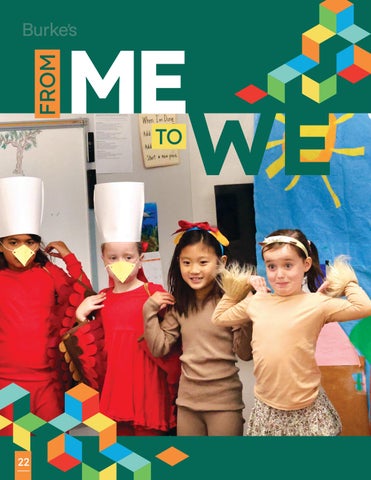
TO
22
BURKE’S
MAGAZINE
The Joyful Heart of Kindergarten Step into a Burke’s kindergarten classroom in September, and you’ll see small people, some a little shy, some brimming with energy, all just beginning to find their footing in a new world. Stay a while, and by spring, you’ll witness something wonderful. Those same children have become confident and connected, and proudly identify as “Burke’s kids.” This transformation is at the heart of the kindergarten experience, and it’s one that teachers Dynelle Chan
(Blue Group), Val Hansel (Red Group), and Zach Swan (Yellow Group) have been guiding for decades. Between them, they bring more than 60 years of experience into Burke’s classrooms. They’ve taught through expanding curricula, shifting spaces, and even a pandemic year that added a fourth “color group.” But what hasn’t changed is the deep partnership they share with each other and with their students.
KINDERGARTEN TEACHERS
Dynelle Chan
BLUE GROUP
Val Hansel
RED GROUP
Zach Swan YELLOW GROUP
Building a Community, One Morning at a Time Each day in kindergarten begins with a Morning Meeting where students greet one another, play a collaborative game, and settle into a shared rhythm. “There’s a sense of belonging,” the teachers explain. “Every child is seen, greeted, and part of something.” That sense of belonging expands steadily over the course of the year. The social studies curriculum is designed around a developmental arc: students begin by learning about themselves—their identities, interests, and families—and gradually widen their lens to include classmates and the school.
“It’s a ‘me to we’ journey,” the teachers say. “At this age, it’s natural for children to be focused on themselves. Our work is to help them look outward and to notice others, to build friendships, and to understand how they fit into a community.” Programs like Person of the Week and Family Readers reinforce this. Each week, students share pieces of their lives, ask questions, and practice listening closely to one another. Over time, a room full of new students becomes a close-knit group of friends.
FALL 2026
23
Learning Through Joy Our busy kindergarten classrooms reflect a carefully designed approach to learning. One that prioritizes joy, curiosity, and hands-on exploration. “So much of what we do is learning through play,” the teachers say. “They’re building math skills, literacy skills, and problem-solving skills—but often, they just feel like they’re playing.” A student devours books in the classroom library. Another works on sight words through a game.
24
Others collaborate on math challenges or dive into creative writing. Instruction is intentionally responsive: teachers observe closely, tailoring experiences to meet each child where they are. That individualized attention is made possible by small class sizes of 12-14 students with a lead teacher and associate teacher. The three classrooms operate as distinct communities, but they are closely aligned, meeting regularly, sharing ideas, and coming together for recess, lunch, and learning experiences.
BURKE’S
MAGAZINE
Small Voices, Big Ideas Kindergarteners at Burke’s are thinkers, creators, and even change-makers. In writing, students move from drawing and dictation to increasingly sophisticated forms of expression: poetry, narrative, nonfiction “how-to” pieces, and even persuasive letters. “They become these mini-activists,” Dynelle Chan noted.
students write about issues that matter to them. Sometimes it’s classroom concerns, like dried-out markers. Other times, it’s bigger: improving shared spaces, helping the environment, or convincing parents of something important (like getting a new puppy!). “They see that their ideas can make a difference,” the teachers say. “That their voices matter.”
Armed with a simple structure—identify a problem, suggest a solution, and communicate it clearly—
A Year of Remarkable Growth Ask any of the teachers what stands out most, and they return to the same idea: growth. “Kindergarten is a big milestone,” the teachers explain. “Children are learning to navigate school on their own, to solve problems, to be part of a group without a parent right there.” “The change from the beginning to the end of the year is incredible,” Val Hansel said. “They can come in as hesitant learners and they leave as confident, capable students.” They learn to read and write. They learn to share, collaborate, and communicate. They learn to see themselves as part of something larger. And perhaps most importantly, they learn to love school. That joy fuels everything. “Even on a tough day,” Zach Swan reflects, “their energy lifts you.”
FALL 2026
25