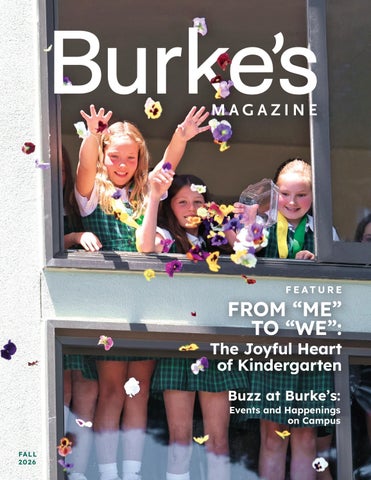
F E AT U R E
FROM “ME” TO “WE”:
The Joyful Heart of Kindergarten Buzz at Burke’s:
Events and Happenings on Campus
FALL 2026
Burke’s Magazine is produced by
BURKE’S ADVANCEMENT OFFICE YUKIKO MEADOWS Director of Advancement yukiko.meadows@burkes.org DIANA SCHNEIDER Director of Communications diana.schneider@burkes.org MIKAELA MARTINEZ Family Relations & Special Events Manager mikaela.martinez@burkes.org MELISSA STERLING Annual Giving & Alumnae Engagement Manager melissa.sterling@burkes.org JEWEL DEVORA ’09 Communications Assistant jewel.devora@burkes.org MONICA HERNANDEZ Advancement & Database Associate monica.hernandez@burkes.org LISA LAI Communications & Advancement Assistant lisa.lai@burkes.org
Designed by Bacio Design & Marketing, Inc.
OUR MISSION is to educate, encourage, and empower girls. Our school combines academic excellence with an appreciation for childhood so that students thrive as learners, develop a strong sense of self, contribute to community, and fulfill their potential, now and throughout life.
On the Cover Siblings of members of the Class of 2026 and Burke’s alumnae toss pansies at Pansy Day.
Table of
CONTENTS IN THIS ISSUE
Opening Shots................................................................2 Head of School...............................................................8 Greetings from Michele Williams Associate Head of School.........................................9 A Message from Alice Moore Letters from Academic Admin..............................10 Margot Zahner, Director of Lower School Sheena Tart-Zelvin, Director of Upper School Renita LiVolsi, Director of Diversity, Equity, Inclusion and Belonging Fran Yang, Director of Curriculum and Innovation 2026-27 Board of Trustees......................................12 New Members Buzz at Burke’s.............................................................14 Events and Happenings on Campus From “Me” to “We”: The Joyful Heart...............22 of Kindergarten Feature Story Pansy Day & Commencement..............................26 Greetings from the Alumnae Association.......28 A Message from Mira Hui Cheung ’95 Alumnae Events...........................................................30 Save the Dates Distinguished Alumnae Feature...........................31 Inspirations: Alumnae in Science........................32 Class Notes & In Memoriam.................................40 2025-26 Annual Giving Thank You......................44 Annual Fund and 8th Grade Class Endowment Donor Profiles...............................................................46 Ways to Give.................................................................IBC
OPENING SHOTS
FIRST GRADE
Music Sharing 2
BURKE’S
MAGAZINE
BURKE’S
MAGAZINE
First grade musicians showed off the instruments they built in Makery and gave family members a peek into the games and lessons they enjoy in the Lower School music classroom!
FALL 2026
3
SECOND GRADE
Tunnel Tops Second graders took a special field trip to the Tunnel Tops to explore nature as inspiration for their poetry unit, where they observed the sights, sounds, and details that bring nature writing to life. The visit also launched a social studies unit, “Women Who Make a Difference,” as the Tunnel Tops was handled by an all-women project management team.
4
BURKE’S
MAGAZINE
FALL 2026
5
“ We’re all in this together!” The Class of 2026 performance of Disney’s “High School Musical, Jr.” leaned into the sense of unity they shared as a class.
6
“
BURKE’S
MAGAZINE
For the past nine years, we have grown up together, learning how to navigate through life. We can confidently say that we are all grateful for everything Burke’s has taught us. One lesson we will never forget is to always embrace our authentic selves and celebrate each other’s individuality, despite our differences.
FALL 2026
”
7
Greetings
from the Head of School A M E S S AG E F RO M M IC H E L E W I L L I A M S
T
his past year, I had the opportunity to see Burke’s through a wider lens by serving on hiring committees, engaging with peer schools, and participating in national conversations about the future of education. What I have found is both affirming and energizing: Burke’s is increasingly recognized beyond our campus for the intentional way we integrate academic excellence with social-emotional learning. We continue to hear that our students are distinguished not only by their academic strength but also by the way they show up in the world of learning and in their relationships with peers. They are intellectually curious, socially aware, empathetic, and committed to being thoughtful friends, allies, and community members. In a complex world, that combination matters profoundly. This fall issue of Burke’s Magazine is one of two editions we will publish this year, giving us many more ways to celebrate and share the life of our school community. Within these pages, you’ll find letters from our Academic Admin team, highlights from end-of-year traditions and celebrations honoring the Class of 2026, and our Inspirations series featuring alumnae working in science. You won’t want to miss Buzz at Burke’s, which is filled with faculty and staff profiles and classroom projects, and make sure to take a peek into our kinder classrooms in “From ‘Me’ to ‘We’: The Joyful Heart of Kindergarten,” which captures where the Burke’s journey begins for our youngest students. As we look ahead to the upcoming year, I do so with gratitude for our community and with optimism for what we will continue to build together. Please see the list of opportunities for our alumnae to engage with Burke’s (p. 30), and I look forward to seeing many of you at the 2027 Alumnae Reunion Luncheon on Friday, March 5, at the St. Francis Yacht Club, honoring class years ’2s and ’7s. Thank you for your shared commitment to our mission as we continue to educate, encourage, and empower the next generation of curious, empathetic leaders. Sincerely,
MICHELE WILLIAMS Head of School
8
BURKE’S
MAGAZINE
Associate Head of School A M E S S AG E F RO M A L IC E M O O R E
O
ver the past two years, as Associate Head of School tasked with overseeing the academic program, I have been guided by this essential question:
H ow are we doing in delivering on our mission to educate, encourage, and empower girls, and how do we know?
In the spring of 2025, we conducted two separate, targeted surveys of our high school alumnae and their parents. The vast majority of parent respondents “strongly agreed” that their child was academically prepared for high school, both in terms of specific content knowledge and in meeting the rigorous logistical demands of high school work—such as time management, study skills, organization, and notetaking. As one parent articulated:
“She accomplished—and continues to build on— what the Burke’s mission advocates. Her self- and intellectual growth were accelerated in so many ways by her K-8 experience at the school. Her curiosity, interest in learning, academic skills, social skills, time management, empathy, and ability to develop bonds with teachers were all so supported at Burke’s.” Our high school-aged alumnae overwhelmingly agreed with this sentiment. They reported feeling exceptionally prepared for the demands of secondary education, specifically citing collaboration, self-advocacy, and communication as the top three vital skills and mindsets that Burke’s helped them develop. One alumna shared:
“I really appreciate so much that Burke’s taught girls how to advocate for themselves and be strong-willed.”
We also asked our high school alumnae to provide advice to current eighth graders to help them prepare for the transition. One freshman reflected:
“I think Burke’s prepared me for the transition into high school by teaching me an open mindset and being ready to try new things. I also felt extremely prepared academically.” These internal findings were validated in February of 2026, when Burke’s hosted an accreditation team from the California Association of Independent Schools (CAIS). The visit followed a lengthy, thoughtful, and rigorous institutional self-study. The accreditation team remarked:
“...the School’s holistic approach places students at the center of all decisions. Everything is crafted with the student experience at the forefront, from the curricular and co-curricular programs to collaboration across divisions, to the schedule. Students are met with a rigorous curriculum and are joyfully learning and engaged in all they do.”
Turning Feedback into Future Growth Ultimately, data is only valuable when it informs action. We are not gathering these insights simply to reflect on our successes, but to strengthen our program and guide our future direction. Moving forward, school leaders and faculty will use this feedback to ensure every student feels supported, known, and academically challenged. By understanding where students are thriving and where they need additional support, we can design learning experiences that build confidence, deepen engagement, and encourage intellectual growth.
FALL 2026 FALL 2026
9
Academic Admin
The Academic Admin Team, led by the Associate Head of School, shapes and advances Burke’s strategic vision for curriculum, teaching, and professional learning.
L
iteracy is the foundation for all learning. It shapes how students think, how they make meaning of the world, and how they express their ideas with clarity and confidence. At Burke’s, we care deeply about ensuring that every student has access to the strongest possible literacy instruction, grounded in research and informed by best practice. To that end, I am delighted to share an update on the work our K–4 teachers have spent the past 18 months doing to strengthen and refine our literacy program.
Margot Zahner, Ed.D
LOWER SCHOOL DIRECTOR
W
hen I ask students what they think I do all day, responses often include, “You are who we see when we’re in trouble,” and “You go to meetings.” Every once in a while, a student replies with, “You make sure students, teachers, and families have everything they need to learn and do their work and feel supported. You make schedules and meet with teachers about what they’re working on, and you say good morning to students each day.” It never fails to amaze me when a student can capture my job more eloquently than I can. That is exactly what I do, and I get to do it in a pretty special place.
10
We began by closely reviewing our current K–4 Language Arts curriculum, including its goals, standards, units of study, projects, and assessments. At the same time, faculty deepened their study of research-based literacy practices and brain-based learning strategies. This work was enriched
Everyone has their own favorite part of Burke’s: our mission, our traditions, our community. For me, it’s the everyday moments with students. I love greeting students each morning in the courtyard, coffee in hand. I love witnessing the daily transitions from class to class: fifth graders excited to go to their lockers, sixth graders trying to remember which materials they need for the next class, and seventh graders being ushered away from hairbrushes, makeup, and mirrors to get to class. I enjoy checking in with students during recess or lunch and meeting each week with Youth Voice to plan assemblies and projects. These moments are the highlights of my day and bring me back to my “why.”
through collaboration with consultant Ana Zamost, Director of Curriculum and Instruction at the Bay Area Teacher Training Institute, along with Fran Yang, Director of Curriculum and Innovation; Alice Moore, Associate Head of School; and me. We visited peer schools to learn about their work and compared what we saw in classrooms around the Bay to what we have identified as key to excellent literacy instruction at Burke’s. While foundational skills such as phonemic awareness, phonics, decoding, encoding, and word study have always been part of our program, this work has brought greater consistency across classrooms and grade levels. We look forward to the year ahead with great excitement as we continue to nurture every Burke’s student as a reader, writer, and critical thinker.
Sheena Tart-Zelvin
UPPER SCHOOL DIRECTOR As we begin a new school year, I am filled with excitement for all that awaits our Upper School students. Whether this is your child’s very first day in Upper School or their “last first day” as they begin eighth grade, the year ahead will be filled with opportunities to learn, lead, take risks, and discover new strengths.
BURKE’S
Renita LiVolsi
DIRECTOR OF DIVERSITY, EQUITY, INCLUSION AND BELONGING
O
n any given day at Burke’s, you will hear it before you see it: students greeting one another by name and with hugs, the easy confidence of children who know this is a place that holds them. That feeling does
O
ne of the most rewarding parts of my role is partnering with our Curriculum Council alongside the Associate Head of School. This long-standing Burke’s committee brings together faculty leaders and members of the Academic Administration Team to steward a cohesive and thoughtful K–8 student experience. As a lifelong educator, I deeply value the essential role teachers play in shaping the success of a school. Burke’s commitment to sustaining an inspiring faculty passionate about education is evident in many ways, and the Curriculum Council is one of the strongest examples. By bringing
MAGAZINE
not happen by accident. It is the quiet, deliberate work of belonging. The work I find myself thinking most about as I look toward the year ahead.
We will hold ourselves accountable, too, regularly examining our own practices so that access and opportunity reach every family who calls Burke’s home.
At Burke’s, we value diversity, equity, inclusion, and belonging not as a program to be completed but as a practice to be lived. Every child learns best when they feel seen, valued, and genuinely known, and so our work begins there, in the daily experiences of every Burke’s student, parent, and faculty member.
The reason this matters is demonstrated by students who raise their hands, ask hard questions, and extend kindness without being asked. As we step into the year ahead, our goals stay the same: to educate, encourage, and empower our students, parents, and faculty to be community members who know exactly who they are and who make room for others to do the same.
In the coming year, that commitment will deepen. In classrooms, teachers will design lessons that offer students both windows into other lives and mirrors of their own. Beyond academics, our affinity spaces, faculty professional development, and parent education will invite our community to connect across differences and to lead with empathy.
administrators and teachers together as partners in leadership, we ensure that the people closest to student learning help guide the future of our instructional program.
DIRECTOR OF CURRICULUM AND INNOVATION
Over the years, the Council has led important schoolwide initiatives, including implementing the Understanding by Design framework, developing our Professional Growth System, integrating Education for Sustainability standards, and mapping our K–8 curriculum to strengthen coherence and connection across grade levels.
curriculum mapping platform, which will support even greater collaboration, alignment, and visibility across our K–8 program. I am grateful for the dedication, expertise, and thoughtful leadership of our Curriculum Council members, whose work helps ensure that Burke’s students experience a rich, connected education every day.
Fran Yang
As we begin a new school year, I am particularly excited about implementing Toddle, our new
FALL 2026
11
2026-27
Board of Trustees
Like all other NAIS member independent schools and CAISaccredited independent schools, Burke’s is governed by an independent, self-perpetuating Board of Trustees. The Board determines Burke’s mission, strategic goals, and policy positions. The Board also acts as fiduciary for future generations of Burke’s students—exercising oversight of the school’s financial health, approving the school’s annual budget, and overseeing the school’s endowment, physical assets, and fundraising. Importantly, the board selects, evaluates, and supports the Head of School. The Board does not get involved in the dayto-day affairs of the school, disciplinary or personnel issues, or admissions decisions—which are the responsibility of the Head of School. In short, the trustees act as stewards of the school, while serving as ambassadors of Burke’s mission.
EXECUT IV E COM MIT TE E James Franzone President
Michael Neruda Treasurer
Stephanie Withers Vice President
Claudine Emeott At Large
Thayer Meicler Secretary
Nisba Husain At Large
John Wang At Large
T RUST EES Gil Barrett Michael Bascus Aneel Bhusri Christopher Corio Lauren Dillard Zoe Duskin ’97 Claudine Emeott Sasha Fahimi James Franzone
Darby Gaynor Glickman ’98 Max Boyer Glynn ’94 Nisba Husain Jen Jarrett Dawn Rosenberg Jha Kate Juergens Keith Lister Abraham Martinez
Thayer Meicler Liz Meyerdirk Michael Neruda Gabe Santos Jeremy Scherer Justine Van Buren Stephanie Withers John Wang Annabelle Wong
EX- O FFICIO MEMBE RS Michele Williams Head of School
12
Nic Marcheso President, Parents’ Association
Mira Hui Cheung ’95 President, Alumnae Board
ANEEL BHUSRI Aneel Bhusri is co-founder, CEO, and Chair of Workday. Aneel co-founded Workday with Dave Duffield in 2005 with a simple idea: build enterprise software that puts people at the center. Over the past two decades, he has helped guide the company from startup to one of the world’s leading enterprise AI platforms for managing people, money, and agents. Throughout Workday’s journey, Aneel has served in a range of leadership roles, including co-CEO from 2009 to 2014 with co-founder Dave Duffield, CEO from 2014 to 2020, co-CEO from 2020 to 2024, and executive chair from 2024 to 2026. He has been a member of its board of directors since its founding. For over 25 years, Aneel has been a product visionary and leader in enterprise software. Before Workday, he held several leadership roles at PeopleSoft, including vice chair of the board and senior vice president responsible for product strategy, business development, and marketing. In addition to his role at Workday, Aneel is a member of the board of trustees at Stanford University and serves on the boards of the Workday Foundation, Memorial Sloan Kettering Cancer Center, and Eat. Learn. Play. He has previously served on the boards of several public and private companies, including Cruise, General Motors, Intel, Okta, and Pure Storage. Aneel holds an MBA from Stanford University and a bachelor’s degree in electrical engineering and economics from Brown University. He is a Crown Fellow at the Aspen Institute.
NIC MARCHESO P.A. PRESIDENT
Nic Marcheso is a business development and strategic partnerships leader with more than 15 years of experience spanning the hospitality, consumer goods, and technology sectors. His career has taken him from early-stage startups to large-scale enterprise organizations, where he has built high-value partnerships, launched go-to-market strategies, and led cross-functional teams. Most recently, he has returned to Sysco, where he focuses on corporate account development across hospitality groups, third-party management companies, and the casino and gaming industry. He grew up in Westminster, CO and holds dual Bachelor of Science degrees in business administration from the University of Denver, with concentrations in hospitality management and international business. His passion for the culinary arts and deep roots in the hospitality industry have shaped both his professional approach and his appreciation for community-building. He also serves on the board of directors of Musical Theatre Works, a San Francisco-based performing arts organization. Nic has been an engaged member of the Burke’s Parents’ Association, serving on the Benefit Committee for four years and the Advancement Committee for three, before stepping into the role of P.A. Vice President for the last two years. Nic and his husband live in San Francisco with their daughter, a Burke’s student, and their son.
KEITH LISTERB U R K E ’ S M A G A Z I N E Keith Lister is the Chief Risk Officer at Northside Capital Management, an independent private wealth management firm. Prior to joining Northside, Keith spent 25 years in investment banking, specializing in equity capital raising. He spent 15 years at Stifel as Head of their Equity Syndicate Desk and 10 years at Thomas Weisel Partners in various roles on their Equity Syndicate Desk. Over his career, he primarily advised his firm’s technology, healthcare and consumer client’s IPO and follow-on transactions. He also maintained strong relationships with top U.S. and European Mutual and Hedge Fund investors. He was a member of both Stifel and Thomas Weisel Partners’ equity commitment committees. Keith recently served on the board of directors of the Belvedere Tennis Club as Treasurer and was a member of their finance, membership, and tennis committees. Keith moved to San Francisco after receiving a B.A. in history from Colgate University. He grew up in Connecticut and Portugal and graduated from Middlesex School (Concord, MA) and Eaglebrook School (Deerfield, MA), a single-sex middle school. In his spare time, he enjoys spending time with his family, playing tennis, golf, and coaching his kids’ soccer, hockey, and lacrosse teams. Keith lives in San Francisco with his wife, two children, and golden retriever.
KATE JUERGENS Kate Juergens is a seasoned independent school leader with nearly two decades of experience in strategic leadership, enrollment management, curriculum design, and faculty development. This year, she will step into the role of Interim Head of School at Cathedral School for Boys, continuing her commitment to mission-driven leadership and organizational sustainability. She most recently served as Chief Advancement Officer and Assistant Head of School where she led institutional strategy across enrollment, marketing, and community engagement in close partnership with the Directors of Communications and Development. Throughout her tenure at Cathedral, Kate has held multiple roles, including Kindergarten Teacher, Director of Enrollment Management, Director of Curriculum, and Director of Lower School. Beyond her school-based leadership, Kate has nonprofit board experience. She served as Board Chair of the Bay Area Teacher Training Institute (BATTI), where she guided the organization through a university partnership transition, strengthened governance practices, and led trustee recruitment and onboarding efforts. Kate holds a master’s in education from the University of the Pacific and earned her undergraduate degree from Bucknell University. She lives in San Francisco with her family. Her daughter is a proud graduate of Burke’s Class of 2022.
JUSTINE VAN BUREN Justine Van Buren is the Executive Vice President of Growth and Partnerships at MoneyGram, where she leads the company’s global go-to-market strategy and enterprise partnerships. Previously, Justine held senior leadership roles at Walmart across marketplace, finance, and omni-channel merchandising, helping to build and scale growth-oriented businesses that supported the company’s digital transformation. Justine is an active member of the Burke’s community, where she has served as Chair of the Burke’s Fall Festival and as an Annual Fund Ambassador. She is also deeply engaged in the San Francisco community, where she currently leads the Hearts and Hands Committee at SLS Preschool and has supported fundraising efforts for the San Francisco Symphony. Justine lives in San Francisco with her husband and three children. She holds an MBA from the Massachusetts Institute of Technology and a B.S. in finance from the University of California, Berkeley. FALL 2026
13
Keep up with all the happenings at Burke’s in real time on our social media accounts! facebook.com/katherine.delmar.burke.school instagram.com/burkesschool
YEARBOOK ASSEMBLY Each year, the entire school gathers for the big yearbook reveal and dedication! This past school year, the theme was board games and the dedication went to Upper School P.E. Teacher and 6th Grade Advisor, Ms. Underwood, and Secondary School Counselor, Ms. Dinapoli! The yearbook is the project of 13 students and two faculty advisors. Students form the editorial team and the art and photo teams.
14
BURKE’S
MAGAZINE
MAYPOLE The Maypole is a long-standing Burke’s tradition that begins with the graduating class delivering an oral history of the Maypole and explaining its significance to the school, before symbolically weaving green and gold ribbons into patterns around the pole in a dance. The origins of the Maypole can be traced back to ancient Germany and Rome, where it then spread throughout Europe. It regained popularity in the late 19th century and even took on a new symbolic meaning when May Day labor movements began to recognize workers. To symbolically support the movements, Burke’s began the Maypole dance in the 1940s at Golden Gate Park in celebration with other schools. It has remained a tradition at Burke’s ever since.
SUMMER READING FOR STAFF & FACULTY
One eighth grader reflected on the significance of the Maypole tradition, expressing, “The maypole symbolizes our life paths crossing and weaving, creating a beautiful design. As we move in and out, under and over, we are reminded of the journeys that we could never have walked alone. The ribbons represent our paths slowly uncrossing as we prepare for the next chapters of our lives. We will leave this circle today forever strengthened and changed by the weaving of our lives and time at Burke’s.”
Students aren’t the only ones with summer reading. This year’s faculty and staff reading connects directly to our ongoing work around wellbeing—a holistic, intentional practice that strengthens our ability to navigate challenges, deepen self-awareness, and foster a culture of connection and belonging where every member of our community can thrive. During Opening Meetings, faculty and staff engaged in book discussion groups and a series of wellbeing-focused “Burkeshops,” designed to share expertise, spark conversation, and inspire new ideas. Together, these experiences help us learn from one another and begin the school year with renewed purpose and connection.
FALL 2026
15 15
BURKE’S & BEYOND: Welcoming the Class of 2026 into the Alumnae Community As the Class of 2026 prepared to embark on the next chapter of their educational journey, Burke’s and Beyond offered an opportunity to look ahead while also strengthening their connection to the Burke’s community. This annual program brings a panel of recent Burke’s alumnae from a variety of high schools back to campus to speak with our eighth graders about the transition to high school. Through candid conversations and smallgroup discussions, students gained valuable insight into academics, extracurricular activities, friendships, and the many opportunities and challenges that await them. The event serves a dual purpose. While it helps prepare students for life beyond Burke’s, it also marks the beginning of their lifelong relationship with the Burke’s Alumnae Association. At the conclusion of the program, Alumnae Board President, Mira Hui Cheung ’95, read each student’s name and presented them with a certificate welcoming them into the Alumnae Association. It was a meaningful moment that underscored an important message: commencement
16
is not the end of a student’s connection to Burke’s—it is the beginning of a new chapter. As alumnae, these students join a remarkable network of women who support one another through mentorship, networking, friendship, and shared experiences. In the years ahead, they will be invited back to campus for alumnae events, volunteer opportunities, reunions, and celebrations that keep them connected to the school and to one another. Burke’s and Beyond reminds our graduating students that wherever they go next, they will always have a place within the Burke’s community.
BURKE’S MAGAZINE
PROFESSIONAL DEVELOPMENT | CIVIC ENGAGEMENT DAY Last April, Burke’s faculty spent a Civic Engagement Professional Development Day partnering with incredible local organizations across San Francisco including Project Open Hand, Alemany Farm, Family House, Hamilton Families, San Francisco Recreation and Park Department, SF Village, La Casa de las Madres, and Mission Action. More than a day of service, it was an opportunity to deepen our understanding of the organizations, strengthen partnerships, and imagine new ways to bring our students into this work.
6TH GRADE STUDENTS SHINE IN EXPLORAVISION COMPETITION Every year, Upper School Science Teacher, Rick Tuten, challenges the sixth grade class to enter the Toshiba ExploraVision national science competition, which invites students to envision and communicate new technology that could be developed 10 or more years in the future. Groups of two to four students submit proposals with a structured abstract; descriptions of history, breakthroughs, design processes, and positive and negative consequences; sample web pages; and a bibliography.
Congratulations to the sixth graders for rising to the challenge, and a special shoutout to the projects that received an honorable mention: AEROFLUSH: A toilet that replaces water entirely, using engineered microbes to transform waste into usable soil in minutes. This breakthrough system could revolutionize infrastructure in water-scarce regions and disaster zones worldwide. GEKO: An autonomous, self-repairing robot designed to hunt down and remove microplastics from ecosystems, working silently and efficiently without disrupting the natural world it protects. ROBOHAND: A bionic-neural/prosthetic interface that reconnects brain signals with physical motion, accelerating recovery and retraining muscle memory in groundbreaking ways. Other projects addressed hypnotherapy solutions for people who suffer from PTSD, capturing and eliminating space junk and orbital debris to protect satellites, detecting early signs of cancer, and more. FALL 2026
17
FACULTY PROFILES ASSISTANT TO THE UPPER SCHOOL DIRECTOR
Robyn Wilkinson As Assistant to the Upper School Director, Robyn Wilkinson sees and supports the magic in everyday interactions between students and faculty, both in and out of the classroom. In her second year, she looks forward to continuing to assist Upper School Director Sheena Tart-Zelvin and the rest of the Upper School faculty. The first year brought on natural challenges, such as learning the rotating and special schedules, but it also yielded rewarding moments for Robyn, like seeing the immediate impact on students when supporting Ms. Tart-Zelvin and other faculty. “If I can help lighten their load, they are able to have an even greater impact with the students.” Even at a young age, Robyn has always supported and helped others—which sometimes included farm animals. She grew up in a renovated barn in the countryside of Northern Virginia with her mother, an artist; her father, a journalist at the Washington Post; and her two younger sisters. She recalls, “My sisters and I would help feed our cows and pigs each morning, thanks to my father’s decidedly unglamorous farming interest.” A graduate of Colgate University with a bachelor’s in English and religion, Robyn then moved out west to work in advertising, helping open the U.S. branch of a London-based agency and working as a broadcast producer. In 2017, she made the transition to working in education; she most recently worked at Convent & Stuart Hall, first in high school admissions and later in advancement. Robyn was drawn to Burke’s for a variety of reasons. She moved into the Richmond District over two decades ago, and found herself impressed by Burke’s unique campus and proximity to nature. Burke’s
18
mission also resonated strongly with Robyn. “I value the small(er) school environment where every student is seen, heard, and known, and then individually empowered. And after years of hearing the laughter and happiness coming from campus, I wanted to experience the joy for myself!” She continues, “What sealed the deal for me was meeting the faculty, staff, and administration during my interview process. Their dedication to the school’s mission and their genuine commitment to the students’ intellectual and personal growth are very inspiring, and I knew I wanted to be part of that kind of community, contributing however and wherever needed.” As her first year at Burke’s came to a close, Robyn reflected, “My favorite part was watching students step up and own the spotlight, whether together or on their own, as they discovered their voices and realized their potential. It gives me so much hope for the future.” Outside of Burke’s, Robyn enjoys hiking or doing yoga, roaming the Clement Street Farmer’s Market, and taking Spanish lessons twice a week. She is happiest in Tahoe, back east surrounded by extended family, or on any kind of sailboat. Robyn has a daughter in college and a son in high school, as well as a dog named Rosie, who enjoys the low tides at Baker Beach.
BURKE’S MAGAZINE
UPPER SCHOOL MUSIC TEACHER
Christopher Borges When the Association for Music in International Schools (AMIS) invited Upper School Music Teacher Christopher Borges to Zimbabwe, he did not hesitate. For Mr. Borges, the opportunity was more than travel. It was a return to the international music community that has been an important part of his career. Before joining Burke’s, Mr. Borges taught in international schools in Brazil, Morocco, and Nepal, experiences that broadened both his musical philosophy and his understanding of how students connect through performance. The AMIS invitation involved traveling to Harare to conduct the middle- and high-school treble honor choir. The festival brought together students from international schools across Africa, including Harare International School, International School of Johannesburg, and International School of Kenya. Students arrived having prepared music independently, and Borges’ job was to bring the ensemble together over three intensive rehearsal days—refining technique, building confidence, and helping students transform separate voices into a cohesive performance. “It’s really about bringing the kids together,” he explained. “There’s no competition. The focus is connection.” That spirit came alive in the festival’s finale, a Zimbabwean song called “Vamudara,” performed alongside student marimba players using handmade Zimbabwean instruments. The piece evolved organically in the moment, with improvisation, movement, and layered rhythms guiding the performance forward. “That’s what I love about music from the people,” Borges said. “Music should involve everybody.” That philosophy, music as participation rather than observation, sits at the center of his work at Burke’s. “I don’t want them just sitting back and listening. I want them to be connected to how you make music.” Entering his third year in the Upper School, Borges teaches students in fifth through eighth grades, building
a program that balances technical skill, creative collaboration, and joyful performance. Fifth graders begin by learning healthy vocal production, music literacy, and foundational ensemble skills through preparation for the Winter Sing. By sixth grade, students deepen their vocal technique while preparing for Cabaret, where choreography, pop repertoire, and theatrical performance expand their confidence and artistry. In seventh and eighth grades, students perform regularly at assemblies and often help shape the repertoire itself. Borges surveys students about the music they love, then uses their selections to teach musical concepts ranging from harmony to bass lines to chord structure. “It doesn’t have to be classical music to learn something,” he said. “You can learn something from the Beatles. You can learn something from Bruno Mars.” For Borges, performance itself is an essential life skill and remains central throughout the program. Regular opportunities to sing in front of peers help students learn resilience, presence, and confidence. All skills that extend far beyond music classrooms and stages. What stands out most to Borges, though, is the joy students bring to the work. “I feel like the kids are really free to be themselves,” he said. “There does seem to be a sense of joy here.”
FALL 2026
19
ARTS FESTIVAL Q&A UPPER SCHOOL ART TEACHER
Erin Sears Q: What inspired the work featured by Upper Schoolers in this year’s Arts Festival? What themes or ideas were you hoping students would explore through the exhibition? A: I hoped students would explore themes of environmental stewardship, belonging, and interdependence. We asked how our community’s health is tied to the health of the trees, plants, animals, and insects that share this place. At the same time, these ideas were connected to art activism, inviting students to see their artworks as “calls to action” about issues they care about, such as climate change, pollution, access to green spaces, and creating safe, welcoming environments for all people. Q: How does teaching art at Burke’s shape your own creative practice, and what do you find most meaningful about guiding students as artists? A: Teaching art at Burke’s shapes my own creative practice by
20
constantly immersing me in the work of contemporary artists (especially Bay Area-based art activists) whom I introduce to students as living examples of how art and social change intersect. Researching these artists and sharing their stories in the classroom keeps me closely connected to my own art community and continually refreshes the ideas and techniques I use in my personal work. What I find most meaningful about guiding students as artists is watching them recognize that they share concerns with real working artists and can use visual language to speak about identity, justice, and the world around them. Helping students see themselves in contemporary art and then take their own exploratory steps in the Upper School Art Room makes the work feel deeply hopeful for me as a teaching artist. Q: Is there a moment, student experience, or aspect of this year’s show that especially captured the spirit of the Burke’s art program for you? A: One moment that especially captured the spirit of the Burke’s art program for me was the fifth and sixth graders’ “Migrating
Monarchs” sculptures. These pieces grew out of their study of Bay Area art activist Favianna Rodriguez, whose prints and paintings in her “Migration is Beautiful” series use the monarch butterfly to symbolize the beauty and dignity of human migration across borders. Students translated that idea into their own work by using the monarch’s journey as a metaphor for immigrants traveling to the United States, embossing metal butterflies whose wings carried stories of courage, displacement, and hope. During the Art Festival, their excitement at seeing these monarchs “migrate” along hallways, stairwells, and shared spaces made the whole Upper School campus feel like a living installation about movement, belonging, and human rights. This was exactly the blend of creativity, empathy, and art activism that defines Burke’s art program for me.
BURKE’S MAGAZINE
THIRD GRADE FLAG PROJECT What symbols tell the story of a place? Third graders explored the history and meaning of flags before turning their attention to San Francisco. Drawing inspiration from the city’s landmarks, neighborhoods, values, and natural beauty, students designed their own flags to represent what makes San Francisco unique.
FOURTH GRADERS ON THE ARTS FESTIVAL RUNWAY Fourth graders walked the runway wearing identity art featuring headbands that celebrated their personal strengths.
FALL 2026
21
TO
22
BURKE’S
MAGAZINE
The Joyful Heart of Kindergarten Step into a Burke’s kindergarten classroom in September, and you’ll see small people, some a little shy, some brimming with energy, all just beginning to find their footing in a new world. Stay a while, and by spring, you’ll witness something wonderful. Those same children have become confident and connected, and proudly identify as “Burke’s kids.” This transformation is at the heart of the kindergarten experience, and it’s one that teachers Dynelle Chan
(Blue Group), Val Hansel (Red Group), and Zach Swan (Yellow Group) have been guiding for decades. Between them, they bring more than 60 years of experience into Burke’s classrooms. They’ve taught through expanding curricula, shifting spaces, and even a pandemic year that added a fourth “color group.” But what hasn’t changed is the deep partnership they share with each other and with their students.
KINDERGARTEN TEACHERS
Dynelle Chan
BLUE GROUP
Val Hansel
RED GROUP
Zach Swan YELLOW GROUP
Building a Community, One Morning at a Time Each day in kindergarten begins with a Morning Meeting where students greet one another, play a collaborative game, and settle into a shared rhythm. “There’s a sense of belonging,” the teachers explain. “Every child is seen, greeted, and part of something.” That sense of belonging expands steadily over the course of the year. The social studies curriculum is designed around a developmental arc: students begin by learning about themselves—their identities, interests, and families—and gradually widen their lens to include classmates and the school.
“It’s a ‘me to we’ journey,” the teachers say. “At this age, it’s natural for children to be focused on themselves. Our work is to help them look outward and to notice others, to build friendships, and to understand how they fit into a community.” Programs like Person of the Week and Family Readers reinforce this. Each week, students share pieces of their lives, ask questions, and practice listening closely to one another. Over time, a room full of new students becomes a close-knit group of friends.
FALL 2026
23
Learning Through Joy Our busy kindergarten classrooms reflect a carefully designed approach to learning. One that prioritizes joy, curiosity, and hands-on exploration. “So much of what we do is learning through play,” the teachers say. “They’re building math skills, literacy skills, and problem-solving skills—but often, they just feel like they’re playing.” A student devours books in the classroom library. Another works on sight words through a game.
24
Others collaborate on math challenges or dive into creative writing. Instruction is intentionally responsive: teachers observe closely, tailoring experiences to meet each child where they are. That individualized attention is made possible by small class sizes of 12-14 students with a lead teacher and associate teacher. The three classrooms operate as distinct communities, but they are closely aligned, meeting regularly, sharing ideas, and coming together for recess, lunch, and learning experiences.
BURKE’S
MAGAZINE
Small Voices, Big Ideas Kindergarteners at Burke’s are thinkers, creators, and even change-makers. In writing, students move from drawing and dictation to increasingly sophisticated forms of expression: poetry, narrative, nonfiction “how-to” pieces, and even persuasive letters. “They become these mini-activists,” Dynelle Chan noted.
students write about issues that matter to them. Sometimes it’s classroom concerns, like dried-out markers. Other times, it’s bigger: improving shared spaces, helping the environment, or convincing parents of something important (like getting a new puppy!). “They see that their ideas can make a difference,” the teachers say. “That their voices matter.”
Armed with a simple structure—identify a problem, suggest a solution, and communicate it clearly—
A Year of Remarkable Growth Ask any of the teachers what stands out most, and they return to the same idea: growth. “Kindergarten is a big milestone,” the teachers explain. “Children are learning to navigate school on their own, to solve problems, to be part of a group without a parent right there.” “The change from the beginning to the end of the year is incredible,” Val Hansel said. “They can come in as hesitant learners and they leave as confident, capable students.” They learn to read and write. They learn to share, collaborate, and communicate. They learn to see themselves as part of something larger. And perhaps most importantly, they learn to love school. That joy fuels everything. “Even on a tough day,” Zach Swan reflects, “their energy lifts you.”
FALL 2026
25
2026
PANSY DAY
Wednesday, June 3 marked our annual Pansy Day, a day to celebrate the outgoing eighth graders and welcome our rising fifth graders into the Upper School!
CONGRATULATIONS TO THE 2026 PANSY DAY AWARD WINNERS May Hickey Award
By vote of the class, for care and concern for the younger students in the school. Alexandra Karthauser
Patricia Franklin Swanson Writing Award
To honor a girl who, as Pat did, shows not only talent in writing but also a love of writing. Poppy Clark and Ferrara Denton
Sarah Babcock Award
26
Established in 1992 in honor of Sarah, this award commemorates Sarah’s spirit and her love of photography and the arts. Visual Arts - Amelie Gutierrez Performing Arts - Cody Marie Chisholm
Julie Song Award Established in 1998, this award recognizes the eighth grader whose kindness, good humor and generosity of spirit makes every day a better one for all around her. Poppy Clark and Jayla Isabelle Duty Head’s Award For generosity of spirit, appreciation of others, and strength of leadership. Alexandra Karthauser and Millie Withers
The Head’s Cup For seriousness of purpose, devotion to excellence, and citizenship which best exemplifies the ideals and purposes of the school. Charlotte Harden
BURKE’S
MAGAZINE
COMMENCEMENT 2026 We bade a fond farewell to the
members of the Class of 2026 on
Thursday, June 4, with joy, music,
and cheers. We wish them the best of luck in high school and beyond!
CLASS OF 2026 HIGH SCHOOL DESTINATIONS Albany High School Bay School Branson School Cate School Choate School Convent of the Sacred Heart EJM-Paris IMG Academy International School of San Francisco Lick-Wilmerding High School Madeira School Marin Academy
The Nueva School Phillips Exeter Academy Sacred Heart Cathedral Preparatory Saint Ignatius College Preparatory School St. Paul’s School Stevenson School Taft School Tamalpais High School San Francisco University High School Urban School of San Francisco Waldorf High School
CLASS OF 2022 COLLEGE DESTINATIONS
Congratulations also to the members of Burke’s Class of 2022 who just
completed four years of high school! A list of some of their college destinations is included here.
Barnard College Boston College Cal Poly San Luis Obispo Cornell University Elon University Georgetown University Loyola Marymount University
Marquette University Massachusetts Institute of Technology New York University Northeastern University Princeton University San Francisco State University Stanford University
Tulane University University of California, Berkeley University of California, Davis University of California, Los Angeles University of California, Santa Barbara University of Chicago University of Maryland University of Michigan University of Pennsylvania University of Richmond University of Southern California University of Texas, Austin University of Virginia Vanderbilt University Wellesley College FALL FALL 2026 2026
27
ALUMNAE BOARD
CONNECTING AND ENGAGING BURKE’S ALUMNAE WORLDWIDE The Burke’s Alumnae Board is a dynamic group of alumnae dedicated to strengthening connections between Katherine Delmar Burke School and its vibrant alumnae community. Through meaningful engagement, the board fosters lifelong ties, celebrates shared experiences, and champions the continued growth and success of Burke’s. Serving as ambassadors for Burke’s, board members help nurture alumnae relationships and inspire support for the school’s mission and future. The group meets on campus four times a year and actively engages with the broader alumnae network throughout the year—sharing updates, gathering feedback, and building community. Board members are also active participants in alumnaesponsored events like Burke’s Festival, the Holiday Cookie Decorating Party, the Alumnae Reunion Luncheon, and more!
2026-27 EXECUTIVE COMMITTEE
Mira Hui Cheung ’95
Natalie Jamison Jewel Devora ’09 Tiret ’98 Vice President, Vice President, Development
Diversity, Equity, Inclusion, and Belonging
Vice President, Events
Natalie J. Engmann ’01
Sara Poole ’10
Darby Gaynor Glickman ’98
Talia Seidman Rhodes ’03
President
Vice President, Governance
Vice President, Mentorship
At-Large
Sinclaire O’Grady ’09
Secretary
MEMBERS
If you’re interested in joining the Alumnae Board for the 2026-27 year or want to learn more, please reach out to: Melissa Sterling at melissa.sterling@burkes.org
Alexandra Bryan ’12
Olivia Cannell ’11
Jenna Friedel Collins ’12
Lisa Harada ’03
Tiffany Miller ’08
Tiana RideoutRosales ’97
Xandrine Griffin ’11
Katya Yudin ’08
We’d love to hear from you!
CLASS REPRESENTATIVES
Building Connections Across Generations Class Representatives are vital alumnae volunteers who help strengthen the bonds between classmates and Burke’s, as well as among fellow alumnae. Ideally, each graduating class has at least one Class Representative who serves as a liaison—sharing news about alumnae and school programs, encouraging support for the Burke’s Annual Fund, and gathering updates and contact information for our annual Class Notes.
NEW MEMBERS FOR 2026-27
Not sure who your Class Representative is? Thinking about getting involved? We’d love to have you on board!
28
Reach out to Melissa Sterling, Annual Fund & Alumnae Engagement Manager, at melissa.sterling@burkes.org to learn more.
Courtney Cooper ’99
Stephanie Soderborg ’01
Sammy Lee ’08
Marissa Fong ’12
Alumnae UPDATES
BURKE’S
MAGAZINE
A MESSAGE FROM MIRA HUI CHEUNG ’95 President, Alumnae Board
With the start of a new school year comes renewed energy across campus, and I’m excited to share what lies ahead for the Burke’s alumnae community. Like many of our families, my own is preparing for a new school year— my daughter is entering third grade, and I’m reminded how quickly these years pass and how special it is to remain connected to the Burke’s community long after graduation. The Alumnae Board has chosen engagement as our theme for the year. We want every alumna to know there are meaningful, enjoyable, and accessible ways to stay connected to Burke’s—whether you graduated five years ago, fifty years ago, or more. I am delighted to welcome four new members to the Alumnae Board this year (see page 28). Their enthusiasm, ideas, and commitment to Burke’s will help us continue strengthening connections among alumnae and between alumnae and the school. To help you plan your year, we have created a full calendar of opportunities to engage with Burke’s. One of our first gatherings will be Festival on October 24, where the
Alumnae Association will have a strong presence, including our own booth and activities. It is always a joyful day to reconnect with classmates, teachers, and friends while experiencing the energy of today’s Burke’s students. We will also continue several favorite traditions, including our Holiday Cookie Decorating Party, the Four-School Alumni Cocktail Gathering, and, of course, the highlight of our alumnae calendar—the Reunion Luncheon on March 5, 2027. Reunion remains our signature event and a wonderful opportunity to celebrate milestones, reconnect with old friends, and welcome beloved teachers to join us. This year, we are also introducing two new opportunities to engage with the school community. Alumnae are invited to join us for the Spring Arts Festival, showcasing the creativity and talent of Burke’s students, and for the Burke’s Dash, a fun and spirited community fun run that we hope will become a new tradition for alumnae. Whether you attend one event or many, volunteer, share your talents with students, submit your news, or simply stop by campus, your participation helps keep our alumnae community vibrant and connected. Burke’s has always been about relationships, and those connections remain one of the school’s greatest strengths.
Congratulations to our 2027 Distinguished Alumna
I hope to see many of you throughout the year. Until then, I wish you a wonderful fall and look forward to reconnecting with you at Burke’s.
Carrie R. Muh ’88, MD, MS, MHSc, FAANS, FCNS
Warmly,
Dr. Muh serves as Division Chief of Pediatric Neurosurgery and Surgical Director of the Pediatric Epilepsy Program at Maria Fareri Children’s Hospital and Westchester Medical Center. She is also a Professor of Neurosurgery and Pediatrics at New York Medical College. Her extraordinary career, leadership, and dedication to improving the lives of children exemplify the values of a Burke’s education. Dr. Muh will be honored at the 2027 Alumnae Reunion Luncheon on March 5, where she will also serve as our featured speaker. This year, we are especially honoring the Classes of ’2s and ’7s, but all alumnae are welcome to attend!
Mira Hui Cheung ’95 President, Alumnae Board
P.S. We’d love to hear what you’ve been up to. Your milestones and adventures help bring our alumnae community to life—please don’t hesitate to share your news and updates with us. Reach out to melissa.sterling@burkes.org. FALL 2026
29
Save THE Dates MORE WAYS TO RECONNECT
WITH BURKE’S THIS YEAR
Alumnae Reunion Luncheon 2027
Four School Alumni Happy Hour
St. Francis Yacht Club 700 Marina Blvd., San Francisco 11 a.m.-1 p.m.
Bar Darling 2263 Chestnut St., San Francisco 6-8 p.m.
FRIDAY, MARCH 5, 2027
The alumnae event of the year is back! Join us to reconnect, reminisce, and celebrate the friendships and memories that make Burke’s so special—all at a beautiful new venue. This year, we are especially honoring the Classes of ’2s and ’7s, and everyone is welcome to attend and take part in this special celebration.
Fall Festival
SATURDAY, OCTOBER 24, 2026 10 a.m.-3 p.m.
Festival is one of Burke’s most beloved traditions— and a favorite among our high school-aged alumnae!
Alumnae Holiday Cookie Decorating
THURSDAY, DECEMBER 3, 2026 3:30-5:30 p.m.
WEDNESDAY, JANUARY 20, 2027
This multi-school Happy Hour is always a hit! Save the date and join alumni from Burke’s, Town, Hamlin, and Cathedral.
DASH
APRIL 2027 8:30-11 a.m.
New this year, alumnae are invited to join us for DASH, Burke’s fun run! We will send more information out in January!
Arts Festival
THURSDAY, MAY 6, 2027 5-7 p.m.
We invite alumnae to return to Burke’s for a special campus tour and experience the campus transformed by a vibrant showcase of student artwork.
Join us for one of Burke’s sweetest traditions—our annual holiday cookie-decorating event. Alumnae and their family members are warmly welcome!
30
We hope to see you this year! For questions about alumnae programs and events, please contact Melissa Sterling, melissa.sterling@burkes.org.
BURKE’S
Distinguished Alumnae
MAGAZINE
The bios of many of our Distinguished Alumnae are available online! Each recipient exemplifies a life of learning, service to community, individuality, and the ability to make a difference in the world. In this feature, two alumnae making recent contributions to science and health are highlighted in orange: Robin Hauser ’78e, whose new documentary Thaw explores the rising trend of elective egg freezing, and Shafia Zaloom ’85, author of Getting Real About Sex Ed: What Today’s Students Need.
SCIENCE
SHAFIA ZALOOM ’85 Health Educator, Consultant and Author
SCIENCE
ROBIN HAUSER ’78e
Documentary Filmmaker, TED Speaker, and Journalist
FALL 2026
31
INSPIRATIONS Q&A WITH ALUMNAE WHO ARE WORKING IN SCIENCE
Sharon J. Sha ’90, MD, MS Dr. Sharon Sha is a Clinical Professor of Neurology and Neurological Sciences at Stanford University where she serves as Chief for the Memory Disorders Division and the Stanford Memory Disorders Center, Associate Vice Chair of Clinical Research, Director of the Huntington’s Disease Center of Excellence and Ataxia Clinic, Co-Director of the Lewy Body Disease Association Research Center of Excellence, and Clinical Core Co-Leader of the Stanford Alzheimer’s Disease Research Center. Her clinical time is devoted to caring for patients with Alzheimer’s disease and other neurodegenerative disorders and her research is devoted to finding treatments for these cognitive disorders. She also served on the California Governor’s Alzheimer’s Prevention and Preparedness Task Force chaired by Maria Shriver in 2020. She has been featured in international media and documentaries such as the BBC’s “How to Stay Young” and the docuseries “Limitless with Chris Hemsworth.” More information about her work is available on her lab website: https://med.stanford.edu/sha-lab.html. Can you share a specific experience or teacher at Burke’s who inspired you to pursue a career or passion in science? There was a science teacher at Burke’s, Mr. Cohen, who made science interesting. I recall looking in petri dishes of planaria and learning about their biology. When starting graduate school and medical school at Georgetown and seeing the Washington Monument in person, I remember thinking it looked a lot like planaria. Science was interesting and made sense to me! What advice would you give to current Burke’s students who are considering a path in science or related fields? In a male-dominated world of science, women can sometimes be overlooked.
32
Persevere and stay true to your passion. Believe in yourself, even when the room doesn’t make space for you. The world needs more women in medicine and science, particularly in leadership positions. How do you incorporate the principles of leadership and empowerment learned at Burke’s into your scientific or professional work? Learning in an environment of all girls gave me confidence that carried me throughout every professional setting I entered afterward. Leadership is not always about speaking the loudest or even being the best. To me, it is about relationships and serving the greater mission with a team.
Do you have any anecdotes about your time at Burke’s related to science that you’d like to share? When compared to educational environments after Burke’s, I now know that I had a sense of intellectual safety that was something I didn’t fully appreciate until I entered spaces where women weren’t always given that same grace. Burke’s gave me a foundation of curiosity and courage I carried with me through everything that followed.
BURKE’S
MAGAZINE
Lily Bowles Leo ’99 Lifelong science enthusiast Lily Bowles Leo tells stories that make science shine. Since 2013, she’s owned Corpus Callosum Consulting, LLC and writes and consults on a variety of projects grounded in behavioral neuroscience. She studied under Richard F. Thompson at USC as an undergrad and specializes in adult hippocampal neurogenesis. She holds a Master of Science degree in behavioral and systems neuroscience from Rutgers, and a Master of Arts in science writing from Johns Hopkins. Like the corpus callosum in the brain, her work integrates hemispheres by making complex and esoteric scientific concepts easily understood by those in non-scientific settings. She fundamentally believes that science is inherently interesting, important, and exciting. Recently, her work has centered on neural implants and the therapeutic benefits of psychedelics and their effects on neurogenesis and brain rhythms. She’s a sixth-generation San Franciscan (and a third-generation Burke’s alumna), and when she’s not with her kids or writing about the brain, she’s watching live music or eating dim sum. Can you share a specific experience or teacher at Burke’s who inspired you to pursue a career or passion in science? Also, do you have any anecdotes about your time at Burke’s related to science that you’d like to share? I fell in love with the brain at age seven on a first grade Burke’s field trip to the Exploratorium. A couple of minutes at the cow brain dissection exhibit, and I was hooked. I came home that night and told my parents I was going to be a brain surgeon. I went on to study neuroscience and psychology as an undergraduate at USC and got my master’s in behavioral and systems neuroscience from Rutgers, studying adult hippocampal neurogenesis. Ultimately, I decided lab work wasn’t for me and decided that I’d rather explain neuroscience to a lay audience. I am passionate about the brain and like to get other people excited about it, too. Thus, in 2013, I founded Corpus Callosum Consulting, LLC. Like the brain structure it is named after, my company integrates the hemispheres of science and non-science worlds. I specialize in neural plasticity and in making complex neuroscience engaging and intuitive. I’ve also recently done some work evaluating neural implants and around psychedelics and their therapeutic effects. I earned my second master’s from Johns Hopkins University in science writing in 2023, where I further developed my skills as a writer, editor, and communicator. I credit much of my love of learning and school to my wonderful, robust first learning experience at
Burke’s. I love what I do, the flexibility is perfect for a single mom of young kids, and I’m never bored. It’s also fun that I can trace it all back to that one fateful day as a Burke’s girl. I now take my kids to the Exploratorium, and while the dissection exhibit is no more, it’s a joy to see their love of science and curiosity grow. I am thrilled that since my time at Burkes, the science facilities have expanded and grown; my kindergartener is already itching to have classes in that beautiful lab building. What advice would you give to current Burke’s students who are considering a path in science or related fields? I would say to follow your curiosity and your passion and find someone whose work you admire. Find a subject you think you’ll never get sick of and dig in deeper. Get a summer internship as early as possible. The more places you experience, the better idea you’ll have of what you want to do with your career. I knew early that I wanted to work with the brain, but one summer with the Forbes/Norris ALS center, and I knew I wouldn’t be able to work with humans with terminal illnesses. I did more internships in high school, and then as soon as I was in college, I found a well-respected lab run by the first scientist to map classical conditioning in the brain and I was in awe of his work. They were doing amazing research and I asked if there was any way I could help out after class. You start with the undergrad grunt work for current grad students, and then slowly you become proficient in lab skills that make you a good candidate for your own graduate work. Also, look for a graduate school
with Teaching Assistants. Learning to teach effectively is an invaluable skill that ultimately led me to become a science communicator. I never would have discovered that if I hadn’t taught college classes. How do you incorporate the principles of leadership and empowerment learned at Burke’s into your scientific or professional work? It’s not easy to be a woman in a traditionally male-dominated field. My first grad school hadn’t built any women’s bathrooms in the neuroscience building. The sexism was not only institutional, socio-cultural, and academic; it was architectural! But I worked in a lab for a woman who was a pioneer in studying the underexplored female brain, and I found my place. I’ll never forget a speech she gave, in which she said she was sick of being asked to justify using female animals in her experiments and that all the other researchers should have to explain why they weren’t. The tide is slowly turning, but for most of history, the female brain was considered too volatile and complex to reliably study due to the effects of rapidly cycling hormonal fluctuations. I think the reason female brains weren’t studied is that they weren’t historically valued as much as male brains were. That’s always made me angry, and I think a deep-rooted sense of empowerment I developed at Burke’s helped me see it for what it was. FALL 2026
33
Natalie Engmann ’01 Natalie Engmann is the Head of Global Health Economics and Outcomes Research at Denali Therapeutics, where she leads a team responsible for selecting and developing the clinical outcomes used in trials to determine efficacy, as well as generating evidence to support the clinical and economic value of Denali’s products. Prior to joining Denali, she was a health economist at Genentech, supporting the neurology and rare disease pipeline, including the launch of two rare disease products. Natalie brings nearly 20 years of health outcomes research experience across industry and academia, with expertise spanning oncology, neuroscience, and rare disease. She holds a Ph.D. in epidemiology from UCSF and an M.S. from the London School of Hygiene and Tropical Medicine.
Can you share a specific experience or teacher at Burke’s who inspired you to pursue a career or passion in science? I still remember taking science classes with Susan Deemer, my Upper School science teacher. It was impactful to learn from a young, female teacher who was so confident and passionate about teaching science. She brought an energy to the classroom that made learning feel engaging and exciting, and she made science approachable without diminishing its rigor. What advice would you give to current Burke’s students who are considering a path in science or related fields? One of the most important lessons I would share with current Burke’s students is that science is an incredibly broad and diverse field. There is no single path into science, and success in the field does not look the same for everyone. From a young age, I knew I was interested in health and medicine, but I did not think I wanted to be a doctor or nurse. For a long time, I did not realize there were other ways to contribute meaningfully to healthcare and science. It was not until college
34
that I discovered public health and epidemiology, and I immediately fell in love with the field. My advice to students would be: if you are drawn to a discipline but the most obvious career paths do not feel like the right fit, keep exploring. Talk to people in different roles, ask questions, and stay openminded. The career path that best fits your interests might be one you didn’t initially know existed. How do you incorporate the principles of leadership and empowerment learned at Burke’s into your scientific or professional work? In my work developing medicines for rare and neurodegenerative diseases, leadership often means moving forward without a clear roadmap. Many of the conditions we work on have no established standard of care, and in some cases we are designing clinical trials or approaches that have never been attempted before. There is no playbook to follow and no obvious example to copy. That kind of work requires creativity, resilience, and the confidence to make thoughtful decisions amid uncertainty. It also requires accepting that innovation comes with the possibility of failure. The principles of leadership
and empowerment I learned at Burke’s—being willing to speak up, think independently, and trust your preparation—continue to shape how I approach those challenges today. Even when the work feels difficult or uncertain, we keep pushing forward because patients and families are waiting for options. Do you have any anecdotes about your time at Burke’s related to science that you’d like to share? One of my favorite science memories at Burke’s was the first day Ms. Deemer taught us how to use bunsen burners. I still remember feeling excited by the sense that we were doing “real” science for the first time and the focus and care required to complete the experiment safely. This taught me that science can be both rigorous and fun, a truth I find in my own work today.
BURKE’S
MAGAZINE
Cameron Baker ’03 Since completing her Ph.D. in molecular and cell biology at UC Berkeley in 2018, Cameron Baker has worked in biotech and pharma in the San Francisco Bay Area. Her doctoral work was conducted in John Flannery’s lab, developing gene therapies for blindness caused by retinal degeneration. The lab engineered a novel adeno-associated virus (AAV) capsid designed to improve gene delivery to the retina through a minimally invasive route, work that ultimately had real world impact. That capsid was later licensed to Adverum Biotechnologies where Cameron subsequently joined as a researcher. It is now part of a promising wet macular degeneration drug that is currently in Phase III trials. At Adverum, Cameron led an optogenetic vision restoration program aimed at restoring sight to people blinded by photoreceptor cell loss. That work has been recognized with a grant of over $1 million from the California Institute for Regenerative Medicine (CIRM). Late last year, Eli Lilly and Company acquired Adverum, and Cameron joined Lilly as part of that transition. She is excited to work in a large pharmaceutical company with a broad portfolio of innovative programs. Throughout her career, her goal has been the same, to turn scientific discovery into treatments that meaningfully improve patients’ lives. Can you share a specific experience or teacher at Burke’s who inspired you to pursue a career or passion in science? The teacher who stands out the most is Ms. Deemer. She was one of my first very cool science teachers, which was a big deal for me at the time. Many people do not think science is cool, but it was cool in Ms. Deemer’s classroom and it was cool for me moving forward. She was enthusiastic and relatable, which made dry and clinical subjects feel more approachable. She was also extremely thoughtful and personable. I remember she went to great lengths to make us feel safe and comfortable when discussing more sensitive subjects like reproductive health. She made it cool to care about science, which is honestly one of the most valuable things a teacher can do. What advice would you give to current Burke’s students who are considering a path in science or related fields? This is far in the future for many current Burke’s students, but I wish more people would consider a Ph.D. program in STEM after college. Unlike a M.D., J.D., or MBA, students pursuing a Ph.D. in a STEM field actually receive a stipend, and depending on the university,
medical and dental benefits. While the stipend is often comparable to minimum wage and likely less than what you would make if you got a job right out of college, you’re still not paying or going into debt for a postgraduate degree that opens the door to many new (and often lucrative) careers that one cannot have without an advanced degree. Not to mention that I met some of my best friends in grad school. It can be quite the slog—six and a half years for me— but I learned a lot and made invaluable connections that have greatly served my career. How do you incorporate the principles of leadership and empowerment learned at Burke’s into your scientific or professional work? One of the most meaningful gifts Burke’s gave me was the complete ignorance of the myth that girls aren’t good at math and science. I genuinely did not encounter that idea until I was taking AP psychology in high school. We were learning about perceived gender bias in academic performance and I was flabbergasted. Not only had I never heard that myth before and thought it sounded ridiculous, but I was also astonished that other people had somehow heard it and, even worse, believed it. Growing up at Burke’s, I was surrounded by girls who were
curious, capable, and competitive in math and science. I had internalized the opposite: that girls are great at math and science because my friends at Burke’s were. This foundation has stayed with me throughout my career. Now I am better able to recognize implicit bias, and I have a reference point that says it doesn’t have to be this way. I bring this with me when I mentor and build teams. Do you have any anecdotes about your time at Burke’s related to science that you’d like to share? One thing I remember clearly from around fifth or sixth grade is our science teacher told us we would learn more vocabulary words in our science class than our foreign language classes. I did not believe her bold claim, but now I know she was completely right. That observation has stuck with me because it captures something true about science that many people don’t always appreciate; before you can even begin to think about a concept, you have to learn the language it lives in. Biology especially is a field where terminology is dense and specific, and fluency in that vocabulary is the price of admission to that conversation. After many years of study, I’m happy to have a seat at the table to discuss real problems that affect people, like blindness, and develop real solutions. FALL 2026
35
Sinclaire O’Grady ’09 Dr. Sinclaire O’Grady completed her undergraduate studies at New York University and completed her M.A. and Ph.D. at the University of California, Berkeley, where her research focused on the development of difficulties with emotion regulation and suicide in females. She has authored over 10 research articles in leading academic journals, presented her research at numerous national academic conferences, and received several awards for her research. Sinclaire completed her American Psychological Association accredited internship at the University of California, San Francisco (UCSF)/Zuckerberg San Francisco General Hospital’s Multicultural Clinical Training Program, with a specialty in adolescent mental health and eating disorders. She is currently completing her postdoctoral fellowship specializing in the treatment of and research on adolescent suicidality and eating disorders at UCSF. Sinclaire has worked with children, adolescents, and adults using evidence-based treatments in outpatient, inpatient, and community mental health settings. Her clinical interests and training focus on providing and improving culturally responsive and trauma-informed evidence-based treatments for high-risk youth and their families. Her research interests focus on investigating developmental pathways to selfharmful behaviors, as well as the dissemination and implementation of evidence-based mental healthcare for high-acuity youth from medically and economically disadvantaged populations. After the completion of her postdoctoral fellowship, she hopes to become a faculty member at an academic medical center.
36
Can you share a specific experience or teacher at Burke’s who inspired you to pursue a career or passion in science?
What advice would you give to current Burke’s students who are considering a path in science or related fields?
I am lucky to have had so many fantastic teachers and experiences at Burke’s that lead me to pursue my career in science. I have fond memories ranging from dissecting a cow heart in fifth grade with Ms. Monk to learn about biology, dropping eggs from the Upper School balcony with Ms. Deemer to study physics, and sketching the science class tarantula sometime in early Lower School. Burke’s fostered a love of curiosity, exploration, discovery, challenge, and inquiry. I also attribute my learning from pursuing long-term research projects, such as the Cultural Heritage Project in seventh grade, as critical to developing my critical thinking, data collection and synthesis, and writing skills. Finally, my superb math teachers (Ms. Cooper and Ms. Wong) helped me learn that girls can be leaders in math and how math can be used to answer questions I have about the world. Together, these experiences helped foster my love for asking questions, challenging assumptions, and helping advance knowledge to improve human wellbeing.
Pursuing a career and having a passion for science can take so many different forms. When at Burke’s, I thought that becoming a scientist meant that I would perform experiments with different chemicals in beakers in a white lab coat. I never would have imagined how I pursue science now through research, teaching, and as a clinician in the field of clinical psychology. Being involved in science can look so diverse: from being in a laboratory conducting experiments to testing the mechanisms behind new treatments for mental health concerns. I’d recommend exploring topics and taking classes that invoke curiosity, getting involved in research labs, go to teachers’ office hours, always asking questions, and continuing to foster a lifelong love of learning. How do you incorporate the principles of leadership and empowerment learned at Burke’s into your scientific or professional work? Throughout my professional work with youth and their families, I strive to help families approach difficult challenges
in life with curiosity, building bravery, taking risks, and increasing respect for themselves and others. One of my favorite evidence-based treatments that I provide, Dialectical Behavior Therapy (DBT), emphasizes authenticity, humility, and empowering people to reach their goals, which I believe echo the principles that I learned at Burke’s and aim to continue to foster today, especially in girls and women. Do you have any anecdotes about your time at Burke’s related to science that you’d like to share? I have so many fond memories of the hands-on science learning experiences at Burke’s: learning about red tail hawks in kindergarten and then worms and compost in the third grade courtyard, drawing countless plants in the garden or at outdoor education trips to the Marin Headlands or Santa Cruz Mountains, field trips to visit the elephant seals and tide pools, numerous dissections, element day, Ms. Deemer making a candle out of an apple and then eating it, and making Rube Goldberg machines.
BURKE’S
MAGAZINE
Kayley You Mak ’09 Kayley You Mak is currently a research technologist in the Bioscience Division at the Los Alamos National Laboratory (LANL). Her scientific interests were further developed at the Bay School of San Francisco where both her Burke’s big sister and little sister attended (Yay, Family #6), and she earned her B.A. in ecology and evolutionary biology at Barnard College. After receiving a grant to complete senior thesis research at the Smithsonian Tropical Institute in Panama City, Kayley returned to work there for a year after finishing undergrad, studying the intergenerational effects of climate change on intertidal snails. In 2019, Kayley moved to Los Alamos, New Mexico to do research on improving the growth of microalgae to be used for biofuels. After a couple of years, she switched to a different team in Genomics and Bioanalytics, doing bioremediation research. Working at LANL to evolve bacteria to metabolize toxic waste products, Kayley completed a thesis-based M.S. in biology at the University of New Mexico. Now, as a research technologist, Kayley enjoys completing novel research with bacterial experiments, bioinformatics, and managing her lab. Outside of work, she enjoys the natural beauty of northern New Mexico by mountain biking, rock climbing, and hiking, plus indoor activities like reading, baking, and making pottery.
Can you share a specific experience or teacher at Burke’s who inspired you to pursue a career or passion in science? At Burke’s, I really enjoyed the Invention Convention. Making my own invention for a niche problem built the foundations for creative problem solving—a skill I still use every day. My invention was the “Double Sippy” that had a water bottle sling for two separate water bottles with straws Velcro-ed together so you could enjoy two separate beverages on the go. I loved getting to make something myself with the materials at hand. Doing cuttingedge research means sometimes I want to be able to do something unusual that no dedicated equipment is manufactured for, but I can usually figure out a way to make that happen with our lab supplies and equipment! What advice would you give to current Burke’s students who are considering a path in science or related fields? I think one of the most important skills is being curious. Adults don’t have all the answers but have practiced answering our own questions. We can learn to ask better questions and make a plan for how to answer them! I make sure my questions are relevant, logical, and the right scope. I then answer my questions
with research of one type or another. A good step is finding a variety of sources (i.e. primary, secondary), evaluating their claims and trustworthiness, and figuring out what knowledge is applicable. Being able to evaluate the credibility of information is even more important as agentic AI grows. After doing a literature search, I can decide if my question was answered and if I have any follow-up questions. In short, keep asking questions!
make our figures or a bioinformatician do our data analysis, but we impressed them when we told them it was all our own work.
How do you incorporate the principles of leadership and empowerment learned at Burke’s into your scientific or professional work?
Some of the most valuable lessons I learned at Burke’s for my scientific career have come from humanities! Before the Cultural Heritage Fair in seventh grade, we had a class discussion of what culture means: what makes up a culture, individual versus collective definitions, and so on. Being able to define larger concepts by breaking them into smaller pieces is something I do regularly. This concept was reinforced in seventh grade science with Element Day as part of the chemistry curriculum, where we each did a deep dive on an element from the periodic table (mine was hydrogen). Element Day helped me to understand both the breadth of the periodic table comprising all the materials in the known universe and the depth of how complex the smallest element is.
The Burke’s community gave me such a supportive environment that it strengthens everyone who is a part of it. Building community is just as important later in life too. I love my lab group of mostly female scientists because we support each other and make each other better scientists. We can learn from our different experiences and acknowledge our contributions to larger projects. Burke’s also taught me how to advocate for myself, which ensures that we always get credit for the work that we do. My lab mates and I are often completing all the steps between designing and running an experiment, doing the data analysis, and making figures to represent our findings. When we presented to our sponsors, they thought we had a graphic designer
Empowerment in my workplace also means making sure the mental workload is spread between our team equitably. Do you have any anecdotes from your time at Burke’s related to science that you’d like to share?
FALL 2026
37
Stephanie Scott ’04 Stephanie Scott is a product leader at the intersection of advanced engineering and human-centric design. For the past eight years, she has led product management for Google’s flagship Pixel Pro phones. In this role, she defines the strategic vision for what to build and why, bringing cutting-edge innovations in AI, camera technology, and hardware materials directly into the hands of users worldwide. She is driven by a commitment to make complex technology useful, inclusive, and accessible. With a journey into technology that began at Burke’s, she built on that foundation to earn her B.S. in mechanical engineering at UC Berkeley, M.S. in mechanical engineering at MIT, and MBA from the Stanford Graduate School of Business. Beyond the office, Stephanie is deeply committed to the San Francisco community, where she lives with her husband and daughter. She serves on the board of trustees at Grace Cathedral, using her engineering background on the Buildings and Grounds and Social Justice committees to help preserve the historic landmark while advancing equity in the city. Can you share a specific experience or teacher at Burke’s who inspired you to pursue a career or passion in science? My journey into the world of science and technology began in the sixth grade, thanks to the incredible impact of Anne Monk. At that age, it was easy for me to look at science and assume it was just “icky and squishy,” or cold formulas in a textbook. Ms. Monk flipped that narrative on its head. She made our classroom a vibrant space of discovery, curiosity, and immense fun. Instead of presenting science as a set of rules to memorize, she taught me that it was a lens through which we can decode the physical world and solve human problems. Ms. Deemer beautifully continued that momentum through seventh and eighth grade with so many hands-on projects and demos. They both took the intimidation factor out of science and replaced it with a sense of wonder. That fundamental shift in mindset fueled my continued interest in science and gave me the confidence to pursue engineering down the line. What advice would you give to current Burke’s students who are considering a path in science or related fields?
38
Explore the breadth of science and don’t put yourself in a box! Science and engineering have tremendous range, so look for an area that you genuinely enjoy and applications that inspire you. For example, I’ve always loved physics more than biology because I like to understand how the physical world around me works. A background in science is a powerful foundation that can take you anywhere from designing new physical materials and developing remedies for disease, to shaping the future of technology. Follow your curiosity, embrace the process of trial and error, and remember that creative problem-solving is a superpower. How do you incorporate the principles of leadership and empowerment learned at Burke’s into your scientific or professional work? At Burke’s, leadership goes far beyond just taking charge. It is about lifting others up and creating space for empowerment. This principle serves as the anchor of my daily work. For me, the ultimate goal of consumer technology is to make advanced scientific and engineering breakthroughs incredibly useful, intuitive, and accessible for everyone. Technology shouldn’t feel exclusive or intimidating; when designed thoughtfully, a new product becomes
a tool for empowerment. It can unlock independent living, accelerate learning for the curious, and provide everyday users with advanced capabilities (like cutting-edge photography tools or real-time AI assistance) that simply weren’t possible a few years ago. Bringing helpful innovations into the palms of millions of people is my way of practicing Burke’s values of empathy, inclusion, and empowerment. Do you have any anecdotes about your time at Burke’s related to science that you’d like to share? I have so many wonderful memories of tackling hands-on projects and collaborating with classmates to solve challenges. A few standout moments include the pure excitement of launching bottle rockets from the tennis courts, racing small custom-built cars down the long Upper School hallways, and the creative chaos of building Rube Goldberg machines. Another favorite memory was a project where we had to translate a specific animal’s traits into a costume. I vividly remember carefully tracing and cutting the intricate back pattern for a wasp out of yellow fabric to layer over a black body suit. That project perfectly captured what I love about Burke’s: science was never isolated from creativity.
BURKE’S
MAGAZINE
Saffron Agrawal ’17 Saffron Agrawal works at the intersection of technology, culture, and the arts, an interest she traces back to her time at Burke’s. She attended Phillips Academy in Andover, Massachusetts, before going on to Harvard University, where she graduated magna cum laude with a B.A. in government and a secondary in theater, dance, and media. During college, an interest in film and storytelling led her to spend summers interning at Creative Artists Agency in book rights and at NEON, an independent film production and distribution company. Saffron participated in a policy fellowship with the AI Safety Student Team at Harvard in her final year which pointed her toward the technology industry, and she now works on the Go-to-Market team at ElevenLabs, an AI company whose technology powers voice agents, dubbing, and audio tools used across industries from entertainment to healthcare. She is based in New York City, where she plays squash, explores the diverse food scene, and sees as many movies and Broadway shows as she can.
Can you share a specific experience or teacher at Burke’s who inspired you to pursue a career or passion in science? Ms. Howland’s technology class is the first thing that comes to mind. From kindergarten I remember running down to the technology classroom to start the next project. The class covered a lot of ground—we coded games in Scratch, built California missions in Minecraft, and made book review awards in Adobe, and none of it felt siloed. You were coding, but you were also building something, or designing something, or telling a story about a book you had read. Technology was the tool but it connected to everything else we were doing. That early exposure to coding and building made technology feel like a natural part of how you solve problems, and that has already been so applicable to my professional experience so far. What advice would you give to current Burke’s students who are considering a path in science or related fields? My advice would be not to put yourself in a box too early. I loved English in high school and studied government in college, and for a while I assumed that meant certain doors weren’t open to
me, but that turned out not to be true. Even studying government I ended up learning to run regressions and found that I genuinely liked working with data, the precision of it, and the way a number can support your argument. I didn’t expect to enjoy that side of it so much, but it definitely had a positive impact on my decision to explore jobs in AI and technology without a computer science background. The subject you were best at in school doesn’t have to define where you end up, and the skills you pick up along the way are often the ones that end up mattering. How do you incorporate the principles of leadership and empowerment learned at Burke’s into your scientific or professional work? The seventh grade Full of Ourselves unit is something that has stayed with me more than I expected. It was a dedicated unit on women’s empowerment at an age when that framing was still pretty new to me, and the version of self-advocacy it taught me was less about speaking louder and more about asking the right questions. At the time that meant going back to a teacher after a test or essay and asking what I could have done differently to improve my grade, which was a small habit but a useful one to build early.
The same instinct shows up in my work now in bigger ways, whether that is asking a customer what they need to see from a product to move forward on a deal, or asking a manager what they need to see to support a promotion. I am grateful Burke’s instilled that in me. Do you have any anecdotes about your time at Burke’s related to science that you’d like to share? During the Full of Ourselves unit we wrote letters to a company making a case for change, and I wrote to LEGO. I was bothered by the difference between their sets marketed to girls versus boys. The girls’ sets used larger pre-assembled pieces and more defined figures, while the boys’ sets assumed more building from scratch. It seemed like LEGO was suggesting that girls my age couldn’t follow the same instructions as boys. I researched the product lines and age ranges and built a specific argument around LEGO’s branding choices. I don’t even remember if I got a response, but that wasn’t really the point. Ms. Deemer gave us the tools to identify something that felt wrong, find the evidence to back it up, and propose tangible solutions to the people who could act on them. That is a skill I use constantly, and I am grateful Burke’s taught it to us so early. FALL 2026
39
CLASSNOTES Alumnae Updates From Burke’s
While our Inspirations | Alumnae in Science feature includes several alumnae working in science, research, and technology, many more are shaping the landscape in extraordinary ways. You will find them listed in the Class Notes below—and they are every bit as inspiring!
Class of 1959 HEIDI MCGURRIN is a poet, writer, painter, and photographer whose
an extended field guide that not only
more about her book here: https://
identifies a certain animal, flower, or
shewritespress.com/product/more-
mushroom, but also adds scientific
than-any-river.
information to all 21 essays.”
art has been presented nationally and internationally. Her art has been inspired by years of travel through Cuba, Haiti, Brazil, Mexico, Chile, Guatemala, the Inca lands of Cuzco, Peru, and Bolivia. Check out some of her work here: https://heidi-
Class of 1977 ALLISON WELLS JUNG is a proud
where she teaches poetry and painting to children from nearby coastal towns.
EVE ERICKSON QUESNEL’S book, “Snow Fleas and Chickadees: Everyday Observations in the Sierra,” was published last year. “[My book] is
40
their 45th reunion at Catherine Clark Gallery in SF, where 16 members
baby earlier this year.
gathered for a wine and charcuterie board mingle. Shortly after, they
Class of 1978
went to eat dinner at Burma Love. “Several classmates flew in, from New York, Tennessee, Wisconsin, Los
VICTORIA TATUM WILSON is
Angeles, and San Diego,” reflects
year, She Writes Press published her
had so much fun that we ended up
proud to announce that earlier this
Class of 1974
The CLASS OF 1981 celebrated
grandmother! Her daughter had a
mcgurrin.squarespace.com. Heidi lives on the Monterey Peninsula,
Class of 1981
novel, “More Than Any River,” about
VERONICA POON KOGLER. “We
shutting the restaurant down!” [1]
the tunnel(s) the state of California wants to build to send more water to corporate agriculture in the southern Central Valley. The book is available at local bookstores, including Green Apple Books in SF. Learn
Class of 1985 ARIANA SMART TRUMAN is having a busy—but fulfilling—year. This spring,
BURKE’S
MAGAZINE
“Life is good!” Ariana exclaims. “I don’t get back to SF much, as my parents haven’t lived there in decades, but will always think of it as home.” Ariana lives in the Hudson Valley with her husband of six years. Her stepsons Nathan and Julian are pursuing doctoral and undergraduate degrees, while her child George is set to start college at the University of Vermont, having recently graduated Emma Willard School in May.
Class of 1986 [1] Pictured from left to right: Jessica Marchand Kroger, Andrea Crittenden
Henselmann, Tatiana Dillen Armstrong, Alex Huneeus, Nancy Mannon, Kim Roberson, Anne Gamrin Pantelick, Veronica Poon Kogler, Claire Morris Goodman, Michelle Sullivan Netteshim, Kim Prichard Boman, Jessica MacDermid, Katie Clark, Brooke Levison Jackson, Ellen Freund. Not pictured: Kim Magowan.
she was honored by the Elevator Repair Service theater company for her contributions to nonprofit theater, having served as Producing Director for 16 years. Her work in theater continues through the tuition-free Wooster Group Summer Institute for New York City public school students, which she founded 30 years ago and at which she still directs. In August, she will switch gears and temporarily relocate to Cambridge
collaborating with her local fire department to design and install a native pollinator garden on its grounds.
KATE ETTINGER has been running
the Bottle Yacht Regatta program for the past five years at the 128-year-old Model Yacht Club in Golden Gate Park. Her late father Bruce had inspired the program, which sees parents and kids transforming recycled water bottles into hulls, sails, and boats. “The joy is seeing families have a chance to come together to learn together to build something together,” she says. The program is a tribute to her father, who was passionate about getting young people involved in model boats. Read more here: https://www.nbcbayarea. com/news/local/bottle-yacht-clubsan-francisco/4051530/.
for a year to begin a master’s degree in education at the Harvard Graduate School of Education. Until then, she is turning her focus to gardening; having completed Cornell Cooperative Extension training as a Master Gardener, she found that she loves volunteering on community gardening projects. Ariana is currently
Class of 1996 MORGAN COSBY HOWSON is
a Licensed Marriage and Family Therapist working with individuals, couples, and families in Mill Valley and via Zoom for California residents. She
FALL 2026
41
specializes in trauma and is especially
The Wisdom and Healing Kinship of
with chronic conditions or disabilities
skilled in supporting perinatal clients,
Trees,” is about how a relationship
in accessing equitable care. She
as well as therapy for therapists. She
with nature, emotional and embodied,
will work at the SF VA (just a few
served as the Upper School Counselor
drives our care of nature in return. “I
blocks away from Burke’s!) as a
at Burke’s from 2010 to 2015, and
am so excited to bring this message
women’s health postdoctoral fellow,
continues to consult for K-12 schools
into the world!” Lindsay exclaims. “I
concentrating on research and care
across the Bay Area. Morgan has also
am doing a specific schools tour at
delivery at the intersections of
been running her own practice since
high schools and universities around
reproductive and mental health care.
2012, and in 2020, re-envisioned
the book, inviting students to support
it to what it is now, the Headlands
reforestation efforts along with
Psychotherapy Group.
engaging with the content of the book.
AMELIA HOLMES LUNA is an
environmental engineer who designs
It is all about inspiring people to feel connected to the living world—I hope to inspire climate courage!”
systems that help protect the environment and keep people healthy. “These systems include water and wastewater treatment plants, which clean water, so that it can be safely delivered to homes as drinking water, or treated after use and returned to nature or used again,” she explains. “Many of my projects include naturebased solutions, like engineered wetlands, that clean water naturally while providing habitat for wildlife and open space for people to enjoy.”
KENDALL SUI is a pediatric nurse
practitioner, having graduated from Columbia University last year with
Class of 2001 JESSICA ADAM SANANES is in the process of becoming a therapist!
her Doctorate of Nursing Practice in pediatric primary care. “I have made it my goal to nurture and help children thrive and grow to the best of my ability,” she says.
She was previously a fundraiser for nonprofits, but is now a grad student getting her MFT/PCC. Jessica also works as a therapist trainee, seeing clients at the Community Institute of Psychotherapy, a nonprofit in San Rafael.
Class of 2015 PIPER STACEY is currently in her third year of medical school at the University of Massachusetts.
Class of 1997
Class of 2008
Class of 2017
LINDSAY BRANHAM, who some
ZOE PLEASURE defended
OLIVIA EVERITT currently works
her dissertation, “Improving
at the U.S. Patent and Trademark
Contraceptive Care for Pregnancy-
Office, working specifically on battery
Capable Veterans with Autoimmune
and fuel cell patent applications.
Conditions,” in June to receive her
She is concurrently completing her
Ph.D. in Health Services from the
M.S. in environmental science and
University of Washington’s School
policy at Johns Hopkins University
of Public Health. For the past ten
in Washington, D.C. Olivia graduated
years, Zoe has been focused on
from Cal Poly SLO with a B.S. in
research that explores how people
chemistry and a minor in law and
make reproductive health decisions
society last year.
may recall attended Burke’s in
fourth and fifth grade, had gone on to get her Ph.D. in environmental psychology from the University of Cambridge. Since then, she has been nominated for an Emmy award for her documentary about the genocide in Myanmar, and is recently spearheading a “10,000 Trees” campaign that aims to reforest and protect land in threatened forests. Her new book that came out in March, “Heartwood:
42
Class of 2012
about contraception and pregnancy, with a focus on supporting those
BURKE’S
MAGAZINE
HOLLAND STACEY works with her
sister, PIPER ’15, conducting research on living donor liver and kidney
transplants with UCSF Transplant Surgery. “I will be joining [my sister] in Boston this August as I begin medical school at Harvard Medical School,” she says. “We love science.”
Class of 2022 The CLASS OF 2022 had 25 members show up for a reunion this past April! They shared appreciation for Burke’s teachers and community as they reminisced about joyous memories.
In Memoriam
Geraldine Grace Benoist ’19
Emily Howard Haffner ’40
Prudence Burtis Scott ’40
Jane Gillespie Andrews ’42
Doris Feigenbaum Fisher ’49
Donna McCaa Compaglia ’69
Burke’s is proud of its strong legacy of graduating strong, confident women. We sadly report the loss of these members of our alumnae family.
FALL 2026
43
With Deep APPRECIATION FOR OUR DONORS
We are grateful to the many members of our community whose generosity makes our mission possible. This support comes from across our entire Burke’s constituency—current parents, grandparents, alumnae, faculty and staff, trustees, and friends of the school—each playing an essential role in sustaining an extraordinary educational experience for our students. The success of the 2025-26 Annual Fund is a testament to the dedication and generosity of our supporters. With an impressive 100% Board participation and an exceptional 99% parent participation, the fund surpassed expectations. We are proud to announce that we raised nearly $2.1M, thanks to the commitment of our community members. These outstanding results are a clear indication of the value our community places on a Burke’s education and the desire to ensure its excellence for future generations. A highlight of our total 25-26 Annual Giving is the generous gift from the Class of 2026 of $520,550, which will contribute to the growth of our endowment. This contribution will have a lasting impact, ensuring Burke’s continued excellence for years to come.
ANNUAL FUND CO-CHAIRS Alex Barza Jen Jarrett Aurelie MacDonald Michael Neruda ANNUAL FUND AMBASSADORS Greg Clapp Mijo Cavallaro Austin Clark Nikesh Desai Hilary Exelrod Jamie Ford Michelle Harris Mohammad Hirmand Jann Jeung
Lindsay LaSalle Sydney McDowell Ben Portnoy Tina Robertson Jeremy Scherer Justine Van Buren Jake Welch Annabelle Wong Tom Yu
ALUMNA AMBASSADOR Natalie Jamison Tiret ’98 Vice President, Development
PERCENTAGE BY GRADE
44
100%
KINDERGARTEN
100%
98%
FOURTH GRADE
100%
SECOND GRADE
100%
100%
FIRST GRADE
FIFTH GRADE
100%
SIXTH GRADE
100%
SEVENTH GRADE
THIRD GRADE
SCAN HERE to view a list of our generous 2025-26 supporters!
BURKE’S
MAGAZINE
Every Gift Makes A DIFFERENCE AT BURKE’S
PHILANTHROPY IS WOVEN INTO THE FABRIC OF OUR COMMUNITY—AND EVERY GIFT, AT EVERY LEVEL, PLAYS AN ESSENTIAL ROLE IN SUPPORTING OUR STUDENTS AND PROGRAMS. The Annual Fund is the cornerstone of that support. It sustains the day-to-day excellence of a Burke’s education by funding faculty, programs, collaborative tuition, classroom resources, and the many experiences that make learning come alive. Each year, participation from our families ensures that Burke’s can continue to offer an exceptional, mission-driven education grounded in curiosity, confidence, and joy. In addition to the Annual Fund, there is something especially meaningful about Eighth Grade at Burke’s. As students reach the culmination of their time here, families come together to celebrate their journey and mark this important milestone through the Eighth Grade Gift. This tradition reflects both gratitude and legacy— honoring students’ experiences while helping strengthen the school for future generations of Burke’s girls. While distinct in purpose, both giving opportunities are deeply connected by a shared belief: every gift makes a difference. Whether supporting the daily life of the school or celebrating the final year of a Burke’s student’s journey, participation at every level helps sustain the strength and spirit of our community. Together, the Annual Fund and the Eighth Grade Gift reflect the full arc of the Burke’s experience—ongoing support for today’s students and a lasting legacy for tomorrow’s.
FALL 2026
45
GIVING PROFILES
A LEGACY OF LEARNING, GENEROSITY, AND HEART
FOR MORE THAN TWO DECADES,
KATHERINE DELMAR BURKE SCHOOL HELD A SPECIAL PLACE IN THE HEART OF ALUMNA MARCIA HART SWANSON ’72. Through 22 consecutive years of giving and, ultimately, a generous bequest gift, Marcia honored not only her own Burke’s experience but also a family legacy deeply rooted in education, community, and opportunity for girls. “Burke’s had a long history for our family,” shared Marcia’s sisters, Lisa Koblentz ’75 and Laura Kaplanis ’78. Their mother and aunt were Burke’s graduates, and all three sisters attended the school, making Burke’s a cherished thread woven through generations of their family in San Francisco. Marcia graduated from Burke’s in 1972, during the years when the school extended through high school. Though her sisters were younger and did not overlap with her on campus, they remember her vividly in her green uniform—artistic, social, athletic, and beloved by classmates and teachers alike. “People remember her fondly,” one sister recalled. “She was sweet and gorgeous and outgoing. Just someone people gravitated toward. She had a really wonderful heart.”
46
The sisters say their years at Burke’s laid strong groundwork for their academic skills and selfconfidence. “I still credit Burke’s for our writing, punctuation, spelling, and all of that. Education was incredibly important in our family. I think Burke’s always held a special place in her heart.” After Burke’s, Marcia attended the University of California, San Diego, initially interested in medicine and biology before eventually building a life centered around family, animals, and community. Her charitable giving reflected those passions. Alongside Burke’s, Marcia supported organizations focused on women’s health, children’s wellbeing, education, and animal care. Through her years of giving and her extraordinary bequest, Marcia Hart Swanson’s legacy will continue to support future generations of Burke’s students, ensuring that young girls continue to find the same encouragement, confidence, and community that shaped her own life so many years ago.
GIVING PROFILES
BURKE’S
MAGAZINE
ANN DEY
MOTHER OF BROOK DEY COSBY ’92 AND MORGAN COSBY HOWSON ’96
My involvement at Burke’s began in the fall of 1983 when my older daughter Brook started kindergarten. I served as a room parent that year and was grateful for the time I spent observing and helping the teachers captivate the imaginations of the girls and begin to instill in them the confidence and curiosity that would see them through the next nine years and well beyond. As a former elementary school teacher, I was deeply aware of how special a Burke’s education was. During my 13 years as a Burke’s parent, I made lifelong friends and found many engaging opportunities to support the school. I served on the Parents’ Association Board, the Board of Trustees, co-chaired an Annual Fund campaign, and was a seventh grade room parent for my daughter Morgan’s class. Each of these experiences gave me unique insights into the school and affirmed what I observed in my daughters: that Burke’s nurtured integrity, creativity, and community. I began giving to the school in 1983, and when Morgan graduated in 1996, it never occurred to me to stop. The Burke’s community continued to inspire me and the impact the education had on my daughters was evident in the intelligent, compassionate, and motivated people they were becoming. Over the several decades since their time at Burke’s, I’ve watched with pride and admiration as they navigate an increasingly complicated world. I know their early education played a foundational role in shaping how they approach uncertain and complex situations.
I realize now that I’ve been giving to Burke’s for more than half of my life! I remain inspired by the extraordinary education the school continues to offer and by the equally extraordinary accomplishments of its graduates. I enjoy knowing that I’m a part of making this possible. I continue to give every year and am proud to share that Brook and Morgan do as well.
FALL 2026
47
GIVING PROFILES
ANTHONY SABEDRA
BURKE’S SPANISH TEACHER & EIGHTH GRADE ADVISOR
As a faculty/staff member, what inspired you to make your first gift to Burke’s? I arrived at Burke’s in January 2007 and my first gift to Burke’s came as a result of my desire to contribute in ways other than teaching or my time outside of the classroom. I strongly believe in our mission and I am proud to be a part of it and to support this important work. Personally, it is a way that I can contribute to girls’ education and to be a part of a community with a common goal and passion. What makes Burke’s such a special place to teach, work, and learn? The community of students, families, and my fellow educators makes Burke’s an amazing place to work. I am blessed to work with a superior group of colleagues. At the end of the day, it is the girls who inspire me to grow as an educator. What is something you wish every parent, alumna, or donor knew about the student experience at Burke’s? I would like every parent, alumna, and donor to know that there is no typical student experience at Burke’s. I am confident that our graduates and alumnae can speak to this through their own lenses, describing their unique experiences. The common thread in our student experience includes joy, humor, and the knowledge that each student has at least one adult who will look out for and guide them during their time here. How have you seen philanthropy make a difference for students during your time at Burke’s? I pride myself on being a part of a school/community that makes many resources possible to support student learning. Whether it is special language apps, additional reading tools like novels, or supporting my own education to attend professional development
48
opportunities, philanthropy is important to all and especially impacts the quality of education our students receive. Burke’s has a tradition of 100% faculty and staff participation in the Annual Fund. Why do you think supporting the Annual Fund is such a priority for faculty and staff? It is not a surprise to me that we have 100% participation in the Annual Fund. This is a nod to the caliber and seriousness of purpose of this faculty. In all of my years as a professional educator, I have never worked with such a phenomenal group of teachers; they work diligently to deliver challenging and innovative curricula of their respective disciplines and to prepare our students for the complexities of the world. Is there a particular Burke’s tradition, program, or experience that holds special meaning for you? Aside from the creative projects that I give my students in class, there are some traditions that are near and dear to me. The Lower School Holiday Sing-Along tells me that the holiday season is here, and I also enjoy and appreciate the eighth grade Maypole; this signals to me the beginning of the goodbyes we share with our graduates. Finally, the Fall Festival and Burke’s Families are always joyful and important to me (shout out to Family #21!).
BURKE’S
Ways TO Give Cash, Check, or Credit Card
Gifts of cash, typically payable by check, and credit card gifts are tax deductible and provide immediate funds to the school. The easiest way to give is online at www.burkes.org/give. You can also send a check to: Katherine Delmar Burke School c/o Advancement Office 7070 California Street San Francisco, CA 94121
Cryptocurrency
Burke’s now accepts select cryptocurrency donations at www.burkes.org/crypto. Donating cryptocurrency directly to Burke’s is a non-taxable event. Your gift will be larger because instead of paying capital gains taxes, Burke’s will receive the full value of your contribution. If you are interested in donating a cryptocurrency not listed on the website or have questions, please contact Yukiko Meadows, yukiko.meadows@burkes.org.
Matching Gifts
Many companies offer their employees the opportunity to double—or in some cases triple—their gifts to certain programs or organizations by matching them. Please check with your employer about their Matching Gift Program.
Planned Giving
The Barbara Burke Legacy Society honors alumnae, past parents, grandparents, current parents, and friends who have remembered Burke’s by bequest in their estate plans or who have made a life income gift or other type of planned gift. You can become a member by: • placing Burke’s in your will •m aking Burke’s the beneficiary of a retirement account • making a gift of a life insurance policy (a gift of life insurance can result in tax savings and can be made through an existing or a new life insurance policy) • establishing a charitable trust •m aking a gift of real estate or other tangible property Each of these gifts can result in substantial tax savings for the donor. Please consult the Advancement Office or your tax adviser for more information. Please notify the Advancement Office if you have made a deferred or planned gift to Burke’s so that you will be included in The Barbara Burke Legacy Society.
MAGAZINE
Other Deferred Gifts
It is possible to make gifts of property that may allow income tax benefits for the donor during his or her lifetime, may be used during the lifetime of the donor, and which would revert to Burke’s, with possible estate tax savings. Institutions can achieve stability and growth through planned giving. Contact your tax adviser for specific advice that relates to your particular circumstances.
Gifts in Kind
Burke’s welcomes donations such as classroom supplies, athletic equipment, and other items related to the educational program, as well as donations of auction items to the annual Burke’s Benefit. Gift value is determined by the donor through appraisal or a record of purchase. Please contact the Advancement Office if you would like to make a gift in kind. For more information about making a gift of any type, please contact Yukiko Meadows, Director of Advancement, at 415.666.3204 or yukiko.meadows@burkes.org. To make a gift online, please visit www.burkes.org/give.
Securities & Property
Gifts of stocks, other securities, or property have two significant advantages to the donor—they are tax deductible for the full fair market value of the gift when it is made, and the donor does not pay capital gains on the appreciated value of the stock or property. Contact the Advancement Office for more information on making a gift of securities or property.
FALL 2026
49
KATHERINE DELMAR BURKE SCHOOL 7070 CALIFORNIA STREET SAN FRANCISCO, CA 94121 BURKES.ORG