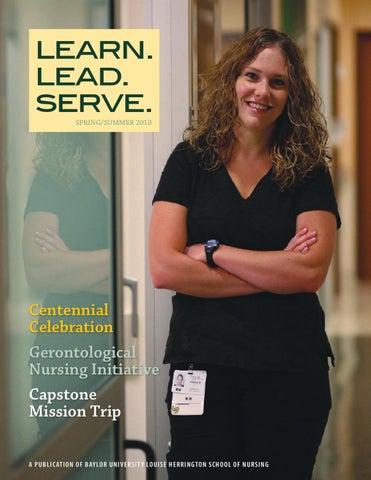
learn. lead. serve. SPRING/SUMMER 2010
Centennial Celebration Gerontological Nursing Initiative Capstone Mission Trip A P UBL I C AT I O N OF BAYLOR U N I VERSI T Y LOUISE HER R ING TO N SCHO OL OF NUR SING
MESSAGE FROM THE DEAN
Looking toward our next century
by Judy Wright Lott DSN, NNP-BC, FAAN Dean
and initiatives that demonstrate how we are living up to this brand promise. In 2002, the Baylor 2012 initiative was introduced and demonstrated our university’s commitment to expanding current academic emphases, renewing our historic commitment to Christian faith in the Baptist tradition while embracing the strengths of other parts of the Christian heritage, and building an even stronger faculty, staff and student body. As a result of this initiative, Baylor is emerging as one of the world’s leading universities. For the past decade, the Louise Herrington School of Nursing has been aligning itself with the 12 imperatives established under Baylor 2012. In turn, we are a better school, and our students benefit from that success. As we welcome our new Baylor University President, Judge Ken Starr, we know his insight and leadership will continue to strengthen and take Baylor to new heights. We look forward to this journey and to writing the story of our next century of service. Dean Lott catches up with Louise Herrington Ornelas, a 1992 Baylor University Alumna Honoris, at the Centennial Gala Luncheon. In 1999, the school was renamed in honor of the $13 million endowment gift made by Mrs. Ornelas.
u
It’s been 100 years since the doors of our school first opened. In that time, we have graduated thousands of nurses who have gone on to improve the lives of others in the world, both physically and spiritually. I truly have never felt more pride as a result of the events and happenings at Baylor University Louise Herrington School of Nursing. Pride for our students, our faculty, staff and the many friends and partners of our school. Now, however, is not the time to rest on our laurels. We continue to hear about the nursing shortage that not just our nation, but the world, is facing. Our population is aging—which not only decreases the number of nurses available to care for people, but changes the face of health care. The older adult is a more unique patient and nurses must be prepared to identify and address the needs of this population. And we can’t ignore the rising cost of healthcare that leaves many without access to quality care and the overall debate behind healthcare reform. Healthcare has always been a complex issue, but today’s nurses are faced with greater responsibilities and require the best possible education we can provide. For these reasons, and many more, we are continuing to develop our campus and our programs to ensure that Baylor nurses are among the best and brightest in their fields. We want to share the news of these events with you. For this reason, I am so pleased to send you this first issue of Learn.Lead.Serve. In 2007, we created the Learn. Lead. Serve. positioning statement for our school and we felt it made the perfect title for a publication that is meant to bring you continued news of the actions
H
O
OL
IN
SC
G
ITY
BA Y
R UNIVER S LO
OF NU
RS
learn. lead. serve.
INSIDE THIS ISSUE
Judy Wright Lott
Message from the Dean inside front cover Graduate Program: A Message from Mary Brucker 2 Undergraduate Program: A Message from Cathy Rosser 2 Faculty News 3 Development News: A Message from Janis Kovar 4 Student Services 6 Learning Resource Center 8 School News 9
Dean, Louise Herrington School of Nursing
FEATURE STORIES
Baylor University Louise Herrington School of Nursing Leadership Ken Starr
President, Baylor University Elizabeth Davis
Interim Provost and Vice President for Academic Affairs, Baylor University
Mary C. Brucker
Associate Dean and Director, Graduate Program Catherine Rosser
Director, Undergraduate Program Lynne Mann
Chair, Faculty Organization Janis Kovar
Director of Development Comments or Questions? We want to hear from you! Send us your comments or questions to: LHSONnews@baylor.edu. And, if you have pictures or stories from a recent Baylor nursing event, we’d love to have you share them with us.
Learn Celebrating 100 Years of Learning 12 Lead Preparing Today’s Nurses for Tomorrow: The Gerontological Initiative 16 Serve Letters Home from Africa: The 2010 Capstone Mission Trip 18 School Partners 22 News from Baylor University 24 Upcoming Events back cover
GRADUATE & UNDERGRADUATE PROGRAMS
A message from Mary Brucker
by Mary Brucker, PhD Associate Dean and Director, Graduate Program
The Graduate Nursing Program admitted its first student in 1990. Although much has been written about the school’s centennial, the graduate program has made significant strides during these last two decades. The first master’s degree was in patient-care management. Today there are three distinct tracks with a thread to care for the medically underserved. In the fall it is estimated that there will be more than 60 students studying to be either a family nurse practitioner (FNP), neonatal nurse practitioner (NNP) or nurse-midwife (NM). The nurse practitioner programs have been in place for several years with 92 FNPs and 30 NNPs already graduated. However, in 2008 the nurse-midwifery was approved by Baylor University and became the first Doctorate of Nursing Practice at the institution. This program is designed for nurses with a
Baccalaureate to obtain a DNP in 8 semesters of full time study and is the first such program in the United States. Three individuals graduated in May 2010 amidst much festivity, including the school’s first separate graduate recognition celebration. On the day after the ceremony, the Baylor University Board of Regents approved the Doctorate of Nursing Practice degree for qualified nurse practitioners. Several current Family Nurse Practitioner students already have expressed their plans to continue on to obtain this degree. In summary, the graduate program is an exciting place to be. Although it may be young in perspective of the entire school, it is growing and certainly in concert with the mission of Baylor University and LHSON’s vision to Learn, Lead and Serve.
A message from Cathy Rosser
by Cathy Rosser, EdD Director, Undergraduate Program
2
Someday you may need a nurse, and no one educates nurses better than Baylor University Louise Herrington School of Nursing (LHSON). Elsewhere in this publication you will read about students who come to the school of nursing to become nurse practitioners or midwives; or students who are attending the accelerated baccalaureate program. However, the mainstay of the school of nursing are the students who attend our traditional basic nursing baccalaureate program—the school that is 100 years old, but forever young due to upto-date education and adherence to the mission of Baylor University to educate men and women for worldwide leadership and service by integrating academic excellence and Christian commitment within a caring community. Over the last 8 years, the school increased the enrollment in the traditional BSN track
by approximately 40% in an attempt to be part of the solution to the nursing shortage. Perhaps more importantly, this increase was accomplished while maintaining quality education. In 2010, the Texas Board of Nursing issued a formal commendation to LHSON. The traditional BSN program was one of only nine of the state’s 97 initial licensure programs to achieve an 85 percent graduation rate and greater than an 85 percent licensure (actually 98%!) pass rate in 2009. This fall LHSON will admit 96 BSN students to the traditional program. Use of simulation, instructional technology and dedicated faculty accompanied by some of the best clinical facilities in the country will help produce nurses to care for those who need a nurse in the future. And it won’t be just any nurse, it will be a Baylor University LHSON nurse. spring/summer 2010
FACULTY NEWS
In memoriam: Jacquelin Neatherlin Dr. Jacquelin S. Neatherlin, BSN ’77, professor and interim graduate program director at the Louise Herrington School of Nursing, passed away January 7, 2010, after a long illness. “Our hearts are heavy, but Jacque is probably already organizing the angelic choir,” shared Dean Judy Wright Lott. “Dr. Neatherlin loved her students, the LHSON, Baylor University and the profession of nursing. She will be greatly missed.” Jacque earned her MSN from the University of Texas Health Science Center, San Antonio, in 1980, and her PhD from Texas Woman’s University in 1993, and had taught at Baylor since 1991. Certified in the field of neuroscience nursing, she served as president of the American Association of Neuroscience Nurses. Jacque also served two terms on the American Board of Neuroscience Nursing, and also as chair of the Test Development Committee for the American Board, which developed and managed the national certification examination for neuroscience
nursing. She was a Distinguished Lecturer and a Virginia Henderson Fellow for Sigma Theta Tau International, the international honor society for nursing, and also served as president of the Eta Gamma Chapter of Sigma Theta Tau. She was most recently Interim Director of the Graduate Program at the School of Nursing. Jacque’s knowledge and skills were sought after, not only by other nursing schools but by hospitals as well. As remarkable as all of this is to the well-being of those on the educational path, it pales in comparison to Jacque’s life journey. She was baptized at the age of seven at the First Baptist Church in Lawton, Oklahoma, and served the Lord through music. She was a member of the Royal Lane Baptist Church in Dallas, where she was a choir member, a deacon, and the teacher of her beloved class called “The Wise Old Owls.” She always met those in her pathway on level ground. She approached them ready to help, and she did not disappoint or abandon their needs. One of the last loving things she did was to prepare and deliver a bowl of homemade vegetable soup to her ailing neighbor just three days before she was confined to the hospital for the last time.
Dr. Linda F. Garner Retires
Lori Spies Named Outstanding Professor
At the close of the semester last month, Dr. Linda F. Garner, BSN ’66, retired from her position as Professor here at the Louise Herrington School of Nursing. During her 40-year tenure at the school, in addition to educating hundreds of students, Dr. Garner was instrumental in preserving the school’s history through her tireless commitment to maintaining event records, artifacts and memorabilia (all of which comprised a big portion of the centennial exhibit at the Mayborn Museum). Upon retirement, after a much anticipated vacation to Germany, Dr. Garner plans to focus more of her time on her parish nursing work at Wilshire Baptist Church and providing patient education at Healing Hands Ministries, a free health clinic in Lake Highlands where she currently serves as the Board Vice Chair.
learn. lead. serve.
We want to congratulate our own Lori Spies, MSN, on being named a Baylor University Outstanding Professor for the 2009– 2010 academic year. This award recognizes faculty contributions to the academic community in ways other than research or teaching. Lori joined the Louise Herrington School of Nursing in 2004 and is the driving force behind the Missions focus for our advanced practice nursing students. Lori’s passion for her students’ learning and global outreach has created a Missions program that truly sets our school apart from most others in the country.
3
DEVELOPMENT NEWS
Keeping the momentum going One event in particular was very special to me: our Endowed Scholarship Appreciation Dinner. This was a great evening that gave our scholarship donors the opportunity to meet the actual students that have benefited from their generosity and provided the students the chance to say “thank you.” For a few of our donors, it was the first time they had ever visited our campus! In addition to the gifts made as part of our Centennial, I want to share with you two other recent gifts that are making a significant difference here at our school. Edgemere Senior Living Community, in conjunction with the Senior Quality Lifestyles Corporation (SQLC) Charitable Foundation, recently honored us with a $10,000 donation to provide funds for student scholarships and simulation learning equipment. Edgemere provides its retirement community residents access to top-of-the-line nursing care and recognizes the importance of providing excellent education for future nurses. Thank you, Edgemere! We are also excited to introduce our Gerontological Initiative this fall. Made possible through an initial gift from the Deerbrook Charitable Trust, we are now the only school in the Metroplex to offer continuing education in geriatrics. As our population ages, it is essential that more nurses understand best practices in the care and treatment of older adults.
Dr. Kenneth Laycock, Edgemere resident (left) and John Falldine, Edgemere Managing Director (right) present Janis Kovar with a check for student scholarships and learning equipment.
u
by Janis Kovar Director of Development
The need for nurses is great and today’s graduating nurses must be highly prepared so that they may immediately move into their career roles. This means we need to be innovative leaders in our teaching methods, utilizing cutting-edge tools and resources to educate and train our students. Acquiring these resources requires funding, and therefore the success of our students depends on our ability to invest in our institution and academic programs. As Director of Development, it is my charge to lay the groundwork for giving and to share with you, our alumni, friends and partners, the many ways in which your current donations make an impact and how your future support will help prepare more Baylor nurses to Learn, Lead and Serve. As many of you know, we have just wrapped up the year-long celebration of our first Century of Service. As part of our Centennial, we felt it was important to recognize our 100 Legends in the Line, the individuals, families, organizations and businesses that have contributed to the success of our school. We couldn’t be more grateful for the commitment and dedication that these Legends have shown throughout the years. More than 265 Centennial Partners made financial contributions, and several more showed their support through volunteer hours or in-kind giving.
spring/summer 2010
We are working hard to grow our campus and graduate more Baylor nurses and, in actuality, many of our programs and initiatives wouldn’t be viable without the support of our donors. For example, due to the first year’s success and increased demand, we have expanded our FastBacc program and doubled the number of students enrolled. In addition to the campus resources required for this increase in student body, many of our FastBacc students require financial assistance for tuition and school costs. Often, traditional scholarships or government funds are not available to these students. We want to ensure that we have current and endowed scholarship funds available so that no student is denied the opportunity to become a nurse. Another great example is the Don A. and Ruth Buchholz Simulation Lab. Our Sim Lab is a tremendous learning tool and teaching asset for our students and faculty and just one example of the innovative ways we educate and prepare our students. We are continually looking for opportunities to expand this facility so that our entire student body is provided sufficient access. Acquiring additional equipment and space is necessary to make this happen. There are, in fact, several ways you can get involved and be a part of our next century of service:
Ways to Show Your School Support
We have designed funds that specifically benefit our students and faculty so that you can make an impact in an area that is important to you.
Current Scholarship Fund
Provides scholarship support for current LHSON students and is a perfect outlet for those who want their gift, combined with existing scholarships, to sustain today’s Baylor nursing students.
Named Endowed Scholarships
Many donors choose to memorialize or pay tribute to a friend or loved one through the establishment of an endowed scholarship fund. Endowments may be initiated with a gift of $5,000 and funded over a period of 5 years. Funds are named when the balance reaches $25,000.
LHSON Alumni Endowed Scholarship Fund
Donations (of any amount) are combined with others to form an endowed scholarship that will benefit future LHSON students in perpetuity.
LHSON Excellence Fund
Distributed at the Dean’s discretion, this fund is used to provide training opportunities for faculty, supplies for students, campus building repairs or expansion and much more.
Missionary Family Nurse Practitioner Program
This fund enables students to participate in medical mission efforts around the world by providing medical supplies, medicines, portions of airfare and more.
Mail a gift
Good Samaritan Dean’s Fund
Go online to www.baylor.edu/give
Lecture Series Endowment Fund
Call me, Janis Kovar, directly at (214) 808-9802
Endowed Professorship Fund
Mail a check to the nursing school directly at 3700 Worth Street, Dallas, TX 75246. Please reference what area you’d like to support. Here you will be able to give directly to LHSON funds and support the initiative that matters most to you.
I’d like to answer any questions you have about the area you would like to support.
learn. lead. serve.
This fund is used to cover unexpected situations that arise throughout the year, such as a student’s difficult circumstance that renders him/ her unable to buy textbooks or the need to replace daily-used lab equipment. This fund is designed to enhance the students’ education by bringing distinguished leaders and keynote speakers to campus on a regular basis. An annual lecture series is created with a gift of $250,000. Endowed professorship funds create prestigious faculty positions and enable the school to attract and retain high quality scholars. Increasing the number of professors reduces the student-to-faculty ratio and further improves the overall student experience. A fund is established with a gift of $1.5M. 5
STUDENT SERVICES
Helping students find the right balance is to enrich the student experience spiritually, intellectually and socially.
Spiritual Development
The office of Student Ministries serves students by providing opportunities for spiritual growth and fellowship. The following are just some of the ongoing student ministry activities: Early Morning Prayer (EMP): Every Monday
u
The Barnabas Success Center and Diane Roose Brinkman Study Room offer students the perfect environment for collaborative study and discussion.
6
Everyone associated with the Louise Herrington School of Nursing knows the rigor and quality of our degree programs. Our students certainly feel it. They learn each day by working with real patients in real situations and real settings. And, thus, we are able to prepare well-trained nurses, ready to serve. But it’s not just the quality of the in-class instruction that sets us apart. The support and tools offered by our own, on-campus, dedicated Student Services department provides tangible, and sometimes intangible, contributions as well. The mission of the Student Services department
morning, 7:14 am (Rm 204) Bible Shorts: Every Tuesday, 12:00 pm (20 minutes) (Rm 105) @4Worship: Student-led worship every Thursday, 4:00 pm (Student Lounge) Mission Trip: First week in January (community clinicals in underserved areas of the U.S.)
Intellectual Development
In September 2009 we opened the Barnabas Success Center and the Diane Roose Brinkman Study Room in the Pauline Allen Gill Student Lounge area of the nursing school campus. Creation of these facilities was made possible by gifts from Anita Collier Jones (BA ’61), The Ginger Murchison Foundation (Don Wills, President) and Don (BBA ’67, MBA ’68) and Kay (BBA ’69) Roose. In addition to quiet
Who’s Who in Student Services Pat Davis Director of Student Initiatives (214) 818-8118
study areas, we offer our students free, on-site tutoring, seminars and workshops in subjects such as: Resume Writing, Interviewing Skills, Test-Taking Strategies and Time Management. We also hold mock interviews to help students land the jobs they are seeking!
Social Development
Our students rarely sit idle. That’s why we are constantly finding ways to bring important services to them to save valuable time. This year, students were able to sit for their yearbook photos, get their flu shots and purchase their textbooks right here on our campus. We also know that our students need to make the most of their “down time” when they have it. For this reason, we encourage and facilitate their participation in many Baylor events such as Diadeloso, graduation video “Shout Outs,” Homecoming Parade and Sing and sporting events. Our students are also offered free memberships to the state-of-the-art Tom Landry Fitness Center, located adjacent to our campus. The following Student Life activities are planned by the Student Life Class Officers:
Debbie Milam Office Manager (214) 820-4146
Endalk Tulu Financial Aid Coordinator (214) 820-4143
Jennifer Buschman Advisor/Recruiter (214) 818-8119
Tina Glaspie Academic Advisor (214) 820-4151
Day at the Lake (White Rock) Flag Football (between classes) Broom Ball (ice hockey in tennis shoes) Barn Dance Day at the Texas State Fair Night on the Town (during orientation)
learn. lead. serve.
David Kemerling Director of Student Ministries (214) 820-4152
7
LEARNING RESOURCE CENTER
Giving students the resources they need to succeed Study Room Adjacent to the computer lab, the student study room is a large enclosed conference space complete with 360º of white board on the walls perfect for diagrams, notes and discussion.
Clinical Totes Offered to students free of charge in their community clinical rotation, these totes provide all the items they need for patient assessment and minor treatment.
A student’s success is the result of their determination and drive, but it also depends on the tools and resources made available to them to learn. The Mabel Peters Caruth Learning Resource Center (also known on campus as the LRC or library) is here to support student study and faculty research goals. In addition to a comprehensive list of study tools, the LRC provides a quiet place to study, convenient rooms for student teams to meet or even a comfortable lounge to grab a couple minutes of shut-eye between classes (we know our students work hard, and we want them to be well-rested!). The LRC resources include citation, full text and image databases, reference materials, reserves, journals, books, e-books, a high-speed printer, a photocopier/printer, audiovisual software and viewing stations, a computer lab, a study room with white boards, additional study areas, student e-mail and internet access, and clinical equipment for checkout (including life-like arm simulators available to help students practice and gain confidence in IV insertion). And the LRC is a hotspot for AirBear wireless access.
Hours
Computer Lab Now open 24 hours a day, 7 days a week. Students can access the computer lab using their student ID cards whenever their schedule permits.
Viewing Stations Our viewing stations have been updated with large, flat screen monitors to allow better clarity when viewing intricate procedure videos and opportunities for teamwork sessions.
8
The LRC is open 7 days a week with extended hours during exam weeks. Standard hours of operation during the semester are: Monday–Thursday 8:00 am–11:00 pm Friday 8:00 am–5:00 pm Saturday 8:00 am–4:00 pm Sunday 1:00–11:00 pm
During most exam periods, the LRC is open 24 hours a day. The latest information on LRC hours can be found on the school website and is posted in various locations throughout campus each semester. Staffed by two professional medical librarians and a library associate during the week, students can seek out research assistance or get the answers they are looking for. The LRC is staffed evenings and weekends by student workers.
spring/summer 2010
SCHOOL NEWS
Our NM-DNP program provides students the opportunity to directly progress from a bachelor’s degree in nursing to a doctorate in nurse-midwifery. In fact, our NM-DNP Class of 2010 are the first three graduates in the country to complete this streamlined degree track. LHSON is also focused on creating innovative programs that open new doors for those wanting to pursue a career in nursing. Introduced in 2009, our FastBacc program is a 12-month accelerated degree track designed for individuals who have completed a bachelor’s degree in a non-nursing discipline. This academically rigorous, full-time program begins each summer and graduated its first class of 16 students this past May. Our second class of students (scheduled to graduate May 2011) is already underway and the program has expanded to include 29 students.
From left: Lindsay Wilson, Professor Dr. Mary Ann Faucher, Summer Latta and Carla Morrow celebrate being the first three Nurse-Midwife Doctorate in Nursing Practice program graduates.
u
Just as the events of our centennial celebration come to a close, the chapters of our next century of service are already being written and the Class of 2010 will definitely be one to remember. We watched with pride as 99 LHSON students were awarded their diplomas this May. In addition to our traditional baccalaureate and graduate degrees, two new classes of students were added to our roster of alumni: our Nurse-Midwife DNP and FastBacc graduates. While the Doctorate in Nursing Practice degree is not new to nursing specialties in general, the DNP degree is new for the practice of nurse-midwifery. LHSON is one of only eight schools nationwide, and the only school in Texas, that offers this program.
Congratulations to our first class of FastBacc graduates: Front Row, Left to Right: Cheryl Tucker, MSN, RN, CNE (Faculty); Amy Yeilding; Victoria Marquez; Lizza Lopez; Heather Darwin; Addie Skow; Dee Dee Hantrakul; Ingrid Mantor; Nan Ketcham, MSN, RN (Faculty) Back Row, Left to Right: Nate Barnes, Katie Bien, Natalie Singer, Jenny Dunn, Natalie Scott, Tera Sickler, Camille Warren, Sissy Walters, Megan Weis
u
Congratulations: Class of 2010!
9
SCHOOL NEWS
CCNE Accreditation – It’s Official!
We are proud to announce that we have once again earned accreditation by the Commission on Collegiate Nursing Education (CCNE) for our baccalaureate and master’s degree programs. CCNE Accreditation affirms the educational excellence of LHSON programs by consistently meeting all four accreditation standards of quality and effectiveness: mission and governance of the nursing programs; institutional commitment and resources from the University; curriculum and teaching-learning practices; and student performance and faculty accomplishments. Congratulations and thanks to everyone that helped in the extensive review process.
It’s a Girl! In 2008, through the generosity of more than 70 donors, the Don A. and Ruth Buchholz Simulation Lab opened, bringing an invaluable hands-on learning tool to our campus. Our high-fidelity patient simulators, or “SimFamily,” are so realistic that they have pulses, breathe, even cry, wheeze, cough and moan. Now, thanks to the continued support of John and Marie Chiles, we are proud to announce the newest addition to our Sim-Family, “JJ,” a 5-year-old child simulator. Like her high-fidelity family members, JJ comes SIM-FAMILY TREE
Sim-Man & Sim-Woman average adult patients Noelle & Hal mother and newborn baby Sim NewB newborn baby (complete with
umbilical cord) John Houser 8-month-old baby JJ 5-year-old child 10
LHSON Students Are Truly Great
Congratulations to Carla Morrow, one of our recent nurse-midwife DNP graduates, whose contributions and hard work were recognized with the Great 100 Nurses Award. While a student at LHSON, Carla worked as an OB nurse practitioner at John Peter Smith Hospital in Fort Worth. Upon earning her NM-DNP degree this May, she plans to pursue her career as a certified nurse-midwife. Way to go, Carla! with an extensive speech library, heart sounds (including splits and murmurs), respiratory sounds (including stridor, bronchial, wheezing, pleural friction and crackles) and bowel sounds. The Sim Lab provides students with a variety of “patients” (at different life stages or ages) used to simulate a wide range of healthcare scenarios including birthing and delivery methods. All patient simulators are in regulation hospital beds in fully furnished rooms and provide the opportunity for training with real clinical equipment. To maximize the learning opportunity, all rooms are equipped with cameras and sound systems that allow instructors to watch and record students as the scenarios play out. From the computer control panels, instructors can “talk” for the manikins, providing verbal interaction between student and patient, and modify patient response to treatment. Recording the scenarios promotes key debriefing review and discussion between instructor and student. While nothing replaces real, hands-on patient experience, innovative methods must be used to provide students with essential practice to assure competence and confidence in real life situations. Classroom time spent in the Simulation Lab complements the student experience and learning that is also achieved in the hospital setting.
Did you know? Current students can schedule patient simulation experiences during Open Lab hours for more practice. Sessions must be scheduled in advance. Contact Vivian Gamblian, RN, MSN, Sim Lab Coordinator, via email at vivian_gamblian@baylor.edu.
SCHOOL NEWS
Better Learning Just a Click Away
We’ve all been there. The professor has just finished the presentation or demonstration of the day’s topic and poses a question to gauge student comprehension. In response, she asks for a show of hands. Some go up immediately. Some hesitantly. Some, perhaps, not at all. The professor, and many times even the students, isn’t sure who has absorbed the material. It can be a missed opportunity for learning, but not anymore. This fall, students at the Louise Herrington School of Nursing will benefit from the roll-out of a new Classroom Response System designed to enhance classroom interaction and enable instructors to better gauge comprehension and understanding of the material being presented. The system, typically referred to as “Clickers,” uses a wireless radio frequency technology from i>clicker. It gives instructors and students immediate feedback from the entire class and automates routine classroom activities like taking attendance and grading student work. Each instructor will have a small, portable receiver that will be pre-programmed with data for their specific class(es). Each student will have a small hand-held i>clicker device (like a small TV remote) that is used to answer multiple-choice or true-false questions or log their attendance. All Q&A responses can be recorded anonymously or with the student name, depending on how the professor sets up their class. The in-class receiver then tallies the responses instantaneously and displays aggregate data in a graph format. Thus students are provided critical feedback on their level of understanding and faculty automatically know when to move on from a subject or when to spend a little more time discussing it. Some faculty refer to this as “just-in-time” teaching—making adjustments to their course as needed to ensure students are comfortable with the subject matter. Clickers can also be
used to gauge student opinion on sensitive or controversial issues. It can be used to catalyze debate and discussion, turning a passive lecture into an interactive exchange. Two faculty members, Marsha Dougherty and Carol Johns, tested a pilot program this past spring in the classroom. “So far, the students (and we) love using the clicker system. It gets them engaged and they don’t have to be nervous about getting the question wrong. I think our students walk out of class more confident in what they are learning,” commented Dougherty. Students will purchase their clicker device for approximately $30-$40 at the same time they are buying their required books and other classroom materials. The device is then registered to that specific student and will be used throughout their time at school. And since every clicker runs on just 3 AAA batteries (which will normally last through an entire semester), the cost to maintain the device is minimal. The Baylor University campus in Waco has also been testing several Classroom Response Systems and is planning to roll out the i>clicker program in many of its departments. I>clicker devices purchased by students in Waco will work with the system used here on the LHSON Dallas campus. Compatible with both PC and MAC systems, the i>clicker program may be used in the near future for online testing and/or pop-quizzes.
Calling All Alumni! We want to hear from you! If it’s been a long time since you’ve been in contact with your alma mater, we want to hear about the great things you are doing. We’d like to include stories in future publications on the amazing nurses that once walked our halls and are now making their impact in the world. Email us at LHSONnews@baylor.edu or mail us a note to: Learn.Lead.Serve. News c/o Louise Herrington School of Nursing, 3700 Worth Street, Dallas, TX 75246.
11
A Celebration 100 Years in the Making OCTOBER 14, 2009 MARKED A MOMENTOUS DATE IN OUR SCHOOL’S HISTORY: THE 100 TH ANNIVERSARY OF OUR MISSION IN PREPARING NURSES FOR THEIR LIFE’S CALLING TO SERVE.
More than 5,300 graduates have gone on to pursue successful nursing careers around the world, with at least 500 graduates serving on the mission field, since the school—one of the oldest nurse training programs in the state—opened in 1909. We saw many of you at our centennial events, but for those that were unable to attend, we’d like to share a glimpse of the gatherings that took place.
12
THE MAYBORN MUSEUM EXHIBIT Debuted in August 2009, the 1,000-sq.-ft. exhibit ran for 8 months and included photographs, articles, videos and artifacts that traced the nursing school’s history. The collection was on display in the Marie and John Houser Chiles Baylor University History Exhibit Hall and included more than 200 items, many of which were on loan from alumni and their families.
ALUMNI REUNION EVENT Over 300 alumni gathered in Dallas for a weekend to reconnect and reminisce.
ENDOWED SCHOLARSHIP APPRECIATION DINNER Endowed scholarship donors were invited to meet the students and hear the stories that their generosity made possible. For many of these donors, this was their first time to ever visit our campus!
Centennial Partners Wall of Honor Centennial Partners that give $1,000 or more will be included on the Centennial Wall of Honor to be constructed and installed on the LHSON campus. GOOD SAMARITAN ($25,000+) Baylor Health Care System CLARA BARTON ($5,000 –$14,999) John H. Chiles Marie E. Chiles Minette Drumwright Pratt BARNABAS ($1,000 – $4,999) r. and Mrs. Joseph Abbate M Gary E. and Susan Key Baker Baptist General Convention of Texas Baylor Alumni Association Mr. and Mrs. Robert E. Beauchamp Dave and Peggy Borders Don and Ruth Buchholz 14
Mr. and Mrs. C. Robert Byrd Arnie and Rosie Cavazos Nancy and Dan Chapman John and Karla Cogburn Communities Foundation of Texas, Inc. Ms. Maria L. Curran Dallas County Community College District Foundation, Inc. Drs. Charles and Elizabeth Davis Mr. K. D. Diepholz East Texas Medical Center Tyler Janice King Erickson E. Burke Evans Curt and Donna Dee Floyd Anita Collier Jones
Dr. and Mrs. Sid Jones Bill and Janis Kovar Laerdal Medical Corporation Debbie Lawson Caldwell Mr. Billy Joe and Dr. Judy Wright Lott Mr. and Mrs. Dennis G. Mitchell Mother Frances Hospital Mr. and Mrs. Robert Louis Patton, Jr. Paul W. and Cathy Vaught Powell Penny Lunday Powers Fred and Gloria Roach Betsy Sharp Robinson Tom and Wilma Carlock Seltzer Ms. LeAnn Harris Solomon Ms. Renee Kirk Swank Mr. and Mrs. Andy W. Tindel Elizabeth Schell Wise Ron and April Wolf Woman’s Auxiliary, Baylor University Medical Center spring/summer 2010
CENTENNIAL GALA LUNCHEON The culminating event was the Centennial Gala Luncheon on March 29, 2010 at the Hilton Anatole in Dallas. With more than 400 attendees, the luncheon was not only a terrific time for us to celebrate our accomplishments, but it provided us the perfect opportunity to give thanks to those that helped make our successes possible. Awards and recognition were given to our Centennial Champions as well as our 100 Legends in the Line—individuals, families, organizations and businesses that have made a significant impact on the school’s legacy through their leadership and support. To an audience of alumni, community partners, civic leaders, school administrators, faculty and students, Lee Woodruff, our keynote speaker, shared her personal story of husband Bob Woodruff ’s roadside bomb injury in Iraq and the important role nurses played in the healing process of the entire family. We sincerely thank each and every one of our Centennial Partners and the Centennial Celebration Committee that made our year-long celebration a great success!
Introducing the gerontological nursing initiative
If there is one thing we don’t need to wait for the census to tell us, it’s that our population is aging. On January 1, 2011 the first Baby Boomers turn 65, with approximately 10,000 a day reaching that mark for the next 20 years. By 2030, the number of people over age 65 will soar to 71.5 million—one in every five Americans. The fact that these rates are growing can be seen as a success story for public health policies and for socioeconomic development, but it also challenges healthcare providers to adapt in order to maximize the health and functional capacity of older people. This growing number of older adults creates an increased need for nursing professionals to be educated and skilled in gerontology.
Why caring for older adults is different Physiologic issues associated with aging change the way illnesses present, the way the human body responds to treatment and which treatments are even appropriate. Traditionally, healthcare providers treat the disease, but for better successes with this population, we must change this approach. Gerontology is the physical, mental, and sociological study of aging and is fast becoming one of the most important fields of study today. Currently, less than one third of Baccalaureate nursing programs in the Dr. Jane Nunnelee enables students to experience various age-related medical conditions, such as macular degeneration and cataracts, to better understand the challenges their patients face in everyday life. 16
u
U.S. have a geriatric specialist faculty member and many
don’t even offer courses or training in gerontological nursing. We are proud that LHSON is one of the few programs that offer this invaluable content to our students (in fact, this coursework is mandatory in all curriculum plans). Jane Nunnelee, PhD, RN, GNP is the champion for gerontological learning at LHSON. Her passion and commitment to the aging community is resolute. “Aging is like a thumbprint. No two people are alike in how their bodies and minds change and how they can be treated,” states Dr. Nunnelee. That’s why we are proud to introduce the Gerontological Initiative at Baylor University Louise Herrington School of Nursing.
incontinence or drug interactions. Since nurses already carry the biggest portion of patients’ inpatient care, they need to know what issues face an older patient as well as how to identify potential other problems that may exist Designed to meet the identified needs of nursing health professionals in the current workforce and to further (dementia, etc.). Dr. Nunnelee’s goal is to increase the recruit nursing students in the specialty of gerontology, number of RNs that are better prepared to successfully our goal is to educate nurses on best practices to improve work with older patients. preventive care, decrease premature morbidity and decrease In her core curriculum classes at LHSON, Dr. Nunnelee unnecessary hospitalization in the care of older adults. is currently preparing our students to work with the older Continuing education courses will be offered to practicing patient. Lindsey Erickson, a recent LHSON graduate currently working on the Oncology floor at Baylor RNs beginning in fall 2010 with courses rolling out for University Medical Center, credits winter, spring and summer sessions. RNs that complete the 30-hour Dr. Nunnelee for giving her the program (of which 10 hours are knowledge and confidence she needs Fall 2010 completed online) will be eligible to sit to work with her patients, especially Gerontological for the ANCC Gerontological Nursing when 85% of them are older adults. Nursing Symposium “For me, working with older patients Certification. September 30–October 2 is the most rewarding experience. Future growth and development I don’t think many healthcare plans for this initiative include Reserve your spot today! professionals have had enough additional CE courses focusing on Call (214) 820-3361 for positive experiences and training in dementia care and long-term care registration information. their classes and so they’re either leadership among others. Plans also nervous or just don’t know what to include programs for other healthcare expect when the patient is older,” Erickson comments. providers and caregivers. “What I was learning in class, I was seeing in my clinicals. Certified gerontological nurses are RNs who have I learned to listen, to be patient and to better assess and additional preparation and passed the ANCC examination. identify potential problems.” The goal of our Gerontological According to the ANCC, today less than 1% of nurses in Nursing Initiative is to have more nurses better skilled at this country are ANCC certified as gerontological nurses. working with this population. Achieving board certification requires the experience and The American Journal of Nursing (AJN) recognizes that knowledge that takes RNs to a higher level of expertise. Certification not only gives RNs confidence in their nurses today will care for more adults over 65 than any other patient population. Caring for older adults requires abilities and their observations, but it validates their specific expertise, knowledge and skills that the majority approach to patient care. of nurses did not learn in school, and for which less than For nurses, adding a geriatrics certification to an existing one percent have had specialized training or certification. specialty broadens professional opportunities and makes Improved geriatric knowledge and skills for nurses in the higher earnings more likely. For example, a clinical nurse specialist certified in both geriatrics and wound, ostomy and workforce and implementation of best practices in the healthcare facilities could make a considerable difference in continence nursing could work as a consultant in nursing outcomes for older adults and for the healthcare field. homes and home care, billing Medicare directly.
The Gerontological Nursing Initiative at the Louise Herrington School of Nursing
Bridging the gap for RNs The care of older adults is significantly different than that of other age populations—even middle-aged adults. In addition to the immediate condition being treated, older adults often have other needs: atypical disease presentation, regular medications, follow-up care and ongoing medical conditions like poor vision or hearing, mental acuity, learn. lead. serve.
Did you know? Research shows that nurses with training in geriatrics provide significantly improved care to older adults. For example, there is evidence that elderly patients with heart failure who are cared for by nurses prepared in geriatrics have few rehospitalizations. – nursingcenter.com 17
Letters home from Africa
Capstone mission trips give students the learning experience of a lifetime Missions are an integral part of what makes our students’ experience unique. LHSON students pursing Family Nurse Practitioner and Nurse-Midwifery degrees have the opportunity to participate in the annual Capstone trip, a multi-week journey that allows the student to be fully immersed in another culture while working in clinics for hands-on experience. Mission fieldwork truly challenges a student’s knowledge and abilities. Comprehensive medical teams and expensive diagnostic equipment are not readily available; thus, a student’s assessment and treatment skills are tested and honed. On March 1, five students, along with Lori Spies, our Missions Program Coordinator, boarded a plane bound for Africa. They spent four weeks partnering with local, full-time missionaries in clinics in Ethiopia and Sierra Leone. They were joined in Sierra Leone by three students from the NurseMidwifery DNP program and Dr. Mary Ann Faucher, our NM-DNP Program Coordinator. Prior to their departure the team worked tirelessly to raise the funds they needed to make the trip, and used donations for much-needed healthcare and basic hygiene items that were distributed to the local children and adults. The following are excerpts from the team’s recent journey. 18
March 3 We are all here, with our luggage, tired but doing well. We arrived and right after lunch immediately went to visit the Mother Teresa’s HIV orphanage and saw a home and treatment center for children who might not have anywhere else to be cared for. Already Africa is pulling at our heartstrings.
March 4
We spent time at ALERT, an internationally recognized treatment and training center for leprosy, TB and HIV. It is in a building that was constructed in the 1930s. It seems that additions are added rather than new things built. It creates an interesting hodgepodge of old and new. Always there is dust and construction about. The most exciting part for me about ALERT was the orthotics department where new limbs are constructed of plaster casting covered in a hard plastic that is cured in kiln type ovens. A soft liner is added since leprosy causes a loss of sensation and the wearer is not able to know if it is rubbing. A shoe is added in hopes of enabling someone who has lost a leg to have a more normal life. Rubber from old tires is used to make soles for shoes and sandals. Serial casting is done on hands that no longer work to put the fingers in a position of functionality. The patients return every day to have a new cast placed until slowly the hand function improves. spring/summer 2010
March 5
Our next visit is CURE hospital, a Christian outreach program that treats cleft palates and clubfeet conditions. In some parts of Ethiopia children born with a cleft lip are left to die because the survival rate is so very low and the disorder is a source of shame for the parents. Cure is a charity hospital that has one of the only two plastic surgeons found in the entire country. Corrective surgeries are being performed and they work hard to spread the word of the work these gifted surgeons, nurses and, yes, even a Nurse Practitioner are able to do. This year again we learned of the life restoring work done by the Fistula Hospital. Woman from all over Ethiopia come to this hospital to have surgical repair of fistulas that develop after days and days in labor, 2–8 days spent in labor. Fistulas are a tragic condition that leads to the women being outcast from their homes. At this wonderful place women are embraced, repaired and educated. We visited with the remarkable woman who is about to graduate her first class of midwives. Her goal is to have women able to provide early intervention and referral to prevent these tragic fistulas from forming. God is doing amazing work in all of these places. Despite the harsh realities of life here, Lake Langano is beautiful. Birds of the most amazing hues are visible in every tree. A troop of baboons can be seen from the window where I am sitting. Waves are lapping at the shore. I love this place.
March 6 Today we drove to Tufa, a remote village on the other side of the lake, to do a community assessment. Our missionary hosts are exploring an outreach to the area and wanted our help gathering information on nutrition and health in the area. We provided care to many sick people. Malaria and worms, respiratory infections and malnutrition—the list goes on. We gathered data and spent time with 243 patients. The evangelist made meaningful contacts with the village elders. The students began the process of learning to conduct a clinic under a tree. We were stretched in many ways. Our students have already had a rich learning experience in Ethiopia and I ask for your continued prayers for health and safety, for our wisdom in treating challenging patients in challenging conditions and for confidence as we learn new things.
March 10 The team continues to work alongside our missionary and Ethiopian colleagues to provide care to the people in the learn. lead. serve.
area. Each morning we have Buna (coffee) on the screened-in porch of the house where we are staying. The porch functions as a place for us to provide continuing education for our nursing colleagues. After our long clinic days we provide tea and snacks and a short talk. It has been fun for all of us to share knowledge with each other and the porch makes for a relaxed time with our Ethiopian colleagues. We are lucky to have solar lights in our rooms. We also occasionally have email access in the office. Today was prenatal day, so, in addition to the usual patients with malaria, intestinal parasites and wound infections, we saw around 100 pregnant women. It was a busy day at the clinic! The prenatal vitamins we brought from home are a much-needed treatment for the huge amount of anemia we find. The students were able to perform Leopold’s maneuvers to determine if the baby was breach and assess the fetal heart tones. It is a rich learning experience for the team and an important outreach to the community. While the patients wait to be seen we conduct community education. This morning the topic was washing faces. We often teach about hand washing, but in this
Trachoma-endemic area, keeping children’s faces clean can prevent this blinding disorder. Our student taught in English, Kim (a Baylor grad and now full-time missionary) translated into Amharic and the clinic worker translated into Oromo, the local language. It can be complicated to accomplish even the simplest task on the mission field, but it is most certainly worth the effort. Yesterday was “Nutrition day.” All the children who fall below the 75% on heights/weights and mid-upper arm circumference qualify for an enriched peanut butter supplement, a successful program in addressing the widespread malnutrition during this time of famine. The Plumpy’nut does an amazing job of providing calorie- and nutrient-dense food that the children love. One boy cried when he learned he had gained enough weight that he no longer qualified to receive his weekly case of Plumpy’nut packets.
March 16
comfort for this woman. Later in the day, we gave the final dose of medicine to both Mom, who had malaria, and the surviving twin. It was encouraging to see the mother feeding the baby and smiling down at the sweet infant in her arms. So many of the people we see here have lost a child or multiple children. The reality of life in environments of poverty is gut-wrenching and cruel.
Today was a tough day. The reality of March 17 injustice in the world and the unneeded Did you know? suffering was made real to the entire Today we leave for Addis and then on team. The clinic day started as usual to Sierra Leone. We have exciting work ■ 1 million deaths could be prevented each year if simple with a Bible reading followed by clinic planned in Sierra Leone. We will provide hygiene measures, such as hand assignments and the team was setting care in an orphanage, and we will set up washing, were implemented. up for school physicals and regular a community clinic working with our ■ 80% of healthcare in Africa is clinic duty when our plans abruptly missionary colleague who is a dentist. provided by nurses. changed. I know several students are looking ■ Neonatal tetanus is a fatal A mother with 10-day-old twins forward to learning a bit about dentistry condition that can be prevented came into the clinic. She told us that in the mission field. We hope to visit with by one dose of tetanus vaccine the one of the babies had not eaten in the Nursing and Midwifery board, visit for the pregnant woman at a cost of 5 cents. two days. On first glance the student hospitals and provide some continuing recognized a gravely ill child, ashen education. It will be a full itinerary. ■ A standard 4-week supply of Plumpy’nut costs only about $17 in color and hardly breathing. It was We are not looking forward to obvious that the child was not going the travel…we will leave Langano for a to survive. A difficult realization. We multiple-hour drive followed by a fiveare accustomed in the United States that all acute illness hour flight and then another eight-hour flight. We are calls for Herculean effort, even when the end result is starting the trek tired and a few of the team members have unchanged. The clinic became chaotic for a while as it was been a bit under the weather. Prayers for traveling mercies determined the other twin was also very ill. A thoughtful would be appreciated. In Freetown, our nurse-midwife team intervention by one of the team allowed the mother and members, making the equally long journey from Dallas, will dying baby a room to themselves. Rapid intervention by join us. It will be great to have the whole team together. the clinic staff and our pediatric pro team member had the March 25 second twin receiving treatment quickly and returned to Mom for feeding and care. I don’t think I can aptly portray Our first clinical day found us setting up a clinic in the how each team member’s heart broke as we saw the pain on rural village, Rokon. We were greeted with speeches by the Mother’s face when the first twin passed away. Her grief the chief and village leaders and entertained by a chorus seemed almost unbearable. The team prayed together for of uniformed school children. We worked with dedicated 20
spring/summer 2010
people who translated English to Krio and Krio to Timni. It is at times a tedious process to get a health history. The community had some of the greatest need of any I have ever seen. We saw 5 cases of lymphatic filiarisis, several cases of what was almost certainly TB, pneumonia, dehydration, neurofibromatosis, a severe case of tuberculosis of the spinal column, probable leishmaniasis and of course the ubiquitous malaria and malnutrition. We were able to provide evaluation and treatment and, working with a local minister, provided pastoral care to more than a hundred people. The FNP students provided checkups for 70 orphaned children. The director of the orphanage was an impressive woman who during the war took the children in her care to Guinea to keep them from harm’s way. She is now in parliament and working for the benefit of many. It was a highlight of the trip for me to watch each of our students working with the children not only providing expert physical care and medication but, just as important, taking the time to teach health promotion and pray with each child. The midwifery students put on a well-received workshop for midwives. Teaching was hands-on with songs and activities to encourage engagement, comprehension and learning. Sierra Leone has the highest maternal mortality rate in the world. The best way to improve this horrific statistic is to provide education and information to those who are providing the care of women. A huge problem in Sierra Leone and across the continent is the Traditional Birth Attendant (TBA) who practices far beyond her level of skills and knowledge. Currently, TBAs can buy Pitocin over the counter and use it for delivery in the villages leading to devastating sequelae. It is a challenging problem to educate community level workers. We have had two very rewarding days working at the UMC hospital and eye hospital. Our students partnered with a physician and assisted in the provision of care learn. lead. serve.
to both in- and outpatients. This is a Christian hospital and it was easy to spot the difference in care from government hospitals. The floors were clean and the staff was smiling. The students saw many sad cases and complicated cases of malaria, typhoid and, strangely for Africa, several cases of appendicitis. Several students opted to observe eye surgery and a few rotated to the lab. Sierra Leone has provided a wonderful opportunity to contrast the cultures of Ethiopia. I am surprised by the myriad of differences. Yet the need across Africa is dire and, while there are regional variations in the specific diseases, all is compounded by malnutrition and lack of clean water, education and access to healthcare. It has been good to be a part of the solution. Despite the abundance of natural resources, the countries of Africa are among the poorest on earth. Nearly half of all people in Africa live on less than a dollar a day, and less than 40% of the population has access to healthcare. The infant mortality rate is critically high. But it’s not only money and supplies that Africa needs; its citizens need education and hope. Lori Spies, the Program Coordinator, sums up the capstone trip experience: “For the Capstone students, the world becomes a smaller place and they not only have people they’ve treated and cared for, but that they’ve worshipped and shared meals with. We become global Christians.”
PARTNER NEWS
LHSON Partner Organizations A Community Approach to Student Success
School of Nursing, we are blessed to have the first dedicated, school-specific Parents League unit. Formed in 2008, the LHSON Parents League keeps our parents informed and involved in their nursing student’s academic life. Here are just a few examples of ways the LHSON Parents League members work on behalf of our students, faculty and staff. Welcome Day Cookout –
The well-known African proverb “It takes a village to raise a child” is a concept that easily describes the many ways in which our students benefit from the generosity of others. While our students are not necessarily children anymore, the support and dedication we are continually offered by many of our partner organizations enables us to take a communal approach in helping our students succeed. The following are just a few examples of how parents and community leaders are involved right here on our campus. LHSON PARENTS LEAGUE We know how important it is that parents are brought into the events and happenings of their child’s academic career. The Baylor University Parents League serves as an information and communication link between parents and the school and helps parents become involved in the Baylor community. At the Louise Herrington 22
New and returning students (and their families) are welcomed to campus with a burger cookout giving everyone the opportunity to get to know each other before classes start. 1st Call to Prayer – On the first Tuesday of every month, parents are invited to meet and pray together for the students, faculty and staff of the nursing school. Breakfast Before Finals – Realizing how hard students work preparing for their final exams, the LHSON Parents League members make sure our students’ stomachs are as full as their heads. Each semester members prepare and serve homemade dishes and share inspirational Bible verses to encourage the students through this stressful time. Goodie Bags – Students are treated to a variety of goodies in fall and spring semesters to brighten their days. Packed with items like note pads, pens, water bottles, lotions, granola bars, fruit and sweet treats, these bags are decorated and topped off with inspirational Bible verses. The LHSON Parents League is 100% volunteer-based, and all funds and materials are donated. If you would like to be a part of, or support, the LHSON Parents League, contact Sheri Charo, current chapter President, at (214) 914-4287. spring/summer 2010
PARTNER NEWS
DEAN’S BOARD Instrumental to the continued success of the school, the Dean’s Board is comprised of 31 community leaders who share a dedicated affiliation with Baylor University. The Dean’s Board members serve as school advocates, active fundraisers and a counsel panel. The entire board was very involved in the events of our Centennial celebration, from raising thousands of dollars in donations to meeting and greeting guests at each event. We couldn’t have done it without this team’s invaluable dedication and hard work. WOMAN’S AUXILIARY, BAYLOR UNIVERSITY MEDICAL CENTER For many decades, the Woman’s Auxiliary at Baylor University Medical Center has provided annual student scholarship funds and has initiated programs to build a supportive student atmosphere, like the Valentine’s Day goodie bags that include homemade cookies and treats (a long-standing tradition that the students truly look forward to). The Woman’s Auxiliary has also given generously to the school’s Mission Fund and the Dean’s Excellence Fund.
learn. lead. serve.
BAYLOR UNIVERSITY WOMEN’S COUNCIL OF DALLAS A long-standing school supporter, the Baylor University Women’s Council of Dallas is an organization of Baylor friends and alumni that provides endowed scholarship funds to support many students throughout the years. The Council also hosts a bi-annual brunch for graduating seniors, complete with homemade dishes and beautiful floral arrangements, to celebrate the students’ achievements. BAYLOR STUDENT NURSES ASSOCIATION (BSNA) A very active campus organization which gives student nurses the opportunity to serve and learn about the nursing profession. Members are active in local, state and national association meetings and host the LHSON Alumni Tent at the Homecoming Parade in Waco. In addition to all the ways in which they serve the school, BSNA supports local domestic abuse shelters with clothing drives and volunteer service.
23
BAYLOR UNIVERSITY NEWS
Welcome President Ken Starr
Elected by unanimous vote among the Baylor Board of Regents on February 12, 2010, we are proud to welcome Judge Ken Starr as the next president of Baylor University. (And we were equally honored that he and his wife, Alice, made a point to join us at our Centennial Gala Luncheon in March.) Described by many as a family man with deep Texas roots, firm in his faith and a thoughtful, deliberate decisionmaker, Judge Starr is the perfect candidate to assume leadership at Baylor University. Having enjoyed the past six years as Dean of Pepperdine Law School, Starr comes to Baylor with a strong appreciation for our mission.
24
“I thought Baylor 2012 was a magnificent, wide-ranging and comprehensive vision,” he says. “It seems to me that nothing was left out—that we wanted to continue to honor undergraduate education and our faith tradition, and at the same time—and this is no small challenge—to expand the graduate programs and to increase the level of research and scholarship at the university.” We want to thank interim president David Garland for his support of our initiatives, especially during our centennial year and we look forward to what the future holds under the leadership of Judge Starr.
spring/summer 2010
BAYLOR UNIVERSITY NEWS
Bon voyage! Buon viaggio! Bonum cursum! ¡Buen viaje! Aloha! No matter what language you say it in, the meaning is the same—good luck and safe journey—and that’s exactly what the Baylor University Send-Off Ceremony is all about. On April 23, pre-nursing students, their parents and administrators and faculty from both campuses gathered to congratulate the students on the completion of their first two years of study and to welcome them to the next chapter of their academic track: the time when they will officially move from the Waco campus to the Dallas campus to complete their degrees in nursing. This fall we will welcome 70 students from the Waco campus (along with another 20 students transferring in from other universities). The Send-Off Ceremony provided students and their parents the opportunity to celebrate the students’ accomplishments to date and get a glimpse at what their studies will be like for the next two years. David Kemerling, Director of Student Ministries at LHSON, led the room in prayer; Dean Judy Lott addressed the potential challenges of transferring to the Dallas campus and helped alleviate possible worries or fears; Janis Kovar, Director of Development, let the students and their parents know about the fantastic resources available to them, including the dedicated Parents League chapter right here in Dallas, and she shared how her fundraising efforts lead to scholarship and other valuable student resources. Pre-nursing students Ashlee Corbitt and Bethany Jones recounted their growth and changes during the past two years on the Waco campus, and Crystalynn Tucker, a LHSON senior, greeted the new students and shared a glimpse at Dallas campus life. We congratulate all of our pre-nursing students and look forward to seeing their bright smiles on our campus real soon!
learn. lead. serve.
25
learn. lead. serve. SPRING/SUMMER 2010
Baylor University Louise Herrington School of Nursing 3700 Worth Street Dallas, Texas 75246 (214) 820-3361 www.baylor.edu/nursing
Event Calendar
June 1 First Day of Classes, First
Summer Session
July 3 Examinations, End of First
October 21–23 Baylor University Homecoming, Waco November 24–28 Thanksgiving - University
Session
July 7 First Day of Classes, Second
Summer Session
August 10 Examinations, End of Second
Summer Session
August 14 Summer Commencement,
Waco
August 23 First Day of Classes, Fall September 6 Labor Day - University Holiday
September 15–17 Fall Break
September 17 Presidential Inauguration of
Judge Ken Starr, Waco
December 6 Last Day of Classes
December 9–15 Final Examinations
December 17 Pinning Ceremony for
Graduating Seniors
December 18 Winter Commencement, Waco
August 19–20 New Student Orientation
Semester
Holiday
October 2 Pre-Nursing Day
Go Green! In our continued effort to be environmentally friendly, please let us know if you would prefer to receive future issues of Learn.Lead.Serve. electronically via email. Send us an email with “Electronic News” in the subject line to: LHSONnews@baylor.edu. Look for our next issue this fall!