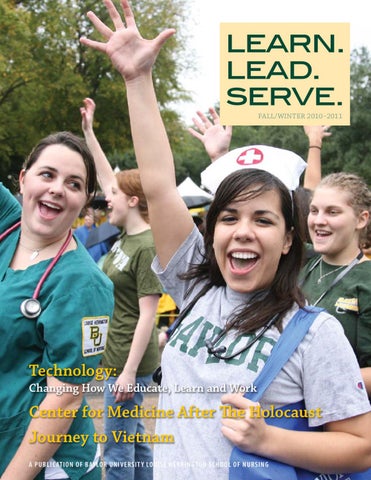
learn. lead. serve. FALL/WINTER 2010–2011
Technology:
Changing How We Educate, Learn and Work
Center for Medicine After The Holocaust Journey to Vietnam A P UBL I C AT I O N OF BAYLOR U N I VERSI T Y LOUISE HER R ING TO N SCHO OL OF NUR SING
MESSAGE FROM THE DEAN
Standing at a crossroads
by Judy Wright Lott DSN, NNP-BC, FAAN Dean
There is great momentum in the United States today to transform our healthcare system to improve quality, safety, affordability and accessibility. As nurses we comprise the largest segment of the healthcare workforce and we are at a crossroads to break down the barriers that limit our ability to influence change, practices and policies. This past October, the Robert Wood Johnson Foundation and the Institute of Medicine published The Future of Nursing: Leading Change, Advancing Health. The culmination of a two-year joint initiative, the report provides recommendations on ways in which nurses can be active participants in the future of healthcare. Producing a healthcare system that delivers the right care—quality care that is patient centered, accessible, evidence-based and sustainable—at the right time will require transforming the work environment, scope of practice, education and numbers of America’s nurses. This and several other recent studies call upon educators to better prepare nurses to effect change in the healthcare environment. As nurse educators, Baylor has always been committed to providing our students with premier education and clinical experience. We are preparing tomorrow’s nursing leaders. Our curriculum challenges students to think and act like nurses long before they graduate. Serving in any number of settings from schools, homes, retail health clinics, long-term care facilities and community and public health centers to battlefields and the mission field, nurses fill an expanding role in the continuum of patient care. The nurse is the nucleus of the patient care plan streamlining collaboration across teams of healthcare professionals. Our students must be prepared to seamlessly transition into the workforce and perform within this collaborative environment.
At Baylor University Louise Herrington School of Nursing we are focused on nursing education transformation. To this end, we are committed to:
Our Students
To recruit more nursing students and expand the diversity of our student body to meet the needs of a growing and diverse patient population
Our Faculty
To grow our faculty base to maintain a low student-faculty ratio To promote the professional development of our educators To prepare more nurses to be nurse educators
Our Campus
To increase our campus footprint— physically and virtually To utilize up-to-date and cutting-edge tools and technologies
Our Curriculum
To educate from a best-practices approach To collaborate with healthcare provider partners for expanded clinical experiences To manage the transition from school to practice We hope that the programs, initiatives and events that you read about in each issue of this publication demonstrate our commitment to our students, nurses and the entire healthcare industry and inspire you to join us in our mission to Learn, Lead and Serve.
fall/winter 2010–2011
H
O
OL
IN
SC
G
ITY
BA Y
R UNIVER S LO
OF NU
RS
learn. lead. serve.
Baylor University Louise Herrington School of Nursing Leadership Ken Starr
President, Baylor University Elizabeth Davis
Executive Vice President and Provost, Baylor University Judy Wright Lott
Dean, Louise Herrington School of Nursing Mary Brucker
Associate Dean and Director, Graduate Program Catherine Rosser
Director, Undergraduate Program Lynne Mann
Chair, Faculty Organization
INSIDE THIS ISSUE
Message from the Dean inside front cover Graduate Program: A Message from Mary Brucker 2 Undergraduate Program: A Message from Cathy Rosser 2 Faculty News 3 Development News: A Message from Janis Kovar 4 School News 8 FEATURE STORIES
Learn Technology: Changing How We Educate, Learn and Work 10 Lead Center for Medicine after the Holocaust: Looking Back to Move Us Forward 14 Serve Nothing Ever Happens by Chance: How Baylor Green Made a Journey to Vietnam 16
Janis Kovar
Director of Development Comments or Questions? We want to hear from you! Send us your comments or questions to: LHSONnews@baylor.edu. And, if you have pictures or stories from a recent Baylor nursing event, we’d love to have you share them with us.
Student Life 18 News from Baylor University 20 Partner News 22 Alumni News 24 Upcoming Events back cover
LEADERSHIP GRADUATE & NEWS UNDERGRADUATE PROGRAMS
A message from Mary Brucker
by Mary Brucker, PhD Associate Dean and Director, Graduate Program
Welcome to 21st century healthcare. Guess who are finally being recognized as integral to the process—yes, nurses! Recently several powerful groups including the Carnegie Foundation, Robert Woods Johnson Foundation and the United States Institute of Medicine have emerged as strong supporters to decrease barriers so that nurses can better meet future needs of our society. As mentioned in the dean’s message, the report titled The Future of Nursing: Leading Change, Advancing Health presented a strong recommendation that nursing education programs should increase the number of graduates, especially those who are primary care providers such as nurse practitioners and nursemidwives, such as those educated at LHSON. Moreover, the report stated that there should be
a doubling of the number of doctorally prepared nurses over the next decade. We are already addressing those recommendations. From 2006 until this fall, the numbers of graduate students have more than doubled, with 78 students currently matriculating in the nurse practitioner and nurse-midwife programs. Of this group, more than a dozen are students seeking a Doctor of Nursing degree. Primary care providers such as nurse practitioners and nurse-midwives also are in great demand simply as the population grows and ages, even without acknowledging the increase in care needed as more individuals receive healthcare coverage. Healthcare may be in changing times, but with graduates from LHSON, we can rest assured we will be in good hands.
A message from Cathy Rosser
by Cathy Rosser, EdD Director, Undergraduate Program
2
“Nurses should practice to the full extent of their education.” The Future of Nursing: Leading Change, Advancing Health, 2010 Just as nurses and their practice have been put into recent spotlight, so has basic nursing education. Content taught in the basic nursing programs drives nursing practice today and should be the foundation for lifelong learning. Not only do we take pride in the high rates of passing the National Council Licensure Examination (NCLEX-RN) and our high graduation rates, but there are continuous intentional activities to educate students for the changing healthcare needs. A recent example is one of retirement of operating room nurses, thus creating a pressing shortage on that area. In response to such an issue being anticipated by our neighbor, Baylor Health Care System, we have developed an elective in that area for
our undergraduate students. The LHSON new graduate is better prepared to practice safely in the operating room, minimizing new employee orientation and orientation cost. Practice and Education are working together. Other ways in which nursing education keeps pace with practice include the number of faculty who regularly work in hospitals, clinics and other sites; the faculty who actively participate in local hospital and/or professional communities; and how faculty constantly review not only what to teach, but how best to teach information. If nurses should practice to the full extent of their education, the corollary is that the education should enable nurses to practice to the fullest extent possible. This is one of intentions of the LHSON undergraduate program as it prepares graduates to Learn, Lead and Serve. fall/winter 2010–2011
FACULTY NEWS
Dean Lott Recognized As Leader in Healthcare
This past fall, LHSON dean Dr. Judy Wright Lott was named one of 60 visionary leaders in nursing and healthcare by her alma mater, the University of Alabama at Birmingham School of Nursing. Dean Lott received her doctoral education at UAB and was honored in Birmingham at the university’s 60th anniversary celebration that included nurse practitioners, healthcare administrators, university presidents, deans and professors from around the globe. The distinguished list of honorees are known for their service in the field of nursing or healthcare on the local, state, national or international level in practice, education or research; are recognized by colleagues and peers for outstanding achievement; and are recognized for their leadership, innovation or entrepreneurship. “Alumni from the UAB School of Nursing have been integral in distinguishing the school in state, national and international circles and in shaping the nursing profession,” said Dr. Doreen Harper, dean of the UAB School of Nursing. “These awards were established to celebrate the school’s renowned graduates and their mark on nursing.”
Cheryl Tucker Earns Certified Nurse Educator Designation
We are proud to announce that Cheryl Tucker, MSN, has achieved Certified Nurse Educator (CNE) status after meeting strict eligibility criteria and completing a rigorous certification process administered by the National League of Nursing (NLN). “Through the certification program, we have made clear to the ranks of higher education that the role of nurse educator is an advanced professional practice discipline with a defined practice setting and demonstrable standards of excellence,” said Dr. Beverly Malone, CEO of the NLN. Cheryl joined LHSON in 2004 and is instrumental in the education of our FastBacc students. Since the certification process was introduced in 2005, less than 1% of learn. lead. serve.
nurse educators have achieved this prestigious designation. Fellow LHSON faculty member Dottie Perri, MSN, also earned CNE status in 2008. “We are very proud that our school now has two faculty that have earned CNE status,” comments Dean Lott. “Our ability to prepare highly educated nurses is directly related to the caliber of nurse educators that we have here on campus.”
Dr. Martha M. Bradshaw to Retire from LHSON
Distinguished LHSON faculty member Martha Bradshaw, PhD, RN, will retire at the end of the 2010–2011 academic year. During her seven-year tenure at LHSON, Dr. Bradshaw taught in both the graduate and undergraduate programs, served as associate dean from 2004 to 2007 and actively participated on several committees and task forces working tirelessly on LHSON programs and initiatives. A dedicated professor, mentor and advisor, she was recently honored as an Outstanding Tenured Faculty. Dr. Bradshaw’s career passions have included research, obstetrics, servant leadership and ethics. Well-published throughout her career, Dr. Bradshaw has said one of her proudest career accomplishments was her book, Innovative Teaching Strategies in Nursing and Related Health Professions. “Today’s faculty need to understand the importance of being more than just a talking head,” she states. “Teaching needs to be purposeful and have meaning for students. We need to convey information to students in ways that they can better understand and use it.” Dr. Bradshaw is an active member of First Baptist Church in Dallas, where she also sings in the choir. Her post-retirement plans include a mission trip to Argentina with her church and enjoying time with her three grandchildren. 3
DEVELOPMENT NEWS
Together we can make amazing things happen Every day I am in awe of the work that is being for this critical, university-wide initiative. An endowed scholarship is one in which the done here at the Baylor University Louise Herrington School of Nursing. Giving students principal investment is left intact and the interest provides the awarded scholarship the opportunity to answer their calling to funds. Endowed scholarships create a nursing is the greatest gift we can give and at Baylor, our students are our number one priority. permanent funding source that is meant to When President Ken Starr first came to Baylor, support students in perpetuity. Even if you aren’t able to create your own named endowed he met with student government officials and scholarship, a gift of any amount can be it was made very clear that affordability is our combined with others to build a fund or students’ overwhelming number one concern. by Janis Kovar The escalating cost of higher education is in fact added to an existing one. To learn more, visit Director of Development a nationwide crisis. Currently, more than 80% of www.baylor.edu/extraordinarystories or contact me directly. Baylor students receive some form of financial With each issue of Learn.Lead.Serve. our goal assistance, and that number is not likely to shrink as the cost to maintain Baylor’s standards is to keep you informed on the news, events and changes that happen on our campus. LHSON of quality education grows. BAYLOR IS ONE OF ONLY 45 has grown significantly throughout the years, For this reason, President PUBLIC AND PRIVATE COLLEGES and current plans and initiatives have been Starr recently announced AND UNIVERSITIES IN THE created to ensure Baylor nurses continue to be the President’s Scholarship UNITED STATES, CANADA the best and brightest in their field. As director Initiative, a three-year AND GREAT BRITAIN—AND THE ONLY TEXAS BIG 12 of development, it is my goal to help each of plan focused on building INSTITUTION—TO EARN A you be a part of our legacy. $100 million in Endowed “BEST BUY ” DESIGNATION BY Since the school was opened in 1909, more Scholarship Funds. We THE 2011 EDITION OF THE FISKE than 5,400 graduates have gone on to pursue are proud to have three GUIDE TO COLLEGES. successful nursing careers around the world. The members of the LHSON following provides a snapshot look at nursing Dean’s Board, Anita Jones (BA ’61) and enrollment and the financial support that make Russell and Betty Pilcher (proud Baylor our growth and successes possible. parents), serving on the steering committee
Baylor University Nursing Statistics TOTAL NURSING ENROLLMENT Total nursing enrollment at Baylor University has grown nearly 70% in the past eight years and is expected to grow another 20% by fall 2013.
4
Projected Fall 2010
Fall 2011
Fall 2012
Fall 2013
Pre-Nursing (BSN) Waco campus
340
347
354
361
Upper-Level Nursing (BSN) LHSON campus
261
286
302
302
FastBacc (BSN) Accelerated degree track
27
48
64
64
Graduate (MSN)
76
80
84
88
Total Nursing Enrollment
704
761
804
815
fall/winter 2010–2011
UNDERGRADUATE PROGRAM STUDENT DEMOGRAPHICS ( LHSON campus)
UPPER DIVISION ENROLLMENT Since 2002, upper division enrollment on the LHSON campus has grown 46%. The most significant source of growth has been our FastBacc and graduate programs. 500
2010 undergraduate enrollment: 288 Female Male
Nursing
International students: 11
Graduate
400
Non-resident Permanent-resident
FastBacc
300 200 100 0
2002
2004
268 20
2006
2008
2010
2012 Projected
Korea Philippines Cote d’Ivoire Ethiopia Pakistan Canada Vietnam China
5 6
3 2 1 1 1 1 1 1
Ethnicity Caucasian Hispanic African American Asian Multiracial Native American/ Pacific Islander
STUDENT-FACULTY RATIO Providing a low studentfaculty ratio is not just a focus here on our campus; it is a Baylor University imperative. LHSON has consistently maintained a ratio below the industry standard of 10:1. Ensuring students’ access to faculty results in a higher standard of educational excellence and student success.
NURSING FACULTY In order to continue to grow our student body, we are also prepared to grow our faculty and teaching staff. The current nursing faculty is comprised of tenure and tenure track faculty, lecturers, joint appointment and part-time faculty and administrators.
10 National average 8 6
197 40 23 17 10 1
Louise Herrington School of Nursing
4 2 0
2006
2007
2008
2009
2010
50 40 30 20 10
2006 2007 2008 2009 2010 learn. lead. serve.
5
DEVELOPMENT NEWS
Financial Support
The continued support of our alumni, family and friends provides critical financial assistance to our students, enables us to recruit and retain a world-class faculty and provides for the purchase of state-of-the-art learning and training equipment and necessary improvements to our facilities. 2,725
Total nursing school donors (2010)
610
FINANCIAL CONTRIBUTIONS BY AMOUNT Donation amount
Percentage of donors
Less than $1,000
90%
$1,001–5,000
6%
$5,001–25,000
2%
$25,001–100,000
1%
Greater than $100,000
1%
TOTAL LHSON GIVING $2 (millions)
Total nursing school donors (historical)
$1
0
2006
2008
68%
2009
$1,779,097
2008
$1,409,688
2007
$507,068
2006
$102,164
2010
Programs and equipment Endowed scholarships 13.6%
Give to Baylor University
$1,442,862
LHSON FUNDS AS PERCENTAGES OF TOTAL DOLLARS GIVEN
ALLOCATION OF LHSON ALUMNI GIVING Current LHSON alumni roster: 4,883
32%
2010
Planned giving 46.6%
13.9%
Excellence fund Missions programs (5.7%) Current scholarships (4%)
Don't give back 15.9%
Research (0.3%)
Note: All enrollment and financial data are as reported in October 2010
I also want to share with you a few specific gifts recently made to LHSON: A $600,000 grant from the Helene Fuld Health Trust, HSBC Bank USA, N.A. Trustee has established the Helene Fuld Health Trust Scholarship Fund for Baccalaureate Nursing Students. To be distributed over the next three years, half is designated as an endowed scholarship fund and the balance is to be used for current need scholarships. Anita Jones, a Dean’s Board member, recognized an immediate need to provide scholarship assistance to students pursuing a career in nursing through our FastBacc accelerated degree program. Upon hearing that some students were unable to afford enrollment in the program this past fall, Anita created an endowed scholarship fund specifically for our FastBacc program. 6
The Lucile W. and George R. Pattullo Fund of the Dallas Foundation provided funds for the purchase of two Laerdal VitalSim blood pressure trainer arms and controllers to be used for instruction and student practice and testing. A $50,000 donation was made to the Patricia Ann Hooper Memorial Endowed Scholarship Fund in memory of Patricia’s husband, Jack Hooper, who passed away in May 2010. The Ralph H. and Ruth J. McCullough Foundation originally created this fund in 1998 to perpetuate the memory of Patricia Ann Hooper and recognize the healthcare professionals that cared for her through a lengthy illness. And we can’t forget the countless number of volunteer hours bestowed upon our campus by the many alumni, fall/winter 2010–2011
family and friends of LHSON. Their dedication and support are what help bring many of our programs and events to life. There is no doubt that we have been truly blessed throughout the years. As members of the Baylor Nation, now more than ever, we are being called upon not only to support today’s students but to open the door for future generations of Baylor students to fulfill their calling to Learn, Lead and Serve. There are several ways you can get involved and be a part of the LHSON mission:
Mail a gift
Mail a check to the nursing school directly at 3700 Worth Street, Dallas, TX 75246. Be sure to reference the specific area you’d like to support.
Planned Giving
Ways to Show Your School Support We have designed funds that specifically benefit our students and faculty so that you can make an impact in an area that is important to you.
Current Scholarship Fund
Provides scholarship support for current LHSON students and is a perfect outlet for those who want their gift, combined with existing scholarships, to sustain today’s Baylor nursing students.
Named Endowed Scholarships
Endowments pledged before May 31, 2011, may be initiated with a gift of $5,000, funded over five years, and are named when the balance reaches $25,000.
LHSON Alumni Endowed Scholarship Fund
Donations (of any amount) are combined with others to form an endowed scholarship that will benefit future LHSON students in perpetuity.
An estate gift is a truly powerful way to support Baylor students. Options for planned or estate giving are numerous, such as a bequest in one’s will, naming Baylor as a beneficiary in an insurance policy or retirement plan, or through a life income plan such as a charitable gift annuity, charitable remainder trust or retained life estate. It’s important to know that a planned gift does not have to amount to the entire estate, it can simply be a percentage or portion thereof. Alumni and friends that make financial commitments through their estates also become members in the Old Main Society.
This fund enables students to participate in medical mission efforts around the world by providing medical supplies, medicines, portions of airfare and more.
Corporate Matching Programs
Good Samaritan Dean’s Fund
Corporate matching gift programs are a wonderful way to make your financial contributions stretch even farther. More than 7,500 companies nationwide offer matching gift programs to their employees and some even double or triple the gifts made by their employees. Talk to your company today to see if they match financial donations and let your efforts make an even bigger impact.
Go online to www.baylor.edu/give
Here you will be able to give directly to LHSON funds and support the initiative that matters most to you.
Contact me, Janis Kovar, directly at (214) 808-9802 or janis_kovar@baylor.edu
I’d like to answer any questions you have about the area you would like to support. learn. lead. serve.
LHSON Excellence Fund
Distributed at the dean’s discretion, this fund is used to provide training opportunities for faculty, supplies for students, campus building repairs or expansion and much more.
Missionary Family Nurse Practitioner Program
This fund is used to cover unexpected situations that arise throughout the year, such as a student’s difficult circumstance that renders him or her unable to buy textbooks or the need to replace daily-used lab equipment.
Lecture Series Endowment Fund
This fund is designed to enhance the students’ education by bringing distinguished leaders and keynote speakers to campus on a regular basis. An annual lecture series is created with a gift of $250,000.
Endowed Professorship Fund
Endowed professorship funds create prestigious faculty positions and enable the school to attract and retain high quality scholars. Increasing the number of professors reduces the student-to-faculty ratio and further improves the overall student experience. A fund is established with a gift of $1.5M. 7
SCHOOL NEWS
Afternoon Tea with Alice Starr
This past September, we were proud to host an afternoon tea with Baylor First Lady Alice Starr. Over 100 attended this special event held in the student lounge of the LHSON campus, including students, faculty, staff and local Baylor alumni. We were honored to have this opportunity to introduce Mrs. Starr to Seniors our campus and let her Cody Sherman know just how proud and Becca Scott we are to have her and share a laugh with President Starr as part of Mrs. Starr. our Baylor family.
Welcoming Our New Neighbors
8
The first symposium for registered nurses who care for the growing population of older adults was held here on the LHSON campus in late September. More than 40 nurses attended the symposium and, upon completion, earned 30 continuing nursing education credit hours (of which 10 are completed online). “Nurses play a vital role in the care, education, and support of the older population in many settings. With the aging of America, there is a tremendous need for nurses to have the best practice and up-to-date knowledge of the complexities of the older adult,” said Dr. Jane Nunnelee, RN, a geriatric nurse practitioner and LHSON senior lecturer who organized and led the symposium. A second Gerontological Dr. Jane Nunnelee Nursing Symposium will be held organized and led the first on Saturday, April 2. For more information or to register, go to symposium, with over 40 attendees. www.baylor.edu/nursing/GNI.
For the past year we’ve watched the construction of the new Baylor Charles A. Sammons Cancer Center right next to our campus, and we can’t wait to welcome our new neighbors. The 10-story, 467,000-square-foot facility, the largest of its kind in North Texas, is scheduled to open March 2011. This new outpatient cancer center will continue Baylor Health Care System’s commitment to world-class care and will feature: A Patient Navigation program to guide patients and families through the cancer journey. Advanced technology and integrative therapies for cancer treatment. Treatments for every type of cancer and expanded cancer research. Top-tier medical staff and healthcare providers, including educating tomorrow’s cancer specialists. Expanded outpatient radiation and chemotherapy, support groups, educational resources and programs.
First Gerontological Nursing Symposium a Success
SCHOOL NEWS
Baylor Grads Outperform on the NCLEX . . . Again!
Baylor nurses recently achieved a 96.85% pass rate on the National Council of Licensure Examination (NCLEX-RN). The exam is designed to test entry-level competencies of nursing graduates and is required of all individuals seeking licensure as a registered nurse. Currently, the national pass rate for first-time exam takers is 87.95%. According to Dr. Catherine Rosser, director of the LHSON undergraduate program, the Baylor percentage was the highest among the baccalaureate nursing programs in North Texas. “This is a tribute to both our faculty and staff and our students and reinforces that Baylor nurses are the best,” Dr. Rosser said.
2010–2011 Class Officers
LEVEL: J1 L to R: Lauren Guy, Ashley Corbitt, Merideth O’Connor, Stephanie Svoboda, Gina Smith, Holly Puder, Julianna Mize
LEVEL: J2
LEVEL: S1 L to R: Kendall Kayworth, Erin Marley, Jennifer Vieira-Katske, Stefanie Keese, Ashlee Dillaman, Caitlin Baker, Hannah Armistead
LEVEL: S2 L to R: Cody Sherman, Becca Scott, Gretchen Musgrave, Lisa Parkman, Haleigh Hopkins, Larissa Manor
learn. lead. serve.
L to R: Holly Gatlin, Margaret Ellis, Danielle Barker, Colleen Russey, Melissa Gonzalez, Dina Masri, Kelli Kinerd
9
Technology CHANGING HOW WE EDUCATE, LEARN AND WORK
N
ot too long ago the Media Hardware Inventory list kept by our Learning Resource Center included items like overhead projectors, filmstrip projectors, cassette recorders and typewriters. And who can forget the days when we would spend countless hours in the library doing research at the microfiche machine? Today these items are considered technological dinosaurs. Replaced by computers, smart phones and high-tech lab simulation equipment, our classrooms are able to more
10
accurately replicate the patient care setting better than ever before. As in almost every facet of our lives today, technology is constantly evolving and has a direct impact not only on the tools our students use to learn and how we educate them, but also on the ability to use that technology to make them more efficient and better prepared on the job. Information is key, and the way we obtain and use that information is more important than ever in regard to patient care.
fall/winter 2010–2011
THE HIGH-TECH CLASSROOM then available 24 hours a day, seven days a Our classrooms today are more technologically week to nursing students through our content advanced than ever before and better equipped management system, Blackboard. While the for learning inside as well as outside of class. ability to review a past lecture when studying With laptop computers, smart phones and for a test, prepping for a clinical day at the other mobile devices, students have information hospital or just reviewing a concept for greater at their fingertips. After an initial trial with understanding is advantageous to any student, our FastBacc students, all classrooms on the it is especially important for the FastBacc nursing school campus will be updated with the students, who are working on their degrees at Tegrity Classroom Capture System by the end an accelerated pace. Tegrity allows the students of the 2010 Christmas break. Made possible to review these lectures at a convenient time. by grants from the Penzance Foundation and Students have the ability to select any portion Harris Clark, the Tegrity system upgrade will of a lecture they want to review, and they allow all faculty to record and capture full class can also download just the audio elements to sessions and demonstrations and make them mobile devices and listen to the lecture as many available to their students for online review and times as they wish. Through use of Tegrity by study. This new system includes professionally the graduate school in both the Neonatal and balanced microphones so that vital classroom Family Practice programs, LHSON has been discussion between students and faculty can be able to add adjunct faculty from North Carolina recorded and the students and Vancouver, British viewing the sessions Columbia. The traditional "The more opportunities undergraduate program online can benefit from the complete classroom we have to put students is sharing lectures from experience. This improves the FastBacc program in real-life situations, the learning opportunity between pediatrics, for everyone. Systems obstetrics and foundation we can better educate like Tegrity also better classes, ensuring them to think like a position LHSON to continuity of content offer distance education between the two degree nurse, not just think and online learning tracks. Tegrity is just one like a student in the courses and broaden the example of how we are student base without expanding our education classroom." having to add more methods to benefit not classrooms or faculty. The only our students, but opportunity for faculty to share a course once also our faculty, as they broaden their reach it’s captured allows those who are specialists more efficiently and consistently. on certain topics to “guest lecture” in another Our Don A. and Ruth Buchholz Simulation course without adding the burden of additional Lab is yet another example of how LHSON workload. The classroom capture system is not is using technology to improve our students’ meant to replace the student-faculty interaction. education experiences. The Sim-Lab setting It is meant to augment the student’s ability puts students in a fully interactive learning to review course sessions and prepare for environment. Students are no longer limited clinical reviews. The Tegrity system enables to crowding around a patient bed to merely our faculty to capture their classroom audio listen to a summary of how a particular patient presentations in addition to whatever video is being cared for. Through the use of real or projector tools they are using (PowerPoint, hospital equipment and high-fidelity patient DVD or an image captured from a camera). simulators, students benefit from playing out The combined audiovisual presentation is real-life scenarios providing them with actual learn. lead. serve.
11
encourages a more evidence-based practice approach to healthcare. However, nurses not only need to be educated on how to use these tools; they also need to adopt the actual habit of using them as part of their everyday practice. “Basic computer skills are no longer enough in today’s healthcare world,” affirms Gamblian. “Our goal in educating tomorrow’s leaders in nursing means our students need to understand how to access and use all the tools that are available to them.” It is for this reason that educators at LHSON are currently incorporating aspects of the Technology Informatics Guiding Education Reform (TIGER) Initiative in their coursework. The TIGER Initiative is designed to address a set of skills that is needed by all nurses who will practice in the profession in the 21st “hands-on” experiences. Sim-Lab equipment like century. Many reports from organizations such the ventriloscope, a stethoscope that transmits as the Institute of Medicine, the American pre-recorded MP3 files as sounds through the Hospital Association, the Joint Commission stethoscope, enables students to identify obscure and professional groups call for the use of or uncommon sounds and leads to more technology as a tool in creating a safer, more accurate diagnoses. “The more opportunities we efficient healthcare delivery system. An have to put students in real-life situations, we Institute of Medicine report entitled Health can better educate them to think like a nurse, Professions Education: A Bridge to Quality not just think like a student in the classroom,” identified five core competencies for healthcare explains Vivian Gamblian, RN, MSN, LHSON professionals: the ability to deliver patientlecturer and simulation coordinator. “We centered care, the ability to work as members of want them to not just know what to do, but an interdisciplinary team, the use of evidenceunderstand why it is the best practice method.” based practice, quality improvement approaches Technological advances can be seen and informatics. There is much confusion throughout the LHSON campus. From basic around this last one. Informatics relates to additions like AirBear wifi throughout our collecting, analyzing, storing, retrieving and facilities, to our Classroom Capture system, disseminating information. Together, computer to patient simulation equipment in both the and information literacy provide the basis for Sim-Lab and the Learning Resource Center, informatics competencies. Today’s nurse must we are constantly finding efficient and effective not only know what information is out there, methods to better educate our students and but also how to retrieve it, evaluate it and put it prepare them for practice. to use. It used to be that nurses were constantly IS ALL THIS TECHNOLOGICAL FUSS referencing volumes of books and materials REALLY NECESSARY? in regard to caring for a patient, and these Today’s technology is not only changing published items needed frequent renewal and how our students learn; it is also evolving updating. Today, that is no longer the case. their post-graduation role in the patient care Medical records, research and cross-reference setting. More than ever before, nurses have material are now available electronically and tools and information at their fingertips which in real time. It is critical that nurses know how 12
fall/winter 2010–2011
and when to access this material, and how to maintain it. To promote and encourage this training, educators are continually finding ways to synchronize the learning process with the workplace environment. Laptops are not required on campus, but they are strongly encouraged. Students are now able to purchase their textbooks in electronic format (commonly referred to as e-book or digital book). The e-book format allows students to learn how to efficiently cross-reference material, use electronic highlighters and even communicate and network among different study groups (all practices that are used daily in the workplace). Today’s nurse is also tasked with complying with HIPAA (the Health Insurance Portability and Accountability Act) guidelines and standards. Our students learn early on how to do this by ensuring their classroom and lab experiences, along with their reports and homework assignments, are HIPAA-compliant. Gone are the days when cell phones were banned from the classroom. Today’s students are actually encouraged to bring and use their smartphones in class just as more nurses are using their smartphones on the patient care floor. In both situations, however, phones are
never to be used for social purposes. For example, as a workplace tool, smartphones can be used to quickly access important drug interaction information at the patients’ bedside. Our world today is a much smaller place, and there is a growing need to enable access to medical records wherever you are. For this reason, the healthcare industry has been challenged to make all medical records available electronically by 2014 to improve communication between healthcare providers, which will heighten continuity of care for the patient. The increased need for information and technology literacy among our graduates means they will not only enter the healthcare workforce readily able to use technology to solve problems, but will also possess a knowledge of standardized languages and classifications and an understanding of the ethical and legal issues surrounding access and use of information. Our ability to educate our students through simulated real-life patient care scenarios will lead to better critical-thinking skills and improved patient outcomes. We are here to ensure Baylor nurses are among the best and brightest in their field and thus are dedicated to constantly evaluating and improving the methods we use in their education.
13
Looking back to move us forward Center for Medicine After The Holocaust
F
rom 1933 to 1945, German physicians, nurses and bioscientists purposely committed the most egregious violations of medical ethics ever seen in history. Even before the time of the genocide of millions known as the Holocaust, the German government established euthanasia programs for mentally and physically ill German children and adults. The elderly and the handicapped were considered burdens on society and not worthy of medical procedures and expenses. Later, guided by eugenic theories of race, hundreds of thousands would be involuntarily sterilized and experimented upon, and gas chambers and crematoria would be created for the mass murder of six million Jews. Many continue to ask how this could have happened. Why would physicians and nurses willingly participate in these acts? And what can we learn from studying Nazi Germany’s concept of a “life not worthy of life” and its treatment of patients who were considered to be living less than a human existence? Answering questions like these is the goal of the Center for Medicine After The Holocaust (CMATH), created by Sheldon Rubenfeld, MD, clinical professor of medicine at Baylor College of Medicine in Houston. The mission of the center is to study and apply the lessons and legacies from medicine’s involvement in the Holocaust to modern medicine so that physicians, nurses and bioscientists will uphold their professions’ highest ideals in doing medical research and in caring for patients. To help reach this
14
“Arbeit Macht Frei” was found at the entrance to most Nazi concentration camps and translates as “Work will make you free.”
goal, a team of “champions” at American medical schools (beginning with schools in Texas) was identified to aid in better educating medical, nursing and graduate students about medicine and the Holocaust. Baylor University’s own Dean Judy Wright Lott, RNC, NNP, DSN, was selected as one of these Champions and will represent Baylor University as part of the 21-person CMATH team. The education of CMATH Champions includes the opportunity for a week-long trip to visit relevant camp and psychiatric sites in Germany and Poland where the medical practices of the Holocaust took place. “I still remember a lecture given by Dr. Ingeborg Mauksch as part of a theory course I had when I was in school,” recounts Dean Lott. “Dr. Mauksch taught us about the role of nurses during the Holocaust and in the concentration camps. It left a long-standing impression on me throughout my career as a nurse and nurse educator.” It’s been widely documented that the physicians and nurses weren’t able to simply not participate. Refusing to participate was an offense punishable by death. These individuals faced the gas chambers or were locked away and refused food and water, eventually starving to death. Although forced to participate, many nurses have recounted that they made every attempt possible to carry out their duties in a compassionate and humane manner.
fall/winter 2010–2011
Dean Lott’s purpose in participating in the CMATH mission is to expand the lessons and learning of Baylor students pursing careers in the medical field. The end goal is that Baylor students benefit from an expanded focus on ethics based on these and other events from the past. “In order to better understand today’s healthcare practices and prepare our students for their future, it is important that we reflect on and learn from our past,” states Dean Lott. “It is critical that we educate our students about exactly why everything that we do in healthcare and research today is based on the Nuremberg Code for humane treatment of the patient.” Medical research and improved technologies
NUREMBERG CODE At the end of World War II, the Nuremberg Trials were held to prosecute the individuals accused of crimes against humanity. One result of these trials was the Nuremberg Code, created to guide the ethical treatment of patients in medical research experiments. Today, the 10 points outlined by the Nuremberg Code are the basis for the regulations issued by the United States Department of Health and Human Services that govern federally funded research. 1. The voluntary consent of the human subject is absolutely essential. This means that the person involved should have legal capacity to give consent; should be so situated as to be able to exercise free power of choice, without the intervention of any element of force, fraud, deceit, duress, over-reaching, or other ulterior form of constraint or coercion; and should have sufficient knowledge and comprehension of the elements of the subject matter involved as to enable him to make an understanding and enlightened decision. This latter element requires that before the acceptance of an affirmative decision by the experimental subject there should be made known to him the nature, duration, and purpose of the experiment; the method and means by which it is to be conducted; all inconveniences and hazards reasonable to be expected; and the effects upon his health or person which may possibly come from his participation in the experiment. The duty and responsibility for ascertaining the quality of the consent rests upon each individual who initiates, directs or engages in the experiment. It is a personal duty and responsibility which may not be delegated to another with impunity. 2. The experiment should be such as to yield fruitful results for the good of society, unprocurable by other methods or means of study, and not random and unnecessary in nature. learn. lead. serve.
are rapidly changing our patient care abilities and practices. Today’s healthcare professionals are thus constantly faced with the question of not just whether we can do something, but whether we should. Giving Baylor students a solid foundation on the understanding of ethical practices in medicine is not only something we can do, but is absolutely something we should do. “I am honored to be among this inaugural group of CMATH Champions,” reflects Dean Lott. “Baylor is already known for the quality education that we provide our students, and this experience will only augment the learning that we are able to offer.”
3. The experiment should be so designed and based on the results of animal experimentation and a knowledge of the natural history of the disease or other problem under study that the anticipated results will justify the performance of the experiment. 4. The experiment should be so conducted as to avoid all unnecessary physical and mental suffering and injury. 5. No experiment should be conducted where there is an a priori reason to believe that death or disabling injury will occur; except, perhaps, in those experiments where the experimental physicians also serve as subjects. 6. The degree of risk to be taken should never exceed that determined by the humanitarian importance of the problem to be solved by the experiment. 7. Proper preparations should be made and adequate facilities provided to protect the experimental subject against even remote possibilities of injury, disability, or death. 8. The experiment should be conducted only by scientifically qualified persons. The highest degree of skill and care should be required through all stages of the experiment of those who conduct or engage in the experiment. 9. During the course of the experiment the human subject should be at liberty to bring the experiment to an end if he has reached the physical or mental state where continuation of the experiment seems to him to be impossible. 10. During the course of the experiment the scientist in charge must be prepared to terminate the experiment at any stage, if he has probable cause to believe, in the exercise of the good faith, superior skill and careful judgment required of him that a continuation of the experiment is likely to result in injury, disability, or death to the experimental subject. 15
Nothing Ever Happens by Chance
How Baylor Green made a journey to Vietnam
Every day the faculty, staff and students at Baylor University Louise Herrington School of Nursing give thanks for the many blessings brought to us through our family, friends, acquaintances and even benevolent strangers. We feel the presence of God’s hands guiding us in everything we do, and it is through His plan Do all the good you can, by all the means you that we answer our calling can, in all the ways you can, in all the places to serve others. The you can, at all the times you can, to all the fact that Sandy Tindel people you can, as long as you ever can. (BSN ’78), a Dean’s John Wesley Board member, forged a collaborative relationship between LHSON and Glocal Ventures was certainly part of God’s plan. You see, Sandy’s brother, Reverend Bob Roberts, Jr., is the founder and president of Glocal Ventures, a DFW-area organization that encourages and facilitates volunteers to use their vocations, skills and passions to make a difference in Vietnam. 16
A Baylor graduate, Bob is the founding pastor of Northwood Church, which launched GVI in 1998. GVI has been recognized by the Vietnamese government as an international non-governmental organization (INGO) since 2005. Through this connection, LHSON faculty was inspired to explore the idea of collaborating with GVI in Vietnam to develop potential learning endeavors for faculty and students. “As a university, Baylor is committed to providing our students the opportunity to examine their lives as a calling, and as such we felt moved to visit Vietnam and consider it as a possible place to use student and faculty gifts and talents,” explains Lori Spies, LHSON Missions Program and FNP Coordinator. The Baylor Nursing Delegation was comprised of David Kemerling, Lyn Prater, Cheryl Riley, Lori Spies and Leslie Payne. The team collaborated with GVI to identify two
fall/winter 2010–2011
facilities, Nam Dinh Nursing University and Chuong My District Hospital, that provided the best opportunity to achieve the established objectives of the trip: Develop sustainable relationships to facilitate ongoing collaboration Assess and identify sites for future student participation Provide updates for faculty at Nam Dinh University Develop relationships and explore opportunities for collaboration with faculty and leaders in nursing Provide support for nurses in rural settings Advocate for nurses and those for whom they provide care Explore potential for an alumni trip
Nam Dinh Nursing University Nam Dinh is an education center that lies southeast of Hanoi. The Baylor Nursing Delegation met with the university director (a member of the Ministry of Health who is in charge of the nursing curriculum for the entire country), assistant director and 40 faculty members. As part of this initial meeting, the Baylor team hosted a workshop for Nam Dinh faculty entitled Using EvidenceBased Practice in Nursing Education. Topics and faculty presenters included: Curriculum Development Overview: Lori Spies The Student-Patient Relationship: David Kemerling Clinical Teaching and Care Plans: Lyn Prater Teaching with Case Studies: Leslie Payne Teaching Neonatal Resuscitation: Cheryl Riley “We found it very gratifying to provide faculty development at Nam Dinh Nursing University, sharing our passion for excellence in nursing with our interested colleagues,” notes Spies. “While in the hospital we were able to provide requested continuing nursing education. We believe we have found a match for our gifts and talents at both of these places and are currently developing plans for return visits.” The well-received workshop also gave the Baylor team the opportunity to work with the Nam Dinh faculty on curriculum development as well as cultivation of the university’s program philosophy, including nursing autonomy, nursing practice, care plans and the development of nursing as a profession. Future collaboration with Nam Dinh Nursing University holds great potential in impacting nursing in Vietnam through the transformation and standardization of nursing education. The opportunity learn. lead. serve.
for Baylor faculty and DNP students to contribute in a meaningful manner is significant, including the potential to create an international healthcare study abroad program for graduate and undergraduate students.
Chuong My District Hospital There is a great urgency for education in this rural hospital that has very limited resources and is a prime example of the markedly different nursing practices in Vietnam. The Baylor team had two meetings with hospital officials and was able to offer continuing education on topics of Cardiac Monitoring and Hand Hygiene.
Today’s Actions Impact Tomorrow’s Possibilities
Upon returning from Vietnam, the Baylor team developed a five-year plan to cultivate and grow our efforts in that country. This past November, Dr. Lyn Prater returned to Nam Dimh University to participate in the university’s 50th anniversary celebration. Dr. Prater spoke on undergraduate and postgraduate education in the United States and she also presented the university with a plaque of recognition in honor of the milestone anniversary. During that same week in November, LHSON and the Baylor Global Network hosted a reception for His Excellency Le Cong Phung, the Vietnam ambassador to the USA at the home of Reverend Bob Roberts, Jr. Attended by several Baylor University officials and the LHSON mission team, the reception was a great opportunity to discuss the importance of Baylor’s efforts in Vietnam and build future partnerships for other Baylor schools and departments. Cultivating collaborative relationships with universities and facilities in Vietnam enables us to further enhance our long-standing tradition of mission work and provides our faculty and students invaluable opportunities to make a difference in this world.
17
STUDENT LIFE
The Faces of LHSON Baylor students come from places near and far. We’d like to introduce you to just a few of our current students and share their stories with you! KENDALL KAYWORTH Undergraduate Student Kendall came to Baylor from a small town outside of Waco. Just three months before she was scheduled to start school she was diagnosed with lymphoma and underwent treatment at MD Anderson in Houston. Determined to pursue a career in nursing, Kendall returned to school and with the support of faculty, staff, fellow students, her roommates and her family she will be graduating in May 2011 (only one year later than her original plan). Kendall chose Baylor because of the strong emphasis on the psychosocial, emotional and spiritual aspects offered on campus. “The spiritual support you receive from the faculty and staff is incredible,” she states. “Professors pray with you before classes and tests. Mrs. Bufton would have us sing ‘This Is the Day That the Lord Has Made’ before every class. What other university would allow that?” After a recent summer externship at Memorial Sloan-Kettering, Kendall plans to pursue her nursing career working on a hematology/oncology floor, perhaps in pediatrics. MIKE MARRS FastBacc Student A 1998 Texas A&M graduate with an industrial distribution degree, Mike had built a successful career in corporate sales but it never truly fulfilled him. Rather, he felt it was his calling to help people and contribute to the betterment of society. So, after some intense soul-searching, he dusted off his backpack and made the decision to return to school. “I can honestly say it was the fourth best decision of my life, behind accepting Christ, asking for my wife’s hand in marriage and deciding to have children,” Mike comments. Mike chose LHSON for its respected reputation and specifically for the accelerated BSN track that fit his new career path (it probably didn’t hurt either that his wife is a Baylor grad). 18
Texas native Mike and his wife welcomed their first child this past August (adding a whole new set of challenges and sleep deprivation to his studies!). Set to graduate May 2011, Mike plans to pursue his career as an ICU, emergency or operating room nurse in the DFW area. CHRISTOPHER DAVIS Family Nurse Practitioner Student Christopher’s first bachelor’s degree was in youth and family ministry from Lubbock Christian University. While he was living and working in Oregon postcollege, nursing came to Christopher as a practical avenue to serve people in a multitude of ways and something he could be truly passionate about. After obtaining his BSN and working at Legacy Children’s Hospital, Christopher developed a deep-seated passion for the plight of those living in poverty-stricken lands, and he soon chose to pursue an FNP degree at LHSON. Set to graduate in 2012, Christopher plans to work with populations that are overlooked or marginalized. YEOUNKYOUNG (SARA) PARK Neonatal Nurse Practitioner Student Yeounkyoung (known to her classmates as Sara) came to us from South Korea. Prior to her move, Sara was working as a nurse in her home country and was frustrated by the common problems and barriers nurses faced. Sara set out to find a school that offered a familial and supportive atmosphere, and Baylor’s LHSON fit the bill perfectly. Sara made the journey on her own, a brave feat given that no one in her family speaks English and all still reside in her native country. Having just recently graduated in December, Sara is currently pursing a career as a neonatal nurse practitioner here in the United States and hopes to one day work in South Korea or other countries where professional neonatal care is needed. fall/winter 2010–2011
Congratulations, Stephanie Lewis! On September 14, surrounded by her peers and mentors, Stephanie Lewis was presented with the Student Nurse of the Year award from the National Black Nurses Association in a surprise ceremony. Stephanie is the first student in Baylor University history to receive this prestigious award. She was officially honored at the annual NBNA convention in San Diego, California, in August; however, she was unable to attend, as she was serving as a nurse extern at a Texas camp for children with arthritis that same week. Stephanie is an active member of the Metroplex chapter of the NBNA (MBNA) and had also previously earned a scholarship from the organization. We are proud of you, Stephanie!
CHERYL SMITHERMAN Nurse-Midwife DNP Student Cheryl Smitherman loves school. Well, actually, Cheryl is passionate about learning and teaching. Having earned a BA in English with a minor in dance in 1989, she originally pursued a career as a teacher and drill team director. In 1996, she chose to return to school and earn her nursing degree, as she had always wanted a career in the medical field. After graduation, Cheryl worked several years as a labor and delivery manager and women’s services nurse educator. Upon hearing that LHSON introduced a Certified NurseMidwifery Doctorate in Nursing Program, Cheryl instantly knew she’d be returning to school. Cheryl’s husband of 21 years, Danny, is the first to admit that he’s looking forward to her planned graduation in May 2012, since she has been in school almost the entire time he has known her!
L to R: Dean Lott, MBNA vice president Peggy Stevenson, Stephanie Lewis; MBNA president Brenda Ross
Student Housing: Living the Suite Life LHSON student housing is now located just one block from
school at the Marquis on Gaston apartment complex. At the Marquis, students are provided up-to-date amenities, security, parking and more. The fullyfurnished split-suite apartments include two bedrooms, two baths and a full kitchen. Up to four students can share an apartment or a
student can choose to pay for a private room or entire apartment. Through our ongoing partnership with Baylor Health Care System, student apartment rental rates are discounted for LHSON students, and all utilities such as basic cable, internet and phone are included. “Our students really enjoy the option of living in an apartment,” comments Dr. Patricia Davis, director of student initiatives. 19
BAYLOR UNIVERSITY NEWS
Taking a Strategic Approach to Baylor’s Future
President Starr and Provost Elizabeth Davis recently invited all Baylor constituents to actively participate in shaping the future of Baylor University. From now through April 2011, the strategic planning process calls upon all faculty, staff, students, alumni and friends to reflect on our past and share insight and ideas on the university’s future. “Good and faithful stewardship of the university’s mission and its resources requires thoughtful planning to ensure that we advance our mission of educating men and women for worldwide leadership and service by integrating academic excellence and Christian commitment within a caring community,” stated President Starr. We hope you will take the time to provide your insight, whether through one of the on-campus open discussions or through website or written submissions. Further details and helpful information about the Strategic Plan can be found at www.baylor.edu/strategicplan.
New Faces on Campus We’re excited to welcome 55 new students to our campus for the spring semester. Incoming J1 Students: Waco campus transfers: 23 Transferring from other universities: 30 Incoming Graduate Students: 2
20
The Nation’s Oldest Homecoming Tradition Continues
No amount of rain was able to dampen our spirits during Baylor Homecoming Week this year. Held October 21–23, it was a time of celebration and fellowship and included traditional events such as the Pigskin Revue, Crowning of the Homecoming Queen and a victorious football game against Kansas State. LHSON students, faculty and alumni turned out to walk in the parade (the largest collegiate Homecoming parade in the nation!) and more than 75 friends and family enjoyed snacks and conversation in our hospitality tent during the parade. The skies might have been gray, but our hearts were filled with green and gold.
BAYLOR UNIVERSITY NEWS
An Early Start to Success A CONVERSATION WITH DIANA KOHLER
Diana Kohler (BSN ’63) is the academic advisor in Baylor’s Pre-Nursing office. Diana is the “face” of LHSON in Waco and works tirelessly guiding students early in their journey to become nurses.
Diana Kohler visits with Baylor students Kelley Joseph and Ann McLain.
What do you like most about your role as Academic Advisor? I have worked at Baylor for 16 years now and have been the academic advisor for all pre-nursing students for are here in Waco to help get the students registered for the past eight years. My role here allows me to help our class so that they have a schedule in hand when they leave. students in many ways. Maintaining academic and admission information is As academic advisor, I advise each pre-nursing student another part of my job. The students’ academic records are every semester. These are freshman, sophomores and a prepared for the Admission committee in order to make few upperclassmen who have changed majors late in their decisions regarding advancement to the Dallas campus. college careers. We keep them on track to complete their At the end of each semester we hold a send-off ceremony prerequisites, advise them on the profession and help for students who will be going to the Dallas campus. The prepare them to become nurses. ceremony is a time for students to share I am also the advisor/sponsor of the their experiences on the Waco campus Waco chapter of the National Student and for family, friends and faculty to “Ms. Diana Kohler is more than an advisor — she Nurses Association. This is a student-led recognize their hard work thus far. is a mentor, friend and organization for pre-nursing students I really enjoy each “hat” I wear, but spiritual leader.” only. They meet twice a month and have mostly I enjoy my time with the students. Kelley Joseph, junior programs from nurses working in the It is amazing to watch them mature and and president, NSNA, Baylor chapter profession as well as participate in several grow right before my eyes while they are service projects. here in Waco. I keep the 11 o’clock hour open daily to visit with prospective students and their families as they What challenges are pre-nursing students facing today? decide on a college. It is a chance for me to help them in One challenge I see for today’s freshmen and sophomores deciding on a career in nursing and what their educational is the pressure of doing excellent academic work. Several options are. Of course, it is a chance to let the Louise of their required courses are very intense and demanding, Herrington School of Nursing shine. and adjusting to this commitment as a new student is The university holds three Premiere events each year for a real challenge. Our nation’s economy has impacted prospective high school juniors and seniors. At each event today’s students as well. They worry about the financial Dr. Claudia Beal, a Baylor nursing faculty member, and I commitments their families are making for them and how present the opportunities that Baylor offers in pursuing a they can contribute to that. They are also aware that many nursing education. nurses who had planned to retire are not doing that during During freshman orientation, we set the incoming this time and thus the types of nursing positions are not students up for success by ensuring they know what they as varied or plentiful. There are still plenty of jobs, but not will need to do to fulfill their scholastic requirements and always in the locations or services of their choice. how we can help them while they are here. LHSON staff learn. lead. serve.
21
PARTNER NEWS
Little Touches Make a Big Impact on Campus Baylor University Women’s Council of Dallas The Baylor University Women’s Council of Dallas is an organization of Baylor graduates, parents and spouses that we are fortunate to have right here in our own backyard. Longstanding supporters of LHSON, the BUWC provides endowed scholarship funds for our students, but its members are also very present and active right here on our campus working to support and enhance our students’ lives and college experience. Often when LHSON graduates recount the time they spent on campus, we hear about the “little things” that made such a big impact. We truly appreciate the time and effort spent by partner organizations like BUWC making homemade treats and sending words of encouragement to students throughout each semester. Whether it’s to welcome them to campus or set them up for success as they head into final exams, these warm gestures help our 22
students stay focused and uplifted. With a current roster of more than 400 members, the BUWC hosts a biannual brunch for graduating seniors. Another event that students, faculty and staff alike look forward to throughout the school year is the decorating of our campus atrium each semester. Jenny Allison (BS ’78, MS ’80) was on campus this past October bringing a bit of fall indoors. Under the theme “Count Your Blessings,” Jenny put together a beautiful display of fall colors and items complete with an inspirational message and treats for students to enjoy as they came and went to class. We are so grateful for the blessings brought to us through the BUWC and the dedication of members like Jenny. Interested in joining the Baylor University Women’s Council of Dallas? Visit www.baylor.edu/network.
fall/winter 2010–2011
PARTNER NEWS
Dean’s Board
The members of the Dean’s Board serve as school advocates, active fundraisers and a counsel panel. Every semester the Dean’s Board, in conjunction with Baylor Health Care System, organizes an appreciation event for our faculty and staff. The board is comprised of community leaders who share a dedicated affiliation with Baylor University. We greatly appreciate these hard-working individuals! Cindy Abbate Diane Allison, BA ’70 Liz Blair, BSN ’74 Ruth Buchholz, BA ’49 Ellen Byrd, BSN ’64 Nancy Chapman, BA ’69, MS ’73 Sheri Charo Velma Chesnutt Charles Chesnutt John Chiles, BBA ’50, JD ’52 Marie Chiles Harris Clark Karla Cogburn
Jennifer Coleman Diane Drake, BSN ’77 Troy Dungan, BA ’59 Chris Felton, BSN ’76 Donna Dee Floyd, Chair Sharon C. Hilliard, BSN ’75 Anita Jones, BA ’61 Pam Jones, BS ’74 Carl E. Knight Ashlyn Lewis, BBA ’88 Rosemary Luquire Alecia Mallett, BSN ’83 Karen McDonald
LHSON Parents League An information and communication link between parents of Baylor students, helping parents be involved in the Baylor community. Contact Sheri Charo, chapter president, (214) 914-4287.
Betty Pilcher Russell Pilcher Linda Sue Plank, BSN ’77 Bill Pratt Minette Drumwright Pratt, BA ’51 David Ramsour, BA ’62, MA ’64 Carey Ann Smith, BSN ’64, MS ’67 Reneé Kirk Swank, BSN ’79 Sandy Tindel, BSN ’78 Remy Tolentino Wayne Tucker, BBA ’85, MBA ’86 Claudia Wilder Betty Schell Wise Dean Lott catches up with Dean’s Board members Nancy Chapman, Donna Dee Floyd and Reneé Kirk Swank.
Baylor Student Nurses Association (BSNA)
Provides student nurses the opportunity to serve and learn about the nursing profession.
Woman’s Auxiliary, Baylor University Medical Center
Providing annual student scholarship funds and programs that support a positive student atmosphere on campus. 23
ALUMNI NEWS
IN THE SPOTLIGHT:
Saralinda Garcia
Saralinda Garcia hasn’t been on our alumni roster long— she only graduated this past May—but she is already planning to lead a life filled with purpose and passion. Saralinda came to LHSON as a transfer student from several different schools all over the country and abroad. Having been in the military for 12 years, she pursued her education wherever and whenever she could, taking night classes after work at the University of Maryland, University of Phoenix, Central Texas College, Valdosta State and Camden County College. Originally enlisting as a Navy hospital corpsman, Saralinda served in Iraq in 2004 on the front lines with the First Marine Division caring for the critically wounded and dying. “When the bombs would hit our compound, everyone would run for cover. It was the hospital corpsmen who were running toward the bombed areas to save those who were hit,” she states. Surviving a car bombing and rocket-propelled grenade attack, Saralinda’s efforts in Iraq helped save many lives, and she received a Navy Achievement Medal for saving a Marine who was critically wounded in the incident. These experiences led her to realize she wanted to do more with her medical skills. In 2006 she applied for the Navy’s Medical Enlisted Commissioning Program with the sole purpose of becoming a nurse. Only 67 individuals were chosen out of the 206 applicants to this very competitive program. “I looked at many nursing schools across the United States, but I could not think of a better place than Baylor University,” she recalls. “I really chose Baylor because I loved that they integrated Christianity and nursing as one. I feel that is how it should be.” But the road to her degree wasn’t as smooth as she might have hoped. Even though she earned her place in the Commissioning Program, the military does not help cover tuition, and her GI bill wouldn’t come close to covering tuition and expenses. Saralinda soon realized that receiving financial assistance would be the only way she could pursue her dream of becoming a nurse. “Not being able to continue my education would not only affect my family, but it would also affect my military commitment, and I would be letting my country down,” she commented. The LHSON Student Services team helped Saralinda apply for a variety of scholarships to help cover her education costs. While 24
Saralinda Garcia (fourth from right) with her fellow Naval officers
a student at LHSON, Saralinda was awarded a variety of both merit- and need-based scholarships, including the Louise Herrington Nursing Scholarship, the Linda Gilbert and Sandra Oliver Scholarship, the Weba C. Ferguson Scholarship, Baylor Transfer Student and Need-Based Scholarships and Professional Nursing Scholarship, as well as a scholarship from Medical City Dallas Hospital. At the Graduation Pinning Ceremony in May, Saralinda was honored with a special commissioning ceremony. Her uncle, a major in the United States Air Force, swore her in; Troy Dungan (BA ’59) read the official Certificate of Commissioning letter from President Obama; and Saralinda’s three children, Noah, Rosemary and Isabella, placed the epaulettes on her uniform. Post-graduation, Saralinda is currently stationed at the Naval Hospital in San Diego and is scheduled to be deployed to Afghanistan within the year, where she will be serving her country as a Navy nurse. Saralinda is grateful for the opportunities her education will bring her, but her family here at Baylor is even more grateful for the work she will do in her career. We’ve always known that LHSON alumni are unique and passionate in their nursing careers, and Saralinda is certainly one shining example.
We Want to Hear from You If it’s been a long time since you’ve been in contact with your alma mater, we want to hear about the great things you are doing. Email us at LHSONnews@baylor.edu or mail a note to Learn.Lead.Serve. News, c/o Louise Herrington School of Nursing, 3700 Worth Street, Dallas, TX 75246.
ALUMNI NEWS
Where Are They Now? We’re always excited to receive notes from former students and hear about the great things they are doing in their lives. Keep the letters coming! Since graduating in December 2001 with my MSN in nursing administration and management, I have published several articles in Neonatal Network and Advances in Neonatal Care. I am currently a nursing professor at Grayson County College, teaching first-semester students. I also am the series editor for the section “Focus on the Physical” in the journal Advances in Neonatal Care and a National Association of Neonatal Nurses task force member for Standards and Scope of Practice for Neonatal Nurses, where we are writing new standards for neonatal nursing. I am also currently enrolled at Texas Women’s University as a PhD student and plan to do my dissertation on communication between NICU parents and nurses. Linda Merritt, MSN, RNC-NIC Lt Col Bonnie Plume Morris, BSN ’71, retired from the United States Air Force Reserves in a formal military ceremony at NAS JRB Carswell, Fort Worth, Texas, on August 7, 2010, after 26 years of service including active duty deployment during Desert Storm in 1991. Attendees included two two-star generals, a one-star general and Bonnie’s father, Captain Hank Plume, WWII USAF pilot and POW. Other attendees included members of the 10th Air Force, Bonnie’s husband David, her two children Joel and Rachel (BSN ’02), and her 11 grandchildren. In addition to her Air Force Reserve career and her Baylor BSN, Bonnie has a Master of Business Administration from the University of Dallas, 1993, and is currently employed as senior director of revenue integrity at Conifer Health Solutions in Frisco, Texas. (This submission courtesy of Bonnie’s husband of 40 years, David Lynn Morris, BA ’70)
Mark Your Calendar! The 2011 Alumni Reunion date is set for Saturday, March 26. Join us here on the LHSON campus and reconnect with old friends, walk the halls of your alma mater to see firsthand how we’ve grown and take advantage of the opportunity to earn some continuing nursing education credits. Simply fill out the registration form included in this issue of Learn.Lead.Serve. and return it to us. Need more information? Visit www.baylor.edu/nursing/alumni or call (214) 820-3361. We hope to see you in March!
LHSON Alumni Reunion March 26, 2011
Schedule of Events MORNING 8:00–9:00 am 9:00–10:00 am 10:00–10:30 am 10:30–11:30 am
Event Check-In/Light Breakfast Opening Session Break Breakout Sessions Complementary Therapies and Healthcare Kathryn Voreis Women and Stroke Claudia C. Beal Sim-Lab CNE Opportunity
11:30 am–1:00 pm
Lunch
AFTERNOON 1:00–2:00 pm
Breakout Sessions Portrayals of Mental Illness in the Arts Jane Price Women and Stroke Claudia C. Beal Sim-Lab CNE Opportunity
2:00–2:15 pm 2:15–3:15 pm
Break Breakout Sessions Portrayals of Mental Illness in the Arts Jane Price Geriatric Care in the 21st Century Jane Nunnelee Sim-Lab CNE Opportunity
3:30–6:00 pm
Free Time
EVENING 6:30–8:30 pm
Alumni Banquet Award Presentations 25
learn. lead. serve. FALL/WINTER 2010–2011
Baylor University Louise Herrington School of Nursing 3700 Worth Street Dallas, Texas 75246 (214) 820-3361 www.baylor.edu/nursing
Event Calendar January 6–7 New Student Orientation January 10 First Day of Classes, Spring
May 4–10 Final Examinations May 12 Pinning Ceremony for
Semester January 17 Martin Luther King, Jr. Day -
University Holiday
Graduating Seniors May 13 Spring Commencement, Waco May 16 First Day of Classes, FastBacc
February 5 Winter Premiere, Waco March 5–13 Spring Break March 19 Pre-Nursing Day March 26 LHSON Alumni Reunion April 1 Send-Off Ceremony, Waco April 2 Gerontological Nursing
Symposium April 9 Spring Premiere, Waco April 14 Diadeloso, Waco April 22–25 Easter Holidays April 29 Last Day of Classes
Program Join Us on Facebook Become a friend of Baylor University Louise Herrington School of Nursing and be a part of our growing online community.
Go Green! In our continued effort to be environmentally friendly, please let us know if you would prefer to receive future issues of Learn.Lead.Serve. electronically via email. Send us an email with “Electronic News” in the subject line to: LHSONnews@baylor.edu. Look for our next issue this spring!