Important Spring Sale
THERE ARE FOUR WAYS TO BID AT BUKOWSKIS BY PHONE
If you prefer to bid by phone, we will call you from the saleroom and bid on your behalf.
LIVE BIDDING
Bid in real–time online from wherever you are at bukowskis.com. Live/hammer auctions requires validation, contact customer service for registration.
ABSENTEE BIDDING
Place an absentee bid at least one hour before the sale and we will bid on the item for you. Just submit your maximum bid online.
IN THE SALEROOM
Once registered for a paddle you are welcome to bid in the saleroom. The auctioneer will announce the bids. If the object and price is right, raise the paddle. Continue until you are the only bidder remaining.
FOR INQUIRIES PLEASE CONTACT
Senior specialist Asian Ceramics and Works of Art, European Ceramics and Glass
Cecilia Nordström + 46 (0)73–940 08 02 cecilia.nordstrom@bukowskis.com
Assisting Specialist Works of Art
Linn Andersson Bennich +46 (0)70–788 84 75 linn.a.bennich@bukowskis.com
Head of Consignment & Sales Department, Fine Art, Specialist Antique Furniture, Decorative Arts and Asian Ceramics
Björn Extergren +46 (0)70–640 28 61 bjorn.extergren@bukowskis.com
Front cover:
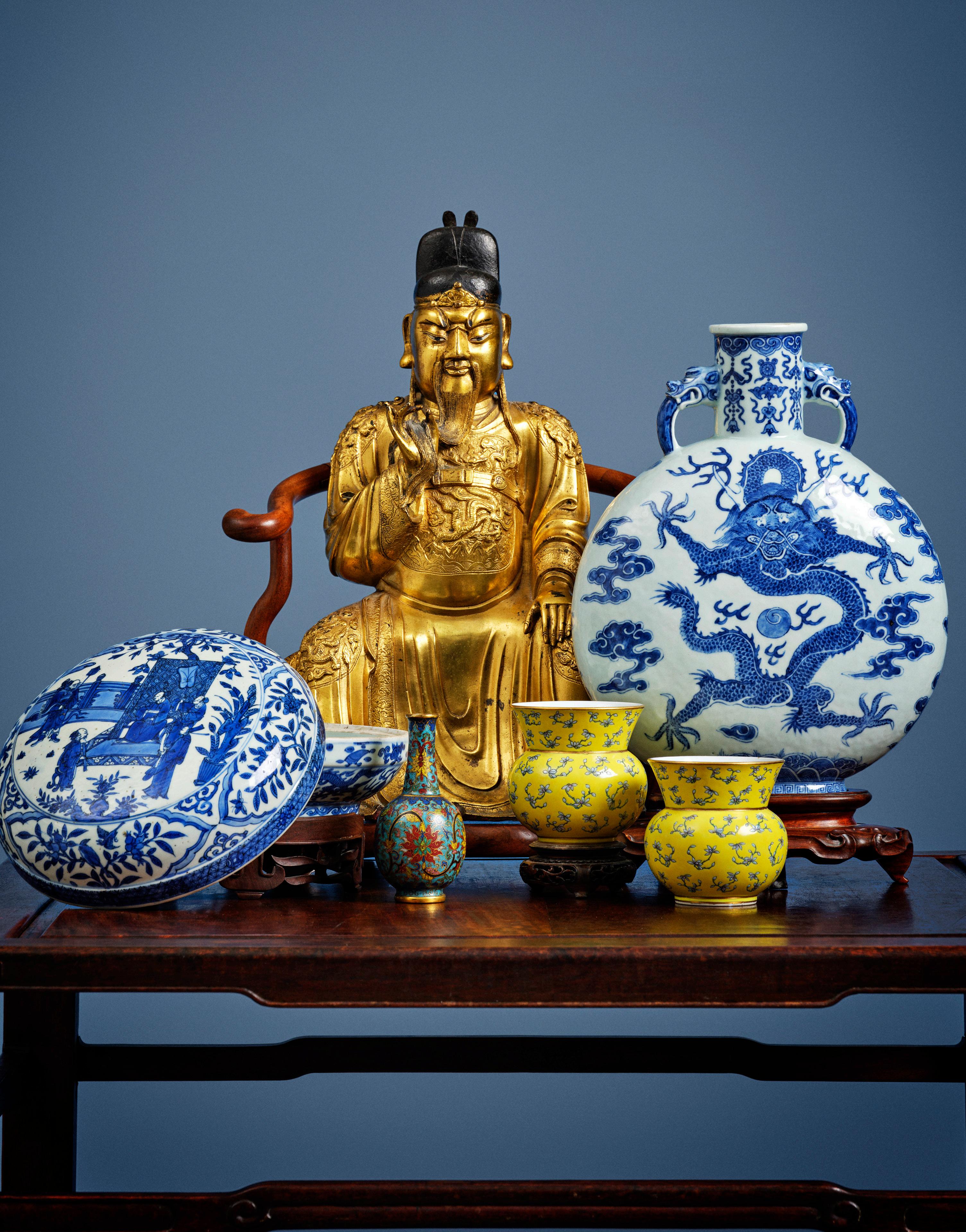
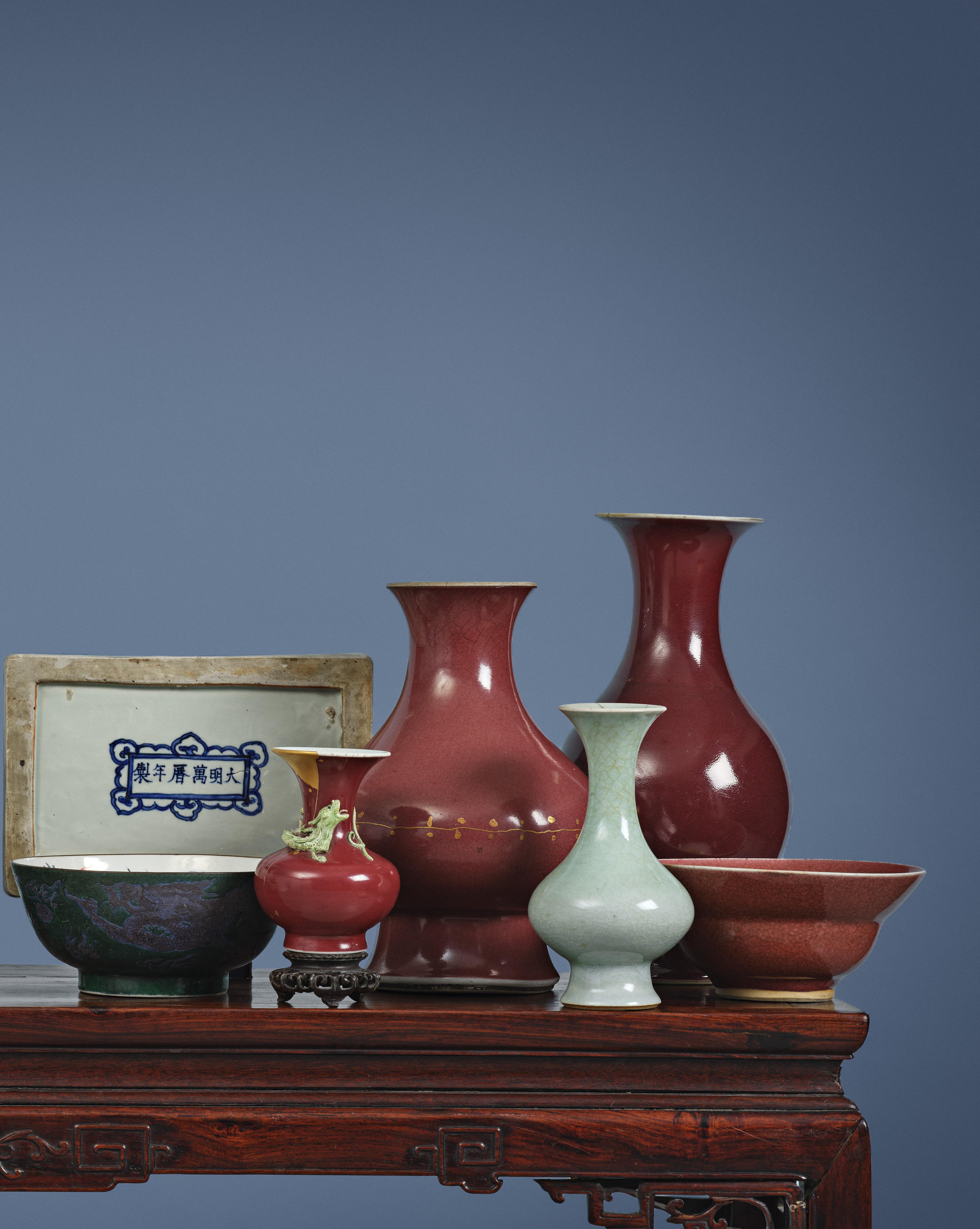
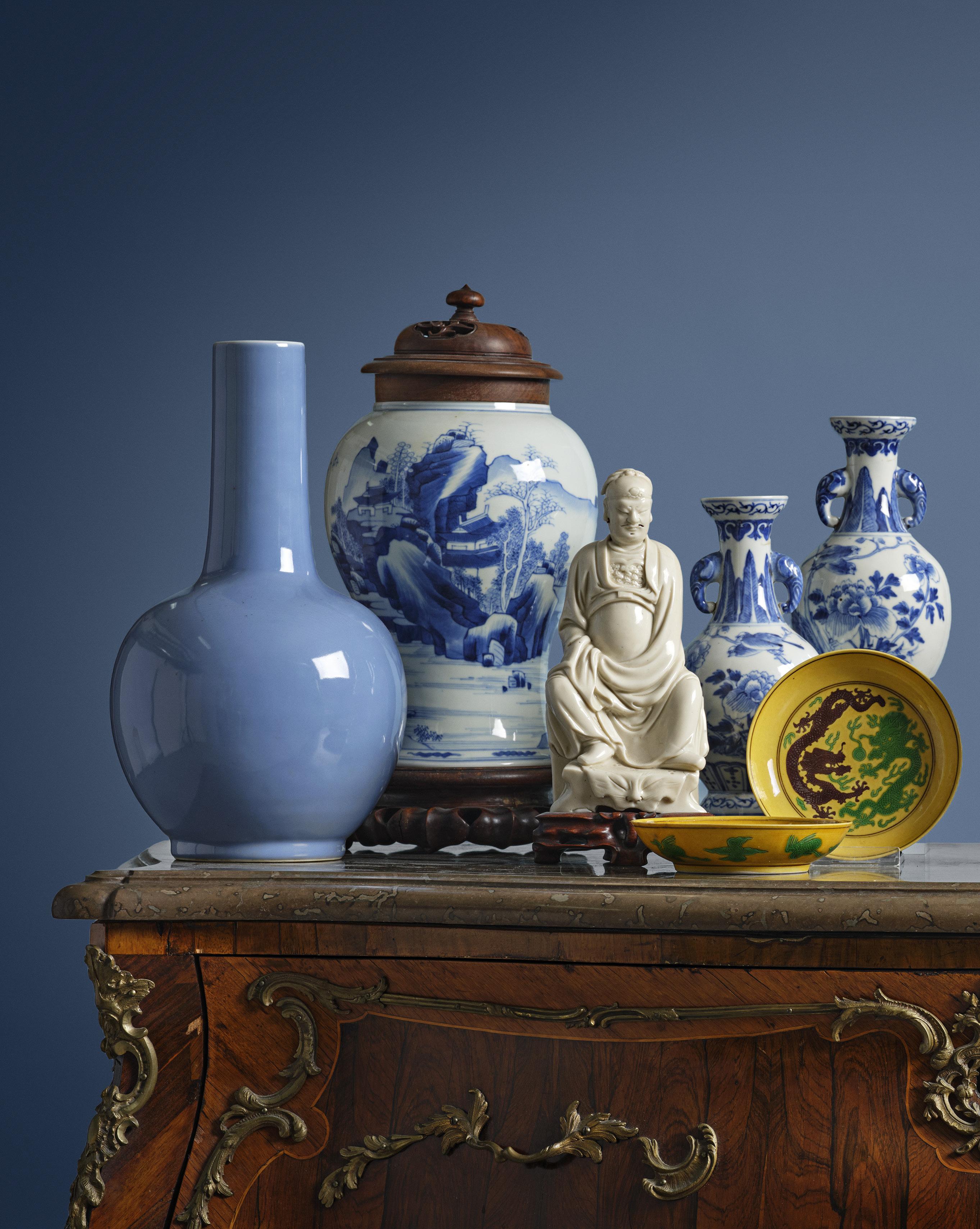
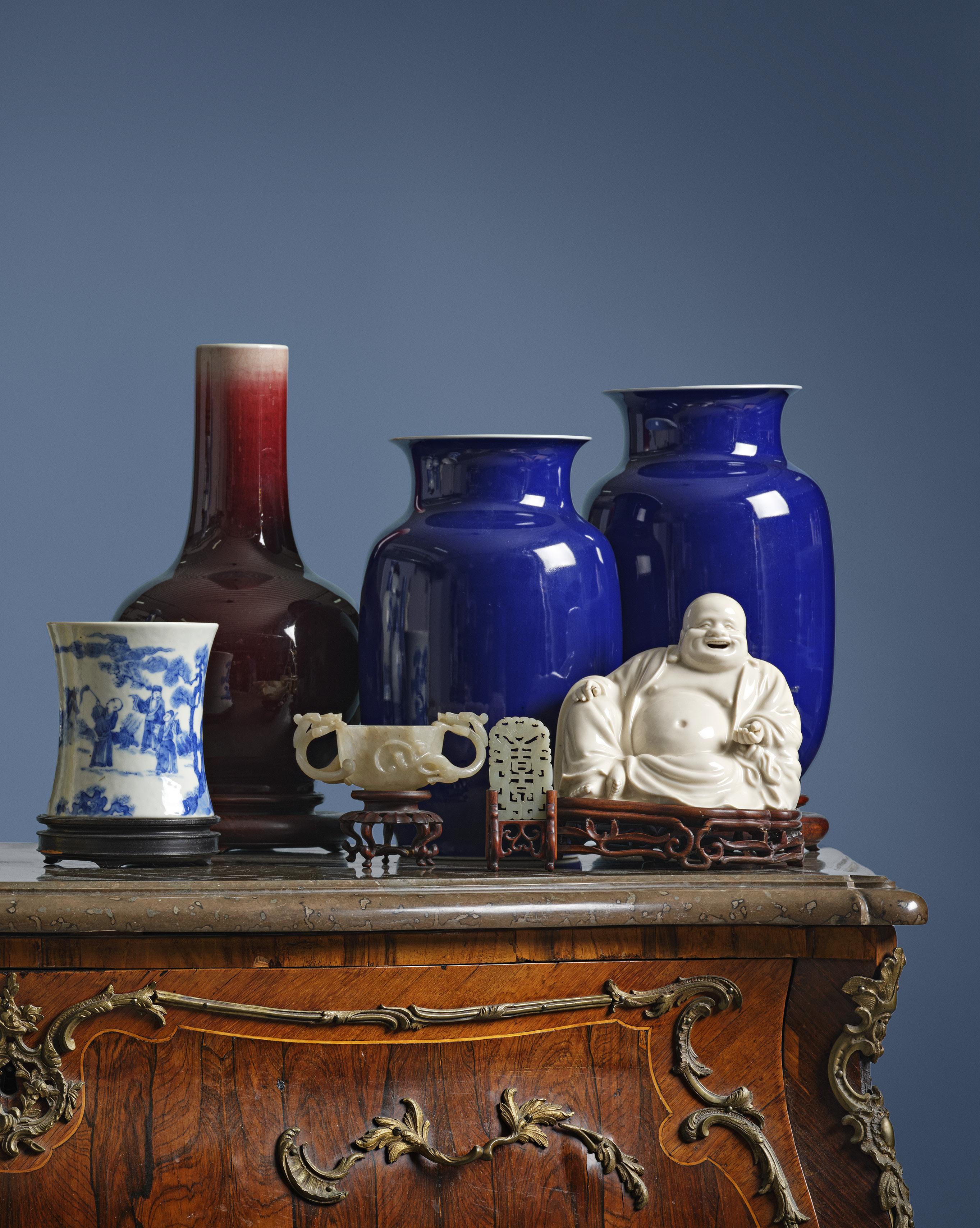
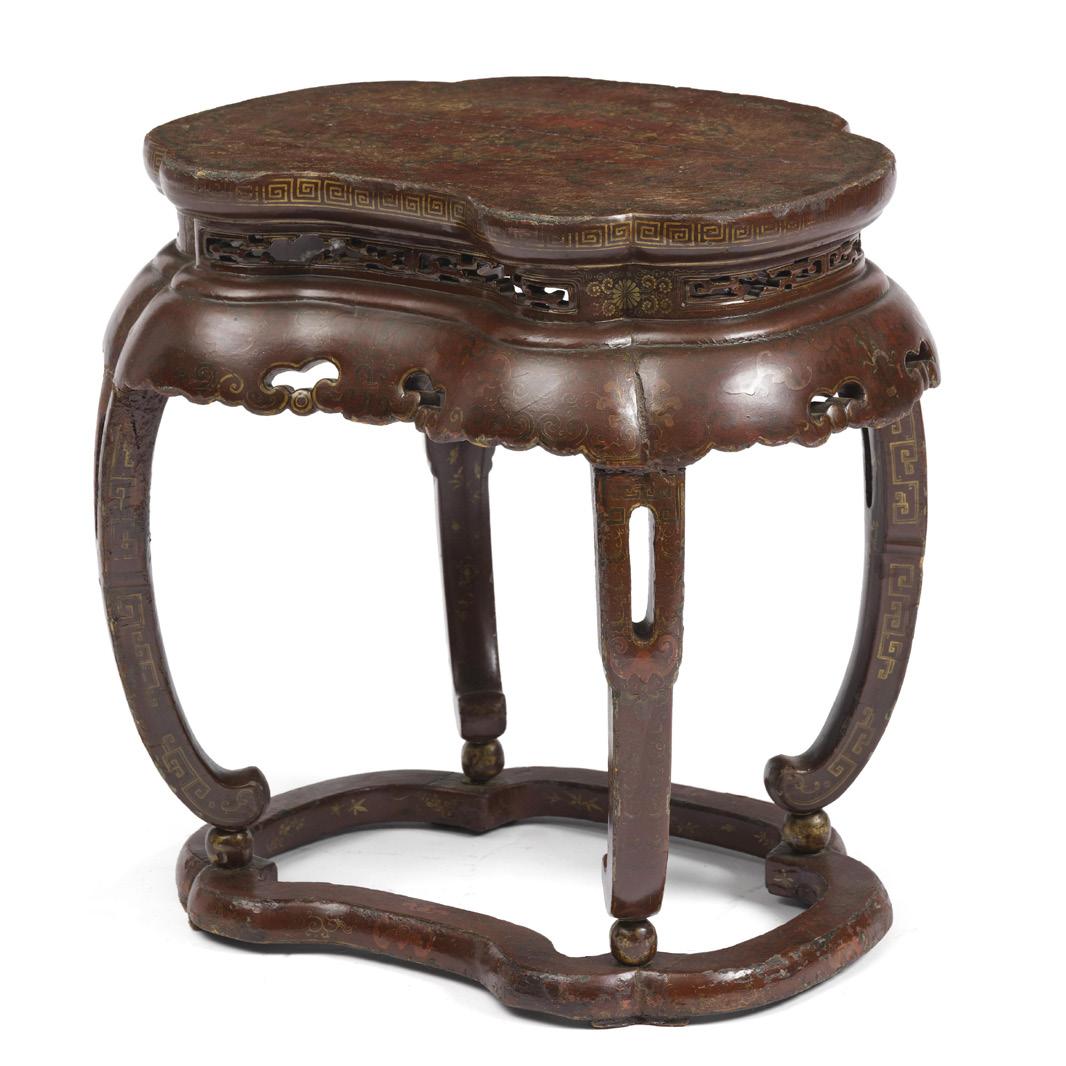
1050. A large well cast figure of Guandi, Ming dynasty (1368-1644). 1181. A blue and white ’dragon’ moon flask, bianhu, Qing dynasty, 19th century. 1044. A small cloisonné ‘lotus’ bottle vase, Qing dynasty with a Qianlong mark and of the period (1736-95). 1149. A blue and white box and cover, Ming dynasty, Wanli mark and of the period (1572-1620). 909. Two enamelled yellow-ground vessels, Zhadou, Qing dynasty, with Tongzhi iron-red four character mark and of the period. 1011. A hardwood table, Qing dynasty.
Back cover:
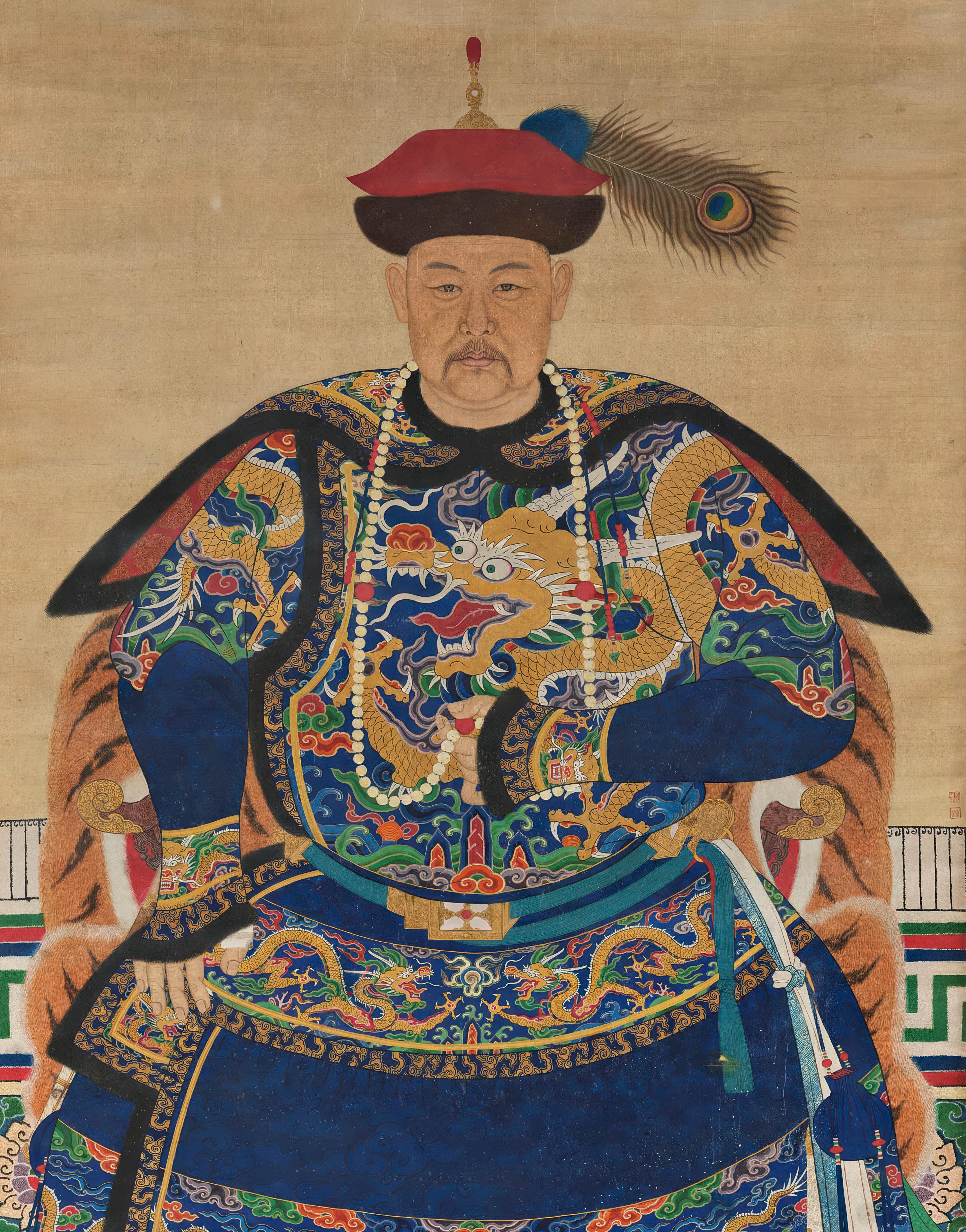
1017. An Ancestral painting of a Manchu bannerman, Qing dynasty, 19th centruy. Signed.
Viewing June 4 – 9, Berzelii Park 1, Stockholm
Live Auction June 10–12, Arsenalsgatan 2, Stockholm
Wednesday June 10, from 10 AM (CEST) Lot. no
Furniture and Works of Art 1 – 231
Silver, Objects of Vertu
– 343 Carpets, Textiles and Islamic Works of Art
Thursday June 11, from 10 AM (CEST)
From 1 PM (CEST)
Friday June 12, from 10 AM (CEST)
Asian Ceramics and Works of Art
– 445
– 475
Pre-registration Asian Sale
Please note that in order to participate in the Asian Sale bidding, as a new client, you are required to pre-register and, upon request, submit a minimum deposit of SEK 50,000. This requirement applies to all bidding methods, including online, telephone, absentee, and in – person bidding in the sale room.
If you have previously bid on Bukowskis, you may be pre-approved. Please check your status by logging in to “My Pages.”
For further information regarding the preregistration application, please contact us at preregistration@bukowskis.com or visit our Customer Service Desk located at Arsenalsgatan 2, Stockholm.
Estimates are provided in Swedish kronor (SEK) and € (EUR). You can find Bukowskis’ general terms and conditions for buyers and sellers, bidding instructions, as well as special terms and conditions for individual lots at bukowskis.com
We extend a warm welcome and look forward to hearing from you.
BUKOWSKIS | JUNE 12 , 2026
From the Collection of Gustaf Oscar Wallenberg
Gustaf Oscar Wallenberg (1865–1937), Stockholm, and thence by descent within the family.
Gustaf O. Wallenberg was a Swedish businessman, diplomat, and active politician. He was the son of André Oscar Wallenberg, founder of Stockholm Enskilda Bank (today’s Skandinaviska Enskilda Banken, known as SEB). After a career in the Swedish Navy, he turned to the business world and was active in improving the transoceanic shipping industry.
Wallenberg was Sweden’s Envoy to Tokyo between 1907–1918. In April 1907 he travelled to Beijing to amend the Treaty of Canton (1847) between Sweden–Norway and China and to establish diplomatic relations between Sweden and the Qing Court. As the Swedish Envoy Extraordinary and Minister Plenipotentiary at the Court of Peking, he successfully negotiated and signed with Lien Fang, the Guangxu Emperor’s High Commissioner Plenipotentiary and Senior Vice-
President of the Wai Wu Pu, the Treaty of Amity, Commerce and Navigation, between Sweden and China, which was signed in Beijing on 2 July 1908, with an additional article signed on 24 May 1909.
The collection was acquired between 1907 and 1918 when Wallenberg was the Swedish Envoy in Tokyo, and possibly during his diplomatic service in China. Documents preserved at the Museum of Far Eastern Antiquities in Stockholm demonstrate the importance of Gustaf Wallenberg and his extensive connections with the Qing government to the Swedish engineers and businessmen who were in China during this period, such as Johan Gunnar Andersson, Osvald Siren, Orvar Karlbeck, Erik Nordstrom and many more.
Gustaf Wallenberg was the grandfather of Raoul Gustaf Wallenberg (1912–1945), an architect, businessman, and diplomat.
LOT 909–942.
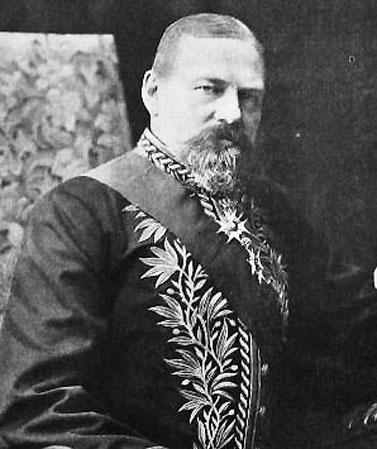
Gustaf O Wallenberg (1865–1937).
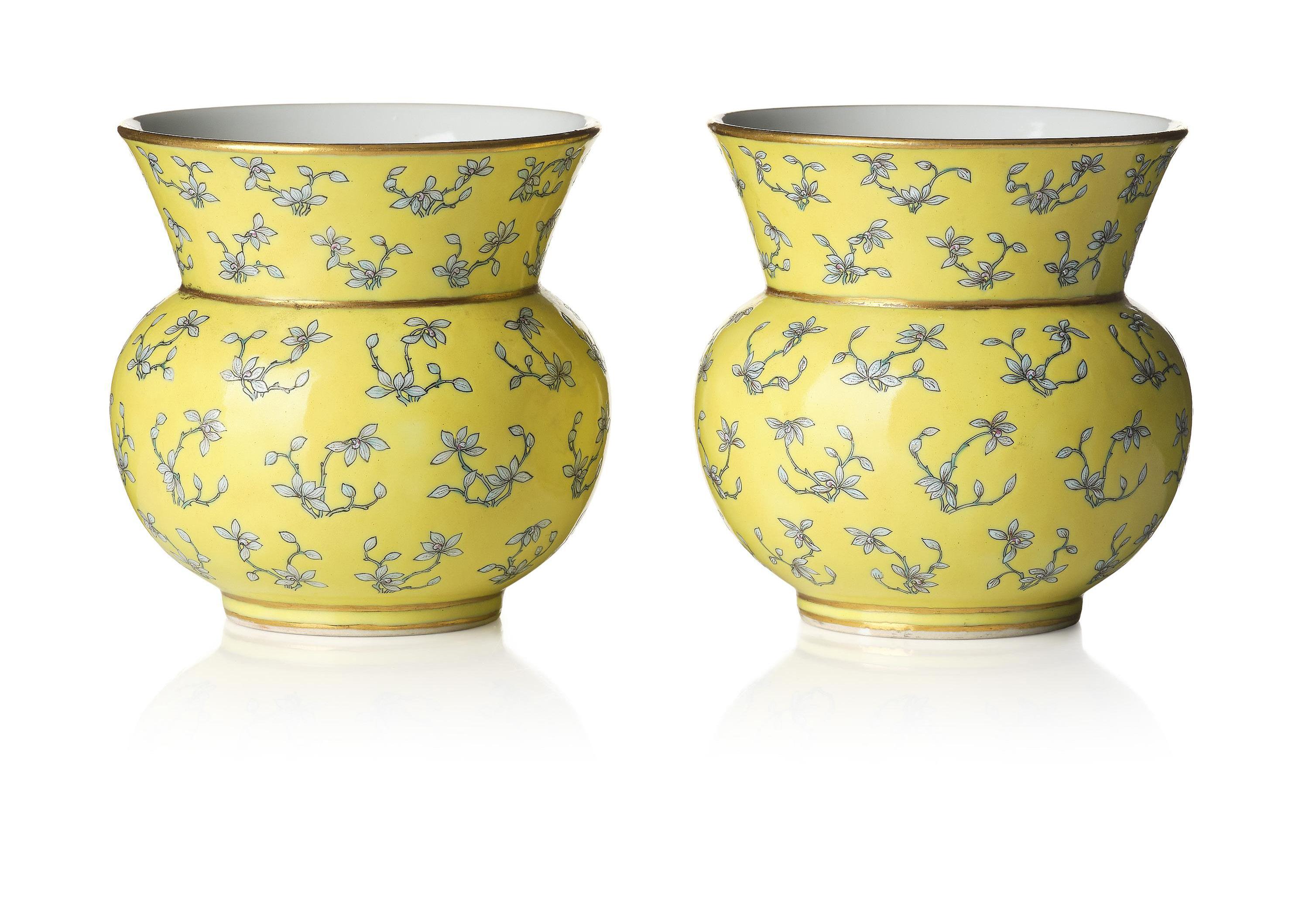
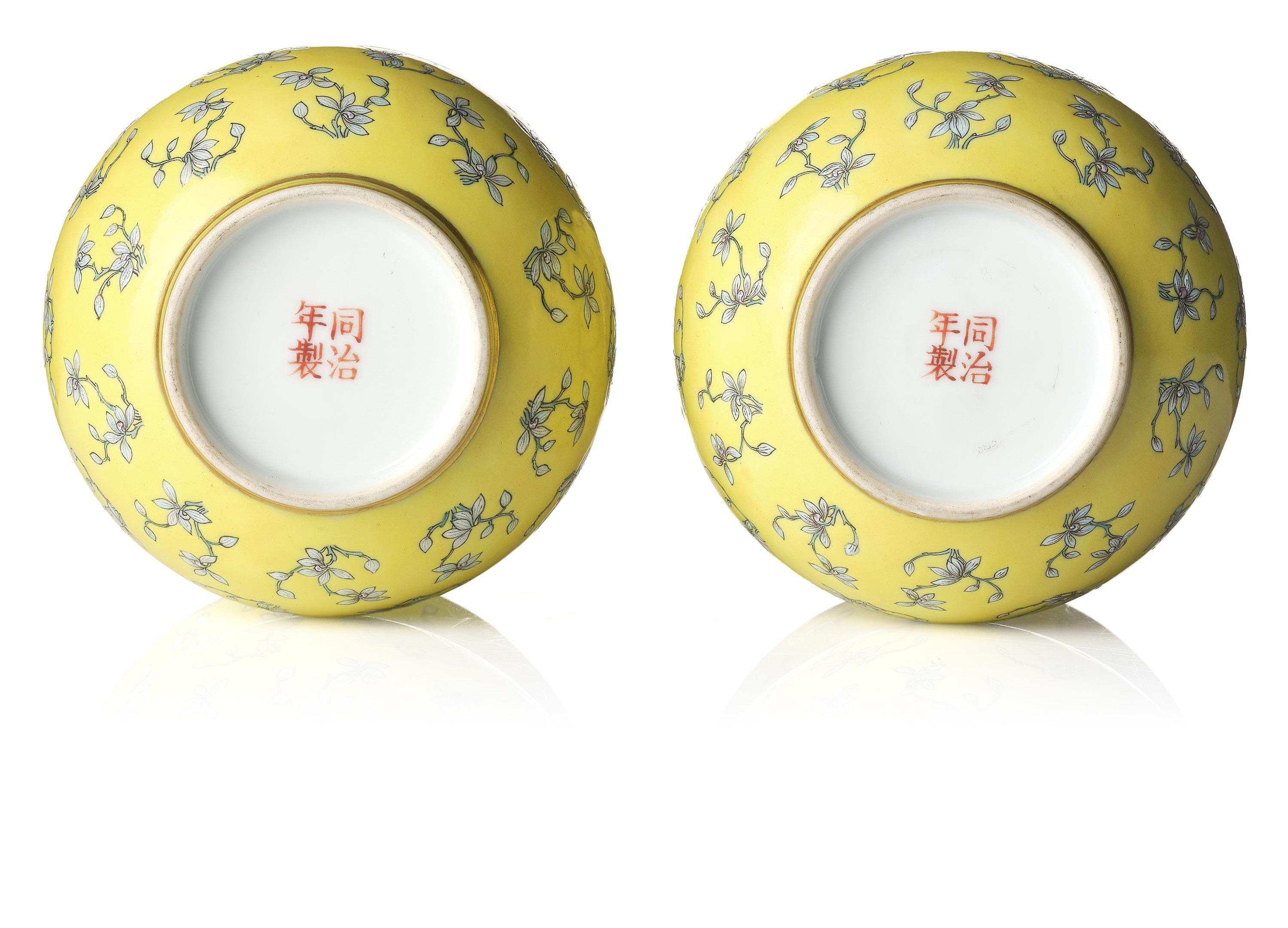
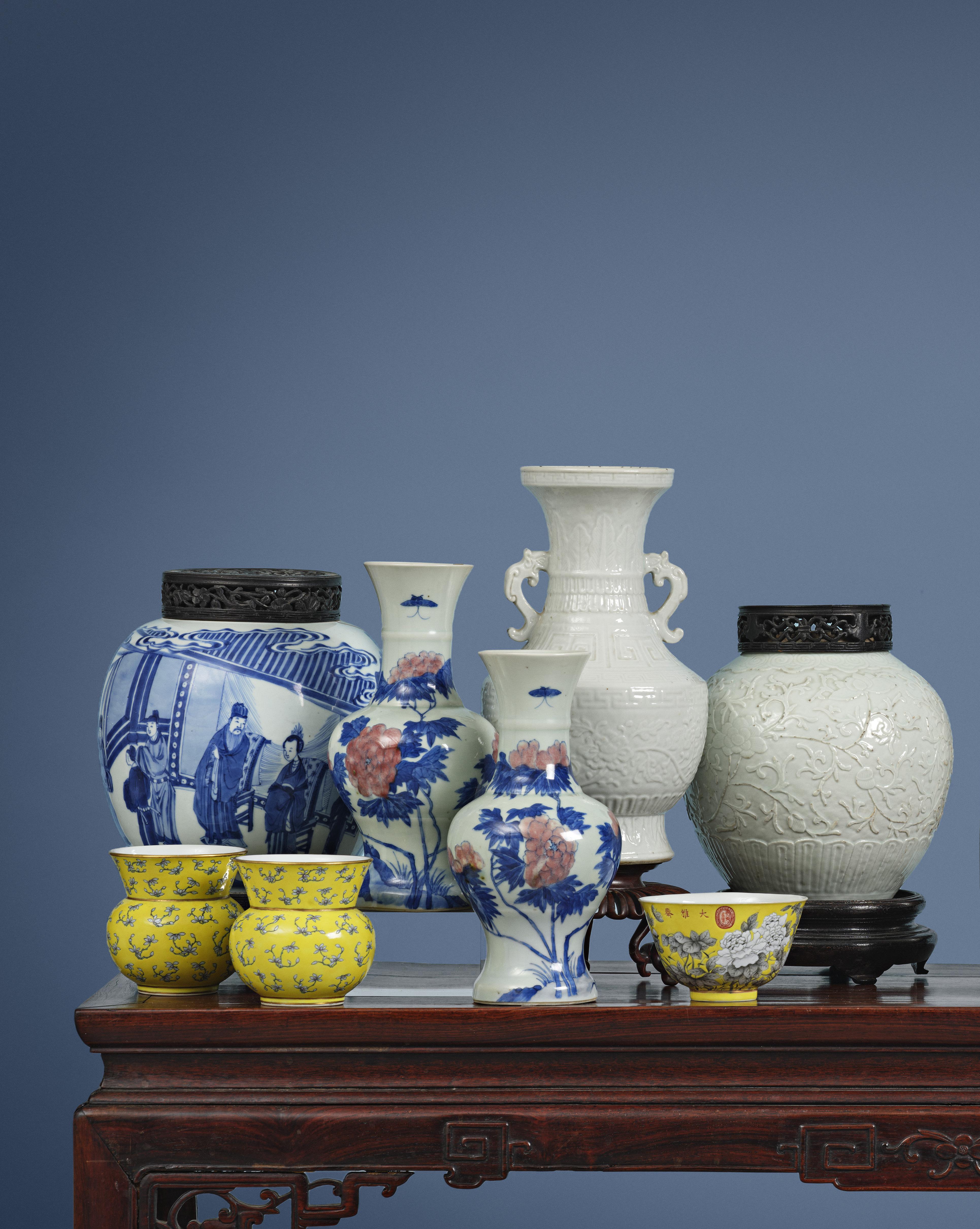
909. Two enamelled yellow-ground vessels, Zhadou, Qing dynasty, with Tongzhi iron-red four character mark and of the period. (1862–1874). Each zhadou with a globular body rising to a flaring neck supported by a short foot, painted in pale enamels with clusters of budding cymbidium orchids, both with gilt borders and reserved on a lemon-yellow ground. Height 9 cm. Diameter 8.7 cm.
Provenance: Gustaf Oscar Wallenberg (1865–1937), Stockholm, and thence by descent within the family.
Exhibitions: Compare a similar, but matched pair sold at Christies, lot 415, Live auction 7997 ‘Fine Chinese Ceramics and Works of Art’, 8 November 2011. Compare with a zhadou of this model and mark in the Palace Museum in Taipei, but with longevity decoration. Object Number 故瓷 012330N000000000.
Estimate: SEK 80 000 – 120 000 / EUR 7 550 – 11 300
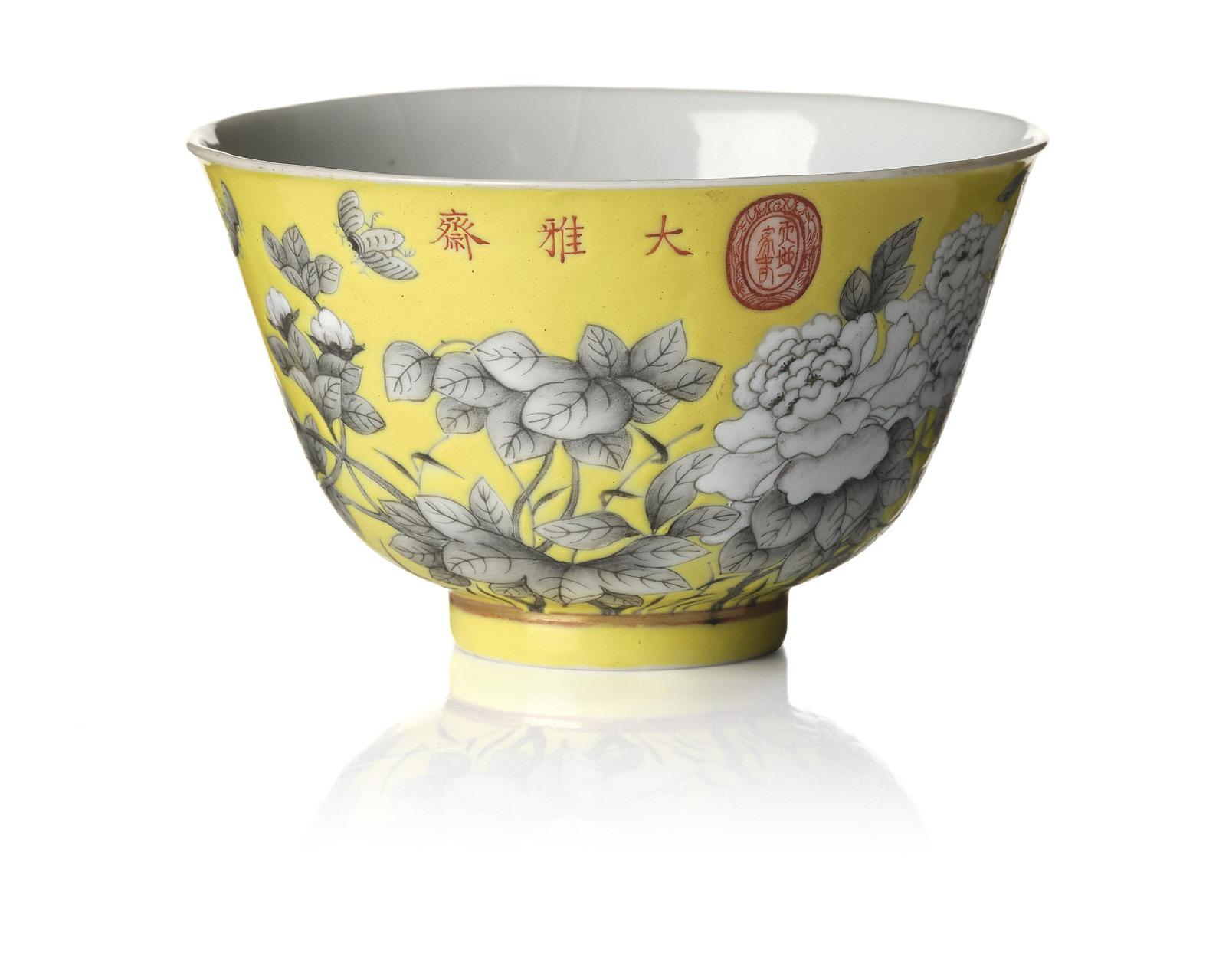
910. A ‘Dayaszhai’ yellow-ground grisaille-decorated cup, Qing dynasty, Guangxu period (1875–1908).
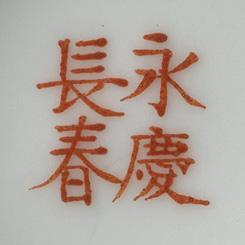
With a four-character Yong Qing Chang Chun mark in iron-red. The cup with rounded sides and a slightly everted rim, finely decorated in grisaille with leafy peony branches issuing large blooms in various stages of growth and two butterflies all against a bright yellow ground. It bears the iron-red seal reading Tian Di Yi Jia Chun, which can be translated as ‘spring throughout heaven and earth’ and the characters Dayazhai, (Studio of Great Elegance). Diameter 10.6 cm. Height 6 cm.
Provenance: Gustaf Oscar Wallenberg (1865–1937), Stockholm, and thence by descent within the family.
Exhibitions: Compare a cup of this type in the collection of the Metropolitan Museum, New York, Object no 1984.286. Gift of Mrs Harry L Toplitt Jr.
Estimate: SEK 10 000 – 15 000 / EUR 944 – 1 420
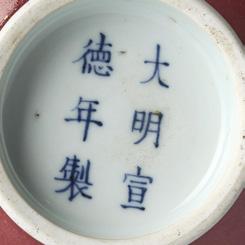
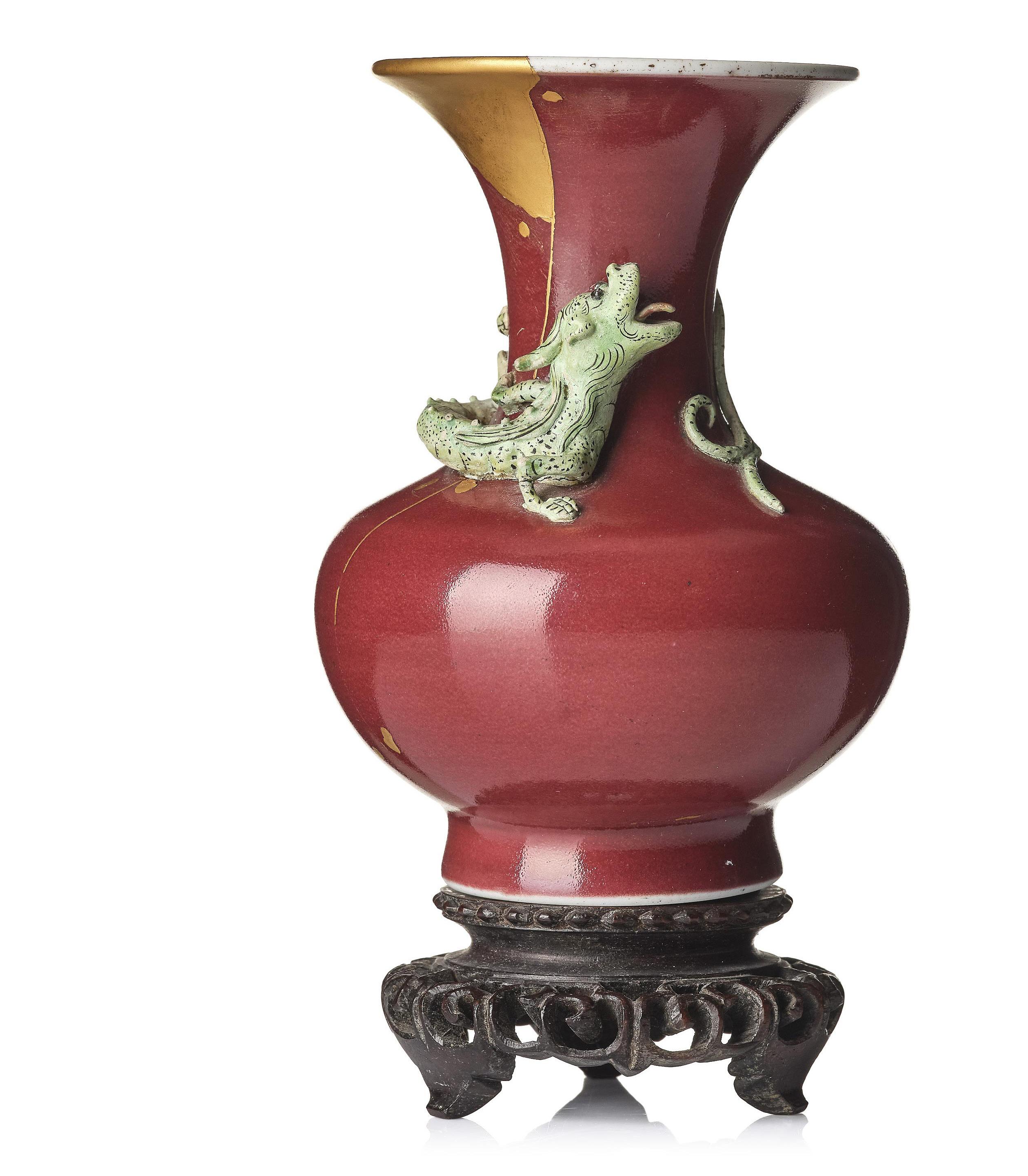
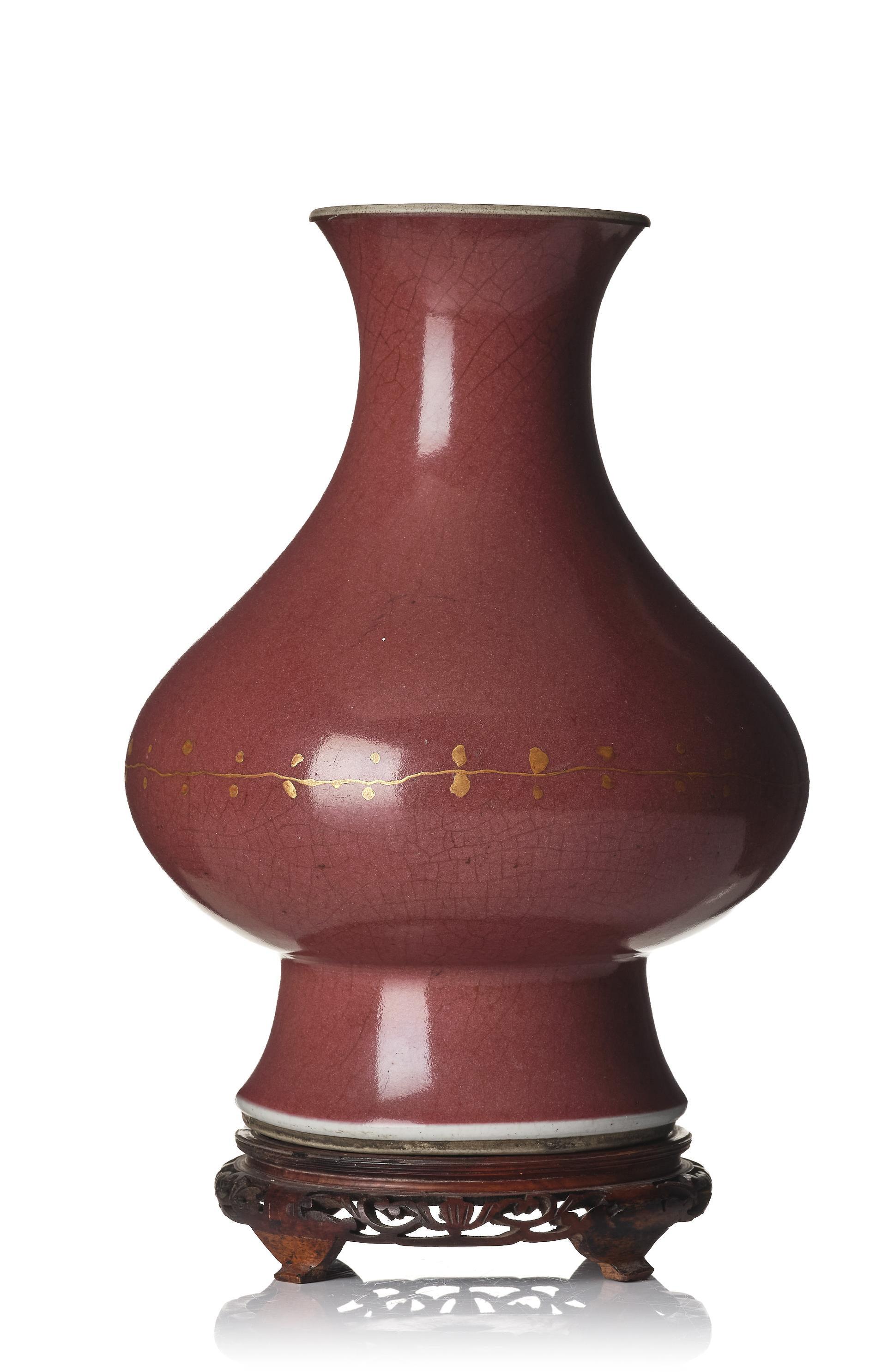
911. A red glazed vase, 17/18th century with Xuande six character mark. Pear shaped with a flared trumpet neck, standing stout on a tall, everted foot, applied around the shoulder a dragon in green, with details in black, the base with an apocryphal Xuande mark. Glazed in deep red colour. Height 12.2 cm. Height with wooden stand 16 cm.
Provenance: Gustaf Oscar Wallenberg (1865–1937), Stockholm, and thence by descent within the family.
Catalogue note: Vases of this type with narrow necks and applied models of dragons are found in earlier wares from the Ming dynasty, both in porcelain as well as in bronze.
Estimate: SEK 8 000 – 10 000 / EUR 755 – 944
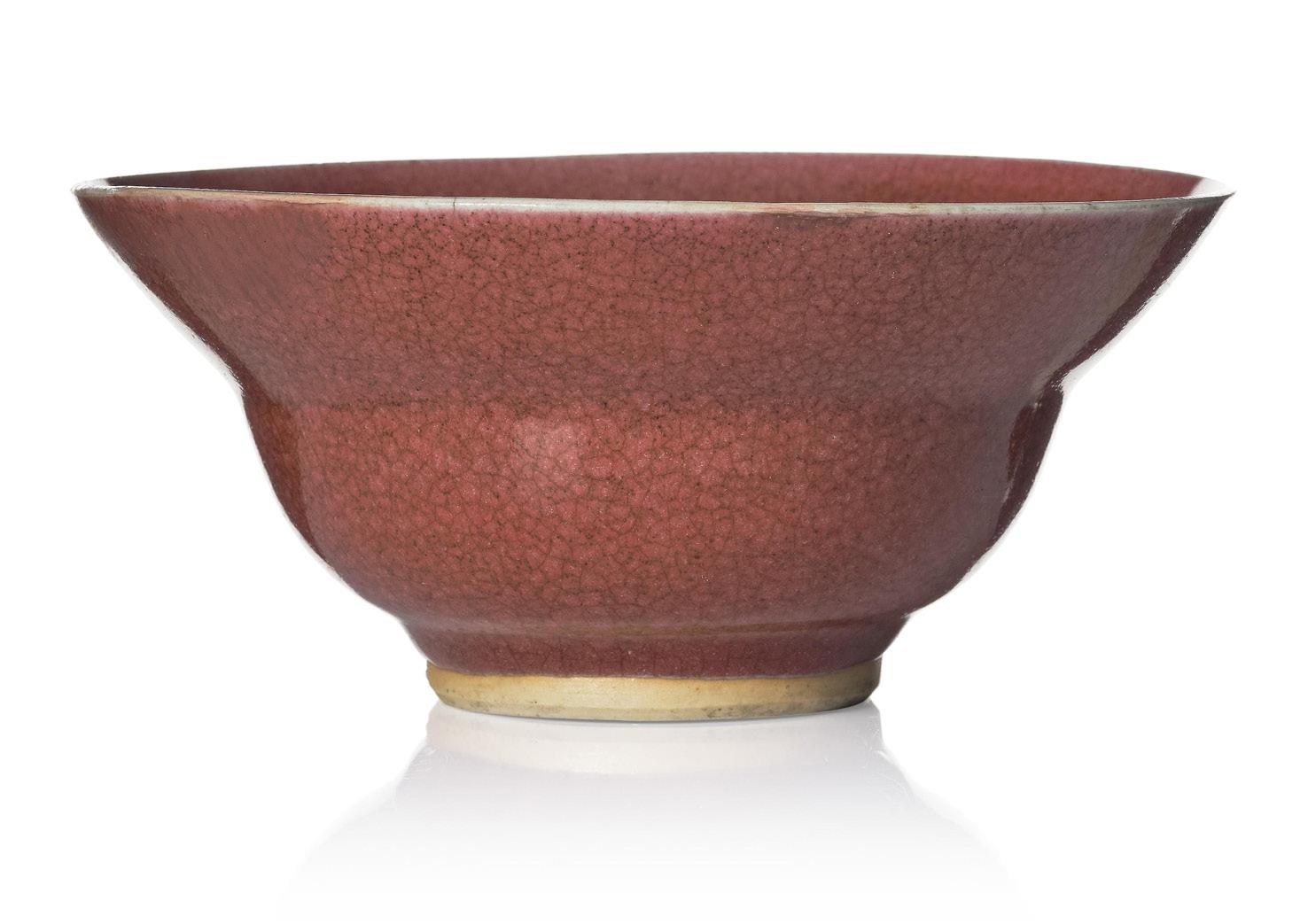
912. A red glazed bowl, Qing dynasty, 18th century. Rounded sides with an everted rim, glazed in a deep copper red glaze that shifts to white by the rim. Diameter 19 cm. Height 8.2 cm.
Provenance: Gustaf Oscar Wallenberg (1865–1937), Stockholm, and thence by descent within the family.
Exhibitions: Compare a bowl of this type in the Musee Guimet, Paris, Inventory no G 1954. Compare also a bowl of this type in the British Museum, Museum number PDF,C.511. Compare also a bowl of this type in the Metropolitan Museum of Art, New York, Credit Line “Purchase by subscription, 1879”. Object Number 79.2.793. Compare a matching pair sold in these rooms, Bukowskis Important Winter Sale 669 lot 1015, 12 December 2025.
Literature: Margaret Medley, 1973 “Illustrated Catalogue of Ming and Ch’ing Monochrome in the Percival David Foundation of Chinese Art” p.61, no.C511. Rosemary Scott, 1989 “Illustrated Catalogue of Ming and Qing Monochrome Wares in the Percival David Foundation of Chinese Art” p.62, no.C511.
Catalogue note: The skills used to create these extraordinary red glazes were lost in China from the mid-fifteenth century until they were rediscovered in the late seventeenth and early eighteenth centuries. The glaze has ‘crept’ at the rim of the dish to reveal the pure whiteness of the porcelain body and the rim is bound in copper.
Estimate: SEK 6 000 – 8 000 / EUR 567 – 755
913. A Langyao pear shaped vase, Qing dynasty, 18th century.
Heavily potted, pear shaped with an everted rim, standing on a tall splayed foot. Glazed in a deep red glaze, base and interior in transparent crackled ge glaze. Height 26.5 cm. Height with wooden stand 30 cm.
Provenance: Gustaf Oscar Wallenberg (1865–1937), Stockholm, and thence by descent within the family.
Estimate: SEK 20 000 – 30 000 / EUR 1 890 – 2 830
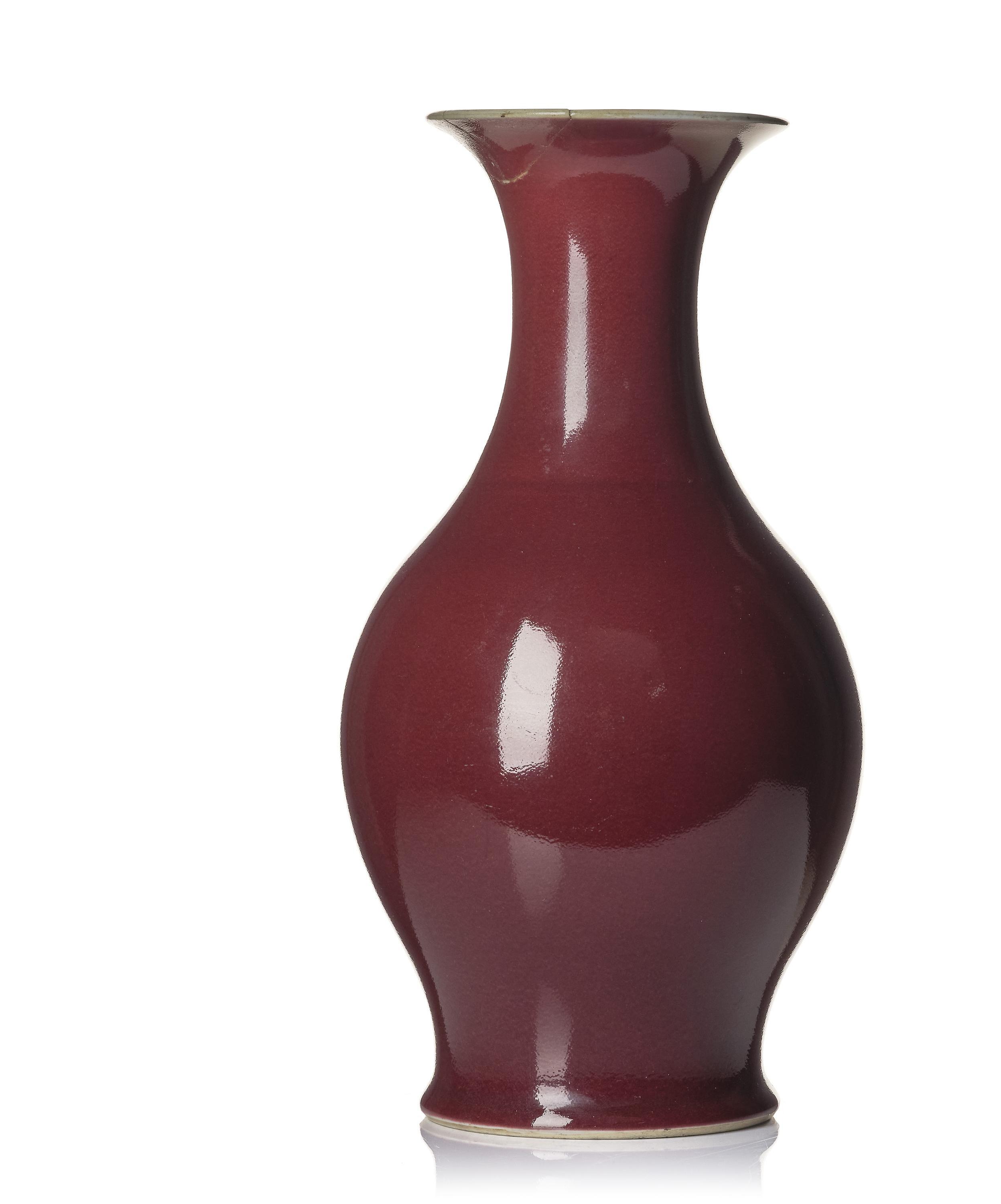
914. A red glazed vase, Qing dynasty, 18th century. Of baluster shape with a rounded body and a rather tall neck with everted rim, glazed in a copper red glaze. Height 31 cm.
Provenance: Gustaf Oscar Wallenberg (1865–1937), Stockholm, and thence by descent within the family.
Estimate: SEK 6 000 – 8 000 / EUR 567 – 755
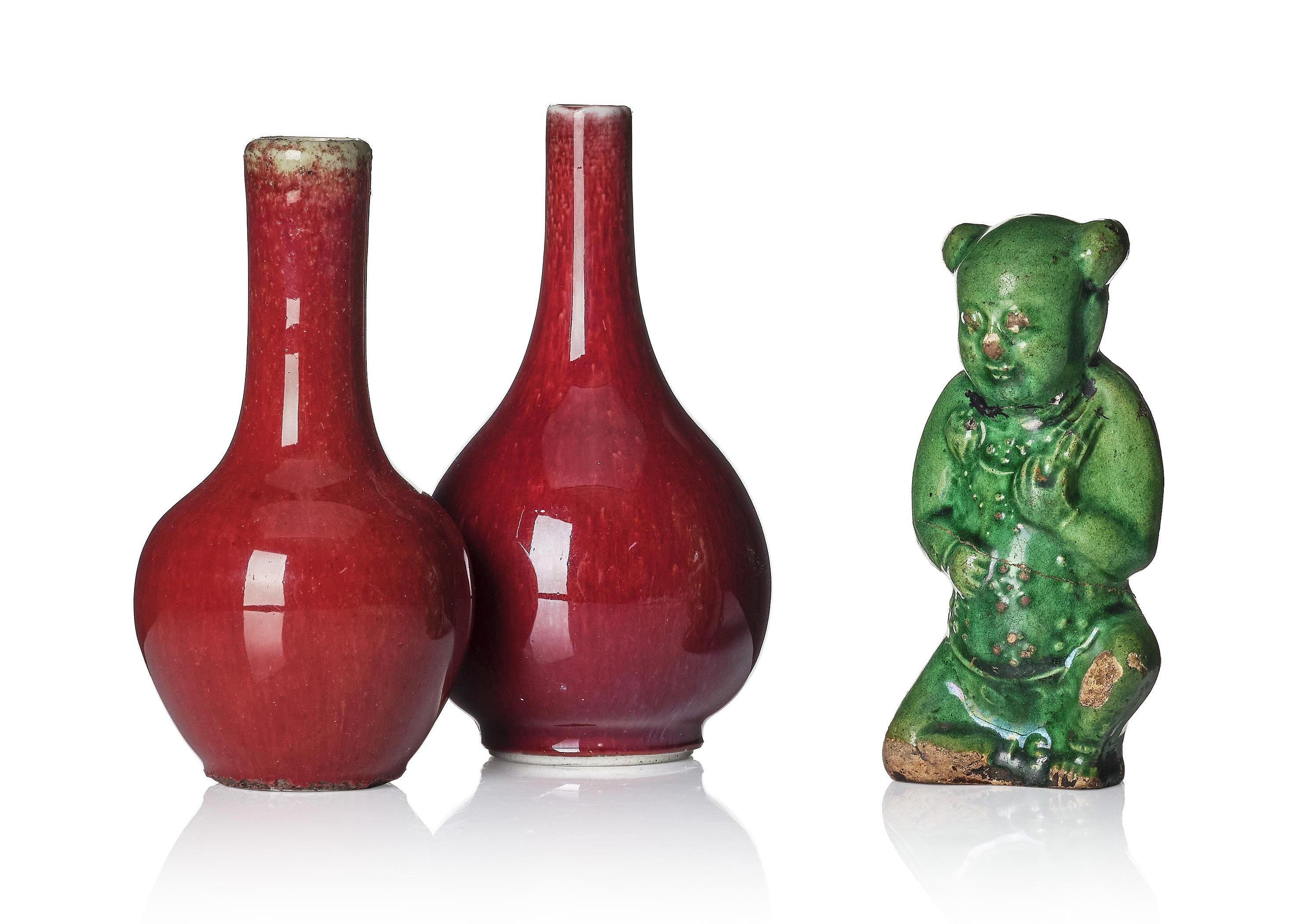
915. Two flambe vases, Qing dynasty, 18/19th century and a small green glazed figure/joss stick holder, late Ming dynasty.
Decorated with red flambé glaze. Height c. 12 cm. Kneeling boy, glazed in green with a hole to the back for a joss stick. Height 9.6 cm.
Provenance: Gustaf Oscar Wallenberg (1865–1937), Stockholm, and thence by descent within the family.
Estimate: SEK 6 000 – 8 000 / EUR 567 – 755
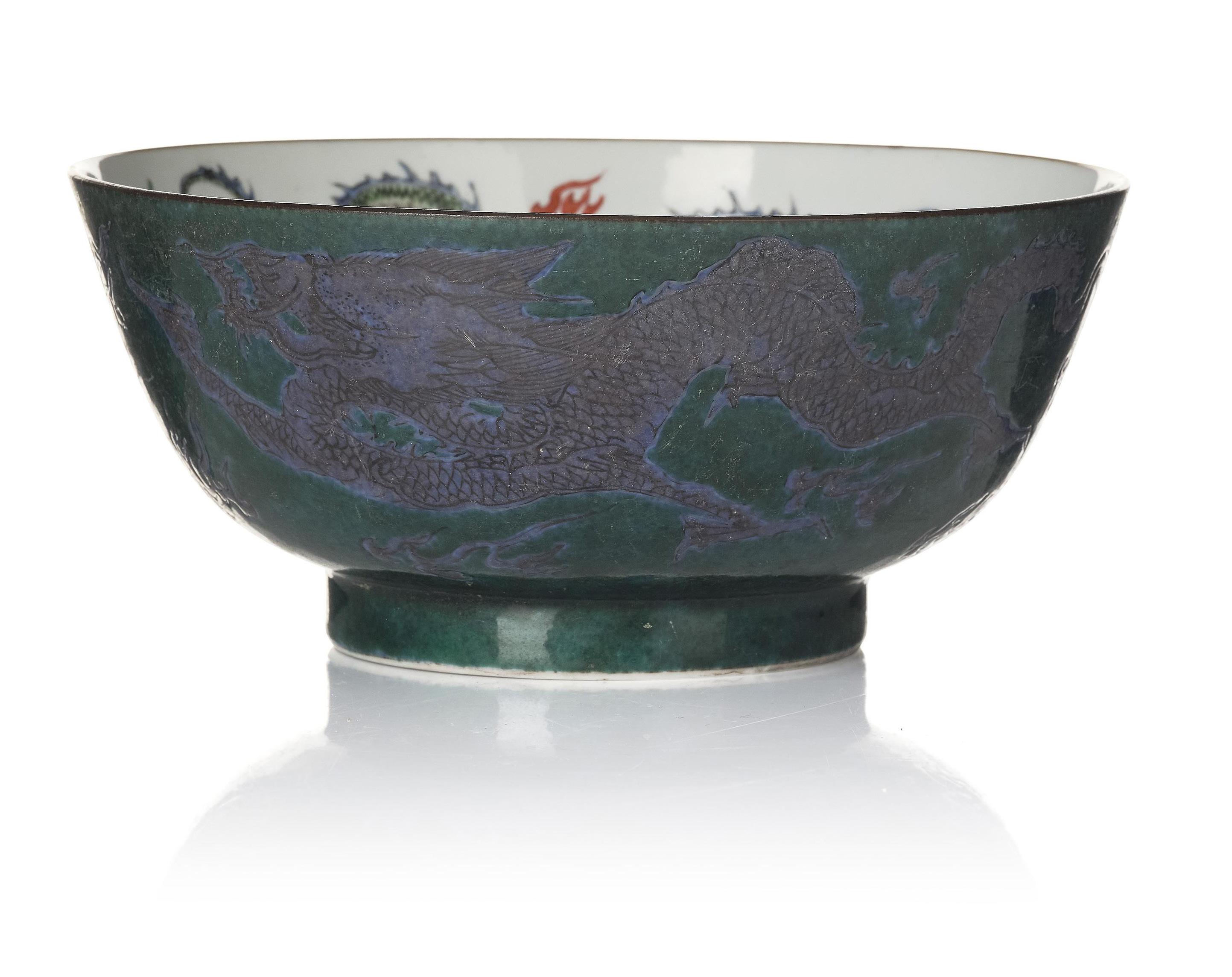
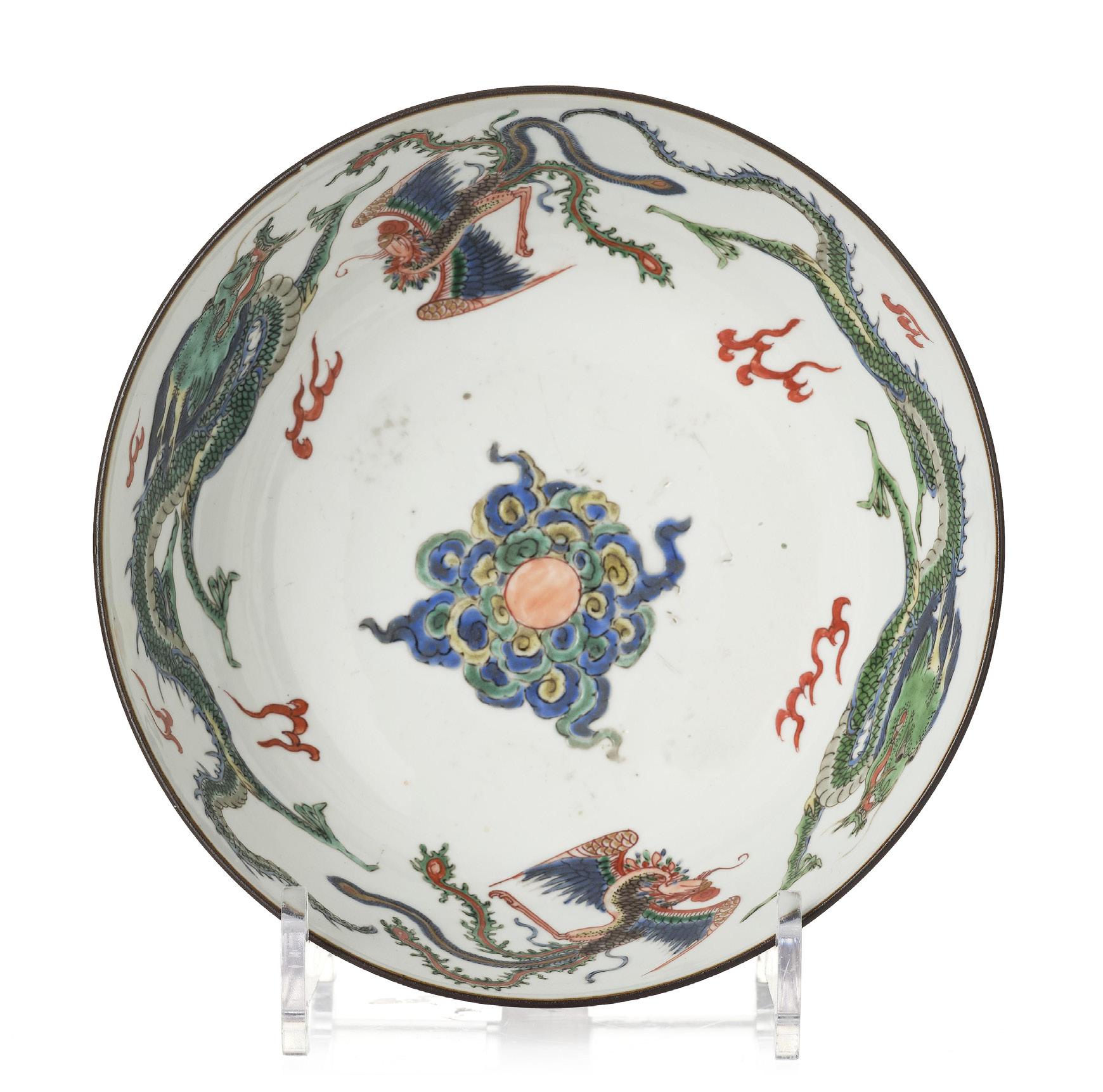
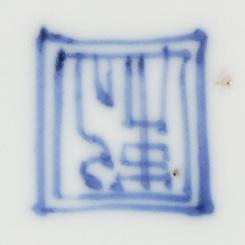
Rounded sides on a short foot. The exterior decorated with two fierce dragons in aubergine/blue enamel against a deep green glazed ground. The interior decorated in famille verte colours with two dragons and two phoenix birds amidst cloud formations. The base with a mark in underglaze blue within a double circle. Diameter 18.5 cm. Height 8 cm.
Provenance: Gustaf Oscar Wallenberg (1865–1937), Stockholm, and thence by descent within the family.
Exhibitions: Compare another bowl with this colour combination of green ground and dragon in aubergine/blue sold at Christies Live auction 2689 Fine Chinese Ceramics and Works of Art, New York, lot 1443, 21–22 March 2013.
Estimate: SEK 15 000 – 20 000 / EUR 1 420 – 1 890
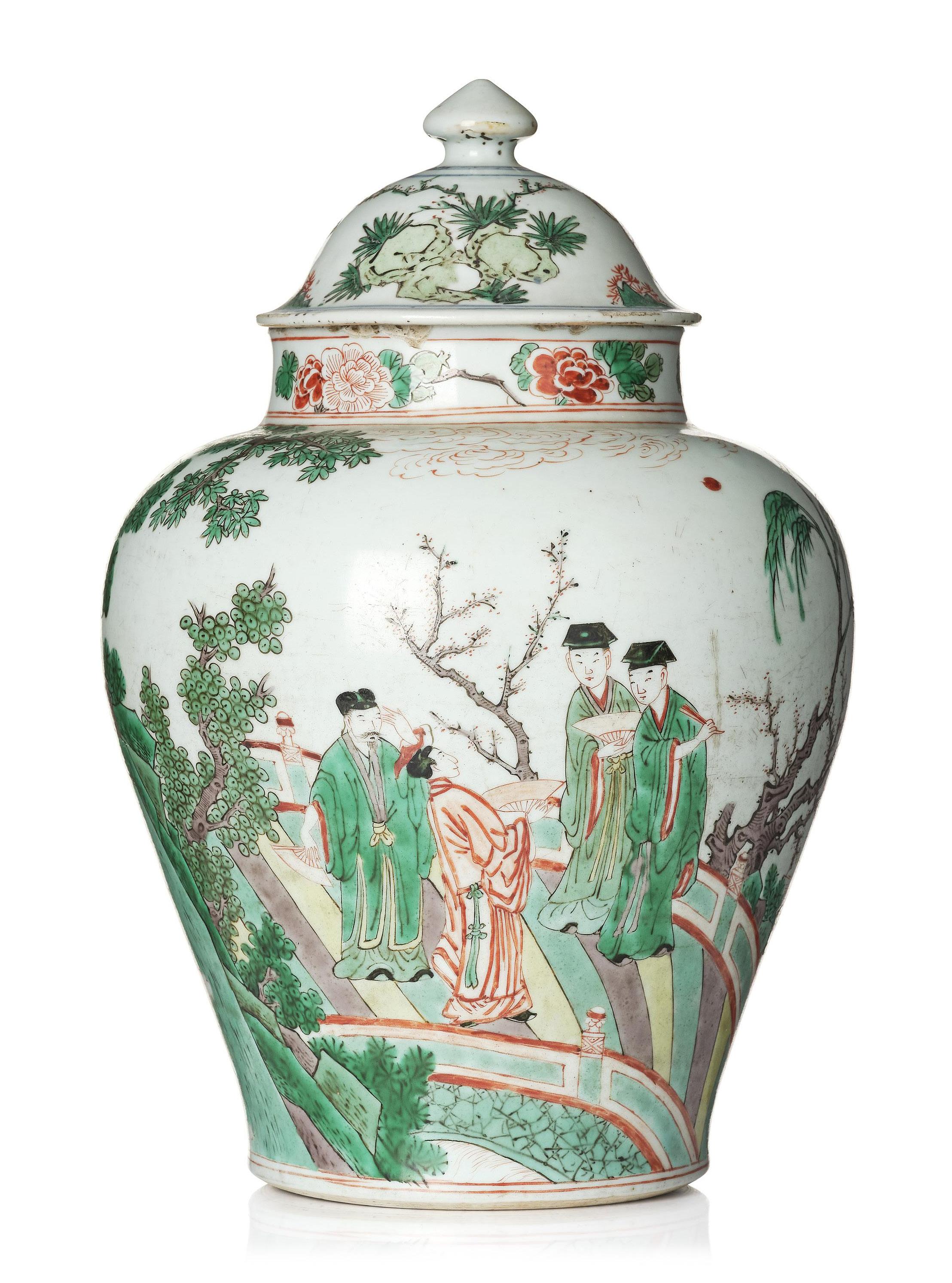
917. A famille verte Transitional jar with cover, 17th century.
Decorated with a figure scene of an elegant lady and her attendant in a pavilion by a lotus pond. The other side with a group of men in conversation. Height 38 cm.
Provenance: Gustaf Oscar Wallenberg (1865–1937), Stockholm, and thence by descent within the family.
Estimate: SEK 40 000 – 60 000 / EUR 3 780 – 5 670
918. A famille verte vase, Qing dynasty, Kangxi (1662–1722).
Shortened ‘yen yen’ vase, decorated in famille verte colours with a blossoming cherry- and magnolia tree as well as with butterflies and a bird. Height 21.5 cm.
Provenance: Gustaf Oscar Wallenberg (1865–1937), Stockholm, and thence by descent within the family.
Estimate: SEK 4 000 – 6 000 / EUR 378 – 567
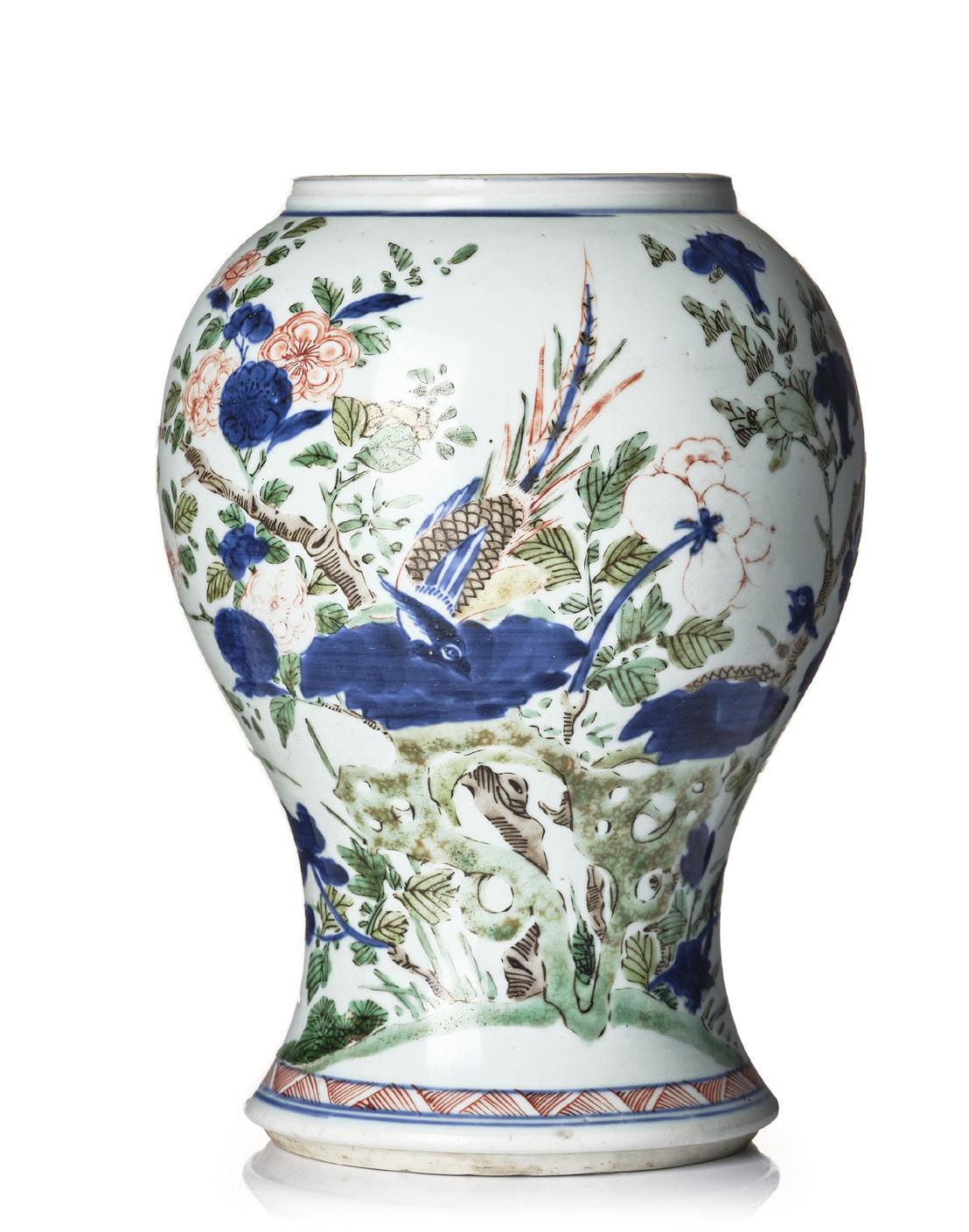
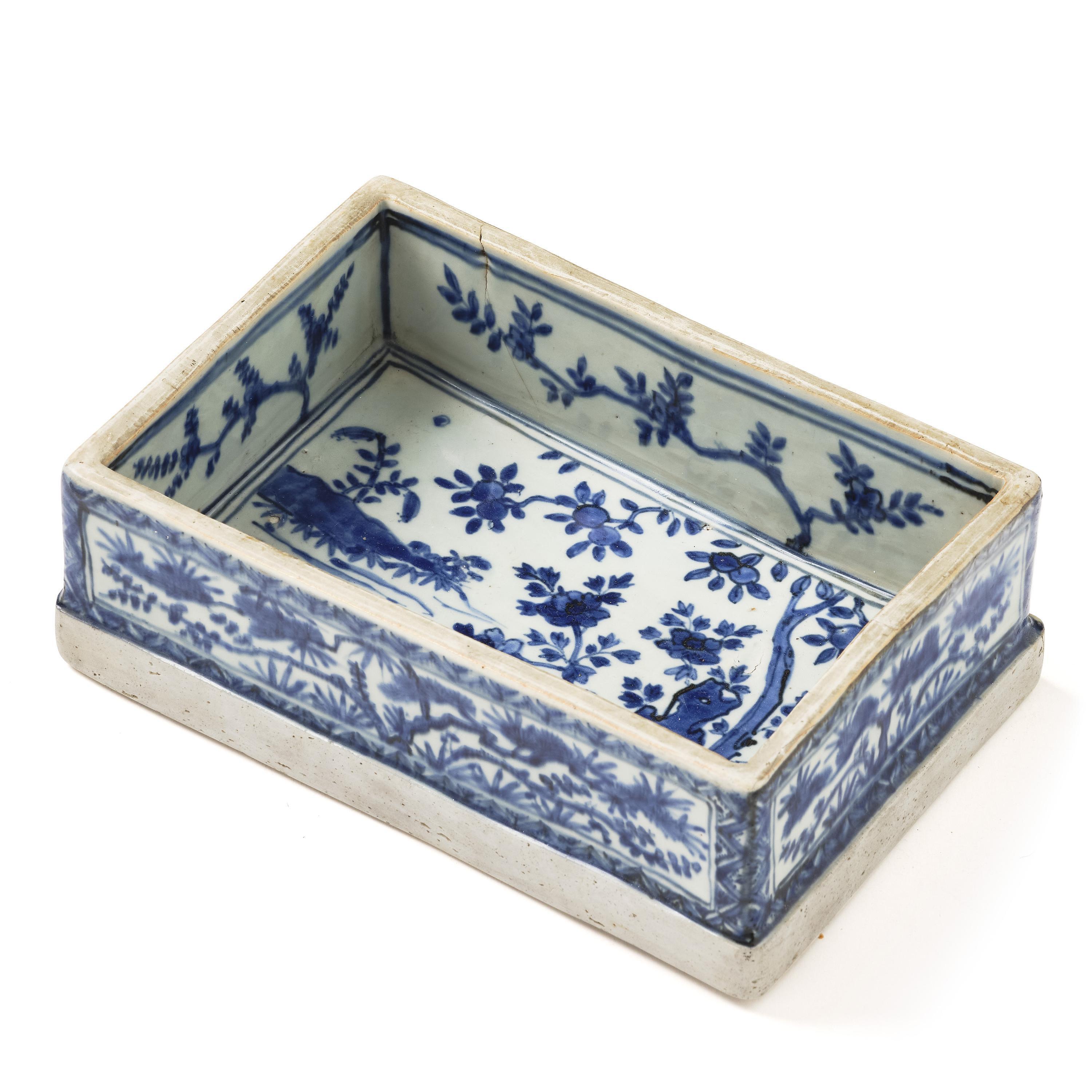
919. A blue and white part writing-box, Ming dynasty, Wanli six-character mark and of the period (1572–1620).
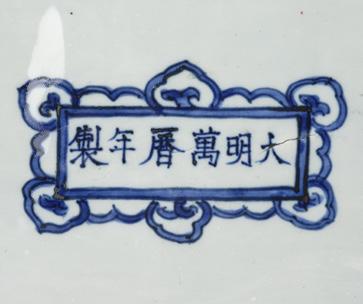
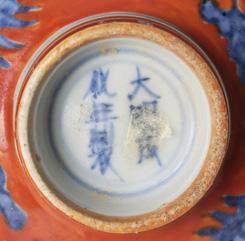
Rectangular, decorated in a good underglaze blue with primary scene of a garden in full bloom. Similar scenes in rectangular panels around sides with gnarly trees and flowers on dense diaper ground. There is a framed inscription on the base that reads 大明萬里年製 . Inscription transliteration: Da Ming Wanli Nian Zhi. Measure 23.5 x 15.5 x 8 cm.
Provenance: Gustaf Oscar Wallenberg (1865–1937), Stockholm, and thence by descent within the family.
Exhibitions: Compare with a complete box of this type in the British Museum, Percival David, Museum number PDF,B.611.
Literature: Pierson has written about the related box in the British Museum 2004 “Illustrated Catalogue of Underglaze Blue and Copper Red Decorated Porcelains in the Percival David Foundation of Chinese Art”, p.78, no. B611, reign mark, p.118. See also See also Medley 1976 “Illustrated Catalogue of Underglaze Blue and Copper Red Decorated Porcelains” p.55, no. B611, pl. X. Pierson 2002 “Percival David Foundation of Chinese Art: A Guide to the Collection” p.69, no.54 (and lid)..
Estimate: SEK 50 000 – 75 000 / EUR 4 720 – 7 080
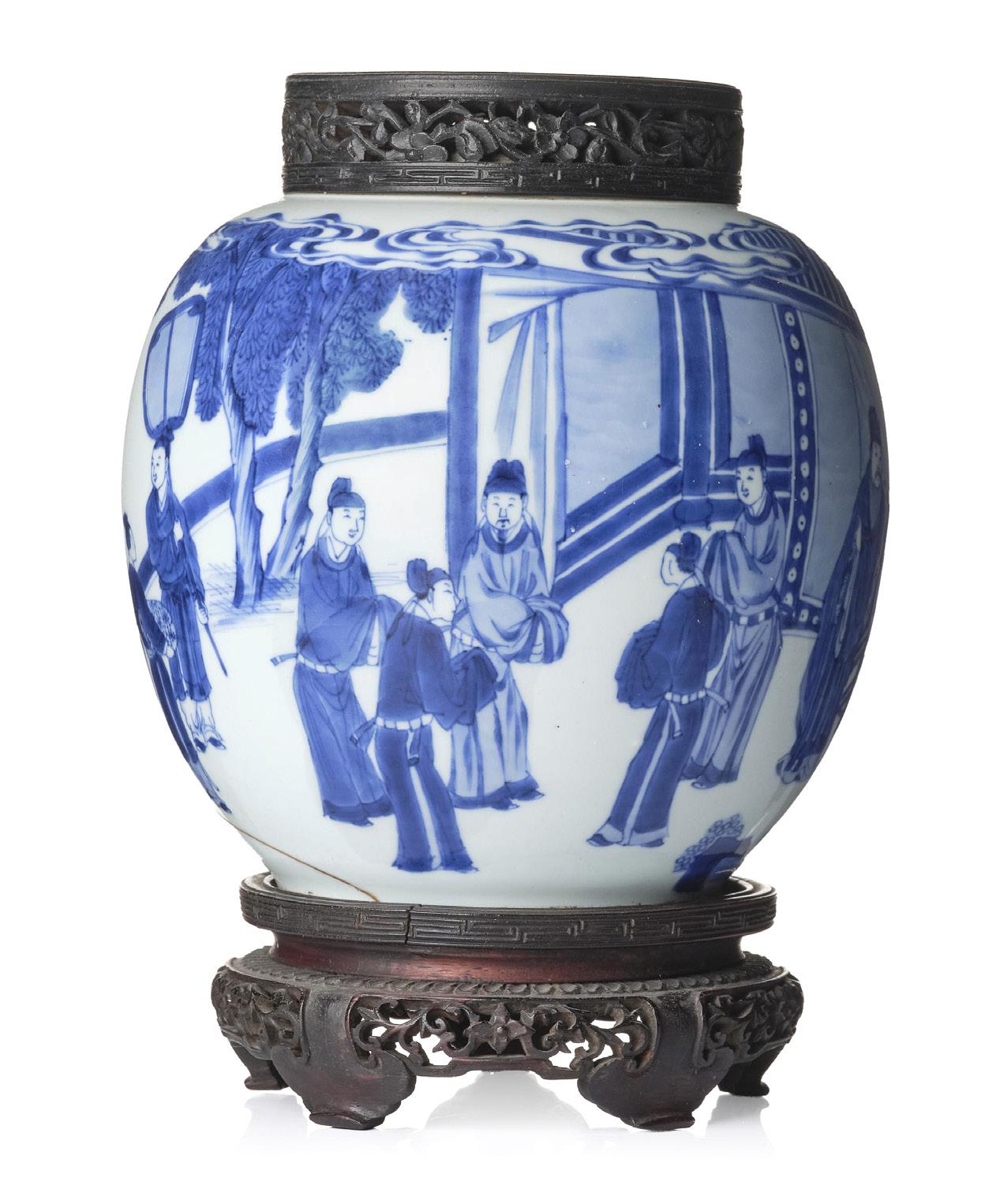
920. A blue and white jar, Qing dynasty, Kangxi (1662–1722).
Ovoid shape with an unglazed rim, decorated in a vibrant underglaze blue colour depicting a figure scene from a Chinese novel. Height 20.5 cm. Height with wooden stand and cover 26 cm.
Provenance: Gustaf Oscar Wallenberg (1865–1937), Stockholm, and thence by descent within the family.
Estimate: SEK 12 000 – 15 000 / EUR 1 130 – 1 420
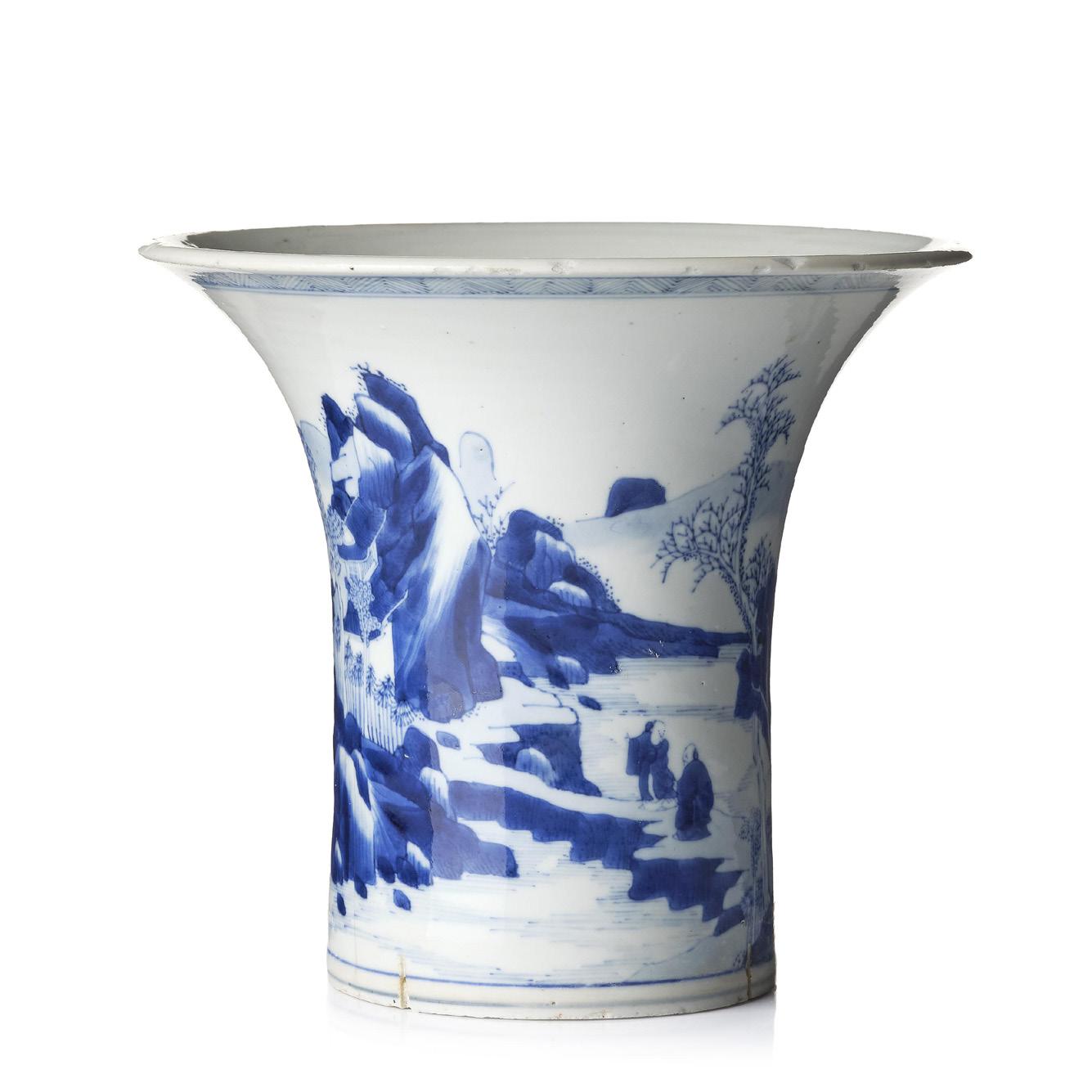
921. A blue and white porcelain fragment, Qing dynasty, Kangxi (1662–1722).
Trumpet shaped decorated in a vibrant underglaze blue colour with a figure scene in a mountainous riverscape. Height 19 cm. Diameter 21 cm.
Provenance: Gustaf Oscar Wallenberg (1865–1937), Stockholm, and thence by descent within the family.
Estimate: SEK 6 000 – 8 000 / EUR 567 – 755
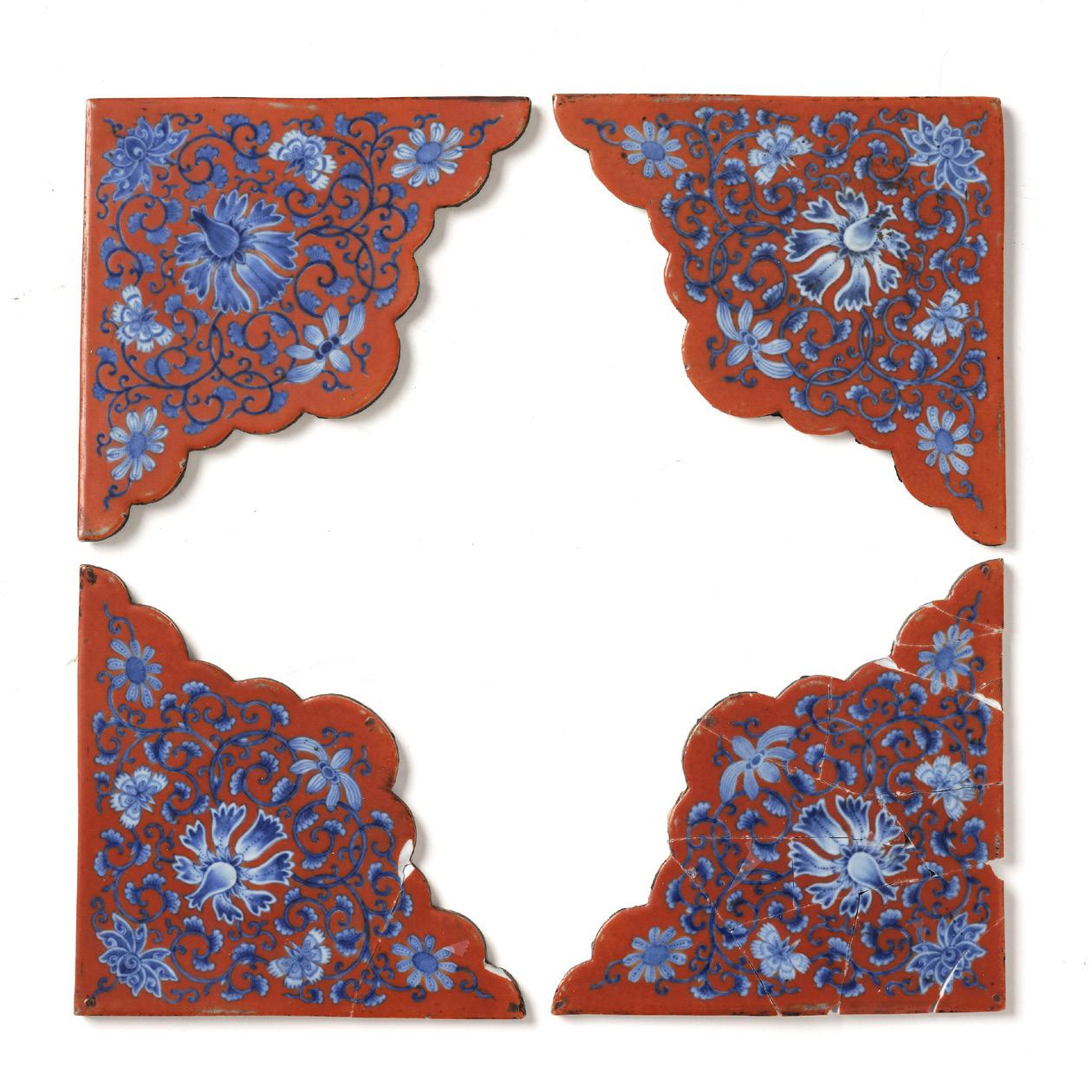
922. A set of four underglaze blue and red tiles, Qing dynasty, 18th century. Decorated in underglaze blue with a lotus and floral scroll against a red ground. Measure each c. 15 x 15 cm. Measure together 30.5 x 30.5 cm.
Provenance: Gustaf Oscar Wallenberg (1865–1937), Stockholm, and thence by descent within the family.
Estimate: SEK 2 500 – 3 000 / EUR 236 – 283
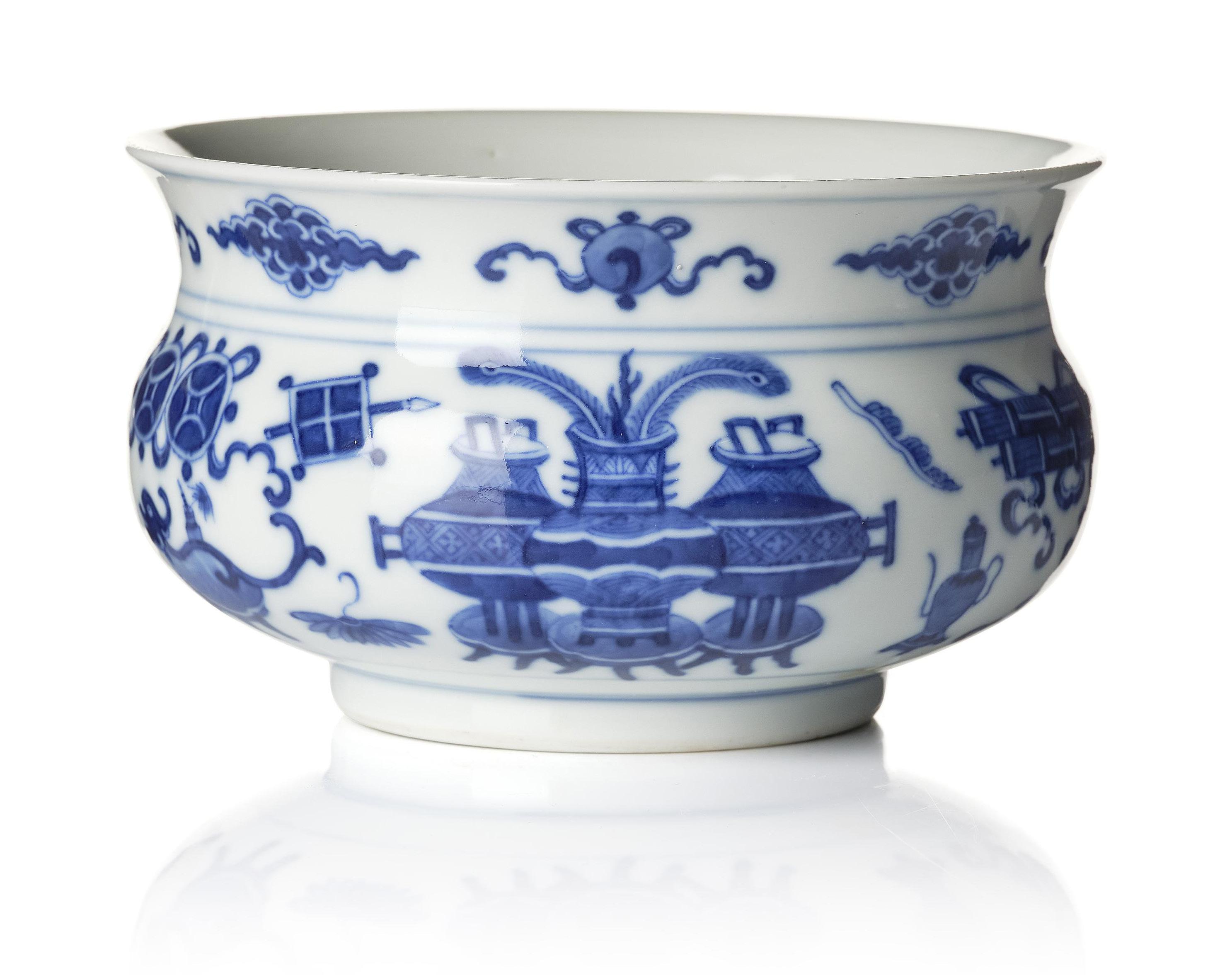
923. A blue and white censer, Qing dynasty, Kangxi (1662–1722).
Rounded shape with a flared rim and a straight foot. Decorated in underglaze blue with antiques and precious objects. Diameter 14.5 cm. Height 8.3 cm.
Provenance: Gustaf Oscar Wallenberg (1865–1937), Stockholm, and thence by descent within the family.
Estimate: SEK 30 000 – 50 000 / EUR 2 830 – 4 720
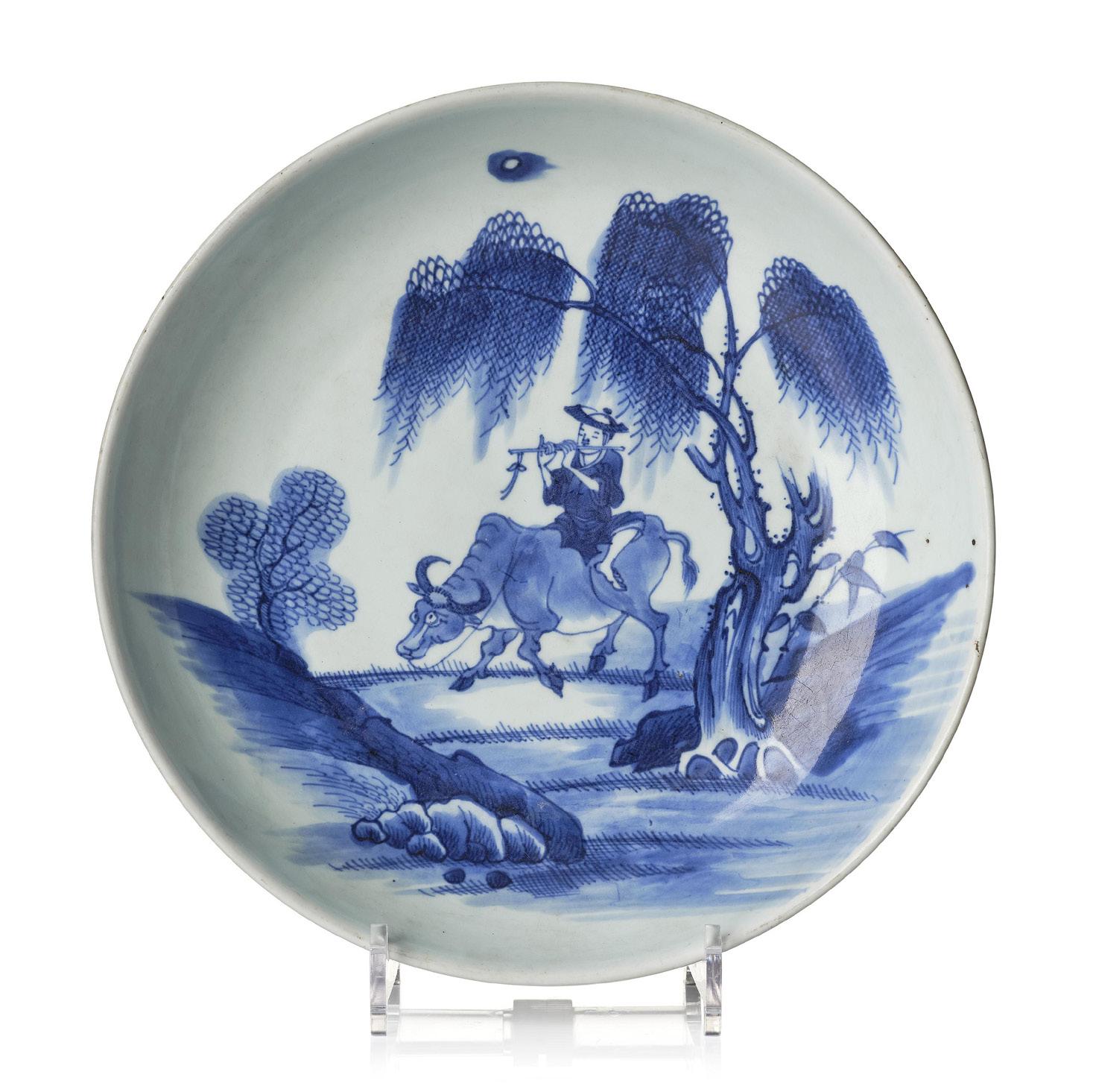
924. A blue and white dish, Qing dynasty, 18th century. Rounded sides, decorated in underglaze blue with a flute playing boy on a water buffalo riding in a moonlit landscape. Diameter 28.2 cm.
Provenance: Gustaf Oscar Wallenberg (1865–1937), Stockholm, and thence by descent within the family.
Estimate: SEK 4 000 – 6 000 / EUR 378 – 567
From
the Collection of Gustaf Wallenberg. LOT 928–930.
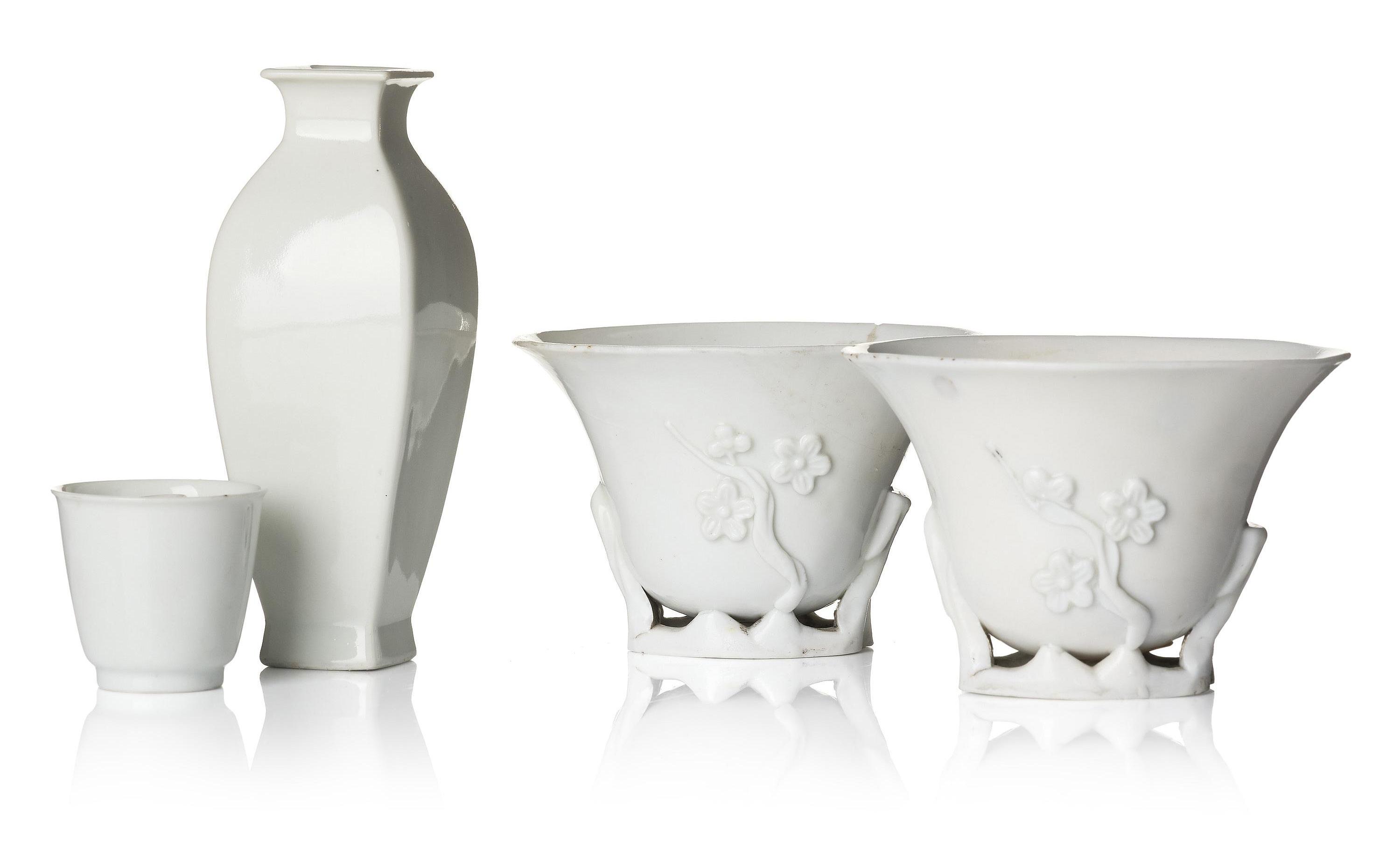
925. A blanc de chine vase and three cups, Qing dynasty, 18th century.
Comprising a rectangular baluster vase in soft paste, height 14 cm. A cup, height 4.5 cm. Two libation cups, height 8 cm, length 11.4 cm.
Provenance: Gustaf Oscar Wallenberg (1865–1937).
Estimate: SEK 6 000 – 8 000 / EUR 567 – 755
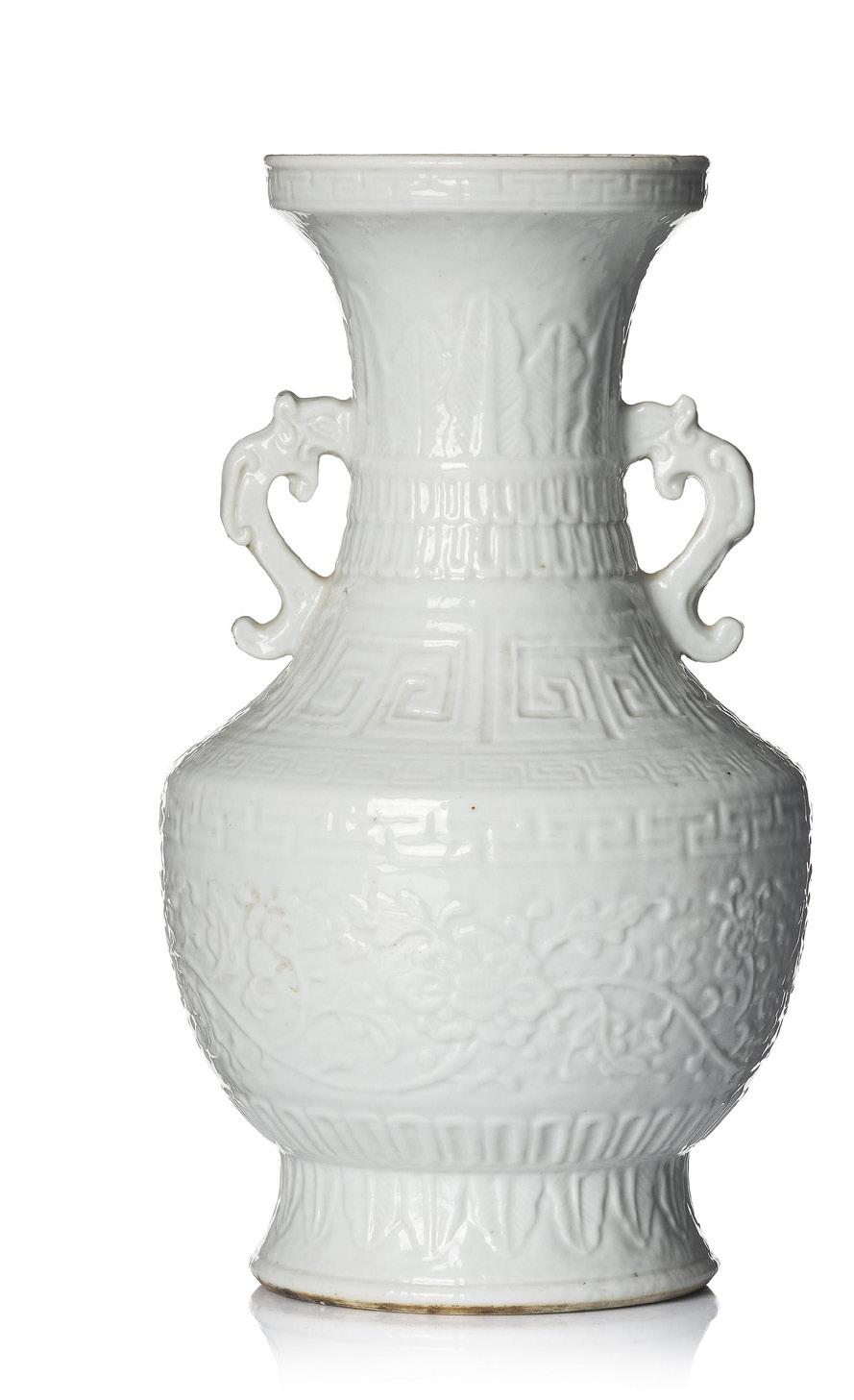
926. A blanc de chine ‘lotus’ vase, Qing dynasty 18/19th century. Of baluster shape with handles in the shape of stylized dragons, decorated in relief with a continuous lotus scroll, a wide meander frieze around the shoulder. Height 25.5 cm.
Provenance: Gustaf Oscar Wallenberg (1865–1937).
Estimate: SEK 12 000 – 15 000 / EUR 1 130 – 1 420
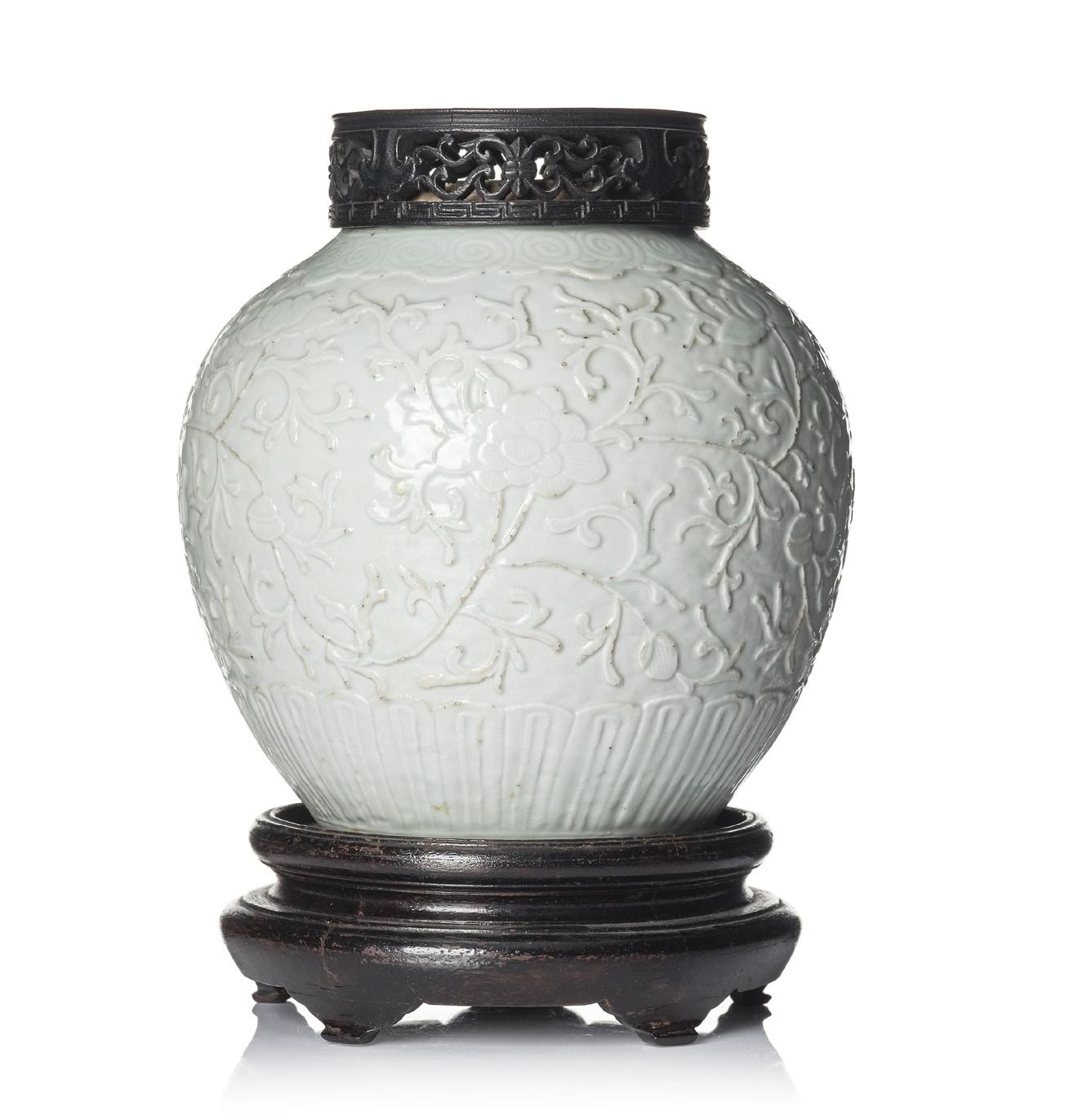
927. A blanc de chine jar, Qing dynasty, 19th century. Rounded shape, unglazed rim, decorated in relief with a continuous floral scroll. Height 17.5 cm. Height with wooden stand and cover 25 cm.
Provenance: Gustaf Oscar Wallenberg (1865–1937), Stockholm, and thence by descent within the family.
Estimate: SEK 6 000 – 8 000 / EUR 567 – 755
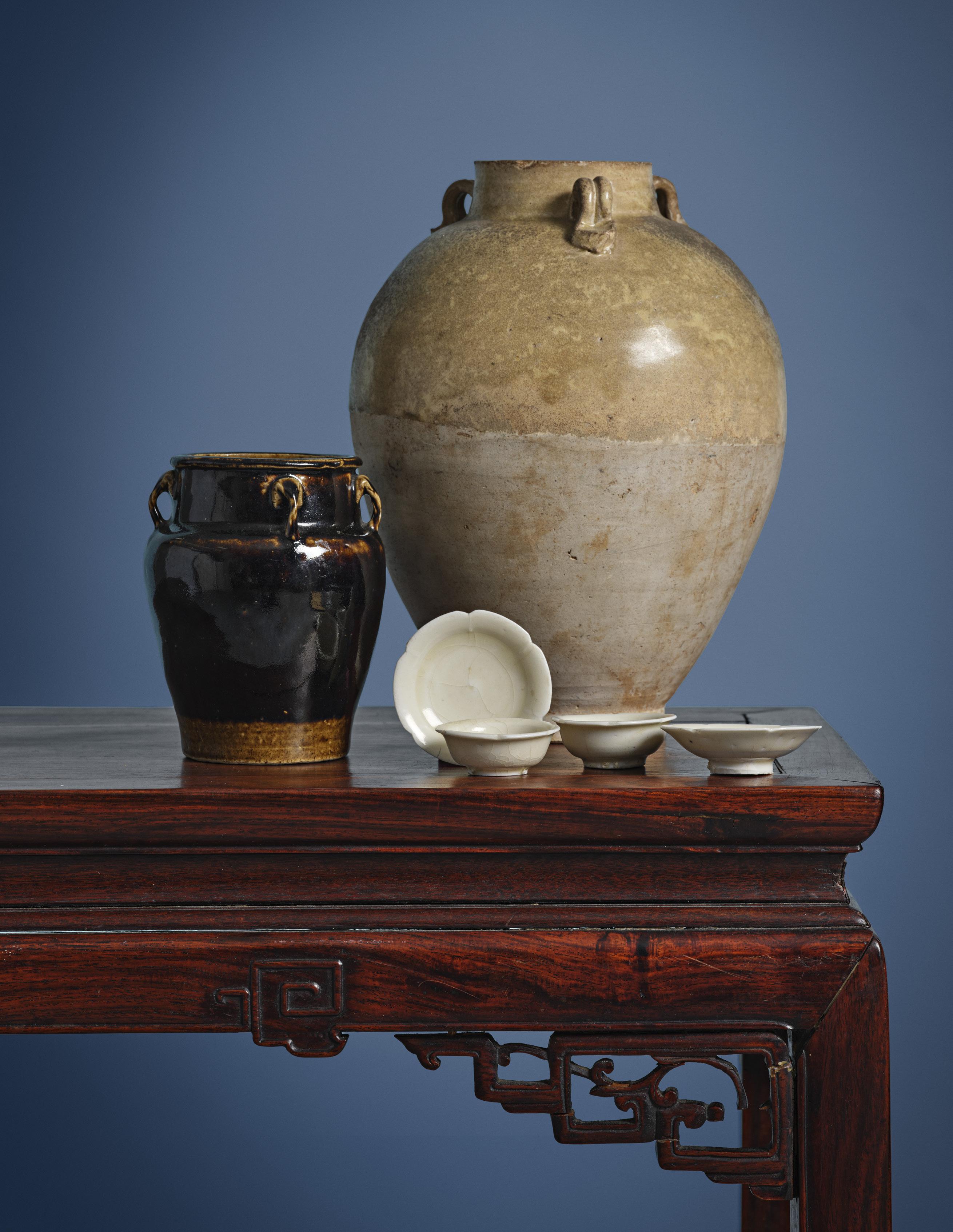
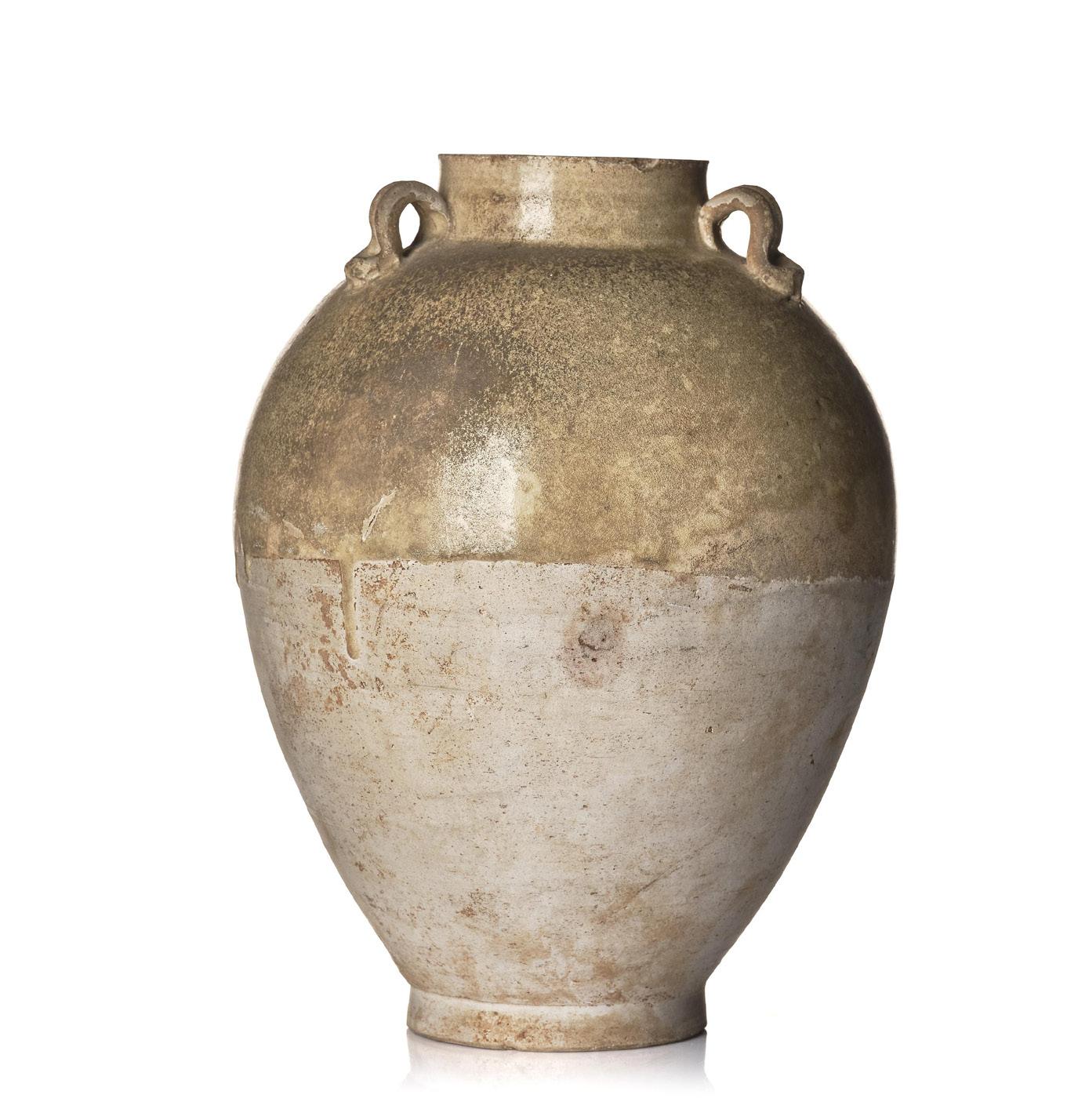
928. A creme glazed handled jar, Tang/Sui dynasty.
The ovoid body supported on a solid slightly splayed foot, set on the rounded shoulders four double-stranded lug handles joining the short straight neck, covered with a crackled translucent glaze of pale creme tinge, stopping short of the mid section to reveal the unglazed body. Height 28 cm.
Provenance: Gustaf Oscar Wallenberg (1865–1937), Stockholm, and thence by descent within the family.
Estimate: SEK 8 000 – 10 000 / EUR 755 – 944
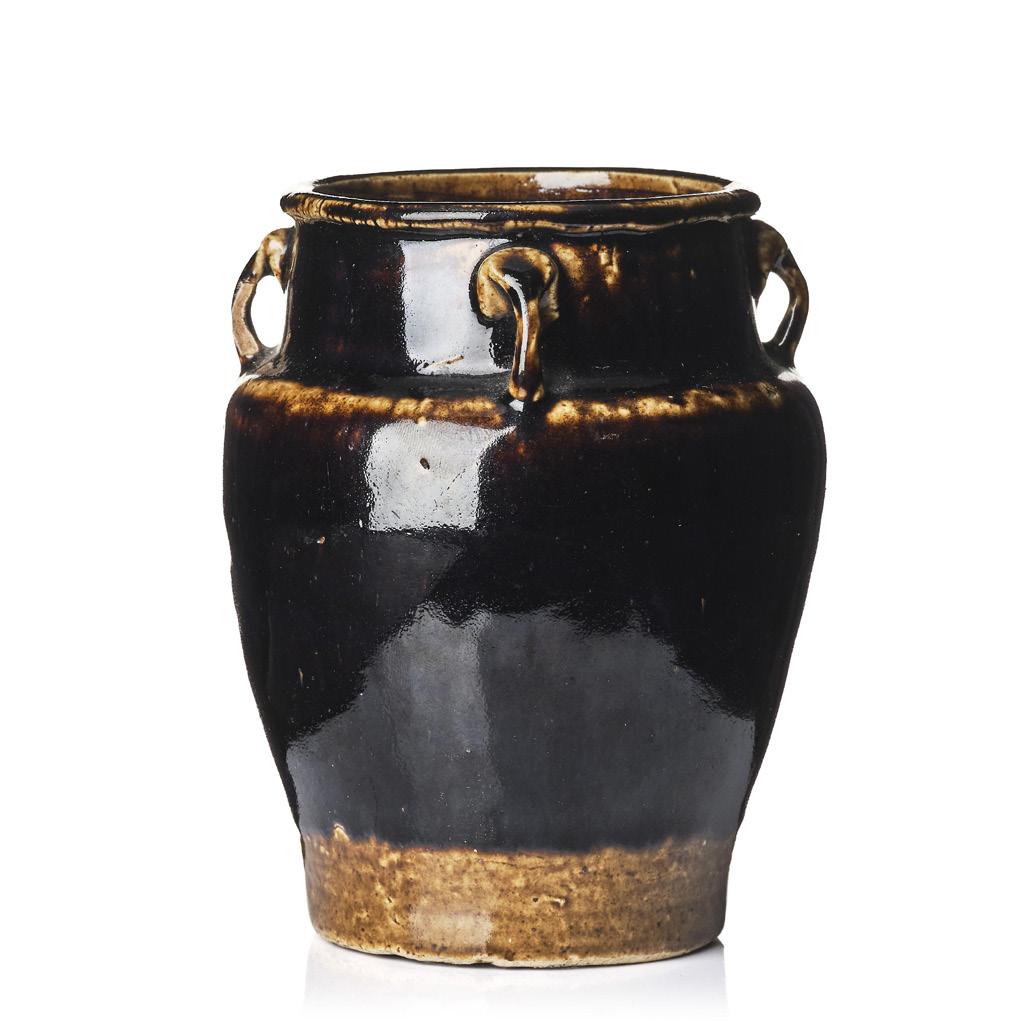
929. A brown glazed jar, Song dynasty (960–1279). Rounded shoulder, short neck with a lipped rim, joined to the shoulder by applied handles, covered with a dark brown glaze that fades to a thinner glaze towards the footrim. Height 13.5 cm.
Provenance: Gustaf Oscar Wallenberg (1865–1937), Stockholm, and thence by descent within the family.
Estimate: SEK 5 000 – 7 000 / EUR 472 – 661
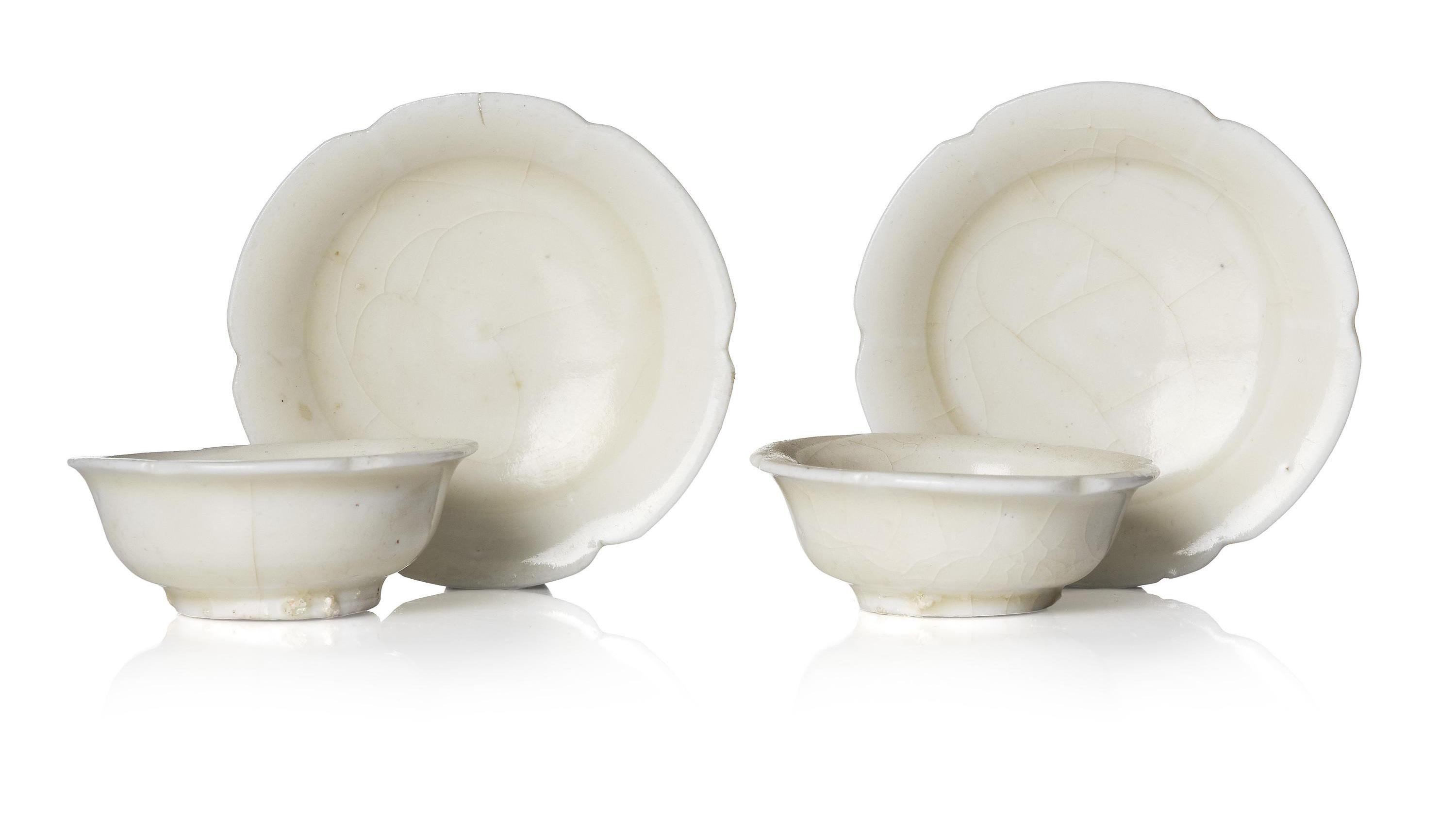
930. A group of four small ding flori-formed dishes, Northern Song dynasty (960–1127). Each dish is formed with shallow flaring sides rising to a six-lobed foliate rim, supported on a slightly concave base. It is covered overall in an attractive pale glaze with a yellowish-ivory tinge. Diameter 5.5–7 cm.
Provenance: Gustaf Oscar Wallenberg (1865–1937), Stockholm, and thence by descent within the family.
Exhibitions: Compare with a set sold at Chrisites Live auction 22642, Important Chinese Art Including the Collection of Dorothy Tapper Goldman, lot 811, 21–22 March 2024.
Literature: Compare “The Denver Art Museum, Bright as Silver, White as Snow: Chinese White Ceramics from Late Tang to Yuan Dynasty”, October 1998–October 1999. Images and text of no 17.
Estimate: SEK 8 000 – 10 000 / EUR 755 – 944
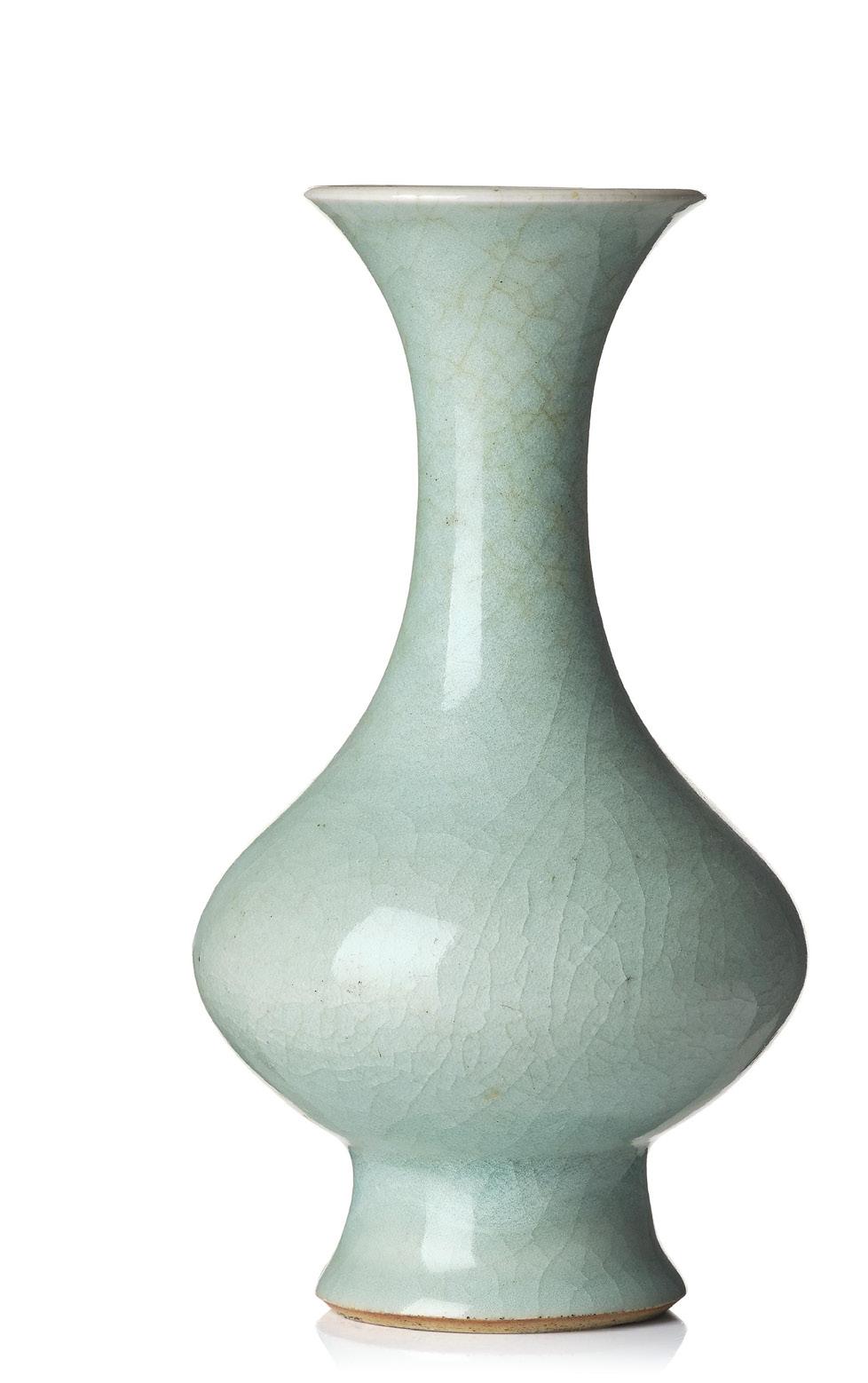
931. An elegant celadon ge-glased vase, late Ming dynasty.
Pear shaped with an everted rim and standing on a tall splayed foot. Glazed in a pale celadon ge-glaze.
Height 18.5 cm.
Provenance: Gustaf Oscar Wallenberg (1865–1937), Stockholm, and thence by descent within the family.
Estimate: SEK 8 000 – 10 000 / EUR 755 – 944
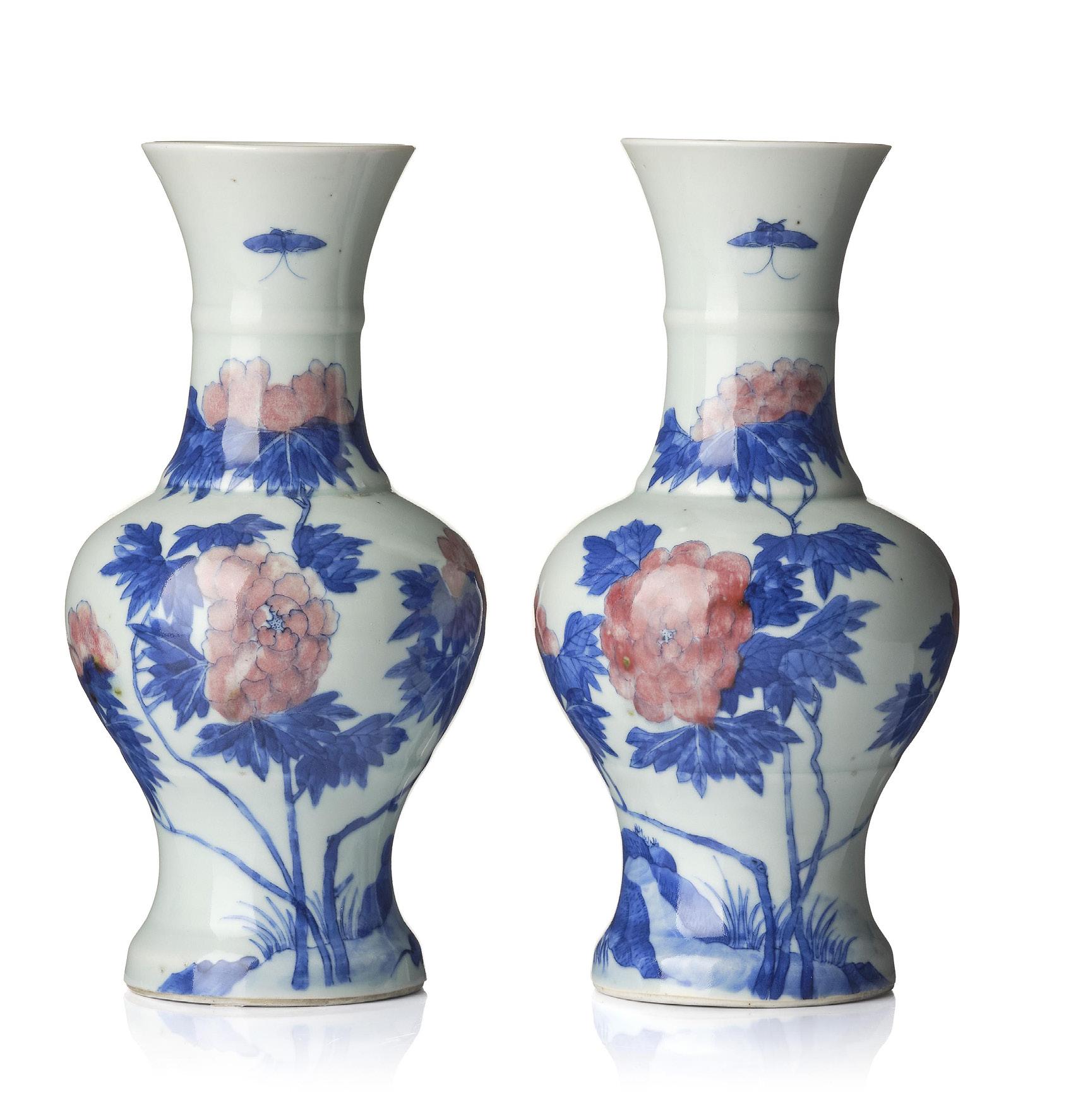
932. A pair of underglaze blue and red vases, Qing dynasty, 19th century. Of baluster shape with a flared rim, decorated in a vibrant underglaze blue colour and underglaze red depicting blossoming peonies. Height 22 cm.
Provenance: Gustaf Oscar Wallenberg (1865–1937), Stockholm, and thence by descent within the family.
Estimate: SEK 15 000 – 20 000 / EUR 1 420 – 1 890
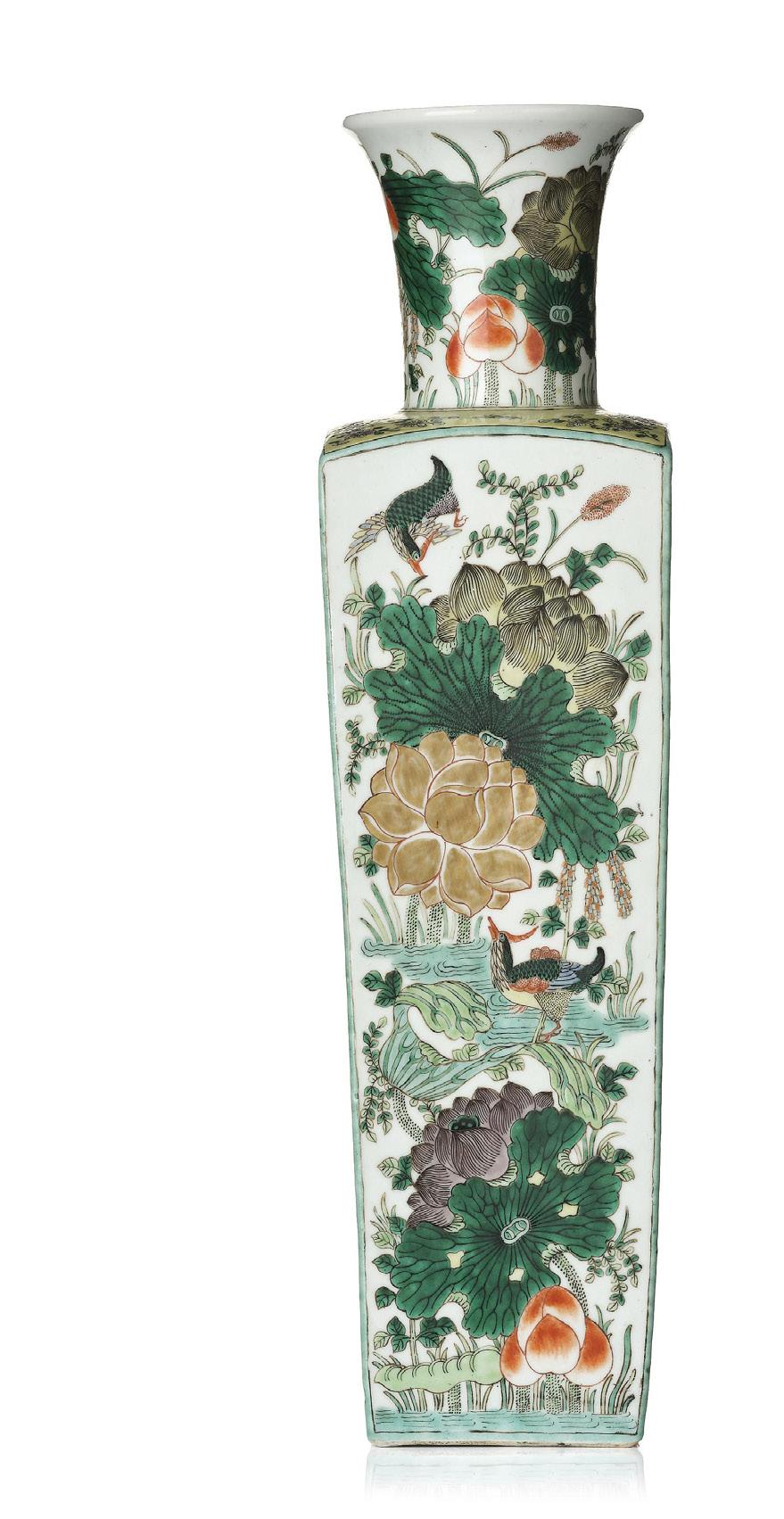
933. A famille verte vase, Qing dynasty, 19th century. Of square baluster shape, decorated in famille verte colours featuring a blossoming lotus pond. Height 57 cm.
Provenance: Gustaf Oscar Wallenberg (1865–1937), Stockholm, and thence by descent within the family.
Exhibitions: This item has an extra label with Wallenberg dep. It refers to the items that were from Mr Raoul Wallenbergs personal collection that were deposited at the Museum of Far Eastern Antiquities in Stockholm.
Estimate: SEK 20 000 – 30 000 / EUR 1 890 – 2 830
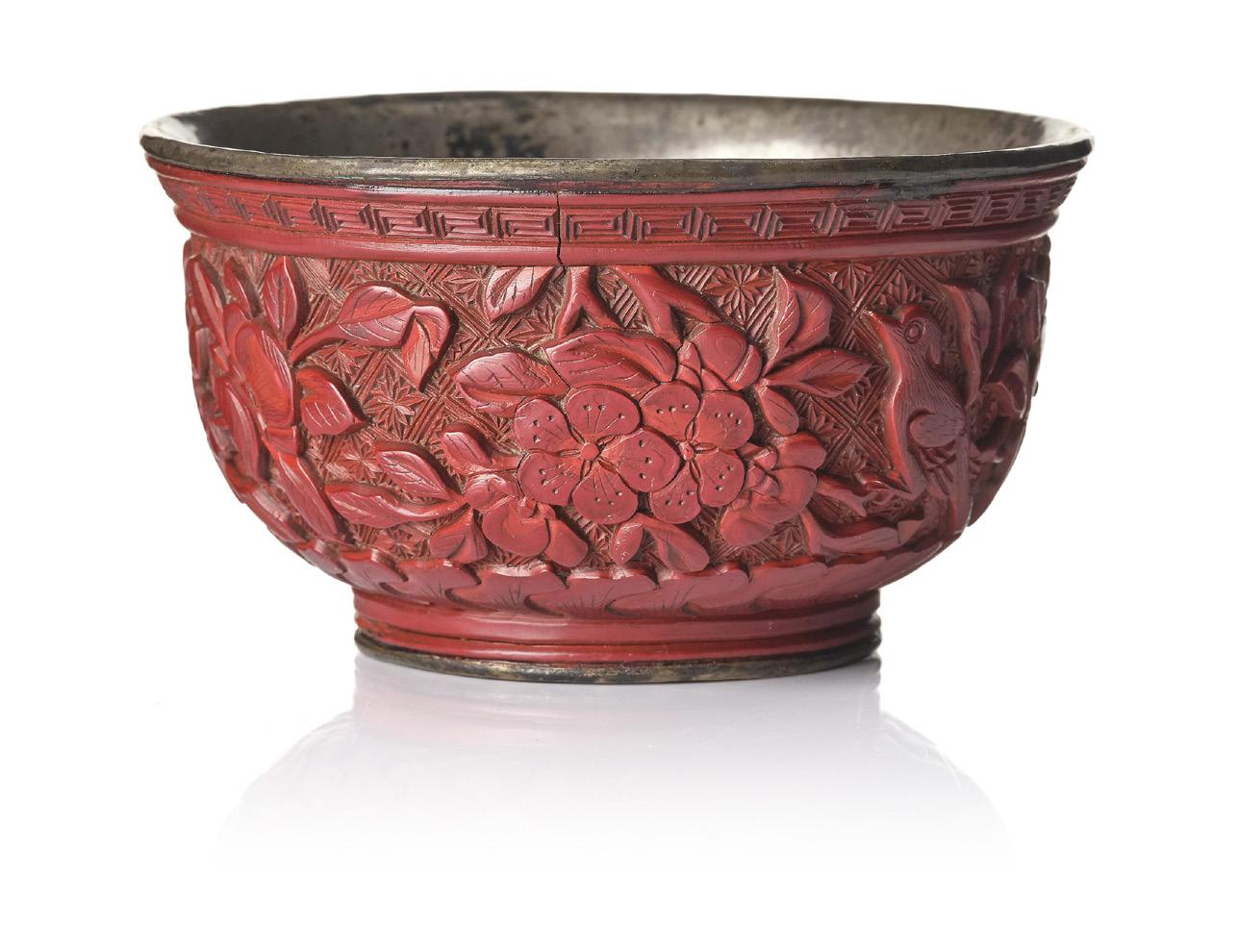
934. A lacquer bowl with silvered lining, late Ming dynasty, 17th century.
Cut decoration of birds amidst blossoming branches. Diameter 10.2 cm. Height 5.4 cm.
Provenance: Gustaf Oscar Wallenberg (1865–1937), Stockholm, and thence by descent within the family.
Exhibitions: Compare with a bowl of this type sold at Christies Live Auction 1814, Fine Chinese Ceramics & Works of Art, lot 155, 22 March 2007. Compare with lot 300, Bonhams Live Auction Fine Chinese Art, London New Bond Street, 7 November 2013.
Literature: Compare with a similar carved cinnabar lacquer bowl with pomegranates and bird design illustrated by Simon Kwan, “Chinese Lacquer: The Muwen Tang Collection Series”, Hong Kong, 2010, pp.222–223, pl 69; see also a similar bowl, Wanli mark and period, illustrated by K.J.Brandt, “Chinesische Lackarbeiten”, Linden Museum, Stuttgart, 1988, pl.44; and B.McElney, “Chinese Metalwares and Decorative Arts”, Museum of East Asian Art, Bath, 1993, pl.321.
Estimate: SEK 8 000 – 10 000 / EUR 755 – 944
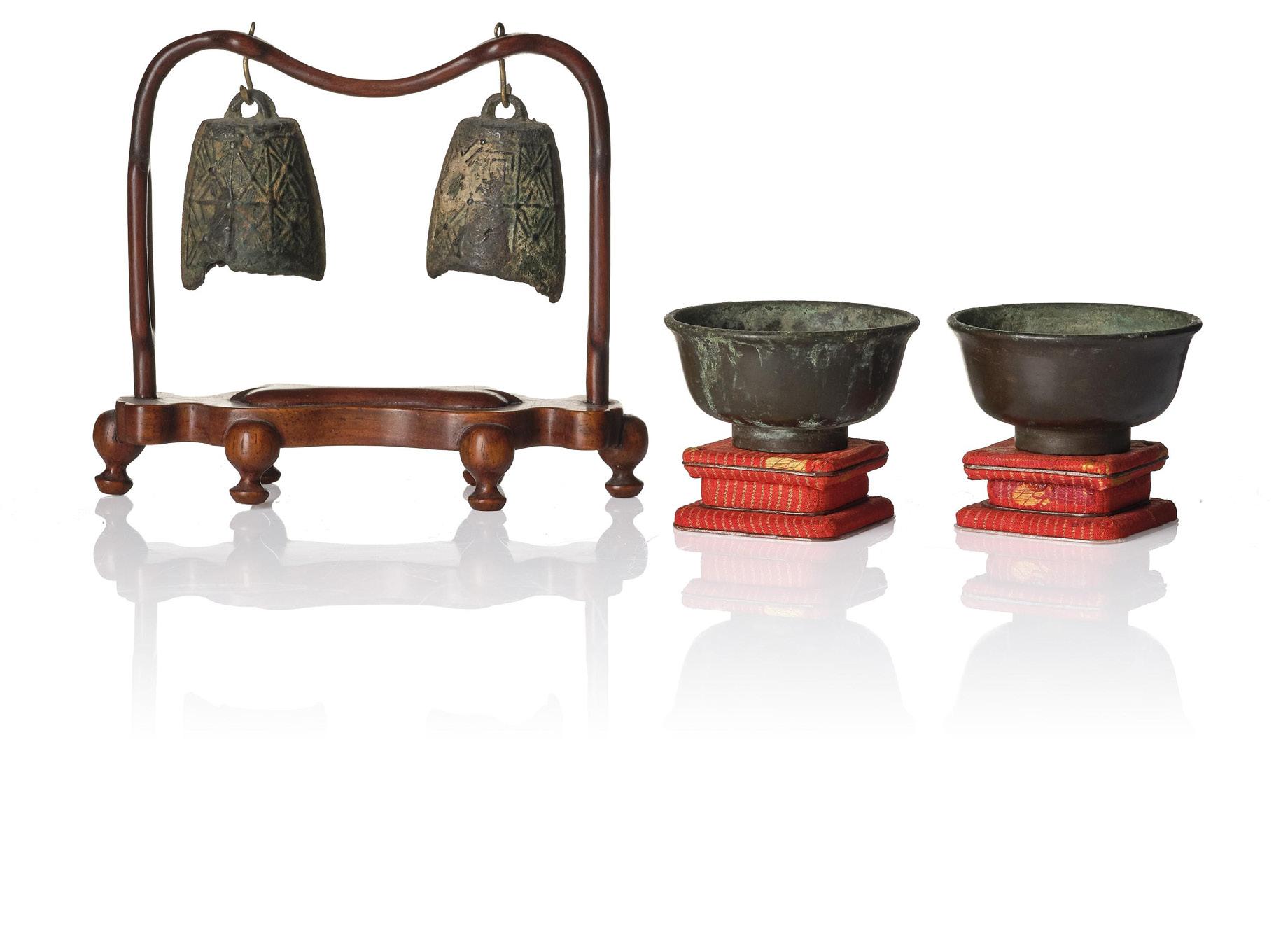
935. A pair of bronze cups and a pair of miniature bronze bells, late Ming/early Qing dynasty.
The cups with rounded sides and slightly everted rim on a short foot. Diameter 6.5 cm. The archaistic bronze bells mounted on a wooden stand, dimensions with stand 12 x 14 cm.
Provenance: Gustaf Oscar Wallenberg (1865–1937), Stockholm, and thence by descent within the family..
Estimate: SEK 4 000 / EUR 378
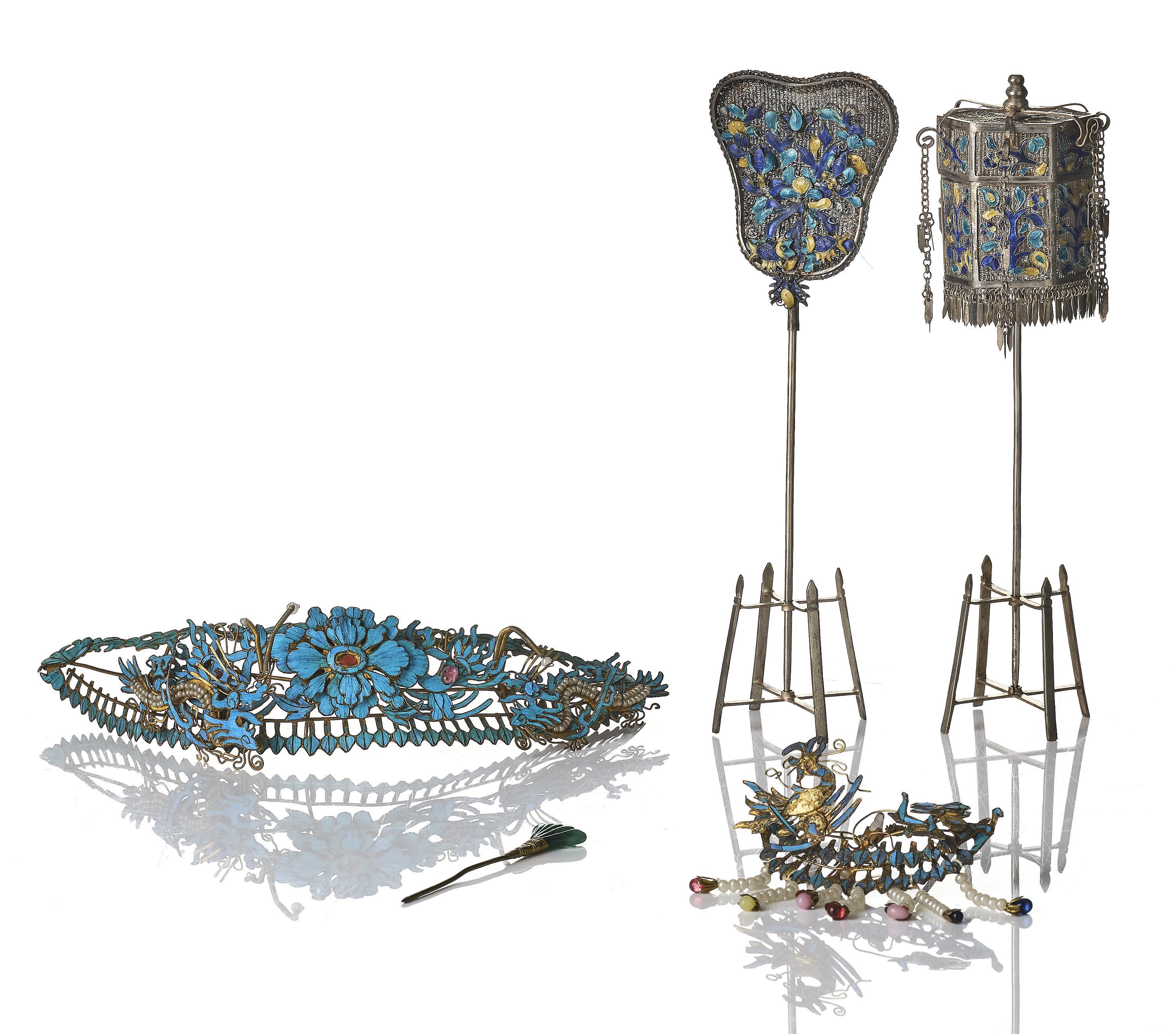
936. A group of hair ornaments, Qing dynasty, 19th century.
Comprising; a pearl and kingfisher feather hair ornament, length 18 cm. Two silver and enamel hair pins in the shape of conopies, lubu, on stands, height 19 cm.
Provenance: Gustaf Oscar Wallenberg (1865–1937), Stockholm, and thence by descent within the family.
Estimate: SEK 8 000 – 10 000 / EUR 755 – 944
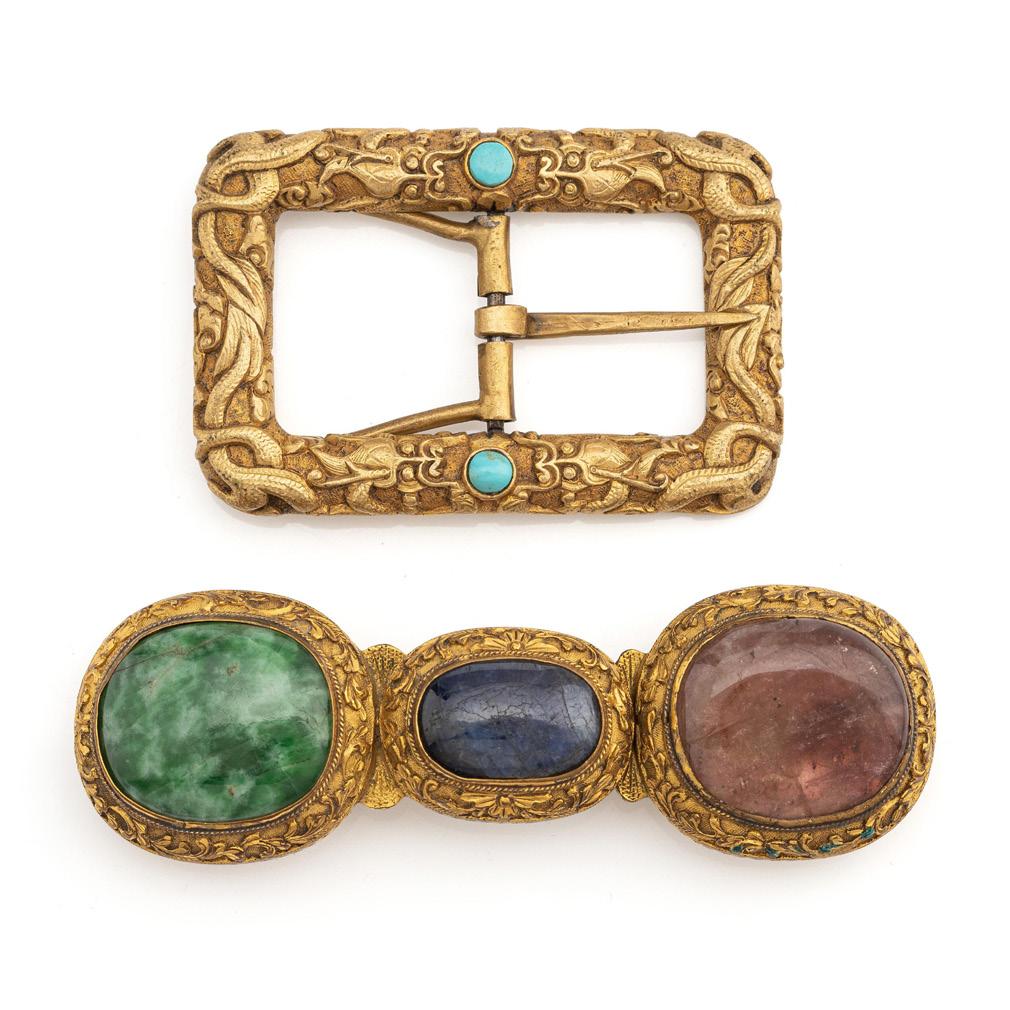
937. A set of two gilded belt-buckles, Qing dynasty, 19th century.
A belt-buckle with stone inlay against a floral ornament, length 9.3 cm. A rectangular belt-buckle decorated with dragons and with turquoise inlay. Measure 6.5 x 4.2 cm.
Marked with Chinese characters.
Provenance: Gustaf Oscar Wallenberg (1865–1937), Stockholm, and thence by descent within the family..
Exhibitions: Compare a belt buckle of this type in the Asian Art Museum in San Fransisco, Credit Line “Bequest of Joseph O. Godwin”. Object number 2010.386.a-.b.
Estimate: SEK 6 000 – 8 000 / EUR 567 – 755
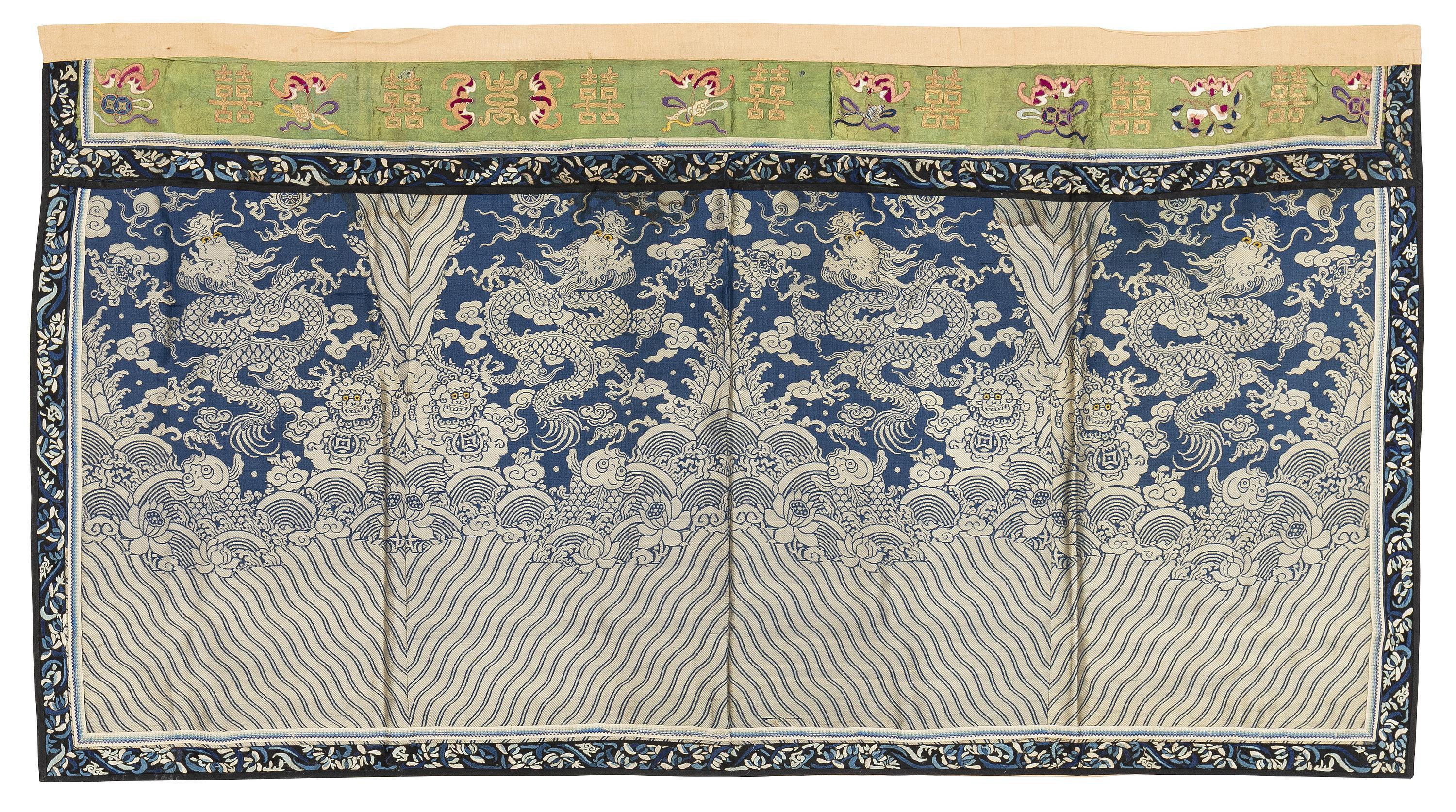
938. A large silk altar cover, Qing dynasty. Decorated with four clawed dragons, fish, coins, buddhist lions and shou characters against a blue background. Measure 100 x 184 cm.
Provenance: Gustaf Oscar Wallenberg (1865–1937), Stockholm, and thence by descent within the family.
Estimate: SEK 6 000 – 8 000 / EUR 567 – 755
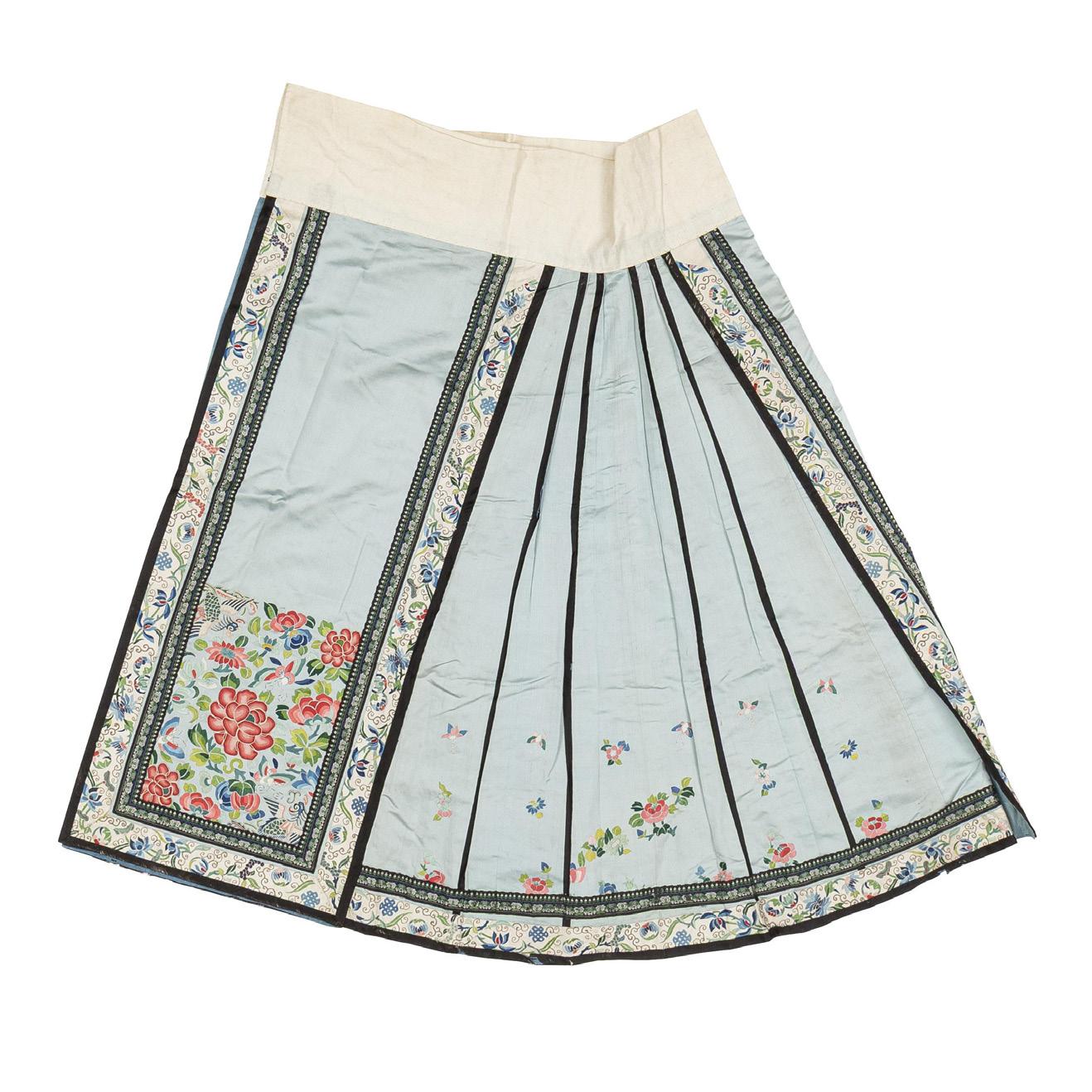
939. A pale blue embroidered silk skirt, Qing dynasty, 19th century.
Embroidered in various techniques such as the ‘pekingstich’ or ‘forbidden knot’ in a variety of colours depicting birds and flowers against a blue ground. Length with cotton trim 94 cm.
Provenance: Gustaf Oscar Wallenberg (1865–1937), Stockholm, and thence by descent within the family. .
Estimate: SEK 6 000 – 8 000 / EUR 567 – 755
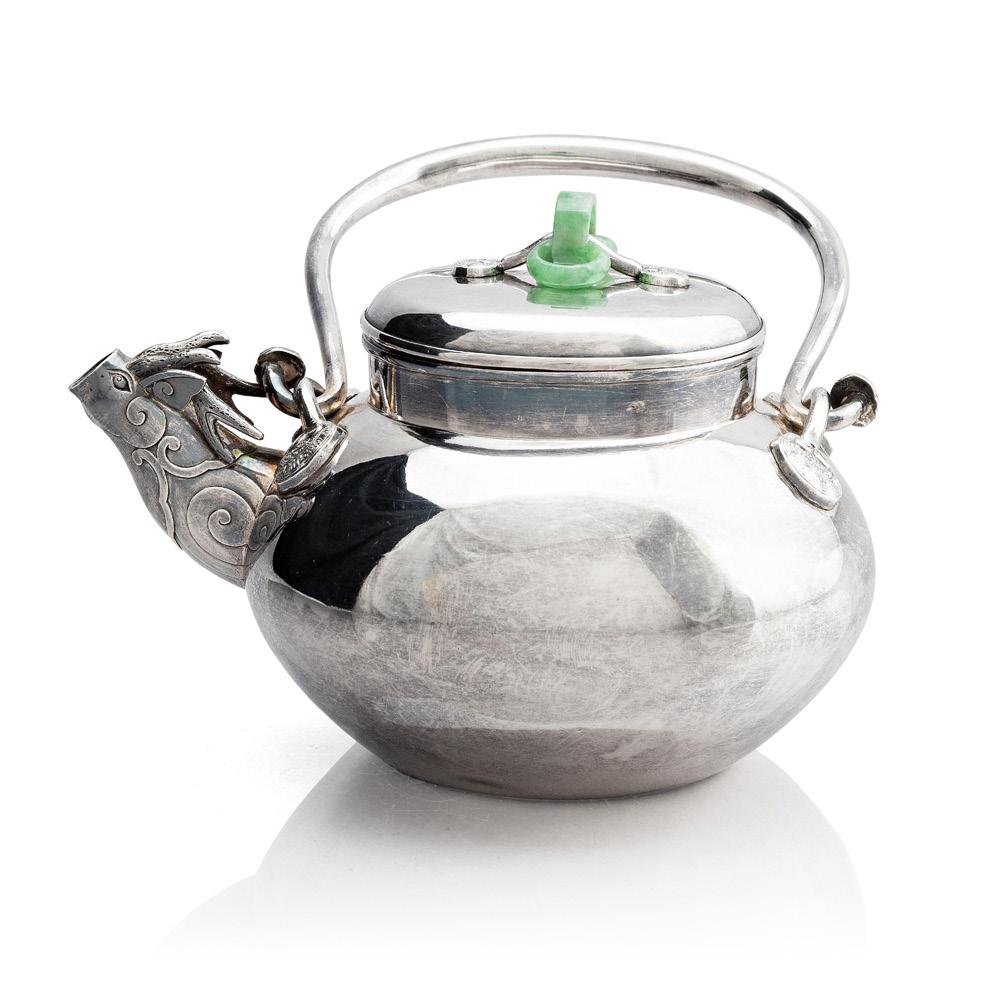
940. A silver tea pot with cover, Japan, early 20th century. With mark inside the cover, 銀製 ‘Ginsei’ (made of silver). The spout rendered on one side in the form of a stylized ram’s head, the beast sensitively depicted with alert eyes and a pair of long curved striated horns above the ears. An upturned handle and each side of the handle with meticulously detailed ruyi. The finial repeats this decoration and has three green stone rings added to it. Height with handle up 18 cm, width 17.5 cm.
Weight 526 grams.
Provenance: Gustaf Oscar Wallenberg (1865–1937), Stockholm, and thence by descent within the family.
Exhibitions: The model seems to be inspired of the white jade tea pots from the Qianlong period.
Catalogue note: With the engraved monogram of O.F. presumably a gift to Gustaf Wallenbergs son-in-law Oscar Falkman, Karlavägen 81, Stockholm.
Estimate: SEK 8 000 – 10 000 / EUR 755 – 944
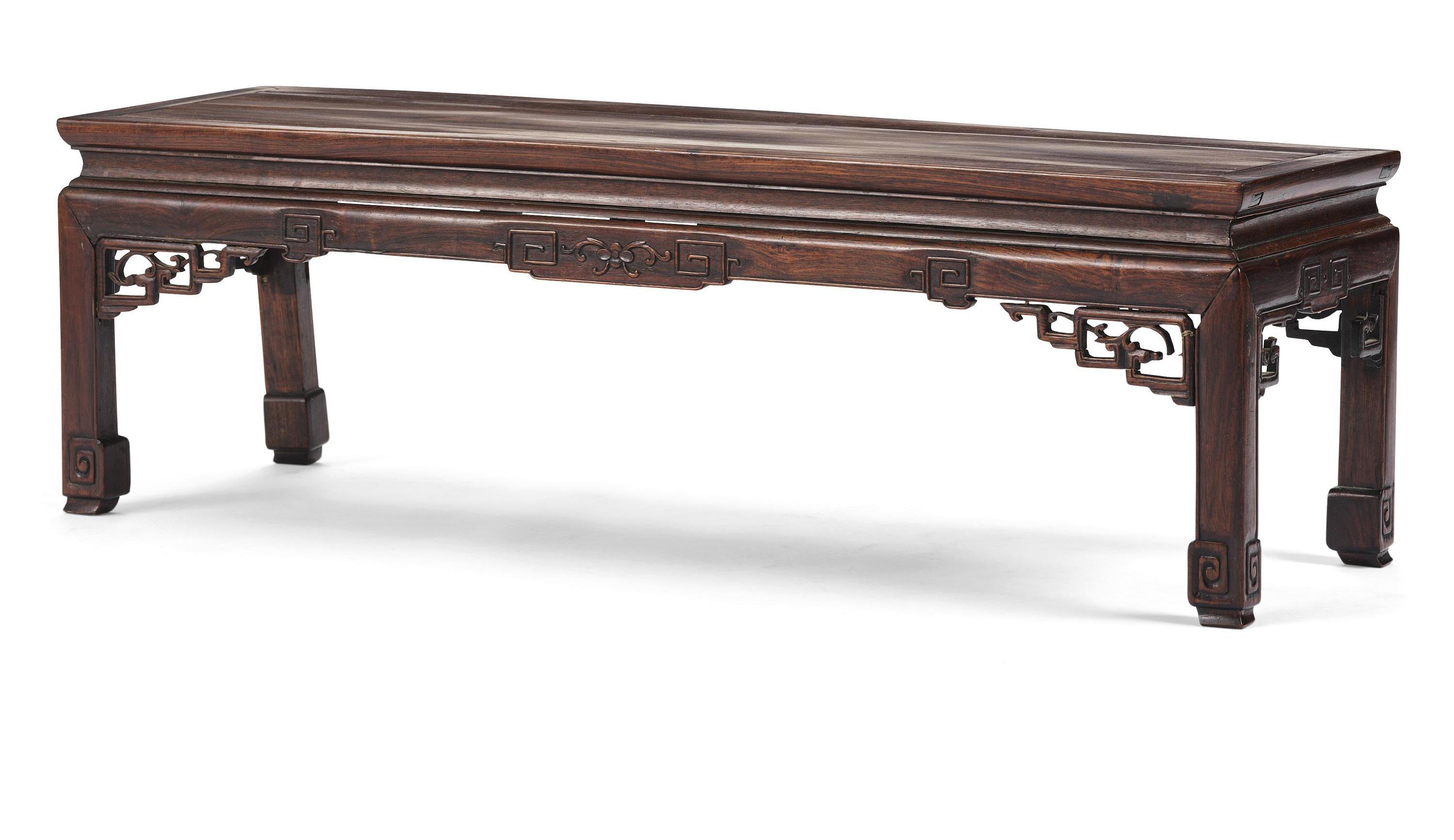
941. A Chinese hardwood low table, Qing dynasty, 19th century. The rectangular panelled top set within a wide border above a recessed waist and a shaped apron, supported on four feet of square section terminating in angular scrolls. Measure 110 x 35 x 35 cm.
Provenance: Gustaf Oscar Wallenberg (1865–1937), Stockholm, and thence by descent within the family.
Estimate: SEK 8 000 – 10 000 / EUR 755 – 944
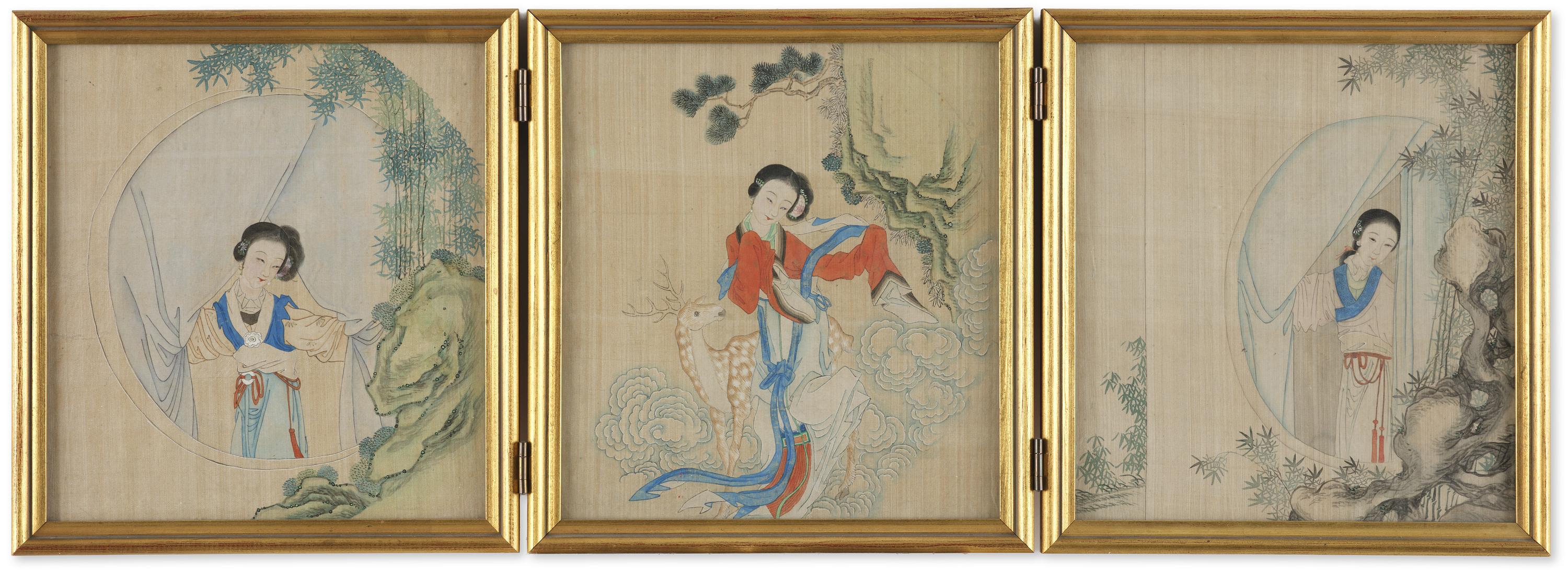
942. Four paintings of ‘Chinese beauties’ by anonymous artist, Qing dynasty, 19th century. Ink and colour on silk. Measure each 21 x 24 cm. Measure with foldable frame 27 x 76 cm. One framed separately measure motif 24 x 29 cm Measure frame 42 x 47 cm.
Provenance: Gustaf Oscar Wallenberg (1865–1937), Stockholm, and thence by descent within the family.
Estimate: SEK 4 000 – 6 000 / EUR 378 – 567
From the Collection of Ove Christian Lunn
The Danish Diplomat and Counsul General for Denmark, Ove Christian Lunn (1873–1935), Lunn had a long diplomatic career and was posted 1910–1918 in Oslo, 1918–1924 in San Fransisco, 1924–28 in Melbourne, 1928–1935 in Shanghai. These items were aquired when posted in Shanghai, thence by descent within the family.
LOT 943–951.
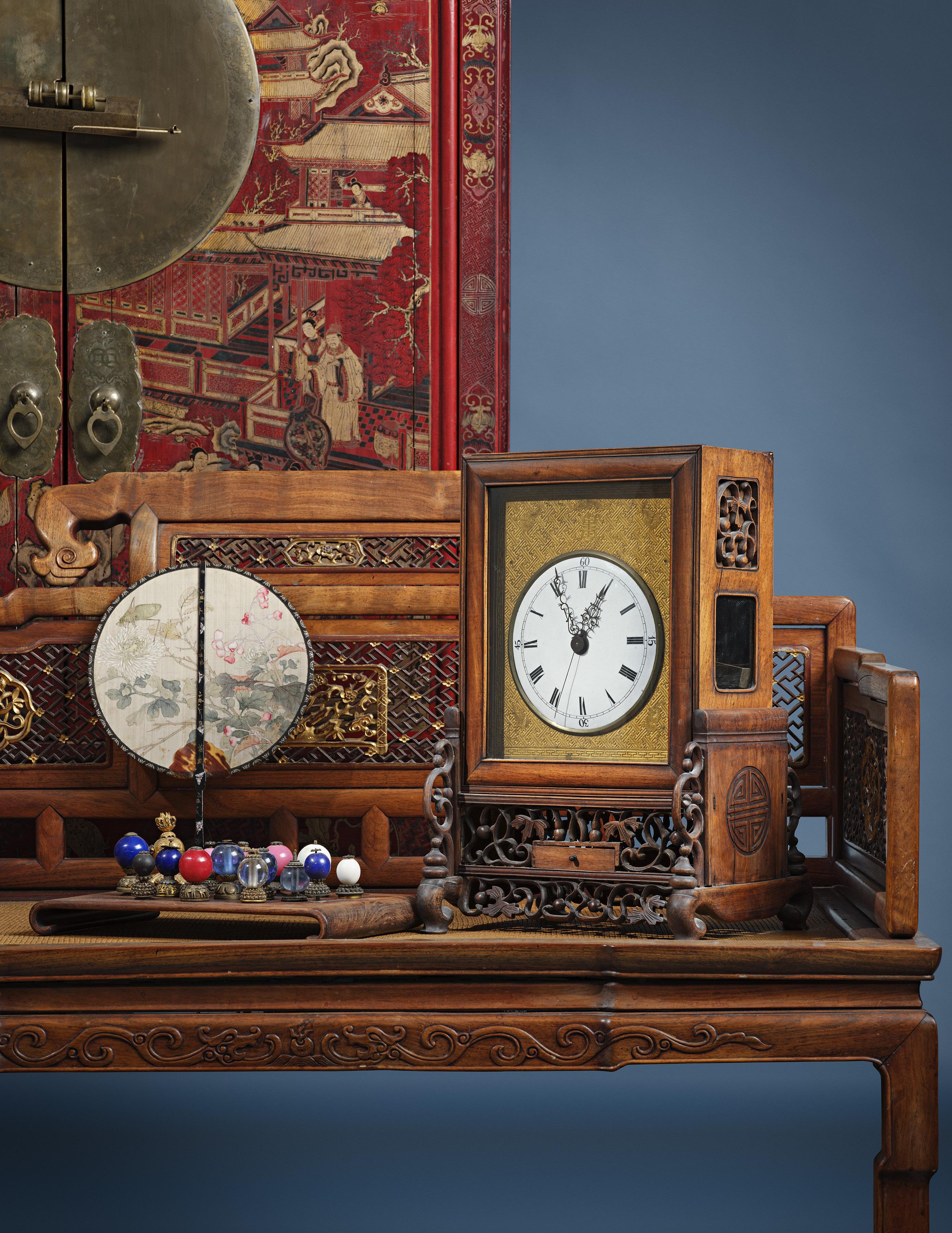
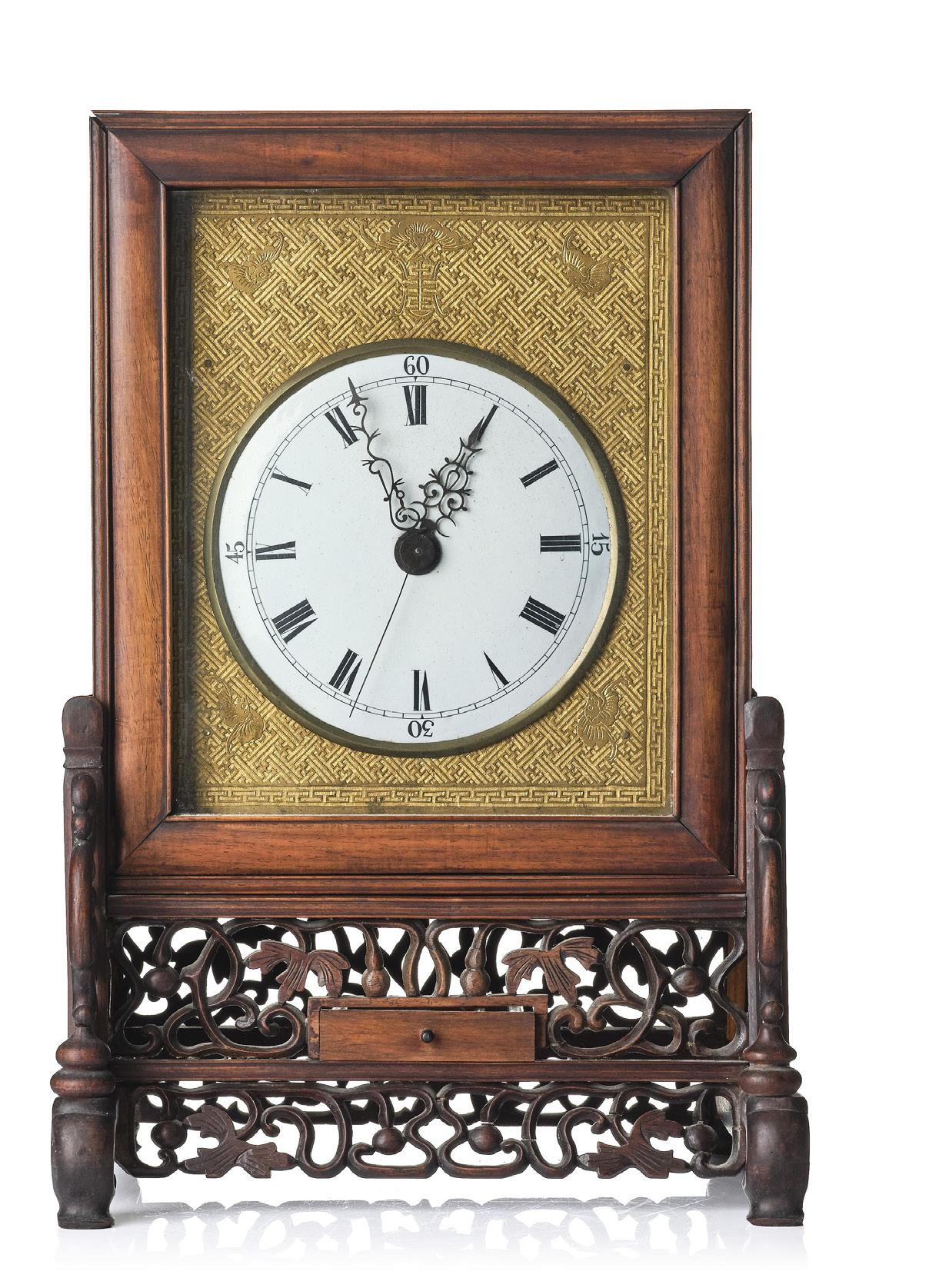
943. A Chinese hardwood Mantel Clock, late Qing dynasty, 19th century.
Enamel dial with centre seconds, the gilt trellis mask surmounted by an engraved scene incorporating five bats and a shou character, the rear-wound two train fuse movement with verge escapement and striking on a bell, the moulded rectangular case mounted in a carved and pierced wooden stand with a drawer that holds the key. Height 50.5 cm. Width 34 cm. Depth 26.5 cm.
Provenance: From the Collection of Ove Christian Lunn, Danish Diplomat and Consul General for Denmark in Shanghai 1928–1935. Lunn had an exciting diplomatic career and was posted 1910–18 in Oslo, 1918–24 in San Francisco, 1924–28 Melbourne and then finally Shanghai 1928–35.
Literature: Chinas hidden century 1796–1912. Edited by Jessica Harrison–Hall, and Julia Lovell. See page 203 for a clock like. There is also an illustration of an interior with a beautiful courtesan with a clock like this on a table.
Catalogue note: In the 18th century, foreign clocks came to Guangzhou and Beijing as tributes for the court or as high-quality trade goods, but the second half of the 19th century the demand seems to have increased for the Yang treasures.
Estimate: SEK 15 000 – 20 000 / EUR 1 420 – 1 890
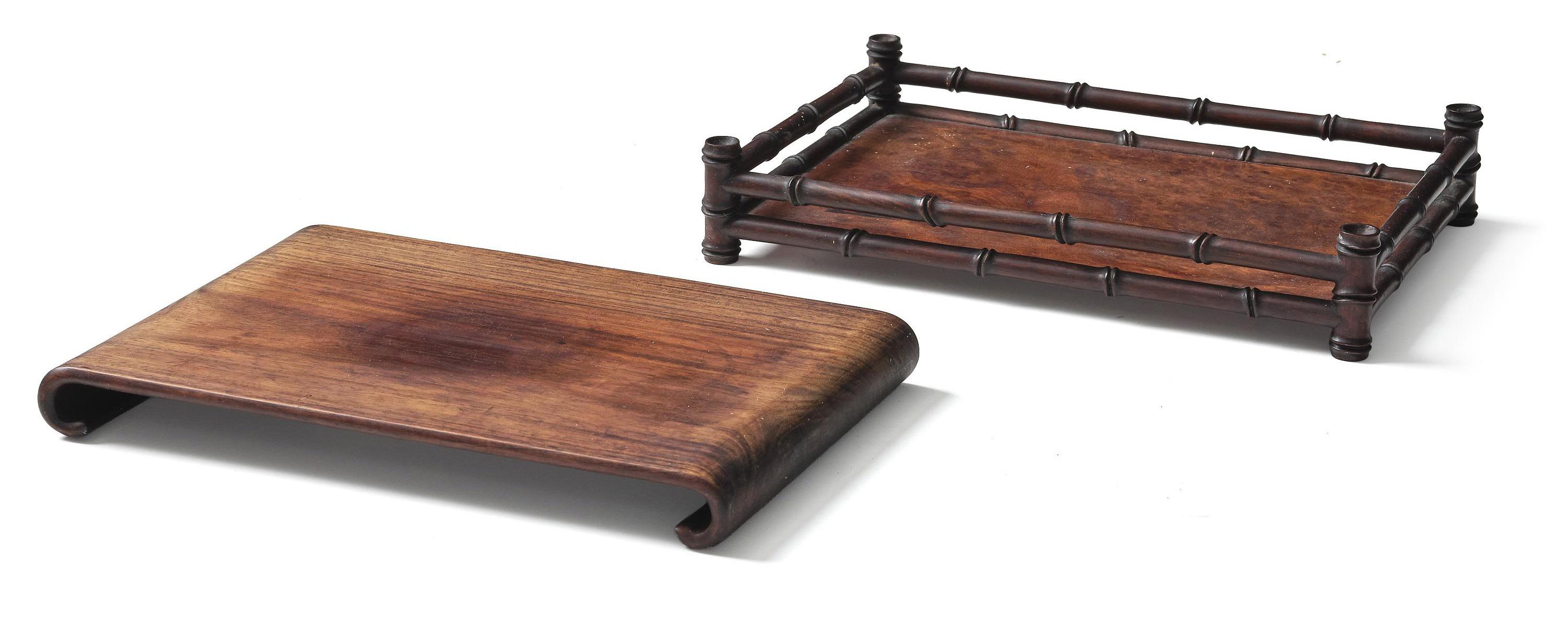
944. A hardwood scroll end stand, Ji, and a rectangular tray, Qing dynasty, 19th century. Of sleek, simple profile, carved from a single piece of wood, the flat upper surface with rounded front and back edges and curving gently around at the ends to form the feet. Measure 35 x 23 x 3 cm. Measure of the rectangular tray 36 x 25 x 7 cm.
Provenance: From the Collection of Ove Christian Lunn, Danish Diplomat and Consul General for Denmark in Shanghai 1928–1935. Lunn had an exciting diplomatic career and was posted 1910–18 in Oslo, 1918–24 in San Francisco, 1924–28 Melbourne and then finally Shanghai 1928–35.
Literature: Compare a slightly smaller laohuali stand in the Metropolitan Museum of Art, New York, illustrated in R. H. Ellsworth, “Chinese Furniture: Hardwood Examples of the Ming and Qing Dynasties”, New York, 1971, p. 236, pl. 155.
Catalogue note: Carved from a single piece of wood, this style of display stand demanded flawless seasoned timber.
Estimate: SEK 8 000 – 10 000 / EUR 755 – 944
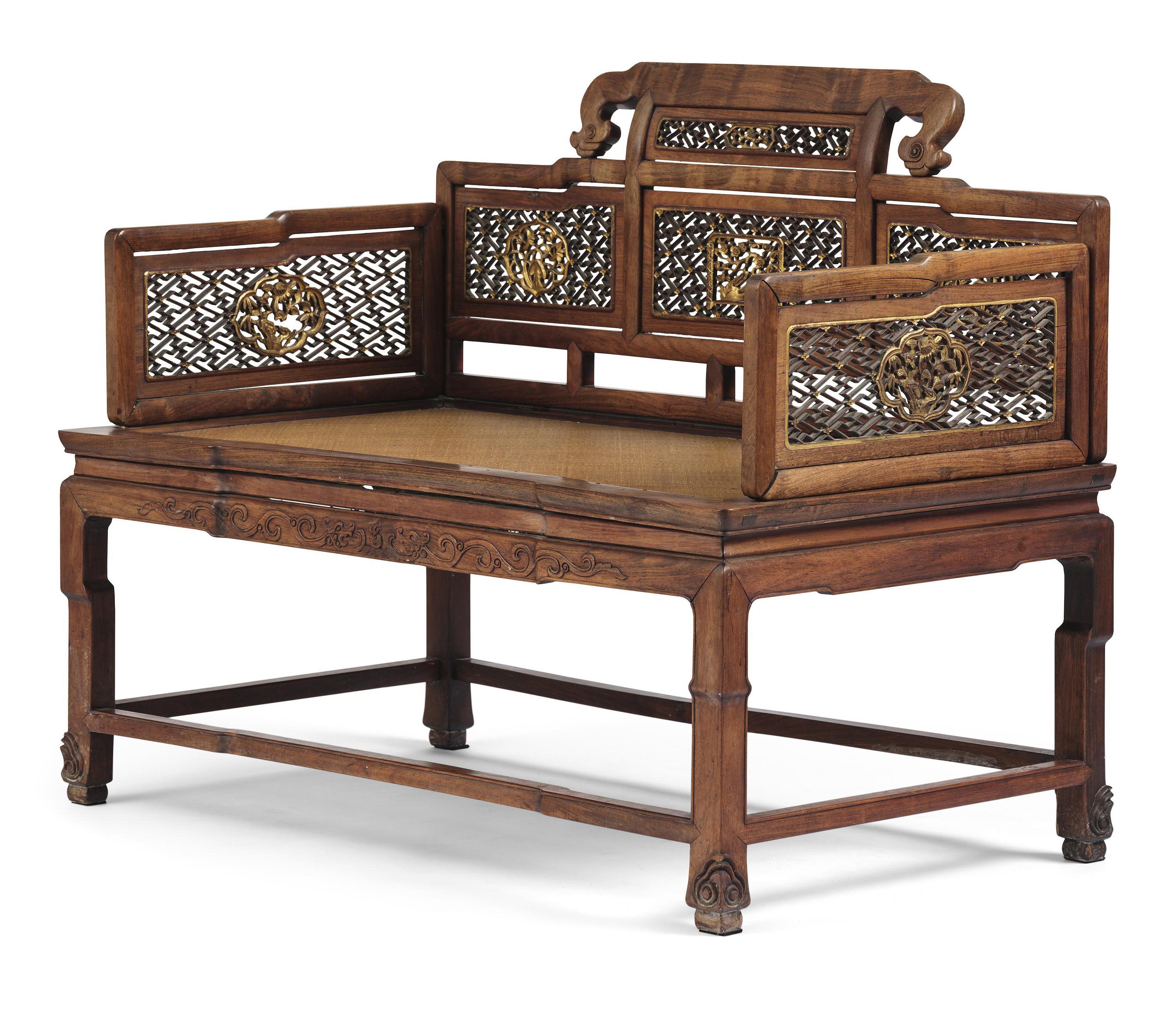
945. A Chinese hardwood throne chair/day bed, Qing dynasty, 19th century.
The back and side rails are gently curved framing openwork panel carved with ‘wanzi’ lattice work and gilded details. All above a reticulated waist, the apron distinguished by the carved confronting chilong dragons. All supported on inward-curved legs terminating in reticulated upturned feet. Measure 125 x 72 x 97 cm.
Provenance: From the Collection of Ove Christian Lunn, Danish Diplomat and Consul General for Denmark in Shanghai 1928–1935. Lunn had an exciting diplomatic career and was posted 1910–18 in Oslo, 1918–24 in San Francisco, 1924–28 Melbourne and then finally Shanghai 1928–35. Thence by descent.
Estimate: SEK 8 000 – 10 000 / EUR 755 – 944
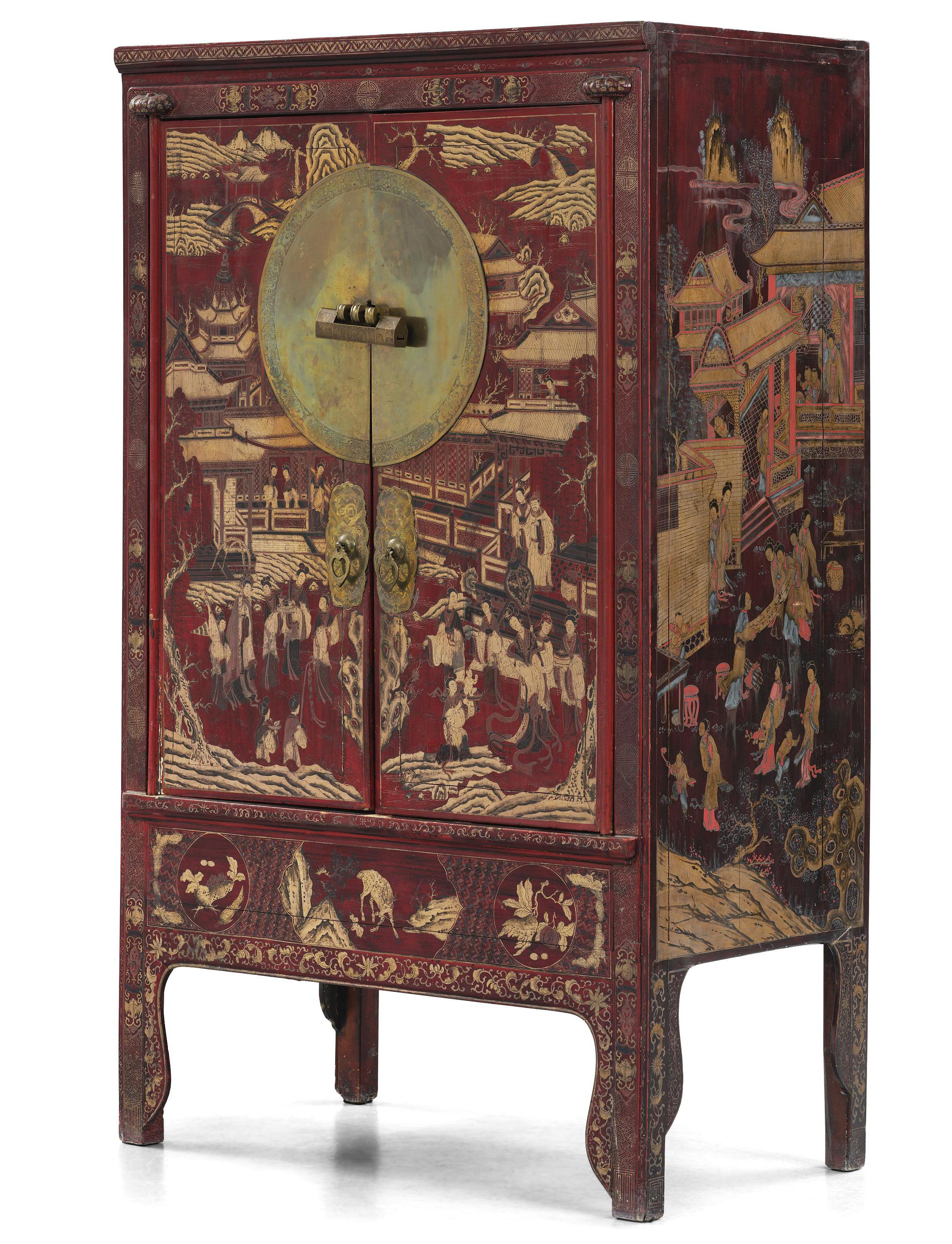
946. A large painted and gilt-decorated and red lacquer cabinet, Qing dynasty 18/19th century.
Of rectangular form, comprising a tall cabinet, with doors opening from removable centre stiles, painted on a red ground with with figure scenes in a palace enviroment, all enclosed by meandering floral scrolls, the sides and shaped apron similarly decorated, the interior lacquered black, fitted with metal hinges, plates and pulls. Two doors that opens to reveal a shelf and drawers. Height 183 cm. Width 119 cm. Depth 59 cm.
Provenance: From the Collection of Ove Christian Lunn, Danish Diplomat and Consul General for Denmark in Shanghai 1928–1935. Lunn had an exciting diplomatic career and was posted 1910–18 in Oslo, 1918–24 in San Francisco, 1924–28 Melbourne and then finally Shanghai 1928–35. Thence by descent.
Literature: Lee Yu-Kuan writes in Oriental Lacquer Art, that lacquer cabinets were ‘used by high officials for storing the clothing and accessories required for their appearances before the emperor or their superiors. Hats and other headdresses were kept in the top section, while the main part of the cabinet contained court costumes and various accessories.’
Estimate: SEK 30 000 – 40 000 / EUR 2 830 – 3 780
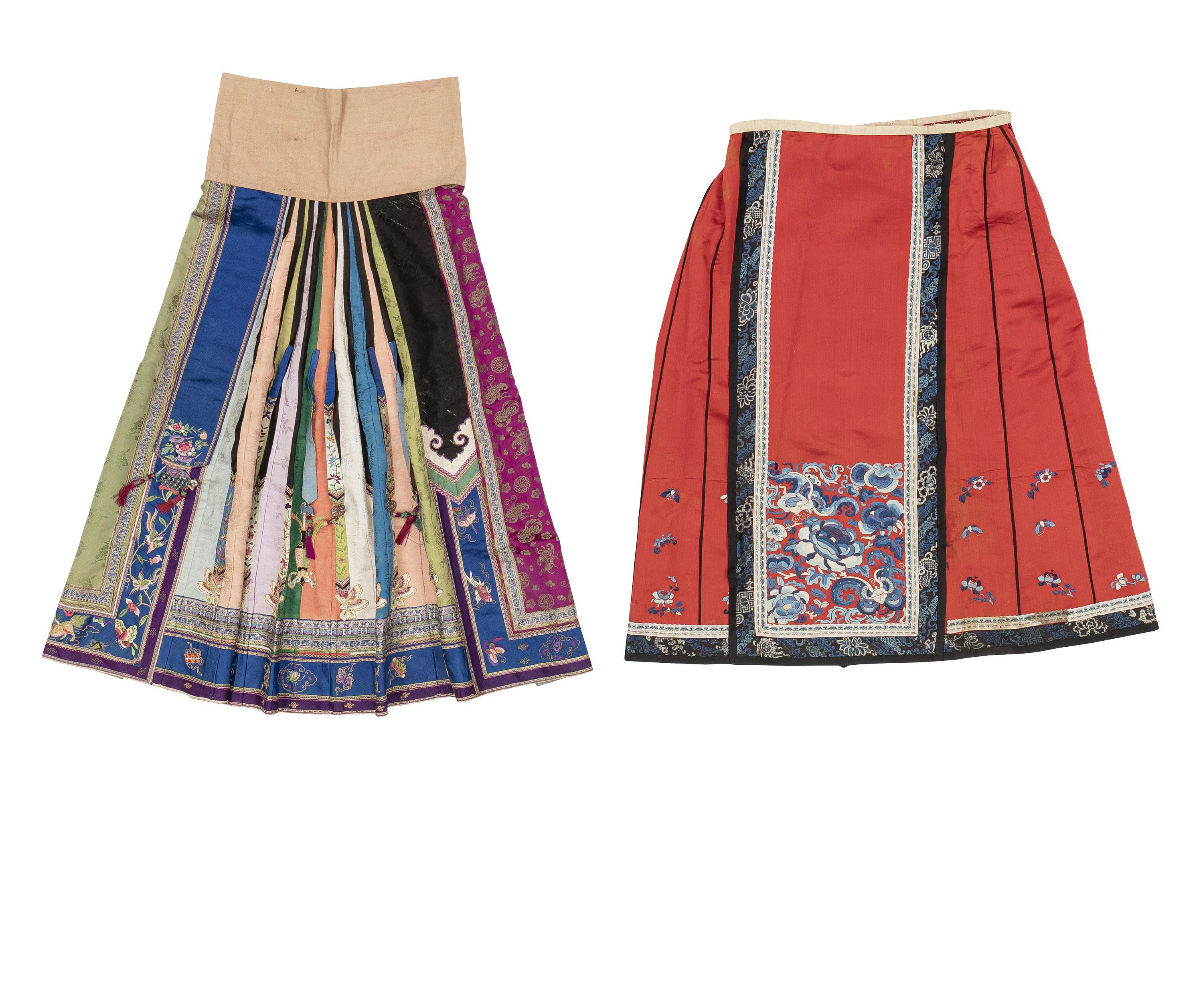
A striped skirt, length with lining by waist 96.5 cm. A red silk skirt, length 80 cm.
Provenance: From the Collection of Ove Christian Lunn, Danish Diplomat and Consul General for Denmark in Shanghai 1928–1935. Lunn had an exciting diplomatic career and was posted 1910–18 in Oslo, 1918–24 in San Francisco, 1924–28 Melbourne and then finally Shanghai 1928–35. Thence by descent.
Estimate: SEK 6 000 – 8 000 / EUR 567 – 755
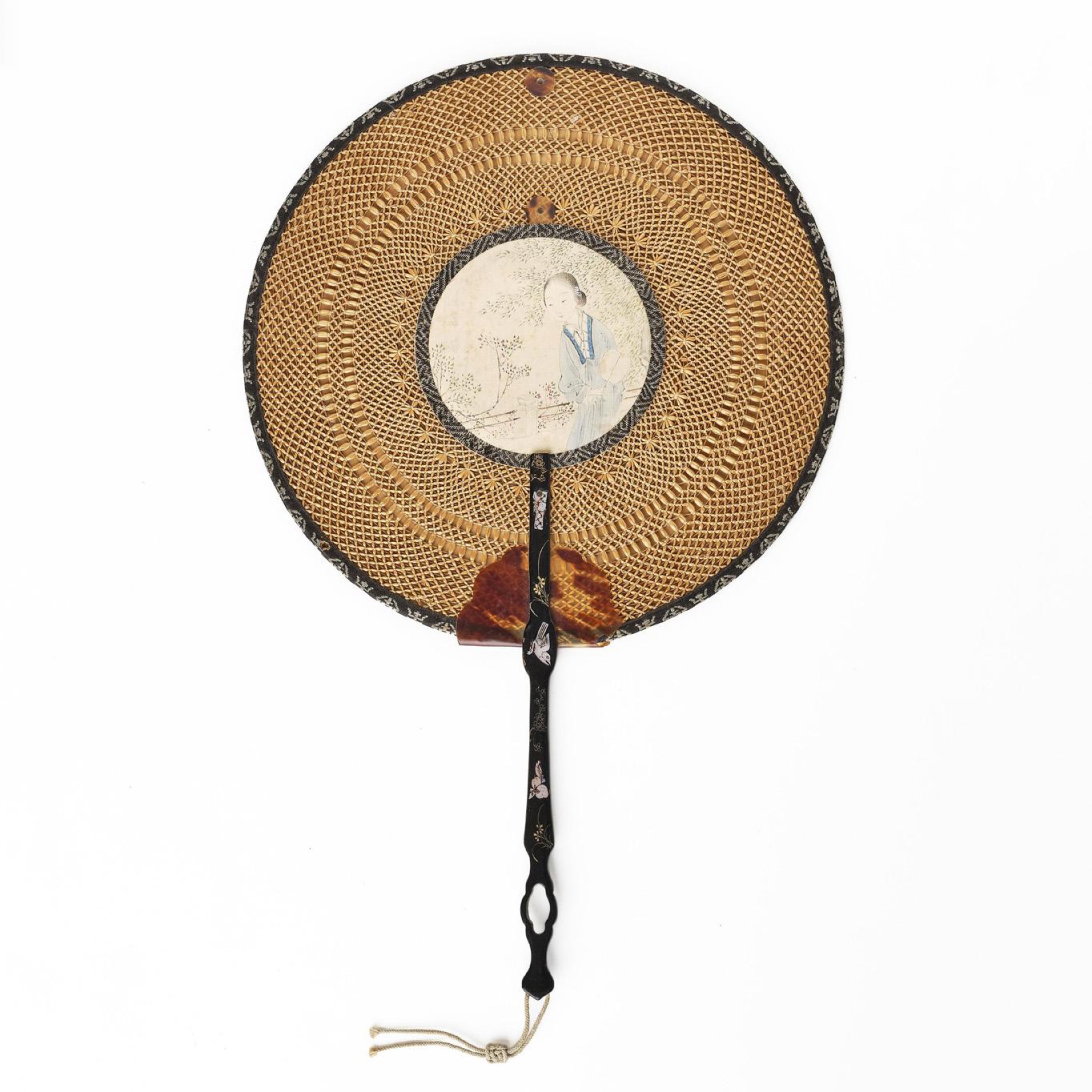
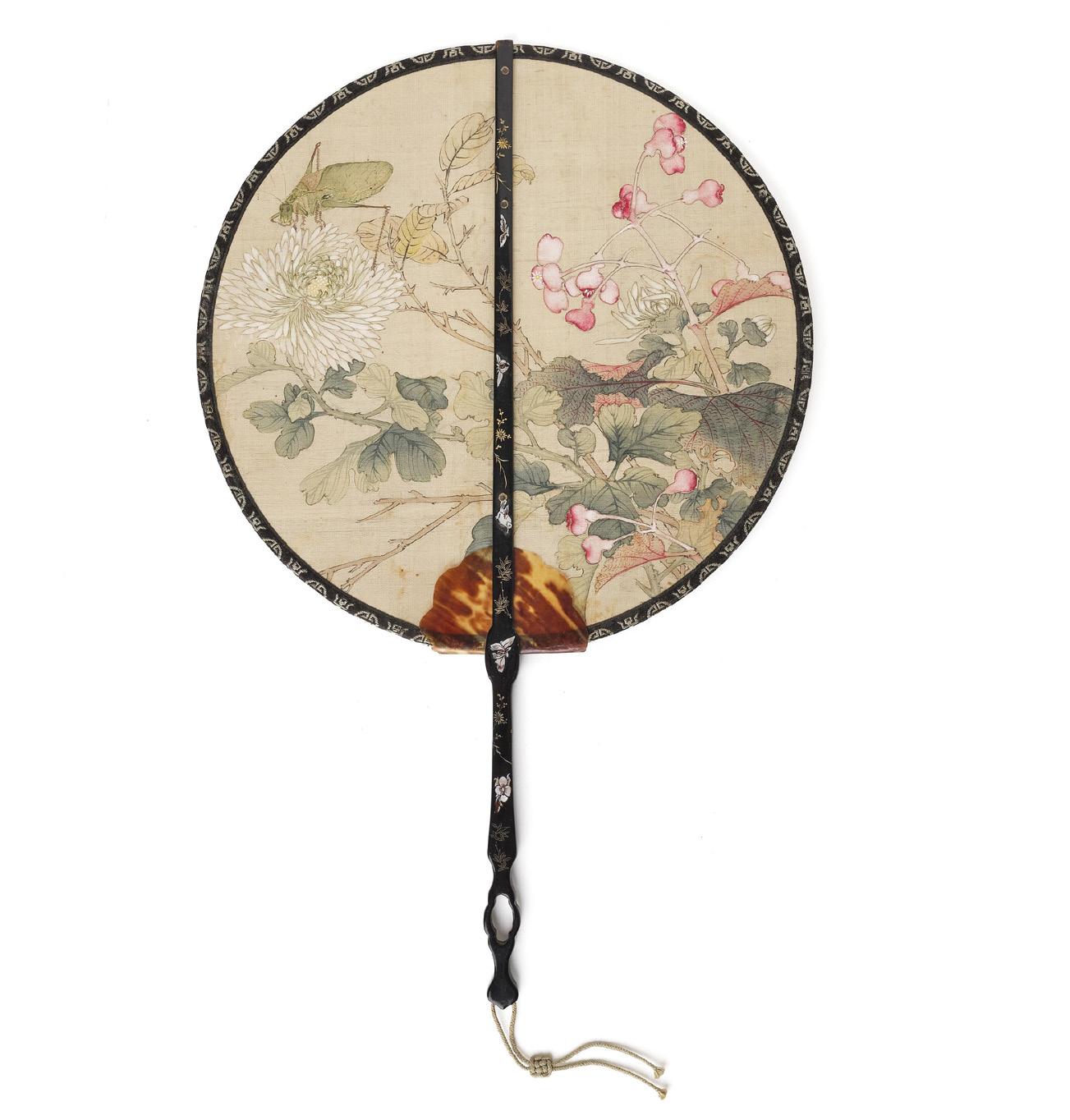
948. A Chinese fan painting by un anonymous artist, ink and watercolour, Qing dynasty, 19th century.
Decorated to one side with a beauty in a garden setting, the other with a cricket amidst flowers. Length 40.5 cm.
From the Collection of Ove Christian Lunn, Danish Diplomat and Consul General for Denmark in Shanghai 1928–1935. Lunn had an exciting diplomatic career and was posted 1910–18 in Oslo, 1918–24 in San Francisco, 1924–28 Melbourne and then finally Shanghai 1928–35. Thence by descent.
SEK 8 000 – 10 000 / EUR 755 – 944
947. Two embroidered silk skirts, late Qing dynasty.
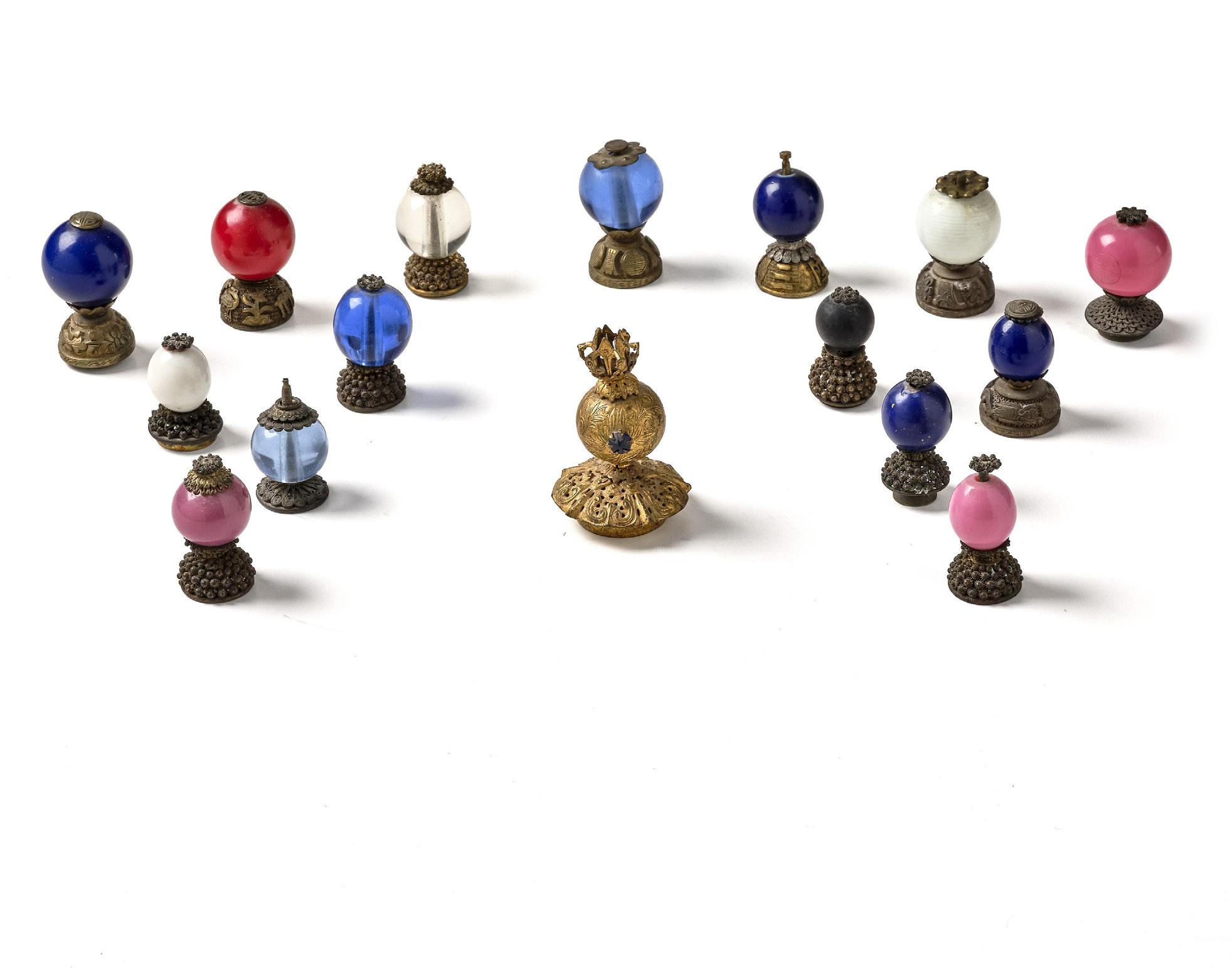
949. A group of 16 mandarin insignias, late Qing dynasty. A group of 16 gilt-metal mandarin insignias, Qing dynasty, 19th century. Each with different glass or mineral spheres used to denote Mandarin rank. Height 6–8.5 cm.
Provenance: From the Collection of Ove Christian Lunn, Danish Diplomat and Consul General for Denmark in Shanghai 1928–1935. Lunn had an exciting diplomatic career and was posted 1910–18 in Oslo, 1918–24 in San Francisco, 1924–28 Melbourne and then finally Shanghai 1928–35. Thence by descent.
Catalogue note: Under Manchu formal dress regulations, the colours of hat finials were used to distinguish official ranks: the four army divisions known as Banners were originally represented by ruby finials for the Red Banner, sapphires for the Blue Banner, rock crystals for the White Banner and gold for the Yellow Banner.
Estimate: SEK 15 000 – 20 000 / EUR 1 420 – 1 890
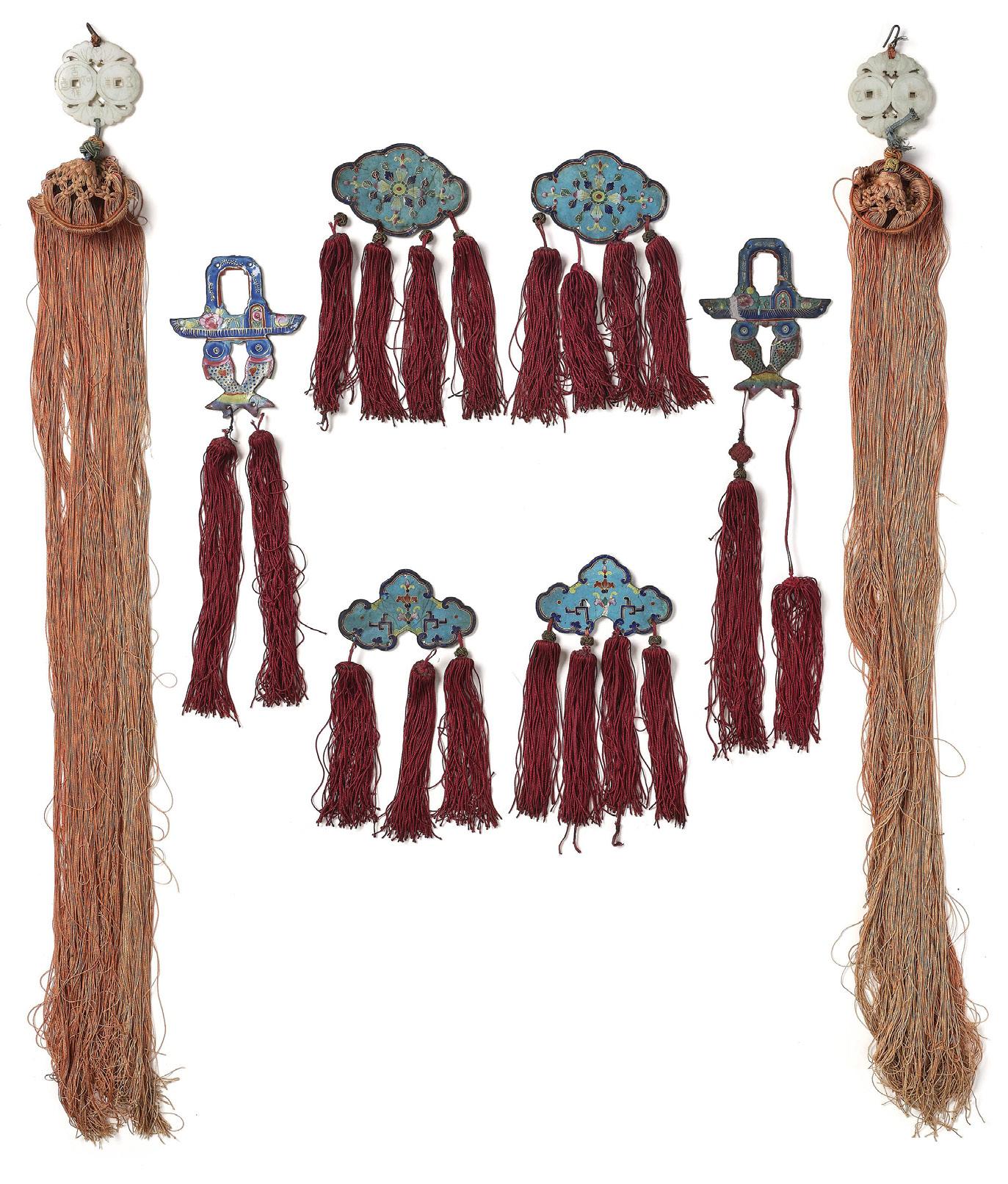
950. A group of tassels, late Qing dynasty.
Comprising two in nephrite sculptured as coins with bats. Diameter c. 7 cm. And six in enamel, width c. 11 cm.
Provenance: From the Collection of Ove Christian Lunn, Danish Diplomat and Consul General for Denmark in Shanghai 1928–1935. Lunn had an exciting diplomatic career and was posted 1910–18 in Oslo, 1918–24 in San Francisco, 1924–28 Melbourne and then finally Shanghai 1928–35. Thence by descent.
Estimate: SEK 6 000 – 8 000 / EUR 567 – 755
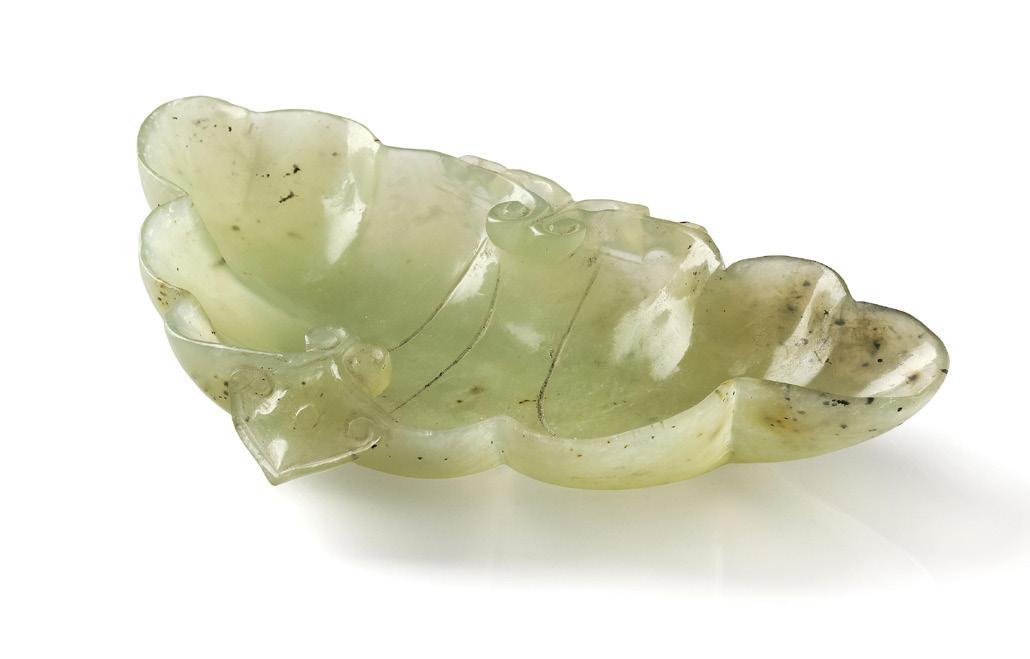
951. A carved nephrite ink palette, Qing dynasty. The palette is naturalistically carved in the form of a leaf or a butterfly. The pale green stone is semi-translucent.
Measure 15 x 9 x 2 cm.
Provenance: From the Collection of Ove Christian Lunn, Danish Diplomat and Consul General for Denmark in Shanghai 1928–1935. Lunn had an exciting diplomatic career and was posted 1910–18 in Oslo, 1918–24 in San Francisco, 1924–28 Melbourne and then finally Shanghai 1928–35. Thence by descent.
Estimate: SEK 8 000 – 10 000 / EUR 755 – 944
From the Collection of G. B. Sabelström
The Collection of G. B. Sabelström (1888–1944). Sabelström worked for the Indian Brewery/United Breweries and lived in Shanghai from the 1920s up until his death in 1944. He was an important art collector and a member of The Royal Asiatic Society in Shanghai that was closely related to the Shanghai Art Museum. As he passed without heirs, he left his collection to Erik Dahl (1896–1979), a Swedish agent for the Swedish paper industry that came to be stationed in Shanghai and Kobe from the 1920s and onwards. Erik Dahl returned to Sweden by the Trans-Siberian Railway and the collection was sent by sea to Sweden after World War II. Thence by descent.
To see other lots sold from this collection, se Bukowskis Sale 641, lot no 779–785.
LOT 952–964.
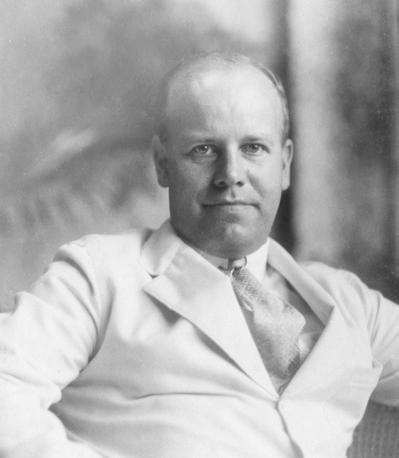
G. B. Sabelström (1888–1944).
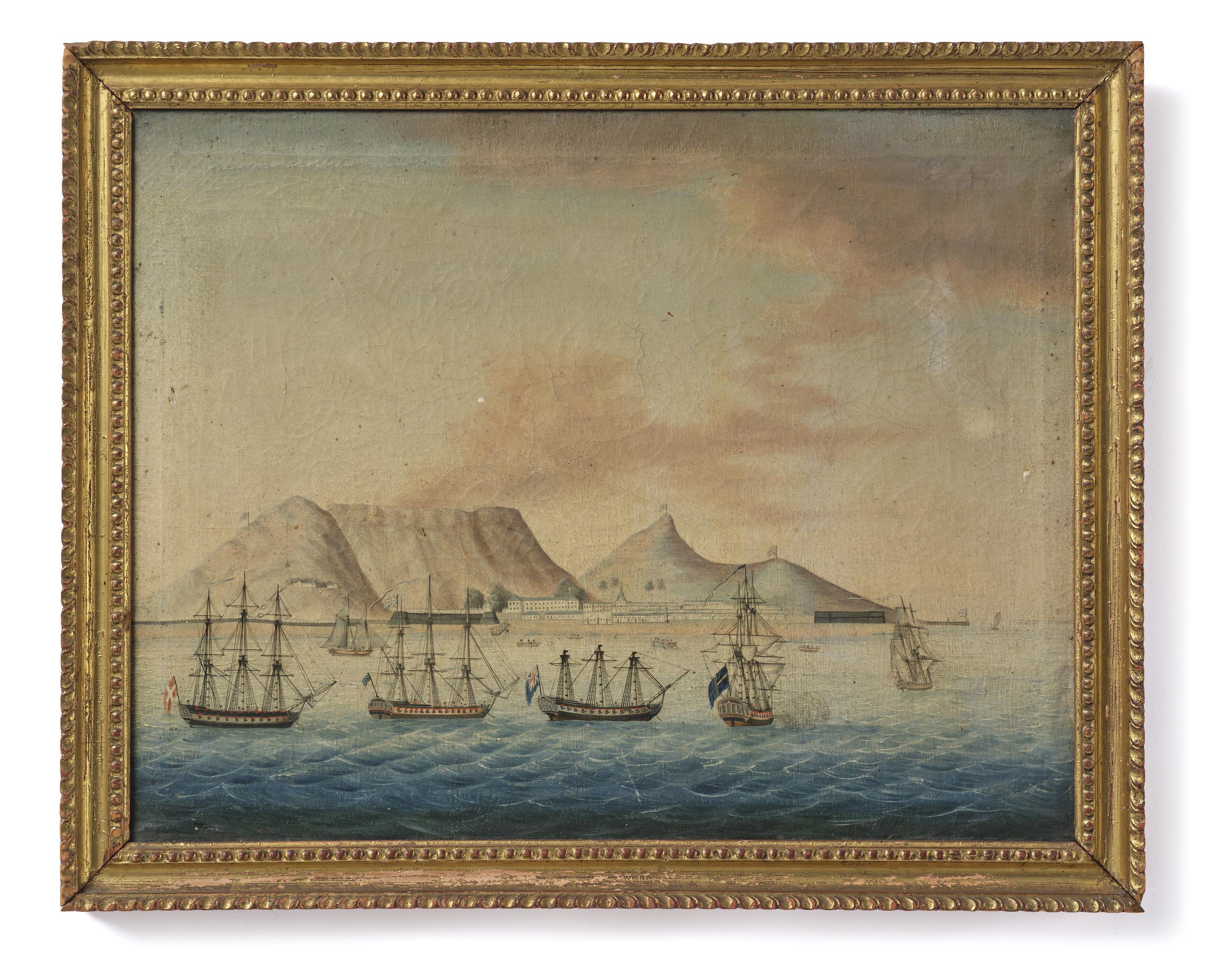
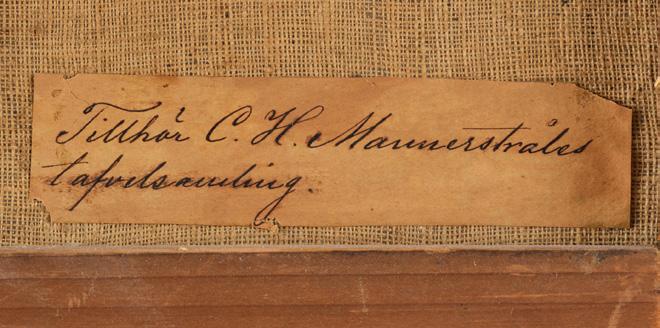
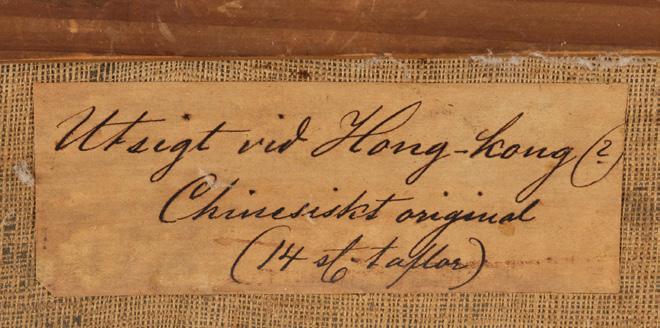
952. A rare Chinese Export painting of ‘Table Mountain’, China, circa 1800. Oil on canvas. In Chinese original frame. Depicting six ships flying Danish, American, English and Swedish flags. The Swedish ship appears to be shooting a salute while setting sails, the background with a view of Cape Town nestled under a dramatic Table Mountain rising to the clouds. Measure canvas 59 x 46 cm. Measure with frame 67.5 x 54 cm.
Provenance: Sabelström (1888–1944). The Collection of G. B. Label to the back, that reads ‘belongs to C.H. Mannerstråhles collection of paintings. One of 14 paintings. The painting is listed in the 1918, Estate inventory over Colonel and Carl Henrik Mannerstråle (1829–1918). 12 paintings from the East India Company Days.
Exhibitions: Compare with a painting of Capetown/Table mountain in the Collection of the Peabody Museum, Salem. Depicted in The China Trade, Carl L Crossman, page 420.
Catalogue note: Cape Town was the midway resting point in the six-nine month maritime journey between Europe and Canton and hence was a familiar sight to the traders. Initially it was the Dutch fleet that took control of the territory, but later it became British domain. The motif can be found on Chinese Export Paintings as well.
Estimate: SEK 100 000 – 125 000 / EUR 9 440 – 11 800
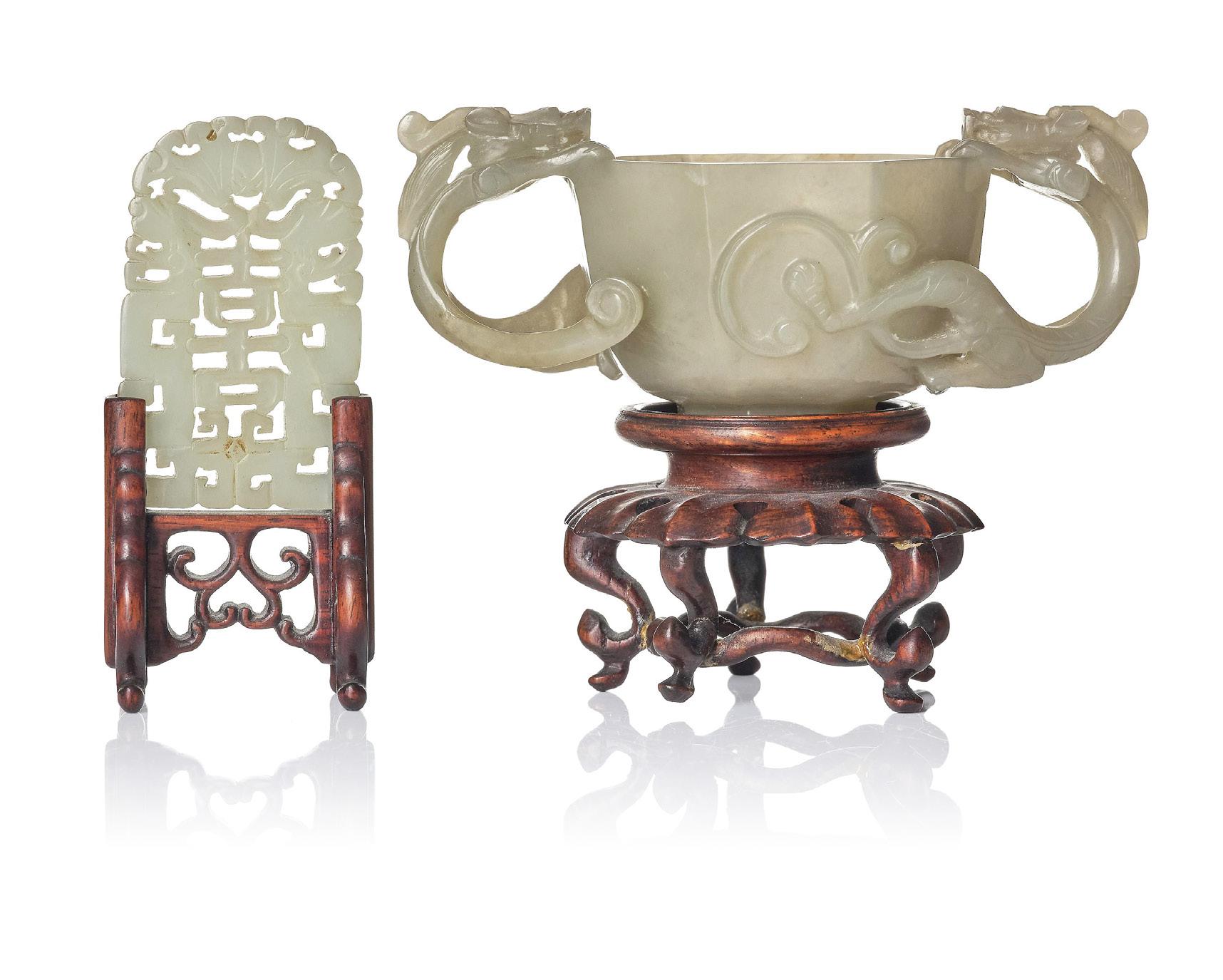
953. A carved nephrite cup with ‘chilong’ handles, late Qing dynasty/early 20th century. Octagonal cup with chilong dragons holding on to the sides forming handles. Length 13 m. Height with wooden stand 10 cm. The placque with pierced decoration. Measure 6.5 x 4 cm. Height with wooden stand 9.5 cm.
Provenance: The Collection of G. B. Sabelström (1888–1944).
Exhibitions: Compare with a cup of this type in the Collection of the Metropolitan Museum, New York. Object no 02.18.386. Gift of Herber R. Bishop, 1902.
Estimate: SEK 12 000 – 15 000 / EUR 1 130 – 1 420
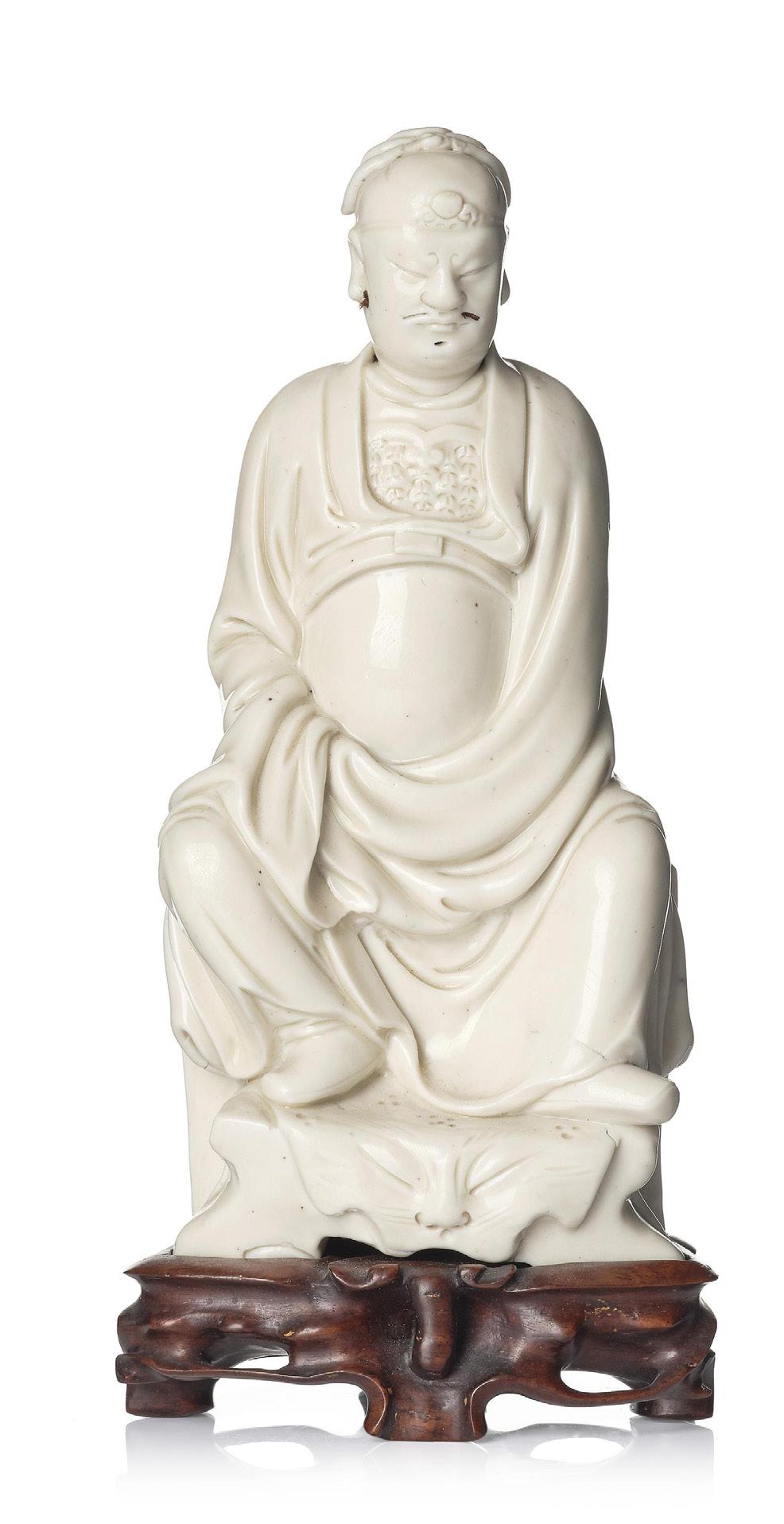
954. A blanc de chine figure of Guandi, Qing dynasty, 18th century.
Depicted seated clad in loose fitting robes where you can se the armour beneath, the face with frowning brows and the mouth surrounded by holes for a moustache and beard. The trone is covered in a tiger hide that is seen below his feet. Height 22 cm. Height with wooden stand 26 cm.
Provenance: The Collection of G. B. Sabelström (1888–1944).
Exhibitions: Compare with a similar figure sold at Christies, lot no 741, 19 March 2009 | Live auction 2269. Fine Chinese Ceramics & Works of Art Including Jades from the Fine Arts Museums of San Francisco.
Catalogue note: Guandi (162–220), also known as Guan Yu, originally was a heroic general of the Period of Three Kingdoms. Over the centuries, Guan Yu’s achievements have been largely elaborated. Guan Yu has become the incarnation of the strength to impel, inspire and motivate, interpreted as the God of Wealth, the God of War and the Protector God of Temples. See P. Duara, ‘Superscribing Symbols: The Myth of Guandi, Chinese God of War’, The Journal of Asian Studies, 1988, vol.47, pp.778–795.
Estimate: SEK 8 000 – 10 000 / EUR 755 – 944
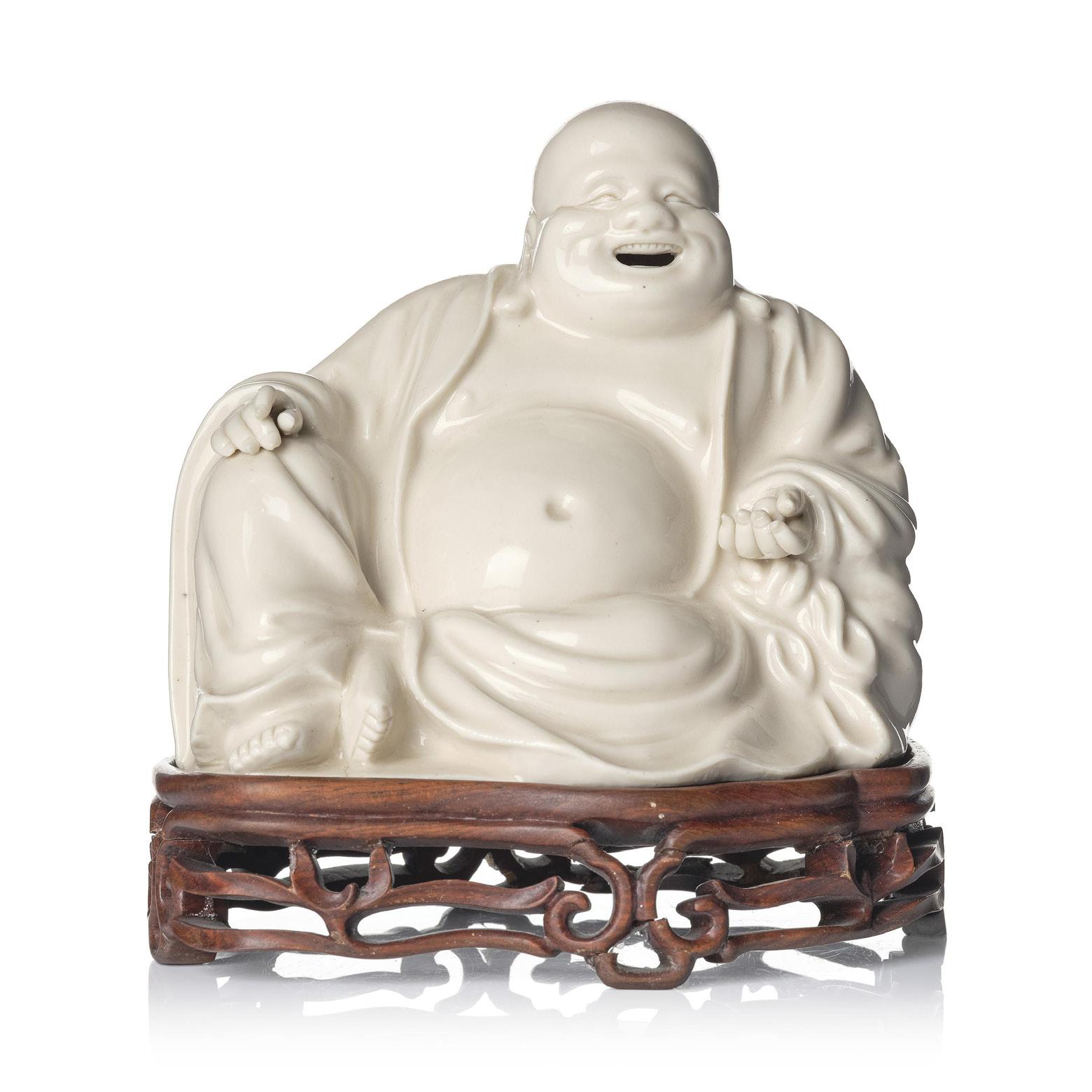
955. A blanc de chine figure of Budai, Qing dynasty, 18/19th century. Seated, clad in loose robes, holding a ball in his left hand. Height 15 cm. Width 16 cm.
Provenance: The Collection of G. B. Sabelström (1888–1944).
Estimate: SEK 4 000 – 6 000 / EUR 378 – 567
956. Two blanc de chine rhinoceros libation cups, Qing dynasty, Kangxi (1662–1722).
After a model made from rhinoceros horn, decorated in relief with a dragon, a buddhist lion, a crane and a deer. Height c. 6 cm. Length 10 cm. Height with wooden stand 9–10 cm.
Provenance: The Collection of G. B. Sabelström (1888–1944).
Estimate: SEK 8 000 – 10 000 / EUR 755 – 944
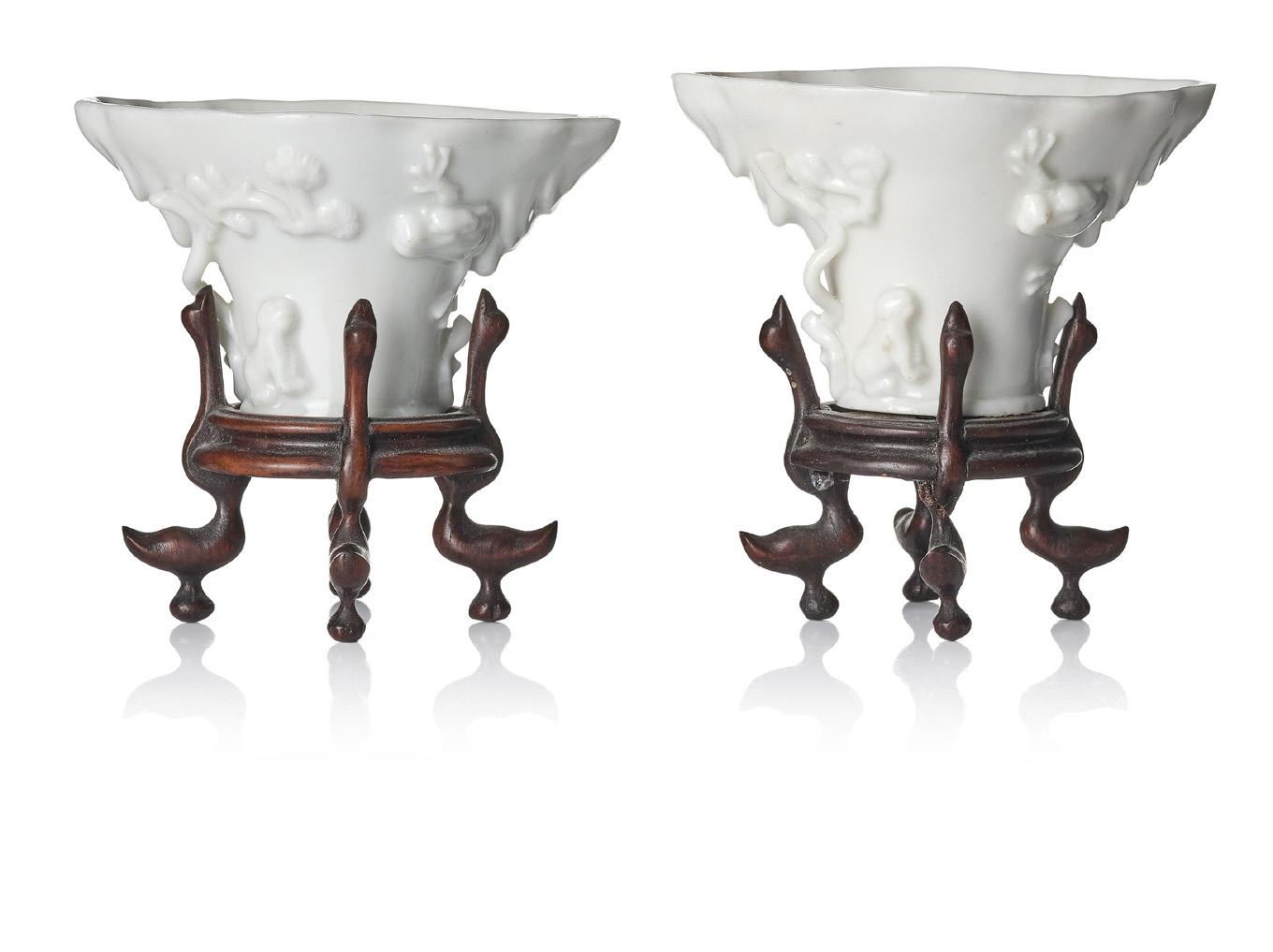
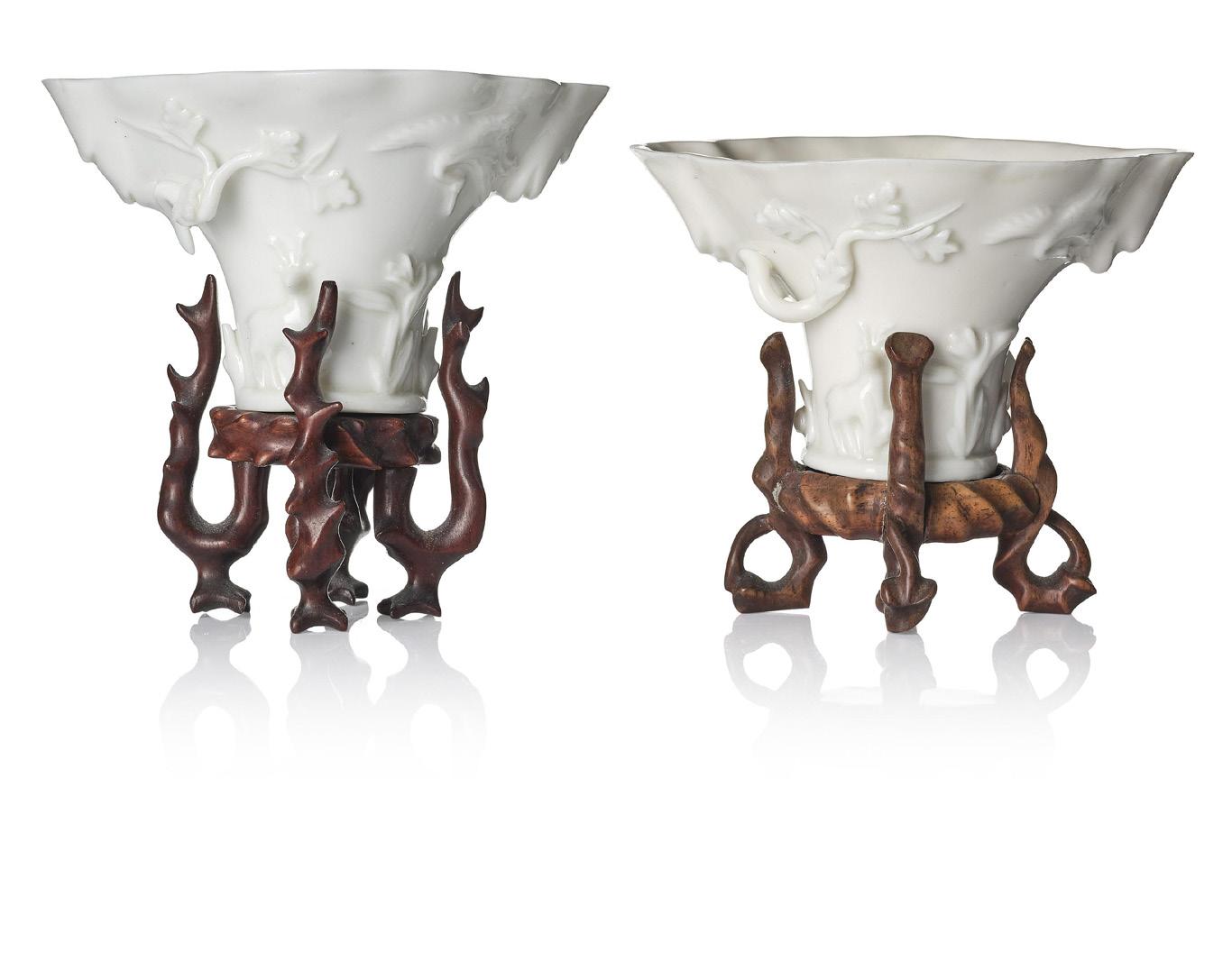
957. A pair of blanc de chine rhinoceros libation cups, Qing dynasty, Kangxi (1662–1722).
After a model made from rhinoceros horn, decorated in relief with dragons, a deer and a crane. Height c. 8 cm, width 14.5 cm. Height with wooden stand 12–14 cm.
Provenance: The Collection of G. B. Sabelström (1888–1944).
Estimate: SEK 12 000 – 15 000 / EUR 1 130 – 1 420
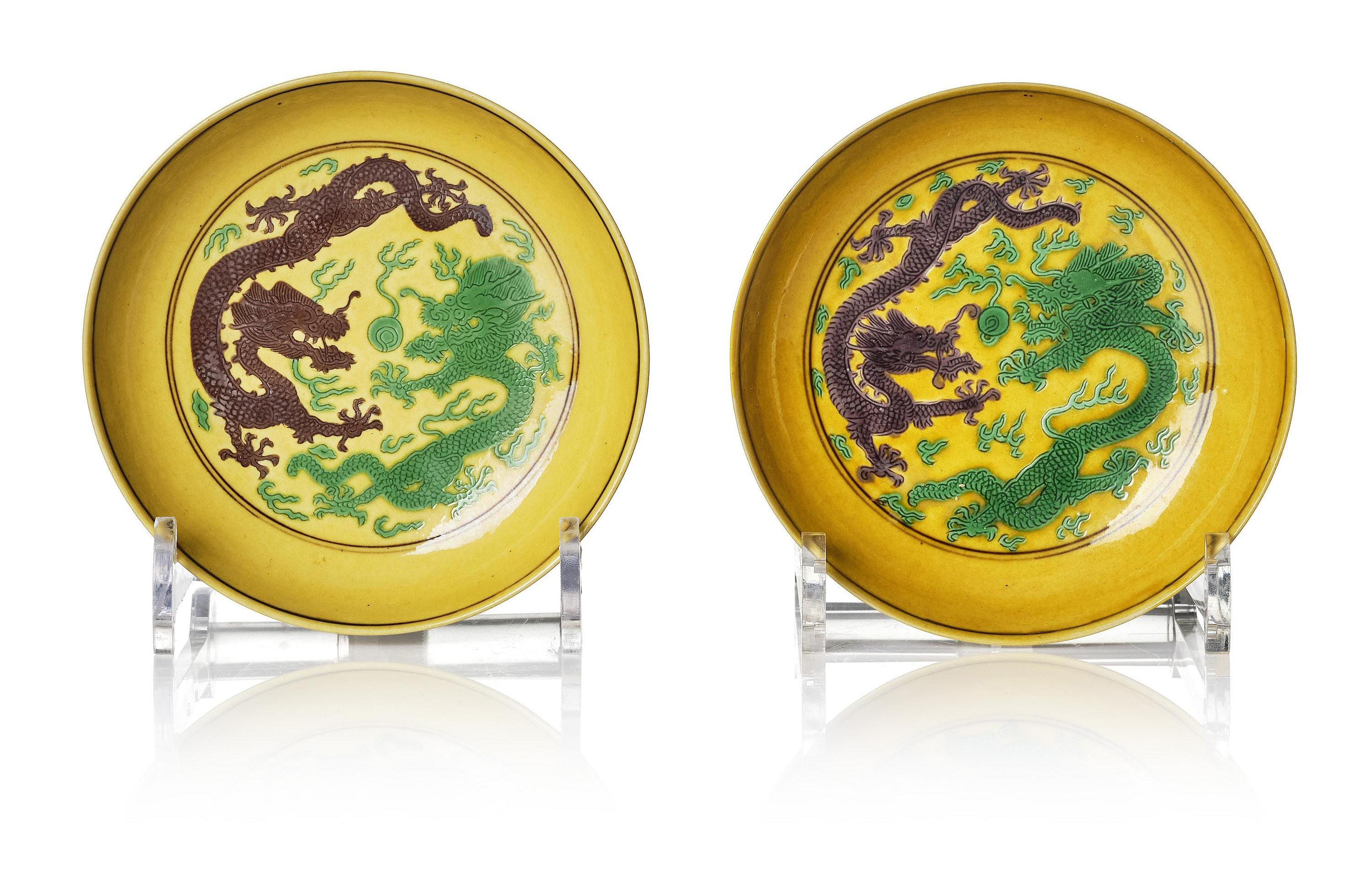
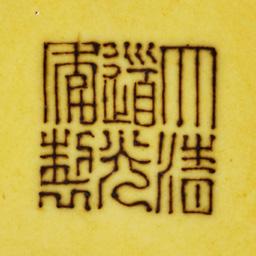
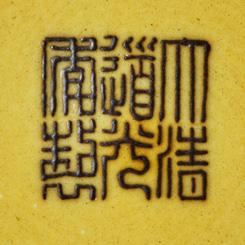
958. A pair of yellow ground aubergine- and green-enamelled ‘dragon’ dishes, Qing dynasty, Daoguang seal mark and period.
Each incised with green and aubergine five-clawed dragons chasing the flaming pearl amidst cloud formations, The exteriors with cloud formations alternating with cranes, all reserved on ochre-yellow ground. Abuergine seal mark to base. Diameter 14.2 cm.
Provenance: The Collection of G. B. Sabelström (1888–1944).
Estimate: SEK 25 000 – 30 000 / EUR 2 360 – 2 830
959. A blue and white vase, Qing dynasty, Kangxi (1662–1722).
The lower section of a yenyen vase, baluster shape decorated in a vibrant underglaze blue with a figure scene in a mountainous landscape. Height 25.5 cm. Height with wooden stand 39 cm.
Provenance: The Collection of G. B. Sabelström (1888–1944).
Estimate: SEK 8 000 – 10 000 / EUR 755 – 944
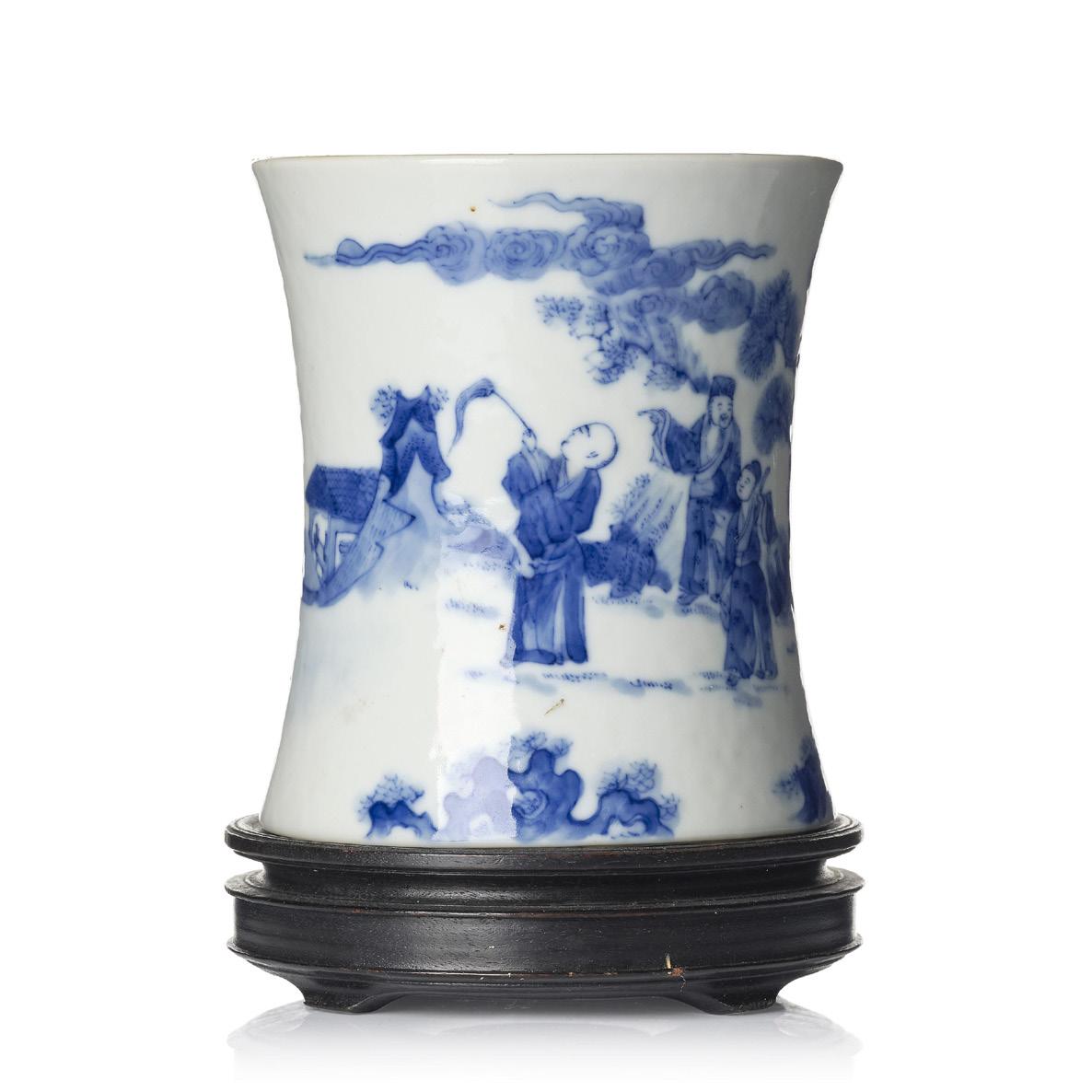
960. A blue and white brush-pot, bitong, Qing dynasty, 19th century with an apochrypal Kangxi mark.
Potted with gently curving sides, the exterior painted with a scene of a scholar and two young boys, the recessed base with an apocryphal six-character Kangxi reign mark within a double circle. Height 13 cm.
Diameter 11.5 cm. Height with wooden stand 16 cm.
Provenance: The Collection of G. B. Sabelström (1888–1944).
Estimate: SEK 12 000 – 15 000 / EUR 1 130 – 1 420
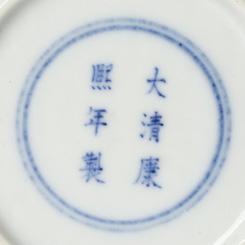
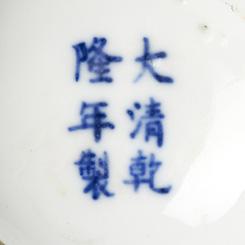
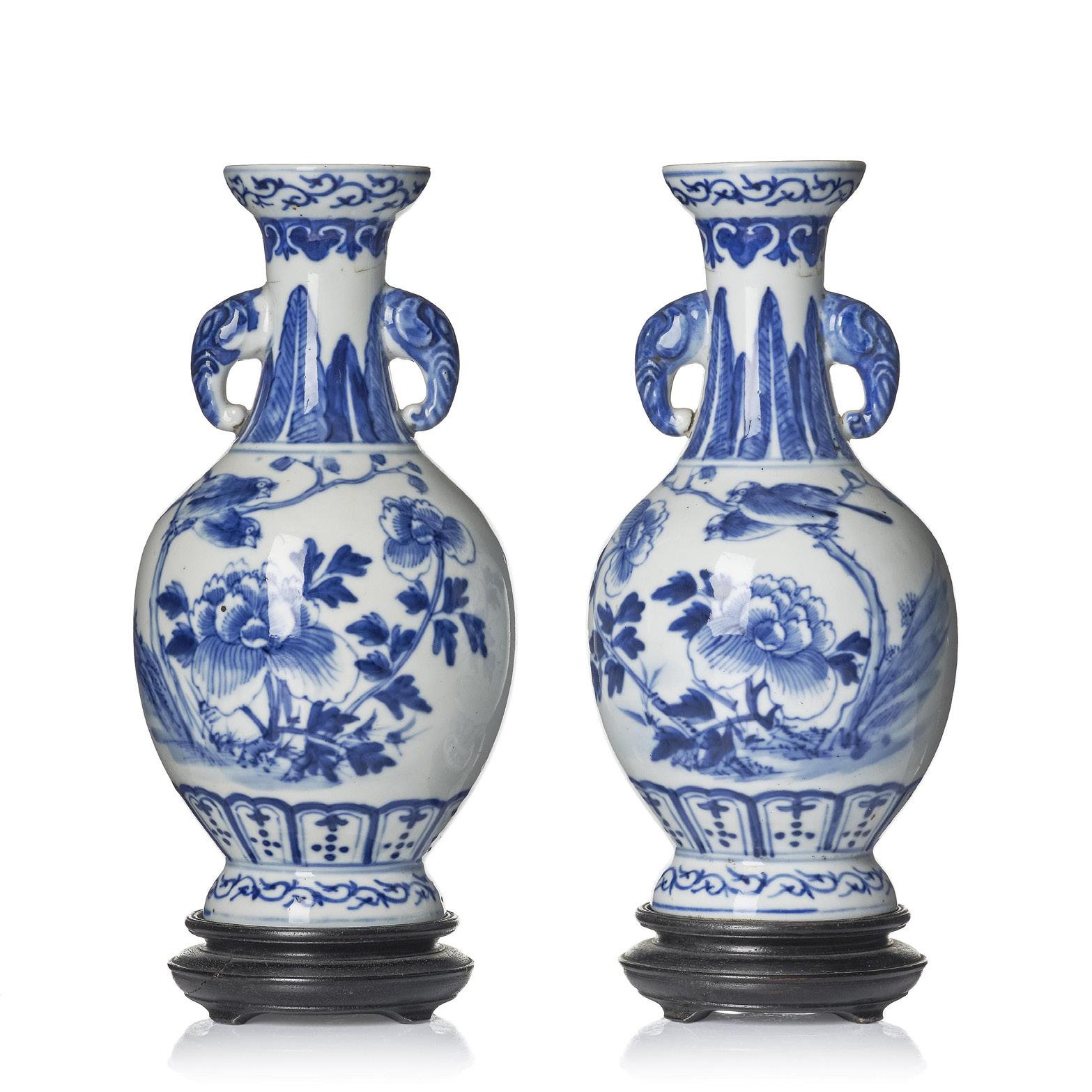
961. A pair of blue and white vases, Qing dynasty, Guangxu mark and period (1875–1908).
Baluster shape, with a flared rim, splayed foot and elegant elephant shaped handles. Both are decorated in underglaze blue with a floral scroll. The slightly recessed base with a Guangxu six character mark. Height 22.5 cm. Height including wooden stand 25 cm.
Provenance: The Collection of G. B. Sabelström (1888–1944).
Estimate: SEK 5 000 – 7 000 / EUR 472 – 661
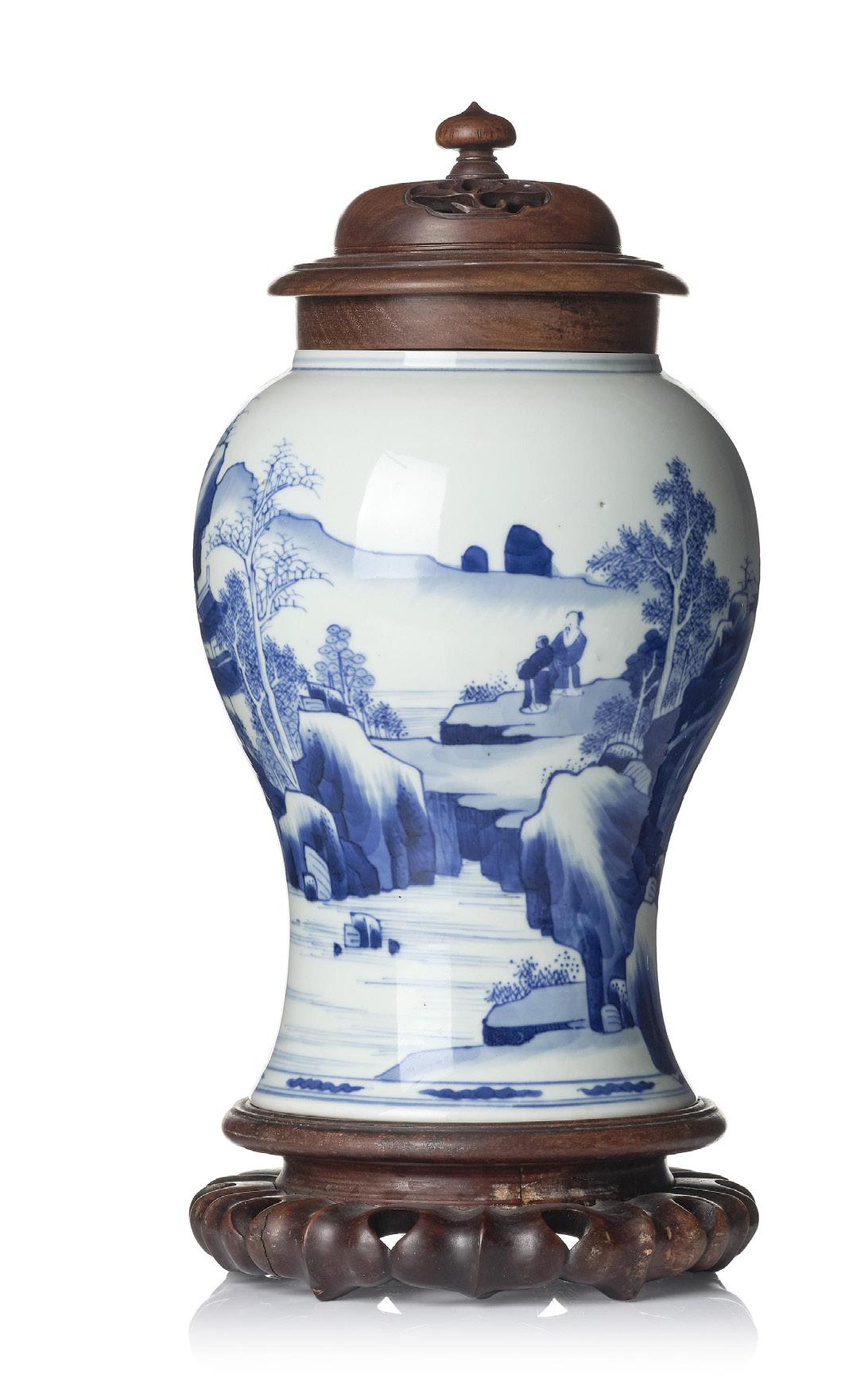
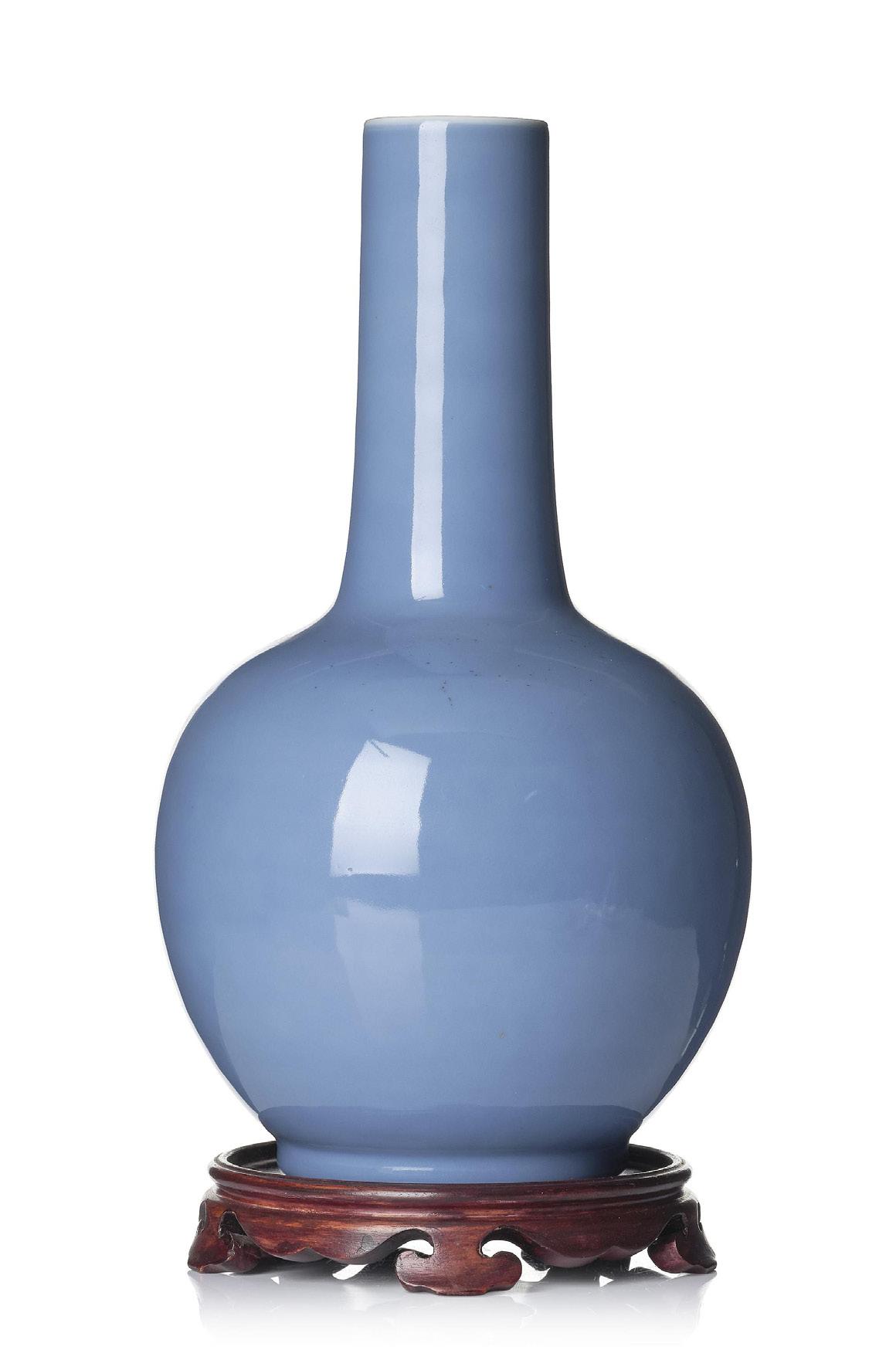
962. A ‘claire de lune’ glazed vase, late Qing dynasty. Rounded shape on a short footrim, elongated neck, glazed in a pale blue glaze. Height 35.5 cm.
Provenance: The Collection of G. B. Sabelström (1888–1944).
Estimate: SEK 6 000 – 8 000 / EUR 567 – 755
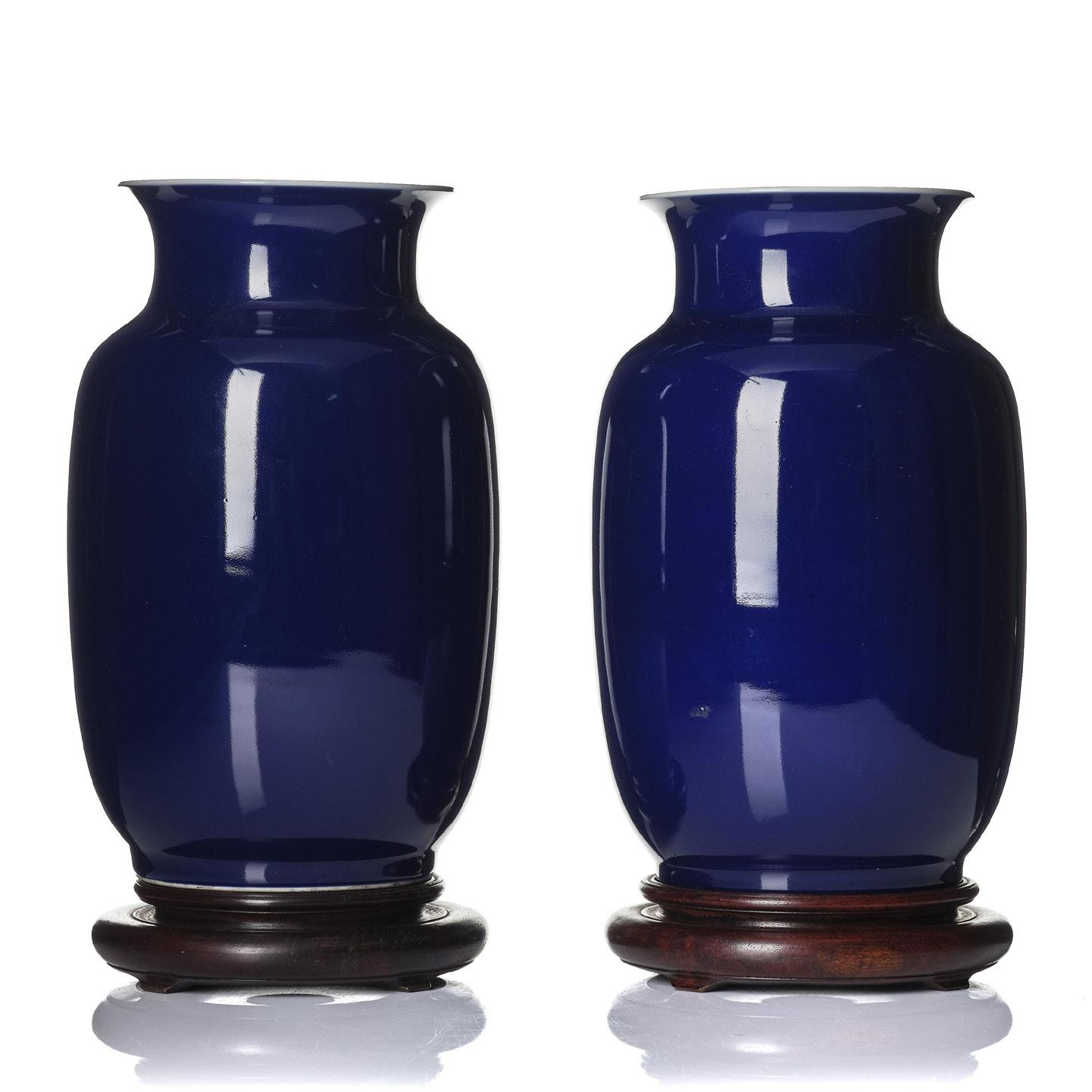
The exterior and base glazed in a deep blue colour, that shifts to white at the rim, the interior of the neck in a lavender blue glaze. Height 28.5 cm.
Provenance: The Collection of G. B. Sabelström (1888–1944).
Estimate: SEK 6 000 – 8 000 / EUR 567 – 755
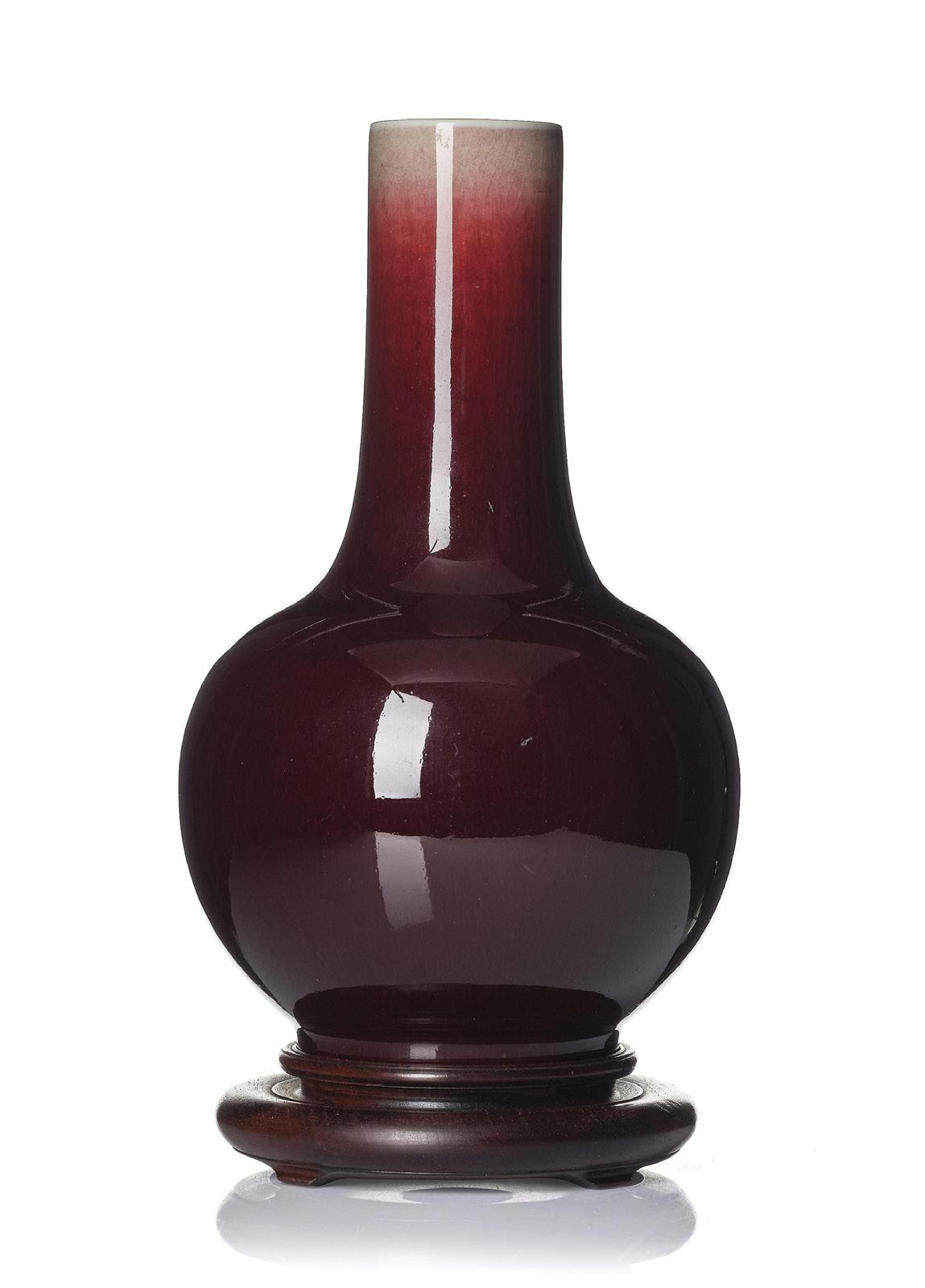
964. A flambé glazed vase, late Qing dynasty/early 20th century. Rounded with an elongated neck glazed in a vibrant red glaze that shifts towards white by the neck and base. Height 32 cm. Height with wooden stand 35.5 cm.
The Collection of G. B. Sabelström (1888–1944).
SEK 8 000 – 10 000 / EUR 755 – 944
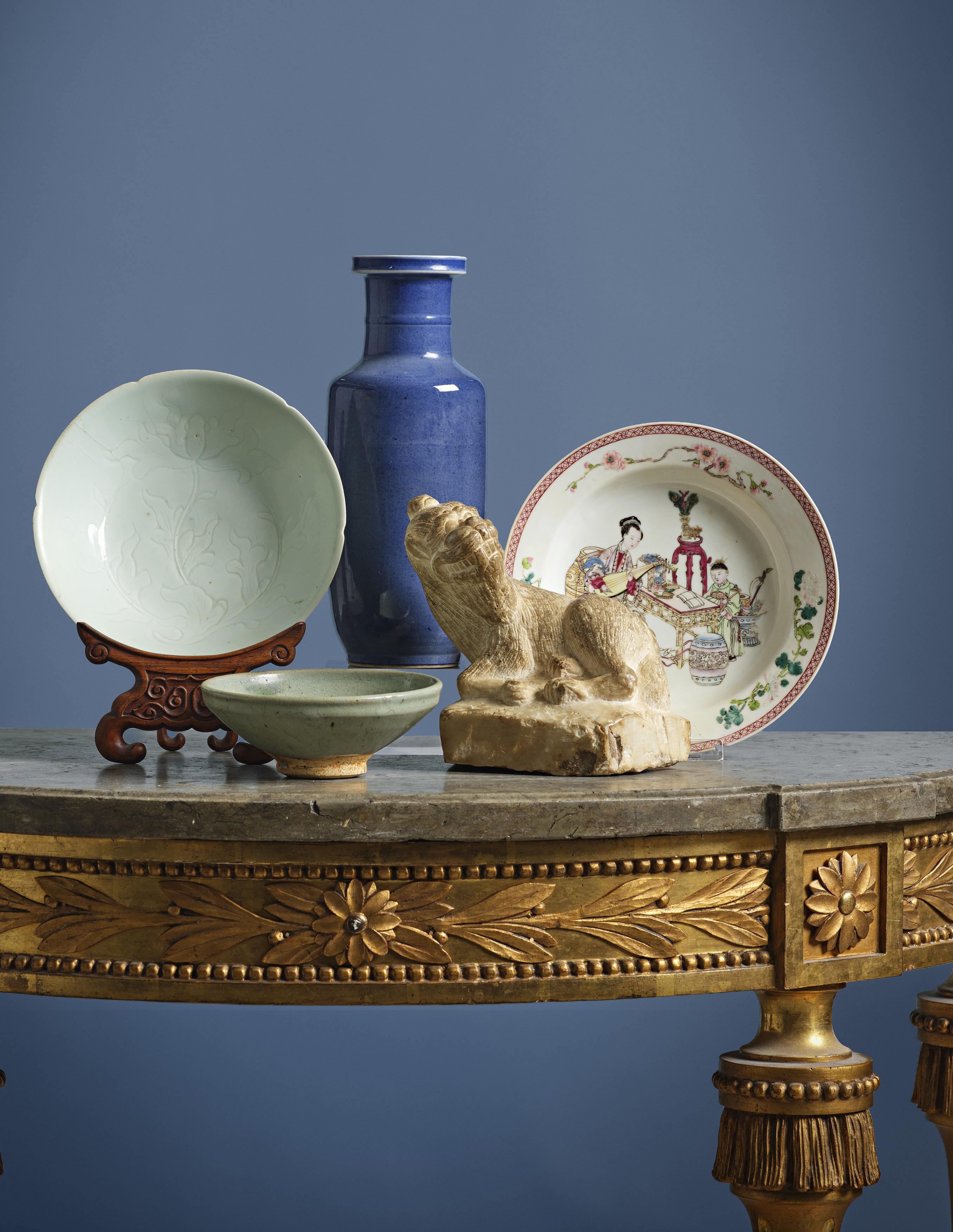
Property of a private Swedish Collector
Property of a private Swedish Collector, the collection was mainly purchased in during the 1960’s. In London, at Bukowskis and from the Antique dealer Magaliff in Stockholm.
To see other lots sold from this collector, see sale 657: 1030–1034.
LOT 965–970.
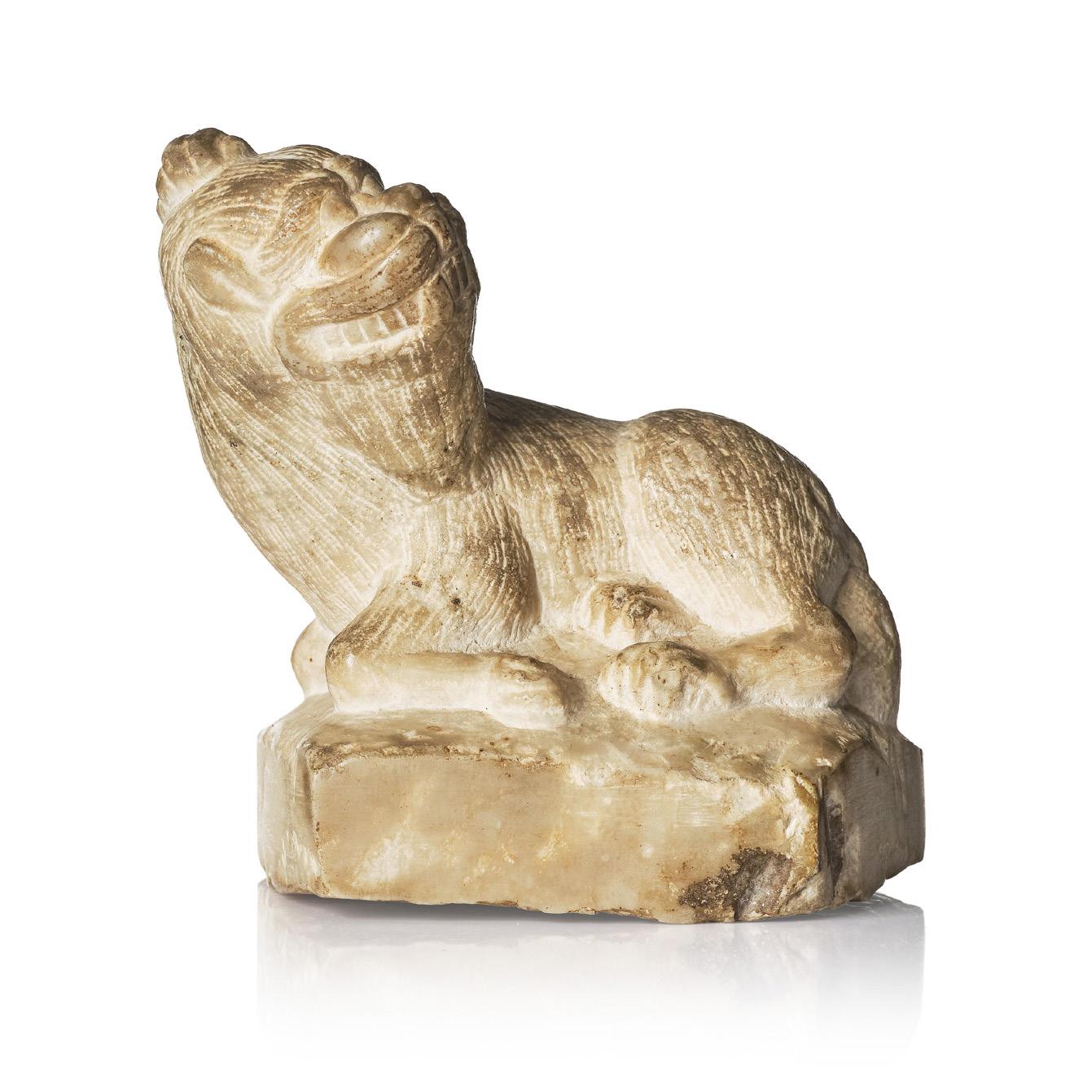
965. A stone figure of a mythical beast, Tang dynasty (618–907).
The muscular mythical beast carved reclining, the head turned to its left, bearing a curious expression with bared teeth and bulging eyes, the neck and body covered in fur. Length 15.5 cm. Height 16 cm.
Provenance: Property of a private Swedish Collector.
Estimate: SEK 10 000 – 15 000 / EUR 944 – 1 420
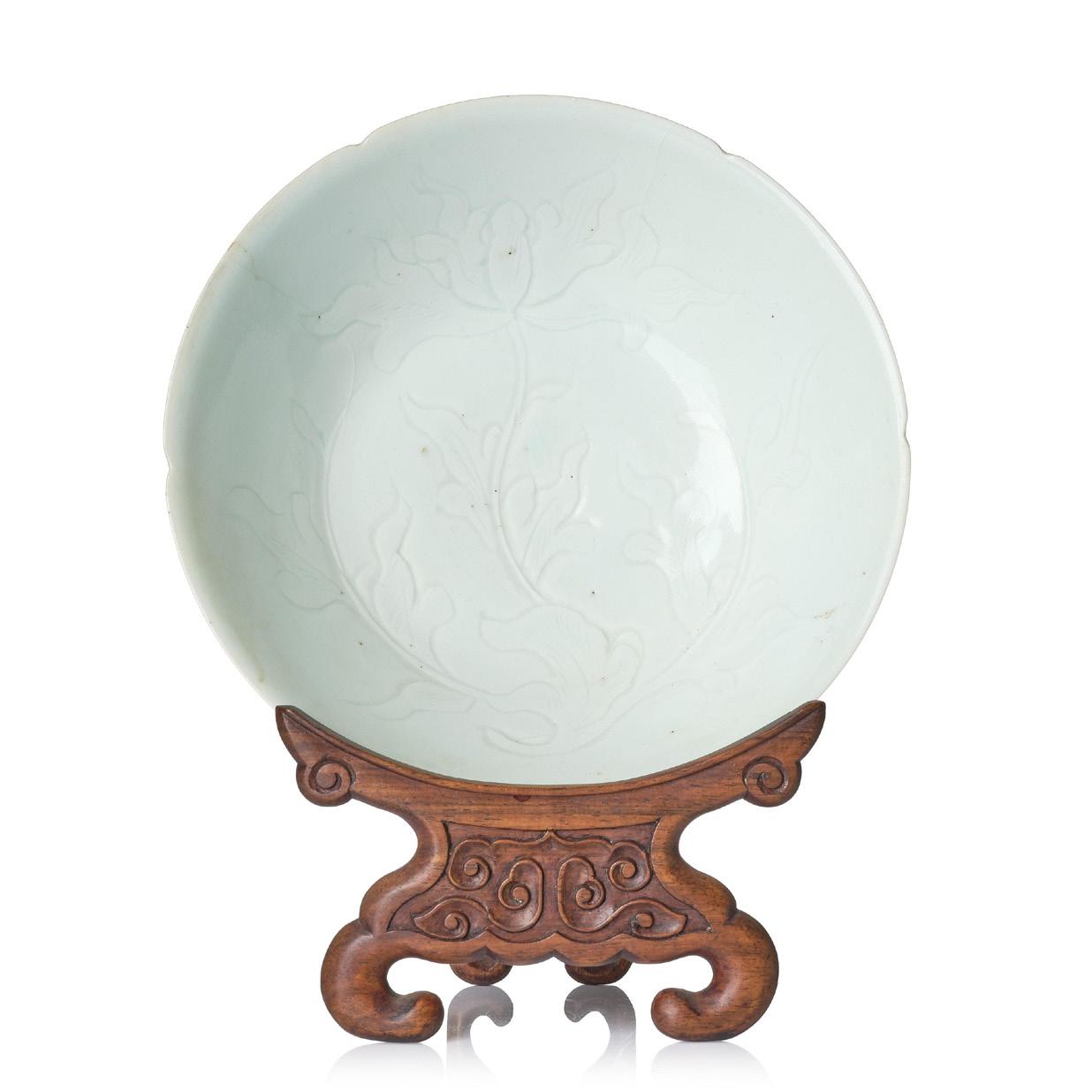
966. A carved qingbai foliate bowl, Song dynasty (960–1279).
Porcelain bowl with incised decoration under a pale blue glaze. Diameter 19 cm.
Height 5 cm. Wooden stand accompanies the piece.
Provenance: Property of a private Swedish Collector.
Estimate: SEK 8 000 – 10 000 / EUR 755 – 944
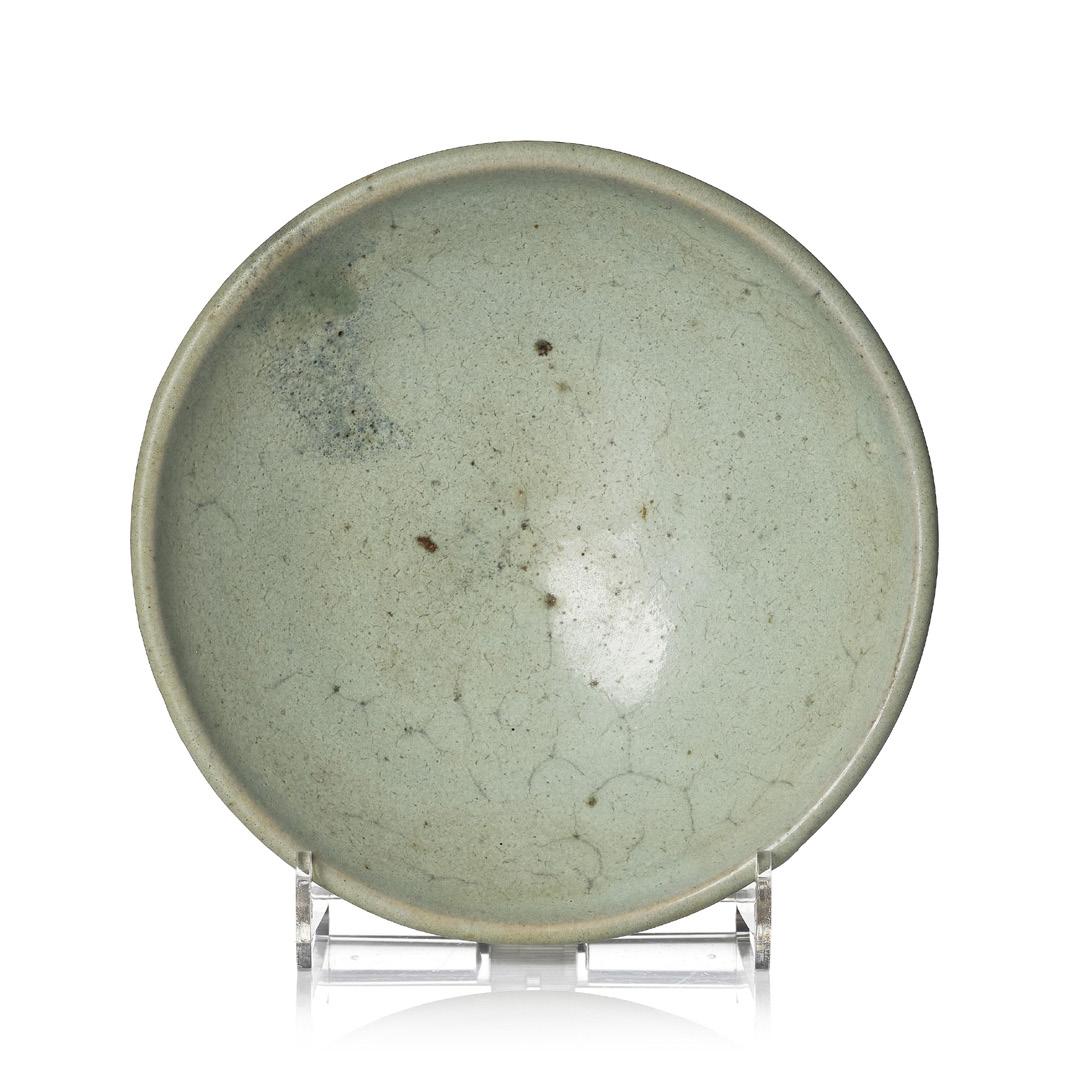
967. A pale green jun glazed bowl, Jin/Yuan dynasty. The bowl is covered overall with a pale greenish-blue glaze, applied liberally on the exterior with a large splash, the glaze stops well above the footrim. Diameter 14 cm. Height 5 cm.
Provenance: Property of a private Swedish Collector, the collection was mainly purchased in during the 1960’s. In London, at Bukowskis and from the Antique dealer Magaliff in Stockholm. To see other lots sold from this collector, see Bukowskis Spring Sale 657 lots 1030–1034, 11 June 2024.
Estimate: SEK 8 000 – 10 000 / EUR 755 – 944
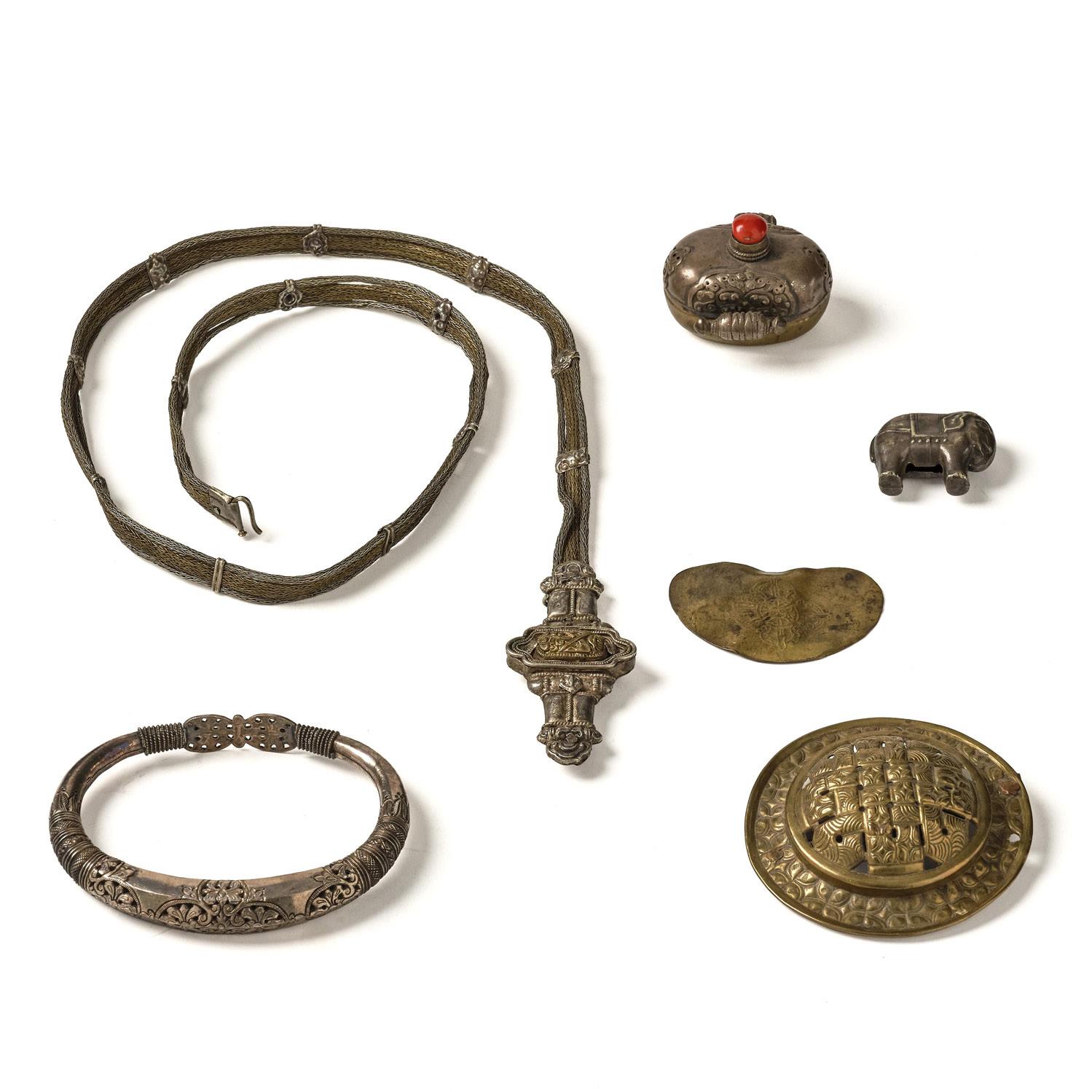
968. A group lot, Tibet 18/19th century.
Comprising; a belt buckle with an eternity knot, brass, diameter 9.5 cm. A small elephant pendant, length 11.5 cm. A bangle, length 11.5 cm. A belt, length 101 cm. A box with cover, length 5.5 cm. A base placque for a deity, length 7.4 cm.
Provenance: Property of a private Swedish Collector.
Estimate: SEK 8 000 – 10 000 / EUR 755 – 944
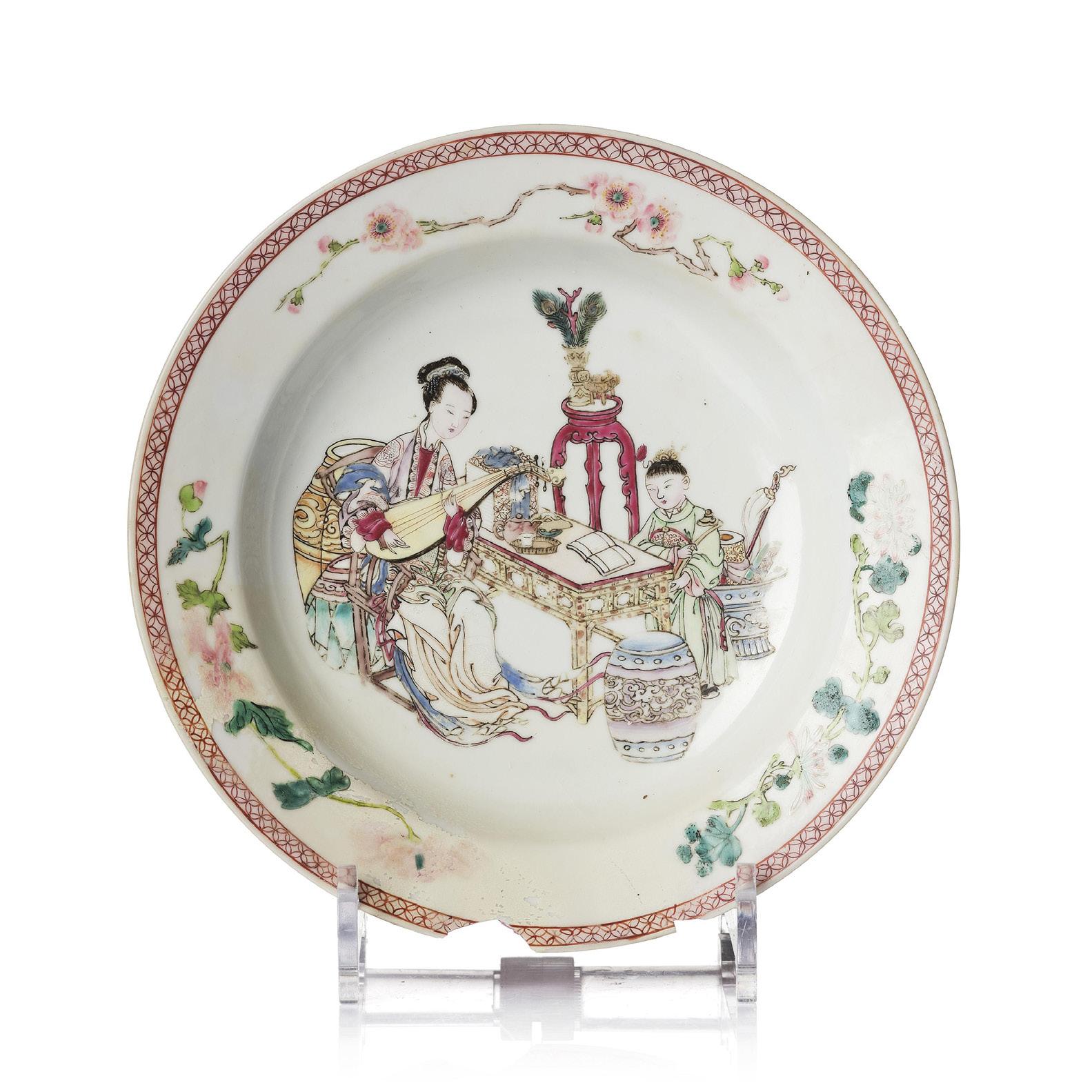
969. A famille rose ruby-back ‘mother and child’ plate, Qing dynasty, Yongzheng (1723–35).
Depicting an elegant lady surrounded by antiques, litterature and playing the lute, in front of her a young boy with a ruyi sceptre. The reverse glazed in a vibrant ruby red. Diameter 21 cm.
Provenance: Property of a private Swedish Collector.
Catalogue note: The present dish is a masterful example of Yongzheng (1722–1735) famille rose export porcelain, combining refined artistry with layered auspicious symbolism. It embodies Confucian ideals of family harmony: the seated lady represents cultivated gentility and virtuous motherhood, while the child signify the wish for prosperous heirs. The individual elements carry additional meaning, the ruyi sceptre held by the boy symbolizes the fulfillment of wishes and a successful official career. The antiques depicted in the background attest to the family’s scholarship, wealth, and cultural sophistication. The dish exemplifies Yongzheng’s exquisite taste through its nuanced use of pinks and pastel shades, achieving an extremely delicate and refined palette. The vibrant ruby-red enamel on the back further highlights the technical mastery and aesthetic sophistication of the period.
Estimate: SEK 6 000 – 8 000 / EUR 567 – 755
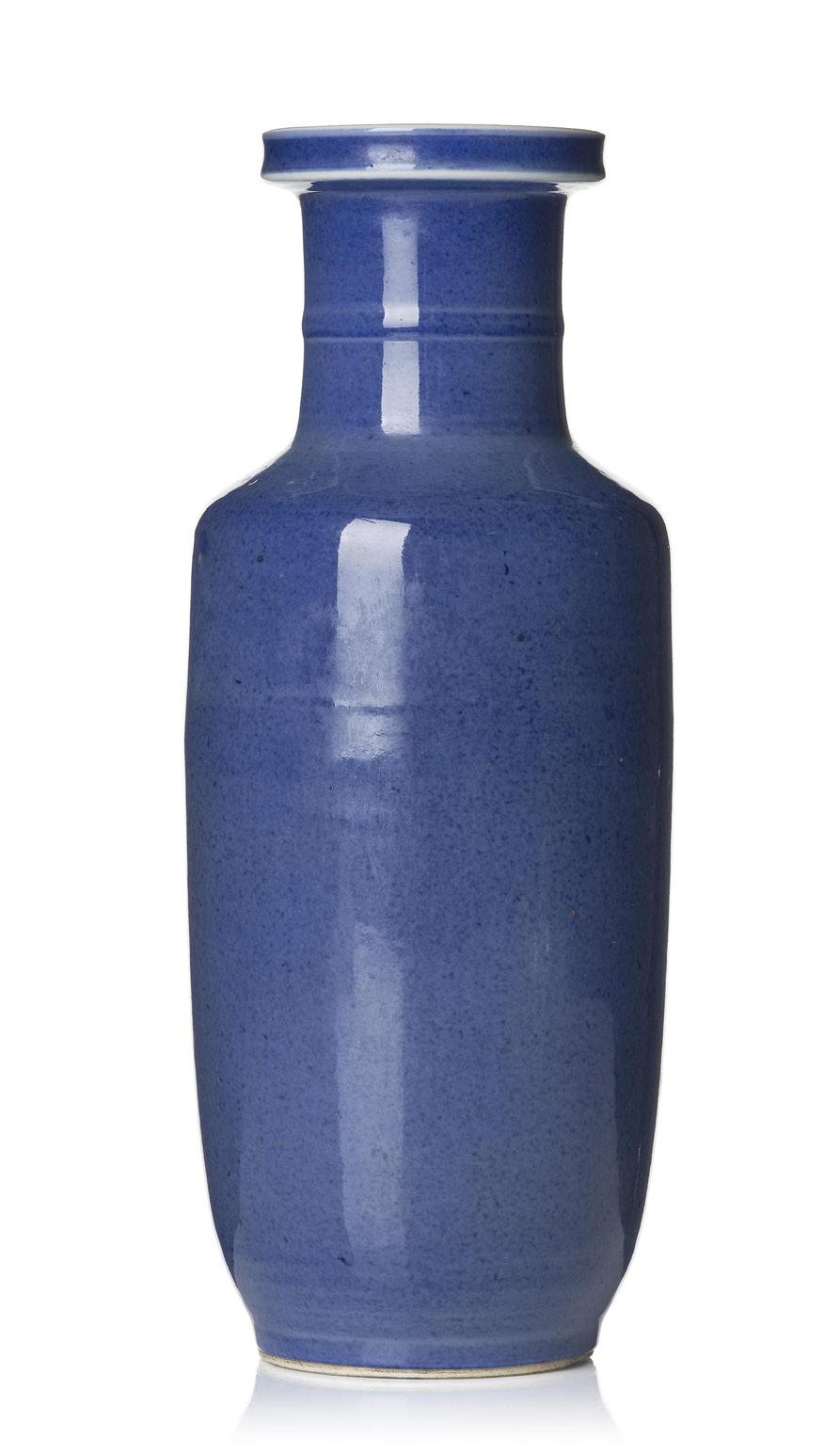
970. A powder blue roleau vase, Qing dynasty, 18th century.
The rounded cylindrical body decorated in powder blue. Height 25.5 cm.
Provenance: Property of a private Swedish Collector.
Exhibitions: Compare with a similar vase in the Collection of the Metropolitan Museum, New York, Credit Line: Robert Lehman Collection, 1975.
Object Number: 1975.1.1686.
Estimate: SEK 8 000 – 10 000 / EUR 755 – 944
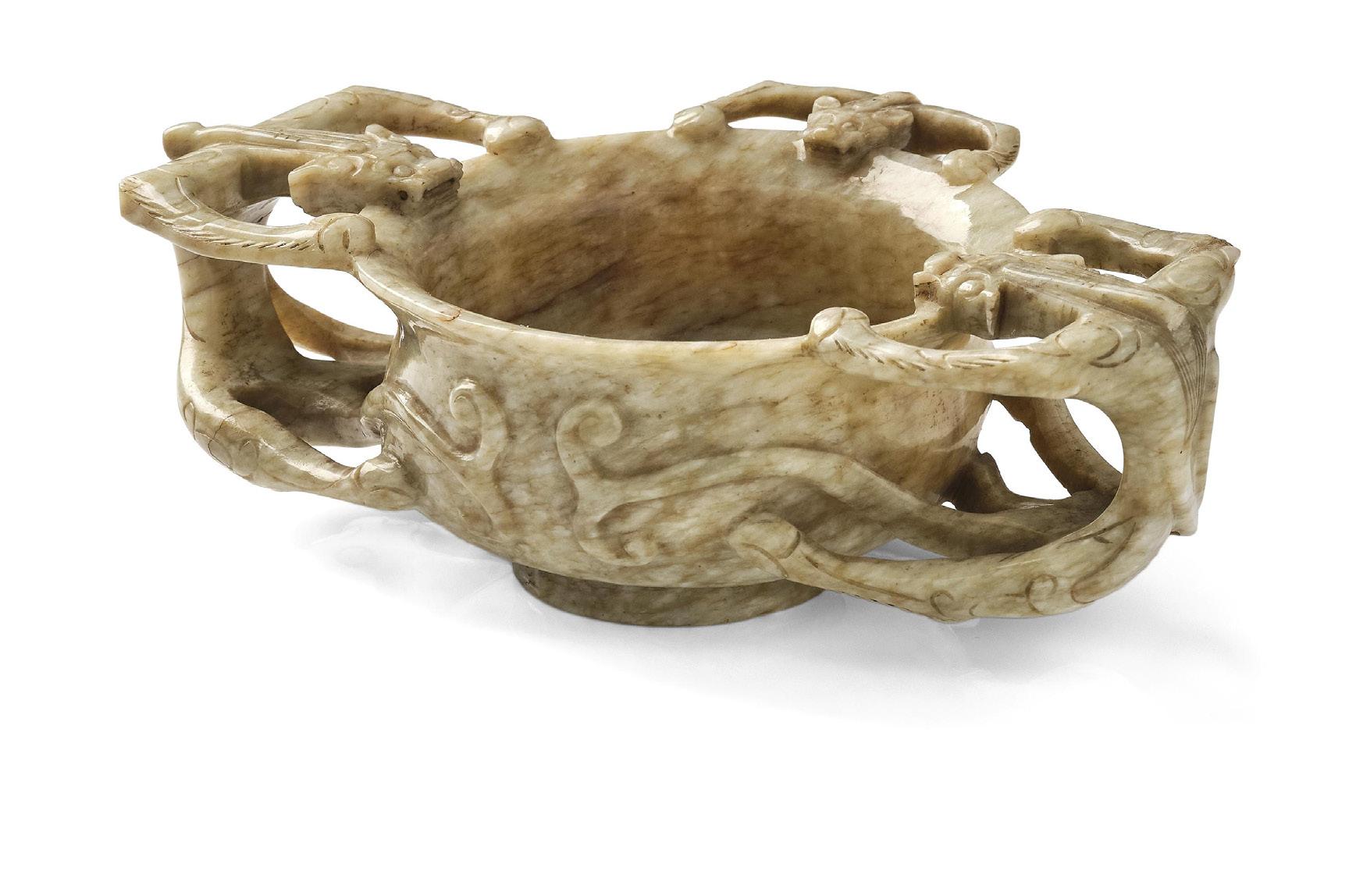
971. A large ‘chicken-bone’ jade chilong cup, Ming dynasty (1368–1644).
The cup with deep rounded sides rising from a short straight foot, with three sinewy chilong dragons carved in high relief clambering up the sides and the head resting on the mouth rim. The mouth open to reveal the teeth, the stone of mottled green and whitish-grey tone. Measure 18 x 13 x 5.5 cm.
Provenance: Property of a private Swedish collector.
Exhibitions: Compare one in the Fitzwilliam Museum, Cambridge, Object no O.54–1946. Bequeathed (1946) by Raphael, Oscar C. Compare with a related white jade cup with chilong handles, Ming dynasty, illustrated in the Compendium of Collections in the Palace Palace Museum: Jade, 7, Beijing, 2011, p.160, no.139.
Literature: See a similar jade cup with three chilong handles, Ming dynasty, illustrated in “Zhongguo guojia bowuguancang wenwu yanjiu congshu: Yuqi juan”, Shanghai, 2007 no.215. Another jade cup with three dragons, Ming dynasty, 16th/17th century, iis in the Cleveland Museum of Art, illustrated by C.Y.Watt, “Chinese Jades from Han to Ch’ing”, New York, 1980, p.165, no.139. It is also interesting to note that a related jade cup with chilong found favour in the Islamic world and was presented by Shah Abbas I to the Ardebil Shrine in 1611, it is illustrated by S.Howard Hansford, “Chinese Carved Jades”, London 1968, pl. 80B.
Estimate: SEK 20 000 – 30 000 / EUR 1 890 – 2 830
From the collection of Sylvia Hurtig
From the collection of Sylvia Hurtig (born Armstrong Morris) (1926–1996), thence by descent. The collection was brought together mainly in the 1960’s. Sylvia, born in England, Newscastleon-Tyne, but living in Stockholm had a particular passion for jade and during her frequent visits to London she acquired the pieces from Christie’s, Sotheby’s as well as from Bukowskis and through the Swedish/Armenian antique dealer Solberger, Tegnérgatan, Stockholm.
LOT 972–982, 984.
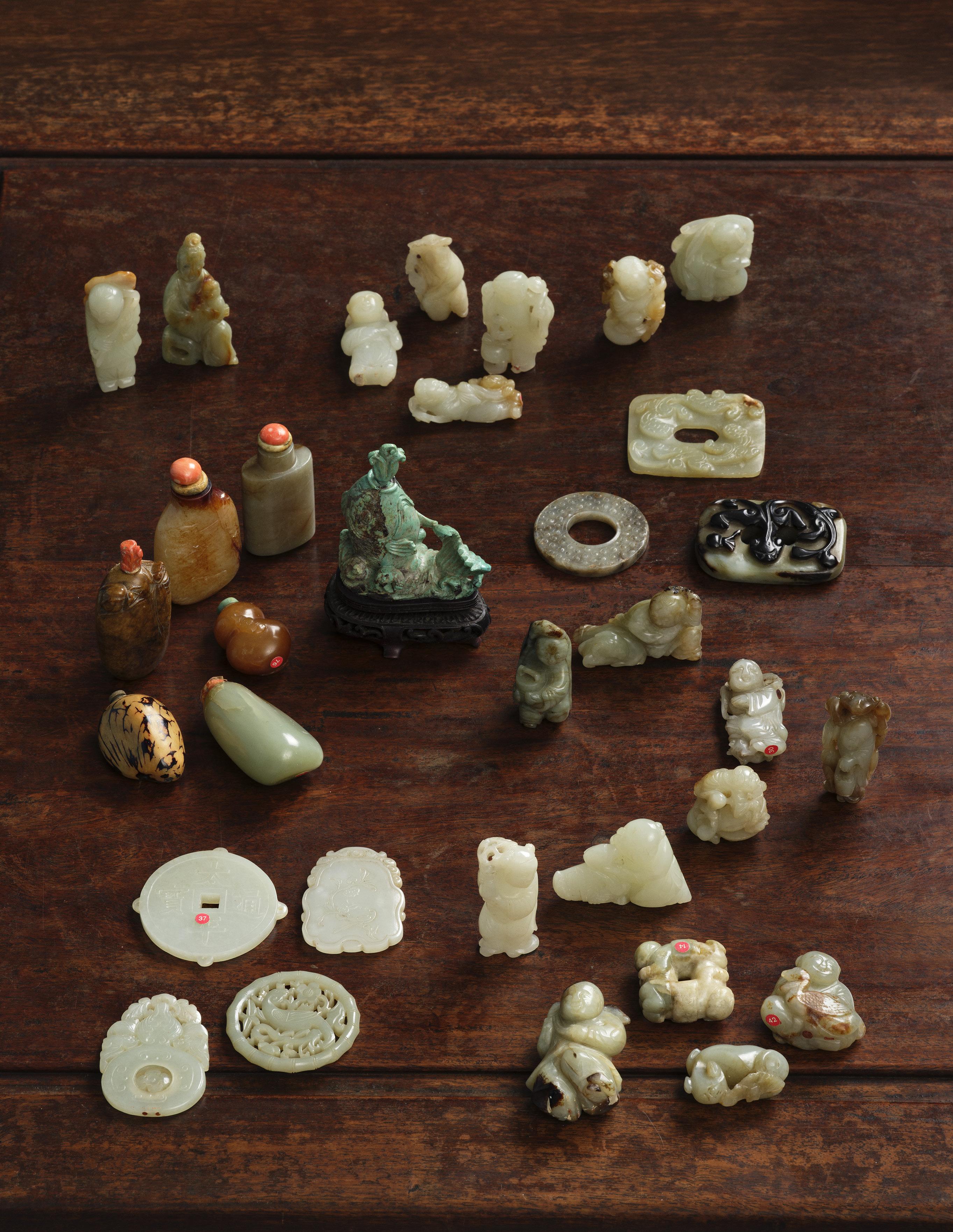
972. Three well carved figures of Liu Hai, Qing dynasty, 19th century.
Two well carved figures in a pale celadon and russet coloured jade of Liu Hai standing and one of him crouching down, sitting on his toad. Height 4–6 cm.
Provenance: From the collection of Sylvia Hurtig (born Armstrong Morris) (1926–1996), thence by descent.
Estimate: SEK 12 000 – 15 000 / EUR 1 130 – 1 420
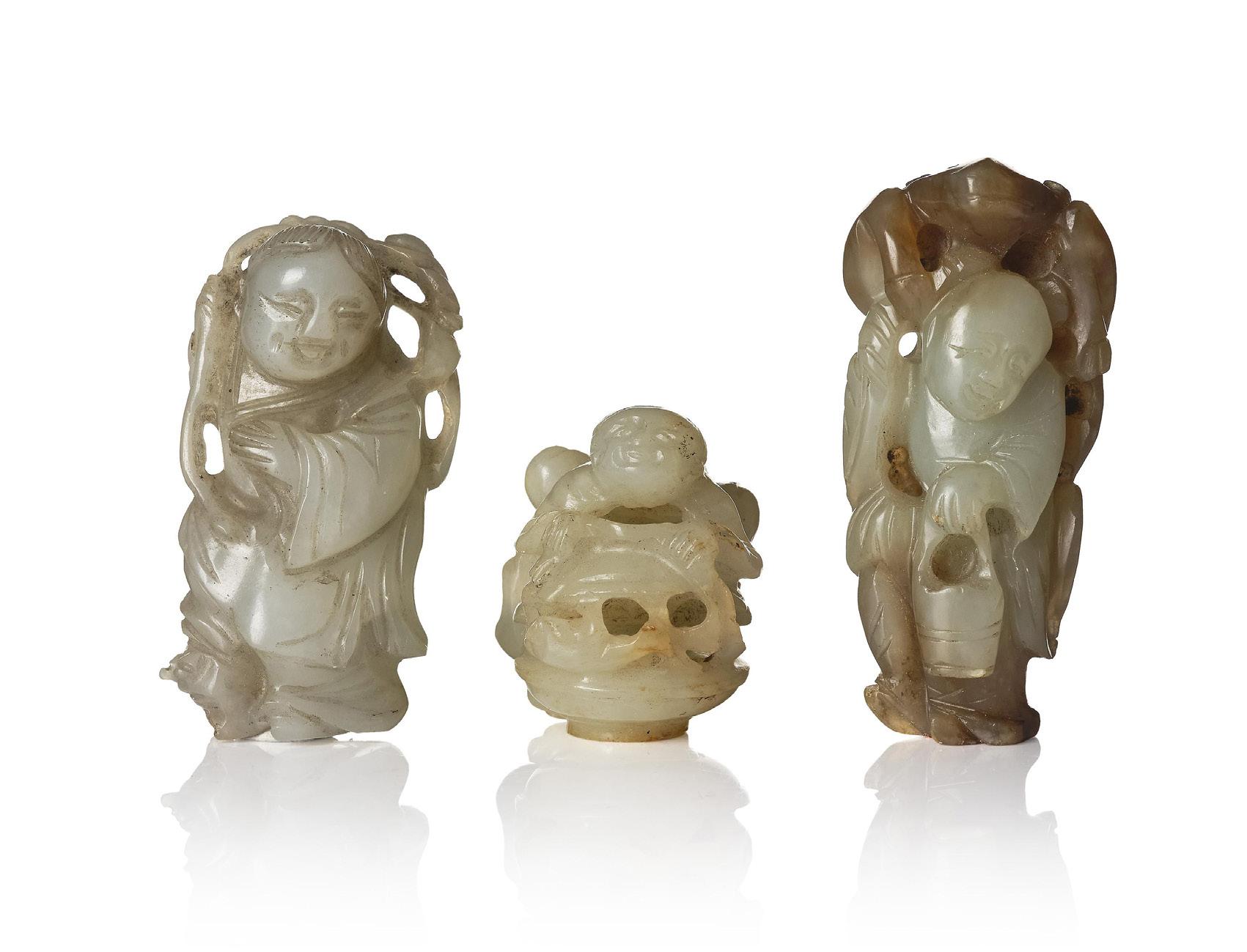
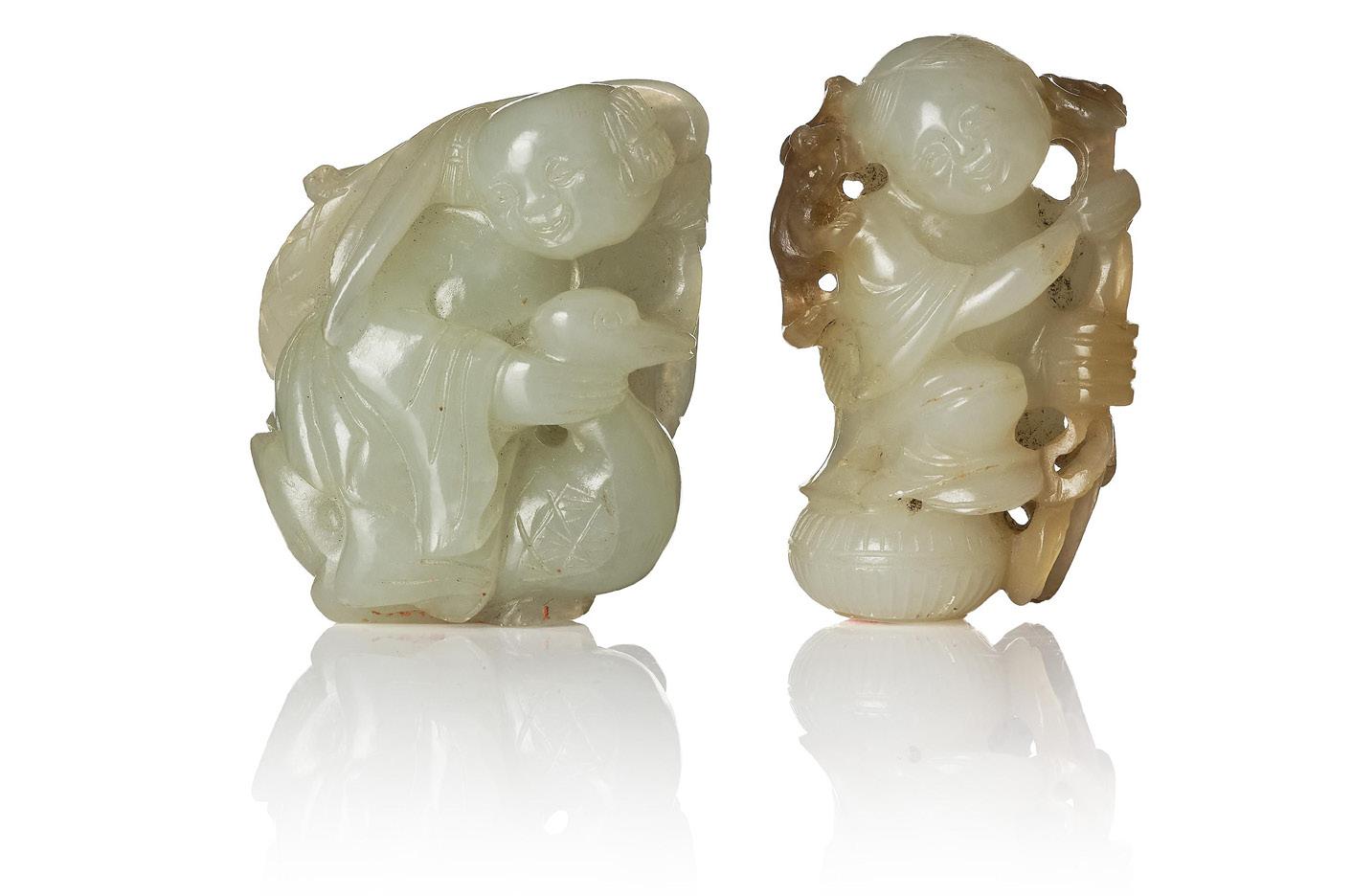
974. Two well sculptured pale celadon jade figures of boys, Qing dynasty, 19th century.
One figure sculptured as a laughing boy holding a vase with flowers. Height 6 cm. The other boy sculptured kneeling next to a mandarin duck. Length 6 cm. Height 4.5 cm.
Provenance: From the collection of Sylvia Hurtig (born Armstrong Morris) (1926–1996), thence by descent.
Estimate: SEK 8 000 – 10 000 / EUR 755 – 944
973. Two well sculptured pale celadon and russet jade sculptures of boys, Qing dynasty, 19th century.
A pale celadon figure sculptured as a young boy with a mandarin duck. Height 4.5 cm. The other a pale celadon and russet jade figure of Liu Hai with his three legged toad on his shoulder. Height 5 cm.
Provenance: From the collection of Sylvia Hurtig (born Armstrong Morris) (1926–1996), thence by descent.
Estimate: SEK 8 000 – 10 000 / EUR 755 – 944
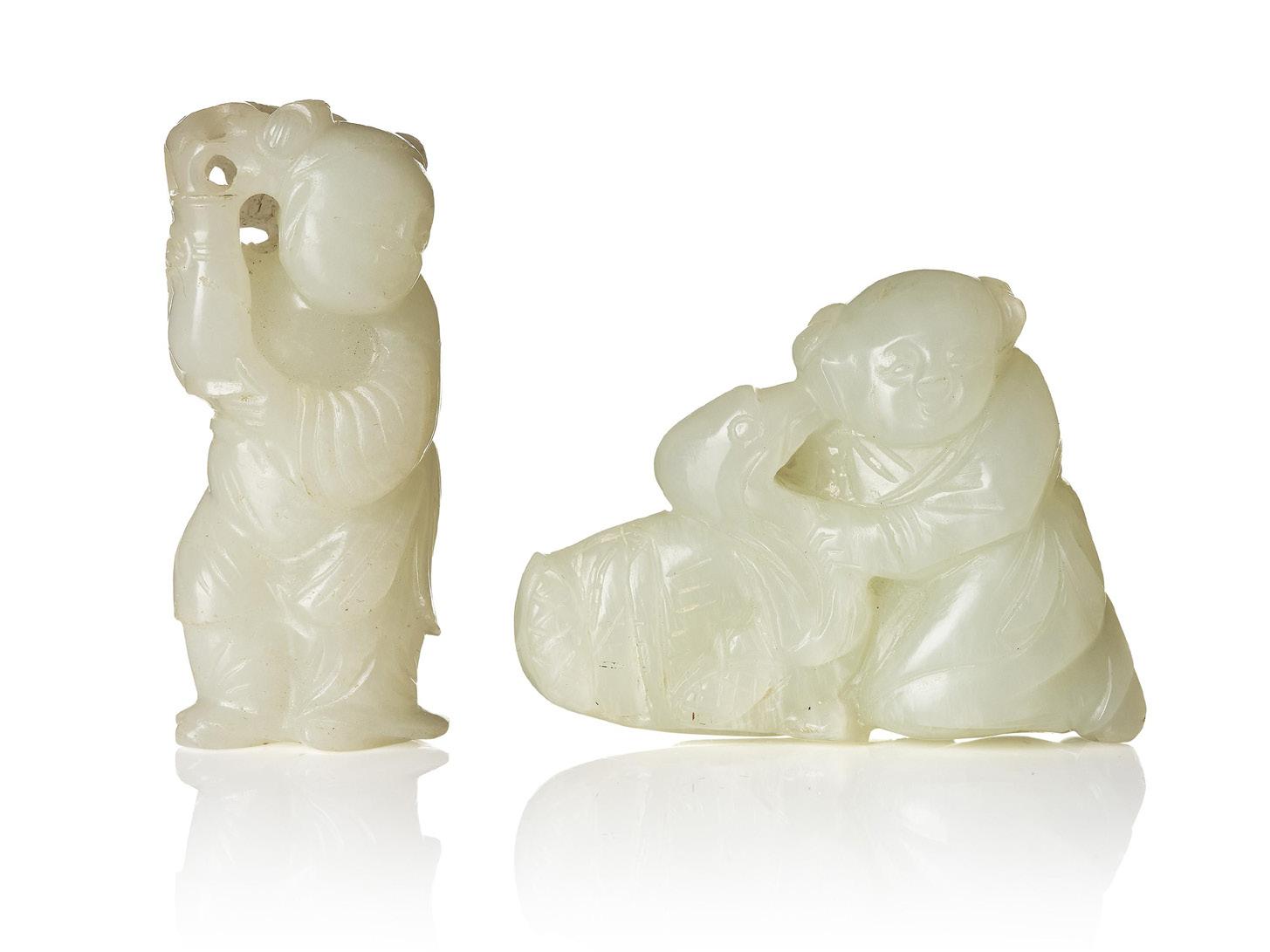
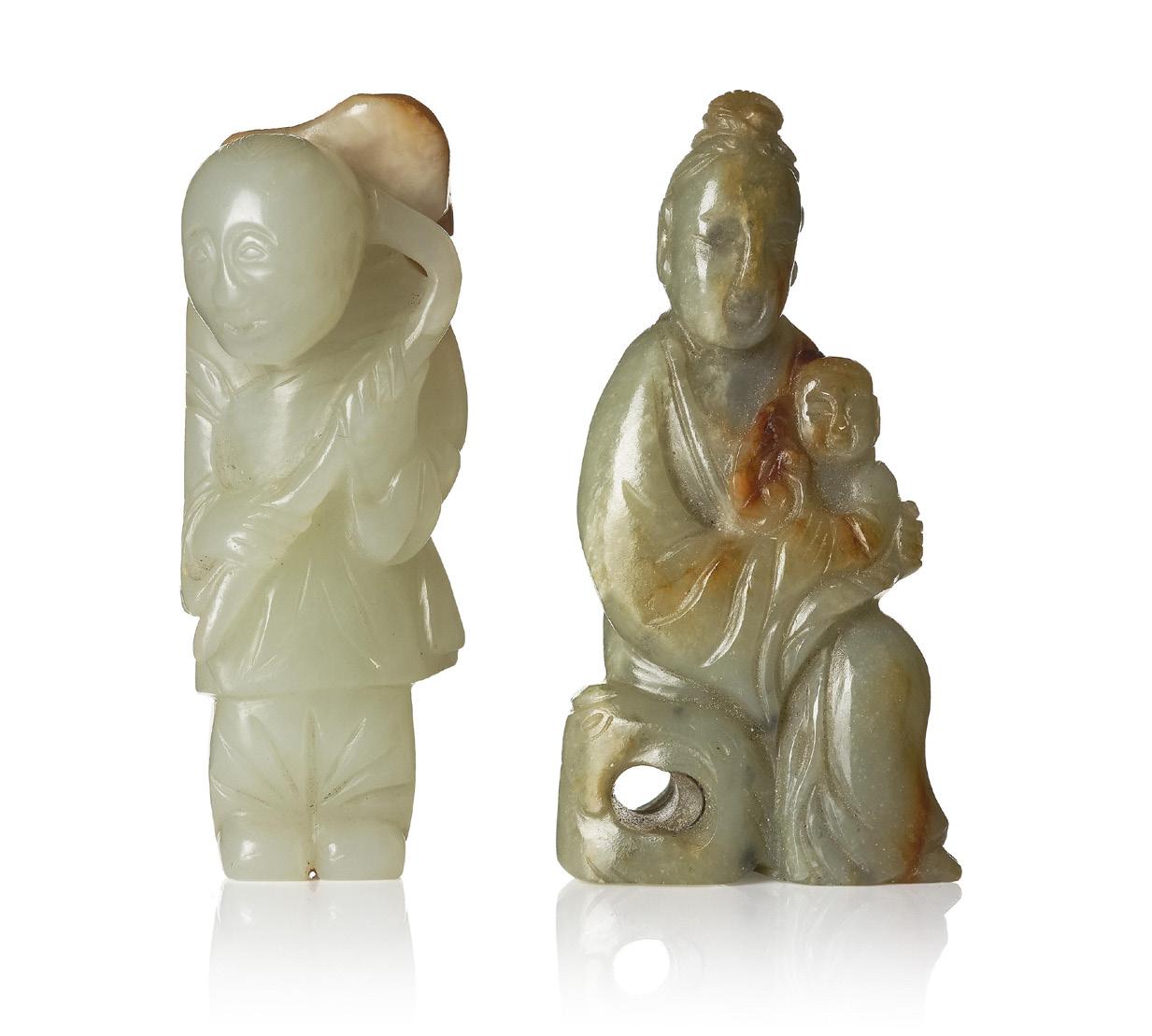
975. Two jade sculptures, late Qing dynasty.
One depicting a seated Guanyin with a boy in her lap, the stone in a olive green that shifts towards a russet brown. Height 7.2 cm. The second one depicting a boy carrying a lotus leaf, the stone of a pale celadon green where the lotus-leaf shifts towards a brown colour. Height 7 cm.
Provenance: From the collection of Sylvia Hurtig (born Armstrong Morris) (1926–1996), thence by descent.
Estimate: SEK 10 000 – 15 000 / EUR 944 – 1 420
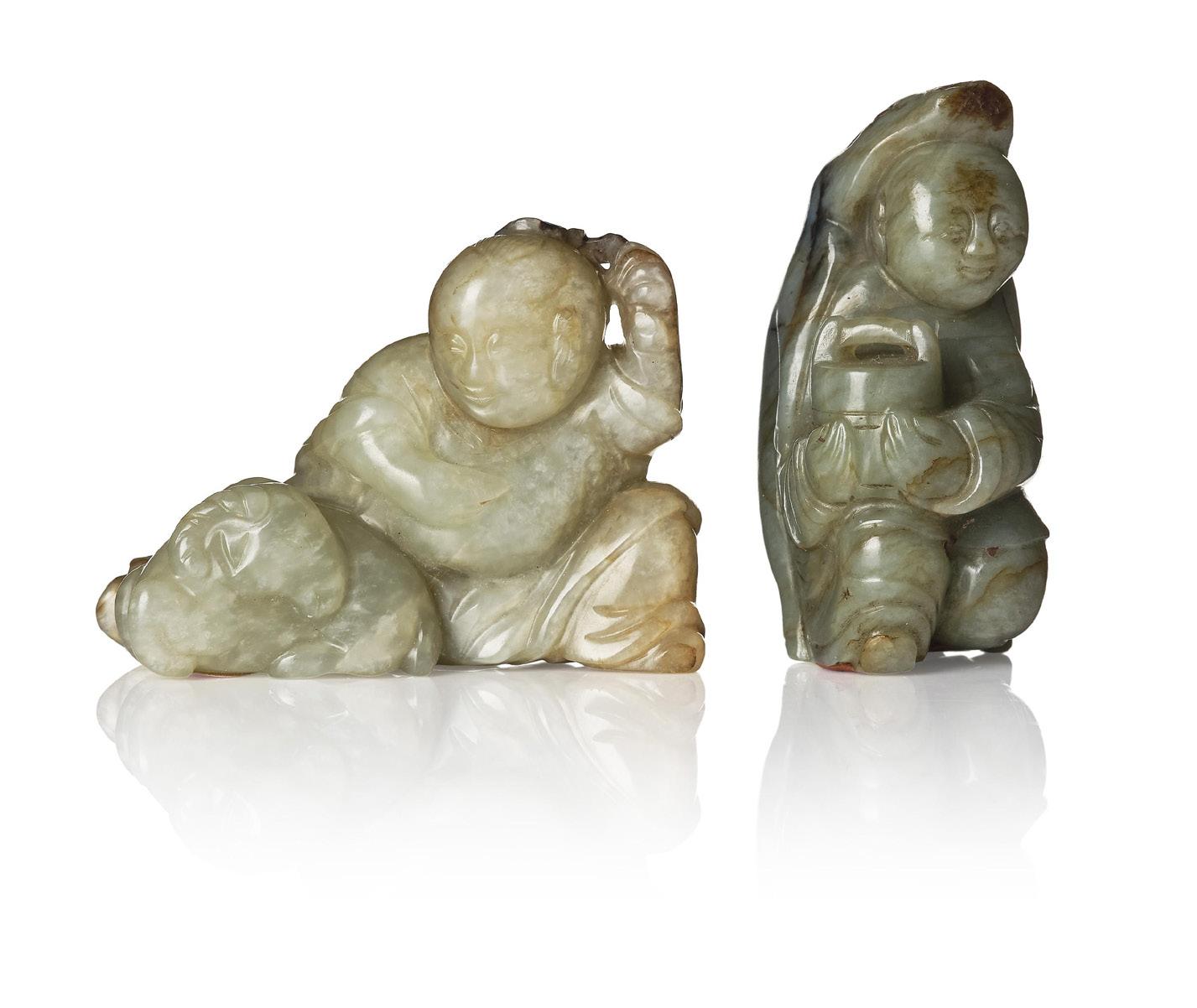
976. A group of four figural jade sculptures, Qing dynasty, 18/19th century.
Each sculptured carrying an item. Height 5.2–6 cm.
Provenance: From the collection of Sylvia Hurtig (born Armstrong Morris) (1926–1996), thence by descent.
Estimate: SEK 15 000 – 20 000 / EUR 1 420 – 1 890
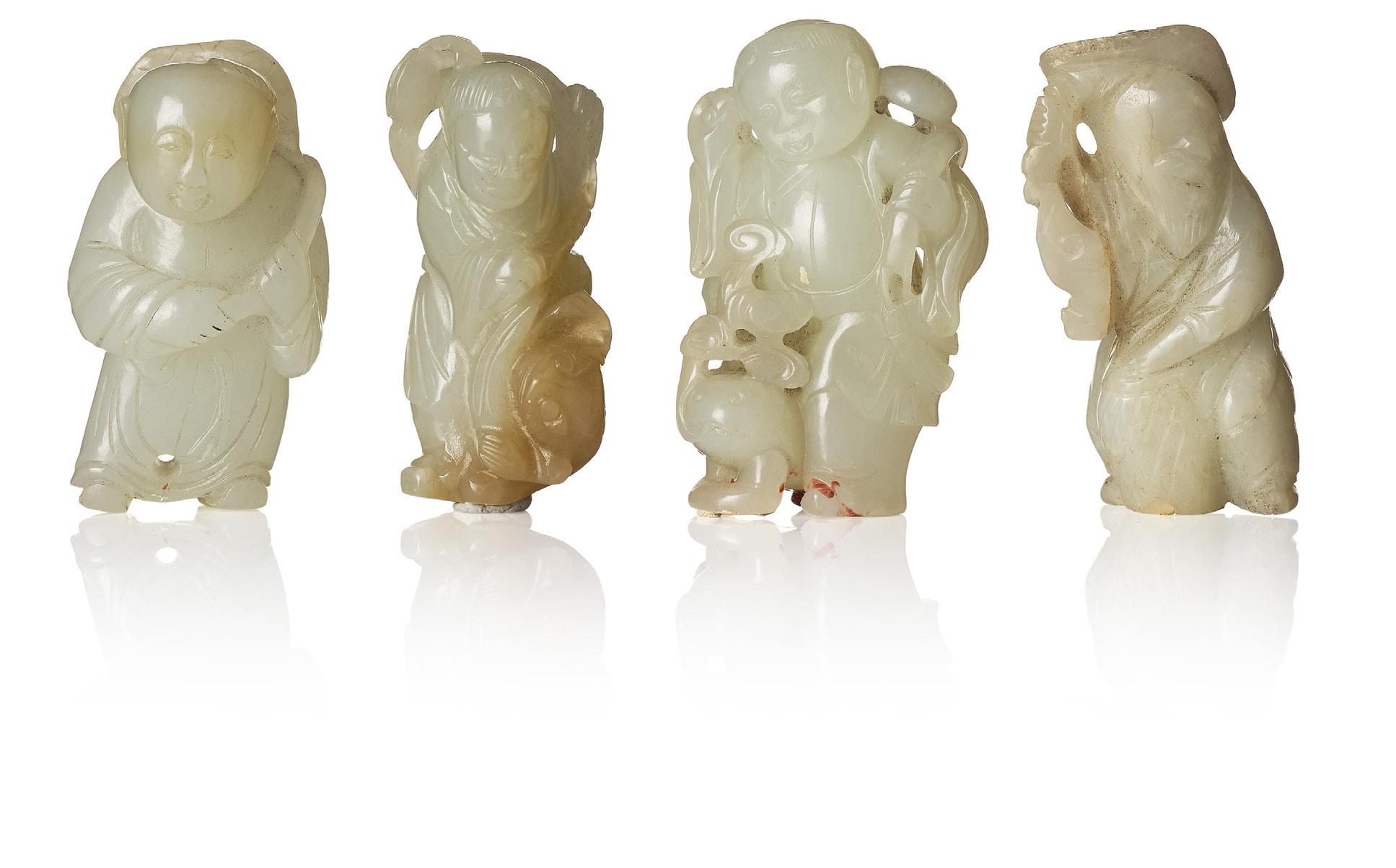
977. Two stone carvings, late Qing dynasty.
A sculpture of a figure with a hide of a deer on its back holding a bucket. Height 5.5 cm. A boy sitting next to his goat, length 5.5 cm.
Provenance: From the collection of Sylvia Hurtig (born Armstrong Morris) (1926–1996), thence by descent.
Estimate: SEK 8 000 – 10 000 / EUR 755 – 944
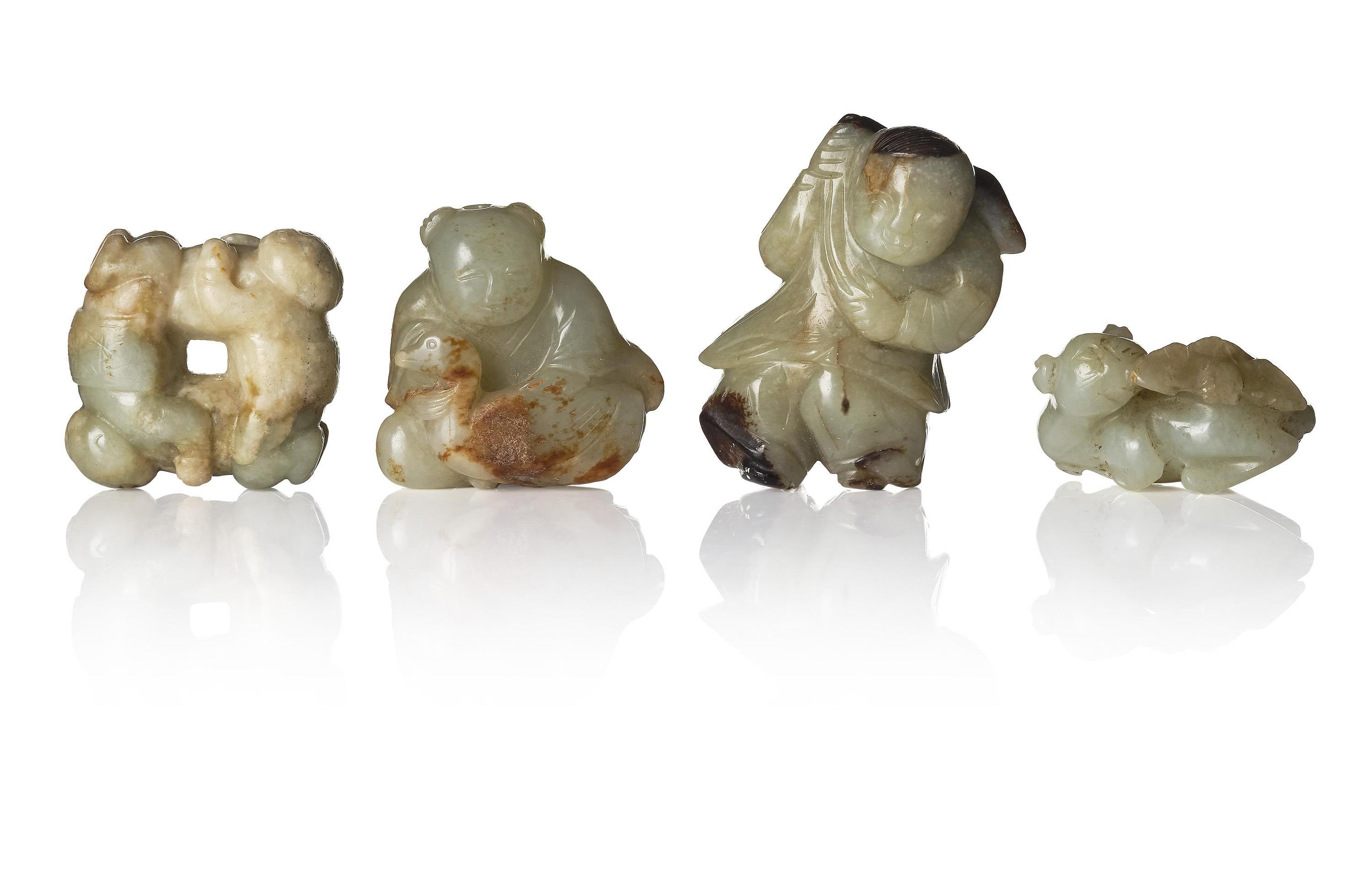
978. A group four well sculptured jade figurines, Qing dynasty/early 20th century. One sculpture depicting a boy with a lotus leaf in a pale green shifting into brown in some areas. Height 6 cm. A sculpture depicting a boy holding a goose, in a pale celadon green and russet brown. Height 4.2 cm. A sculpture of boys in a cartweel tumble, measure 4 x 4 cm. A feline animal with a bat, length 4.2 cm.
Provenance: From the collection of Sylvia Hurtig (born Armstrong Morris) (1926–1996), thence by descent.
Estimate: SEK 8 000 – 10 000 / EUR 755 – 944
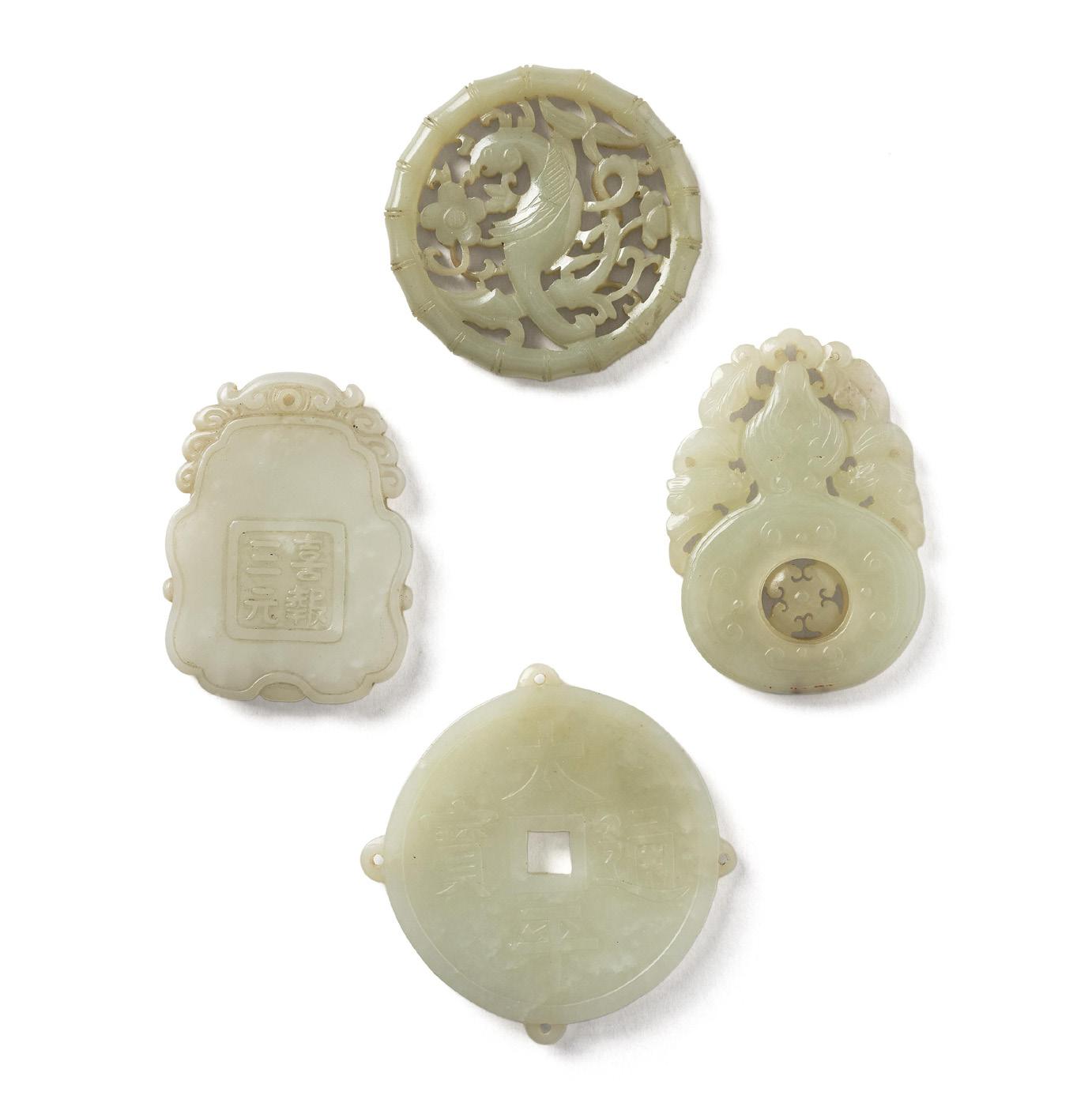
979. Four Chinese well sculptured nephrite pendants, late Qing dynasty and 20th century.
Comprising; a gourd shaped pendant flanked by two bats, well carved in a pale celadon green. Height 6.4 cm.
A pendant with a bird perched on a branch wiht fruit, the opposite side with a seal mark all in a pale celadon green. Height 5.8 cm. A coin shaped placque in celadon green. Diameter 6 cm. A roundel with an intricate pierced sculpturing of a bird amidst flowers in a pale olive green colour. Diameter 5.5 cm.
Provenance: From the collection of Sylvia Hurtig (born Armstrong Morris) (1926–1996), thence by descent.
Estimate: SEK 15 000 – 20 000 / EUR 1 420 – 1 890
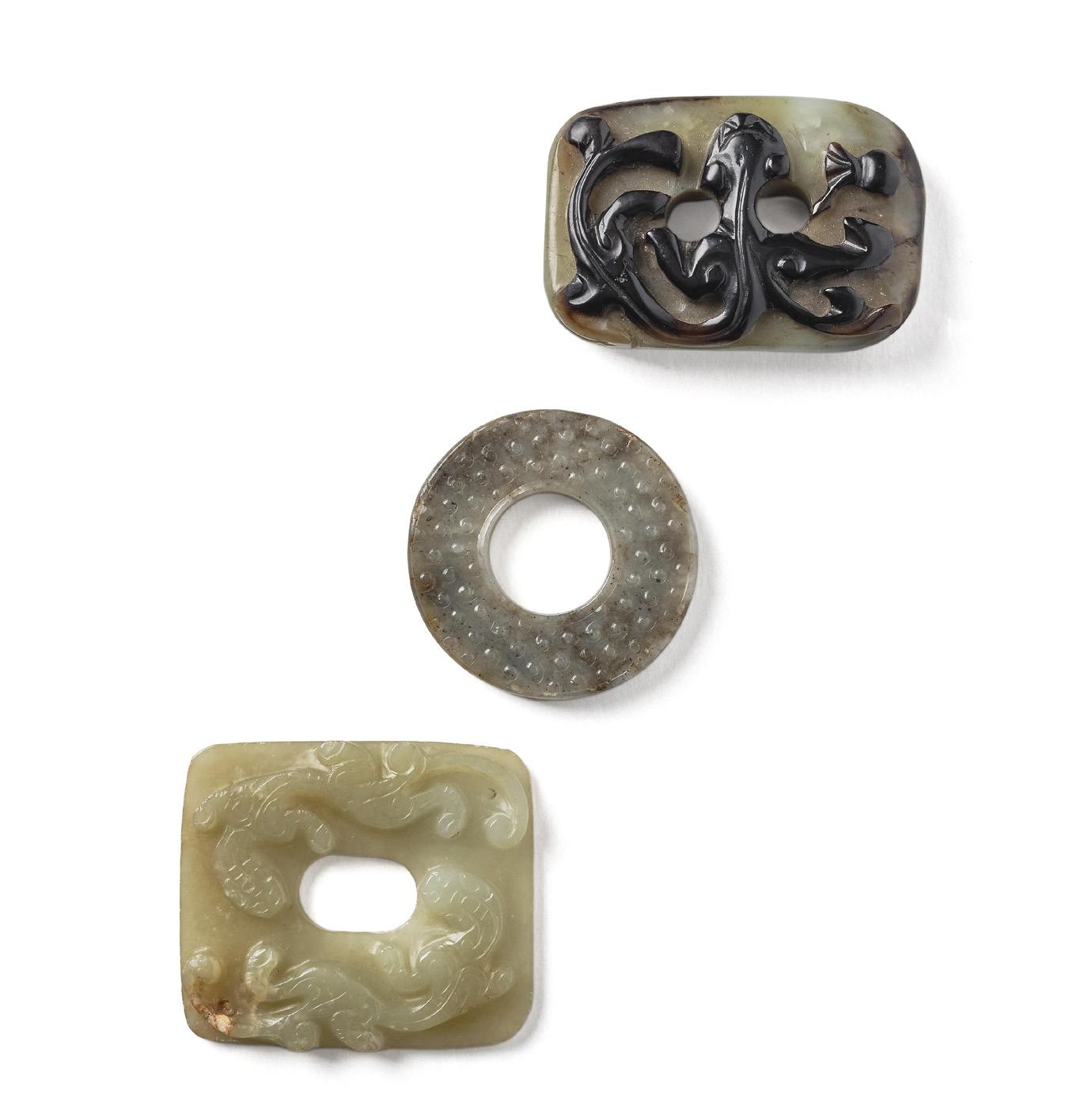
980. Three well sculptured neprite objects, Qing dynasty.
Comprising; a bi disc in green tones that shifts towards brown. Diameter 5.2 cm. A Chilong placque in pale celadon green. Measure 5.5 x 6.2 cm. A Chilong placque belt buckle with a dark russet brown dragon pierced on a celadon ground. Measure 6.6 x 4,5 cm.
Provenance: From the collection of Sylvia Hurtig (born Armstrong Morris) (1926–1996), thence by descent.
Estimate: SEK 8 000 – 10 000 / EUR 755 – 944
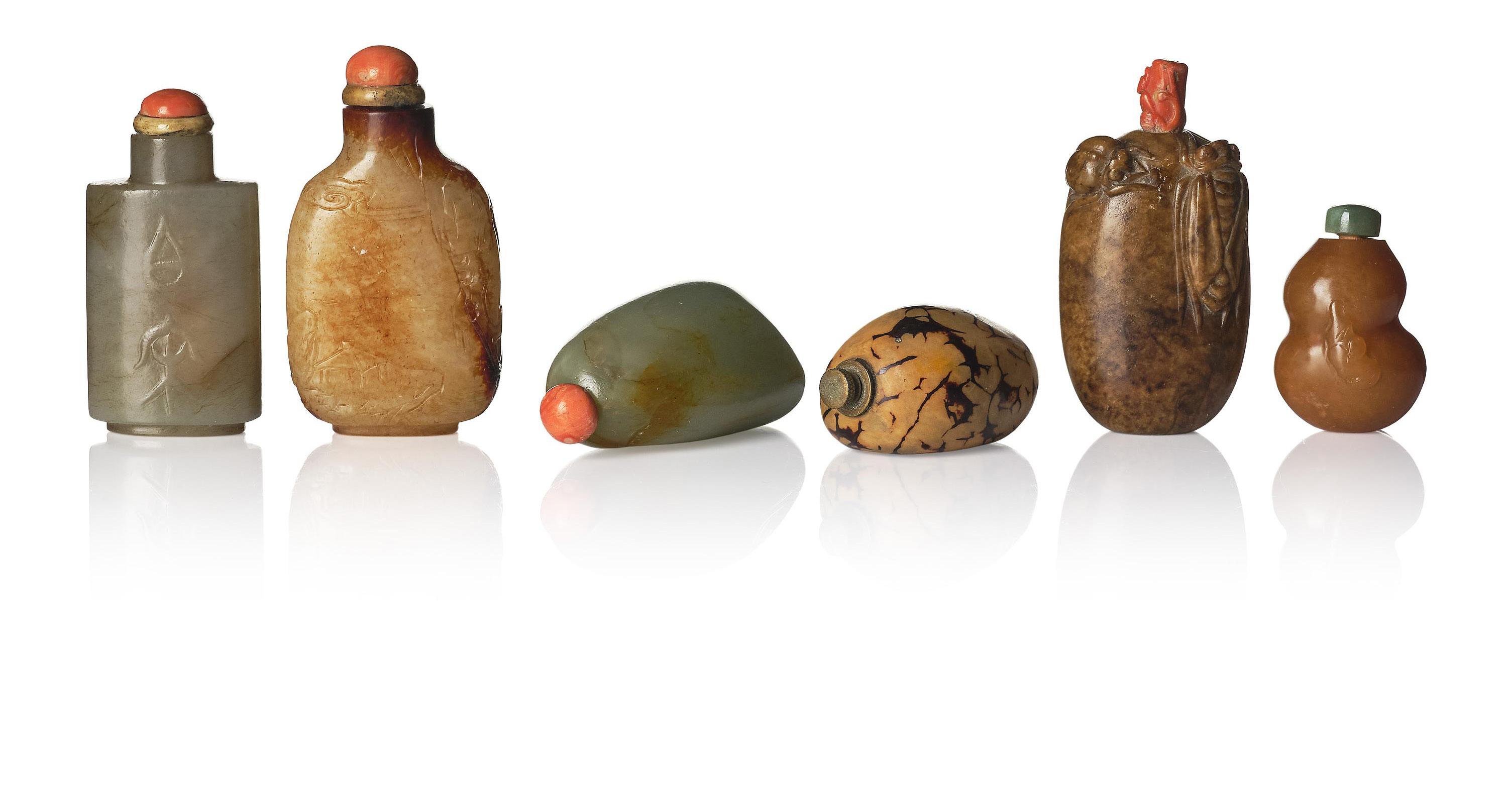
981. A group lot of six stone snuff bottles, China, 20th century. Comprising; One snuff bottle in green mottled jade that shifts towards brown, decorated with archaistic characters. Height 6.8 cm. Snuff bottle in mottled stone with pewter cover, height 4.5 cm. A snuff bottle in mottled stone decorated in relief with a landscape scene. Height 7.2 cm. A small snuff bottle in gourd shape, decorated with bats, height 4.5 cm. An unsculptured nephrite snuff bottle with stopper, height 7 cm. A brown stone snuff bottle sculptured with insects, height 7.5 cm.
Provenance: From the collection of Sylvia Hurtig (born Armstrong Morris) (1926–1996), thence by descent.
Estimate: SEK 8 000 – 10 000 / EUR 755 – 944
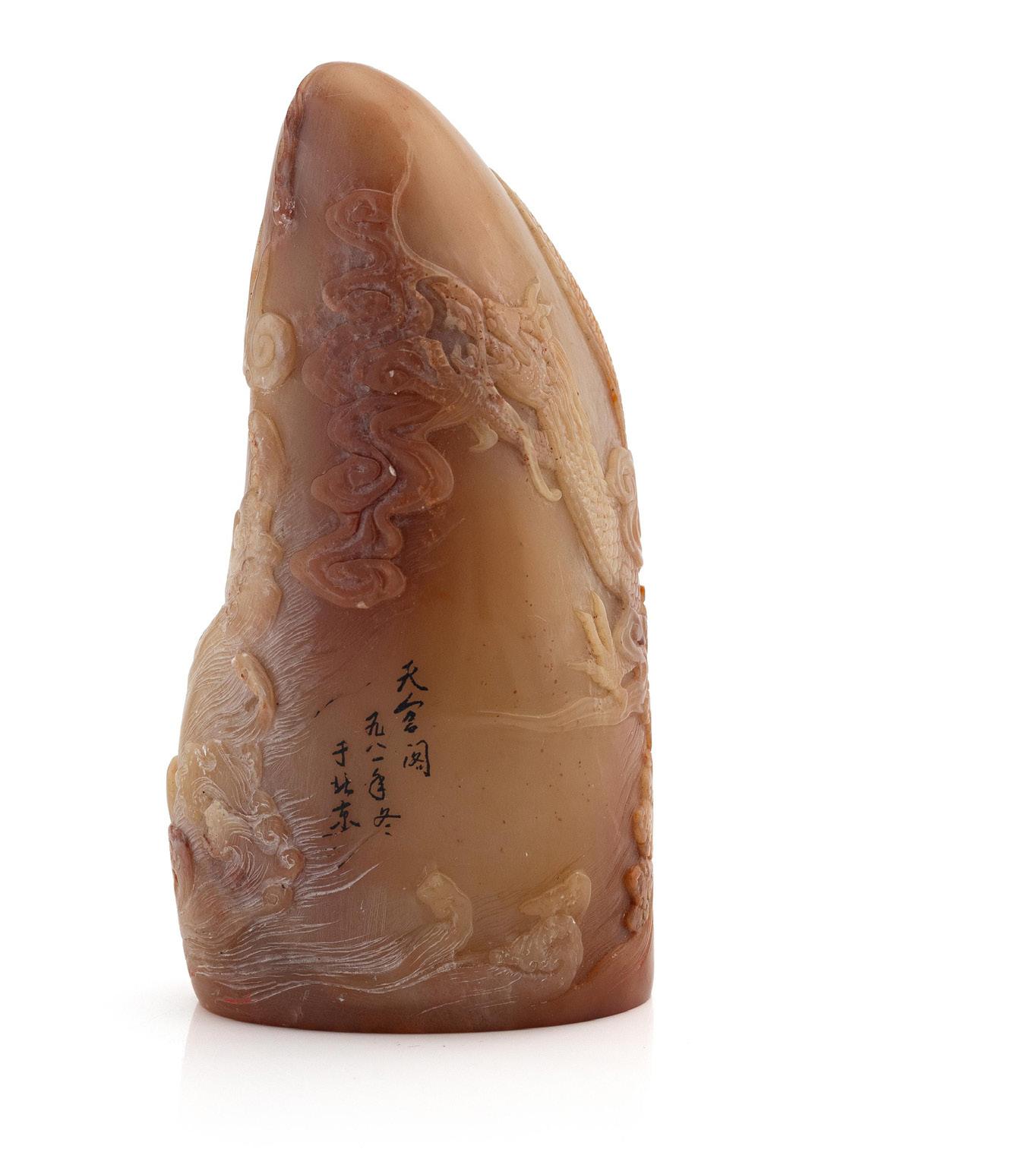
982. A carved stone ‘dragon amidst waves’ seal, China, 20th century. The irregularly shaped oval seal is sculptured as a boalder with decoration in relief with a dragon rising up from fierce waves. Inscriptions to side. ‘The mountain retreat of pine harmony’. Height 10.1 cm.
Provenance: From the Collection of Ann Kreuger (1926–2022). Ann Kreuger is well known in the circles of snuff bottles collectors, dealers and auction houses. She was an active member in the Snuff bottle society, researched, collected, lectured, and wrote numerous articles in the subject. Her deep interest in Chinese culture, language, tradition, and history led her to build a very rich library on the subject. A large part of her collection of snuff bottles was sold at Sotheby’s, see the single owner sale ‘The Guo’an Collection of fine Chinese snuff bottles, Hong Kong, Monday 30 October 2000, from where they found their way into other prestigious collections.
Estimate: SEK 8 000 – 10 000 / EUR 755 – 944
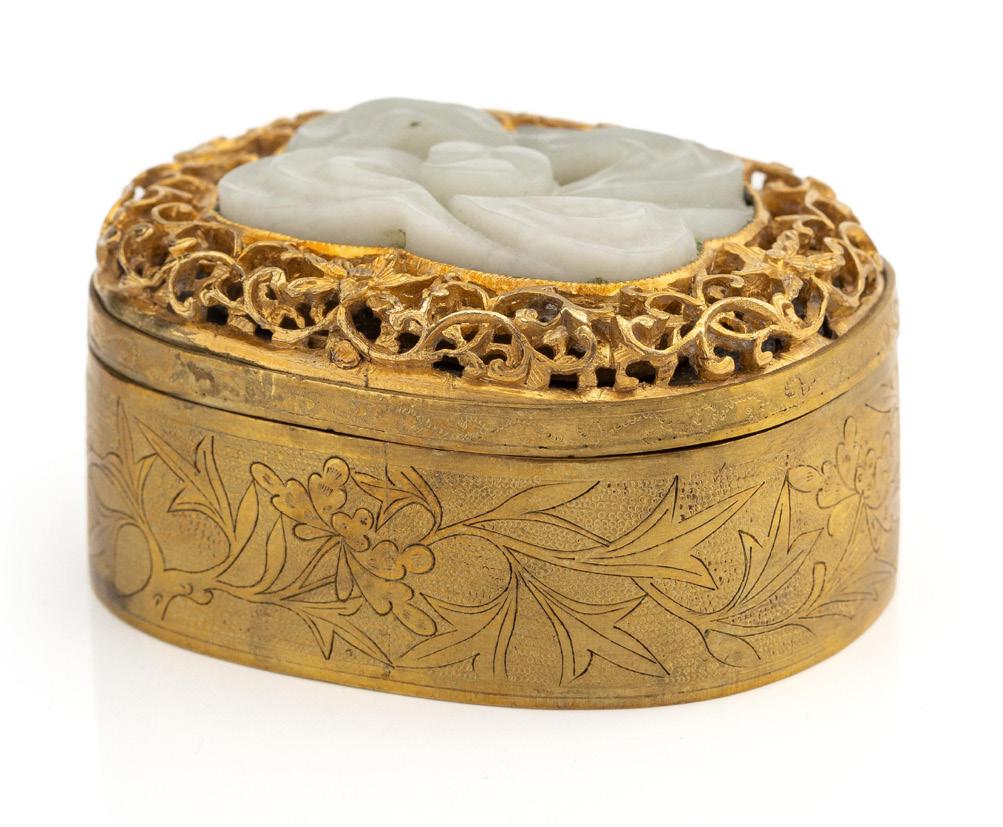
983. A gilded box with an ‘endless knot’ inlay, Qing dynasty, 19th century.
Oval with a reticulated floral scroll at the top, the interior of the cover and the sides with further floral scrolls. Measure 6 x 5 x 3,2 cm.
Provenance: Property of a private Swedish collector, whose mother acquired the box in Shanghai in the 1930’s.
Estimate: SEK 4 000 – 6 000 / EUR 378 – 567
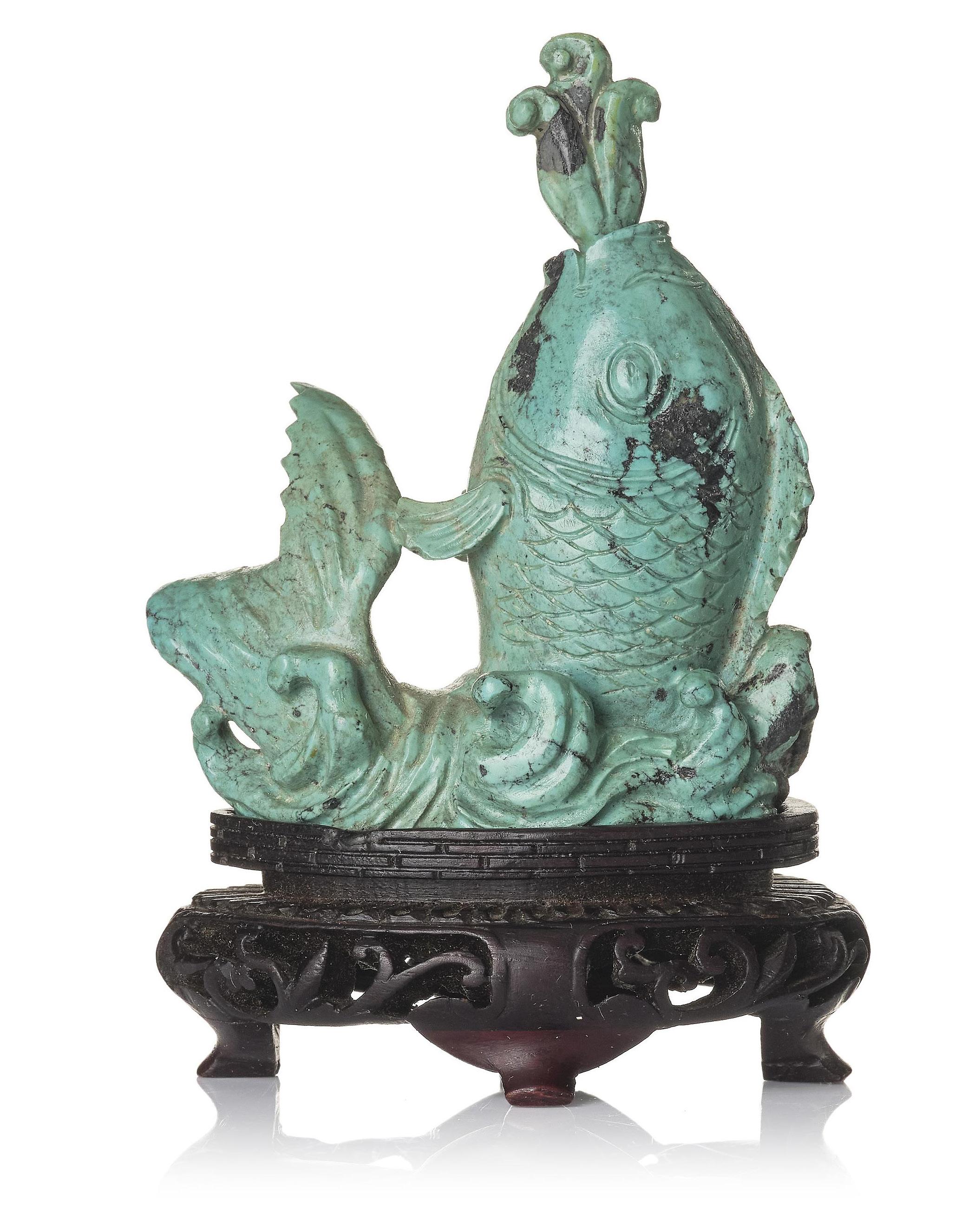
984. A well sculptured turquoise figure of a carp, Qing dynasty, 19th century.
Sculptured as a leaping carp that jumps out of fierce waves. Height with wooden stand 9 cm. Length 7.5 cm.
Provenance: From the collection of Sylvia Hurtig (born Armstrong Morris) (1926–1996), thence by descent. The collection was brought together mainly in the 1960’s. Sylvia, born in England, Newscastle-on-Tyne, but living in Stockholm had a particular passion for jade and during her frequent visits to London she acquired the pieces from Christie’s, Sotheby’s as well as from Bukowskis and through the Swedish/Armenian antique dealer Solberger, Tegnérgatan, Stockholm.
Estimate: SEK 6 000 – 8 000 / EUR 567 – 755
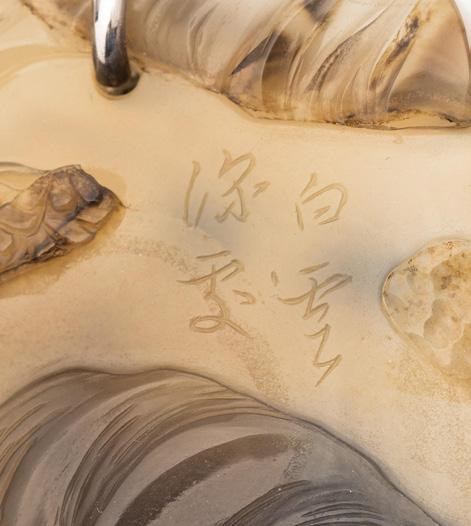
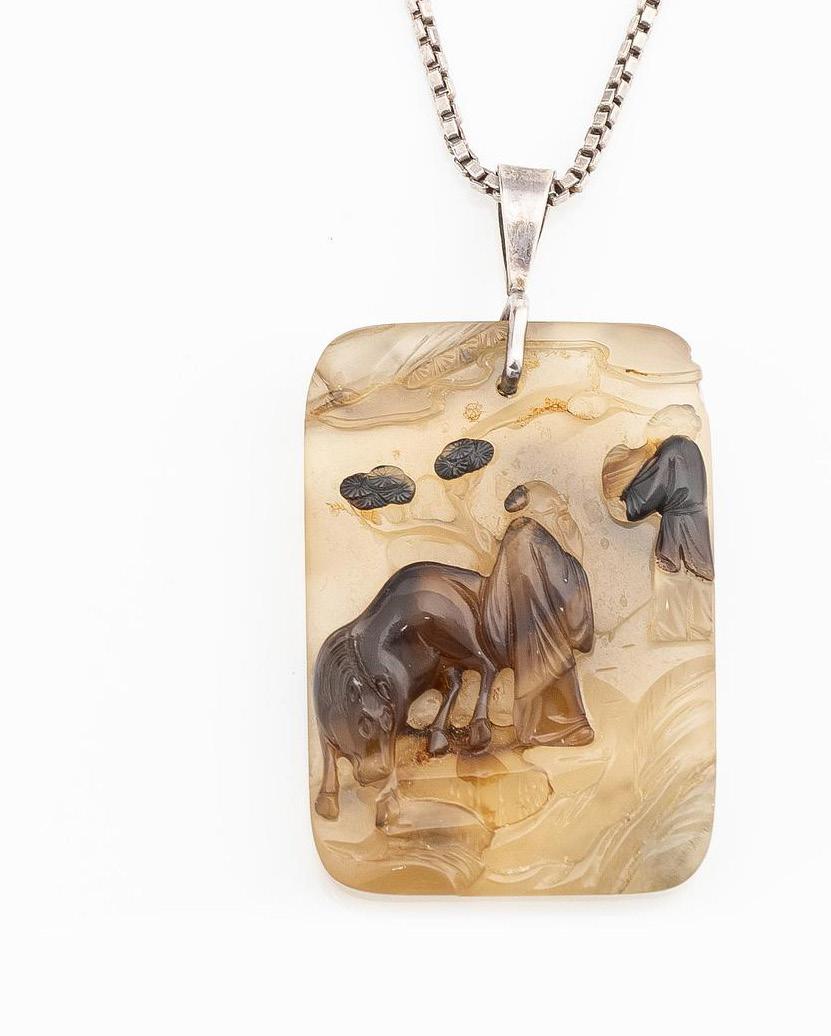
985. An inscribed and well carved agate ‘Scholar and attendant’ pendant, Qing dynasty, probably 19th century.
The smoky amber toned stone displaying several defined areas of dark brown colouring, skilfully utilized to pick out the highlights in a scene with two men and a horse in a landscape setting the other side with a gnarled pine tree growing from the side of a rocky overhang against an background of contorted rocks. One side with a four character inscription.
Measure 5.2 x 3.8 cm.
Provenance: Purchased in Stockholm, Signe S Lindström Jewels & Art Trade 1966. Thence by descent within the family.
Exhibitions: Compare with one sold in these rooms at Bukowskis Spring Asian Sale Stockholm 593, lot 38, 8 June 2016. Compare with one sold at Bonhams San Francisco Fine Chinese Works of Art and Paintings, lot no 7126, 23 June 2015.
Catalogue note: The inscription reads 白雲深處 (Baiyun shen chu) which could be translated as ‘Deep Among the White Clouds’.
Estimate: SEK 20 000 – 25 000 / EUR 1 890 – 2 360
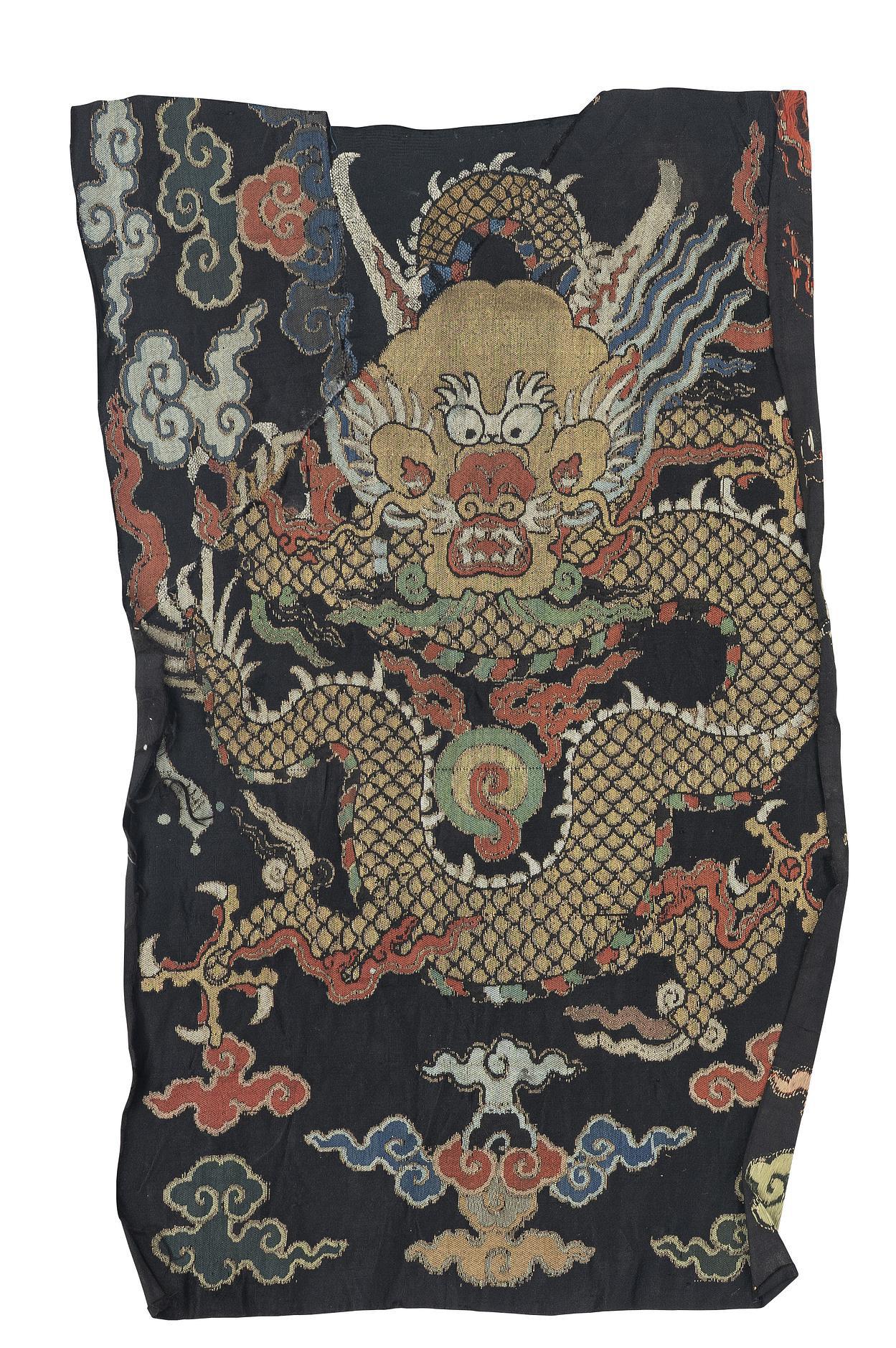
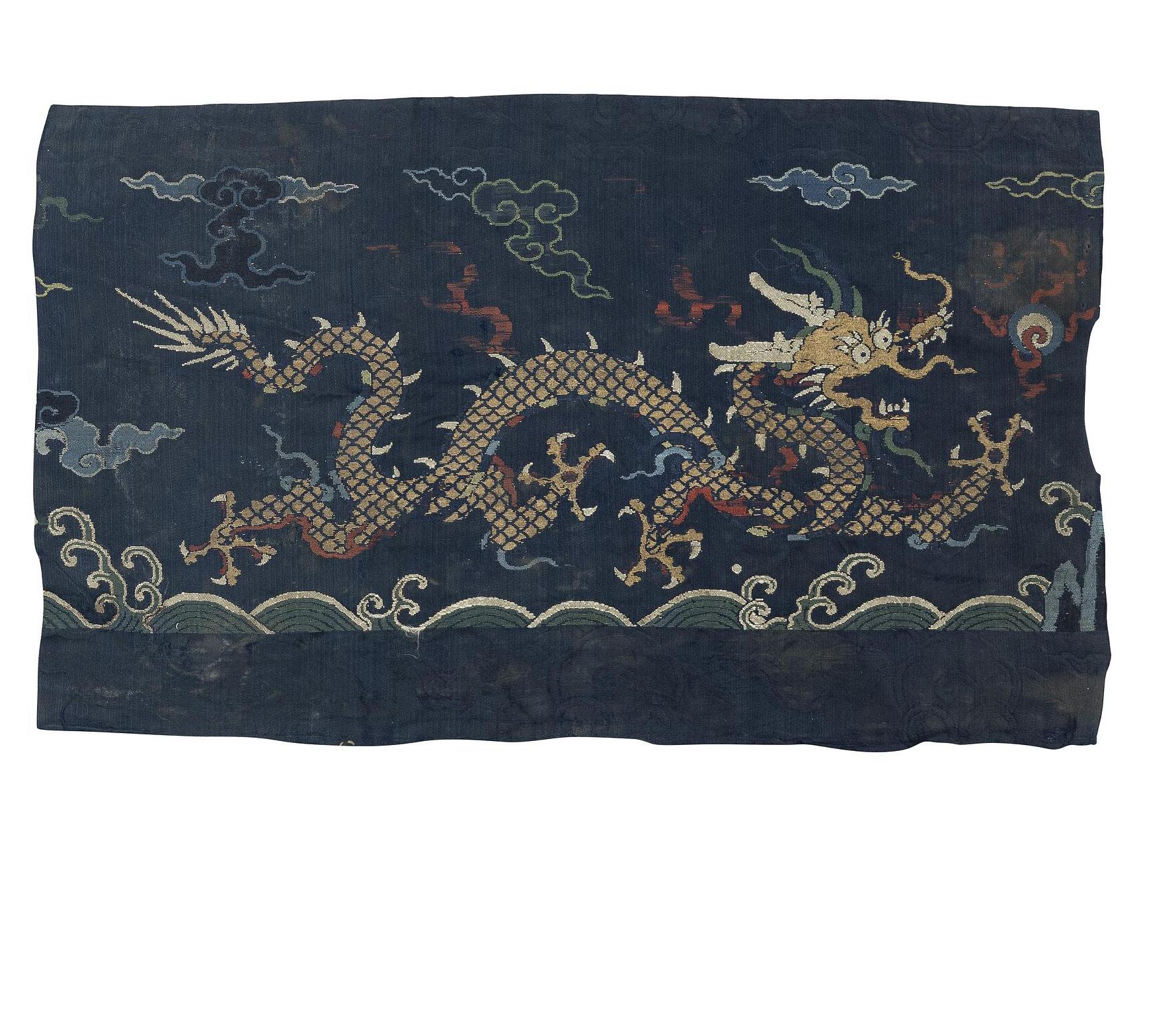
returned to China in grownup years for work, he came to live in China altogether more than 40 years. His love of China, and Chinese works of art is mirrored in the collection and being an academic collector, he never got tired of learning more about the subject by studying literature, attending lectures, visiting museums, auction houses and befriending curators from Beijing, Hong Kong, London, Paris, and Stockholm. The collection consists of both Chinese ceramics and textiles. This being a part of the textile collection.
Estimate: SEK 6 000 – 8 000 / EUR 567 – 755
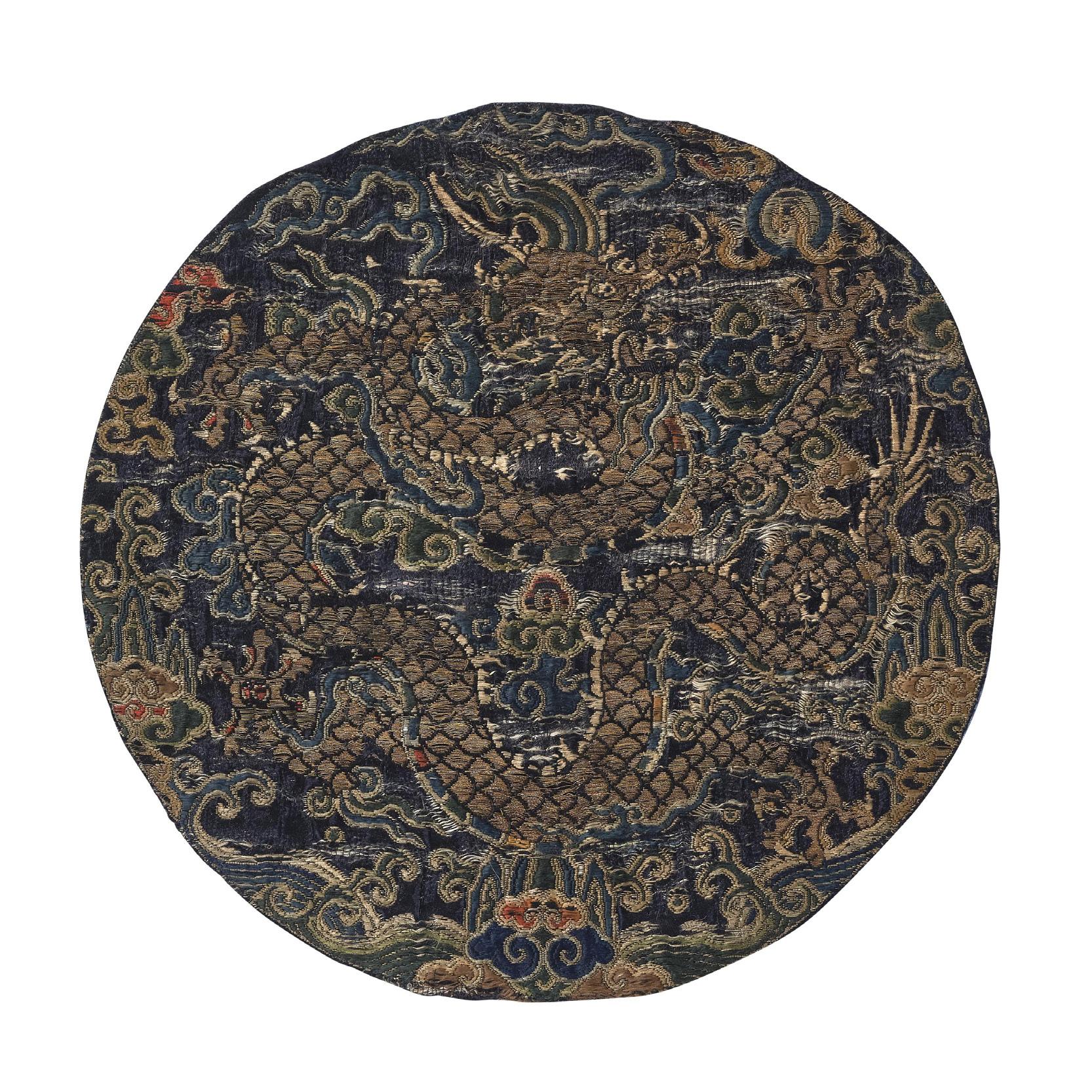
987. An Imperial dragon insignia roundel/rank badge, early 1700’s. With a dragon chasing the flaming pearl amidst cloud formations against a dark blue ground. Lined with blue silk. Diameter 30 cm.
Provenance: Property of a private Finnish Collection. The collection was formed between 1980–2020, the collector has had an interest in China and Chinese Works of Art since childhood, growing up in Beijing. He returned to China in grownup years for work, he came to live in China altogether more than 40 years. His love of China, and Chinese works of art is mirrored in the collection and being an academic collector, he never got tired of learning more about the subject by studying literature, attending lectures, visiting museums, auction houses and befriending curators from Beijing, Hong Kong, London, Paris, and Stockholm. The collection consists of both Chinese ceramics and textiles. This being part 2, a part of the textile collection.
Estimate: SEK 15 000 – 20 000 / EUR 1 420 – 1 890
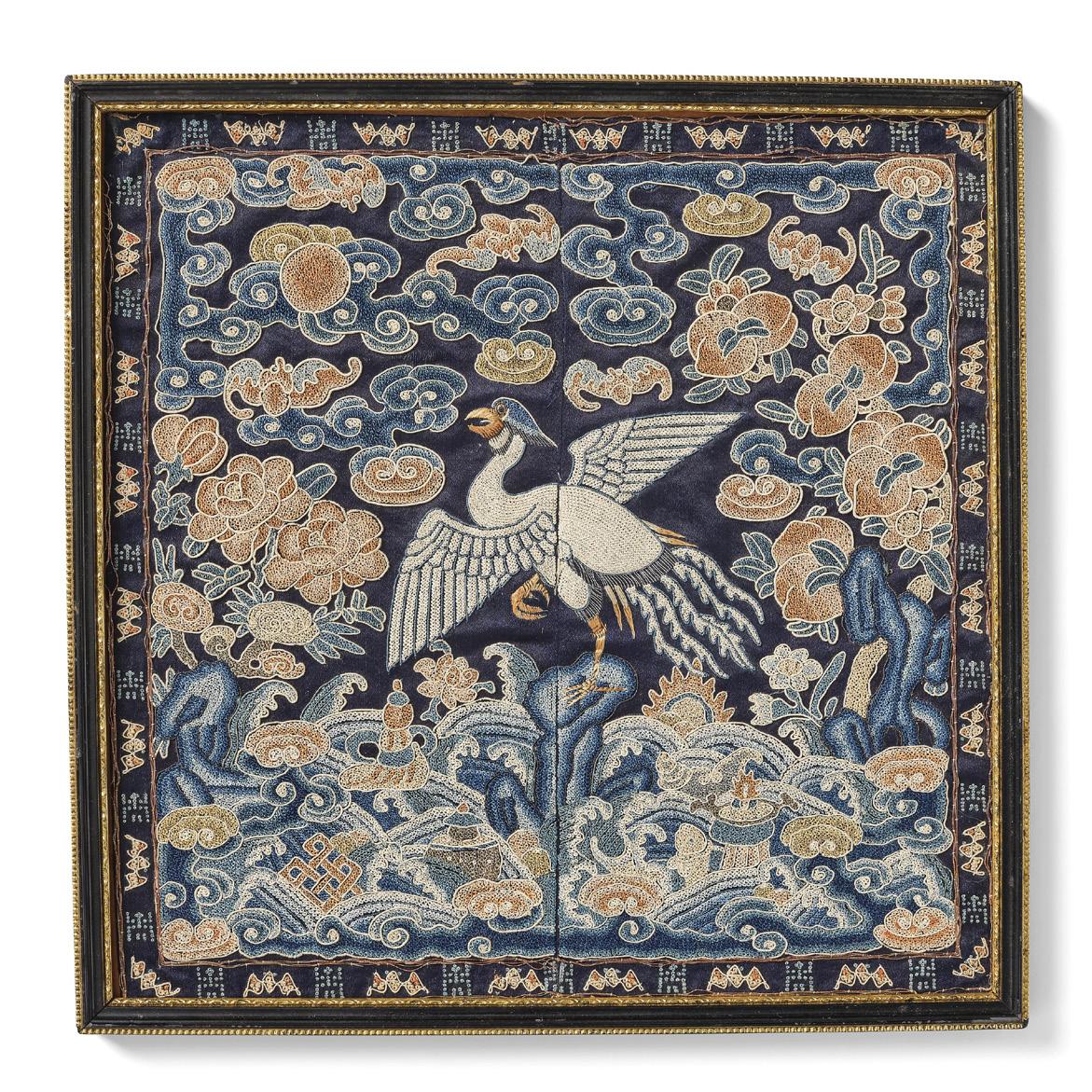
988. A civil offical’s rank badge with a silver pheasant in Peking knot, Qing dynasty, early 19th century.
The Fifth Civil Rank badge worked in Peking Knot / ‘forbidden knot’ depicting the bird upon a rock amongst foaming waves and the Eight Buddhist Emblems, bajixiang, below bats and peach sprays, all amidst ruyi-shaped clouds. A border with bats and shou characters. Framed. Measure badge 31 x 31 cm. Measure with frame 32.8 x 32.8 cm.
Provenance: Purchased at Christies Sale 9511, lot 84. 19 November 2002. Property of a private Finnish Collection. The collection was formed between 1980–2020, the collector has had an interest in China and Chinese Works of Art since childhood, growing up in Beijing. He returned to China in grownup years for work, he came to live in China altogether more than 40 years. His love of China, and Chinese works of art is mirrored in the collection and being an academic collector, he never got tired of learning more about the subject by studying literature, attending lectures, visiting museums, auction houses and befriending curators from Beijing, Hong Kong, London, Paris, and Stockholm. The collection consists of both Chinese ceramics and textiles, This being part 2, a part of the textile collection.
Literature: Illustrated Precedents for the Ritual Paraphernalia of the Imperial Court, published in 1759, tells us much about how Court attire was regulated by imperial decrees. The Chinese tradition of wearing rank badges (buzi), also known as Mandarin squares,
to demonstrate civil, military or imperial rank began in 1391 during the Ming dynasty (1368–1644), and continued throughout the Qing dynasty (1644–1911). These insignia were sewn onto or woven into the wearer’s garments to indicate their rank. Civil officials wore insignia with different bird species corresponding to their rank, while animals denoted military officers. The fall of the Qing dynasty in 1911 brought an end to rank insignia.).
Catalogue note: A badge featuring a bird identified the wearer as a civil official. To attain such a position required years of intense study, so birds may have been selected because of their literary associations. Each rank was represented by a different species, and while there were slight variations over time, by the Qing dynasty the order from highest to lowest was: crane, golden pheasant, peacock, wild goose, silver pheasant, egret, mandarin duck, quail and paradise flycatcher. Civil officials sat on the emperor’s left at court functions, so their rank birds faced right towards him. While it may be easy to tell a duck from a goose in real life, identifying different species on rank badges can be difficult. Birds are shown in similar poses, are of similar size and are placed on grounds of similar decoration, which had slight variations from period to period. Certain species, such as peacocks, can be identified easily because of the distinctive eye design on their feathers. For the more difficult varieties, look at the form of the head and neck and the shape of the tail feathers. For example, the first-rank crane typically has a rounded head topped by a red cap, while the silver pheasant worn by fifth-rank civil officials has distinctive long, scalloped or serrated tail feathers.
Estimate: SEK 6 000 – 8 000 / EUR 567 – 755
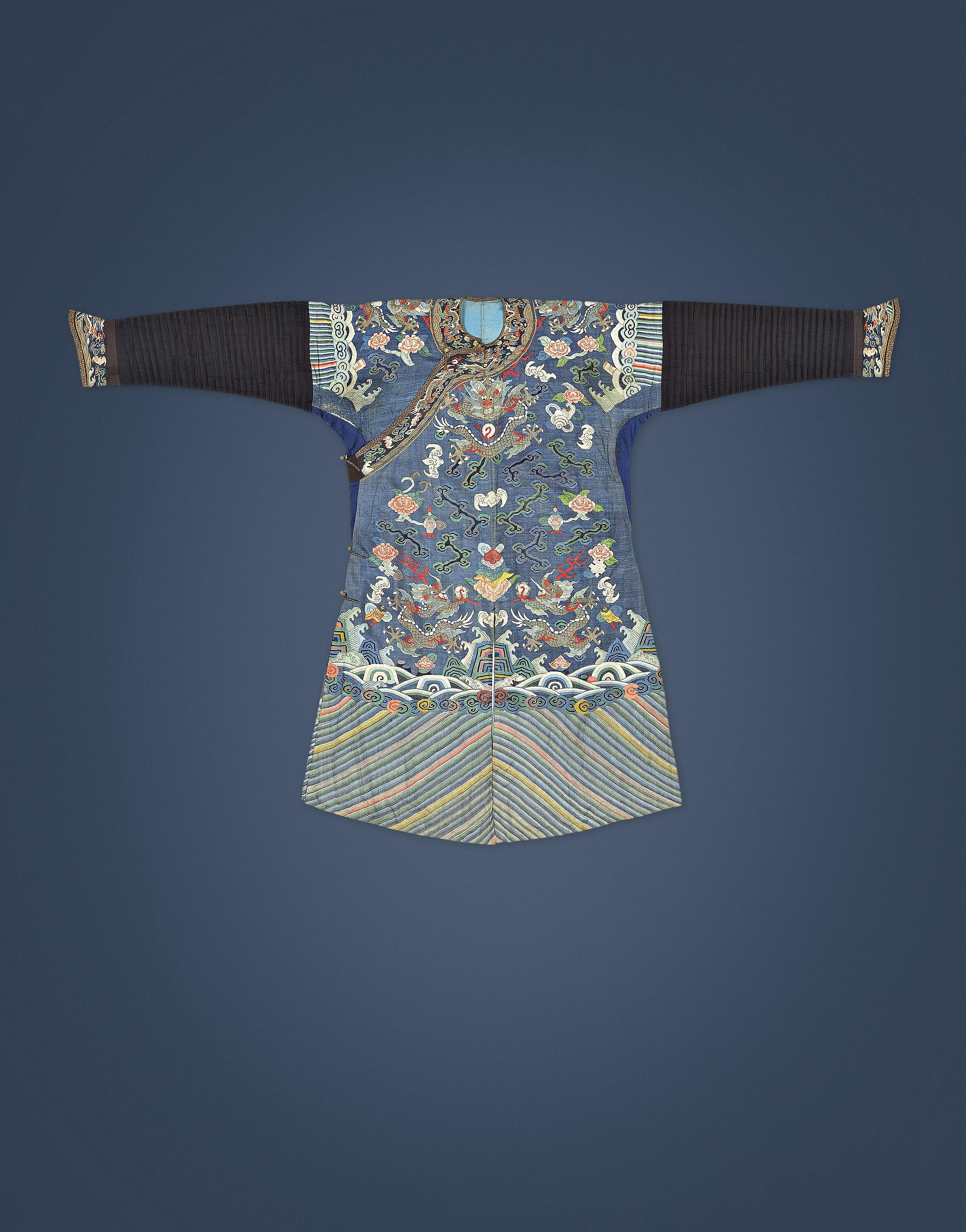
989. An imperial kesi Jifu with five clawed dragons on a blue ground, Qing dynasty, 19th century. Decorated with five clawed dragons amidst ruyi-shaped clouds, bats and buddhist the Eight Daoist Emblems above a lishui stripe. The decoration is repeated on the border, collar and horsehoof cuffs. With pleated midnight blue silk sleeves. Length back 140 cm. Width arm to arm 220 cm.
Provenance: Purchased at Christies, labelled lot no 26, 24 November 1998. Property of a Finnish Collection. The collection was formed between 1980–2020, the collector has had an interest in China and Chinese Works of Art since childhood, growing up in Beijing. He returned to China in grownup years for work, he came to live in China altogether more than 40 years. His love of China, and Chinese works of art is mirrored in the collection and being an academic collector, never got tired of learning more about the subject by studying literature, attending lectures, visiting museums, auction houses and befriending curators from Beijing, Hong Kong, London, Paris, and Stockholm. The collection consists of both Chinese ceramics and textiles. This being part 2, a part of the textile collection.
Estimate: SEK 30 000 – 40 000 / EUR 2 830 – 3 780
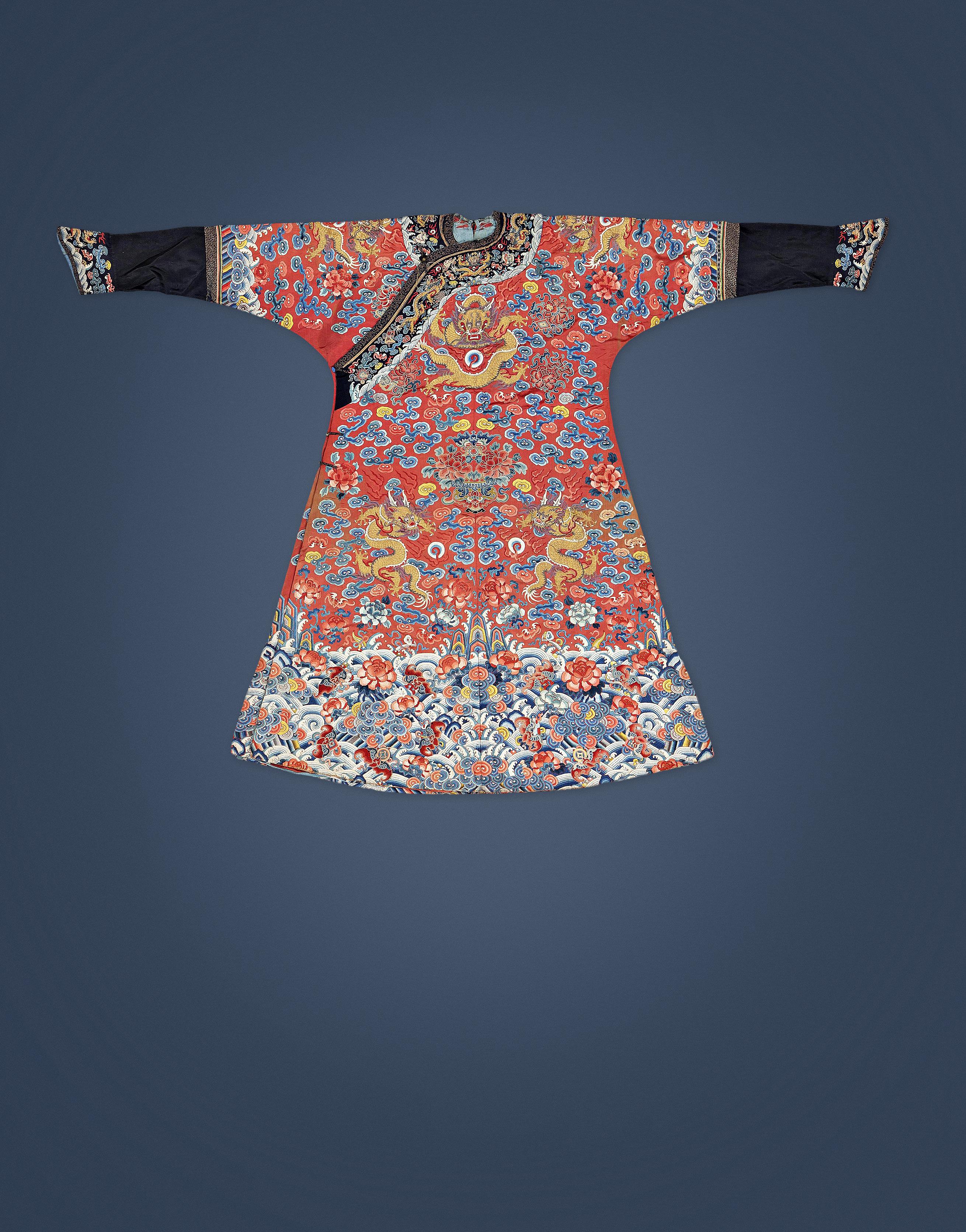
990. An embroidered red ground five clawed dragon ‘female’ formal robe, Qing dynasty, 19th century.
Displaying nine five clawed dragons chasing the flaming pearl above a wide lishui border embroidered in brightly hued silk and gold as well as embroidered with the ‘peking knot’ (forbidden stich), the ninth dragon behind the front panel. All against a red ground. Blue silk lining. Length back 140 cm. Length arm to arm 193 cm.
Provenance: From the Collection of Jenny Fridström, aquired around 1902, she lived with her husband in Patse Bolong, inner Mongolia during the years 1902 and 1921 were they worked as Missionaries. Adorned with five-clawed dragons, a symbol reserved for use only by the imperial family, this robe, of semi-formal design, would have been a remarkable sight when worn as part of a festive occasion. Though bright yellow robes worn by the emperor and duller yellow and blue pieces wornby princes and lesser members of the imperial family respectively are well attested, it is rare to find a robe of this bright red colour. An auspicious colour associated with fire and good fortune, red clothing was (and continues to be) worn on festive occasions including weddings and birthdays.
Exhibitions: Compare, lot no 121, Sothebys, Arts d’Asie, 14 June 2024. Compare lot 434, Bonhams New Bond Street London, Live auction Fine Chinese Art, 6 November 2014.
Literature: Women played only a marginal role in the Qing dynasty court and government. As such, opportunities to wear formal dress, such as chaofu or dragon robes, were minimal, and surviving examples are particularly rare. Unlike those worn by men, women’s dragon robes had no front and back vent.
Catalogue note: The décor on this jifu, ( 吉服 literally, ‘auspicious’ dress), or longpao, ( 龙袍 , [imperial] dragon robe) follows the standard Qing disposition of five-clawed dragons (long, 龙 ) amid clouds across the entire surface of the garment. The standing water (lishui, 立水 ) border at the hem features piled wind-swept waves on which float the Eight Buddhist Symbols ( ba jixiang, 八吉祥 ), symbols for the Eight Precious Things (ba bao, 八宝 ), the attributes of the Eight Daoist Immortals (ba xian, 八仙 ), large peony blossoms, and several motifs that function as rebus. The term ‘hurricane waves’ was coined by Alan Priest in the 1940s to describe this variation of lishui, which first appeared on some jifu robes during the first quarter of the nineteenth century. The dragons, as is typical, are depicted with couched gold-wrapped threads while the rest of the embroidered decoration uses colored floss silk. However, what is remarkable is the choice of embroidery stitches for executing these colored silk elements. The embroidery here also employs a single stitch commonly known in the West as ‘pekin’, ‘peking’, or ‘pekinese’ stitch, (Beijing zhen, 北京針 ). It is also known as lasuo xiu (拉锁绣 , literally ‘zipper stitch’).1
It is a composite stitch involving two elements: a row of closely spaced back stitches and a second element interlaced in continuous loops moving forward two and back one through the previously laid down back stitches. It is time-consuming and requires consistent, exacting skill to maintain the proper tension and spacing of each parallel row of back stitches and well as rigorous consistency in placing the interlacing elements.
The exclusive use of beijing zhen or lasuo xiu stitching on a court dragon robe remains a puzzle.
Estim at e: SEK 30 000 – 40 000 / EUR 2 830 – 3 780
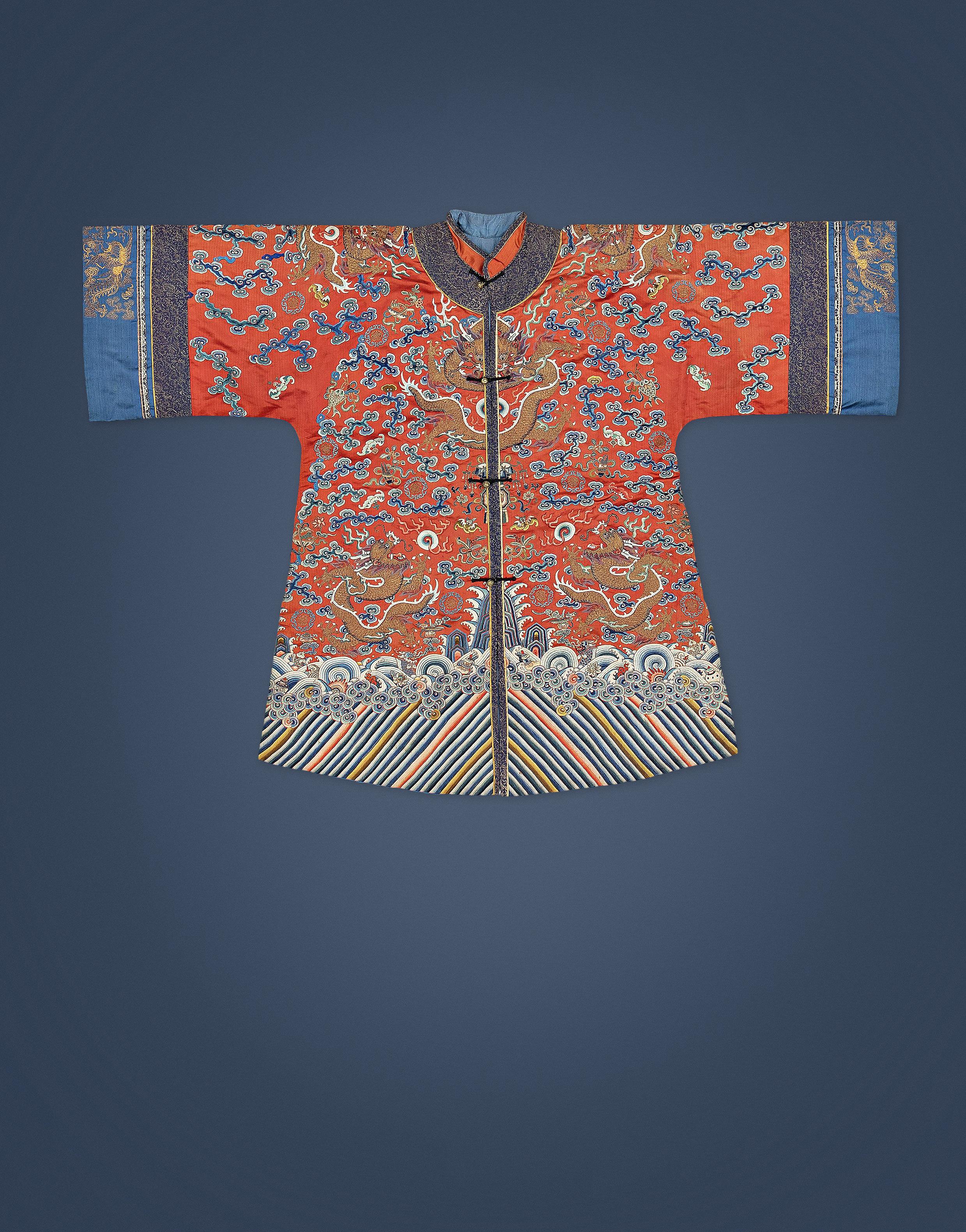
991. A Chinese embroidered silk robe, late Qing dynasty, 19th century.
Decorated with eight five clawed dragons embroidered with metal thread amidst ruyi-shaped clouds, bats and buddhist the Eight Daoist Emblems above a lishui stripe, all to a red ground. Collar and cuffs with blue brocade featuring lotus scrolls and metal thread embroideries with phoenix birds and dragons. Blue silk lining. Length 100, width between arms 139 cm.
Estimate: SEK 50 000 – 75 000 / EUR 4 720 – 7 080
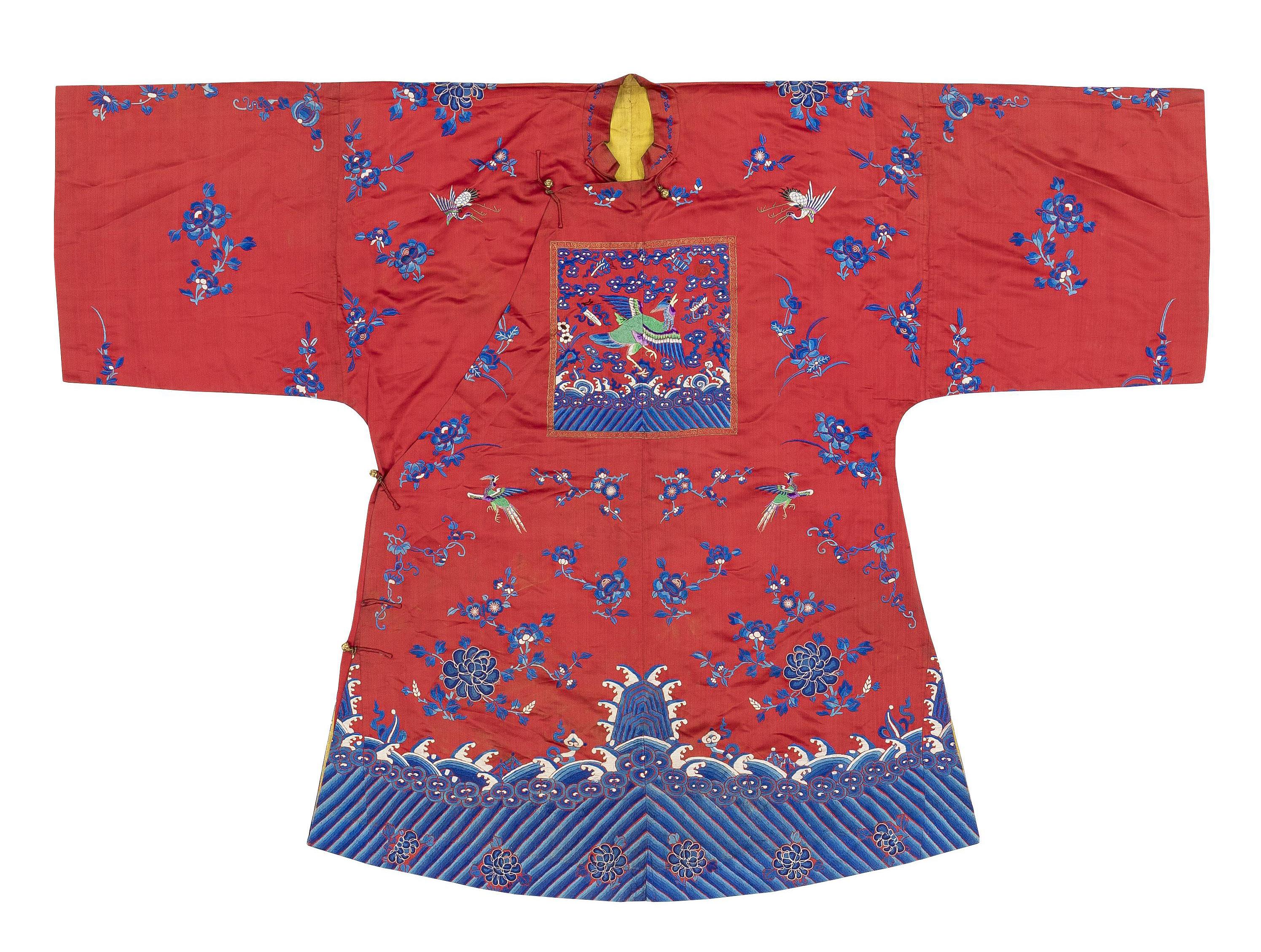
992. A Chinese semi-formal embroidered silk robe, late Qing dynasty, circa 1900.
Embroidered with birds and flowers in blue against a red ground, all above a section of waves. Yellow silk lining. Length back 112 cm. Width arm to arm 144 cm.
Provenance: Property of a private Swedish Estate.
Estimate: SEK 8 000 – 10 000 / EUR 755 – 944
993. A Chinese embroidered silk robe, 1920’s.
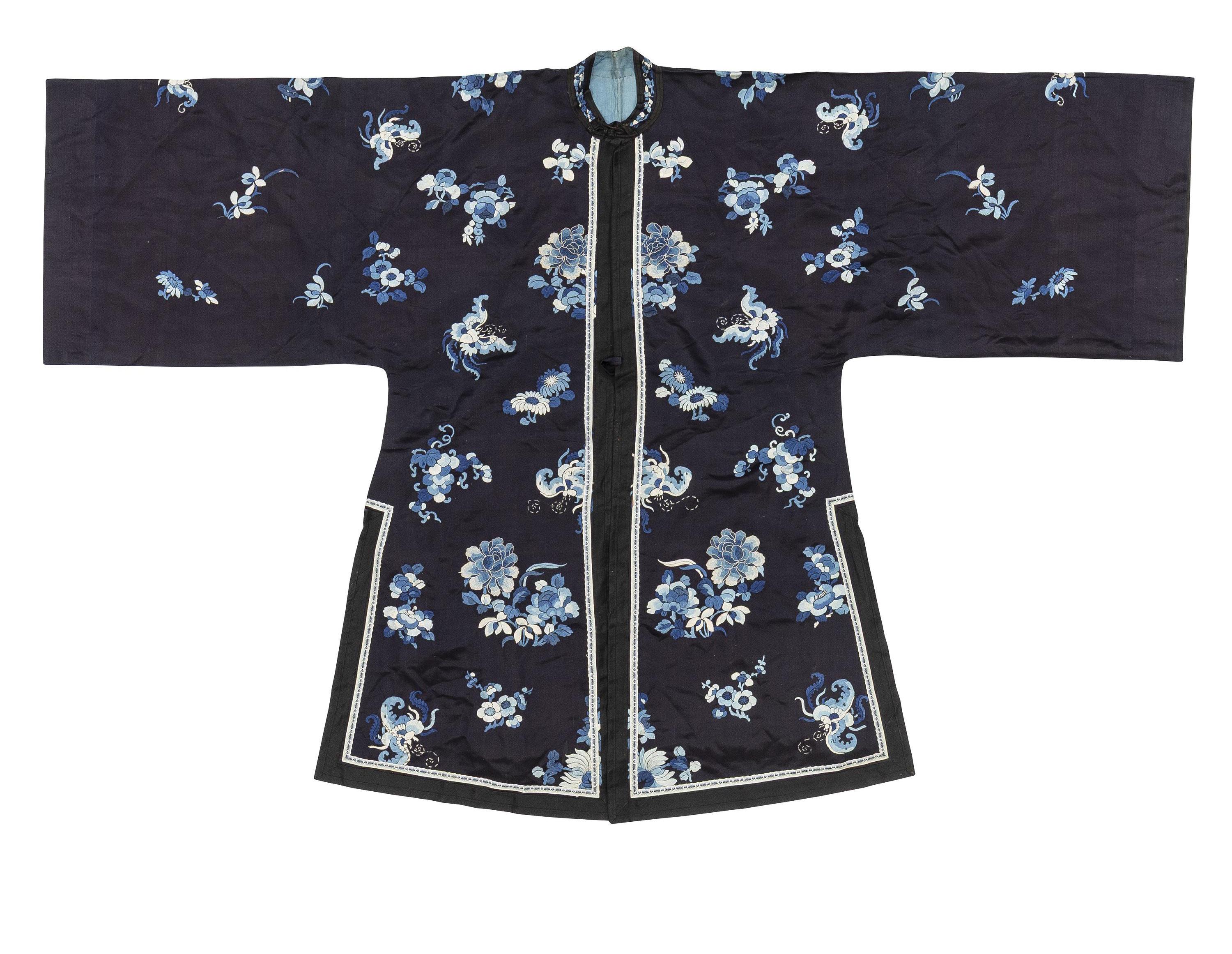
Embroidered with butterflies and flowers against a dark blue ground. Lined with blue silk. Length back 110 cm. Measure arm to arm 172 cm.
Provenance: Property of a private Swedish Estate.
Estimate: SEK 6 000 – 8 000 / EUR 567 – 755
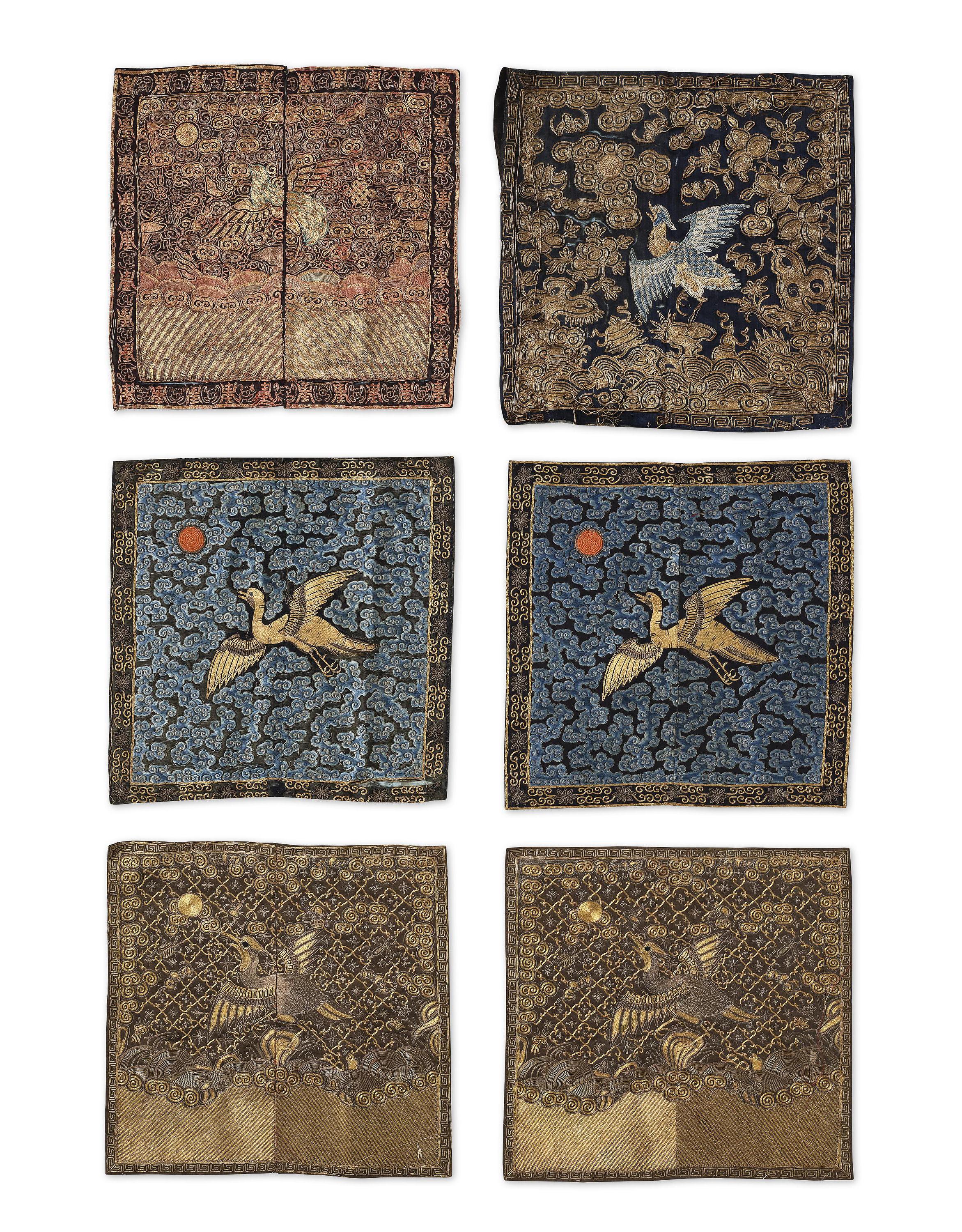
994. A group of six ‘Buzi’, Qing dynasty, 19th century.
Comprising; one embroidered in gold against black with a bird. Around the edges shou characters and bats. Measure 29.5 x 29 cm. Antoher one with a bird in blue surrounded by clouds and peaches above fierce waves all in gold against a dark ground. Measure 29 x 29 cm. Then a pair of golden birds with blue clouds and a coral sun. Lined in blue silk. Measure 28 x 29 cm. A pair of birds, embroidered in gold an silver against a brown ground. Lined in blue silk. Measure 29,5 x 28 cm.
Provenance: Property of a private Swedish Estate.
Catalogue note: A badge featuring a bird identified the wearer as a civil official. To attain such a position required years of intense study, so birds may have been selected because of their literary associations. Each rank was represented by a different species, and while there were slight variations over time, by the Qing dynasty the order from highest to lowest was: crane, golden pheasant, peacock, wild goose, silver pheasant, egret, mandarin duck, quail and paradise flycatcher. Civil officials sat on (…).
Estimate: SEK 10 000 – 15 000 / EUR 944 – 1 420
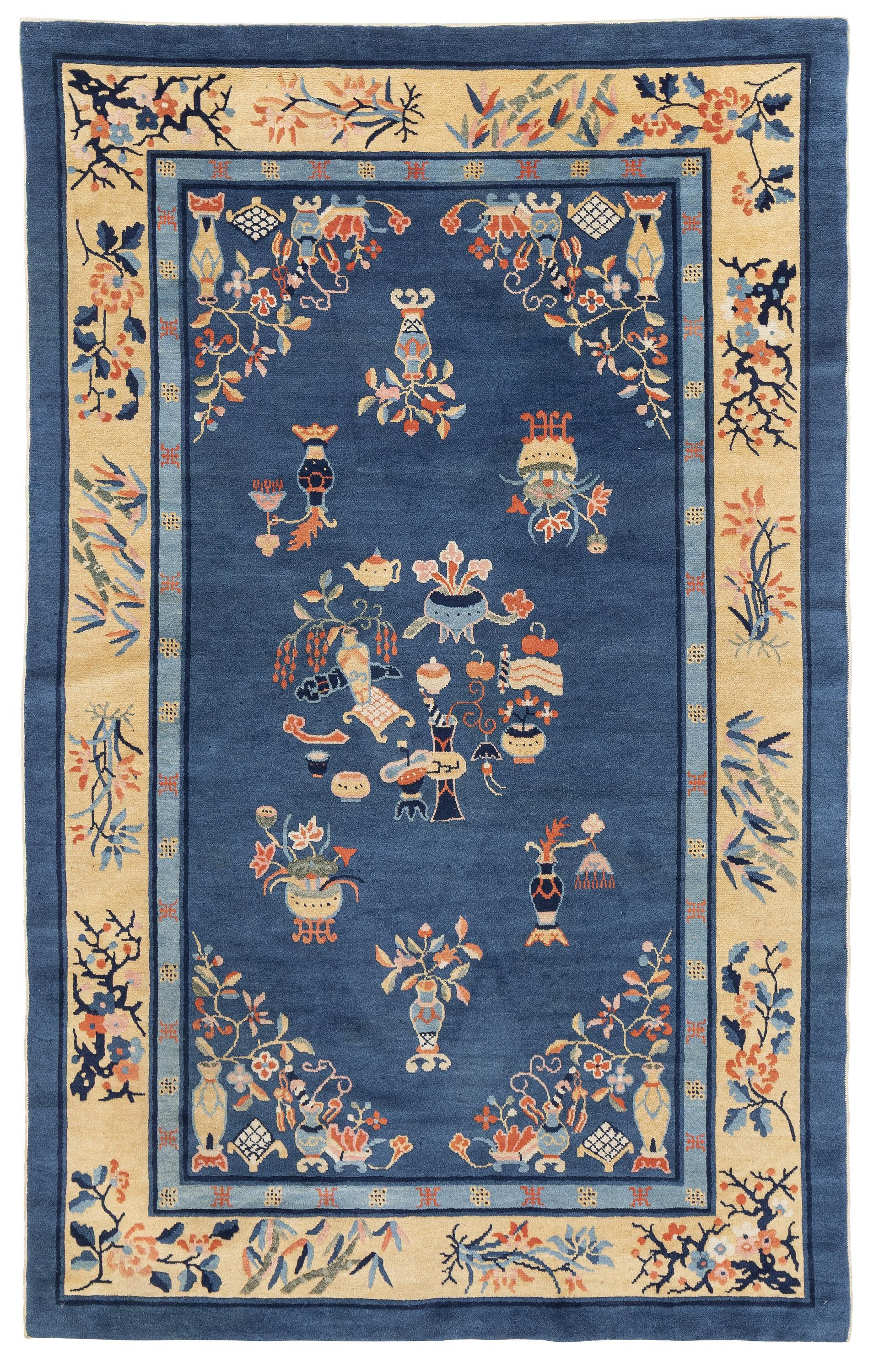
995. An antique, Beijing rug, north China, circa 1920, 243 x 163 cm.
A light blue ground with polychrome medallion and corner ornaments.
A yellow main border with polychrome floral vine.
Provenance: Peter Willborgs samling 1955–2019).
Estimate: SEK 10 000 – 12 000 / EUR 944 – 1 130
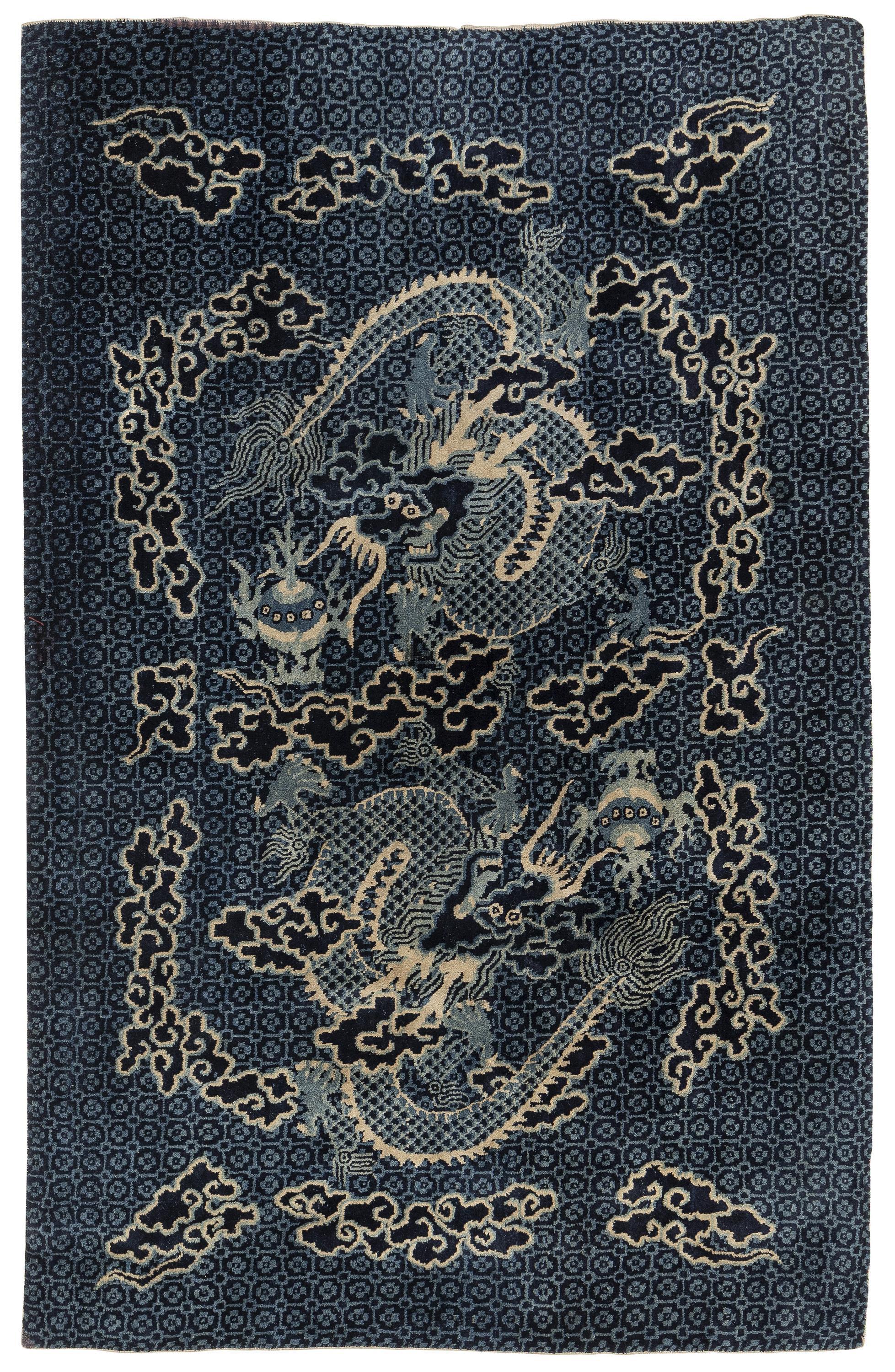
996. A Chinese ‘dragon’ rug, circa 1920, c. 190x122 cm. Dark blue brocade pattern with two five clawed dragons chasing the flaming pearl amidst cloud formations.
Estimate: SEK 10 000 – 12 000 / EUR 944 – 1 130
997. No lot.
From the Collection of Christer R. Christensson
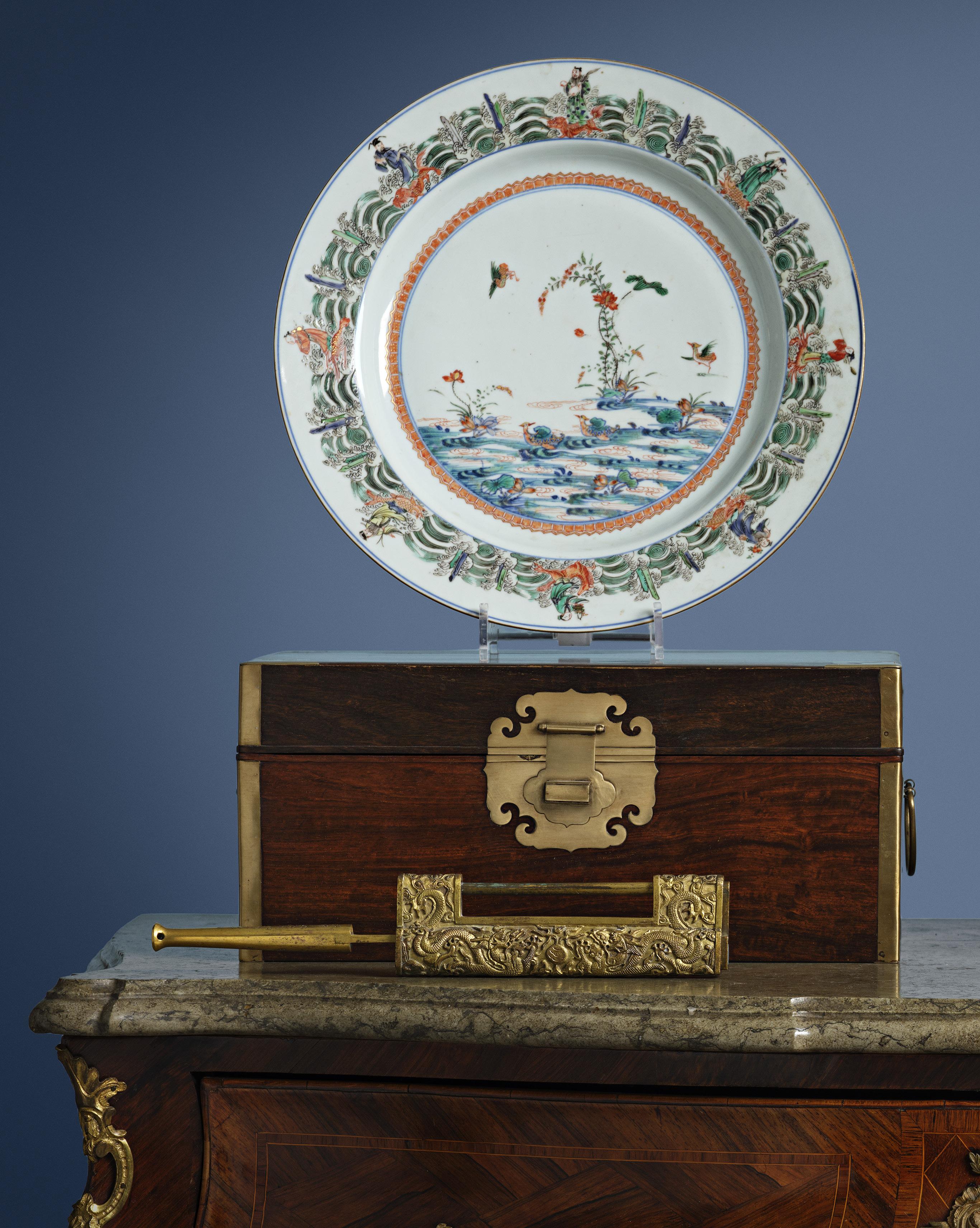
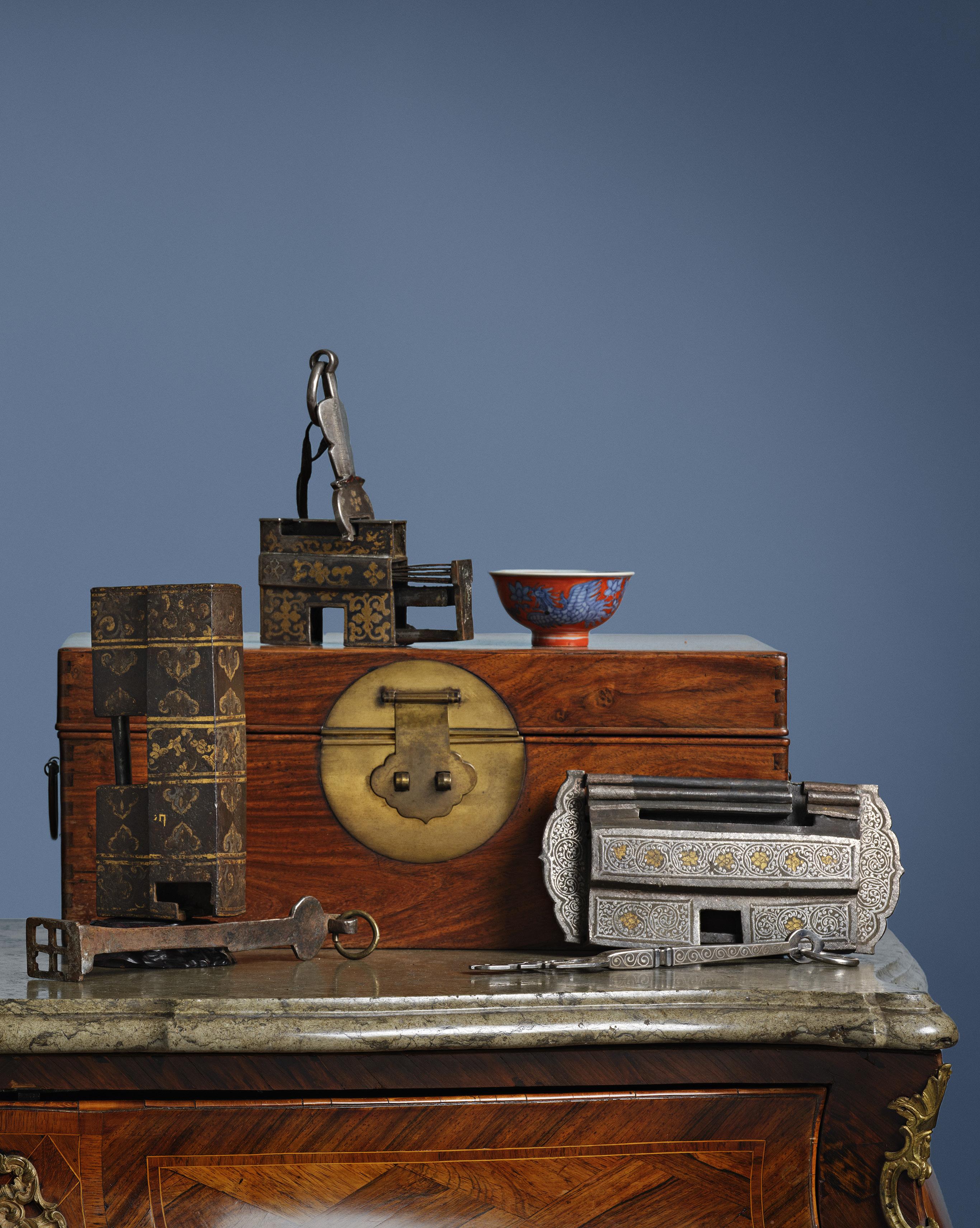
From the Collection of Christer R. Christensson, born 1941. Christers work life took him across the globe a fact that has shaped his Art collection. When we asked Christer about the reason for collecting art, motorcycles, cars and locks, his eyes light up and he talks passionately of the fantastic collaboration between function and form. An object being a sculptural artwork at the same time it has a function.
LOT 998–1007.
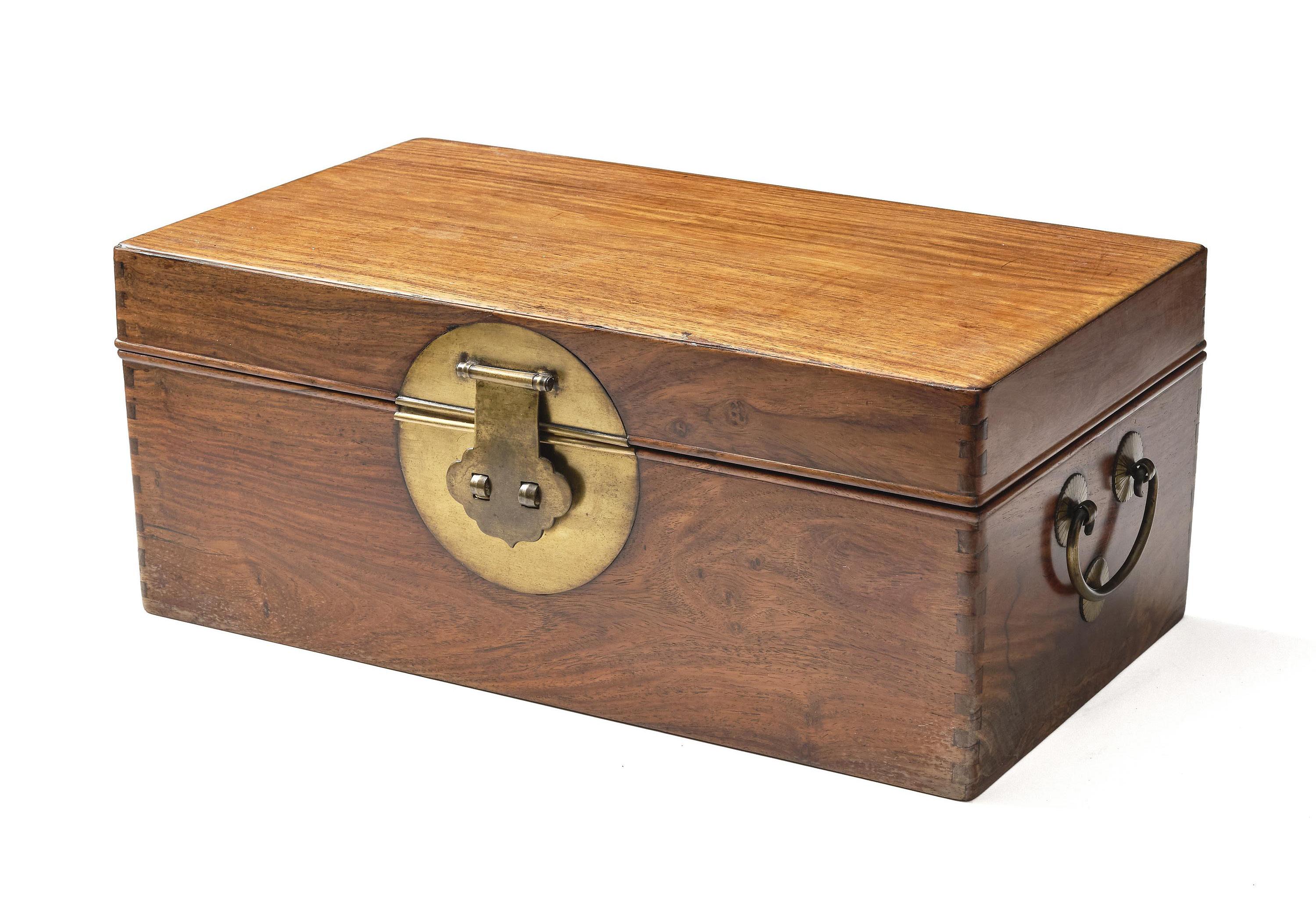
lustrous sheen. Measure 45 x 26 x 18.5 cm.
Provenance: From the Collection of Christer R. Christensson.
Catalogue note: Prospective purchasers are advised that several countries prohibit the importation of property containing materials from endangered species. Accordingly, prospective purchasers should familiarize themselves
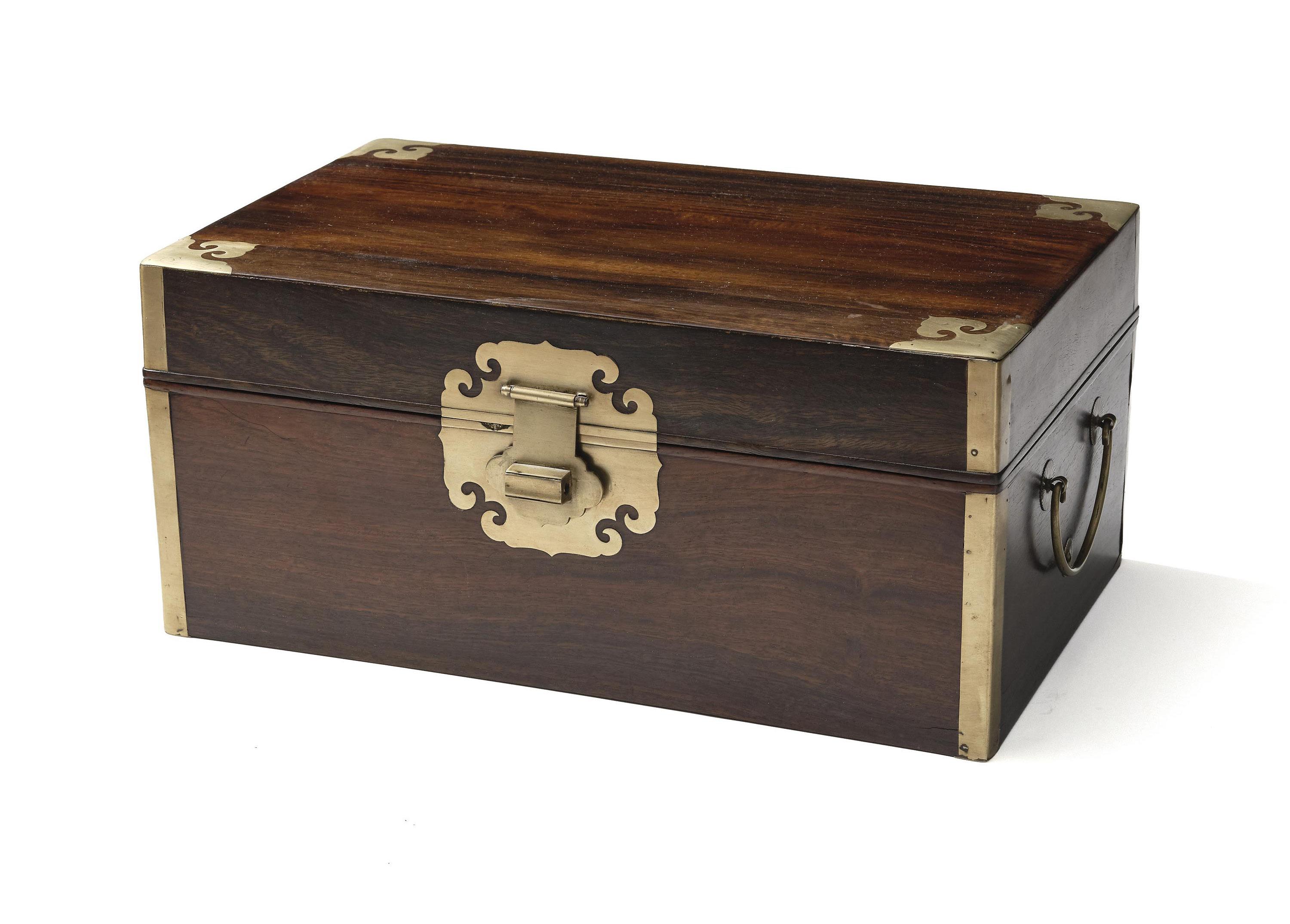
Provenance: From the Collection of Christer R. Christensson.
Catalogue note: Prospective purchasers are advised that several countries prohibit the importation of property containing materials from endangered species. Accordingly, prospective purchasers should familiarize themselves with relevant customs regulations prior to bidding if they intend to import this lot into another country.
Estimate: SEK 12 000 – 15 000 / EUR 1 130 – 1 420
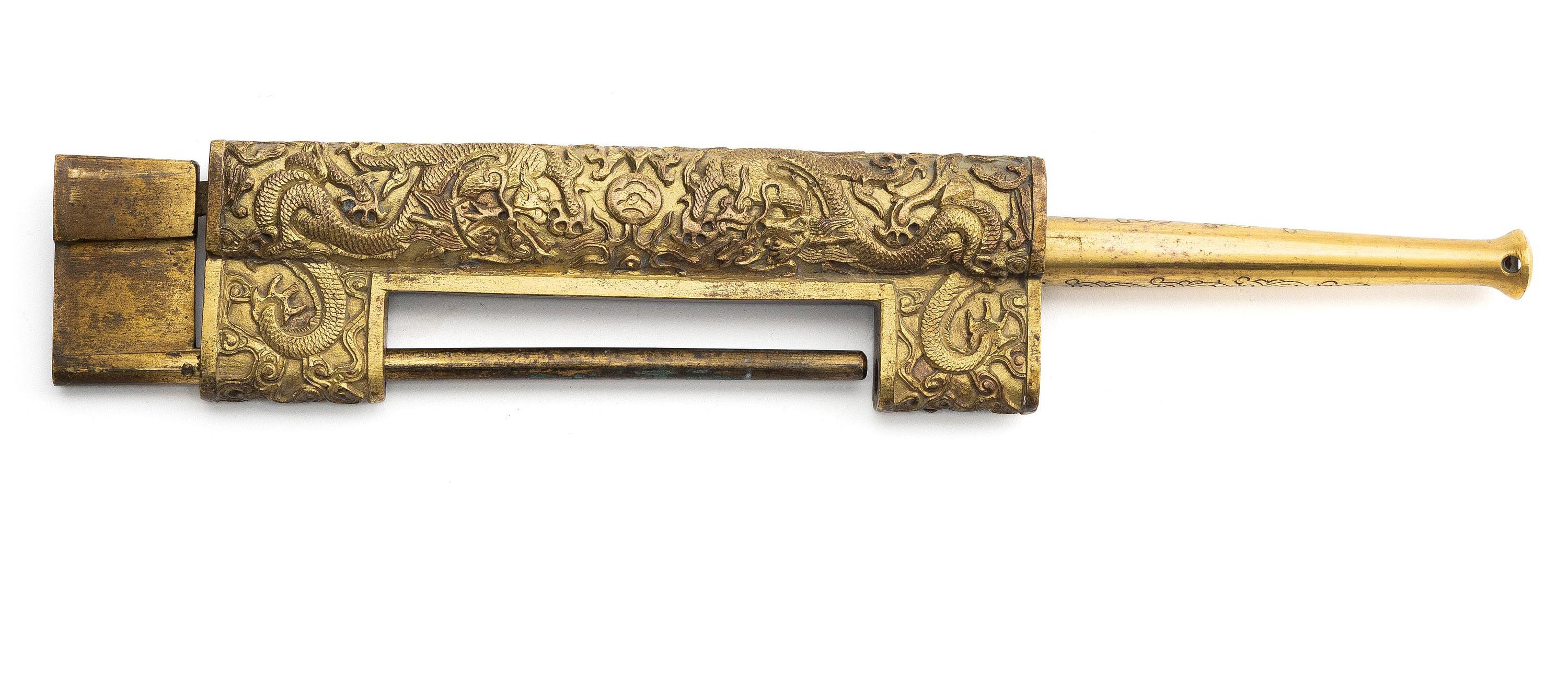
Exhibitions: Compare with a pair that bears Qianlong mark, sold at Christies Live auction 2832, Important Chinese Ceramics and Works of Art, lot 3016, 1 Dec 2010.
Literature: To read more about this kind of locks, see Martina Pall, The Asian Padlock, objects from the Schell Collection Graz, p. 10–83.
Estimate: SEK 120 000 – 150 000 / EUR 11 300 – 14 200
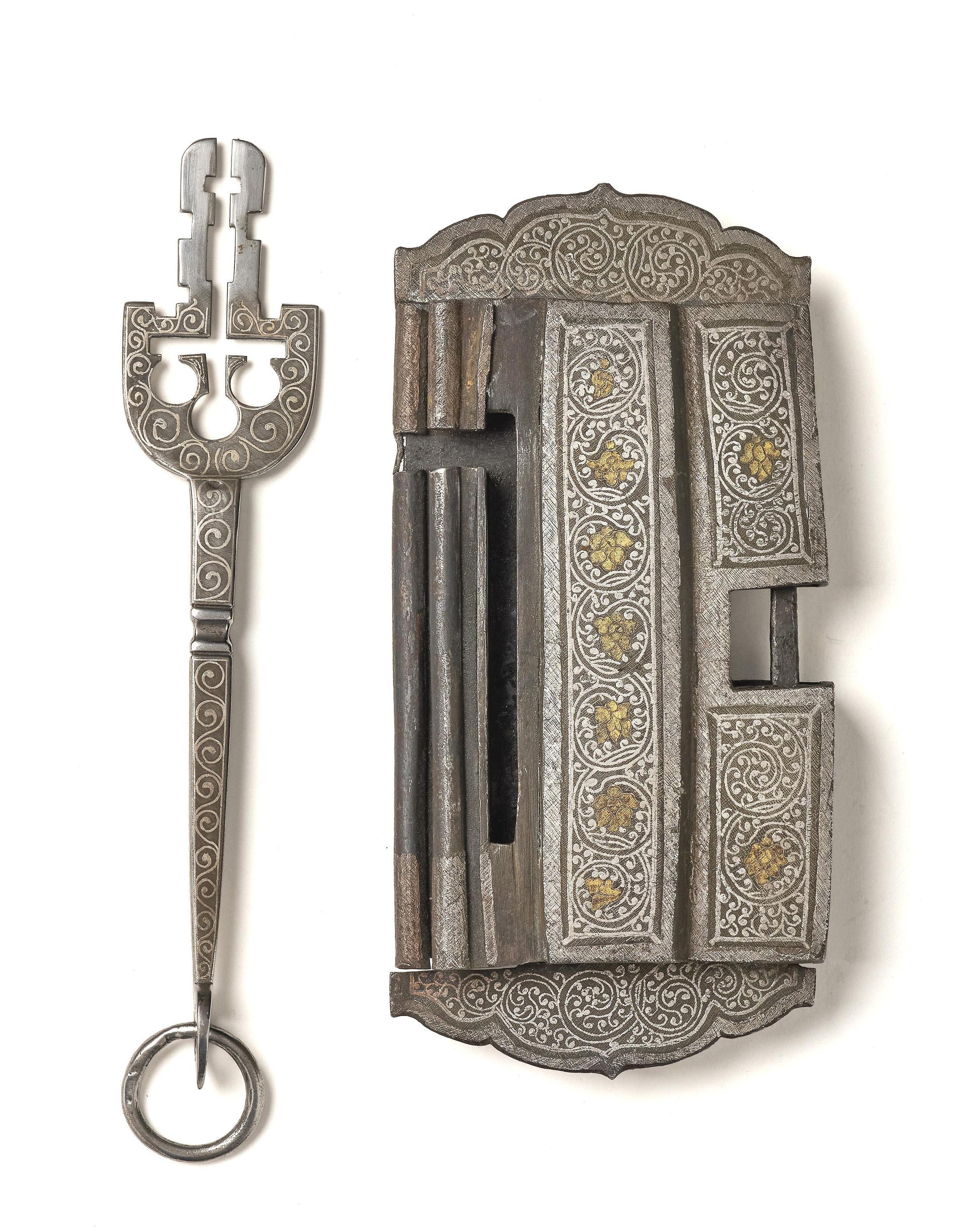
1001. A Shokpa-shaped lock, inlaid with silver threads, Tibet, 19th century. ‘Ashtamangala’.
Rectangular shape, with wide side wings, inlayed in silver and gold in the ‘Koft-Gari technique showing tendrils and spirals on the front and back, the front is enhanced with decoration in gold. Measure 22 x 11 cm. A key accompanies that does not seem to fit. Length 26 cm.
Provenance: From the Collection of Christer R. Christensson.
Literature: To read more about Tibetan locks, see Martina Pall, The Asian Padlock, objects from the Schell Collection Graz, p. 84–117, compare with locks of this type p. 103.
Estimate: SEK 50 000 – 75 000 / EUR 4 720 – 7 080
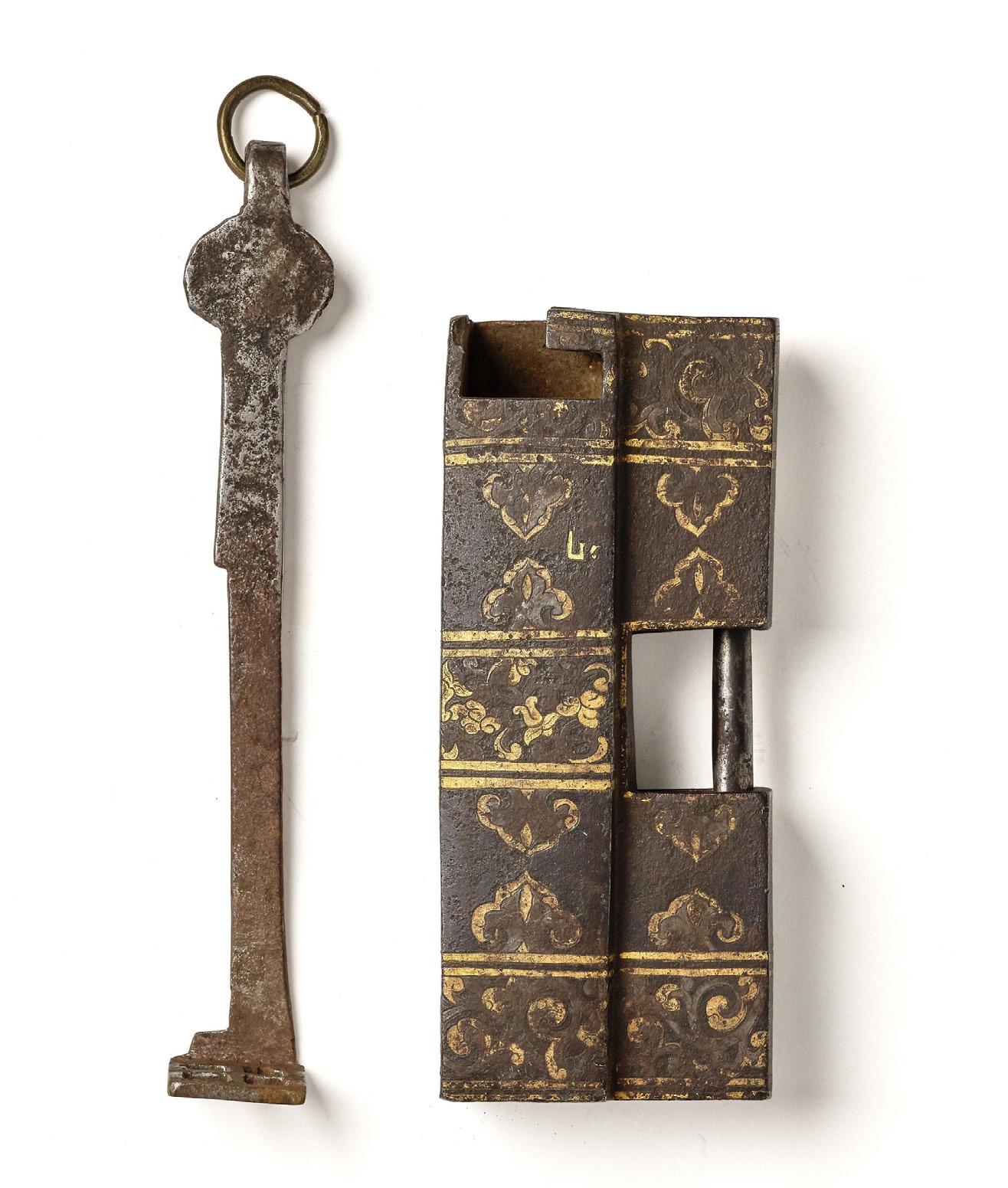
1002. A large iron, silver and gold lock, Tibet, 17th/18th century.
The very heavy lock is the type that can be found in monestaries. Its a rectangular lock with a protruding lower part, decorated with gold and damascened silver in floral scrolls and ruyi patterns on all sides. Traces of a tibetan script, the word “ka”. Measure 20 x 8.5 cm. Length key 25 cm.
Provenance: From the Collection of Christer R. Christensson.
Literature: To read more about Tibetan locks, see Martina Pall, The Asian Padlock, objects from the Schell Collection Graz, p. 84–117. Compare with a Tibetan lock of the same period that has this type of silver and gold inlay but of different decoration, sold at Christies Live auction 2551, lot 818, 21 March 2012.
Estimate: SEK 25 000 – 30 000 / EUR 2 360 – 2 830
1003. A Tibetan lock for a chest, late 18th century/early 19th century. With an inscription both on the key and on
Iron, cast in a rectangular shape with a protruding mid section. Gilded decoration of a floral scroll. Measure 9 x 8 cm. Length key including ring handle 15 cm.
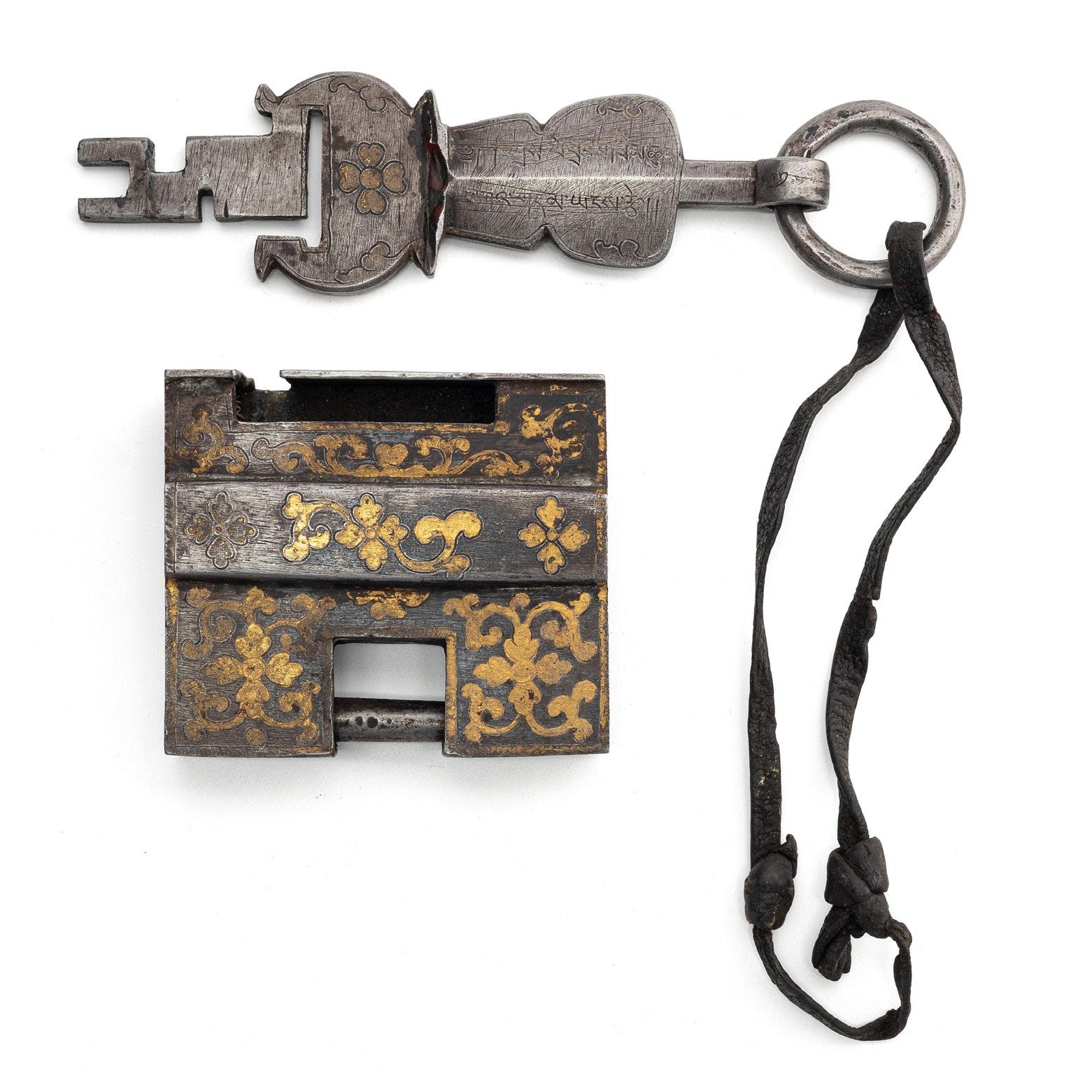
SEK 25 000 – 30 000 / EUR 2 360 – 2 830
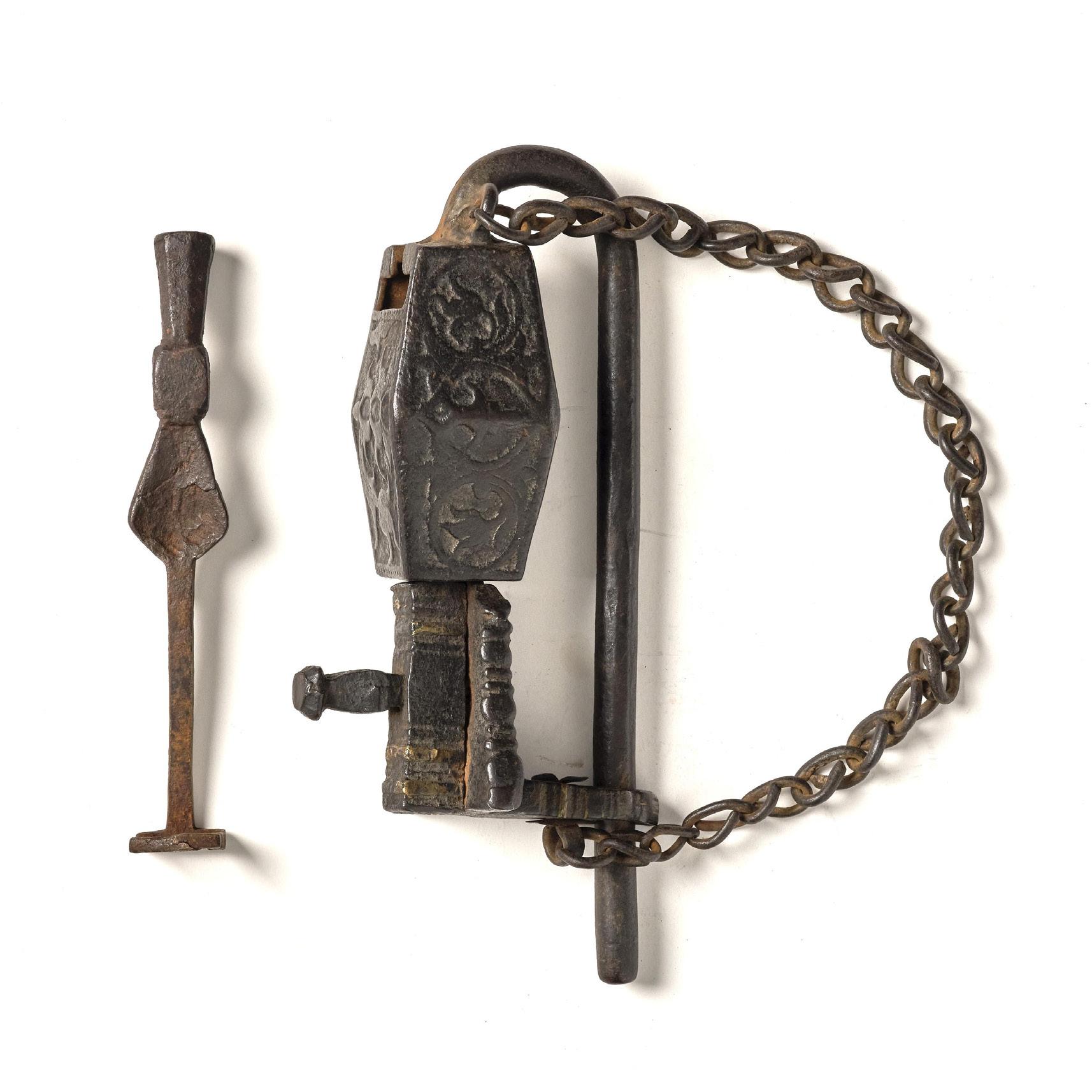
1004. A cast Iron ‘Temple lock’, Nepal, 19th century.
The heavy iron lock is cast with decoration to one side with interlocking harts, the other side with roundels of flowers. Length 28 cm. Length key 20 cm. Chain still intact.
Provenance: From the Collection of Christer R. Christensson.
Literature: To read more about Nepalese locks, see Martina Pall, The Asian Padlock, objects from the Schell Collection Graz, compare locks of this style on p. 118–141.
Estimate: SEK 30 000 – 40 000 / EUR 2 830 – 3 780
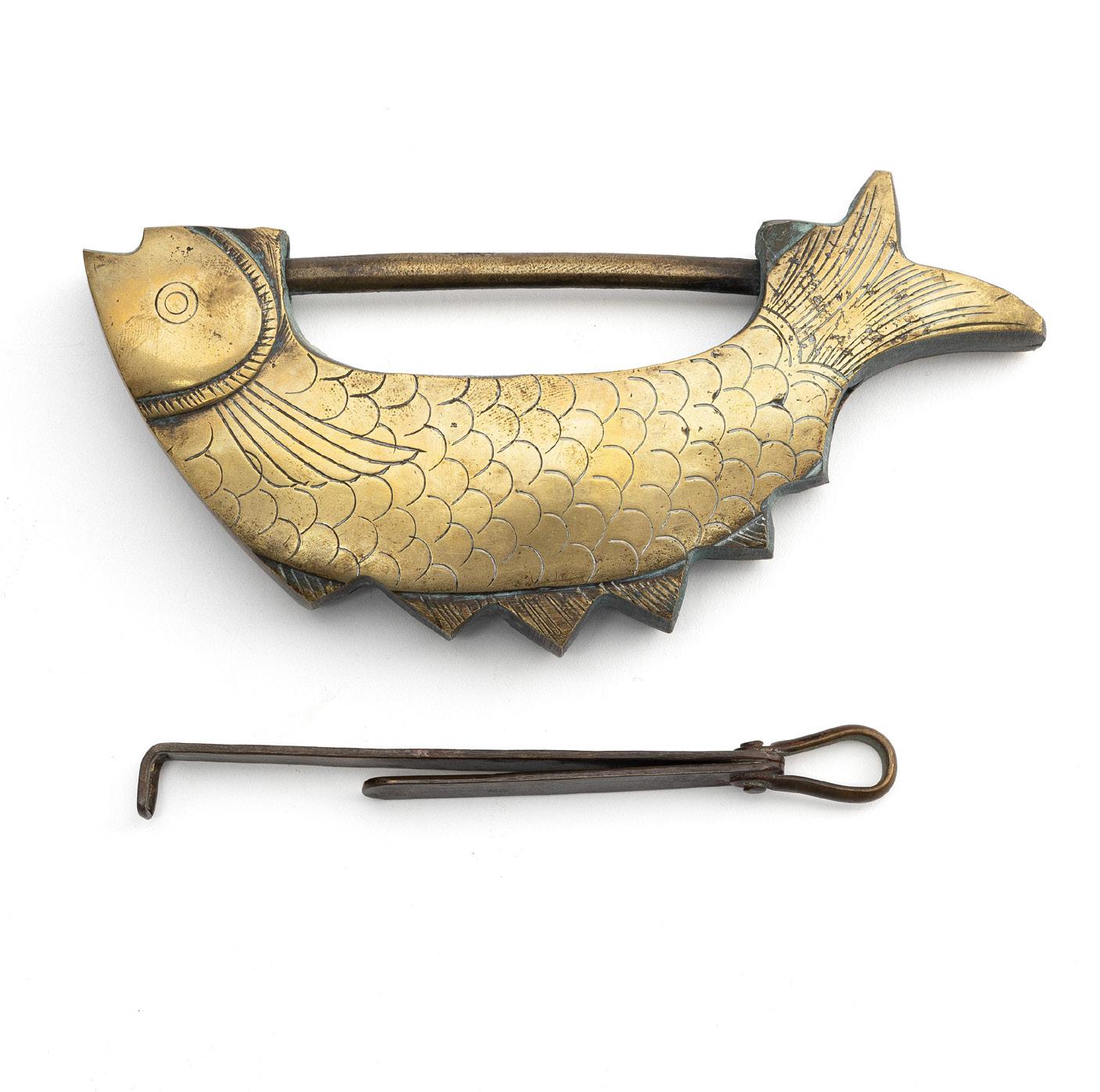
1005. A Korean ‘fish’ lock (Ja Mool Tong), circa 1920.
In the shape of a carp. Length 17.5 cm. Length 13.5 cm.
Provenance: From the Collection of Christer R. Christensson.
Literature: Depicted in the book, Svenska Samlare (Swedish Collectors), by Kim von Platen and Göran Tull, 2003, p. 141. To read more about these fish locks, see Martina Pall, The Asian Padlock, objects from the Schell Collection Graz, p. 158–160.
Catalogue note: The fish was considered a good gard of a lock, since they never close their eyes.
Estimate: SEK 8 000 – 10 000 / EUR 755 – 944
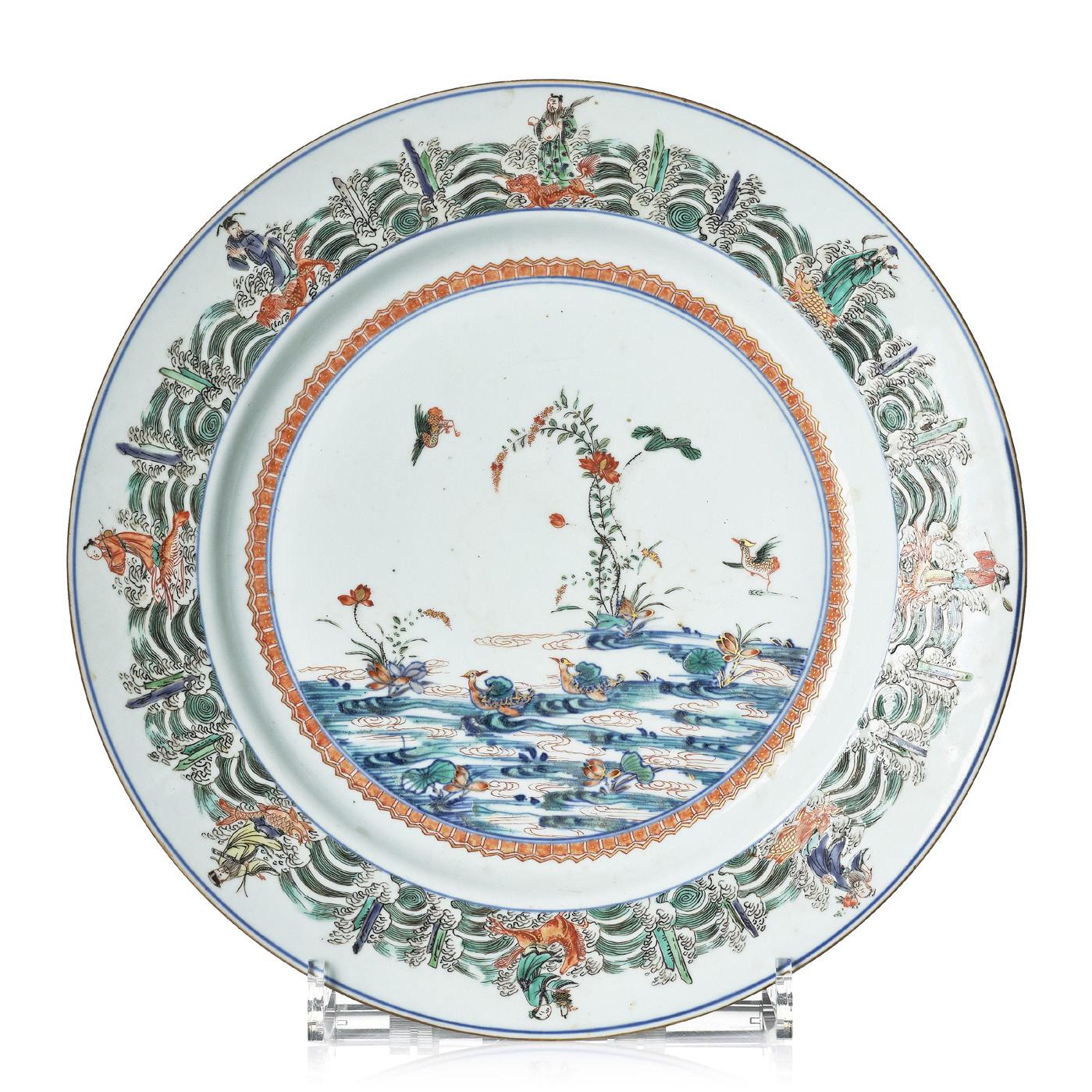
1006. A famille verte ‘immortals’ dish, Qing dynasty, Kangxi (1662–1722).
Decorated in doucai and famille verte colours, a central scene with ducks in a lotus pond, around the rim the immortals riding on various creatures amidst wild waves. Diameter 36 cm.
Provenance: From the Collection of Christer R. Christensson.
Exhibitions: Compare a dinner plate of this type but smaller sold at Sothebys Hong Kong, China 5000 years, lot 358, 26 May 2021. Compare with a dish of this type but smaller in the Metropolitan Museum of Art, New York, Credit Line: “Purchase by subscription, 1879”, object Number: 79.2.1288.
Estimate: SEK 8 000 – 10 000 / EUR 755 – 944
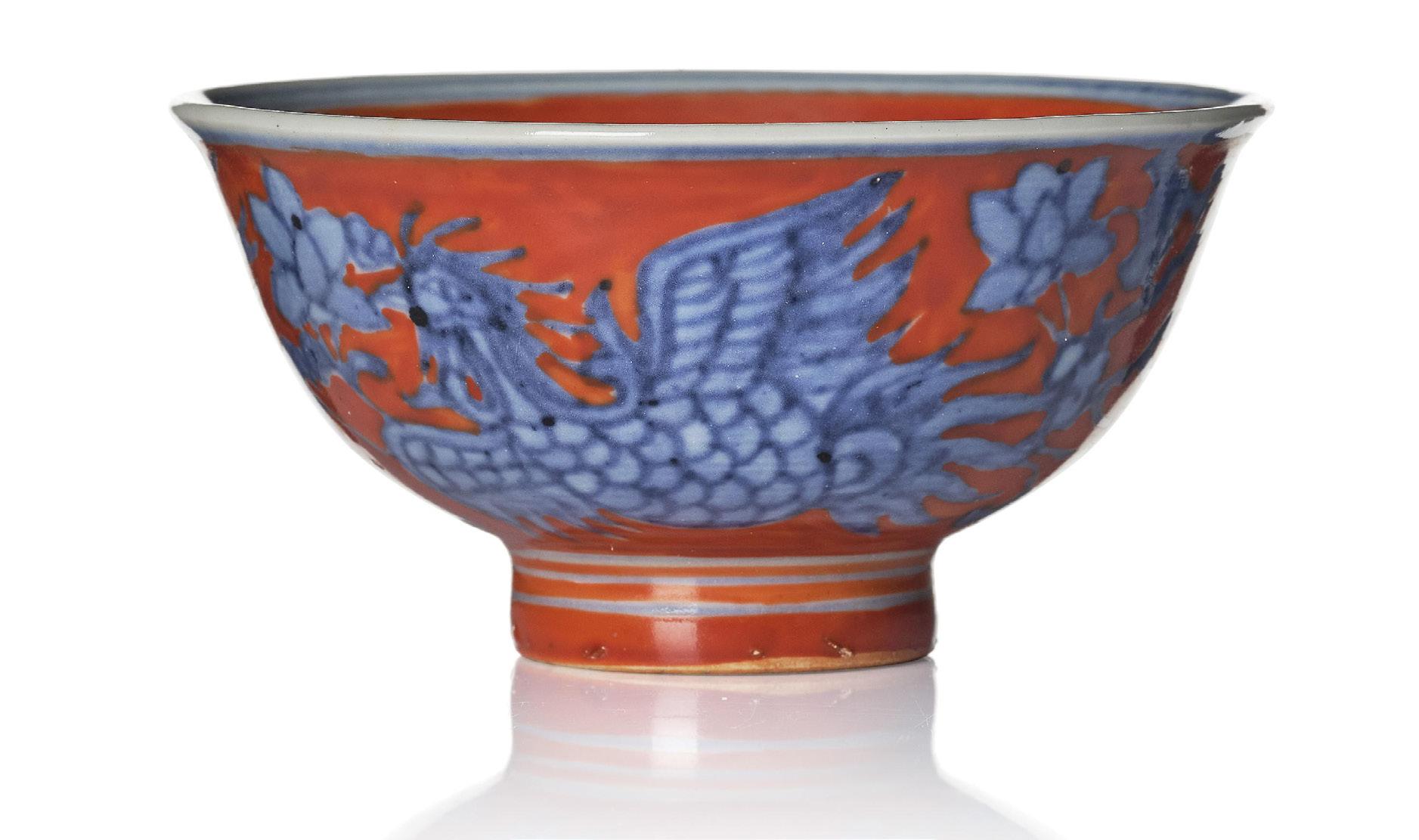
1007. A small blue and white phoenix cup, Qing dynasty, 19th century.
Rounded sides with a flared rim standing atop of a rather tall straight footrim. Decorated in underglaze blue with phoenix birds amidst lotus surrounded by iron red ground. The base with a six character apochryphal Chenghua mark within double circle. Diameter 9 cm. Height 4.5 cm.
Provenance: From the Collection of Christer R. Christensson.
Estimate: SEK 15 000 – 20 000 / EUR 1 420 – 1 890
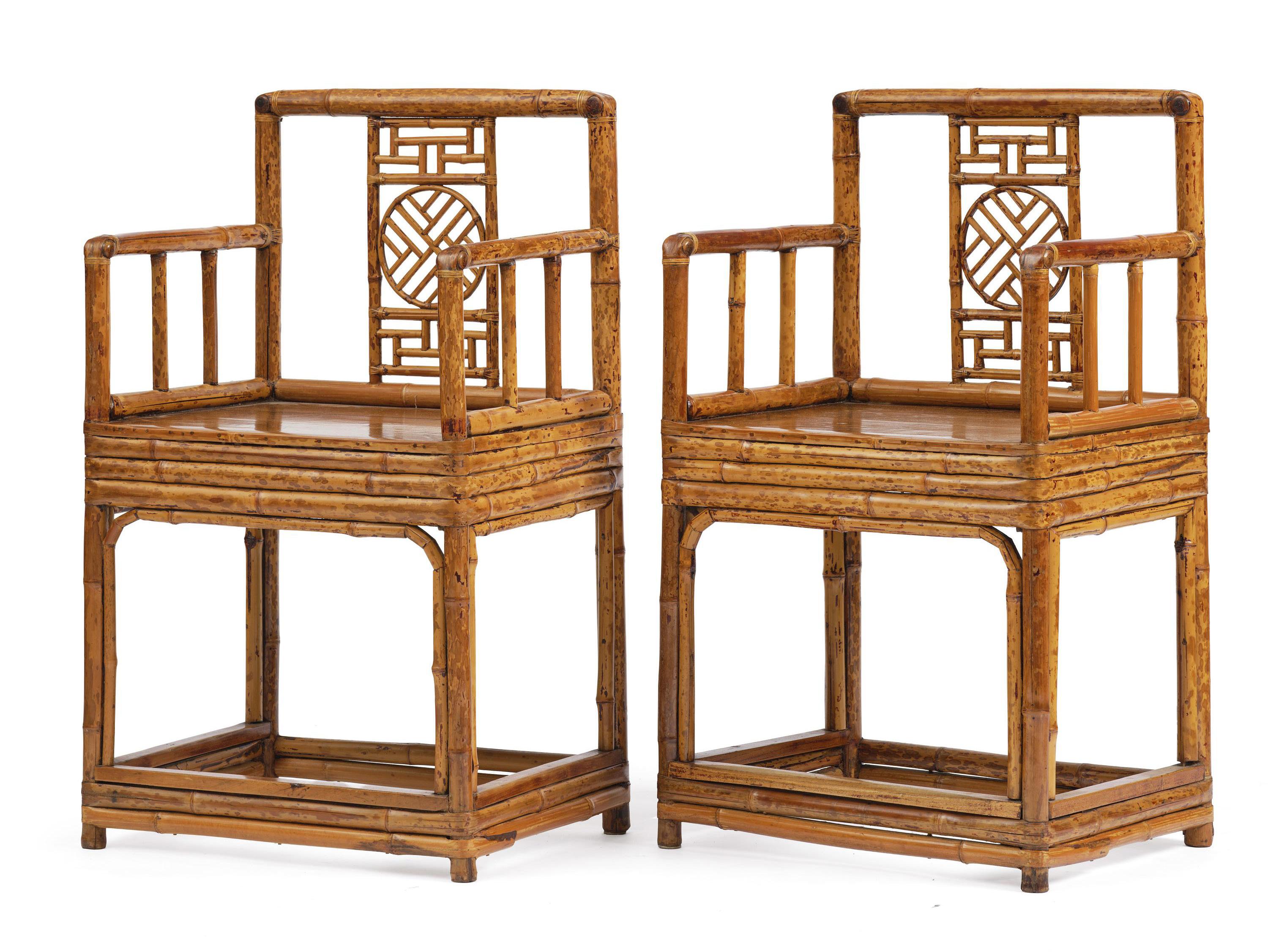
1008. A pair of spotted bamboo arm-chairs, Qing dynasty, 19th century.
Each is constructed with a U-shaped bamboo crestrail continuing to form the arms and the front posts, supported by four slender bamboo sideposts. The lacquered wooden seat above an apron of four bamboo legencircling stretchers, supported on legs joined at the base with two leg-encircling stretchers with a softwood footrest. Height back 93 cm. Height seat 52 cm. Width 54 cm. Depth 42 cm.
Provenance: Purchased at Bukowskis Spring Sale 574, lot 1419, 28 May 2013. Then with the provenance Kaptensgården, Landskrona, Sweden.
Exhibitions: Compare also with Sotheby’s New York, In the Studio: Asian Art, featuring Works from the Collection of Bruce Dayton and Ruth Stricker Dayton, lot 752, 28 September 2021.
Literature: For an interesting discussion on bamboo and hardwood furniture, refer to R. W. Longsdorf, ‘Chinese Bamboo Furniture, Its Influence on Hardwood Furniture Design’, Orientations, January 1994, pp. 76–83, where the author discusses the features of bamboo furniture carried over to hardwood forms, such as rounded members, wrap-around stretchers, stacked stretchers and the use of closely-placed vertical struts.
Catalogue note: In China, bamboo has traditionally held a place of significance within literati culture. Together with the flowering plum and pine, they form the ‘Three Friends of Winter’ for their ability to withstand the cold and remain green. Upright and sturdy, yet easily bending with the wind, bamboo came to signify moral integrity among the literati elite, and has served as a constant source of inspiration for poets and painters, alike. When compared to their hardwood counterparts in huanghuali and zitan, relatively few examples of bamboo furniture have survived. The material is less durable than hardwoods, and abundant enough that replacements could be easily made. To make a piece of furniture in bamboo, lengths of bamboo were steamed and softened until pliable and bent around a frame. This construction technique inspired examples in huanghuali seen in wraparound stretchers, round legs, circular struts, members carved to imitate nodes of bamboo, and continuous arms.
Estimate: SEK 15 000 – 20 000 / EUR 1 420 – 1 890
1009. No lot.
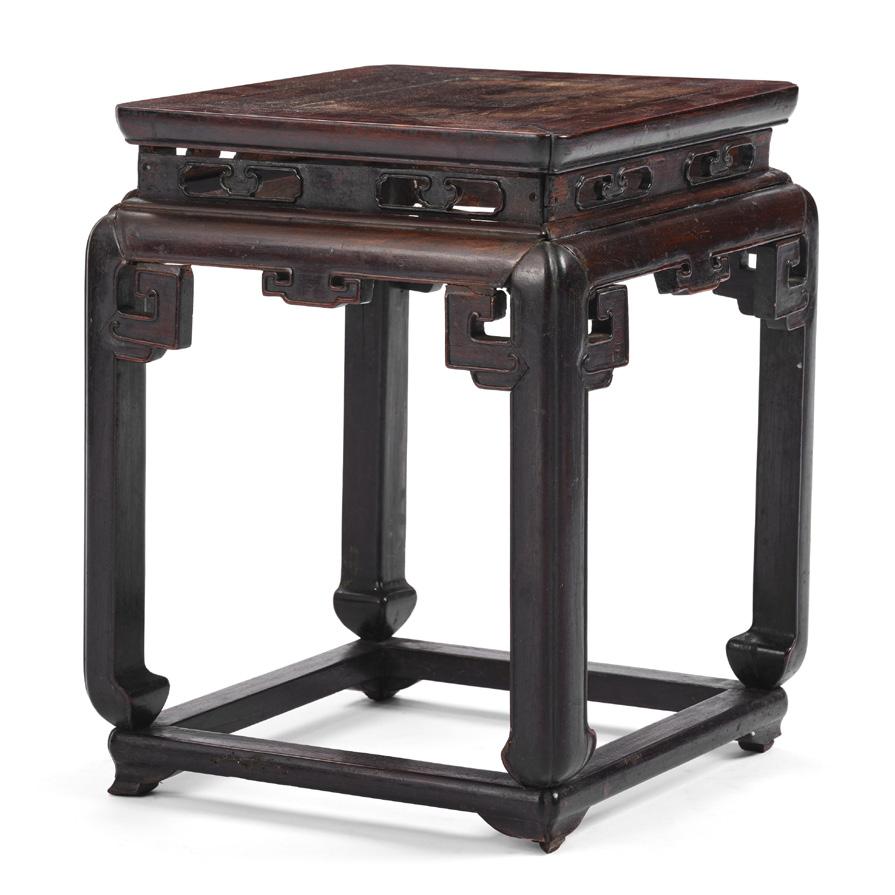
1010. A hardwood square stool (Fangdeng), Qing dynasty, 19th century. The panel top set within a square frame with rounded corners, above a narrow openwork waist supported by four rounded legs joined by stretchers. Measure top panel 34 x 34 cm. Height 46 cm.
Provenance: Property of a private collector.
Exhibitions: Compare with a pair of stools of this type sold at Sothebys New York, Chinese Art, lot 280, 18 March 2025.
Estimate: SEK 6 000 – 8 000 / EUR 567 – 755
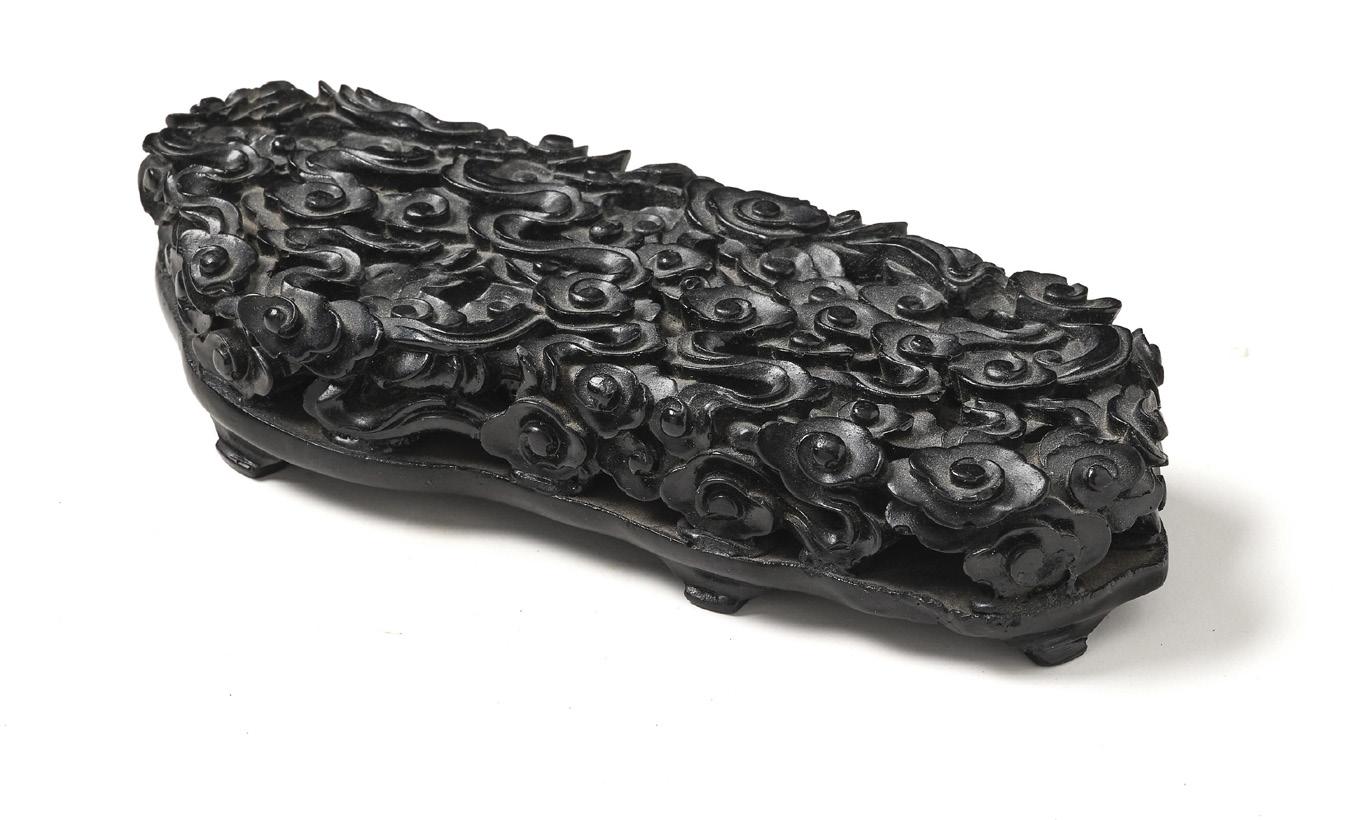
1013. A lacquered and painted wooden stand, China, presumably late Qing dynasty.
In the shape of cloud formations. Height 4.3, length 22.5, width 9 cm.
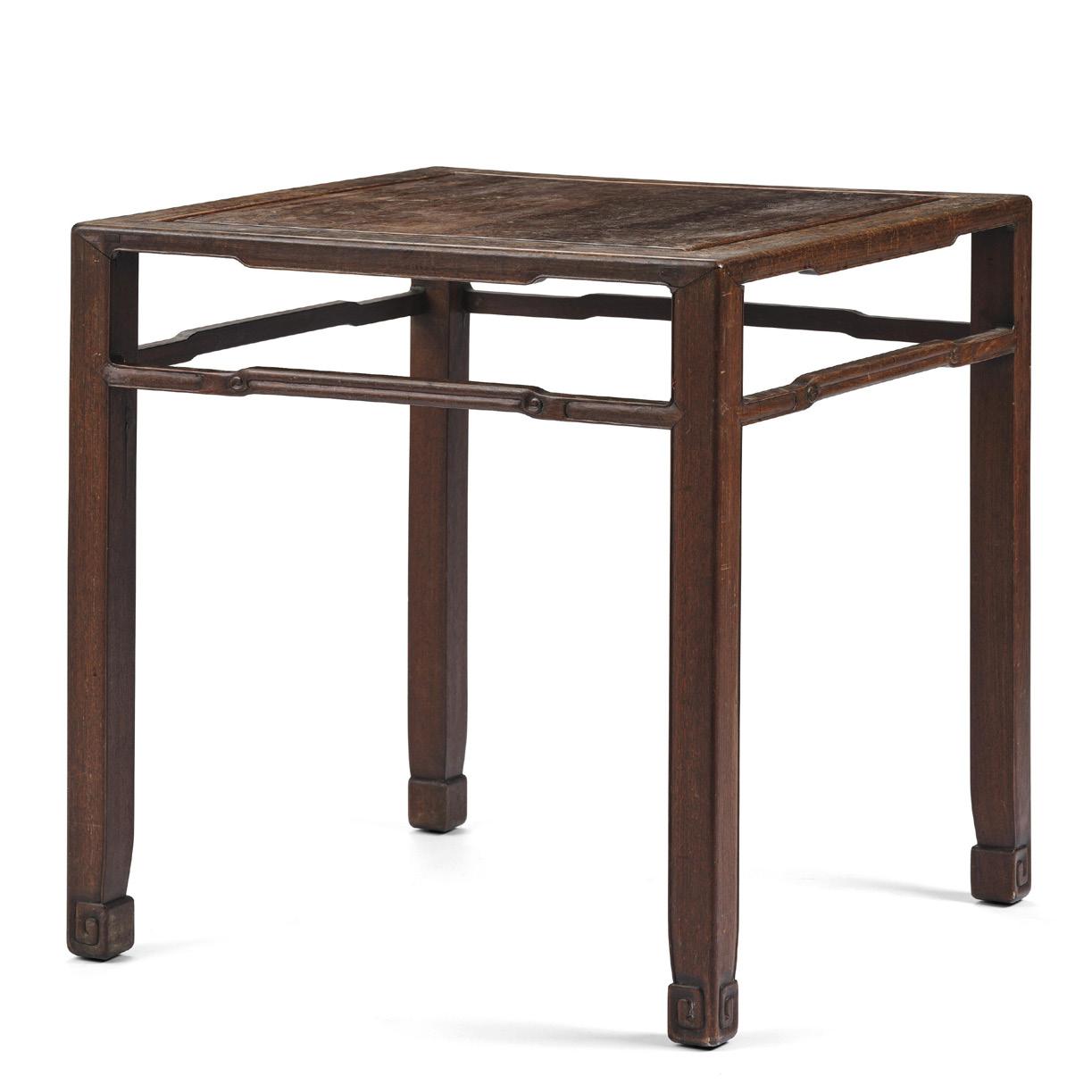
1011. Table, hardwood. Qing dynasty. Well proportioned table, square slender top, continuing to squaresectioned legs terminating in hoof feet, the legs secured by humpbacked stretchers. Table top 74x74, height 76.5 cm.
Estimate: SEK 10 000 – 15 000 / EUR 944 – 1 420
Provenance: Purchased at Bukowskis Spring Sale 633, lot 872, 2 June 2021. Then with provenance: From the Collection of Henrik Eugene Reuterswärd (1881–1964), thence by descent to Marina Reuterswärd. Henrik E Reuterswärd was employed by Mo and Domsjö Aktiebolag, from 1901, later MoDo, the company was later lead by the famous collector of Asian art Carl Kempe (1884–1967). Reuterswärd built his collection during the golden age of collecting in Europe. The interest for works of art from Asia were great at the time, this was enhanced by many factors such as; that the world renowned Swedish geographer, topographer, explorer, photographer, travel writer Sven Hedin 1865–1952 hade made several excursions to Asia 1898–1907. The famous China Club were founded in 1929. The Karlbeck syndicate were formed and Orvar Karlbeck (1879–1967) made several trips to acquire objects for collectors and Museums around the world. Henriks relative C.R. Patrik Reuterswärd (1885–1963) was posted as charge d’affaires in Tokyo, Peking and Shanghai 1911–1914. One can also wonder if his relative C.R. Patrik Reuterswärd (1885–1963), who was posted as charge d’affaires in Tokyo, Peking and Shanghai 1911 inpired him as well.
Estimate: SEK 4 000 – 6 000 / EUR 378 – 567
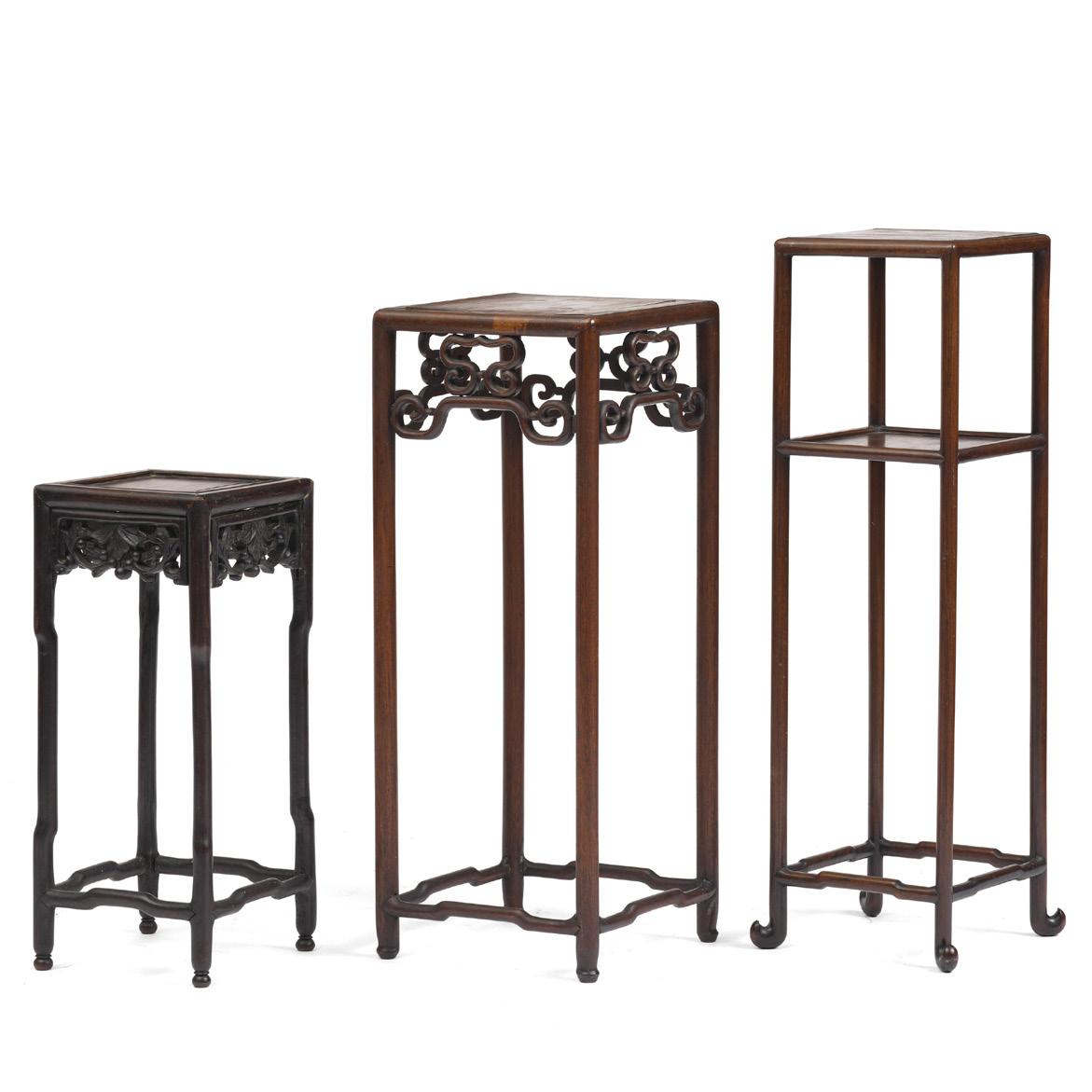
1012. A group of three hardwood tall tables, Qing dynasty. Of square form. The smaller one decorated with carved grapes and leaves at the apron. Height 52–78.5 cm.
Provenance: From a private Scandinavian collector.
Estimate: SEK 4 000 – 6 000 / EUR 378 – 567
1014. A red and gold lacquer stool, Qing dynasty, presumably 18th century.
The ruyi-shaped top above a narrow reticulated apron, the outward curving legs terminating in connected feet, decorated in red and gold. Length 47, depth 37, height 47 cm.
Provenance: Purchased at Bukowskis Winter Sale 583 , lot 354, 2 December 2014.
Estimate: SEK 8 000 – 10 000 / EUR 755 – 944
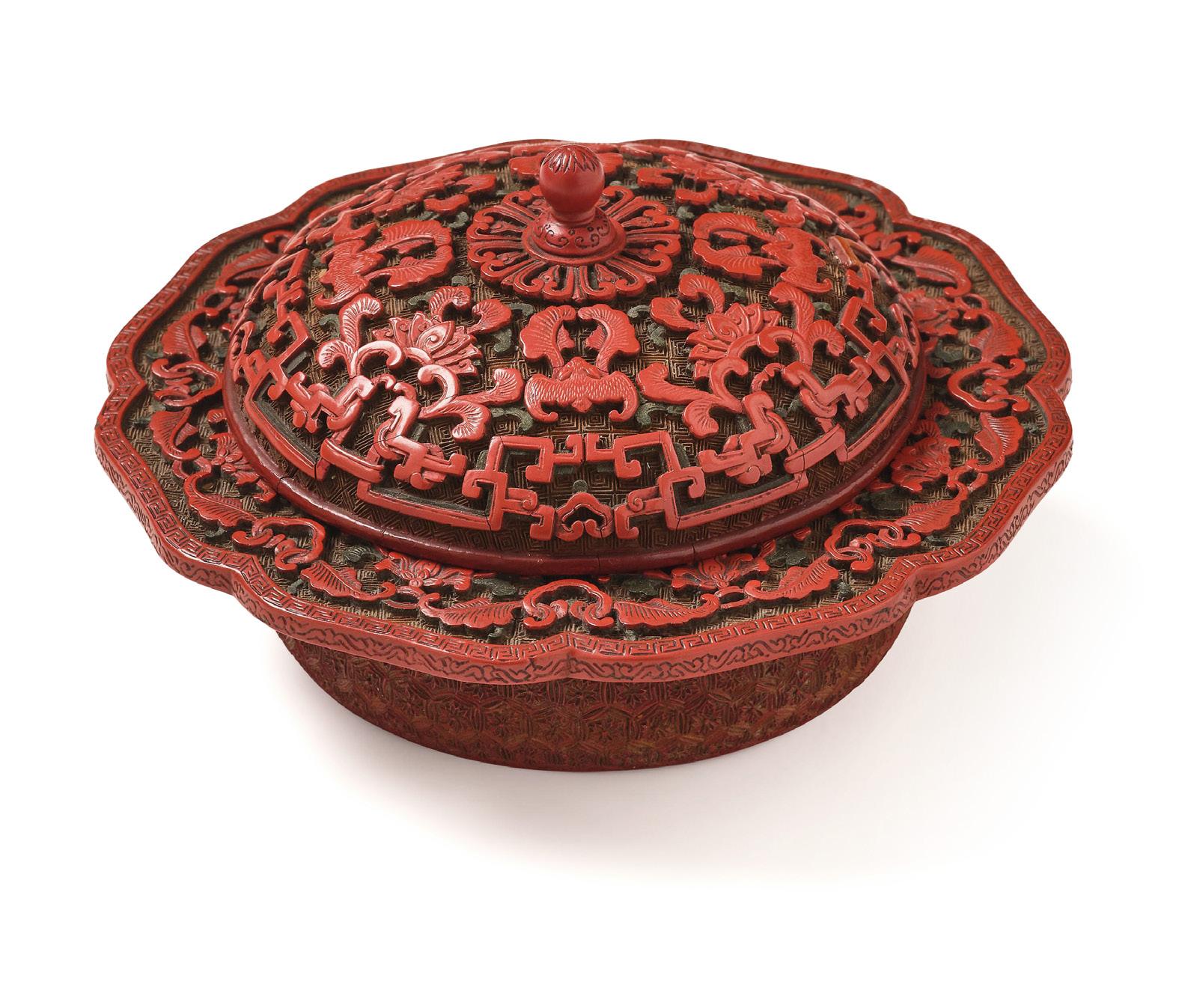
1015. A Chinese three-colour lacquer box and cover, Qing dynasty, Qianlong (1736–95).
The wide flattened lobed rim and domed cover deep carved with foliate motifs interspersed with bats and ruyi heads on a diaper ground. Diameter 14.8 cm.
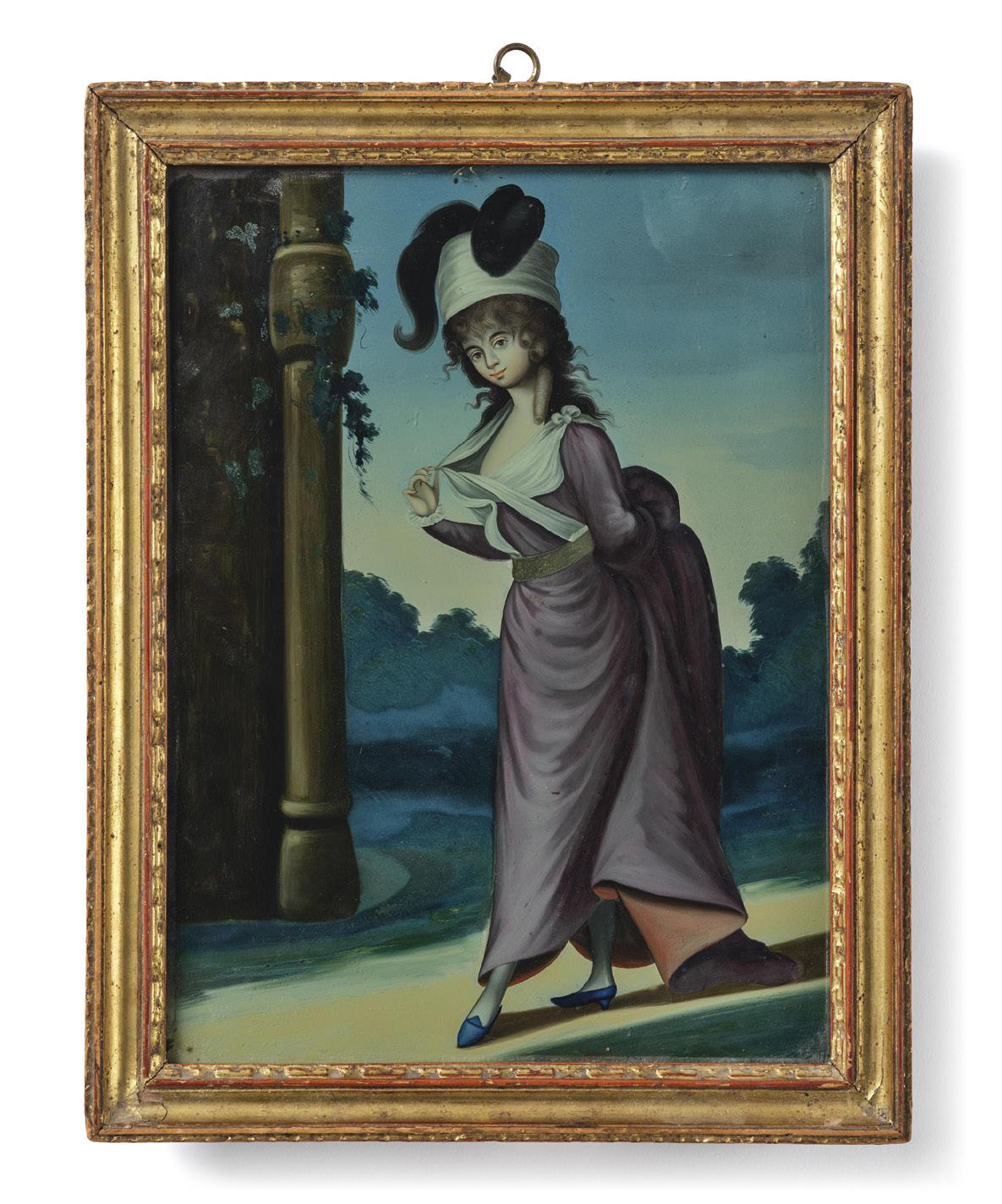
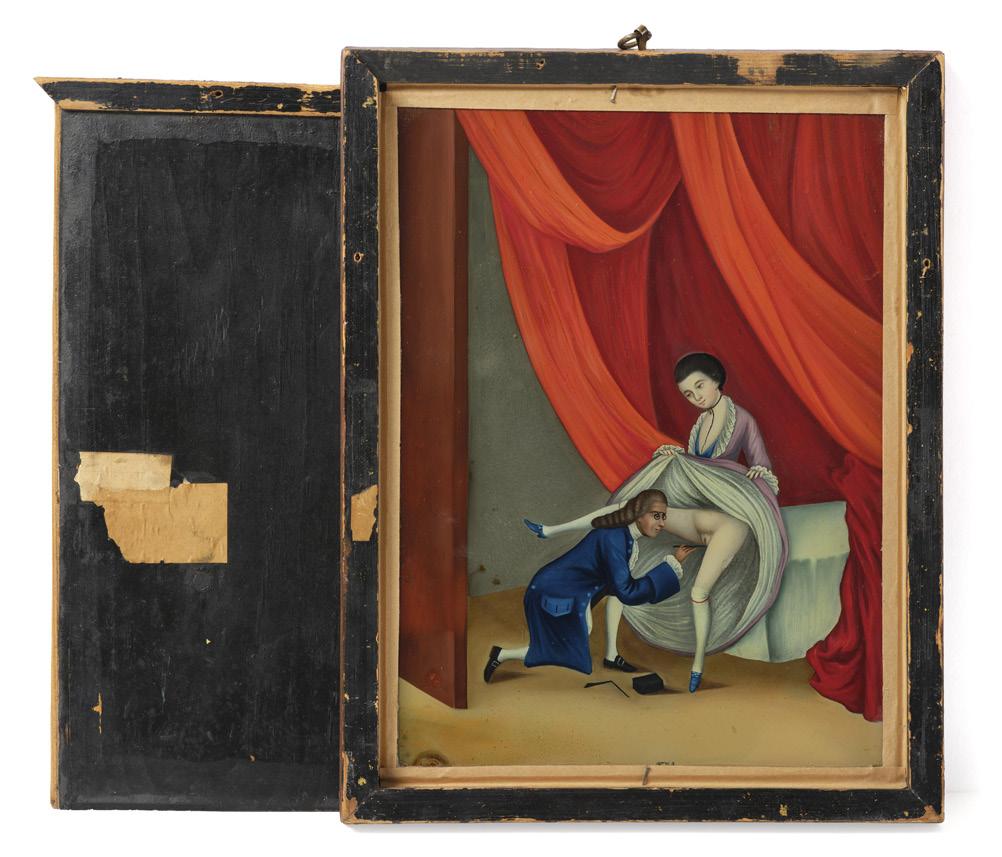
1016. A Chinese reverse glass ‘Erotic’ painting, double sided, Chinese School, Qing dynasty, circa 1800.
Elegant lady with a large hatt with black feathers, she lifts her blouse and bares her bosom. Can be opened in the back, with erotic motif. Measure motif 22 x 29.5 cm. Measure with Chinese frame 27 x 35 cm.
Provenance: Property of a private Swedish collector.
Literature: Margaret Jourdain and R Soame Jenyns; Chinese Export Art in the Eighteeth Century, discusses about the paintings on glass, the cultural exchanges in these, made fore export, ofthen deriving in som degree of the decoration from European engravings. The technicque arriving to the court of Peking thorugh the Jesuit G. Castiglione (1688–1766). These paintings have their chinese counterpart as well, boxlike paintings or ivory-carvings for example with a hidden drawer in the back to reveal an erotic image.
Estimate: SEK 8 000 / EUR 755
1017. An Ancestral painting of a Manchu bannerman, Qing dynasty, 19th century. Signed.
The one seal reads Liu, followed by Xiang. The lower signature looks to be 瑶生 . Portraying a high ranking official/bannerman dressed in a formal manchu ceremonial outfit chaofu, consisting of cape (pi ling), a blue silk dragon court robe (chaopao). He is depicted with a powerful gaze, seated on a throne, with a gold finial inset with pearls and a ruby stone. Measure motif 97.5 x 188 cm. Measure with frame 109 x 200 cm. Can be rolled up.
Provenance: From a private Swedish Collector who purchased the two portraits from an Estate Sale in the early 1970’s from a lady who lived in Sweden but had German/ Austrian roots. The dragon jifu with the large dragon is illustrated in what was the fashion in the 17th century, perhaps giving us a clue to whom it is, a high ranking member of the Qing society and very possibly of the inner circle of the Qing Imperial Court. According to dress regulations, only male princes of the highest orders could wear the blue ceremonial robe, the chaozhu neclace made of precious stones and the hat finial embellished with pearls and a ruby stone.
Exhibitions: Compare with a portrait in the Metropolitan museum of art, New York, Credit Line: “Rogers Fund, 1942”. Object Number: 42.141.17. Compare with a pair of paintings sold at Bonhams London, New Bond Street, Fine Chinese Art, lot no 117, 10 November 2016. Compare also with lot 2066 at Bonhams New York, Chinese Works of Art and Paintings, 13 March 2017.).
Literature: Worshiping the ancestors : Chinese commemorative portraits by Stuart, Jan, 1955–; Rawski, Evelyn Sakakida; Freer Gallery of Art; Arthur M. Sackler Gallery (Smithsonian Institution. Compare with a portrait on p. 99, from the Collection of the Royal Ontario Museum wearing the same type of large dragon decoration on his jacket. Compare also with a portrait in the Collection of the Smithosonian, Arthur M Sackler Gallery depicting Prince Zhuang. Wearing the same type of clothing and insignia but a three eyed peacock feather. Depicted on p. 54. Pl 2.2.
Catalogue note: The present lot embodies the Imperial academy workshop style of the 18th century, which combined traditional Chinese portrait painting with Western painting techniques introduced by Jesuit missionary artists at Court such as Giuseppe Castiglione (1688–1766), Ignace Sichelbart (1708–1780) and Jean-Denis Attiret (1702–1768). However, the second set of portraits, which includes the present lot, would have most likely been painted by Chinese artists well schooled in the Jesuit manner of painting and European shading. The large hanging scrolls, on account of their function as cult paintings hence often unsigned eventhough workshop productions, they are not listed in the major catalogue of the imperial collection of painting and calligraphy, the Shiqu baoji xubian.
Estimate: SEK 30 000 – 40 000 / EUR 2 830 – 3 780
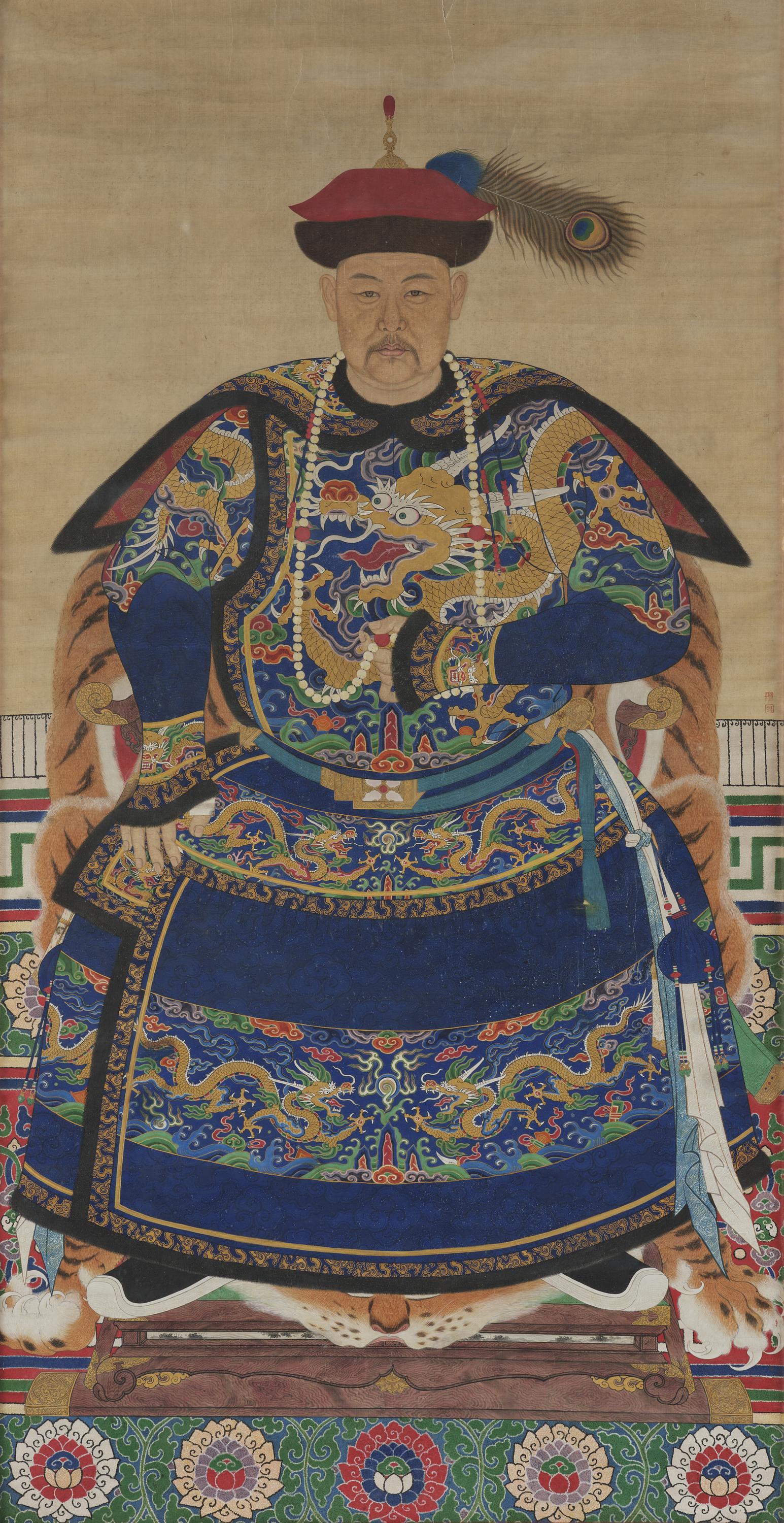

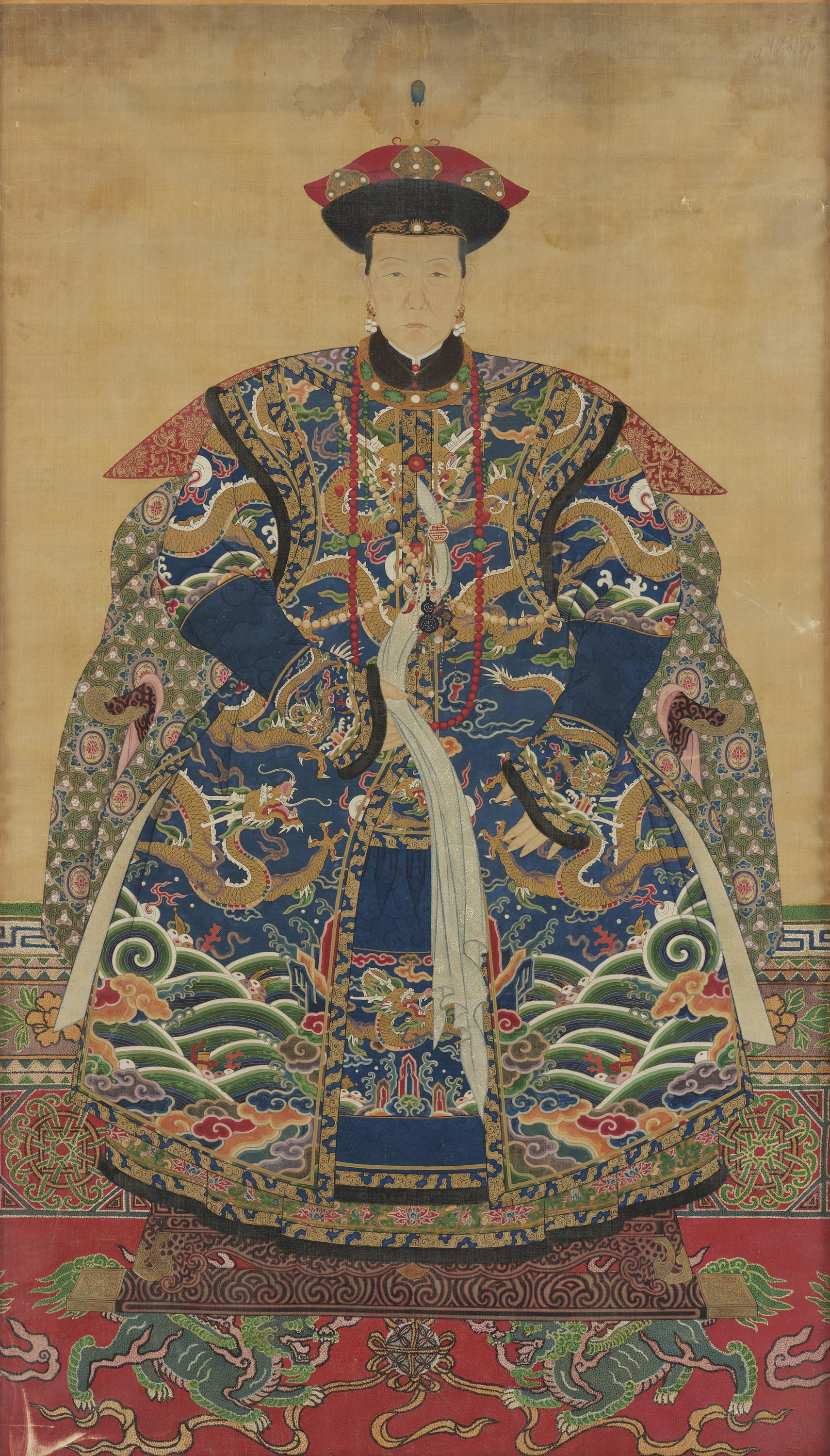
1018. A painting of a high ranking noble woman, Qing dynasty, 19th century. Anonymous artist. Ink and colour on silk. Portraying a high-ranking noble woman, with a distinguished face, meticulously drawn, dressed in the formal manchu ceremonial outfit (chaofu) consisting of a cape (pi ling) blue silk dragon court robe (choupao), finely embroidered with dragons in gold threads. Wearing three ceremonial strands of beads hung around her neck, two of the diagonally across her chest and a long white silk kerchief hanging down from the elaborate collar. She wears a court hat, with three golden placques with pearl inlay, surmounted by a gilt bronze, ruby inlayed finial, her elbows resting gently on each side of what seems to be a horse shoe back armchair draped with silk, sitting on a colourful rug. Measure motif 95x165 cm. Measure with frame 107x178 cm.
Provenance: From a private Swedish Collector who purchased the two portraits from an Estate Sale in the early 1970’s from a lady who lived in Sweden but had German/ Austrian roots. The subject of this portrait is annonymous, but the sitter’s dragon robe, court necklace and elaborate headdress hint at imperial connections. The three earrings in each earlobe indicate she is a bannerwoman. A persons rank was indicated by the colour of choufu worn.
Exhibitions: Compare with an imperial portrait in the Metropolitan Museum of Art, New York, Credit Line: Rogers Fund, 1942, Object Number: 42.141.6. Compare also with a portrait of Lady Guan, in the Arthur M Sackler Gallery in the Smithosonian Institution, Washington D.C. Depicted in the Exhibition Catalogue, ‘Worshipping the Ancestors, Chinese Commemorative Portraits, 2001. Cat no 2.1. The important and extensive Collection of Richard G.Pritzlaff holds several examples. Compare with a portrait sold at Sothebys Hong Kong, Fine Chinese Ceramics & Works of Art, lot no 1823, April 2010.
Literature: Worshiping the ancestors Chinese Commemorative Paintings, Stuart, Jan; Rawski, Evelyn Sakakida; Freer Gallery of Art; Arthur M. Sackler Gallery (Smithsonian Institution), Freer Gallery of Art, 2001. Bannermen were the Qing dynasty’s military elite administered into divisions known as the Eight Banners. Apart from being soldiers, the banner system was also the basic organisational framework of all Manchu society and included various groups including Manchus, Mongols and Han Chinese.
Catalogue note: It is fascinating to see how sensitively the sitters individual features is painted. This portrait shows how the traditional Chinese portrait painting during the 18th and 19th century was influenced with Western painting techniques introduced by Jesuit missionary artists at the court. In accordance with the Chinese ancestor portrait tradition, the sitter is depicted in a rigidly frontal and symmetrical pose, in a chair whilst wearing formal, highly decorated clothing at the centre of the composition..
Estimate: SEK 20 000 – 30 000 / EUR 1 890 – 2 830

1019. An imperial edict, Qing dynasty, Jiaqing period (1796–1820), dated 1809.
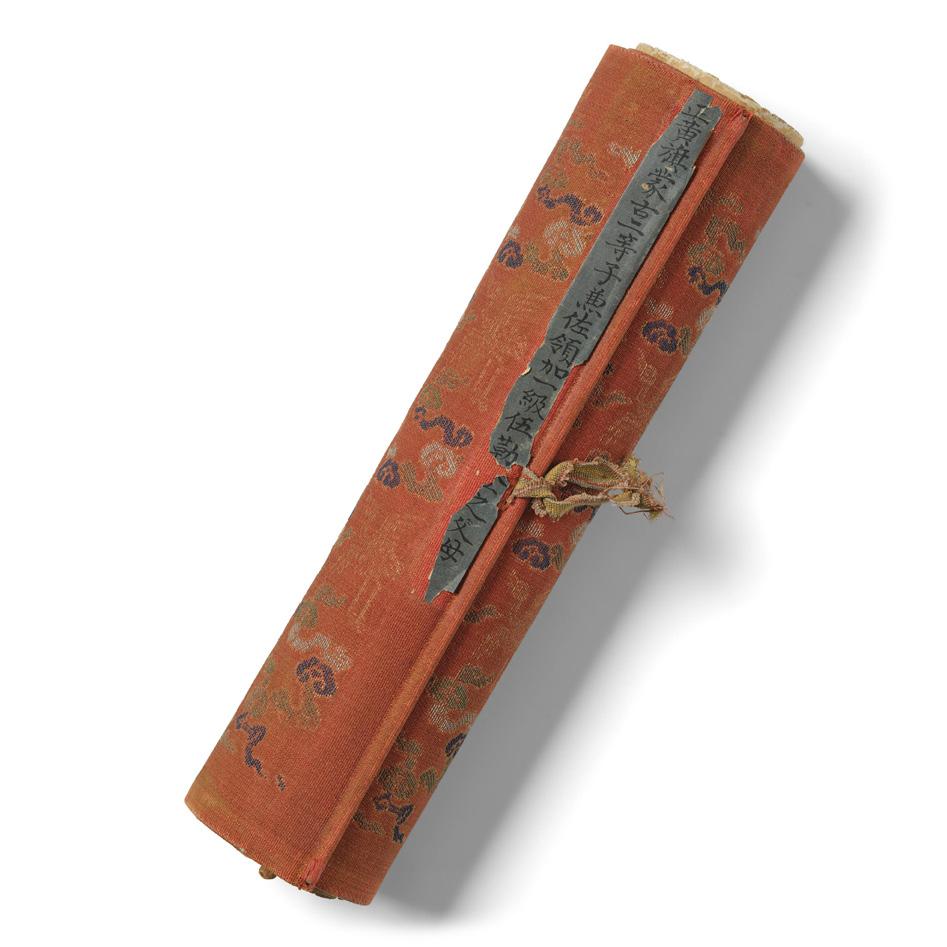
Horizontal hand scroll, ink on woven brocade, with bilingual parallel text in Chinese and Manchu, dated 1809. Measure c. 530 x 33 cm.
Provenance: From the collection of Sten Hultberg (1909–2002) and textile designer Astrid Sampe (1909–2002), thence by descent to the present owner. Hultberg was the owner and operator of Sven Hultbergs textile printers in Dala Floda, Sweden and Astrid Sampe is a designer and was a long time head of the textiles at the Department Store Nordiska Kompaniet NK in Stockholm Sweden.
Exhibitions: Compare with an imperial edict in the collection of the British Library , London, OR4574 f006r.
Literature: The black and white image illustrates the edict in the home of Astrid Sampe and Sven Hultberg.
Catalogue note: The Manchus, held the Qing throne, and being rulers of vast terretories, the Qing monarchs governed a multi-ethnic empire, comprising Manchus, Han Chinese, Tibetans, Uyghur Muslims, Mongols and idigenous groups in frontiers and inlands. These editcs are important testiments of the Qing Imperial administrations cultural, linguistic and religious pluralities.
Estimate: SEK 25 000 – 30 000 / EUR 2 360 – 2 830
1020. A Daoist painting of the lords and officials of hell by an anonymous artist, Qing dynasty, 18th/19th century.
Ink and colour on silk. Depicting, in three rows and led by attendants carrying flags, various officials and some of the lords of hell, each figure wearing official robes and carrying implements. Measure motif 70.5 x 138.5 cm. Measure with passepartout 77 x 138.5 cm. Laid on board.
Provenance: From the Collection of Åke Reuterswärd (1884–1973), thence by descent. Åke Reuterswärd was a passionate collector who aquired most of his collection through his brother Thorsten Reuterswärds gallery, the well reknowned ‘Japanska Magasinet’ in Stockholm.
Exhibitions: Compare with a painting of this type sold with Bonhams San Francisco, Asian Decorative Arts, lot 2407, 15 March 2011.
Literature: The British Museum, The BP exhibition, Ming, 50 years that changed China. Craig Clunas and Jessica Harrison-Hall. Compare with the set of Water-andland ritual paintings made for the Baoning Monestary in Youyu, Shanxi, p. 250–253.
Estimate: SEK 10 000 – 15 000 / EUR 944 – 1 420
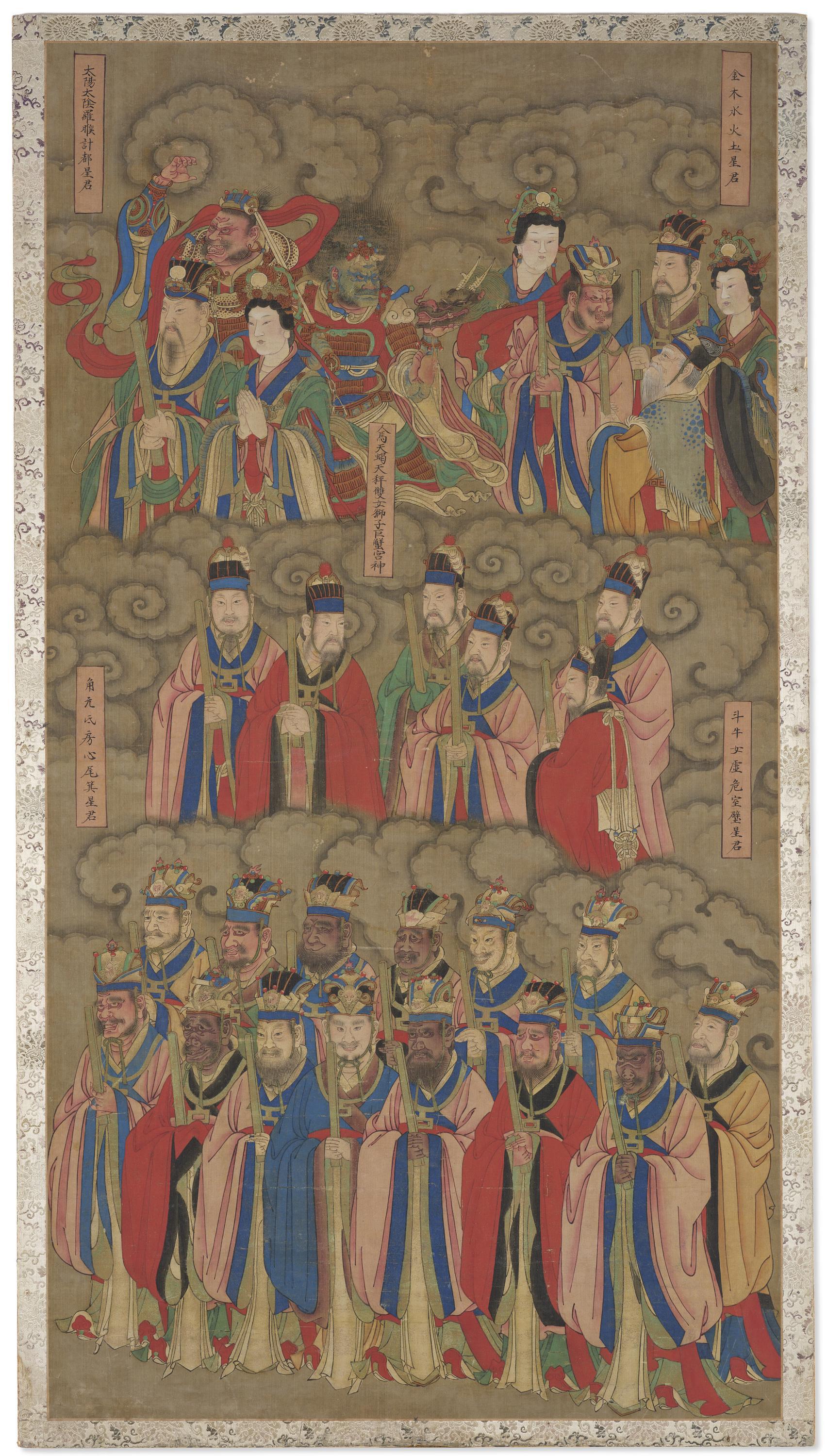
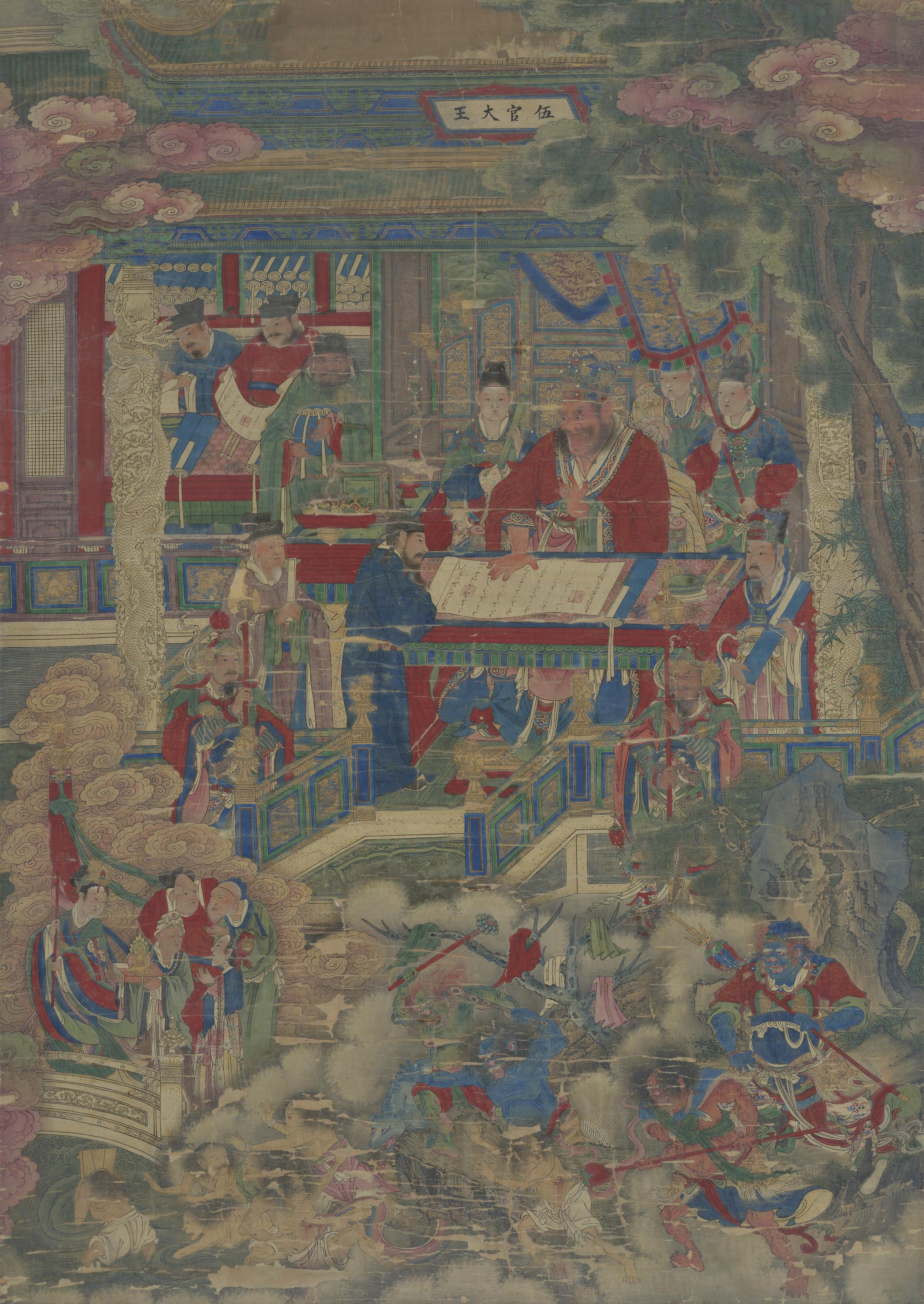
1021. A large painting by anonymous artist, Qing dynasty, 18/19th century.
The painting depicts a gathering of immortals with attendants in architectural setting all standing amongst scrolling clouds, wearing long robes and with distinctive individual faces. Below them a group of demons an humans. Measure motif 84 x 118 cm. Measure with frame 100 x 135 cm. Laid on panel.
Provenance: From the collection of Dagmar Glimstedt, Thence by descent. Purchased from Gösta Montell (1899–1975), head of the Etnographic Museum 1954–1966. Montell took part on Sven Hedins expedition in Central Asia 1929–1933. He published three books; one about the Temple Yonghegong together with Ferdinand Lessing and one about the Mongols and another ‘Amidst gods and people, memories of happy years in Peking’.
Exhibitions: Compare with a group of paintings in the Metropolitan Museum New York of ‘Heavenly Emperors’, dated as Ming/Qing. Credit Object Number: 57.116.2. Object Number: 57.116.1.
Estimate: SEK 20 000 – 30 000 / EUR 1 890 – 2 830
1022. A large painting by anonymous artist, Qing dynasty, 18th/19th century.
The painting depicts a gathering of immortals with attendants in architectural setting all standing amongst scrolling clouds, wearing long robes and with distinctive individual faces. Below them a group of demons an humans. Measure motif 84 x 118 cm. Meaure with frame 102 x 137 cm. Laid on a panel.
Provenance: From the collection of Dagmar Glimstedt, Thence by descent. Purchased from Gösta Montell (1899–1975), head of the Etnographic Museum 1954–1966. Montell took part on Sven Hedins expedition in Central Asia 1929–1933. He published three books; one about the Temple Yonghegong together with Ferdinand Lessing and one about the Mongols and another ‘Amidst gods and people, memories of happy years in Peking’.
Exhibitions: Compare with a group of paintings of ‘Hevenly Emperors’ in the Metropolitan Museum New York, dated as Ming/Qing. Credit Object Number: 57.116.2. Object Number: 57.116.1.
Literature: Yanluo Wang is featured in the classic Chinese novel Journey to the West.
Catalogue note: Yanluo Wang is the god of death and the ruler of Diyu, overseeing the “Ten Kings of Hell” in its capital of Youdu. The name is a transcription of the Sanskrit for “King Yama”.
Estimate: SEK 30 000 – 50 000 / EUR 2 830 – 4 720
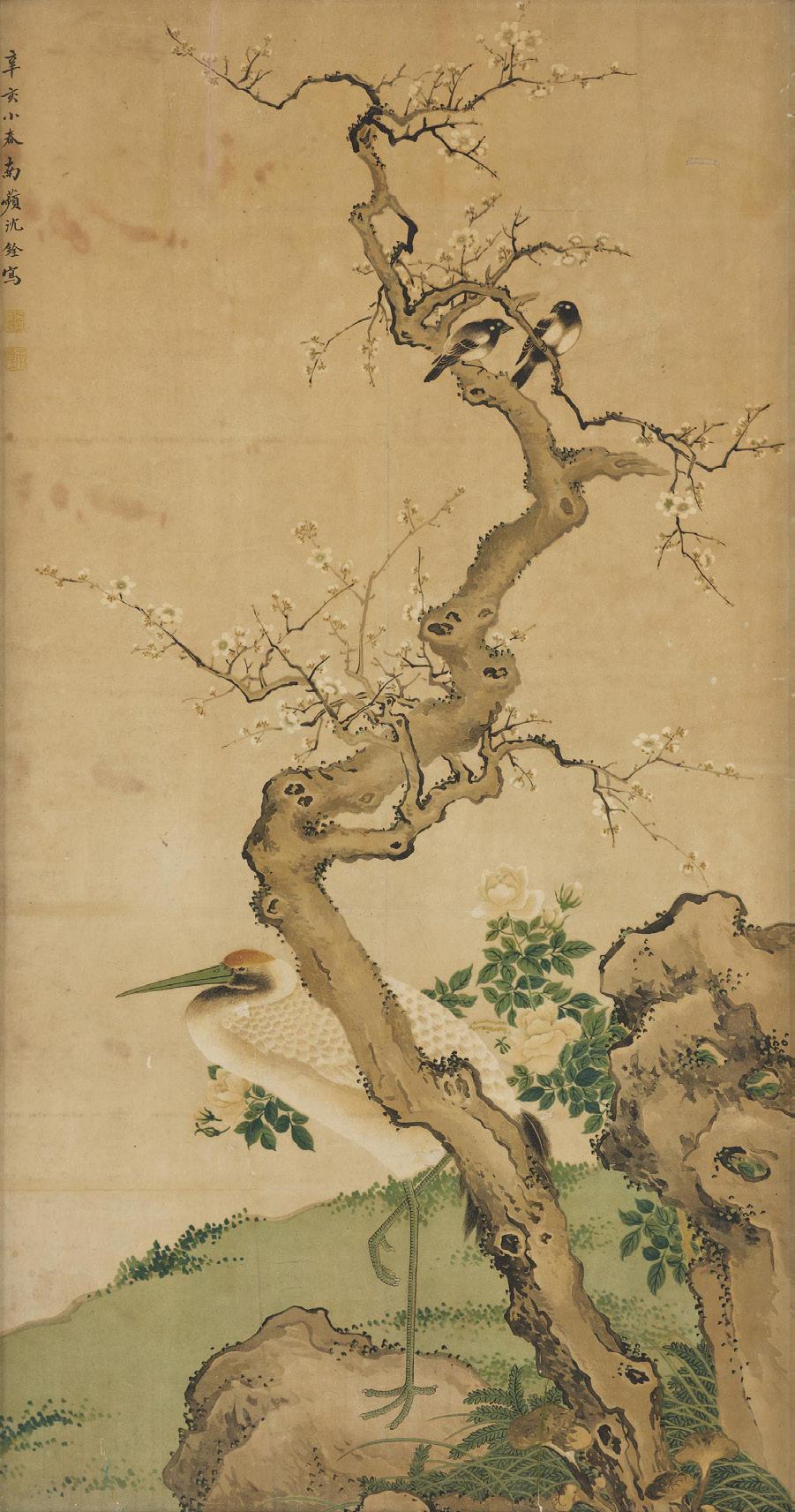
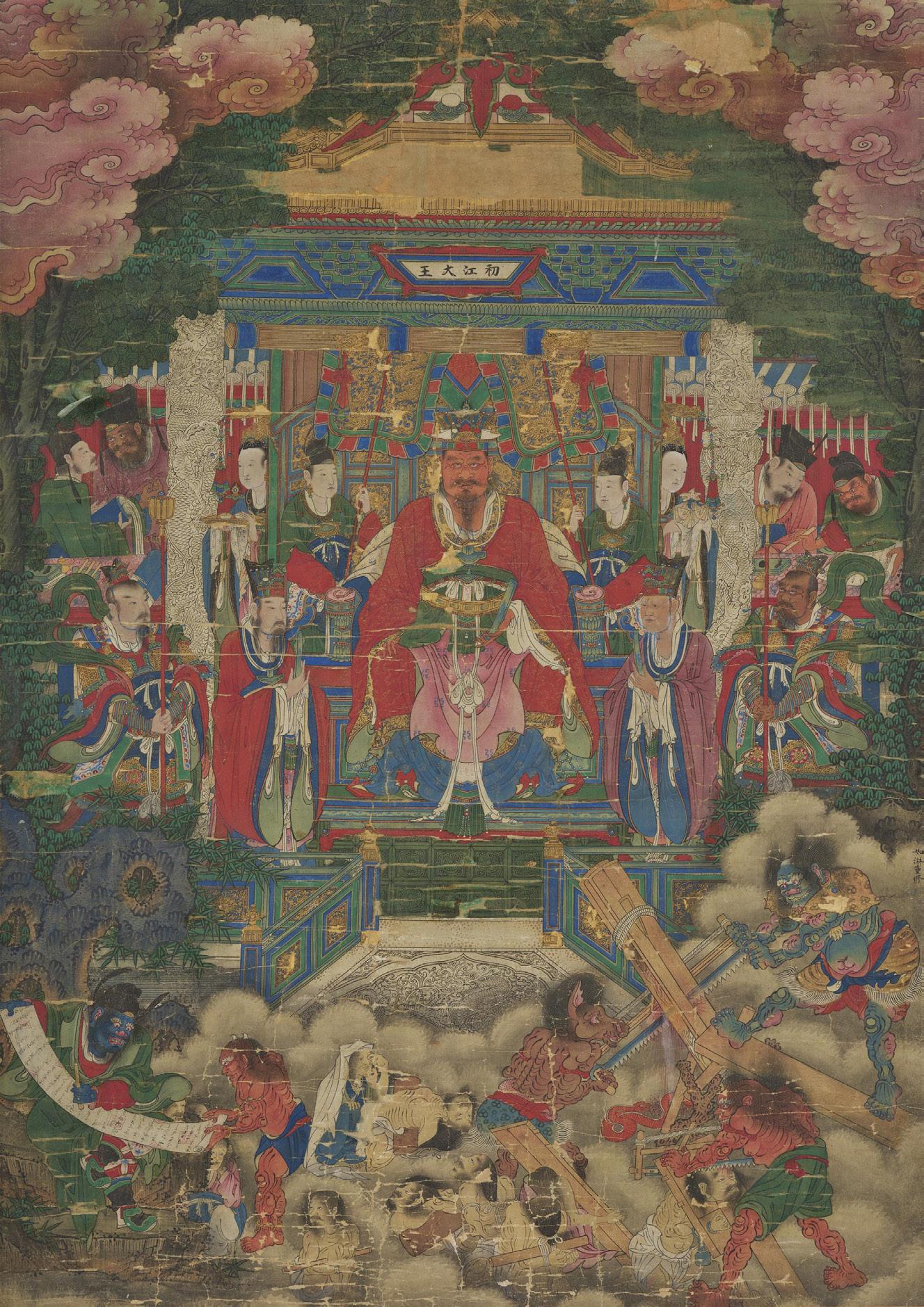
1023. Shen Quan (After) (China, 1682–1762) ‘Crane, magpies and a blossoming cherry tree’.
(Shen Nanpin). Ink and colour on paper. Seals in red. With calligraphy.
Measure motif 73x136 cm. Measure with frame 79 x 145 cm.
Provenance: Property of a private Swedish Estate.
Catalogue note: In 1731 the court painter Shen Quan traveled to Nagasaki at the request of the Japanese government. During his nearly two years in Japan, Shen and his students produced a large number of paintings –typified by bold ink brushwork for rocks and trees paired with meticulous application of color for birds and flowers–which served as an enduring inspiration to Japanese artists. This example combines cranes, peaches, and lingzhi fungus, all symbols of longevity or immortality, along with bamboo and China rose (yueji).
Estimate: SEK 8 000 – 10 000 / EUR 755 – 944
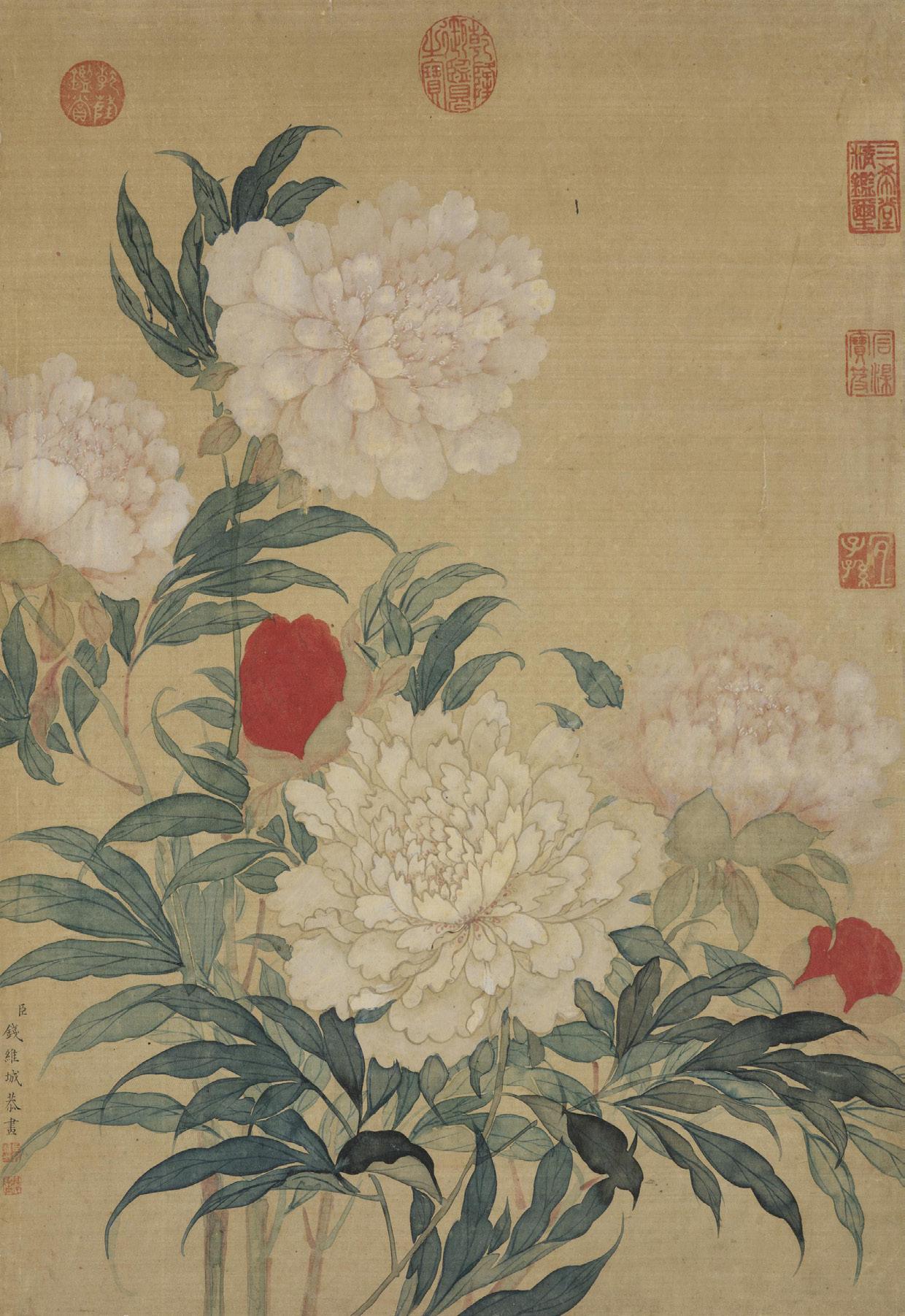
1024. Qian Weicheng (After) (China, 1720–1772) “Flowers”, late Qing dynasty/20th century.
A Chinese painting on silk. With seven seals in red and calligraphy. Measure motif 38 x 56 cm. Measure with frame 62 x 129 cm.
Provenance: Purchased by the current owner’s father (a sea captain at Broström Shiping) in the early 1960’s, thence by descent.
Catalogue note: Qian Weicheng was one of the foremost Orthodox School landscapists and flower painters of the 18th century. Enjoying a brilliant official career, Qian rose to the rank of vicepresident of the Board of Works. At the same time, the Qianlong Emperor considered him to be one of the outstanding painters of the age. In over twenty years’ service at court, Qian Weicheng produced more than 275 paintings for the emperor. Even after Qian’s death in 1772, the emperor continued, as on this album, to add appreciative inscriptions.
Estimate: SEK 12 000 – 15 000 / EUR 1 130 – 1 420
1025. Xi Gang (After) (China, 1746–1803) “Mountain landscape”. 20th century.
Ink on paper. A landscape with mountains. Two seals in red. With calligraphy. Signed and sealed Xi Gang (1746–1803) but later. Measure motif 30.5 x 107 cm. Measure hanging 51 x 225 cm. Scroll painting, can be rolled up.
Provenance: Property of a private Swedish collector. Acquired in Shanghai in the 1930’s.
Estimate: SEK 20 000 – 25 000 / EUR 1 890 – 2 360
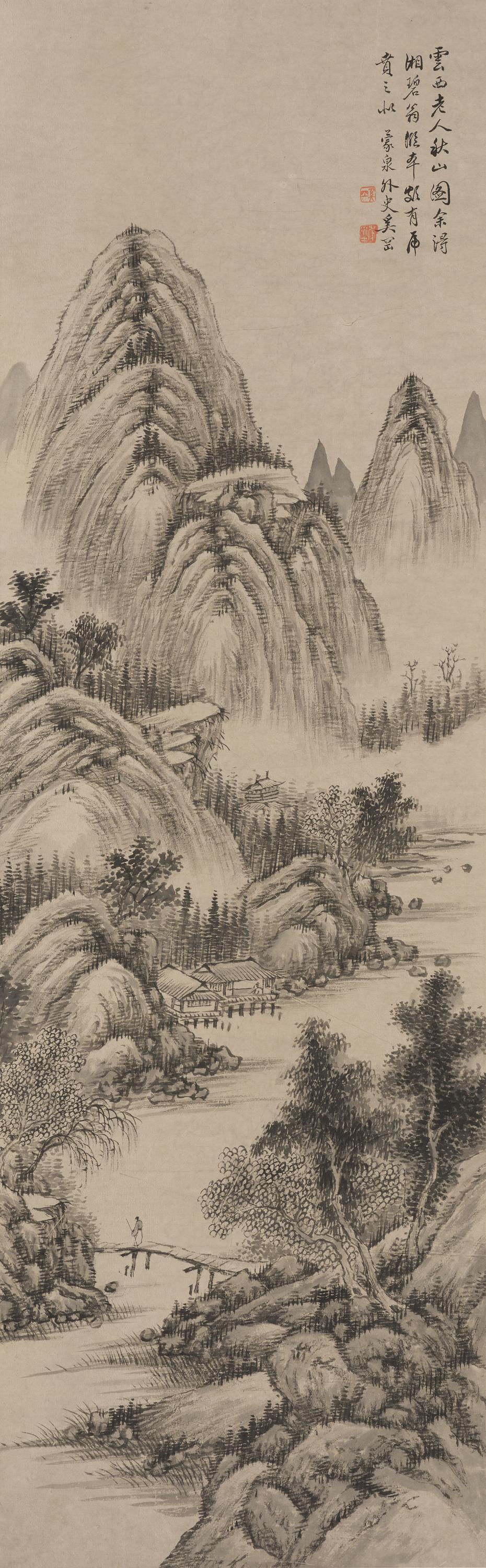
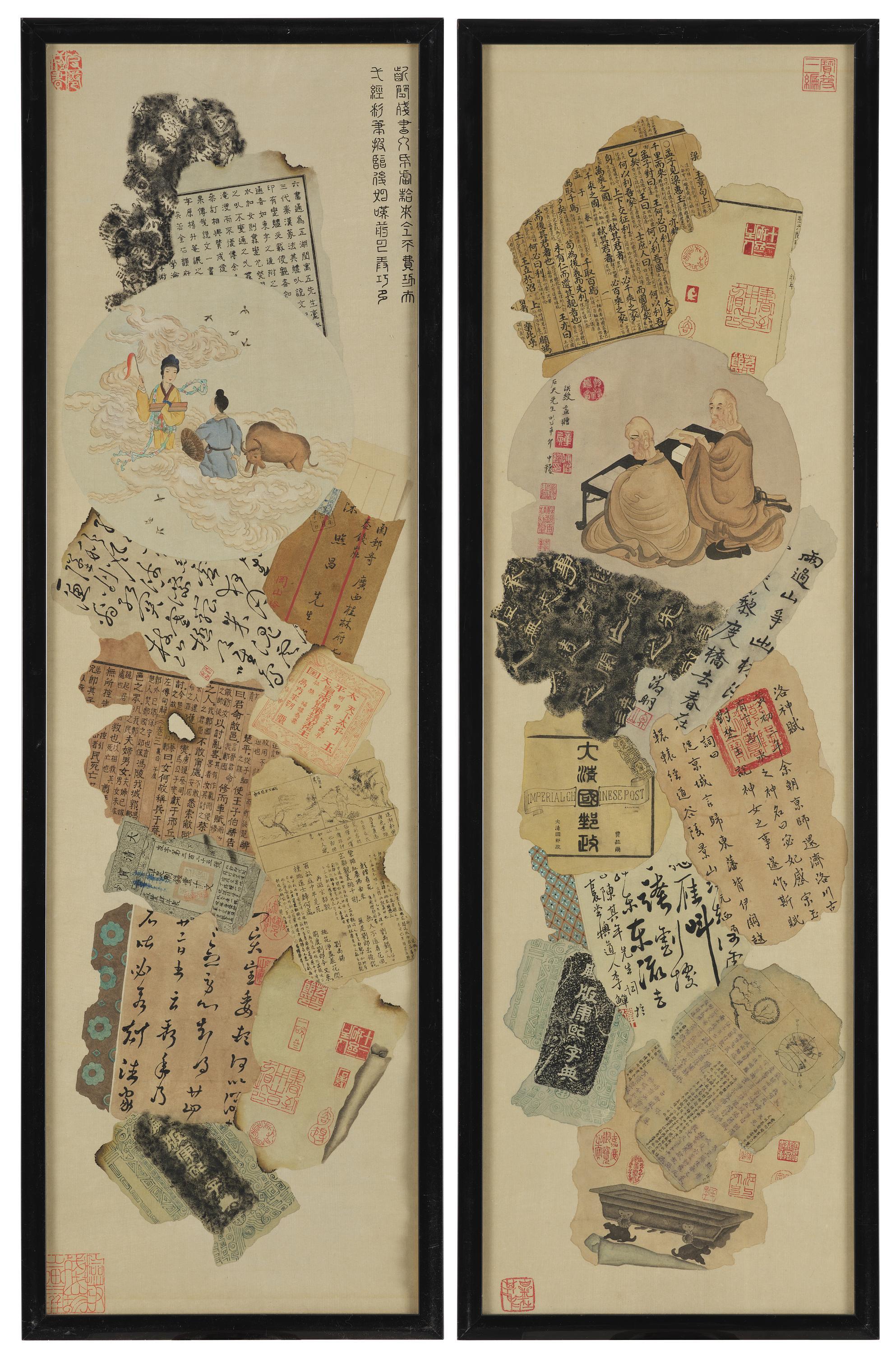
1026. Two Chinese Bapo paintings by Anonymous artist, 20th century. Watercolour and ink on paper. With seal in red and calligraphy. Measure motif 31 x 105.5 cm.
Measure with frame 35 x 107.5 cm.
Literature: Read, Nancy Berliner, “The ‘Eight Brokens’, Chinese Trompe-l’oeil Painting”, Orientations February 1992, pp. 61–66.
Catalogue note: Bapo 八破 (literally ‘eight-brokens’) or jinhuidui 錦灰堆 (literally ‘a pile of brocade and ashes’) is a fascinating genre of Chinese painting that emerged in the late Qing and was popular in the early 20th century. Using trompe-l’oeil techniques, artists carefully created seemingly random collages of two dimensional images, including fragments of paintings, book pages, calligraphic rubbings, letters and ephemeral scraps. The subject matter of these paintings bear a humble countenance – they are folded and torn, burnt or scarred. However a closer examination of the individual elements reveals the artist’s deep understanding of the traditions of calligraphy and painting.
Estimate: SEK 20 000 – 30 000 / EUR 1 890 – 2 830
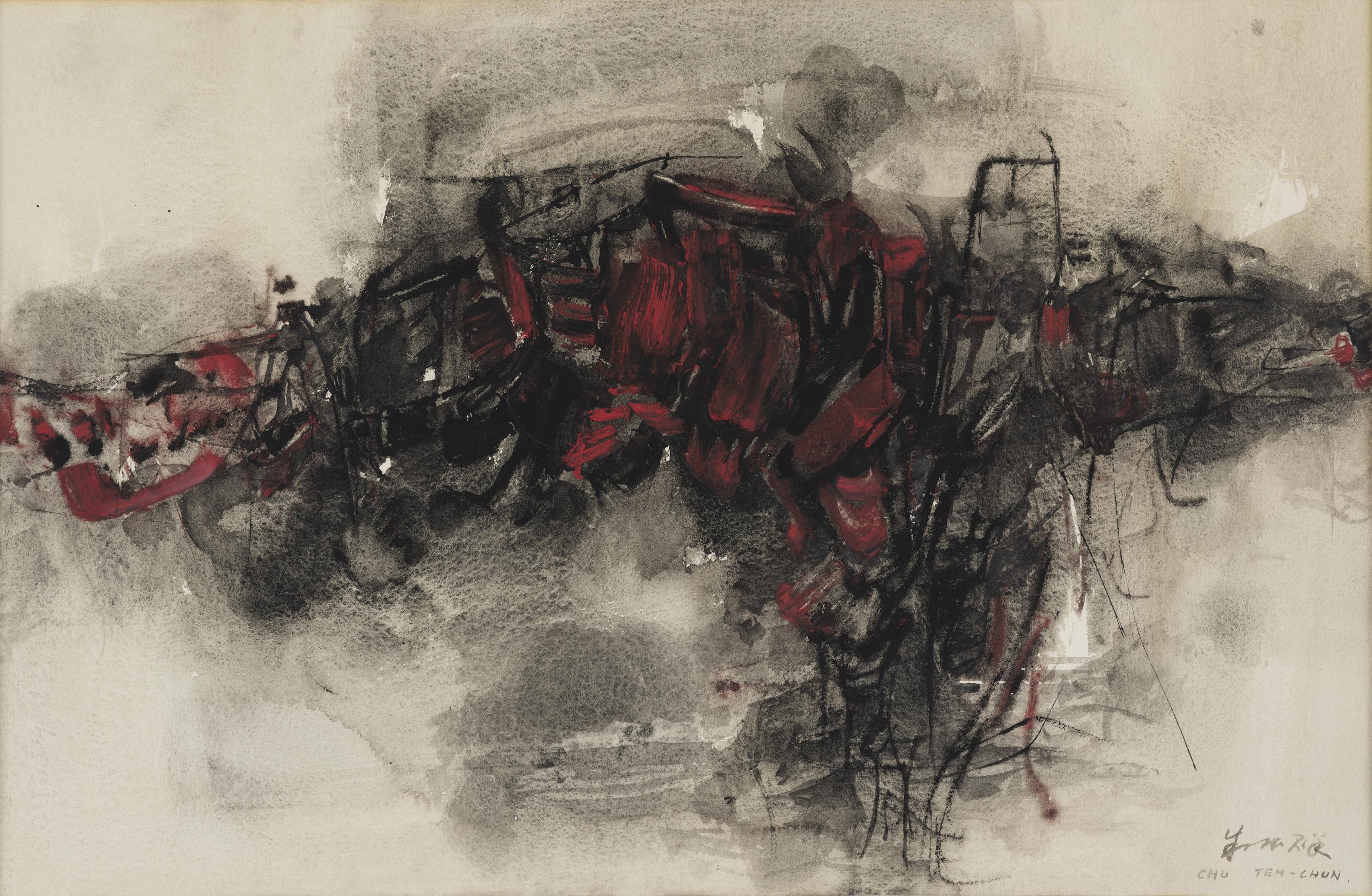
1027. Chu Teh-Chun (China, 1920–2014) “Composition No. 121”.
Signed Chu Teh-Chun. Also signed and dated 1962 verso. Gouache and watercolour on Arches paper 38 x 57 cm. A certificate of authenticity from Fondation Chu Teh-Chun is included. This work will be included in the Catalogue Raisonné being prepared by Fondation Chu Teh-Chun.
Provenance: Architect Fritz Jaenecke (1903–1978), Malmö, Sweden. Thence by descent.
Exhibitions: Galerie Legendre, Paris, France, “30 gouaches de Chu Teh-Chun”, 8–30 May 1962. Baier Gallery, Mainz, Germany, “Chu Teh-Chun”, 1962 after the previous exhibition.
Catalogue note: Chu was born in Xiao district in Anhui, China in 1920. Both his father and grandfather were traditional doctors who collected Chinese paintings. In his early childhood, a tutor taught Chu and his two older brothers calligraphy and classical Chinese poetry. With the encouragement of his father, Chu enrolled in the Hangzhou Academy of Fine Arts at the age of 15. It was at the Academy that Chu began his lifelong friendship with Wu Guanzhong. Between the 1930s and ‘40s, Chu travelled across China teaching at various institutions and participating in group exhibitions, including one with Zao Wou-Ki in 1945. Upon the establishment of the People’s Republic of China in 1949, Chu moved to Taiwan and held his first solo exhibition in 1954 at Taipei’s Sun Yatsen Hall. All the paintings were sold, allowing him to finance his trip to France and his first years in Paris. During his years abroad, Chu further explored the integration of classical Chinese arts with newfound inspirations from Western abstraction, likening the controlled spontaneity of both techniques. In 1956, he was selected from many prestigious painters including Picasso, Miro and Cocteau for the exhibition “Peinture d’Aujourd’hui” in the Palais Royal gardens where he exhibited a semi-abstract painting. In 1979, the Cernuschi Museum organised an exhibition of Lin Fengmian who came to Paris with Liu Kaiqu and a delegation of Chinese sculptors. This was an opportunity for CHU to see his former teachers and friends again. In 1981, Wu Guanzhong came to Paris and the two friends finally met again. On 17th December 1997, Chu Teh-Chun was inducted into the Academy of Fine Arts. He was the first Chinese person to join the Academy.
Estimate: SEK 200 000 – 250 000 / EUR 18 900 – 23 600
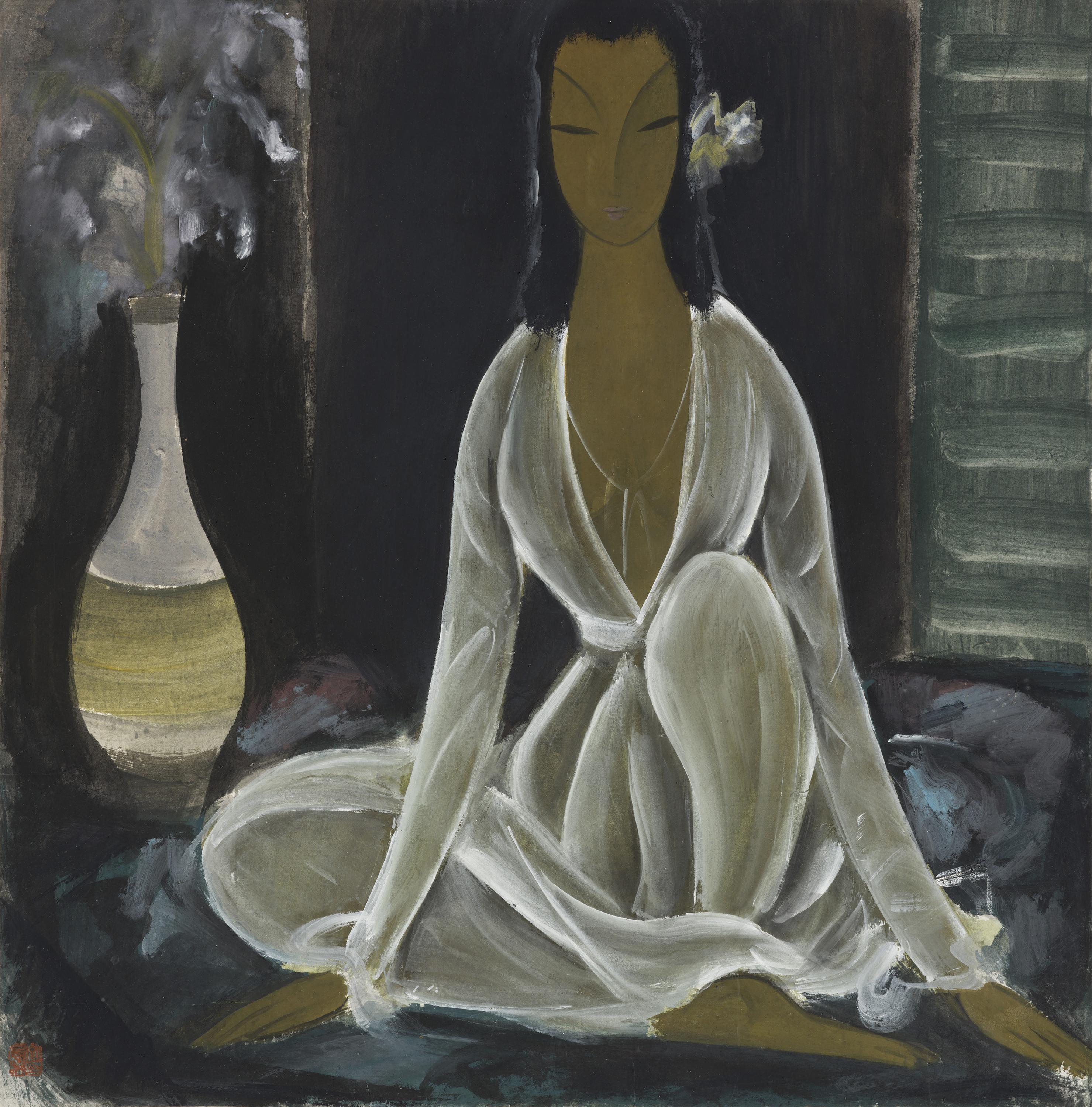
1028. Lin Fengmian (China, 1900–1991) ‘Lady in white with vase’. Gouache on paper. With one seal of the artist. Framed with glass. Measure motif 66.5 x 65.5 cm. Measure with frame 79 x 77 cm.
Provenance: From the collection of Eivor och Jarl Johansson, thence by descent. The couple were passionate art collectors and purchased art at auctions and galleries in Gothenburg, Stockholm, London, Paris, Norway and Denmark. The photograph is taken at the summer house at Orust in the mid 1980’s. Eivor Johansson was herself a textil artist and held exhibitions with batik art.
Catalogue note: Lin Fengmian was a charismatic pioneer of Chinese modern art, the teacher of both Wu Guanzhong and Zao Wou-Ki. Born in Guangdong in the last years of imperial rule, Lin Fengmian was a pivotal figure in the history of Chinese modern art. Having shown prodigious talent for drawing as a child, he won a government-sponsored scholarship to study in France in 1919, where he discovered Post-Impressionism, Fauvism and Primitivism. He later travelled to Berlin and was radicalised by the German Expressionists Erich Heckel and Emil Nolde, who used their talents to critique the corrupting forces of the Weimar Republic. On his return to China in 1926, Lin began teaching at the Beijing Academy of Art, where he attempted to reconcile traditional Chinese art and European practices. He became one of the Four Great Academy Presidents, a rarefied group of pioneering teachers who sought to transform Chinese art education in the republican era. Another member of the group was the painter Xu Beihong. At the outbreak of the second Sino-Japanese war, in 1937, Lin’s studio was ransacked by soldiers, and many of his paintings were lost. Later, during the Cultural Revolution, Lin chose to destroy all of his paintings to stop them being used against him. Yet his works are rare, as many paintings were destroyed in his lifetime. It was not until the death of Mao Zedong that artists were able to exercise some creative freedom once more, and the protagonists of the early avant-garde were slowly rehabilitated. In 1977, Lin was allowed to move to Hong Kong, where he spent his remaining years making up for lost time, working on new paintings and remaking the work that had been lost during the Cultural Revolution. In 1989, at the age of nearly 90, Lin had his first retrospective, at the National Taiwan Museum in Taipei.
Estimate: SEK 350 000 – 500 000 / EUR 33 100 – 47 200
1029. Vu Cao Dam (Vietnam, 1908–2000) “Le Rendez-Vous”, 1960.
Oil on canvas in original frame. His figures are touchingly poetic and the figures of the young couple is sensitively depicted, coming alive against the muted resonance of the background. Measure canvas 36 x 41.5 cm. Measure with frame 57 x 65 cm.
Provenance: A Private collection. Purchased by the current owner’s parents in France in the 1960s.
Exhibitions: With a brochure with text on Vu Cao Dam by Jeanne Auboyer from Musee Guimet and L. Gines fastened on the back, with note Vu Co Dam, Saint. Paul, A.M.
Catalogue note: Among all the great Vietnamese masters recognised today, Vu Cao Dam remains one of the most admired for the finesse and poetic beauty of his body of work. Born in Hanoi in 1908 into a scholarly family, Catholic but of Confucian tradition, Vu entered Hanoi’s École des Beaux-Arts d’Indochine in 1926 at 18 years old, a year after the school first opened. During the first ten years of his career, he focused mainly on sculpture and displayed remarkable talent and maturity in his work for his young age. At only 23, he was selected to participate in the 1931 Paris Colonial Exhibition and gained much acclaim from the local press and art critics of the time.
Upon graduating from the school in 1931, Vu was awarded a one-year scholarship to study in France and enrolled at the prestigious École du Louvre in the Far-East section. Little did he know that he was never to see his homeland again, as war and geopolitical upheaval changed the course of his destiny. Yet his homeland was never far from his heart, as it was evidently the inspiration behind his art. One senses the outpouring of love and longing, the bittersweet melancholy that pervades the art of the Master. Vu went on to marry a French
woman and settled in France, yet the inspiration for his artistic vision remained his youthful memories of his beloved motherland.
As he often stated throughout his career, his artistic interpretations were mainly drawn from the Kim Van Kieu, the famous and much revered Vietnamese epic written by Nguyen Du (1765–1820). In 1949, Vu moved from Paris to the countryside of southern France, renowned for its beautiful scenery and light, living down the road from Matisse’s Chapel and a short distance from Marc Chagall’s home. Having excelled in both painting and sculpture, Vu’s artwork stands the test of time for its profound beauty, extreme refinement, and humanistic sensitivity.
Today multicultural and multiracial expressions are sought but I think I was among the first to try, in my work, to reconcile my oriental roots, without disrupting tradition, with my perception of the lessons given by studying the masters of western culture. – Vu Cao Dam, 1997.
Predominantly blue in colour, Vu employs discreet accents of red in this charming portrait of a young couple in traditional Vietnamese attire. Seated in the foreground, cross-legged in a manner that calls to mind Buddhist imagery, the male figure raises his left hand. On the right side, dressed in luminous pink, the young woman is depicted reminiscent of the Madonna images in Christianity. Through the strategic and restrained use of complementary colours in what is an overall cool colour scheme, Vu masterfully and subtly heightens the contrast and colour vibration of this balanced and poignant composition. La Famille not only exemplifies the artist’s virtuosity in painting, it also stands as a testament of a man’s lifelong exploration and discovery of his multicultural identity. The work is from the collection of a Scandinavian family where it has remained with the family since it was acquired in Paris in the 1960s.
Estimate: SEK 300 000 – 400 000 / EUR 28 300 – 37 800
1030. Dung Tran Nguyen (Vietnam, 1942–2023) “Street image from old Hanoi”/”Image de rue du vieux Hanoï”, signed and dated 1988. Oil on silk. Vietnam. Measure 29 x 48 cm. Measure with frame 40 x 50 cm.
Provenance: Acquired 1988 in Hanoi, from Hoa Vietnam State Art Trade (Xunhasaba), by the present owner, who worked at Sida in Vietnam during the 1980s.
Estimate: SEK 6 000 – 8 000 / EUR 567 – 755
1031. Do Xuan Doan (Vietnam, 1937) “Spring festival in the Highlands”/” Festival du printemps dans le Highlands”.
Signed Mai Van Kee and Do Xuan Dong, and dated 1987. Depicting Hmong women dressed for spring festival. Measure with frame 155.5 x 155.5 cm.
Provenance: Acquired 1988 in Hanoi, from Hoa Vietnam State Art Trade (Xunhasaba), by the present owner, who worked at Sida in Vietnam during the 1980s.
Literature: The Hmong New Year Festival is one of the most colourful spring festivals in Ha Giang, celebrated by the H’Mông ethnic community. Depending on the region, it often falls around the Lunar New Year season. As Lunar New Year unfolds, Hmong communities gather on mist-covered peaks, keeping ancient games and vibrant traditions alive from the third to the seventh day of the first lunar month. Throughout the festival, women wear their most beautiful outfits.
Catalogue note: Do Xuan Doan, born in 1937, is a distinguished Vietnamese artist renowned for his contributions to modern and contemporary art. He graduated from the Hanoi College of Fine Arts in 1961 and developed a unique style that blends traditional Vietnamese themes with modern techniques. His formative years coincided with the Vietnam War, during which he joined the army, an experience that infused his artistic expression with resilience and social consciousness. Do Xuan
Do Xuan Doan’s paintings often illustrate scenes of rural life, capturing the harmony between man and nature. His works are characterised by vibrant colours, dynamic compositions, and the use of lacquer on wood, a traditional Vietnamese medium that adds depth and texture. His subjects include ancient houses, old streets, and ordinary people, where simplicity and sincerity are encapsulated. He enhances his paintings with a vibrant colour palette and bold brushstrokes.
Defying the constraints of conventional categorisation, Do Xuan Doan seamlessly traverses the realms of realism, expressionism, surrealism, and abstraction. As one of the founders and leaders of the Young Artists Association in 1966, he played a pivotal role in encouraging innovation and experimentation among young artists, significantly influencing the development of modern Vietnamese art.
Do Xuan Doan’s contributions to Vietnamese culture and his role in shaping the Young Artists Association remain significant. His contemporary lacquer works continue to inspire and resonate with viewers, exemplifying creativity, resilience, and a commitment to pushing artistic boundaries. His enduring legacy reminds us of the power of expression and the beauty of capturing everyday life through visual art.
Estimate: SEK 90 000 – 120 000 / EUR 8 500 – 11 300
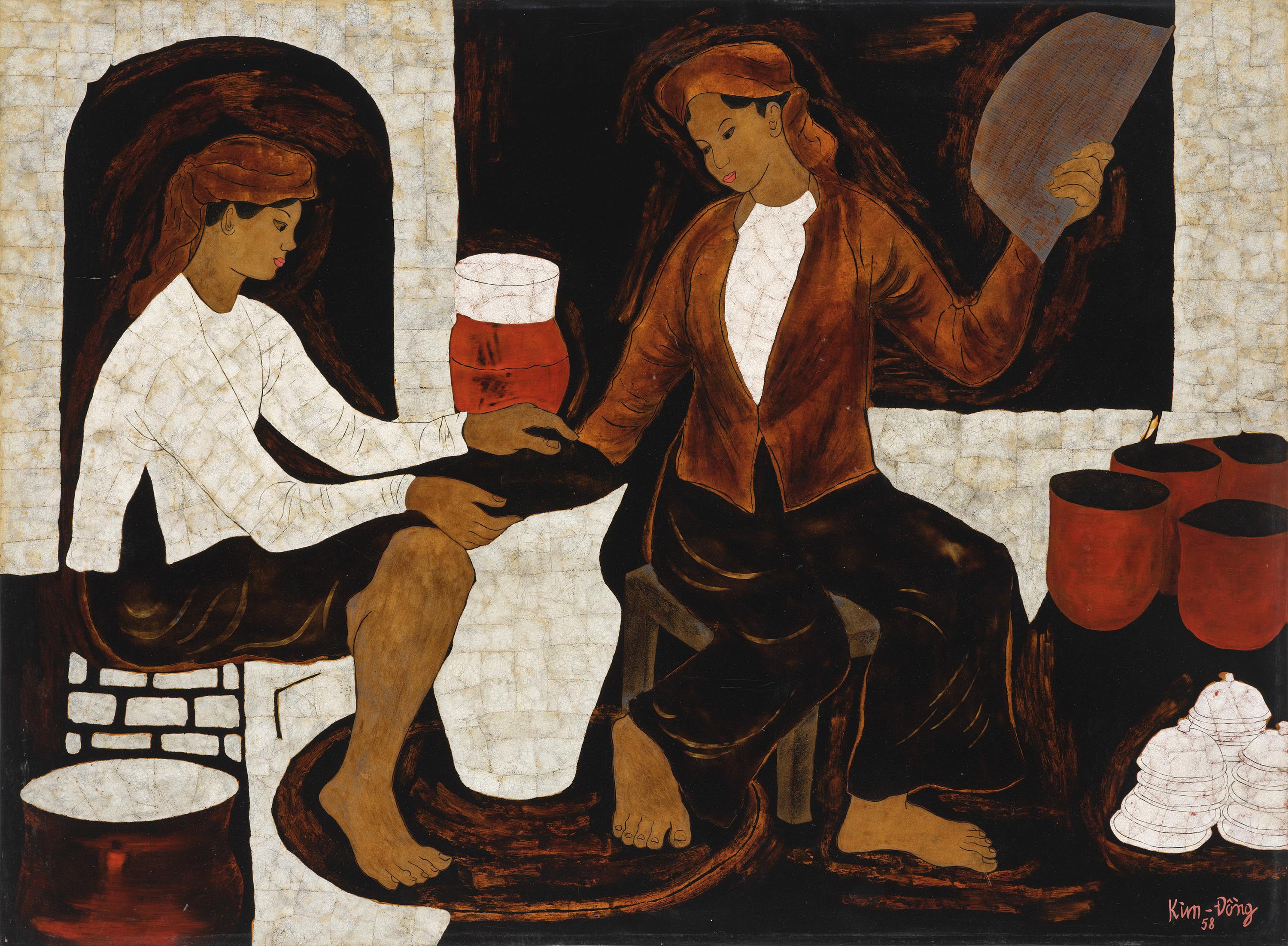
1032. Nguyen Kim Dong (Vietnam, 1922–2009) “Pottery Handicraft”/ ”Atelier de poterie artisanale”.
A lacquer painting of a ceramic studio. Signed and dated Kim Dong –58. Measure 100 x 73 cm.
Provenance: Acquired 1988 in Hanoi, from Hoa Vietnam State Art Trade (Xunhasaba), by the present owner, who worked at Sida in Vietnam during the 1980s.
Exhibitions: Compare one with this subject sold at Christies Live Auction 23845 20th Century Day Sale, lot no 129, 28 March 2026. Compare with one sold at Arts d’Asie, Primardeco S.A.R.L.Toulouse, France, 3 December 2021.
Estimate: SEK 60 000 – 80 000 / EUR 5 670 – 7 550
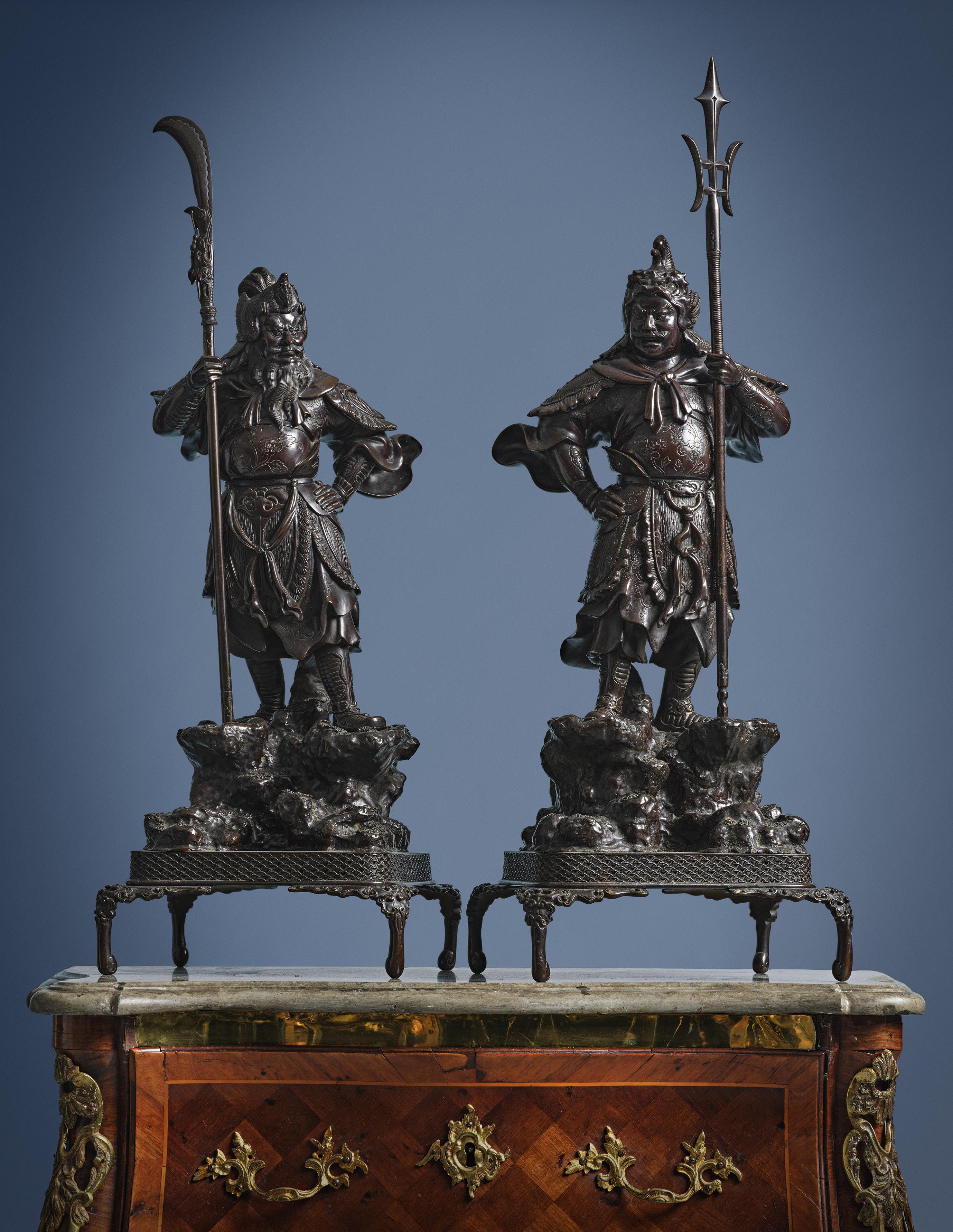
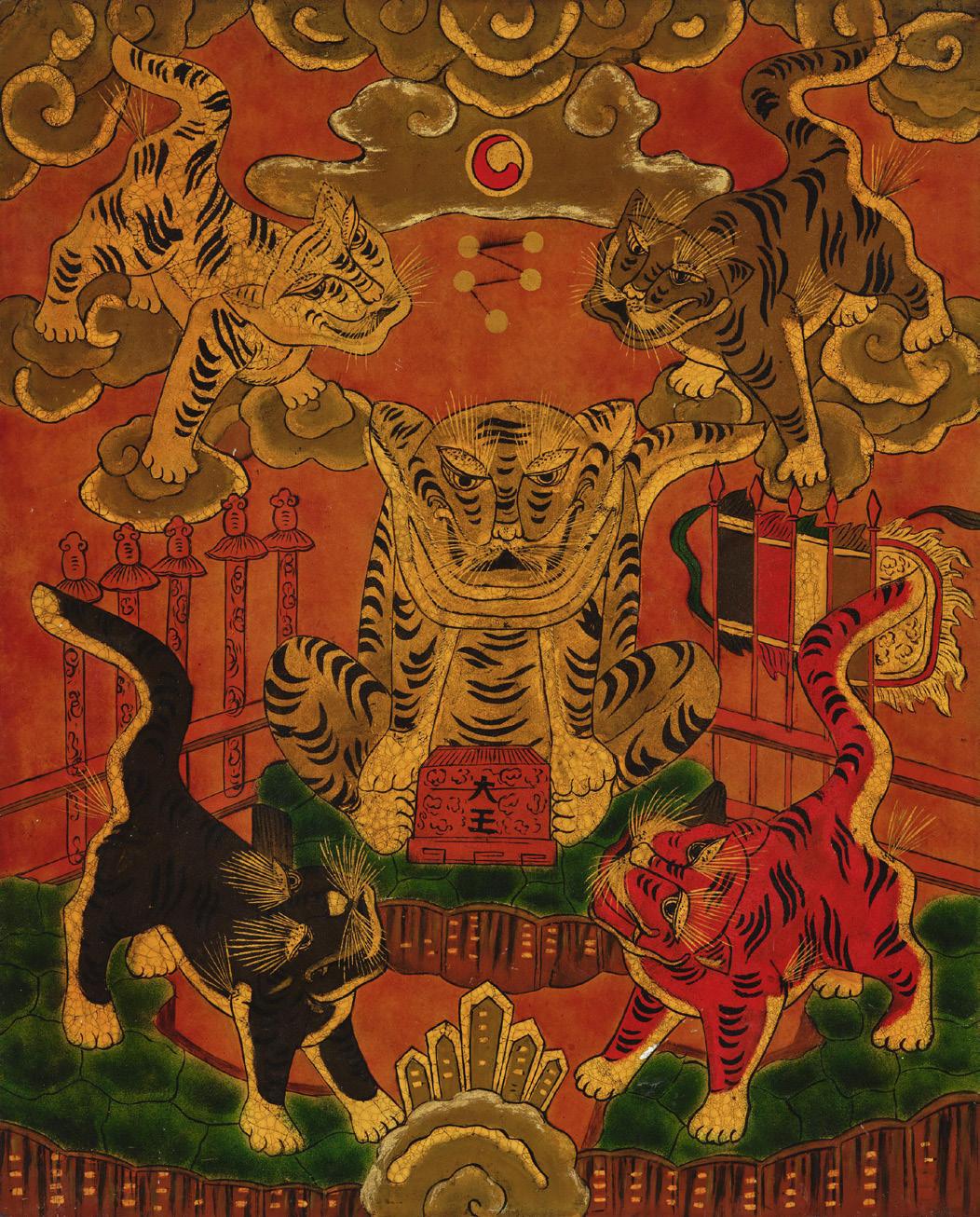
1033. Toan Nguyen Duc (Vietnam, 1929–2016)
“Five Tigers”/”Cinq tigres”, 1985.
Lacquer painting on wooden panel. Measure 40 x 50 cm.
Provenance: Acquired 1988 in Hanoi by the present owner who worked at Sida in Vietnam during the 1980s.
Estimate: SEK 6 000 – 8 000 / EUR 567 – 755
1034. Jayashree Chakravarty (India, 1956) “Affection”, signed and dated 1987 verso.
Oil on canvas. Measure 62 x 62 cm. Measure with frame 65 x 65 cm.
Provenance: Property of a private Swedish collector of Asian art, purchased at auction in Sweden, Stockholms Auktionsverk, 2019.
Exhibitions: Compare a painting sold at Sothebys, Modern & Contemporary South Asian Art, lot 46, 18 March 2019. Compare also “Under the Red Sky; Untitled (1987/89)” by the same artist sold at Sothebys, Modern and Contemporary South Asian Art, lot 63, 6 March 2020.
Catalogue note: Chakravarty, who received her BA in Fine Arts from the Visva Bharati University, is the recipient of numerous awards including the Gujarat Lalit Kala Akademi Award, the Second Bharat Bhavan Biennale Award, and the Bombay Art Society Award, Mumbai. Her work is in the collections of the Chandigarh Museum and the National Gallery of Modern Art, New Delhi. Other awards and recognition; First Indian artist to showcase at Paris’ Guimet Museum. Listed among ‘10 Best Images from Indian Art in 2016’, published at Times of India.
Estimate: SEK 30 000 – 35 000 / EUR 2 830 – 3 310 (d)
1035. Hiroshi Yoshida (Japan, 1876–1950) Moonlit coastal landscape with pine tree. Watercolour on paper. Sheet size 28.2 x 37.6 cm. Frame 40 x 48 cm.
Provenance: Property of a private Swedish collector.
Catalogue note: Hiroshi Yoshida, (1876 – April 5, 1950) was a 20th-century Japanese painter and woodblockprintmaker. Along with Hasui Kawase, he is regarded as one of the greatest artists of the shin-hanga style and is noted especially for his lanscape prints. Yoshida made numerous trips around the world, with the aim of getting to know different artistic expressions and making works of different landscapes. He was known as a mountain painter (山岳画家 ) in Japan and spent about half of the year on sketching travels. He was particularly fond of mountain landscapes and painted many of them, founding the Nihon Sangakugaka Kyōkai (Japan Mountain Painting Society , 日本山岳画家協会 ). His works are held in several museums worldwide, to mention some the British Museum, the Brooklyn Museum, the Museum of Fine Arts Boston. Estimate: SEK 25 000 – 30 000 / EUR 2 360 – 2 830
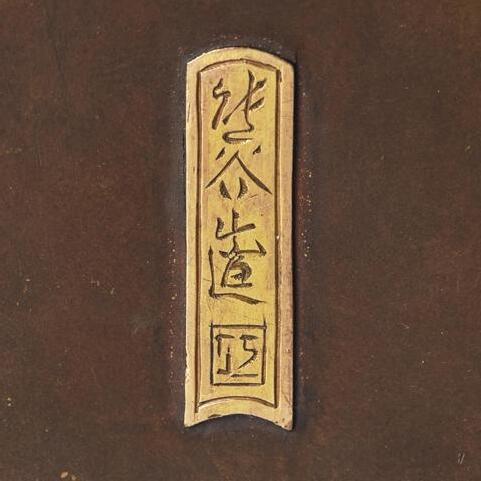
1036. An impressive pair of Japanese inlayed bronze vases, 19th century. Signed Kumagai Zo, Kyoto. Of baluster shape, decorated in relief with birds in a garden in full bloom. Height 31 cm. Weight c. 5150 gram.
Provenance: From the collection of Lundgrens antik.
Estimate: SEK 40 000 – 60 000 / EUR 3 780 – 5 670
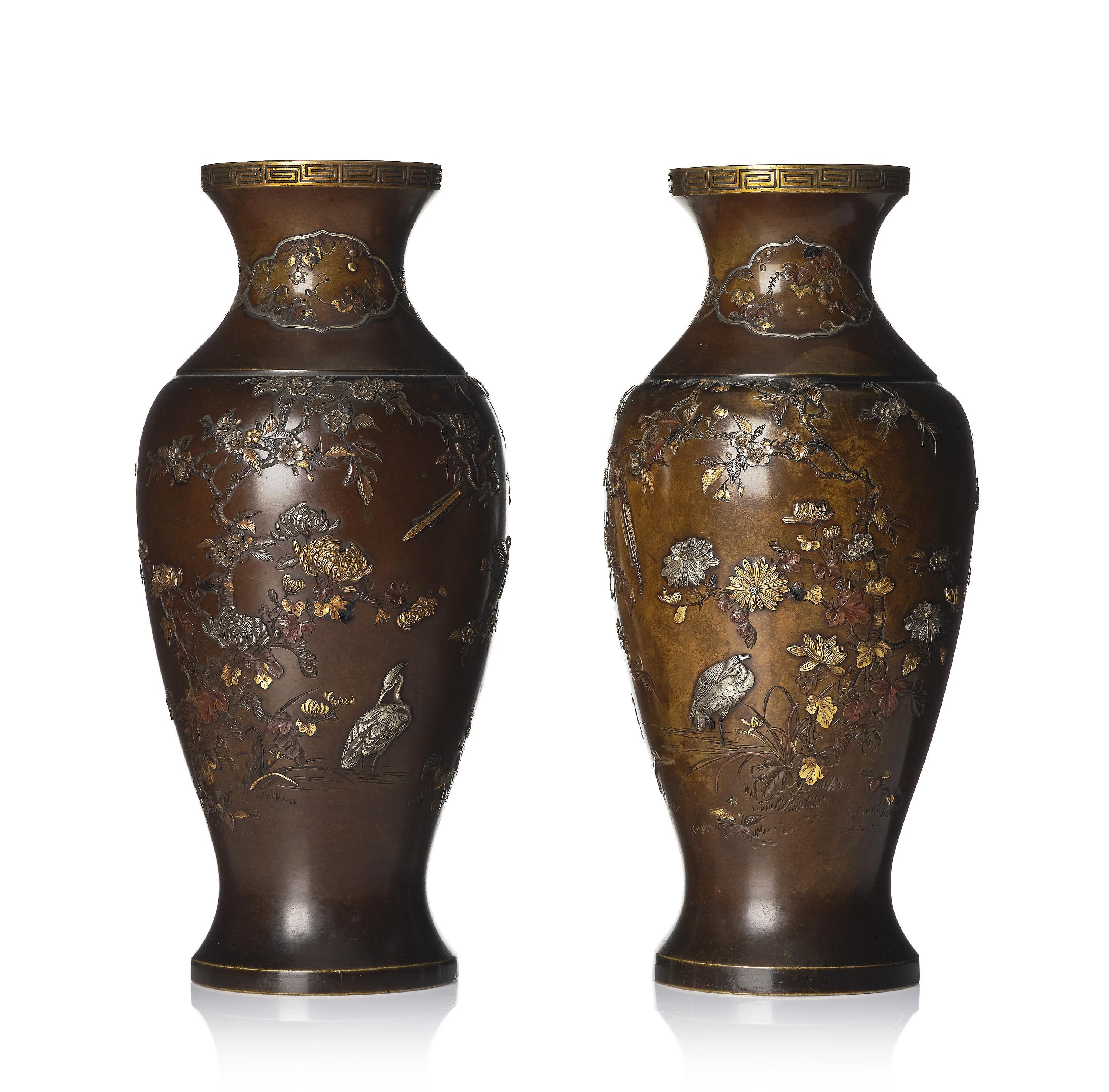
1037. A pair of Japanese bronze guardians, Meiji period (1868–1912).
Each cast as a standing guardian figure holding a halberd, chiselled and engraved details, each on bronze stand with rock formations. Height 80–83 cm.
Provenance: Property of a Finnish Collector.
Exhibitions: Compare with a similar pair sold at Christies Live auction 17735, lot no 228, 5 December 2019, provenance: A South American Private Collection.
Estimate: SEK 50 000 – 75 000 / EUR 4 720 – 7 080
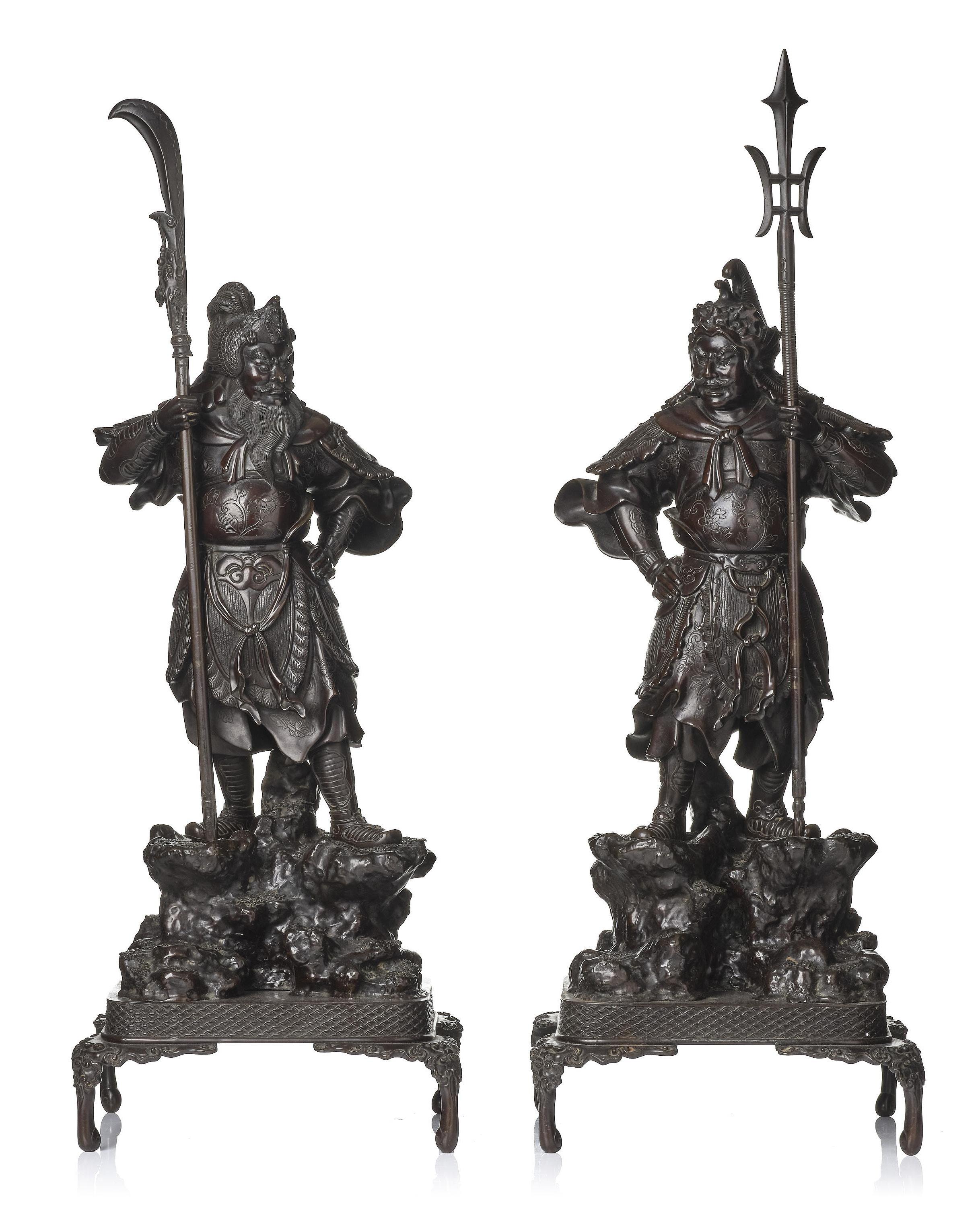
1066, 1008 and 1045.
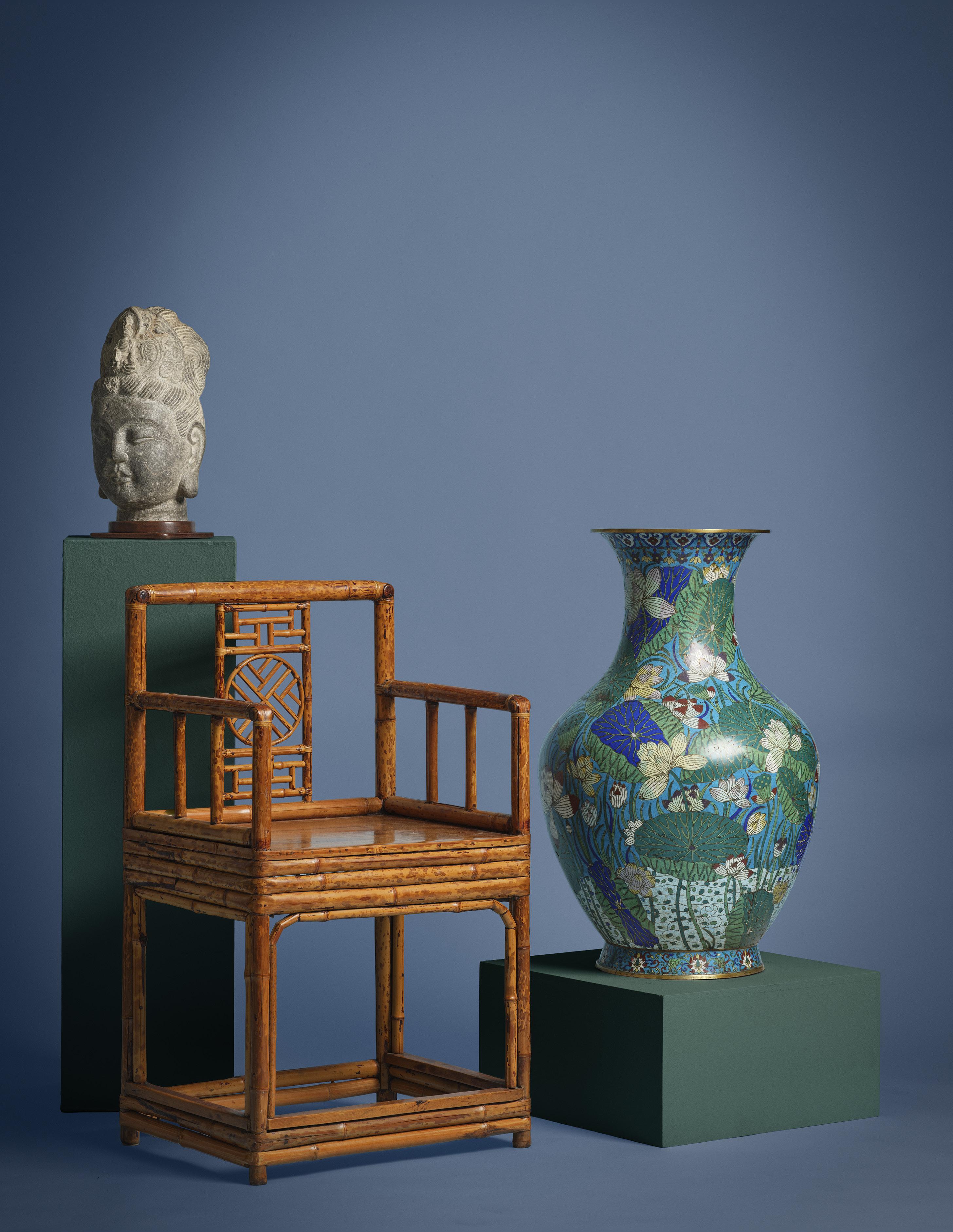
1038. A pair of Japanese vases, Genroku, circa 1700. Drop shaped, enameld with green, red and gold featuring flowers. Height 27 cm.
Provenance: Property of a private Swedish Collector.
Estimate: SEK 6 000 – 8 000 / EUR 567 – 755
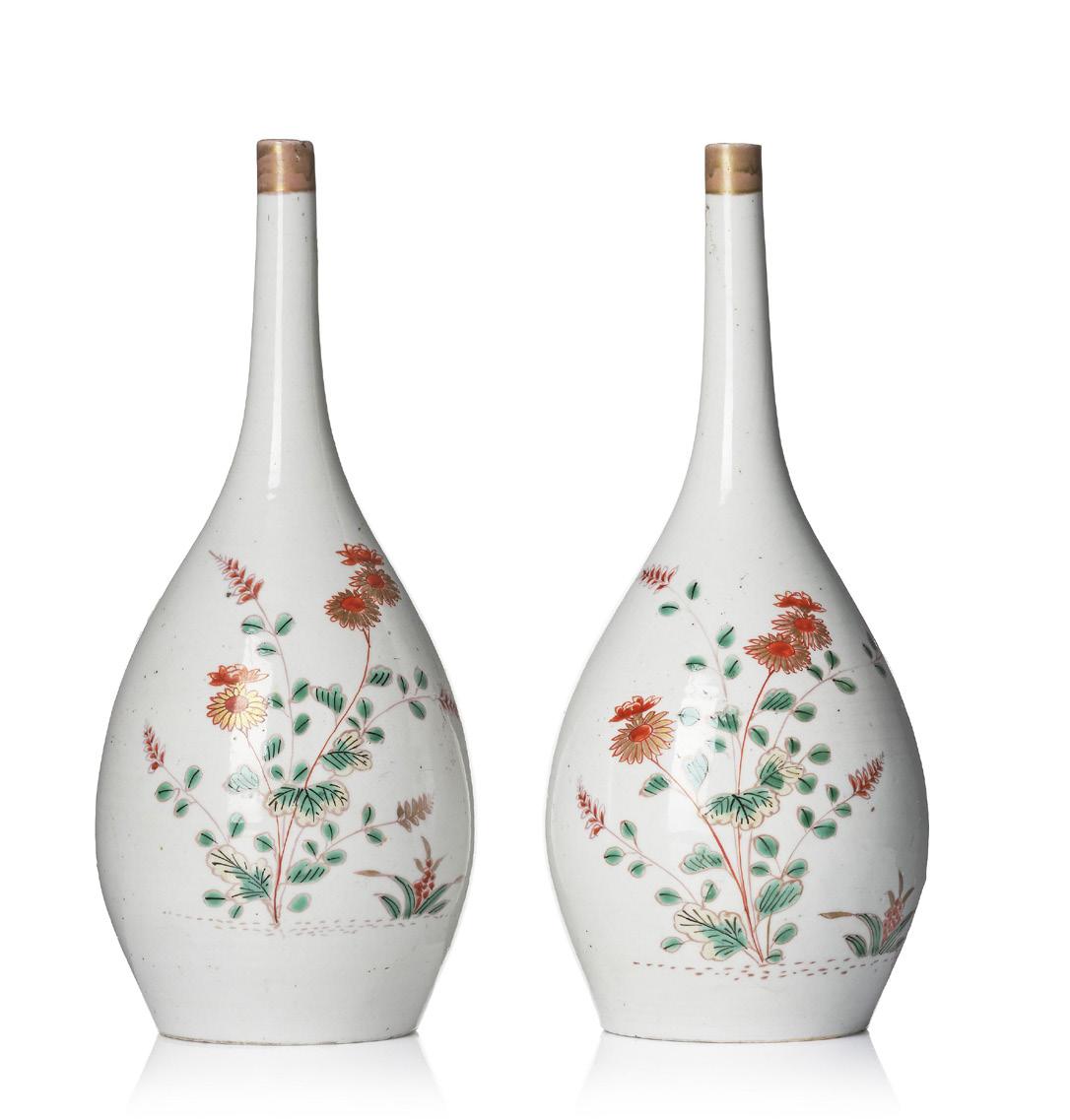
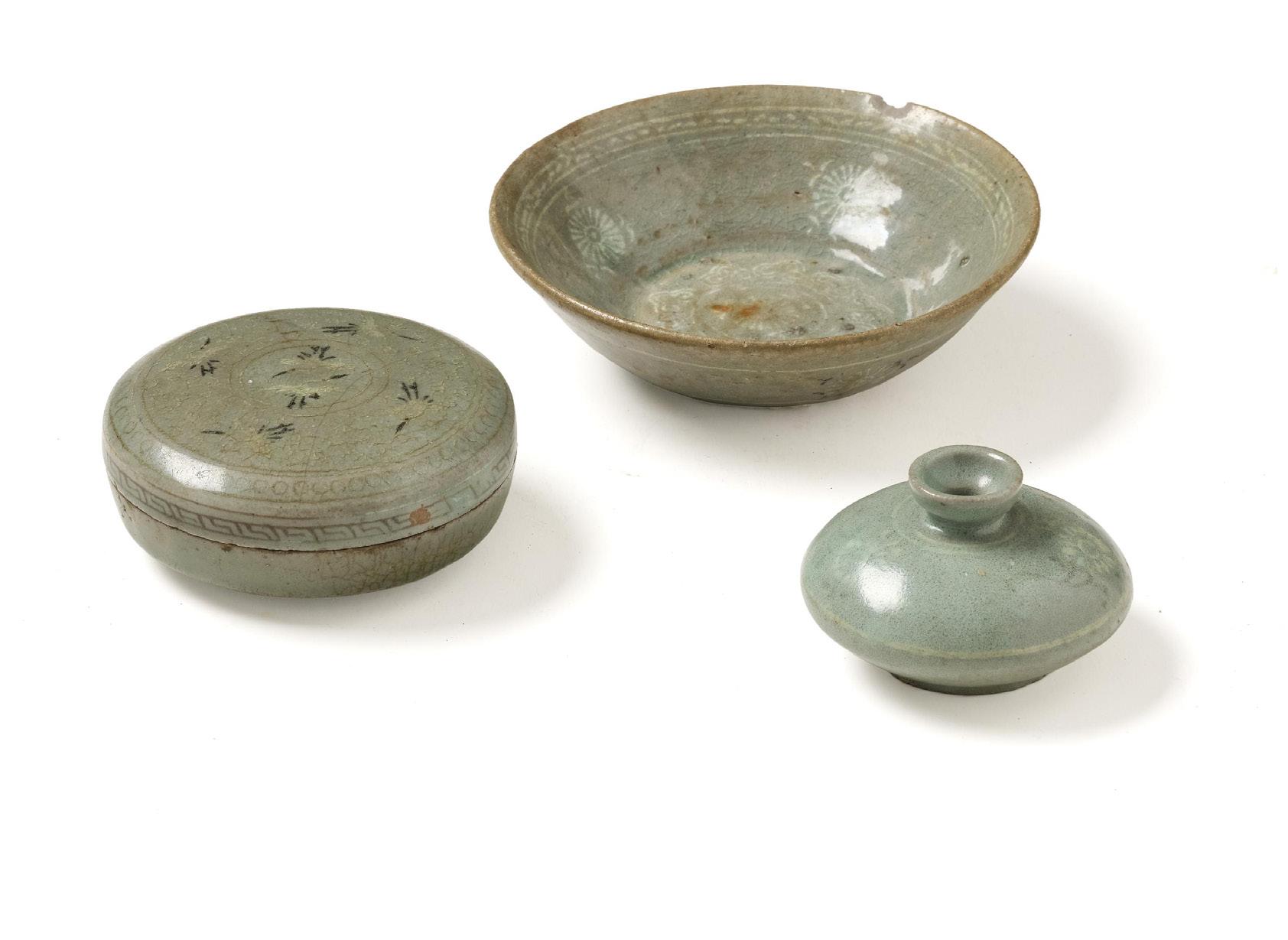
1040. A Chinese five piece export silver tea set, stamped WH, Wang Hing & Co. Hong Kong & Canton.
Marked WH, Makers mark and 90. Engraved with a C. Decorated in high relief with four-clawed dragons chasing the flaming pearl. Comprising; A large tea pot, height handle up 21 cm, length 20 cm. Weight 906.4 gram. Stand and burner, height 16.5 cm. length 19 cm. Weight 445 gram. Smaller pot, height 15 cm, length 25 cm. Weight 719.2 gram. A sugar bowl with cover, height 12 cm, length 15 cm. Weight 380.2 gram. A milk jug, height 7 cm, length 13 cm. Weight 269 gram. Total weight 2719 gram.
Provenance: Property of a private Swedish collector.
Estimate: SEK 30 000 – 40 000 / EUR 2 830 – 3 780
1039. A celadon glazed slip-decorated vase, bowl and box, Korea, Goryeo, 12/13th century.
The vase with rounded compressed body and a short flared neck. Inlaid in white slip with chrysanthemum flowers to a green celadon ground. Height 4.5 cm. A bowl with light slip featuring chrysanthemum flowers to the exterior and the interior with flowers and a ruyi border, all to a greengrey celadon ground. Height 4 cm, diameter 13.5 cm. The round box with cover decorated with a frieze of clouds interspersed with six flying cranes of white slip with iron-slip legs, beaks and eyes.
Height 4 cm, diameter 10 cm.
Provenance: Property of a private Swedish collector.
Estimate: SEK 12 000 – 15 000 / EUR 1 130 – 1 420
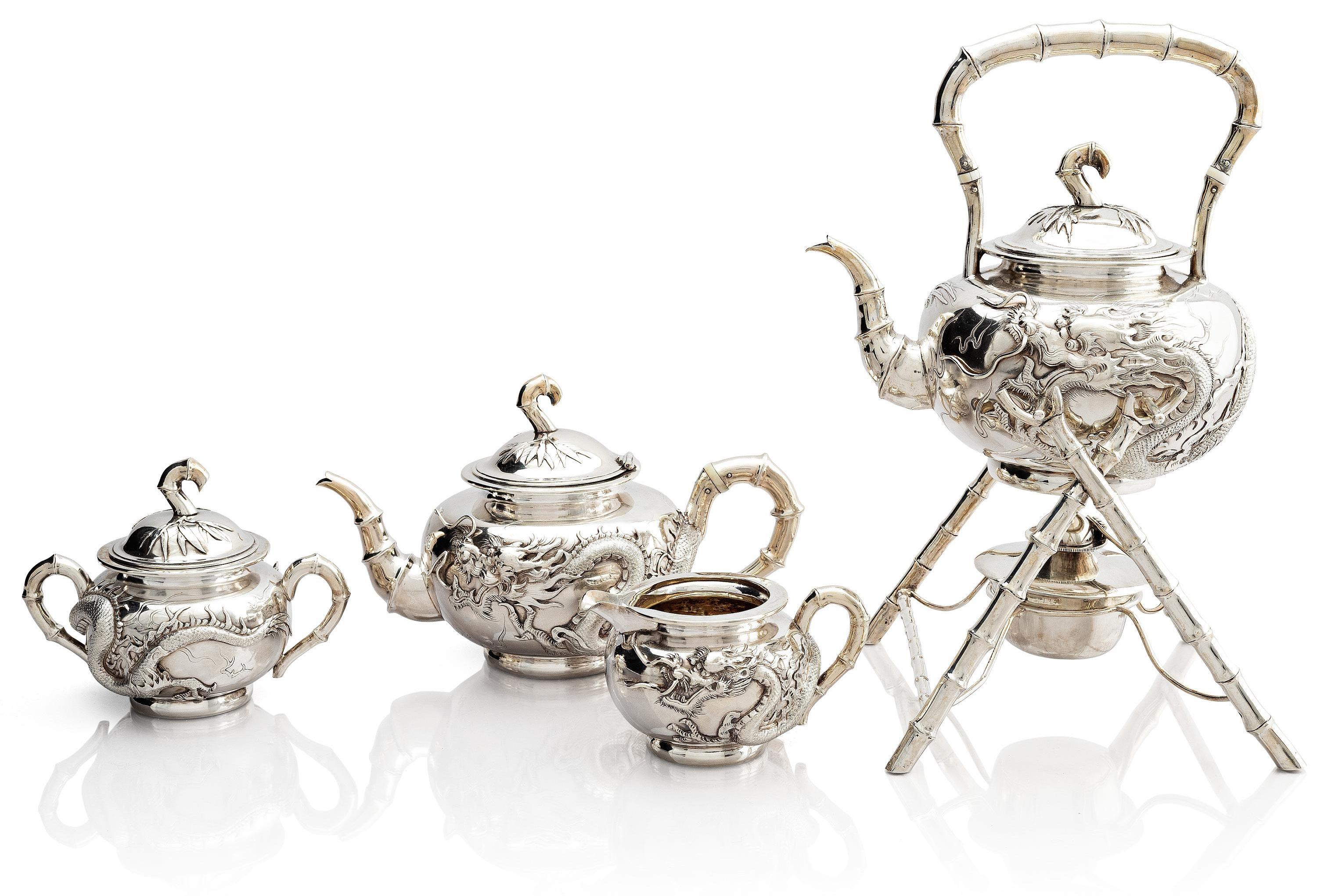
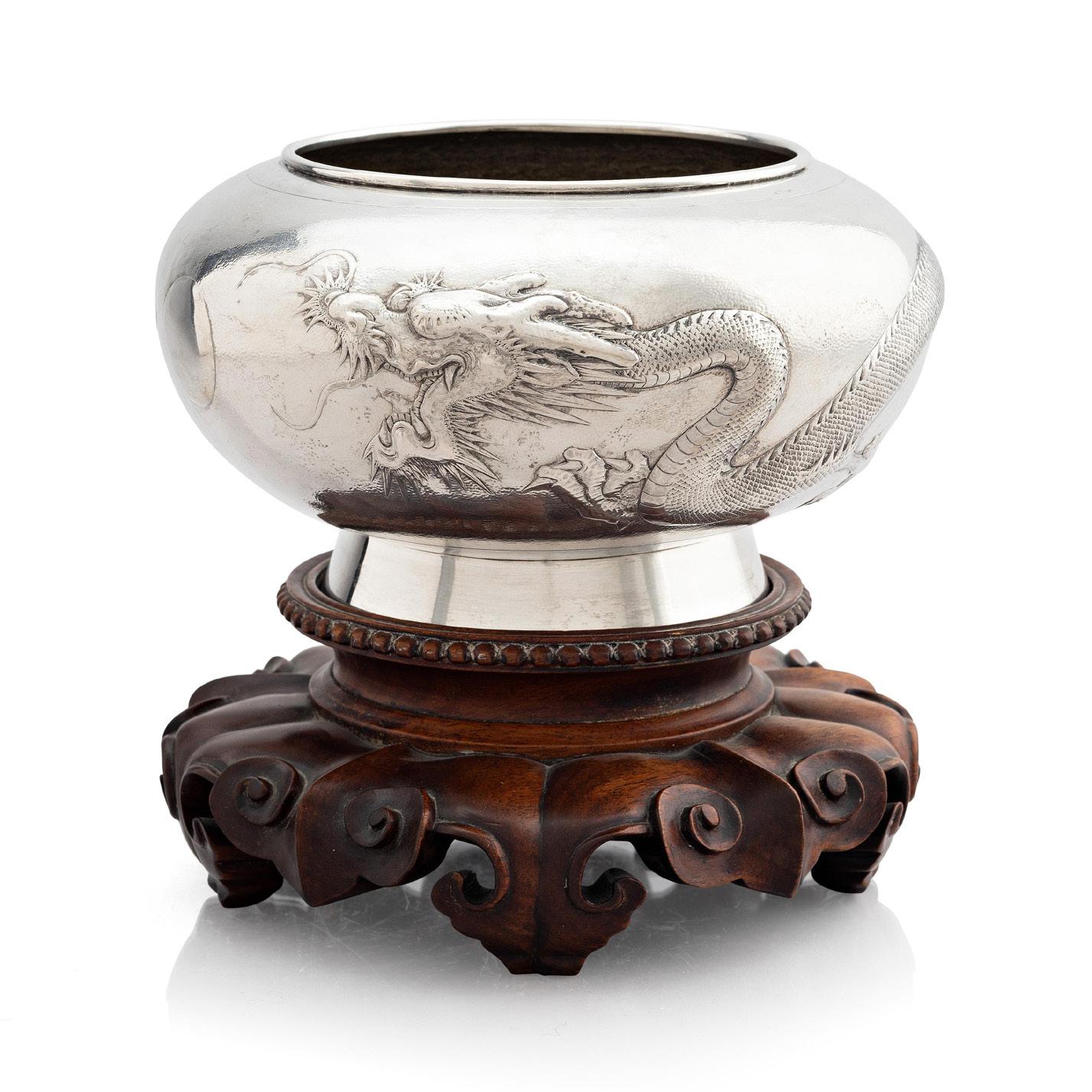
1041. A Chinese silver bowl, Tuck Chung, Hwang Chang, Shanghai, early 20th century.
Repousse work, decorated with a four clawed dragon. Diameter opening 12.2 cm. Diameter widest part 19 cm. Weight c. 620 gram. Wooden stand accompanies the piece.
Estimate: SEK 8 000 – 10 000 / EUR 755 – 944
1042. Two silver coasters and a money clip, China, early 20th century.
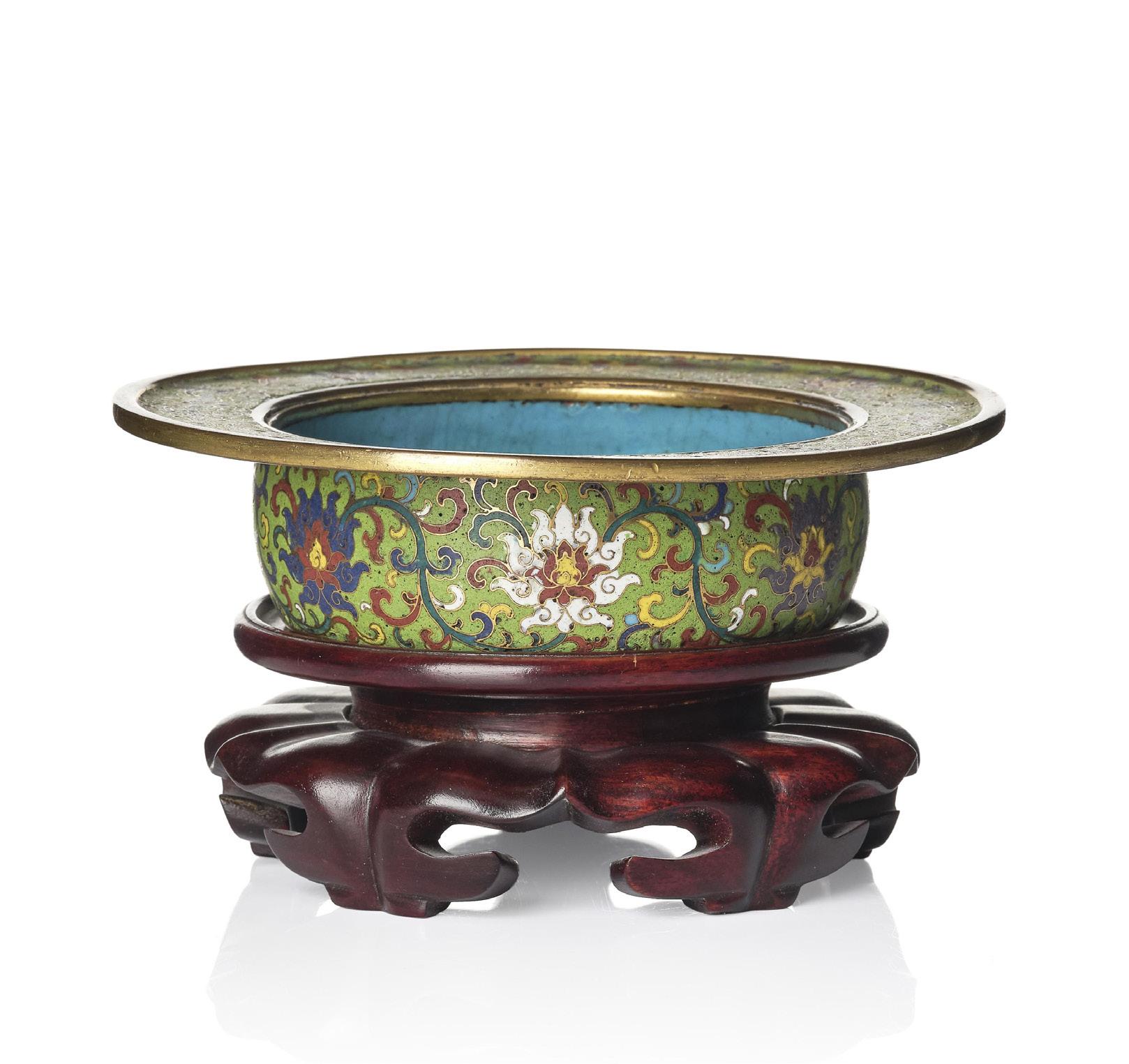
Diameter coasters 8.2 cm. Marked Sterling. In an original velvet and silk clad box from George Falconer & Co LTD, Hong Kong. Length clip 6 cm. Total weight 157.4 gram.
Provenance: The collection of General Director Vilhelm Meyers. A prominent Danish businessman who lived and worked in China during the years 1902–1935. He ran and owned the Andersen & Meyer Ltd, a company which at the time had about 25 000 employees. In 1935, Vilhelm and Kirstens daughters donated 150 Chinese Works of Art of their parents vast collection to the National Museum in Copenhagen.
Estimate: SEK 8 000 – 10 000 / EUR 755 – 944
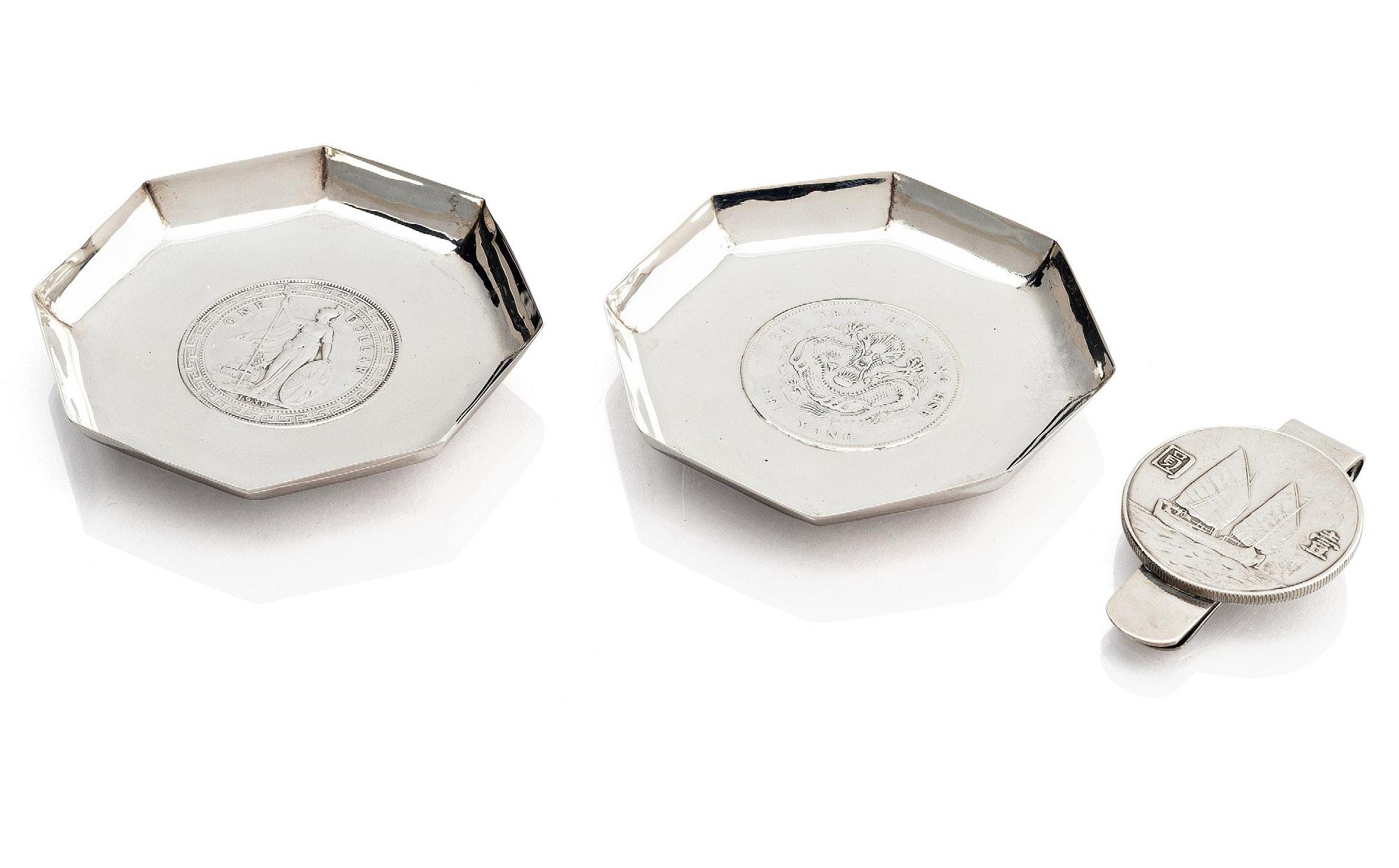
1043. A small cloisonne ‘lotus’ basin, late Ming dynasty. Both the flattened everted rim and the underside with an elegant continuous lotus scroll all against a green ground, the interior of the basin enamelled with turquoise as well on the upright cavetto. Gilded rim and edges. Diameter 16 cm.
Provenance: Purchased at Bukowskis Fine Art Asian Sale 574, lot 1362, 28 May 2013. Then from a private Swedish Collector of Chinese Works of Art.
Estimate: SEK 12 000 – 15 000 / EUR 1 130 – 1 420
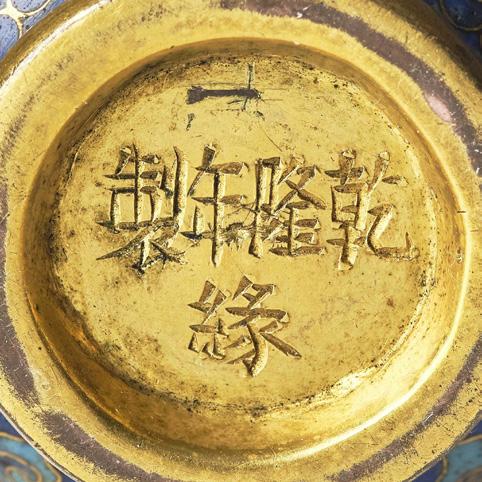
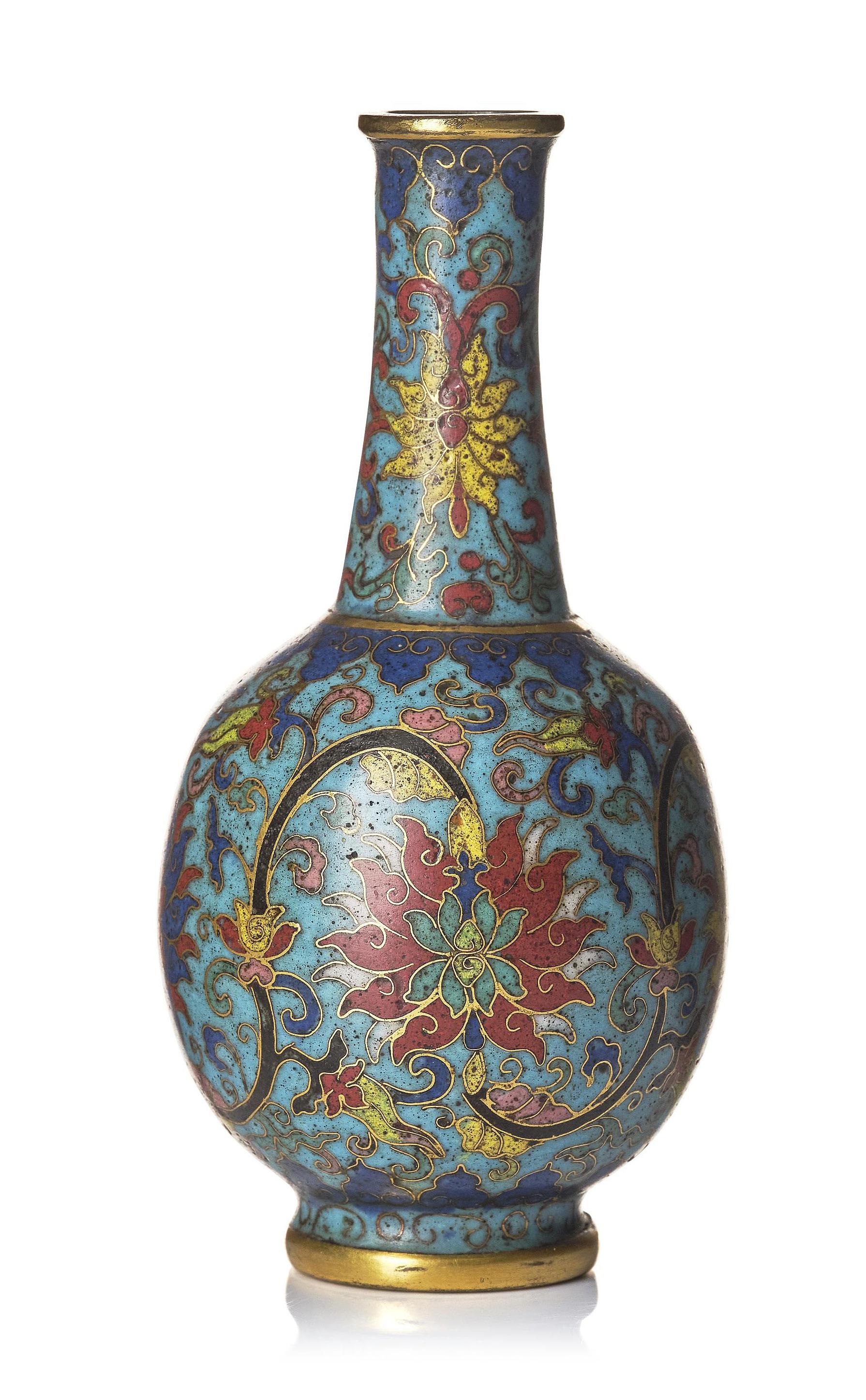
1044. A small cloisonné ‘lotus’ bottle vase, Qing dynasty with a Qianlong mark and of the period (1736–95). The vase is cast with a globular body and tall slightly tapering neck, decorated in multi-coloured enamels with scrolling lotus against a turquoise ground. The gilt base is incised with a Qianlong reign mark in a horizontal line followed by an additional character of Yuan. Height 12 cm.
Provenance: Property of a private Swedish collector.
Exhibitions: Compare another related Qianlong cloisonné enamel vase in the Palace Museum, Beijing, illustrated in Compendium of Collection of the Palace Museum: Enamels 2, Beijing and Hefei, 2011, pl.154. Compare, Christies Live auction 3217 Reverence and PerfectionMagnificent Imperial Cloisonne Enamels from a Private European Collection, lot no 2057, 29 May 2013.
Literature: Compare to a slightly smaller example (12.1 cm. high) in the Pierre Uldry Collection, inscribed with an additional character, Shou, illustrated by Brinker and Lutz in Chinese Cloisonné: The Pierre Uldry Collection, New York, 1989, pl. 285. The authors note that the additional inscription seen on some Qing cloisonné enamel pieces may appear as a single number between one and five or as an obscure character defining the vessel’s usage and category, op. cit., p. 74. See also, a very similar one in Cloisonné, Chinese enamels form the Yuan, Ming and Qing dynasties, Edited by Beatrice Quette. Page 291. The extra character is also sometimes seen on some imperial glass wares and believed by some scholars to be a serial number from the Chinese classic Qianziwen, ‘The One Thousand Word Essay’, with a strong connection to the Imperial Workshops (refer to Elegance and Radiance, Grandeur in Qing Glass, Chinese University of Hong Kong, 2000, p. 312).
Estimate: SEK 25 000 – 30 000 / EUR 2 360 – 2 830
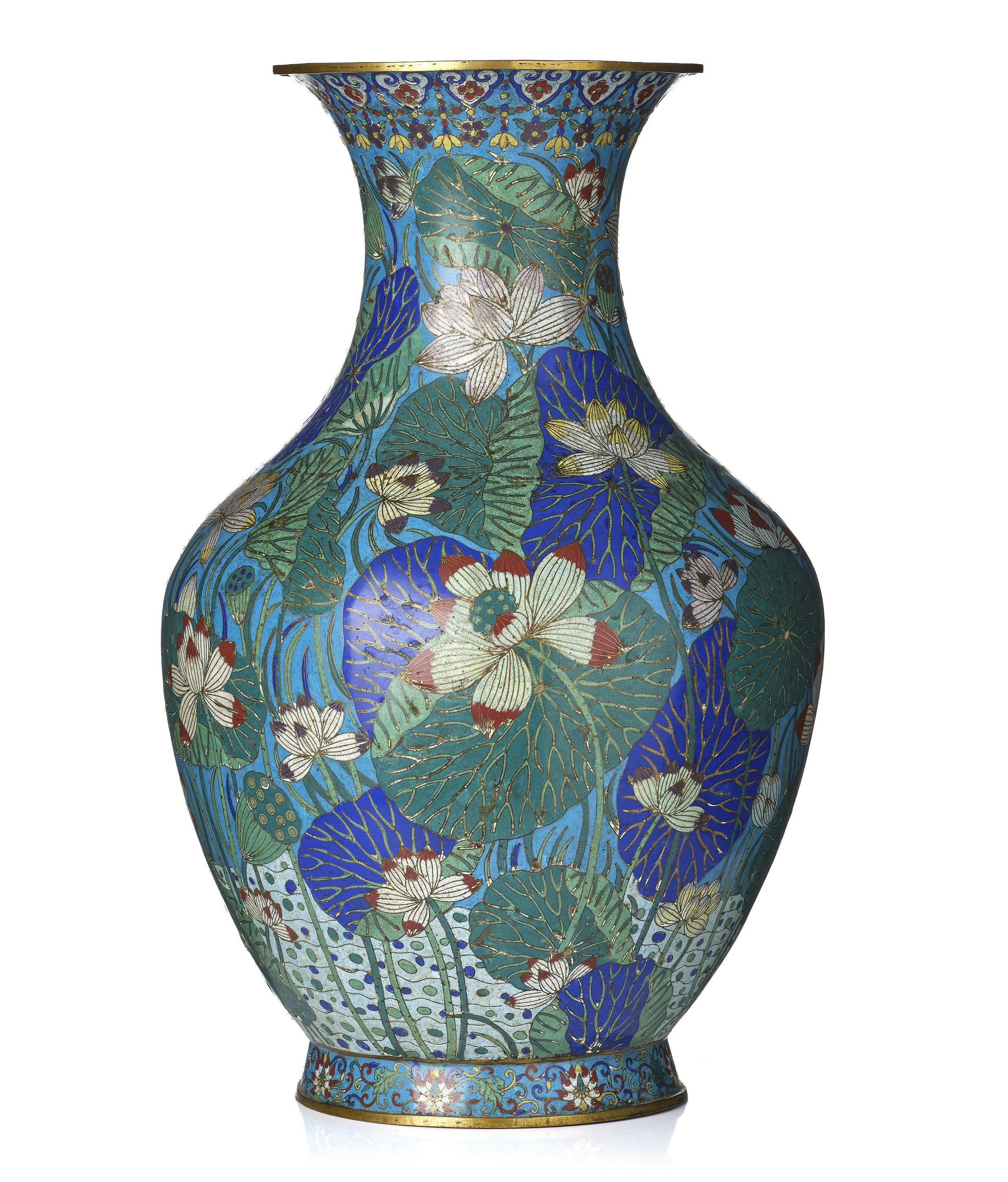
1045. A massive and fine cloisonné enamel ‘lotus’ vase, Qing dynasty, circa 1800.
Baluster shape, colourfully and densely enamelled around the body with large lotus leaves and blossoms, in tones of green, yellow, purple, red and blue against a turquoise ground. All framed by a ruyi-head border above and with a lotus petal panel and the slightly spreading foot. Height 78 cm.
Provenance: From the collection of Alexandra (Kowalewska) & Nicolai Heidenreich. Thence by descent.
Exhibitions: Compare with a pair of vases of this type but smaller sold at Bonhams New Bond Street London, Fine Chinese Art, lot 121, 11 November 2010. Compare also with a smaller vase sold at Bonhams New Bond Street London, lot 87, 7 November, 2013.
Catalogue note: The present vessel exemplifies the Qianlong period’s creative reinterpretation of antiquities. This refined synthesis of archaic form and imperial opulence reflects the Qianlong Emperor’s discerning connoisseurship and his enduring reverence for the classical past. His advocacy of fugu (“return to the ancient”) inspired court artisans to look to antiquity not merely for replication, but as a wellspring for innovation, melding the moral integrity and simplicity of ancient design with the grandeur and sophistication of the Qing aesthetic.
Estimate: SEK 50 000 – 75 000 / EUR 4 720 – 7 080
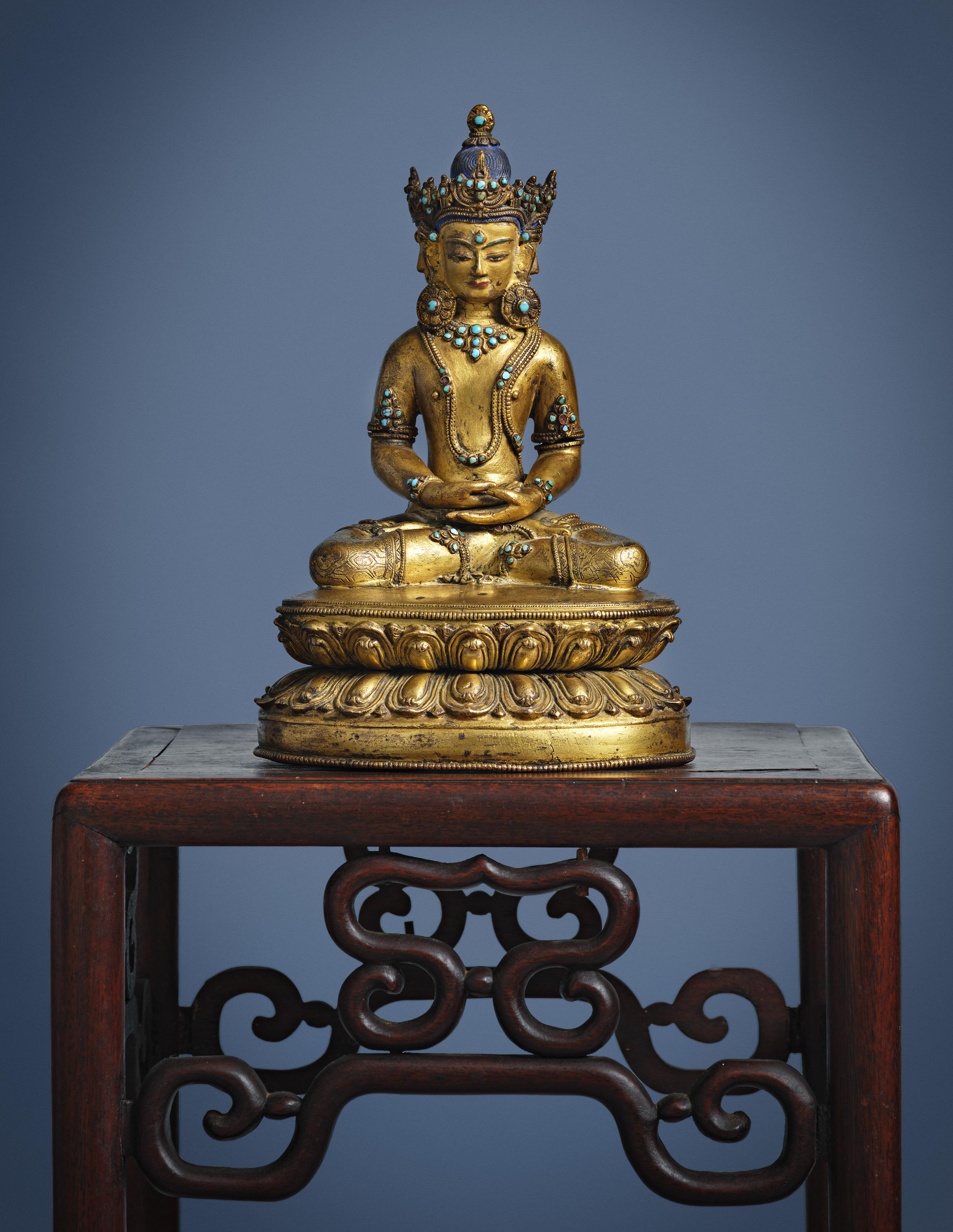
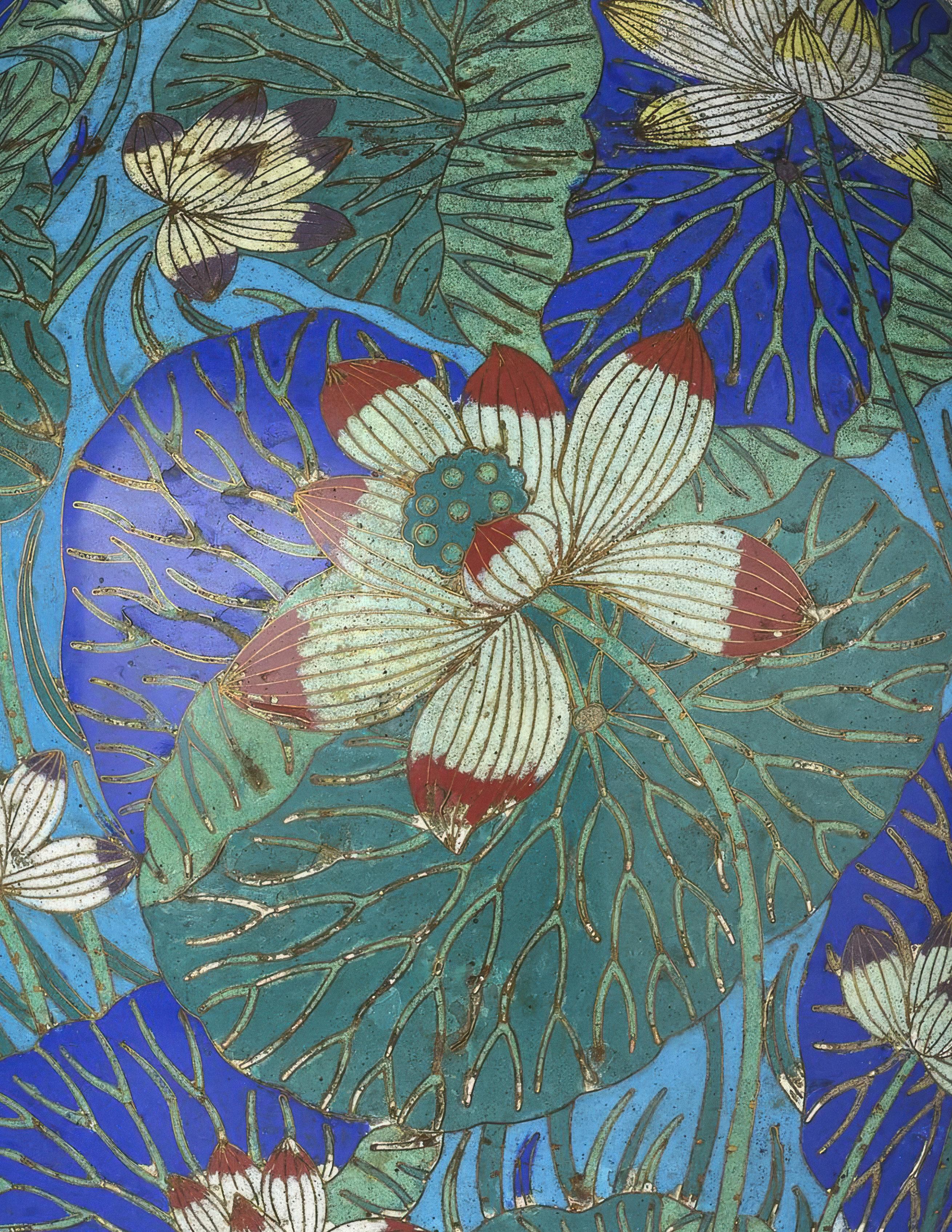
1046. A cloisonne ‘Sanskrit’ dish, Qing dynasty, with a Qianlong mark and of the period (1736–95).
A large sanskrit character to the center in black, around the rim, further signs. Around the interior we find offerings alternating with cloud formations. The reverese is decorated with alternating louts and the buddhist emblems. Diameter 14.5 cm.
Exhibitions: Compare with a dish of this type in the collection of the Palace Museum in Taiwan, 000698N00000. Compare also a dish of this type in the British Museum, Museum number 1991,0326.1.
Literature: Enamel ware in the Ming and Ch’ing Dynasty, National Palace Museum, compare with a similar plate page 139. 01.11.000696´`698–1173.
Catalogue note: The central symbol on this plate is a complex Tibetan Buddhist monogram known as Namchu Wangden (the “Tenfold Powerful One”), which represents the Kalachakra mantra.
Estimate: SEK 40 000 – 60 000 / EUR 3 780 – 5 670
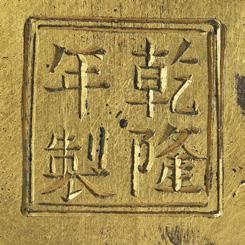
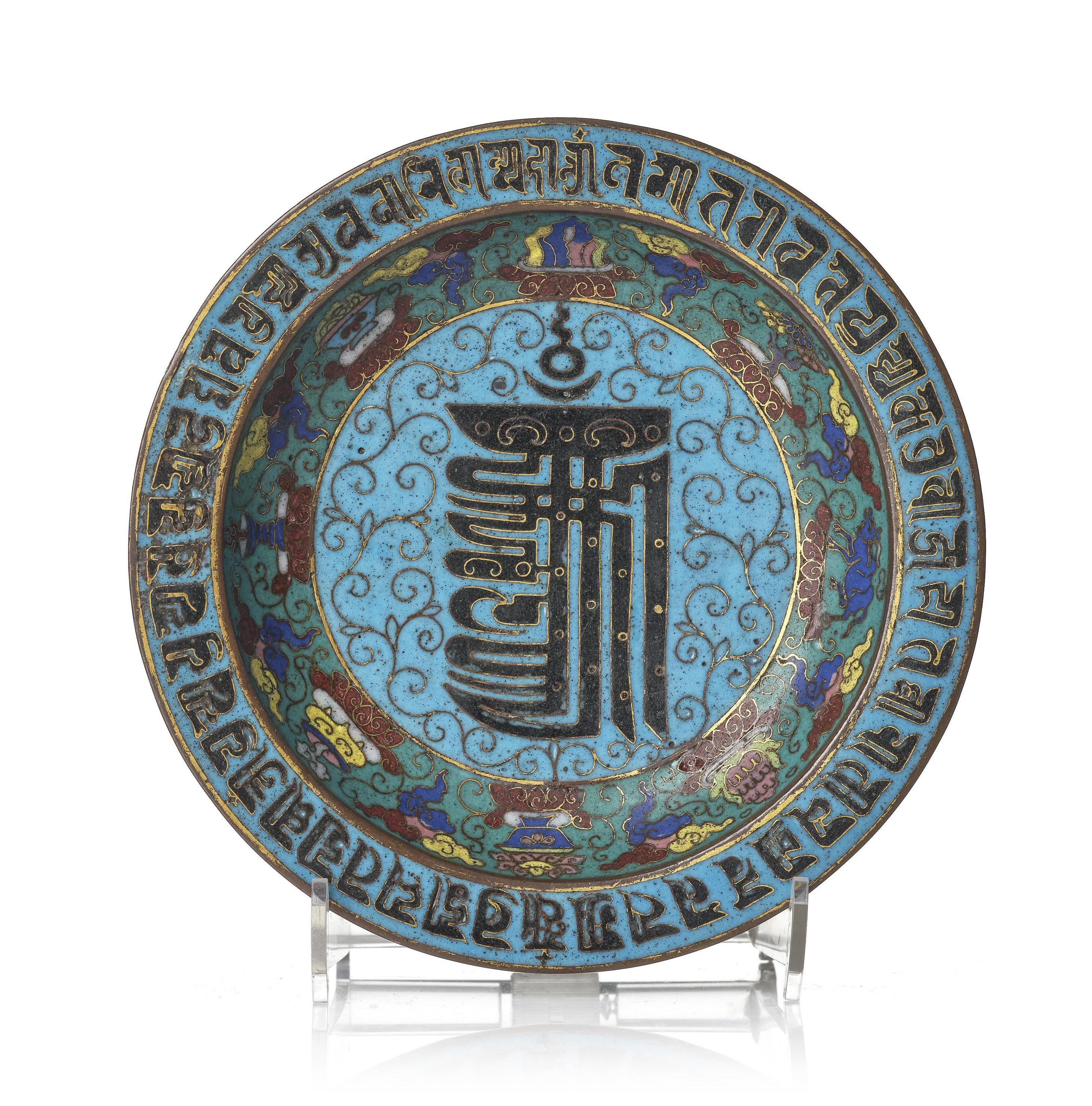
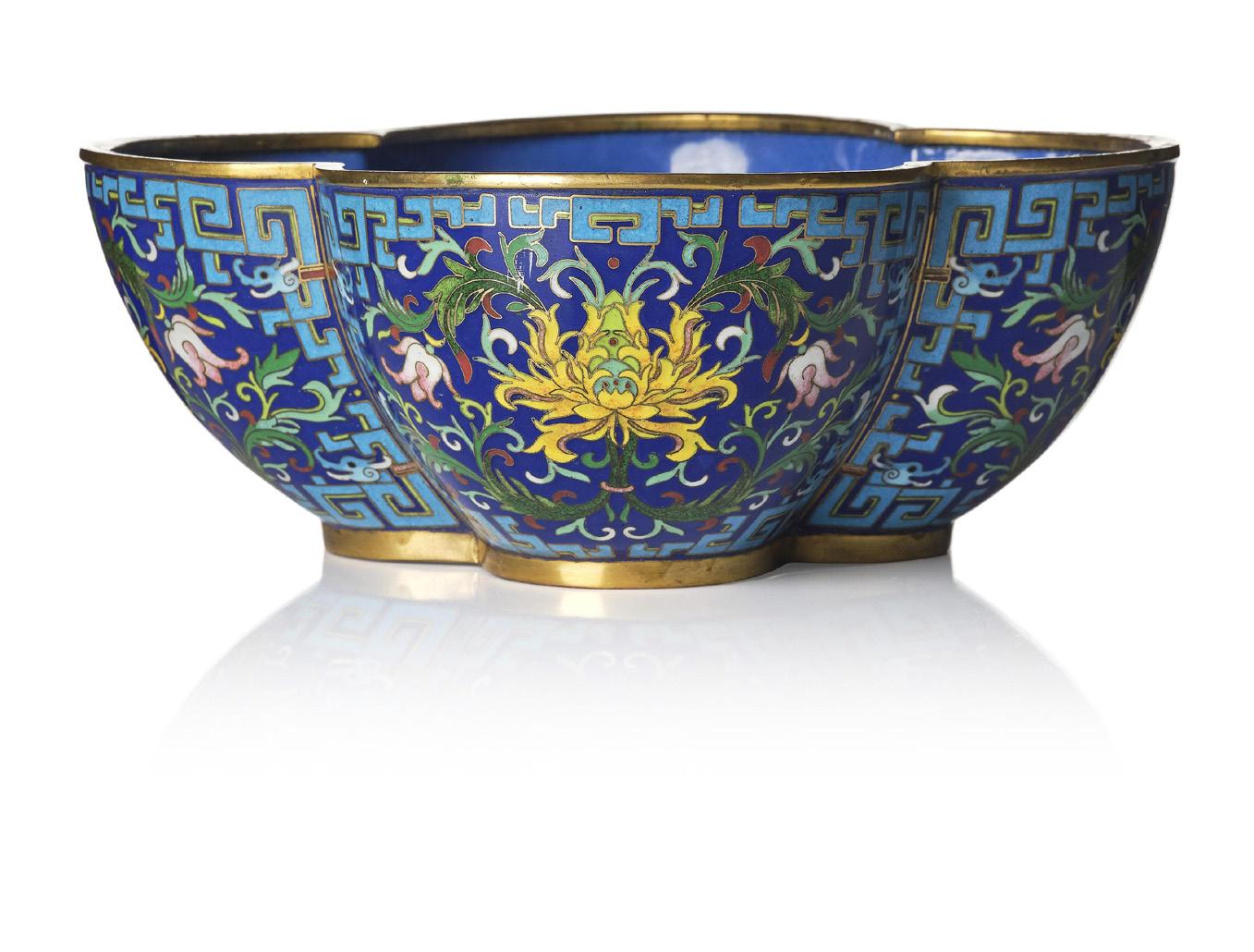
1048. A Chinese cloisonné ‘flowers and butterflies’ box with cover, 20th century.
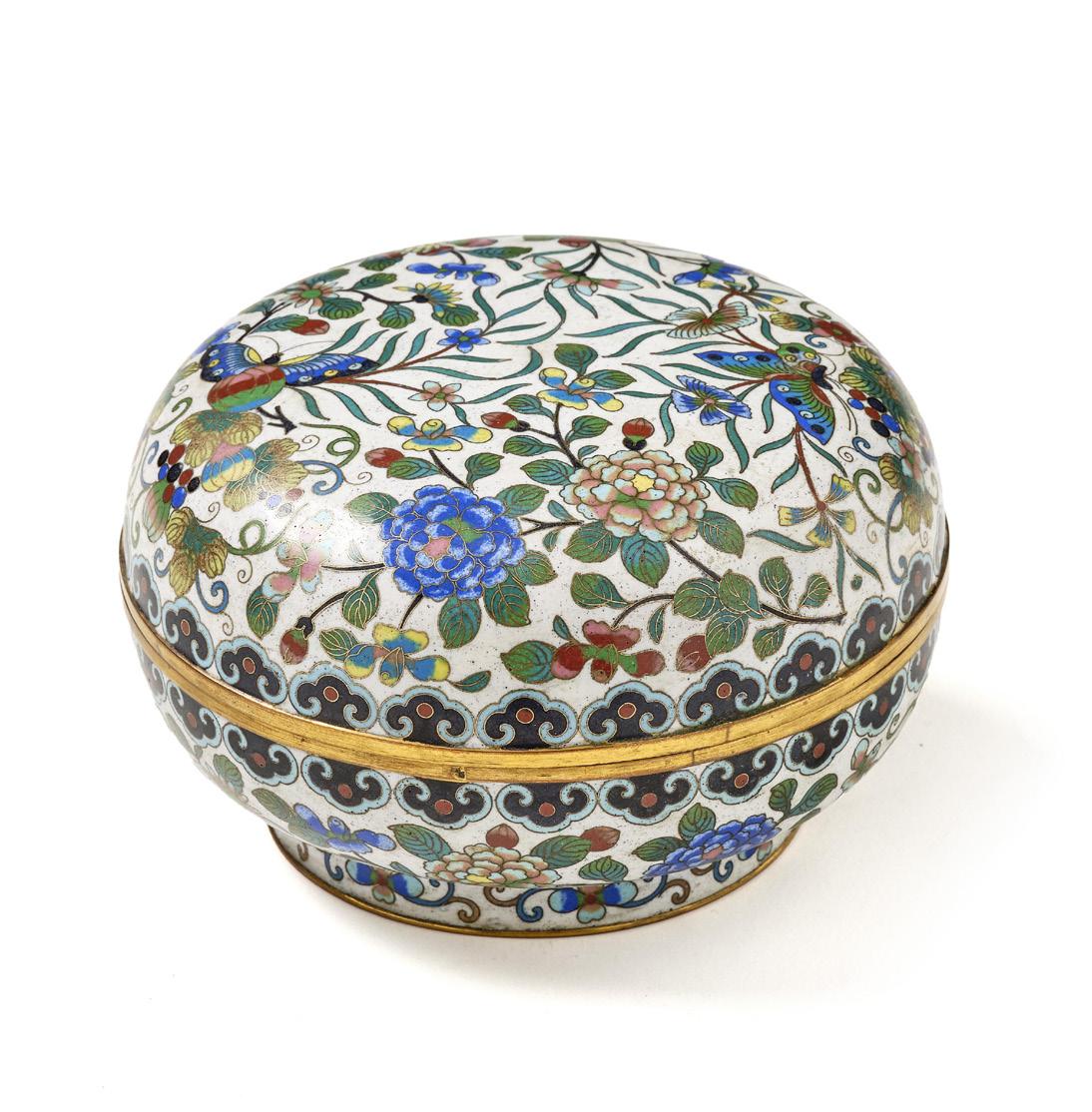
Of compressed globular form resting on a short straight foot, the domed cover decorated with flowers and butterflies in vibrant colours all against a white ground. The interior and base in a turquoise blue. Gilded rims. Diameter 15 cm.
Provenance: Poperty of a private Swedish collector.
Estimate: SEK 4 000 – 6 000 / EUR 378 – 567
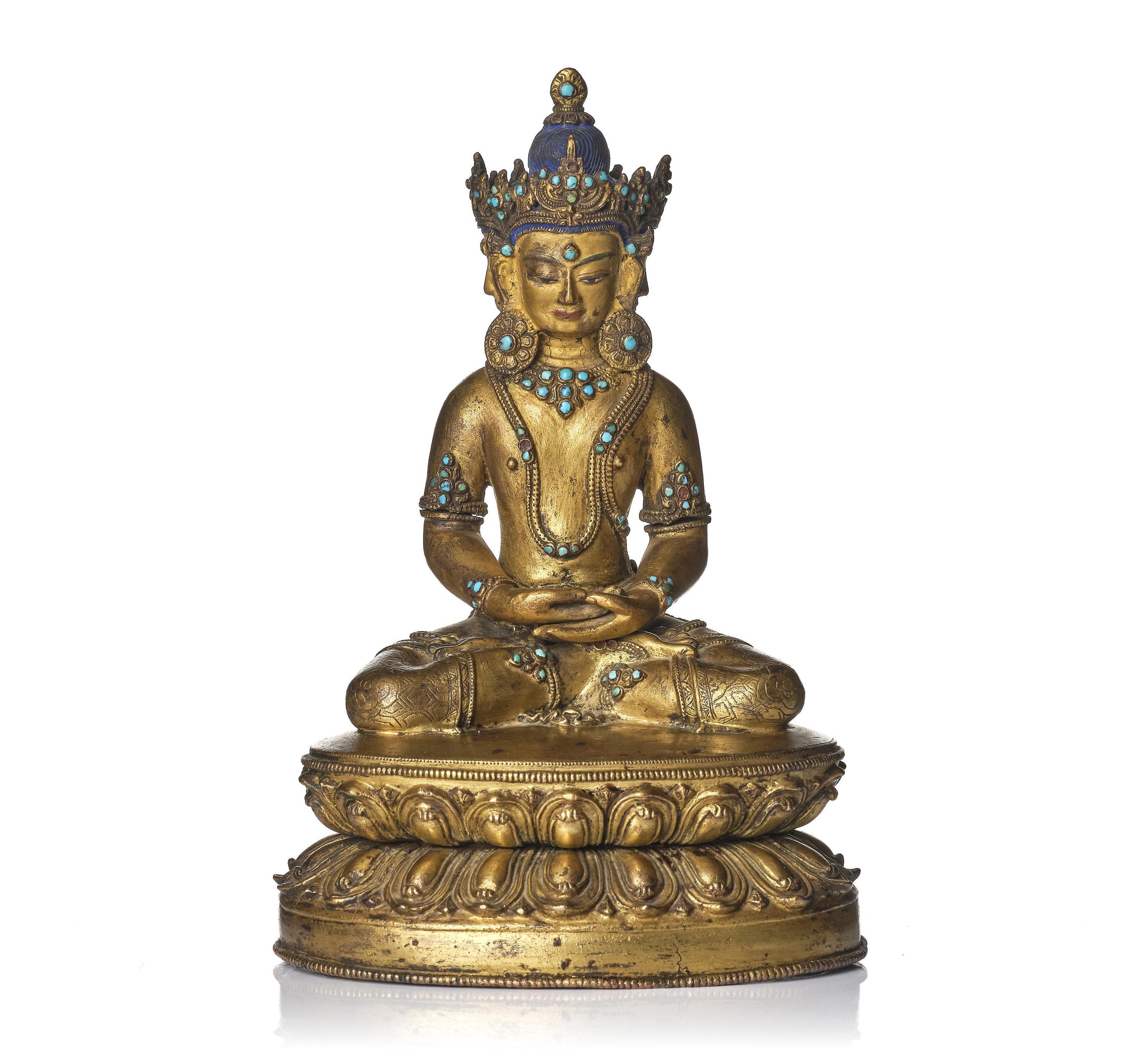
The figure is cast seated in dhyasana upon a double lotus throne with beaded edges, holding his hands in his lap, joined in the meditative samadhi mudra and meant to support The Wheel of Dharma (Dharmachakra) or an upright vajra, the head is represented with four faces, each with a calm expression and a drop-shaped urna between the arched brows, framed by ears suspending large floral earrings, a continuous ornate crown encircling the pigmented high coiffure, clad in a geometric-patterned skirt (antaravasaka) with finely incised borders which is tied around the waist and terminating in a ruffled flourish between his crossed legs, adorned in elaborate jewellery inlaid with turquoise beads, the faces with cold gold paste and pigments, sealed with a copper plate engraved with a gilt double vajra (visvavarja).
Height: 23 cm. Provenance: From the collection of Chef and Restaurant Manager Erik Berlin (1930 -2012), Malmö. Thence by descent within the family.
Exhibitions: Compare with a Tibetan sculpture of the same period but smaller; sold at Christie’s New York, lot 85, 14 September 2010. Compare with one at Himalayan Art resources, lot not 2381.
Literature: Another example of a four-faced Vairocana is published in Amy Heller, Early Himalayan Art, New Delhi, 2008, pp.124–5, no.40.
Catalogue note: Sarvavid Vairocana is the chief deity in the Sarvavid Vairocana Mandala, the root mandala of the Sarvadurgatiparisodhana Tantra. Out of the five ‘wisdom’ Buddhas, he is the only one who may have more than one face. Sarvavid Vairocana is recognized by his bodhisattva regalia, his four faces, and The Wheel of Dharma (Dharmachakra), which is lost in the present figure. In this large and finely detailed figure of Vairocana, he is depicted in his four-faced form, alluding to his epithet as the Oalluding to his epithet as the Omniscient Buddha. The present figure is cast in parts, with the forearms and lower part of the lotus throne cast in separate parts.
Estimate: SEK 200 000 – 220 000 / EUR 18 900 – 20 800
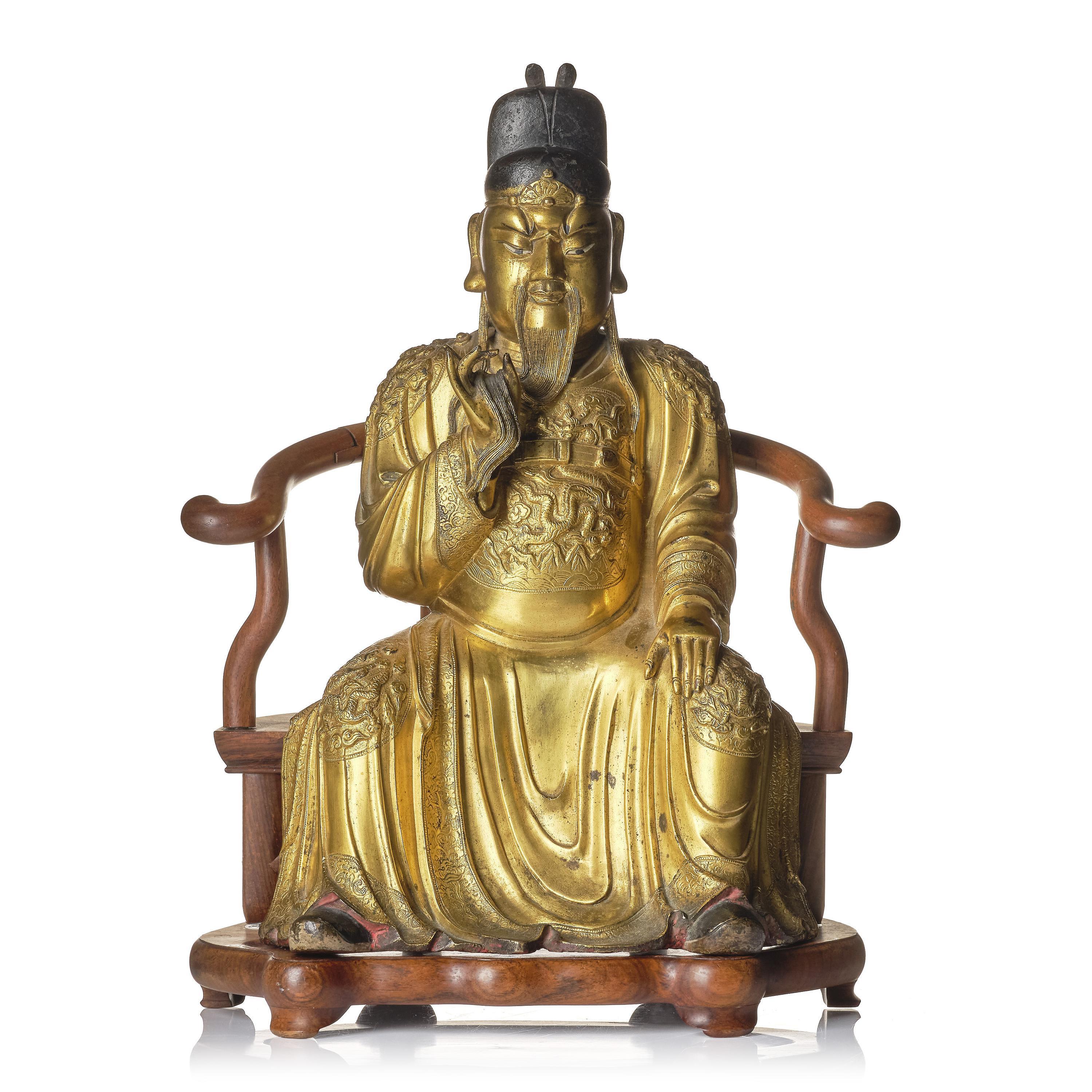
1050. A large well cast figure of Guandi, Ming dynasty (1368–1644).
The figure is shown seated with his left hand resting on his thigh. He is dressed in a long scholars robe over his armour with a raised belt decorated to shoulders, knees and front with a leaping dragon amidst clouds, further a floral scroll decoration at the hem. The face with fierce expression and well-groomed beard, the hair pulled up and hidden under a classic Ming scholars hat, his right hand playing with his long beard. Consecrated in red to interior. Height 44 cm. Height 44 cm. Height with later wood stand in the shape of a horseshoe arm chair 47 cm.
Provenance: From the collection of Mr Sjösten, Gothenburg, the partner of Gösta Hatt, Gothenburg, thence by descent.
Exhibitions: Compare with a figure of this type but larger in the British Museum, Museum number OA+.7023. Compare a much smaller one, sold at Christies, Live Auction 11928. Fine Chinese Ceramics & Works of Art part I. lot 1423. Compare also with Christies, Live Auction 22642. Important Chinese Art Including the Collection of Dorothy Tapper Goldman. Lot 1151. Christies, Live Auction 3484. The Sublime and the Beautiful: Asian Masterpieces of Devotion. Lot 1627.
Catalogue note: This imposing figure, with his handsome and benevolent features, represents Guan Di, the God of War, is a popular figure in Chinese mythology and culture. His image comes from an historical figure who lived during the chivalrous era of the Three Kingdoms (about 161–220), Guan Yu, was a general who helped Liu Bei to establish the Shu Han dynasty in AD 221. After his death, he was venerated as a loyal and righteous figure, his fame continued to grow as rulers conferred successively greater titles upon him. Finally, in 1594, a Ming dynasty emperor canonized him as god of war—protector of China and of all its citizens. Thousands upon thousands of temples were constructed, each bearing the title Wu Miao (Warrior Temple) or Wu Sheng Miao (Sacred Warrior Temple). With the name Guan Di, he was worshipped in temples and households as the daoist God of War, honest merchants and in this attire with the scholars robe over the armour he was venerated as the patron god of scholars.
Estimate: SEK 200 000 – 300 000 / EUR 18 900 – 28 300
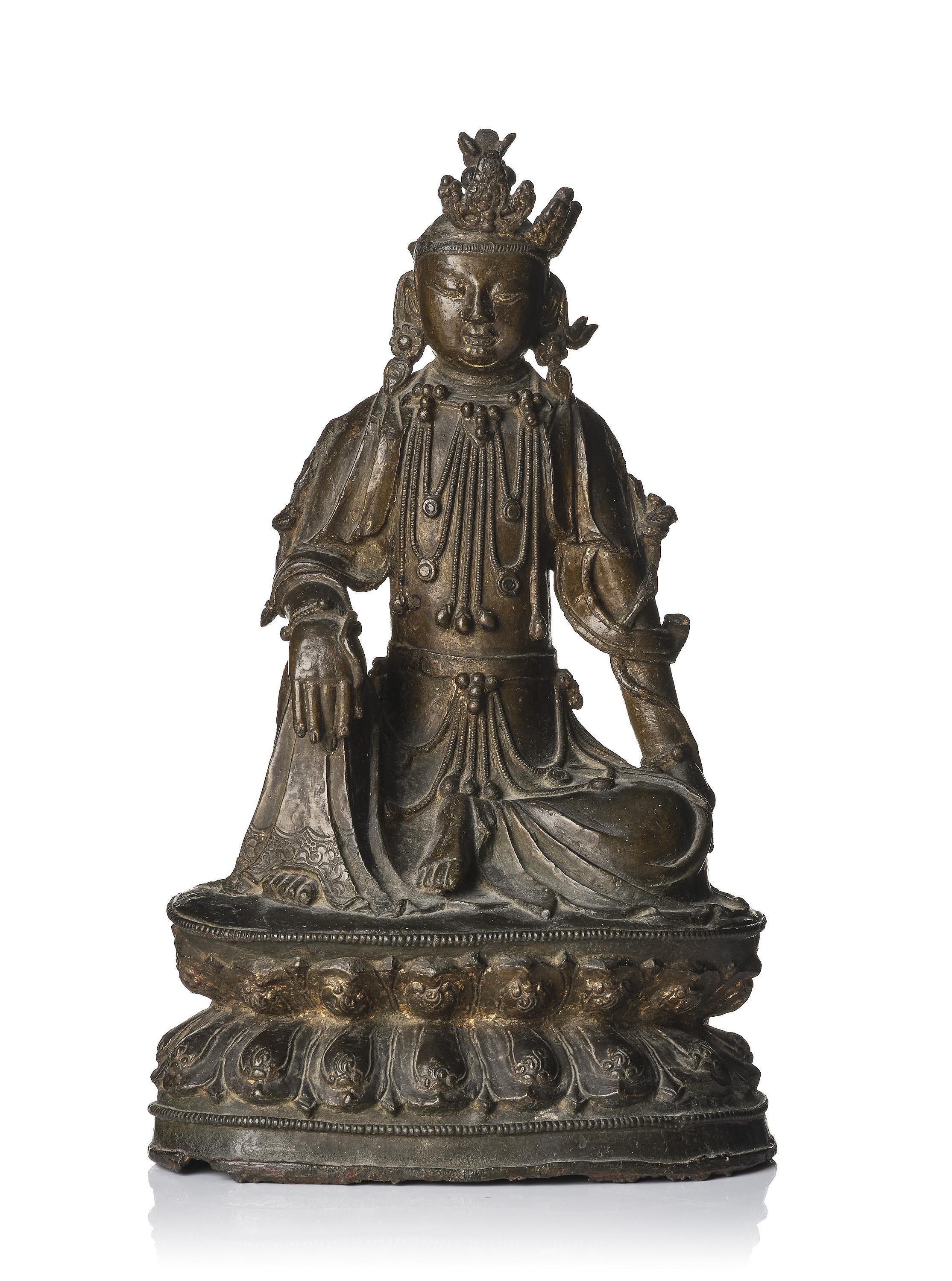
1051. A bronze sculpture of Guanyin, Ming dynasty (1368–1644).
Seated in rajalilasana, the right hand draped over the raised right knee, the other palm placed by the edge of the platform base for support, the head with an elaborate crown, the elongated ears and shapely body adorned with ornaments and jewels, all supported by a double-lotus base. Traces of red pigments to interior. Height 35 cm.
Provenance: Purchased at Winkel & Magnussons auction in Copenhagen, in 1950, by the present owners grandmother. Black and white print is the saved page of the auction catlogue. This being lot 437.
Estimate: SEK 50 000 – 80 000 / EUR 4 720 – 7 550
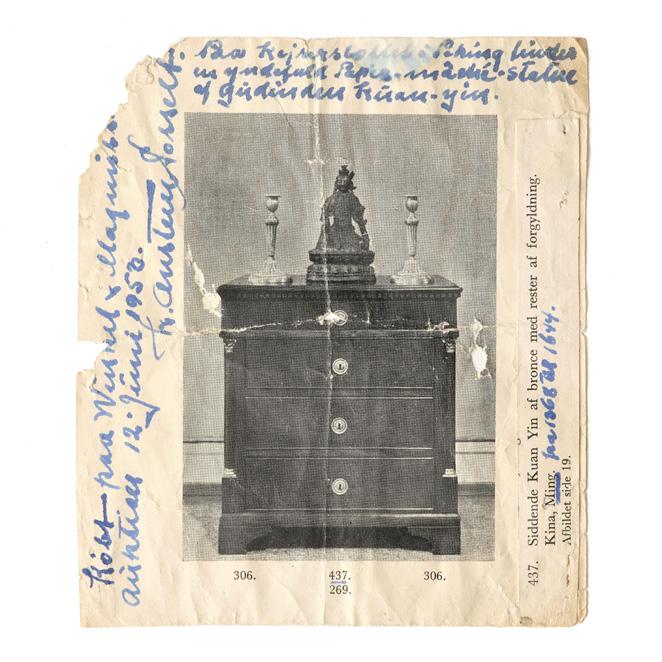
1052. A bronze sculpture of a crowned Buddha, late Ming dynasty, with an inscription dating it 1530.
With inscription to the base with a cyclical date that can be interpreted as ‘Made on the twentieth day of the third month in the ninth year of the Jiajing reign (1530), by Wu Liangjing and Hao Miaolian together with their son Wu Han’. The crowned buddha shown seated in padmasana. Lacquered and with cold gilt. Height 32.2 cm.
Provenance: Purchased in 1947 in Shanghai, by the Swedish collector Olle Kronke, thence by descent.
Estimate: SEK 50 000 – 75 000 / EUR 4 720 – 7 080
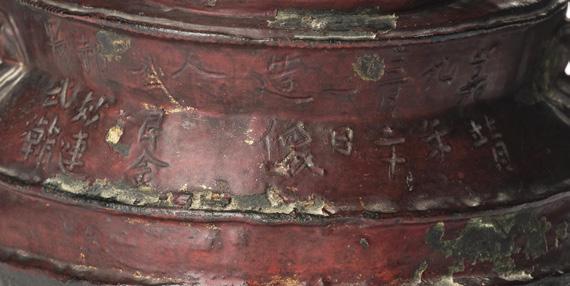
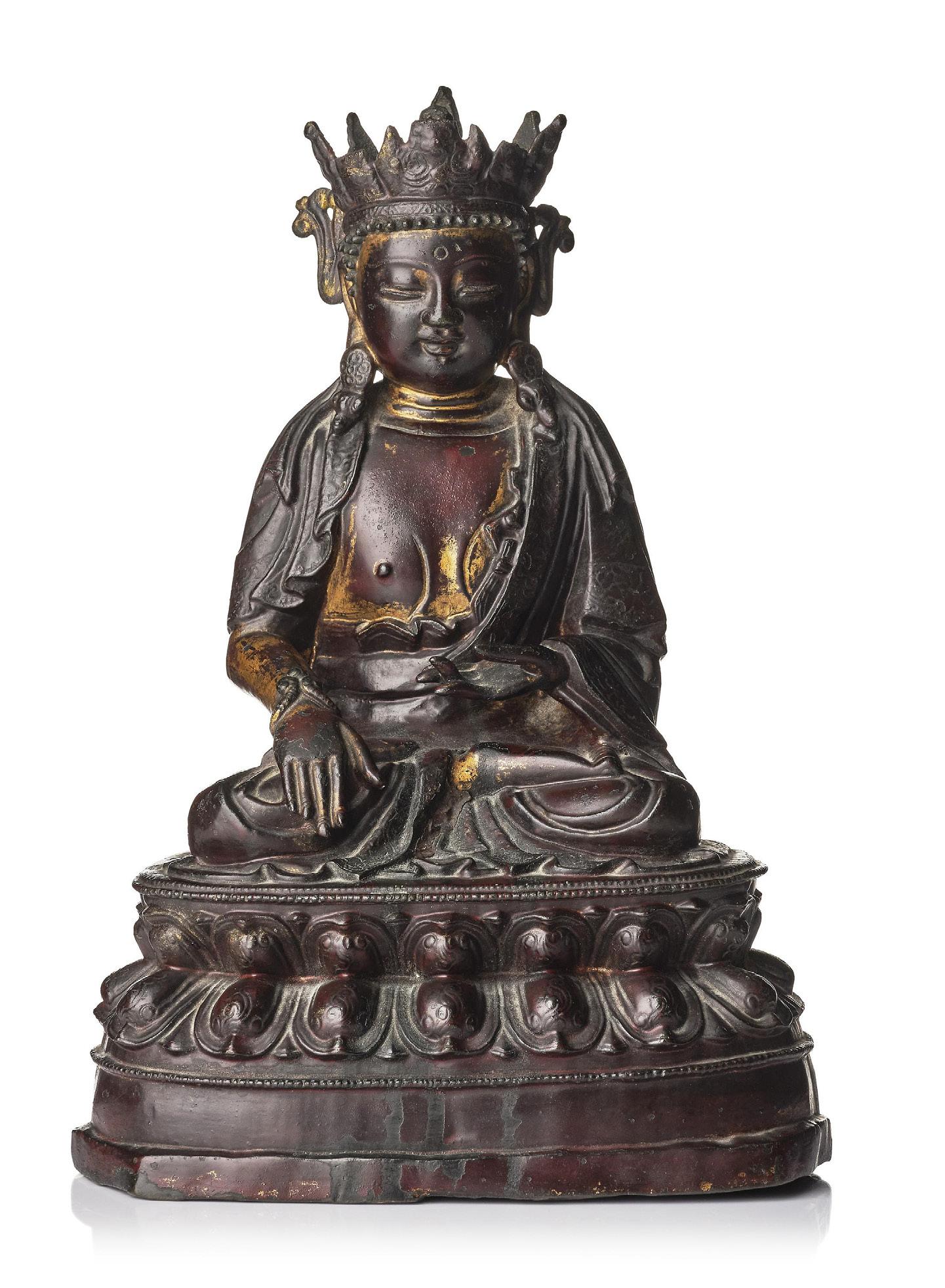
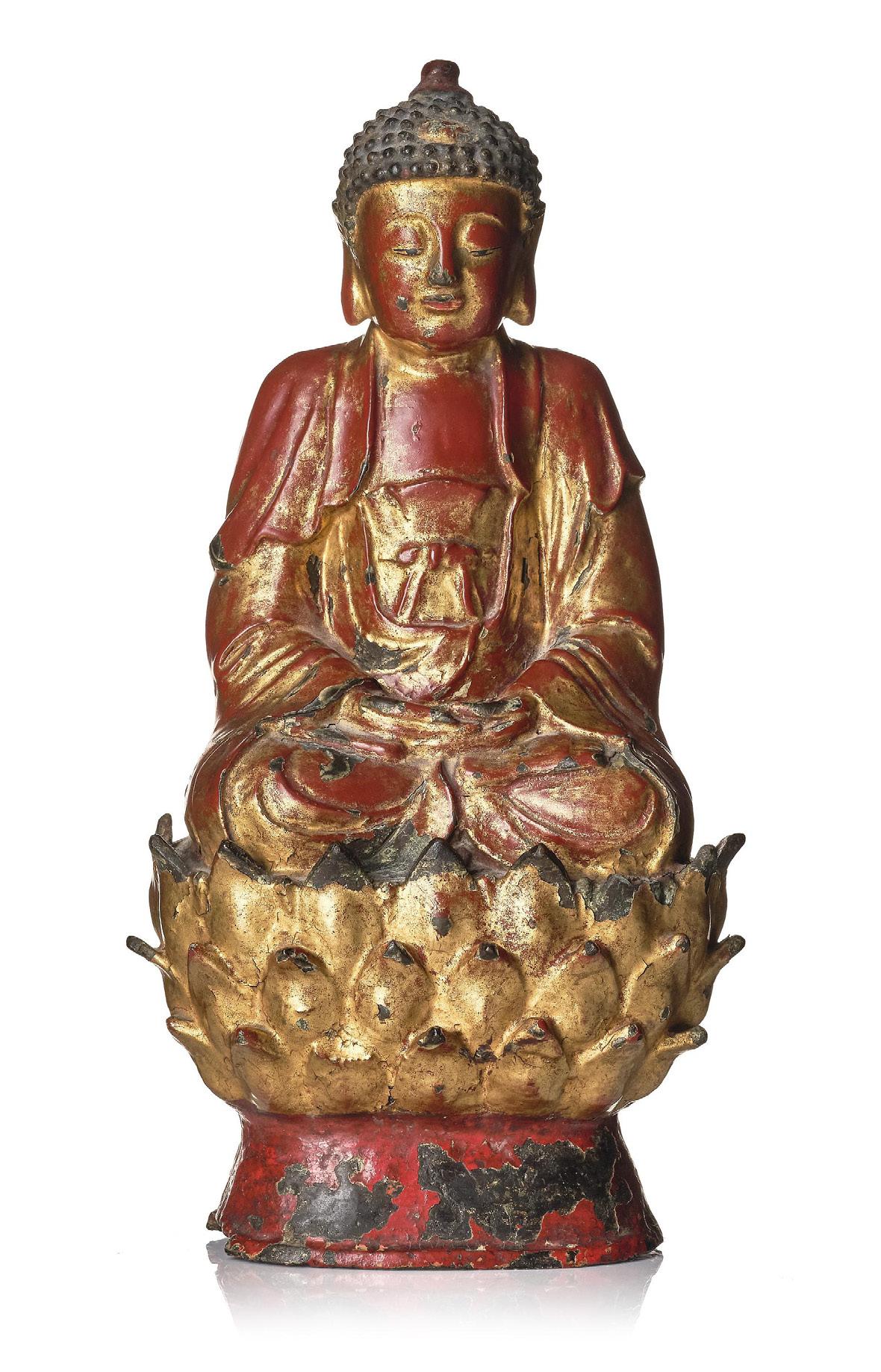
1054. A gilt bronze sculpture of Arhat Ajita, Tibeto-Chinese, 18th century.
Depicts arhat Ajita as a meditating hermit clad in heavy robes and a heavy hood, a standard iconographic portrayal of the master. He is rooted on a two-tiered cushion, with elegant intricate lotus decoration, the Arhat seated in vajraparyankasana, with hands held in dhyanamudra. Traces of cold gilt painting. The base is sealed and with a double vajra. Height 15.5 cm.
Width 11.5 cm. Depth 9 cm.
Provenance: From the Collection of M.D. Karl-Olof Högsell (1896–1974). He was acitve as a M.D on ships for a period , and brought the deity back during this time. Thence by descent within the family.
Literature: Compare another portrait of Ajia, in Portraits of the Masters, pp.78–9, no.2.
Catalogue note: The name Ajita means “The Unsubdued”, probably related to the story of his successful fetching of a princess with the most excellent of elephants, in order to have King Prasenajit agree to their marriage. This talented young man eventually abandoned his wealth and power, and became one of the sixteen disciples of Buddha.
Estimate: SEK 50 000 – 75 000 / EUR 4 720 – 7 080
1053. A seated bronze figure of Bhaisajyaguru Buddha, Ming dynasty (1368–1644).
The medicine buddha depicted seated on a lotus throne, cold gilt and lacquered. Height 31.5 cm.
Provenance: Property of a private Finnish collector of buddhist art.
Estimate: SEK 12 000 – 15 000 / EUR 1 130 – 1 420
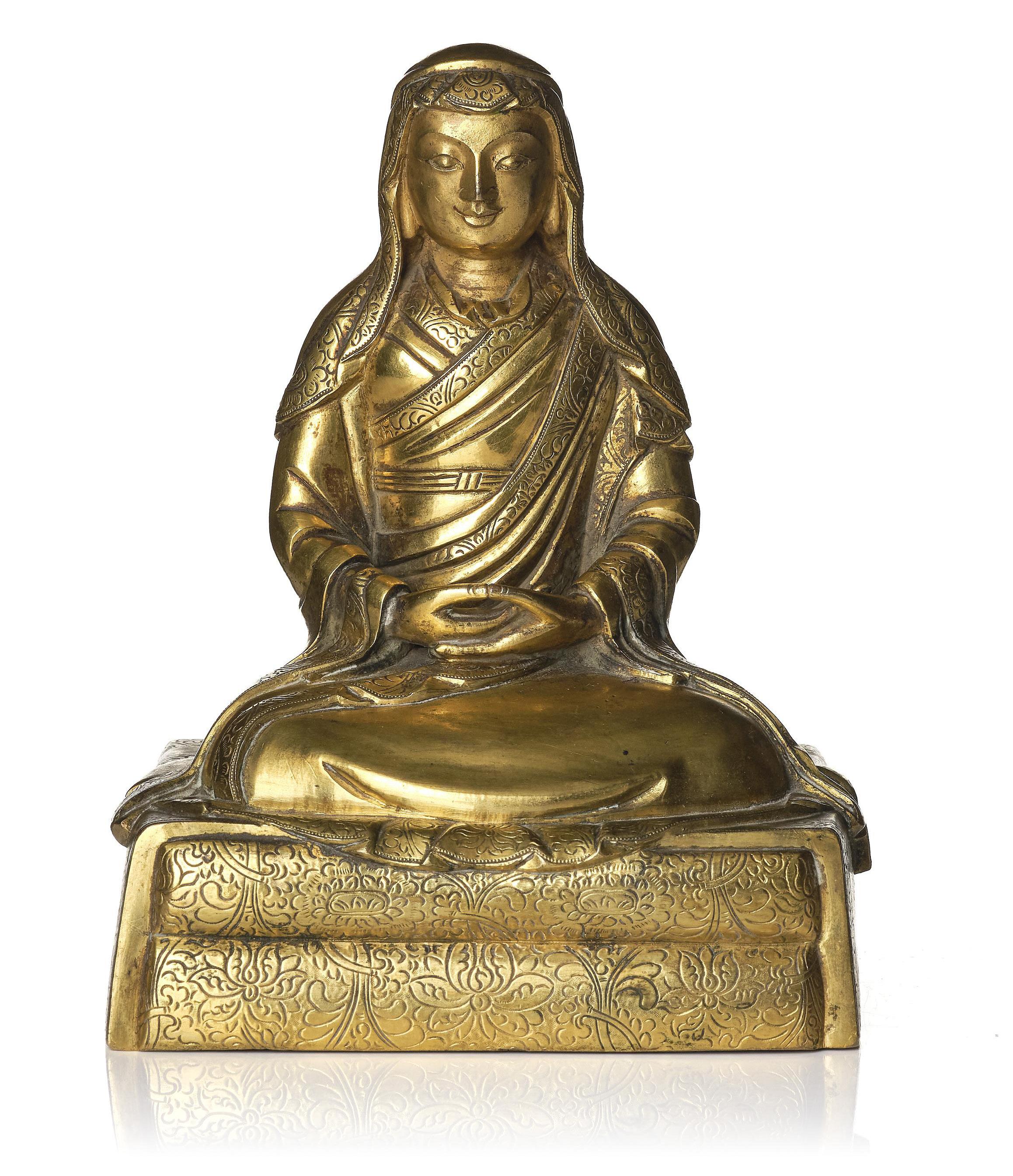
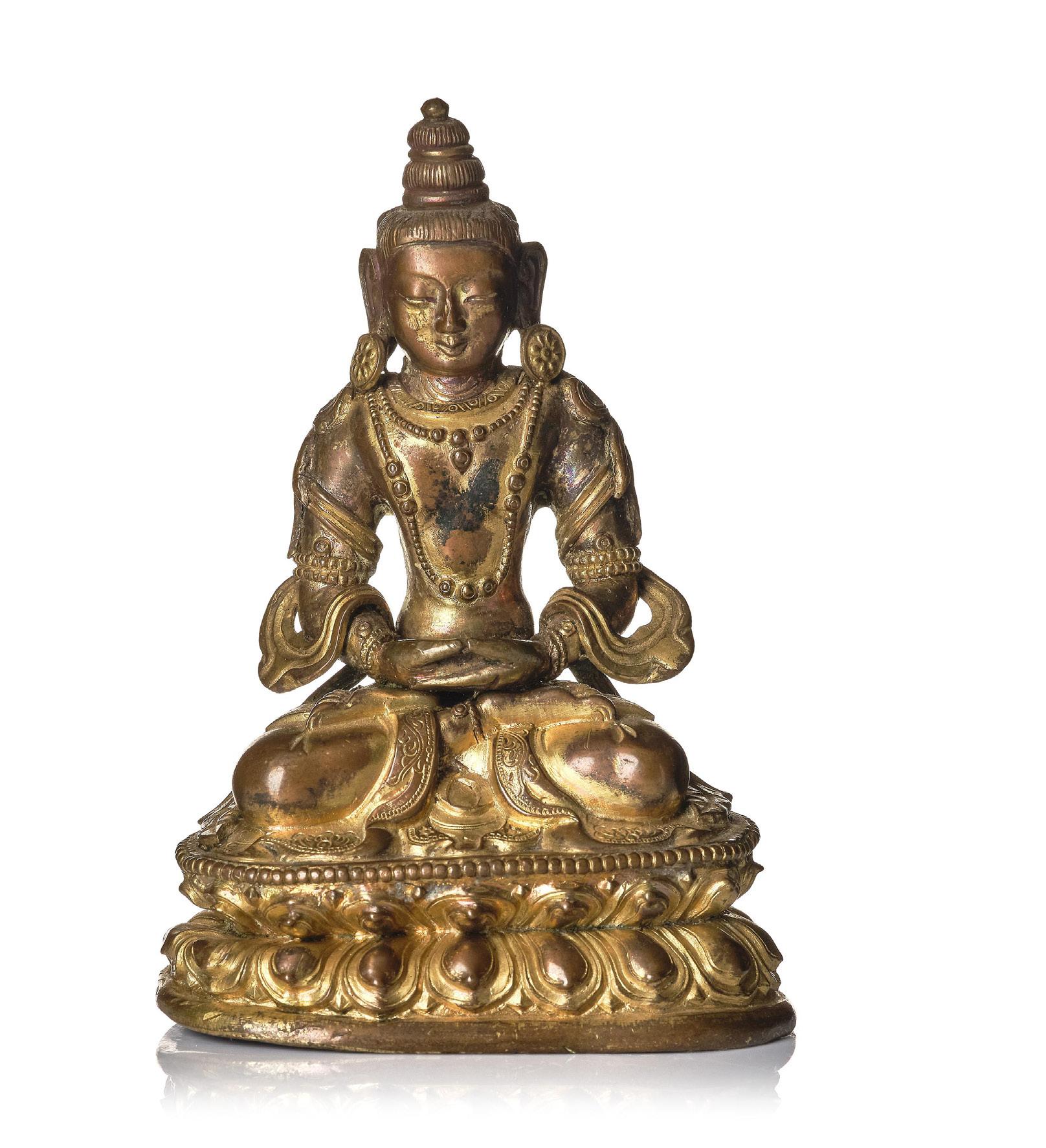
1055. A gilt copper alloy figure of Amitayus, Tibeto-Chinese/Mongolia, 18th century.
Amitayus is seated cross-legged on a double lotus base with a beaded rim, with his hands folded in his lap and legs crossed in dhyanasana. He is dressed in a dhoti ornamented with incised foliate patterns, and a flowing ribbon gracefully embraces his forearms. He is lavishly adorned with necklaces and large pendant earrings that rest on his shoulders. His hair is styled in a high ushnisha. This high topknot is characteristic. Made in several parts, gilded. Height 11.5 cm.
Provenance: Property of a private Finnish collector of buddhist art.
Catalogue note: This lot portrays Amitayus, the bliss-body of the tathagata Amitabha. In Tibet, Amitayus is worshipped in a special ceremony for obtaining long life and is traditionally depicted wearing ornaments and a crown, and holding the ambrosia vase from which spill the jewels of eternal life.
Estimate: SEK 20 000 – 25 000 / EUR 1 890 – 2 360
1056. A gilt-bronze figure of Amitayus, Qing dynasty, Mongolian, 18th century.
Well cast, seated in dhyanasana on a high double-lotus base with hands held in dhyana mudra, wearing a finely incised dhoti tied at the waist, a long sash flowing freely about the shoulders and arms, elaborate jewellery adorning the chest, arms, and ankles, the face with a serene expression framed by pendulous earrings and a fivepointed diadem encircling a tiered topknot. Base sealed with and decorated with a double-vajra. Filled. Cold gold paint and gilded. Height 16.5 cm.
Provenance: From the collection of Mr Karl Alfred Gustawsson (1897–1997), chief antiquarian at the Swedish National Antiquities Authority, who received it as a gift originally from the Swedish Archeologist and Explorer Folke Bergman (1902–1946), amanuensis at the Museum of Far Eastern Antiquties, thence by descent. Folke Bergman aquired it when he participated in the Sven Hedin Expedition. Mr Gustawsson was asked to join Sven Hedin’s SinoSwedish Expedition in 1927.
Catalogue note: Amitayus, the Buddha of Infinite Life, is considered an apparitional form of the Buddha Amitabha; both are typically depicted with red skin in paintings and textiles, denoting their shared identity. In Tibetan shrines, a figure of Amitayus is often set alongside the figures of Ushnishavijaya and White Tara in a longevity triad. Amitabha and Amitayus are celebrated in both Mahayana and Vajrayana practices, and both were popular deities to worship during the Qing dynasty. Figures of Amitayus were produced in large quantities to commemorate imperial birthdays.
Estimate: SEK 50 000 – 75 000 / EUR 4 720 – 7 080
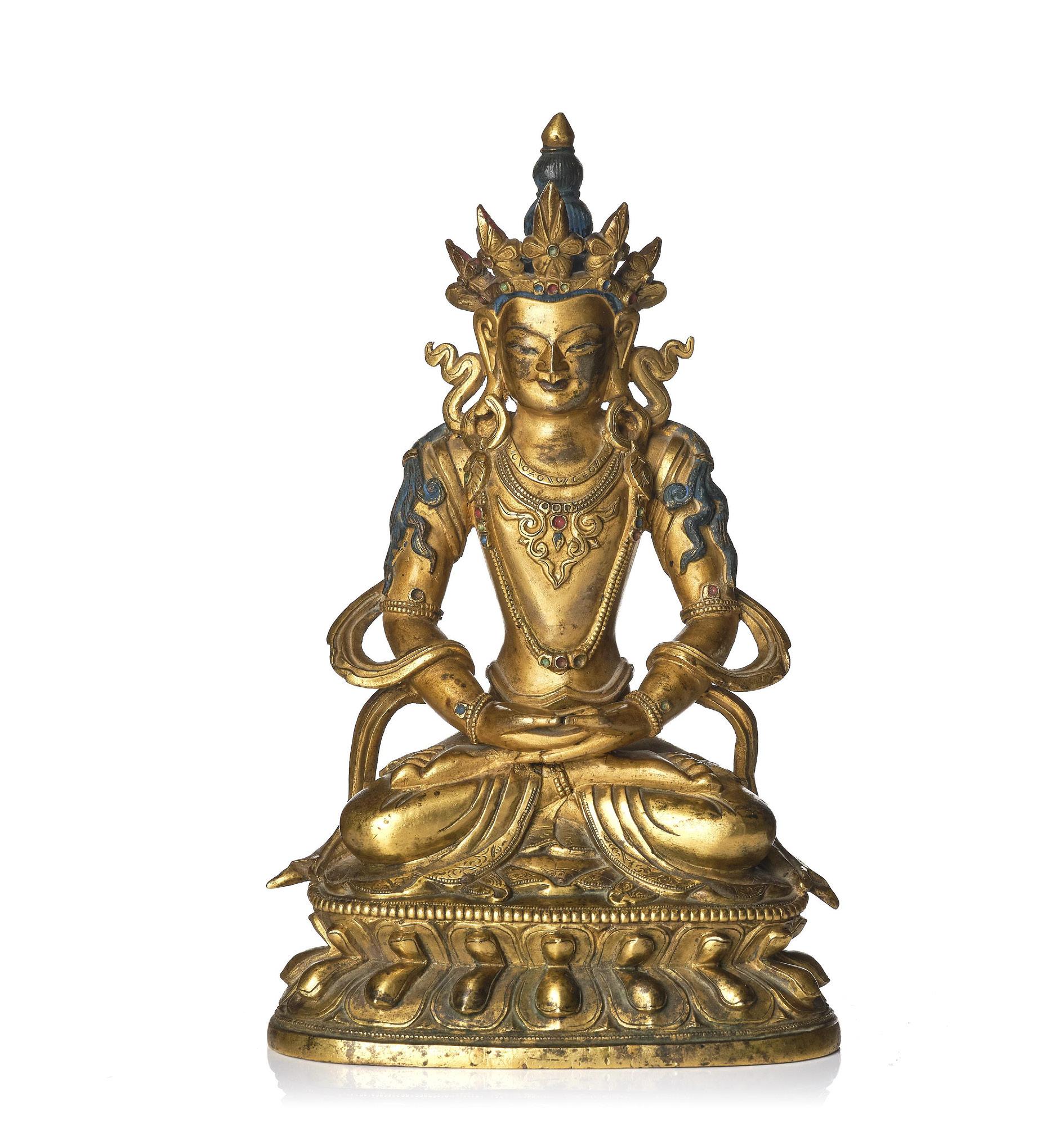
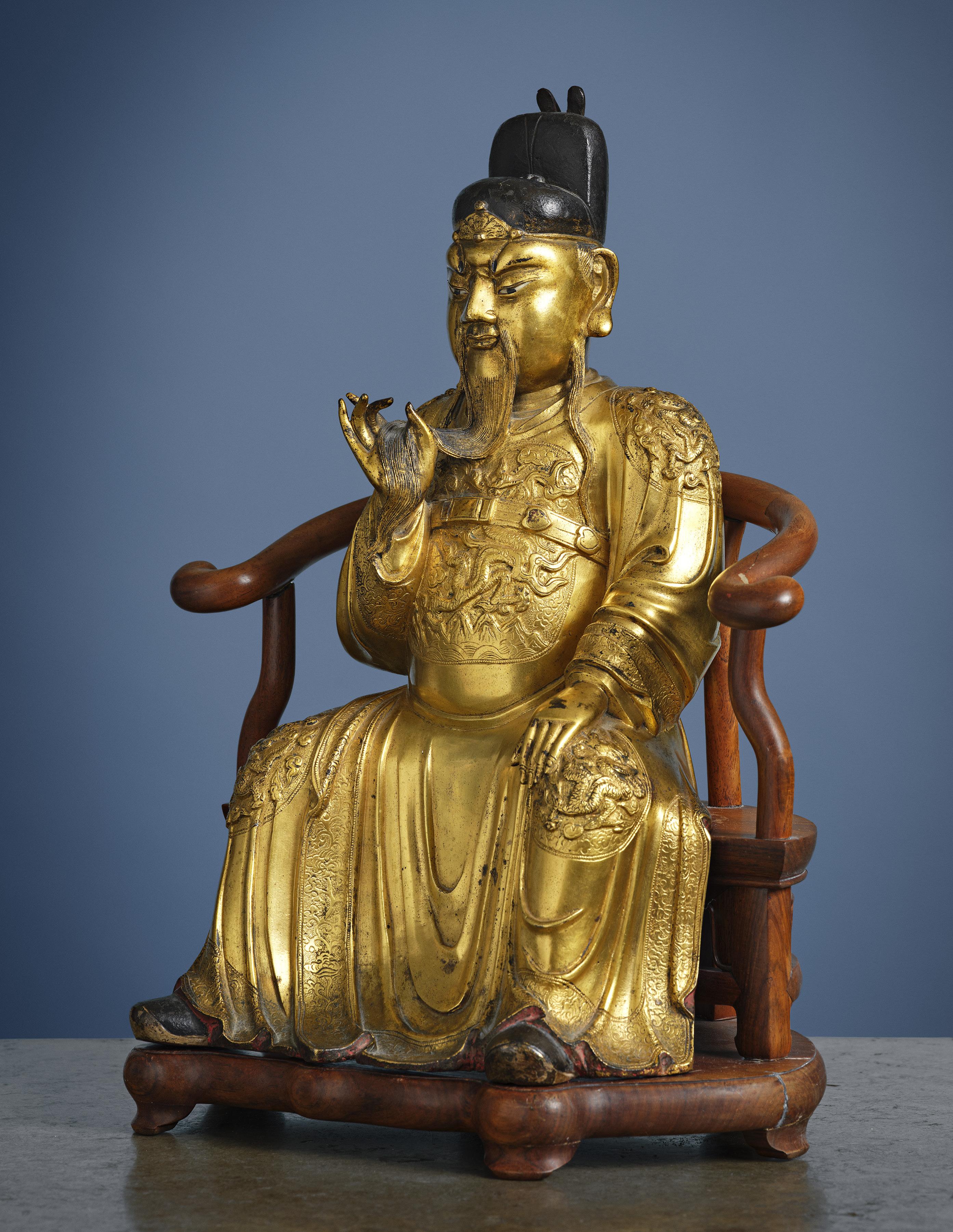
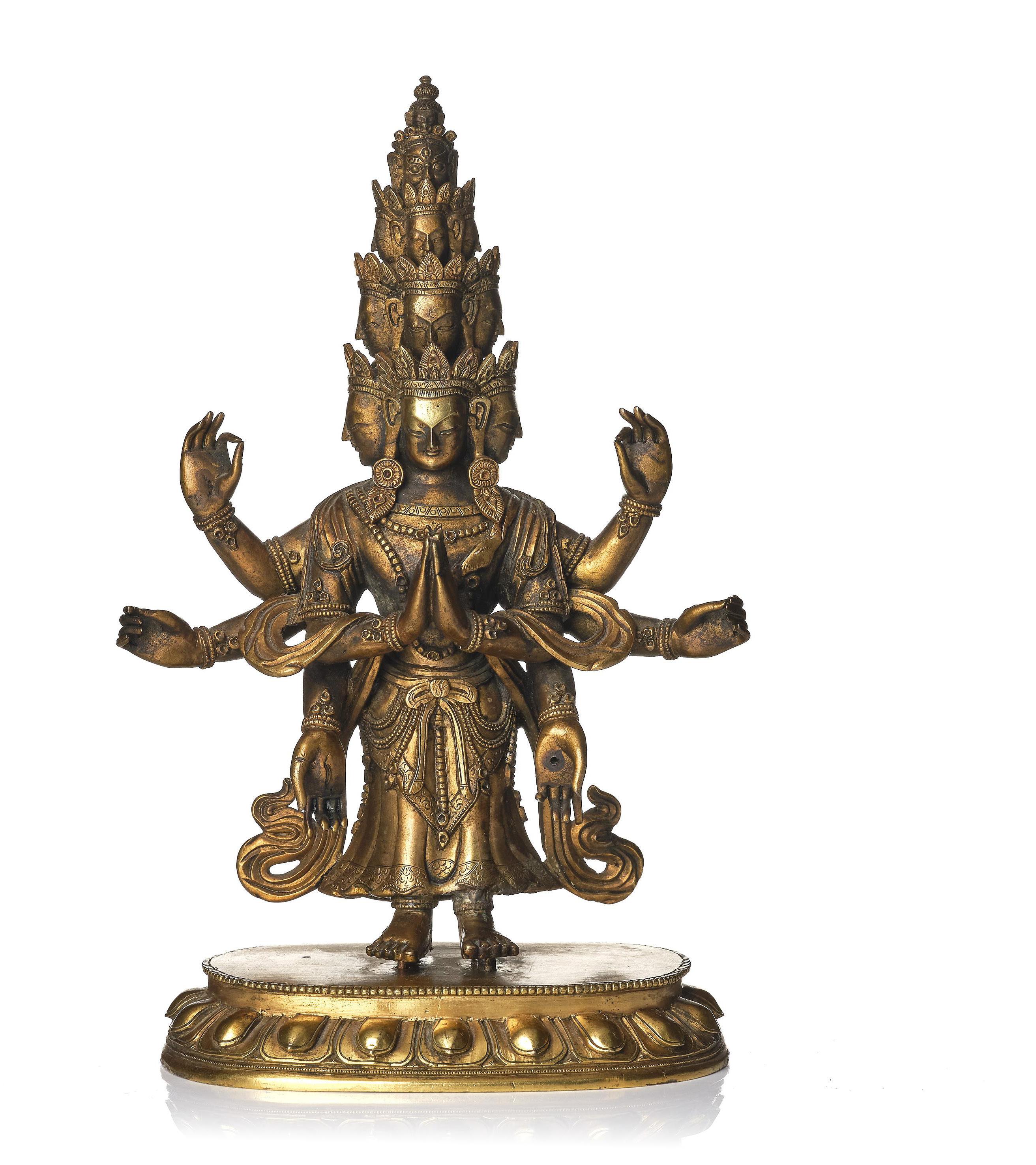
1057. A Tibeto-Chinese gilt bronze figure of Avalokiteshvara Ekasdashamukra, 19th century.
Depicted standing on a lotus base with a beaded edge, in his eight-armed, eleven-faced emanation, loosely fixated to the base, the principal hands held in namaskar mudra, the other six radiating around the body in different postures, one hand lowered to reveal a third eye in the palm, clad in a skirt with elaborate borders tied around the waist and a diaphanous shawl around the shoulders, adorned in the fine jewellery of a bodhisattva, the heads rising in groups of three surmounted by five-pointed crowns, the faces of serene expression apart from the tenth wrathful face which is that of Mahakala, the eleventh face is that of Amitayus, sealed with a later brass plate engraved with a double vajra (visvavajra). Height 22 cm..
Provenance: From the collection of Chef and Restaurant Manager Erik Berlin (1930 -2012), Malmö. Thence by descent within the family.
Exhibitions: Compare with one sold at Christies Live auction 2300, Indian and Southeast Asian Art, lot 250, 23 March 2010.
Catalogue note: Avalokiteshvara is one of the most beloved deities in Mahayana Buddhism. In this depiction, the bodhisattva appears in his elevenheaded form. Ten of the heads represent stages on the path to enlightenment, while the eleventh, crowning head is that of Amitabha (or Amitayus), Avalokiteshvara’s spiritual genesis. There are numerous legends about the origin of this form of Avalokiteshvara. In one version, Avalokiteshvara vowed that he would not enter nirvana until he had first helped all sentient beings enter the Pure Land of Amitayus (Sukhavati). He descended into hell, converted the souls, and led them personally to Sukhavati. Yet, for every soul he saved, another descended into hell to take its place. He was so overwhelmed with this Sisyphean task that he gave up on his vow. Overcome by despair, his head shattered into a thousand pieces. Moved by Avalokiteshvara’s compassion, Amitabha reassembled the fragments into ten heads and placed his own atop them. He encouraged Avalokiteshvara to continue his mission, assuring him there were other ways to save sentient beings. To assist him, Mahakala – the wrathful manifestation of Avalokiteshvara – came into existence to battle negative forces with compassion and remove obstacles to enlightenment. Mahakala’s head is the tenth in the sequence, just below Amitabha’s at the top.
Estimate: SEK 30 000 – 50 000 / EUR 2 830 – 4 720
1058. A gilt and polychrome lacquer figure of a divinity, 16th/17th century.
Dressed with a belt and voluminous robe of an official as he sits holding his right hand up, the left hand with a bowl. Projecting foot rest beneath his boots, the surfaces coloured in a combination of red, black and gilt lacquers.
Height 27 cm. Height with later wooden stand 28.5 cm.
Provenance: Property of a private Swedish collector.
Estimate: SEK 8 000 – 10 000 / EUR 755 – 944
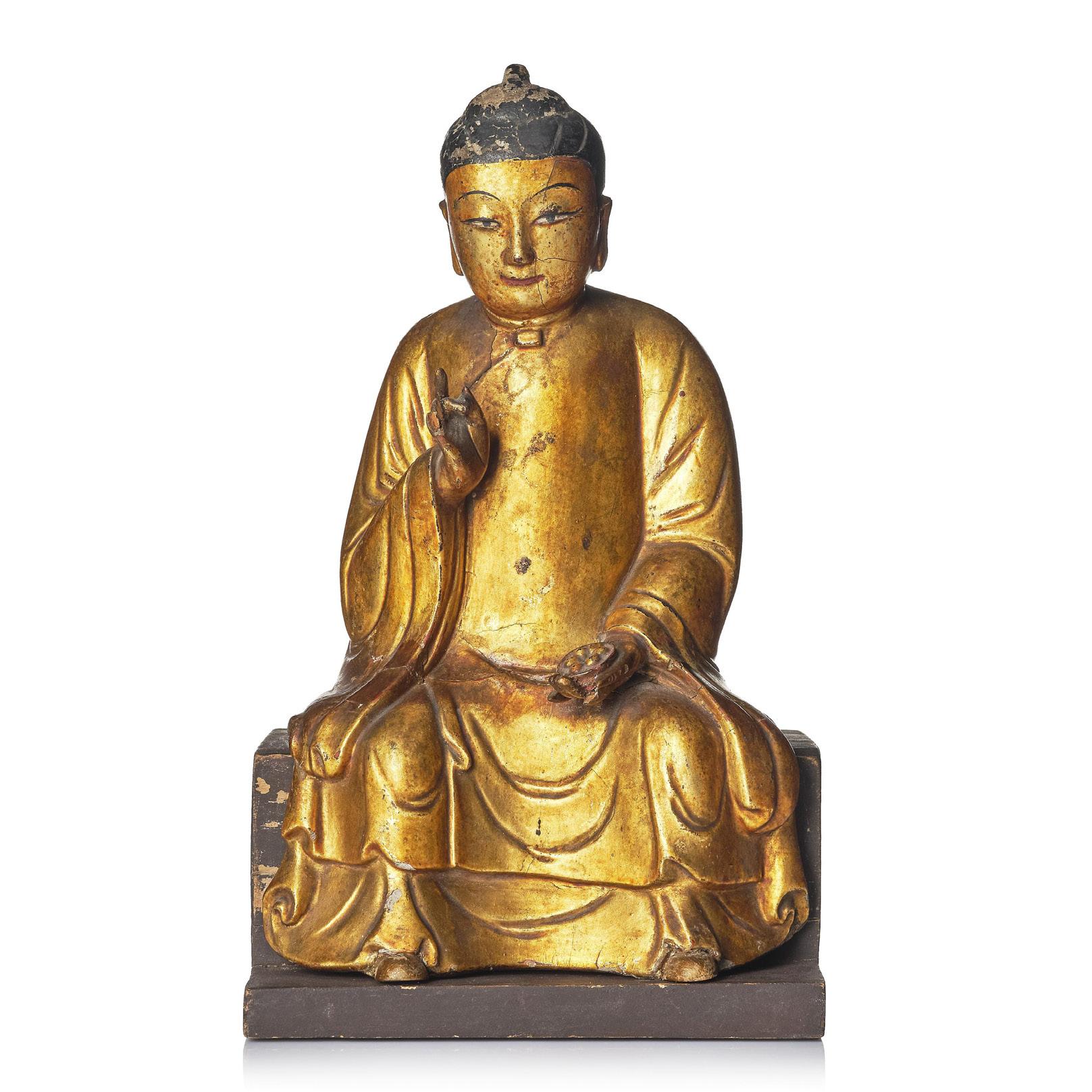
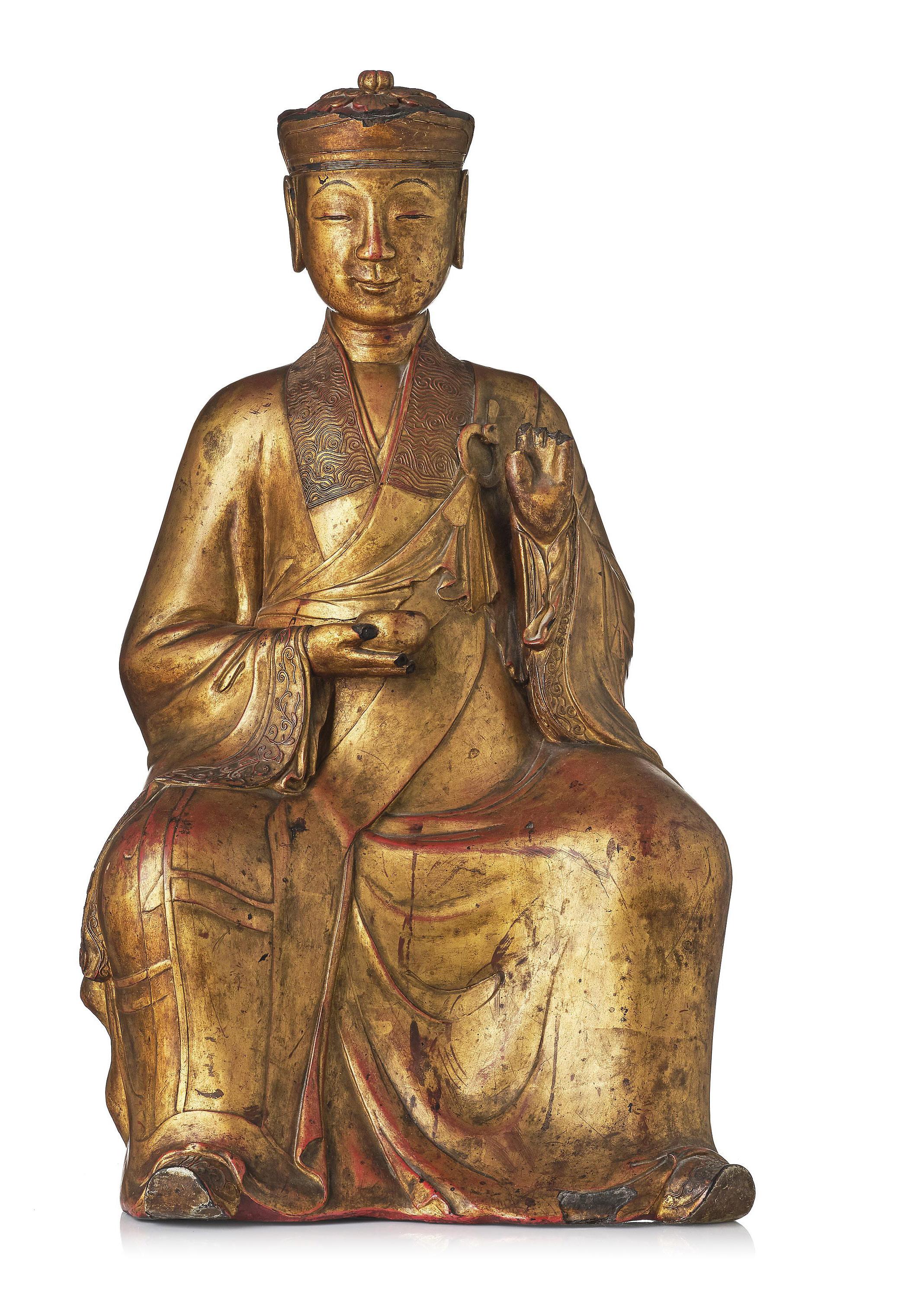
1059. A large gilt lacquer figure of a deity, Vietnam, 19th century.
Depicted seated with a bowl in his hand, clad in loose fitted robes. Height c. 90 cm.
Provenance: From the collection of the Swedish Noble family von Horn, Hjälmarsnäs, according to family tradition it was brought to Sweden from Indo-Chine by Kapten Lorentz Leopold von Horn (1836–1892).
Literature: The provenance is documented also in the book “Slott och Herresäten”, Malmö, 1969. p. 122. Then placed in the upper room on top of a cabinet. Depicted p. 120.
Estimate: SEK 15 000 – 20 000 / EUR 1 420 – 1 890
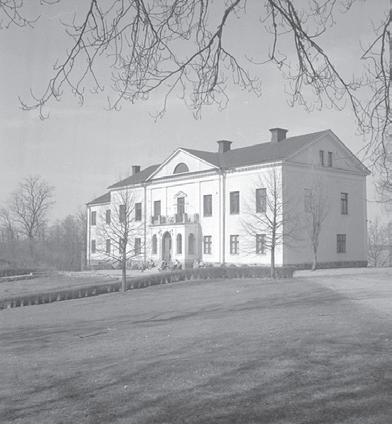
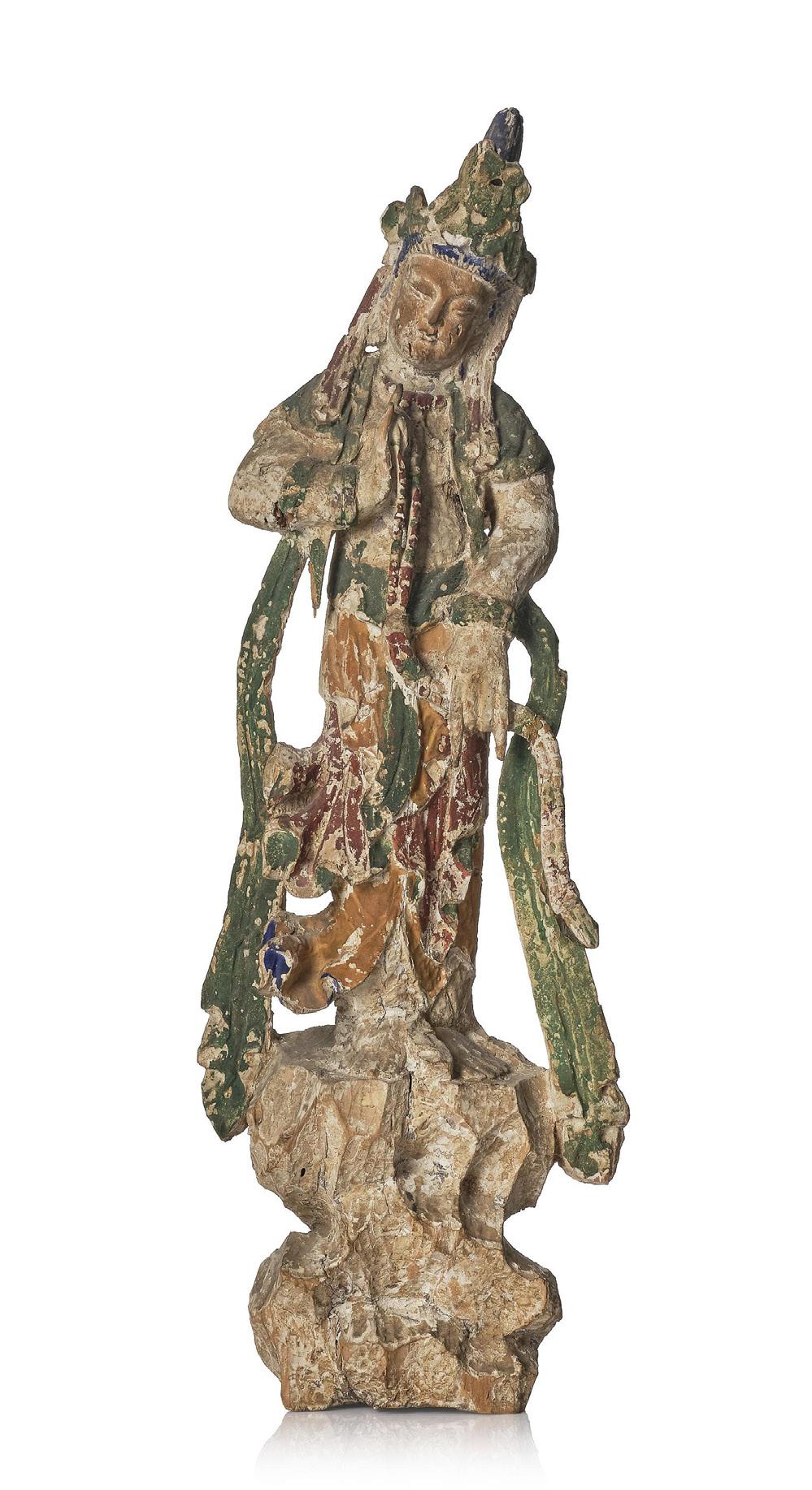
1060. A wooden sculpture of Guanyin, Yuan/Ming dynasty.
The deity depicted standing on a rock formation clad in a long flowing robe, painted in colour pigments. Height 50.5 cm.
Provenance: From the Collection of the Finnish Commercial Counselor Kalle Kuusinen (1889–1980). Thence by descent within the family. Mr Kuusinen bought the sculptures in Hong Kong in March 1935. when on a around the world trip statues from a round-the-world voyage in Hong Kong in March 1935, when travelling with Consul General Arvo A Himberg. Enclosed is a copy of the itinerary and passenger list of the Empress of Britain that they travelled.
Estimate: SEK 8 000 – 10 000 / EUR 755 – 944
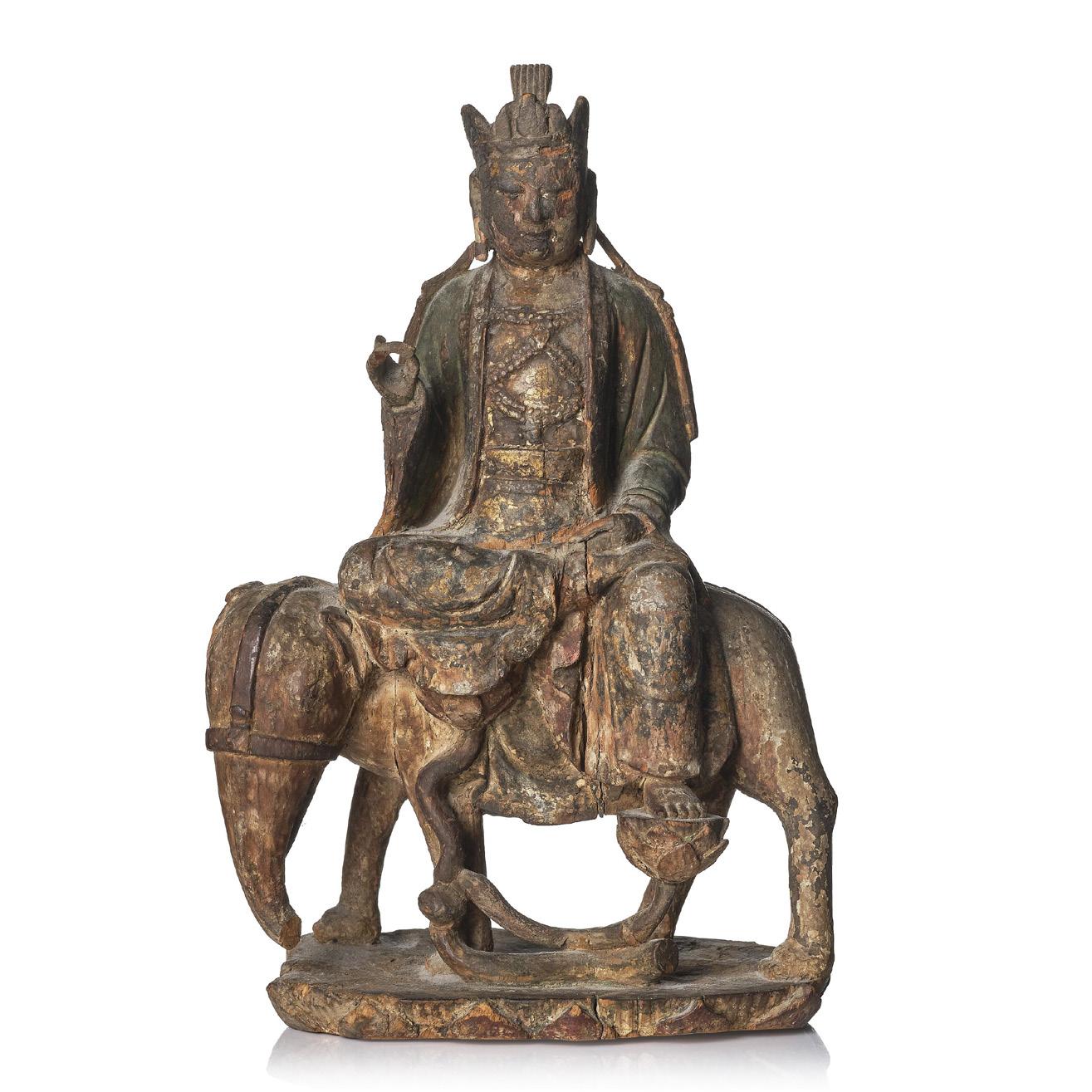
1061. A wooden sculpture of Samantabhadra on an elephant, Ming dynasty (1368–1644). The deity is depicted seated in lalitasana on an elephant, the Bodhisattva depicted with the left hand held in apanamudra and the right hand raised, dressed in long flowing robes falling into voluminous pleats, further embellished with beaded jewellery, the face with a benevolent expression with downcast eyes and a smile, surmounted by a diadem, the elephant finely portrayed with its head gently swayed to one side. Traces of colour pigment and gilding. Height 30 cm.
Provenance: From the Collection of the Finnish Commercial Counselor Kalle Kuusinen (1889–1980). Thence by descent within the family. Mr Kuusinen bought the sculptures in Hong Kong in March 1935. when on a around the world trip statues from a round-the-world voyage in Hong Kong in March 1935, when travelling with Consul General Arvo A Himberg. Enclosed is a copy of the itinerary and passenger list of the Empress of Britain that they travelled.
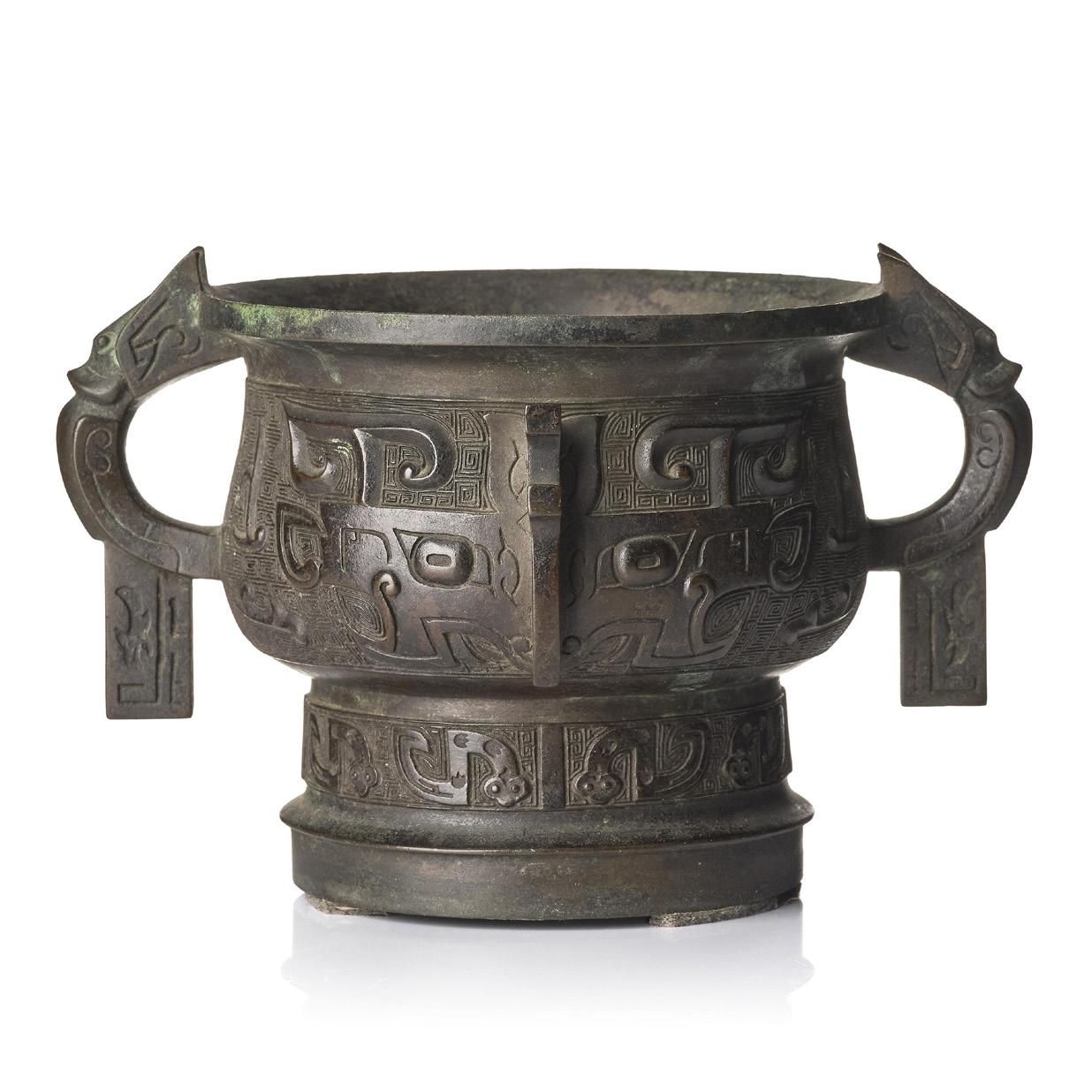
Estimate: SEK 8 000 – 10 000 / EUR 755 – 944
1062. An archaistic bronze vessel, Qing dynasty 18th/19th century.
The bowl standing on a high foot and cast with two animal-head C-scroll handles, cast to the exterior with two large taotie masks centred on a flange reserved on a leiwen band, a further leiwen band with kui-dragons surrounds the foot rim. The interior with two characters in seal script. The bronze with areas of variegated green patina and some encrustations. Height c. 10 cm. Diameter c. 12 cm.
Provenance: Property of a Swedish collector.
Exhibitions: Compare with a larger censer of this type sold at Christies Sale 15031, The Art of China, lot 120, 2017. Compare with a censer of this type in the British Museum, Registration number 1986,0517.1.
Catalogue note: After a Western Zhou style bronze vessel, Gui.
Estimate: SEK 6 000 – 8 000 / EUR 567 – 755
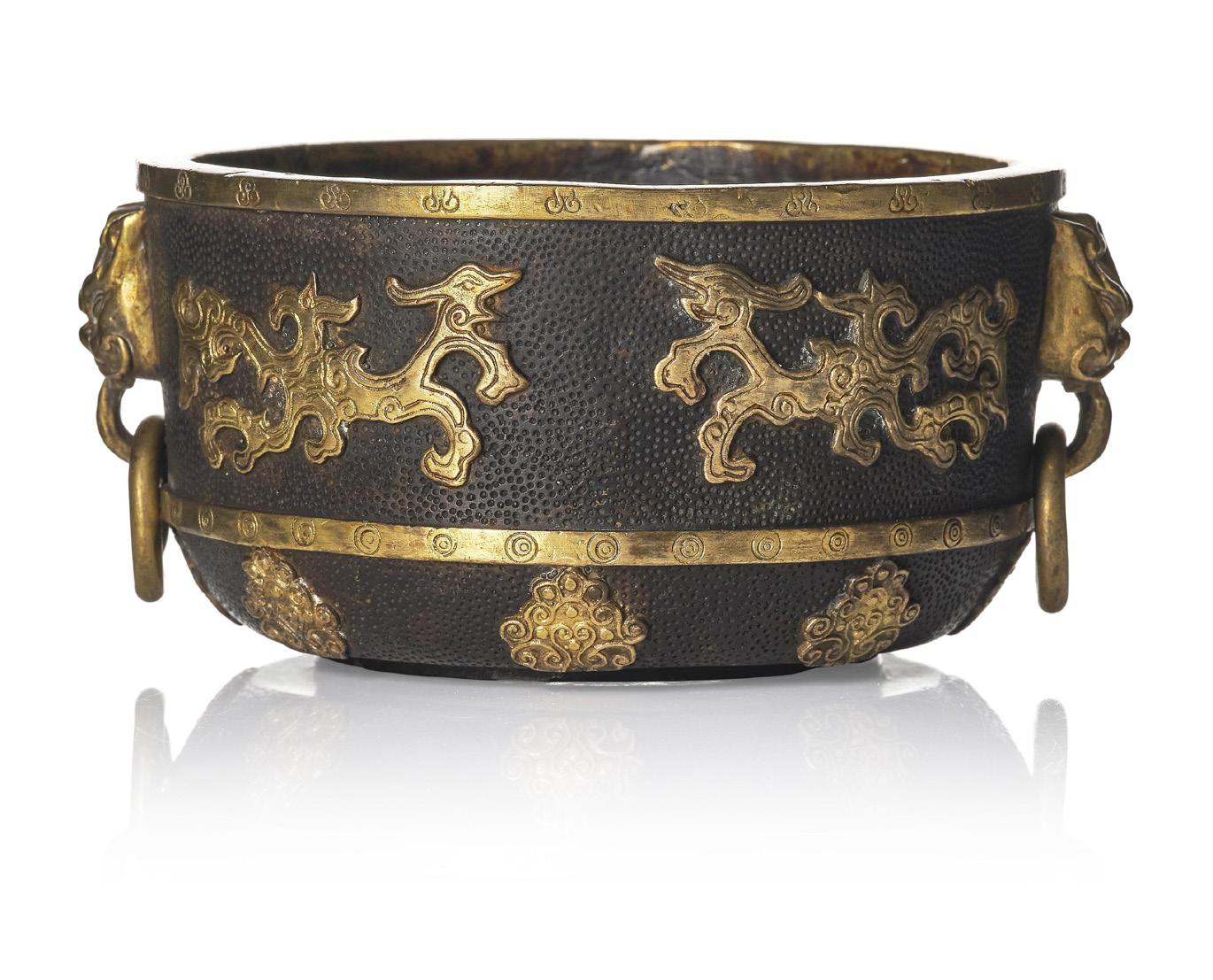
1063. A bronze censer, Qing dynasty, with an archaistic mark to the base. Round with mascaron ring handles, the vessel is cast rising from a rounded base. The body is decorated in shallow relief with gilt stylized dragons on a ground of dots, a band of roundels and symbols around the waist and rim. Length 15.5 cm. Height 7.2 cm.
Provenance: Poperty of a private Swedish collector.
Estimate: SEK 10 000 – 15 000 / EUR 944 – 1 420
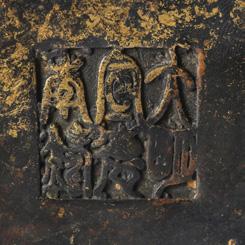
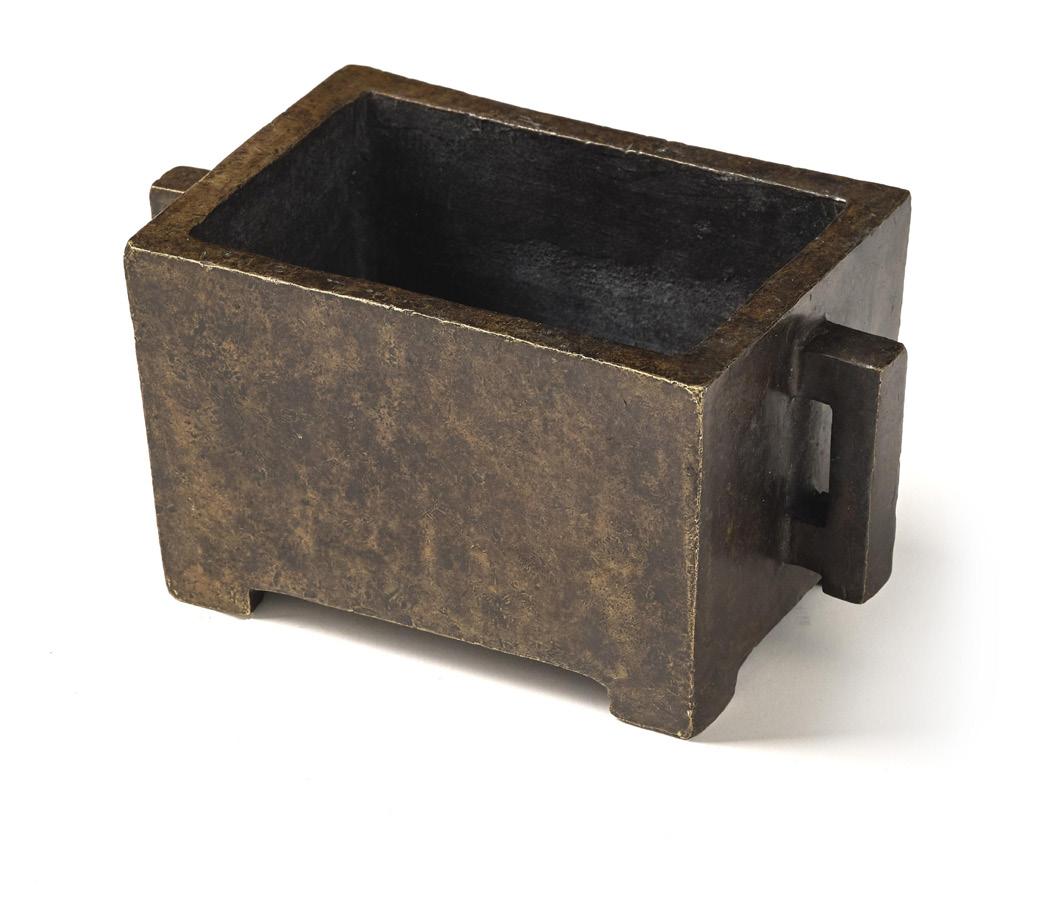
1064 A. A Rectangular bronze censer with square handles, Qing dynasty, Xuande mark.
Heavily cast of rectangular shape with slightly tapering sides, supported on four integral corner feet and flanked by a pair of angular handles, the surface with a rich brown patina, the base cast with four-character Xuande mark in seal script. Measure 9 x 18 x 10 cm.
Catalogue note: The Chinese name of this incense burner macao lu (horse trough censer) derives from its distinctive shape, which resembles a horse trough.
Estimate: SEK 12 000 – 15 000 / EUR 1 130 – 1 420
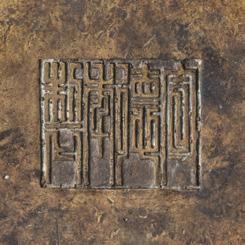
1065. A large bronze censer with cover, Qing dynasty, 19th century.
The large censer is cast as a tripod on a postament, chilong dragon handles, pierced domed cover with a large buddhist lion with a brocade ball sitting atop ruyi shaped clouds. Height 43 cm. Width 35 cm.
Provenance: Property of a private Swedish collector.
Estimate: SEK 12 000 – 15 000 / EUR 1 130 – 1 420
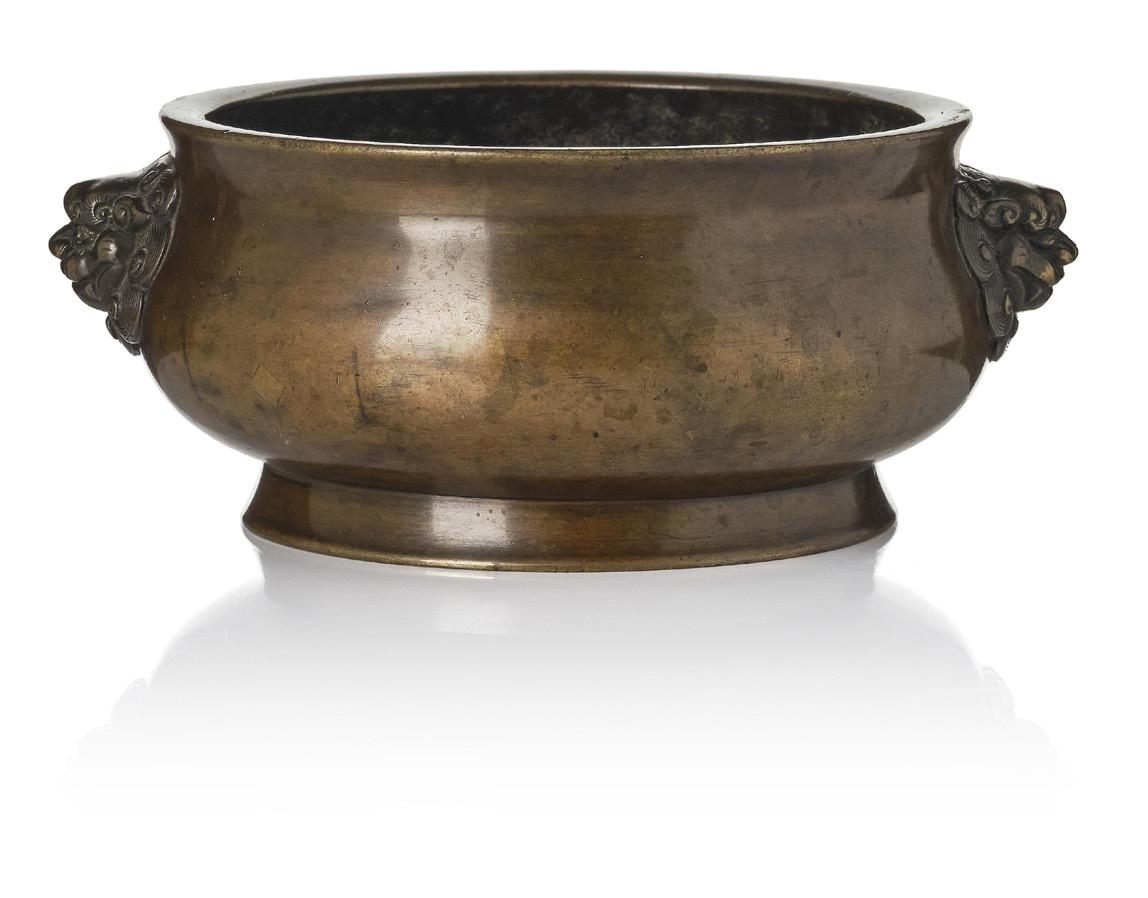
1064. A bronze censer, Qing dynasty, with a Xuande mark. Diameter widest part 18.5 cm. Height 7.5 cm. Weight 903 gram.
Provenance: Property of a private Swedish collector.
Estimate: SEK 8 000 – 10 000 / EUR 755 – 944
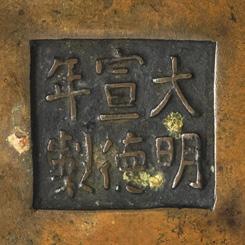
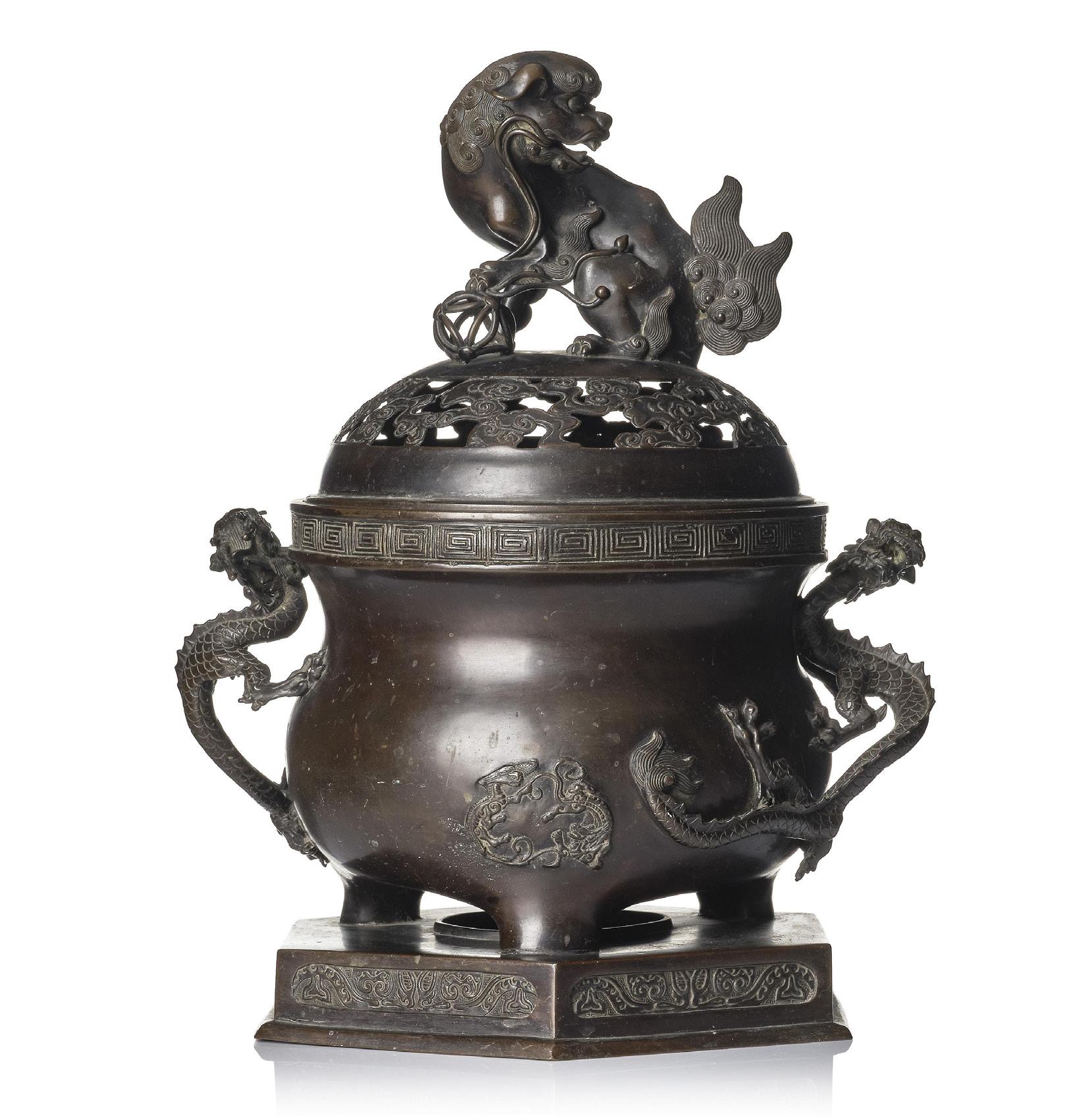
1066. A large well sculptured head of Guanyin, Ming dynasty (1368–1644). With serene expression and downcast eyes, the hair pulled up in a high chignon, with attached headdress carved with a seated deity amongst scrolling foliage.
Given as a wedding gift to Stig och Ulla Nordfelt in 1970 by the collector Sten
Compare with a sculpture of this type sold at Christies Live auction 2544, Asian
The Bodhisattva Avalokiteshvara, the Chinese goddess of Mercy and Compassion, Guanyin in Chinese, historically has been one of the most popular and most favoured Buddhist deities in China. Bodhisattvas are enligthened beings who have put off entering paradise in order to help others attain enlightment.
SEK 60 000 – 80 000 / EUR 5 670 – 7 550
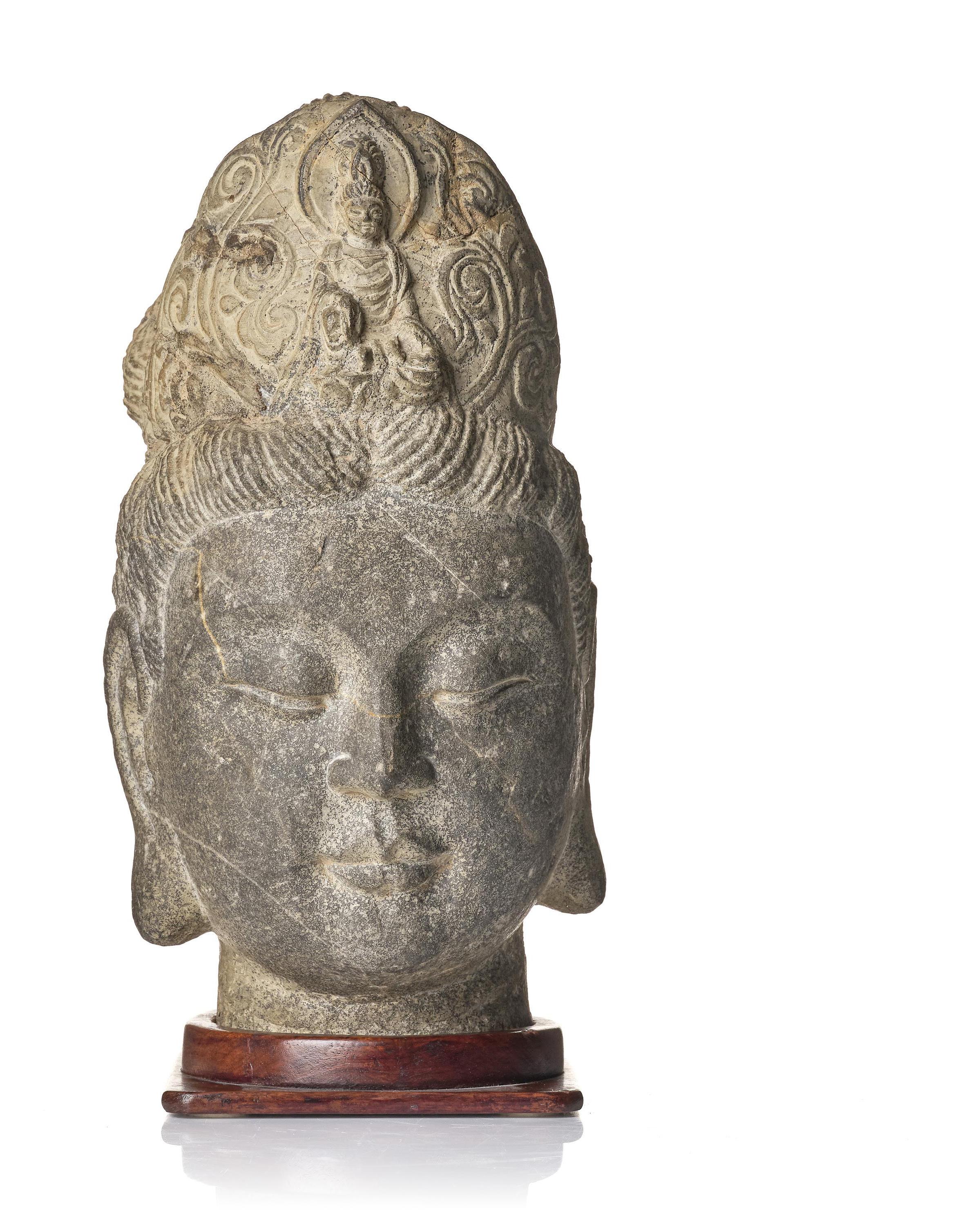
1067. A painted pottery figure of a female dancer, Tang dynasty (608–906). The graceful figure wearing a long-sleeved surcoat belted above the waist, the head turned to one side and hair pulled up into two topknots, depicted in animated pose, gracefully stepping forward with one arm raised and the other resting upon her side. Height 27 cm.
Provenance: From the collection of Carlo Lizzani (1922–2013), who purchased it during the production of the film Muragalia Chinese (Behind the Great Wall) in 1958. The figure was given as a gift to the present owner, a Swedish lady in 1969. In 1957 Carlo Lizzani spent ten months of his life as a filmmaker and researcher in China, to make the first feature-length documentary film by a Western director in that nation which at the time was considered almost like a fairy-tale country by Westerners.
Estimate: SEK 15 000 – 20 000 / EUR 1 420 – 1 890
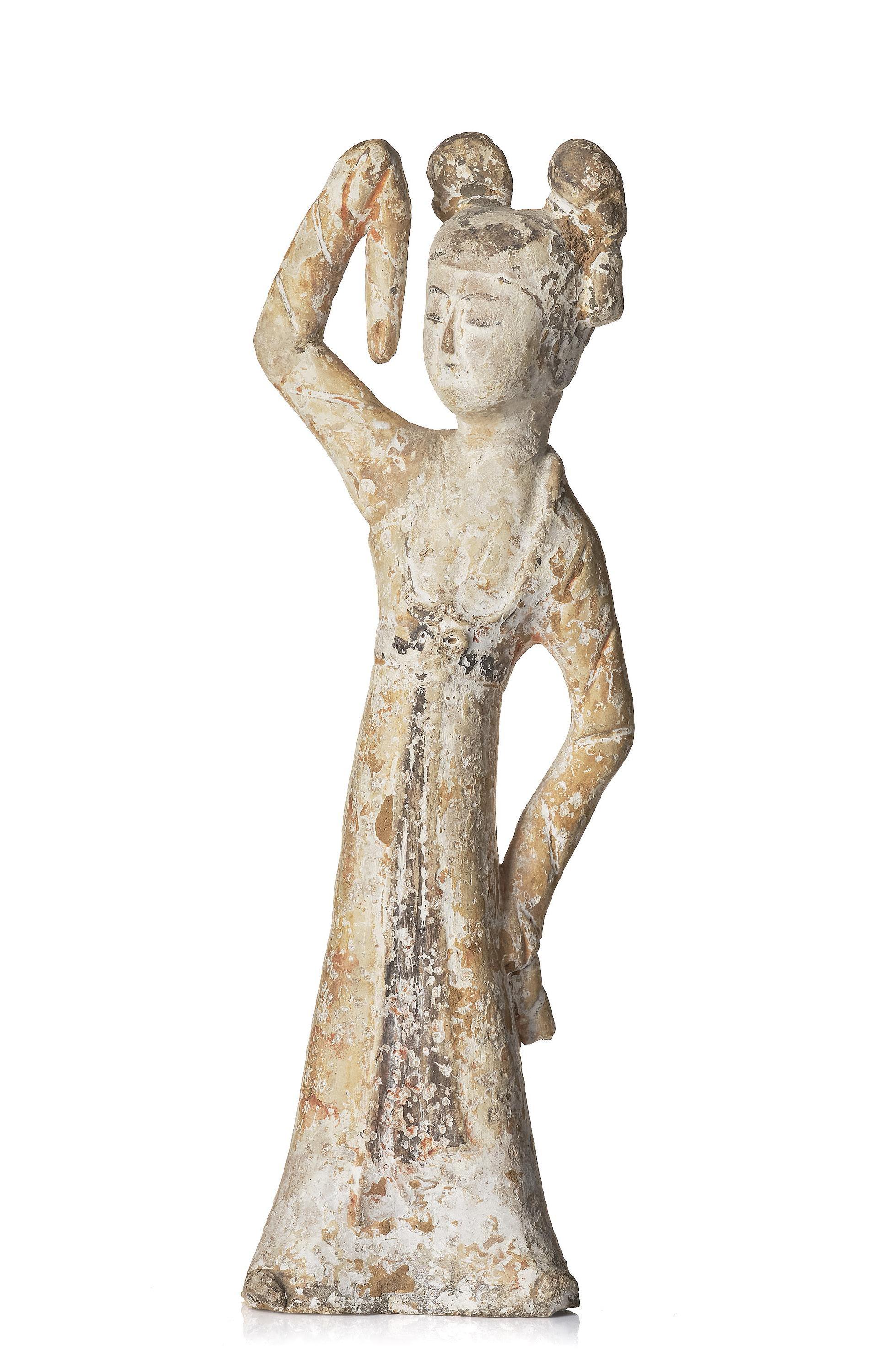
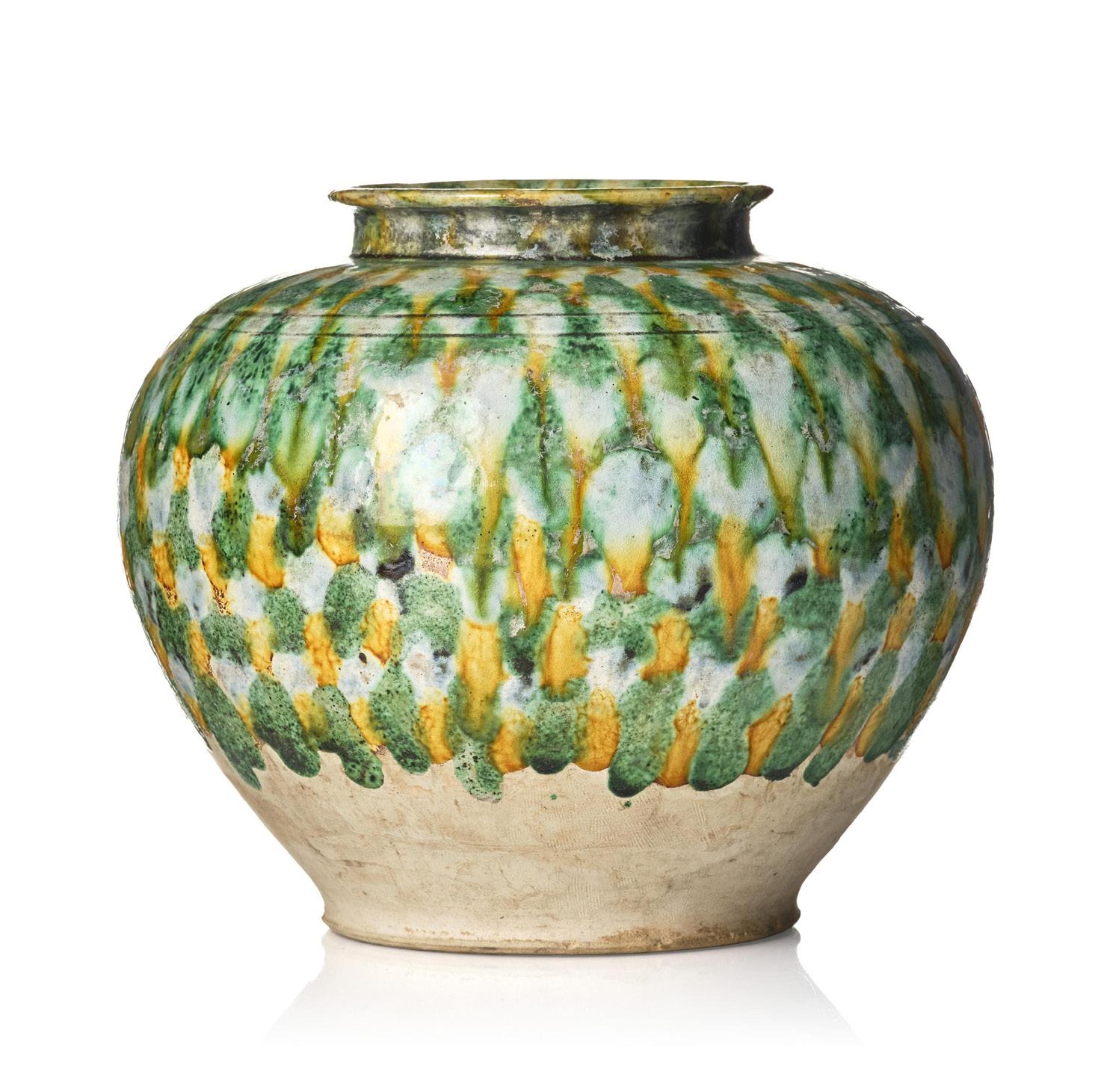
1068. A sancai-glazed pottery jar, Tang dynasty (618–907).
The wide ovoid body liberally splashed with bright amber, cream and green glaze that covers the short neck and continues over the out-turned rim, all on a white slip that falls irregularly towards the flat base exposing the pale pinkish-buff ware. Height 18 cm. Height 18 cm. Later wooden stand included to the lot, height including the stand 23.5 cm.
Provenance: From the Collection of Anny, nee Everitt (1876–1974) och Sten Bergstrand (1875–1862), thence by descent within the family.
Exhibitions: Compare with a jar in the Art Insitute Chicago that also has this colouring/pattern. Reference Number 1973.633. Compare with one at Chrisites, lot 418, 17 SEP 2008 | Live auction 2027, Fine Chinese Ceramics and Works of Art.
Literature: Compare with a jar of this type in Regina Krahl, Chinese Ceramics from the Gulexuan Collection, object no 15.
Estimate: SEK 20 000 – 30 000 / EUR 1 890 – 2 830
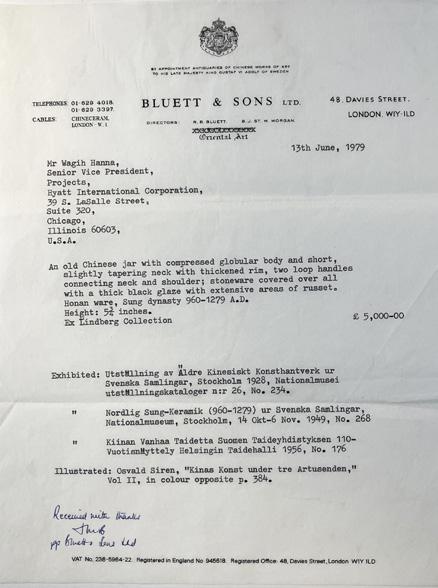
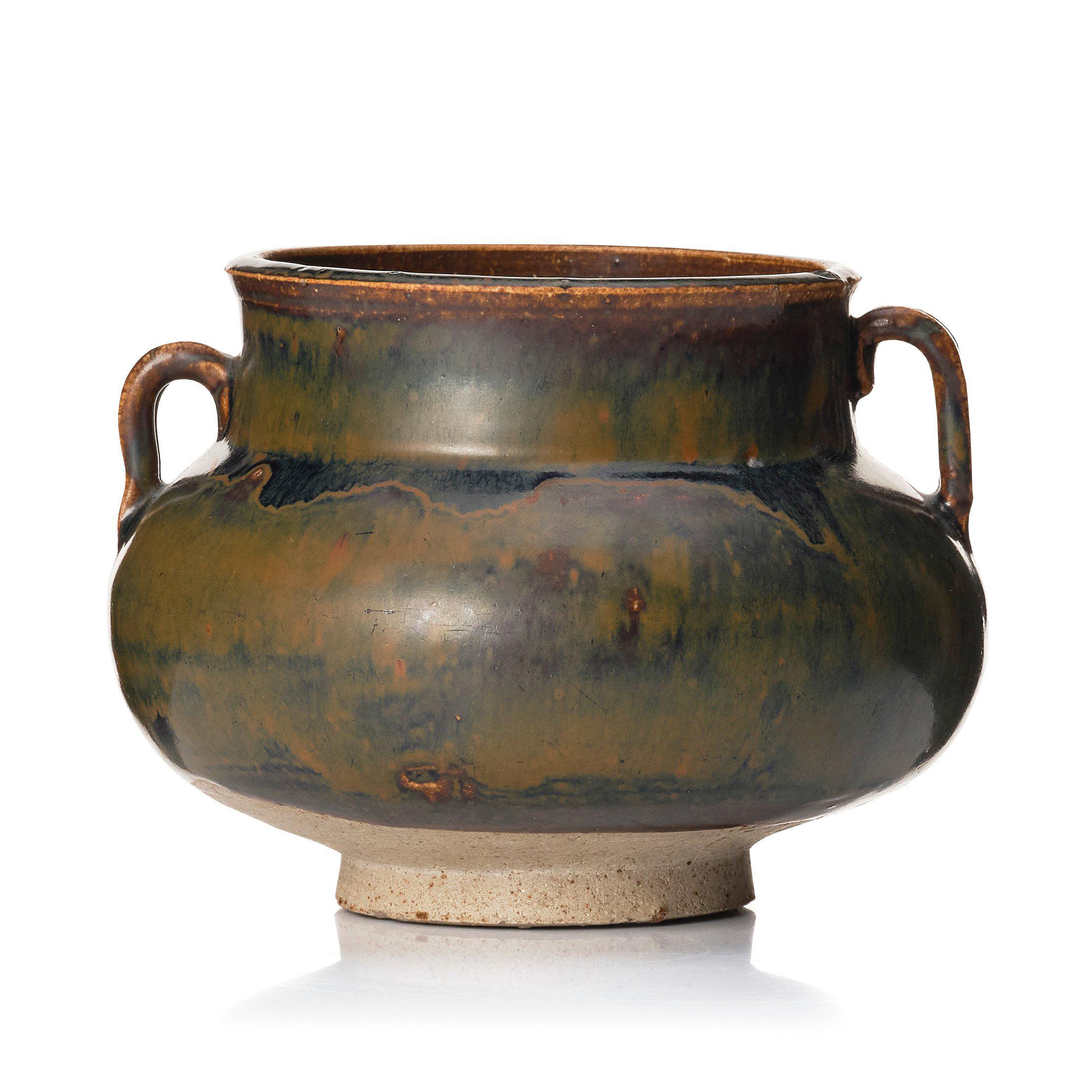
1069. A black and brown glazed stoneware jar, Northern Song dynasty (960–1127).
The body of compressed globular form, rising from a short spreading foot to a broad waisted neck with everted rim. Applied at the shoulder with a pair of strap handles, covered with a rich dark brown lustrous glaze irregularly decorated with lighter russet and buff splashes falling short in a neat line above the foot to reveal the light greyish body. Height 10.8 cm.
Provenance: Purchased at Bluett&Son, 48 Davies Street, London, June 13th 1979. Label to base Bluett London. From the Collection of Mr W. Hanna. Mr Hanna graduated from Ecole des Beaux Art in Paris, before joining Hyatt International Hotels in Chicago, USA. His work as Senior Vice President covered overseeing the design of hotels worldwide. This including the selection of architects and interior designers, approval of designs and approval of interior finishing materials and furnishings. After retiring Mr Hanna settled down in Malmö with his Swedish wife in beautifully decorated penthouse flat in “Turning Torso” building.
Exhibitions: Exhibited in the 1928 exhibition at the National museum in Stockholm ‘Utställning av äldre kinesiskt konsthantverk ur svenska samlingar’, lot 234. Exibition label to base. Also exhibited in the National Museum in 1949, lot no 268. Exhibition label to base.
Literature: Illustrated in Osvald Sirén, Kinas konst under tre årtusenden, Vol II. in colour opposite 384.
Estimate: SEK 40 000 – 60 000 / EUR 3 780 – 5 670
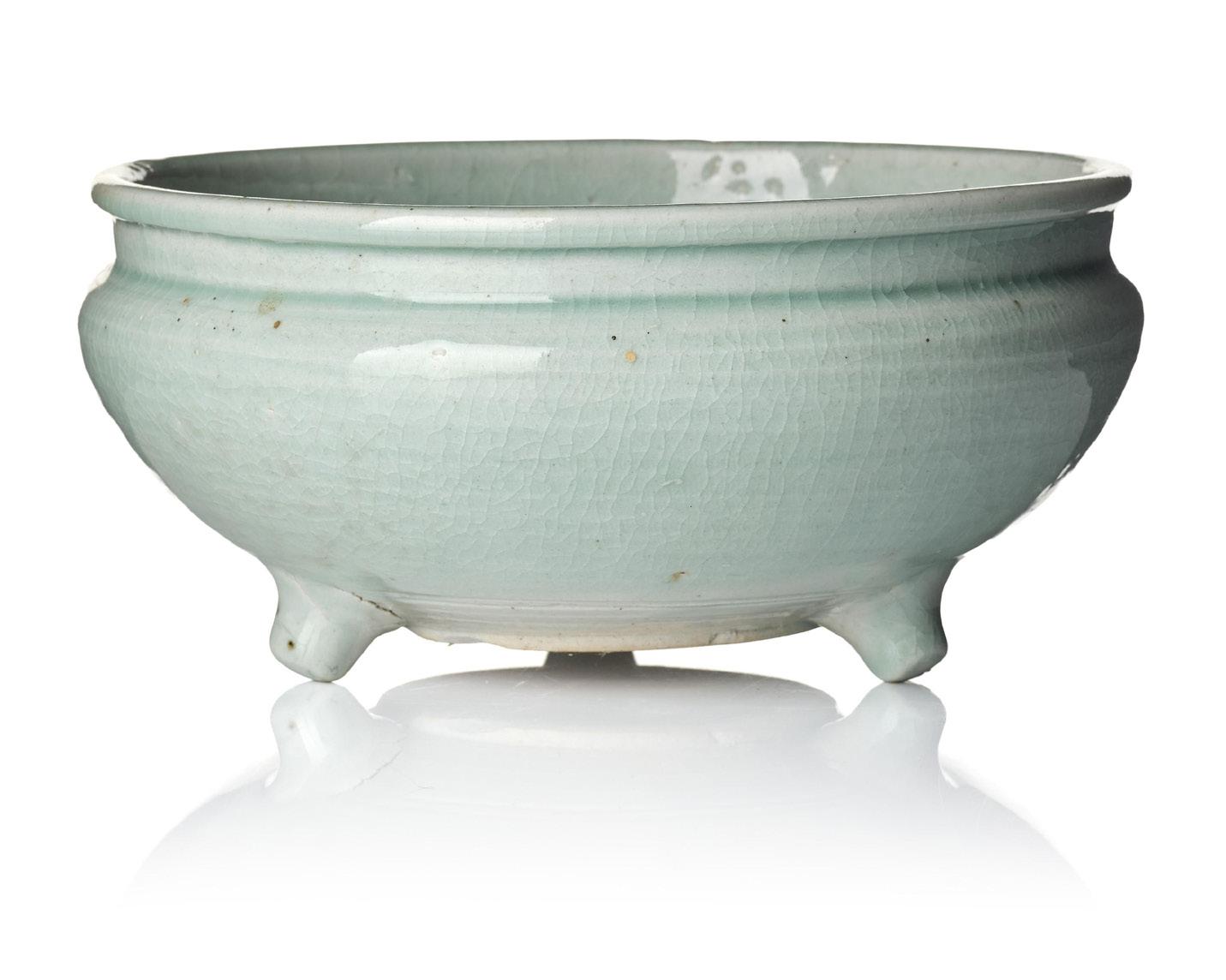
the exterior a band of petals, covered inside and out with a seagreen glaze pooling to darker shades in the recessed area, the foot rim neatly pared, showing the light porcelaneous body partly burnt orange-brown from firing. Diameter 14.7 cm. Height 6.8 cm.
Provenance: Property of a private Swedish collector.
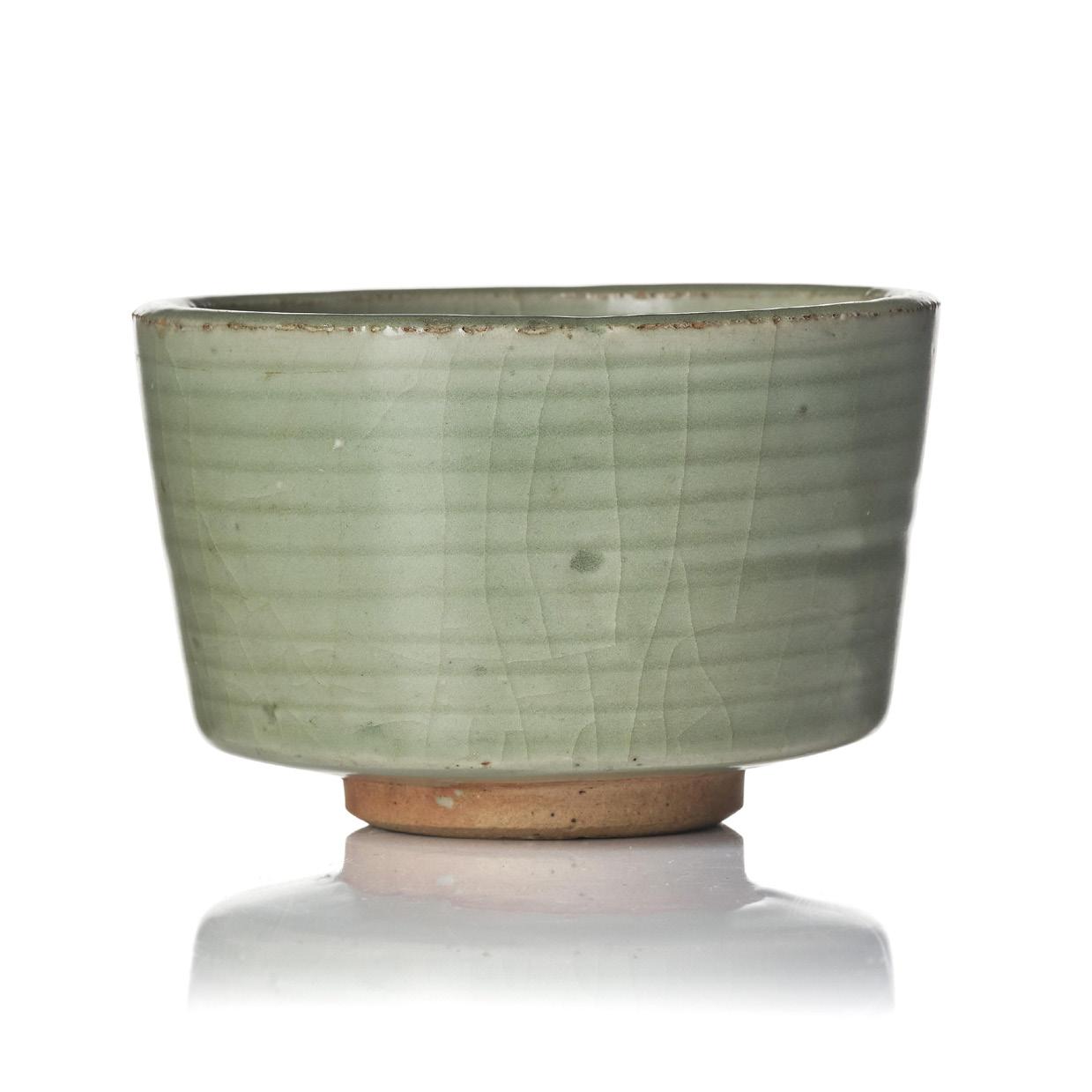
1070. A pale celadon glazed tripod censer, Ming dynasty (1368–1644).
The wide rounded vessel raised on three feet, covered overall in a pale celadon crackle glaze, save the well and base, burnt slightly orange in the firing. Diameter 26 cm. Height 12 cm.
Provenance: A private Swedish Collector.
Estimate: SEK 8 000 – 10 000 / EUR 755 – 944
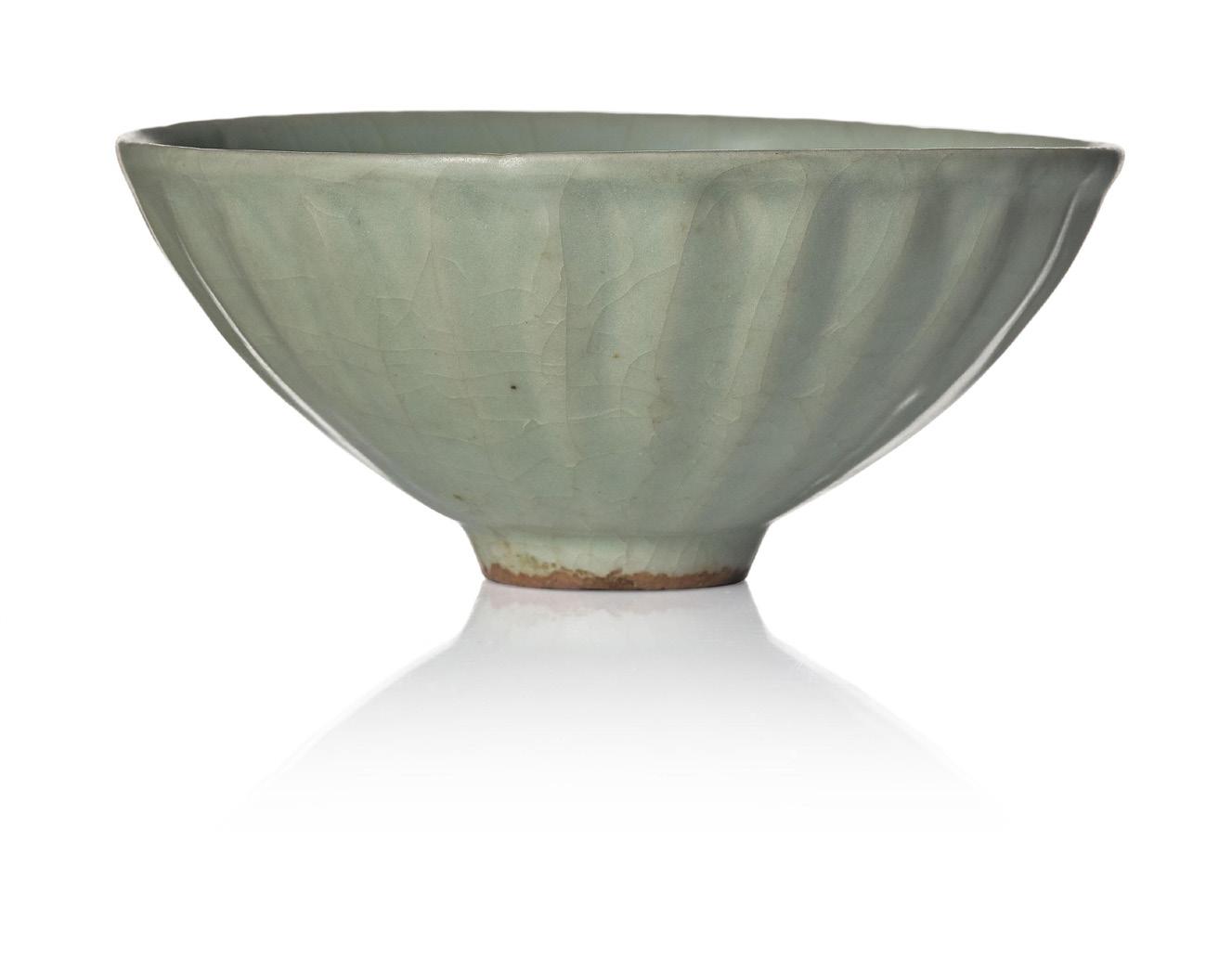
1073. A rare celadon lamp, Ming dynasty (1368–1644).
The shallow bowl with a candle holder, supported on legs descending to the rounded plinth, glazed in a celadon green glaze. Height 11 cm. Height with candle holder in brass 15 cm.
Provenance: Property of a private Swedish collector.
Exhibitions: Compare a blue and white example with a Zhengde mark and of the period see lot 51, Sothebys, Hong Kong, November 18th 1986.
Literature: See also a vessel of this shape formerly in the Swedish Royal Collection, now in the Museum of Far Eastern Antiquities, Stockholm, illustrated in the Oreintal Ceramics, The Worlds Great Collections, Vol, 8, 1982, pl 56. Described as ‘a stand in the shape of a stool’.
Estimate: SEK 6 000 – 8 000 / EUR 567 – 755
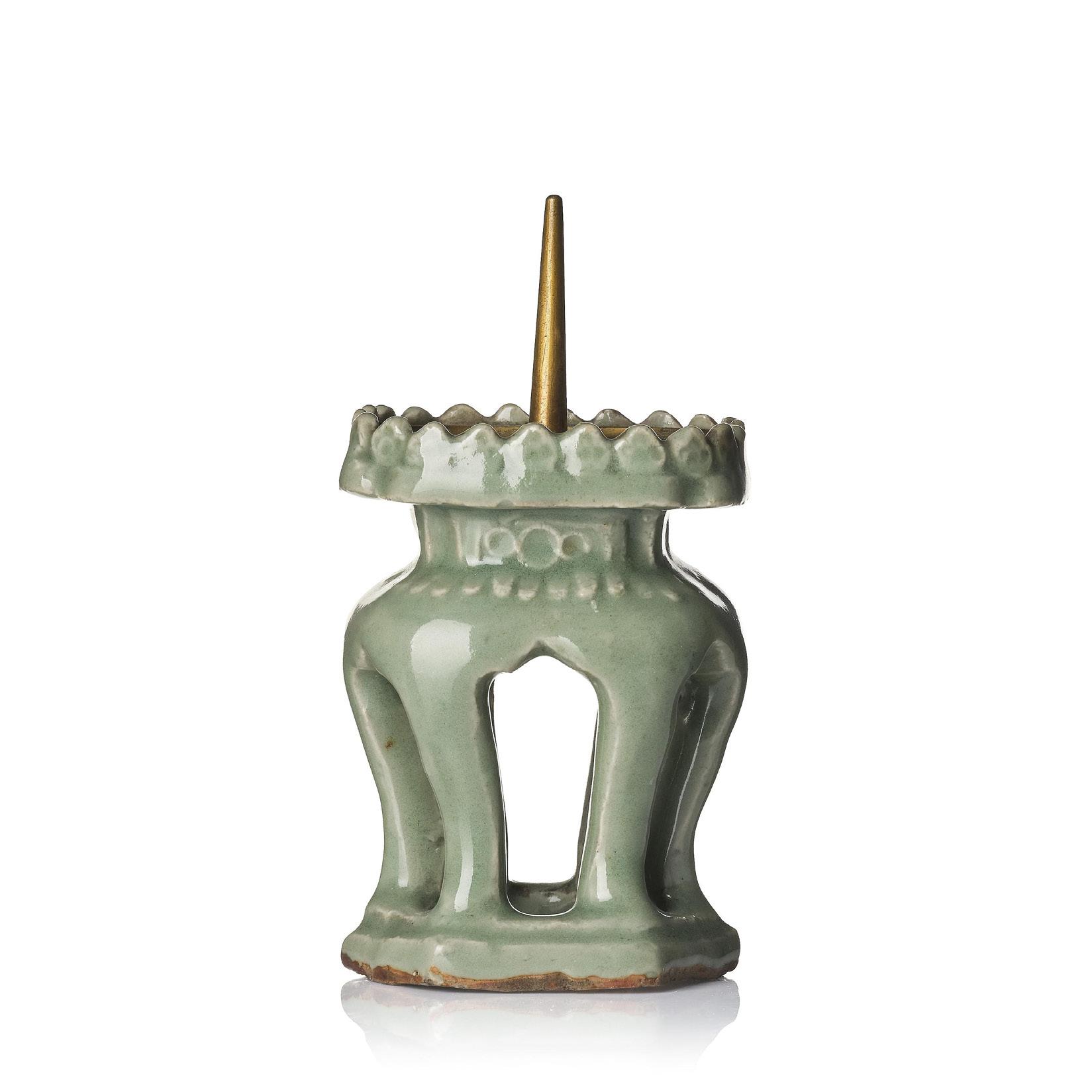
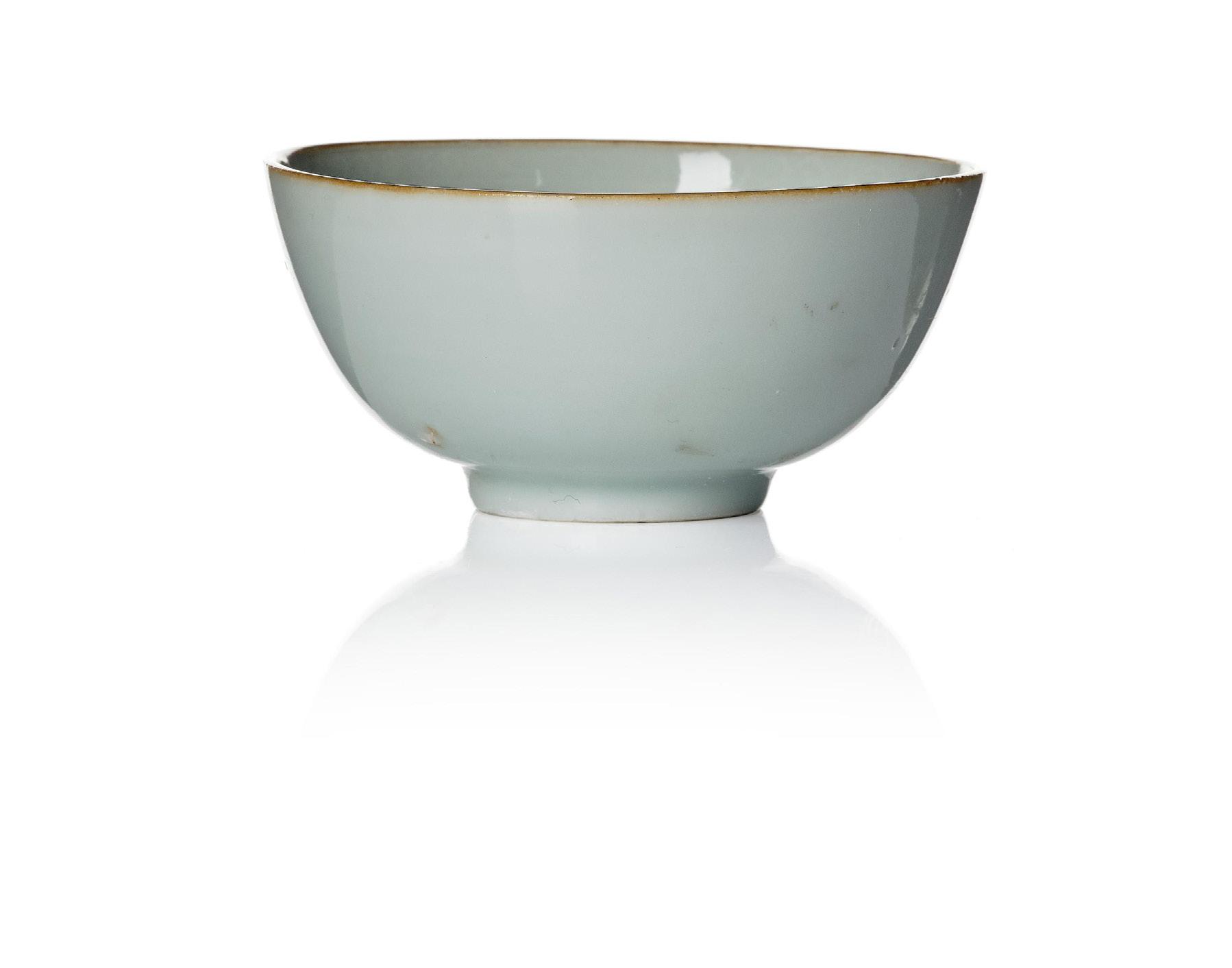
1075. Two famille verte figures of ‘boys’, Qing dynasty, Kangxi (1662–1722).
Matched set, two standing figures of boys carrying a vase, both decorated in famille verte colours. Height 27–28 cm.
Provenance: Property of a private Swedish collector.
Estimate: SEK 8 000 – 10 000 / EUR 755 – 944
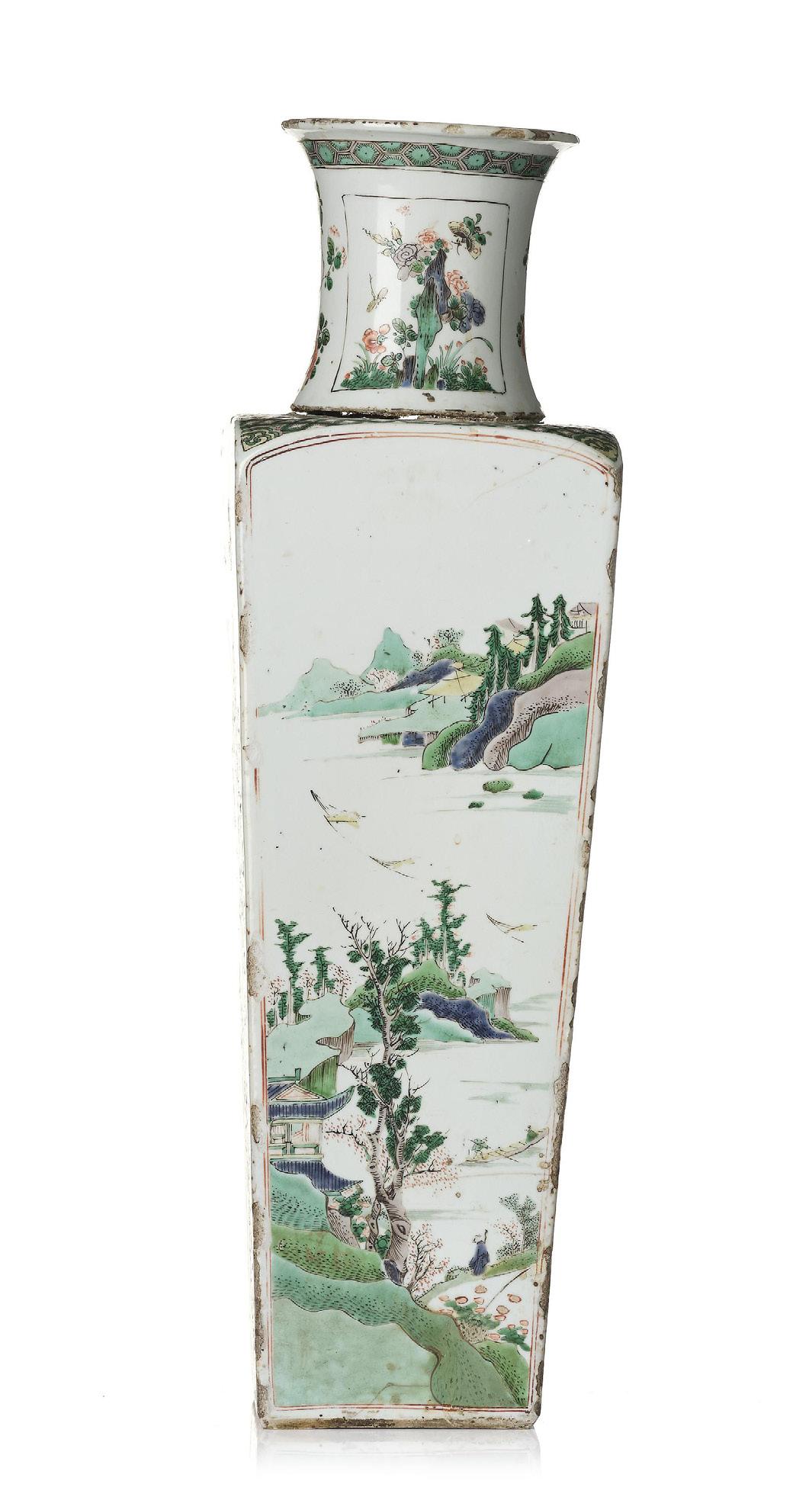
1074. A lotus cup, late Ming dynasty/early Qing dynasty. Rounded sides on a short footrim, the interior decorated wtih birds in a lotus pond. Brown by the rim. Diameter 8.8 cm.
Provenance: Labels from Johannes Hellner Da27, C. T. Loo and Hans Öström no 923.
Estimate: SEK 6 000 – 8 000 / EUR 567 – 755
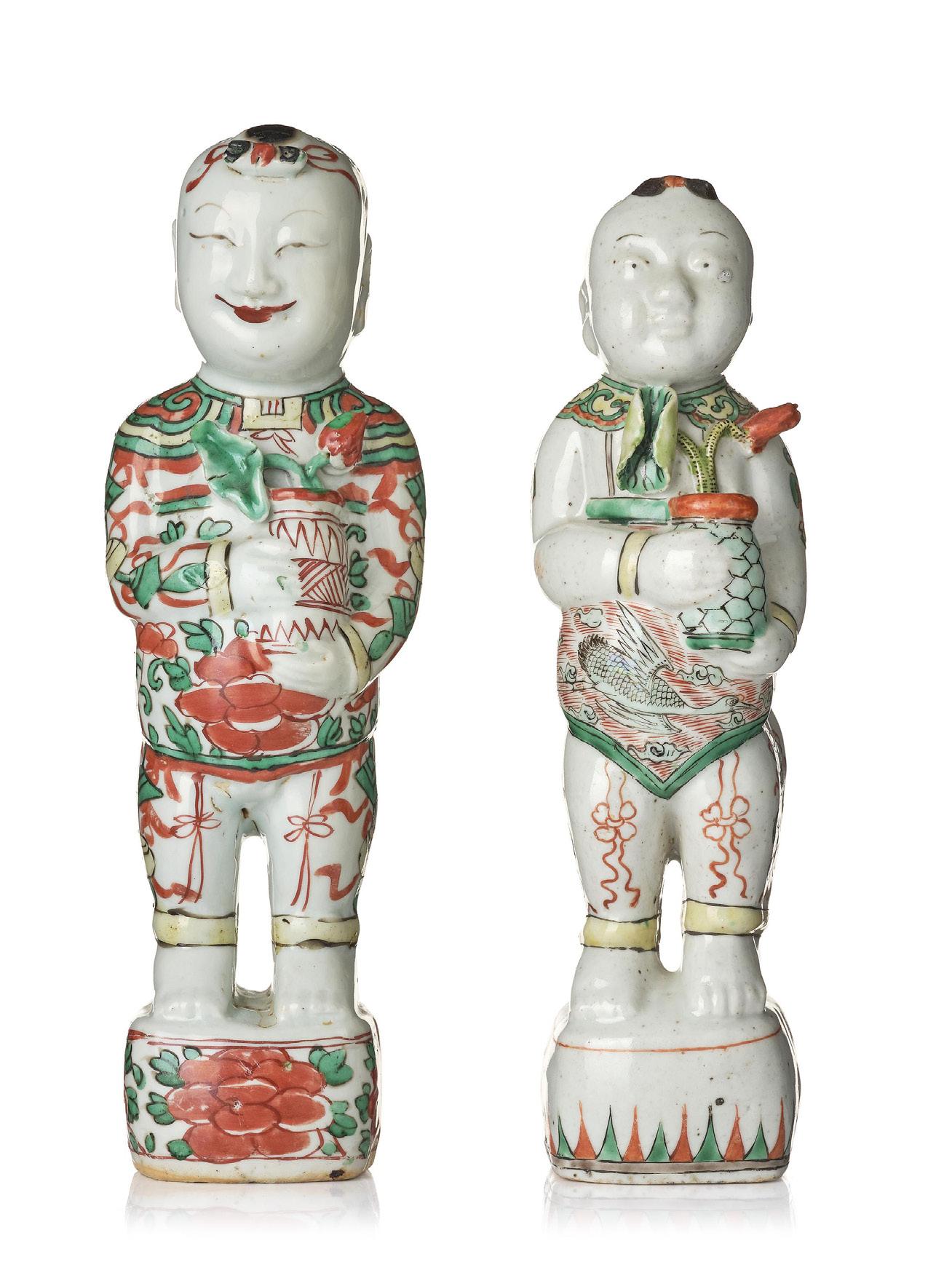
1076. A large famille verte vase, Qing dynasty, Kangxi (1662–1722).
Of rectangular baluster shape, decorated around the sides with alternating floral scenes, riverscapes and a lotus pond. Height 61 cm.
Property of a private Swedish collector.
SEK 8 000 – 10 000 / EUR 755 – 944
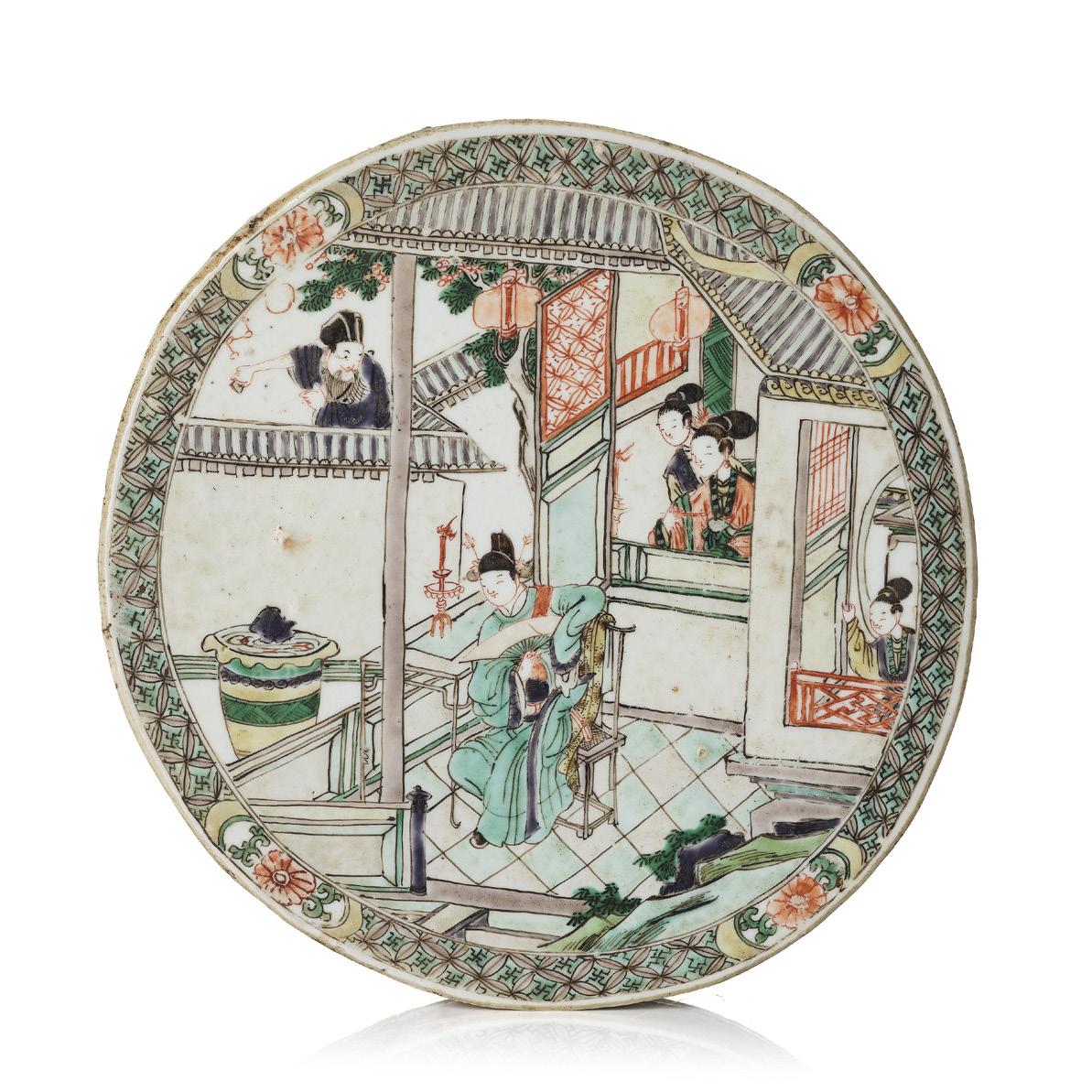
1077. A famille verte ‘figural’ herb brick, Qing dynasty, Kangxi (1662–1722).
Round, luten together in hollow sections with holes to the sides for attachments, decorated to both sides, one side with a figure from a Chinese novel, the other decorated with antiques and precious objects. Diameter 21 cm.
Provenance: Property of a private Swedish Collection.
Estimate: SEK 6 000 – 8 000 / EUR 567 – 755
1078. A famille verte dish, Qing dynasty, Kangxi (1662–1722).
Decorated in famille verte colours with a figure scene. Diameter 35 cm.
Provenance: Property of a private Swedish Estate.
Estimate: SEK 12 000 – 15 000 / EUR 1 130 – 1 420
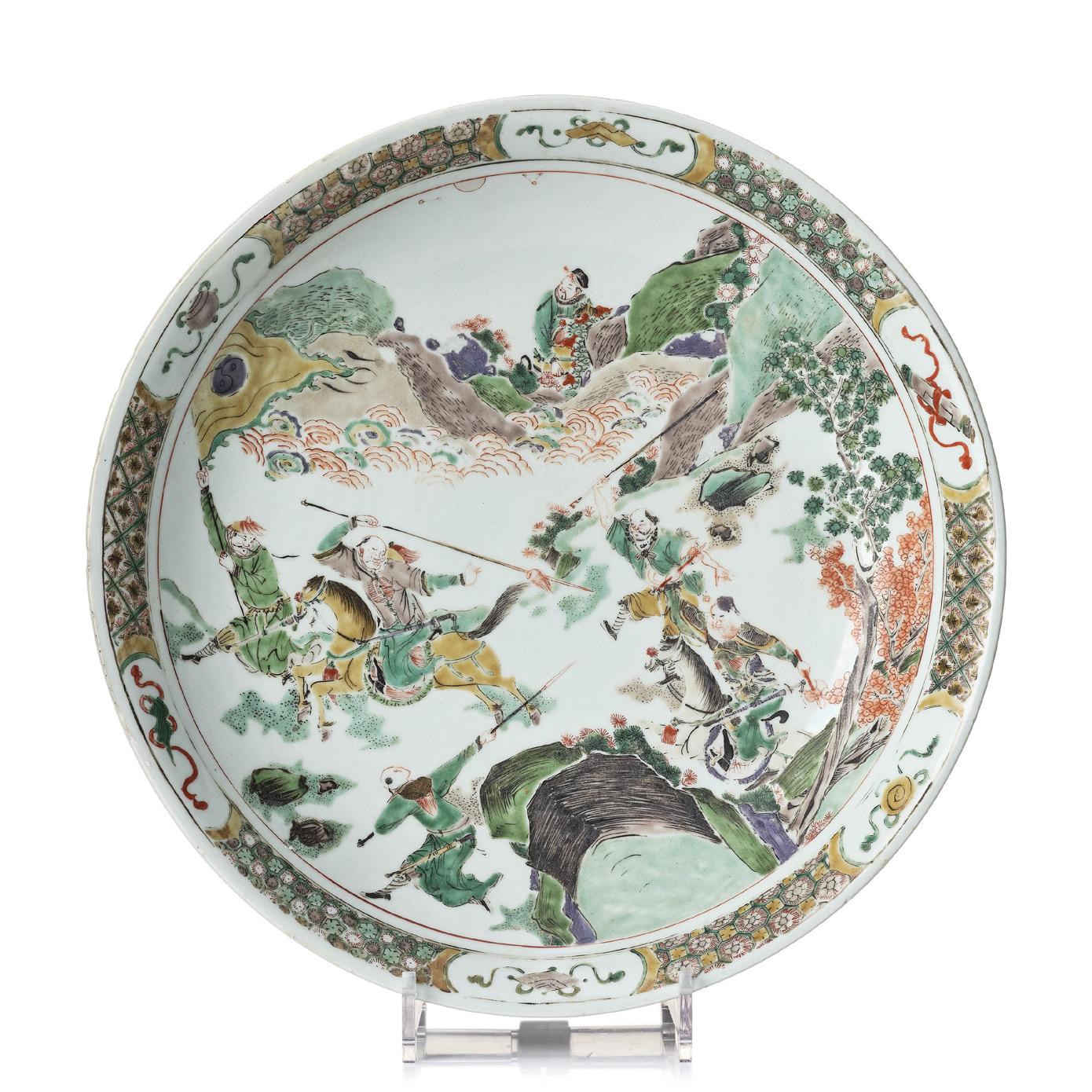
1079. A famille verte bowl and a dish, Qing dynasty, Kangxi (1662–1722).
The bowls base with a hare in underglaze blue. Decorated in famille verte against a cafe au lait ground. Diameter 15 cm. Height 7 cm. The dish with the same pattern but with a flower to the base. Diameter 22. 5 cm.
Provenance: Property of a private Swedish collector.
Estimate: SEK 10 000 – 12 000 / EUR 944 – 1 130
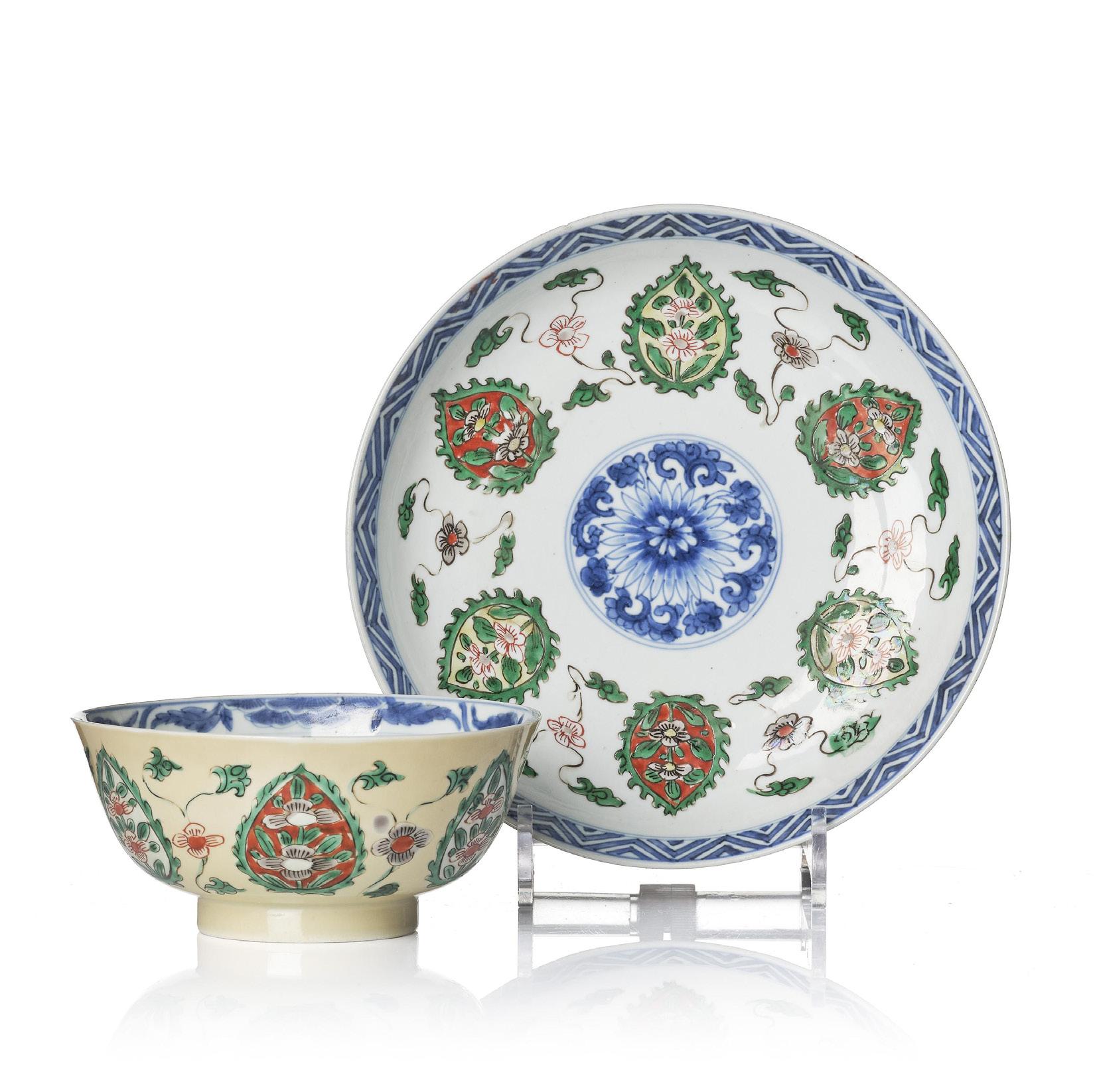
1080. A famille verte bowl, Qing dynasty, Kangxi (1662–1722).
Decorated in famille verte with butterflies and flowers in a garden in full bloom. With poem. Diameter 18.8 cm.
Height 8.5 cm.
Provenance: With a label from the Henry Knowler Collection, no 103.
Estimate: SEK 8 000 – 10 000 / EUR 755 – 944
1081. A set of four famille verte and cups with stands, Qing dynasty, Kangxi (1662–1722).
Decorated with a moulded relief and in famille verte with flowers, insects and birds, the exterior against a cafe au lait coloured ground. Diameter cup 8 cm. Diameter dish 13.2 cm.
Provenance: Purchased at Skajs Antique Shop in Stockholm, Sweden in the 1970’s.
Estimate: SEK 8 000 – 10 000 / EUR 755 – 944
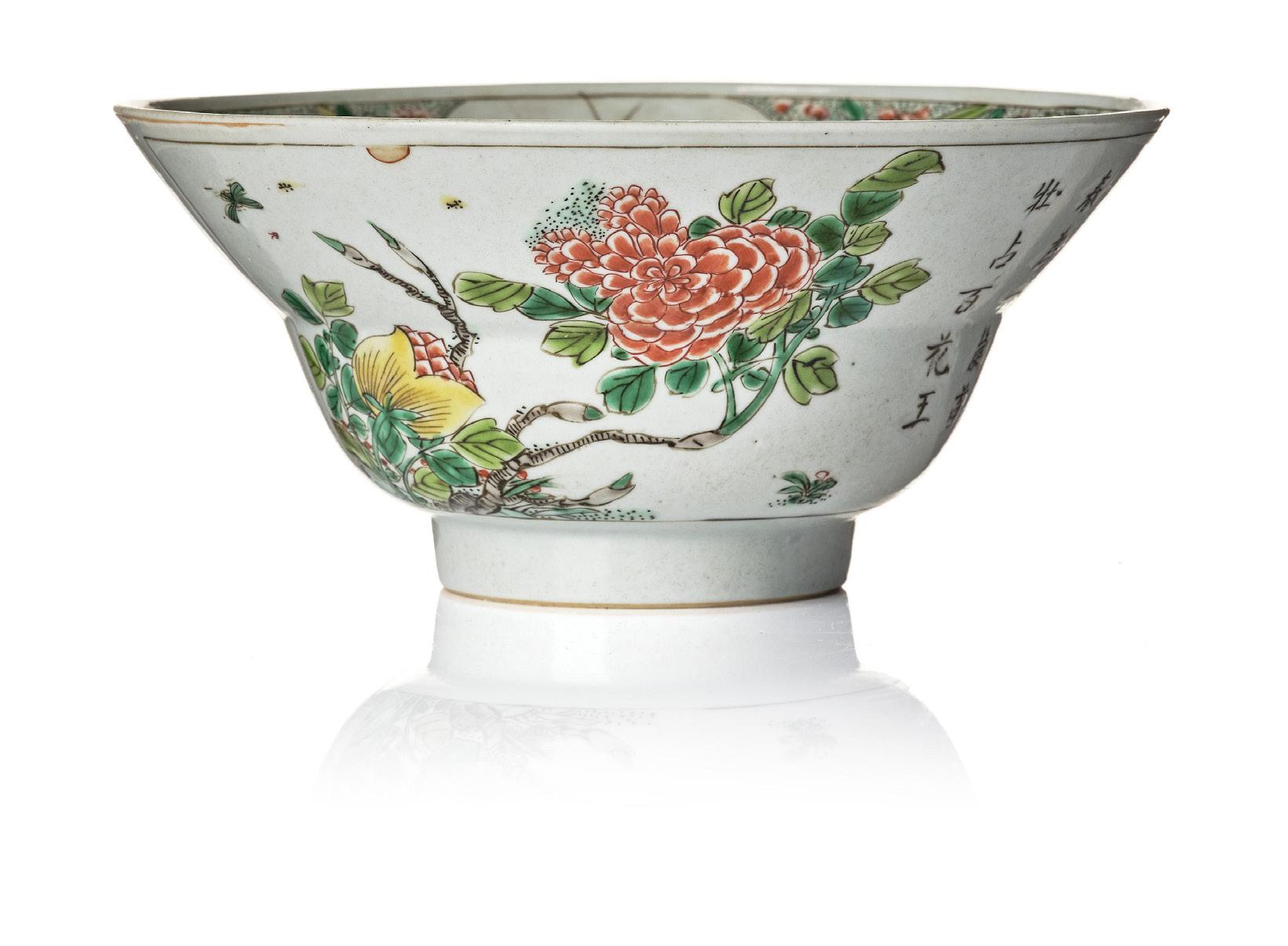
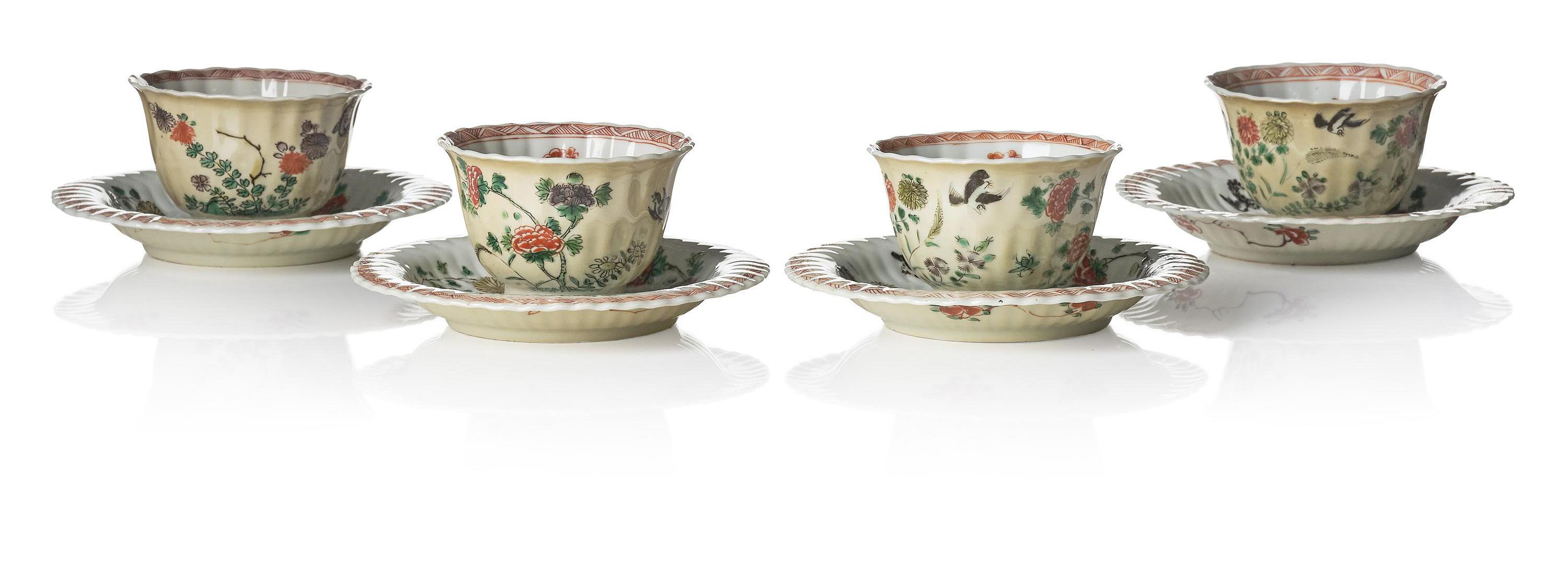
1082. A pair of famille verte dishes, Qing dynasty, Kangxi (1662–1722).
Decorated in famille verte with a bird on a blossoming branch, with a poem. Base with artemisa leaf in underglaze blue. Daimeter 21.5 cm.
Both with a fitted box. Measure 25.5 x 25.5 x 6 cm.
Provenance: Property of a private Swedish Estate.
Estimate: SEK 6 000 – 8 000 / EUR 567 – 755
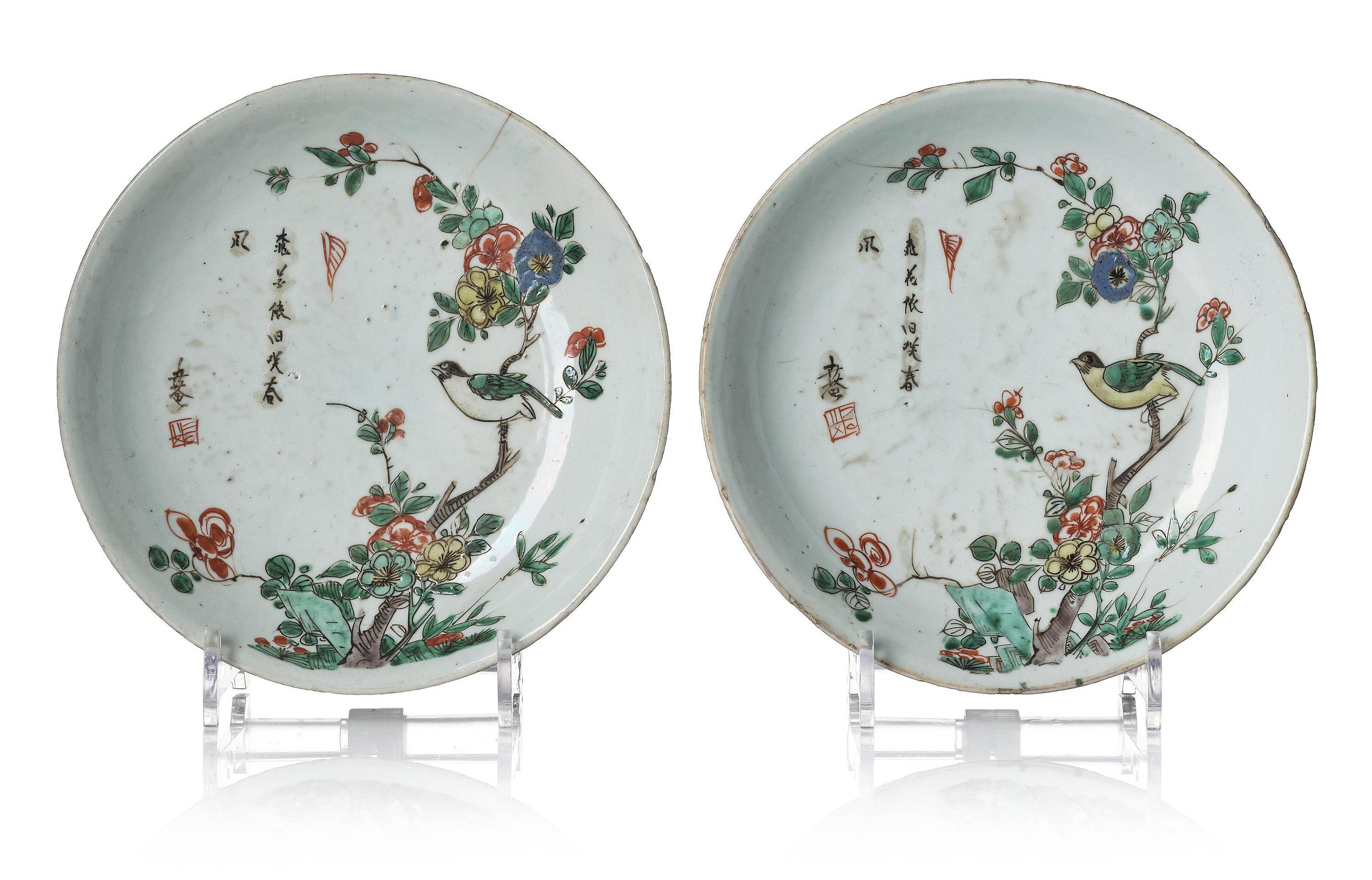
1083. A famille verte ‘eight horses of Mu’ plate, Qing dynasty, Kangxi (1662–1722).
Decorated to the center with Mus eight horses, galopping, grassing and frolicking on the fields. Around the rim blossoming cherry and mountains. The center of the reverse with a jue in underglaze blue. Diameter 22 cm.
Provenance: Purchased at Skajs Antique Shop in Stockholm, Sweden in the 1970’s.
Estimate: SEK 8 000 – 10 000 / EUR 755 – 944
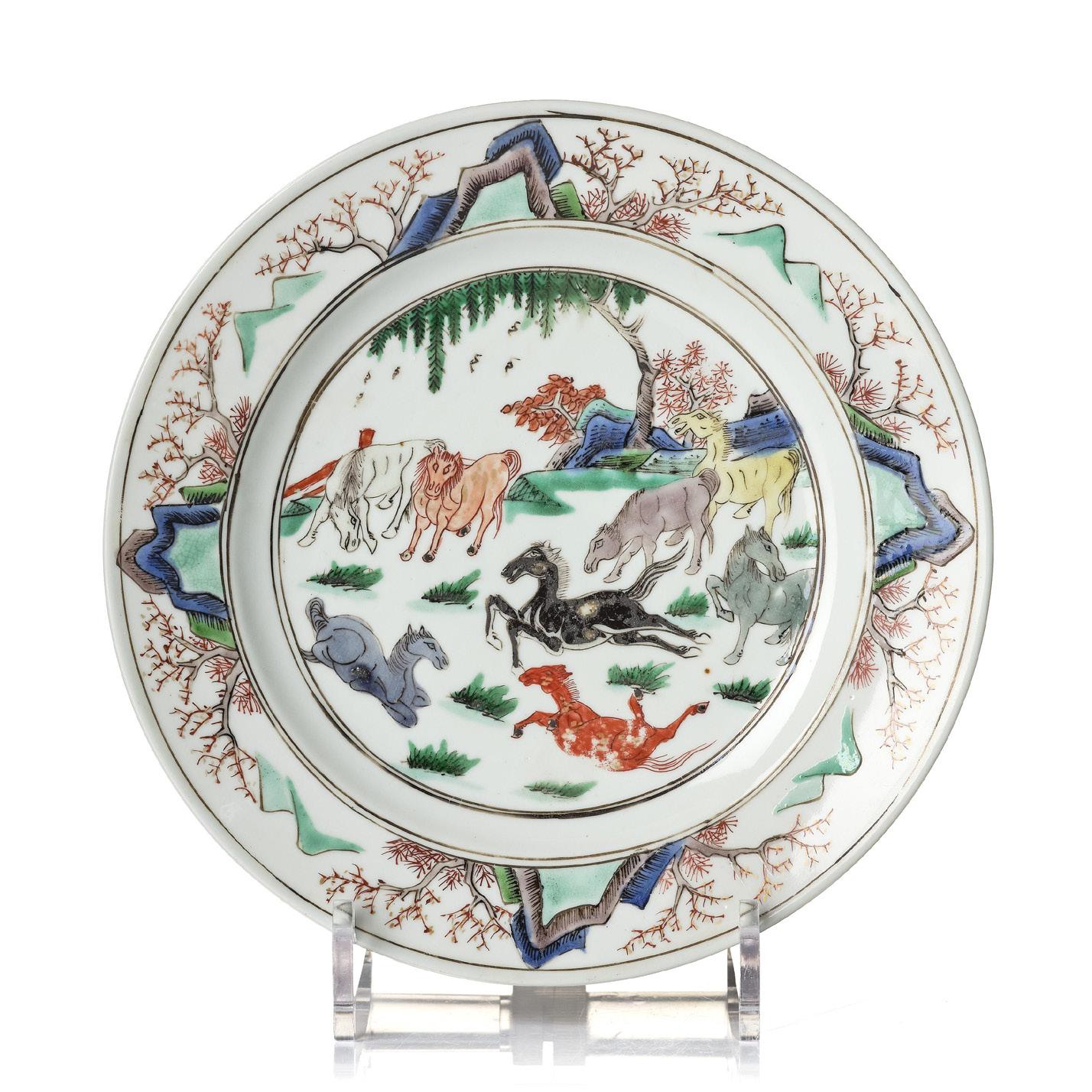
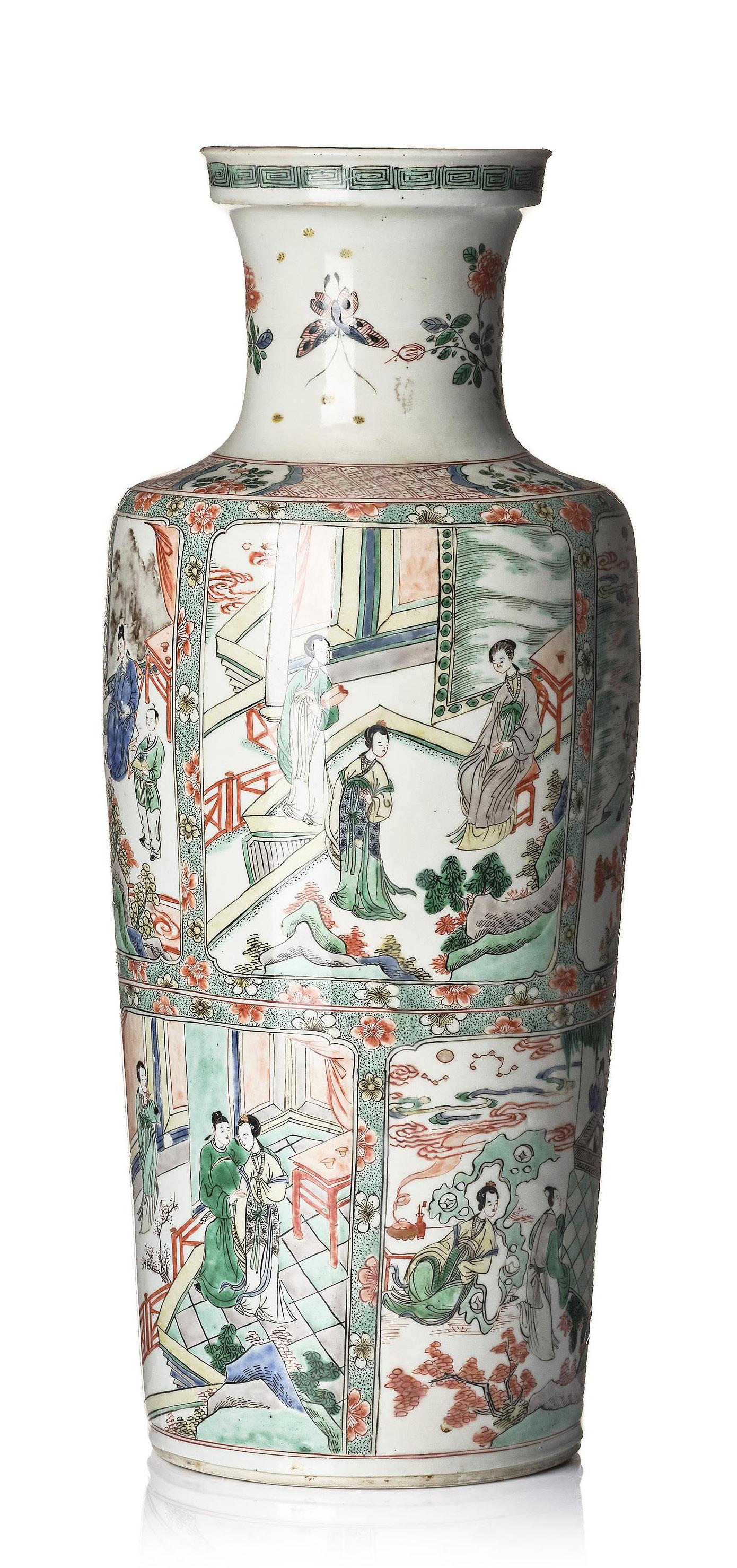
1084. A famille verte roleau vase, Qing dynasty, early 18th century.
Of cylinder shape, with waisted neck and lipped rim, decorated with a variety of figure scenes from a Chinese novel. Height 46.5 cm.
Provenance: Property of a private Swedish collector.
Estimate: SEK 8 000 – 10 000 / EUR 755 – 944
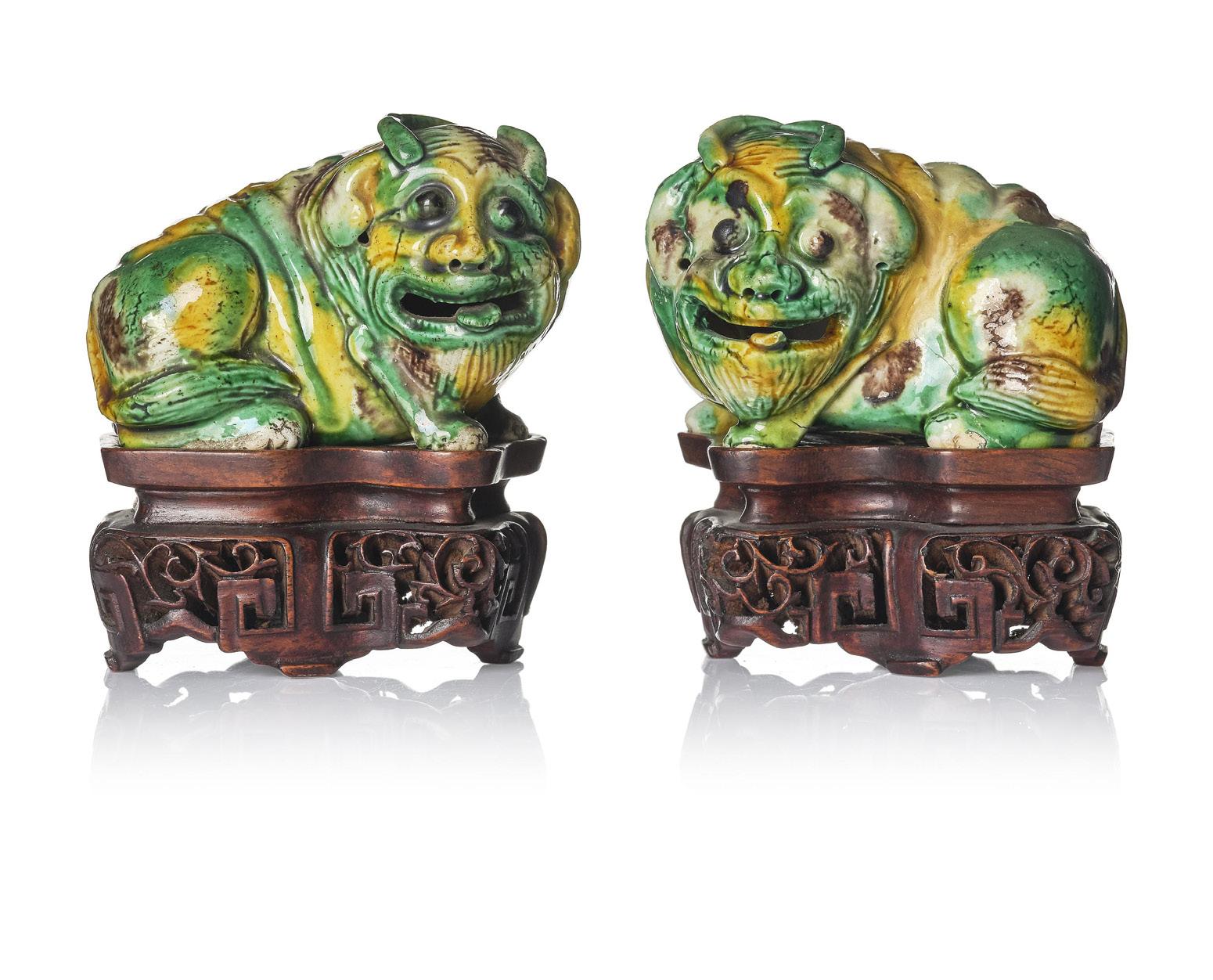
Estimate: SEK 18 000 – 20 000 / EUR 1 700 – 1 890
1086. An imari jar wtih cover, Qing dynasty, 18th century. Decorated in imari colours of phoenixbirds and a buddhist lion in a garden in full bloom. Height 24.5 cm.
Provenance: Property of a private Swedish Estate.
Estimate: SEK 12 000 – 15 000 / EUR 1 130 – 1 420
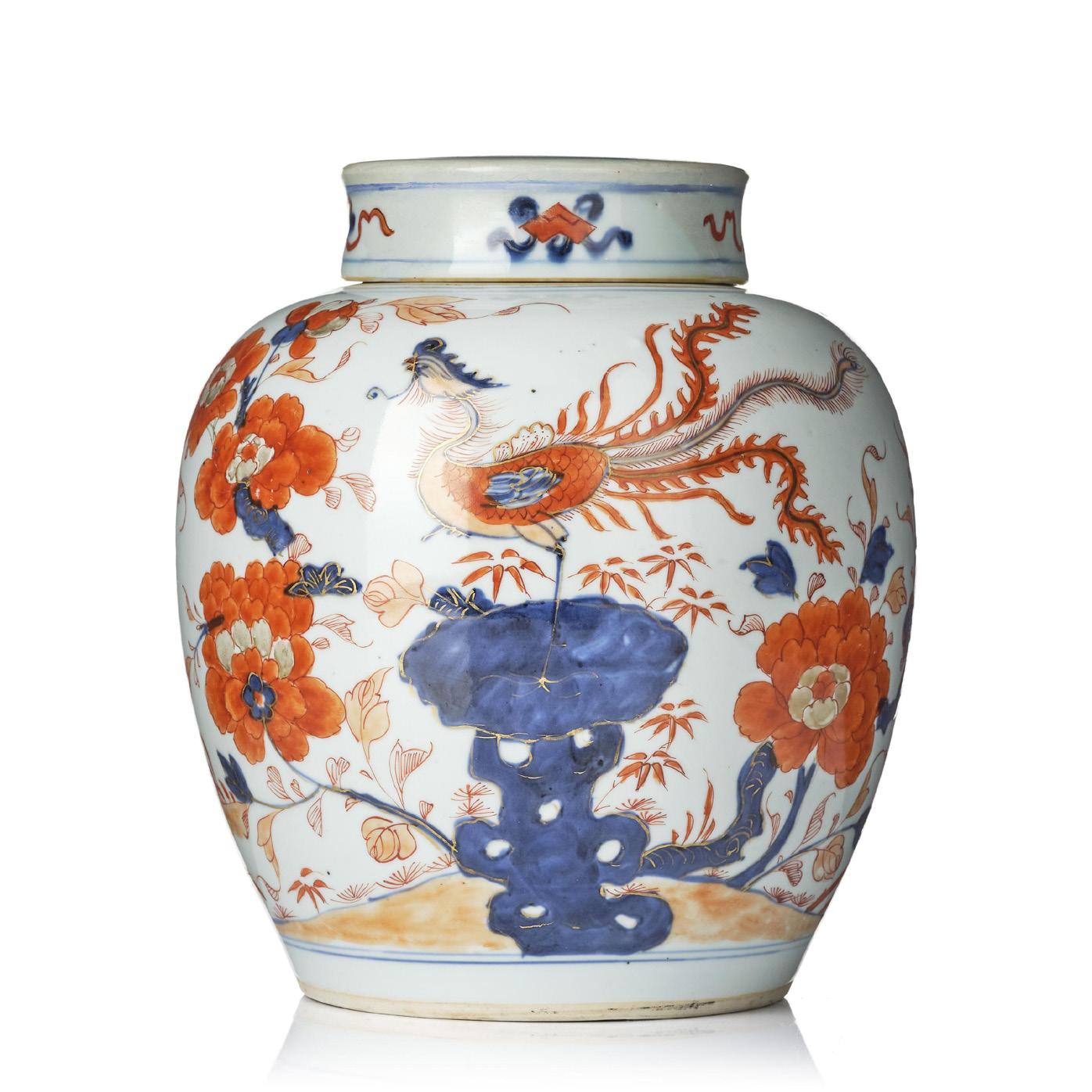
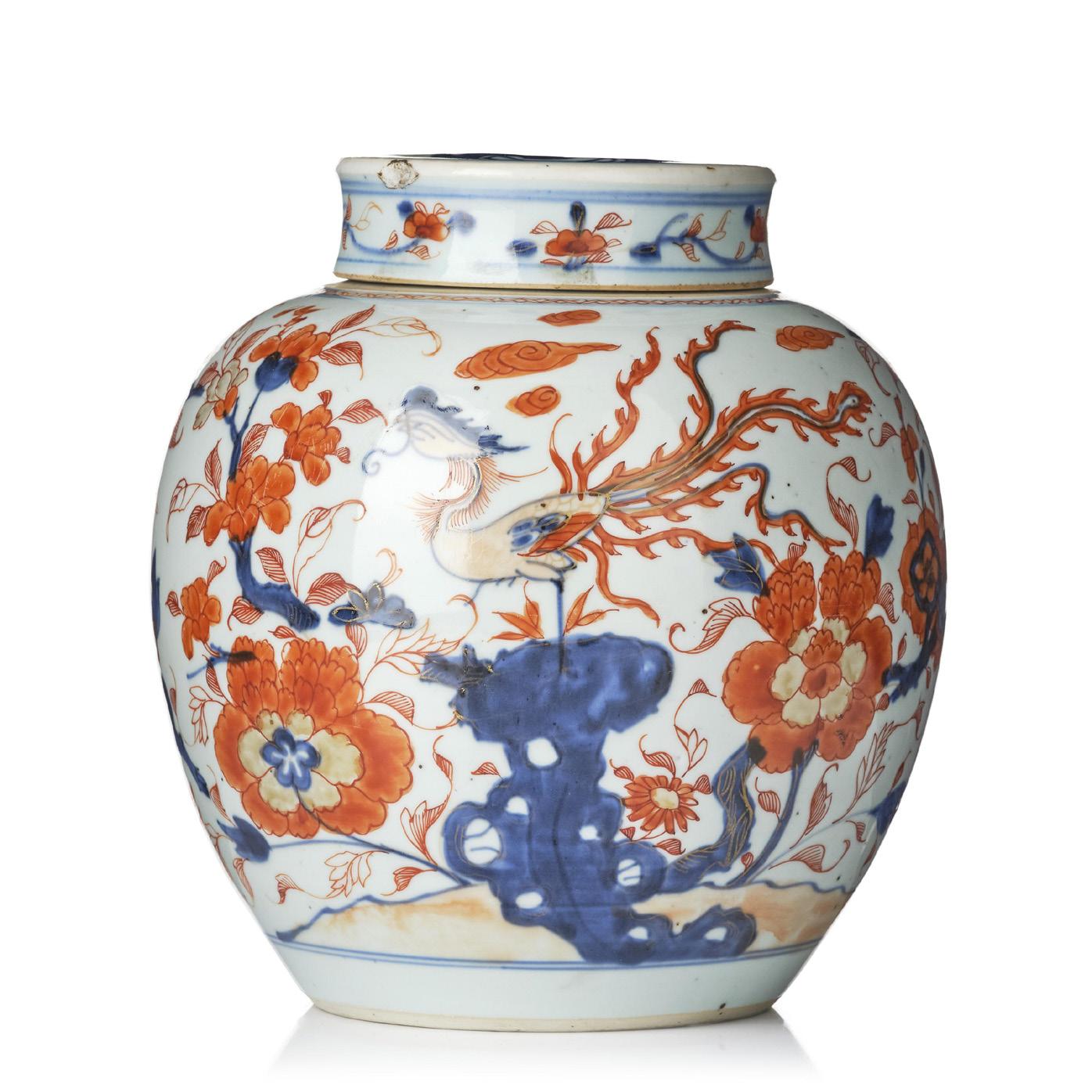
1087. An imari jar with cover, Qing dynasty, 18th century. Ovoid shape, decorated in imari colours with buddhist lions and mythical beasts in a garden setting. Heigh 25 cm.
Provenance: Property of a private Swedish Estate.
Estimate: SEK 15 000 – 20 000 / EUR 1 420 – 1 890
1088. An Imari jar, Qing dynasty, Kangxi (1662–1722)
Ovoid. Decorated with imari featuring a mythological beast amidst flames, a phoenix bird and a garden in bloom. Height 21.5 cm.
Estimate: SEK 6 000 – 10 000 / EUR 567 – 944
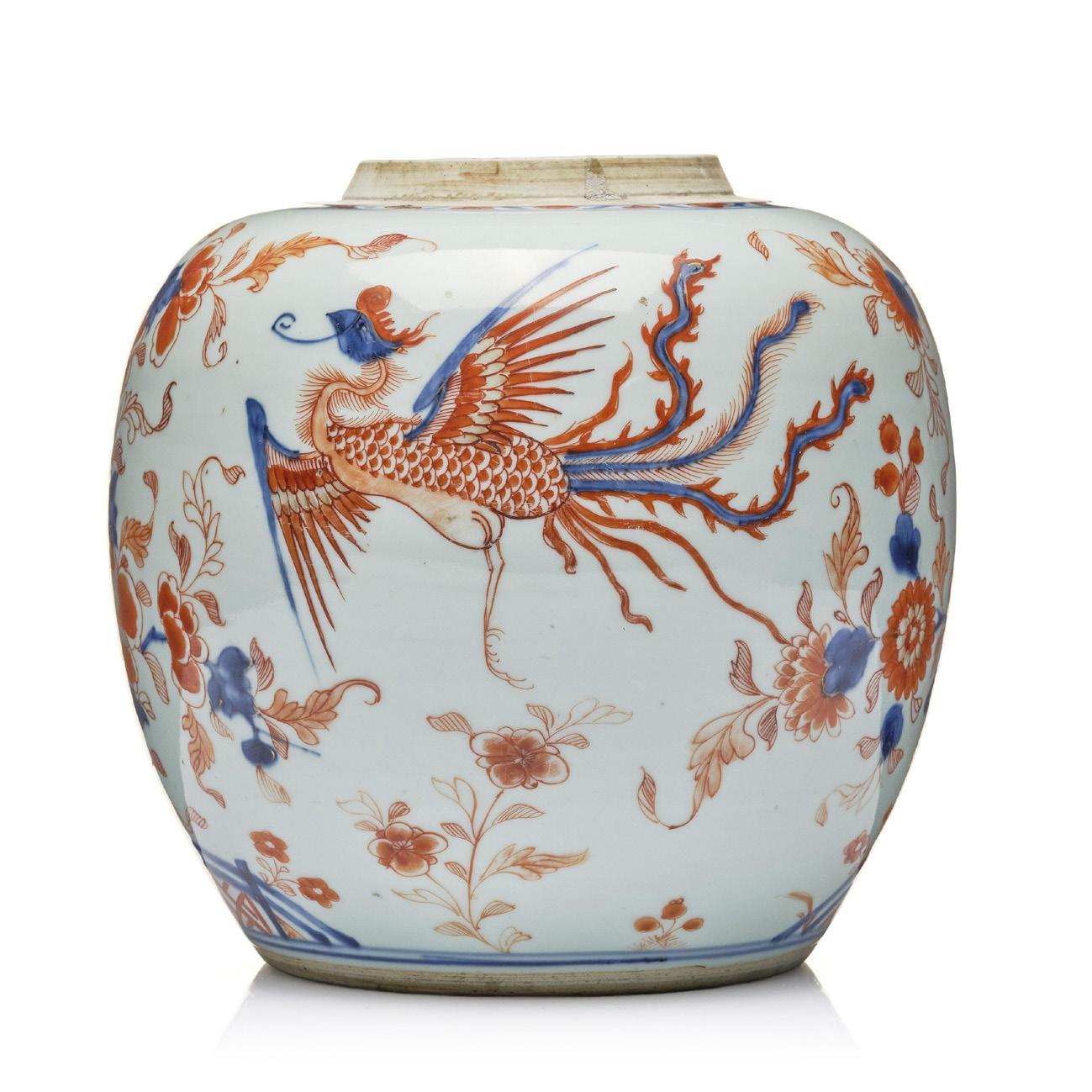
1089. A moulded white-glazed ‘anhua’ decorated cup, Late Ming/early Qing dynasty.
Rounded sides that rises from a short footrim, everted brown rim. The interior decorated with a moulded relief decoration depicting birds in a lotus pond. Diameter 9.5 cm. Height 4.5 cm.
Exhibitions: Compare with a bowl from the Palmer family collection, sold at Christies, lot 1547, Auction 23835, December 12 2024, Hong Kong.
Estimate: SEK 15 000 – 20 000 / EUR 1 420 – 1 890
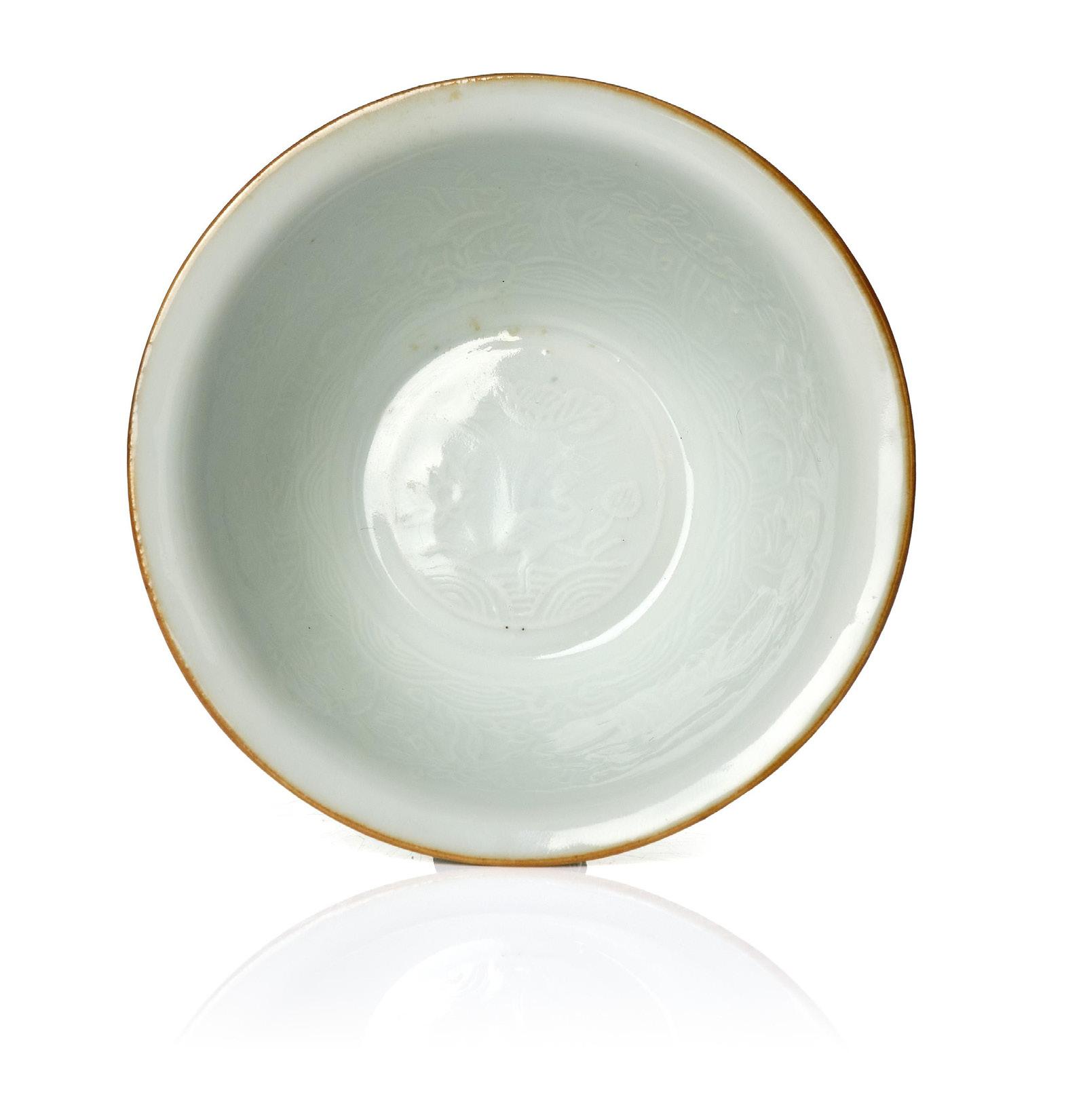
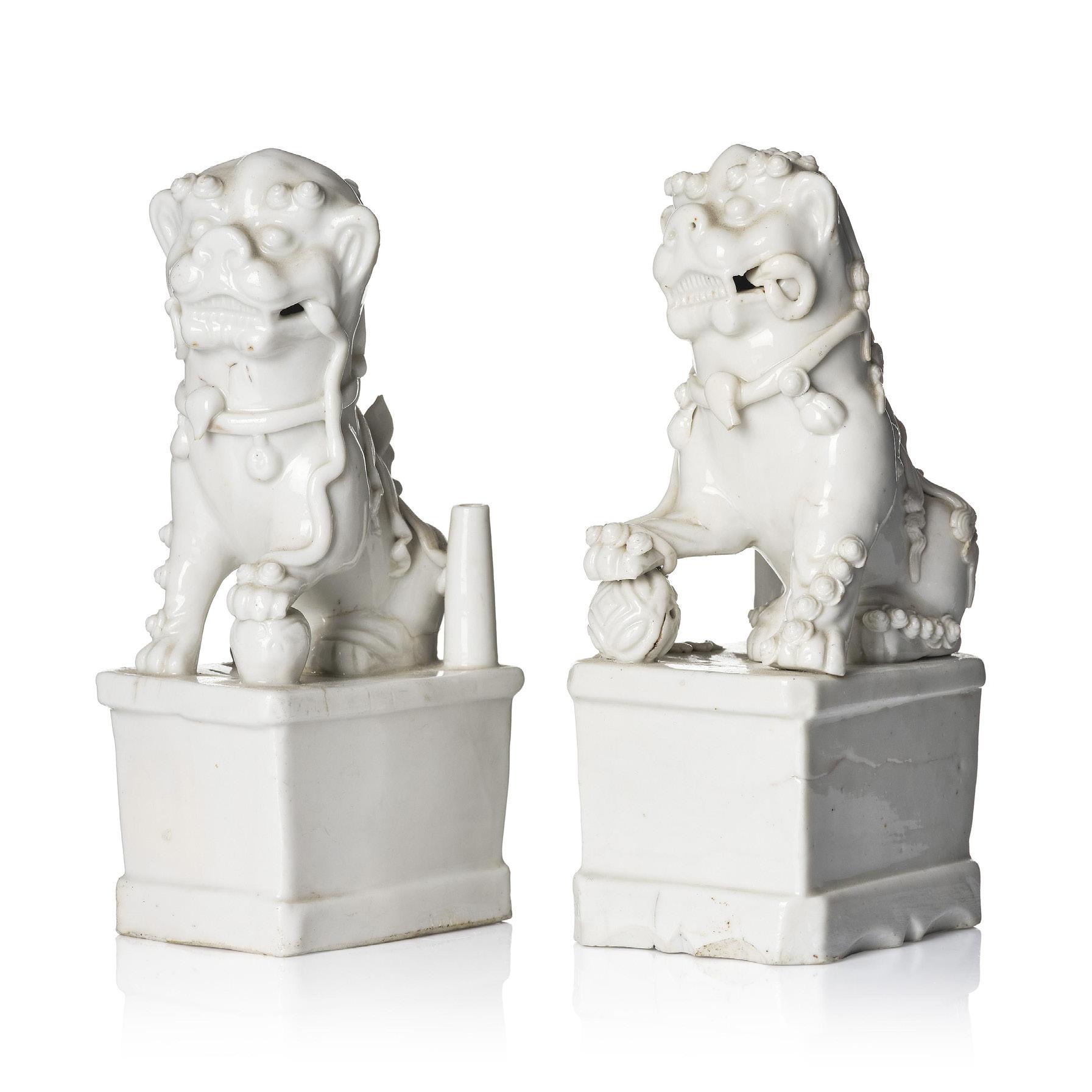
1090. Two blanc de chine figures of buddhist lions/joss stick holders, Qing dynasty, Kangxi (1662–1722).
Exhibitions: Compare with a smililar pair at the Victoria & Albert Museum, London, Museum no. 704A-1883.
Catalogue note: Incense holders like these was made in the kilns of Dehua in southern China during the reign period of the emperor Kangxi (1662–1722). Dehua kilns were specialized in the production of porcelain objects with no painted decoration, also known in Europe as ‘blanc de Chine’.
Estimate: SEK 12 000 – 15 000 / EUR 1 130 – 1 420
1091. A blanc de Chine seated figure of Bodhidharma, Qing dynasty.
Modelled seated with the right knee raised and the left leg tucked beneath, the arms resting on the right knee beneath a voluminous robe opening at the chest and falling in layered folds to reveal the right foot, the face with a contemplative expression, downcast eyes and pendulous earlobes, the brows, moustache and beard picked out in tight curls, the back impressed with a apochyphal He Chaozong seal mark within a double-gourd cartouche and a Xuande seal mark. Height 21.5 cm. Height with later wood stand 27.5 cm.
Provenance: Purchased in Denmark, bears an Bruun-Rasmussen label.
Exhibitions: Two similar, however, unmarked, but from the period blanc de Chine figures of Bodhidharma are preserved in the British Museum, London, published in Ming Ceramics in the British Museum, London, 2001, nos 17:13 and 17:14.
Estimate: SEK 50 000 – 75 000 / EUR 4 720 – 7 080
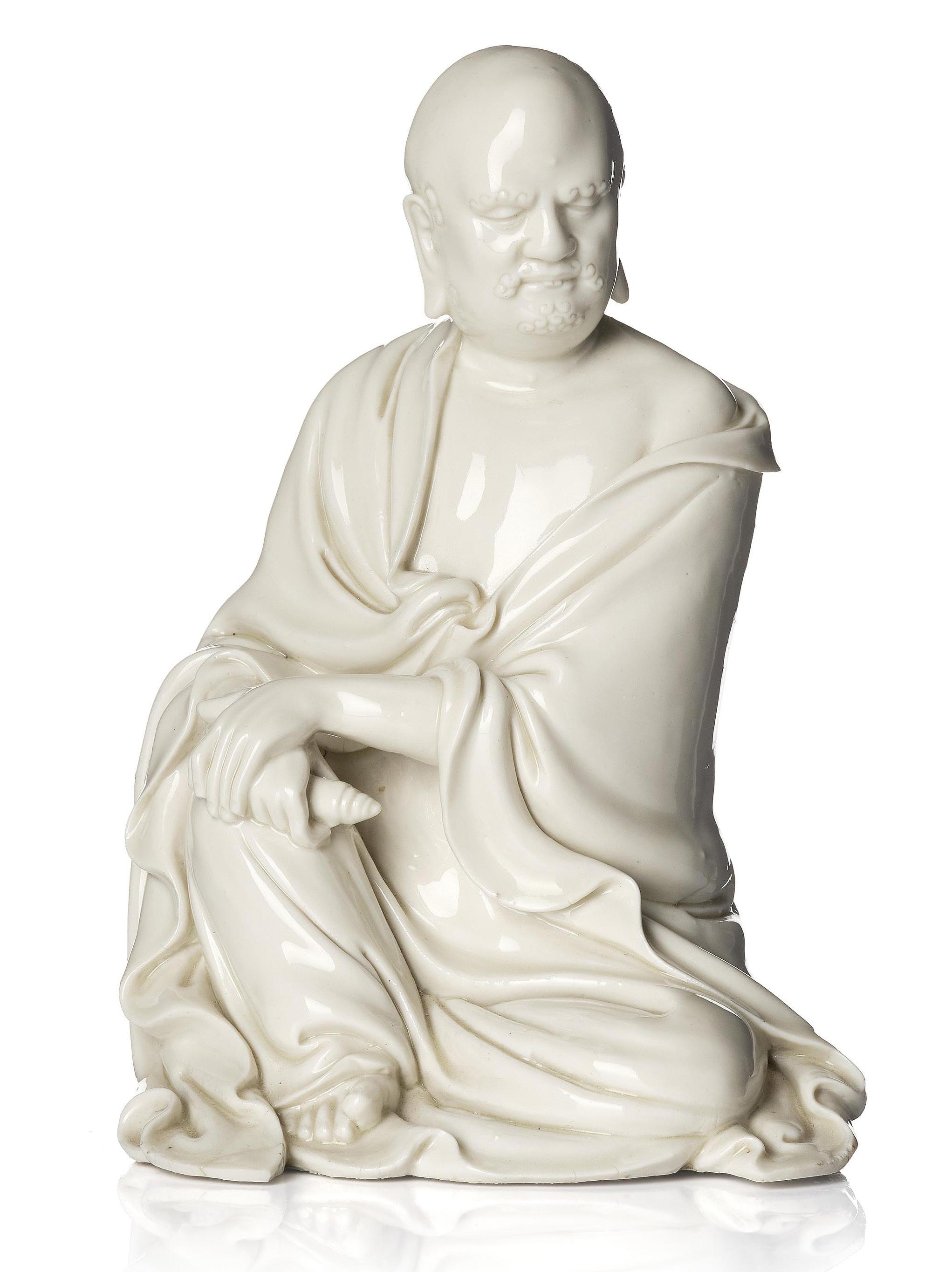
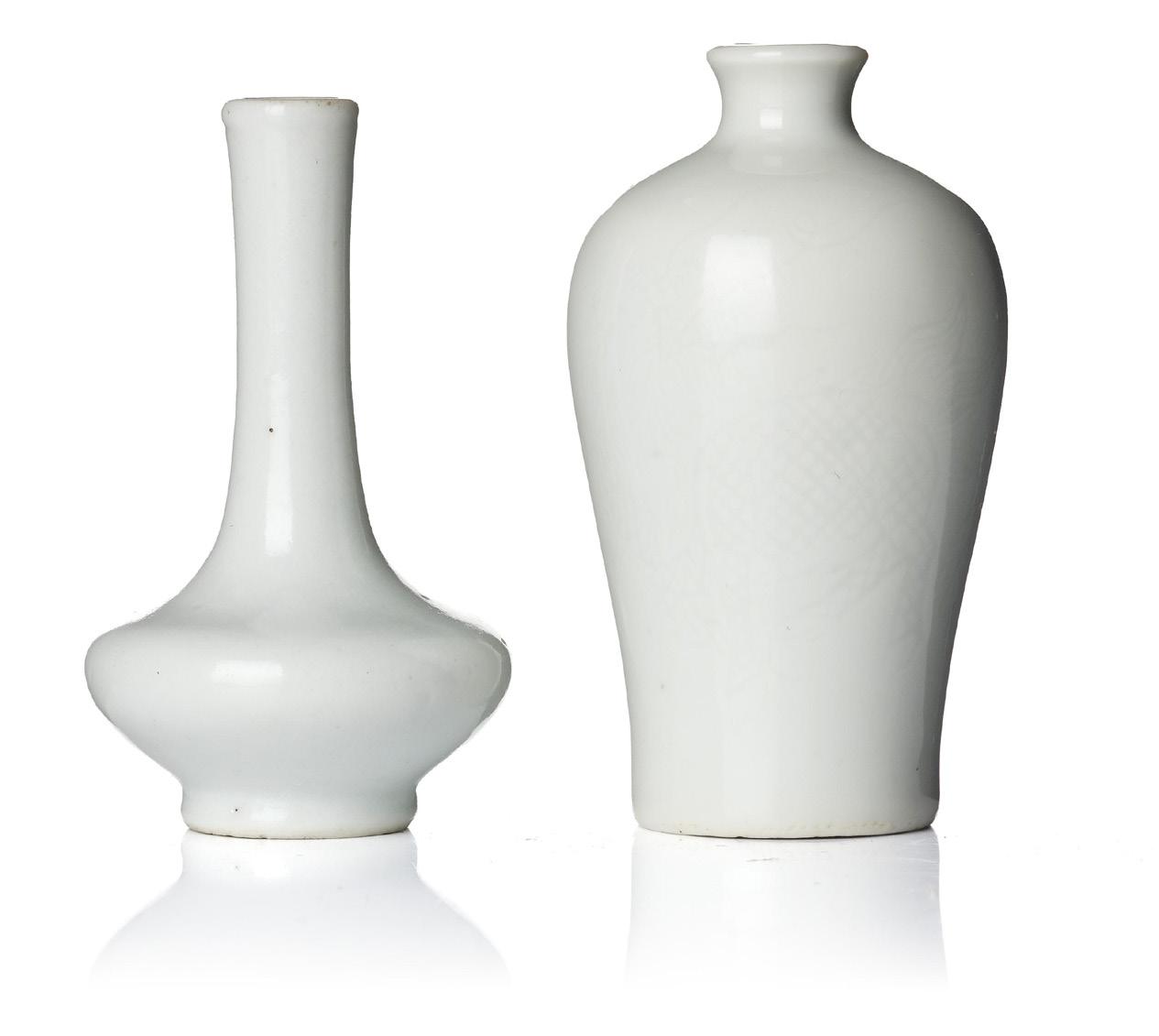
Exhibited at ‘Mittens rike’, Borås Konstmuseum, depicted in the catalogue p. 122, lot 419–420.
Estimate: SEK 6 000 – 8 000 / EUR 567 – 755
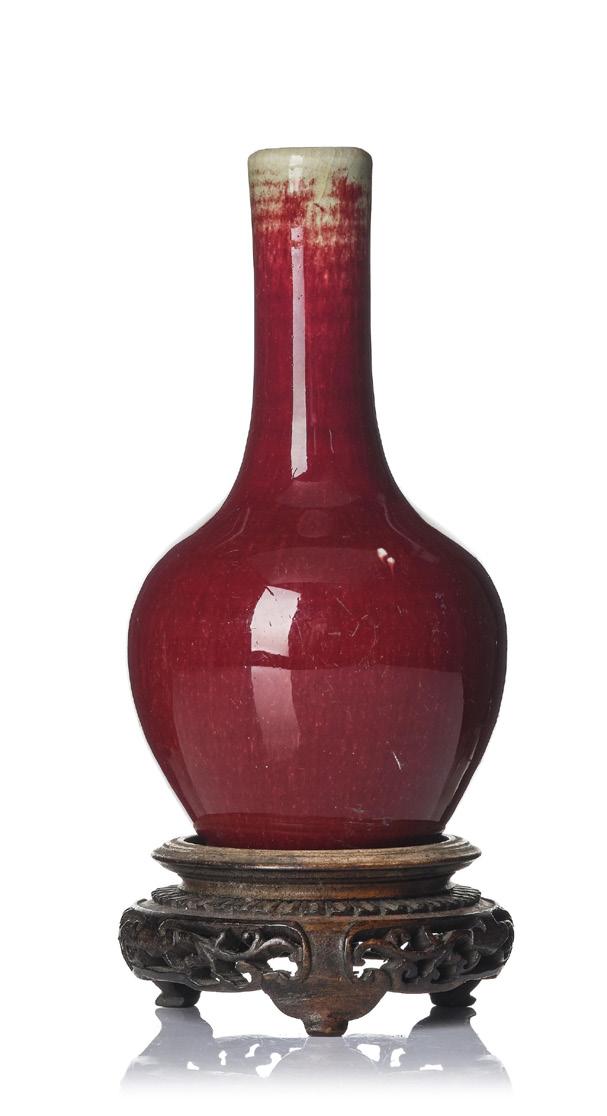
1095. A flambé glazed vase, Qing dynasty, 19th century. Rounded body with an elongated neck, glazed in a deep red glaze that shifts towards a pale celadon green tone by the rim. Height 14 cm. Height with wooden stand 16.5 cm.
Provenance: Property of a private Swedish collector.
Exhibitions: Compare vases of this type in the National Palace Museum, Taiwan, Taipei. Object Number 故瓷 000159N000000000.
Estimate: SEK 4 000 – 6 000 / EUR 378 – 567
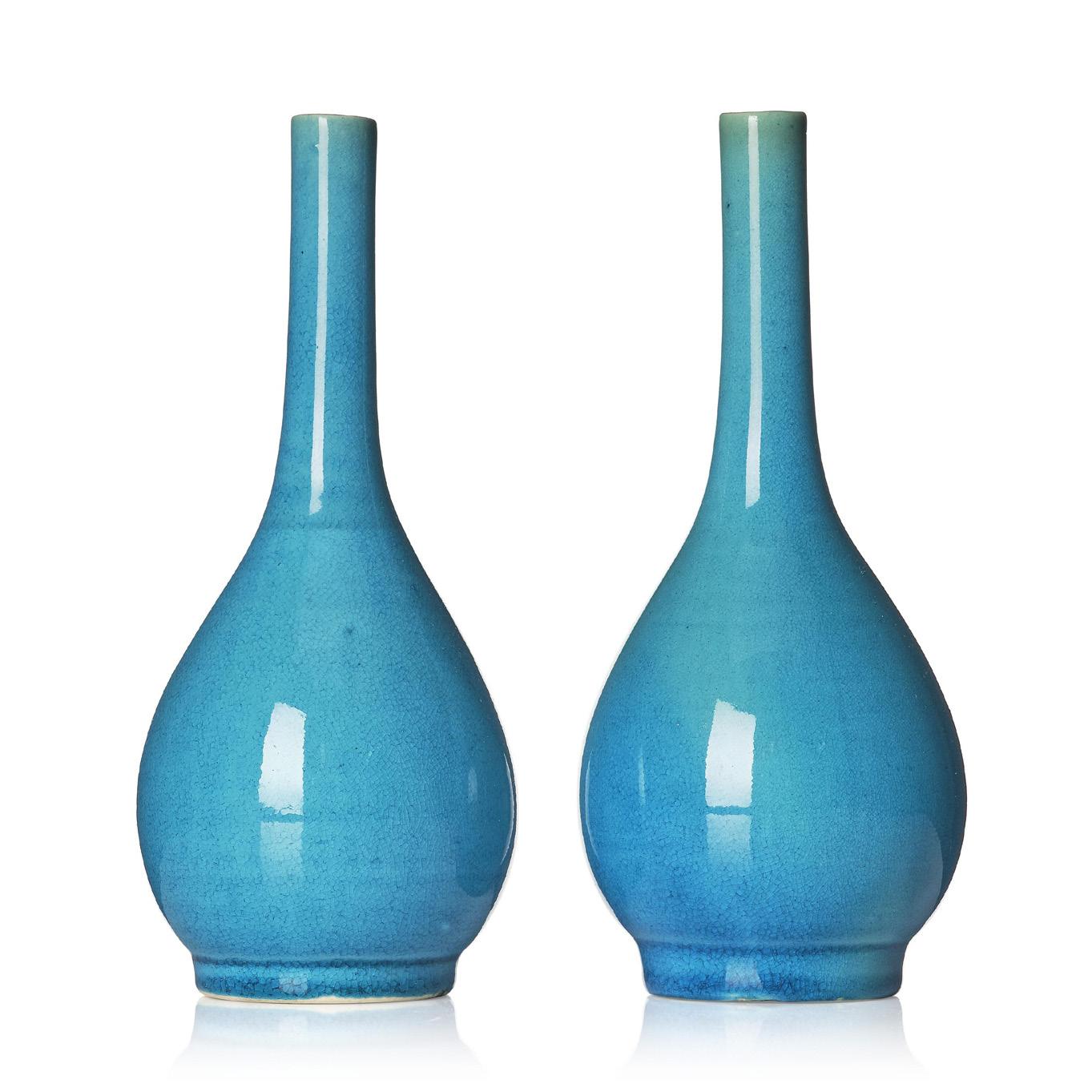
Kangxi (1662–1722).
Pear shaped with rounded bodies and tall slender necks, on short footrims. Decorated with vibrant turquoise glaze. Height 16.5 cm.
Exhibitions: Compare with a vase of this type in the British Museum, London, Registration number 2012,3004.1.
Estimate: SEK 6 000 – 8 000 / EUR 567 – 755
1094. No lot .
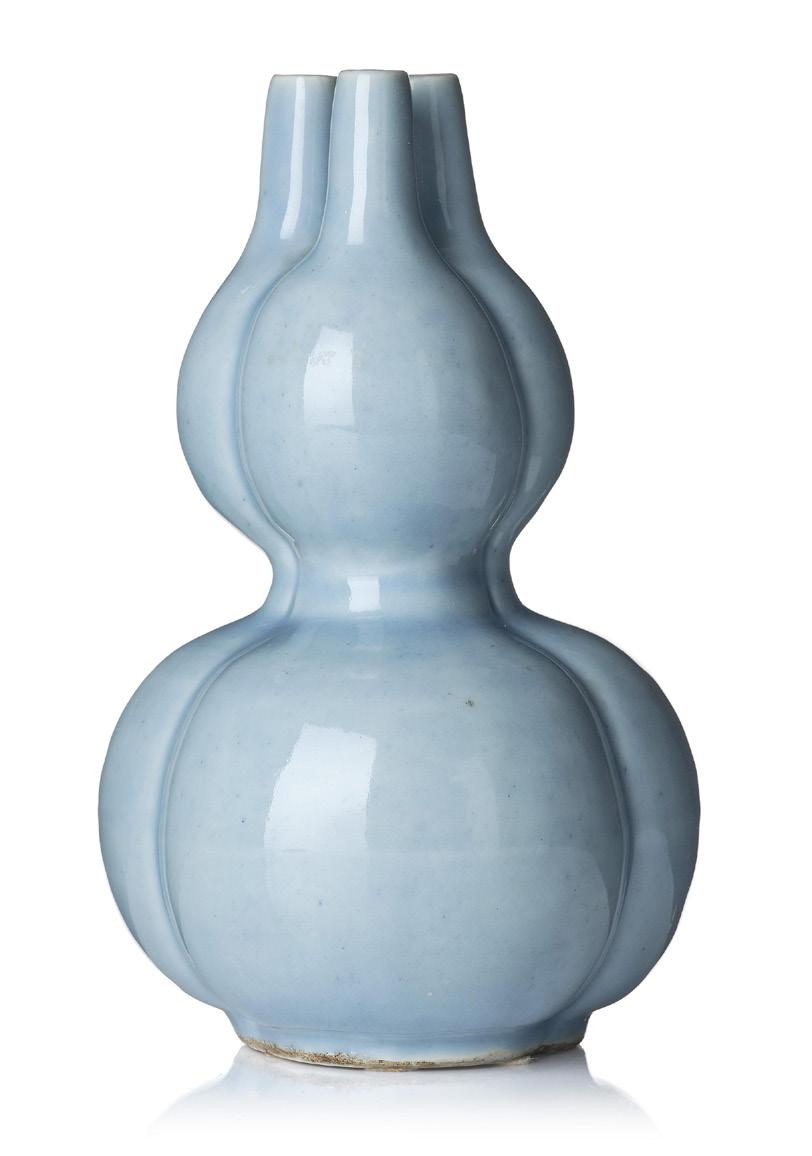
1096. A ‘claire de lune’ glazed double-gourd vase, Qing dynasty 18/19th century.
Of three-lobed double-gourd form, skilfully potted with the lower bulb rising from a trefoil foot to a slender waisted neck surmounted by the smaller upper bulb tapering to three tubular spouts, covered overall lavender blue glaze. Height 25.5 cm.
Provenance: Purchased at auction in Stockholm in the 1980’s by the present owner.
Estimate: SEK 10 000 – 12 000 / EUR 944 – 1 130
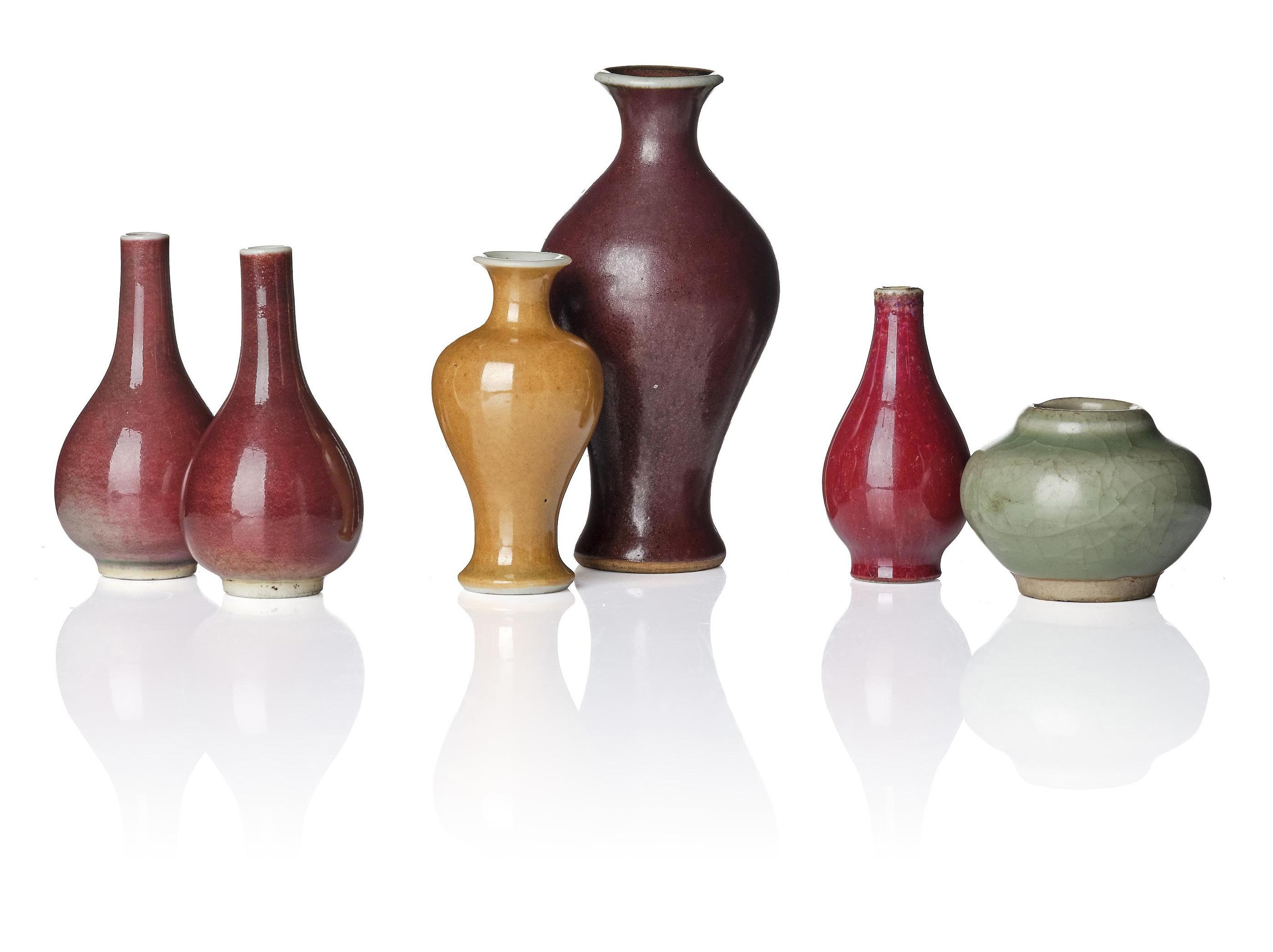
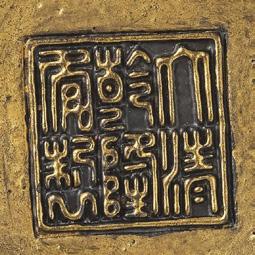
1097. A group of monochrome miniatures, Qing dynasty, 18/19th century. Glased in different monchrome glazes including sang de boeuf and celadon. Height 4–11 cm.
Exhibitions: Exhibited at ‘Mittens rike’, Borås Konstmuseum, depicted in the catalogue p. 122–128, lot 416,432 and 455. Estimate: SEK 8 000 – 10 000 / EUR 755 – 944
1098. No lot.
1099. A bronze imitating seal paste box with cover, Qing dynasty, with Qianlong mark. Octagonal shape with a slightly domed cover, decorated in relief with two facing five clawed dragons chasing the flaming pearl amidst cloud formations. The sides with buddhist emblems against a turquoise ground enamel. Base with a Qianlong seal mark all gilded. Diameter 7.5 cm. Wooden silk clad box accompanies the piece. Measure 10.5 x 9.5 x 11 cm.
Provenance: From the Collection of Ann Kreuger (1926–2022). Ann Kreuger is well known in the circles of snuff bottles collectors, dealers and auction houses. She was an active member in the Snuff bottle society, researched, collected,
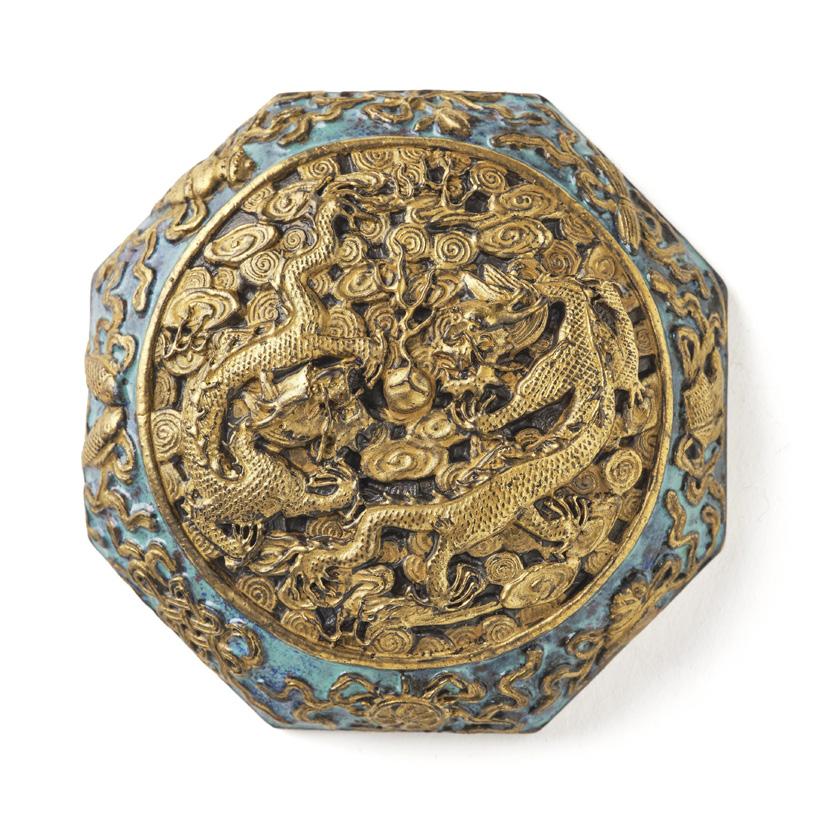
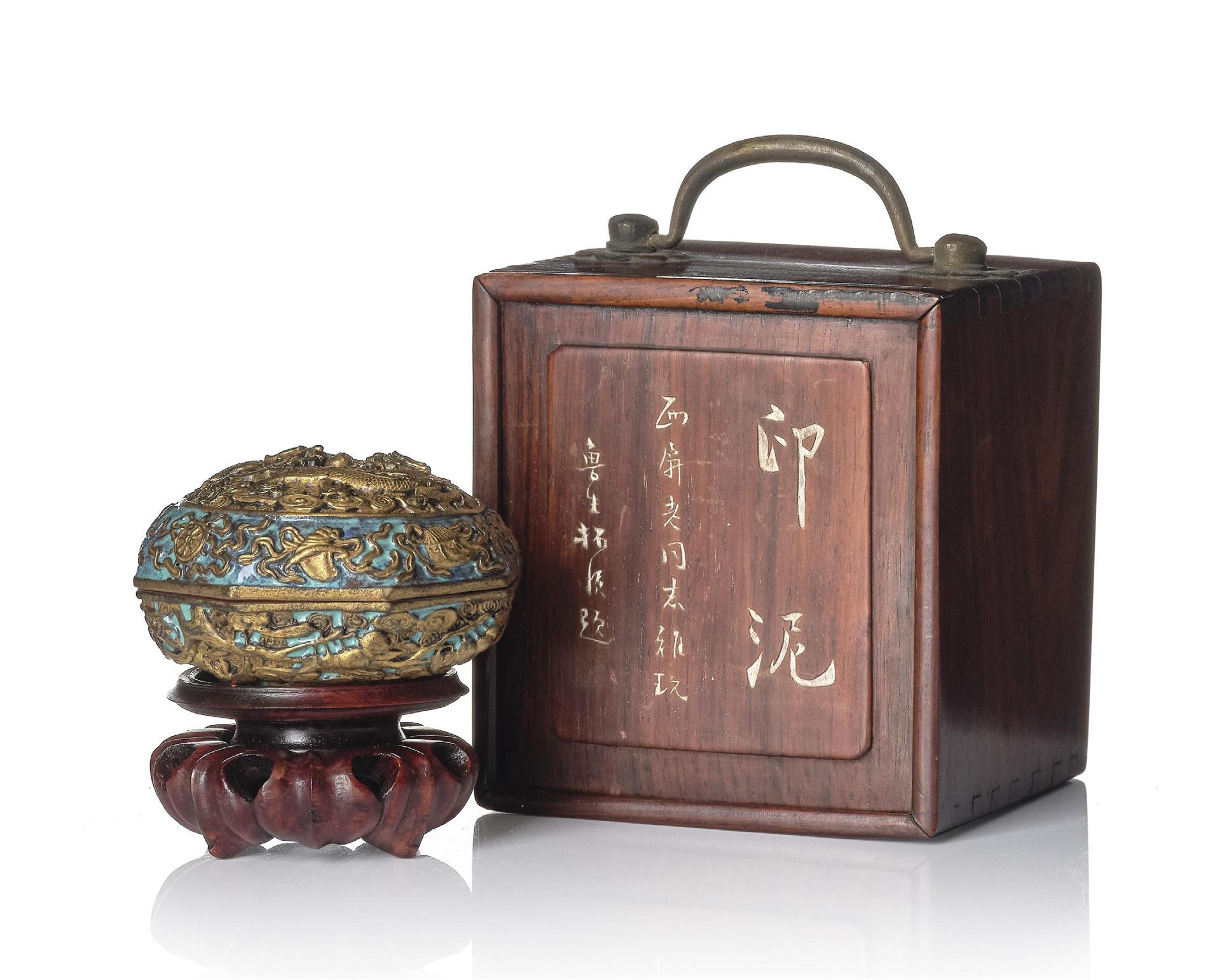
LOT 1102, 1182, 1159, 1158, 1054, 1056, 1044, 971 and 1015.
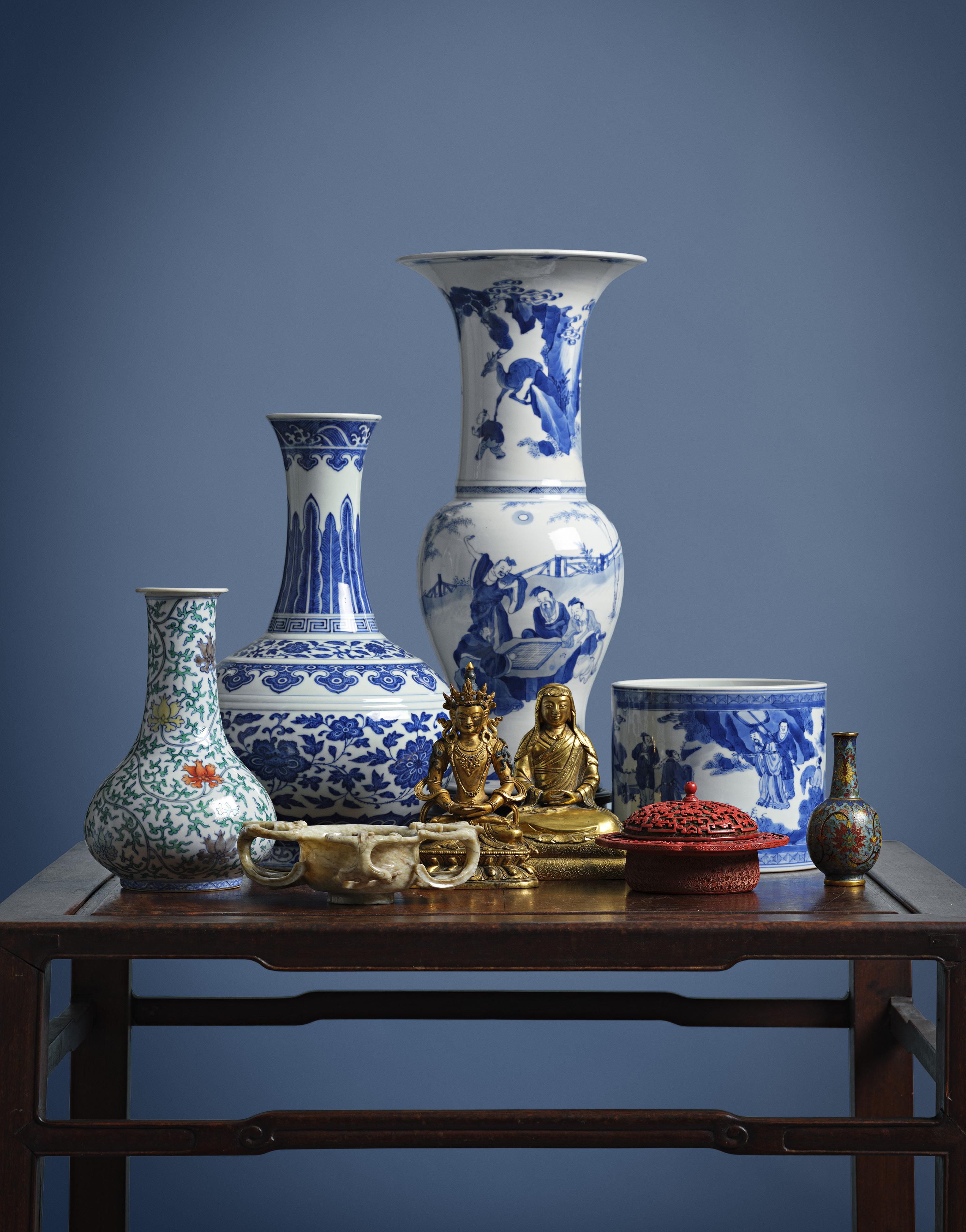
1100. A flambé glazed vase and brush-washer, Qing dynasty, 18th/19th century.
The vase in an elegant shape with a narrow neck, glazed in a deep red flambé glaze. Height wooden stand 12.5 cm. The brush pot in a beehive shape also glazed in a deep red flambé glaze that shifts towards white at the rim. Diameter widest part 7 cm.
Provenance: Property of a private collector.
Estimate: SEK 10 000 – 15 000 / EUR 944 – 1 420
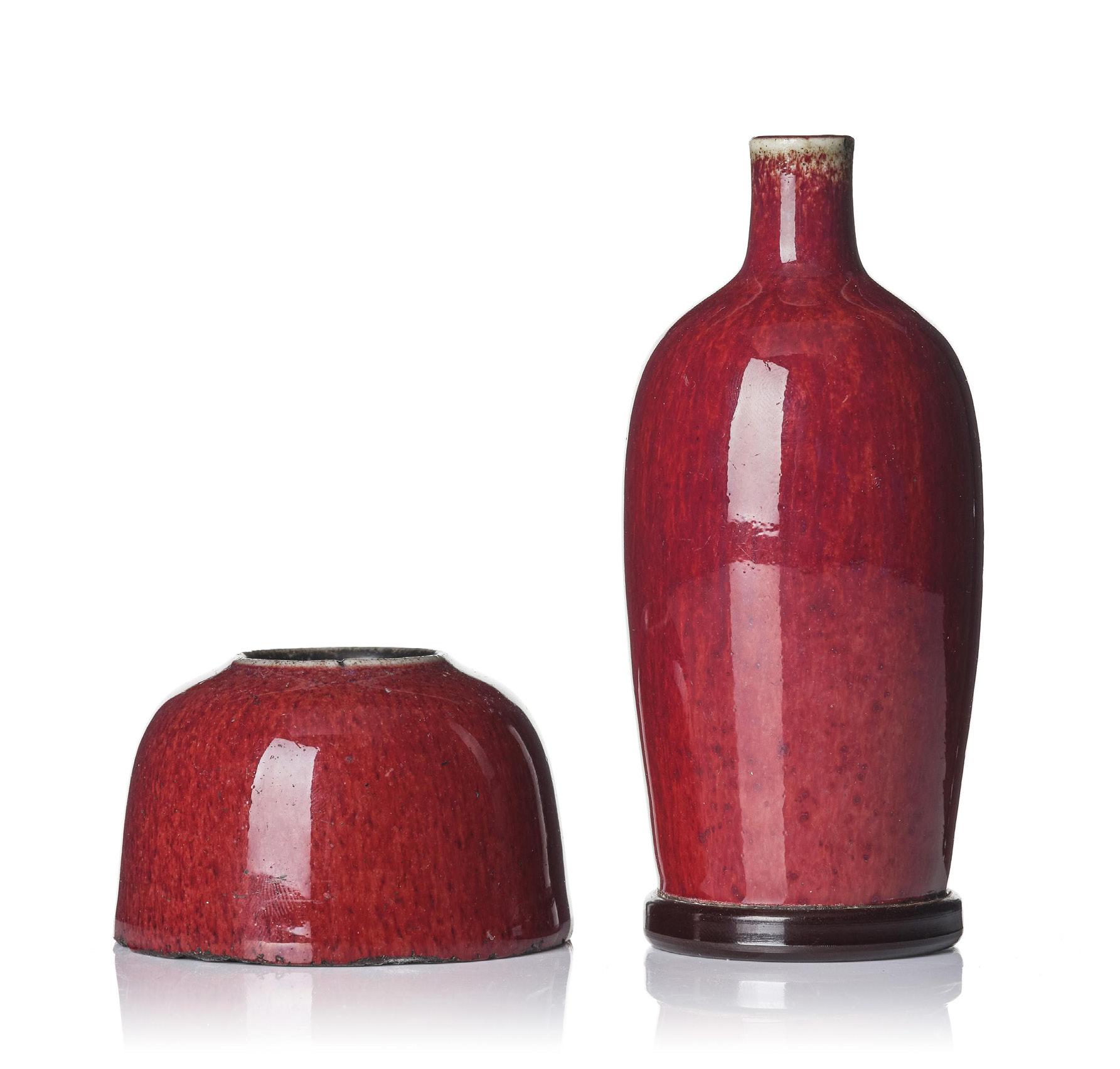
1101. A blue glazed jar, Qing dynasty, 18th century. Ovoid shape, gilded decoration of a garden in full bloom against a deep blue glaze. Height 22 cm. Height with wooden stand and cover 29.5 cm.
Provenance: Property of a private Swedish collector.
Estimate: SEK 8 000 – 10 000 / EUR 755 – 944
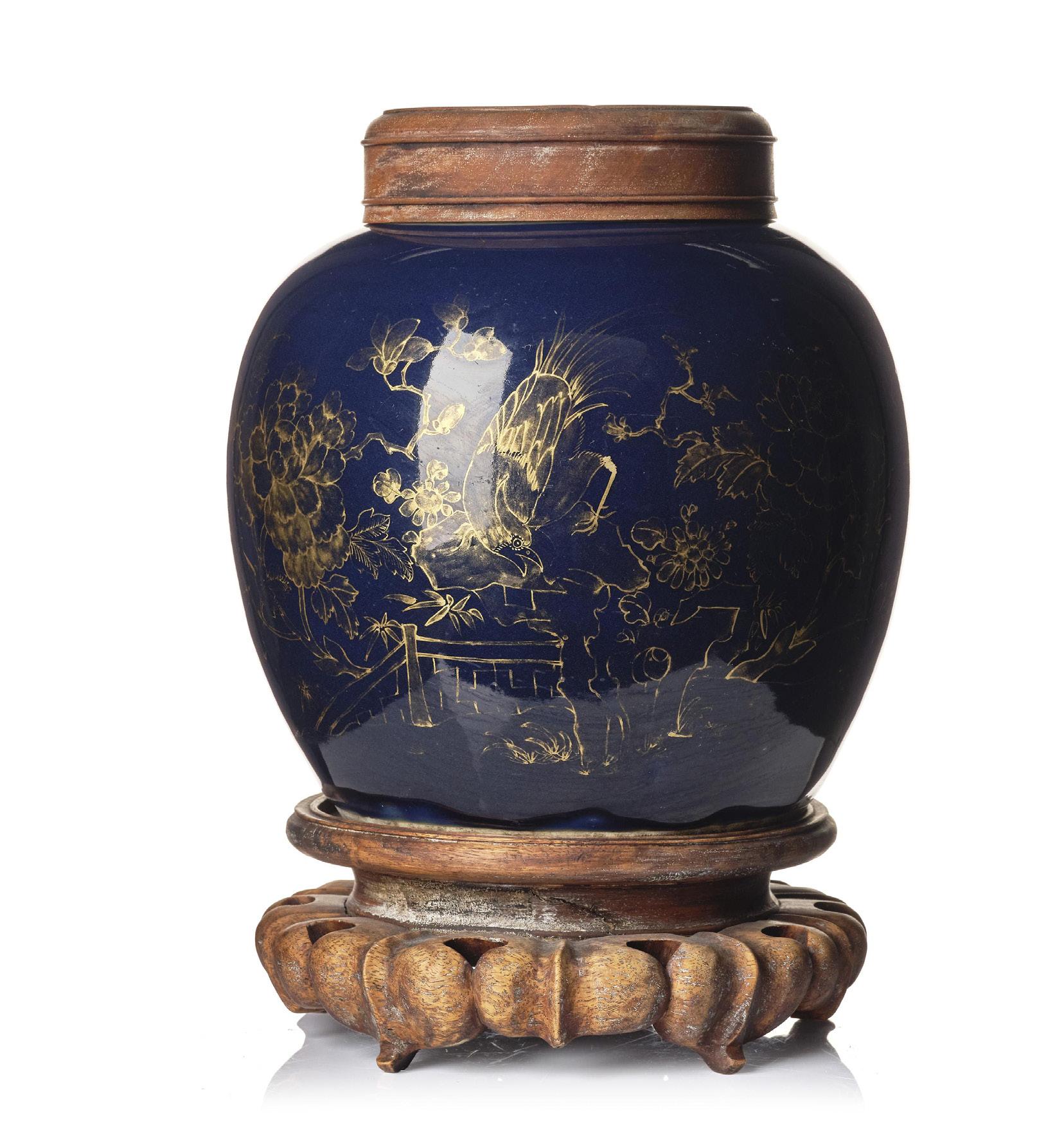
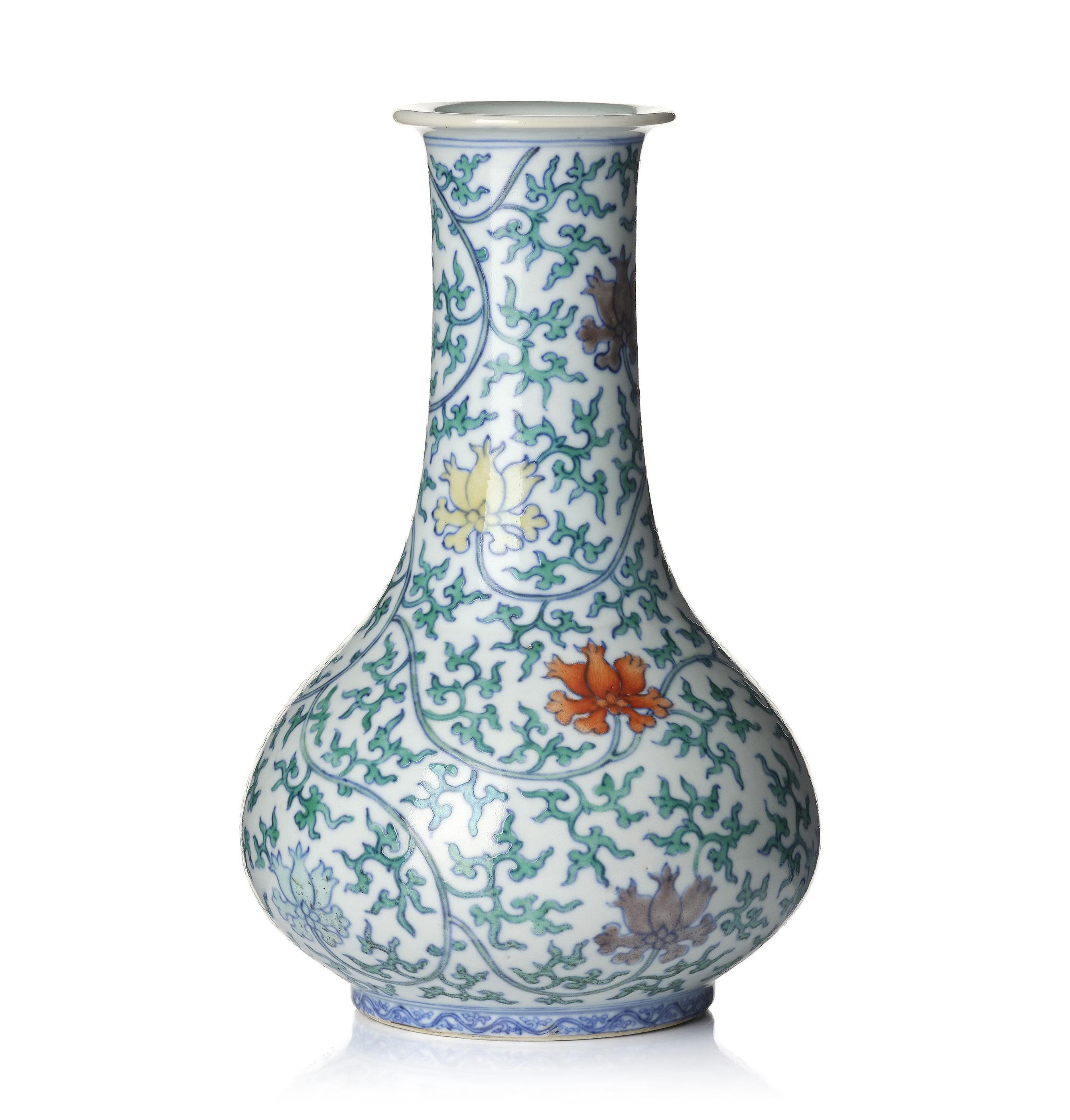
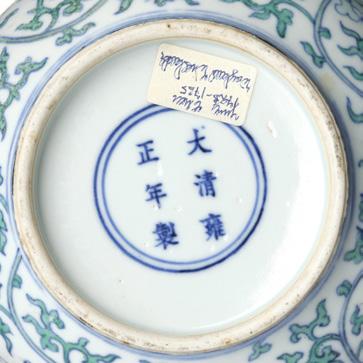
1102. A Ming-style doucai vase, Qing dynasty with a Yongzheng mark.
The compressed globular body with a splayed foot and elongated neck rising to an everted rim, finely pencilled in Chenghua style with an Indian lotus meander issuing full formal blooms and curled leaves, the foot encircled by a formal scroll. With a Yongzheng six character mark within a double circle. Height 23.5 cm.
Provenance: Property of a private Swedish Estate.
Exhibitions: Compare a vase sold at Christies, Hong Kong, The Imperial Sale, Fine Chinese Ceramics and Works of Art, lot 957, 26 April 2004.
Literature: Compare with a Ming dynasty example in Shanghai Museum, that is illustrated in the Zhongguo Wenwu Jinghua Daquan (ceramics), p. 386, fig. 741.
Catalogue note: The shape of this vase has its inspiration in Chenghua prototypes, although the pronounced lip is more of a Qing variation.
Estimate: SEK 30 000 – 50 000 / EUR 2 830 – 4 720
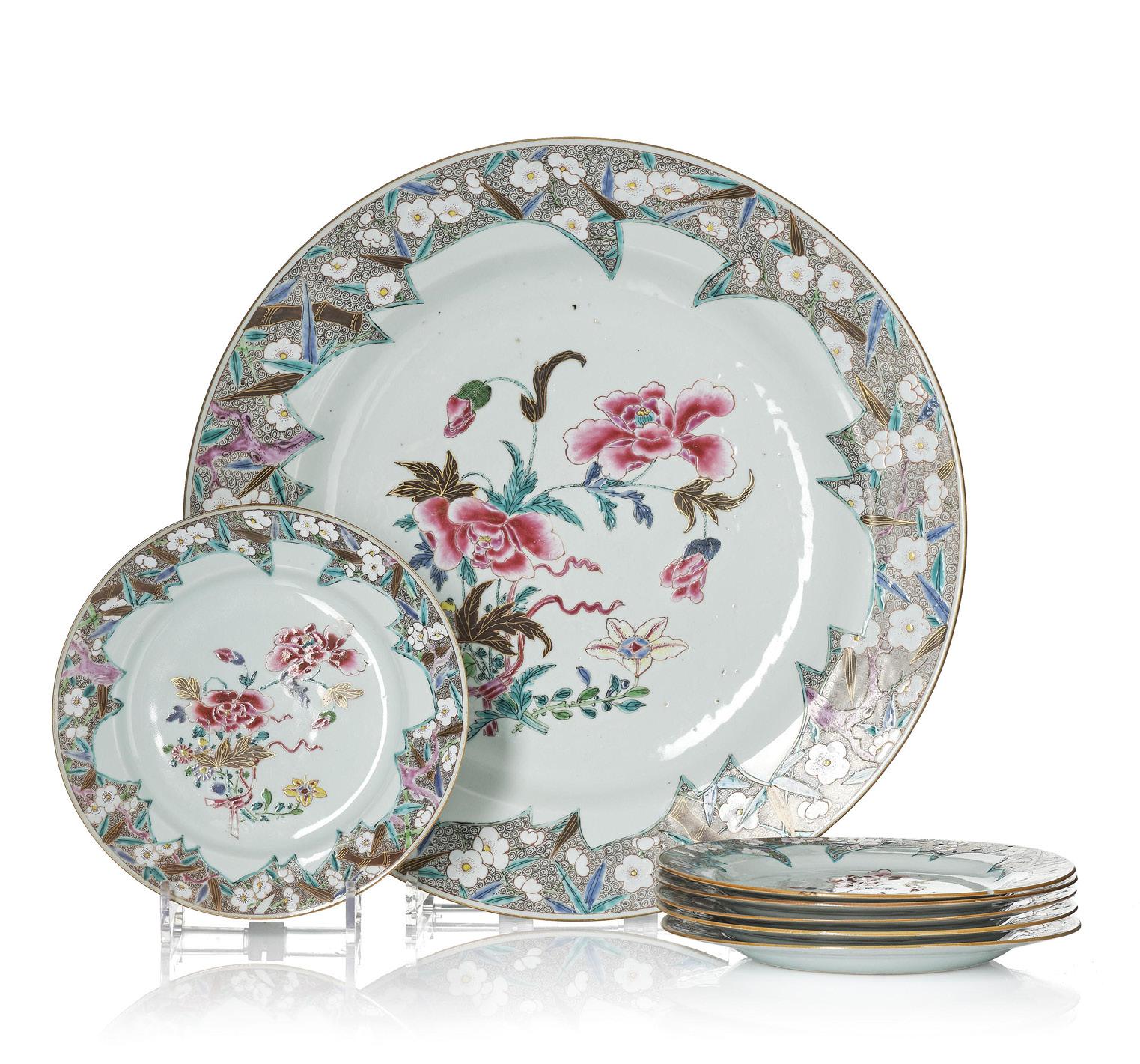
1104. A famille rose tea pot with cover, Qing dynasty, Yongzheng (1723–35).
Decorated in relief with leaves and buds. Length 14.5 cm. Height 11 cm.
Provenance: Property of a private Swedish collector.
Estimate: SEK 8 000 – 10 000 / EUR 755 – 944
1103. A pair of famille rose serving dishes and six dinner plates, Qing dynasty, Qianlong (1736–95).
Decorated in famille rose with flowers. Diameter dishes 44 cm. Diameter dinner plates 22.5 cm.
Provenance: Property of a private Swedish Estate.
Estimate: SEK 8 000 – 10 000 / EUR 755 – 944
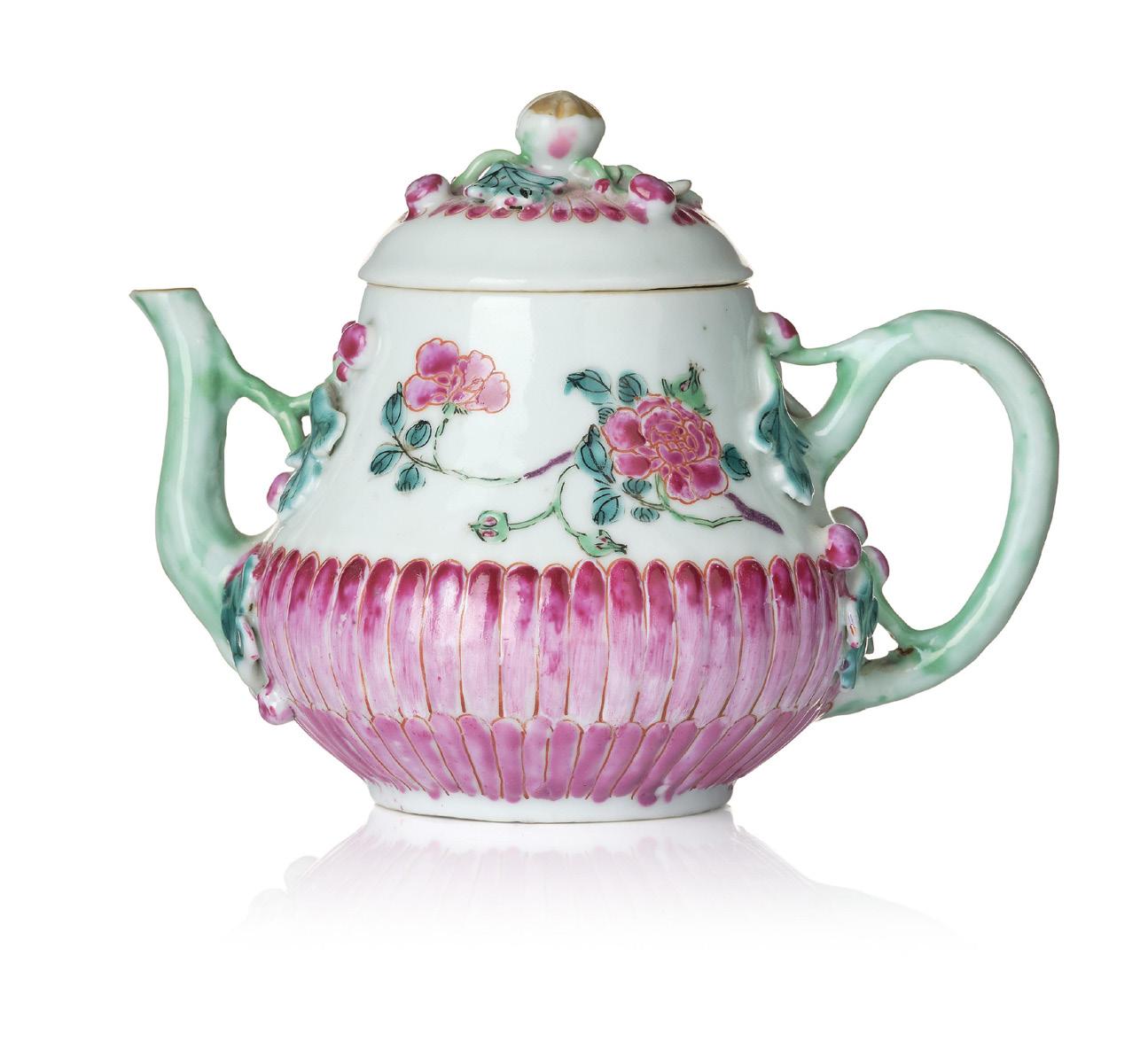
1105. An enameled ‘parrots and butterflies’ bowl, Qing dynasty, 18th century. Decorated in underglaze blue and then later in Holland with enamels featuring parrots and butterflies. Diameter 14.5 cm. Height 6.8 cm.
Provenance: Poperty of a private Swedish collector.
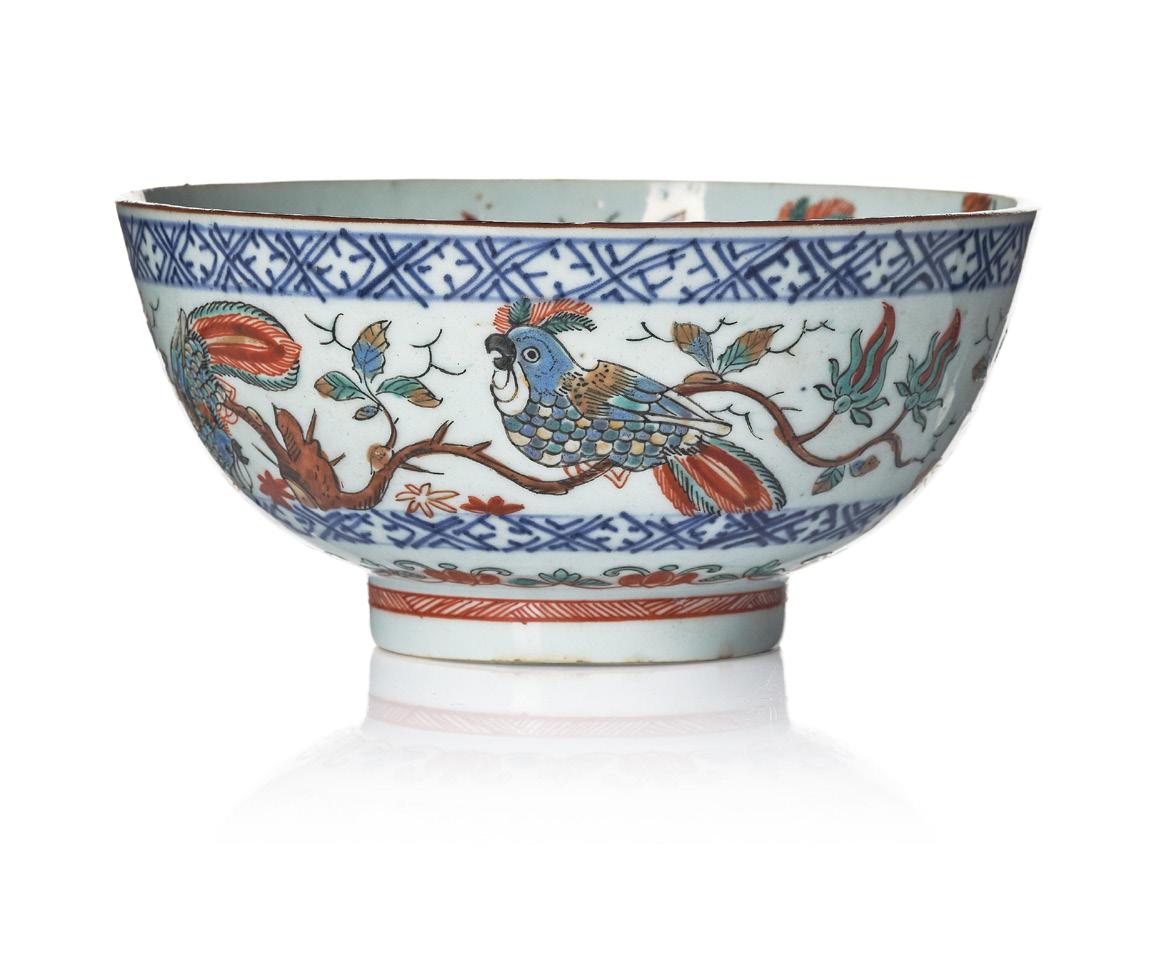
Exhibitions: Compare with a bowl of this type in the British Museum, Acquisition name; Franks.940.+.
Donated by: Sir Augustus Wollaston Franks. Acquisition date 1896.
Estimate: SEK 4 000 – 6 000 / EUR 378 – 567
1106. A rare famille rose figure of a hawk with its pray, Qing dynasty, Qianlong (1736–95). Depicting a fierce looking hawk clutching its pray in the right claw sitting atop of a cliff. Decorated in famille rose enamels. Height 21 cm.
Provenance: Property of a private Swedish collector.
Estimate: SEK 8 000 – 10 000 / EUR 755 – 944
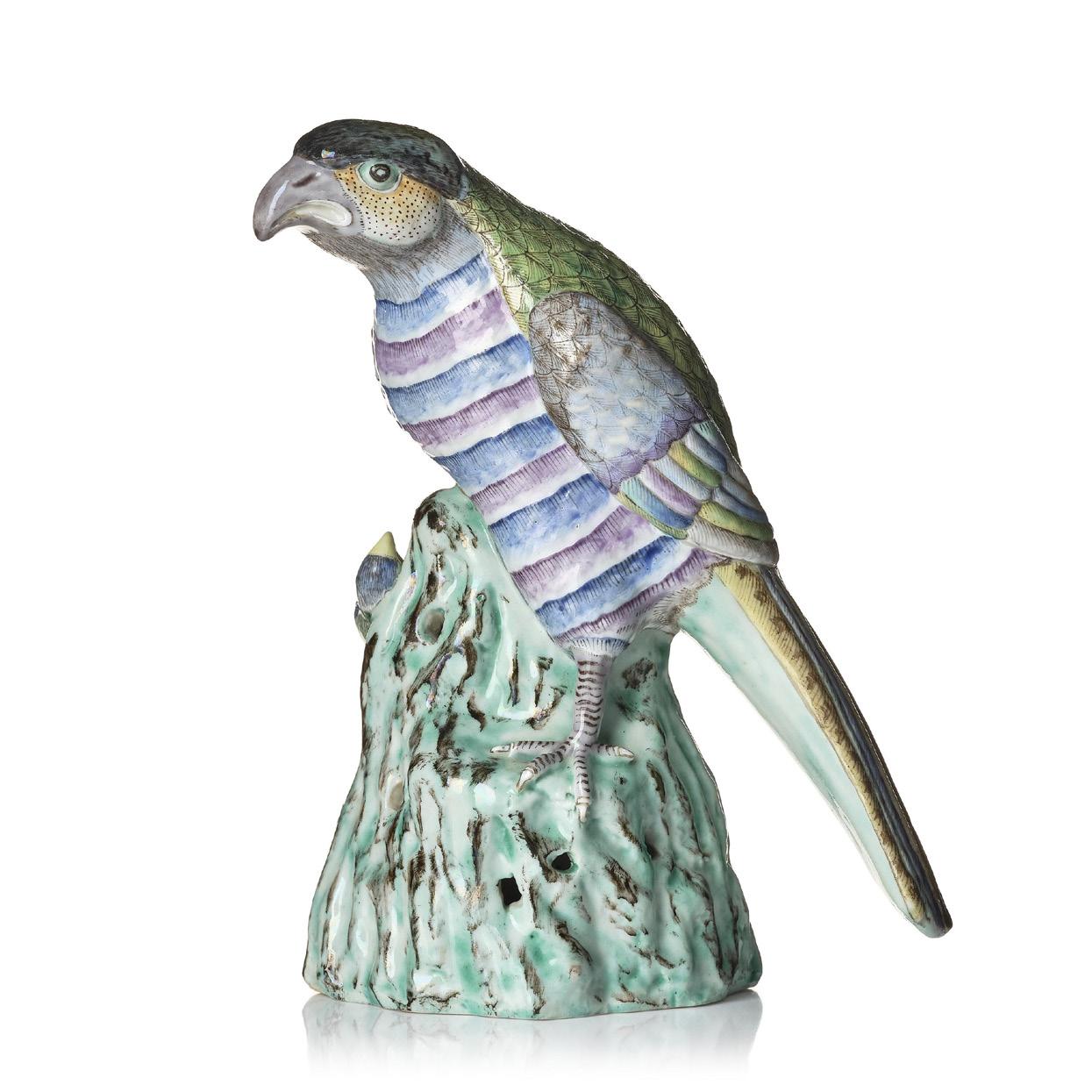
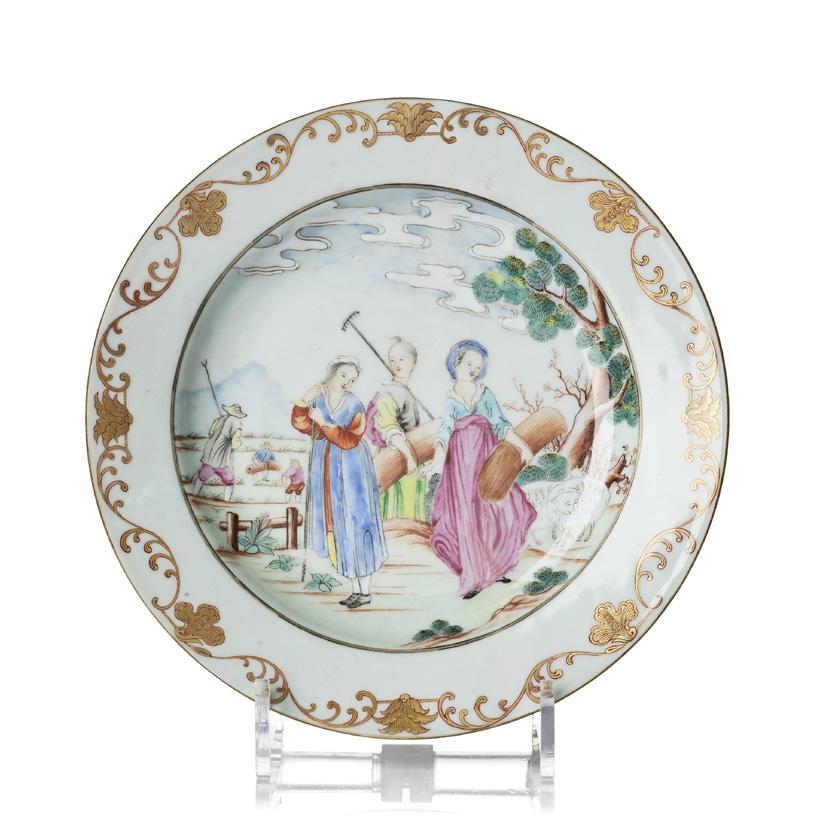
1107. A famille rose ‘European Subject’ dinner plate, Qing dynasty, Yongzheng (1723–35).
Decorated with three farm women at harvest, with gilt scroll-and-shell borders. Diameter 23 cm.
Provenance: Property of a private Swedish collector.
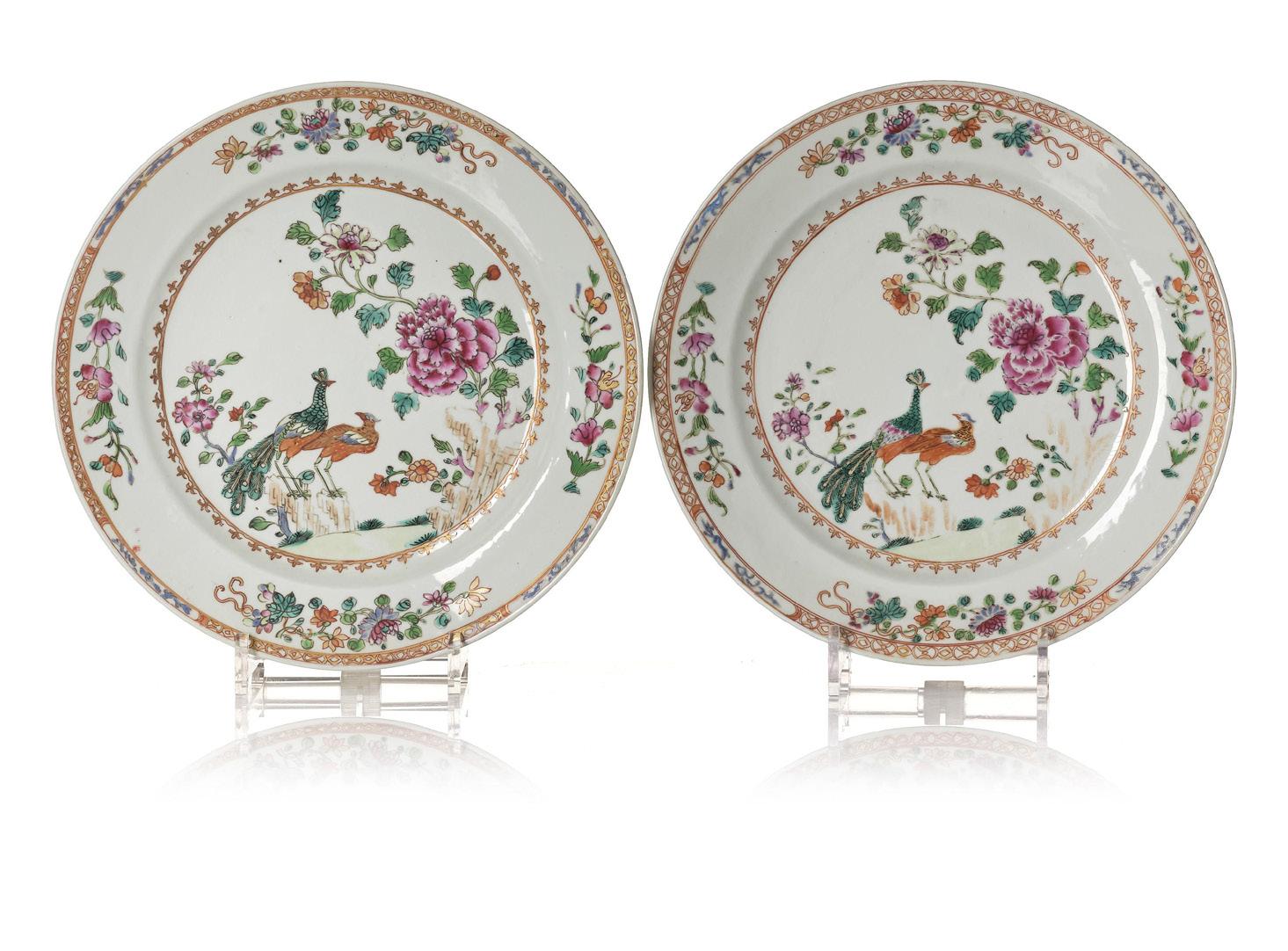
Exhibitions: Compare with a pair sold at Christies, lot 115, 21 JAN 2016 | Live auction 11640, Chinese Export Art. New York.
Estimate: SEK 10 000 – 15 000 / EUR 944 – 1 420
1109. A famille rose ‘double peacock’ serving dish, Qing dynasty, Qianlong (1736–95).
Octagonal shape, decorated with peacocks in a garden in full bloom. Diameter 38.5 cm.
Provenance: Property of a private Swedish collector.
Estimate: SEK 6 000 – 8 000 / EUR 567 – 755
1108. A pair of ‘double peacock’ famille rose serving dishes, Qing dynasty, Qianlong (1736–95).
Decorated with peacocks in a garden in full bloom. Diameter 28.5 cm.
Provenance: Property of a private Swedish collector.
Estimate: SEK 6 000 – 8 000 / EUR 567 – 755
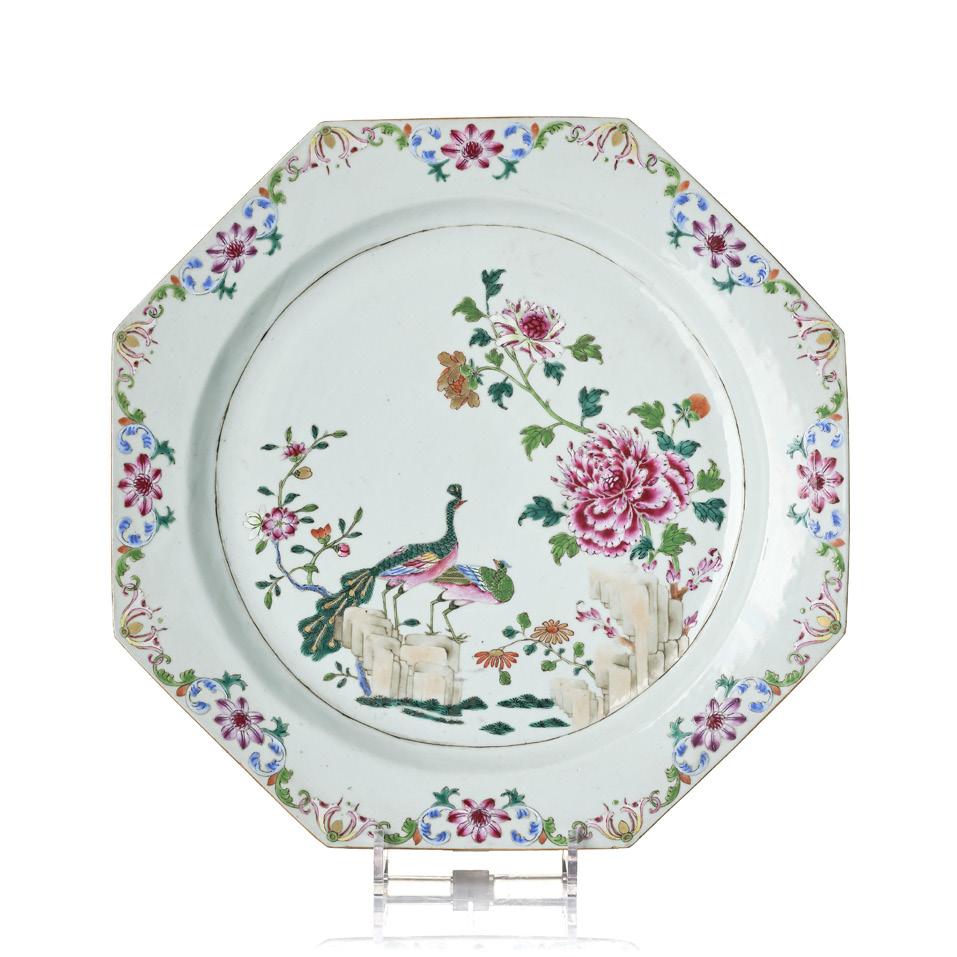
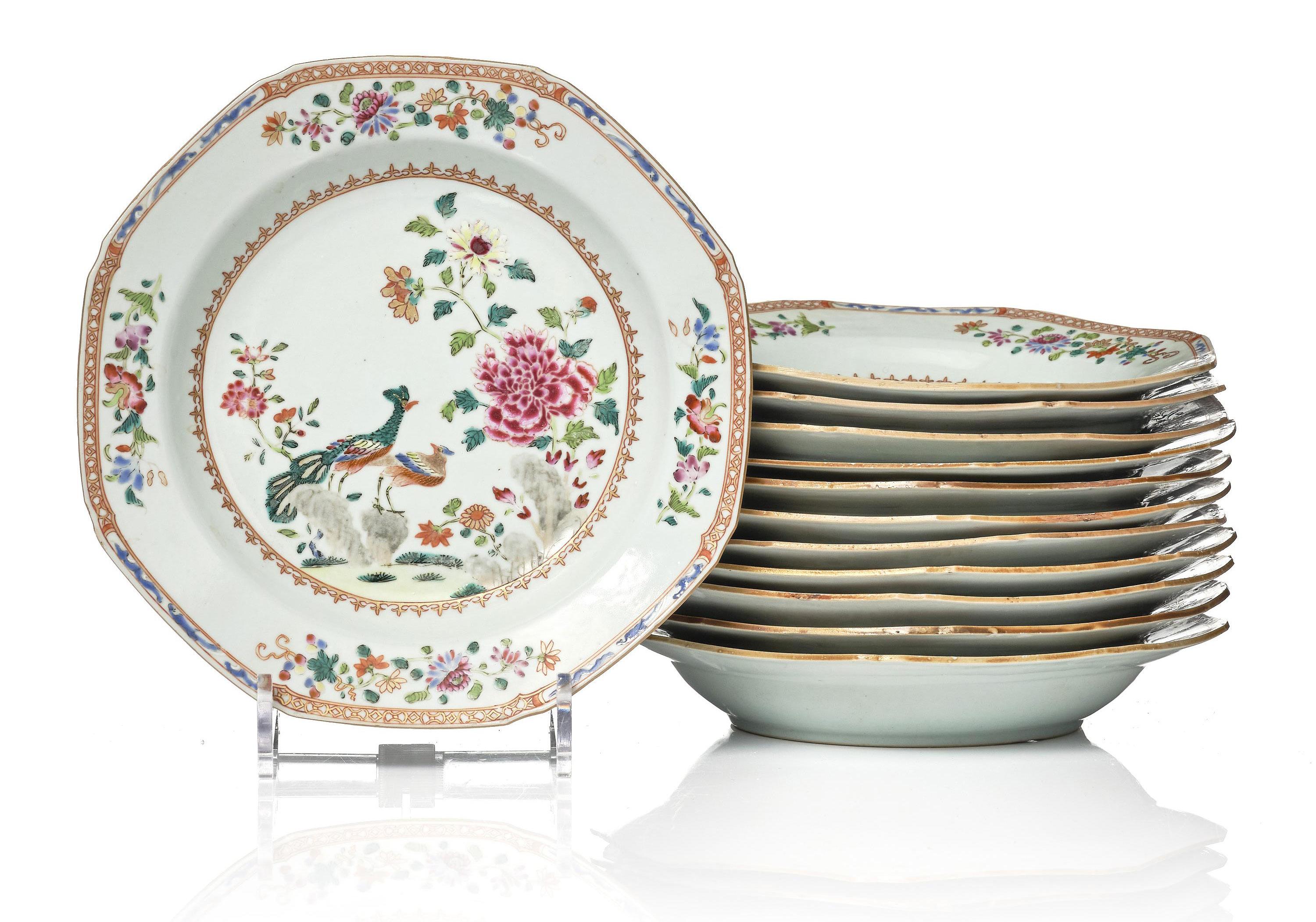
1110. A set of 12 famille rose ‘double peacock’ soup dishes, Octagonal decorated in famille rose with peacocks in a garden setting.
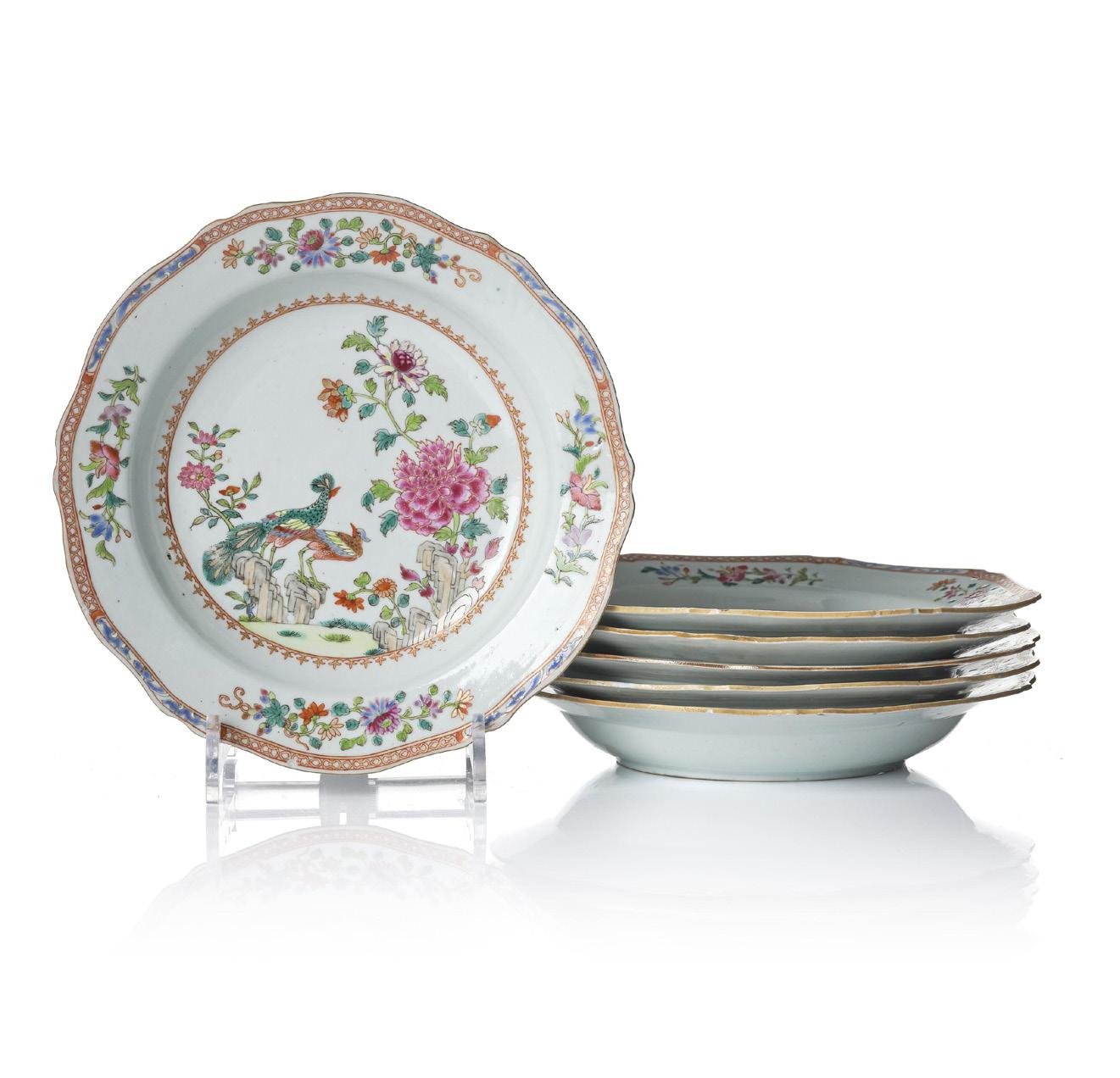
1111. A set of six famille rose ‘double peacock’ soup dishes, Qing dynasty, Qianlong (1736–95).
Decorated in famille rose colours with a garden setting with peacocks. Diameter 22.5 cm.
Provenance: Property of a private Swedish collector.
Estimate: SEK 10 000 – 15 000 / EUR 944 – 1 420
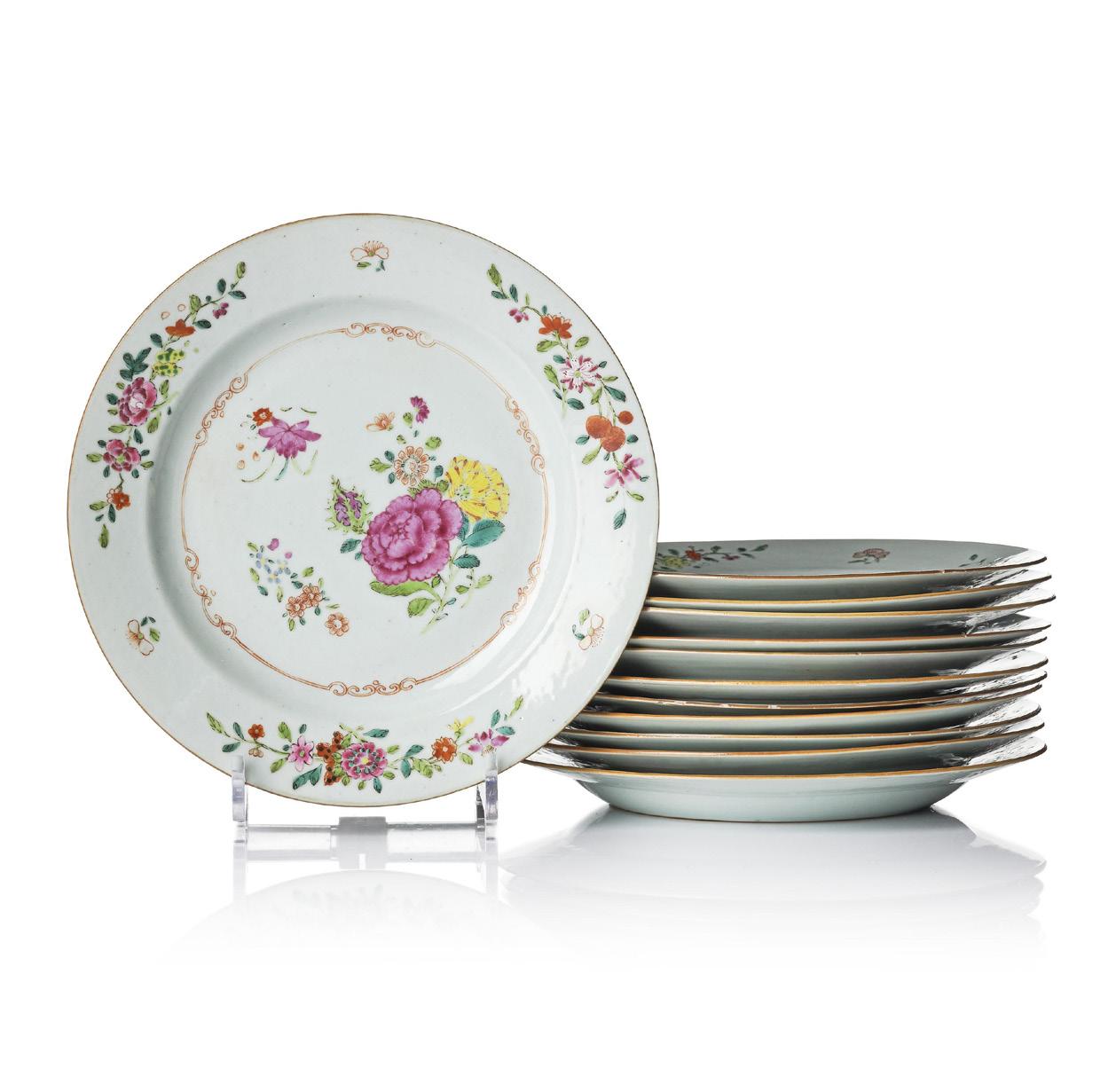
1112. A set of 12 famille rose dishes, Qing dynasty, Qianlong (1736–95).
Decorated after a European pattern with roses, Diameter 23 cm.
Provenance: Property of a private Swedish Estate.
Estimate: SEK 8 000 – 10 000 / EUR 755 – 944
1113. A pair of famille rose ‘figural’ tea cups with saucers, Qing dynasty, Qianlong (1736–95).
Rounded sides on a short footrim, and with a slightly everted rim, decorated with figure scenes from court life. Diameter cup 7.4 cm. Diameter stand 11.4 cm.
Estimate: SEK 4 000 – 6 000 / EUR 378 – 567
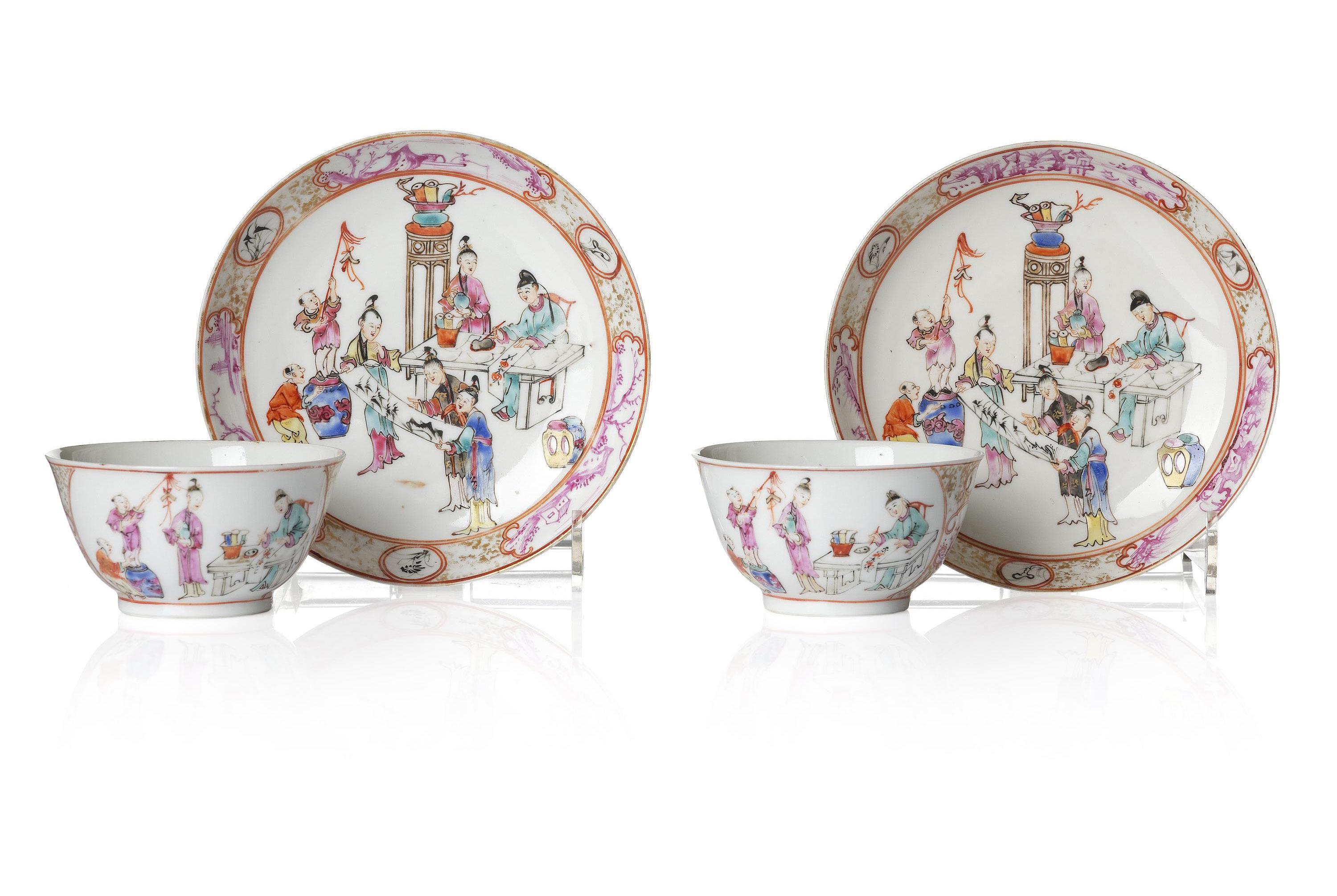
1114. A famille rose serving dish, Qing dynasty, Qianlong (1736–95).
Lobed, decorated to the rim in underglaze blue, the cavetto with a central scene with an elegant lady with a deer in a garden setting. Diameter 41 cm.
Provenance: Property of a private Swedish Estate.
Estimate: SEK 8 000 – 10 000 / EUR 755 – 944
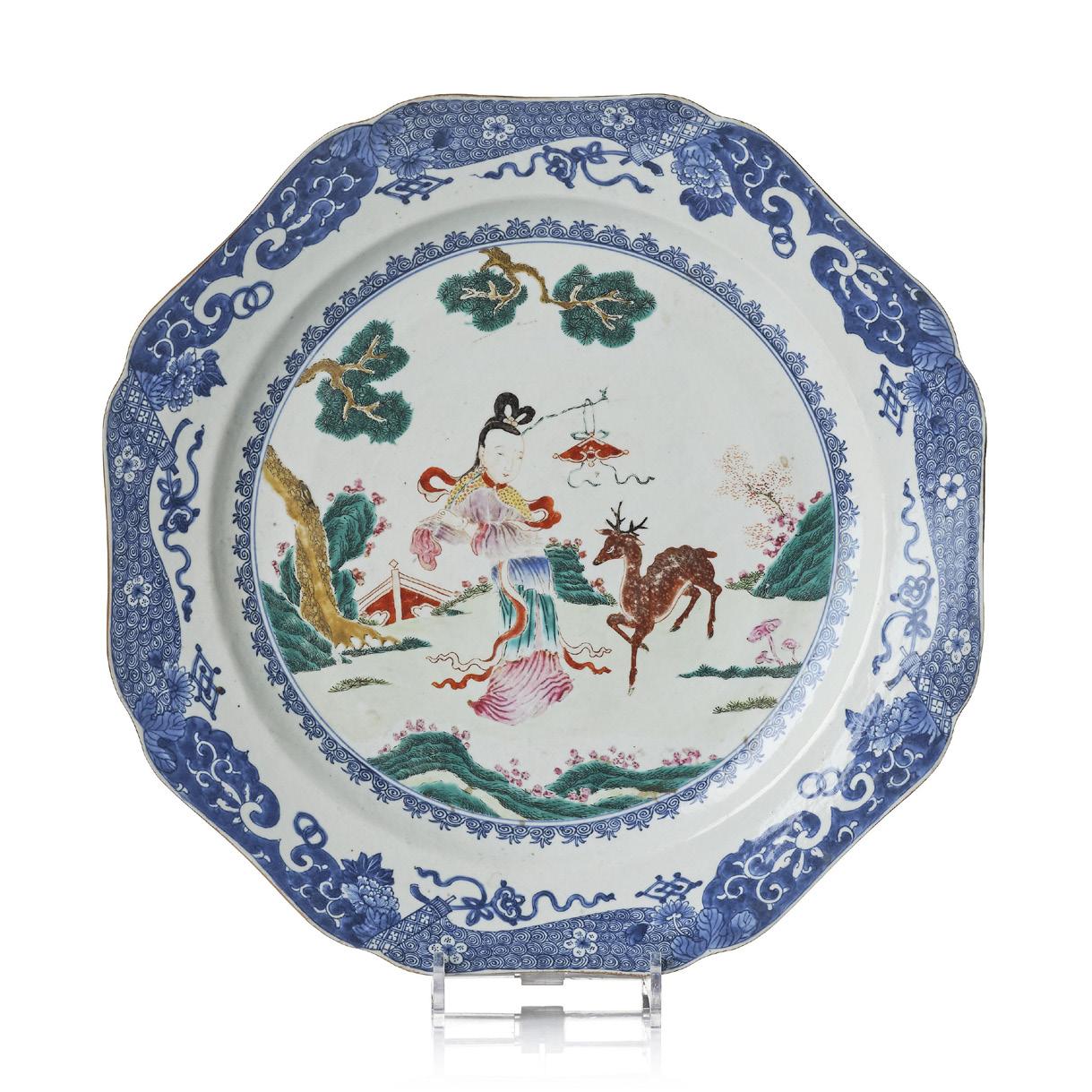
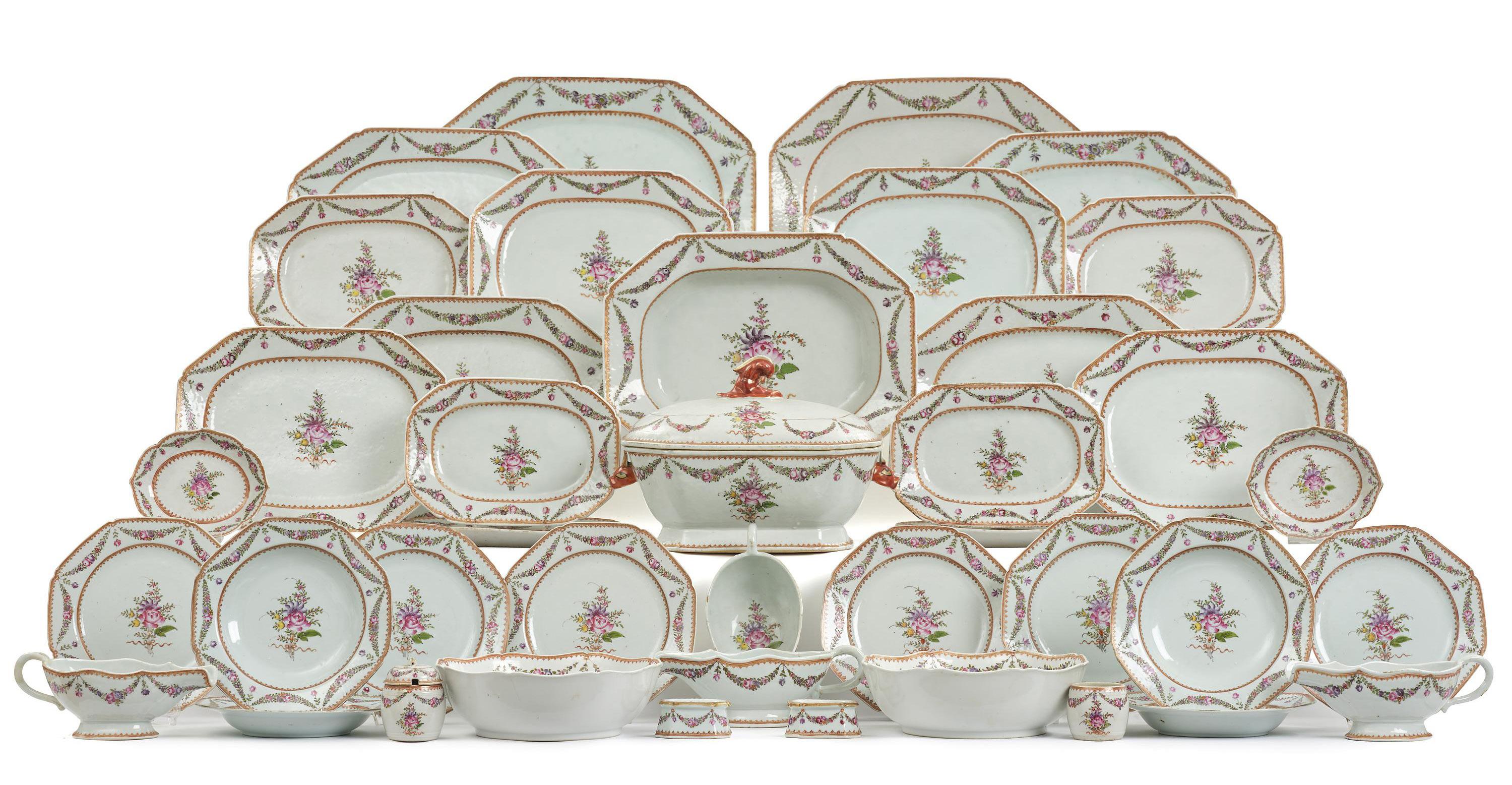
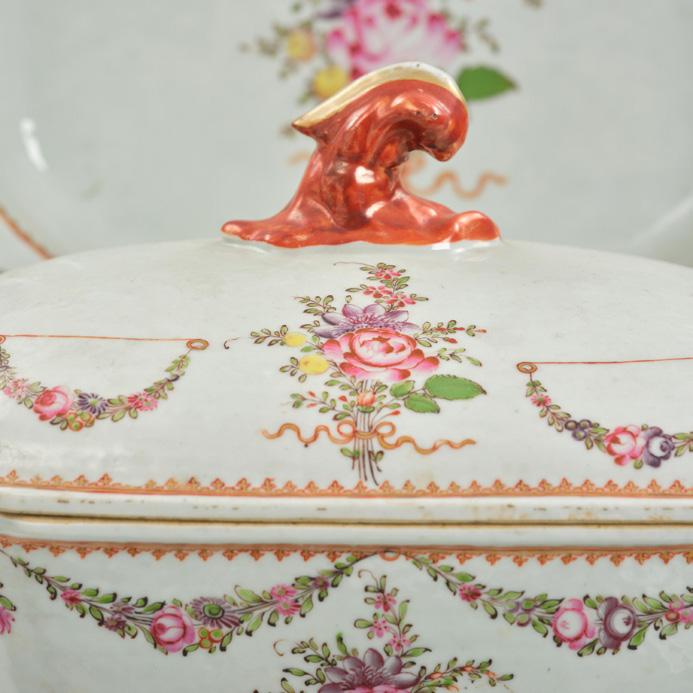
1115. An extensive famille rose dinner service, Qing dynasty, Qianlong (1736–95). (106 pieces).
Decorated with a European pattern in famille rose and gold with flower bouquets and garlands. Comprising, a tureen with cover and stand, length 36.5 cm (handles with later painted eyes on the rabbit heads), 4 sauce boats, length 23 cm. 2 salts, measure 7.5 x 6.5 x 3.5 cm. 3 small deep lobed dishes, length 16 cm. 2 octagonal bowls, diameter 25 cm. 2 mustard cups, one with a cover, height cups 5.5 cm. 3 round serving dishes, diameter 21.5 cm. 4 round serving dishes, diameter 25 cm. 2 octagonal serving dishes, length 41 cm. 4 octagonal serving dishes, length 37 cm. 5 octagonal serving dishes, length 32 cm. 4 octagonal serving dishes, length 28.5 cm. 5 octagonal serving dishes, length 25 cm. 32 soup dishes, diameter 22 cm. 33 dinner plates, diameter 22.5 cm.
Provenance: Property of a private Swedish Estate.
Estimate: SEK 120 000 – 150 000 / EUR 11 300 – 14 200
1116. A set of three famille rose ‘tobacco leaf’ plates, Qing dynasty, Qianlong (1736–95).
Lobed, decorated in vibrant colours with flowers and tobacco leaves. Diameter 23 cm.
Provenance: Property of a private Swedish Estate. Estimate: SEK 4 000 – 6 000 / EUR 378 – 567
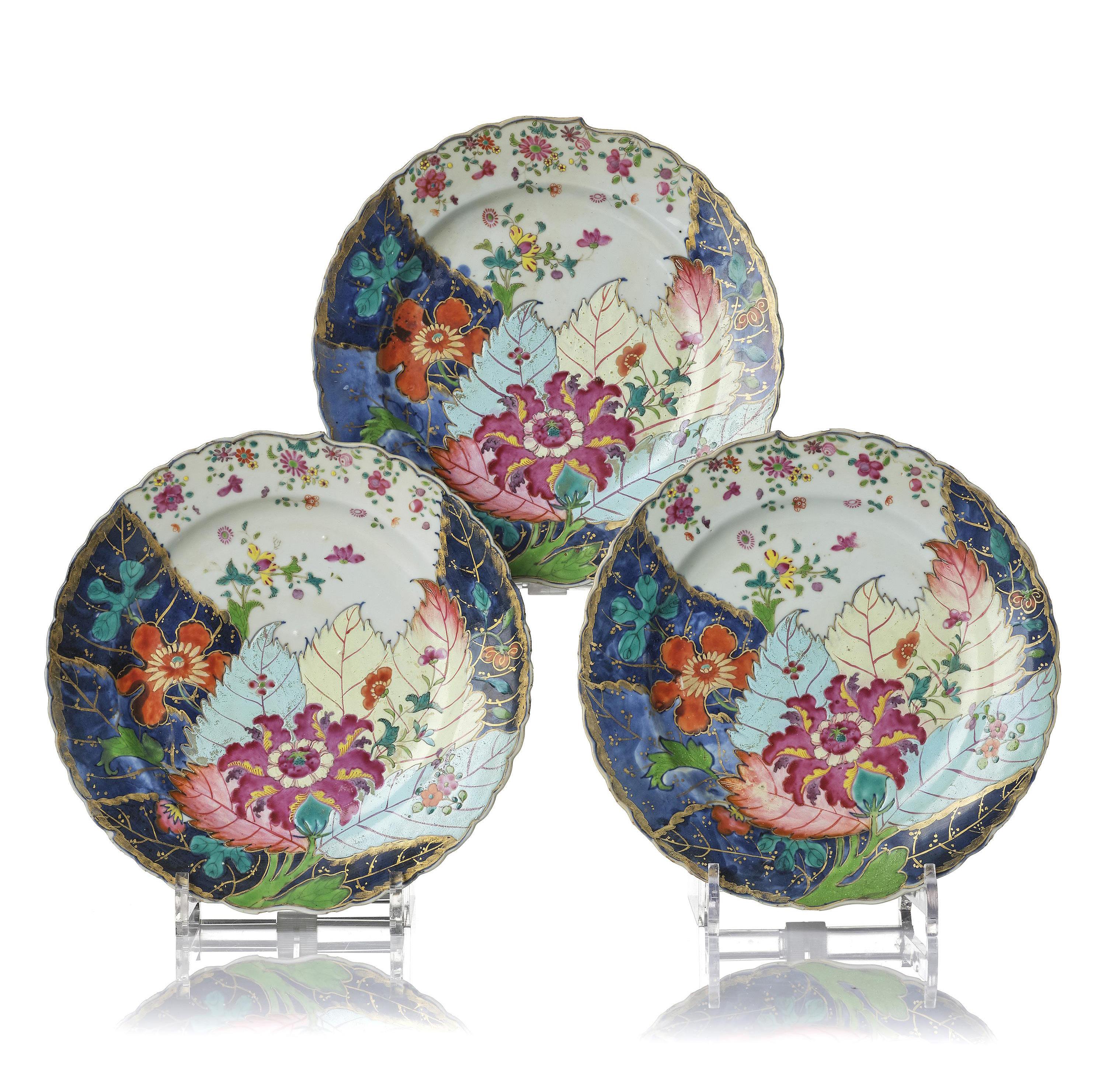
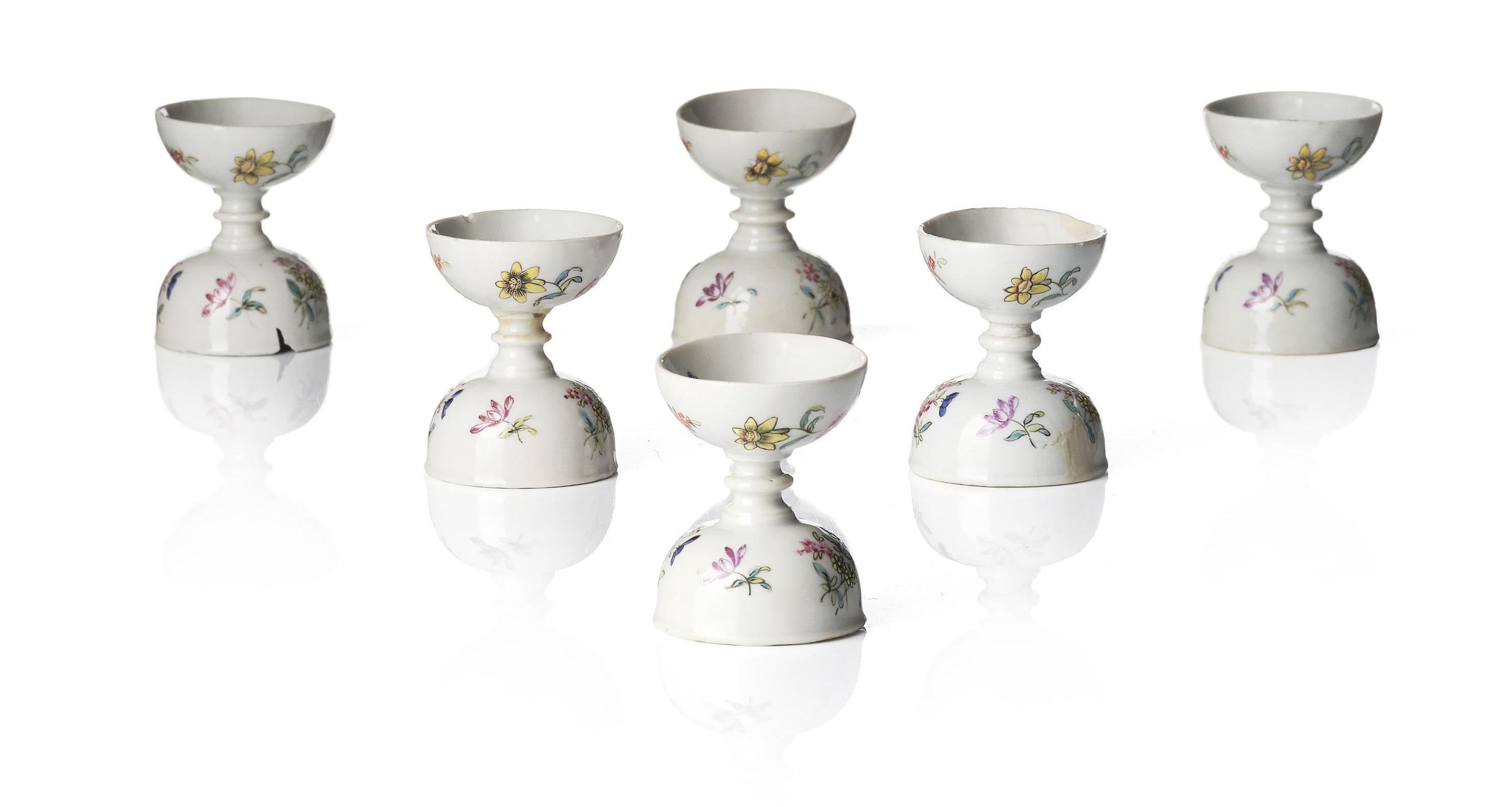
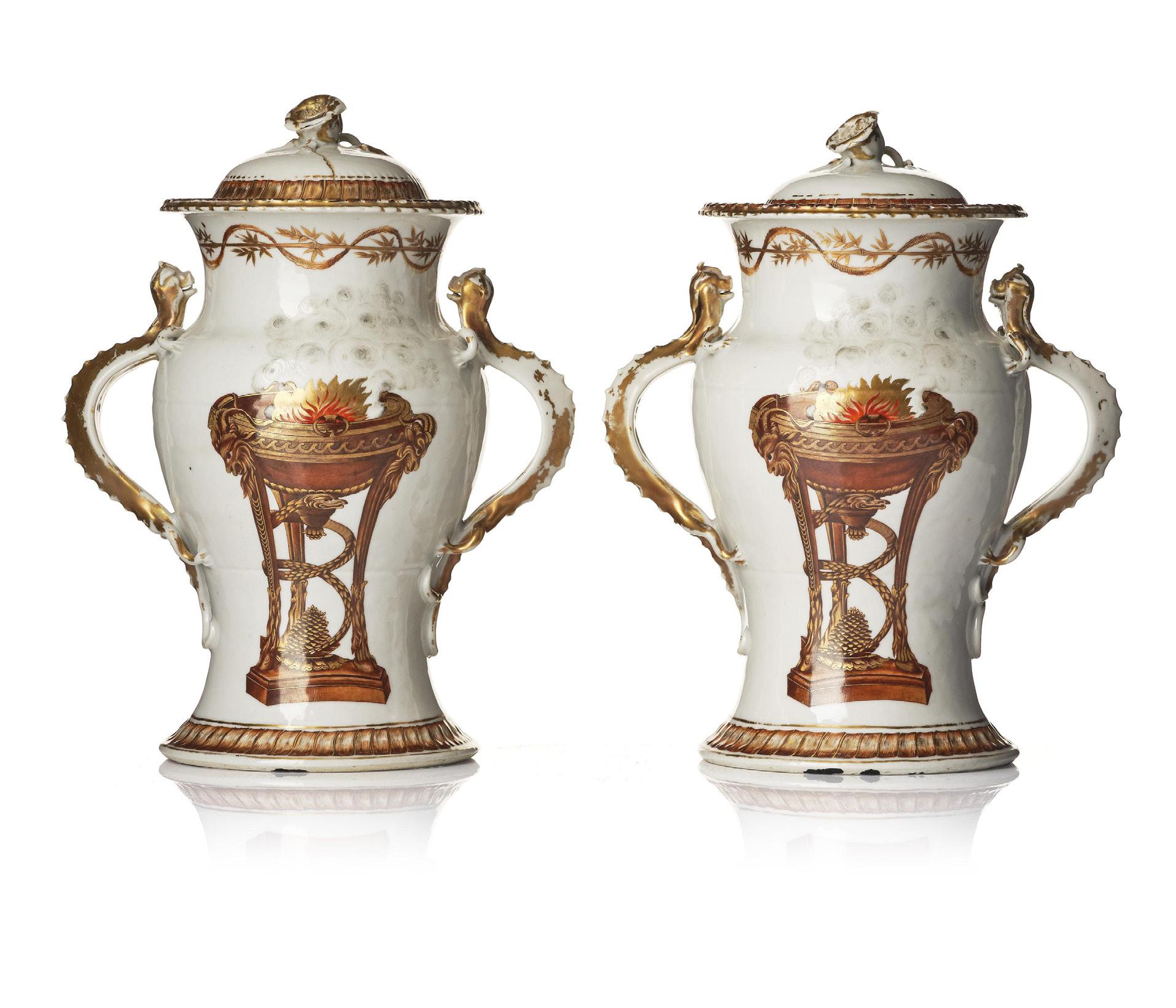
Compare no 101. Pl 123.
Estimate: SEK 18 000 – 22 000 / EUR 1 700 – 2 080
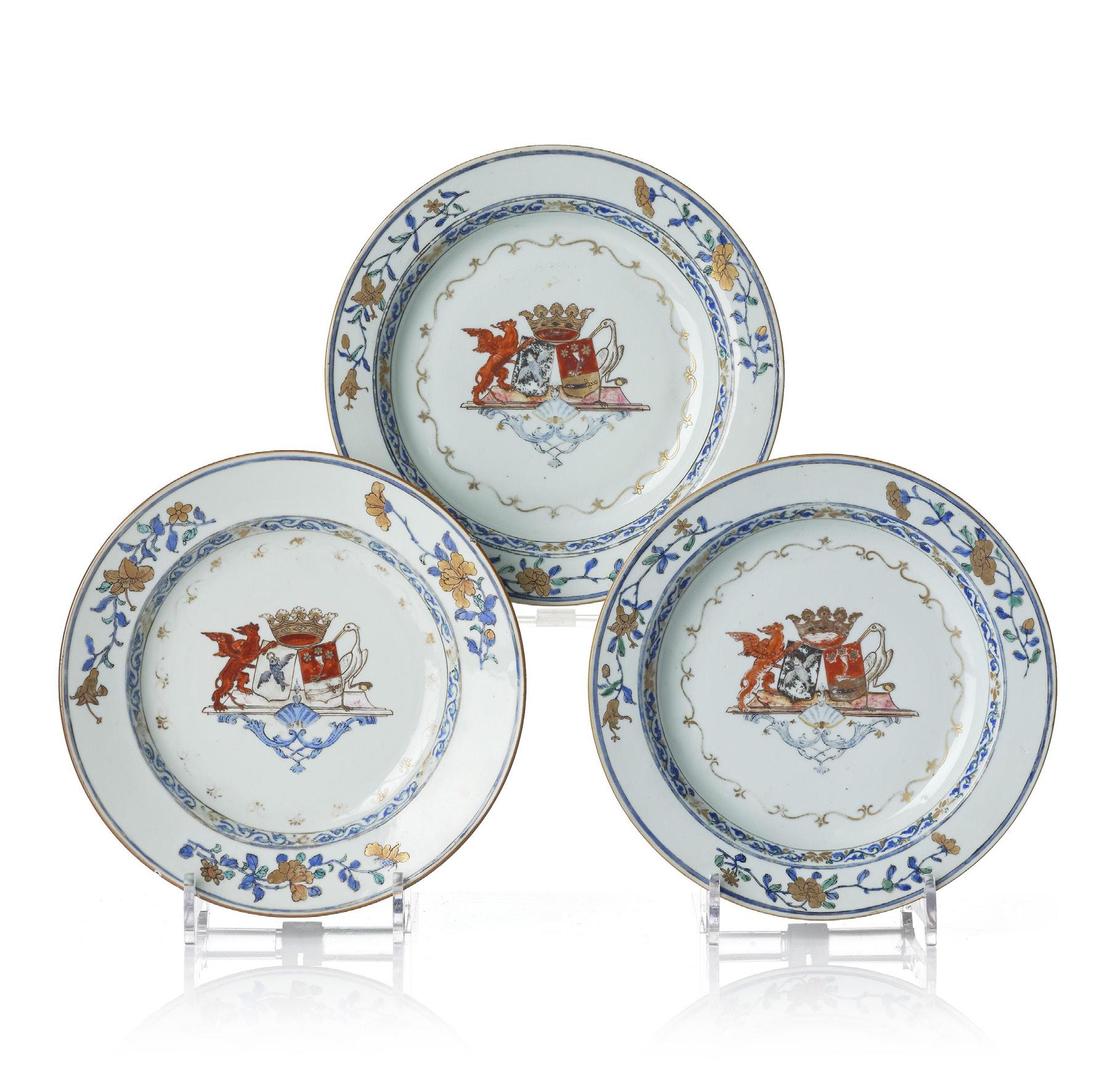
1119. A set of the three famille rose armorial dinner plates, Qing dynasty, Yongzheng (1723–35).
Decorated in famille rose with the arms acollé of the Swedish noble family von Fersen and Wachtmeister. Diameter 22.5 cm.
The service commissioned by the Lieutenant Colonel and President of the Svea Court of Appeal Hans von Fersen (1684–1748) and his wife Eleonora Margareta Wachtmeister af Mälsåker (1684–1748), who married in 1715. Owner of the estates Ljung and Steninge in Husby socken as well ass Granhammar, Tibble and Gäddgården in Arboga socken. Eleonora Margareta Wachtmeister of Mälsåker was one of the investors in the Swedish East Inida Company’s first oktroj. From the decoration and the fact that Hans passes away in 1736 it is clear that the service was brought back on one of the Swedish East India Company’s first expeditions.
SEK 4 000 – 6 000 / EUR 378 – 567
1120. An armorial cup and stand, Qing dynasty, Qianlong (1736–95).
Decorated in enamels with the coat of arms of the Swedish Noble family of Ehrenpreuss. Diameter cup 8.5 cm. Diameter dish 11.5 cm.
Provenance: The noble family Ehrenpreus 1313, knighted in 1695, introduced 1697. Baronial 1747, introduced with no. 218. The service was presumably commissioned by Carl Diedric Ehrenpreus (b.18/1 1692 - d. 21/2 1760).
Estimate: SEK 6 000 – 8 000 / EUR 567 – 755
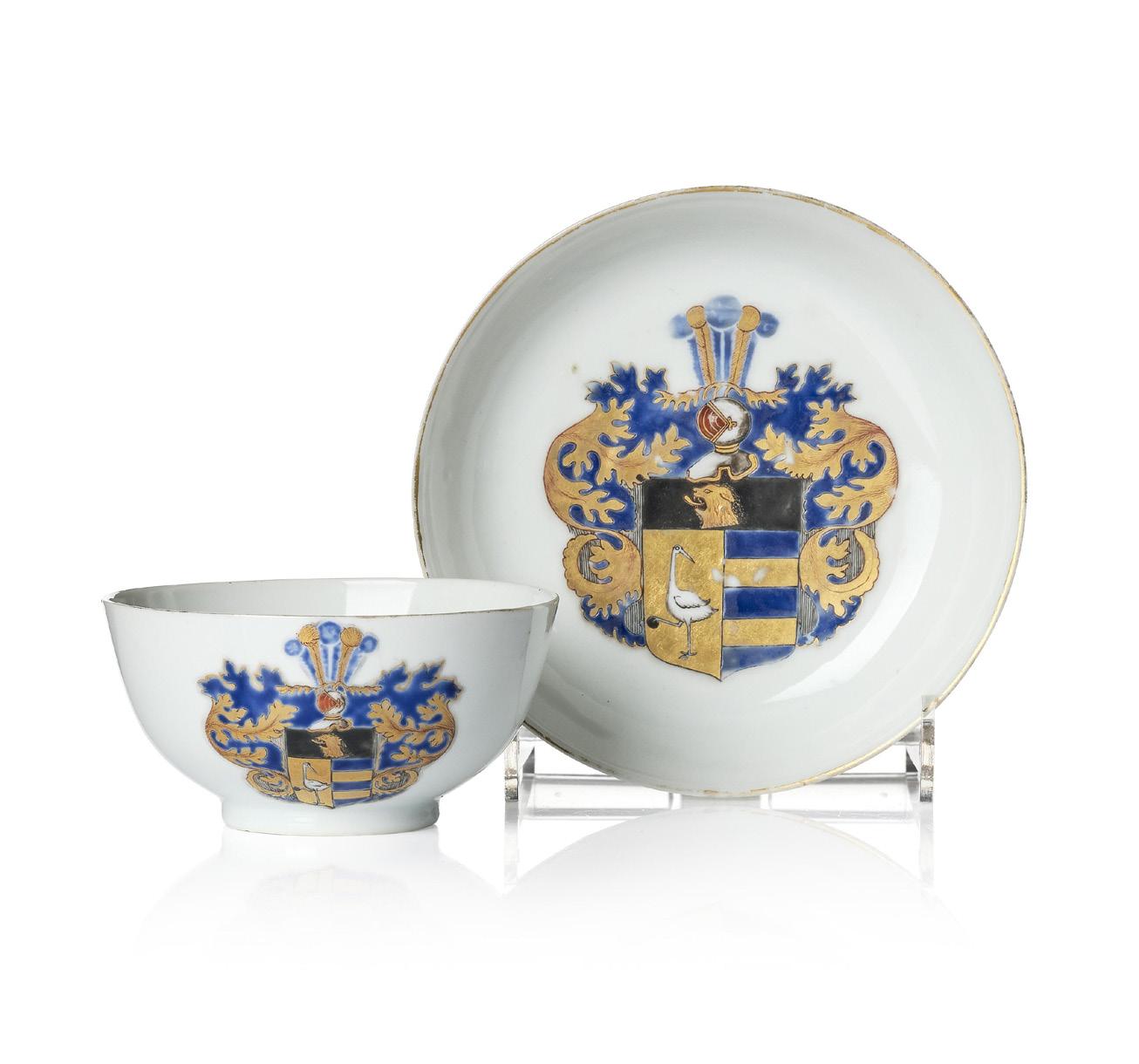
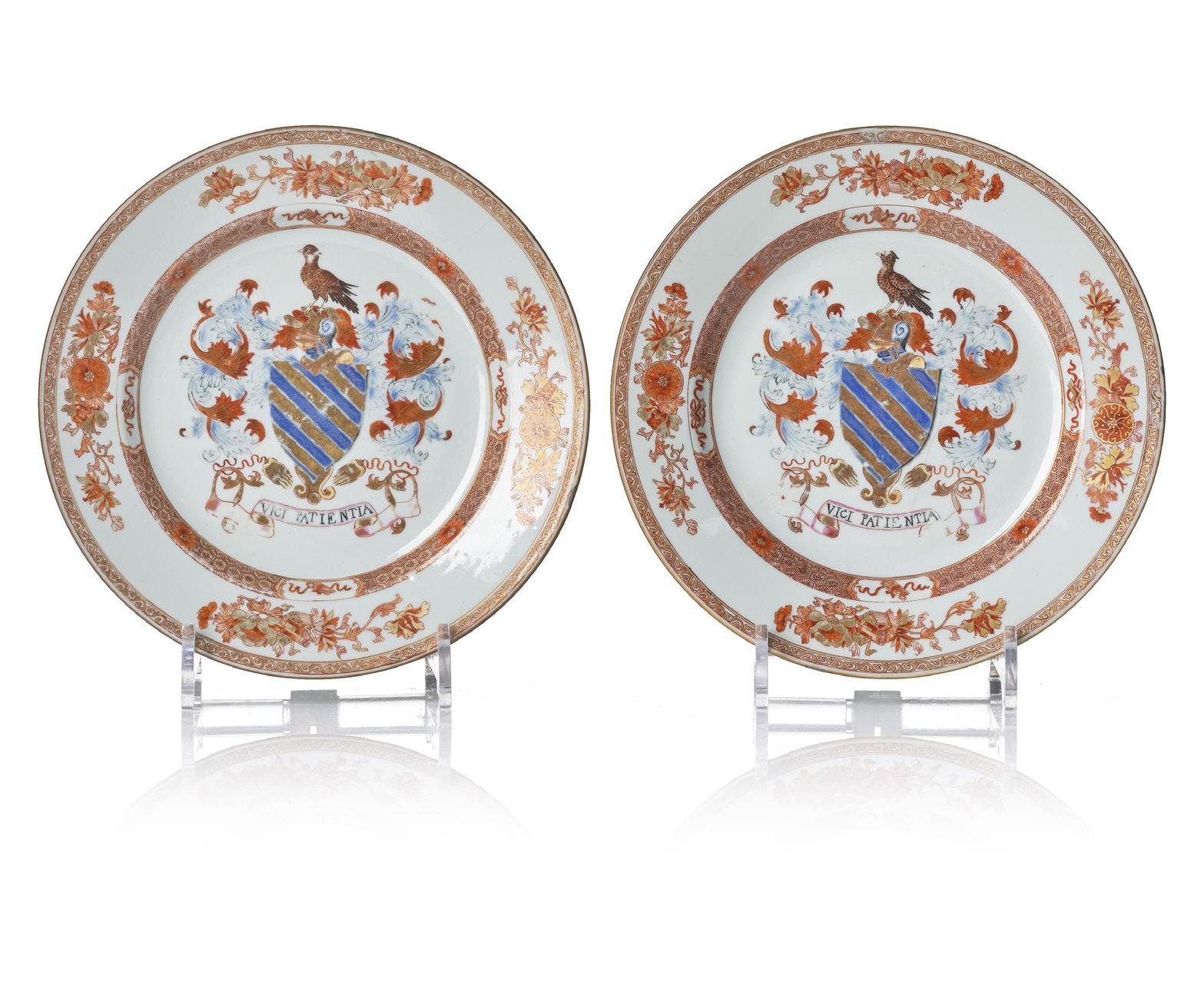
Literature: David Sanctuary Howard, Chinese Armorial Porcelain, Vol. II, page 151.
Estimate: SEK 6 000 – 8 000 / EUR 567 – 755
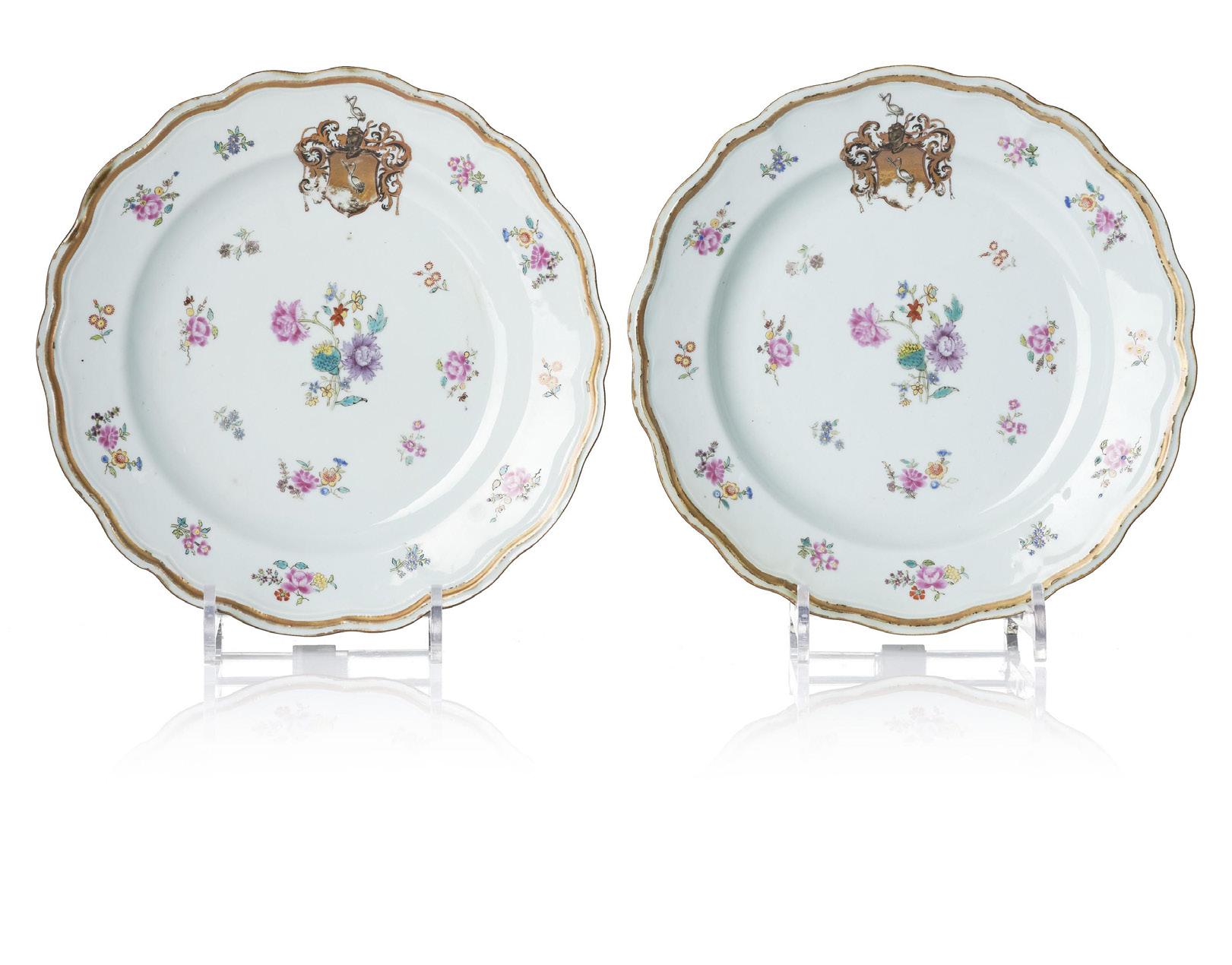
1122. A pair of famille rose armorial dishes, Qing dynasty, Qianlong (1736–95).
After a European silver model, decorated with the arms of Grill. Diameter 25 cm.
Provenance: The service was comissioned by Anthony Grill, Amsterdam (1705–1783) and was aimed his son Abraham (III) Grill (1735–1805) who moved to Sweden in the 1770’s to secure the operations of Garphytte iron works upon the bankrupsy of Michael Grubbs.
Estimate: SEK 8 000 – 10 000 / EUR 755 – 944
1123. A pair of ‘Chinese Export’ armorial dinner plates, Qing dynasty, 1790’s. Lobed, after a silver model, decorated in blue enamel and gold around the rim, central motif of the Coat of Arms of the Swedish Noble family Wachtmeister. Diameter 24.5 cm.
Provenance: From a dinner service commissioned by Claes Adam Wachtmeister (1755–1828), the dinner service is listed in his estate inventory of 1828 as being in his appartment in Stockholm, thence by descent within the family up until now.
Catalogue note: The decoration that surrounds the coat of arms is the order of the sword, it helps us date the service to some where between 1794 when recieves the title of Commandor of the large cross of the Order of the Sword. And before he recieves the Order of the Seraphim 1809.
Estimate: SEK 6 000 – 8 000 / EUR 567 – 755
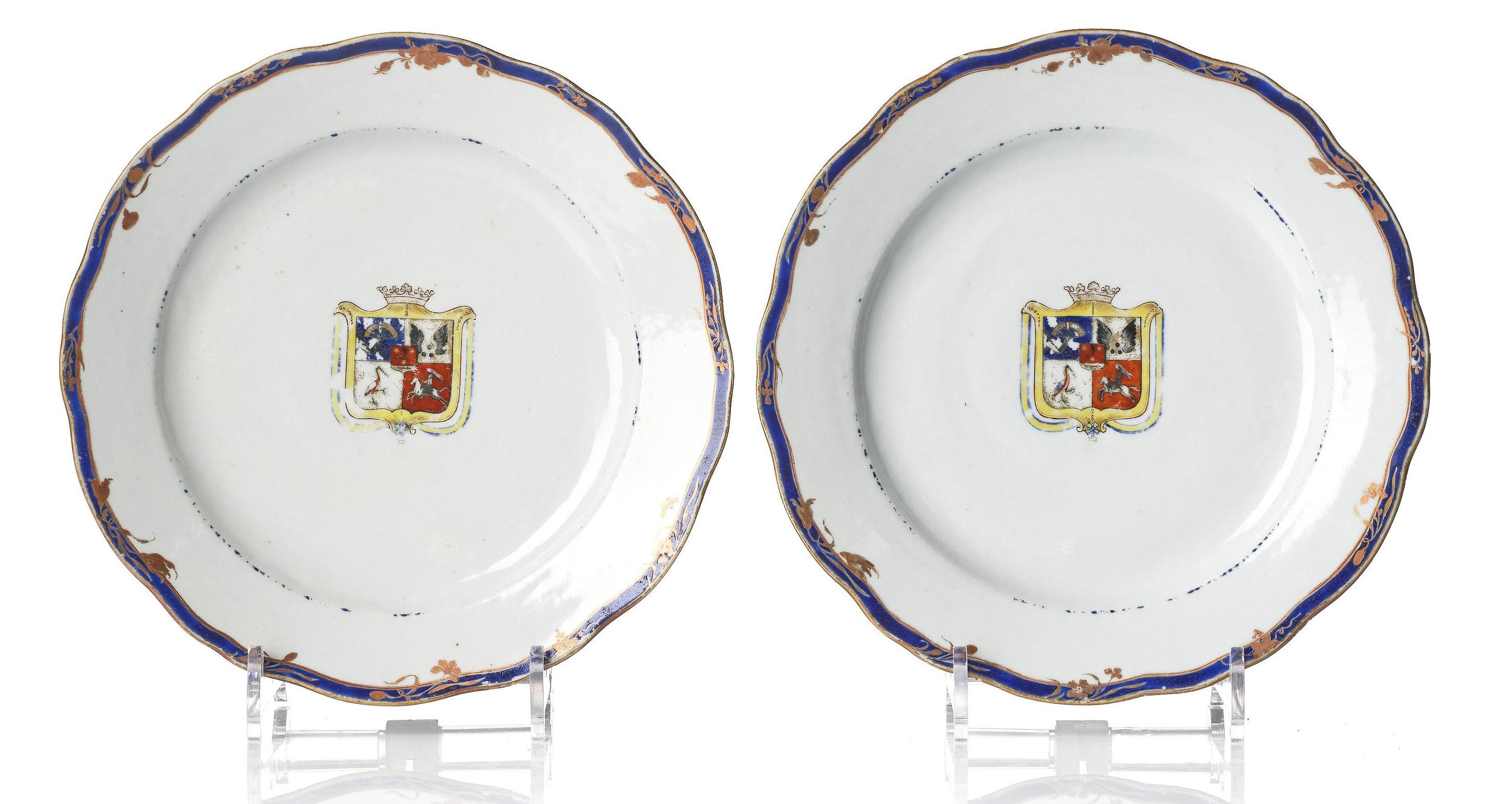
1124. A set of 10 ‘European Subject’ custard cups with covers and a coffeepot with cover, Qing dynasty, Jiaqing (1796–1820).
Decorated in enamel and gold, each with the name ‘Kitty’. Height c. 9.5 cm. A coffee pot with cover, matched. Height 21 cm.
Provenance: Property of a private Swedish collector.
Estimate: SEK 6 000 – 8 000 / EUR 567 – 755
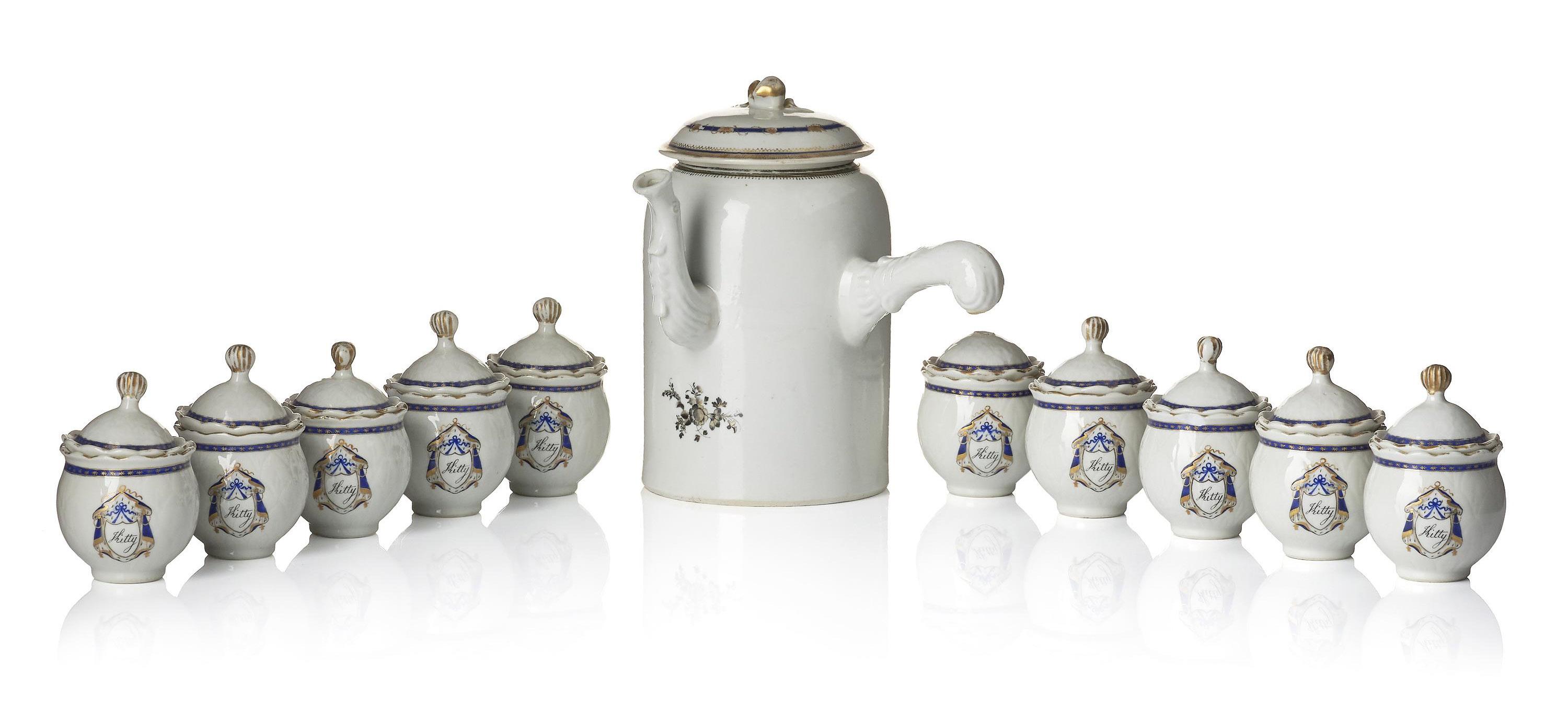
1125. A Chinese Export tankard, Qing dynasty, Qianlong (1736–95).
Decorated in relief and grisaille with the name Lor:Görges. Height 14 cm.
Provenance: Comissioned by Lorentz Görges (1723–1803).
Merchant in Stockholm. Lorentz Görges was born as the son of the ensign at the Östgöta Infantry Regiment, Johan Görges, and his wife Clara Corylander. Görges later moved to Stockholm, where he became a merchant and a councillor of commerce. He married Hedvig Elisabet Bohman in 1754 at Maria Magdalena Church. The couple had one daughter and two sons. For several years, Görges was a part-owner of the successful trading house Bohman, Hassel & Görges, and he was counted among the so-called Shipbrokers’ nobility. His wife was the daughter of Carl Bohman, who was one of the original owners of the trading house Bohman & Hultman. Lorentz Görges built the Görgeska house during the 1760s, which is located in Djurgårdsstaden.
Catalogue note: The portraits were sold at Bukowskis in 2024. “Kommersrådet Lorentz Görges” (1723–1803) & his wife “Hedvig Elisabeth Bohman” (Bogman) (1730–) See Image 1586911.
Estimate: SEK 8 000 – 10 000 / EUR 755 – 944
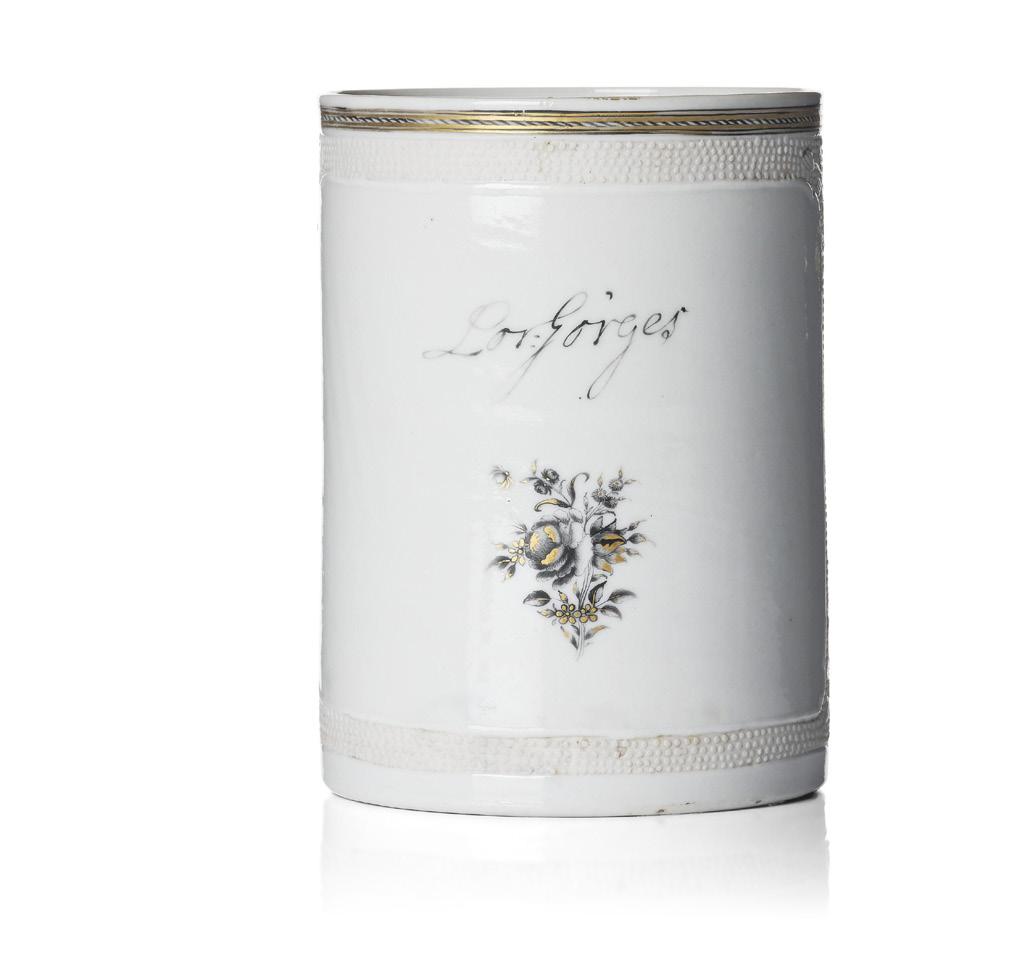
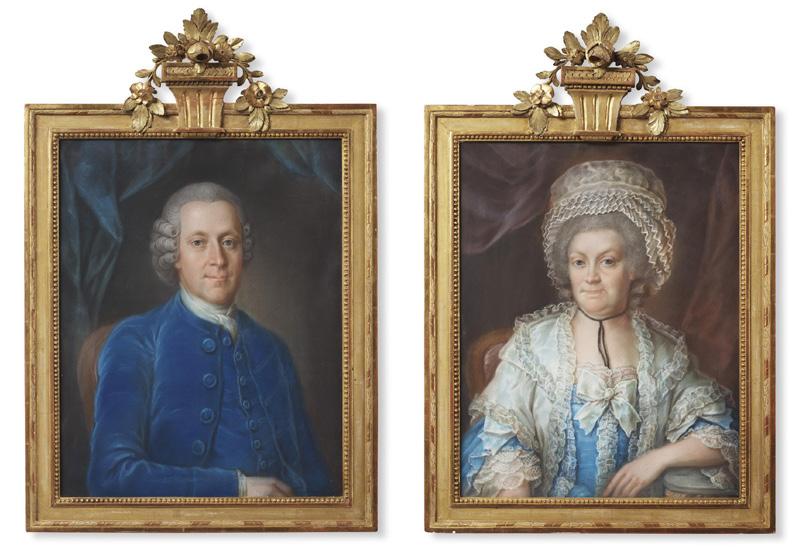
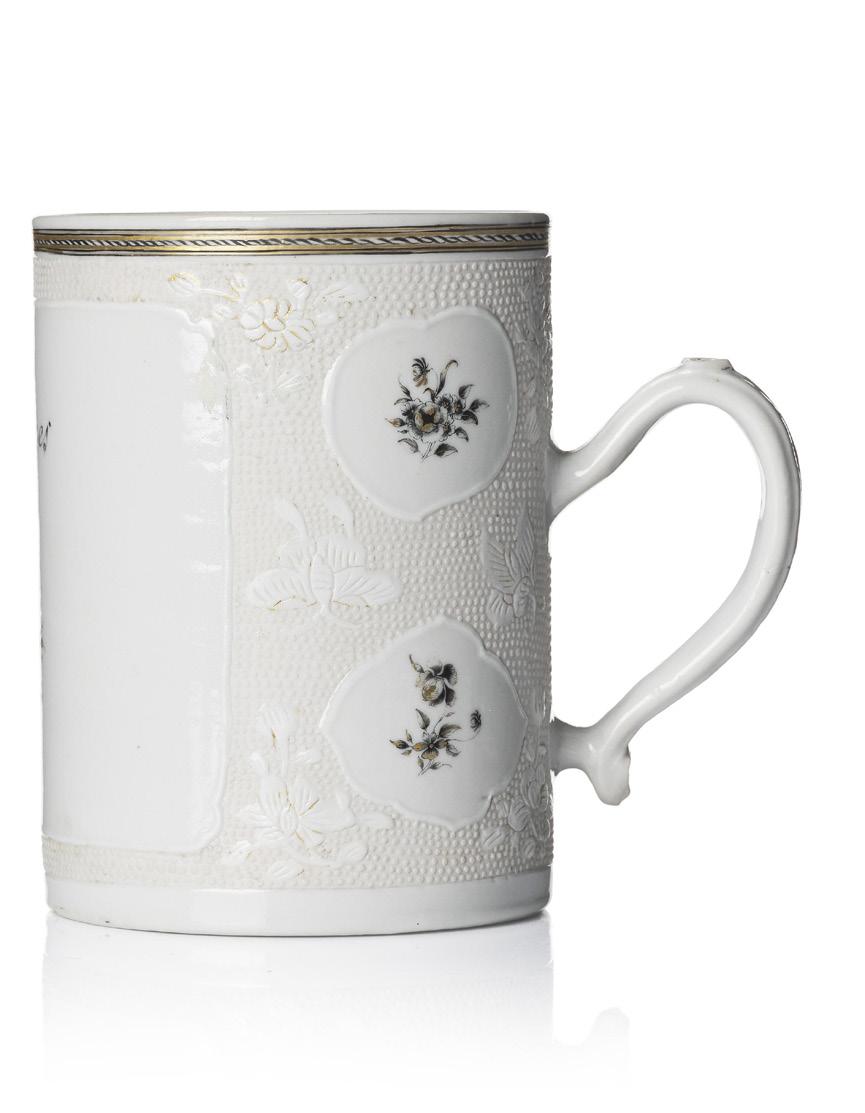
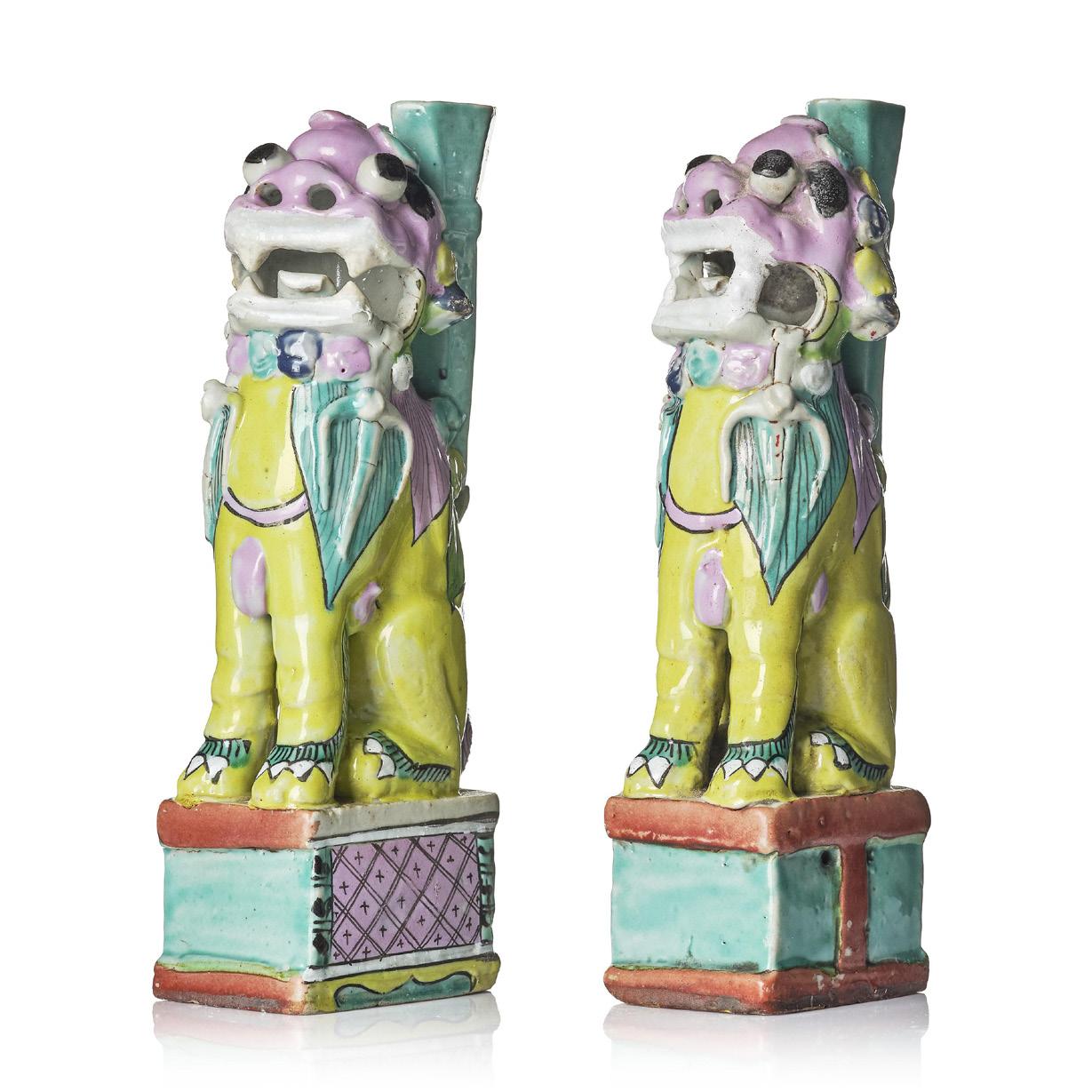
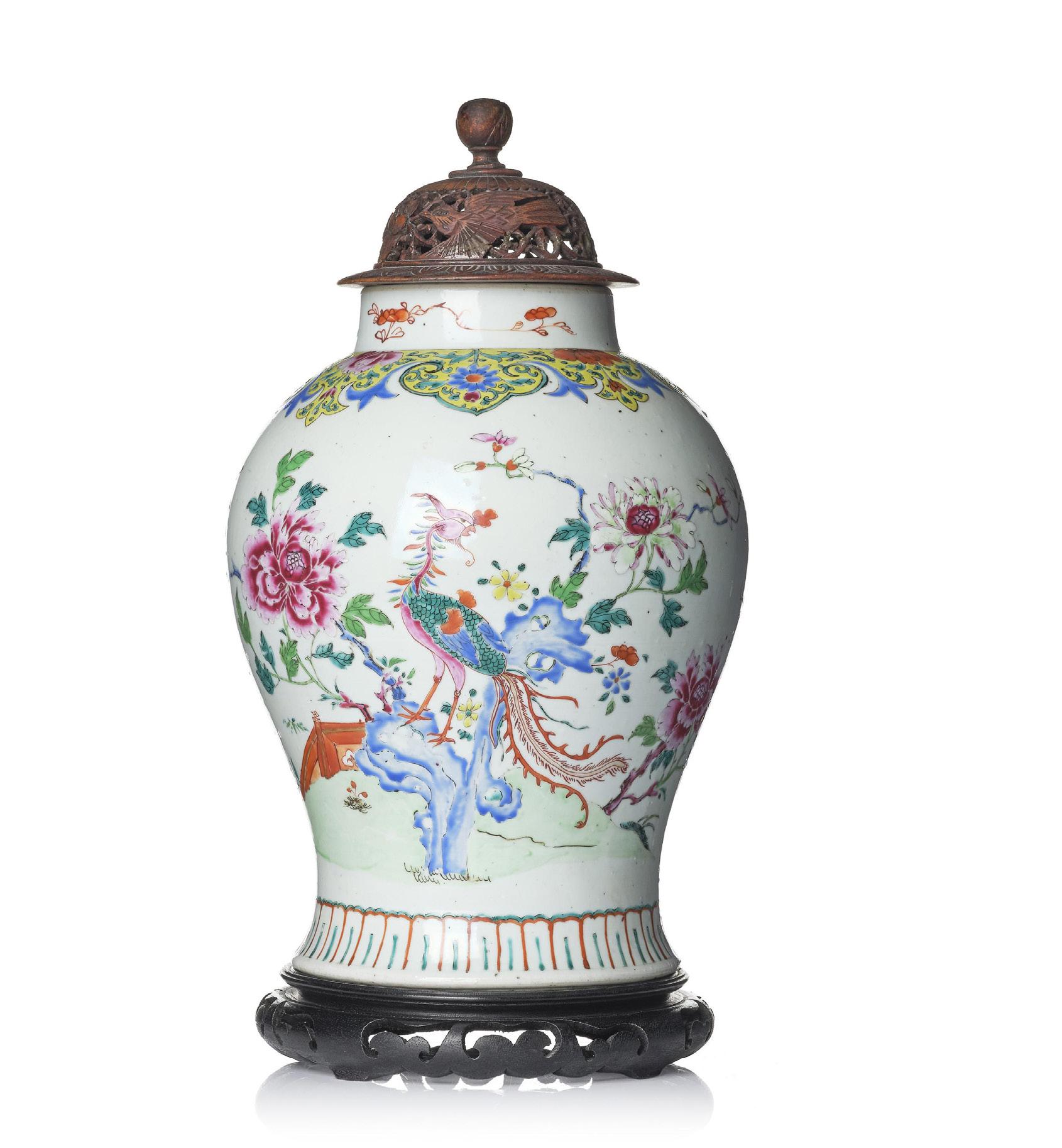
holders, Qing dynasty, circa 1800.
Seated buddhist lions on tall plinths, each with a vase on its back for the joss sticks, glazed in bright colours. Height 22 cm.
Provenance: Property of a private Swedish collector.
Estimate: SEK 6 000 – 8 000 / EUR 567 – 755
1127. A large famille rose ‘peacock’ jar, Qing dynasty, 18th century.
Of baluster shape, decorated in famille rose with a large peacock in a garden setting. Height 35 cm. Height with wooden cover and stand 48 cm.
Provenance: Property of a private Swedish Estate.
Estimate: SEK 8 000 – 10 000 / EUR 755 – 944
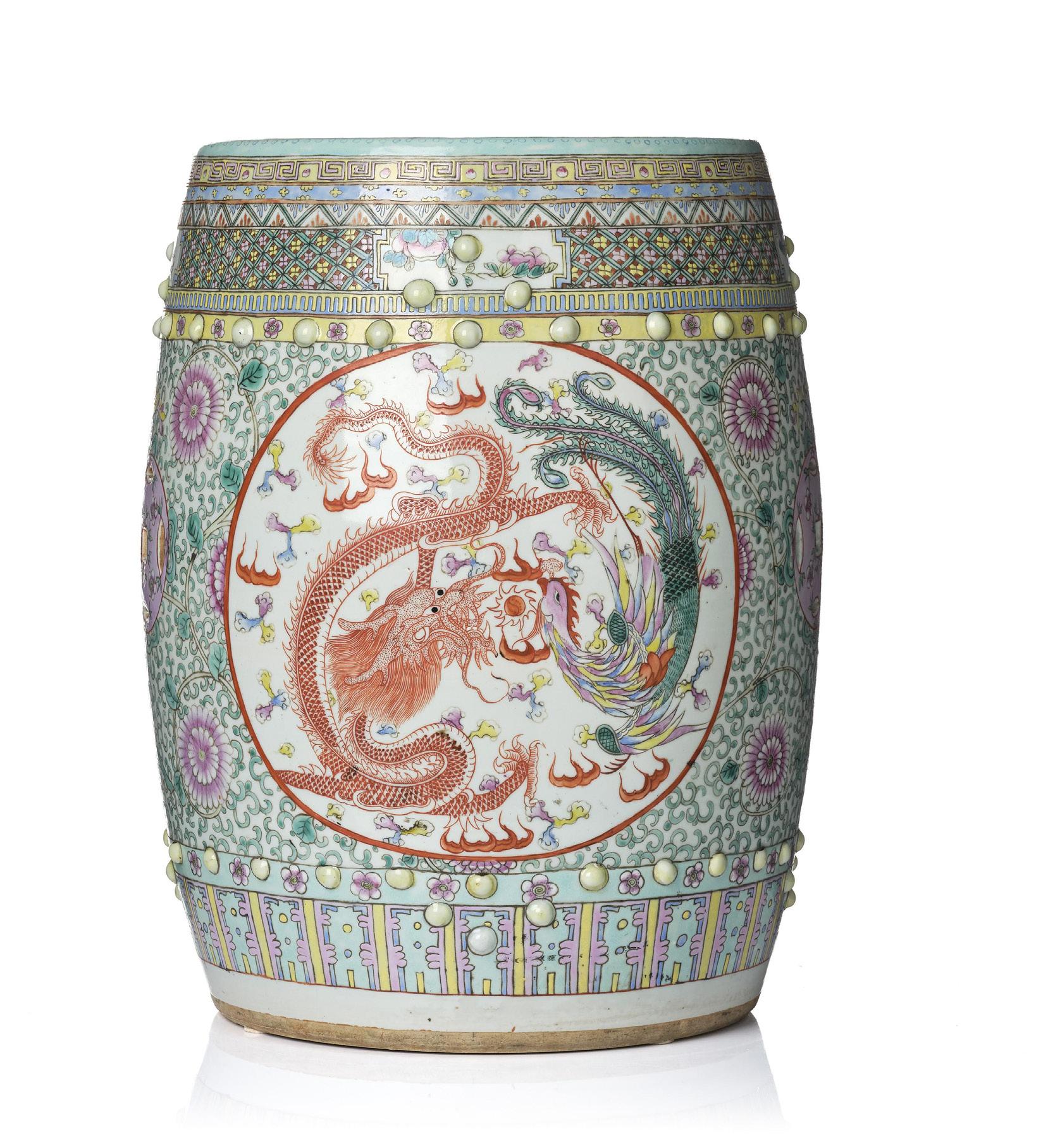
1129. A pair of famille rose ‘floral’ wall vases, Qing dynasty, 19th century.
Flattened back, with three spouts, decorated in famille rose colours with butterflies and flowers. Height 16.8 cm. Width 9.8 cm.
Provenance: Property of a private Swedish Estate.
Estimate: SEK 4 000 – 6 000 / EUR 378 – 567
1128. A famille rose garden seat, late Qing dynasty.
Round, barrel shaped, decorated with pierced sections and in famille rose colours. The seat with flowers, the sides with round panels featuring dragons and phoenix birds with the pearl amidst flames. Height 47 cm.
Diameter c. 30 cm.
Provenance: From the Collection of Ann Kreuger (1926–2022). Ann Kreuger is well known in the circles of snuff bottles collectors, dealers and auction houses. She was an active member in the Snuff bottle society, researched, collected, lectured, and wrote numerous articles in the subject. Her deep interest in Chinese culture, language, tradition, and history led her to build a very rich library on the subject. A large part of her collection of snuff bottles was sold at Sotheby’s, see the single owner sale ‘The Guo’an Collection of fine Chinese snuff bottles, Hong Kong, Monday 30 October 2000, from where they found their way into other prestigious collections.
Estimate: SEK 20 000 – 30 000 / EUR 1 890 – 2 830
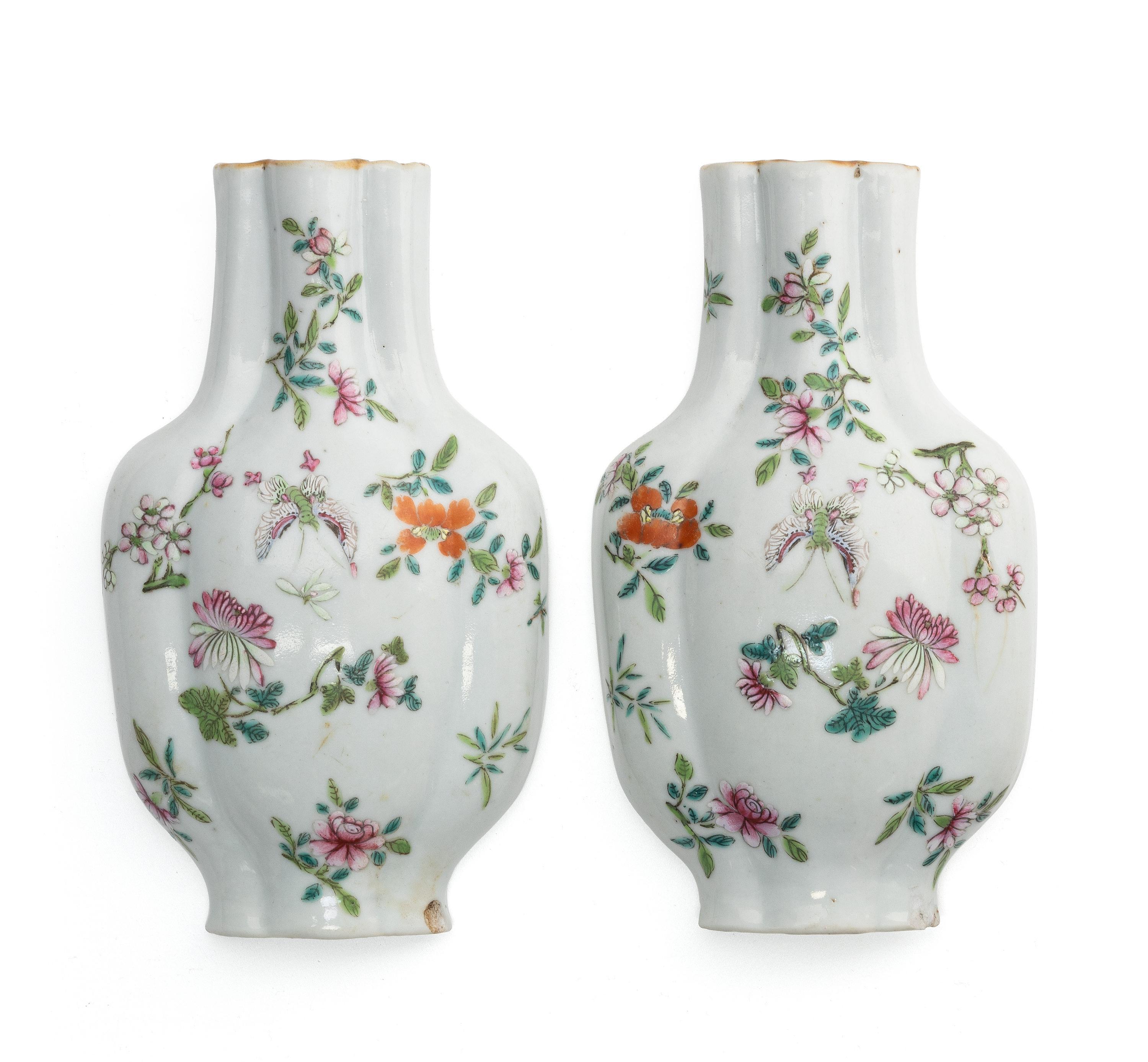
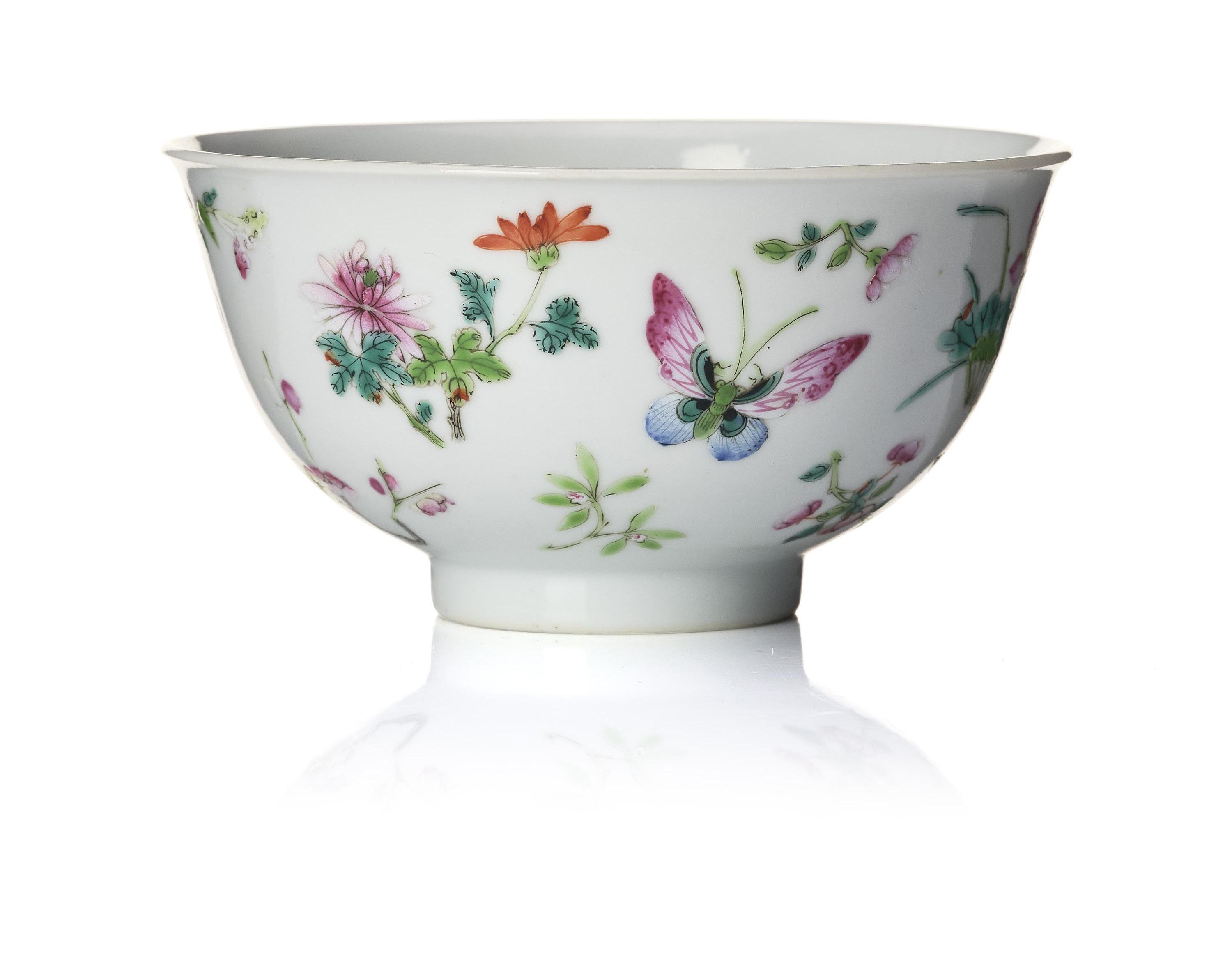
1130. A famille rose ‘butterfly’ bowl, Qing dynasty with Daoguang mark and of the period (1820–1850).
Decorated in famille rose colours with butterflies and floral sprigs. Underglaze blue seal mark. Diameter 11.5 cm.
Provenance: Property of a private Swedish collector.
Exhibitions: Compare a similar bowl sold in these rooms Bukowskis Winter Sale 669, lot 1172, from the Karl Hugosson Collection, 10 December 2025.
Estimate: SEK 20 000 – 25 000 / EUR 1 890 – 2 360
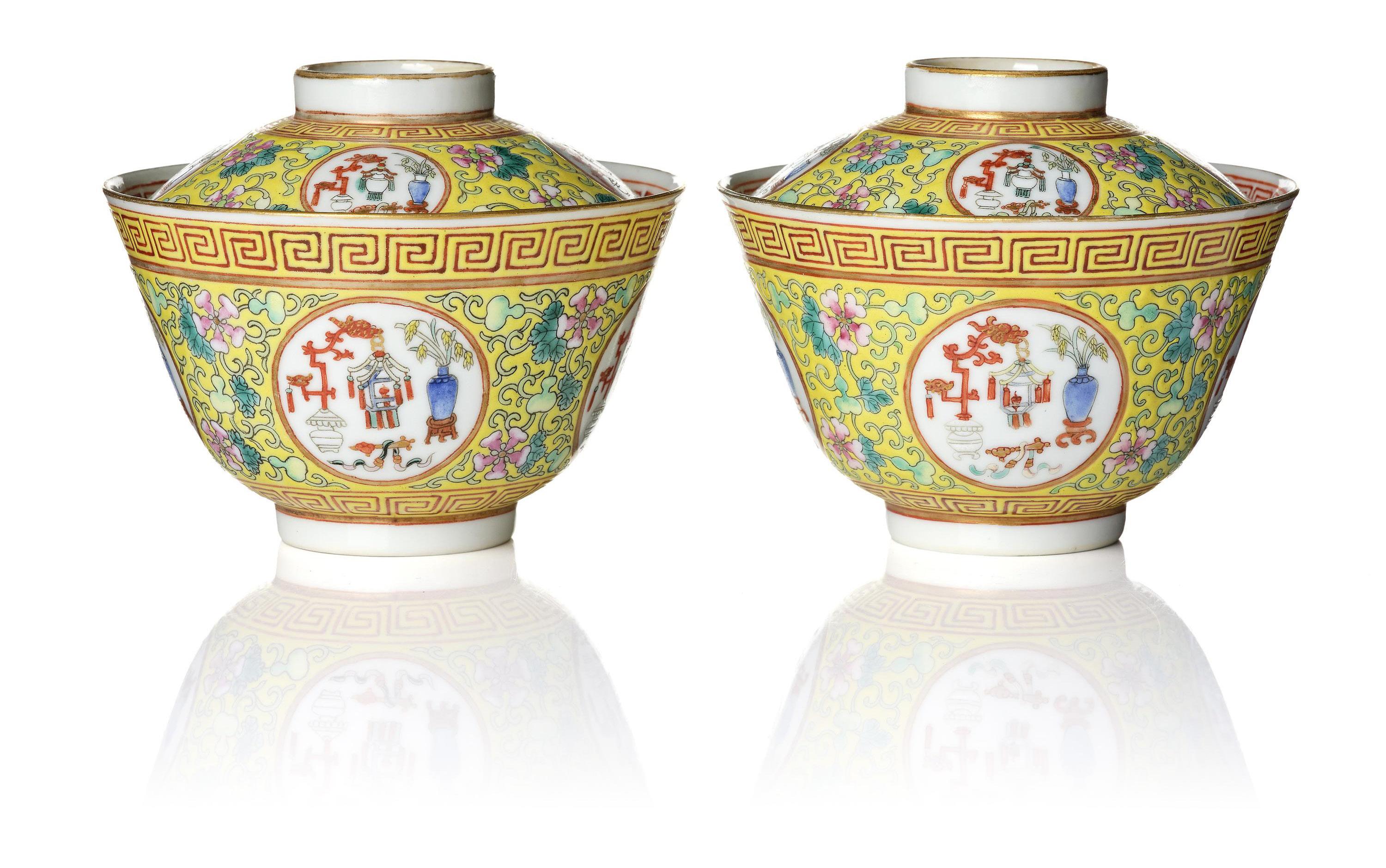
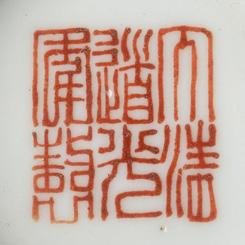
1131. A pair of yellow ground ‘medallion’ bowls with covers, Qing dynasty with Daoguang mark.
Tall sides on a short footrim, domed cover, decorated in famille rose colours with a continuous floral scroll with kalebass fruit. Seal mark to base on cover and cup.
Height 10.6 cm. Height 9 cm.
Provenance: Purchased at Stockholms Auktionsverk, lot 3342, 6 June 2013.
Estimate: SEK 8 000 – 10 000 / EUR 755 – 944
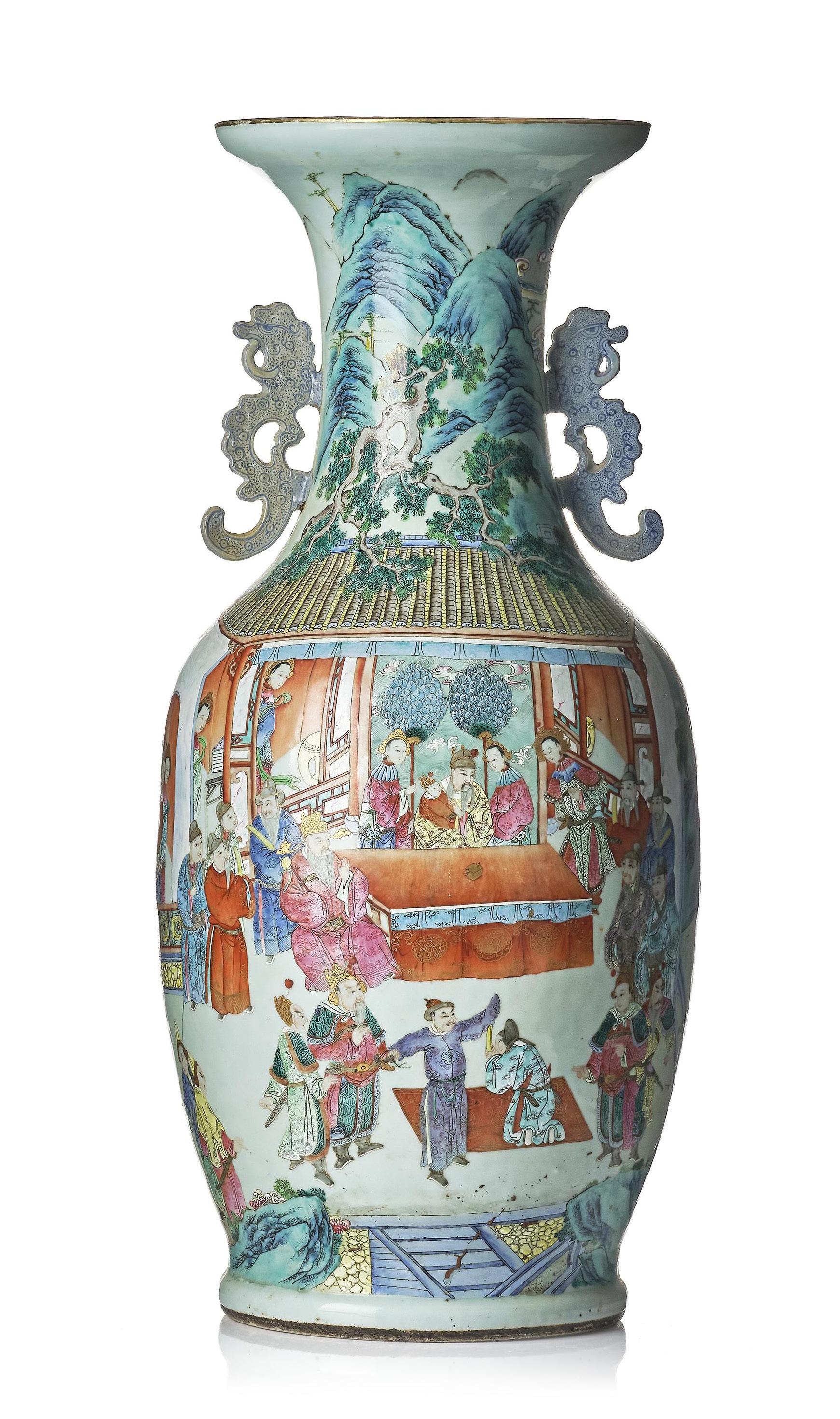
1132 A. A massive famille rose ‘figural’ vase, Qing dynasty, 19th century.
Baluster shape with twin dragon handles, painted around the body in bright famille rose colours depicting a vivid scene with figures from a Chinese classic novel. Height 86 cm.
Provenance: From the collection of Maj and Carl-Gustav Berqvist, Moholm, Sverige. Purchased in the 1960’s. Thence by descent. With a collector’s label to the base.
Catalogue note: Large-scale vases with impressive decoration came to prominence in the Qianlong reign, and the tradition carried on in the 19th century. Often the inspiration for the decoration were from classical novels of Chinese literature such as the Romance of the Three Kingdoms.
Estimate: 20 000 – 25 000 SEK / EUR / EUR 1 890 – 2 360
1132. A large famille rose ‘nine peaches’ dish, late Qing dynasty/early 20th century with a Qianlong mark.
The dish is enamelled on the exterior with fruiting and flowering peach branches and lingzhi fungus extending over the rim into the interior, besides two bats in flight. The base glazed in a turquoise coloured. Six character seal mark within a double circle. Diameter 46.5 cm.
Provenance: Property of a private Swedish Estate.
Catalogue note: The motif of peaches and bats are a pun, Duo Fu Duo Shou, 多福多寿 , May you enjoy great happiness and longevity.
Estimate: SEK 50 000 – 75 000 / EUR 4 720 – 7 080
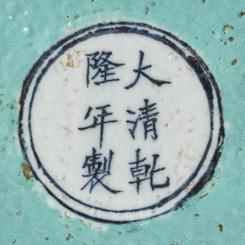
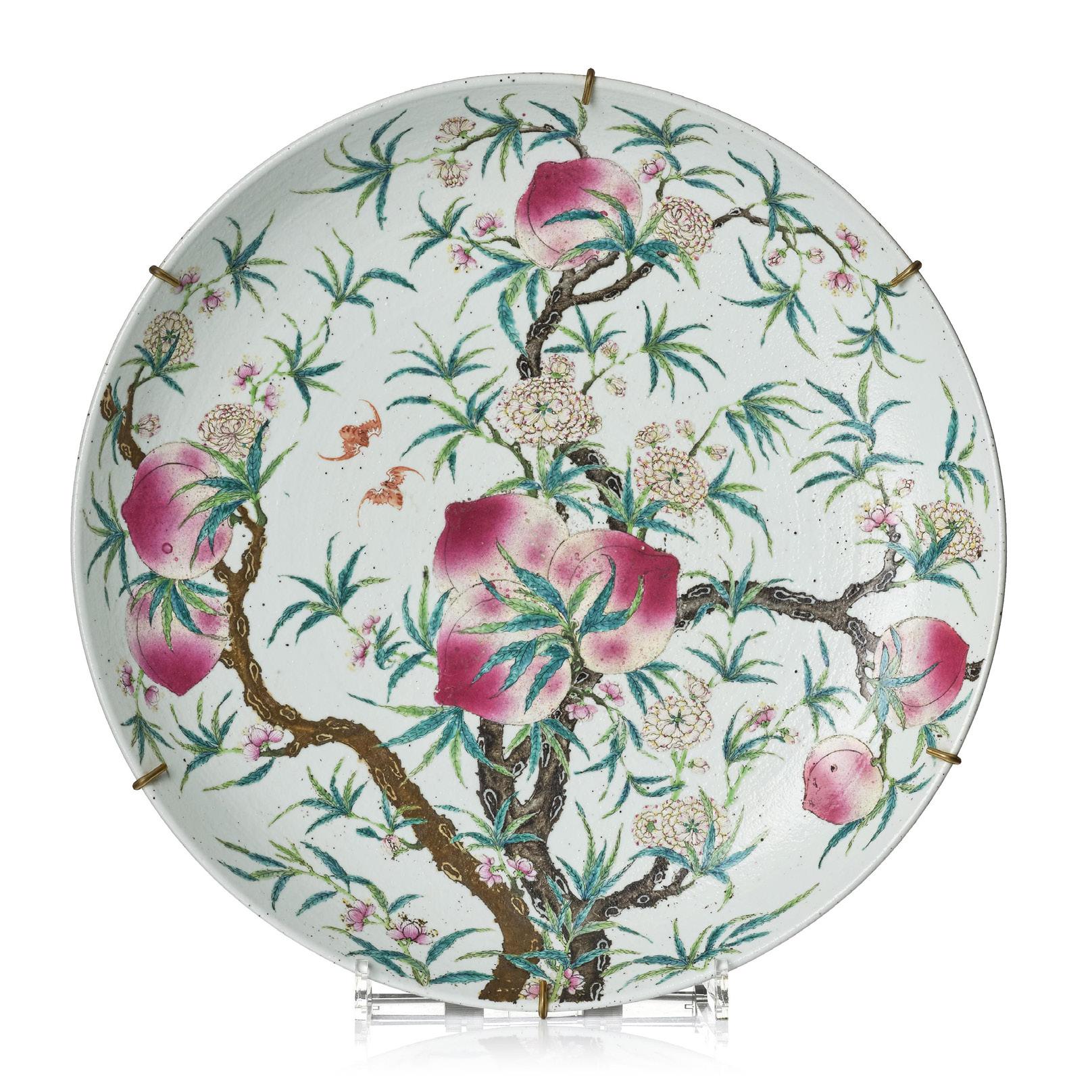
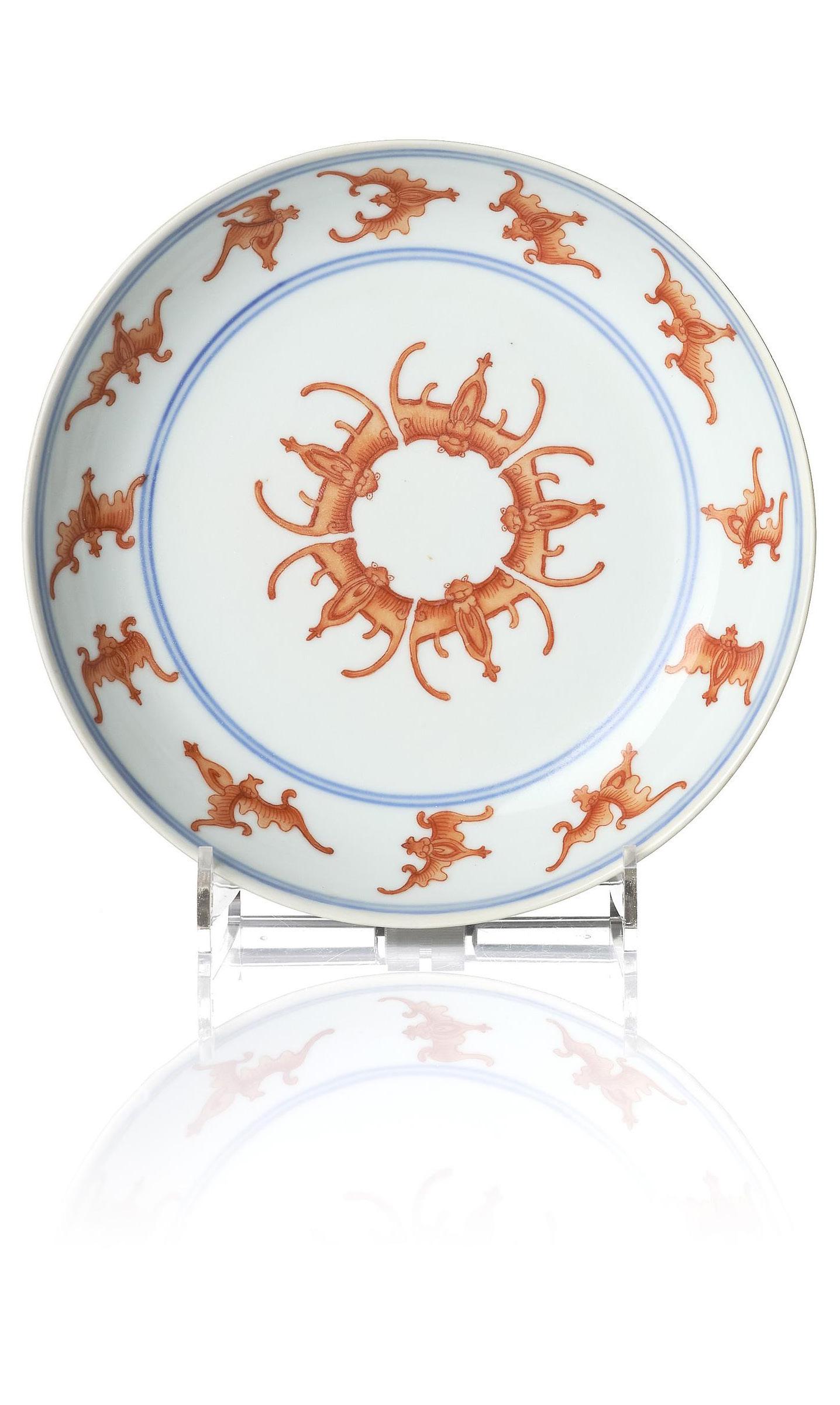
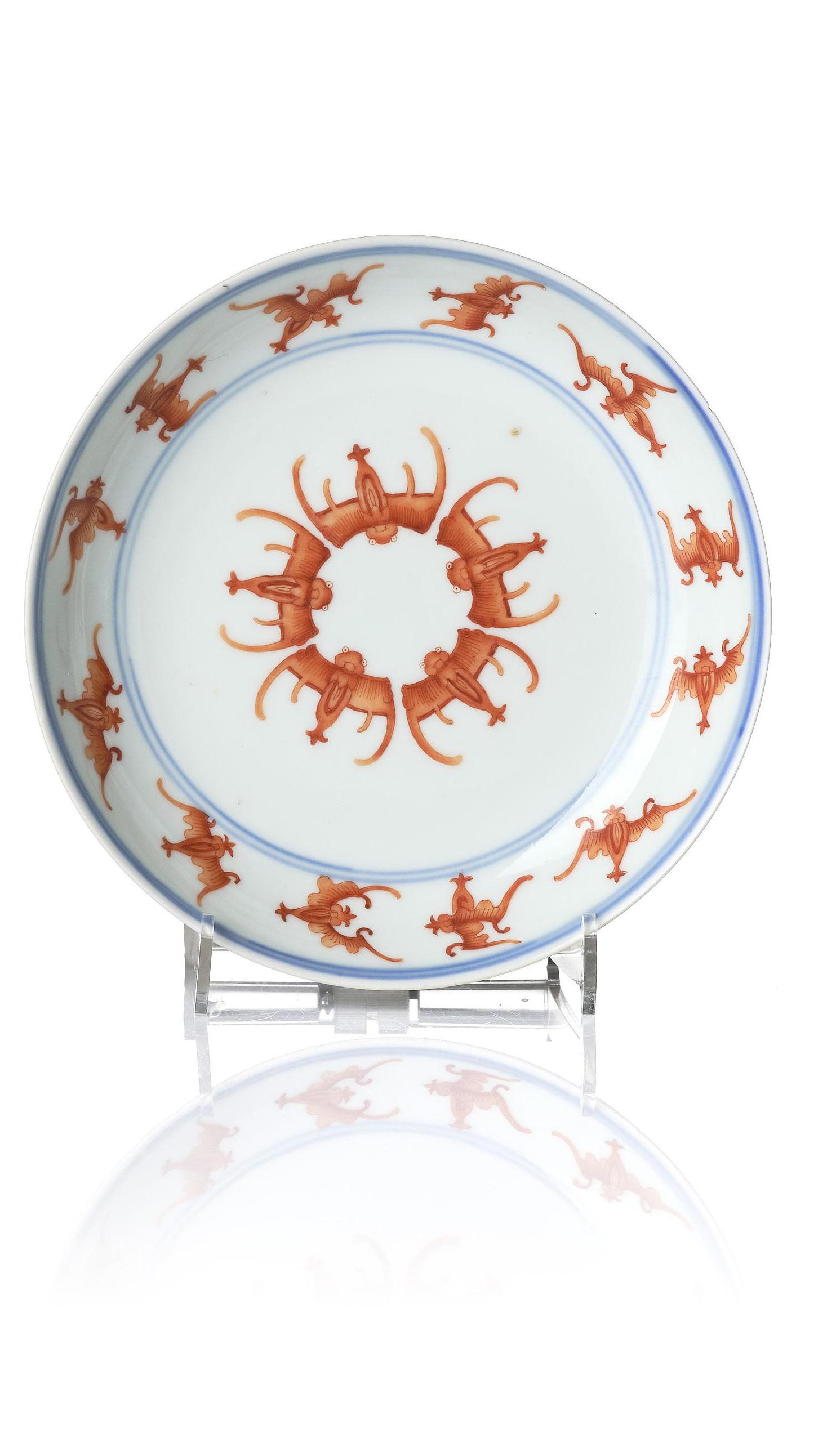
1133. A pair of iron-red decorated ‘bats’ dishes, Qing dynasty, Guangxu mark and period (1875–1908).
Each with a central roundel enclosing five inwards facing bats, within a border of twelve bats in flight, the exterior with 12 further iron-red bats, underglaze blue mark to the base.
Diameter 15.6 cm.
Provenance: Property of a private collector, who purchased it at auction in Holland in 2013.
Exhibitions: Compare lot 1112, Christies, 21–22 Sep 2023 Live auction 22039. Important Chinese Ceramics and Works of Art. Compare also lot 91, Bonhams, Asian Art 9 May 2022, London, Knightsbridge.
Literature: Compare dishes of this type in the Palace Museum, Taipei. Object Number 故瓷 002793N000000000.
Estimate: SEK 20 000 – 30 000 / EUR 1 890 – 2 830
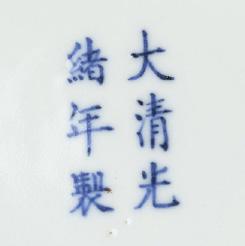
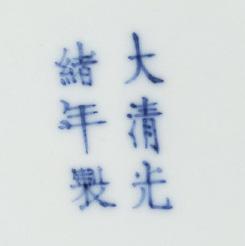
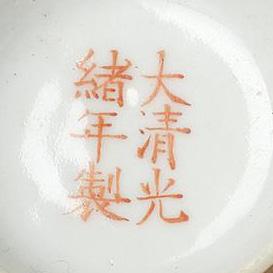
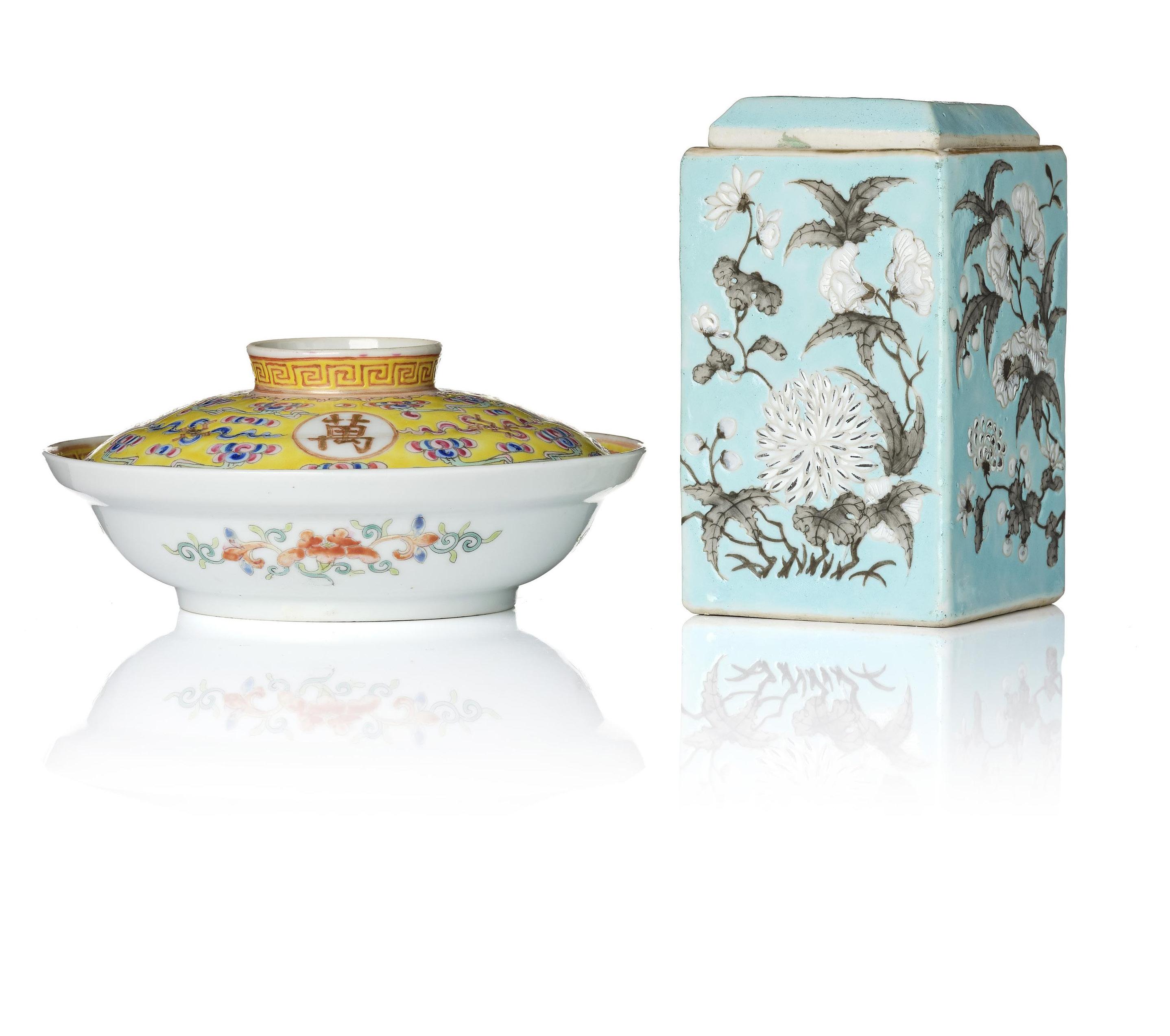
1134. A yellow glazed bowl with cover and a turquoise ground box with cover, Qing dynasty, Guangxu (1875–1908).
The bowl with a domed cover, all decorated with four roundels with shou characters on a yellow glazed ground with cloud formations, ribbons and shou symbols. The interior of the cover with five bats and a shou character. The base of both cover and bowl with Guangxu mark and of the period.
Diameter 16 cm. The rectangular box with a pierced cover, decorated in grisaille with flowers against a turquoise ground. Measure 7.5 x 7.5 x 12 cm.
Provenance: Property of a private Swedish collector.
Estimate: SEK 6 000 – 8 000 / EUR 567 – 755
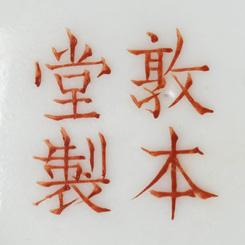
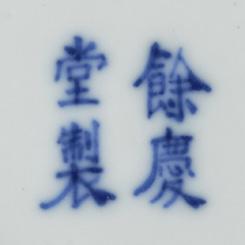
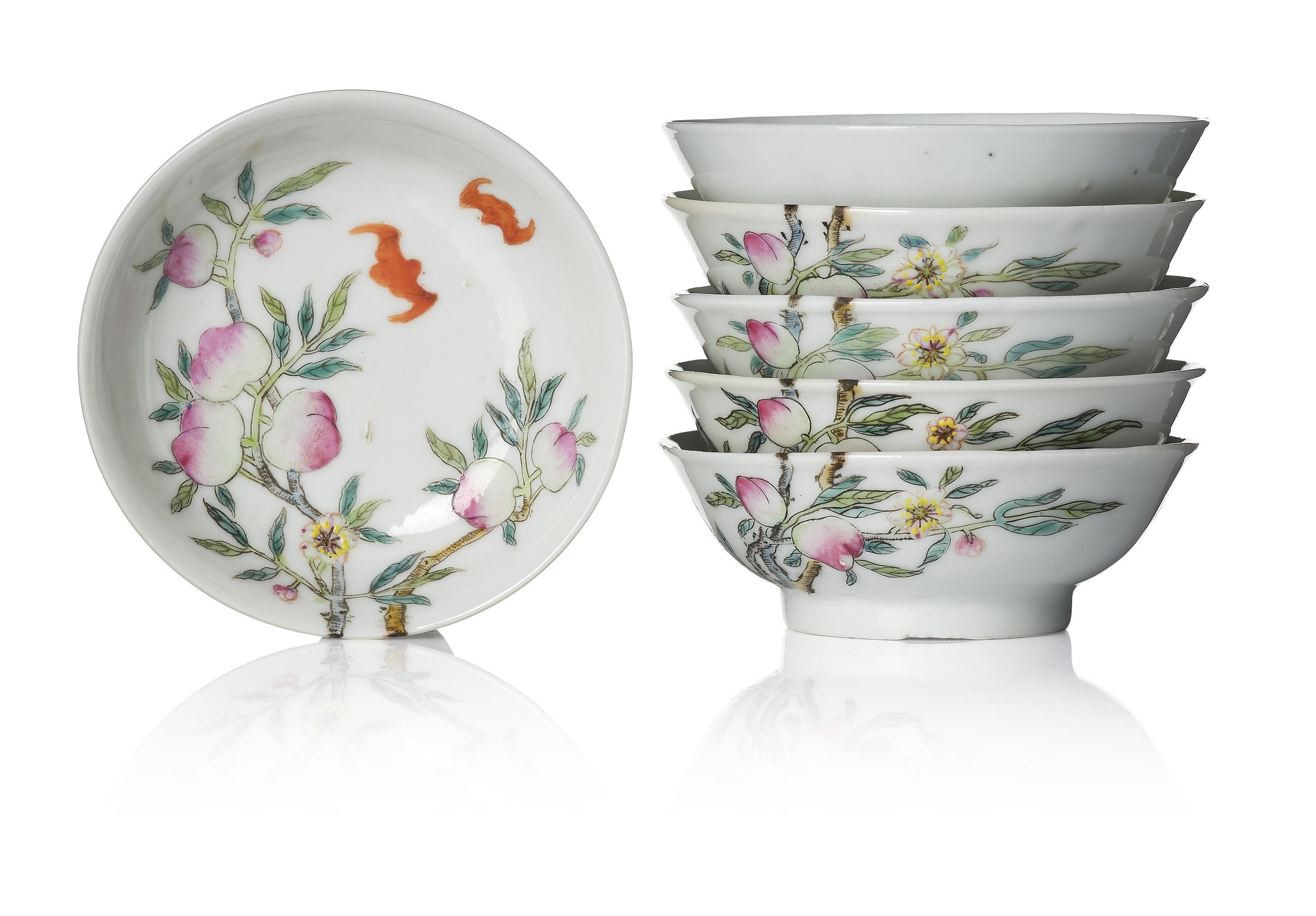
1135. A set of six (5+1) small Chinese ‘peaches’ dishes, late Qing dynasty/Republic.
A set of five dishes decorated with peaches and two bats. The decoration continues over the edge. Four character mark in red. Diameter 8 cm. The other dish with a similar decoration. Underglaze blue mark. Diameter 8 cm.
Provenance: Property of a private Swedish Estate.
Estimate: SEK 5 000 – 7 000 / EUR 472 – 661
1136. An enamelled ‘nine dragon’ vase, Qing dynasty with Guangxu six character mark and of the period (1874–1908).
The body of bulbous form with slender flaring neck, the vase is decorated with nine sinuous five-clawed dragons in various colours, amidst scrolling clouds and ironred flames, one emerging from a band of crashing waves at the foot. Height vase c. 36 cm. Height with mount for shade 54 cm.
Provenance: Property of a private Swedish collector.
Estimate: SEK 8 000 – 10 000 / EUR 755 – 944
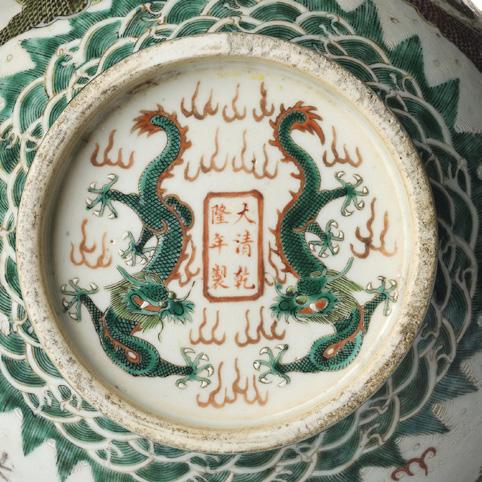
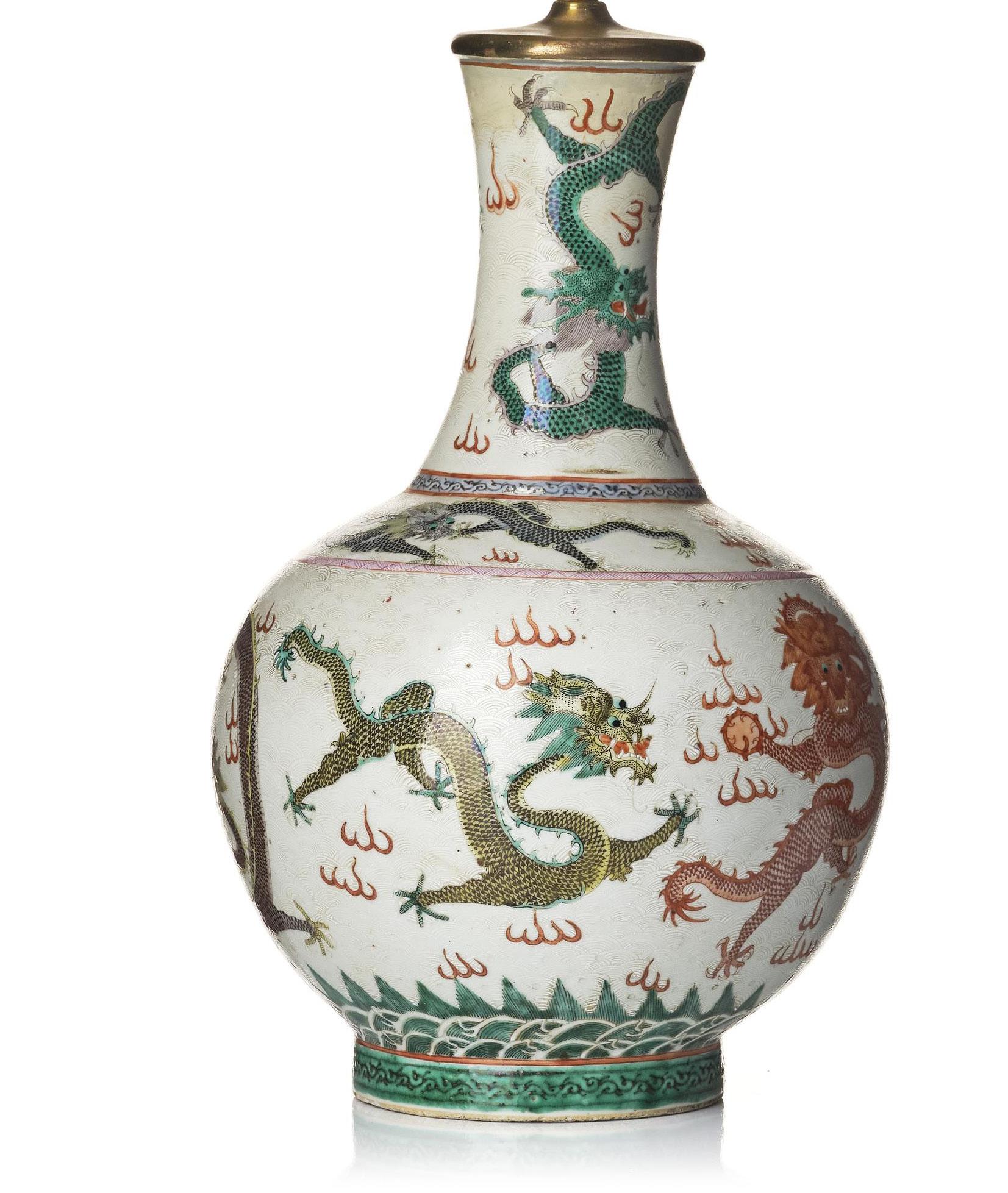
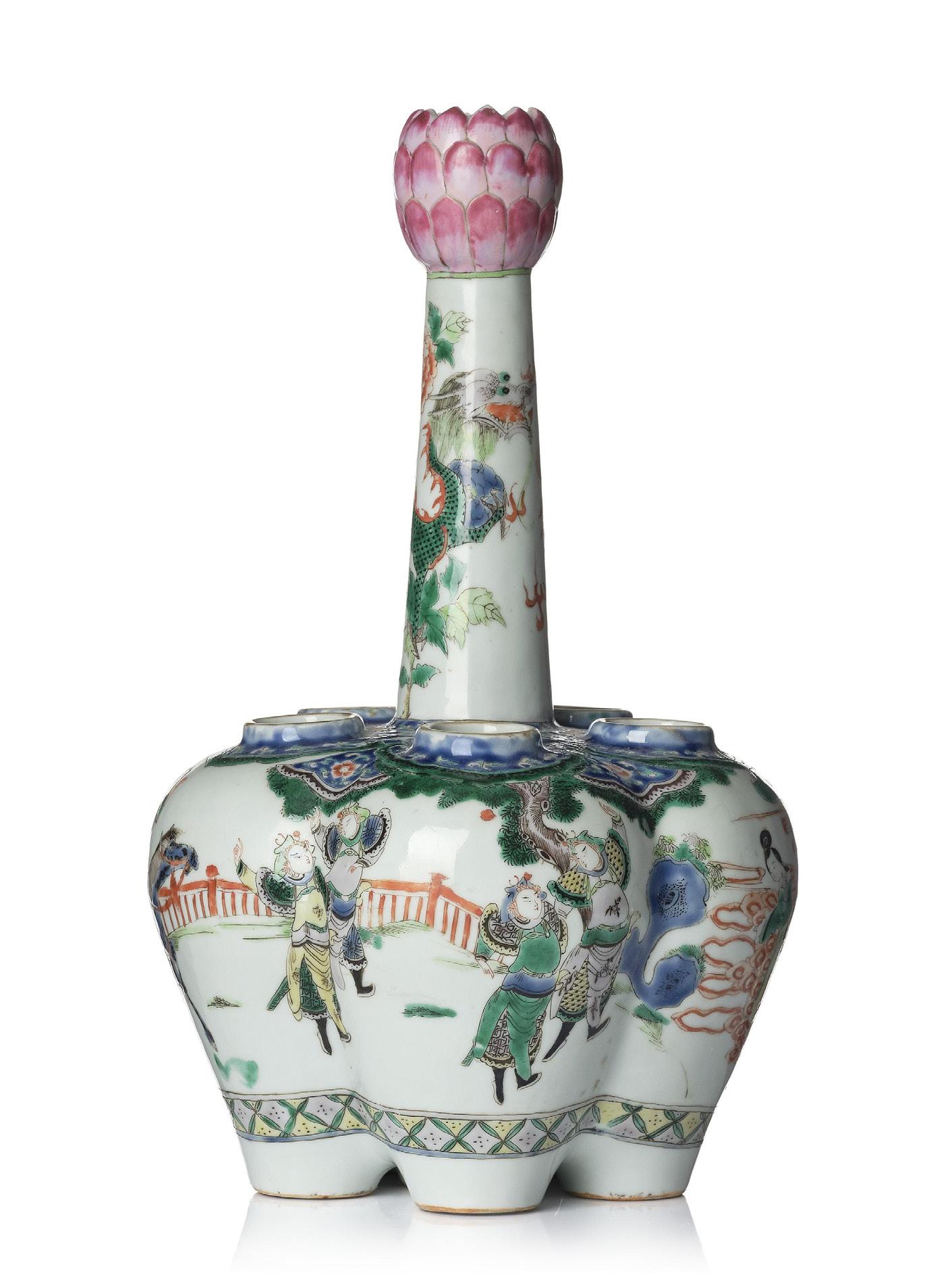
1137. A large famille rose tulip vase, Qing dynasty, 19th century. With four character mark. For six bulbs. Decorated in famille rose colours with a figure scene. Height 34 cm.
Provenance: Property of a private Swedish collection.
Estimate: SEK 8 000 – 10 000 / EUR 755 – 944
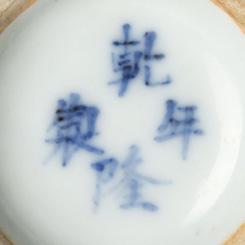
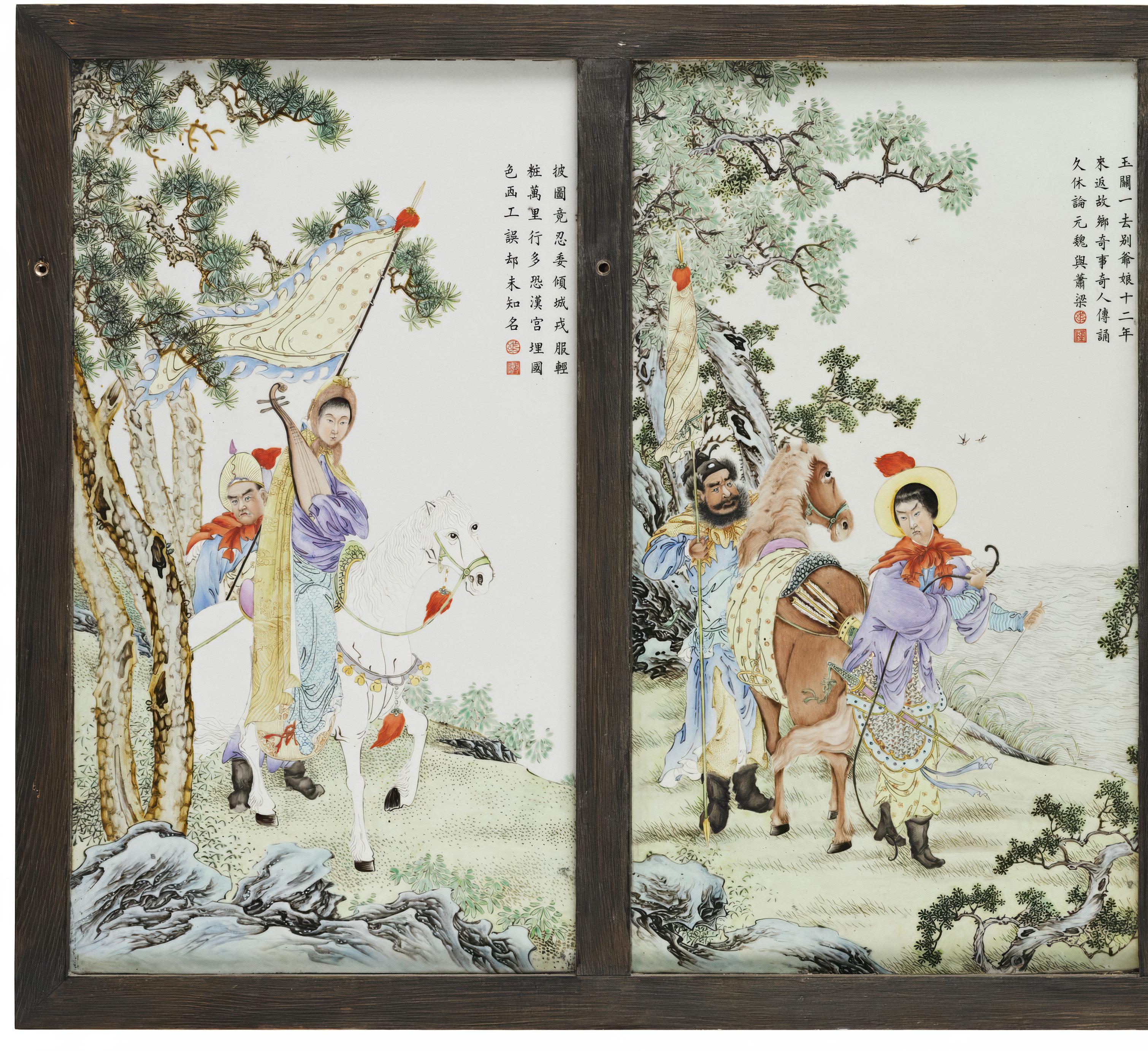
1138. A group of four Chinese porcelain placques, Republic, early 20th century.
Finely painted with different figure scenes from well known Chinese novels. Each panel neatly inscribed with a poem followed with two seals, one the trigram for the character Qian, the other reading Long. Each placque 42 x 76 cm. Measure framed together 84.5 x 186 cm.
Provenance: The paintings were acquired in the 1980s by the present owner’s mother, thence by descent.
Exhibitions: Compare a pair of panels sold at Bonhams New York, Chinese Works of Art, lot 627, 18 March 2019. Catalogue note: 1 披圖竟忍委傾城,戎服輕妝萬里行。多恐漢宮埋國色,畫工誤卻未知名。 Unrolling her portrait, how could (he) bear to cast away such a devastating beauty; In light armour and simple adornment, she travels ten thousand miles. How lamentable that the deep Han palace buried a beauty of the nation, All because a painter’s deception left her true radiance unknown. 2 玉關一去別爹娘,十二年來返故鄉。奇事奇人傳誦久,休論元魏與蕭梁。 Beyond the Jade Pass she departs, bidding farewell to her parents; Twelve years pass before she returns to her homeland. Strange deedStrange deeds and a remarkable life are told and retold through time—Why speak only of the Yuan Wei or the Xiao Liang? 3 Swift and sorrowful winds sweep past the Han encampments; Startled, she hears songs of Chu rising from all sides. She asks only to drain a cup before the honoured one with a single sword—Unable to bear hearing her lord cry out in helpless despair. 4 The Lady of Guo receives the favour of her sovereign; At dawn she rides her horse straight into the palace gates. Disdaining cosmetics that might mar her natural beauty. With lightly brushed brows, she attends upon the Son of Heaven.
Estimate: SEK 75 000 – 100 000 / EUR 7 080 – 9 440
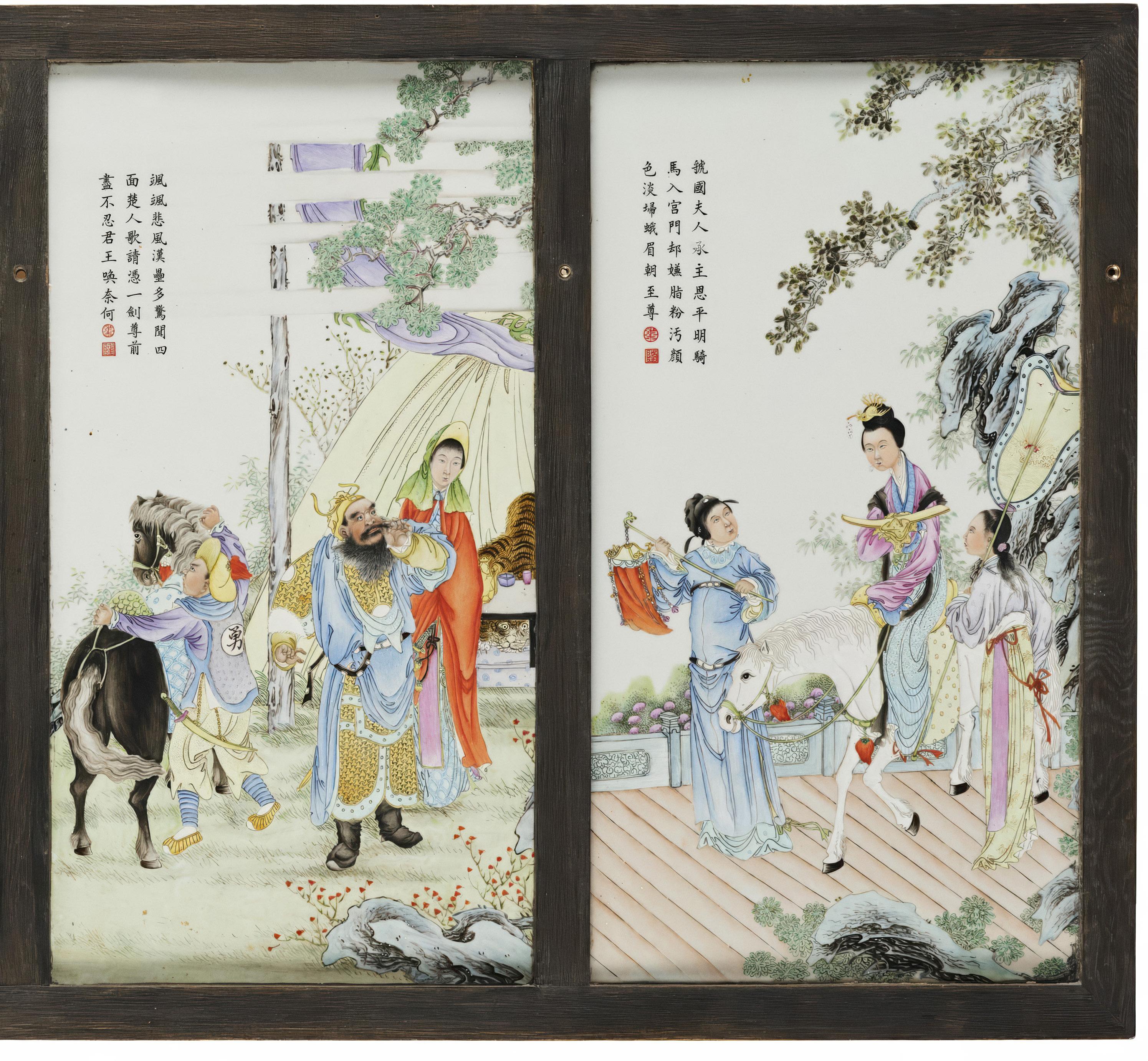
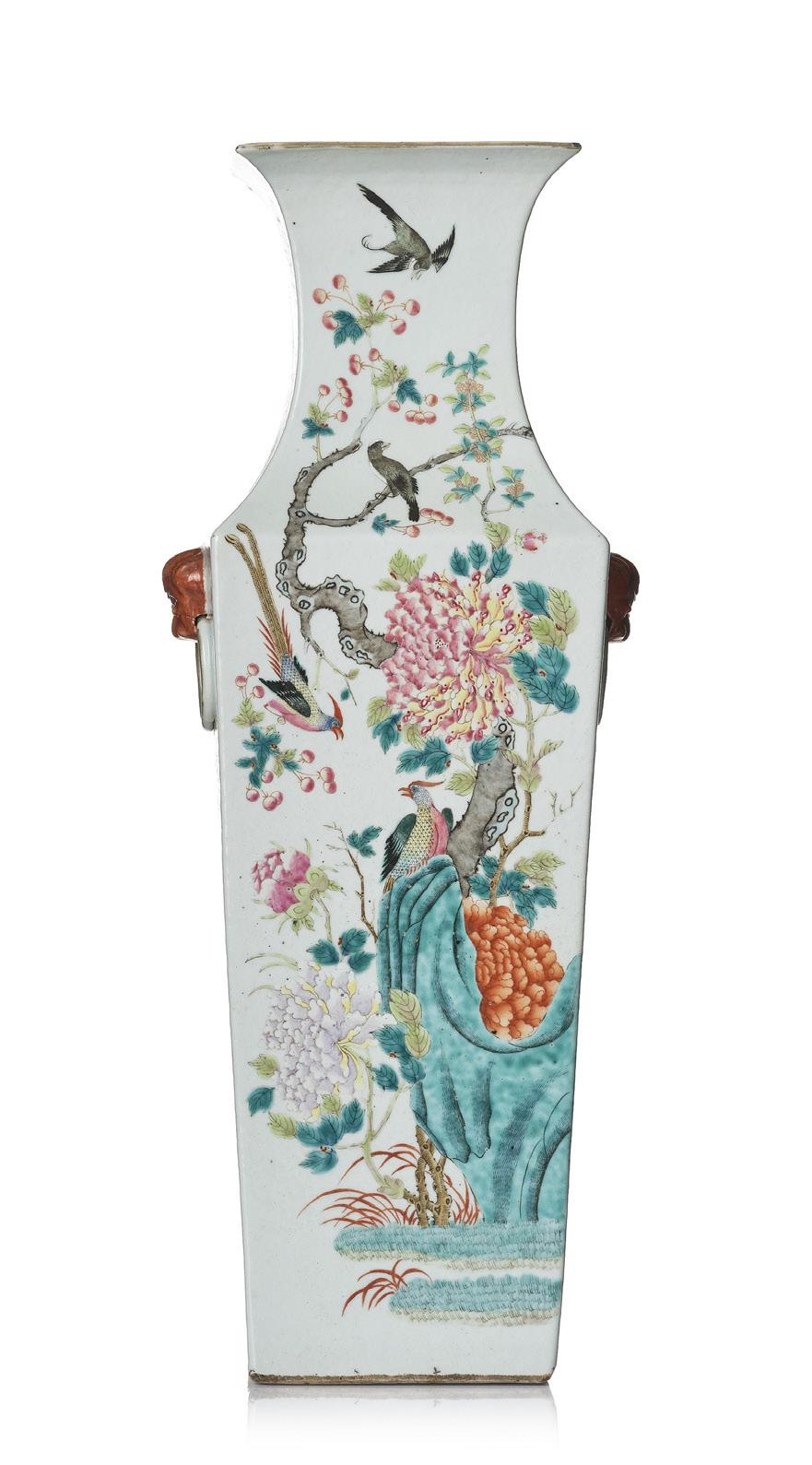
1139. A large famille rose ‘birds in a garden’ vase, Qing dynasty, 19th century.
Of square baluster shape with ring mascaron handles, decorated in famille rose with birds in a garden. Height 58 cm.
Provenance: Property of a private Swedish collector.
Estimate: SEK 8 000 – 10 000 / EUR 755 – 944
1140. A large yellow ground ‘100 birds’ fish basin, Qing dynasty, 19th century.
Rounded sides that rises towards a wide lipped rim, decorated to the exterior in famille verte colours depicting birds in a garden in full bloom against a bright yellow ground.
The interior with five large fishes amidst sea weed.
Diameter 52 cm. Height 47 cm.
Provenance: Purchased at auction in Stockholm.
Catalogue note: “One Hundred Birds” ( 百鸟图 ) in Chinese culture, often depicted in art as Bainiao tu (100 Birds Paying Homage to the Phoenix), symbolizes harmony, prosperity, and the respect of all beings for a virtuous ruler.
Estimate: SEK 30 000 – 50 000 / EUR 2 830 – 4 720
1141. No lot
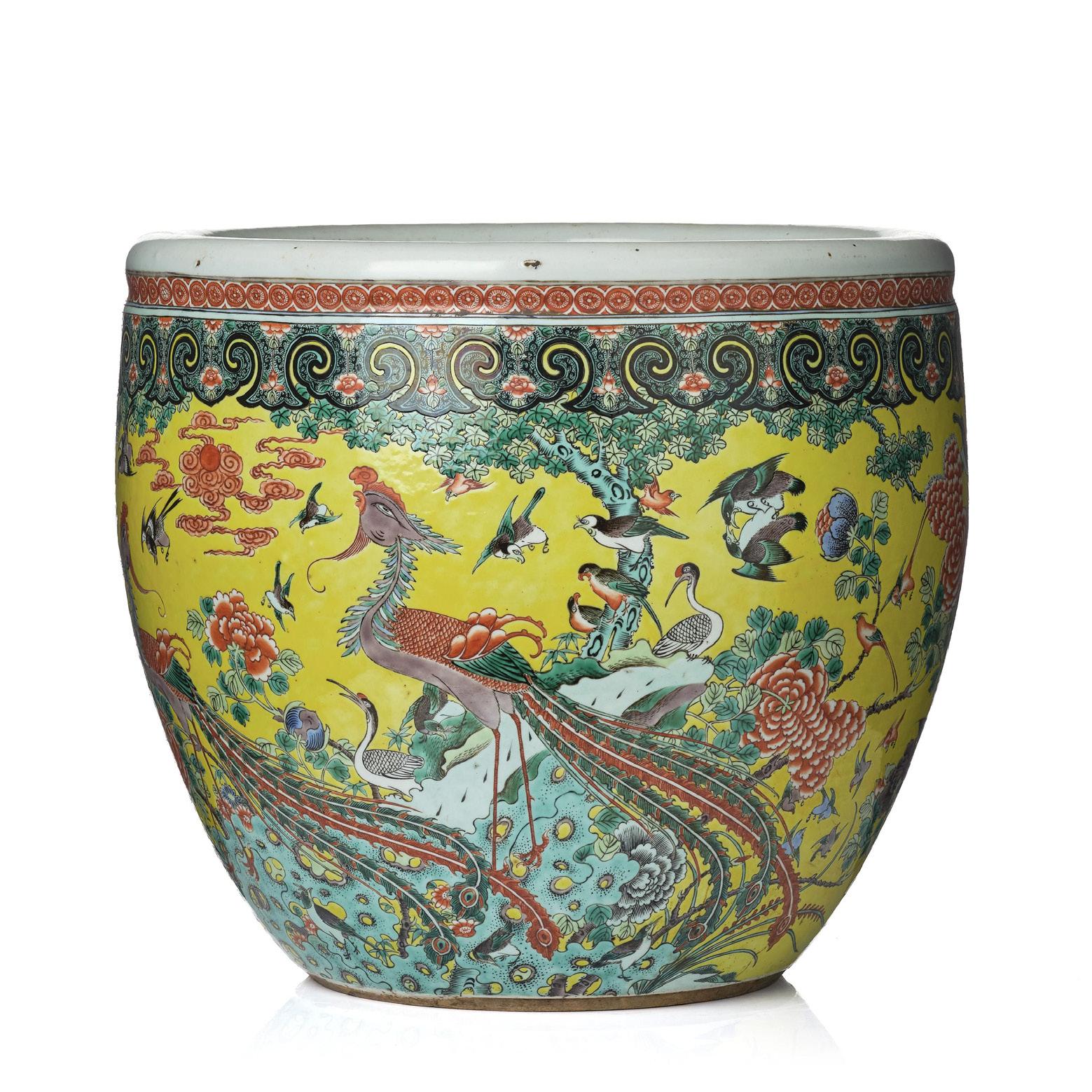
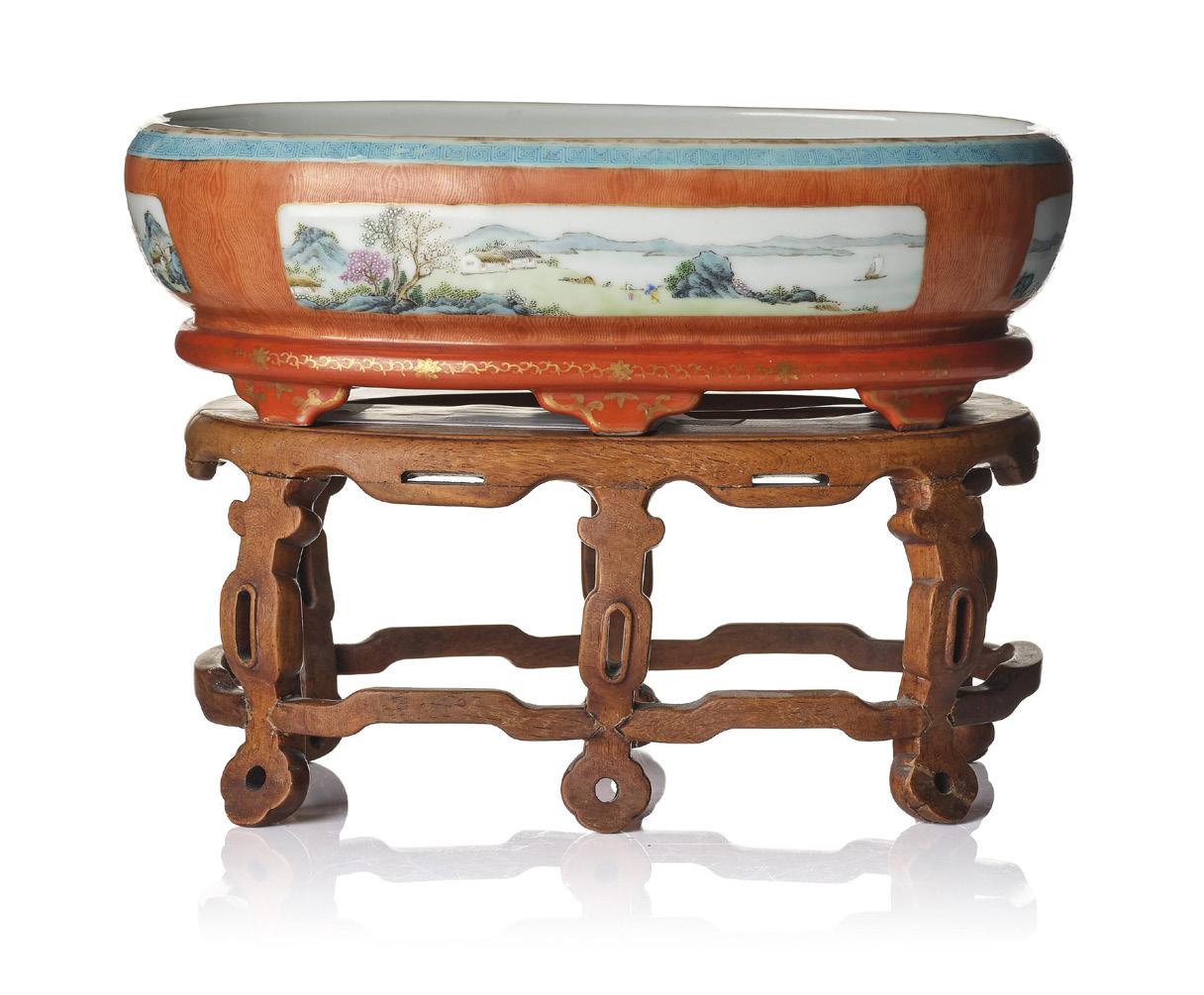
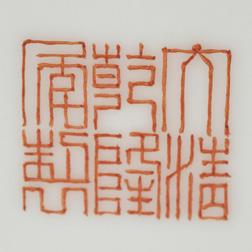
1142. A Chinese faux bois jardiniere, Republic with a Qianlong mark.
Oval shape decorated in famille rose with evenly spaced landscape panels, each decorated in bright enamels against a ground enamelled to mimic wood, and with a coral red ground around the feet. Length c. 28 cm.
Height 8.5 cm. Height with wooden stand 19.5 cm.
Provenance: Property of a private Swedish Estate, has been in the family since the mid 20th century.
Catalogue note: As porcelain was a medium that was relatively easy to control and decorate to high standards, it was frequently used in Jingdezhen to simulate a variety of other works of art such as hardstone, bronzes, cloisonné, wood and lacquer.
Estimate: SEK 8 000 – 10 000 / EUR 755 – 944
1143. A pair of famille rose flower pots, late Qing dynasty/Republic.
Rounded sides, everted lipped rim. Decorated in vibrant colours with flowers in a garden. Diameter 21.2 cm. Height 16 cm.
Provenance: From the Collection of Ann Kreuger (1926–2022). Ann Kreuger is well known in the circles of snuff bottles collectors, dealers and auction houses. She was an active member in the Snuff bottle society, researched, collected, lectured, and wrote numerous articles in the subject. Her deep interest in Chinese culture, language, tradition, and history led her to build a very rich library on the subject. A large part of her collection of snuff bottles was sold at Sotheby’s, see the single owner sale ‘The Guo’an Collection of fine Chinese snuff bottles, Hong Kong, Monday 30 October 2000, from where they found their way into other prestigious collections.
Estimate: SEK 5 000 – 7 000 / EUR 472 – 661
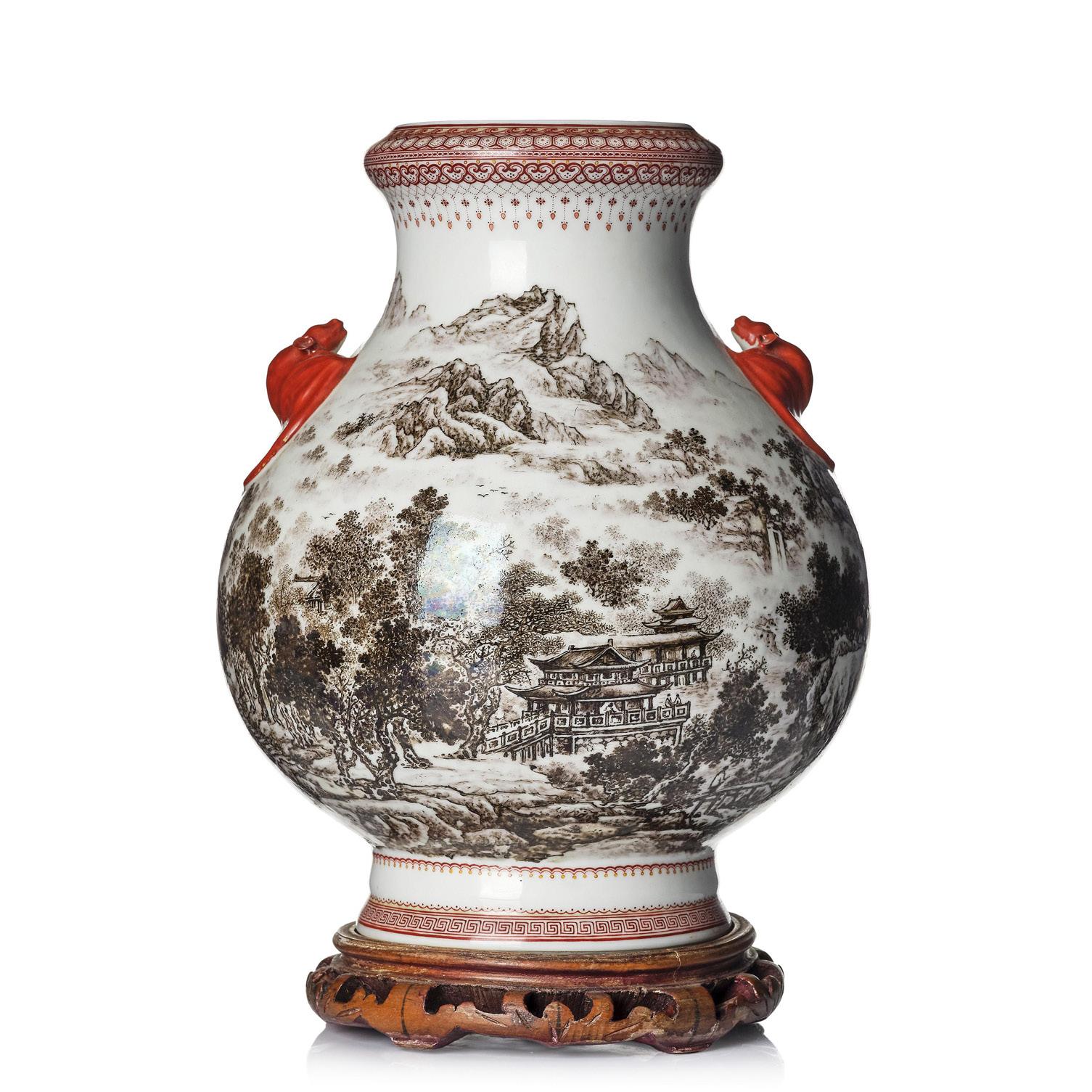
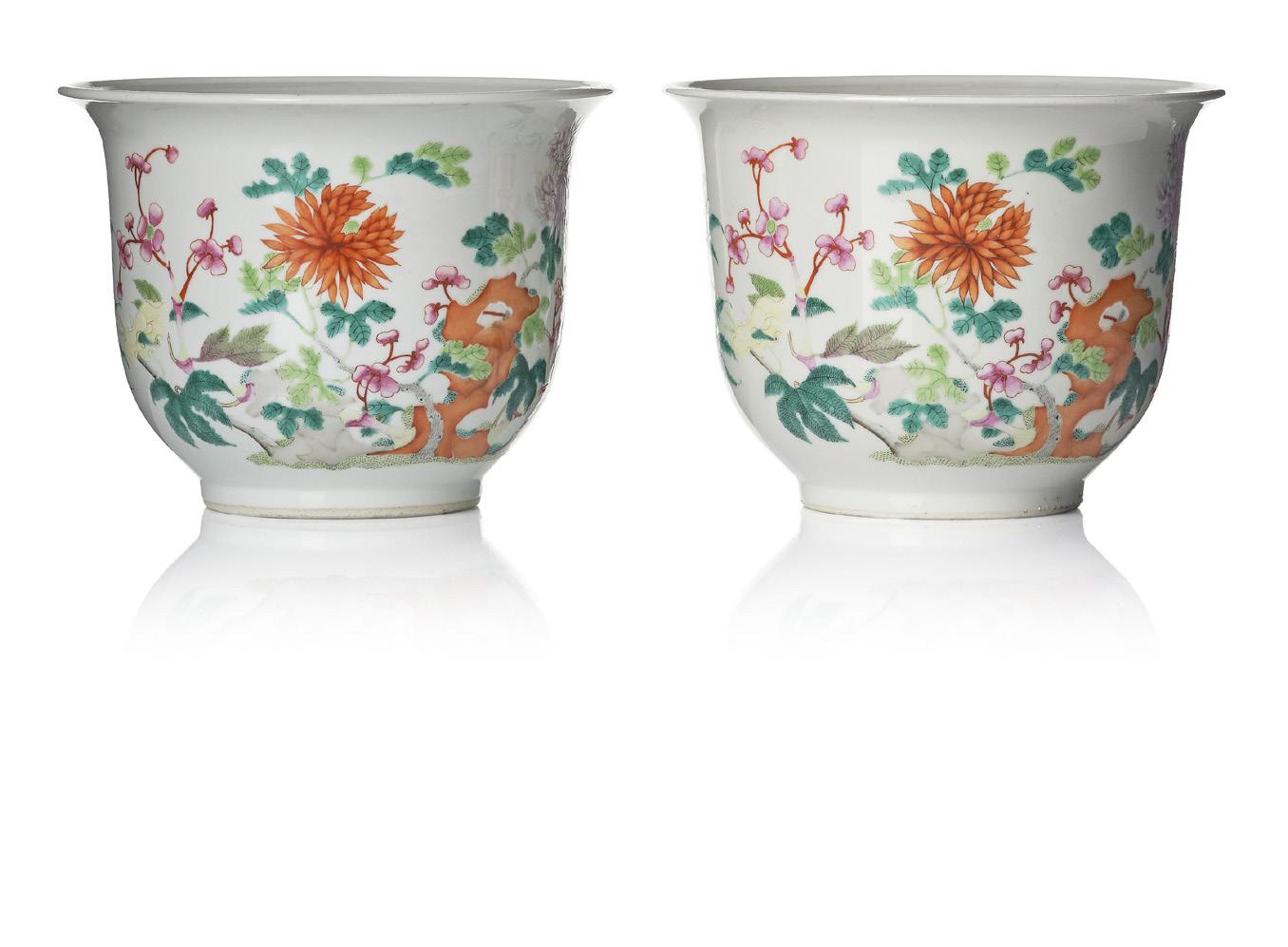
1144. A grisaille ‘landscape’ vase, Republic period, 20th century.
Seal mark in red Jiangzi Jingdezhen. Well potted with handles in the shape of bats, decorated in grisaille with a landscape with pagodas. Jeweled pendants and stylized pattern in red by neck and footrim. The gently recessed base with a seal mark in red. Height c. 27 cm. Height with wooden stand 29 cm.
Provenance: Purchased by the current owner’s father (a sea captain at Broströms) in the early 1960s.
Estimate: SEK 8 000 – 10 000 / EUR 755 – 944
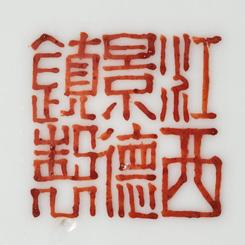
1145. No lot
1146. No lot
1147. No lot
1148. A blue and white jar, Ming dynasty (1368–1644).
Broad shoulder, decorated in underglaze blue with four mythical creatures in between them cloud formations, by the shoulder ruyi alternating with rock formations. Height 30 cm. Height with wooden stand and cover 36.5 cm.
Provenance: Property of a private Swedish collector.
Estimate: SEK 10 000 – 15 000 / EUR 944 – 1 420
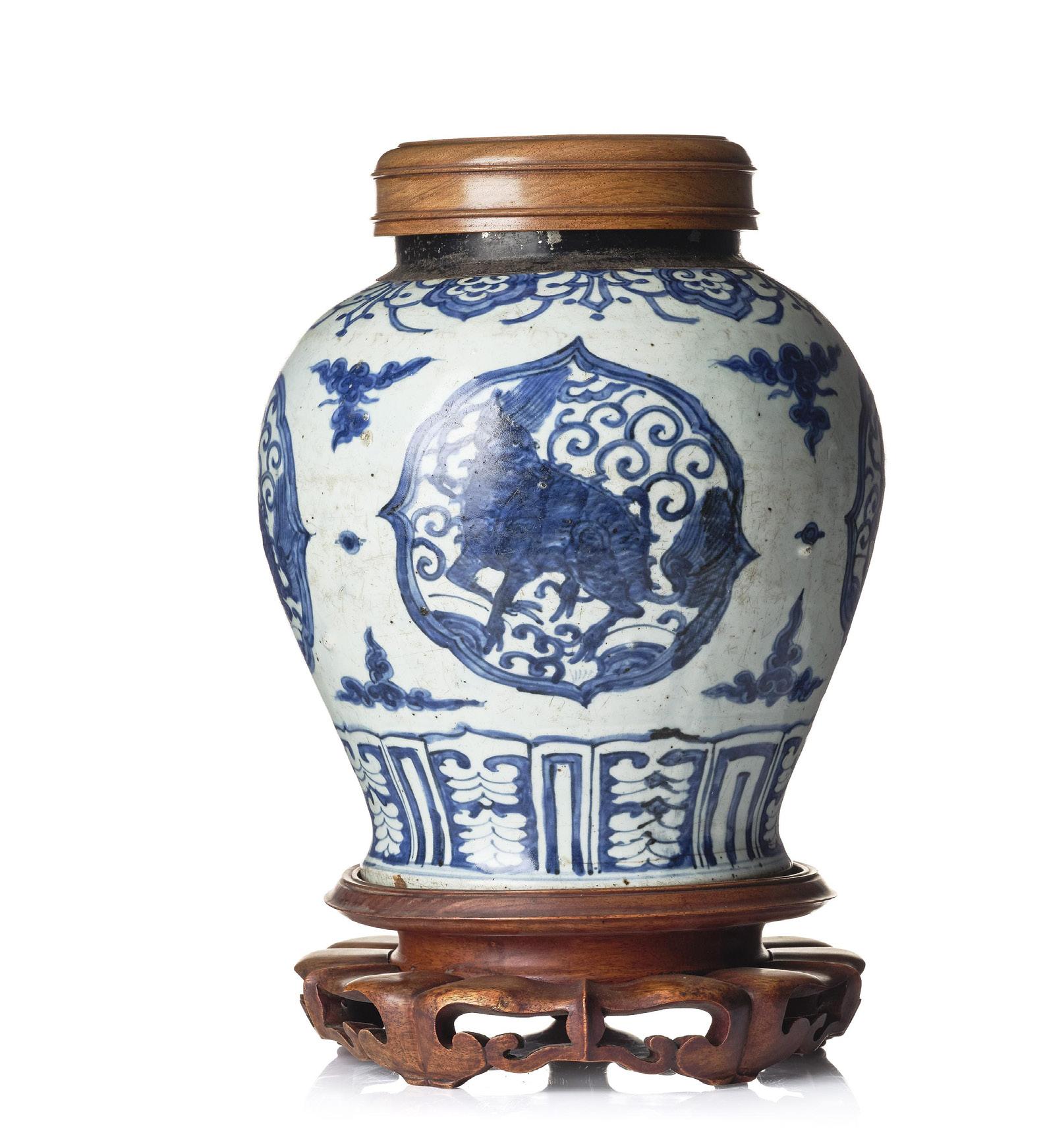
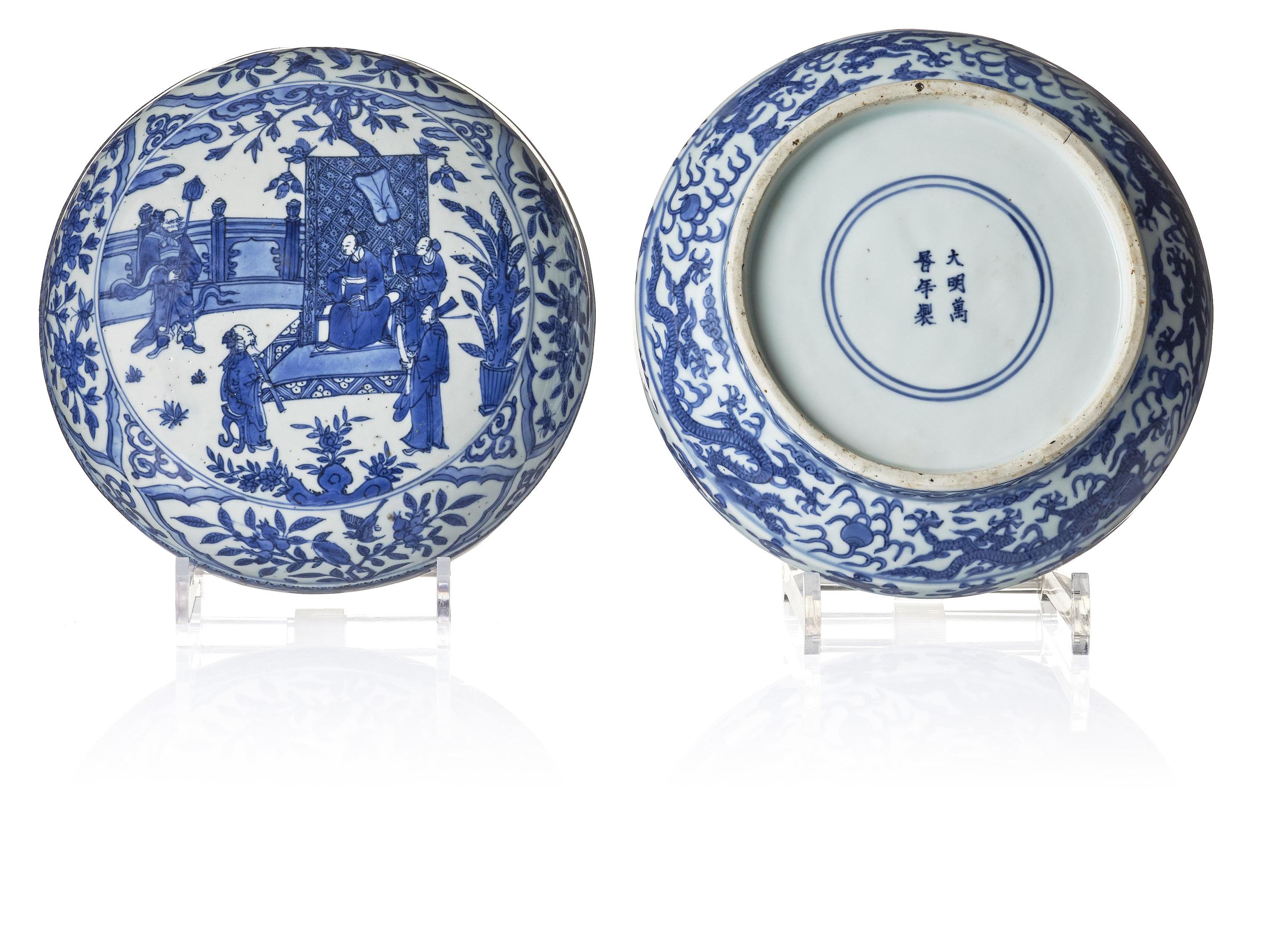
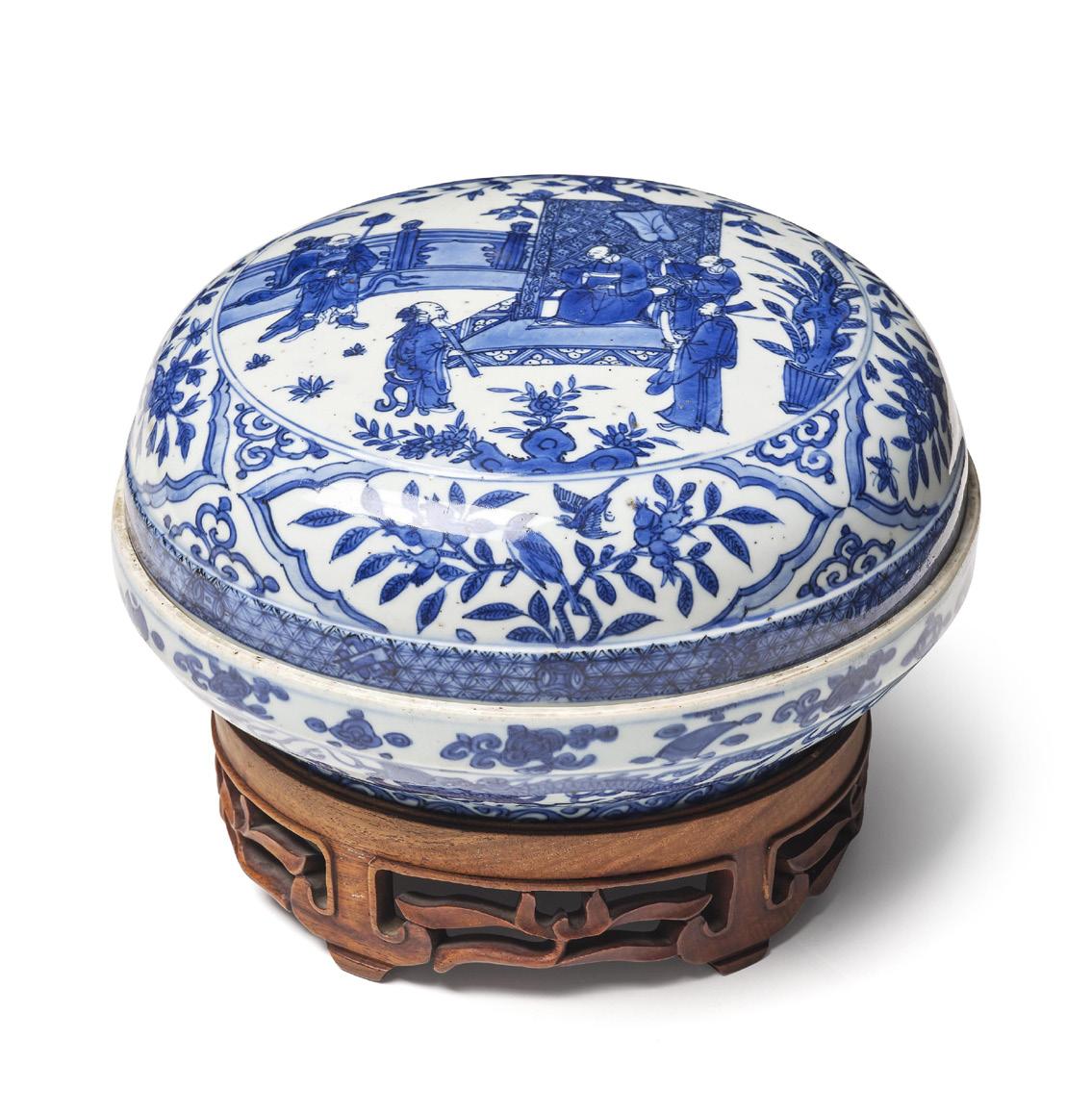
a double circle. Diameter 22.7 cm.
Provenance: From the collection of Rolf Schmitz (1927–2018). Purchased in London in the late 1970s, thence by descent.
Exhibitions: Compare a box of this type and decoration (lower) at Sothebys Hong Kong, Important Chinese Art, lot 3675, 5 April 2017.
Literature: For comparable pieces in litterature, see a box from the Qing court collection and still in Beijing, is illustrated in The Complete Collection of Treasures of the Palace Museum. Blue and White Porcelain with Underglaze Red (II), Shanghai, Shanghai, 2000, pl. 181; one from the collection of the Zwinger in Dresden, is published in Porzellansammlung im Zwinger, Staaliche Kunstsammlungen, Dresden, 1982, p. 12; another in the Ashmolean Museum, Oxford, is illustrated in Daisy Lion-Goldschmidt, Ming Porcelain, London, 1978, pl. 212; a fourth box, in the Metropolitan Museum of Art, New York, is published in Oriental Ceramics. The World’s Great Collections, Tokyo, 1982, vol. 2, pl. 93; and a further example, in the Philadelphia Museum of Art, Philadelphia, was included in the Museum’s exhibition Ming Blue-and-White. An Exhibition of Blue-Decorated Porcelain of the Ming Dynasty, Philadelphia, 1949, and is illustrated in Philadelphia Museum Bulletin, vol. XLIV, no. 223, Autumn 1949, pl. 141.
Estimate: SEK 80 000 – 100 000 / EUR 7 550 – 9 440
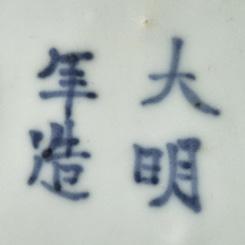
1150. A blue and white writing box, Ming dynasty (1368–1644).
Narrow mid section, of double lozenge shape, divided in to two compartments, with hollow cylindrical columns/holders for pen in each corner, decorated in underglaze blue with flowering branches. The base with four character mark. Length 16.2 cm.
Provenance: Property of a private collector. Purchased at Bukowskis, E519. A private collection of Asian Ceramics and Carpets 2020. Collectors inventory no 1207. Fitted box from previous collector.
Exhibitions: Compare with a box in the Collection of Musee Guimet, lot G 4372.
Estimate: SEK 8 000 – 10 000 / EUR 755 – 944
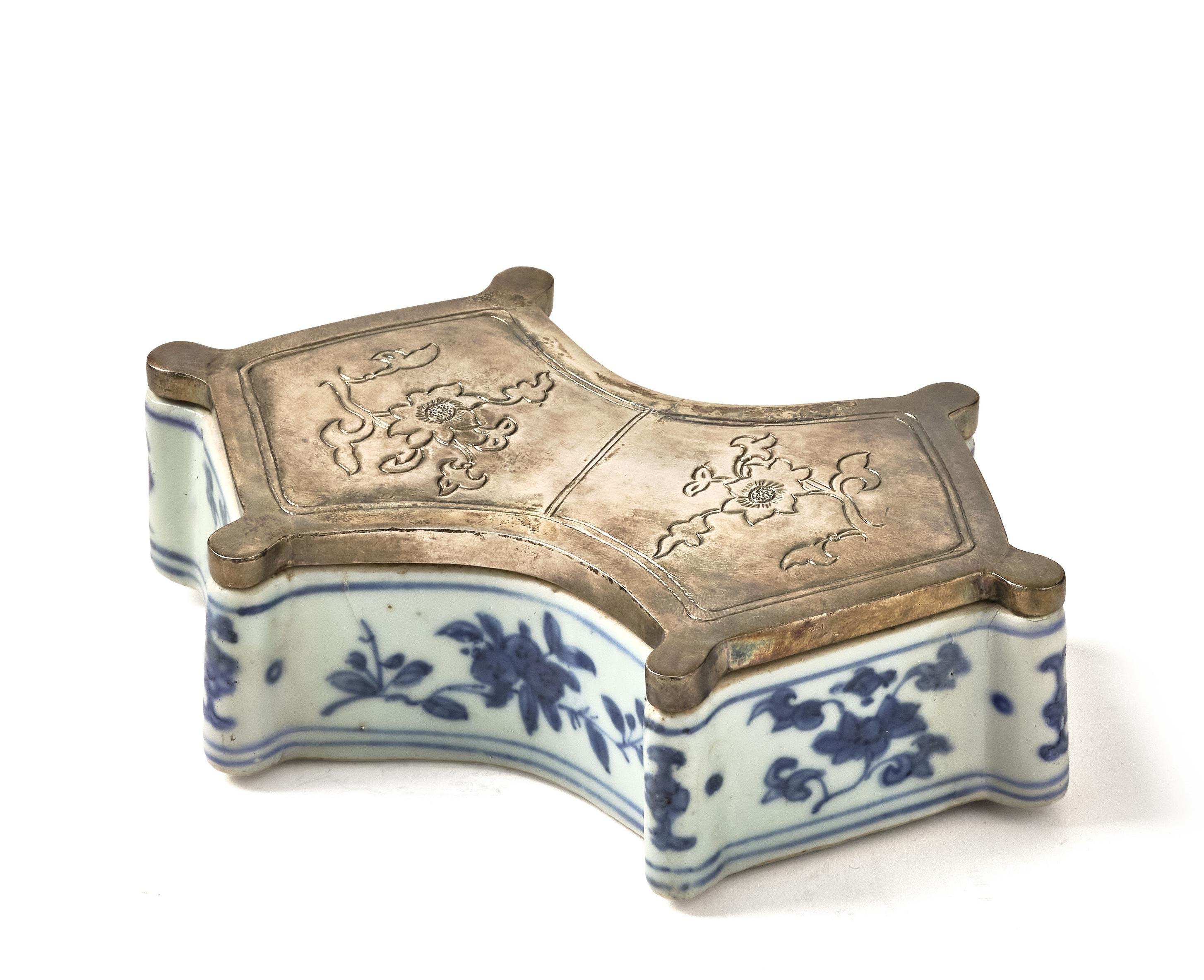
1151. A blue and white ‘boys at play’ jar, late Ming dynasty (1368–1644).
Decorated in underglaze blue with boys playing in a garden setting under the supervision of elegant ladies of the court. Height 12.5 cm.
Provenance: Property of a private Swedish collector.
Estimate: SEK 6 000 – 8 000 / EUR 567 – 755
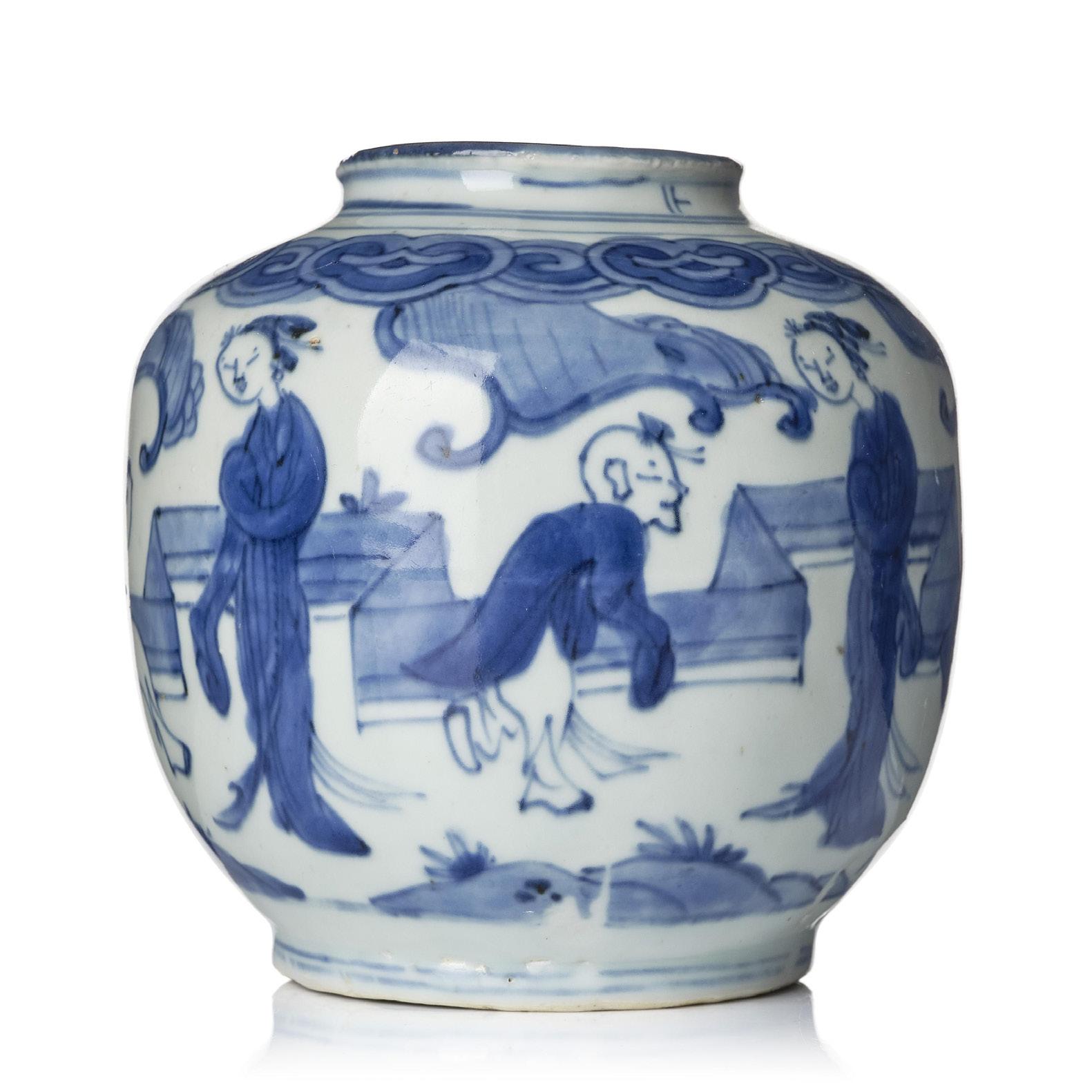
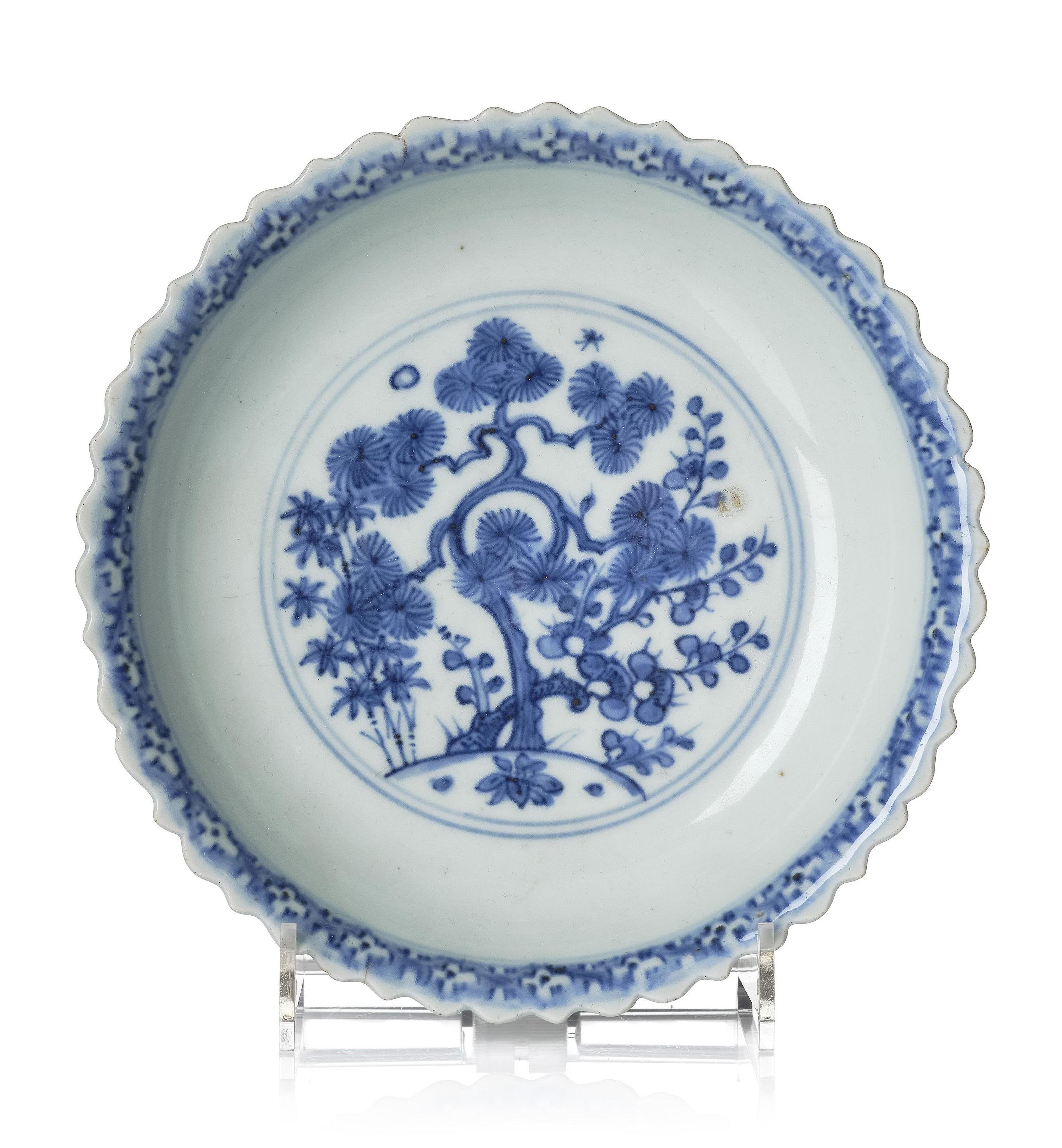
1152. A blue and white dish, Ming dynasty, with Xuande mark.
Lobed rim, decorated in underglaze blue with the three friends, lotus, pine and cherry tree. The reverse decorated with a continuous lotus scroll. The base with a six character mark of Xuande within a double underglaze blue circle. Diameter 15 cm.
Provenance: Label, Carl Kempe, lot 772. From the collection of Mr Liljenberg Hansson, a long time member of the British Oriental Ceramics Society who started to collect Chinese Works of Art in the 1970’s.
Estimate: SEK 40 000 – 60 000 / EUR 3 780 – 5 670
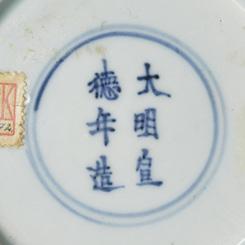
1153. A blue and white ‘geese in flight’ jar, Ming dynasty (1368–1644).
Decorated in underglaze blue with geese in flight. Height 12 cm.
Provenance: Property of a private Swedish collector.
Catalogue note: The wild goose is the more important for poetry, whether as significant of migratory seasonal change, or as “bearing a message of love from afar”, by persons separated by a great distance.
Estimate: SEK 6 000 – 8 000 / EUR 567 – 755
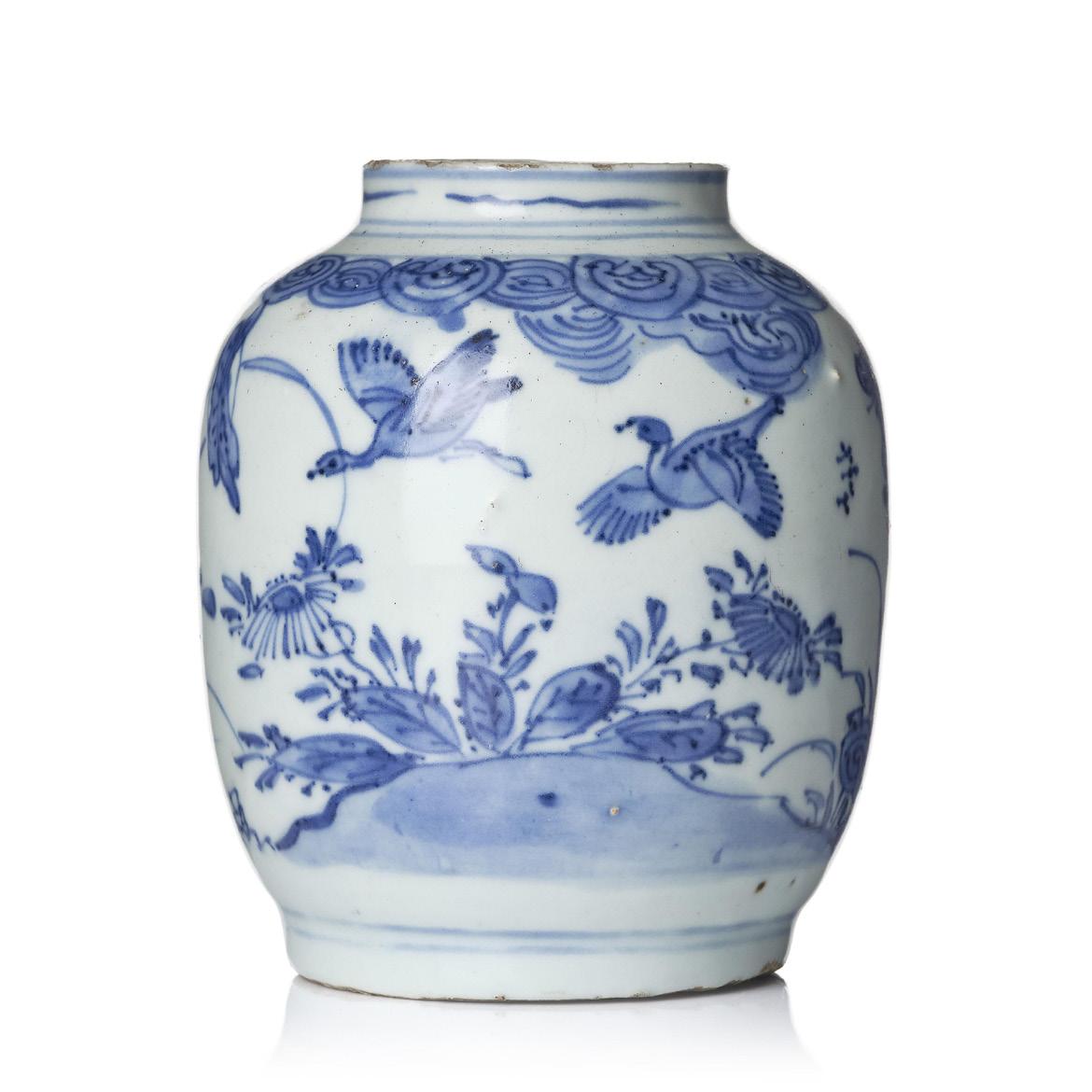
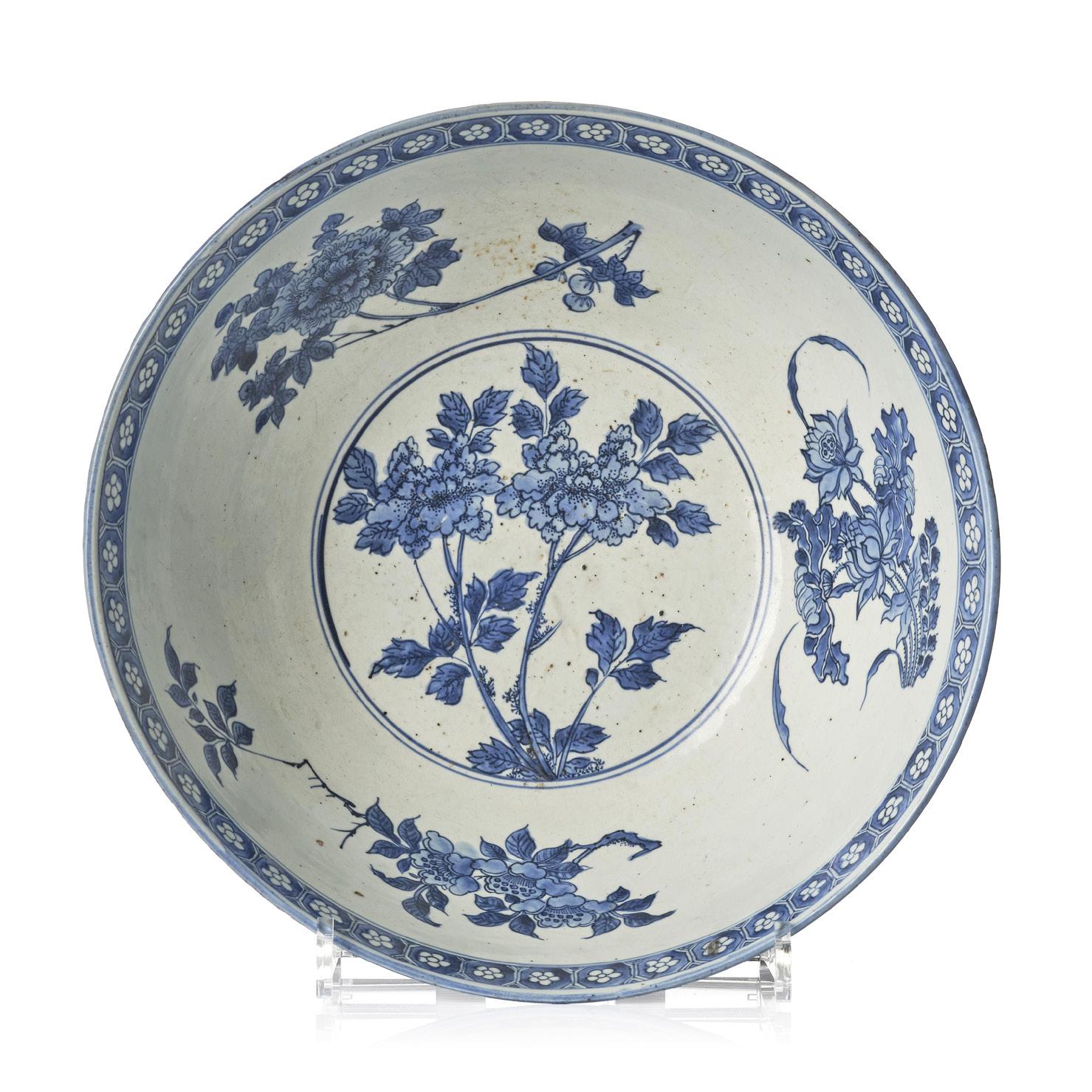
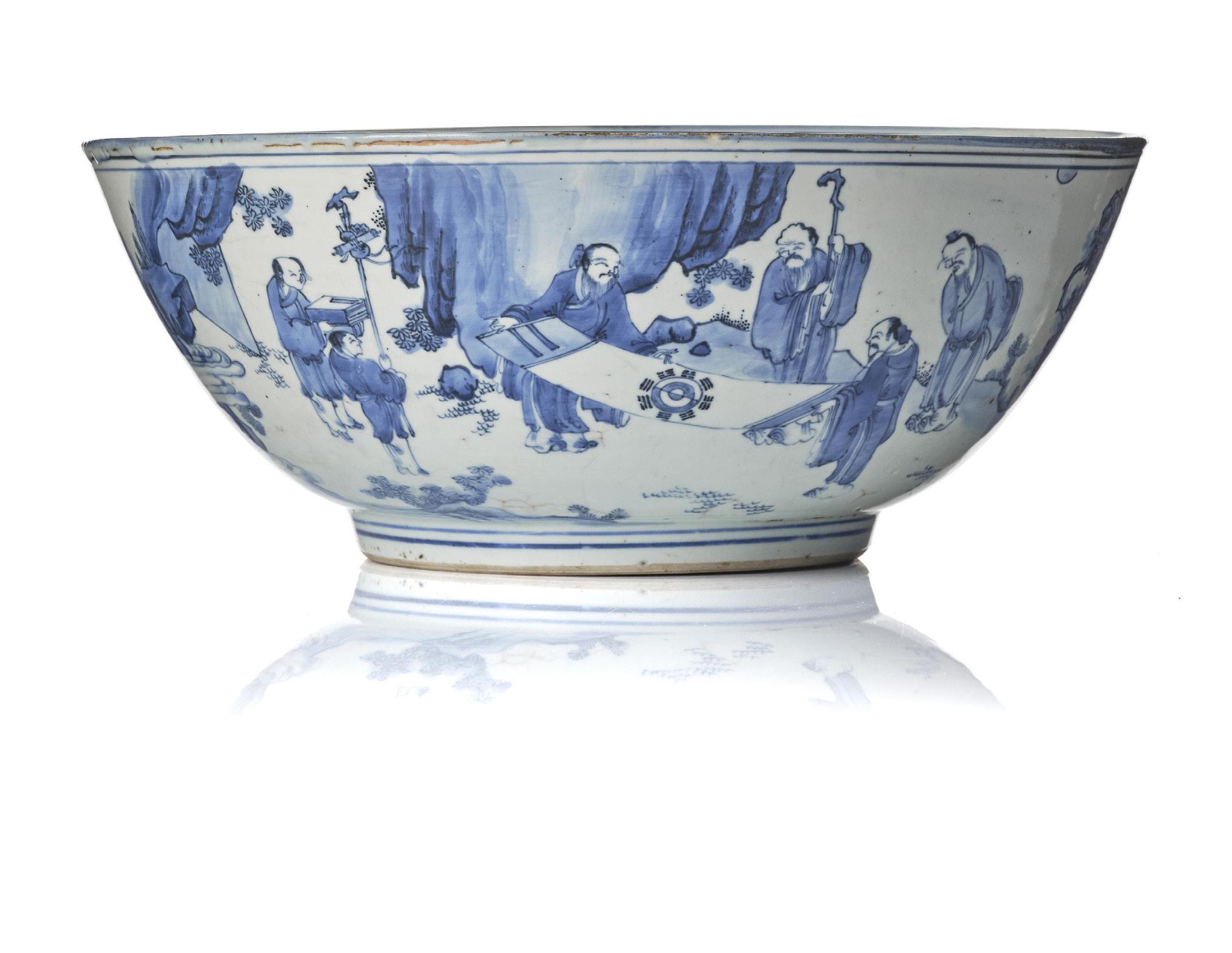
exterior painted in inky cobalt tones, a group of scholars looking at a painting, strolling in a garden and being attended by young boys carrying books and various things. Gusts of clouds swirling all around obscuring the mountainous landscape and dividing the scenes, the interior centered with a medallion enclosing a blossoming peony, around the interior three groups of blossoms such as lotus, peony and prunus. Diameter 34 cm. Height 13,5 cm. Japansk trälåda medföljer, mått 39 x 39,5 x 20 cm.
Provenance: Purchased in the late 1950’s from the collection of Raoul af Geijerstam who collected Chinese Works of Art when he worked for Perstorp AB in Japan in the early 1950’s. Since then within the family.
Exhibitions: Compare with lot 9, Bonhams, The Marsh Collection of 2 November 2023 at Bonhams Bond Street, London for a bowl with the similar type of flowers to the interior. Compare with lot 28, Sothebys, HOTUNG |
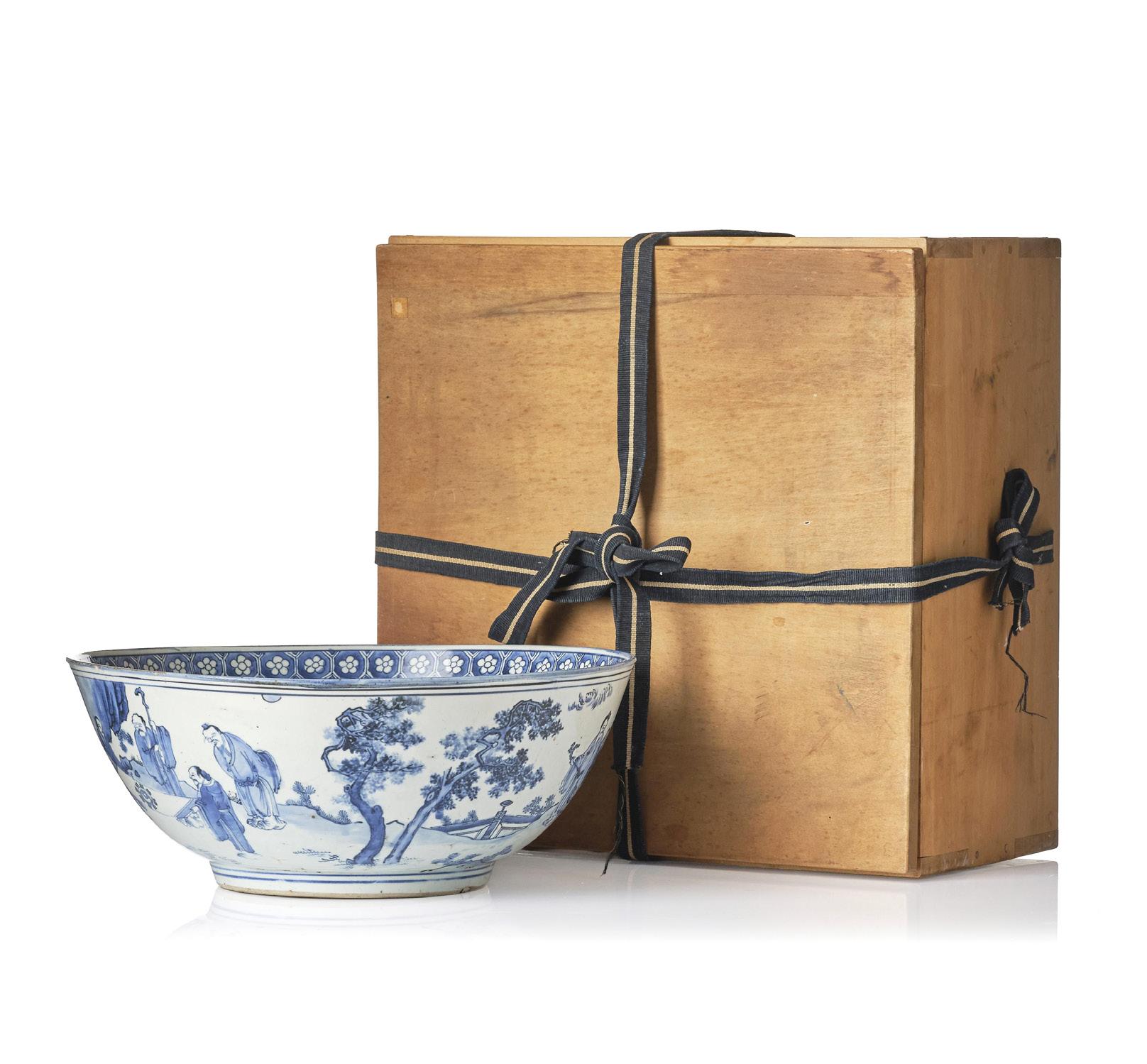
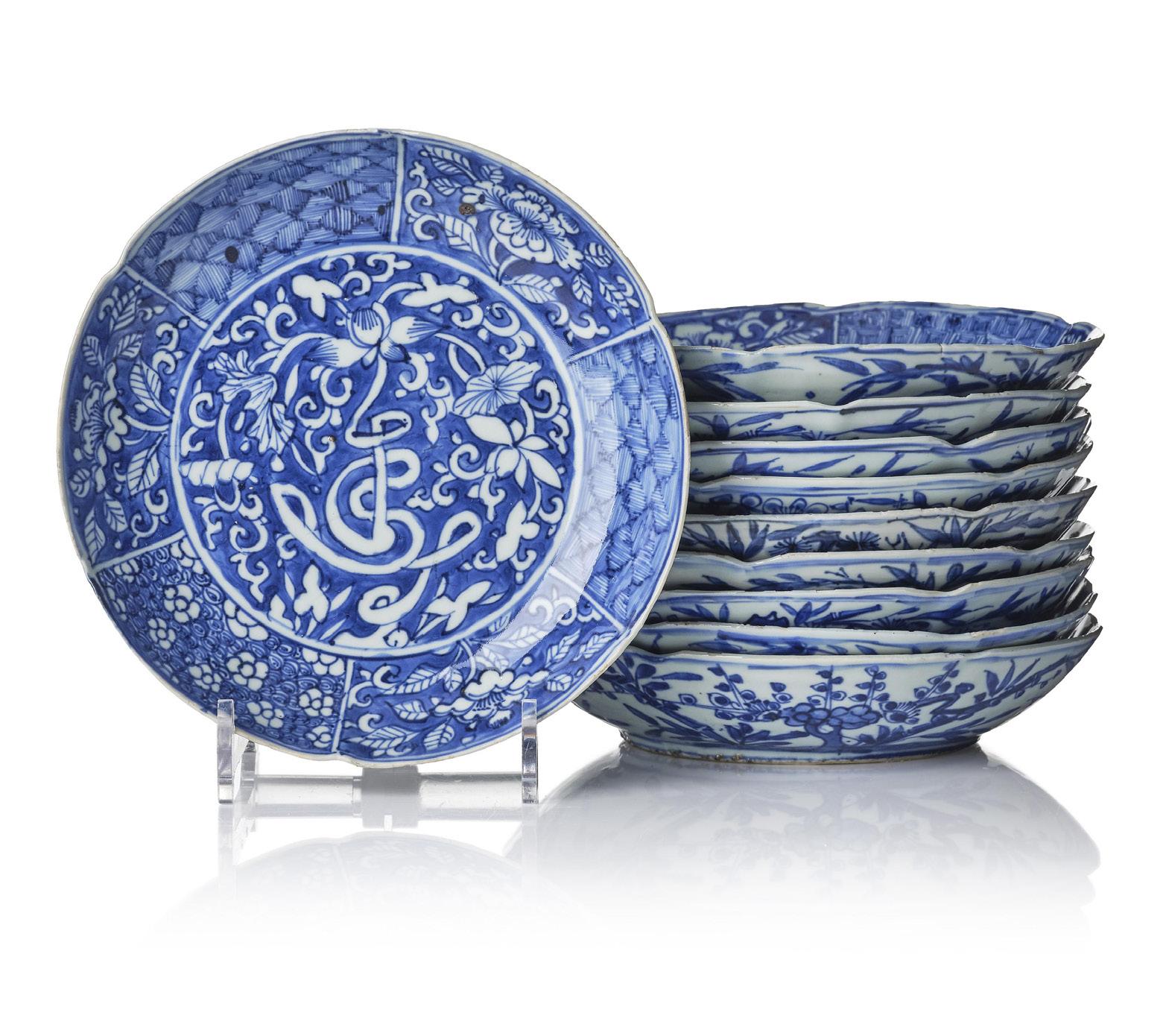
1156. A set of 10 blue and white dishes, Tianqi/Chongzhen, 17th century.
Moulded shape, reverse decorated with a floral scroll. In the center of the cavetto lingzhi fungus. Apocryphal six character Chenghua mark to base. Diameter 22 cm.
Provenance: Purchased in the late 1950’s from the collection of Raoul af Geijerstam who collected Chinese Works of Art when he worked for Perstorp AB in Japan in the early 1950’s. Since then within the family.
Estimate: SEK 15 000 – 20 000 / EUR 1 420 – 1 890
1155. A set of 10 blue and white dishes, Tianqi/ Chongzhen, 17th century.
Six lobed reverse decorated with different flowers and stylized patterns in each lobe, central cavetto with a shou character against a lotus pond. The reverse further decorated with bamboo, pine and cherry blossom. Hallmark to base. Diameter c. 21.3 cm. Japanese wooden box accompanies this lot. Measure wooden box 54 x 26 x 26.5 cm.
Provenance: Purchased in the late 1950’s from the collection of Raoul af Geijerstam who collected Chinese Works of Art when he worked for Perstorp AB in Japan in the early 1950’s. Since then within the family.
Estimate: SEK 15 000 – 20 000 / EUR 1 420 – 1 890
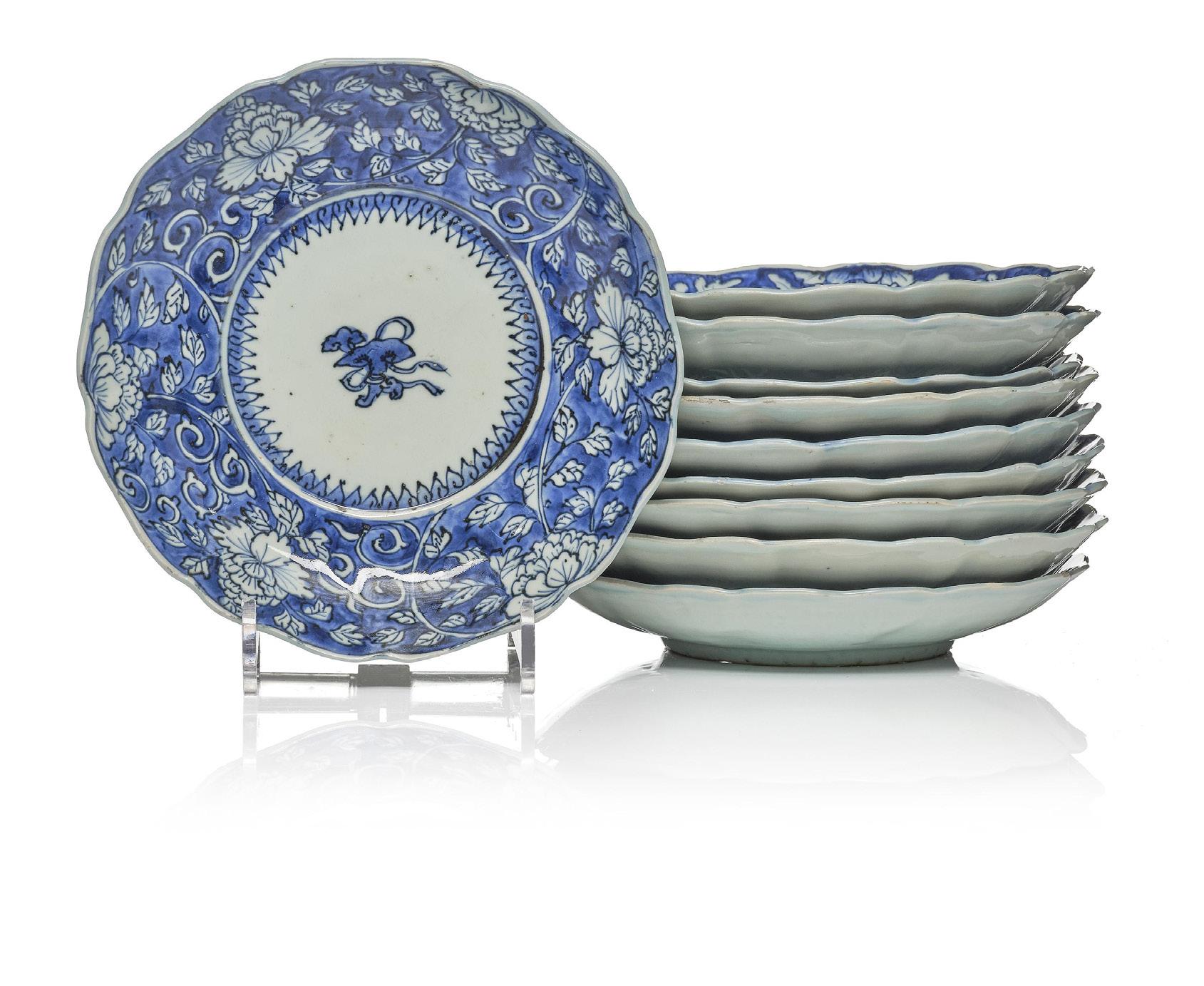
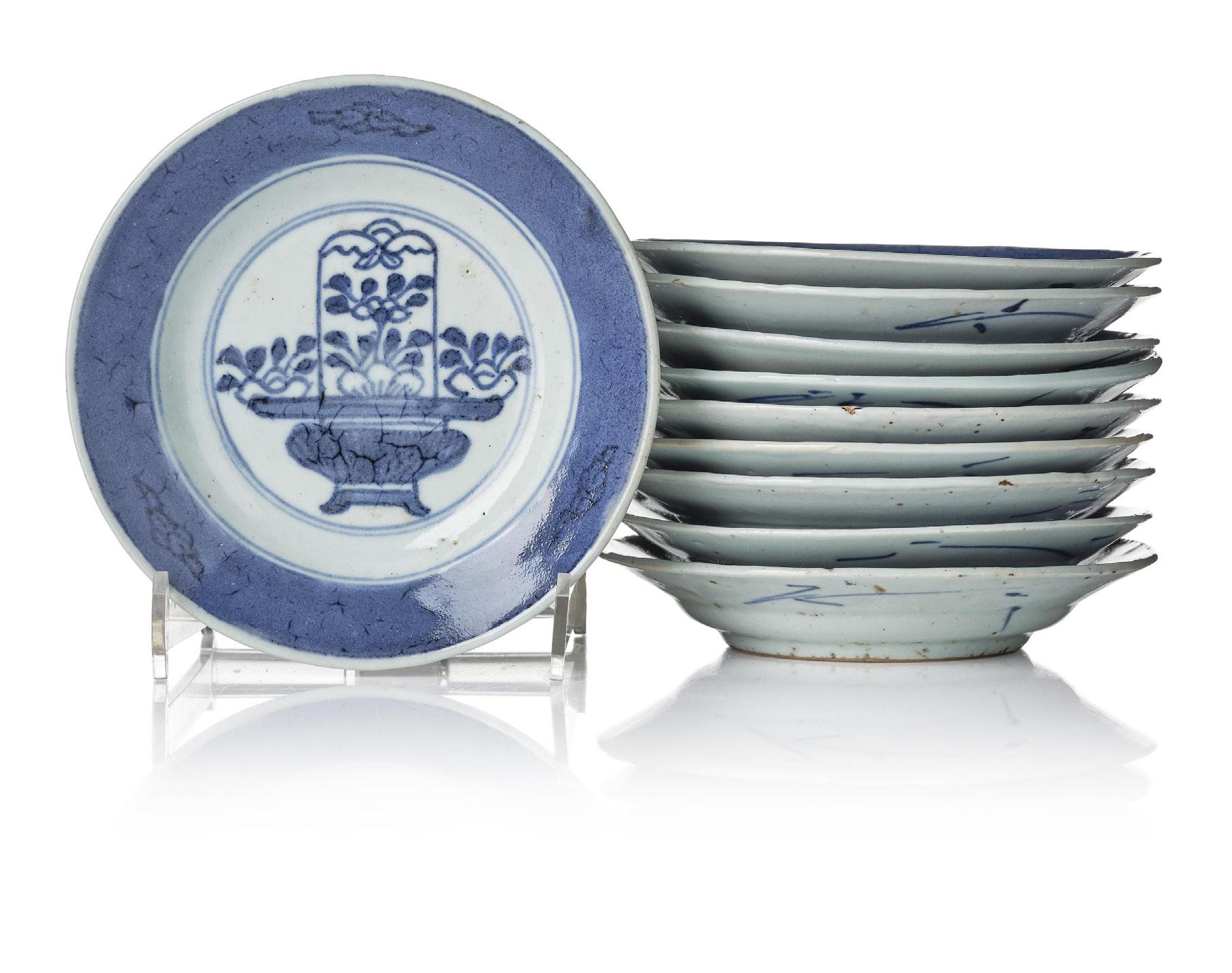
1157. A group of 10 blue and white small dishes, Qing dynasty, 18th century. Decorated in underglaze blue with a floral basket. Diameter 11.5 cm. Japanese wooden box accompanies the set. Measure 26 x 14 x 11 cm.
Estimate: SEK 8 000 – 10 000 / EUR 755 – 944
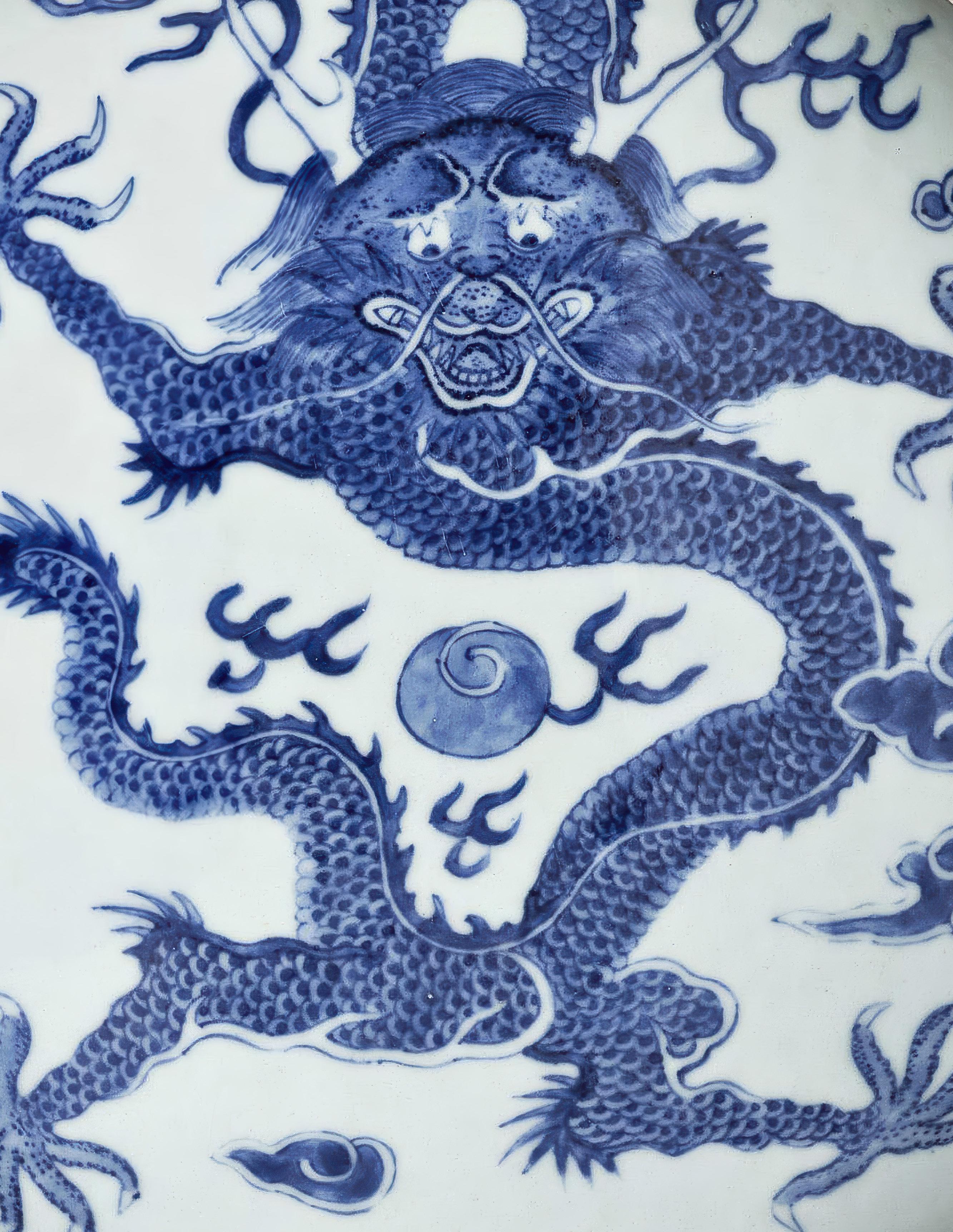
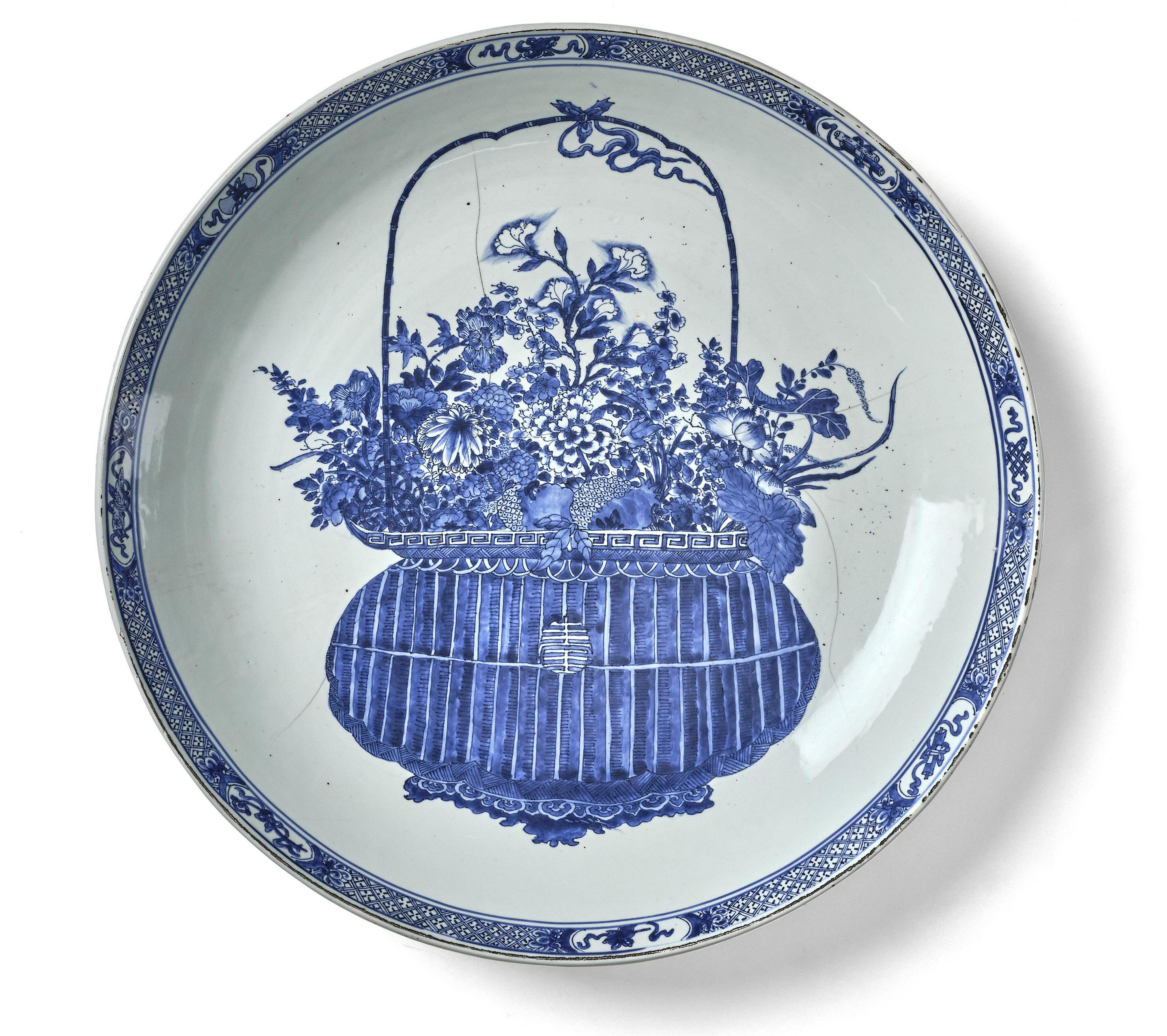
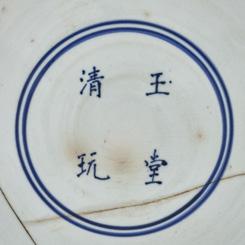
1157 A. A massive blue and white charger, Qing dynasty, early Kangxi (1662–1722) with a Yu Tang Jia Qi mark.
The shallow, rounded sides rising from a tapered foot to a broad flared rim, the interior finely painted with a large woven bamboo basket set on a stand with ruyi-head feet, the rounded sides of the basket supporting a flared rim overflowing with chrysanthemum, aster, peony, magnolia, pomegranate blossoms, and other flowers beneath a tall, beribboned bamboo handle. The mark on the base is in underglaze blue and within a double circle, can be translatet as ‘beautiful vessel for the jade hall’. Diameter 60 cm. On a later mahogany base with claw-and-ball feet, branded AB CE Jonsson Stockholm 21/1 21 5994. Height 63 cm.
Provenance: Property of a private Swedish Estate.
Estimate: SEK 6 000 – 8 000 / EUR 567 – 755
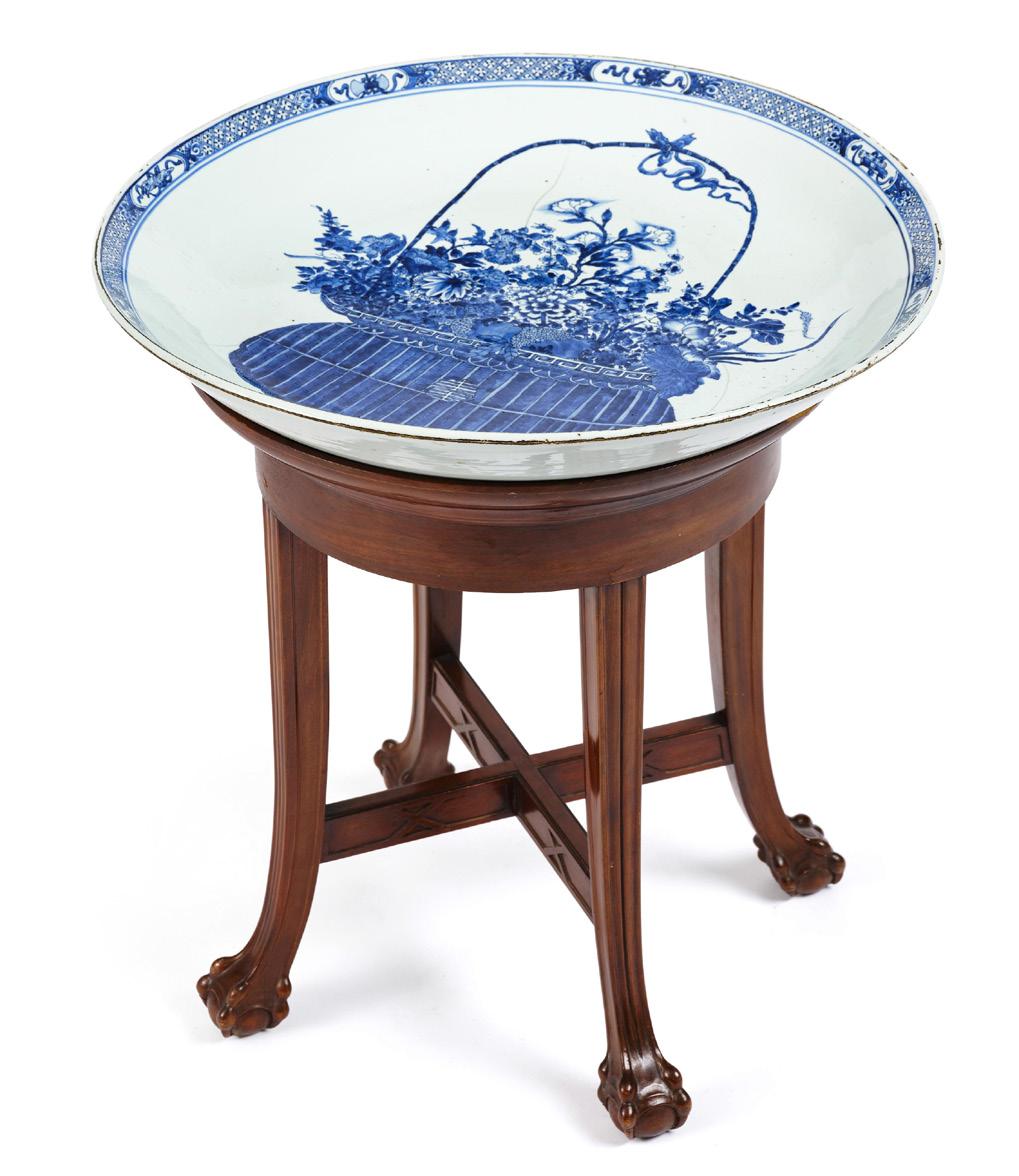
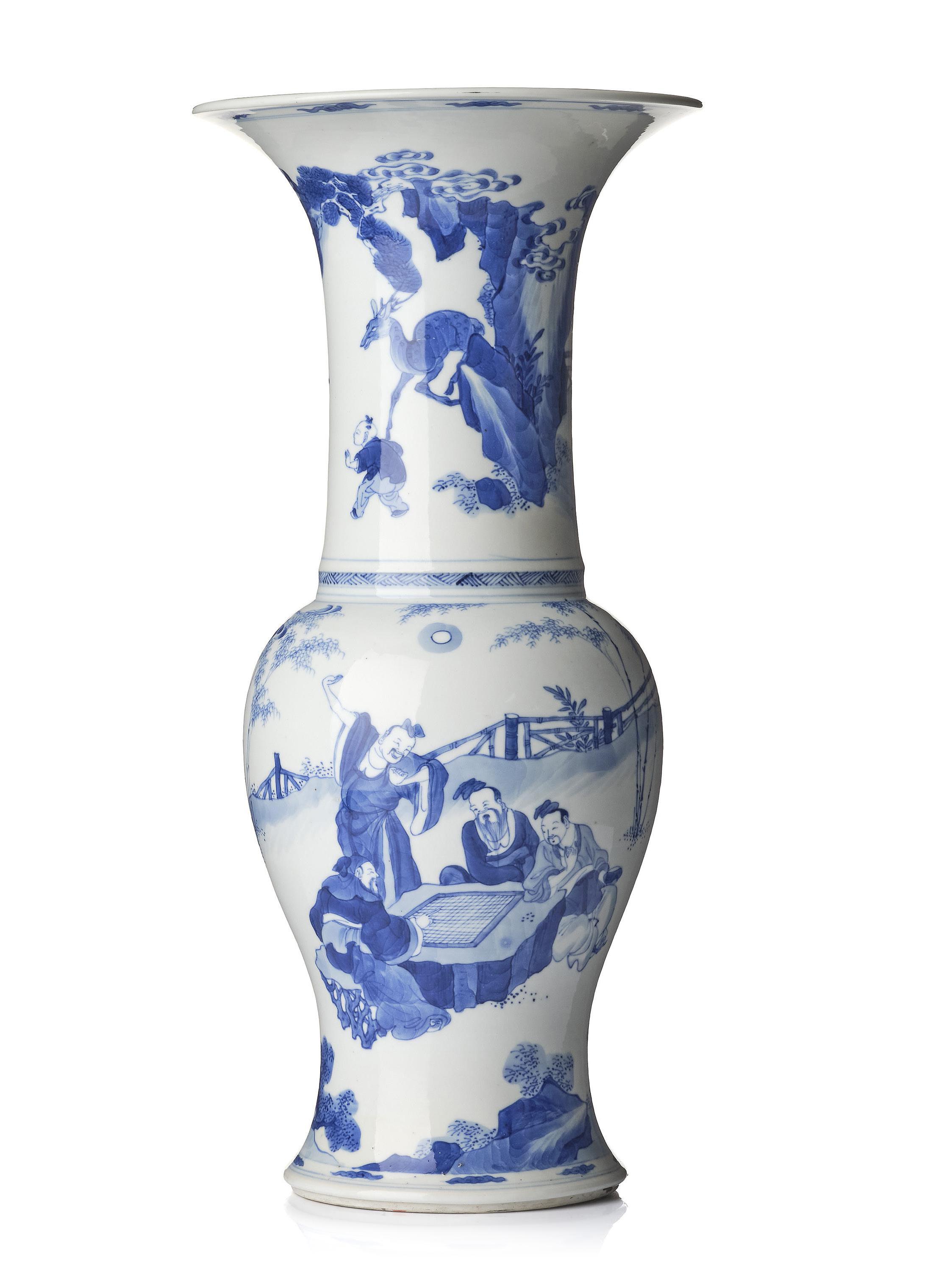
1158. A large blue and white ‘figural’ yenyen vase, Qing dynasty, Kangxi (1662–1722).
Elongated shape with a flared rim, underglaze blue decoration with two sections of figure scenes The upper section with shoulaou with his crane and a group of men and boys. The lower section with a group of scholars playing a bordgame in a landscape setting. Height 46.5 cm.
Provenance: Property of a private Swedish collector.
Estimate: SEK 40 000 – 60 000 / EUR 3 780 – 5 670
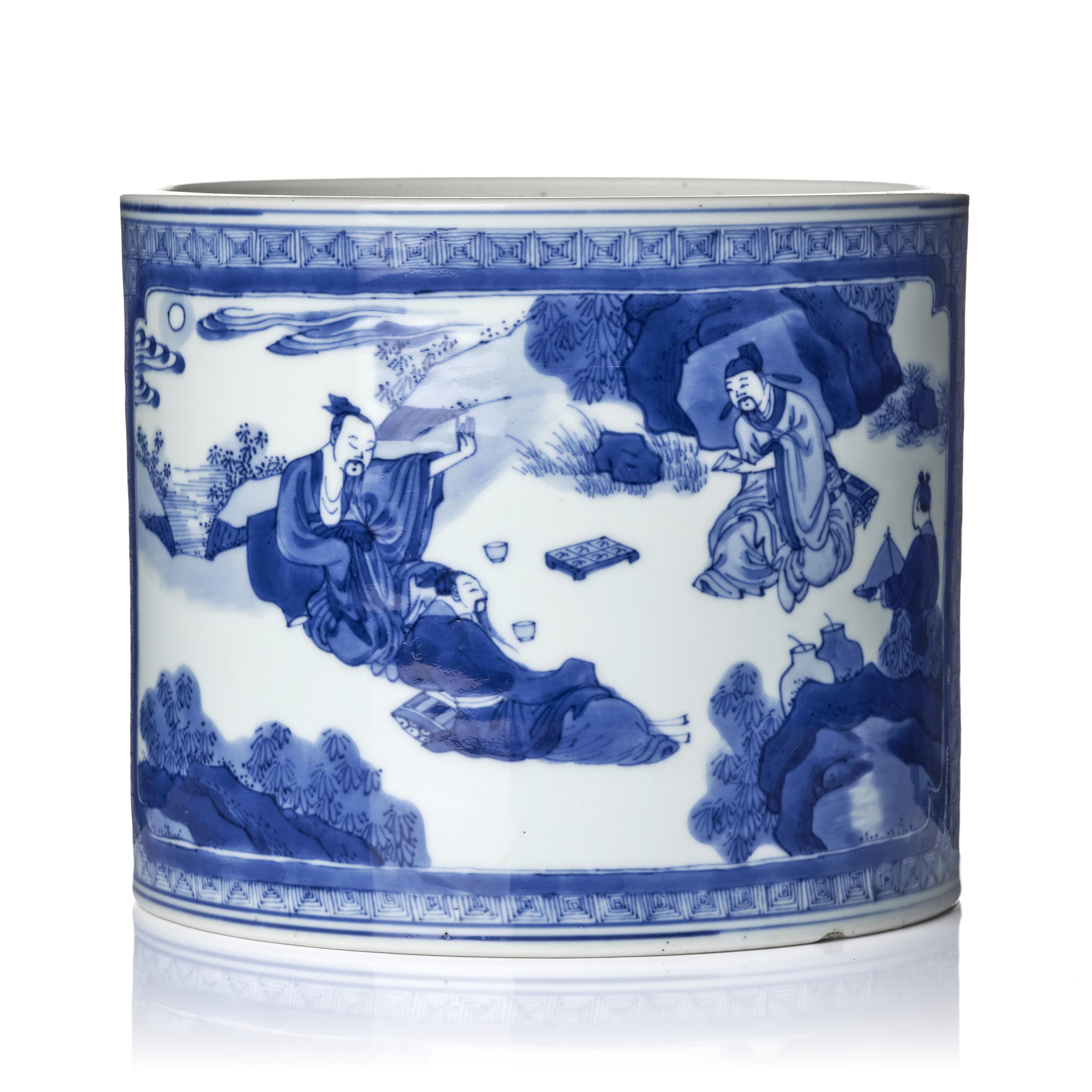
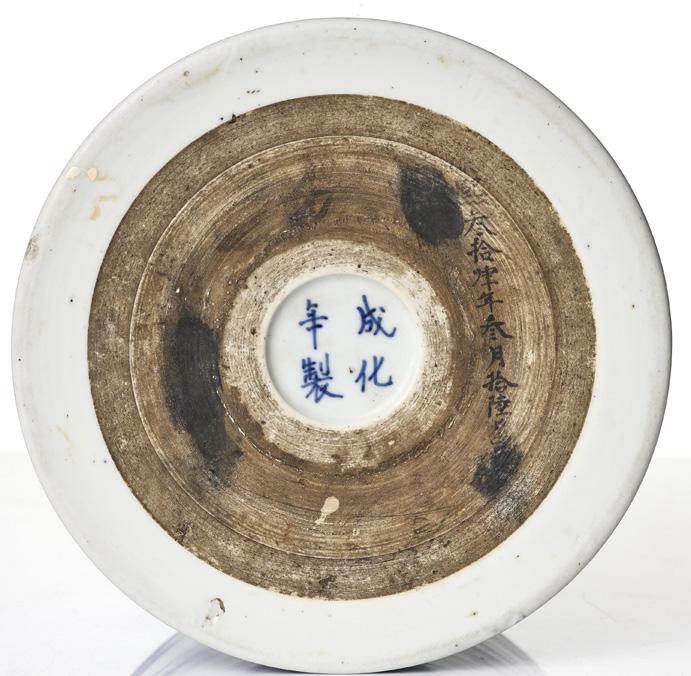
1159. A blue and white ‘scholars’ brush pot/bitong, Qing dynasty, Kangxi (1662–1722).
Decorated in underglaze blue with two central scenes depicting the literati on an outing in nature with attendants preparing for them to engage in scholarly pursuits, one can see a wrapped qin intrument, books, and other things being brought along. The countersunk base is inscribed with an apocryphal Chenghua mark. Height 15 cm. Diameter 18 cm.
Provenance: Property of a private Swedish collector, purchased by the present owners in Stockholm at auction in the early 1920’s thence by descent. Sigge Björcks Konsthandel, 1924, from the Collection of C E Gadelius, lot no 110.
Catalogue note: The mark in black reads 康熙叁拾四年叁月拾陸日 The sixteenth day of the third month of the thirty-fourth year of the Kangxi period.
Estimate: SEK 100 000 – 150 000 / EUR 9 440 – 14 200
1160. A blue and white ‘cracked-ice’ vase, Qing dynasty, Kangxi (1662–1722).
A baluster shaped vase, decorated in underglaze blue with shou characters and prunus against a cracked ice decoration. Height 33.5 cm.
Provenance: Property of a private Swedish collector.
Estimate: SEK 8 000 – 10 000 / EUR 755 – 944
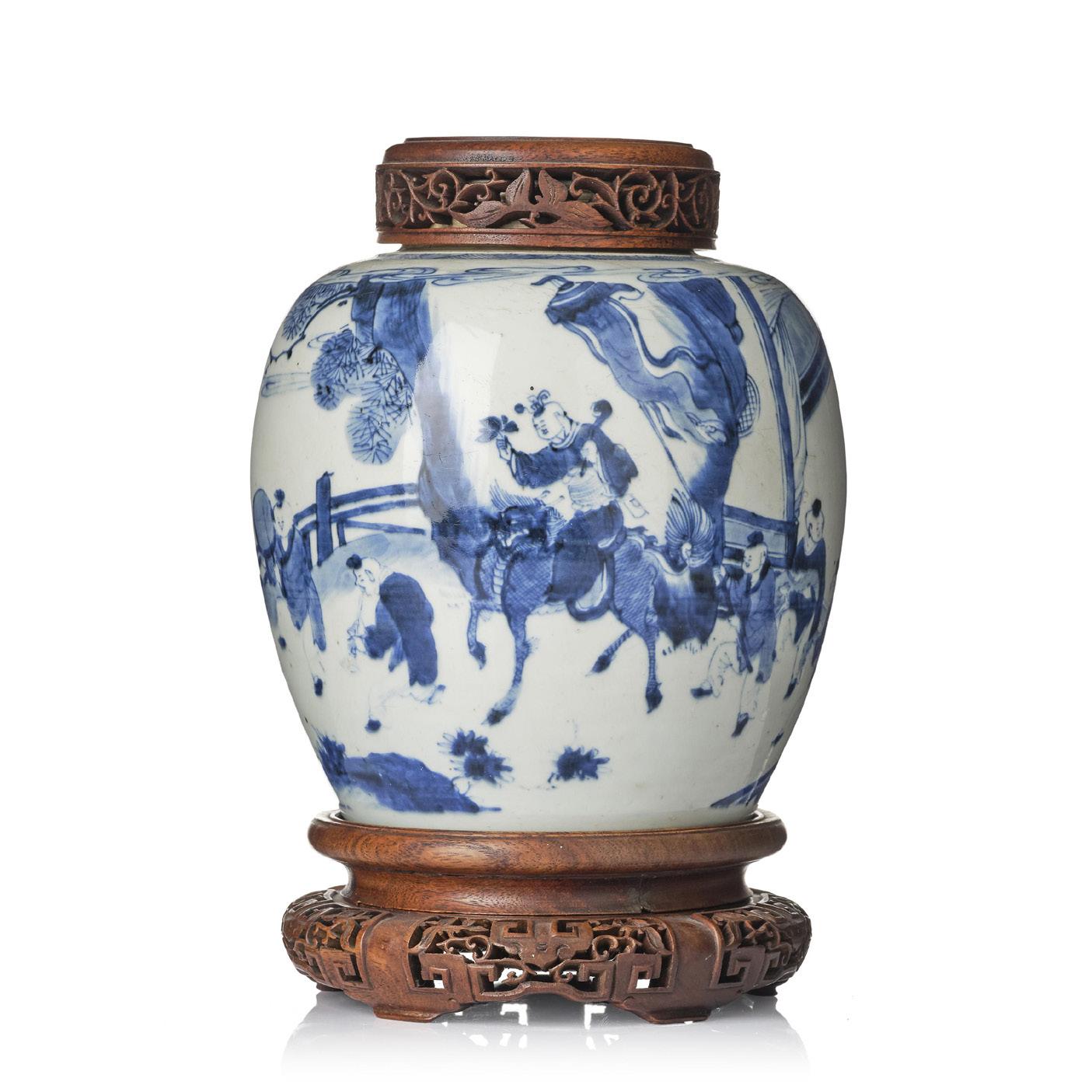
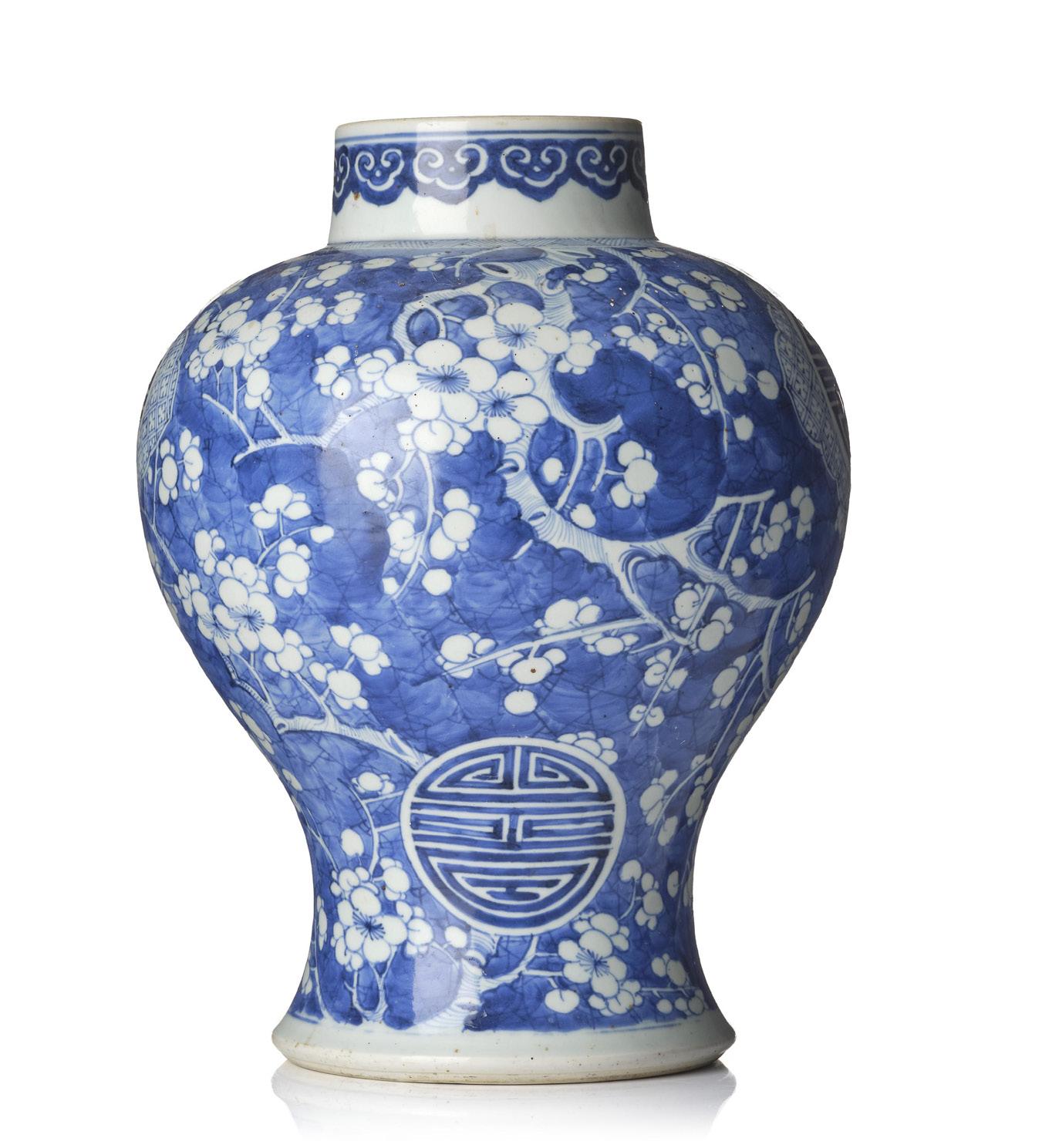
1161. A blue and white ‘boys at play’ jar, Qing dynasty, Kangxi (1662–1722).
Of ovoid shape, decorated in underglaze blue with boys at play in a palace garden setting. Height 22.5 cm. Height with wooden cover and stand 30 cm.
Property of a private Swedish Estate. SEK 8 000 – 10 000 / EUR 755 – 944
1162. A pair of blue and white ‘floral’ vases, Qing dynasty, Kangxi (1662–1722).
Of trumpet shape, decorated in underglaze blue with a continuous floral scroll. Height 25.5 cm.
Estimate: SEK 6 000 – 8 000 / EUR 567 – 755
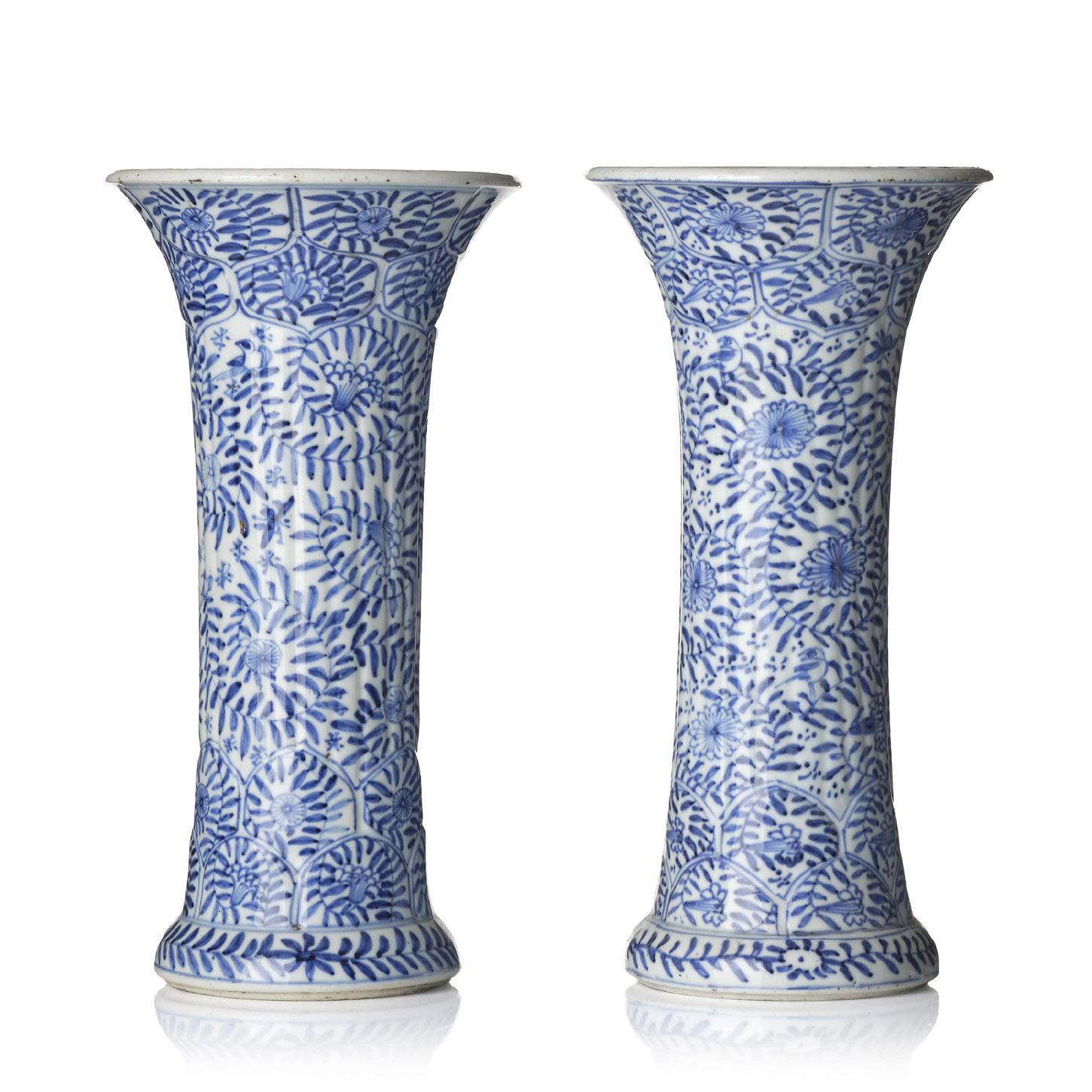
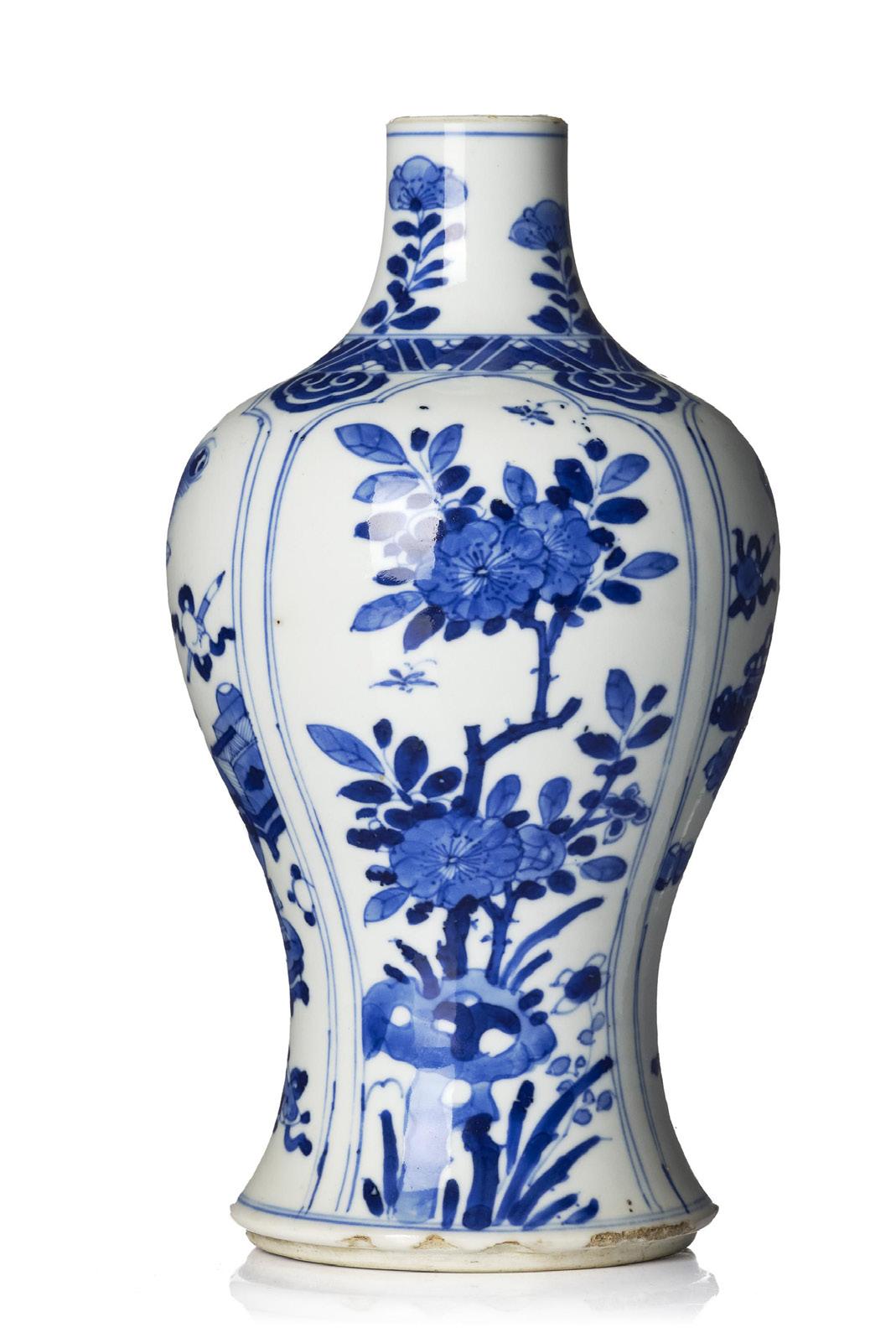
1163. A blue and white ‘antiques’ vase, Qing dynasty, Kangxi (1662–1722).
Of Meiping shape but with an elongated neck, decorated in a vibrant underglaze blue with antiques and flowers. Height 21.5 cm.
Provenance: Property of a private Swedish collector.
Estimate: SEK 6 000 – 8 000 / EUR 567 – 755
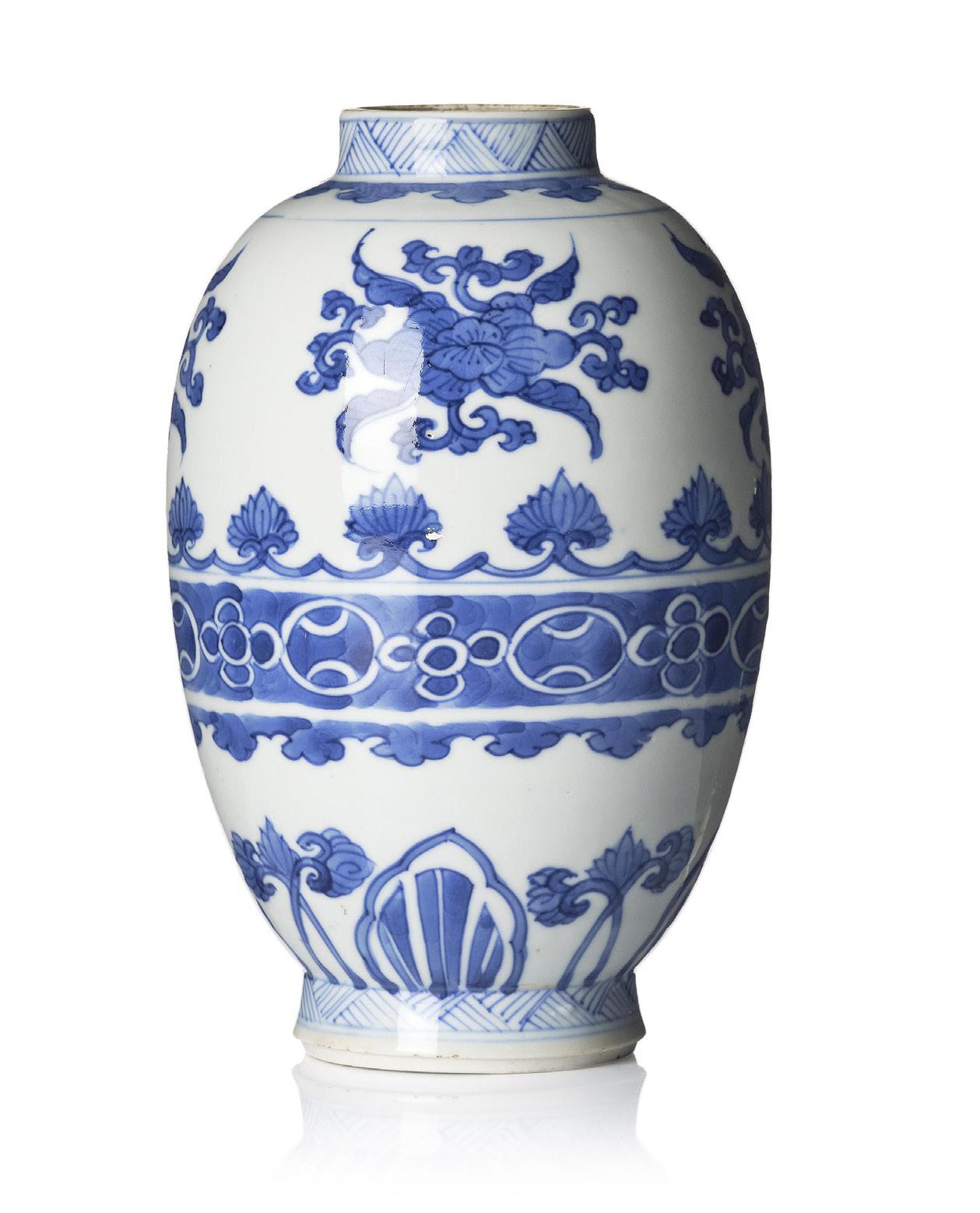
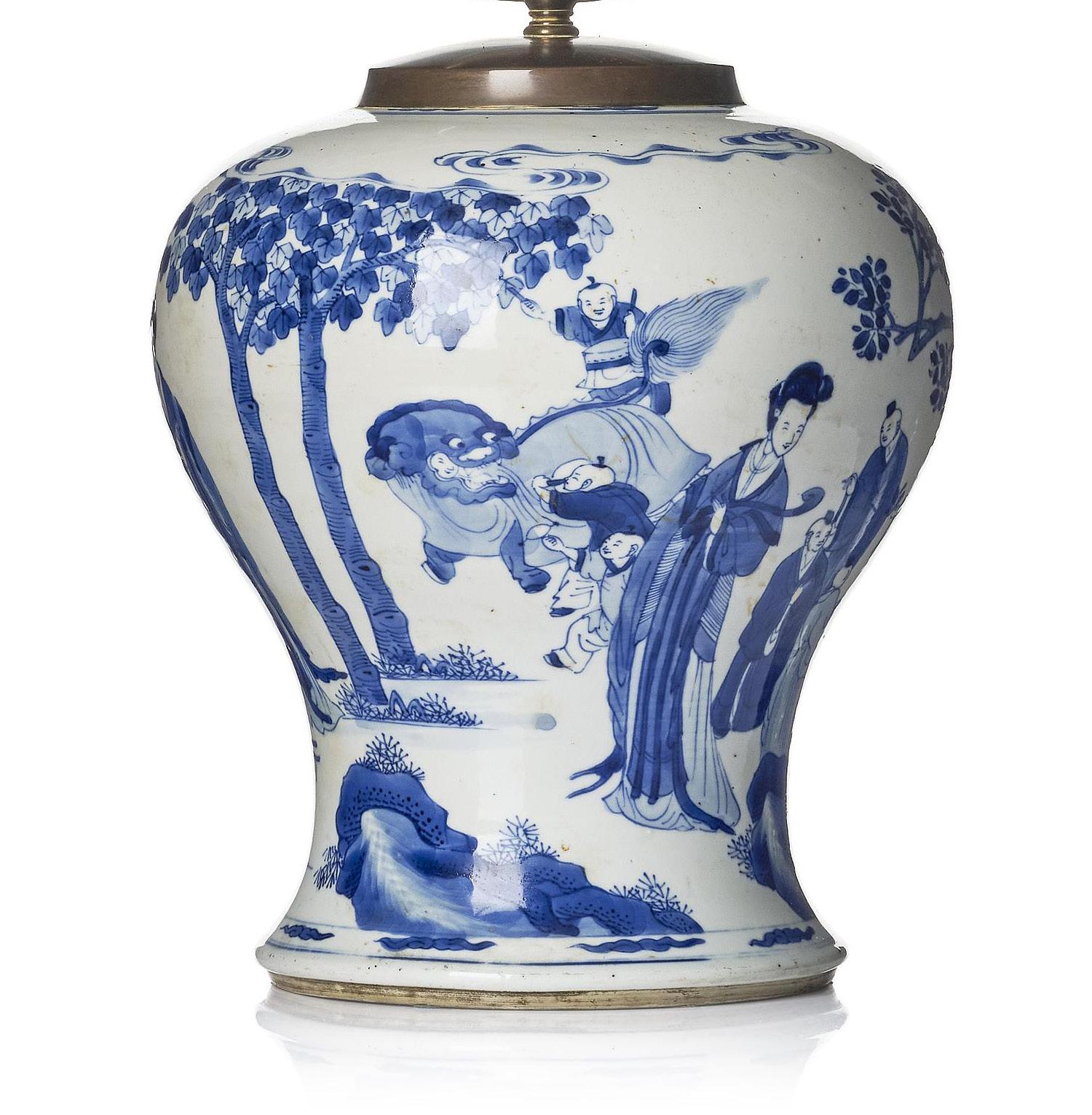
Kangxi (1662–1722).
Of baluster shape, decorated in underglaze blue with a lively scene with boys at play dressing up as a buddhist lion, playing drums, attending class and playing blind fold in a garden setting. Height 28.5 cm. Height with mount as a lamp 59 cm.
Provenance: Property of a private collector. Old inventory label to base 16805.
Estimate: SEK 12 000 – 15 000 / EUR 1 130 – 1 420
1165. A blue and white ‘floral’ jar, Qing dynasty, Kangxi (1662–1722).
Of ovoid shape, decorated in underglaze blue with stylized bands and flowers. Height 17.5 cm.
Property of a private Swedish collector. SEK 4 000 – 6 000 / EUR 378 – 567
1166. A blue and white ‘floral’ bowl, Qing dynasty, Kangxi (1662–1722).
Moulded and decorated in underglaze blue with flowers. Diameter 21 cm.
Provenance: Property of a private Swedish collector.
Estimate: SEK 8 000 – 10 000 / EUR 755 – 944
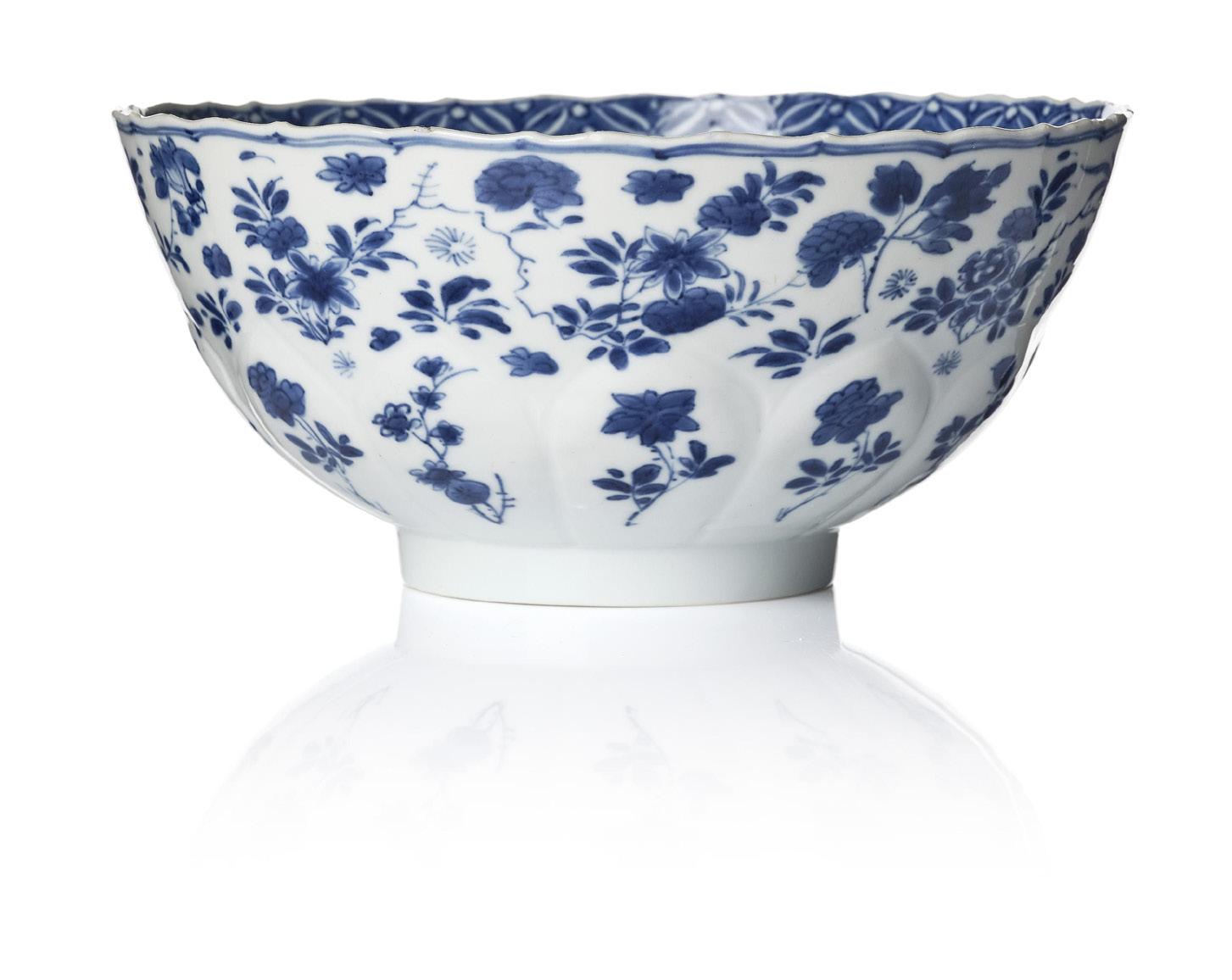
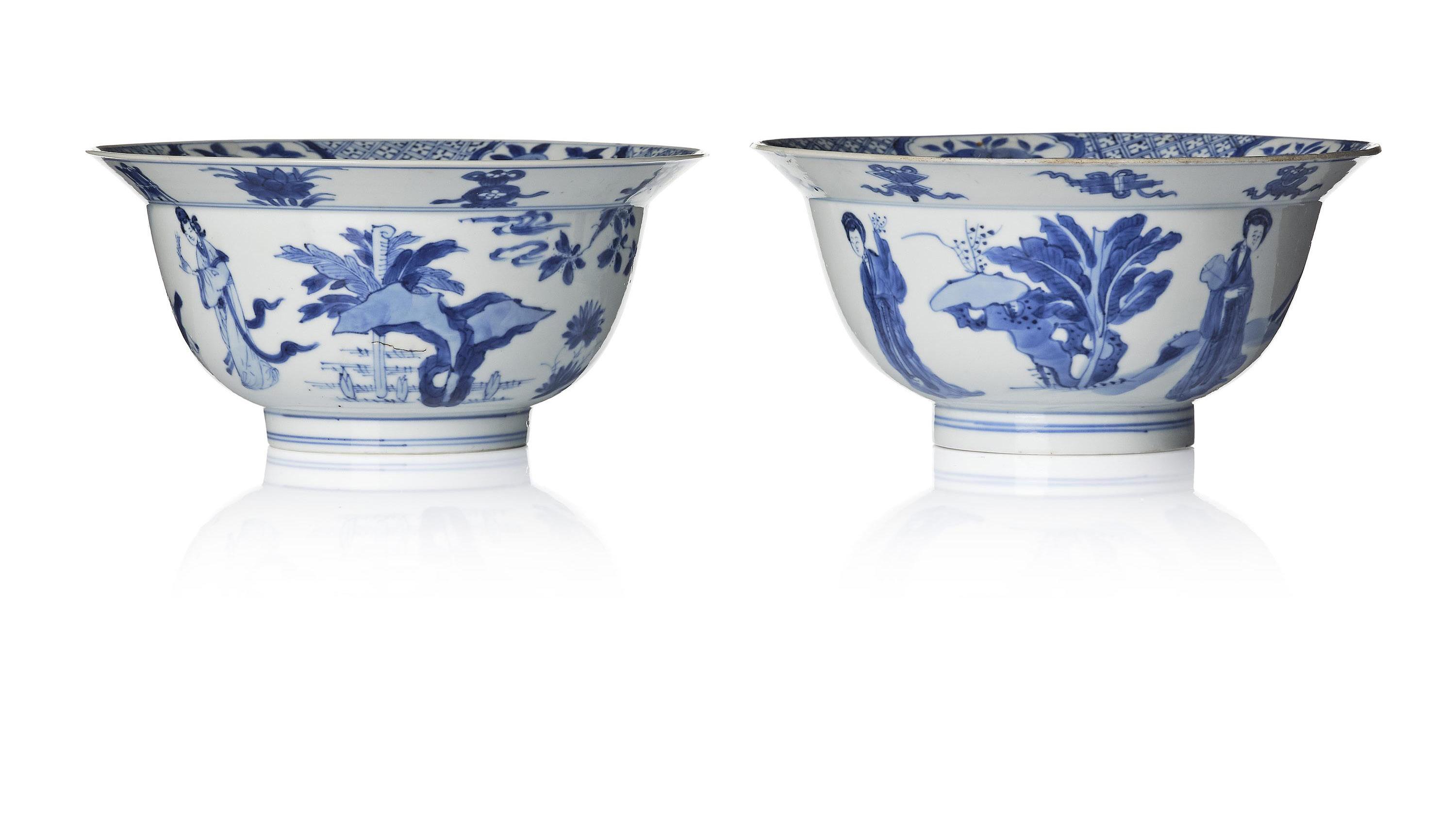
1167. A pair of blue and white ‘boys at play’ bowls, Qing dynasty, Kangxi (1662–1722).
Rounded sides that rises from a short straight footrim and ends with an everted rim, decorated in underglaze blue with boys at play in a garden setting accompanied by elegant ladies. The base with Chenghua six character apocryphal reign mark within a double circle. Diameter 16 cm. Height 7.5 cm.
Provenance: Property of a private Swedish Estate.
Estimate: SEK 15 000 – 20 000 / EUR 1 420 – 1 890
1168. A blue and white jug with cover, Qing dynasty, Kangxi (1662–1722).
After a European model, decorated in underglaze blue with antiques and precious objects. Height 13.5 cm.
Provenance: Property of a private Swedish Estate.
Estimate: SEK 4 000 – 6 000 / EUR 378 – 567
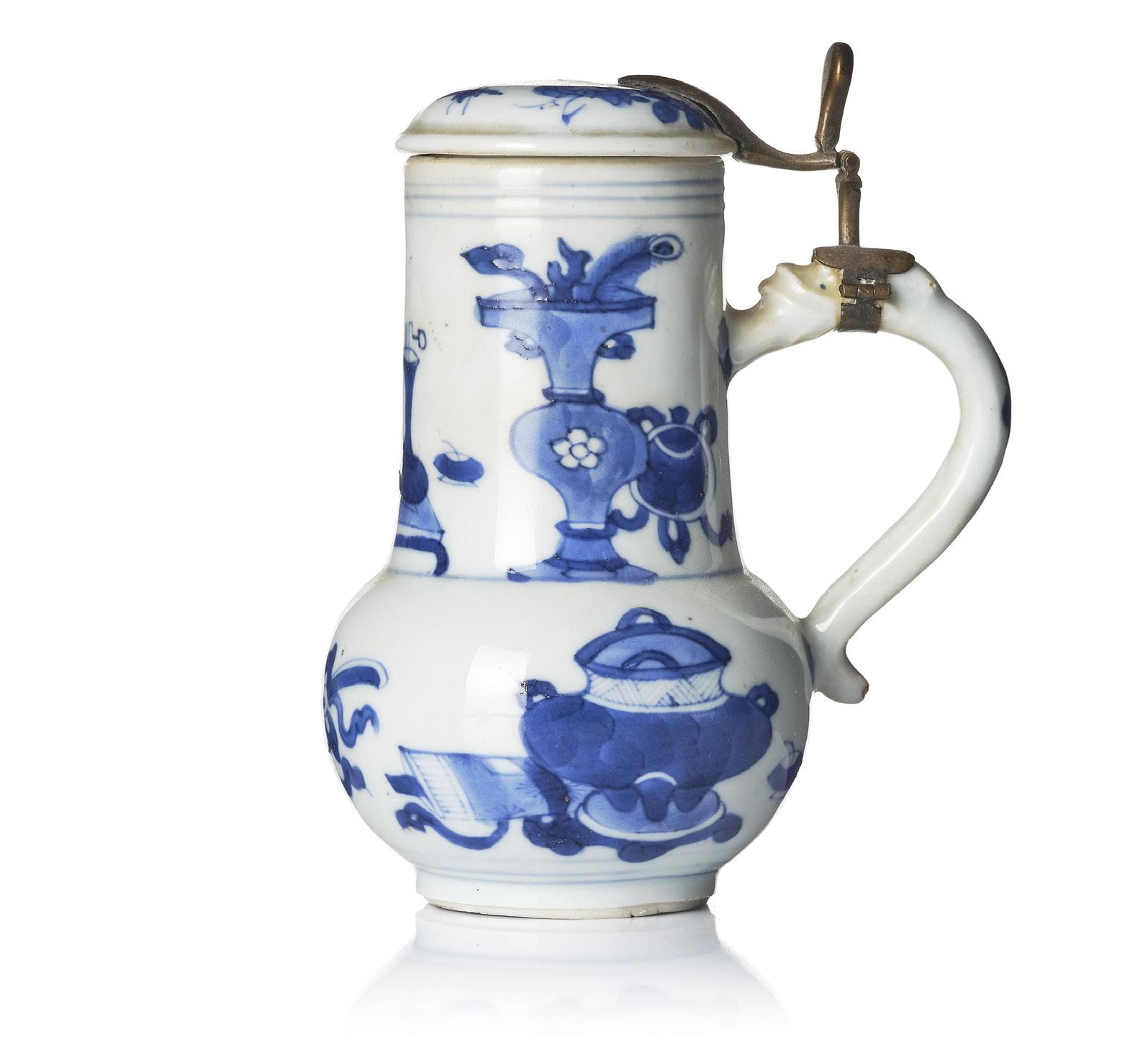
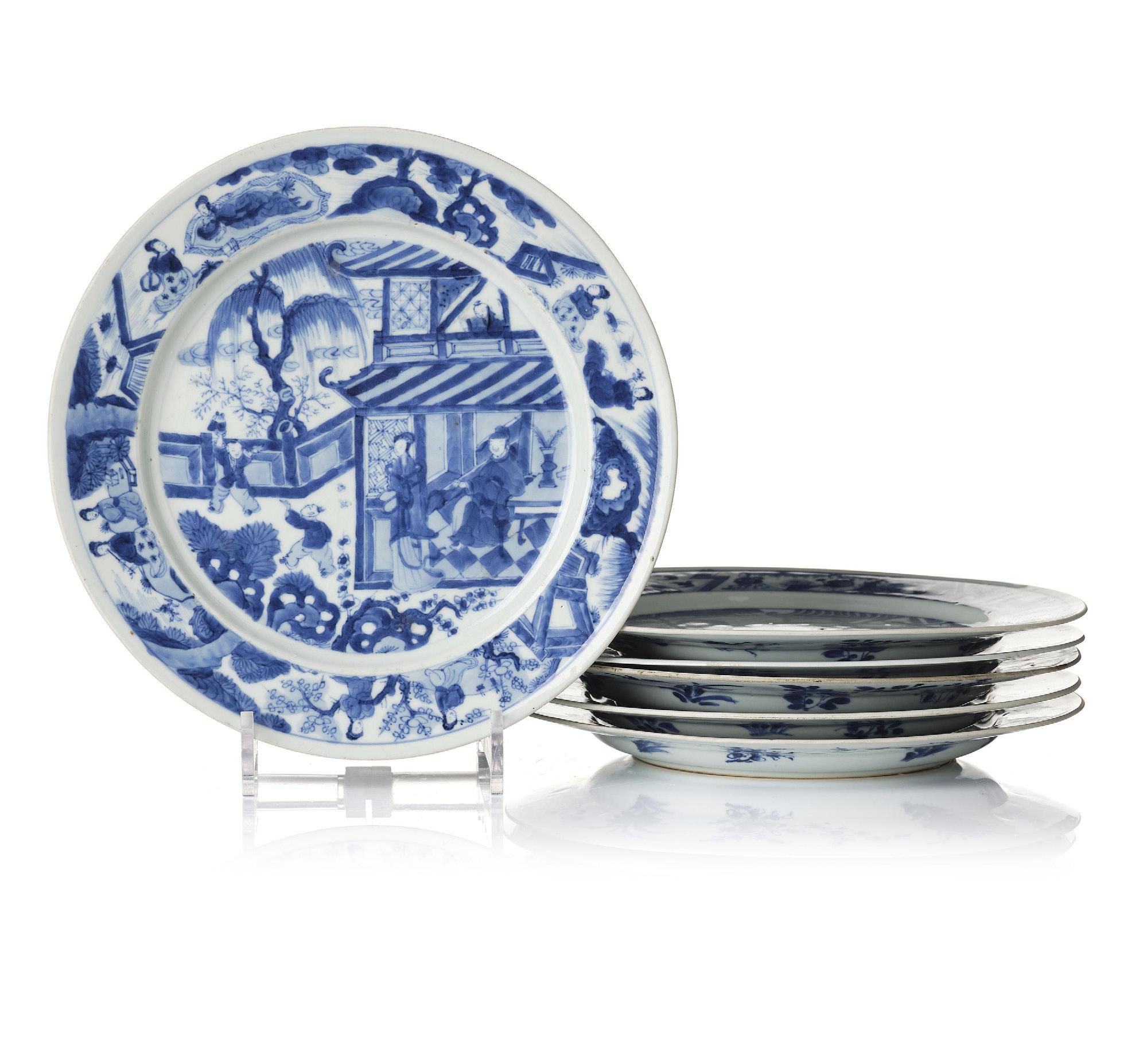
Exhibitions: Compare a bowl of this type in the Metropolitan museum, New York, Credit Line: Purchase by subscription, 1879. Object Number: 79.2.206.
Estimate: SEK 15 000 – 20 000 / EUR 1 420 – 1 890
1169. A set of six blue and white dishes, Qing dynasty, Kangxi
Each plate with central roundel delicately painted with similar scenes of two small boys at play within a fenced garden watched from nearby by a graceful lady clutching a fan and also by a gentleman seated in a house with another small boy on a terrace above, the rim with ladies in a garden setting participating in leisure pursuits of various types, the reverse with a single floral spray encircling the rim, the vase with a large double floral spray bending to form a circle.
Compare with a plate of this type in the collection of the Metropolitan Museum, New York, Credit Line: Purchase by subscription, 1879, Object Number: 79.2.348. Compare also a pair at the Smitosonian, Freer Gallery, The peacock room, Accession Number
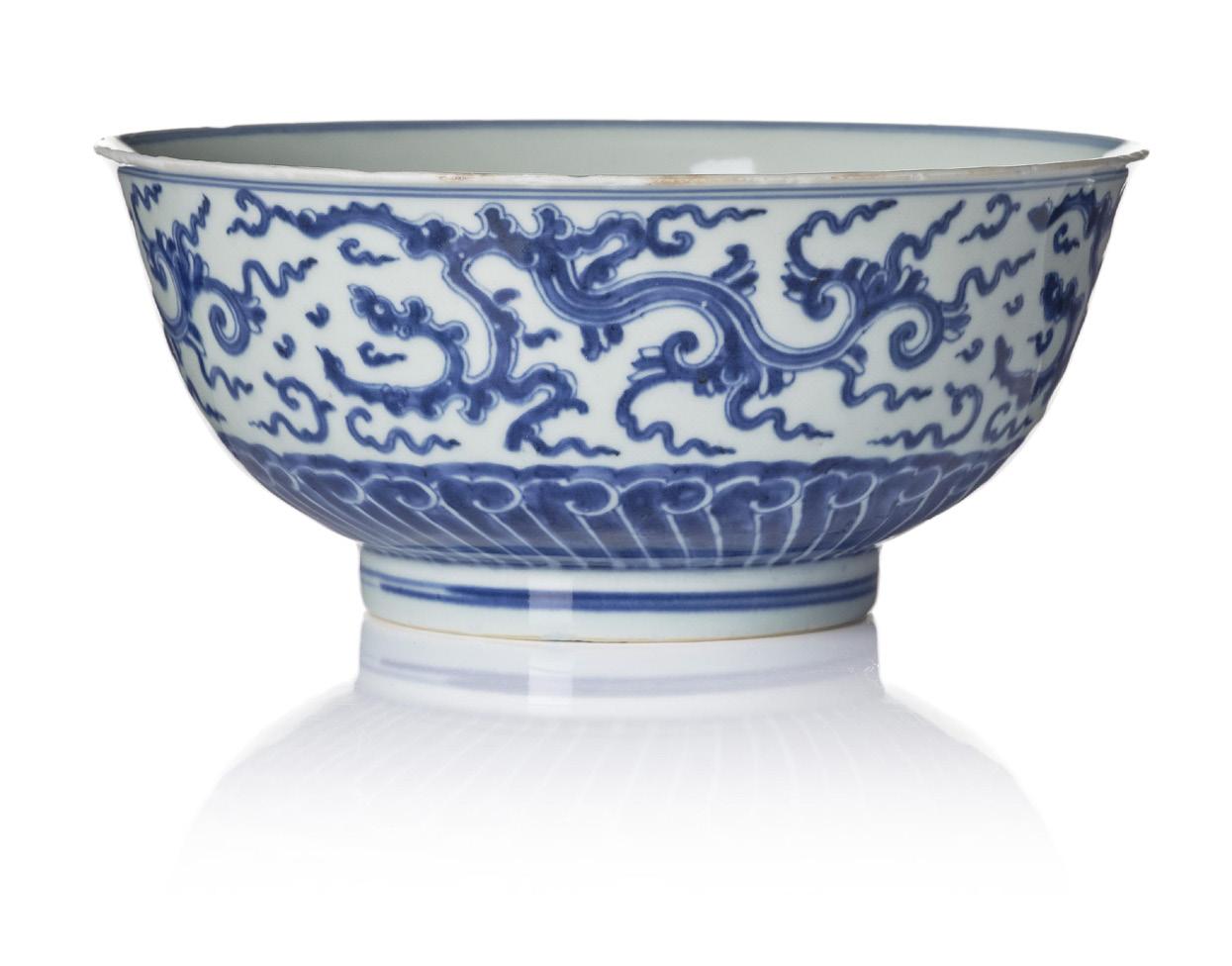
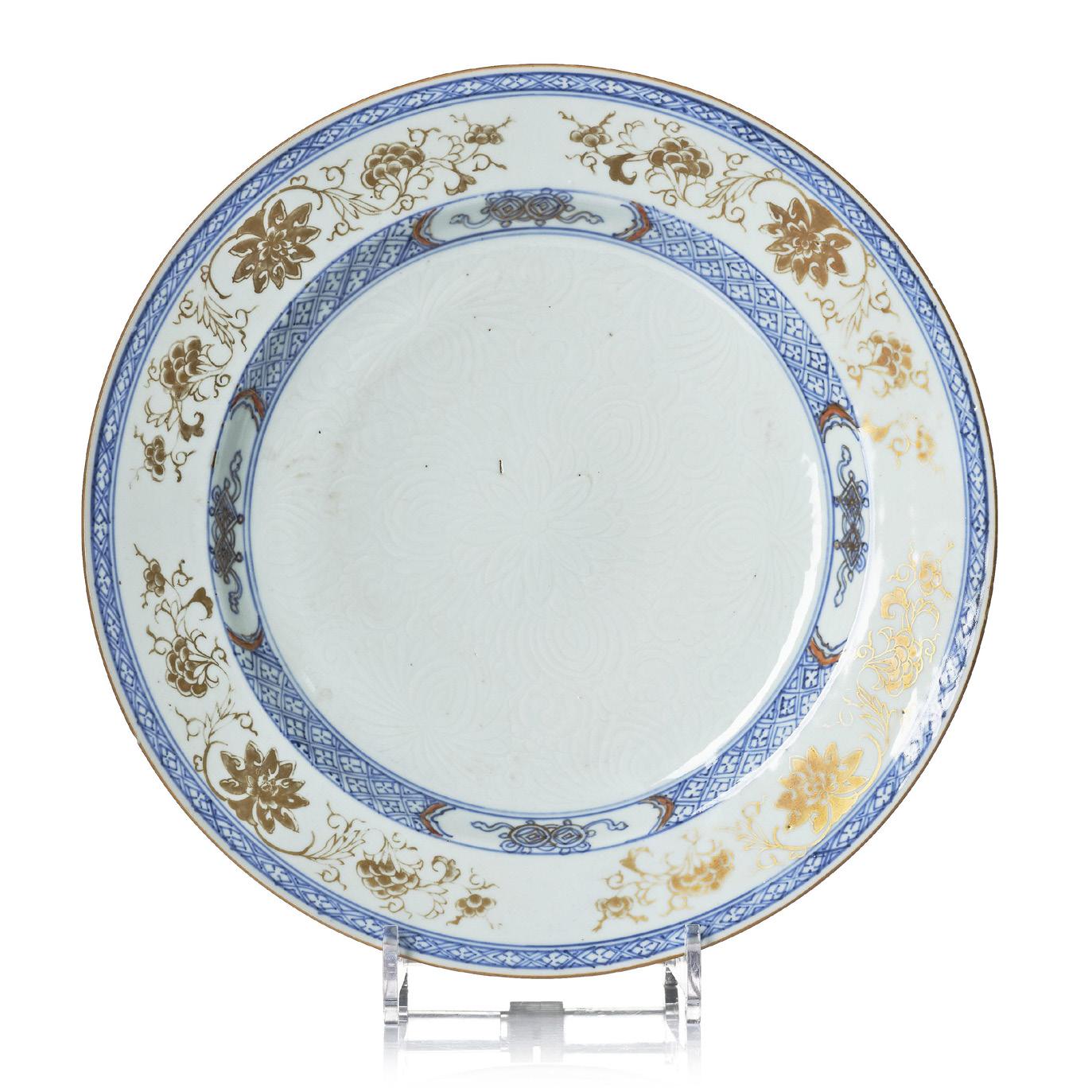
1171. A blue and white ‘anhua’ decorated dish, Qing dynasty, Yongzheng (1723–35).
Cut decoration to the cavetto with a floral pattern, around the rim decorated in both underglaze blue and gold. Diameter 32 cm.
Provenance: Property of a private Swedish collector.
Estimate: SEK 6 000 – 8 000 / EUR 567 – 755
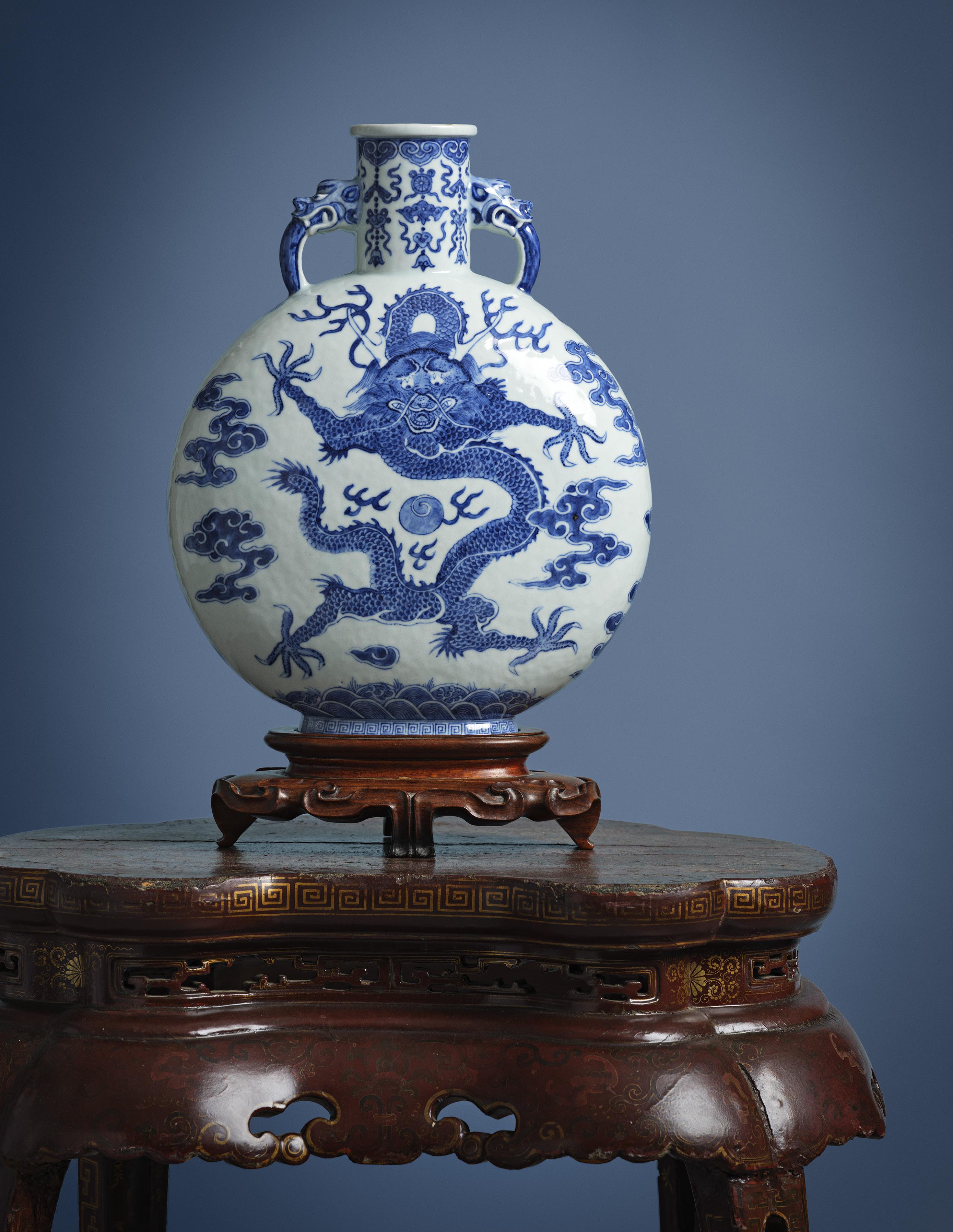
Drakvasen From the collection of John Engellau (1911–89), director at Volvo in the 1970s. Thence by descent. LOT 1181.
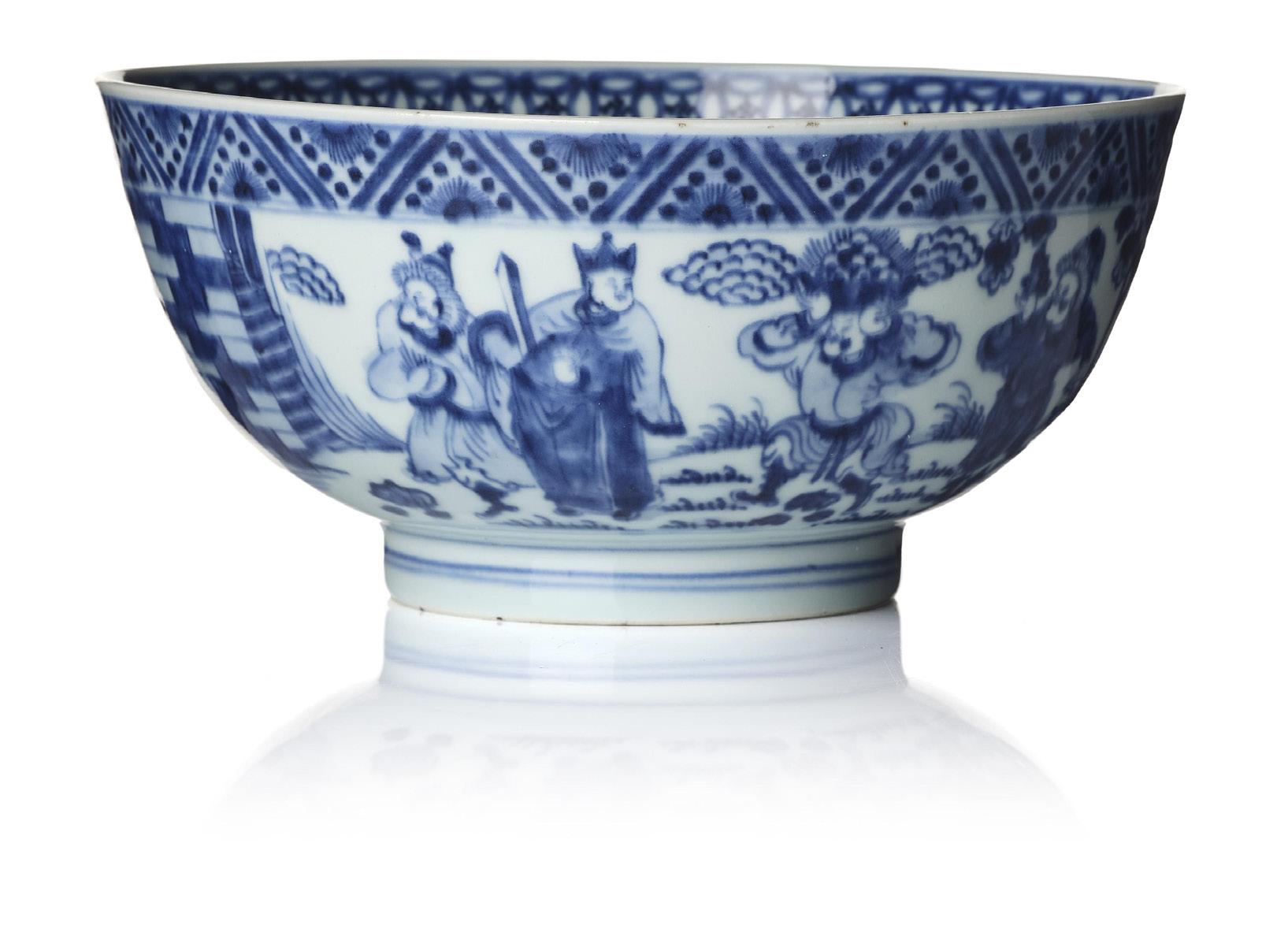
1172. A blue and white ‘foreigners bearing gifts’ bowl, Qing dynasty, 18th century.
Rounded sides on a short footrim. The interior decorated with a four clawed dragon, around the sides a procession with men ‘foreigners bearing gifts’. Diameter 21.4 cm.
Provenance: Purchased at Bukowskis Important Spring Sale 657, lot no 1324, 11 June 2024.
Estimate: SEK 8 000 – 10 000 / EUR 755 – 944
1173. A large blue and white serving dish, Qing dynasty, Yongzheng (1723–35).
Decorated in underglaze blue with a central motif of the three friends, peaches, cherry blossom and peonies. Diameter 37.5 cm.
Provenance: Property of a private Swedish collector.
Estimate: SEK 6 000 – 8 000 / EUR 567 – 755
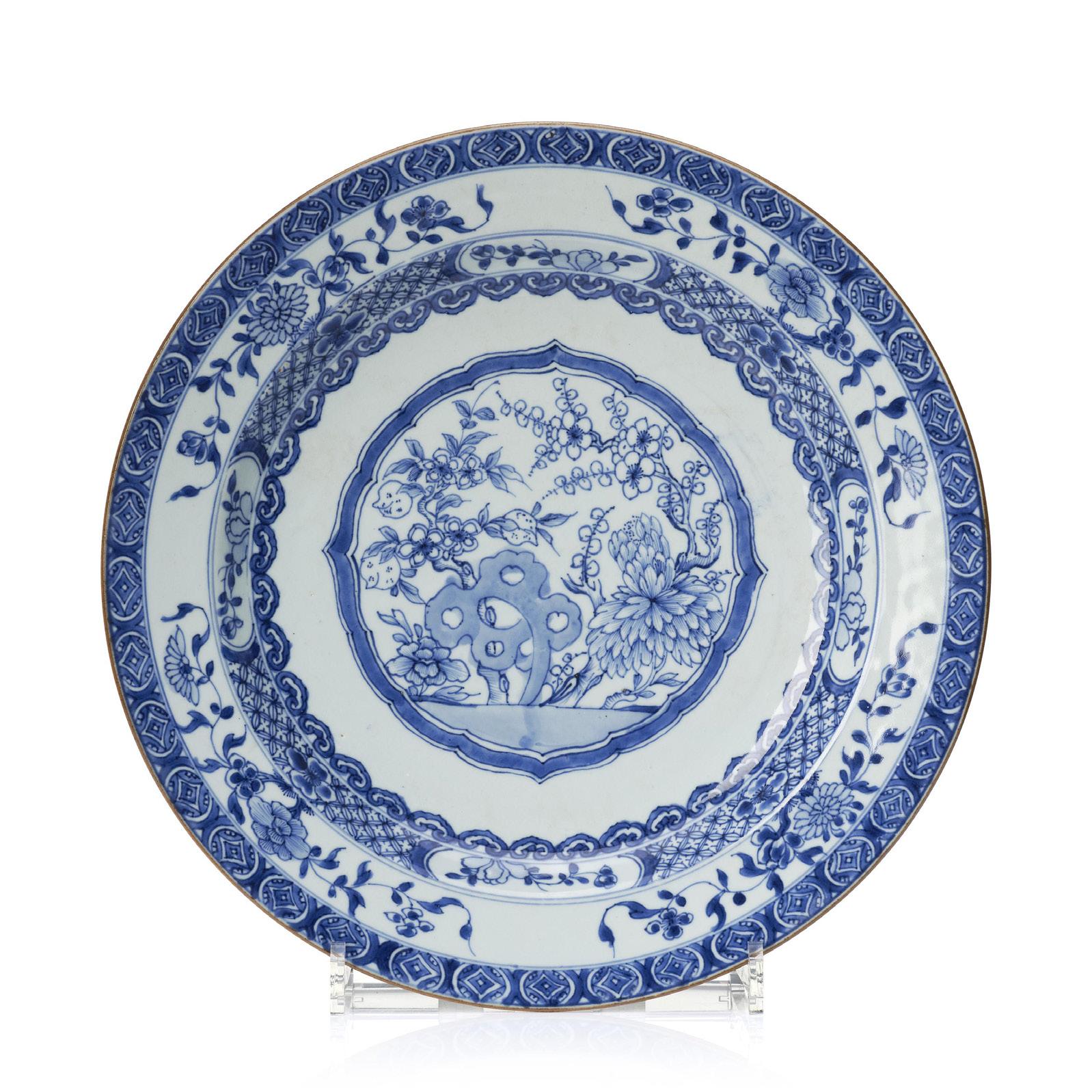
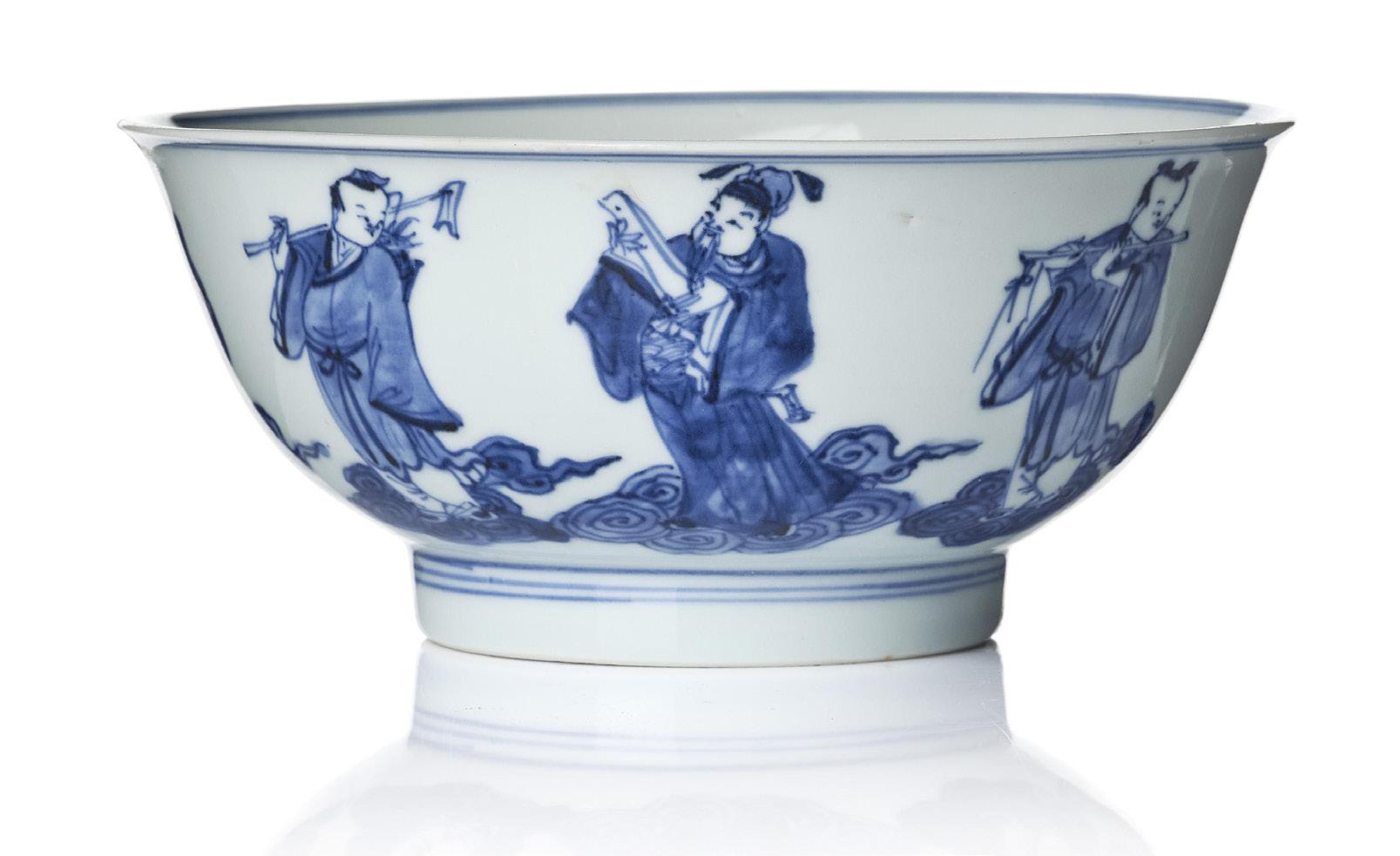
1174. A blue and white ‘Immortals’ bowl, Qing dynasty, Qianlong (1736–95).
With seal mark in underglaze blue. Rounded sides with an everted rim and a short straight foot. Decorated in underglaze blue with immortals. Diameter 18 cm. Height 7.5 cm.
Provenance: Property of a private Swedish collector.
Exhibitions: Compare with a very similar bowl sold at Sothebys London, China 5000 Year, lot no 7, 14–22 February 2022.
Estimate: SEK 12 000 – 15 000 / EUR 1 130 – 1 420
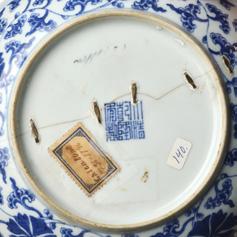
1175. A blue and white ‘lotus dish’, Qing dynasty with Qianlong mark. Decorated with a central medallion with a lotus scroll. The reverse with a continuous lotus scroll and a Qianlong seal mark in underglaze blue. Diameter 19.2 cm.
Provenance: The Collection of Erik Nordström (1884–1971) Erik Nordström was commissioned after a recommendation by Swedish minister Gustav Oscar Wallenberg, the Envoyé of Japan and China, as Post General in Shanghai at the Royal Chinese General Post Office in 1910. The aim was to help facilitate its work throughout China. He was positioned in several of the Chinese provinces (he often chose the northern provinces due to their resemblance to the northern Sweden where he stems from) over his his 35 years in the postal service. Gustav Oscar Wallenberg who became a close and dear friend of Erik Nordström, was a keen collector of Chinese ceramics and introduced him to the art of collecting by defining age, quality and heritage as they visited the antique shops of Beijing. The vast collection of Eric Nordström contains a variety of objects of which many were acquired for the purpose of everyday use, hence the wear to many of the objects. During his time in China he encountered and befriended many of the Swedish society who both worked and lived as well as passed through China at the time, i.e. Johan Gunnar Andersson and wife, Sven Hedin, Carl Bonde, Sten Thiel in the company of Nils von Dardel and his then fiancé Nita Wallenberg, to name only a few.Erik Nordström was a keen sportsman and always liked a challenge whether it be hunting, shooting or tennis. He retired in China in 1945 and spent his last years in Qingdao before his return to Sweden in 1948. By the time he left China in 1948 he and his family had experienced the Chinese revolution, World War I and the Japanese invasion and World War II. For other lots from this collection sold in these rooms with Bukowskis. See Sale 629 lot 641-643. And also the mayor part of the collection, sale 580, 160 lots.
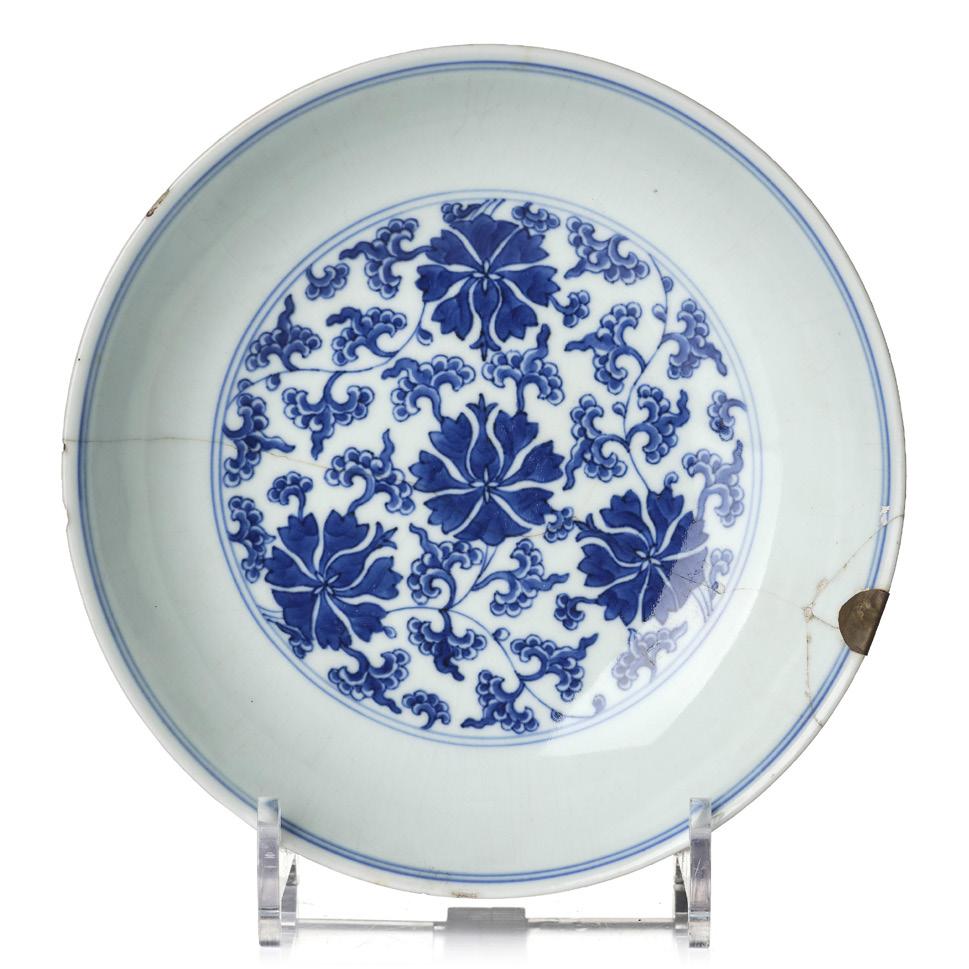
Exhibitions: Compare, Christies, Auction the art of China, Autumn Edition. September 3rd, 2020.
Estimate: SEK 6 000 – 8 000 / EUR 567 – 755
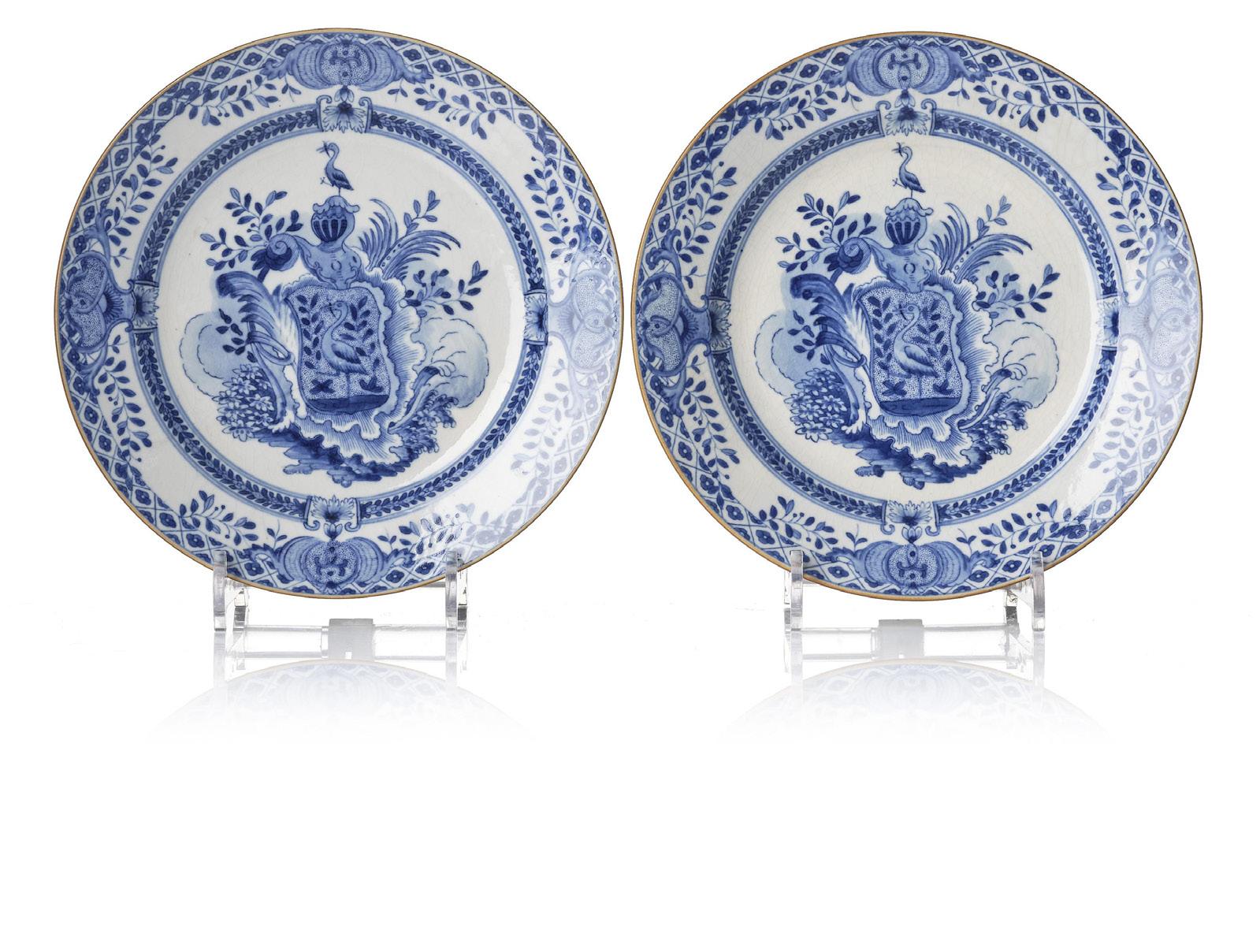
1177. A blue and white ‘armorial’ dish for the Swedish family ‘Grill’, Qing dynasty, Qianlong (1736–95).
Oval, after a European silver model. Decorated with underglazed blue featuring a crane with a cricket in his beak. Length 45 cm.
Provenance: The Grill family was one of the most powerful in Sweden during the 18th century. Many family members were involved in the Swedish East India Company. Claes Grill was for example director of the Swedish EastIndia Company, owner of Sweden’s leading merchant house Claes & Carolos Grill, their trade involved shipping, co-owner of a sail and linen manufactory, glassworks, shipyards, a bank and he owned a line of mines and estates. This service might have been comissioned by Jean Abraham Grill who were the administrative assistant for many years in Canton. He might have comissioned it for his father Abraham Grill, also a Director of the Swedish East India Company. The Grill family derives from a Dutch noble family and was not introduced in Sweden. They used the crane with a cricket in its beak as their coat of arms.
Estimate: SEK 6 000 – 8 000 / EUR 567 – 755
1176. A pair of armorial dinner plates, soft paste, Qing dynasty, 18th century.
Decorated with the Grill family crest featuring a crane with a cricket in its beak. Around the rim a garland with flowers and foliage. Diameter 25 cm.
Provenance: The service was comissioned by Anthony Grill, Amsterdam (1705–1783) and was aimed his son Abraham (III) Grill (1735–1805) who moved to Sweden in the 1770’s to secure the operations of Garphytte iron works upon the bankrupsy of Michael Grubbs. Thence by descent within the family.
Estimate: SEK 10 000 – 15 000 / EUR 944 – 1 420
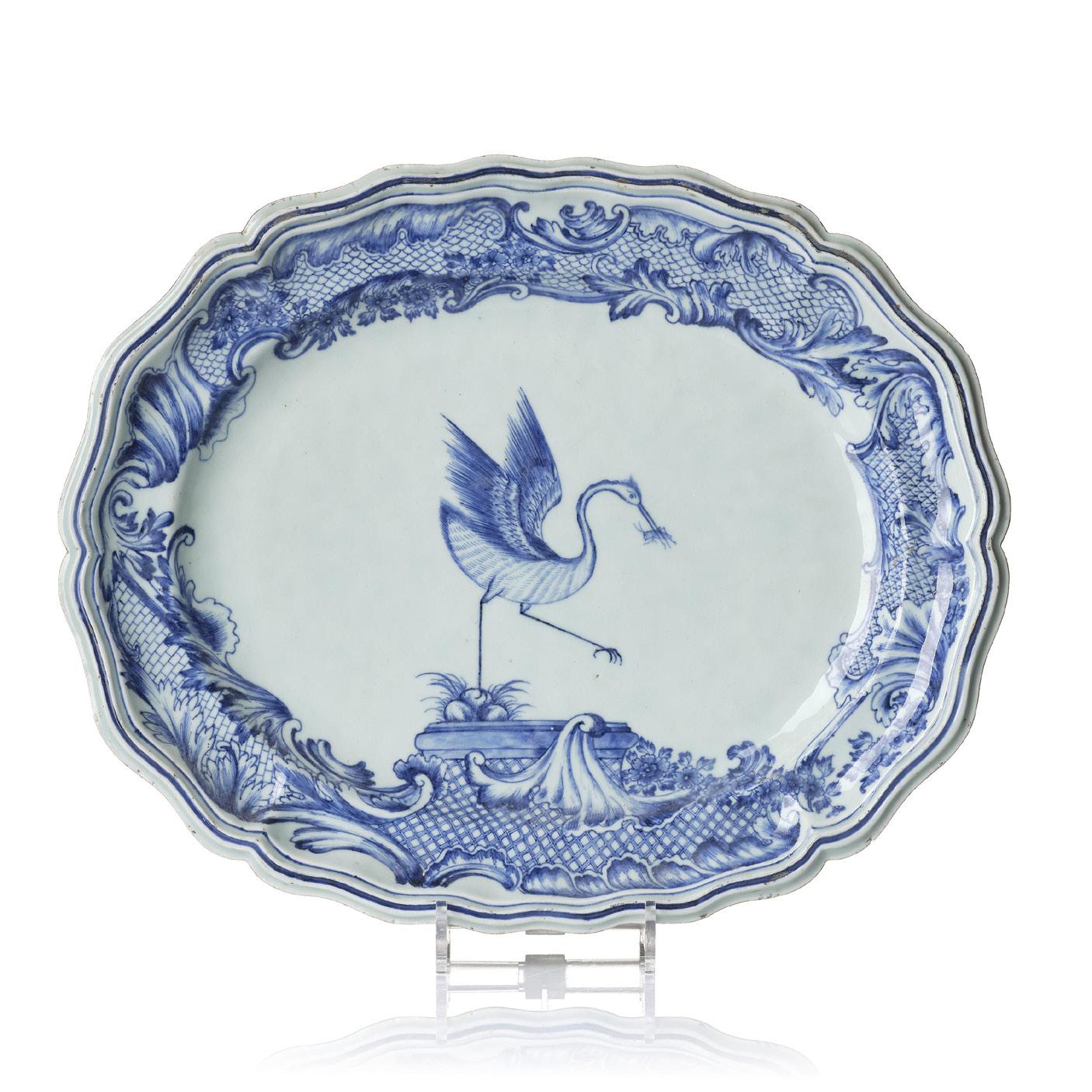
1178. A set of 11 blue and white dessert plates, Qing dynasty, Qianlong (1736–95).
After a European model, decorated in underglaze blue with flowers. Diameter 23.5 cm.
Estimate: SEK 18 000 – 22 000 / EUR 1 700 – 2 080
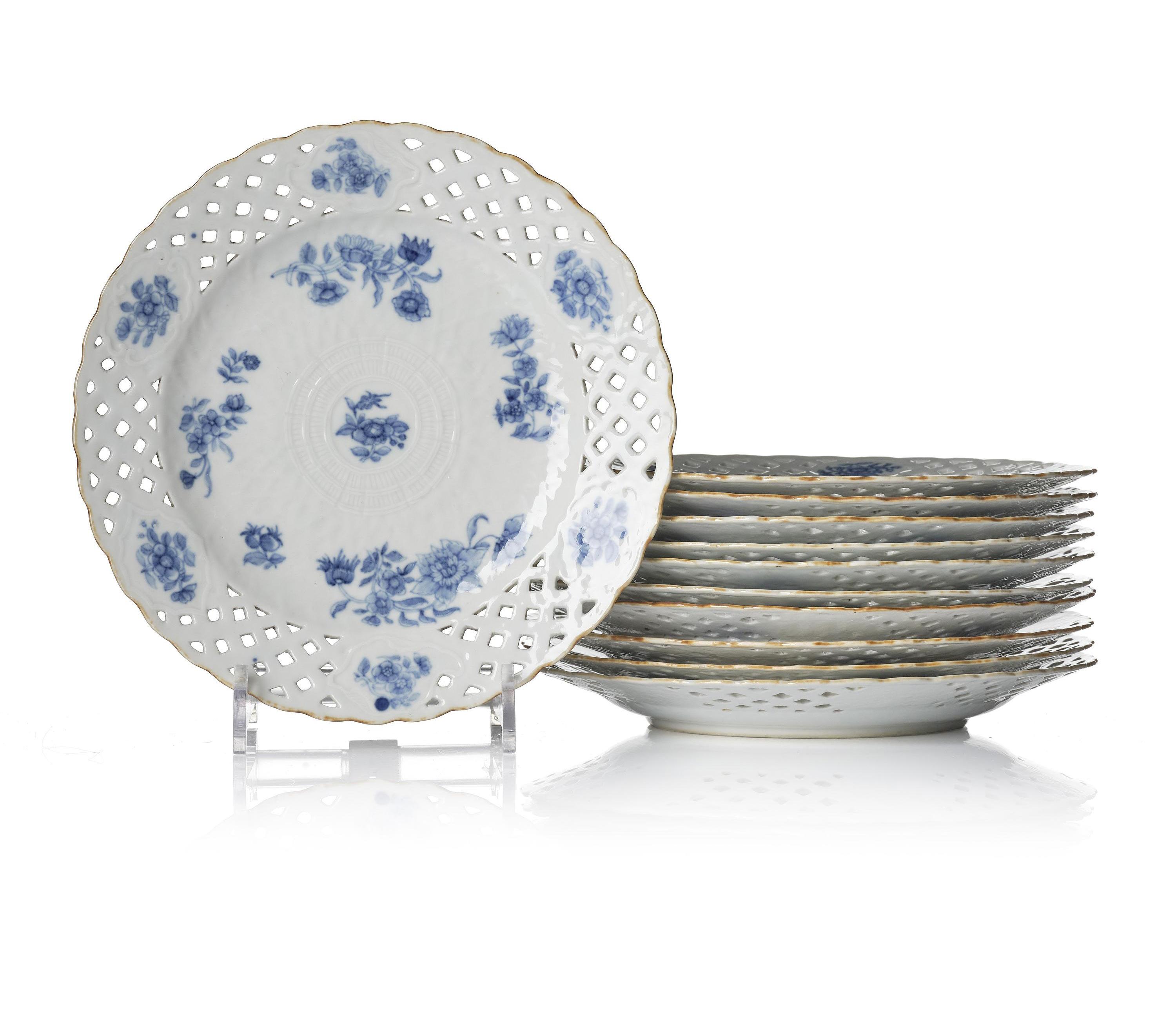
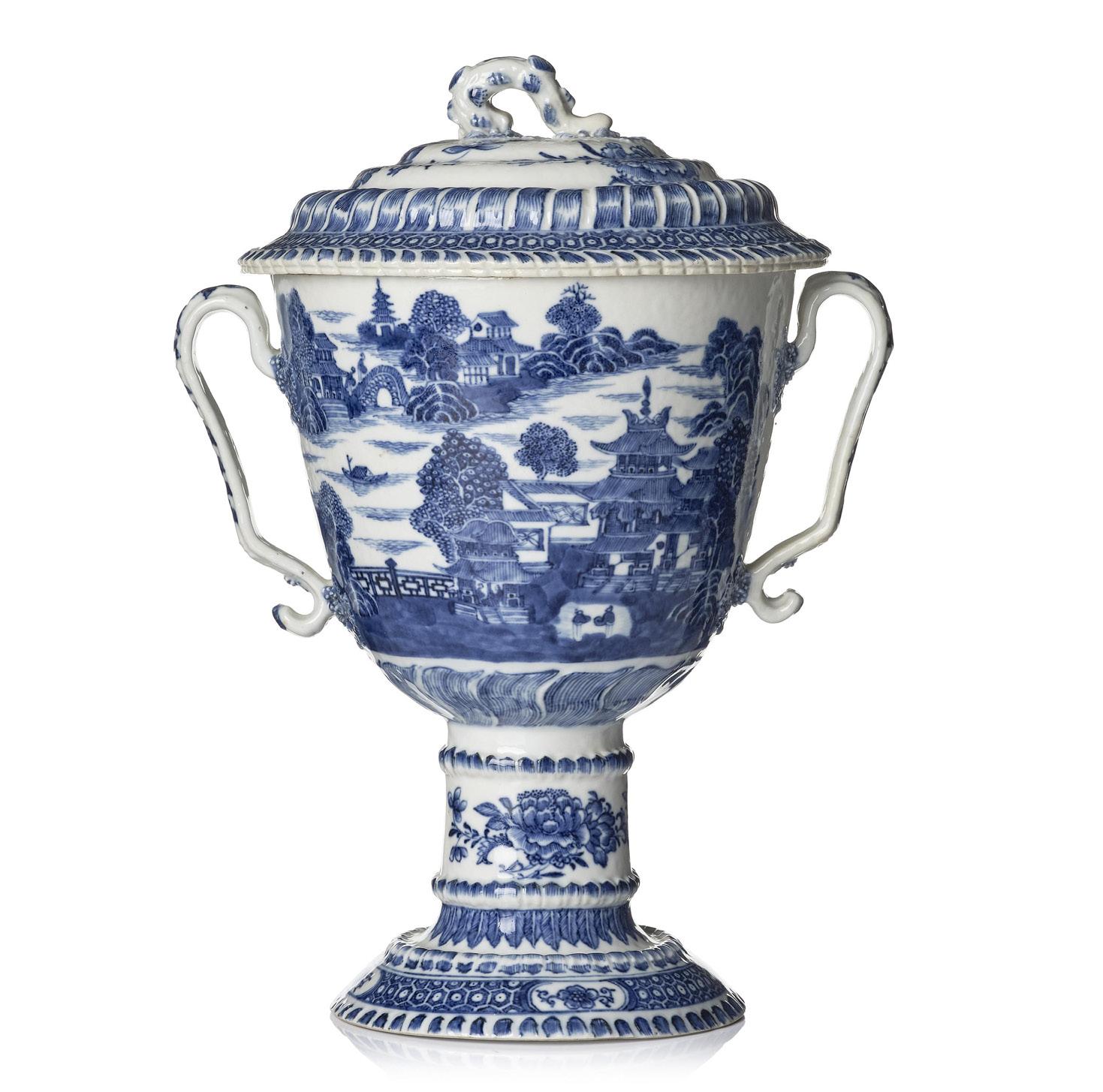
1180. A large blue and white ‘landscape’ goblet with cover, Qing dynasty, Qianlong (1736–95).
After a European silver model, decorated in underglaze blue with flowers and a riverscape. Height 28 cm.
Estimate: SEK 8 000 – 10 000 / EUR 755 – 944
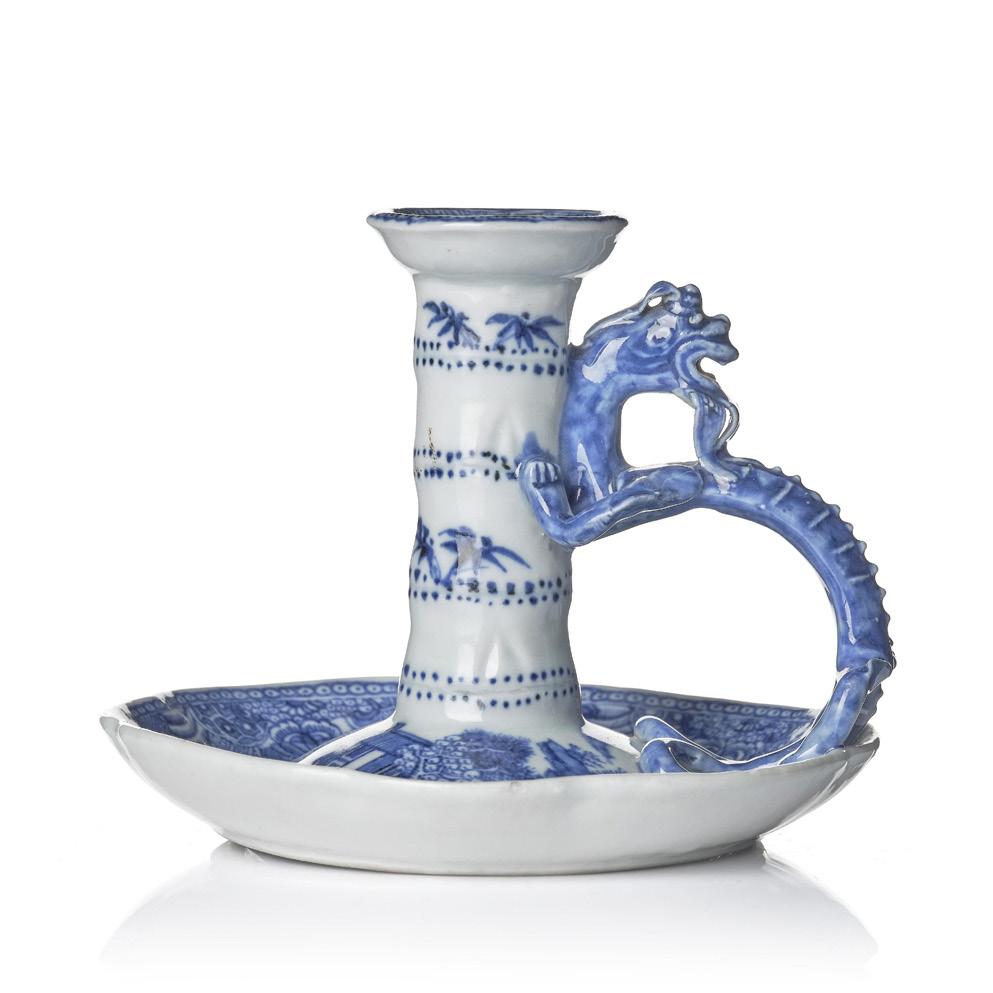
1179. A blue and white candle stick, Qing dynasty, Qianlong (1736–95).
Lobed, with a bamboo shaped neck, and a Chilong dragon handle, decorated in underglaze blue with a riverscape. Length 15 cm. Height 11.5 cm.
Estimate: SEK 10 000 – 15 000 / EUR 944 – 1 420
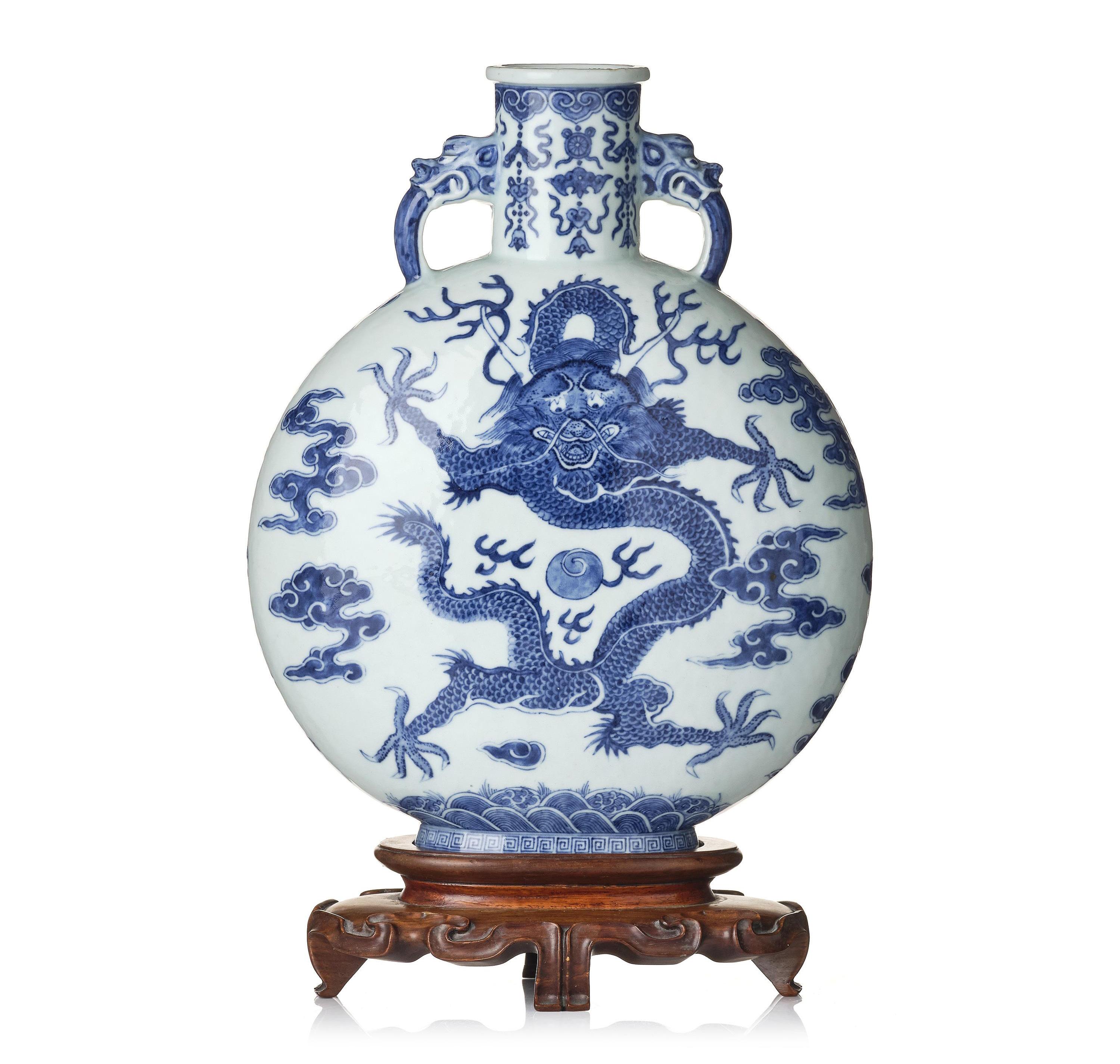
The flattened moon-shaped circular body rising from an oblong slightly splayed foot. Finely painted in underglaze blue with a ferocious five-clawed dragon writhing amidst vaporous clouds and above crashing waves, surmounted by a tall neck decorated with a ruyiband, bats and suspending tasselled chimes on each side, and flanked by two dragon-handles. Height 32 cm. Height with accompanying wooden stand 37.8 cm.
Provenance: From the collection of John Engellau (1911–89), director at Volvo in the 1970s. Thence by descent.
Catalogue note: This flattened flask form, originating in metal or glass prototypes from West Asia, was adapted in China in the Yongle (1403–1424) and Xuande (1426–1435) periods, when exquisite blue and white porcelain examples were made. By the time the Ming imperial potters at Jingdezhen adapted this shape, it retained only a basic relationship to the original form. They rejuvenated the vessel, creating a sophisticated, faintly elliptical, circular outline with swelling sides, all counterbalanced by a slender cylindrical neck and fanciful curled handles. Following a lull in production after the 15th century, Qing potters again revived the form. Dragons had rarely appeared on moonflasks before the Qianlong period, although a few examples from the early 15th century exist, such as a Xuande flask painted with a three-clawed dragon, illustrated in Gugong Bowuyuan cang Ming chu qinghua ci [Early Ming blue-and-white porcelain in the Palace Museum], vol. 1, Beijing, 2002, pl. 89. The motif of a front-facing dragon first emerged in the mid-16th century after which it became its most commonly depicted form in the decorative arts of the late Ming period, appearing on ceremonial robes, porcelain and carved objects. The shape of this handled moon flask and the design of the dragon and the decoration on the neck are very much inspired by the Ming dynasty prototypes.).
Estimate: SEK 120 000 – 150 000 / EUR 11 300 – 14 200
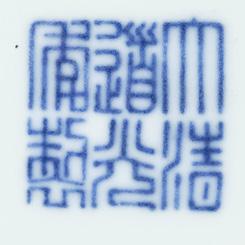
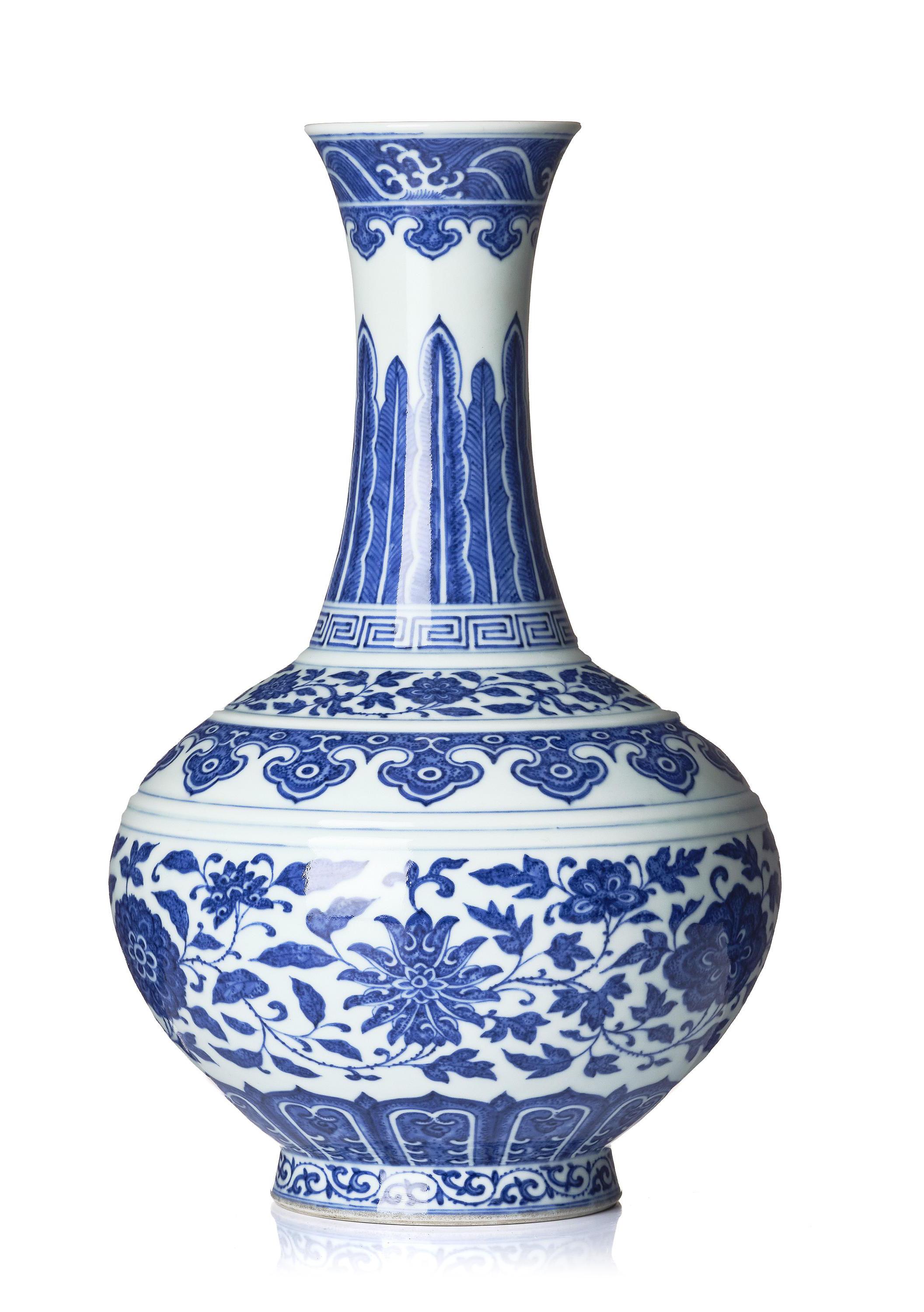
1182. A Ming style blue and white bottle vase, Qing dynasty, Guangxu seal mark and of the the period (1875–1908). The globular body is finely painted in vibrant tones of cobalt blue with a composite floral scroll above a band of lotus petals and classic scroll at the foot, and below a trefoil cloud collar and another composite floral scroll around the shoulder. The tall neck is further decorated with key fret and upright plantain leaves, and breaking waves at the flaring mouth. Height 37.5 cm.
Provenance: Property of a private Swedish Collector.
Exhibitions: Compare with a vase sold at Bonhams, lot not 71, Fine Chinese Art, 15 May 2014, London, New Bond Street.
Literature: A similar Guangxu-period vase is illustrated in The Complete Collection of Treasures of the Palace Museum - 36 - Blue and White Porcelain with Underglazed Red (III), Hong Kong, 2000, p. 174, no. 159.
Estimate: SEK 75 000 – 100 000 / EUR 7 080 – 9 440
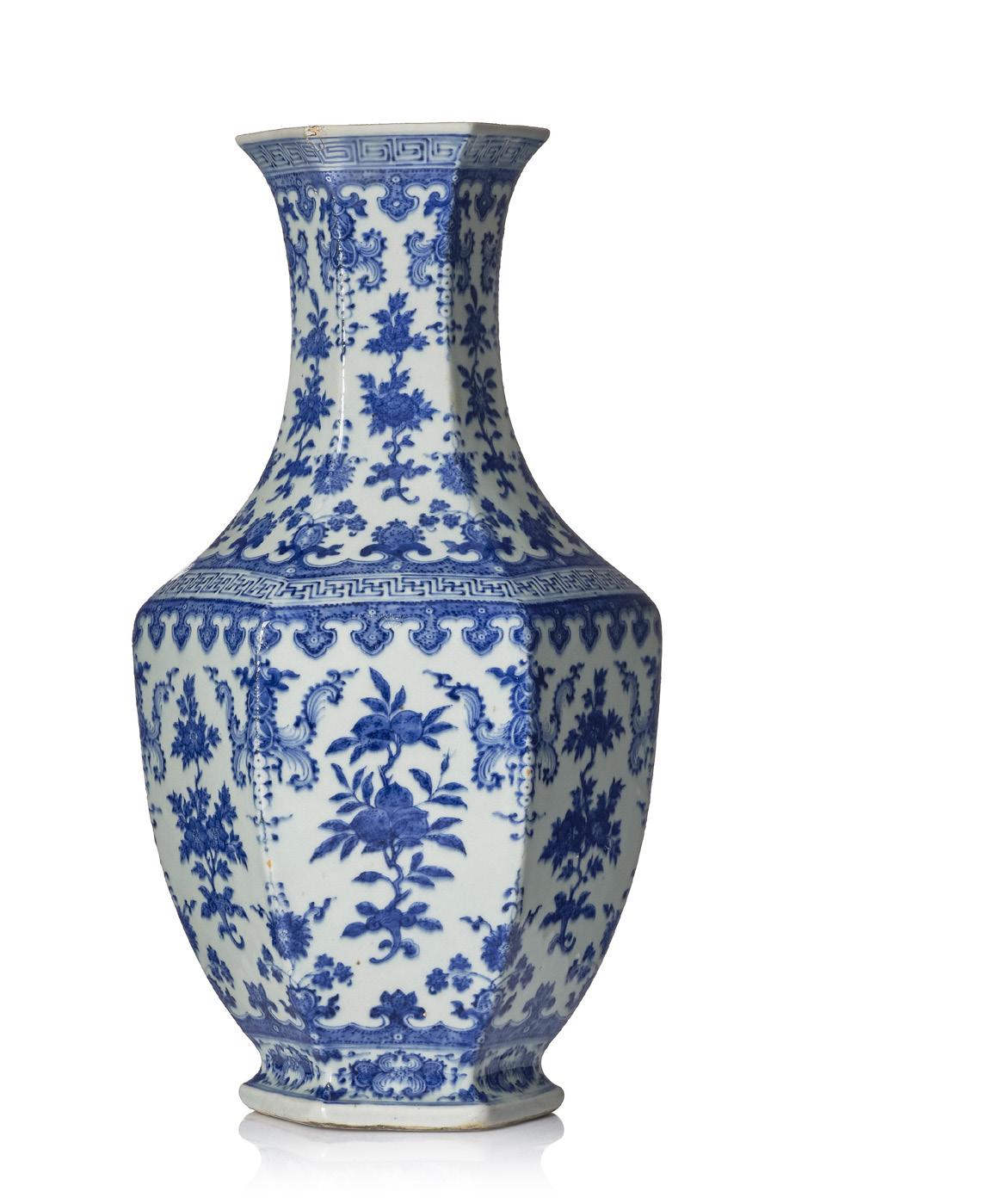
1183. A blue and white hexagonal ‘Sanduo’ vase, Qing dynasty, 19th century. Hexagonal baluster shape, decorated in underglaze blue with peaches, flowers, litchi, and pomme granate. Base with apocryphal Qianlong seal mark. Height 44 cm.
Property of a private Swedish collector.
SEK 8 000 – 10 000 / EUR 755 – 944
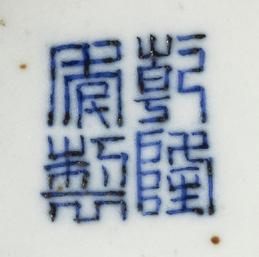
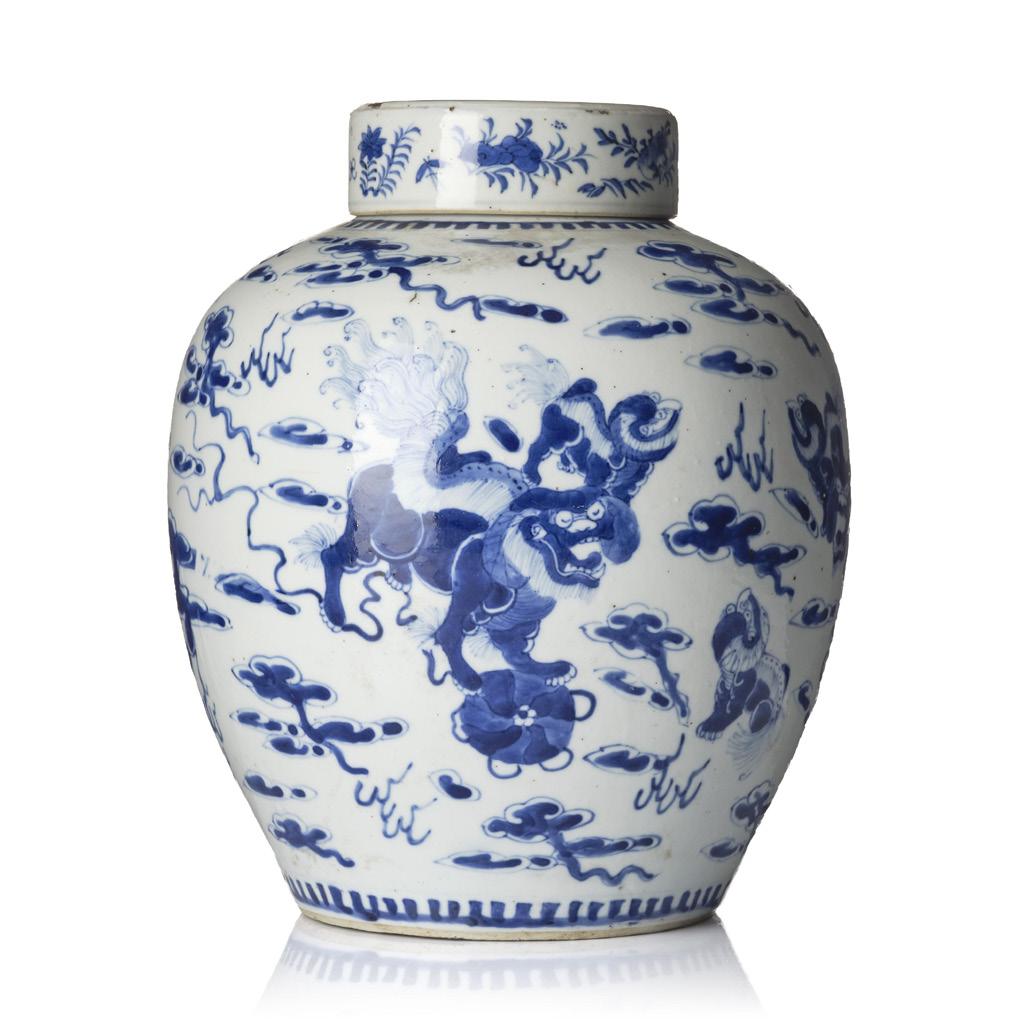
1185. A blue and white jar with cover, Qing dynasty, 19th century.
With an apochrypal Kangxi mark to the base. Ovoid shape, decorated in underglaze blue with buddhist lions amidst cloud formations. Height 29 cm.
Estimate: SEK 6 000 – 8 000 / EUR 567 – 755
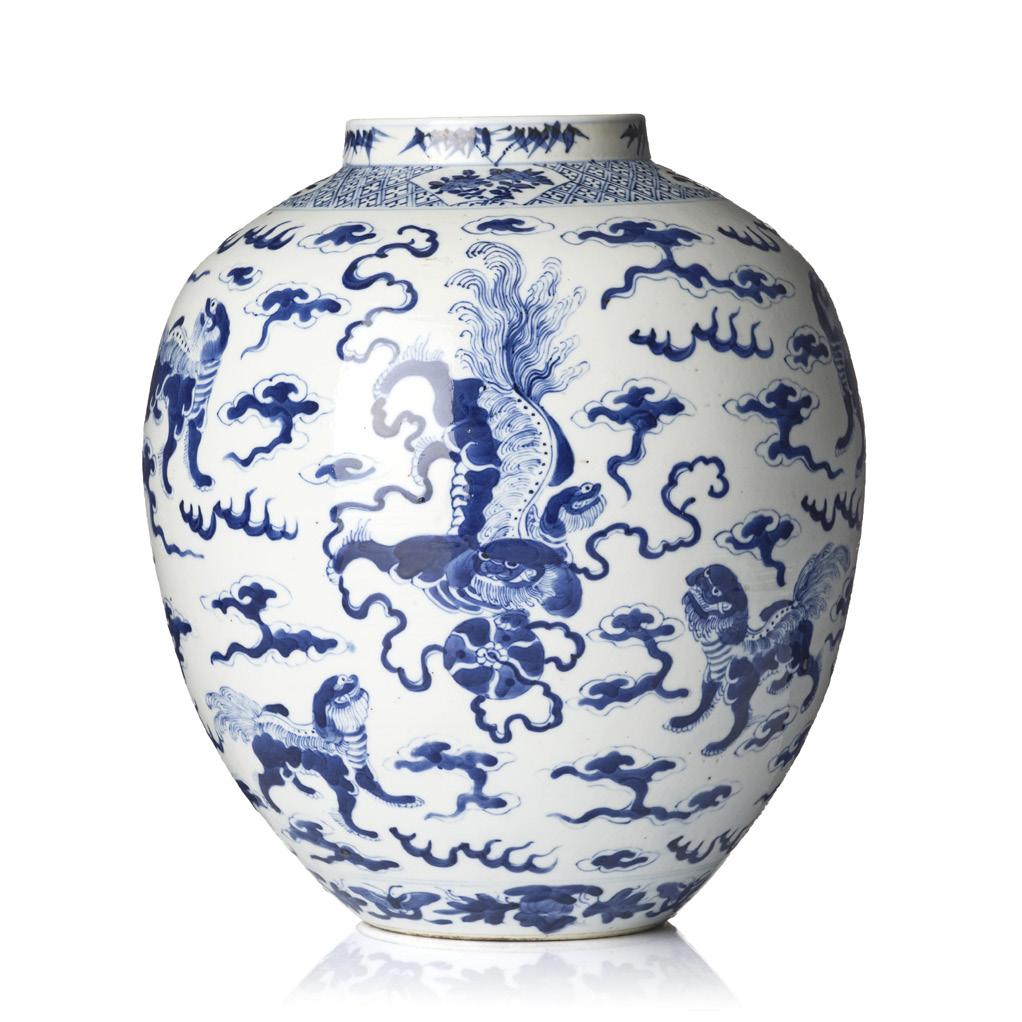
1184. A blue and white ‘buddhist’ lion jar, Qing dynasty, 19th century.
Seal mark to base. Ovoid shape, decorated in underglaze blue with buddhist lions amidst cloud formations. Height 28 cm.
Provenance: Purchased at Bukowskis, lot no 1342.
Estimate: SEK 8 000 – 10 000 / EUR 755 – 944
1186. A pair of blue and white ‘landscape’ vases, late Qing dynasty/ early 20th century.
Rectangular baluster shape with mascaron handles, decorated with riverscapes with mountains and figures. Height 41 cm. Height with wooden stand 45.5 cm.
Provenance: Property of a private Swedish Estate.
Estimate: SEK 10 000 – 15 000 / EUR 944 – 1 420
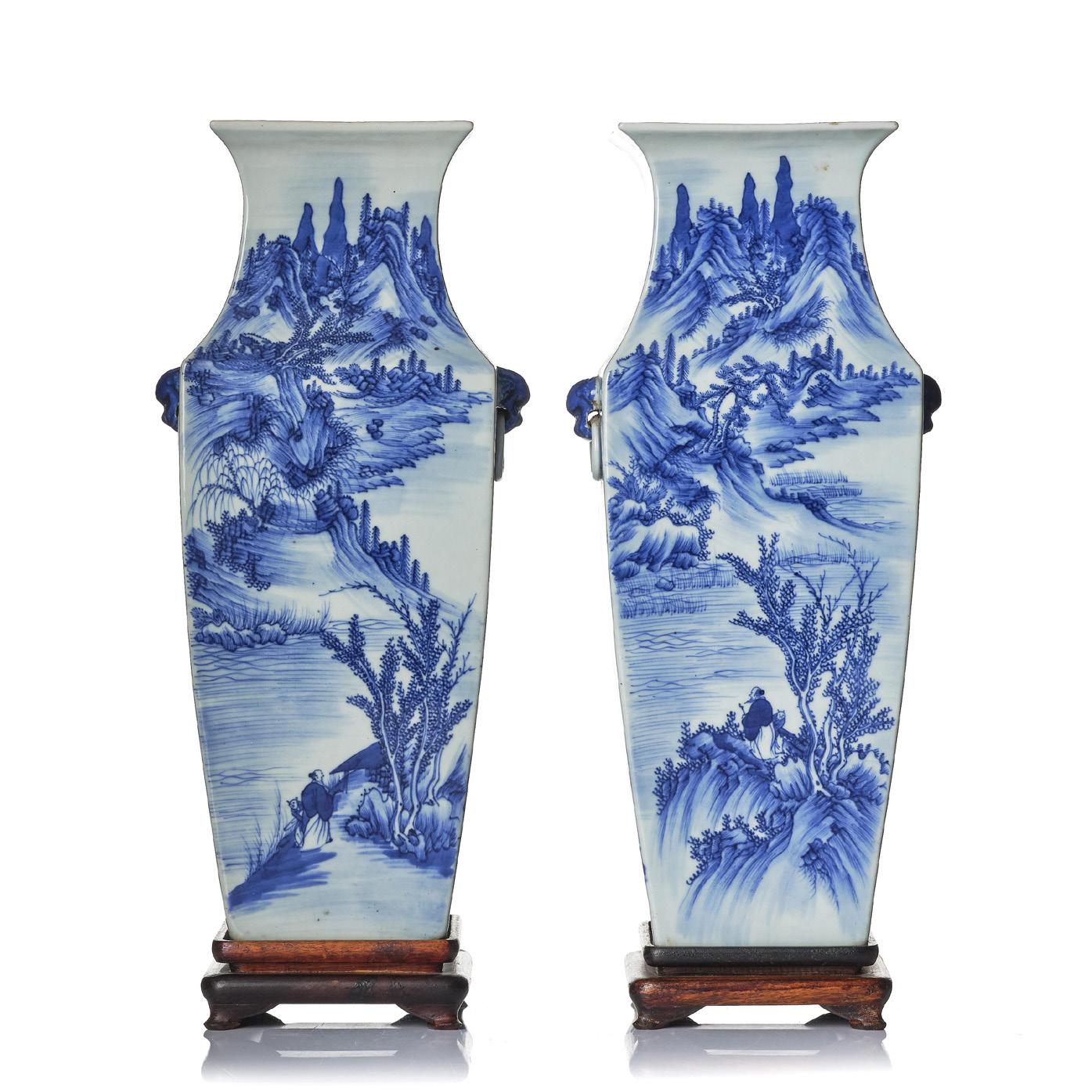
Valuation enquiry: +46 (0)739 400 802 | cecilia.nordstrom@bukowskis.com +44 (0)20 7468 5888 | asaph.hyman@bonhams.com
BONHAMS & BUKOWSKIS: LEADERS IN CHINESE AND ASIAN ART IN EUROPE
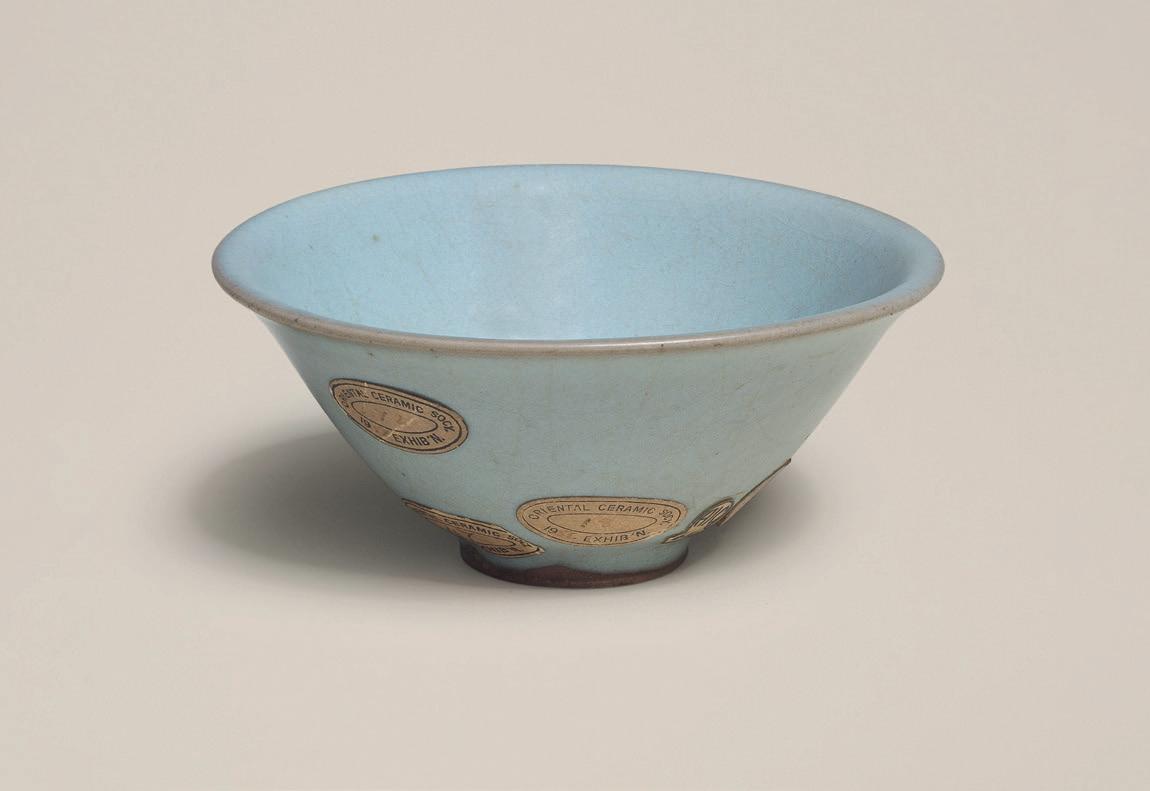
A JUNYAO LIGHT-BLUE-GLAZED BOWL Northern Song/early Jin Dynasty; sold for SEK 13,161,000 A CIZHOU SGRAFFIATO BLACK AND WHITE PEONY-PATTERN VASE, MEIPING, Late Northern Song/early Jin Dynasty; sold for SEK 10,694,000
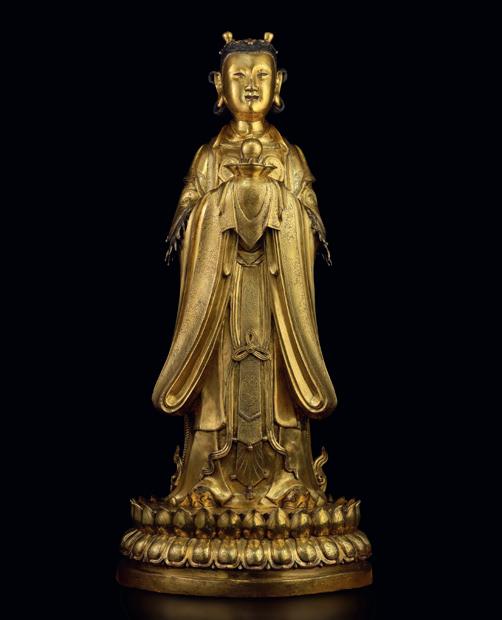
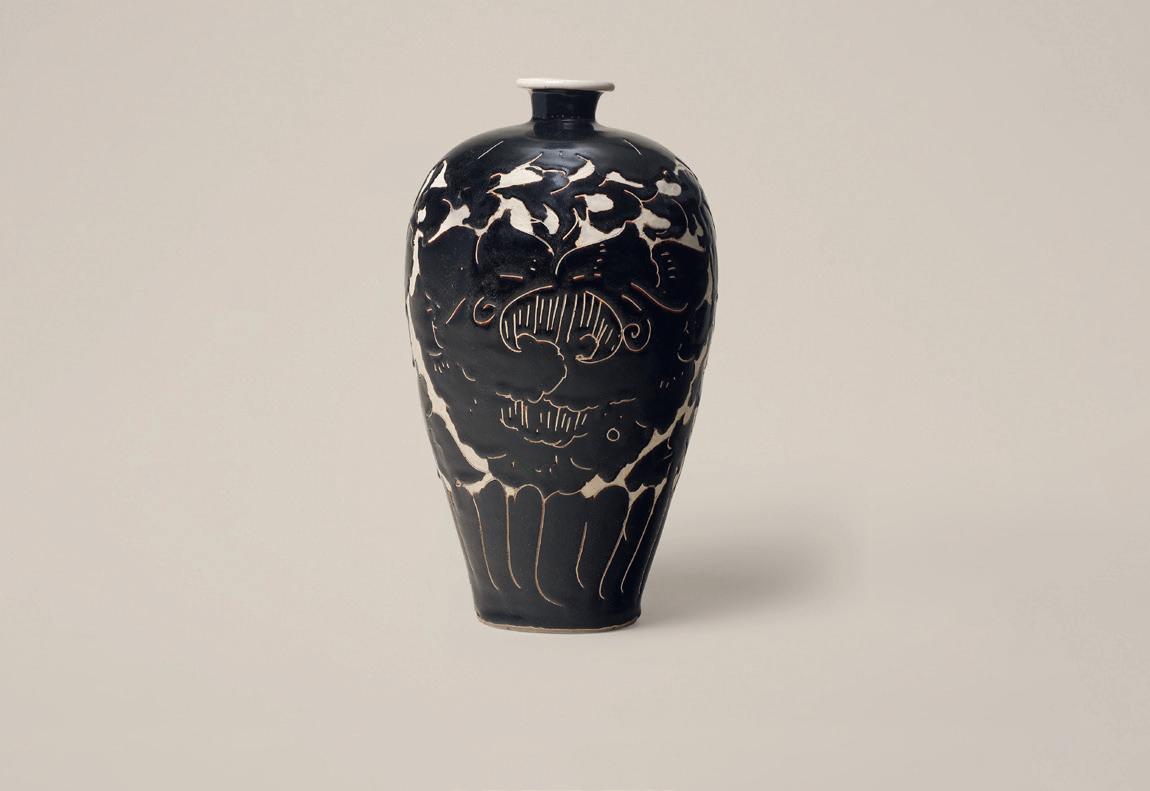
AN IMPORTANT MASSIVE IMPERIAL GILT COPPER-ALLOY FIGURE OF LONGNÜ, dated to 1641 and of the period; sold for SEK 31,860,000 AN IMPORTANT EXTREMELY LARGE BLUE AND WHITE ‘SEVEN SAGES OF THE BAMBOO GROVE’ BRUSHPOT, BITONG, Chongzhen; sold for SEK 4,200,000
Bonhams and Bukowskis have been entrusted with the sale of exceptional objects from celebrated Swedish historical collections, including those of Gustaf Wallenberg, Johannes Hellner, Carl Kempe, Emil Hultmark, and Ivan Traugott.
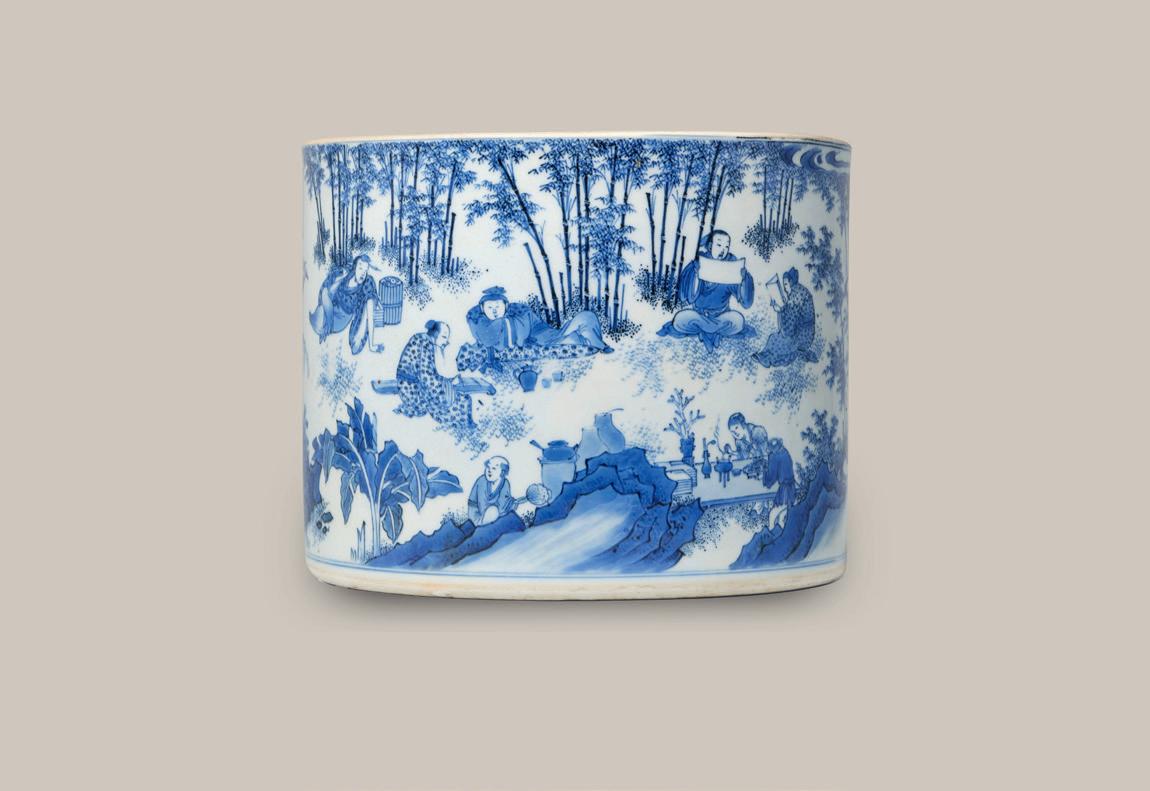
Contact us today to book a free and confidential consultation.
+46 (0)739 400 802
Cecilia.nordstrom@bukowskis.com
+44 (0)20 7468 5888
Asaph.hyman@bonhams.com
Estimates are given in Swedish kronor (SEK) and € (EUR). Bukowskis general terms and conditions for buyers and sellers, bidding instructions, and special terms and conditions for individual lots can be found at bukowskis.com. We also reserve the right for any possible typographical or printing errors.
Bukowskis Stockholm Arsenalsgatan 2 Box 1754
111 87 Stockholm, Sweden
T +46 8 614 08 00
F +46 8 611 46 74 www.bukowskis.com
All lots are searched against the Art Loss Register database.