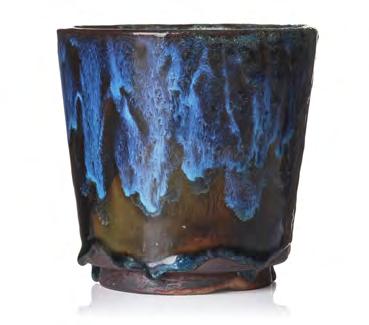
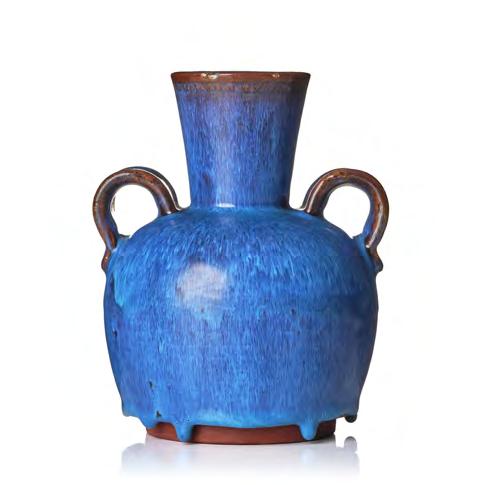
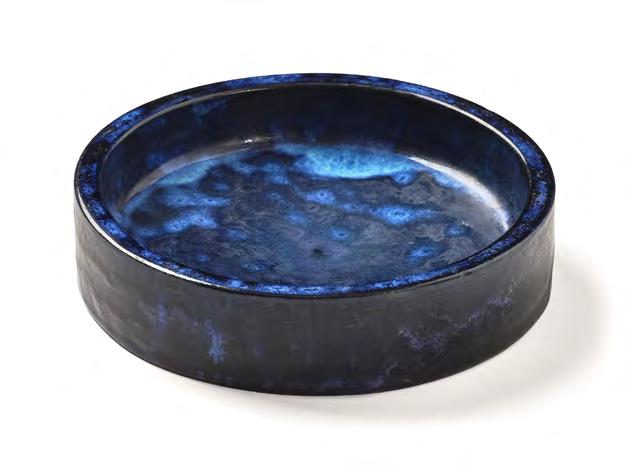
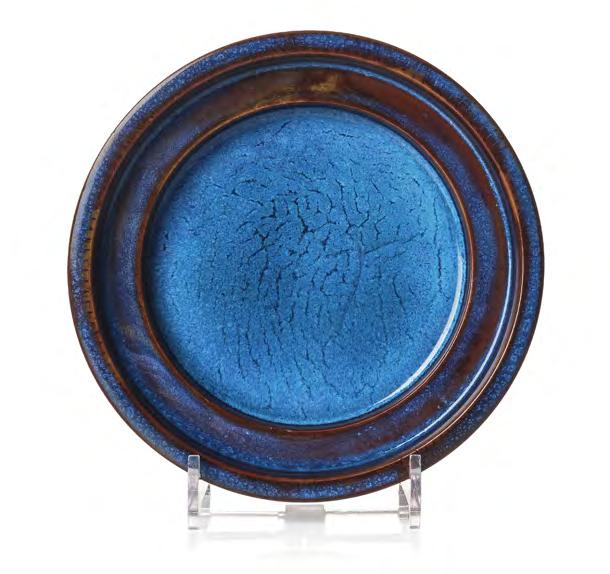
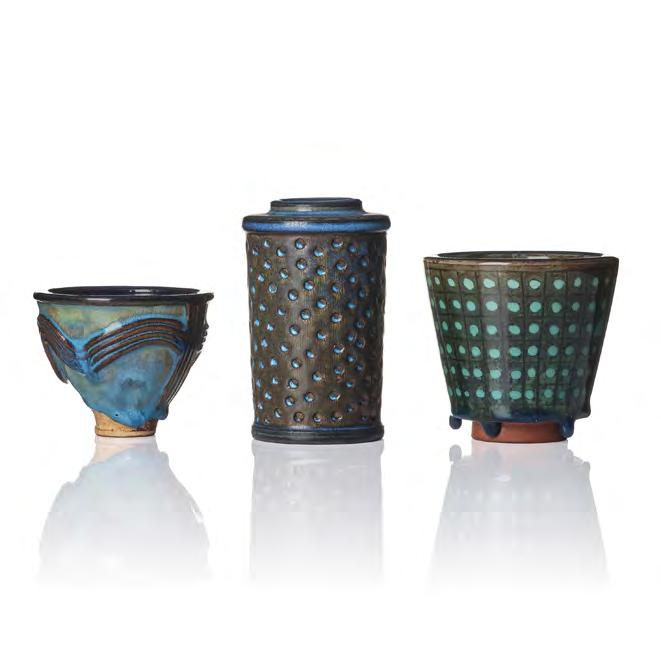
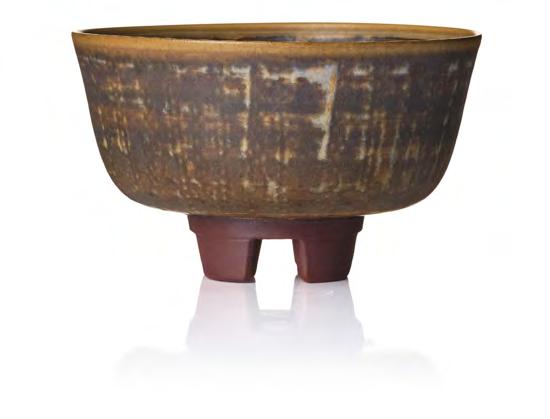
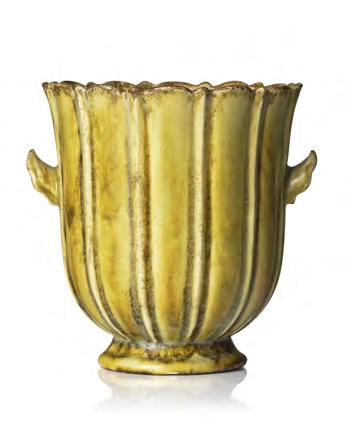
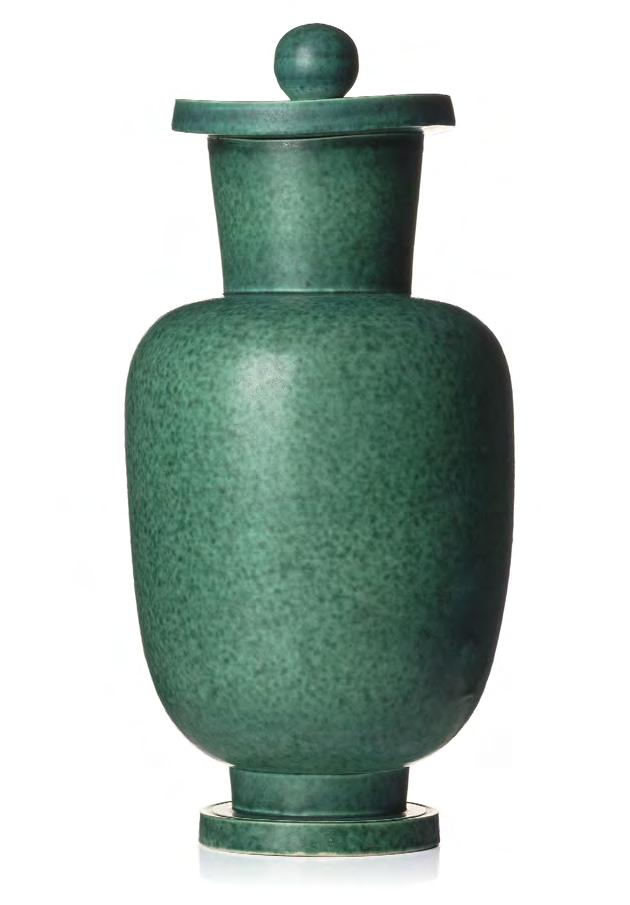
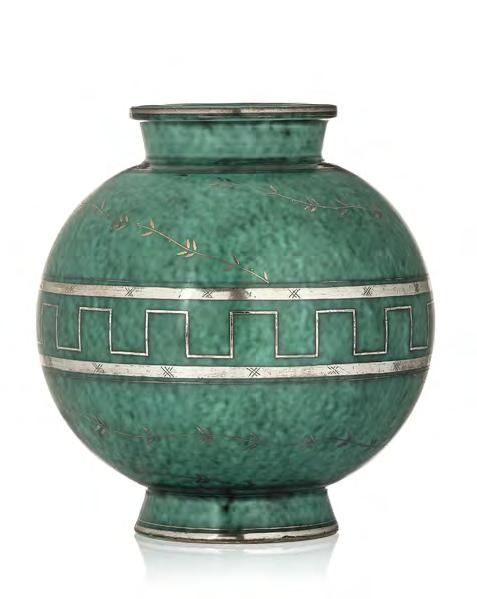
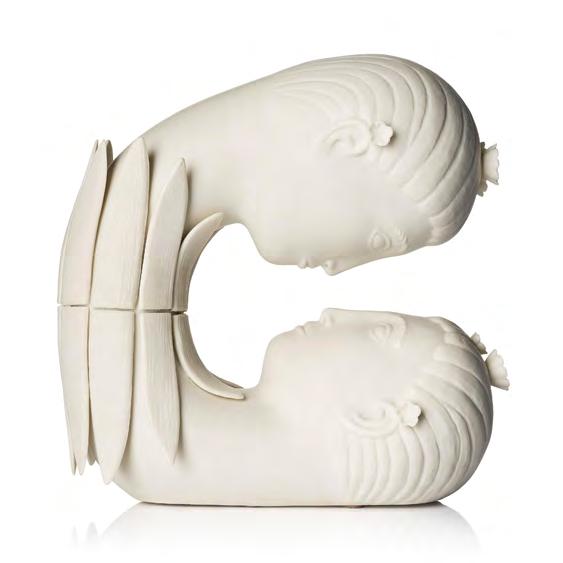
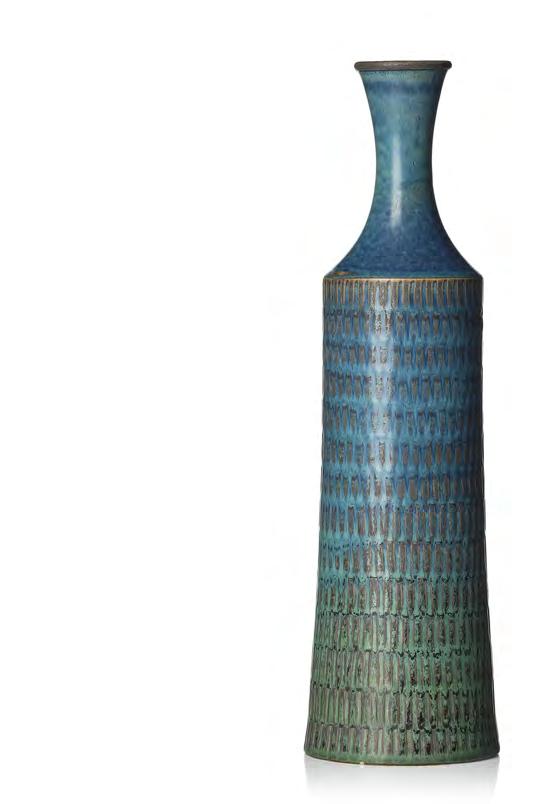
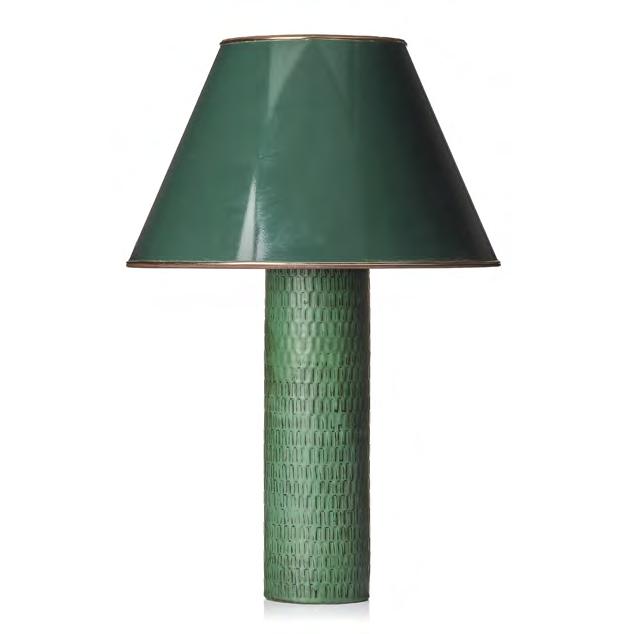
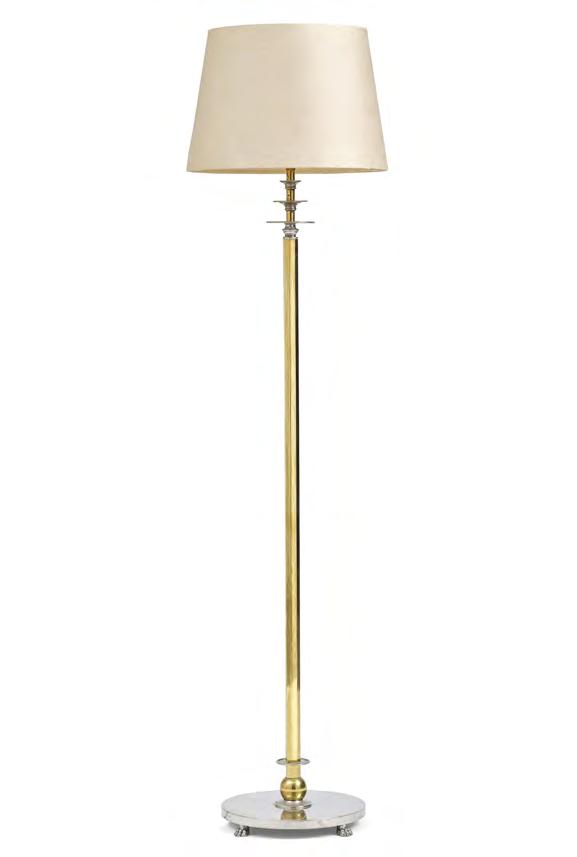
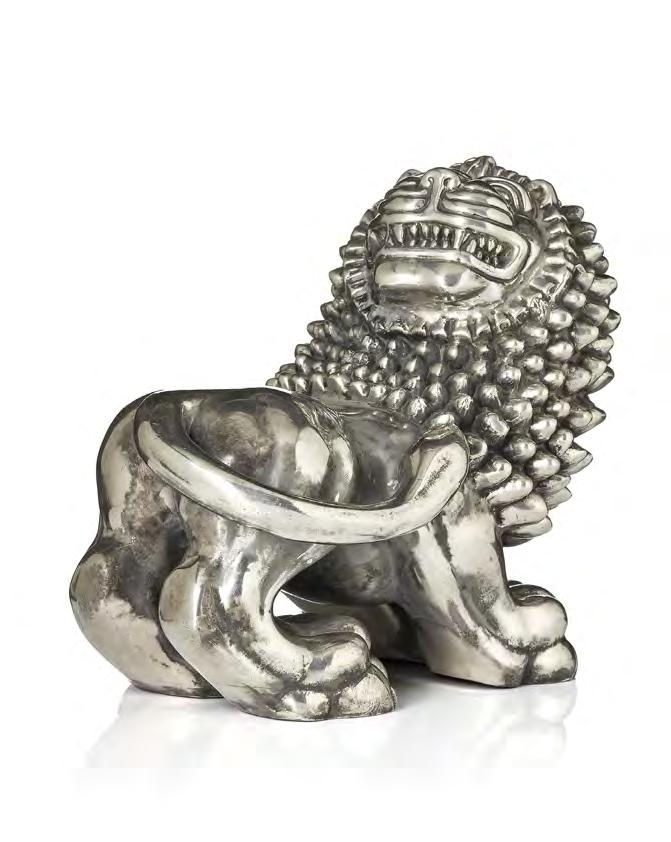
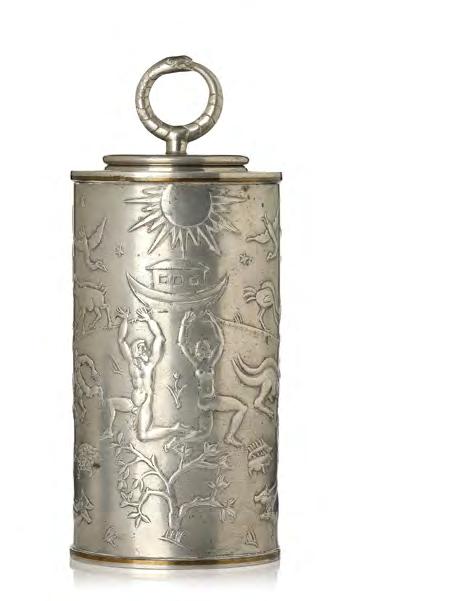
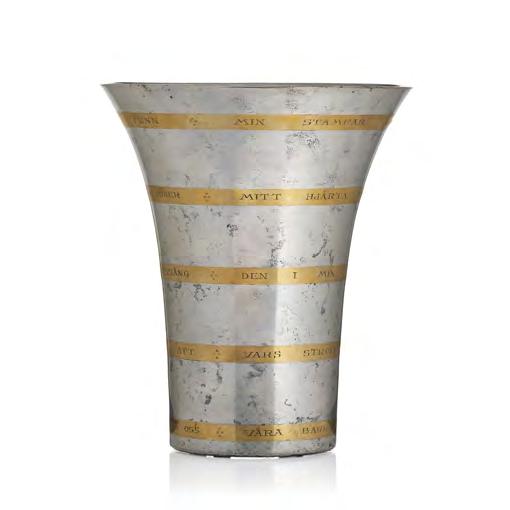
If you prefer to bid by phone, we will call you from the saleroom and bid on your behalf.
LIVE BIDDING
Bid in real–time online from wherever you are at bukowskis.com. Live/hammer auctions requires validation, contact customer service for registration.
ABSENTEE BIDDING
Place an absentee bid at least one hour before the sale and we will bid on the item for you. Just submit your maximum bid online
IN THE SALEROOM
Once registered for a paddle you are welcome to bid in the saleroom. The auctioneer will announce the bids. If the object and price is right, raise the paddle. Continue until you are the only bidder remaining.
FOR INQUIRIES PLEASE CONTACT
Head of Design/Specialist Modern & Contemporary Decorative Art & Design
Fredrik Karlsson +46 (0)767 81 06 06 fredrik.karlsson@bukowskis.com
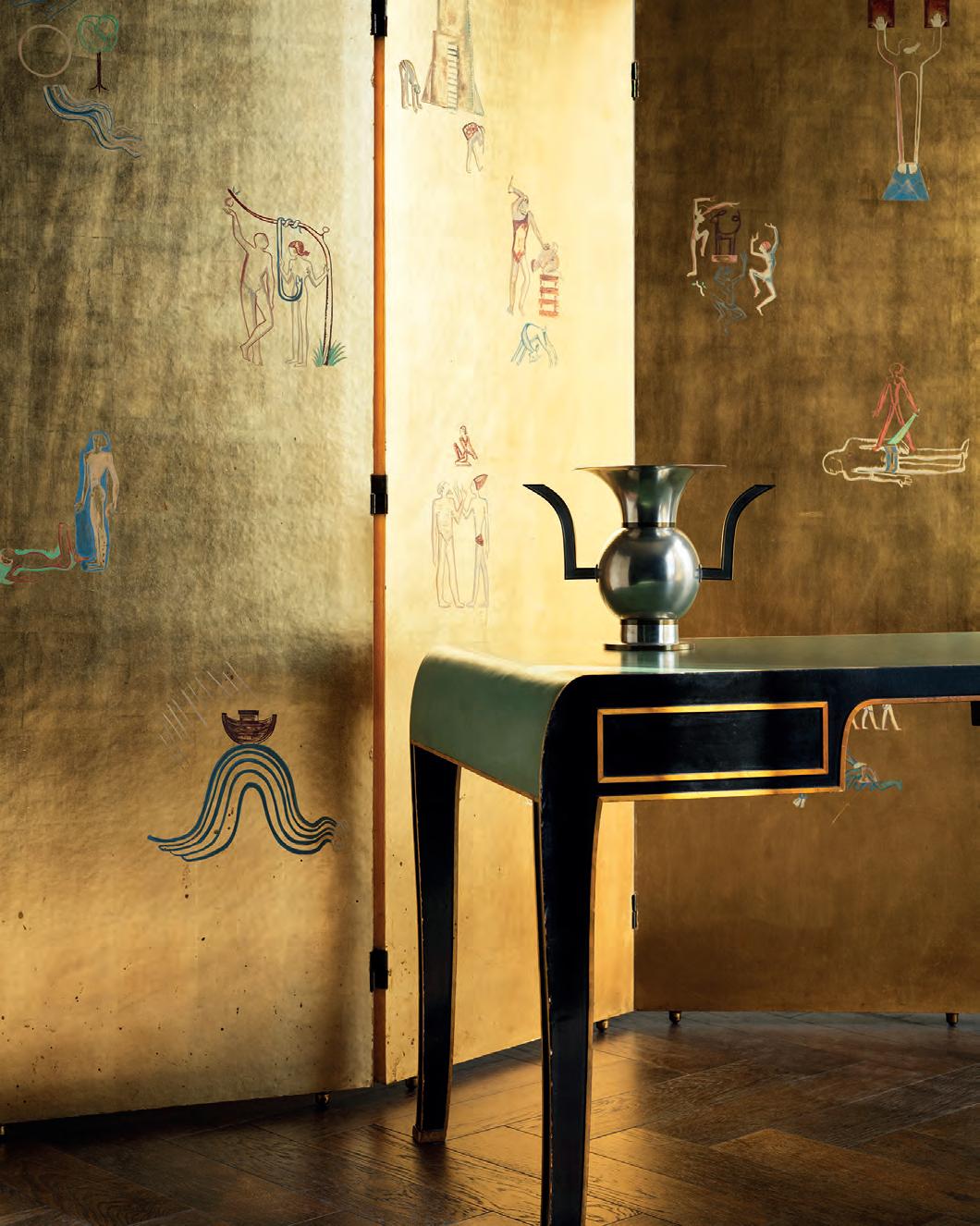
COVER: 292.
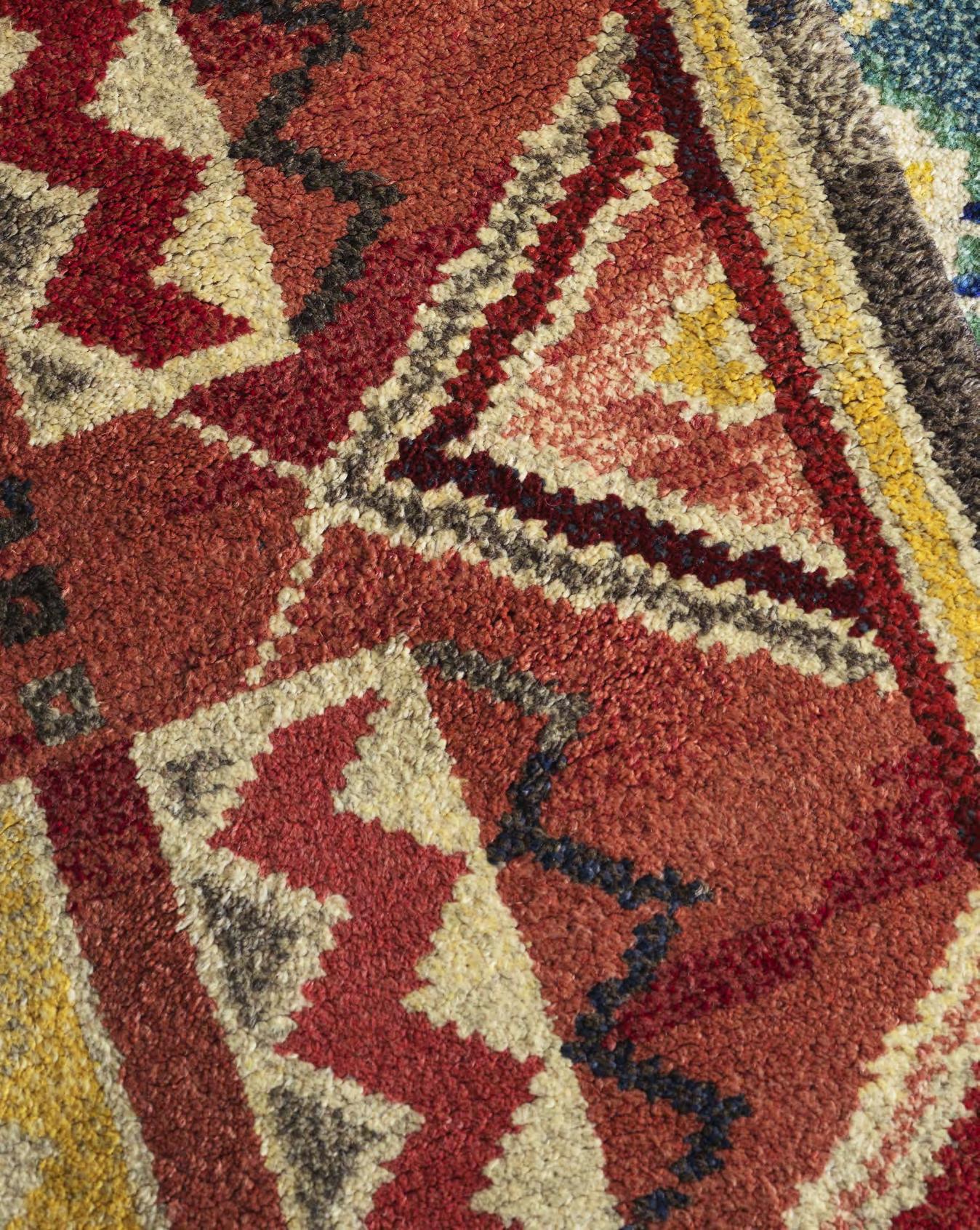
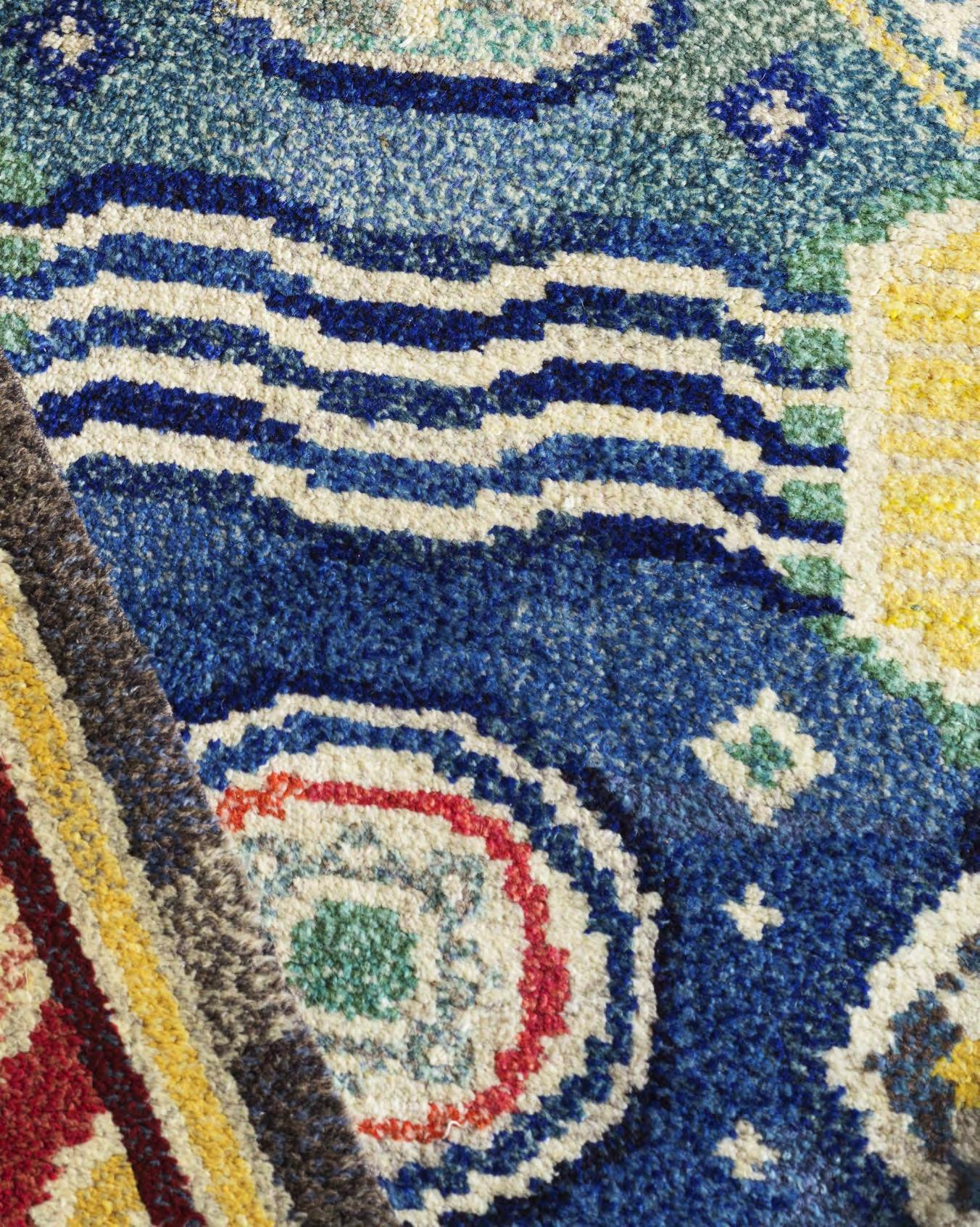
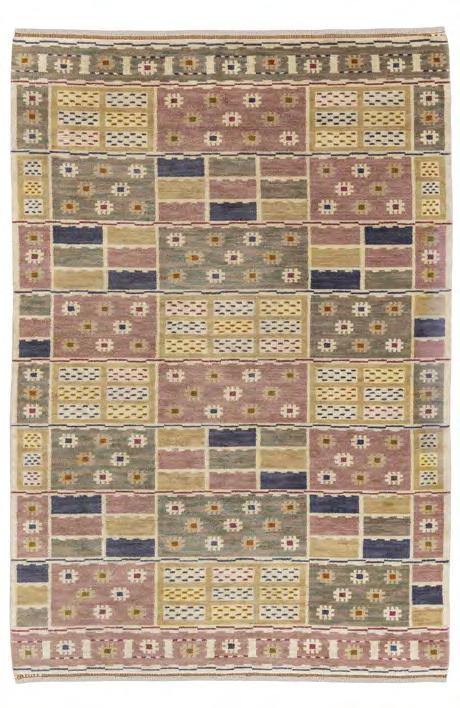
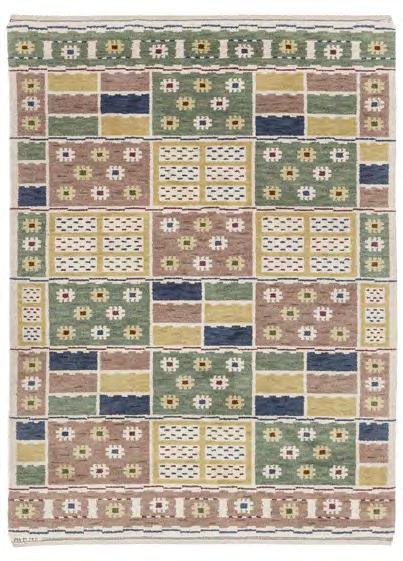
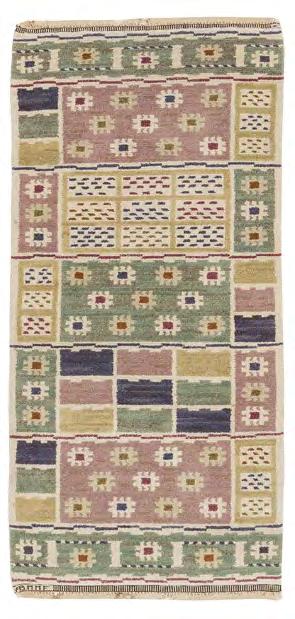
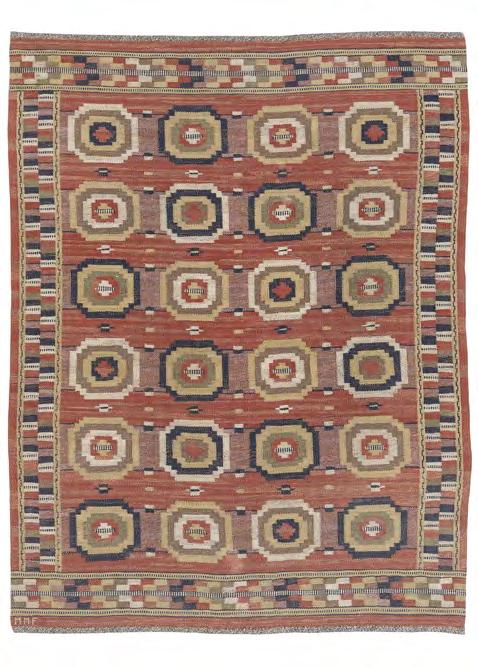
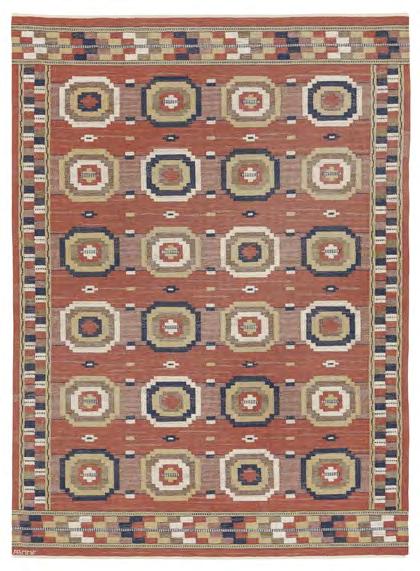
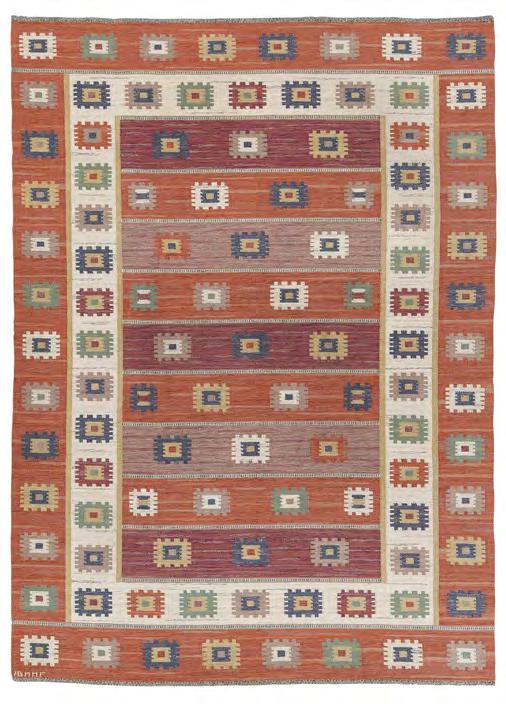
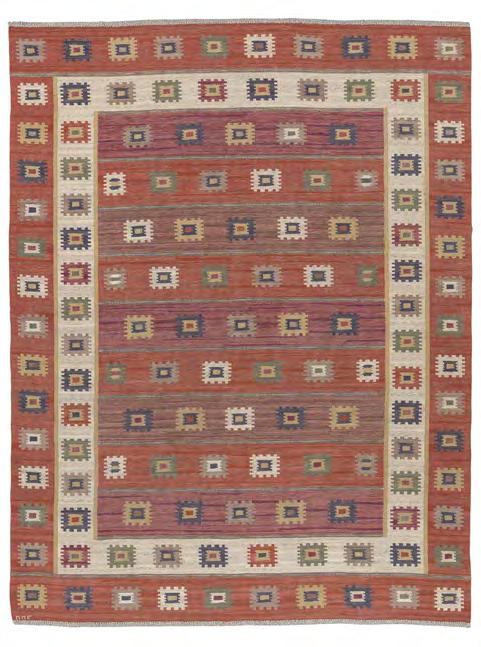
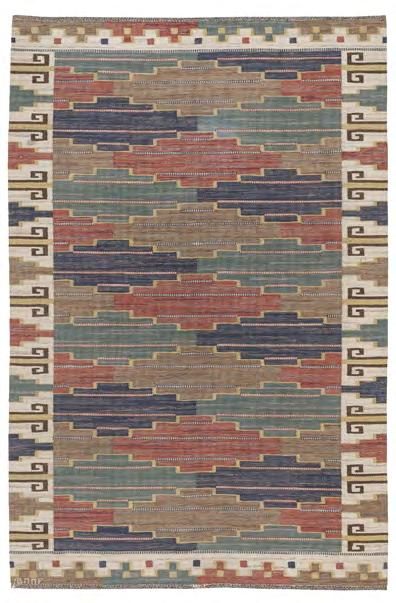
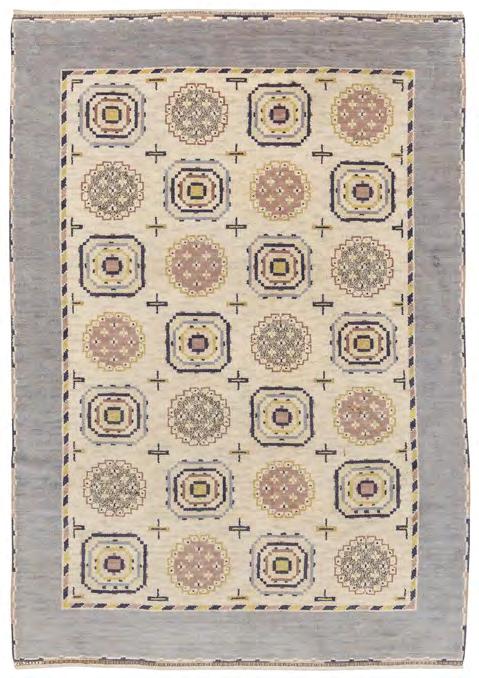
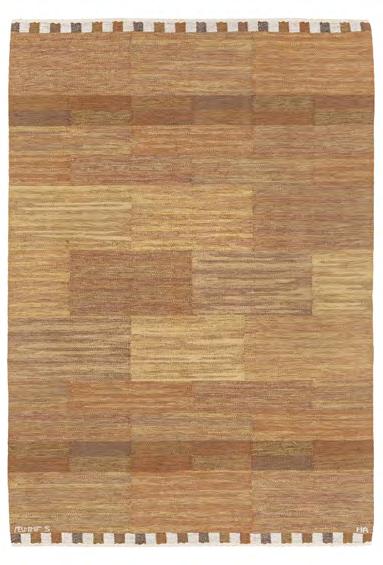
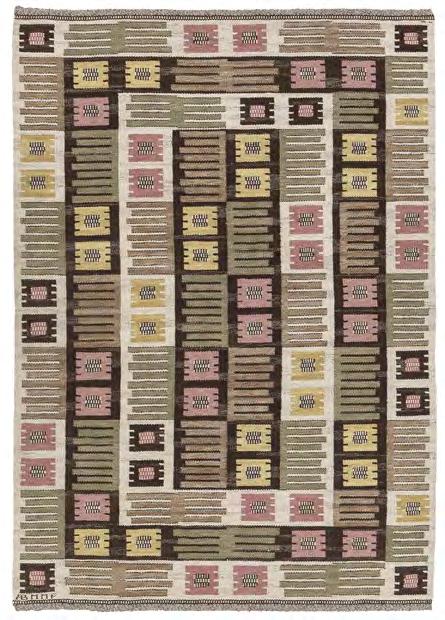
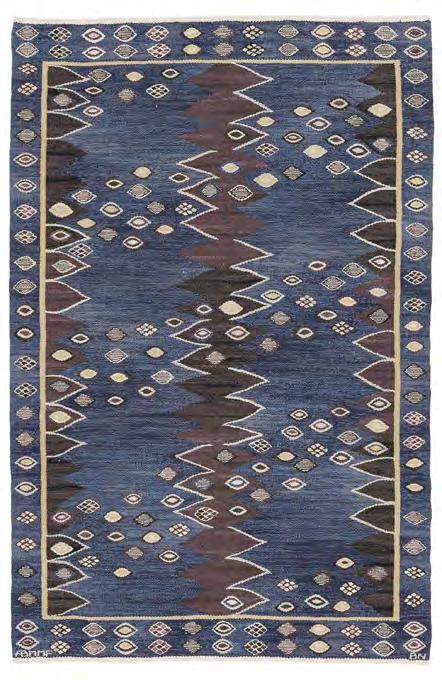
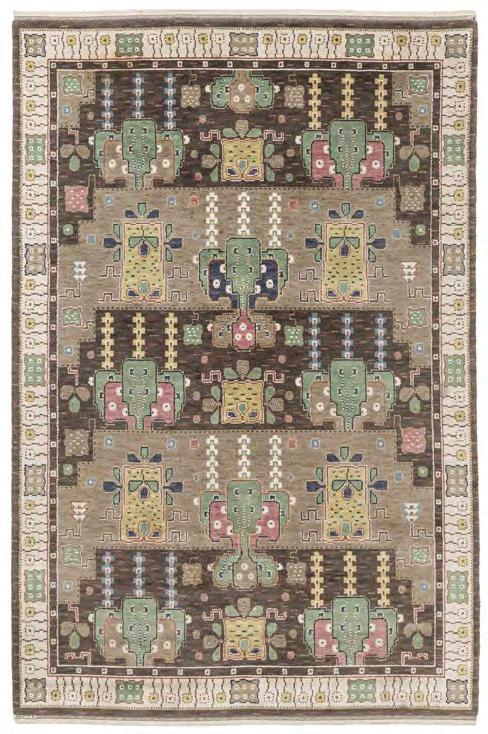
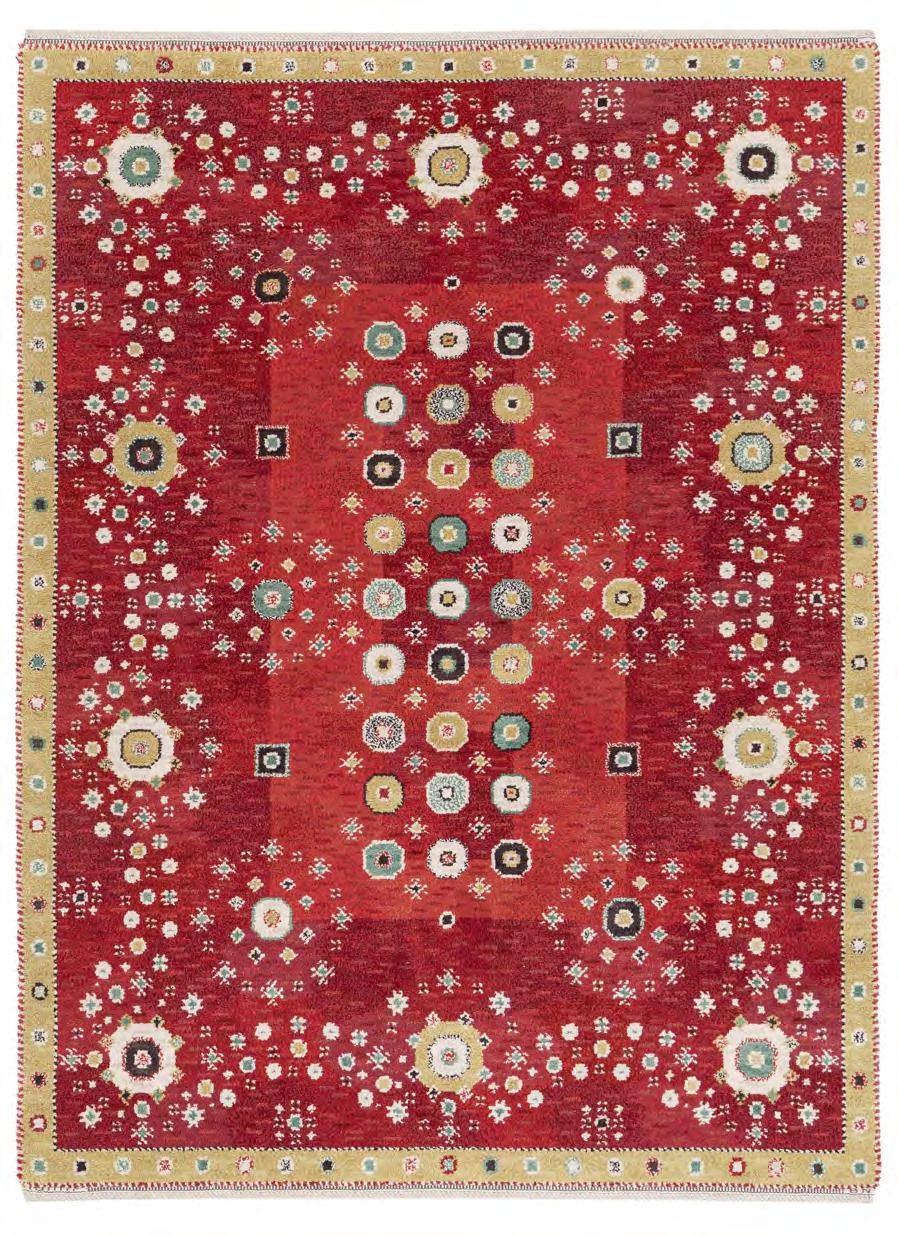
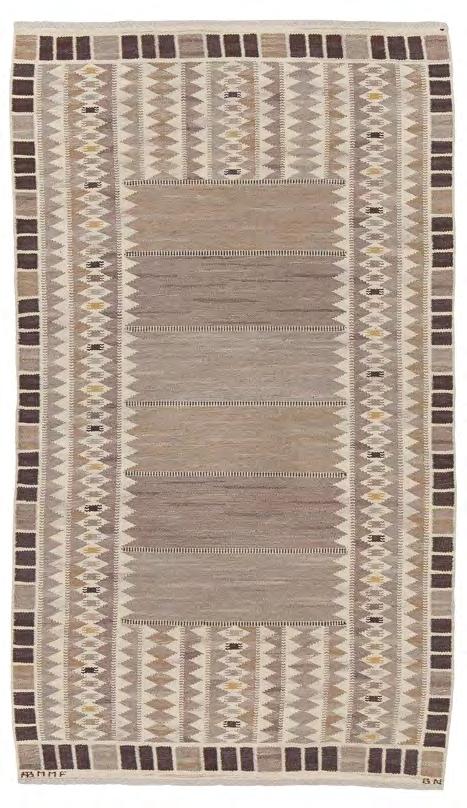
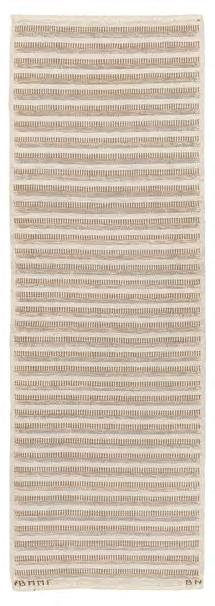
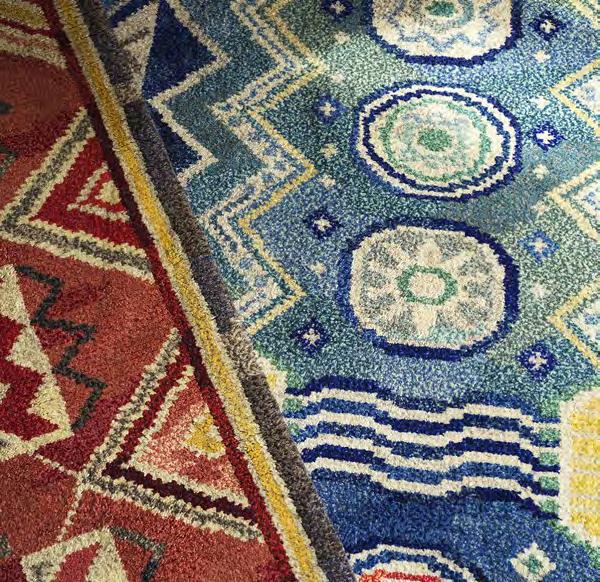
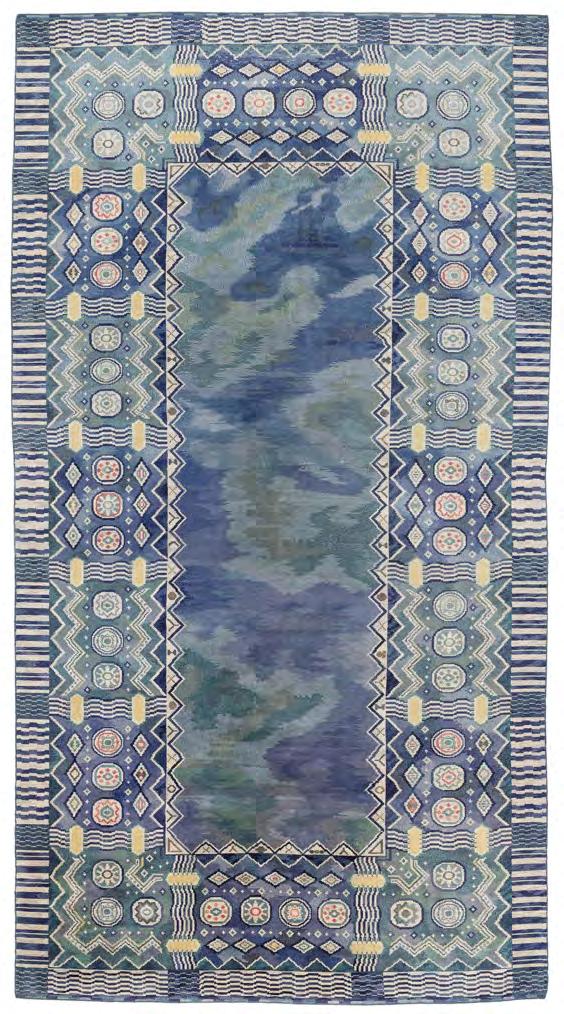
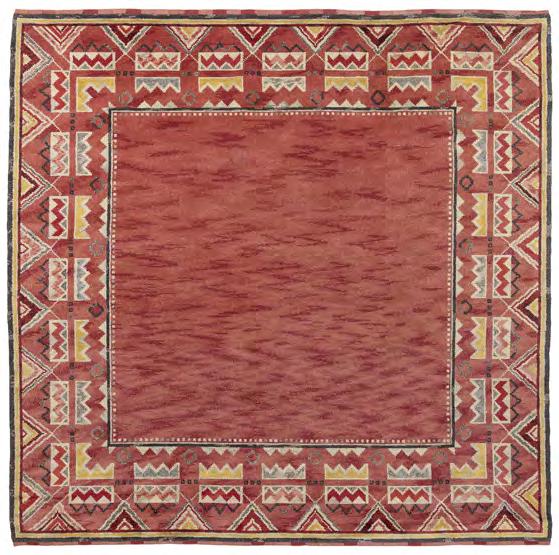
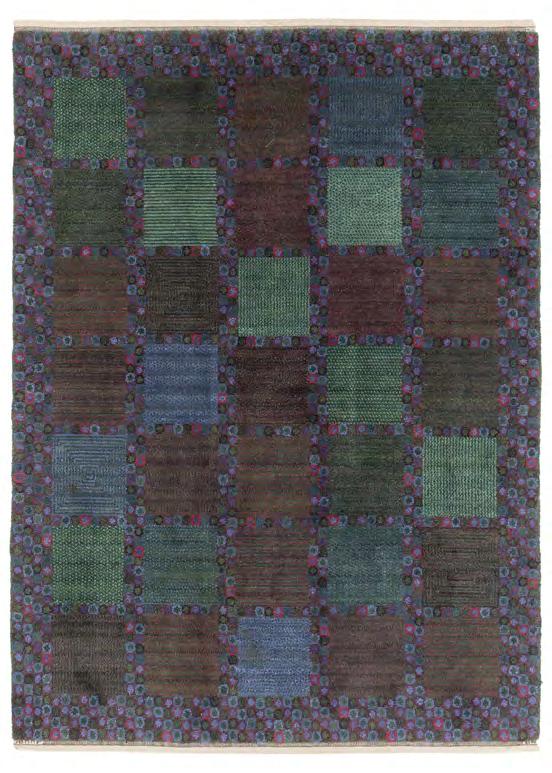
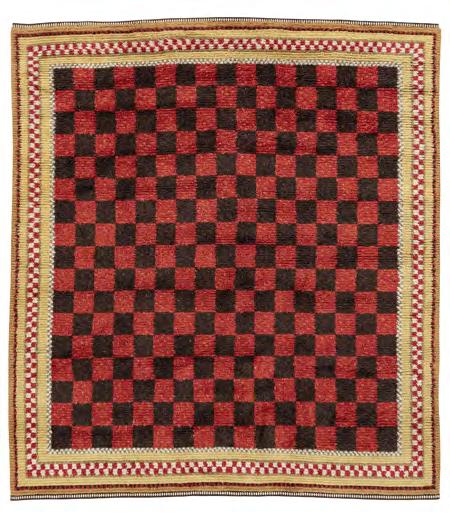
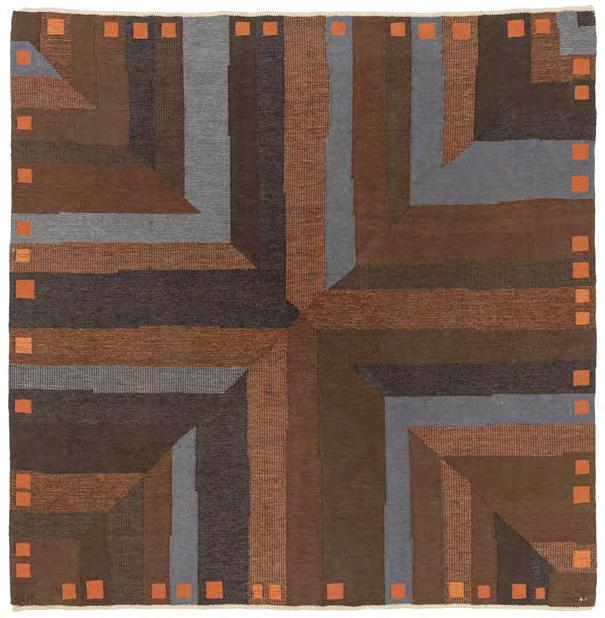
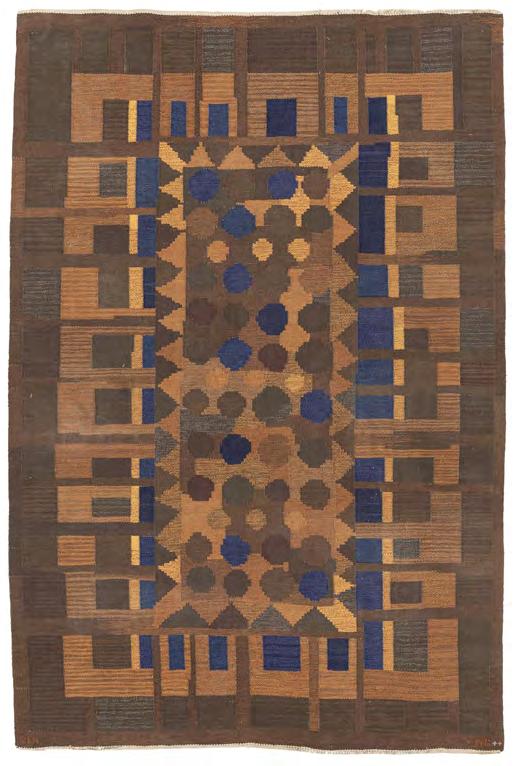
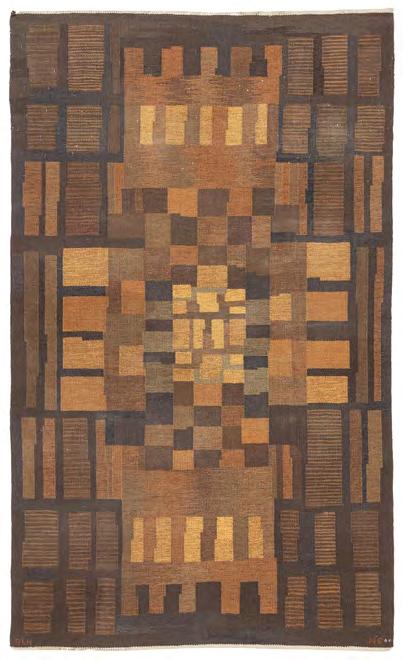
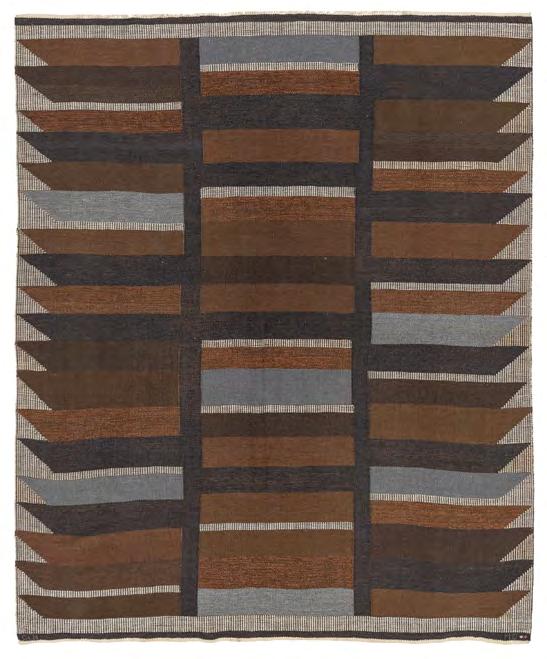
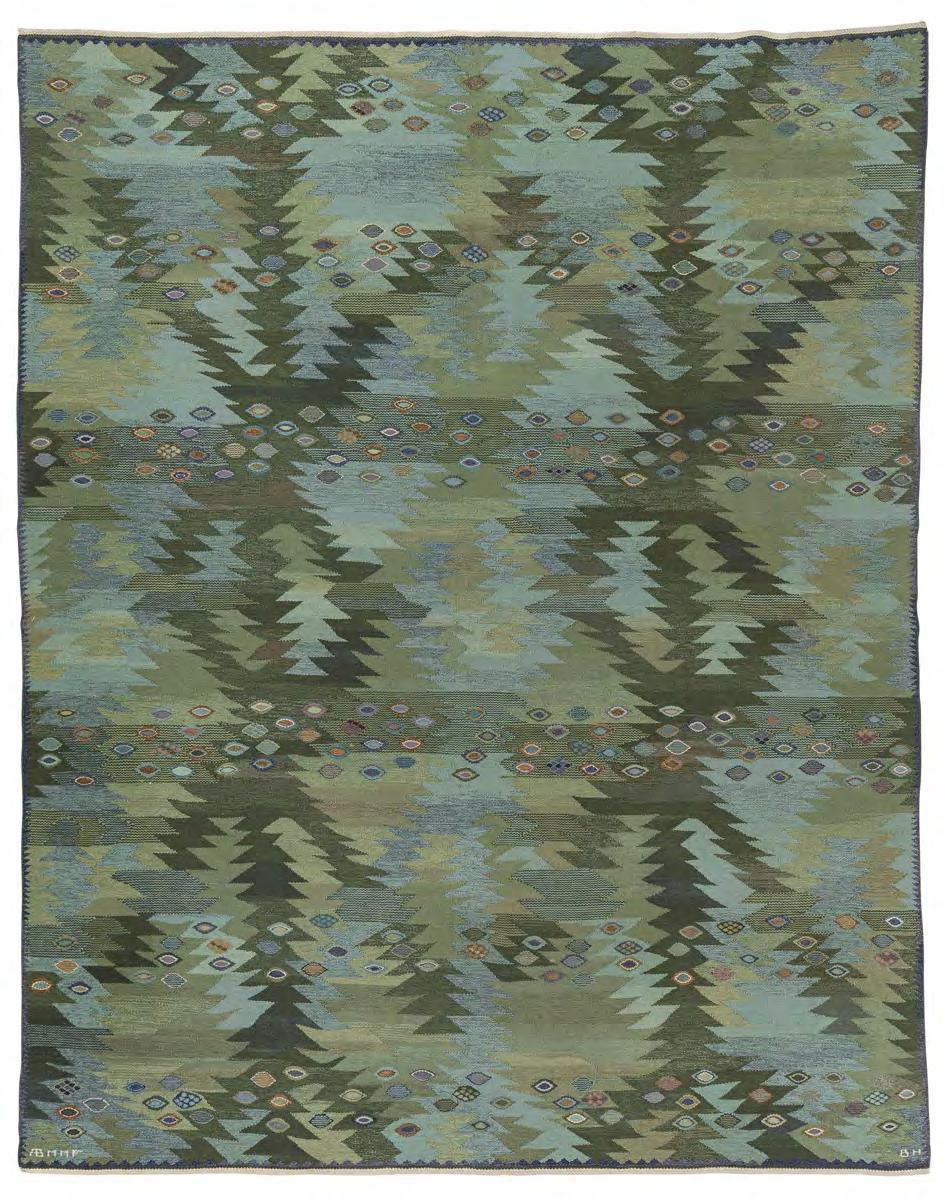
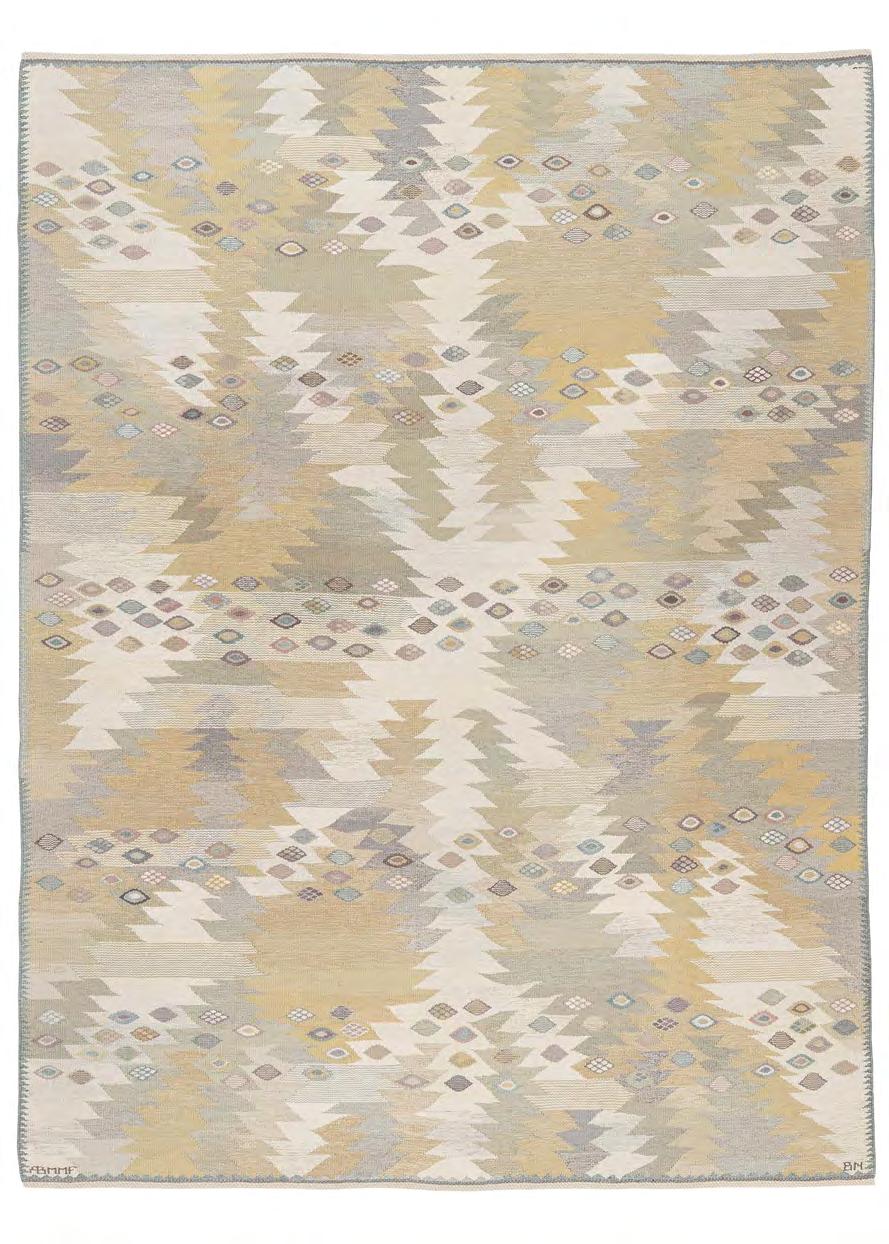
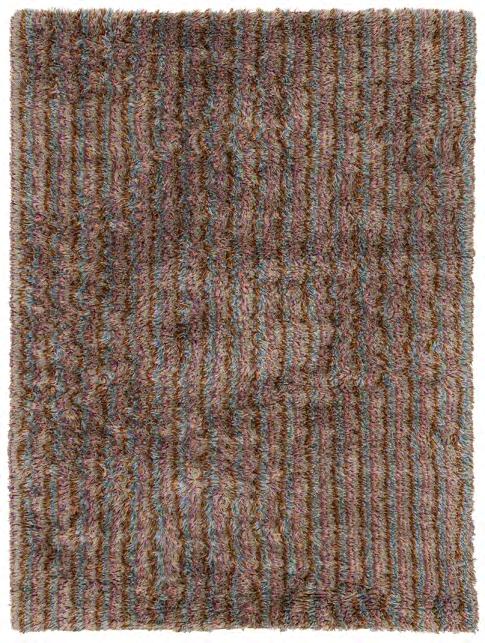
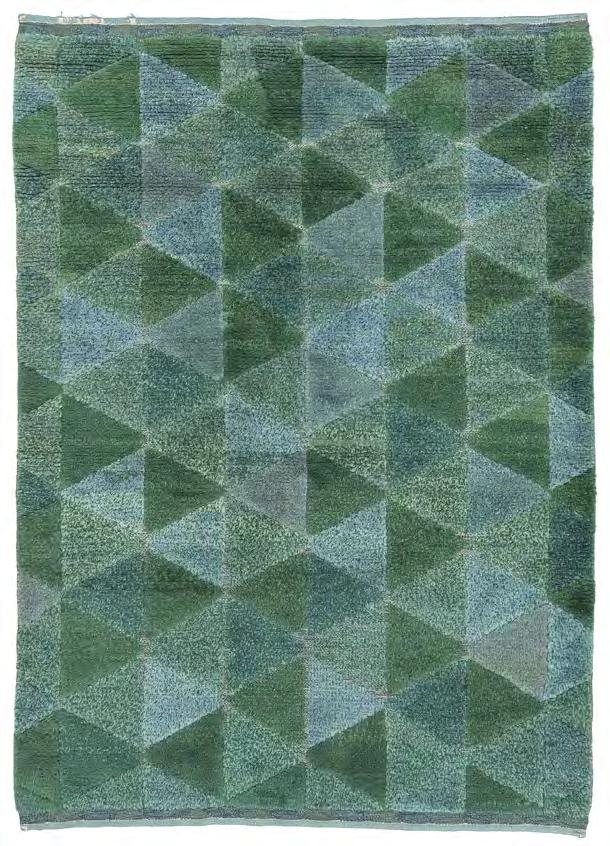
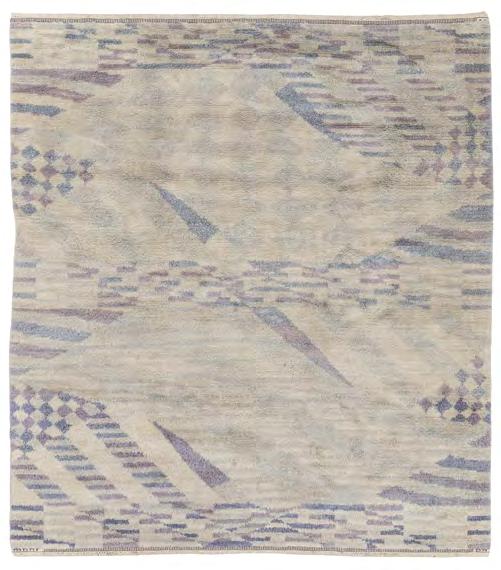
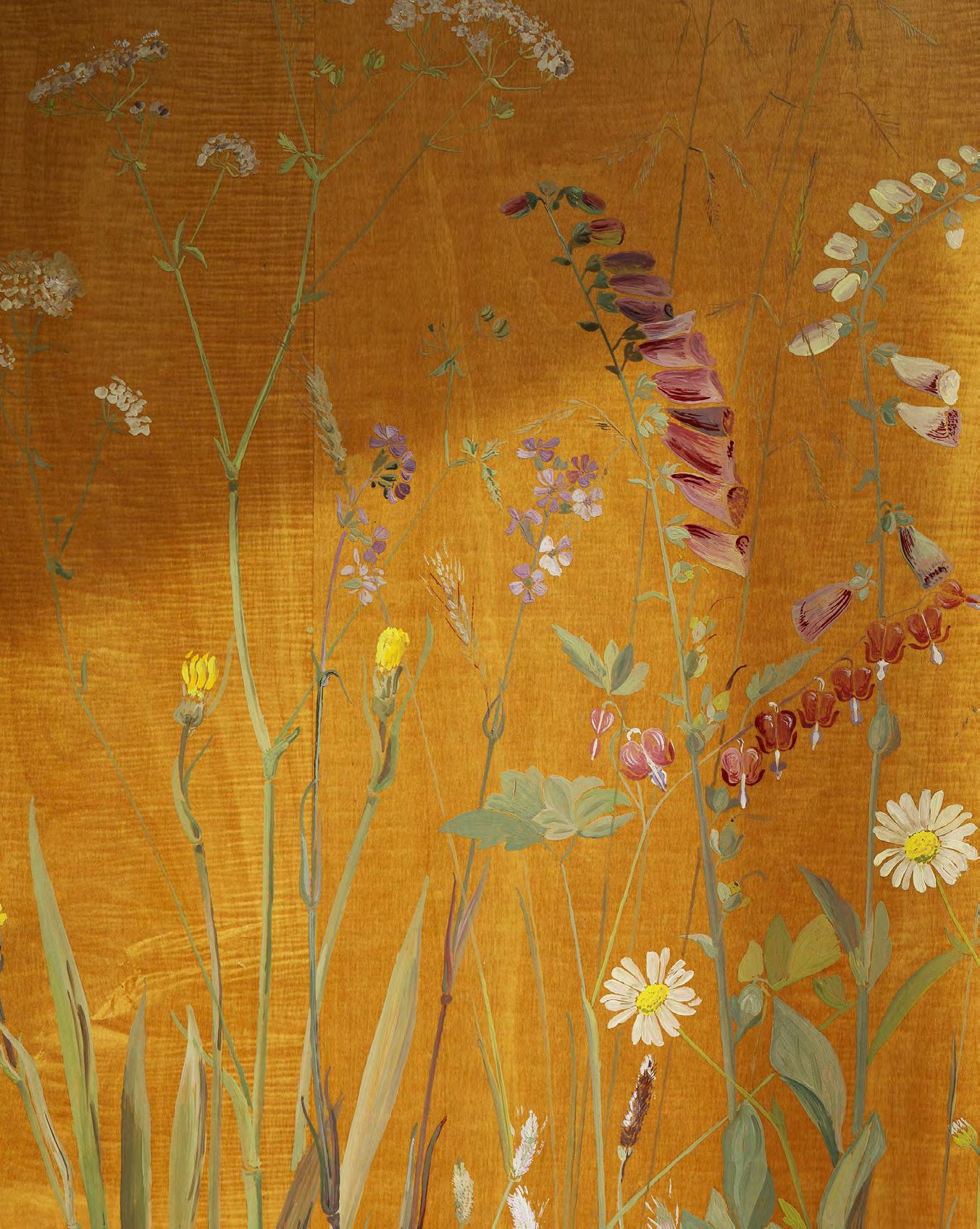
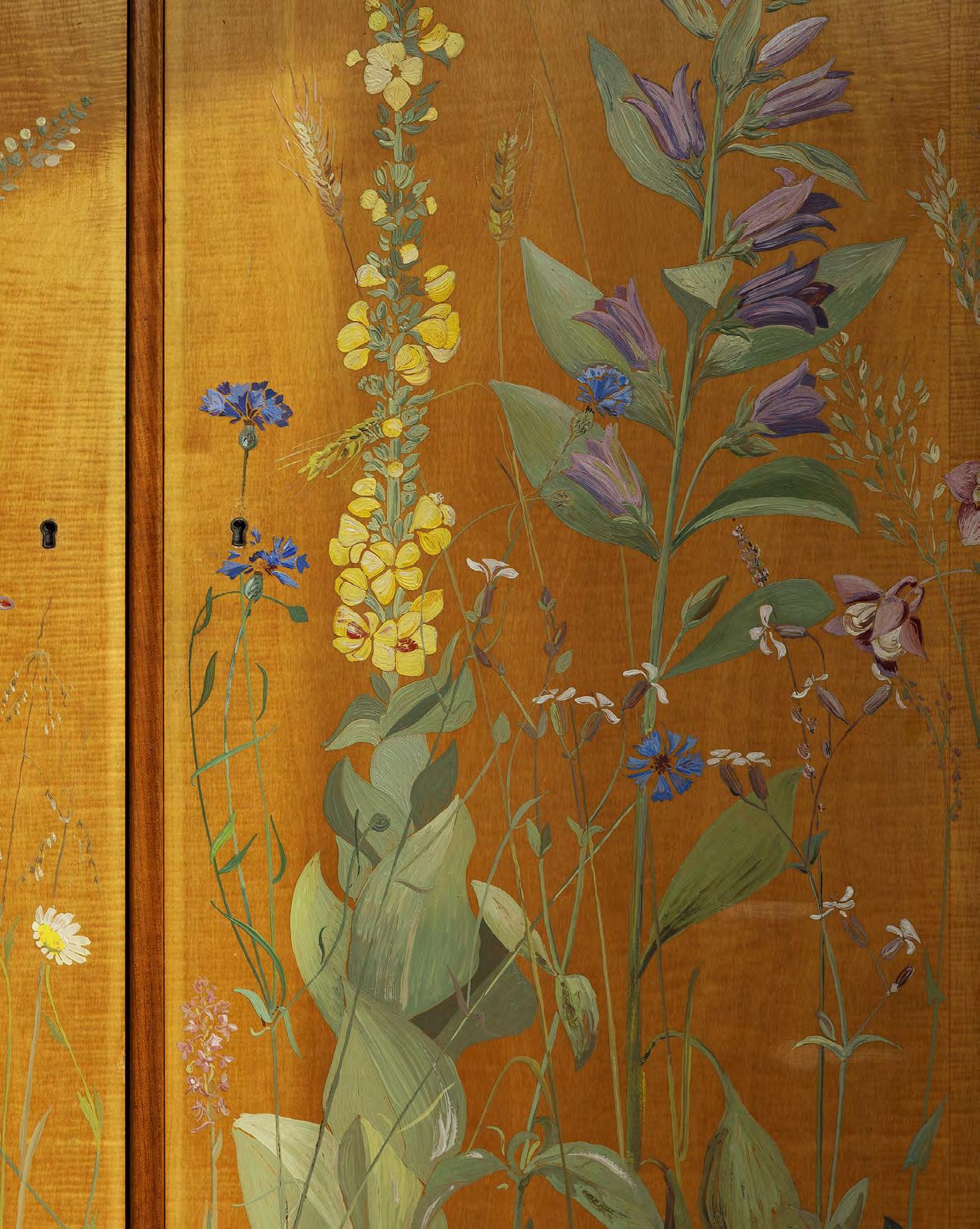
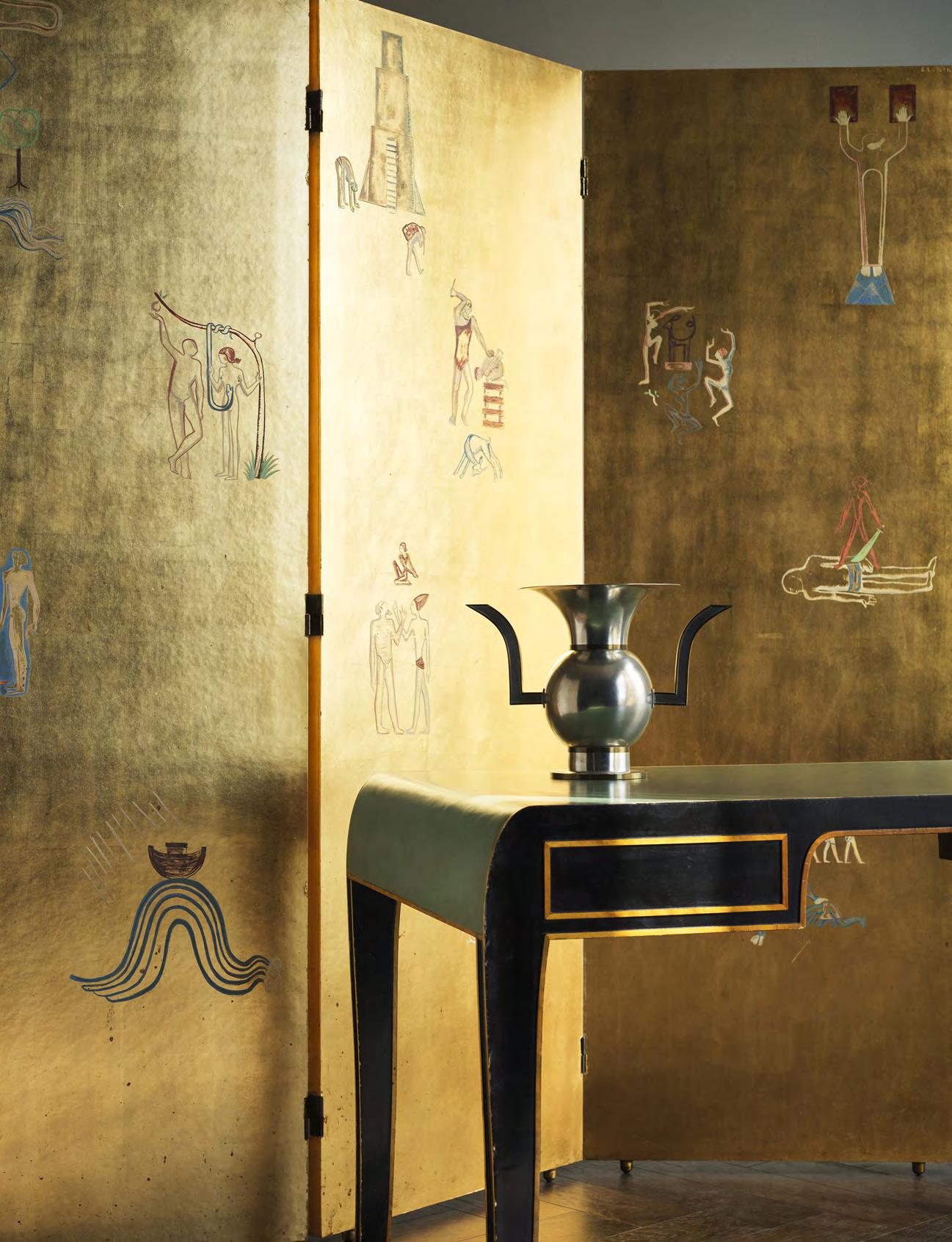
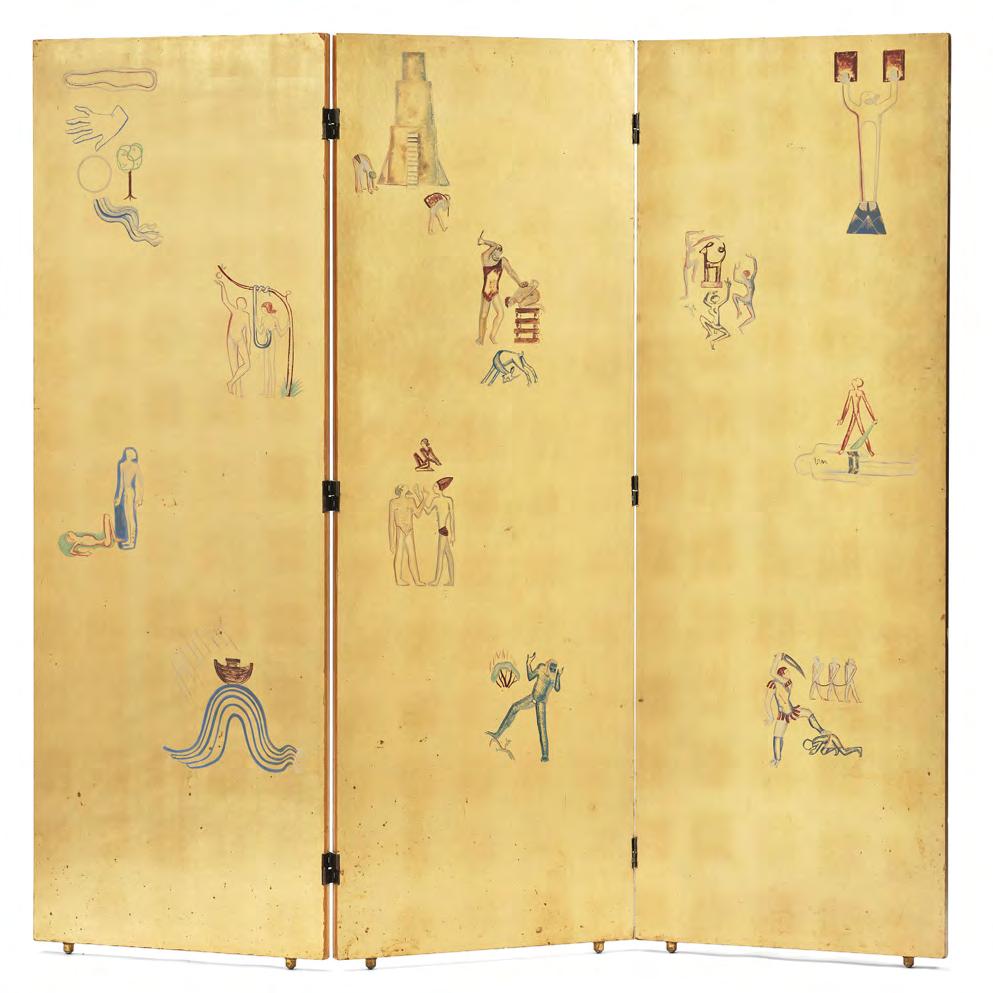
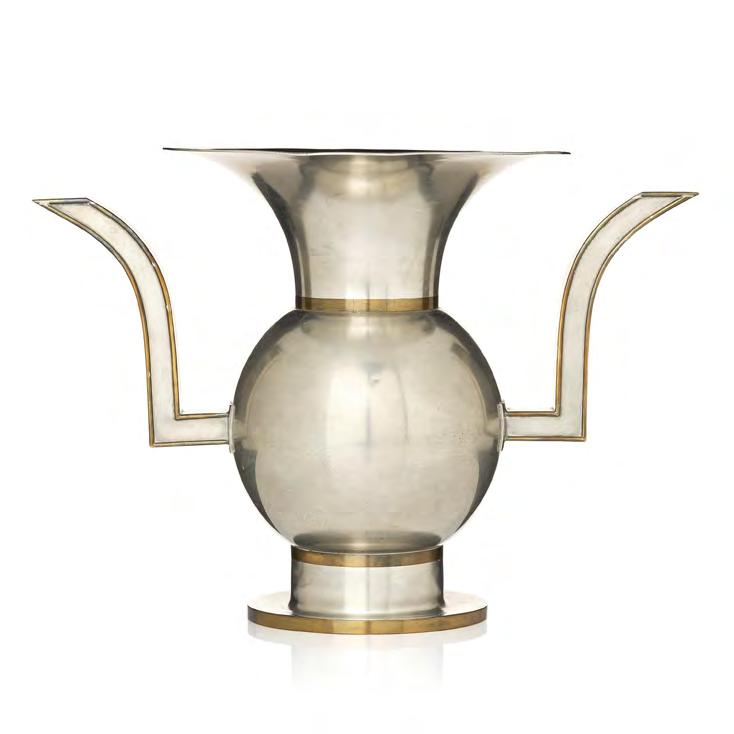
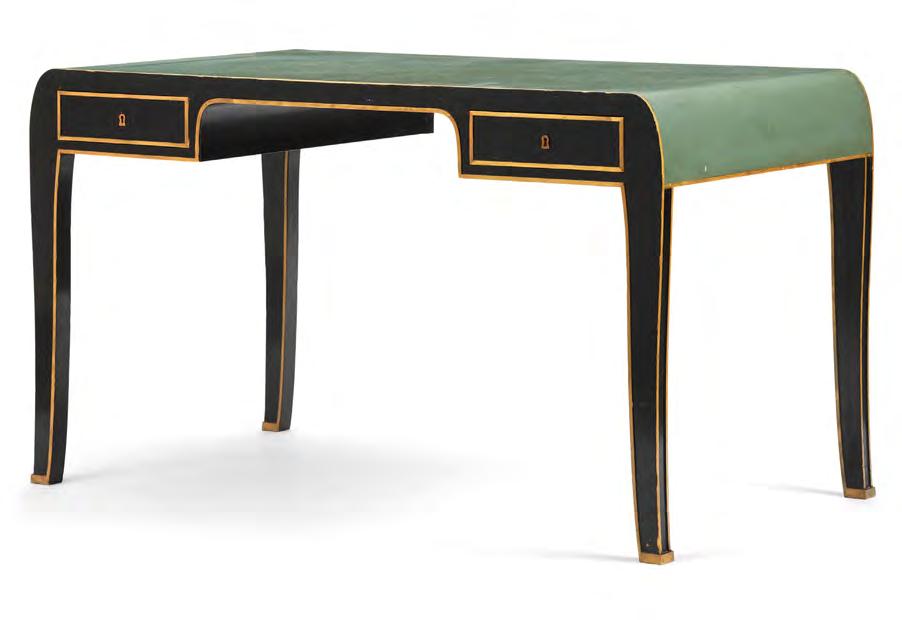
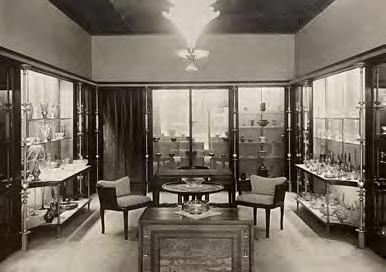
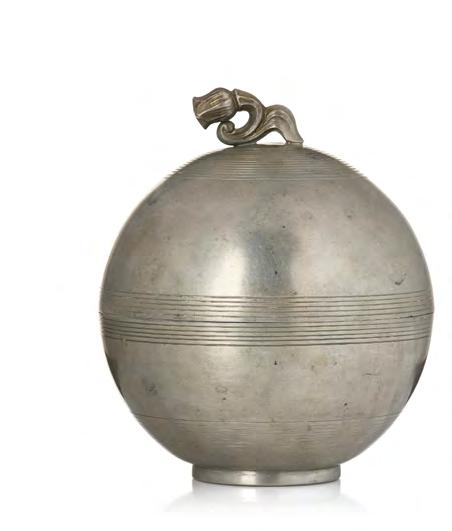
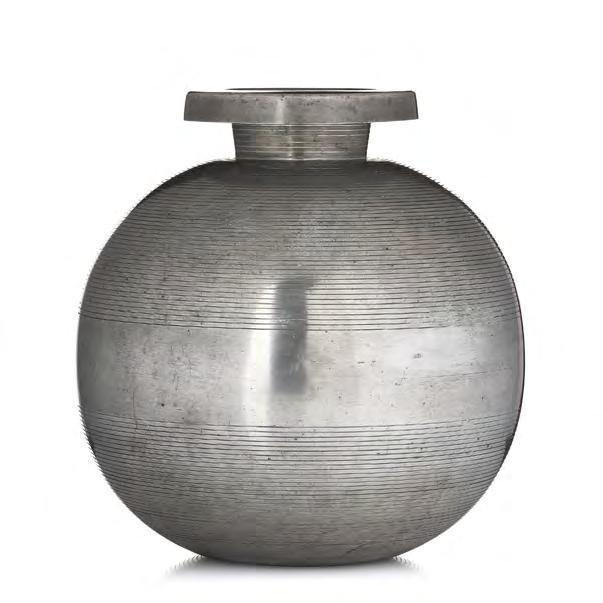
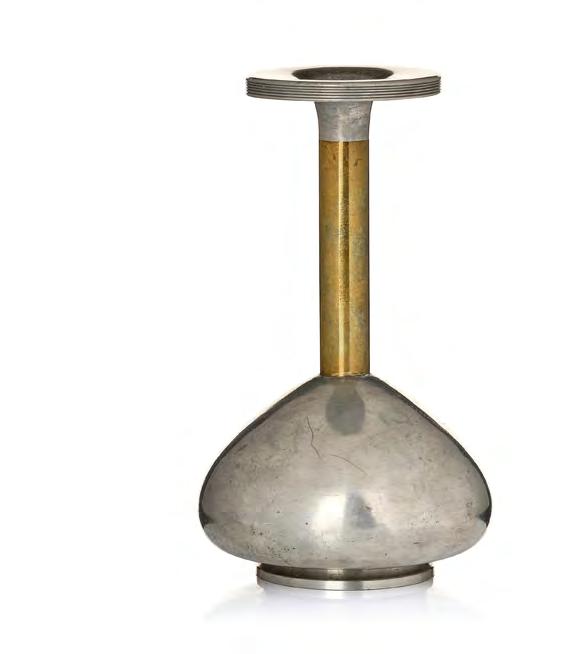
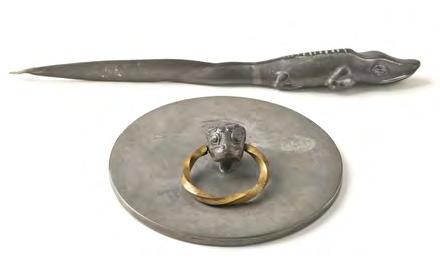
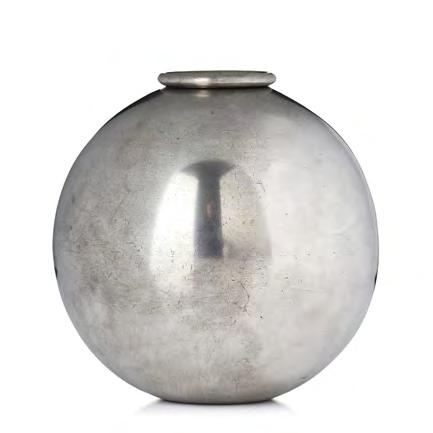
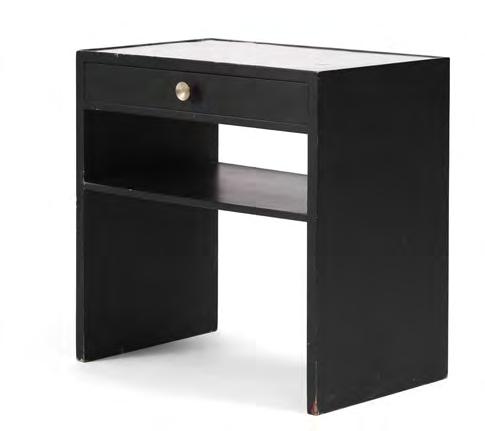
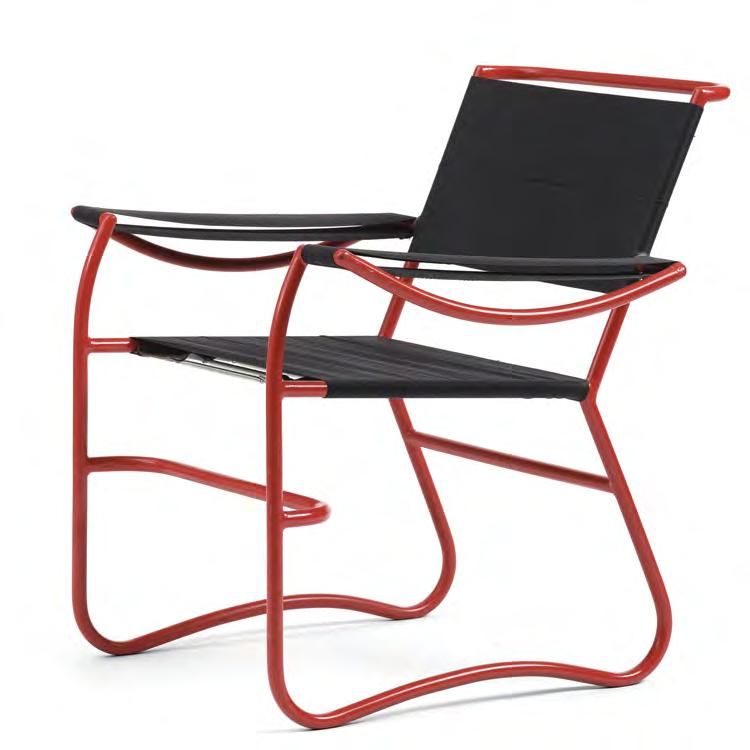
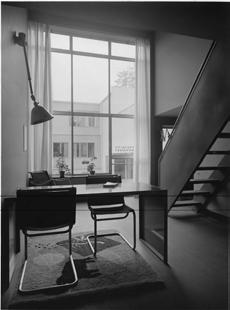
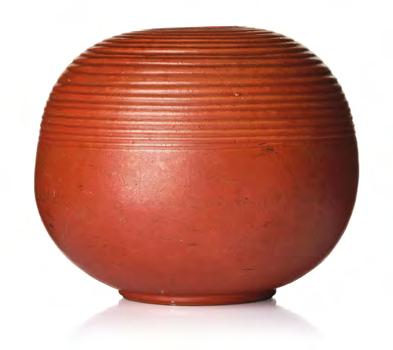
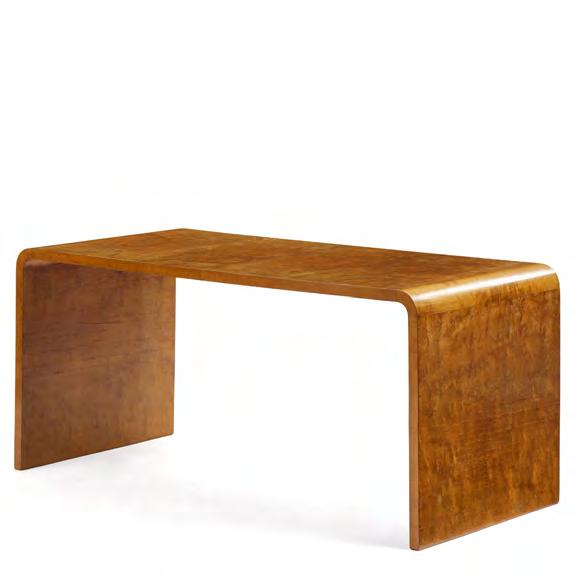
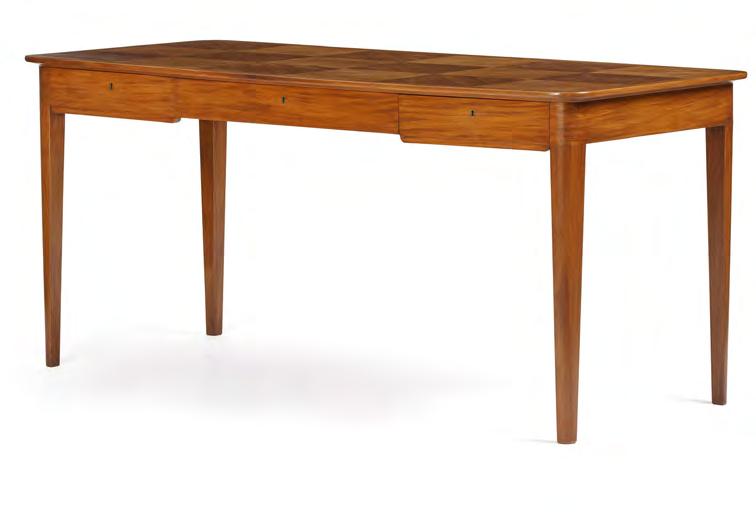
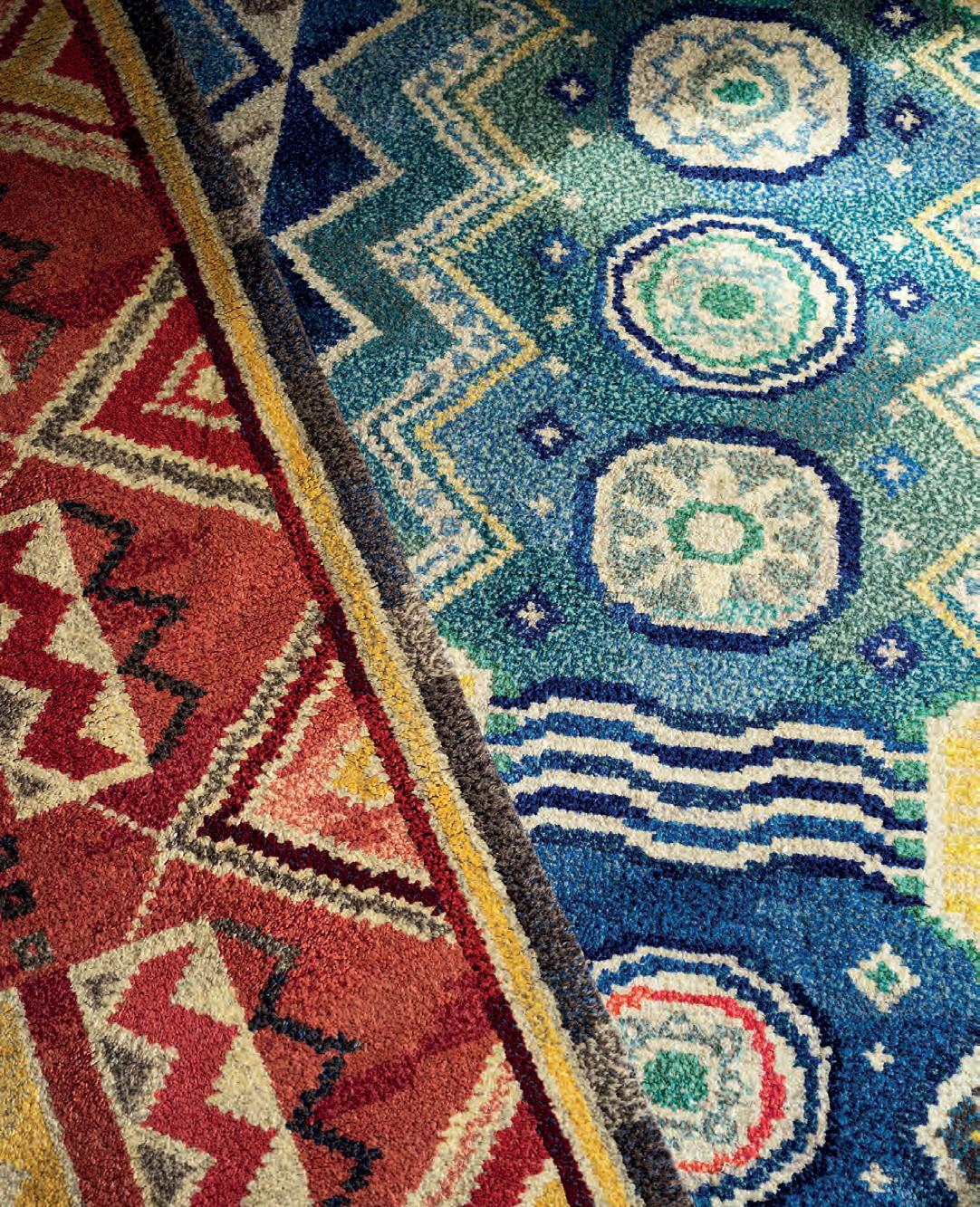
Carl Hörvik, a Swedish Grace desk, Nordiska Kompaniet, for Les Arts Décoratifs Suédois, Paris, 1928. 284. Einar Luterkort, a unique Swedish Grace folding screen, 1930s. 287. Nils Fougstedt, a pewter and brass vase, Svenskt Tenn, Stockholm 1930. BACK: 256. Margareta Sundbom Eichenholz, a knotted pile carpet. 255. Margareta Sundbom Eichenholz, a knotted pile carpet, ‘Skogen och älven’.
Modern Art & Design
Viewing May 13–19. Live auction May 20–21. Read more at www.bukowskis.com
Wednesday May 20, from 10 am (CEST)
Thursday May 21, from 10 am (CEST)
1 pm (CEST)
Glass
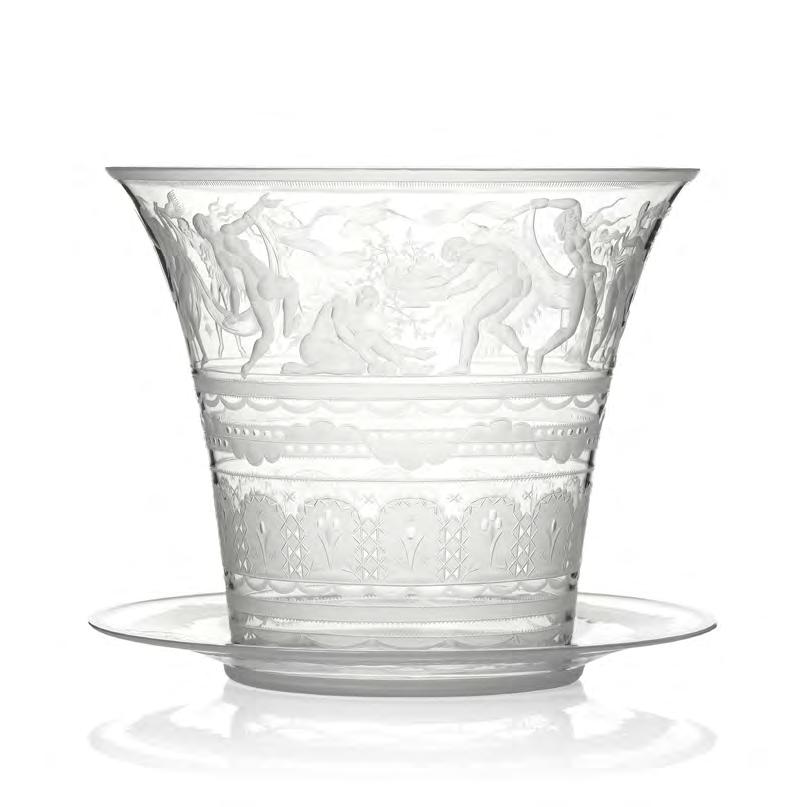
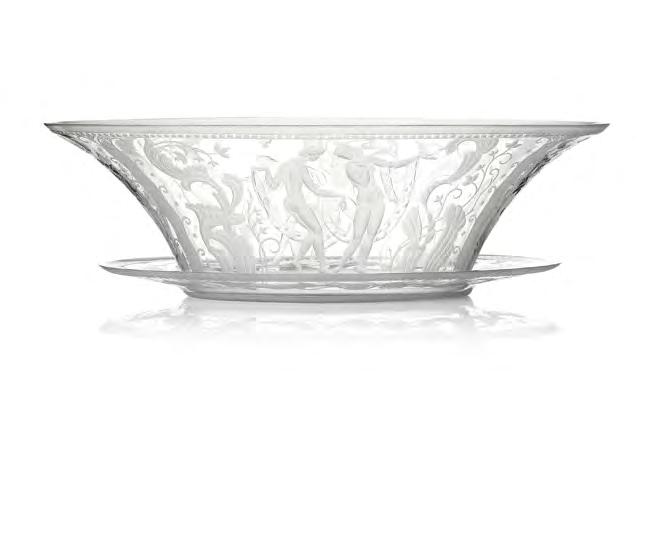
2. Simon Gate (Sweden, 1883–1945) an engraved glass bowl with plate, Orrefors 1930, model 122.
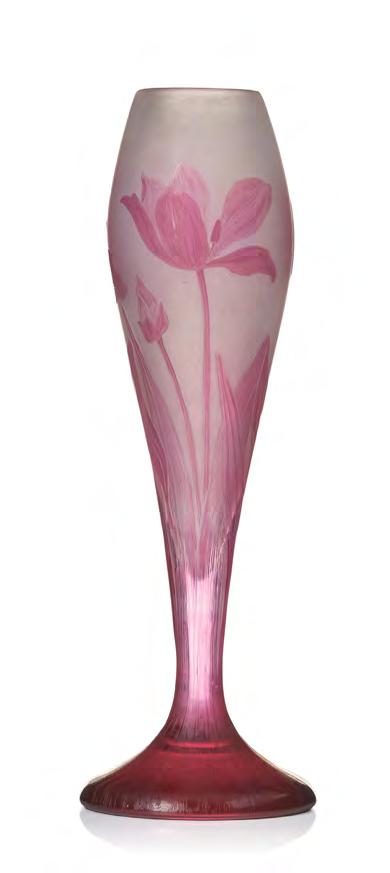
1. Karl Lindeberg (Sweden, 1877–1931) An Art Nouveau cameo glass vase, Kosta, model 173, circa 1900. Pink overlay glass with etched decoration of tulips against a white frosted background, signed Kosta KL 173 and on the foot Kosta. Height 35.7 cm.
Estimate: SEK 12 000 – 15 000 / EUR 1 130 – 1 410
Richly engraved decoration of dancing, music-making women, bowl and plate signed ORREFORS 1930 S. GATE 122 E. Weidlich (engraver, active 1922–29?). Height of the bowl 23.5 cm, diameter 27.7 cm, diameter of the plate 29.5 cm.
Provenance: Received as a gift in 1930, thence by descent within the family.
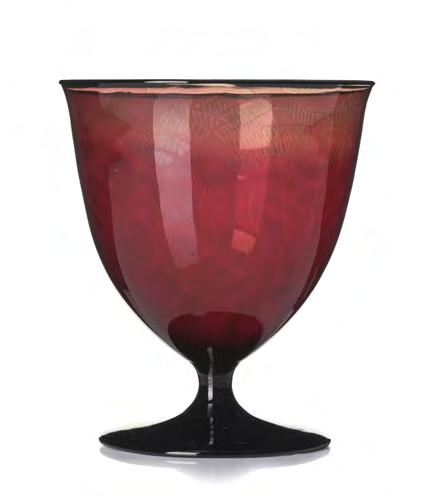
4. Edward Hald (Sweden, 1883–1980) a graal glass vase, Orrefors, Sweden, 1928.
Burgundy coloured glass with abstract striped decoration, signed SGraal Orrefors 1928 KB (glassblower Knut Bergqvist) 3205 EH.
Height 14 cm, diameter 12 cm.
Estimate: SEK 6 000 – 8 000 / EUR 566 – 754 (d)
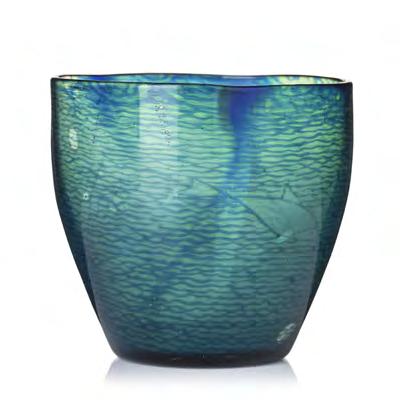
3. Edward Hald (Sweden, 1883–1980) a graal glass vase, Orrefors, no. 699, Sweden, 1918.
Decoration of swimming fish in blue against green, signed SGraal Orrefors KB - HW (glassblower Knut Bergqvist, etched decor by Heinrich Wollman) no 699. Height 10.3 cm, diameter 11.2 cm.
Provenance: Edward Hald, thence by descent within the family.
Estimate: SEK 8 000 – 10 000 / EUR 754 – 943 (d)
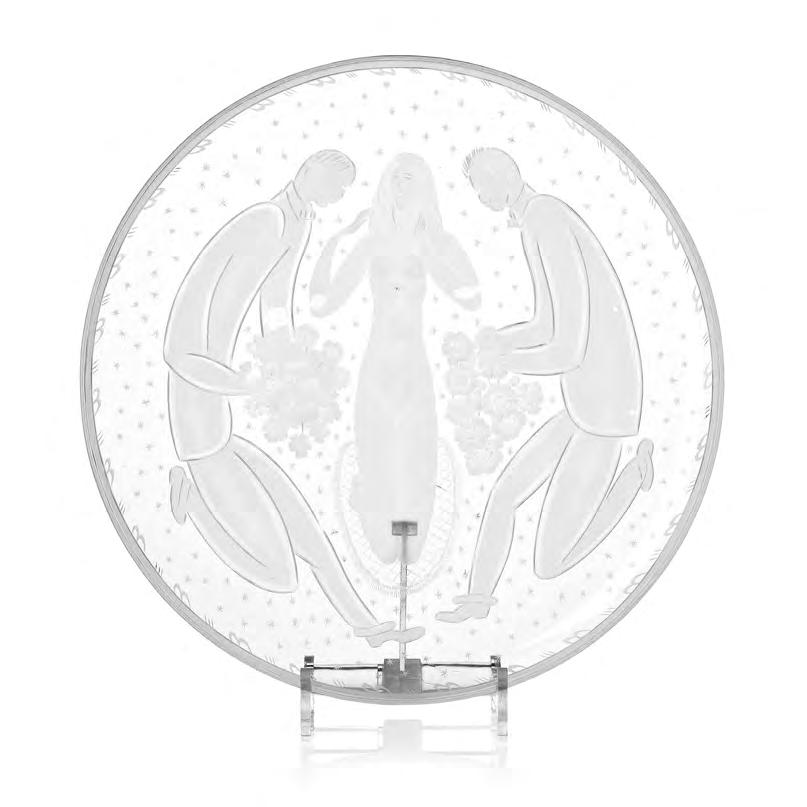
5. Edward Hald (Sweden, 1883–1980) “Rivalerna”, an engraved glass tray, Orrefors, Sweden, ca. 1920.
Engraved and etched decoration of a woman with attentive suitors, signed H. 160120 Orrefors. Diameter 33.3 cm.
Provenance: Edward Hald, thence by descent within the family.
Exhibitions: Nationalmuseum, Waldemarsudde, Stockholm 19.9–27.11 1983, “Edward Hald - Målare, Konstindustripionjär”, cf. the model exhibited, catalogue no. 120.
Literature: Helmut Ricke, Lars Thor, “Swedish Glassworks, Production Catalogues 1915–1960”, Prestel-Verlag 1987, see the model illustrated p. v.
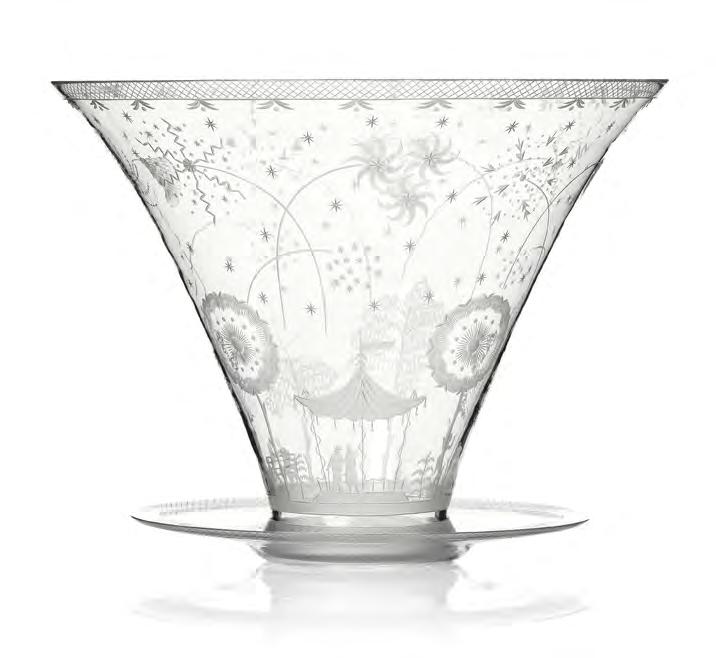
6. Edward Hald (Sweden, 1883–1980) a Swedish Grace “Fyrverkeri” (Fireworks) engraved glass bowl with a plate, Orrefors, Sweden, 1925, model 248.
Engraved decoration of fireworks and people in a park landscape, the bowl centrally signed Orrefors H 248. 1925 TL (blurred engraver, probably Thure Löfgren). Height including the plate 21 cm, diameter 27 cm.
Estimate: SEK 20 000 – 25 000 / EUR 1 890 – 2 360
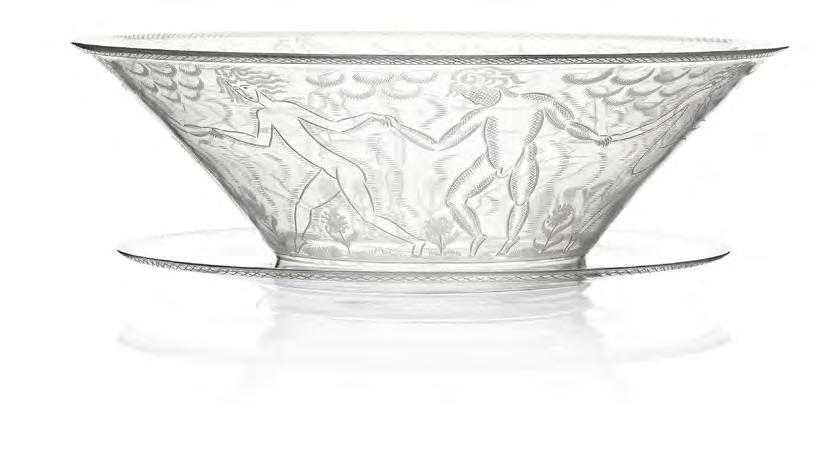
7. Edward Hald (Sweden, 1883–1980) an engraved glass bowl with plate, Orrefors, Sweden, 1926, model 305, engraved by Emil Goldmann.
Decoration of dancing girls and boys among flowers, the bowl signed Orrefors Hald 305. 26. E.G. Diameter 28 cm, total height 9.7 cm.
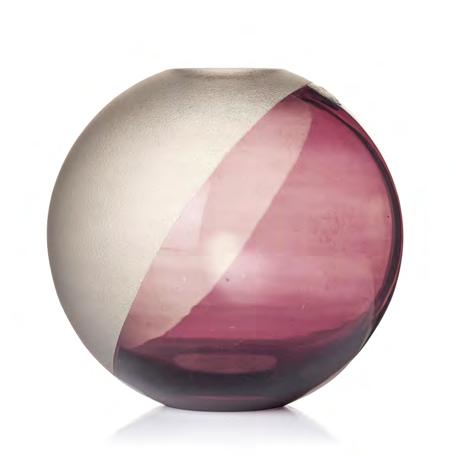
Spherical, partly brown-toned with a blasted side, signed Of Lu 163 and manufacturer's paper label. Height 13 cm.
Estimate: SEK 8 000 – 10 000 / EUR 754 – 943
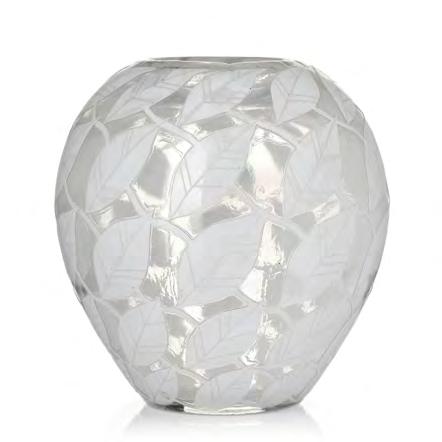
10. Sven Erik Skawonius (Sweden, 1908–1981) a cameo glass vase, Kosta, Sweden, 1940s, model 182.
Polished decoration of white leaves against a clear background, signed Kosta Skawonius 182. Height 16.5 cm.
Estimate: SEK 4 000 – 6 000 / EUR 377 – 566
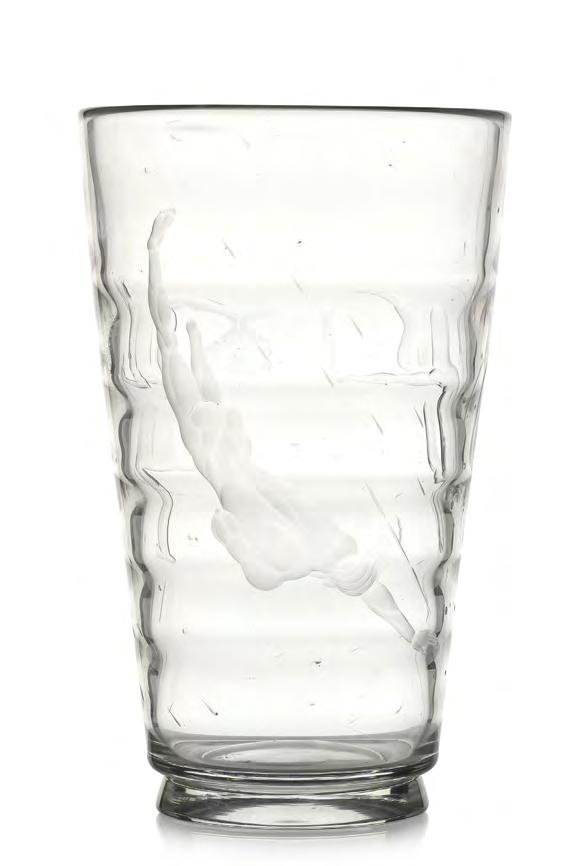
9. Vicke Lindstrand (Sweden, 1904–1983) a “Pärlfiskare” (Pearl Fisher) engraved glass vase, model 1115, Orrefors, Sweden, 1936.
Optically blown clear glass with a decoration of three swimming figures, signed Orrefors Lindstrand 1115 - A2 - E.G. (engraver Emil Goldmann, active 1923–39). Height 34 cm.
Estimate: SEK 30 000 – 40 000 / EUR 2 830 – 3 770
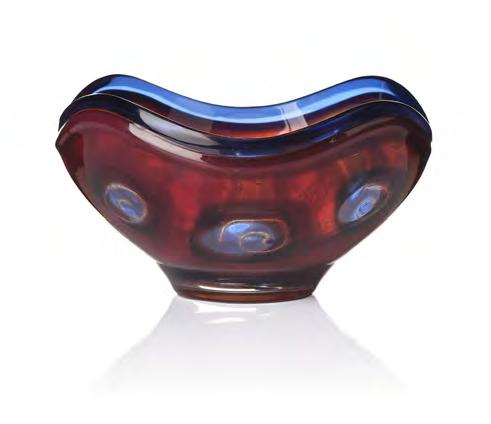
11. Sven Palmqvist (Sweden, 1906–1984) a ravenna glass bowl, Orrefors, Sweden, 1955, no 876.
Oval with lattice decoration in blue against green, signed ORREFORS Ravenna No 876 Sven Palmqvist. 17 x 13.5 cm, height 8 cm.
Estimate: SEK 10 000 – 12 000 / EUR 943 – 1 130
12. Sven Palmqvist (Sweden, 1906–1984) a ravenna glass bowl, Orrefors, Sweden, 1957, no 1118.
Four-sided with a checkered decoration in red and blue, signed ORREFORS Ravenna No 1118 Sven Palmqvist. 14 x 14 cm, height 7.7 cm.
Estimate: SEK 8 000 – 10 000 / EUR 754 – 943 (d)
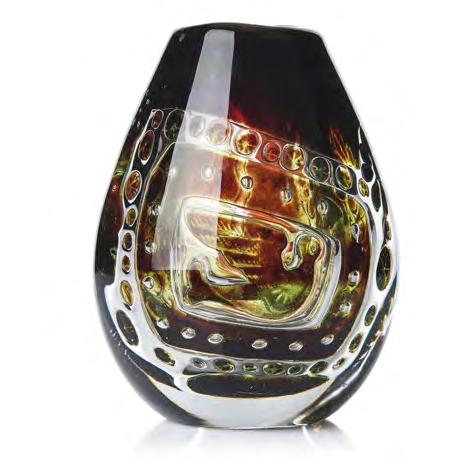
14. Edvin Öhrström (Sweden, 1906–1994) an Ariel glass vase “The Girl and the Dove”, Orrefors 1957, no. 449F.
Drop-shaped with decoration of a girl and dove in brown and green against clear glass, signed ORREFORS Ariel No 449F
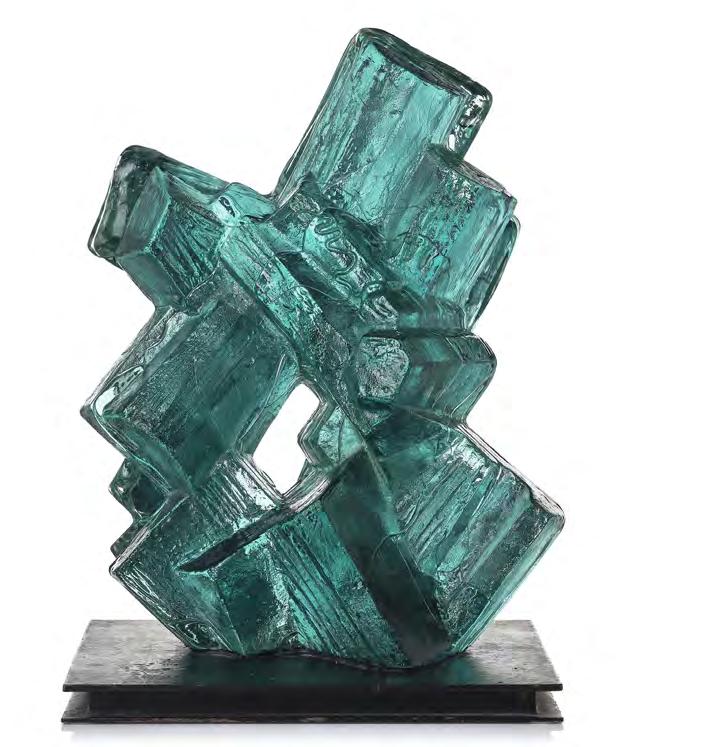
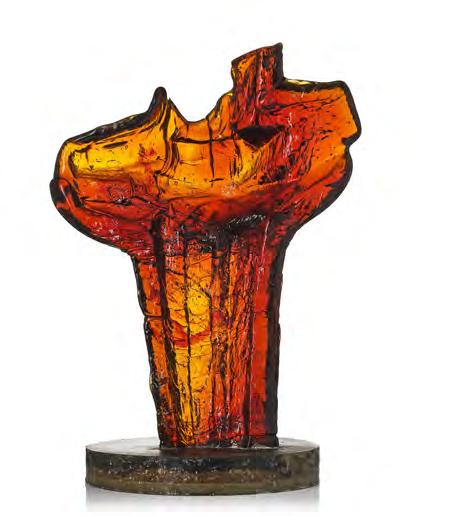
Emerald green glass, two parts, signed Öhrström 1/7. The height of the sculpture is 54 cm, total height including mounting on a metal plate is 57.3 cm, the plate measures 41 x 41 cm.
Provenance: From the collection of Art Collector and Entrepreneur Kent Löwenberg.
Literature: Märta Holkers & Folke Holmér, “Edvin Öhrström, skulptör i glas”, Carlssons 1991, cf. the model illustrated p. 6.
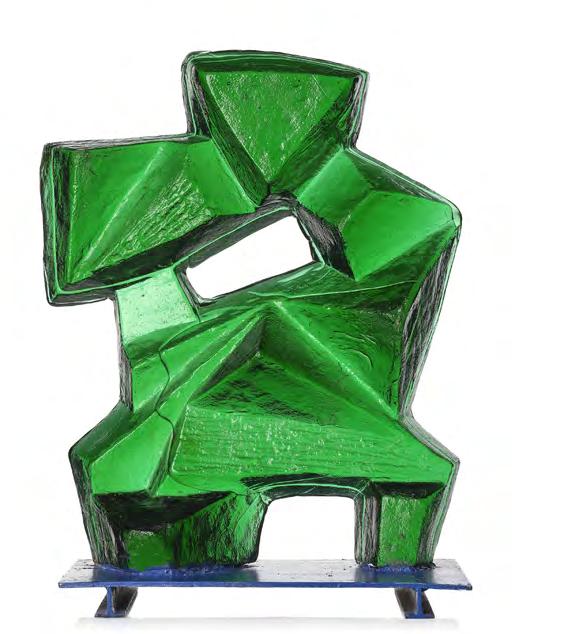
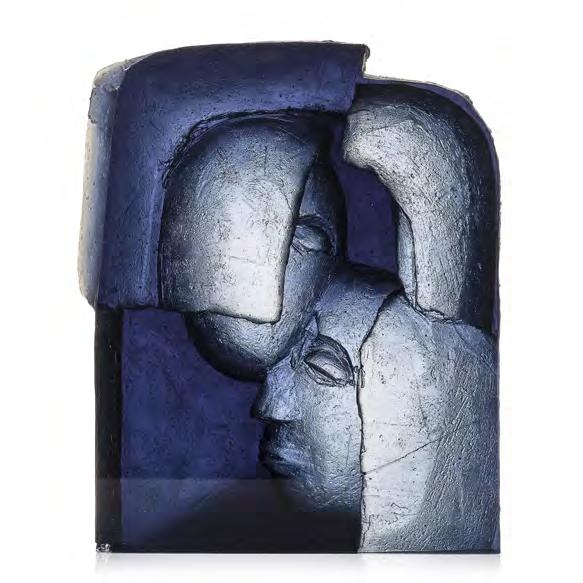
19. Edvin Öhrström (Sweden, 1906–1994) “Låt oss komma överens” (Let's Come to an Agreement), a cast glass sculpture, Lindshammar Glassworks, post 1955. Green glass, signed E. Öhrström. Height 53.5 cm, width 44 cm, total height including blue lacquered metal stand, 57 cm.
Provenance: From the collection of Art Collector and Entrepreneur Kent Löwenberg.
Literature: Märta Holkers & Folke Holmér, “Edvin Öhrström, sculptor in glass”, Carlssons 1991, cf. the model illustrated p. 74.
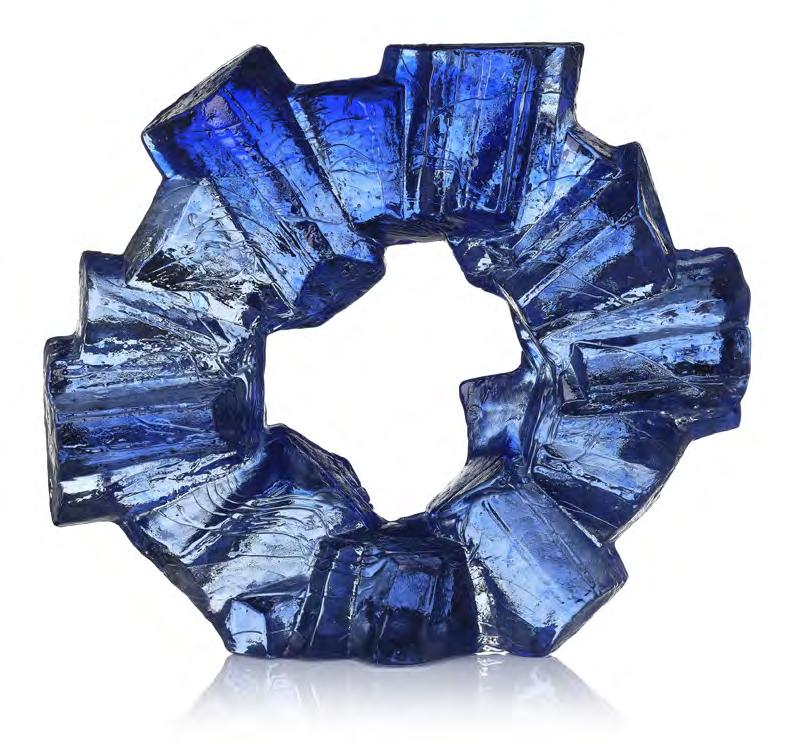
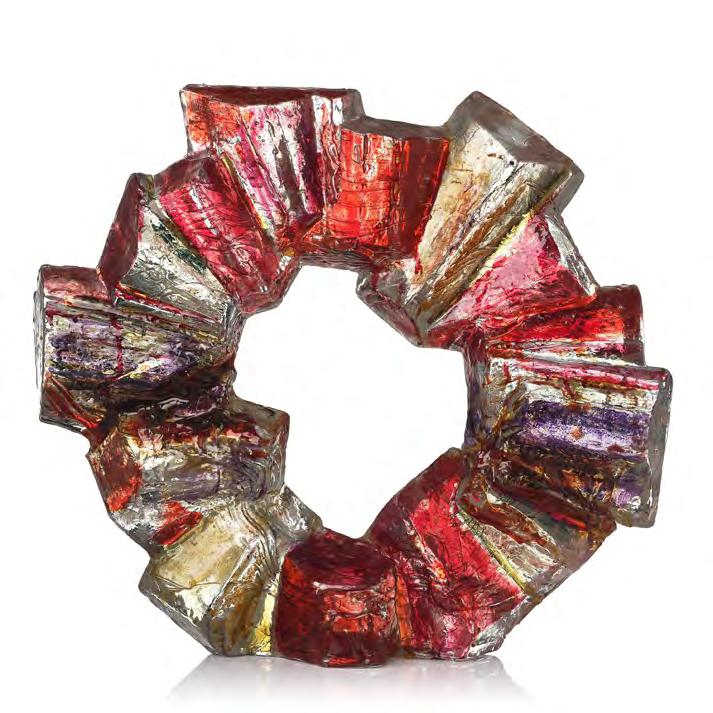
18. Edvin Öhrström (Sweden, 1906–1994) “Korona”, a cast glass sculpture, Lindshammar Glassworks. Clear glass with red and purple inclusions, signed E Öhrström. Height 55 cm.
Provenance: From the collection of Art Collector and Entrepreneur Kent Löwenberg.
Literature: Märta Holkers & Folke Holmér, “Edvin Öhrström, sculptor in glass”, Carlssons 1991, cf. the model illustrated p. 67.
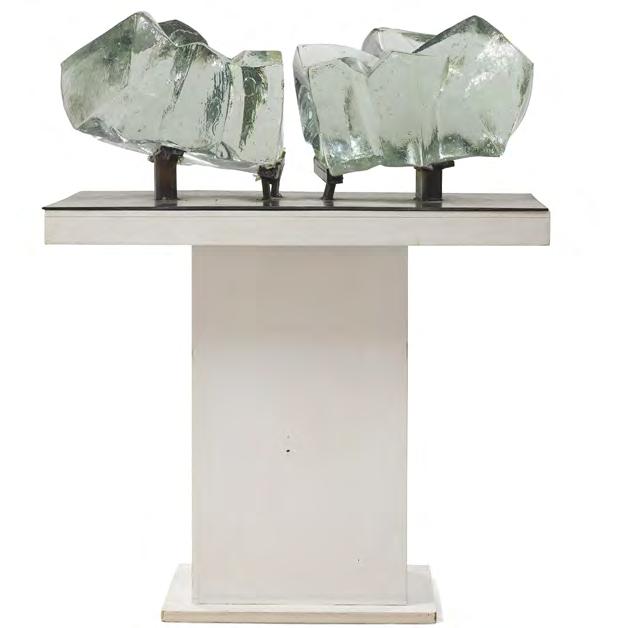
Slightly green-tinted glass, two pieces, one piece signed EÖhrström 1976 and 1/9 ÖHRSTRÖM, mounted on a whitepainted wooden stand with an iron plate, signed ÖHRSTRÖM, the stand 95.5 x 55 cm, height 80.5 cm, total height 116 cm.
Provenance: From the collection of Art Collector and Entrepreneur Kent Löwenberg.
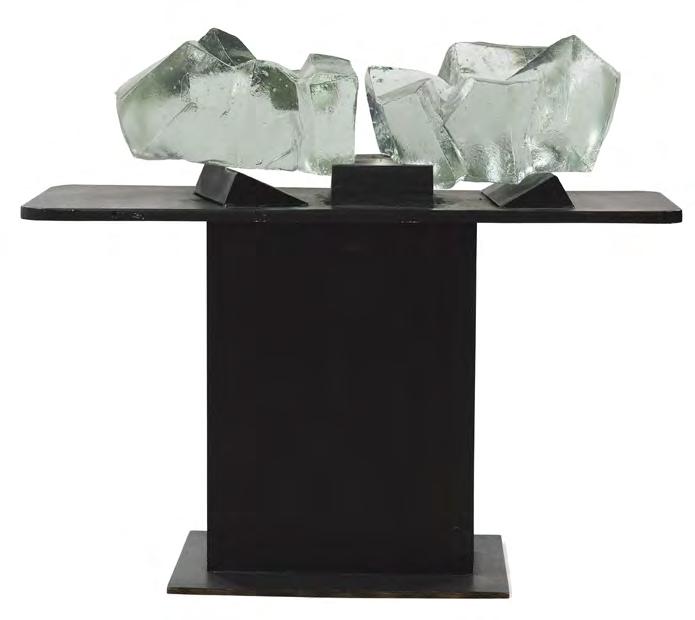
Slightly green tinted glass, two pieces, signed E. Öhrström. Length 92 cm, total height including black-painted wooden stand, 98 cm, the stand 46.5 x 115 cm.
Provenance: From the collection of Art Collector and Entrepreneur Kent Löwenberg.
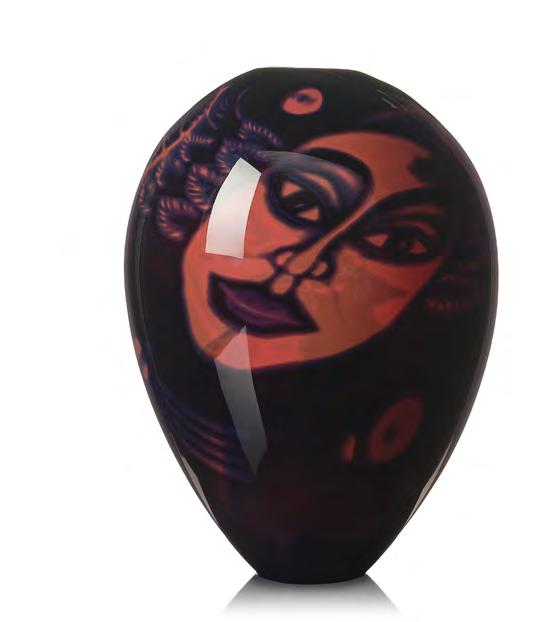
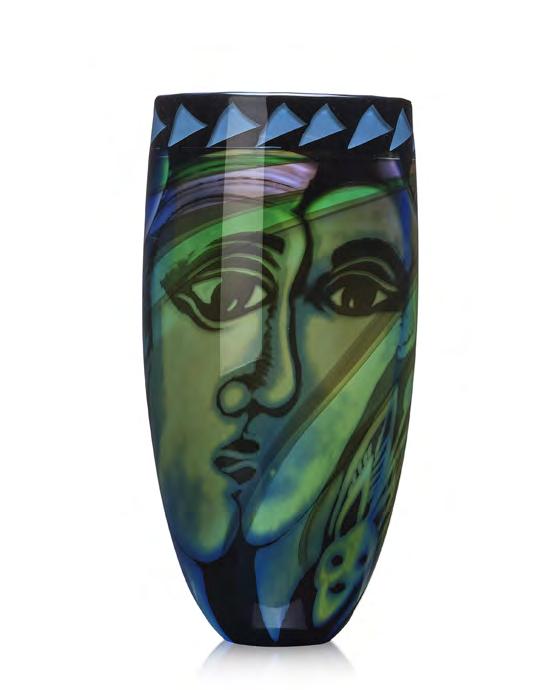
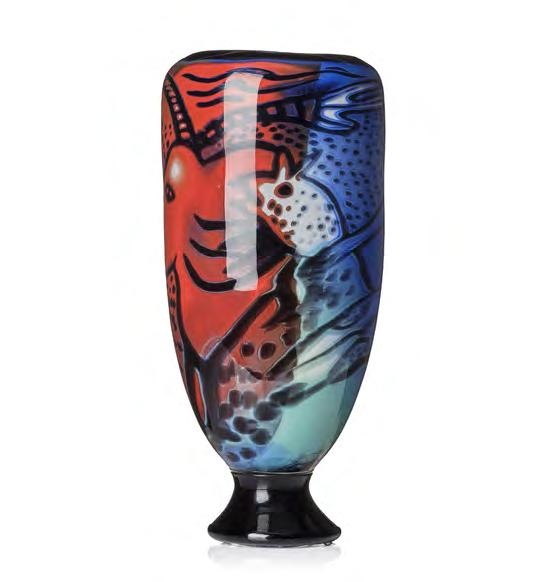
26. Eva Englund (Sweden, 1937–1998) “Fire soul”, a graal glass vase, Orrefors 1988.
Decoration of faces in orange-red, blue and blue-black, signed Orrefors Gallery -88 965830 Eva Englund 41–50 and inscribed by Eva Englund and label marked. Height 26 cm.
Estimate: SEK 12 000 – 15 000 / EUR 1 130 – 1 410
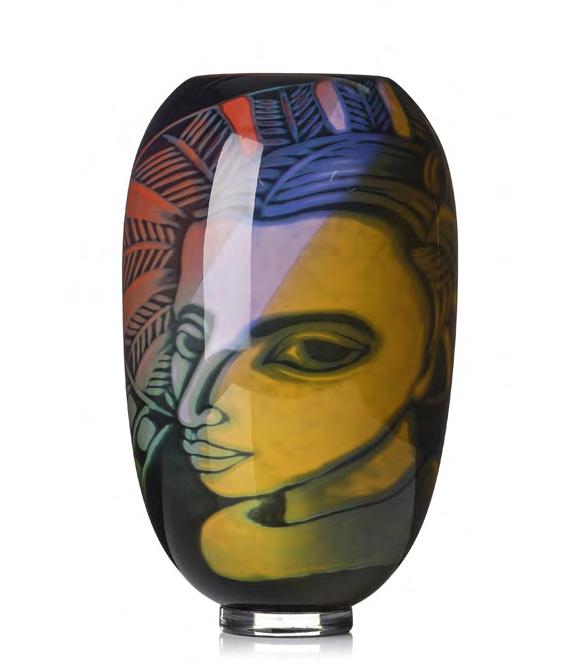
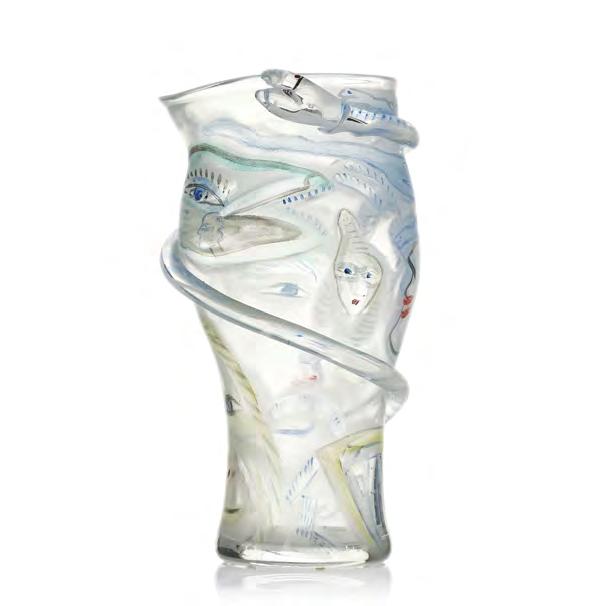
28. Eva Englund (Sweden, 1937–1998) a unique graal glass vase, Muraya, Sweden 1993.
Decoration of heads in yellow, red, metallic green, and blue against a burgundy background, signed Eva Englund Muraya ?? (indistinct date) 03 93 unique graal Dorothy K, Wilke A (Dorothy Konnberg, engraver, Wilke Adolfsson, glassblower).
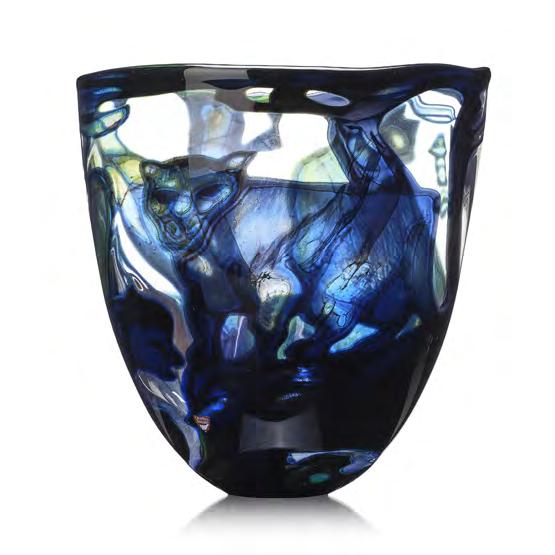
27. Eva Englund (Sweden, 1937–1998) a graal glass vase, Orrefors, Sweden, 1990.
Decor of motifs with panthers among branches in blue, orange, and green metallic, signed Orrefors 908130 Eva Englund -90 and inscribed by Eva Englund. Height 28.7 cm.
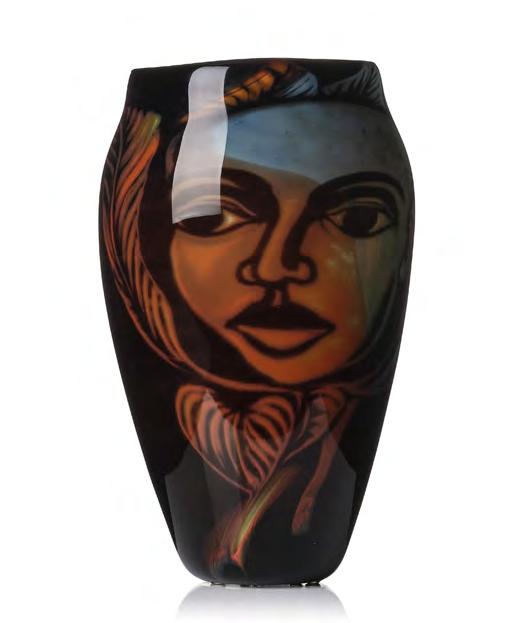
29. Eva Englund (Sweden, 1937–1998) a graal glass vase, Muraya, Sweden 1991.
Decoration in orange and green against a burgundy background of faces among foliage, signed Eva Englund Muraya 200591 unique graal Dorothy K, Wilke A (Dorothy Konnberg, engraver, Wilke Adolfsson, glassblower).
Height 27 cm.
Estimate: SEK 15 000 – 20 000 / EUR 1 410 – 1 890
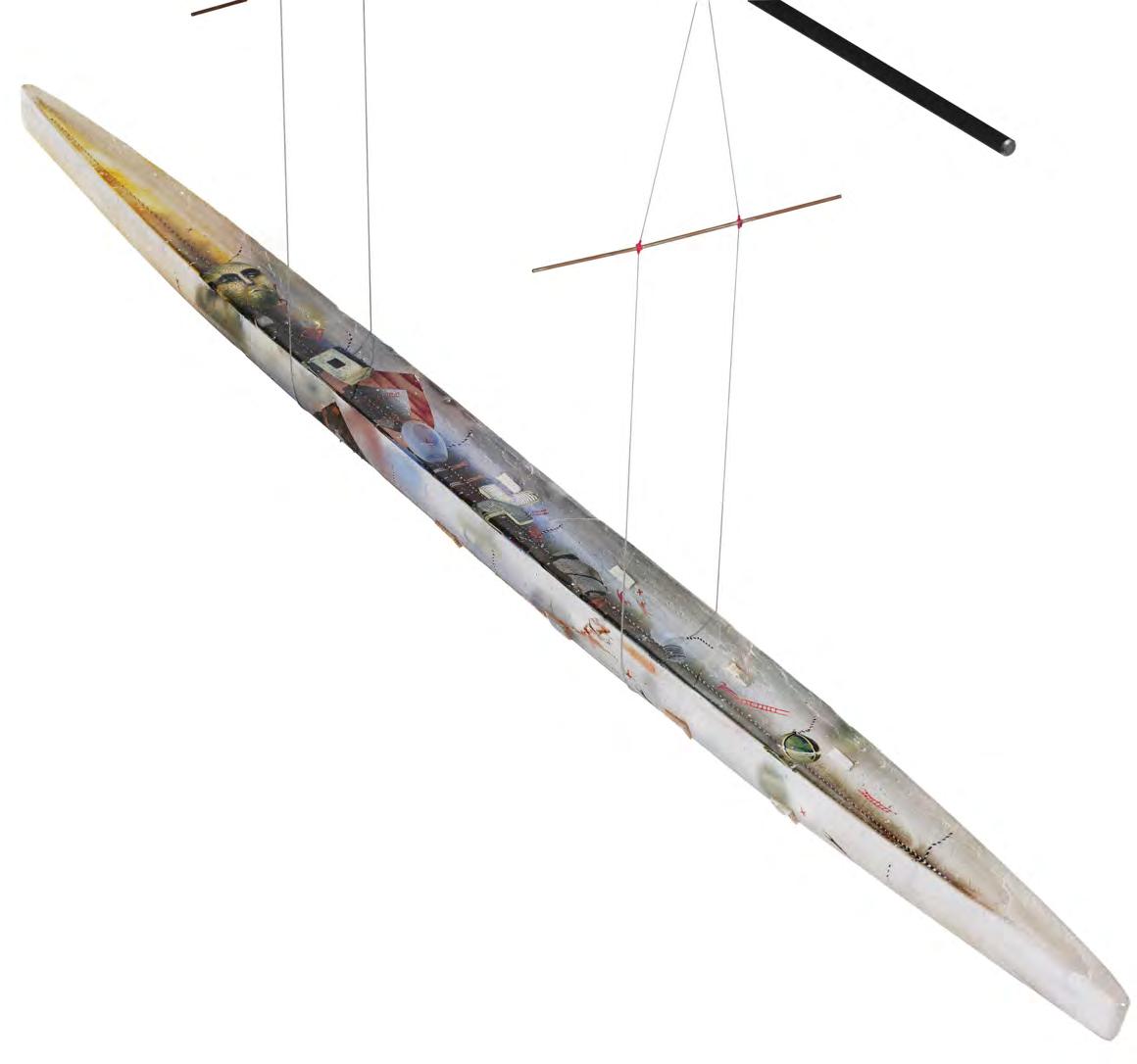
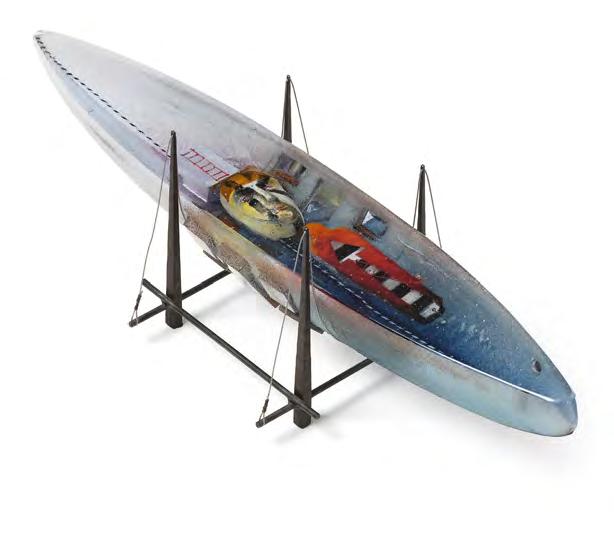
30. Bertil Vallien (Sweden, 1938) a monumental sand cast glass sculpture of a boat, Kosta Boda, Sweden, 21st century. Multicoloured decoration with internal and external objects, signed B Vallien KOSTA BODA 8BVAUN 019103 UNIQUE. Length 252 cm, width 13 cm. A metal rod, length 180 cm, and wires for hanging are included. Estimate: SEK 200 000 – 300 000 / EUR 18 900 – 28 300 (d)
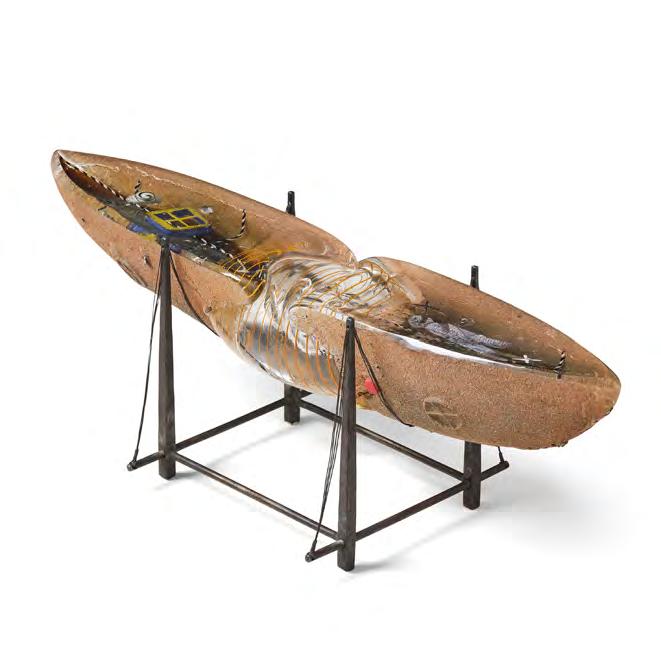
31. Bertil Vallien (Sweden, 1938) a unique sand cast glass sculpture of a boat, Kosta Boda, Sweden, 1980s.
Sand-cast front and back, blown middle section in clear glass with air spiral and orange serpentine, signed KOSTA BODA 305870145 B. Vallien. Length 61 cm, width ca. 11 cm, on a blackened iron stand with pulleys, height 20 cm, width 20.5 cm.
Provenance: From the collection of Art Collector and Entrepreneur Kent Löwenberg.
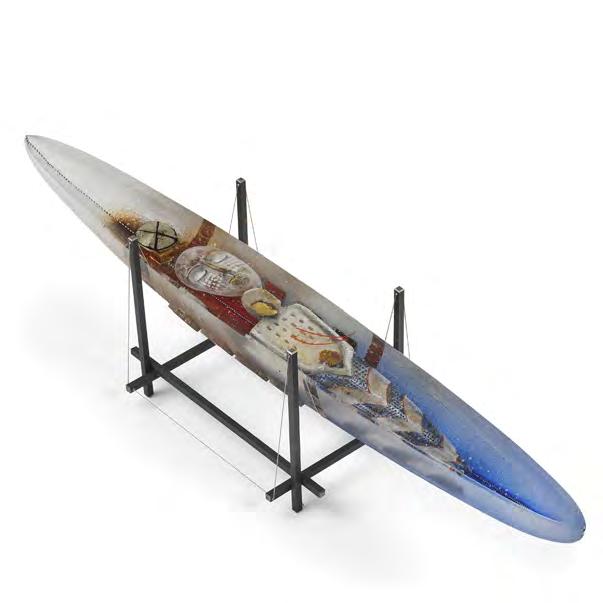
Inlaid decoration of a resting face and reclining figure, etc. signed B Vallien 7532016. Length 113.5 cm, width 12.8 cm, on an iron stand with wires, height 28 cm, width 26 cm.
Inlaid decoration of figures, etc., stand of etched clear glass, the boat signed KOSTA BODA 305880470 B. Vallien UNIQUE. Length 51.5 cm, width 9.2 cm, the stand 40 x 12 cm, total height 12.5 cm.
In- and outwards decoration with an inlaid face, reclining figure and various objects, signed B. Vallien 7530761 KOSTA BODA UNIQUE. Length 62 cm, width 11 cm, on an iron stand with wire, height 18.5 cm, width 20.3 cm.
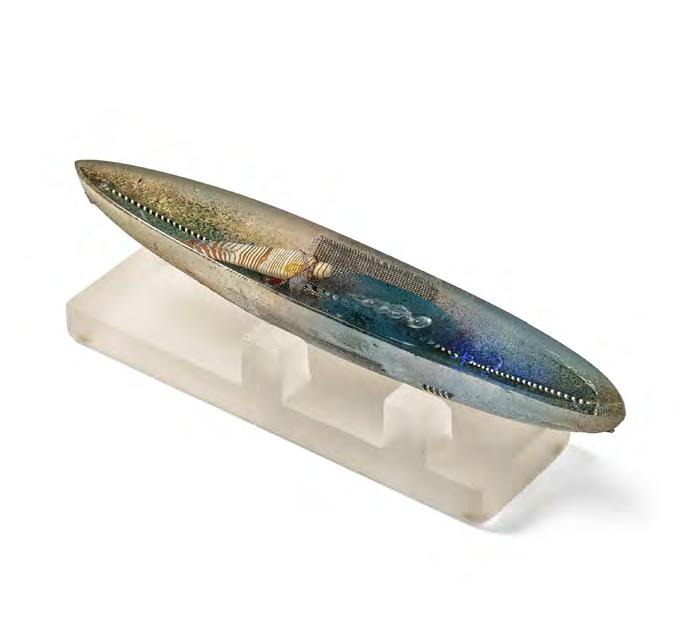
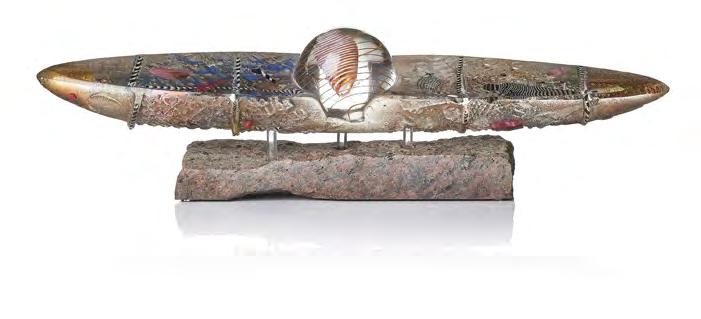
35. Bertil Vallien (Sweden, 1938) a unique sand cast glass sculpture of a boat, Kosta Boda, Sweden, 1980s.
External and internal decoration of reclining figures and various objects, in the centre a blown, sunk-in globe in clear glass with an internal object in red with white stripes and orange serpentine, signed KOSTA BODA 305880513 B. Vallien. Length 66 cm, width 10.5 cm, on a stand of granite, 35 x 10.5 cm.
Provenance: Purchased in 1986 from B Damberg Glaskonst AB in Jönköping.
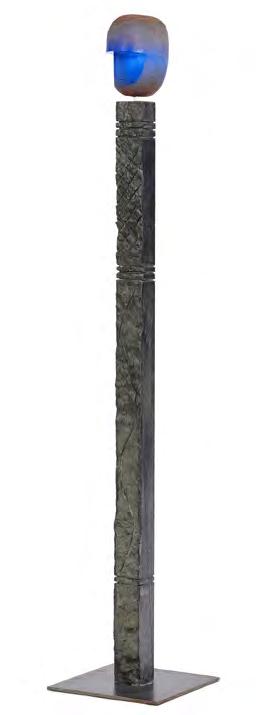
36A. Bertil Vallien (Sweden, 1938) a unique sand-cast glass sculpture of a head on a tall carved granite pedestal, Kosta Boda. Blue glass, cut sides, signed B Vallien KOSTA BODA UNIQUE 8BVAUN 979132. Height 22 cm, width approx. 11 cm, depth approx. 21 cm, total height approx. 184 cm including high granite base with carved decoration, on a square iron plate.
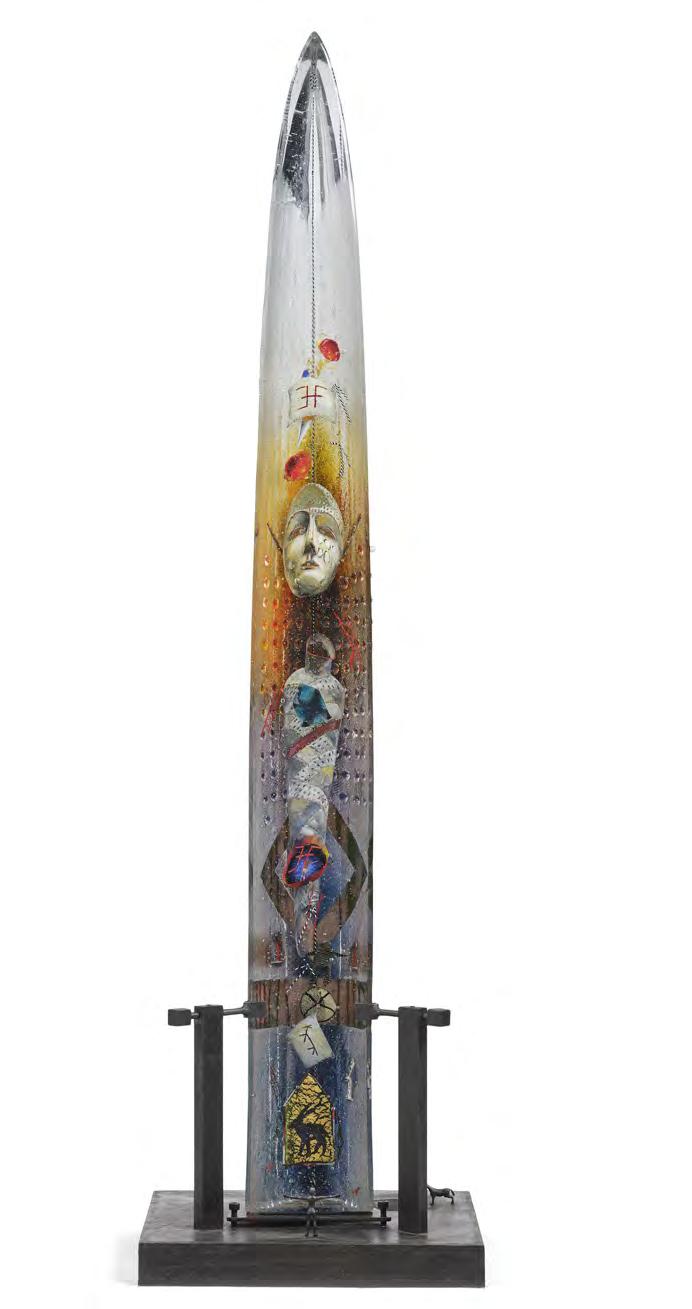
37. Bertil Vallien (Sweden, 1938) a sand cast glass sculpture of a standing half-boat, Kosta Boda, Sweden. Internal decoration of a face, reclining figures and various objects, external relief decoration of spikes, signed B. Vallien KOSTA BODA UNIQUE 7531885. Height 176 cm, width 19 cm, total height c. 183 cm, including iron stand, an iron stand with a square base including a figure and a dog, c. 50 + 50 cm.
38. Bertil Vallien (Sweden, 1938) a unique sand cast glass sculpture of a boat, Kosta Boda, Sweden.
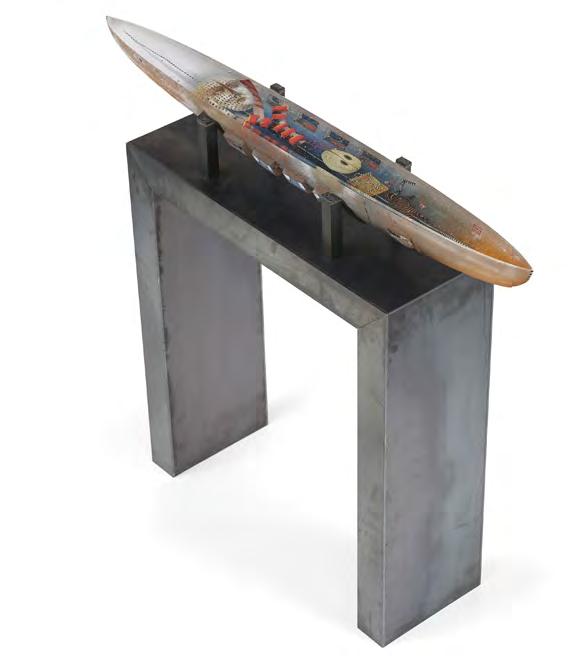
Inner decoration of a face and various objects, signed B. Vallien 7531136 KOSTA BODA UNIQUE. Length 111 cm, width 12 cm, total height including metal stand, 90 cm, the stand 70 x 25 cm.
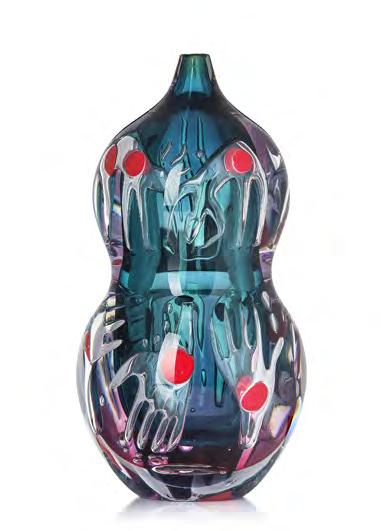
41. Peter Hermansson (Sweden, 1975) a unique ariel glass vase, Örsjö, Sweden 2012.
Gourd-shaped with green and pink underlay featuring enclosed decoration of figures and hands with red dots. Signed Peter Hermansson ARIEL No 74 unique 2012 Glasblåsare (glassblower) Micke Johansson Örsjö. Height 28.5 cm.
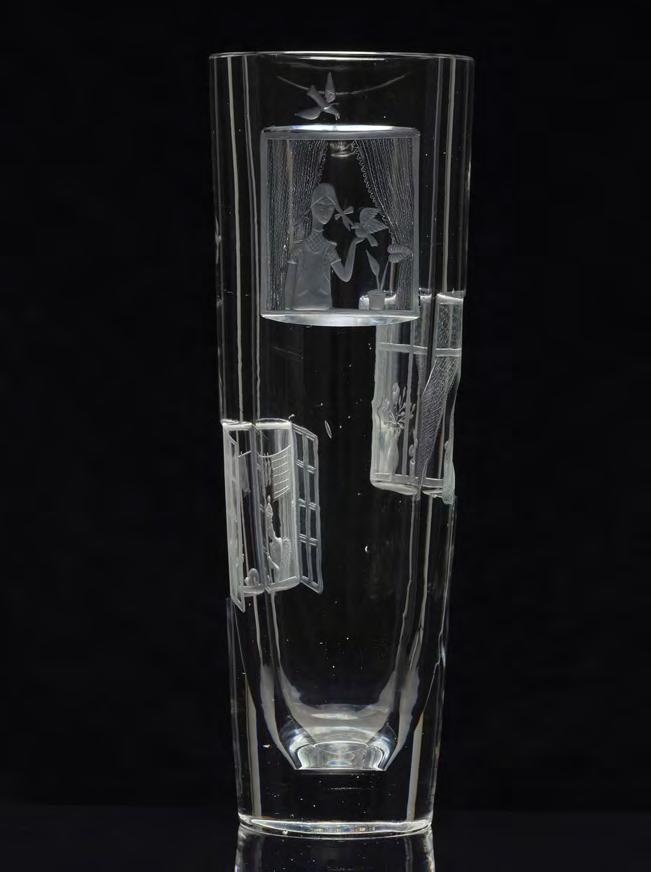
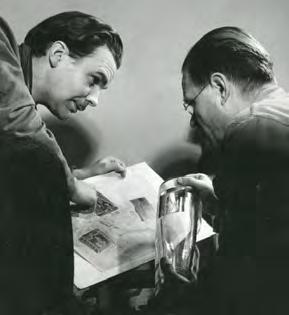
43. Tapio Wirkkala (Finland, 1915–1985) a rare engraved “Finestra” glass vase, Iittala, Finland, 1947, model 3220, engraved by Theodor Käppi.
Three different deep-cut windows with engraved decoration of a girl with a bird, a lady with a cat, as well as flowers and a fluttering curtain, signed and dated T. WIRKKALA - TH. KÄPPI IITTALA -47.
Height 34 cm, diameter 11.5 cm.
Provenance: Acquired at auction from the estate of Carolyn Price (19272018), Bartlesville, Oklahoma, USA. In 1954 Carolyn and her husband Harold Price Jr. commissioned the architect Frank Lloyd Wright to design a house for their family. Wright placed the home as if it was emerging from one of the land’s rolling hills, thus earning the home its nickname Hillside. The Price family surrounded themselves with iconic designs of many modernist architects and designers.
Literature: Marianne Aav (ed.), “Tapio Wirkkala Eye Hand and Thought”, WS Bookwell OY, 2000, model illustrated p. 56.
Marianne Aav (ed.), “Iittala, 125 years of Finnish glass, Complete History with all Designers”, Designmuseo, Arnoldsche 2006, see pp. 32, 342-343. “Tapio Wirkkala - A Poet in Glass and Silver”, Collection Kakkonen, The Finnish Glass Museum, Saarijärvi 2013, see pp. 28-39. Compare both versions illustrated: “Tapio Wirkkala engraved Finestra in 1946”, p. 28 and the auction’s version: “better known for it’s crystal version that has been engraved by Theodor Käppi”, p. 33.
Estimate: SEK 50 000 – 75 000 / EUR 4 710 – 7 070
Tapio Wirkkala and engraver Theodor Käppi with a ”Finestra” vase
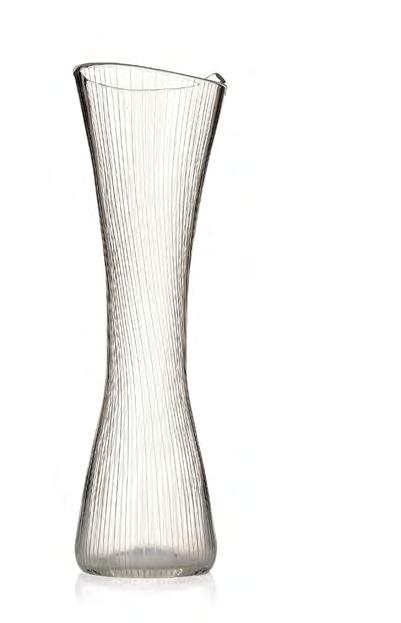
44. Tapio Wirkkala (Finland, 1915–1985) a glass vase, model 3509, Iittala, Finland.
Line cut, clear glass. Signed TAPIO WIRKKALA IITTALA. Height 40 cm.
Estimate: SEK 10 000 – 12 000 / EUR 943 – 1 130
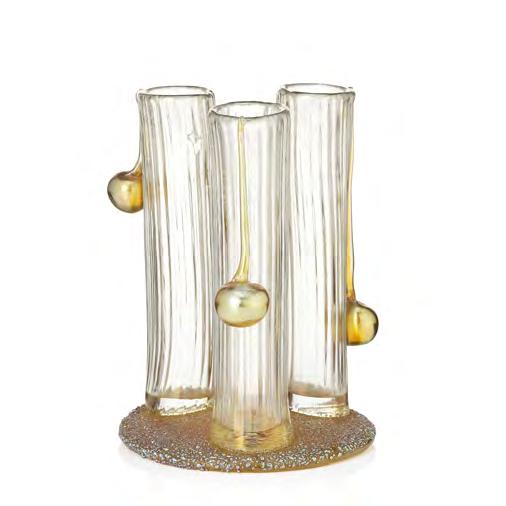
45. Johann Loetz (Austria, 1880–1940) an Art Nouveau “Boule Boule” glass vase, Austria, early 1900s.
Iridescent glass, three nearly cylindrical vases with a decoration of balls on a circular base. Height 14.5 cm, diameter of the base 10.5 cm.
Estimate: SEK 15 000 – 20 000 / EUR 1 410 – 1 890
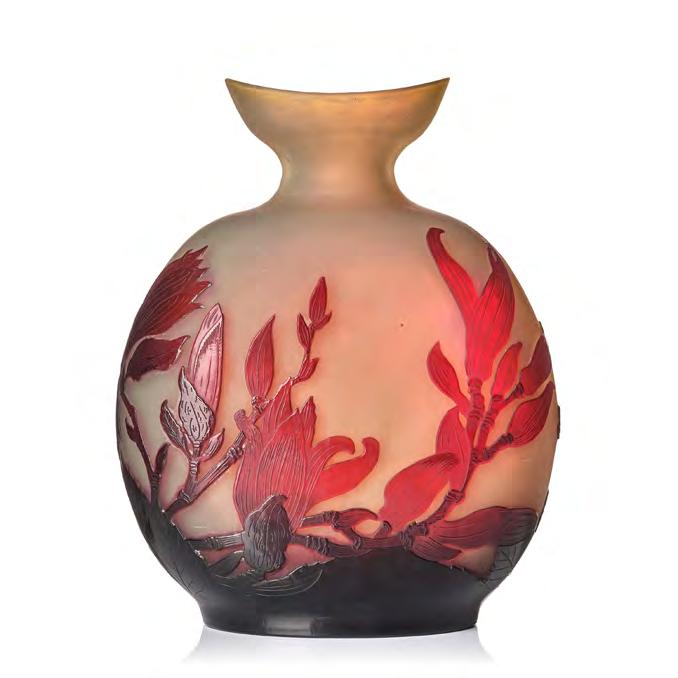
46. Emile Gallé (France, 1846–1904) an Art Nouveau cameo glass vase, Nancy, France, early 1900s.
Etched decoration of flowering magnolia branches in red against a yellowed background, signed Gallé. Height 31.5 cm.
Estimate: SEK 10 000 – 12 000 / EUR 943 – 1 130
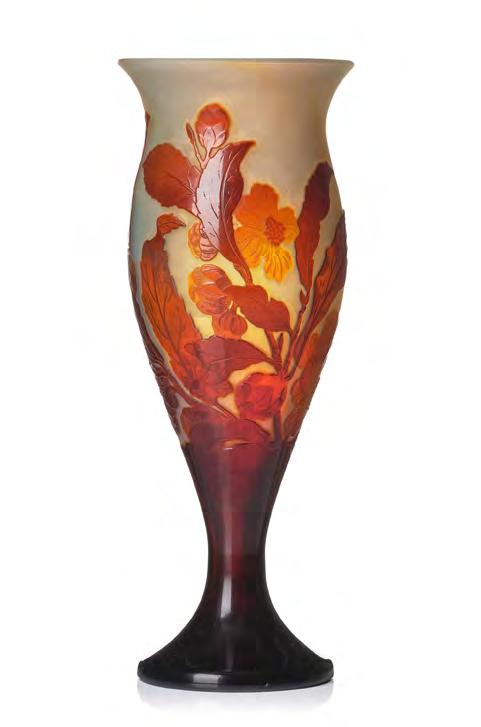
47. Emile Gallé (France, 1846–1904) an Art Nouveau cameo glass vase, Nancy, France, early 1900s.
Decoration of zinnia flowers with leaves in orange-brown against a matte white background, signed Gallé. Height 31 cm.
Estimate: SEK 6 000 – 8 000 / EUR 566 – 754
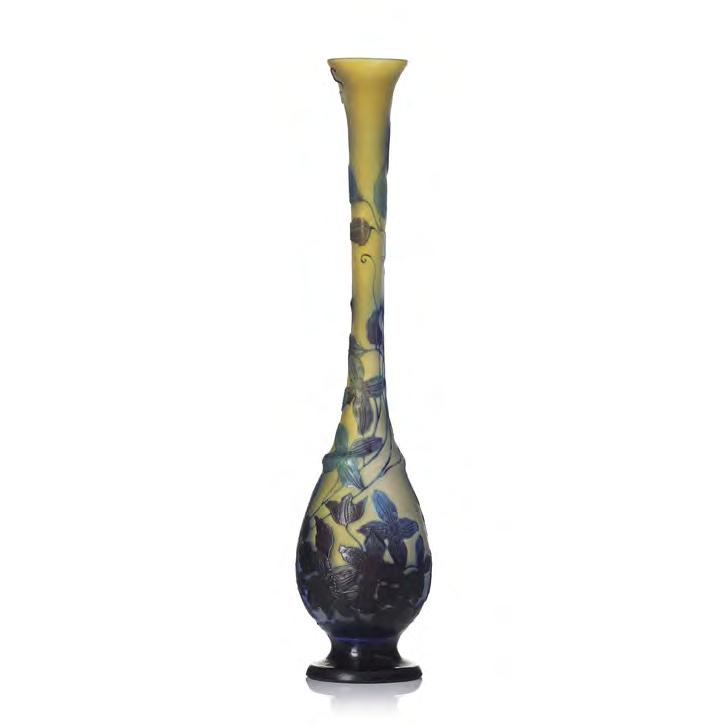
48. Emile Gallé (France, 1846–1904) an Art Nouveau cameo glass vase, Nancy, France.
Decorated with clematis and leaves in dark blue against a matte yellow background, signed Gallé. Height 38 cm.
Provenance: From the collection of Art Collector and Entrepreneur Kent Löwenberg.
Estimate: SEK 6 000 – 8 000 / EUR 566 – 754
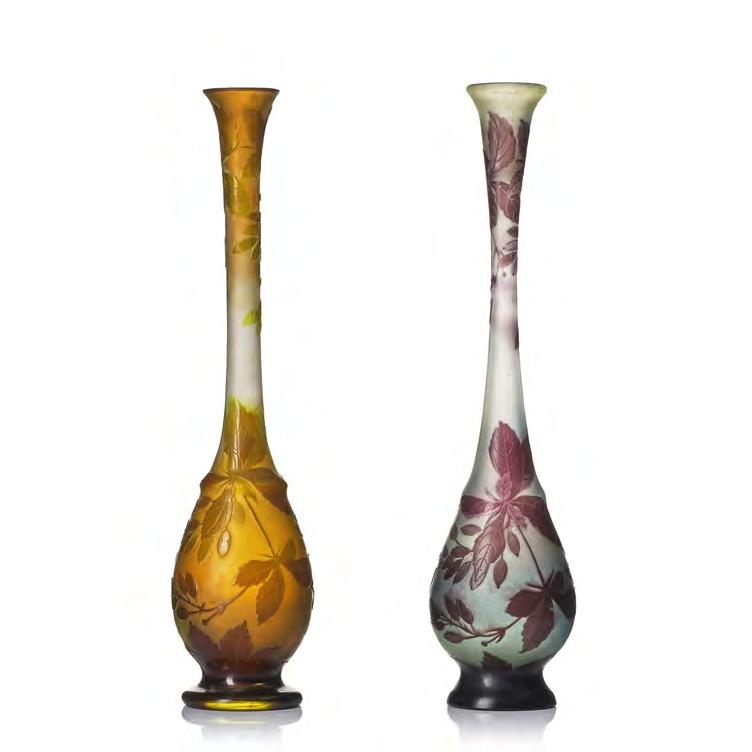
49. Emile Gallé (France, 1846–1904) a set of two Art Nouveau cameo glass vases, Nancy, France.
Decorated with mahonia berries and leaves. One of the vases with decoration in violet against a matte blue background, signed Gallé. Height 37 cm. The other with decoration in yellow-brown against a matte yellowwhite background, signed Gallé. Height 37 cm.
Provenance: From the collection of Art Collector and Entrepreneur Kent Löwenberg.
Estimate: SEK 6 000 – 8 000 / EUR 566 – 754
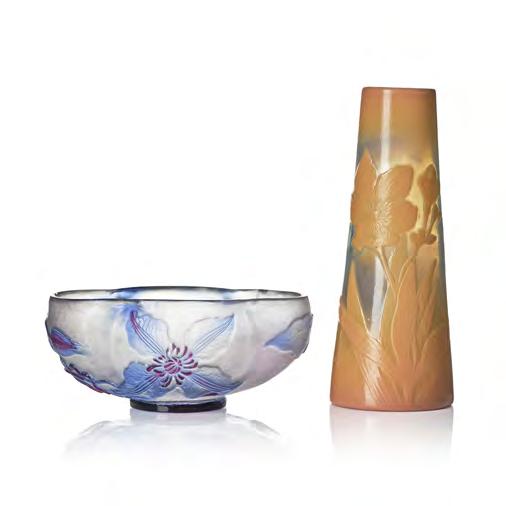
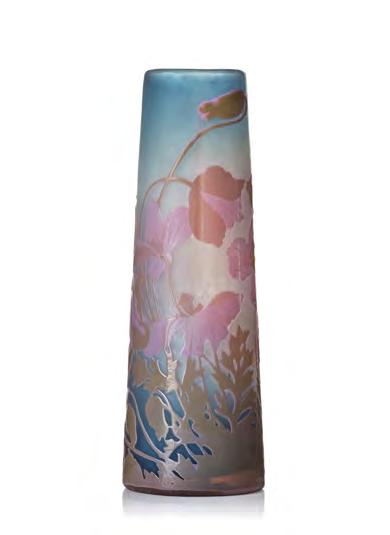
50. Emile Gallé (France, 1846–1904) an Art Nouveau cameo glass vase and a fire-poilshed cameo glass bowl, Nancy, France. The vase somewhat conical shape, decorated with flowers in pale pink against a clear background, signed Gallé. Height 16.2 cm. The bowl in an oval shape, decorated with clematis in blue against a clear ground, signed Gallé. Length 13 cm, height 5 cm.
Provenance: From the collection of Art Collector and Entrepreneur Kent Löwenberg.
Estimate: SEK 6 000 – 8 000 / EUR 566 – 754
51. Emile Gallé (France, 1846–1904) an Art Nouveau cameo glass vase, Nancy, France.
Asymmetric mouth, slightly conical, decoration of anemones in various hues of pink against a pale blue background signed Gallé with a star. Height 21 cm.
Provenance: From the collection of Art Collector and Entrepreneur Kent Löwenberg.
Estimate: SEK 4 000 – 6 000 / EUR 377 – 566
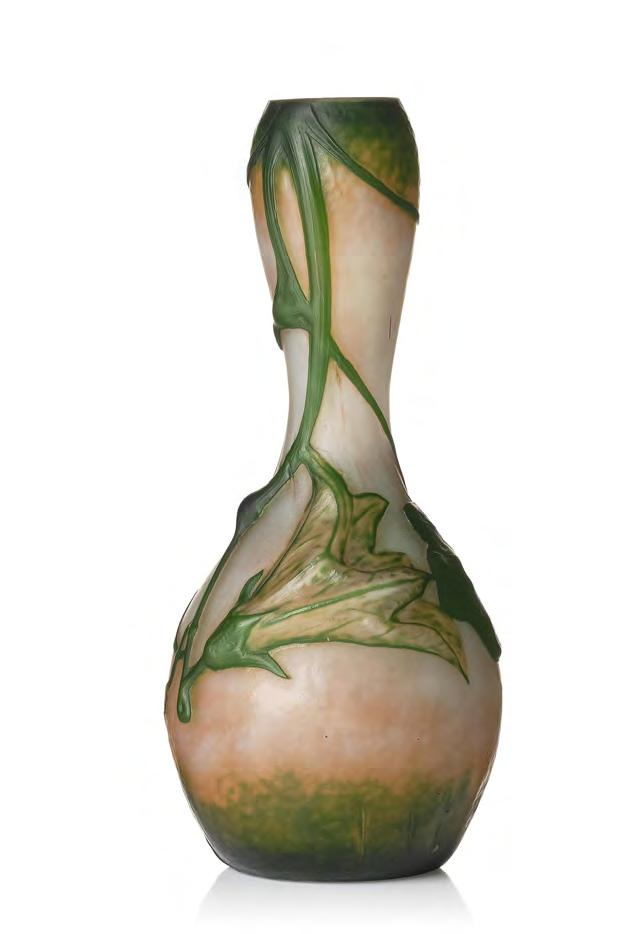
52. Daum Frères (France, Founded in 1878) an Art Nouveau soufflé glass vase, “Coloquinte en fleurs”, Nancy, France, ca 1906–1907. Mould-blown, decorated with pumpkin flowers and branches, polished, ground Martelé-cut in milky white, orange-pink and green colours, signed: DAUM NANCY with the cross of Lorraine. Height 23.5 cm.
Literature: Munich City Museum, “Nancy Art Nouveau in Lorraine 1900”, Verlag Philipp von Zabern, Mainz am Rhein, 1980, see the same model depicted as catalogue number 474, p. 111. Noël Daum, “Daum Mastery of Glass, Edita, Lausanne 1985, compare model ill. p. 61.
Estimate: SEK 15 000 – 20 000 / EUR 1 410 – 1 890
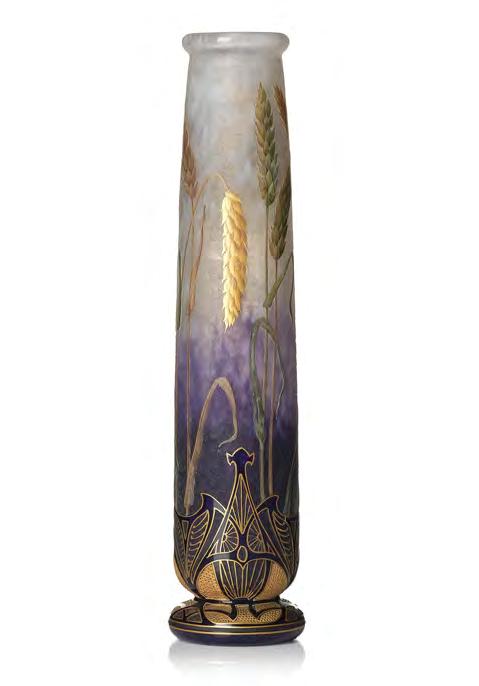
53. Daum Frères (France, Founded in 1878) an Art Nouveau gilt and enamelled cameo glass vase, Nancy, France. Etched and gilt decoration of wheat ears and other ornaments against a mottled background in white and purple, gilt signature Daum Nancy. Height 27 cm.
Provenance: From the collection of Art Collector and Entrepreneur Kent Löwenberg.
Estimate: SEK 8 000 – 10 000 / EUR 754 – 943
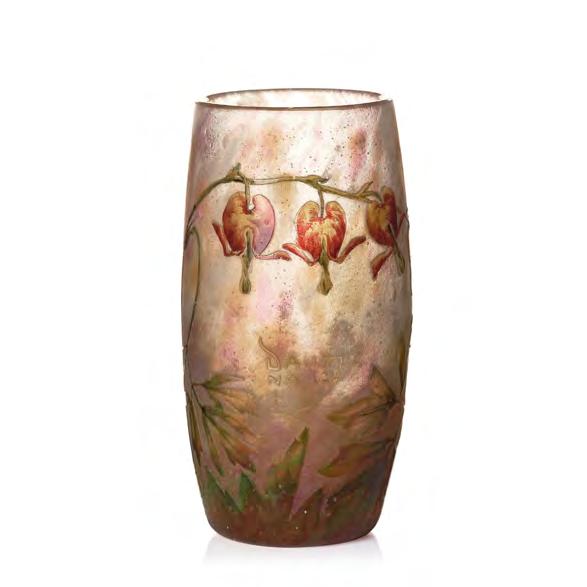
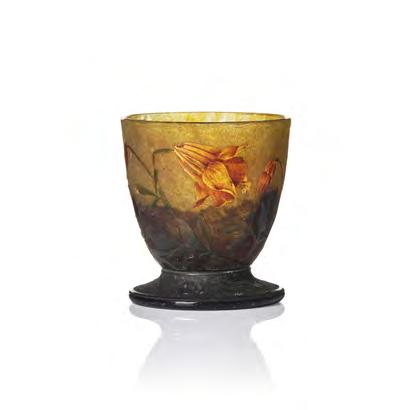
54. Daum Frères (France, Founded in 1878) an Art Nouveau cameo glass vase, Nancy, France, ca 1900.
Etched cameo glass with decoration of a bleeding hearts in orange-red and green-yellow against a mottled background, signed DAUM NANCY with the cross of Lorraine. Height 12 cm.
Estimate: SEK 5 000 – 6 000 / EUR 471 – 566
55. Daum Frères (France, Founded in 1878) an Art Nouveau miniature cameo glass vase, Nancy, France.
Enamel-painted cameo glass with a decoration of fuchsia flowers and leaves in red and green against a yellow and gold-toned background, signed DAUM NANCY with the cross of Lorraine. Height 5 cm.
Estimate: SEK 4 000 – 5 000 / EUR 377 – 471
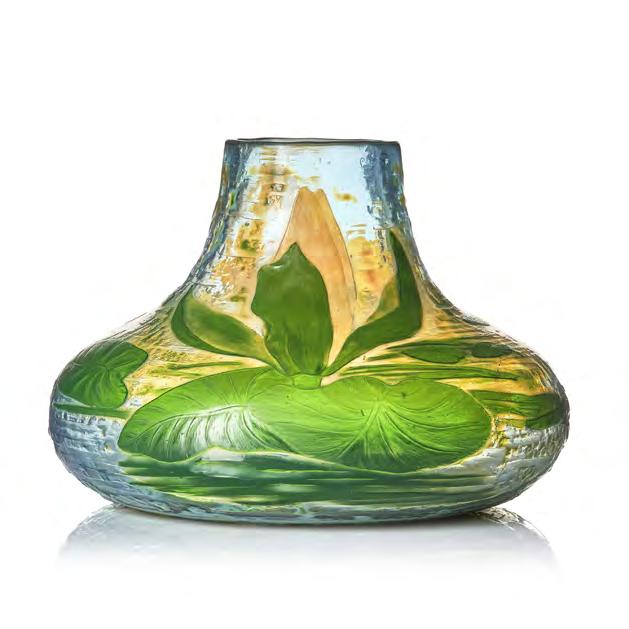
56. Edmond Lachenal (France, 1855–1948) (after a drawing by the same), an Art Nouveau cameo glass vase, Daum, Nancy, France. Glass in green and white against an iridescent background, decoration of water lilies, engraved signature with gold on the base DAUM NANCY d'après Lachenal. Height 13.5 cm.
Estimate: SEK 8 000 – 10 000 / EUR 754 – 943
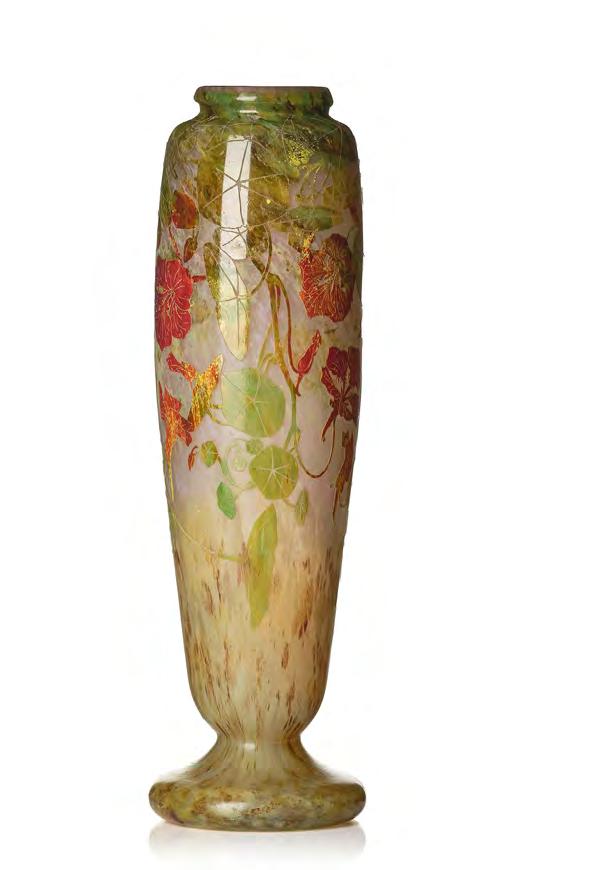
57. Daum Frères (France, Founded in 1878) an Art Nouveau cameo glass vase, Nancy, France.
Baluster shape on a round foot, etched decoration of garden cresses in red, yellow, and green against a matte mottled background, signed DAUM NANCY with the cross of Lorraine. Height 51 cm.
Provenance: From the collection of Art Collector and Entrepreneur Kent Löwenberg.
Estimate: SEK 20 000 – 25 000 / EUR 1 890 – 2 360
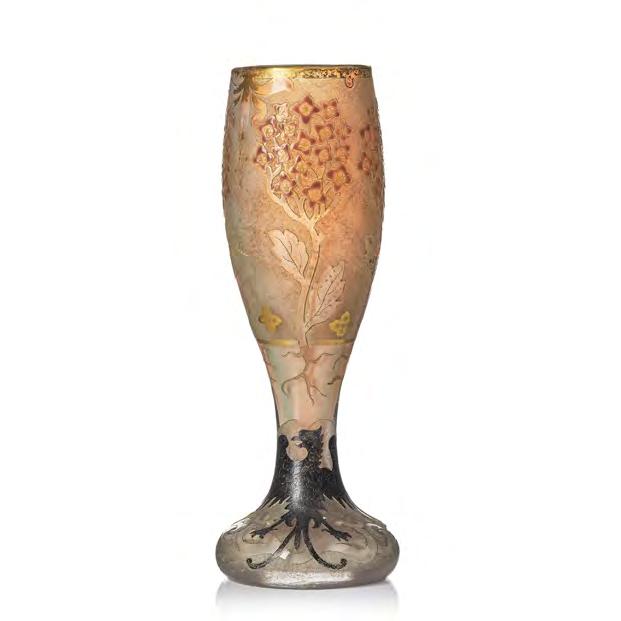
58. Daum Frères (France, Founded in 1878) an Art Nouveau cameo glass vase, Nancy, France.
Decoration of four flowers in pink and yellow, at the base an eagle in black, gilded details, signed in gold underneath Daum Nancy with the cross of Lorraine. Height 18.2 cm.
Provenance: From the collection of Art Collector and Entrepreneur Kent Löwenberg.
Estimate: SEK 4 000 – 6 000 / EUR 377 – 566
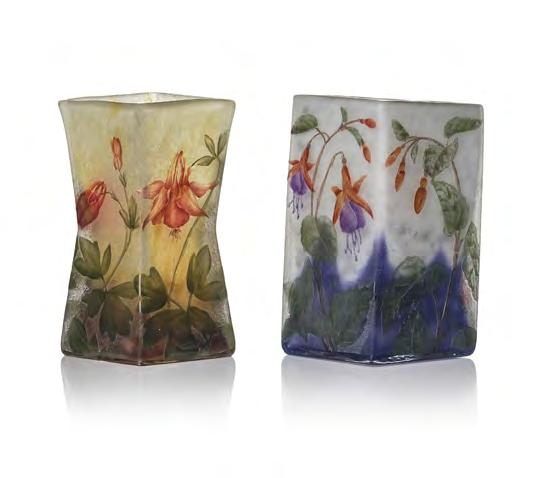
59. Daum Frères (France, Founded in 1878) a set of two Art Nouveau cameo glass vases, Nancy, France.
Rhomboid shape, one decorated with fuchsia in red, violet, and green against a frosted white and violet background, the other decorated with columbines of in red and green against a frosted yellow-toned background, both signed DAUM NANCY and with the cross of Lorraine. Height 11.5 cm and 11 cm.
Provenance: From the collection of Art Collector and Entrepreneur Kent Löwenberg.
Estimate: SEK 8 000 – 10 000 / EUR 754 – 943
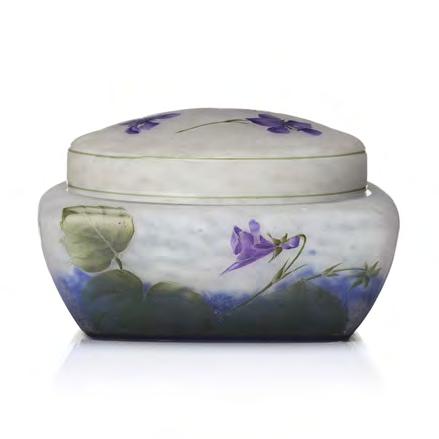
60. Daum Frères (France, Founded in 1878) an Art Nouveau cameo glass lidded bowl/bonbonnière, Nancy, France.
Decorated with violets and leaves in violet and green against a frosted background in white and violet, signed DAUM NANCY with the cross of Lorraine. 15 x 15 cm, height 9.5 cm.
Provenance: From the collection of Art Collector and Entrepreneur Kent Löwenberg.
Estimate: SEK 6 000 – 8 000 / EUR 566 – 754
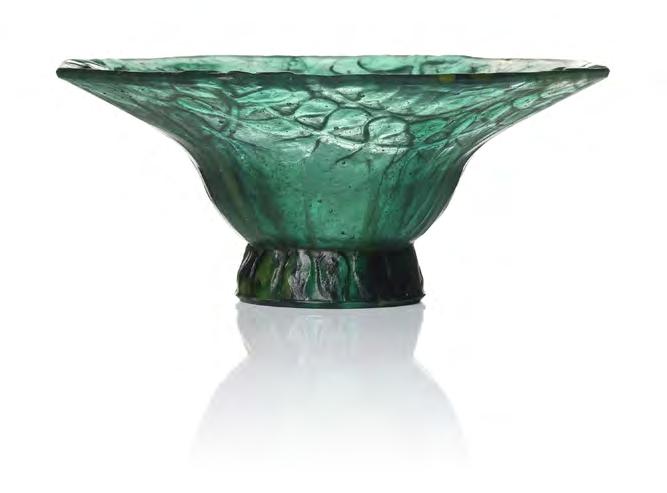
62. Gabriel Argy-Rousseau (France, 1885–1953) a “Garland” pâte de cristal bowl, model 25.10, France, ca. 1925.
Octagonal rim, the interior and foot with relief decoration, signed G. ARGYROUSSEAU. Height 10.3 cm, diameter 25.2 cm.
Provenance: From the collection of Art Collector and Entrepreneur Kent Löwenberg.
Literature: Janine Bloch-Dermant, “G. Argy-Rousseau: Glassware As Art”, Thames and Hudson 1991, cf. the model illustrated p. 205.
Estimate: SEK 12 000 – 15 000 / EUR 1 130 – 1 410
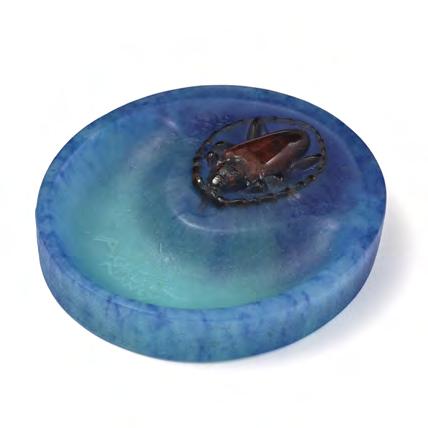
61. Almaric Walter & Henri Bergé (France, 1870–1959) a pâte de verre beetle ashtray, Nancy, France, early 20th century. Oval shape, mottled glass mass in blue-green with a brown beetle in relief, signed A.Walter Nancy Bergé sc. Length 10,5 cm.
Estimate: SEK 4 000 – 5 000 / EUR 377 – 471 (d)
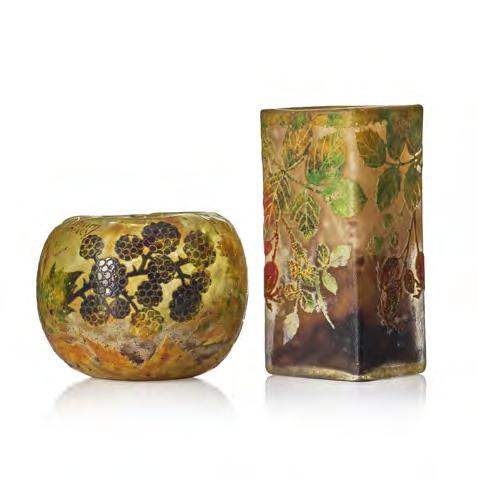
63. Daum Frères (France, Founded in 1878) a set of two Art Nouveau cameo glass vases, Nancy, France.
Decoration of foliage with blackberries in dark purple, greenish-yellow, and orange-red against a matte yellow mottled background, signed DAUM NANCY and the Lorraine cross. Height 7 cm. The other four-sided with decoration of rose hips with foliage against a matte brown-beige ground, signed DAUM NANCY and the Lorraine cross. Height 12 cm.
Provenance: From the collection of Art Collector and Entrepreneur Kent Löwenberg.
Estimate: SEK 8 000 – 10 000 / EUR 754 – 943
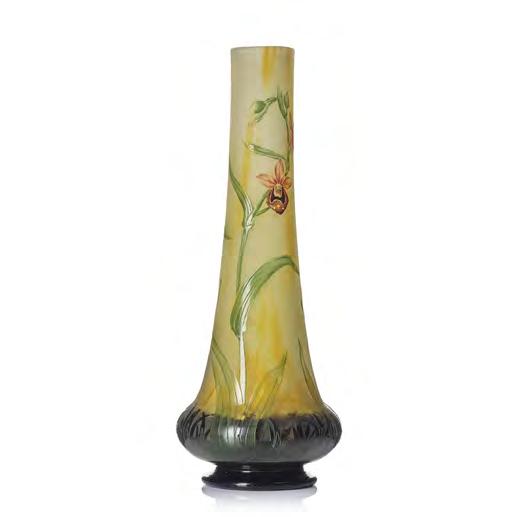
65. Daum Frères (France, Founded in 1878) an Art Nouveau cameo glass vase, Nancy, France.
Decoration of cypripediae in red, reddish-brown and green against a matte yellow and burgundy background, signed DAUM NANCY with the cross of Lorraine. Height 22 cm.
Provenance: From the collection of Art Collector and Entrepreneur Kent Löwenberg.
Estimate: SEK 6 000 – 8 000 / EUR 566 – 754
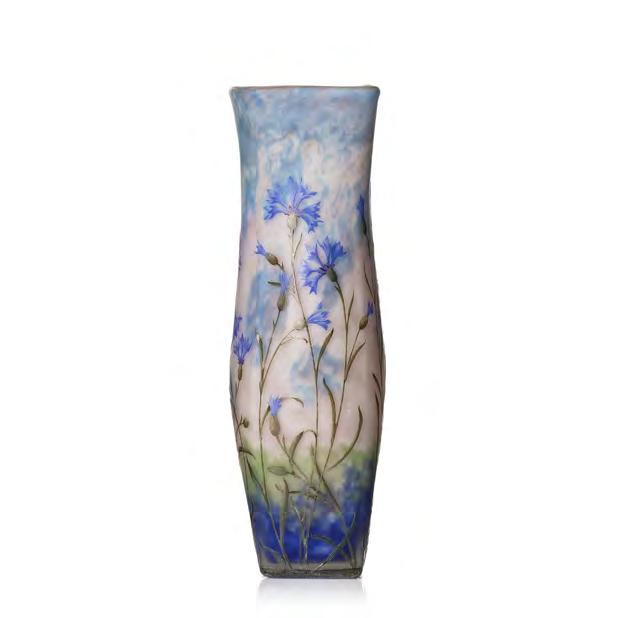
64. Daum Frères (France, Founded in 1878) an Art Nouveau cameo glass vase, Nancy, France.
Four-sided, decorated with cornflowers in blue and green against a mottled frosted background, signed DAUM NANCY and with the cross of Lorraine. Height 24 cm.
Provenance: From the collection of Art Collector and Entrepreneur Kent Löwenberg.
Estimate: SEK 6 000 – 8 000 / EUR 566 – 754
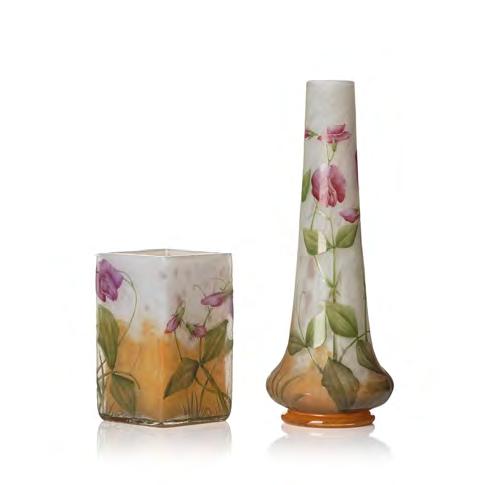
66. Daum Frères (France, Founded in 1878) a set of two Art Nouveau cameo glass vases, Nancy, France.
Etched decoration of sweet peas in pink and green against a frosted background in white and yellow, signed DAUM NANCY with the cross of Lorraine. Height 21.5 and 10.5 cm.
Provenance: From the collection of Art Collector and Entrepreneur Kent Löwenberg.
Estimate: SEK 8 000 – 10 000 / EUR 754 – 943
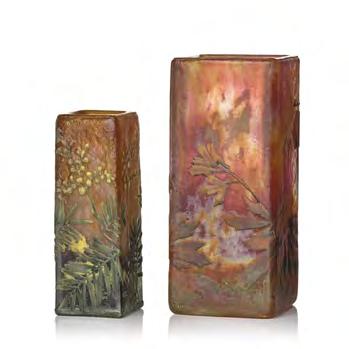
67. Daum Frères (France, Founded in 1878) a set of two Art Nouveau cameo glass vases, Nancy, France.
Almost square shape, the one with a decoration of bleeding hearts with leaves in orange-red and green against an iridescent background in pinkish tones, the other with a decoration of mimosa with leaves in yellow and green against an orange and brown background, both signed DAUM NANCY with the cross of Lorraine. Height 12 cm and 9.5 cm.
Provenance: From the collection of Art Collector and Entrepreneur Kent Löwenberg.
Estimate: SEK 4 000 – 6 000 / EUR 377 – 566
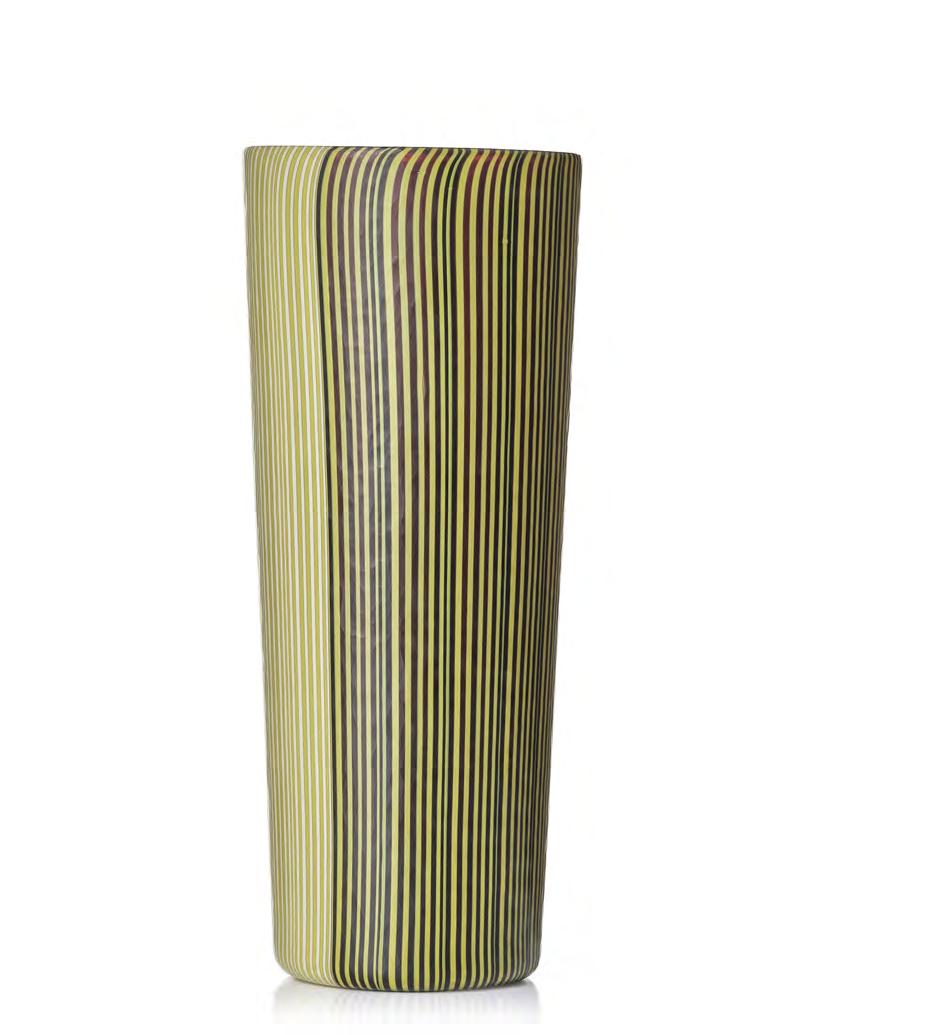
68. Carlo Scarpa (Italy, 1906–1978) a rare “Tessuto bicolore” glass vase, model 4551, Venini, Murano, Italy 1945–48.
Clear glass with threads in yellow, white, and brownish-purple glass, matte wheel-carved surface in battuto technique, etched signature venini murano ITALIA. Height 25 cm.
Provenance: Probably acquired during a honeymoon trip to Venice in 1954, thence by descent within the family.
Literature: Marino Barovier, “Venetian glass by Carlo Scarpa: The Venini company 1932–1947”, The Metropolitan Museum of Art, New York 2013, cf. the model illustrated from the Chiara and Francesco Carraro collection, Venice, p. 268.
Estimate: SEK 60 000 – 80 000 / EUR 5 660 – 7 540
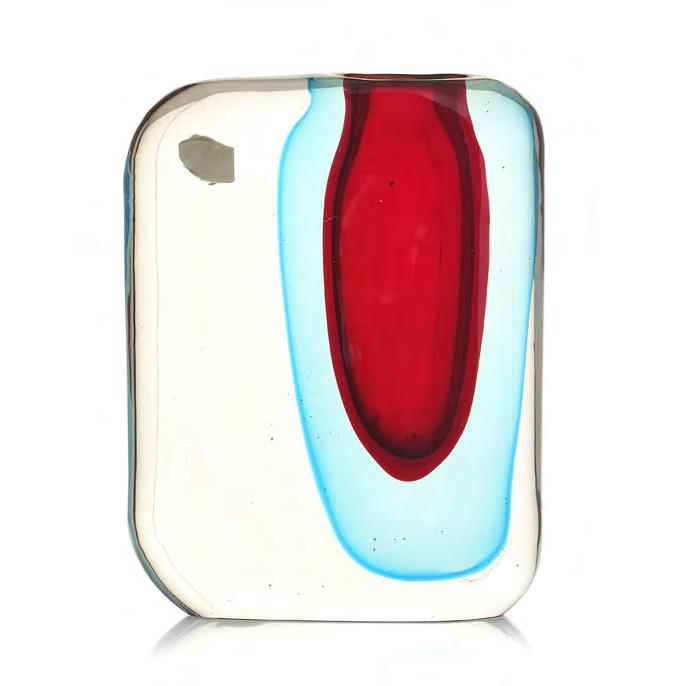
69. Antonio da Ros (Italy, 1936–2012) a “Momento” glass vase, Cenedese, Murano, Italy, 1960s.
Oval shape, internal decoration in blue and red among clear glass, paper label “Åkerholmska”. Height 18 cm.
Provenance: Åkerholmska Bosättningsmagasinet, Stockholm (Åkerholm’s Settlement Warehouse, Stockholm)..
Estimate: SEK 8 000 – 10 000 / EUR 754 – 943
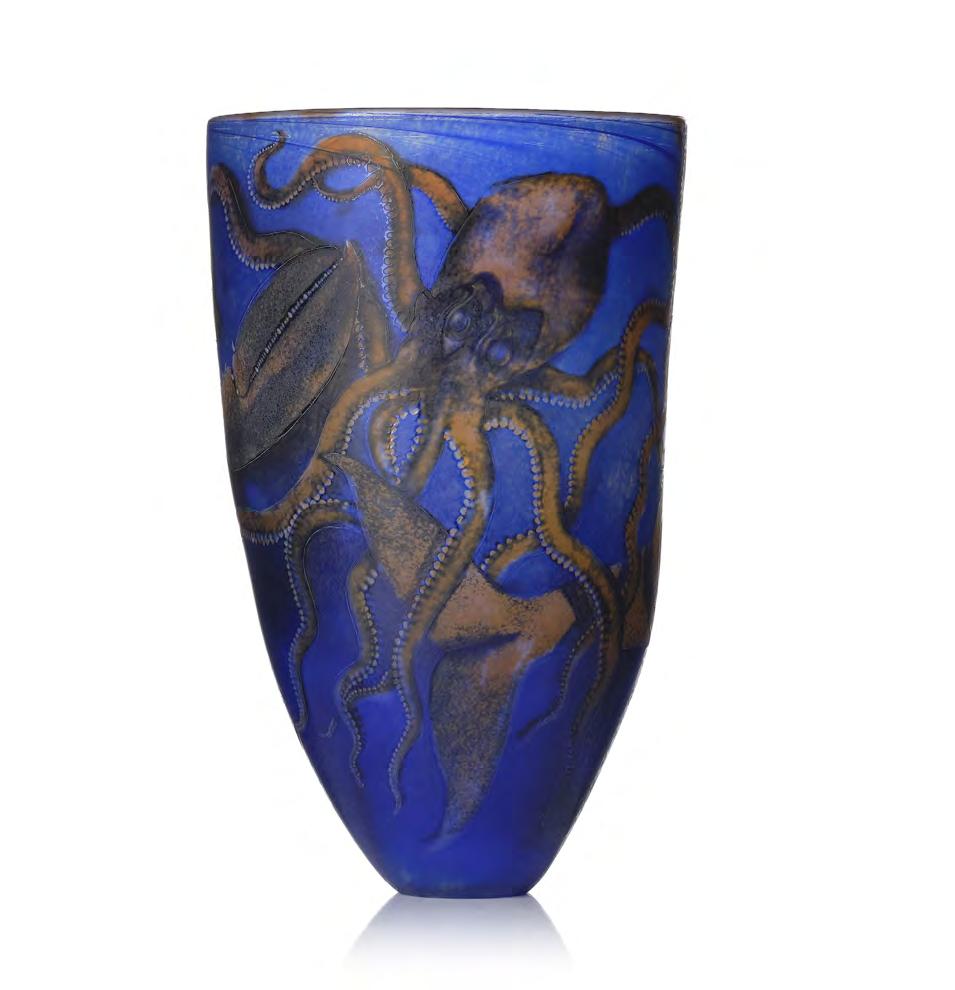
70. Clare Henshaw (United Kingdom, 1964) a studio glass vase, United Kingdom, dated 1990.
Blue and orange glass, inside and outside with engraved and sandblasted decoration of a mermaid with octopuses, signed Clare Henshaw 1990. Height 42 cm.
Estimate: SEK 6 000 – 8 000 / EUR 566 – 754 (d)
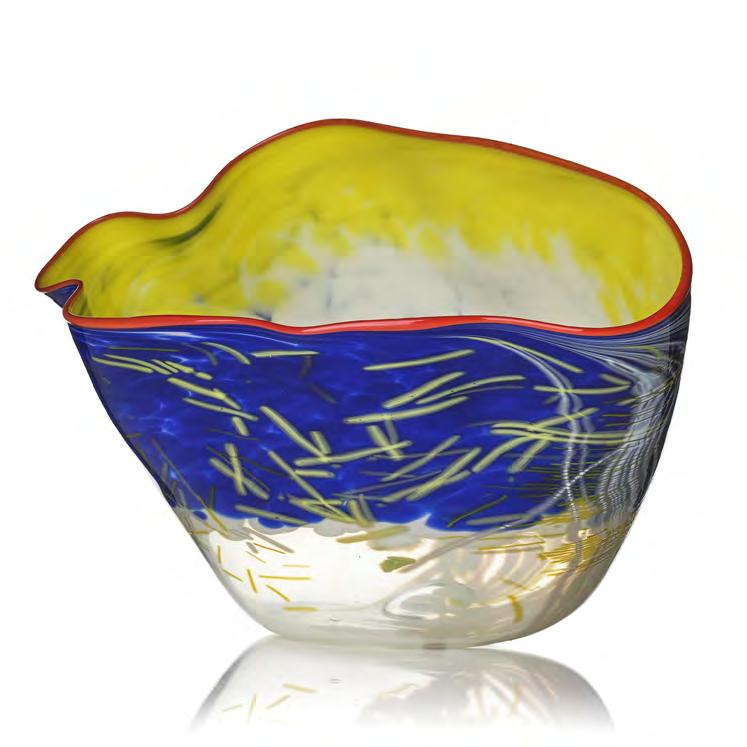
71. Dale Patrick Chihuly (United States, 1941) a glass sculpture, Seattle, USA, 1990.
Decorated in blue, yellow, and white, rim in red, signed Chihuly -90.
Length 28.5 cm, height 21 cm.
Estimate: SEK 30 000 – 40 000 / EUR 2 830 – 3 770
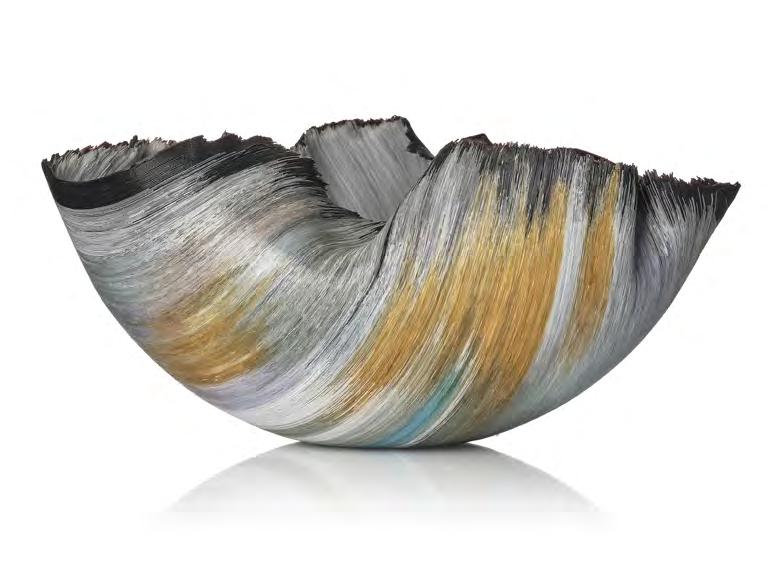
72. Mary Ann Toots Zynsky (United States, 1951) a filet-de-verre glass bowl, Seattle, USA.
Oval shape, thin glass threads in white, black, pink, yellow, and turquoise, signed Z. Length 34.5 cm, height 16 cm.
Provenance: From the collection of Art Collector and Entrepreneur Kent Löwenberg.
Estimate: SEK 25 000 – 30 000 / EUR 2 360 – 2 830
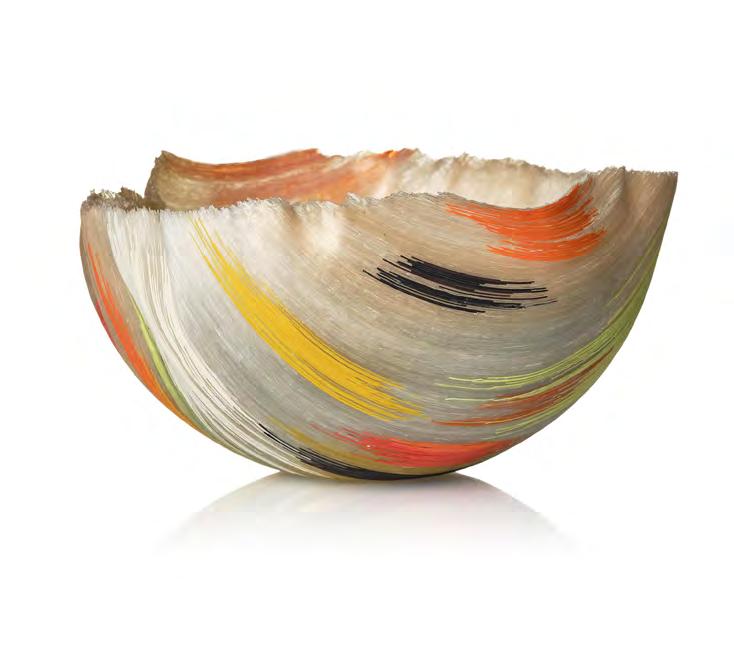
73. Mary Ann Toots Zynsky (United States, 1951) a filet-de-verre glass bowl, Seattle, USA.
Almost oval shape, thin glass threads in orange, yellow, green, white, and black, signed Z. 24 x 22.3 cm, height 12 cm.
Provenance: From the collection of Art Collector and Entrepreneur Kent Löwenberg.
Estimate: SEK 20 000 – 25 000 / EUR 1 890 – 2 360
Ceramics
The Rackstad Colony & Hilma Persson-Hjelm
The Rackstad colony was one of Sweden’s most important artist colonies, active mainly circa 1898-1920 in the Arvika area. The group consisted of a circle of artists and craftsmen who were united by a love for the Värmland light, nature and the ideals of the Arts and Crafts movement.
The colony began in 1898 when the couple Gustaf and Maja Fjaestad rented the residence and studio ”Oppstuhage” in the village of Taserud from the sculptor Christian Eriksson.
In addition to Gustaf and Maja Fjaestad, local artists and craftsmen joined, as well as others who wanted to work on a smaller scale and close to other artists. Fritz Lindström, Björn Ahlgrensson and Bror Lindh were among the painters. Craftsmen active in the colony included Hilma Persson-Hjelm, Riborg Böving and Lisa ”Koppar-Lisa” Morell.
Those who joined the colony worked not only with painting but also with textiles, furniture, ceramics and forging. They were inspired by the prevailing ideals of creating an artistic whole in everyday life.
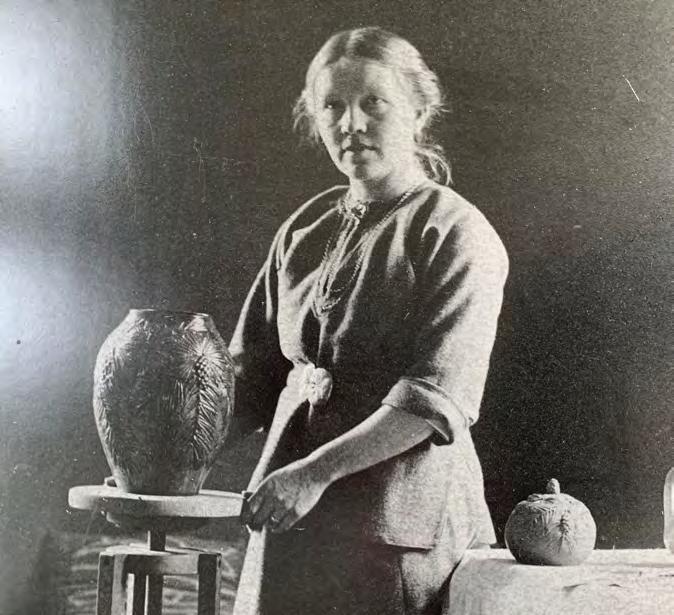
Hilma Persson-Hjelm , raised in the area, was a well-educated ceramist who worked together with her husband Rolf. Hilma created the various models and decorations in a distinctive Art Nouveau style. Rolf developed the various glazes and the objects were turned by Martin Andersson.
Riborg Böving , unlike Hilma Persson-Hjelm, did not have her roots in Värmland. The two had gotten to know each other when they studied at the Technical School in Stockholm. Riborg also wanted to work on a smaller scale and moved up to Värmland as well. The fine clay from the area around Lake Ullen meant that there was fertile ground for a larger number of pottery workshops. However, most of what was produced was utility ceramics. It was largely only Persson-Hjelm and Böving who worked with art objects.
Riborg Böving eventually had students around her in her studio and thus ensured that the resurgence of ceramic tableware was maintained throughout the 20th century.
The private collector who has put together the auction’s selection has taken a lot of time and selected the various objects with great care. The purchases have been made both in galleries and at various auctions.
Lots no 74-88 were included in the exhibition at Prins Eugen’s Waldemarsudde, “Rackstadkolonin – Stämningsmåleri, konsthantverk & design”, 6 September 2025–15 February 2026.
Hilma Persson-Hjelm
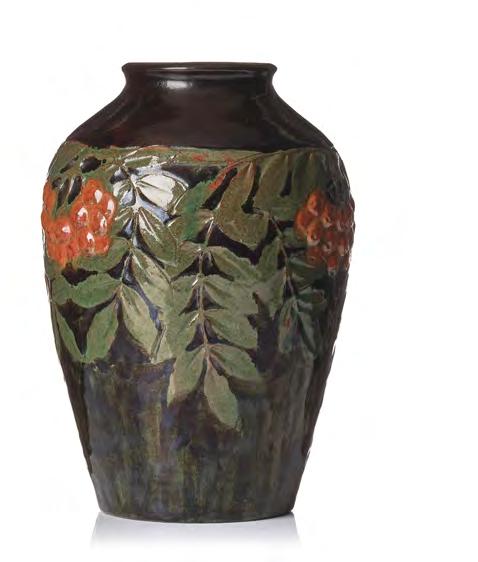
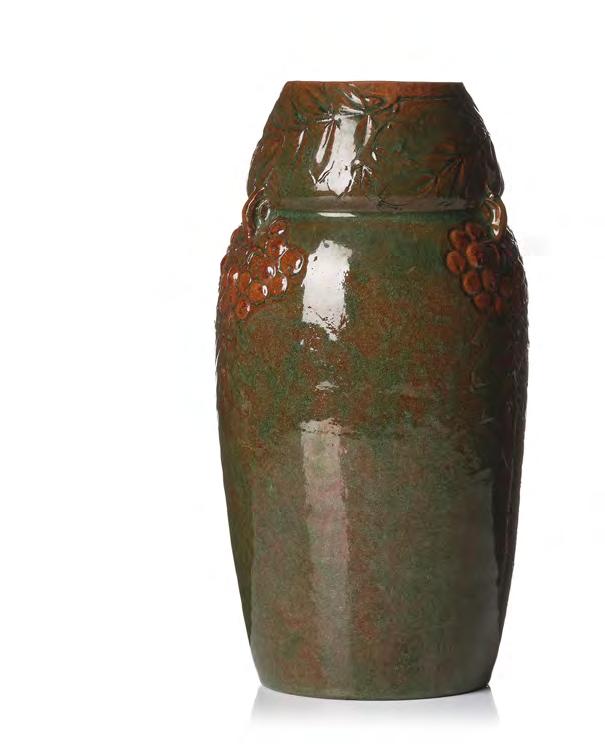
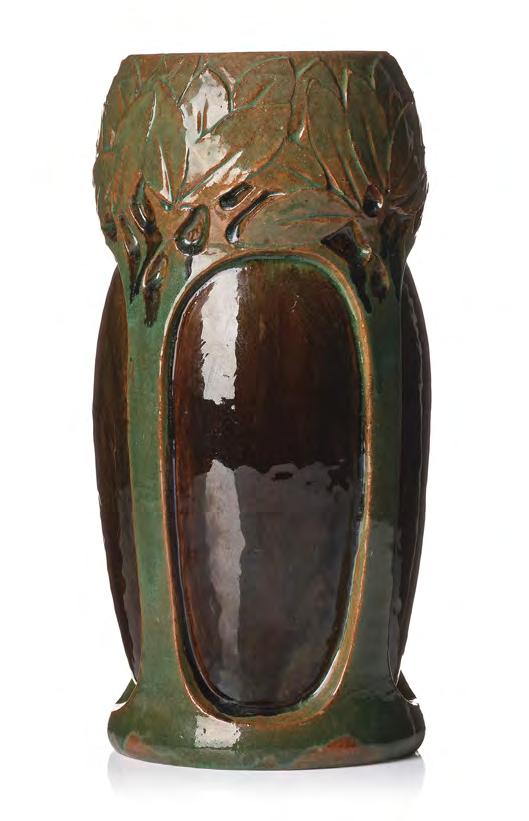
74. Hilma Persson-Hjelm (Sweden, 1877–1953) a glazed earthenware Art Nouveau vase, executed in her own studio, Arvika, 1913. No 2241.
Glazed in brown with incised and carved decoration of rowan-berries with foliage in orange and green, signed H.P 1913 2241. Height 26 cm.
Exhibitions: Prins Eugens Waldemarsudde, Stockholm, “Rackstadkolonin –Stämningsmåleri, konsthantverk & design”, 6 September 2025–15 February 2026.
Estimate: SEK 6 000 – 8 000 / EUR 566 – 754
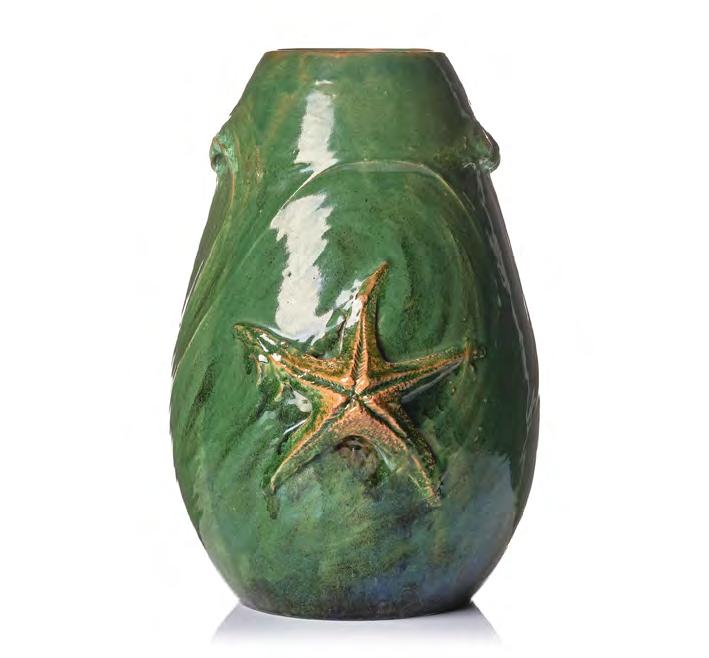
75. Hilma Persson-Hjelm (Sweden, 1877–1953) a glazed earthenware Art Nouveau vase, executed in her own studio, Arvika, 1910. No 1280.
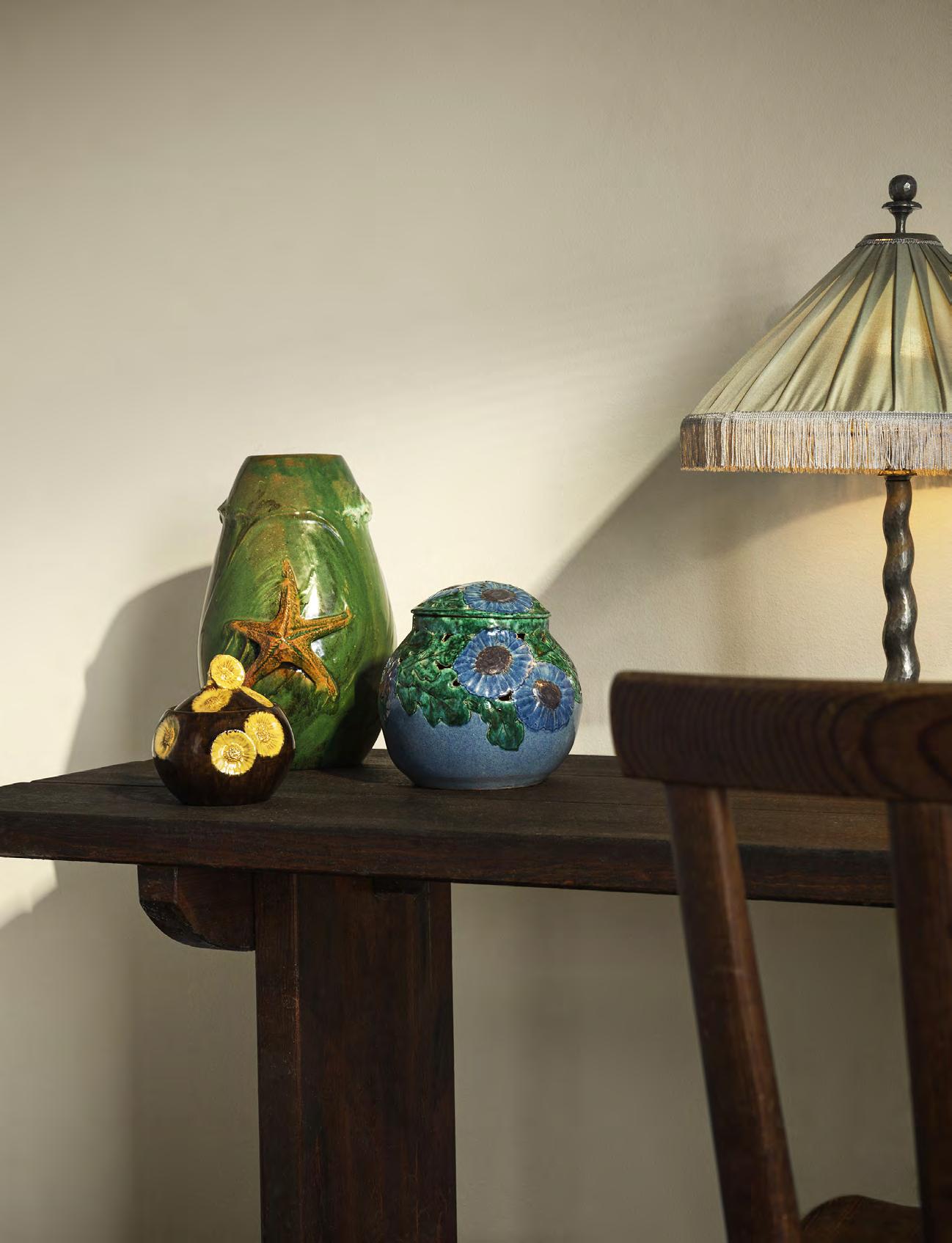
Glazed in green, decorated with starfish in high relief and wave formations, signed .HP. 1910 1280. Height 31 cm.
Exhibitions: Prins Eugens Waldemarsudde, Stockholm, “Rackstadkolonin –Stämningsmåleri, konsthantverk & design”, 6 September 2025–15 February 2026.
Estimate: SEK 10 000 – 15 000 / EUR 943 – 1 410
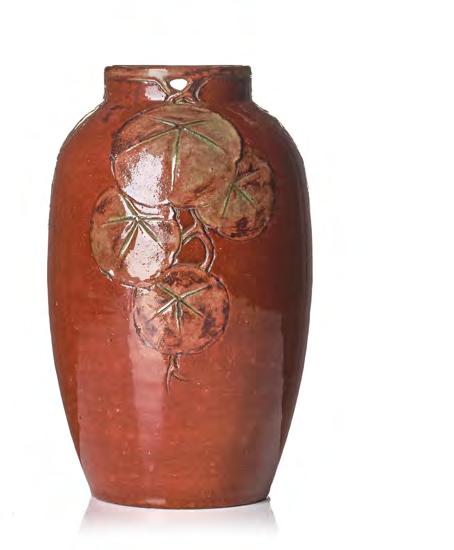
76. Hilma Persson-Hjelm (Sweden, 1877–1953) a glazed earthenware Art Nouveau vase, executed in her studio, Arvika, 1908. No 454.
Glazed with some green hues in an incised decoration of leaves, short pierced neck, signed .HP. 1908 454. Height 20.5 cm.
Exhibitions: Prins Eugens Waldemarsudde, Stockholm, “Rackstadkolonin –Stämningsmåleri, konsthantverk & design”, 6 September 2025–15 February 2026.
Estimate: SEK 6 000 – 8 000 / EUR 566 – 754
75. Hilma Persson-Hjelm, a glazed earthenware art nouvea vase
80. Hilma Persson-Hjelm, a glazed earthenware art nouvea lidded bonbonnière
86. Hilma Persson-Hjelm, a glazed earthenware art nouvea, lidded vase
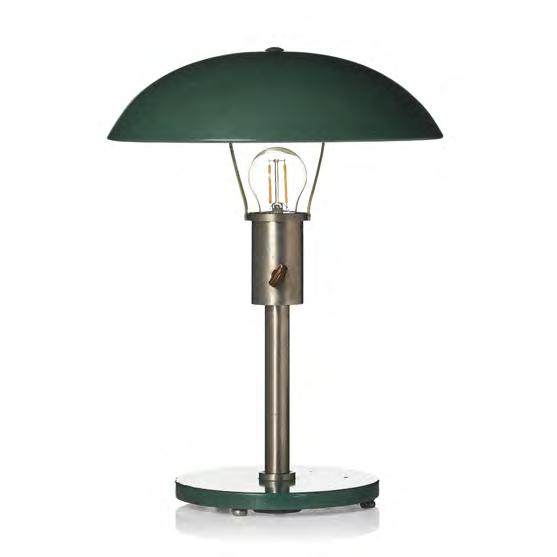
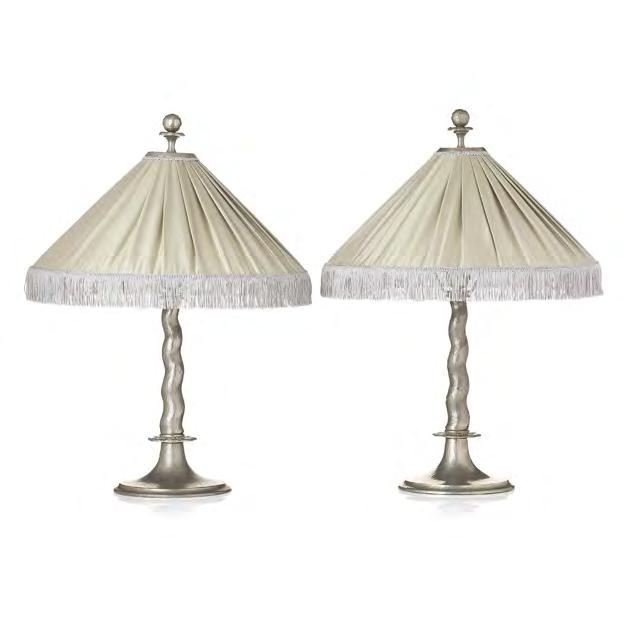
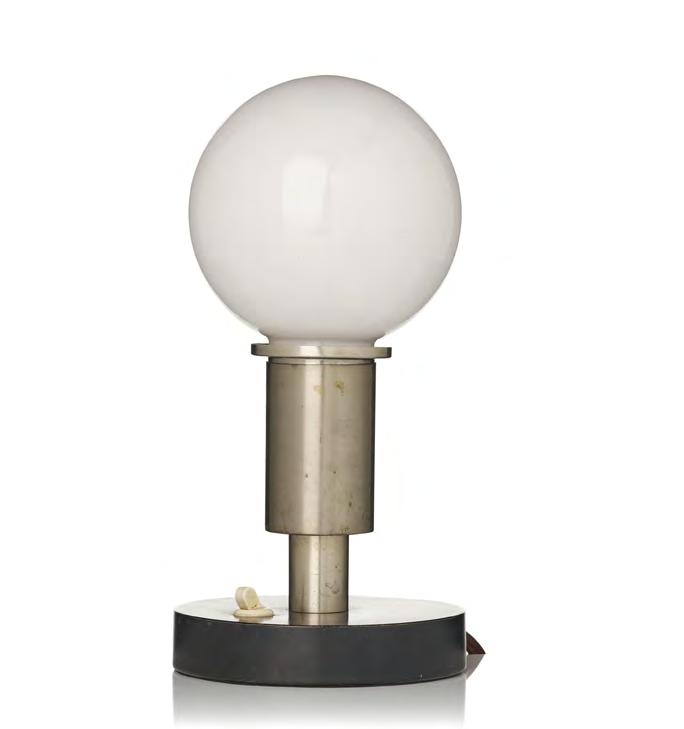
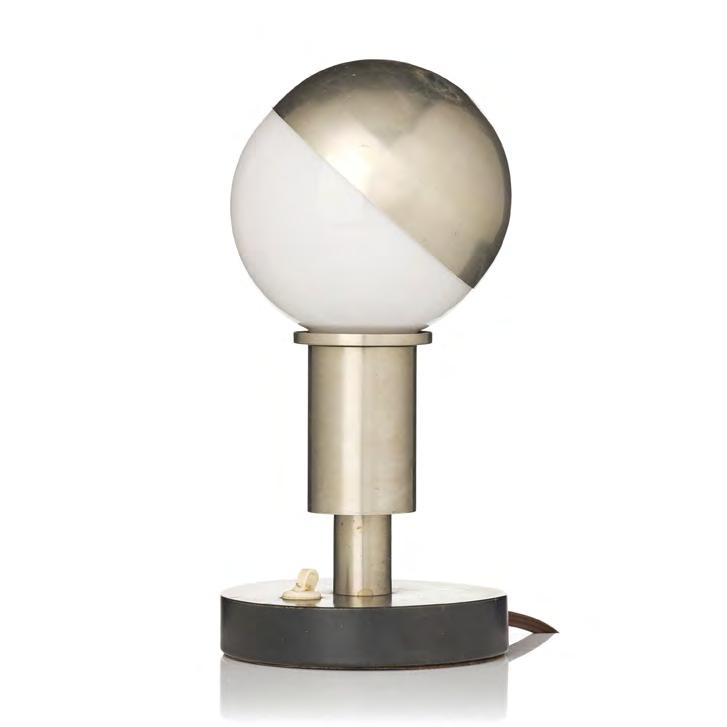
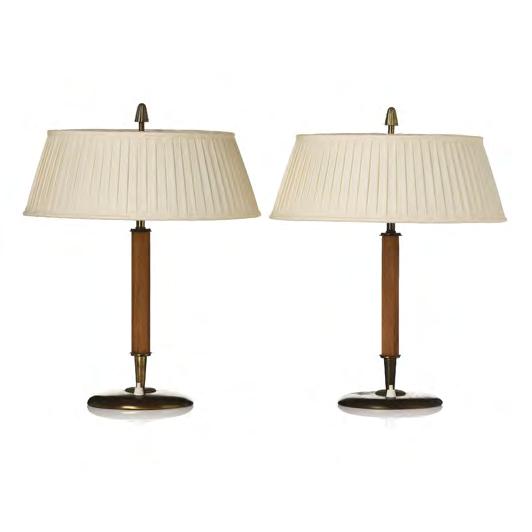
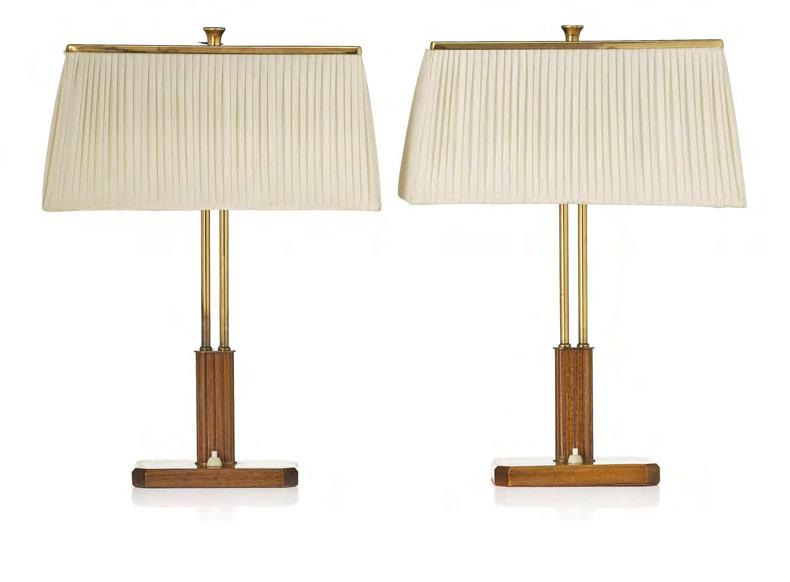
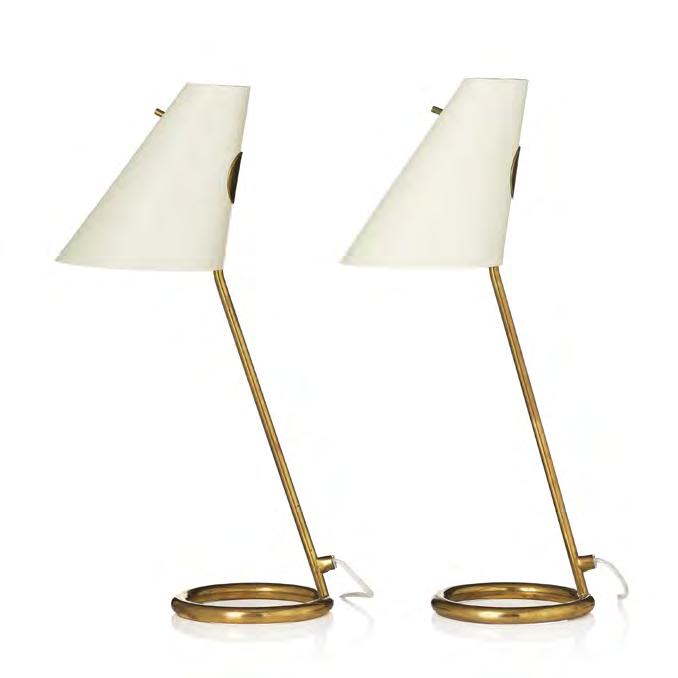
365. Harald Notini, a pair of table lamps model 6891
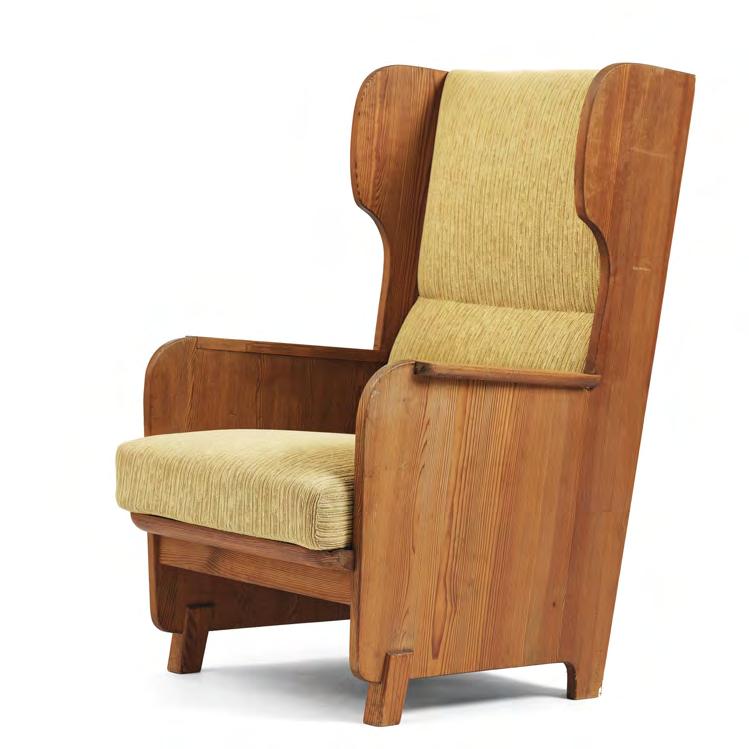
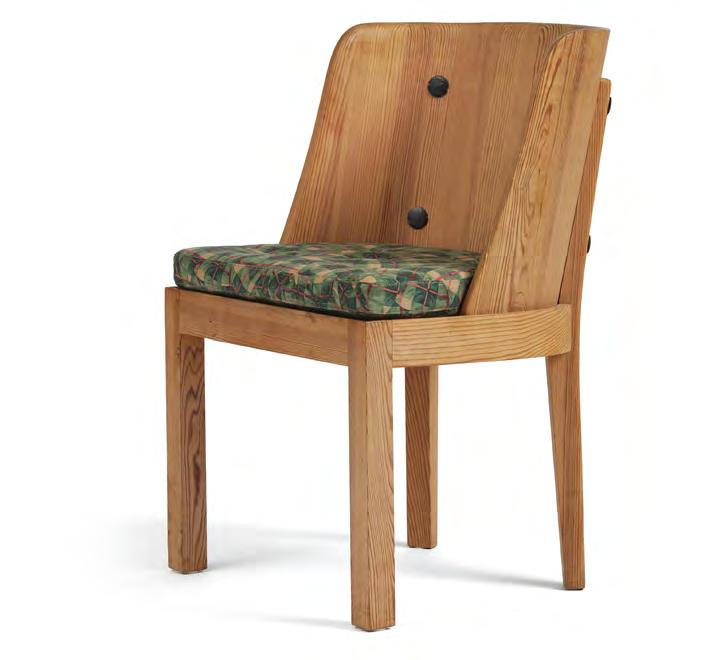
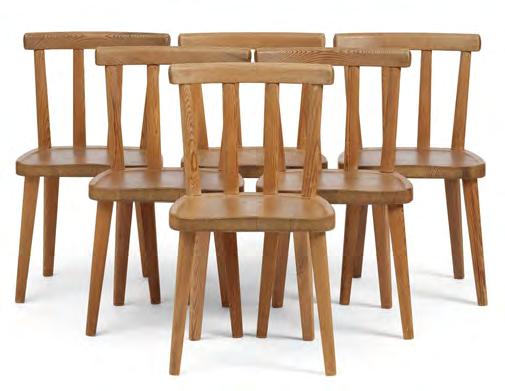
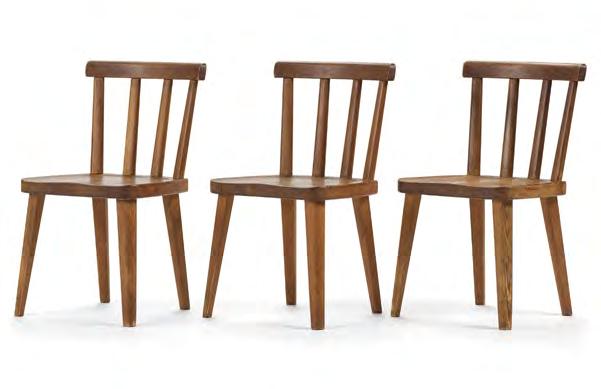
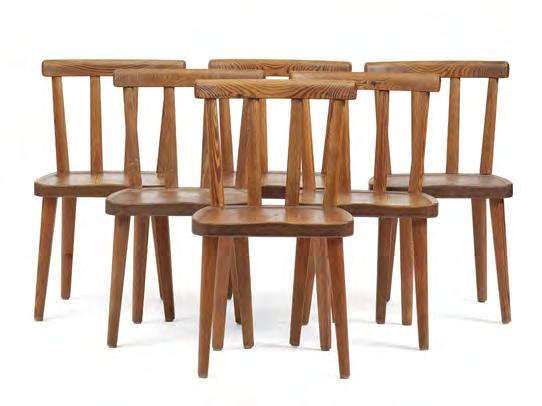
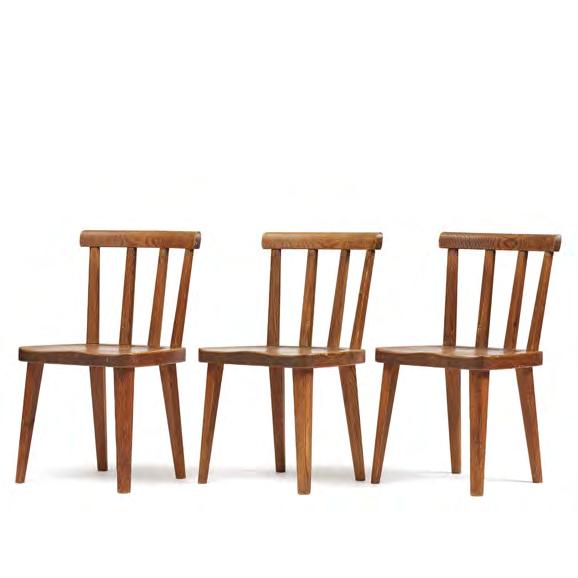
392. Axel Einar Hjorth, a set of three stained pine “Utö” chairs
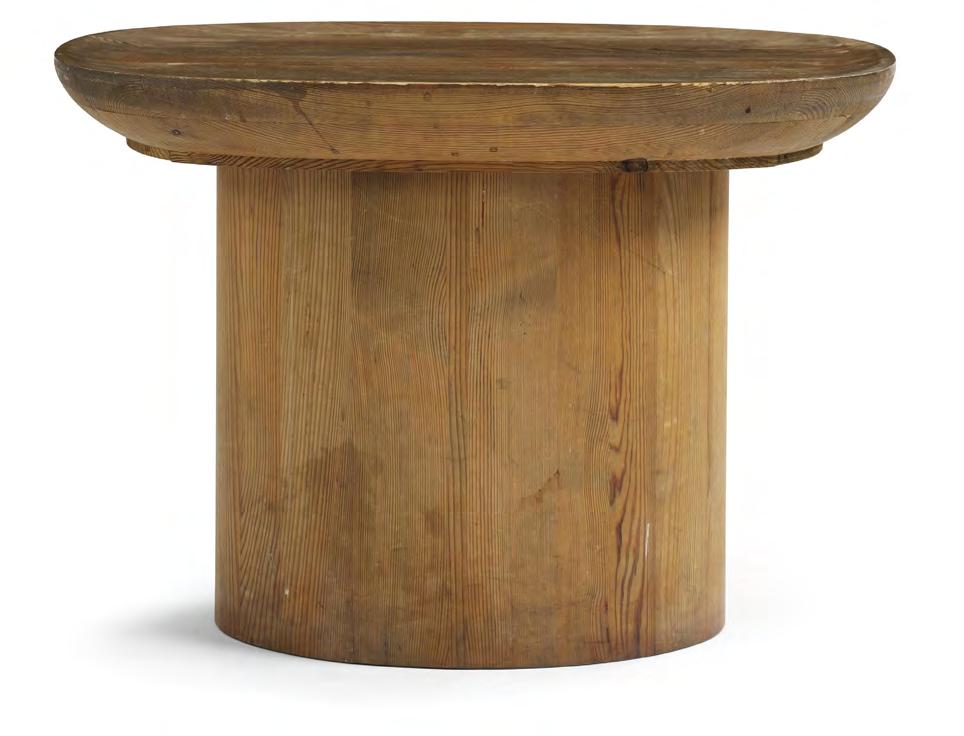
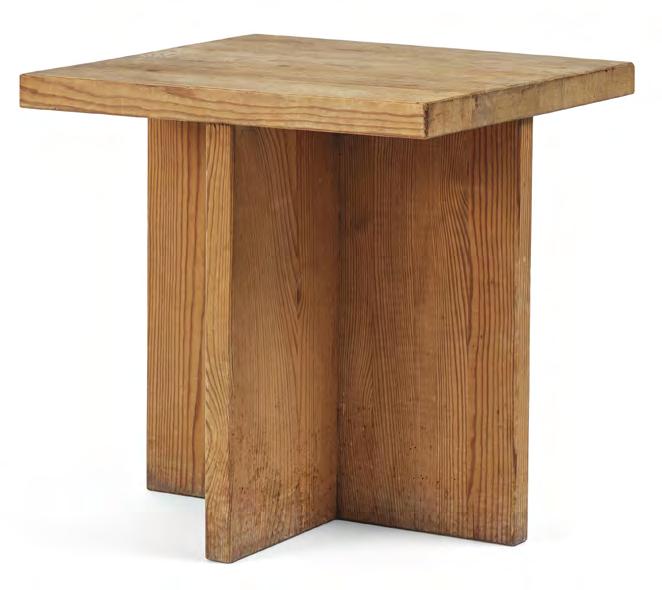
400. Axel Einar Hjorth, a stained pine “Skoga” table
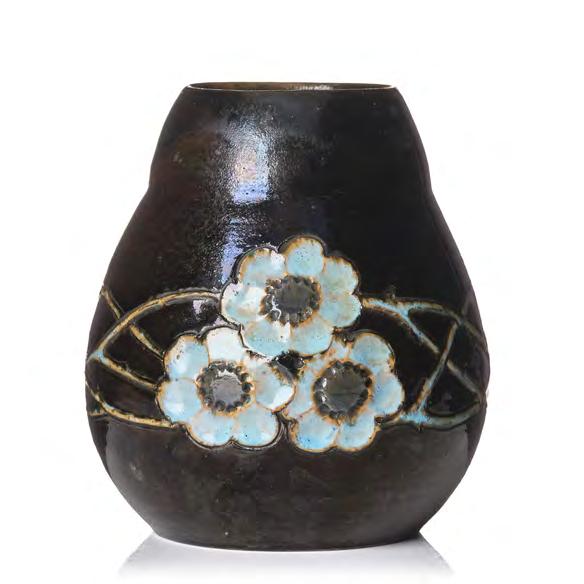
77. Hilma Persson-Hjelm (Sweden, 1877–1953) a glazed earthenware Art Nouveau vase, executed in her own studio, Arvika 1918. No 5196.
Glazed in dark brown with incised decoration of anemones in light blue, signed .HP. 1918 5196. Height 18 cm.
Exhibitions: Prins Eugens Waldemarsudde, Stockholm, “Rackstadkolonin –Stämningsmåleri, konsthantverk & design”, 6 September 2025–15 February 2026.
Estimate: SEK 8 000 – 10 000 / EUR 754 – 943
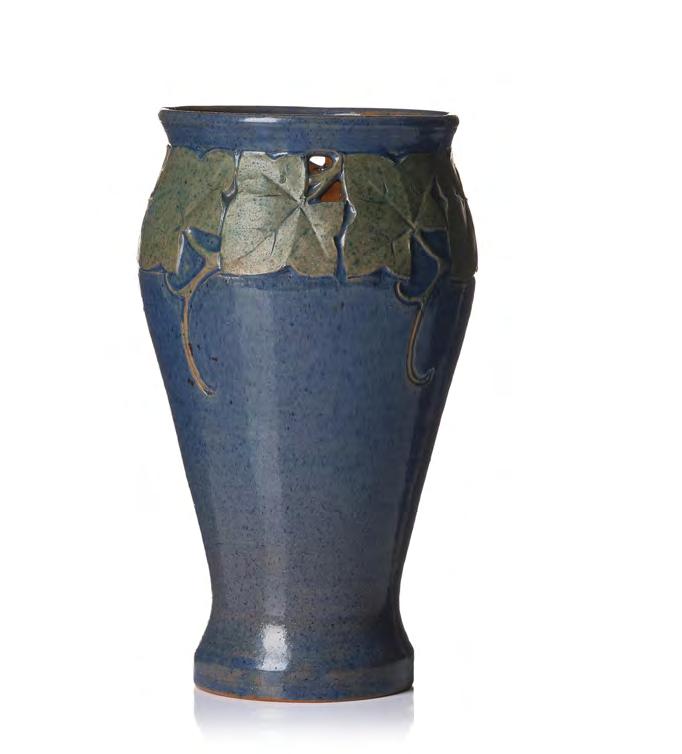
78. Hilma Persson-Hjelm (Sweden, 1877–1953) a glazed earthenware Art Nouveau vase, executed in her own studio, Arvika, 1921. No 8415.
Small shoulder, pierced at the rim, glazed in blue and green with decoration of ivy, signed .HP. 1921 8415. Height 22.3 cm.
Exhibitions: Prins Eugens Waldemarsudde, Stockholm, “Rackstadkolonin –Stämningsmåleri, konsthantverk & design”, 6 September 2025–15 February 2026.
Estimate: SEK 6 000 – 8 000 / EUR 566 – 754
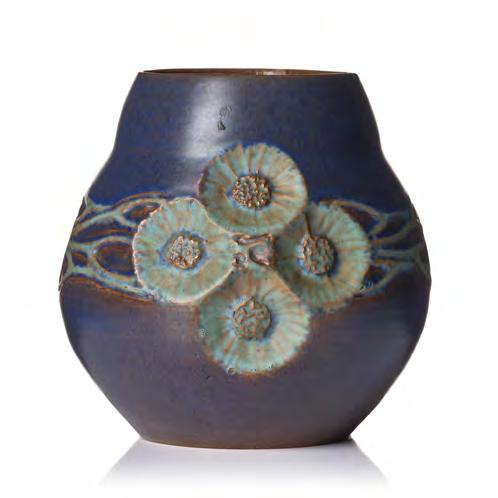
79. Hilma Persson-Hjelm (Sweden, 1877–1953) a glazed earthenware Art Nouveau vase, executed in her own studio, Arvika 1919. No 1619.
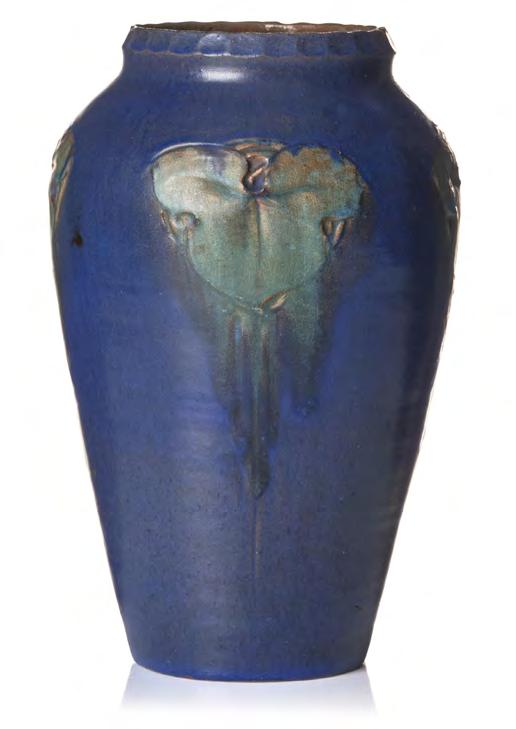
Glazed in blue with incised and carved flowers in lighter blue hues signed .HP. 1919 1619. Height 15 cm.
Exhibitions: Prins Eugens Waldemarsudde, Stockholm, “Rackstadkolonin –Stämningsmåleri, konsthantverk & design”, 6 September 2025–15 February 2026.
Estimate: SEK 6 000 – 8 000 / EUR 566 – 754
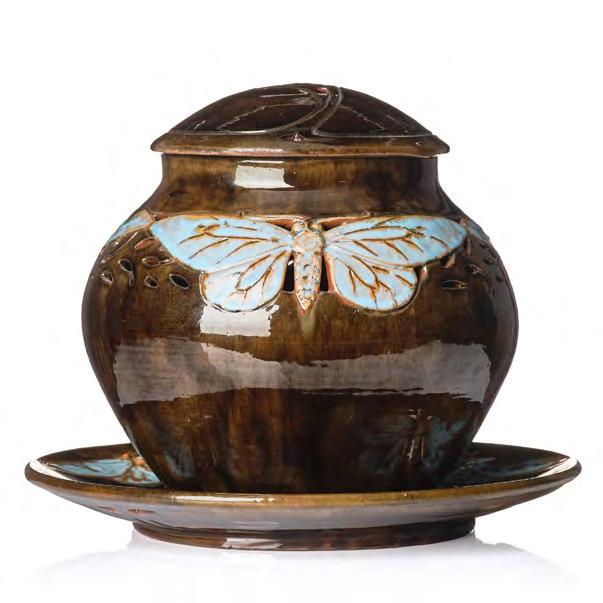
81. Hilma Persson-Hjelm (Sweden, 1877–1953) a glazed earthenware Art Nouveau lidded tureen with a plate, executed in her studio, Arvika 1919. No 8812, plate 1699.
Glazed in brown, partially pierced decoration of butterflies glazed in pale blue, signed .HP. 1919 8812 and .HP. 1919 1699. Total height 21 cm.
Exhibitions: Prins Eugens Waldemarsudde, Stockholm, “Rackstadkolonin –Stämningsmåleri, konsthantverk & design”, 6 September 2025–15 February 2026.
Estimate: SEK 10 000 – 12 000 / EUR 943 – 1 130
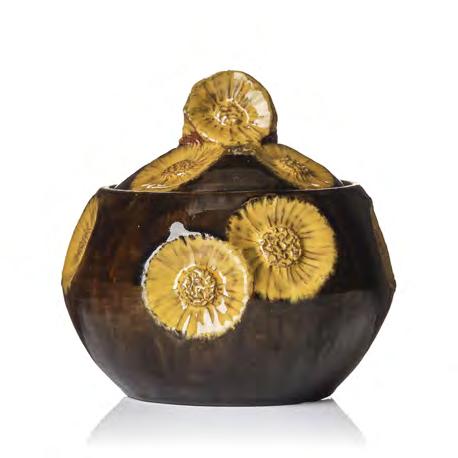
80. Hilma Persson-Hjelm (Sweden, 1877–1953) a glazed earthenware Art Nouveau lidded bonbonnière, executed in her studio, Arvika, 1919, Art Nouveau. No. 6540.
Glazed in dark brown, carved and incised decoration in yellow of coltsfoot, signed .HP. 1919 6540. Height 12.5 cm.
Exhibitions: Prins Eugens Waldemarsudde, Stockholm, “Rackstadkolonin –Stämningsmåleri, konsthantverk & design”, 6 September 2025–15 February 2026.
Estimate: SEK 4 000 – 6 000 / EUR 377 – 566
82. Hilma Persson-Hjelm (Sweden, 1877–1953) a glazed earthenware Art Nouveau vase, executed in her studio, Arvika 1908. Nr 684.
Glazed in green, incised and carved decoration of rowan berries and foliage, signed .HP. 1908 684. Height 25 cm.
Exhibitions: Prins Eugens Waldemarsudde, Stockholm, “Rackstadkolonin –Stämningsmåleri, konsthantverk & design”, 6 September 2025–15 February 2026.
Estimate: SEK 8 000 – 10 000 / EUR 754 – 943
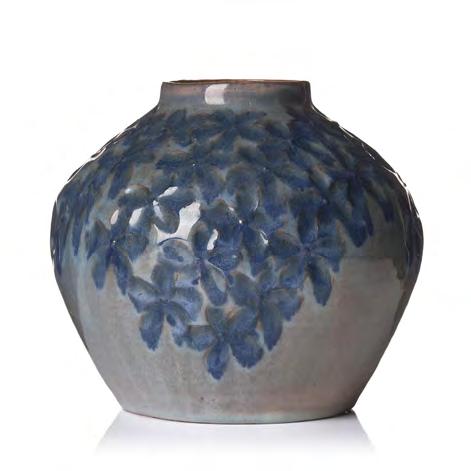
83. Hilma Persson-Hjelm (Sweden, 1877–1953) a glazed earthenware Art Nouveau vase, executed in her own studio, Arvika 1916. No 3807.
Glazed in grey with incised blue hepatica, signed .HP. 1916 3807.
Height 13 cm.
Exhibitions: Prins Eugens Waldemarsudde, Stockholm, “Rackstadkolonin –
Stämningsmåleri, konsthantverk & design”, 6 September 2025–15 February 2026.
Estimate: SEK 6 000 – 8 000 / EUR 566 – 754
85. Hilma Persson-Hjelm (Sweden, 1877–1953) a glazed earthenware Art Nouveau vase, executed in her own studio, 1910. No 1173.
Glazed in brown with high-relief decoration of trees and tree crowns in green, signed .HP. År (year) 1910 1173. Height 26 cm.
Exhibitions: Prins Eugens Waldemarsudde, Stockholm, “Rackstadkolonin –Stämningsmåleri, konsthantverk & design”, 6 September 2025–15 February 2026.
Estimate: SEK 10 000 – 12 000 / EUR 943 – 1 130
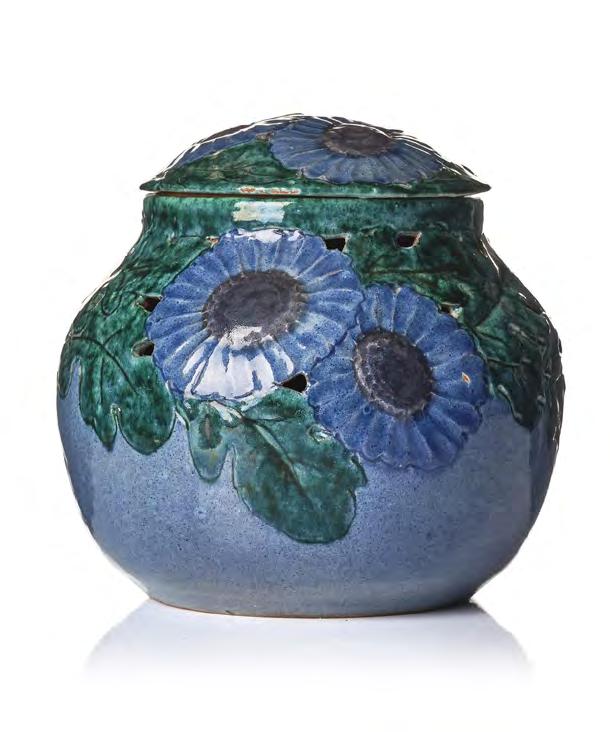
84. Hilma Persson-Hjelm (Sweden, 1877–1953) a glazed earthenware Art Nouveau lidded vase, executed in her own studio, Arvika, 1920, No. 1008.
Glazed in blue and green, pierced decoration on both the urn and lid with a design of flowers and leaves, signed .HP: 1920 1008. Height 19,5 cm.
Exhibitions: Prins Eugens Waldemarsudde, Stockholm, “Rackstadkolonin –Stämningsmåleri, konsthantverk & design”, 6 September 2025–15 February 2026.
Estimate: SEK 8 000 – 10 000 / EUR 754 – 943
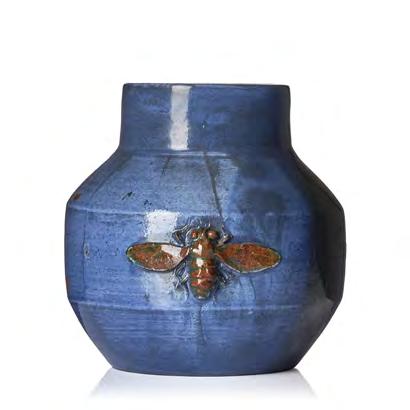
86. Hilma Persson-Hjelm (Sweden, 1877–1953) a glazed earthenware Art Nouveau vase, executed in her studio, Arvika, 1911. No 1505.
Glazed in blue with a decoration of a moth in high relief, signed .HP. 1911 1505. Height 12 cm.
Exhibitions: Prins Eugens Waldemarsudde, Stockholm, “Rackstadkolonin –Stämningsmåleri, konsthantverk & design”, 6 September 2025–15 February 2026.
Estimate: SEK 6 000 – 8 000 / EUR 566 – 754
87. Hilma Persson-Hjelm (Sweden, 1877–1953) a glazed earthenware Art Nouveau vase, executed in her studio, Arvika 1918. No 6124.
Glazed in blue with a decoration of carved hepatica leaves in green hues, signed .HP. 1918. 6124. Height 23.5 cm.
Exhibitions: Prins Eugens Waldemarsudde, Stockholm, “Rackstadkolonin –Stämningsmåleri, konsthantverk & design”, 6 September 2025–15 February 2026.
Estimate: SEK 8 000 – 10 000 / EUR 754 – 943
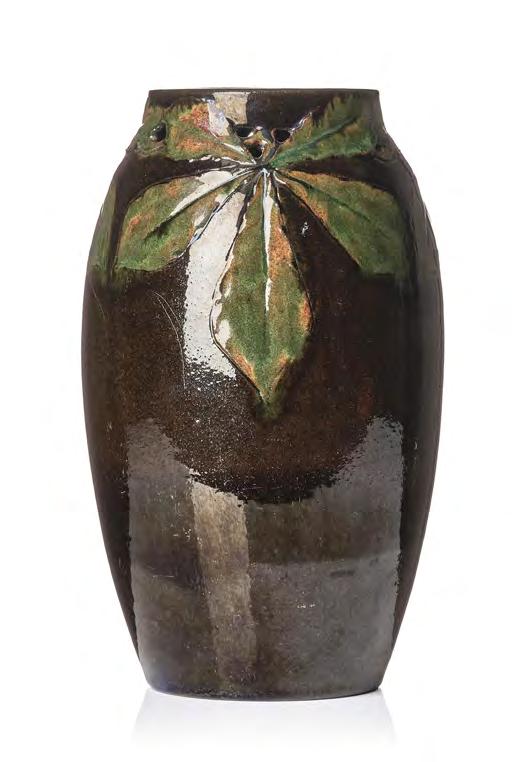
88. Hilma Persson-Hjelm (Sweden, 1877–1953) a glazed earthenware Art Nouveau vase, executed in her own studio, Arvika 1911. No 1542.
Dark brown glaze with incised and partially pierced decoration of chestnut leaves in green, signed .HP. 1911 152. Height 18.5 cm.
Exhibitions: Prins Eugens Waldemarsudde, Stockholm, “Rackstadkolonin –Stämningsmåleri, konsthantverk & design”, 6 September 2025–15 February 2026.
Estimate: SEK 6 000 – 8 000 / EUR 566 – 754
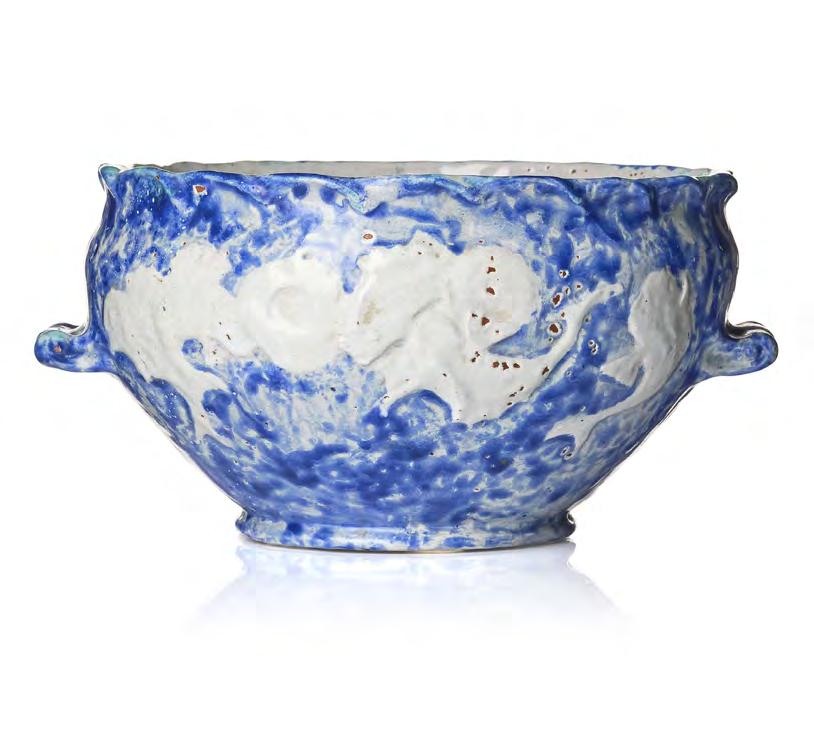
89. Riborg Böving (Sweden, 1880–1953) a faience bowl, Arvika, Sweden, early 20th century.
Bowl on a small foot, with handles, glazed in blue with relief decoration of various fish, signed on the bottom RBA.
Diameter 31 cm, height 17 cm.
Estimate: SEK 3 000 – 4 000 / EUR 283 – 377
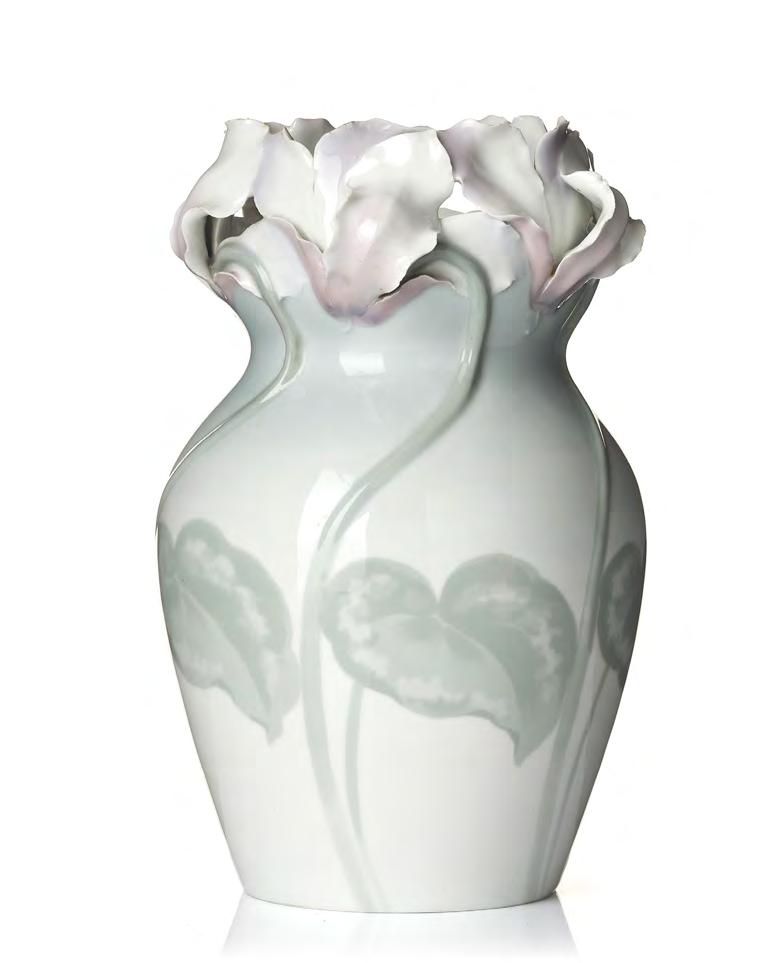
90. Waldemar Lindström (Sweden, 1875–1950) & Karl Lindström (1865–1956), a porcelain vase, Rörstrand, ca. 1900.
Gourd-shaped, the upper part with pierced decoration of cyclamen, underglaze colours in purple-pink and green, stamped 5734 and incised signature WL (modelled by Waldemar Lindström), KL (decorated by Karl Lindström) and stamped Rörstrand in green. Height 28.5 cm.
Estimate: SEK 20 000 – 25 000 / EUR 1 890 – 2 360
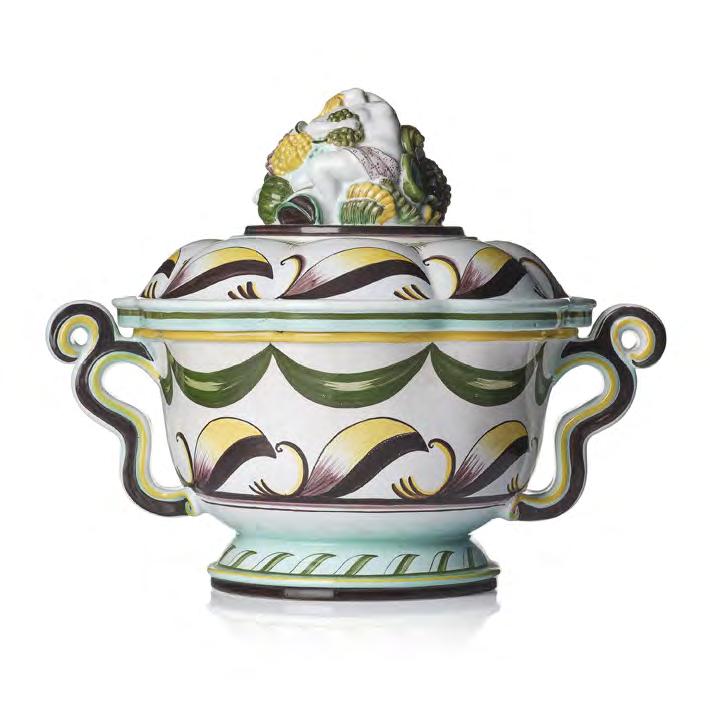
92. Arthur Percy (Sweden, 1886–1976) a Swedish Grace lidded creamware bowl, Gefle Porcelain Factory, Sweden, 1920s-30s. Model D + lid, round, decorated with curved handles, on the lid a figure and fruits. Painted stylised decoration in green, yellow, aubergine brown, and black. Stamped MADE IN SWEDEN MODEL PERCY GEFLE SSF (Swedish Arts and Crafts Association) T. 77. (painter's signature T, Eugen Trost), the lid stamped MADE IN SWEDEN, T. 77. Height ca. 36.5 cm, length 45 cm (diameter 35.5 cm).
Literature: Erik Wettergren, “The Modern Decorative Arts of Sweden”, Malmö Museum, 1926, see the model with a different decoration illustrated on p. 133.
Helena Dahlbäck Lutteman, “Svensk 1900-tals keramik, stengods, porslin, flintgods”, ICA Förlaget 1985, the model illustrated on p. 58.
Ulf Hård af Segerstad, “Keramik, sekelskifte till sjuttiotal”, the model illustrated, catalogue number 30
Estimate: SEK 25 000 – 30 000 / EUR 2 360 – 2 830
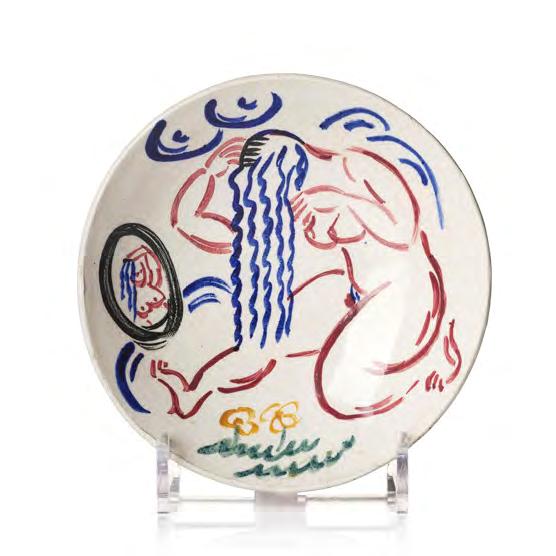
91. Edward Hald (Sweden, 1883–1980) an early ceramic bowl, studio work, Stockholm, 1917.
Hand painted decoration of a woman with a mirror in blue, red, yellow, green, and black, signed E. HALD 1917. Diameter 17.7 cm, height 4.4 cm.
Provenance: Mrs Margareta Hald, thence by descent within the family.
Exhibitions: Edward Hald - Målare, Konstindustripionjär, Nationalmuseum, Waldemarsudde, Stockholm 14.9–27.11 1983, catalogue no. 305, see pp. 86–87.
Literature: Arthur Hald (ed.), “Simon Gate, Edward Hald”, Swedish Society of Crafts and Design, Stockholm 1948, the bowl illustrated mentioned p. 38: “Girl with a Mirror, faience bowl by Edward Hald, 1917. Belongs to Mrs. Margareta Hald”.
Estimate: SEK 6 000 – 8 000 / EUR 566 – 754 (d)
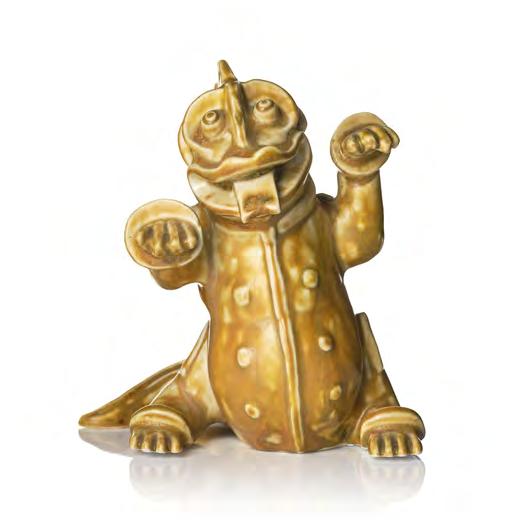
93. Ivar Johnsson (Sweden, 1885–1970) “Caliban”, a glazed ceramic sculpture, Gefle porcelain factory, 1930s. Green glaze, signed IVAR (illegible) and “30”. Height 29.8 cm.
Literature: Gunnela Ivanov, “Swedish Grace”, Orosdi-Back, Stockholm 2017, p. 509.
Estimate: SEK 8 000 – 10 000 / EUR 754 – 943 (d)
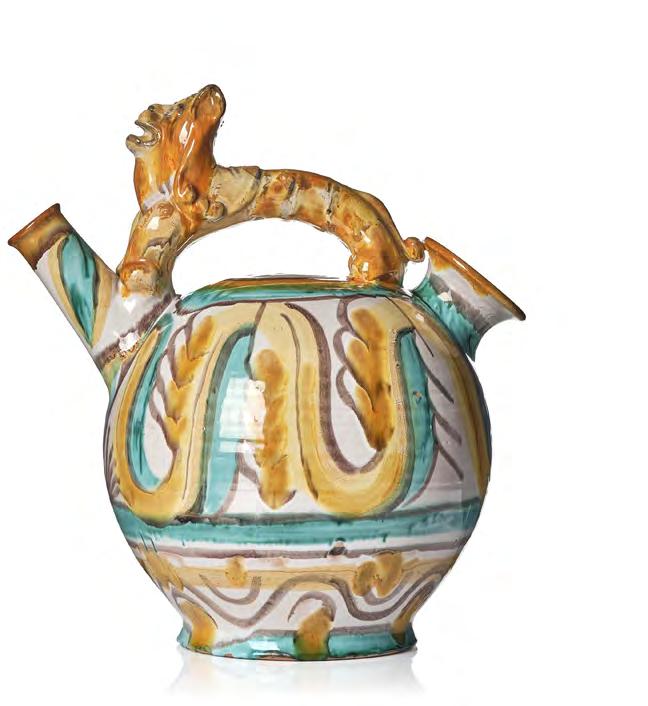
94. Allan Ebeling (Sweden, 1897–1975) a glazed ceramic jug, Upsala-Ekeby, ca. 1930.
Globular jug with a handle in the form of a tiger, glaze in green, yellow, and orange, signed UE AE 1929. Height 41.5 cm.
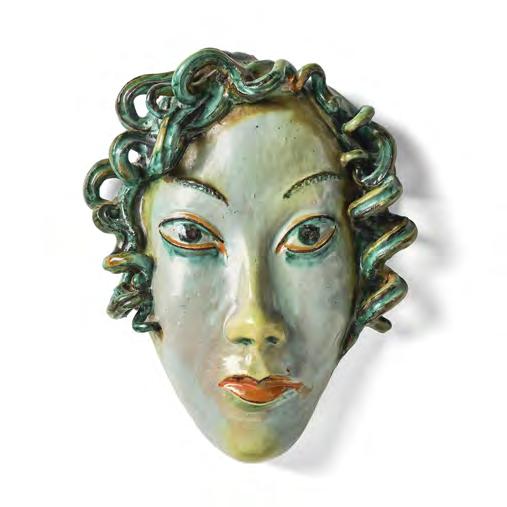
95. Allan Ebeling (Sweden, 1897–1975) a glazed earthenware wall sculpture of a masque, Torshälla 1934.
Face with decoration in green, brown, and orange, signed AE TORSHÄLLA 1934. Height 36 cm, width 29 cm.
Estimate: SEK 4 000 – 6 000 / EUR 377 – 566 (d)
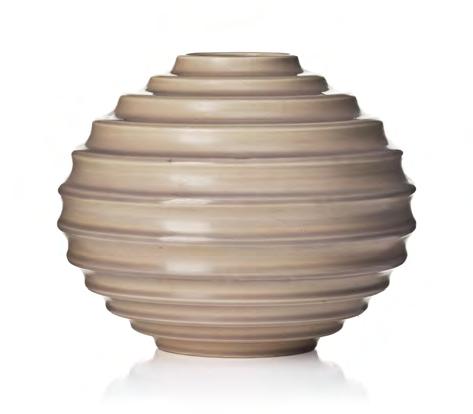
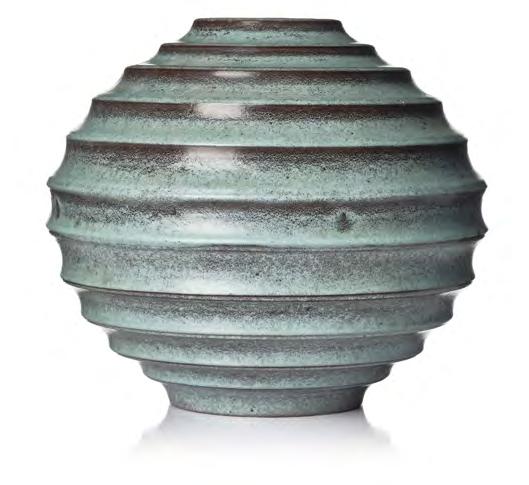
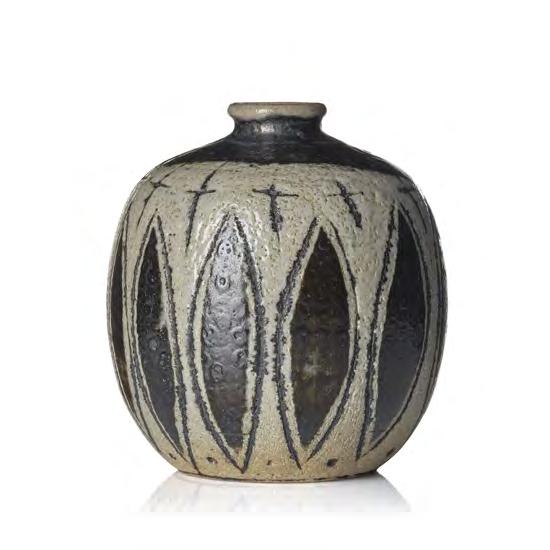
96. Ewald Dahlskog (Sweden, 1894–1950) a spherical faience vase, model D9/3, Bo Fajans, Gävle, 1930s.
Spherical, glazed with so-called lava glaze in grey-green, signed incised Bo ED D 9/3 and painted LAVA. Height 25 cm.
Exhibitions: The model was introduced at the Stockholm Exhibition in 1930 and was produced in five different sizes, of which this is the largest version.
Estimate: SEK 8 000 – 10 000 / EUR 754 – 943
97. Ewald Dahlskog (Sweden, 1894–1950) a spherical faience vase, model D9/1, Bo Fajans, Gävle, 1930–43. Spherical, glazed in brown tones, signed ED Bo D9/1 and glaze number -528 in black. Height 16.5 cm.
Estimate: SEK 6 000 – 8 000 / EUR 566 – 754
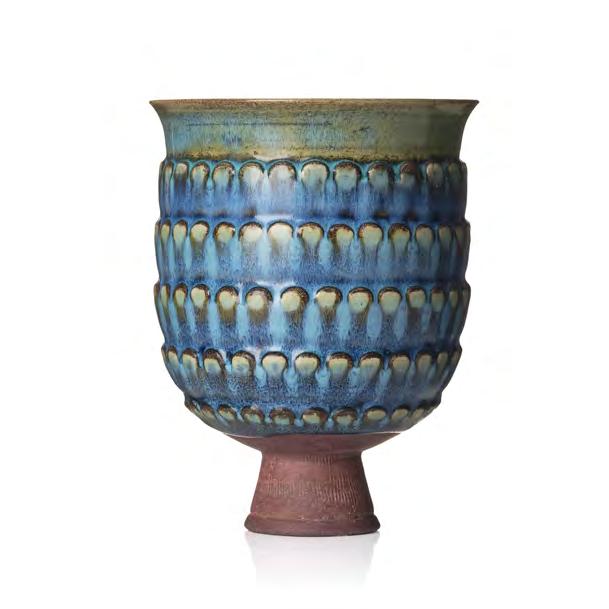
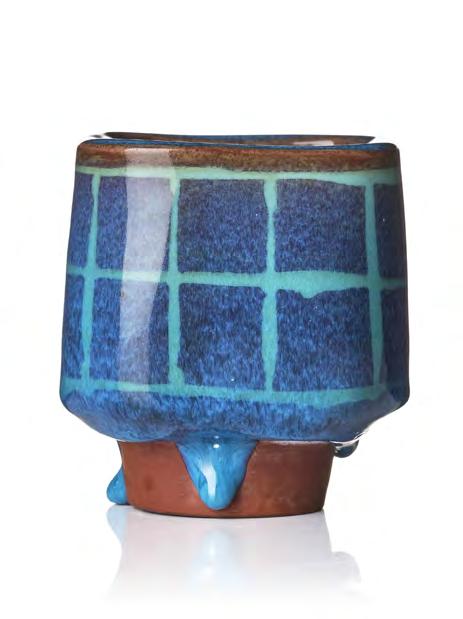
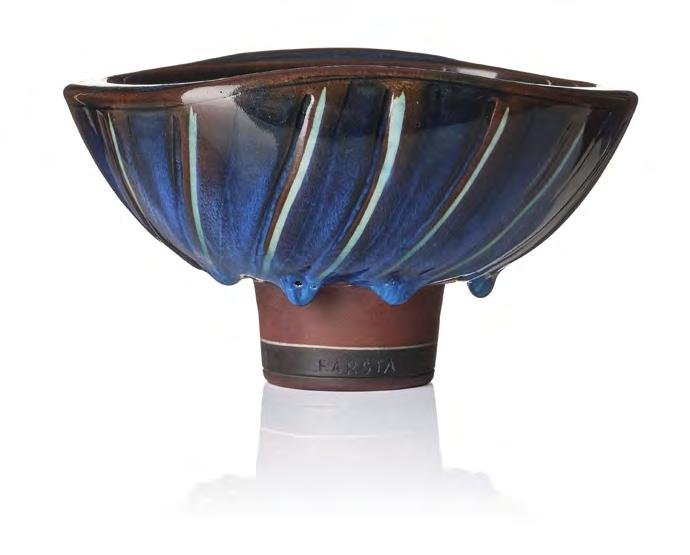
98. Wilhelm Kåge, a Farsta stoneware vase
103. Wilhelm Kåge, a set of two stoneware vases
106. Wilhelm Kåge, a Farsta stoneware vase
116. Wilhelm Kåge, a Farsta stoneware vase
118. Wilhelm Kåge, a Farsta stoneware vase/sculpture
123. Wilhelm Kåge, a Farsta stoneware vase
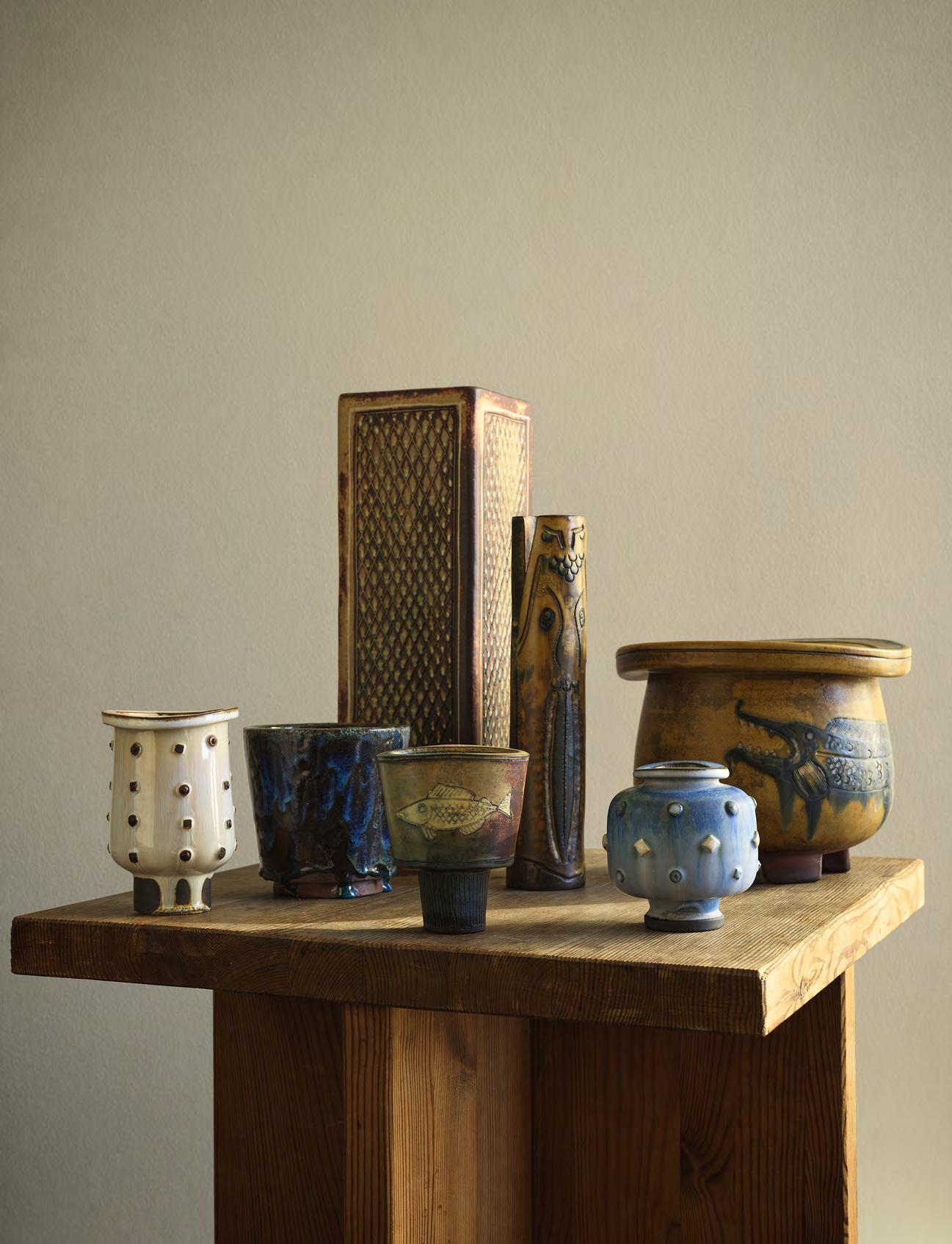
Wilhelm Kåge: Property from a Swedish Private Collection
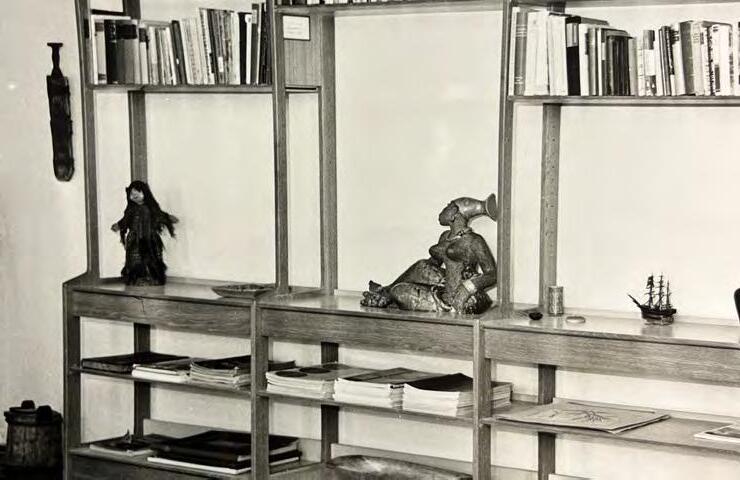
Bukowskis presents a large collection of ceramics by Wilhelm Kåge. The present collection has been carefully built over more than 20 years, with the most important objects being acquired at various auctions. The collector in question has placed extra importance on the provenance of the objects and much of what has been acquired has come directly from Wilhelm Kåge’s private collection. Several of the pieces are depicted in Gisela Eronn’s “Wilhelm Kåge Keramikens mästare” published in 2006, and also notable in this context is the interior photo of Kåge’s home on Fjällgatan in Stockholm that can be found in Nils Palmgren’s “Wilhelm Kåge”, published in 1953, where some of the vases and bowls that are present in this sale are depicted in the artist’s bookshelf.
Wilhelm Kåge was the artistic director of the Gustavsberg porcelain factory from 1917 to 1949, and initiated the artistic workshop Gustavsbergs Studio in 1942.
As a leading figure in the birth of the Swedish decorative art industry, as well as its march to international recognition, Kåge became a pioneer in the true sense of the word, and during this era in Swedish design history the leading name in the field of ceramics.
98. Wilhelm Kåge (Sweden, 1889–1960) a Farsta stoneware vase, Gustavsberg 1934.
Glazed in turquoise, green, and brown, signed GUSTAVSBERG KÅGE FARSTA with the anchor mark and year letter D. Height 11.5 cm, diameter 11.5 cm.
Provenance: From the estate of Professor Wilhelm Kåge, thence by descent.Uppsala Auktionskammare, International Important Sale 11 June 2019, catalogue no. 299. Swedish private collection, purchased at the above auction.
Literature: David Westman (ed.), “Porslin”, a periodical for ceramics published by AB Gustavsbergs Fabriker, no. 1–2, Svenska Tryckeriaktiebolaget, Stockholm 1951–52, see the vase illustrated on page 36.
Estimate: SEK 8 000 – 10 000 / EUR 754 – 943 (d)
In 1953, Nationalmuseum in Stockholm held a major retrospective exhibition of Wilhelm Kåge. The exhibition highlighted his importance for Swedish ceramics, especially his artistic ”Farsta” stoneware. The present sale includes a total of 41 selected lots from this collection, which mainly consists of ”Farsta” objects. One of the collection’s main works can be found in one of the photos from the Nationalmuseum exhibition of 1953.
Wilhelm Kåge gained broad international recognition already during his lifetime. When The New York Times reviewed a Kåge exhibition in New York in 1958, the paper described him as one of the three most important contemporary ceramicists in the world. His long friendship and artistic exchange with Japanese master Shōji Hamada is highlighted in the current exhibition “Wilhelm Kåge & Shōji Hamada – Ceramics Across Borders” at Nationalmuseum, running from April 23, 2026 to February 28, 2027.
The collection comprises lot no 98-138.
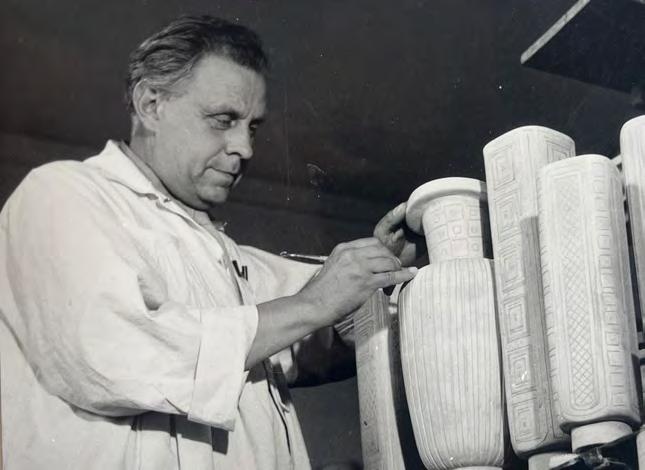
Wilhelm Kåge in the studio
100. Wilhelm Kåge (Sweden, 1889–1960) an early Farsta stoneware dish, Gustavsberg 1933.
Stepped base and rim, glaze in blue and turquoise, signed GUSTAVSBERG KÅGE FARSTA with anchor mark and year letter C. Diameter 22.3 cm, height 4.5 cm.
Provenance: From the estate of Professor Wilhelm Kåge, thence by descent. Uppsala Auktionskammare, International Important Sale 11 June 2019, catalogue no. 299.
Swedish private collection, purchased at the above auction.
Estimate: SEK 6 000 – 8 000 / EUR 566 – 754 (d)
99. Wilhelm Kåge (Sweden, 1889–1960) a Farsta stoneware vase, Gustavsberg 1934.
Bulbous form with handles, narrow neck, turquoise/blue glaze, signed GUSTAVSBERG KÅGE with anchor mark, year letter D and FARSTA.
Height 16 cm.
Provenance: From the estate of Professor Wilhelm Kåge, thence by descent. Uppsala Auktionskammare, International Important Sale 11 June 2019, catalogue no. 299.
Swedish private collection, purchased at the above auction.
Literature: Nils Palmgren, “Wilhelm Kåge”, Nordisk Rotogravyr, Stockholm 1953, see the vase depicted in Wilhelm Kåge's bookshelf, p. 238, as well as in a photograph with Wilhelm Kåge from the balcony on Fjällgatan, p. 241 (Photo: Kerstin Bernhard).
102. Wilhelm Kåge (Sweden, 1889–1960) a set of two early Farsta stoneware bowls, Gustavsberg 1933 and 1936.
A with impressed decoration of stylised leaves, glaze in blue and turquoise, signed GUSTAVSBERG KÅGE with the year letters C and F, the latter also FARSTA. Height 7.5 and 12 cm, diameter 17.7 and 13,8 cm.
Provenance: From the estate of Professor Wilhelm Kåge, thence by descent. Uppsala Auktionskammare, International Important Sale 11 June 2019, catalogue no. 299.
Swedish private collection, purchased at the above auction.
Estimate: SEK 6 000 – 8 000 / EUR 566 – 754 (d)
101. Wilhelm Kåge (Sweden, 1889–1960) an early Farsta stoneware dish, Gustavsberg 1933.
Glaze in shades of blue, signed GUSTAVSBERG KÅGE with the anchor mark, year letter C and FARSTA. Diameter 16.5 cm, height 4 cm.
Provenance: From the estate of Professor Wilhelm Kåge, thence by descent. Uppsala Auktionskammare, International Important Sale 11 June 2019, catalogue no. 299.
Swedish private collection, purchased at the above auction.
Estimate: SEK 4 000 – 6 000 / EUR 377 – 566 (d)
104. Wilhelm Kåge (Sweden, 1889–1960) a set of two Farsta stoneware dishes, Gustavsberg Studio, one dated 1949.
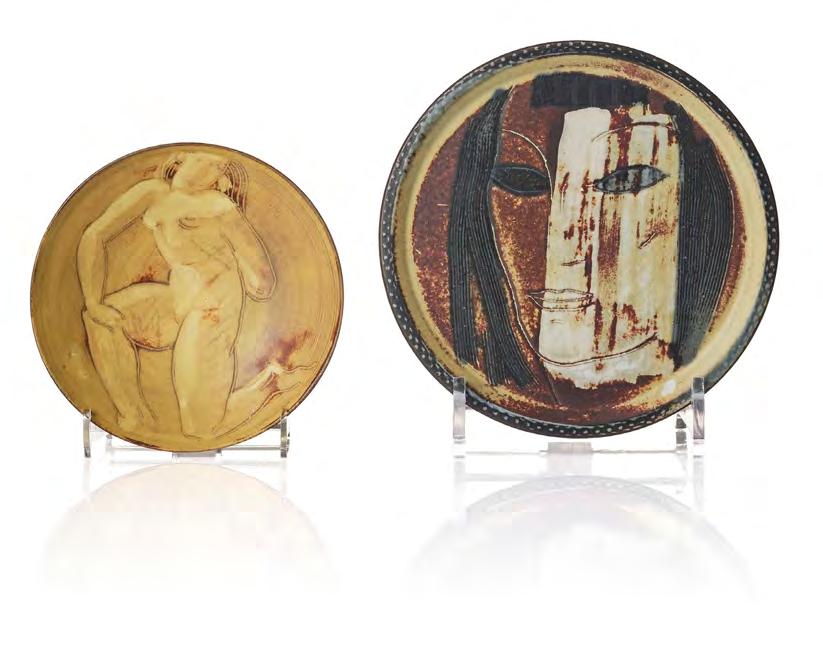
Engraved decoration of a face and a female figure, glaze in yellow and green against brown, signed KÅGE FARSTA with the studio hand, the smaller with the year letter S. Diameter 17 and 13.2 cm.
Provenance: Swedish private collection, previously in the Erik Holmberg Collection, purchased at Bukowskis Modern Art & Design auction 616, May 2019, see catalog no. 61.
Estimate: SEK 8 000 – 10 000 / EUR 754 – 943 (d)
103. Wilhelm Kåge (Sweden, 1889–1960) a set of two stoneware vases, Gustavsberg Studio 1940s.
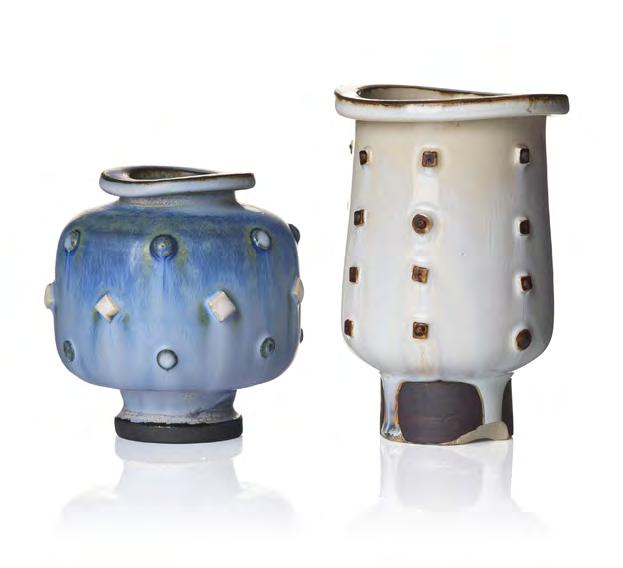
Relief decoration of round and square knobs, white and blue glaze, signed KÅGE, with impressed studio stamp and the blue vase also indistinctly ?4. Height 13 and 10 cm.
Provenance: The white vase previously in the estate of Professor Wilhelm Kåge. Thence by descent. Uppsala Auktionskammare, Auction 11 June 2019, catalogue no. 298.
The blue vase previously in Nils Holm’s private collection. Uppsala Auktionskammare, International Important Sale 7 June 2017, catalogue no. 129. Swedish private collection, purchased at the above auctions.
Literature: Nils Palmgren, “Wilhelm Kåge”, Nordisk Rotogravyr, Stockholm 1953, see the white vase depicted in Wilhelm Kåge's bookshelf, p. 238.
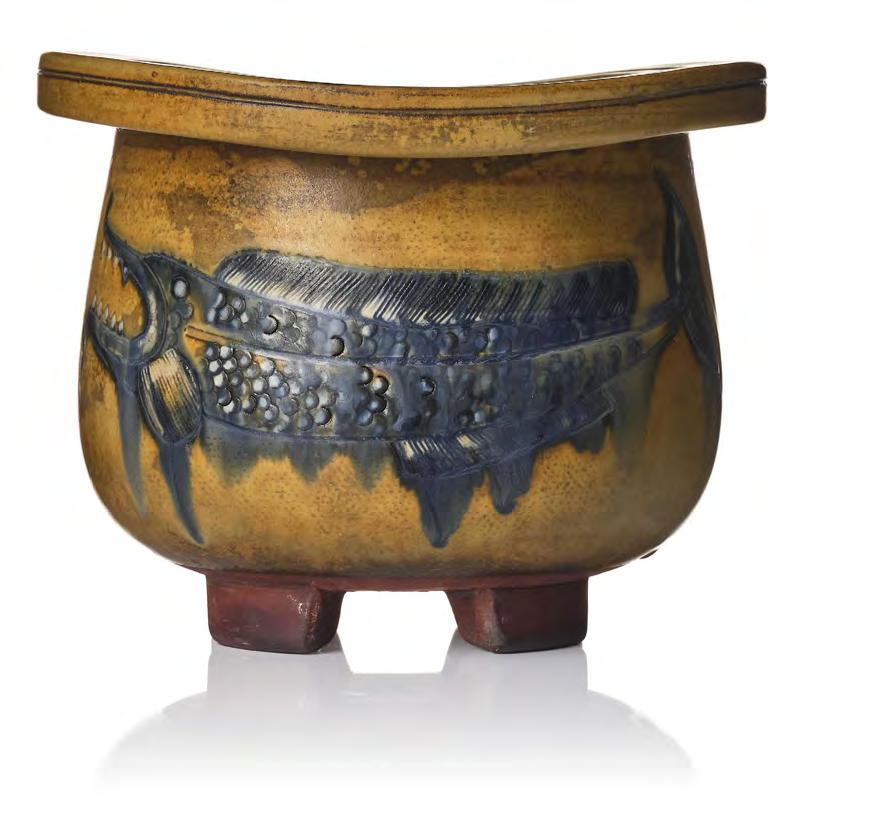
106. Wilhelm Kåge (Sweden, 1889–1960) a Farsta stoneware urn, Gustavsberg Studio 1953, provenance Wilhelm Kåge. Round urn on four feet, carved decoration of fish, signed KÅGE with impressed studio mark, FARSTA and year letter X. Height 17.2 cm, diameter 21.5 cm.
Provenance: From the estate of Professor Wilhelm Kåge, thence by descent. Uppsala Auktionskammare, International Auction 11 June 2019, catalogue no. 292. Swedish private collection, purchased at the above auction.
Literature: Nils Palmgren, “Wilhelm Kåge”, Nordisk Rotogravyr, Stockholm 1953, cf. similar vase illustrated p. 234.
107. Wilhelm Kåge (Sweden, 1889–1960) a Farsta stoneware vase, Gustavsberg Studio 1940s-50s.
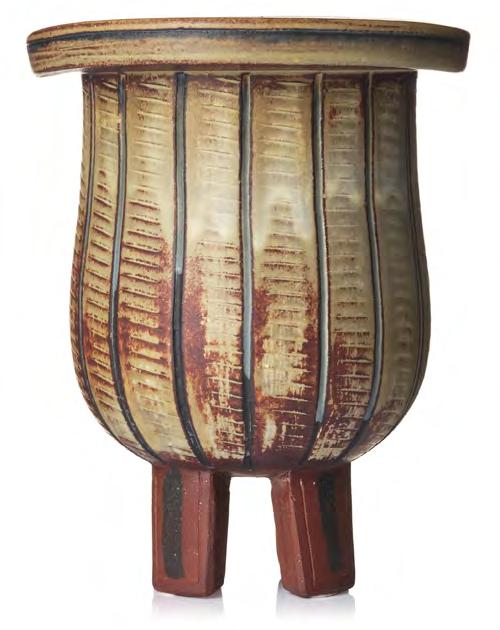
Round on four feet, relief decoration of stripes, glaze in yellow, green and brown, signed KÅGE and with an impressed studio mark, indistinct year letter. Height 19 cm, diameter 14.6 cm.
109. Wilhelm Kåge (Sweden, 1889–1960) a set of three Farsta stoneware vases, Gustavsberg Studio, two dated 1948 and 1950. Decoration of squares, dots, and stripes in relief, glaze in blue, green, and turquoise, signed KÅGE FARSTA with studio stamp, two with the year letters S and T respectively. Height 7, 8.7, and 11.3 cm.
Provenance: The left vase from the estate of Professor Wilhelm Kåge, thence by descent. Uppsala Auktionskammare, International Auction 11 June 2019, catalog no. 303. Swedish private collection, purchased at the above auction.
108. Wilhelm Kåge (Sweden, 1889–1960) a Farsta Spirea stoneware vase, Gustavsberg Studio 1950s.
Engraved decoration, partly with blue glaze, signed KÅGE FARSTA and with the studio stamp. Height 9 cm.
Provenance: Swedish private collection.
Estimate: SEK 5 000 – 7 000 / EUR 471 – 660 (d)
110. Wilhelm Kåge (Sweden, 1889–1960) a Farsta stoneware lidded jar, Gustavsberg Studio 1950s.
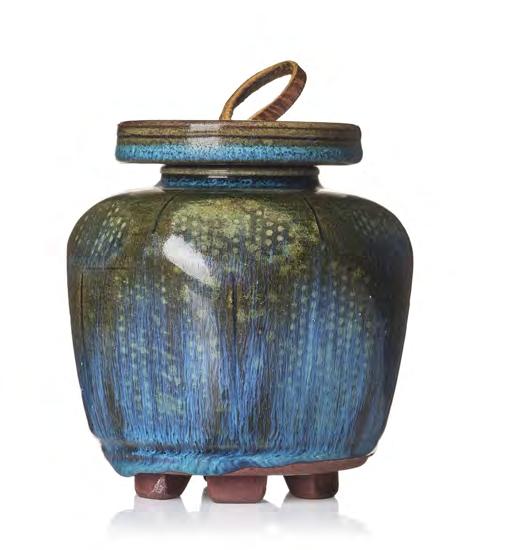
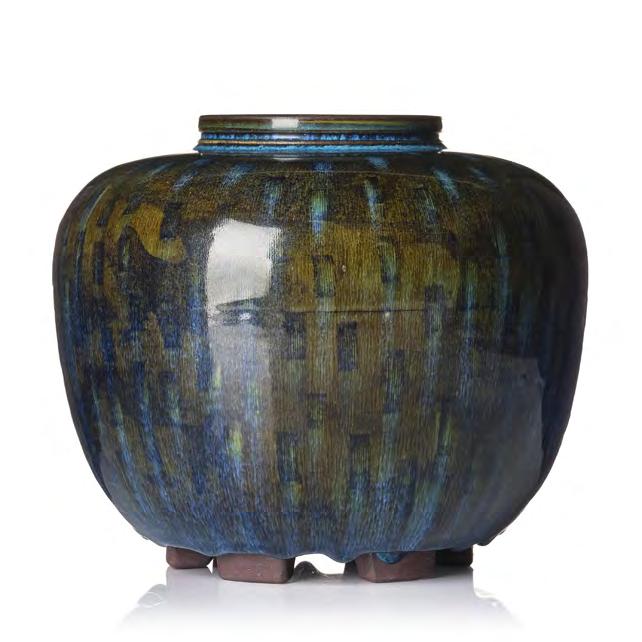
Hexagonal on six unglazed feet, green, turquoise, and blue glaze, signed KÅGE with the studio stamp, FARSTA. Height 10.5 cm.
Provenance: Swedish private collection, previously in the Erik Holmberg Collection, purchased at Bukowskis Modern Art & Design auction 616, May 2019, see catalogue no. 62.
Estimate: SEK 4 000 – 6 000 / EUR 377 – 566 (d)
111. Wilhelm Kåge (Sweden, 1889–1960) a Farsta stoneware vase, Gustavsberg Studio 1950s.
Four-sided on an unglazed rounded base, glazed in turquoise blue with a checkered decoration in a lighter blue, signed with the studio hand KÅGE. Height 8 cm.
Provenance: Swedish private collection.
Estimate: SEK 4 000 – 5 000 / EUR 377 – 471 (d)
112. Wilhelm Kåge (Sweden, 1889–1960) a Farsta stoneware vase, Gustavsberg Studio 1950s.
Clock-shaped bowl on an unglazed foot, relief decoration, glossy glaze in blue and green, signed KÅGE with the studio stamp, height 11.8 cm, diameter 9 cm.
Provenance: From the estate of Professor Wilhelm Kåge, thence by descent. Uppsala Auktionskammare, International Auction 11 June 2019, catalogue no. 303. Swedish private collection, purchased at the above auction..
Literature: Gisela Eronn, “Wilhelm Kåge, keramikens mästare”, Prisma 2006, depicted on the cover.
Estimate: SEK 6 000 – 8 000 / EUR 566 – 754 (d)
113. Wilhelm Kåge (Sweden, 1889–1960) a Farsta stoneware bowl, Gustavsberg Studio 1958.
Oval footed bowl, incised decoration of diagonal stripes, dripping glaze in blue, turquoise, and some brown, signed KÅGE FARSTA with the studio stamp and year letter Ö. 16.3 x 14 cm, height 9.2 cm.
Provenance: Swedish private collection.
Estimate: SEK 5 000 – 6 000 / EUR 471 – 566 (d)
115. Wilhelm Kåge (Sweden, 1889–1960) a set of two Farsta stoneware footed bowls, Gustavsberg Studio 1958 and 1960.
Glaze in turquoise, blue, and green, signed KÅGE FARSTA with the studio stamp and year designations Ö and K9. Height 8 and 8.5 cm, diameter 16.3 and 15 cm.
Provenance: Swedish private collection.
Estimate: SEK 8 000 – 10 000 / EUR 754 – 943 (d)
114. Wilhelm Kåge (Sweden, 1889–1960) a set of two Farsta stoneware bowls, Gustavsberg Studio 1955–56.
Double mouth rim (“bowl in a bowl”), incised decoration, glaze in turquoise, blue and green, signed KÅGE FARSTA with the studio stamp and the year letters Z and Å. Height 6–7 cm, diameter 11–12.5 cm.
Provenance: Swedish private collection.
Estimate: SEK 6 000 – 8 000 / EUR 566 – 754 (d)
116. Wilhelm Kåge (Sweden, 1889–1960) a Farsta stoneware vase, Gustavsbergs Studio 1950s.
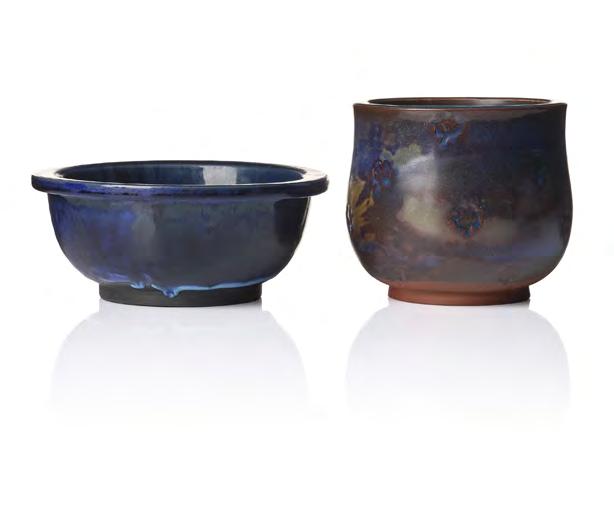
Oval shape on a high foot, incised decoration in blue and yellow against a darker yellow background, signed GUSTAVSBERG with the studio hand, KÅGE FARSTA. Height 11 cm.
Provenance: Swedish private collection.
Literature: David Westmand (ed.), “Porslin”, a journal for ceramics published by AB Gustavsbergs Fabriker, no. 2, 1945, cf. the vase illustrated on p. 3.
Estimate: SEK 4 000 – 5 000 / EUR 377 – 471 (d)
117. Wilhelm Kåge (Sweden, 1889–1960) a set of three Farsta stoneware footed bowls, Gustavsberg Studio 1950s.
Engraved striped decoration, glossy glaze in turquoise and green, signed KÅGE with the studio mark, 2 pieces with the year letter Ö. Height 7.2 and 9 cm.
Provenance: From the estate of Professor Wilhelm Kåge, thence by descent. Uppsala Auktionskammare, International Auction 11 June 2019, catalogue no. 303. Swedish private collection, purchased at the above auction..
Estimate: SEK 8 000 – 10 000 / EUR 754 – 943 (d)
118. Wilhelm Kåge (Sweden, 1889–1960) a Farsta stoneware vase/sculpture in the form of a 'dragonfish', Gustavsberg Studio 1955. Incised and impressed decoration, glaze in yellow, green, and brown, signed KÅGE z. with the studio stamp and FARSTA. Height 26.2 cm.
120. Wilhelm Kåge (Sweden, 1889–1960) a Farsta stoneware vase, Gustavsberg Studio 1954.
Nearly cylindrical with a collar, incised decoration of vertical stripes, yellow glaze, signed Y KÅGE and with an impressed studio mark as well as FARSTA. Height 18.8 cm, diameter 13.3 cm.
123. Wilhelm Kåge (Sweden, 1889–1960) a Farsta stoneware vase, Gustavsberg Studio 1952.
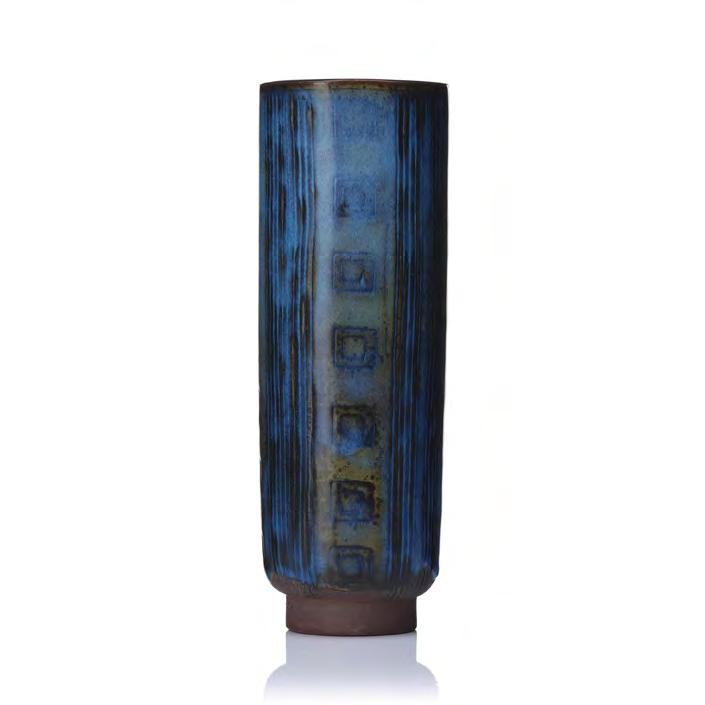
Square form on four feet, incised checkered pattern, glaze in brown, yellow, and some green, signed FARSTA KÅGE with the studio stamp and year letter V. Height 36.3 cm, 12 x 12 cm.
Provenance: Swedish private collection.
Exhibitions: Nationalmuseum, Stockholm, this vase was exhibited at the major Wilhelm Kåge exhibition in 1953.
Literature: Arthur Hald (ed.), The Swedish Society of Crafts and Design's journal FORM 1953, issue 5, see the vase illustrated from the Nationalmuseum's exhibition, p.107 (Photographer: Knut E. Svensson).
124. Wilhelm Kåge (Sweden, 1889–1960) a Farsta stoneware vase, Gustavsberg Studio 1958.
Cylindrical on five feet, relief decoration of horizontal bands and incised squares, glaze in beige, brown, and green, signed KÅGE Ö with the studio mark and FARSTA. Height 18.5 cm, diameter 12 cm.
125. Wilhelm Kåge (Sweden, 1889–1960) a Farsta stoneware bowl, Gustavsberg Studio 1946.
Engraved grid decoration in relief, glaze in brown, yellow, and green, signed GUSTAVSBERG FARSTA KÅGE P. as well as studio stamp and marked 103 G.M. Diameter 25.5 cm, height 5.9 cm.
Provenance: From the estate of Professor Wilhelm Kåge, thence by descent Uppsala Auktionskammare, International Auction 11 June 2019, part of catalogue no. 310. Swedish private collection, purchased at the above auction.
Literature: Gisela Eronn, “Wilhelm Kåge, keramikens mästare”, Prisma 2006, see the bowl illustrated on the first spread as well as p. 135.
Estimate: SEK 6 000 – 8 000 / EUR 566 – 754 (d)
126. Wilhelm Kåge (Sweden, 1889–1960) a Farsta Spirea stoneware bowl, Gustavsberg Studio 1957.
Incised band decoration, matte glaze in yellow, green, blue, and beige, signed KÅGE Ä, impressed studio mark and FARSTA.
129. Wilhelm Kåge (Sweden, 1889–1960) a set of two Farsta stoneware vases, Gustavsberg Studio 1952 and 1958. Glaze in green and beige, signed KÅGE with the studio stamp and the year letters V and Ö. Height 19 and 11 cm.
Provenance: Swedish private collection, previously in the Erik Holmberg Collection, purchased at Bukowskis Modern Art & Design auction 616, May 2019, see catalog no. 61.
Estimate: SEK 8 000 – 10 000 / EUR 754 – 943 (d)
130. Wilhelm Kåge (Sweden, 1889–1960) a Farsta stoneware dish, Gustavsberg Studio 1959.
Rectangular with incised grid decoration, glaze in yellow and green, signed i9 KÅGE with the studio stamp and FARSTA. 35.7 x 24.6 cm, height 5.3 cm.
Provenance: From the estate of Professor Wilhelm Kåge (1889 -1960), thence by descent. Uppsala Auktionskammare, International Auction, 11 June 2019, part of catalog no. 310. Swedish private collection, purchased at the above auction.
Estimate: SEK 6 000 – 8 000 / EUR 566 – 754 (d)
131. Wilhelm Kåge (Sweden, 1889–1960) a Farsta stoneware vase, Gustavsbergs Studio 1958.
Cylindrical vase with partially combed decoration in blue-green against a yellow ground, signed KÅGE FARSTA. GUSTAVSBERG studio hand Ö. Height 12 cm.
Provenance: Swedish private collection.
Estimate: SEK 6 000 – 8 000 / EUR 566 – 754 (d)
133. Wilhelm Kåge (Sweden, 1889–1960) a Farsta stoneware bowl, Gustavsberg Studio 1956.
Round on four unglazed feet, glaze in brown and somewhat blue shades with combed decoration, signed KÅGE FARSTA GUSTAVSBERG with the studio mark Ä. Height 7.3 cm, diameter 12 cm.
Provenance: Swedish private collection.
Estimate: SEK 3 000 – 5 000 / EUR 283 – 471 (d)
132. Wilhelm Kåge (Sweden, 1889–1960) a Farsta stoneware vse, Gustavsberg Studio 1950.
Bulbous body, high slender neck, on four feet, incised band decoration, yellow glaze, signed KÅGE FARSTA with the studio mark and year letter T. Height 17.3 cm.
Provenance: Swedish private collection.
Estimate: SEK 5 000 – 6 000 / EUR 471 – 566 (d)
134. Wilhelm Kåge (Sweden, 1889–1960) a set of two Farsta stoneware vases and a bowl, Gustavsberg Studio 1950s.
Incised and dotted relief decoration, glaze in brown, beige and blue, signed KÅGE with the studio mark, FARSTA, the dish and a vase with the year letter Z (1955). Height 4.7, 9 and 10.5 cm, diameter of the dish 15.5 cm.
Provenance: Swedish private collection.
Estimate: SEK 8 000 – 10 000 / EUR 754 – 943 (d)
136. Wilhelm Kåge (Sweden, 1889–1960) an Argenta ceramic vase, Gustavsberg 1935.
Globular on foot, painted silver decoration of vertical bands with geometric decor and leaf scrolls, signed HANDTHROWN GUSTAVSBERG ARGENTA, anchor mark, year letter E KÅGE 1045 II. Height 23.4 cm.
Provenance: Swedish private collection.
Estimate: SEK 8 000 – 10 000 / EUR 754 – 943
135. Wilhelm Kåge (Sweden, 1889–1960) a stoneware jar, Gustavsberg 1930.
Godronned form with handles, contoured rim, on a flared foot, glaze in yellow and some brown, signed GUSTAVSBERG KÅGE, anchor mark and year letter A. Height 17.7 cm, width including handles 18 cm.
Provenance: Swedish private collection.
Estimate: SEK 6 000 – 8 000 / EUR 566 – 754 (d)
137. Wilhelm Kåge (Sweden, 1889–1960) a stoneware floor vase with cover, Gustavsberg 1930s-40s. Green glaze, spherical knob, stamped factory mark and KÅGE. Height 54.5 cm.
Provenance: Swedish private collection.
Estimate: SEK 12 000 – 15 000 / EUR 1 130 – 1 410
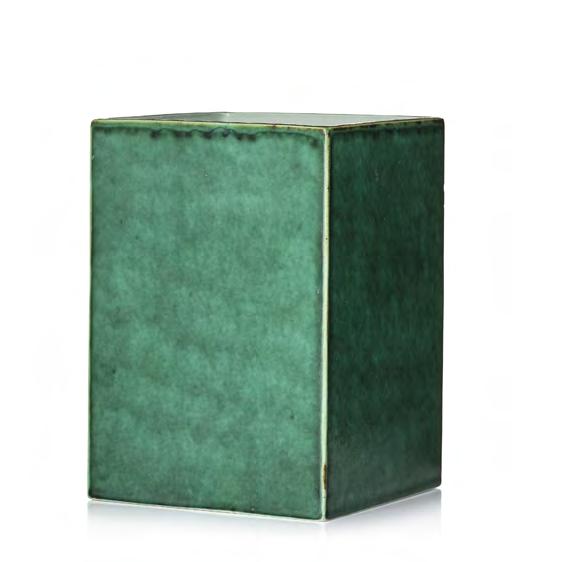
139. Wilhelm Kåge (Sweden, 1889–1960) a rare “Puzzle” cactus planter model 975/9, Gustavsberg, 1931.
Glazed earthenware in green tones, signed and dated GUSTAVSBERG 1931 KÅGE and stamped with model number KÅGE 975 9. Length 24.5 cm, width 10.5 cm, height 21.5 cm.
Literature: Bengt Lundberg, “Hur ett hem inredes praktiskt, rationellt, ekonomiskt: handbok över bohags- och bruksföremål”, Natur och Kultur 1933, p. 179. Nils Palmgren, “Wilhelm Kåge: konstnär och hantverkare”, Nordisk Rotogravyr 1953, p. 146.
Estimate: SEK 20 000 – 30 000 / EUR 1 890 – 2 830
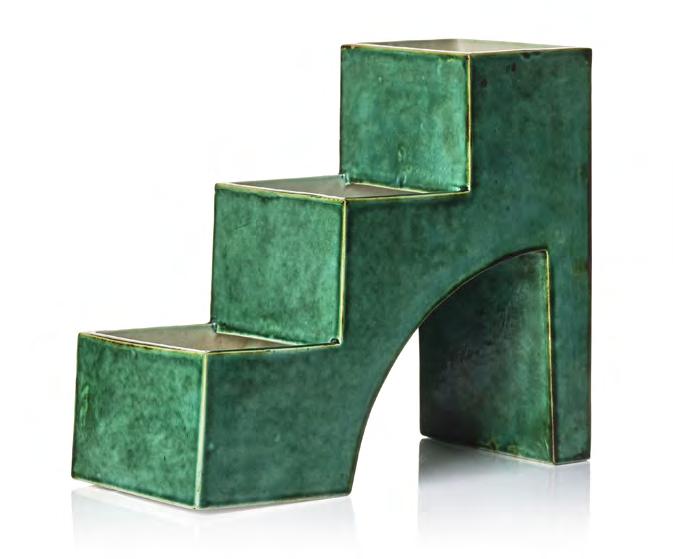
138. Wilhelm Kåge (Sweden, 1889–1960) a rare “Puzzle” cactus planter model 975/2, Gustavsberg, 1931.
Glazed earthenware in green tones, signed and dated GUSTAVSBERG 1931 KÅGE and stamped with model number 975 2. Length 12 cm, width 12 cm, height 17.5 cm.
Provenance: Swedish private collection.
Literature: Bengt Lundberg, “Hur ett hem inredes praktiskt, rationellt, ekonomiskt: handbok över bohags- och bruksföremål”, Natur och Kultur 1933, p. 179. Nils Palmgren, “Wilhelm Kåge: konstnär och hantverkare”, Nordisk Rotogravyr 1953, p. 146.
Estimate: SEK 15 000 – 20 000 / EUR 1 410 – 1 890
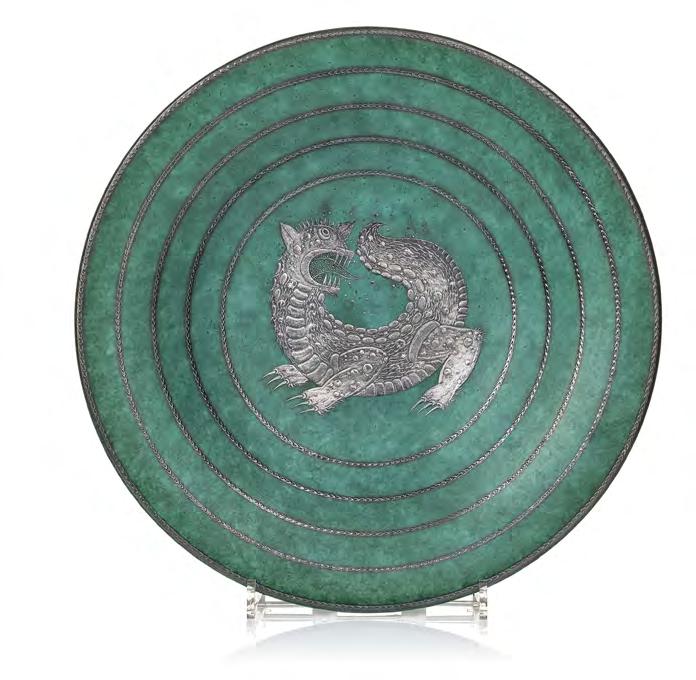
140. Wilhelm Kåge (Sweden, 1889–1960) an Argenta stoneware dish, model 1035, Gustavsberg, Sweden 1940.
Green-glazed, painted silver decoration of a dragon within five rings, signed GUSTAVSBERG with the anchor mark and year letter J, KÅGE ARGENTA 1035 III. painter's signature EL. Diameter 45.5 cm.
Provenance: Underneath with a gift inscription: GUSTAV ÅSBERG 60 YEARS 14 NOV 1940 GUSTAVSBERG PORCELAIN FACTORY.
Estimate: SEK 8 000 – 10 000 / EUR 754 – 943
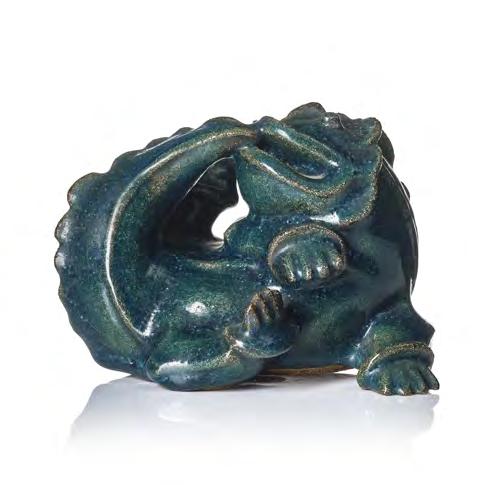
141. Wilhelm Kåge (Sweden, 1889–1960) a chamotte stoneware sculpture of a dragon puppy, Gustavsberg ca 1940.
Green glaze, stamped GUSTAVSBERG KÅGE. Height 8.5 cm, length 13 cm, width approx. 9.5 cm.
Provenance: From the collection of Art Collector and Entrepreneur Kent Löwenberg.
143. Wilhelm Kåge (Sweden, 1889–1960) a set of two stoneware sculptures of dragon puppies, Gustavsberg, Sweden 1940–50's.
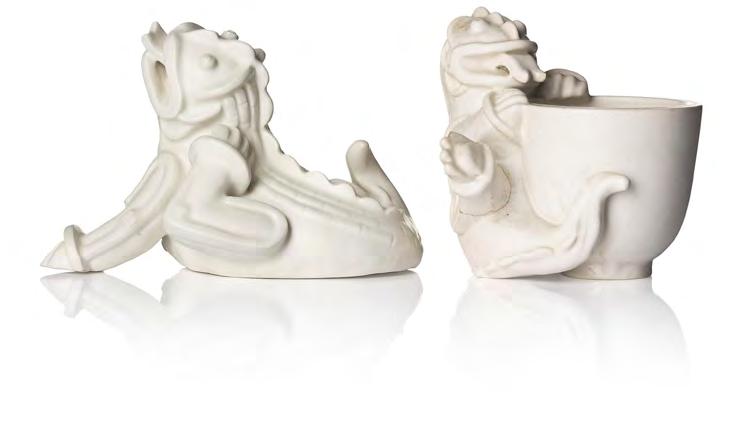
Carrara glaze, one scratching itself, the other embracing a bowl, stamped GUSTAVSBERG KÅGE 9 and the other with an indistinct mark. Length 16 cm, height 10 cm and length 12 cm, height 11 cm.
Provenance: From the collection of Art Collector and Entrepreneur Kent Löwenberg.
147. Wilhelm Kåge (Sweden, 1889–1960) a Farsta stoneware vase, Gustavsberg Studio 1948.
Somewhat oval shape, glazed in turquoise, green and brown shades with incised geometric decoration, signed with the GUSTAVSBERG studio mark KÅGE FARSTA R. Height 22 cm.
Provenance: From the collection of Art Collector and Entrepreneur Kent Löwenberg.
Estimate: SEK 8 000 – 10 000 / EUR 754 – 943 (d)
146. Wilhelm Kåge (Sweden, 1889–1960) a Farsta stoneware urn, Gustavsberg Studio 1958.
Round on six unglazed feet, incised decoration, glossy glaze in green and turquoise/blue, signed KÅGE Ö with studio stamp and FARSTA, numbered 7526. Height 19 cm, diameter 22.5 cm.
Provenance: Edward Hald, thence by descent within the family.
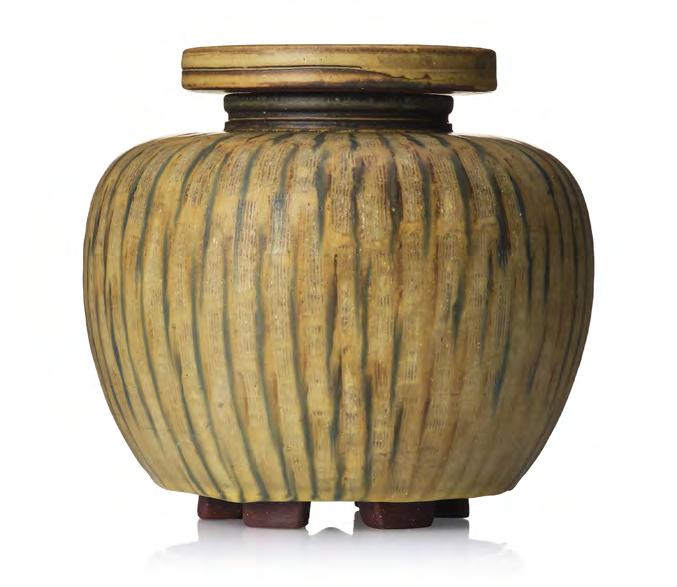
148. Wilhelm Kåge (Sweden, 1889–1960) a Farsta stoneware urn with cover, Gustavsberg Studio 1956. Bowl on six feet, carved rim decoration, glaze in yellow, green and brown, signed KÅGE with studio stamp, FARSTA and year letter Å. Height 18.2 cm.
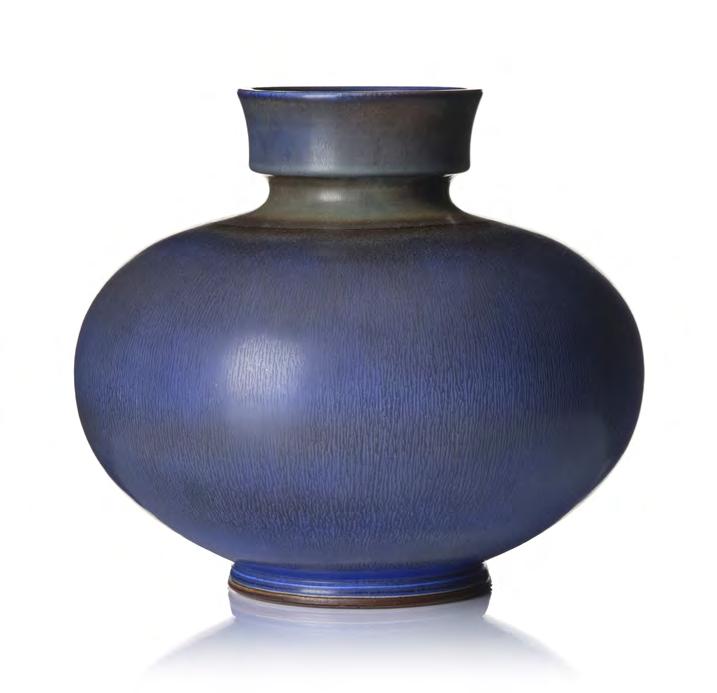
152. Berndt Friberg (Sweden, 1899–1981) a stoneware vase, Gustasberg Studio 1965. Blue hare's fur glaze, signed Friberg with the studio mark and year letter g. Height 28.4 cm.
153. Berndt Friberg (Sweden, 1899–1981) a stoneware vase, Gustavsberg Studio 1967. Hare's fur glaze in blue and brown, signed Friberg with the studio mark and year letter I. Height 54 cm.
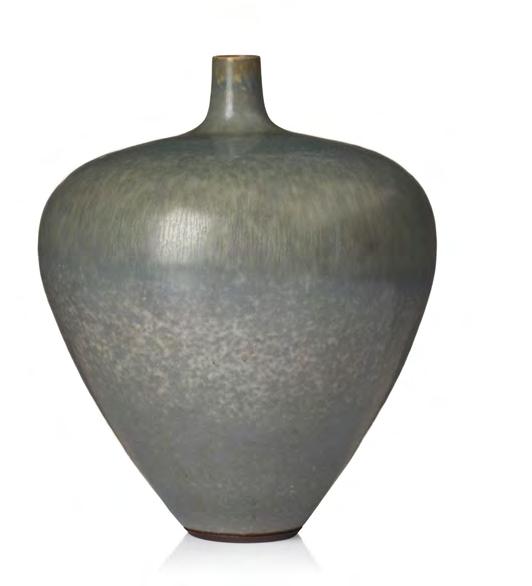
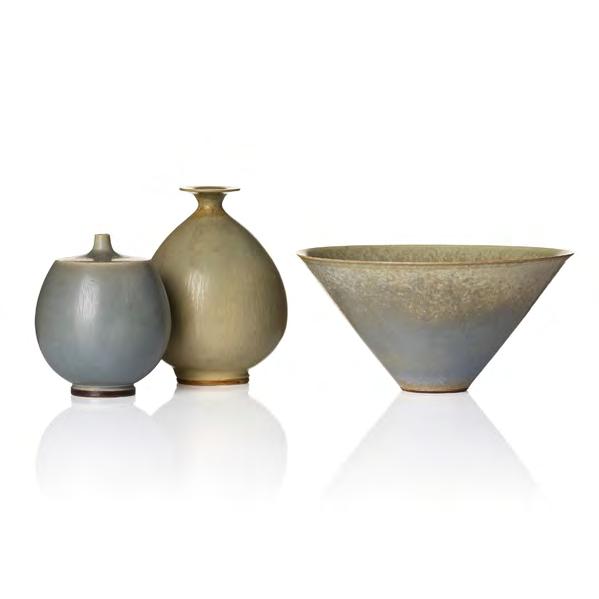
155. Berndt Friberg (Sweden, 1899–1981) a stoneware vase, Gustavsbergs studio, 1964. Harer's fur glaze in dove blue, signed with the studio mark Friberg. Height 19.5 cm.
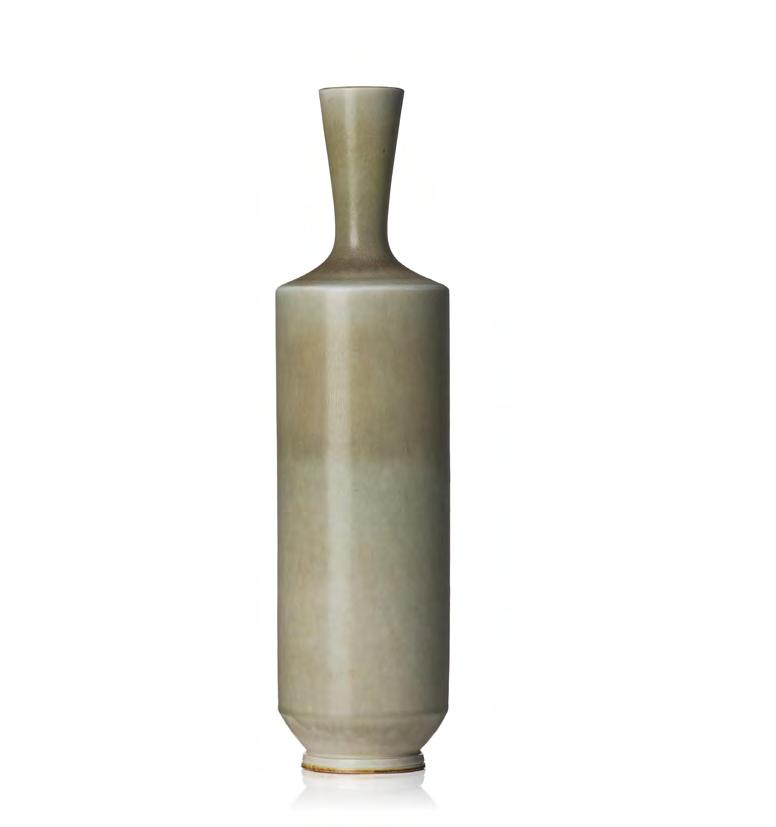
154. Berndt Friberg (Sweden, 1899–1981) a stoneware vase, Gustavsbergs Studio 1965. Hare's fur glaze in beige-grey hues, signed with the studio hand Friberg G. Height 35 cm.
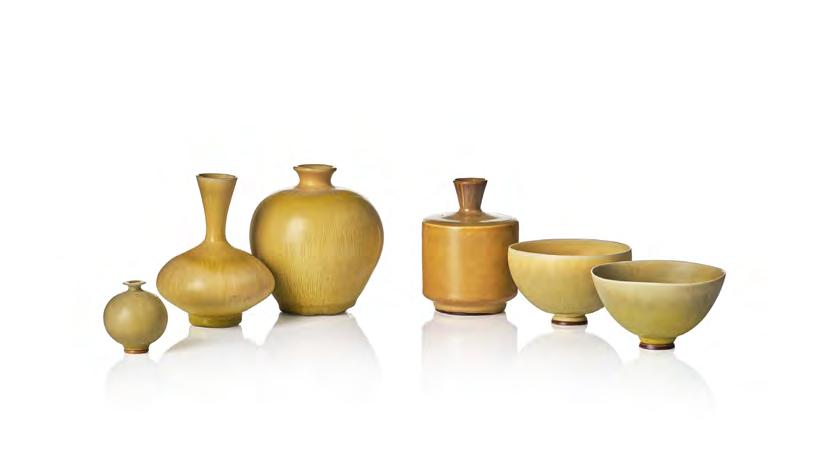
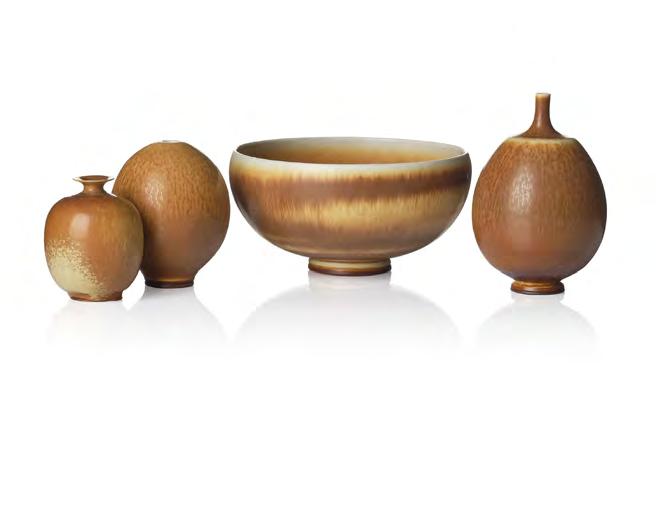
157. Berndt Friberg (Sweden, 1899–1981) a set of four stoneware vases and two bowls, Gustavsberg Studio 1962–74. Hare's fur glaze in yellow and some green, signed Friberg with the studio mark and various year letters. Height 4.7–11 cm.
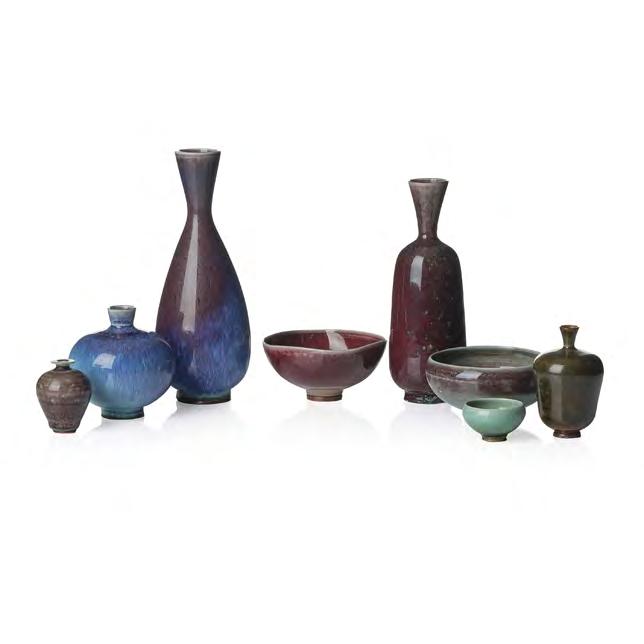
158. Berndt Friberg (Sweden, 1899–1981) a set of two stoneware vases and a bowl, Gustavsbergs Studio 1955–66. Hare's fur glaze in grey and beige, signed Friberg with the studio mark and the year letters z, ö and H. Height 6.9–10 cm, the bowl's diameter 14 cm.
Estimate: SEK 8 000 – 10 000 / EUR 754 – 943
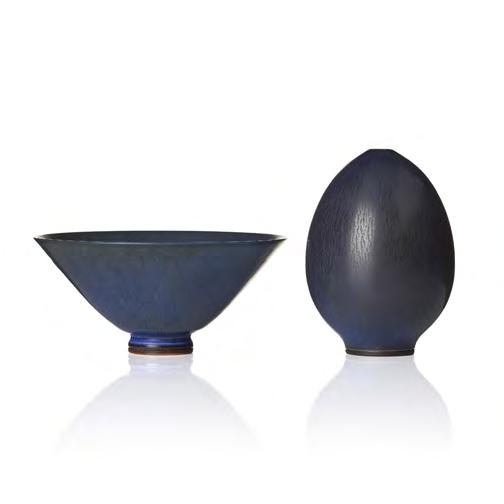
160. Berndt Friberg (Sweden, 1899–1981) a stoneware bowl and a vase, Gustavsberg Studio 1944–47 and 1957. Round bowl and egg-shaped vase with blue hare's fur glaze, signed BF with the studio mark and Friberg with the studio mark and year letter Ä. Height 5.4–9.5 cm, diameter of the bowl 11.8 cm.
Estimate: SEK 5 000 – 7 000 / EUR 471 – 660 (d)
159. Berndt Friberg (Sweden, 1899–1981) a set of three stoneware vases and a bowl, Gustavsberg Studio 1951–69. Cognac brown hare's fur glaze, signed Friberg with the studio mark and the year letters U, I, J, and K. Height 7.3–12 cm.
161. Anders Bruno Liljefors (Sweden, 1923–1970) a stoneware vase, Gustavsbergs Studio 1952. Engraved decoration, glaze in grey and blue, signed A.B.L. with the studio hand GUSTAVSBERG and year letter v. Height 11.8 cm, diameter 11 cm.
Provenance: Privatsamling, Gustavsberg.
Estimate: SEK 4 000 – 5 000 / EUR 377 – 471 (d)
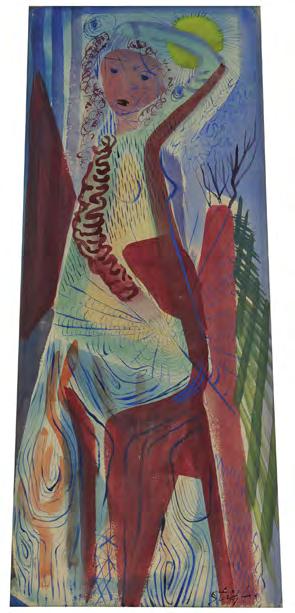
162. Stig Lindberg (Sweden, 1916–1982) Woman in sunshine. Signed Stig L. Gouache on paper 43 x 17–20.5 cm.
Provenance: Managing Director Sten Hultberg (1909-2002) & textile designer Astrid Sampe (1909-2002). Thence by descent to the present owner. Hultberg ran a textile printing company in Dala-Floda for which Stig Lindberg designed many textiles.
Estimate: SEK 8 000 – 10 000 / EUR 754 – 943 (d)
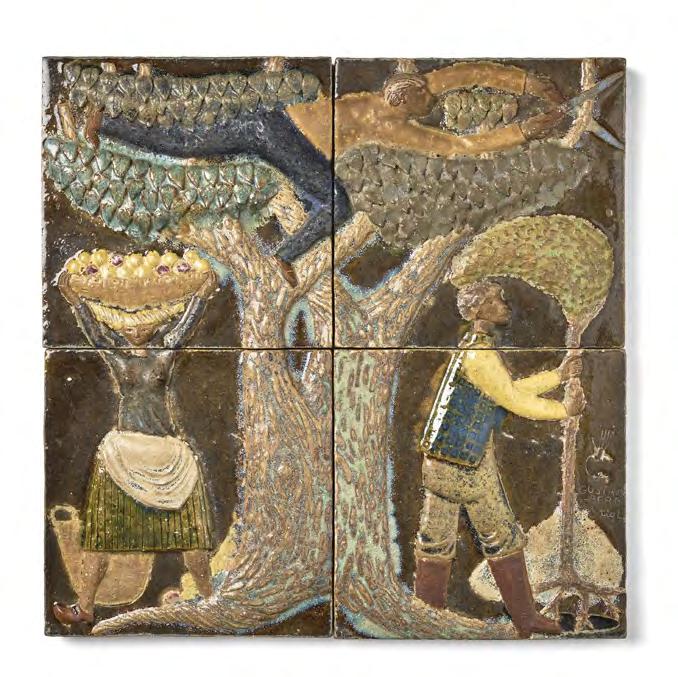
163. Stig Lindberg (Sweden, 1916–1982) a chamotte stoneware relief, four pieces, Gustavsberg Studio 1940s. Garden scene with tree pruning, glaze in green, yellow, turquoise, blue and beige, signed with the studio mark GUSTAVSBERG Stig L. Each relief 31 x 31 cm, depth approx. 5 cm, total approx. 63 x 63 cm.
164. Stig Lindberg (Sweden, 1916–1982) a stoneware vase, Gustavsberg Studio 1960. Carved relief decoration, green glaze, signed Stig L with the studio mark. Height 13.8 cm, diameter ca 13 cm.
165. Stig Lindberg (Sweden, 1916–1982) a stoneware vase, Gustavsberg Studio 1963.
Almost cylindrical with a globular upper part, the base with pressed relief decoration, glaze in blue and green, signed Stig L with the studio mark. Height 20.7 cm.
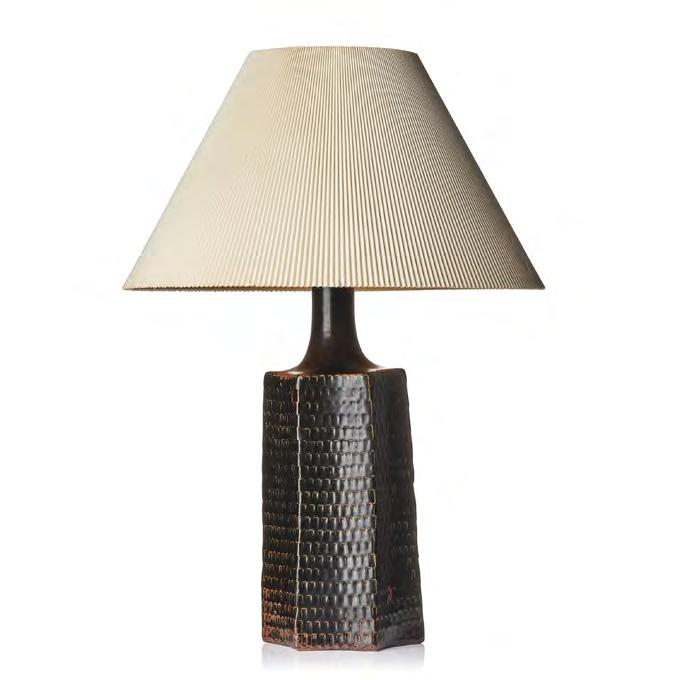
168. Stig Lindberg (Sweden, 1916–1982) a stoneware table lamp, Gustavsberg Studio 1970.
Hexagonal form, pressed lattice decoration, glaze in black and rust brown, signed Stig L with studio the studio mark. Height excluding mounting, 37 cm, total height including accompanying off-white pleated fabric shade, 57 cm.
Provenance: Provenance: Director at Gustavsberg Studio, thence by descent within the family.
Cylindrical, glaze in white and blue, signed with the symbol for Designhuset, Carl-Harry Stålhane “Ching te Chén” ugn (kiln) -85 x 68. Height 31.5 cm.
Estimate: SEK 4 000 – 6 000 / EUR 377 – 566 (d)
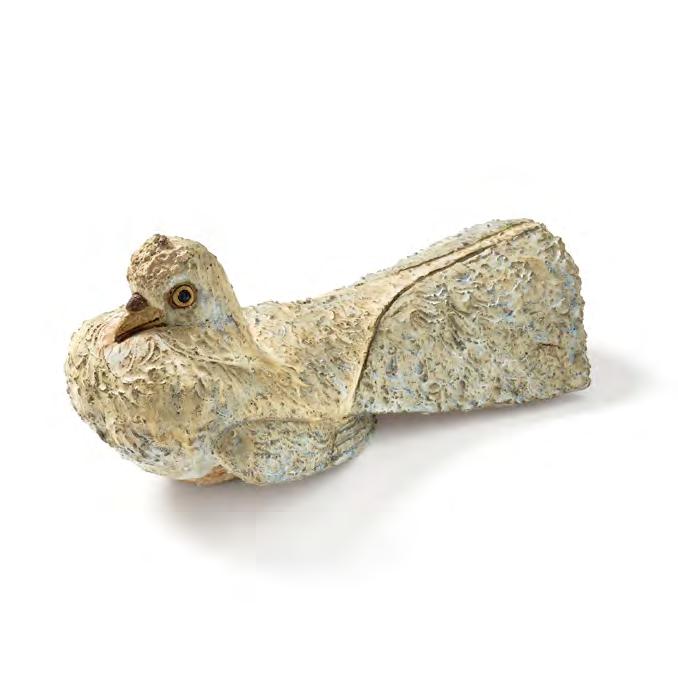
175. Tyra Lundgren (Sweden, 1897–1979) a chamotte stoneware sculpture of a bird, executed in her studio, Bredkvie, Gotland 1974. Reclining dove, glazed in light blue and offwhite hues, incised signature TL 20/9-74. Length 37 cm, height 18,5 cm.
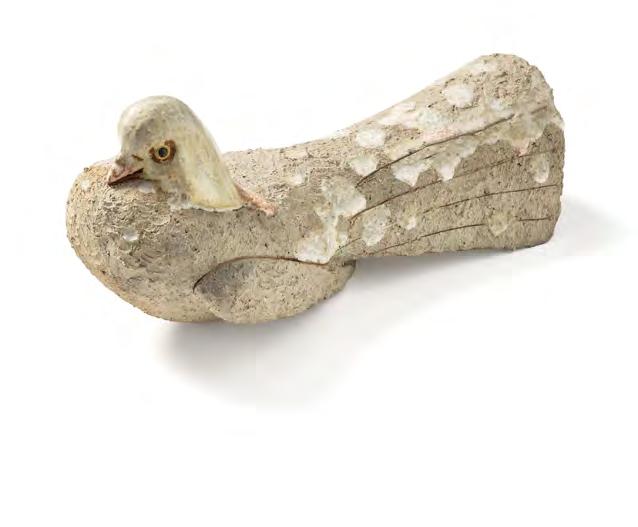
176. Tyra Lundgren (Sweden, 1897–1979) a chamotte stoneware sculpture of a bird, executed in her studio, Bredkvie, Gotland 1961. Reclining dove, partially glazed in pale hues, incised signature TL-61. Length 36 cm, height 17 cm.
Estimate: SEK 8 000 – 10 000 / EUR 754 – 943 (d)
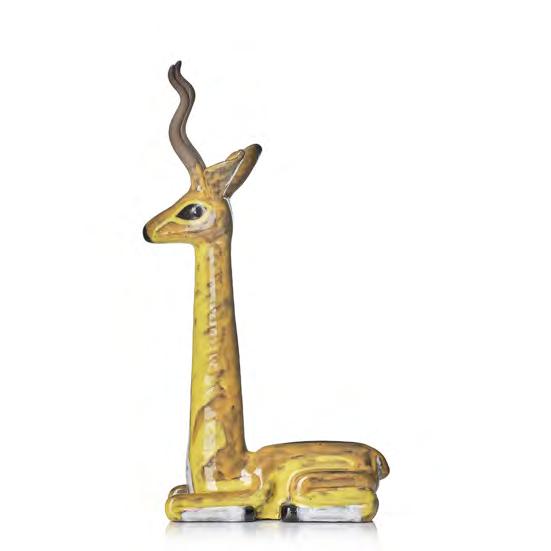
178. Vicke Lindstrand (Sweden, 1904–1983) a glazed ceramic sculpture of a gazelle, Upsala-Ekeby, Sweden, 1948–60.
Glaze in yellow, black, and white, stamped V.L. Height 50.4 cm.
Estimate: SEK 12 000 – 15 000 / EUR 1 130 – 1 410
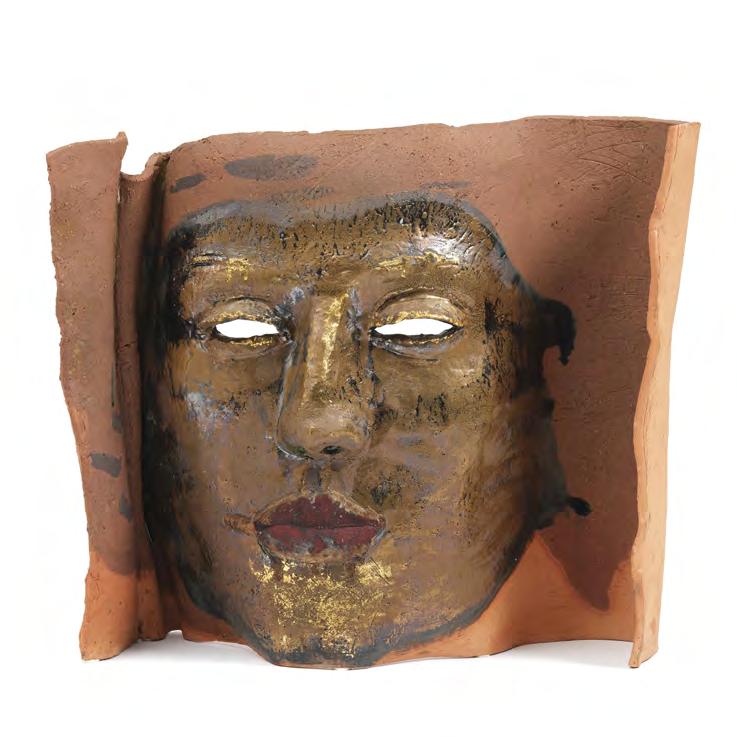
179. Hertha Hillfon (Sweden, 1921–2013) a partially glazed earthenware relief, own studio, Stockholm.
In the form of a face, bronze-coloured glaze with details in red and black. Height 60 cm, width 72.5 cm.
Provenance: Acquired at Stockholms Auktionsverk, Moderna Kvalitén, Spring 1995, catalog no. 1174.
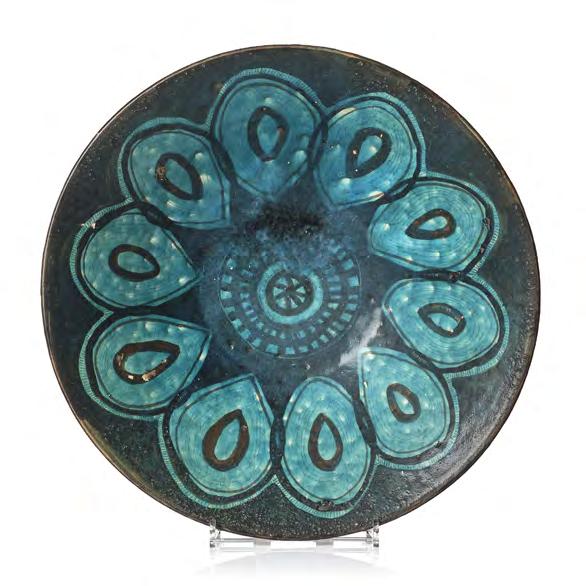
180. Signe Persson-Melin (Sweden, 1925–2022) a grand ceramic dish, executed in her workshop, Malmö 1959. Glazed in turquoise with abstract decoration in black, signed SP Signe Persson -59 and impressed with a fish, Signe Persson Melin’s signature. Diameter 55 cm, height 14 cm.
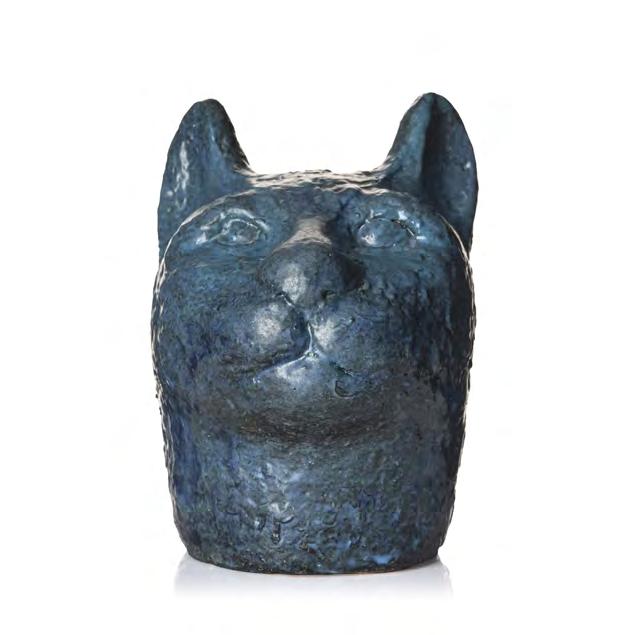
181. Dagmar Norell (Sweden, 1917–1996) a glazed ceramic sculpture of a feline, probably 1950s-60s. Red chamotte clay, blue glaze, signed D. NORELL. Height 16 cm.
Provenance: Gåva från Dagmar Norells familj till nuvarande ägare efter konstnärens bortgång 1996.
Estimate: SEK 4 000 – 5 000 / EUR 377 – 471 (d)
182. Dagmar Norell (Sweden, 1917–1996) a stoneware sculpture/vase, own workshop, Spånga, probably 1980s. Unglazed white clay, in the form of a female torso, signed DN. Height 43 cm.
Provenance: Gåva från Dagmar Norells familj till nuvarande ägare 2004.
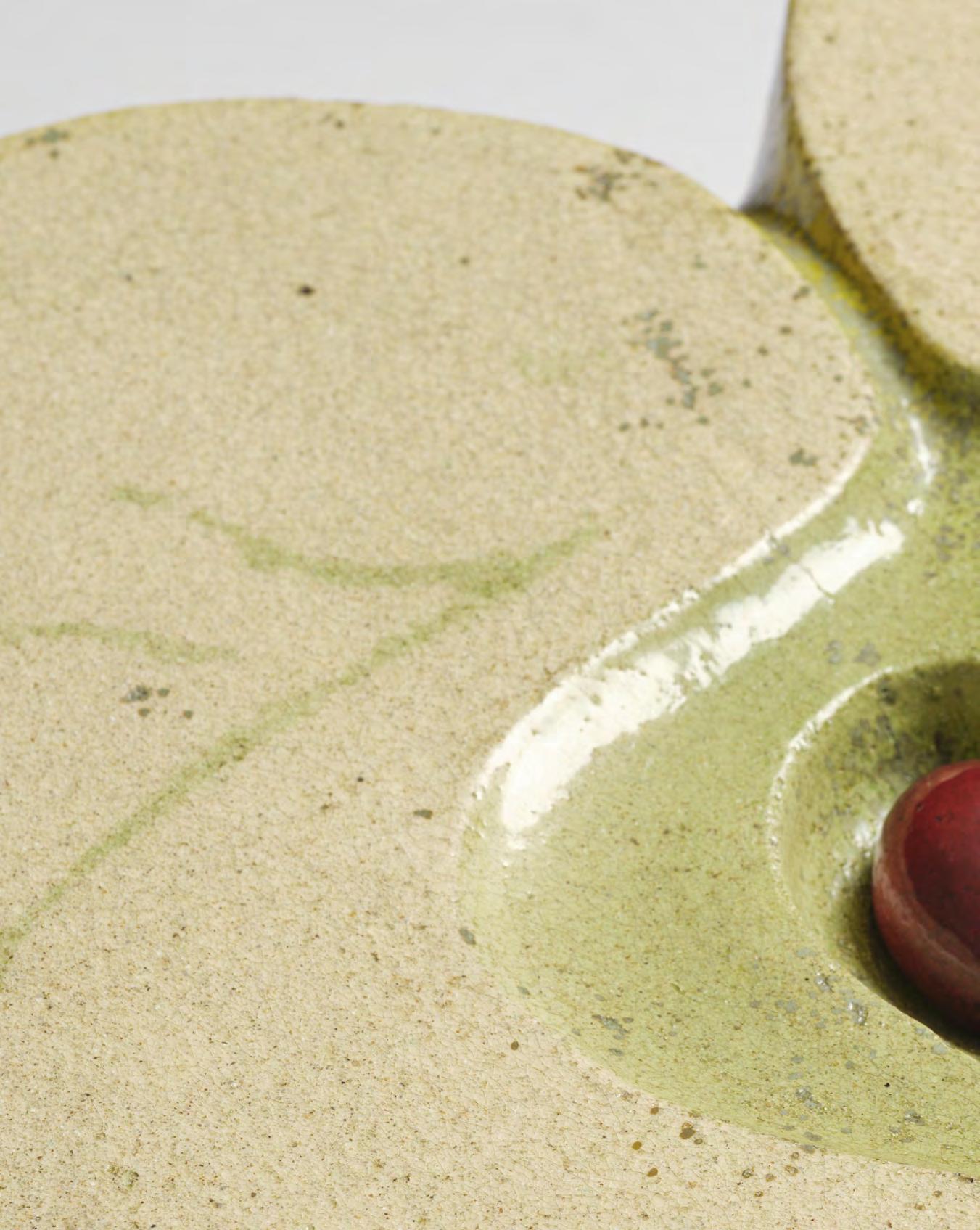
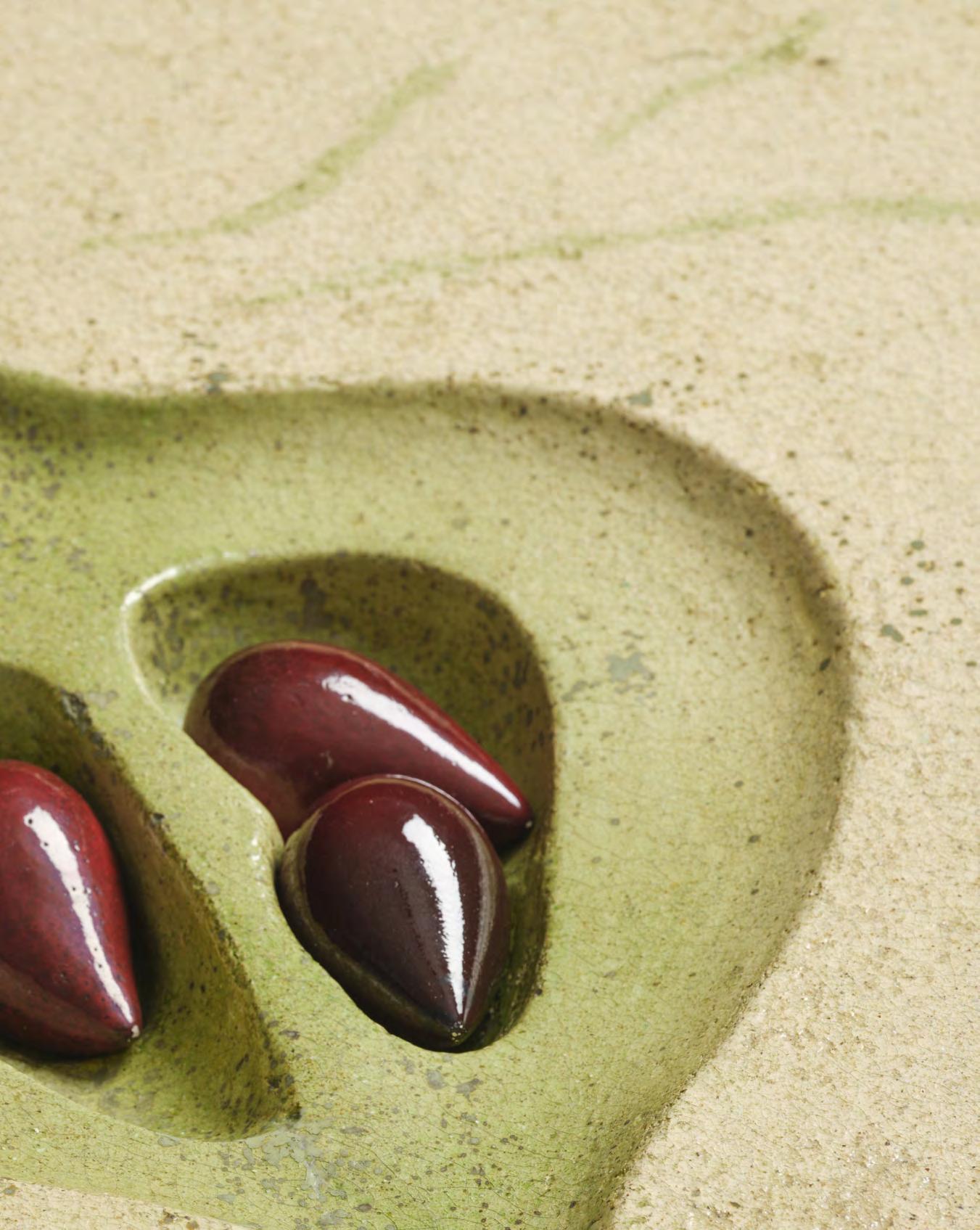
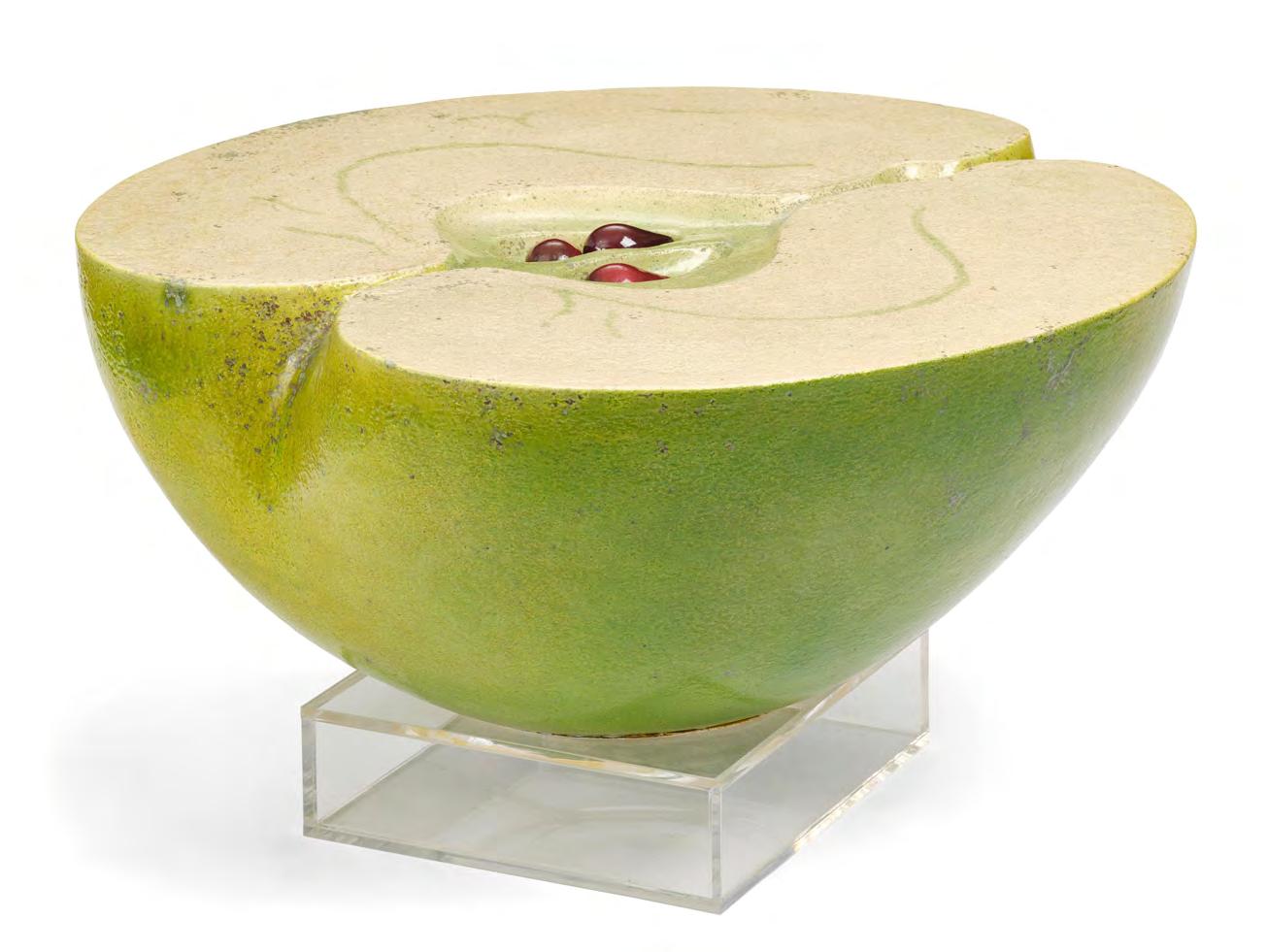
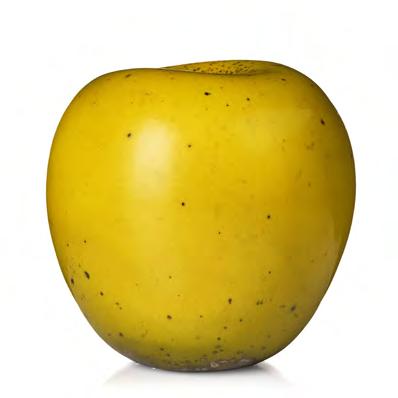
185. Hans Hedberg (Sweden/France, 1917–2007) a large faience sculpture of an apple, Biot, France.
Glazed in green with some brown, the top side glazed in off-white with three loose burgundy-glazed cores, signed HHg. 79 x 83 cm, height approx. 37 cm, excluding the 10 cm high base in plexiglass. A faceted circular glass disc, diameter 109 cm is included, allowing the sculpture to be used as a table.
192. Aune Siimes (Finland, 1909–1964) a porcelain vase, Arabia, Finland 1940s.
Flask-shaped with flowing burgundy glaze, signed AS ARABIA.
Height 24.3 cm.
Estimate: SEK 4 000 – 6 000 / EUR 377 – 566 (d)
193. Michael Schilkin (Finland, 1900–1962) a stoneware sculpture of a reclining woman, Arabia, Finland, 1940s.
Partially glazed in beige and blue, stamped signed M. Schilkin Arabia.
Length 55 cm, height 37 cm.
Provenance: Managing Director Sten Hultberg (1909-2002) & textile designer Astrid Sampe (1909-2002). Thence by descent to the present owner. Hultberg ran a textile printing company in Dala-Floda and Sampe was head of the textile department at Nordiska Kompaniet.
Exhibitions: Liljevalchs konsthall, Stockholm, “Nordiskt Konsthantverk”, 7 September - 6 October 1946.
Literature: Stig M H:son Björkman (ed.), “Svenska hem i ord och bilder 1947”, Spectator 1947, illustrated in Hultberg and Sampe's home at Karlaplan in Stockholm p. 231.
“Tapio Wirkkala - A Poet in Glass and Silver”, Collection Kakkonen, The Finnish Glass Museum, Saarijärvi 2013, see the sculpture illustrated from the exhibition at Liljevalchs, Stockholm 1946, p 36.
Four-sided with a high rim, decoration in colours against a dark green background of three female figures by a lake with swans and water lilies, signed KAPIAINEN and marked R. 34.5 x 34 cm, height 6 cm.
Provenance: From the collection of Art Collector and Entrepreneur Kent Löwenberg.
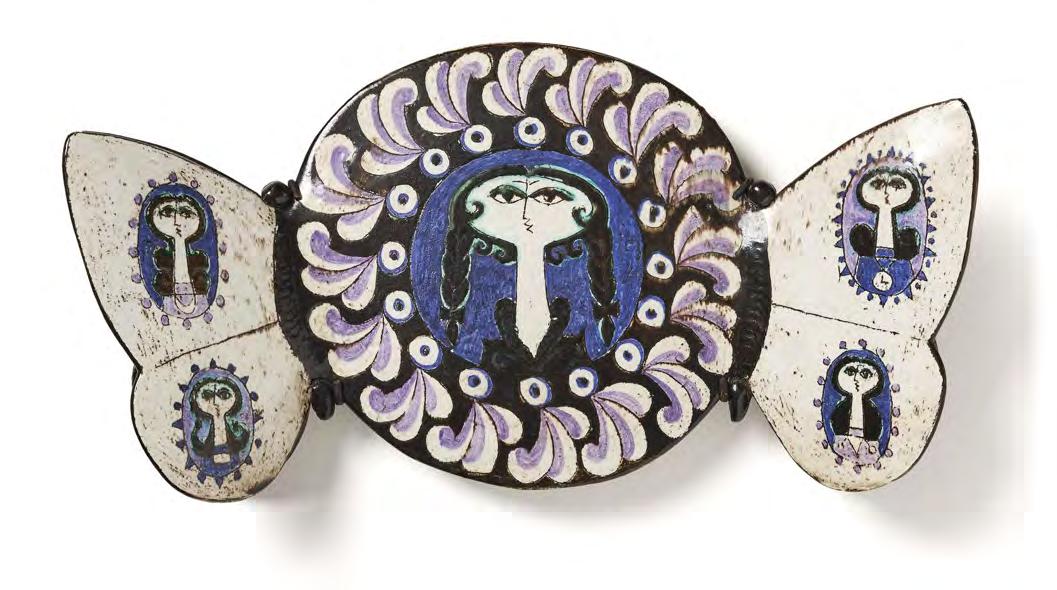
197. Birger Kaipiainen (Finland, 1915–1988) a glazed stoneware wall sculpture, Rörstrand, Sweden, 1950s. In the shape of a circular plaque flanked by butterflies, polychrome painted decoration of medallions with female faces, signed KAIPIAINEN R, mounted on a black-painted iron frame for wall hanging.
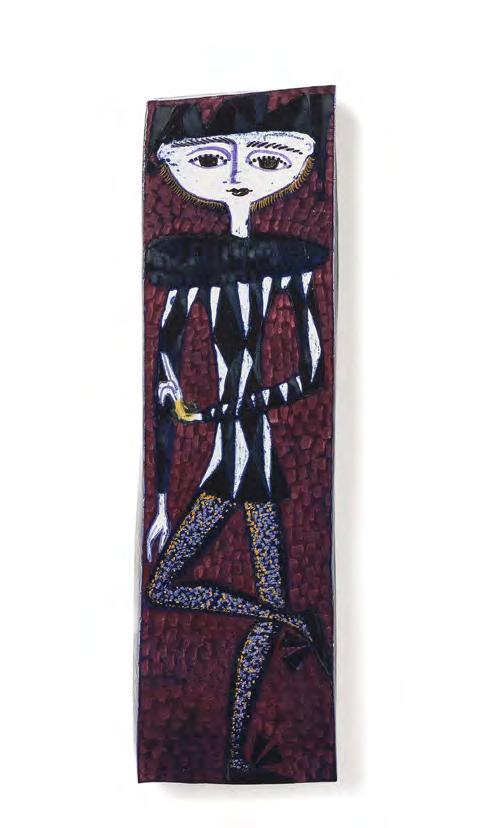
Rectangular, painted decoration of a harlequin in colours against an aubergine-coloured background, painted signature KAIPIAINEN. 63 x 18 cm, depth 6 cm.
Estimate: SEK 30 000 – 40 000 / EUR 2 830 – 3 770
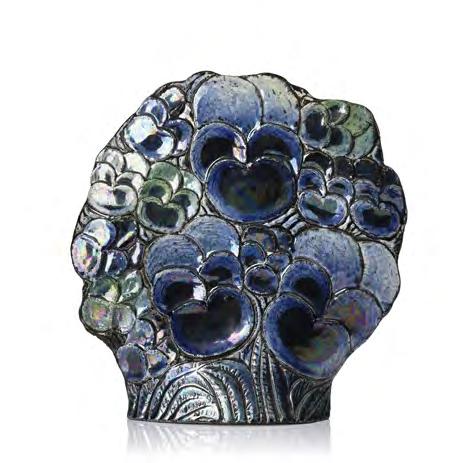
199. Birger Kaipiainen (Finland, 1915–1988) a stoneware sculpture, Arabia, Finland 1960s.
Relief decoration of pansies, lustre glaze in blue and green, signed KAIPIAINEN ARABIA. Height 24 cm, width approx. 24 cm, depth approx. 8 cm.
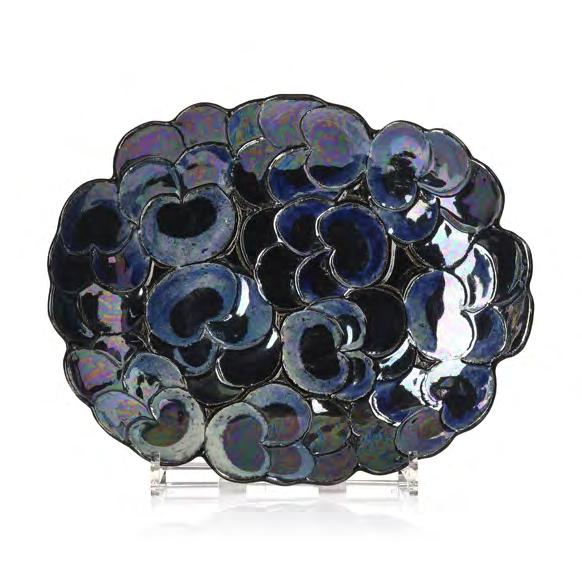
200. Birger Kaipiainen (Finland, 1915–1988) a decorative stoneware dish, Arabia, Finland 1960s.
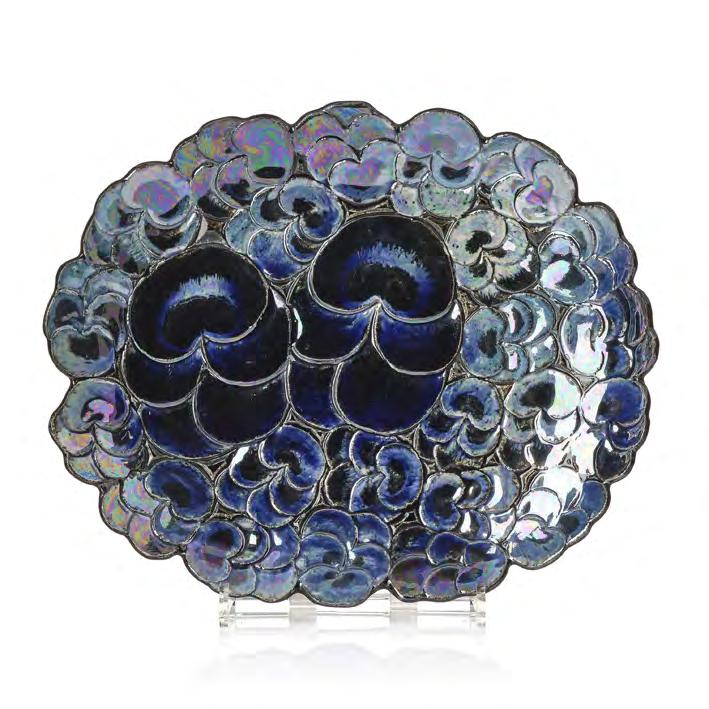
Lustre glaze in blue and violet shades with a relief decoration of pansies, signed KAIPIAINEN ARABIA. 42 x 34.5 cm.
Literature: Maria Berg, “Kaipiainen”, Otava Publishing Company, Keuruu 1986, cf. similar plates illustrated pp. 80–83.
Estimate: SEK 50 000 – 75 000 / EUR 4 710 – 7 070
201. Birger Kaipiainen (Finland, 1915–1988) a decorative stoneware dish, Arabia, Finland 1960s.
Lustre glaze in blue and violet shades with a relief decoration of pansies, signed KAIPIAINEN ARABIA. 27.5 x 33.8 cm.
Literature: Maria Berg, “Kaipiainen”, Otava Publishing Company, Keuruu 1986, cf. similar plates illustrated pp. 80–83.
Estimate: SEK 30 000 – 40 000 / EUR 2 830 – 3 770
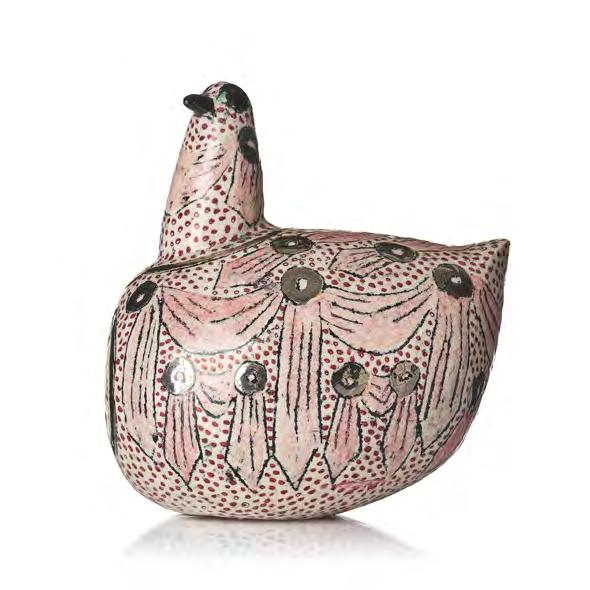
202. Birger Kaipiainen (Finland, 1915–1988) a glazed ceramic sculpture of a bird, Arabia, Finland 1970s.
Painted decoration of red festoons with details in silver against a red dotted ground, around the neck, on the chest a hanging clock, signed KAIPIAINEN. Height 17 cm, length 16 cm, width 12 cm.
Literature: Maria Berg, “Kaipiainen”, Otava Publishing Company, Keuruu 1986, cf. similar birds depicted p. 128.
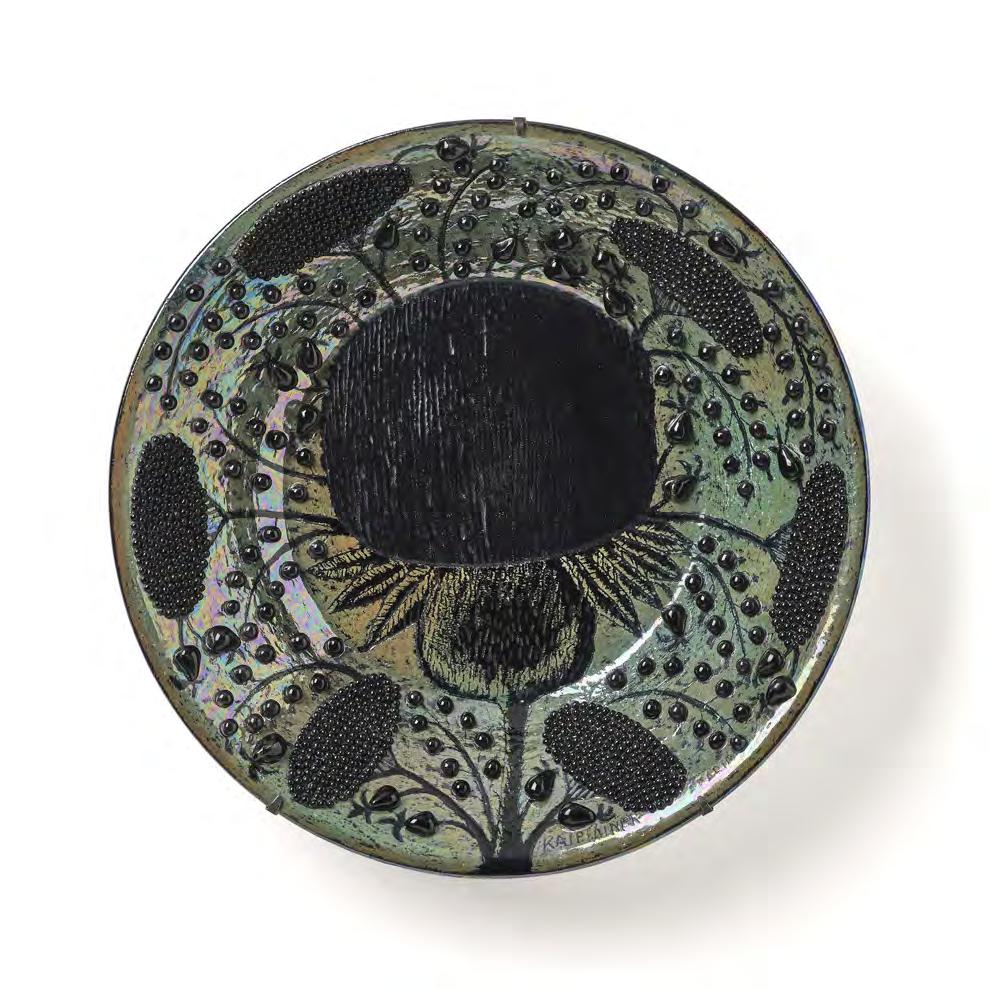
203. Birger Kaipiainen (Finland, 1915–1988) a large decorative ceramic dish, Arabia, Finland, probably 1970s.
Floral decoration with modelled beads, fruits in dark violet against green lustre glaze, signed KAIPIAINEN ARABIA, metal mounting for wall. Diameter 54 cm, depth approx. 12.5 cm.
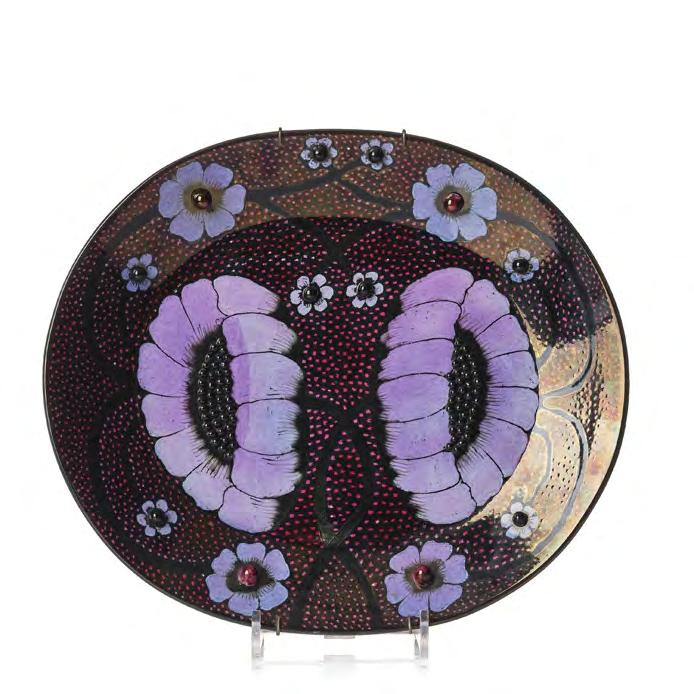
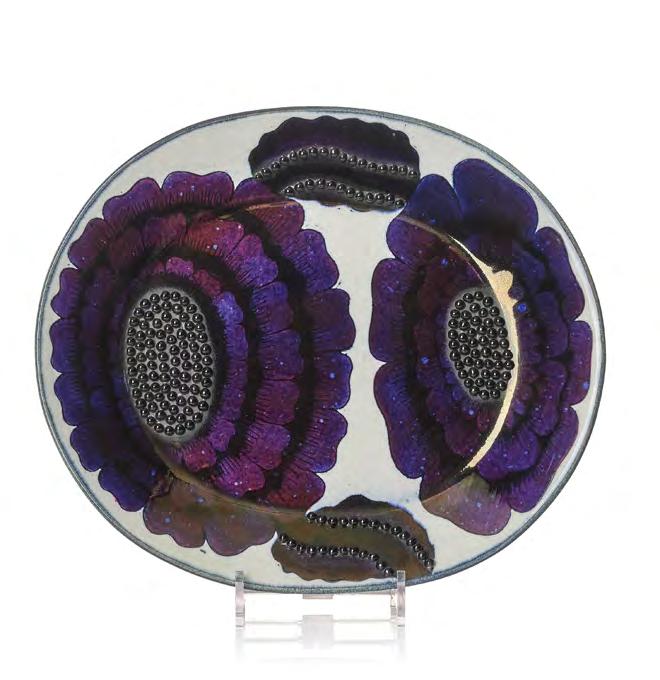
Oval, lustre glaze in violet, red and black with a decoration of flowers with beads, the reverse with incised signature KAIPIAINEN ARABIA. 35.5 x 31 cm.
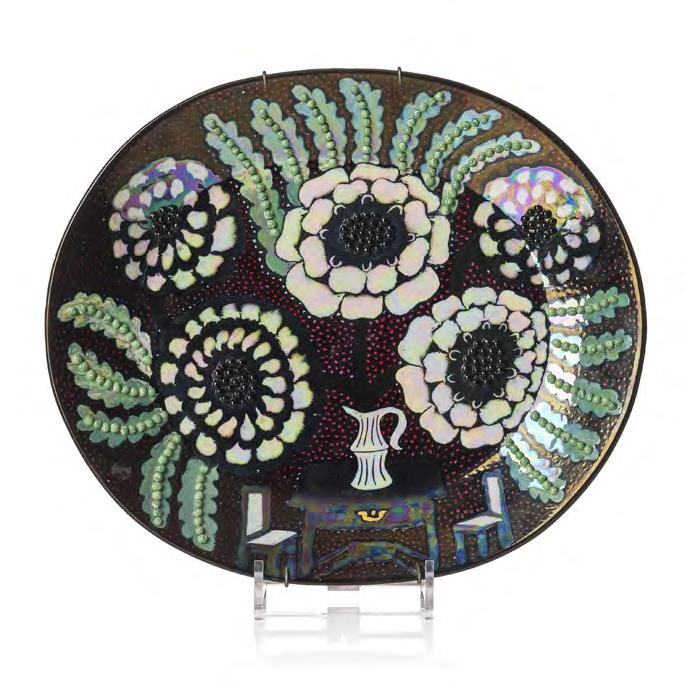
Oval, glazed with lustre glaze in green, violet, white, and more against a dark red-dotted background with a decoration of still life with flowers, partly with beads in relief, the back inscribed with the signature KAIPIAINEN ARABIA. 30.5 x 35.5 cm.
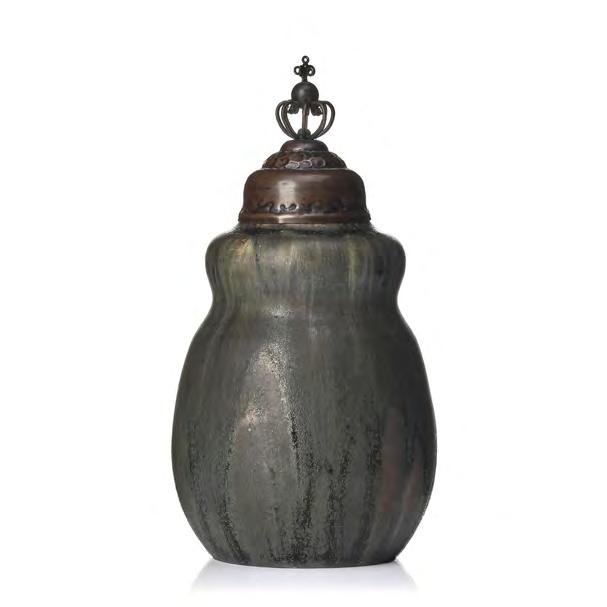
207. Patrick Nordström (Sweden, 1870–1929) a stoneware vase with a patinated metal cover, Royal Copenhagen, Denmark 1914.
Gourd-shaped with dark green and bronze-coloured glaze, marked PN 1914 with the wave mark in underglaze blue. Total height 23.5 cm.
Estimate: SEK 12 000 – 15 000 / EUR 1 130 – 1 410
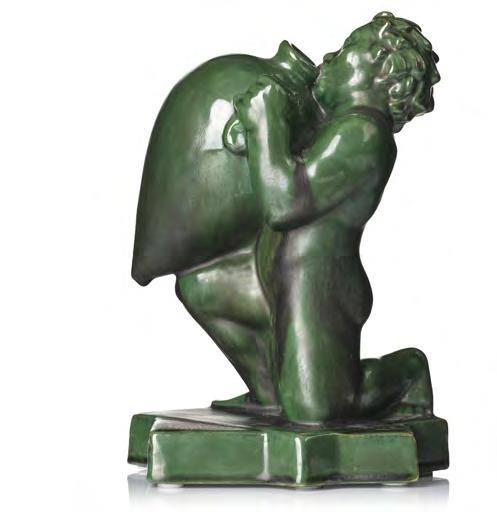
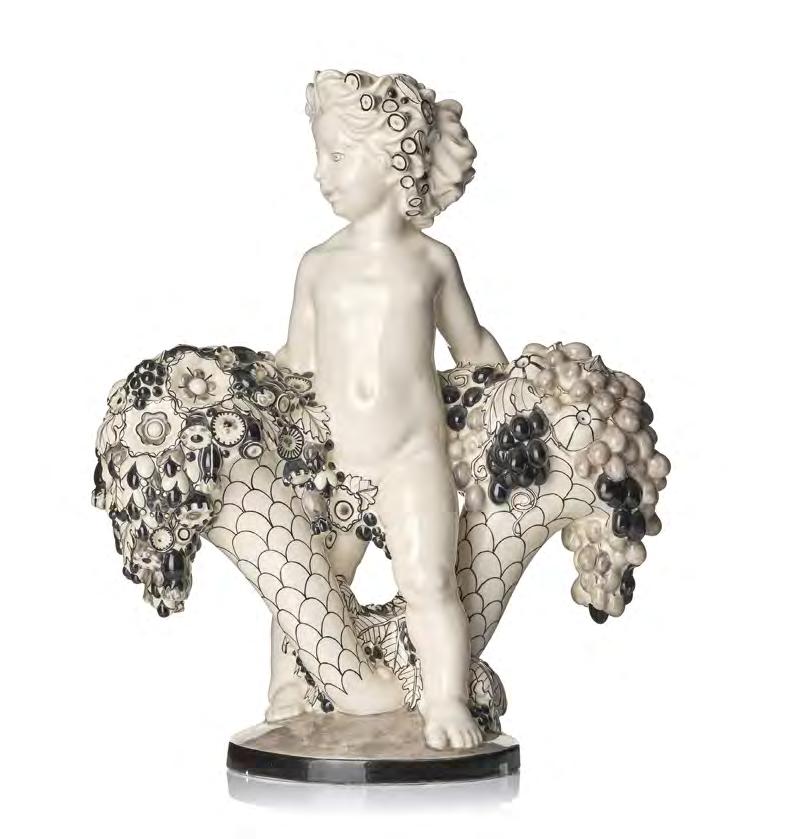
208. Bertold Löffler (Austria, 1874–1960) a ceramic sculpture of a putto with cornucopia, model 156, Wiener Keramik, Vienna, Austria, 1908–1912.
Decoration in black and grey. The putto with two cornucopias, one containing fruit, the other containing flowers, the base stamped with the framed factory mark and Bertold Löffler's monogram, 156, underneath with painted mark 156/D.3/OK. Height 49 cm width 40 cm. The model “Putto mit Füllhörnern” (Putto with Cornucopia) was designed by Bertold Löffler and sculpted by Wilhelm Schleich for Wiener Keramik for the exhibition “1908 Kunstschau” in Vienna. The model is represented in this version in the collections of the Leopold Museum, Vienna (Inv. 6081). The model has also been produced with polychrome decoration.
The firm Wiener Keramik was founded by Michael Powolny and Bertold Löffler in 1906. The two had a close collaboration with the Wiener Werkstätte. In 1912/1913, the firm merged with Gmundner Keramik, and all models produced by Wiener Keramik were subsequently executed by “Vereinigte Wiener und Gmundner Keramik.”
Literature: Dr Susanne Walther (ed.), “Traum und Wirklichkeit Wien 1870-1930”, Historical Museum of the City of Vienna, 1985, p. 381, cat. no. 13/5/41, see the model with polychrome decoration.
Hans-Peter Wipplinger (ed.), “Wien 1900. Aufbruch in die Moderne”, Vienna 2019 (Exh. cat. Leopold Museum, Vienna, from 15.03.2019).
Estimate: SEK 50 000 – 75 000 / EUR 4 710 – 7 070
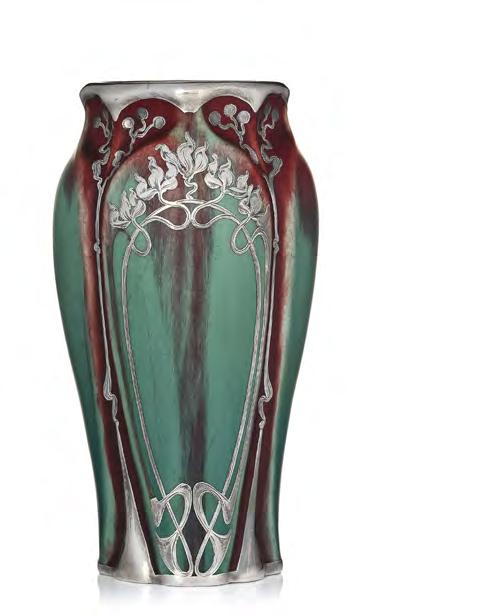
209. Eugene Baudin (France, 1853–1918) an Art Nouveau glazed ceramic vase, France. Baluster-shaped with relief decoration of leaves and painted floral ornamentation in silver. Signed E Baudin. Height 16 cm.
Estimate: SEK 6 000 – 8 000 / EUR 566 – 754
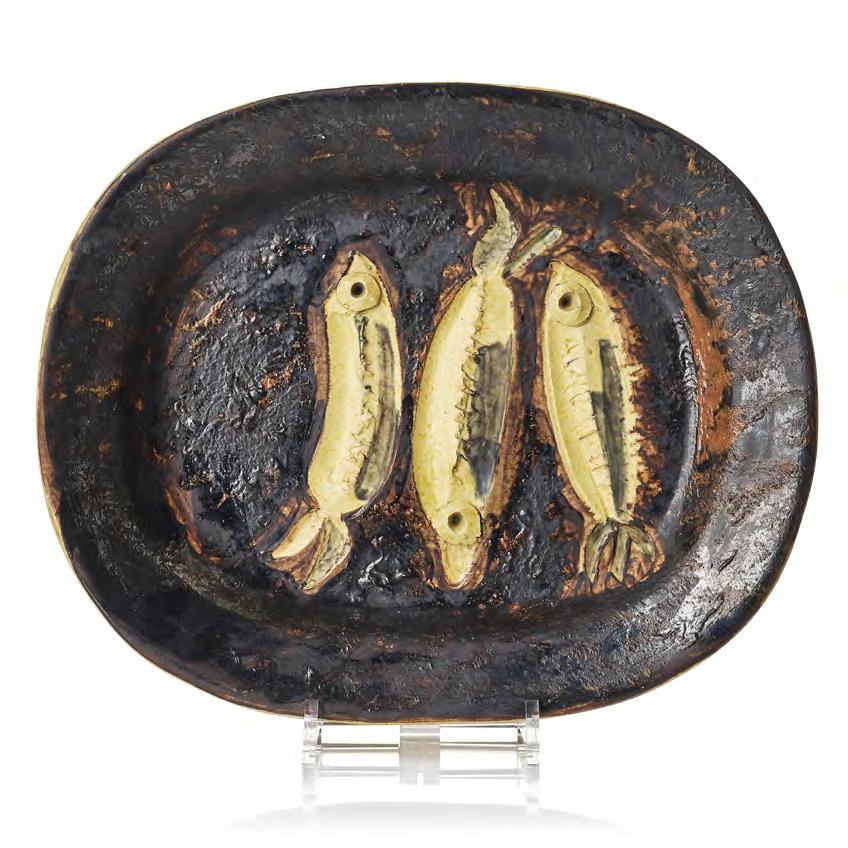
210. Pablo Picasso (Spain, 1881–1973) a “Trois Sardines” (A.R. 34), faience dish, Madoura, Vallauris, France, post 1948. Relief decoration of three sardines, decoration in black, yellow, and green engobe, stamped MADOURA PLEIN FEU EDITION PICASSO 48/200. 30 x 36.3 cm.
Literature: Alain Ramié, “Pablo Picasso - Catalogue of the edited ceramic works 1947–1971”, Galerie Madoura 1988, cat. no. 34.
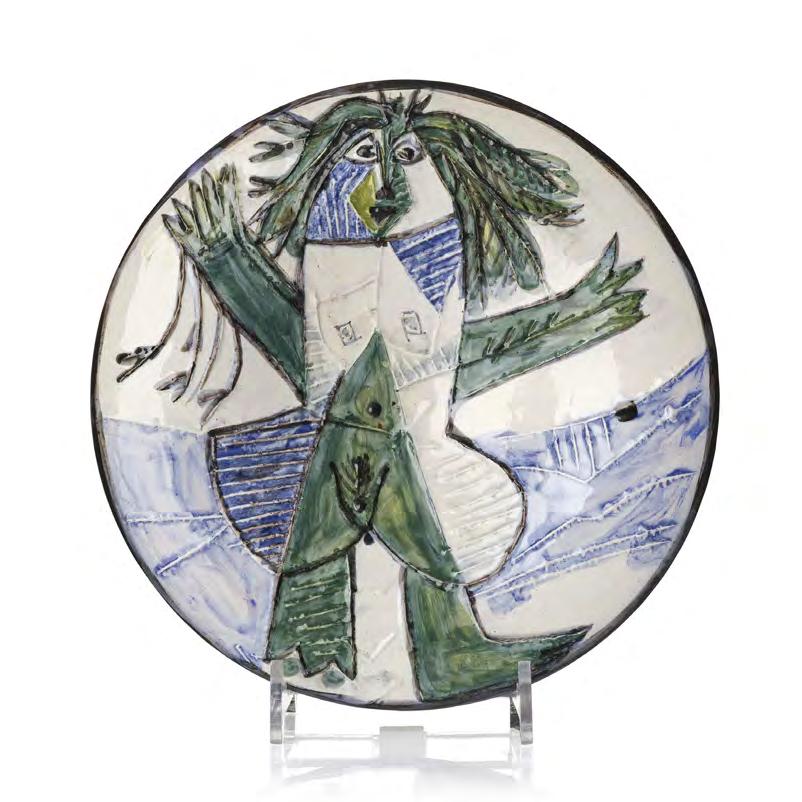
211. Pablo Picasso (Spain, 1881–1973) a “Femme échevelée” (A.R. 509) faience dish, Madoura, Vallauris, France, post 1963. Relief decoration of a female figure in blue, green, yellow, and black against white, stamped MADOURA PLEIN FEU EMPREINTE ORIGINALE PICASSO T 103 and painted 32/100. Diameter 26,5 cm.
Literature: Alain Ramié, “Pablo Picasso - Catalogue of the edited ceramic works 1947–1971”, Galerie Madoura 1988, cat. no. 509.
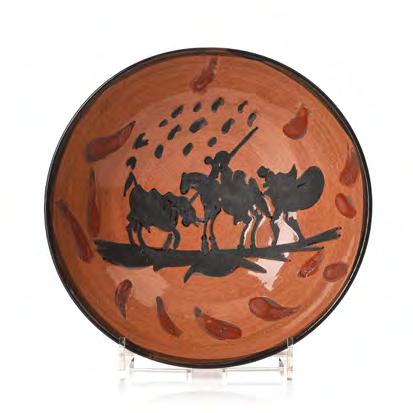
213. Pablo Picasso (Spain, 1881–1973) a “Picador” (A.R. 211) faience bowl, Madoura, Vallauris, France, post 1953. Terracotta-coloured with a decoration of bullfighting in black and coloured engobe, signed EDITION PICASSO 65/500. Diameter 16 cm.
Literature: Alain Ramié, “Pablo Picasso - Catalogue of the edited ceramic works 1947–1971”, Galerie Madoura 1988, cat. no. 211.
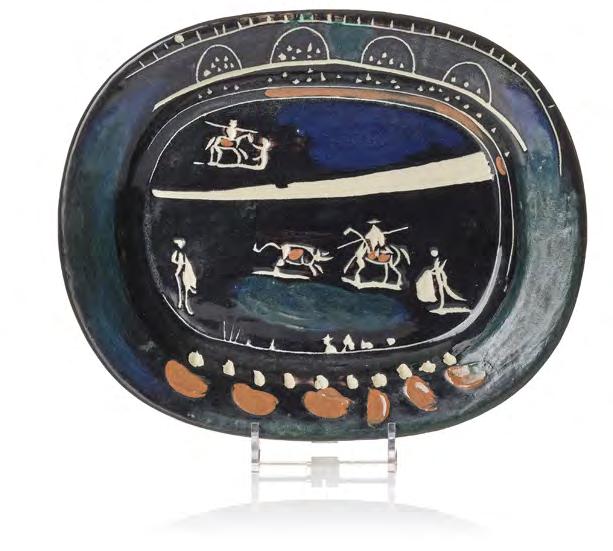
212. Pablo Picasso (Spain, 1881–1973) a “Corrida verte” (A.R. 81) faience dish, Madoura, Vallauris, France, post 1949. Engraved motif of a bullfighting arena with decoration in blue, green, black, and brown against a white background, stamped MADOURA PLEIN FEU EMPREINTE ORIGINALE DE PICASSO EDITION PICASSO. 30 x 36.5 cm.
Literature: Alain Ramié, “Pablo Picasso - Catalogue of the edited ceramic works 1947–1971”, Galerie Madoura 1988, cat. no. 81.
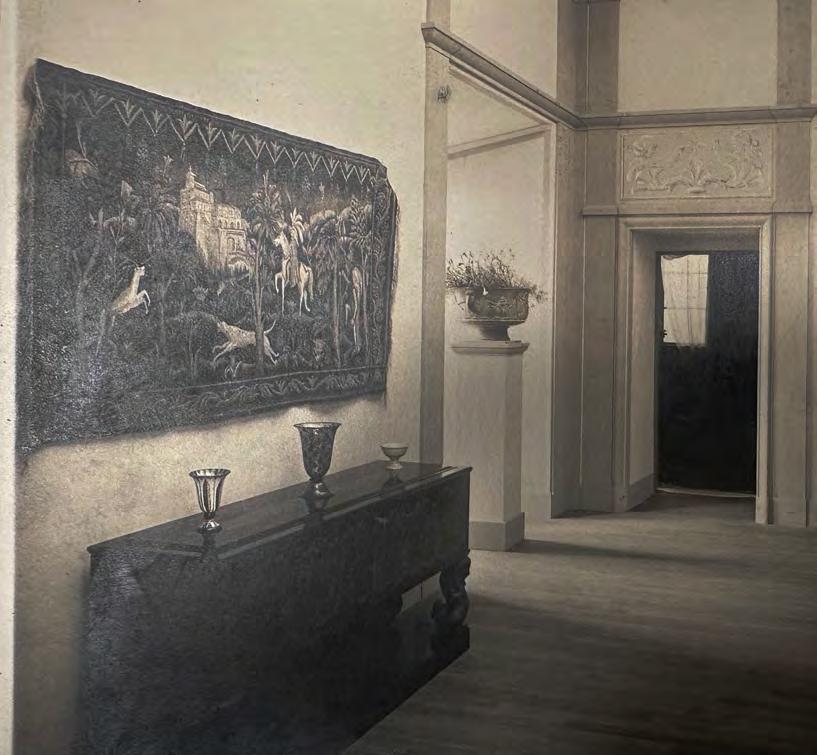
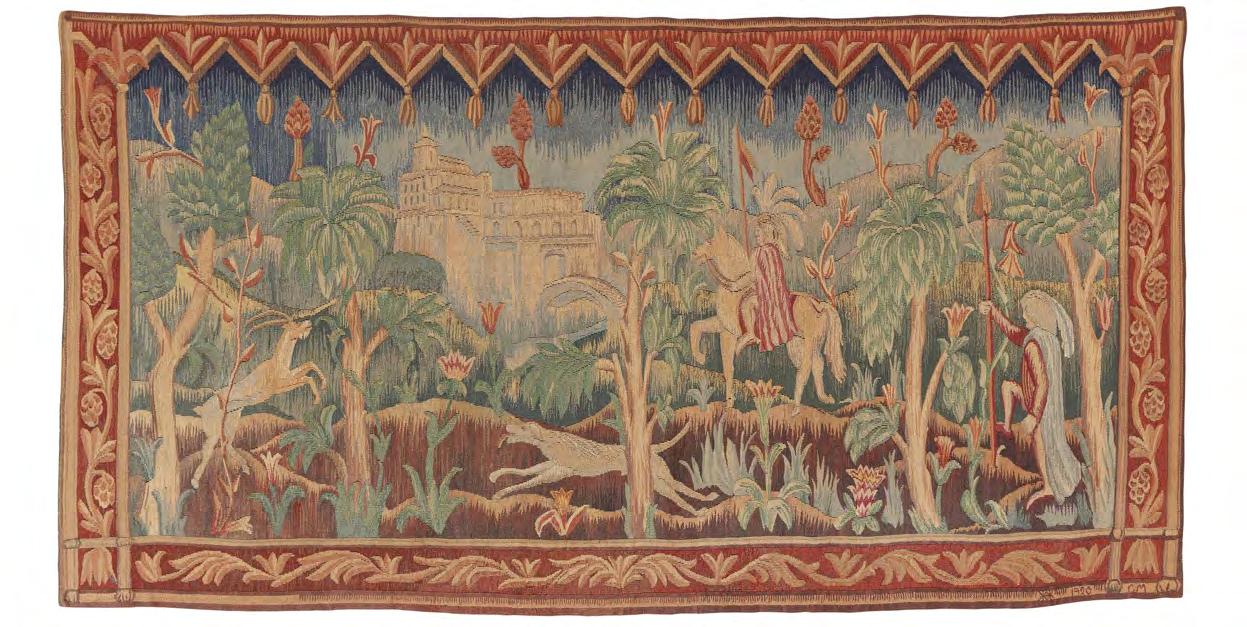
The woven tapestry designed by Carl Malmsten for the first exhibition of Föreningen Verkstaden in 1920 stands as a clear example of his view on craftsmanship and the role of textiles in interior spaces. At a time when industrialization was driving toward mass production, Malmsten instead chose to highlight the handmade, where every detail bore traces of care and a deep understanding of materials.
Föreningen Verkstaden created a platform for this type of work. Here, artists and craftsmen came together with the ambition of uniting function and beauty. Malmsten’s tapestry became part of this whole—not as an isolated decoration, but as an integrated element of the spatial composition.
At the exhibition at Liljevalchs Konsthall in 1920, the tapestry was shown alongside furniture and other works of decorative art. It functioned as a backdrop, but also as an active surface that gave the room rhythm and character. Here, Malmsten’s textile thinking becomes clear: textiles were not merely to adorn, but to create atmosphere and bind together the different elements of a space.
At the same time, other artists were active within the same group, such as Harald Bergsten and Gunnar Asplund. Their work contributed to the overall artistic unity of the exhibition, where different expressions interacted. Asplund’s architectural vision and Bergsten’s decorative sensibility enhanced the environment in which Malmsten’s textiles could fully come into their own.
The tapestry from 1920 can therefore be seen as a manifestation of Malmsten’s ideals. It demonstrates how textiles, craftsmanship, and architecture can interact to create a cohesive experience. Through his work, Malmsten established a textile legacy in which quality, simplicity, and the inherent character of materials comes to focus.
In this woven tapestry, several layers of meaning converge: a historical moment, an artistic idea, and a masterful execution. It becomes not only part of the exhibition, but an expression of a broader movement within Swedish design—one in which Carl Malmsten stood as one of the most influential figures.
Liljevalchs photo album: Stockholm City Archives. Liljevalchs Konsthall, K1a:21, Fotografiböcker, 1920. Liljevalchs Konsthall - Exhibition No. 25 1920.
217. Carl Malmsten (Sweden, 1888–1972) a tapestry, c. 213 x 113 cm, Handarbetets vänner, signed CM (V) dated 1920.
Designed in 1920.
Provenance: A private Swedish collection..
Exhibitions: The tapestry was exhibited in section 8, “Gallery” at the Föreningen Verkstadens first exhibition, Liljevalchs, Stockholm, Sweden, September 1920.
Literature: Liljevalchs Konsthall, catalogue 25, Föreningen Verkstadens first exhibition, 1920, p. 9.
218. Märta Måås-Fjetterström (Sweden, 1873–1941) a 'Renaissance' drape, flat weave, c. 248 x 144 cm, signed MMF. (Märta Måås-Fjetterström). Designed in 1913–19. Woven before 1942.
Literature: Tyra Lundgren, Märta Måås-Fjetterström and the weaving workshop in Båstad, 1968, listed in the catalogue raisonné p. 111.
Estimate: SEK 20 000 – 25 000 / EUR 1 890 – 2 360
219. Märta Måås-Fjetterström (Sweden, 1873–1941) a 'Lammet' drape, flat weave, c. 200 x 125 cm, signed MMF. (Märta Måås-Fjetterström.) Early design. Woven before 1942.
Literature: Compare Bergman, Ingrid “Märta Måås-FjetterströmEn mästare och nyskapare inom textilkonsten”, Södertälje 1991, plate p. 10.
Estimate: SEK 20 000 – 25 000 / EUR 1 890 – 2 360
220. Märta Måås-Fjetterström (Sweden, 1873–1941) a 'Blå essbård' (also S-bård), flat weave c. 142 x 42 cm, signed AB MMF. Designed before 1929, woven before 1941.
Estimate: SEK 10 000 – 12 000 / EUR 943 – 1 130
221. Polly Björkman (Sweden) a tapestry weave drape, c. 259 x 165 cm, signed TPB.
(Textil Ateljé Polly Björkman). Sweden around the 1920s-/30s. An ivory grey ground with polychrome stylised rows of spring flowers.
Estimate: SEK 25 000 – 30 000 / EUR 2 360 – 2 830
222. Marianne Richter (1916–2010) a tapestry, 'Strandvägsskuta' c. 107 x 96 cm, signed AB MMF MR. (AB Märta Måås-Fjetterström, Marianne Richter). Designed in 1961.
Literature: Compare “Nationalmusei utställningskatalog 308 Verkstad Måås-Fjetterström”, Stockholm 1967, plate p. 17 no. 53; “Strandvägsskutor” Lundgren, Tyra “Märta Måås-Fjetterström och väv-verkstaden i Båstad”, Stockholm 1968, colour plate to p. 96; “Liljevalchs konsthalls katalog: Märta Måås-Fjetterström, Märta flyger igen, 90 år med Märta Måås-Fjetterström”, Värnamo 2009, colour plate p. 169.
Estimate: SEK 8 000 – 10 000 / EUR 754 – 943 (d)
223. Lars Gynning (1920–2003) a tapestry ,'Flyttfåglar' tapestry weave, c. 230 x 150 cm, PF Aubusson signed Gynning. (Pinton Frères, Aubusson Lars Gynning). Designed in 1951.
Provenance: Rigmor Gynnings samling (1933–2025).
Literature: Brunius, Teddy “Lars Gynning: textila bilder. Les images sur textile de Lars Gynning”, Kulturen, Lund, 1985, colour plate p. 10.
Estimate: SEK 50 000 – 60 000 / EUR 4 710 – 5 660
224. Märta Måås-Fjetterström (Sweden, 1873–1941) a flat weave textile, 'Medaljongerna', c. 118 x 41 cm, signed AB MMF. Designed in 1926, woven after 1941.
Literature: Compare “Små vävnader från Märta Måås-Fjetterström”, colour plate 3.
Estimate: SEK 8 000 – 10 000 / EUR 754 – 943
225. Märta Måås-Fjetterström (Sweden, 1873–1941) a flat weave textile, 'Medaljongerna', c. 83 x 61 cm, signed AB MMF. Designed in 1926, woven after 1941.
Literature: Compare “Små vävnader från Märta Måås-Fjetterström”, colour plate 3.
Estimate: SEK 8 000 – 10 000 / EUR 754 – 943
226. Märta Måås-Fjetterström (Sweden, 1873–1941) a “Röd häst” textile, tapestry weave, c. 148 x 57 cm, signed AB MMF. (AB Märta Måås-Fjetterström). Designed in 1930. Woven after 1941.
Literature: Compare “Små Vävnader från Märta Måås-Fjetterström”, färgplansch 1, 9; Liljevalchs konsthalls katalog: Märta Måås-Fjetterström, Märta flyger igen, 90 år med Märta Måås-Fjetterström, Värnamo 2009, colour plate p. 118.
Estimate: SEK 12 000 – 15 000 / EUR 1 130 – 1 410
227. Märta Måås-Fjetterström (Sweden, 1873–1941) a 'Täppan' textile / Cushion, tapestry technique, c. 66 x 45 cm, signed AB MMF.
Designed in 1931. Woven after 1941.
Estimate: SEK 6 000 – 8 000 / EUR 566 – 754
228A. Märta Måås-Fjetterström (Sweden, 1873–1941) a carpet, “Svarta trädgårdsmattan”, knotted pile, ca 348 x 219-220,5 cm, signed AB MMF Designed in 1918, woven before 1942.
Literature: Compare with Lundgren, Tyra: Märta Måås-Fjetterström och väv-verkstaden i Båstad, Stockholm 1968, colour plate opposite page 32; Liljevalchs konsthalls katalog: Märta Måås-Fjetterström, Märta flyger igen, 90 år med Märta Måås-Fjetterström, Värnamo 2009, colour plate page 79, 104-105; Persson, Angelica: Se på mattorna - det är jag, 100 år av textil konst - sedan 1919, Märta Måås-Fjetterström, Båstad/Mölndal 2019, colour plates pages 60-61; Skrifter från Kungl. Husgerådskammare 20, Nisser-Dalman, Margareta, Stockholm 2019, No. 55, page 60.
Estimate: SEK 60 000 – 80 000 / EUR 5 660 – 7 540
228. Märta Måås-Fjetterström (Sweden, 1873–1941) a 'Höstmattan' carpet, flat weave, c. 295 x 182 cm, signed MMF.
Designed in 1918, woven before 1942.
Literature: Compare with Lundgren, Tyra: Märta Måås-Fjetterström och vävverkstaden i Båstad, Stockholm 1968, colour plate opposite page 32; Liljevalchs konsthalls katalog: Märta Måås-Fjetterström, Märta flyger igen, 90 år med Märta Måås-Fjetterström, Värnamo 2009, colour plate page 79, 104-105; Persson, Angelica: Se på mattorna - det är jag, 100 år av textil konst - sedan 1919, Märta Måås-Fjetterström, Båstad/Mölndal 2019, colour plates pages 60-61; Skrifter från Kungl. Husgerådskammare 20, Nisser-Dalman, Margareta, Stockholm 2019, No. 55, page 60.
Estimate: SEK 60 000 – 80 000 / EUR 5 660 – 7 540
230. Märta Måås-Fjetterström (Sweden, 1873–1941) a 'Ängarna' carpet, knotted pile, c 248 x 182 cm, signed AB MMF.
Designed in 1928 for m/s Kungsholm, woven after 1941.
Provenance: From the collection of Art Collector and Entrepreneur Kent Löwenberg.
Literature: Compare with Märta Måås-Fjetterström och verkstaden i Båstad, Stockholm 1951, plate page 17; Mattor och vävnader - Märta Måås-Fjetterström, Barbro Nilsson, Marianne Richter, Ann-Mari Forsberg, Båstad 1956, plate page 10; ICA bokförlag: AntiktBukowskis experter berättar, Västerås/Spanien 2006, colour plate page 176; Liljevalchs konsthalls katalog: Märta Måås-Fjetterström, Märta flyger igen, 90 år med Märta Måås-Fjetterström, Värnamo 2009, colour plate page 113; Skrifter från Kungl. Husgerådskammare 20, Nisser-Dalman, Margareta, Stockholm 2019, No. 27, page 58; Angelica Persson, Ehrling Braghfors, Ulrik Swedrup: Se på mattorna - det är jag, 100 år av textil konst - sedan 1919, Märta Måås-Fjetterström, Båstad/ Mölndal 2019, text and colour plates pages 100-101.
Estimate: SEK 60 000 – 80 000 / EUR 5 660 – 7 540
229. Märta Måås-Fjetterström (Sweden, 1873–1941) a 'Ängarna' carpet, knotted pile, c. 305 x 208 cm, signed AB MMF. Designed in 1928 for m/s Kungsholm, woven after 1941.
Literature: Compare with “Märta Måås-Fjetterström och verkstaden i Båstad”, Stockholm 1951, plate p. 17; “Mattor och vävnader - Märta Måås-Fjetterström, Barbro Nilsson, Marianne Richter, Ann-Mari Forsberg”, Båstad 1956, plate p. 10; “ICA bokförlag: Antikt (…).
231. Märta Måås-Fjetterström (Sweden, 1873–1941) a 'Ängarna' carpet, knotted pile, c. 190 x 90 cm, signed AB MMF. Designed in 1928 for m/s Kungsholm, woven after 1941. Literature: Compare with “Märta Måås-Fjetterström och verkstaden i Båstad”, Stockholm 1951, plate p. 17; “Mattor och vävnader - Märta Måås-Fjetterström, Barbro Nilsson, Marianne Richter, Ann-Mari Forsberg”, Båstad 1956, plate p. 10; “ICA bokförlag: Antikt (…).
Estimate: SEK 25 000 – 30 000 / EUR 2 360 – 2 830
Ängarna and M/S Kungsholm
In 1928, the Swedish American Line vessel M/S Kungsholm was to be fitted out as a floating pavilion showcasing the superiority of the Swedish 1920s classicism. The architect Carl Bergsten gathered the leading designers of the day to furnish the ship, among them Märta Måås-Fjetterström along with others such as Carl Malmsten, Elsa Gullberg, Oscar Nilsson, and Simon Gate. Märta Måås-Fjetterström walked through the first-class lounge during her trip to New York in 1928. What could a rug convey on a ship? What was missing on a magnificent sea? Grass, meadows, and flowers from the gardens of childhood. By her next trip, there lay, in the first-class lounge, a large rug by Måås-Fjetterström named Ängarna (The Meadows).
The interior of M/S Kungsholm
232. Märta Måås-Fjetterström (Sweden, 1873–1941) a 'Röda Åttan', flat weave, c. 285 x 215 cm, signed AB MMF.
Designed in 1928, woven after 1941.
Literature: Compare “Liljevalchs konsthalls katalog: Märta Måås-Fjetterström, Märta flyger igen, 90 år med Märta Måås-Fjetterström”, Värnamo 2009, colour plate p. 109; Angelica Persson, Ehrling Braghfors, Ulrik Swedrup “Se på mattorna - det är jag, 100 år av textil konst - sedan 1919, Märta Måås-Fjetterström”, Båstad/Mölndal 2019, colour plates p. 90-91.
Estimate: SEK 40 000 – 50 000 / EUR 3 770 – 4 710
233. Märta Måås-Fjetterström (Sweden, 1873–1941) a 'Röda åttan' carpet, flat weave, c. 267 x 202 cm, signed MMF.
Designed in 1928, woven before 1942.
Literature: Compare “Liljevalchs konsthalls katalog: Märta Måås-Fjetterström, Märta flyger igen, 90 år med Märta Måås-Fjetterström”, Värnamo 2009, colour plate p. 109; Angelica Persson, Ehrling Braghfors, Ulrik Swedrup “Se på mattorna - det är jag, 100 år av textil konst - sedan 1919, Märta Måås-Fjetterström”, Båstad/Mölndal 2019, colour plates p. 90-91.
Estimate: SEK 40 000 – 50 000 / EUR 3 770 – 4 710
234. Märta Måås-Fjetterström (Sweden, 1873–1941) a carpet, 'Röd grön äng', flat weave, c. 345 x 251 cm, signed AB MMF.
Designed in 1929, the year after 'Grön äng', woven after 1941. (A rare variant with the white border.).
Literature: Compare “Liljevalchs konsthalls katalog: Märta MååsFjetterström, Märta flyger igen, 90 år med Märta Måås-Fjetterström”, Värnamo 2009, colour plate p. 109; Angelica Persson, Ehrling Braghfors, Ulrik Swedrup “Se på mattorna - det är jag, 100 år av textil konst - sedan 1919, Märta Måås-Fjetterström”, Båstad/Mölndal 2019, colour plates p. 90-91.
235. Märta Måås-Fjetterström (Sweden, 1873–1941) a flat weave 'Röd grön äng' carpet, c. 402 x 305 cm, signed MMF.
Designed in 1929, the year after 'Grön äng', woven before 1941. (A rare variant with the white border.).
Provenance: Direktör Folke Stenbeck (1893–1977).
Literature: Compare “Liljevalchs konsthalls katalog: Märta Måås-Fjetterström, Märta flyger igen, 90 år med Märta Måås-Fjetterström”, Värnamo 2009, colour plate p. 109; Angelica Persson, Ehrling Braghfors, Ulrik Swedrup “Se på mattorna - det är jag, 100 år av textil konst - sedan 1919, Märta MååsFjetterström”, Båstad/Mölndal 2019, colour plates p. 90-91.
236. Märta Måås-Fjetterström (Sweden, 1873–1941) a 'Blåringen' carpet, knotted pile, c. 295 x 210 cm. Signed AB MMF. (AB Märta Måås-Fjetterström). Designed in 1931. Woven after 1941.
Provenance: From the collection of Art Collector and Entrepreneur Kent Löwenberg.
Estimate: SEK 60 000 – 80 000 / EUR 5 660 – 7 540
237. Märta Måås-Fjetterström (Sweden, 1873–1941) a 'Blå heden' carpet , flat weave, c. 303 x 202 cm, signed AB MMF.
Designed in 1931, woven after 1941.
Provenance: Inköpt 20 februari 1959.
Literature: Compare with “Märta Måås-Fjetterström och verkstaden i Båstad”, Stockholm 1951, plate p. 6; “ICA bokförlag: Antikt - Bukowskis experter berättar”, Västerås/Spanien 2006, colour plate p. 178; “Liljevalchs konsthalls katalog: Märta Måås-Fjetterstr(…).
Estimate: SEK 40 000 – 60 000 / EUR 3 770 – 5 660
238. Märta Måås-Fjetterström (Sweden, 1873–1941) a 'Bruna heden' carpet, flat weave, c. 250 x 170 cm, signed AB MMF.
Designed in 1931, woven after 1941.
Literature: Compare with “Märta Måås-Fjetterström och verkstaden i Båstad”, Stockholm 1951, plate p. 6; “Liljevalchs konsthalls katalog: Märta MååsFjetterström, Märta flyger igen, 90 år med Märta Måås-Fjetterström”, Värnamo 2009, colour plate p. 66–69.
Estimate: SEK 20 000 – 25 000 / EUR 1 890 – 2 360
239. Märta Måås-Fjetterström (Sweden, 1873–1941) a 'Rutmattan med blått' carpet, flat weave, c. 235 x 118 cm, signed AB MMF.
(AB Märta Måås-Fjetterström.) Designed in 1931. Woven after 1941. (Rare.).
Estimate: SEK 20 000 – 25 000 / EUR 1 890 – 2 360
240. Märta Måås-Fjetterström (Sweden, 1873–1941) a 'Policolor' carpet, flat weave, c. 218 x 119 cm, signed MMF. Designed in 1932.
Estimate: SEK 25 000 – 30 000 / EUR 2 360 – 2 830
241. Märta Måås-Fjetterström (Sweden, 1873–1941) a “Porslinsmattan” carpet, flat weave, c. 205 x 140 cm, signed AB MMF.
Designed in 1932, woven after 1941.
Estimate: SEK 30 000 – 40 000 / EUR 2 830 – 3 770
242. Märta Måås-Fjetterström (Sweden, 1873–1941) A 'Nyponblomman' carpet, flat weave, c. 241 x 170 cm, signed AB MMF. (AB Märta Måås-Fjetterström.) Designed in 1932. Woven after 1941.
Literature: Compare with Angelica Persson, Ehrling Braghfors, Ulrik Swedrup “Se på mattorna - det är jag, 100 år av textil konst - sedan 1919, Märta Måås-Fjetterström”, Båstad/Mölndal 2019, colour plate p. 123.
Estimate: SEK 30 000 – 40 000 / EUR 2 830 – 3 770
243. Märta Måås-Fjetterström (Sweden, 1873–1941) a carpet 'Ljusa plador', flat weave, c. 262 x 162 cm, signed AB MMF. Designed in 1933, woven after 1941.
Literature: Compare Angelica Persson, Ehrling Braghfors, Ulrik Swedrup “Se på mattorna - det är jag, 100 år av textil konst - sedan 1919, Märta MååsFjetterström”, Båstad/Mölndal 2019, colour plate p. 124.
Estimate: SEK 40 000 – 50 000 / EUR 3 770 – 4 710
245. Märta Måås-Fjetterström (Sweden, 1873–1941) a 'Vita spetsporten' carpet, knotted pile, signed AB MMF, c. 220 x 136 cm.
244. Märta Måås-Fjetterström (Sweden, 1873–1941) a flat weave 'Röda Esset' carpet, c. 339 x 225 cm, signed AB MMF. Designed in 1934, woven after 1941.
Literature: CCompare with Lundgren, Tyra “Märta Måås-Fjetterström och väv-verkstaden i Båstad”, Stockholm 1968, colour plate opposite p. 64; “Liljevalchs konsthalls katalog: Märta Måås-Fjetterström, Märta flyger igen, 90 år med Märta Måås-Fjetterström”, Värnamo 2009, colour plate p. 82; Angelica Persson, Ehrling Braghfors, Ulrik Swedrup “Se på mattorna - det är jag, 100 år av textil konst - sedan 1919, Märta Måås-Fjetterström”, Båstad/ Mölndal 2019, colour plate p. F1.
Estimate: SEK 40 000 – 60 000 / EUR 3 770 – 5 660
(AB Märta Måås-Fjetterström.) Designed in 1934, woven after 1941. Other info (petit): A carpet in the ‘Vita spetsporten’ design, was presented by the Swedish Parliament and Government to H.M. King Carl XVI Gustaf’s 80th birthday in 2026.
Literature: Compare with Lundgren, Tyra “Märta Måås-Fjetterström och väv-verkstaden i Båstad”, Stockholm 1968, colour plate opposite p. 64; “Liljevalchs konsthalls katalog: Märta Måås-Fjetterström, Märta flyger igen, 90 år med Märta Måås-Fjetterström”, Värnamo 2009, colour plate p. 82; Angelica Persson, Ehrling Braghfors, Ulrik Swedrup “Se på mattorna - det är jag, 100 år av textil konst - sedan 1919, Märta Måås-Fjetterström”, Båstad/Mölndal 2019, colour plate p. F1.
Estimate: SEK 30 000 – 40 000 / EUR 2 830 – 3 770
246. Märta Måås-Fjetterström (Sweden, 1873–1941) a ‘Vita spetsporten’ carpet, knotted pile in relief, c. 218 x 119 cm, signed AB MMF,. (AB Märta Måås-Fjetterström.) Designed in 1934, woven after 1941 Other info (petit): A carpet in the ‘Vita spetsporten’ design, was presented by the Swedish Parliament and Government to H.M. King Carl XVI Gustaf’s 80th birthday in 2026.
Estimate: SEK 30000 –40 000 / EUR 2 830 – 3 770
247. Aina Kånge (Sweden, 1906–1991) a flat weave carpet, c. 310 x 202 cm, signed AK-EJ.
Aina Kånge - Edna Johansson (Married Martin).
Estimate: SEK 15 000 – 20 000 / EUR 1 410 – 1 890
248. Märta Måås-Fjetterström (Sweden, 1873–1941) a 'Örtagården' carpet, knotted pile, c. 313 x 205 cm, signed AB MMF.
Designed in 1934, woven after 1941.
Provenance: From the collection of Art Collector and Entrepreneur Kent Löwenberg.
Literature: Compare with Lundgren, Tyra “Märta Måås-Fjetterström och väv-verkstaden i Båstad”, Stockholm 1968, colour plate opposite p. 64; “Liljevalchs konsthalls katalog: Märta Måås-Fjetterström, Märta flyger igen, 90 år med Märta Måås-Fjetterström”, Värnamo 2009, colour plate p. 82; Angelica Persson, Ehrling Braghfors, Ulrik Swedrup “Se på mattorna - det är jag, 100 år av textil konst - sedan 1919, Märta Måås-Fjetterström”, Båstad/Mölndal 2019, colour plate p. F1.
249. Barbro Nilsson (Sweden, 1899–1983) a 'Snäckorna' carpet, tapestry weave, c. 219 x 144 cm, signed AB MMF BN. (AB Märta Måås-Fjetterström, Barbro Nilsson.) Designed in 1943.
Provenance: From the collection of Art Collector and Entrepreneur Kent Löwenberg.
Literature: Compare with Lundgren, Tyra “Märta Måås-Fjetterström och vävverkstaden i Båstad”, Stockholm 1968, colour plate opposite p. 64; “Liljevalchs konsthalls katalog: Märta Måås-Fjetterström, Märta flyger igen, 90 år med Märta Måås-Fjetterström”, Värnamo 2009, colour plate p. 82; Angelica Persson, Ehrling Braghfors, Ulrik Swedrup “Se på mattorna - det är jag, 100 år av textil konst - sedan 1919, Märta Måås-Fjetterström”, Båstad/Mölndal 2019, colour plate p. F1.
Estimate: SEK 60 000 – 80 000 / EUR 5 660 – 7 540
231. Märta Måås -Fjetterström, a ‘Ängarna carpet
250 Barbror Nilsson, a ‘Rabatten röd’ carpet
250. Barbro Nilsson (Sweden, 1899–1983) a 'Rabatten röd' carpet, knotted pile, 266 x 195 cm, signed AB MMF BN.
Designed in 1944.
Provenance: From the collection of Art Collector and Entrepreneur Kent Löwenberg.
Literature: Compare “Märta Måås-Fjetterström och verkstaden i Båstad”, Stockholm 1951, plate 28; Plath, Iona “The Decorative Arts of Sweden”, New York 1966, plate p. 46; Harrison Beer, Eileena “Scandinavian Design”, USA 1976, plate p. 134; Runda Rabatten “L(…).
251. Barbro Nilsson (Sweden, 1899–1983) 'Randig med tvist, grå', flat weave, c. 266,5 x 91 cm, signed AB MMF BN.
(AB Märta Måås-Fjetterström, Barbro Nilsson). Designed in 1943.
Provenance: From the collection of Art Collector and Entrepreneur Kent Löwenberg.
Estimate: SEK 18 000 – 20 000 / EUR 1 700 – 1 890
252. Barbro Nilsson (Sweden, 1899–1983) a 'Salerno grå' ('Kristianstad'), flat weave, c. 268 x 155 cm, signed AB MMF BN. (AB Märta Måås-Fjetterström, Barbro Nilsson.) Designed in 1948.
Literature: Compare with Yashar, Nazanin, Nilufar Tappeti Antichi “Tappeti Svedesi e Mobili Scandinavi Anni 1920-1960”, Milano 1998, colour plate p. 39; “Liljevalchs konsthalls katalog: Märta Måås-Fjetterström, Märta flyger igen, 90 år med Märta Måås-Fjetterström”, Värnamo 2009, colour plate p. 151.
Estimate: SEK 40 000 – 50 000 / EUR 3 770 – 4 710
253. Barbro Nilsson (Sweden, 1899–1983) a runner, 'Salerno blå', flat weave, c. 419 x 122 cm, signed AB MMF.
(AB Märta Måås-Fjetterström, Barbro Nilsson.) Designed in 1948.
Literature: Compare with Yashar, Nazanin, Nilufar Tappeti Antichi “Tappeti Svedesi e Mobili Scandinavi Anni 1920-1960”, Milano 1998, colour plate p. 39; “Liljevalchs konsthalls katalog: Märta Måås-Fjetterström, Märta flyger igen, 90 år med Märta Måås-Fjetterström”, Värnamo 2009, colour plate p. 151.
254. Carl Dangel (Sweden, 1913–1977) a rug, “The Parrot” flat weave, c. 295 x 200 cm, signed CD. Designed during the early 1950s.
Estimate: SEK 30 000 – 40 000 / EUR 2 830 – 3 770
The Textile Artist Margareta Sundbom-Eichenholz
The textile artist Margareta Sundbom-Eichenholz, born in 1928, developed an early interest in art and craftsmanship and studied at Konstfack, Stockholm, around 1950. Her education provided a strong foundation in both traditional techniques and a more experimental approach to textile art, which shaped her artistic practice throughout her career.
The two carpets currently presented at auction can be understood in light of this background, but above all through her strong connection to nature. Sundbom-Eichenholz drew much of her inspiration from the forests of Hälsingland, which served as a recurring source of motifs and atmosphere in her work. The carpets can be seen as interpretations of these landscapes—not as literal representations, but as artistic translations of the rhythms, colours, and structures of the forest.
Her use of colour and composition is particularly striking, creating a sense of depth and movement reminiscent of a dense woodland. Organic forms and shifting tones evoke tree trunks, filtered light, and the textures of the forest floor. In this way, the carpets become more than decorative objects; they convey a sense of place and lived experience.
Her upbringing in northern Uppland, and later life in Gästrikland, where she lived in close contact with both natural and industrial environments, further informed her visual language. These influences can also be traced in the carpets, where a balance between organic and structured elements is evident.
Sundbom-Eichenholz was also deeply engaged in the Swedish handicraft movement, both nationally and internationally. Her work in the United States, where she toured and exhibited extensively, reflects her ambition to preserve and renew textile traditions. This ambition is visible in the carpets, where traditional craftsmanship is combined with a distinctly personal artistic expression.
Her artistic production came to an end as early as 1957, making her body of work part of a relatively short but intense creative period. This lends particular significance to the carpets, which can be seen as concentrated expressions of her artistic vision during this formative phase.
Taken together, the two carpets represent a synthesis of her artistic ideals: nature-inspired imagery, technical skill, and a commitment to renewing textile art.
Photo: Collage with private photo
255. Margareta Sundbom Eichenholz (Sweden, 1928) a knotted pile, 'Skogen och älven' carpet, Gävleborgs Läns Hemslöjdsförening, c. 710 x 384 cm.
257. Barbro Nilsson (Sweden, 1899–1983) a 'Gröningen, mörk' carpet, knotted pile, c. 266 x 182 cm, signed AB MMF BN. (AB Märta Måås-Fjetterström, Barbro Nilsson). Designed in 1954.
Provenance: From the collection of Art Collector and Entrepreneur Kent Löwenberg.
Literature: Compare 'Rödingen' Möller, Viggo Sten “En bok om Barbro Nilsson”, Stockholm/Barcelona 1977, colour plate p. 74.
Estimate: SEK 30 000 – 40 000 / EUR 2 830 – 3 770
258. Edna Martin (1908–2003) a flat weave runner, c. 335 x 104 cm signed SH EM. (Svenskt hemslöjd, Edna Martin).
Estimate: SEK 18 000 – 20 000 / EUR 1 700 – 1 890
259. A knotted pile carpet, c. 269 x 244 cm, Norrbottens Läns Hemslöjd.
Sweden, Luleå, around the mid-20th century. Of a large polychrome brown and red checkerboard design.
Estimate: SEK 12 000 – 15 000 / EUR 1 130 – 1 410
260. Margareta Grandin-Nettles (Sweden, 1933–2003) a flat weave carpet, c. 302 x 246 cm, signed GLH MG. (Gävleborgs läns hemslöjd, Margareta Grandin). Sweden the 1960's.
Estimate: SEK 15 000 – 20 000 / EUR 1 410 – 1 890
261. Margareta Grandin-Nettles (Sweden, 1933–2003) a carpet, flat weave, c. 278 x 275 cm, signed GLH MG. (Gävleborgs läns hemslöjd, Margareta Grandin). Sweden the 1960's.
Estimate: SEK 15 000 – 20 000 / EUR 1 410 – 1 890
262. Margareta Grandin-Nettles (Sweden, 1933–2003) a flat weave 'Citrin' carpet, c. 303 x 183 cm, signed GLH MG. (Gävleborgs läns hemslöjd, Margareta Grandin). Sweden the 1960's.
Estimate: SEK 10 000 – 15 000 / EUR 943 – 1 410
263. Margareta Grandin-Nettles (Sweden, 1933–2003) a flat weave 'Smaragd' carpet, c. 302 x 203 cm, signed GLH MG. (Gävleborgs läns hemslöjd, Margareta Grandin). Sweden the 1960's.
Estimate: SEK 10 000 – 15 000 / EUR 943 – 1 410
264. Margareta Grandin-Nettles (Sweden, 1933–2003) a flat weave carpet, c. 305 x 250 cm, signed GLH MG. (Gävleborgs läns hemslöjd, Margareta Grandin). Sweden the 1960's.
265. Barbro Nilsson (Sweden, 1899–1983) a 'Falurutan gul S' carpet, flat weave, c. 280 x 188 cm, signed AB MMF BN.
(AB Märta Måås Fjetterström, Barbro Nilsson.) Designed in 1952.
Provenance: From the collection of Art Collector and Entrepreneur Kent Löwenberg.
Literature: Compare with Möller, Viggo Sten: En bok om Barbro Nilsson, Stockholm/Barcelona 1977, colour plates p. 68; Liljevalchs konsthalls katalog: Märta Måås-Fjetterström, Märta flyger igen, 90 år med Märta Måås-Fjetterström, Värnamo 2009, colour plate p. 153.
267. Barbro Nilsson (Sweden, 1899–1983) a carpet, 'Falurutan gul S', flat weave, c. 223 x 115 cm, signed AB MMF BN.
(AB Märta Måås Fjetterström, Barbro Nilsson.) Designed in 1952.
Provenance: From the collection of Art Collector and Entrepreneur Kent Löwenberg.
Estimate: SEK 15 000 – 20 000 / EUR 1 410 – 1 890
266. Barbro Nilsson (Sweden, 1899–1983) a 'Falurutan gul S' carpet, flat weave, c. 226 x 114 cm, signed AB MMF BN.
(AB Märta Måås Fjetterström, Barbro Nilsson.) Designed in 1952.
Provenance: From the collection of Art Collector and Entrepreneur Kent Löwenberg.
Literature: Compare with Möller, Viggo Sten: En bok om Barbro Nilsson, Stockholm/Barcelona 1977, colour plates p. 68; Liljevalchs konsthalls katalog: Märta Måås-Fjetterström, Märta flyger igen, 90 år med Märta Måås-Fjetterström, Värnamo 2009, colour plate p. 153.
269. Barbro Nilsson (Sweden, 1899–1983) a 'Tånga blå', tapestry weave carpet, c. 345 x 277 cm, signed AB MMF BN. (AB Märta Måås-Fjetterström, Barbro Nilsson.) Designed in 1955.
Literature: Compare with Möller, Viggo Sten “En bok om Barbro Nilsson”, Stockholm/Barcelona 1977, colour plate p. 69; Stensman, Mailis “Ännu Mera Mattor från Märta Måås-Fjetterströms ateljé i Båstad 1919-1999”, Uddevalla 1999, colour plate p. 11; af Klercker, Susanne “Antikt - Bukowskis experter berättar”, Västerås/ Spanien 2006, colour plate p. 184; “Liljevalchs konsthalls katalog: Märta MååsFjetterström, Märta flyger igen, 90 år med Märta Måås-Fjetterström”, Värnamo 2009, colour plate p. 154-155.
270. Barbro Nilsson (Sweden, 1899–1983) a 'Tånga ljus' carpet, tapestry weave, c. 319 x 238 cm, signed AB MMF BN. (AB Märta Måås-Fjetterström, Barbro Nilsson.) Designed in 1955.
Literature: Compare with Möller, Viggo Sten “En bok om Barbro Nilsson”, Stockholm/Barcelona 1977, colour plate p. 69; Stensman, Mailis “Ännu Mera Mattor från Märta Måås-Fjetterströms ateljé i Båstad 1919-1999”, Uddevalla 1999, colour plate p. 11; af Klercker, Susanne “Antikt - Bukowskis experter berättar”, Västerås/ Spanien 2006, colour plate p. 184; “Liljevalchs konsthalls katalog: Märta MååsFjetterström, Mä rta flyger igen, 90 år med Märta Måås-Fjetterström”, Värnamo 2009, colour plate p. 154-155.
272. Agda Österberg (1891–1987) a ‘Composition 334’ criterionrya (AVA-rya) pile carpet, c. 375 x 232 cm.
A polychrome stripe pattern. The sides have a green border. Designed in 1964. A sewn on label at the back “Agda Österberg, Tre Bäckar, Varnhem”.
Provenance: The engineer Carl Tesdorpf, Villa Tesdorpf in Skövde. The villa was designed for him and his family by the architect Ralph Erskine and was built in 1954. Many Agda Österberg carpets were ordered to this house. Bukowski Auctions, Modern Art + Design 612, 21 November 2018, lot 236, purchased by the current owner..
Estimate: SEK 50 000 – 70 000 / EUR 4 710 – 6 600
273. Agda Österberg (1891–1987) a criterionrya (AVA-rya) pile carpet, c. 231.5 x 171 cm.
A polychrome stripe pattern. A sewn on label at the back “Agda Österberg, Tre Bäckar, Varnhem”.
275. Svea Norén (Sweden) a tapestry weave carpet, c. 296 x 203 cm, unsigned. Sweden, around the middle of the 20th century. A bordered patterned ground with hourglasses in different shades of yellow, brown and grey.
Estimate: SEK 25 000 – 30 000 / EUR 2 360 – 2 830
274. A flat weave carpet, c. 327 x 243 cm, Bohusslöjd–Konstfliten.
Gothenburg, Sweden, the 1950's.
Estimate: SEK 30 000 – 40 000 / EUR 2 830 – 3 770
276. Judith Johansson (Sweden, 1916–1993) a flat weave 'Hittarp', c. 336 x 250 cm, signed JJ. Designed in 1963.
277. Marianne Richter (1916-2010) a “Rosita, grön” carpet, flat weave, c. 260 x 173 cm, signed AB MMF V MR. Designed in 1959. In the 1970’s some of the AB MMF carpets were woven in Vasa, Finland.
Estimate: SEK 30 000 – 40 000 / EUR 2 830 – 3 770
278. Anna-Greta Sjöqvist (Sweden, 1908–1993) a 'Blomsteräng' carpet, flat weave, c. 240 x 170 cm, signed AGS. Sweden, the 1960s.
Estimate: SEK 10 000 – 12 000 / EUR 943 – 1 130
279. Kerstin Bergman Mauritzson (Sweden, 1928–2023) a flat weave carpet, c. 295 x 204 cm, signed KLH KB. (Kristianstad Läns Hemslöjdsförening, Kerstin Bergman (née Maurtizson).
Estimate: SEK 25 000 – 30 000 / EUR 2 360 – 2 830
281. Barbro Nilsson (Sweden, 1899–1983) a carpet, 'Sandbotten', knotted pile, c. 215 x 186 cm, signed AB MMF BN. (AB Märta Måås-Fjetterström, Barbro Nilsson). Designed in 1966.
Literature: In Viggo Sten Møller’s book “En bok om Barbro Nilsson”, pp. 34–35, Eva von Zweigbergk is quoted:
“Both lyrical and magnificent is one of the most recent major works, Sandbotten [Seabed], an enormous, densely woven knotted pile carpet made for Svenska Handelsbanken, in which the violet shadows across the sand convey an intense sense of how the sun shines even in a winter-darkened room.”
Estimate: SEK 60 000 – 80 000 / EUR 5 660 – 7 540
280. Ingrid Hellman-Knafve a knotted pile in relief carpet, c. 235 x 164 cm, unsigned.
Sweden around 1950. Geometric patterns in various shades of green and blue.
Provenance: From the collection of Art Collector and Entrepreneur Kent Löwenberg.
Estimate: SEK 15 000 – 20 000 / EUR 1 410 – 1 890
282. Marianne Richter (1916–2010) a 'Muren, brun' carpet, flat weave, c. 262 x 168 cm, signed AB MMF S MR. (AB Märta Måås-Fjetterström, Marianne Richter.) Designed in 1971.
Estimate: SEK 30 000 – 40 000 / EUR 2 830 – 3 770
283. Josef Frank (Sweden, 1885–1967) A 'Matta nr II' carpet, hand tufted, c. 320 x 222 cm.
Designed by Josef Frank for Svenskt Tenn around 1940. Tufted in Sweden by Kasthall.
284. Einar Luterkort, a unique Swedish Grace folding screen
287. Nils Fougstedt, a rare pewter and brass vase model A 903
292. Carl Hörvik , a Swedish Grace desk
Swedish Grace to Modernism: Property from a Swedish Private Collection
Bukowskis presents an important collection of design from the 1920s to the 1940s - a defining era in Swedish design. The collection offers an insight into the stylistic period that marked the transition from Swedish Grace to Functionalism and further into Swedish Modern. The collection reflects a time of aesthetic refinement and a gradual shift towards the more stripped-down and rational, where craftsmanship meets industrial production.
In the present collection, elegant objects with classical proportions and decorative elements from the 1920s coexist with clean, more functional forms from the breakthrough of functionalism in the 1930s. The collection shows how ideals have changed but at the same time carried with them a consistent sense of quality and form. Highlights include a gilded folding screen hand painted by artist Einar Luterkort, a desk designed by architect Carl Hörvik for the Nordiska
Kompaniet store in Paris in 1928, a pewter mirror by Björn Trägårdh for Firma Svenskt Tenn, and an elm cabinet by ditto exhibited at the Röhsska Museum in Gothenburg, 1932. In addition, a rare armchair model “Estelle” by Gustaf Axel Berg should be mentioned.
The collection’s 48 lots, acquired with care and passion over five decades, reflect an era that came to shape Swedish design identity.
The collection comprises lot no. 284–330.
284. Einar Luterkort (Sweden, 1905–1981) a unique Swedish Grace folding screen, 1930s.
Three-part on castors, gilded with hand-painted decoration of motifs from the Old Testament, signed E. Luterkort. Height 187.5 cm, width 3 x 65 cm.
Provenance: Consul & director Herman Schlasberg (1878-1945), Landskrona, commissioned in the late 1930s. Bukowski Auktioner, Moderna Vårauktionen 1989, lot 931.
285. Wilhelm Kåge (Sweden, 1889–1960) a glazed ceramic tea caddy with cover, Gustavsberg, 1925.
Cube-shaped with moulded flowers on the sides and lid, light blue tin glaze, signed GUSTAVSBERG 1925 KÅGE, incised 849 WK and impressed J5. Height 15 cm.
Exhibitions: The models with light tin glaze were produced by Gustavsberg around 1925 and was exhibited at the World’s Fair in Paris in 1925 and at “Swedish Contemporary Decorative Arts” at the Metropolitan Museum of Art, New York in 1927. A larger bowl was acquired for the collections of the Metropolitan Museum of Art, New York.
Literature: Nils Palmgren, “Wilhelm Kåge konstnär och hantverkare” Nordisk Rotogravyr, Stockholm 1953, see pp. 120–123. Gunnela Ivanov, “Swedish Grace”, Orosdi-Back 2017, see the model illustrated on page 518.
Estimate: SEK 4 000 – 5 000 / EUR 377 – 471
287. Nils Fougstedt (Sweden, 1881–1954) a rare pewter and brass vase model A 903, Firma Svenskt Tenn, Stockholm, 1929. Decorative bands of brass, spherical body with upturned handles, trumpet-shaped mouth, stamped with the angel mark and year stamp C8. Height 25.5 cm.
Exhibitions: The model was on display at the Stockholm Exhibition in 1930.
Literature: Catalogue, “Firma Svenskt Tenn”, Nordisk Rotogravyr 1931, model illustrated (n.p.). Hedvig Hedqvist, Rikard Jacobson & Jan von Gerber, “Modernt Svenskt Tenn”, Atlantis 2004, p. 73.
Estimate: SEK 20 000 – 25 000 / EUR 1 890 – 2 360
286. C.G. Hallberg (Sweden, Founded in 1860) a silver plated Swedish Grace table mirror, Stockholm, 1920s-1930s. Of oval shape, stamped with the maker's mark. 33 x 26 cm.
Estimate: SEK 6 000 – 8 000 / EUR 566 – 754
288. Nils Fougstedt (Sweden, 1881–1954) a Swedish Grace pewter mirror, Herman Bergman konstgjuteri, Stockholm, 1932.
The top decorated with a huntress and a pair of lions, manufacturer's stamp with the year mark F8. 92 x 47 cm (including the crown).
Estimate: SEK 12 000 – 15 000 / EUR 1 130 – 1 410
289. Nils Fougstedt (Sweden, 1881–1954) & Thorvald Alef, a pewter box model A 811, Firma Svenskt Tenn, Stockholm, 1929. Rectangular on four feet, crowned with a woman with a veil. Interior wood-lined, manufacturer's stamp and year stamp C8. 26 x 15 cm, height 25 cm.
Literature: Catalogue, “Firma Svenskt Tenn”, Nordisk Rotogravyr 1931, the model illustrated (n.p.) and mentioned as “Purchased by the Nationalmuseum”.
Estimate: SEK 10 000 – 12 000 / EUR 943 – 1 130
291. A Swedish Grace pewter box, Herman Bergman konstgjuteri, Stockholm, 1930.
Octagonal, lid with repoussé decoration of Egyptianising pair, stamped with manufacturer's mark D8. 13.5 x 9.2 cm, height 3.2 cm.
Estimate: SEK 3 000 – 4 000 / EUR 283 – 377
290. Anna Petrus (Sweden, 1886–1949) & Estrid Ericson, a pewter bowl with handles, model A 309, Firma Svenskt Tenn, Stockholm, 1927.
Round bowl on a small foot with upturned handles in the form of serpent heads, the body with female faces in relief, stamped with the angel mark A8. Length 25 cm including handles, height 11 cm.
The 1925 Exposition Internationale des Arts Décoratifs et Industriels Modernes in Paris was a great success for Sweden, where the style that came to be known as Swedish Grace gained international recognition and established the country as a leading design nation at the time. The Swedish pavilion, designed by architect Carl Bergsten, showcased high-quality decorative arts and furniture.
In the aftermath of the Paris exhibition, the demand for Swedish design remained high in the French capital. In December 1928, an exclusive store named Les Arts Décoratifs Suédois opened in Paris on Boulevard Malesherbes, under the management of Nordiska Kompaniet in Stockholm. Among the represented items were NK’s furniture, Orrefors glass, Gustavsberg and Gefle porcelain factories, Firma Svenskt Tenn, silver from Atelier Borgila, and bronzes from Herman Bergman’s foundry. The permanent interior was designed by NK’s chief architect Axel Einar Hjorth and was manufactured in Nyköping, from where it was sent to be assembled on-site by French workers.
For the store in Paris, Nordiska Kompaniet once again engaged architect Carl Hörvik to design a series of furniture, seven in total, whose acclaimed works at the 1925 exhibition had garnered significant attention. The present desk should be seen as a particularly well-executed representative of the highly regarded Swedish design movement of the time, intended for the exclusive Parisian market.
The use of an inlaid linoleum top recurs in other pieces of furniture produced by Nordiska Kompaniet around the same time, notably in the reading tables designed by Gunnar Asplund for the Stockholm City Library, where inlaid linoleum, as in the case of the present table, continue around the rounded short ends of the frame. The Stockholm City Library was completed in 1928, the same year that NK’s store in Paris opened its doors.
292. Carl Hörvik (Sweden, 1882–1954) a Swedish Grace desk, Nordiska Kompaniet, for Les Arts Décoratifs Suédois, Paris, 1928. Black-painted birch, top of linoleum, manufacturer's metal label AB NORDISKA KOMPANIET R 33530 - C 21147. Length 130 cm, depth 71 cm, height 73 cm.
Literature: Drawing number 33530 in NK's customer ledger in the Nordic Museum's archive was registered on 17 September 1928 with Les Arts Décoratifs Suédois stated as the client and Hörvik as the designer.
293. Sylvia Stave (Sweden, 1908–1994) a pewter bonbonnière model no 5347, C.G. Hallberg, Stockholm, 1933.
Fluted decoration, finial in the shape of a flower, manufacturer's mark CGH GARANTERAT SVENSKT TENN with year mark G8. Height 16 cm.
Estimate: SEK 3 000 – 4 000 / EUR 283 – 377
294. Sylvia Stave (Sweden, 1908–1994) a pewter and brass vase model 5557, C.G. Hallberg, Stockholm, 1933.
Fluted mouth, manufacturer's mark CGH GARANTERAT SVENSKT TENN with year mark G8. Height 19 cm.
Literature: Model illustrated in the 1933 catalogue.
Estimate: SEK 8 000 – 10 000 / EUR 754 – 943
295. Sylvia Stave (Sweden, 1908–1994) a pewter vase model 5496, C.G. Hallberg, Stockholm, 1934.
Sphere-shaped with ribbed decoration, manufacturer's mark CGH GARANTERAT SVENSKT TENN with year mark H8. Height 20 cm.
Literature: Model illustrated in the 1935 catalogue.
Estimate: SEK 6 000 – 8 000 / EUR 566 – 754
296. Sylvia Stave (Sweden, 1908–1994) a silver plated jug model 3470, C.G. Hallberg, Stockholm, 1930s.
Handle with woven rattan, stamped CGH ALP. Height 16 cm.
Exhibitions: The model was exhibited at the “Standard 1934” exhibition, organised in collaboration between the Swedish Society of Crafts and Design and the Swedish Association of Architects at Liljevalchs in Stockholm.
Literature: Model illustrated in the 1935 catalogue.
Estimate: SEK 3 000 – 4 000 / EUR 283 – 377
297. Boréns (Sweden, Founded in 1924) a rare table lamp model 160, Borås, 1930s.
Nickelplated shade and base, green lacquered column, adjustable shade.
Height 23 cm (shade down).
Literature: Model illustrated in the 1939 catalogue.
Estimate: SEK 6 000 – 8 000 / EUR 566 – 754
298. Harald Notini (Sweden, 1879–1959) a set of two “Cryopas” vases model C11550, Pukebergs Glasbruk, 1930s. Green glass, of spherical shapes. Height 17–21.5 cm.
Estimate: SEK 6 000 – 8 000 / EUR 566 – 754
299. Edgar Böckman (Sweden, 1890–1981) a stoneware wall sculpture, executed in his own studio, 1930s.
Motif of a stylised still-life with colours in yellow, beige, grey, and black, monogram signed EB. 43 x 19 cm.
Provenance: Edgar Böckman himself. Böckman opened his own ceramic workshop in 1935 in Stockholm as well as in Nyhamnsläge, where he worked in both stoneware and earthenware.
Estimate: SEK 8 000 – 10 000 / EUR 754 – 943 (d)
300. Firma Svenskt Tenn (Sweden, Founded in 1924) an important chest of drawers, Stockholm, 1932.
Elm, six drawers and a door with underlying shelving, keyhole inserts in ivory, manufacturer's metal label SVENSKT TENN STOCKHOLM.
Length 120 cm, depth 42 cm, height 80.5 cm.
Exhibitions: Röhsska Museum, Gothenburg, “Moderna Möbler” (Modern Furniture), 1932, the present chest of drawers was exhibited.
Literature: Otto Schulz (ed.), “Boet: Månadsskrift för Hemkultur, Hantverk och Konstindustri”, 1932, the present chest of drawers illustrated from the exhibition at Röhsska p. 164.
Estimate: SEK 30 000 – 40 000 / EUR 2 830 – 3 770
301. Firma Svenskt Tenn (Sweden, Founded in 1924) a glass bottle model A 1608, with a pewter and brass stopper by Björn Trägårdh, Stockholm, 1930s.
Bottle of partially frosted glass, rounded shoulder, short neck, round pewter stopper with brass rim. Height 20 cm.
Estimate: SEK 4 000 – 6 000 / EUR 377 – 566
Röhsska Museum, 1932
303. Nils Fougstedt (Sweden, 1881–1954) a rare pair of candlesticks model A 1277, Firma Svenskt Tenn, Stockholm, 1935.
Pewter and brass, stamped with the angel mark and year mark J8. Height 6.5 cm, diameter 7 cm.
Estimate: SEK 6 000 – 8 000 / EUR 566 – 754
304. Björn Trägårdh (Sweden, 1908–1998) a rare pewter wall mirror model A 1607, Firma Svenskt Tenn, Stockholm, 1930s.
Rectangular, the frame with a snakeskin/ panama-pattern and with two parts polished. 69 x 48 cm.
302. Bo Notini (Sweden, 1910–1975) a rare candlestick model A 1388, Firma Svenskt Tenn, Stockholm, 1930.
Pewter and brass, for three candles, stamped with the angel mar and year mark D8. Length 23.5 cm, height 10.5 cm.
Literature: Hedvig Hedqvist, Rikard Jacobson & Jan von Gerber, “Modernt Svenskt Tenn”, Atlantis 2004, p. 73.
Estimate: SEK 12 000 – 15 000 / EUR 1 130 – 1 410
297. B oréns, a rare table lamp model 160
298. Harald Notini, a set of two “Cryopas” vases model C11550
300. Firma Svenskt Tenn, an important chest of drawers
304. Björn Trägårdh, a rare pewter wall mirror model A 1607
307. Nils Fougstedt, a pewter vase model A 1477
305. Firma Svenskt Tenn (Sweden, Founded in 1924) a lapis lazuli lidded pewter jar, Stockholm, 1930.
Rectangular tapering form, the lid with a copper-mounted lapis lazuli, stamped with the angel mark D8. Height 11.5 cm.
Estimate: SEK 6 000 – 8 000 / EUR 566 – 754
306. Firma Svenskt Tenn (Sweden, Founded in 1924) a pewter hand mirror model A 1497 and a letter opener in the shape of an alligator, Stockholm, 1930s-40s.
Round mirror with a dragon head after an antique Chinese model, holding a twisted brass ring, unmarked. Diameter 12.5 cm. Paper knife marked with the angel's mark. Length 23 cm.
Estimate: SEK 3 000 – 4 000 / EUR 283 – 377
307. Nils Fougstedt (Sweden, 1881–1954) a pewter vase model A 1477, Firma Svenskt Tenn, Stockholm, 1932. Stamped with the angel mark and year mark F8. Height 10.5 cm.
Estimate: SEK 4 000 – 6 000 / EUR 377 – 566
308. Nils Fougstedt (Sweden, 1881–1954) a rare pewter and brass wall mirror model A 679, Firma Svenskt Tenn, Stockholm, 1932. Stamped with the angel mark F8. 64 x 40.5 cm.
309. Firma Svenskt Tenn (Sweden, Founded in 1924) a pewter and glass ashtray/bowl, Stockholm, 1950.
Circular shape with glass insert, stamped with the angel mark Z8.
Diameter 15 cm, height 4 cm.
Estimate: SEK 4 000 – 6 000 / EUR 377 – 566
310. Sten Blomberg (Sweden, 1909–1978) a side table, David Blomberg AB, Stockholm, ca 1933.
Black-painted birch, nickel-plated top and fittings, one drawer. Length 60 cm, depth 38 cm, height 60 cm.
Literature: Compare with models illustrated in the 1933 catalogue.
Estimate: SEK 8 000 – 10 000 / EUR 754 – 943
311. Sven Markelius (Sweden, 1889–1972) a rare armchair, AB Stockholms Nya Järnsängsfabrik, ca 1930. Red lacquered iron frame, upholstery in a waxed cotton fabric. Width 69 cm, depth 70 cm, height 77 cm.
Provenance: Janek Björklund (1949–2017), Qvartinge Antikhandel/ FORM 1900.
Exhibitions: Stockholm Exhibition 1930, Hall 36 Rental Apartments, Apartment 7, model exhibited.
Literature: Catalogue, “Stockholmsutställningen 1930 av konstindustri, konsthantverk och hemslöjd: Specialkatalog över bostadsavdelningen”, Utställningsförlaget 1930, model mentioned and illustrated pp. 99-100. Eva Rudberg, “Sven Markelius Arkitekt”, Arkitektur Förlag 1989, model illustrated p. 74
Estimate: SEK 25 000 – 30 000 / EUR 2 360 – 2 830
Stockholm Exhibition 1930
312. Stockholm Exhibition 1930, catalogue, brochures and souvenirs, six pieces.
“Stockholmsutställningen 1930 av konstindustri, konsthantverk och hemslöjd, maj-september: officiell huvudkatalog”. Bound in blue cloth with embossed text and logo in silver, 280 pages. 20 x 14.5 cm.
“Stockholmsutställningen 1930: Vägvisare”. 44 pages, 19 x 13.5 cm.
“Specialkatalog för Svenska Hemslöjdföreningarnas Riksförbunds Hemslöjdshall å Stockholmsutställningen 1930”. 98 pages. 19 x 14 cm.
“Stockholm Stockholmsutställningen 1930”. Fold-out brochure from the Swedish Traffic Association. 20.5 x 10 cm. A cup in silver-plate from the Fabriksaktiebolaget Kronsilver and a pin, both featuring the “razor” motif designed by Sigurd Lewerentz.
Estimate: SEK 6 000 – 8 000 / EUR 566 – 754
313. Steninge Keramik (Sweden, 1932–1937) a glazed ceramic vase, model 833 B, 1930s. Orange-red glaze, incised signature S. Height 21.3 cm, diameter 24.5 cm.
Literature: Gunilla & Giselher Naglitsch, “Steningelera - tegel till slott och lagård, lergods för vacker vardag, keramik med hög ambition”, Sigtuna Museum 2008, p. 40.
Estimate: SEK 3 000 – 4 000 / EUR 283 – 377
314. Wilhelm Kåge (Sweden, 1889–1960) a “Sunny” glazed ceramic vase, Gustavsberg, Sweden, 1930s.
Yellow/green glazed, marked with impressed factory stamp GUSTAVSBERG KÅGE HANDDREJAD, Height 9.5 cm, diameter 15 cm.
Exhibitions: The “Sunny” model series was presented at Nordiska Kompaniet, Stockholm in 1933.
Estimate: SEK 3 000 – 4 000 / EUR 283 – 377
315. Eskil Sundahl (Sweden, 1890–1974) & Erik Lund, a tubular steel chair, KF (Kooperativa Förbundet), 1930s.
Chrome plated, upholstered seat covered in reddish-brown leather. Height 70 cm, seat height ca. 44 cm.
Estimate: SEK 8 000 – 10 000 / EUR 754 – 943
317. Harald Notini (Sweden, 1879–1959) a floor lamp, Arvid Böhlmarks Lampfabrik, Stockholm, 1930s.
Nickel-plated, cream lacquered curved shade and details, sandblasted glass disc, four lamp holders and one uplight, a total of five lamps.
Height ca. 159 cm, shade diameter 49 cm.
Literature: Compare models 15127 and 15136 illustrated in the catalogues of 1934 and 1935, respectively.
Estimate: SEK 30 000 – 40 000 / EUR 2 830 – 3 770
316. Hyresgästernas Möbelaffär (Sweden, Founded in 1927) a set of two functionalist birch cabinets, Stockholm, 1930s. Cabinet with double doors and interior with shelves, manufacturer's metal label HYRESGÄSTERNAS MÖBELAFFÄR STOCKHOLM S2 3 37. 89 x 45 cm, height 61 cm. The second cabinet on tall legs, behind one door an interior with shelves, manufacturer's metal label HYRESGÄSTERNAS MÖBELAFFÄR STOCKHOLM S1 3 33. 45 x 40 cm, height 91 cm
Hyresgästernas Möbelaffär opened in 1927 at Malmskillnadsgatan 19 in Stockholm. The aim of the store and its offerings was to provide those with lesser means the opportunity to purchase stylish and modern furniture at a reasonable price, on instalment if they wished. The store remained in operation until 1943. .
Estimate: SEK 12 000 – 15 000 / EUR 1 130 – 1 410
318. Harald Notini (Sweden, 1879–1959) a ceiling lamp model 10307, Arvid Böhlmarks Lampfabrik, Stockholm, 1930s.
Frame in nickel-plated brass, three discs in frosted glass with intermediate shades in opal glass. Diameter 50 cm, total height ca. 65 cm.
Literature: Model illustrated in the 1936 catalogue.
Estimate: SEK 20 000 – 25 000 / EUR 1 890 – 2 360
320. Allan Ebeling (Sweden, 1897–1975) a unique glazed ceramic vase, Torshälla, 1934.
Glaze in yellow, green, and light blue tones, signed AE TORSHÄLLA 1934. Height 34.2 cm.
Estimate: SEK 8 000 – 10 000 / EUR 754 – 943 (d)
319. Just Andersen (Denmark, 1884–1943) a mirror, Guldsmedsaktiebolaget, Stockholm, 1930s.
Pewter and brass, relief decoration of flowers linked by a border, manufacturer's stamp GAB JUST 1154. 42.5 x 34.5 cm.
Estimate: SEK 8 000 – 10 000 / EUR 754 – 943
321. Allan Ebeling (Sweden, 1897–1975) or Albert Landin, a grand glazed earthenware vase, Sigtuna keramik, Sweden, 1937–40.
Green-glazed with horizontal relief decoration, robust handle, signed S. Height 35 cm.
Literature: Gunilla & Giselher Naglitsch, “Steningelera”, Sigtuna Museum, 2008, see image p. 33 with objects for the World’s Fair in Chicago 1933, the model depicted and then made at Steninge, p. 36 a larger variant depicted.
Estimate: SEK 4 000 – 6 000 / EUR 377 – 566
322. Harald Notini (Sweden, 1879–1959) a table lamp, Arvid Böhlmarks Lampfabrik, Stockholm, 1930s.
Nickel-plated brass, green lacquered base and adjustable metal shade. Height 35 cm.
Literature: Compare models 1561 and 15210 illustrated in the 1936–39 catalogues.
Estimate: SEK 12 000 – 15 000 / EUR 1 130 – 1 410
323. Harald Notini (Sweden, 1879–1959) a floor lamp model 15212, Arvid Böhlmarks Lampfabrik, Stockholm, 1930s. Nickel-plated stem, cream lacquered base, parchment shade, marked on underside with model number 15212. Adjustable height ca. 116–170 cm.
Literature: Model illustrated in the 1938 catalogue.
Estimate: SEK 8 000 – 10 000 / EUR 754 – 943
324. Nordiska Kompaniet (Sweden, Founded in 1902) an elm veneered cabinet, Sweden, 1930s-40s.
Handles in rosewood, interior shelves and drawer fittings in birch, manufacturer's metal label A.B. NORDISKA KOMPANIET NK STOCKHOLM. Length 130 cm, depth 38 cm, height 110 cm.
Estimate: SEK 15 000 – 20 000 / EUR 1 410 – 1 890
326. Swedish Modern, a birch veneered rectangular table, 1930s-40s.
Length 120 cm, width 55 cm, height 54.5 cm.
Estimate: SEK 15 000 – 20 000 / EUR 1 410 – 1 890
325. Swedish Modern, a wall mirror with wave-shaped frame, 1940s.
Stained beech. 98 x 46 cm.
Estimate: SEK 8 000 – 10 000 / EUR 754 – 943
327. Swedish Modern, a pair of ceiling lamps, 1940s. Shades in tinted overlay glass, woven rattan, pendant in brass. Shade diameter 30 cm, shade height ca. 33 cm, total height including pendant 110 cm.
Provenance: Reportedly from a men’s clothing store in Stockholm.
Estimate: SEK 30 000 – 40 000 / EUR 2 830 – 3 770
328. Gustaf Axel Berg (Sweden, 1891–1971) a rare “Estelle” armchair, G. A. Berg, Stockholm, 1940s.
Backrest with a narrow waist and strongly accentuated neck support, legs dark stained, manufacturer's metal label AKTIEBOLAGET G. A. BERG STOCKHOLM. Height 121 cm, width 73 cm, seat height ca. 41 cm.
Exhibitions: The model was presented at the exhibition “Svensk Form” (Swedish Design) at the Museum of Decorative Arts in Copenhagen, 1942.
Literature: Åke Stavenow (ed.), “Form: Svenska Slöjdföreningens Tidskrift”, 1943, p. 92.
Estimate: SEK 60 000 – 80 000 / EUR 5 660 – 7 540
329. G. A. Berg, a side table, Stockholm, 1930s.
Veneered in elm, manufacturer's metal label AKTIEBOLAGET G. A. BERG STOCKHOLM. Length 60 cm, width 35 cm, height 58 cm.
Estimate: SEK 6 000 – 8 000 / EUR 566 – 754
330. Swedish Modern, a nickel plated wall mirror, 1930s. Nickel-plated brass. Diameter 98 cm.
Estimate: SEK 12 000 – 15 000 / EUR 1 130 – 1 410
Form, 1943
331. Carl Malmsten, a Swedish Grace showcase cabinet
342 Carl Malmsten, a Swedish Grace table
343. Carl Malmsten, a pair of Swedish Grace armchairs
345. Carl Malmsten, a Swedish Grace floor lamp
346. Axel Gute, a pair of Swedish Grace bronze bookends
347. Simon Gate, an engraved Swedish Grace glass bowl on plate
Villa Kvikkjokk
Torsten Kreuger & Villa Kvikkjokk
Torsten Kreuger (1884–1973) was a Swedish engineer educated at Chalmers in Gothenburg. He primarily worked as an industrialist and banker. On behalf of his family, he worked in the match industry and later supported his brother the ”Match King” Ivar Kreuger in building his financial empire. Kreuger was active in the banking sector in Stockholm and owned several newspapers.
Villa Kvikkjokk on Djurgården in Stockholm was built in the 1860s and designed by the architect Theodor Anckarsvärd. Torsten Kreuger moved into the villa in 1926 and remained there into the 1930s. Kreuger had Villa Kvikkjokk extensively restored and hired Carl Malmsten to design several sets of furniture for the villa’s various rooms. Malmsten, in turn, commissioned his brother-in-law Alf Munthe to hand paint the decoration on a blue dining room set (cat. no. 331-341) as well as wall and ceiling paintings in Villa Kvikkjokk. For the salon, Malmsten designed a piece of furniture in Chinese red with profiled gilded decoration (cat. no. 342-345). The furniture by Malmsten bears a strong resemblance to the set he designed as early as 1923 and which came to be a wedding gift to the newlywed Crown Prince Gustaf (VI) Adolf and Louise Mountbatten before they moved into Ulriksdal Castle.
In a magazine article from 1956, the interior of Villa Kvikkjokk is mentioned: ”We enter the exceptionally homely salon. The artistic touch that Carl Malmsten and Alf Munthe gave the room during the restoration still stands up very well, despite such recent additions as the radiogramophone and the more modernist demands of a younger generation. But the mixingof old and new has been done in a very reverent and harmonious way.”
Carl Malmsten’s role in Swedish 20th-century furniture design cannot be overestimated. He had an early breakthrough as a young architect when in 1916 he was commissioned to design furniture for Stockholm City Hall. He had previously trained himself through internships at various carpentry workshops and studied traditional furniture styles at the Nordic Museum and Skansen in Stockholm. Malmsten became one of the foremost representatives of 1920s Swedish classicism, also known as Swedish Grace. He collaborated with several of the leading architects of the time, notably with Ivar Tengbom on the interior design of the Stockholm Concert Hall and Ivar Kreuger’s Matchstick Palace.
Alf Munthe was a Swedish artist and designer, primarily in textiles. After receiving his artistic education at the Stockholm Academy of Arts, Munthe undertook several study trips to Europe. Munthe founded the ”Smedsuddskolonin” together with Victor Axelson and Torsten Palm. Eventually, Munthe came to focus on textile work, from the 1920s with embroideries for Thyra Grafström’s studio, for example for the Skandia cinema. Others were woven at Elsa Gullberg’s studio. From 1934, Alf Munthe began a collaboration with the Handarbetets Vänner, which continued into the 1950s. Munthe participated in a large number of exhibitions, both in Sweden and internationally.
331. Carl Malmsten (Sweden, 1888–1972) a Swedish Grace showcase cabinet, decorated by Alf Munthe, executed by cabinetmaker Albin Johansson, Stockholm, 1927.
Painted in dove blue, the lower section with three doors, reserves with floral decoration in colours against a pale grey background, the upper section with three doors and stylised ornaments in pale grey, framed by floral decor in colours. Total height 195 cm, length 140 cm, depth 45 cm.
Provenance: Villa Kvikkjokk, Djurgården.
Estimate: SEK 50 000 – 75 000 / EUR 4 710 – 7 070
332. Carl Malmsten (Sweden, 1888–1972) a grand Swedish Grace dining table, decorated by Alf Munthe, executed by cabinetmaker Albin Johansson, Stockholm, 1927.
Rectangular with four-sided slightly conical legs, painted in dove blue with floral decoration in colours, signed and dated on the top AM 1927 and manufacturer's metal label on the underside ALBIN JOHANSSON STOCKHOLM, etabl 1890. Length 200 cm, width 98 cm, height 76 cm, two painted extension parts and one unpainted, length 115 cm, 65 cm and 110 cm.
Provenance: Villa Kvikkjokk, Djurgården.
Estimate: SEK 60 000 – 80 000 / EUR 5 660 – 7 540
333. Carl Malmsten (Sweden, 1888–1972) a set of six Swedish Grace chairs, decorated by Alf Munthe, executed by cabinetmaker Albin Johansson, Stockholm, 1927.
Oval backrest, rattan in the seat and back, painted in dove blue with floral decoration in colours, loose seat upholstered in a blue and white fabric designed by Alf Munthe and woven at the Elsa Gullberg atelier, Stockholm. Height 97 cm, width 50 cm, seat height approx. 48 cm.
Provenance: Villa Kvikkjokk, Djurgården.
Literature: Anna Greta Wahlberg, “Carl Malmsten”, Signum 1988, see p. 40, regarding the chair model, compare Malmsten's chair to the then Crown Prince Gustav Adolf and his future wife Louise of Mountbatten at Ulriksdal. Regarding the upholstery, see pp. 42–43.
Estimate: SEK 40 000 – 60 000 / EUR 3 770 – 5 660
335. Carl Malmsten (Sweden, 1888–1972) a pair of Swedish Grace chairs, decorated by Alf Munthe, executed by cabinetmaker Albin Johansson, Stockholm, 1927.
Painted in dove blue with floral decoration in colours, rattan in the seat and back, loose cushion upholstered in a blue and white fabric composed by Alf Munthe and woven at the Elsa Gullberg atelier. Height 97 cm, seat height ca 48 cm.
Provenance: Villa Kvikkjokk, Djurgården.
Estimate: SEK 15 000 – 20 000 / EUR 1 410 – 1 890
337. Carl Malmsten (Sweden, 1888–1972) a pair of Swedish Grace chairs, decorated by Alf Munthe, executed by cabinetmaker Albin Johansson, Stockholm, 1927.
Painted in dove blue with floral decoration in colours, rattan in the seat and back, loose cushion upholstered in a blue and white fabric composed by Alf Munthe and woven at the Elsa Gullberg atelier. Height 97 cm, seat height ca 48 cm.
Provenance: Villa Kvikkjokk, Djurgården.
Estimate: SEK 15 000 – 20 000 / EUR 1 410 – 1 890
334. Carl Malmsten (Sweden, 1888–1972) a Swedish Grace sideboard, decorated by Alf Munthe, executed by cabinetmaker Albin Johansson, Stockholm, 1927.
Curved front with pearl cutting, meander frieze, three doors with reserves in relief, painted in dove blue with floral decoration and butterflies in colours against a grey background, the interior partially upholstered in velvet, the front cabinet with three drawers in birch. Length 163 cm, depth 62 cm, height 86 cm. Glass top included.
Provenance: Villa Kvikkjokk, Djurgården.
Estimate: SEK 35 000 – 40 000 / EUR 3 300 – 3 770
336. Carl Malmsten (Sweden, 1888–1972) a pair of Swedish Grace chairs, decorated by Alf Munthe, executed by cabinetmaker Albin Johansson, Stockholm, 1927.
Painted in dove blue with floral decoration in colours, rattan in the seat and back, loose cushion upholstered in a blue and white fabric composed by Alf Munthe and woven at the Elsa Gullberg atelier. Height 97 cm, seat height ca 48 cm.
Provenance: Villa Kvikkjokk, Djurgården.
Estimate: SEK 15 000 – 20 000 / EUR 1 410 – 1 890
338. Carl Malmsten (Sweden, 1888–1972) a pair of Swedish Grace chairs, decorated by Alf Munthe, executed by cabinetmaker Albin Johansson, Stockholm, 1927.
Painted in dove blue with floral decoration in colours, rattan in the seat and back, loose cushion upholstered in a blue and white fabric composed by Alf Munthe and woven at the Elsa Gullberg atelier. Height 97 cm, seat height ca 48 cm.
Provenance: Villa Kvikkjokk, Djurgården.
Estimate: SEK 15 000 – 20 000 / EUR 1 410 – 1 890
340. Carl Malmsten (Sweden, 1888–1972) a Swedish Grace flower table, decorated by Alf Munthe, executed by Albin Johansson, Stockholm, 1927.
Oval shape with painted tin insert, legs with fluted over-urns, diamondshaped base with paw feet, painted in dove blue with floral decoration in colours. Length 69 cm, width 50 cm, height 71 cm.
Provenance: Villa Kvikkjokk, Djurgården.
Estimate: SEK 15 000 – 20 000 / EUR 1 410 – 1 890
339. Carl Malmsten (Sweden, 1888–1972) a Swedish Grace console table, decorated by Alf Munthe, executed by cabinetmaker Albin Johansson, Stockholm, 1927.
Rectangular with two drawers, painted in dove blue with floral decoration in colours. Length 108 cm, width 49.5 cm, height 77 cm. Glass top included.
Provenance: Villa Kvikkjokk, Djurgården.
Estimate: SEK 30 000 – 50 000 / EUR 2 830 – 4 710
341. Carl Malmsten (Sweden, 1888–1972) an oval Swedish Grace table, decorated by Alf Munthe, executed by cabinetmaker Albin Johansson, Stockholm, 1927.
Oval top on a rhomboid base, the legs with partially carved decoration, with paw feet, painted in dove blue with floral decoration in colours, the top with decoration of a pastoral landscape featuring a man and woman, signed and dated AM. 27, manufacturer's metal label ALBIN JOHANSSON etabl 1890 STOCKHOLM. Length 80 cm, width 60 cm, height 71 cm. Glass top included.
Provenance: Villa Kvikkjokk, Djurgården.
Estimate: SEK 15 000 – 20 000 / EUR 1 410 – 1 890
343. Carl Malmsten (Sweden, 1888–1972) a pair of Swedish Grace armchairs, executed by cabinetmaker Albin Johansson, Stockholm, 1927–28.
Wood lacquered in Chinese red with carved gilded, floral decoration, rattan in the backrest, loose, upholstered cushions in the back and in the seat. Designed in 1927-28 for the hall of Villa Kvikkjokk. The model later reappears in the interior of Örebro Sparbank in 1937. Height 91 cm, width 63 cm, seat height ca 45 cm.
Provenance: Villa Kvikkjokk, Djurgården.
Estimate: SEK 30 000 – 50 000 / EUR 2 830 – 4 710
342. Carl Malmsten (Sweden, 1888–1972) a Swedish Grace table, executed by cabinetmaker Albin Johansson, Stockholm, 1927. Rectangular, lacquered in Chinese red, carved and gilded relief decoration of floral ornamentation. The drawing for the present table is registered in the Carl Malmsten archive and is dated 1927. It is noted that it was designed for the hall of Villa Kvikkjokk. The model later appears in a veneered version with rich inlaid decoration that was exhibited at the World’s Fair in Paris in 1937. Length 15 cm, width 62 cm, height 63 cm.
Provenance: Villa Kvikkjokk, Djurgården.
Estimate: SEK 50 000 – 75 000 / EUR 4 710 – 7 070
344. Carl Malmsten (Sweden, 1888–1972) a Swedish Grace showcase cabinet, executed by cabinetmaker Albin Johansson, Stockholm, 1928.
Lacquered in Chinese red, carved, sculpted and gilded floral decor, four doors with geometric lattice, interior with adjustable shelves painted in dove blue, manufacturer's metal label. The drawing for the present cabinet is registered in the Carl Malmsten archive and is dated 1928. It is noted that it was designed for the hall of Villa Kvikkjokk. Height 112 cm, length 132 cm, depth 31 cm.
Provenance: Villa Kvikkjokk, Djurgården.
Estimate: SEK 50 000 – 75 000 / EUR 4 710 – 7 070
331. Carl Malmsten, a Swedish Grace showcase cabinet
346. Axel Gute, a pair of Swedish Grace bronze bookends
331. Carl Malmsten, a Swedish Grace showcase cabinet
346. Axel Gute, a pair of Swedish Grace bronze bookends
347. Simon Gate, an engraved Swedish Grace glass bowl on plate
345. Carl Malmsten (Sweden, 1888–1972) a Swedish Grace floor lamp, executed by cabinetmaker Albin Johansson, Stockholm, 1927–28.
Wooden frame lacquered in Chinese red with carved and gilded floral decoration, faceted conical leg, octagonal base on four feet, two lamp holders, rectangular shade with striped original fabric. The drawing for the present lamp is registered in the Carl Malmsten archive and is dated 1927. It is noted that it was designed for the hall of Villa Kvikkjokk. Height 139 cm (including shade).
Provenance: Villa Kvikkjokk, Djurgården.
Estimate: SEK 30 000 – 40 000 / EUR 2 830 – 3 770
346. Axel Gute (Sweden, 1890–1959) a pair of Swedish Grace bronze bookends, Herman Bergman konstgjuteri, Stockholm 1920s.
Patinated in greenish-brown. Egyptising female figures draped in veils, signed Axel Gute Herman Bergman Fud. Height 29 cm.
347. Simon Gate (Sweden, 1883–1945) an engraved Swedish Grace glass bowl on a plate, Orrefors, Sweden 1926, model 147. Oval with engraved stylised decoration of female figures with veils, plants and borders. Signed Orrefors S. Gate 147. 26 A.D (Arthur Diessner). Length 38.8 cm, total height 12 cm, plate length 32 cm.
Literature: Helmut Ricke, Ulrich Gronert, “Glass in Sweden 1915-1960”. Munich 1986, cf. catalogue number 76, p. 84. Helmut Ricke, Lars Thor, “Swedish Glass Manufactories, Production Catalogues 1915-1960”, Prestel Verlag, Munich 1987, the drawing illustrated p. 27.
Provenance: Industrialist, banker & newspaper owner Torsten Kreuger (1884-1973), Villa Kvikkjokk, Djurgården. Thence by descent to the present owner.
Estimate: SEK 25 000 – 30 000 / EUR 2 360 – 2 830
349. Edward Hald (Sweden, 1883–1980) a Swedish Grace ceiling lamp, Orrefors, 1920s.
Frame in nickel-plated brass, shade and prisms in blue-tinted glass with cut decoration. Total height ca. 60 cm, diameter 37 cm.
Literature: A variant of the model is illustrated in a drawing in the Orrefors archive, 1928.
Estimate: SEK 30 000 – 40 000 / EUR 2 830 – 3 770
348. Edward Hald (Sweden, 1883–1980) a chandelier model HD 55, Orrefors, ca 1928.
Amber-toned glass in four parts along with an inner cup featuring richly cut decorations, frame and decorative parts in nickel-plated metal.
Height 80 cm, diameter 60 cm.
Literature: Drawing of the model in the Orrefors archive, dated 1928.
Estimate: SEK 40 000 – 60 000 / EUR 3 770 – 5 660
350. Axel Gute (Sweden, 1890–1959) a pair of Swedish Grace book ends, dated 1919.
Bronze-patinated metal, in the form of Syrinx and Pan, signed and dated Gute 1919. Mounted on ebonised wooden bases.
Height 26–26.5 cm.
Estimate: SEK 10 000 – 12 000 / EUR 943 – 1 130
351. Anna Petrus (Sweden, 1886–1949) a patinated bronze sculpture of a female torso, Stockholm, ca. 1915.
Woman with a bob hairstyle and arm raised above her head, signed in the bronze A. Petrus with indistinct dating. Height 15 cm. On the reverse, a hook for hanging. The present torso appears to be a study for a sculpture dated 1915, depicting a seated woman, which is represented in Anna Petrus’ estate.
Provenance: Private collection, Sweden. Reportedly acquired in the 1970s-80s.
Estimate: SEK 10 000 – 12 000 / EUR 943 – 1 130
352. Anna Petrus (Sweden, 1886–1949) a pewter jug in the shape of a standing lion, Herman Bergman konstgjuteri, Stockholm, 1920s.
In the shape of a standing lion, signed to underside RENT TENN Herman Bergman Fud. An example of this design is held in the collections of the Nationalmuseum, Stockholm, inventory number NMK 148/2012. Length 17 cm, height 22 cm.
Literature: Marie Rehnberg, “Anna Petrus, skulptör och industrikonstnär”, Signum 2009, p. 84–85. Hedvig Hedqvist, Rikard Jacobson & Jan von Gerber, “Modernt Svenskt Tenn”, Atlantis 2004, model illustrated p. 14.
Estimate: SEK 20 000 – 25 000 / EUR 1 890 – 2 360
353. Hjördis Nordin-Tengbom (Sweden, 1877–1969) a patinated bronze table lamp, Herman Bergman konstgjuteri, Stockholm, 1922. Patinated bronze, female figure in a shell, signed Hjördis T.m Year 1922 with foundry mark Herman Bergman Fud. Height 61 cm including the pleated shade (height of the base 37 cm).
Estimate: SEK 12 000 – 15 000 / EUR 1 130 – 1 410
354. Nils Fougstedt (Sweden, 1881–1954) attributed to, a Swedish Grace pewter box, Herman Bergman konstgjuteri, Stockholm, 1929. The locket with relief decoration of a dancing faun and human figure, stamped with the maker's mark Stockholm C8. 10 x 8 cm, height 5.3 cm.
Estimate: SEK 4 000 – 5 000 / EUR 377 – 471
356. Ivar Johnsson (Sweden, 1885–1970) a pair of “Diana” cast iron urns, Näfveqvarns bruk, Swedish Grace.
Relief decoration of the goddess of hunting, Diana. Height ca. 47 cm, width including the handles ca. 52 cm, diameter ca. 39.5 cm.
Provenance: Holmsund Manor, Bomhus, Gävle.
Exhibitions: The model was exhibited at the jubilee exhibition in Gothenburg in 1923 and subsequently at the International Exhibition of Modern Decorative and Industrial Arts in Paris in 1925, where the urns were placed outside the Swedish Pavilion.
Estimate: SEK 40 000 – 50 000 / EUR 3 770 – 4 710
355. Ivar Johnsson (Sweden, 1885–1970) a pair of “Venus” cast iron urns, Näfveqvarns bruk, Swedish Grace.
Relief decoration of a Venus figure and stylised plants with the text VENUS STIGER UR HAFVET (Venus rises from the sea). Height ca. 49 cm, width ca. 57.5 cm including handles, diameter ca. 51.5 cm.
Provenance: Holmsund Manor, Bomhus, Gävle.
Exhibitions: The model was first displayed at Hemutställningen (Home Exhibition) in 1917 at Liljevalchs in Stockholm and subsequently at the International Exhibition of Modern Decorative and Industrial Arts in Paris in 1925, where the urns were placed outside the Swedish Pavilion.
Estimate: SEK 60 000 – 80 000 / EUR 5 660 – 7 540
357. Ivar Johnsson (Sweden, 1885–1970) a pair of “Venus” cast iron urns, Näfveqvarns bruk, Swedish Grace.
Relief decoration of a Venus figure and stylised plants with the text VENUS STIGER UR HAFVET (Venus rises from the sea). Height ca. 49 cm, width ca. 57.5 cm including handles, diameter ca. 51.5 cm.
Provenance: Holmsund Manor, Bomhus, Gävle.
Exhibitions: The model was first displayed at Hemutställningen (Home Exhibition) in 1917 at Liljevalchs in Stockholm and subsequently at the International Exhibition of Modern Decorative and Industrial Arts in Paris in 1925, where the urns were placed outside the Swedish Pavilion.
Estimate: SEK 60 000 – 80 000 / EUR 5 660 – 7 540
358. Ivar Johnsson (Sweden, 1885–1970) a pair of “Diana” cast iron urns, Näfveqvarns bruk, Swedish Grace.
Relief decoration of the goddess of hunting, Diana. Height approx. 47 cm, width including the handles ca. 52 cm, diameter ca. 39.5 cm.
Provenance: Holmsund Manor, Bomhus, Gävle.
Exhibitions: The model was exhibited at the jubilee exhibition in Gothenburg in 1923 and subsequently at the International Exhibition of Modern Decorative and Industrial Arts in Paris in 1925, where the urns were placed outside the Swedish Pavilion.
Estimate: SEK 40 000 – 50 000 / EUR 3 770 – 4 710
359. Ivar Johnsson (Sweden, 1885–1970) a pair of “Venus” cast iron urns, Näfveqvarns bruk, Swedish Grace.
Relief decoration of a Venus figure and stylised plants with the text VENUS STIGER UR HAFVET (Venus rises from the sea). Height ca. 49 cm, width ca. 57.5 cm including handles, diameter ca. 51.5 cm.
Provenance: Holmsund Manor, Bomhus, Gävle.
Exhibitions: The model was first displayed at Hemutställningen (Home Exhibition) in 1917 at Liljevalchs in Stockholm and subsequently at the International Exhibition of Modern Decorative and Industrial Arts in Paris in 1 925, where the urns were placed outside the Swedish Pavilion.
Estimate: SEK 60 000 – 80 000 / EUR 5 660 – 7 540
360. Folke Bensow (Sweden, 1886–1971) a Swedish Grace “Parkbänk N:r 1” bench, Näfveqvarns bruk.
Lacquered cast iron ends, seat in painted pine, marked NÄFVEQVARN.
Length 200 cm, width 65.5 cm.
Exhibitions: The model was displayed at the International Exhibition of Modern Decorative and Industrial Arts in Paris in 1925, where the benches were placed outside the Swedish Pavilion.
Estimate: SEK 30 000 – 40 000 / EUR 2 830 – 3 770
361. Anna Petrus (Sweden, 1886–1949) a pair of cast iron water spouts, Näfveqvarns bruk, Swedish Grace.
In the form of a reclining lion. L 30, W 17, H 22 cm.
Provenance: Johan Fredrik (1891-1979) & Märta Beijer (1896-1997), Stockholm. Bukowski Auktioner, Lilla Bukowskis S100, December 1998, cat. no. 638.
Literature: Gösta Lilja, Bror Olsson & S. Arthur Svensson (eds.), “Svenskt Konstnärslexikon vol IV”, 1961, the figures mentioned p. 410.
Marie Rehnberg, “Anna Petrus Skulptör och industrikonstnär”, Arena 2009, see the water basin illustrated p. 90.
Estimate: SEK 40 000 – 50 000 / EUR 3 770 – 4 710
362. Anna Petrus (Sweden, 1886–1949) a cast iron mascaron, Näfveqvarns bruk, Swedish Grace.
In the form of a lion's head. Height 28 cm, depth 10 cm.
Provenance: Ivar Stenberg (1908-1999), Bohult, employed at Näfveqvarns bruk. Thence by descent to his son Bernt Hammarström (1938-2025), employed at Näfveqvarns bruk from 1952, among other roles as a lathe operator.
Thence by descent to the present owner.
Literature: Gösta Lilja, Bror Olsson & S. Arthur Svensson (eds.), “Svenskt Konstnärslexikon”, vol IV, 1961, the well figures mentioned p. 410.
Marie Rehnberg, “Anna Petrus Skulptör och industrikonstnär”, Atlantis 2009, see water basin p. 90.
Estimate: SEK 8 000 – 10 000 / EUR 754 – 943
363. Johannes Dahl (Sweden, 1886–1953) a “Solvisare” pedestal, Näfveqvarns bruk, Swedish Grace.
Cast iron, relief decoration of the zodiac, signed JOCKE DAHL 1921. Height 96 cm.
Provenance: Ivar Stenberg (1908-1999), Bohult, employed at Näfveqvarns bruk. Thence by descent to his son Bernt Hammarström (1938-2025), employed at Näfveqvarns bruk from 1952, among other roles as a lathe operator. Thence by descent to the present owner.
Exhibitions: The model was exhibited with a sundial in the Swedish pavilion at the International Exhibition of Modern Decorative and Industrial Arts in Paris in 1925 and was awarded a silver medal. The model was subsequently also shown at the Swedish design exhibitions at the Metropolitan Museum of Art in New York and the Art Institute of Chicago in 1927.
Estimate: SEK 30 000 – 40 000 / EUR 2 830 – 3 770
364. Three volumes of “Répertoire du Goût Moderne”, Nº 1, 2, 4.
Editions Albert Lévy, Paris, 1928–1929. Three portfolios (33.5 x 25.5 cm) with 40 stencil-colored plates each depicting French interior architecture and design by, among others Charlotte Perriand, Francis Jourdain and Robert Mallet-Stevens. Typography and design by Louis Kaldor, printed in the pochoir technique by Jean Saudé.
Estimate: SEK 6 000 – 8 000 / EUR 566 – 754
366. Erik Tidstrand (Sweden, 1876–1944) a rare Swedish Grace ceiling lamp model 25895, Nordiska Kompaniet, Sweden, 1920s. Frame in antique patinated brass, shade in matte opal glass. Shade diameter 48 cm, total height ca. 100 cm.
Literature: Model illustrated in the Nordiska Kompaniet archive ca. 1927.
Estimate: SEK 20 000 – 25 000 / EUR 1 890 – 2 360
365. Harald Notini (Sweden, 1879–1959) a pair of table lamps model 6891, Arvid Böhlmarks Lampfabrik, Stockholm, 1920s. Pewter, hammered surface, pleated shades with fringes, stamped with model number 6891. Height 54 cm.
Literature: Model illustrated in the 1926 catalogue. Erik Andrén, “Aktiebolaget Arvid Böhlmarks lampfabrik 1872–1937”, Stockholm, 1937, pl. 47.
Estimate: SEK 40 000 – 50 000 / EUR 3 770 – 4 710
367. Handel (United States, 1885–1936) an Art Deco table lamp, Connecticut, USA, 1920s.
Frame in patinated metal, etched and internally hand-painted shade in glass, manufacturer's mark under the base HANDEL, the shade signed HANDEL 7397 with the painter's signature. Height 38 cm.
Estimate: SEK 10 000 – 12 000 / EUR 943 – 1 130
368. Swedish Grace, ceiling lamp, 1920s-30s. Gold-painted metal, 18 light sockets. Total height 142 cm, height of the crown 52 cm.
Estimate: SEK 20 000 – 30 000 / EUR 1 890 – 2 830
369. Lars Holmström (Sweden, 1894–1959) a Swedish Grace brass wall mirror, Arvika, 1920–30s.
Crowned by a frieze with a palmette, the back with maker's mark. 62 x 35 cm.
Estimate: SEK 15 000 – 20 000 / EUR 1 410 – 1 890
370. John Lundqvist (Sweden, 1882–1972) a gilded plaster sculpture of a lyre player, dated 1928.
Signed and dated John Lundqvist 1928. Height 67 cm.
Estimate: SEK 15 000 – 20 000 / EUR 1 410 – 1 890
371. Otto Schulz (Germany/Sweden, 1882–1970) a pair of Swedish Grace mirrors, Boet, Gothenburg, 1920s. Red lacquered wood with gilded profiled edges, meander border and crown, faceted mirror glass, branded and executed by Bröderna Berglund Möbelfabrik, Örnsköldsvik. 128 x 51 cm.
Literature: Otto Schulz (ed.), “Boet”, 1928, model illustrated pp. 26–29.
Estimate: SEK 30 000 – 40 000 / EUR 2 830 – 3 770
372. Otto Schulz (Germany/Sweden, 1882–1970) a pair of Swedish Grace console tables, Boet, Gothenburg, 1920s. Red lacquered wood with gilded profiled details, branded and executed by Bröderna Berglund Möbelfabrik, Örnsköldsvik. Width 80 cm, depth 30 cm, height 76 cm.
Literature: Otto Schulz (ed.), “Boet”, 1928, model illustrated pp. 26–29.
Estimate: SEK 20 000 – 30 000 / EUR 1 890 – 2 830
Boet, 1928
373. Elis Bergh (Sweden, 1881–1954) a Swedish Grace floor lamp, C.G. Hallberg, Stockholm, 1920s.
Silver-plated, on a round base with paws, the stem with a ball at the bottom, gadrooned details, for two light points, manufacturer's mark H under a crown. Height 196 cm, diameter of the shade 51 cm.
Estimate: SEK 20 000 – 25 000 / EUR 1 890 – 2 360
374. Elis Bergh (Sweden, 1881–1954) a Swedish Grace ceiling lamp, C.G. Hallberg, Stockholm, 1920s.
Spherical central part with stylised leaves and six curved arms, a small globe on a chain at the bottom, trumpet-shaped decorative elements and rings on the stem, stamped with the manufacturer's mark C.G. HALLBERG on the ceiling cup. Total height ca. 108 cm, diameter including the candle arms ca. 60 cm.
Literature: Erik Wettergren, “L’art Décoratif Moderne en Suède”, Malmö Museum 1925, model illustrated on p. 150. Nils G. Wollin, “Hemmet och den moderna smaken”, Natur & Kultur 1928, p. 101.
Estimate: SEK 25 000 – 30 000 / EUR 2 360 – 2 830
375. Firma Svenskt Tenn (Sweden, Founded in 1924) a pewter tray, Stockholm, 1928.
Round with a rim in brass, plume-shaped handles. Stamped with the angel mark and year mark B8. Diameter 35.3 cm, width with handles 44.5 cm.
Exhibitions: An oval variant of this model was exhibited at the Bygge & Bo exhibition at Liljevalchs, Stockholm in 1925.
Estimate: SEK 4 000 – 6 000 / EUR 377 – 566
376. Nils Fougstedt (Sweden, 1881–1954) a pewter hand mirror model A 508, Firma Svenskt Tenn, Stockholm, 1920s-30s.
Relief decoration of a female figure among flowers and grapes under a radiant sun, marked nF. Length 22.8 cm, the mirror's diameter 14.8 cm.
Estimate: SEK 4 000 – 5 000 / EUR 377 – 471
377. Nils Fougstedt (Sweden, 1881–1954) & Anna Petrus, a pewter and brass floor lamp model A 763, Firma Svenskt Tenn, Stockholm, 1930.
Brass stem, geometrical decoration in pewter and brass, resting on four lion paws, stamped with the angel mark, Stockholm D8. Designed in 1928 and was also produced as a floor candelabrum. The lion paws are designed by Anna Petrus. Height 131 cm, including the lamp fixture and shade 150 cm.
378. Anna Petrus (Sweden, 1886–1949) a ceiling lamp model G 454 (Båstadkronan), Firma Svenskt Tenn, Stockholm, 1927–28. Pewter, circular frame with relief decoration of reclining women, frosted glass plate, details of ebonised wood, for three light points. Diameter 43 cm, height ca. 37.5 cm.
Provenance: Hotel Båstad, Skåne.
In 1910, Hotel Båstad was acquired by engineer Ludvig Nobel (nephew of Alfred Nobel). Nobel first expanded Hotel Båstad upon taking over, but in 1927-28, he renovated and added to the then modest hotel with the aim of creating a representative hotel. Architect Carl Hörvik was commissioned to design a large part of the interior, and Firma Svenskt Tenn in Stockholm supplied the fixtures. Notably, the present model is referred to as “Båstadkronan” (The Båstad Crown) in the archives of Svenskt Tenn.
Estimate: SEK 30 000 – 40 000 / EUR 2 830 – 3 770
379. Nils Fougstedt (Sweden, 1881–1954) a pewter and brass jar model A 608, Firma Svenskt Tenn, Stockholm, 1932. Relief decoration featuring the motif of Adam and Eve with the animals of the ark, stamped with the angel mark and year mark F8. Height 18 cm.
381. Estrid Ericson (Sweden, 1894–1981) a pewter and brass vase, Firma Svenskt Tenn, Stockholm, 1938.
Decoration of vertical bands of brass with the engraved poem “My ancestor had a great chalice” by Verner von Heidenstam, stamped with the angel mark, Stockholm M8. Height 22.4 cm.
Provenance: Engraved gift inscription on the inside: “Till Martin Sellberg på 50-årsdagen den 22 juli 1938 från kamrater vid fastighetskontoret”.
Estimate: SEK 10 000 – 12 000 / EUR 943 – 1 130
380. Anna Petrus (Sweden, 1886–1949) a pewter sculpture of a lion, Firma Svenskt Tenn, Stockholm, 1960.
Stamped with the angel mark, Stockholm k9. Length 18 cm, height 15 cm.
Provenance: On the underside engraved inscription: “To Georg Tressler the lion of the contractors, with thanks from his friend Gunnar B Rooth 1962”. From the collection of Art Collector and Entrepreneur Kent Löwenberg.
Estimate: SEK 20 000 – 25 000 / EUR 1 890 – 2 360
382. Firma Svenskt Tenn (Sweden, Founded in 1924) a lidded pewter box, Stockholm, 1938.
Box covered in woven beads in blue and white, stamped with the angel mark and year mark M8. Height 7 cm, diameter 10 cm.
Estimate: SEK 10 000 – 12 000 / EUR 943 – 1 130
383. Björn Trägårdh (Sweden, 1908-1998) a rare coffee table model 158, Firma Svenskt Tenn, Stockholm, 1930s. Stained birch, round with two shelves. Diameter 75 cm, height 57 cm.
Exhibitions: The model was presented at Galleri Modern in Stockholm in September 1931.
Literature: Catalogue, “Möbler - Firma Svenskt Tenn”, Bröderna Lagerström 1931, model illustrated p. 5.
Estimate: SEK 50 000 – 60 000 / EUR 4710 – 5660
384. Uno Åhrén (Sweden, 1897–1977) a rare set of four chairs, Gemla, Diö, 1930s.
Black lacquered birch, textile backs with embroidered decoration. Height 82 cm, seat height 43.5 cm.
Exhibitions: The model was introduced at the Stockholm Exhibition 1930.
Literature: Catalogue, “Stockholmsutställningen 1930 av konstindustri, konsthantverk och hemslöjd: Specialkatalog över bostadsavdelningen”, Utställningsförlaget 1930, model mentioned and illustrated p. 196.
Estimate: SEK 15 000 – 20 000 / EUR 1 410 – 1 890
Stockholm Exhibition 1930
385. Axel Einar Hjorth (Sweden, 1888–1959) a stained pine “Lovö” armchair, Nordiska Kompaniet, Sweden, 1930s. Loose upholstered cushions. Height 111 cm, width 70 cm, seat height ca 44 cm.
Provenance: Örsås Boda Estate, Svenljunga municipality, acquired in the mid-1930s.
Estimate: SEK 60 000 – 80 000 / EUR 5 660 – 7 540
386. Axel Einar Hjorth (Sweden, 1888–1959) a stained pine “Utö” table, Nordiska Kompaniet, Sweden, 1930s. Length 69 cm, width 53 cm, height 48 cm.
388. Axel Einar Hjorth (Sweden, 1888–1959) a stained pine “Lovö” chair, Nordiska Kompaniet, Sweden, 1930s.
Wrought iron fittings, later cushion included. Height 79.5 cm, seat height including cushion ca. 47 cm.
Provenance: Court singer David (1879-1951) & Helny Stockman (1896-1974), Stockholm. Thence by descent to the present owner. Helny worked at Nordiska Kompaniet in Stockholm, and the present lot was acquired for their summer house on Lisslö in the Stockholm archipelago.
387. Axel Einar Hjorth (Sweden, 1888–1959) a stained pine “Värmdö” table, Nordiska Kompaniet, Sweden, 1930s.
Rounded corners. 50 x 50 cm, height 55.5 cm.
Provenance: Court singer David (1879-1951) & Helny Stockman (1896-1974), Stockholm. Thence by descent to the present owner. Helny worked at Nordiska Kompaniet in Stockholm, and the present lot was acquired for their summer house on Lisslö in the Stockholm archipelago.
Estimate: SEK 20 000 – 30 000 / EUR 1 890 – 2 830
389. Axel Einar Hjorth (Sweden, 1888–1959) a stained pine “Lovö” table, Nordiska Kompaniet, Sweden, 1930s.
Square shape. 49.5 x 49.5 cm, height 50.5 cm.
Provenance: Accountant Ture Kristersson (1895-1957), purchased for a summer house in Falsterbo built in 1934.
Estimate: SEK 60 000 – 80 000 / EUR 5 660 – 7 540
390. Axel Einar Hjorth (Sweden, 1888–1959) a set of six stained pine “Lovö” chairs, Nordiska Kompaniet, Sweden, 1930s. Wrought iron fittings, loose seat cushions. Height 96 cm, seat height ca 44 cm.
Provenance: Örsås Boda Estate, Svenljunga municipality, acquired in the mid-1930s.
391. Axel Einar Hjorth (Sweden, 1888–1959) a set of six stained pine “Utö” chairs, Nordiska Kompaniet, Sweden, 1930s.
Height 80 cm, seat height 44 cm.
Provenance: Court singer David (1879-1951) & Helny Stockman (1896-1974), Stockholm. Thence by descent to the present owner. Helny worked at Nordiska Kompaniet in Stockholm, and the present lot was acquired for their summer house on Lisslö in the Stockholm archipelago.
Estimate: SEK 60 000 – 80 000 / EUR 5 660 – 7 540
392. Axel Einar Hjorth (Sweden, 1888–1959) a set of three stained pine “Utö” chairs, Nordiska Kompaniet, Sweden, 1930s.
Seat height 46 cm.
Estimate: SEK 30 000 – 40 000 / EUR 2 830 – 3 770
393. Harald Notini (Sweden, 1879–1959) a rare table lamp model 6992, Arvid Böhlmarks Lampfabrik, Stockholm, 1930s. Nickel-plated brass, spherical shade in glass with adjustable cover, switch in bakelite on a black lacquered base. Height 25 cm.
Literature: Erik Andrén, “Aktiebolaget Arvid Böhlmarks Lampfabrik 1872–1937”, 1937, pl. 50, cat. no. 5, compare fully nickel-plated model. Bengt Lundberg, “Hur ett hem inredes praktiskt, rationellt, ekonomiskt: handbok över bohags- och bruksföremål”, Natur och kultur 1933, compare p. 55.
Estimate: SEK 25 000 – 30 000 / EUR 2 360 – 2 830
394. Harald Notini (Sweden, 1879–1959) a rare table lamp model 6992, Arvid Böhlmarks Lampfabrik, Stockholm, 1930s. Nickel-plated brass, spherical shade in glass, switch in bakelite on a black lacquered base. Height 25 cm.
Literature: Erik Andrén, “Aktiebolaget Arvid Böhlmarks Lampfabrik 1872–1937”, 1937, pl. 50, cat. no. 5, compare fully nickel-plated model. Bengt Lundberg, “Hur ett hem inredes praktiskt, rationellt, ekonomiskt: handbok över bohags- och bruksföremål”, Natur och kultur 1933, compare p. 55.
Estimate: SEK 20 000 – 25 000 / EUR 1 890 – 2 360
395. Axel Einar Hjorth (Sweden, 1888–1959) a “Dagmar” mirror, Nordiska Kompaniet, Sweden, 1939. Mirror glass on a wooden back, nickel-plated fittings, manufacturer's metal label NK R 38717 - C 4 2 39. 133 x 55 cm.
Literature: Model illustrated in the 1935 catalogue.
Estimate: SEK 6 000 – 8 000 / EUR 566 – 754
396. Axel Einar Hjorth (Sweden, 1888–1959) a set of two “Typenko” stools, Nordiska Kompaniet, Sweden, 1936. Legs in stained birch, seat upholstered in red wool fabric, manufacturer's metal label NK R 36171 - C 13 6 36. Height 45 cm, diameter 45 cm.
Provenance: Enligt uppgift från modehuset Regent, Stockholm.
Estimate: SEK 10 000 – 15 000 / EUR 943 – 1 410
397. Axel Einar Hjorth (Sweden, 1888–1959) a five-piece “Birka” dining suite, Nordiska Kompaniet, Sweden, 1930s.
Consisting of a round table, top and sides veneered with olive ash, angled legs veneered with maple, two birch-veneered extension leaves. The table with manufacturer's metal label NK R 38669, the four chairs with curved backs veneered with olive ash, upholstered seats with later upholstery, legs with maple veneer. Table diameter 120 cm + 60 cm x 2, chair height 77.5 cm, seat height ca 45 cm. The table with a mounted bell underneath.
Provenance: The present dining suite was commissioned by a family from Stockholm along with a sideboard (referred to in the archive as “chest”) in the mid-1930s and has remained in the same family since then.
Estimate: SEK 50 000 – 75 000 / EUR 4 710 – 7 070
398. Erik Tidstrand (Sweden, 1876–1944) a ceiling lamp model 28805, Nordiska Kompaniet, Sweden, 1930s.
Two shades in lacquered and nickel-plated brass, an underlying shade in champagne tinted overlay glass, nickel-plated frame and ceiling cup. Diameter 60 cm, total height ca. 55 cm.
Literature: Model illustrated in the 1934 catalogue.
Estimate: SEK 20 000 – 25 000 / EUR 1 890 – 2 360
399. Axel Einar Hjorth (Sweden, 1888–1959) a stained pine “Skoga” sofa, Nordiska Kompaniet, Sweden, 1930s.
Length 210 cm, height 87, width 65.
Estimate: SEK 30 000 – 40 000 / EUR 2 830 – 3 770
400. Axel Einar Hjorth (Sweden, 1888–1959) a stained pine “Skoga” table, Nordiska Kompaniet, Sweden, 1930s.
Rectangular with rounded corners, the base with a crossbar.
Length 180 cm, width 60 cm, height 71.5 cm.
Estimate: SEK 30 000 – 40 000 / EUR 2 830 – 3 770
402. Axel Einar Hjorth (Sweden, 1888–1959) a set of three stained pine “Utö” chairs, Nordiska Kompaniet, Sweden, 1930s.
Seat height 46 cm.
Estimate: SEK 30 000 – 40 000 / EUR 2 830 – 3 770
401. Axel Einar Hjorth (Sweden, 1888–1959) a set of six stained pine “Utö” chairs, Nordiska Kompaniet, Sweden, 1930s.
Seat height 46 cm.
Estimate: SEK 60 000 – 80 000 / EUR 5 660 – 7 540
403. Erik Fleming (Sweden, 1894–1954) a pair of pewter candlesticks, Norrahammars Tenn, 1930.
Stamped NORRAHAMMARS TENN D8. Height 25.5 cm.
Literature: Hedvig Hedqvist, Rikard Jacobson & Jan von Gerber, “Modernt Svenskt Tenn”, Atlantis 2004, pp. 70–71 and 112.
Estimate: SEK 8 000 – 10 000 / EUR 754 – 943
404. Simon Gate (Sweden, 1883–1945) a ceiling lamp model GD 652, Orrefors, 1930s.
Two plates in frosted glass with etched decoration of a compass rose, chromed details and ceiling cup. Diameter 63 cm.
Literature: Model illustrated in the 1937 catalogue.
Estimate: SEK 12 000 – 15 000 / EUR 1 130 – 1 410
405. Bo Notini (Sweden, 1910–1975) a floor lamp, Glössner & Co, Stockholm, 1940s.
Foot and stem in brass, partially cream lacquered, frosted inner shade, outer shade with sandblasted decoration of stylised figures. Height 174–176.
Estimate: SEK 10 000 – 12 000 / EUR 943 – 1 130
408. Bruno Mathsson (Sweden, 1907–1988) an elm venered wallmounted secretaire, Firma Karl Mathsson, Värnamo, 1930s-40s. Interior with compartments painted in light green, back with manufacturer's paper label Komp. Bruno Mathsson Tillv. Karl Mathsson Värnamo. Height 50 cm, width 71 cm.
Literature: Åke Huldt (ed.), “Konsthantverk och Hemslöjd i Sverige 1930–40”, Almqvist & Wiksell 1941, p. 385.
Estimate: SEK 25 000 – 30 000 / EUR 2 360 – 2 830
406. Oscar Nilsson (Sweden, 1895–1975) a mahogany desk, cabinetmaker Allan Lindgren, Stockholm, 1938. Mahogany, three drawers, the top veneered in a grid pattern, label marked in the drawer with a date of September 1938. Length 165 cm, depth 70 cm, height 74 cm.
Literature: Otto Schulz (red.), “Boet: Månadsskrift för Hemkultur, Hantverk och Konstindustri”, 1938, compare p. 119.
Estimate: SEK 20 000 – 30 000 / EUR 1 890 – 2 830
407. Bruno Mathsson (Sweden, 1907–1988) a rare Swedish Modern wall shelf, Firma Karl Mathsson, Värnamo, 1938. Elm veneer, rectangular with rounded corners, marked with manufacturer's paper label and with ink BM 38 KM 38. 100 x 25 cm, height 32 cm.
Estimate: SEK 12 000 – 15 000 / EUR 1 130 – 1 410
409. Bruno Mathsson (Sweden, 1907–1988) a lounge chair with wheels, Firma Karl Mathsson, Värnamo, 1940s, with reading table from 1972.
Bentwood of birch, upholstery of girths, later neck pillow upholstered in a grey fabric, the chair with manufacturer's paper labels and ink marked BM 44, the reading table branded. The chair length ca. 166 cm, height 91 cm.
Estimate: SEK 35 000 – 40 000 / EUR 3 300 – 3 770
410. Bertil Brisborg (Sweden, 1910–1993) a rare floor lamp model 32608, Nordiska Kompaniet, Sweden, 1940s-50s. Brass, leather-covered column, manufacturer's mark NK with model number 32608. Height 167 cm, shade diameter 38 cm.
Literature: Model illustrated in a photograph in the Nordiska Kompaniet archive.
Estimate: SEK 40 000 – 50 000 / EUR 3 770 – 4 710
411. Bertil Brisborg (Sweden, 1910–1993) a pair of table lamps model 32036, Nordiska Kompaniet, Sweden, 1940s-50s. Brass, column in beech, pleated shades, one lamp marked with model number 32036. Height 46 cm.
Literature: Model illustrated in the 1948 catalogue.
Estimate: SEK 12 000 – 15 000 / EUR 1 130 – 1 410
Nordiska Kompaniet Archives
412. Elias Svedberg (Sweden, 1913–1987) a rare “Eftermiddag” (Afternoon) armchair, Nordiska Kompaniet, Sweden, ca. 1937. Elm, partially fluted on the frame, armrests, and legs, upholstered seat and back, covered in a secondary geometrically patterned velvet fabric. Height 108 cm, width 73 cm, seat height ca 42 cm.
Provenance: Managing Director Sten Hultberg (1909-2002) & textile designer Astrid Sampe (1909-2002). Thence by descent to the present owner. Astrid Sampe was the head of the Nordic Company’s textile chamber and had a longstanding collaboration with Elias Sveberg. The rugs and textiles that NK exhibited at the exhibition in Paris in 1937 were all composed by Sampe.
Exhibitions: The model was first exhibited at the World Exposition in Paris 1937.
Literature: Åke Stavenow (ed.), “Exposition internationale de Paris 1937 arts et techniques dans la vie moderne : Suède : guide officiel illustré”, 1937, p. 56. Åke Huldt (ed.), “Konsthantverk och Hemslöjd i Sverige 1930-40”, Almqvist & Wiksell 1941, p. 390.
Stig M H:son Björkman (ed.), “Svenska hem i ord och bilder 1947”, Spectator 1947, illustrated in Hultberg and Sampe’s home at Karlaplan in Stockholm p. 231.
Estimate: SEK 30 000 – 40 000 / EUR 2 830 – 3 770
413. Elias Svedberg (Sweden, 1913–1987) an important side table, Nordiska Kompaniet, for the World Exposition in Paris 1937.
Ash and ash veneer, manufacturer's metal label NK R 40403 - C 34643.
Length 80 cm, width 32 cm, height 42 cm.
Provenance: Managing Director Sten Hultberg (1909-2002) & textile designer
Astrid Sampe (1909-2002). Thence by descent to the present owner. Astrid Sampe was the head of the Nordic Company’s textile chamber and had a long-standing collaboration with Elias Sveberg. The rugs and textiles that NK exhibited at the exhibition in Paris in 1937 were all composed by Sampe.
Exhibitions: Exposition Internationale des Arts et Techniques dans la Vie Moderne, Paris 1937, the present table was exhibited in Sweden’s pavilion.
Parts of the interiors from Sweden’s pavilion later became a travelling exhibition in Warsaw, Prague, and Riga during the spring of 1938. The table was subsequently also shown at the exhibition “Vi bo i Ribershus” (We Live in Ribershus) in Malmö during the autumn of 1938.
Literature: Åke Stavenow (ed.), “Exposition internationale de Paris 1937 arts et techniques dans la vie moderne : Suède : guide officiel illustré”, 1937, p. 53 & 56.
Stig M H:son Björkman (ed.), “Svenska hem i ord och bilder 1947”, Spectator 1947, illustrated in Hultberg and Sampe’s home at Karlaplan in Stockholm p. 233.
The present table is illustrated in several photographs from the 1937-38 exhibitions in the Nordiska Kompaniet archives.
Estimate: SEK 10 000 – 15 000 / EUR 943 – 1 410
World Exposition, Paris 1937.
415. Nordiska Kompaniet (Sweden, Founded in 1902)
a rare “Anette” cabinet, 1940s.
Honduras mahogany with relief decoration, interior with shelving and drawer fittings, manufacturer’s metal label NK R 44196 - C 21 2 44. Length 110 cm, depth 43 cm, height 153 cm.
Estimate: SEK 40 000 – 50 000 / EUR 3 770 – 4 710
414. Nordiska Kompaniet (Sweden, Founded in 1902)
a rare “Anette” chest of drawers, Sweden, 1940s.
Honduras mahogany with relief decoration, three drawers, manufacturer’s metal label NK R 44990 - C 7381.
Length 85 cm, depth 37 cm, height 77 cm.
Estimate: SEK 40 000 – 50 000 / EUR 3 770 – 4 710
416. Asea (Sweden, Founded in 1883) a rare Swedish Modern floor lamp model A5000, 1940s.
Brass frame, curved arm partially covered in braided leather, shade in brass with a serrated edge. Adjustable height ca. 133–155 cm.
Literature: Model illustrated in the magazine Ljuskultur 1945 and in the Ljuskultur archive at the Nordic Museum, Stockholm.
418. Harald Notini (Sweden, 1879–1959) a pair of ceiling lamps model 11555, Arvid Böhlmarks Lampfabrik, Stockholm, 1940s.
Shade of glass with an ivory overlay, woven rattan, pendulum in brass. Height of the shade ca. 57 cm, diameter ca. 45 cm. Total height including the pendulum ca. 160 cm.
Literature: Model illustrated in the 1946 catalogue.
419. Harald Notini (Sweden, 1879–1959) a ceiling lamp model 11555, Arvid Böhlmarks Lampfabrik, Stockholm, 1940s.
Shade of white opalescent glass so called Veluria, woven rattan, pendant in brass. Height of the shade ca. 58 cm, including the pendant ca. 149 cm. Diameter of the shade ca. 45 cm.
Literature: Model illustrated in the 1946 product catalogue.
Estimate: SEK 40 000 – 50 000 / EUR 3 770 – 4 710
421. Carl-Axel Acking (Sweden, 1910–2001) a rare ceiling lamp model 982, Bröderna Malmströms Metallvarufabrik, Malmö, 1950s.
Brass, five light points against white lacquered shields with a brass rim, upper three light points surrounded by an open opal glass bowl. Diameter 72 cm, height 44 cm, total height 163 cm.
Provenance: Ekshärad Community Centre, Värmland, built in 1957.
Exhibitions: The model was presented at Skånemässan (The Scanian Fair) in Malmö in 1940.
Literature: Model illustrated in the 1940 catalogue.
420. Harald Notini (Sweden, 1879–1959) a pair of ceiling lamps model 11472, Arvid Böhlmarks Lampfabrik, Stockholm, 1940s. Shade of opal glass so called veluria, one light point, brass fitting. Diameter of the bowl 35 cm, height 42 cm. Total height including fitting ca. 69.5 cm.
Estimate: SEK 30 000 – 40 000 / EUR 2 830 – 3 770
422. Carl-Axel Acking (Sweden, 1910–2001) a pair of wall lamps model 5029, Bröderna Malmströms
Metallvarufabrik, Malmö, 1950s.
Brass, white lacquered shields with a brass rim. Height 50 cm, width 29 cm.
Provenance: Ekshärad Community Centre, Värmland, built in 1957.
Literature: Model illustrated in the 1940 catalogue.
Estimate: SEK 60 000 – 80 000 / EUR 5 660 – 7 540
423. Carl-Axel Acking (Sweden, 1910–2001) a pair of wall lamps model 5029, Bröderna Malmströms
Metallvarufabrik, Malmö, 1950s.
Brass, white lacquered shields with a brass rim. Height 50 cm, width 29 cm.
Provenance: Ekshärad Community Centre, Värmland, built in 1957.
Literature: Model illustrated in the 1940 catalogue.
Estimate: SEK 60 000 – 80 000 / EUR 5 660 – 7 540
424. Carl Cederholm (Sweden, 1909–1991) a Swedish Modern cabinet, Stil & Form, Stockholm, 1940s-50s.
Mahogany, rectangular, the interior with adjustable shelves and pull-out drawers, Height 154 cm, width 119 cm, depth 46 cm.
Estimate: SEK 30 000 – 40 000 / EUR 2 830 – 3 770
425. Carl Cederholm (Sweden, 1909–1991) a Swedish Modern armchair, Stil & Form, Stockholm, 1940s-50s.
Asymmetrical shape, upholstered in a blue velvet with brass nails, sculpted legs of beech. Height 86 cm, width ca 89 cm, seat height ca 40 cm.
Estimate: SEK 20 000 – 30 000 / EUR 1 890 – 2 830
426. Erik Chambert (Sweden, 1902–1988) a unique cabinet, Chamberts Möbelfabrik, Norrköping, 1952.
Rectangular form, curved legs, veneered with mahogany and birch, hand painted decoration of Swedish summer flowers by Erik Chambert, signed and dated ERIK CHAMBERT 1952. Interior with four drawers, one fixed and a total of six loose adjustable shelves. Height 131 cm, width 122.5 cm, depth 46 cm.
Provenance: Purchased from Chamberts in Norrköping ca. 1952, thence by descent within the family.
Literature: Bonnie Festin, “Sommaräng, konkret och harlekin: verk av Erik Chambert”, Norrköping City Museum 2015, compare pp 54 and 57.
426. Erik Chamberg, a unique cabinet, Chambers Möbelfabrik
342 Märta Måås -Fjetterström, a ‘Ängarna’ carpet
Erik Chambert
Erik Chambert was a versatile artist, designer, and furniture architect with a distinctive expression often described as “human functionalism.” He was influenced by the artistic currents of his time but always transformed them into a personal style. Today, he is regarded as one of the foremost Swedish designers of the 20th century, alongside contemporaries such as Josef Frank and Carl Malmsten.
Raised in his father’s company, Chambert’s furniture factory in Norrköping, Chambert began working at the age of 16 and trained as a cabinetmaker before continuing his studies at The Higher School of Arts, Crafts and Design (now Konstfack) in Stockholm. Study trips across Europe brought him early into contact with both the Bauhaus movement and Art Concret.
After graduating in 1925, he was employed at Otto Schulz’s design office in Gothenburg. His breakthrough came at the Stockholm Exhibition in 1930, where he furnished a functionalist apartment designed by Kurt von Schmalensee. This success was followed by participation in the world exhibitions in Brussels in 1935, Paris in 1937, and New York City in 1939.
Despite the ideals of functionalism, Chambert remained committed to craftsmanship, and the furniture from the family workshop was always hand-made with great care.
During the 1930s and 1940s, his design language softened and nature motifs became increasingly central. He worked with inlays and later with painted floral compositions, alongside a growing interest in drawing and painting, which eventually also established him as a recognised visual artist.
Chambert was an active craftsman, creating gouaches, wall paintings, and designs for wallpapers and textiles. Nature was his primary source of inspiration. During cycling trips, he observed and sketched wild plants, grasses, and weeds, sometimes with roots attached, often bringing them back to his studio for further study.
This interest in nature deepened in his furniture design. In the 1940s, he began using cabinet surfaces as artistic canvases, painting lush floral meadows in oil. The unique cabinet in this auction is richly decorated with Swedish wildflowers: hepatica, hawkweed, cow parsley, foxglove, bleeding heart, oxeye daisy, mullein, Carpathian bellflower, columbine, and various grasses. Chambert’s preparatory sketches in gouache for the present decor is held in the collections of Norrköpings konstmuseum.
Private photo
428. Axel Larsson (Sweden, 1898–1975) a rare set of four chairs, Svenska Möbelfabrikerna, Bodafors, 1940s-50s.
Stained oak, upholstered in brown faux leather, manufacturer's label Bodafors SMF. Height 81 cm, seat height 44 cm.
Brass, three perforated shades. Diameter 70 cm, total height 73 cm.
Literature: Compare model 958 from the so-called New York series illustrated in the catalogue of 1940. The series was created for the World’s Fair in New York in 1939.
Estimate: SEK 30 000 – 40 000 / EUR 2 830 – 3 770
429. S. M. Wincrantz Möbelindustri (Sweden, Founded in 1938) a Swedish Modern armchair, Skövde, 1940s-50s.
Organic form, upholstered with a blue textile, legs in lacquered beech. Width 85 cm, depth 80 cm, height 106 cm.
Estimate: SEK 40 000 – 50 000 / EUR 3 770 – 4 710
430. Josef Frank (Sweden, 1885–1967) attributed to, a cast iron table with marble top, Firma Svenskt Tenn, Sweden, 1950s. Four-part, profiled base of white lacquered cast iron, top of black marble. Diameter 139.5 cm, height 73 cm.
Provenance: Reportedly, the table has been in the family’s possession since the 1950s.
Exhibitions: The model was exhibited at the Svenskt Tenn spring exhibition in 1941.
Literature: Anita Du Rietz, “Skönhet till vardags: Estrid Ericson och Svenskt Tenn”, Lorensvik Förlag 2018, p. 191, the model illustrated from the spring exhibition in 1941.
431. Firma Svenskt Tenn (Sweden, Founded in 1924) a pewter and brass wall mirror model 2283, Firma Svenskt Tenn, Stockholm, 1952.
Pewter frame with inner lining and suspension of brass, stamped with the angel mark B9. 45 x 35 cm (height including suspension 50 cm).
Estimate: SEK 15 000 – 20 000 / EUR 1 410 – 1 890
432. Josef Frank (Sweden, 1885–1967) a “Liljevalchs” sofa, Firma Svenskt Tenn, 2013.
Upholstered sofa with button-tufted pink velvet upholstery, loose back cushions, rounded feet, manufacturer's metal label underneath. Length 280 cm, depth 140 cm, seat height 43 cm.
432A. Josef Frank (Sweden, 1885–1967) a “Tyresö” chest of drawers, model B 2170, Firma Svenskt Tenn, Sweden, ca 1992. Veneered with burled thuja and walnut, legs and handles of brass. Width 130 cm, depth 45 cm, height 81 cm.
433. Josef Frank (Sweden, 1885–1967) a coffee table model B 965, Firma Svenskt Tenn, mid-20th century. Base of walnut, round top in Levanto Rosso marble. Diameter 90 cm, height 48 cm.
Provenance: Gift from the present owner’s grandmother in the 1980s
Estimate: SEK 25 000 – 30 000 / EUR 2 360 – 2 830
434. Josef Frank (Sweden, 1885–1967) a pair of side tables, model B 2184, Firma Svenskt Tenn, Sweden, mid-20th century. Walnut, joined legs. 80 x 40 cm, height 55 cm.
Literature: Marlene Ott-Wodni, “Josef Frank 1885–1967 Raumgestaltung und Möbeldesign”, 2015, cf. the model illustrated p. 356, no. 569.
Estimate: SEK 10 000 – 15 000 / EUR 943 – 1 410
435. Josef Frank (Sweden, 1885–1967) a coffee table, Firma Svenskt Tenn, Sweden, mid-20th century. Irregular top in alabaster, base in mahogany. Height 43 cm, the top approx. 83 x 71 cm.
Estimate: SEK 20 000 – 25 000 / EUR 1 890 – 2 360
436. Josef Frank (Sweden, 1885–1967) a red lacquered brass bowl with a pewter cover, Firma Svenskt Tenn, Stockholm, 1949. Round bowl of orange-red lacquered brass, the cover is made of pewter with a finial in the shape of an elephant. The cover is stamped with the angel mark Y8, the bowl with the angel mark. Diameter 14 cm, height 8.5 cm.
This model was designed in 1949. The finial on the lid was probably composed in collaboration with Estrid Ericson.
Estimate: SEK 6 000 – 8 000 / EUR 566 – 754
438. Josef Frank (Sweden, 1885–1967) a model B 2070 display cabinet, Svenskt Tenn, pre 1985. Mahogany, ball feet, two loose glass shelves, interior mirror-clad. Width 38.5, depth 16.5, height 49 cm.
Estimate: SEK 12 000 – 15 000 / EUR 1 130 – 1 410
439. Josef Frank (Sweden, 1885–1967) a rare flower table with green lacquered box model B 2084, Firma Svenskt Tenn, 1950–60s.
Frame of mahogany with brass fittings, removable tray of green-painted tin. 70 x 44.5 cm, height 65.5 cm.
Estimate: SEK 20 000 – 30 000 / EUR 1 890 – 2 830
440. Josef Frank (Sweden, 1885–1967) a pewter mounted green-tinted glass box, Firma Svenskt Tenn. 14.5 x 12, height 12 cm.
Estimate: SEK 6 000 – 8 000 / EUR 566 – 754
442. Josef Frank (Sweden, 1885–1967) a set of eight mahogany chairs model B 800, Firma Svenskt Tenn, mid 20th century. Back with spindles, upholstered seat covered with a black horsehair fabric. Height 83 cm, seat height ca. 43 cm.
Estimate: SEK 15 000 – 20 000 / EUR 1 410 – 1 890
441. Josef Frank (Sweden, 1885–1967) a walnut dining table model B 1020, Firma Svenskt Tenn, pre 1985. The top veneered with burled wood veneer, edge of boxwood, four-part base. Diameter 145, height 71.5 cm.
Estimate: SEK 20 000 – 30 000 / EUR 1 890 – 2 830
443. Josef Frank (Sweden, 1885–1967) a mahogany veneered sideboard model B 598, Svenskt Tenn, Sweden 1950s. Mahogany with a border of boxwood, five drawers with brass handles. 130 x 43 cm, height 68.5 cm.
Literature: Marlene Ott-Wodni, “Josef Frank 1885–1967 Raumgestaltung und Möbeldesign”, 2015, cf. the model illustrated p. 310, no. 334.
Estimate: SEK 50 000 – 75 000 / EUR 4 710 – 7 070
444. Josef Frank (Sweden, 1885–1967) a display cabinet model B 2070, Firma Svenskt Tenn, pre 1985.
Mahogany, door, sides and two loose glass shelves, back and bottom of mirror glass, ball feet. Width 39, depth 16, height 48.5 cm.
Estimate: SEK 12 000 – 15 000 / EUR 1 130 – 1 410
446. Josef Frank (Sweden, 1885–1967) a walnut veneered sewing table, Firma Svenskt Tenn, mid-20th century. Two drawers, one drawer with compartments, the lower drawer with a fitted interior for yarn, brass fittings, on castors. 81 x 40 cm, height 54,5 cm.
Estimate: SEK 8 000 – 10 000 / EUR 754 – 943
445. Josef Frank (Sweden, 1885–1967) a mahogany chest of drawers, Firma Svenskt Tenn, 1950s.
Mahogany, six different size drawers, brass handles. This model of a chest of drawers is found in two drawings by Josef Frank in the Svenskt Tenn archive with the inscription “Chest of drawers 100x78x50 mahogany with 6 drawers (locks) brass handles.” Thus the present chest of drawers was probably made to order. The model no B 1109 from around 1941 is of similar design but has a shelf below. 102 x 52,5 cm, height 79 cm.
This model of a chest of drawers is found in two drawings by Josef Frank in the Svenskt Tenn archive with the inscription “Chest of drawers 100x78x50 mahogany with 6 drawers (locks) brass handles.” Thus the present chest of drawers was probably made to order. The model no B 1109 from around 1941 is of similar design but has a shelf below
Estimate: SEK 30 000 – 40 000 / EUR 2 830 – 3 770
447. Josef Frank (Sweden, 1885–1967) a walnut veneered table model 1028, Firma Svenskt Tenn, pre 1985.
Walnut and walnut root, three-part central base. Diameter 110 cm, height 59 cm. Glass top included.
Estimate: SEK 20 000 – 25 000 / EUR 1 890 – 2 360
448. Josef Frank (Sweden, 1885–1967) a mahogany desk, variant of model B 2115, Firma Svenskt Tenn, mid-20th century. Four drawers with brass handles. 131 x 62 cm, height 74 cm.
Estimate: SEK 20 000 – 25 000 / EUR 1 890 – 2 360
448A. Josef Frank (Sweden, 1885–1967) a sideboard model B 1015, Firma Svenskt Tenn, Sweden, ca 2001. Mahogny, på vardera sida skåp med ett justerbart hyllplan bakom dörrar, i mitten fyra lådor, beslag av mässing. Längd 220 cm, djup 54 cm, höjd 80 cm. Nyckel finns.
Estimate: SEK 40 000 –60 000 / EUR 3 770– 5 546
448B. Josef Frank (Sweden, 1885–1967) a display cabinet model B 2077, Firma Svenskt Tenn, Sweden, ca 2001. Cherry wood, cabinet on high legs, interior with mirror glass and two loose shelves, the leg frame stamped Josef Frank Svenskt Tenn. 91 x 31 cm, height approx. 170 cm.
Estimate: SEK 60 000 –80 000 / EUR 5 539 – 7 385
449. Hans Bergström (Sweden, 1910–1996) a rare and large “Molnet” (The Cloud) ceiling lamp, ateljé Lyktan, Åhus, 1940s-50s.
Irregular shape, frame in lacquered steel, original pleated textile, decoration of three doves in brass, six light points. Diameter ca. 120 cm.
Literature: Johan Jansson, “Ljuset ska vara vitt och lysa fritt - historien om ateljé Lyktan”, Arvinius 2009, p. 236. Original drawing in the ateljé Lyktan archive.
450. Hans Bergström (Sweden, 1910–1996) a ceiling lamp model 136/5, ateljé Lyktan, Åhus, 1940s.
Brass, five arms with shades in frosted glass, manufacturer's mark. Height 33 cm, diameter 65 cm.
Literature: Original drawing in the ateljé Lyktan archive.
Estimate: SEK 10 000 – 12 000 / EUR 943 – 1 130
Original drawing in the archives of ateljé Lyktan
451. Hans Bergström (Sweden, 1910–1996) a five-piece garden furniture set, ateljé Lyktan, Åhus, 1940s-50s.
Comprising a table with four chairs, white lacquered steel, table top and seats of lacquered wood. Table 100 x 56.5 cm, height 73.5 cm.
Literature: Arthur Hald & Sven Erik Skawonius, “Nyttokonst”, Svensk Rotogravyr 1951, model illustrated. p 47. These were designed for Café Gärdskan for the city of Åhus’ 800th anniversary exhibition, 2–16 July 1949.
Estimate: SEK 20 000 – 25 000 / EUR 1 890 – 2 360
452. Hans Bergström (Sweden, 1910–1996) a floor lamp model 547, ateljé Lyktan, Åhus, 1940s-50s.
Elm and brass fram, legs in brass with ends in elm, manufacturer's stamp ATELJÉ LYKTAN ÅHUS. Adjustable height ca. 120–135 cm.
Estimate: SEK 15 000 – 20 000 / EUR 1 410 – 1 890
453. Carl Malmsten (Sweden, 1888–1972) a rare “Nocturne” chest of drawers, 1950s.
Mahogany, four drawers, the upper two drawers lockable, fittings in brass. Width 110 cm, depth 45 cm, height 75.5 cm.
Estimate: SEK 15 000 – 20 000 / EUR 1 410 – 1 890
454. Harald Notini (Sweden, 1879–1959) a table lamp model 15525, Arvid Böhlmarks Lampfabrik, Stockholm, 1950s.
Base and shade in brass, the leg in elm with wrapped leather handle, four brass feet, manufacturer's mark with model number 15525
Height 46 cm.
Literature: Model illustrated in the 1951 catalogue.
Estimate: SEK 12 000 – 15 000 / EUR 1 130 – 1 410
455. Harald Notini (Sweden, 1879–1959) a pair of table lamps model 15485, Arvid Böhlmarks Lampfabrik, Stockholm, 1940s-50s.
Column and base in mahogany, brass, silk shades, two light points each, one lamp with manufacturer's mark and stamped model number 15485.
Length 36.5 cm, depth 16 cm, height 50 cm.
Literature: Model illustrated in the 1949 catalogue.
Estimate: SEK 20 000 – 25 000 / EUR 1 890 – 2 360
456. Harald Notini (Sweden, 1879–1959) or Uno Westerberg, a Swedish Modern ceiling lamp, Arvid Böhlmarks Lampfabrik, Stockholm, 1950s.
Brass, eight arms with shades in matte veluria glass. Total height 140 cm, height of the crown 75 cm.
Literature: Compare with models illustrated in the 1959 catalogue.
Estimate: SEK 30 000 – 40 000 / EUR 2 830 – 3 770
458. Harald Notini (Sweden, 1879–1959) a pair of wall lamps model 8820, Arvid Böhlmarks Lampfabrik, Stockholm, 1950s.
Frame of brass with perforated shades of lacquered metal, two light points. Height 34.5 cm.
Literature: Model illustrated in the 1959 catalogue.
Estimate: SEK 15 000 – 18 000 / EUR 1 410 – 1 700
457. Harald Notini (Sweden, 1879–1959) a pair of wall lamps model 8820, Arvid Böhlmarks Lampfabrik, Stockholm, 1950s. Frame of brass with perforated shades of lacquered metal, two light points. Height 34.5 cm.
Literature: Model illustrated in the 1959 catalogue.
Stained beech, spring seat and back, upholstered in yellow faux leather. Height 105 cm, seat height 40 cm, width 72 cm.
Provenance: The present chair was exhibited at the opening of the new IKEA store in Kållered, just outside the city of Gothenburg, 2023.
Literature: Product catalogue, IKEA, 1959, pp. 10–11. Andreas Siesing, “Svenska möbler – Folkhemsform i ull, jakaranda, furu och bok”, Atlantis, 2015, p. 136.
461. Bertil Brisborg (Sweden, 1910–1993) attributed to, a rare table lamp model 2105, Nordiska Kompaniet, Sweden, 1950s. Frame in brass, perforated outer shade, manufacturer's mark NK 2105. Height 27,5 cm.
Estimate: SEK 12 000 – 15 000 / EUR 1 130 – 1 410
460. Hans-Agne Jakobsson (Sweden, 1919–2009) a ceiling lamp model T 261/6, Hans-Agne Jakobsson AB, Markaryd, 1950s. Frame in brass, six shades, acrylic diffusers, manufacturer's paper label Hans-Agne Jakobsson AB Markaryd Made in Sweden T 261/6. Length 160 cm, width 48 cm, total height 100 cm.
Provenance: Ekshärad Community Centre, Värmland, built in 1957.
Estimate: SEK 20 000 – 30 000 / EUR 1 890 – 2 830
462. Hans-Agne Jakobsson (Sweden, 1919–2009) a pair of table lamps model B 90, Hans-Agne Jakobsson AB, Markaryd, 1960s.
Brass, lacquered shades, manufacturer's mark HAJ MARKARYD B 90. Height 50 cm.
Literature: Model illustrated in the 1960 catalogue.
Estimate: SEK 20 000 – 25 000 / EUR 1 890 – 2 360
464. Alvar Aalto (Finland, 1898–1976) a birch table model 75, probably executed by Huonekalu-ja Rakennustyötehdas A.B, Finland, 1930s-40s.
Laminated birch, with one shelf. 60 x 51 cm, height 60.5 cm.
Literature: Thomas Kellein (ed.), “Alvar & Aino Aalto Design”, Hatje Cantz Verlag 2005, compare pp. 65–66.
Estimate: SEK 25 000 – 30 000 / EUR 2 360 – 2 830
463. Tapio Wirkkala (Finland, 1915–1985) a laminated birch dish, Finland, 1950s.
Asymmetrical shape, laminated birch, signed TW. 26 x 22.5 cm.
465. Alvar Aalto (Finland, 1898–1976) a ceiling lamp model A 203, Valaisinpaja Finland, 1970s.
Three cylindrical shades of off-white, lacquered metal with a perforated brass ring, manufacturer's paper label. This model was designed in 1962. Length 62 cm, total height ca 140 cm.
Estimate: SEK 30 000 – 40 000 / EUR 2 830 – 3 770
466. Scandinavian Modern, a chaise longue, 1940s-50s.
Upholstered in sheepskin, legs in oak. Length 160 cm, depth 90 cm, height 96 cm.
Estimate: SEK 35 000 – 40 000 / EUR 3 300 – 3 770
467. Niels Holger Rasmussen (Denmark, 1871–1952) an oak coffee table, Denmark, ca. 1924–27.
Corners with gilded metal ornamentation, lower shelf with woven brass rods. Length 70.5 cm, width 50 cm, height 49.5 cm.
Provenance: The Danish Order of Freemasons’ Hall, Copenhagen.
Literature: Mirjam Gelfer-Jørgensen (ed.), “Herculanum paa Sjælland: klassicisme og nyantik i dansk møbeltradition”, Rhodos 1988, the interior mentioned pp. 351–352.
Estimate: SEK 12 000 – 15 000 / EUR 1 130 – 1 410
468. Hans J. Wegner (Denmark, 1914–2007) a “Bamse” (Papa Bear) armchair, AP-stolen, Denmark, 1950s-60s.
Upholstery in a brown-black checkered fabric with deep-buttoned back, loose cushion in the seat, legs and armrest endings in teak, underneath with a stamp “20”. Height 98 cm, seat height ca 38 cm, width 90 cm.
Estimate: SEK 50 000 – 75 000 / EUR 4 710 – 7 070
469. Hans J. Wegner (Denmark, 1914–2007) a seven-piece “Hjerte-set” (Heart) dining set, Fritz Hansen, Denmark, 1965. Consisting of a table with six chairs. Teak, birch, and oak, table with a round top, three legs, manufacturer's paper label dated 1965. Table diameter 120 cm, height 70.5 cm. Chair height 72 cm, seat height 43 cm.
Estimate: SEK 30 000 – 40 000 / EUR 2 830 – 3 770
470. Hans J. Wegner (Denmark, 1914–2007) a “Bamse” (Papa Bear) armchair, AP-stolen, Denmark, 1950s-60s. Fully upholstered armchair with button-tufted red/grey fabric, loose seat cushion, armrests and legs of teak, manufacturer's stamp and label Danish Furnituremakers Control. Seat height ca. 38 cm, height 98 cm, width 90 cm.
Estimate: SEK 60 000 – 80 000 / EUR 5 660 – 7 540
471. Hans J. Wegner (Denmark, 1914–2007) a foldable easy chair model 512, Johannes Hansen, Copenhagen, 1950s-60s. Oak, seat and back with woven rattan, branded JOHANNES HANSEN COPENHAGEN DENMARK. Height 74 cm, seat height ca. 38 cm.
Exhibitions: Designed in 1949 and presented at the Copenhagen Cabinetmakers' Guild Furniture Exhibition the same year.
Estimate: SEK 25 000 – 30 000 / EUR 2 360 – 2 830
472. Hans J. Wegner (Denmark, 1914–2007) a “President” sideboard, “President”, model RY-25, Ry Møbler, Denmark, 1959.
Veneered with rosewood, sliding doors, base in steel and rosewood, interior of oak, three sections, two with adjustable shelves and one section with drawers, manufacturer's stamp RY Made in Denmark and dated 17 SEP 1959.
Length 200 cm, depth 49 cm, height 79.5 cm.
Provenance: Editor Christer Mårdbrant (1948-2025), Stockholm.
Estimate: SEK 40 000 – 60 000 / EUR 3 770 – 5 660
473. Hans J. Wegner (Denmark, 1914–2007) a pair of “CH25” easy chairs, Carl Hansen & Son, Denmark, 1960s. Oak, seat and back with paper cord weave, one chair with a manufacturer's paper label. Height 72 cm.
Estimate: SEK 30 000 – 40 000 / EUR 2 830 – 3 770
474. Hans J. Wegner (Denmark, 1914–2007) a dining table model “AT-304”, Andreas Tuck, Denmark, 1960s. Teak top on saber-shaped oak legs with brass fittings, manufacturer's mark ANDR. TUCK DESIGN HANS J. WEGNER MADE IN DENMARK. Length 128 cm, width 85 cm, height 72 cm. Two drop-leaves of 55 cm each, total length 238 cm when extended.
Estimate: SEK 30 000 – 40 000 / EUR 2 830 – 3 770
475. Børge Mogensen (Denmark, 1914–1972) a set of eight “Jagtspisestol”/”Spanish Dining” chairs model 3237 & 3238, Fredericia Stolefabrik, Denmark.
Of which two with frames, structure in oak, seat and back in naturalcoloured leather. Height 81.5 cm, seat height 43 cm.
Estimate: SEK 50 000 – 75 000 / EUR 4 710 – 7 070
476. Børge Mogensen (Denmark, 1914–1972) a rare oak bench, cabinetmaker Erhard Rasmussen, Denmark, 1950s.
Loose cushion in brown leather, metal label ILLUMS BOLIGHUS KØBENHAVN. Length 103 cm, depth 43 cm, height 42 cm.
Exhibitions: The model was first exhibited at the Cabinetmakers' Guild Furniture Exhibition in Copenhagen 1951.
Literature: Grete Jalk (ed.), “Dansk Møbelkunst gennem 40 aar”, Teknologisk Institut, vol. III, 1947–56, p. 189.
Estimate: SEK 20 000 – 30 000 / EUR 1 890 – 2 830
477. Børge Mogensen (Denmark, 1914–1972) a pair of “Spanish Chairs”, Fredricia Stolefabrik, Denmark. Oak, upholstery with natural brown leather, manufacturer's paper label. Height 68 cm, seat height ca 31 cm.
Estimate: SEK 50 000 – 75 000 / EUR 4 710 – 7 070
478. Børge Mogensen (Denmark, 1914–1972) a rare oak sofa, Tage Kristiansen, Denmark, ca. 1951.
Oak, brass fittings, fully upholstered seat and back covered in brown leather. Length 182 cm, depth 78 cm, height 75 cm.
Literature: Model illustrated in the Danish Furniture Index.
486. Ib Kofod-Larsen (Denmark, 1921–2003) a rare armchair model 423, Christensen & Larsen, Denmark, 1950s.
Teak, seat and back upholstered in grey textile. Height 73 cm, *width 79 cm.
Exhibitions: The model was first exhibited at the Cabinetmakers' Guild Furniture Exhibition in Copenhagen 1954.
Literature: Grete Jalk (ed.), “Dansk Møbelkunst gennem 40 aar”, Teknologisk Institut, vol. III, 1947–56, pp. 276–277.
Estimate: SEK 60 000 – 70 000 / EUR 5 660 – 6 600
487. Arne Jacobsen (Denmark, 1902–1971) an “Egg” armchair, Fritz Hansen, Denmark, 1964.
Black leather upholstery, swivel on a four-part base of brushed aluminium, loose cushion in the seat, manufacturer's paper label MADE IN DENMARK 0364 BY FRITZ HANSEN. Height 107 cm, seat height 38 cm, width 90 cm.
Estimate: SEK 30 000 – 40 000 / EUR 2 830 – 3 770
489. Ole Wanscher (Denmark, 1903–1985) a pair of rosewood “Colonial Chair” model PJ 149, Poul Jeppesen, Denmark, 1950s. Two seats upholstered in rattan, loose upholstered cushions covered in black leather, manufacturer's metal label MADE IN DENMARK PJ DESIGN OLE WANSCHER. Height 85 cm, seat height ca. 41 cm.
Estimate: SEK 50 000 – 60 000 / EUR 4 710 – 5 660
488. Arne Jacobsen (Denmark, 1902–1971) a pair of “Swan” armchairs, Fritz Hansen, Denmark, 1960s.
Upholstered with brown faux leather, base of laminated teak. Height 77 cm, width 78 cm, seat height ca 37 cm.
Estimate: SEK 40 000 – 50 000 / EUR 3 770 – 4 710
490. Ole Wanscher (Denmark, 1903–1985) a rosewood armchair, cabinetmaker A.J. Iversen, Denmark, 1950s-60s.
Upholstered seat covered in black leather. Height 79 cm, seat height 43 cm.
Exhibitions: The model was first exhibited at the Cabinetmakers' Guild Furniture Exhibition in Copenhagen 1958.
Literature: Grete Jalk (ed.), “Dansk Møbelkunst gennem 40 aar”, Teknologisk Institut, vol. IV, 1957–66, pp. 56–57.
Estimate: SEK 15 000 – 20 000 / EUR 1 410 – 1 890
491. Scandinavian Modern, a sofa, mid-20th century.
Curved model, recently upholstered in light sheepskin. Length 190 cm, height 66 cm, seat height 44 cm.
Estimate: SEK 40 000 – 50 000 / EUR 3 770 – 4 710
493. Preben Fabricius & Jørgen Kastholm (Denmark, 1931–1984 and 1931–2007) a “Scimitar” chair, Ivan Schlechter, Copehhagen, 1960s. Frame of steel, upholstered in beige leather, manufacturer's stamp in steel and leather. Height 66 cm, seat height 35 cm.
Estimate: SEK 40 000 – 50 000 / EUR 3 770 – 4 710
492. Poul Kjaerholm (Denmark, 1929–1980) a logo store sign, E Kold Christensen, Denmark, 1950s-60s. Lacquered steel. 80 x 80 cm.
Estimate: SEK 12 000 – 15 000 / EUR 1 130 – 1 410
494. Horst Brüning (Germany, 1934) a daybed, Alfred Kill International, Germany, 1960s-70s.
Frame in chrome-plated steel, upholstered cushion covered in brown leather. Length 200 cm, width 80 cm, height 37 cm.
Estimate: SEK 30 000 – 40 000 / EUR 2 830 – 3 770
496. Lisa Larson (Sweden, 1931–2024) a “Thumbelina” bronze sculpture, ed. 133/999, Scandia Present, ca. 1978.
497. Gunnar Cyrén (Sweden, 1931–2013) a sculpture, “Kan du inte tala?”, ed. 5/7, Herman Bergman konstgjuteri, Stockholm & Gävle, 1988.
In the form of a hippopotamus in green patinated bronze and a frog in gilded silver on a base. The frog with stamps for sterling silver and Cyrén, Gävle 1989. Signed Cyrén 5/7, the base marked H. Bergman Fud. and stamped H. BERGMAN CIRE PERDUE.
498. Mats Theselius (Sweden, 1956) an “El Dorado” easy chair, ed. 266/360, Källemo, Värnamo, post 2002.
Birch, brass, natural-coloured leather, manufacturer's label EL DORADO by Mats Theselius 2002 No 266/360 KÄLLEMO AB SWEDEN. Height 78 cm, seat height 47 cm, width 65 cm.
499. Mats Theselius (Sweden, 1956) an “El Dorado” easy chair, ed. 267/360, Källemo, Värnamo, post 2002. Birch, brass, natural-coloured leather, manufacturer's label EL DORADO by Mats Theselius 2002 No 267/360 KÄLLEMO AB SWEDEN. Height 78 cm, seat height 47 cm, width 65 cm.
500. Mats Theselius (Sweden, 1956) an “Hommage à Sigurd Lewerentz” armchair, ed. 38/123, Källemo, Värnamo, post 2012. Patinated copper, ebony and steel frame, woven textile, maker's mark HOMMAGE A SIGURD LEWERENTZ MATS THESELIUS NO 38/123 KÄLLEMO SWEDEN 2012. Height 74 cm, seat height 40 cm.
502. Georg Jensen (Denmark, 1866–1935) a pair of silver bowls, model no 25, Copenhagen 1918, Swedish import marks GABF.
Round bowls with decor on the rims of leaves and berries, height 5.7 cm, diameter approximately 15.5 cm. 830/1000 silver. Underneath engraved C. Total weight approximately 368 g.
Literature: Janet Drucker and William Drucker, Georg Jensen: 20th Century Designs, New York 2002. Compare ill. at p. 6, catalogue no F-47.
Estimate: SEK 5 000 – 6 000 / EUR 471 – 566
503. Georg Jensen (Denmark, 1866–1935) a silver centrepiece bowl, model no 19, Copenhagen ca 1919–21, Swedish import marks GABF.
504. Georg Jensen (Denmark, 1866–1935) a sterling silver grape bowl, model no 263B, Copenhagen 1933–1944.
Bowl on a twisted leg, decor with hanging grapes. The model was designed in 1918. Height 19.3 cm, diameter at the top 18.2 cm. Weight approx. 574 g.
Litterature: Ivan Munk Olsen, “Sølvsmeden Georg Jensen”, Köpenhamn 1937, compare copy ill. at p. 74.
Ed. Lloyd E. Herman, Erik Lassen m fl, “Georg Jensen silversmithy - 77 artists : 75 years”, Washington 1980, compare ill. catalogue no 68.
Janet Drucker, “Georg Jensen, a tradition of splendid silver”, USA 1997. Compare ill. at p. 42 and p. 189.
Janet Drucker and William Drucker, “Georg Jensen: 20th Century Designs”, New York 2002. Compare ill. at p. 30, catalogue no F-211.
Lise Funder, “Danish Silver 20th Century”, 2004, the model illustrated and mentioned at p. 8.
Thomas C. Thulstrup, “ Georg Jensen, Silver & Design”, Copenhagen 2004, the model illustrated and mentioned at pp. 34-35.
Estimate: SEK 25 000 – 30 000 / EUR 2 360 – 2 830
Round bowl on high openwork foot with leaves and berries, height 16.5 cm, diameter 19.8 cm. 830/1000 silver. Weight approx. 617 g.
Litterature: Ivan Munk Olsen, “Sølvsmeden Georg Jensen”, Köpenhamn 1937, compare copy ill. at p. 46.
Red. Ditlev Reventlow, “Georg Jensens sølvsmedie - gennem fyrretyve aar 1904 - 1944”, 1944. A copy ill. at the chapter about Georg Jensen.
Jørgen E. R. Møller, “Georg Jensen The Danish SIlversmith”, Georg Jensen & Wendel A/S, Köpenhamn 1985. Compare copy ill. at p. 43.
Janet Drucker, “Georg Jensen, a tradition of splendid silver”, USA 1997. Compare ill. at p. 188.
Janet Drucker and William Drucker, “Georg Jensen: 20th Century Designs”, New York 2002. Compare ill. at p. 5, catalogue no F-46.
Thomas C. Thulstrup, “Georg Jensen: Silver and Design”, Copenhagen 2004. Compare ill. at pp. 32-33.
Lise Funder, “Danish Silver 20th Century”, 2004, compare ill. at p. 56, catalogue no 57.
Exhibitions: The model (in a slightly lager format) was acquired in an early stage by Musée du Louvre in Paris to the permanent exhibition.
Estimate: SEK 20 000 – 25 000 / EUR 1 890 – 2 360
The Grape candlesticks
As with many creations from Georg Jensen, the Grape candlesticks embody the Art Nouveau style, distinguished by flowing, decorative lines, organic shapes and flora and fauna details, all executed in finely crafted, high-quality materials. First introduced in 1918, the Grape motif became one of Georg Jensen’s defining designs and contributed to his reputation as a world-famous silver designer. His beautiful bowls, candlesticks, beakers and other objects in this series are highly popular collector’s items.
The pair of candlesticks included in this auction, catalog number 505, was originally designed in 1926. Beneath the small grape clusters, an intricate floral pattern emerges. This refined detail is also hand-crafted by the chaser, using exceptionally fine punches.
The candle holders are supported by the slender twisted stem which stands on the round base. The grape ornaments are meticulously placed and give the model both its exquisite shape and its name.
The Grape candlesticks
Original sketch for the model
506. Georg Jensen (Denmark, 1866–1935) a sterling silver centrepiece bowl, model no. 775, design Harald Nielsen, Copenhagen 1933–1944, Swedish Import mark.
Round bowl on a high foot with pierced decor of grapes, height 14 cm, diameter 18 cm. Weight approx. 460 g.
Litterature: Janet Drucker and William Drucker, “Georg Jensen: 20th Century Designs”, New York 2002. Compare ill. at p. 30, catalogue no F-210.
Lise Funder, “Danish Silver 20th Century”, 2004. Original drawing of the model depicted and mentioned on p. 60.
Estimate: SEK 10 000 – 12 000 / EUR 943 – 1 130
505. Georg Jensen (Denmark, 1866–1935) a pair of Danish sterling silver candlesticks, modell no 264, Copenhagen after 1945. Decor of grapes, twisted leg on a round foot. The model was designed in 1926. Height 29.7 cm. Weight together approximately 2811 g.
Litterature: Janet Drucker and William Drucker, “Georg Jensen: 20th Century Designs”, New York 2002. Compare ill. at p. 30, catalogue no F-210.
Lise Funder, “Danish Silver 20th Century”, 2004. Original drawing of the model depicted and mentioned on p. 60.
507. Georg Jensen (Denmark, 1866–1935) a sterling silver bowl/dish, model no 2A, Georg Jensen & Wendel A/S, Copenhagen 1945-51.
“Magnolia.” Georg Jensen & Wendel A/S. Round with pierced decoration of flower buds. Diameter 19.2 cm. Weight approx. 358 g.
Provenance: From the collection of Art Collector and Entrepreneur Kent Löwenberg.
Litterature: Janet Drucker och William Drucker, “Georg Jensen, 20th century designs”, USA 2002, jfr s.2 bild F-24.
Estimate: SEK 12 000 – 15 000 / EUR 1 130 – 1 410
509. Georg Jensen (Denmark, 1866–1935) a pair of sterling silver sugar/spice jars, model no 235C, Copenhagen, Denmark 1925–1932. Oval bowl on round foot, decor with flower buds and leaves. Height (including handle) 5.5 cm, length 7.5 cm. Total weight approx. 98 g.
Literature: Ivan Munk Olsen, “Sølvsmeden Georg Jensen”, Köpenhamn 1937, compare copy ill. at p. 46.
Jørgen E. R. Møller, “Georg Jensen The Danish SIlversmith”, Georg Jensen & Wendel A/S, Köpenhamn 1985. Compare ill. at p. 54.
Janet Drucker, “Georg Jensen, A Tradition of Splendid Silver”, Schiffer, USA, 1997, the model illustrated p. 205 and p. 226 (here referred to as a sugar bowl).
Janet Drucker and William Drucker, “Georg Jensen, 20th century designs”, USA 2002, compare copy on page 27, image F-192.
508. Georg Jensen (Denmark, 1866–1935) a sterling silver tray, model no 2, Copenhagen, Denmark after 1945. “Magnolia”. Oval tray with a decor of flower buds. Length 26.3 cm, width 18.23 cm. Weight approx. 385 g.
Provenance: From the collection of Art Collector and Entrepreneur Kent Löwenberg.
Estimate: SEK 12 000 – 15 000 / EUR 1 130 – 1 410
Jörgen E.R. Möller, “Georg Jensen, The Danish silversmith”, Copenhagen 1985. The model illustrated p. 54 (here referred to as a candy bowl)..
Estimate: SEK 12 000 – 15 000 / EUR 1 130 – 1 410
510. Georg Jensen (Denmark, 1866–1935) a sterling silver tureen with lid, model no 547A, design by Harald Nielsen, Copenhagen 1925–1932.
Round tureen with a lid and handles in ebony. Lid finial in the form of stylised leaves. Swedish import marks. Height approx. 12.5 cm, diameter approx. 18.2 cm. Weight approx. 775 g.
Litterature: Janet Drucker and William Drucker, “Georg Jensen, 20th century designs”, USA 2002, the model illustrated p. 60 fig. F-434.
Estimate: SEK 10 000 – 12 000 / EUR 943 – 1 130
511. Georg Jensen (Denmark, 1866–1935) a sterling silver and ivory gravy ladle, model no 93, Copenhagen, Denmark 1924
The handle is made of ivory in the form of stylised leaves, ending with a berry knop in silver. Length 20.5 cm.
Litterature: Janet Drucker, “Georg Jensen, a tradition of splendid silver”, USA 1997, jfr exemplar på bild s. 51 samt s. 284.
Estimate: SEK 5 000 – 6 000 / EUR 471 – 566
512. Georg Jensen (Denmark, 1866–1935) a sterling silver fish server, design no 55, Copenhagen 1919–1927.
Handle in the form of interlinked fish. The model designed in 1914. London Hall Mark for Foreign Silver and London Assay house marks.
Length approx. 27.5 cm. Weight approx. 160 g.
Literature: Ivan Munk Olsen, “Sølvsmeden Georg Jensen”, Köpenhamn 1937, compare copy ill. at p s. 79.
Ed. Ditlev Reventlow, “Georg Jensens sølvsmedie - gennem fyrretyve aar 19041944”, 1944, the model ill. at p. 55.
Janet Druckner, “Georg Jensen - A tradition of splendid silver”, 1997, the model ill. at p. 44 and p. 287.
Jørgen Møller, “Georg Jensen the Danish Silversmith”, 1985, the model ill. at p. 35.
Ed. Shigehiko Koshiba, “Georg Jensen and The Silversmiths”, 1988, the model ill. at p. 63.
Estimate: SEK 6 000 – 8 000 / EUR 566 – 754
513. Georg Jensen (Denmark, 1866–1935) a sterling silver bowl, model no 242, designed by Johan Rohde, Copenhagen, Denmark 1925–32.
Rounded bowl, pierced foot with berries and leaves.
Diameter 18.5 cm, height 12.5 cm, weight approx. 465 g.
Litterature : Ivan Munk Olsen, “Sølvsmeden Georg Jensen”, Köpenhamn 1937, compare copy ill. at p. 92.
Red. Ditlev Reventlow, “Georg Jensens sølvsmedie - gennem fyrretyve aar 1904 - 1944”, 1944. The model ill. at the chapter about Johan Rohde Janet Drucker och William Drucker, “Georg Jensen, 20th century designs”, USA 2002, the model ill at p. 26, image F-190.
Provenance: Bought at Bukowskis Modern Art & Design, auction no 632, April 2021.
Estimate: SEK 12 000 – 15 000 / EUR 1 130 – 1 410
514. Georg Jensen (Denmark, 1866–1935) a sterling silver three-light candelabrum, designed by Harald Nilesen, model no 595, Copenhagen, 1925–1932.
A leaf-capped base and elongated leafy branches, height 39 cm, length 20.5 cm. Weight approximately 1766 g.
Litterature: Janet Drucker, “Georg Jensen, a tradition of splendid silver”, USA 1997, compare copy ill. at p. 230.
Janet Drucker and William Drucker, “Georg Jensen, 20th century designs”, USA 2002, compare copy ill. at p. 66 catalogue no. F-475.
Estimate: SEK 40 000 – 50 000 / EUR 3 770 – 4 710
515. Georg Jensen (Denmark, 1866–1935) a sterling silver bowl, model no 543, design by Harald Nielsen, Copenhagen after 1945. Grape bowl. Oval with a handle and decor of flower buds and grapes. The model was designed in 1929. Height (including handle) 25 cm, length approx. 22 cm. Weight approx. 711 g.
Provenance: From the collection of Art Collector and Entrepreneur Kent Löwenberg.
Estimate: SEK 25 000 – 30 000 / EUR 2 360 – 2 830
516. Georg Jensen (Denmark, 1866–1935) a sterling silver salt cellar, Copenhagen, Denmark 1933–1944.
Oval bowl on a round foot, lightly hammered surface, handle and decor of flowers. Length 9.8 cm. Weight approx. 87 g.
Provenance: From the collection of Art Collector and Entrepreneur Kent Löwenberg.
Litterature: van Munk Olsen, “Sølvsmeden Georg Jensen”, Köpenhamn 1937, compare copy ill. at p. 46.
Jørgen E. R. Møller, “Georg Jensen The Danish SIlversmith”, Georg Jensen & Wendel A/S, Köpenhamn 1985. Compare ill. at p. 54.
Janet Drucker, “Georg Jensen, A Tradition of Splendid Silver”, Schiffer, USA, 1997, the model illustrated p. 205 and p. 226 (here referred to as a sugar bowl).
Janet Drucker and William Drucker, “Georg Jensen, 20th century designs”, USA 2002, compare copy on page 27, image F-192.
Jörgen E.R. Möller, “Georg Jensen, The Danish silversmith”, Copenhagen 1985. The model illustrated p. 54 (here referred to as a candy bowl).
Estimate: SEK 6 000 – 8 000 / EUR 566 – 754
517. Georg Jensen (Denmark, 1866–1935) a sterling silver bowl, model no 773, Copenhagen, Denmark after 1945.
Round bowl on a small foot and pierced decoration with flowers. Height 10.8 cm, diameter 18.6 cm. Weight approx. 443 g.
Litterature: Janet Drucker and William Drucker, “Georg Jensen, 20th century designs”, USA 2002, the model illustrated p. 87 fig. F-656.
Estimate: SEK 8 000 – 10 000 / EUR 754 – 943
518. Georg Jensen (Denmark, 1866–1935) a sterling silver bowl on foot, model no. 259, design Gundorph Albertus, Copenhagen, after 1945.
Tapered circular bowl on a pedestal foot, height 11 cm, diameter 14,7 cm. Weight approximately 303 g.
Litterature: Janet Drucker and William Drucker, “Georg Jensen, 20th century designs”, USA 2002, compare copy ill. on p. 29, image F-206.
Estimate: SEK 10 000 – 12 000 / EUR 943 – 1 130
519. Georg Jensen (Denmark, 1866–1935) a pair of sterling silver sallad-cutlery, design Johan Rohde, Copenhagen after 1945. 'Konge/Acorn'. Length 26 cm. Total weight approx. 227 g.
Estimate: SEK 4 000 – 5 000 / EUR 377 – 471
520. Georg Jensen (Denmark, 1866–1935) a sterling silver flatware set, 112+1 pieces, design Sigvard Bernadotte, Copenhagen 1933–1944.
Comprising:
12 dinner forks 19.3 cm
2 dinner knives 22 cm
12 table spoons 19.7 cm
12 entrée forks 15.5 cm
12 entrée knives 17 cm
12 entrée spoons 18.3 cm
12 fish forks 17 cm
12 fish knives 19.5 cm
6 butter knives 15 cm
2 large serving spoons 20.8 cm
2 medium serving spoons 18 cm
2 small serving spoons 15 cm
2 long serving forks 18 cm
2 short serving forks 11.3 cm
1 bottle opener in a different model by Georg Jensen, made after 1945. Blade in steel. Swedish import marks.
Total weight approx. 6275 g.
Estimate: SEK 50 000 – 60 000 / EUR 4 710 – 5 660
521. Georg Jensen (Denmark, 1866–1935) a sterling silver flatware set, 135 pieces, ‘Dronning/Acantus’, design Johan Rohde, Copenhagen, Denmark after 1945.
Cutlery in sterling silver and stainless steel. Made after 1945.
Comprising:
12 dinner knives, 22.5 cm
12 dinner forks, 18.5 cm
12 table spoons, 19 cm
12 fish knives, 20.8 cm
12 table knives, 20.5 cm
12 table forks, 16.5 cm
12 dessert forks, 14.5 cm
12 dessert spoons, 15.5 cm
12 teaspoons, 13.3 cm
12 coffee spoons, 11.5 cm
12 mocha spoons, 9.5 cm
1 cake server, 23.5 cm
1 large ladle, 24 cm
1 sauce ladle, 19 cm
Total weight approximately 5560 g (including steel blades on the knives and the blade on the sauce ladle).
Literature: Janet Druckner, “Georg Jensen - A tradition of splendid silver”, 1997. Compare ill. at pp. 262–263 and 270.
Estimate: SEK 70 000 – 80 000 / EUR 6 600 – 7 540
523. Georg Jensen (Denmark, 1866–1935) a pair of sterling silver salt shakers, model 'Pyramid/ Pyramide', design Harald Nielsen, no 632, Copenhagen after 1945.
Globular on a round foot, height 4.5 cm. Total weight approx. 73 g.
Literature: Janet Drucker, “Georg Jensen - A tradition of splendid silver”, 1997, compare ill. at p. 58.
Janet Drucker and William Drucker, Georg Jensen: 20th Century Designs, New York 2002. Compare ill. at p. 74, catalogue no F-531.
Estimate: SEK 4 000 – 5 000 / EUR 377 – 471
522. Georg Jensen (Denmark, 1866–1935) a sterling silver vase, design Harald Nielsen, model no 469A, Copenhagen, Denmark 1933-1944.
Slightly conical model with flared upper rim. Pierced decor at the base. Model 469A. Swedish importmarks. Height 15 cm, diameter at the top 9.4 cm. Weight 200 g.
Litterature: Janet Drucker and William Drucker, “Georg Jensen, 20th century designs”, USA 2002, compare a copy ill. at p. 52 image F-371.
Estimate: SEK 5 000 – 7 000 / EUR 471 – 660
524. Georg Jensen (Denmark, 1866–1935) a sterling silver letter knife, design by Sigvard Bernadotte, model no 14, Copenhagen after 1945.
Fluted decor on the handle. Length 23 cm. Weight approx. 89 g.
Estimate: SEK 5 000 – 6 000 / EUR 471 – 566
525. Georg Jensen (Denmark, 1866–1935) a pair of sterling silver candlesticks, design by Sigvard Bernadotte, model no 711A, Copenhagen, Denmark after 1945.
Cylindrical leg and foot, the side of the foot with fluted decor. Height 6 cm. Weight together approximately 289 g.
Provenance: From the collection of Art Collector and Entrepreneur Kent Löwenberg.
Litterature: Janet Drucker och William Drucker, “Georg Jensen, 20th century designs”, USA 2002, modellen avbildad s. 81 bild F-606.
Estimate: SEK 20 000 – 25 000 / EUR 1 890 – 2 360
527. Evald Nielsen (Denmark, 1879–1958) four sterling silver beakers/cups on a foot, Denmark 20th century.
Round cup with a pierced shaft, decorated with stylised berries and leaves, standing on a round profiled foot. Height 7.8 cm, diameter at the top 6.5 cm. Total weight approx. 338 g.
526. Georg Jensen (Denmark, 1866–1935) a pair of sterling silver candlesticks, design by Sigvard Bernadotte, model no 711A, Copenhagen, Denm after 1945.
Cylindrical leg and foot, the side of the foot with fluted decor. Height 6 cm. Weight together approximately 280 g.
Provenance: From the collection of Art Collector and Entrepreneur Kent Löwenberg.
Litterature: Janet Drucker and William Drucker, “Georg Jensen, 20th century designs”, USA 2002, the model illustrated p. 81 image F-606.
Estimate: SEK 20 000 – 25 000 / EUR 1 890 – 2 360
The diving helmet
Anton Michelsen was one of Denmark’s most prominent silversmiths and jewelers, with roots in Copenhagen dating back to the 19th century. Michelsen founded his company in 1841 and became widely known for the high quality of both hollowware and jewelry, which led to his appointment as Royal Court Jeweler. The firm A. Michelsen was passed down from father to son, continuously evolving in style and expanding in scope. Participation in the 1900 World Exhibition helped spread the company’s strong reputation. Later, the business was taken over by his grandson Poul Ulrich Michelsen in 1921, marking the beginning of yet another innovative phase.
During the 1920s, the firm experienced a period that balanced tradition and renewal, where classical craftsmanship met the stylistic ideals of the time. The company had previously been successful within the Art Nouveau movement and now embraced Art Deco. Collaborations with several architects and artists resulted in objects that combined technical skill with artistic imagination.
Among the fascinating objects from the 1910s and 1920s are a small number of silver sculptures, such as an equestrian sculpture depicting King Christian IX from 1906. A particularly rare yet expressive example is this silver sculpture depicting a diving helmet. The figure stands on a seabed, with corners decorated with shells and seaweed.
Today, silver sculptures from Anton Michelsen’s production in the 1920s are highly valued by collectors and museums. They are appreciated not only for their material worth but also for their historical and artistic significance. These works represent a period when Scandinavian design began to gain global recognition and continue to exemplify the timeless appeal of fine silver craftsmanship.
A Danish sterling silver sculpture/ink stand, mark of company Anton Michelsen, Copenhagen 1923.
528. A Danish sterling silver sculpture/ink stand, mark of company Anton Michelsen, Copenhagen 1923. Sculpture in the form of a diver's helmet on a rectangular base decorated with shells in the corners. The helmet with hinges and the faceplate can be opened. Assay master CF Heise. Dimensions 17.5 x 22.5 x 19 cm. Weight approx. 1290 g.
Estimate: SEK 40 000 – 50 000 / EUR 3 770 – 4 710
529. A sterling silver box with lid, designed by Erik Herløw, company Anton Michelsen, Copenhagen ca 1950s.
Round box in the shape of a compass rose. Height 3 cm, diameter 10 cm. Weight approx. 275 g.
Estimate: SEK 6 000 – 7 000 / EUR 566 – 660
530. A Norwegian silver bowl, mark of David Andersen, mid-20th century.
Silver 830. Round with a recessed foot, with handles featuring band decor. Height 5 cm (including handles 8 cm), diameter of the bowl 23.5 cm, width with handles 27.5 cm. Weight 634 g.
Estimate: SEK 8 000 – 10 000 / EUR 754 – 943
531. Karl Anderson (Sweden, 1865–1938) a Swedish early 20th century Art Nouveau silver centerpiece bowl, Stockholm 1916. Round bowl on four volute-shaped legs. Rich ornamental decor with flowers and leaves. Height 20 cm, diameter approx. 26 cm. Weight approx. 1303 g.
Estimate: SEK 20 000 – 25 000 / EUR 1 890 – 2 360
532. Sandbergs Eftr G C Gustafsson C A, a silver bowl with lid, Helsingborg, Sweden 1919.
Bowl on a foot, wood handles, on the lid a wood berry knob, lightly hammered surface. Height 26 cm. Weight approx. 999 g.
Estimate: SEK 8 000 – 10 000 / EUR 754 – 943
533. Carl Fredrik Carlman (Sweden, 1831–1889) an 830/1000 silver tea caddy, Stockholm, Sweden 1926.
Rectangular with flared long sides, pearlstring decor, slightly hammered surface, and a round lid. Silver 830/1000. Height 13 cm, length 9 cm, width 8 cm. Weight approximately 260 g.
Estimate: SEK 4 000 – 6 000 / EUR 377 – 566
534. Sven Carlman (Sweden, 1901–1963) a large bowl on foot/ wine cooler, silver, company CF Carlman, Stockholm 1904. Round bowl on a foot, decor with stylised flowers. Gilded on the inside. Design Sven Carlman. Height 20.2 cm, diameter at the top 27.3 cm.
536. A silverware set, model 'Kronborg Castle', 161 pieces, Wilkens & Söhne, Bremen, Germany mid 20th century.
Silver 800/1000. Comprising:
12 dinner knives 25 cm
12 dinner forks 21 cm
12 table spoons 21 cm
14 table knives 21.7 cm
14 table forks 17.5 cm
13 table spoons 18 cm
12 fish knives 21 cm
12 fish forks 17.5 cm
9 dessert spoons 14.5 cm
18 dessert forks 15 cm
5 consommé spoons 16.7 cm
6 teaspoons 13 cm
2 cake servers, 22 cm and 25.5 cm
2 carving knife and fork, 24 cm and 27.5 cm
1 soup ladle 34 cm
7 various serving spoons, 14-25.5 cm
7 various serving forks and tongs, 12.5-26 cm
3 butter knives 16.5 cm
Knives and carving cutlery with steel blades.
Total weight approx. 8990 g.
Estimate: SEK 60 000 / EUR 5 660
535. Karl Anderson (Sweden, 1865–1938) a Swedish silver tray, Stockholm 1952.
Rectangular with wave band decor along the edge. Length 48,8, width 34.8 cm. Weight approximately 1927 g.
Estimate: SEK 25 000 – 30 000 / EUR 2 360 – 2 830
537. W.A. Bolin (Sweden) a silver plate/tray, Stockholm, Sweden 1920.
Oval with a raised rim, decor with leaves. Gift engraving underneath.
Scrathed Bolin no 10749. Length 38 cm. Weight approx. 675 g.
Estimate: SEK 8 000 – 10 000 / EUR 754 – 943
538. W.A. Bolin (Sweden) a silver bowl, Stockholm, Sweden 1923.
Round bowl on a twisted shaft with a round foot. Height 16 cm, diameter
21.7 cm. Weight approx. 347 g.
Estimate: SEK 6 000 – 8 000 / EUR 566 – 754
539. W.A. Bolin (Sweden) a large silver bowl with handles, Stockholm, Sweden, 1931.
Oval bowl with handles, ornaments along the upper edge. Height 11.5 cm, length 37 cm. Weight approximately 1069 g.
Estimate: SEK 12 000 – 15 000 / EUR 1 130 – 1 410
540. Sven-Arne Gillgren (Sweden, 1913–1992) a sterling silver box, GAB, Stockholm, Sweden 1948.
Four-sided with a pyramidal lid crowned with cabochon-cut chalcedony and glass stones. Interior gilded and upholstered in velvet. Measurements 11.5 x 11.5 cm, height 12.5 cm. Weight approximately 649 g (possibly wood under the velvet).
Estimate: SEK 10 000 – 12 000 / EUR 943 – 1 130
542. Carl Fredrik Carlman (Sweden, 1831–1889) a sterling silver ashtray, designed by Sven Carlman, Stockholm, Sweden 1955.
Round bowl with a pierced lid with decor of a ship. Engraved gift inscription underneath. Height 4.7 cm, diameter at the top 18.5 cm. Weight approx. 1836 g.
Estimate: SEK 25 000 – 30 000 / EUR 2 360 – 2 830
541. Helge Lindgren (Sweden, 1895–1982) a sterling silver bowl, Stockholm, Sweden 1952.
Round shallow bowl on a small foot. Height 6.3 cm, diameter 30.7 cm. Weight approx. 1658 g.
543. Nordisk Silverkonst (Sweden) a silver and wood pitcher and ladle, Helsingborg, Sweden 1946.
A silver pitcher on a small foot, curved handle in wood. Height (including handle) 12.5 cm. Ladle with handle in wood, length 15.5 cm.
Total weight approximately 436 g.
Estimate: SEK 7 000 – 9 000 / EUR 660 – 848
545. Wiwen Nilsson (Sweden, 1897–1974) a parcel-gilt sterling silver bowl, the so called 'Byzantine' bowl, Lund Sweden 1949. Round with a ribbed foot rim, wave band and stamped decor at the top. Height 8 cm, diameter 22.2 cm. Weight 724 g.
Literature: Kersti Holmquist, “The Silversmith Wiwen Nilsson”, Lund 1990. The same model illustrated at p. 132 and described pp. 128–132.
546. Wiwen Nilsson (Sweden, 1897–1974) a sterling silver bowl on foot, Lund, Sweden 1942.
Faceted bowl on a foot. Height 12.5 cm, diameter approx. 23 cm.
Weight approx. 607 g.
Litterature: Kersti Holmquist, “The Silversmith Wiwen Nilsson”, Lund 1990, compare example illustrated on p. 43 (this type of bowl was designed around 1925).
550. Wiwen Nilsson (Sweden, 1897–1974) a parcel-gilt sterling silver beaker, the so called 'Byzantine model', Lund, Sweden 1941.
Straight sides, gadrooned foot, wave band decor and at the top a lambrequin decor. Height 21 cm, weight approx. 705 g.
Literature: Kersti Holmquist, “The Silversmith Wiwen Nilsson”, Lund 1990, p. 130. Wiwen himself referred to this style as “Byzantine”. The form is reminiscent of Swedish 18th century.
549. Wiwen Nilsson (Sweden, 1897–1974) a parcel-gilt sterling silver bowl, Lund Sweden 1970.
Round bowl, the so-called Byzantine model, decor at the upper part, gadrooned foot, gilded inside. Height 8.3 cm, diameter 16 cm. Weight approx. 541 g.
558. Ulf Trolle-Lindgren (Sweden, 1935) a sterling silver three piece coffee set, Strömstad, Sweden 1967.
Conical model, lightly hammered surface, handle covered in leather, height 23 cm. Creamer, height 9 cm. Sugar bowl, height 5.5 cm. Total weight approx. 738 g.
Estimate: SEK 8 000 – 10 000 / EUR 754 – 943 (d)
559. Sigurd Persson (Sweden, 1914–2003) a sterling silver bowl on foot, Stockholm 1975.
Oval bowl with slightly flared rim, lightly hammered surface, standing on a foot. Height 9.8 cm, length 21.4 cm, width 16.4 cm. Weight approximately 555 g.
Estimate: SEK 8 000 – 10 000 / EUR 754 – 943 (d)
560. Sigurd Persson (Sweden, 1914–2003) a sterling silver vase, Stockholm 1977.
Cylinder-shaped with a longitudinal fold, flared rim, and slightly hammered surface. Height 17 cm. Weight approx. 367 g.
Estimate: SEK 4 000 – 5 000 / EUR 377 – 471 (d)
561. Olle Ohlsson (Sweden, 1928) a sterling silver teapot, Stockholm, Sweden 1980.
Teapot in sterling silver, chiseled decor and handle in ebony with a gilded figure as the finial. Height (including handle) 17.8 cm, length 22 cm. Weight approximately 399 g.
562. Olle Ohlsson (Sweden, 1928) three sterling silver bowls/ tumblers, Stockholm, Sweden 1979.
Globular shape with chased decor of a stylised face representing a gust of wind. All signed under Olle Ohlsson, one with year letter, the others marked 91 and 77. Gift engraving under one. Height 7.5. Total weight approx. 455 g.
565. A large silver hip flask, Kultakeskus, Hämeenlinna, Finland 1970. Smooth surface, curved shape, stopper in cork. Swedish import marks and Käsityö (handicraft). Silver 830/1000. Height (including stopper) 27 cm, length 12.5 cm. Weight approx. 514 g.
Estimate: SEK 10 000 – 12 000 / EUR 943 – 1 130
566. Jörgen Fruergaard (Sweden, Active Norrköping 1969–1981) a sterling silver jardiniere/bowl, Norrköping, Sweden 1974.
Asymmetric shape with upturned edges and hammered surface. Height 16 cm, length 40.5 cm. Weight approx. 963 g.
Estimate: SEK 15 000 – 20 000 / EUR 1 410 – 1 890
567. Eric Råström (Sweden, 1906–1962) a silver beaker, company Råströms Silver- O Nysilverfabrik, Stockholm, Sweden, 1974. Oval silver beaker, the foot with wave band decor and flared upper rim. Height 15.6 cm. Weight approx. 310 g.
Estimate: SEK 6 000 – 8 000 / EUR 566 – 754 (d)
568. Gunnar Cyrén (Sweden, 1931–2013) “Stornäbb” (large beak), a unique sterling silver bowl with sapphires and glass, Gävle, Sweden 1977.
A sterling silver sculpture in the shape of a bird as a large cup with a beak in glass and eyes of sapphires. Chiseled decor with soldered details. Underneath signed Cyrén. Height 17.5 cm, length 26 cm. Weight approx. 1263 g. Height 17.5 cm, length 26 cm. Weight approx. 1263 g.
Exhibitions: Gallery Argentum, Stockholm. April 1979, exhibition number 25. The Nationalmuseum in Stockholm, “Swedish silver today”, an anniversary exhibition (20 years) for the association Nutida Svenskt Silver, 18 May-14 August 1983. Gävle Museum, exhibition “Gunnar Cyrén”, June 10 - September 2, 1990, cat. no. 6. The Röhsska Museum, Gothenburg 29 September - 4 November 1990. Gallery Orrefors, Stockholm, 13 December 1990 - 27 January 1991. Suomen Lasi Museo, Riihimäki, Finland, 15 February - 21 April 1991.
With the sculpture, a folder is included in which the artist has gathered sketches of the artwork, photographs from the work process, exhibition catalogs where the sculpture has been featured, and a description of the piece.
Estimate: SEK 8 000 – 10 000 / EUR 754 – 943 (d)
569. Claës E. Giertta (Sweden, 1926–2007) a sterling silver bowl, Stockholm, Sweden 1974.
Round bowl, partially faceted. Engraved underneath. Height 8 cm, diameter at the top 15.3 cm. Weight approximately 629 g.
Estimate: SEK 8 000 – 10 000 / EUR 754 – 943 (d)
571. Lennart Larsson Guld AB (Sweden) a Swedish silver butter box with lid and tray, Jönköping 1974.
Round box with lid and plate/tray. Lid knob in Swedish green marble (Kolmården marble). Height (including plate) 8 cm, diameter of plate 15.3 cm, diameter of box 9.8 cm. Total weight approx. 498 g.
Estimate: SEK 8 000 – 10 000 / EUR 754 – 943
570. Eric Löfman (Sweden, 1925–1994) a pair of silver candlesticks, MGAB, Uppsala, Sweden, 1976.
On a round foot, thin waist, flared with a high rim. Engraving. Height 12 cm, diameter 10.5 cm. Filled feet.
Estimate: SEK 8 000 – 10 000 / EUR 754 – 943
572. Inga Lagervall Ringbom (1943) a sterling silver and nephrite bottle with lid, Stockholm 1978.
Round concave model with lid, standing on a rectangular base, lid knob in nephrite. Also the lid with marks. Total height 17.8 cm, length 10.5 cm. Weight 356 g.
Estimate: SEK 6 000 – 8 000 / EUR 566 – 754 (d)
573. Firma Kultakeskus Oy (Finland) a silver and wood ceremonial mallet, Hämeenlinna, Finland 1978.
Octagonal shape, length approx. 24 cm.
Estimate: SEK 4 000 – 6 000 / EUR 377 – 566
574. Tapio Wirkkala (Finland, 1915–1985) a silver bowl, model TW9, marked TW, Kultakeskus, Hämeenlinna 1978. Length 52.3 cm. Weight approximately 703 g. Marked 'Handmade Finland'. Made to order.
579. Wiwen Nilsson (Sweden, 1897–1974) a pair of earrings, sterling silver and step-cut rock crystal, Lund 1943. Signed Wiwen Nilsson. Rock crystal ca 15 x 15 mm, total weight 5.5 g.
Estimate: SEK 4 000 – 6 000 / EUR 377 – 566
581. Björn Weckström (Finland, 1935 -) a necklace “Kardinal”, 18K gold and platinum with opal details, Finland 1979. For Lapponia
35 x 42 mm, length 50.5 cm, weight 32 g.
Estimate: SEK 35 000 – 40 000 / EUR 3 300 – 3 770
580. Wiwen Nilsson (Sweden, 1897–1974) a necklace, sterling silver with step-cut rock crystal, Lund 1942. Signed Wiwen Nilsson. 19 x 33 mm, length 63.5 cm, weight 40 g.
Estimate: SEK 12 000 – 15 000 / EUR 1 130 – 1 410
583. Wiwen Nilsson (Sweden, 1897–1974) brooch in the form of a twig, sterling silver, Lund 1954.
Signed Wiwen Nilsson. 54 x 23 mm, weight 13 g.
Estimate: SEK 6 000 – 8 000 / EUR 566 – 754 (d)
582. Wiwen Nilsson (Sweden, 1897–1974) a necklace, silver with rock crystal, Lund 1942.
Signed Wiwen Nilsson. Rock crystal ca 28 x 17 mm, length ca 60 cm, weight 39 g.
Estimate: SEK 20 000 – 25 000 / EUR 1 890 – 2 360
584. Wiwen Nilsson (Sweden, 1897–1974) a brooch in the form of a fish, sterling silver, Lund 1956.
Signed Wiwen Nilsson, No. 50. 89 x 20 mm, weight 12.5 g.
Signed Wiwen Nilsson. Width 3.8 mm, size 60, weight 4 g.
Estimate: SEK 3 000 – 4 000 / EUR 283 – 377
587. Wiwen Nilsson (Sweden, 1897–1974) a ring, 18K gold, Lund 1956. Signed Wiwen Nilsson. Width 3.8 mm, size ca 54, weight 4 g. Box from Wiwen Nilsson is included.
Estimate: SEK 3 000 – 4 000 / EUR 283 – 377
588. Björn Weckström, a bracelet 18K gold “Bear Tooth”, Finland. For Lapponia
Signed Björn. Width 37 mm, length 18 cm, weight 115 g.
592. Björn Weckström (Finland, 1935 -) a necklace “Tundra”, 18K gold, Finland. For Lapponia.
Signed Björn. Width 9 mm, length 47 cm, weight 60 g.
Estimate: SEK 65 000 – 70 000 / EUR 6 130 – 6 600
593. Wiwen Nilsson (Sweden, 1897–1974) a pendant in the form of a cross, sterling silver with onyx and step-cut rock crystal, Lund 1937. Signed Wiwen Nilsson. Cross 30 x 65 mm with loop, length 70 cm, weight 41 g. Case from Wiwen Nilsson included.
595. Wiwen Nilsson (Sweden, 1897–1974) a pair of earrings, gilded silver with pearls, Lund 1943.
Signed Wiwen Nilsson, screw, Pearls ca 6 mm, weight 3 g.
Estimate: SEK 3 000 – 3 500 / EUR 283 – 330
594. Wiwen Nilsson (Sweden, 1897–1974) a ring 18K gold with a pearl and two motifs of the french lily, Lund 1951.
Signed Wiwen Nilsson. Diameter of the pearl ca 6 mm, size 16.75/52.5, weight 4.8 g.
Estimate: SEK 8 000 – 10 000 / EUR 754 – 943 (d)
596. Wiwen Nilsson (Sweden, 1897–1974) a pair of earrings, 18K gold, geometric shape.
Signed Wiwen Nilsson. Ca 14 x 14 mm, weight 7 g.
Estimate: SEK 12 000 – 14 000 / EUR 1 130 – 1 320
597. Wiwen Nilsson (Sweden, 1897–1974) a brooch, sterlingsilver with banded agate, Lund 1941. Signed Wiwen Nilsson. Ca 85 x 15 mm, weight 13 g.
Estimate: SEK 8 000 – 10 000 / EUR 754 – 943
598. Wiwen Nilsson (Sweden, 1897–1974) a pair of earrings, sterling silver set with green quartz, Lund 1952. Signed Wiwen Nilsson. Diameter 15 mm, total weight 9 g.
Estimate: SEK 7 000 – 8 000 / EUR 660 – 754
599. Wiwen Nilsson (Sweden, 1897–1974) a brooch, silver, geometric shape, Lund 1941. Signed Wiwen Nilsson. Ca 80 x 11 mm, weight 8 g.
Signed Wiwen Nilsson. Inner diameter ca 60 mm, width ca 9 mm, weight 37 g.
Estimate: SEK 4 000 – 5 000 / EUR 377 – 471
602. Björn Weckström (Finland, 1935 -), a necklace “Tenochtitlan” 18K gold, Finland. For Lapponia 1970. Signed BW. Length ca 40 cm, width ca 25 mm, weight 137 g. With Swedish import mark.
Stamped IBD. Dimensions with loop ca 50 x 60 mm, weight 35 g.
Estimate: SEK 3 000 – 5 000 / EUR 283 – 471
604. Inga-Britt “Ibe” Dahlquist (Sweden, 1924–1996) a necklace “Nefertiti”, bronze.
Signed IB.Dahlquist. Width ca 25 mm, length ca 48.5 cm, weight 127 g.
Exhibitions: “Contemporary Jewellery”, Nationalmuseum Stockholm 1959 “The International Exhibition of Modern Jewellery”, Goldsmiths' Hall London 1961 “Form Fantasy”, Liljevalchs Art Gallery, Stockholm 1964.
Estimate: SEK 10 000 – 12 000 / EUR 943 – 1 130
605. Björn Weckström (Finland, 1935 -) a necklace “Galactic Peaks”, sterling silver, Finland 1986. For Lapponia.
Width 17 mm, length 40 cm, weight 65 g. A pouch from Lapponia is included.
Provenance: Rigmor Gynnings samling (1933–2025).
Estimate: SEK 10 000 – 12 000 / EUR 943 – 1 130
606. Björn Weckström (Finland, 1935 -) a ring 18K gold with cultured pearls, Finland. For Lapponia. Width 6–19 mm, size ca 54, weight 14 g.
Estimate: SEK 15 000 – 20 000 / EUR 1 410 – 1 890
607. Theresia Hvorslev, a bracelet, silver Falköping 1972. For Alton.
Signed Theresia. Length ca 18 cm, width ca 35 mm, weight 67 g.
Estimate: SEK 4 000 – 5 000 / EUR 377 – 471
608. Theresia Hvorslev (Sweden, 1935) a necklace and a bracelet, 18K gold, Falköping 1969.
Signed Theresia. Width ca 11.5 mm and 15 mm, length 43 cm and 18.5 cm, total weight 60 g.
Estimate: SEK 60 000 – 65 000 / EUR 5 660 – 6 130
609. Bent Knudsen (Denmark, 1924–1997) Bent Knudsen, a ring, silver with movable beads. Ca 1960's.
Stamped Bent K, no. 244. Squares ca 14 x 14 mm, size 16/50, weight 13 g.
Estimate: SEK 2 000 – 3 000 / EUR 189 – 283
610. Bent Knudsen (Denmark, 1924–1997) a bangle, silver, ca 1960's.
Stamped Bent K, no. 121. Inner diameter ca 65 mm, width ca 30 mm, weight 54 g.
Estimate: SEK 3 000 – 4 000 / EUR 283 – 377
611. Anni & Bent Knudsen, a necklace, silver with cabochon-cut amethysts, Denmark, ca 1960's.
Signed Anni & Bent Knudsen. Pendant length ca 13 cm, inner diameter ring ca 12 cm, weight ca 57 g.
Estimate: SEK 10 000 – 12 000 / EUR 943 – 1 130
612. Rosa Taikon (Sweden, 1926–2017) a bangle, sterling silver, Stockholm 1978.
Signed Rosa Taikon. Width ca 6.5–58 mm, weight 70 g. Box included.
616. Björn Weckström (Finland, 1935 -) a necklace “Inari”, 18k gold with faceted rock crystal, Finland. For Lapponia.
Signed Björn. Pendant 35 x 45 mm, length 46 cm, weight 39 g.
Estimate: SEK 45 000 – 50 000 / EUR 4 240 – 4 710
617. Björn Weckström (Finland, 1935 -) a necklace “Taiga”, 18K gold with faceted bars of quartz, Finland. For Lapponia.
34 x 60 mm, length 50 cm, weight 27 g.
Estimate: SEK 30 000 – 35 000 / EUR 2 830 – 3 300
619. Björn Weckström (Finland, 1935 -) a bracelet “Borealis”, 18K gold, for Lapponia.
Signed Björn. Width 24 mm, length ca 18 cm, weight 49 g.
Estimate: SEK 50 000 – 55 000 / EUR 4 710 – 5 180
618. Björn Weckström (Finland, 1935 -) necklace with clock “Sun Dial”, 18K gold, Finland 1974. By Lapponia.
Width of the pendant ca 25 mm, length ca 80 cm, total weight 68 g.
Estimate: SEK 75 000 – 80 000 / EUR 7 070 – 7 540
620. H Strömdahl, a parure, silver with gemstones, Stockholm 1961 and 1963.
The set includes several pieces where the detachable buttons can be mounted, including a tiara, a bracelet, a ring, and brooches. Measurements of the buttons ca 19 x 23.5 mm, total weight 147 g.
Estimate: SEK 15 000 – 20 000 / EUR 1 410 – 1 890
622. PA Lundahl-Terrs, a necklace and a bracelet in 18k gold
621. Ring 18K gold and silver with white stones. Hugo Strömdahl, Stockholm 1961 and 1964.
Including likely moonstone, ca 19 x 25 mm, size 54, total weight 28 g. The three motifs are removable and interchangeable.
Estimate: SEK 22 000 – 25 000 / EUR 2 070 – 2 360
622. PA Lundahl-Terrs, a necklace and a bracelet in 18K gold, Växjö 1972. Width ca 1–2 mm, inner diameter ca 9.6 cm and 6.8 cm, total weight 9.5 g.
Height ca 3 cm, diameter ca 11 cm, weight 92 g. Unsigned.
Estimate: SEK 3 000 – 4 000 / EUR 283 – 377 (d)
625. PA Lundahl-Terrs, a bridal crown, silver.
Height ca 4.5 cm, diameter ca 10 cm, weight 79 g. Unsigned.
Estimate: SEK 3 000 – 4 000 / EUR 283 – 377 (d)
626. PA Lundahl-Terrs, figurines/pendants, eleven pieces, silver, in the form of animals.
Height ca 10–20 mm, total weight 129 g. Some stamped Terrs.
Estimate: SEK 4 000 – 5 000 / EUR 377 – 471 (d)
620. H Strömdahl, a parure, silver with gemstones
625. PA Lundahl-Terrs, a bridal crown, silver
627. PA Lundahl-Terrs, a necklace and a bracelet, iron and round brilliant-cut diamonds.
Width 1.5–6.5 mm and 1.5–5.7 mm, inner diameter 6.5 cm and 11.5 cm, total weight 27 g. Unsigned.
Estimate: SEK 4 000 – 5 000 / EUR 377 – 471 (d)
629. PA Lundahl-Terrs, a crown, two bracelets, a brooch, a earring, and a pendant, silver, Stockholm and Växjö, among others 1961.
The crown signed Per Arne. Height ca 4.5 cm, inner diameter 7.8 cm, width ca 28 mm, length ca 19 cm, 45 x 45 mm, 25 x 30 mm, 29 x 60 mm, total weight 160 g. A bracelet, the brooch, the earring, and the pendant made during Lundahl's training at Konstfack.
Estimate: SEK 5 000 – 6 000 / EUR 471 – 566 (d)
628. PA Lundahl-Terrs, a bridal crown, sterling silver, Växjö 1965.
Height 38 mm, inner diameter 9.3 cm, weight 94 g.
Estimate: SEK 3 000 – 5 000 / EUR 283 – 471 (d)
630. PA Lundahl-Terrs, a ring, silver with quartz, Växjö 1966.
16.5 x 48 mm, size ca 54, weight 25 g.
Estimate: SEK 2 000 – 3 000 / EUR 189 – 283 (d)
631. PA Lundahl-Terrs, a pendant in silver with rutilated quartz, Växjö 1966.
Signed Per Arne. 28 x 80 mm, weight 27.5 g.
Estimate: SEK 2 500 – 3 500 / EUR 236 – 330 (d)
632. A brooch, 18k gold set with a fancy-cut smoky quartz and round brilliant-cut diamonds.
Signed BL. Total weight of the diamonds 0.08 ct according to engraving, 53 x 53 mm, total weight 33 g.
Estimate: SEK 40 000 – 45 000 / EUR 3 770 – 4 240
633. A Ring, 18k gold with a fancy-cut smoky quartz and round brilliant-cut diamonds.
Signed BL. Total weight of the diamonds 0.05 ct according to engraving, ca 23 x 25 mm, size 54, total weight 14.5 g.
Estimate: SEK 18 000 / EUR 1 700
634. Björn Weckström (Finland, 1935 -) a wristwatch, 18K gold, Finland 1980. For Lapponia.
Case 18 x 30 mm, length ca 17 cm, weight 42 g.
Estimate: SEK 45 000 – 50 000 / EUR 4 240 – 4 710
635. Björn Weckström (Finland, 1935 -) a brooch, 18K gold, Finland. For Lapponia.
Signed Björn. 40 x 35 mm, weight 20 g.
Estimate: SEK 25 000 – 30 000 / EUR 2 360 – 2 830
636. Björn Weckström (Finland, 1935 -) a ring, 18K gold, Finland 1979. For Lapponia.
Width ca 6.5–15.0 mm, size 17, weight 12.5 g.
Estimate: SEK 15 000 – 20 000 / EUR 1 410 – 1 890
637. Björn Weckström (Finland, 1935 -) a pair of cufflinks, silver, Helsinki 1964.
Signed Weckström. 20.5 x 21, total weight 20 g.
Estimate: SEK 6 000 – 8 000 / EUR 566 – 754 (d)
638. Björn Weckström (Finland, 1935 -) a bracelet, 14 k gold, “Carrara”, Finland 1983. For Lapponia.
Length ca 18 cm, width ca 17 mm, weight 56.9 g.
Estimate: SEK 30 000 – 40 000 / EUR 2 830 – 3 770
639. Björn Weckström (Finland, 1935 -) a necklace “Rain in the mountains”, 18k gold with moss agate, Finland. For Lapponia.
Length ca 43 cm, pendant dimensions ca 60 x 35 mm, weight 38 g. With Swedish import mark.
Estimate: SEK 25 000 – 30 000 / EUR 2 360 – 2 830
640. Carl Nyströmer, a necklace, 18k gold, Stockholm 1960. Width ca 10–23 mm, inner diameter 12 cm, weight 70 g.
Estimate: SEK 50 000 – 60 000 / EUR 4 710 – 5 660
641. Claës E. Giertta (Sweden, 1926–2007) a necklace “Tree of Life”, 18k gold and white gold with round brilliant-cut diamonds, Stockholm 1982. Signed Giertta. Pendant ca 40 x 45 mm, inner diameter ca 12.7 cm, total weight 32 g. A fitted case from Giertta is included.
649. Sven-Erik Högberg (Sweden, 1924–1997) a necklace, sterling silver, Gothenburg 1995 and 1997.
Pendant ca 4.5 x 5.0 cm, length 41.5 cm, weight 122 g.
Sven-Erik Högberg (1924–1997) was a prominent Swedish silversmith whose work is characterised by a subtle balance between form, function, and material sensibility. Born in Hammars parish in Örebro County, he trained in Stockholm from 1945 to 1947 and then continued his studies at the School of Arts and Crafts in Gothenburg from 1947 to 1950, where he deepened his artistic expression. In 1952, Högberg established his own silversmith workshop in Gothenburg, where he would work for most of his life, often in close collaboration with his brother Anders Högberg. Alongside his own creative practice, he also served as a teacher at the School of Arts and Crafts in Gothenburg during the years 1967–1968, where he contributed to passing on the traditions of silversmithing to a new generation. Högberg participated in numerous national and international craft exhibitions. His works can be found today in several significant collections, including the Nationalmuseum, Röhsska Museum, Värmlands Museum in Karlstad, and Bergen Museum. Bukowskis has the great honour of offering this unique collection, directly from Högberg’s family. The items have never before been on the market, making this a rare opportunity to acquire works by a significant figure in Swedish craftsmanship
The Röhsska Museum in Gothenburg organised a exhibition featuring Sven Erik Högberg and Anders Högberg, ”The Silversmiths”. In connection with this, a catalogue was published in which catalogue number 649 was depicted on the cover.
See catalogues and view our auctions at www.bukowskis.com
Estimates are given in Swedish kronor (SEK) and € (EUR). Bukowskis general terms and conditions for buyers and sellers, b idding instructions, and special terms and conditions for individual lots can be found at bukowskis.com. We also reserve the r ight for any possible typographical or printing errors.
Bukowskis Stockholm
Arsenalsgatan 2 Box 1754
111 87 Stockholm, Sweden
T +46 8 614 08 00
F +46 8 611 46 74 www.bukowskis.com
All lots are searched against the Art Loss Register database.