THERE ARE FOUR WAYS TO BID AT BUKOWSKIS BY PHONE If you prefer to bid by phone, we will call you from the saleroom and bid on your behalf. LIVE BIDDING Bid in real–time online from wherever you are at bukowskis.com. Live/hammer auctions requires validation, contact customer service for registration. ABSENTEE BIDDING Place an absentee bid at least one hour before the sale and we will bid on the item for you. Just submit your maximum bid online. IN THE SALEROOM Once registered for a paddle you are welcome to bid in the saleroom. The auctioneer will announce the bids. If the object and price is right, raise the paddle. Continue until you are the only bidder remaining.
FOR INQUIRIES PLEASE CONTACT Senior specialist Asian Ceramics and Works of Art, European Ceramics and Glass Cecilia Nordström + 46 (0)73–940 08 02 cecilia.nordstrom@bukowskis.com Assisting Specialist Works of Art Linn Andersson Bennich +46 (0)70–788 84 75 linn.a.bennich@bukowskis.com Head of Consignment & Sales Department, Fine Art, Specialist Antique Furniture, Decorative Arts and Asian Ceramics Björn Extergren +46 (0)70–640 28 61 bjorn.extergren@bukowskis.com
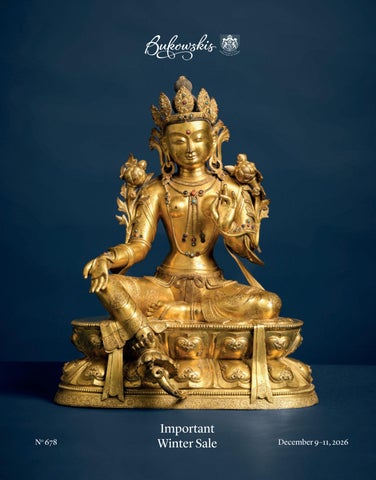
Front cover: 1136. A large gilt bronze figure of Tara, Tibeto-Chinese, Kangxi, early 18th century. Back cover: 1210. A massive yellow ground ‘dragon’ charger, late Qing dynasty, with a Kangxi six character mark. 1252. A large blue and white moonflask bianhu, Qing dynasty, 19th century. 1137. A gilt-bronze figure of Amitayus, Qing dynasty, Mongolian, 18th century. 1253. A Ming-style blue and white bottle vase, Republic period with a Qianlong mark. 1099. A Chinese red laquer box, late Qing dynasty/early 20th century. 1102 A Chinese square hardwood ’Immortals’ table, Baxian zhuo, Qing dynasty.
Viewing December 3 – 8, Berzelii Park 1, Stockholm. Live Auction December 9–11, Arsenalsgatan 2, Stockholm. Wednesday December 9, from 10 AM (CET)
Lot. no
Furniture and Works of Art
1 – 232
Silver, Objects of Vertu
233 – 380
Carpets, Textiles and Islamic Works of Art
381 – 489
Glass and Ceramics
490 – 548
Thursday December 10, from 10 AM (CET)
Lot. no
Jewellery
549 – 649
From 1 PM (CET) Art
650 – 991
Friday December 11, from 10 AM (CET)
Lot. no
Asian Sale – Asian Ceramics and Works of Art
1001 – 1288
Bidding for the Asian Sale takes place online at Bukowskis.com between November 24 and December 11, with a concluding live auction on December 11 at Arsenalsgatan 2 in Stockholm.
Pre-registration Asian Sale Please note that in order to participate in the Asian Sale bidding, as a new client, you are required to pre-register and, upon request, submit a minimum deposit of SEK 50,000. This requirement applies to all bidding methods, including online, telephone, absentee, and in – person bidding in the sale room. If you have previously bid on Bukowskis, you may be pre-approved. Please check your status by logging in to “My Pages.” For further information regarding the preregistration application, please contact us at preregistration@bukowskis.com or visit our Customer Service Desk located at Arsenalsgatan 2, Stockholm. Estimates are provided in Swedish kronor (SEK) and € (EUR). You can find Bukowskis’ general terms and conditions for buyers and sellers, bidding instructions, as well as special terms and conditions for individual lots at bukowskis.com. We extend a warm welcome and look forward to hearing from you.
NO 678 | ASIAN SALE B U KO W S K I S | DECEMBER 11 , 2 0 2 6
From the collection of the German-Belgian businessman Friedrich (Frédéric) Dahlmann and his wife Elisabeth, thence by decent to their daughter Ingrid Killander, Stockholm, Sweden (born Dahlmann). Frédéric Dahlmann moved his family to Shanghai, a city he used as a base when selling technical appliances and machinery to Asia. He was a passionate art collector and the family later brought the collection back to Belgium, Brussels where they settled later on. LOT 1001–1004.
1001. A finely cast bronze ritual wine vessel ‘Gu’, Shang dynasty, Anyang, 12th century BC. The trumpet-form neck crisply cast with four blades filled with inverted taotie masks and scrolls rising from a band of angular snakes, with two taotie masks divided and separated by narrow notched flanges on the center section and on the spreading foot, those on the foot with prominent brows and set below a band of two pairs of confronted dragons with elephant-like snouts, all reserved on leiwen grounds, with inscription cast inside the foot of a bird, with mottled milky green patina. Height 26.5 cm. Provenance: From the collection of the German-Belgian businessman Friedrich (Frédéric) Dahlmann and his wife Elisabeth, thence by decent to their daughter Ingrid Killander, Stockholm, Sweden (born Dahlmann). Exhibitions: Compare with one at Chicago Institute of Art, Reference Number 1937.2. Compare with Christies, lot 1501, 22–23 MAR 2012 | Live auction 2553. Fine Chinese Ceramics and Works of Art (Parts I & II). Literature: A Shang dynasty bronze gu of this design with a different pictogram inside the foot, in the collection of the National Museum of Asian Art, Smithsonian Institution, is illustrated by R. Bagley, Shang Ritual Bronzes in the Arthur M. Sackler Collection, Cambridge, 1987, pp. 234–235, no. 31. Catalogue note: Frédéric Dahlmann was vice-president of the Economic Commission (1957–1983) of the Belgian-Chinese Friendship Association.
Estimate: SEK 60 000 – 80 000 / EUR 5 460 – 7 280
1002. A blue and white ‘figurative’ jar, Qing dynasty, early Kangxi (1662–1722). Ovoid shape, unglazed neck, decorated in underglaze blue with the heavenly princess surrounded by ladies playing musical instruments in a garden with lingzhi shaped cloud formations. Height 17.5 cm. Height with wooden cover and stand 22 cm. Provenance: From the collection of the German-Belgian businessman Friedrich (Frédéric) Dahlmann and his wife Elisabeth, thence by decent to their daughter Ingrid Killander, Stockholm, Sweden (born Dahlmann).
Estimate: SEK 8 000 – 10 000 / EUR 728 – 910
1003. A pair of Chinese egg shell porcelain bowls, Republic, 20th century. With Qianlong seal mark. Decorated in famille rose with scenes with scholars in a beautiful garden with bamboo, reading, painting and being at leasure, the interior of the rim with ruyi border, the center of the bowls with dragons. Height 6.2 cm, diameter 13 cm. Blue fitted box and wooden stands accompanies this lot. Provenance: From the collection of the German-Belgian businessman Friedrich (Frédéric) Dahlmann and his wife Elisabeth, thence by decent to their daughter Ingrid Killander (born Dahlmann).
Estimate: SEK 10 000 – 15 000 / EUR 910 – 1 370
1004. A Chinese egg shell porcelain bowl, Republic period, 20th century. Octagonal shape, decorated in famille rose with figure scenes in a garden and a boat on a river, also a deity on a crane in flight amidst clouds and attendants. Apocryphal Qianlong seal mark. Diameter 13.5, height 5.8 cm. Provenance: From the collection of the German-Belgian businessman Friedrich (Frédéric) Dahlmann and his wife Elisabeth, thence by decent to their daughter Ingrid Killander, Stockholm, Sweden (born Dahlmann).
Estimate: SEK 8 000 – 10 000 / EUR 728 – 910
LOT 1002.
Property of a private Swedish collector, a long time member of the Swedish Oriental Ceramics Society. LOT 1005–1022.
1005. A group of five pottery figures of attendants, Sui/Tang dynasty. Of different decoration. Height 19.5–22 cm. Provenance: Property of a private Swedish collector, a long time member of the Swedish Oriental Ceramics Society. With label from Sothebys, Chinese Ceramics & Works of Art from J. T. TAi & Co. Lot 244.
Estimate: SEK 15 000 – 20 000 / EUR 1 370 – 1 820
1006. A brown glazed dish, Song dynasty (960–1279). Round with short sides, glazed in a brownish glaze with black areas that covers the base as well as the rim is therefore left bare and polished after the firing. Diameter 10.5 cm. Provenance: Property of a private Swedish collector, a long time member of the Swedish Oriental Ceramics Society. Purchased at auction i Sweden, then from the collection of Gustaf Hilleström (1911–1994). Mr Hilleström was a Swedish Museum director, writer and collector of Chinese Works of Art. He was a long term member of the board of the friends of the Museum of Far Eastern Antiquities. Part of his collection was exhibited at the Museum and there is a catalogue from that time Kina som hobby, Gustaf Hilleströms samling, Östasiatiska Museet, Stockholm 1968.
Estimate: SEK 6 000 – 8 000 / EUR 546 – 728
1007. A longquan celadon mallow form dish, Song/Ming dynasty. The dish is finely potted with deep flared sides rising to an everted, hexa-lobed rim, and is covered overall in a luminous bluish-green glaze suffused with crackles, leaving the foot unglazed, revealing the biscuit body. Diameter 14.7 cm. Height 4.2 cm. Provenance: Property of a private Swedish collector, a long time member of the Swedish Oriental Ceramics Society.
Estimate: SEK 12 000 – 15 000 / EUR 1 090 – 1 370
1008. A group lot of metalworks, Ming dynasty and older. Comprising; Two daggers, height 20–27 cm. A belt buckle, length 8 cm. A ladle, length 9 cm. A lamp, length 12 cm. Two metal ornaments, length 3–7 cm. A bell with a wooden stand 7.5 cm. Provenance: Property of a private Swedish collector, a long time member of the Swedish Oriental Ceramics Society. Purchased at auction i Sweden, then from the collection of Gustaf Hilleström (1911–1994). Mr Hilleström was a Swedish Museum director, writer and collector of Chinese Works of Art. He was a long term member of the board of the friends of the Museum of Far Eastern Antiquities. Part of his collection was exhibited at the Museum and there is a catalogue from that time Kina som hobby, Gustaf Hilleströms samling, Östasiatiska Museet, Stockholm 1968.
Estimate: SEK 8 000 – 12 000 / EUR 728 – 1 090
1009. A group of seven early bronze mirrors, Han-/Tang dynasty (206 BC-907 AD). Of different models and decoration cast with central nob for the string, all finely decorated in relief. Part silvered. Diameter 5.5–11 cm. Provenance: Property of a private Swedish collector, a long time member of the Swedish Oriental Ceramics Society. Purchased at auction i Sweden, then from the collection of Gustaf Hilleström (1911–1994). Mr Hilleström was a Swedish Museum director, writer and collector of Chinese Works of Art. He was a long term member of the board of the friends of the Museum of Far Eastern Antiquities. Part of his collection was exhibited at the Museum and there is a catalogue from that time Kina som hobby, Gustaf Hilleströms samling, Östasiatiska Museet, Stockholm 1968. Exhibitions: Two of them with a label from the Exhibition at the Museum of Far Eastern Antiquities in Stockholm, 1968. Catalogue note: Han mirrors (such as the famous TLV mirrors) were designed to represent the universe, circular like heaven and square like earth, acting as talismans to illuminate and protect the deceased in the darkness of tombs. The Tang dynasty is considered the golden age of bronze mirror production. Tang mirrors were treasured high-value gifts exchanged among elites, poets, and lovers, often functioning as tokens of affection, marriage, or social prestige.
Estimate: SEK 15 000 – 20 000 / EUR 1 370 – 1 820
1010. Two jade dragon pendants jue, archaistic, Ming dynasty or older. The pendants are carved in the shape of a coiled dragon, circular eyes, a long tail. Length 4.8–6 cm. Provenance: Property of a private Swedish collector, a long time member of the Swedish Oriental Ceramics Society. Purchased at auction i Sweden, then from the collection of Gustaf Hilleström (1911–1994). Mr Hilleström was a Swedish Museum director, writer and collector of Chinese Works of Art. He was a long term member of the board of the friends of the Museum of Far Eastern Antiquities. Part of his collection was exhibited at the Museum and there is a catalogue from that time Kina som hobby, Gustaf Hilleströms samling, Östasiatiska Museet, Stockholm 1968.
Estimate: SEK 8 000 – 10 000 / EUR 728 – 910
1011. A set of two jade ‘cloud’ sword fittings/decorations and a jade scabbard, 17th/18th century. The set is comprised of a sword guard well carved on one side with cloudform scrolls, length 8.4 cm, and a sword slide decorated to the surface with cloud scrolls and a stylized dragon face, width 5 cm. A fitting is a pommel carved with a nob in high relief with ruyi-scrolls encircled by a band of comma spirals. Diameter 4.5 cm. Provenance: Property of a private Swedish collector, a long time member of the Swedish Oriental Ceramics Society. Purchased at auction i Sweden, then from the collection of Gustaf Hilleström (1911–1994). Mr Hilleström was a Swedish Museum director, writer and collector of Chinese Works of Art. He was a long term member of the board of the friends of the Museum of Far Eastern Antiquities. Part of his collection was exhibited at the Museum and there is a catalogue from that time Kina som hobby, Gustaf Hilleströms samling, Östasiatiska Museet, Stockholm 1968.Catalogue note: In the style of Warring states period/Western Han dynasty 475 BC-AD 8.
Estimate: SEK 20 000 – 30 000 / EUR 1 820 – 2 730
1012. A jade openwork ‘phoenix’ pendant, Song/Ming dynasty. The pendant is well-carved and pierced as a pair of phoenix birds, their upturned tails form an intricate decoration. Height 10 cm. Width 7.8 cm. Provenance: Property of a private Swedish collector, a long time member of the Swedish Oriental Ceramics Society. Purchased at auction i Sweden, then from the collection of Gustaf Hilleström (1911–1994). Mr Hilleström was a Swedish Museum director, writer and collector of Chinese Works of Art. He was a long term member of the board of the friends of the Museum of Far Eastern Antiquities. Part of his collection was exhibited at the Museum and there is a catalogue from that time Kina som hobby, Gustaf Hilleströms samling, Östasiatiska Museet, Stockholm 1968.
Estimate: SEK 30 000 – 50 000 / EUR 2 730 – 4 550
1013. A jade belt ornament and a jade scabbard, late Ming dynasty/early Qing dynasty. The belt ornament with a sculptured nob on one side and a tothie mask to the other with stylized cloud ornaments. The scabbard with rounded sides and well carved on one side with cloud-form scrolls. The stone is of a pale greenish-brown tone with feather-like russet markings. Length 11.5 cm. Provenance: Property of a private Swedish collector, a long time member of the Swedish Oriental Ceramics Society. Purchased at auction i Sweden, then from the collection of Gustaf Hilleström (1911–1994). Mr Hilleström was a Swedish Museum director, writer and collector of Chinese Works of Art. He was a long term member of the board of the friends of the Museum of Far Eastern Antiquities. Part of his collection was exhibited at the Museum and there is a catalogue from that time Kina som hobby, Gustaf Hilleströms samling, Östasiatiska Museet, Stockholm 1968.
Estimate: SEK 8 000 – 10 000 / EUR 728 – 910
1014. A jade scabbard chape and a jade scabbard slide, 18th century or older. The chape is well carved to each side with angular scrolls and drilled to one end for attachment to the bottom of the scabbard, the stone is of a greyish-pale green tone with areas of alteration. Width 5 cm. The rectangular-shaped slide with curved ends is carved with with angular scrolls, the stone is of a pale white-greenish tone with brown markings. Length 8.2 cm. Provenance: Property of a private Swedish collector, a long time member of the Swedish Oriental Ceramics Society. Purchased at auction i Sweden, then from the collection of Gustaf Hilleström (1911–1994). Mr Hilleström was a Swedish Museum director, writer and collector of Chinese Works of Art. He was a long term member of the board of the friends of the Museum of Far Eastern Antiquities. Part of his collection was exhibited at the Museum and there is a catalogue from that time Kina som hobby, Gustaf Hilleströms samling, Östasiatiska Museet, Stockholm 1968.
Estimate: SEK 8 000 – 12 000 / EUR 728 – 1 090
1015. A group of three archaistic jade ornaments, Qing dynasty or earlier. One round decorated in relief with chilong dragons and clouds, diameter 5.4 cm. A dragonfish, length 12.4 cm. A round with three reclining animals. Diameter 6 cm. Provenance: Property of a private Swedish collector, a long time member of the Swedish Oriental Ceramics Society. Purchased at auction i Sweden, then from the collection of Gustaf Hilleström (1911–1994). Mr Hilleström was a Swedish Museum director, writer and collector of Chinese Works of Art. He was a long term member of the board of the friends of the Museum of Far Eastern Antiquities. Part of his collection was exhibited at the Museum and there is a catalogue from that time Kina som hobby, Gustaf Hilleströms samling, Östasiatiska Museet, Stockholm 1968.
Estimate: SEK 12 000 – 15 000 / EUR 1 090 – 1 370
1016. A jade belt buckle, and two archaistic sword ornaments, Qing dynasty or older. A belt hook in celadon coloured jade with yellow spots, carved in relief with chilong dragons. Length 7.4 cm. A sword ornament with two confronting Chilong dragons. Width 5 cm. A sword ornament in celadon green with russset spots with a coiling chilong dragon. Width 4.5 cm. Provenance: Property of a private Swedish collector, a long time member of the Swedish Oriental Ceramics Society. Purchased at auction i Sweden, then from the collection of Gustaf Hilleström (1911–1994). Mr Hilleström was a Swedish Museum director, writer and collector of Chinese Works of Art. He was a long term member of the board of the friends of the Museum of Far Eastern Antiquities. Part of his collection was exhibited at the Museum and there is a catalogue from that time Kina som hobby, Gustaf Hilleströms samling, Östasiatiska Museet, Stockholm 1968.
Estimate: SEK 4 000 – 6 000 / EUR 364 – 546
1017. A group of Chinese stone ornaments, Qing dynasty. Comprising a lotus shaped bowl in a pale celadon green with grey featherings. Diameter 9.4 cm. A buckle in the shape of a wrathful demon. Height 12.3 cm. A well sculptured crane with a lingzhi in a pale celadon green tone. Length 7 cm. A round decorative ornament with a crane in flight. Diameter 4.6 cm. A lingzhi shaped finial in soapstone. Height 5.5 cm. Provenance: Property of a private Swedish collector, a long time member of the Swedish Oriental Ceramics Society. Purchased at auction i Sweden, then from the collection of Gustaf Hilleström (1911–1994). Mr Hilleström was a Swedish Museum director, writer and collector of Chinese Works of Art. He was a long term member of the board of the friends of the Museum of Far Eastern Antiquities. Part of his collection was exhibited at the Museum and there is a catalogue from that time Kina som hobby, Gustaf Hilleströms samling, Östasiatiska Museet, Stockholm 1968.
Estimate: SEK 4 000 – 6 000 / EUR 364 – 546
1018. An architectural tile with a boy and lotus, presumably late Ming dynasty/early Qingdynasty. Decorated to both sides in deep relief with lotus and a boy, glazed in green, yellow and white. Measure 50 x 26 x 17 cm. Provenance: Property of a private Swedish collector, a long time member of the Swedish Oriental Ceramics Society. Exhibitions: Compare with tiles attributed to be from the Nanjing porcelain pagoda in the Metropolitan Museum, Credit Line, Purchase by subscription, 1879. Object No. 79.2.790. Object No. 79.2.789. Catalogue note: The Da Bao’en Monastery tower, or “Porcelain Pagoda,” in Nanjing–a wonder of Buddhist architecture commissioned by Yongle, the second Ming emperor (reigned 1402–24). Nine stories tall and clad in colorful glazed tiles of exuberant form, the building became a symbol of early Ming splendor and the power, righteousness, and religious devotion of the ruling family. The structure came to influence and inspire many other buildings.
Estimate: SEK 6 000 – 8 000 / EUR 546 – 728
1019. A small ‘iron-rust’ censer or brush washer, Qing dynasty, 18th century. After a bronze model, glazed in bronze imitating iron rust glaze. Height 4.5 cm. Length 8.5 cm. Provenance: Property of a private Swedish collector, a long time member of the Swedish Oriental Ceramics Society. Purchased at auction i Sweden, then from the collection of Gustaf Hilleström (1911–1994). Mr Hilleström was a Swedish Museum director, writer and collector of Chinese Works of Art. He was a long term member of the board of the friends of the Museum of Far Eastern Antiquities. Part of his collection was exhibited at the Museum and there is a catalogue from that time Kina som hobby, Gustaf Hilleströms samling, Östasiatiska Museet, Stockholm 1968. Exhibitions: Compare with a censer at British Museum, Registration number 1915,0409.41. Literature: In the catalogue of Gustaf Hilleströms Samling, lot no 1201. Listed as Qianlong. Depicted on page 156.
Estimate: SEK 4 000 – 6 000 / EUR 364 – 546
1020. A well enamelled ‘landscape’ vase, China, Republic, 20th century. Rectangular baluster shape, decorated with a moon pavilion, gilded rim and footrim. Seal mark in red to base. Height 14 cm. Height with wooden stand 17 cm. Silk clad box accompanies the lot. Provenance:Property of a private Swedish collector, a long time member of the Swedish Oriental Ceramics Society.
Estimate: SEK 30 000 – 50 000 / EUR 2 730 – 4 550
1021. A bronze cutlery set with silver and gold inlay, Qing dynasty. Containing; a knife, two chopsticks and a stick. Length 34 cm. Provenance: Property of a private Swedish collector, a long time member of the Swedish Oriental Ceramics Society.
Estimate: SEK 5 000 – 7 000 / EUR 455 – 637
1022. A set of three Japanese bronze mirrors, Edo period (1603–1868). All three decorated in deep relief with a dense vegetation and a central knop. Diameter 11–12.2 cm. Provenance: Property of a private Swedish collector, a long time member of the Swedish Oriental Ceramics Society. Purchased at auction i Sweden, then from the collection of Gustaf Hilleström (1911–1994). Mr Hilleström was a Swedish Museum director, writer and collector of Chinese Works of Art. He was a long term member of the board of the friends of the Museum of Far Eastern Antiquities. Part of his collection was exhibited at the Museum and there is a catalogue from that time Kina som hobby, Gustaf Hilleströms samling, Östasiatiska Museet, Stockholm 1968.
Estimate: SEK 5 000 – 7 000 / EUR 455 – 637
From the Collection of a Swedish Connoisseur From the Collection of a Swedish Connoisseur of Asian Works of Art. This is part of a collection, a collection that was assembled not only with great care, but also with a deep curiosity and passion for learning – a true academic collection. The collector has been actively buying and studying Chinese porcelain since the early 1970’s. LOT 1023–1029.
1023. A blue and white pomme granate ewer, Ming dynasty, Wanli (1573–1619). The bulbous lower body is decorated with vertical panels enclosing leafy flower blossoms alternating with tassle decorated precious objects, beneath a ruyi border at the base of the slender neck. The gently curved spout is decorated as a branch with molded leaves, a flaring, star-form mouth. The slightly recessed base is fully glazed, with the rounded foot ring left unglazed. Height 19.5 cm. Provenance: From the Collection of a Swedish Connoisseur of Asian Works of Art. Exhibitions: Compare with lot 850, Christie’s Live auction 19547, Important Chinese Ceramics and Works of Art, 23–24 September 2021. Compare with one in the Collection of Musee Guimet, Collection Grandidier, Paris, Museum no G 1005. The Groninger Museum, The Netherlands, object no. 1960.0057. Literature: For reference in litterature of this type, see Jorge Welsh Books, ‘Kraak Porcelain: The Rise of Global Trade in the Late 16th and Early 17th Centuries’, pp. 176–179, no. 25 and Maura Rinaldi, ‘Kraak Porcelain: A Moment in the History of Trade’, pp. 17–179, and pl. 225. Catalogue note: This elegant and fragile pouring vessel belongs to a rare group of Kraak porcelain ewers produced during the Wanli period. Commonly referred to as ‘pomegranate ewers’, these vessels derive their modern name from the globular, lobed body and distinctive star-shaped mouth rim. In Chinese culture, the pomegranate (shiliu)—with its abundance of seeds—symbolises fertility, prosperity, and numerous descendants. The form is exceptional within the Kraak repertoire. Unlike the more robust kendis, pear-shaped bottles, and double-gourd vessels of the period, these ewers are remarkably thinly potted and refined in execution. Their elongated spouts ultimately derive from earlier Ming dynasty ewers influenced by Middle Eastern metalwork prototypes, while the relief-moulded leafy branches and star-shaped mouth rim appear unique to this particular group.
Estimate: SEK 50 000 – 75 000 / EUR 4 550 – 6 820
1024. A blue and white kendi/ewer, Ming dynasty, 17th century. Of compressed globular form with domed conical neck and spout, decorated in underglaze blue with a scholar in a landscape by a river. Height 19.5 cm. Provenance: From the Collection of a Swedish Connoisseur of Asian Works of Art.
Estimate: SEK 10 000 – 15 000 / EUR 910 – 1 370
1025. A rare underglaze blue, copper red and celadon decorated landscape bowl, Qing dynasty, Kangxi (1662–1722). The hexagonal, lobed bowl is decorated to the exterior with three landscape scenes, each accompanied by a calligraphic inscription describing the scene. The centre of the interior is decorated with a pavilion set by the river before mountains hidden in mist. Diameter 19.4 cm. Height 9 cm. Provenance: From the Collection of a Swedish Connoisseur of Asian Works of Art. Exhibitions: Compare lot 860, Christies Live auction 19547 Important Chinese Ceramics and Works of Art, 23–24 September 2021. Literature: The poem reads; 一葉扁舟倚絲綸,歲寒江上有閒人。雲水 萬木陰中一草亭,雲開四面遠山青。雲水 A solitary little boat rests by the fishing line; Upon the winter river sits a soul at ease. Yunshui Amid the shade of countless trees stands a humble thatched pavilion; As the clouds part, green mountains emerge on every side. Yunshui The two seals at the beginning of the inscriptions read: (Zhushi) which could be translated as ‘bamboo and stone’. Catalogue note: The combination of celadon green with underglaze cobalt blue and underglaze copper red is relatively rare, no doubt because it was so difficult to fire successfully. With the coming of the Kangxi reign came renewed imperial interest in porcelain and a demand for high quality and variety. In the early years of the reign the potters revived the combination of underglaze blue and underglaze copper red on single pieces, and with the re-establishment of the imperial kiln complex court demand for innovation resulted in molded and carved surface decoration and the use of areas of celadon green being added to this already challenging palette.
Estimate: SEK 50 000 – 75 000 / EUR 4 550 – 6 820
1026. A pair of blue and white ‘Shoulao’ dishes, Qing dynasty, 18th century. Rounded sides with an everted rim, decorated to the centre with Shoulao and his deer, around the inner sides peaches, fingerlemon and melons. Diameter 15.8 cm. Provenance: From the Collection of a Swedish Connoisseur of Asian Works of Art. Catalogue note: Chinese art and Daoist tradition, the pairing of Shoulao (the God of Longevity) and his deer (often a stag or white deer) carries deep auspicious meaning centered on life, fortune, and status. The deer is believed in Chinese folklore to live an extraordinarily long life. The Chinese word for deer (lu, 鹿) is a homophone for lu (emolument or civil service salary). Accompanying Shoulao, the deer symbolizes prosperity, high office, and scholarly success in the imperial examination system.
Estimate: SEK 20 000 – 30 000 / EUR 1 820 – 2 730
1027. A doucai ‘month’ cup, late Qing dynasty/Republic, with a Kangxi mark. Delicately potted with flaring sides, enamelled with two clusters of flowering narcissus, rockwork and three long iron-red rose/peony blossoms. An apochryphal six character Kangxi mark within a double circle to the base. Height 4.5 cm. Diameter 5.8 cm. Provenance: From the Collection of a Swedish Connoisseur of Asian Works of Art.
Estimate: SEK 10 000 – 15 000 / EUR 910 – 1 370
1028. A zitan brush pot/bitong, Qing dynasty, 18th/19th century. The cylindrical sides naturalistically carved in relief with a continuous scene of a gnarly tree trunk. The dark-colored wood displaying fine grains resembling numerous ox-hair. Height 17 cm. Diameter 15 cm. Provenance: From the Collection of a Swedish Connoisseur of Asian Works of Art. Exhibitions: Compare a similar; lot 1413 sold at Christies Live auction 9598, Chinese Ceramics, Works of Art and Textiles, 8 November 2013. Compare another similar; lot no 1281 at Christies Live auction 2648, Auspicious Treasures Scholars and Emperors: Selections from the Robert H. Blumenfield Collection, 22 March 2012.
Estimate: SEK 12 000 – 15 000 / EUR 1 090 – 1 370
1029. A pair of blue and white dishes, Qing dynasty, 18th century. The rounded sides rising from a straight foot to a flared molded rim, vividly painted to the interior in the style of the Master of the Rocks, depicting a riverscape with clouds swirling around pagodas, two figures can be seen in a small boat on the river. An unusual design with butterflies alternating with different blossom including hisiscus, peony and chrysanthemum. Diameter 23 cm. Provenance: From the Collection of a Swedish Connoisseur of Asian Works of Art. Catalogue note: The pattern with butterflies and flowers to he rim can be compared with the design by Pronk, ‘Arbour’.
Estimate: SEK 18 000 – 22 000 / EUR 1 640 – 2 000
From the Collection of Hans Hirsch (1950–2026) Hans Hirsch was a familiar presence at Swedish auctions and a passionate collector, with a particular fondness for early ceramics. He was a much-valued member of the Swedish Oriental Ceramics Society and the Friends of the Museum of Far Eastern Antiquities in Stockholm. In Sweden, Hans Hirsch was also a highly respected numismatist. He received his training at M. C. Hirsch, then regarded as Sweden’s leading coin dealership. The proprietor, Harry Glück, was a relative of Hans’s mother, and this family connection undoubtedly helped him pursue his interest in numismatics while taking on additional work at the dealership, then located on Regeringsgatan in central Stockholm. Following his military service, Hans secured a permanent position at
the firm in 1970. In 1976, he and Ulf Nordling started a coin dealership on Nybrogatan in central Stockholm, which later relocated to Karlavägen. Hans’s extensive numismatic knowledge, spanning a period from approximately 625 BC to the present day, was widely recognised and highly valued by collectors, fellow specialists and institutions alike. Bukowskis has been entrusted with the sale of a selection of Hans Hirsch’s collection, together with his extensive library on Chinese works of art, see lot 1256–1288 in this sale. A further part of his collection will be offered for sale by Bonhams in Paris. LOT 1030–1050.
1030. A green glazed beaker/ear cup, Han dynasty (206 B.C.-220 A.D). Oval, moulded shape with two ears, glazed in a green glaze. Height 5 cm. Length 10.3 cm. Provenance: Ex collection Hans Öström B188. Property of a private Swedish collector. Exhibitions: These kind of Han ear cups are represented in several museums, but to see on example, Museum of Asian Art, San Fransisco, Credit LineGift of Ed Nagel. Object number B73P9. Smithosonian, The National Museum of Asian Art. Accession Number. S2012.9.3057 Literature: Known in Chinese as bei (杯) or yushang (羽觴), vessels of this type appear to have served a dual purpose in early China, functioning both as drinking cups for wine and as containers for food offerings; see for example, a set of ninety lacquer ear cups excavated from the Han dynasty tombs of the Marquis Dai and his family, located at Mawangdui near Changsha in Hunan Province, where fifty cups were found inscribed with jun feng shi (‘to serve you food’) and the rest jun feng jiu (‘to serve you wine’); see J.Waley-Cohen, trans., ‘The Lacquers of the Mawangdui Tomb’, Oriental Ceramic Society Translations, no.11, Hong Kong, 1984, p.16.
Estimate: SEK 3 000 – 4 000 / EUR 273 – 364
1031. A red and green decorated bowl and stemcup, Jin dynasty (1115–1234). White slipped stoneware painted with a branch of pommegranate in low firing red and green enamels. Cizhou. Diameter bowl 10.8 cm. Height stemcup 8.3 cm. Provenance: From the Collection of Hans Hirsch (1950–2026). Purchased from Bukowskis Autumn Classic Sale 571, 4 December 2012. lot no 1450. Then from a Swedish Collector. Exhibitions: Exhibited at “The World of Colors”, An exhibition of ceramics with coloured decoration dating from 700 to 1920 belonging to members of the Oriental Ceramics Society. Catalogue written by Rose Kerr and Philip Allen. P. 35, no 57.
Estimate: SEK 6 000 – 8 000 / EUR 546 – 728
1032. A purple splashed jun censer and a dish, Yuan dynasty (1271–1368). Tripod with raised handles, glazed in a lavender blue jun glaze with a purple splash. Height 9.5 cm. The dish flat with an everted slanting rim and a lavender blue glaze with a purple splash. Diameter 17 cm. Provenance: From the Collection of Hans Hirsch (1950–2026).
Estimate: SEK 8 000 – 12 000 / EUR 728 – 1 090
1033. A ‘floral’ bowl, Yuan dynasty (1271–1368). Rising from a short straight footrim with rounded sides, and eveted foliated rim. Decorated in relief with chrysanthemum, lotus, peonies and cherryblossoms. Diameter 18 cm. Provenance: From the Collection of Hans Hirsch (1950–2026). Purchased from Bukowskis, 2011, the Thomax Collection, lot 1646. The Thomax collection was formed by the Art Collector and Conneisseur Professor Leif Sourander, Åbo, Finland from the 1960’s to the 1990’s. Exhibitions: Arabia Museum, Helsinki, Finland. 1994.
Estimate: SEK 4 000 – 6 000 / EUR 364 – 546
1034. A brown glazed jar, Song/Ming dynasty. Rounded sides with a short neck and lipped rim. Glazed in a brown and black glaze. Height c. 8.5 cm. Diameter 12 cm. Provenance: From the Collection of Hans Hirsch (1950–2026). Purchased at Bukowskis 2009, then from the Collection of Stig Bojling, Gothenburg, Sweden.
Estimate: SEK 5 000 – 8 000 / EUR 455 – 728
1035. A spotted toby sai jen ewer and a celadon glazed bird feeder, Song-/Ming dynasty. Double gourd shaped ewer decorated with a spotted glaze. Height 11 cm. The birdfeeder shaped as a lotus bud and glazed in an olive green glaze. Length 6 cm. Provenance: From the Collection of Hans Hirsch (1950–2026).
Estimate: SEK 6 000 – 8 000 / EUR 546 – 728
1036. A Longquan celadon stemcup, early Ming dynasty. The sturdily potted cup with well-rounded sides and slightly everted rim, supported on a partly hollowed, spreading stem imitating a section of bamboo, covered overall with an unctuous green glaze except the footrim, burnt brick-red in the firing. Height 11.5 cm. Diameter 12.4 cm. Provenance: From the Collection of Hans Hirsch (1950–2026). Literature: For similar examples of Longquan celadon stem cups, see J. Harrison-Hall, Ming Ceramics in the British Museum, 2001, p. 463, pls. 16:2 and 16:3; see also J. Ayers, The Chinese Porcelain Collection of Marie Vergottis, p. 30, pl. 9.
Estimate: SEK 6 000 – 8 000 / EUR 546 – 728
1037. A tripod incense burner and a pear shaped vase, Ming dynasty (1368–1644). The censer with a wide body waisted just below the rim, resting on three tall legs, glazed in a crackled celadon green glaze. Height 11 cm. Diameter 13 cm. The vase, pear shaped with a flared lipped rim, glazed in a celadon green crackled glaze. Height 12.6 cm. Provenance: From the Collection of Hans Hirsch (1950–2026).
Estimate: SEK 8 000 – 10 000 / EUR 728 – 910
1038. A Longquan celadon glazed tripod incense burner, Ming dynasty (1368–1644). The compressed globular body raised on three feet molded as fantastic animal heads, the curving exterior walls are decorated with a floral scroll, the graygreen glaze covering most surfaces except a cinnamon-burnt circle at the floor of the well and across the circular extruding from the base. Diameter 30.5 cm. Height 12.5 cm. Provenance: From the Collection of Hans Hirsch (1950–2026).
Estimate: SEK 8 000 – 12 000 / EUR 728 – 1 090
1039. A celadon glazed inscence burner, Ming dynasty (1368–1644). The compressed globular body with everted rim, set on three beast mask and paw feet, the crackled celadon glaze falling short of the base and interior center. Diameter 29.5 cm. Height 12 cm. Provenance: From the Collection of Hans Hirsch (1950–2026). Exhibitions: Compare Bonhams, lot no 162. Chinese & other Asian Works of Art, 5 November 2012, London, Knightsbridge.
Estimate: SEK 8 000 – 10 000 / EUR 728 – 910
1040. A celadon glazed figure of Guanyin, Ming dynasty (1368–1644). The deity depicted seated, clad in a flowing robe, glazed in a celadon glaze that leaves face and chest bare to reveal a red colour. Height 18.5 cm. Height with wooden stand 20 cm. Provenance: From the Collection of Hans Hirsch (1950–2026). Exhibitions: Compare a seated Guanyin, lot 8275, Bonhams San Francisco, sale 19433, 20 December 2011. Catalogue note: Longquan figures depicting deities, decorated with delicately carved elements left unglazed for visual interest, are a particular feature of the Yuan and Ming dynasties. Often, ceramics of this type feature a small deity figure surrounded by an elaborate shrine.
Estimate: SEK 6 000 – 8 000 / EUR 546 – 728
1041. A junglazed vase, Yuan dynasty (1271–1368). Pear shaped with a tall neck and flared rim. Lavender blue glaze with two purple stains. Height 18.2 cm. Provenance: From the Collection of Hans Hirsch (1950-2026). Purchased at Bukowskis, Sale 629, lot 607, 10 December 2020, From the Collection of Claes Wirseen (1939–2020). Pharmacist Claes Wirseen grew up in a family with a passion for Art and Antiques, he and his wife continued the tradition and were frequent visitors to the Fine Art viewings of the Auction Houses in Stockholm. He became interested in Asian art in the 1980’s and started to build up his collcetion at that time, never tiring to learn more about the Asian Ceramics and Works of Art. Purchased at Bukowskis autumn Sale 1998. Lot no 1261. Then from a prominent Swedish Collector. Exhibitions: Compare with a vase in the British Museum, Registration number PDF.80.
Estimate: SEK 15 000 – 20 000 / EUR 1 370 – 1 820
1042. A blue and white incenser burner/bulb-bowl, Qing dynasty, 18th century. Tripod with rounded sides decorated with figures in a riverscape. Diameter 26 cm. Height 9 cm. Provenance: From the Collection of Hans Hirsch (1950–2026).
Estimate: SEK 8 000 – 10 000 / EUR 728 – 910
1043. A pair of blue and white bowls, Qing dynasty, Kangxi (1662–1722). Moulded, rounded sides, everted rim, decorated in underglaze blue with a floral scroll. Presumably from a shipwreck. Diameter 14.6 cm. Height 7.2 cm. Provenance: From the Collection of Hans Hirsch (1950–2026).
Estimate: SEK 8 000 – 10 000 / EUR 728 – 910
1044. A pair of blue and white bowls, Qing dynasty, Kangxi (1662–1722). Ribbed with rounded sides, on a short foot, decorated in underglaze blue with peonies and cherry blossom. Diameter 15 cm. Height 7 cm. Provenance: From the Collection of Hans Hirsch (1950–2026).
Estimate: SEK 8 000 – 10 000 / EUR 728 – 910
1045. A large blue and white and underglaze red vase, Qing dynasty, 18/19th century. Of baluster shape with moulded scrolling handels, decorated with the symbols of long life, a deer, a crane and a pine tree all in underglaze blue and red. The other side with bamboo and rockwork. Height 49 cm. Provenance: From the Collection of Hans Hirsch (1950–2026). Exhibitions: Compare with a vase sold at Christies, lot no 1200. Chinese Ceramics, Works of Art, Live Auction 5528, 12 Nov 2010.
Estimate: SEK 15 000 – 20 000 / EUR 1 370 – 1 820
1046. A set of three flambé glazed vases and two brush washers, late Qing dynasty/early 20th century. A large vase with a tall neck, bulb shaped top and a sang de boef glaze. Height 25 cm. A smaller vase with an elongated neck and flambé glaze. Height 20 cm. A small vase with an elongated neck, flambé glaze. Height 14.5 cm. A brush washer in flambé glaze, interior and base with ge glaze. Height 3 cm. Diameter 6 cm. A brush washer in behive shape in a red glaze. Height 4 cm. Diameter 5.8 cm. Provenance: From the Collection of Hans Hirsch (1950–2026).
Estimate: SEK 8 000 – 10 000 / EUR 728 – 910
1047. A group of four monochrome vases and a brush washer, late Qing dynasty/around 1900. Comprising; A vase with rounded sides on a tall foot with an elongated neck and flared rim, glazed in a deep blue glaze. Height 21.5 cm. A double vase, glazed in deep blue. Height 12 cm. A turquoise glazed jar. Height 13 cm. A drop shaped vase glazed in turquoise. Height 15 cm. A blue glazed brush washer. Diameter 7 cm. Height 3 cm. Provenance: From the Collection of Hans Hirsch (1950–2026).
Estimate: SEK 12 000 – 15 000 / EUR 1 090 – 1 370
1048. A green glazed vase and brush washer with a coral red behive shaped brush washer, late Qing dynasty. The vase with a compressed shape and tall neck, glazed in a green ge glaze. Height 12.5 cm. A brush-washer glazed in a similar ge glaze. Diameter widest part 7.5 cm. The coral red behive shaped brushwasher with a white glazed base and interior. Height 5.2 cm. Provenance: From the Collection of Hans Hirsch (1950–2026).
Estimate: SEK 5 000 – 7 000 / EUR 455 – 637
1049. A green glazed dog, a pair of white glazed dishes and a shoe-shaped brushwasher, Qing dynasty 18th/19th century. A green glazed bisquit figure of a dog, length 9 cm. A blue and white brush washer, length 9.2 cm. Two white glazed flower shaped dishes, diameter 8 cm. Provenance: From the Collection of Hans Hirsch (1950–2026). The shoe shaped brush washer with a label, Ex Collectis Erik Hancock.
Estimate: SEK 6 000 – 8 000 / EUR 546 – 728
1050. A small carved pale green jade carving of Shoulao, late Ming dynasty (1368–1644). Oval shape depicting Shoulao in the center with a deer above the oval garland two bats. Measure c. 8 x 6 cm. Provenance: From the Collection of Hans Hirsch (1950–2026).
Estimate: SEK 6 000 – 8 000 / EUR 546 – 728
The collection of Elis Eklöw 1894–1984. The collection of Elis Eklöw 1894–1984, thence by descent within the family. Elis Eklöw worked for the familys import house August Eklöw (founded by his father in 1898). The company became focused on import from Asia after Elis Eköws first trip to China and Japan in 1922. Elis Eklöw became a passionate collector of Chinese Works of Art, a major part of the collection was sold at Sothebys in the 1980’s in a single owner sale. LOT 1051-1054.
1051. A blue and white brush pot, Qing dynasty. Of waisted cylindrical form, finely painted to the exterior with a riverscape featuring figure scene. Apochryphal mark to base that reads Da Ming Chenghua Nian Zhi accompanied with an artemisia leaf. Diameter 13.8 cm. Height 13.5 cm. Provenance: The collection of Elis Eklöw 1894–1984, thence by descent within the family.
Estimate: SEK 20 000 – 30 000 / EUR 1 820 – 2 730
1052. A group of five blue and white five clawed dragon bowls, late Qing dynasty.
1053. A group of five blue and white five clawed dragon bowls, late Qing dynasty.
Rounded sides with a flared rim on a short footrim. Decorated in underglaze blue with five clawed striding dragons chasing the flaming pearl. Base with a pocryphal Kangxi six character mark. Diameter 12.7 cm. Height 5.5 cm.
Rounded sides with a flared rim on a short footrim. Decorated in underglaze blue with five clawed striding dragons chasing the flaming pearl. Base with apocryphal Kangxi six character mark. Diameter 12.7 cm. Height 5.5 cm.
Provenance: The collection of Elis Eklöw 1894–1984, thence by descent within the family.
Provenance: The collection of Elis Eklöw 1894–1984, thence by descent within the family.
Estimate: SEK 10 000 – 15 000 / EUR 910 – 1 370
Estimate: SEK 10 000 – 15 000 / EUR 910 – 1 370
1054. A famille rose flower pot with stand, China, Republic period, 20th century. Slanting sides and everted rim, decorated in famille rose with flowers in bloom. The base with a Guangxu six character mark in red. Height 15.5 cm. Diameter 18 cm. The dish with a auspicious phrase mark that reads ‘Lin Zhi Cheng Xiang’. Diameter dish 16.5 cm. Provenance: The collection of Elis Eklöw 1894–1984, thence by descent within the family.
Estimate: SEK 6 000 – 8 000 / EUR 546 – 728
The collection of professor Gunnar Wallquist 1894–1971. Gunnar Wallquist graduated in 1917 at the Royal Institute of Technology in Stockholm, he became a professor at this institution and was the Principal of the School of Mining and Metallurgy, he had a great interest in Art and formed a fine collection in his villa near the Institute. It was perhaps his connection to mining and relation to Johan Gunnar Andersson who also got him in to collecting Chinese Works of Art. His home at Villagatan 19, Stockholm, was donated to the Royal Institute of Technology where it still is used for representational purposes. LOT 1055-1070.
1055. A lavender and purple jun glazed bowl, Ming dynasty (1368–1644). Rounded sides on a splayed foot, glazed in a lavender blue that shifts towards purple and with the glaze stopping above the foot to reveal a pink clay. Diameter 19 cm. Height 8.5 cm. Provenance: The collection of professor Gunnar Wallquist (1894–1971).
Estimate: SEK 6 000 – 8 000 / EUR 546 – 728
1056. Two longquan petal carved celadon bowls, Yuan dynasty 13th/14th century. The exterior of the rounded sides decorated with a band of carved upright petals with incised outlines, covered overall with a glaze of sea-green color. Diameter 16.8 cm. Height 7 cm. Provenance: The collection of professor Gunnar Wallquist (1894–1971).
Estimate: SEK 6 000 – 8 000 / EUR 546 – 728
1057. A pair of Longquan celadon dishes, Yuan/Ming dynasty. Flat, with everted rim on a short foot, glazed in a celadon glaze. Diameter 12.5 cm. Provenance: The collection of professor Gunnar Wallquist (1894–1971). Exhibitions: Compare with a dish of this type at British Museum, London, Museum number 1984,0202.41. Harrison-Hall 2001 / Catalogue of Late Yuan and Ming Ceramics in the British Museum (16:60).
Estimate: SEK 8 000 – 10 000 / EUR 728 – 910
1058. A rare celadon glazed figural bowl, Ming dynasty (1368–1644). Rounded sides, on a high foot, decorated to the interior with scholars and with calligraphy, all glazed in an olive green ge glaze. Diameter 15 cm. Height 8.5 cm. Provenance: The collection of professor Gunnar Wallquist (1894–1971). Collectors inventory no W505. Purchased from Bluett & Son, Label no 21. Exhibitions: Bluett Exhibition, May 1926. The Jaimes Bird Collection of Early Chinese Pottery and Porcelain, no 21. Then sold to Dr Emil Hultmark, Sweden for £ 15. Sold as Song dynasty. We thank Mr Dominic Jellinek for the research. Literature: Compare a similar example exhitibted in the Burlington House Exhibition, no1363. Sir Alan Barlows Collection no c55. Catalogue pl 95c. Catalogued by Michael Sullivan as Ming dynasty 14th/15th century.
Estimate: SEK 6 000 – 8 000 / EUR 546 – 728
1059. A celadon glazed ewer and a bowl, Ming dynasty (1368–1644). For the Southeast Asian market. The ewer with an upturned spout, glazed in an olive green glaze. Height 7 cm. The bowl with carved exterior, glazed in a celadon green glaze. Diameter 14 cm. Height 7 cm. Provenance: The collection of professor Gunnar Wallquist (1894–1971).
Estimate: SEK 4 000 – 6 000 / EUR 364 – 546
1060. A group of three celadon glazed wares, Yuan/Ming dynasty. The vase, with ring handles and a celadon glaze. Height 7 cm. The jar with a waisted neck and a celadon glaze. Height 8 cm. The bowl with rounded sides and a lipped rim. Diameter 11 cm. Height 5.2 cm. Provenance: The collection of professor Gunnar Wallquist (1894‑1971). Collectors inventory no W545:4. W545:3, 83. W546, 78. Gunnar Wallquist.
Estimate: SEK 6 000 – 8 000 / EUR 546 – 728
1061. A group of 17 anhua and doucai dishes, Qing dynasty, 18th century. Decorated in anhua and doucai colours with flowers. Diameter 21.5 cm. Provenance: The collection of professor Gunnar Wallquist (1894‑1971).
Estimate: SEK 25 000 – 30 000 / EUR 2 280 – 2 730
1062. A ge glazed brush washer and two pots, Qing dynasty, 18th/19th century. Glazed in a ge glaze. Width of the brush washer 6 cm. Height of pots 5–7 cm. Provenance: The collection of professor Gunnar Wallquist (1894–1971).
Estimate: SEK 8 000 – 10 000 / EUR 728 – 910
1063. A famille verte bowl, Qing dynasty, 18th century. Decorated in famille verte with pomegranate on a branch. Base with double fish in underglaze blue. Diameter 14.5 cm. Provenance: The collection of professor Gunnar Wallquist (1894–1971).
Estimate: SEK 4 000 – 6 000 / EUR 364 – 546
1064. A blue and white ‘Yuhuchunping’ vase, Qing dynasty, circa 1800. Pear shaped with an everted rim, decorated with a finely painted plantain and bamboo growing beside rocks on grassy mounds, below a band of foliate scroll in-between upright leaves and a pendent ruyi collar at the waisted neck, the base with a band of lotus lappets encircling the short foot, decorated with a band of demi-florettes. The base with a bat in flight in underglaze blue. Height 21 cm. Provenance: The collection of professor Gunnar Wallquist (1894–1971). Catalogue note: The shape and decoration of the present vase is based on prototypes of the early Ming dynasty, and due to its popularity continued to be produced through the end of the Qing dynasty.
Estimate: SEK 20 000 – 30 000 / EUR 1 820 – 2 730
1065. A Ming style blue and white double gourd ‘phoenix and crane’ vase, Qing dynasty, 19th century. Well potted with two pronounced bulbs, painted in Ming style with a dense composite floral scroll, divided by a waisted neck encircled by bands of floral scrolls, amidst the flowers on the two bulbs there are eight roundes, each painted with a crane and a phoenix in different positions. With an apocryphal Wanli six character reign mark within a double circle. Height 27.5 cm. Provenance: The collection of professor Gunnar Wallquist (1894–1971).
Estimate: SEK 30 000 – 50 000 / EUR 2 730 – 4 550
1066. A pair of blue and white ‘floral’ bowls, late Qing dynasty, circa 1900. Decorated in underglaze blue with a floral scroll. With a four character mark within double circles to the base. Diameter 11.7 cm. Provenance: The collection of professor Gunnar Wallquist (1894–1971).
Estimate: SEK 4 000 – 6 000 / EUR 364 – 546
1067. A turquoise glazed ‘dragon’ dish, late Qing dynasty with Kangxi six character mark. The interior is impressed and decorated in green, aubergine, yellow and cream enamels with two five-clawed dragons chasing a flaming pearl, surrounded by a band of floral sprays in the well. The everted border is decorated with four dragons, and the exterior is similarly decorated beneath a band of cloud-scrolls and four five clawed dragons. The base with Kangxi six character mark within a double underglaze blue circle. Diameter 39.5 cm. Provenance: The collection of professor Gunnar Wallquist (1894–1971).
Estimate: SEK 50 000 – 75 000 / EUR 4 550 – 6 820
LOT 1067.
1068. A pair of yellow ground famille rose landscape bowls, late Qing dynasty/Republic, with Qianlong mark. Rounded sides on a short foot and with an everted rim. Decorated in famille rose with four roundels with landscapes, all against a yelllow floral sgraffito ground. Diameter 19 cm. Provenance: The collection of professor Gunnar Wallquist (1894–1971).
Estimate: SEK 15 000 – 20 000 / EUR 1 370 – 1 820
1069. A Yixing box with cover, Qing dynasty, 18th/19th century. Round box with cover, decorated with birds in a blossoming cherry tree. Height 8.5 cm. Diameter 8 cm. Provenance: The collection of professor Gunnar Wallquist (1894–1971).
Estimate: SEK 4 000 – 6 000 / EUR 364 – 546
1070. A Japanese teapot in the style of Makuzu Kozan I, Meiji (1868–1912). Makuzo Kozan I (Miyagawa Toransuke 1842–1916). Seal mark in underglaze blue to base. Double gourd shape, upturned spout, decorated in relief, in underglaze red and blue with dragons amidst cloud formations. Height 20.5 cm. Provenance: The collection of professor Gunnar Wallquist (1894–1971). Exhibitions: Compare with a tea pot in the collection of the Metropolitan Museum of Art, New York, Object no 93.3.364 a och b. Gift from Charles Stewart Smith 1896. Literature: This is the starting period when the artists departed from his highrelief and gold gilt period and started focusing on making porcelain pieces with underglaze paint and experimented new colours. The ewer form is also relatively rare in the artist’s survived repertoire compared to other forms. The piece takes its shape from the prototype Chinese ewer form with a long neck extending out of a bulbous body, a slender spout with a pointy mouth and an elegant handle. The white surface was finely decorated with two copper red dragons, one slithering upward, the other downward, amidst iron-brown ribbons of clouds and above the waves. The clouds extend and wraps both the sprout and handle. The mouth is circumvented with a blue band of lotus leaf motif. The base is signed in underglaze blue seal “Great Nippon, Made by Kozan”. Catalogue note: Miyagawa Kōzan I (宮川香山) (1842–1916) was a Japanese ceramist. He was appointed artist to the Japanese Imperial household and was one of the major potters of the Meiji Era. From 1876 to 1913, Kōzan won prizes at 51 exhibitions, including the World’s Fair and the National Industrial Exhibition. His name was originally Miyagawa Toranosuke. Outside Japan he is also known as Makuzu Kōzan.
Estimate: SEK 8 000 – 10 000 / EUR 728 – 910
From the Collection of Antti Rautio 1955–2026. LOT 1071–1085.
1071. A pair of bamboo imitating chairs, late Qing dynasty, circa 1900. Height back 94 cm. Width 54 cm. Height seat 49.5 cm. Depth 42.5 cm. Provenance: From the Collection of Antti Rautio (1955–2026).
Estimate: SEK 10 000 – 15 000 / EUR 910 – 1 370
1072. A pair of dream stone panels, Qing dynasty, 19th century. Each with circular och square marble placques with black and gray veinine evocative of ethereal landscapes shrouded in swirling mists and clouds. Each marble placque with inscriptions. Each measuring 125 x 36 cm. Provenance: From the Collection of Antti Rautio (1955–2026). Literature: Tian Jiaqing, Classic Chinese Furniture of the Qing dynasty, compare with a set depicted, p. 246, lot no 110. Catalogue note: The tradition of these Chinese natural stone painting of a mountain range is called a dream stone, “shih-hua.” They are mostly cut from historic Dali marble found in the Cangshan mountains of western China. These mysterious mountains, unique in the world, are known for yielding incredible and fantastic natural landscaped works of art created over tens of millions of years from mineral inclusions that affected the process of ancient organic material which transformed into limestone and finally resulted in marble- a metamorphic hard stone. This art form is centuries of years old since the Ming dynasty. Dream stones became favored art in the west particularly since the 19th century when French collectors named them “pierres de reve.”.
Estimate: SEK 16 000 – 20 000 / EUR 1 460 – 1 820
1073. A pair of Chinese hardwood and dreamstone armchairs, late Qing dynasty/early Republic. Each with square-section members forming the undulating crestrail and straight back posts joined by well-carved openwork lingzhi enclosing a circular marble plaque of ivory color, suffused with brown striations, the stepped and recessed arms with further lingzhi motifs, the hardwood seat supported on four angular cabriole legs terminating in block feet. Height back 88 cm. Width 63 cm. Height seat 38 cm. Depth 50.5 cm. Provenance: From the Collection of Antti Rautio (1955–2026). Exhibitions: Compare lot 915, Saturday at Sotheby’s New York: Asian Art, 16 September 2017. Catalogue note: Hongmu chairs with designs such as this lot were very popular in Shanghai during the late Qing dynasty and the Republic period.
Estimate: SEK 18 000 – 22 000 / EUR 1 640 – 2 000
1074. A well sculptured Chinese hardwood desk, 20th century. The desk with three large drawers, the top with several compartments for letters and correspondence, to each side two doors, carved with bats holding strings of coins. The front decorated with shou characters. Height 126.6 cm. Depth 67 cm. Length 158.5 cm. Table top height 86 cm. Provenance: From the Collection of Antti Rautio (1955–2026). Purchased from the Collection of the Finnish diplomat and ambassador Martti Lintulahti (1917–1982). Martti Lintulahti transitioned from military service to diplomacy in 1948, leaving the Finnish Defense Forces—where he had graduated as an officer in 1943 and later served as adjutant to Marshal Carl Gustaf Emil Mannerheim following World War II, to join the Ministry of Foreign Affairs Lintulahti’s linguistic proficiency in Japanese, Chinese, and Arabic positioned him for roles requiring specialized knowledge, though initial assignments focused on foundational administrative and analytical work in Helsinki. Lintulahti held the position of minister-counselor at the Finnish Embassy in Beijing during the mid-1960s. He later also served as Chargé d’Affaires to Iraq from 1969 to 1973 before being elevated to Finland’s first resident Ambassador there on December 29, 1973, a position he held until 1975.
Estimate: SEK 12 000 – 15 000 / EUR 1 090 – 1 370
1075. A well sculptured hardwood daybed, 20th century. Well carved with three central panels, the one in the middle with a mytichal beast, a deer and a phoenix bird amidst flowers. Length 205 cm. Height back 113 cm. Height seat 53 cm. Depth 62.5 cm. Provenance: From the Collection of Antti Rautio (1955–2026). Purchased from the Collection of the Finnish diplomat and ambassador Martti Lintulahti (1917–1982). Martti Lintulahti transitioned from military service to diplomacy in 1948, leaving the Finnish Defense Forces—where he had graduated as an officer in 1943 and later served as adjutant to Marshal Carl Gustaf Emil Mannerheim following World War II—to join the Ministry of Foreign Affairs Lintulahti’s Lintulahti’s linguistic proficiency in Japanese, Chinese, and Arabic positioned him for roles requiring specialized knowledge, though initial assignments focused on foundational administrative and analytical work in Helsinki. Lintulahti held the position of minister-counselor at the Finnish Embassy in Beijing during the mid-1960s. He later also served as Chargé d’Affaires to Iraq from 1969 to 1973 before being elevated to Finland’s first resident Ambassador there on December 29, 1973, a position he held until 1975. Literature: For a discussion of the varied uses of this style of bed, see Sarah Handler, “Comfort and Joy: A Couch Bed for Day and Night,” Journal of the Classical Chinese Furniture Society, Winter 1991, pp. 4–19. Catalogue note: Literary texts suggest that luohan beds were also considered part of everyday furnishings and were used in both formal and semi-formal interiors. Unlike canopy beds, luohan beds could be used to formally receive guests, and is often matched with a small kang table as a set for this purpose.
Estimate: SEK 15 000 – 20 000 / EUR 1 370 – 1 820
1076. An antique Chinese silk dragon carpet, circa 1920, c. 246 x 151 cm. The carpet is woven with nine dragons chasing flaming pearls within a polychrome wave pattern border, all beneath a three character inscription, Bao He Dian, which translates to ‘The Palace of Heavenly Harmony’. Provenance: From the Collection of Antti Rautio (1955–2026).
Estimate: SEK 40 000 – 50 000 / EUR 3 640 – 4 550
1077. A Chinese bank note, Ming dynasty, Hongwu (1368–1399). Of the type Da Ming Bao Chao. Great Ming Treasure Note. Value 1 guan, that is 1000 cash/coins. A six-character inscription giving the name of the banknote across the top. Illustration of 1000 coins (strung as 10 groups of 100 coins) to the center. C. 22 x 34 cm. Provenance: From the Collection of Antti Rautio (1955–2026). Exhibitions: Compare with banknotes of this type in the British Museum. Registration number: CIB. EA.260. Ex collection of Frederick Ernest Catling. Catalogue note: The dark paper were made from bark out of mullbery trees.
Estimate: SEK 8 000 – 10 000 / EUR 728 – 910
1078. A blue and white vase, Ming dynasty (1368–1644). Drop shaped, with a slender neck and flared mouth. Decorated in underglaze blue with bamboo, pine and a blossoming cherry tree as well as with birds. Height 32 cm. Provenance: From the Collection of Antti Rautio (1955–2026).
Estimate: SEK 12 000 – 15 000 / EUR 1 090 – 1 370
1079. A blue and white ‘Shoulao’ bowl, Ming dynasty (1368–1644). Rounded sides on a short straight footrim, decorated in underglaze blue with figure scenes within roundels, against lanca characters. The bottom of the interior decorated with Shoulao on his crane. Diameter 21.5 cm. Provenance: From the Collection of Antti Rautio (1955–2026).
Estimate: SEK 8 000 – 10 000 / EUR 728 – 910
1080. A blue and white jar, Ming dynasty (1368–1644). Decorated in underglaze blue with a floral scroll. Base with a rabbit. Height 20 cm. Provenance: From the Collection of Antti Rautio (1955–2026).
Estimate: SEK 6 000 – 8 000 / EUR 546 – 728
1081. A blue and white ‘floral’ jar with cover, Ming dynasty (1368–1644). Rounded sides with a short neck, a slightly domed cover. Decorated in underglaze blue with a continuous floral scroll. Height 28 cm. Provenance: From the Collection of Antti Rautio (1955–2026).
Estimate: SEK 15 000 – 20 000 / EUR 1 370 – 1 820
1082. A group of five blanc de chine libation cups, Qing dynasty, Kangxi (1662–1722). After a model in rhinoceros, decorated in relief with dragons lurking in the clouds above deers, flowers, trees, buddhist lions and feline animials. Height 5.5–8.5 cm. Length 10–14 cm. Provenance: From the Collection of Antti Rautio (1955–2026). Exhibitions: Compare with cups of this type in the British Museum, Museum number 1980,0728.399–400.
Estimate: SEK 6 000 – 8 000 / EUR 546 – 728
1083. A group of three blanc de chine libation cups, Qing dynasty, Kangxi (1662–1722). After a model in rhinoceros, decorated in relief with cherry blossom, and one with calligraphy that illustrates a poem about drinking wine. Height 4.5–5.5 cm. Length 6.5–8.5 cm. Provenance: From the Collection of Antti Rautio (1955–2026). Exhibitions: Compare with cups of this type in the British Museum, Museum number 1984,0202.84.
Estimate: SEK 4 000 – 6 000 / EUR 364 – 546
1084. A blue glazed inscense burner, Qing dynasty, with a date corresponding to Yongzheng (1723–35). A tripod, with rounded sides glazed in a sacrificial blue glaze, around the sides inscriptions in underglaze blue. Diameter 28 cm. Höjd 11.5 cm. Provenance: From the Collection of Antti Rautio (1955–2026). Literature: Nian Gengyao (1679 – 13 January 1726), courtesy name Lianggong, was a Chinese military commander of the Qing dynasty. He was born a member of the Han Chinese Bordered Yellow Banner and had extensive military experience on the western frontier of the Qing Empire.[1] Nian became commander-in-chief of the Qing armies in the northwest; and helped to incorporate the region of what is now Qinghai into the Qing Empire. Catalogue note: Commemorative poem of a governor who won a battle in the second year of Yongzheng. Nian Gengyao (1679–1736).
Estimate: SEK 40 000 – 50 000 / EUR 3 640 – 4 550
1085. A blue and white altar vase, Qing dynasty, 19th century. Rectangular shape after a metal shape, with loose handle, decorated with a floral scroll. Height 28 cm. Provenance: From the Collection of Antti Rautio (1955–2026).
Estimate: SEK 6 000 – 8 000 / EUR 546 – 728
LOT 1103.
1086. An enamel on copper ‘Scholars’ bowl, Qing dynasty, 18th century. Rounded sides on a short straight footrim, decorated around the sides with group of scholars on an outing with their attendants. Diameter 19.4 cm. Estimate: SEK 4 000 – 6 000 / EUR 364 – 546
1087. The most illustrious order of the Royal House of Chakri, Siam, 20th century. The Most Illustrious Order of the Royal House of Chakri, Grand Cross set of insignia, Collar chain, comprising 19 medallions, ten of interwoven double Chakra and Trisula and nine of floral medallions, each embellished with 6 small diamonds, and each linked via two gold rings and affixed to the reverse by a sliding clasp, length 55.5 cm ; independent collar badge in silver, gold, diamonds and enamels, height 10 cm, width 5.5 cm; a sash badge in gold, with hinged trophy of Thai arms over trident within wheel of flames, height 9.5 cm, width 4 cm; and (iv) breast star, in silver, gold, diamonds and enamels, width 8 cm. All in a velvet clad box. Measure 24.5x24.5x7 cm. Provenance: The Swedish Noble man and Diplomat Ove Gustaf Wilhelm Ramel (1887–1980). Ramel had a long career with the Swedish foreign ministry, he started as an attaché in 1915, already in 1917 he was the envoyé in Moscow. Exhibitions: Compare with lot 71 at Sothebys London, #Royal Orders and Medals from the collection of George, Duke of Cambridge (1819–1904), King George III’s Grandson” 3 July 2018. Catalogue note: The Most Illustrious Order of the Royal House of Chakri was established in 1882, Its establishment was in commemoration of the Bangkok Centennial, whence King Taksin of Thonburi’s reign ended, beginning the Chakri dynasty and the capital of Siam moving to Bangkok. A single class Order only available to members of the Thai royal family, foreign heads of state and members of other royal houses, it is rarely encountered on the market, with only 61 awards to foreigners to the present day. H.M. The Queen of England was awarded the insignia of the Order on 19 July 1960. Such is the scarcity of foreign recipients that King Fuad’s appointment was one of just three in the period 1934–1948, the others recipients being French President Albert François Lebrun (19 April 1934) and King George VI (2 February 1937). President Dwight D. Eisenhower is the only U.S. leader to receive this honorable distinction. Observed in the design of the Order are a number of elements related to the dynasty. The most prevalent is certainly the emblem of the Chakri dynasty, designated by King Rama I, comprising the celestial weapons of the Chakra (a 108-edged discuss) and the Trisula (trident). Each represents the gods Vishnu, and Shiva, of which the latter the Thai sovereign is seen as an incarnation. In wearing the Order, the chain is placed around the neck with appendant Badge attached, the Star upon the left breast and the sash Badge upon the yellow sash, this worn from the left shoulder to the right hip.
Estimate: SEK 300 000 – 350 000 / EUR 27 300 – 31 800
1088. Two Japanese folding screens, Meiji (1868–1912). Two parted folding screens lined with brocade, the reverse covered with black fabric, the frames in black lacquered wood and brass mountings decorated with relief flowers. Each panel decorated with ink and colour on silk, featuring a hunting company with horses, archers and a shogun in a horse carriage, all in a coastal landscape with pine trees and a boat approaching at sea. One panel signed. Each panel measures 87 x 172 cm. Provenance: Property of a private Swedish collector.
Estimate: SEK 10 000 – 15 000 / EUR 910 – 1 370
1089. A set with six Japanese knives, Meiji (1868–1912). Well worked with copper, gilded and silvered areas. Signed 天民 Ten Min. Kao mark on blade. Length 23 cm. In a box, measure 27 x 17.5 x 4 cm. Catalogue note: Asama Tenmin (浅間 天民), a famous late 19th-century (Meiji period) Japanese master metalwork artist.
Estimate: SEK 8 000 – 10 000 / EUR 728 – 910
1090. A Chinese silver coffee pot with cover, early 20th century. Unidentified silver marks. After a Europan silver model, decorated with a fierce four clawed dragon chasing the flaming pearl. Height 22 cm. Weight c. 822 gram. Provenance: Property of a private Swedish Estate.
Estimate: SEK 10 000 – 15 000 / EUR 910 – 1 370
1091. A Chinese silver bowl, late Qing dynasty. Traders mark KC and artisan mark. Pierced sides, decorated in relief with four dragons chasing the flaming pearl. Diameter 16.8 cm. Height 9 cm. Weight c. 401 gram. Provenance: From the collection of Richard Weise (1878–1943). A Swedish businessman who lived and worked in China in the 1920’s. He was the Director of the American-Chinese Bank. Thence by descent within the family.
Estimate: SEK 6 000 – 8 000 / EUR 546 – 728
1092. A Chinese silver bread basket, circa 1900. Unidentified makers mark. Pierced sides decorated with bamboo, cherry blossom, and peonies. Length 26 cm. Width 19 cm. Weight c. 260 gram. Provenance: From the collection of Richard Weise (1878–1943). A Swedish businessman who lived and worked in China in the 1920’s. He was the Director of the American-Chinese Bank. Thence by descent within the family.
Estimate: SEK 8 000 – 10 000 / EUR 728 – 910
1093. A group of six coasters with silver coins, four of them Chinese, 20th century. Comprising: One decorated with cherry blossom, Diameter 10 cm. One with a Chinese ship. Diameter 10 cm. One with bamboo and a Chinese 1 Dollar Coin. Diameter 9 cm. One coaster with a Yuan Shikai ‘Fat Man Dollar’ Diameter 7.3 cm. Two coasters with osman silver coins, one dated as 1293, Islamic hijricalender. Diameter 8.1 cm. Total weight c. 321 gram. Provenance: From the collection of Richard Weise (1878–1943). A Swedish businessman who lived and worked in China in the 1920’s. He was the Director of the American-Chinese Bank. Thence by descent within the family.
Estimate: SEK 8 000 – 10 000 / EUR 728 – 910
1094. A Chinese Silver tray, Hong Kong, Tack Hing, early 20th century. With makers mark. Decorated with birds amidst bamboo. Around the rim further four dragons chasing the flaming pearl. Length 30 cm. Width 19 cm. Weight c. 231 gram. Provenance: From the collection of Richard Weise (1878–1943). A Swedish businessman who lived and worked in China in the 1920’s. He was the Director of the American-Chinese Bank. Thence by descent within the family.
Estimate: SEK 4 000 – 6 000 / EUR 364 – 546
1095. A pewter-encased Yixing teapot and cover, late Qing dynasty, 19th century. Signed Zhu Jian. The brown clay teapot shaped as a ‘waning moon’, and signed to the yizing ware. Its exterior surfaces enclosed within a pewter covering incised with a birds on a branch design on one side and reverse inscribed with a Tang poem by Wan Wei (699–759). The spout and finial to the fitted lid inset with pieces of olive green hardstone. Length 15 cm. Height 7.8 cm. Literature: Another pewter-mounted teapot by Yang Pengnian, similar engraved with flowering prunus and inscribed by Zhu Jian, is illustrated by K.S. Lo, The Stonewares of Yixing: from the Ming period to the present day, Hong Kong, 1986, pl. 40, and discussed, pp. 213–5. Catalogue note: The Yixing teapot with pewter overlaid originated during the Jiaqing reign of the Qing dynasty and reached peak popularity in the Daoguang period. These teapots are renowned for their intricate craftsmanship and refined materials. The production process begins with forming the teapot body from clay, which is then fired and subsequently encased in pewter. Jade is inlaid separately into the spout, knob, and handle, earning the name Sanxiang hu (triple-inset teapot).
Estimate: SEK 8 000 – 10 000 / EUR 728 – 910
1096. A Chinese lacquer box with motif of tea merchants, Qing dynasty, 19th century. Rectangular. Brass fittings, gilt motif featuring figure scenes packing, trading and drinking tea. Height 10.5, 22 x 16 cm. Estimate: SEK 8 000 – 10 000 / EUR 728 – 910
1097. A Chinese lacquer box with buddhist lions, Qing dynasty with a Yongzheng mark. Octagonal with a wicker part, black lacquer and painted with a scene with buddhist lions at play. Diameter 35.5. cm. Estimate: SEK 8 000 – 10 000 / EUR 728 – 910
1098. A red lacquer box, Qing dynasty, 19th century. Rounded sides, the top panel decorated in deep relief with boys playing in a garden by a river. The sides with panels decorated with peonies, magnolia, cherry blossom and narcissus. Diameter 15.8 cm. Provenance: Purchased at Bukowskis, sale 657, lot 1124. Property of a private Finnish Collection. The collection was formed between 1980–2020, the collector has had an interest in China and Chinese Works of Art since childhood, growing up in Beijing. He returned to China in grownup years for work, he came to live in China altogether more than 40 years. His love of China, and Chinese works of art is mirrored in the collection and being an academic collector, he never got tired of learning more about the subject by studying literature, attending lectures, visiting museums, auction houses and befriending curators from Peking, Hong Kong, London, Paris, and Stockholm. The collection consists of both Chinese ceramics and textiles.
Estimate: SEK 10 000 – 15 000 / EUR 910 – 1 370
1099. A Chinese red laquer box, late Qing dynasty/early 20th century. Round shape with a domed cover. Rich carved relief featuring a scholar in his garden, lotus flowers to the sides, meander and ruyi borders. Diameter 26 cm, height 13.5 cm. Provenance: Property of a private collector.
Estimate: SEK 6 000 – 8 000 / EUR 546 – 728
1100. A group lot of Chinese hardwood stands and cover, Qing dynasty, 19th century. (10 pieces). Well sculptured in different manners in hardwood. Comprising; A stand for a small screen och jade placque. 13.5 x 15 cm. A stand in the shape of swirling waves. 4.5 x 7 cm. A wooden cover carved like cherry blossoms. Outer diameter 7 cm. Inner diameter 5 cm. A wooden cover in the shape of a lotus leaf. Height 8 cm. Diameter 10 cm. Five wooden stands, diameter 6.5–12 cm. A stand on tall legs. Diameter for a jar 9.5 cm. Height 12.5 cm. Provenance: Property of a private Swedish collector.
Estimate: SEK 6 000 – 8 000 / EUR 546 – 728
1101. A huang huali kang table/display stand, early Qing dynasty. The panel top with everted ends set within a rectangular, molded-edge frame above a shaped and beaded apron, supported on four recessed rectangular-section beaded and well sculptured legs terminating in shapely everted, tapering feet, supported on the underside by a pair of transverse stretchers. Height 11.2 cm. Depth 17.4 cm. Length 45 cm. Provenance: Property of a private collector. Exhibitions: Compare lot 237, Bonhams Hong Kong, Fine Chinese Ceramics and Works of Art, 26 May 2014. Literature: Small stands such as these, miniature versions of full-sized furniture, were often used on larger tables to display potted landscapes or the “Three Friends of Incense” – the incense tool vase, incense burner, and incense powder box. Low table were common pieces of furniture for dining, display and reading purposes. In the cold climates of Northern China it could also be used in the kang. Catalogue note: Prospective purchasers are advised that several countries prohibit the importation of property containing materials from endangered species, including but not limited to coral, ivory and tortoiseshell. Accordingly, prospective purchasers should familiarize themselves with relevant customs regulations prior to bidding if they intend to import this lot into another country.
Estimate: SEK 20 000 – 30 000 / EUR 1 820 – 2 730
1102. A Chinese square hardwood ‘Immortals’ table, Baxian zhuo, Qing dynasty. The top set with a large floating panel, above a u-shaped apron, outlined by a similar cruving struts tennoned to the gently tapering cylindrical legs with spandrels. Height 86, the dimensions of the top 95 x 95 cm. Provenance: Property of a private Swedish collector. Catalogue note: Square tables, such as the present lot, also known as eigth, six or four immortals table depending on the number of people who could sit around it, were moved frequently and were in constant use and had to be robust. This gave rise to square tables with humpback stretchers and corner spandrels which privided additional support, whilst provididng ample leg room for thouse seated around it.
Estimate: SEK 8 000 – 10 000 / EUR 728 – 910
1103. A Chinese carved hardwood cabinet, late Qing dynasty/early 20th century. With a panelled top, of rectangular outline with a pair of hinged doors separated by a central stile, the panels boldly carved with an elegant flower composition, above a wide scrolling foliate-carved apron with beaded edge, the interior with a pair of shelves and two drawers above a cover, all supported on four square-section legs. Engraved metal mounts. Measure 73.5 x 42 x 22 cm. Provenance: From the collection of Karl Wilhelm Gerdhem (1868–1932), Sweden. Thence by decent within the family. Karl Wilhelm Gerdhem was a notable Swedish technologist and engineer, as well as a collector of Chinese porcelain. One of his most recognizable achievements would be his work with SAT and the other leading telephone company, Ericsson, making him one of the premier figures behind early 20th century telecommunications networking. He acquired much of his collection in the early 1900s Beijing, during his negotiation with network construction in Guangzhou (1914-1915), before returning to Sweden at the outbreak of the WWI. When he returned to Sweden, he brought with him a rather extensive collection of Chinese Works of Art.
Estimate: SEK 10 000 – 15 000 / EUR 910 – 1 370
1104. A well sculptured hardwood figure of an ox, Qing dynasty. Well sculptured as a reclining ox, with its head turned, its fur, hooves, antlers all high-lighted by the deep relief. Length 23 cm. Catalogue note: A reclining ox (or resting water buffalo/bull) carries specific symbolic meanings that build upon the general traits of the ox.
Estimate: SEK 4 000 – 6 000 / EUR 364 – 546
1105. A sculptured jade boulder, late Ming/early Qing dynasty. A pale greenish grey and black mountain carved in relief with a crane beneath two pine trees below another crane in flight. To the right a waterfall cascading down. The reverse sculptured as a craggy mountain. Measure 18 x 9.5 x 5 cm. Provenance: Property of a private Swedish collector. Purchased from Knapton Rasti Asian Art, The Property of Mr Philip Cardeiro. Lot 66, 2009. Depicted in the catalogue. Exhibitions: The catalogue accompanies the lot. Knapton Rasti Asian Art, The Property of Mr Philip Cardeiro.
Estimate: SEK 30 000 – 50 000 / EUR 2 730 – 4 550
1106. A set of belt buckles and ornaments, four pieces. Qing dynasty, 19th century. Comprising; a belt buckle in gilt metal, decorated with a sculptured placque in mother of pearl. Length 13 cm. A belt buckle in gilt metal decorated with a floral ornament to the reverse and three stones to the front. Length 10 cm. A belt buckle in gilt metal with a floral decoration to the reverse and two stone inlays to the front. Measure 3 x 3.5 cm. A pin with a single stone, length 4.8 cm. Provenance: From the Collection of the Swedish textile artist Göta Trädgårdh (1904–1984), thence by descent to Björn Trädgårdh.
Estimate: SEK 8 000 – 10 000 / EUR 728 – 910
1107. A group lot of jade, tiger’s eye and glass snuff bottle, late Qing dynasty. Comprising; two circular jade carvings, diameter 3.3–5 cm. A sculpture figure of a boy with lotus, height 5.5 cm. A pendant with gilt metal, inlayed with pearls, and with a pendant in tiger’s eye stone. Height 6.5 cm. A Beijingglass snuffbottle with cover. Height 6 cm. Provenance: The private Collection of Nils Nessim (1916–1974), thence by descent. Nils Nessim (1917–1974), was a Swedish businessman and carpet dealer, son of the Director and Carpet specialist Jean B Nessim (1887–1946). In 1942 he founded AB Nils Nessim in 1942, he expanded and in the 1960’s he founded Nils Nessim International and Nils Nessims Antiques. Nils were early schooled in the carpet business by his father, and went on many business trips to aquire carpets and goods for the stores. He travelled the world and built up an impressive collection of Antiques and Asian Works of Art alongside the carpet business. He is today well known for his collection of buddhist art and Russian Easter Eggs. In 1959 he became the first westener to be allowed to export antiques from China. He is well known for his collection of Russian Easter Eggs, and at one point he is said to have had over 1000 of them.
Estimate: SEK 5 000 – 7 000 / EUR 455 – 637
1108. A stone carving of two fishes, China, 20th century. Sculptured as two fishes. Length 7.5 cm. Provenance: Purchased at Skånes auktionsverk 2012, 15 april, lot no 465.
Estimate: SEK 10 000 – 15 000 / EUR 910 – 1 370
1109. A group of five jade ornaments, Qing dynasty and older. Comprising; a sculptured figure of a boy with a fish, height 5 cm. A sculptured lotus bud, measure 3.3 x 2.5 cm. A bi disc, diameter 5.9 cm. An archers ring decorated with an animal head, diameter 3.5 cm. A jade ornament, height 6 cm. Estimate: SEK 8 000 – 10 000 / EUR 728 – 910
1110. A Chinese sculptured figure of a reclining mythical creature with lingzhi fungus. Sculpted in light green jade stone with reddish brown nuances. Length 9 cm. Estimate: SEK 8 000 – 10 000 / EUR 728 – 910
1111. A Chinese agathe wine cup and an amber wine cup, Qing dynasty. The amber cup hexagonal with an everted rim, and a short footrim. Height 3.8 cm. The agate cup most likely made after a silver model, elegantly carved with steep, tapering sides rising from a short circular foot to a finely barbed foliate rim, the vessel fashioned from a translucent stone of warm beige tone, attractively suffused with caramel-brown speckling. Diameter 6.5 cm. Height 3.5 cm. Provenance: Property of a privare Swedish collector, purchased at Bukowskis. Exhibitions: Compare with a cup sold at Bonhams London New Bond Street, Fine Chinese Art, lot no 217 “A small agate cup, 18th century”, 5 November 2026. Literature: Compare with a related agate lobed cup, Yongzheng, in the Palace Museum, Taipei, illustrated by Chen Yuxiu, ‘Xuanyun feixia: tan Yongzheng chao manao de jianshang’ (旋雲飛霞-談雍正朝瑪瑙的鑑賞) in Gugong wenwu yuekan, no.319, 2009, p.87, fig.4.
Estimate: SEK 16 000 – 20 000 / EUR 1 460 – 1 820
1112. A group of Mandarin hat insignias, late Qing dynasty, 19th century. With coral and rock chrystal. Height 2–6.5 cm. Provenance: The private Collection of Nils Nessim (1916–1974), thence by descent. Nils Nessim (1917–1974), was a Swedish businessman and carpet dealer, son of the Director and Carpet specialist Jean B Nessim (1887–1946). In 1942 he founded AB Nils Nessim in 1942, he expanded and in the 1960’s he founded Nils Nessim International and Nils Nessims Antiques. Nils were early schooled in the carpet business by his father, and went on many business trips to aquire carpets and goods for the stores. He travelled the world and built up an impressive collection of Antiques and Asian Works of Art alongside the carpet business. He is today well known for his collection of buddhist art and Russian Easter Eggs. In 1959 he became the first westener to be allowed to export antiques from China. He is well known for his collection of Russian Easter Eggs, and at one point he is said to have had over 1000 of them. Catalogue note: Under Manchu formal dress regulations, the colors of hat finials were used to distinguish official ranks: the four army divisions known as Banners were originally represented by ruby finials for the Red Banner, sapphires for the Blue Banner, rock crystals for the White Banner and gold for the Yellow Banner.
Estimate: SEK 5 000 – 7 000 / EUR 455 – 637
1113. A pair of Nepalese boxes, a belt buckle, a lapiz lazuli sculpture and a well sculptured walnut, Qing dynasty. Comprising; a box with a deity in green, measure 10.5 x 8 x 4 cm. A box with cover with a deity in lapis lazuli, measure 10 x 7 x 5 cm. A belt buckle, gilt kopper alloy, inlayed with green stone, length 8 cm. A lapis lazuli sculpture of lingzhi fungus, measure 5 x 5.5 cm. A sculptured walnut with figures. Height 4.5 cm. Estimate: SEK 8 000 – 10 000 / EUR 728 – 910
1114. A group of five snuff bottles with stoppers, Qing dynasty. Comprising; A well sculptured agathe snuffbottle with a horse and his groom, height 6.8 cm. An amethyst snuff bottle decorated with birds on a flowering branch, height 6.2 cm. A green Peking glass snuffbottle, height 6.8 cm. A snuffbottle in a rubin red coloured Peking glass, height 8 cm, A pink Peking glass snuff bottle decorated with chilong dragons on the sides. Height 7 cm. Estimate: SEK 8 000 – 10 000 / EUR 728 – 910
1115. A group lot of beijing glass brush washers, 20th century or earlier. Comprising; A large amber coloured brushpot idecorated with basket weave, on the shoulder a coi fish and a chilong dragon. Diameter widest part 11.5 cm. Height 6.5 cm. A smaller amber coloured brush pot with cut decoration. Diameter widest part 8 cm. Height 5.5 cm. A small green brush pot decorated in relief with fish in a lotus pond, with a seal mark. Height 3 cm. Diameter 4 cm. Estimate: SEK 8 000 – 10 000 / EUR 728 – 910
1116. A ‘1000 buddha’ silk fragment, late Ming dynasty. Silk brocade. Woven in shades of blue, green, peach, ochre and white, the panel is decorated with five rows of Buddhas divided by scrolling clouds. Each figure is surrounded by a mandorla and seated on a lotus throne with hands clasped in front of the chest. Measure textile 31 x 66 cm. Measure with frame 68 x 102 cm. Provenance: From the collection of Ms Marianne Berg-Lukala (1946–2026). Acquired in 1988. Exhibitions: Compare with a silk fragment in the Metropolitan Museum of Art, New York, Object Number: 1991.404.1. Compare with a silk panel of this type sold at Christies, 20–21 MAR 2014 | Live auction 2830. Fine Chinese Ceramics and Works of Art. Lot 2354. Literature: See B. Gray, Buddhist Cave Paintings at Tun-Huang, Chicago, 1959, pl. 7, for a detail of a painting of ‘The Thousand Buddhas’ above a frieze of ‘The Seven Buddhas of the Past’, dated circa 500 and located in Cave 257. This pattern of ‘The Thousand Buddhas’ is seen on a group of silk textiles of Liao through Ming date. It was also prominent in early Buddhist cave paintings found along the Silk Road, and can be seen preserved in cave sites such as Dunhuang. It was likely these paintings that provided the inspiration for the present group of textiles. Compare, also, another silk panel of later Ming date illustrated by J. Simcox, Chinese Textiles, Spink & Son, London, 1994, no. 19.).
Estimate: SEK 20 000 – 22 000 / EUR 1 820 – 2 000
1117. A Chinese silk fragment, early Qing dynasty, 18th century. With ruyishaped auspicious clouds and shou characters. Measurement central panel 58.5 x 59 cm. Measure with silk panel 101 x 102 cm. Measure with full frame 117 x 117 cm. Provenance: From the collection of Ms Marianne Berg-Lukala (1946–2026). Acquired in 1988. Catalogue note: The surrounding stylized swirls are traditional auspicious clouds (xiangyun), symbolizing good fortune, peace, and a connection to the celestial realm. When paired together, the clouds and longevity characters act as a visual wish for eternal good luck and long life.
Estimate: SEK 12 000 – 15 000 / EUR 1 090 – 1 370
LOT 1135.
Property of a private Finnish Collection. The collection was formed between 1980–2020, the collector has had an interest in China and Chinese Works of Art since childhood, growing up in Beijing. He returned to China in grownup years for work, he came to live in China altogether more than 40 years. His love of China, and Chinese works of art is mirrored in the collection and being an academic collector, he never got tired of learning more about the subject by studying literature, attending lectures, visiting museums, auction houses and befriending curators from Beijing, Hong Kong, London, Paris, and Stockholm. The collection consists of both Chinese ceramics and textiles, This being a part of the textile collection. LOT 1118–1127.
1118. A group of three yellow ground silk brocade ‘dragon’ fragments, late Ming dynasty/early Qing dynasty. Woven with five-clawed dragons in gold-wrapped metallic threads pursuing flaming pearls amidst multi-coloured clouds and against a yellow ground. Measure each fragment 73 x 24.5, 70 x 127 cm and 73 x 75 cm. Provenance: Property of a private Finnish Collection.
Estimate: SEK 8 000 – 10 000 / EUR 728 – 910
1119. A Chinese Dragon Chi’Fu Formal Winter Robe, early 19th century. Decorated in gold with five clawed dragons chasing the flaming pearl amidst cloud formations. Lined in blue. Length back 135 cm. Width arm to arm 179 cm. Provenance: Purchased from Christies, lot no 26, 17 nov 1999. Property of a private Finnish Collection. Exhibitions: Compare a robe of this type in the Denver Art Museum, Collection: Gift of Caroline Bancroft, 1942.1.
Estimate: SEK 30 000 – 40 000 / EUR 2 730 – 3 640
1120. A womans embroidered silk vest, Xiapei, Qing dynasty, 19th century. Made with a front opening, the front and back secured at the sides by woven ribbons and applied with a second rank golden pheasant badge, embroidered in gold-wrapped thread and satin stitch with a floral ruyi cloud collar above and five-clawed dragons below, all amidst pairs of rank badge birds, clouds and auspicious emblems, the pointed hems decorated with lishui borders and hung with ‘cash’ netting suspending silk tassels. Lined in red silk brocade. Length 125 cm. Provenance: Purchased at Bukowskis Classic Spring Sale 562, lot 238, 14 June 2011. Property of a private Finnish Collection. Exhibitions: Compare with lot no 176 at Bonhams, Fine Chinese Paintings and Works of Art, 21 September 2020. Compare also Bonhams, lot 127, Fine Chinese Ceramics and Works of Art 14 September 2026, New York. Catalogue note: The xiapei was worn by the wives of Han Chinese officials, who applied badges representing their husband’s rank to the front and back. In this case, the badges display the bird of her husband, indicating that the wearer was the wife of a certain rank of civil official. The five-clawed mang dragons beneath the badge indicate the wearer’s hereditary title.
Estimate: SEK 50 000 – 75 000 / EUR 4 550 – 6 820
1121. A pair of military insignia badges, ‘buzi’, with tigers, late Qing dynasty.
1122. An officials rank badge, ‘buzi’, 2nd category, Qing dynasty, 1840/50’s.
Embroidered in strong colours with a central scene of a tiger turning his head towards the coral red sun, to his right a bat, to his left two peaches. Lined with blue cotton. Measure 28 x 29 cm.
Kesi technique, depicting a bird perched upon a rock formation, surrounded by bats, flowers, precious objects and ruyishaped clouds. No lining. Measure 29.5 x 30 cm.
Provenance: Property of a private Finnish Collection.
Provenance: Property of a private Finnish Collection.
Literature: Illustrated Precedents for the Ritual Paraphernalia of the Imperial Court, published in 1759, tells us much about how Court attire was regulated by imperial decrees. The Chinese tradition of wearing rank badges (buzi), also known as Mandarin squares, to demonstrate civil, military or imperial rank began in 1391 during the Ming Dynasty (1368–1644), and continued throughout the Qing Dynasty (1644–1911).
Literature: Illustrated Precedents for the Ritual Paraphernalia of the Imperial Court, published in 1759, tells us much about how Court attire was regulated by imperial decrees. The Chinese tradition of wearing rank badges (buzi), also known as Mandarin squares, to demonstrate civil, military or imperial rank began in 1391 during the Ming Dynasty (1368–1644), and continued throughout the Qing Dynasty (1644–1911).
These insignia were sewn onto or woven into the wearer’s garments to indicate their rank. Civil officials wore insignia with different bird species corresponding to their rank, while animals denoted military officers.
These insignia were sewn onto or woven into the wearer’s garments to indicate their rank. Civil officials wore insignia with different bird species corresponding to their rank, while animals denoted military officers.
The fall of the Qing Dynasty in 1911 brought an end to rank insignia.
The fall of the Qing Dynasty in 1911 brought an end to rank insignia.).
Estimate: SEK 8 000 – 10 000 / EUR 728 – 910
Estimate: SEK 6 000 – 8 000 / EUR 546 – 728
1123. An officials rank badge, ‘buzi’, Qing dynasty, 1830’s/40’s. Kesi technique with gold thread depicting a goose, fourth level, standing atop of a cliff, surrounded by flowers, bats and ruyishaped clouds, gazing at the coral red moon. Lined in blue silk. Measure 28 x 31 cm. Provenance: Purchased from Christies, lot no 565, 14 May 2010. Property of a private Finnish Collection. Literature: Illustrated Precedents for the Ritual Paraphernalia of the Imperial Court, published in 1759, tells us much about how Court attire was regulated by imperial decrees. The Chinese tradition of wearing rank badges (buzi), also known as Mandarin squares, to demonstrate civil, military or imperial rank began in 1391 during the Ming Dynasty (1368–1644), and continued throughout the Qing Dynasty (1644–1911). These insignia were sewn onto or woven into the wearer’s garments to indicate their rank. Civil officials wore insignia with different bird species corresponding to their rank, while animals denoted military officers. The fall of the Qing Dynasty in 1911 brought an end to rank insignia.).
Estimate: SEK 8 000 – 10 000 / EUR 728 – 910
1124. A kesi military rank badge, ‘buzi’, Qing dynasty, 1830’s. Fifth category of emblem. Decorated with a fierce looking buddhist lion perched on a rock formation, turning his head towards a coral red sun, surrounded by bats, emblems and cloud formations. Lined in yellow. Measure 31 x 29 cm. Provenance: Purchased at Christies, lot no 175, 21 November 1997. Property of a private Finnish Collection. Literature: Illustrated Precedents for the Ritual Paraphernalia of the Imperial Court, published in 1759, tells us much about how Court attire was regulated by imperial decrees. The Chinese tradition of wearing rank badges (buzi),also known as Mandarin squares, to demonstrate civil, military or imperial rank began in 1391 during the Ming Dynasty (1368–1644), and continued throughout the Qing Dynasty (1644–1911). These insignia were sewn onto or woven into the wearer’s garments to indicate their rank. Civil officials wore insignia with different bird species corresponding to their rank, while animals denoted military officers. The fall of the Qing Dynasty in 1911 brought an end to rank insignia.
Estimate: SEK 8 000 – 10 000 / EUR 728 – 910
1125. A pair of officials rank badges, ‘buzi’, Qing dynasty, 19th century. Embroidered in silk and gold thread with a central motif of a bird perched upon a cliff, surrounded by waves, ruyi clouds, bats and auspicious symbols. Lined in blue cotton. Measure 30.5 x 29 cm. Provenance: Property of a private Finnish Collection. Literature: Illustrated Precedents for the Ritual Paraphernalia of the Imperial Court, published in 1759, tells us much about how Court attire was regulated by imperial decrees. The Chinese tradition of wearing rank badges (buzi), also known as Mandarin squares, to demonstrate civil, military or imperial rank began in 1391 during the Ming Dynasty (1368–1644), and continued throughout the Qing Dynasty (1644–1911). These insignia were sewn onto or woven into the wearer’s garments to indicate their rank. Civil officials wore insignia with different bird species corresponding to their rank, while animals denoted military officers. The fall of the Qing Dynasty in 1911 brought an end to rank insignia.
Estimate: SEK 4 000 – 6 000 / EUR 364 – 546
1126. A pair of officials rank badges, ‘buzi’, Qing dynasty, 19th century. Embroidered with an egret standing atop of a cliff, surrounded by fierce waves, peonies, peaches, and ruyishaped clouds. No lining. Measure 28 x 27.5 cm. Provenance: Property of a private Finnish Collection. Literature: Illustrated Precedents for the Ritual Paraphernalia of the Imperial Court, published in 1759, tells us much about how Court attire was regulated by imperial decrees. The Chinese tradition of wearing rank badges (buzi), also known as Mandarin squares, to demonstrate civil, military or imperial rank began in 1391 during the Ming Dynasty (1368–1644), and continued throughout the Qing Dynasty (1644–1911). These insignia were sewn onto or woven into the wearer’s garments to indicate their rank. Civil officials wore insignia with different bird species corresponding to their rank, while animals denoted military officers. The fall of the Qing Dynasty in 1911 brought an end to rank insignia.
Estimate: SEK 3 000 – 5 000 / EUR 273 – 455
1127. A group lot of three officials rank badges/buzis, late Qing dynasty, circa 1900–1910. Embroidered with gold and silver thread against a black ground. One with a tiger, measure 28 x 28 cm. Two with birds, measure 21 x 23 cm. Provenance: Property of a private Finnish Collection. Literature: Illustrated Precedents for the Ritual Paraphernalia of the Imperial Court, published in 1759, tells us much about how Court attire was regulated by imperial decrees. The Chinese tradition of wearing rank badges (buzi), also known as Mandarin squares, to demonstrate civil, military or imperial rank began in 1391 during the Ming Dynasty (1368–1644), and continued throughout the Qing Dynasty (1644–1911). These insignia were sewn onto or woven into the wearer’s garments to indicate their rank. Civil officials wore insignia with different bird species corresponding to their rank, while animals denoted military officers. The fall of the Qing Dynasty in 1911 brought an end to rank insignia.).
Estimate: SEK 4 000 – 6 000 / EUR 364 – 546
1128. An embroidered silk fragment, altarcloth, Qing dynasty, 19th century. Decorated with five clawed dragons chasing the flaming pearl amidst cloud formations, surrounded by bats and other symbols. Measure 123 x 57 cm. Provenance: Property of a private Swedish collector.
Estimate: SEK 6 000 – 10 000 / EUR 546 – 910
1129. A silk fragment of a crane, Qing dynasty, 19th century. Depicting a crane with spread wings above tumbling waves and amidst cloud formations, all against a deep blue ground. Measurement 74 x 61.5 cm. Lined in yellow silk. Provenance: The private Collection of Nils Nessim (1916–1974), thence by descent. Nils Nessim (1917–1974), was a Swedish businessman and carpet dealer, son of the Director and Carpet specialist Jean B Nessim (1887–1946). In 1942 he founded AB Nils Nessim in 1942, he expanded and in the 1960’s he founded Nils Nessim International and Nils Nessims Antiques. Nils were early schooled in the carpet business by his father, and went on many business trips to aquire carpets and goods for the stores. He travelled the world and built up an impressive collection of Antiques and Asian Works of Art alongside the carpet business. He is today well known for his collection of buddhist art and Russian Easter Eggs. In 1959 he became the first westener to be allowed to export antiques from China. He is well known for his collection of Russian Easter Eggs, and at one point he is said to have had over 1000 of them.
Estimate: SEK 4 000 – 6 000 / EUR 364 – 546
1130. A Chinese embroidered female robe, Qing dynasty, 19th century. Apple green ground of silk brocade with roundes with five clawed dragons. Border trim embroidered in strong colours and gold. Creme colour lining. Length back 137 cm. Width arm to arm 125 cm. Provenance: Property of a private Swedish collector.
Estimate: SEK 8 000 – 10 000 / EUR 728 – 910
1131. A Ningxia ‘Buddhist Lion’ carpet, China, early 20th century. 130 x 128 cm. Almost of square shape, decorated with five buddhist lions against a red ground surrounded by cloudband motifs, in a polychrome wave, cloud and mountain border ‘shoushan fuhai’. Provenance: Property of a private Swedish collector. Catalogue note: Chinese carpets featuring Buddhist lions emerged in the early seventeenth century. These early examples are clearly drawn and embody the fierce and protective nature of these stylized beasts. As time went on, these Buddhist lions developed features of the Pekinese dog, popular as pets in the palace, which were deliberately bred to reproduce the imaginative characteristics of the semi-mythological lion. By the eighteen century, Buddhist lions were depicted on carpets in a more stylized manner.
Estimate: SEK 5 000 – 7 000 / EUR 455 – 637
1132. An Antique Peking Carpet, North China, circa 1920. c. 343 x 278 cm. A blue ground with polychrome flowering trees, vases and a medallion. A dark blue main border with flowering branches and antiques. Estimate: SEK 18 000 – 20 000 / EUR 1 640 – 1 820
1133. A large Tibetan bronze vajra, 18th/19th century. The thunderbolt-scepter is cast with a central bulbous grip that separates two lotus pedestals supporting a central column surrounded by eight arched vajra points emerging from the jaws of makara heads. Length 27.5 cm. Provenance: Purchased at Auction i Malmö, Sweden, Kronprinsen, in the 1990s. Catalogue note: The dorje or vajra was mainly employed in Tantric Buddhism in Tibet, in the Vedic ritual for dispelling evil forces from sacrificial enclosures. As such, it symbolizes spiritual forces and firmness of spirit.
Estimate: SEK 20 000 – 30 000 / EUR 1 820 – 2 730
1134. A bronze figure of Bodhisattva, Ming dynasty (1368–1644). Heavily cast, depicted seated on a lotus throne, wearing a crown, and jewels. Height 21 cm. Provenance: Purchased at Bukowskis Classic Spring Sale 574, lot 1787, 28 May, 2013. Then from the Collection of Poul Nortung (1905–1973). The Manufacturer Poul Nortungs passion for Chinese and Japanese Works of Art started at an early age, influenced by his father, master bookbinder Frederik Nortung, who collected Oriental Ceramics, Literature and Works of Art. He himself started to expand the family collection during the years 1935–1950. Poul Nortung owned a Danish metal company known as LUXOR. The antiques in his collection were often acquired in London, Paris and Germany, or through his friend, the antique dealer Canova Skånstrom.
Estimate: SEK 12 000 – 15 000 / EUR 1 090 – 1 370
1135. A bronze sculpture of Guanyin, Ming dynasty (1368–1644). Seated in rajalilasana, the right hand draped over the raised right knee, the other palm placed by the edge of the platform base for support, the head with an elaborate crown, the elongated ears and shapely body adorned with ornaments and jewels, all supported by a double-lotus base. Traces of red pigments to interior. Height 35 cm. Provenance: Purchased at Winkel & Magnussons auction in Copenhagen, in 1950, by the present owners grandmother. Black and white print is the saved page of the auction catalogue. This being lot 437.
Estimate: SEK 40 000 – 60 000 / EUR 3 640 – 5 460
1136. A large gilt bronze figure of Tara, Tibeto-Chinese, Kangxi, early 18th century. Finely and heavily cast seated in lalitasana on an elevated double-lotus base with incised floral bands, her right foot resting on a separate padma issuing from the base, her hands in varada and vitarka mudra holding lotus stems rising up to flank her shoulders, wearing a long flowing dhoti incised with fine floral patterns within and a sash across her shoulders tied above her waist and swirling down to the side, her face with a benign expression flanked by disk earrings inset with turquoise and coral, surmounted by a foliate tiara, chignon. Vague traces of paint to the hair. Bejeweled with turquoise, coral and lapis lazuli. Height 42 cm. Weight 18.1 kilogram. Provenance: According to the consigner, purchased privately from a private collector in Uppsala who aquired it from the collection of Axel Benzler. Axel Benzler graduated in Stockholm 1911 from the Frans Schartau handelsinstitut (a predecessor of todays Stockholm School of Economics). Having studied Russian, he travelled to St. Petersburg the same year to work for a local company. It was the beginning of frequent travels between Sweden and Russia. Pre-revolution Russia was in the 1910s a significant market for the Swedish export industry, making up for 31% of the total export. Besides St. Petersburg, Axel Bentzler also spent time in Moscow between 1914-1916 before returning to now Petrograd 1916-1918. During his time in Russia it is believed that Axel Benzler mainly focused on import trade of food and timber, the timber for making matches. His father was a successful food retailing merchant in Stockholm. During the Russian revolution Axel returned to Stockholm where in 1921 he made contact with the “Swedish King of matches”, Ivar Kreuger. Kreuger himself had a prominent business importing aspen timber from Russia for his match making company in Sweden, STAB (Svenska Tändsticksaktiebolaget). Kreuger hired Axel Benzler to be his man in Petrograd and to negotiate with the new Soviet leadership. The purpose was to get a monopoly of the Soviet production of matches and securing the important import of aspen. During this time Axel Benzler called himself Axel Ivanovitch to have a more Russian personation. To earn respect as a foreigner he had his office located in the Swedish consulate in Petrograd/Leningrad and a dacha in the countryside. STAB:s Russian affairs came to a stop in 1929 when Stalin decided to stop all export of aspen timber from the Soviet Union. To be able to confiscate Axel Benzler’s assets, he was accused of tax-offenses by the Soviet government. His long experience of negotiating with Soviet officials had been his lifeline. Benzler left Russia in 1929. After the death of Ivar Kreuger in 1932 and the collapse of his business empire, Axel remained in the timber importing business. He worked in many countries and lived through both allied bombardment and the Red Army invasion of Danzig in 1945. During his time in Danzig he also changed his surname from Johansson to Benzler. In 1944 Axel and his brother started the transmission company Benzler & Co which still exists today as part of an international business group. His extensive collection of Russian Art and Applied Arts is a token of his affection for the great Eastern neighbour.
Estimate: SEK 1 250 000 – 1 500 000 / EUR 114 000 – 136 000
1137. A gilt-bronze figure of Amitayus, Qing dynasty, Mongolian, 18th century. Well cast, seated in dhyanasana on a high double-lotus base with hands held in dhyana mudra, wearing a finely incised dhoti tied at the waist, a long sash flowing freely about the shoulders and arms, elaborate jewellery adorning the chest, arms, and ankles, the face with a serene expression framed by pendulous earrings and a five-pointed diadem encircling a tiered topknot. Base sealed and decorated with a doublevajra. Filled. Cold gold paint and gilded. Height 16.5 cm. Weight 1024 gram. Provenance: From the collection of Mr Karl Alfred Gustawsson (1897–1997), chief antiquarian at the Swedish National Antiquities Authority, who received it as a gift originally from the Swedish Archeologist and Explorer Folke Bergman (1902–1946), amanuensis at the Museum of Far Eastern Antiquties, thence by descent. Folke Bergman aquired it when he participated in the Sven Hedin Expedition. Mr Gustawsson was asked to join Sven Hedin’s Sino-Swedish Expedition in 1927. Catalogue note: Amitayus, the Buddha of Infinite Life, is considered an apparitional form of the Buddha Amitabha; both are typically depicted with red skin in paintings and textiles, denoting their shared identity. In Tibetan shrines, a figure of Amitayus is often set alongside the figures of Ushnishavijaya and White Tara in a longevity triad. Amitabha and Amitayus are celebrated in both Mahayana and Vajrayana practices, and both were popular deities to worship during the Qing dynasty. Figures of Amitayus were produced in large quantities to commemorate imperial birthdays.
Estimate: SEK 40 000 – 60 000 / EUR 3 640 – 5 460
1138. A gilt-lacquer bronze figure of 18 armed Avalokiteshvara, late Ming dynasty (1368–1644). Seated in dhyanasana, surrounded by the 18 arms holding various attributes, the deity bears a large crown with the buddha of compassion in the middle. Traces of paint and cold gilt. Height 32 cm. Provenance: The private Collection of Nils Nessim (1916–1974), thence by descent. Nils Nessim (1917–1974), was a Swedish businessman and carpet dealer, son of the Director and Carpet specialist Jean B Nessim (1887–1946). In 1942 he founded AB Nils Nessim in 1942, he expanded and in the 1960’s he founded Nils Nessim International and Nils Nessims Antiques. Nils were early schooled in the carpet business by his father, and went on many business trips to aquire carpets and goods for the stores. He travelled the world and built up an impressive collection of Antiques and Asian Works of Art alongside the carpet business. He is today well known for his collection of buddhist art and Russian Easter Eggs. In 1959 he became the first westener to be allowed to export antiques from China. He is well known for his collection of Russian Easter Eggs, and at one point he is said to have had over 1000 of them. Catalogue note: Her eighteen arms (sixteen of which hold implements) symbolize the eighteen paths of attaining Buddhahood as described in her incantation. The deity is invoked to purify karma, attract resources, grant protection, and promote an auspicious rebirth.
Estimate: SEK 60 000 – 80 000 / EUR 5 460 – 7 280
1139. A Tibeto-Chinese bronze figure of Manjushri, late 19th century. Cast seated in dhyanasana on a lotus base with the right hand raised brandishing the sword, the left hand raised in varada mudra, a lotus flower supporting the attribute of the book of knowledge, wearing a long flowing dhoti gathered in folds around his feet and an elaborate belt and necklace with beaded festoons, his head slightly tilted in a serene expression with finely detailed foliate tiara. Height 13.5 cm. Estimate: SEK 8 000 – 10 000 / EUR 728 – 910
1140. A large bronze sculpture of buddha, Thailand, circa 1900/early 20th century. The Buddha is seated on a tall base, decorated with an elephant in virasana, the heroic posture. His left-hand rests gently on his lap whilst the elongated fingers of his right hand are outstretched in bhumisparsamudra. This gesture echoes his call of the Earth to witness and attest to his achievement of maravijaya: Enlightenment, thus taking this throne and vanquishing Mara’s demonic retinue. Dressed in monk’s garb, with his feet, right shoulder and full arm exposed, the Buddha wears a long scarf that falls diagonally from the left shoulder above the navel, culminating in cascading folds. The upper edge of the lower garment is prominent by virtue of an undulating ridge. The full lips are delineated in a serene half smile, his heavy-lidded eyes are inlaid with shell and glass, and the elongated earlobes frame his face. In recognisable symbolism, the hair is outlined with a narrow band and tied in tight, spiky curls that encompass his head and ushnisha. Height 51.5 cm. Provenance: The private Collection of Nils Nessim (1916–1974), thence by descent. Nils Nessim (1917–1974), was a Swedish businessman and carpet dealer, son of the Director and Carpet specialist Jean B Nessim (1887–1946). In 1942 he founded AB Nils Nessim in 1942, he expanded and in the 1960’s he founded Nils Nessim International and Nils Nessims Antiques. Nils were early schooled in the carpet business by his father, and went on many business trips to aquire carpets and goods for the stores. He travelled the world and built up an impressive collection of Antiques and Asian Works of Art alongside the carpet business. He is today well known for his collection of buddhist art and Russian Easter Eggs. In 1959 he became the first westener to be allowed to export antiques from China. He is well known for his collection of Russian Easter Eggs, and at one point he is said to have had over 1000 of them.
Estimate: SEK 20 000 – 30 000 / EUR 1 820 – 2 730
1141. A Tibetan Thanka depicting Vajrabhairava, 19th century. The fierce manifestation of Manjushri, with nine faces, the central one of a buffalo, with thirty-four hands and sixteen legs, surrounded at the top by three Lama Tsongkhapa. Measurement motif 35.5 x 44 cm. Measure with frame 40 x 48 cm. Provenance: Property of a private Swedish collector.
Estimate: SEK 6 000 – 8 000 / EUR 546 – 728
1142. An imperial edict, Qing dynasty, dated to the first year of emperor Jiaqing reign period, 1796, (1796–1820). Horizontal hand scroll, written on silk brocade woven with a pattern of scattered ruyi-clouds mounted as a handscroll, with bilingual parallel text in Chinese and Manchu. The text arranged in standard form reading from left to right in Manchu and repeated from right to left in Chinese characters, the Chinese text opening with a four-character title in a vertical line, Fengtian Gaoming, ‘By Command of Heaven’, flanked by a pair of dragons. Measure c. 340 x 35 cm. Provenance: The collection of Andrea Andreen (1888–1972), then inherrited by the son Elias Svedberg (1913–1987), thence by descent to the current owner. Exhibitions: Compare lot 1019 sold in these rooms Bukowskis Important Spring Sale 673. Catalogue note: The Manchus, held the Qing throne, and being rulers of vast terretories, the Qing monarchs governed a multi-ethnic empire, comprising Manchus, Han Chinese, Tibetans, Uyghur Muslims, Mongols and idigenous groups in frontiers and inlands. These editcs are important testiments of the Qing Imperial administrations cultural, linguistic and religious pluralities.
Estimate: SEK 40 000 – 50 000 / EUR 3 640 – 4 550
1143. A pair of Chinese wall paper panels, Qing dynasty, 18th century. Decorated with shelves with antiques, precious objects, fruits and flowers. Measure motif 47 x 91 and 47 x 95 cm. Measure with frame c. 63 x 112 cm. Provenance: From Skenäs Herrgård (Manor House), Södermanland, Sweden. From the collection of Carl Otto Palmstierna, thence by descent. These paintings were saved by him, they were in the Erik Dahlberg Wing at the Manorhouse since the late 18th century, and Mr Palmstierna framed them to preserve them for the future. Exhibitions: See panels from this series sold at Bukowskis Classic Spring Sale 593, lots 129–131, 8 June 2016. Then with the provenance one of the wings of Skenäs Säteri, Vingåker, Sweden. The Swedish Manor House Skenäs säteri was owned by the Gyllenborg family during the 18th Century, a family who invested in the Swedish East India Company and is known for comissioning armorial porcelain. See also Bukowskis lot 2302, sale 678. Literature: Wallpaper panels like these are also to be found att Carl von Linnes house Hammarby. Compare alos wallpaper panels like these in the Nordiska Museum, listed as 1750-1790. NM.0091958A-Q. Catalogue note: See also the Exhibition at Musee Guimet, Paris, Le savoir en trompe-l’oeil Corée, 18e–20e siècle 16 septembre 2026–4 janvier 2027.
Estimate: SEK 15 000 – 20 000 / EUR 1 370 – 1 820
1144. A reverse glass painting, Qing dynasty, 18th century. Depicting and elegant Chinese lady and a companion, dressed in traditional dress, they are seated on a bench on a balcony with rocks and foliage to the right and behind. Measure glass 29 x 44 cm. Measure with frame 35.5 x 50.5 cm. Provenance: Property of a private Swedish Collector. Exhibitions: Compare a similar sold at Christies Live Auction 9338, lot no 9338, 13 april 2000. Catalogue note: Imported mirror or glass plates were typically used because although Chinese glass production was established in the Forbidden City by Imperial Edict in 1696 and they did employ foreign craftsmen there, the Chinese product was not as thick or desirable for these works as needed.
Estimate: SEK 20 000 – 30 000 / EUR 1 820 – 2 730
1145. A Chinese Export reverse glass painting, Qing dynasty, around 1800. Painted with an intense and rather remarkable hunting scene with women hunting a fox with sabre and spears. Measure with frame 64 x 45.5 cm. Provenance: From the collection of the Ahlgren family, Gävle. Literature: Depicted in the Magazine Svenska Hem i ord och bild, 1946.
Estimate: SEK 4 000 – 6 000 / EUR 364 – 546
1146. A painting by anonymous artist, ink and colour on silk, late Qing dynasty/around 1900. Depicting a vivid scene with the female Immortals in a mountainious riverscape including the Queen Mother of the West (Xi Wangmu) seated in a red carriage pulled by a dear and holding a large peach of Immortality to the top left; Puxian with an elephant and Wenshu with a lion; Magu the hemp maiden carrying a basket and riding a giant carp fish; He Xiangu riding a crane amidst cloudformations. Hardwood frame 45.5 x 85 cm. Provenance: From the collection of Karl Sixten Rynander (1903–1996), Ryningsberg, Södermanland, Sweden.
Estimate: SEK 15 000 – 20 000 / EUR 1 370 – 1 820
1147. Tang Yin China (1470-1524). After. Scroll painting, Scholars with attendant in a mountainious landscape, late Qing dynasty / circa 1900 . Ink and colour on silk. Calligraphy and a red seal. Image 127 x 42.5 cm. Estimate: SEK 10 000 – 15 000 / EUR 910 – 1 370
1148. Wu Hufan (China, 1894–1968) Landscape with trees and a rock. Ink on paper. Calligraphy and three red seals. 47.5 x 30 cm. Frame 81 x 38 cm. Can be rolled up. Provenance: Property of of a private Swedish Estate.
Estimate: SEK 40 000 – 60 000 / EUR 3 640 – 5 460
1149. Anonymous artist, ‘figure scene with calligraphy’, Qing dynasty, late 19th century. Ink and colour on silk. Calligraphy and a red seal. 36 x 38 cm. Frame 41 x 43 cm. Provenance: Labeled “Svenskt Tenn Stockholm” verso. Svenskt Tenn is an interior design company founded in 1924. The founder of the company Estrid Ericson was a passionate collector of Chinese Works of Art and sold Chinese paintings and selected pieces in her design company.
Estimate: SEK 8 000 – 10 000 / EUR 728 – 910
1150. Anonymous artist, Two Sparrows, China, 20th century. Ink and watercolour on silk. Calligraphy and two red seals. Image area c. 25 x 30 cm. Frame 31.5 x 42 cm. Inscription verso: “Astrid Rudebeck Julen 1966 från H.M. Konungen” (Astrid Rudebeck Christmas 1966 from H.M. the King). Provenance: A gift to Astrid Rudebeck (born von Platen 1893–1982) by the Swedish King Gustav VI Adolf. Thence by descent. Nils Rudebeck was Marshal of the Court to to Gustaf Adolf and Astrid Rudebeck were a close friend to his wife Louis Mountbatten so they came to accompany the couple on their around the world trip where China was an important stop to the Swedish King since his great interest in the Chinese Culture. He later on founded the famous “China Club” in Sweden in 1929. Astrid Rudebeck was the daughter of the great collector of Chinese antiques hovstallmästare Carl Gustaf von Platen.
Estimate: SEK 5 000 – 7 000 / EUR 455 – 637
1151. No lot.
1152. Anonymous artist, late Qing dynasty/early 20th century. Signed Nong Wen Wei 熊文蔚. With calligraphy and seals in red. Landscape with figures and pagodas. Total length c. 600 cm. Provenance: Property of a private Swedish Estate.
Estimate: SEK 8 000 – 10 000 / EUR 728 – 910
1153. A painting of a dog, Sun Jusheng 1913–2018). With calligraphy and seal in red. Measure motif 33.5 x 67 cm. Measure hanging 50 x 180 cm. Provenance: From the Collection of Klas E Böök (1909–1980), thence by descent. A Swedish diplomat and civil servant. Mr Böök first had a career within banking, that led up to the position of Governor of the Swedish National Bank from 1948 to 1951. His diplomatic career began when he was appointed head of the Commercial Department of the Ministry for Foreign Affairs and envoy from 1947 to 1948. He was minister in Ottawa from 1951 to 1956, ambassador in Beijing from 1956 to 1961, also accredited and envoy from 1947 to 1948. He was minister in Ottawa from 1951 to 1956, ambassador in Beijing from 1956 to 1961, also accredited as envoy to Bangkok from 1956 to 1959. Böök was ambassador in New Delhi, also accredited to Colombo and Kathmandu from 1961 to 1965 and in Bern from 1965 to 1972. He had special assignments for the Foreign Ministry from 1972 to 1975).
Estimate: SEK 5 000 – 7 000 / EUR 455 – 637
1154. An inkrubbing of the East Wall Chamber of the Wuliang shrine, China, 20th century. The rubbing shows a procession with a horse carriage and figures carrying out different shores. Measure motif 79 x 197 cm. Full measure of the scroll 87 x 223 cm. Provenance: From the Collection of Klas E Böök (1909–1980), thence by descent. A Swedish diplomat and civil servant. Mr Böök first had a career within banking, that led up to the position of Governor of the Swedish National Bank from 1948 to 1951. His diplomatic career began when he was appointed head of the Commercial Department of the Ministry for Foreign Affairs and envoy from 1947 to 1948. He was minister in Ottawa from 1951 to 1956, ambassador in Beijing from 1956 to 1961, also accredited as envoy to Bangkok from 1956 to 1959. Böök was ambassador in New Delhi, also accredited to Colombo and Kathmandu from 1961 to 1965 and in Bern from 1965 to 1972. He had special assignments for the Foreign Ministry from 1972 to 1975. Catalogue note: Wu Liang Shrine is located in Jiaxiang County, Shandong Province, dating to the Eastern Han dynasty, 147–168 CE. The stone carvings collectively known as the Wu Family shrines are a series of organized pictorial elements and inscriptions forming a tomb discovered in China’s Shandong province in 1786. The stone reliefs however have been studied since the Song Dynasty (960–1279) through ink rubbings of their surface decoration and inscriptions. These rubbings were created by placing paper over the surface of the stone and rubbing the paper with ink, transferring the stone texture to paper.
Estimate: SEK 4 000 – 6 000 / EUR 364 – 546
1155. Huang Gang (China, 1961) . Laquer on panel. Signed and dated 1999. 50 x 50 cm. Frame c. 53 x 53 cm. Provenance: Property of a private Swedish Estate.
Estimate: SEK 20 000 – 30 000 / EUR 1 820 – 2 730
1156. Khalil Ibrahim (Malaysia, 1934–2018) Bantai Bachok Beach. Batik. Dated 1968. Measure motif 26 x 42 cm. Measure with frame 46 x 56 cm. Provenance: Property of a private Swedish collector who got it in the 1990s at Gotland, it came with the house when it was purchased. Catalogue note: Khalil Ibrahim (1934–2018) was a celebrated Malaysian contemporary artist and master painter renowned for elevating traditional batik from a craft into a form of fine art. Awarded a Pahang state scholarship in 1960 to study in the United Kingdom, graduating with a National Diploma in Design from Central St Martins College of Art and Design in London (1966). Exhibited widely across Southeast Asia and internationally, including shows in Singapore, Indonesia, Switzerland, Australia,Brazil, and the Netherlands.
Estimate: SEK 30 000 – 35 000 / EUR 2 730 – 3 180
1157. Shizhuzhai jianpu, “Ten Bamboo Studio Manual of Painting and Calligraphy”, four volumes, Rongbaozhai, Beijing, 1952. Ten Bamboo Studio Manual of Painting and Calligraphy, ink and colour on paper, contains four volumes of woodblock prints. String binding, titled by Yu Feian. First printed in about 1644, originally edited by Hu Zhengyan (c.1582–c.1672), the four volumes including nearly 30 categories of 300 prints of different objects, motifs, and subjects of traditional Chinese scholarly interests, the 1952 version printed by historian Zheng Zhenduo and writer Lu Xun, published by Rong Bao Zhai in Beijing, incorporating the traditional printing technologies of multi-colour block printing and embossing used in the very first edition, and is the earliest complete version of the collection in recent Chinese history. Each book 31,3 x 21,2 cm in a cloth-bound slipcase (22.5 x 31.5 x 5.5 cm). Provenance: Property of a private Swedish Estate.
Estimate: SEK 10 000 – 15 000 / EUR 910 – 1 370
1158. Shizhuzhai jianpu, “Ten Bamboo Studio Manual of Painting and Calligraphy”, four volumes, Rongbaozhai, Beijing, 1952. Ten Bamboo Studio Manual of Painting and Calligraphy, ink and colour on paper, contains four volumes of woodblock prints. String binding, titled by Yu Feian. First printed in about 1644, originally edited by Hu Zhengyan (c.1582– c.1672), the four volumes including nearly 30 categories of 300 prints of different objects, motifs, and subjects of traditional Chinese scholarly interests, the 1952 version printed by historian Zheng Zhenduo and writer Lu Xun, published by Rong Bao Zhai in Beijing, incorporating the traditional printing technologies of multi-colour block printing and embossing used in the very first edition, and is the earliest complete version of the collection in recent Chinese history. Each book 31,3 x 21,2 cm in a cloth-bound slipcase (22.5 x 31.5 x 5.5 cm). Provenance: From the collection of Edvin Trettondal, Chefsbibliotekarie i Mölndal.
Estimate: SEK 10 000 – 15 000 / EUR 910 – 1 370
1159. A sancai glazed figure of an equestiran, Tang dynasty (618–907). A female rider clad in robes with long sleeves. Length 19 cm. Height 24 cm. Provenance: Purchased by Erik von Hoftsen (1874–1956) at Bukowskis in 1932, thence by descent.
Estimate: SEK 6 000 – 8 000 / EUR 546 – 728
1160. A Longquan celadon vase, Yuan dynasty (1271–1368). Baluster shape, decorated in relief with a continuous floral scroll, celadon glaze. Height 16 cm. Provenance: Property of a private Swedish estate. Exhibitions: Compare with a vase of this type in the British Museum, Museum number 1933,0313.4.
Estimate: SEK 4 000 – 6 000 / EUR 364 – 546
1161. A green and yellow glazed pottery figure of Guandi, Ming dynasty (1368–1644). The figure is shown seated with his hands resting on his thighs. He is dressed in armor and belted robes, and he sports a long beard flowing from his pensive face, glazed in green and yellow glaze. Height 23.5 cm. Provenance: With a label from W. Salt, Art Dealer, Buxton, England. Catalogue note: This imposing figure, with his handsome and benevolent features, represents Guan Di, the God of War, is a popular figure in Chinese mythology and culture. His image comes from an historical figure who lived during the chivalrous era of the Three Kingdoms (about 161–220), Guan Yu, was a general who helped Liu Bei to establish the Shu Han dynasty in AD 221. After his death, he was venerated as a loyal and righteous figure, his fame continued to grow as rulers conferred greater titles upon him. Finally, in 1594, a Ming dynasty emperor canonized him as god of war—protector of China and of all its citizens. Thousands upon thousands of temples were constructed, each bearing the title Wu Miao (Warrior Temple) or Wu Sheng Miao (Sacred Warrior Temple). With the name Guan Di, he was worshipped in temples and households as the daoist God of War, honest merchants and in this attire with the scholars robe over the armour he was venerated as the patron god of scholars.).
Estimate: SEK 6 000 – 8 000 / EUR 546 – 728
1162. A green and yellow glazed roof-tile, Ming dynasty (1368–1644). The mythical creature standing foursquare on a base, wearing a decorative traping, suspending tassels and bells, supporting a vessel in its back. Height 52 cm. Length 55 cm. Provenance: Purchased by a private collector from Uppsala Auktionskammare. Then listed as from the Collection of Ivar Hörhammer. Ivar Hörhammer (1884– 1953) was born in Stockholm, Sweden, but moved at an ealry age to Finland. He founded his own gallery in Helsinki in 1918, where he exhibited both fine art and works of art. Most of the Chinese objects in his collection were purchased in London during the 1930’s, everything neatly recorded in his account book. In the spring of 1936, he organized the first extensive exhitibion with Chinese porcelain in Finland. Exhibitions: Compare with a rooftile of this type at British Museum, London, Accession number C.4–1910.
Estimate: SEK 25 000 – 30 000 / EUR 2 280 – 2 730
1163. A large double gourd shaped Jizhou ware vase, Yuan/Ming dynasty. Gourd shaped, decorated with a cream coloured censer against a brown glaze, the window on the larger gourd is finely painted with bamboo. Height 32 cm. Provenance: Property of a private Swedish collector. Given to Frode Lund (born 1890) on his 50th birthday in 1940. Thence by descent. Exhibitions: Compare with a related vase in the Victoria & Albert Museum, Accession number. CIRC.589–1927. Compare also with a vase in the Hallwyl Museum, Stockholm. Museum number XLVIII:VII:B.c.b.01._HWY.
Estimate: SEK 12 000 – 15 000 / EUR 1 090 – 1 370
LOT 1228, 1181, 1169, 1170, 1171 & 1172.
1164. A Swatow charger, late Ming dynasty, 17th century. Rounded sides on a slanting footrim, decorated in green and red over the glaze, a central scene with a bird. Diameter 37.5 cm. Provenance: Property of a private Swedish collector.
Estimate: SEK 6 000 – 8 000 / EUR 546 – 728
1165. A cream glazed dragon flask, Qing dynasty, 18th/19th century. Globular flask, decorated with fierce dragons chasing the flaming pearl amidst clouds covered in a cream crackle glaze. Height 28 cm. Provenance: Property of a private Swedish Collector. Exhibitions: Compare with a very similar vase in the British Museum, Museum number PDF.131. Sir Percival David. Literature: Medley 1980 / Illustrated Catalogue of Ting and Allied Wares, p.25, no.68. Potters in the late Ming and Qing dynasties made copies of Ding wares at Jingdezhen in Jiangxi province, Zhangzhou in Fujian province and in other southern kilns.
Estimate: SEK 4 000 – 6 000 / EUR 364 – 546
1166. A blanc de chin/fahua glazed figure of Guanyin, Yuan/ Ming dynasty. The deity depicted seated atop a rock formation sourrounded by swirling waves, holding a child in her arms, on the right side a bird, the other side with a vase, the boddhisattva with a hihg tiara, the glaze of a bluish tone. Height 37 cm. Estimate: SEK 8 000 – 10 000 / EUR 728 – 910
1167. A large blanc de chine figure of Guanyin, 18/19th century. Incised characters and border that reads ta Ming Wanli nien chi. Also with a gourd that reads Fukien, Dehua. The bejewelled figure is modelled standing on a wave base with lotus buds and leaves. The diety is dressed inflowing robes tied in the waist with a ribbon, long strands of hair falling over the shoulders and holding a ruyi sceptre in the right hand. The figure wears a crown and the hair is piled in a high chignon. Height 48.5 cm. Provenance: Property of a Swedish private Estate. Literature: Donnelly, P.J. Blanc de Chine, 1969. Compare a very similar Guanyin depicted on plate 77. Donnelly discusses that when tath figure was for sale in a London auction room in 1937 (Sothebys, cat, 11 nov 1937, lot 69) it was considererd to be Wanli mark an period. But he himself writes that its most likely 18th century. The figure in the Donnelly book is listed to belong to the Swedish Art collector Mr Rolf de la Mare.
Estimate: SEK 15 000 – 20 000 / EUR 1 370 – 1 820
1168. A large celadon glazed vase, Qing dynasty, 18th century. Heavy body with an elongated neck that terminates in a bulb shaped top, ‘garlic mouth’, glazed in a celadon green. Height 33 cm. Height with mount as a lamp 42 cm. Provenance: From the collection of Sigurd Yngve Eurén (1890–1990). A Swedish engineer, who initially came out to China in 1917 to work with setting up a net of radio masts. He then got a job building bridges over the many rivers that connected to the Yangtze river. After a couple of years, he moved to Shanghai and set up his own business exporting tea, with an office at the Bund. It was during the lively social gatherings in Shanghai he met his future wife, the American Pearl Lilian, who he married in 1925. They moved to a villa in Shanghai and soon had two sons. He came to be factory manager and later on, Site Manager for Svenska Tändsticks Aktiebolaget (Swedish Match). When the war came he sent his family to America but stayed on during the Japanese invasion to watch over the company factories. His family later on settled in Djursholm, Stockholm, Sweden.
Estimate: SEK 8 000 – 10 000 / EUR 728 – 910
1169. A flambe glazed vase, Qing dynasty, 18th century. Compressed body on a short foot, glazed in a flambe ge glaze that shifts from a celadon green to a red. Height 7.5 cm. Estimate: SEK 6 000 – 8 000 / EUR 546 – 728
1170. An apple glazed brush washer, late Qing dynasty/Republic, with Kangxi six character mark. Rounded sides, with a narrow opening, glazed in a red glaze that shifts in colour. Base with a six character apochryphal mark of Kangxi. Height 6 cm. Diameter 8.5 cm. Provenance: Property of a private collector.
Estimate: SEK 15 000 – 20 000 / EUR 1 370 – 1 820
1171. A green flambé glazed vase and a red glazed brush washer, Qing dynasty, 18th/19th century. The vase with a compressed body, tall neck and flared rim, glazed in a green flambé glaze to the exterior, the interior with a red and purple flambé glaze. Height 18 cm. The brush washer in a flattened shape, red glaze that is white around the rim. Height 5.2 cm. Diameter widest part 10 cm. Provenance: Property of a private Swedish collector.
Estimate: SEK 6 000 – 8 000 / EUR 546 – 728
1172. A pair of yellow glazed vases, Qing dynasty, 19th century. Drop shaped on a short footrim, elongated neck that terminates in a bulb, glazed in a warm yellow. Height 20.5 cm. Provenance: Purchased in Gothenburg by the present owner in the 1990s. Exhibitions: Compare with a vase in the Metropolitan Museum, New York, also with this kind of yellow glaze and white interior and base, Credit Line: Bequest of Benjamin Altman, 1913. Object Number: 14.40.322.
Estimate: SEK 8 000 – 10 000 / EUR 728 – 910
1173. A famille verte/noir wine ewer/tea pot with cover, Qing dynasty, Kangxi (1662–1722). Hexagonal shape, decorated wih famille noir and famille verte enamels on the biscuit. The sides and cover are decorated with applied panels of openwork molded and painted, the handle is in the shape of a curving fish, and the spout issues from the mouth of a dragon. Height 16 cm. Length 17.5 cm. Provenance: Property of a private Swedish collector. With documents inside, form a The Old Curiosity Shop, 13&14 Portsmout Streat, London. Exhibitions: Compare a very similar tea pot at the K.S. Lo Collection, Flagstaff House Museum of tea ware, depicted in the catalogue by Anita Y F Wong and Ka-lun Ng, p. 250, object no 120. Compare also with a very similar wine ewer at the Metropolitan Museum of Art, New York, Object Number: 63.213.18a, b. Literature: Hoson, Catalouge of the Leonard Gow Collection, pl 54. No 359.
Estimate: SEK 8 000 – 10 000 / EUR 728 – 910
1174. A wucai decorated tea caddy, Transition, 17th century. Of ovoid shape, decorated in wucai colours with the ‘three friends’ lotus, peonies and chrysanthemum. Height 13 cm. Estimate: SEK 5 000 – 7 000 / EUR 455 – 637
1175. A pair of famille verte bowls, Qing dynasty, Kangxi (1662–1722). Oval, lobed, decorated in famille verte with birds in a garden in full bloom. Length 23.5 cm. Estimate: SEK 10 000 – 15 000 / EUR 910 – 1 370
1176. A pair of famille verte chargers, Qing dynasty, Kangxi (1662–1722). Rounded sides on a short footrim, decorated in famille verte with flowers. Diameter 35 cm. Provenance: Property of a private Swedish collector.
Estimate: SEK 8 000 – 10 000 / EUR 728 – 910
1177. A famille verte bowl, Qing dynasty, 18th century. Rounded sides on a short foot, decorated in iron red and green with roundels of phoenix birds. The base with Chenghua six character mark within double circles. Diameter 18.5 cm. Provenance: Property of a private Swedish collector. Exhibitions: Compare with a bowl of this type in the Collection of Musee Guimet, Grandidier, Paris, inv. no G 4612.
Estimate: SEK 6 000 – 8 000 / EUR 546 – 728
1178. A powder blue rouleau vase, Qing dynasty, 18th century. Finely potted with a tall cylindrical body rising to a waisted neck with a raised rib beneath a galleried rim, the exterior decorated in gold against a powder blue ground with calligraphy, shou characters and a landscape. Height 42.5 cm. Provenance: Property of a private Swedish Estate. Catalogue note: Powderblue glazed porcelain was first produced in the late 17th century in Jingdezhen. Its Chinese name, chuiqing, derives from the particular technique required to apply the pigment: the powdered cobalt was blown onto the surface through a bamboo cane whose extremity was covered in a fine gauze.
Estimate: SEK 25 000 – 30 000 / EUR 2 280 – 2 730
1179. A powder blue jar with cover, Qing dynasty, Qianlong (1736–95). From the Tsarskoje Selo Palace. Of baluster shape, decorated in powder blue and gold. Height 43 cm. Provenance: With an inventory label from Tsarskoye Selo Palace Administration (Tsarskoskoselskoho Dvortsovoho Pravleniya) no, 3736. Acquired in Russia by a Swedish official in the 1920/-30s, thence by descent. Catalogue note: Tsarskoye Selo, is the former residence of the Russian imperial family, located 24 kilometers south of Saint Petersburg.
Estimate: SEK 30 000 – 50 000 / EUR 2 730 – 4 550
1180. A pair of famille rose and underglaze blue jars with covers, Qing dynasty with Qianlong seal mark (1736–95). Of baluster shape with domed covers, decorated with panels in famille rose with flowers against a underglaze blue ground with gilded decoration. The base marked with a Qianlong seal mark. Height 40.5 cm. Provenance: Property of a private Swedish collector.
Estimate: SEK 30 000 – 50 000 / EUR 2 730 – 4 550
1181. Two miniature Chinese famille rose black-ground tea pots with covers, Qing dynasty, Yongzheng (1723–35). Of globular form, very similarly decorated with pink peaches and flower heads reserved on a black ground with traces of gilt foliage remaining. Length 11.5 cm. Height 8.5 cm. Exhibitions: Compare a very similar at the Metropolitan Museum of Art, New York, Object Number: 24.80.209a, b. Compare a similar black tea pot of this period decorated with peaches at the Musee Guimet, Collection Grandidier, G 15. Compare a very similar pair sold at Christies, lot no 369, 2 JUL 2013 | Live auction 8996. Literature: Anita Y.F. Wong and Ka-lun Ng. Chinese Ceramic Tea Vessels, The K.S. Lo Collection, Flagstaff House Museum of Tea Ware. See a tea pot like these on page 280. Lot 143.
Estimate: SEK 8 000 – 10 000 / EUR 728 – 910
1182. A Chinese porcelain dish, Qing dynasty, Yongzheng (1723–35). Deep. Decorated in famille rose colours with an elegant lady and two sheep. The rim further decorated with antiques in panels inbetween sections of bianco sopra to bianco. Diameter 16.5 cm. Provenance: Property of a private collector, purchased at Bukowskis. Catalogue note: The dishes are painted in a way that the eys open and close depending on how you turn the plate.
Estimate: SEK 8 000 – 10 000 / EUR 728 – 910
1183. A famille rose tea pot with cover, Qing dynasty, Yongzheng (1723–35). Elegantly molded decoration to the base and cover with a chrysanthemum shape, decorated in famille rose with flowers. Length 15.5 cm. Height 9 cm. Estimate: SEK 6 000 – 8 000 / EUR 546 – 728
1184. A famille rose Yenyen vase, Qing dynasty. Baluster body with a tall neck and a flared rim, decorated in famille rose colours with birds in a garden. Height 44.5 cm. Provenance: Property of a private Swedish Collector.
Estimate: SEK 8 000 – 10 000 / EUR 728 – 910
1185. A pair of famille rose ‘floral’ serving dishes, Qing dynasty, Qianlong (1736–95). After a European silver model, decorated in strong famille rose colours with flowers. Length 30 cm. Provenance: Property of a private Swedish collector.
Estimate: SEK 5 000 – 7 000 / EUR 455 – 637
1186. A Chinese Export famille rose armorial service, Qing dynasty, Qianlong (1736–95). (14 pieces). Decorated in famille rose with a coat of arms and the motto “Himlen Waghte Foten”. Comprising; a punch bowl, diameter 26 cm. Three serving dishes, diameter 25.5–35 cm. Two soup dishes, diameter 22.5 cm. eight dinner plates, diameter 23 cm. Exhibitions: A coffee pot from this service is in the Collection of Kulturen in Lund, KM 21115. Literature: Bo Gyllensvärd, Kulturens årsbok 1977, p. 119, depicted in Kulturens årsbok 1977, p. 113–125, colour pl. XII, XIV.
Estimate: SEK 10 000 – 15 000 / EUR 910 – 1 370
1187. A large pair of Chinese Export famille-rose figures of ladies, Qing dynasty. Each modeled standing holding a Gu vase forming the candleholder, the robes painted in enamels. Height 42 cm. Provenance: Property of a private Swedish Estate. Exhibitions: Compare with a pair sold at Sothebys New York, Elegance & Wonder: The Jordan Saunders Collection, lot 10095, 3 February 2024. Literature: For a very similar modeled and enameled pair of this type in the James E. Sowell Collection, see Cohen & Motley, 2008, no. 5.4, p. 103; and for another pair with leaf-shaped bases formerly in the Hodroff Collection, see Howard, 1994, p. 258. Catalogue note: Pairs of candlesticks in the form of what are often described as ‘court ladies’ holding vases were popular in Europe for use on mantels or tables during the 18th century. The vases they hold are particularly fine miniature molded vases which are slightly adapted from the traditional form of a flaring bronze vase, gu, to serve as more functional candle holders in a Western home.
Estimate: SEK 10 000 – 15 000 / EUR 910 – 1 370
1188. A large armorial dish, Qing dynasty, Qianlong (1736–95). After a silver model, decorated in famille rose with a coat of arms and flowers. Diameter 35 cm. Provenance: Unidentified coat of arms accolée, the flags that at first glance appear to be Swedish might be naval flags. We thank Göran Mörner at the House of Nobility for research. Catalgoue notes: Compare Christies, lot 581, 14 NOV 2002 | Live auction 9506, Chinese Ceramics and Works of Art. For an almost identical charger.
Estimate: SEK 6 000 – 8 000 / EUR 546 – 728
1189. An extensive famille rose dinner service, Qing dynasty, Qianlong (1736–95). (106 pieces). Decorated with a European pattern in famille rose and gold with flower bouquets and garlands. Comprising: a tureen with cover and stand, length 36.5 cm (handles with later painted eyes on the rabbit heads). 4 sauce boats, length 23 cm. 2 salts, measure 7.5 x 6.5 x 3.5 cm. 3 small deep lobed dishes, length 16 cm. 2 octagonal bowls, diameter 25 cm. 2 mustard cups, one with a cover, height cups 5.5 cm. 3 round serving dishes, diameter 21.5 cm. 4 round serving dishes, diameter 25 cm. 32 soup dishes, diameter 22 cm. 33 dinner plates, diameter 22.5 cm. Provenance: Property of a private Swedish Estate.
Estimate: SEK 80 000 – 120 000 / EUR 7 280 – 10 900
1190. A set with one serving dish and six plates, Qing dynasty, Qianlong (1736–95). Decorated in famille rose with crabs in sea weed and with blossoming peonies. Diameter 23–35 cm. Provenance: Property of a private Swedish Estate. Catalogue note: The Chinese word for crab (蟹) and the Chinese word for harmony (协) are both pronounced xie. The crab symbol is sometimes used on charms which express a desire for peace such as the large tian xia tai ping (天 下太平) charm shown at Peace Coins and Charms. The crab is also used to symbolize success in the imperial examination system. This is because the Chinese word for the crab’s shell (jia 甲) has the additional meaning of “first” as in achieving the highest score in the examination to become a government official.
Estimate: SEK 8 000 – 10 000 / EUR 728 – 910
1191. A pierced famille rose dish, Qing dynasty, Qianlong (1736–95). Rounded sides, decorated in famille rose with birds in a garden in full bloom. Diameter 21.6 cm. Provenance: Property of a private collector.
Estimate: SEK 6 000 – 8 000 / EUR 546 – 728
1192. A pair of Chinese export ‘Mandarin Palette’ ‘Figural’ vases with covers, Qing dynasty, Qianlong (1736–95). Baluster shaped with rounded shoulders and cylindrical short necks. Domed covers with Buddhist lion finials. Each vase finely painted on two sides with Chinese figures engaged in various pursuits in a garden by a pavilion within panels. Underglazed blue geometrical pattern with white relief butterflies and flowers surrounding the panels. Height c. 45–49 cm. Provenance: From the collection of Karl Sixten Rynander (1903–1996), Ryningsberg, Södermanland. Literature: Compare with a similar piece; lot 115 Sotheby’s New York “Americana: Furniture, Folk Art, Silver, Chinese Export Art and Prints” 20 January 2024.
Estimate: SEK 12 000 – 15 000 / EUR 1 090 – 1 370
1193. A famille rose figural tureen with cover and stand, Qing dynasty, Qianlong (1736–95). Hexagonal shape, finial and handles in the shape of buddhist lions, finely painted with figure scenes from court life. Length 22.5 cm. Diameter dish 25.5 cm. Provenance: Property of a private Swedish Estate.
Estimate: SEK 8 000 – 12 000 / EUR 728 – 1 090
1194. A famille rose figural tureen with cover and stand, Qing dynasty, Qianlong (1736–95). Hexagonal shape, finial and handles in the shape of buddhist lions, finely painted with figure scenes from court life. Length 31 cm. Provenance: Property of a private Swedish Estate.
Estimate: SEK 8 000 – 10 000 / EUR 728 – 910
1195. A massive Chinese Export punch bowl with stand, Qing dynasty, Qianlong (1736–95). With the monogram CW. Decorated in the enamels blue and gold. Diameter bowl 40 cm. Diameter dish 47 cm. Provenance: Property of a private Swedish Estate.
Estimate: SEK 4 000 – 6 000 / EUR 364 – 546
1196. A pair of Chinese Export jugs with the signature of M Ankarsvärd, Qing dynasty, late 18th century. Cylindrical shape, decorated in blue enamel and gold. Height 10 cm. Provenance: Property of a private Swedish Estate. Comissioned for Michaël Anckarsvärd (1742–1838). Exhibitions: Compare with a jug of this type at Östergötlands Museum, OM.A.001282, then with the signature of King Gustavus III.
Estimate: SEK 8 000 – 10 000 / EUR 728 – 910
1197. A famille rose dinner service, Qing dynasty, Jiaqing (1796–1820). (15 pieces). Decorated in famille rose enamels with a central flower bouquet, garlands and bands. Comprising; 12 dinner plates, diameter 23.5 cm, two deep dishes, diameter 24.5 cm, a chestnutbasket with stand, length 18 cm. Provenance: Property of a private Swedish collection.
Estimate: SEK 10 000 – 15 000 / EUR 910 – 1 370
1198. A rare figurative brush/flower pot, Qing dynasty with Daoguang mark and of the period (1821–50). Decorated to the exterior with panels with figure scenes, the interior with tassels in underglaze blue. The base marked Daoguang nian zhi. Diameter 18 cm. Height 15 cm. Provenance: Property of a private Swedish collector. Catalogue note: This type of vessels seems to have been made both in Japan and China in the 19th century.
Estimate: SEK 15 000 – 20 000 / EUR 1 370 – 1 820
1199. A set of four famille rose cups, Qing dynasty, Daoguang mark and period (1820–1850). Tall sides, short feet, decorated in enamels with flowers and insects. Seal mark in red to bases. Height 5.8 cm. Diameter 8.5 cm. Provenance: Property of a private Swedish Estate.
Estimate: SEK 10 000 – 15 000 / EUR 910 – 1 370
1200. A large famille rose ‘figural’ vase, Qing dynasty, 19th century. Baluster shape with twin dragon handles, part gilt and painted around the body in bright famille rose enamels featuring panels with vivid scenes from “The Birthday of General Guo Ziyi”, the neck with two panels each containing a motif with an elegant lady; one with a phoenix bird and the other with a deer carrying peaches and lingzhi. All to a celadon ground decorated with polychrome butterflies and flowers. Height 64 cm. Provenance: Property of a Swedish private collector who purchased it in the 1950s from a Swedish antique dealer. Thence by descent.
Estimate: SEK 10 000 – 15 000 / EUR 910 – 1 370
LOT 1199, 1208, 1211 & 1212.
1201. A large famille rose Canton jar with cover, Qing dynasty, 19th century. Of baluster shape, decorated in famille rose with figure scenes from court life. Height 65 cm. Provenance: Property of a private Swedish collector.
Estimate: SEK 12 000 – 15 000 / EUR 1 090 – 1 370
1202. A famille rose jar, Qing dynasty, 19th century. Ovoid shape, decorated in famille rose with a bird in a garden in full bloom. Height 23 cm. Provenance: Property of a private Swedish Estate.
Estimate: SEK 6 000 – 8 000 / EUR 546 – 728
1203. A famille rose vase, Qing dynasty, 19th century. Base with an apochryphal Qianlong seal mark in red. Of baluster shape, decorated with birds, butterflies and flowers in a garden. Height 46 cm. Provenance: Property of a private Swedish collector.
Estimate: SEK 12 000 – 15 000 / EUR 1 090 – 1 370
1204. A pair of famille rose vases, Qing dynasty, 19th century. Pear shaped with a bulbshaped mouth, decorated in famille rose colours with a scholar on horse back and two attendants. Gilded rim. Height 14 cm. Provenance: Property of a private Swedish Estate.
Estimate: SEK 6 000 – 8 000 / EUR 546 – 728
1205. A famille rose peach dish, late Qing dynasty with a Qianlong seal mark. Enamelled in shades of pink, white, iron-red, green, lime-green, brown and black, the exterior with two peaches on flowering branches, the design continuing over the rim to the interior, the branches bearing seven further peaches and blossoms, beside two bats. Apocryphal Qianlong seal mark to base. Diameter 45 cm. Provenance: Came to the present owner by inheritance from a Swedish collector in Ljusne/ Söderhamn, Sweden in 1985. Exhibitions: Compare Bonhams, lot no 167, Chinese Ceramics, Works of Art and Paintings 20 September 2021, Live Auction New York. For another see Christie’s, London, 11 November 2015, lot 834. Catalogue note: The design also unfolds as a sophisticated network of rebuses: peaches evoke longevity, five red bats invoke the Five Blessings, and the flowering branch itself carries a homophonic wish for lasting peace and good government (guo chang zhi). These layered motifs made these objects popular gifts to celebrate a birthday.
Estimate: SEK 50 000 – 75 000 / EUR 4 550 – 6 820
1206. A large famille rose ‘nine-peaches’ tianqiuping/vase, late Qing dynasty with Qianlong mark. Globular body and with a tall neck. Finely enamelled with five iron-red bats in flight amidst leafy blossoming branches partially covered in lichen, one extending up to the neck and around the sides of the body, the other growing in the opposite direction, each bearing clusters of ripe textured fruit. The base is inscribed with an apocryphal Qianlong six-character seal mark in underglaze blue. Height 53 cm. Provenance: Property of a private Swedish collector. Exhibitions: Compare with a vase of this type sold at Bonhams New York, Chinese Works of Art and Paintings, lot 342, 19 September 2022. For another late example of a nine-peach vase, see Christie’s London, lot 835, 11 November 2015. Literature: The name tianqiuping (literally ‘heavenly orb vase’) comes from the shape which appeared like a celestial planet. This shape began in the Yongle and Xuande periods, perhaps inspired by Islamic copper or glass prototypes of the Middle East, but was revived during the Yongzheng and Qianlong reigns. Most later copies were based on vases from this period, and the most convincing were made in the Guangxu reign. Catalogue note: The peach, one of the three fruits of the sanduo ‘Three Abundances’ together with the pomegrenate and finger citron, has long been associated with Shoulao, the God of Longevity. It is also a fruit commonly found as one of the fruits of the Four Seasons, together with cherry, pomegranate and persimmon symbolising blessing for long life which continues for many springs. The peach design, for all its symbolism, has been one of the most favoured designs in Chinese art and been used for decorating vases, dishes and bowls.
Estimate: SEK 50 000 – 75 000 / EUR 4 550 – 6 820
1208. A pair of iron red blue and white Wufu bat cups with stands, Qing dynasty, Guangxu mark and period (1875–1908). Decorated with five iron-red bats amongst scrolling clouds, the reverse decorated with three bats in underglaze blue. Diameter 11.5 cm cup, Height cup and stand 8.5 cm. Provenance: Property of a private Swedish collector. Catalogue note: The design of the five bats (same prounciation with happiness/blessing) is a pictorial rebus standing for the Five Blessings: old age, wealth, health, love of virtue and natural death.
Estimate: SEK 15 000 – 20 000 / EUR 1 370 – 1 820
1209. A pair of blue and white ‘bats’ dishes, late Qing dynasty, Guangxu period with ‘Qing hua zhen min’ marks. Decorated in underglaze blue and red with bats amidst cloud formations. Diameter 14.4 cm. Provenance: Property of a private Swedish Estate.
Estimate: SEK 12 000 – 15 000 / EUR 1 090 – 1 370
1207. A pair of famille rose ‘butterflies’ vases, Qing dynasty, Guangxu mark (1875–1908). Elegantly potted with a globular body surmounted by a waisted neck rising to a gently flaring rim, the exterior brightly enamelled with a myriad of colourful butterflies, embellished with bands of overlapping ruyi cloud collars at the rim and above the foot, further with a broad band of lotus scrolls and shou characters encircling the shoulder, the underside bearing a reign mark in iron-red. Height 38.5 cm. Provenance: From the collection of the Finnish master builder Vilho Ääri (1876–1953), thence by descent within the family. Exhibitions: Compare with vases of this type in the collection of the Palace museum of Taipei, Object Number故 瓷 001880N000000000. 故瓷001881N000000000. Literature: Similar Guangxu-marked vases are illustrated in Imperial Porcelain of Late Qing from the Kwan Collection, The Chinese University of Hong Kong Art Gallery, Hong Kong, 1983, p. 133, no. 140; by G. Avitabile, From the Dragon’s Treasure: Chinese Porcelain from the 19th and 20th Centuries in the Weishaupt Collection, London, 1987, p. 91, no. 126; and by H.A. Van Oort, Chinese Porcelain of the 19th and 20th Centuries, the Netherlands, 1977, pl. 104. Catalogue note: Butterflies are a symbol of happiness and also longevity.
Estimate: SEK 80 000 – 120 000 / EUR 7 280 – 10 900
1210. A massive yellow ground ‘dragon’ charger, late Qing dynasty, with a Kangxi six character mark. Incised with two confronting dragons centred on a ‘flaming pearl’, bordered with various flowering plants in the cavetto including lotus, prunus, chrysanthemum and peony, the rim with a band of dragons striding through the flames, the underside with four further striding dragons below cranes and trailing clouds, all picked out in tones of green, aubergine and white outlined in black on a bright yellow ground. An apocryphal underglaze blue six character mark within double circle. Diameter 51 cm. Provenance: Purchased by the current owner’s father, who was chief engineer with Broströms shipping company in Gothenburg between 1940 and 1950. According to his family this dish was acquired by him sometime between 1948 and 1950, when he sailed with the vessel Antartic Ocean. Exhibitions: Compare with a yellow ground 19th century dish at the Rijksmuseum, NL, Object number AK-RBK-15858. Compare with dishes of this type marked with the ChuxiuGong Zhi mark. The Chinese University of Hong Kong Exhibition of Imperial Porcelain of Late Qing, Hong Kong, 1983, included a large biscuit dish, no. 96, with the Chuxiu Gong zhi mark, which is illustrated, p. 154. A discussion of this dish by Simon Kwan, ibid., pp. 30–31, states that these wares consist mainly of large objects for display, believed to have been ordered by the Empress Dowager Cixi for her own special use when she was residing at the Chuxiu Gong, the Palace of Gathering Elegance, in the Imperial Palace. The Empress Dowager was believed to have used the Chuxiu Gong for several years around 1856 and again around 1885. Compare with a dish sold at Wolley and Wallace, lot no 199, Fine Asian Art–10 Nov 2026. Literature: The design of this dish originates from a earlier Kangxi prototype; for a Kangxi example, see John Ayers, Far Eastern Ceramics in the Victoria and Albert Museum, no. 197. Catalogue note: Compare also with dishes of this type from the period, National Palace Museum, Object Number中瓷 001888N000000000.
Estimate: SEK 30 000 – 40 000 / EUR 2 730 – 3 640
1211. A famille rose ‘lotus and bats’ stem cup, Qing dynasty with Jiaqings seal mark in red. Rounded sides resting on a splayed foot, decorated in famille rose colours with a continuous lotus scroll with bats and shou characters, all against a green ground. The interior with five bats around a shou character. Diameter 12.5 cm. Height 10.5 cm. Provenance: Property of a private Swedish Estate.
Estimate: SEK 6 000 – 8 000 / EUR 546 – 728
1212. A group lot with a brush pot, a bowl and a dish, Qing dynasty, 19th century. The brush pot in a cylindrical shape, decorated in famille rose colours with historical persons, gilded rim. Height 11.5 cm. Diameter 6 cm. Fitted wooden stand accompanies the set. The cup decorated with branches ripe with fruit that reaches over the edge and continues to the interior. Base with Tongzhi mark in red. Diameter 11.5 cm. Height 5 cm. The dish decorated in famille rose with five bats flying near a branch with five ripe peaches. Daoguang seal mark in red to base. Diameter 14.5 cm. Provenance: Property of a private Swedish Estate.
Estimate: SEK 15 000 – 20 000 / EUR 1 370 – 1 820
1213. A pair of famille rose ‘boys at play’ bowls, Qing dynasty, Guangxu mark and period (1875–1908). Rounded sides rising from a straight foot, slightly flared lipped rim. Decorated with the popular boys at play motif. The boy in the center is holding a scholars hat. Seal mark in red. Diameter 13.8 cm. Provenance: Property of a private Swedish collector.
Estimate: SEK 12 000 – 15 000 / EUR 1 090 – 1 370
LOT 1146.
1214. A Chinese famille rose moon flask, Qing dynasty, 19th century. The flattened moon-shaped circular body rising from an oblong slightly splayed foot, the shoulder with handels in the shape of dragons. Two central roundels decorated in vibrant famille rose colours depicting birds in a garden in full bloom, all against a lotus scroll on yellow ground. Red seal mark to base. Height 40.5 cm. Provenance: Property of a private Swedish collector.
Estimate: SEK 8 000 – 10 000 / EUR 728 – 910
1215. A pair of famille rose yellow ground medallion bowls, Qing dynasty, Guangxu mark and period (1875–1908). Rounded sides, slightly everted rim, decorated in vivid colours, the roundels with a lantern and a vase all against a yellow ground with a floral scroll. The interior with a shou character at the centre, encircled by five bats. Diameter 12.5 cm. Provenance: Uppsala Auktionskammare 2013, lot 3338. Then from the collection of a Swedish Businessman who purchased them in China in 1956.
Estimate: SEK 20 000 – 30 000 / EUR 1 820 – 2 730
1216. A Chinese coral-ground reserve decorated ‘Sì Jūnzǐ’ (the Four Noble ones) porcelain bowl, late Qing dynasty. Finely potted decorated with “Sì Jūnzǐ” (The Four Noble Ones) featuring prunus, orchids, bamboo och chrysanthemum reserved on a rich coral red ground. Daoguang seal mark in red. Diameter 18 cm. Height 5 cm. Provenance: Property of a private Swedish Estate. Exhibitions: Compare a cup with similar decoration, lot 1319 Bukowskis Important Winter Sale 669, 10 december 2025.
Estimate: SEK 8 000 – 10 000 / EUR 728 – 910
1217. A ‘lotus’ bowl, Qing dynasty with a Qianlong mark. Rounded sides, everted rim, decorated in a black outline under a translucent, vibrant green glaze with a dense continuous lotus scroll with stylized bloom amidst feathery leaves and tendrils. Seal mark to base in underglaze blue. Diameter 12 cm. Height 6.2 cm. Provenance: Property of a private Swedish collector. Exhibitions: Compare with a bowl of this decoration in the collection of the Chicago Institute of Art, Credit Line; Bequest of Henry C. Schwab. Reference Number 1941.671.2.
Estimate: SEK 6 000 – 8 000 / EUR 546 – 728
1218. A matched pair of famille verte figurative vases, Qing dynasty, 19th century. Of square baluster shape with waisted necks and flared rims, sculpted mask handles in the form of mythical beasts. Decorated in famille verte colours with figure scenes from court life. Height c. 46 cm. Provenance: Property of a private Swedish collector.
Estimate: SEK 8 000 – 10 000 / EUR 728 – 910
1219. A pair of famille verte vases, China, 20th century. Of rounded baluster shape, with a cylindrical slender neck and flared mouth. Decorated in famille verte with elegant company in a garden, the neck with three playing boys. One of the vases with Kangxi mark in underglazed blue within double circles to the base. Old labels to the bases. Height 44 cm. Estimate: SEK 12 000 – 15 000 / EUR 1 090 – 1 370
1220. A large triple gourd vase, late Qing/early 20th century. Well potted, the upper bulb of pear shape, decorated with two panels of pomegranate against a yellow ground, the middle bulb with two panels decorated with birds and flowers against a turquoise ground, the lower bulb continues with panels of birds but this time against a lime green ground. Gilded rim. Height 43.5 cm. Estimate: SEK 18 000 – 20 000 / EUR 1 640 – 1 820
1221. A famille rose vase, early 20th century with a Hongxian mark. Rounded body, tall neck with a flared rim, handles in the shape of stylized dragons, decorated in famille rose with kalebass, peonies and prunus next to a pond with goldfish. Height 40 cm. Provenance: Acquired in the mid-1950s, thence by descent to the present owner.
Estimate: SEK 10 000 – 12 000 / EUR 910 – 1 090
1222. A wucai decorated vase, Qing dynasty, 19th century. Of baluster shape, decorated with antiques and precious objects in a garden setting. Made in to a lamp. Height with wooden stand and cover 44 cm. Estimate: SEK 6 000 – 8 000 / EUR 546 – 728
1223. A famille rose ‘Boy and Chicken cup’, Republic period, with Qianlong seal mark. The deep U-shaped body finely painted with the scene of Jia Chang stamping his left foot to call the chickens in a setting of blue rocks and peonies, the boy depicted facing the rooster while the hen and four chicks are shown to the reverse beneath a poetic inscription. Höjd 6.5 cm. Provenance: Property of a private Swedish collector. Exhibitions: Compare Bonhams, lot 127. Fine Chinese Ceramics and Works of Art featuring Private Collections of Snuff Bottles 18 September 2023 | Live Auction, New York. Literature: The mark on the base of all of these cups reads Da Qing Qianlong fanggu, which translates as ‘made in imitation of antiquity in the Qianlong reign of the Great Qing dynasty’. The imitation of antiquity, or archaism, was a theme close to the Qianlong emperor’s heart and a considerable number of imperial art objects in a range of different media bear this mark. The correct rendering of the mark was given by D. Howard and J. Ayers when they included a similar cup in their catalogue of the Mottahedeh collection, Chinese for the West, London/New York, 1978, vol. 1, pp. 17–2, no. 165. A cup of this type was also loaned by the Chinese government to the International Exhibition of Chinese Art, Royal Academy, London, 1935, cat. no. 2155. Catalogue note: Cups of this type are based on earlier Chenghua doucai prototypes such as the pair of cups of similar shape, but decorated with chickens only, included in the Illustrated Catalogue of Chinese Government Exhibits for International Exhibition of Chinese Art in London, vol. II, Porcelain, 1948, p. 130, no. 171. The poem is in praise of well-known works of art from earlier periods and in particular to Ming dynasty chicken cups. As with most of Qianlong’s poems, there are many archaic references. In this instance, the Emperor mentioned the child prodigy, Jia Chang (b. 713 AD), as depicted by the image of the boy on the present cup. At the age of thirteen, Jia Chang was such a talented trainer of fighting cocks that the Tang dynasty emperor Xuanzong (r. 713-56 AD) employed him to train the imperial fighting cocks. The design on these cups is therefore often known as ‘the precocious boy’.
Estimate: SEK 20 000 – 25 000 / EUR 1 820 – 2 280
1224. A famille noire ‘fu’ pot with cover, Qing dynasty, 19th century. The ewer is made in the shape of the Chinese character fu, decorated in the famille noire palette with cherry blossom and a central panel with a scholar. Height 22 cm.
1225. A doucai vase, Republic, 20th century. Of baluster shape with a flared rim, elephant mascaron handles, decorated in doucai colours. Apocryphal seal mark to base Da Qing Qian long Nian Zhi. Height 17 cm.
Provenance: Property of a private Swedish collector.
Provenance: Purchased from the Digman familys antique shop Kisek in Båstad in the 1950 by the present owner’s grandfather, Ernest Hansson (1885–1975), thence by descent.
Estimate: SEK 5 000 – 7 000 / EUR 455 – 637
Estimate: SEK 6 000 – 8 000 / EUR 546 – 728
1226. A famille rose yellow-ground ‘butterfly’ dish, Republic with Tongzhi mark. Enamelled with butterflies on a deep yellow ground, the exteriors painted in iron-red with three bats, the base with a four-character iron-red apochryphal Tongzhi mark. Diameter 24.3 cm. Provenance: Property of a private Swedish collector.
Estimate: SEK 6 000 – 8 000 / EUR 546 – 728
1227. A porcelain figure of a Luohan and a brush rest, late Qing dynasty. Seated Luohan gilded and glazed in a robins egg typ of glaze. Height 14.5 cm. A blue glazed rock formation decorated in relief with a lotuspond. Length 10 cm. Height 7 cm. Estimate: SEK 6 000 – 8 000 / EUR 546 – 728
1228. A pair of pink sgraffito ground famille rose ‘floral’ vases, Republic, 20th century. The base with iron red apocryphal Qianlong seal marks. Globular with elongated necks, decorated with famille rose enamels with flowers against a pink sgraffito ground. Height 22 cm. Estimate: SEK 6 000 – 8 000 / EUR 546 – 728
1229. A famille rose bamboo and cherry blossom brush pot, late Qing dynasty/Republic, with a seal mark in red. Tall cylindrical shape, finely painted with bamboo and blossoming cherry tree. Gilded rim. Height 12 cm. Estimate: SEK 8 000 – 10 000 / EUR 728 – 910
1230. A blue and white dish, Ming dynasty (1368–1644). Rounded sides, short foot, decorated in underglaze blue with fruits, flowers and cloud formations. Diameter 32 cm. Provenance: Property of a private Swedish collector.
Estimate: SEK 8 000 – 10 000 / EUR 728 – 910
1231. A blue and white ‘three rams’ dish, Ming dynasty (1368–1644). Rounded sides on a short footrim that leans inwards, decorated in underglaze blue with three reclingin rams in a garden setting. Around the rim roundels with buddhist lions, this is repeated on the back but with cranes. Auspicious mark to base. That reads ‘Fugu Jiaqi’. Diameter 35 cm. Estimate: SEK 18 000 – 22 000 / EUR 1 640 – 2 000
1232. A large set of blue and white tiles, Ming dynasty (1368–1644). (28 pieces). Comprising six rectangular frieses consisting each of a set of four tiles. A set of four corner panels, length 20 cm. All decorated in underglaze blue with lotus, prunus, peonies and chrysanthemum. Provenance: Taro och Inga-Bodil Gadelius samling, därefter i arv.
Estimate: SEK 15 000 – 20 000 / EUR 1 370 – 1 820
1233. A massive blue and white kraak dish, Ming dynasty, Wanli (1572–1620). Lobed decorated in a vibrant underglaze blue, central motif with a cricket in a garden setting. Around the rim, antiques, flowers and precious objects. Diameter 49 cm. Provenance: Property of a private Swedish Estate.
Estimate: SEK 20 000 – 25 000 / EUR 1 820 – 2 280
1234. A blue and white kraak dish, Ming dynasty, Wanli (1572–1620). Decorated in underglaze blue with a central scene with a censer decorated with a horse. Around the sides alternating flowers and buddhist emblems. Diameter 31 cm. Provenance: Property of a private Swedish collector.
Estimate: SEK 6 000 – 8 000 / EUR 546 – 728
LOT 1144.
1235. A blue and white figural bottle vase, Transitional period, Chongzhen (1628–1643). Of bottle shape, the globular body surmounted by a tall neck interrupted by a ‘garlic-head’ bulb below the rim, decorated in a vibrant underglaze blue with a scene depicting a Ming official in a tent surrounded by his attendants, receiving a messanger. The neck painted with Iznik-style tulips, separated by the floral frieze of the bulb, and repeated floral scroll on the shoulder. Mounted as a table lamp. Height with mounts 49 cm. Provenance: Purchased at Auction in Sweden, then with the provenance of the Swedish Nobleman, Carl Adolf Hamilton (1919–1972). Exhibitions: Compare with two vases of this type in the Hallwyl Museum in Stockholm. Museum inventory no XLVIII:VIII:B.b.c.01._HWY & XLVIII:VIII:B.b.c.02._HWY.
Estimate: SEK 30 000 – 50 000 / EUR 2 730 – 4 550
1236. A set of three blue and white dishes, Tianqi/Chongzhen, 17th century. Decorated in underglaze blue with a pine tree, a ruyishaped cloud formation, and a rock. Diameter c. 21 cm. Provenance: Property of a private Swedish Collector.
Estimate: SEK 4 000 – 6 000 / EUR 364 – 546
1237. An imari bottle flask, Qing dynasty, Kangxi (1662–1722). Tall rectangular octagonal shape, a short neck with flared rim. Decorated with flowers in gardens. Height 27.5 cm. Exhibitions: Compare lot 605 sold in these rooms at Bukowskis Important Winter Sale 605, 5 December 2017.
Estimate: SEK 10 000 – 15 000 / EUR 910 – 1 370
1238. A pair of blue and white vases, Qing dynasty, Kangxi (1662–1722). With six character mark to base. The molded baluster bodies of lotus petal shape, decorated with underglazed blue featuring elegant ladies and boys at play, each with elephant double loop handles. Height 27 cm. Provenance: Property of a private Swedish collector. Exhibitions: Compare a similar pair at the Metropolitan Museum, New York, credit line: purchase in 1879, object number: 79.2.168. Compare with vases of this type in the collection of The Staatliche Kunstsammlungen Dresden, for example. Inv. no PO 7059, PO 7061.
Estimate: SEK 8 000 – 10 000 / EUR 728 – 910
1239. A blue and white dragon dish, Qing dynasty, Kangxi (1662–1722). Lobed, decorated in underglaze blue with two confronting dragons above fierce waves, around the rim precious objects with ribbons. The base with an apochrypal Xuande six character mark. Diameter 15.3 cm. Provenance: Label from Guest & Gray, London.
Estimate: SEK 8 000 – 10 000 / EUR 728 – 910
1240. Two blue and white molded vases, Qing dynasty, Kangxi (1662–1722). The molded bodies of lotus petal shape, decorated with underglazed blue featuring flowers and gardens, each with elephant double loop handles. Artemisia leaf to bases. Height 26.5–27.5 cm. Estimate: SEK 8 000 – 10 000 / EUR 728 – 910
1241. A blue and white figural food container, Qing dynasty, Kangxi (1662–1722).
1242. A blue and white jar, Qing dynasty, Kangxi (1662–1722).
Barrel shaped, decorated in a vibrant underglaze blue with two panels featuring figure scenes from court life. Length 21.5 cm. Height 20 cm.
Ovoid shape with fluted relief, decorated with underglazed blue depicting flowers. Unglazed base with an apocryphal Chenghua mark. Height 20 cm. Height with wooden stand and cover 24,5 cm.
Provenance: Property of a private Swedish Estate.
Estimate: SEK 6 000 – 8 000 / EUR 546 – 728
Provenance: Property of a private Swedish collector.
Estimate: SEK 10 000 – 15 000 / EUR 910 – 1 370
1243. A blue and white ‘lotus’ jar, Qing dynasty, 18th century.
1244. A blue and white ‘antiques’ jar, Qing dynasty, 18th century.
Heavily potted, of ovoid shape, decorated with a vibrant underglaze blue continuous lotus scroll. Height 19.5 cm.
Of ovoid shape, decorated in underglaze blue with antiques against a ‘cracked ice’ ground with prunus. Height 18.5 cm. Wooden cover accompanies the lot.
Provenance: Property of a private Swedish Estate.
Estimate: SEK 6 000 – 8 000 / EUR 546 – 728
Provenance: Property of a private Swedish Estate.
Estimate: SEK 6 000 – 8 000 / EUR 546 – 728
1245. A blue and white dragon censer, Qing dynasty, Kangxi (1662–1722). Rounded sides with an everted rim, decorated in underglaze blue with two confronting dragons chasing the flaming pearl amidst cloud formations. Diameter 14.6 cm. Height 10 cm. Provenance: Property of a private Swedish collector.
Estimate: SEK 6 000 – 8 000 / EUR 546 – 728
1246. A blue and white bowl, Qing dynasty 17th century. Heavily potted, rounded sides on a short footrim, decorated in underglaze blue with a five clawed dragon and a flying horse amidst clouds. Diameter 18.5 cm. Estimate: SEK 8 000 – 10 000 / EUR 728 – 910
1247. A set of fourteen blue and white dishes, Qing dynasty, Kangxi (1662–1722). Round. Decorated with underglazed blue, each plate with central roundel painted with birds in a garden with pak choi and flying insects, panels around the rim with flowers and buddhist elements. Diameter 22 cm. Provenance: Karl Sixten Rynander (1903–1996), Ryningsberg, Södermanland.
Estimate: SEK 15 000 – 20 000 / EUR 1 370 – 1 820
1248. A blue and white dish with stylized dragons, Qing dynasty, 18th century. Rounded sides, unglazed base, decorated in underglaze blue with stylized dragons amidst cloud formations. The back with lingzhi fungus. Diameter 28 cm. Provenance: Property of a private Finnish Collection. The collection was formed between 1980–2020, the collector has had an interest in China and Chinese Works of Art since childhood, growing up in Beijing. He returned to China in grownup years for work, he came to live in China altogether more than 40 years. His love of China, and Chinese works of art is mirrored in the collection and being an academic collector, he never got tired of learning more about the subject by studying literature, attending attending lectures, visiting museums, auction houses and befriending curators from Peking, Hong Kong, London, Paris, and Stockholm. The collection consists of both Chinese ceramics and textiles, This being part 1. Purchased at Bukowskis 2008, Sale 0550, lot no 2076. Exhibitions: Compare a bowl of this decoration in the Metropolitan Museum, New York, Credit Line: Purchase by subscription, 1879. Accession Number: 79.2.206. The bowl has a Yongzheng mark and is catalogued as of the period.
Estimate: SEK 12 000 – 15 000 / EUR 1 090 – 1 370
1249. A blue and white figural dish, Qing dynasty, 18th century. Decorated in underglaze blue with a scholar and his attendant on a walk by the river, the reverse decorated with further scenes from the riverbank, the base with an apocryphal six character Chenghua mark within double circles. Diameter 15.4 cm. Estimate: SEK 6 000 – 8 000 / EUR 546 – 728
LOT 1001, 1101, 1205, 1207 & 1102.
1250. A blue and white ‘Burghley House’ dish, Qing dynasty, circa 1745. Painted to the interior with a medallion enclosing a detailed view of Burghley House with peacocks in the garden, all encircled by a floral strapwork band at the rim. Diameter 38.5 cm,. Provenance: Property of a private Swedish Estate. Exhibitions: For other Chinese export porcelain wares of this design, see one sold at Sotheby’s, London, 19 May 2021, lot 272; a pair from the collection of the Visconde de Lançada sold in the same rooms, 18 January 2023, lot 73; and one from the Pierre Durand Collection sold at Christie’s, New York, 27 January 2022, lot 220. Literature: For a museum example see two oval platters with this motif: in the collection of the Peabody Essex Museum, Salem (inv. no. E81797) illustrated by William R. Sargent in Treasures of Chinese Export Ceramics From the Peabody Essex Museum, New Haven, 2012, p. 139, cat. no. 47. Catalogue note: Burghley House was constructed between 1555 and 1587 for William Cecil, 1st Baron Burghley (1520–1598), the chief advisor to Queen Elizabeth I (r. 1558–1603). He also served as Secretary of State twice (1550–1553 and 1558–1572) and as Lord High Treasurer in 1572. The home itself is considered a masterpiece of Tudor architecture and houses a renowned art collection with particular depth in Chinese and Japanese export porcelains, as well as European and English ceramics. Images of Burghley House also appear on English delftware with a composition resembling the Chinese examples, although lacking the birds or a decorative border. The designs for these plates are thought to derive from a print by Johannes Kip (1653–1722) in Nouveau Théater de la Grande Bretagne (1715), after a drawing by Leonard Knyff (1650–1722).
Estimate: SEK 8 000 – 10 000 / EUR 728 – 910
1251. A set of two blue and white tureens with covers and two dishes, Qing dynasty, Qianlong (1736–95). Decorated in underglaze blue with flowers. Length tureen 25.5 cm. Length tureen stand, 31.5 cm. Length serving dish, 30.5 cm. Provenance: Part of lot 864 at Bukowskis Winter Sale 629, 10 December 2020.
Estimate: SEK 6 000 – 8 000 / EUR 546 – 728
1252. A large blue and white moonflask bianhu, Qing dynasty, 19th century. The flattened circular body with well painted scene of immortals on an outing all surrounded by a border decoration with a leafy vine and butterflies, the flaring narrow neck is flanked by a pair of ruyi-form handles, the splayed rectangular foot with downwards lappets that are repeated by the rim. Höjd 49.5 cm. Provenance: Property of a private Swedish collector.
Estimate: SEK 60 000 – 80 000 / EUR 5 460 – 7 280
1253. A Ming-style blue and white bottle vase, Republic period with a Qianlong mark. The globular body is finely painted in vibrant tones of cobalt blue with a composite floral scroll above a band of lotus petals and classic scroll at the foot, and below a trefoil cloud collar and another composite floral scroll around the shoulder. The tall neck is further decorated with key fret and upright plantain leaves, and breaking waves at the flaring mouth. Base with a seal mark that reads Da Qing Qianlong Nian Zhi. Height 39 cm. Provenance: From the collection of Inga and Elis Brunnberg, Dalarö. Literature: Compare with one sold at Christies, lot 787, 22–23 March 2018, Live auction 15449. Fine Chinese Ceramics and Works of Art. Compare with lot 787 at Christies Live auction 15449 “Fine Chinese Ceramics and Works of Art”, 22–23 March 2018. Also compare with a vase sold at Bonhams London, New Bond Street, lot not 71, “Fine Chinese Art”, 15 May 2014.
Estimate: SEK 75 000 – 100 000 / EUR 6 820 – 9 100
1254. A pair of armorial blue and white dinner plates, soft paste, Qing dynasty, 18th century. Decorated with the Grill family crest featuring a crane with a cricket in its beak. Around the rim a garland with flowers and foliage. Diameter 24.8 cm. Estimate: SEK 20 000 – 25 000 / EUR 1 820 – 2 280
1255. A blue and white Wang Bu style brush pot/bitong, Republic. Cylindrical shape, decorated in underglaze blue with a bird perched on a nest. Seal mark in underglaze blue at the center of the recessed base molded with circular base. Height 13.2 cm. Diameter 8.8 cm. Provenance: From the Collection of Klas E Böök (1909–1980), thence by descent. A Swedish diplomat and civil servant. Mr Böök first had a career within banking, that led up to the position of Governor of the Swedish National Bank from 1948 to 1951. His diplomatic career began when he was appointed head of the Commercial Department of the Ministry for Foreign Affairs and envoy from 1947 to 1948. He was minister in Ottawa from 1951 to 1956, ambassador in Beijing from 1956 to 1961, also accredited as envoy to Bangkok from 1956 to 1959. Böök was ambassador in New Delhi, also accredited to Colombo and Kathmandu from 1961 to 1965 and in Bern from 1965 to 1972. He had special assignments for the Foreign Ministry from 1972 to 1975. Literature: For further illustrated examples of Wang Bu porcelain work, see Simon Kwan, Chinese Porcelain of the Republic Period, 2008, pp. 234–241, nos. 88–91. Catalogue note: Wang Bu (1895–1968), born in the Jiangxi provence, is also known by the names of Zhuxi, Zhuxi Daoren, Renyuan, Taoqing Laoren, and by his studio name of Yuan Wen Wu Guo zhi Zhai. At a young age, he joined the Hexing Ci Zhuang in Jingdezhen and began learning porcelain painting techniques in underglaze blue and white. His innovative skill of using Chinese brush drawing on blue and white porcelain earned him the title of ‘Master of Blue and White’ of modern Chinese porcelain painting.
Estimate: SEK 4 000 – 6 000 / EUR 364 – 546
1255 A. A blue and white dragon dish, Republic, 20th century. Decorated with five clawed dragons chasing the flaming pearl amidst cloud formations. Apochrypal Daoguang mark to base. Diameter 16.5 cm. Provenance: From the collection of a Finnish diplomat who lived in Peking for 17 years from the end of 1950’s. Thence by descent within the family.
Estimate: SEK 8 000– 10 000 / EUR 728 – 910
A collectors library, From the Collection of Hans Hirsch (1950–2026). LOT 1256–1288 1256. The George Eumorfopoulos Collection, volume I-VI, R.L. Hobson, 1925–1928. Comprising: The Catalogue of the George Eumorfopoulos Collection of Chinese, Corean and Persian Pottery and Porcelain, Vols. I-IVI only, London, 1925–1928. With covers. Measure each volume approx 33 x 47 cm. Limited Editition: This copy is no 145. (725). Provenance: Property of a private Swedish Collector.
Estimate: SEK 15 000 – 20 000 / EUR 1 370 – 1 820
1257. Regina Krahl, Chinese Ceramics From The Meiyintang Collection. Wang Tao, Chinese Bronzes From the Meiyingtang Collection. Comprising: Regina Krahl, Chinese Ceramics From The Meiyintang Collection Volume Three (I-II). Paradou Writing, London. With original cloth; slipcase. Measure 27 x 37 cm. Regina Krahl, Chinese Ceramics From The Meiyintang Collection Volume Four (I-II). Paradou Writing, London. With original cloth; slipcase. Measure 27 x 37 cm. Wang Tao, Chinese Bronzes From the Meiyingtang Collection, Paradou Writing, London, 2009. With original cloth; slipcase. Measure 27 x 37 cm. Provenance: A Collectors Library – Property of a private Swedish Collector.
Estimate: SEK 6 000 – 8 000 / EUR 546 – 728
1258. Carl Kempe, a group of books and catalogues of the well renowned Swedish Collector, volumes. Comprising; Bo Gyllensvärd, Tang Gold & Silver, Stockholm 1957. Bo Gyllensvärd, Festskrift tillängnad Carl Kempe, 80 år, 1951. Bo Gyllensvärd, Chinese Gold & Silver in the Carl Kempe Collection, Stockholm, 1953. Bo Gyllensvärd, Chinese Gold and Silver, The Kempe Collection, The Asia Society Inc, New York, 1971. Masterpieces of Chinese Precious Metalwork, Ming and Qing Imperial Gold, Sotheby’s, Hong Kong 11 April 2008. Masterpieces of Chinese Precious Metalwork, early gold and silve(…). Read more at www.bukowskis.com Provenance: A Collectors Library - Property of a private Swedish Collector.
Estimate: SEK 4 000 – 6 000 / EUR 364 – 546
1259. A collectors library, a group of books on bronzes, 10 volumes. Comprising; The great bronze age of China, Edited by Wen Fong, Metropolitan Museum of Art, New York, 1980. A walk through the ages, Chinese Archaic Art from the Sondra Landy Gross Collection. Hillwood Art Museum, New York, 2004. Chinese Bronzes from the Buckingham Collection, by Charles Fabens Kelley and Chen Meng Chia. The Art Institute of Chicago, 1946. Christian Daydier, Oriental Bronzes Ltd. L’art et la matiere, Paris, 2 octobre-14 novembre 1998. The Art of the Warring States and Han pe(…). Read more at www.bukowskis.com Provenance: A Collectors Library - Property of a private Swedish Collector.
Estimate: SEK 4 000 – 6 000 / EUR 364 – 546
1260. A collectors library, a group of books on Shipwrecks, eight volumes. Colin Sheaf and Richard Kilburn, The Hatcher Porcelain Cargoes, The complete record, Phaidon, Christies, Oxford, 1988. C.J. A. Jörg, The Geldermasen, History and Porcelain, Groningen 1986. Michael Flecker, The Tang Shipwreck, Art and exchange in the 9th, century. Asian Civilisations Museum 2017. Sinan Cargo Wreck, National Maritime Museum. Roxanna Brown & Sten Sjöstrand Maritime Archeology and Shipwreck, Ceramics in Malaysia. Kuala Lumpur, 2004. Sten Sjöstrand & Sharipah Lok Lok bt(…). Read more at www.bukowskis.com Provenance: A Collectors Library - Property of a private Swedish Collector.
Estimate: SEK 3 000 – 4 000 / EUR 273 – 364
1261. A Collectors Library, a group lot of books about Korea, 9 volumes. Comprising; Chewon Kim and G. St. G M. Gompertz, The Ceramics of Korea. London, 1961. Korean Cenral Historical Museum, 1979. Treasures from Korea, Roger Goepper, Rodereick Whitfield, British Museum, 1984. 5000 years of Korean Art, Samhwa Printing Co, Korea, 1979. Leeum, Samsung Museum of Art. Korean Ceramic Art Association Exhibition, Museum of Far Eastern Aniquties, Stockholm 1997. W.B Honey, Corean Pottery, Victoria Albert Museum, London, Faber & Faber. Margaret Medley, Korean and Chi(…). Read more at www.bukowskis.com Provenance: A Collectors Library - Property of a private Swedish Collector.
Estimate: SEK 3 000 – 4 000 / EUR 273 – 364
1262. A Collectors Library, a group of books on Chinese Works of Art in Museum Collections, 43 Volumes. Comprising; John Ayers, Far Eastern Ceramics in the Victoria and Albert Museum, Sothebys Parke Bennet, 1980. Hugo Helbing, Ostasiatische Kunst Aus Dem Besits Des Herrn Hugo Meyl, Munchen, 1930. Masterpieces of the Ho-Am Art Museum I Antique Art I Korea 1996. He Li, Chinese Ceramics, Thames & Hudson. From the Robin and R. Randolph Richmond, Jr. Collection. Five Thousand Years of Chinese Ceramics. 2005. Francois Fourcade, Art Treasures of the Peking Museum, 1981. Wan-go Weng / Yang Boda, (…). Read more at www.bukowskis.com Provenance: Property of a private Swedish Collector.
Estimate: SEK 8 000 – 10 000 / EUR 728 – 910
1263. Osvald Siren, Kinas Konst under tre Årtusenden, Vol I–II samt Kinas Trädgårdar. Stockholm, 1942. Natur och Kultur. 1942 and Aktiebolaget Svensk Litteratur. 1948. Lether bindings. Provenance: Property of a private Swedish collector.
Estimate: SEK 2 500 – 3 000 / EUR 227 – 273
1264. A Collectors Library, a group of Exhibition catalogues from Eskenazi, Marchants and J. J. Lally & Co, 32 volumes. A Dealers Hand, The Chinese Art World Through the Eyes of Guiseppe Eskenazi, in collaboration with Hajni Elias, 2012. Scala Publishers, London. Eskenazi katalogerna i en ej komplett serie från 1972–2018. Marchant kataloger från 1989–2022. Kataloger från J. J. Lally & Co, 6 volymer. Provenance: Roperty of a private Swedish collector.
Estimate: SEK 4 000 – 6 000 / EUR 364 – 546
1265. A Collectors Library, a group of books on Chinese Works of Art, 9 volumes. Comprising: The Complete Collection of Treasures of the Palace Museum, Porcelain of the Jin and Tang Dynasties. The Complete Collection of Treasures of the Palace Museum, Porcelain of the Song Dynasty I-II. Masterpieces of Chinese Carved Lacquer Ware in the National Palace Museum. Masterpieces of Chinese Porcleain in the National Palace Museum. Masterpieces of Chinese Snuff Bottles in the National Palace Museum. Masterpieces of Chinese Enamels in the National Palace Museum. Masterpieces of (…). Read more at www.bukowskis.com Provenance: Property of a private Swedish collector.
Estimate: SEK 2 500 – 3 000 / EUR 227 – 273
1266. A Collectors Library, A group of exhibition catalogues from Roger Keverne, 27 volumes. (2000–2013). Provenance: Property of a private Swedish collector.
Estimate: SEK 3 000 – 3 500 / EUR 273 – 318
1267. A Collectors Library, A group of publications from the Oriental Ceramics Society, 113 volumes. Some are bound in cloth. Provenance: Property of a private Swedish collector.
Estimate: SEK 6 000 – 8 000 / EUR 546 – 728
1268. A collectors library, a group of books on Asian Ceramics and Works of Art, 22 volumes. Comprising; Fujio Koyama, John Figgess, Two thousand years of oriental ceramics, Thames and Hudson, London, 1961. Michel and Cecilie Beurdeley, Chinese Ceramics, Thames and Hudson, London, 1974. Mary Tregar, Song Ceramics, Thames and Hudson, London, 1982. Daisy Lion-Goldschmidt, La Porcelaine Ming, Office du livre, Fribourg, 1978. Qian Hao, Chen Heyi, and Ru Suichu, Out of Chinas Earth, Beijing 1986. Fujio Koyama, Chinese Ceramics, one hundred selected masterpieces from collections in Japan(…). Read more at www.bukowskis.com Provenance: Property of a private Swedish collector.
Estimate: SEK 4 000 – 6 000 / EUR 364 – 546
1269. A collectors library, a group of books on Asian Ceramics and Works of Art, 42 volumes.
1270. A collectors library, a group of books on Chinese ceramics and works of art, 12 volumes.
Comprising; W. B. R. Neave-Hill, Chinese Ceramics, London, 1975. J. M. Addis, Chinese ceramics, London, 1975. Dr George C. Williamso, The Book of Famille Rose, London. Hugh Scott, The Golden Age of Chinese Art, The lively Tang Dynasty. Japan, 1970. William Bower Honey, The Ceramic ARt of China, and other countries of the far east, London, 1944. A. L. Hetherington, The Early Ceramic Wares of CHina, London, 1924. George Soulie de Morat, A History of Chinese Art, from ancient times to the pres(…).
Comprising; The Jiurutang Collection, II volumes. A Survey of Chinese Ceramics, Sung Wares, by Liu Liang-yu, Aries Gemini Publishing Ltd. 1991. Wang Geyi Callicraphy Selection, Wang Geyi, Shanghai, 1996. Tang Sancai, Selected Artifacts from the Bryan Collection, Thames & Hudson, London, 2010. Oriental Ceramics, The Worlds Great Collections, Museum of Far Eastern Antiquities, Stockholm, Bo Gyllensvärd, 1982. Annette L. Juliano, Bronze, Clay and Stone, Chinese Art in the C.C. Wang Family(…).
Read more at www.bukowskis.com
Read more at www.bukowskis.com
Provenance: Property of a private Swedish Collector.
Provenance: Property of a private Swedish Collector.
Estimate: SEK 6 000 – 8 000 / EUR 546 – 728
Estimate: SEK 3 000 – 3 500 / EUR 273 – 318
1271. A collectors library, a group of books on Chinese ceramics, 8 volumes.
1272. A Collectors Library, a group of books on Chinese Works of Art, 20 volumes.
Comprising; Maura Rinaldi, Kraak Porcelain, A Moment in the History of Trade, London 1989. Rare Pieces from the Oriental Ceramics Society Members, China without the Dragons. Edited by Regina Krahl, 2016. Michael Butler, Julia B. Curtis, Stephen Little, Treasures from an Unknown Reign, Shunzhi Porcelain 1644–1661. Virginia 2002. Transitional Wares and Their Forerunner, Editor Hincheung Lovell, Hong Kong 1981. Eva Ströber, Ming porcelain for a globalised trade, Arnoldsche Art Publishers. Jes(…).
Comprising; John G. Phillips, China Trade Porcelain, The Phaidon Press, 1956. R. L. Hobson, Same Jenyns, Chinese Art, 1954. Michael Sullivan, Chinese Ceramics, Bronzes and Jades, in the Collection of Sir Alan and Lady Barlow, 1953. A. L. Hetherington, The Early Ceramics Wares pf China, London 1922. R. L. Hobson, The Art of The Chinese Potter, London. R. L. Hobsen, The Wares of The Ming dynasty, London, 1923. John Alexander Pope, Chinese Porcelains from the Ardebil Shrine, Freer Gallery o(…).
Read more at www.bukowskis.com
Read more at www.bukowskis.com
Provenance: Property of a private Swedish Collector.
Provenance: Property of a private Swedish Collector.
Estimate: SEK 3 000 – 3 500 / EUR 273 – 318
Estimate: SEK 3 000 – 3 500 / EUR 273 – 318
1273. A Collectors Library, a group of books on Chinese Art and Works of Art, 21 volumes. Comprising; Warren E. Cox, Chinese Ivory Sculpture, Bonanza books, New York. H. F. E Visser, Asiatic Art in private Collections of Holland and Belgium, De Spieghel Publishing Co, Holland 1947. Ludwig Bachhofer, A short history of Chinese Art, Panteon, 1944. Tarao Miyagawa, Editor, A History of the Art of China, Chinese Painting, Kyoto, 1983. E & J Frankel Ltd, Twetny fifth Anniversary Retrospect. Chinesisches Gelehrtensteine, aus der Sammlung Richard Rosenblum. Zurich 1998. Chinese Pain(…). Read more at www.bukowskis.com Provenance: Property of a private Swedish Collector.
Estimate: SEK 4 000 – 6 000 / EUR 364 – 546
1274. A Collectors Library, a group of books on ‘Porcelain of the National Palace Museum, volumes. Comprising; Lung-Chüan Ware of the Sung Dynasty. Cafa Company Limited, Hong Kong 1962. Chüan Ware of the Sung Dynasty. Cafa Company Limited, Hong Kong 1962. Kuan Ware of the Southern Sung Dynasty Vol I-III, Cafa Company Limited, Hong Kong 1962. Kuan Ware of the Sung Dynasty, Cafa Company Limited, Hong Kong 1962. Orange cloth band and with worn dustjackets. Blue and White Ware of the Ming dynasty, Book III. Cafa Company Limited, Hong Kong 1962. Ju Ware of the Sung Dynasty, Cafa Company Limi(…). Read more at www.bukowskis.com Provenance: A Collectors Library - Property of a private Swedish Collector.
Estimate: SEK 4 000 – 6 000 / EUR 364 – 546
1275. A collectors library, a group of books in German about Chinese Works of Art, 10 volumes. Comprising; Ernst Zimmermann, Chinesiches Porzellan, und die übringen kermaischen erzeugnisse Chinas, Band I-II, Leipzig. 1923. Chinesische Frühkeramik, Eine Enführung von Dr Oscar Rücker-Embden, Leipzig 1922. Das Alte China, Menschen und Götter im Reich der Mitte 5000 v Chr - 220 n. Chr. Zurich, 1996. Ulrich Wiesner, Chineseische Keramik, Meisterwerke aus Privatsammlungen, Köln 1988. Walter Bondy, Kang-hsi, Munchen 1923. Thomas Dexel, Die Formen Chinesischer Keramik, Germany, 1955. Gunhild(…). Read more at www.bukowskis.com Provenance: A Collectors Library - Property of a private Swedish Collector.
Estimate: SEK 3 000 – 3 500 / EUR 273 – 318
1276. A collectors library, a group of books on Chinese Ceramics and Works of Art, 23 volumes. Comprising; Spirit of Han, Editor Aileen Lau, Southeast Asian Ceramics Society. 1991. The Imperial Studio, Littleton and Hennessy, November 2009. Barbara Harrisson, Swatow, In Het Princessenhof, Leeuwarden, 1979. Chinese Ceramics by Seizon Hayashiya & Gakuji Hasebe, Japan 1966. Michael Sullivan, The Arts of China, California Press, 1984. Earth and Fire, Ceramics Donated by the National Museum of Chinese History Beijing, China, Hong Kong 1991. Han Yangling Museum. Stacey Pierson, From Ob(…). Read more at www.bukowskis.com Provenance: A Collectors Library - Property of a private Swedish Collector.
Estimate: SEK 4 000 – 6 000 / EUR 364 – 546
1277. A collectors library, a group of books on Japanese Works of Art, 22 volumes. Comprising; Bestående av; Barry Davies Oriental Art, Netsuke and Inro from European Collections, 2002. Barry Davies Oriental Art, 2002. The Hartman Collection of Japanese Metalwork, 1976. Barry Davies Oriental Art, The Robert S. Huthart Collection of NonIwami Netsuke, July 1998. Japanese Lacquer Nambokucho to Zesin, The Collection of Mike and Hiroko Dean. Gunter Nitschke, The Architecture of the Japanese Garden, Right Angle and Natural Form. Benedikt Taschen, Köln, 1991. Netsuke, Östasiati(…). Read more at www.bukowskis.com Provenance: A Collectors Library - Property of a private Swedish Collector.
Estimate: SEK 4 000 – 6 000 / EUR 364 – 546
1278. A Collectors library, a group of Orientations magazine, approximately 88 magazines. Editions from 1992–2020 . Not the complete series. Provenance: Property of a private Swedish collector.
Estimate: SEK 2 500 – 3 000 / EUR 227 – 273
1279. A collectors library, a group of books on Chinese Works of Art, 48 volumes. Bestående av; John Ayers, The Bauer Collection, Geneva, Chinese Ceramics, volume I. George J. Lee, Selected Far Eastern Art in the Yale University Art Gallery, London, 1970. Lisa Ritondo-Mc Cord, New Orleans Museum of Art, 2000. Heaven and Earth Seen Within, Song Ceramics from the Robert Barron Collection. Origins of Chinese Ceramics, China Institute in America, 1978. Dark Jewels, Chinese Black and Brown Ceramics from the Shatzman Collection, 2003. Heavenly Earth, Early Chinese Ceramics fro(…). Read more at www.bukowskis.com Provenance: Property of a private Swedish Collector.
Estimate: SEK 2 500 – 3 000 / EUR 227 – 273
1280. A collectors library, a group of books on Chinese Works of Art, 25 volumes. Comprising; Yang Peijun, Selected Treasures of the Shanxi History Museum. Chinese Art Through the Eye of Sakamoto Goro, Song Ceramics, New York 2014. Lin Shimin & Lin Hao, Zhongguo Yueyao, Chinas Yueyao Kiln, 2 volumes. Prinzip Monochrom, Lack und Keramik der Song und Qing Zeit, Foundation Baur, Munchen. Li Zhiyan, Simon Kwan, Song Ceramics, The Muwen Tang Collection Series, 11. Simon Kwan, Chinese Neolitic Pottery, The Muwen Tang Collection Series, 03. Song Ceramics from the Kwan Colle(…). Read more at www.bukowskis.com Provenance: Property of a private Swedish Collector.
Estimate: SEK 3 000 – 3 500 / EUR 273 – 318
1281. A collectors library, a group of books on Chinese Works of Art, 41 volumes. Comprising; Rose Kerr, Yaozhou Wares From Museums and Art Institutes Around the World, Including the Yaozhou Tribute Wares, Hong Kong 2021. Rose Kerr, Jade Green and Kingfisher Blue, Longquan Wares from Museums and Art Institutes Around the World, Hong Kong 2022. Rose Kerr, Dazzling Official Jun Wares, From Museum Collections Around the World, Hong Kong 2021. The Tsui Museum of Art, Cinese Ceramics I, Neolitic to Liao, 1993. Regina Krahl, Sky Blue, Winter Green, Moon White, Exhibition of Y(…). Read more at www.bukowskis.com Provenance: Property of a private Swedish Collector.
Estimate: SEK 4 000 – 6 000 / EUR 364 – 546
1282. A Collectors Library, a group of 19 Chrisites catalogues and 11 Bonhams catalogues. Provenance: Property of a private Swedish Collector.
Estimate: SEK 1 500 – 2 000 / EUR 136 – 182
1283. A Collectors Library, a group of books on South East Asian Works of Art, 13 volumes. Comprising; Roxanna M. Brown, The Ceramics of South East ASia, Their dating and identification. Oxford University Press 1977. Natalie V. Robinson, Sino-Thai Ceramics in the National Museum, Bankok, Thailand, 1982. South-East Asian And Chinese Trade Pottery, 1979, Catalogue of an exhibition - the Oriental Ceramics Society Hong Kong. William Warren, The House on the Klong, The Bankok Home and Asian Art Collection of James Thompson, Tokyo, 1968. John Guy, Oriental Trade Ceramics in Southeast A(…). Read more at www.bukowskis.com Estimate: SEK 1 500 / EUR 136
1284. A Collectors Library, a group of books on Chinese Works of Art, 7 volumes. Comprising; Eva Ströber, Symols on Chinese Porcelain, 10000 times happiness, Arnoldsche. Patricia Bjaaland Welch, Chinese Art, A guide to Motifs and Visual Imagery, Tuttle, 2008. Anthony Christie, Chinese Mythology, Paul Hamlyn, 1968. Denise Patry Leidy, How to read Chinese ceramics, The Metropolitan Museum of Art, New York, 2015. Julia Hutt, Understanding Far Eastern Art, Dutton, New York, 1987. C.A.S. Williams, Encyklopedia of Chinese Symbolism and Art Motives, The Julian Press, New York(…). Read more at www.bukowskis.com Provenance: A private Swedish Collector.
Estimate: SEK 2 500 – 3 000 / EUR 227 – 273
1285. A Collectors Library - A group lot of books about jade, 15 volumes. Bestående av; Jade, Roger Keverne, Lorentz books, 1995. Angus Forsyth & Brian Mc Elney, Jades from China, The Museum of East Asian Art, Bath, England, 1994. Jades from the Tomb of the King of Nanyue, Editor Peter Y. K. Lam. Hong Kong 1991. Stanley Charles Nott, Chinese Jade, Throughout the ages, A review of its Characteristics, Decoration, Folklore and Symbolism. Charles E Tuttle Co, Japan, 1962. Gu Fang and Li Hongjuan, Chinese Jade, The Spiritual and Cultural Significance of Jade in C(…). Read more at www.bukowskis.com Provenance: A Collectors Library - Property of a private Swedish Collector.
Estimate: SEK 4 000 – 6 000 / EUR 364 – 546
1286. A Collectors Library, a group of books about Chinese Works of Art, 34 volumes. Comprising; S. T. Yeo, & Jean Martin, Chinese Blue & White Ceramics, Singapore 1978. Chinese Antiques from the Brian S. McEnlney Collection, Hong Kong, 1987. Ancient Chinese Tea Wares, Flagstaff House Museum, 1987. Marua Rinaldi, Ceramics in Scholarly Taste. Wang Qing-zheng, Underglaze blue and red. Chinese Celadons and other related wares in Southeast Asia, Singapore 1979. The Wonders of the Potters Palette, Qing Ceramics from the Collection of the Hong Kong Museum of Art, 1985. (…). Read more at www.bukowskis.com Provenance: Property of a private Swedish Collector.
Estimate: SEK 4 000 – 6 000 / EUR 364 – 546
1287. A Collectors Library, a set of The Museum of Far Eastern Antiquities Bulletin, Stockholm, 14 volymes. Provenance: Property of a private Swedish collector.
Estimate: SEK 4 000 – 6 000 / EUR 364 – 546
1288. A collectors library, a group of catalouges from Sothebys, approx 65 volumes. From the years 1977–2019, Not a complete series. Provenance: Property of a private Swedish collector.
Estimate: SEK 3 000 – 3 500 / EUR 273 – 318
Valuation enquiry: +46 (0)739 400 802 | cecilia.nordstrom@bukowskis.com | +44 (0)20 7468 5888 | asaph.hyman@bonhams.com
BONHAMS & BUKOWSKIS:
LEADERS IN CHINESE AND ASIAN ART IN EUROPE
A Yaozhou Flower-Pattern Jar, Five Dynasties sold for SEK 9,525,000 inc. premium
A Gilt-Bronze Figure of Avalokitesvara, Yuan/Ming Dynasty sold for SEK 12,894,000 inc. premium
A ‘Tang Ying’ Famille Rose Brushpot, Bitong, Qianlong sold for SEK 7,088,000 inc. premium
A Gilt Copper Alloy Glass-embellished Elephant Stand, Qianlong/Jiaqing period sold for SEK 5,959,000 inc. premium
Bonhams and Bukowskis have been entrusted with the sale of exceptional objects from celebrated Swedish historical collections, including those of Gustaf Wallenberg, Johannes Hellner, Carl Kempe, Emil Hultmark, and Ivan Traugott.
Contact us today to book a free and confidential consultation. +46 (0)739 400 802 Cecilia.nordstrom@bukowskis.com +44 (0)20 7468 5888 Asaph.hyman@bonhams.com
Get an online valuation on sell.bonhams.com
Estimates are given in S wedish kronor (S EK ) and € (EU R). Bukowskis general terms and conditions for buyers and sellers, bidding instructions, and special terms and conditions for individual lots can be found at bukowskis.com. We also reserve the right for any possible typographical or printing errors.
Bukowskis Stockholm Arsenalsgatan 2 Box 1754 111 87 Stockholm, Sweden T +46 8 614 08 00 F +46 8 611 46 74 www.bukowskis.com
All lots are searched against the Art Loss Register database.
www.bukowskis.com