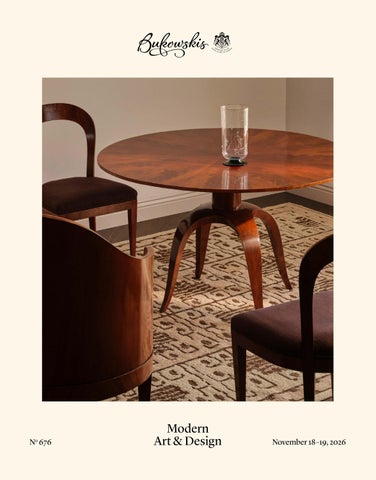
No 676
Modern Art & Design
November 18–19, 2026
Viewing November 12–17 Live auction November 18–19 2026 Wednesday November 18, 10 AM (CET) Glass Ceramics
Lot.no 1 – 45 46 – 157
Furniture and Works of Art
158 – 319
Jewellery
320 – 428
Thursday November 19, 10 AM (CET)
Lot.no
Silver
429 – 546
Carpets and Textiles
547 – 602
1 PM (CET)
Lot.no
Art
603 – 934
Prints
935 – 984
www.bukowskis.com
Glass
1. Axel Enoch Boman (Sweden, 1875–1949) a cameo glass vase, Reijmyre 1908, no. 162. Seascape with etched and polished decoration of jellyfish in purple and blue against a mottled green ground, signed Reijmyre AE Boman 162. Height 15 cm. Provenance: Managing Director Nils (1902–1990) and Alice Sjödal (née Enhörning) (1928–2026). Thence by descent to the present owner.
Estimate: SEK 25 000 – 30 000 / EUR 2 250 – 2 700
2. Alf Wallander (Sweden, 1862–1914) a unique cameo glass bowl, Reijmyre 1910, no. 233. White cameo glass with etched decoration of rose branches with falling leaves against a frosted ground. Signed “DESSIN ALF WALLANDER 10 AE Boman REIJMYRE UNIK No 233”. Height 15 cm, diameter 25,5 cm, mynningen 22 cm. Provenance: Propery from a private collection, Finland (lots 2-15, 17, 41).
Estimate: SEK 25 000 – 30 000 / EUR 2 250 – 2 700
3. Heinrich Wollman (Austria, 1876–1923) a cameo glass vase, Orrefors, 1910s. Etched floral decoration in red and green against a lighter yellowgreen ground, marked Orrefors in the cameo and engraved signature underneath: 1280–4–9 HW. Height 27.3 cm. Estimate: SEK 12 000 – 15 000 / EUR 1 080 – 1 350
4. Orrefors (Sweden, Founded in 1898) an Art Nouveau cameo glass vase, probably ca 1914–15. Purple glass with decoration of violets in green, signed Orrefors on the body. Height 30 cm. Estimate: SEK 4 000 – 6 000 / EUR 360 – 539
5. Edward Hald (Sweden, 1883–1980) An engraved bowl with plate, “Fyrverkeri” (Fireworks), model 248, Orrefors, 1922. Engraved decoration depicting fireworks and figures in a park landscape, the bowl signed Hald 248.22. Orrefors A.D. (engraver Arthur Diessner). Total height including dish 21.3 cm, diameter 27.5 cm, diameter of dish 20.4 cm. Exhibitions: The model was exhibited at the 1925 Exposition Internationale in Paris, at the touring exhibition “Swedish Decorative Arts” at the Metropolitan Museum of Art in New York in 1927, and at the subsequent exhibition in Chicago in 1927.
Estimate: SEK 25 000 – 30 000 / EUR 2 250 – 2 700
6. Simon Gate (Sweden, 1883–1945) an engraved glass bowl with plate, model 122, Orrefors, 1926. Richly engraved decoration of dancing, music-making women, border ornamentation, etc. The bowl is signed ORREFORS S. GATE 122. 1926. E. WEIDLICH. Height of bowl 23 cm, diameter 27.7 cm, diameter of dish 29.3 cm. Estimate: SEK 80 000 – 100 000 / EUR 7 190 – 8 990
7. Simon Gate (Sweden, 1883–1945) an engraved glass bowl with plate, model 128, Orrefors post 1920. Oval bowl with dish, featuring hunting motifs with Diana, dancing women and botanical ornaments, signed Orrefors Gate 128 and with the engraver’s signature. Length 21.5 cm, width 15.7 cm, height including dish 11.7 cm. Literature: Helmut Ricke, Ulrich Gronert, “Glas in Schweden 1915–60”, Prestel Verlag, Munich, 1986, cf. cat. no. 74, p. 83.
Estimate: SEK 6 000 – 8 000 / EUR 539 – 719
8. Simon Gate (Sweden, 1883–1945) an engraved glass bowl with plate, model 147, Orrefors 1958. Oval bowl with engraved stylised decoration depicting female figures with veils, plants and borders, signed Orrefors Gate 147 C6 EÅ (engraver Ernst Åberg). The plate bears a label. Length 37.5 cm, width 23 cm, total height 13 cm, plate length 31.3 cm. Literature: Helmut Ricke, Ulrich Gronert, *Glas in Schweden 1915–1960*. Munich, 1986, cf. catalogue no. 76, p. 84. Helmut Ricke, Lars Thor, *Schwedische Glasmanufakturen, Produktionskataloge 1915–1960*, Prestel-Verlag, Munich, 1987, the drawing illustrated on p. 27.
Estimate: SEK 15 000 – 20 000 / EUR 1 350 – 1 800
9. Edward Hald (Sweden, 1883–1980) an engraved glass bowl with plate “Vine harvesting”, model 410, Orrefors, 1926. Engraved decoration depicting women and children picking grapes among vines, with Bacchus’s head at the base, signed Orrefors. E. Hald. 410. 26. EW (engraver Emil Weidlich). Diameter 28.9 cm, total height 14.6 cm, plate diameter 30.5 cm. Estimate: SEK 18 000 – 20 000 / EUR 1 620 – 1 800
10. Edward Hald (Sweden, 1883–1980) an engraved glass vase “Serenade”, model 510, Orrefors, 1926. Bell-shaped vase with engraved decoration depicting a figural scene, signed Of. H. 510. 26. KR (engraver Karl Rössler). Height 13.2 cm, diameter 10.8 cm. Literature: H. Ricke, U. Gronert “Glass in Sweden 1915–60”, Munich 1986, cf. catalogue no. 115, p. 103.
Estimate: SEK 5 000 – 6 000 / EUR 450 – 539
11. Edward Hald (Sweden, 1883–1980) an engraved lidded glass beaker in the form of a birdcage, Orrefors 1927, model 601. Engraved decoration depicting a cockatoo, signed Of. H. 601–27 GA GA and with a paper label. Height of the beaker 8.2 cm, total height including lid 14 cm. Estimate: SEK 6 000 – 8 000 / EUR 539 – 719
12. Simon Gate (Sweden, 1883–1945) an engraved glass vase, Orrefors 1931, model G1109. Cylindrical, on a black foot, with engraved geometric decoration depicting architectural panels with a mandolin player and a dancer, signed Of. Gate. 1931, K. 1109. Height 26.2 cm, diameter 12.8 cm. Literature: Helmut Ricke, Lars Thor, “Schwedische Glasmanufakturen, Produktionskataloge 1915–1960”, Prestel-Verlag, Munich 1987, p. 78, cf. the model illustrated in Orrefors’ production catalogue, No. 2, March 1932.
Estimate: SEK 20 000 – 30 000 / EUR 1 800 – 2 700
13. Ewald Dahlskog (Sweden, 1894–1950) a clear glass lidded bowl, “Karusell”, Kosta 1926–1929. Cut, stylised decoration depicting various animals with riders, the bowl signed E. Dahlskog Kosta. Total height 37.5 cm, lid diameter 27.7 cm, bowl diameter 27 cm. Literature: H. Ricke, U. Gronert. “Glas in Schweden 1915–60”, catalogue no. 325, the model illustrated across a full page p. 195.
Estimate: SEK 30 000 – 40 000 / EUR 2 700 – 3 600
14. Ewald Dahlskog (Sweden, 1894–1950) a matte cut glass lidded goblet, “Tespis”, Kosta 1926–29. Decoration depicting theatre masques and curtains, signed E. Dahlskog. Kosta. Height 40.3 cm. Estimate: SEK 5 000 – 6 000 / EUR 450 – 539
15. Vicke Lindstrand (Sweden, 1904–1983) a set of two engraved cameo glass vases,, models 1359 and 1263, Orrefors, 1935. Brown overlay glass on a darker foot, the larger vase with engraved decoration depicting a dancer, signed Of. L. 1359. BG (engraver Bertil Gustafsson) A1. Height 21.5 cm. The smaller vase with engraved decoration depicting a seated archer, signed Of. L. 1263. A1. BG (engraver Bertil Gustafsson). Height 11 cm. Estimate: SEK 6 000 – 8 000 / EUR 539 – 719
16. Gerda Strömberg (Sweden, 1879–1960) an engraved glass vase, Eda Glasbruk, 1930, model 3322. Mould-blown grey/yellow-tinted glass, wavy rim, engraved and cut stylised decoration, signed Gerda Strömberg Eda 30. Height 19 cm, diameter 12.9 cm. Literature: H. Ricke, U. Gronert, “Glas in Schweden 1915–60”, Munich 1986, cf. catalogue no. 390, p. 230.
Estimate: SEK 10 000 – 12 000 / EUR 899 – 1 080
17. A 1930’s painted glass beaker, Åfors, after an original by Vicke Lindstrand. Enamel-painted stylised decoration after Vicke Lindstrand’s vase “Ordspråk”, depicting nude female figures representing “see no evil, speak no evil, hear no evil” and plants in black against a matt ground. Height 12 cm, diameter 11.5 cm. Literature: Derek E. Ostergard (ed), ‘The Brilliance of Swedish Glass, 1918–1939, An Alliance of Art and Industry’, compare the original model, no 81, illustrated p 239.
Estimate: SEK 20 000 – 25 000 / EUR 1 800 – 2 250
18. Edward Hald (Sweden, 1883–1980) a “fish graal” glass vase, Orrefors 1938, no. 236. Decorated with fish and aquatic plants in green against clear glass, signed Orrefors Sweden Graal No. 236/38 and signed by Edward Hald. Height 22 cm. Estimate: SEK 30 000 – 40 000 / EUR 2 700 – 3 600 (d)
19. Edward Hald (Sweden, 1883–1980) an early fish graal glass vase, Orrefors, circa 1940. Decorated with fish and aquatic plants in green against clear glass, hand-signed Orrefors Sweden Graal No Edward Hald. Height 21.5 cm, diameter 15 cm. Estimate: SEK 15 000 – 20 000 / EUR 1 350 – 1 800 (d)
20. Vicke Lindstrand (Sweden, 1904–1983) a rare model LU 1910/3 glass vase, Orrefors 1937–38. Thick-walled with an emerald-green underlay with sand, signed Orrefors LU 1910/3. Height 17.4 cm. Estimate: SEK 30 000 – 35 000 / EUR 2 700 – 3 150
21. Edvin Öhrström (Sweden, 1906–1994) an ariel glass vase, no. 149, Orrefors 1939. Spherical, decorated in metallic green, signed E. Öhrström 1939 ORREFORS SWEDEN ARIEL no. 149. Height 16.3 cm, diameter approx. 18.5 cm. Exhibitions: According to a record in the Orrefors archive, exhibited at the NK exhibition in 1939. In the summer of 1939, Orrefors organised a major exhibition at Nordiska Kompaniet in Stockholm in conjunction with the New York World’s Fair. It was the largest exhibition Orrefors had organised to date, with approximately 500 new objects on display.
Estimate: SEK 150 000 – 200 000 / EUR 13 500 – 18 000 (d)
22. Edvin Öhrström (Sweden, 1906–1994) an ariel glass vase Ariel no 792, “Nuit dans les Tropique”, Orrefors, 1949. Decorated with female figures in lighter blue and darker bluish purple against a clear background, signed Orrefors Sweden Ariel no. 741 E. Öhrström. Height 16.7 cm. Literature: Helmut Ricke, Ulrich Gronert, “Glas in Schweden 1915–60”, Prestel Verlag, Munich, 1986, cf. catalogue no. 224, similar vase, Ariel no. 792, illustrated on page 153. See also the drawing for the decoration illustrated from the Orrefors Archives.
Estimate: SEK 50 000 – 75 000 / EUR 4 500 – 6 740 (d)
23. Edvin Öhrström (Sweden, 1906–1994) an ariel glass vase, Orrefors 1950, nr 160E. Ovoid on a low foot, decorated in green and burgundy with women and more, signed ORREFORS SWEDEN ARIEL 160E and probably later inscribed E. ÖHRSTRÖM. Height 18 cm,. Literature: The preparatory sketch for one of the women is held in the archives of Småland Museum. Bukowskis would like to thank Björn Arfvidsson at Kulturparken Småland for this information.
Estimate: SEK 60 000 – 80 000 / EUR 5 390 – 7 190 (d)
24. Ingeborg Lundin (Sweden, 1921–1992) an ariel glass vase “Faces”, Orrefors 1988. Almost square, decorated with faces in shades of green, signed Orrefors 957715 Ingeborg Lundin Ariel Gallery 6–88. Height 17.5 cm. Estimate: SEK 12 000 – 15 000 / EUR 1 080 – 1 350
25. Ingeborg Lundin (Sweden, 1921–1992) “Faces”, an ariel glass vase, Orrefors 1984. Decor of faces against a yellow-green background, signed Orrefors 9057715 Ingeborg Lundin Ariel Gallery 11–84 and label marked. Height 16.5 cm, diameter 13 cm. Provenance: Private Collection, Sweden.
Estimate: SEK 12 000 – 15 000 / EUR 1 080 – 1 350 (d)
26. Eva Englund (Sweden, 1937–1998) “Child of the Sun”, a graal glass vase, Orrefors 1988. Decoration of faces in coral red, dark blue and metallic green, signed Orrefors 977530 Eva Englund EA. 1–88. and handwritten Eva Englund. Height 28.5 cm. Provenance: Sivert Oldenvi Collection. Sivert Oldenvi Collection.
Estimate: SEK 15 000 – 20 000 / EUR 1 350 – 1 800 (d)
27. Ingeborg Lundin (Sweden, 1921–1992) a “Melon” glass vase, Orrefors, post 1959. Blue-grey glass, signed ORREFORS Expo 9–59 Ingeborg Lundin. Height 31 cm. Estimate: SEK 20 000 – 25 000 / EUR 1 800 – 2 250
28. Kaj Franck (Finland, 1911–1989) a “Bells of Kremlin” decanter model KF 501, Nuutajärvi, Notsjö, Finland 1963. Smoke-coloured and blue decanter with striped, polychrome stopper, signed K. Franck Nuutajärvi Notsjö -63 and label marked. Height 35 cm. Estimate: SEK 35 000 – 40 000 / EUR 3 150 – 3 600
29. Helena Tynell (Finland, 1918–2016) a glass bottle, “Solflaskan”, Riihimäen Lasi Oy, Finland, produced 1964–74. Mould-blown blue-green glass, label marked Finncristall. Height 32 cm. Estimate: SEK 15 000 – 20 000 / EUR 1 350 – 1 800
30. Tapio Wirkkala (Finland, 1915–1985) a glass sculpture, “Tokio”, Iittala, Finland 1955. Clear, steam-blown crystal glass, signed TAPIO WIRKKALA IITTALA -55. Height 19.5 cm, diameter 9.7 cm. Estimate: SEK 15 000 – 18 000 / EUR 1 350 – 1 620
31. Gunnar Cyrén (Sweden, 1931–2013) a pair of “Rosendal” glass and silver candlesticks, Orrefors 1992, ed. 6–10. Cut clear crystal glass with candle sleeves and silver deer heads, signed Cyrén Orrefors Gallery -92 986972 Gunnar Cyrén 6–10, label marked. Height 27,5 cm. Estimate: SEK 25 000 – 30 000 / EUR 2 250 – 2 700 (d)
32. Bertil Vallien (Sweden, 1938) an etched cameo glass plate, Kosta, unique. Etched decoration depicting a seated woman among peacocks, signed B. Vallien with signature, Kosta Unik B.35 305849035. Diameter 43 cm, height 8.5 cm. Estimate: SEK 6 000 – 8 000 / EUR 539 – 719 (d)
32A. Daum Frères, an Art Nouveau cameo glass vase, Nancy, France. Etched and painted decoration of poppy flowers against a yellow and orange mottled ground, signed in the cameo DAUM NANCY with the Cross of Lorraine. Height 12.5 cm. Estimate: SEK 12 000 – 15 000 / EUR 1 080 – 1 350
33. Daum Frères (France, Founded in 1878) a set of two Art Nouveau cameo glass vases, Nancy, France. Rhomboid shape, one decorated with fuchsia in red, violet, and green against a frosted white and violet background, the other decorated with columbines of in red and green against a frosted yellow-toned background, both signed DAUM NANCY and with the cross of Lorraine. Height 11.5 cm and 11 cm. Estimate: SEK 8 000 – 10 000 / EUR 719 – 899
34. Daum Frères (France, Founded in 1878) a set of two Art Nouveau cameo glass vases, Nancy, France. Etched decoration of sweet peas in pink and green against a frosted background in white and yellow, signed DAUM NANCY with the cross of Lorraine. Height 21.5 and 10.5 cm. Estimate: SEK 8 000 – 10 000 / EUR 719 – 899
35. Daum Frères (France, Founded in 1878) an Art Nouveau cameo glass vase, Nancy, France. Decoration of cypripediae in red, reddish-brown, and green against a matte yellow and burgundy background, signed DAUM NANCY with the cross of Lorraine. Height 22 cm. Estimate: SEK 6 000 – 8 000 / EUR 539 – 719
36. Daum Frères (France, Founded in 1878) a set of two Art Nouveau cameo glass vases, Nancy, France. Almost square shape, the one with a decoration of bleeding hearts with leaves in orange-red and green against an iridescent background in pinkish tones, the other with a decoration of mimosa with leaves in yellow and green against an orange and brown background, both signed DAUM NANCY with the cross of Lorraine. Height 12 cm and 9.5 cm. Estimate: SEK 4 000 – 6 000 / EUR 360 – 539
37. Daum Frères (France, Founded in 1878) an Art Nouveau cameo glass vase, Nancy, France, ca 1900. Almost round with an oval boat-shaped mouth, marbled glass with etched and enamel-painted decoration of clematis in violet, green and yellow, signed DAUM NANCY FRANCE with the cross of Lorraine. Height 13.5 cm. Estimate: SEK 4 000 – 6 000 / EUR 360 – 539
38. Emile Gallé (France, 1846–1904) an Art Nouveau ‘Soufflé’ mold-blown cameo glass vase, “Prunes”, Nancy, France. Plum decoration with foliage in blue and green against a matt yellow ground, signed Gallé on the body. Height 32.5 cm. Provenance: Direktör Bernhard Johansson (1870–1950) därefter i arv till nuvarande ägare.
Estimate: SEK 30 000 – 50 000 / EUR 2 700 – 4 500
39. Etablissements Gallé (1904–1936), a cameo glass table lamp in the so-called mushroom shape, Nancy, France. Etched decoration of flowering branches in reddish brown and pinkish red against a yellow frosted ground. The foot and shade signed Gallé in the cameo. Brass mount for two light points. Height 41 cm, diameter of the shade 26.5 cm. Provenance: Bukowskis Modern Auction 511, spring 1999, catalogue no. 943, from the Löfberg Collection, Malmö.
Estimate: SEK 50 000 – 60 000 / EUR 4 500 – 5 390
40. Johann Loetz (Austria, 1880–1940) an Art Nouveau “Boule Boule” glass vase, Austria, early 1900s. Iridescent glass, three nearly cylindrical vases with a decoration of balls on a circular base. Height 14.5 cm, diameter of the base 10.5 cm. Estimate: SEK 8 000 – 10 000 / EUR 719 – 899
41. Le Verre Francais, a cameo glass “Scarabée” vase, France, Art Deco. Etched decoration in reddish brown against an orangey-yellow ground, signed Le verre Francais. Height 41.2 cm. Estimate: SEK 10 000 – 12 000 / EUR 899 – 1 080
42. René Lalique (France, 1860–1945) an “Archers” moulded glass vase, France, 1920s-30s, model no. 893. Lightly grey-tinted glass, partially patinated reddish-brown, decorated with archers and birds, marked R. LALIQUE. Height 26.5 cm. Provenance: The family of business leader and financier Axel Wenner-Gren (1881–1961). Literature: Félix Marcilhac, *R. Lalique, Catalogue raisonné de l’oeuvre de verre*, Les Éditions de l’Amateur, Paris, 1994, the model illustrated on p. 415, no. 893.
Estimate: SEK 30 000 – 50 000 / EUR 2 700 – 4 500
43. René Lalique (France, 1860–1945) an “Esterel” mould-blown glass vase, France, 1920s–30s. Leaf decoration with a matt finish and reddish-brown patination, marked R LALIQUE. Height 15.5 cm, diameter 16 cm. Literature: Félix Marcilhac, “R. Lalique, Catalogue raisonné de l’oeuvre de verre”, Les éditions de l’amateur, Paris 1994, the model illustrated on p. 426, no. 941.
Estimate: SEK 5 000 – 7 000 / EUR 450 – 629
44. Paolo Venini (Italy, 1895–1959) a sapphire blue bottle with stopper, “Mezza Filigrana”, Venini Murano. Italy, 1950s. The body with a band of red filigree decoration, acid etched signature “venini murano ITALIA”. Height including stopper 35.5 cm. The model was first introduced at the 1956 Venice Biennale. Estimate: SEK 12 000 – 15 000 / EUR 1 080 – 1 350
45. Alessandro Pianon (Italy, 1931–1984) “Pulcino” a glass sculpture of a bird, Vetreria Vistosi, Murano, Italy, 1960s. Orange glass paste, murrine eyes, copper leg stand. Height 21 cm. Estimate: SEK 30 000 – 40 000 / EUR 2 700 – 3 600
45A. Kiki Kogelnik “Penny Round Head”, a glass sculpture, Berengo Studio, Murano, Venice, circa 1995. Green-tinted glass with dots in red, yellow, blue and black, on a darker base, signed K.K.S (Special). Height 37 cm. Estimate: SEK 200 000 – 250 000 SEK / EUR 18 200 – 22 700 (d)
45B. Kiki Kogelnik, a “Celestial Head” glass sculpture from the “Balloon” series, Berengo Studio, Venice, 1996, ed. 1/10. Head in milk-white glass with red-orange details, on a clear glass foot, placed on a tall concave red-orange plinth. The head signed K.K. 1/10. Total height 70 cm. Estimate: SEK 200 000 – 250 000 SEK / EUR 18 200 – 22 700 (d)
Ceramics
46. Hilma Persson-Hjelm (Sweden, 1877–1953) a glazed earthenware Art Nouveau vase, executed in her own studio, Arvika 1911. No 1677. Relief decoration of two crabs among waves, glaze in shades of green and blue, signed HP 1911 1677-. Height 31.2 cm. Provenance: Private Collection, Sweden.
Estimate: SEK 20 000 – 25 000 / EUR 1 800 – 2 250
47. Hilma Persson-Hjelm (Sweden, 1877–1953) vase, glazed earthenware, own studio, Arvika 1920. No. 1711. Relief decoration of two butterflies, matte glaze in blue and turquoise, signed HP 1920 7711. Height 23.3 cm. Provenance: Private Collection, Sweden.
Estimate: SEK 8 000 – 10 000 / EUR 719 – 899
48. Hilma Persson-Hjelm (Sweden, 1877–1953) a glazed earthenware Art Nouveau vase, executed in her own studio, Arvika 1919, no. 6668. Relief decoration of stylised leaves, glaze in green and blue, signed HP 1919 6668. Height 21.5 cm. Provenance: Private Collection, Sweden.
Estimate: SEK 5 000 – 7 000 / EUR 450 – 629
49. Hilma Persson-Hjelm (Sweden, 1877–1953) a glazed earthenware vase, executed in the artist’s studio, Arvika 1917, no 4745. Mouth with relief decoration of hepatica leaves in green against blue and reddish brown, signed HP. 1917. 4745. Height 18.6 cm. Provenance: The artist Hilma Persson-Hjelm, thence by descent within the artist’s family.
Estimate: SEK 8 000 – 10 000 / EUR 719 – 899
50. Hilma Persson-Hjelm (Sweden, 1877–1953) a glazed earthenware Art Nouveau vase, executed in her own studio, Arvika 1918, no. 5873. Relief decoration of three medallions with crossed branches of birch with pendants, matte glaze in blue and turquoise, signed HP 1918 5873. Height 16.5 cm. Provenance: Private Collection, Sweden.
Estimate: SEK 8 000 – 10 000 / EUR 719 – 899
51. Hilma Persson-Hjelm (Sweden, 1877–1953) a glazed eartheware Art Nouveau vase, executed in her own studio, Arvika, 1911. No 1402. Engraved decoration of roses in white and green against a black ground, signed HP 1911 1402. Height 26 cm, diameter 19 cm. Provenance: Private Collection, Sweden.
Estimate: SEK 8 000 – 10 000 / EUR 719 – 899
52. Hilma Persson-Hjelm (Sweden, 1877–1953) a glazed earthenware Art Nouveau vase, executed in her own studio, Arvika 1908, no. 544. Stylised leaf decoration, green and brown glaze, signed HP 1908 544. Height 22.2 cm. Provenance: Private Collection, Sweden.
Estimate: SEK 6 000 – 8 000 / EUR 539 – 719
53. Hilma Persson-Hjelm (Sweden, 1877–1953) a glazed earthenware Art Nouveau vase, executed in her own studio, Arvika 1908, no. 539. Relief decoration of spruce sprays, pierced mouth, three small handles, glaze in brown and green, signed HP 1908 539. Height 21.8 cm. Provenance: Private Collection, Sweden.
Estimate: SEK 6 000 – 8 000 / EUR 539 – 719
54. Hilma Persson-Hjelm (Sweden, 1877–1953) two glazed earthenware vases, executed in her own studio, Arvika 1908 and 1913. Relief decoration of butterflies, glaze in orange/brown and blue, signed HP 1908 582 and HP 1913 2298. Height 16.5 and 18 cm. Provenance: Private Collection, Sweden.
Estimate: SEK 8 000 – 10 000 / EUR 719 – 899
55. Hilma Persson-Hjelm (Sweden, 1877–1953) two glazed earthenware Art Nouveau vases, executed in her own studio, Arvika 1908–1909, no. 256 and 798. Relief decoration of stylised leaf stems and pine tufts with cones, glaze in green and brown, signed 256 HP 1908 and HP 1909 798. Height 21 and 31.8 cm. Provenance: Private Collection, Sweden.
Estimate: SEK 8 000 – 10 000 / EUR 719 – 899
56. Hilma Persson-Hjelm (Sweden, 1877–1953) two glazed earthenware Art Nouveau vases, executed in her own studio, Arvika 1916 and 1918. No. 4441 and 5718. Relief decoration of branches in dark green against a straw-yellow background, signed HP 1916 4441 and HP 1918 5718. Height 27 and 19 cm. Provenance: Private Collection, Sweden.
Estimate: SEK 10 000 – 12 000 / EUR 899 – 1 080
57. Hilma Persson-Hjelm (Sweden, 1877–1953) a glazed earthenware lidded jar, executed in the artist’s studio in Arvika 1930, no. 9077. Knob in the form of a mother with child, green glaze, internally metallic shimmering black glaze, signed HP 9077 1930. Height 15 cm, diameter 14 cm. Provenance: Private Collection, Sweden.
Estimate: SEK 3 000 – 4 000 / EUR 270 – 360
58. Hilma Persson-Hjelm (Sweden, 1877–1953) two glazed earthenware Art Nouveau lidded bowls, executed in the artist’s studio, Arvika 1914, no. 2624. Relief decoration of leaves in green and various shades of blue, signed HP 1914 3135 and HP 1914 2624. Height 9 cm, diameter 14.5 cm and height 11.5 cm, diameter 14 cm. Provenance: Private Collection, Sweden.
Estimate: SEK 6 000 – 8 000 / EUR 539 – 719
59. Gunnar G:son Wennerberg (Sweden, 1863–1914) an earthenware vase, Gustavsberg, 1908. Painted daisy decoration against a green ground, signed Gustafsberg 1908 G Wennerberg. Height 26.3 cm. Estimate: SEK 4 000 – 6 000 / EUR 360 – 539
60. Wilhelm Kåge (Sweden, 1889–1960) two stoneware vases, Gustavsberg, 1930s. Glazed in dark brown and yellow, signed GUSTAVSBERG KÅGE with the anchor mark. Height 16 and 16.7 cm. Provenance: According to label, purchased at Nordén auktioner, after Wilhelm Kåge, Stockholm, Kåge 7/443.
Estimate: SEK 6 000 – 8 000 / EUR 539 – 719 (d)
61. Wilhelm Kåge (Sweden, 1889–1960) a Farsta stoneware vase, Gustavsberg, 1940. Relief decoration of pressed stars, turquoise-blue glaze, signed GUSTAVSBERG FARSTA KÅGE with the anchor mark and year letter j. Height 22.5 cm. Estimate: SEK 12 000 – 15 000 / EUR 1 080 – 1 350 (d)
62. Wilhelm Kåge (Sweden, 1889–1960) a Farsta stoneware vase, Gustavsberg Studio, 1953. Globular on a foot, lobed rim, incised band decoration, glaze in blue, green and yellow, signed KÅGE with the studio mark and year letter x, as well as FARSTA. Height 13.2 cm. Estimate: SEK 12 000 – 15 000 / EUR 1 080 – 1 350 (d)
63. Wilhelm Kåge (Sweden, 1889–1960) a Farsta stoneware vase, Gustavsberg Studio, 1950. Cylindrical with geometric relief decoration, brown and yellow glaze, signed KÅGE FARSTA with the studio mark GUSTAVSBERG and year letter T. Height 12 cm, diameter 9.5 cm. Estimate: SEK 12 000 – 15 000 / EUR 1 080 – 1 350 (d)
64. Wilhelm Kåge (Sweden, 1889–1960) a Farsta stoneware vase, Gustavsberg Studio 1958. Cylindrical on five feet, incised decoration of vertical stripes, brown and strawyellow glaze, signed FARSTA and KÅGE with the studio stamp. Height 19.5 cm. Estimate: SEK 15 000 – 20 000 / EUR 1 350 – 1 800 (d)
65. Wilhelm Kåge (Sweden, 1889–1960) a Farsta stoneware vase, Gustavsberg Studio 1950. Relief decoration of stylised leaves, blue glaze, signed KÅGE FARSTA with the studio mark GUSTAVSBERG and year letter T. Height 20.2 cm. Estimate: SEK 10 000 – 12 000 / EUR 899 – 1 080 (d)
66. Wilhelm Kåge (Sweden, 1889–1960) a Farsta stoneware vase, Gustavsberg 1940. Relief decoration of dots, blue glaze, signed GUSTAVSBERG KÅGE with anchor mark, year letter J and FARSTA. Height 22 cm, diameter approx. 28.5 cm. Estimate: SEK 20 000 – 30 000 / EUR 1 800 – 2 700 (d)
67. Wilhelm Kåge (Sweden, 1889–1960) a Farsta stoneware vase, Gustavsberg Studio 1956. Bottle-shaped, glazed in dark green, brown and yellow hues with incised vertical stripes, signed with the GUSTAVSBERG studio mark KÅGE FARSTA R. Height 34.5 cm. Estimate: SEK 30 000 – 40 000 / EUR 2 700 – 3 600 (d)
68. Wilhelm Kåge (Sweden, 1889–1960) a Farsta stoneware sculpture of a “dragon fish”, Gustavsberg Studio, 1953. Slightly S-shaped, partially openwork back with incised and impressed decoration, glazed in shades of brown and beige, signed FARSTA KÅGE with the GUSTAVSBERG studio mark and year letter X. Length 61 cm. Estimate: SEK 80 000 – 100 000 / EUR 7 190 – 8 990 (d)
69. Wilhelm Kåge (Sweden, 1889–1960) a stoneware sculpture of a dragon puppy, Gustavsberg Sweden 1939. Recumbent puppy biting its tail, glazed in shades of yellow, with the stamped signature KÅGE GUSTAVSBERG i, and the anchor mark. Length 33 cm, height 25.5 cm. Estimate: SEK 40 000 – 50 000 / EUR 3 600 – 4 500 (d)
70. Wilhelm Kåge (Sweden, 1889–1960) a stoneware figure of a dragon mother, Gustavsberg, c. 1940. Reclining dragon mother, green and reddish-brown glaze, stamped with the anchor mark GUSTAVSBERG KÅGE 6. Height 11 cm, length 25.5 cm. Estimate: SEK 20 000 – 25 000 / EUR 1 800 – 2 250 (d)
71. Wilhelm Kåge (Sweden, 1889–1960) a stoneware sculpture of a dragon mother, Gustavsberg 1939. Reclining dragon mother, mottled beige and brown glaze, stamped KÅGE GUSTAVSBERG and with the anchor mark 1939. Length 25 cm. Estimate: SEK 15 000 – 20 000 / EUR 1 350 – 1 800 (d)
72. Wilhelm Kåge (Sweden, 1889–1960) a stoneware figure of a dragon puppy, Gustavsberg, circa 1940. White glaze, stamped with the anchor mark GUSTAVSBERG KÅGE 9. Height 10 cm, length 15.5 cm. Estimate: SEK 15 000 – 20 000 / EUR 1 350 – 1 800 (d)
73. Wilhelm Kåge (Sweden, 1889–1960) an “Argenta” stoneware vase, Gustavsberg, 1933. Green glaze with silver-painted band decoration, signed HANDDREJAD GUSTAVSBERG with anchor mark and year letter c, KÅGE 1045. Height 22.8 cm. Estimate: SEK 8 000 – 10 000 / EUR 719 – 899
74. Wilhelm Kåge (Sweden, 1889–1960) an Argenta stoneware vase, Gustavsberg 1939. Green glaze with painted silver decoration depicting a winding snake, stamped HANDDREJAD GUSTAVSBERG with anchor mark, KÅGE and ARGENTA 929, with the painter’s signature EL in silver. Height 20.3 cm. Estimate: SEK 8 000 – 10 000 / EUR 719 – 899
75. Wilhelm Kåge (Sweden, 1889–1960) a stoneware “Argenta” vase, Gustavsberg 1941. Spherical with a short neck, green-glazed with painted silver decoration depicting Näcken with his lute among waves, signed HANDDREJAD GUSTAVSBERG ARGENTA KÅGE 1042 III K and painter’s signum. Height 20 cm. Estimate: SEK 8 000 – 10 000 / EUR 719 – 899
76. Berndt Friberg (Sweden, 1899–1981) a stoneware vase, Gustavsberg Studio 1961. Globular with hare’s fur glaze in blue and hints of brown, signed Friberg with the studio mark and year letter c. Height 22.5 cm. Estimate: SEK 10 000 – 12 000 / EUR 899 – 1 080 (d)
77. Berndt Friberg (Sweden, 1899–1981) a stoneware vase, Gustavsberg Studio 1962. Hare’s fur glaze in blue and some brown, signed Friberg with the studio mark and dated 1962. Height 25 cm, diameter 29 cm. Estimate: SEK 18 000 – 20 000 / EUR 1 620 – 1 800 (d)
78. Berndt Friberg (Sweden, 1899–1981) a set of four miniature stoneware vases and a bowl, Gustavsberg Studio 1958–65. Blue hare’s fur glaze, signed Friberg with the studio mark and various year letters. Height 5–12 cm. Provenance: Private Collection, Sweden.
Estimate: SEK 8 000 – 10 000 / EUR 719 – 899 (d)
79. Berndt Friberg (Sweden, 1899–1981) a set of four stoneware vases and a bowl, Gustavsberg Studio 1955–70. Hare’s fur glaze in green, beige, brown, and yellow, signed Friberg with the studio mark and various year letters. Height 6.5–21.5 cm. Provenance: Private Collection, Sweden.
Estimate: SEK 10 000 – 12 000 / EUR 899 – 1 080 (d)
80. Berndt Friberg (Sweden, 1899–1981) a hare’s fur stoneware vase, Gustavsberg’s Studio, Sweden 1966. Glaze in yellow hues, signed with the studio hand Friberg H. Height 11 cm. Estimate: SEK 8 000 – 10 000 / EUR 719 – 899 (d)
81. Berndt Friberg (Sweden, 1899–1981) an set of seven stoneware vases and two bowls, Gustavsberg Studio, 1956–68. Hare’s fur glazes in various yellow and light brown shades, signed Friberg with the studio mark and different year letters. Height 2.3–15.5 cm. Estimate: SEK 15 000 – 18 000 / EUR 1 350 – 1 620 (d)
82. Berndt Friberg (Sweden, 1899–1981) a stoneware vase, Gustavsberg Studio, 1971. Globular with hare’s fur glaze in celadon green and brown, signed Friberg with the studio mark and year letter M. Height 11 cm. Estimate: SEK 8 000 – 10 000 / EUR 719 – 899 (d)
83. Berndt Friberg (Sweden, 1899–1981) a stoneware vase, Gustavsberg Studio, 1966. Brown hare’s-fur glaze, signed Friberg with the studio mark and year letter H. Height 36.2 cm. Estimate: SEK 12 000 – 15 000 / EUR 1 080 – 1 350 (d)
84. Berndt Friberg (Sweden, 1899–1981) a set of seven stoneware vases, and two bowls, Gustavsberg Studio, 1944–60. Various hare’s-fur glazes in blue, green and some brown, signed Friberg with the studio mark and various year letters. The vases are 5–17.3 cm in height, the bowls measure 10.3 x 9.5 cm and 11.2 cm in diameter. Estimate: SEK 15 000 – 20 000 / EUR 1 350 – 1 800 (d)
85. Berndt Friberg (Sweden, 1899–1981) a stoneware vase, Gustavsberg Studio 1973. Glossy glaze in burgundy and green, signed Friberg with the studio mark 1973. Height 30 cm. Estimate: SEK 15 000 – 20 000 / EUR 1 350 – 1 800 (d)
86. Berndt Friberg (Sweden, 1899–1981) a set of five stoneware vases, Gustavsberg Studio 1964–72. Glossy glazes in burgundy, green, and aniara, signed Friberg with the studio mark and various year letters. Height 5.5–15 cm. Provenance: Private Collection, Sweden.
Estimate: SEK 8 000 – 10 000 / EUR 719 – 899 (d)
87. Berndt Friberg (Sweden, 1899–1981) a set of six stoneware vases, two bowls and a dish, Gustavsberg Studio, 1960s–70s. Glossy glazes in burgundy, green and aniara, as well as hare’s-fur glazes in beige and brown. Signed Friberg with the studio mark and various year letters. Height 2–16 cm, diameter of the dish 17 cm. Estimate: SEK 10 000 – 12 000 / EUR 899 – 1 080 (d)
88. Stig Lindberg (Sweden, 1916–1982) a stoneware vase, Gustavsberg Studio 1960. Round bowl on a tall conical foot, grey-white glaze, signed Stig L with the studio mark. Height 20.7 cm. Estimate: SEK 5 000 – 6 000 / EUR 450 – 539 (d)
89. Stig Lindberg (Sweden, 1916–1982) a stoneware vase, Gustavsberg Studio 1966. Pressed geometric decoration, glazed in blue and turquoise/green, signed Stig L with the studio mark. Height 24 cm. Estimate: SEK 10 000 – 15 000 / EUR 899 – 1 350 (d)
90. Stig Lindberg (Sweden, 1916–1982) a group of four stoneware vases, a teapot and a bowl, Gustavsberg Studio, 1958–69. Pressed chequered decoration, the teapot with a beaded band in relief, handle in wood and brass, turquoise/blue glaze, signed Stig L with the studio mark. Height 4–15.5 cm, height of the teapot 19.5 cm including the handle. Estimate: SEK 15 000 – 20 000 / EUR 1 350 – 1 800 (d)
91. Stig Lindberg (Sweden, 1916–1982) a stoneware floor vase, Gustavsberg Studio, 1966. Impressed checkered relief decoration, turquoise-blue glaze, signed Stig L with the studio mark. Height 47 cm, diameter at the base 28.3 cm. Estimate: SEK 20 000 – 25 000 / EUR 1 800 – 2 250 (d)
92. Lisa Larson (Sweden, 1931–2024) a unique stoneware sculpture, Gustavsberg Studio, circa 1960. Mother figure with five children, partially glazed in brown and beige with incised details, signed LISA LARSON with the studio mark SWEDEN. Height 29 cm. Estimate: SEK 30 000 – 40 000 / EUR 2 700 – 3 600 (d)
93. Lisa Larson (Sweden, 1931–2024) Unique sculpture, stoneware, Gustavsberg, circa 1960. Mother-and-child figure, partially glazed in blue, dark green and yellow with incised details, signed LISA LARSON. Height 17.5 cm. Estimate: SEK 20 000 – 25 000 / EUR 1 800 – 2 250 (d)
94. Anders Bruno Liljefors (Sweden, 1923–1970) a stonneware vase, Gustavsberg Studio Sweden 1953. Bulbous with a short neck, carved and incised decoration in shades of brown and grey, signed with the studio hand A.B.L. X. Height 12 cm. Estimate: SEK 4 000 – 6 000 / EUR 360 – 539 (d)
95. Anders Bruno Liljefors (Sweden, 1923–1970) a vase and two stoneware bowls, Gustavsberg Studio Sweden 1952 1953. Glazed in grey, incised with decoration in dark blue, brown and turquoise, signed with the studio mark A.B.L. and X and V (vase). Vase height 7.5 cm, bowls 6–7 cm. Estimate: SEK 4 000 – 6 000 / EUR 360 – 539 (d)
96. Edgar Böckman (Sweden, 1890–1981) a stoneware vase, executed in his own workshop, Sweden 1930s-40s. Relief decoration of white-glazed vertical stripes, signed EB. Height 25 cm. Literature: Åke Stavenow (ed.), Svenska Slöjdföreningens Tidskrift, FORM, 1938, no. 9, see the model illustrated on page 29.
Estimate: SEK 6 000 – 8 000 / EUR 539 – 719 (d)
97. Edgar Böckman (Sweden, 1890–1981) two stoneware vases, executed in his own workshop 1930s-40s. Relief decoration of white-glazed vertical stripes, signed EB. Height 14 and 20.5 cm. Estimate: SEK 6 000 – 8 000 / EUR 539 – 719 (d)
98. Edgar Böckman (Sweden, 1890–1981) two stoneware vases, execured in his own workshop, 1930s-40s. Relief decoration of vertical white-glazed stripes, signed EB. Heights 20 and 25 cm. Estimate: SEK 6 000 – 8 000 / EUR 539 – 719 (d)
99. Edgar Böckman (Sweden, 1890–1981) a stoneware vase and bowl, executed in his own workshop, 1930s–40s. Relief decoration of white-glazed vertical stripes, signed EB. Heights 21.5 and 11.5 cm, bowl diameter 18.5 cm. Estimate: SEK 6 000 – 8 000 / EUR 539 – 719
100. Ewald Dahlskog (Sweden, 1894–1950) a spherical faience vase model D9/176, Bo Fajans, Gävle, Sweden, 1937–1943. Glazed in black and red, decor no 604, with painted signature MADE IN SWEDEN BO D9/176 E.D X. and stamped BO GÄVLE SWEDEN. Height 25 cm. Estimate: SEK 12 000 – 15 000 / EUR 1 080 – 1 350
101. Ewald Dahlskog (Sweden, 1894–1950) a spherical faience vase model D9/3, Bo Fajans Gävle, Sweden, 1930–1943. Spherical, glazed in nuances of brown, signed in the material Bo D9/3 E.D and painted: Iron. Height 25 cm. Estimate: SEK 10 000 – 12 000 / EUR 899 – 1 080
102. Ewald Dahlskog (Sweden, 1894–1950) a spherical faience vase model D9/1, Bo Fajans, Gävle, Sweden, 1930–1943. Glazed in brown shades, signed to the ceramics Bo D9/1 E.D and painted: iron. Height 16 cm. Estimate: SEK 6 000 – 8 000 / EUR 539 – 719
103. Ewald Dahlskog (Sweden, 1894–1950) , a spherical faience vase, model D9/2, Bo Fajans, Gävle, 1930–43. Glazed in blue-grey hues, signed in the body: ED Bo D9/2, with the maker’s mark and TURKOS. Height 19.5 cm. Estimate: SEK 12 000 – 15 000 / EUR 1 080 – 1 350
104. Gertrud Lönegren (Sweden, 1905–1970) a stoneware vase, Rörstrand, 1930s–40s. Fluted relief decoration, glaze in yellow, brown and beige, stamped RÖRSTRAND HANDDREJAD L125 LÖNEGREN. Height 22 cm, diameter 22.5 cm. Estimate: SEK 10 000 – 12 000 / EUR 899 – 1 080
105. Gertrud Lönegren (Sweden, 1905–1970) a stoneware vase and a dish, Rörstrand, 1930s–40s. Fluted decoration, glaze in yellow, brown and beige, stamped RÖRSTRAND HANDDREJAD L166 LÖNEGREN and Rörstrand LÖNEGREN L169. Height 18.5 cm, diameter of the dish 28.5 cm. Estimate: SEK 6 000 – 8 000 / EUR 539 – 719
106. Gertrud Lönegren (Sweden, 1905–1970) a stoneware vase, Rörstrand, 1930s–40s. Incised decoration of fish among aquatic plants, glazed in yellow, brown and beige, stamped RÖRSTRAND LÖNEGREN SWEDEN L250 HANDDREJAD. Height 27.5 cm. Estimate: SEK 6 000 – 8 000 / EUR 539 – 719 (d)
107. Gertrud Lönegren (Sweden, 1905–1970) a set of three stoneware vases, Rörstrand 1930s-40s. Incised decoration of fish among aquatic plants, glazed in yellow, brown and beige, stamped RÖRSTRAND HANDDREJAD and with various model numbers, L251 and L252; two also stamped LÖNEGREN SWEDEN. Heights 17.8, 18.7 and 20.3 cm. Estimate: SEK 6 000 – 8 000 / EUR 539 – 719
108. Carl-Harry Stålhane (Sweden, 1920-1990) a unique stoneware vase, Rörstrand 1957. White hare’s fur glaze, signed R CH Stålhane -57 SWEDEN M109. Height 31.4 cm. Estimate: SEK 10 000 – 12 000 / EUR 899 – 1 080
109. Carl-Harry Stålhane (Sweden, 1920-1990) a unique stoneware vase, Rörstrand 1949. Speckled eggshell-coloured “mimosa” glaze, signed R CH Stålhane -49 and incised no. 145. Height 29.8 cm. Estimate: SEK 6 000 – 8 000 / EUR 539 – 719 (d)
110. Åke Holm (Sweden, 1900–1980) “Abraham”, a stoneware sculpture, Höganäs, 1950s. Glaze in shades of brown and green, signed ÅKE Holm. Height 46.5 cm. Literature: Ronny Rudolf & Rolf Lindstrup, “ÅKE Holm – Keramiker och skulptör”, Hässleholm 2016, cf. similar sculpture, ill. p. 126.
Estimate: SEK 18 000 – 20 000 / EUR 1 620 – 1 800 (d)
111. Åke Holm (Sweden, 1900–1980) “Jeremia”, a stoneware sculpture, Höganäs, 1950s. Glaze in shades of brown and green, signed ÅKE Holm. Height 24.5 cm. Literature: Ronny Rudolf & Rolf Lindstrup, “ÅKE Holm – Keramiker och skulptör”, Hässleholm 2016, cf. similar sculpture, illustrated on p. 153.
Estimate: SEK 10 000 – 12 000 / EUR 899 – 1 080 (d)
112. Tyra Lundgren (Sweden, 1897–1979) a chamotte stoneware sculpture of a bird, Bredkvie, Gotland, 1960s–70s. Glaze in red, yellow, blue and white, signed B TL and indistinctly dated. Height 12.5 cm, length approx. 15.5 cm, width approx. 11.5 cm. Estimate: SEK 8 000 – 10 000 / EUR 719 – 899 (d)
113. Hans Hedberg (Sweden/France, 1917–2007) a faience sculpture of a pumpkin, Biot, France. Speckled glaze in orange, grey, black and hints of green, signed HHg. Height 21 cm, diameter approx. 35 cm. Provenance: Gallery 92, Frösön, Östersund. Private collection, acquired from the above.
Estimate: SEK 60 000 – 80 000 / EUR 5 390 – 7 190 (d)
114. Hans Hedberg (Sweden/France, 1917–2007) a faience sculpture of an apple, Biot France. Glazed in red with dots of green, signed HHg. Height 11.5 cm. Estimate: SEK 30 000 – 35 000 / EUR 2 700 – 3 150 (d)
115. Hans Hedberg (Sweden/France, 1917–2007) a faience sculpture of an apple, Biot France. Red and green speckled glaze, signed HHg. Height 12 cm. Estimate: SEK 20 000 – 30 000 / EUR 1 800 – 2 700 (d)
116. Hans Hedberg (Sweden/France, 1917–2007) a faience sculpture of a bunch of grapes, Biot, France. Blue-glazed grapes on a green branch, signed HHg. Length 26 cm, height 13.8 cm. Estimate: SEK 40 000 – 50 000 / EUR 3 600 – 4 500 (d)
117. Hans Hedberg (Sweden/France, 1917–2007) a large faience sculpture of a sponge, Biot, France. Mottled glaze in green and beige, mounted on a rubber ring, signed HHg. Height approx. 53 cm. Estimate: SEK 175 000 - 200 000 / EUR 15 700 – 18 000 (d)
118. Hans Hedberg (Sweden/France, 1917–2007) a faience tray, Biot France. Rectangular, four conical feet, glazed in turquoise, signed HHg. 48 x 33 cm. Estimate: SEK 15 000 – 20 000 / EUR 1 350 – 1 800 (d)
119. Hans Hedberg (Sweden/France, 1917–2007) a faience vase, Biot, France, ca 1962. Speckled glaze in red, green and turquoise, signed HHg. Height 44.6 cm. Estimate: SEK 8 000 – 10 000 / EUR 719– 898 (d)
120. Hans Hedberg (Sweden/France, 1917–2007) a monumental faience sculpture of a lemon, Biot, France. Yellow and green glaze, signed HHg. Height, diameter approx. 52 cm, length approx. 88 cm, total height including the plexiglass stand approx. 55 cm. Estimate: SEK 350 000 – 400 000 / EUR 31 500 – 36 000 (d)
121. Hans Hedberg (Sweden/France, 1917–2007) a faience sculpture of an egg, Biot, France. Mottled glaze in pink-red shades with some green, signed Hhg. Height including the three-legged iron stand 16 cm. Estimate: SEK 12 000 – 15 000 / EUR 1 080 – 1 350 (d)
122. Hans Hedberg (Sweden/France, 1917–2007) a faience sculpture of an egg, Biot, France. Mottled glaze in apricot/pink and beige/green, signed HHg. Height 15 cm, including the three-part black-painted metal stand. Estimate: SEK 8 000 – 10 000 / EUR 719 – 899 (d)
123. Hans Hedberg (Sweden/France, 1917–2007) a faience sculpture of an egg, two-part, Biot, France, in original box. Mottled glaze in green, turquoise glaze to the interior, signed HHg. Height 19.5 cm, including a three-part black-painted metal stand. Original wooden box, signed HHg, 21.5 x 22 cm, height 19.5 cm. Provenance: A gift by the artist to the present owner.
Estimate: SEK 8 000 – 10 000 / EUR 719 – 899 (d)
124. Hans Hedberg (Sweden/France, 1917–2007) a faience sculpture of an apple, Biot, France. Green speckled glaze, signed HHg. Height 21.5 cm. Estimate: SEK 15 000 – 20 000 / EUR 1 350 – 1 800 (d)
125. Hans Hedberg (Sweden/France, 1917–2007) a faience sculpture of an apple, Biot, France. Red mottled glaze with touches of green, signed HHg. Height 11.5 cm. Estimate: SEK 35 000 – 40 000 / EUR 3 150 – 3 600 (d)
126. Hans Hedberg (Sweden/France, 1917–2007) a faience sculpture of an apple, Biot, France. Mottled glaze in red, orange, green and yellow, signed HHg. Height 12 cm. Estimate: SEK 25 000 – 30 000 / EUR 2 250 – 2 700 (d)
127. Hertha Hillfon (Sweden, 1921–2013) a large earthenware wall relief, executed in her own studio, Stockholm 1980-85. Three parts, centrally decorated with a woman’s face in high relief, with flowing hair, hands and chest, flanked by wave formations, partially glazed in blue and gold. Centrally signed H H 80 and the right-hand part signed H. Hillfon 1985. Height approx. 78 cm, width approx. 58 + 96 + 56 cm, total width approx. 215 cm. Iron wall stand, height 81 cm, length approx. 207 cm. Provenance: The Folkets Park Association, Arvika.
Estimate: SEK 30 000 – 50 000 / EUR 2 700 – 4 500 (d)
128. Axel Salto (Denmark, 1889–1961) a celadon glazed stoneware vase model 20710, Royal Copenhagen, Denmark, post 1944. Incised decoration depicting trees and foliage, incised signature SALTO 20710 x 99, wave mark in underglaze blue. Height 14.5 cm. Literature: Susanne Bruhn & Pia Wirnfeldt (eds), “Axel Salto – Stentøjsmesteren”, CLAY – Keramikmuseum, Denmark 2017, cf. catalogue no. 215, p. 177.
Estimate: SEK 12 000 – 15 000 / EUR 1 080 – 1 350
129. Axel Salto (Denmark, 1889–1961) a stoneware vase model 21452, Royal Copenhagen, Denmark, 1950s-60s. Sung glaze in green/beige and brown, relief decoration of long, vertically arranged budding shoots, faint incised signature, and 21452 and the wave mark in underglaze blue, stamped DENMARK u in green, remnants of a paper label. Height 22.5 cm. Literature: Susanne Bruhn & Pia Wirnfeldt (eds), “Axel Salto – Stentøjsmesteren”, CLAY – Museum of Ceramic Art Denmark, 2017, cf. catalogue numbers 299, 300, p. 181.
Estimate: SEK 100 000 – 150 000 / EUR 8 990 – 13 500
130. Axel Salto (Denmark, 1889–1961) a budding style stoneware vase model 21471, Royal Copenhagen, Denmark, 1963. Teardrop-shaped in the budding style with Sung glaze, incised signature SALTO, marked with model no. 21471 and the wave mark in underglaze blue, factory stamp in green and with paper label. Height 20.8 cm. Literature: Susanne Bruhn & Pia Wirnfeldt (eds.), “Axel Salto - Stentøjsmesteren”, CLAY - Keramikmuseum, Denmark 2017, compare the model illustrated on p. 138 and p. 181, no. 305.
Estimate: SEK 100 000 – 125 000 / EUR 8 990 – 11 200
131. Axel Salto (Denmark, 1889–1961) a budding style stoneware vase model 20670, Royal Copenhagen, Denmark, 1965. Cylindrical, slightly concave form with knobs, grey/green glaze, incised signature SALTO, the wave mark in underglaze blue and a green circular factory stamp. Height 21 cm, diameter 9.5 cm. Literature: Susanne Bruhn & Pia Wirnfeldt (eds.), “Axel Salto - Stentøjsmesteren”, CLAY – Keramikmuseum, Denmark 2017, compare cat. no. 45, illustrated on p. 168, no. 102, p. 171, and no. 175, p. 175.
Estimate: SEK 25 000 – 30 000 / EUR 2 250 – 2 700
132. Axel Salto (Denmark, 1889–1961) a stoneware head of a deer model 20803, Royal Copenhagen, Denmark, 1965. Oxblood/ sang de boeuf- glaze, incised signature SALTO, the underglaze blue wave mark 20803, stamped with the company mark in green. Height 31 cm. Literature: Susanne Bruhn & Pia Wirnfeldt (eds), “Axel Salto – Stentøjsmesteren”, CLAY – Keramikmuseum, Denmark, 2017, cf. catalogue no. 257, p. 179.
Estimate: SEK 20 000 – 25 000 / EUR 1 800 – 2 250 (d)
133. Frans August Hallin (Sweden, 1865–1945) a unique stoneware vase, Bing & Grøndahl, Denmark, early 20th century. Grey-blue so-called grene glasur (branch glaze), signed FAH 1105 and with a stamped factory mark B&G. Height 28.8 cm. Exhibitions: Frans August Hallin’s ceramics for Bing & Grøndahl was shown at the ‘Baltic’ exhibition in Malmö 1914. The so called ‘grene glasur’ glaze was a speciality, developed at Bing & Grøndahl, inspired by French and Japanese ceramics.
Estimate: SEK 15 000 – 18 000 / EUR 1 350 – 1 620
134. Marita Lybeck (Finland, 1906–1990) a glazed ceramic vase, executed in her own workshop, Kauniainen, Finland, 1947. Conical, with glaze in pink and light mint green, signed ML 1947. Height 36 cm. Estimate: SEK 6 000 – 8 000 / EUR 539 – 719 (d)
135. Friedl Holzer-Kjellberg (Finland, 1905–1993) a stoneware bowl, Arabia, Finland 1944. Mottled glaze in light beige/green, signed ARABIA 1944 F.H.K. Height 15.5 cm, diameter 30 cm. Estimate: SEK 5 000 – 7 000 / EUR 450 – 629 (d)
136. Friedl Holzer-Kjellberg (Finland, 1905–1993) a stoneware bowl, Arabia 1944. Speckled eggshell-coloured glaze in beige, white, and green, signed ARABIA 1944 -F.H.Kj-. Diameter 28.5 cm, height 8.8 cm. Provenance: Gift from Birger Kaipiainen to his study mate Maire Arijoki (1925–1998). Birger and Maire were classmates at the Central School of Arts and Crafts in Ateneum.
Estimate: SEK 3 000 – 4 000 / EUR 270 – 360 (d)
137. Birger Kaipiainen (Finland, 1915–1988) a stoneware dish, Arabia, Finland, 1970s. Engraved fuchsia decoration in red, blue, green, white and yellow against a cream-coloured lustre glaze, signed KAIPIAINEN ARABIA. Diameter 25.5 cm. Estimate: SEK 10 000 – 15 000 / EUR 899 – 1 350 (d)
138. Birger Kaipiainen (Finland, 1915–1988) a stoneware dish, Arabia, Finland. Round dish with painted decoration of flowers, lustre glaze in violet, pink, orange and black with moulded black beads against a white ground, signed KAIPIAINEN ARABIA. Diameter 20 cm. Provenance: Gift from Birger Kaipiainen to his study mate Maire Arijoki (1925–1998). Birger and Maire were classmates at the Central School of Arts and Crafts in Ateneum.
Estimate: SEK 12 000 – 15 000 / EUR 1 080 – 1 350 (d)
139. Birger Kaipiainen (Finland, 1915–1988) a stoneware dish, Arabia, Finland. Round dish with painted fruit and berries in striped and checkered decoration in black, orange, and gold against an iridescent white lustre glaze, signed KAIPAINEN ARABIA. Diameter 33 cm. Provenance: Gift from Birger Kaipiainen to his study mate Maire Arijoki (1925– 1998). Birger and Maire were classmates at the Central School of Arts and Crafts in Ateneum.
Estimate: SEK 25 000 – 30 000 / EUR 2 250 – 2 700 (d)
140. Birger Kaipiainen (Finland, 1915–1988) a stoneware dish, Arabia, Finland 1970/80s. Painted decoration of roses and pansies, etc., with modeled beads in red, white, black, and blue against a purple ground, signed KAIPIAINEN ARABIA. 31 x 35.5 cm. Provenance: Gift from Birger Kaipiainen to his study mate Maire Arijoki (1925–1998). Birger and Maire were classmates at the Central School of Arts and Crafts in Ateneum.
Estimate: SEK 30 000 – 40 000 / EUR 2 700 – 3 600 (d)
141. Birger Kaipiainen (Finland, 1915–1988) a stoneware dish, Arabia, Finland. Painted decoration of red flowers with black modeled beads against a green-toned background, signed KAIPIAINEN ARABIA. 26.3 x 29.2 cm. Provenance: Gift from Birger Kaipiainen to his study mate Maire Arijoki (1925–1998). Birger and Maire were classmates at the Central School of Arts and Crafts in Ateneum.
Estimate: SEK 20 000 – 25 000 / EUR 1 800 – 2 250 (d)
142. Birger Kaipiainen (Finland, 1915–1988) a stoneware dish, Arabia, Finland. Relief decoration of pansies in blue-black and violet lustre glaze, signed KAIPIAINEN ARABIA. 27.5 x 33.5 cm. Provenance: Gift from Birger Kaipiainen to his study mate Maire Arijoki (1925–1998). Birger and Maire were classmates at the Central School of Arts and Crafts in Ateneum.
Estimate: SEK 25 000 – 30 000 / EUR 2 250 – 2 700 (d)
143. Birger Kaipiainen (Finland, 1915–1988) a stoneware sculpture, Arabia, Finland. Relief decoration of pansies in yellow, blue, and black lustre glaze, signed KAIPIAINEN ARABIA. Height approx. 21 cm, width approx. 16 cm, depth approx. 8 cm. Provenance: Gift from Birger Kaipiainen to his study mate Maire Arijoki (1925–1998). Birger and Maire were classmates at the Central School of Arts and Crafts in Ateneum.
Estimate: SEK 8 000 – 10 000 / EUR 719 – 899 (d)
144. Birger Kaipiainen (Finland, 1915–1988) a stoneware wall sculpture, Rörstrand 1950s. In the form of a round plaque flanked by butterflies, with polychromepainted decoration of medallions depicting women’s faces, signed KAIPIAINEN R, mounted on a black-painted iron stand for wall mounting. Height 28.5 cm, width 55 cm, depth 13 cm. Estimate: SEK 40 000 – 50 000 / EUR 3 600 – 4 500 (d)
145. Rut Bryk (Finland, 1916–1999) a stoneware sculpture/cube, Arabia, Finland, c. 1960. Impressed graphic pattern in black against a white unglazed ground, signed BRYK, with a thin green/black glaze on the interior. Measurements approx. 11.1 x 11.1 x 11.1 cm. Estimate: SEK 10 000 – 12 000 / EUR 899 – 1 080 (d)
Georges Jouve Georges Jouve is regarded as one of France’s most important ceramicists of the mid-20th century. He studied at the École Boulle in Paris and began his artistic career as a set designer. During the Second World War, Jouve was captured by the Germans and interned in a German camp. After several attempts, he managed to escape and sought refuge with his step-parents in a ceramic village in southern France, Dieulefit, where he began working with clay. In 1944, Jouve established his first independent studio in Paris. He was soon invited by the architect and designer Jaques Adnet to participate in the exhibition “La Ceramique Contemporaine” organised by Compagnie des Arts Francais, where Jouve exhibited alongside France’s leading designers. The exhibition featured, among other works, sculpture by Alexandre Knoll, ceramics by Jean Besnard and lighting by Serge Mouille. Jouve subsequently took part in numerous recurring exhibitions of contemporary ceramics, both in France and internationally. Jouve died in 1964, aged just 54.
146. Georges Jouve (France, 1910–1964) “Toupie”, a large satiny-black enameled faience sculpture, France, ca. 1959. Signed JOUVE FRANCE. Dimensions 42.5 x 30 cm, height 28 cm. Provenance: Purchased in the 1960s, thence by descent within the family. Exhibitions: The model was exhibited at Galerie Folklore in Lyon, France in 1960. Georges Jouve displayed ceramics on shelves and tables made of lacquered metal by Jacques Bouget. Literature: Karine Lacquermant, “Georges Jouve”, Norma Editions, 2025, cf. “Forme Toupies, faïence émaillée”, the model depicted in white, see p. 187. See also the model in black depicted in Galerie Folklore à Lyon 1960, p. 257.
Estimate: SEK 700 000 – 800 000 / EUR 62 900 – 71 900 (d)
147. Georges Jouve (France, 1910–1964) “Pichet Oiseau”, a faience jug, France, 1950s. Carved and enamel-painted decoration of a bird in green and pink against a white-glazed craquelé ground, signed underneath. Height 14.2 cm. Provenance: Probably acquired during a trip to Aix-en-Provence, where the family’s daughter studied in the 1960s, thence by descent within the family.
Estimate: SEK 15 000 – 20 000 / EUR 1 350 – 1 800 (d)
148. Pablo Picasso (Spain, 1881–1973) a rare complete set of twelve “Service Visage Noir” (A.R. 36–47) faience plates, Madoura, Vallauris, France, post 1948. Glazed in black, decorated with various faces in red, green and white, stamped MADOURA PLEIN FEU D’APRÈS PICASSO, and painted EDITION PICASSO and marked with letters from A to L. Diameter 25 cm. Provenance: This complete set of twelve plates was purchased directly from Suzanne and Georges Ramié at Madoura, France, in March 1956, as documented by a copy of the receipt. Thence by descent to the present owner. Literature: Alain Ramié, “Picasso Catalogue de l’oeuvre céramique édité 1947–1971”, Galerie Madoura, 1988, see pp. 37–39, catalogue nos. 36–47.
Estimate: SEK 500 000 – 700 000 / EUR 45100 – 63200 (d)
149. Pablo Picasso (Spain, 1881–1973) a “Poisson fond noir” (A.R. 167) faience dish, Madoura, Vallauris, France, post 1952. White faience with relief decoration of fish in blue, white, and green against a black engobe, stamped MADOURA PLEIN FEU EMPREINTE ORIGINALE DE PICASSO. 42.5 x 35 cm. Provenance: Galleri Kihlman, according to label. Literature: Alain Ramié, “Pablo Picasso – Catalogue of the Edited Ceramic Works 1947–1971”, Galerie Madoura, 1988, cat. no. 167.
Estimate: SEK 60 000 – 80 000 / EUR 5 390 – 7 190 (d)
150. Pablo Picasso (Spain, 1881–1973) a “Bouquet à la pomme” (A.R. 305) faience dish, Madoura, Vallauris, France, post 1956. Decor of a floral still life in relief, glaze in blue and white as well as black engobe, mirror-reversed date in relief 22.1.56. Stamped MADOURA PLEIN FEU EMPREINTE ORIGINALE DE PICASSO. Diameter ca. 25 cm. Provenance: Purchased by the present owner in Grasse in 1956. Literature: Alain Ramié, “Pablo Picasso – Catalogue of the Edited Ceramic Works 1947–1971”, Galerie Madoura, 1988, no. 305, p. 157.
Estimate: SEK 30 000 – 40 000 / EUR 2 700 – 3 600 (d)
151. Pablo Picasso (Spain, 1881–1973) a “Scène de Tauromachie” (A.R. 412) faience dish, Madoura, Vallauris, France, post 1959, ed. 54/100. White faience with a relief decoration depicting a bullfighting scene in black, dated 11.6.59., stamped MADOURA PLEIN FEU EMPREINTE ORIGINALE DE PICASSO and numbered 54/100. Diameter 42 cm. Literature: Alain Ramié, “Pablo Picasso – Catalogue of the Edited Ceramic Works 1947–1971”, Galerie Madoura, 1988, cat. no. 412.
Estimate: SEK 80 000 – 100 000 / EUR 7 190 – 8 990 (d)
152. Pablo Picasso (Spain, 1881–1973) a “Sujet Colombe” (A.R. 435) faience jug, Madoura, Vallauris, France, post 1959, ed. 48/500. In the form of a dove with incised and painted decoration in black and white against a white-glazed ground, signed EDITION PICASSO 48/500 MADOURA and stamped EDITION PICASSO MADOURA PLEIN FEU. Height 14 cm, length 22 cm. Provenance: Purchased from the Madoura workshop in 1970. Literature: Alain Ramié, “Pablo Picasso – Catalogue of the Edited Ceramic Works 1947–1971”, Galerie Madoura, 1988, cat. no. 435.
Estimate: SEK 30 000 – 40 000 / EUR 2 700 – 3 600 (d)
153. Pablo Picasso (Spain, 1881–1973) an “Oiseau au soleil” (A.R. 174) faience dish, Madoura, Vallauris, France, post 1952. White-glazed, decorated in black with a bird sitting on a branch in the sunshine, stamped signature MADOURA PLEIN FEU. Diameter 16 cm. Literature: Alain Ramié, “Pablo Picasso - Catalogue of the edited ceramic works 1947–1971”, Galerie Madoura 1988, cat. no. 174.
Estimate: SEK 15 000 – 20 000 / EUR 1 350 – 1 800 (d)
154. Pablo Picasso (Spain, 1881–1973) an “Oiseau au ver” (A.R. 172) faience dish, Madoura, Vallauris, France, post 1952. White-glazed, decorated in black with a bird with a worm, signed EDITION PICASSO and MADOURA PLEIN FEU. Diameter 15.5 cm. Literature: Alain Ramié, “Pablo Picasso - Catalogue of the edited ceramic works 1947–1971”, Galerie Madoura 1988, cat. no. 172.
Estimate: SEK 15 000 – 20 000 / EUR 1 350 – 1 800 (d)
155. Pablo Picasso (Spain, 1881–1973) an “Oiseau au ver” (A.R. 172) faience dish, Madoura, Vallauris, France, post 1952. White-glazed, decorated in black with a bird with a worm, signed EDITION PICASSO and MADOURA PLEIN FEU. Diameter 15.2 cm. Literature: Alain Ramié, “Pablo Picasso - Catalogue of the edited ceramic works 1947– 1971”, Galerie Madoura 1988, cat. no. 172.
Estimate: SEK 15 000 – 20 000 / EUR 1 350 – 1 800 (d)
156. Pablo Picasso (Spain, 1881–1973) an “Oiseau au ver” (A.R. 172) faience dish, Madoura, Vallauris, France, post 1952. Decoration of a bird with a mask in black against a white-glazed background, signed EDITION PICASSO and stamped EDITION PICASSO MADOURA PLEIN FEU. Diameter 16 cm, height 4.2 cm. Literature: Alain Ramié, “Pablo Picasso - Catalogue of the edited ceramic works 1947– 1971”, Galerie Madoura 1988, cat. no. 172.
Estimate: SEK 10 000 – 12 000 / EUR 899 – 1 080 (d)
157. Kasimir Sevrinovitch Malevich (Ukraine, 1879–1935) a Suprematist three pieces porcelain tea set, Lomonosov, dated 1923. Teapot with lid and two cups in white-glazed porcelain with painted decoration in black, grey and red, signed K. Malevich Cynpematu3m 1923. Length of teapot 23 cm, height 17 cm, height of cups 7.2 cm. Estimate: SEK 18 000 – 20 000 / EUR 1 620 – 1 800
Furniture and Works of Art
158. Jugend/Art Nouveau, a wall cabinet, ca. 1900. Mahogany and oak with marquetry in various woods, decorative elements of brass. Carved floral decoration to the crest and base, the door panel and sides with inlays in various woods depicting stylised landscapes, brass fittings decorated with cobweb motifs. Height 94 cm, width 70 cm, depth 32 cm. Estimate: SEK 20 000 – 25 000 / EUR 1 800 – 2 250
159. Arvid Böhlmarks Lampfabrik (Sweden, Founded in 1872) an Art Nouveau wrought iron ceiling lamp model 5466, Stockholm, 1910s. Conical shape with marbled glass in amber coloured hues. Height 50 cm, chain 32 cm, total height 82 cm. Literature: Model illustrated in the 1915 catalogue.
Estimate: SEK 10 000 – 15 000 / EUR 899 – 1 350
Ola Eriksson (1852-1942) Ola Eriksson was a Swedish carpenter, cabinetmaker and sculptor, born and active in Taserud and Arvika in Värmland. Ola Eriksson was the eldest of the Eriksson brothers; the others were Elis, Christian and Karl. Their father, Erik Olsson, founded a carpentry in Taserud in the 1850s. After the sons had trained in Sweden and abroad, they took over the firm, which was renamed “Bröderna Erikssons Möbelverkstad”. They produced furniture commissioned by, among others, Carl Westman, Ragnar Östberg, Gustaf Fjaestad and Ivar Tengbom. Each brother had his own speciality in the firm: Ola Eriksson was the carpenter, Karl Eriksson (Mäster-Karl) and Elis Eriksson (Elis i Taserud) were the cabinetmakers, while the sculptor Christian Eriksson created models for figures and fittings. The workshop also had links with the Rackstad Group. Ola Eriksson was, for example, one of those who executed the magnificent furniture designed by Gustaf Fjaestad for Signe Maria and Ernest Thiel around 1907–1908; the furniture is now housed at Thielska Galleriet.
160. Ola Eriksson (Sweden, 1852–1942) a sculpted folk art pine chair, Taserud, Värmland, Sweden, 1921. Carved decoration of a flower, towards the base borders with geometric decoration, back panel with stylised flower urn, signed and dated O.E 1921. Height 78 cm, width 40 cm. Estimate: SEK 20 000 – 25 000 / EUR 1 800 – 2 250
161. Ola Eriksson (Sweden, 1852–1942) a sculpted folk art pine chair, Taserud, Värmland, Sweden, 1922. Contoured back rest, towards the base borders decorated with a running dog-pattern and a stylised French lily, the backrest with carved flowers, signed and dated O.E Taserud 1922. Height 89 cm, width 48 cm. Estimate: SEK 20 000 – 30 000 / EUR 1 800 – 2 700
162. Ola Eriksson (Sweden, 1852–1942) a sculpted folk art pine table, Taserud, Värmland, Sweden, 1933. The base with stylised volutes and garlands, in the middle of the leg a robust baluster with relief decoration, loose top, signed with monogram and dated OE 1933. Height 58 cm, diameter 67 cm. Estimate: SEK 30 000 – 40 000 / EUR 2 700 – 3 600
163. Gustaf Janson (Sweden, 1892–1979) a patinated bronze table lamp, Herman Bergman konstgjuteri, Stockholm, 1910s-1920s. In the form of a stylised female figure, signed G. Janson with foundry mark Herman Bergman fud. Height including shade 72 cm, height of lamp base 44 cm. Estimate: SEK 10 000 – 12 000 / EUR 899 – 1 080
164. Astri Bergman-Taube (Sweden, 1898–1980) a bronze table mirror, Herman Bergman konstgjuteri, Stockholm, 1920s. Frame with relief decoration of acanthus, surmounted by a reclining couple and a shell, signed to the left lower corner, a. Bergman with the foundry mark Herman Bergman Fud. Height 38 cm, width 26.5 cm. Astri Taube was the daughter of court foundry worker Herman Bergman (1869–1954) and Emilia (Mélen) Tholff (1872–1962). Astri was the eldest of four siblings. Through her father’s art foundry, she came into contact with all the leading Swedish artists of the time at an early age, and Carl Milles was her godfather. She received a thorough art education in Sweden and then travelled to Paris in 1920 to continue her studies. Upon returning to Stockholm, she studied at Konstakademien (the Royal Academy of Fine Arts), where, among others, her godfather Milles was one of her teachers. During her time in Paris, she met her future husband, Evert Taube. They married in 1925. In 1895, Herman Bergman founded H Bergman konstgjuteri in Norrmalm, Stockholm. In 1914, he opened a shop on Birger Jarlsgatan in Stockholm, selling everything from sculptures and lamps to other interior designs, such as mirrors. The shop later moved to Kungsgatan, where it remained until the 1930s. Estimate: SEK 8 000 – 10 000 / EUR 719 – 899
165. Ragnar Gellerstedt (Sweden, 1887–1963) a patinated bronze table lamp, Herman Bergman konstgjuteri, Stockholm, 1920s. In the form of a stylised female figure carrying a child and a jug, signed R Gellerstedt with foundry mark Herman Bergman fud. Height including shade 63 cm, height of lamp base 40 cm. Estimate: SEK 8 000 – 10 000 / EUR 719 – 899
Carlo Bugatti (1856-1940) Highly acclaimed Italian decorator and designer Carlo Bugatti was born in Milan in 1856. He studied at the Brera Academy of Fine Arts at a time when artists, architects, writers and poets found a sense of community in what was known as the “Scapligiati”, the bohemians. Bugatti went on to develop a highly distinctive style, drawing inspiration from Moorish architecture, as well as Japanese and African culture. He combined a variety of exotic materials and types of wood. Bugatti received his first significant acclaim at the exhibitions in Milan and London in 1888. He subsequently exhibited in Turin in 1898 and in Paris in 1900, and achieved a major breakthrough at the 1902 exhibition in Turin. Bugatti participated with a “Snail Room”, furnished, among other pieces, with his so-called “Cobra chairs”. In 1904, Bugatti moved with his family to Paris, where he sold his furniture through, among others, the Bon Marché department store. Bugatti’s motto was: “Every object can become a work of art.” He died in Alsace in 1940. The present sofa, table and mirror was acquired by Swedish artist Knut Norman during a trip to Italy in the 1940s.
166. Carlo Bugatti (Italy, 1856–1940) a sofa, Italy, ca. 1900. Ebonised wood, decorated with inlays in pewter, copper and brass. Seat and back with painted parchment, the back decorated with tassels. Length 178 cm, width 57 cm, height 100 cm. Provenance: Swedish artist Knut Norman (1896–1977), acquired during a trip to Italy in the 1940s. Literature: Philippe Dejean, “Bugatti: Carlo, Rembrandt, Ettore, Jean”, Rizzoli 1982, compare p. 84.
Estimate: SEK 100 000 – 150 000 / EUR 8 990 – 13 500
167. Carlo Bugatti (Italy, 1856–1940) a table, Italy, ca. 1900. Rectangular, ebonised wood, decorated with inlays of pewter, copper, brass and ivory. Parchment top, painted with motifs of plants and spiderwebs. 97.5 x 65.5 cm, height 70 cm. Provenance: Swedish artist Knut Norman (1896–1977), acquired during a trip to Italy in the 1940s. Literature: Philippe Dejean, “Bugatti: Carlo, Rembrandt, Ettore, Jean”, Rizzoli 1982, compare p. 84.
Estimate: SEK 80 000 – 100 000 / EUR 7 190 – 8 990
168. Carlo Bugatti (Italy, 1856–1940) a wall mirror with a shelf, Italy, ca 1900. Mahogany and ebonised wood, inlaid decoration in pewter, copper, brass and ivory, shelf with three drawers, wrought-iron fittings. Length 86 cm, depth 22 cm, height ca. 71 cm. Provenance: Swedish artist Knut Norman (1896–1977), acquired during a trip to Italy in the 1940s.
Estimate: SEK 60 000 – 80 000 / EUR 5 390 – 7 190
169. Ary Bitter (France, 1883–1973) a pair of bookends, Susse Frères, France, ca. 1935. Elephants in green-patinated bronze, mounted on wooden stands, one bearing a metal plaque inscribed ARY BITTER Sclp SUSSE Fres EDrs PARIS. Height of stands 17.5 cm, length 15.8 cm, width ca. 10.3 cm. Total height including the tallest elephant 28.5 cm, total width 16 and 20 cm respectively. Estimate: SEK 30 000 – 40 000 / EUR 2 700 – 3 600
Strömsholmen’s restaurant.
Carl Bergsten at the Exhibition of Art and Industry in Norrköping 1906 The significance of architect and furniture designer Carl Bergsten for the development of modern architecture and furniture design in Sweden during the early 20th century cannot be overstated. Several of his commissions, such as the Exhibition of Art and Industry in Norrköping in 1906, the Swedish pavilion at the World Exhibition in Paris in 1925, and the interior of the M/S Kungsholm in 1928, have had a decisive impact on the development of Swedish architecture and design. For the Exhibition of Art and Industry in his hometown of Norrköping in 1906, Bergsten, then 25 years old, was appointed chief architect. In the years prior, Bergsten had met architect Josef Hoffmann in Vienna during a study trip in Europe and was inspired by him, his work with the Wiener Werkstätte, and by his colleagues active in the progressive Vienna Secession. Bergsten brought these impressions back to Sweden and in 1906 executed one of the largest modern manifestations in Swedish history. For the café in Strömsholmen’s restaurant, built in connection with the exhibition, Bergsten designed, among other things, the present chair, which with its strict geometric forms and technical innovations came to write Swedish design history. Bergsten’s innovative design required a manufacturer, which Bergsten found with Gemla Leksaksfabrik in Diö. The then-new bentwood technique that had inspired him during his meeting with Josef Hoffmann in Vienna required an ambitious producer. Together with Gemla, they experimented with materials and techniques to produce the first bentwood furniture in Sweden. Strömsholmen’s restaurant became a centre for Norrköping’s nightlife until the building was destroyed in a large fire in June 1939. After the exhibition in 1906, most of the buildings were demolished, but the hunting lodge designed by Bergsten from the exhibition was moved to an island in Bråviken just outside Norrköping. To this hunting lodge, eight of the few remaining chairs from Strömsholmen’s restaurant were also brought. The set was sold at auction in 2000, and the present chairs are two of the eight chairs that were part of the set. Few chair models have been given such an important and indisputable place in Swedish design history as Bergsten’s café chairs, and the present sale offers a rare opportunity to acquire two of the few surviving chairs.
170. Carl Bergsten (Sweden, 1879–1935) an important chair, Gemla Leksaksfabrik, Diö, for the Norrköping Exhibition of Art and Industry, 1906. Blackened bent wood of birch on five ball feet, circular seat upholstered in green leather. Height 106 cm, seat height 46 cm. Provenance: Strömsholmen’s restaurant, Norrköping. Private collection, Finland. The restaurant building was designed by architect Carl Bergsten for the Norrköping Exhibition of Art and Industry in 1906, and became a centre for Norrköping’s nightlife until the building was destroyed in a large fire in June 1939. After the exhibition in 1906, most of the buildings were demolished, but the hunting lodge designed by Bergsten from the exhibition was moved to an island in Bråviken just outside Norrköping. To this hunting lodge, eight of the few remaining chairs from Strömsholmen’s restaurant were also brought. The set was sold at auction in 2000. The present chair is one of the eight chairs that were part of the set. Literature: Ivar Tengbom (ed.), “Arkitektur och dekorativ konst”, No. 6, 1908, see illustration from the restaurant p. 69. Monica Boman (ed.), “Svenska möbler 1890-1990”, Signum 1993, p. 99. Bonnie Festin, “Carl Bergsten - en arkitekt och hans former”, Norrköpings Stadsmuseum 2005, p. 12, 31.
Estimate: SEK 200 000 – 250 000 / EUR 18 000 – 22 400
171. Carl Bergsten (Sweden, 1879–1935) an important chair, Gemla Leksaksfabrik, Diö, for the Norrköping Exhibition of Art and Industry, 1906. Blackened bent wood of birch on five ball feet, circular seat upholstered in green leather. Height 106 cm, seat height 46 cm. Provenance: Strömsholmen’s restaurant, Norrköping. Private collection, Finland. The restaurant building was designed by architect Carl Bergsten for the Norrköping Exhibition of Art and Industry in 1906, and became a centre for Norrköping’s nightlife until the building was destroyed in a large fire in June 1939. After the exhibition in 1906, most of the buildings were demolished, but the hunting lodge designed by Bergsten from the exhibition was moved to an island in Bråviken just outside Norrköping. To this hunting lodge, eight of the few remaining chairs from Strömsholmen’s restaurant were also brought. The set was sold at auction in 2000. The present chair is one of the eight chairs that were part of the set. Literature: Ivar Tengbom (ed.), “Arkitektur och dekorativ konst”, No. 6, 1908, see illustration from the restaurant p. 69. Monica Boman (ed.), “Svenska möbler 1890-1990”, Signum 1993, p. 99. Bonnie Festin, “Carl Bergsten - en arkitekt och hans former”, Norrköpings Stadsmuseum 2005, p. 12, 31.
Estimate: SEK 200 000 – 250 000 / EUR 18 000 – 22 400–
Architect Carl Bergsten designed his first pieces of furniture in 1905 for his own home, including this bedside table, which was made in only two examples. The other table is on loan to Norrköping City Museum, where it is displayed in the museum’s permanent exhibition on the architect Carl Bergsten. At the same time, Bergsten designed a pair of wardrobes. Today, one of the wardrobes is part of the collections of the Nordic Museum in Stockholm, while the other, sold at Bukowskis’ Modern auction in 1997 (lot no. 503, catalogue no. 724), is held by the Röhsska Museum in Gothenburg. The pieces were manufactured by Chamberts Möbelfabrik in Norrköping.
172. Carl Bergsten (Sweden, 1879–1935) a bedside table, executed by Chamberts Möbelfabrik, Norrköping, 1905, for architect Carl Bergsten’s own residence. One of only two tables executed. Round marble top, square leg frame with a birch shelf, painted in light grey and black. Height 71 cm, diameter 45 cm. Provenance: Arkitekt Carl Bergsten (1879-1935), därefter i arv inom familjen. Bukowski auktioner, Moderna Höstauktionen 2005, nr 437, kat. nr 1265. Privatsamling, Finland. Exhibitions: Nordiska Museet, Stockholm, “Svensk Jugend”, 22 February–31 August 1964. Literature: Monica Boman (ed.), “Svenska Möbler 1890-1990”, Signum 1991, the table is illustrated on pp. 84 and 99 (incorrect caption). Lena Wik, “Carl Bergsten och hans möbelformgivning”, 60-page paper, Department of Art History at Stockholm University, spring term 1993, see the table illustrated on p. 10. Bengt OH Johansson, “Med egna vågor om Carl Bergsten arkitekt 1879-1935”, Arkitektur Förlag 2019, p. 184.
Estimate: SEK 200 000 – 300 000 / EUR 18 000 – 26 900
173. Tyra Lundgren (Sweden, 1897–1979) a faience and bronze chandelier, Arabia, Finland, 1920s. Partly faience, polychrome decoration depicting a putto, flowers and more, five curved arms, frame and ceiling cup in bronze. Diameter including candle arms 63 cm, height ca 84 cm. Estimate: SEK 20 000 – 30 000 / EUR 1 800 – 2 700
174. Wilhelmina “Tiddit” Wendt (Sweden, 1896–1988) a patinated copper table lamp, Atelier Torndahl, 1920s-30s. Green patina, the base in the shape of St George and the Dragon, a floral finial, signed with a TW at the circular base. Height including the shade holder ca. 73 cm. Provenance: The Wendt family. Wilhelm Wendt founded and owned Stensmölla Kemiska Tekniska Industri, which later became Skånska Ättikfabriken. Vinegar, tar, charcoal and wood alcohol were produced here. In 1918, the company invented Scandinavia’s first plastic material, isolite. The company became Scandinavia’s largest manufacturer of plastic materials and, under the name Perstorp, became synonymous in the 1960s with laminated, patterned table tops. The lamp originally belonged to one of Wilhelmina “Tiddits”’ siblings.
Estimate: SEK 6 000 – 8 000 / EUR 539 – 719
175. Carl Malmsten (Sweden, 1888–1972) a rare pair of Swedish Grace armchairs, 1920s. Stained birch, upholstered in green textile. Height 102 cm, width 64 cm. A variant of the model was displayed at the Bygge och Bo exhibition at Liljevalchs Konsthall in Stockholm in 1922, illustrated in a photograph in the collections of the Swedish National Museum of Science and Technology, Stockholm (identification number TEKA0145719).
Estimate: SEK 12 000 – 15 000 / EUR 1 080 – 1 350
176. Gösta Thorell (Attributed to) (Sweden) a Swedish Grace ceiling lamp, 1920s. Brass, silk shade, one lampholder. Total height 61 cm, diameter 38 cm. Estimate: SEK 10 000 – 12 000 / EUR 899 – 1 080
177. Harald Notini (Sweden, 1879–1959) a table lamp model 6891, Arvid Böhlmarks Lampfabrik, Stockholm, 1920s. Pewter, hammered surface, hand-painted original shade, stamped with model number 6891. Height 54 cm. Literature: Model illustrated in the 1926 catalogue. Erik Andrén, “Aktiebolaget Arvid Böhlmarks lampfabrik 1872–1937”, Stockholm, 1937, pl. 47.
Estimate: SEK 15 000 – 20 000 / EUR 1 350 – 1 800
Uno Åhrén at the Gothenburg Exhibition 1923 – the birth of Swedish Grace The 1923 Gothenburg Exhibition was one of the major events in Sweden during the early 20th century. The exhibition marked the 300th anniversary of the city of Gothenburg and showcased the progress of modern society in the fields of industry, technology, art, architecture, and culture. The hall of decorative arts (Konstindustrihallen) was a prominent feature of the exhibition, which took place during a period when Swedish design and craftsmanship were evolving rapidly. Furniture, textiles, glassware, ceramics, and other functional objects demonstrated how everyday items could be designed with careful attention to materials, form, and detail. The hall of decorative arts highlighted the connection between artistic creativity, skilled craftsmanship, and modern production. In the journal of the Swedish Society of Crafts, architect Sigfrid Ericson writes at length about the exhibition: “Under the triumphant leadership of Erik Wettergren, the Swedish decorative arts sector has celebrated a major and well-deserved success this summer. While this section of the Jubilee Exhibition was not particularly large in terms of scope, a judicious limitation on the number of exhibited objects allowed the decorative arts—as a whole—to make a strong and impactful impression. Among more recent trends, the connection to furniture styles from the latter part of the 19th century is particularly striking; it is worth noting that these specific pieces rank among the best in the exhibition. More significant than this - which represents the latest fashion—is a tendency, clearly evident in many of the interiors, toward a more architectural approach to furniture construction than has previously been the case. Those working in interior design now employ a decidedly broader vocabulary of forms than they did just a few years ago; overall, there is a more confident sense of proportion, resulting in more refined design. A preference for slender, lightweight forms is frequently apparent.” In Gothenburg, the association Verkstaden presented a series of interiors in one of the wings of the building dedicated to the decorative arts. Verkstaden was a collective founded in 1918, consisting primarily of young architects and designers; its members included Gunnar Asplund, Sigurd Lewerentz, Carl Hörvik, and Uno Åhrén. The furniture suite present in this sale originates from a living room interior exhibited by the then 25-year-old architect Uno Åhrén. Regarding the two interiors exhibited by Åhrén, Ericson writes in the journal of the Swedish Society of Crafts: “Uno Åhrén has composed two of the most notable rooms: a living room—produced by furniture manufacturer Emil Jansson of Helsingborg—and a dining room—produced by David Blomberg’s workshop and Gemla Fabrikers AB. The approach to both rooms is bold and Gothenburg Exhibition 1923. purposeful; upon entering, one is struck by an immediate, intuitive sense of well-being, as the architect has succeeded in capturing something that is otherwise consistently absent from such interiors: a living atmosphere. This atmosphere is particularly strong in the living room—perhaps partly because the design draws upon an era from which many of us derive our earliest childhood impressions. It would be tempting to highlight some of the finest details in this room—which so uniquely blends the ambiance of a bygone era with a modern, personal sensibility for form—but space does not permit it.” In his reviews of the 1923 exhibition, Sigfrid Ericson captured the essence of the style we now refer to as Swedish Grace. The Gothenburg Exhibition is widely regarded as the genesis of this design movement, which was distinctly characterized by classical, elegant forms and a high level of craftsmanship. The living room furniture suite presented by Uno Åhrén in 1923 ought to be regarded as a masterfully executed example—highly significant in the history of design—of how Swedish Neoclassicism first gained public recognition before both national and international audiences. The forms seen in the chairs and the sofa’s generously rounded backrests reappears later in Åhrén’s lady’s armchair exhibited at the 1925 Paris Exposition. The present 1923 suite eventually came into the possession of the Thiel family—likely acquired by the cultural figures Arthur Thiel and Alice Thiel (née Sachs)—before passing down to their daughter, Olga Enhörning (née Thiel), and subsequently by descent to the present owners. Bukowskis proudly present this furniture suite at auction for the first time.
178. Uno Åhrén (Sweden, 1897–1977) an important table, executed by Emil Jansson, Helsingborg, for the Gothenburg Exhibition 1923. Mahogany veneered, circular top on four curved legs. Diameter 123 cm, height 70 cm. Provenance: (Probably) Businessman Arthur Thiel (1860–1933) & Alice Thiel (née Sachs) (1869–1949), Stockholm. Olga Enhörning (née Thiel) (1897–1980), Stockholm. Thence by descent to the present owner. Exhibitions: Gothenburg Tercentennial Jubilee Exposition 1923, Föreningen Verkstaden’s exhibition hall. Literature: Gregor Paulsson, “Svenska Slöjdföreningens Tidskrift”, Issue 2, 1924, pp. 33–35. Erik Wettergren, “L’art Décoratif Moderne en Suède”, Malmö museum 1925, p. 162. Ernst Fischer, “Svenska Möbler i Bild”, Natur och Kultur, 1950, p. 124. Eva Rudberg, “Uno Åhrén: en föregångsman inom 1900-talets arkitektur och samhällsplanering”, Byggforskningsrådet, 1981, p. 37. Illustrated in a photograph from the 1923 exhibition in the collections of ArkDes in Stockholm (Identification number ARKM.1974-104-119).
Estimate: SEK 200 000 – 250 000 / EUR 18 000 – 22 500
179. Uno Åhrén (Sweden, 1897–1977) an important set of five chairs, executed by Emil Jansson, Helsingborg, for the Gothenburg Exhibition 1923. Mahogany veneered, curved back, upholstered seat. Height 86 cm, seat height 45 cm. Provenance: (Probably) Businessman Arthur Thiel (1860–1933) & Alice Thiel (née Sachs) (1869–1949), Stockholm. Olga Enhörning (née Thiel) (1897–1980), Stockholm. Thence by descent to the present owner. Exhibitions: Gothenburg Tercentennial Jubilee Exposition 1923, Föreningen Verkstaden’s exhibition hall. Literature: Gregor Paulsson, “Svenska Slöjdföreningens Tidskrift”, Issue 2, 1924, pp. 33–35. Erik Wettergren, “L’art Décoratif Moderne en Suède”, Malmö museum 1925, p. 162. Ernst Fischer, “Svenska Möbler i Bild”, Natur och Kultur, 1950, p. 124. Eva Rudberg, “Uno Åhrén: en föregångsman inom 1900-talets arkitektur och samhällsplanering”, Byggforskningsrådet, 1981, p. 37. Illustrated in a photograph from the 1923 exhibition in the collections of ArkDes in Stockholm (Identification number ARKM.1974-104-119).
Estimate: SEK 80 000 – 100 000 / EUR 7 190 – 8 990
180. Uno Åhrén (Sweden, 1897–1977) an important sofa, executed by Emil Jansson, Helsingborg, for the Gothenburg Exhibition 1923. Mahogany-veneered, with a curved back and fixed upholstered seat and back. Length 225 cm, depth 80 cm, height 92 cm. Provenance: (Probably) Businessman Arthur Thiel (1860–1933) & Alice Thiel (née Sachs) (1869–1949), Stockholm. Olga Enhörning (née Thiel) (1897–1980), Stockholm. Thence by descent to the present owner. Exhibitions: Gothenburg Tercentennial Jubilee Exposition 1923, Föreningen Verkstaden’s exhibition hall. Literature: Gregor Paulsson, “Svenska Slöjdföreningens Tidskrift”, Issue 2, 1924, pp. 33–35. Erik Wettergren, “L’art Décoratif Moderne en Suède”, Malmö museum 1925, p. 162. Ernst Fischer, “Svenska Möbler i Bild”, Natur och Kultur, 1950, p. 124. Eva Rudberg, “Uno Åhrén: en föregångsman inom 1900-talets arkitektur och samhällsplanering”, Byggforskningsrådet, 1981, p. 37. Illustrated in a photograph from the 1923 exhibition in the collections of ArkDes in Stockholm (Identification number ARKM.1974-104-119).
Estimate: SEK 60 000 – 80 000 / EUR 5 390 – 7 190
Näfveqvarn at the Gothenburg Exhibition 1923.
Näfveqvarn Näfveqvarns bruk (Näfveqvarn foundry), situated on the shores of the Bråviken bay in Nävekvarn, Södermanland county, holds a prominent place in the history of Swedish industry and design. Founded in the 17th century, the foundry evolved over time into a significant center for iron production and casting. Beyond its industrial output, Näfveqvarn became particularly renowned for its artistic iron castings—works that combined the technical properties of iron with the aesthetic ideals and architectural expressions of the era. During the late 19th and early 20th centuries, artistically designed iron objects gained increasing importance. Through collaborations between the foundry’s technical expertise and prominent architects and designers, pieces were created that bridged the realms of craftsmanship, art, and industrial manufacturing. The capacity of cast iron to render intricate ornamentation and sculptural forms made the material exceptionally well-suited for this type of artistic industrial production. The 1920s marked a golden age for the foundry; its products were showcased and acclaimed at events such as the 1923 Gothenburg Tercentennial Jubilee Exposition, the 1925 International Exhibition of Modern Decorative and Industrial Arts in Paris, and the 1927 exhibition of industrial arts in New York. These objects fused classicist forms, decorative reliefs, and sculptural motifs with the robust character of cast iron. The present sale features several unusual and highly sought-after models cast at the Näfveqvarn foundry, including Folke Bensow’s “Bord N:r 10” table and “Taburett N:r 1” stool. The latter—along with the exceptionally rare “Blomster” (Flower) table, designed by Carl Hörvik and Ernst Spolén—comes from the Ellesøhus estate, north of Copenhagen, Denmark. All the items reflect an era when industrial expertise, artistic vision, and a design approach deeply attuned to the nature of materials converged in an extraordinary way.
181. Ivar Johnsson (Sweden, 1885–1970) a pair of “Venus” cast iron urns, Näfveqvarns bruk, Swedish Grace. Relief decoration of a Venus figure and stylised plants with the text VENUS STIGER UR HAFVET (Venus rises from the sea). Height ca. 49 cm, width ca. 57.5 cm including handles, diameter ca. 51.5 cm. Provenance: Holmsund Manor, Bomhus, Gävle. Exhibitions: The model was first displayed at Hemutställningen (Home Exhibition) in 1917 at Liljevalchs in Stockholm and subsequently at the International Exhibition of Modern Decorative and Industrial Arts in Paris in 1925, where the urns were placed outside the Swedish Pavilion Literature: Nils G. Wollin, “Nutida Svensk konstslöjd i bild”, Natur och Kultur, 1931, the model illustrated on p. 54. Kurt Rindståhl, “Näfveqvarnsgods efter skulpturer av svenska konstnärer”, Näfveqvarns Bruk, Näfveqvarn, offprint from Gjuterisällskapets skriftserie 10, 2004, p. 3: In 1916, Näfveqvarns Bruk contacted Elsa Gullberg at the Swedish Arts and Crafts Society’s agency for assistance in enhancing the aesthetic appeal of the works’ production. Ivar Johnsson’s model, the Venus urn, “Venus Rising from the Sea”, was the first proposal to be approved by the aesthetic council.
Estimate: SEK 60 000 – 80 000 / EUR 5 390 – 7 190
182. Ivar Johnsson (Sweden, 1885–1970) a pair of “Venus” cast iron urns, Näfveqvarns bruk, Swedish Grace. Relief decoration of a Venus figure and stylised plants with the text VENUS STIGER UR HAFVET (Venus rises from the sea). Height ca. 49 cm, width ca. 57.5 cm including handles, diameter ca. 51.5 cm. Provenance: Holmsund Manor, Bomhus, Gävle. Exhibitions: The model was first displayed at Hemutställningen (Home Exhibition) in 1917 at Liljevalchs in Stockholm and subsequently at the International Exhibition of Modern Decorative and Industrial Arts in Paris in 1925, where the urns were placed outside the Swedish Pavilion. Literature: Nils G. Wollin, “Nutida Svensk konstslöjd i bild”, Natur och Kultur, 1931, the model illustrated on p. 54. Kurt Rindståhl, “Näfveqvarnsgods efter skulpturer av svenska konstnärer”, Näfveqvarns Bruk, Näfveqvarn, offprint from Gjuterisällskapets skriftserie 10, 2004, p. 3: In 1916, Näfveqvarns Bruk contacted Elsa Gullberg at the Swedish Arts and Crafts Society’s agency for assistance in enhancing the aesthetic appeal of the works’ production. Ivar Johnsson’s model, the Venus urn, “Venus Rising from the Sea”, was the first proposal to be approved by the aesthetic council.
Estimate: SEK 60 000 – 80 000 / EUR 5 390 – 7 190
183. Carl Hörvik (Sweden, 1882–1954) & Ernst Spolén, a rare “Blomster” cast iron flower table, Näfveqvarns bruk, Sweden, 1920s. Loose limestone top. Length 35 cm, width 35 cm, height 53.5 cm. Provenance: Emil Mazetti-Nissen (1861–1929), Ellesøhus, Denmark. In 1888, the Dane Emil Nissen crossed the water to Sweden to establish his new factory, Malmö Choklad- och Konfektfabriks AB. To prevent himself from being confused with his father, who was also in the confectionery business, the name “Mazetti” was adopted; in Italian, it means ‘small bundle’. Nissen later added Mazetti to his surname. In the late 1920s, Mazetti-Nissen commissioned the Ellesøhus estate on the coast just north of Copenhagen. The main building was completed in 1930 and designed by the architects Bendixen and Klein, who drew strong inspiration from the classical English country house style. The present table was placed on the large veranda overlooking the lake. Mazetti-Nissen died the year before the estate was completed, and his widow moved in. Exhibitions: Model exhibited at the Gothenburg Tercentennial Jubilee Exposition 1923.
Ellesøhus, August 1931.
Literature: Gregor Paulsson (ed.), Svenska Slöjdföreningens Tidskrift, “Näfveqvarns Bruks Gjutjärnstävling”, 1922, model mentioned on pp. 1–3. Monica Boman (ed.), “Svenska möbler 1890-1990”, Signum 1993, p. 147. The model is illustrated in a photograph from the 1923 exhibition held in the collections of the Museum of Gothenburg (Inventory no. GhmE:5402).
Estimate: SEK 150 000 – 200 000 / EUR 13 500 – 18 000
184. Folke Bensow (Sweden, 1886–1971) a Swedish Grace “Taburett N:r 1” cast iron stool, Näfveqvarns bruk, Sweden, 1920s. Rectangular shape with stylised relief decoration and an openwork lattice-patterned seat. Length 63 cm, width 40.5 cm (at the base), height 50 cm. Provenance: Emil Mazetti-Nissen (1861–1929), Ellesøhus, Denmark. In 1888, the Dane Emil Nissen crossed the water to Sweden to establish his new factory, Malmö Choklad- och Konfektfabriks AB. To prevent himself from being confused with his father, who was also in the confectionery business, the name “Mazetti” was adopted; in Italian, it means ‘small bundle’. Nissen later added Mazetti to his surname. In the late 1920s, Mazetti-Nissen commissioned the Ellesøhus estate on the coast just north of Copenhagen. The main building was completed in 1930 and designed by the architects Bendixen and Klein, who drew strong inspiration from the classical English country house style. The present table was placed on the large veranda overlooking the lake. Mazetti-Nissen died the year before the estate was completed, and his widow moved in.
Ellesøhus, August 1931.
Exhibitions: Model exhibited at the International Exhibition of Modern Decorative and Industrial Arts in Paris in 1925.
Estimate: SEK 150 000 – 200 000 / EUR 13 500 – 18 000
185. Carl-Oscar Avén (Sweden, 1894–1984) a “Flicka på snäcka” (Girl on a Shell) cast iron fountain, Näfveqvarns bruk, Sweden. Height 55 cm. Literature: Model illustrated in the 1946 catalogue.
Estimate: SEK 15 000 – 20 000 / EUR 1 350 – 1 800
186. Folke Bensow (Sweden, 1886–1971) a Swedish Grace “Bord N:r 10” cast iron table, Näfveqvarns bruk, Sweden. Decor in relief, limestone top. Length 114, width 64, height 73 cm. Provenance: Böksjölund, Kolmården, Östergötland County. Exhibitions: The model was first presented at the Gothenburg Tercentennial Jubilee Exposition 1923, when the city, as well as Näfveqvarns bruk, celebrated its 300th anniversary. The model was subsequently also shown in the Swedish pavilion at the International Exhibition of Modern Decorative and Industrial Arts in Paris in 1925 and at the Stockholm Exhibition in 1930. Literature: Gregor Paulsson (ed.), “Svenska Slöjdföreningens tidskrift”, Stockholm, 1926, issue 5, “Näfveqvarns-gods”, see p. 109 onwards.
Estimate: SEK 175 000 – 200 000 / EUR 15 700 – 18 000
187. Folke Bensow (Sweden, 1886–1971) a Swedish Grace “Parkbänk N:r 1” cast iron bench, Näfveqvarns bruk, Sweden. Black-lacquered, pine seat, marked in the casting NÄFVEQVARN. Length 173 cm, height 54 cm. Exhibitions: The model was exhibited outside the Swedish pavilion at the International Exhibition of Modern Decorative and Industrial Arts in Paris 1925 and subsequently at the Stockholm Exhibition in 1930.
Estimate: SEK 50 000 – 75 000 / EUR 4 500 – 6 740
188. Carl Hörvik (Sweden, 1882–1954) a garden furniture set, a table and a pair of chairs, possibly produced by Thulins vagnfabrik, Skillingaryd, Sweden. Table top of slate, base of white lacquered iron. Chair height 79 cm, table height 70 cm, diameter 60 cm. Provenance: The garden furniture was designed by Hörvik for the refined gardens at the hotel ‘Stadshotellet Båstad’ in the late 1920s and for the Restaurant Lindgården, Djurgården, Stockholm in 1930.
Estimate: SEK 75 000 – 100 000 / EUR 6 740 – 8 990
189. Erik Tidstrand (Sweden, 1876–1944) a ceiling lamp, Nordiska Kompaniet & Orrefors, 1930s. Matte-nickel plated with a stem in ebonised wood, shade of ambertinted glass with cut decoration. Diameter 64 cm, height 60 cm. Literature: Compare model 28086 illustrated in the Nordiska Kompaniet lighting catalogue from 1933.
Estimate: SEK 10 000 – 15 000 / EUR 899 – 1 350
190. Edward Hald (Sweden, 1883–1980) a ceiling lamp, Orrefors, 1930s. Nickel-plated metal frame, two shades in tinted glass with cut decoration. Total height ca. 100 cm, diameter 70 cm. Literature: Compare with model illustrated in the Nordiska Kompaniet archive.
Estimate: SEK 20 000 – 30 000 / EUR 1 800 – 2 700
191. Nordiska Kompaniet (Sweden, Founded in 1902) a rare “Idun” cabinet, Swedish Grace, 1927. Grey-painted with carved classical decoration, door fitted with a jasperware plaque from Wedgwood, with shelving and drawers in mahogany behind, manufacturer’s metal label AB NORDISKA KOMPANIET R 32099 20 9 27. Width 92 cm, depth 54 cm, height 173 cm. Literature: Model illustrated in the 1930 catalogue.
Estimate: SEK 25 000 – 30 000 / EUR 2 250 – 2 700
192. An imposing Swedish Grace gilt armchair, 1910–20s. Gilded pine frame, shaped armrests with carved volutes decorated with acanthus, square tapered legs with carved decoration of lilies and more, later velvet upholstery to the seat and back. Height 114 cm, width 66.5 cm, seat height ca. 45 cm. Literature: Ann Katrin Pihl Atmer, “Stockholms Stadshus och arkitekten Ragnar Östberg: drömmen och verkligheten”, Natur & Kultur, 2011, cf. pp. 459–460.
Estimate: SEK 20 000 – 30 000 / EUR 1 800 – 2 700
193. Otto Schulz (Germany/Sweden, 1882–1970) a “Skåpet” (The Cabinet) cabinet, Boet, Gothenburg, 1920s. Lacquered in matte black, highlighted with gold colour, three pairs of doors with relief decoration à la chinois, the inside of the doors with polychrome painted decoration, the upper part of the cabinet lined with grey marble to be used as a bar, the two others with drawers below shelves. Height 154 cm, width 75 cm, depth 45 cm. Literature: Otto Schulz (ed.), “Boet”, 1928, model illustrated across pp. 53–54.
Estimate: SEK 75 000 – 100 000 / EUR 6 740 – 8 990
194. Otto Schulz (Germany/Sweden, 1882–1970) a corner cabinet, Boet, Gothenburg, 1920s. Painted, the front with hand-painted decoration featuring stylised male and female figures surrounded by animals and shells, crowned by figures, interior with shelves. Width 87 cm, depth 57 cm, height 194 cm. Provenance: By descent from the present owner’s grandmother. Literature: Otto Schulz (ed.), “Boet”, 1928, model illustrated p. 142, referred to as a “Nursery cabinet”.
Estimate: SEK 30 000 – 40 000 / EUR 2 700 – 3 600
195. Otto Schulz (Germany/Sweden, 1882–1970) “Boet” magazine, complete in 11 volumes, 1928–38. Editor Otto Schulz. Elanders Boktryckeri and Skandia-Tryckeriet, Gothenburg. Eleven volumes in half-leather binding. Provenance: Furniture designer Erik M. Kardell (1893–1967), Norrköping. Thence by descent to the present owner.
Estimate: SEK 20 000 – 30 000 / EUR 1 800 – 2 700
196. Otto Schulz (Germany/Sweden, 1882–1970) a chest of drawers, Boet, Göteborg, 1930s. Elm, partly dark-stained, with decorative handles featuring inlays in various types of wood. Width 100 cm, depth 45 cm, height 68 cm. Literature: Otto Schulz (ed.), “Boet”, 1935, model illustrated p. 181.
Estimate: SEK 30 000 – 40 000 / EUR 2 700 – 3 600
197. Axel Einar Hjorth (Sweden, 1888–1959) a rare and early stained pine “Sandhamn” sofa, Nordiska Kompaniet, Sweden, for the spring exhibition 1929. Loose seat cushion upholstered in a striped fabric, three loose round cushions upholstered in the original fabric, manufacturer’s metal label NORDISKA KOMPANIET R 33843 - MÖB. Length 230 cm, depth 73 cm, height 79 cm, seat height ca 30 cm. Provenance: Valborg Färnström (née Holmström) (1888–1951), purchased for a summer home on Ingarö in the Stockholm archipelago. Thence by descent to the present owner. Exhibitions: The present sofa was exhibited at Nordiska Kompaniet’s spring exhibition in 1929.
Estimate: SEK 150 000 – 200 000 / EUR 13 500 – 18 000
The present sofa exhibited at the Nordiska Kompaniet spring exhibition 1929.
198. Axel Einar Hjorth (Sweden, 1888–1959) a stained pine “Sandhamn” table with a stone top, Nordiska Kompaniet, Sweden, 1929. Rectangular sandstone top, manufacturer’s metal label AB NORDISKA KOMPANIET R 33848 – 23 4 29. Length 75 cm, width 45 cm, height 56 cm. Provenance: Valborg Färnström (née Holmström) (1888–1951), purchased for a summer home on Ingarö in the Stockholm archipelago. Thence by descent to the present owner.
Estimate: SEK 200 000 – 300 000 / EUR 18 000 – 27 000
199. Axel Einar Hjorth (Sweden, 1888–1959) a pair of stained pine “Sandhamn” easy chairs, Nordiska Kompaniet, Sweden, 1932. Loose cushions upholstered in a striped fabric, manufacturer’s metal label NK R 33844 - C 1 29 32. Height ca 88 cm, width 64 cm, seat height ca. 48 cm. Provenance: Valborg Färnström (née Holmström) (1888–1951), purchased for a summer home on Ingarö in the Stockholm archipelago. Thence by descent to the present owner.
Estimate: SEK 100 000 – 150 000 / EUR 8 990 – 13 500
200. Axel Einar Hjorth (Sweden, 1888–1959) a stained pine “Sandhamn” table, Nordiska Kompaniet, Sweden, 1929. Rectangular, manufacturer’s metal label NK R 33847 – C 28 4 29. Length 170 cm, width 60 cm, height 64 cm. Provenance: Valborg Färnström (née Holmström) (1888–1951), purchased for a summer home on Ingarö in the Stockholm archipelago. Thence by descent to the present owner.
Estimate: SEK 60 000 – 80 000 / EUR 5 390 – 7 190
201. Axel Einar Hjorth (Sweden, 1888–1959) a stained pine “Sport” bookcase, Nordiska Kompaniet, 1930s. Three fixed shelves. Height 132.5, width 110.5 cm, depth 30 cm. Provenance: Valborg Färnström (née Holmström) (1888–1951), purchased for a summer home on Ingarö in the Stockholm archipelago. Thence by descent to the present owner.
Estimate: SEK 20 000 – 30 000 / EUR 1 800 – 2 700
202. Axel Einar Hjorth (Sweden, 1888–1959) a stained pine “Lovö” chair, Nordiska Kompaniet, Sweden, 1930s. Wrought iron fittings, cushion with later upholstery included. Height 79.5 cm, seat height including cushion ca. 48 cm, excluding cushion 42 cm. Provenance: Gifted to the present owner’s father in 1975, probably by Ivar Åberg, Director at the Swedish Customs Service.
Estimate: SEK 75 000 – 100 000 / EUR 6 740 – 8 990
203. Axel Einar Hjorth (Sweden, 1888–1959) a stained pine “Lovö” chair, Nordiska Kompaniet, Sweden, 1930s. Wrought iron fittings. Height 80 cm, seat height ca. 41.5 cm. Estimate: SEK 60 000 – 80 000 / EUR 5 390 – 7 190
204. Axel Einar Hjorth (Sweden, 1888–1959) a stained pine “Lovö” table, Nordiska Kompaniet Sweden 1930s. Round on a four-part base. Diameter 60 cm, height 50 cm. Provenance: Tyra Kessler (1902–1959), acquired in the late 1930s. Thence by descent within the family to the present owner.
Estimate: SEK 40 000 – 50 000 / EUR 3 600 – 4 500
205. Axel Einar Hjorth (Sweden, 1888–1959) a stained pine “Utö” sofa, Nordiska Kompaniet, Sweden, 1930s. Length 140 cm, depth 48 cm, height 80 cm. Provenance: Acquired by the present owner’s grandmother for a house in Stortorp, Huddinge parish.
Estimate: SEK 80 000 – 100 000 / EUR 7 190 – 8 990
206. Axel Einar Hjorth (Sweden, 1888–1959) a pair of stained pine “Sandhamn” chairs, Nordiska Kompaniet 1930s. Rough-planed. Height 88 cm, depth 78.5 cm, width 60 cm, seat height without cushion 31 cm. Provenance: The present armchairs were probably purchased in the 1930s for a summer house in Vittjärv outside Boden. The house was built in the National Romantic style and is now a listed cultural heritage building.
Estimate: SEK 75 000 – 100 000 / EUR 6 740 – 8 990
207. Axel Einar Hjorth (Sweden, 1888–1959) an “Utö” stained pine corner cabinet, Nordiska Kompaniet, 1930s. With fixed shelves on top and profile-cut sides with a wave pattern, lower part with a cabinet with adjustable shelving. Length 90 cm, depth 50 cm, height 190 cm. Provenance: Shipowner Jarl Malmros (1897–1969), Askenäs manor, Älmhult municipality, Småland.
Estimate: SEK 30 000 – 40 000 / EUR 2 700 – 3 600
208. Axel Einar Hjorth (Sweden, 1888–1959) a stained pine “Lovö” chair, Nordiska Kompaniet, Sweden, 1930s. Wrought iron fittings. Height 80 cm, seat height ca. 41.5 cm. Provenance: Siljansgården, Tällberg. Siljansgården in Tällberg has housed several businesses over the years. From 1928 to 1971, it hosted summer courses under the name Siljanskolan. The school was furnished with several models from Nordiska Kompaniet’s sports cabin ranges.
Estimate: SEK 50 000 – 75 000 / EUR 4 500 – 6 740
209. Axel Einar Hjorth (Sweden, 1888–1959) a stained pine “Lovö” chair, Nordiska Kompaniet, Sweden, 1930s. Wrought iron fittings. Height 96,5 cm, seat height 40,5 cm. Provenance: Siljansgården, Tällberg. Siljansgården in Tällberg has housed several businesses over the years. From 1928 to 1971, it hosted summer courses under the name Siljanskolan. The school was furnished with several models from Nordiska Kompaniet’s sports cabin ranges.
Estimate: SEK 20 000 – 25 000 / EUR 1 800 – 2 250
210. Axel Einar Hjorth (Sweden, 1888–1959) a set of four stained pine “Utö” chairs, Nordiska Kompaniet, Sweden, 1930s. Height 79,5 cm, seat height 43 cm. Provenance: Siljansgården, Tällberg. Siljansgården in Tällberg has housed several businesses over the years. From 1928 to 1971, it hosted summer courses under the name Siljanskolan. The school was furnished with several models from Nordiska Kompaniet’s sports cabin ranges.
Estimate: SEK 40 000 – 50 000 / EUR 3 600 – 4 500
211. Axel Einar Hjorth (Sweden, 1888–1959) a rare “Torö” stained pine side table, Nordiska Kompaniet, 1930s. Height 55 cm, diameter 50 cm. Provenance: Sports cabin on the Bjäre Peninsula, Skåne County, built in the 1930s.
Estimate: SEK 30 000 – 40 000 / EUR 2 700 – 3 600
212. Axel Einar Hjorth (Sweden, 1888–1959) a pair of “Utö” chairs, Nordiska Kompaniet, Sweden, 1930s. Height 80 cm, seat height 43 cm. Estimate: SEK 20 000 – 25 000 / EUR 1 800 – 2 250
213. Axel Einar Hjorth (Sweden, 1888–1959) a stained pine “Värmdö” table, Nordiska Kompaniet, Sweden, 1930s. Marked with the model number 41285. 50 x 50 cm, height 55.5 cm. Estimate: SEK 15 000 – 20 000 / EUR 1 350 – 1 800
214. Axel Einar Hjorth (Sweden, 1888–1959) a pair of stained pine “Lovö” armchairs, Nordiska Kompaniet, Sweden, 1930s. Wrought iron fittings, loose seat cushions. Seat height ca. 44 cm. Estimate: SEK 125 000 – 150 000 / EUR 11 200 – 13 500
215. Axel Einar Hjorth (Sweden, 1888–1959) a pair of stained pine “Lovö” armchairs, Nordiska Kompaniet, Sweden, 1930s. Wrought iron fittings, loose seat cushions. Seat height ca. 44 cm. Estimate: SEK 125 000 – 150 000 / EUR 11 200 – 13 500
216. Axel Einar Hjorth (Sweden, 1888–1959) a stained pine “Lovö” dining table, Nordiska Kompaniet, 1930s. Length 180 cm, width 75 cm, height 72.5 cm. Estimate: SEK 50 000 – 60 000 / EUR 4 500 – 5 390
217. Axel Einar Hjorth (Sweden, 1888–1959) a set of six stained pine “Utö” chairs, Nordiska Kompaniet, Sweden, 1930s. Seat height 46 cm. Estimate: SEK 50 000 – 75 000 / EUR 4 500 – 6 740
218. Erik Tidstrand (Sweden, 1876–1944) a pair of table lamps model 29584, Nordiska Kompaniet, 1930s. Matt brass, polished ebony. Height 37 cm including shade. Literature: Model illustrated in the 1938 catalogue.
Estimate: SEK 8 000 – 10 000 / EUR 719 – 899
219. Axel Einar Hjorth (Sweden, 1888–1959) a “Typenko” bookcase, Nordiska Kompaniet, 1934. Stained birch, manufacturer’s metal label NK R 36109 - C 17 10 34. Length 140 cm, depth 35 cm, height 65 cm. Estimate: SEK 75 000 – 100 000 / EUR 6 740 – 8 990
220. Axel Einar Hjorth (Sweden, 1888–1959) a “Record” mirror, Nordiska Kompaniet, 1934. Nickel-plated fittings, manufacturer’s metal label NK R 36929 C 17 12 34. Diameter 90 cm. Estimate: SEK 20 000 – 25 000 / EUR 1 800 – 2 250
221. Erik Tidstrand (Sweden, 1876–1944) a ceiling lamp, Nordiska Kompaniet, 1930s. Frame in polished nickel-plated brass, with two opposing opaline glass shades. Diameter 65 cm, total height ca. 35 cm. Estimate: SEK 10 000 – 12 000 / EUR 899 – 1 080
222. Erik Tidstrand (Sweden, 1876–1944) a ceiling lamp model 20486, Nordiska Kompaniet, 1930s. Frame in matte nickel-plated brass, a frosted glass disc with two underlying discs in shades of yellow. Diameter 65 cm. Literature: Model illustrated in the 1935 catalogue.
Estimate: SEK 10 000 – 15 000 / EUR 899 – 1 350
223. Helga Wolfenstein, attributed to (Sweden, 1901-1969) a floor lamp, A.B. Dekoration, Stockholm, 1930s. Brass, on a tripod base, two light sources, pleated shade. Adjustable height 140–185 cm. Literature: Stig M. H:son Björkman (ed.), “Svenska hem i ord och bilder”, Issue 10, 1938, compare illustrated variants.
Estimate: SEK 12 000 – 15 000 / EUR 1 080 – 1 350
224. Ulla & Gunnar Eklöf (Sweden, 1912–2008 and 1909–1963) a pair of table lamps, Corona Belysningskultur, Stockholm, 1930s-40s. Glass globes with painted interiors, on lacquered metal stands, brass fittings, two light points, one of which is inside the glass, manufacturer’s mark CORONA. Total height 42 cm including shade. Estimate: SEK 10 000 – 12 000 / EUR 899 – 1 080
225. Nils Fougstedt (Sweden, 1881–1954) a pewter hand mirror model A 619, Firma Svenskt Tenn, Stockholm, 1920s-30s. Triangular, relief decoration with classical motifs, the handle in blackened wood. Length 35 cm, width 21 cm. Estimate: SEK 8 000 – 10 000 / EUR 719 – 899
226. Nils Fougstedt (Sweden, 1881–1954) a rare and imposing pewter ceiling lamp model 103, Firma Svenskt Tenn, Stockholm, 1925. Wavy brass edge, frosted glass shade, six lampholders and six candleholders. Diameter 80 cm including light holders, height 88 cm. Provenance: Tore (1898–1987) & Valborg Enander (1899–1958), Stockholm. Thence by descent to the present owner. Literature: Model illustrated in the 1925 catalogue.
Estimate: SEK 30 000 – 40 000 / EUR 2 700 – 3 600
227. Nils Fougstedt (Sweden, 1881–1954) a pewter and brass table lamp model A 691, Firma Svenskt Tenn, Stockholm 1928. Round foot with vertical flutes in brass, the stem is pewter plated brass, stamped with the angel mark B8. Height 38 cm excluding the fitting, diameter of the base 19 cm. Estimate: SEK 20 000 – 30 000 / EUR 1 800 – 2 700
228. Firma Svenskt Tenn (Sweden, Founded in 1924) a pewter mirror with brass details, Stockholm, 1928. Pewter, square, with the corners decorated with brass flowers, stamped with the angel mark B8. 27.5 x 27.5 cm. Estimate: SEK 4 000 – 6 000 / EUR 360 – 539
229. Anna Petrus (Sweden, 1886–1949) & Estrid Ericson, a pewter bowl with handles model A 309, Firma Svenskt Tenn, Stockholm, 1927. Round bowl on a small foot with upturned handles in the form of serpent heads, the body with female faces in relief, stamped with the angel mark A8. Length 25 cm including handles, height 11 cm. Literature: Catalogue, “Firma Svenskt Tenn”, Nordisk Rotogravyr 1931, model illustrated (n.p.).
Estimate: SEK 10 000 – 12 000 / EUR 899 – 1 080
230. Nils Fougstedt (Sweden, 1881–1954) a lidded pewter jar/tea caddy model A 608, Firma Svenskt Tenn, Stockholm, 1929, a version of “Paradiset”. Brass lining at the top and bottom, cylindrical jar with decoration of the expulsion from Paradise and the sun, the lid knob in the form of a serpent, stamped with the angel mark C8. Height 17.5 cm. Estimate: SEK 15 000 – 20 000 / EUR 1 350 – 1 800
231. Björn Trägårdh (Sweden, 1908–1998) a pewter paper-weight, model A 1568, Firma Svenskt Tenn, Stockholm, 1931. A bull standing on rectangular base, stamped with the angel mark E8. Length 12,4 cm, height 6 cm. Estimate: SEK 6 000 – 8 000 / EUR 539 – 719
232. Anna Petrus (Sweden, 1886–1949) a pewter inkstand model A 778, Firma Svenskt Tenn, Stockholm, 1935. Round with glass insert, the finial in the shape of a seated lion, stamped with the angel mark I8, Diameter 11.5 cm, height 12 cm. Literature: Catalogue, “Firma Svenskt Tenn”, Nordisk Rotogravyr 1931, model illustrated (n.p.).
Estimate: SEK 8 000 – 10 000 / EUR 719 – 899
233. Anna Petrus (Sweden, 1886–1949) a pair of andirons/ firedogs in the shape of lions, model 780, cast iron and brass, Firma Svenskt Tenn, mid-20th century. Dark patinated brass, signed A. Petrus. Length ca 36.5 cm. Literature: Catalogue, “Firma Svenskt Tenn”, Nordisk Rotogravyr 1931, model illustrated (n.p.).
Estimate: SEK 20 000 – 30 000 / EUR 1 800 – 2 700
234. Marie-Louise Idestam Blomberg (Sweden, 1898–1988) a pewter scupture model A 458, Firma Svenskt Tenn, Stockholm, post 1927. Horn-blowing cherub, metal chain for suspension. Sculpture length ca. 25 cm, chain length 53 cm. Estimate: SEK 18 000 – 20 000 / EUR 1 620 – 1 800
235. Anna Petrus (Sweden, 1886–1949) a pewter lion sculpture on stand, model A 1136, Firma Svenskt Tenn, ca. 1960s. An agate stand on cork base. Lion’s height 14.7 cm, length 18 cm, width 10.5 cm. Provenance: Photographer Lennart Nilsson (1922–2017), a gift from Estrid Ericson, thence by descent within the family.
Estimate: SEK 25 000 – 30 000 / EUR 2 250 – 2 700
236. Björn Trägårdh (Sweden, 1908–1998) a pewter vase, Firma Svenskt Tenn, Stockholm, 1936. Cylindrical vase with a rounded brass rim, stamped with the angel mark Stockholm k8. Height 21.5 cm, diameter 9 cm. Estimate: SEK 8 000 – 10 000 / EUR 719 – 899
237. Firma Svenskt Tenn (Sweden, Founded in 1924) a rare wall lamp model 727, Stockholm, 1920s–30s. Pewter, three wall mounts. Height ca. 42 cm. Literature: Catalogue, “Firma Svenskt Tenn”, Nordisk Rotogravyr 1931, model illustrated (n.p.).
Estimate: SEK 4 000 – 6 000 / EUR 360 – 539
238. Josef Frank (Sweden, 1885–1967) a cast iron table with a circular stone top, Firma Svenskt Tenn, 1940s. The base of green-painted cast iron, spiral-turned leg, four-part feet and a Kolmården marble top with bevelled edge. Diameter 120 cm, height 73 cm. Provenance: The table was purchased for a country estate in the 1940s by the present owner’s grandparents. Exhibitions: The model was exhibited at the Svenskt Tenn spring exhibition in 1941. Literature: Anita Du Rietz, “Skönhet till vardags: Estrid Ericson och Svenskt Tenn”, Lorensvik Förlag 2018, p. 191, the model illustrated from the spring exhibition in 1941.
Estimate: SEK 75 000 – 100 000 / EUR 6 740 – 8 990
239. Josef Frank (Sweden, 1885–1967) a rare cast iron “Hortus” planter, Åkers Styckebruk, for Firma Svenskt Tenn, 1940s. Decorated with knobs and a reeded rim. Height 17 cm, diameter 20.5 cm, total width including handles 25.5 cm. Estimate: SEK 12 000 – 15 000 / EUR 1 080 – 1 350
240. Estrid Ericson (Sweden, 1894–1981) a wall mirror, model J 364, Firma Svenskt Tenn, probably 1940s–50s. The frame covered in an ivy-patterned fabric, with a gilt wooden moulding framing the mirror glass. 74.5 x 74.5 cm. Estimate: SEK 20 000 – 25 000 / EUR 1 800 – 2 250
241. Josef Frank (Sweden, 1885–1967) a coffee table, Firma Svenskt Tenn, Sweden, 1970s. Walnut base model U491, with a green marble top. Diameter 130 cm, height 47.5 cm. Provenance: Physician Anders Gustaf Dalén (1907–1994) & Inez Dalén (1911–2003), purchased for their summer house on Lidingö, Stockholm in the 1970s. Thence by descent within the family to the present owner..
Estimate: SEK 60 000 – 80 000 / EUR 5 390 – 7 190
242. Josef Frank (Sweden, 1885–1967) a side table with a travertine top model B 552, Firma Svenskt Tenn, Sweden, probably 1940s. Rectangular mahogany base with an oval travertine top. 66 x 35 cm, height 51 cm. Provenance: The family of business leader and financier Axel Wenner-Gren (1881–1961).
Estimate: SEK 18 000 – 20 000 / EUR 1 620 – 1 800
243. Josef Frank (Sweden, 1885–1967) a set of ten dining chairs model 2027, Firma Svenskt Tenn, Sweden, 1950s. Walnut, upholstered seat in natural-coloured leather with brass studs. Height 84 cm, seat height 44 cm. Provenance: Lawyer and editor Bengt Lassen (1908–1974), Stockholm. Thence by descent to the present owner.
Estimate: SEK 40 000 – 50 000 / EUR 3 600 – 4 500
244. Josef Frank (Sweden, 1885–1967) a dining table model B 1020, Firma Svenskt Tenn, pre 1985. Elm burr-veneered top, walnut base, boxwood edging. Diameter 145 cm, height 74 cm. Estimate: SEK 30 000 – 40 000 / EUR 2 700 – 3 600
Josef Frank’s “Flora” Already during Josef Frank’s years at Haus & Garten in Vienna in the 1930s, he began covering cabinets with various materials, at the time using textiles such as chintz and cretonne. In parallel with Frank’s work in Vienna, Svenskt Tenn´s founder Estrid Ericson travelled to Uppsala in the summer of 1930, visiting Carl von Linné’s Hammarby together with her friend, the author and poet Bo Bergman. Estrid was captivated by Linné’s idea of covering bedroom walls with botanical prints. She was inspired to do something similar in her own bedroom in her Stockholm flat. The wallpapered furniture has become something of a signature of Svenskt Tenn’s most exclusive production. From the 1930s onwards, the pieces were varied in different ways, with the choice of covering and furniture model creating different expressions. Various types of illustrated works were used, featuring highly varied motifs and types of graphic prints—sometimes maps, different kinds of fabrics and, occasionally, leather. A few years after Josef Frank and Estrid Ericson began their collaboration in the 1930s, they created a cabinet and a chest of drawers covered with plates from Palmstruch’s flora, and later from Lindman’s flora. The chest of drawers, model no. 1050, was produced from around 1940. The chest of drawers featured in this sale was purchased by midwife Ulla-Britt Bergström (1924– 2020) for her and her husband Åke’s house in Farsta Strand, Stockholm - most likely during the Midwife Ulla-Britt Bergström 1960s. It has since passed down to the present owner. During the war years, Ulla-Britt worked (1924–2020) for the Swedish Telegraph Agency, but she dreamed of a career in nursing. After qualifying as a nurse and obtaining her midwifery certification, she began working as a midwife at Södersjukhuset (Stockholm South General Hospital) in 1954. She was highly regarded by the midwifery students she mentored, and until her retirement in 1989, she guided countless expectant parents through their pregnancies. Her home in Farsta Strand reflected a love for Swedish design, where pieces by Carl Malmsten sat alongside works from Svenskt Tenn. The crown jewel - the present “Flora” chest of drawers - greeted guests in the hallway.
245. Josef Frank (Sweden, 1885–1967) a “Flora” chest of drawers model 1050, Firma Svenskt Tenn, Sweden, ca. 1960s. Mahogany, covered with floral prints from “Nordens flora” by C. A. Lindman, three drawers with brass handles, ball feet. Width 131 cm, depth 43 cm, height 76 cm. Provenance: Midwife Ulla-Britt Bergström (1924–2020), Stockholm, probably acquired during the 1960s. Thence by descent to the present owner.
Estimate: SEK 700 000 – 900 000 / EUR 62 900 – 80 900
246. Josef Frank (Sweden, 1885–1967) a pair of pewter candlesticks, model A 2584, Firma Svenskt Tenn, Stockholm, 1960 and 1967. Candle holder in the form of a flower cup, legs with a node at the bottom, on a round base with a rifled edge, stamped with the angel mark and year mark K9 and R9. Height 36 cm. Estimate: SEK 8 000 – 10 000 / EUR 719 – 899
247. Estrid Ericson (Sweden, 1894–1981) a mirror model J 364, Firma Svenskt Tenn, Sweden, mid-20th century. Textile-covered square frame decorated with ivy. 55 x 55 cm. Estimate: SEK 10 000 – 12 000 / EUR 899 – 1 080
248. Estrid Ericson (Sweden, 1894–1981) probably, a pewter and agate box, Firma Svenskt Tenn, Stockholm, 1964. Oval with an inset agate on the lid, stamped with the angel mark Stockholm O9. Length 15.5 cm, width 10 cm, height 4.5 cm. Estimate: SEK 15 000 – 20 000 / EUR 1 350 – 1 800
249. Josef Frank (Sweden, 1885–1967) a sideboard, model B 1015, Firma Svenskt Tenn, Sweden, mid 20th century. Walnut, on each side a cabinet with an adjustable shelf behind doors, in the centre four drawers with brass fittings. Length 220 cm, depth 55 cm, height 80 cm. Literature: Marlene Ott-Wodni, “Josef Frank 1885–1967 Raumgestaltung und Möbeldesign”, 2015, compare with the model illustrated on p. 311, no. 340.
Estimate: SEK 40 000 – 60 000 / EUR 3 600 – 5 390
250. Josef Frank (Sweden, 1885–1967) a serving trolley model B 2224, Firma Svenskt Tenn, Sweden, probably 1950s. Veneered in walnut, two tiers, on castors. Length 80 cm, width 50 cm, height 72.5 cm, total height including brass handle 76.5 cm. Literature: Marlene Ott-Wodni, “Josef Frank 1885–1967 Raumgestaltung und Möbeldesign”, 2015, compare the model illustrated on p. 310, no. 332.
Estimate: SEK 12 000 – 15 000 / EUR 1 080 – 1 350
251. Josef Frank (Sweden, 1885–1967) a rare and early cabinet model B 2192, Firma Svenskt Tenn, Sweden, probably from the 1950s–60s. Walnut base, green-lacquered cabinet, interior veneered in walnut with four adjustable shelves. Width 110 cm, depth 42 cm, height 140 cm. Provenance: Purchased at Nordén Auktioner, Stockholm, in the late 1990s.
Estimate: SEK 150 000 – 200 000 / EUR 13 500 – 18 000
252. Estrid Ericson (Sweden, 1894–1981) a brass mirror model H 2500, Firma Svenskt Tenn, Sweden, mid-20th century. Decorated with a pleated edge, manufacturer’s paper label Svenskt Tenn. 45 x 45 cm. Estimate: SEK 6 000 – 8 000 / EUR 539 – 719
253. Josef Frank (Sweden, 1885–1967) a brass serving trolley model B 889, Firma Svenskt Tenn, Sweden, mid-20th century. Pierced edges, shelves of mirrored glass. 78 x 47 cm, height 60.5 cm. Estimate: SEK 12 000 – 15 000 / EUR 1 080 – 1 350
254. Josef Frank (Sweden, 1885–1967) a display cabinet model B 2070, Firma Svenskt Tenn, Sweden, pre 1985. Mahogany, door, sides and two loose glass shelves, mirrored glass back and base, ball feet. Width 38, depth 16.5, height 49 cm. Estimate: SEK 15 000 – 20 000 / EUR 1 350 – 1 800
255. Josef Frank (Sweden, 1885–1967) a floor lamp model 2564/1, Firma Svenskt Tenn. Brass, dark-patinated stem and green-lacquered shade, manufacturer’s mark SVENSKT TENN TYP 2564. Height 145 cm. Estimate: SEK 8 000 – 10 000 / EUR 719 – 899
256. Josef Frank (Sweden, 1885–1967) a floor lamp model 2564/1, Firma Svenskt Tenn. Brass, white-lacquered stem and shade, manufacture’s mark SVENSKT TENN 2564/1. Height 150 cm. Estimate: SEK 8 000 – 10 000 / EUR 719 – 899
257. Harald Notini (Sweden, 1879–1959) a pair of ceiling lamps model 11555, Arvid Böhlmarks Lampfabrik, Stockholm, 1940s. Shade of glass with an ivory overlay, woven rattan, pendulum in brass. Height of the shade ca. 57 cm, diameter ca. 45 cm. Total height including the pendulum ca. 109 cm. Literature: Model illustrated in the 1946 catalogue.
Estimate: SEK 150 000 – 200 000 / EUR 13 500 – 18 000
258. Harald Notini (Sweden, 1879–1959) a ceiling lamp model 11555, Arvid Böhlmarks Lampfabrik, Stockholm, 1940s. Shade of glass with an ivory overlay, woven rattan, pendulum in brass. Height of the shade ca. 57 cm, diameter ca. 45 cm. Total height including the pendulum ca. 85 cm. Literature: Model illustrated in the 1946 catalogue.
Estimate: SEK 75 000 – 100 000 / EUR 6 740 – 8 990
259. Harald Notini (Sweden, 1879–1959) a pair of ceiling lamps model 11192, Arvid Böhlmarks Lampfabrik, Stockholm, 1940s. Brass pendulum, glass shade in ivory overlay. Diameter 22 cm, total height including pendulum 69 cm. Literature: Model illustrated in the 1946 catalogue.
Estimate: SEK 10 000 – 15 000 / EUR 899 – 1 350
260. Harald Notini (Sweden, 1879–1959) a pair of ceiling lamps model 11192, Arvid Böhlmarks Lampfabrik, Stockholm, 1940s. Brass pendulum, glass shade in ivory overlay. Diameter 22 cm, total height including pendulum 69 cm. Literature: Model illustrated in the 1946 catalogue.
Estimate: SEK 10 000 – 15 000 / EUR 899 – 1 350
261. Harald Notini (Sweden, 1879–1959) a table lamp model 15258, Arvid Böhlmarks Lampfabrik, Stockholm, 1940s. Brass, shade in ivory overlay glass, column in pollopas resin. Height 37 cm. Literature: The model was first presented in the 1940 catalogue.
Estimate: SEK 15 000 – 20 000 / EUR 1 350 – 1 800
262. Harald Notini (Sweden, 1879–1959) a table lamp model 15474, Arvid Böhlmarks Lampfabrik, Stockholm, 1940s. Stained elm pillar, brass base and shade, manufacturer’s mark with model number. Height 44 cm. Literature: Model illustrated in the 1948 catalogue.
Estimate: SEK 15 000 – 20 000 / EUR 1 350 – 1 800
263. Carl Malmsten (Sweden, 1888–1972) a “Ståndaren” writing desk, 1960. Rosewood, inlay with floral decoration in various woods, manufacturer’s mark CM. Length 170 cm, depth 85 cm, height 75,5 cm. Provenance: Civil engineer Sven A. Tyrén (1912–1991), Stockholm, purchased in 1960 (receipt included). Thence by descent to the present owner.
Estimate: SEK 80 000 – 100 000 / EUR 7 190 – 8 990
264. A pair of armchairs, Carl J. Palmgrens Möbelindustri, Tranås, 1930s-40s. Rich marquetry in various types of wood, with a fixed upholstered back and loose cushion upholstered in patterned textile, manufacturer’s stamp Carl J. Palmgrens Möbelindustri Tranås. Height 79 cm, width 69 cm. Estimate: SEK 30 000 – 40 000 / EUR 2 700 – 3 600
265. Ivar Johnsson (Sweden, 1885–1970) & Oscar Nilsson, a longcase clock, Hjalmar Jackson, Stockholm, 1942. Rich marquetry in, among other materials, rosewood and birch, as well as mother-ofpearl, decorated with stylised figures in verdant landscapes, signed and dated Ivar Johnsson 1942. Height 200 cm, width 41,5 cm, depth 23,5. Literature: The model is illustrated in drawings dated 1937 in the archives of the Stockholm Handicraft Association, identification numbers 733.1–733.3.
Estimate: SEK 20 000 – 25 000 / EUR 1 800 – 2 250
266. Oscar Nilsson (Sweden, 1895–1975) a pair of armchairs, executed by a master carpenter in Stockholm, ca 1938. Mahogany, seat and back in woven leather. Height 91 cm, seat height 44 cm. Literature: Otto Schulz (red.), “Boet: Månadsskrift för Hemkultur, Hantverk och Konstindustri”, 1938, model illustrated p. 119.
Estimate: SEK 8 000 – 10 000 / EUR 719 – 899
267. Boréns (Sweden, Founded in 1924) a rare table lamp model 162, Borås, 1940s. Brass, adjustable shade with a perforated edge, lacquered handle, manufacturer’s mark BABO 9312. Height 27 cm. Literature: Model illustrated in the 1943 catalogue.
Estimate: SEK 8 000 – 10 000 / EUR 719 – 899
268. Harald Notini (Sweden, 1879–1959) a ceiling lamp model 11894, Arvid Böhlmarks Lampfabrik, Stockholm, 1950s. Three perforated brass shades with serrated edges, brass columns and brass wires. Height 76 cm, diameter 55 cm. Literature: Model illustrated in the 1950 catalogue.
Estimate: SEK 20 000 – 30 000 / EUR 1 800 – 2 700
269. Harald Notini (Sweden, 1879–1959) a table lamp model 15360, Arvid Böhlmarks Lampfabrik, Stockholm, 1940s. Column in stained elm, shade and base in brass. Height 47 cm, diameter 40 cm. Literature: Model illustrated in the 1946 catalogue.
Estimate: SEK 12 000 – 15 000 / EUR 1 080 – 1 350
270. Carl-Axel Acking (Sweden, 1910–2001) a rare ceiling lamp model 982, Bröderna Malmströms Metallvarufabrik, Malmö, 1950s. Brass, five light points against white lacquered shields with a brass rim, upper three light points surrounded by an open opal glass bowl. Diameter 72 cm, height 44 cm, total height 165 cm. Provenance: Ekshärad Community Centre, Värmland, built in 1957. Exhibitions: The model was presented at Skånemässan (The Scanian Fair) in Malmö in 1940. Literature: Model illustrated in the 1940 catalogue.
Estimate: SEK 80 000 – 100 000 / EUR 7 190 – 8 990
271. Carl-Axel Acking (Sweden, 1910–2001) a pair of armchairs, cabinetmaker Carl Bergsten, Stockholm, 1940s. Mahogany frame, seat and back upholstered in green fabric. Height 80 cm, width 66 cm, seat height ca. 38 cm. Literature: Åke Stavenow (ed.), “Form: Svenska Slöjdföreningens Tidskrift”, 1943, p. 56. The model is illustrated in a drawing dated 1943 in the archives of the Stockholm Handicraft Association, identification number 250.1.
Estimate: SEK 25 000 – 30 000 / EUR 2 250 – 2 700
272. Bertil Söderberg (Sweden) a table, for Föreningen Svensk Hemslöjd (Swedish Handicraft Association), 1930s. Birch, the top veneered in curly birch. Length 85.5 cm, width 85.5 cm, height 58 cm. Literature: Otto Schulz (ed.), “Boet: Månadsskrift för Hemkultur, Hantverk och Konstindustri”, 1937, model illustrated p. 202.
Estimate: SEK 8 000 – 10 000 / EUR 719 – 899
273. Otto Schulz (Germany/Sweden, 1882–1970) a cabinet, Boet, Gothenburg, 1940s. . Elm frame and top, doors and sides upholstered in faux leather with decorative studding, so called “Bo-point”, interior with shelving and drawers. Length 125 cm, depth 43 cm, height 158 cm. Estimate: SEK 30 000 – 40 000 / EUR 2 700 – 3 600
274. Bertil Brisborg (Sweden, 1910–1993) & Åke Hultgren, a pair of table lamps model 2043, Nordiska Kompaniet, 1940s–50s. Brass frame, leather-clad column, internal uplight shade in white-lacquered sheet metal with one lamp socket, three additional lamp sockets, shade in natural-coloured textile, manufacturer’s mark NK 2043. Height 60 cm. Estimate: SEK 15 000 – 20 000 / EUR 1 350 – 1 800
275. Harald Notini (Sweden, 1879–1959) a pair of ceiling lamps model 11555, Arvid Böhlmarks Lampfabrik, Stockholm, 1940s. Shade of glass with an ivory overlay, woven rattan, pendulum in brass. Height of the shade ca. 57 cm, diameter ca. 45 cm. Total height including the pendulum ca. 83 cm. Literature: Model illustrated in the 1946 catalogue.
Estimate: SEK 150 000 – 200 000 / EUR 13 500 – 18 000
276. Harald Notini (Sweden, 1879–1959) a rare ceiling lamp model 11836, Arvid Böhlmarks Lampfabrik, Stockholm, 1940s–50s. Overlay glass shade, woven rattan, pendulum in brass. Diameter of shade ca. 33 cm, total height 71 cm. Literature: Model illustrated in the 1949 catalogue.
Estimate: SEK 40 000 – 50 000 / EUR 3 600 – 4 500
277. Harald Notini (Sweden, 1879–1959) a ceiling lamp model 12078 B, Arvid Böhlmarks Lampfabrik, Stockholm, 1950s. Brass, shades in frosted glass with etched decoration. Diameter 77 cm. Literature: Model illustrated in the 1953 catalogue.
Estimate: SEK 15 000 – 20 000 / EUR 1 350 – 1 800
278. Ulla & Gunnar Eklöf, attributed to (Sweden, 1912–2008 and 1909–1963) a pair of ceiling lamps, Swedish Modern, Corona Belysningskultur, Stockholm, 1940s. Beehive-shaped frame in lacquered metal with decoration of flowers and leaves, inner shades in yellow opalescent glass. Total height 61 cm, diameter ca. 35 cm. Literature: Åke Stavenow (ed.), “Form: Svenska Slöjdföreningens Tidskrift”, 1943, compare lighting fixtures with similar decoration.
Estimate: SEK 40 000 – 50 000 / EUR 3 600 – 4 500
279. Carl-Axel Acking (Sweden, 1910–2001) a ceiling lamp model 981, Bröderna Malmströms Metallvarufabrik, Malmö, 1950s. Brass, four light points against white lacquered shields with a brass rim, three light points at the top. Diameter 68 cm, total height 98 cm. Provenance: Sererjaur village hall, Arvidsjaur Municipality. Literature: Compare model illustrated in the 1940 catalogue.
Estimate: SEK 75 000 – 100 000 / EUR 6 740 – 8 990
280. Carl-Axel Acking (Sweden, 1910–2001) a ceiling lamp model 981, Bröderna Malmströms Metallvarufabrik, Malmö, 1950s. Brass, four light points against white lacquered shields with a brass rim, three light points at the top. Diameter 68 cm, total height 98 cm. Provenance: Sererjaur village hall, Arvidsjaur Municipality. Literature: Compare model illustrated in the 1940 catalogue.
Estimate: SEK 75 000 – 100 000 / EUR 6 740 – 8 990
281. Hans Bergström (Sweden, 1910–1996) a ceiling lamp, ateljé Lyktan, Åhus, 1950s. Teak frame, 6 injection-moulded plastic shades, brass details. Height ca. 50 cm, diameter ca. 100 cm. Literature: Charlotte & Peter Fiell (eds.), “Decorative Art 50s”, Taschen, 2008, p. 399.
Estimate: SEK 20 000 – 30 000 / EUR 1 800 – 2 700
282. Hans Bergström (Sweden, 1910–1996) a rare pair off wall lights, ateljé Lyktan, Åhus, 1940s. Brass, floral decoration in glass, opaline glass shades. Height 25 cm, depth from wall 21 cm. Literature: Compare model 359, illustrated in the ateljé Lyktan archives.
Estimate: SEK 12 000 – 15 000 / EUR 1 080 – 1 350
283. Carl Malmsten (Sweden, 1888–1972) a Swedish Modern “Lindegård” sofa, mid-20th century. Elm, flat splats in the back, curved form, loose upholstered cushions covered in off-white bouclé fabric. Length 202 cm, depth ca. 63 cm, height 75 cm, seat height ca. 46 cm. Estimate: SEK 20 000 – 25 000 / EUR 1 800 – 2 250
284. Harald Notini (Sweden, 1879–1959) a rare ceiling lamp, Arvid Böhlmarks Lampfabrik, Stockholm, 1940s. Brass frame, three etched glass shades with lacquered metal reflectors. Diameter ca. 65 cm, total height 83 cm. Literature: Model illustrated in a 1947 advertisement.
Estimate: SEK 20 000 – 25 000 / EUR 1 800 – 2 250
285. Harald Notini (Sweden, 1879–1959) a ceiling lamp model 11050, Arvid Böhlmarks Lampfabrik, Stockholm, 1930s-40s. Brass, glass with etched decoration. Diameter 50 cm, total height ca. 70 cm. Literature: Model illustrated in the 1939 catalogue.
Estimate: SEK 15 000 – 20 000 / EUR 1 350 – 1 800
286. Carl Fagerlund (Sweden, 1915–2011) a glass mirror, Orrefors, 1940s–50s. Rectangular frame of cast glass plates. 70 x 51 cm. Estimate: SEK 15 000 – 20 000 / EUR 1 350 – 1 800
287. Hans-Agne Jakobsson (Sweden, 1919–2009) a floor lamp model S-910, Hans-Agne Jakobsson AB, Åhus, 1950s. Metal base lacquered in ivory white, teak stained beech wood stem, adjustable metal shade, black ball shaped feet, manufacturer’s metal label NR S-910 MAX 40 W Hans-Agne Jakobsson ÅHUS. Height 142 cm. Estimate: SEK 15 000 – 20 000 / EUR 1 350 – 1 800
288. Hans Bergström (Sweden, 1910–1996) a pair of floor lamps model 541, ateljé Lyktan, Åhus, 1940s–50s. Brass and grey-lacquered metal, adjustable height, manufacturer’s mark ATELJÉ LYKTAN ÅHUS 541. Minimum height 116 cm. Estimate: SEK 20 000 – 25 000 / EUR 1 800 – 2 250
289. James Krenov (United States, 1920–2009) a cabinet on stand, Sweden, 1960–70s. Pear wood, two drawers on tall, slightly tapered legs, signed with monogram JK. Width 48 cm, depth 39.5 cm, height 79.5 cm. Estimate: SEK 40 000 – 50 000 / EUR 3 600 – 4 500
290. Lisa Larson (Sweden, 1931–2024) “Meditation”, a patinated bronze sculpture, Scandia Present, post 1978, ed. 397/999. Signed Lisa Larson and numbered 397. Height 14 cm. Estimate: SEK 15 000 – 20 000 / EUR 1 350 – 1 800 (d)
291. Stig Lindberg (Sweden, 1916–1982) a patinated bronze “Månfisken” (Moon Fish) sculpture, Scandia Present, Sweden, 1970s, no 330. A fish with a sun-shaped face and crescent-shaped tail, mounted on a stand, the base marked Stig L. No 330. Height 19 cm, length 28 cm. Literature: Gisela Eronn, “Tusenkonstnären Stig Lindberg”, Prisma 2003, see the model illustrated p. 139.
Estimate: SEK 20 000 – 25 000 / EUR 1 800 – 2 250 (d)
292. Stig Lindberg (Sweden, 1916–1982) a patinated bronze “Solfågeln” (Sun Bird) sculpture, Scandia Present, Swden, post 1978, no 285. Bird with an egg on a rectangular plinth, stamped Stig L. No. 285. Height ca. 26.5 cm, length 27,5 cm. Literature: Literature: : Gisela Eronn, “Tusenkonstnären Stig Lindberg”, Prisma 2003, see the model illustrated p. 139.
Estimate: SEK 15 000 – 20 000 / EUR 1 350 – 1 800
293. Frits Henningsen (Denmark, 1889–1965) a wingback chair, Denmark, 1940s. Oak frame, fixed seat and backrest upholstered in studded leather. Width 70 cm, height 97 cm. Literature: Compare with model illustrated in the Furniture Index at Designmuseum Danmark.
Estimate: SEK 25 000 – 30 000 / EUR 2 250 – 2 700
294. Danish Modern, a curved sofa, 1940s. Newly upholstered in sheepskin. Length 160 cm, depth ca 80 cm, height ca 66 cm, seat height ca 40 cm. Compare with model illustrated in an advertisement for the Crome & Goldschmidt department store in Copenhagen in Ny Tidsskrift for Kunstindustri, 1941.
Estimate: SEK 30 000 – 40 000 / EUR 2 700 – 3 600
295. Hans J. Wegner (Denmark, 1914–2007) a mahogany valet chair model JH 540, Johannes Hansen, Denmark, 1950–60s. Manufacturer’s mark JH JOHANNES HANSEN COPENHAGEN DENMARK. Height 94 cm, seat height 44 cm. Literature: Christian Holmsted Olesen, “Wegner Just One Good Chair”, Design Museum Danmark, 2014, p. 128.
Estimate: SEK 80 000 – 100 000 / EUR 7 190 – 8 990
296. Hans J. Wegner (Denmark, 1914–2007) a dining table model AT-314, Andreas Tuck, Denmark. Teak top on sabre-shaped oak legs with brass stretchers, manufacturer’s stamp FABRIKAT ANDR. TUCK ARKITEKT: HANS J. WEGNER DENMARK. Length 190 cm, width 106 cm, height 71 cm. Two drop leaves measuring 60 cm each; total length when extended 310 cm. Estimate: SEK 100 000 – 125 000 / EUR 8 990 – 11 200
297. Hans J. Wegner (Denmark, 1914–2007) a set of six model CH31 oak and rattan chairs, Carl Hansen & Son, Denmark 1950s. Wowen rattan to the seat and back, branded. Height 76 cm, seat height ca 43 cm. Estimate: SEK 35 000 – 40 000 / EUR 3 150 – 3 600
298. Hans J. Wegner (Denmark, 1914–2007) a pair of model CH-27 oak easy chairs, Carl Hansen & Son, Odense Denmark. Oak, seat and back with woven rattan, marked with the manufacturer’s stamp and label respectively. Height 78 cm, seat height ca 37 cm. Provenance: Purchased in Stockholm in the early 1970s.
Estimate: SEK 40 000 – 60 000 / EUR 3 600 – 5 390
299. Hans J. Wegner (Denmark, 1914–2007) a dining table model AT-304, Andreas Tuck, Denmark. Teak top on sabre-shaped oak legs with brass stretchers. Length 128 cm, width 85 cm, height 72 cm. Two drop leaves measuring 55 cm each; total length when extended 238 cm. Estimate: SEK 30 000 – 40 000 / EUR 2 700 – 3 600
300. Hans J. Wegner (Denmark, 1914–2007) a set of six model CH-30 chairs, Carl Hansen & Son, Denmark. Backrest with teak, oak base, seat upholstered in brown leather. Height 75.5 cm, seat height ca 44 cm. Estimate: SEK 20 000 – 30 000 / EUR 1 800 – 2 700
301. Hans J. Wegner (Denmark, 1914–2007) a “Bamse” (Papa Bear) armchair with footstool, APstolen, Denmark, 1960s, footstool by Getama. Upholstered, with oak armrest and legs, stamped with manufacturer’s mark. Armchair height 100 cm, seat height ca. 40 cm; footstool 59.5 x 52 cm, height ca. 41 cm. Provenance: The armchair was purchased from Hedbergs Möbler, Vinslöv, in the 1960s.
Estimate: SEK 50 000 – 60 000 / EUR 4 500 – 5 390
302. Hans J. Wegner (Denmark, 1914–2007) a writing desk model AT-305, Andreas Tuck, Denmark, 1950s-60s. Oak, three drawers, teak top with two drop-leaves, manufacturer’s mark FABRIKAT: ANDR. TUCK ARKITEKT: HANS J. WEGNER DANMARK. Length 136 cm, depth 76 cm, height 72 cm. Two drop-leaves, each 48 cm; total length when extended 232 cm. Estimate: SEK 20 000 – 25 000 / EUR 1 800 – 2 250
303. Ib Kofod-Larsen (Denmark, 1921–2003) a pair of rosewood “Samsö” armchairs, Olof Persons Fåtöljindustri (OPE), Jönköping, 1960s. Cushions with reddish-brown leather. Height 72,5 cm, seat height ca 33 cm (without the cushion), width 71 cm. Estimate: SEK 60 000 – 80 000 / EUR 5 390 – 7 190
304. Ib Kofod-Larsen (Denmark, 1921–2003) a rosewood “Samsö” armchair, Olof Persons Fåtöljindustri (OPE), Jönköping, 1960s. Cushions with reddish-brown leather. Height 72,5 cm, seat height ca 33 cm (without the cushion), width 71 cm. Estimate: SEK 30 000 – 40 000 / EUR 2 700 – 3 600
305. Bodil Kjaer (Denmark, 1932) a rosewood sideboard, E. Pedersen & Søn, Denmark, 1960s. Veneered in rosewood, legs in chrome-plated steel, drawers and shelving interior, manufacturer’s paper label made in denmark by e. pedersen & søn a-s design bodil kjaer. Length 170 cm, depth 61 cm, height 73 cm. Estimate: SEK 30 000 – 40 000 / EUR 2 700 – 3 600
306. Nanna & Jørgen Ditzel (Denmark, 1923–2005 and 1921–1961) a rosewood desk, Søren Willadsen Møbelfabrik, Denmark, 1950s. Rosewood veneered, with four drawers in the frame, manufacturer’s paper label SW FURNITURE VEJEN DENMARK. Length 176 cm, depth 75 cm, height 74 cm. Estimate: SEK 50 000 – 75 000 / EUR 4 500 – 6 740
307. Arne Jacobsen (Denmark, 1902–1971) a pair of “Swan” armchairs, Fritz Hansen, Denmark, 1960s. Upholstered with brown faux leather, base of laminated teak. Height 77 cm, width 78 cm, seat height ca 37 cm. Estimate: SEK 30 000 – 40 000 / EUR 2 700 – 3 600
308. Arne Jacobsen (Denmark, 1902–1971) a set of six teak “Grand Prix” chairs, Fritz Hansen, Denmark 1963–64. Teak, manufacturer’s paper label. Height 78 cm, seat height 43 cm. Estimate: SEK 15 000 – 20 000 / EUR 1 350 – 1 800
309. Severin Hansen Jr. (Denmark, 1936–2020) a rosewood desk model 36, Haslev Møbelsnedkeri, Denmark, 1960s. Veneered with rosewood, four drawers. Length 143 cm, depth 75 cm, height 72 cm. Estimate: SEK 35 000 – 40 000 / EUR 3 150 – 3 600
310. Børge Mogensen (Denmark, 1914–1972) a pair of “Spanish Chairs”, Fredricia Stolefabrik, Denmark. Oak, upholstery of natural-coloured leather, one with manufacturer’s paper label 226, series 1064. Height 68 cm, width 81 cm, seat height ca. 31 cm. Estimate: SEK 50 000 – 60 000 / EUR 4 500 – 5 390
311. Peter Hvidt & Orla Mølgaard Nielsen (Denmark, 1916–1986 and 1907–1993) a sideboard, Søborg Møbler, Denmark, 1950s–60s. Teak, shutter doors with shelving behind, five drawers, manufacturer’s mark. Length 166 cm, depth 48 cm, height 86.5 cm. Literature: Per H Hansen & Klaus Petersen, “Den Store Danske Møbelguide”, Aschehoug 2005, p. 121.
Estimate: SEK 30 000 – 40 000 / EUR 2 700 – 3 600
312. Poul Kjaerholm (Denmark, 1929–1980) a pair of “PK22” easy chairs, E. Kold Christensen, Denmark. Matt-brushed steel, brown leather upholstery, stamped with manufacturer’s mark EKC DENMARK. Height 71 cm. Estimate: SEK 35 000 – 40 000 / EUR 3 150 – 3 600
313. Paavo Tynell (Finland, 1890–1973) a floor lamp model 9609, Taito, Finland, mid-20th century. Three-part lacquered metal base, stem in brass with twisted rattan, manufacturer’s mark 9609 OY TAITO AB. Height 152 cm. Estimate: SEK 60 000 – 80 000 / EUR 5 390 – 7 190
314. Paavo Tynell (Finland, 1890–1973) a table lamp model 9227, Taito, Finland, mid-20th century. Brass, perforated screen, manufacturer’s mark TAITO. Height 42 cm. Estimate: SEK 30 000 – 40 000 / EUR 2 700 – 3 600
315. Olavi Hänninen (Finland, 1920–1992) a pair of “Boomerang”, Huonekalu Mikko Nupponen, Finland, 1960s. Mahogany frame, leather-wrapped armrests, later cushions. Height 74 cm (without cushion), width 70 cm. Estimate: SEK 40 000 – 50 000 / EUR 3 600 – 4 500
316. Lisa Johansson-Pape (Finland, 1907–1989) a floor lamp model 2062, Orno, Finland, 1950s. Brass, perforated shade, leather-wrapped column. Height 144 cm. Provenance: By descent from the present owner’s great-grandfather in Helsinki.
Estimate: SEK 25 000 – 30 000 / EUR 2 250 – 2 700
317. Adolf Relling (Norway, 1913–2006) a pair of teak and rattan “Bambi” chairs, Gustav Bahus eft. for Rastad & Relling, Norway, 1950s-60s. Seat and back with woven rattan, loose seat cushion upholstered in light brown leather. Height 70 cm, width 63 cm, seat height ca 38 cm including the cushion. Estimate: SEK 35 000 – 40 000 / EUR 3 150 – 3 600
318. Bernard Schottlander (United Kingdom, 1924–1999) a “Mantis” floor lamp model G-37, produced under licence by Bergboms, Malmö, 1950s. Lacquered metal, adjustable angle, manufacturer’s mark G-37 BERGBOM. Height 156 cm. Estimate: SEK 15 000 – 20 000 / EUR 1 350 – 1 800
319. Jean Gillon (Brazil, 1919–2007) a “Jangada” armchair with footstool, Italma WoodArt, Brazil, ca. 1968. Rosewood, rope-covered seat with leatherupholstered cushions, manufacturer’s paper label. Width 90 cm, height 82 cm. Estimate: SEK 30 000 – 40 000 / EUR 2 700 – 3 600
Jewellery
320. Poul Havgaard (Denmark, 1936–2011) a ring “New Born”, sterling silver, for Lapponia, Finland, 1973. Signed Poul. Ca 28 x 31 mm, size 53, weight 23 g. Pouch from Lapponia included. Estimate: SEK 4 000 – 5 000 / EUR 360 – 450
Wiwen Nilsson Wiwen Nilsson was a Swedish designer born in Copenhagen. He studied at his father’s workshop, as well as in Germany, Denmark and France. Nilsson is primarily known for his objects created in silver with a geometric, stylish and austere form. Nilsson made his debut at the Gothenburg Exhibition in 1923. At the Stockholm Exhibition in 1930, he had his big breakthrough and his innovative modernism was a success. Nilsson has, among other things, created jewellery, silverware and crockery.
321. Wiwen Nilsson (Sweden, 1897–1974) Cufflinks, a pair, and three shirt studs, 18K gold, Lund, 1963 and 1964. Signed Wiwen Nilsson. Measurements ca 10 x 11 mm and 20 x 23 mm. Total weight 24.6 g. Estimate: SEK 25 000 – 30 000 / EUR 2 250 – 2 700 (d)
322. Wiwen Nilsson (Sweden, 1897–1974) a brooch, silver, in the form of a flowering branch, Lund 1961. Signed Wiwen Nilsson. Ca 40 x 45 mm, weight 14 g. Estimate: SEK 8 000 – 9 000 / EUR 719 – 809 (d)
323. Wiwen Nilsson (Sweden, 1897–1974) a necklace, silver with step-cut rock crystal and onyx, Lund 1941. Signed Wiwen Nilsson. Pendant ca 45 x 25 mm, length 63 cm, weight 58 g. Estimate: SEK 15 000 – 18 000 / EUR 1 350 – 1 620 (d)
324. Wiwen Nilsson (Sweden, 1897–1974)a pair of cufflinks, sterling silver, Lund, 1956. Signed Wiwen Nilsson. Ca 15 × 21 mm, total weight 12.5 g. Estimate: SEK 6 000 – 8 000 / EUR 539 – 719
325. Wiwen Nilsson (Sweden, 1897–1974) a bracelet, sterling silver with faceted rock crystal, Lund 1944. Signed Wiwen Nilsson. Width ca 6–12 mm, inner diameter ca 60 mm, weight 35 g. Estimate: SEK 12 000 – 15 000 / EUR 1 080 – 1 350
326. Wiwen Nilsson (Sweden, 1897–1974) a ring, silver with faceted rock crystal, Lund 1966. Signed Wiwen Nilsson. Stone diameter ca 12 mm, size 16/50, weight 5 g. Estimate: SEK 6 000 – 8 000 / EUR 539 – 719
327. Wiwen Nilsson (Sweden, 1897–1974) a brooch in the form of a bird, gilded sterling silver in three colours, Lund 1952. Signed Wiwen Nilsson, No. 1. Ca 65 x 40 mm, weight 14 g. Estimate: SEK 8 000 – 10 000 / EUR 719 – 899
328. Wiwen Nilsson (Sweden, 1897–1974) a brooch in the form of a bird, gilded sterling silver in three colours, Lund 1957. Signed Wiwen Nilsson, No. 2. Ca 68 x 28 mm, weight 14 Estimate: SEK 8 000 – 10 000 / EUR 719 – 899
Astrid Fog Astrid Fog was a fashion designer who began collaborating with Georg Jensen in the late 1960s, where she designed jewellery with a sculptural feel and clean lines in silver. Her jewellery features pure design with squares, circles, and hearts in the innovative spirit of the 1960s, characterised by modernist geometric forms. She also designed, among other things, candlesticks.
329. Astrid Fog (Denmark, 1911–1993) a ring, sterling silver, for Georg Jensen, Denmark 1970s. No. 143. Width ca 4 mm, size ca 54, weight 11.7 g. Estimate: SEK 4 000 – 5 000 / EUR 360 – 450
330. Astrid Fog (Denmark, 1911–1993) a necklace, sterling silver, for Georg Jensen, Denmark ca 1970. No. 123. Height of the pendants 9 cm, length ca 62 cm, weight 79 g. Estimate: SEK 8 000 – 10 000 / EUR 719 – 899
331. Wiwen Nilsson (Sweden, 1897–1974) a necklace, silver with rock crystal, Lund 1952. Signed Wiwen Nilsson. Pendant ca 50 x 12 mm, length ca 59 cm, weight 36 g. Estimate: SEK 25 000 – 26 000 / EUR 2 250 – 2 340
332. Wiwen Nilsson (Sweden, 1897–1974) a cross pendant, sterling silver with rock crystal, Lund 1941. Signed Wiwen Nilsson. Cross ca 50 x 30 mm, length of chain ca 60 cm, weight 47 g. Estimate: SEK 30 000 – 40 000 / EUR 2 700 – 3 600
333. Inga-Britt “Ibe” Dahlquist (Sweden, 1924–1996) a necklace, silver with natural stones, for Lantz, Stockholm, 1961. Signed I Dahlquist. Width ca 1.3–4.5 mm, inner diameter ca 11 cm, weight 13.7 g. Estimate: SEK 8 000 – 10 000 / EUR 719 – 899 (d)
334. Inga-Britt “Ibe” Dahlquist (Sweden, 1924–1996) a necklace, silver with fossils, Malmö, 1959. Stamped IBS and signed Olof Barve. Pendant ca 30 x 55 mm, inner diameter ca 11 cm, weight 18 g. Estimate: SEK 10 000 – 12 000 / EUR 899 – 1 080 (d)
335. Vivianna Torun Bülow-Hübe (Sweden, 1927–2004) a pendant, silver and a blue glass drop, France, 1960s. Signed Torun. Drop ca 15 x 24 mm, weight 8 g. With French hallmarks. Provenance: Purchased from Collectors Gallery in Brussels, who acquired them directly from the artist’s estate.
Estimate: SEK 5 000 – 6 000 / EUR 450 – 539 (d)
336. Vivianna Torun Bülow-Hübe (Attributed to) (Sweden, 1927–2004) a pair of earrings, silver with naturalstone. 1950s. Ca 15 x 16 mm, total weight 2.5 g. Unsigned. Provenance: Purchased from Nordlings Stockholm, who acquired them directly from an individual who had purchased them directly from Torun Bülow Hübe.
Estimate: SEK 5 000 – 6 000 / EUR 450 – 539 (d)
337. Vivianna Torun Bülow-Hübe (Sweden, 1927–2004) a silver necklace, France, 1960s. Signed Torun. Width ca 4 mm, inner diameter ca 20.2 x 15.6 cm, weight 71 g. With French hallmarks. Estimate: SEK 8 000 – 10 000 / EUR 719 – 899 (d)
338. Nanna Ditzel (Denmark, 1923–2005) a ring in sterling silver with hematite, for Georg Jensen, Denmark, circa 1965. Signed NJ, no. 97. Ca 19 x 25 mm, size 17.25/54, weight 19 g. Estimate: SEK 3 000 – 4 000 / EUR 270 – 360 (d)
339. Nanna Ditzel (Denmark, 1923–2005) a bracelet, sterling silver, for Georg Jensen, Denmark ca 1970. No. 168. Width ca 6–8.5 mm, inner diameter 6.3 cm, weight 76 g. Estimate: SEK 5 000 – 6 000 / EUR 450 – 539
340. Nanna Ditzel (Denmark, 1923–2005) a bracelet, sterling silver, for Georg Jensen, Denmark ca 1970. Signed ND, no. 160. Width 9 mm, inner diameter 6.2 cm, weight 58 g. Estimate: SEK 6 000 – 7 000 / EUR 539 – 629
341. Astrid Fog (Denmark, 1911–1993) a ring, sterling silver, for Georg Jensen, Denmark ca 1960. No. 146. Width ca 12 x 32 mm, size 57, weight 10 g. Estimate: SEK 4 000 – 5 000 / EUR 360 – 450
342. Astrid Fog (Denmark, 1911–1993) Georg Jensen, a ring, silver with cabochon cut black stones, Denmark ca 1970. No. 166. Diameter ca 35 mm, size 17/53, weight 29 g. Estimate: SEK 7 000 – 8 000 / EUR 629 – 719
343. Bent Gabrielsen (Denmark, 1928) a pendant “Broom”, sterling silver with chain, for Georg Jensen, Denmark 1960/70s. Pendant signed BG, no. 142, ca 4 x 11.5 cm, weight 51 g, chain signed GB, numbered 195A, width 5.5 mm, length ca 65 cm, weight 37 g. Estimate: SEK 8 000 – 9 000 / EUR 719 – 809 (d)
344. Wiwen Nilsson, a pair of cufflinks and shirt buttons, 18K gold with cabochon-cut amethysts, Lund 1956. Signed Wiwen Nilsson. Ca 15 x 12, 14 x 19 mm, total weight 29 g. Estimate: SEK 19 000 – 21 000 / EUR 1 720 – 1 900
345. Bent Gabrielsen (Denmark, 1928) a ring, sterling silver with rutile quartz, for Georg Jensen, Denmark ca 1970s. Signed BG, no. 169. Diameter 25 mm, size 16, weight 23 g. Estimate: SEK 3 000 – 4 000 / EUR 270 – 360
346. Arno Malinowski (Denmark, 1899–1976) a necklace, sterling silver, for Georg Jensen, Denmark ca 1968. No. 136. Width 28 mm, length 38.5 cm, weight 108 g. Original case from Georg Jensen included. Estimate: SEK 30 000 – 35 000 / EUR 2 700 – 3 150
347. Hans Hansen, a ring, silver, partially gilded, Denmark 1960/70s. Signed HaH. Diameter ca 22 mm, size 17/53, weight 12 g. Estimate: SEK 3 000 – 4 000 / EUR 270 – 360
348. Wiwen Nilsson (Sweden, 1897–1974) a monogram brooch, silver, Lund, 1962. Signed Wiwen Nilsson. Ca 65 x 45 mm, weight 14 g. Estimate: SEK 4 000 – 5 000 / EUR 360 – 450
349. Karl Gustav Hansen (Denmark, 1914) a ring “Schmuck”, sterling silver, for Hans Hansen, Denmark 1960/70s. Signed HaH. Width ca 2–35 mm, size 51, weight 19 g. Estimate: SEK 4 000 – 5 000 / EUR 360 – 450
350. Grete Prytz-Kittelsen (Norway, 1917–2010) a brooch/ pendant “With dots”, sterling silver, for J Tostrup, Norway 1950s. Diameter ca 58 mm, weight 22.5 g. Estimate: SEK 4 000 – 5 000 / EUR 360 – 450
351. Grete Prytz-Kittelsen (Norway, 1917–2010) a bracelet “With dots”, sterling silver, for J Tostrup, Norway 1950s. Width ca 25–33 mm, inner diameter ca 55 mm, weight 52 g. Estimate: SEK 5 000 – 6 000 / EUR 450 – 539
352. Pekka Piekäinen (Finland, 1945–2004) a ring “Flared Bar”, sterling silver, for Auran Kultaseppä, Finland, 1975. Signed PP. Width ca 8.3–28 mm, size 52, weight 36 g. Estimate: SEK 3 000 – 4 000 / EUR 270 – 360
353. Paul Havgaard, a ring “Tree of Life”, sterling silver, for Lapponia, Finland, 1973. With five interchangeable motifs, ring size 54, width of the various parts ca 17–30 mm, total weight 60 g. Estimate: SEK 5 000 – 6 000 / EUR 450 – 539
354. Hans Hansen (Denmark, 1884–1940) a necklace, sterling silver, Denmark 1960/70s. Signed Hans Hansen, no. 357. Width of the neck ring ca 3–15 mm, width of the central section ca 11 cm, internal diameter ca 13.5 cm, weight 109 g. Estimate: SEK 15 000 – 20 000 / EUR 1 350 – 1 800
355. Vivianna Torun Bülow-Hübe (Sweden, 1927–2004) a bracelet, sterling silver, for Georg Jensen, Denmark, 1960s/70s. Signed Torun, no. 203. Width ca 2–20 mm, inner diameter 60 mm, weight 50 g. Estimate: SEK 15 000 – 20 000 / EUR 1 350 – 1 800 (d)
356. Karlheinz Sauer a necklace 18K gold and opal with cultured pearls and round brilliant-cut diamonds. Signed K Sauer. Width ca 2.3–22 mm, total weight of the diamonds ca 1 ct, inner diameter 13.3 cm, weight 69 g. Västerås 2006. Estimate: SEK 65 000 – 70 000 / EUR 5 840 – 6 290 (d)
357. Kristian Nilsson, a pendant 18K gold an lapis lazuli. Signed KN. 30 x 52 mm, weight 25 g. Provenance: Kristian Nilsson (1942–1989).
Estimate: SEK 30 000 – 40 000 / EUR 2 700 – 3 600 (d)
Ibe Dahlquist Like many other 1950s Swedish innovators of the tradition-laden art of jewellery, Ibe Dahlquist (1924-1996) trained as a designer at Konstfack. After completing her education, she settled in Visby and together with the silversmith Olov Barve, she created jewelry with a distinctive and modernist tone, Barve also graduated from Konstfack in the mid-1950s and they both worked together for several decades. Like other makers of the time, Dahlquist worked with “low” materials, including stones and fossils that she found on Gotland’s shores, in opposition to traditional jewelry in precious stones and metals. Ibe Dahlquist was one of the participants in the legendary exhibition “The International Exhibition of Modern Jewellery” in London in 1961. The exhibition mixed established jewelry artists such as Alexander Calder and Pablo Picasso with more traditional jewelry makers such as Harry Winston to show the varied nature of jewelry. Established sculptors were also invited and had their small wax sculptures cast in “low” materials such as bronze. Dahlquist also often and willingly worked in bronze and seems to have had a particular fondness for and ability to bring out the very best from the golden alloy. In 1965 she was recruited to the firm Georg Jensen and designed a number of pieces of jewelery for them with her unmistakable modernist but soft style. Ibe Dahlquist is today represented at, among others, the National Museum in Stockholm and the British Museum in London.
358. Inga-Britt “Ibe” Dahlquist (Sweden, 1924–1996) a necklace “Nefertiti”, silver and bronze, Visby 1965. Signed IB.Dahlquist. Length 42 cm, width ca 25 mm, weight 138 g. Estimate: SEK 10 000 – 12 000 / EUR 899 – 1 080
359. Rosa Taikon (Sweden, 1926–2017) a ring, silver, Stockholm 1998. Signed Rosa Taikon. Diameter ca 21 mm, size 18/56.5, weight 18 g. Estimate: SEK 10 000 – 12 000 / EUR 899 – 1 080 (d)
Anna Petrus Anna Petrus was a sculptor, industrial designer and designer, active in the early 20th century. She was born Anna Petersson, the daughter of a professor of medicine and a countess, and adopted the surname Petrus while studying at Konsthögskolan. She inherited a modest fortune at the age of 11 when her mother died, enabling her to study in London and travel to Italy and France at an early age. Anna Petrus achieved her major international breakthrough at the 1925 Exposition Internationale in Paris, where she exhibited objects in pewter and cast iron in the Swedish Grace style. At the time, pewter was considered an outdated material, but its popularity increased as designers such as Petrus recognised its advantages. In 1924, she began collaborating with the newly established Firma Svenskt Tenn. The lion became a recurring motif in Anna Petrus’s work, appearing both as sculptures and as stylised decorations.
360. Anna Petrus (Sweden, 1886–1949) a bracelet in the form of a lion, gilt pewter. Length ca 17 cm, width ca 35 mm, weight ca 160 g. Estimate: SEK 6 000 – 7 000 / EUR 539 – 629
361. A Rosa Taikon & Bernd Janusch necklace, silver, Stockholm, 1970. Stamped TAI, signed Bernd Janusch. Ca 40 x 30 mm, length ca 80 cm, weight 19 g. Estimate: SEK 6 000 – 7 000 / EUR 539 – 629
362. Vivianna Torun Bülow-Hübe (Sweden, 1927–2004) a neck ring with pendant, silver with natural stone, Stockholm 1964. Signed TORUN. Pendant ca 45 x 25 mm, inner diameter ca 14 cm, total weight 33 g. With Swedish hallmarks. Estimate: SEK 20 000 – 25 000 / EUR 1 800 – 2 250 (d)
363. Sven-Erik Högberg (Sweden, 1924–1997) a necklace, sterling silver, Gothenburg 1961. Signed SEH. Diameter of the pendant ca 45 mm, length ca 39 cm, weight 116 g. Estimate: SEK 8 000 – 10 000 / EUR 719 – 899 (d)
364. Kristian Nilsson, a pendant 18K gold with a faceted citrine, amethyst, and peridot. Stockholm, 1986. Ca 27 x 47 mm X 19 mm, chain 18K gold, width ca 2 mm, length 50 cm, total weight 69 g. The chain made by Balestra. Provenance: Kristian Nilsson (1942–1989).
Estimate: SEK 80 000 – 90 000 / EUR 7 190 – 8 090 (d)
365. Vivianna Torun Bülow-Hübe (Sweden, 1927–2004) a bracelet, sterling silver with rutile quartz, for Georg Jensen, Denmark, circa 1960. Signed Torun, no. 207. Width ca 3.5–19 mm, inner diameter 60 mm, weight 46.5 g. Estimate: SEK 15 000 – 20 000 / EUR 1 350 – 1 800 (d)b
366. Vivianna Torun Bülow-Hübe (Sweden, 1927–2004) a bracelet, sterling silver with moss agate, for Georg Jensen, Denmark, 1960s/70s. Signed Torun, no. 203. Agate ca 3 x 4.5 cm, inner diameter ca 60 mm, weight 54 g. Estimate: SEK 15 000 – 20 000 / EUR 1 350 – 1 800
367. Björn Weckström (Finland, 1935 -) a necklace, 18K gold and lapis lazuli, Finland, 1999. Width ca 9 mm, length ca 45 cm, weight 115 g. Estimate: SEK 125 000 / EUR 11 200
368. Björn Weckström (Finland, 1935 -) a bracelet “Robot Ruben”, sterling silver, for Lapponia, Finland, 1970. Signed BW. Width ca 10–37 mm, length ca 22 cm, weight 90 g. Estimate: SEK 8 000 – 10 000 / EUR 719 – 899
369. Inga-Britt “Ibe” Dahlquist (Sweden, 1924–1996) a necklace, “Fjäll”, bronze. Signed IB. Dahlquist. Inner diameter ca 14 cm, central section measuring ca 100 x 90 mm, weight 128 g. Pouch included. Estimate: SEK 10 000 – 12 000 / EUR 899 – 1 080
370. Kristian Nilsson, a necklace of cultured pearls and 18K gold with a faceted emerald and round brilliant-cut diamonds. Emerald 30.15 ct, total weight of the diamonds 6.44 ct, weights according to engraving, diameter of the pearls ca 9 mm, clasp 44 x 43 mm, length with clasp ca 51 cm, total weight 103 g. Stamped SKN, Stockholm 1989. Case included. Provenance: Kristian Nilsson (1942–1989).
Estimate: SEK 80 000 – 90 000 / EUR 7 190 – 8 090 (d)
371. Vivianna Torun Bülow-Hübe (Sweden, 1927–2004) a neck ring with two glass drops, silver, France, 1960s. Signed Torun. Inner diameter ca 11.2 cm, pendants ca 12 x 50 mm and 13 x 53 mm, total weight 21 g. With French hallmarks. Provenance: Purchased from Collectors Gallery in Brussels.
Estimate: SEK 15 000 – 20 000 / EUR 1 350 – 1 800 (d)
372. Vivianna Torun Bülow-Hübe (Sweden, 1927–2004) a necklace with two glass drops, silver, France, 1960s. Signed Torun. Inner diameter ca 15 cm, pendants ca 19 x 70 mm, total weight 40 g. With French hallmarks. Estimate: SEK 15 000 – 20 000 / EUR 1 350 – 1 800 (d)
373. Vivianna Torun Bülow-Hübe (Sweden, 1927–2004) a necklace with a pendant, silver and a natural stone, France, 1960s. Signed Torun. Inner diameter 12.7 cm, pendant ca 35 x 69 mm, total weight 26 g. With French hallmarks. Estimate: SEK 15 000 – 20 000 / EUR 1 350 – 1 800 (d)
374. Vivianna Torun Bülow-Hübe (Sweden, 1927–2004) a brooch, sterling silver with rutilated quartz, Germany, 1970s. Signed Torun, no. 7413. Ca 9 x 3.4 cm, weight 25.5 g. With Swedish import marks. Provenance: Purchased from Collectors Gallery in Brussels.
Estimate: SEK 4 000 – 5 000 / EUR 360 – 450 (d)
375. Vivianna Torun Bülow-Hübe (Sweden, 1927–2004) a ring, sterling silver, for Georg Jensen, Denmark, 1960s. No. 150. Width ca 2.2–17.5 mm, size 47, weight 29 g. Estimate: SEK 5 000 – 6 000 / EUR 450 – 539 (d)
376. Vivianna Torun Bülow-Hübe (Sweden, 1927–2004) A wristwatch, sterling silver with rutilated quartz, for Georg Jensen, Denmark, circa 1960. Signed Torun, no. 231. Width ca 3–18 mm, inner diameter ca 55 mm, weight 41.5 g. Estimate: SEK 12 000 – 15 000 / EUR 1 080 – 1 350 (d)
377. Bent Knudsen, a ring, 14K gold with amethyst, Denmark ca 1970. Signed BentK. Ca 20 x 20 mm, size 16.25/51, weight 9 g. Estimate: SEK 15 000 – 20 000 / EUR 1 350 – 1 800
378. Wiwen Nilsson (Sweden, 1897–1974) Wiwen Nilsson, a pair of earrings, 18K gold with faceted rock crystal, Lund 1944. Weight 6 g. Estimate: SEK 7 000 – 8 000 / EUR 629 – 719
379. Wiwen Nilsson (Sweden, 1897–1974) a ring, 18K white gold, with two pearls, Lund 1951. Signed Wiwen Nilsson, pearl diameter ca 6 mm, size 55, weight 4 g. Estimate: SEK 6 000 – 7 000 / EUR 539 – 629
A collection of silver and jewellery with a story to tell We are delighted to present a collection of silver and jewellery with personal ties to an important period in the history of Swedish silversmithing. The collection is associated with Carl-Erik Olsson (1922–2020), who spent 38 years working for the renowned silversmith and designer Wiwen Nilsson in Lund, Sweden. Wiwen Nilsson (1897–1974) is regarded as one of Sweden’s most influential silversmiths and designers. With his austere aesthetic, geometric precision and distinctive modernist style, he secured a central place in Swedish applied arts history. His works remain highly regarded for their uncompromising design and exceptional craftsmanship. Carl-Erik Olsson began working for Wiwen Nilsson in 1936, initially as a young errand boy, after a friend helped him secure the position. He went on to become an apprentice and eventually one of Wiwen Nilsson’s foremost silversmiths. During his 38 years in the workshop, he worked with a wide range of silver, from hollowware and decorative objects to jewellery. Following Wiwen Nilsson’s death in 1974, Carl-Erik continued his career with his close friend Albrechtsson in Lund, where he worked as a silversmith until his retirement. The collection thus brings together silver and jewellery with a story of craftsmanship, professional dedication and a long-standing tradition of silversmithing in Lund. It offers an opportunity to acquire objects of both aesthetic merit and historical significance — pieces to appreciate, wear, use and cherish for generations to come. Lot.no 380–491
Wiwen Nilsson Collection Jewellery
380. Wiwen Nilsson (Sweden, 1897–1974) a ring, silver with rock crystal, Lund 1952. Signed Wiwen Nilsson. Setting ca 9 x 15 mm, size 17.25/54, weight 6 g. Estimate: SEK 10 000 – 12 000 / EUR 899 – 1 080
381. Wiwen Nilsson (Sweden, 1897–1974) a bracelet, silver, Lund 1956. Signed Wiwen Nilsson. Length ca 17.5 cm, width ca 17 mm, weight 48 g. Estimate: SEK 15 000 – 18 000 / EUR 1 350 – 1 620
382. Wiwen Nilsson (Sweden, 1897–1974) a bracelet, silver, Lund 1956. Signed Wiwen Nilsson. Length ca 18.5 cm, width ca 12 mm, weight 35 g. Estimate: SEK 12 000 – 15 000 / EUR 1 080 – 1 350
383. Wiwen Nilsson (Sweden, 1897–1974) a pair of ringshaped earrings, silver, Lund 1953. Signed Wiwen Nilsson. Diameter ca 18 mm, length ca. 20 mm, weight 5 g. Estimate: SEK 8 000 – 10 000 / EUR 719 – 899
384. Wiwen Nilsson (Sweden, 1897–1974) a ring, silver with rock crystal, Lund 1946. Signed Wiwen Nilsson. Setting ca 11 × 7 mm, size 17.5/55, weight 3 g. Estimate: SEK 10 000 – 12 000 / EUR 899 – 1 080
385. Wiwen Nilsson (Sweden, 1897–1974) a bracelet “Gürtel”, linked rings, silver, Lund 1970. Signed Wiwen Nilsson. Length ca 20 cm, width ca 14 mm, weight 34 g. Estimate: SEK 15 000 – 20 000 / EUR 1 350 – 1 800
386. Wiwen Nilsson (Sweden, 1897–1974) a necklace “Gürtel”, silver, Lund 1970. Signed Wiwen Nilsson. Length ca 43 cm, width ca 14 mm, weight 72 g. Estimate: SEK 30 000 – 40 000 / EUR 2 700 – 3 600
387. Wiwen Nilsson (Sweden, 1897–1974) a ring, silver with rock crystal, Lund. Signed Wiwen Nilsson. Stone ca 15 x 11 mm, size 17/53, weight 8 g. Estimate: SEK 12 000 – 15 000 / EUR 1 080 – 1 350
388. Wiwen Nilsson (Sweden, 1897–1974) a pair of earrings, silver, Lund 1940. Signed Wiwen Nilsson. Length ca 23 mm, weight 9 g. Estimate: SEK 3 000 – 4 000 / EUR 270 – 360
389. Wiwen Nilsson (Sweden, 1897–1974) a brooch, silver with rock crystal, Lund 1940. Signed Wiwen Nilsson. Ca 60 x 12 mm, weight 9 g. Estimate: SEK 3 500 – 4 000 / EUR 315 – 360
390. Wiwen Nilsson (Sweden, 1897–1974) a tie clip, silver, Lund 1958. Signed Wiwen Nilsson. Length ca 70 mm, width ca 4 mm, weight 5 g. Estimate: SEK 2 500 – 3 000 / EUR 225 – 270
391. Wiwen Nilsson (Sweden, 1897–1974) a brooch in the shape of a bird, silver, Lund 1958. Signed Wiwen Nilsson. Ca 60 x 25 mm, weight 15 g. Estimate: SEK 10 000 – 12 000 / EUR 899 – 1 080
392. Wiwen Nilsson (Sweden, 1897–1974) a tie clip, silver, Lund 1965. Signed Wiwen Nilsson. Length ca 55 mm, weight 4 g. Estimate: SEK 2 500 – 3 000 / EUR 225 – 270
393. Wiwen Nilsson (Sweden, 1897–1974) a pair of shirt studs, silver, 1937. Signed Wiwen Nilsson. Ca 8 x 8 mm, weight 2 g. Estimate: SEK 3 500 – 4 000 / EUR 315 – 360
394. Wiwen Nilsson (Sweden, 1897–1974) a pair of shirt studs, silver, Lund 1939. Signed Wiwen Nilsson. Rectangular shape, ca 10 x 5 mm, weight 2 g. Estimate: SEK 2 500 – 3 000 / EUR 225 – 270
395. Wiwen Nilsson (Sweden, 1897–1974) a pair of shirt studs, silver, Lund 1963. Signed Wiwen Nilsson. Ca 12 x 10 mm, weight 3 g. Estimate: SEK 3 500 – 4 000 / EUR 315 – 360
396. Wiwen Nilsson, a necklace silver with rock crystal, Lund 1939. Engraved New York 1939. Signed Wiwen Nilsson, length ca. 56 cm, rock crystal ca 23 x 15 mm, weight 29 g. Estimate: SEK 35 000 – 40 000 / EUR 3 150 – 3 600
397. Wiwen Nilsson, a brooch in the form of a crane, silver, Lund 1962. Signed Wiwen Nilsson. Ca 70 x 30 mm, weight 14 g. Estimate: SEK 8 000 – 10 000 / EUR 719 – 899
398. Wiwen Nilsson (Sweden, 1897–1974) a necklace, silver with rock crystal, ring and triangle, Lund 1942. Signed Wiwen Nilsson. Rock crystal ca 28 x 24 mm, length ca 60 cm, weight 55 g. Estimate: SEK 25 000 – 30 000 / EUR 2 250 – 2 700
399. Wiwen Nilsson (Sweden, 1897–1974) a pair of cufflinks, rectangular design, silver, Lund 1962. Signed Wiwen Nilsson. Ca 22 x 12 mm, weight 15 g. Estimate: SEK 3 000 – 4 000 / EUR 270 – 360
400. Wiwen Nilsson (Sweden, 1897–1974) a necklace, silver with rock crystal, Lund, 1949. Signed Wiwen Nilsson. Length 42 cm, pendant ca 30 x 14 mm, weight 21 g. Estimate: SEK 16 000 – 18 000 / EUR 1 440 – 1 620
401. Wiwen Nilsson (Sweden, 1897–1974) a pair of octagonal cufflinks, silver, Lund 1948. Signed Wiwen Nilsson. Ca 16 x 16 mm, weight 12 g. Estimate: SEK 4 000 – 6 000 / EUR 360 – 539
402. Wiwen Nilsson (Sweden, 1897–1974) a ring, silver with onyx, Lund 1942. Signed Wiwen Nilsson. Setting ca 23 x 12 mm, size 17.75/56, weight 7 g. Estimate: SEK 12 000 – 15 000 / EUR 1 080 – 1 350
403. Wiwen Nilsson (Sweden, 1897–1974) a flowershaped earring, silver, Lund 1948. Signed Wiwen Nilsson. Diameter ca 15 mm, weight 3 g. Estimate: SEK 1 500 – 2 000 / EUR 135 – 180
404. Wiwen Nilsson (Sweden, 1897–1974) a pair of 18K gold earrings with step-cut synthetic spinels, Lund, 1965. Signed Wiwen Nilsson. Ca 15 x 37 mm, total weight 9 g. Estimate: SEK 15 000 – 18 000 / EUR 1 350 – 1 620
405. Wiwen Nilsson (Sweden, 1897–1974) a bracelet, sterling silver, Lund 1971. Signed Wiwen Nilsson. Width ca 4–6 mm, length ca 20 cm, weight 19 g. Estimate: SEK 10 000 – 12 000 / EUR 899 – 1 080
406. Wiwen Nilsson (Sweden, 1897–1974) a ring, 18K gold with a pearl, Lund 1950. Signed Wiwen Nilsson. Pearl ca 7 mm, size 17.5/54.5, weight 6 g. Estimate: SEK 12 000 – 15 000 / EUR 1 080 – 1 350
407. Wiwen Nilsson (Sweden, 1897–1974) a pair of 18K gold earrings with rock crystals, Lund 1951. Signed Wiwen Nilsson. Ca 10 x 10 mm, weight 9 g. Estimate: SEK 15 000 – 18 000 / EUR 1 350 – 1 620
408. Wiwen Nilsson (Sweden, 1897–1974) a brooch in the form of an orchid, silver, Lund 1937. Signed Wiwen Nilsson. Ca 60 x 60 mm, weight 16 g. Estimate: SEK 8 000 – 10 000 / EUR 719 – 899
409. Wiwen Nilsson, a ring 18K gold with pearl, Lund 1952. Signed Wiwen Nilsson. Pearl diameter ca 8 mm, size 18.5/58, weight 6 g. Estimate: SEK 12 000 – 15 000 / EUR 1 080 – 1 350
410. Wiwen Nilsson, a brooch, geometric design, silver, Lund 1959. Signed Wiwen Nilsson. Length ca 45 mm, weight 11 g. Estimate: SEK 8 000 – 10 000 / EUR 719 – 899
411. Wiwen Nilsson, a brooch in the form of a goose, gilt silver, Lund 1952. Signed Wiwen Nilsson. Ca 55 x 20 mm, weight 11 g. Estimate: SEK 12 000 – 15 000 / EUR 1 080 – 1 350
412. Wiwen Nilsson, a ring 18K gold with garnet, Lund 1952. Signed Wiwen Nilsson. Stone ca 9 x 6 mm, size 16.25/51, weight 4 g. Estimate: SEK 12 000 – 15 000 / EUR 1 080 – 1 350
413. Wiwen Nilsson, a brooch, geometric shape, silver, Lund 1964. Signed Wiwen Nilsson. Ca 55 x 23 mm, weight 12 g. Estimate: SEK 8 000 – 10 000 / EUR 719 – 899
414. Wiwen Nilsson, a ring in 18K gold with synthetic blue spinel, Lund 1946. Signed Wiwen Nilsson. Stone ca 10 x 8 mm, size 18.25/57.5, weight 6 g. Estimate: SEK 12 000 – 15 000 / EUR 1 080 – 1 350
415. Wiwen Nilsson, a bracelet, silver, Lund 1949. Signed Wiwen Nilsson. Length ca. 17 cm, width ca 1.5 mm, weight 3 g. Estimate: SEK 8 000 – 10 000 / EUR 719 – 899
416. Wiwen Nilsson, a bracelet, silver, Lund 1942. Signed Wiwen Nilsson. Length ca 18 cm, width ca 2 mm, weight 4 g. Estimate: SEK 8 000 – 10 000 / EUR 719 – 899
417. Wiwen Nilsson, a brooch, geometric design, silver, Lund 1964. Signed Wiwen Nilsson. Ca 55 x 23 mm, weight 12 g. Estimate: SEK 8 000 – 10 000 / EUR 719 – 899
418. Wiwen Nilsson (Sweden, 1897–1974) a brooch, leaf-shaped, silver, Lund 1951. Signed Wiwen Nilsson. Ca 50 x 25 mm, weight 7 g. Estimate: SEK 3 500 – 4 000 / EUR 315 – 360
419. Wiwen Nilsson (Sweden, 1897–1974) a brooch, in the shape of a leaf, silver, Lund 1948. Signed Wiwen Nilsson. Ca 50 x 25 mm, weight 7 g. Estimate: SEK 3 500 – 4 000 / EUR 315 – 360
420. Wiwen Nilsson (Sweden, 1897–1974) a ring, silver with rock crystal, Lund 1965. Signed Wiwen Nilsson. Setting ca 13 x 8 mm, size 18.5/58, weight 5 g. Estimate: SEK 10 000 – 12 000 / EUR 899 – 1 080
421. Wiwen Nilsson (Sweden, 1897–1974) a necklace, silver with ring, rock crystal and rods, Lund 1971. Signed Wiwen Nilsson. Diameter ring ca 55 mm, rock crystal ca 25 x 25 mm, length ca 60 cm, weight 62 g. Estimate: SEK 30 000 – 40 000 / EUR 2 700 – 3 600 (d)
422. Wiwen Nilsson (Sweden, 1897–1974) a ring, silver with rock crystal, Lund 1940. Signed Wiwen Nilsson. Setting ca 19 x 14 mm, size 17/53.5, weight 9 g. Estimate: SEK 12 000 – 15 000 / EUR 1 080 – 1 350
423. Wiwen Nilsson (Sweden, 1897–1974) a silver ring with rock crystal, Lund 1939. Signed Wiwen Nilsson. Setting ca 15 x 10 mm, size 19/60, weight 6 g. Estimate: SEK 10 000 – 12 000 / EUR 899 – 1 080
424. Wiwen Nilsson (Sweden, 1897–1974) a bracelet, silver, Lund 1946. Signed Wiwen Nilsson. Rod ca 8 x 4 mm, length ca 19 cm, weight 18 g. Estimate: SEK 8 000 – 10 000 / EUR 719 – 899
425. Wiwen Nilsson (Sweden, 1897–1974) a necklace, silver, Lund 1945. Signed Wiwen Nilsson. Width ca 5–8 mm, length ca 53 cm, weight 78 g. Estimate: SEK 16 000 – 18 000 / EUR 1 440 – 1 620
426. Wiwen Nilsson (Sweden, 1897–1974) a necklace, sterling silver, Lund, 1947. Signed Wiwen Nilsson. Width ca 4–6 mm, length ca 48.5 cm, weight 47 g. Estimate: SEK 16 000 – 18 000 / EUR 1 440 – 1 620 (d)
427. Wiwen Nilsson (Sweden, 1897–1974) a bracelet, sterling silver, Lund 1971. Signed Wiwen Nilsson. Width ca 5–8 mm, length ca 19.5 cm, weight 27.5 g. Estimate: SEK 10 000 – 12 000 / EUR 899 – 1 080 (d)
428. Wiwen Nilsson (Sweden, 1897–1974) a brooch, silver, in the shape of a blooming cherry branch, Lund 1957. Signed Wiwen Nilsson. Ca 60 x 45 mm, weight 12 g. Estimate: SEK 6 000 – 8 000 / EUR 539 – 719
Silver
Wiwen Nilsson Collection Works of Art
429. Wiwen Nilsson (Sweden, 1897–1974) a sterling silver beaker, Lund, Sweden 1942. Round tapering towards the base. Height 4 cm, weight 55.3 g. Estimate: SEK 3 000 – 4 000 / EUR 270 – 360 (d)
430. Wiwen Nilsson (Sweden, 1897–1974) a sterling silver beaker, Lund Sweden 1946. Hexagonal, tapering towards the base. Height 8.4 cm, weight 178 g. Estimate: SEK 8 000 – 10 000 / EUR 719 – 899 (d)
431. Wiwen Nilsson (Sweden, 1897–1974) a sterling silver beaker, Lund Sweden 1946. Hexagonal, tapering towards the base. Height 6.8 cm, 99.2 g. Estimate: SEK 6 000 – 8 000 / EUR 539 – 719 (d)
432. Wiwen Nilsson (Sweden, 1897–1974) a sterling silver cigarette case, Lund Sweden 1946. Rectangular, interior with a crossbar. 9 x 7.5 cm, weight 142 g. Estimate: SEK 6 000 – 8 000 / EUR 539 – 719 (d)
433. Wiwen Nilsson (Sweden, 1897–1974) a sterling silver letter-opener/bookmark, Lund Sweden 1950. Reticulated rocaille finial. Length 12.5, weight 26.9 g. Estimate: SEK 2 500 – 3 000 / EUR 225 – 270 (d)
434. Wiwen Nilsson (Sweden, 1897–1974) a sterling silver cigarette holder, Lund Sweden 1950. Round, tapering towards the mouthpiece. Length 11.6 cm, weight 8.6 g. Estimate: SEK 2 500 – 3 000 / EUR 225 – 270 (d)
435. Wiwen Nilsson (Sweden, 1897–1974) a pair of sterling silver salt and pepper cellars, Lund Sweden 1950. Hexagonal, tapering towards the base, domed covers with pierced “S” and “P”. Height ca. 4.2 cm, weight 61.9 g. Literature: Kersti Holmquist, “Silversmeden Wiwen Nilsson”, 1990, cf. ill. p. 95.
Estimate: SEK 6 000 – 8 000 / EUR 539 – 719 (d)
436. Wiwen Nilsson (Sweden, 1897–1974) a pair of sterling silver and gilt sterling silver salt and pepper cellars, Lund Sweden 1951. Cylindrical with pierced squares at the top. Height 2.5 cm, weight 24 g. Estimate: SEK 2 500 – 3 000 / EUR 225 – 270 (d)
437. Wiwen Nilsson (Sweden, 1897–1974) a pair of sterling silver and gilt sterling silver salt and pepper cellars, Lund Sweden 1951. Cylindrical with pierced squares at the top. Height 2.5 cm, weight 24 g. Estimate: SEK 2 500 – 3 000 / EUR 225 – 270 (d)
438. Wiwen Nilsson (Sweden, 1897–1974) a sterling silver vase, Lund Sweden 1950. Hexagonal, tapering towards the base. Height 17.2 cm, weight 351.8 g. Estimate: SEK 30 000 – 40 000 / EUR 2 700 – 3 600 (d)
439. Wiwen Nilsson (Sweden, 1897–1974) a sterling silver bowl on foot, Lund, Sweden 1951. Octagonal clock-shaped form, on a foot. Height 16.5 cm, diameter approx. 16.6 cm. Weight approx. 515 g. Literature: Kersti Holmquist, “Silversmeden Wiwen Nilsson”, 1990, cf. ill. p. 93.
Estimate: SEK 25 000 – 30 000 / EUR 2 250 – 2 700 (d)
440. Wiwen Nilsson (Sweden, 1897–1974) a sterling silver orchid vase, Lund Sweden 1952. Cylindrical on a round flat base. Height 18.6 cm, weight 103 g. Estimate: SEK 12 000 – 15 000 / EUR 1 080 – 1 350 (d)
Work tools and workbooks belonging to Carl-Erik Olsson (Wiwen Nilsson Collection)
441. Wiwen Nilsson (Sweden, 1897–1974) a pair of sterling silver candlesticks, Lund, Sweden 1949. Faceted stems on circular bases. Height approx. 11 cm. Total weight approx. 430 g. Estimate: SEK 40 000 – 50 000 / EUR 3 600 – 4 500 (d)
442. Wiwen Nilsson (Sweden, 1897–1974) a sterling silver vase, Lund Sweden 1950. Octagonal, tapering towards the base. Height 16 cm, weight 307.7 g. Literature: Kersti Holmquist, “Silversmeden Wiwen Nilsson”, 1990, cf. ill. p. 133 (the same model in pewter).
Estimate: SEK 30 000 – 40 000 / EUR 2 700 – 3 600 (d)
443. Wiwen Nilsson (Sweden, 1897–1974) a pair of sterling silver small beakers, Lund, Sweden 1954–1955. Slightly conical model with a decorative band at the base. Height 8.5 cm, upper diameter approx. 6.3 cm. Total weight approx. 269 g. Literature: Kersti Holmquist, “Silversmeden Wiwen Nilsson”, 1990, cf. ill. p. 88.
Estimate: SEK 5 000 – 6 000 / EUR 450 – 539 (d)
444. Wiwen Nilsson (Sweden, 1897–1974) a sterling silver table cross with five rock-crystal, Lund, Sweden 1952. Table cross on a square base, with rock crystal decor at the ends and centre of the cross. Height 24 cm, length 14.5 cm. Weight approx. 418 g. Estimate: SEK 80 000 – 100 000 / EUR 7 190 – 8 990 (d)
445. Wiwen Nilsson (Sweden, 1897–1974) a sterling silver napkin holder, Lund Sweden 1950. Plain oval shape. Length 4.5 cm, weight 25 g. Literature: Kersti Holmquist, “Silversmeden Wiwen Nilsson”, 1990, cf. ill. p. 96.
Estimate: SEK 2 500 – 3 000 / EUR 225 – 270 (d)
446. Wiwen Nilsson (Sweden, 1897–1974) a sterling silver napkin holder, Lund Sweden 1954. Plain oval shape. Length 5.2 cm, weight 72.5 g. Literature: Kersti Holmquist, “Silversmeden Wiwen Nilsson”, 1990, cf. ill. p. 96.
Estimate: SEK 4 000 – 6 000 / EUR 360 – 539 (d)
447. Wiwen Nilsson (Sweden, 1897–1974) a sterling silver napkin holder, Lund Sweden 1959. Hexagonal. Diameter 4.5 cm, weight 32.8 g. Literature: Kersti Holmquist, “Silversmeden Wiwen Nilsson”, 1990, cf. ill. p. 96.
Estimate: SEK 4 000 – 6 000 / EUR 360 – 539 (d)
448. Wiwen Nilsson (Sweden, 1897–1974) a matchbox holder, silver, Lund 1956. Signed Wiwen Nilsson. Ca 45 x 30 mm, weight 24 g. Estimate: SEK 2 500 – 3 000 / EUR 225 – 270 (d)
449. Wiwen Nilsson (Sweden, 1897–1974) a sterling silver box with cover, Lund Sweden 1958. Octagonal. Diameter ca 7.7 cm, weight 103.5 g. Estimate: SEK 8 000 – 10 000 / EUR 719 – 899 (d)
450. Wiwen Nilsson (Sweden, 1897–1974) a sterling silver powder case, Lund Sweden, 1962. Square, a mirror to the interior of the cover. 7.5 x 7.5 cm, weight 152.8 g including the glass mirror. Estimate: SEK 3 000 – 4 000 / EUR 270 – 360 (d)
451. Wiwen Nilsson (Sweden, 1897–1974) a pair of sterling silver beakers, Lund Sweden, 1961. Bell shaped cups with flared rims on tapered stems with square bases. Height 10.5 cm, weight 127 g. Estimate: SEK 5 000 – 6 000 / EUR 450 – 539 (d)
452. Wiwen Nilsson (Sweden, 1897–1974) a silver sculpture, Lund Sweden 1961. Geometric composition with a matt surface, mounted on a black square wood base. Height sculpture 6.1 cm, height including base 8.3 cm. Total weight 178 g. Estimate: SEK 20 000 – 25 000 / EUR 1 800 – 2 250 (d)
453. Wiwen Nilsson (Sweden, 1897–1974) a sterling silver beaker, Lund, Sweden 1961. Round, tapering towards the base. Everted rim and base, decorated with zig zag border to the rim and above the base, fluted base. Height 15.5 cm, weight 445.7 g. Estimate: SEK 12 000 – 15 000 / EUR 1 080 – 1 350 (d)
454. Wiwen Nilsson (Sweden, 1897–1974) a sterling silver tankard, the so called “Byzantine model”, Lund, Sweden 1961. Hexagonal model with handle and hinged lid, the lower edge with gadrooning and the upper edge with zigzag decor. Height (including the lid finial) 15.5 cm. Weight approx. 662 g. Literature: Kersti Holmquist, “Silversmeden Wiwen Nilsson”, 1990, cf. ill. p. 131.
Estimate: SEK 40 000 – 60 000 / EUR 3 600 – 5 390 (d)
455. Wiwen Nilsson (Sweden, 1897–1974) a sterling silver sugarbowl, Lund Sweden 1963. Hexagonal, tapering towards the base. Height 5.1 cm, weight 96.5 g. Literature: Kersti Holmquist, “Silversmeden Wiwen Nilsson”, 1990, cf. ill. p. 83.
Estimate: SEK 4 000 – 6 000 / EUR 360 – 539 (d)
456. Wiwen Nilsson (Sweden, 1897–1974) a pair of sterling silver candlesticks, Lund Sweden 1966. Hexagonal. Height 5.1 cm, weight 209.5 g. Estimate: SEK 20 000 – 25 000 / EUR 1 800 – 2 250 (d)
457. Wiwen Nilsson (Sweden, 1897–1974) a pair of sterling silver candlesticks, Lund, Sweden 1969. Hexagonal form on a round base. Height approx. 10.5 cm, total weight approx. 495 g. Literature: Kersti Holmquist, “Silversmeden Wiwen Nilsson”, 1990, cf. ill. p. 107.
Estimate: SEK 35 000 – 40 000 / EUR 3 150 – 3 600 (d)
458. Wiwen Nilsson (Sweden, 1897–1974) a set of three sterling silver champagne goblets, Lund Sweden, 1966 and 1971. Round cups on conical downwards tapering stems on round bases. Height 9–12.1 cm, diameter 9.3–9.5 cm. Weight 460 g. Literature: Kersti Holmquist, “Silversmeden Wiwen Nilsson”, 1990, cf. ill. p. 88.
Estimate: SEK 20 000 – 25 000 / EUR 1 800 – 2 250 (d)
459. Wiwen Nilsson (Sweden, 1897–1974) a sterling silver bowl, Lund Sweden, 1969. Bell shaped with a flared rim, short straight foot with a clover border in relief. Height 5 cm, diameter 11 cm, weight 120.8 g. Estimate: SEK 4 000 – 6 000 / EUR 360 – 539 (d)
460. Wiwen Nilsson (Sweden, 1897–1974) a set of three sterling silver candlesticks, Lund, Sweden 1971. Hexagonal form. Height 19.8 cm, weight 255 g. Height 15.6 cm, weight 230 g. Height 11.5 cm, weight 206 g. Total weight approx. 688 g. Literature: Bengt Bengtsson, *Gammalt silver ur Kulturens samlingar*, 1979, cf. identical candlesticks illustrated on p. 195. Kersti Holmquist, “Silversmeden Wiwen Nilsson”, 1990, cf. ill. p. 105.
Estimate: SEK 100 000 – 125 000 / EUR 8 990 – 11 200 (d)
461. Wiwen Nilsson (Sweden, 1897–1974) a sterling silver vase, Lund Sweden 1971. Hexagonal, tapering towards the base. Height ca 14.3 cm, weight 263 g. Estimate: SEK 14 000 – 16 000 / EUR 1 260 – 1 440 (d)
462. Wiwen Nilsson (Sweden, 1897–1974) a parcel-gilt sterling silver chalice, the so called “Byzantine model”, Lund, Sweden 1971. Round bowl on a conical, downward-flaring foot with a gadrooned rim and wave-band decor at the upper edge. Height 18.5 cm, diameter at the top 9.5 cm. Weight approx. 431 g. Estimate: SEK 35 000 – 40 000 / EUR 3 150 – 3 600 (d)
463. Wiwen Nilsson (Sweden, 1897–1974) a pair of gilt sterling silver ‘Byzantine’ salt and pepper cellars, Lund Sweden 1971. Cylindrical column shaped with zigzag borders and fluted relief to the base. Height 5.4 cm, weight 196.7 g. Estimate: SEK 12 000 – 15 000 / EUR 1 080 – 1 350 (d)
464. Wiwen Nilsson (Sweden, 1897–1974) a pair of sterling silver and gilt sterling silver salt and pepper cellars, Lund Sweden 1971. Hexagonal, tapering towards the base, domed covers. Height ca 5.3 cm, weight 96.3 g. Literature: Kersti Holmquist, “Silversmeden Wiwen Nilsson”, 1990, cf. ill. p. 95.
Estimate: SEK 8 000 – 10 000 / EUR 719 – 899 (d)
465. Wiwen Nilsson (Sweden, 1897–1974) a sterling silver creamer, Lund Sweden, 1972. Octagonal on a splayed octagonal base. Height 10.8 cm, weight 188.9 g. Literature: Kersti Holmquist, “Silversmeden Wiwen Nilsson”, 1990, cf. ill. p. 82.
Estimate: SEK 12 000 – 15 000 / EUR 1 080 – 1 350 (d)
466. Wiwen Nilsson (Sweden, 1897–1974) two banknote clips, silver, Lund, 1972. Signed Wiwen Nilsson. Ca 45 x 25 mm, total weight 28 g. Estimate: SEK 3 000 – 4 000 / EUR 270 – 360 (d)
467. Wiwen Nilsson (Sweden, 1897–1974) a sterling silver bowl on foot, Lund, Sweden 1973. Octagonal pointed-oval model. Height 9 cm, length 29.2 cm, width 12.5 cm. Weight approx. 408 g. Exhibitions: An identical example is held in the collections of Kulturen in Lund, Sweden. Literature: Kersti Holmquist, “Silversmeden Wiwen Nilsson”, 1990, cf. ill. p. 43.
Estimate: SEK 60 000 – 80 000 / EUR 5 390 – 7 190 (d)
468. Wiwen Nilsson (Sweden, 1897–1974) a sterling silver “Byzantine” dish, Lund Sweden 1973. Lobed dish with fluted rim and zigzag border. Diameter 17 cm, weight 271 g. Estimate: SEK 12 000 – 15 000 / EUR 1 080 – 1 350 (d)
469. Wiwen Nilsson (Sweden, 1897–1974) a sterling silver vase, Lund Sweden 1973. Hexagonal, tapering towards the base. Height 17.2 cm, weight 335.2 g. Estimate: SEK 30 000 – 40 000 / EUR 2 700 – 3 600 (d)
470. Wiwen Nilsson (Sweden, 1897–1974) a set of four sterling silver knife rests, Lund Sweden 1973. Length 6.5 cm, weight 51 g. Estimate: SEK 4 000 – 6 000 / EUR 360 – 539 (d)
471. Wiwen Nilsson (Sweden, 1897–1974) a pair of sterling silver and gilt sterling silver salt and pepper cellars, Lund 1974. Hexagonal, tapering towards the base, domed covers. Height ca 5.3 cm, weight 95.8 g. Literature: Kersti Holmquist, “Silversmeden Wiwen Nilsson”, 1990, cf. ill. p. 95.
Estimate: SEK 8 000 – 10 000 / EUR 719 – 899 (d)
472. Wiwen Nilsson (Sweden, 1897–1974) a silver and brass display sign, 1911. Rectangular plaque with examples of engravings, dated 1911. Incised initials “H.S.” to reverse. 7.5 x 10.5 cm. Weight including brass stand 33.4 g. No marks. Estimate: SEK 2 500 – 3 000 / EUR 225 – 270 (d)
473. Wiwen Nilsson (Sweden, 1897–1974) a sterling silver cutlery-set of 120 pieces, Lund Sweden 1960-61. Comprising: 12 dinner knives, 20.7 cm 12 dinner forks, 19.7 cm 12 table spoons, 19.3 cm 12 table knives, 18.6 cm 12 table forks, 17.2 cm 12 table spoons, 17.2 cm 12 fruit/cheese knives, 16.3 cm 12 dessert forks, 14.8 cm The knives with steel blades. Total weight (including steel blades), ca 4 765 g. Estimate: SEK 100 000 – 125 000 / EUR 8 990 – 11 200 (d)
474. Wiwen Nilsson (Sweden, 1897–1974) a silver and steel carving set, Lund Sweden, 1960. Serving fork and carving knife, length 26.8–29 cm, weight including steel 220.2 g. Estimate: SEK 10 000 – 12 000 / EUR 899 – 1 080 (d)
475. Wiwen Nilsson (Sweden, 1897–1974) a silver sauce ladle, Lund Sweden, 1960. Length 18.5 cm, weight 68.7 g. Estimate: SEK 2 500 – 3 000 / EUR 225 – 270 (d)
476. Wiwen Nilsson (Sweden, 1897–1974) a pair of silver salad servers, Lund Sweden 1960. A ladle and a fork, length 25.7–26 cm, weight 202 g. Estimate: SEK 8 000 – 10 000 / EUR 719 – 899 (d)
477. Wiwen Nilsson (Sweden, 1897–1974) a pair of silver sandwich ladles, Lund Sweden, 1960. Length 19.6 cm, weight 124 g. Estimate: SEK 2 500 – 3 000 / EUR 225 – 270 (d)
478. Wiwen Nilsson (Sweden, 1897–1974) a silver sardine fork, Lund Sweden, 1960. Length 14.3 cm, weight 37.2 g. Estimate: SEK 1 500 – 2 000 / EUR 135 – 180 (d)
479. Wiwen Nilsson (Sweden, 1897–1974) a pair of silver serving spoons, Lund Sweden, 1960. Length 14.2 cm, weight 61.9 g. Estimate: SEK 4 000 – 6 000 / EUR 360 – 539 (d)
480. Wiwen Nilsson (Sweden, 1897–1974) a set of twelve silver coffee spoons, Lund Sweden, 1960. Length 12.5 cm, weight 214 g. Estimate: SEK 6 000 – 8 000 / EUR 539 – 719 (d)
481. Wiwen Nilsson (Sweden, 1897–1974) a pair of silver cake servers, Lund Sweden, 1960 and 1972. Length 22.8 cm, weight 145.5 g. Estimate: SEK 6 000 – 8 000 / EUR 539 – 719 (d)
482. Wiwen Nilsson (Sweden, 1897–1974) a silver serving spoon “potato ladle”, Lund Sweden, 1960. Length 22 cm, weight 81.7 g. Estimate: SEK 2 500 – 3 000 / EUR 225 – 270 (d)
483. Wiwen Nilsson (Sweden, 1897–1974) a set of twelve silver herring forks, Lund Sweden, 1960. Length 12.8 cm, weight 194.4 g. Estimate: SEK 8 000 – 10 000 / EUR 719 – 899 (d)
484. Wiwen Nilsson (Sweden, 1897–1974) a pair of silver serving forks, Lund Sweden, 1960. Length 19.7 cm, weight 86.7 g. Estimate: SEK 2 500 – 3 000 / EUR 225 – 270 (d)
485. Wiwen Nilsson (Sweden, 1897–1974) a silver cake spatula, Lund Sweden, 1960. Length 18.3 cm, weight 46.6 g. Estimate: SEK 2 500 – 3 000 / EUR 225 – 270 (d)
486. Wiwen Nilsson (Sweden, 1897–1974) a set of twelve silver mocca spoons, Lund Sweden, 1960. Length 10.5 cm, weight 149.2 g. Estimate: SEK 6 000 – 8 000 / EUR 539 – 719 (d)
487. Wiwen Nilsson (Sweden, 1897–1974) a silver potato fork, Lund Sweden, 1960. Length 17.3 cm, weight 31.8 g. Literature: Kersti Holmquist, “Silversmeden Wiwen Nilsson”, 1990, cf. ill. p. 100.
Estimate: SEK 6 000 – 8 000 / EUR 539 – 719 (d)
488. Wiwen Nilsson (Sweden, 1897–1974) a set of six silver butter knives, Lund Sweden, 1960. Length 17.5 cm, weight 281.7 g. Estimate: SEK 6 000 – 8 000 / EUR 539 – 719 (d)
489. Wiwen Nilsson (Sweden, 1897–1974) a pair of silver serving spoons, Lund Sweden, 1960. Length 15 cm, weight 67.5 g. Estimate: SEK 4 000 – 6 000 / EUR 360 – 539 (d)
490. Wiwen Nilsson (Sweden, 1897–1974) a silver marmelade spoon, Lund Sweden, 1971. Length 14.1 cm, weight 28.8 g. Estimate: SEK 1 500 – 2 000 / EUR 135 – 180 (d)
491. Wiwen Nilsson (Sweden, 1897–1974) a pair of silver and steel bottle openers, Lund Sweden, 1960. Length 8.6 cm, weight including steel 97 g. Estimate: SEK 5 000 – 6 000 / EUR 450 – 539 (d)
492. Wiwen Nilsson (Sweden, 1897–1974) a silver bowl, Lund, Sweden 1937. Faceted model on a small foot. Height 9.5 cm, diameter approximately 20 cm. Weight approximately 367 g. Estimate: SEK 25 000 – 30 000 / EUR 2 250 – 2 700 (d)
493. Wiwen Nilsson (Sweden, 1897–1974) twelve silver schnaps glasses, Lund, Sweden 1941. Conical, smooth on round foot. Height 6.5 cm. Weight together approx. 910 g. Literature: Kersti Holmquist, “Silversmeden Wiwen Nilsson”, Lund, 1990, the model illustrated at p. 87 (there referred to as a cocktail beaker).
Estimate: SEK 30 000 – 40 000 / EUR 2 700 – 3 600 (d)
494. Wiwen Nilsson (Sweden, 1897–1974) a sterling silver bowl on foot, Lund, Sweden 1942. Faceted bowl on a foot. Height 12.5 cm, diameter approx. 23 cm. Weight approx. 607 g. Literature: Kersti Holmquist, “The Silversmith Wiwen Nilsson”, Lund 1990, compare example illustrated on p. 43 (this type of bowl was designed around 1925).
Estimate: SEK 25 000 – 30 000 / EUR 2 250 – 2 700 (d)
495. Wiwen Nilsson (Sweden, 1897–1974) a parcel-gilt sterling silver bowl, Lund, Sweden 1949. Round bowl, the so-called Byzantine model, decor at the upper part, gadrooned foot, gilded inside. Height 7.5 cm, diameter 13.8 cm. Weight approx. 378 g. Estimate: SEK 8 000 – 10 000 / EUR 719 – 899
496. Wiwen Nilsson (Sweden, 1897–1974) a sterling silver box, 1952, Lund, Sweden 1952. Rectangular model with a hinged lid. Gilded inside. Signed Wiwen Nilsson. Also the lid with marks. Measurements 26 x 14.5 x 5 cm. Weight approx. 1140 g. Estimate: SEK 20 000 – 25 000 / EUR 1 800 – 2 250 (d)
497. Wiwen Nilsson (Sweden, 1897–1974) a sterling silver jar with lid, Lund, Sweden 1956–1957. Pentagonal form with a flat lid and removable inner walls. All parts with marks. Height 8.8 cm. Weight approx. 323 g. Literature: Kersti Holmquist, “Silversmeden Wiwen Nilsson”, 1990, cf. ill. p. 110.
Estimate: SEK 15 000 – 20 000 / EUR 1 350 – 1 800 (d)
498. Wiwen Nilsson (Sweden, 1897–1974) a sterling silver bowl, Lund, Sweden 1967. Round bowl with octagonal base. Height 6.3 cm, diameter 23.5 cm. Weight approximately 602 g. Exhibitions: Kulturen i Lund, “Bygge och Bo-utställningen” (=The Building and Living Exhibition), 1931, see image from the exhibition at p. 132 in Kersti Holmquist’s book “Silversmeden Wiwen Nilsson”, 1990. Literature: Kersti Holmquist, “Silversmeden Wiwen Nilsson”, 1990, compare the model illustrated at p. 68.
Estimate: SEK 25 000 – 30 000 / EUR 2 250 – 2 700 (d)
499. Wiwen Nilsson (Sweden, 1897–1974) a parcel-gilt sterling silver beaker, the so called ‘Byzantine model’, Lund, Sweden 1968. Straight sides, gadrooned foot, wave band decor and at the top a lambrequin decor. Height 20.5 cm, diameter at the top 15 cm. Weight approx. 758 g. Literature: Kersti Holmquist, “The Silversmith Wiwen Nilsson”, Lund 1990, p. 90. Wiwen himself referred to this style as “Byzantine”. The form is reminiscent of Swedish 18th century.
Estimate: SEK 15 000 – 20 000 / EUR 1 350 – 1 800 (d)
500. Wiwen Nilsson (Sweden, 1897–1974) a pair of sterling silver candlesticks, Lund, Sweden 1968. Round candle holder, tapered stem, hexagonal foot. Height 23 cm. Total weight approx. 1164 g. Literature: Kersti Holmquist, ‘Silversmeden Wiwen Nilsson’, Lund, 1990, see variants of the model illustrated pp 106, 148 and 166.
Estimate: SEK 60 000 – 80 000 / EUR 5 390 – 7 190 (d)
501. Georg Jensen (Denmark, 1866–1935) a silver bowl, design Johan Rohde, model no 171, Copenhagen 1919. Bowl on a pierced leg with berries and leaves standing on a round foot. Silver 830/1000. Swedish import mark. Height 14 cm, diameter 20 cm, weight approx. 605 g. Estimate: SEK 15 000 – 20 000 / EUR 1 350 – 1 800
502. Georg Jensen (Denmark, 1866–1935) a silver bowl, model no 296, Copenhagen, Denmark 1920. Oval form, decorated with hanging grapes and vines, the foot partly gadrooned and decorated with grapes. 830/1000 silver. Length 19.8 cm, width 14.3 cm, height 13 cm. Weight approximately 477 g. Literature: Ivan Munk Olsen, “Sølvsmeden Georg Jensen”, Copenhagen 1937, the modell ill. at p. 56. Jørgen E. R. Møller, “Georg Jensen The Danish SIlversmith”, Georg Jensen & Wendel A/S, Copenhagen 1985. The model depicted p 56. Ed. Georg Jensen Ltd, “Georg Jensen and The Silversmiths”, Japan 1988, the modell ill. at p .34-35. Janet Drucker, “Georg Jensen, a tradition of splendid silver”, USA 1997, p. 204 for a contemporary image of this model. In the book it is stated that the design was made 1919. Janet Drucker and William Drucker, Georg Jensen: 20th Century Designs, New York 2002. Compare ill. at p. 34, catalogue no F-240.
Estimate: SEK 30 000 – 40 000 / EUR 2 700 – 3 600
503. Georg Jensen (Denmark, 1866–1935) a sterling silver bowl, model no 180B, Copenhagen 1925–1932. Round bowl with decor of berries and leaves on the foot. Height 11.5 cm, diameter at the top 14.3 cm. Weight approx. 305 g. Literature: Janet Drucker and William Drucker, “Georg Jensen: 20th Century Designs”, New York 2002. Compare with the example illustrated on p. 19, catalogue no. F-146.
Estimate: SEK 8 000 – 10 000 / EUR 719 – 899
504. Georg Jensen (Denmark, 1866–1935) a sterling silver fish server, design no 55, Copenhagen 1919–1927. Handle in the form of interlinked fish. The model designed in 1914. London hallmark for foreign silver and London assay house marks. Length approx. 27.5 cm. Weight approx. 160 g. Literature: Ivan Munk Olsen, “Sølvsmeden Georg Jensen”, Köpenhamn 1937, compare copy ill. at p s. 79. Ed. Ditlev Reventlow, “Georg Jensens sølvsmedie - gennem fyrretyve aar 1904 - 1944”, 1944, the model ill. at p. 55. Janet Druckner, “Georg Jensen - A tradition of splendid silver”, 1997, the model ill. at p. 44 and p. 287. Jørgen Møller, “Georg Jensen the Danish Silversmith”, 1985, the model ill. at p. 35. Ed. Shigehiko Koshiba, “Georg Jensen and The Silversmiths”, 1988, the model ill. at p. 63.
Estimate: SEK 6 000 – 8 000 / EUR 539 – 719
505. Georg Jensen (Denmark, 1866–1935) a silver cake spatula, Copenhagen, Denmark 1920. Oval blade with leaf engraving, handle with terminal leaf decor. 830/1000 silver. Hallmarks of assay master CF Heise and Swedish import marks. Length 26 cm. Weight approx. 77 g. Estimate: SEK 4 000 – 5 000 / EUR 360 – 450
506. Georg Jensen (Denmark, 1866–1935) a sterling silver and ivory gravy ladle, model no 93, Copenhagen, Denmark 1924. The handle is made of ivory in the form of stylised leaves, ending with a berry knop in silver. Length 20.5 cm. Literature: Janet Drucker, “Georg Jensen, a tradition of splendid silver”, USA 1997, compare example illustrated at p. 51 and at p. 284.
Estimate: SEK 5 000 – 6 000 / EUR 450 – 539
507. Georg Jensen (Denmark, 1866–1935) a sterling silver matchbox holderCopenhagen, Denmark 1925–1932. Decor depicting the courtyard of Tändstickspalatset (The Matchstick Palace in Stockholm). Swedish import marks. 11.8 x 7.2 x 3.9 cm. Weight approx. 173 g. The decor on the lid depicts Tändstickspalatset (The Matchstick Palace commissioned by Ivar Kreuger) in Stockholm, a building designed by Ivar Tengbom in lavish Swedish 1920s Classicism (called Swedish Grace). The view shows it’s famous inner courtyard. The building was completed in 1928, and a long list of renowned Swedish artists and designers were commissioned to work on both the exterior and the interior. The matchbox case features sculptor Carl Milles’s famous bronze sculptures depicting Diana, goddess of the hunt, a deer and a wild boar. Estimate: SEK 2 000 – 3 000 / EUR 180 – 270
508. Georg Jensen (Denmark, 1866–1935) a sterling silver salt cellar, model no 235A, Copenhagen 1925–32. Oval bowl on a round foot, lightly hammered surface, handle and decor of flowers. Swedish import marks. Length 9.8 cm. Weight approx. 85 g. Literature: Ivan Munk Olsen, “Sølvsmeden Georg Jensen”, Köpenhamn 1937, compare copy ill. at p. 46. Jørgen E. R. Møller, “Georg Jensen The Danish SIlversmith”, Georg Jensen & Wendel A/S, Köpenhamn 1985. Compare ill. at p. 54. Janet Drucker, “Georg Jensen, A Tradition of Splendid Silver”, Schiffer, USA, 1997, the model illustrated p. 205 and p. 226 (here referred to as a sugar bowl). Janet Drucker and William Drucker, “Georg Jensen, 20th century designs”, USA 2002, compare copy on page 27, image F-192. Jörgen E.R. Möller, “Georg Jensen, The Danish silversmith”, Copenhagen 1985. The model illustrated p. 54 (here referred to as a candy bowl).
Estimate: SEK 6 000 – 8 000 / EUR 539 – 719
509. Georg Jensen (Denmark, 1866–1935) a sterling silver bowl, design Johan Rohde, model no 17A, Copenhagen 1945–51. Bowl on a pierced leg with berries and leaves standing on a round foot. With mark George Jensen & Wendel A/S and Swedish import mark.Height 10.7 cm. Diameter at the top 11.5 cm. Weight approximately 181 g. Estimate: SEK 7 000 – 9 000 / EUR 629 – 809
510. Georg Jensen (Denmark, 1866–1935) a sterling silver three-light candelabrum, designed by Harald Nilesen, model no 595, Copenhagen, 1925–1932. A leaf-capped base and elongated leafy branches, height 39 cm, length 20.5 cm. Weight approximately 1766 g. Literature: Janet Drucker, “Georg Jensen, a tradition of splendid silver”, USA 1997, compare copy ill. at p. 230. Janet Drucker and William Drucker, “Georg Jensen, 20th century designs”, USA 2002, compare copy ill. at p. 66 catalogue no. F-475.
Estimate: SEK 40 000 – 50 000 / EUR 3 600 – 4 500
511. Georg Jensen (Denmark, 1866–1935) a pair of sterling silver bowls, Design Piet Hein, model no 1145C, Copenhagen, Denmark after 1945. Round model on a small foot. Height 5.7 cm, diameter at the top 13 cm. Total weight approximately 509 g. Estimate: SEK 5 000 – 6 000 / EUR 450 – 539
512. Georg Jensen (Denmark, 1866–1935) a sterling silver bowl on foot, model no. 259, design Gundorph Albertus, Copenhagen, Denmark, after 1945. Tapered circular bowl on a pedestal foot, height 11 cm, diameter 14,7 cm. Weight approximately 303 g. Literature: Janet Drucker and William Drucker, “Georg Jensen, 20th century designs”, USA 2002, compare copy ill. on p. 29, image F-206.
Estimate: SEK 9 000 – 10 000 / EUR 809 – 899
513. Georg Jensen (Denmark, 1866–1935) a set of 91 pieces of sterling silver flatware, model ‘Pyramide’, design Harald Nielsen, Copenhagen 1933–1944. Comprising: 12 table knives, 22.5 cm. 12 table forks, 18 cm 7 table spoons, 18.5 cm 12 table knives, 19.5 cm 12 table forks, 16.2 cm 12 dessert knives, 16.5 cm 12 dessert forks, 14 cm 12 dessert spoons, 16.5 cm Handles engraved with “H”. Stainless steel blades. Swedish import marks. Total weight (including the steel blades of the knives): approx. 4,860 g. Literature: Ed. Ditlev Reventlow, “Georg Jensens sølvsmedie - gennem fyrretyve aar 1904 - 1944”, 1944, the model illustrated in the chapter about Harald Nielsen. Ed. Lloyd E. Herman, Smithsonian Institution, “ Georg Jensen Silversmithy, 77 artists, 75 years”, 1980, the model illustrated at p. 16. Jørgen Møller, “Georg Jensen the Danish Silversmith”, 1985, the model illustrated at p. 46. Janet Druckner, “Georg Jensen - A tradition of splendid silver”, 1997, the model illustrated at pp. 262-263 and 267, 280. Lise Funder, “Danish Silver 20th Century”, 2004, the model illustrated and mentioned at p. 70. Thomas C. Thulstrup, “ Georg Jensen, silver & Design”, 2004, the model illustrated and mentioned at pp. 52-53 and 195.
Estimate: SEK 60 000 – 70 000 / EUR 5 390 – 6 290
514. Georg Jensen (Denmark, 1866–1935) a set of 44 pieces of ‘Acorn’ sterling silver and stainless steel flatware, design Johan Rohde, Copenhagen after 1945. Comprising: 6 dinner knives 22.7 cm 6 dinner forks 19 c 6 spoons 16 cm 6 dessert knives 16.5 cm 6 dessert forks 14.2 cm 6 dessert spoons 15.5 cm 6 coffee spoons 11 cm 2 butter knives 15 cm Knife blades in stainless steel. Total weight approx. 1960 g. Exhibitions: The Panama–Pacific International Exposition in San Francisco, USA, 1915, the model was exhibited for the first time. Literature: Ivan Munk Olsen, “Sølvsmeden Georg Jensen”, Copenhagen 1937, the model illustrated p. 90. Ed. Ditlev Reventlow, “Georg Jensens sølvsmedie - gennem fyrretyve aar 1904 - 1944”, 1944, the model illustrated in the chapter about Johan Rohde. Sigurd Schultz, “Johan Rohde sølv”, 1956, the model illustrated at p. 53. Ed. Lloyd E. Herman, Smithsonian Institution, “ Georg Jensen Silversmithy, 77 artists, 75 years”, 1980, the model illustrated at p. 14. Jørgen Møller, “Georg Jensen the Danish Silversmith”, 1985, the model illustrated at p. 26. Janet Druckner, “Georg Jensen - A tradition of splendid silver”, 1997, the model illustrated pp. 262-263 and 271. Lise Funder, “Danish Silver 20th Century”, 2004, the model illustrated and mentioned at p. 66. Thomas C. Thulstrup, “ Georg Jensen, silver & Design”, 2004, the model illustrated and mentioned at pp. 44-45.
Estimate: SEK 25 000 – 30 000 / EUR 2 250 – 2 700
515. Georg Jensen (Denmark, 1866–1935) a 120 pieces sterling silver cutlery set, “Cypress”, design Tias Eckhoff, Copenhagen, Denmark . Comprising: 13 dinner forks, 19 cm 11 dinner knives, 22.3 cm 12 table spoons, 18 cm 12 table forks, 17 cm 12 table knives, 20 cm 12 fish knives, 19.5 cm 12 sandwich forks, 14.7 cm 12 dessert spoons, 15.4 cm 6 lobster forks, 19.3 cm 6 butter knives, 16 cm 2 serving forks, 17.2 cm 2 salad forks, 21.5 cm 3 salad/serving spoons, 21.5 cm Gravy spoon, 20 cm Soup ladle, 32 cm Cake server, 22.5 cm Cake knife, 28 cm Cheese slicer, 25 cm Total weight of all pieces excluding stainless steel: 4,185 g. Total weight of all pieces including stainless steel: 1,560 g. Estimate: SEK 45 000 – 50 000 / EUR 4 040 - 4 490
516. Company A. G. Dufva AB ((Founded in 1847. Closed 1970. Sweden)) a silver tankard, Stockholm, Sweden 1907. Gilded inside, standing on four ball feet, hinged lid.Height (including finial) 24 cm. Weight approx. 868 g. Provenance: Property from a private collection, Finland.
Estimate: SEK 10 000 – 12 000 / EUR 899 – 1 080
517. C.G. Hallberg (Sweden, Founded in 1860) a silver and enamel dish, Stockholm Sweden 1914. Lobed octagonal rim, chased relief featuring foliage and branches, green enamel apples. Diameter 26.3 cm. Weight 486.7 g. Engraved dedication to the exterior “Till Alice och Arthur Thiel Silfverbröllopsdagen 1914 från vännerna Amalia och Marcus Wallenberg”. Mark “CG Hallberg”. Provenance: Businessman Arthur Thiel (1860–1933) & Alice Thiel (née Sachs) (1869–1949), gifted in 1914 by their friends Amalia and Marcus Wallenberg. Thence by descent to their daughter Olga Enhörning (née Thiel) (1897–1980). Thence by descent to the present owner.
Estimate: SEK 5 000 – 6 000 / EUR 450 – 539
518. Company Peter Hertz (Denmark) a 24 pieces silver fish cutlery, Copenhagen, Denmark 1913. Fish decor. The set comprises: 12 fish knives, 21.5 cm 12 forks, 18.5 cm 830/1000 silver. All marked by purveyor to the Royal Court Peter Hertz with a crown. Assayer CF Heise. Total weight approx. 1,354 g. Provenance: Property from a private collection, Finland.
Estimate: SEK 15 000 – 20 000 / EUR 1 350 – 1 800
519. Olga Lanner (Sweden, 1884–1961) a silver tea strainer, Stockholm 1913. Art Nouveau. Round tea strainer with a rim in the shape of waves and a handle in the form of a seahorse. Likely unique. Length 17.8 cm. Weight approx. 156 g. Provenance: Gift from the artist and then by descent.
Estimate: SEK 7 000 – 9 000 / EUR 629 – 809 (d)
520. Holger Rasmussen (Denmark, active 1893–1937) a three pieces sterling silver and ivory coffee service, Denmark, first half of the 20th century. Coffee pot, cream jug and sugar bowl with lid. Rounded forms with lightly hammered surfaces, curved bone handles and flower bud finials. Swedish import marks. Engraved initials and years underneath. Height 7–19 cm. Weight (including handles) approx. 1,070 g. Estimate: SEK 25 000 – 30 000 / EUR 2 250 – 2 700
521. Carl M. Cohr (Denmark) a three pieces silver coffee service, Denmark (active 1893–1937). Coffee pot, sugar bowl and creamer, rectangular modell with beveled corners and handles in hard wood. Swedish import marks. Height 5–18 cm. Total weight approximately 1120 g. Estimate: SEK 10 000 – 12 000 / EUR 899 – 1 080
522. Märta af Ekenstam (Sweden, 1880–1939) a pair of silver candlesticks, Malmö, Sweden 1923. Twisted handles on a domed foot with a hexagonal stone base, decorated with pearlstring. Total height approx. 18 cm. Provenance: Property from a private collection, Finland.
Estimate: SEK 7 000 – 9 000 / EUR 629 – 809
523. C.G. Hallberg (Sweden, Founded in 1860) a silver table lamp, Stockholm, Sweden, 1921. Lightly hammered surface, base with a bead border, on wooden ball feet. A textile-covered lampshade is included. Total height including the lampshade 79 cm, diameter of the foot 24 cm. Estimate: SEK 18 000 – 20 000 / EUR 1 620 – 1 800
524. Karl Anderson (Sweden, 1865–1938) a ‘Swedish Grace’ silver coffee service, 4 pieces, Stockholm 1929–1930. Comprising a coffee pot with lid, a sugar bowl, a cream jug, and a bowl with a handle. Oval and tapering downwards. Fully decorated with a stylised pattern. Finial and handle in hard wood. Height 8–24 cm. Total weight 1377 g. Estimate: SEK 15 000 – 18 000 / EUR 1 350 – 1 620
525. Karl Anderson (Sweden, 1865–1938) a silver-gilt and enamel cup and cover, Stockholm, Sweden 1926. Round cup on a circular foot, with a knopped stem and domed cover with the letters IL in a mirror monogram, decor with crowns and laurel branches. Also the lid with marks. Height (including cover) approx. 21.5 cm. Estimate: SEK 12 000 – 15 000 / EUR 1 080 – 1 350
526. Karl Anderson (Sweden, 1865–1938) a silver bowl, Stockholm 1935. Round with a recessed foot, two shell-shaped handles. Height 5.5 cm, length (including handles) 37 cm. Weight approximately 866 g. Estimate: SEK 12 000 – 15 000 / EUR 1 080 – 1 350
527. Elkington & Co (United Kingdom) A silver tray, Birmingham 1937. Rectangular with beveled corners and handles. Length (including handles) 58.5 cm, width 36.7 cm. Weight approx. 2240 g. Estimate: SEK 8 000 – 10 000 / EUR 719 – 899
528. Atelier Borgila (Sweden) a sterling silver vase/large beaker, Stockholm 1945. Smooth with flared rim. Gift engraving underneath. Height 21 cm, diameter at the top 14.5 cm. Weight approximately 882 g. Estimate: SEK 10 000 – 12 000 / EUR 899 – 1 080
529. Atelier Borgila (Sweden) a sterling silver bowl, Stockholm 1952. Square model with rounded corners, on a small foot, decor of a pearl string. Height 11.4 cm. Dimensions 16.2 x 16.2 cm. Weight approx. 817 g. Estimate: SEK 15 000 – 18 000 / EUR 1 350 – 1 620
530. Atelier Borgila (Sweden) a pair of sterling silver candlesticks, Stockholm, Sweden 1954. Tapering stem on a circular foot. Height 15.5 cm. Weight together approx. 400 g. Estimate: SEK 10 000 – 12 000 / EUR 899 – 1 080
531. Cartier (France, 1847) a sterling silver cocktail shaker, ca 1950s. Slightly conical model, smooth with ribbed decor, curved handle and spout. Height 20 cm. Weight approx. 392 g. Estimate: SEK 10 000 – 15 000 / EUR 899 – 1 350 (d)
532. Guldsmedsaktiebolaget (GAB) (Sweden, Founded in 1868) a sterling silver coaster/bowl, Stockholm 1938. Round with a flared rim, small foot with a decor of twisted ribbon. Height 5.5 cm, diameter at the top 15.5 cm. Weight approx. 546 g. Estimate: SEK 8 000 – 10 000 / EUR 719 – 899
533. Guldsmedsaktiebolaget (GAB) (Sweden, Founded in 1868) a sterling silver Jardinière with insert for flowers, Stockholm 1938. Oval, with a flared rim, small foot with a decor of twisted ribbon. Height 6.5 cm, length 42.5 cm, width 20.5 cm. Weight approximately 2405 g. Estimate: SEK 30 000 – 40 000 / EUR 2 700 – 3 600
534. Robbe & Berking (Germany) a sterling silverware set, model ‘Art-Deco’, 152 pieces and casket, Flensburg, Germany. Model Art Deco was designed in 1929 by Theodor Berking, silversmith and thirdgeneration owner of the company. A cutlery set casket and 152 pieces, comprising: 12 dinner knives 23.5 cm 12 dinner forks 20.5 cm 12 table spoons 20.5 cm 12 dessert knives 21 cm 12 dessert forks 18.5 cm 12 dessert spoons 18.5 cm 2 fish knives 21.5 cm 12 fish forks 18 cm 12 lobster forks 18.5 cm 12 gourmet spoons 18.5 cm 12 teaspoons 13.5 cm 12 coffee spoons 11 cm 2 soup ladles 23 cm 2 serving utensils 22.5 cm 2 serving spoons 23 cm 1 cake server 24 cm 1 sauce ladle 17 cm Total weight: approx. 9070 g. (including stainless steel blades) Provenance: Purchased at Rosenthal Studio-haus London 1994.
Estimate: SEK 150 000 – 160 000 / EUR 13 500 – 14 400
535. Erik Fleming (Sweden, 1894–1954) a 144 pieces silver cutlery-set, Flavia, Skellefteå 1951–52. Comprising: 12 table knives, 22.5 c 12 table forks, 19.5 cm 12 table spoons, 20.5 cm 12 starter knives, 20 cm 12 starter forks, 17.5 cm 12 starter spoons, 18 cm 12 dessert forks, 15.5 cm 12 dessert spoons, 14 cm 12 fish knives, 19 cm 12 fish forks, 19.5 cm 12 teaspoons, 11.7 cm 2 coffee spoons, 10.7 cm Blue box included. Knife blades in stainless steel. Total weight approx. 7,750 g. Estimate: SEK 50 000 – 60 000 / EUR 4 500 – 5 390
536. W.A. Bolin (Sweden) a pair of silver candlesticks, 1953. Tapering downwards on a circular foot with twisted ribbon decor. Height 15 cm. Total weight 447 g. Estimate: SEK 10 000 – 12 000 / EUR 899 – 1 080
537. Bengt Liljedahl (Sweden, 1932–2026) twelve sterling silver cups with saucers and spoons, Stockholm, Sweden 1971–1972. Round with a hammered surface. Gilded inside. Dish diameter 10 cm, spoon length 10 cm, cup height (including saucer and handle) 5.5 cm. Total weight approx. 1,955 g. Estimate: SEK 25 000 – 30 000 / EUR 2 250 – 2 700 (d)
538. Rey Urban (Sweden, 1929–2015) twelve sterling silver plates/coasters, Stockholm, Sweden 1979. Round plates/coasters. Diameter 11.8 cm. Total weight approx. 1463 g. Estimate: SEK 20 000 – 25 000 / EUR 1 800 – 2 250 (d)
539. Anders Högberg (Sweden, 1921–1996) a sterling silver bowl with lid, Gothenburg, Sweden 1975. Round with pierced decor and gold details, and a finial in rock crystal. Height 9.5 cm. Diameter 9 cm. Weight approx. 225 g. Provenance: From the artist’s family.
Estimate: SEK 12 000 – 15 000 / EUR 1 080 – 1 350 (d)
540. Glenn Roll (Sweden, 1952) a sterling silver punchbowl, Trosa, Sweden 2003. Round bowl with a flared upper rim and hardwood handles. Height (including handle) 8.5 cm. Weight approx. 1,953 g. Estimate: SEK 18 000 – 20 000 / EUR 1 620 – 1 800 (d)
541. Glenn Roll (Sweden, 1952) a pair of sterling silver bowls, Trosa, Sweden 2003. Round bowl with a flared rim and a detachable base in hardwood. Height 6 cm (including base 6.5 cm). Diameter at the top 15.4 cm. Total silver weight approx. 1,125 g. Estimate: SEK 10 000 – 12 000 / EUR 899 – 1 080 (d)
542. Karlheinz Sauer (Germany, 1943) a sterling silver coffee pot, Västerås, Sweden 2005. Curved form, long spout and curved handle with acrylic. Height 35 cm. Weight approx. 963 g. Estimate: SEK 15 000 – 18 000 / EUR 1 350 – 1 620 (d)
543. Wolfgang Gessl (Sweden, 1949–2017) a sterling silver and acrylic jug/saucer, Stockholm, Sweden, 2005. Organic shape with a round handle of acrylic. Marked underneath LF 3/3 and engraved 958. Height (including handle) 10 cm, length 34 cm (including handle). Weight approximately 787 g. Literature: Kerstin Wickman, “Wolfgang Gessl,Gold and Silversmith He Expands Geometry”, Stockholm 2002, the model mentioned and illustrated at p. 28 (there with a black handle).
Estimate: SEK 10 000 – 15 000 / EUR 899 – 1 350 (d)
544. Sebastian Schildt (Sweden, 1964) a sterling silver jug, Stockholm, Sweden 2008. Lightly hammered surface, high handle. Height (including handle) 19.8 cm. Weight approx. 437 g. Estimate: SEK 6 000 – 8 000 / EUR 539 – 719 (d)
545. Olle Olls (Sweden, 1971) a sterling silver vase, “Large chanterelle”, Stockholm, Sweden 2013. Irregular form with a lightly hammered surface. Height 15.5 cm. Weight approx. 249 g. Estimate: SEK 5 000 – 6 000 / EUR 450 – 539 (d)
546. Hans Hansen (Denmark, 1884–1940) a 46 pieces sterling silver cutlery-set, model “Line”, Copenhagen, Denmark. Provenance: Property from a private collection, Finland.
Comprising: 8 table knives, 21 cm 8 table forks, 19.3 cm 8 tablespoons, 20 cm 8 starter spoons, 18.5 cm 10 dessert forks, 14 cm 2 serving spoons, 20 cm 2 serving forks, 15 and 20 cm respectively Knife blades in stainless steel. Total weight approx. 2,120 g. Estimate: SEK 20 000 – 25 000 / EUR 1 800 – 2 250
Carpets and Textiles
547. Gustaf Fjæstad (Sweden, 1868–1948) a tapestry, c. 134 x 165 cm, signed F05. Polychrome moonlit landscape featuring birches by an inland lake. Estimate: SEK 80 000 – 100 000 / EUR 7 190 – 8 990
548. Anna Casparsson (Sweden, 1861–1961) a folding screen, ‘The Seven Swans’, ‘The Snow Queen’, ‘Sleeping Beauty’ and ‘The Blue Bird’, 150 x 47 cm per panel. Dated 1931. The screen depicts fairy-tale worlds and classic stories. The four panels are labelled at the bottom with the titles ‘The Seven Swans’, ‘The Snow Queen’, ‘Sleeping Beauty’ and ‘The Blue Bird’. Appliqué embroidery on velvet and silk, embellished with beads, sequins, shells and gold thread. Partly painted. Provenance: Master builder Jonas Näswall. Exhibitions: The Solo exhibition about Anna Casparssons Embroideries at Moderna Museet, Stockholm, in 1960. Literature: Moderna museet’s exhibition catalogue No 13, edited by Carlo Derkert: “Broderier - Anna Casparsson”, 1960, No 14.
Estimate: SEK 25 000 – 30 000 / EUR 2 250 – 2 700
549. Anna Casparsson (Sweden, 1861–1961) a velvet embroidery, c. 133 x 125 cm. Polychrome composition. Provenance: Purchased directly from Anna Casparsson by the artist Rune Persson (1914–1990), thereafter inherited by the current owner.
Estimate: SEK 15 000 – 20 000 / EUR 1 350 – 1 800 (d)
550. Anna Casparsson (Sweden, 1861–1961) a velvet embroidery, 83 x 80 cm. A pink velvet embroidery, appliqué, lace, metal threads, sequins and glass beads. Provenance: A private Swedish collection.
Estimate: SEK 6 000 – 8 000 / EUR 539 – 719 (d)
551. Märta Måås-Fjetterström (Sweden, 1873–1941) a flat weave textile, ‘Medaljongerna’, c. 83 x 61 cm, signed AB MMF. Designed in 1926, woven after 1941. Literature: Compare “Små vävnader från Märta Måås-Fjetterström”, colour plate 3.
Estimate: SEK 8 000 – 10 000 / EUR 719 – 899
552. Märta Måås-Fjetterström (Sweden, 1873–1941) a ‘Blå essbård’ (also S-bård), flat weave c. 142 x 42 cm, signed AB MMF. Designed in 1929, woven before 1941. Unique in this format. Estimate: SEK 6 000 – 8 000 / EUR 539 – 719
553. Märta Måås-Fjetterström (Sweden, 1873–1941) a ‘Blommor på röd botten’ textile, flat weave, c. 57 x 33 cm signed AB MMF . (AB Märta Måås-Fjetterström) Designed prior to 1929, woven after 1941. Estimate: SEK 6 000 – 8 000 / EUR 539 – 719
554. Barbro Sprinchorn (1929–1973) a ‘Kronärtskocka’ tapestry, c. 66 x 84 cm, signerad AB MMF BS. AB Märta Måås-Fjetterström, (Barbro Sprinchorn). designed in 1971. Estimate: SEK 8 000 – 10 000 / EUR 719 – 899 (d)
555. Agda Österberg (1891–1987) a textile, c. 126 x 93 cm, signed AÖ. Polychrome modernist composition. Estimate: SEK 12 000 – 15 000 / EUR 1 080 – 1 350 (d)
556. Barbro Nilsson (Sweden, 1899–1983) a ‘Nejlikan, blå’ textile, c. 20,5 x 22 cm, signed BN. (Barbro Nilsson, MMF AB). Probably designed in 1950. Framed. Estimate: SEK 4 000 – 5 000 / EUR 360 – 450
557. Lars Gynning (1920–2003) a ‘Flyttfåglar’ tapestry weave, c. 230 x 150 cm, PF Aubusson, signed Gynning. (Pinton Frères, Aubusson Lars Gynning). Designed in 1951. Literature: Brunius, Teddy “Lars Gynning: textila bilder. Les images sur textile de Lars Gynning”, Kulturen, Lund, 1985, colour plate p. 10.
Estimate: SEK 20 000 – 25 000 / EUR 1 800 – 2 250
558. Lars Gynning (1920–2003) a “La Vieille Ville’ (‘Gamla Stan’) tapestry weave, 93.5 x 198 cm, signed GYNNING MTP Fino. (Manufactura de Tapeçarias de Portalegre/Portugal, Guy Fino, Lars Gynning). Guy Fino founded the company around 1950–1951. Provenance: Purchased in these rooms at Bukowskis Modern Spring Sale 560, lot 945, 3 May 2011. Literature: Compare Brunius, Teddy: Lars Gynning - Textila bilder, Lund 1985, compare sp 26–27.
Estimate: SEK 20 000 – 25 000 / EUR 1 800 – 2 250
559. Lars Gynning (1920–2003) a ‘Viking’ (‘Gånge Rolf’) tapestry, c. 113 x 166 cm signed MTP Fino GYNNING numbered 974. (Manufactura de Tapeçarias de Portalegre/Portugal, Guy Fino, Lars Gynning). Guy Fino founded the company around 1950–1951. Exhibitions: Compare with “Gånge Rolf”: Brunius, Teddy: Lars Gynning - Textila bilder, Lund 1985, plate page 59, colour plate page 60, text pages 61 and 66.
Estimate: SEK 12 000 – 15 000 / EUR 1 080 – 1 350 (d)
560. Märta Måås-Fjetterström (Sweden, 1873–1941) a ‘Höstmattan”’ carpet, flat weave, ca 283 x 190 cm, signed AB MMF. Designed in 1918, woven after 1941. Literature: Compare with Millesgårdens uexhibition catalogue no 20: “Märta MååsFjetterström”, Stockholm 1989, No. 15, colour plate page 18; “Skrifter från Kungl. Husgerådskammaren” 20, Nisser-Dalman, Margareta, Stockholm 2019, No. 9, pages 26, 56; Angelica Persson, Ehrling Braghfors, Ulrik Swedrup: “Se på mattorna - det är jag, 100 år av textil konst - sedan 1919, Märta Måås-Fjetterström”, Båstad/Mölndal 2019, colour plate page 53.
Estimate: SEK 30 000 – 40 000 / EUR 2 700 – 3 600
561. Märta Måås-Fjetterström (Sweden, 1873–1941) a ‘Vit botten’ carpet, flat weave, c. 317 x 280 cm, signed MMF. Designed before 1919. Woven before 1942. Literature: Compare with “Skrifter från Kungl. Husgerådskammaren 20”, Nisser-Dalman, Margareta, Stockholm 2019, No. 12, page 57; Angelica Persson, Ehrling Braghfors, Ulrik Swedrup: “Se på mattorna - det är jag, 100 år av textil konst - sedan 1919”, Märta Måås-Fjetterström, Båstad/ Mölndal 2019, colour plate page 54.
Estimate: SEK 50 000 – 60 000 / EUR 4 500 – 5 390
562. Märta Måås-Fjetterström (Sweden, 1873–1941) a carpet, ‘Vit botten’, flat weave, c. 303 x 205 cm, signed AB MMF. Designed before 1919, woven after 1941. Literature: Compare with “Skrifter från Kungl. Husgerådskammaren 20”, Nisser-Dalman, Margareta, Stockholm 2019, No. 12, page 57; Angelica Persson, Ehrling Braghfors, Ulrik Swedrup: “Se på mattorna - det är jag, 100 år av textil konst - sedan 1919, Märta Måås-Fjetterström”, Båstad/Mölndal 2019, colour plate page 54.
Estimate: SEK 50 000 – 60 000 / EUR 4 500 – 5 390
563. Märta Måås-Fjetterström (Sweden, 1873–1941) a ‘Vit botten’ carpet, flat weave, c. 264 x 178 cm, signed AB MMF. Designed before 1919, woven after 1941. Literature: Compare with Skrifter från Kungl. Husgerådskammaren 20, NisserDalman, Margareta, Stockholm 2019, No. 12, page 57; Angelica Persson, Ehrling Braghfors, Ulrik Swedrup: Se på mattorna - det är jag, 100 år av textil konst - sedan 1919, Märta Måås-Fjetterström, Båstad/Mölndal 2019, colour plate page 54.
Estimate: SEK 40 000 – 50 000 / EUR 3 600 – 4 500
564. Märta Måås-Fjetterström (Sweden, 1873–1941) a ‘Blå taggen’ carpet, flat weave, c. 306 x 202 cm, signed AB MMF. (AB Märta Måås-Fjetterström). Designed before 1924.Woven after 1941. Estimate: SEK 50 000 – 60 000 / EUR 4 500 – 5 390
565. Märta Måås-Fjetterström (Sweden, 1873–1941) a ‘Ängarna’ carpet, knotted pile, c. 287 x 196 cm, signed AB MMF. Designed in 1928 for m/s Kungsholm, woven after 1941. Literature: Compare with “Märta Måås-Fjetterström och verkstaden i Båstad”, Stockholm 1951, plate p. 17; “Mattor och vävnader - Märta Måås-Fjetterström, Barbro Nilsson, Marianne Richter, Ann-Mari Forsberg”, Båstad 1956, plate p. 10; “ICA bokförlag: Antikt Bukowskis experter berättar”, Västerås/Spanien 2006, colour plate p. 176; “Liljevalchs konsthalls katalog: Märta Måås-Fjetterström, Märta flyger igen, 90 år med Märta MååsFjetterström”, Värnamo 2009, colour plate p, 113; Nisser-Dalman, Margareta “Skrifter från Kungl. Husgerådskammare 20”, Stockholm 2019, No. 27, p. 58; Angelica Persson, Ehrling Braghfors, Ulrik Swedrup “Se på mattorna - det är jag, 100 år av textil konst - sedan 1919, Märta Måås-Fjetterström”, Båstad/Mölndal 2019, text and colour plates p. 100-101.
Estimate: SEK 100 000 – 125 000 / EUR 8 990 – 11 200
566. Märta Måås-Fjetterström (Sweden, 1873–1941) a “Ståndaren” carpet, knotted pile, c. 223 x 107 cm, signed AB MMF. (Märta Måås-Fjetterström.) Designed in 1928, woven after 1941. The pattern “Ståndaren” was designed for the famous swedish ocean liner m/s Kungsholm. Literature: Compare with Stensman, Mailis: Ännu Mera Mattor från Märta MååsFjetterströms ateljé i Båstad 1919-1999, Uddevalla 1999, colour plate page 7; Liljevalchs konsthalls katalog: Märta Måås-Fjetterström, Märta flyger igen, 90 år med Märta MååsFjetterström, Värnamo 2009, colour plate page 111.
Estimate: SEK 50 000 – 60 000 / EUR 4 500 – 5 390
567. A knotted pile in relief, Bohusslöjd-Konstfliten, c. 190 x 116 cm. Circa 1920–1930. A light ground with a polychrome modernist composition. Estimate: SEK 12 000 – 15 000 / EUR 1 080 – 1 350
568. Märta Måås-Fjetterström (Sweden, 1873–1941) a ‘Grön äng’ carpet, flat weave, c. 221.5 x 151.5 cm, signed AB MMF. Designed in 1928, woven after 1941. Literature: Compare with Liljevalchs konsthalls exhibition catalogue: “Märta MååsFjetterström, Märta flyger igen, 90 år med Märta Måås-Fjetterström”, Värnamo 2009, colour plate p. 112; Angelica Persson, Ehrling Braghfors, Ulrik Swedrup: “Se på mattorna - det är jag, 100 år av textil konst - sedan 1919, Märta Måås-Fjetterström”, Båstad/Mölndal 2019, colour plates p. 94-96, 102-103.
Estimate: SEK 80 000 – 100 000 / EUR 7 190 – 8 990
569. Märta Måås-Fjetterström (Sweden, 1873–1941) a ‘Grön äng’ carpet, flat weave, c. 292 x 253 cm, signerad AB MMF. (AB Märta Måås-Fjetterström.) Designed in 1928, woven after 1941. (A rare version with the white border.). Literature: Compare with Liljevalchs konsthalls exhibition catalogue: “Märta Måås-Fjetterström, Märta flyger igen, 90 år med Märta MååsFjetterström”, Värnamo 2009, colour plate p. 112; Angelica Persson, Ehrling Braghfors, Ulrik Swedrup: “Se på mattorna - det är jag, 100 år av textil konst - sedan 1919, Märta Måås-Fjetterström”, Båstad/Mölndal 2019, colour plates p. 94-96, 102-103.
Estimate: SEK 80 000 – 100 000 / EUR 7 190 – 8 990
570. Märta Måås-Fjetterström (Sweden, 1873–1941) a flat weave ‘Röd grön äng’ carpet, c. 355 x 262 cm, signed MMF. Designed in 1929, the year after ‘Grön äng’, woven before 1941. (A rare version with the white border.). Literature: Compare with “Liljevalchs konsthalls katalog: Märta Måås-Fjetterström, Märta flyger igen, 90 år med Märta Måås-Fjetterström”, Värnamo 2009, colour plate p. 112; Angelica Persson, Ehrling Braghfors, Ulrik Swedrup “Se på mattorna - det är jag, 100 år av textil konst - sedan 1919, Märta Måås-Fjetterström”, Båstad/Mölndal 2019, colour plates p. 96, 102.
Estimate: SEK 150 000 – 200 000 / EUR 13 500 – 18 000
571. Märta Måås-Fjetterström (Sweden, 1873–1941) a ‘Röd Grön Äng’ carpet, flat weave, c. 270 x 180 cm, signed AB MMF. (AB Märta Måås-Fjetterström.) Designed in 1929, woven after 1941. Literature: Compare with “Liljevalchs konsthalls katalog: Märta MååsFjetterström, Märta flyger igen, 90 år med Märta Måås-Fjetterström”, Värnamo 2009, colour plate p. 112.
Estimate: SEK 60 000 – 80 000 / EUR 5 390 – 7 190
Stockholm Exhibition 1930.
572. Ingegerd Torhamn (Sweden, 1898–1994) a knotted pile pictoral carpet, c. 193 x 95 cm, signed IT. Circa 1930. Light grey-blue ground with a polychrome modernist figure. Provenance: The Swedish artist Astri Bergman Taube and the famous Swedish composer Evert Taube, subsequently inherited by Sven-Bertil Taube (1934–2022), and subsequently inherited by the current owner. Exhibitions: Stockholm Exhibition 1930, Hall 26, Textile hall. Liseberg, Gothenburg, “Evert Taubes Värld”, 2008–2016.
Estimate: SEK 150 000 – 200 000 / EUR 13 500 – 18 000 (d)
A gift between friends This rug tells several stories. First exhibited at the Stockholm Exhibition of 1930, it later became part of the home of Astri and Evert Taube, placing it within the circle of one of Sweden’s most celebrated artistic couples. Its provenance also leads to the friendship between Ingegerd Torhamn and Astri Bergman Taube. Although they worked in different artistic mediums, they shared a deep affinity with nature, the sea and the Swedish archipelago, themes that recur throughout both of their oeuvres. Seen in this light, the rug becomes more than an early work by Ingegerd Torhamn. It also serves as a tangible link between two distinguished female artists and their respective creative worlds. When the rug was shown at the Stockholm Exhibition in 1930, it formed part of an event that would help shape the future of Swedish art, architecture and design. The exhibition brought together many of the leading designers and craft practitioners of the period, while textile art was afforded an important role through figures such as Märta Måås-Fjetterström, Elsa Gullberg and Barbro Nilsson. The exhibition marked a breakthrough in the recognition of textiles as a modern and independent artistic medium, and Torhamn’s participation places her work firmly within this pivotal moment in Swedish design history. Textile works represent a relatively small yet significant part of Torhamn’s artistic production. Alongside the monumental commissions for which she is best known, these works reveal a more intimate scale, while retaining the same strong sense of form, rhythm and narrative. The fact that this rug once belonged to the home of Astri and Evert Taube lends it an additional dimension. It stands not only as a testament to Torhamn’s artistry, but also as a reminder of the personal relationships and creative networks that shaped Swedish cultural life during the first half of the twentieth century.
573. Märta Måås-Fjetterström (Sweden, 1873–1941) a ‘Fåren’ carpet, knotted pile, c. 160 x 84 cm, signed AB MMF. Designed in 1930. Woven after 1941. Literature: Compare with Lundgren, Tyra: “Märta Måås-Fjetterström och vävverkstaden i Båstad”, Stockholm 1968, plate 31.
Estimate: SEK 8 000 – 10 000 / EUR 719 – 899
574. Märta Måås-Fjetterström (Sweden, 1873–1941) a “Blå heden” carpet, flat weave, c. 253 x 173 cm, signed AB MMF. Designed in 1931, woven after 1941. Literature: Compare with “Märta Måås-Fjetterström och verkstaden i Båstad”, Stockholm 1951, plate p. 6; “ICA bokförlag: Antikt - Bukowskis experter berättar”, Västerås/Spanien 2006, colour plate p. 178; “Liljevalchs konsthalls katalog: Märta Måås-Fjetterström, Märta flyger igen, 90 år med Märta Måås-Fjetterström”, Värnamo 2009, colour plate p. 66-69; Nisser-Dalman, Margareta, “Skrifter från Kungl. Husgerådskammaren 20”, Stockholm 2019, No. 36, p. 59; Angelica Persson, Ehrling Braghfors, Ulrik Swedrup “Se på mattorna - det är jag, 100 år av textil konst - sedan 1919, Märta Måås-Fjetterström”, Båstad/Mölndal 2019, colour plates p. 112-114.
Estimate: SEK 20 000 – 25 000 / EUR 1 800 – 2 250
575. Märta Måås-Fjetterström (Sweden, 1873–1941) a ‘Bruna heden’ carpet, flat weave, c. 305 x 206 cm, signed MMF. Designed in 1931, woven before 1942. Literature: Compare with “Märta Måås-Fjetterström och verkstaden i Båstad”, Stockholm 1951, plate p. 6; “Liljevalchs konsthalls katalog: Märta MååsFjetterström, Märta flyger igen, 90 år med Märta Måås-Fjetterström”, Värnamo 2009, colour plate p. 66–69.
Estimate: SEK 35 000 – 40 000 / EUR 3 150 – 3 600
576. Märta Måås-Fjetterström (Sweden, 1873–1941) a ‘Nyponblomman’ carpet, flat weave, c. 295 x 200 cm, signed MMF. (AB Märta Måås-Fjetterström.) Designed in 1932, woven after 1941. Literature: Compare with Angelica Persson, Ehrling Braghfors, Ulrik Swedrup: “Se på mattorna - det är jag, 100 år av textil konst - sedan 1919, Märta Måås-Fjetterström”, Båstad/Mölndal 2019, colour plate p. 123.
Estimate: SEK 40 000 – 50 000 / EUR 3 600 – 4 500
577. Märta Måås-Fjetterström (Sweden, 1873–1941) a ‘Munka-Ljungby’ carpet, flat weave, c. 248 x 172 cm, signed AB MMF. Designed in 1933. Woven after 1941. Estimate: SEK 30 000 – 40 000 / EUR 2 700 – 3 600
578. Märta Måås-Fjetterström (Sweden, 1873–1941) a ‘Hallundarya’ carpet, knotted pile, c. 211 x 208 cm, signed MMF. (Märta Måås-Fjetterström) Designed in 1933. Very rare. Estimate: SEK 25 000 – 30 000 / EUR 2 250 – 2 700
579. Märta Måås-Fjetterström (Sweden, 1873–1941) a ‘Örtagården’ carpet, knotted pile, c. 297 x 203 cm, signed AB MMF. Designed in 1934, woven after 1941. Estimate: SEK 100 000 – 125 000 / EUR 8 990 – 11 200
580. Märta Måås-Fjetterström (Sweden, 1873–1941) a ‘Blå trasryan’ carpet, c. 120 x 114 cm, signed MMF. Designed in 1934, woven after 1942. Literature: Compare “Liljevalchs konsthalls katalog: Märta MååsFjetterström, Märta flyger igen, 90 år med Märta Måås-Fjetterström”, Värnamo 2009, colour plate p. 124.
Estimate: SEK 12 000 – 15 000 / EUR 1 080 – 1 350
581. Märta Måås-Fjetterström (Sweden, 1873–1941) a ‘Vita spetsporten’ carpet, knotted pile in relief, c. 218 x 119 cm, signed AB MMF. (AB Märta Måås-Fjetterström.) Designed in 1934, woven after 1941. Literature: Compare with Thorman, Elisabeth “Svenska mattor, utställning på Akademien för de Fria Konsterna”, Stockholm 1945, plate No VI; “Katalogen Märta Måås-Fjetterström och verkstaden i Båstad”, Stockholm 1951, plate p. 12; Lundgren, Tyra “Märta MååsFjetterström och väv-verkstaden i Båstad”, Stockholm 1968, plate No 42; af Klercker, Susanne “Antikt - Bukowskis experter berättar”, Västerås/Spanien 2006, colour plate p. 178; “Liljevalchs konsthalls katalog: Märta Måås-Fjetterström, Märta flyger igen, 90 år med Märta Måås-Fjetterström”, Värnamo 2009, colour plate and text p. 82-83, 130..
Estimate: SEK 30 000 – 40 000 / EUR 2 700 – 3 600
582. Märta Måås-Fjetterström (Sweden, 1873–1941) an ‘Il Greco’ carpet, knotted pile, c.310 x 209 cm, signed AB MMF. (AB Märta Måås-Fjetterström.) Designed in 1935, woven before 1942. Literature: Compare with “Skrifter från Kungl. Husgerådskammaren 20”, NisserDalman, Margareta, Stockholm 2019, No. 32, p. 58; Angelica Persson, Ehrling Braghfors, Ulrik Swedrup: “Se på mattorna - det är jag, 100 år av textil konst - sedan 1919, Märta Måås-Fjetterström”, Båstad/Mölndal 2019, plate p. 142.
Estimate: SEK 40 000 – 50 000 / EUR 3 600 – 4 500
583. Märta Måås-Fjetterström (Sweden, 1873–1941) a ‘Shell’ carpet, flat weave, c. 230 x 162 cm, signed MMF. (AB Märta Måås-Fjetterström.) Designed 1937, woven befor 1942. Rare. Estimate: SEK 18 000 – 20 000 / EUR 1 620 – 1 800
584. Märta Måås-Fjetterström (Sweden, 1873–1941) A ‘Skvattram’ carpet, knotted pile in relief, c. 310 x 207 cm, signed MMF. (Märta Måås-Fjetterström). Designed in 1938. Woven before 1942. Rare. Literature: Compare with Lundgren, Tyra: “Märta Måås-Fjetterström och väv-verkstaden i Båstad”, Stockholm 1968, plate No. 43; “Millesgårdens utställningskatalog nr 20: Märta Måås-Fjetterström”, Stockholm 1989–90, No. 16.
Estimate: SEK 80 000 – 100 000 / EUR 7 190 – 8 990
585. Sigvard Bernadotte (1907–2002) a rug, knotted pile, c. 194 x 136 cm, signed. Sweden the 1940s-50s. An ivory ground with a large medallion with geometric patterns and borders in a variety of blue, red, grey and brownish violet nuances. Labeled “Designed by SIGVARD BERNADOTTE. Made at Nils Nessims Textilateljéer”. Estimate: SEK 10 000 – 12 000 / EUR 899 – 1 080 (d)
586. Sigvard Bernadotte (1907–2002) a ‘Harlequin’ carpet, flat weave, c. 226 x 153 cm, signed SB. Woven at Nils Nessims Textilateljéer, in the 1940–1950s. Estimate: SEK 15 000 – 18 000 / EUR 1 350 – 1 620
587. Barbro Nilsson (Sweden, 1899–1983) a ‘Snäckorna’ carpet, tapestry weave, c. 402 x 246 cm, signed AB MMF BN. (AB Märta Måås-Fjetterström, Barbro Nilsson.) Designed in 1943. Literature: Compare with Lundgren, Tyra: “Märta Måås-Fjetterström och väv-verkstaden i Båstad”, Stockholm 1968, plate 48; af Klercker, Susanne “Antikt - Bukowskis experter berättar”, Västerås/ Spanien 2006, colour plate p. 182; “Liljevalchs konsthalls katalog: Märta Måås-Fjetterström, Märta flyger igen, 90 år med Märta Måås-Fjetterström”, Värnamo 2009, colour plate p. 145.
Estimate: SEK 200 000 – 300 000 / EUR 18 000 – 27 000
588. Marianne Richter (1916–2010) a ‘Hästhov’ carpet, flat weave, c. 217 x 130 cm, signed AB MMF MR. (AB Märta Måås-Fjetterström, Marianne Richter). Designed in 1944. Rare. Estimate: SEK 18 000 – 20 000 / EUR 1 620 – 1 800
589. Barbro Nilsson (Sweden, 1899–1983) a ‘Salerno grå’ (‘Kristianstad’), flat weave, c. 268 x 155 cm, signed AB MMF BN. (AB Märta Måås-Fjetterström, Barbro Nilsson.) Designed in 1948. Literature: Compare with Yashar, Nazanin, Nilufar Tappeti Antichi “Tappeti Svedesi e Mobili Scandinavi Anni 1920-1960”, Milano 1998, colour plate p. 39; “Liljevalchs konsthalls katalog: Märta Måås-Fjetterström, Märta flyger igen, 90 år med Märta Måås-Fjetterström”, Värnamo 2009, colour plate p. 151.
Estimate: SEK 30 000 – 40 000 / EUR 2 700 – 3 600
Dangels Textile Studio – A Shared Craft Dangels Textile Studio in Malmö was founded by husband and wife Karl Dangel and Ebba Karsten, whose shared dedication to textile craftsmanship formed the basis of a practice that continued for several decades. Established in 1946, their studio specialised primarily in flatwoven rölakan rugs, produced in a variety of sizes. Their work brought together design and traditional weaving techniques: Karl created the patterns, which the couple then worked side by side to bring to life on the loom. The studio attracted a diverse clientele, ranging from private individuals to churches throughout the province of Skåne. Church commissions often included rugs made using the flossa technique, which produces a pile surface. The Malmö Industrial Lottery was another regular customer, frequently offering one of the studio’s rugs as its first prize. Alongside her work in the studio, Ebba taught weaving classes in the evenings for many years. Her teaching engagements included the Swedish Telecommunications Administration, Malmö Hemgårdar and TBV. Karl Dangel’s path into textile craftsmanship began in southern Germany. Born in 1912 in Biberach an der Riss, he trained as an upholsterer. However, widespread unemployment in Germany during the early 1930s made it difficult to find work, prompting him to travel to Italy. While there, he met several Swedes and exchanged addresses with them. On returning to Germany, he encountered an increasingly unsettled political climate and decided to move to Sweden. Through his Swedish contacts, all of whom shared an interest in art, he found employment with Edvin Svensson in Östratorp, in southern Skåne. Karl worked for Svensson from 1933 to 1939, during which time he developed his weaving skills, particularly in tapestry weaving. He subsequently moved to Malmö, where he attended drawing and painting classes taught by the artist Jules Schyl. The two became close friends, and Karl continued to develop his artistic interests alongside his practical knowledge of textiles. Ebba Karsten, born in Lund in 1914, had trained as a weaver and gained professional experience at Lund Hemslöjd and Malmö Hemslöjd, organisations associated with traditional Swedish handicrafts. She met Karl in the mid-1940s, and the couple married in 1946. That same year, they established Dangels Textile Studio, bringing their respective experience and skills together in a shared enterprise. Following Karl’s death in 1977, Ebba continued weaving independently. She concentrated increasingly on smaller rugs and maintained her practice until around 1990. She died in 2005, leaving behind a body of work shaped by decades of dedication to textile design and craftsmanship.
590. Karl Dangel (Sweden, 1913–1977) a ‘Näckrosen’ carpet, flat weave, c. 262 x 179 cm, Dangels Textilateljé, signed CD. Sweden, 1960s. Estimate: SEK 25 000 – 30 000 / EUR 2 250 – 2 700 (d)
591. Karl Dangel (Sweden, 1913–1977) a ‘Spetsbården’ carpet, flat weave, c. 260 x 173, Dangels Textilateljé, signed CD. Designed in the 1960s. Estimate: SEK 20 000 – 25 000 / EUR 1 800 – 2 250 (d)
592. Karl Dangel (Sweden, 1913–1977) a ‘Blåmusslan’ carpet, flat weave, c. 201 x 102 cm, Dangels Textilateljé, signed CD. Designed in the 1950s–60s. Estimate: SEK 10 000 – 12 000 / EUR 899 – 1 080 (d)
593. Barbro Nilsson (Sweden, 1899–1983) a, ‘Falurutan blå’ carpet, flat weave, c. 189 x 112 cm, signed AB MMF BN. (AB Märta Måås Fjetterström, Barbro Nilsson.) Designed in 1952. Literature: Compare with Möller, Viggo Sten: “En bok om Barbro Nilsson”, Stockholm/ Barcelona 1977, colour plates p. 68; “Liljevalchs konsthalls katalog: Märta MååsFjetterström, Märta flyger igen, 90 år med Märta Måås-Fjetterström”, Värnamo 2009, colour plate p. 153.
Estimate: SEK 20 000 – 25 000 / EUR 1 800 – 2 250 (d)
594. Ingrid Hellman-Knafve a ‘Haga’ carpet, knotted pile in relief, c. 424 x 174 cm, signed IHK. Circa 1950. A light blue flat weave ground with a knotted ivory modernist geometric pattern. A sewn on lable at the back. Estimate: SEK 20 000 – 25 000 / EUR 1 800 – 2 250
595. Barbro Nilsson (Sweden, 1899–1983 ) a ‘Finspong, lättbrun’ (‘Kringelikroka’) carpet, tapestry weave, ca 268 x 177 cm, signed AB MMF BN . (AB Märta Måås-Fjetterström, Barbro Nilsson). Designed in 1954. Estimate: SEK 80 000 – 100 000 / EUR 7 190 – 8 990 (d)
596. Judith Johansson (Sweden, 1916–1993) An ‘Aspelöv’ carpet, flat weave, c. 353 x 223 cm, Signed JJ. Designed in 1963. Estimate: SEK 30 000 – 40 000 / EUR 2 700 – 3 600 (d)
597. Barbro Nilsson (Sweden, 1899–1983) a “Solfläckar” carpet, tapestry weave, c. 260 x 190 cm, signed AB MMF BN. (AB Märta Måås-Fjetterström, Barbro Nilsson). Designed in 1966. Literature: Lundgren, Tyra: “Märta Måås-Fjetterström och väv-verkstaden i Båstad”, Stockholm 1968, colour plate opposite p. 80; “Nationalmusei utställningskatalog 308: verkstad Måås-Fjetterström”, Stockholm 1967, No. 31, plate p. 13; Möller, Viggo Sten: “En bok om Barbro Nilsson”, Stockholm/ Barcelona 1977, colour plate p. 90; “Liljevalchs konsthalls katalog: Märta MååsFjetterström, Märta flyger igen, 90 år med Märta Måås-Fjetterström”, Värnamo 2009, colour plate p. 156-157.
Estimate: SEK 80 000 – 90 000 / EUR 7 190 – 8 090 (d)
598. No lot.
599. Brita Grahn (1907–2003) a flat weave carpet, c. 304 x 204 cm, signed Brita Grahn. Polychrome geometric patterns and squares. Estimate: SEK 15 000 – 20 000 / EUR 1 350 – 1 800 (d)
600. Anna Hådell (Sweden, 1908–2014) a flat weave carpet, c. 252 x 168 cm, Leksands hemslöjd. Circa 1950. Geometric pattern in shades of blue and purple. Signed LH AH. Estimate: SEK 12 000 – 15 000 / EUR 1 080 – 1 350 (d)
600A. Barbro Nilsson (Sweden, 1899–1983) a ‘Sandbotten’ carpet, knotted pile, c. 215 x 186 cm, signed AB MMF BN. (AB Märta Måås-Fjetterström, Barbro Nilsson). Designed in 1966. Estimate: SEK 40 000 – 50 000 / EUR 3 620 – 4 520 (d)
601. Marianne Richter (1916–2010) a ‘Korsvirke, brun’ carpet, flat weave, c. 244 x 165 cm, signed AB MMF MR. (AB Märta Måås-Fjetterström, Marianne Richter). Designed in 1972. Rare. Estimate: SEK 40 000 – 50 000 / EUR 3 600 – 4 500
602. Ingemar Callenberg (Sweden, 1926–1973) a flat weave tapestry, c. 320 x 170 cm, signed I Callenberg. Circa 1970. Large polychrome stylised birds. Estimate: SEK 18 000 – 20 000 / EUR 1 620 – 1 800 (d)
THERE ARE FOUR WAYS TO BID AT BUKOWSKIS BY PHONE If you prefer to bid by phone, we will call you from the saleroom and bid on your behalf.
LIVE BIDDING Bid in real–time online from wherever you are at bukowskis.com. Live/hammer auctions requires validation, contact customer service for registration.
ABSENTEE BIDDING Place an absentee bid at least one hour before the sale and we will bid on the item for you. Just submit your maximum bid online .
IN THE SALEROOM Once registered for a paddle you are welcome to bid in the saleroom. The auctioneer will announce the bids. If the object and price is right, raise the paddle. Continue until you are the only bidder remaining.
FOR INQUIRIES PLEASE CONTACT Head of Design/Specialist Modern & Contemporary Decorative Art & Design Camilla Behrer, +46 708 92 19 77 camilla.behrer@bukowskis.com
Head Specialist Carpets, Textiles & Islamic Works of Art Christopher Stålhandske, +46 708 19 12 58 christopher.stalhandske@bukowskis.com
Chief Specialist Modern & Contemporary Decorative Art & Design Eva Seeman, +46 708 92 19 69 eva.seeman@bukowskis.com
Head Specialist Silver Lisa Gartz +46 709 17 99 93 lisa.gartz@bukowskis.com
Specialist Modern & Contemporary Decorative Art & Design Karl Green, +46 70 007 94 25 karl.green@bukowskis.com
Head Specialist Jewellery Cecilia Andrén +46 790 78 03 20 cecilia.andren@bukowskis.com Specialist Jewellery Fredrik Karlsson +46 (0)767 81 06 06 fredrik.karlsson@bukowskis.com
Cover 12. Simon Gate, an engraved glass vase, model G1109, Orrefors 1931. 178. Uno Åhrén, an important table, executed by Emil Jansson, Helsingborg, for the Gothenburg Exhibition 1923. 179. Uno Åhrén, an important set of five chairs, executed by Emil Jansson, Helsingborg, for the Gothenburg Exhibition 1923. 180. Uno Åhrén, an important sofa, executed by Emil Jansson, Helsingborg, for the Gothenburg Exhibition 1923. 584. Märta Måås-Fjetterström, a ‘Skvattram’ carpet, knotted pile in relief, ca 310 x 207 cm, signed MMF. Back 184. Folke Bensow, a Swedish Grace “Taburett N:r 1” cast iron stool, Näfveqvarns bruk, Sweden, 1920s. 183. Carl Hörvik & Ernst Spolén, a rare “Blomster” flower table, Näfveqvarns bruk, Sweden, 1920s.
www.bukowskis.com