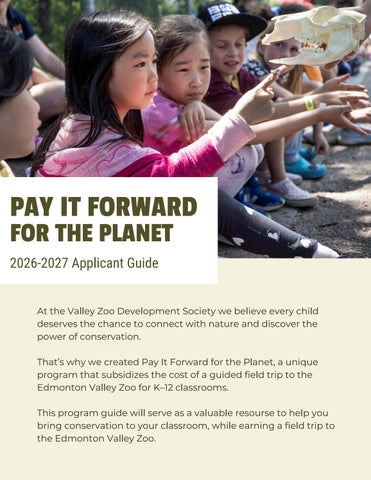
PAY IT FORWARD FOR THE PLANET 2026-2027 Applicant Guide At the Valley Zoo Development Society we believe every child deserves the chance to connect with nature and discover the power of conservation. That’s why we created Pay It Forward for the Planet, a unique program that subsidizes the cost of a guided field trip to the Edmonton Valley Zoo for K–12 classrooms. This program guide will serve as a valuable resourse to help you bring conservation to your classroom, while earning a field trip to the Edmonton Valley Zoo.
Introduction Having the opportunity to take learning beyond the classroom helped students deepen their understanding in a way that could not be replicated through classroom instruction alone. 2026 Pay it Forward Recipient
100+ CLASSES
Pay it Forward for the Planet is a field trip subsidy that is awarded to teachers and schools who “put their conservation hats on” and bring conservation into the classroom. Designed to increase access to hands-on education while preparing the next generation of students to become champions for conservation, Pay it Forward has supported tens of thousands of students, hundreds of teachers.
Choose a Conservation Project
Complete Your Application
13,245 STUDENTS
Get your project approved
Take action in your community
70 SCHOOLS Visit the Zoo!
The Subsidy Pay it Forward is 100% donor and grant funded, meaning funding is available on a first-come-first-serve basis and is not guaranteed to last the school year. The program application will close when funding is no longer available. Each approved applicant is eligible to receive a subsidy to help offset the cost of a field trip or the booking fee of a virtual program. Up to $250 for an eligible scheduled field trip to the Edmonton Valley Zoo Up to $95 reimbursement for an eligible Virtual Field Trip program.
Important Dates: Program Opening
August 24th 2026
Program Closing
March 31st 2027*
Last Day for Field Trips
April 30th 2027
Last Day to Submit
May 31st 2027**
*Subject to funding availability **Extensions available on a case-by-case basis
Eligibility Pay it Forward aims to support as many worthy classes as possible. An eligible applicant will be a class or group from a facility within Alberta that is attending either a in-person guided field trip, or, a virtual field trip, outside of the months of May and June. An eligible applicant will also conduct a worthy conservation minded project that will have a measurable impact or goal. There is NO age limit on the program. To date Pay it Forward has sponsored classes from preschool to grade 12.
Ineligible Applications: The following are not eligible for Pay It Forward for the Planet Subsidy Funding; applications with the following will not move past the approval stage without correction: Self-guided education visits, Zoo Immersion, Zoo School, or Sleepover Programs. Applicants who are not associated with an accredited educational institution, including homeschool groups and out-of-school clubs. Field trips booked for facilities that are not the Edmonton Valley Zoo. Programs booked after the Last Day for Field Trips. Cleanup or waste-free lunch events without a clear end goal or project in mind.
Pay It Forward
t s i l k c e h C y t Eligibili
: f the following o L L A to s e y r answe ust be able to m u o y , ly p p a Before you al on ible educati g li e n a h it iated w We are affil ol. are, or scho c y a d , n o ti institu ith the program w le ib g li e n a oked W e have bo Valley Zoo. Edmonton dates. the eligible in h it w s ll /program fa Our field trip t gful studen in n a e m e lv will invo Our project n. participatio ject lts of the pro u s re e th k will trac The project ay 31, 2027. M y b t c je ro plete our p W e c an c o m
Project Guide To give applicants the best shot at a successful application, we highly recommend following the below guide while planning and submitting your project: Projects are evaluated on two major criteria The projects’ ability to provide a reasonable, skill/grade appropriate exposure to conservation for the students of the applying class; and A clear project description that follows the S.M.A.R.T. goal framework and with measurable results shared by the end of the school year. A strong project: Gives students an active role in conservation. Connects to a real environmental or conservation issue. Has a clear and achievable goal. Produces a measurable outcome or result. Has an impact beyond a single activity or day. Gives students an opportunity to learn, act, and reflect. Is appropriate for the students' age and abilities. As part of your application, you will be asked to identify a goal for your conservation project. Your goal should be a S.M.A.R.T goal. Specific: What are you trying to change, improve, or achieve? Measurable: What evidence will show that you achieved your goal? Achievable: Is your goal realistic given your time and resources? Relevant: What conservation issue are you addressing? Time-Bound: When will your project or desired change be completed?
Reporting Guide The project results must be submitted before May 31st unless the applicant has otherwise received permission or an extension. The submission will be shared publicly on the Valley Zoo Development Society’s project web page, and can be shared with funders, donors, and digital media platforms. Submissions must contain, at minimum: ·2-4 high quality images of key components of the project, OR a video; compliant with FOIP permissions. At least ONE image of students engaging in the project. If FOIP is an issue this can be students’ hands working on the project, or photos taken from behind. At least ONE image of the completed project, if the project has a physical form. If digital, a copy of the project is acceptable. An 800+ character description of the project that outlines the following: What the students did, how they did it, and the results. What the students learned, and how it impacted them This can be student written, or teacher written.
Booking Your Field Trip As an external organization, the Valley Zoo Development Society is unable to book your Zoo trip. All bookings can be done through the City of Edmonton’s booking request form.
Click Here To Book Field Trips
Year-Round Field Trip Programs Animal Senses Animals Around the World Fur, Feathers and Scales Night Creatures
Animal Appetites Animal Movers and Shakers Winter Animal Adaptations Endangered Species
Program contents can be modified, and requests can be made during the booking process. Just let the booking coordinator or program interpreter know prior to your field trip date
Booking Your Virtual Experience Explore the Zoo from the comfort of your own classroom! Tailored to meet the Alberta curriculum, but flexible for any viewer, these interactive programs help you visit the Zoo without leaving your school! After the video concludes, join a member of the zoo education team for an interactive Q&A session.
Click Here To Book A Virtual Visit
Virtual Programs A Day In the Zoo Life Basic Needs of Aquatic Animals Evolutionary Wonders in Madagascar Farmyard Friendships Food Chains and Foragers
Hot and Cold Seasonal Secrets of Canadian Carnivores The Magic of Reindeer Tiger Tales: Ecosystems and Interactions Wetland Wonders
Frequently Asked Questions Below are some of the most common questions about the Pay It Forward for the Planet subsidy; if you have any other questions, reach out to the Program Coordinator at donate@buildingourzoo.com
Can students choose their project themselves? Yes! Students are welcome to be involved in the application process, however we encourage educator guidence.
Our class cannot afford to book a trip without the subsidy. Can apply before booking a trip? Contact the Program Coordinator prior to applying for further instruction.
Can I apply for funding for a project that has already begun?
Can I make changes to my project after I’m approved?
Yes! Projects that have already begun are eligible for the subsidy. However, please note this in your application.
Any major changes to approved projects must be confirmed with the Program Coordinator.
What is Conservation?
What counts as a “result” from our project?
Conservation means taking action to protect nature, wildlife, and the resources we all depend on. It can include protecting habitats, reducing waste, conserving water, helping wildlife, or inspiring others to care for the environment.
Results vary project to project, but some examples of “results” could be: # of pollinators visiting a garden # of community members engaged Students awareness of a topic (calculated before and after the project)
Fishing for inspiration?
Your students can make a BIG difference! Conservation projects can happen at your school, in your community, or beyond. Here are some ideas and resoucres to check out to inspire your next conservation project!
Nature Journaling - John Miur Laws Bringing nature journaling into the classroom helps students increase awareness of the natural world around them.; allowing students to investigate, monitor changes, track seasonal changes, and reinforces science skills in students of all ages. John Miur Laws has hundreds of hours of video content and curriculum available for FREE on his website.
City of Edmonton - Neighbouring for Climate Our friends at the City of Edmonton have multiple toolkits with project ideas, from nature maps to rain gardens – complete with checklists, worksheets, and postcards to inspire climate action in your community. Engage with your local community leauge to create an even stronger project!
Nature Alberta - Naure Kids Nature Alberta encourages youth and families to observe and investigate nature. Geared towards ages 4-12, Nature Alberta has multiple free resource guides, identification guides, and activities to guide your conservation project!
Polar Bears International - Education Center Polar Bears International offers free webcasts, teaching and learning materials, and activities for classrooms! All of the free resources connect to Albertas curriculum topics and goals. Explore their resources and videos, and have a look at their bear tracker!
Ducks Unlimited - Educator Resources Ducks Unlimited has award-winning educational activities all focused on wetlands. These activities vary from invasive species management, birding, classroom learning and more.
World Wildlife Fund - Teaching Resources World Wildlife Fund is a trusted, international resource with hundreds of webinars, live-streams, lesson plans, and education resources with a focus on conservation, and STEAM learning.
www.buildingourzoo.com/pay-it-forward