
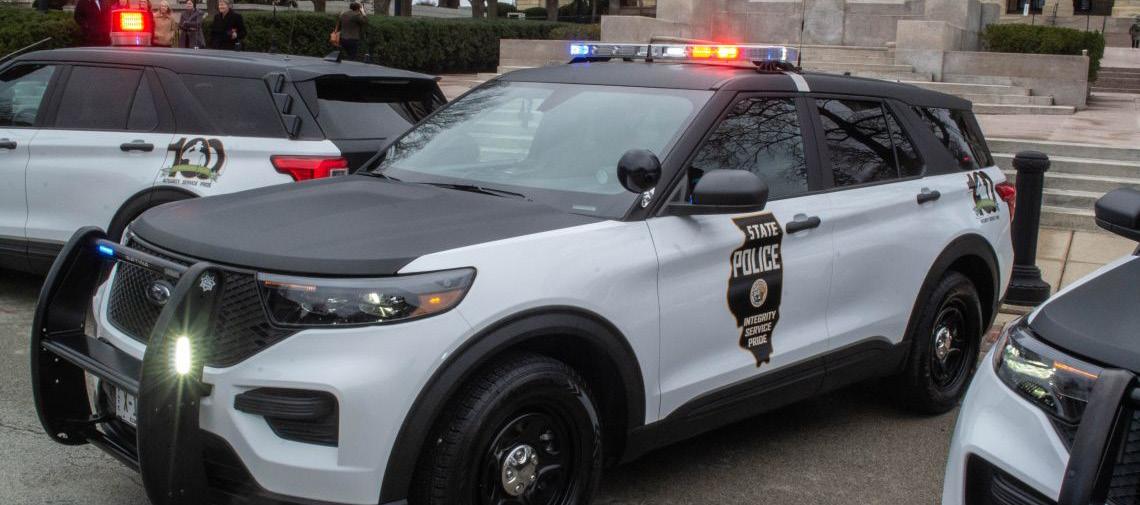



An Illinois State Police car is pictured outside the Illinois Capitol in Springfield during an event in 2022. (Capitol News Illinois photo by Jerry Nowicki)
By Ben Szalinski Capitol News Illinois
More than 1,000 Illinois State Police vehicles are near the end of their life, but the agency might not be able to replace them anytime soon.
The Illinois Department of Central Management Services recommends that vehicles in the ISP fleet be replaced every eight years or 150,000 miles, but it’s taking much longer, ISP Director Brenden Kelly told a Senate appropriations committee last month.
“At this rate with this funding mechanism we have, it will take about 18 years to replace our fleet,” Kelly said. “So while we’re not expecting a miracle in terms of some legislation to solve that for us permanently, we recognize that we’re going to have to continue to, piecemeal, find those sources of funding where they can be found.”
The problem, Kelly said, lies with the State Police Vehicle Fund. While lawmakers have appropriated $30 million to the State Police for vehicle replacement each year since fiscal year 2024, the actual revenue that goes into the fund is about a third of that amount or less.
In fiscal year 2025, for example, lawmakers gave ISP $30 million in spending authority, but the agency ultimately spendt about $7 million due to the fund’s slower revenue pace.
The fund’s main revenue source comes from a $1 fee on license plates that was enacted in 2008 and the proceeds from the sale of retired ISP vehicles. The balance generally hovers around $11 million to $12 million, according to ISP.
“Our vehicle replacement fund is not keeping up with the cost of those vehicles,” Sen. Seth Lewis, R-Bartlett, a member of the Senate’s public safety
appropriations committee, told Capitol News Illinois. “So our officers are spending eight hours a day in a vehicle that is eight to 10 years old with hundreds of thousands of miles on it. They don’t have the same safety standards as today’s vehicles.”
APPROPRIATION GRAPHIC
Beginning this spring, 10% of an insurance underwriting fee paid by car insurance providers will also be devoted to the fund, which could increase its balance by a few million dollars, according to State Police.
That existing fee otherwise funds State Police administration and training.
Lewis added he’s open to increasing how much of the vehicle registration fees goes toward the State Police vehicle fund. Most of the $151 registration fee goes to transportation infrastructure under current law.
“We are spending close to $56 billion; if we could come up with 20, 30 million to keep our officers safe, I want to work on that,” he said.
ISP covers more miles than any other state, Kelly said. The average car in ISP’s 2,700-vehicle fleet has 100,000 miles.
Vehicle costs
The cost of new police vehicles has also ballooned from “over a decade ago” when a new car cost $60,000, Kelly said.
They now cost $120,000.
“The cost may have gone up but the funding for that has not,” Kelly said.
ISP has 1,067 cars that meet CMS’ threshold for replacement, according to ISP, but the agency has been replacing more vehicles in recent years because of mechanical issues and damage. ISP reported 24 of their cars were hit in Scott’s Law violations in 2024 and 15 in 2025. Scott’s Law requires drivers to slow down and move over when approaching an
(Continued on page 9, see ‘POLICE’)
Companies could be on the hook for work-related activities before and after shifts start,
The Illinois Supreme Court ruled state wage law does not include certain federal exclusions
By Jenna Schweikert Capitol News Illinois jschweikert@capitolnewsillinois. com
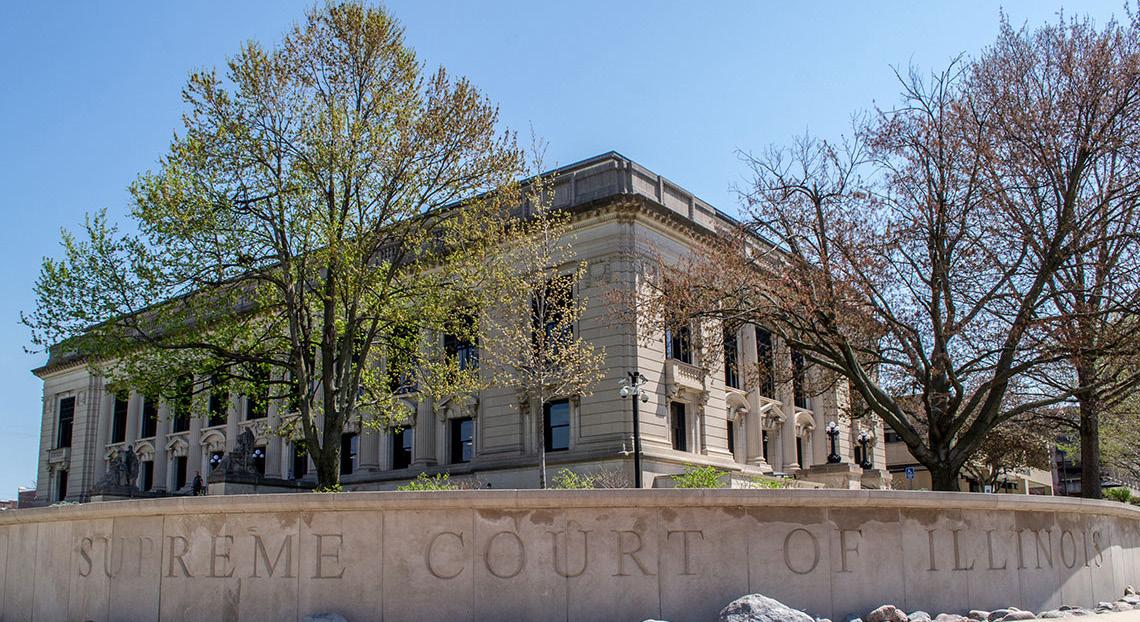
Illinois law does not specifically shield companies from having to pay employees for time spent completing required pre- and post-work activities, the state Supreme Court unanimously ruled.
Although federal regulations exclude that requirement, the court found Illinois’ wage law does not include any similar provisions. That means employers could be required to compensate employees for required activities outside of the normal work day.
The U.S. Court of Appeals for the Seventh Circuit asked the state’s high court to decide if state law includes the federal regulation found in the Fair Labor Standards Act. The question originates from a civil suit brought against Amazon by two former employees, although
the court’s ruling is not an official ruling in that case.
In the opinion, Justice David Overstreet wrote that the court’s goal was to determine the legislature’s intent at the time Illinois’ 1971 Minimum Wage law was enacted, emphasizing that the court aimed to adhere to the plain language of the law.
“We must refrain from departing from the statute’s plain language by reading into it exceptions, limitations, or conditions that conflict with the express language of the statute,” Overstreet wrote.
Justice Overstreet delivered the court’s opinion, with Chief Justice P. Scott Neville and Justices Lisa Holder White, Joy Cunningham, Elizabeth Rochford, and Mary O’Brien concurring. Justice Sanjay Tailor did not take part in the decision.
Johnson v. Amazon
In 2020, Amazon required its employees to complete 10-15-minute
pre-shift health screenings to avoid transmission of COVID-19. Two employees, Lisa Johnson and Gale Miller Anderson, later sued the company in the Cook County circuit court, arguing they should have been compensated for that time under federal and state law.
Amazon requested the case be moved to federal court in the U.S. District Court for the Northern District of Illinois and moved to dismiss the case, arguing they were not required to pay Johnson and Anderson based on federal exemptions for preliminary work activities in the Fair Labor Standards Act.
The federal court approved the dismissal under federal and state statutes, finding that federal law had frequently been used to interpret Illinois’ Minimum Wage Law.
Johnson and Anderson appealed, this time arguing they were entitled
(Continued on page 10 see ‘WAGE’)

WOODRIDGE, IL — Sinfonietta Bel Canto will present its highly anticipated Spring Chamber Music Festival on Sunday, April 19 at 2:00 p.m. at Woodridge United Methodist Church, located at 2700 75th Street in Woodridge.
This special concert embraces a lively theme of Broadway and popular music, blending beloved classics with timeless chamber works in a program designed to appeal to a wide range of musical tastes. Audience members can expect an engaging afternoon filled with familiar melodies and exceptional performances.
The program will feature the Prairie Sky Quintet—Elayne Vargo (flute), Julia Landes (oboe), Art Perez (clarinet), Deborah Efflandt (bassoon), and Stephen Thurlow (horn)—performing selections from Fiddler on the Roof by Jerry Bock, “Old Man River” from Show Boat by Jerome
Kern, and the Overture to The Magic Flute by Wolfgang Amadeus Mozart.
Jennifer Kumar (cello), Jiwon Kim (viola), and Heewon Cha (piano) will present Brahms’ Trio in A minor, Op. 114 – III. Andantino Grazioso, along with “We Don’t Talk About Bruno” from Encanto by Lin-Manuel Miranda. Kumar and Cha will also perform Chopin’s Introduction and Polonaise Brillante, Op. 3.
Soprano Roxanne Ferguson, accompanied by pianist Heewon Cha, will bring vocal highlights to the program with selections including “Someone to Watch Over Me” from Oh, Kay!, “It’s De-Lovely” from Red, Hot and Blue!, “I Could Have Danced All Night” from My Fair Lady, and “Till There Was You” from The Music Man.
(Continued on page 9, see ‘BROADWAY’)

By Tom Emery Contributor to
The Bugle, The Sentinel & The Enterprise
Newspapers
Holy Week is a reflective time for people of many faiths, and Palm Sunday, Good Friday, and Easter Sunday are marked by tens of millions around the world. However, Holy Week in 1865 was a defining period in American history.
On Palm Sunday, April 9, Robert E. Lee surrendered the Army of Northern Virginia to Ulysses S. Grant at Appomattox Court House, signaling the death knell for the Confederate cause that wilted away in the coming weeks. Five days later on Good Friday, President Lincoln was mortally wounded in his box at Ford’s Theater by assassin John Wilkes Booth, and died the next morning.
The timing of Lincoln’s death has drawn parallels to Christ, and it has been claimed that only Christ has been the subject of more books than the sixteenth President. However, the extent of Lincoln’s Christian devotion has been one of
the most intensely debated topics among Lincoln scholars for decades.
Lincoln’s Christianity – or lack thereof –was an issue in his successful 1846 Congressional race against Methodist Rev. Peter Cartwright. His own law partner, William Herndon, even declared that Lincoln was an infidel. Many of Herndon’s various claims about Lincoln have since been debunked.
It is accepted by many writers that Lincoln underwent a religious transformation after the death of his second son, four-year-old Eddie, in 1850. Still, Lincoln was never an official member of any church in his lifetime.
Clearly, however, Lincoln was a believer. His words are peppered with Christian phrases and alliterations, and some of his greatest orations, such as the Gettysburg Address and his Second Inaugural, have been cited by scholars for their religious reference.
On the opposite side were men like Lee, a deeply religious individual who frequent-
ly credited his military successes and setbacks to a higher power. His reports and verbal declarations often contained references to “a merciful God,” “the blessings of God,” and “the Giver.”
Though Lee’s racial views have been blasted in recent years, biographer Michael Fellman wrote in 2000 that the general “transparently and warmly believed in the existence of a literal heaven, a far better place to which all Christians would go” and that “death was no void but a permanent home.”
As Lee was about to ride to Appomattox Court House for the surrender on Palm Sunday, he told a subordinate that “as good Christian men…we must consider only the effect which our action [to continue or surrender] will have upon the country at large.”
Lee’s devotion was reflective of the period, as Christianity was a greater part of life for many Americans in the mid-19th century than now. Though less than half of Americans were members of a church in that era, as many as four out of five



Motor vehicles have come a long way since the days of the Model T. Safety features in particular have undergone significant enhancements over the last several decades.
Improvements in airbags, structural modifications like crumple zones and technological features like automatic emergency braking have helped to make modern vehicles far safer than the cars and trucks of yesteryear.
While there’s no denying that modern vehicles are safer than ever, the human element remains an unpredictable variable. Even in an era marked by vehicles with greatly enhanced safety features, distracted or impaired drivers can compromise the well-being of everyone on the road. Age is another variable unique to each driver that merits consideration when considering road safety.
The National Institute on Aging notes that certain conditions associated with aging, including increased stiffness of muscles and joints, can make it difficult for seniors to safely operate motor vehicles. Seniors who want to ensure they’re safe to drive can take various steps to ensure they are not compromising their own safety or the safety of others when getting behind the wheel.
• Have your driving skills assessed by a trained professional. The NIA notes that the American Occupational Therapy Association maintains a database of driving specialists who can help seniors assess their skills behind the wheel.
These trained professionals may assess existing skills and offer advice about how to overcome any issues
aging drivers might be having.
• Take a driving course. Safe driving courses can help drivers of all ages stay up-to-date on the latest safety protocols and advice on how to drive safely. Modern driving is vastly different than it was when many current seniors became licensed drivers.
A safe driving course can refresh drivers’ memories about safety protocols, and some may even offer advice on how to navigate modern roadways, which may be marked by distracted drivers and feature vehicles with brighter headlights that can make it more difficult for older drivers to drive at night.
• Speak with your physicians about your medications. A recent study from the U.S. Food and Drug Adminstration found that the average adult age 65 and older now uses roughly four medications. Medications produce side effects that can affect every area of a user’s life, including their ability to drive. Those effects might be heightened when taking more than one medication, and interactions also can lead to side effects that might not manifest if individuals were taking just one prescription.
Aging drivers can maintain an honest and ongoing dialogue with their physicians to ensure they’re aware of the effects their medications might be having on their ability to drive safely. Report any new side effects the moment they appear.
Aging can compromise seniors’ ability to safely operate motor vehicles. But aging adults can employ various strategies to improve their skills behind the wheel.


A high cost of living and ongoing advancements in medicine have contributed to longer life expectancies, which might suggest that people would remain in the workforce longer than previous generations.
Surprisingly, however, recent data indicates that many professionals are still choosing to retire relatively early.
According to the 2024 MassMutual Retirement Happiness Study, the average retirement age among American retirees is 62. This figure is slightly lower than what many workers say they actually want, as both pre-retirees and retirees in the study identified 63 as their ideal retirement age.
The gap between expectation and reality highlights the complex mix of financial, personal, and health-related factors that influence when peo-
ple ultimately leave the workforce.
In contrast, Canadians appear to be staying employed longer. Statistics Canada reports that the average retirement age in Canada reached 65.1 in 2023.
This difference between the two countries may be partly explained by structural factors such as national retirement systems. For example, the Canada Pension Plan (CPP) provides eligible retirees with a monthly, taxable benefit designed to replace a portion of their income.
The standard age to begin receiving CPP benefits is 65, which may encourage workers to remain employed until they qualify for full support.
Beyond pension systems, several other factors may contribute to early retirement in the United States. Employer-sponsored retirement plans,
such as 401(k)s, give workers more flexibility in deciding when to retire, particularly if they have saved aggressively. Additionally, some individuals leave the workforce early due to health concerns, job burnout, or the desire to pursue personal interests while they are still active and able.
At the same time, rising living costs and economic uncertainty can complicate retirement planning. While some retirees feel financially secure, others may underestimate how long their savings will need to last, especially as life expectancy continues to increase.
Healthcare costs, housing expenses, and inflation all play significant roles in shaping retirement decisions.
There is also a growing trend toward “phased retirement,” where individuals reduce their working hours rather


than stopping work entirely. This approach allows older adults to maintain income, stay socially engaged, and ease the transition into full retirement.
Ultimately, retirement timing is influenced by a combination of personal goals, financial readiness, and

broader economic conditions.
As people continue to live longer and healthier lives, the traditional notion of retiring in the early 60s may continue to evolve, prompting individuals and policymakers alike to rethink what retirement looks like in the modern era.


Participants
Also,
















A nutritious diet is a notable foundation of a healthy lifestyle. When paired with routine exercise, a healthy diet can help people feel better physically and mentally and reduce their risk for various chronic diseases.
Temptation combined with the accessibility and convenience of unhealthy foods makes it easy to compromise a healthy diet.
When planning meals and snacks, adults looking to stay a nutritious course can incorporate a variety of low-calorie, nutrient-dense foods into their diets.
The Mayo Clinic notes that most vegetables are naturally very low in calories but high in volume or weight. The weight in many vegetables comes from water and fiber, not calories.
The fiber content in vegetables also can make people feel fuller longer, reducing the likelihood of between-meal snacking on unhealthy but convenient foods like potato chips.
The Mayo Clinic cites these vegetables as low-calorie options that are
high in water and fiber:
• Salad greens
• Asparagus
• Carrots
• Tomatoes
• Broccoli
• Zucchini
Incorporating more low-calorie and water- and fiber-rich vegetables into your existing diet is not difficult. For example, the Mayo Clinic recommends adding vegetables to pasta dishes as a replacement for meat and cheese.
When reaching for a between-meal snack, opt for carrots or broccoli over chips, pretzels or baked goods.
Fruits also make a healthy addition to a daily diet, though the Mayo Clinic warns that some fruits are better than others for people looking for low-calorie, nutrient-dense options.
The online medical resource Healthline notes that avocados typically contain 161 calories per 100-gram serving, which equals about half of a medium-sized avocado.
That makes avocados a high-calorie



It can benefit anyone to learn to spot the signs and symptoms of rosacea, as such knowledge may compel those who develop the condition to seek help more quickly than they otherwise might.
fruit compared to some alternatives. Bananas also tend to be higher in calories than other fruits, as Healthline reports a medium-sized banana (105 calories) contains 27 grams of carbohydrates.
Avocados and bananas pack a nutritional punch, but it’s important that people seeking low-calorie fruits to add to their diet recognize that each

fruit tends to be on the high end in regard to calories.
Fortunately, there are plenty of low-calorie and flavorful fruits that can make great additions to a healthy diet. Strawberries are loaded with flavor and rich in vitamin C and fiber, and a 100-gram serving of this popular fruit contains around 32 calories. Watermelon (30 calories


per 100 grams), cantaloupe (34 calories), honeydew melon (36 calories), and peaches (39 calories) are some additional low-calorie fruits that make great additions to a nutritious diet.
Eating right involves consumption of healthy foods like fruits and vegetables, which tend to be low in calories and nutrient-rich.



























































(Continued from page 2, ‘POLICE)
emergency vehicle on the road.
Seven cars have been hit this year as of mid-March, including three separate incidents in one day.
The agency expects the funding from the insurance underwriting fee will allow it to replace 47 additional high-mileage cars this year. So far, 60 new vehicles have arrived during FY26.
The number of new vehicles the agency receives each year can vary based on market conditions and
(Continued from page 3, ‘VOTERS’)
The concert will also feature Joy and the Boys Brass Quintet—Russell Monahan and Mark Running (trumpets), Joy Inouye (French horn), Bruce Gaylord (trombone), and Adam Obrzut (tuba)—performing “Get Me to the Church on Time” from My Fair Lady, “Sunrise, Sunset” from Fiddler on the Roof, and “Comedy Tonight” from A Funny Thing Happened on the Way to the Forum.
how long it takes for the vehicle to be outfitted for police service.
ISP received 138 new vehicles in FY25 but only 43 in FY22 because of a shortage of microchips. Many of the cars on backorder that year were delivered in FY23.
Capitol News Illinois is a nonprofit, nonpartisan news service that distributes state government coverage to hundreds of news outlets statewide. It is funded primarily by the Illinois Press Foundation and the Robert R. McCormick Foundation.
Tickets are available for purchase online at www.SinfoniettaBelCanto. org and will also be sold at the door. The event offers open seating, handicap accessibility, and an opportunity for community members to experience high-quality, affordable live music.
This program is partially supported












(Continued from page 2, ‘WAGE’)
to compensation only under state law, which does not include those federal exemptions. Amazon, in reply, said federal law supported the district court’s conclusion that the exclusions apply to state law.
The Seventh Circuit asked the Illinois Supreme Court to settle the question, who then found that Amazon could not rely on federal regulations to inform Illinois’ minimum wage law because the General Assembly chose not to include the specific exclusions on preliminary activities.





A plain reading of the law “reveals that the General Assembly did not signify any intention to incorporate the preliminary and postliminary activities exclusions,” Overstreet wrote, referencing a subsection of the wage law that includes a list of exceptions.
“Notably, four of these exceptions incorporate by reference specific provisions of the FLSA, regulations of the United States Department of Labor (USDOL), or both,” Overstreet wrote.

worked’ that necessarily includes preliminary and postliminary activities, explicitly encompassing all time that an employee is required to be on an employer’s premises.”
The case will now return to the Seventh Circuit court. Pending that decision, or any action by the legislature, Illinois employers may soon have to compensate employees for that extra time spent preparing for a shift.
“The General Assembly delegated the authority to define ‘hours worked’ to IDOL (the Illinois Department of Labor). In turn IDOL adopted a definition of ‘hours
Capitol News Illinois is a nonprofit, nonpartisan news service that distributes state government coverage to hundreds of news outlets statewide. It is funded primarily by the Illinois Press Foundation and the Robert R. McCormick Foundation.