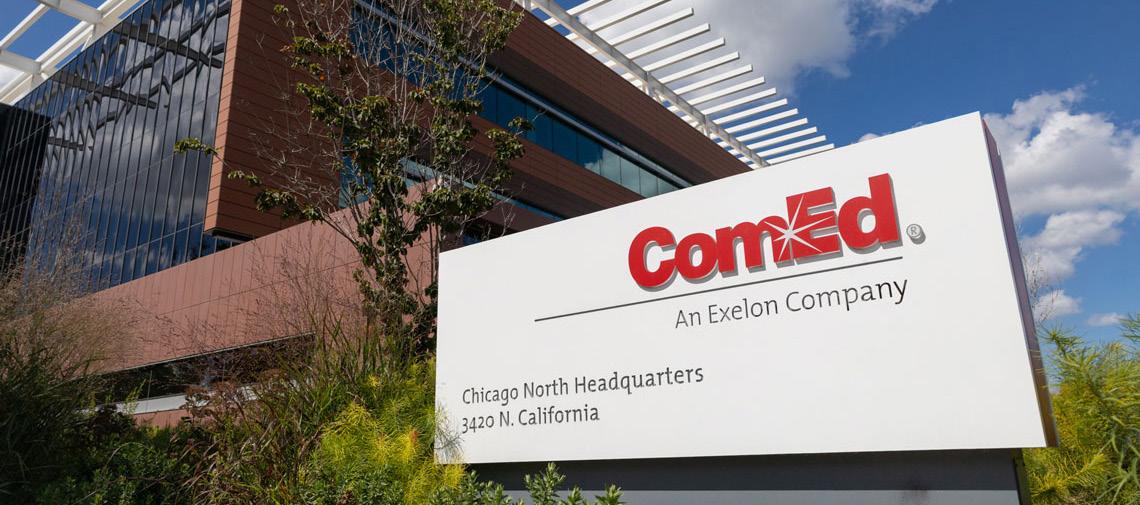



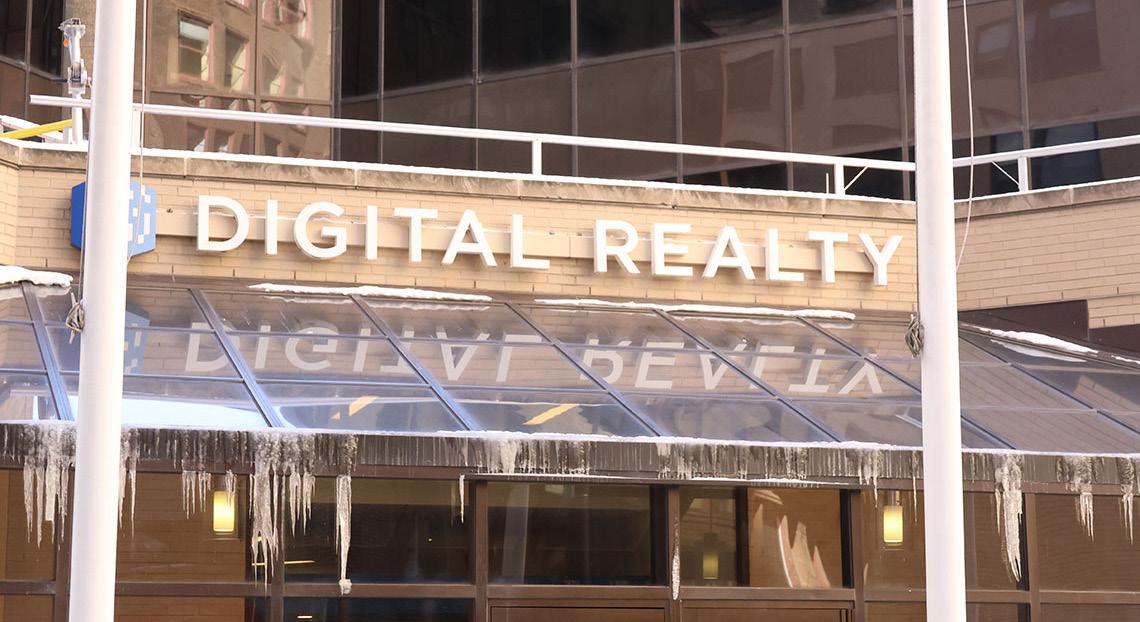
ComEd’s Chicago headquarters. (Capitol News Illinois file photo by Andrew Adams) (Capitol News Illinois photo by Peter Hancock)

By Maggie Dougherty & Nikoel Hytrek Capitol News Illinois
As large data centers burn electricity as fast as some small cities, utilities and advocates are looking for ways to ensure they’re not passing the buck for related infrastructure costs to everyday ratepayers.
The Illinois Commerce Commission on Thursday approved a proposal from Commonwealth Edison that allows the electric utility to seek a type of security deposit from developers of large-load projects based on the energy needs of proposed projects. Those deposits will allow ComEd to recover costs associated with data centers if the companies go out of business, move, or if facilities constructed to serve the customer are under-utilized.
The ICC called the approval of ComEd’s June request an “important first step.” But consumer and environmental advocates sought broader protections that the commission ultimately determined were out of scope for the proceedings.
The ICC did, however, direct its staff to initiate new proceedings next month to investigate the unaddressed issues and adopt new ratepayer protections, recognizing what it called “significant reliability, affordability and policy risks” caused by large-load projects in ComEd’s territory.
The order stated that ComEd’s pipeline includes more than 75 large-load projects that are expected to draw over 28,000 megawatts of energy. That’s more than ComEd’s highest-ever 24,000-megawatt peak demand in its 118-year history.
“In other words, the cumulative maximum demand of requests to serve new large load projects that are already in the application process is nearly 1.2 times greater than the highest demand ComEd has ever needed to serve,” the commission wrote in its order.
The huge surge in demand by data cen-
ters, which ComEd said has accelerated at an “exponential pace” since 2019, comes at a time when the state is facing projected energy shortfalls that are expected to drive up energy costs if not resolved.
“ComEd’s proposals are pivotal customer protection measures,” the company’s attorney told the commission during oral arguments. “They mitigate the risk that costs associated with providing service to new large load customers might be shifted to other customers.”
Prior to the order, ComEd required a flat $1 million deposit from all large load project applications. Under the revised tariff, security deposits for new projects requesting 50-200 megawatts will start at $1 million and increase by $500,000 for each additional 100 megawatts beyond that point.
In projects that come to fruition, the deposits will go toward the development cost of the project, according to ComEd. Deposits will be returned on canceled projects, minus costs already incurred by ComEd.
Here’s what’s at stake Concerned environmental and consumer advocates had hoped the ICC would set additional consumer protections, like requiring data centers to pay for the full cost of their infrastructure needs and adoption of a “bring your own new clean energy” model.
ComEd’s proposal protects customers in part by ensuring that data centers pay the portion of the cost assigned to them, Brad Klein, managing attorney with the Environmental Law and Policy Center, told Capitol News Illinois.
“But what it doesn’t do is fully, directly assign all of the costs of the infrastructure to the data center in the first place,” Klein said. “We still spread it out, we socialize it, and then ComEd is only protecting the portion of the cost that is assigned to the data center, even though
(Continued on page 7, see ‘ComED’)
Lawmakers, stakeholders, the governor and feds all have indicated they’re open to regulation
By Nikoel Hytrek Capitol News Illinois nhytrek@capitolnewsillinois.com
Managing data centers has been a growing issue around the U.S. as states balance economic development with community concerns about pollution, water supply and energy prices.
That has led to different regulations nationwide from moratoriums on development permits to putting data centers in their own ratepayer class. Illinois legislators have proposed regulating data centers with the POWER Act, a bill that addresses concerns about prices, water and pollution by:
• Requiring data centers to pay for their own energy and the infrastructure to generate it, and requiring that energy to come from renewable sources.
• Mandating transparency from data
centers about their water use and water permits from the Illinois Environmental Protection Agency, which would manage how data centers handle wastewater and meet efficiency standards.
• Requiring the IEPA to conduct assessments about how a data center would impact a community and mandating data center developers enter community benefits agreements that promote transparent engagement with the public. The community benefits agreements will be enforced by a coalition of residents, organizations and local government officials who will make up a community advisory board.
Democratic lawmakers sponsoring the bill call the regulations “commonsense” guardrails on a growing industry that impacts communities and electricity prices.
“Obviously, we know that data centers can provide economic development. But on the other hand, I want
to make sure that our environment is protected and our people are protected,” said Illinois House Majority Leader Robyn Gabel, D-Evanston. While data center backers say the economic benefits include job creation, capital investments and property tax revenue, environmentalists and consumer advocates say they are far outweighed by the risks for water resources and energy prices.
The POWER Act thus far remains in committee. But Illinois has a history of passing large-scale energy packages, such as the Climate and Equitable Jobs Act and the Clean and Reliable Grid Act, as extensive amendments late in their regular or fall legislative session. The session is slated to adjourn on May 31.
Growing need for rules
Aurora is one Illinois city already regulating data centers. The city in
(Continued on page 6, see ‘POWER’)

By Ben Szalinksi, Brenden Moore & Jenna Schweikert Capitol News Illinois
Lt. Gov. Juliana Stratton rode a late wave of momentum to win the Democratic nomination for Illinois’ open U.S. Senate seat, toppling longtime frontrunner Rep. Raja Krishnamoorthi with the financial aid and political muscle of Gov. JB Pritzker and an outsider message that set her apart from her rivals with Washington experience.
With 82% of precincts reporting, Stratton had a 39.6% to 33.6% lead over Krishnamoorthi, a margin of about 50,000 votes out of more than 900,000 cast. Rep. Robin Kelly, D-Lynwood, was in third place with 18.5%. The Associated Press called the race for Stratton at 9:40 p.m. Tuesday evening.
“Eleven months ago, I made a promise to Illinois to be the fighter you deserve, to go to the mat fighting for you, and bring your voices with me to Washington,” Stratton told supporters on Chica-
go’s West Side. “I haven’t forgotten that promise.”
Stratton received about 44% of the vote in Chicago to Kelly’s 25% and Krishnamoorthi’s 23%. She essentially fought suburban Cook County to a draw with Krishnamoorthi while he came out ahead in the suburban collar counties besides Will County, where Stratton led.
Stratton also led in many downstate counties, especially population centers in the Metro East, Springfield, Bloomington-Normal and Champaign-Urbana.
“We never lost sight of what’s most important, and that is courage, courage, inspired me to run,” Stratton said. “Courage powered this campaign, and courage will bring this fight straight to Donald Trump’s door.”
Stratton pledged to continue calling for abolishing U.S. Immigration and Customs Enforcement Agency, raising the minimum wage and instituting Medicaid for All.

“It’s time for bold ideas, big dreams and real courage in Washington, and we won’t wait a second longer,” Stratton said.
Across town at Krishnamoorthi’s event, the energy in the room was flat the entire night as results streaming on a large projector continually showed Stratton ahead. Eventually, the feed was cut off and replaced with a large “Raja” campaign logo.
While the Associated Press had yet to call the race, Krishnamoorthi took the stage shortly after 9:30 p.m. to announce that he’d called Stratton to concede the race.
KRISHNAMOORTHI
“Obviously, this is not the result we sought,” a somber-looking Krishnamoorthi, flanked by his wife and two of his children, told supporters. “But unlike Donald Trump, I’m not going to question the outcome. I’m proud of the race we ran. And I’m honored at the support we received from every corner of the state, from Rockford to Cairo and
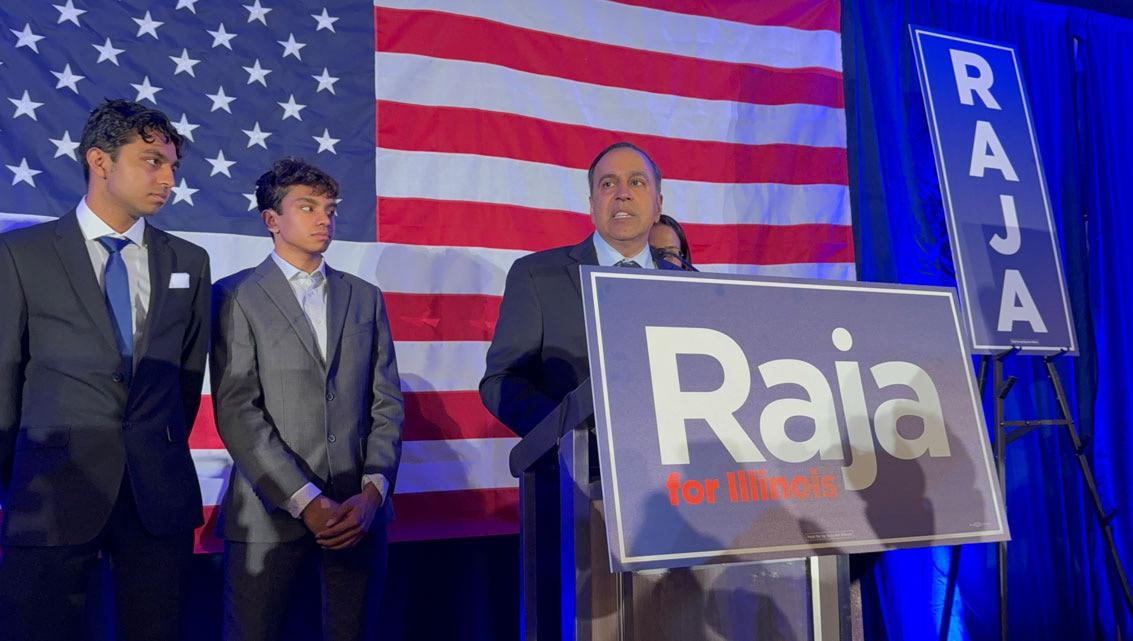
from the Quad Cities to Decatur.”
Referencing an old Chicago machine phrase about excluding outsiders from party politics, Krishnamoorthi cast himself as the guy “nobody sent.”
He thanked supporters “who had the courage to defy the party establishment and endorse the candidate with 29 letters in his name.” He also thanked
his donors, whom he credited with enabling him to “compete against very wealthy interests,” a not-so-veiled reference to Gov. JB Pritzker, who largely bankrolled a super PAC that backed Stratton.
End of long primary season Tuesday night marked the conclusion of
(Continued on page 7, see ‘VOTERS’)



The day a child leaves home can be bittersweet for parents. Although a son or daughter being successful and mature enough to move on to new opportunities can be a source of pride, parents typically lament the quiet that comes from empty rooms and a change to the daily routine they’d grown accustomed to when the kids were around. After some time, some couples decide to downsize to a home more befitting the empty nester lifestyle.
Downsizing presents an option for homeowners whose kids have left the nest. New analysis from a survey of 2,500 empty nesters commissioned by Regency Living found that 30 percent of empty nesters choose to downsize and move from their original family homes. When retirement is just around the corner, many professionals shift focus to how they want to live and where. Moving to a new home presents plenty of opportunities for older adults, including a chance to choose a home based on what’s right for them in this stage of life. There are questions homeowners can ask themselves as they ponder if downsizing is right for them.
1. How much upkeep can I handle?
A lifelong family home may be wellloved, but chances are it requires significant upkeep and repairs. Empty nesters may choose to move on to a home that offers lifestyle benefits like less maintenance. Homes in lifestyle communities or those overseen by a homeowners’ association tend to have certain maintenance built into a monthly fee.
2. Is this layout still a fit? Many empty nesters may not immediately feel the effects of aging, but before selecting a next home, individuals should think about aging in place and any unique needs they may have.
Opting for a single-level home, or at least one with the owner’s suite on the main level, can be advantageous.
3. Can I make due with less square footage? A cavernous home with many rooms often isn’t desirable for empty nesters. All of that square footage requires heating, cooling and maintenance. Rattling around inside a big, empty house may precipitate the decision to downsize. Downsizing also can free up home equity, which can be used to fund retirement needs.
4. Which features do you desire? Many empty nesters want the next home to focus on some luxury items they may have bypassed in the first home when priorities lay elsewhere. Upscale environments like gourmet kitchens, spa-like bathrooms and outdoor living spaces may be in the budget when moving into a home with a smaller footprint.
5. Will my home be secure while I travel? Empty nesters might want to choose homes in gated communities or condominium complexes for safety reasons. Should they opt to spend a portion of time at a vacation rental or second home as snowbirds, secure communities enable residents to leave their primary residence with the peace of mind that those homes will be less vulnerable to thieves.
6. Does this home have enough light? The American Optometric Association says many adults start to have problems seeing clearly beginning at age 40. Homes with more light from large windows and artificial lighting can reduce accident risk.
Moving to a smaller home is a consideration for many empty nesters. Various features offer benefits to adults who want to age in place.


Investors look for various opportunities they hope will help them grow their wealth. Some invest in the stock market directly by buying stocks and bonds, while others choose a more passive form of investing like index funds.
Certain investors prefer to back enterprising entrepreneurs, and some people determine that real estate is the avenue to pursue.
There are several different ways to invest in real estate, including buying a home. Investing in real estate can be lucrative, although the return on such investments can be affected by high interest rates. When interest rates fall, investors often come out of the woodwork.
According to a 2022 Bankrate survey, 29 percent of Americans said that real estate was their prime pick for investing money they won’t need for at least 10 years.
Investors considering real estate have many options to choose from.
Become a landlord
NerdWallet says buying a property with the intention of renting it out is one of the most common ways to invest in real estate.
However, this could be one of the more labor-intensive real estate investment options, as it requires property owners to field calls from renters and always be available to tackle issues that inevitably arise.
Plus, if renters are not properly vetted, landlords may end up with lessthan-ideal tenants.
While there are management services that can offset some of the work, farming out tasks comes with expenses that can cut into profits. Still, when a successful renter-landlord dynamic is established, this option can provide significant longterm income.
Flipping properties
Buying a property and “flipping it,” which means renovating and putting
it up for sale shortly after, is another real estate investment venture. Flipping requires a lot of work and perhaps even some extraordinary skills.
First, it involves finding up-andcoming neighborhoods and then renovating within a reasonable budget so that you can sell the home at a premium.
Remodeling costs can run high, and the time involved in flipping may be longer than investors anticipated.
Building equity in a home creates a nest egg that homeowners can tap into at a later time, particularly when they choose to sell.
Bankrate says banks treat owner-occupied properties more favorably, giving borrowers lower mortgage rates and requiring lower down payments.
Purchase REITs
REITs are real estate investment trusts that enable investors to invest
The skin is recognized as the largest organ of the human body. Perhaps that’s one reason why people go to such great lengths to protect their skin. But even the most ardent devotees of skin protection can develop disorders that affect the skin, including rosacea.
The prevalence of rosacea may surprise individuals unfamiliar with the condition. A 2024 study published in the Journal of the American Academy of Dermatology found roughly 5 percent of the global population has rosacea, a skin condition that occurs when blood vessels in the skin enlarge.
Because the condition is so prevalent, it can benefit anyone to learn to spot the signs and symptoms of rosacea, as such knowledge may compel those who develop the condition to seek help more quickly than they otherwise might.
• Facial redness: That National Rosacea Society says individuals with rosacea often experience flushing and a persistent facial redness known as erythema. Some patients also can see small blood vessels in affected areas of their face. Stinging, burning, swelling, and roughness or scaling also may occur.
The redness that’s a hallmark of rosacea

It can benefit anyone to learn to spot the signs and symptoms of rosacea, as such knowledge may compel those who develop the condition to seek help more quickly than they otherwise might.
may appear brown or purplish in individuals with darker skin tones.
• Bumps and pimples: The NRS notes people with inflammatory rosacea may experience bumps and/or pimples on the skin. Raised red patches known as plaques also may affect certain individuals.
• Enlargement of the nose: Rosacea can cause some people to develop rhinophyma, which the NRS notes is an enlargement of the nose that occurs due to excess tissue. Rhinophyma also may be marked by a thickening of the skin and the develop of irregular surface nodules that can even affect areas other than the nose.

in real estate without actually touching physical real estate properties, advises NerdWallet.
REITs are like the mutual funds of the real estate realm, and include companies that own commercial real estate. REITs can pay out high dividends, making them popular re -

tirement investments.
Dividends can be reinvested to grow your money further.
Investing in real estate can be a worthwhile option for people who want a tried-and-true vehicle for seeing their money grow.

• Eye irritation: NRS surveys indicate ocular rosacea affects up to 60 percent of rosacea patients. So it’s possible individuals with rosacea will develop some form of eye irritation. The NRS reports that ocular rosacea often results in watery or bloodshot eyes, irritation and burning or stinging of the eyes, swollen eyelids, and even styes.
The NRS also notes that many people with ocular rosacea report feeling a gritty sensation in the eyes that makes it seem as though they have something in their eyes. Rosacea affects a significant percentage of the global population. More information about rosacea, including treatment options for those diagnosed with the condition, can be found at rosacea.org.


(Continued from page 2, ‘POWER’)
September implemented a 180-day moratorium on development that will expire in late March.
Notice is hereby given that the President and Board of Trustees of the Village of Plainfield will hold a Public Hearing on the proposed Budget for the 2026-2027 Fiscal Year at 7:00 p.m. on Monday, April 6, 2026 at the Village Hall, 24401 W. Lockport Street, Plainfield, Illinois 60544. Copies of the Proposed Budget are available online at https://www.plainfieldil.gov and available for inspection at the office of the Village Clerk, 24401 W. Lockport Street, Plainfield, Illinois 60544, Monday through Friday from 8:00 a.m. to 4:30 p.m.
(Published in the Enterprise March 26, 2026)



The city set the pause so it could study the fiscal, environmental, stormwater and utility impacts on the community and come up with better rules and safeguards.
In late February, Aurora proposed ordinances that would require developers to conduct and submit multiple studies dealing with noise, water consumption and energy needs. The ordinances also require future data centers to meet standards for noise, vibrations, water use and energy use. New and expanded data centers “will also need to install and operate either onsite renewable energy techniques or on-site resilience storage procedures.”
The POWER Act has similar requirements, and negotiations on the bill are ongoing. Those conversations include municipalities and workforce, labor, manufacturing and environmental groups.
“What we’re asking for in this legislation are principles that I think, widely, people understand,” said state Sen. Ram Villivalam, D-Chicago.
“Accountability protects our taxpayers and protects our environment. That’s, I believe, entirely possible,” he continued.
Technology is an essential part of many people’s lives, and the data centers needed to support that technology will continue to exist and expand, Villivalam said.
“We’re not saying ‘no.’ We’re saying this is going to continue. This is how we need to approach it,” he said. Agreement between the governor and feds
Protecting consumers from paying for data centers’ energy needs is a key part of the POWER Act, and shifting the cost to the data centers has widespread, bipartisan support in Illinois and nationwide.
During his annual budget address, Gov. JB Pritzker put the onus on PJM Interconnection, the electric grid operator that covers all or part 13 states from Illinois to the East Coast: “PJM must force data center developers to pay for capacity resources to power their operations to protect consumers from higher rates.”
Pritzker also proposed a two-year pause on tax credits for new data centers to compensate for rising demand and higher prices. Illinois has provided tax incentives for data centers since Pritzker signed bipartisan legislation
in 2019. According to the state’s 2024 report, at least 27 data centers had received incentives totaling $983 million in estimated lifetime tax breaks and benefits.
“With the shifting energy landscape, it is imperative that our growth does not undermine affordability and stability for our families,” Pritzker said.
Pritzker has long advocated for attracting data centers to Illinois, especially given his focus on growing quantum computing, but he lately has said he also wants development to be controlled.
In January, Pritzker joined the Trump administration and 12 other governors in the PJM service area to call for PJM to adopt six principles to lower electricity prices. One principle would require PJM to allocate the cost of “any new” capacity to data centers.
Tech companies in early March signed a voluntary, nonbinding “Ratepayer Protection Pledge” at the White House, agreeing to cover the majority of costs for data center energy, though the pledge does not include penalties or other enforcement language. Seven companies have signed, including Google, Amazon, Microsoft and Meta. President Donald Trump announced the pledge during his State of the Union address.
In a separate letter, Pritzker and New Jersey Gov. Philip Murphy clarified to PJM that “implementation of these principles must also ensure that clean, cheap energy growth will not be sabotaged.”
Cautious support from Republicans Illinois Republicans have also called for data centers to pay for their own energy generation, though their support for the POWER Act isn’t guaranteed and they don’t share a commitment that energy generation come from renewable sources.
“While data centers have become part of the broader energy discussion, they are not the primary driver of the rate increases families have been experiencing,” said Sen. Sue Rezin, R-Morris. “At the same time, I believe large energy users should pay their fair share and that our grid must remain secure and dependable.”
Rezin sits on the committees that will likely discuss the POWER Act and she said she’s open to “thoughtful, targeted proposals” for handling data centers, but she also wants to ensure companies aren’t dissuaded from investing in Illinois.
Her concern is similar to that of groups like the Illinois Manufacturers’ Association, which framed the POW-
ER Act as “penalizing innovation” in a news release after it was announced. They also advocated for dealing with energy prices by pursuing an “all-ofthe-above energy approach” to generation.
However, Gabel said she’s had conversations with groups like the IMA, and they’ve indicated they’re open to negotiation.
“I have spoken to both the IMA and the Data Center Coalition, and they both say that there’s much in this bill that that they can work with,” she said. “There may be a few issues that we need more discussion about, but neither of those organizations felt like this was DOA.”
Considering how many other states have data center regulations, Gabel said she thinks concerns about scaring away development are overblown.
“I’ve met with data centers, and they are open to this,” she said.
The Clean Jobs Coalition, a group of organizations committed to renewable energy favors the bill but also supports negotiation.
“We also know that data center development in Illinois to date has not delivered a fair deal for families, who have paid millions in tax incentives while subsidizing Big Tech’s utility costs,” the group said in a statement. “The POWER Act is an opportunity to reconcile that imbalance moving forward and will need further discussion and consideration among stakeholders.”
A big reason for the urgency, Gabel said, is that data centers built elsewhere in the PJM territory would impact what Illinoisans pay anyway, even if the centers aren’t built in Illinois. That’s because all states in that territory pull from the same energy pool.
“We feel like it’s our responsibility to put some guardrails around the development of these data centers,” she said.
The bill language is now in the House Executive Committee, which meets Thursday at 10 a.m. and the Senate AI and Social Media Subcommittee, where senators will discuss multiple bills regulating data centers, though negotiations could come down to the wire if recent history is a guide.
Capitol News Illinois is a nonprofit, nonpartisan news service that distributes state government coverage to hundreds of news outlets statewide. It is funded primarily by the Illinois Press Foundation and the Robert R. McCormick Foundation.
(Continued from page 3, ‘VOTERS’)
a lengthy and expensive primary campaign to replace Sen. Dick Durbin, who has held the seat since 1997, and did not make an endorsement in the race.
Krishnamoorthi spent years laying the groundwork for a Senate run. He made frequent stops across the state, from fundraisers for various county Democratic parties to official congressional events well outside the boundaries of his suburban congressional district.
He was also the most aggressive fundraiser in the Illinois congressional delegation, banking more than $19 million before he launched his Senate run in May 2025.
He continued fundraising at a breakneck pace, allowing him to run television advertisements nonstop since last July — more than six months before any other campaign or outside political action committee got on the air. Krishnamoorthi’s campaign spent more than $27 million on ads.
The name recognition attained through his paid media blitz allowed Krishnamoorthi to build an early polling lead on his main rivals, Stratton and Kelly. However, Krishnamoorthi’s numbers eventually hit a ceiling, remaining stubbornly stuck in the midto-high 30s even as he continued to lead his opponents.
Stratton entered the race with Pritzker’s endorsement. But after seven years as the self-funding billionaire’s No. 2, she struggled to fundraise on her own — a problem exacerbated by strict federal contribution limits to campaign committees.
She attempted to turn this weakness into a strength by pledging not to accept donations from corporate political action committees. She also made bold policy proposals like an hourly $25 minimum wage.
But she really started gaining ground on Krishnamoorthi in January, when the Pritzker-funded Illinois Future PAC finally launched a long-expected ad campaign on her behalf.
Unlike candidate committees, which are subject to strict contribution limits, PACs can raise unlimited sums, making it an attractive option for Pritzker to exert outsized influence on the race.
Krishnamoorthi simultaneously faced tough headlines over more than $90,000 in contributions from donors with ties to President Donald Trump, including nearly $30,000 from Shyam Sankar, the chief technology officer of Palantir, a company that holds a $30
million contract with ICE to help track individuals for deportation. Krishnamoorthi donated a sum equaling Sankar’s contributions to immigrant rights organizations.
This was around the same time Operation Midway Blitz dominated the headlines, drawing negative attention to federal immigration officers.
Kelly has served in Congress since 2013 and previously served a stint as chair of the Democratic Party of Illinois before being ousted by Pritzker-backed Lisa Hernandez. She cast herself as a progressive in the race who could work across the aisle to get things accomplished.
But Kelly also struggled to break out due to a lack of resources, always remaining a distant third place behind Krishnamoorthi and Stratton.
As Stratton gained in the polls, dark money PACs with ties to the cryptocurrency industry poured more than $10 million into ads against her. They also sought to boost Kelly, leading to accusations that the effort was meant to split the Black vote between Stratton and Kelly, who are both Black women. Stratton begins the general election as a heavy favorite to succeed Durbin, facing off against former Republican Party Chair Don Tracy.
Seven other candidates were also on the ballot and received about 9% of the vote.
Republican results
In the Republican primary for Durbin’s open Senate seat, Tracy received 40% of the vote as of 10 p.m. Tuesday evening. Tracy faced five other candidates in the primary race, which lacked the same attention as the Democratic primary with a field of lesser-known candidates with little political experience.
TRACY
“We stand before you tonight as the Illinois Republican nominee for the United States Senate. Thank you again for entrusting me with this important nomination,” Tracy said at his watch party in Springfield. “With your help, we’ll deliver that underdog victory in November that will shock the nation and make Illinois better, more balanced and a stronger state.”
Tracy said his top priority will be reducing cost of living in key areas like energy and health care. The mood at the watch party was quiet initially, picking up as supporters watched results roll in. Kathy Salvi, the current Illinois Republican Party chair and the party’s failed Senate candidate in 2022, spoke to the growing crowd around 8 p.m.
“I am absolutely delighted to be here
for you, Don,” Salvi said. “Everything that you stand for will elevate and bring hope and promise to Illinois.”
Of the five other candidates, Chicago attorney Jeannie Evans received about 22% of the vote, real estate manager Casey Chlebek received 11%, and the final three candidates received about 25% collectively.
Congressional results
Four of the five open congressional seats saw intense competition in their primary races this cycle, with dozens of candidates seeking rare open seats in Congress and an unprecedented $62 million contributed in direct campaign contributions and outside funding.
In the 9th Congressional District, Evanston mayor Daniel Biss won with about 30% of the vote as of 10 p.m. The contentious primary in one of the state’s most liberal districts gained national attention after candidates sparred over whether they aligned with the views of American Israel Public Affairs Committee and one candidate was charged by the federal government with conspiring to impede immigration agents. Biss, a former state senator who lost the 2018 gubernatorial primary to Gov. JB Pritzker, will face Republican John Elleson in the November general election.
In the 2nd Congressional District, Cook County commissioner Donna Miller beat nine candidates including state senator Robert Peters and former U.S. Rep. Jesse Jackson Jr. with 40% of the vote as of 10 p.m. Miller will face Republican Michael Scott Noack, who won his primary uncontested, in the general election.
In the 7th Congressional District, state Rep. La Shawn Ford won the Democratic primary against 12 other candidates, with just under 25% of the vote as of 10 p.m. Ford will face the GOP primary winner Chad Koppie in November.
In the 8th Congressional District, former U.S. Rep. Melissa Bean won her primary with about 32% of the vote as of 10 p.m. and will face Republican nominee Jennifer Davis in November.
The 4th Congressional District is also open this fall but did not have a contested primary. The November election is expected to be a tense battle between Democratic nominee Patty Garcia and candidates who filed as independents.
Capitol News Illinois is a nonprofit, nonpartisan news service that distributes state government coverage to hundreds of news outlets statewide. It is funded primarily by the Illinois Press Foundation and the Robert R. McCormick Foundation.
(Continued from page 2, ‘ComEd’)
the data center is causing all of that cost.” The cost of infrastructure like transmission wires and poles for a single data center could be $50 million or more, just to serve a single new data center, Klein added.
According to a report by the Union of Concerned Scientists, ComEd ratepayers are already left holding the bag for hundreds of millions of dollars in costs to connect data centers to the grid. The new tariff structure would not apply to data centers already on the grid. Advocates also say the “bring your own new clean energy model” could offset reliability risks created by energy generation shortages exacerbated by the data center demands.
They recommended that companies that bring their own renewable energy sources to the table should be rewarded with faster grid connections, skipping the long wait times that normally exist for data centers to connect to ComEd’s grid, using TSA PreCheck as an analogy.
“Travelers who demonstrate they are low-risk earn access to faster screening and better service. Illinois can apply the same principle to data centers,” Klein wrote on ELPC’s website. “Projects that put in the work up front — planning for clean energy, efficiency, and grid reliability — should be rewarded with faster grid connections.
The approach has been discussed in




Texas and by PJM, the regional network operator that serves all or part of 13 states reaching from the East Coast to the ComEd territory in Illinois. Advocates are also pushing for parallel legislative protections via the POWER Act, introduced by Illinois state lawmakers in February.
The bill language is slated for discussion in upcoming subject matter hearings in the House. In the Senate, it has been sent to a subcommittee, where senators will discuss multiple bills regulating data centers.
The ICC directed its staff to file a report and draft an order initiating additional proceedings by April 23 to evaluate further ratepayer protections.
That exploration should be completed within eight months or “as expeditiously as possible.”
“We’re taking the commission at its word that this is a first step and that they’re serious about the follow-up steps needed to protect consumers and the environment,” Klein said. “We’re really heartened by the Commission doing this on a real, near term, urgent basis.”
Capitol News Illinois is a nonprofit, nonpartisan news service that distributes state government coverage to hundreds of news outlets statewide. It is funded primarily by the Illinois Press Foundation and the Robert R. McCormick Foundation.