In a Wonderful State of Preservation - A Classic Work
Editio Princeps of Diogenes - Fine Contemporary Binding
The Lives of the Famous Philosophers - Basel - 1533
1 Diogenes Laertius, [Greek Philosophy]. THE LIVES OF THE FAMOUS PHILOSOPHERS.]
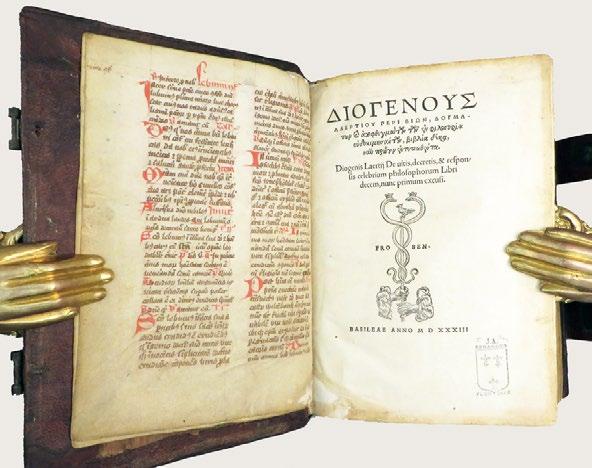
Diogenis Laertij De vitis, decretis, & responsis celebrium philosophorum Libri decem, nunc primum excusi. (Basel: Hieronymus Froben e Nikolaus Episcopius, 1533) The Editio Princeps, the first printing of the work in the original Greek. Greek and roman type. Woodcut printer’s device of Johann Froben by Hans Holbein der Jünger [The Younger] on the title-page and on fol. CC4v (Heitz-Bernoulli 50). Woodcut decorated headpieces, decorated and animated initials on black ground, from different alphabets designed by Holbein; on fol. a1r 8-line initial, showing Heraclitus and Democritus, from the capital Latin alphabet of May 1520 drawn by Holbein and by Jacob Faber (cfr. Hollstein’s German, xivB, n. 119). 4to (210x146 mm)., In a very rarely encountered contemporary binding of Dutch blind-tooled leather over wooden boards. The covers are framed by two borders of blind tooled fillets, a floral tool at each corner; the central panel is divided into diamond designs with rosettes on the upper cover and fleur-de-lys on the rear. Turn–ins and cords fixed at the inner boards. Antique spine and clasps renewed at a somewhat later date and accomplished with the greatest skill. The guard leaves are composed of two bifolia from a 14th-century manuscript breviary. Collation: 1, 2, 3, 4, a-z4, A-Z4, aa-zz4, AA-CC4 (fols. 1v, CC4r blank). [8], 573, [3] pp A beautiful and fine broad-margined copy in a wonderful contemporary binding, faint water staining to the inner corner of the first quires, a minor repair to the gutter of the first leaves, two tiny wormholes in the last three quires. Provenance: John Alfred Spranger (1889-1968; book-plate on front pastedown and stamp on title-page).
EXTREMELY RARE FIRST PRINTING OF THE EDITIO PRINCEPS OF THIS REMARKABLY IMPORTANT BOOK AND A COPY WHICH IS OF THE VERY FINEST STATE AND CONDITION. The editio princeps of Diogenes Laertius’ Lives of the Famous Philosophers, is the most important source of our knowledge in the history of Greek philosophy, from Thales to Pyrrho.
The text was known only in the Latin translation by Ambrogio Traversari (1386-1439), which made its first appearance in print in Rome around 1472 and which was widely reprinted during the fourteenth and the first decades of the sixteenth century. This is the first printing of the book in its original language. The edition is dedicated by the typographers Froben and Episcopius to the scholars, and in their epistle they declare their publishing plan: to print at least a work per year able to combine usefulness and pleasure.
The text follows a manuscript provided by the professor of Greek and Hebrew at the University of Wittenberg Matthaeus Goldhahn (1480-1553), called Aurigallus, probably a copy of the codex Raudnitzianus Lobkowicensis vi.F.c.38, at the time preserved in Komotau (Bohemie), in
the house of the politician Bohuslav Lobkowitz von Hassenstein (c. 1460-1510), and presently in the Library Národní Knihovna of Prague. $16,500.
Perhaps the Most Rare and Beautiful Gustave Doré of All Corrida de Toros - Paris - L. Turgis - Circa 1860 Exquisitely Coloured and a Highly Unusual Offering
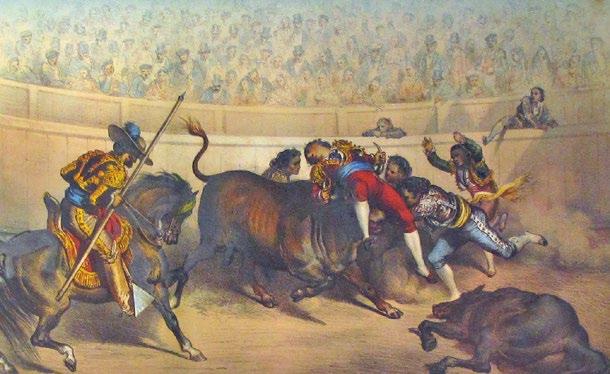
2 Doré, Gustave. CORRIDA DE TOROS (Paris: L. Turgis, ca. 1860) EXTREMELY RARE SUITE OF HANDCOLOURED LITHOGRAPHS ON BULLFIGHTING. A complete suite of six large hand-coloured original lithographs by Gustave Doré. 45.5 by 61.4 cm, Each plate with the running title ‘Corrida de Toros’, individual captions in Spanish and French and with ‘G. Doré del. A fine set with occasional evidence of age.
FIRST ISSUE AND VERY RARE, A SUITE OF IMAGES ON BULL FIGHTING AS SEEN AND CHRONICLED BY GUSTAVE DORÉ. In Corrida de Toros, Doré captured the strength and movement of the bull, the tension, the danger in the ring - it almost seems as if the bull has a chance, not just at survival but of actually conquering the men on foot and horseback who are supremely annoying it to rage. Doré appears to sympathize with the bull and the tragedy of bullfighting rather than the glory of the fighters.
‘The French artist, Gustave Doré, was born in Strassburg in 1832. In 1848, he moved to Paris where it was noted that “his facility as a draughtsman was extraordinary.” He was a prolific worker whose talents and creations are greatly valued to the present day. Doré’s first illustrated story was published when he was only fifteen years old. His talent was evident even earlier, however. At age five he had been a prodigy troublemaker, playing pranks that were mature beyond his years. Seven years later, he began carving in cement. Subsequently, as a young man, he began work as a literary illustrator in Paris, winning commissions to depict scenes from books by Rabelais, Balzac, Milton and Dante.
In 1853, Doré was asked to illustrate the works of Lord Byron. This commission was followed by additional work for British publishers, including a new illustrated English Bible. A decade later, he illustrated a French edition of Cervantes’s Don Quixote, and his depictions of the knight and his squire, Sancho Panza, have become so famous that they have influenced subsequent readers, artists, and stage and film directors’ ideas of the physical “look” of the two characters. Doré also illustrated an oversized edition of Edgar Allan Poe’s “The Raven”, an endeavor that earned him 30,000 francs from publisher Harper & Brothers in 1883.
Doré’s English Bible (1866) was a great success, and in 1867 Doré had a major exhibition of his work in London. This exhibition led to the foundation of the Doré Gallery in Covelant Bond Street. After an illness, he died in January of 1883. $18,500.
536-4433
Very Rare First Edition of a World Classic
Dostoevsky - The Brothers Karamazov - Brat’ya Karamazovy
The Rare First Edition - Published St. Petersburg - 1881
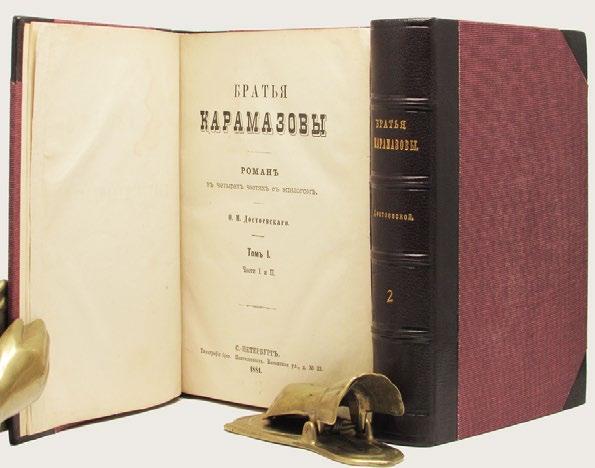
3 Dostoevsky, Fyodor. BRAT’YA KARAMAZOVY [In Russian, Cyrillic] (St. Petersburg: Pateleevyi Brothers, 1881) 2 volumes. RARE FIRST EDITION. Both half-titles present. 8vo, in later half brown morocco over brown boards, the spines with raised bands and gilt lettering in Cyrillic, edges marbled, now housed in a quarter morocco clamshell case. 509; 699 pp. An exceptionally well preserved and proper copy of this very rare edition, Vol. I lacking only the final blank, some very minor and expected spotting or blemishes, two leaves with minor and expert paper repairs, in all a very handsome and proper example of this rare world literary classic.
VERY RARE, THE TRUE FIRST EDITION OF DOSTOEVSKY’S THE BROTHERS KARAMAZOV, A MASTERPIECE OF RUSSIAN LITERATURE. THE BROTHERS KARAMAZOV was Dostoevsky’s final novel, on which he spent most of the last two years of his life writing. It is more then a classic of Russian Literature, it is a passionate philosophical novel that enters deeply into the ethical debates of God, free will, and morality. One of literatures greatest spiritual dramas, it has been acclaimed all over the world by thinkers as diverse as Sigmund Freud, Albert Einstein, Ludwig Wittgenstein, Martin Heidegger, Cormac McCarthy, Kurt Vonnegut and Pope Benedict XVI as one of the supreme achievements in literature. $36,500.
Galileo Galilei - Opere del Galileo - 1718
The Complete Works Including Many First Printings
The Embodiment of the Galilean Revolution
A Fine Set in Rare Full Calf Bindings of the Period
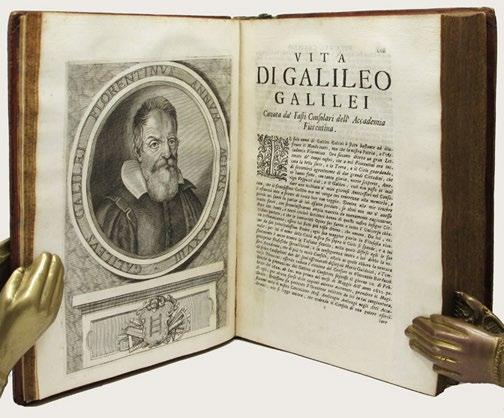
4 Galilei, Galileo. OPERE DI GALILEO GALILEI LINCEO NOBILE FIORENTINO GIA LETTORE DELLE MATEMATICHE NELLE VNIUERSITA DI PISA, E DI PADOUA, DI POI SOPRAORDINARIO NELLO STUDIO DI PISA. PRIMARIO FILOSOFO, E MATEMATICO DEL SERENISSIMO GRAN DUCA DI TOSCANA. In quest nuoua editione insieme raccolte, e di varij Trattati dell’istesso Autore non più Stampati accresciute. (Firenze: Tartini & Franchi, 1718) 3 volumes. Rare first three volume collection, the second issuance of certain parts of the OPERE and the first printing of many of the works of Galileo or pieces heretofore unpublished in any form including the GIORNATA SESTA DEI DISCORSI E DIMOSTRAZIONI MATEMATICHE INTORNO ALLE NUOVE SCIENZE. With a very finely engraved vignette title-page printed in black and red to volume one,
(617) 536-4433
also an engraved portrait of Galileo, engraved folding plan, folding plate of the compass, many woodcut plates, astronomical renderings, mathematical tables and diagrams throughout, a number of fine woodcut initials. 4to, [241mm x 180 mm], handsomely bound in contemporary bindings of fine full mottled calf, handsomely decorated in gilt on the spines with gilt panels incorporating a floral motif between gilt-tooled raised bands, two compartments featuring fine gilt ruled and lettered red morocco labels. cxii, 628, 2 page errata; [viii], 722, errata; [vi], 484, [50pp of errata, index, registri, etc]. A truly fine copy, large and unusually fresh. A rare survival in contemporary state, crisp and an especially clean copy throughout, the bindings quite handsome with only minimal wear or evidence of age.
EXTREMELY SCARCE IN FULL CALF BINDINGS OF THE PERIOD. USUALLY ENCOUNTERED IN VELLUM BINDINGS, THIS RARE EDITION OF GALILEO’S COMPLETE WORKS (excepting the DIALOGO, which was still on the Index of Prohibited Books at the time), preserves a record of some of the most seminal discoveries in astronomy, scientific methodology, mathematics, primary work in the study of motion, as well as the most significant support of the Copernican theory of a heliocentric planetary system--in other words, the embodiment of the “Galilean Revolution.”
This issue of the OPERE, contains an entire volume of Galileo’s writings which appear here for the first time, having never before been printed. The long list of these first printings is given by Riccardi (p. 520-521) and cited by Centi. Included are the GIORNATA SESTA DEI DISCORSI E DIMOSTRAZIONI...as well as other works such as the LETTERE IN PROPOSITO DI TROVARE LE LONGITUDINI, the NOTE SOPRA IL NUNZIO SIDEREO..., the LA OPERAZIONI ASTRONOMICHE and a profusion of other works.
Contained in this collection are many of the most important works in the history of science and physics, works that would cost many, many thousands of dollars to collect individually. Some among these are: RISPOSTA ALLE OPPOSITIONI , Galileo’s work on virtual velocity; DISCORSO AL SERENISSIMO DON COSIMO II, on floating bodies and expanding greatly on the work of Archimedes; The DIFESA, his first work of Astronomy; LE OPERATIONI DEL COMPASSO GEOMETRICO, E MILITARE, the seminal work on the compass and it’s use in scientific and military enterprise.
In 1610 Galileo published his SIDEREUS NUNCIUS (included here), in which he described the construction of his telescope and his observations using the new instrument. His discoveries did not prove that Copernicus’s heliocentric theory was correct, but they did show that geocentric philosophy of Aristotle and the geocentric system proposed by Ptolemy were incorrect, providing strong evidence for the heliocentric theory--an implausible theory which had largely been ignored for sixty years after Copernicus’s death. His new support for the Copernican system reopened the controversy, and in 1615 he was officially silenced as regards the truth of astronomy. “
Astronomy and the science of motion, rightly understood, says Galileo, are hand in glove. There is no need to fear that the earth’s rotation will cause it to fly to pieces” (PMM). Galileo pioneered the study of motion and its mathematical analysis, a field which was taken up by Decartes and Huygens and culminated in the “massive achievements of Newton in dynamics and gravitational astronomy”.
“Galileo, more than any other man, had introduced the change in our manner of thinking that broke with ancient and led on to modern science. Contributions had also been made by Copernicus,
by Vesalius, by Harvey, by Tycho, and by Kepler and others. The share of Galileo, however, is overwhelming...[It] was more than an addition to knowledge. It was more even than an alteration in the conception of the structure of the universe. It was rather a change in mood as to the kind of knowledge that was to be sought. It partook of the nature of a philosophical crisis” (Singer, A HISTORY OF SCIENTIFIC IDEAS, p. 249). The influence of the new mood affected ideas regarding the mechanical world, the extension of the senses, the idea of the universe as mathematical and boundless, and indeed altered the whole world of science and religion.
Gamba 227; Centi 170; Riccardi I, 520-521; Carli-Favaro 431. Razzolini 157; Graesse III, 15 Gamba 227; Centi 170; Riccardi I, 520-521; Carli-Favaro 431. Razzolini 157; Graesse III, 15 $12,500.
The First Illustrated Paradise Lost - The First Folio Edition ‘The Earliest Serious Effort to Illustrate Important English Poetry’ A Superb Copy in Fine Contemporary Binding - London, 1688
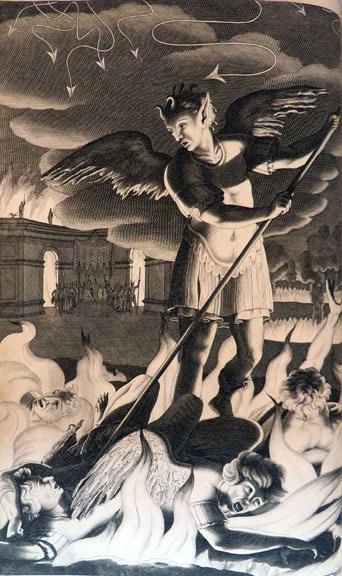
5 Milton, John. PARADISE LOST. A POEM IN TWELVE BOOKS...[Bound with:] PARADISE REGAINED. A POEM. IN IV BOOKS. To Which is Added SAMSON AGONISTES. (London: by Miles Flesher, for Richard Bently and Jacob Tonson; and by R.E. and are to be sold by Randal Taylor., 1688; 1688) First Illustrated Edition. First Folio Editions. First Issues. With a very fine engraved frontispiece portrait of Milton by R. White and 12 very fine copperplate engravings by Burgess and P. P. Bouche after John Baptist Medina, B Lens and H. Aldrich. Folio [12 3/8” x 7 5/8”], beautifully bound in full contemporary antique paneled calf of the 17th century, the spine with raised bands, lettered in gilt on a adobe-red morocco lettering label decorated with gilt tooling, the covers with central panel of dark calf surrounded by fine gilt work sides creating an outside panel ruled in gilt and with fine gilt corner pieces. [2]ff, 343, [7]; [1]f, 66, [6], 57 pp. A magnificent copy in absolutely superb condition, no repairs or sophistication of any sort, slight corner loss to one leaf. Extremely rare in this condition and state of preservation.
THE FIRST ILLUSTRATED AND FIRST FOLIO EDITION. This is also one of the earliest examples of a book published by subscription and one of the earliest illustrated books in English literature. Five Centuries of Book Illustration (1988) Edward Hodnett calls this “the earliest serious effort to illustrate an important work of English poetry;” and in Francis Barlow: First Master of English Book Illustration he goes further and declares it “the only major English literary work with important engraved illustrations in the seventeenth century.” The book was co-published by Tonson with Richard Bentley, and as with all of Tonson’s more elaborate books this is printed on high-quality paper in a large, very handsome type. The copperplate engravings have a dramatic power that was only matched 200 years later by John Martin’s gloomy mezzotints.
The addition of PARADISE REGAINED, also the first folio edition is a great complement to the PARADISE LOST. They are not always found bound together. SAMSON AGONISTES has a separate title-page (”Printed, and are to be Sold by Randal Taylor”), pagination and register, but it is not regarded as a separate publication.
“In publishing the monumental editions of the works of classical authors, Tonson was following the example of his most significant precursors in the publishing business. In rescuing from obscurity or oblivion the masterpieces of English authors and publishing them with similar care, he was an innovator. His first and best triumph in this neglected field was
(617) 536-4433
the fourth edition of Milton’s PARADISE LOST, which Tonson published with Bentley in 1688...” Lynch. Jacob Tonson, Kit-Cat Publisher, 1971, p.128. Wing M2146, 2154; Pforzheimer 720, 721; Grolier, Wither to Prior, 607; Coleridge. Milton Collection, 1980, Nos. 93c and 170. $25,000.
One of Only 6 Magnificent Folio Sets Handcoloured Monstrelet’s Classic Work - The Great Johnes Translation The Chronickles of Engruerrand de Monstrelet
Printed in 1809 - Bound in Full Dark Green Crushed Morocco
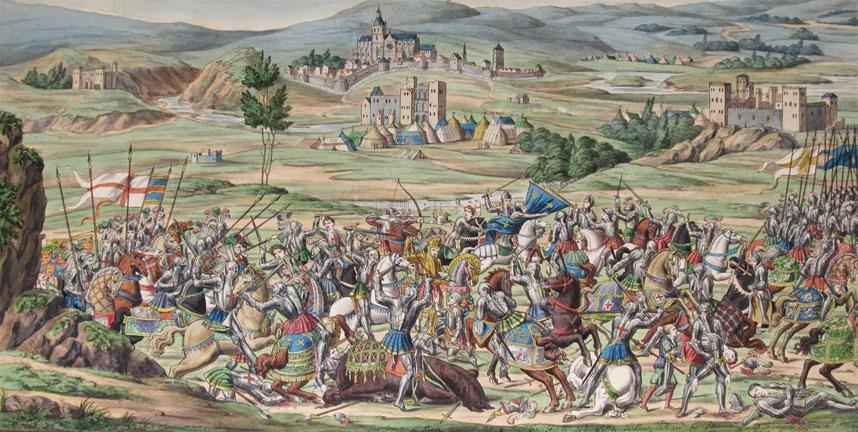
6 Monstrelet, Enguerrand De. THE CHRONICLES OF ENGRUERRAND DE MONSTRELET, Containing an Account of the Cruel Civil Wars Between The Houses of Orleans and Burgundy; of the Possession of Paris and Normandy by the English, Their Expulsion Thence, and of Other Memorable Events That Happened in the Kingdom of France as well as in Other Countries. A History of Fair Example and Great Profit to the French, Beginning in the Year MCCCC. Where That of Sir John Froissart Finishes, and Ending at the Year MCCCLXVII. And Continued by Others to the Year MDXVI. Translated by Thomas Johnes, ESQ. (London: Hafod Press, 18091809) 5 volumes. FIRST EDITIONS of Johnes’ translations. LARGE PAPER, FOLIO COPIES, ONE OF ONLY SIX SETS WITH THE PLATES IN TWO STATES, both handcoloured and in sepia. Of the large paper sets issued in only 25 sets total, 19 were issued without the coloured plates. This then is one of the very rare copies with coloured plates and one of only six thus. Extensively illustrated with very fine plates issued in two states, both in sepia and hand-coloured and illuminated, 102 plates total. Large Folio, bound in full dark-green crushed morocco, the spines lettered in gilt between raised bands of the spines. Each volume is housed in a cloth covered open-end slipcase. A very handsome set of this rare work. Some weakness to a few hinges.
VERY RARE LARGE PAPER FIRST EDITION COPIES. ONE OF ONLY SIX COPIES PRINTED. Johnes’s translation was the standard for most of the nineteenth century. “Froissart might be called the great interviewer of the Middle Ages. The newspaper correspondent of modern times has scarcely surpassed this medieval collector of intelligence. He traveled extensively in the various countries of Europe; he conversed with gentlemen of rank everywhere; and he had the remarkable knack of persuading those about him to divulge all he wanted to know. He learned the details of battles from both sides and from every point of view. He delighted in the minutest affairs of every cavalry skirmish, of the capture of every castle, and of every brave action and gallant deed. He lived from 1337 to about 1410, and wrote chiefly of contemporaneous events. The “Chronicles” are universally considered as the most vivid and faithful picture we have of events in the fourteenth century.... As a picture of the most favorable side of chivalry, the work has no equal” (Adams, Manual of Historical Literature, pp. 334-5).
$10,500.
536-4433
Andrea Palladio’s Great Work on Architecture
The Very Fine Folio Printing - From the Original Blocks I Quattro Libri Dell’Architettura Printed in Venice by Carampello - 1616 - A Beautiful Copy
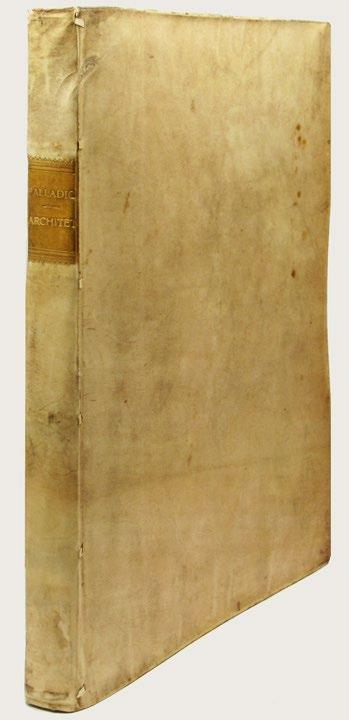
7 Palladio, Andrea. I QUATTRO LIBRI DELL’ARCHITETTURA Ne’ quali, dopò un breve Trattato de’cinque ordini, e di quelli avertimenti, che sono più necessari nel fabricare; Si Tratta Delle Case Private, delle Vie, dei Ponti, dei Piazzae, dei i Xisti, & de Tempij. (Venice: Appresso Bartolomeo Carampello, 1616) Extremely early printing, only the fourth ever issued and using the plates of the original 1570 printing. The type has been re-set by the same printer of the 1581 and 1601 printings and the initials re-cut from wood as in the earlier issues. General and divisional titles within woodcut historiated architectural border, over 200 woodcut illustrations (including over 150 full page folio sized). The engravings are by Giovanni and Cristoforo Chrieger, Cristoforo Coriolano and others and derive directly from the 1570 first edition, while the text has been reorganized by Carampello and has newly cut initials and a new woodcut title-page from the 1601 edition. Folio, finely bound in handsome period antique Italian vellum, the spine with morocco label pleasingly tooled in gilt in contemporary design. A handsome binding. (68), 78, [1 blank leaf], 46, [2], 133, [colophon], (same as the 1601, except for the presence of the blank leaves KK4, and RRRR4 in this issuance). A very pleasing, large, handsome, clean and crisp copy with especially fine and dark impressions of the engravings. The textblock is solid and tight, the binding, still very strong, is in wonderful condition. An excellent and very well preserved example of this rare book.
VERY RARE FOLIO PRINTING OF THE ORIGINAL PALLADIO, USING THE BLOCKS OF 1570. A very fine and handsome folio printing of Palladio’s great work. Palladio’s designs and work to this day remain the central pillar of classical architecture and all architecture which followed. Sixteenth-century editions are truly scarce and retain the original sophistication and in this case, the exact replication of the prior issue.
‘Palladio’s lasting influence on architectural style in many parts of the world was exercised less through his actual buildings than through this, his textbook. The book is divided into four sections: orders and elementary problems, domestic building, public building and own planning and temples. Palladio’s style was directly inspired by Roman classical models through the writings of Vitruvius and Alberti. Its characteristics are those of classicism: symmetry, order, fixed mathematical relations of the parts to each other and to the whole, logic and monumentality.
Palladio followed the rules of classical Roman architecture more closely than any other architect...In spite of the vogue for the baroque and the fact that Palladio left no immediate successors, his book exerted a powerful influence on contemporary architecture and classical ideals until the end of the eighteenth century.
As a practising architect Palladio worked mainly in Vicenza, Venice and the Venetian countryside, especially along the Brenta River. His Villa Capra (known as La Rotonda) near Vicenza became virtually a prototype of the Palladian style, and it was widely and faithfully copied. At the end of his life he left plans for the tour de force of trompe l’oeil, the Teatro Olimpico in Vicenza, which was finished by his pupil Vincenzo Scamozzi.’ PMM.
Palladio’s treatise features among the capital Renaissance texts of architecture, next to Alberti’s, Serlio’s, Vignola and Scamozzi’s. It exerted an incredible influence all over Europe and Great Britain in particular. The first book deals with architectural orders, materials and building techniques. The second is about private houses, the third discusses civil and urban engineering, the fourth focuses on temples and similar buildings. Fowler 215. PMM (First Edition). Raccolta palladiana Guglielmo Cappellatti n 109. Millard, Italian and Spanish books n 67 $18,500.
One of the Greatest Books of the Enlightenment The Book that Changed the Way Europeans Thought The Book that Strengthened Ethical and Religious Tolerance Jean Frédéric Bernard and Bernard Picart Ceremonies and Religious Customs of the Various Nations Published - London - 1731-1739 - Rare First Edition
Profusely Illustrated with Exquisite Copperplate Engravings
8 [Picart, Bernard Illus.], Bernard; Jean Frédéric Bernard. THE CEREMONIES AND RELIGIOUS CUSTOMS OF THE VARIOUS NATIONS OF THE KNOWN WORLD; Together with Historical Annotatons, and several Curious Discourses Equally Instructive and Entertaining. Vol. I Containing the Ceremonies of the Jews, and the Roman Catholicks. Vol. II (1731), The Ceremonies of the Roman Catholicks; Vol. III (1731), The Ceremonies of the Idolatrous Nations; Vol. IV Ceremonies (1735), Part II; Vol. V (1736), Containing the Ceremonies of the Greeks and Protestants; Vol. VI (1737) in Two Parts. Part I. Containing the Doctrine and Discipline of the Church of England, of the Presbyterians, Independents, Anabaptists, Quakers, etc.. Part II. Containing the Various Sects of Mahometans, with an Appendix of the Lives of Mohammed, Omar, and Ali. Vol. VII (1739), Containing the Various Sects of Mahometans. Written originally in French, and illustrated with a large Number of Folio Copper Plates, all beautifully designed by Mr. Bernard Picart and curiously Engraved by most of the best hands in Europe. (London: Printed by William Jackson, for Claude du Bosc, 1733-1739) 7 volumes bound in six. First Edition in English. Sumptuously illustrated throughout with magnificent folio copperplate engravings by Picart. Title pages printed in red and black with engraved vignettes. Highly accomplished historiated and decorative head
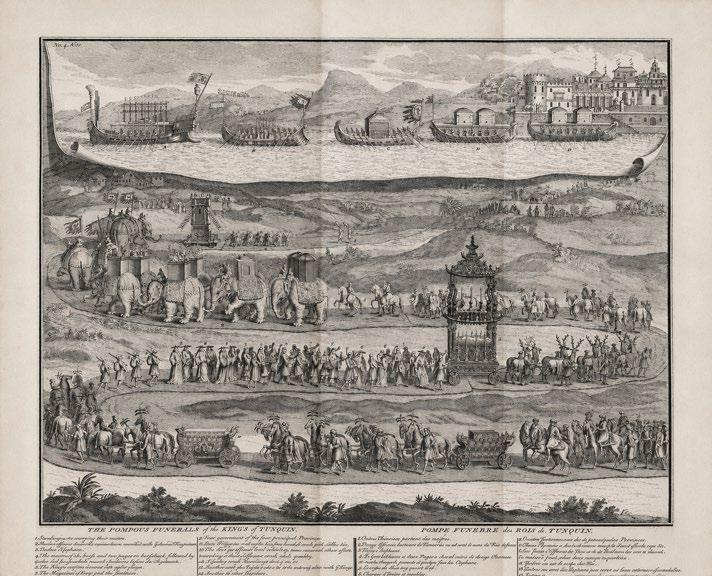
and tailpieces, large and decorative initials, some running 12 lines. Superb head and tail-pieces throughout, 224 plates, all with copperplate engravings, an extra plate in one volume not called for in the binding list with many being double-page and folding. One of the greatest books of the age, both in text and illustration. Elephant Folio, (17.5” x 11”), contemporary three-quarter calf over marbled paper covered boards, the spines with raised bands over cords, gilt ruled, contrasting red and green morocco lettering pieces gilt, the boards used in the binding are most probably the original printer’s boards covered in blue paper as was normal. [4], viii, [10], 450, [12]; [x], 364, [14]; [xii], 495, [29]; ix, [9], 514, [14]; [vi], 470, [22]; [vi], 228, [6]; [iv], 164, [12] pp. A copy in its original binding, with some wear to the extremities, one cover loose at the upper hinge (easily repaired), some wear to the marbled paper showing the original printer’s blue boards underneath, some general wear, the textblocks and engravings all in pleasing condition, crisp and bright, unpressed and generally quite clean.
FIRST EDITION OF ONE OF THE GREATEST BOOKS OF THE ENLIGHTENMENT. THE BOOK THAT CHANGED THE WAY EUROPEANS THOUGHT. A BOOK THAT STRENGTHENED ETHICAL AND RELIGIOUS TOLERANCE. A BOOK WITH A GREAT PROFUSION OF STUNNING COPPERPLATE ENGRAVINGS.
Jean Frédéric Bernard (1680 - 1744) was a French bookseller, author, translator, printer and publisher. He worked mainly in the Netherlands, but published mainly in his native language. The son of a Huguenot refugee family, which was deeply woven into the cultural network of the era, he became one of the Netherlands’ best-selling publishers in Amsterdam thanks to his skill with reprints, who also used this income and an inheritance to finance important works of the European Enlightenment and natural sciences as an author. Recent research has gone so far as to attribute two of his editions, Recueil de voyages au nord (1715ff.) and Cérémonies et coûtumes religieuses (1723ff.), to have had a significant and lasting impact on the perception of the educated elites of the early 18th century. Both works strengthened ethical and religious tolerance towards other cultures and ethnic groups in the European Enlightenment.
Bernard developed a surprising religious theory concept in his introduction: “For him, religion is primarily a social phenomenon. All religions agree in their essential core, they are only different in their forms of expression. In the various customs and forms people’s own religious ideas would find their expression; behind this, however, lies the need for ceremonies in general, which is fundamental to human beings. Also anthropologically constant is the desire to interpret certain times and aspects of human existence through religious rituals, but also the attempt to create access to the divine through prayer.” Wyss-Giacosa
The seven-volume folio edition on the ceremonies and cultic expressions of all known religions was a bestseller of the Enlightenment era despite its high price and folio format. The 1,200 copies of the first edition were soon sold, translations were published into German, English and Dutch, and in 1741 there was even a competing edition in France itself. Contemporary reviewers reviewed the work extremely favorably and the work was widely found in the collections of prominent collectors of the time. The work gained particular importance due to the numerous illustrations by the engraver Bernard Picart, which were so popular with the public that the work was associated with Picart. In addition, the illustrations showed ethnic groups that, in the tenor of the time, were usually depicted as “bloodthirsty savages”, such as: The Indians of Florida, as caring individuals when mourning their loved ones. Thus, religious and cultural tolerance would have been increased in the European Enlightenment of the first half of the 18th century. Picart’s depiction still has an iconographic influence on Jewish culture today.
Picard (1673 – 1733), was a French draughtsman, engraver, and book illustrator in Amsterdam. His interest in cultural and religious habits was a guiding force in the artistic works he produced. After settling in The Hague he gathered with other notable thinkers to consider the changing tones caused by the Enlightenment. Picart, Prosper Marchand and Charles Levier belonged to a “radical Huguenot coterie”, that studied the works of John Locke, which promoted the separation of church and state.
From 1720 Picart collaborated on the Cérémonies with Bernard, with a commitment to religious toleration. Jonathan I. Israel calls Cérémonies “an immense effort to record the religious rituals and beliefs of the world in all their diversity as objectively and authentically as possible”.
‘They put religion in comparative perspective, offering images and analysis of Jews, Catholics, Hindus, Muslims, the peoples of the Orient and the Americas, Protestants, deists, freemasons, and assorted sects. Despite condemnation by the Catholic Church, the work was a resounding success. For the next century it was copied or adapted, but without the context of its original radicalism and its debt to clandestine literature, English deists, and the philosophy of Spinoza.’
This complete edition was published by Claude du Bosc from 1733 to 1739. This set, a copy of the complete du Bosc edition in its contemporary binding, is particularly collectible. As a reference book it was unprecedented; “no other work before then had ever attempted, in word and image, such a grand sweep of human religions”. “It sowed the radical idea that religions could be compared on equal terms, and therefore that all religions were equally worthy of respect - and criticism. It turned belief in one unique, absolute, and God-given truth into ‘religion’, that is, into individual ceremonies and customs
that reflected the truths relative to each people and culture”. One of the most significant features of the work is its attention to the native American peoples. The 34 engravings in this section include illustrations of indigenous peoples from Canada, Virginia, Florida, Hispaniola, Mexico, Venezuela, the Caribbean and Peru engaged in a wide variety of activities.
See:
(L. Hunt/M. C. Jacob/W. Mijnhardt: The Book That Changed Europe : Picart & Bernard’s Religious Ceremonies of the World. Harvard University Press, 2010 The Early Enlightenment, Religious Toleration, and the Origins of Comparative Religion: Bernard and Picart’s Religious Ceremonies and Customs of All the Peoples of the World)
Paola von Wyss-Giacosa: Religionsbilder der frühen Aufklärung. In: Sehepunkte, 7/2007, Nr. 9
Jenna Weissman Joselit: Enlightened Views. How a set of 18th-century etchings helped change the way Europe thought about religion, 2010
Israel, Jonathan I. (2001) Radical enlightenment: Philosophy and the Making of Modernity, 1650–1750. Oxford University Press
“Center for European and Russian Studies”. www.international.ucla.edu. $10,500.
“All The Wisdom of The Ancients”
First Edition - First Issue - The Historie of the World - 1601
Philemon Holland’s Great Translation of Pliny - PMM 5
The Encyclopedia of All The World’s Knowledge
9 [Pliny] Plinius Secundus, C. (A.D. 23-79). THE HISTORIE OF THE WORLD, COMMONLY CALLED THE NATURAL HISTORY OF C. PLINIUS SECUNDUS. Translated into English by Philemon Holland, Doctor of Physick. (London: Adam Islip, 1601) 2 volumes bound in one. First Edition in English. First Issue with the Original Title-Page and Adam Islip as Printer. With handsome engraved title-pages to each volume. Folio, contemporary full calf, sometime rebacked, the spine panel with raised bands, one compartment lettered in gilt, the original covers refurbished with new leather along the edges as required, portions of the original clasps are still present, endleaves replaced. Initial blank, Title,preface & table of contents 60 pp., 614, 42 index; [10, Second Title, To the Reader, Explanation of Words], 632, index, errata, final blank. Complete. A handsome and pleasing copy of this rare first edition, the endleaves renewed and the original binding refurbished at the edges and at the back, the first few leaves and the last few with some aging or toning and rubbing or time-wear to the edges, the textblock quite clean throughout, unpressed, sturdy and quite fresh, the binding with some general restoration as noted.
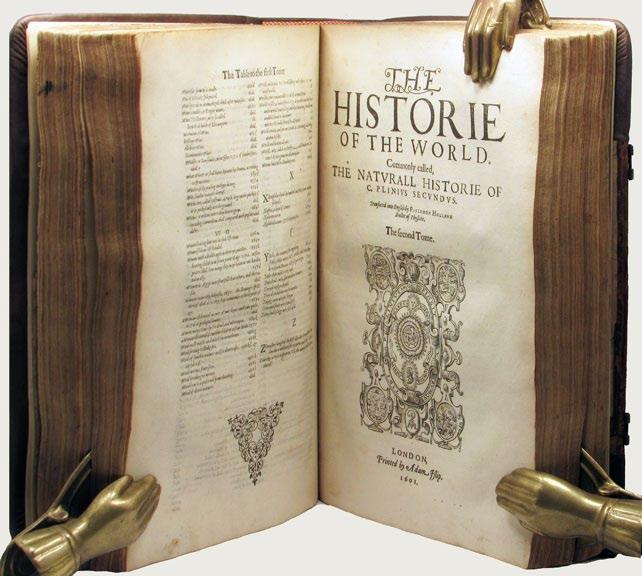
RARE FIRST EDITION OF PHILEMON HOLLAND’S GREAT
TRANSLATION. The first full English translation of this important book. First published in Venice in 1469, “The ‘Natural History” of Pliny the Elder is more than a natural history: it is an encyclopaedia of all the knowledge of the ancient world....He was a compiler rather than an original thinker, and the importance of this book depends more on his exhaustive reading (he quotes over four hundred authorities, Greek and Latin) than on his original work. All the spare time allowed him by a busy administrative career was devoted to reading; he began long before daybreak, his nephew the younger Pliny recorded, and grudged every minute not spent in study; no book was so bad, he used to say, as not to contain something of value. When he died the ‘Natural History’ (the sole extant work out of one hundred and two volumes from his pen) was still incomplete. It comprises thirty-seven books dealing with mathematics and physics, geography and astronomy, medicine and zoology, anthropology and physiology, philosophy and history, agriculture and mineralogy, the arts and letters. He is scrupulous in his acknowledgment of his sources (you must, he wrote, with honest humility, declare those from whom you have profited), and the whole of the first book is devoted to the tables of contents and authorities which bear witness to his method.
The Historia soon became a standard book of reference: abstracts and abridgments appeared by the third century. Bede owned a copy, Alcuin sent the early books to Charlemagne, and Dicuil, the Irish geographer, quotes him in the ninth century. It was the basis of Isidorets Etymologiae and such medieval encyclopedias as the Speculum Majus of Vincent of Beauvais and the Catholicon of Balbus. One of the earliest books to be printed at Venice, the center from which so much of classical literature was first dispensed, it was later translated into English by Philemon Holland in 1601, and twice reprinted (a notable achievement for so vast a text).
More recently, scholars as various as Humboldt and Grimm have praised and acknowledged their debt to it. Over and over again it will be found that the source of some ancient piece of knowledge is Pliny. (PMM)
The standard of reference for scholars since the 15th century, Holland’s translation made it available to the English speaking world for the first time. $14,500.
Hamlet and Macbeth
Rare and Highly Desirable
Shakespeare’s Two Greatest Plays
The Earliest Obtainable Printings - 1632
10 Shakespeare, William. “The Tragedy of Macbeth” [with] “The Tragedy of Hamlet, Prince of Denmark” ([London]: [by Thomas Cotes for Robert Allot], [1632])
From the famed Second Folio of Shakespeare. Folio, quarter brown calf and marbled boards, gilt lettered and ruled on the spine. [251]-302. A very handsome and large copy, the binding in excellent order, the text in nice condition and with only typical or occasional mild spotting or light aging, the last two leaves of Hamlet supplied from a different folio then the rest.
RARE AND HIGHLY IMPORTANT. Two of Shakespeare’s most famous plays extracted from the Second Folio edition of his COMEDIES, HISTORIES, AND TRAGEDIES, a cornerstone--and some would say foundation--of English literature. While the complete Second Folio is one of the book collector’s great prizes, a status well reflected in its price these days, this is an opportunity to acquire two of the best plays from the volume bound separately.
THE ESSENCE OF SHAKESPEARE and truly the earliest obtainable printings of HAMLET or MACBETH that one could purchase. This 2nd Folio printing of MACBETH is the second time only that this great play was printed. MACBETH is a tragedy so great that for centuries it has been considered bad luck to even speak its name inside a theatre, thus it is almost universally referred to by stage
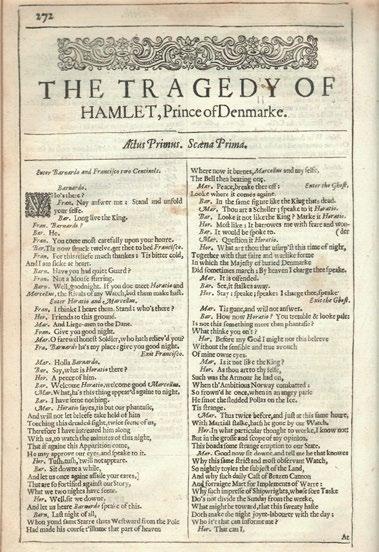
actors simply as “the Scottish play”. HAMLET contains the great line “to be or not to be”, considered the most often quoted of all of the Bard’s many, many well quoted lines. In either case, these are the earliest obtainable printings of Shakespeare’s greatest plays. $45,000.
The Wealth of Nations
The First & Greatest Classic of Modern Economic Thought An Especially Early Copy - Remarkably Well
Preserved
11 Smith, Adam. AN INQUIRY INTO THE NATURE AND CAUSES OF THE WEALTH OF NATIONS (London: for A. Strahan and T. Cadell, 1786) 3 volumes. An especially early printing, the fourth, only the second of the octavo editions, the last edition with any changes, includes a new preface never before printed, issued only 10 years after the first 2 vol. quarto edition. 8vo, beautiful three-quarter polished calf in fine antique style over marbled paper covered boards, red morocco lettering labels gilt, the spine in compartments separated by gilt bands, gilt central devices in the compartments. viii, 499 + errata; vi, 518, [5] Appendix + errata; v + errata, 465, (47) index + (1) ad pp. A remarkably fine and handsome set, the text blocks completely untrimmed and with the original deckled edges as issued from the printer. Bindings in excellent condition.
A BEAUTIFUL SET OF THIS EXTRAORDINARY WORK. Smith’s classic work was begun at Toulouse in 1763-64 where he had travelled as guardian of Henry Scott, the young duke of Buccleuch, and in the company of David Hume, historian and fellow professor at Glasgow University. The work took shape over the next ten years and was finally published in 1776. At one point during its composition, Hume wrote that Smith was “cutting himself off entirely from human society.” But his labors, however severe his methods, yielded the “first and greatest classic of modern economic thought” (Printing and the Mind of Man).
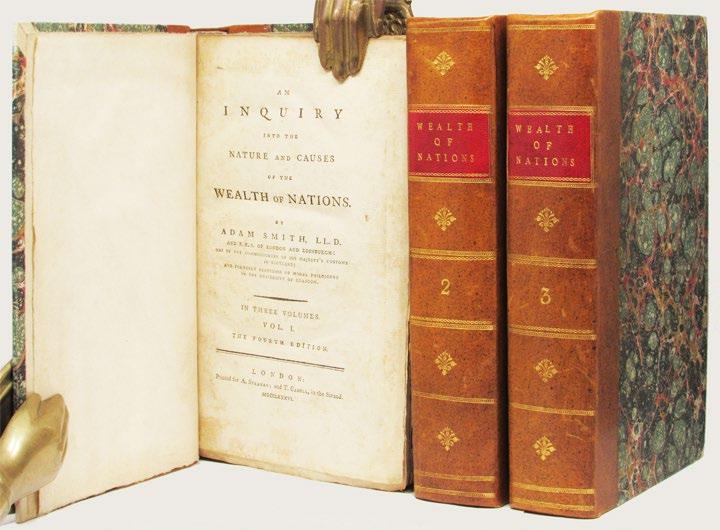
“[I]t may be said that the WEALTH OF NATIONS certainly operated powerfully through the harmony of its critical side with the tendencies of the halfcentury which followed its publication to the assertion of personal freedom and ‘natural rights.’ It discredited the economic policy of the past, and promoted the overthrow of institutions which had come down from earlier times, but were unsuited to modern society. As a theoretic treatment of social economy, and therefore as a guide to social reconstruction and practice in the future, it is provisional, not definitive. But when the study of its subject comes to be systematized on the basis of a general social philosophy more complete and durable than Smith’s, no contribution to that final construction will be found so valuable as his” (Britannica).
The fourth edition contains a special ‘advertisement’, first appearing here, in which Smith declares that he is now ‘at liberty to acknowledge my very great obligations to Mr. Henry Hop of Amsterdam. To that gentleman I owe the most distinct, as well as liberal information, concerning a very interesting and important subject, the Bank of Amsterdam’. Eighteenth century editions of Smith’s magnum opus are now becoming very scarce. Goldsmiths’ 3148; Kress B.1129; Vanderblue, p.3; not in Einaudi. $9500.
His First Book - Adam Smith - Fine Contemporary Calf Gilt
The Theory of Moral Sentiments - London - 1759 - Very Rare
One of the Most Important Works in all English Philosophy First Use of the Phrase “Led by an Invisible Hand”
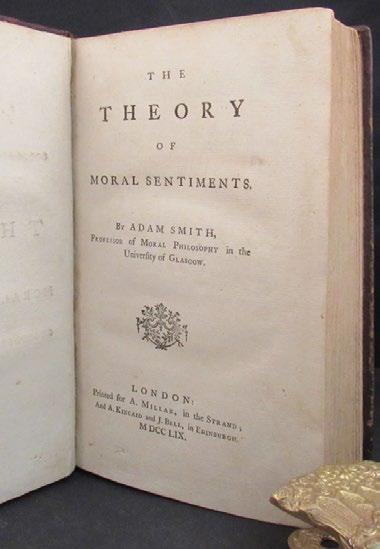
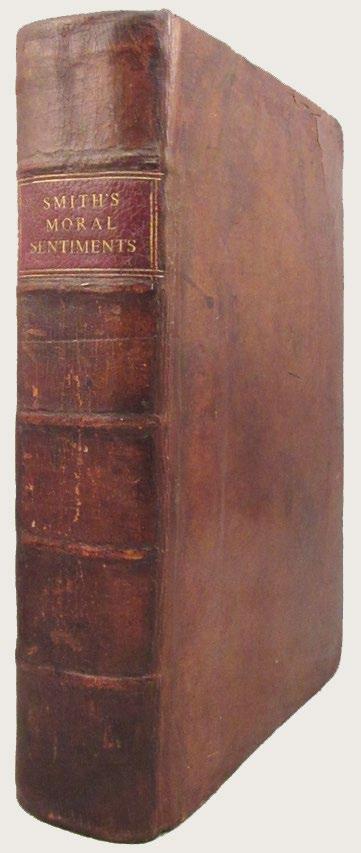
12 Smith, Adam. THE THEORY OF MORAL SENTIMENTS, Or, An Essay Towards an Analysis of the Principles by which Men naturally judge concerning the Conduct and Character, first of their Neighbours, and afterwards of themselves. To which is added, A Differentiation on the Origin of Languages (London: Printed for A. Millar, in the Strand and A. Kincaid and J. Bell, in Edinburgh, 1759, 1759) First Edition. Thick 8vo, 202 x 123 mm., bound in its original contemporary binding of full calf, neatly and very sympathetically and skillfully restored at the back with the original spine panel laid down (preserving all but ca. 2cm at the foot, a nearly invisible sophistication, the original morocco label replaced, free endleaves renewed sympathetically with antique paper. [xii], 551, [1] errata (uncorrected in the text, with an error: 412 should read 413); pp. 317336 omitted from pagination as usual; complete with the half-title pp. A very handsome copy, crisp and unpressed, clean throughout, the binding strong and in good order, the occasional spot as to be expected, but truly a pleasing copy of this monumental work.
THE ESPECIALLY RARE FIRST EDITION IN ORIGINAL CONTEMPORARY BINDING OF ADAM SMITH’S FIRST BOOK, PUBLISHED IN 1759. A TRULY RARE BOOK AND ONE OF THE MOST IMPORTANT WORKS IN ALL OF ENGLISH PHILOSOPHY.
‘THE THEORY OF MORAL SENTIMENTS was a true scientific breakthrough. It shows that our moral ideas and actions are a product of our very nature as social creatures. It argues that this social psychology is a better guide to moral action than is reason. It identifies the basic rules of prudence and justice that are needed for society to survive, and explains the additional, beneficent, actions that enable it to flourish.
As individuals, we have a natural tendency to look after ourselves. That is merely prudence. And yet as social creatures, explains Smith, we are also endowed with a natural sympathy – today we would say empathy – towards others. When we see others distressed or happy, we feel for them – albeit less strongly. Likewise, others seek our empathy and feel for us. When their feelings are particularly strong, empathy prompts them to restrain their emotions so as to bring them into line with our, less intense reactions. Gradually, as we grow from childhood to adulthood, we each learn what is and is not acceptable to other people. Morality stems from our social nature.
So does justice. Though we are self-interested, we again have to work out how to live alongside others without doing them harm. That is an essential minimum for the survival of society. If people go further and do positive good – beneficence – we welcome it, but cannot demand such action as we demand justice. Virtue. Prudence, justice, and beneficence are important. However, the ideal must be that any impartial person, real or imaginary – what Smith calls an impartial spectator – would fully empathize with our emotions and actions. That requires self-command, and in this lies true virtue.
Morality, says Smith, is not something we have to calculate. It is natural, built into us as social beings. When we see people happy or sad, we feel happy or sad too. We derive pleasure when people do things we approve of, and distress when we believe they are doing harm.
Of course, we do not feel others’ emotions as strongly as they do. And through our natural empathy with others, we learn that an excess of anger, or grief, or other emotions distresses them. So we try to curb our emotions to bring them into line
with those of others. In fact, we aim to temper them to the point where any typical, disinterested person – an impartial spectator, says Smith – would empathise with us.
Likewise, when we show concern for other people, we know that an impartial spectator would approve, and we take pleasure from it. The impartial spectator is only imaginary, but still guides us: and through experience we gradually build up a system of behavioural rules – morality.
Punishments and rewards have an important social function. We approve and reward acts that benefit society, and disapprove and punish acts that harm it. Nature has equipped us with appetites and aversions that promote the continued existence of our species and our society. It is almost as if an invisible hand were guiding what we do.
For society to survive, there must be rules to present its individual members harming each other. As Smith comments, it is possible for a society of robbers and murderers to exist – but only insofar as they abstain from robbing and murdering each other. These are the rules we call justice.
If people do not help others when they could, or fail to return a good deed, we may call them uncharitable or ungrateful. But we do not punish people to force them to do good: only for acts of real or intended harm. We force them only to obey the rules of justice, because society could not otherwise survive.
But nature has given us something even more immediate than punishment, namely our own self-criticism. We are impartial spectators, not only of other people’s actions, thanks to conscience. It is nature’s way of reminding us that other people are important too.
In the process of making such judgments on a countless number of actions, we gradually formulate rules of conduct. We do not then have to think out each new situation afresh: we now have moral standards to guide us.
This constancy is beneficial to the social order. By following our conscience, we end up, surely but unintentionally, promoting the happiness of mankind. Human laws, with their punishments and rewards, may aim at the same results; but they can never be as consistent, immediate, or effective as conscience and the rules of morality engineered by nature.
Smith ends THE THEORY OF MORAL SENTIMENTS by defining the character of a truly virtuous person. Such a person, he suggests, would embody the qualities of prudence, justice, beneficence and self-command.
Prudence moderates the individual’s excesses and as such is important for society. It is respectable, if not endearing. Justice limits the harm we do to others. It is essential for the continuation of social life. Beneficence improves social life by prompting us to promote the happiness of others. It cannot be demanded from anyone, but it is always appreciated. And self-command moderates our passions and reins in our destructive actions.
Freedom and nature, Smith concludes, are a surer guide to the creation of a harmonious, functioning society than the supposed reason of philosophers and visionaries.’ The Adam Smith Institute
The phrase that he is especially known for is first used here and would be repeated in THE WEALTH OF NATIONS: that the rich “...led by an invisible hand to make nearly the same distribution of the necessities of life, which would have been made, had the earth been divided into equal portions among all its inhabitants, and thus without intending it, without knowing it, advance the interest of the society, and afford means to the multiplication of the species.” (Part IV, Section 1, pp. 350).
Both THE THEORY OF MORAL SENTIMENTS, Adam Smith’s first book and his later WEALTH OF NATIONS demonstrate “a great unifying principle...Smith’s ethics and his economics are integrated by the same principle of selfcommand, or self-reliance, which manifests itself in economics in laissez faire” (Spiegel).
“The fruit of his Glasgow years The Theory of Moral Sentiments would be enough to assure the author a respected place among Scottish moral philosophers, and Smith himself ranked it above the Wealth of Nations. Its central idea is the concept, closely related to conscience, of the impartial spectator who helps man to distinguish right from wrong. For the same purpose, Immanuel Kant invented the categorical imperative and Sigmund Freud the superego” (Niehans, 62) Adam Smith Institute; Goldsmiths’ 9537; Higgs 1890; Kress 5815; Tribe 1; Vanderblue, p. 38. $115,000.
Baldassarre
Castiglione - Il Libro del Cortegiano - 1547
One of the Greatest Books of 16th Century Italy
PMM 59 - The Renaissance Ideal - Printed by Aldus
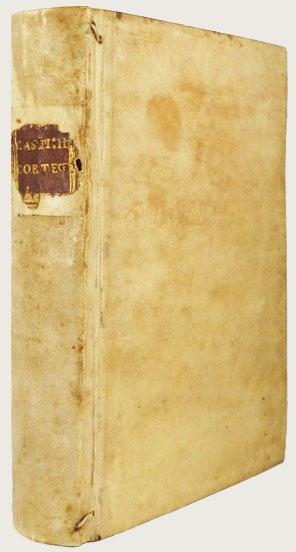
13 Castiglione, Conte Baldassarre. IL LIBRO DEL CORTEGIANO, DI NUOVO RINCONTRATO CON L’ORIGINALE SCRITTO DI MANO DE L’AUTORE... (Vinegia: Figlioli di Aldo (Aldus), 1547) Early Printing by Aldus. Elaborate Aldine device Impressed on the titlepage and at the end on the verso of the colophon leaf. Dedication to Michel de Selva, vescovo di Viseo. 8vo, bound in 17th century stiff vellum, red morocco lettering label gilt. ff. (5), 195, (8). A fine example with the title label with a bit of chipping and with some light loss.
RARE
ALDINE EDITION OF THE CLASSIC
LANDMARK
IL CORTEGIANO. Castiglione’s great work is one of the most famous books of the Italian Renaissance and represents the highest level of commitment to the prince and the new political and social order. The Courtier is the prototype of the courtesy book, written as conversation between members of the court. At the time of its composition Castiglione was at the court of Guidobaldo de Montefeltre and Elizabetta Gonzaga at Urbino, together with Bembo, Giuliano de’ Medici, Federico Fregoso and other Renaissance luminaries; members of that court feature as speakers in the conversation. Castiglione, after serving the Sforzas at Milan and the Gonzagas at Mantua, came to the Court of Urbino in 1504 where de Montefeltre and his consort Elizabetta Gonzaga were the center of the most brilliant court in Italy, which counted among its members Bembo, Bibbiena, G. de’Medici and many other eminent men. This brilliant book is based on Castiglione’s experience of life among these dazzling figures.
‘The Courtier’ depicts the ideal aristocrat, and it has remained the perfect definition of a gentleman ever since. It is an epitome of the highest moral and social ideas of the Italian Renaissance and is written in the form of a discussion between members of the court. The fundamental idea that a man should perfect himself by developing all his faculties goes back to Aristotle’s ETHICS and many of the Aristotelian virtues reappear--honesty, magnanimity and good manners. The ideal man should also be proficient in arms and games, be a scholar and connoisseur of art; he should develop graceful speech and cherish a sense of honour. Relations between the prince and the courtier, forms of government, and rules for the conduct of a lady are also discussed and the book ends with the celebrated pronouncement on platonic love by Bembo.
This Renaissance ideal of the free development of individual faculties and its rules of civilized behaviour formed a new conception of personal rights and obligations in Europe. The book was translated into most European languages and between 1528 and 1616 no less than one hundred and eight editions were published. It had great influence in Spain where traces of it can be found in DON QUIXOTE and in France in Corneille’s writings. But its most potent influence was probably in England. Its influence can be seen in Shakespeare, Spenser, Ben Jonson, Sir Philip Sidney, Robert Burton and Shelley. It had a great impact on the development of English drama and comedy.
The beautiful and highly important printings of the house of Aldus are exceptional and revered in their own right. This, one of the most exceptional of Italian Renaissance works published by the great Renaissance printer of Italy. (PMM 59). Renouard 139.1. UCLA IIIa, 328. Adams C-933. BMC 156. Cens. Naz. III, 2049. $8950.
Charles Darwin - The Origin of Species - 1861 A Beautiful Copy - Very Bright and Very Clean The Greatest Biological Work Ever Written The Most Important Work of Science of the 19th Century The Great Leap Forward in Mankind’s Knowledge of Itself
14 Darwin, Charles. ON THE ORIGIN OF SPECIES BY MEANS OF NATURAL SELECTION, or the Preservation of Favoured Races in the Struggle for Life (London: John Murray, 1861) A very early issuance and only the third edition (seventh thousand of the title, with important additions and corrections] of Darwin’s monumental work. This edition is printed in the same format and binding as the first edition, and includes “An Historical Sketch of the Recent Progress of Opinion on the Origin of Species” in which Darwin acknowledges his fellow scientists as regards the theory of evolution, as well as a table of corrections to the first and second editions. Twothousand copies only were printed and issued in April 1861. Folding lithographed diagram by W. West. Quarto in 12’s (7 3/4” x 5 7/8”, 193mm x 124mm), publisher’s original green cloth, gilt decorated on the spine and blocked in blind on the covers, salmon glazed paper end-leaves with the binders Edmonds & Remnants ticket on the rear paste-down. Housed in a handsome morocco labeled slipcase with chemise. i-v vi-xix, 538, [2] ads. and with one folding plate. A very fresh and clean copy, fine and very bright both internally and externally with only very light evidence of age or use. The endleaves in excellent condition and unusually clean, the hinges strong and pleasing and without refurbishment, a slight bit of rubbing only at the extremities. An especially pleasing copy, unusually well preserved. One of the best we have seen.
AN ESPECIALLY HANDSOME AND PLEASING COPY OF THIS GREAT BOOK. THE THIRD AND HIGHLY IMPORTANT ISSUANCE OF CHARLES DARWIN’S MASTERWORK.
The book is rare in cloth in this condition.
Darwin’s Revolutionary Masterwork, in which he not only “drew an entirely new picture of the workings of organic nature; he revolutionized our methods of thinking and our outlook on the natural order of things. The recognition that constant change is the order of the universe had been finally established and a vast step forward in the uniformity of nature had been taken.” [PMM) Together with Copernicus’ DE REVOLUTIONIBUS and Newton’s PRINCIPIA, it is deemed one of the three greatest and most important scientific works ever penned.

“The most influential scientific work of the nineteenth century” and “The most important biological work ever written” (Horblit, Freeman). Darwin’s elaboration of the theory of natural selection laid the groundwork for the controversy over the evolution of man, and with only slight modification by such scientists as Stephen Jay Gould, Darwin’s ideas remain the umbra under which most current biological research is conducted.
The import of the ORIGIN need hardly be stated. This edition, for the first time contains Darwin’s historical treatment of theories of evolution: “An Historical Sketch of the Recent Progress of Opinion on the Origin of Species” (xiii-xix). Here Darwin acknowledges the impact of Lamarck, Patrick Matthew and others, right up to 1860, on his thought. As such, it is the first edition that situates Darwin in his broader intellectual context.
Copies of the ORIGIN are often quite worn, but the present item is unusually well preserved, bright, clean, tight and especially handsome. The book was, if ever used, handled very kindly indeed.
Darwin had intended the book to be an abstract of his ‘big book’ on transmutation, of which only the first part (Variation Under Domestication, 1868) was published in his lifetime. Freeman 381; PMM 344b; Dibner 199; Grolier/Horblit 23. $7850.
Democracy In America
Rare First Printing of 1835-1836
One
of the
Great and Classic Texts on the United States
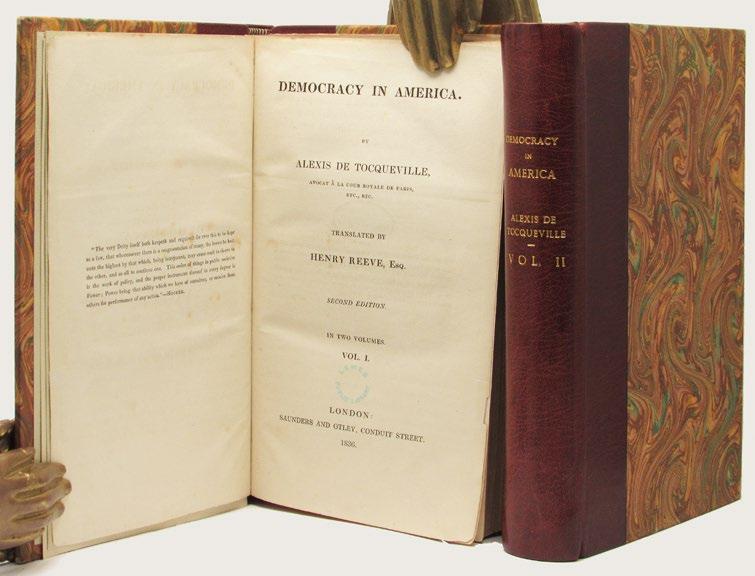
15 De Tocqueville, Alexis. DEMOCRACY IN AMERICA. Translated by Henry Reeve, Esq. (London: Saunders and Otley, 1836, 1835) 2 volumes. First Edition in English of Volume II and Second Edition in English of Volume I, both preceding the American first editions. Large folding engraved map with outline colouring in Vol. I. 8vo, three-quarter brown morocco over marbled boards, the spines handsomely lettered in gilt. xliv, 333; viii, 462 pp. An unusually handsome, very bright and fresh set, a few small unobtrusive old ownership stamps.
VERY EARLY PRINTING OF DEMOCRACY IN AMERICA, TOCQUEVILLE’S GREAT WORK ON AMERICA, STILL CONSIDERED
A MASTERPIECE AND ONE OF THE BEST BOOKS EVER PENNED ON THE COUNTRY. “One of the most important texts of political literature” (PMM). An extraordinary and very readable work. Tocqueville travelled to America to examine prisons and penitentiaries in this country, and upon his return he wrote DE LA DEMOCRATIE, the first book of reasoned politics on democratic government in America, which made his reputation. The book established many of the fundamental concepts of sociology. De Tocqueville’s articulation and application of the concepts of power, social stratification, industrialism and mass culture in particular provided the theoretical framework for their more detailed treatment at the end of the century by Weber, Simmel, Tönnies, Burckhardt, Michels, Acton, Taine and Le Play.
Harold J. Laski calls Democracy in America “perhaps. . . the greatest work ever written on one country by the citizen of another.” The book grew out of a trip to the United States De Tocqueville took as an assistant magistrate, with Gustave de Beaumont, in order to study the American penitentiary system for France. From New York City they travelled as far east as Boston, as far west as Green Bay, as far north as Sault Ste. Marie and Quebec, and as far south as New Orleans. Their analysis was published in 1833, and immediatly afterward Tocqueville began to write the work by which he is best remembered.
The book treats specific aspects of government and politics, including the principal of popular sovereignty, the nature of the states and local government, judicial power, the American Constitution, political parties, freedom of the press, suffrage, the role of the majority and the methods used to ensure against its tyranny, and the present and possible future of the three races making up the population--whites, blacks, and the indigenous peoples. There is also a discussion of the difficulties inhibiting the creation of an aristocracy, and an analysis of the causes of prosperity. The second part was published in the following year.
DEMOCRACY IN AMERICA “remains the best philosophical discussion of democracy, illustrated by the experience of the United States, up to the time when it was written, which can be found in any language. More than this is true. Notwithstanding the changes which have occurred in the material and social circumstances of the United States during the last sixty years [written in 1898], the consequent elimination of certain factors in the civilization of this country, and the introduction of new and unforeseen problems,--notwithstanding all this, the student of modern popular government must revert to Tocqueville....When his work appeared, democracy was to some an ‘ideal,’ a ‘brilliant dream;’ to others, ‘ruin, anarchy, robbery, murder.’ De Tocqueville wished to lessen the fears of the latter, the ardor of the former class. He treats
Democracy as a fact” (Daniel Gilman, in his introduction to the 1898 edition, quoted by Larned 2807). De Tocqueville’s conclusions about the system of government chosen by the young nation, and the implications of that choice, have been reexamined by each succeeding generation since it was originally published.
This second edition collates the same as the first and was issued only one year after the first. It precedes the first American edition.
See Sabin 96062. Not in Einaudi, Goldsmiths or Kress. $8950.
With Fine Manuscript Letter by Charles Dickens
Autograph Letters from Forster, Landor, Mitford and Others
Exquisitely Bound and Extra-Illustrated With Engravings James T. Fields “Portraits” of His Friends and Peers
Yesterdays with Authors - Boston - 1886
16 [Dickens, Charles] Fields, James T. YESTERDAYS WITH AUTHORS (Boston: Houghton, Mifflin and Company at the Riverside Press, 1886) One volume expanded to two. A UNIQUE COPY, EXTRA-ILLUSTRATED AND WITH AUTOGRAPH LETTERS. With the eleven engraved original portraits featuring handwriting facsimiles and OVER ONE HUNDRED AND TWENTY extra engraved portraits and views from various sources, AND WITH SEVEN ORIGINAL MANUSCRIPT NOTES OR LETTERS BOUND IN. Crown 8vo, in very fine and luxurious full chocolate crushed morocco by the Monastery Hill Bindery, the covers with double-frames composed of 5 gilt ruled lines, the four corners with large gilt tooled decorations in a vine, leaves and berries motif, the spines with six double-gilt framed compartments separated by gilt-ruled raised bands, four tooled with gilt leaves in the corners, two compartments lettered in gilt, additional gilt rule at the heads and tails of the spine, gilt stippled board edges, the turn-ins with wide gilt panels gilt decorated in a geometric motif surrounding a all-over green morocco inlay with geometric frame featuring elaborate gilt floral corners, fine dark-green silk endleaves, top edges gilt. The bindings protected by felt-backed cloth covered chemises and encased in matching felt lined, morocco backed slipcases with raised bands and lettering in gilt in two of the compartments. 250; [2] 253-419 pp. A beautiful set in very fine condition, the slipcases only with some trivial rubbing.

A UNIQUE AND EXQUISITE COPY, WITH OVER A HUNDRED EXTRA-ILLUSTRATIONS AND FINE MANUSCRIPT MATERIAL INCLUDED. The author’s literary portraits of his friends is here greatly enhanced with the seven bound in notes and letters. There is a four page signed and dated letter by the author, James T. Fields, a one page note on printed stationery, dated and signed by Dickens’ longtime friend and biographer John Forster; a two page literary letter on blue paper dated and initialed by Charles Dickens in 1856; a clipped dated signature by English writer Mary Russell Mitford; a three page letter in the hand of Miss M. R. Mitford; a one page signed and dated note by English Poet Bryan Waller Procter; and a signed manuscript note by poet, author and activist Walter Savage Landor. James T. Fields was a prolific American writer and contemporary and friend of the Transcendentalists and other important New England authors as well. Here he gives us literary biographies and commentaries on Thackeray, Hawthorne, Dickens, Wordsworth, Miss Mitford, and Bryan Proctor (who wrote under the pseudonym of ‘Barry Cornwall’. There is within these pages much commentary on other writers and famous persons, such as Alexander Pope, Shakespeare, and others. Added to all of this in the way of extra-illustrations are portraits of noted individuals ranging from Harriet Beecher Stowe to Abraham Lincoln, Charles Dickens, Nathaniel Hawthorne, and contemporaries and subjects of the writers from Andrew Jackson to Napoleon Bonaparte. $7500.
A Superb Set - Beautifully Bound - First Edition - 1812 Imitations of Original Drawings by Hans Holbein
The Court of Henry VIII and Illustrious Persons Fine Red Morocco Gilt Extra - The Plates in Two States An Unusually Rare Edition Extra-Illustrated
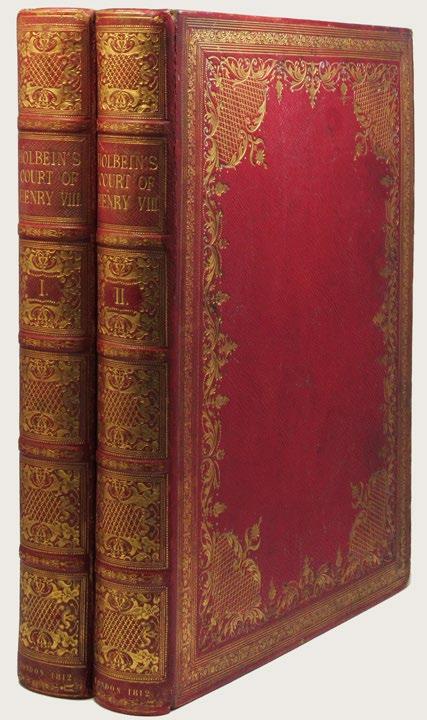
17 [Henry VIII; Holbein, Hans, artist]; Chamberlaine, John. IMITATIONS OF ORIGINAL DRAWINGS BY HANS HOLBEIN, IN THE COLLECTION OF HIS MAJESTY, For the Portraits of Illustrious Persons of the Court of Henry VIII, With Biographical Tracts (London: Published by John Chamberlaine, the Keeper of the King’s Drawings and Medals. Printed by William Bulmer and Co., Shakespeare Printing Office, 1812) 2 volumes. First Edition of the century, First Issue, the second edition overall. A RARE EXAMPLE WITH THE PLATES BOTH IN COLOURED AND UNCOLOURED STATE, THUS WITH DOUBLE THE NUMBER OF PLATES NORMALLY ENCOUNTERED. With 84 hand-coloured plates and 84 plates uncoloured, all separately printed on India paper and tipped onto full-page leaves, each facing the other, the plates with protective leaf separating the two, each image with two variations, mezzotint portraits of Holbein and his wife, a total of 168 illustrations on full-page plates, four plates dated from the first printing in 1792, the other 164 dated 1812 as with the publishing date. The plates are printed on a variety of papers, slightly different from one another-grey, buff, white, lavender and pink. Folio, 34.5 x 2, beautifully bound in full red morocco gilt extra, the spines with gilt tooled raised bands separating the compartments which are elaborately gilt decorated within triple gilt filleted frames, gilt stippling to the borders of the frames, lettered in gilt in one compartment, the covers beautifully gilt decorated in all-over designs, the borders with gilt stippled lines enclosing three gilt filleted borders surrounding an elaborate gilt inner border of floral tooling, bordered again by a stippled and multi-filleted gilt frame, the whole surrounding elaborate and large gilt tooled decorations at the inner corners and along the rules, the edges gilt ruled, the turnovers gilt rolled, marbled endleaves, all edges gilt, very elaborate and beautifully preserved binding work. unpaginated. Fine copies, beautifully preserved, very light wear or age evidence to the bindings which remain strong, the pages and plates all in good order, some very occasional light foxing to the papers as is typical, the colours remain vibrant and as printed, the giltwork on the bindings is in very pleasing condition, a very handsome set indeed.
FIRST EDITION AND AN UNUSUALLY SPECIAL COPY BOUND IN FULL RED MOROCCO GILT EXTRA, WITH THE PLATES PRINTED ON INDIA PAPER IN BOTH COLOURS AND BLACK AND WHITE, A COPY WITH DOUBLE THE NUMBER OF PLATES USUALLY ENCOUNTERED. Hans Holbein the Younger; c. 1497 – between 7 October and 29 November 1543) was a German-Swiss painter and printmaker who worked in a Northern Renaissance style, and is considered one of the greatest portraitists of the 16th century. He also produced religious art, satire, and Reformation propaganda, and he made a significant contribution to the history of book design. He is called “the Younger” to distinguish him from his father Hans Holbein the Elder, an accomplished painter of the Late Gothic school.
Holbein was born in Augsburg but worked mainly in Basel as a young artist. At first, he painted murals and religious works, and designed stained glass windows and illustrations for books from the printer Johann Froben. He also painted an occasional portrait, making his international mark with portraits of humanist Desiderius Erasmus of Rotterdam.
Holbein travelled to England in 1526 in search of work with a recommendation from Erasmus. He was welcomed into the humanist circle of Thomas More, where he quickly built a high reputation. He returned to Basel for four years, then resumed his career in England in 1532 under the patronage of Anne Boleyn and Thomas Cromwell. By 1535, he was King’s Painter to Henry VIII. In this role, he produced portraits and festive decorations, as well as designs for jewellery, plate, and other precious objects. His portraits of the royal family and nobles are a record of the court in the years when Henry was asserting his supremacy over the Church of England.
Holbein’s art has sometimes been called realist, since he drew and painted with a rare precision. His portraits were renowned in their time for their likeness, and it is through his eyes that many famous figures of his day are pictured today, such as Erasmus and More. He was never content with outward appearance, however; he embedded layers of symbolism, allusion, and paradox in his art, to the lasting fascination of scholars. In the view of art historian Ellis Waterhouse, his portraiture “remains unsurpassed for sureness and economy of statement, penetration into character, and a combined richness and purity of style.”
For Holbein, “everything began with a drawing”. A gifted draughtsman, he was heir to a German tradition of line drawing and precise preparatory design. Holbein’s chalk and ink portraits demonstrate his mastery of outline. He always made preparatory portraits of his sitters, though many drawings survive for which no painted version is known, suggesting that some were drawn for their own sake.
Ellis Waterhouse wrote that “modern” painting in England may be said to have begun with Holbein. That later artists were aware of his work is evident in their own, sometimes explicitly. Hans Eworth, for example, painted two full-length copies in the 1560s of Holbein’s Henry VIII derived from the Whitehall pattern and included a Holbein in the background of his Mary Neville, Lady Dacre. The influence of Holbein’s “monumentality and attention to texture” has been detected in Eworths’ work. According to art historian Erna Auerbach: “Holbein’s influence on the style of English portraiture was undoubtedly immense. Thanks to his genius, a portrait type was created which both served the requirements of the sitter and raised portraiture in England to a European level. It became the prototype of the English Court portrait of the Renaissance period”.
This striving for perfection is very evident in his portrait drawings, where he searches with his brush for just the right line for the sitter’s profile. The critical faculty in making this choice and his perception of its potency in communicating decisively the sitter’s character is a true measure of Holbein’s supreme greatness as a portrait painter. Nobody has ever surpassed the revealing profile and stance in his portraits: through their telling use, Holbein still conveys across the centuries the character and likeness of his sitters with unrivalled mastery. (see J. Rowlands, Hans Holbein the Younger, 1985) $8750.
The Greatest Text on Freedom of Thought and Speech
John Stuart Mill - On Liberty - First Edition - PMM 345
18 Mill, John Stuart. ON LIBERTY (London: John W. Parker and Son, 1859) First edition. 8vo, publisher’s original brown ribbed cloth with russet endpapers, the boards paneled in blind, the spine panel with two paper labels lettered in manuscript. With the Baronial engraved bookplate of Thomas Ashton of Hyde, British philanthropist, politician, and peer. 207, [1] colophon, 16 ads. pp. A fine and bright copy internally, the text especially fresh, a few pencil notations of interest but easily removed if desired, the boards are only lightly age mellowed and with a bit of mottling, unfaded and with little wear, the spine with loss to the cloth at both tips.
FIRST EDITION OF THE GREAT TEXT ON LIBERTY, one of the scarcest Mill first editions and the one which remains his most widely read book. It is also the work Mill himself thought most likely to be of enduring value.
ON LIBERTY represents the final stage in the growth of Utilitarian doctrine, and its central point is one which had escaped both Mill’s father and Jeremy Bentham: that the ‘greatest good’ of the community is inseparable from the liberty of the individual. Hitherto, liberty had always been considered relative, in relation to tyranny or oppression; Mill extended tyranny to include a custom-ridden majority, and declared that ‘the sole end for which mankind is justified in interfering with liberty of action is self-protection.’
Many of Mill’s ideas are now the commonplaces of democracy.
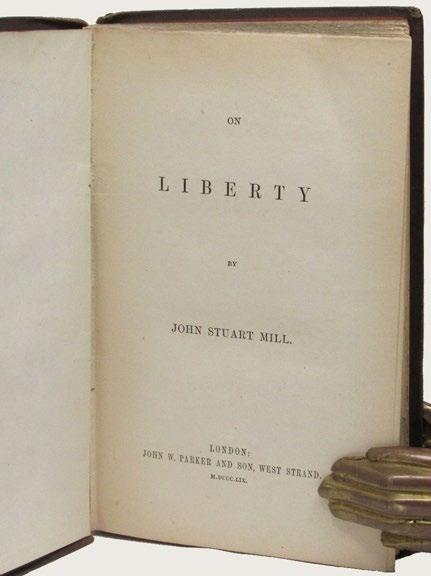
His arguments for freedom of every kind of thought or speech have never been improved on. He was the first to recognize the tendency of a democratically elected majority to tyrannize over a minority, and his warning against it has a contemporary ring: ‘We can never be sure that the opinion we are endeavouring to stifle is a false opinion; and, if we were sure, stifling it would be an evil still.’ (PMM). PMM 345. Not in Einaudi. Carter & Muir No. 345. Hazlitt, The Free Man’s Library, p. 116 $8500.
With Kay Nielsen’s Wonderful Illustrations “Hansel and Gretel”-An Extremely Fine Copy
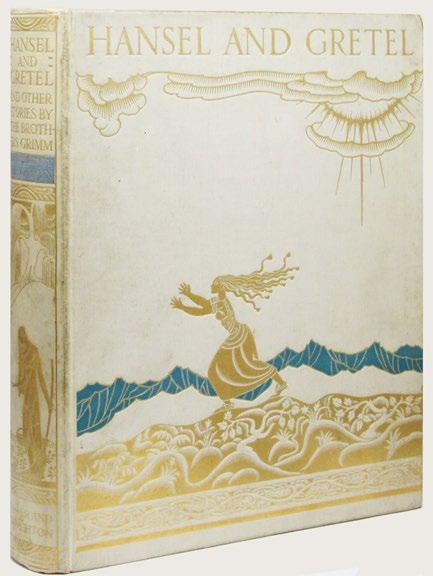
19 [Nielsen, illus.] The Brothers Grimm. HANSEL AND GRETEL and Other Stories By the Brothers Grimm (London: Hodder & Stoughton, [1925]) FIRST EDITION AND THE BEST OF THE LIMITED EDITIONS. One of only 600 copies hand-numbered and SIGNED BY KAY NIELSEN. This copy also with the laid-in announcement from Leicester Galleries regarding the availability for purchase of the original watercolours produced to illustrate this book. With 12 tipped-in color plates, 10 black & white illustrations, decorated title-page, decorated initials, and red decorative endleaves all by Kay Nielsen. 4to, publisher’s best original binding of beautiful ivory cloth, the upper cover lettered in gilt and pictorially decorated with Nielsen’s all-over designs in gold and turquoise-blue, the spine exquisitly decorated and lettered in gilt and with the artist’s name gilt within a field of blue, t.e.g. 276 pp. + plates. A very handsome copy with only very light evidence of age, the textblock, plates and binding all in very pleasing condition. A TRULY HANDSOME COPY OF THE VERY RARE LIMITED FIRST EDITION, IN BEST BINDING, OF THE PREFERRED ENGLISH ISSUE, SIGNED BY NIELSEN. Along with the title story a full twenty-two of Grimm’s Tales are beautifully illustrated throughout with Kay Nielsen’s wonderfully evocative paintings. Copies this fine and beautiful are very rare. The white cloth, the gilt work and decorative work to the covers, the text-block and plates are in remarkably pristine condition.
This is the last book Kay Nielsen would illustrate for Hodder and Stoughton. It was a book begun many years prior and worked on throughout Nielsen’s early career. Nielsen had started work on his paintings to illustrate Grimm’s stories in 1912, but the work was halted due to the occurrence of The Great War. After the 1918 Hodder and Stoughton resumed the publishing work on Nielsen’s illustrated books. In 1924 it was finally decided to complete Nielsen’s Grimm project. The book was offered only to the luxury market and was not issued in a trade edition in England. Susan E. Meyer, A Treasury of the Great Children’s Book Illustrators, p. 206. $7650.
The Opening of Central Africa to the Western World Mungo Park’s Travels in the Interior Districts Africa With Journal of a Mission to the Interior 1799 and 1815
The First Editions of Each - With Fine Engravings and Maps
20 Park, Mungo. TRAVELS IN THE INTERIOR DISTRICTS OF AFRICA: Performed Under The Direction And Patronage Of The African Association, in the Years 1795, 1796, and 1797. With An Appendix, Containing Geographical Illustrations of Africa. By Major Rennell [with,] JOURNAL OF A MISSION TO THE INTERIOR OF AFRICA, IN THE YEAR 1805..TOGETHER WITH OTHER DOCUMENTS, OFFICIAL AND PRIVATE, RELATING
536-4433
TO THE SAME MISSION, TO WHICH IS PREFIXED AN ACCOUNT OF THE LIFE OF MR. PARK. (London: Printed for John Murray, 1799 and 1815) 2 volumes. Rare First Edition of each volume. With engraved portrait frontispiece of Park, finely engraved plates and folding maps throughout. 4to, handsomely bound in threequarter calf over marbled boards, the spines with raised bands bordered with gilt fillet lines, compartments of the spines with handsome gilt-work, decorations and lettering on a red morocco label in one compartment, t.e.g. xxviii, 372, [xcvii]; cxxx, [1], 219 pp. A very handsome set presented in fine bindings, the text very bright and clean, plates and maps all in good order.
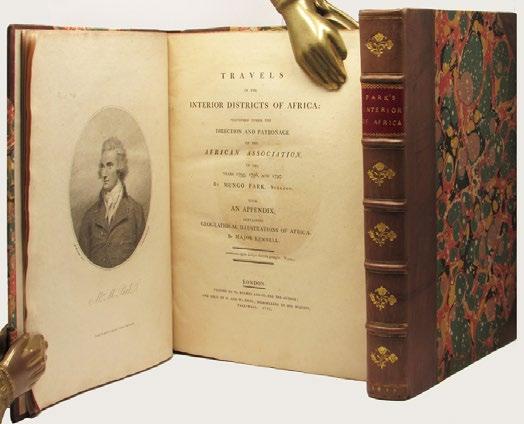
A RARE AND ELUSIVE SET OF THE FIRST EDITION PRINTINGS OF EACH VOLUME AND A VERY HANDSOMELY BOUND COPY OF THIS HIGHLY IMPORTANT AND SEMINAL WORK OF AFRICANA. The African Association of London’s previous four expeditions to explore the Niger river had failed by the time they charged Park, a Scotsman, with the commission to explore the Gambia, Senegal, and Niger rivers in 1795. He covered well over 100 miles before he fell ill in 1797 and returned back to England. His unaffected style and natural sense of storytelling in the subsequent publication of his adventures make this one of the most popular accounts of African exploration. He returned to Africa in 1805 to search for the source of the Niger in a canoe, and met great hardships both on the river and with the natives that eventually cost him his own life and the life of his men.
“Until the publication of Park’s book in 1799 hardly anything was known of the interior of Africa, apart from the northeast region and coastal area...Park’s TRAVELS had an immediate success and was translated into most European languages. It has become a classic of travel literature, and its scientific observations on the botany and meteorology of the region, and on the social and domestic life of the Negroes, have remained of lasting value. Park’s career was cut short, but he made the first great practice advance in the opening-up of Central Africa.” PMM 253. A rare copy of this milestone Africana.
After the publication of the TRAVELS, Park withdrew to the quiet life of a country physician. He soon became bored with this existence and returned to Africa in 1805. He traveled on the Niger by canoe, but failed to reach the source of the river. He and his companions were killed by natives at Boussa after their canoe foundered on the rapids. Fortunately, Park had earlier sent his journals to Gambia, and they were finally published in 1815. $5250.
A Classic Work In the Rare First English Printing
Plutarch - The Philosophie, Commonlie Called the Morals
Published in London - 1603 - Bound in Period Calf Gilt
Philemon Holland’s Highly Significant Translation
21 Plutarch, [Plutarchus]. THE PHILOSOPHIE, COMMONLIE CALLED, THE MORALS Written By the learned Philosopher Plutarch of Chaeronea. Translated out of the Greek into English, and conferred with the Latine translation, and the French, by Philemon Holland of Coventrie, Doctor in Physicke. Wherunto are annexed the Summaries necessary to be read before every Treatise. (London: Printed by Arnold Hatfield, 1603) The Rare First Edition in English. A copy with pleasing provenance, bearing the bookplate of the Davenport family, one of the oldest recorded families in the UK. Illustrated throughout with 5 and 9 line large decorated capital letters,
536-4433
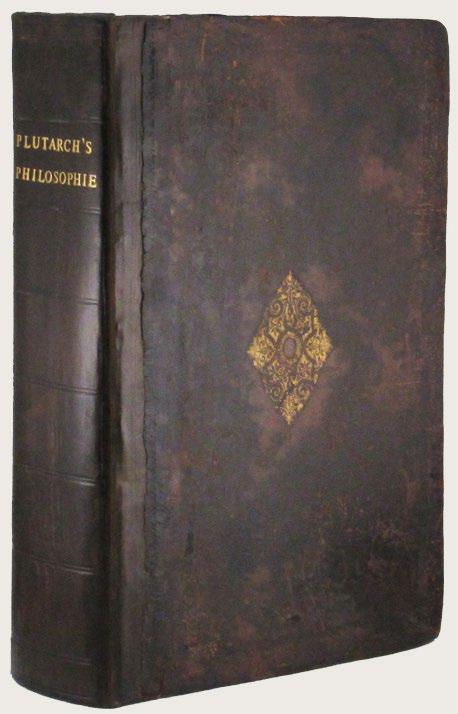
and with elaborately engraved head and tailpieces. Large, Thick Folio, full contemporary calf, the covers with elaborately tooled central ornament gilt, the spine with blind tooled bands separating the compartments, one compartment lettered in gilt. [viii], 1363, [1], [64, Explanation, Index, Table, Errata] pp. A beautifully preserved, handsome, very clean, crisp and unpressed copy, the original decorated calf covers rebacked, two preliminary leaves with small unobtrusive paper supports to the verso of the leaves at the edge for strength.
A RARE AND IMPORTANT CLASSICAL WORK IN THE FIRST ENGLISH EDITION TRANSLATED BY THE ESTEEMED PHILEMON HOLLAND, TRANSLATOR OF A NUMBER OF THE MOST IMPORTANT CLASSICAL WORKS WRITTEN IN GREEK AND IN LATIN.
‘Plutarch (c. A.D. 46-120), the Greek thinker and writer, wss born at Chaeronea in Boeotia. Trajan bestowed consular rank upon him and Hadrian appointed him procurator of Greece. He was initiated in the secret mysteries of Dionysius, which held the the soul was imperishable; but he was an independent thinker and seems not to have been an adherent of any particular school of philosophy. His vast acquaintance with the literature of his time is everywhere apparent. His celebrity rest especially upon his MORALIA and his forty-six PARALLEL LIVES. The design of the latter appears to have been the publication, in successive books, of authentic biographies in pairs, taking together a Greek and a Roman. The LIVES are works of great learning and research with long lists of authorities given. The Moralia was composed first, while writing the Lives occupied much of the last two decades of Plutarch’s life.
The MORALS (OPERA MORALIA) consists of a great number of essays. Their literary value is greatly enhanced by the large number of citations from lost Greek poems, especially verses of the dramatists, among whom Euripides holds by far the first place. It is an eclectic collection of seventy-eight essays and transcribed speeches, including “Concerning the Face Which Appears in the Orb of the Moon” (a dialogue on the possible causes for such an appearance and a source for Galileo’s own work), “On Fraternal Affection” (a discourse on honour and affection of siblings toward each other), “On the Fortune or the Virtue of Alexander the Great” (an important adjunct to his Life of the great king), and “On the Worship of Isis and Osiris” (a crucial source of information on Egyptian religious rites); more philosophical treatises, such as “On the Decline of the Oracles”, “On the Delays of the Divine Vengeance”, and “On Peace of Mind”; and lighter fare, such as “Odysseus and Gryllus”, a humorous dialogue between Homer’s Odysseus and one of Circe’s enchanted pigs. Some additional treatises are the following: ON THE EDUCATION OF CHILDREN, HOW A YOUNG MAN OUGHT TO HEAR POETRY, ON THE RIGHT WAY OF HEARING, HOW A FLATTERER MAY BE DISTINGUISHED FROM A FRIEND, HOW TO GET BENEFIT OUT OF ENEMIES, ON HAVING MANY FRIENDS, PRECEPTS ABOUT HEALTH, ADVICE TO THE MARRIED, THE BANQUET OF THE SEVEN WISE MEN, ON FATE, ON THE GENIUS OF SOCRATES, THE CONSOLATION TO HIS WIFE, ON THE PRESERVATION OF THE SOUL, ON THE VIRTUES OF WOMEN and OF LOVE. But this represents only a small sample of the many works included in the ‘Moralia’.’
‘Plutarch’s writings had an enormous influence on English and French literature. Shakespeare paraphrased parts of Thomas North’s translation of selected Lives in his plays, and occasionally quoted from them verbatim
Ralph Waldo Emerson and the Transcendentalists were greatly influenced by the Moralia and in his glowing introduction to a later 19th-century edition, he called the Lives “a bible for heroes”.] He also opined that it was impossible to “read Plutarch without a tingling of the blood; and I accept the saying of the Chinese Mencius: ‘A sage is the instructor of a hundred ages. When the manners of Loo are heard of, the stupid become intelligent, and the wavering, determined.’”
Montaigne’s Essays draw extensively on Plutarch’s Moralia and are consciously modelled on the Greek’s easygoing and discursive inquiries into science, manners, customs and beliefs. Essays contains more than 400 references to Plutarch and his works.’ wiki
An important FIRST EDITION of this great work by Plutarch. CBEL II, 1494.; BRITANNICA 11. $8500.
A Beautifully Bound Complete Set of Bell’s Shakespeare Published in London - Extensively Illustrated - 1793
Presented in Full Regency Straight-Grain Goatskin Gilt
22 Shakespeare, William. THE DRAMATICK WRITINGS OF WILL. SHAKSPERE. [Bell’s Edition of Shakespeare]. Printed Complete from the TEXT of SAM. JOHNSON and GEO. STEEVENS, And Revised from the Last Editions. [with,] A PROLEGOMENA TO THE DRAMATICK WRITINGS OF WILL. SHAKSPERE (London: Printed for and Under the Direction of John Bell, 1793) 20 volumes. The important Bell’s Shakespeare, with the Prefaces by Pope, Theobald, Hanmer Warburton and Johnson, and with both Rowe’s and Malone’s Life of Shakespeare, and with many other important essays, notes and emendations. Engraved frontispiece portraits of Shakespeare and of the Prince of Wales, of Pope, Warburton, Hanmer and Johnson as well as others, of Shakespeare’s house and with a profusion of finely engraved plates throughout the volumes 12mo, beautifully bound in full red Regency straight-grain morocco with handsome gilt ruling to the borders of the upper and lower covers, the spine with compartments separated by gilt bands, gilt tooled Regency decorative motifs and lettering in gilt within the compartments, gilt tooled edges and gilt rolled turnovers, marbled end-leaves, all edges gilt. An excellent and important set, very handsome, beautifully preserved, fresh and clean.
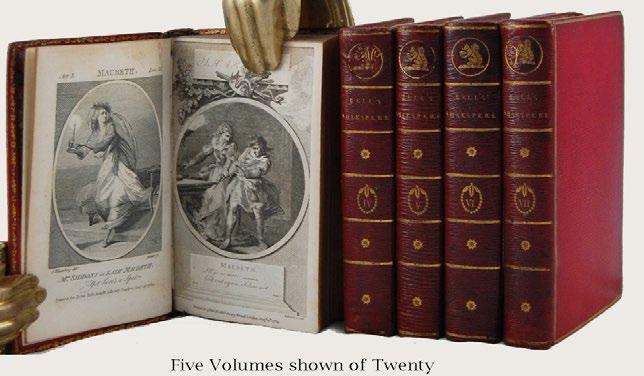
AN IMPORTANT PRESSING OF THE SHAKESPEARE PLAYS AND OF THE SCHOLARLY WRITINGS AND DISCUSSIONS UP TO THE CURRENT TIME. The plays are from Steevens’ and Johnson’s Scholarly Edition of Shakespeare (1773). This edition prints a two volume Prolegomena, which consists of prefaces written for Shakespeare’s plays over many years. A PROLEGOMENA TO THE DRAMATICK WRITINGS OF WILL. SHAKSPER includes, along with all the most important prefaces, both Rowe’s and Malone’s ‘Lives of Shakespeare’, the 1623 preface of Heming and Condell, as well as Shakespeare’s Will, Commendatory Verses, and an attempt to determine the original order of the plays. With 97 portraits, vignettes and character plates, including a foldout of signatures on Shakespeare’s Will in Vol. II, “an example of fans” in the Merry Wives’ Annotations, a foldout of the Morris Dancers in Henry IV part 1’s Annotations, and an extra vignette in Titus Andronicus.
This, the “Literary” Shakespeare, was published serially beginning in 1785, and collected in 20 vols. What distinguishes this edition from the others by Bell is the elaborateness of the presentation. This was the culmination of a 15 year effort to publish an edition of the Bard’s works which had a high cultural value due to its edition, annotation, and beauty of its typography and illustration. Indeed, this edition proved a social triumph for Bell with his assembled 1800 subscribers, including the Royal Family (ex-cept for the Sovereign) along with the Queen of France, monsieur the Kings brother and a collection of 70 nobles.
The edition was printed on smooth wove paper, gilt edges and handsomely bound in calf, probably in Bell’s own bindery.
In this edition Bell first replaced the long s (ƒ) with the modern small rounded s, an innovation which quickly caught on*. There are many more portraits in this edition, than in the earlier “acting” editions of Shakespeare. In the Prolegomena alone, there are 8 portraits, as well as several engravings of places and things related to Shakespeare. Throughout the rest of the collection, each play has between 2 and 4 character portraits, featuring prominent actors in the roles. In contrast to the engravings of the earlier edition, these portraits have oval borders and lush backgrounds. The actors themselves are rendered in a much softer, more romantic style.
The artists Bell commissioned were all under the age of 25 and relatively unknown. Most notable among them was the young Johan Heinrich Ramberg, who had come to England from Hanover under the patronage of George III. It is because of these young artists that these portraits are so different from those in the “acting” edition. Ramberg brought with him a European aesthetic, and all the artists brought the burgeoning romantic artistic trends to the drawing boards. $7500.
The Most Trustworthy Account of the Cape - 1785
Andrew Sparrman’s Voyage to the Cape of Good Hope
Scarce & Important First Edition - Illustrated Extensively
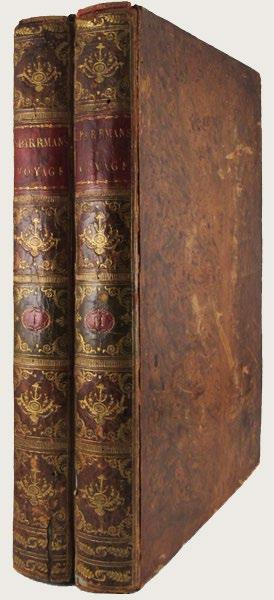
23 Sparrman, Andrew. A VOYAGE TO THE CAPE OF GOOD HOPE, TOWARD THE ANTARCTIC POLAR CIRCLE AND ROUND THE WORLD; BUT CHIEFLY INTO THE COUNTY OF THE HOTTENTOTS AND CAFFRE,FROM THE YEAR 1772-1176, (London: G.G.J. & J. Robinson, Pater-Naster-Row, 1785) 2 volumes. First Edition. Illustrated with an engraved frontispiece to Vol. I plus 9 other engraved plates including 2 of Hottentot subjects and 7 of natural history subjects and a large folding map. 4to, contemporary polished calf unrestored, the spines beautifully gilt decorated within very elaborate panel designs of the period, separated by multi-ruled gilt bands and with contrasting red and green morocco title and numbering pieces gilt, gilt tooled board edges. xxviii, 368; viii, 350; errata page. A very handsome set in rare contemporary binding, joints split, cover to Vol. I nearly detached, all easily refurbished by order, some mellowing to text occasional, evidence of old worm tracks to a some of the border edges of some plates.
RARE CONTEMPORARY BINDING ON THIS VERY IMPORTANT FIRST EDITION AND ONE OF THE EARLIEST WORKS ON THE CAPE OF GOOD HOPE AND THE SOUTHERN AFRICAN CONTINENT AND THE SOUTHERN OCEANS. “An enthusiast in the study of natural history from his youth, the author was overjoyed to be enabled to proceed to the Cape, ... with the Royal East India Company” In 1772, Sparrman was invited to join Captain Cook”s expedition on the Resolution and sailed with him until 1775. Once back on the Cape he undertook an expedition to the interior. This trip has been described in Mendelssohn as the “most trustworthy account of the Cape Colony and the various races of people then residing in it, that has been published in the eighteenth century.” His account of Cook’s voyage as well as his exploration in Africa are described within. Included is brief glossary of Hottentot language and full page plates of indigenous animals. Mendelssohn, Vol. 4; Spence 1146; renard 1516; Hill p. 279. $7500.
Huckleberry
Finn
- First Edition in the Original Cloth Twain’s Masterpiece of American Literature
24 Twain, Mark. ADVENTURES OF HUCKLEBERRY FINN (New York: Charles L. Webster and Company, 1885) First edition. With 174 black and white illustrations by E.W. Kemble. 8vo, publisher’s original green cloth elaborately decorated in gilt and black on the covers and spine. 366 pp. A very handsome copy, bright and appealing. This copy is clean and tight and very pleasing internally, the paper extremely fresh. The cloth is uncommonly bright and the gilt in really excellent condition.
AN IMPORTANT FIRST EDITION AND A HANDSOME AND PLEASING COPY. The title-leaf is conjugate with
[1] and the copyright notice is dated 1884; p. [13] with the illustration captioned “Him and another Man listed at p. 87; p. 57 with “saw” spelled correctly; p. 283 with the corrected engraving and conjugate with leaf 18(3); p. 155 has the final five replaced; p. 161 is lacking a signature mark, as usual; and leaf 23(8) has been excised. The frontis portrait is in Blanck’s state 3, with the imprint of the PhotoGravure Company and with the tablecloth or scarf not visible.
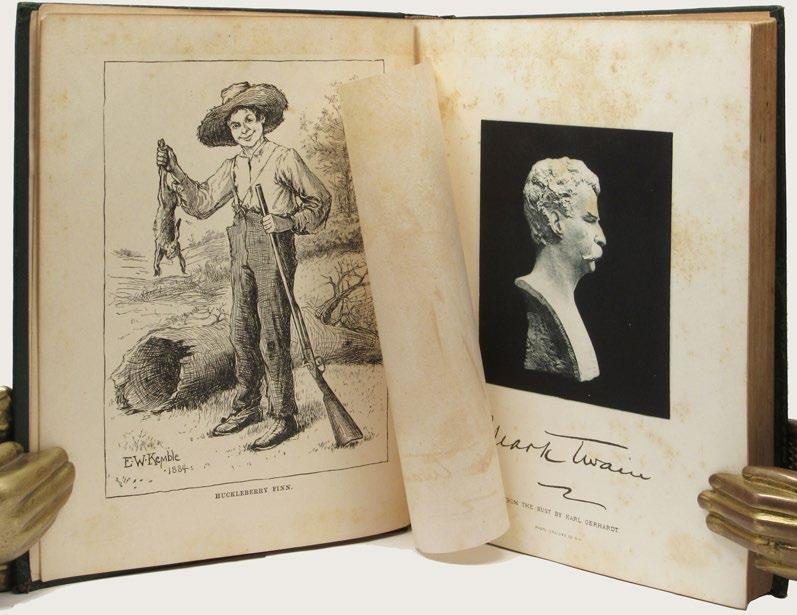
The printing points mentioned above should not be considered issue points, as the sheets for the book were printed over time, but gathered and bound at random. Based on issue points only (the state of the illustration on p. 283 and the binding), this is a first edition. Along with Tom Sawyer, Huckleberry Finn is considered the stepping stone to modern American literature. And along with Tom Sawyer, for the first time, the hero of the novel was a boy. These books are landmarks and Hemingway often offered his opinion that the modern novel would have been impossible without them. With Whitman’s Leaves of Grass and Melville’s Moby Dick, they provide us with a view of America transcending its past and beginning its future. $5250.
The Foundation of a Library of California” Miguel Venegas’ Famed “Noticia de California” - 1759
The First English Edition of This Zamorano Eighty Work “The First Book in English Completely Devoted to California
25 Venegas, Miguel. A NATURAL AND CIVIL HISTORY OF CALIFORNIA: Containing an accurate description of that Country, Its Soil, Mountains, Harbours, Lakes, Rivers, and Seas; Its Animals, Vegetables, Minerals, and Famous Fishery for Pearls. The Customs of the Inhabitants, Their Religion, Government, and Manner of Living Before Their Conversion the Christian Religion by the Missionary Jesuits. Together With Accounts of Several Voyages and Attempts Made For Settling California, and Taking Actual Surveys of that Country, Its Gulf, and Coast of the South Sea. Translated From the Original Spanish of Miguel Venegas, a Mexican Jesuit, Published in Madrid 1758 (London: For James Rivington and James Fletcher, 1759) 2 volumes. First Edition in English and the first translation of this work out of Spanish. With a large folding map of California based on the Jesuit map and eight illustrations on four copper-engraved plates. Note that very often, there are only 2 copper plates and occasionally even fewer found in copies of the book. 8vo (195mm x 125mm ), handsomely bound in antique three-quarter blue morocco over marbled paper covered boards, the joins tooled in gilt, the spines with raised bands gilt decorated, the compartments with gilt rolled tooling at the borders, two compartments lettered in gilt. [20], 455; [8], 387 pp. A handsome, clean and pleasing copy of this highly important work. The bindings in pleasing condition, the large folding map in good order, a bit of the typical mellowing to the paper caused by time, an unpressed and crisp copy of this important book.
THE VERY SCARCE FIRST EDITION IN ENGLISH, preceding the French and German translations. USUALLY THIS WORK IS FOUND WITH TWO PLATES, BUT OCCASIONALLY A COPY WILL HAVE FOUR AND A FOLDING MAP AS IN THIS EXAMPLE. A very uncommon book in such nice condition and with the extra plates as
536-4433
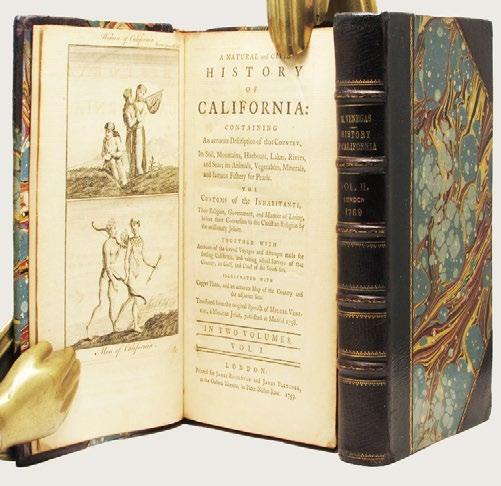
noted by Cowan I, 237-238: “these four plates appear to have been issued with but a few copies of the work, as two is the number usually found.”
Considered by Cowan to be “the foundation of a library of California,” this work is the most extensive account of Lower California of its period. Concluded in Mexico in 1739, the Noticia was extensively revised and brought up to the year 1750 in Spain by Fr. Andres Marcos Burriel, who restricted the account to actual voyages, rejecting all apocryphal material. It was presumably allowed to be published to counteract anti-Jesuit statements that had appeared in accounts of George Anson’s voyage in the Pacific (17401744).
Although concerned primarily with Lower California, it also contains extracts from Lopez de Gomara and Torquemada relating to early Northwest Coast explorations, including an account of the 1602-03 Vizcaino expedition, taken by Torquemada from the diary of Father Antonio de la Ascension. Hill I, Vol. I notes that this, the first translation “gave the English-speaking world its earliest thorough account of the little-known areas of the west coast of North America. This work has been cited as the first book in English completely devoted to California.”
The large folding map is based on Kino’s famous Jesuit map of 1702, first published in the 1726 issue of the German collection of missionary reports, “Der Neue Welt Bott”. The original Spanish edition contained no plates, but had engraved illustrations as a border to this map. In this printing the same illustrations have been included as bound plates instead. They are of: men of California, women of California, the coyote, California deer, the native manner of curing the sick, the sorcerers of California, the martyrdom of Father Carranca and the martyrdom of Father Taraval.
In all, this work represents the most extensive and scholarly study of early California, its people, geography, flora and fauna and the history of the early European settlement from Cortez to the 18th century. Sabin 98845. Zamorano Eighty. Howes V69. Barrett, Baja California 2536. Cowan II, p. 658. Graff 4471. Hill I, Vol. I. Howell 50, California 247. Jones 499. Norris 4070. Palau 358390. Streeter Sale 2435 $5850.
Very Rare Superb Copy of the 17th Century History of Peru
The First Edition in English of this Cornerstone Work 1688 - De la Vega’s Royal Commentaries of Peru
26 Vega, Garcilasso de la, the Inca. THE ROYAL COMMENTARIES OF PERU, IN TWO PARTS. The First Part: Treating of the Original of their Incas or Kings; the Second Part: Describing the manner by which that new World was conquered by the Spaniards. Translated by Sir Paul Rycaut. (London: by Miles Flesher for Richard Tonson, 1688) First Edition in English. This copy has two title pages, one with the Tonson imprint rubricated (black and red), the other with the Heyrick imprint in black only. Sabin states: “As some copies have only the black titles and some only the rubricated ones, while others have both, it seems possible that all the issues were originally published with two titles.” Engraved portrait frontispiece of translator Paul Rycaut, the rubricated title page in red and black, and 10 copperplate engravings. Folio, an especially handsome copy, bound in its original contemporary speckled English calf, the spine with raised bands, the compartments with floriated panels decorated in gilt,
red morocco lettering piece gilt, the covers with a border decorations rolled in blind and double-filleted rules at the borders. 1019. A superb copy of this rare and early work. The book remains in its original binding. The text-block is crisp, clean and unpressed, The engraved illustrations are all in excellent condition. A truly wonderful copy and especially fine survival of a book rarely if ever found in such condition.
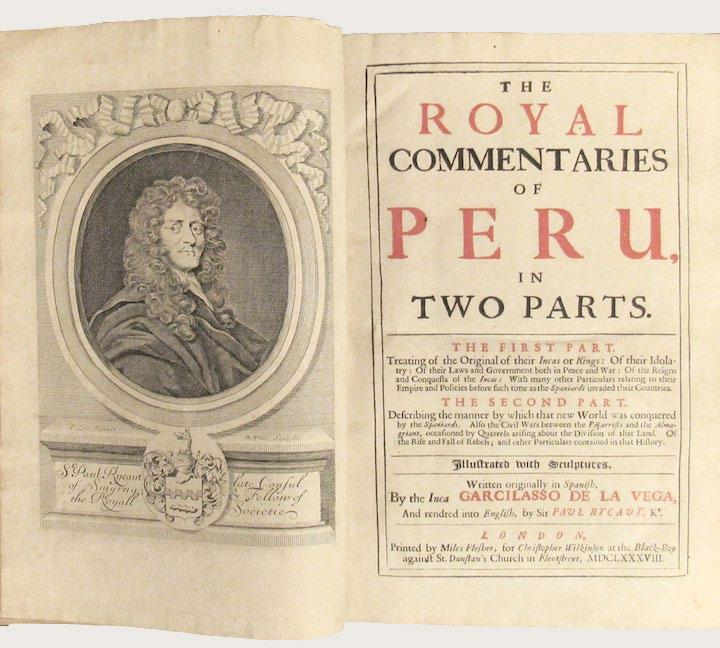
RARE FIRST EDITION OF THIS HIGHLY IMPORTANT EARLY HISTORY OF THE INCAN CIVILIZATION AND OF THE CONQUEST OF PERU BY THE SPANISH. De la Vega was a prince of Incan royalty by virtue of his mother, who was descended from the last Incan King of Peru. He took great pride in his Incan ancestry, styling himself “Garcilasso Inca” and becoming a dedicated student of the Peruvian language and traditions. However, the translator also tells us that “the Spanish humour was most prevalent in him, so that he delighted much to tell us, as in diverse places, that he was [also] the son of Garcilasso de la Vega, one of the first Conquerours of the new World...” Such an illustrious ancestry provides for a rendering of the history of the Incan civilization from a unique point of view.
The first section of the text details the early history of the Incas before the Spanish conquest, including their laws and government and other “particulars relating to their Empire and Policies.” The second part details the Spanish conquest and the various civil wars and rebellions that came along with them and after them. The first part was published in Lisbon in 1609, and the second part in 1617. This edition is the first English translation by Sir Paul Rycaut. This is a classic work, comprehensive and painstakingly researched, and remains today one of the chief authorities on the subject of ancient Peru. ESTC R34862; Sabin 98760 Wing G216 $9500.
Please continue to the next page.
Koberger’s Magnificent Incunable Bible - July 30, 1477
His Second Latin Bible - Beautifully Rubricated Superb in Impressive Contemporary German Binding
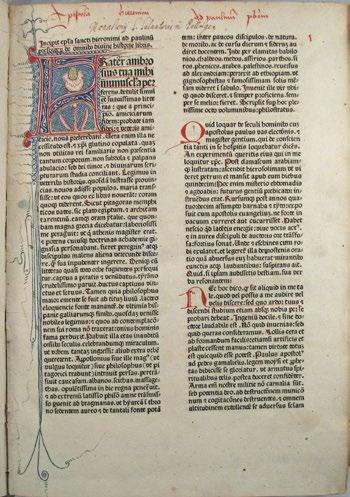
27 [Bible, in Latin]. BIBLIA LATINA [With the tractate of Menardus Monachus] (Nuremberg: Anton Koberger, 30 July, 1477) Very Early Printing of the Bible and only the second Latin Bible printed by Koberger, 51 lines and headline, double column, canon marginalia in the Gospels. With manuscript headlines in red, a beautiful opening initial of 10 lines with elaborate flourishes that flow from the very top to very bottom of the page in red, blue and green, numerous 6 line initials in red and blue, some with much longer extensions or flourishes, a profusion of 3 line initials in red or blue, red paragraph marks and additional rubricating throughout primarily in red. Royal folio (375 x 265mm approx), in contemporary German blind-stamped pigskin over thick wood boards, (probably a Nuremberg binding), the boards center-paneled and decorated in blind with a central tool within multiple borders, remnants of brass catches on the fore-edge. Manuscript lettering to the spine with wide tall bands. 468 leaves, complete. An unusually fine copy, especially well preserved and very handsome indeed. An important copy with full contemporary binding intact, and in great likelihood coming directly from Koberger’s workshop.
A RARE AND EXTREMELY HANDSOME COPY, ESPECIALLY WELL PRESERVED. THIS BOOK REPRESENTS ONLY THE SECOND TIME THAT KOBERGER PRINTED THE LATIN BIBLE. This printing was issued in the second year after the first printing of 1475. Anton Koberger was for a number of years the leading publisher/ printer of his time. The total list of his printings for the forty years from 1473 to 1513, when he died, comprises no less than two-hundred and thirty-six separate works, including fifteen impressions of the Biblia Latina, eight of which presented material differences of notes and commentaries which entitled them to be considered as distinct editions. “In the actual number of separate works issued, Koberger was possibly equaled by one or more of his contemporaries, but in respect to literary importance and costliness, and in the beauty and excellence of the typography, the Koberger publications were not equaled by any books of the time excepting the issues of Aldus in Venice” (Putnam II, p. 150).
This printing of Koberger’s Latin Bible was printed again in 1478 and is largely based on the Fust and Schoeffer edition of 1462. The tractate of Menardus is included which is a summary of the books of the Bible with a guide on how to best study them. It was first printed not after 1474. A beautiful example of the magnificent productions during the first generation of printed Bibles, the state of preservation and the impressive German binding making it all the more so. HC *3065; GW 4227; BMC II, 414 (IC. 7159); Goff B-552 $115,000.
A Rare Unique Handcoloured Set - Beautifully Bound
The First Illustrated Edition of Burton’s Masterpiece
His Great Translation of the “Arabian Nights” With a Double-Set of 142 of Letchford’s Plates - 1897
28 Burton, Richard F., [translator]. A PLAIN AND LITERAL TRANSLATION OF THE ARABIAN NIGHTS’ ENTERTAINMENTS, NOW ENTITLUED [sic] THE BOOK OF THE THOUSAND NIGHTS AND A NIGHT. With Introduction, Explanatory Notes on the Manners and Customs of Moslem Men and a Terminal Essay Upon the History of The Nights [with] SUPPLEMENTAL NIGHTS... With Notes Anthropological and Explanatory (London: H.S. Nichols, Ltd., 1897) 12 volumes. Rare and Most Probably a Unique Presentation of the Illustrated
Library Edition. 142 original illustrations, including a portrait of Burton, reproduced from the original pictures in oils specially painted by Albert Letchford with one set of the original 71 illustrations presented as included by the publisher and another set individually hand-coloured. 8vo, splendid, handsome and very finely executed three-quarter gilt-bordered dark red morocco over vellum covered boards, the spine in compartments separated by wide gilt decorated raised bands, the compartments of the spine elaborately decorated and lettered in gilt with beautiful arabesque designs, t.e.g., marbled endpapers. A very handsome and unusually appealing set. The bindings are very stately and attractive and the colouring of the illustrations beautifully accomplished. We know of no other handcoloured copy being offered in recent memory. Some old stains to the edges of some leaves or plates, lower corners of a few volumes with old evidence of damp. Spines, gilt-work, bands all in excellent condition.
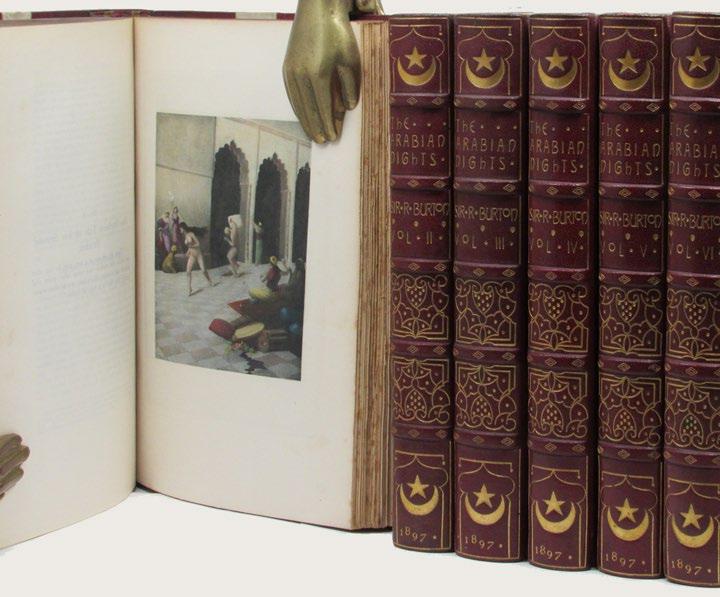
A VERY RARE AND PROBABLY UNIQUE SET OF THIS HIGHLY IMPORTANT EDITION, THE FIRST TO BE ILLUSTRATED, AND THIS COPY WITH AN ADDED SET OF THE ORIGINAL PLATES SINGULARLY HANDCOLOURED. Nichols’ printing is a scarce and handsome edition, the first to include the illustrations by Letchford. In 1896, two years after their first edition of ARABIAN NIGHTS, the Nichols-Smithers duo commissioned Sir Richard Burton’s close friend, Albert Letchford, to paint 65 illustrations for another edition as well as a portrait of Burton, and soon after commissioned for 5 more. Burton and Letchford had met several years before when Letchford was 18 when he was in Florence beginning his art education and had discussed the possibility of illustrating “Nights.” “Burton’s suggestion of illustrating the “Nights” had appealed greatly to Letchford on account of the unlimited scope such a subject would give to an artist who loved the East and had a boundless imagination.” Letchford commenced study of Eastern images for his paintings, though only one of the illustrations was painted in Burton’s lifetime.
Richard Burton was one of the foremost linguists of his time, an explorer, poet, translator, ethnologist, and archaeologist, among other things. ‘The Thousand Nights and a Night’ is probably the most famous of all his many works. This translation reflected his encyclopedic knowledge of Arabic language, sexual practices and life: “it reveals a profound acquaintance with the vocabulary and customs of the Muslims, with their classical idiom,” [Ency Britt] as well as colloquialisms, philosophy, modes of thought and intimate details. In contrast to Victorian mores, Burton was driven to explore what would now be called by literary critics the uncanny/Unheimliche or the unresolvable tensions of human beings. Accordingly, he recorded details of daily life and practices that were considered vulgar at the time.
“The Arabian Nights” have been traced back to an ancient Persian masterpiece, the “Hazar Afsanah” or “Thousand Tales.” The stories themselves can be dated from between the 8th and the 16th centuries and were for popular entertainment. They include a range of subjects from romance and fantasy, to homosexuality, bestiality, and obscenity. While a number of other English translations predated Burton’s unexpurgated version, perhaps his achieved greatest notoriety due to its copious footnotes and the “Terminal Essay” found in the last volume. They are a compendium of his private reservoir of anthrological and sexual curiosities. His discussions of female sexual education and homosexuality excited intense debate and controversy at the time of publication.
Burton’s “Nights” was enthusiastically received and lauded as “masterly, strong, vital, and picturesque,” and as “one of the most important translations to which a great English scholar has ever devoted himself.” However, it was not without its critics, including th Edinburgh Review which wrote, “Probably no European has ever gathered such an appalling collection of degrading customs and statistics of vice.” Burton was ecstatic over the immediate critical and financial success of his
translation and became instantaneously famous internationally. Burton wrote of the financial success of his Nights, “ I struggled for forty-seven years. I distinguished myself honourably in every way I possibly could. I never had a compliment nor a ‘thank you’, nor a single farthing. I translated a doubtful book in my old age, and immediately made sixteen thousand guineas. Now that I know the tastes of England, we need never be without money.” Penzer, p. 114-116. $9500.
One of the Earliest Printings of Caesar - Folio - Illustrated Printed In Venice By Zani - 1511 - In Contemporary Binding With Title In Red And Black And Fine Large Woodcuts
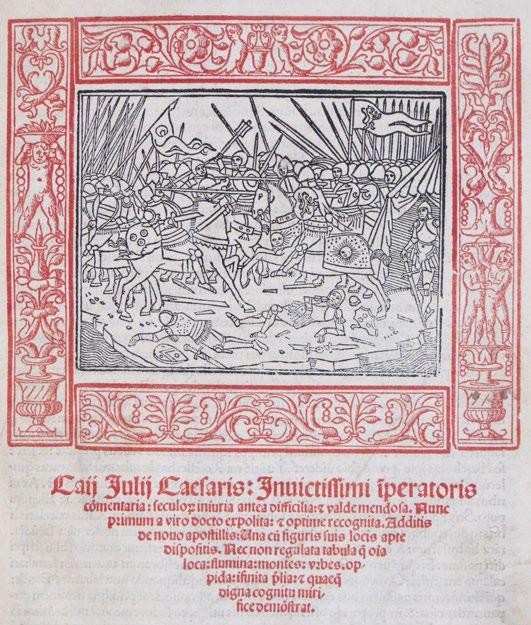
29 Caesar, Caius Julius. COMMENTARIA... Nunc primum a viro docto expolite: & optime recognita. Additis de novo apostillis: una cum figuis suis locis apte disposiris (Venezia: Agostino Zani, 1511) A Very Early Folio Illustrated Edition incorporating incunabular plates, of Caesar’s Commentaries, a core classical text of the Roman period. Illustrated with incunabular woodcuts from plates used for the 1493 edition of Livy. The title page is printed in red and there is a very fine, large woodcut to the title leaf (92 x 120 mm) within an elaborate border printed in red and repeated on the first leaf of text, within an altogether different woodcut border printed in black. There is a woodcut of approximately the same size at f. 51; twelve smaller woodcuts (each approx. 56 x 74 mm) are placed at the beginning of each chapter. Folio (mm 314x210), contemporary Italian half goatskin over wooden boards, goatskin on the sides with blind-ruled geometric designs, a pair of scallop-shaped brass foreedge catches on front cover, vellum half pastedowns cut from a 14th-century theological manuscript. A very handsome copy of this rare illustrated work. VERY RARE. ONE OF THE EARLIEST AND MOST BEAUTIFUL ILLUSTRATED EDITIONS AND THE IMPORTANT FIRST PRINTING IN ITALY OF AN ILLUSTRATED EDITION OF THIS GREAT CLASSICAL WORK. The title woodcut depicts a battle scene; the second large woodcut shows Lentulus seated addressing the Senate. The woodblocks depicted, were first used in Giunta’s 1493 edition of Livy and were immensely successful and consequently passed on from printer to printer.
Considered very rare. A superbly illustrated edition of Cæsar, apparently the first illustrated Cæsar published in Italy. The title woodcut is strongly reminiscent of Uscello’s great tryptich, “The Battle of San Romano,” and the spare line of the woodcuts at the head of each chapter is perhaps inspired by Aldus’ HYPNEROTOMACHIA POLIPHILI (1499). The text was edited by L. Panaetius. The Duc de Rivoli (Livres a figures Venitiens, p. 160) records an edition printed at the same press in 1517. A highly important book and a very desirable copy.
Julius Caesar was anxious to establish his own record of his successful campaigns in Gaul from 58 to 52 B.C., which includes the less successful invasion of Britain. To answer those who accused him of purely personal ambition, he wished to appear as a straightforward soldier, fighting wars that were essential to Rome. Fascinating for its insights into a man who shaped the history of the western world, his first-hand account of the Gallic Wars is a crucial source for the history of Britain and Germany as well as Gaul. Books I[VII were probably written year by year, when events were fresh in Caesar’s mind and issued together in 51 B.C. Book VII ends with the defeat of Cercingetorix so that Aulus Hirtius (d. 43 B.C.) Caesar’s lieutenant in Gaul, took up the narrative in Book VII with the ensuing uprisings and the beginnings of Caesar’s disputes with the authorities in Rome.
Despite the fact that Julius Caesar is one of the most famous men in history, only a handful of his extensive writings
536-4433
survive to the present day. The “Commentaries” were written not to suggest a history, but rather as a bald record of events. Caesar wished to create an impression that he was just a simple soldier fighting for the good of Rome. It is unique as a contemporary account of a drawn out (nine years) foreign war written by a Roman general, and also for its lucid and unrhetorical language. The work was probably first published in 51 BC.
This “Opera” contains his primary works, “Commentaries on the Gallic War” and the three books of the Civil Wars in Rome with Pompey, the Alexandrian War, the African Wars, the Spanish War. And there is a fine and extensive index at the end of the volume. BMC/STC Italian p. 135; Essling 1727; Sander 1503. $14,500.
Dapper’s Great Work - Description de L’Afrique - 1686 With Splendid Maps and Views from the Great Atlases Published in Amsterdam - 1686 - The First in French
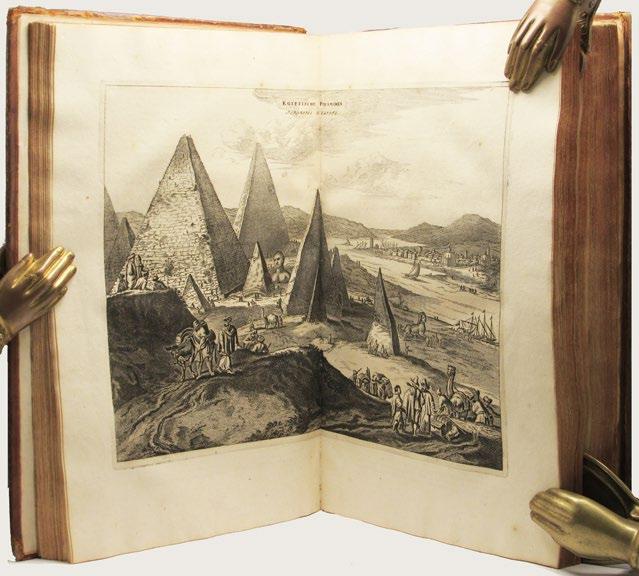
30 Dapper, Olfert. DESCRIPTION DE L’AFRIQUE, Contenant Les Noms, a Situation et les Confins de toutes ses Perties, leurs Rivieres, leurs Ville et leurs Habitation, leaurs Plantes et leurs Animaux, les Moeurs, les Coutumes, la Langue, les Richesses, la Religion et le Gouvernement de ses Peuples, Avec Des Cartess des Etats, des Provinces et des Villes et des Figures en tailleDouce, qui Representent les Habits et les Principales Ceremonies de Habitans, les Plantes et les Animaux (Amsterdam: Traduite du Flamand, 1686) First edition of the French printing. With a great profusion of superb engravings including the very large folding map at the beginning of the book and the other fine copper plates as called for including 14 double page maps, 28 double page plates, 55 text views plus the very elaborately engraved pictorial frontispiece. Folio, bound in full contemporary calf, armorial crest in gilt on both covers which are bordered with double gilt fillet lines, the spine with raised bands gilt ruled, gilt emblematic centre tools, morocco lettering label gilt. iv, 534, (22) pp. A pleasing and unrestored copy, bright and clean and very well preserved copy internally, a touch of foxing occasionally, the original binding with some edge-wear and rubbing, spine rubbed from use, hinges cracking but with the cords strong and tight. Collated complete.
RARE AND IMPORTANT FIRST EDITION OF THIS MONUMENTAL WORK. Dapper’s most sought after series of travel which covers the entire continent: the Islamic North (from Morocco to Egypt), Abyssinia, Central and Southern Africa, and Madagascar, Malta, the Canaries and other islands of the African coast. The work contains “a [great] number of fine maps and engravings showing the flora and fauna, views of various towns and antiquities, costumes and local scenes” (-Hamilton)
The fine double-page plates include views of Cairo, an illustration of a caravan marching out of Cairo to Mecca, the Pyramids of Egypt, a view of the Royal Palace of Morocco, a plan of Tangier, a plan of Capt. Kempthorn’s engagement in the Mary-Rose with several men-of-war, views of Tunis and Tripoli, views of the castles of Mina and Cormantine, views of Lovango and Luanda and the Cape of Good Hope, views of Forts Nassau and Orange, a view of Pike Mountain on Teneriffe, a plan of Malta, and others. Brunet II p. 520; Graesse II p. 535, Mendelssohn I p. 43; Tieal, Kennedy p. 3416; South Africa in Print p. 33 $9500.
One of the Greatest Works of Political Philosophy
‘The Federalist Papers’, With the Works of Hamilton First Edition of the Works - Early Issue of The Federalist 31 Hamilton, Alexander [et. al]. [THE FEDERALIST] THE WORKS OF ALEXANDER HAMILTON; Comprising His Most Important Official Reports; an Improved Edition of THE FEDERALIST, On The New Constitution, Written in 1788; and PACIFICUS, On The Proclamation of Neutrality, Written in 1793 (New York: Williams & Whiting, 1810) 3 volumes. First edition of the collected WORKS and only the third printing of the FEDERALIST according to Sabin. Of the other works included, these are generally the first obtainable editions. With engraved frontispiece portraits in each volume. 8vo, in very handsome contemporary tree calf, the spines with gilt ruled flat bands and with black morocco labels gilt ruled and lettered, gilt volume numbers with leather labels. vii,325; iv,368; iv, 368 pp. The rare and handsome contemporary calf only very lightly worn at the edges and extremities, overall near-fine, the text with some light tonging and foxing, but much less than is expected on such early American imprints. Ex-libris on front pastedown, contemporary ownership inscription on title-pages, some notes in text also, all in pencil, a few instances of authorship emendations made in ink by a contemporary hand.
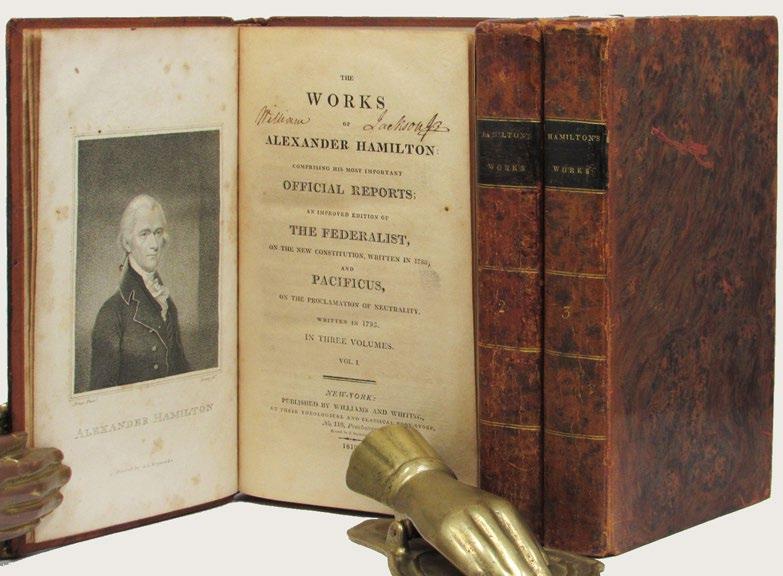
AN EXTREMELY EARLY PRINTING OF THE FEDERALIST AND QUITE SCARCE, and very much so in contemporary tree calf and fully original condition. The first volume of this work contains miscellaneous but highly important papers by Hamilton concerning his reports on a National Bank and the Constitutionality of the National Bank. Volumes Two and Three contain the FEDERALIST and PACIFICUS. Sabin notes that Williams also distributed this same printing with just volumes two and three with a different title-page and it is only the fourth printing of the FEDERALIST Sabin list. The papers in volume one are: The Report on Public Credit, on a National Bank, on the Subject of Manufactures, on the Constitutionality of a National Bank, and on the Establishment of a Mint.
“The Federalist is the most important work in political science that has ever been written, or is likely ever to be written in the United States. It is...the one product of the American mind that is rightly counted among the classics of political theory.”
The Federalist stands beside the Declaration of Independence and the Constitution itself among all the sacred writings of American political history. It has a quality of legitimacy, of authority, and authenticity that caused Thomas Jefferson to say of it, “appeal is habitually made by all, and rarely declined or denied by any” as to the “genuine meaning” of the Constitution.
George Washington, writing to Alexander Hamilton in the summer of 1788, said: “When the transient circumstances and fugitive performances which attended this crisis shall have disappeared, that work will merit the notice of posterity, because in it are candidly and ably discussed the principles of freedom and the topics of government--which will be always interesting to mankind so long as they shall be connected in a civil society.”
“Its fame derives from the whole course of American history. It is a sign, as it were, of the prodigious success of the Constitution, which as it has endured and evolved over the generations, has called attention ever more insistently to the men who, having helped write it, first explained it. In bursts of brilliance it is not only an analysis and defense of our
Constitution but an exposition of certain enduring truths that provide an understanding of both the dangers and the delights of free government. It mixes candor and hope, realism and idealism in a message to all friends of liberty. No happiness without liberty, no liberty without self-government...” (Rossiter 1961).
One of the most important pieces of early American writing in political philosophy. Alexander Hamilton, James Madison, and John Jay originally published these articles to explain the principle of, and to argue the propriety of adopting, the recently devised Constitution. THE FEDERALIST PAPERS remains to this day the most vital and important writing about the American Constitution and is referred to on an ongoing basis by scholars of law, politics, philosophy and history and lovers of literature for its perfection of thought and beauty of word.
Sabin lists a copy with three portraits which appear in this copy. The copies here are unrestored and in absolutely original condition, a highly unusual find as goes this work. Sabin, 29987, 23982; PMM 234 [for the first edition]; Ford 116. $12,500.
In Our Time - Hemingway’s Second Book - 1927 A Superb Presentation Copy with Fine Provenance Boni and Liveright - Preceeding the Scribner’s First Printing
32 Hemingway, Ernest. IN OUR TIME (New York: Boni and Liveright, 1927) First American Edition, second printing, March 1927. A WONDERFUL SIGNED PRESENTATION COPY WITH EXCELLENT PROVENANCE. 8vo, publisher’s original black cloth lettered in gilt on the spine and upper cover and with gilt geometric decorations on the upper cover. 214, (1) pp. A fine copy, beautifully preserved.
FIRST EDITION, SECOND PRINTING, SIGNED PRESENTATION COPY OF HEMINGWAY’S FIRST BOOK OF STORIES OTHER THAN THE WORK WHICH INCLUDED TEN POEMS. This was the author’s first book published in the U.S., only his second published book and the first that was published for the general trade audience. Fewer than 1400 copies of the first issue of the book were published, and even less of this second issue which is considered to be more rare than the first. It was influenced, as was THREE STORIES AND TEN POEMS (1923) by Ezra Pound and Gertrude Stein, while spokespersons for the “Lost Generation.
There is excellent provenance associated with this copy which was inscribed and presented to Major General Milton Foreman who was a hero in the Spanish-American War, the Mexican Border Service Campaign and World War I. It is pprobable that Hemingway met him during the First World War.
‘In the Spanish-American War, he enlisted in the Army as a private in Troop C, First Calvary, on December 5, 1895. He worked his way up the ranks until he was a captain. In the Mexican Border Service, he was a colonel commanding the First Calvary Division of the Illinois National Guard
Colonel Milton J. Foreman, of the Illinois National Guard, received the Distinguished Service Cross for bravery in World War I while serving in France. When his unit came under heavy artillery and machine gun fire, he crept through the German gunfire, laying out telephone wire so that he could tell his artillery where the enemy had its gun positions. Foreman found the enemy gun positions and directed his artillery to lay down a barrage of shells to destroy them.
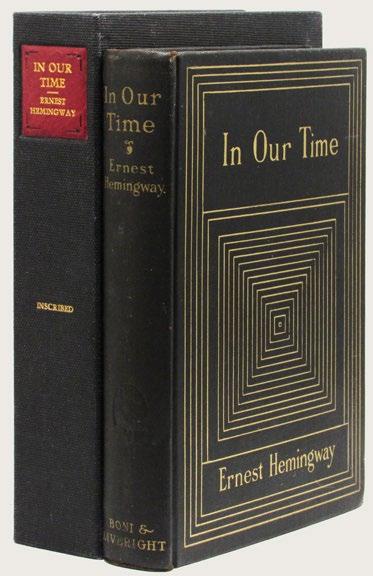
General Foreman was awarded for bravery the Distinguished Service Cross, the Distinguished Service Medal, Silver Star Citations, French Legion of Honor and the Belgian Order of the Crown. During World War II, Foreman was honored when a merchant liberty ship was named the S.S. Foreman.
General Foreman was one of the organizers of the American Legion and he was elected chairman of its executive committee at the Paris Caucus, at which he represented Illinois. During the Legion’s third national convention in 1921, he was designated as a past national commander by resolution.
He was very active in politics and civic affairs. Foreman had the confidence of presidents, cabinet members, senators, governors and mayors. He was a bachelor and a collector of rare books. He died on October 18, 1935’ see Seymour “Sy” Brody Connolly 100 $26,500.
An Important Woodblock Hand-Coloured Japanese Map From the Beginning of 1684 - Very Rare and Very Beautiful Japan Eiri Edo Oezu - Very Large Joined and Folded Paper
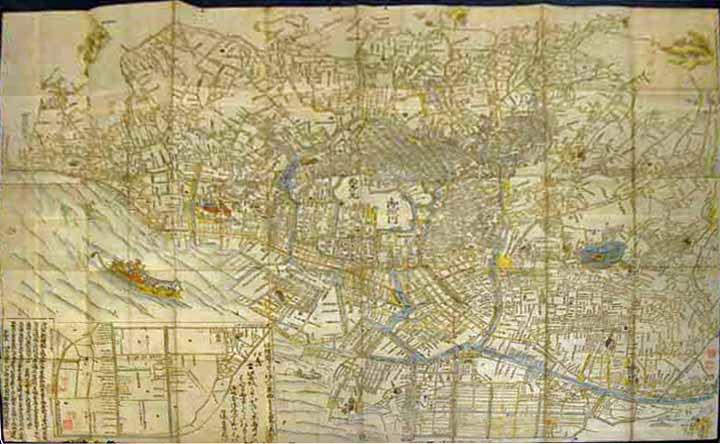
33 [Japanese Hand-Coloured Wood-Block Printing]; [Maps and Atlases]; [Tokyo Map], Hyoshiya Ichirobe. A WOODBLOCK HANDCOLOURED MAP OF TOKYO; JAPAN EIRI EDO OEZU (Illustrated Edo) (Edo [Tokyo]: Hyoshiya Ichirobe (Hayashi-shi Yoshinaga), First month, 1684 (But Third month, 1680)) A large woodcut map of Edo (Tokyo) with fine handcolouring, on joined and folded paper. The map is breathtaking in its detail and features many paintings of important landmarks, temples, bridges and people, who are often pictured working or fishing from boats on the waterways running through Tokyo. A stunning and very rare woodblock map beautifully and unusually handcoloured. Roads, blocks, buildings, open areas, canals and waterways, are all vividly laid out on this huge and most impressive map. 123.5 by 149.5 cm., folded within paper covers, folds to 28 by 18 cm, now preserved in a fine clamshell box. A remarkably well preserved and very rare item, with some light rubbing due to age and as to be expected. A bit of old worming or light soiling and occasional small repairs, but in all quite astonishing in its quality and beautifully preserved with bright and vivid colour and detail.
AN EXTRAORDINARY ITEM, REMARKABLE FOR BOTH ITS CARTOGRAPHIC DETAIL AND ITS ARTISTIC BEAUTY. The wood block printing shows land tenures of Daimyo and Hatamoto. It also shows temples and shrines, includes a distance chart and descriptive listing of Daimyo showing crests and halberds. There is also a inset of the eastern portion of Edo. East Asian Library, Berkeley EA9. $12,500.
The Most Beautiful La Fontaine Fables Ever Printed
One of the Finest Illustrated Books of all Time
The Zenith of the French Illustrated Book With Jean-Baptiste Oudry’s Extraordinary Illustrations Engraved Frontispieces and 275 Full-Page Folio Plates
34 La Fontaine, J[ean] de. FABLES CHOISIES, Mises en Vers Par J. De La Fontaine (Paris: Chez Desaint & Saillant [et] Durand, De l’Imprimerie de Charles-Antoine Jombert, 1755-1759) 4 volumes. First edition, first issue of this extraordinary work, considered to be one of the finest illustrated books ever produced in France, and considered by Ray to be “one of the most ambitious and successful of all illustrated books. The plate entitled “Le Singe et le Léopard” is first issue and is without lettering in the banner. Engraved frontispiece, and with the engraved portrait Oudry by Tardieu after de Largillière included in only some copies, and 275 engraved plates after Jean-Baptiste Oudry by Cochin, Tardieu, Prévost, Chedel Lempereur and others. As well, there are over 200
536-4433
very finely engraved vignettes, head- and tail-pieces by Lesueur after Bachelier. Large folio, 15 3/4 x 11 inches, bound in very handsome contemporary full motteled calf, the boards framed with gilt double-ruled lines, the spine with wide bands creating gilt framed compartments, each double-gilt ruled and decorated in a floral motif including large central gilt flowers, two compartments with contrasting red and brown morocco labels gilt lettered, endpapers marbled and a.e.g. Vol. I: [4], xxx, xvii, 124pp. 70 plates, frontispiece engraving, portrait engraving of Oudry; Vol. II: [4], ii, 135pp. 68 plates; Vol. III: [4], 146 pp. 68 plates; Vol. IV: [4], ii, 188 pp. 69 plates
A fine and handsome set, very well preserved with only light evidence of use or age, confined primarily to the extremities, the tips and hinges with some very sympathetic, expert and unobtrusive refurbishment. The plates and text-blocks generally very clean and fresh. Occasionally a bit of the toning typical to the work.
RARE FIRST EDITION, FIRST ISSUE OF WHAT IS GENERALLY CONSIDERED TO BE ONE OF THE GREATEST FRENCH BOOKS OF ALL TIME AND ONE OF THE FINEST ILLUSTRATED BOOKS EVER TO BE PRODUCED, ONE OF THE MOST AMBITIOUS AND SUCCESSFUL EVER PRODUCED, AND THE ZENITH OF THE 18TH CENTURY DECORATED BOOK IN FRANCE. ‘THE FABLES of La Fontaine are known universally and exhibit the versatility and fecundity of the author’s talent more fully than any of his other work. For his edition of THE FABLES, La Fontaine, the great French poet took inspiration from Aesop, Horace, Boccaccio and Ariosto and Tasso, Machiavelli’s comedies, and Eastern stories that in his epoch were transmitted through translations from the Persian. The boldness of the politics is as much to be considered as the ingenuity of the moralizing, as the intimate knowledge of human nature displayed in the substance of the narratives, or as the artistic mastery shown in their form.
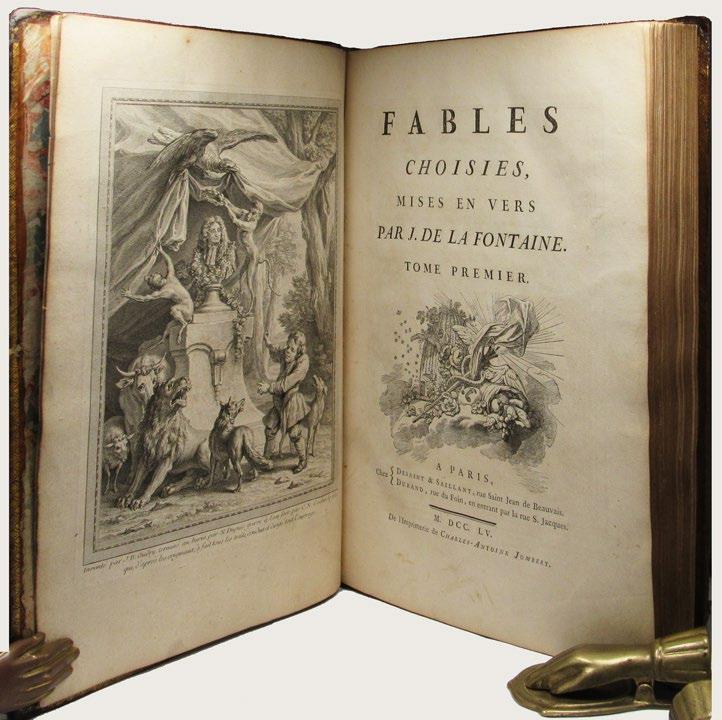
Perhaps the best criticism ever passed upon La Fontaine’s FABLES is that of Silvestre de Sacy, to the effect that they supply delights to three different ages: the child rejoices in the freshness and vividness of the story, the eager student of literature in the consummate art with which it is told, the experienced man of the world in the subtle reflections on character and life which it conveys. Nor has any one, with the exception of a few paradoxers...denied that the moral tone of the whole is as fresh and healthy as its literary interest is vivid. The book has therefore naturally become a standard French reader both at home and abroad. It is no small testimony to its merit that not even this use (or misuse) has interfered with its popularity. Oudry, (1686 - 1755) was one of the most famous artists of France. His artwork, designed for La Fontaine’s FABLES, the most famous production of the great French author is considered the most masterful interpretation of the most famous fabulist. He served both Louis XV and Louis Fagon (1680-1744), an Intendant des Finances and book collector. Oudry decorated his houses in Vanves and Fontenay-aux-Roses with arabesques, flowers and birds.
Fagon was charged with reviving the fortunes of the tapestry manufactory of Beauvais, which had flourished under Colbert, and he gave the task to Oudry and his associate, Besnier, in 1734. Oudry succeeded in his tasks, becoming wealthy in the process. His success at Beauvais led to a further appointment as inspector at the Gobelins manufactory in 1736, where his works were copied as cartoons for tapestries. Through most of the 1730s, he concentrated mainly on producing designs for tapestries, notably the nine Chasses Royales Gobelins series (1733-46), first woven for the Château de Compiègne (and reunited in Compiègne), for which the cartoons were later framed into the boiseries in an interior decor for Charles X at
Fontainebleau, 1828.
Oudry worked primarily for Louis XV and he turned down offers to work for the Czar Peter the Great and the King of Denmark, preferring to remain in France, where he maintained a large studio of assistants. He profited as the principal animal painter and one of the foremost decorative painters during the first half of Louis XV’s reign. After initial training as a portrait painter, he concentrated on the still-life and by the 1720s he had also begun to establish himself as a specialist in hunting scenes, game-pieces and portraits of animals. He ran an active workshop, often keeping his best originals for years and selling copies and (more or less autograph) variants. In the 1730’s he was most active as a tapestry designer, making numerous designs for the royal tapestry works of Beauvais and the Gobelins, and he continued to produce his brilliantly painted hunts, still-lifes and studies of animals and birds to the end of his career.
A very pleasing copy of “one of the most ambitious and successful of all illustrated books, the zenith of the 18th-century decorated book in France.”’ $16,500.
The Great First Edition in English - The First History of Rome
The Romane Historie Written by T. Livius of Padua - 1600
Philemon Holland’s Superb Translation of Livy’s History
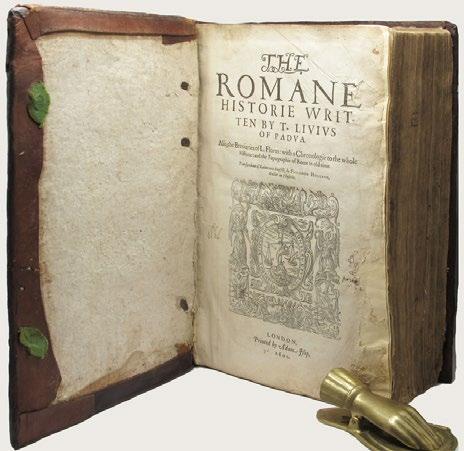
35 [Livy] T. Livius, of Padua. THE ROMANE HISTORIE Written by T. Livius of Padua. Also, the Breviaries of L. Florus: with a Chronologie to the whole Historie: and the topogrpahie of Rome in old time. Translated out of Latine into English by Philemon Holland, Doctor of Physicke. (London: Adam Islip, 1600) First Edition in English of Livy’s highly influential history of Rome. Engraved head- and tail-pieces for each chapter, engraved and elaborate multiple line historiated initials to each chapter, engraved decorated title, two portraits: Queen Elizabeth and Titus Livius. Thick Folio, in a binding of contemporary full calf, the upper cover with a gilt tooled emblem at the center, that at the rear cover excised,double-ruled borders in blind to the covers, wide raised bands to the spine with sedate blind ruling to the bands, simple central gilt ornament to the compartments, original turnovers, boards and ties, rare in original binding. (x), 1403, [1, To the Reader], 40 index and errata) pp. A good copy, the text-block fresh and unpressed, some old evidence of rubbing and wear to the lower outside corner of a number of the leaves at the beginning and end of the book, title-page and dedication leaf backed at the outer margins, the original spine panel with some portions lost and later refurbished or replaced during rebacking. A good copy of a book now elusive and rarely seen in commerce in contemporary binding..
This is the RARE FIRST EDITION IN ENGLISH OF PHILEMON HOLLAND’S SUPERB TRANSLATION of the great historian’s work on Roman history, originally written circa 20 B.C. OF A SUPREMELY IMPORTANT ROMAN TEXT. Holland’s edition was widely studied in Elizabethan time and served as a major source for William Shakespeare.
“(T)he only English translation of any merit is by Philemon Holland (1600).” Livy’s account is of interest because unlike others at the time [Virgil, Horace], he did not predict an upward, linear progression of Rome. Livy divided the history into decades and his further division of subjects into 142 libri or volumina is thought to be his own idea. Livy’s goal in writing a history was to write the first history of the Roman people. For the people themselves, he believed something could be learned;
“they are invited to note especially the moral lessons taught by the story of Rome, to observe how Rome rose to greatness by the simple virtues and unselfish devotion of her citizens, and how on the decay of these qualities followed degeneracy and decline.” His aim is not to develop historiagraphy per se but to write in testimony to Rome’s greatness as well as attempting to ensure that Rome did not bring about its own downfall through corruption and vice. “Livy was deeply penetrated with a sense of the greatness of Rome...But, if this ever-present consciousness often gives dignity and elevation to this narrative, it is also responsible forsome of its defects. Thus, it could be said that Livy’s approach is a ”didactic view of history.” [EB] $11,500.
John Locke - An Extremely Rare Autograph Handsomely Preserved on the Original Folio Leaf
36 Locke, John. AUTOGRAPH SIGNATURE AND OWNERSHIP INSCRIPTION: Signed as “John Locke ex dono Authoris” [“From the Gift of the Author”] A Fine Example of one of the most desirable English autographs. 10.5 cm x 19.3 cm, original folio leaf trimmed long ago for presentation. Beautifully preserved, a fine autograph in excellent condition.
RARE JOHN LOCKE AUTOGRAPH. LOCKE’S AUTOGRAPH IS RARE IN ANY FORM. LOCKE MANUSCRIPTS NEVER APPEAR ON THE MARKET -- HIS AUTOGRAPH PAPERS ARE OWNED BY THE BODLEIAN LIBRARY -- AND EVEN LETTERS ARE EXTREMELY DIFFICULT TO FIND IN COMMERCE.
The present autograph appears to be written on the flyleaf of a foliosized book from Locke’s library; the flyleaf now separated from the book. Locke routinely signed the books he owned, and he also often indicated from whom they were acquired. As one of the most prominent English intellectuals, Locke was often presented books by other authors – as here: clearly evidenced by Locke’s inscription “ex dono author is”, given by the author.
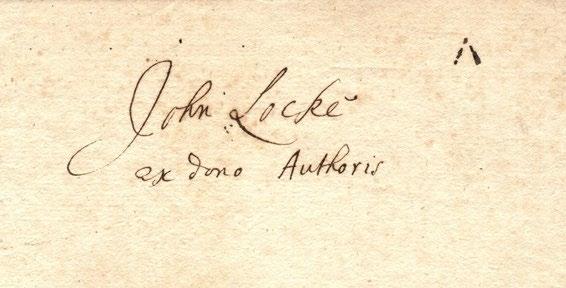
Though Locke is thought to have owned a fairly large library of some 4000 titles, only about twenty percent of his original library is known to be extant. Many of these extant volumes are now in institutional collections, and only a small number are to be found in private hands.
Locke is of course most famous for his ESSAY CONCERNING HUMANE UNDERSTANDING - the foundational text of empirical philosophy - and also for his “Two Treatises of Government,” a political work of central importance to the birth of the American nation. Locke’s great ESSAY was the “first attempt on a great scale, and in the Baconian spirit, to estimate critically the certainty and the adequacy of human knowledge, when confronted with God and the universe” (EB). It served as the most concrete manifestation of a new empiricist spirit, in contrast to the metaphysical philosophies of Descartes, Spinoza and Leibniz. Locke was inspired to write the ESSAY in 1671 after a philosophical discussion with friends in which he realized that no progress could be made before they had examined the mind’s capacities and seen “what objects our understandings were, or were not, fitted to deal with” (from the “Epistle to the Reader”).
“Other philosophers had reflected on and written about human knowledge...But Locke was the first philosopher to devote his main work to an inquiry into human understanding, its scope and its limits. And we can say that the prominent place occupied in modern philosophy by the theory of knowledge is in large measure due to him...” (Copleston, A HISTORY OF PHILOSOPHY).
Locke’s influence was widespread and was not strictly limited to pure philosophical enquiry. In America his emphasis on rational thought versus “enthusiasm” provided ammunition and philosophical grounding to opponents of the revivalist and itinerant preachers of the Great Awakening, and in the nineteenth century the “nature versus nurture” thesis was
employed by Unitarians and other anti-Calvinist factions to argue that human nature was improvable through nurture and self-culture rather than corrupt beyond hope without conversion through a special act of divine grace. In England Locke had a strong influence on the literature of the Augustan Age, Sterne, Addison, and the members of the Scriblerus Club all acknowledging the currency of his ideas. “The art of education, political thought, theology and philosophy, especially in Britain, France, and America, long bore the stamp of the ESSAY, or of reaction against it” (Fraser, quoted in Grolier). Locke’s ESSAY has passed through more editions than any classic in modern philosophical literature and remains a cornerstone in the history of human thought. $10,000.
A Beautiful and Rare 19th Century Folio Palladio
With a Total of 233 Fine Copperplate Engravings
The Scamozzi “Opera” of Andrea Palladio
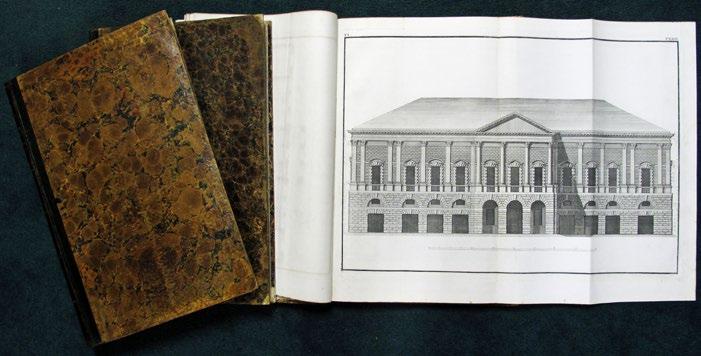
37 Palladio, Andrea. LE FABBRICHE E I DISEGNI DI ANDREA PALLADIO E LE TERME. Nuova Ed. Italiana Foggiata Sulla Vicentinese di Bertotti Scamozzi Ampliata e Fornita di Note da Celestino Foppiani (Genova: G. Decamilii, 1845) Five volumes bound in three. A beautiful 19th Century edition of the monumental critical “Opera” of Palladio of Ottavio Bertotti Scamozzi, expanded with the commentary and notes of Celestino Foppiani. With a total of 233 impressive folio copper engraved plates. Large folio, finely bound in morocco backed boards with titles and numbers on the handsomely decorated spine in gilt. 3 cc., 135; 3 cc., 88; 3 cc., 72; 3 cc., 92; xiv, 28. Engraved Plates: LII, LI, LI, LIV, XXV. A very handsome and pleasing copy of this important and beautiful book, with some expected evidence of wear and use, some typical or occasional staining to some leaves because of use.
SCARCE AND BEAUTIFUL PRINTING of the magnificent “Scamozzi Palladio” with the commentary Ottavio Scamozzi first written between 1776 and 1785. Containing full commentary and notes on each building and the commentary and notes of architect Celestino Foppiani.
Palladio’s designs and work to this day remain the central pillar of classical architecture and all architecture which followed.
‘Palladio’s lasting influence on architectural style in many parts of the world was exercised less through his actual buildings than through this, his textbook. The book is divided into four sections: orders and elementary problems, domestic building, public building and town planning and temples. Palladio’s style was directly inspired by Roman classical models through the writings of Vitruvius and Alberti. Its characteristics are those of classicism: symmetry, order, fixed mathematical relations of the parts to each other and to the whole, logic and monumentality.
Palladio followed the rules of classical Roman architecture more closely than any other architect...In spite of the vogue for the baroque and the fact that Palladio left no immediate successors, his book exerted a powerful influence on contemporary
architecture and classical ideals until the end of the eighteenth century.
As a practicing architect Palladio worked mainly in Vicenza, Venice and the Venetian countryside, especially along the Brenta River. His Villa Capra (known as La Rotonda) near Vicenza became virtually a prototype of the Palladian style, and it was widely and faithfully copied. At the end of his life he left plans for the tour de force of trompe l’oeil, the Teatro Olimpico in Vicenza, which was finished by his pupil Vincenzo Scamozzi.’ $9500.
Giovanni Bardi - Memorie del Calcio Fiorentino - 1688
One of the Very Earliest Books Relating to Football With Fine Engraved Folding Plates
38 [Soccer; Football]; Bardi, Giovanni Maria De’, Et Al (Bini, Pietro de Lorenzo, Editor). MEMORIE DEL CALCIO FIORENTINO. Tratte da Diverse Scritture (Firenze: Stamperia di S.A.S., alia Condotta, 1688) Rare First Edition of this very early work on football. Engraved armorial title-vignette featuring a figure with a football by Francesco Nacci, two folding engraved plates, one with players lined up for play in the Piazza Sante Croce by Alexander Cecchini and one a diagram of player’s positions. 4to, in nineteenth-century marbled boards backed in black morocco, the spine gilt lettered and with multi-line gilt ruled flat bands, additional gilt tooling at the foot, bookplate of Franco Niccoli to front paste-down. [xii], 118, [2 manuscript entries] pp. A very handsome and proper copy of this rare book, with a couple of contemporary marginal annotations and one contemporary manuscript leaf bound at the end, a little scattered foxing throughout but not obtrusive.
RARE FIRST EDITION OF PIETRO BINI’S ANTHOLOGY ON FLORENTINE FOOTBALL, a forerunner to the modern games of soccer, rugby and American football. THIS IS ONE OF THE EARLIEST TREATISES ON THAT PREDECESSOR TO OUR MODERN GAMES.
In the game of calcio two teams each consisting usually of 27 men are engaged on an enclosed ground of 172 x 82 braccie fiorentine (just little smaller than a modern football field). The action consists of carrying and kicking a pumped ball of medium size with fists and feet (hence the name calcio) in order to make it pass beyond the terminal barriers of the adversaries’ half. One such successful action is called caccia. The team making the most caccie is the winner. Games typically last one hour and are played ‘for honour’s sake’.
The wonderfully detailed description of the game is largely by Giovanni de’ Bardi and, though it was first published (anonymously) nearly a century earlier, the text included here is greatly expanded and illustrated. It fully explains the rules and manners of the game, and describes a number of games that had recently been played in and near Florence. The double-page plate depicts a match in the Piazza Santa Croce is very impressive and provides us with a lasting 17th century “instant replay” of the event. $9850.
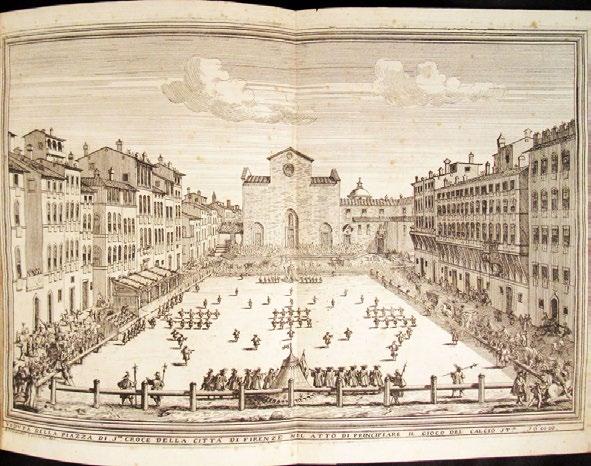
‘The Birth of All Theatre’
The Editio Princeps of Sophocles - Printed by Aldus, 1502
First Printing in Greek of ‘Oedipus the King’ and all Other Plays
39 Sophocles, (469-399 B.C.). [Title in Greek] TRAGEDIAE SEPTEM CUM COMMNETARIIS. (Venice: Aldus the Elder, August 1502) The very rare editio princeps, the first Aldus edition, the first Greek text, the first complete edition of Sophocles, the first appearance of Aldus’s finest Greek type and the first in Aldus’ series of the classics in pocket format. Woodcut aldine dolphin and anchor device [Fletcher no.2] on verso of last leaf, capital spaces with guide letters. 8vo, very fine 19th century French grained red goatskin, covers lined in blind with triple fillet rules and corner tools, the spine lettered in gilt between raised bands ruled in blind. 196 ff. with all blanks present A very handsome copy in a very well preserved antique binding.
THE VERY RARE first printing or editio princeps in its native Greek of a classic of enormous significance--the birth of all theatre. First printing from the Aldine press with the imprint: Venetiis, in Aldi Romani Academia, and the first printing by Aldus in the series by the classic authors.
Dibdin in his great book on the Greek and Roman classics said of this printing that it “is a very excellent and accurate edition; highly approved by Brunck, and taken from valuable MSS. It is greatly preferable to many that followed it. The Aldine edition was the basis of every subsequent one, till that of Turnebus. A very copious and flattering account is given by the bibliographer Harles of the excellence of this editio princeps.”
Sophocles has been called the father of modern theatre and the Homer of tragedy. “According to Aristotle in the Poetics, Sophocles was an innovator in tragedy: he added a third to the previously accepted two actors, introduced ‘scene painting’, and increased the chorus from twelve to fifteen; he also abandoned the Aeschylean practice of writing trilogies on related events instead giving each play a self-contained plot....His characters were admired by Aristotle for being ‘like ourselves only nobler’; his heroes and heroines are placed in circumstances in which they must act, and by their actions, which often have tragic consequences, they show their heroic stature. For Aristotle, Oedipus Rex represented Greek tragedy at its greatest.” - Howatson. Brunet; Dibdin, Classics; Oxford Classical Literature.
Please note; the image used to illustrate this catalogue is from an alternate source. $27,500.
Spinoza’s Tractatus Theologico-Politicus
One of the Most Important Philosophical Works of the Period A Foundational Work in Liberty and Democratic Thought The Very Rare First Edition in the Original Dutch - 1693
40 Spinoza, Baruch De. DE RECHTZINNIGE THEOLOGANT, OF GODGELEERDE STAATKUNDIGE VERHANDELINGE. UIT HET LATIJN VERTAALT. [THE ORTHODOX THEOLOGIAN OR THEOLOGICALPOLITICAL TREATISE; TRACTATUS THEOLOGICO-POLITICUS] (Amsterdam: N.p.: Henricus Koenraad’ (i.e. Jan Rieuwiertsz jun.), 1693) First edition in Dutch of TRACTATUS THEOLOGICO-POLITICUS, the THEOLOGICAL-POLITICAL TREATISE. 8vo [16 x 20cm], handsomely bound in full vellum with leather bands, spine lettered in manuscript. (xxviii), 360 pp. A very fine and handsome copy of this very scarce first edition printing, the text-block very fresh and clean, a strong impression of the text, the binding as pristine. FIRST ISSUE, FIRST PRINTING OF THE VERY RARE DUTCH EDITION WHICH SPINOZA DID NOT WANT PUBLISHED OUT OF FEAR OF RETRIBUTION. QUITE ELUSIVE, AND ONE OF THE MOST IMPORTANT PHILOSOPHICAL WORKS OF THE EARLY MODERN PERIOD. Baruch Spinoza is unquestionably one of the most important philosophers of all time -- and certainly, perhaps the most radical of the early modern period. His thought combines a commitment to Cartesian metaphysical and epistemological principles with elements from ancient Stoicism
and medieval Jewish rationalism into a nonetheless highly original system. His extremely naturalistic views on God, the world, the human being and knowledge serve to ground a moral philosophy centered on the control of the passions leading to virtue and happiness. They also lay the foundations for a strongly democratic political thought and a deep critique of the pretensions of Scripture and sectarian religion. Of all the philosophers of the seventeenth-century, perhaps none have more relevance today than Spinoza.
Spinoza’s aim in TRACTATUS THEOLOGICO-POLITICUS, which he completed and published anonymously in 1670, was to prove that the stability and security of society is not undermined, but rather enhanced by freedom of thought, meaning primarily, the freedom to philosophize. As is clear from the text, he concluded that the primary threat to this freedom emanated from the clergy, whom he accused of playing upon the fears and superstitions of people in order to maintain power. His solution was to divest the clergy of all political power, even to placing authority over the practice of religion into the hands of the sovereign. The sovereign, Spinoza argued, should extend broad liberties within this domain, requiring adherence to no more than a minimal creed that was neutral with respect to competing sects and the meaning of which was open to a variety of interpretations. This he hoped, would allow philosophers the freedom to do their work unencumbered by the constraints of sectarianism.
As was to be expected, the work was met with a firestorm of criticism. It was condemned as a work of evil, and its author was accused of having nefarious intentions in writing it. Even some of Spinoza’s closest friends were deeply unsettled by it. Though he had assiduously tried to avoid it, Spinoza found himself embroiled in heated religious controversy and saddled with a reputation for atheism, something he greatly resented.
Shortly after the publication, Spinoza moved to the Hague, where he was to live out his remaining years. Besides having to deal with fallout from this treatise, he witnessed a political revolution that culminated in the murder by an angry Orangist-Calvinists mob of the Grand Pensionary of Holland, Jan De Witt as well as his brother Cornelius. Spinoza admired De Witt for his liberal policies and was horrified by the murder. With the ascent of the Orangist-Calvinist faction, he felt his own situation to be tenuous.
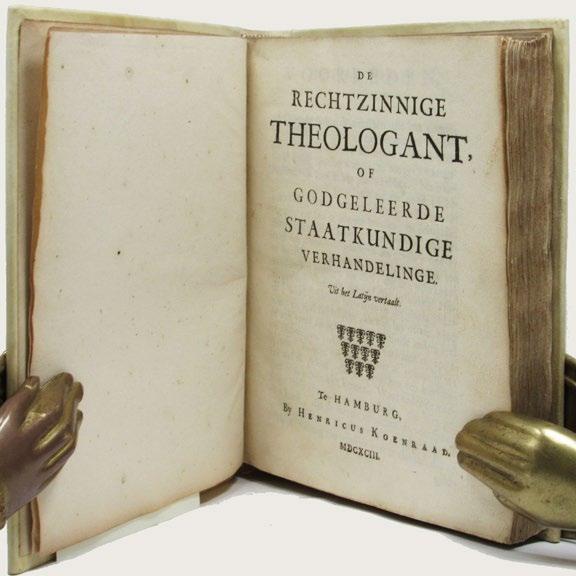
In the words of PRINTING AND THE MIND OF MAN, “...[The TRACTATUS THEOLOGICO-POLITICUS] constituted an extension to political thought of his ethical views. Man is moved to the knowledge and love of God; the love of God involves the love of our fellow men. Man, in order to obtain security, surrenders part of his right of independent action to the State. But the State exists to give liberty, not to enslave; justice, wisdom and toleration are essential to the sovereign power.
Baruch Spinoza (1632-1677), scion of a leading Jewish family in Europe’s most cosmopolitan city of the seventeenth century, Amsterdam, provided the intellectual architecture for a philosophic structure which would level current assumptions and conclusions. For his endeavors, Spinoza was excommunicated by his own community and his name, Baruch-Benedict (which means blessed), became anathema both in the community he left and the larger community he never entered. During his lifetime, Spinoza’s works were published anonymously, and even his posthumously published Opera contains neither place nor date of publication. His rise to a central position in the drama of humankind’s search for truth came slowly but inexorably as human reason came to be more and more relied upon over the ideas promulgated by an adherence to divine dogma. It is said that Thomas Jefferson would have been one of the first Americans to have accepted Spinoza as his spiritual kin. $19,500.
Mark Twain - The Adventures of Huckleberry Finn First Printing, With the First Issue Points A Very Nice Copy in the Publisher’s Sheepskin Binding
41 Twain, Mark. THE ADVENTURES OF HUCKLEBERRY FINN (Tom Sawyer’s Comrade). (New York: Charles L. Webster, 1885) First edition. First Issue. With 174 black and white illustrations by E.W. Kemble. Large 8vo, original publisher’s sheep binding with the red and black lettering labels on the spine. It is estimated that only 2500 copies were issued in this binding. 366 pp. A very pleasing and handsome copy. Light, expert and unobtrusive refurbishment to the joints.
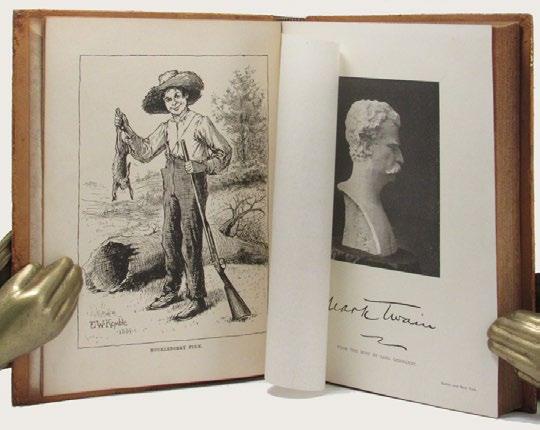
FIRST EDITION OF ONE OF THE MOST IMPORTANT AND GREATEST BOOKS IN AMERICAN LITERATURE. A very handsome copy with the following earliest setting states as listed by BAL: “Him and another Man” is listed at page 88, BAL’s first state; page 57, eleventh line from the bottom reads “...with the was...,” BAL’s first state; page 155 with final 5 “stamped in” by hand (see Underhill), and matching the original font in the setting of the page number (no priority, occurring randomly in all three states independent of other major signs of first printing sheets, but this setting seems to appear least often); the portrait frontispiece is in BAL’s first state, “heliotype” imprint on the portrait frontispiece, title page with 1884 copyright on verso, p.9: the heading for Chapter 6 reads “Decided” (later corrected to “Decides”), p.143: “I” in “Col.” (line 1) missing and “b” in “body” (line 7) broken, p. 161: signature mark “11” is missing, final leaf is a blank. Very rare with this many first issue points. The sheep bindings are generally in poor condition, but this copy is still quite nice. Along with Tom Sawyer, Huckleberry Finn is considered the stepping stone to modern American literature. And along with Tom Sawyer, for the first time, the hero of the novel was a boy. These books are landmarks and Hemingway often offered his opinion that the modern novel would have been impossible without them. With Whitman’s Leaves of Grass and Melville’s Moby Dick, they provide us with a view of America transcending its past and beginning its future. $16,500.
Please continue to the next page.
A Chronicle of the Kings of England - 1643
First Edition, First Issue - Sir Richard Baker’s Classic Work One of the Great Works on English Government and Royalty
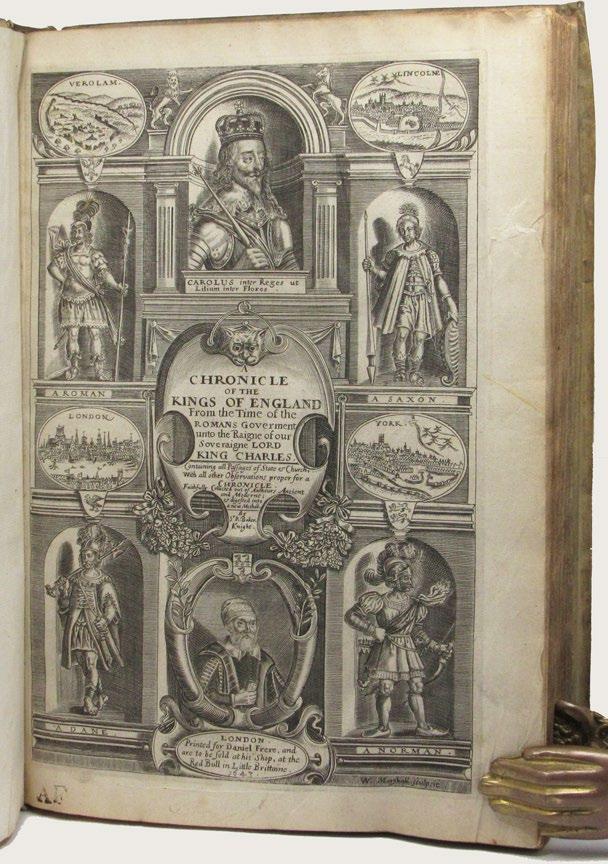
42 Baker, Sir R[ichard], Knight. A CHRONICLE OF THE KINGS OF ENGLAND, FROM THE TIME OF THE ROMANS GOVERNMENT, UNTO THE RAIGNE OF OUR SOVERAIGNE LORD KING CHARLES. Containing all Passages of State and Church, with All Other Observations Proper for a Chronicle. Faithfully Collected out of Authours Ancient and Moderne; & Digested into a new Method ... Whereunto is Added, THE REIGN OF KING CHARLES THE FIRST AND KING CHARLES THE SECOND. In Which are Many Material Affairs of State, Never Before Published; and Likewise the Most Remarkable Occurrences Relating to King Charles the Second’s Most Wonderful Restoration, by the Prudent Conduct of George Late Duke of Albemarle, Captain General of All His Majesties Armies... (London: Printed for Daniel Frere, and are to be Sold at his Shop, at the Red Bull in Little Brittaine, 1643) Rare First Edition, First Issue of this important work. With a very elaborate and beautifully engraved titlepage by W. Marshall depicting Kings including a Roman, a Saxon, a Dane and a Norman, King Charles, Baker and views of London, York, Lincoln and Verolam, a frontispiece engraving of Charles, the young Prince of Wales who would later be King Charles II by van Dalen, the preliminary leaves including the Dedication, the Catalogue of Authours, the first page of the Chronicle and the first page of each book, with beautifully engraved head-pieces and 4, 6 or 10 line historiated initials, the books with finely engraved tail-pieces at the end of each. Folio, 13.5” x 9”, the binding 14” x 9.5”, bound in full contemporary vellum, the spine panel with title in manuscript. [14], 181, [1], 163, 108, 163, [1] pp. complete A handsome and very well preserved copy, the text crisp, clean and unpressed, the binding strong, with minimal wear and normal expected age evidence.
ONE OF THE GREAT EARLY WORKS ON THE HISTORY OF ENGLISH GOVERNMENT AND ROYALTY. Educated at Oxford, Baker was elected to parliament in 1597. In 1603 he was knighted by King James I. His great Chronicle of the Kings of England was published first in 1643, translated into Dutch in 1649 and was continued down to 1658 by Edward Phillips, a nephew of John Milton and a strong loyalist. For many years the Chronicle was extremely popular and followed on in many editions all the way throughout the 19th century.
Baker was Knighted by James the 1st in 1620 but by 1635 found himself penniless and in debtor’s prison. It was there that he wrote his magnificent CHRONICLE. The great success of the work came too late to help as he died, still in confinement, very shortly after the printing of the first edition. Granger; Kippis; Encyc. Brit. $3850.
Presentation Copies Inscribed by Robert Browning Selections From His Poetical Works - Two Volumes
43 Browning, Robert. SELECTIONS FROM THE POETICAL WORKS OF ROBERT BROWNING [with] SELECTIONS...Second Series (London: Smith, Elder and Co., 1878, 1880) Together 2 volumes. The fourth edition of the first volume, the first edition of the second volume. INSCRIBED IN EACH VOLUME BY BROWNING. 8vo, original sienna cloth lettered and decorated in gilt and black. xi, 348; vii, 371, [2]. The first volume has been expertly rebacked to match the original; the second has been recased with some restoration at the spine ends; both have new endpapers and bear the stamp of the College for Working Women. A very good set. AN INSCRIBED PRESENTATION COPY OF EACH VOLUME. The first is inscribed “To the Members of the Working Women’s College with Robert Browning’s kind regards, Jan. 14 ‘80.” The second volume is inscribed “With Robert Browning’s best respects and regards.” Presentation copies of Browning’s writings are quite scarce.
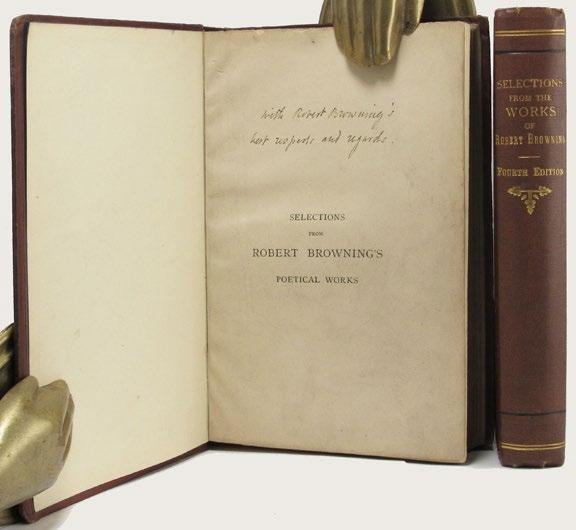
Browning ranks high among the Victorian Poets; noted for irony, characterization, dark humour, social commentary, historical settings and challenging vocabulary and syntax. $3850.
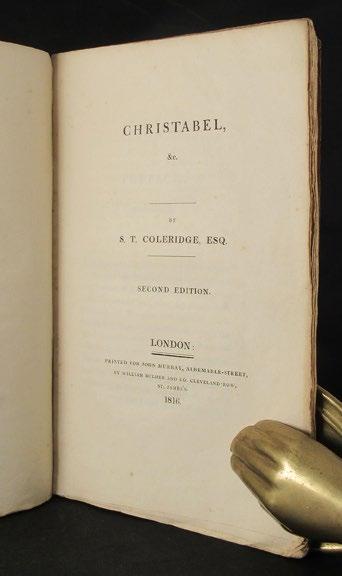
Samuel Taylor Coleridge - Original Publisher’s Wraps Christabel, Kubla Khan, and The Pains of Sleep - 1816
44 Coleridge, Samuel. CHRISTABEL, &C. (London: John Murray, 1816) First Edition, second issuance of the book, same year as the first issuance. 8vo, printer’s original drab wrappers, unbound and untrimmed. vii, 64, (4)pp. ads dated May 1816. An unusually well preserved copy, the wrappers untouched and unrestored, some chipping or loss to the spine panel of the wrapper confined to the lower section, quite clean and showing just occasional age internally.
VERY SCARCE IN THE ORIGINAL WRAPPERS UNTRIMMED AND UNBOUND. Coleridge began to write these poems in 1797 in Stowey (Somerset). He wrote ‘Kubla Khan’ after returning from Germany in 1800 and finished the last work, ‘The Pains of Sleep’, shortly before publication. Coleridge states that although it may appear that the metre of ‘Christabel’ is irregular, in truth he has created a new principle--that of counting the accents in each line rather than the syllables. “Though the latter may vary from seven to twelve, yet in each line the accents will be found to be only four. Nevertheless this occasional variation in the number of syllables is not introduced wantonly, or for the mere ends of convenience, but in correspondence with some transition in the nature of the imagery or passion.”
Coleridge wrote the ballad “Christabel”, a tale of spiritual seduction in a medieval castle, as an experiment in English poetry at the encouragement of his good friend Wordsworth. Also included are “Kubla Khan” and “The
Pains of Sleep.” “Kubla Khan,” an unfinished poem, was composed according to Coleridge in an opium-induced sleep, and is to some extent a precursor to symbolism and surrealism. Written after Coleridge quarreled with Wordsworth and moved to London, this book was originally published with Byron’s influence. $3850.
The True First Editions of Dickens’ First Great Books Sketches By “Boz” and Sketches by “Boz” (II) Published in London - 1836 and 1837 - Beautifully Bound
45 (Dickens, Charles) “Boz”. SKETCHES BY “BOZ”, Illustrative of Every-Day Life and Every-Day People. WITH SKETCHES BY “BOZ”, THE SECOND SERIES (London: James Macrone, 1836, 1837) 3 volumes. First editions of both works. 8vo, in a fine full olive morocco binding signed by Zaehnsdorf, ruled in gilt on covers. Very fine gilt decorations and lettering between raised bands of the spine. Gilt turn-ins. Fine decorative end-papers. 348; 342; 377, 17 ads. pp. A fine set, the binding very handsome with the spines lightly toned to honey.
RARE FIRST EDITIONS OF BOTH WORKS. SKETCHES BY BOZ was Dickens first work to be published in book form. “It is a fact that first books by authors that go on to attain great eminence are the most difficult to acquire in collector’s condition. Early in the collecting period of Dickens’ publications it seems that the very best copies came to the surface first. Then the state of the books began to wane until at the present period Sketches by Boz make an appearance far from satisfactory.” This is especially true with Dickens.
In addition to the importance of Dickens in world literature, this ‘Sketches’ also features the light-hearted illustrations of George Cruikshank. The Second Series contains a catalogue of Macrone publications and features an ad for the novel GABRIEL VARDON by Charles Dickens, which would be reissued as BARNABY RUDGE.
Dickens received only £400 as his share of the ‘Sketches’ while Macrone received ten times that amount. Because ‘Pickwick’ was by this time a “stupendous” success, Macrone decided to issue ‘Sketches’ in monthly parts. He was the absolute owner of the copyright and so decided to “press the popularity of the rising young author to the limit.” But Dickens began to consider his deal with Macrone a bad one and backed by Chapman and Hall, bought the rights for £2250. As partners they published ‘Sketches’ in parts and went on to publish the bulk of Dickens’ work. $7950.
One
of
the Very
Earliest
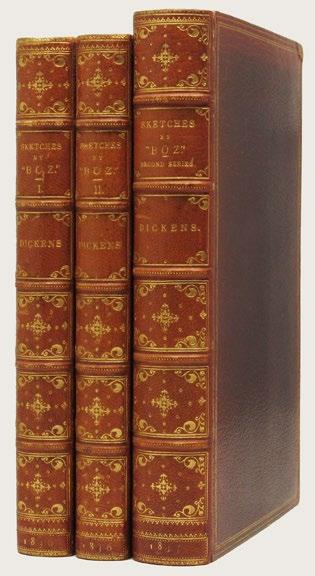
and Most Rare of the Artist’s Works
Gustave Doré - Trois Artistes Incompris et Mecontens
One of the Earliest “Comic Books” Published Paris - Chez Aubert & Cie. - 1850-1851
46 Doré, Gustave. TROIS ARTISTES INCOMPRIS ET MÉCONTENS Leur Voyage En Province.....Et Ailleurs !!. Leur Faim Dévorante et Leur Déplorable Fin (Paris: Chez Aubert & Cie, [1850-51]) First Edition, First Issue of one of the two earliest and most rare of all Doré’s illustrated books. Only Les Travaux d’Hercule precedes this book, and like the Trois Artistes Incompris et Mecontens is very rarely if ever seen in commerce. Illustrated with an engraved title-page as the upper cover illustration of the book, and over 150 woodcut illustrations throughout. Folio, publisher’s original and earliest binding of pictorially illustrated yellow paper over boards, the upper cover with all-over illustrations printed in red and black. [1], 25 pp. A well preserved and handsome copy of this very rare and fragile book, some expert and unobtrusive strengthening at the tips and edges, a book
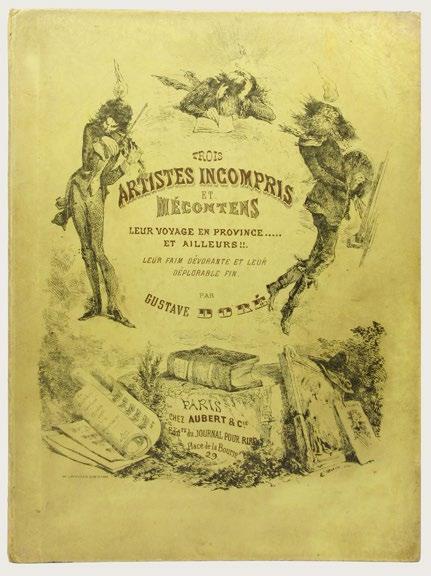
seldom if ever encountered, and even then, nearly always with very considerable wear and breakage.
FIRST EDITION OF ONE OF THE EARLIEST AND MOST RARE OF DORÉ’S ILLUSTRATED WORKS.
‘At 15 years of age Doré had begun his career working as a caricaturist for the French paper Le journal pour rire. Wood-engraving was his primary method at this time. In the late 1840s and early 1850s, he made several text comics, like Les Travaux d’Hercule (1847), Trois artistes incompris et mécontents (1850-1), Les Dés-agréments d’un voyage d’agrément (1851) and L’Histoire de la Sainte Russie (1854), but subsequently went on to win commissions to depict scenes from books by Cervantes, Rabelais, Balzac, Milton, and Dante. He also illustrated “Gargantua et Pantagruel” in 1854.
‘Trois Artists is a fascinating book...but dating the Trois Artistes original is a bibliographical challenge. The earliest Journal pour Rire advertisement was in November 29, 1850 and the book itself has a Dec. 1850 date in the publisher’s catalogue. The second larger Journal pour Rire advertisement was dated January 31, 1851, and the book was listed by February 11, 1851 in Bibliographie de la France. Whether December or January, the book remains, along with Les Travaux d’Hercule, the most rare of Gustave Doré’s illustrated books and one of the earliest “comic books” produced.
Gustave Doré (1832-1883), was described by Saturday Review as “The most startling art phenomenon in Europe; his genius at each turn changes, like the colors in a kaleidescope, into something new and unexpected.” The Fine Arts Quarterly Review also wrote: “Doré is a great and marvelous genius, a poet a nation produces once in a thousand years. He is the most imaginative, the profoundest, the most productive poet that ever sprang from the French race.” These are 1860s quotes from England about a French artist. What did Doré actually do? He created a series of dozens of literary folios with thousands of full-page engravings that are still being borrowed today in hundreds of popular culture genres. The Doré phenomenon was all the more remarkable because he was being viciously attacked by British elitists like John Ruskin, who asserted that Doré was the Devil, come to destroy the morality of the British public who were unsophisticated peasants. But those “unsophisicated peasants” who admired Doré art included the Queen of England, the Prince of Wales, the Poet Laureate, Charles Dickens, plus Leo Tolstoy, Mark Twain, not to mention the Pope. Doré’s dramatic, mystical, otherworldly imagery transcended dimensions of the physical and the spiritual. While other illustrators showed people standing in a room talking, Doré showed images of Spiral Nebula, Flying Saucers, the depths of Hell, and the opening of Heaven in his folios for Dante, Milton, Tennyson, The Bible, Rabelais, Shakespeare, Fairy Tales, Fables, Don Quixote, Baron Munchausen, The Ancient Mariner, Doré’s social commentary masterpiece London, A Pilgrimage, and Poe’s The Raven, which Doré did not live to see published. Doré was a creative geniuses with unlimited imagination.
Consider that Gustave Doré, at the age of 15 years, and a diminutive teenager walked into the office of Charles Philipon to show his drawings. It is said that he looked to be about 12. Philipon was mesmerized as Doré created new drawings with lightning-fast rapidity right before his eyes. Shortly thereafter, a book appeared with a most curious introduction by the Aubert Publishing Company that read, “The Labours of Hercules was written, drawn, and lithographed by a 15-year-old artist, who has no teacher or art training.” Thus began the art career of the most prolific and popular illustrator of all time. He wrote and drew several “comic books” before he began the transition to Literary Folios, Painting & Sculpture. But the only other edition of Doré’s Hercules in 145 years was a German edition in 1922. Charles Philipon’s company Aubert contracted with Doré’’s father to hire the boy to draw for his Journal pour Rire and Doré had over a thousand engravings published while still a teenager. In 1850 TROIS ARTISTES INCOMPRIS ET MÉCONTENS (Three Misunderstood Malcontent Artists), with 155 drawings was published. One of the two earliest, and now most rare, of the young genius’s books. And one of the earliest of all “comic books”. $5500.
The Rare Offprint from Zeitschrift für Elektrochemie Einstein’s Important Continuation on Brownian Motion
47 Einstein, A[lbert]. [Offprint issue;] THEORETISCHE BEMERKUNGEN ÜBER DIE BROWNSCHE BEWEGUNG (Weinheim: Offprint from: Zeitschrift für Elektrochemie. Nr. 6., 1907, February) First Edition, Offprint Issue from Volume 13, number 6. Single sheet, approximately 10” x 8” pp 41-42 pp. A very fine example of this rare issue, a very minor and unobtrusive stain to an upper corner.
SCARCE OFFPRINT ISSUE OF AN IMPORTANT EINSTEIN PAPER OF STATISTICAL MECHANICS and a continuation of his remarkable 1905 and 1906 publications on Brownian Motion, which not only led to the proof of the existence of the atom but also worked to determine the size of atoms, and how many atoms there are in a mole, or the molecular weight in grams, of a gas. This paper also contains a note on the technical meaning of “average velocity.” BRL 20; Weil 20. $4500.
Very Rare Africana - Captain Grant’s Walk Across Africa
James Grant’s Own Copy - With Hill House Markings - 1854
48 Grant, Capt. James Augustus. A WALK ACROSS AFRICA or Domestic Scenes from My Nile Journal. (Edinburgh: William Blackwood and Sons, 1864) First Edition and THE COPY BELONGING TO GRANT HIMSELF, WITH HILL HOUSE MARKINGS, FROM HILL HOUSE, MORAY, BANFFSHIRE, SCOTLAND. THIS IS FROM THE HOUSE OCCUPIED BY JAMES AUGUSTUS GRANT AND THIS COPY IS RECORDED AS BELONGING TO THE AUTHOR. With the folding map of the walk done by Grant and Speke Across Africa, contained in pocket in back cover. 8vo, publisher’s original green cloth, the spine lettered in gilt with gilt decorations at the head and tail, covers with decorative borders in blind, the upper cover bearing a large vignette decoration of the M’Ganda warrior saluting impressed in gilt. xviii, 452, [34 ads] pp. An internally fine and fresh copy, partially unopened. The cloth does bear some old evidence of water at the lower right corner of the upper cover and to the lower cover. There is a repaired tear to the cloth. The gilt remains bright on both the spine and upper cover, and the binding is solid and tight.
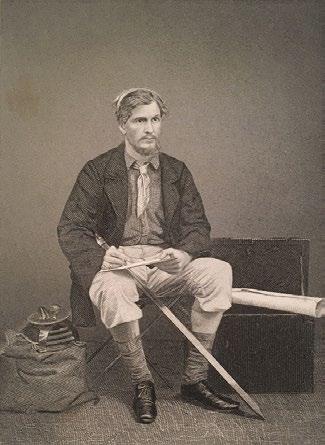
VERY RARE, THIS IS CONSIDERED TO BE THE COPY BELONGING TO GRANT HIMSELF, AS IT CONTAINS THE HILL HOUSE MARKINGS FROM HIS HOME IN MORAY, BANFFSHIRE, SCOTLAND. IT IS THE VERY SCARCE FIRST EDITION IN ORIGINAL CLOTH OF ONE OF THE MOST ELUSIVE OF THE EARLY AFRICAN EXPLORING BOOKS. James Grant accompanied Speke on his journey across Africa to solve the riddle of the source of the Nile. Meant as a companion to the account of the journey written by Speke, Grant explores the “ordinary life and pursuits, the habits and feelings of the natives” and the economic potential of the countries they traveled. Britannica vol. 12, 354. $4500.
Robert Graves - I, Claudius - Inscribed by Robert Graves With, Claudius the God - First Edition of Each Volume With Original Dustjackets - Very Rare Inscribed - 1934
49 Graves, Robert. I, CLAUDIUS. From the Autobiography of Tiberius Claudius Emperor of the Romans born B.C. 10 murdered and deified A.D. 54 (with,) CLAUDIUS THE GOD AND HIS WIFE MESSALINA (London: Arthur Baker, 1934) First Edition of each volume, I, CLAUDIUS is signed and inscribed to Charles Abbot, noted Graves scholar and correspondent by the author, “Affectionately Robert Graves”. With fold out genealogical trees of the Imperial family and the royal family of the Herods at the end of the volumes. 8vo, publisher’s original black cloth, lettered in gilt on the spine and in the dustjacket. 494, folding table at rear; 575, fold out genealogy, pp. Each is a very good copy, bright and clean, the text blocks are tight and sound, the dustjackets with some chips and tears but both are now housed in glassine protective wrappers.
FIRST EDITION OF EACH VOLUME, THE FIRST VOLUME IS SIGNED AND INSCRIBED FOR ABBOTT, THE NOTED GRAVES SCHOLAR AND COLLEAGUE. These two books, Graves’ best known works, became massively popular when first published in 1934 and gained literary recognition with the award of the 1934 James Tait Black Prize for literature and fiction.
$7850.
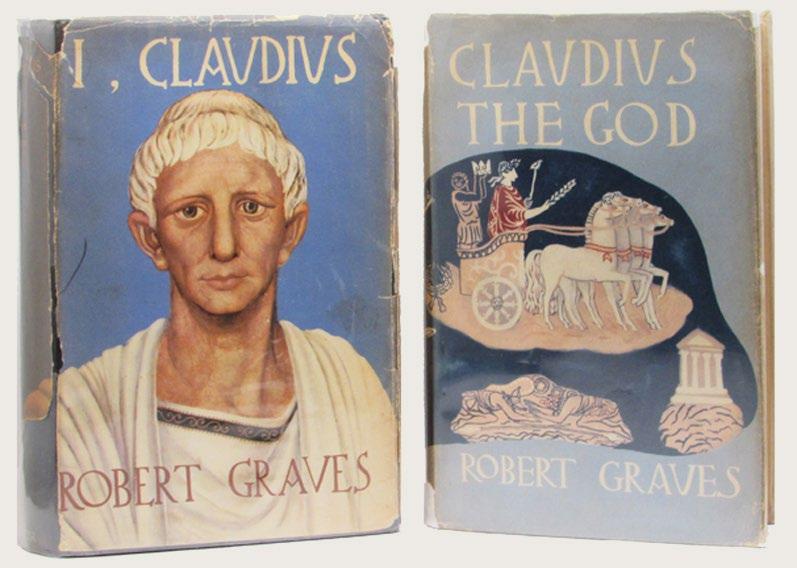
The Rare First Edition - First Issue in Original Cloth Hawthorne’s Twice-Told Tales - 1837 - One of His Earliest An Unusually Fresh and Well Preserved Copy
50 Hawthorne, Nathaniel. TWICE-TOLD TALES (Boston: American Stationers Co., 1837) The First Issue of the True First Edition, very scarce and significantly important. With American Stationers Co.’s circular quill imprint on the title-page. 8vo, publisher’s original textured brown/black cloth, with the spine lettered in gilt within a gilt frame. While there are known variations to the bindings no priority is given and all first edition copies are first printing, first issue. Now housed in a handsome light brown cloth-covered folding box with two dark brown morocco labels lettered and ruled in gilt. 4 ads, 334, 16 catalogue pp. An unusually handsome and well preserved copy, very scarce as such, the text with far less than the typical foxing that is always present due to the paper stock used, otherwise extremely clean and fresh, the hinges solid and firm, the binding dark and unfaded with bright gilt, very minor wear or rubbing at the tips and extremities, the front blank free-fly with a small amount of loss to the bottom outside corner, and a short closed tear without loss to the first leaf of the advertisement catalogue, early ownership notation of Eliz. L. Parkman.
FIRST EDITION, FIRST ISSUE, RARE, AND ONLY THE SECOND BOOK PUBLISHED BY HAWTHORNE AND THE FIRST ONE TO ACTUALLY BEAR HIS NAME. As Hawthorne was a young and relatively unknown writer at the time, the print run was understandably rather small, recorded as only 1000 copies printed. That fact, along with the
536-4433
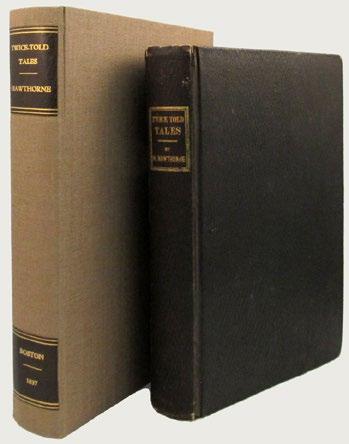
low production values continue to make TWICE-TOLD TALES one of the most scarce of all the author’s works.
Released in the spring of 1837, TWICE-TOLD TALES is a collection of short stories all of which had been previously printed only in various magazines and annuals, thus Hawthorne’s title of “Twice-Told”. The stories had been published anonymously, as was FANSHAWE, his first published book. Hawthorne enjoyed calling the stories ‘twice-told’ as this was also a reference to Shakespeare’s ‘King John’. A third aspect of the ‘twice-told’ scenario is the fact that many of them are ironic retellings of familiar older stories and tropes.
While reviews were largely positive (his college mate from Bowdoin, Henry W. Longfellow, reviewed it in the North American Review with extreme praise) sales were slow, and then were halted completely by the Panic of ‘37. The book may have been the first to make a name for the author, but it would not make him wealthy. There was no second edition until 1842, and at that time many more tales, and a second volume, were added. That edition was noticed far and wide, and many of the stories have lived on and are now considered American classics. Grolier 100, BAL 7581, ClarkA2.1. Sold.
James Bruce’s Travels to Discover the Source of the Nile With Alexander Murray’s Great Biographical Work on Bruce First Edition - Six Volumes Quarto - 1790 and 1808
Edinburgh - Fine Contemporary Calf Bindings Gilt
51 [Nile; Africa Exploration]; Bruce, James, of Kinnaird; Murray, Alexander. TRAVELS TO DISCOVER THE SOURCE OF THE NILE, IN THE YEARS 1768, 1770, 1771, 1772, AND 1773. . . [with,] ACCOUNT OF THE LIFE AND WRITINGS OF JAMES BRUCE of Kinnaird, Esq. F.R.S. Author of TRAVELS TO DISCOVER THE SOURCE OF THE NILE, In the Years 1768, 1769, 1770, 1771, 1772, & 1773. (Edinburgh: J. Ruthven for G.GJ. and J. Robinson et al and Printed by George Ramsay and Company, for Archibald Constable and Company, 1790; 1808) 6 volumes. The First Edition, Edinburgh imprint, sometimes called “the best edition” (Cox) with the First Edition of Murray’s fine and important work on Bruce. Engraved title vignettes in all volumes. Vol. I with illustrated header on the dedication to the King and with 53 very finely engraved plates, and maps and charts, including 3 very large folding maps. The Murray volume with an additional 22 engraved plates including a portrait frontispiece of Bruce, and two large folding maps at the end of the volume. A total of 75 plates and 5 large folding maps. 4to (300 x 240 mm.), with the half-titles in vols. !-!V, very handsomely bound in very handsome contemporary half polished calf over marbled paper covered boards. The spines, with raised bands are gilt ruled and decorated with gilt lettering on red morocco labels, original endleaves, end-leaves and with a fine antique engraved armorial plate. Early ownership inscription to title-page and a fine early armorial bookplate. [The Bruce] lxxxv, 535; viii, 718; viii, 759; viii, 695; xiv, 230, 3 large folding maps, index, errata pp. [The Murray] xiii, 504,4 ads. pp + 22 engraved plates and maps. A fine and desirable set in scarce contemporary bindings, the paper fresh and clean and the text-blocks as solid as could be, the bindings are very handsome withminor evidence of use or age at the extremities, a bit of tenderness to the hinges of a few volumes but these are still sturdy and strong, and the folding maps are in excellent condition.
HIGHLY IMPORTANT EARLY EXPLORATION INTO AFRICA AND A RARE EDITION IN FULL CONTEMPORARY CALF WITH ORIGINAL SPINE PANELS AND WITHOUT REPAIRS. A cornerstone to any collection of Africana, this is one of the earliest and greatest illustrated works on the seminal discoveries to be made on the continent over A hundred year period. This set with the added murray volume rarely encountered in matching binding as here.
Bruce was one of the earliest westerners to search for the source of the Nile. In November of 1770 he reached the source of the Blue Nile, and though he acknowledged that the White Nile was the larger stream, he claimed that the Blue Nile was the Nile of the ancients and that he was thus the discoverer of its source.
The account of his travels was written twelve years after his journey and without reference to his journals, which gave critics grounds for disbelief, but the substantial accuracy of the book has since been amply demonstrated.
James Bruce traveled to Egypt in 1768 accompanied by the Italian artist Luigi Balugani. They spent five years in Upper Egypt, Abyssinia, and in the exploration of the Nile. With the exception of the French surgeon Poncet, no European had visited Abyssinia in over 150 years, so Bruce’s account was of unique importance in providing valuable information on the region to Europeans. The plates, based on his own and Balugani’s drawings, include maps, botanical and zoological specimens, antiquities, artifacts and plans of monuments.
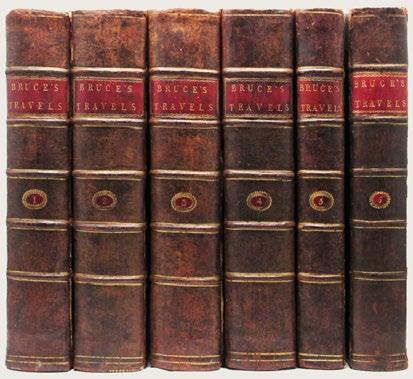
A cornerstone to any collection of Africana, this is one of the earliest and greatest illustrated works on the seminal discoveries to be made on the continent over a hundred year period. Blackmer 221; Gay 44; Hilmy I, p.91; Nissen ZBI 617 $7850.
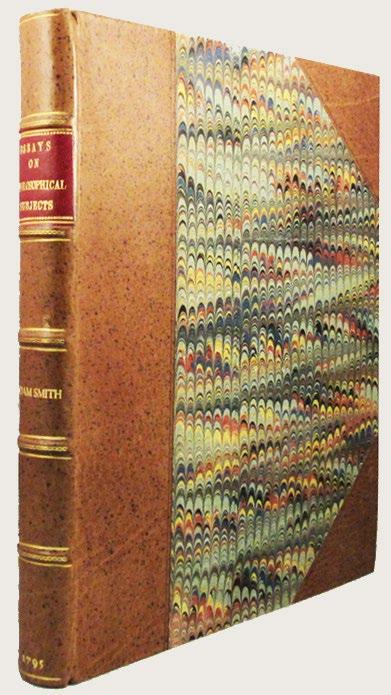
Adam Smith - Essays on Philosophical Subjects First Edition - Published London - 1795
With the First Biography of the Author by Dugald Stewart The Small Handful of Essays that Had Escaped the Flames
52 Smith, Adam. ESSAYS ON PHILOSOPHICAL SUBJECTS. To Which is Prefixed, An Account of the Life an Writings of the Author, by Dugald Stewart, F.R.S.E (London: For T. Cadell Jun. and W. Davies, and W. Creech in Edinburgh, 1795) First Edition. 4to, in a handsome and correct period style binding of three-quarter calf over marbled boards. The spine with raised bands gilt ruled and with chain device in gilt, red morocco label ruled, stippled and lettered in gilt, additional gilt lettering in two other compartments, edges dyed. xcv, 244 pp. xcv, [1, blank], 244 pp. A(4), a(4)-l(4), B(4)-Z(4), AA(4)II(2) A fine fresh copy, quite clean and crisp, the binding in excellent condition, small and unobtrusive blank embossed exlibris on the top corners of several signatures.
SCARCE FIRST EDITION of the posthumously published essays of Adam Smith. Though thought of today primarily as an economist due to the fame of his WEALTH OF NATIONS, these essays demonstrate the diverse range of philosophical sciences to which Smith applied himself. They were arranged and edited by his close friends James Black and William Hutton. Black and Hutton had attended to Smith in his old age and had made his literary executors. Shortly before his death, Smith had forced them to burn the vast majority of his unpublished papers, over sixteen volumes worth of manuscripts. These few which remained were intended, according to the editors, as “parts of a connected history of the liberal sciences and elegant arts”, but that Smith had “long since ... found it necessary to abandon that
plan as far too extensive”. The range over fields as diverse as philosophy, aesthetics, the history of science, astronomy, physics, metaphysics, music, and sensory perception. Most of them were originally written prior to 1759, long before his remarkable success with WEALTH OF NATIONS.
Stewart’s account of Smith’s life was the first biography written of him and remains an important source. It was originally delivered as a series of lectures at the Royal Society of Edinburgh. $7500.
Edmund Spenser’s The Faerie Queen Very Fine Copies of All Three Volumes - 1751 An Especially Handsome Set in Full Contemporary Calf
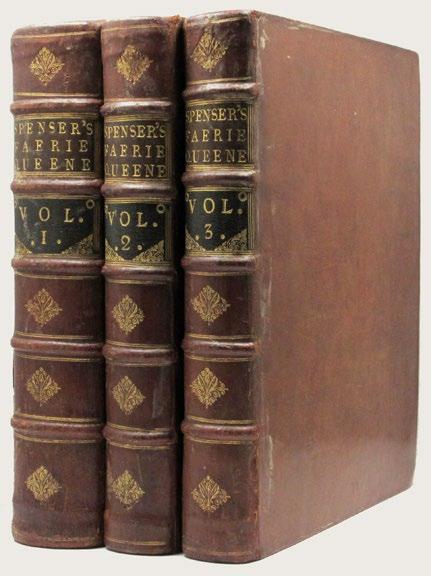
53 [Spenser, Edmund]. THE FAERIE QUEENE. With an exact Collation of the Two Original Editions, Published by Himself at London in Quarto; the Former containing the first Three Books printed in 1590, and the Latter the Six Books in 1596. To which are now added, A new Life of the Author [by Thomas Birch], and Also A Glossary. Adorn’d with thirty-two CopperPlates, from the Original Drawings of the late W. Kent, Esq; Architect and principal Painter to his Majesty. [With,] Two Cantos of Mutabilitie: Which, Both for Forme and Matter, appeare to be a parcell of some following Booke of the Faerie Queene, under The Legend of Constancie. First Printed in the Edition at London 1609, in fol. (London: for J. Brindley, in New Bond-Street and S. Wright, Clerk of his Majesty’s Works...., 1751) 3 volumes. Very Scarce First Printing of the Edition. A copy with pleasing provenance, coming from the library and with the bookplate of John Templer who was educated at Westminster School, and Trinity College, Cambridge, graduating in 1836. He was admitted to the Inner Temple in 1837. Templer became a close friend of James Brooke through his elder brother James Lethbridge Templer (1811–1845), of the East India Company Merchant Navy. Templer acted as Brooke’s legal counsel. In 1853 Templer was called to the bar, and from 1854 he was one of the Masters of the Court of Exchequer Illustrated with 32 very finely engraved full-page copper plates, and engraved head and tailpieces and initials throughout. Large, thick quartos, in very fine contemporary polished calf, the spines with raised bands gilt ruled, two compartments with fine contrasting maroon and black morocco lettering labels gilt, the remaining compartments with central gilt tooling, original endleaves. [2], lxiii, xxxvii, 453, [2]; [2], 450; [2], 440 pp An unusually fine, handsome, and beautifully bound set. The bindings are in excellent condition, and these are crisp, clean copies, especially so. Very rarely are such fine copies encountered in the marketplace. TRULY FINE COPIES OF THIS BEAUTIFUL PRINTING OF SPENSER’S FAIRIE QUEENE, ONE OF THE GREATEST WORKS IN THE ENGLISH LANGUAGE.
Edmund Spenser stands with William Shakespeare and John Milton in the history of English poetry and litereature. He is recognized as one of the premier craftsmen of modern English verse from its infancy, and one of the greatest poets in the language. Spenser was known to his contemporaries as “the prince of poets” and was said by them to be “as great in English as Virgil in Latin”. He was greatly preferred over Shakespeare by Queen Elizabeth and many others of the day. He left behind his masterful essays in every genre of poetry, from pastoral and elegy to epithalamion and epic. A century later John Milton would call Spenser “a better teacher than Aquinas” and was greatly influenced by him. Since then, generations of readers have admired his subtle use of language, his imagination, his immense classical and religious learning and “his unerring ability to synthesize and, ultimately, to delight”.
THE FAERIE QUEEN is Spenser’s best known work, and arguably his best. It is especially notable for its form: it was
the first work written in what is now called Spenserian stanza, and is also one of the longest poems in the English language. An allegorical work, written in praise of Queen Elizabeth I, it is largely symbolic, the poem follows several knights in an examination of several virtues. It found, not surprisingly, great political favour with Elizabeth I and was such a public success that it quickly became Spenser’s defining work. The last six books of the twelve Spenser intended were never written, though two cantos noted as the Seventh and Eighth Bookes appear here. Ashley V, 191 and 192; Bartlett 241; Grolier Langland to Wither 231 and 233; Hayward 22; Johnson Spenser 9 and 11; Pforzheimer 969 and 970; STC 23081 and 23082; Grolier One Hundred English Books 12. $4500.
Gulliver’s Travels - 1727 - The First Edition with the Verses Travels into Several Remote Nations of the World A Very Rare Copy in Full Contemporary Calf
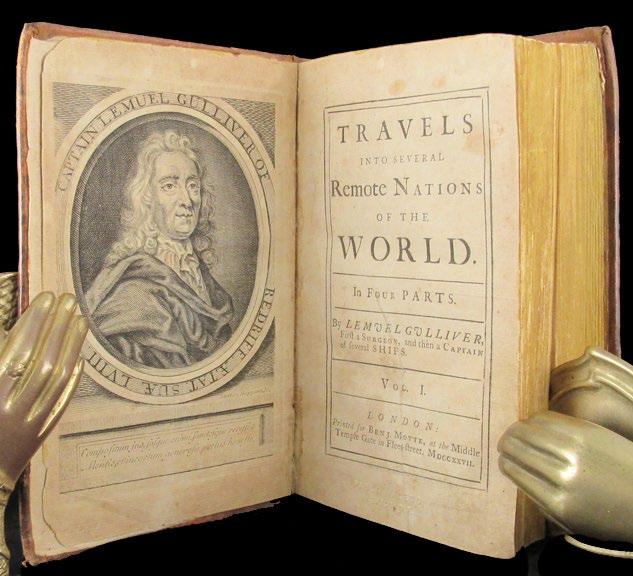
54 [Swift, Jonathan]. TRAVELS INTO SEVERAL REMOTE NATIONS OF THE WORLD, by Lemuel Gulliver, First a Surgeon, and then a Captain of several Ships. To which are prefix’d, Several Copies of Verses Explanatory and Commendatory; never before printed (London: For Benj. Motte, 1727) 2 volumes bound as one. Second edition, published within a few months of the first editions and set from the type of the first issue of the first edition (the A edition). This is the first edition to include the “Verses,” which had been separately printed in March of 1727. They were compressed into twenty pages and inserted here by the publisher after the title to Volume I and before the text. This is also one of the earliest issues of the second edition, with the portrait state as found in the first editions and in only some copies of the second, the general title, also early, does not mention Second Edition, and the advertisement leaf is present preliminary to Vol. II. Portrait frontispiece, and 6 additional plates including the 5 maps called for in the earliest issue, engraved head and tailpieces throughout. 8vo, in rarely encountered full contemporary mottled calf, the spine with a maroon morocco lettering label gilt. i-ii, [xx], iii-xii, 148, [x],164; [1] ads, [vi],155, [viii],199. A very handsome and pleasing copy, quite clean internally with no staining or spotting and just light mellowing. A bit of normative evidence of age, withal a very attractive and especially well preserved copy of this scarce book. RARE. Copies in contemporary bindings are regrettably uncommon, and this copy remains a fine example of the book in its original aspect. This edition included the five Verses (1. To Quinbus Flestrim. 2. The Lamentation. 3. To Mr. Lemuel Gulliver. 4. Mary Gulliver To Capt. Lemuel Gulliver. 5. The Words of the King of Brobdingnag.) which did not appear in the first editions.
“Gulliver’s Travels” is a biting political satire ingeniously styled after the many narratives of travel and exploration popular at the time, which Swift had read in the library of his employer, Sir William Temple. And though most satire, especially political satire, is quickly rendered unintelligible or uninteresting with the passage of time, Swift endowed his story with so much imagination that it has never passed out of the canon of classics in English literature.
This, the most famous of Swift’s works, was published anonymously as the author was afraid of the reception the book might meet with. His satire was directed at the prevailing powers of the day, and it has become known as one of the greatest literary works ever penned. Teerink 293, PMM 185 (First Printing). $6500.
A Magnificent Italian Classic - Antonio Groppo’s Printing Torquato Tasso - Il Goffredo...Gerusalemme Liberata Exquisitely Illustrated With Over 100 Very Fine Engravings
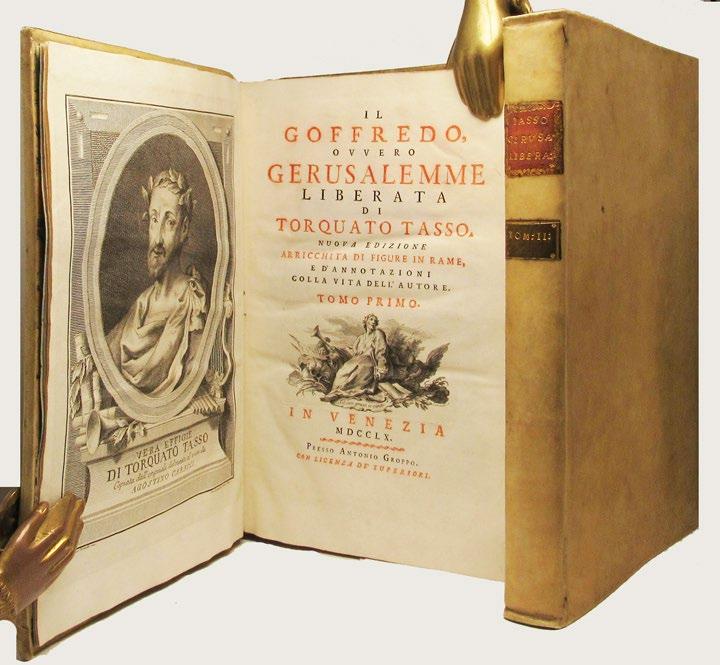
55 Tasso, Torquato. IL GOFFREDO, OVVERO GERUSALEMME LIBERATA DI TORQUATO TASSO. Nuova Edizione Arricchita Di Figure in Rame, Ed’annotazioni Colla Vita Dell’Autore. (Venezia: Antonio Groppo, 176061) 2 volumes. First Groppo Edition. Superbly illustrated with very fine engravings throughout including a very finely engraved fullpage frontispiece by Novelli, a beautifully engraved title page in red and black, with finely engraved vignettes and head and tail pieces throughout, a very fine full page engraving of the author by Agostino Caracci, and with 20 very beautifully executed full page engravings by J. Leonardus from the designs of Bernardo Castello from 1617. The “Argomentos” all with elaborate engraved and intricate borders, the first large multi-line initial of each canto finely historiated with engraved figures, and additionally, 94 fine and large engravings are included within the text after designs by Novelli and executed for the edition by Leonardus. 4to, in fine full antique vellum over stiff boards with yap edges and marbled endpapers, the spines with a brick-red morocco title labels gilt lettered and decorated and a smaller brown morocco volume labels also gilt decorated and lettered. An Oates Family copy with engraved armorial plates of William Edward, Edward and Robert Washington Oates, founders of the Oates Museum and the Oates Collection at University of Southampton. (2), XXX, 364; XII, 360. A wonderful set in exemplary condition, extremely fresh and clean, the paper unpressed and the impression is bold, dark and fine.
A RARE, IMPORTANT AND VERY BEAUTIFUL EDITION OF THIS CLASSIC OF ITALIAN LITERATURE. The edition has long been considered one of the richest and most magnificent of the many editions of Tasso printed over the centuries.
Poet, prose writer and literary theorist, Tasso was successor to and deviator from the tradition of Boiardo and Ariosto, he gave to the court of Ferrara the third of the great ottava rima epic romances celebrating the Este ancestry, Gerusalemme Liberata, and the purest example of Renaissance pastoral drama, Aminta. Even before its end, his life became a legend of poetic madness and wandering. Born in Sorrento, he shared the political exile of his father, Bernardo, and began his literary studies and his long experience of Italian courts in Urbino. He attended the universities of Padua and of Bologna, at 18 published Rinaldo, a chivalric poem in 12 cantos, and in 1565 took service with Cardinal Luigi d’Este.
Although he completed the Liberata in 1575, Tasso was never to be satisfied with it in relation to neo-Aristotelian canons of epic poetry or to Counter-Reformation religious orthodoxy, and restlessly he consulted scholars on one score and ecclesiastical inquisitors on the other. In 1577 he was imprisoned for a paranoid display of violence in the presence of Lucrezia d’Este. He escaped to the south but, following another outburst on his return to Ferrara in 1579, was shut up in the hospital of S. Anna, to remain there until 1586. The Liberata was finally published in 1581, but Tasso continued to regard the poem as unfinished while it circulated in several editions from that year on. Released from S. Anna, he went to Mantua under the protection of Duke Vincenzo Gonzaga, and thence into a ceaseless vagabondage that took him to Genoa,
Rome, Naples and Florence. He received hospitality from religious orders and academies, from the Medici, from the marquis Giambattista Manso, and from Pope Clement VIII and his nephew, to whom Tasso dedicated the only authorized version of his epic, much reworked and retitled. Raccolta Tassiana, 270: “Questa edizione merita di essere annoverata tra le più belle ed ornate che si abbiano della Gerusalemme”. Morazzioni, p. 228. Gamba, 948, p. 285. Serassi II, 406. $6950.
First Edition of Stevenson’s Classic Psychological Thriller Dr. Jekyll and Mr. Hyde - London - 1886 - A Pleasing Copy
56 Stevenson, Robert Louis. THE STRANGE CASE OF DR. JEKYLL AND MR. HYDE (London: Longman, Green and Co, 1886) First Edition. 8vo, original marmalade colored cloth lettered in black on the upper cover with publisher’ insignia at the top left corner, the spine lettered in black, housed in a handsome foldover chemise and morocco backed slipcase. [8], 141, [1] ads. pp. A pleasing copy, very well preserved, the hinges in good order, tight and strong, much better than usually found, with light evidence of age or shelving only, the tips and corners in good order.
FIRST EDITION. Dr. Jekyll and Mr. Hyde is one of Stevenson’s most sought after titles, and it is rarely found in a condition which requires no apologies. This copy, however, is unusually nice condition with only minor evidence of age or use.
The names of Dr. Jekyll and Mr. Hyde, the two alter egos of the main character, have become shorthand for the exhibition of wildly contradictory behaviour, especially between private and public selves. In The Strange Case of Dr. Jekyll and Mr. Hyde, Stevenson suggested that the human propensities for good and evil are not necessarily present in equal measure. Hyde is quite a bit smaller than Jekyll, perhaps indicating that evil is only a small portion of Jekyll’s total personality but one that may express itself in forceful, violent ways. The story has long been interpreted as a representation of the Victorians’ bifurcated self. Jekyll is in every way a gentleman, but just beneath the surface lie baser desires that remain unspoken; he is the very personification of the dichotomy between outward gentility and inward lust. Stevenson’s tale took on new resonance two years after publication with the grisly murders perpetrated by Jack the Ripper in 1888, when the psychological phenomenon that Stevenson explored was invoked to explain a new and specifically urban form of sexual savagery. Britannica $6950.
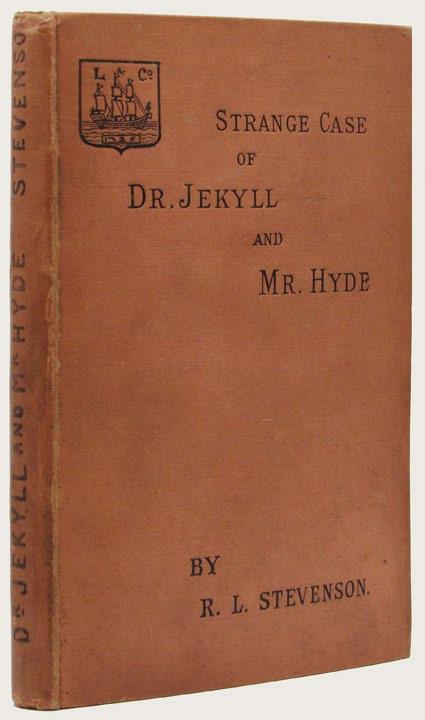
Please continue to the next page.
A Very Handsome Copy of the First Edition - First Issue
An Essay Concerning Humane Understanding - PMM 164
John Locke’s Great Work Published in 1690
The Most Complete Expression of the New Empiricist Spirit
57 Locke, John. AN ESSAY CONCERNING HUMANE UNDERSTANDING. In Four Books (London: by Eliz. Holt for Thomas Basset, 1690) First edition, first issue, with the Undated Dedication, with the title-page listing Eliz. Holt, the Properly Positioned “SS”, the first imprint and all points called for, typographical ornaments line 3 has them upside down in columns 2 through 6, while in line 4, all ornaments are upside down, with five of the six possible misnumbered pages for this issue: “85” as “83”, “287” as “269”, “296” as “294”, “303” as “230” and “319” as “327”, page 55 with “Underwandings” as called for, with the incorrect Roman numerals to pp. 57 and 263 and the deleted 24 paragraph indicator at page 90. With contemporaneous signature “J Locke” on the title page and three handwritten corrections, “in”, “extremely” and the insert “some” (which may be in Locke’s hand), in the preliminaries. Folio, 320 x 195 mm., full polished calf to style, handsomely and discreetly double lined in gilt on the covers and the spine with raised bands ruled in gilt with red morocco lettering label gilt in best style on the spine. In beautiful condition. title + [10] + 1-362 + [22] Contents pp. A handsome and pleasing and crisp copy in lovely condition, some quite unobtrusive evidence of age mellowing or toning to the lower edges of the leaves probably from old damp.
FIRST EDITION FIRST ISSUE OF THIS SINGULARLY IMPORTANT WORK IN THE HISTORY OF PHILOSOPHY AND EPISTEMOLOGY. Locke’s ESSAY was the “first attempt on a great scale, and in the Baconian spirit, to estimate critically the certainty and the adequacy of human knowledge, when confronted with God and the universe” (EB). It served as the most concrete manifestation of a new empiricist spirit, in contrast to the metaphysical philosophies of Descartes, Spinoza and Leibniz. Locke was inspired to write the ESSAY in 1671 after a philosophical discussion with friends in which he realized that no progress could be made before they had examined the mind’s capacities and seen “what objects our understandings were, or were not, fitted to deal with” (from the “Epistle to the Reader”).
“Other philosophers had reflected on and written about human knowledge...But Locke was the first philosopher to devote his main work to an inquiry into human understanding, its scope and its limits. And we can say that the prominent place occupied in modern philosophy by the theory of knowledge is in large measure due to him...” (Copleston, A HISTORY OF PHILOSOPHY).
Locke’s influence was widespread and was not strictly limited to pure philosophical enquiry. In America his emphasis on rational thought versus “enthusiasm” provided ammunition and philosophical grounding to opponents of the revivalist and itinerant preachers of the Great Awakening, and in the nineteenth century the “nature versus nurture” thesis was employed by Unitarians and other anti-Calvinist factions to argue that human nature was improvable through nurture and self-culture rather than corrupt beyond hope without conversion through a special act of divine grace. In England Locke had a strong influence on the literature of the Augustan Age, Sterne, Addison, and the members of the Scriblerus Club all acknowledging the currency of his ideas. “The art of education, political thought, theology and philosophy, especially in Britain, France, and America, long bore the stamp of the ESSAY, or of reaction against it” (Fraser, quoted in Grolier). Locke’s ESSAY has passed through more editions than any classic in modern philosophical literature and remains a cornerstone in the history of human thought. Wing L273; Pforzheimer 599; PMM 164; Grolier English 36. See Jean S. Yolton, John Locke, A Descriptive Bibliography, Thoemmes Press, 1998, pp. 70 for details on these variations.] $65,000.
“Theuerdank” - The Great Chivalric Epic - Maximilian I
One of the Most Spectacular German Illustrated Books
A Gem of the Early Renaissance - Pfintzing’s Masterpiece
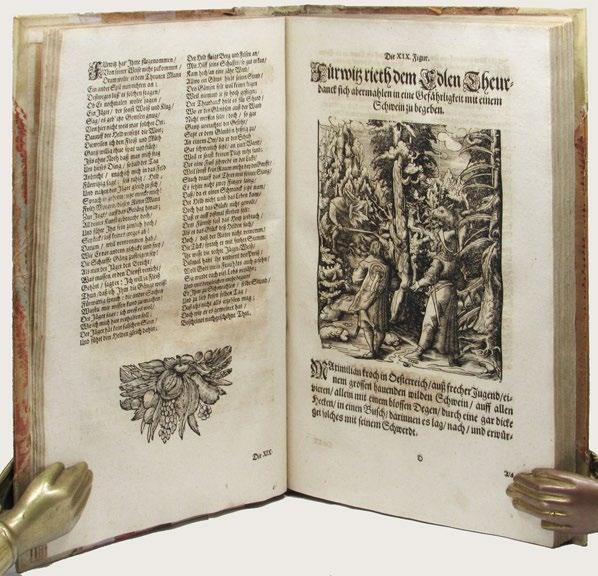
58 Pfintzing, Melchior. [THEUER-DANCK] Der AllerDurchleuchtigste Ritter, Oder die Rittermassige, Hoch-Theure, HochstGefahrliche und Glorwurdigste Groβ-Thaten, Abentheuer, GlucksWechselungen und Siges-Zeichen deβ Aller-Groβmachtigsten, Unuberwindlichsten, Dapfersten... Heldens Mazimiliani I Wie Solche... Unter em Nahmen Theur-Danck, Zu Offentlichem Druck Befordert (Ulm: Matthaus Wagner fur Matthaus Schultes, 1679) With an engraved frontispiece and 117 numbered woodcuts by Hans Burgkmair, Leopold Schaufelein, Leonhard Beck and others reprinted from the sixteenth century plates, engraved initials and tail-pieces throughout. Folio, in antique half vellum over marbled boards, with institutional gold wax seal on upper board, spine lettered in manuscript. 125 ff; 58 pp. Very handsomely preserved and a very pleasing copy with a bit of age evidence to the binding and some mellowing to the prelims.
A FINE EARLY ISSUE OF ONE OF THE MOST SPECTACULAR GERMAN ILLUSTRATED BOOKS OF THE SIXTEENTH CENTURY. The poem is an allegorical chivalric romance celebrating the exploits of the hero (Emperor Maximilian I) in overcoming a series of obstacles in his journey to seek the hand in marriage of Queen Ernreich (Mary of Burgundy) in 1478. Parts of the text were composed by Maximilian himself, who had made the first drafts in 1505-8; his private secretary Melchior Pfintzing oversaw completion of the poem and edited the work. Other contributors were Maximilian’s Silberkammerer Sigismund von Dietrichstein and his Geheimsekretar Marx Treitzsauerwein; Johann Stabius and the humanist Conrad Peutinger worked with the printers and artists. A contract survives dated 17 December 1508, in which Maximilian awarded the Augsburg printer Schonsperger, a specialist in the production of German illustrated books, the post of Imperial printer for life, at an annual salary of 10 florins.
This printing contains additional preliminary material by Matthaus Schultes and a 58 page work on Maximilian I. $9500.
The Greatest Work of the Father of English History
The Venerable Bede - The Rare First Edition in English
The History of the Church of England - “Historia Ecclesiastica”
59 Bede, The Venerable (673–735 AD). THE HISTORY OF THE CHURCH OF ENGLANDE COMPILED BY VENERABLE BEDE, Englishman. Translated Out of the Latin to English by Thomas Stapleton Student in Diuninite. (Antwerp: John Laet, 1565) Five books in one volume. A VERY RARE COMPLETE COPY, the First Edition of Historia ecclesiastica gentis Anglorum translated into English. Provenance: Montanus, 1602 -- Sir Roger Twysden, 1648, and Sir John Saunders Sebright (armorial bookplate). With woodcut device on titlepage, woodcut armorial dedication to Queen Elizabeth, woodcut plate of St. Augustin with Elbert King of Kent in anno 596, woodcut plate of King Oswald uniting the Umbrian kingdoms, halfpage woodcut of Elbert
building St. Paul’s, and with many large and handsome woodcut initials all throughout. The woodcuts are possibly by Arnaud Nicolai. Small 4to (188 x 140 mm), in antique three-quarter russia over marbled boards, the spine with raised bands ruled in gilt, one compartment gilt lettered, gilt dating at the tail, gilt lined back and cornerpieces. *1-6, >1-4, #1-4, 192, [9] pp. A truly excellent survival of a book rarely found complete. The textblock is especially fresh and well preserved, crisp and very clean. The blanks date from the time of the binding, but the text is otherwise wholly complete and original, the binding is handsome though its age is evident and there was restoration some time ago to the hinges, the front of which is also strengthened from within.
VERY RARE FIRST EDITION IN ENGLISH OF THE FIRST AND GREATEST WORK OF ENGLISH HISTORY BY THE FATHER OF ENGLISH HISTORY. RARE IN COMPLETE STATE, when one reads the catalogue entries of copies in even some of the worlds most prestigious institutions one finds descriptions of missing signatures, facsimile titles, or entire sections excised to be quite the norm. This copy, but for its probable early 19th century blank flies and endpapers is wholly intact and in a truly exceptional state of preservation.
The Venerable Bede’s title of “The Father of English History” is well deserved. He was England’s greatest historian in the Middle Ages. His greatest work is the Historia Ecclesiastica, here in its first English edition. It is an ecclesiastical history of the English people. Bede begins with Caesar’s invasion in 55 BCE and St. Alban’s martyrdom in Roman Britain, tracks the spread of Christianity following St. Augustine’s mission to England in 597, and provides an account of critical events such as the Council of Whitby, which decided that Roman rather than Celtic Christian customs would be followed in Britain.
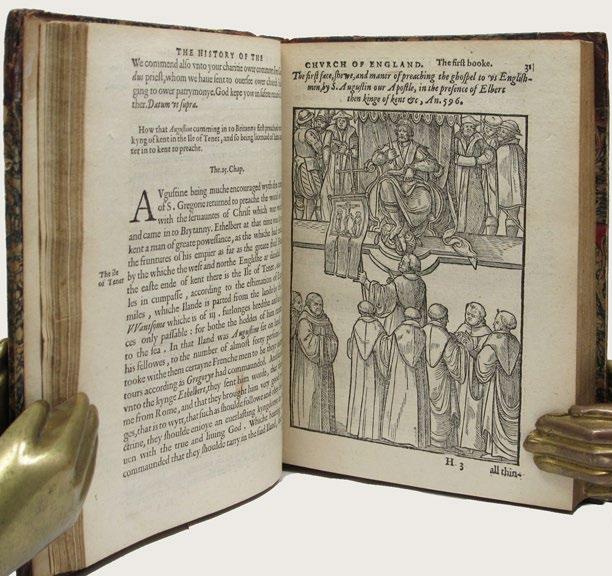
Bede drew on the many manuscripts in the Jarrow monastery’s outstanding library and correspondents provided him materials. He was a diligent scholar and properly credited his sources. To the benefit of historical scholarship, Historia Ecclesiastica spread widely throughout Europe in the Middle Ages, with some 160 manuscripts still surviving. Not long after his death, he became known as the Venerable Bede. His was one of the first printed history books, published (in Latin) in Strasbourg about 1475. Highly popular on the Continent and in Britain, it was reprinted in 1500, 1506, and 1514.
Due to its strong association with Catholicism this first translation into the English tongue was published in Antwerp, as the book was then prohibited in England as traitorous. Stapleton was educated in Oxford, where he became a fellow in 1553. On Queen Elizabeth’s accession, he left England to study theology in Louvain and Paris. His translation of Bede was his first of many fine works. Stapleton used Bede’s history to remind the reader that “we Englishmen also these many hundred of years kept and preserved sound and whole the precious perle of right faith and belefe,” and he admonished that “after we forsooke the first paterne off the Christen faith delievered to us, we have fallen in to plenty of heresies.” He added that the Venerable Bede, a most reliable source, describes many miracles that occurred in Britain under the true faith. Stapleton’s translation has been called an “enduring contribution to this sparkling collection of [recusant] prose” -DNB)
This is also a copy of fine and established provenience. It was formerly owned by the renown historian and antiquary Roger Twysden, whose ownership signature is dated 1648. Having been caught up in civil war strife, Twysden retired to his seat, Roydon Hall, and devoted himself to his study and writings, particularly on early English histories and monasticism.
His collection passed to Sir John Sebright, who sold the main portion at auction in 1807. Much of Twysden’s collection later passed to Sir John Sebright, whose fine engraved armorial plate is afixed to the front paste-down. The present binding was likely made while the book was in Sebright’s possession.
Contrary to the implications of Stapleton’s edition of Bede, Twysden’s Historical vindication of the Church of England (1657) argued that it was the Church of England, rather than Rome, which had held fast to the true faith, and that the pope’s powers over England, gained gradually over the centuries, had been submitted to voluntarily out of love not duty, for the archbishop of Canterbury had no mediate superior but only Christ and God (see Jessup, Sir Roger Twysden pp. 1925). Completed in 731, Bede’s Historia ecclesiastica gentis Anglorum, is ‘probably one of the most popular history books in any language and has certainly retained it popularity longer than any rival. The enthusiasm shown for his writings in the eighth century by English missionaries on the Continent, such as Boniface, Lul, and others, led to the spread of knowledge of his works not only in England but also in western Europe . . . . From then on, as the spread of his manuscripts shows, the History became popular all over western Europe and 160 of them survive today in spite of all the wars and other dangers to which manuscripts are always subject’ (Colgrave & Mynors p. xvii). It was first printed c. 1475, at Strasbourg (PMM 16). ‘Bede provided for over a thousand years, and to a large extent still provides, nearly all the knowledge available of the early history of England. His Historia is the only work, other than parts of the Bible, which has been read by every English generation from his own day to the present. It has the power to move and to convey something of the personality of its author, to a degree which has called forth not only admiration but a kind of affection’ (Oxford DNB). BM; STC 1778; Allison & Rogers 82; Pforzheimer 55; Chrzanowski 1565b. $36,500.
First Edition - James Joyce - Finnegans Wake One of 425 Copies Only - Signed by Joyce
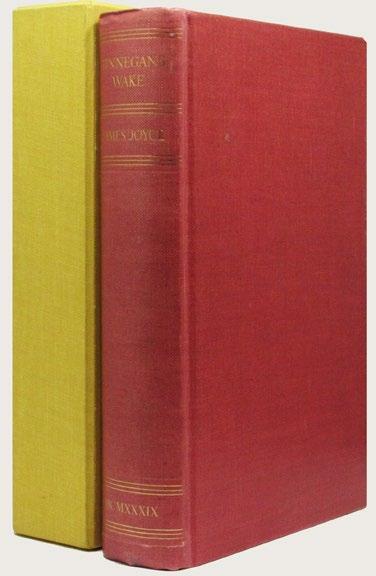
60 Joyce, James. FINNEGANS WAKE (London: Faber and Faber, 1939) First Edition, First Issue, Signed by James Joyce and limited to 425 copies only, of which this is number 341. 8vo, publisher’s original red buckram lettered in gilt on spine, t.e.g., other edges untrimmed. Yellow cloth slipcase expertly re-created as the original. 628. A fine copy, very handsome, bright and clean, very well preserved and without wear. The slipcase in beautiful condition.
IMPORTANT FIRST EDITION SIGNED BY JAMES JOYCE. A very desirable copy of this, the best and scarcest issue of the first editions.
No book has ever been more ambitiously conceived than Joyce’s FINNEGAN’S WAKE. If ULYSSES represents the pinnacle of the Modernist movement, FINNEGAN’S WAKE is a step beyond; it stands in the same relation to ULYSSES as ULYSSES does to A PORTRAIT OF THE ARTIST....—an extension which is also a completely new conception. Joyce envisioned the book as nothing less than a “history of the world.” Seventeen years in the writing, and composed in a sort of meta-language--”an Esperanto for the art of fiction”--it stands as a unique monument to language and literature and the modern age. Slocum and Calhoun A49; Bradbury, The Modern World, 157-176. About this work, he stated “‘I might easily have written this story in the traditional manner. Every novelist knows the recipe...But I, after all, am trying to tell the story of this Chapelizod family in a new way. Time and the river and the mountain are the real heroes of my book... I am trying to build many planes of narrative with a single aesthetic purpose.’” (Ellmann) Slocum and Calhoun A49; Bradbury, The Modern World, 157-176. $18,500.
John Milton - The Poetical Works With Superb Provenance - In Presentation Full Red Morocco
The First to Include the Famed Illustrations of Richard Westall The Magnificent Boydell Folio Edition 1794-1797
61 Milton, John. THE POETICAL WORKS OF JOHN MILTON. With A Life of the Author, by William Hayley (London: By W. Bulmer and Co., Shakespeare Printing Office for John and Josiah Boydell, and George Nicol, 1794-1797) 3 volumes. First edition of this Boydell issue, the first edition with the plates by Richard Westall, and a magnificent presentation copy, given by Lord Lansdowne, the first Marquis of Landsdowne to the French diplomat, M. Chauvet, who for many years resided at Kensington in London. An especially large copy. With 32 fine large plates, being the 28 plates by Richard Westall and 4 portraits of John Milton. Folio (41 x 30 cm), very finely bound in exceptional full contemporary bindings of crushed red morocco, French in style with fine gilt rolled borders within gilt ruled frames on all covers, each frame with corners formed with central gilt circular devices, the spines with flat gilt ruled bands creating compartments decorated with small gilt central star burst tools, one compartment lettered in gilt, a second with gilt volume numbers and additional gilt lettering at the bottom of the spines, gilt tooled edges to the covers and gilt turn-ins, marbled endpapers, a.e.g. cxxxiii, 213; 286; 300, [4] pp. A most beautiful and exceptional set.
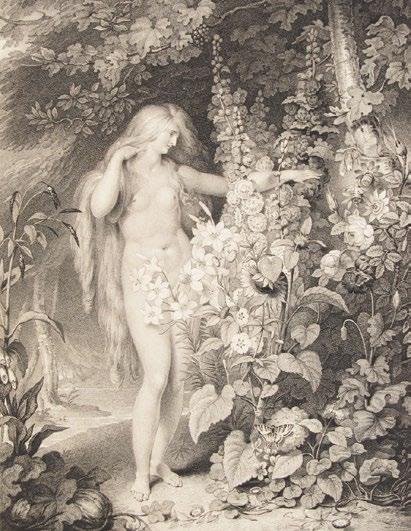
A REGAL SET OF THE FIRST EDITION OF THE GREAT ENGLISH POET AND WRITER TO INCLUDE THE FAMOUS ENGRAVINGS FROM RICHARD WESTALL. The Boydells would use Westall to illustrate their two greatest printing efforts, the two greatest masters of the English language, John Milton and William Shakespeare. Though Westall’s illustrations would be used again in a number of later editions and printings, this is by far the largest, finest and most impressive of any of the presentations. The Boydell text is equally fitting to these magnificent plates, impressively laid out and making use of the fonts of William Martin.
In the years that would follow, Westall would become quite famous, for these illustrations to Milton and for his portrait of Princess Victoria. He would serve as Princess Victoria’s drawing master until the time of his death in 1836.
The very fine bindings are quite fitting and elegant. The volumes are beautifully fitting to the presentation inscribed in this copy and were a gift from Lord Lansdowne, William Petty, the first Marquis of Landsdowne and Prime Minister from 1782-1783, to his close friend M. Chauvet, the French diplomat who resided for many years at Kensington. The inscription is dated 1802 and correlates with Chauvet’s being recalled to France due to the growing hostilities between France and England after the Treaty of Amiens.
In PARADISE LOST, PARADISE REGAINED and SAMSON AGONISTES Milton revived the heroic verse of Homer and Virgil to frame the tale of Satan and Paradise that has become the best-known epic poem written in English. He had difficulty in finding a publisher because of the plague of 1665, which killed many pressmen, and the Great Fire of the following year, which destroyed many printing houses—and those publishers who were still operating were wary of the project because of Milton’s anti-Restoration sympathies.
Simmons, to whom he finally came, drove a hard bargain, and according to the agreement reached and the number of copies sold, Milton was paid a total of £15. Milton’s work survives and is revered to this day as amongst the most significant
poetry and prose ever penned and additionally important, at a defining moment in the development of the English language. A truly towering figure, Milton remains one of the most celebrated and analyzed poets in English literature. Dryden described ‘Paradise Lost’ as ‘one of the greatest, most noble and sublime poems which either this age or nation has produced,’ while Blake, keying in on the poem’s heretical implications, described Milton as ‘a true Poet, and of the Devil’s party without knowing it.’
This thorough collection includes not only ‘Paradise Lost’ and the other major works, including ‘Paradise Regained, Samson Agonistes, and Comus’, but the sonnets, psalms, translations, and his work in Latin. As well, there is a fine Memoir of Milton and history of his literary work.
PARADISE LOST has remained one of the greatest classics of modern English vernacular, indeed some say, that it constitutes the beginning of modern English poetry and literature. $18,500.
Hemingway’s First Published Novel
The Torrents of Spring - First Edition, First Issue, First State An Especially Rare Advance Copy with Original Photograph And With the Publisher’s Typed Statement Affixed - 1926
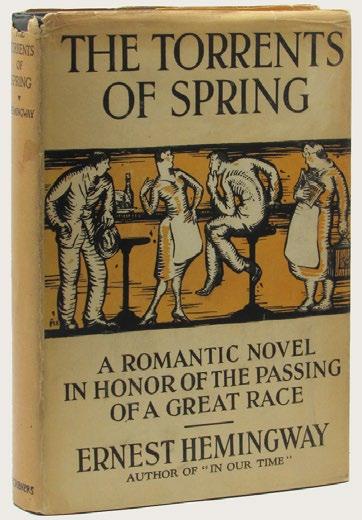
62 Hemingway, Ernest. THE TORRENTS OF SPRING: A Romantic Novel in Honor of the Passing of a Great Race (New York: Charles Scribner’s Sons, 1926) First edition, First Issue with nine titles listed on the rear panel of the dustjacket. A superb advance copy of the first printing, with an original photograph of Hemingway tipped in and the printed publisher’s biographical statement affixed, announcing that “ “The Sun Also Rises” will be published by Charles Scribner’s Sons in the Fall”. 8vo, original black cloth lettered in red on the spine and upper cover, and in the original dustjacket. [8], 143 pp. A very fine, especially well preserved copy of Hemingway’s first novel, clean and solid, hinges firm, the jacket with a bit of mellowing caused by time and with a small chip to the tip of the jacket’s spine panel.
FIRST EDITION, FIRST ISSUE, VERY RARE ADVANCE COPY WITH ORIGINAL PHOTOGRAPH AND PUBLISHER’S TYPED STATEMENT AFFIXED ANNOUNCING THE FORTHCOMING PUBLICATION OF “THE SUN ALSO RISES” AND WITH FORD MADDOX FORD’S LAUDATORY COMMENT ON HEMINGWAY. THIS IS THE AUTHOR’S FIRST LONG WORK TO BE PUBLISHED. Although it was written after THE SUN ALSO RISES --”to cool out,” Hemingway explained-- THE TORRENTS OF SPRING was published prior to his more famous novel. It was written as a parody of Sherwood Anderson’s Dark Laughter. “It seems to have started as a knockabout parody of Sherwood Anderson’s mechanized folkware” (quoted in THE HEMINGWAY READER). Written in ten days, it is a satirical treatment of pretentious writers. Hemingway received a mixed reaction to the novella that was sharply critical of other authors. His wife Hadley believed the characterization of Anderson was “nasty”, while F. Scott Fitzgerald considered the novella to be a masterpiece. Hanneman A4a. $18,500.
The First Edition - Very Rare in Original Cloth Great Expectations - A Charles Dickens Three-Decker Perhaps the Greatest of All Dickens’ Books Published in London - 1861
63 Dickens, Charles. GREAT EXPECTATIONS (London: Chapman and Hall, 1861) 3 volumes. First Edition, fifth impression of the title-pages, but, the text-blocks with virtually all first issue points of the First Edition, first impression, first state. Vol. III with “i” p. 193, “3” present as last digit in p. 103 in the text per Smith and Clarendon bibliographies and etc. With the August 1861 catalogue. 8vo, publisher’s original purple cloth lettered and decorated in gilt on the spines and in blind on the upper and lower covers. [iv], 344; [ii], 350; [ii], 344 pp. An unusually handsome, clean and fresh copy without repairs or sophistication. Light mellowing to the cloth from age, slight rubbing at the tips, hinges strong and quite tight with only slight evidence of age wear. The text block remains clean and in excellent condition. Very rare in this condition and state of preservation.
HIGHLY IMPORTANT AND VERY RARE FIRST EDITION IN THE ORIGINAL CLOTH. “The rarity of the first issue of GREAT EXPECTATIONS has been attributed to the...fact that ‘the first edition was almost entirely taken up by libraries.” Patten, pp. 290-292, states that 1000 copies of the first issue and 750 of the second were printed and that probably most of the first and more than half of the second (1400 copies in all) were purchased by Mudies Select Library” (Smith, DICKENS IN THE ORIGINAL CLOTH).
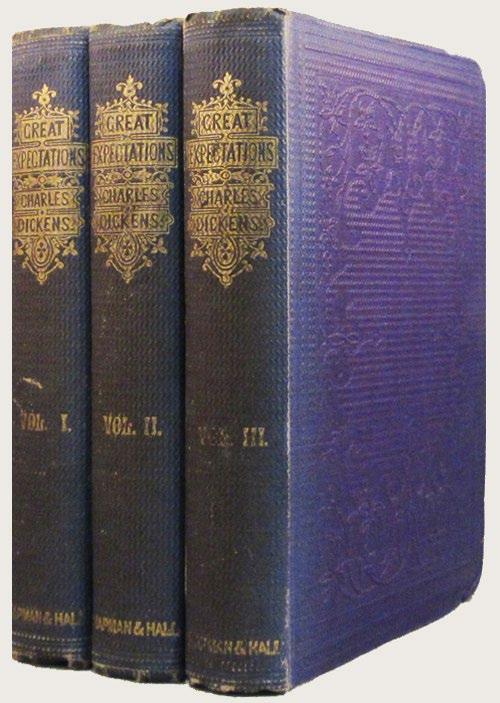
Even in 1932 Eckel lamented that “to obtain fine clean copies of this book has been the unsuccessful quest of many book collectors.” Struggle between the various bibliographical arguments continues to this day with many holding to the points and positions formulated by Smith (see CHARLES DICKENS IN THE ORIGINAL CLOTH) while some argument is occasionally made that copies of the book must correspond to the specifications put forth in the Clarendon bibliography. But as the sampling of copies used in that bibliography was statistically too small to gain absolute information by which a definitive argument could logically be made for the entire first edition run, it remains the case that such data can be used logically to build an argument towards acceptance of the existence of one micro pattern only within the run and not therefore a finding which determines finally and clearly for the whole.
Most experts today, continue to hold that Victorian printings and editions yielded to many factors during the binding process, not the least of which were economy and imprecision. It is likely that a Victorian publisher would most surely have used existing sheets when sewing together the gatherings before binding. Indeed, the specifications which are contained in the Oxford article seem to show that the textual points noted are of a very minor state and involve a change of or damage to a letter here or a word there, and as the editor Margaret Caldwell herself notes, “the clear conclusion is that there is no warrant for treating the five impressions as distinct editions: no authorial revision distinguishes one from another; blatant errors of substance remain uncorrected; a few errors and accidentals are corrected but many more remain.” It is also noted that one copy at the Bodlean at Oxford University is mixed state within the text while having first edition, first issue title pages. $18,500.
The Last of the Mohicans - An American Classic
James Fenimore Cooper - First Edition - 1826
An Excellent Set in Contemporary Bindings with Provenance The Most Famous of the Leatherstocking Tales
The Original Owner with a Thomas Jefferson Connection
64 [Cooper, James Fenimore]. THE LAST OF THE MOHICANS: A Narrative of 1757. By The Author Of “The Pioneers” (Philadelphia: H.C. Carey and I. Lea - Chestnut Street, 1826) 2 volumes. First Edition, First Issue with BAL’s state A of the Copyright page in Vol. II and with other points called for. A COPY WITH FINE PROVENANCE AND PRESENTATION INSCRIPTIONS DATED JUNE 1826. With all the blanks called for including the conjugate for the title-page in Vol. II, the first issue points called for are present, Vol. I has the final “I” at “viii” and page 89 is incorrectly numbered 8vo, bound in the printer’s original bindings of calf over blue paper covered boards. xi, [1], 282; [iv], 289 pp. A truly honest copy bound in calf and boards at the time of publication, with wear to the boards and calf backs, boards to Vol.II detached, the usual mellowing to the text-blocks, title-page to Vol.II with a closed tear, a pleasing copy of this monumental American novel, unsophisticated and very rare thus.
A RARE TRUE FIRST EDITION, FIRST ISSUE OF THIS GREAT CLASSIC, A TRUE CORNERSTONE OF AMERICAN LITERATURE, AND ONE OF THE MOST ELUSIVE OF THE IMPORTANT EARLY AMERICAN LITERARY CREATIONS.
James Fenimore Cooper was an avid reader in an age when most literature in America was imported from England. But as an author, he decided early on that he could well do a better job of writing for a growing and distinctly American readership than could his European counterparts. And so, he began the writing of his “Leather Stocking” series of which LAST OF THE MOHICANS is the second book after the introduction of Natty Bumppo in THE DEERSLAYER but the most famous of all the titles in the group and the “first in which the scout...was made the symbol of all that was wise, heroic and romantic in the lives and characters of the white men who made the American wilderness their home....This novel glorified for the many generations of readers, in England, France, Russia and at home, some aspects of American life that were unique to our cultural history.”
Cooper did far more than to imitate the European authors he had read, instead developing a great new American style by which quite quickly he became one of the first and greatest literary giants of the New World. His works reflect themes and emotions unique to a people living on the edge of the great American wilderness and Cooper would prove to be widely read, not only in America, but throughout all of Europe as well. ‘His achievement...the result of brilliant improvisation... was sustained...to the close of a hectic, crowded career. His...fame attests his power of invention...the creation of tension between different kinds of society, between society and the individual, between the settlement and the wilderness, and between civil law and natural rights as these suggest issues of moral and mythic import.’
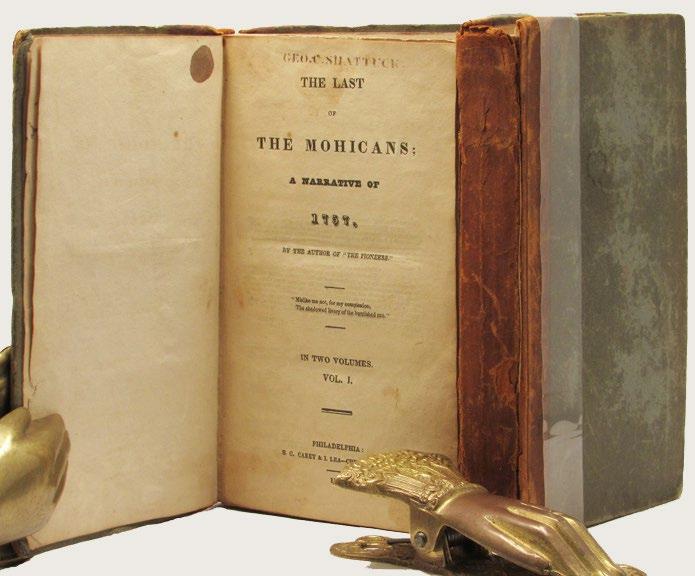
Cooper’s works remain to this day classics in American literature. “This is the... most famous of the Leatherstocking Tales”. (Grolier 100 Influential American Books, 34).
Concerning the provenance, this copy has a gift presentation dated June, 1826 and is the copy of George C. Shattuck. George Cheyne Shattuck (1783–1854) graduated from Dartmouth College in 1806 and studied medicine at Harvard Medical School and the University of Pennsylvania, receiving a degree from the latter in 1807. He practiced medicine in Boston, where in 1808 he published Three Dissertations on Boylston Prize Questions for the Years 1806 and 1807 (Sowerby, no. 986), a copy of which he sent to Thomas Jefferson in October 1808. Shattuck established an endowed professorship at the Harvard Medical School and was president of the Massachusetts Medical Society, 1836–40. DAB; Martin Kaufman and others, Dictionary of Medical Biography [1984], 2:675–6; Edward Jarvis, Memoir of the Life and Character of George Cheyne Shattuck, M.D. [1854]).
Dr. Shattuck was known to Thomas Jefferson who wrote to him in 1809: “Washington Mar. 11–09. Th: Jefferson presents his compliments to mr Shattuck and his thanks for the copy of the Boylston prize dissertation which he was so kind as to send him. he shall read it with pleasure in the leisure of Monticello, to which place he [is] now in the moment of departure. he prays mr Shattuck to accept the assurances of his respect.
Grolier 34; BAL 3833; Hart; Grolier 100; Oxford American Literature; Johnson, High Spots of American Literature pp 24-25, Spiller & Blackburn 7 $18,500.
Pablo Picasso - An Original Signed Engraving
‘Le Pigeonneau’ - ca. 1939 - An Important Gravure à la Gouge Probably His First or Second Effort in the Technique
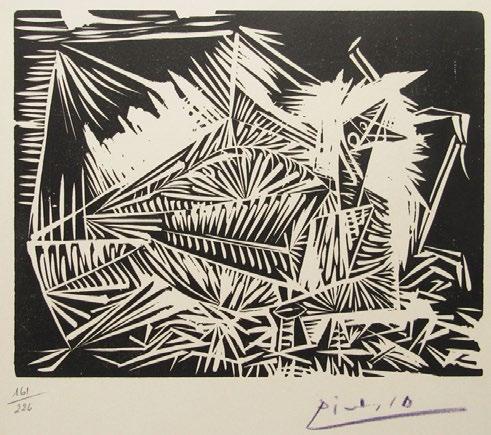
65 Picasso, Pablo. An Original Signed Engraving ‘LE PIGEONNEAU’ (Paris: From the Press of Robert Blanchet, ca. 1939) No. 161 of a Limited Edition of only 226 copies printed on vélin d’Arches. AN ORIGINAL GRAVURE A LA GOUGE PRINT SIGNED IN CRAYON BY PICASSO. Folio, on a 14.5 by 11 single sheet, the printed area measuring approximately 6.5 by 8. A fine copy of the signed engraving.
A very important print, a signed impression of the original linogravure, ‘Le Pigeonneau’, (c. 1939), which is believed to be either Picasso’s first or second effort in the technique. $14,950.
First Edition of Winston Churchill’s First Book - 1898
The Story of the Malakand Field Force A Unusually Fine And Fresh Copy in Original Cloth
66 Churchill, Winston. THE STORY OF THE MALAKAND FIELD FORCE: An Episode of Frontier War (London: Longmans, Green and Co, 1898) First edition, first issue of the book, no other printings were issued of the first edition but one. This copy with the printed errata slip tipped in. A complete and perfect copy. With a photographic portrait frontispiece, 2 folding maps in colour and 4 sketches and plans. 8vo, publisher’s original pale green cloth lettered in gilt on spine and cover. Now housed in a very fine light-red morocco fold-over case, the spine panel of the case with raised bands stopped in gilt, the compartments with gilt ruled frames, lettered and numbered in 3 compartments in gilt. xv, 336, 32 ads. An extremely fine copy, all tissue guards present, maps and sketches all in especially fine condition, the cloth as pristine and about as fine and clean as one could hope to find.
THE FIRST EDITION, AND AN EXTREMELY FINE AND CLEAN COPY OF THIS INCREASINGLY HARD TO FIND WORK. The first book written by Winston Churchill who would one day be not only a prolific and prize winning author but one of the greatest figures in modern history. After an education at Harrow and Sandhurst he entered the army in 1895 and embarked on one of the most varied and distinguished careers of the 20th century. He acted as a correspondent for The Daily Telegraph from India and for the Morning Post during the Boer War. His dramatic escape from prison in Pretoria brought him to public attention. He embarked on his political career in 1900 by entering Parliament. While there he held many major offices of state: Home Secretary, Secretary of State for War, First Lord of the Admiralty in which he oversaw naval operations for the First World War, Colonial Secretary, Chancellor of the Exchequer and eventually in 1940, Prime Minister. The latter office he would hold throughout World War Two and again from 1951 to 1955.
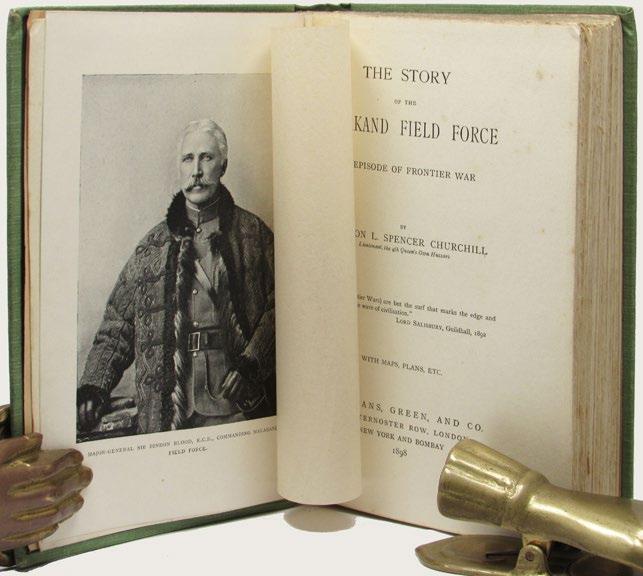
Early in this illustrious life, in 1897, the Daily Telegraph paid Churchill £5 per column for his dispatches from the Northwest Frontier in India, where he first saw action as a soldier, and after his return he fashioned these articles into the book here offered. It was the author’s first book and only 2000 copies were printed; it is of course now very difficult to find, especially in such fine condition. $9500.
The Greatest of all Western Philosophers
Platonis Opera - The Works of Plato - 1518 - Very Rare
The First Printing Outside of Italy and the First in Paris
The Great Folio Plato - Issued by Bade and Petit
The Most Revered and Widely Used Printing of the Era
67 Plato, (427–347 BC). PLATONIS OPERA a Marsilio Ficino traducta: adiectis ad eius vitie & operu enarrationem Axiocho ab Rodulpho Agricola: & Alcyo ne ab Augustino Datho tralatis. (Paris: Venundantur ab Ioanne Parvo & Iodoco Badio, (colophon:) impressa sunt solertiore cura Ascensianis Anno domini MDXVIII (1518) Quinto Kalendas Iuanias. Deo Gratiae.) Very Rare and Extremely Early Printing. THE FIRST PARISIAN PRINTING AND THE FIRST PRINTING OUTSIDE OF ITALY. It includes certain pseudo-Platonic dialogues never before printed,
is only the second printing of the 16th century and the fourth of all printings. Truly rare, no copy is in the British Museum and it is mentioned only in Adams. Dedicated by Ficino to Lorenzo de’ Medici this printing was reproduced from the Venetian incunable edition of B. de Choris, 1491. A COPY WITH FINE PROVENANCE. Four ownership signatures are noted on the title-page suggesting that the book traveled throughout Europe during its first 250 years of existence. One of the signatures most probably signifies ownership of the book by Sir John Cobham who had been raised to the peerage by King Charles I in 1645. Very finely engraved and illustrated title-page with superb Renaissance decorative borders incorporating allegorical figures and a scribe at work; at the center, a very beautiful engraving of the printers at work at the press, very fine and ornate capital letters throughout in black with ornate xilographic decorations, occasional manuscript emendations in the margins in a contemporary Renaissance hand and with contemporary ownership inscription on the title. Folio (330 x 223) in eights, full antique calf incorporating double blind fillet borders on the covers enclosing roll tooled inner borders in blind with a large central panel incorporating decorated corner tools and inner rolled borders all in blind, the spine with wide raised bands, brown morocco lettering label gilt. cc. num. CCCLXXXIX (389 folio leaves) A very large, handsome, crisp and clean copy with expert and insignificant repair to a closed tear on one leaf. A copy with very wide and ample margins. The binding is in quite excellent condition with very little wear of evidence of use. A sympathetic restoration of the spine panel accomplished at some time.
VERY RARE. THE FIRST PRINTING OUTSIDE OF ITALY AND THE FIRST PARISIAN PRINTING. A very beautiful and important production of Ficino’s great Latin translation of Plato— ”still the best translation of that author Italy can boast” (Britannica). This printing also includes certain pseudo-Platonic dialogues never before printed. Ficino began his translation in 1466 from a manuscript supplied by his patron, Cosimo de’Medici, and by Amerigo Benci. During its progress Ficino submitted sections for review to the greatest scholars of the age: Angelo Poliziano, Cristofor Landino, Demetrios Chalchondylas and others, which served to refine the work. Marcilio Ficino is perhaps the most important of all scholarly Renaissance thinkers and his influence on philosophical, humanistic and cultural thought remains unsurpassed. Through the beneficence of the Medici family, Renaissance Platonism emanated from him and his work and studies caused the vast expansion of the ideas inherent in Platonic thought. Some have argued that Ficino’s direct effect on the Renaissance is without equal by any other scholar. His Latin translation of Plato allowed for all of Plato’s dialogues to be available to Western readers for the first time.
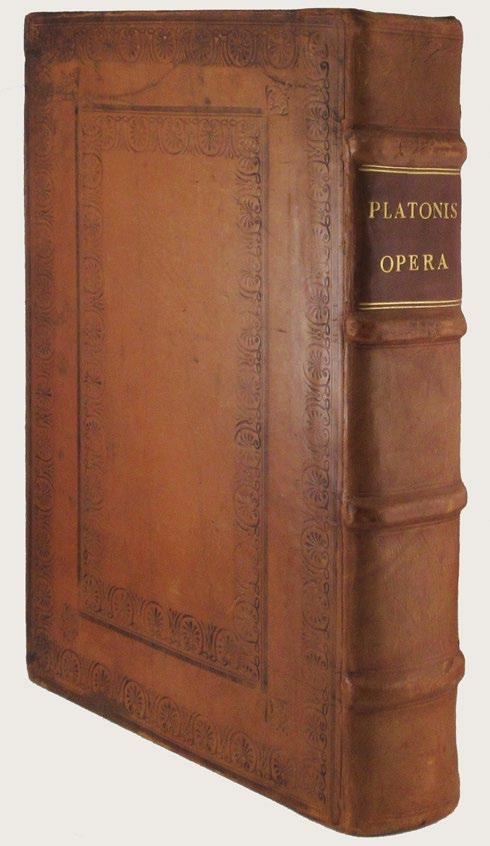
‘This first edition produced by Jean Petit and Jodocus Badius in Paris became the standard Plato-edition of the time with numerous editions following it. It remained for many years perhaps the most influential of all Renaissance readings of Plato and is considered to this day one of the most important and refined of all early printings of the great philospher’s writings. Bade and Petit, important in their own right, were highly important contemporaries of Erasmus. They are responsible for many of the finest and most widely used editions of classical texts printed during the century.
THE KING OF PHILOSOPHERS. ONE OF THE SUPREME TEXTS OF THE RENAISSANCE. Plato’s reintroduction into European thought has had a total and sweeping effect in the realms of philosophy, science, and religion. This work reprints the whole text in one endeavour of the first edition (Florence, 1484-85) issued over many months in a series of parts. The first edition in parts, of Plato’s OPERA is of the most extreme rarity, probably now absolutely unobtainable, so this is one of the very earliest printings one could hope to secure in its complete state and an especially interesting issuance of the OPERA from one of the finest European printers. Adams P-1443 $9500.
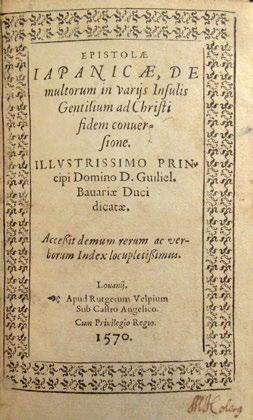
The Jesuit Missions in Japan and Asia Extremely Early News and Accounts From the East Epistolae Iapanicae - Japan and Asiatica
68 [Jesuit Letters]. EPISTOLAE IAPANICAE, DE MULTORUM IN VARIJS INSULIS GENTILIUM Ad Christi Fidem Conversione. Illustrissimo Principi Domino D. Guiliel. Bauariae Duci dicatae. AccelBit demum Rerum Verborum Index Locupletissimus (Louanii: Apud Rutgerum Velpium sub Castro Angelico cum Privilegio Regno, 1570) Early Printing. 12 leaves with woodcut title border, figurative initials, and printer’s device at the end. 8vo [14.5cm x 505cm], ihandsomely bound in full antique vellum over stiff boards, the spine lettered in calligraphic manuscript. 402 pp. A handsome and well preserved copy in attractive fine vellum, p. 51/52 upper blank edge restored, some minor occasional browning and at the end of the book, very light evidence, now faded away, of damp from long ago.
VERY RARE, EXTREMELY EARLY ACCOUNTS OF WESTERN INTERACTION WITH JAPAN AND ASIA. THE WRITINGS DATE FROM 1549 TO THE 1560’S. $16,500.
Harris’s Splendid Folio of African Fauna One of the Most Important South African Works
69 Harris, Capt. W. Cornwallis. PORTRAITS OF THE GAME AND WILD ANIMALS OF AFRICA (London: W. Pickering, 1840[-1843]) First edition, large-paper issue, and issue with the addition of vignette engravings. Additional lithographed title-page with hand-colored vignette after Harris by F. Howard, 30 superb hand-colored lithographed plates after Harris by Howard, all plates are backed with linen, 30 uncolored lithographed tailpiece vignettes at the end of each section. Elephant folio (Approx. 21” x 16”), handsomely bound in contemporary half red morocco over marbled boards, the spine with tall gilt ruled raised bands creating 6 compartments, three of which are lettered in gilt, gilt ruling on boards, a.e.g. Additional title, title-page and last three leaves of text with some expert repair, one plate with expert repair affecting some of the image (mostly just sky), occasional and much smaller closed edge tears also neatly repaired, mild or typical spotting, some minor old staining, binding firm and very attractive and with some light rubbing to the morocco extremities.
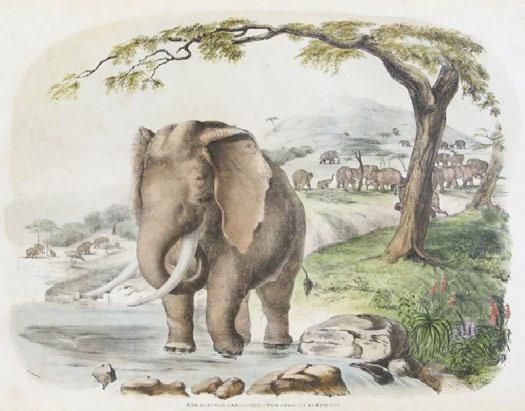
“One of the most important and valuable of the large folio works on South African fauna” (Mendelssohn I, p. 688), based on Harris’ hunting expedition of 1836-37. Monumental and one of the grandest works on big game ever published. “In addition,” Mendelssohn continues, “to the beautiful coloured engravings which render this work almost the most highly prized of the books relating to South African animals, every plate is accompanied by an exhaustive chapter upon the characteristics of the animal represented, as well as by a short sketch of its personal appearance, &c., and numerous engravings in the letterpress illustrate the notes” (pp. 688-89).
This copy with the List of Subscribers, which according to Tooley (247) is almost always missing. Additionally, the black and white vignettes at the end of each section, which are based on Harris’ own trophies, are only found in this issue.
Harris was the head of the mission sent by the British Government to open up relations with the Ancient Christian Kingdom of Shoa in the Ethiopian highlands. His success in this pursuit earned him a knighthood. He was as well, one of the earliest explorers to penetrate the highland country.
This is a scarce and magnificent work. $15,000.
A Core Work of Modern Economics
Vilfredo Pareto - Cours D’Économie Politique
The Rare First Edition - Handsomely Bound - 1896-1897
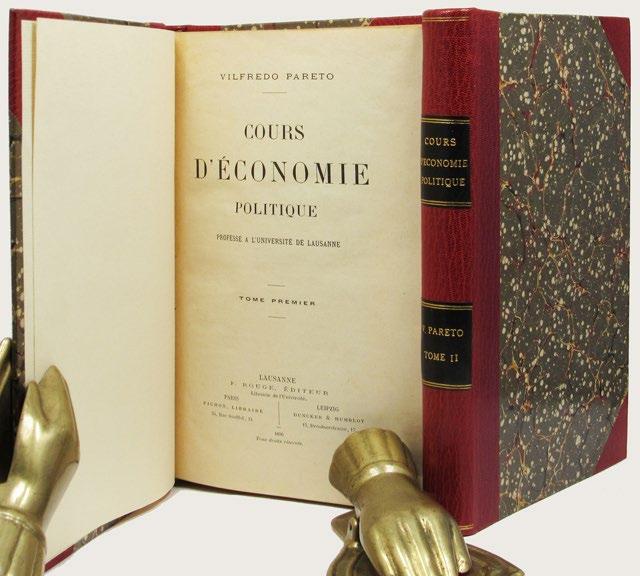
70 [Economics]; Pareto, Vilfredo. COURS D’ÉCONOMIE POLITIQUE PROFESSÉ À L’UNIVERSITÉ DE LAUSANNE (Lausanne: F. Rouge, Éditeur, Librairie de l’Universit, 18961897) 2 volumes. Rare First Edition. The First Major Work by this very important economist. Illustrated with numerous tables and graphs throughout. 8vo, in a fine French binding of three-quarter burnt-red morocco over marbled boards, spines lettered gilt on two gilt ruled black morocco labels, additional gilt ruling at the ends. viii. 430: (4), 426 pp. A very fine and attractive set of this rare first edition, the handsome bindings as mint, the text fresh and clean with just the lightest hint of age, a superior set indeed.
RARE FIRST EDITION OF ONE OF THE GREAT MODERN CLASSICS OF ECONOMICS, IT WAS IN THESE COURSES THAT PARETO BEGAN HIS DEVELOPMENT CONCEPT OF ‘PARETO EFFICIENCY’ WHICH HELPED CREATE THE FIELD OF MICROECONOMICS AND CHANGED ECONOMICS FROM A PHILOSOPHICAL STUDY TO A PRACTICAL ONE.
In 1893, Pareto succeeded Léon Walras to the chair of Political Economy at the University of Lausanne in Switzerland, where he remained for the rest of his life. He was he first to discover that income follows a power-law probability distribution of wealth in a society, fitting the trend that a large portion of wealth is held by a small fraction of the population, the ‘Pareto distribution’.
Pareto’s legacy in the study of economist is profound. Much in response to his efforts the economics evolved from a branch of moral philosophy, as viewed by Adam Smith, into a data intensive field of scientific research and mathematical equations. $9500.
Walt Whitman - A Fine Set of the Complete Writings 10 Volumes - Beautifully Bound in Morocco, Gilt Extra One of a Limited Number and an Important Set of the Works
71 Whitman, Walt. THE COMPLETE WRITINGS...
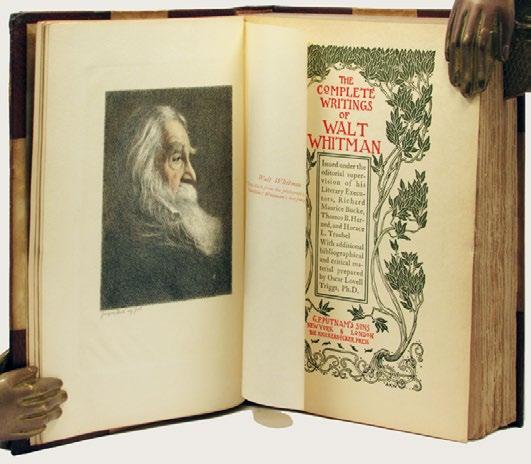
Issued under the editorial supervision of his Literary Executors, Richard Maurice Bucke, Thomas B. Harned, and Horace L. Traubel. With additional bibliographical and critical material prepared by Oscar Lovell Triggs, Ph.D. (New York: The Knickerbocker Press for G. P. Putnam’s Sons, 1902) 10 volumes. The Paumanok Edition, one of only 300 numbered sets printed on Ruisdael handmade paper. With illustrations in gravure and aquatint on japon vellum in each volume, colour frontispiece of Whitman to Volume I, tissue guards intact as issued. Large, thick 8vo, beautifully presented in fine period bindings of threequarter crushed honey morocco over subtle marbled boards, the turnovers gilt ruled at the borders, the spine with art nouveau decorations incorporating raised bands gilt decorated and gilt ruled, the largest compartment with fine gilt and black tooled art nouveau intertwining decorations, one compartment lettered in gilt, t.e.g., others uncut. xcvi, 294; xiii, 323; vii, 297; xi, 324; vii, 301; v,318; v, 281, v, 300; xviii, 230; v, 309 pp. A very handsome, fine and bright, attractive and especially well preserved set.
A RARE AND BEAUTIFUL SET, on fine paper with Gothic titles, illustrated title pages and finely engraved portraits of the author, the people in his life and other important personages of the age. There is a fine introduction to LEAVES OF GRASS and the set also includes an important biography of the poet by Bucke, Harned, and Traubel. There are here presented, the greatest poem of America in its most complete format, and volumes of the wonderful prose writings of Whitman including the inclusion of SPECIMEN DAYS and other significant works.
Whitman’s LEAVES OF GRASS portrayed America at the crossroads between an old world, soon to be cast off, and the new world of our future present. With the publication of LEAVES OF GRASS in 1855, Whitman, the poet of democracy, ushered in a new era in American letters, describing specifically American experiences in a distinctly American idiom. From its first publication in 1855, he had complete confidence in the greatness of both the book and its author.
“Always the champion of the common man, Whitman is both the poet and the prophet of democracy. The whole of LEAVES OF GRASS is imbued with the spirit of brotherhood and a pride in the democracy of the young American nation. In a sense, it is America’s second Declaration of Independence: that of 1776 was political, this of 1855 intellectual. ...The poems are saturated ‘with a vehemence of pride and audacity of freedom necessary to loosen the mind of still-to-be-formed America from the folds, the superstitions, and all the long, tenacious, and stifling anti-democratic authorities of Asiatic and European past’. To the young nation, only just becoming aware of an individual literary identity distinct from its European origins, Whitman’s message and his outspoken confidence came at a decisive moment.
LEAVES OF GRASS was Whitman’s favorite child. From the time of its original publication,...until the year of his death, he continued revising and enlarging it. If (his) reputation has fluctuated over the years and his position among, if indeed not at the head of, the list of great American poets was not assured until some time after his death, there was never any doubt of the matter in his own mind. ‘I know I am deathless’, he wrote. ‘Whether I come to my own today or in ten
thousand or ten million years, I can cheerfully take it now, or with equal cheerfulness I can wait.’ Time has vindicated his conviction.” PMM
One of the rare opportunities to acquire this comprehensive set from one of the greatest of American poets. Myerson $12,500.
A Rare and Beautiful Edition of Ovid’s Metamorphoses
Two Beautiful Large Folio Volumes Profusely Illustrated Latin and French - Printed in Amsterdam - 1732
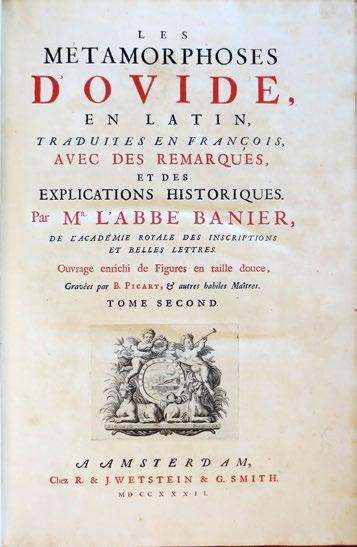
72 Ovid. LES METAMORPHOSES D’OVIDE, En Latin, Traduites en Francois, Avec des Remarques, et des Explications Historiques Par Mr. L’Abbe Banier de l’Académie Royale des Inscriptions & Belles-Lettres (Amsterdam: R. & J. Westein & G. Smith, 1732) 2 volumes. First of the edition, the French and Latin printed in double column. Extensively illustrated with figures in taille douce engraved by B. Picart and other skilled masters. The engravings consist of large pictorial illustrative chapter heads typically measuring over 22 by 17 cm. Also with engraved tail pieces and initials throughout. Folio [46.5 by 30.5 cm], in very fine and handsome contemporary mottled calf, the boards paneled in gilt featuring an outer gilt rolled frame in a fleur de list mottif around an inner gilt panel featuring large acorn cornerpieces, this surrounding a large and ornate central gilt element in finest period fashion, the spines elaborately gilt tooled in compartments between wide gilt-tooled bands, the compartments in a floral motif also featuring large acorn center tools, two compartments featuring morocco labels of contrasting red and green with extensive gilt decoration and lettering. 248; 249-524, [4] pp. A very fine and handsome set, the contemporary calf extremely handsome with only the most minor of expected age, internally very fresh, clean and wonderfully preserved.
VERY SCARCE, THE LATIN AND FRENCH VERSION OF WESTEIN AND SMITH’S IMPRESSIVE ILLUSTRATED OVID. It is far rarer then their Latin/English printing, OCLC notes only 15 copies in institutional collections and there are no auction records going back over 25 years. This a magnificent copy in full and very fine contemporary binding. Banier’s translation into French was a standard for decades and was later reprinted. There were several editions of it in 1732, but we are unaware of any earlier.
Metamorphoses is mainly a collection of Greek and Roman myths, retelling classical stories such as Echo and Narcissus, Jason and Medea, and Venus and Adonis. It also includes the Eastern Babylonian tale, Pyramus and Thisbe. This great epic work has been recognized throughout the centuries for its inventiveness, charm, and originality.
“As a story-teller and guide to Greek myth and Roman legend, Ovid was very influential on later Roman writers and was read, quoted, and adapted during the Middle Ages. He was the favourite Latin poet of the Renaissance, and there were many translations of his works into English.”-M.C.Howatson. His influence upon great writers through history, from Chaucer to Marlowe and Shakespeare, is well-known. $9500.
536-4433
The Official Atlas of the Civil War A Highly Impressive Piece of American History
Extremely Rare in the Original Folio Parts
73 Cowles, Captain Calvin D. [Compiler]. ATLAS TO ACCOMPANY THE OFFICIAL RECORDS OF THE UNION AND CONFEDERATE ARMIES. Published Under the Direction of the Hons. Redfield Proctor, Stephen B. Elkins, and Daniel S. Lamont, Secretaries of War (Washington: Government Printing Office, 1891-1895) In the original 36 parts. FIRST EDITION. With 175 numbered double-page lithographed color maps and plates on 178 sheets by Bien. Large elephant folio, presented in the original 36 large folio fascicles with their original printed paper wrappers, now housed together in a blue cloth portfolio case with string ties, the spine of the case is lettered in gilt. A handsome and impressive set in fully original condition, overall, very excellent and especially well preserved. The original wrappers show some occasional minor wear along the edges and spines, occasional small tears at folds or minor creasing or separation. Sets in the original fascicles with wrappers intact are very rare and very elusive in the open market. This is a very fine example of the most rare state of the first edition. SCARCE IN ORIGINAL FOLIO PARTS AND AN EXTREMELY IMPRESSIVE ATLAS PRODUCED BY THE UNITED STATES GOVERNMENT PRINTING OFFICE TO ILLUSTRATE THE OFFICIAL RECORDS OF THE AMERICAN CIVIL WAR. The first of the 36 fascicles contains the index and preface and also included is the 1902 additions and corrections insert, each of the following 35 fascicles contain five of the large double page plates. A beautiful and fascinating accompaniment to the official records of the Civil War. Each massive plate is either an impressively detailed and informative map or contains multiple images providing detailed plans of cities, towns and fortresses, views, panoramas, uniforms, battlefields, bridges, engagements, lookouts, etc., etc.
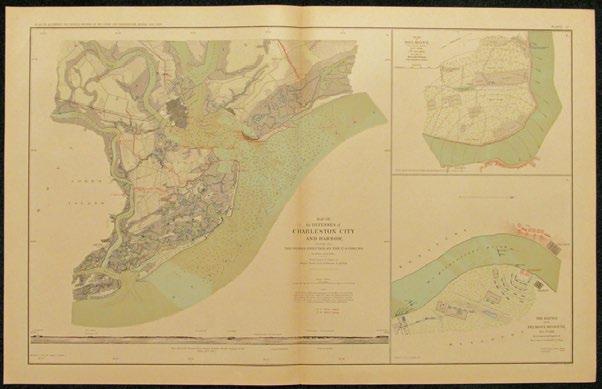
The maps and plans were primarily reproduced from those that had been drawn during the war by engineers, draftsmen, and sometimes even generals themselves for actual military use. Only a few maps, drawn later by cartographers, were added for historical purposes. Tactical and strategic maps indicate troop disposition; defense lines, redoubts, and fortifications of key sites are clearly shown. Terrain maps often contain picket positions, signal stations, and lines of march. Some were taken from what had been only rough sketches, some from cartographic masterpieces. All are informative and reveal the knowledge, or lack of knowledge, that both sides possessed about the terrain, and the strength and the position of opposing troops. The index to the maps refers to campaigns and battles, rivers, creeks, lakes, bays, islands, bridges, fords, ferries, landings, roads, railroads, mountains, towns, churches, forts, and much more.
An indispensable source of information and imagery from the American Civil War. The atlas was not reprinted until 1958. Howes, C816; Rumsey Collection; Later editorial review; reviewer unknown; Library of Congress; National Archives. $12,500.
Hardy’s Only Historical Novel
The Trumpet-Major - A Story of the Napoleonic Wars A Handsome Set in the Very Scarce Original Decorated Cloth
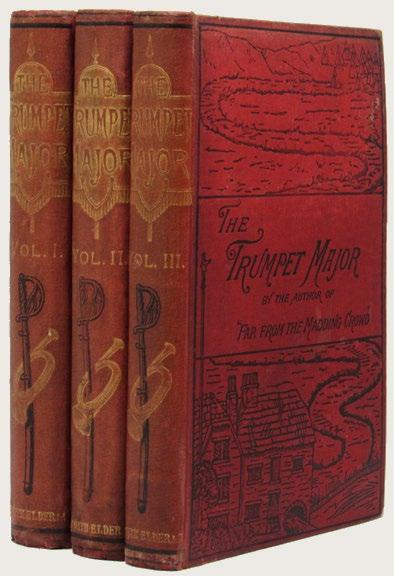
74 Hardy, Thomas. THE TRUMPET-MAJOR. A Tale (London: Smith, Elder and Co., 1880) 3 volumes. First edition. 8vo, in the publisher’s original and Purdy’s primary binding of red cloth, the upper cover lettered and paneled to produce two vignettes from drawings by Hardy all in black, the spines lettered and decorated with sword and trumpet in gilt and black and with the two line ruled borders on the rear covers in blind. Housed in a blue cloth-coverd clamshell box with morocco label gilt lettered. [ii], vi, 296; [ii], vi, 276; [ii], vi, 259 pp. A very handsome set, the bindings attractive and fresh, expert and unobtrusive refurbishment at the spine tips, the text-block tight and quite clean and fresh, essentially no spotting whatsoever and only the lightest age mellowing, a very pleasing set indeed.
THE FIRST EDITION OF HARDY’S EPIC NOVEL OF THE NAPOLEONIC WAR, A VERY ATTRACTIVE SET IN ORIGINAL CLOTH. Purdy notes the edition was printed in only 1000 copies. The cover illustrations were designed by Hardy and feature two vignettes, one of an encampment on a river which leads down to the second of a mill. Hardy wrote the story to commemorate the 75th anniversary of Trafalgar, it was first printed in an abridged form in “Good Words”. It is Hardy’s only historical novel. Purdy, pp. 31-35; Sterling 427; Sadleir 1115 HBS 66272. $12,500.
The Truly Rare First Edition, First Issue
Sir Walter Raleigh’s History of the World - London - 1614 In Fine Contemporary Binding - A Classic of the Renaissance One of the Earliest English Views of the World and History
75 Raleigh [Ralegh], Sir Walter. THE HISTORY OF THE WORLD (London: Printed for W. Barre, 1614) First edition, first issue, with the Rare Errata leaf at the end. With the engraved title-page and the “Minde of the Front. [ispiece]” leaf, and 8 double-page plates and maps as issued. Folio, very handsomely bound in full antique mottled calf, the spine panel fully gilt, with raised bands separating the compartments which are elaborately decorated with full multi-tooled panels incorporating a number of tools, all gilt, and with a red morocco lettering label gilt, the covers with double gilt fillet rules at the borders, binding edges gilt tooled Collation: [2ff.] [40, A-B4 Preface], [40, a-d2, Contents of the Chapters], 1-651, [1]; [2 blank], 1-776; [2, To the Reader], [24, A Chronological Table], [16, An Alphabeticall Table...of the First and Second Bookes], [16, An Alphaeticall Table ...of the Third, Fourth and Fift Bookes], [1, Errata], [1, Colophon] pp. A very handsome copy in full antique mottled calf, the hinges and portions of the tips or edges refurbished imperceptibly in an expert, unobtrusive and sympathetic manner at an early date, the text-block large and barely trimmed, opening leaves with some expert refurbishment and strengthening at the edges, the Preface and a few other leaves remargined or re-edged expertly at an early date and not affecting the text, a clean, crisp and fine copy, with the covers well preserved and the spine panel beautifully accomplished and expertly restored. Rare in such an early binding.
RARE FIRST EDITION OF RALEIGH’S MASSIVE TOME AND A CORNERSTONE WORK IN HISTORIOGRAPHY.
ONE OF THE GREAT BOOKS PRINTED IN ENGLAND AT THE BEGINNING OF THE 1600’s. This is the only volume published of the massive history Raleigh planned and began while in the Tower of London after the accession of James I. This is the earlier of the two editions having the colophon dated 1614, with the errata uncorrected. It was rigidly suppressed by order of King James I, but nevertheless passed through several editions. The engraved title was not issued with the second edition, which appeared in 1617, a printed title having a portrait of Raleigh taking its place. A reissue of
536-4433
the second edition appeared in 1621, and later editions in 1624, 1628, 1666, and 1684, 1687 and throughout the 18th century.
While most of Raleigh’s prose works up to then had been written for private circulation[...] the HISTORY was intended for publication to a wide audience. Raleigh began writing it about 1607, the work was entered in the Stationers’ register in 1611 and appeared towards the end of 1614. The Preface was suppressed by George Abbot, archbishop of Canterbury, on 22 December and copies were seized by the kings’ agents for his own use. According to Chamberlain the suppression came about because it was “too sawcie in censuring princes” [...] The suppression order was soon lifted and the History was reprinted in 1617. It remained popular: there were at least eleven editions in the seventeenth century, one in the eighteenth, and one in the nineteenth.
Raleigh was one of the principal figures of the English Renaissance. As well as being a poet of wide repute and a successful soldier, he was one of the earliest explorers of the New World (one of its cities still bears his name). This ambitious book, which Raleigh worked on with the help of several assistants, ostensibly deals with Greek, Egyptian, and biblical history up to 168 B.C., but the preface summarizes modern European history and represents one of the earliest English views of the world and its history. It has become a classic of English Renassaince literature.
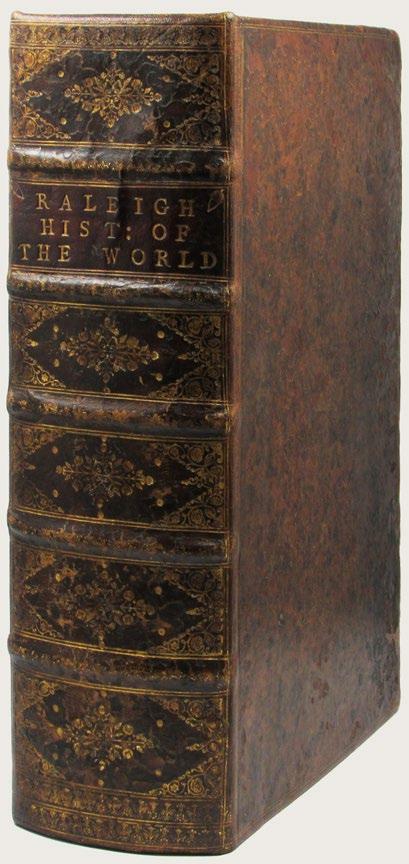
The History is described as “The first part of the general history of the world”, implying, as Ralegh said, that other parts were to come. This, he admitted, was his intention and indeed he had “hewn them out”. What exists is a substantial work, of about a million words, in five books, running from the creation of the world to 146 B.C., the time of the second Macedonian war. The first two books are principally, though not wholly, concerned with biblical history, the last three mainly with the story of Greece and Rome. In the first two, God’s judgments are seen as the central determinants of events; in the latter three the role of man is more evident. History is regarded as moral exemplum, a classical concept appropriate ot the treatment of ancient history but unusual for the subsequent discussion of Henry VIII. The juxtaposition of the discussion of Henry with that of James must have registered as ironic with the original readers, especially later when James’s “unstained sword of justice” had Ralegh’s blood on it. The HISTORY IS FAR MORE THAN A CHRONOLOGY, ITS OPENING CHAPTERS DESCRIBED THE CREATION OF THE WORLD AND ITS NATURE BEFORE RALEGH MOVED TO THE PHILOSOPHICAL PROBLEMS RAISED BY THE CONCEPTS OF PRESCIENCE, PROVIDENCE, FREE WILL AND FORTUNE. He adopted the familiar distinction between first and second causes, God’ Will, he later wrote, determined everything [...] yet God works through second causes, “Instruments, Causes and Pipes”, which carry his will to the world. The distinction is not clear or unambiguous, but it enabled Ralegh to focus upon human actions. Essentially, he wrote for a purpose, as a man of action: it was, he said, “the end and scope of all History, to teach by example of times past, such wisdom as my guide our desires and actions” (ODNB). perhaps unsurprisingly, given his previous experiences, one of Raleigh’s principal themes was ‘the general wickedness of kings and the severity of God’s judgement upon them [...] The misdeeds of English kings were related in some detail. o Henry VIII Ralegh wrote that “if all the pictures and patterns of a merciless prince were lost in the World, they might again be painted to the life, out of the story of this king” [...] Only one ruler in the entire history of the world receives unstinted and unadulterated praise from Ralegh: Epaminondas of Thebes, with Hannibal as proxime accessit. Although Ralegh believed that history could provide examples and precepts for rulers to follow, its events demonstrated only too clearly that they were unlikely to do so. His book ends with a paean of praise to Death: “Oh eloquent, just and mighty Death! whom none could advise, thou has persuaded; that none has dared, thou hast done; and whom all the world hath flattered, thou only hath cast out of the world and despised: thou hast drawn together all the far stretched greatness, all the pride, cruelty, and ambition of man, and covered it over with these two narrow words, Hic jacet” (loc.cit.) The poem “The Mind of the Front’ (i.e. explanation of the allegorical frontispiece) was written by Ben Jonson, who had been tutor to Raleigh’s son at the time of the book’s production. $9500.
One of the Most Important Works in the History of Medicine
Morgagni’s De Sedibus...Morborum Per Anatomen - 1761
The Rare First Edition with Pleasing Provenance - PMM 206 The Founding Work of Pathology
76 Morgagni, Johann Baptista. DE SEDIBUS, ET CAUSIS MORBORUM PER ANATOMEN INDAGATIS LIBRI QUINQUE. Dissectiones, et Animadversiones, nunc primum editas complectunur propemodum innumeras, medicis, chirurgis, anatomicis profuturas. Multiplex praefixus est Index rerum, & nominum accuratissimus. (Venice: Ex Typographia Remondiniana, [1761]) 2 volumes bound in one. First edition, first issue, large-paper copy and a copy with pleasing “old world” provenance. Fine woodcut head- and tailpieces, without the engraved portrait by Renard which is often lacking. Folio, 41 x 24.5 cm, full contemporary calf expertly rehinged at an early date, gilt tooled spine, red and green morocco lettering labels. xcvi, 298; 452 pp. A very good copy with wide margins, minor dampstain at the lower blank margin, most noticeable in the index and diminishing toward the end of this section, some wear to the corners of the covers. Bookplate and small title-page stamp of the Medical Society of Norwich and Norfolk. The Medical Society bookplate is pasted over the eighteenth-century bookplate of Johannes Manning, M.D., with the inscription on an early blank, “Presented by the executors of the late Dr. Manning.”
THE RARE FIRST EDITION OF ONE OF THE GREATEST BOOKS IN THE HISTORY OF MEDICINE, and “a foundation of modern pathological anatomy. Vast in scope, it is one of the most fundamentally important works in the history of medicine. In it he (Morgagni) reports in precise and exhaustive detail his findings in nearly seven hundred autopsy dissections, introducing and insisting on the concept that diagnosis, prognosis, and treatment of disease must be based on an exact understanding of the pathologic changes in the anatomical structures” (Heirs to Hippocrates 501). The work focused attention on the “seat” rather than the “nature” of the disease, which had been the principle concern of medicine since Hippocrates.
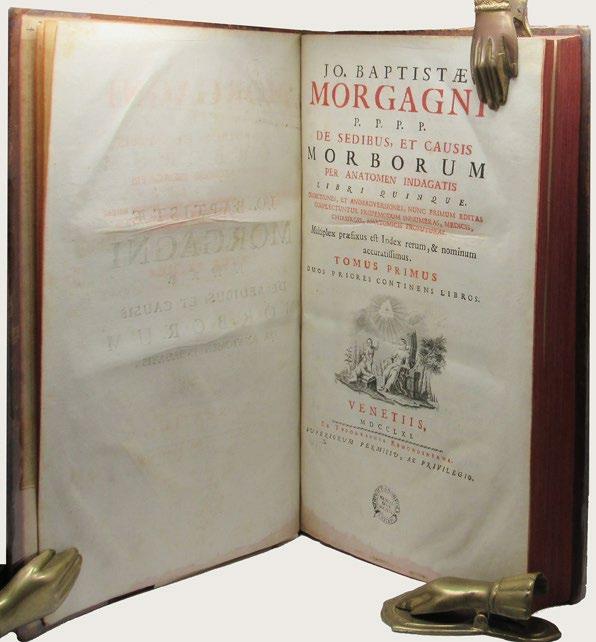
“By this great work, one of the most important in the history of medicine, Morgagni was the true founder of modern pathological anatomy. The work was completed in Morgagni’s 79th year and consists of a series of 70 letters reporting about 700 cases and necropsies. As best he could, he correlated the clinical record with the post-mortem findings. Morgagni gave the first descriptions of several pathological conditions [including descriptions of nitral stenosis and heart block (Letter III), and of angina pectoris]. He was Professor of Anatomy at Padua.”
The Coat of Arms of the Manning family was used by Dr. Johannes Manning for his bookplate which is affixed to the front pastedown, and which is currently underneath the plate of the Norwich and Norfolk Medical Society. Concerning the Manning family, there is much known.
“The surname of MANNING was derived from the Old English word ‘manningi’ a nickname for a brave and valiant man. The name was brought to England in the wake of the Norman Conquest of 1066. Early records of the name mention MANNIG ( without surname ) listed as a tenant in the Domesday Book of 1086. Algarus Manning est Upsune, was recorded in 1130 in County Northumberland. Semem filius Manning, was documented in the year 1181 in County Essex.
Henry Maninge was recorded in County Cambridge in the year 1273. Nicholas Mannyng, 1273 ibid. Johannes Manning was listed in the Yorkshire Poll Tax of 1379 and Norah Mannyng was also recorded Thomas Renshaw and Jane Mannin were married at St. George’s, Hanover Square, London in the year 1757. This originally English name, which is numerous in County Cork, and County Dublin, is sometimes used as a synonym of Mannin. Ireland was one of the earliest countries to evolve a system of hereditary surnames. They came into being fairly generally in the 11th century, and indeed a few were found before the year 1000. The maritime county of Cork, in Munster, is bounded by the sea on the south-west, the south and the south-east. To the east it has land boundaries with the counties of Waterford and Tipperary, and to the north with Limerick and to the west with Kerry. Anciently the country formed part of the kingdom of Desmond. After the Anglo-Norman Invasion the whole of the present county, save the City of Cork (which had been founded by the Vikings) and its surroundings, was granted in 1177 by Henry 11 to Anglo-Norman knights who brought over their followers and established a military colony. A notable member of the name was Thomas Manning (1772-1840) the English traveller, born in Suffolk. He entered Caius College, Cambridge, to study Chinese and in 1806 went out as a doctor to Canton. In 1811, he visited Lhasa in Tibet, the first Englishman ever there. He returned to England in 1817, and then went to travel in Italy. He returned, and died in Bath. The associated arms are recorded in Sir Bernard Burkes General Armory. Ulster King of Arms in 1884. Registered at the Ulster Office.” Garrison and Morton 2276, 2734, and 2885. PMM 206. Norman Library 1547. $16,500.
The
Edition
De Luxe
of Stanley’s Great
Narrative
In Darkest Africa - A Handsome Copy Signed by Stanley - Published in London - 1890
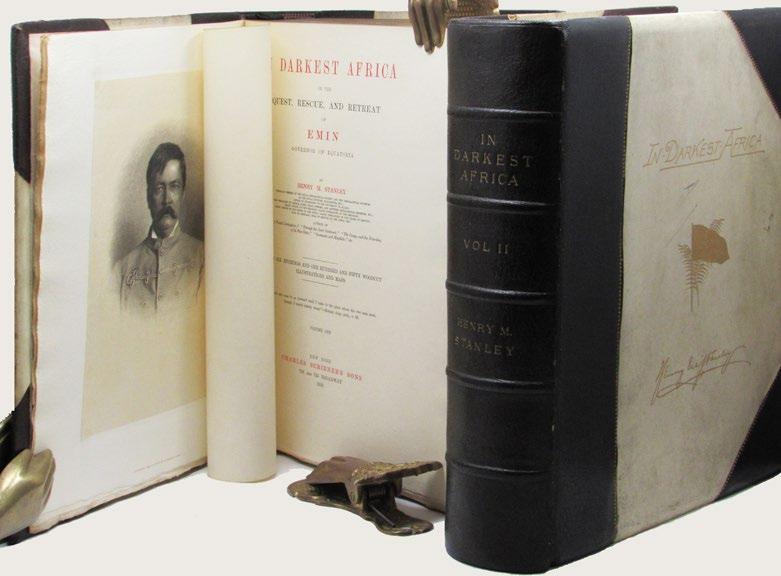
77 Stanley, Henry M. IN DARKEST AFRICA, or the Quest, Rescue, and Retreat of Emin, Governor of Equatoria (London and New York: Sampson Low, Marston, Searle, and Rivington for Charles Scribner’s Sons, 1890) 2 volumes. Edition de Luxe. One of a limited edition of 250 numbered copies signed by Stanley on the reverse of the half-title. With 6 etchings and 150 woodcut illustrations and 3 folding maps. Each of the etchings are signed in pencil by the artist. Large 4to, contemporary threequarter brown morocco and with vellum covered sides, gilt lettered on the spines, gilt lettered and with gilt flag vignette on the upper covers, t.e.g. and all edges untrimmed. xv, 529; xi, 472. Index in each volume. A lovely example of this rare set, the bindings unusually fresh with the morocco and vellum in an especially good state of preservation, extremely fresh and clean internally.
VERY SCARCE LIMITED EDITION OF ONE OF THE PRINCIPLE WRITINGS OF ONE OF THE GREATEST EXPLORERS OF THE DARK CONTINENT.
“By 1885 Stanley had become deeply interested in the schemes of Mr. (afterwards Sir) William Mackinnon, chairman of the British India Steam Navigation Company, for establishing a British protectorate in East Equatorial Africa, and it was believed that this object could be furthered at the same time that relief was afforded to Emin Pasha, governor of the the
Equatorial Province of Egypt, who had been isolated by the Mahdist rising of 1881-1885...Instead of choosing the direct route Stanley decided to go by way of the Congo, as thereby he would be able to render services to the infant Congo State, then encountering great difficulties with the Zanzibar Arabs established on the Upper Congo” (EB).
Stanley and Tippoo Tib, the chief of the Congo Arabs, entered into an agreement for the latter to assume governorship of the Stanley Falls station and supply carriers for the Emin relief expedition, and then travelled up the Congo to Bangala together. They parted ways at Stanley Falls and Stanley started his trip toward Albert Nyanza, leaving a rear-guard at Yambuya on the lower Aruwimi under the command of Major E.M. Barttelot.
Stanley’s journey to Albert Nyanza became a hazardous 160-day march through “nothing but miles and miles, endless miles of forest” that claimed the lives of over half of Stanley’s men from starvation, disease, and hostility of the natives. Finally upon the arrival at Albert Nyanza, Stanley achieved communication with Emin but was troubled by the nonarrival of his rear-guard. He retraced his steps back to Yambuya to find that Tippoo Tib had broken faith, Barttelot had been murdered, and the camp was in disarray and only one European was left. Stanley again set out for Albert Nyanza, where Stanley, Emin Pasha, and the survivors of the rear-guard began the return journey to Zanzibar by way of Uganda, a trip during which he discovered the Mountains of the Moon (Ruwenzori), traced the course of the Semliki River, discovered Albert Edward Nyanza and the great southwestern gulf of Victorian Nyanza. Of Stanley’s original 646 men, only 246 survived.
This account of his adventures was wildly popular and published in six languages. This particular edition is extremely scarce in such excellent condition. EB $12,500.
W.H. Ireland’s Marvelous Work on Napoleon
The Life of Napoleon Bonaparte - 1828 - First Edition
Four Volumes Profusely Illustrated with Folding Plates
Cruikshank Illustrations Hand-Coloured - Antique Bindings
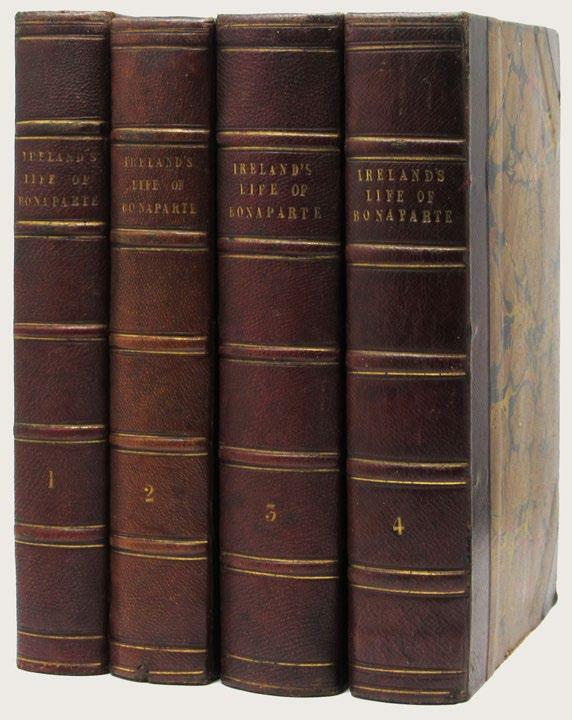
78 Ireland, Esquire, W.H. THE LIFE OF NAPOLEON BONAPARTE. (London: John Cumberland, 1828) 4 volumes. First Edition. 27 folding aquatints of which 24 are handcoloured including folding handcoloured frontispieces, engraved title-pages and profusely illustrated with fine handcoloured engravings throughout, many folding coloured plates and battle plans, all by Engraved by G. Cruikshank from the original designs of Vernet, Denon, Prudhon, Gerard, Cruikshank, Swebach, Beyer &c, and executed at Paris by I. Duplesis Berteaux and others. Plates dated 1824, 1825, 1826, 1827 and 1828 8vo, handsomely bound in three-quarter contemporary brown morocco over marbled paper covered boards, spines gilt ruled between raised bands, lettered and numbered in gilt. xl, 477 pp, 5 handcoloured folding plates; xii, 556 pp, 6 handcoloured folding plates; xiv, 600 pp, 5 handcoloured folding plates; viii, 542,1 folding plates of which 8 are handcoloured, pp. A very pleasing set in antique binding.
VERY SCARCE FIRST EDITION AND ONE OF THE MOST SIGNIFICANT OF THE PLETHORA OF WORKS ON NAPOLEON. Ireland’s “Life” is treasured for the wonderful handcoloured plates that grace its pages. All are multi-folding and depict a wide range of activities, battles, locales and portraiture of the Napoleonic reign. All were executed by the finest artists of the day including court painters to the Emperor himself. This is a pleasing set in original condition. $7850.
In Fine Bindings of Full Red Morocco Gilt
Ackermann’s Extraordinary Views of Westminster Abbey Eighty-One Fine Hand-Coloured Plates - First Edition – 1812
79 Ackermann, R[udolph]. A HISTORY OF THE ABBEY CHURCH OF ST. PETER’S WESTMINSTER, Its Antiquities and Monuments (London: For R. Ackerman, 1812) 2 volumes. First edition and First Issue, originally issued in 16 monthly parts. A copy with pleasing provenance. Illustrated with 81 magnificent hand-coloured aquatint plates of views of Westminster Abbey and an engraved portrait of William Vincent and a floor plan of the Abbey. Large 4to, handsomely bound in fine red morocco, the spines with wide gilt decorated and gilt ruled raised bands creating the compartments, two compartments gilt lettered and ruled, the covers with triple gilt fillet rules at the borders, turnovers tooled in blind, all edges gilt., armorial bookplates of George Dunn of Wooley Hall and Arthur John Dorman. xviii, 330, [6]; 275, [4] pp. A very handsome and pleasing set, the plates clean and bright and in an excellent state, the bindings strong and firm, some inevitable offsetting from plates to text as usual, the text leaves with some very occasional light spotting as normal.
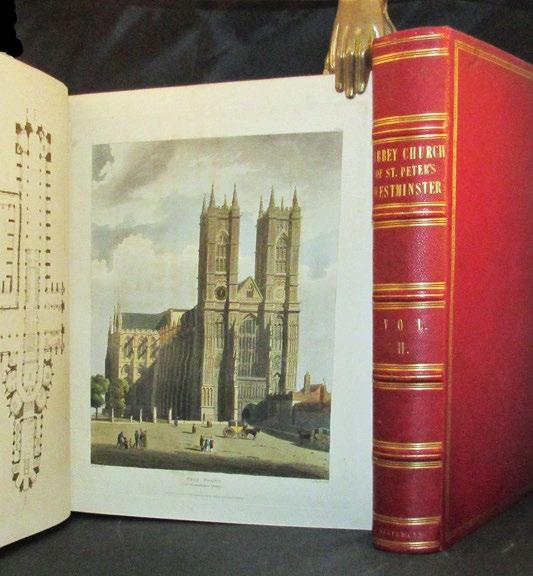
FIRST EDITION OF THIS TRULY GRAND WORK BRILLIANTLY BOUND AND A WONDERFUL SET WITH 81 HAND-COLOURED SCENES OF WESTMINSTER ABBEY, ONE OF THE GREAT ACKERMANN PLATE BOOKS. The fine subtly hued images include both interior and exterior views of the Abbey. They include not only the architectural features but also the stained glass windows, mosaic pavement, the chapels, monuments, effigies and transepts. The artist included F. Mackenzie, A. Pugin, J. Bluck, T. Uwins, G. Shepherd, J. Hamble, T. Sutherland and others.
The set is the very scarce first issue of the edition, with the first plate of volume two, “Aymer de Valance”, marked “F. Mackenzie delt.” as called for. The half-titles and subscriber’s list are retained within the fine red morocco bindings. This is one of Ackermann’s major colour plate books.
George Dunn was educated at Beaumont College, Windsor, and at Stonyhurst, and was afterwards called to the Bar... [He] inherited large estates both in Northumberland and Berkshire, together with sufficient revenues, and was able to indulge the tastes of a scholar and collector of early printed books, mediaeval bindings, manuscripts, old silver, and old clocks, as well as those of a sportsman and keen angler, an astronomer and a student of forestry. Of none of these things was he content to have a superficial knowledge. Indeed, it may be said that he handled nothing without mastering it completely ... “Mr. George Dunn,” The Times (11 March 1912), p. 11.
Sir Arthur John Dorman, 1st Baronet, KBE was an important British industrialist. In 1875, he went into partnership with Albert de Lande Long to acquire the West Marsh Ironworks in Middlesbrough. During the 1880s they mastered the new steelmaking technologies being introduced at that time including the use of Open hearth furnaces. Together they built a large industrial concern, Dorman Long, which by 1914 employed 20,000 people and during the World War I was a major supplier of shells. $5950.
(617) 536-4433