PAUL WRIGHT AS WE ARE
“Unhistoric Lives” Emily Dickinson
As We Are
PAUL WRIGHT
PAINTINGS BY PAUL WRIGHT.
TEXT BY JENI WEINBERGER.
They are an opinion, a perspective, and you may not agree, but hopefully they give some insight into the studio discussions and research during 2024 & 2025. All these inquiries are part of a larger exploration of humanism in our time.
THOMPSON’S GALLERY,
10 - 26 SEPTEMBER 2025
As We Are
In a world increasingly shaped by division, As We Are offers something quietly radical: a collective portrait of ordinary people trying, simply, to live. In this new body of work, Paul Wright turns his expressive eye toward the lives we often overlook; not in search of difference, but of common ground.
These paintings reflect over a year of concentrated studio inquiry, where Wright, a three-time finalist for the National Portrait Gallery Award, has pursued a question both intimate and expansive: what do we all want, need, and carry as human beings? The answers lie not in declarations of identity, but in gestures, glances, rooms, routines and in the unguarded humanity of people who might, in another moment, be us.
This is portraiture as empathy. With his signature oil-on-linen expressionism, Wright allows the paint to pulse and flare with presence. Faces emerge through instinctive strokes that seem at once immediate and timeless. Whether capturing a solitary figure in thought or a family gathered around a table, his portraits resist idealisation and instead honour the dignity of being seen, not staged or constructed, but As We Are.
The people in these works are not public figures or known personalities. They are parents, workers, elders, children just, ‘unhistoric lives’, to borrow George Eliot’s phrase, lived faithfully and without spectacle. They are drawn from across backgrounds, cultures, and generations, but what binds them is not difference. It is the shared effort of daily life; to care, to connect, to endure, to hope.
In recent years, much cultural energy has gone toward defining what separates us. We hope that this exhibition gently turns the lens in another direction. It does not deny our differences, our race, belief, wealth, geography, but insists that beneath those distinctions lies something deeper: the desire to love and be loved, to belong, to be recognised. In this, we are profoundly alike.
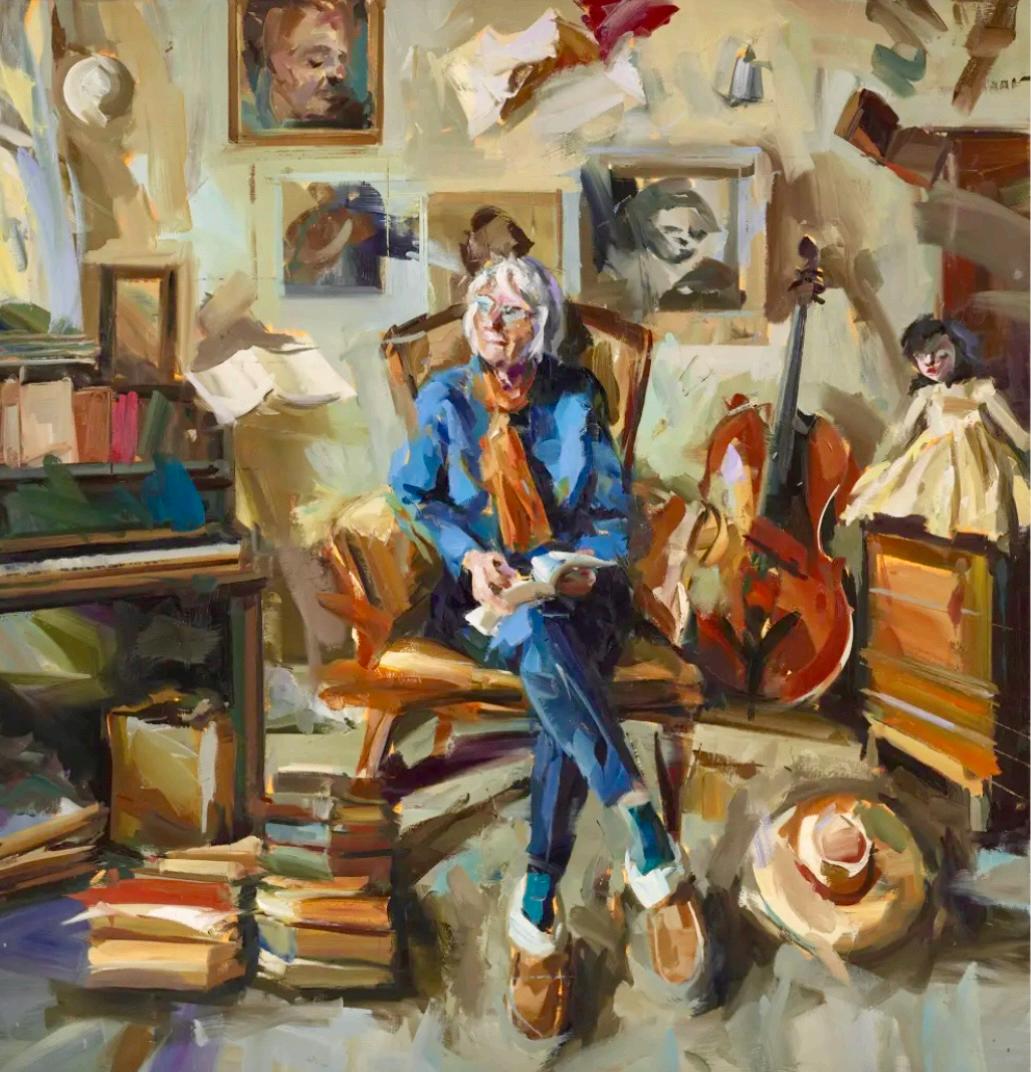
That Paul Wright's portrait of his mother is currently on view at the National Portrait Gallery is no small context for this show. Her presence; quiet, powerful, maternal forms an emotional backbone for the broader collection. As with the exhibition as a whole, it reminds us that the most extraordinary thing we can be is fully, honestly ourselves.
As We Are is presented by Thompson’s Gallery, London, from 10 to 26 September 2025, with work available for private viewing before the public opening. It is an invitation not just to look, but to recognise and to see one another clearly, without spectacle or judgement. And in that act, to rediscover what connects us.
Identity & Language
These two paintings speak to how we present ourselves to the world; one through restraint (reason), the other through voice and inherited language (patois). They open the show by inviting viewers to consider how we construct and express identity.
How do we speak ourselves into being? What do we keep, and what do we reveal?
A Man of Reason
There is a stillness in this figure that suggests not withdrawal, but composure, the kind that comes from having lived long enough to understand that not everything demands reaction. His gaze is level, unflinching.
The brushwork is confident but measured, and the palette; earthy, warm, quietly luminous, carries echoes of a spiritual tradition, perhaps evoking an Indian heritage, though it asserts no single identity.
He is a man who sees clearly, not with the urgency of youth, but with the patience of perspective. There’s a sense that he knows the darker side of life, has perhaps walked alongside it, but chooses not to dwell. His presence is neither aloof nor didactic. Rather, he seems to offer space for reflection, for calm, for dialogue without defensiveness. This is a portrait of wisdom, not showmanship. Of someone who embodies reason not as cold intellect, but as understanding. He feels worldly, but not world-weary. Grounded, but expansive. He does not force you to agree; he invites you to consider.
A Man of Reason
My Patois
This portrait speaks louder, not in volume, but in rhythm. The title alone places us in a field of cultural tension and vitality. Patois is not just a dialect; it is a claim. Once marginalised, once coded, now absorbed and reabsorbed into the mainstream. What began in Caribbean homes and music halls now lives in urban youth culture, in grime lyrics, in playground slang, in WhatsApp voice notes. Sometimes beautiful. Sometimes threatening. Always alive.
Here, though, we are met by an elderly man. His expression is gentle. Unbothered. Reclaiming. This is not a portrait of power in the conventional sense. It is a quiet act of cultural stewardship. He is not performing youth, nor nostalgia. He is holding his language with its cadences, its code-switches, its complexities as something worth protecting.
The colours are bold, but not chaotic. Wright’s palette honours vibrancy without parody. We are not asked to decode this man’s politics. We are simply asked to see him as someone who holds within him the histories of migration, adaptation, and expression that shape modern Britain.
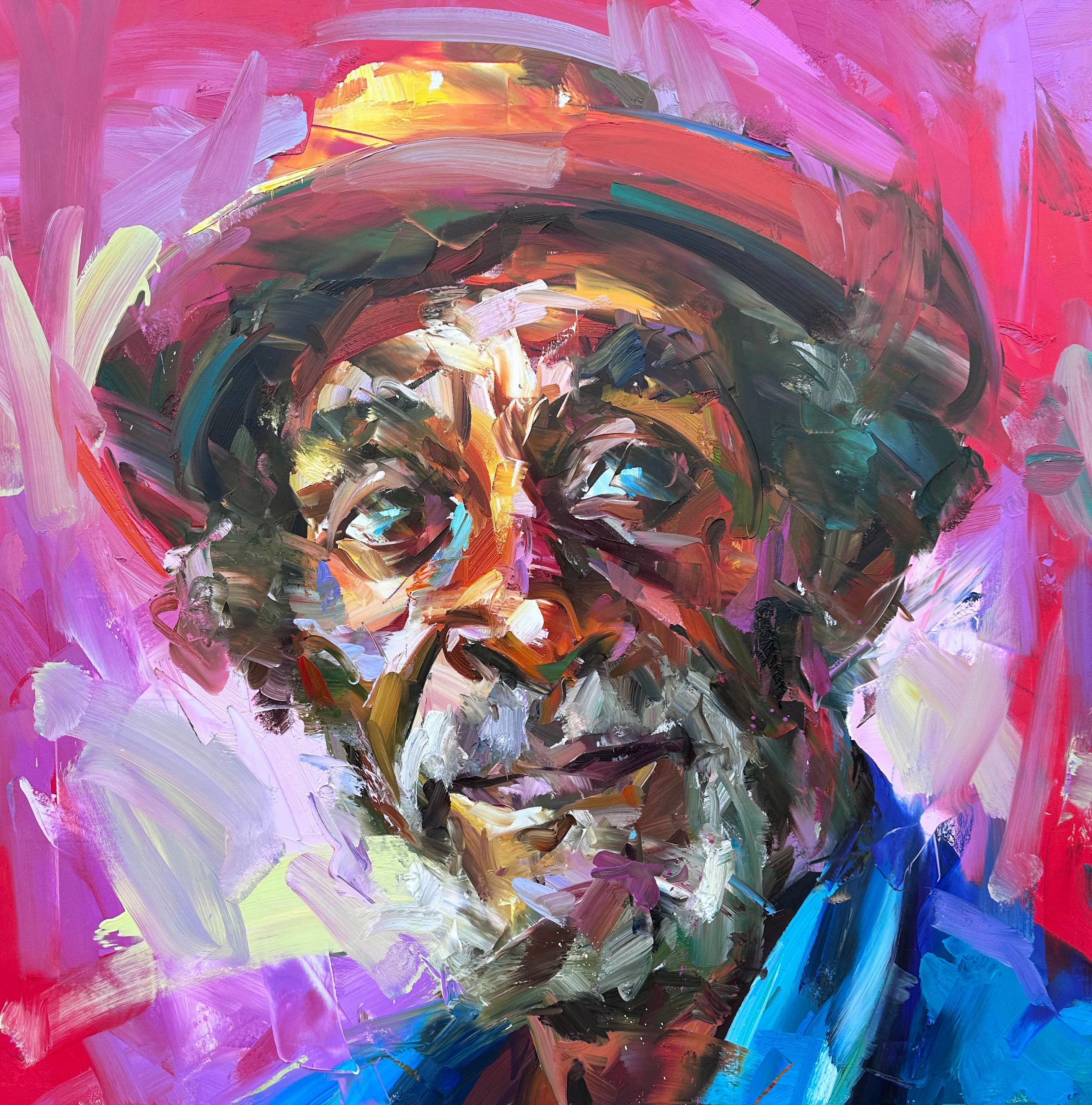
My Patois oil on linen 100cm x 100cm 2025
Together,
A Man of Reason and My Patois form a kind of philosophical diptych - one contemplative, one kinetic. They are exploring Language and Identity.
One man is expansive in worldview, the other grounded in the body and the beat of daily life. Neither shouts. Both hold their ground. They remind us that identity isn’t something we inherit or perform, it’s something we shape, refine, and carry forward.
These selections were conscious, almost meditative. Drawn to their contrast in energy and similarity in depth. One exudes contemplative insight; the other holds cultural rhythm in his bones. Both are elders. Both are dignified. And both speak to the lived history behind the faces we pass every day.
These are not portraits of other people. They are reflections of ourselves.
Bonds & Boundaries
Friends, In Secret, Incognito
Friends
A painting full of light, colour, and closeness. But look longer: there is no obvious narrative. Just presence. These people might be friends, or strangers sharing a moment. Each face holds its own interior world, yet there is harmony in their arrangement. It’s a portrait of companionship without performance, the kind we recognise from trains, cafes, waiting rooms. Lives brushing gently against one another.
There is a quiet kind of friendship here, not necessarily forged through shared history or spoken allegiance, but through a subtle attunement. The way bodies lean, the space held between them, the absence of drama. As Elena Ferrante wrote,
"Only in friendship do I know how to feel that I am not alone."
That sort of friendship; ambient and barely declared carries its own depth. It doesn’t demand attention. It exists, as this painting does, in the delicate poise between individuals who, whether for a moment or a lifetime, belong beside one another.
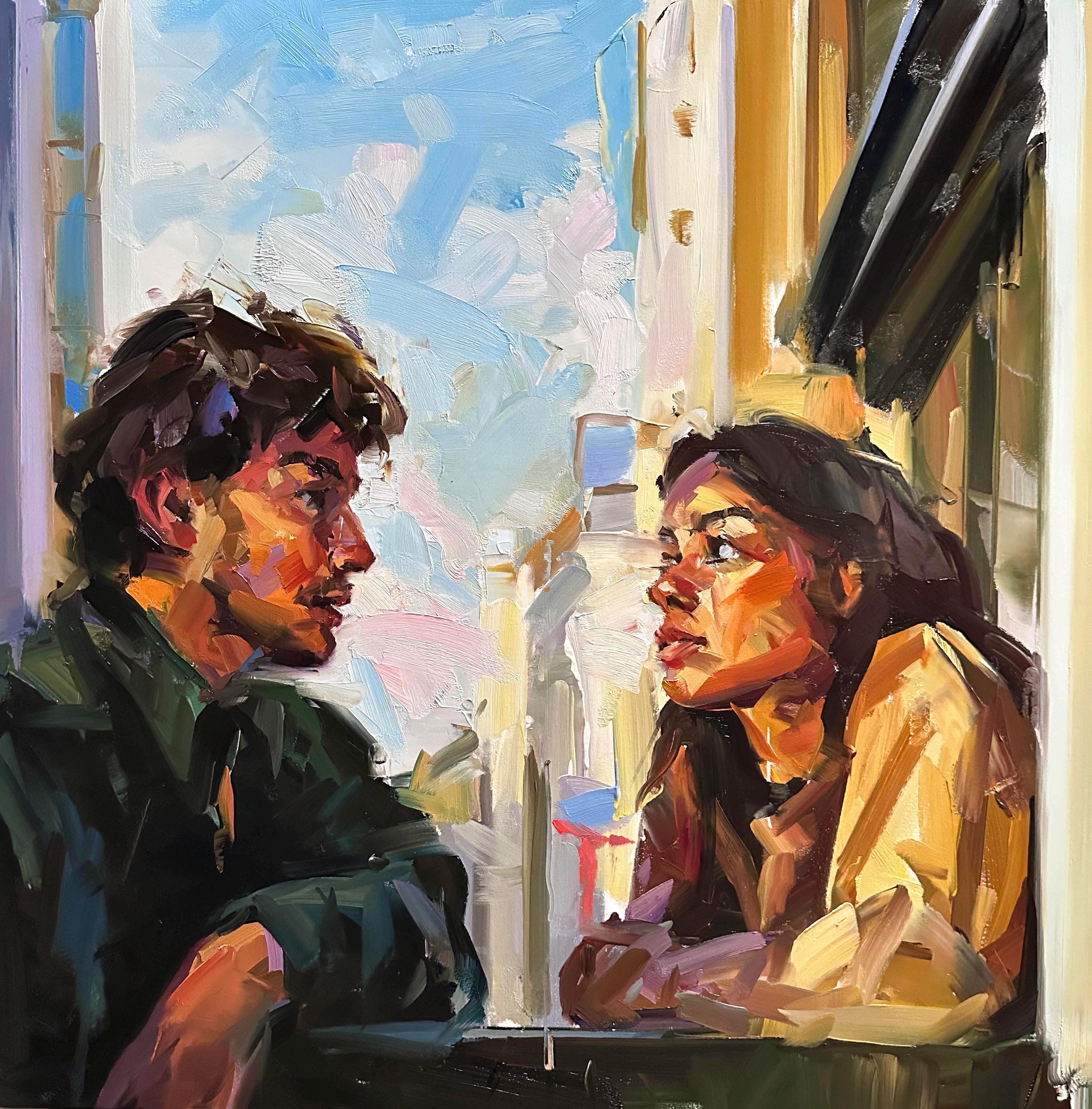
Friends oil on linen 90cm x 90cm 2025
In Secret
We all carry things we do not share. This painting feels like a whisper kept in. The downward glance, the slightest reach of his arm. The painting has a dynamic vibrancy in all but the boy. Was this deliberate? Does this unconsciously draw us towards him? It is only his face that is slightly visible, are we seeing what he feels? Does this indicate something deeper from the artist or purely a construct? And does it matter? The result is all suggestive of something withheld, protected. This is not about shame or isolation. It is about the interior spaces we all need. Where we rehearse, reflect, or simply rest.
There is a quiet dignity in reticence, the kind Virginia Woolf alluded to when she wrote of,
"the little daily miracles, illuminations, matches struck unexpectedly in the dark."
These figures seems to inhabit such a space: lit from within, but unlit to others. The painting does not intrude, nor does it decode. It respects the mystery. In a world that so often demands visibility, In Secret gives value to the unseen, to the sacredness of one’s inner life, held gently out of reach.
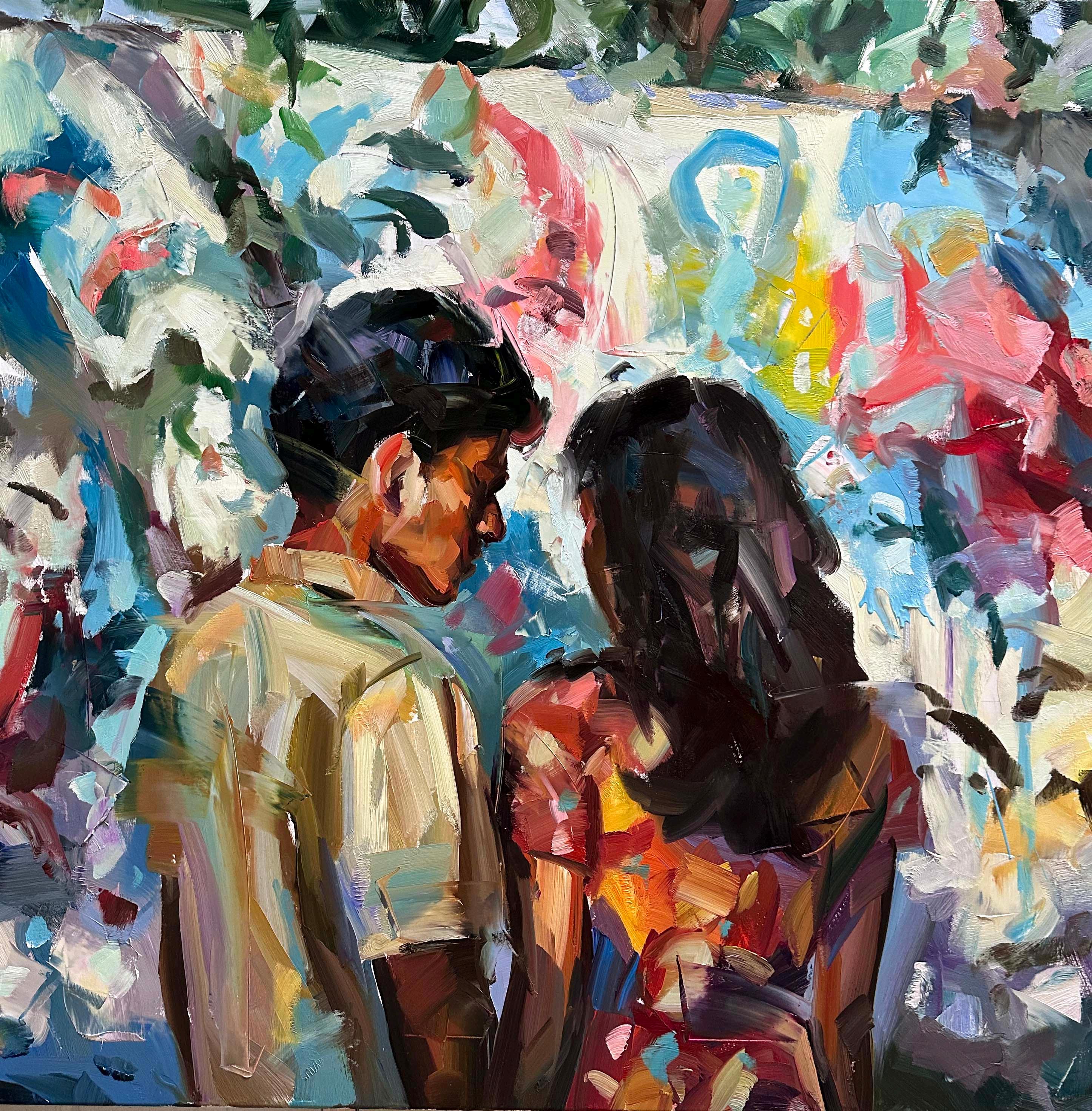
In Secret
oil on linen 90cm x 90cm 2025
Incognito
At first glance, this figure appears open, her eyes meeting ours, posture steady, but the title unsettles that first impression. Incognito implies a veil, a chosen ambiguity. There’s confidence in her gaze, but it’s not an invitation. It holds us, not out of reach, but not entirely in, either.
The brushwork mirrors this tension: vivid around the features, then loosening into abstraction at the edges, where the figure almost dissolves back into the linen. It's a visual rhythm: revelation and retreat. Like someone speaking with candour, yet still keeping something for themselves.
This isn’t about deception. It’s about agency. About what it means to be seen on one’s own terms. It reminds me something Zadie Smith once wrote, and I paraphrase because it is from memory, “people aren’t blank pages but they’re palimpsests, always hiding stories underneath.”
Incognito honours that. The right to choose what’s shown, and what remains quietly, purposefully obscured.
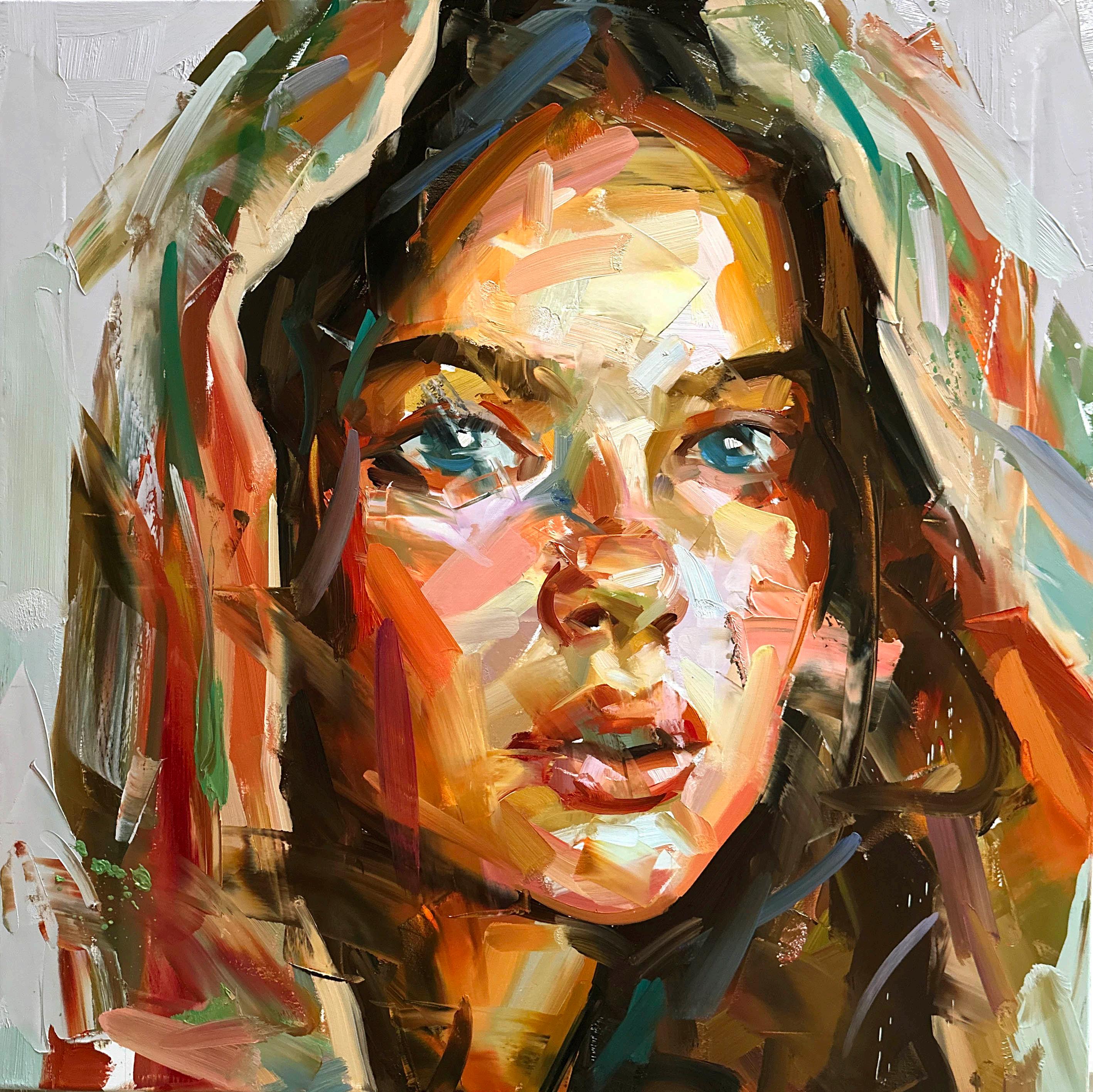
Incognito oil on linen 90cm x 90cm 2025
Sitting Beside, Not Solving - our studio discussions
In Friends, In Secret, and Incognito, we encounter not declarations, but quiet presences. These figures do not ask to be solved. They offer something more subtle — the feeling of sitting near someone without needing to intrude. Each portrait invites us to dwell in uncertainty, to recognise the emotional landscapes that unfold not through explanation, but through stillness, posture, and pause.
To sit alongside another person without needing to decode, fix, or dominate them is a deeply human gesture and a rare one in our age of hyper-exposure and instant judgment. Art can model this way of being. Technology, at its best, can scaffold it.
The challenge is to reorient both away from extraction and performance and toward presence and resonance. Instead of making tools that reveal, we must design experiences that attune. Instead of building platforms that reward outrage, we can create spaces that reward reflection. Instead of seeking mastery over complexity, we need interfaces, be it visual, digital or social, that allow us to dwell within it, together.
Art already does this. It leaves room for ambiguity, for contradiction, for emotion without outcome. The task is to ensure technology becomes an ally in this not a coloniser of human subtlety, but a steward of it.
To prevent conflict, dehumanisation, and division at scale, we can practice and teach the habit of sitting alongside. That begins not with surveillance or slogans, but with design: of culture, of systems, of spaces. And perhaps, first, with the simple act of looking at a painting, and choosing to stay.
The Listener
Some figures command attention. This one offers it. I chose to place it here because it feels as if it is a natural evolution from the previous 3.
He is still. There is nothing passive in this stillness. The Listener holds space not by speaking, but by remaining present. They are the one who stays after the others have gone, who hears the story out, who doesn’t interrupt. And in that quietness, something powerful happens: they become the centre, without ever asking to be.
This portrait marks a shift in the exhibition’s rhythm. Where earlier works explore selfhood: how we hold identity, protect it, perform or retreat from it, The Listener turns outward. They are not asking to be seen; they are seeing. Their presence is a gesture of care.
The composition reflects this balance. There’s a groundedness to his posture, it is upright, steady, engaged. A gentleness in the brushwork that softens around the eyes and mouth. The colours are complementary, active but still, neither loud nor subdued.
We don’t know what he is listening to. But perhaps that’s the point. The act of listening, really listening, doesn’t demand context. It demands attention. It asks nothing but offers everything.
“To listen is to lean in, softly, with a willingness to be changed by what we hear.” Mark Nepo
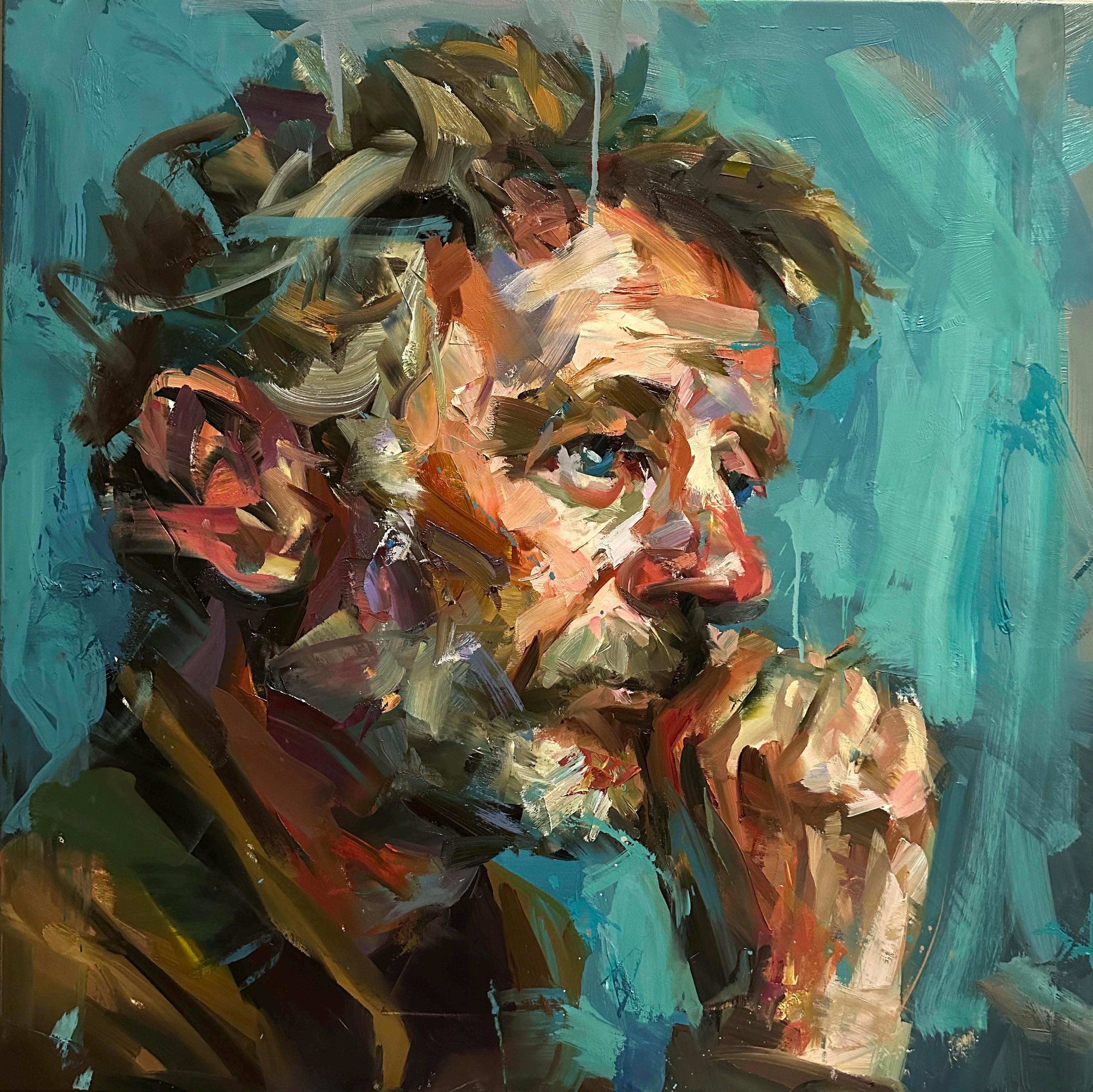
The Listener oil on linen 80cm x 80cm 2025
Before the Beginning Ends
Two figures stand behind parted curtains, half-seen, half-sheltered, as if looking out at something they have not yet fully named. The fabric around them is floral, familiar, almost theatrical. It evokes bedrooms, dressing rooms, safe places. But now, drawn aside, it marks a threshold: between the known and the unknown, safety and exposure, childhood and whatever comes next.
This painting holds the charged stillness of a moment before change. It speaks to that subtle line in life, sometimes in youth, sometimes much later, where the self begins to emerge from a sheltered space, blinking into a world that can be both dazzling and unkind. How can we prepare the young for that crossing? Not only with courage, but with care. Not only by pushing them forward, but by letting them linger when they need to.
And perhaps the deeper truth is that these moments do not end in childhood. There are times in adulthood, too: in grief, in love, in change, when we return to the threshold, unsure. Still behind the curtain. Still watching. Still hoping the world will meet us gently.
This is not a portrait of innocence. It’s a portrait of the moment just after, when everything begins to mean more than it did a moment before.
“And the day came when the risk to remain tight in a bud was more painful than the risk it took to blossom.”Anaïs Nin
Paul is now beginning to look outward in his reflections. It is a sharp reminder how our actions have consequences for the generations to come.
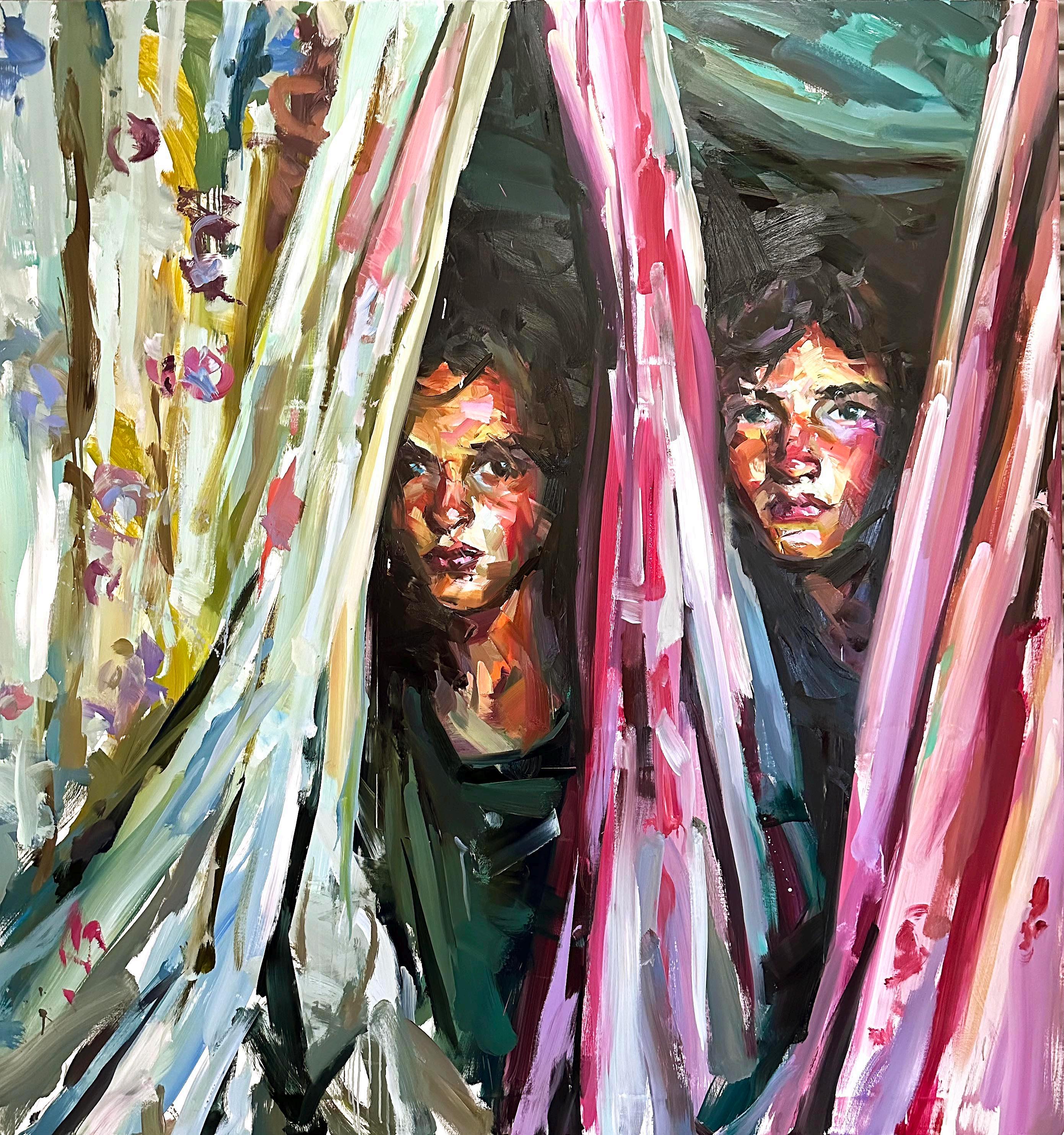
Before The Beginning Ends
oil on linen 150cm x 130cm 2025
End of Service
Two chefs stand together, their bodies quietly entwined. It is a moment of intimacy, but not of spectacle. Their faces are turned away, as if the viewer has arrived mid-scene uninvited, but not entirely unwelcome. The kitchen glows around them: teal shadows and golden heat, pans suspended like instruments at rest. The rush of the evening service has passed. What remains is quiet, private, shared.
There’s a subtle tension in the scene. Are they hiding? Or simply pausing? Is this their restaurant, or are they stealing a moment after working in roles that don’t allow for this closeness? The ambiguity is part of the painting’s strength; the suggestion that tenderness, though present, may still be precarious.
Restaurants are famously intimate ecosystems. People meet in the heat of service, fall in love among the clang of pans and the repetition of prep. But they are also workplaces. Places of gossip, hierarchy, heated passion and risk. Paul Wright captures that duality, not by illustrating drama, but by holding a scene in suspension. The figures are painted with muscular tenderness: broad strokes, dense light, skin rendered in fragments of colour that flicker with motion and restraint. Around them, the space blurs and cools. The kitchen becomes both container and witness.
The palette is beautifully economical with cool tones wrapped around a furnace of orange and copper, like embers still glowing after the fire. The brushwork is deliberate but alive, full of energy just spent. The composition draws the eye to the embrace, but not in a voyeuristic way. We see them as one might glimpse someone through a closing door: aware of their privacy, grateful for their presence.
In a world quick to comment and quicker to judge, End of Service reminds us how vital it is to protect small, honest connections in the quiet moments. Not everything has to be known to be real.
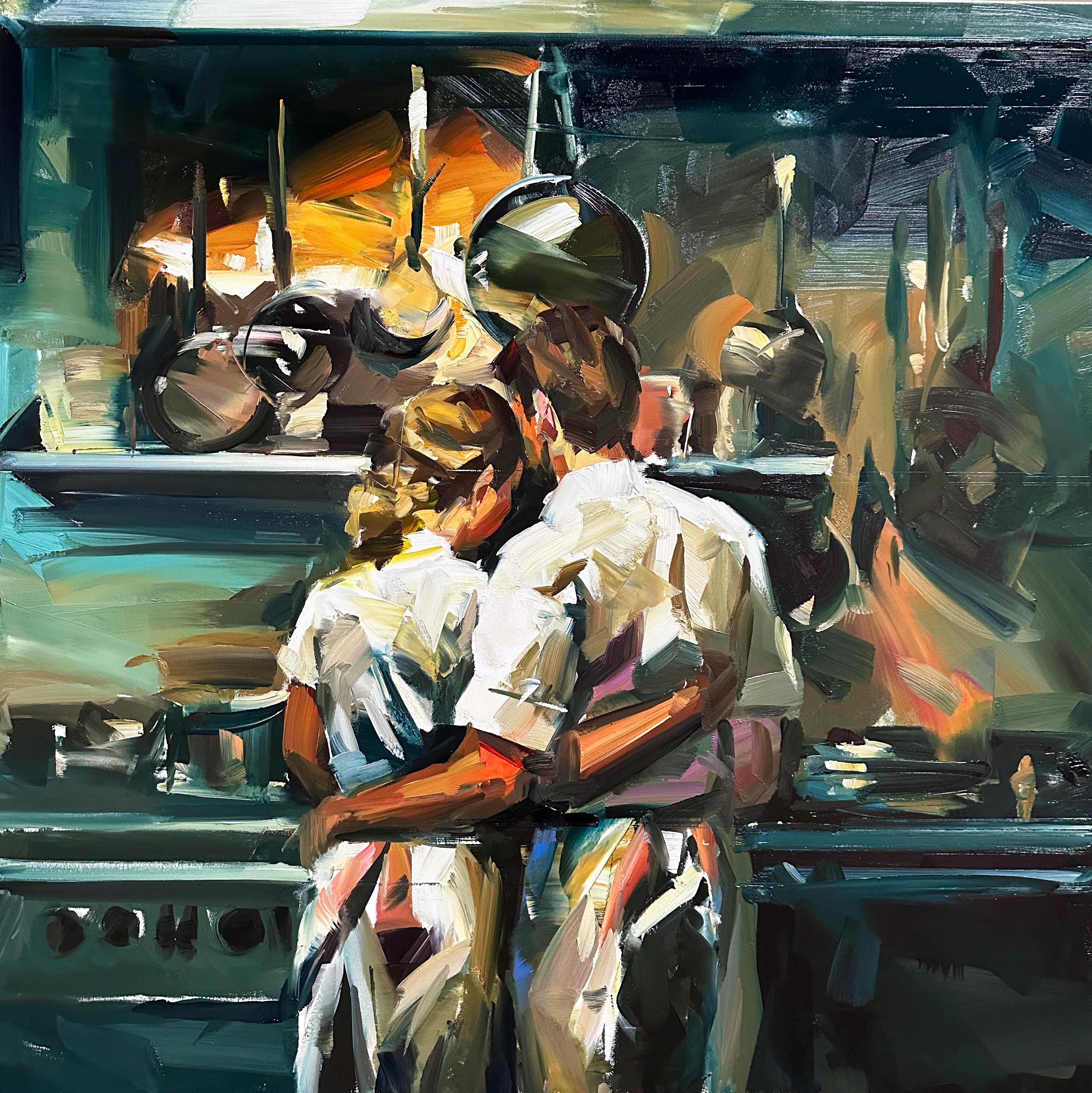
End of Service
oil on linen 90cm x 90cm 2025
The Last Tide
Following Before the Beginning Ends and End of Service, The Last Tide completes a quiet arc. From early watchfulness, to the heat of daily work, to a moment on the edge of letting go. These are not grand milestones. They are human thresholds. The kind that pass with little announcement, but mark us nonetheless.
Here, a man stands by his boat, his tools at rest, his gaze elsewhere. Is this the end of a shift? A career? Or something larger still? The painting holds that uncertainty gently. Is he stepping away by choice, into earned rest or because there is nothing left to fish, no one left to take over, no room left for him in a world reshaped by scale, speed, and systems?
The composition is steady, reflective. Paul's brushwork has quietened here, less urgency, more air. The strokes are broad, almost sea-washed. Only the man’s jacket flares warm against the cooler tones of boat and sky. It’s not a portrait of despair. But it is a portrait of a man who knows what it is to be useful and knows what it feels like when usefulness becomes uncertain.
There is an added layer now, with AI and automation stirring similar fears across so many sectors. We are all beginning to ask: What happens when the work stops needing us? Who are we then?
The painting doesn’t answer. But it gives space for the question. It recalls the lines of an old sea shanty from whom my memory fails to recollect:
Now the tide is turning, The lines are laid, the nets drawn in, And we are not what we were before, Nor shall be so again.
The tide recedes. What remains is still a man, still standing.
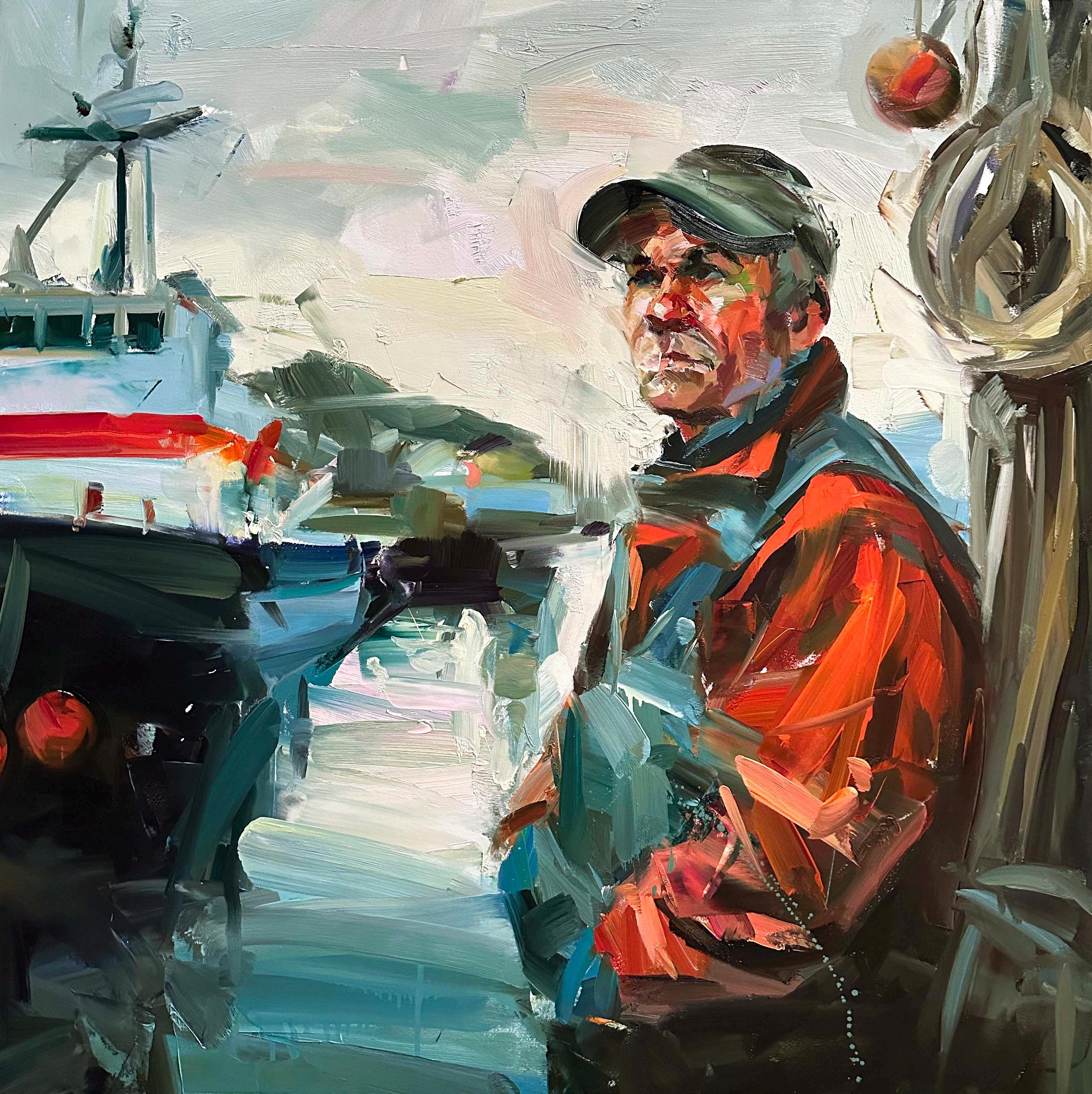
The Last Tide oil on linen 90cm x 90cm 2025
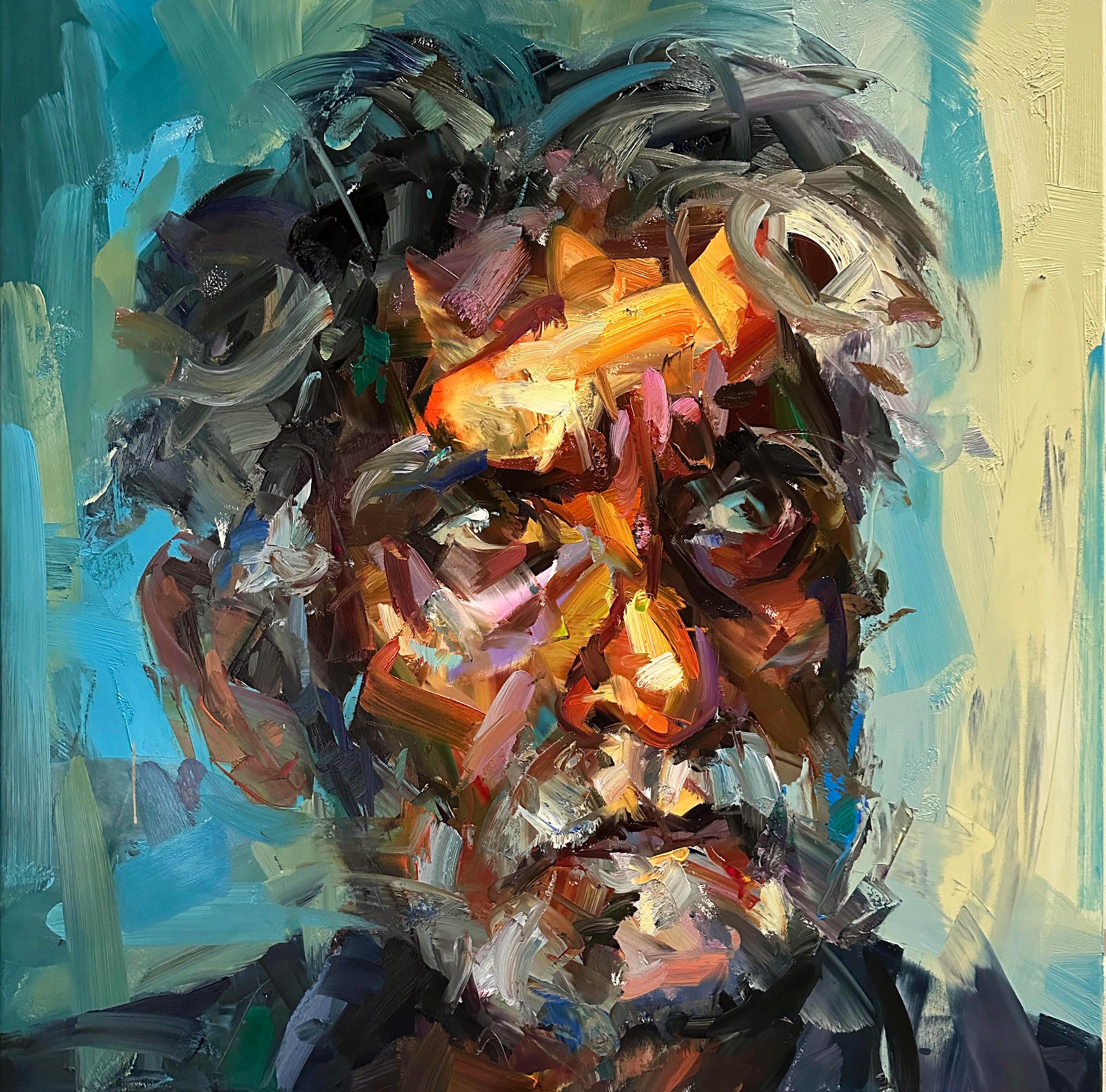
Man of Mystery
There’s no shyness here. The face meets us head-on; full-frontal, unapologetic. It’s a kind of portrait you rarely see beyond youth: bold without explanation, watchful yet self-possessed. The eyes don’t give much away, but they don’t look away either. There’s power in that.
This is a painting about surface, not superficiality, but surface as tension, as theatre. What you see is vivid, immediate: blocks of orange, teal, crimson, and gold slicing across bone and muscle. Paul’s brushwork is muscular but swift, almost improvisational. The background thrums with movement, but the head stays steady, like a photograph resisting blur. You feel the energy of someone still forming, not because he lacks clarity, but because he is choosing what to withhold.
There’s swagger here, yes. But it’s not arrogance. It’s the confidence of someone still close to the rawness of becoming: a man testing how he might be seen, without quite showing his hand. A portrait not of ego, but of potential.
This man doesn’t hide, but nor does he offer certainty. The mystery isn’t what he’s thinking. It’s what he knows and isn’t yet telling.
This isn’t a portrait you solve. It’s one you live with. It changes, depending on where you’re standing or what kind of day you’ve had. Some works speak for their sitter. This one allows the sitter to speak when they choose, and what they say may just depend on you. And that makes it unforgettable.
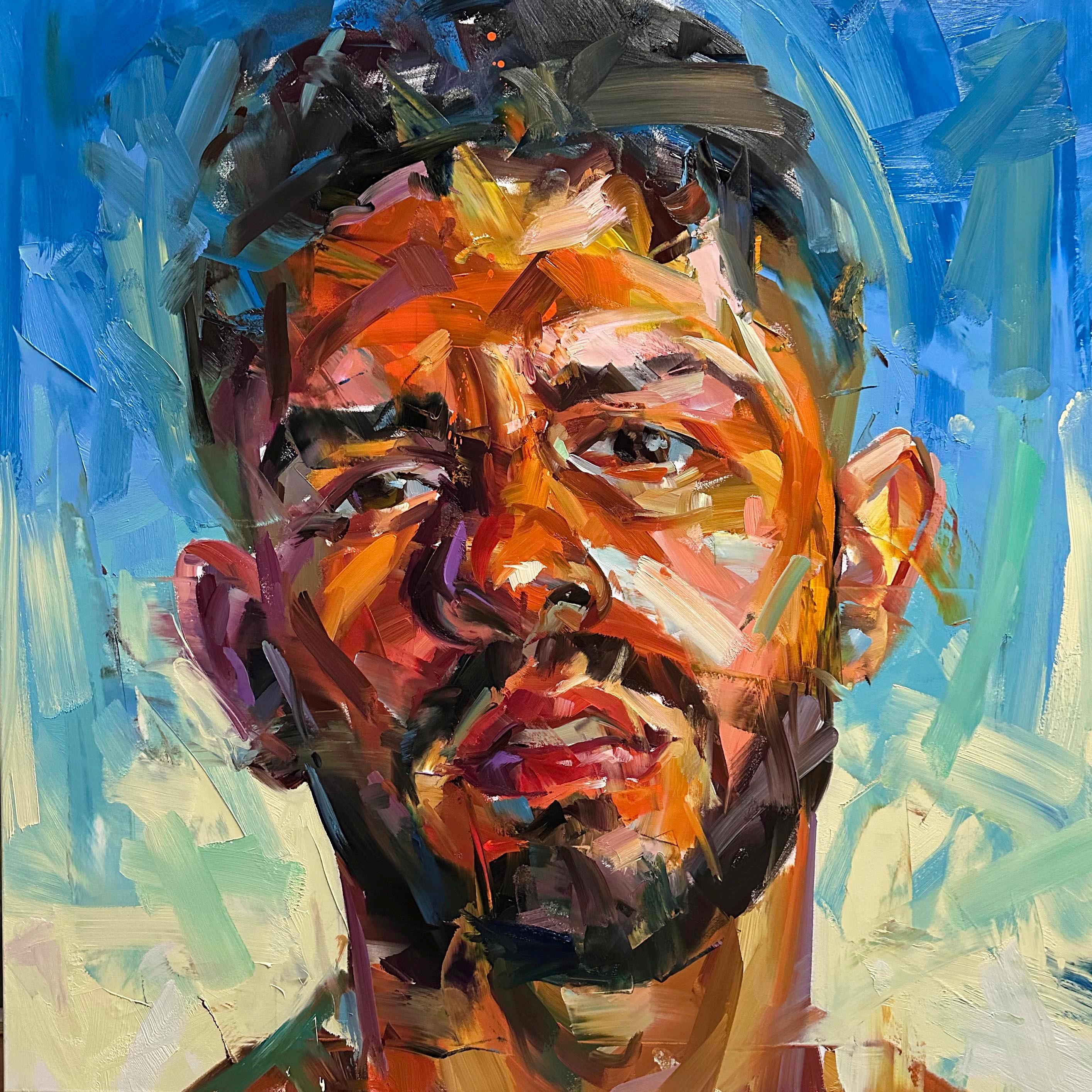
Man of Mystery
oil on linen 110cm x 110cm
The Poet
The gaze is steady, but it’s not trying to impress. This face doesn’t confront, it absorbs. The eyes feel alert, but inward-looking. It’s a portrait of someone who has witnessed, considered, distilled.
Compared to the saturated confidence of Man of Mystery, The Poet carries a different kind of intensity. Still youthful, still burning with colour but less in performance than in perception. The brushstrokes swirl with warmth: cadmium reds and saffron yellows layered into sea-blues and violets. There’s a rhythm to them, almost like phrasing as if the painting were spoken, not painted.
This isn’t about writing poems. It’s about seeing like a poet: noticing the flicker behind the face, the world inside the world. The direct gaze feels less about being watched than about being understood, and understanding in return. The background is alive, but ungraspable. Like a thought forming. Or a truth just beyond words.
“A poet is, before anything else, a person who is passionately in love with language.”W.H. Auden. But Paul Wright paints the language before it becomes words. The Poet is the moment thought becomes colour, and feeling becomes form.
Both portraits are, in a sense, studies in sovereignty. They offer nothing on demand. But they transform the space around them. And in doing so, they reward the viewer, not with clarity, but with depth.
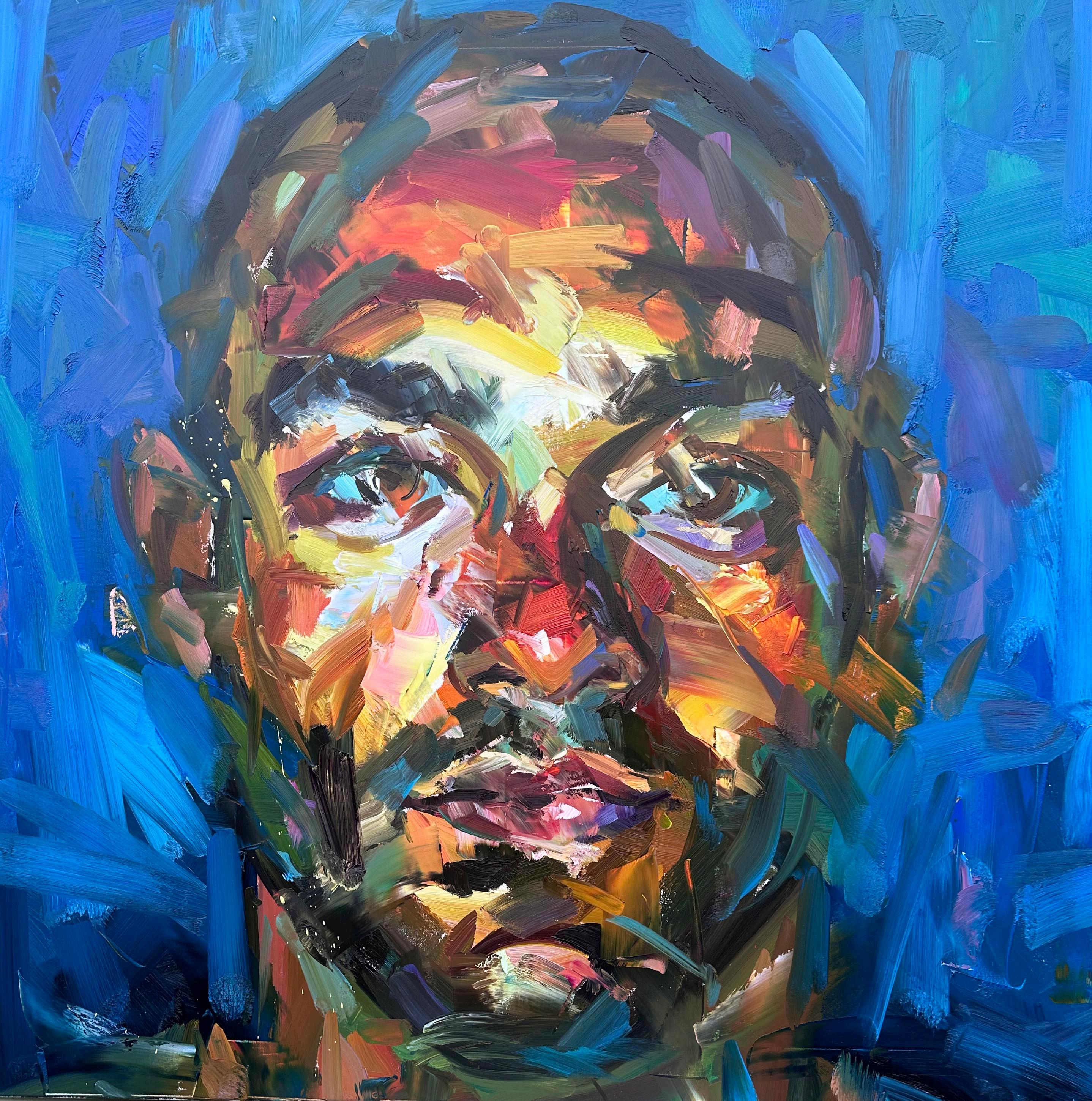
The Poet oil on linen 110cm x 110cm 2025
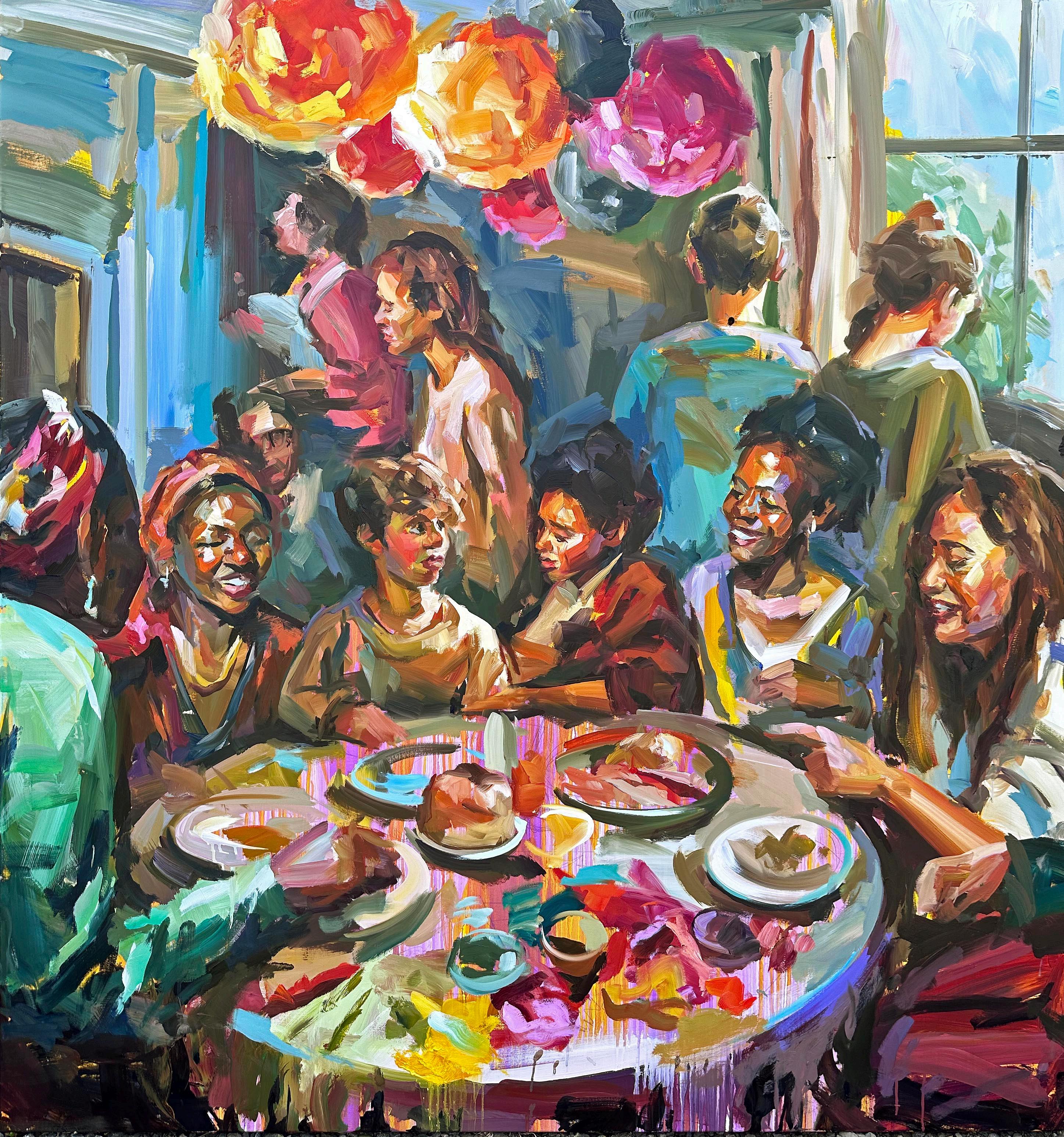
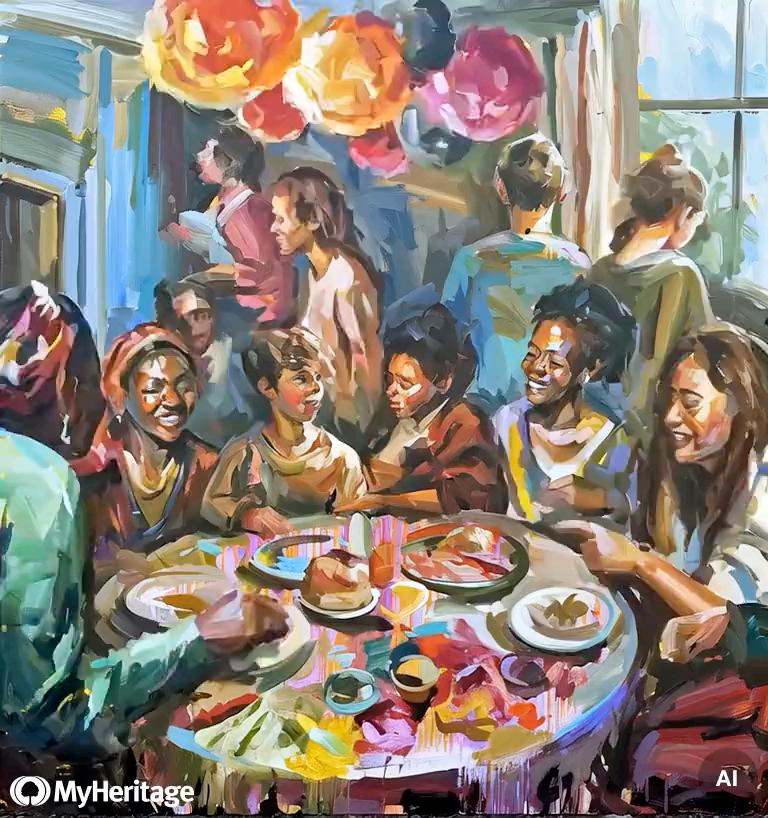
There’s a boy at the table who says, ‘I don’t get it.’ No one turns to explain. No one turns away. The conversation continues, full of light, noise, and half-heard jokes. He stays. He is part of it, not despite his confusion, but with it.
This painting might be the quiet heart of the exhibition. Across these works, whether in the still tension of Before the Beginning Ends, the dignity of The Last Tide, or the ambiguity of Incognito, the thread that binds them is not certainty, but grace. The ability to sit beside someone, not to decode them or demand clarity, but simply to remain close, to accept what is seen and not assumed, presumed. To leave bias and to see how we are similar, not focus on the differences.
That ethos shapes not only Paul Wright’s approach to portraiture, but also our studio’s broader inquiry, especially as we begin to work with technology. The question isn’t how we can make machines more like humans, or even how humans can better use machines. It’s more intimate than that. It’s about attention. About how we model care, not through control or comprehension, but through how we choose to look and how long we stay.
Paul’s brushwork is, in many ways, a metaphor for this. His paintings never overstate. The strokes are fast, but observant. They carry emotional truth without fixing identity. In I Don’t Get It, the drips and daubs of pigment around the table are joyful, even chaotic, but always tender. No figure dominates. Every individual is allowed their own light. The palette, too, speaks volumes. There’s the electric optimism of pinks and yellows; the grounding warmth of ochre and red; the scattering of unexpected greens, like glimpses of the outside world. Everything feels alive, not perfectly resolved, but richly lived.
As a studio working at the edge of art and technology, we return to this idea: that clarity is not the same as connection. We are not seeking to solve the human condition, or even simulate it. We are trying to honour it with all its mess, doubt, pauses, and pluralities. To build tools, and experiences, that allow people to see one another with softness, not speed. To choose kindness by default.
That’s what I Don’t Get It offers. Not a moral, not a manifesto — just a moment. A boy. A table. A community that continues, with him. If we can carry that principle into AI, into art, into healthcare and political structures, a reflection of how we could live with one another, then maybe we’re doing something worthwhile.
From The Studio
Jeni Weinberger
On the Quiet Power of Seeing One Another
A woman towards us, her eyes soft with thought. Two children peer through a curtain, not yet sure whether to enter the room or stay safely hidden in its folds. A fisherman in his waterproofs stands leaning against a wooden shed, his stance casual, his expression tired but proud. A table overflows with faces. They are talking, listening, reaching, eating, laughing. Each one etched with the push and pull of ordinary time.
These are not grand portraits. There is no overt symbolism, no demand for spectacle. And yet, in their stillness, they carry weight. They ask us to consider what John Berger called “the moment of seeing”, that fleeting, generous act in which one human truly recognises another. It’s a small moment, but a deeply human one. And perhaps, right now, a radical one.
This solo exhibition by Paul Wright emerges from a year of close collaboration in the studio: in painting, writing, research, and reflection. Together, we’ve been asking difficult questions: not just about how portraiture looks, but about what it’s for. Can it still speak into the world with relevance? Can it hold space for truth, for connection, for shared meaning without sliding into sentiment or cliché?
In recent years, portraiture has risked becoming a mirror of performance, either photorealistic to the point of detachment, or wholly focused on identity as a visual label. Meanwhile, much of the cultural conversation has become dominated by what separates us. The result is often a kind of fragmentation where individual identifiers are highlighted at the expense of shared humanity. And while it is vital to honour difference, we believe it is equally vital to rediscover, recognise and remember what connects us and why that is so important.
The figures in As We Are are not portraits of named individuals. They are composites formed from observation, emotion, conversations and memory. They emerge from lived experience but are not literal representations. Each sitter is a vessel, holding something of the universal. They are not models of diversity; they are portraits of similarity, of the invisible threads that run through daily life, across age, race, class, and context. They are what we see when we choose to look with attention, not assumption or bias.
The paintings also function as a kind of argument , a visual response to what we see as the narrowing of cultural space. We believe the arts must do more than entertain or adorn. At their best, they offer a way to see the world, and ourselves, more clearly. They open emotional ground. They give form to questions language cannot hold. And they carry, often quietly, the potential to repair.
Our studio’s wider work is not only artistic, but structural. Alongside these canvases, we are exploring how to use emerging technologies to extend portraiture’s reach, to build immersive, empathetic experiences that honour everyday lives at scale. This exhibition is one facet of that research: a still point in a wider movement to give voice, dignity, and presence to those so often unseen.
In this way, As We Are is more than a collection of paintings. It’s a philosophy, a conversation, a challenge. A refusal to let human lives - humble, complex, vital and fragile, be flattened into data, dismissed as background, or reduced to category and identifiers. These works hold space for nuance, ambiguity, and care.
As George Eliot wrote, “the growing good of the world is partly dependent on unhistoric acts… the number who lived faithfully a hidden life.” These are those lives. And in choosing to see them, really see them, we are reminded of our shared capacity to care, to connect, and to make meaning. Not despite our ordinariness, but because of it.
‘SMALLER
WORLD’
A PORTRAIT OF THE ARTIST’S MOTHER
ON VIEW AT THE NATIONAL PORTRAIT GALLERY, LONDON UNTIL 8TH OCTOBER 2025. IT WILL THEN BE PART OF THE NPG TOURING EXHIBITION.
THE STUDIES
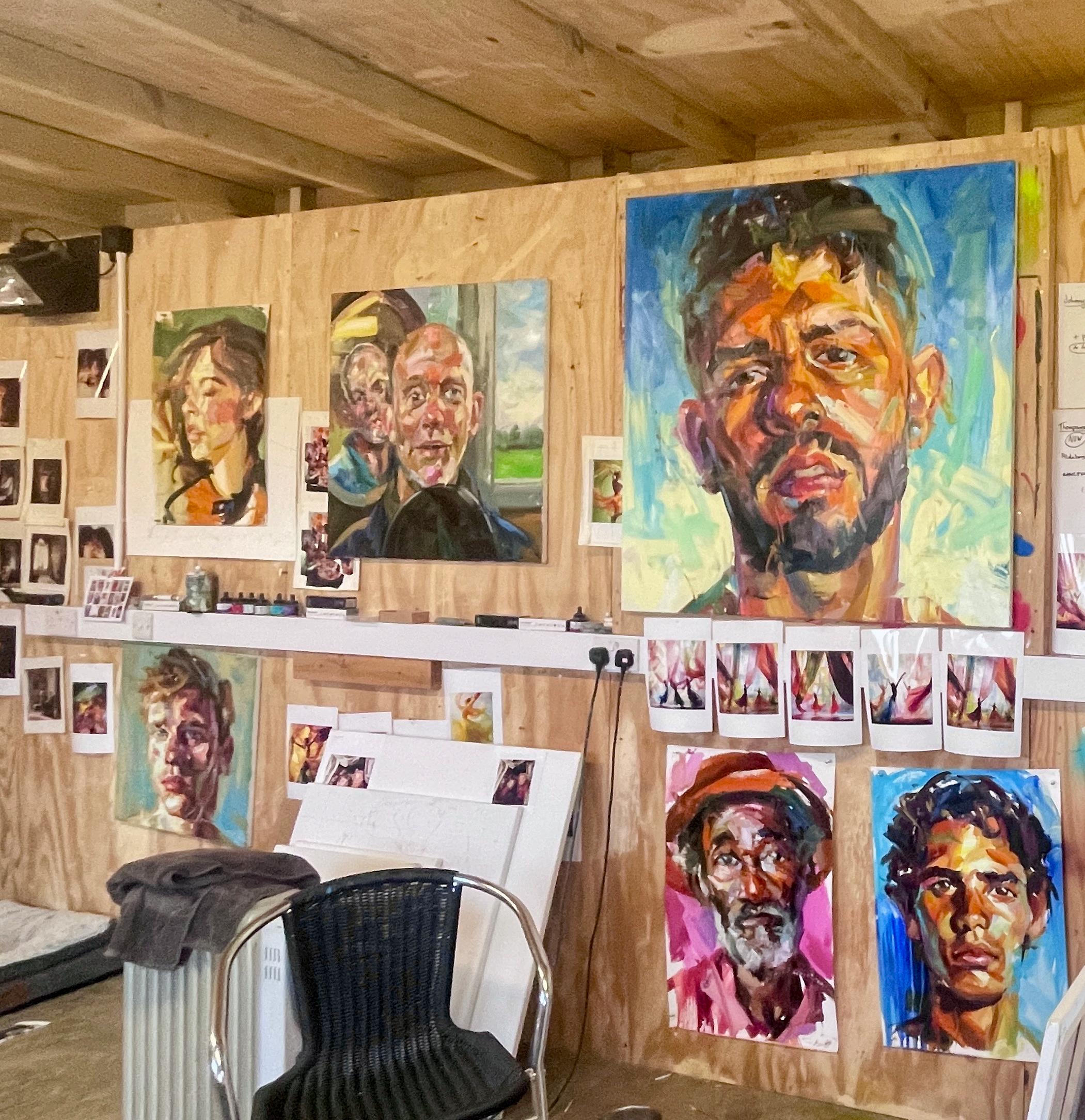
Studies in Observation
Preparatory Works in Oil on Paper
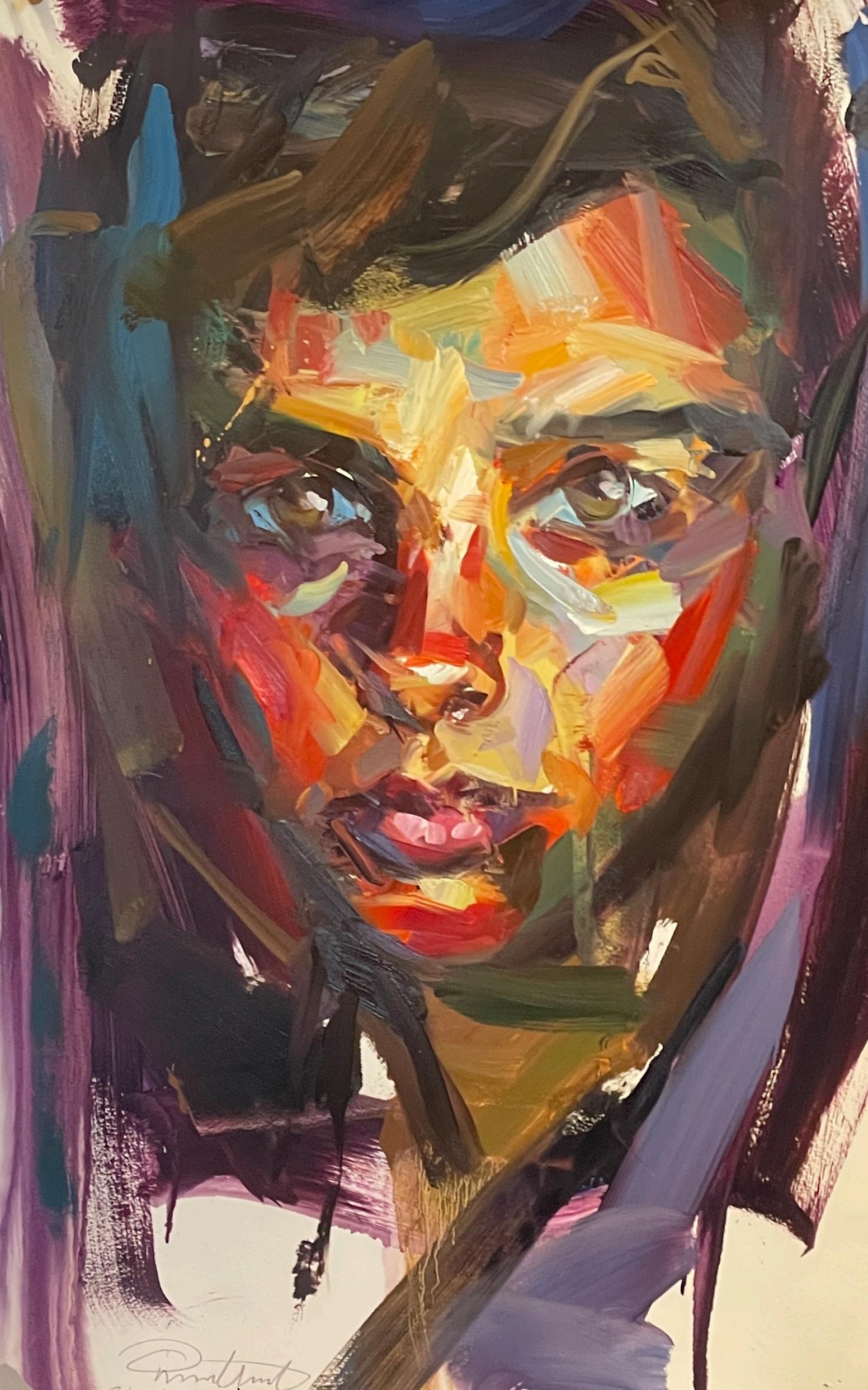
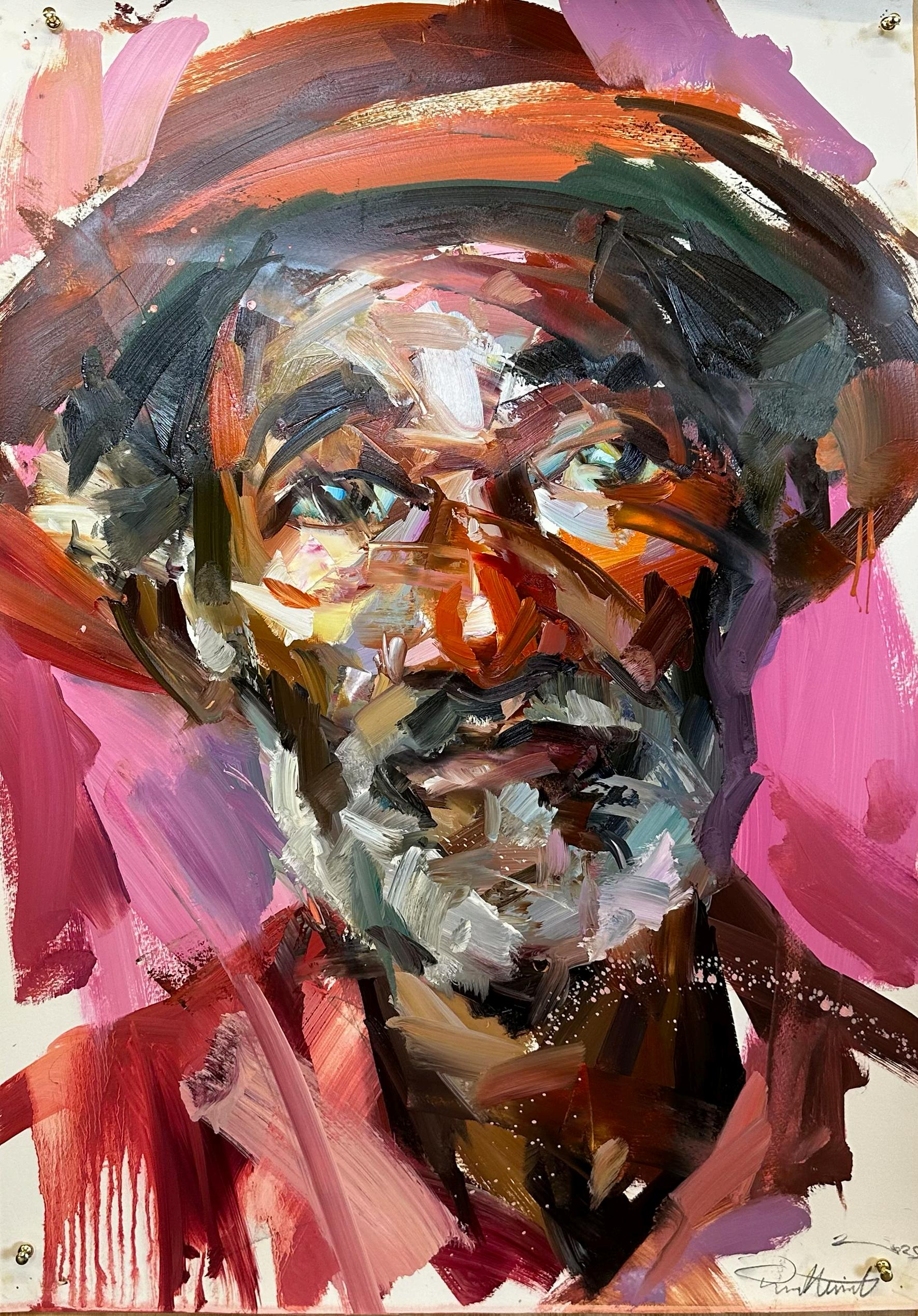
These smaller portraits, executed in oil on paper, offer a glimpse into the artist’s process, not as rough sketches, but as focused rehearsals in seeing. In them, Paul Wright pares down his brushwork to its most immediate, instinctive gestures. The urgency of these studies lies not in polish but in presence: a head tilted, a gaze held, a flicker of mood caught before it disappears.
Preparatory work is where the painter listens first to their observation, the pose, the emerging composition, the idea, their thoughts. These works are about learning what the painting needs to become. They are not drafts to be discarded, but moments of clarity: a conversation between hand and eye, intention and instinct. In their looseness lies their power.
Here, the studies stand as quiet portraits in their own right. Each one holds the trace of looking; a record of attention, curiosity, and the slow work of understanding another person.
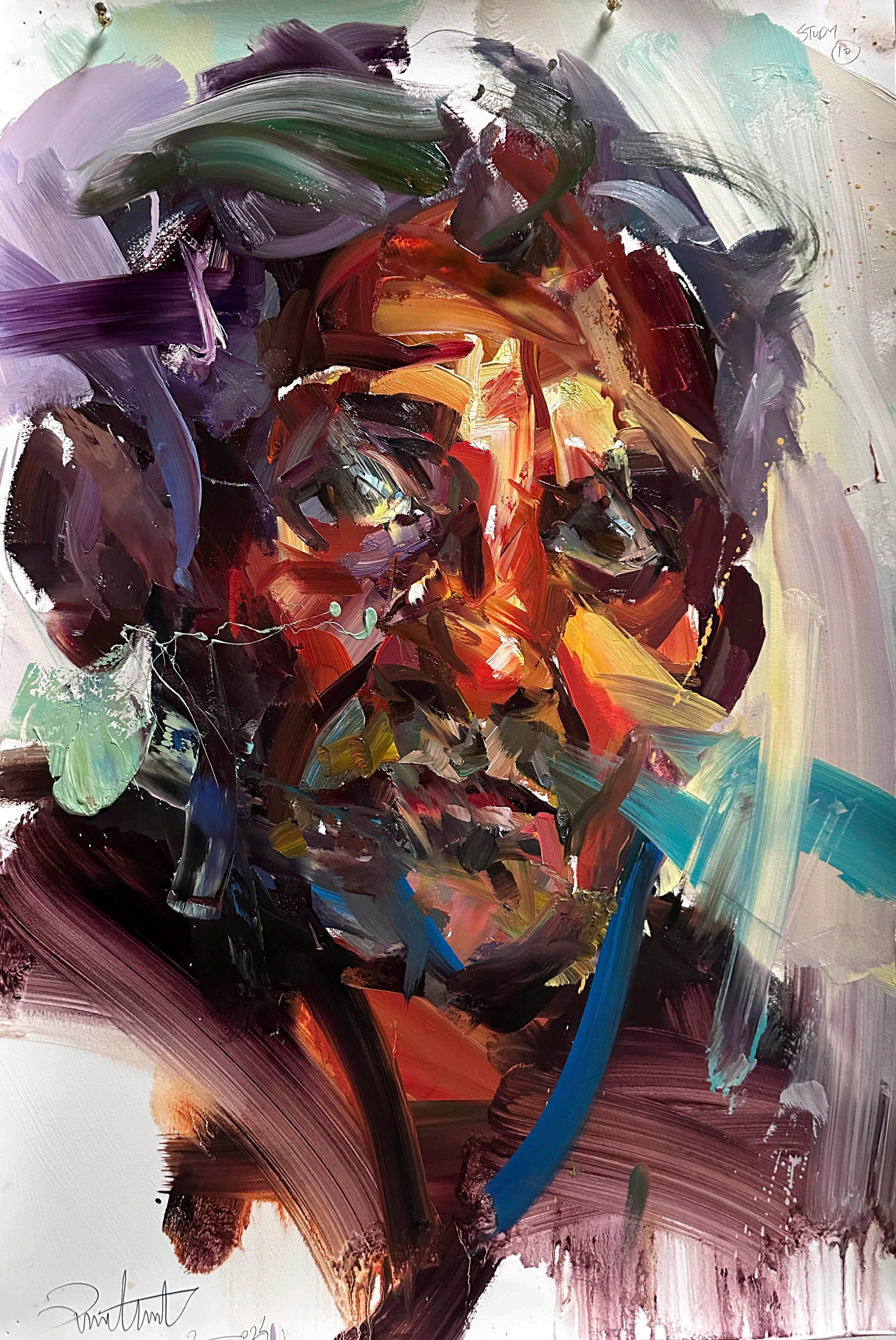
Study 10 oil on paper 70cm x 50cm 2025
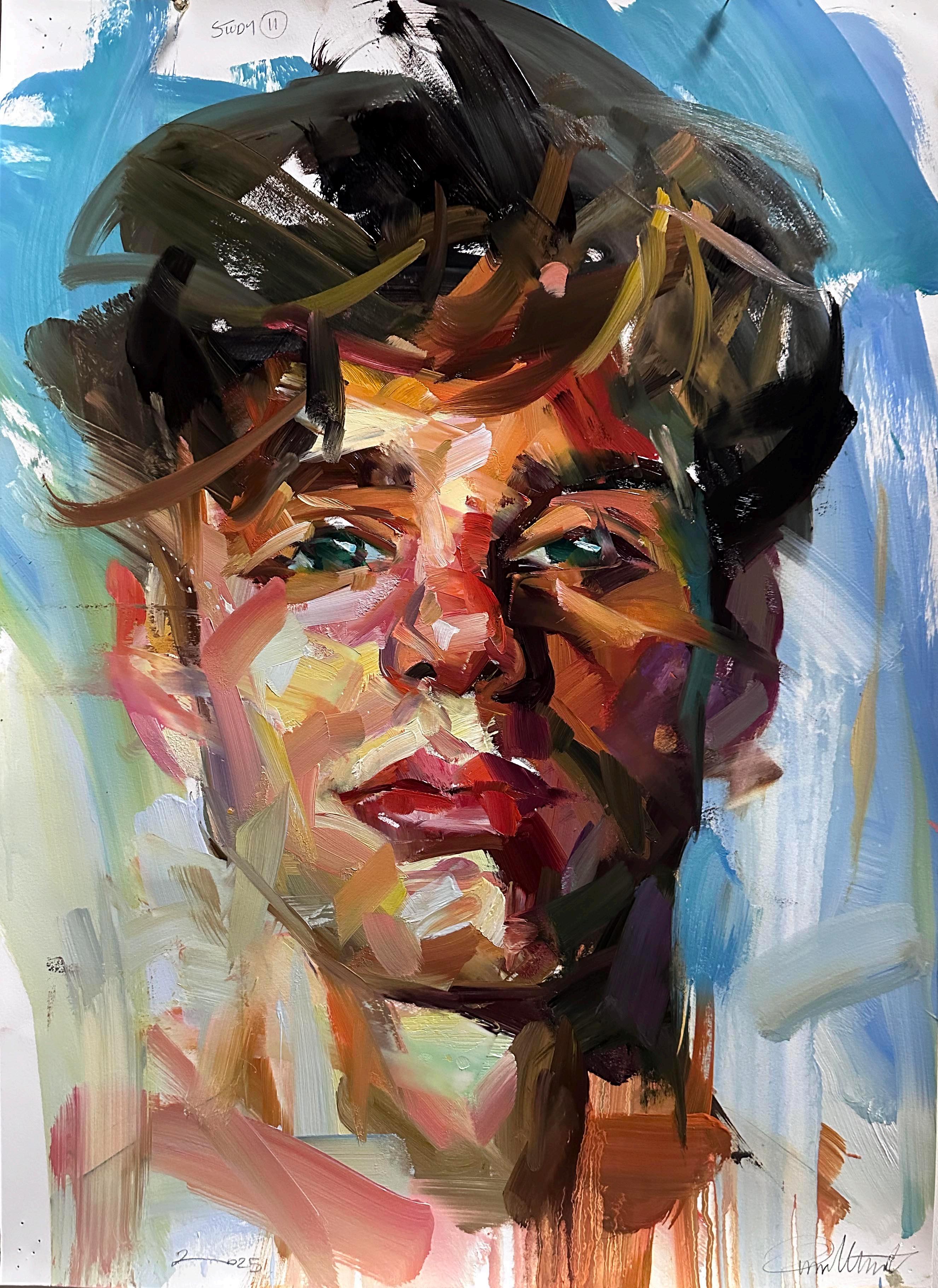
Study 11 oil on paper 70cm x 50cm 2025
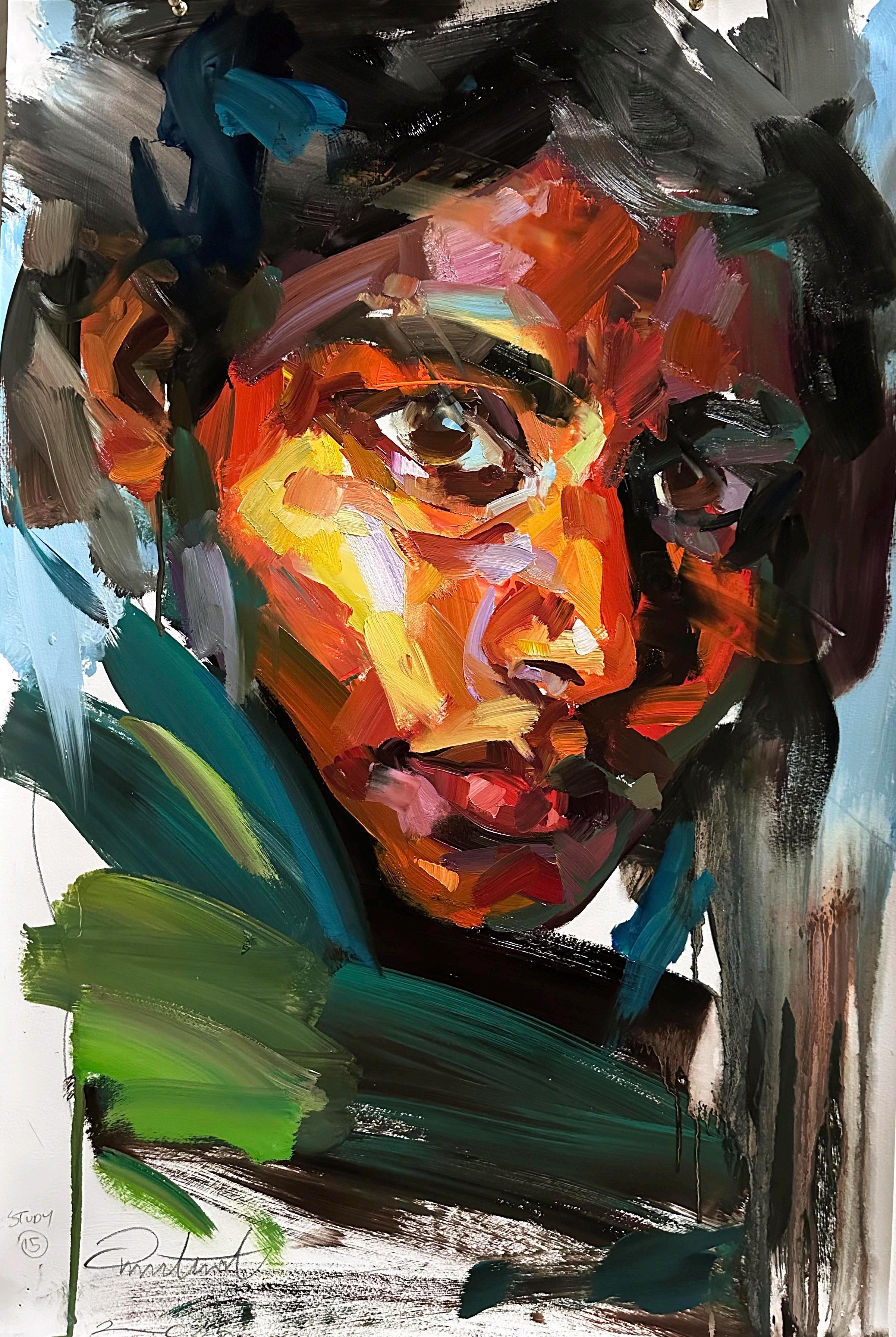
Study 15 oil on paper 70cm x 50cm 2025
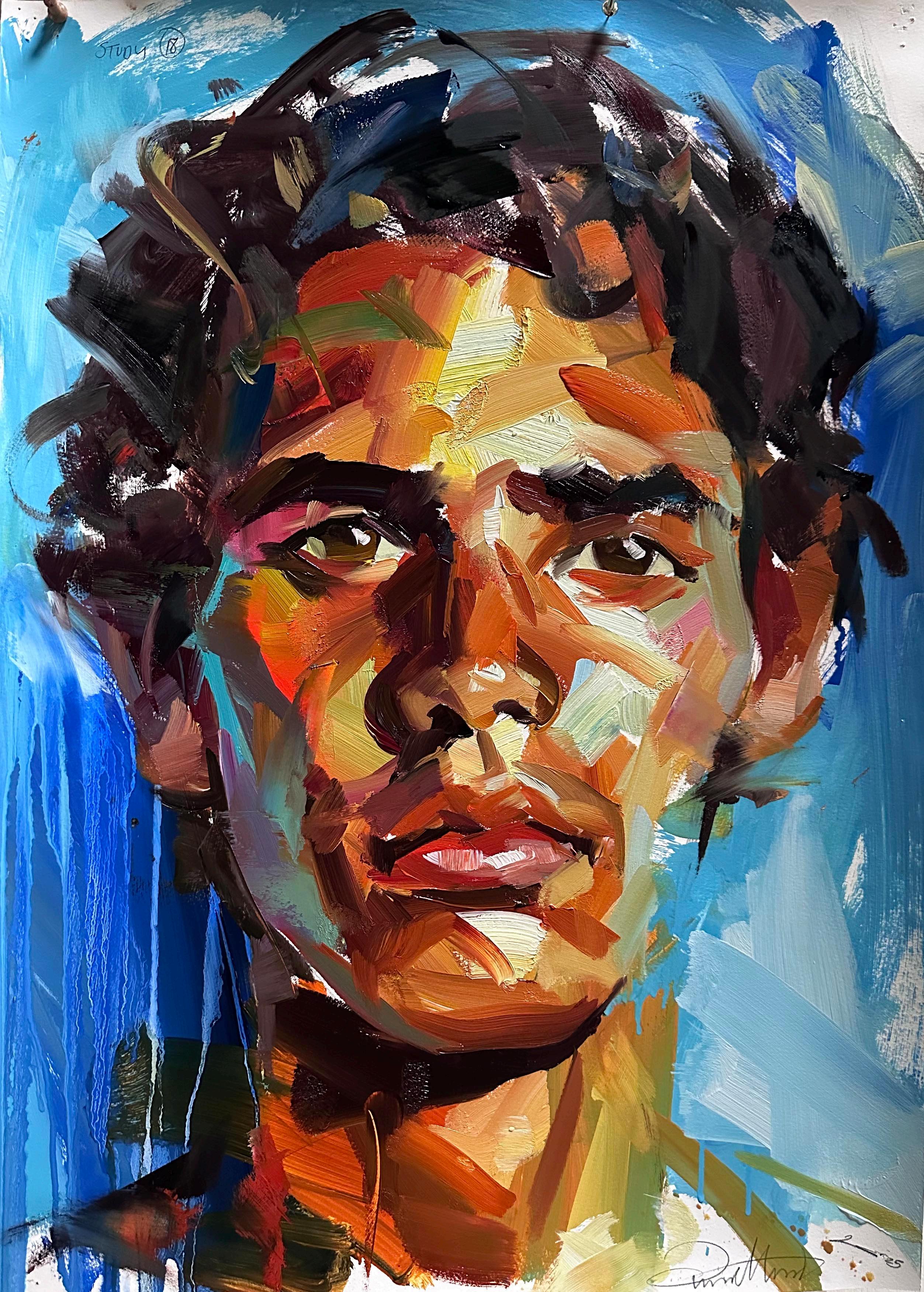
Study 18 oil on paper 70cm x 50cm 2025
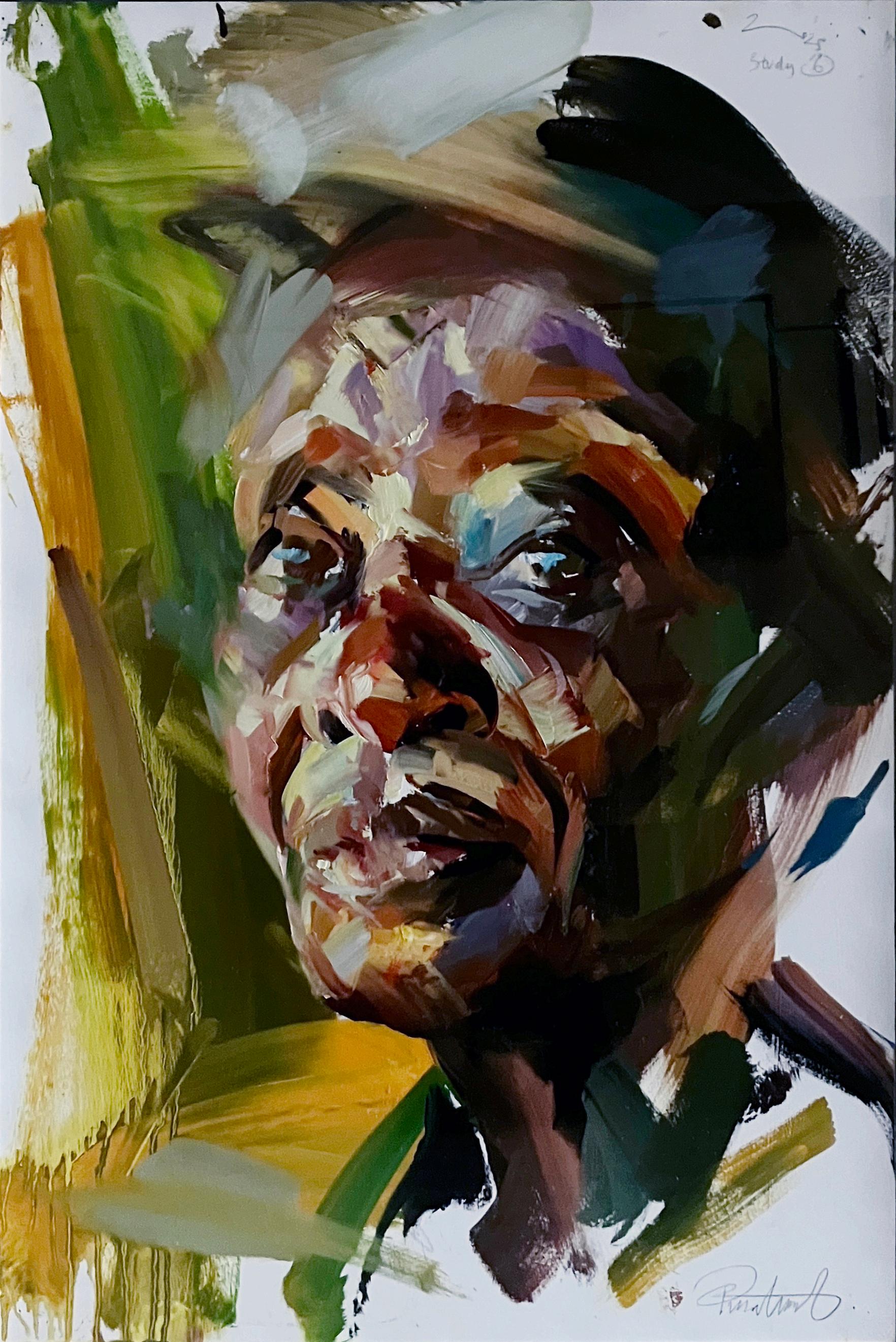
Study 6 oil on paper 70cm x 50cm 2025
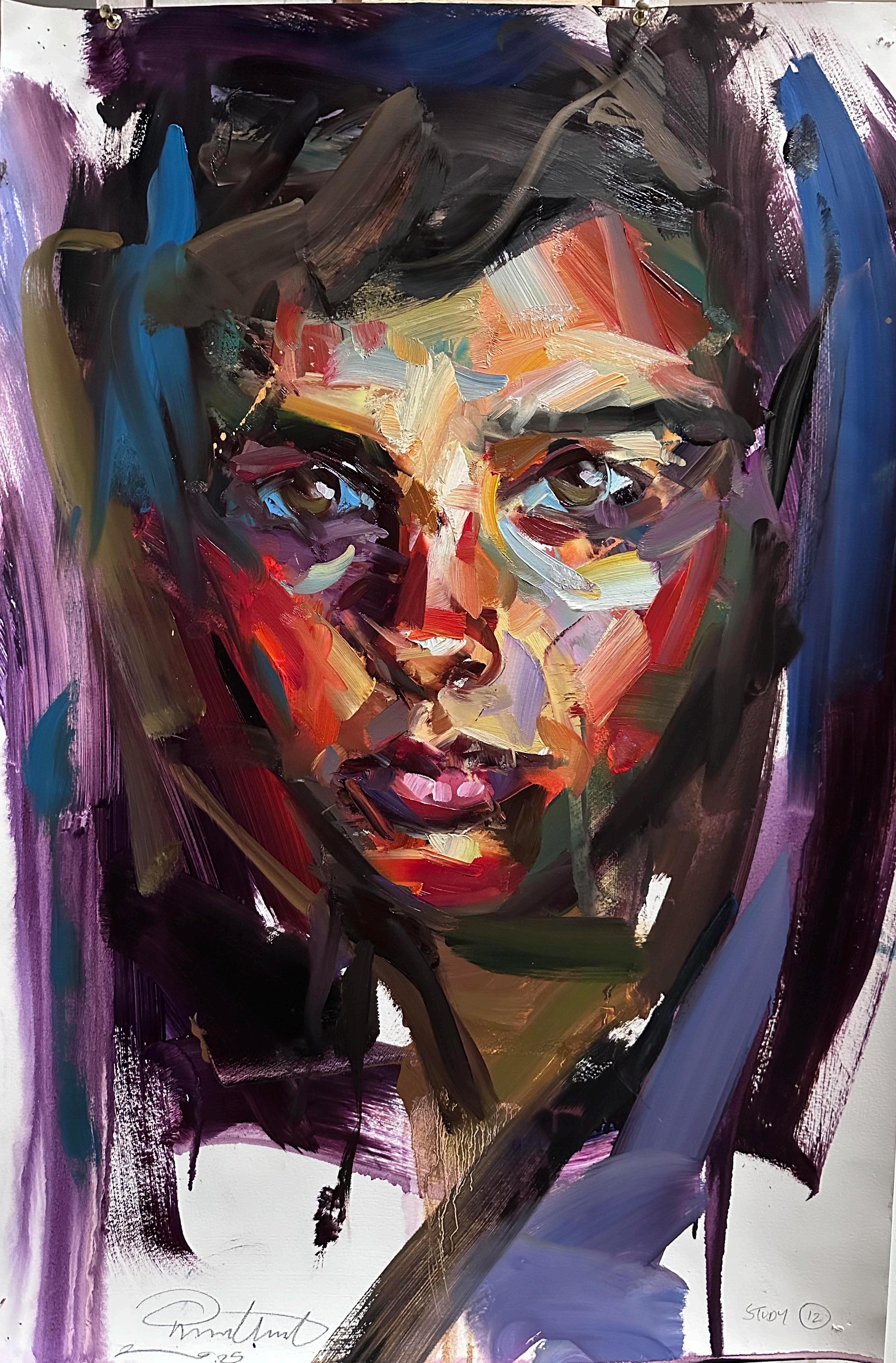
Study 12 oil on paper 70cm x 50cm 2025
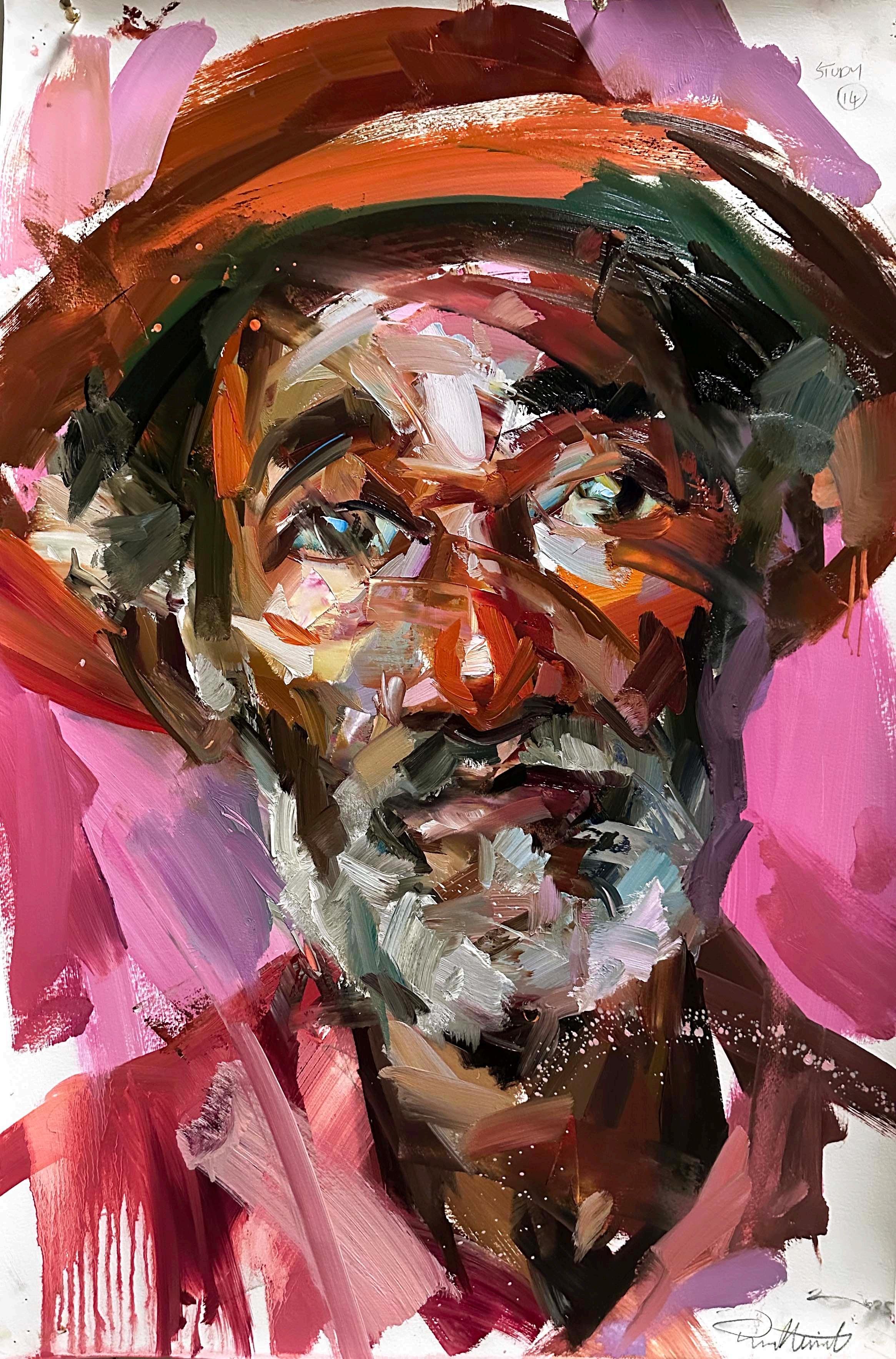
Study 14 oil on paper 70cm x 50cm 2025
As We Are — A Portrait of Now
Each painting in this exhibition is a portrait. But not in the traditional sense. These are not likenesses of individuals. They are emotional archetypes; portraits of moments, of thresholds, of shared human experience.
Paul Wright has spent more than twenty years developing a practice grounded in expressive brushwork and psychological depth. A three-time exhibitor at the National Portrait Gallery Awards and currently represented in its 2025 touring exhibition, his work continues to shape the contemporary conversation around British portraiture.
Every painting in As We Are is available for acquisition and may be reserved prior to the exhibition’s opening. These works belong in private and institutional collections not only for their technical accomplishment, but for the way they speak across boundaries of culture, class, generation and geography.
But the work does not stop at the gallery wall.
In parallel with this exhibition, Paul Wright and studio collaborator Jeni Weinberger are undertaking a long-term research-led initiative to explore how portraiture can serve wider social, cultural, and technological needs particularly in healthcare, education, and mental wellbeing. Their focus begins with Smaller World, a portrait exploring the emotional terrain of dementia, and is evolving into a body of work that uses immersive technologies to build new tools for empathy, reflection, and cross-cultural understanding.
This research underpins a broader mission:
‘At the intersection of portraiture, ethics, and immersive technology, we are developing new ways for people to experience the lives of others. By combining artistic practice with academic research and emerging technologies, we aim to develop new frameworks for human-centred technology for a more connected, more compassionate future.’ Jeni Weinberger
By acquiring a work from As We Are, you are not only collecting a painting.You are directly supporting this research. You become a sponsor of innovation. A patron of change. A collaborator in the effort to make the arts matter again, and differently.
If you believe, as we do, that creativity and care must shape the next chapter of cultural life, we warmly welcome your support.
These paintings are not declarations.
They are invitations.
To reflect, to belong, and to see one another — As We Are.
AS WE ARE PAUL WRIGHT