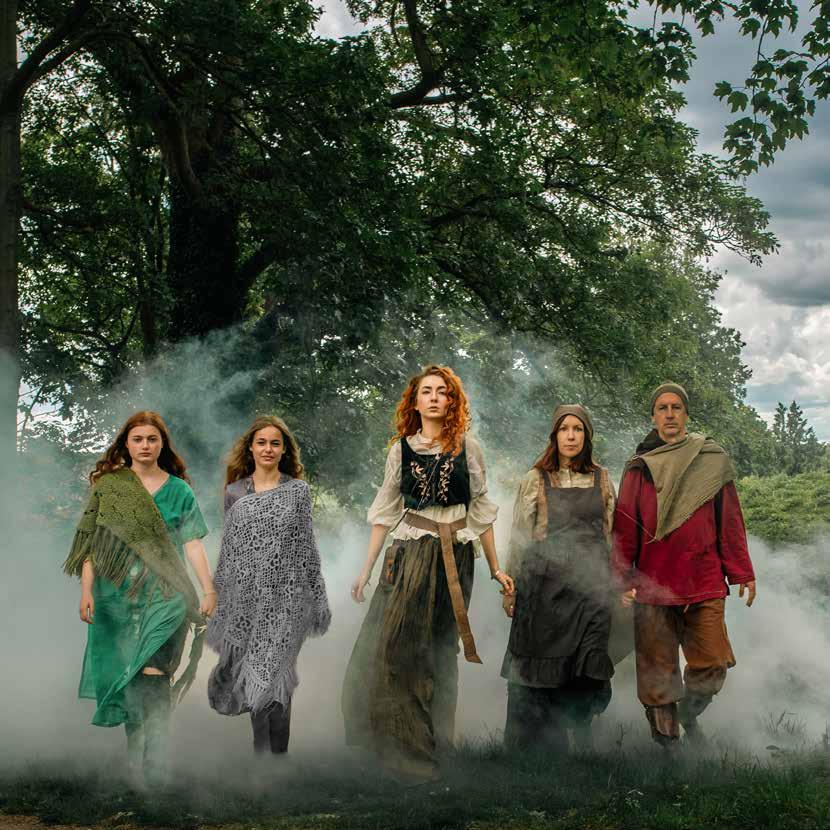



















Photo by Mangus Photography



By Martin Angus (Editor)
Welcome to Issue 15 of ‘Reflections of Thetford’ magazine. Celebrating over 2 and a half years of helping make Thetford a Great Place to Live!
This issue, we bring you, our readers, part I of the result of our writers’ historical research and creativity, ‘Bringing Boudica Home to Thetford.’
Taking the known historical facts of this legendary warrior queen, who led one of the largest Iceni uprisings against the Roman Empire. Symbolising resistance and strength, inspiring movements for justice and women’s rights. Our story begins with her fallen and defeated on the battlefield with her two daughters. We lift her up and bring her home.
Alongside Boudica in this edition, we have a large number of current-day women telling their story, who are doing great things in Thetford, from volunteers, business owners and residents.
Not forgetting the chaps, although I confess they are a little outnumbered this issue, there are shared stories from similar great male folk of our town, also doing great things.
As a magazine, we are collaborating with many individuals, businesses, charities, sports clubs, theatre groups, event organisers, local authorities, emergency services, and have most recently teamed up with a local Community Interest Company.
If you are part of any of the above, and we aren’t yet talking, please get in touch.
These collaborations will hopefully open up many exciting opportunities for the Bubbly Hub team to bring to fruition many community projects we are currently laying the foundations for.
We will, of course, bring you updates as they materialise within our great Thetford community.
As always, we couldn’t do it without you, the advertisers, contributors, featured residents, writers, and most importantly, you, the reader.
I can’t thank everyone enough for making Thetford a great place to live.
Please enjoy our 15th edition of ‘Reflections of Thetford’ magazine.
©Reflections of Thetford is published by The Bubbly Hub. All rights reserved 2026. Whilst every care is taken, the publisher accepts no responsibility for loss or damage resulting from the contents of this publication, as well as being unable to guarantee the accuracy of contributions supplied as editorial, images or advertisements. No part of this publication may be reproduced, copied or transmitted in any form or by any means or stored in any information storage or retrieval system without the publishers written permission.







The Thetford Club That Took Its Shot
The Garden Shed Keeps Growing Marigolds Tearoom From Chalkboards to Cityscapes More Than Coffee Ambition Baton Twirlers
One Man and His Dog A Ball of Light in Thetford Painting Thetford’s Stories in Colour and Character From Jelgava to Thetford
Thetford’s Young Market Maker Thread by Thread The Medusa Project Thetford Breakfast with old friends
Planter
Thetford

Written by Martin Angus
There is a moment in every good local story when an idea stops being a fantasy and becomes a decision.
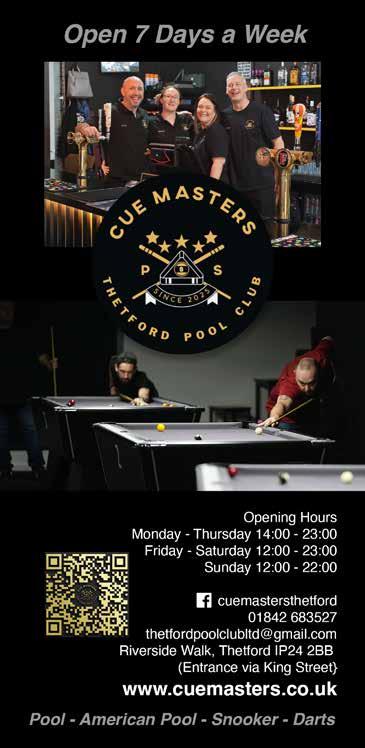
For Paul and Naomi, two of the four founders of Cue Masters Thetford, that moment arrived after years of conversations, postponed dreams and one particularly ambitious domestic plan involving a pool room in the back garden. When that proved too expensive, Paul’s response was wonderfully direct: if he could not have a pool table at home, perhaps he would simply open a club full of them.
That may sound like a throwaway line, but Cue Masters has never really been about doing things by halves.
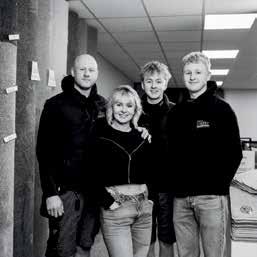
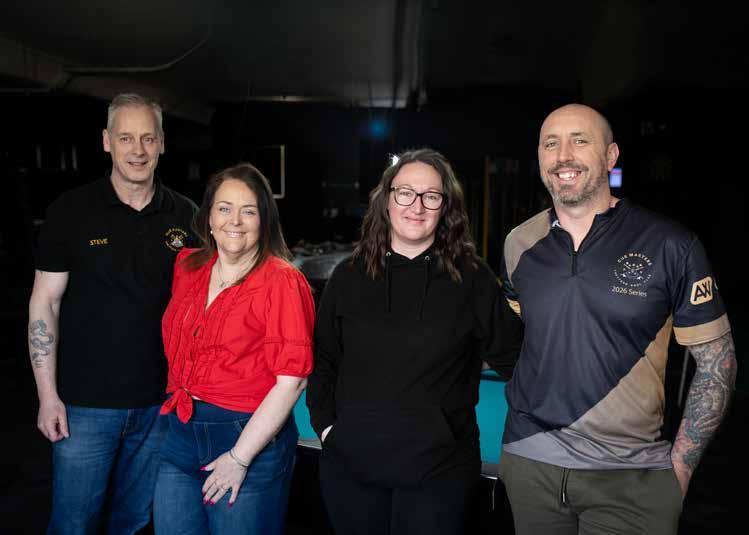
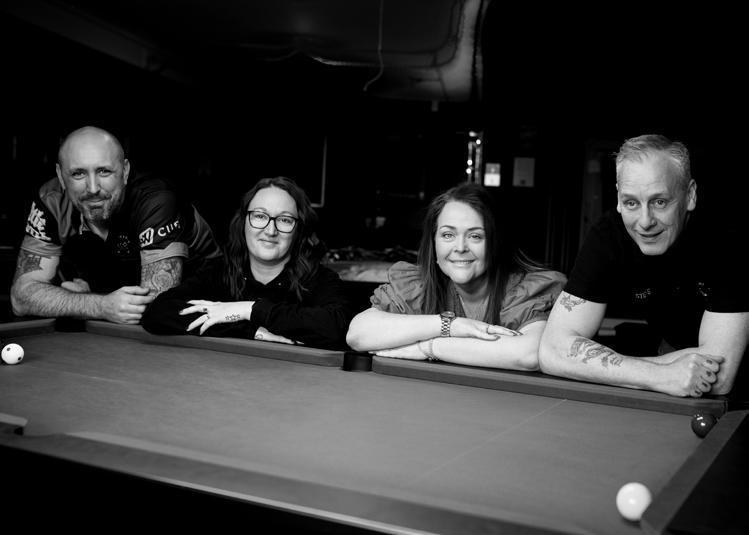
Just over a year since the idea became public, the club on Riverside Walk has already become one of Thetford’s most quietly impressive success stories. Founded by Paul, Naomi, Steve and Lisa, Cue Masters

was born from a shared love of pool, snooker and darts, but also from a very clear sense that Thetford was missing something.
“There was no cue sports scene here,” Paul says. “You had pubs and social clubs with one or two tables, but not a dedicated club. There was nowhere close by offering what we wanted.”
The founders knew what good looked like because they had spent years travelling to find it. Competitions often meant heading out of Norfolk, sometimes much further afield. For serious players, that was frustrating. For beginners or casual players, it meant there was no obvious place to discover the game properly.
Then came the building.
Paul describes himself as someone who likes to “window shop” online, whether for cars, houses or, in

this case, potential business premises. Several sites were considered. Some were too small. Others were too large. One former bank, he recalls, had so many rooms and levels it felt “like going round The Crystal Maze”.
Then Richard Hazel showed them the Riverside Walk space.
“As soon as we walked in, we went, yes,” Paul says. “Gut feeling straight away. It was the spot.”
Naomi agrees. It was not simply the location, though being by the river certainly helps. It was the way the space immediately suggested what it could become. The layout, the view, the accessibility, the nearby free parking, everything seemed to line up.
The timeline that followed was astonishingly quick. Early conversations became serious in early 2025. The company was formed in April. The lease was signed in July. By September, Cue Masters was open.
Of course, that short version hides months of risk, paperwork and physical graft. There were architects’ drawings, planning, building control, suppliers, legal details and financial decisions, all before the founders knew with absolute certainty that the lease would be theirs.
“That was the sleepless nights,” Paul says. “Spending money with no guarantee.”
But Steve had a phrase that helped push them forward: if they did not try, they would always wonder “what if?”
So they tried.
And they did much of it themselves. The flooring, bar, kitchen and countless other details were shaped by
the founders’ own hands, supported by family, friends and local people who helped paint, lift, clean and prepare the club for opening.
One of Paul’s favourite memories is not a tournament or a victory, but the private VIP night held before the official launch. It was an evening for close family, friends, local players and those who had helped make the club possible. The venue was not quite finished, but the tables were in use, the bar was operating, and the dream had become visible.
“We all stood back by the bar,” Paul says. “Steve, Lisa, Naomi and I. We just went, wow, we did it.”
That emotional reaction is easy to understand when you see what they have created.
Cue Masters is not the old stereotype of a pool hall. There is nothing smoky, shadowy or unwelcoming here. The club has a modern, stylish feel, with dark walls carefully chosen not for drama but for performance. The lighting is designed so that the tables are bright while the surrounding space remains comfortable. Every table has room around it, its own seating, power supply, score tablet and coat hooks.
The coat hooks may sound like a small thing, but they say a lot about Cue Masters. Paul and Steve are players. They know how irritating it is when cue cases lean awkwardly against walls, coats end up on the floor, and someone is always squeezing behind you mid-shot.
They could have packed in more tables. More tables would have meant more potential income. Instead, they chose space.
“There’s nothing worse as a player than having a wall behind you, or another table too close,” Paul says. “Here, you can walk around the table freely.”
Fill in the Neighbourhood Policing Survey and let us know: norfolk.police.uk/npsurvey
That attention to detail runs through everything. Cue Masters has seven Supreme tables, two Rasson tables, a snooker table, an American nine-ball table and six dartboards. The tables are kept to championship standard. Cloths are replaced when needed. Dartboards are changed as soon as they begin to wear. Clean balls, fast cloths and proper lighting all make a difference, even to casual players.
“They notice straight away,” Paul says. “The balls are clean, the cloth has no chalk marks, and there are no beer stains. It brings out a better player in everybody.”
Perhaps the greatest compliment has come from visiting players who tell them, “You’ve ruined other clubs for us.”
That is said with affection, but it captures the standard Cue Masters has set. People now travel from King’s Lynn, Cambridge, Norwich, Lowestoft and beyond to play in Thetford. In a short time, the club has placed the town firmly on the cue sports map.
Yet the most interesting thing about Cue Masters is that it is not only for serious players.
Paul and Naomi are proudest when they talk about the mix of people who come through the door. Families, grandparents, young players, league teams, experienced competitors and complete beginners all share the same space. The music is there, but not overwhelming. The bar feels social without being rowdy. There is room to play, but also room simply to sit.
Some couples visit every month, they sit by the window overlooking the river, have food and drinks, catch up for a few hours and leave. They do not play pool at all.
That matters. It proves Cue Masters has become more than a sports venue.
Another regular, Dottie, is in her late seventies and comes in with her grandchild. They play pool, then sit down for tea and something to eat. In a world where young people are so often absorbed by screens, the club gives them something simple and precious: time together.
“It’s one-on-one quality time,” Paul says.
That community aspect was there from the beginning. Before the opening, the founders posted on Facebook to gauge interest. The response was overwhelmingly positive. When memberships were released early, Naomi expected mainly friends and family to sign up. Instead, strangers began paying to support a club they had not yet seen.
“They didn’t know us,” she says. “They didn’t know what it was going to look like. It was just the fact that a pool club was opening in their town.”
Around 150 people put their faith in the idea before the doors had opened.
That faith has been repaid.
Cue Masters now has teams playing in local leagues, including seven teams in the Thetford pool charity league and teams in ladies’ and South Norfolk leagues. On league nights, the place comes alive. Home teams, away teams, supporters and regulars create the kind of atmosphere that turns a venue into a community.
“It’s brilliant,” Paul says. “Everyone supports each other.”
That support is part of a wider change in cue sports. Paul believes pool has benefitted from greater exposure through YouTube, televised competitions and organisations investing in the game properly.



Naomi points to junior initiatives and the role of social media, where young people might discover a trick shot or competition clip and decide to try the sport themselves.
But what keeps people playing is not just the spectacle. It is the learning.
Cue sports teach patience, discipline, routine and resilience. Paul talks about the importance of the shot process: standing, stepping in, getting down on the shot, repeating the pattern until it becomes instinctive. Players learn to control themselves as much as the cue ball.
There is also a phrase often heard in the sport: be a goldfish.
In other words, forget the last mistake. The bad shot is gone. The lost frame is gone. Focus on the next one.
It is not bad advice for life either.
Of course, running a business with friends and family is not always smooth. Paul and Naomi laugh about disagreements over music, particularly Steve’s fondness for eighties tracks and Simply Red. But the bigger decisions have always been guided by a shared aim: what is right for the business?
Each founder brings something different. Paul and Steve came from the building trade, bringing practical skill, determination and deep knowledge of the game. Steve is also a level two pool coach, a valuable asset for players looking to improve. Naomi still works full time for UK Power Networks while handling bookkeeping, accounts and administration for the club. Lisa, with her pub management experience, oversees much of the bar and kitchen side.
Naomi and Lisa, Paul says, have shown “the patience
of saints” in helping him and Steve understand the hospitality side of the business.
The club also supports local where possible. Signage was created by Pitstop Graphics, a local business and friend. Photography, print and other services have been sourced locally when budgets allow. As Naomi notes, start-ups must sometimes make difficult decisions, but the intention to support the local economy is clear.
The welcome is another carefully protected detail. New visitors are greeted properly, not left awkwardly at the door. Staff explain the tables, rates, cues, toilets, timing system and how everything works. The owners wear shirts with their names on, making them approachable from the start.
There is also genuine guidance for those who want it. Cue Masters sells cues, but not with a quick “that’ll do” approach. Customers can try them first. Paul and Steve help beginners think about weight, length and tip size. If someone is going to spend £50, £150 or £300, they want that person to leave with the right cue, not just a cue.
It is another example of the service mindset that has helped the club grow so quickly.
And the growth has been remarkable. Social media followers jumped from a small circle of friends to nearly 2,000 in what felt like moments. Customers who book for an hour often stay for two or three. Players who come for competitions return with their families. People who first arrive through league fixtures later come back for food, drinks or a casual game.
Asked what success would look like in five years, Naomi’s answer is refreshingly grounded.
it makes it worthwhile,” she says.
Paul agrees. They are not pretending not to care about the business side. Bills must be paid, equipment maintained and the lights kept on. But Cue Masters was never created purely as a money-making exercise. It was built because four people loved the game and believed Thetford deserved something better.
That sense of purpose is probably why the club feels the way it does. It is professional without being cold, competitive without being intimidating, social without being chaotic. It is a place where serious players can sharpen their game, children can discover a new skill, grandparents can bond with grandchildren, and friends can spend an evening doing something more memorable than scrolling through phones.
If the founders could invite one famous player for a game, Steve’s choice would likely be Ronnie O’Sullivan. Paul’s would be Chris Melling, the “magician” of cue sports, admired not only for his talent across multiple formats but for his character.
But in truth, Cue Masters does not need a celebrity guest to prove its worth. Its success is already written in the people who keep coming back, the teams that have made it home, the beginners who feel welcome, and the players who say other clubs no longer quite measure up.
The best local businesses do more than open their doors. They create somewhere people feel belongs to them.
Cue Masters has done exactly that.
“As long as people are using it and want to use it, then
And in just over a year, Thetford’s new cue sports club has already potted something far bigger than a winning black. It has created a community.
Written by Martin Angus
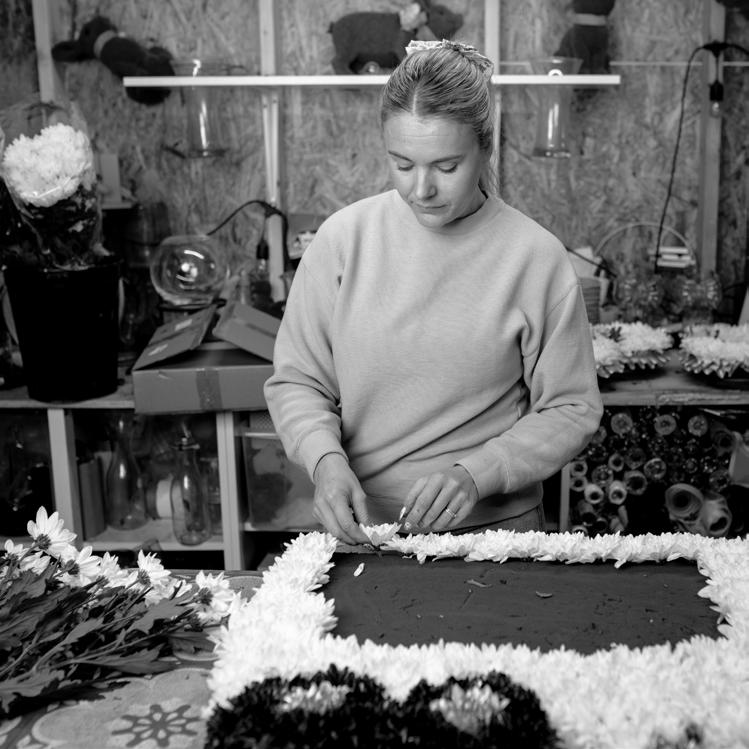
When Reflections of Thetford first met Caitlin Chrystal, The Garden Shed Florists was exactly that: a florist business run from a small, makeshift chipboard shed in the garden.
Two years on, the name remains, the ladybirds remain, and Caitlin’s warmth remains, but almost everything else has grown.
The original shed was a tiny corner of workspace. “See where the metal posts are?” she says, pointing across her new workshop. “That little back corner is where I used to work.” Today, The Garden Shed occupies a much larger, purpose-built space, complete with sofas, a consultation area, flower buckets, storage, work benches and enough personality to make brides feel instantly at home.
Although, in true Caitlin style, even this new space is already under pressure.
“This isn’t really big enough,” she laughs. “We’ve already spoken about expanding.”
That says a lot about how far the business has come since October 2022, when Caitlin made what she describes as a very impulsive decision to leave her job and set up on her own. Back then, she was working from home, keeping overheads low and hoping people would trust her. Now she has more than 60 weddings booked this year, weekly contracts with Elveden Inn and The Guinness Arms, regular work with estates and venues, workshops, corporate events, school projects, and a van waiting to be sign-written.
“I feel like my business has just stepped up more than I could have imagined,” she says.
The van is a recent arrival, very recent. Until a week before our interview, Caitlin was still charging around in her own car. Now Creative Penguin is preparing


the sign-writing, and The Garden Shed is about to become even more visible around Thetford and beyond.
Visibility matters. Even now, people still occasionally say they did not know there was a florist in Thetford. Yet, at the same time, Caitlin is experiencing the curious and slightly surreal side of local recognition.
“I went to an adult pantomime in Barnham a couple of nights ago,” she says, “and my friend was talking to this lady, and she went, ‘You’re The Garden Shed.’ That happens to me so often. I think, how do people know who I am? I have no idea who this lady was.”
She laughs, but there is genuine amazement in it. “It blows my mind.”
In issue two, Caitlin was at the beginning of a leap into the unknown. Does it still feel like a risk?
“It’s still a massive risk,” she says without hesitation. “I’m self-employed, and my husband’s self-employed. We’ve got a mortgage. We’ve got children. If I have a down period, or if he has a down period, we can’t pay anything.”
That honesty is refreshing. Success stories, particularly in local business features, can sometimes be smoothed over until the challenges are barely visible. Caitlin does not do that. She is proud, grateful and ambitious, but she is also clear that running a small business is not a fairy tale.
Even so, the risk now has stronger foundations. The weekly Elveden contract gives her a regular income. The wedding diary is fuller than she ever imagined. In the past six months, she says, there have not really been any quiet periods.
“My security blanket is a little bit more there,” she
says. “When I first started, it was a gamble. I still wake up some days like, What am I doing? Why am I doing this? But it’s the best thing I’ve ever done. It works around my children, works around my life. It’s brilliant.”
That balance is central to Caitlin’s story. She is not just a florist; she is the orderer, maker, deliverer, designer, administrator, social media voice, email responder, workshop host and customer service department. She is also a mother of three.
Most mornings begin at around five o’clock when flower deliveries arrive. She works in the shed, then steps away to get the children ready and do the school run. By nine, she is usually back among the flowers. Later comes collection, delivery, consultations, more making, more messages, school pick-up, family life, then evening admin and social media.
“It’s not often I switch off before about nine o’clock,” she says. “People don’t see that part.”
Still, she would not change it.
The new workshop has transformed the way she works. Previously, she travelled to brides, arriving with a clipboard, paper, pen, and laptop. Now they come to her. They sit on the sofa, talk through ideas, look at flowers, browse books and see Caitlin’s work properly.
“It’s more personal,” she says. “I can get the flowers out of the buckets and say, Is this what you want?”
It is also more practical. Instead of losing hours to travel, Caitlin can pause, meet a customer, then return straight to work. The workshop has also allowed her to host her own classes, particularly over Christmas, without needing to hire other venues.
The milestone she is proudest of is clear: “Definitely


Awards have helped, too. Caitlin became awardwinning within her first 18 months and was recognised at the Thetford Business Awards twice in a row. That changed things.
“I think that was my turning point of getting a little bit more publicity,” she says. “As soon as it was able to be spoken of as award-winning, it became that little bit further afield.”
Further afield now includes venues such as Titchwell Manor near Hunstanton, where she has been invited to showcases and now works several times a year. But Caitlin is careful about awards. She has won others, but refuses to pay large fees simply to claim them.
“I’m not going to pay for recognition or vanity awards,” she says. “I think sometimes your reputation just speaks for itself.”
That reputation has grown largely through word of mouth, and this is where Thetford has played such a big role. Caitlin regularly sees posts on local forums asking for florists, only for her name to appear again and again.
“Complete strangers recommend me,” she says. “That honestly blows my mind. It means a lot more than you know.”
The work itself has changed hugely. In the early days, she was sending out £10 bouquets and often running at a loss simply to build a portfolio. Although she had years of floristry experience, she deliberately did not use photographs from previous employers. The Garden Shed had to stand on its own.
“I had to start from the bottom,” she says. “People
had to trust me.”
They did. Today, the minimum bouquet is usually around £30, and the commissions are increasingly ambitious. Caitlin has made everything from wedding arches and large floral installations to highly personal funeral tributes. She has created a three-foot can of beer, gates of heaven, an owl, an eyeball, a bumblebee and, during our interview, was working on a lorry.
“I don’t say no to anything,” she says. “You have to wing it. There’s no test run. People have to trust you, and I have to trust myself.”
One of her favourites was the bumblebee, made in memory of a much-loved “Queen Bee”.
That emotional side of the work matters deeply to Caitlin. Weddings and funerals, she says, are two things you cannot take back. They have to be right.
“I work because I care,” she says. “I would much rather make less profit, and you have the most incredible bouquet or the most incredible tribute.”
Her style has developed, too. Like learning to drive, she says, everyone may start with the same basics, but eventually you find your own way. She looks back at her early work and can see how far she has come. She trains constantly, attends wholesaler open days, listens to growers and keeps track of new varieties.
Hydrangeas remain her favourite flower, her wedding flower, although she has discovered an unfortunate new problem.
“I have grown hay fever to peonies,” she says. “Which isn’t great when peonies come in as of tomorrow.”
There is also a growing




that are not necessarily to her own taste. Caitlin naturally loves pinks, yellows and “girly colours”, but customers often have different visions.
“I’ve learned that not everything that goes out of here has to be what I like,” she says.
One bride requested colours that Caitlin was unsure would work. She followed the brief anyway and was surprised by the result.
“It was beautiful. It was perfect.”
Sustainability remains complicated. Caitlin is frank that, in practical terms, floristry as an industry still has challenges, especially around foam for weddings and funerals. She reuses wherever possible, keeps stems long so flowers can be repurposed, and encourages brides to move arrangements from one part of the day to another rather than buying everything new.
“I’m big in reuse where I can,” she says. “But in terms of sustainability, it’s a work in progress.”
Collaboration, however, has not changed. Caitlin still believes firmly in “collaboration over competition”. She works with venues, schools and other local businesses, and has helped other florists. One florist from Ely came to her for advice after others turned her down; they are now friends.
“I’m not in competition with anyone but myself,” Caitlin says. “I’m constantly trying to up my own game.”
Her community work has widened, too. She has been in schools, including Redcastle and Barnham, using flowers to help children explore creativity, nature and sensory learning. At Redcastle, pupils made flower canvases which came together as one large display.
“It was more about learning that you can be creative
with anything,” she says. “Nature’s big.”
The Garden Shed may be growing beyond Thetford, but Thetford remains central to its identity. Caitlin’s customers, supporters and recommenders have helped carry the business from a chipboard corner to a thriving workshop. She has gained contracts, confidence, recognition and space, although not quite enough space, apparently.
When asked what the Caitlin from issue two would say if she could see the business now, she pauses.
“I don’t think she’d believe it,” she says. “I honestly thought when I first started it would be like a hobby job. I would never have believed this could be my full-time job. Sixty-plus weddings, corporate events, contracts with big names, buying a van, and expanding the shed. I just would never have believed you.”
Then comes the phrase she returns to often, because perhaps no other phrase quite fits.
“It blows my mind.”
And it is easy to see why. The Garden Shed began with uncertainty, necessity and a temporary structure in a garden. It has grown through graft, instinct, local support, word of mouth and Caitlin’s refusal to treat flowers as “just flowers”.
For her, they are memory, celebration, comfort, personality and promise. They are the thing people carry down aisles, place beside coffins, send in love, give in apology, use to decorate milestones and remember people who mattered.
Two years on from that first feature, The Garden Shed is not just blooming. It is putting down roots.

Written by Liz Gibbons
With the weather unable to make up its mind, I arrive in Thetford town centre in a raincoat and clutching an umbrella, grateful to have caught a brief pause between the downpours and hailstorms. Above me, patches of blue sky are beginning to break through, casting brief moments of sunshine.
Just up from the library, inside the ‘Dad’s Army Museum’, is the wonderfully nostalgic ‘Marigolds Tearoom’. As I approach the museum entrance, by the red telephone box, I spot Joy Osborne standing in the doorway waiting for me. Sunlight catches her face as she greets me with a warm smile before ushering me inside for the promised mug of tea.
Upon entering, the tearoom feels like stepping back in time. Since its opening in 2011, the ‘Marigolds Tearoom’ has welcomed thousands of visitors with homemade cakes, using wartime recipes, vintage china, and above all else, an unmistakable sense of community created by its dedicated volunteers.

Every detail, from the bunting to teapots in tea cosies, floral tablecloths and the old-fashioned counter, all enhances the ambience created.
Today, I am meeting just a few of the ladies who keep the tearoom running week after week. Their roles cover everything from baking wartime-inspired cakes, greeting customers and serving tea, to washing dishes and taking money in the old till. Three have come along to our gathering this morning. Joy, who helped arrange the interview, alongside Jill and Denise W, are all eager to share the story behind the tearoom and explain why this little corner of Thetford has captured the hearts of so many people over the years. As we sit ourselves around the little tables, with mugs of tea slowly cooling, we are ready to commence.
Joy begins, appropriately, at the very beginning. Sitting beneath the bunting and shelves of vintage china, she explains how the idea for the tearoom first came about. Former museum manager Corinne
Fulford believed the experience at the ‘Dad’s Army Museum’ could be made even more immersive with an authentic 1940s-style tearoom alongside it.
“Corinne came up with the idea for the tearoom,” explains Joy, who has been part of ‘Marigolds’ since the very start. “Denise Jones and I have been here since the tearoom opened in 2011. Corinne was the manager at the time and had a chat with us and said it would be great if we had a tearoom.”
What began as a simple idea quickly became something far bigger than anyone expected. The volunteers still vividly remember opening day and the sheer number of visitors who poured through the doors. “It was just me and Denise J,” Joy recalls with a laugh. “About 400 people turned up!” After a day like that, I hope someone made them a cup of tea!
Denise J, the tearoom manager since the very start, wrote in with her own story. “I started my time in ‘Dad’s Army’ 17 years ago, and when Corrine suggested a tearoom, we jumped on the idea. I started managing the tearoom when we first opened. There were just a couple of us at the start, but that very quickly changed.”
Fifteen years on, the tearoom is still run entirely by volunteers. As the museum remains free to enter, the tearoom plays an important role in helping support its running costs. “We just charge for the baking ingredients,” says Joy. “We don’t get paid. We all just really enjoy doing it.” There are 14 volunteers helping out on a carefully organised rota. “You just mark down which shifts you can do,” explains Jill, who is a regular volunteer. “The shift is split into a morning or an afternoon, so you only do a few hours each. We try to get the rota done two months in advance.” Joy goes on to explain, adding that Maureen is in charge of organising the rotas a couple of months in advance at a time.
The volunteers themselves are not all local; some travel from further afield because their partners volunteer in the museum, dressing as members of the famous platoon from the television series ‘Dad’s Army’. “Lindsay, Josie, Pauline and Karen all come from Norwich because their other halves volunteer in the museum,” explains Denise W. Joy, adding that, as well as mainly retired ladies, “we’ve got two young girls, Georgia and Ashleigh, that help out as well.”
When I ask how everyone first became involved, it quickly becomes clear that very few of the volunteers ever planned to join the beloved tearoom. Most simply popped in for a cup of tea, struck up a conversation, and before they knew it, found themselves part of the ‘Marigolds’ family.
Jill recalls visiting with friends before being recruited on the spot. “I started after having a coffee there with friends and got talking to Chris, and she said, ‘Why don’t you come and help out?’” Continuing, Jill goes on to say that she spoke to Denise J and got the job.
Denise W had a similarly direct introduction. “I told Joy I’d just retired and she said, ‘Good, you can come and volunteer here.’ I’ve been volunteering for 18 months, and now my sister, Janie, has joined as well.”
The same happened to Diane, who was unable to attend the interview but kindly shared her memories afterwards. “I started after having a coffee there with friends and got talking to Chris, and she said, ‘Why don’t you come and help out?’”
For Irene, it all started with a pile of dishes. “I noticed Joy was very busy as we were enjoying our tea in ‘Marigolds’, and made a comment about the washing up. I did that about four or five years ago and have volunteered ever since.”
Listening to these stories, it is easy to see why the

tearoom feels so much like a community. That sense of friendship is one of the reasons the volunteers stay. “You’re constantly on the go, cleaning tables, washing up, drying up,” says Jill. “You meet a lot of friends through the tearoom.”
And there is certainly no shortage of work. During busy summer weekends, the pace can become relentless. “We had one shift, Joy and I, where we didn’t even have time to speak to each other,” laughs Denise W. “It was non-stop.” “I don’t think we even looked at each other,” Joy adds, prompting another round of laughter.
Diane says that she feels a great purpose in supporting our local community. “I thoroughly enjoy the collaborative nature of the work and working alongside such a committed and positive team.” She goes on to say how she’s met so many people through the tearoom and even made some reconnections with old school friends and people from far away. A highlight for her is definitely the homemade cakes. “I enjoy selling our homemade cakes that you can’t buy in shops, and seeing people’s reactions after a bite or two.”
Denise W expresses how much she loves what she does, “I just like the people I’ve met since volunteering here and the wider museum. I love being a part of this, I love going out on the road, it’s like going to an away game for a football match.”
For the volunteers, the tearoom is about far more than tea and cake. It is a sense of community, friendship and a shared purpose. “Over the years, I’ve met lots of lovely people from all walks of life,” says Maureen in her written statement. “There is a loyal group of ladies in the tearoom, and we work well together. We also go for a coffee and a chat.”
The easy-going humour between the ladies fills the
room throughout our conversation. When asked about the most rewarding aspect of the tearoom, Jill delivers with perfect timing, making us all laugh, “The pay.” Joy immediately joins in with, “Yeah, the pay rises are great.” The laughter continues, the kind that only comes from people who genuinely enjoy spending time together.
Yet beneath the jokes lies deep affection for what they have built together. “We all really enjoy it,” says Denise W. “We wouldn’t keep doing it if we didn’t enjoy it.” Jill believes the atmosphere is what makes people return. “It’s relaxed. It’s not one in, one out. People stay for a chat.”
That welcoming atmosphere is carefully tied into the tearoom’s authentic 1940s aesthetic. Every corner is filled with objects chosen or donated by volunteers over the years. “We’re always adding to it,” says Joy. “When we first started, we went around charity shops looking for things like the glass cake stands. Things gradually filled up.”
Every item in the tearoom seems to come with its own story. Even down to the beautiful handpainted ‘Marigolds’ signs. “Dave wrote ‘Welcome to Marigolds’ and wrote the ‘Marigolds’ sign outside,” reveals Joy. “He used to be a signwriter; he learnt his trade in the army.” The tearoom counter once stood in Thetford Typewriters shop, while the display cabinet behind it originally belonged to Arthur Handsord’s menswear shop on White Hart Street. Behind the counter sits an old-fashioned sink, chosen to match the tearoom’s nostalgic feel, and put to good use coping with the never-ending pile of teacups, saucers and plates.
Some of the items carry a more personal significance. Jill tells me that many of the smaller decorative pieces were donated after her mother passed away, helping to keep her memory alive while adding to
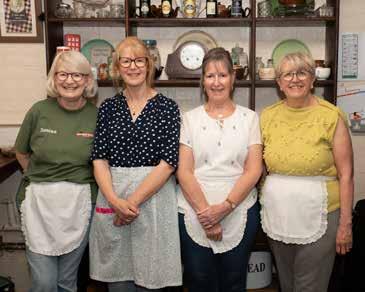
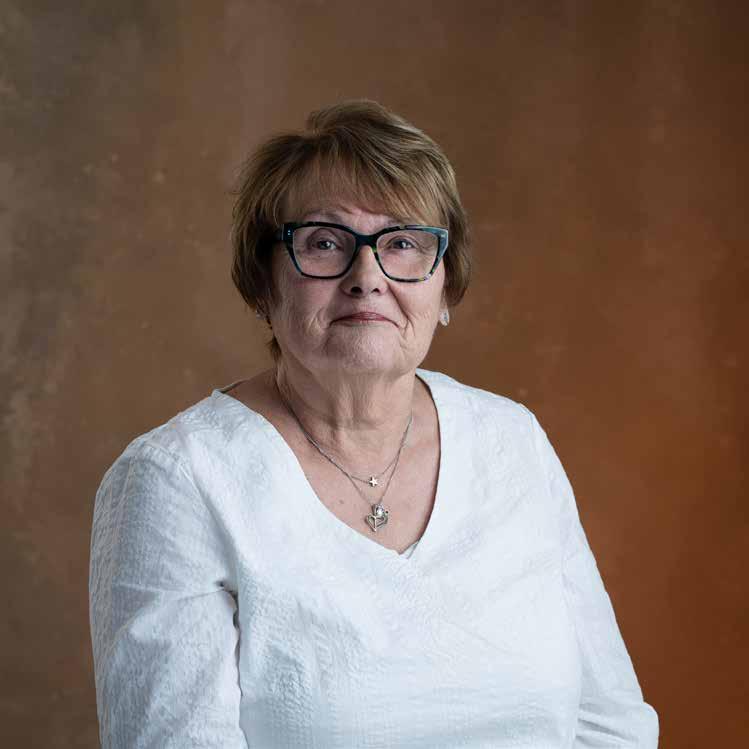
Denise W., Janice, Diane and Denise J.
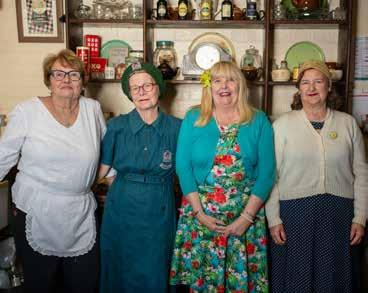
Volunteers: Joy, Jill, Josie and Karen


the tearoom’s nostalgic atmosphere. Like many of the objects on display, they preserve both family memories and a small piece of Thetford town’s history.
The ladies all agree that the vintage china plays a huge part in creating the atmosphere. “People love having a pot of tea with a milk jug,” says Joy. The team use traditional brown teapots, old wooden trays and Ringtons tea, a brand dating back to 1907. Another way to create an authentic ambience is through music, which is played from the wartime era throughout the tearoom and museum. The handmade tea cosies, knitted dishcloths and bunting add further touches of nostalgia. “Whenever I’m out, I’m always looking for more things,” says Joy, who recently bought a vintage glass jelly mould for the collection.
For many visitors, these details spark emotional memories. “People come in and say, ‘My nan had one of those,’” says Jill. “It takes them back.”
The cakes themselves are central to the experience and are all homemade by the volunteers using traditional wartime and post-war recipes. “Between us, we all make the cakes and biscuits,” says Joy. “All traditional rationing recipes.” Denise J makes bread pudding, Chris makes apple cake and coffee cake, Ellie makes scones, Victory cake and coffee cake, Joy bakes vinegar cake, Annie makes scones, Maureen prepares ANZAC, lavender biscuits, and sausage rolls, while Lesley’s beetroot cake and parsnip cakes often surprise visitors.
“One little boy wanted the chocolate cake,” Joy recalls with a grin. The little boy ate it with relish, his face covered in chocolate icing. “Afterwards I told him it was beetroot cake and he said, ‘But I don’t like beetroot!’”
The famous vinegar cake is another conversation starter. “People are always surprised,” says Joy. “It was used when people didn’t have eggs, but you don’t taste the vinegar at all. It’s a fruit cake.” The tearoom has become an important part of the museum experience itself. “So many museum cafés are just an add-on,” says Denise W. “But this tearoom is part of the experience and contributes to the museum.” Modern coffee requests are politely rejected with a smile. “People ask for cappuccinos and lattes,” laughs Jill, “and we say, ‘It’s 1940, they didn’t have those then.’”
Over the years, visitors have travelled from around the world to experience both the museum and the tearoom. Joy remembers when “two men flew in from Ireland and said the main reason for coming over was the ‘Dad’s Army Museum’ and the tearoom.” She expressed her surprise that they were not visiting London first, but was delighted that Thetford was top on their list.
Visitors from Australia, Holland and across the UK regularly stop by, while dedicated fans of ‘Dad’s Army’ often arrive quoting lines from the show. “Some are such avid fans,” says Jill. “They know everything.”
As our conversation draws to a close, it becomes easy to understand the affection people hold for this little tearoom and the volunteers who keep it running. It explains why so many visitors return week after week, often ordering exactly the same thing each time. “They come for the community,” says Joy, “and they get to know you.”
Denise J, wrote in to convey her thanks to the dedicated ‘Marigolds’ team. “I would like to say that, since it opened, I’ve had the pleasure of working with some fantastic volunteers,” she says. “It runs like a well-oiled cog, from us all baking, to Maureen, my co-pilot. Without her, I wouldn’t manage. She sets
everything up on a Friday, alongside all the volunteers who help out on Saturdays. It’s not just those things either; there are all the jobs that go on behind-thescenes. I love volunteering, it’s part of Thetford, and it brings people together.”
For the volunteers and customers alike, perhaps that is what the ‘Marigolds Tearoom’ truly represents. It is not simply nostalgia for wartime Britain or a fondness for a classic sitcom, but community, and the continuation of something increasingly rare. A place where strangers become familiar faces, friendships are formed over cups of tea and homemade cake, and everyone is met with a warm welcome.
‘Marigolds Tearoom’ are always looking for new volunteers. Why not pop along to see what it involves and chat to one of the lovely ladies to see if you fancy giving it a go?

Written by Martin Angus
There’s a particular kind of pride that comes from spotting something you’ve made out in the world. For Sam and James, founders of West Brothers, it might be a chalkboard outside a pub, a gleaming corporate sign on a warehouse, or a carefully placed graphic on a high-performance car.
“Whenever we see one of our boards,” they admit, “we still stop and look. It’s a little buzz.”
That quiet moment of satisfaction, half pride, half disbelief, captures something essential about their journey. Because West Brothers didn’t begin as a polished, high-tech signage company. It began, quite literally, with two graduates, a borrowed sum of money, and a workshop full of machinery that looked like it belonged in a museum.
Thrown in at the Deep End Thirteen and a half years ago, Sam and James
arrived in Thetford fresh out of university. Their degrees, in criminology and history, had little to do with manufacturing, design, or business.
“We had no idea what we were doing,” they say, laughing now, but at the time, it was less funny.
The pair had taken over a struggling chalkboard business, complete with decades-old machinery. It was their entry point into a world they didn’t understand yet: woodworking, logistics, finance, and production, all learned on the fly.
“The machines were from the 1920s,” they recall. “No guards, no emergency stops… it was chaos.”
Their first workshop on Kelvin Place was crammed with equipment far too large for the space. Every morning began not with production, but with a logistical puzzle, moving pallets, clearing pathways, and reorganising the layout just to be

able to start work.
“It took about two hours just to get the place ready for the day,” they say. “And then the same again at night to pack it all back in.”
They were learning everything at once: how to manufacture, how to manage orders, how to read a P.O. (Purchase Order, a term they initially didn’t even recognise), and how to keep a business afloat.
“I don’t really know how we survived that,” one of them admits.
But they did. And in doing so, they laid the foundation for everything that followed.
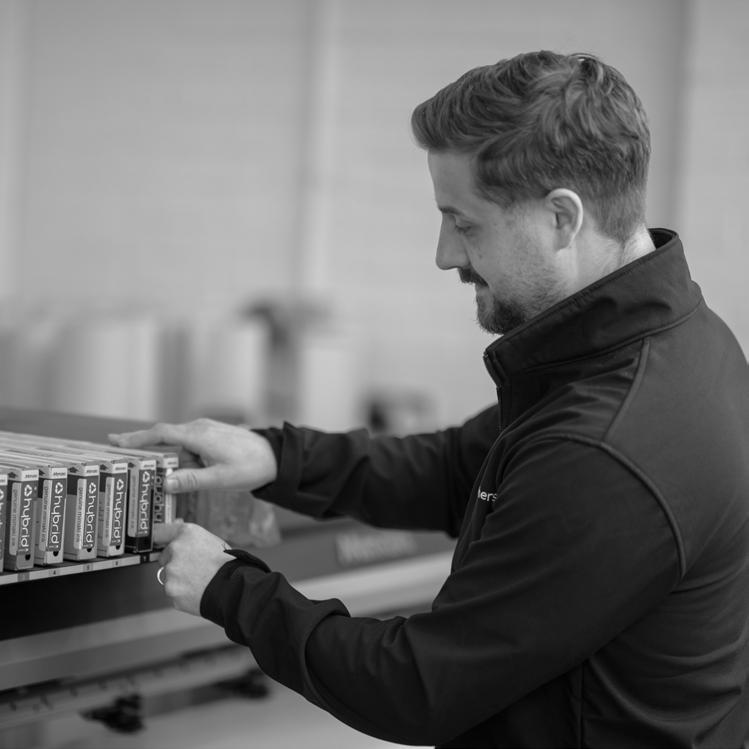
The business began with traditional chalkboards, A-frames, easels, and tabletop displays, supplied to pubs, restaurants, and wholesalers. Orders came in bulk, margins were tight, and the work was physically demanding.
But hidden within that humble product was a crucial lesson.
“We realised that for every ten chalkboards we sold wholesale, we could sell one bespoke one for ten times the price,” they explain.
That insight, into the value of customisation, would shape the future of West Brothers.
At the same time, demand from clients like Vodafone began to evolve. They didn’t just want chalkboards; they wanted branding, printed graphics, something more polished and professional.
At first, the brothers outsourced the printing. But soon, they saw an opportunity.
Three years in, they bought their first printer, along with a small signage company that came with it. That moment marked a turning point.
Every business has a defining moment, sometimes dramatic, sometimes quiet.
For West Brothers, it came in two forms.
The first was small: a single acrylic sign, made from an offcut, taking just 20 minutes to produce.
“We sold it for £175,” they recall. “And we realised… that’s the same profit as a huge chalkboard order.”
The second moment was much bigger, a call from Vodafone late on a Friday afternoon.
“They needed samples, quotes, everything for a meeting on Tuesday,” they say.
Over a frantic weekend, they pulled together a proposal for hundreds of units, chalkboards and easels.
“That’s when it clicked,” they say. “This isn’t just a job anymore. This could be a real business.”
From that point on, the direction was clear. Signage and printing offered not just better margins, but more creativity, more scalability, and more opportunity.
Interestingly, Thetford wasn’t part of some grand strategic plan.




“There was no big decision to be here,” they admit. “It just made sense at the time.”
But what they discovered was a town rich in industrial potential, hidden in plain sight.
“You don’t really notice it until you’re part of it,” they say. “But there are some huge companies here.”
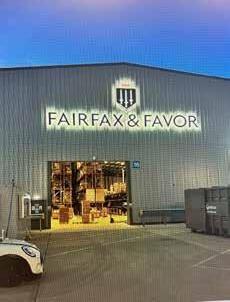
From global giants like Baxter Healthcare to major manufacturers scattered across the industrial estates, Thetford offered something invaluable: a network of businesses that needed exactly what West Brothers could provide.
“It was a really nice surprise,” they say. “If it works for companies like that, then there’s something right about the area.”
Over time, Thetford didn’t just support their growth, it became part of their identity.
Learning the Hard Way Growth wasn’t always smooth.
At one point, their core chalkboard business was undercut by cheap imports.
“Suddenly, people could buy them cheaper than we could make them,” they explain. “That whole side just dropped off.”
Instead of resisting the shift, they adapted, focusing on bespoke work, signage, and highervalue production.
There were also the everyday challenges of running a business, cash flow, staffing, and investment decisions.





“Some of the machines we look at are over £100,000,” they say. “In a small town, you have to be sure the work is there.”
That constant balancing act, between ambition and sustainability, is still part of their decisionmaking today.
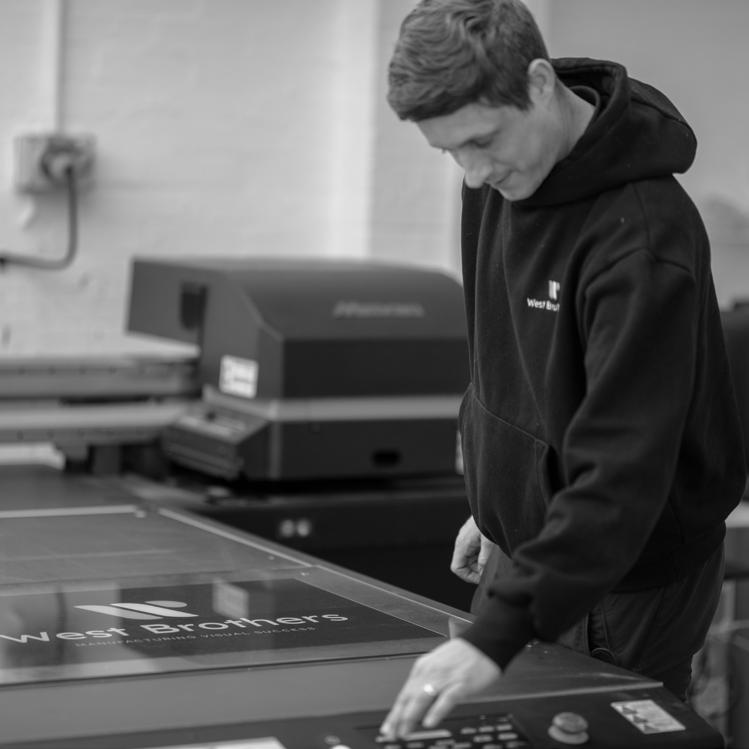
At its heart, West Brothers is a creative business, but one grounded in technical reality.
“You can design anything,” they explain. “But you have to be able to make it.”
That gap, between idea and execution, is where much of their expertise lies.
A single sign might have multiple possible production methods, each with different costs, materials, and visual outcomes.
“You could do it for £50 or £500,” they say. “But the customer wants £150.”
Bridging that gap requires experience, communication, and a deep understanding of both design and manufacturing.
“It’s about knowing the best way to make it, not just how it looks.”
One of the company’s most significant projects began close to home, when West Brothers secured a large-scale rebranding contract for a major corporate client in Thetford. What started as a local job quickly evolved into a multi-year project spanning several sites across the UK.
“It all kicked off at the same time we moved into this unit,” they recall. “It was chaos.”
Long days became even longer nights, with installations often running into the early hours, but the experience marked an important turning point for the business.
“It proved we could handle projects on that scale,” they say.
The work demanded precision, consistency and organisation, but there were still opportunities for creativity along the way. One standout moment came when they were asked to completely rethink a feature wall near a boardroom with only days to spare.
“They basically just said, ‘do something with it,’” they laugh. “That was a good one.”
Despite their growth, West Brothers remains firmly a family-run operation.
Their parents, both business owners, instilled a strong work ethic early on.
“We grew up around it,” they say. “Working weekends, helping out, it was just normal.”
That mindset still defines the company today.
“It’s about not letting people down,” they explain. “If a job needs doing, we do it.”
Late nights, early mornings, last-minute changes, it’s all part of the territory.
“We’re not nine-to-five,” they say. “It’s more like
And yet, there’s no resentment in that statement, only pride.
“I’ve never had a day where I didn’t want to come to work,” one adds.
Defining ‘Visual Success’
Their tagline, manufacturing visual success, wasn’t chosen lightly.
“It took us a long time to figure out how to describe what we do,” they say.
Rather than listing products, they focused on purpose.
“Everything we make is visual. It helps businesses communicate, stand out, or function better.”
From a simple chalkboard to a complex signage system, the goal is the same: to create something that works and looks good doing it.
Ask them what success means today, and the answer isn’t about revenue or expansion.
“It’s flexibility,” they say.
The ability to attend a school event, pick up their children, or adjust their schedule, that’s what matters most.
“You don’t miss things,” they explain. “That’s the best part.”
There’s also something deeper: a genuine enjoyment of the work itself.
Perhaps most importantly, there’s still excitement. “You never know what’s coming next,” they add.
A small enquiry might turn into a major project. A quiet afternoon might spark a new idea.
That unpredictability, the same uncertainty that defined their early days, has become one of the most rewarding parts of the journey.
At its core, the story of West Brothers is about making things, physical, tangible, visible things.
From chalkboards to large-scale signage, from hand-built frames to high-tech printing, the tools have changed, but the essence hasn’t.
“My favourite lesson at school was design technology,” one of them reflects. “This is the closest I can get to that.”
And that’s perhaps the most telling detail of all.
Because after thirteen years, countless projects, and a business that now spans far beyond Thetford, the motivation remains the same as it was on day one:
To create something from nothing, and then stand back, look at it, and think:
We made that.

17th-19th July 2026



The Festival of Thetford & Punjab returns to Thetford on Saturday 17th July and Sunday19th July 2026. The festival has become an annual event in Thetford with local, national and international audiences keen to learn more about Maharaja Duleep Singh and his family’s story which links Thetford with Punjab through the rich cultural heritage.
Events, activities and talks will take place on Saturday 18th July in various locations around Thetford including the Ancient House Museum and the Annual Thomas Paine Hotel Curry Night.
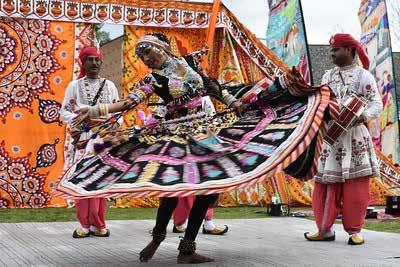
this fascinating region’s legendary entertainment communities, combining their amazing skills – with optional live musical support from the World famous Rajasthan Heritage Brass Band - in performing breathtaking acts of courage and bravery. Bhangra Legends Heera Group from Southall Kumar and Dhami will also sing their evergreen bhangra tracks for audiences to enjoy. Local business traders and Punjabi food stall Apna Pind along with Henna hand painting, arts and crafts will be on display.
Sunday 19th July will see Thetford Mela take place at Thetford Grammar school grounds which will include the cultural activities including the Rajasthan Heritage Brass Band and the Circus Raj from Rajasthan,India. Circus Raj are elite street circus performers from
The Ancient House Museum will be open all day on Sunday 19th July for free activities and free admission to the museum as part of the Festival of Thetford and Punjab.
For More regular updates on the Festival of Thetford and Punjab please sign up to our monthly e-newsletter on www.essexcdp.com




Written by Martin Angus
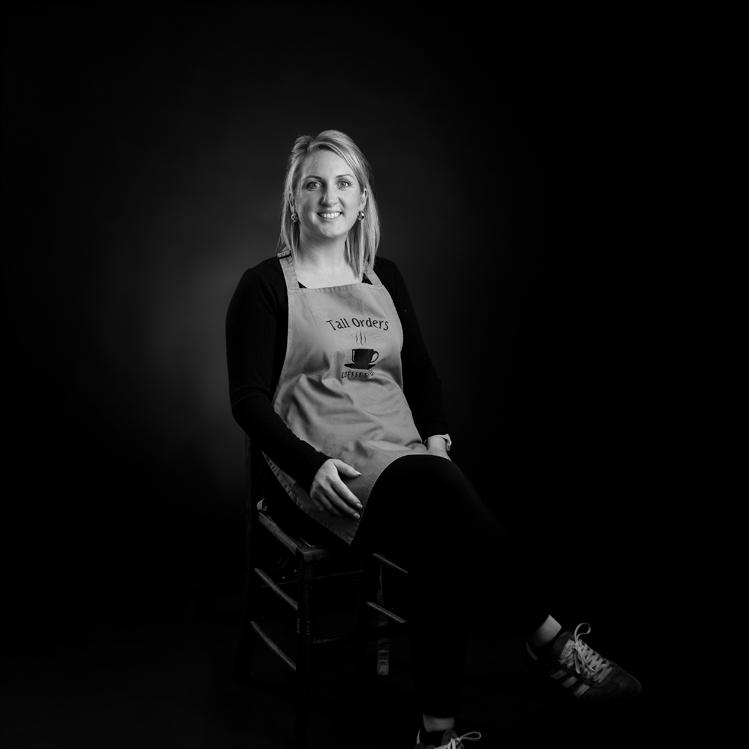
From behind the counter at Tall Orders Café, Leigh Miller has one of the best vantage points in Thetford. Through the windows of the King Street café, she can watch the town move around her, shoppers carrying bags, cyclists stopping for coffee, regulars arriving for “the usual”, tourists wandering in after exploring the town’s rich history, and familiar faces settling into favourite seats as though they were extensions of their own living rooms.
For Leigh, that daily rhythm is more than simply running a business. It is community in motion.
And in an age when high streets across Britain are wrestling with uncertainty, Tall Orders Café has quietly become one of the beating hearts of Thetford town centre.
The remarkable thing is that Leigh never set out to become the polished owner of one of the
town’s best-loved cafés. In fact, her story is woven so tightly into Thetford itself that it feels less like a business journey and more like a continuation of a family tradition rooted in service, resilience, and community spirit.
Born in Bury St Edmunds but raised in Thetford, Leigh attended Raleigh, Admirals and Rosemary Musker schools before studying beauty at West Suffolk College, though, as she laughs, she “literally done nothing with beauty.”
Instead, her real education began much earlier, standing behind the counter of her mother’s sweet shop.
Her mum owned the much-loved “Auntie Pam’s Sweet Shop” on King Street, and from the age of thirteen, Leigh was already learning the realities of customer service, long hours and the importance of knowing people by name. It

was there that the foundations of her work ethic were laid, not through textbooks, but through conversations, queues and community.
That early exposure to independent retail shaped her understanding of what makes a town centre tick. The best businesses, she believes, are not just transactional. They become part of people’s routines and memories.
Hospitality, however, arrived in full force when Leigh and her mother took over The Grafton Arms in Barnham when she was just eighteen. It marked the beginning of a long chapter in pubs and bars, eventually leading to Leigh and her partner taking over The Green Dragon in Thetford, which they ran for nine years.
The Green Dragon years taught her the realities of self-employment. Long days became normal. Customer service became instinctive. Hospitality stopped being a job and became part of who she was.
Then came Ibiza.
It sounds almost surreal in the context of King Street, the owner of a thriving Thetford café, once spent a year waitressing in a Spanish hotel while her partner sold tickets and DJ’d near the legendary Café Mambo. Yet the experience widened Leigh’s understanding of hospitality. Different people, different expectations, different energy, but the same principle remained: make people feel welcome, and they will return.
When she came back to Thetford, the landscape had changed. Wetherspoons had altered the local pub scene dramatically, and eventually, like many independents across the country, The Green Dragon struggled against the pressures facing
traditional pubs.
Leigh adapted.
She worked at New Look in the high street while still running the pub, juggling two jobs to make ends meet. It was during those shifts, looking across the road at Tall Orders Café, that a quiet dream began to form.
“I used to always say, I’d love to have my own little coffee shop,” she recalled.
At the time, it was simply an idea, one of those passing ambitions people mention without truly believing it will happen.
But years later, after working at Howdens Kitchens and Joinery and becoming increasingly restless behind a desk, fate intervened through a Facebook post announcing Tall Orders was closing.
Leigh didn’t overthink it.
She picked up the phone.
“I literally just winged it,” she said.
That instinctive decision changed everything.
The transition was not glamorous. There were delays, uncertainty and moments of real doubt. Leigh had left the security of a steady income at Howdens while waiting for the lease to complete, all while raising a two-year-old son.
For a period, she had neither the café nor her old job.
“I was a little bit like, what have I done?” she




admitted candidly.
That honesty perhaps explains why Tall Orders feels so authentic. There is no manufactured “entrepreneurial” mythology here. Leigh speaks openly about fear, uncertainty and self-doubt. The café exists not because success was guaranteed, but because she took the risk anyway.
Supported by family, particularly her mum and dad, helping care for her young son while renovations took place, she pushed forward. Walls were painted, equipment replaced, late nights endured, and in January 2023, Tall Orders reopened under Leigh’s ownership.
Today, walking into the café, it is hard to imagine those uncertain beginnings.
Tall Orders hums with warmth.
The décor is clean but comfortable. The atmosphere is relaxed without feeling lazy. Staff greet customers with genuine friendliness rather than rehearsed corporate enthusiasm. Upstairs, the window seats have become prized positions for people-watching over King Street, while outside tables spill onto the pavement during warmer months, adding life and movement to the high street.
It is exactly the kind of independent business towns desperately need.
Leigh insists much of the café’s success comes from the people around her, especially longserving staff member Jo, who remained through the ownership transition and now runs much of the kitchen operation. Homemade cakes, fresh scones and rotating bakes have become part of Tall Orders’ identity, giving the café the
unmistakable feel of somewhere personal rather than manufactured.
Even the menu philosophy reflects Leigh’s grounded approach.
She does not chase trends for the sake of it. She keeps things simple, affordable and consistent.
“People just want a sandwich, coffee and a bit of cake,” she explained.
And increasingly, they want it at Tall Orders.
The café’s breakfasts have become particularly popular, so much so that an independent local poll once crowned them “best looking breakfast in town”, a competition Leigh knew nothing about until flowers arrived at the café announcing the result.
Yet perhaps what truly distinguishes Tall Orders is not the food but the flexibility and humanity behind it.
Leigh talks passionately about “going the extra mile”, though she describes it so casually that it sounds less like a customer service strategy and more like common decency.
If customers cannot climb the stairs, tables are rearranged downstairs. If a child desperately wants pancakes from elsewhere while the family orders lunch, Leigh allows it rather than losing the table. Cyclists have water bottles refilled. Elderly customers get help carrying shopping upstairs. Gluten-free diners are catered for without fuss. Dogs receive water bowls and even dog ice cream outside.
None of these gestures are revolutionary individually.
Together, they create loyalty.
That loyalty matters enormously at a time when Thetford’s high street faces significant challenges. Leigh speaks honestly about concerns over declining footfall, particularly following the loss of charity shops and other businesses from the town centre.
Yet she remains optimistic.
She points to positive developments, the arrival of an NHS dentist, the planned banking hub and rumours of educational investment in the town, as signs that Thetford can recover and evolve once again.
Importantly, Tall Orders is not simply benefiting from the town; it is actively contributing to it.

Leigh supports local events, donates prizes for charities, participates in community trails and welcomes groups who use the café as a meeting point or social hub. Running clubs gather there. Tourists stop there. Regulars build routines around it.
In many ways, Tall Orders now functions as a modern version of what pubs once represented, a reliable social anchor.
That sense of belonging has developed naturally over time. Leigh describes how customers who were once simply faces and coffee orders have gradually become people whose holidays, families and lives she now knows personally.
That transformation, from café customers to community, may be Tall Orders’ greatest achievement.
And remarkably, Leigh herself still resists acting like a traditional “owner”.
Customers are often surprised to discover she runs the place at all because she works alongside staff rather than above them. She wears the same uniform, serves customers herself and remains firmly “in the thick of it”.
That leadership style filters through the entire café. There is no hierarchy visible to customers, only teamwork.
It also explains why Tall Orders feels less like a polished business concept and more like an extension of Leigh’s personality, hardworking, straightforward, warm and quietly resilient.
Perhaps the most striking aspect of Leigh’s
story is how little ego it contains. Asked what achievement makes her proudest, she simply answers: “Just doing it.”
No grand claims. No exaggerated business language. Just the satisfaction of taking a risk and building something meaningful.
And meaningful it undoubtedly is.
At a time when many town centres are criticised for lacking identity, Tall Orders provides something increasingly rare: authenticity. It is not trying to imitate London café culture or become an Instagram backdrop. It succeeds because it understands Thetford and the people who live there.
The café belongs on King Street because Leigh belongs to King Street.
She grew up there. Worked there. Learned there.
Dreamed there.
Now she is helping shape its future.
Tall Orders has already left its mark on the town.
It has brought warmth to the high street.
It has created jobs, conversations and routines.
It has reminded people that independent businesses still matter.
And perhaps most importantly, it has shown that optimism can still survive on Britain’s struggling high streets, one coffee, one breakfast and one act of kindness at a time.
Written by Martin Angus
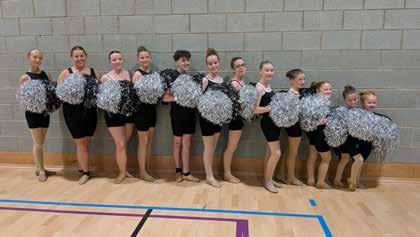
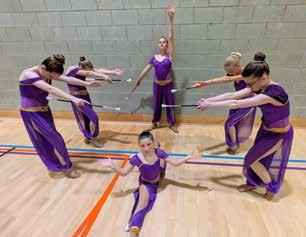
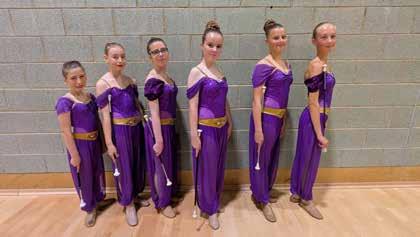
At first glance, it looks almost impossible. A sixyear-old launches a silver baton high into the air beneath the unforgiving lights of a national championship arena. Around her sit hundreds of spectators, coaches and judges. The baton spins violently overhead before dropping back toward the floor with alarming speed. In that split second, there is silence, concentration, tension.
Then, catch.
The crowd exhales. Somewhere at the edge of the competition floor, proud parents burst into applause. Team-mates scream encouragement. A coach beams with relief and pride.
For Ambition Baton Twirlers of Thetford, these tiny moments are everything.
In a quiet corner of Norfolk, inside the halls of
Cloverfield Community Church, in Thetford, every Sunday afternoon, something rather remarkable is happening. While much of the town may still think baton twirling belongs to another era, all marching boots and carnival parades, a determined local club is redefining the sport entirely.
And they are doing it with astonishing success.
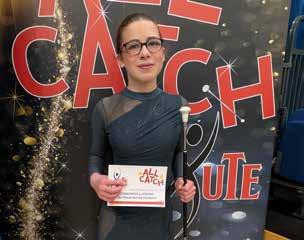
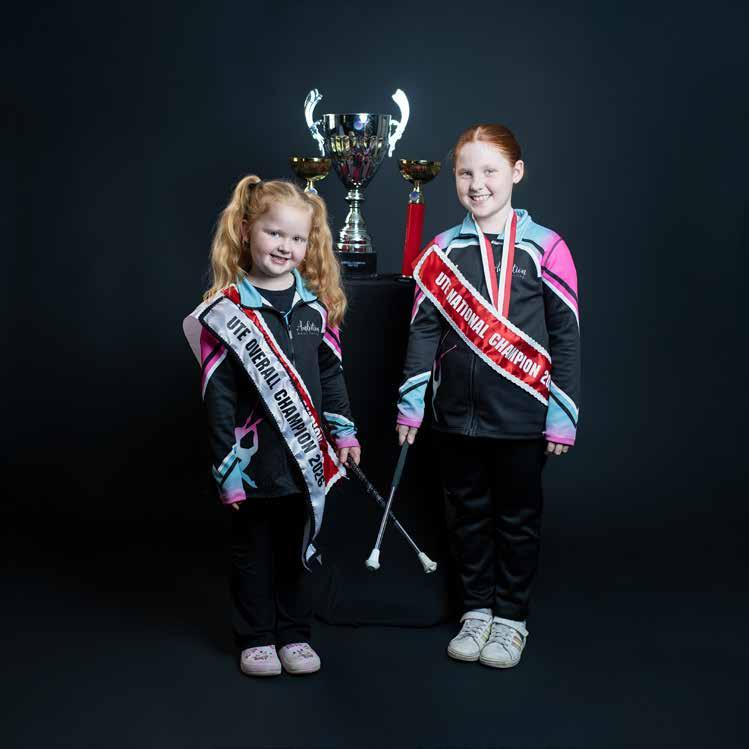
This year, Ambition Baton Twirlers returned from the national championships in Crawley with not one but two national champions, alongside an overall national champion title, and some fantastic routines from all their athletes. An extraordinary achievement for a club only six years old.
Even more impressive is the age of the stars at the centre of it all.
Florence, aged eight, became a national champion. Quinn, just six years old, not only claimed a national
title but was crowned overall champion, too.
Six years old.
Most children that age are still mastering shoelaces and learning to sit still for story time. Quinn is already competing on national stages in front of hundreds of people.
Yet inside Ambition Baton Twirlers, nobody seems particularly surprised.
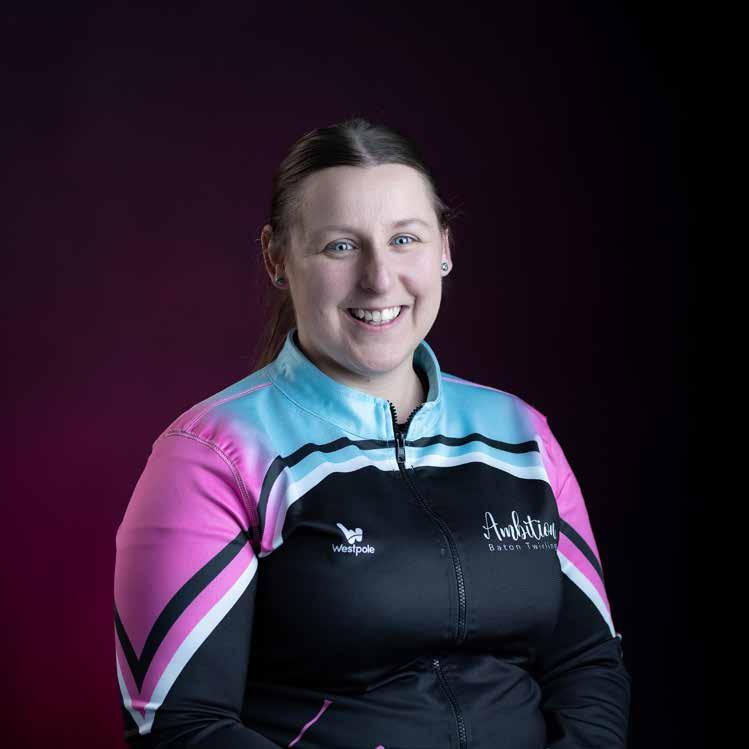
“Quinn was basically born with a baton in her hand,” laughs coach Georgia Bloom.
It is said affectionately, but there is truth in it. Baton twirling, for many involved in the club, is not simply a hobby. It is heritage. Family. Community. Identity.
Georgia herself has been baton twirling for 26 years. Her journey into the sport began through an almost unbelievable coincidence. When her mother, Dawn, gave birth to her, the lady in the next hospital bed happened to be a baton twirling coach from Thetford’s old Abbey Twirlettes.
Years later, Georgia was invited along to training.
“She just took to it,” Dawn recalls.
That chance encounter shaped the course of Georgia’s life.
Today, she coaches the next generation of twirlers while continuing to inspire athletes nationally and internationally. She represented England from 2008 until 2024, competing across Europe and beyond in countries including America, Canada, Croatia, Spain and France.
But despite all the medals, travel and experience,
Georgia insists the sport has always been about far more than trophies.
For her, baton twirling is about people.
“I’d much rather have our club support each other than bring home 100 gold medals,” she says. “As long as the athletes enjoy themselves and make memories, that’s more important than anything else.”
That philosophy runs through Ambition Baton Twirlers like a silver thread.
Spend even a few minutes with the group, and one thing becomes immediately obvious: this is not merely a sports club. It is an extended family.
Parents describe competition weekends like giant communal adventures. Someone brings sewing kits. Someone else handles hair and makeup. Another parent stocks emergency sweets for exhausted children during 12-hour competition days.
If one child forgets equipment, another family member helps instantly.
“There’s no awkwardness,” says one parent. “Everybody supports everybody else.”
Another adds: “You walk into a room and it feels like you’ve never been away.”
In an age increasingly dominated by screens, isolation and disconnected social lives, Ambition Baton Twirlers feels refreshingly old-fashioned in the best possible sense. Children of vastly different ages train together, encourage one another and form genuine friendships. Parents become friends too.
And unlike many youth sports environments, there is remarkably no toxicity.
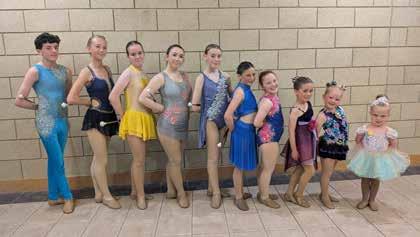
Baton twirling may be fiercely competitive, but the culture surrounding it appears unusually supportive.
One mother describes how athletes from rival clubs routinely lend costumes, shoes and hair accessories to each other at national events. Another compares the atmosphere favourably to dance competitions, where rivalries can sometimes become uncomfortable.
“In baton twirling, everybody is friendly,” she says. “Everybody says hello.”
Georgia believes sportsmanship is one of the club’s defining values.
In a widely shared social media post last year, she wrote passionately about supporting athletes regardless of results, whether routines go perfectly or batons hit the floor. Those words clearly were not written for social media applause. They are principles she lives by every weekend.
“If they drop the baton, it’s okay,” she says simply. “People get nervous. As long as they try their hardest, that’s all that matters.”
It is easy to see why children flourish under that approach.
Florence, despite her young age, already speaks with surprising maturity about the lessons the sport has taught her.
“I’ve learned hard skills,” she says thoughtfully, “and I’ve learned not to give up.”
That resilience matters because baton twirling is far harder than outsiders realise.
The sport today is a blend of dance, gymnastics,
acrobatics, choreography and technical precision. Modern routines involve multiple batons, aerial throws, complex spins and intense athletic conditioning.
Some athletes perform with two or even three batons simultaneously.
One of Ambition’s senior athletes, Charlie, performs with three at once, a constant juggling act requiring extraordinary coordination. After only two years with the club, Charlie has already won bronze and gold medals internationally at the Nations Cup in Eindhoven.
For younger athletes watching from the sidelines, achievements like Charlie’s are transformational.
“They see what’s possible,” Georgia explains.
That sense of possibility is crucial in a town where many people have never even seen baton twirling performed at an elite level.
One of the frustrations repeatedly voiced by the club is how overlooked the sport remains. While football teams attract sponsorship and attention, baton twirling often struggles for recognition despite the immense financial and physical demands placed upon athletes and families.
Competition travel alone can probably cost families hundreds, and international travel costs thousands. All events are entirely self-funded. Parents pay for accommodation, transport, costumes, competition fees and specialist equipment. Fundraising becomes constant.
Yet nobody involved seems bitter about it.
If anything, there is pride in the sacrifice.

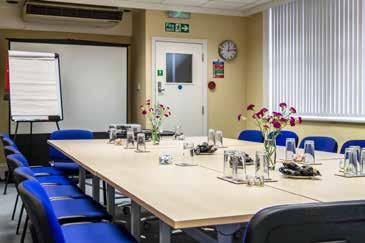
Need a professional space to meet? Anglia House Business Centre offers modern, fully equipped meeting rooms, book by the half day or day, and focus on what matters.
Anglia House Bridge Street Thetford IP24 3AG 07342 72701

enquiries@angliahousebusinesscentre.co.uk www.angliahousebusinesscentre.co.uk
Georgia coaches entirely voluntarily, travelling around 40 minutes each way to Thetford several times a week, simply because she loves the sport and the children involved.
“She does it from the love of her heart,” Dawn says.
And the athletes clearly respond to that dedication.
Training sessions at Cloverfield Community Church are structured but joyful. Warm-ups lead into technical drills, routines, tricks and games. Younger children practise alongside older role models, learning not just baton skills but discipline, patience and confidence.
There is laughter throughout.
Even at national championships, amid enormous pressure, the emphasis remains on enjoyment.
That balance between ambition and emotional well-being may explain why the club has achieved so much so quickly.
In only six years, Ambition Baton Twirlers has produced multiple national champions, international competitors and their athlete Beth is part of the England development squad.
For a tiny grassroots club from Thetford, that is astonishing.
But perhaps the most impressive aspect is not the medal count.
It is the confidence these children carry.
Watching Florence and Quinn chatter excitedly about routines, sparkly costumes and catching batons midair, there is none of the self-consciousness often seen
in modern children. They are articulate, resilient and socially confident.
Competition has not hardened them. It has empowered them.
Quinn, despite being only six, already talks excitedly about seeing friends from other clubs at competitions. Florence speaks openly about perseverance and improving through mistakes.
These are not just sporting lessons. They are life lessons.
And perhaps that is why Ambition Baton Twirlers matters so much to Thetford.
Because beyond the trophies and glitter lies something deeper: a genuine community giving young people belonging, discipline and aspiration.
At a time when many youth organisations struggle for volunteers and participation, Ambition appears to be thriving precisely because it offers more than sport.
It offers connection.
Parents become support systems for one another. Older athletes mentor younger children. Coaches nurture emotional resilience alongside technical ability.
Nobody succeeds alone.
That collective spirit becomes especially powerful during difficult moments. Georgia speaks movingly about waiting for athletes as they come off the competition floor, whether triumphant or devastated.
Sometimes children cry after routines. Sometimes they are disappointed. Sometimes they exceed every



At NMV Sweet & Savoury, we create stunning wedding cakes, birthday cakes, and custom cakes for any occasion. Our menu also includes French mousse mini cakes, desserts, and appetizers, perfect for adding a touch of elegance to your celebration. Delivery available. Visit us online: www.nmvsweetandsavoury.co.uk
Follow us on social media: Facebook @nmvsweetandsavoury Instagram @nmv_sweetandsavoury 07936 612846


In every circumstance, she is there.
That consistency matters enormously for young competitors navigating pressure and self-belief.
“I’ll always be waiting for my athletes,” Georgia says.
The result is a culture where children feel safe enough to fail, and therefore brave enough to excel.
Perhaps that is why Ambition Baton Twirlers continues to grow.
The club now has 18 members ranging from complete beginners to advanced competitors. Some train simply for fun. Others harbour dreams of international competition.
And those dreams suddenly feel very real.
Next year, Liverpool will host major championships. Beyond that lie other international countries, where some Ambition athletes hope one day to compete. For children from a modest Sunday club in Thetford, that is extraordinary.
Yet listening to everyone speak, there is no arrogance, only excitement.
When asked to describe the club in five words, the answers come quickly:
“Supportive.”
“Kind.”
“Grateful.”
“Energetic.”
“Family.”
That final word lingers longest.
Because ultimately, Ambition Baton Twirlers is not really about batons at all.
It is about what happens when people choose to invest in each other.
It is about a coach giving countless unpaid hours so children can flourish.
It is about parents waking before dawn for competitions hundreds of miles away.
It is about little athletes standing nervously on a red carpet waiting for national championship results while their teammates scream support from the sidelines.
And it is about a town quietly producing extraordinary young athletes who deserve far more recognition than they currently receive.
The trophies matter, of course, they do.
But long after the medals tarnish and the routines change, these children will remember something else entirely.
They will remember the friendships.
They will remember the laughter.
They will remember being part of something special.
And in a world that often feels increasingly disconnected, that may be Ambition Baton Twirlers’ greatest achievement of all.
Daniel Allbritton

Written and
Photographed
by Andy Greenhouse
The weather app on my phone informed me that I could expect warm sunshine, with a temperature of 15C to 17C, for the best part of the day.
Having agreed to meet around midday, by the river at Nuns Bridges, I was therefore relieved to know there would be some warmth in the air, and that I wouldn’t have to sit shivering while chatting.
I was meeting Daniel Allbritton and his dog, Bear.
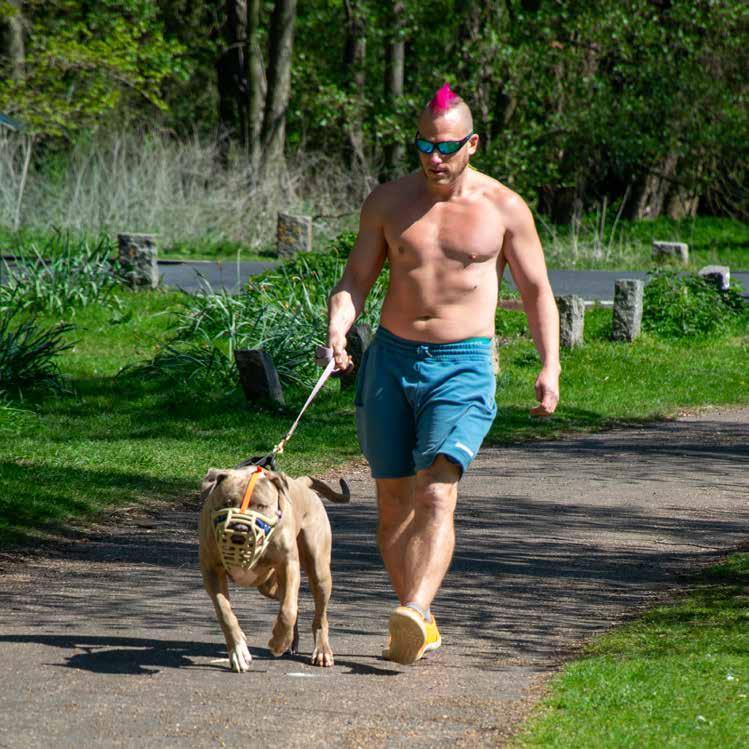
Daniel is the guy you can see striding around town with his dog, wearing nothing but a pair of shorts and trainers. No matter the temperature, you’ll never see him with a T-shirt on.
We had exchanged texts the previous week to organise things and, as I usually do with my subjects, I’d left it completely up to Daniel where we would
meet. I did suggest a few places I’d previously met up with people, but understandably, he came back requesting an outdoor location. He suggested the benches by the memorial at Nuns Bridge, and it was such a perfect spot.
I parked under a tree in the small car park and headed over the larger of the humpback bridges to where Spring Walk starts, between the Little Ouse and the Thet. There’s a large area of green with a lime tree planted in the centre, which has been adopted as a remembrance tree, with many poppy wreaths and crosses laid at its base. Around the other side, there’s a cast-iron bench set into a concrete base.
This was where the very colourful Daniel was seated, awaiting my arrival. Sporting a vivid neon-pink mohawk with multi-coloured mini dreads at the back, blue shorts and bright orange trainers, he was an explosion of colour in a sea of greenery, in the
For over 100 years we have provided care, reassurance and professional support to local families when they need it most.
Our friendly and experienced funeral arrangers are here to guide you through each step of your journey.
Our services include:
• Personalised funerals
• Pre-paid funeral plans
• Direct cremation
• Flowers, transport and stationery
• Expert guidance
• Multi-faith services
• Masonry
• In-home consultations

Your local Funeral Arranger, Lisa
Thetford
33-35 Bury Road, Thetford, Norfolk IP24 3DD
01842 845874
We’re open
Monday to Friday 10am–3pm Saturday Closed Sunday Closed
Find out more about all our services at: eastofengland.coop/funerals
Bear was waiting for me, too. I suddenly became very appreciative of the solid bench and the way it was fixed into the ground, with Bear’s lead wrapped around it. I had the foresight to stop a few feet away as I approached them, and I judged the distance just right; had I gone another foot closer, Bear would have had me over in his eagerness to say hello.
I’d also come prepared with a pocketful of dog treats and, with the most alpha-male, commanding voice I could manage, I instructed Bear to sit several times and proceeded to try and convince him that I was a source of food, not actual food!
It seemed to work, and he gradually became calm, more intent on digging a hole than trying to give me a bear hug.
With the intricacies of canine introductions completed, I could turn my attention to Daniel. We formally said ‘Hello’ with a handshake and sat on the bench.
Bears’ exuberance at meeting me managed to derail the plan, and my structured list of questions stayed in my pocket as we sat and chatted about the dog: his origins and the effect he had on Daniel’s life.
Muzzled though Bear was, Daniel was quick to point out that he absolutely loves people and is totally non-aggressive. He explained that I was just ‘new’ to him and something to explore, and that jumping up is not something that he would normally do.
Bear was about 6 months old when he was given to Daniel. His previous owners were going through a difficult time, and combined with a lack of space, they decided to rehome Bear. Daniel was suggested by a friend, knowing that he’d recently lost his last dog.
It took a while to be able to walk him successfully on a lead, as he was and can be a very excitable dog, as I had witnessed. Things have been more difficult lately. When he first came on the scene, Daniel could take him somewhere he could be let off the lead so he could run around, but that’s all changed now: he must be on a lead and muzzled all the time.
These measures have unfortunately been imposed on him since he was impounded by the police.
An anonymous member of the public decided on seeing Bear in the street, to report him as a dangerous animal. Consequently, he was taken into custody and subjected to all manner of investigative examinations to confirm his lineage.
After two weeks of separation from his owner, Bear was returned to Daniel with the affirmation that he held no aggressive tendencies towards people. They had, however, deemed it necessary to neuter him, as the law states that he is not permitted to reproduce.
Also, under the XL bully ruling, they must wear a muzzle and be on a lead in public at all times. Daniel is also not permitted to give Bear away, sell him, or put him into a rehoming shelter. Bear must remain with him permanently, and Daniel is only allowed a certain number of days each year when he can be without him.
We chatted for a few minutes more about Bear and the kinds of problems some dogs have because of ignorant and greedy breeders. Popular breeds can be worth a lot of money, and some unscrupulous sorts will overbreed dogs or breed them with the wrong dogs, which can result in all sorts of neurological and genetic disorders that can manifest as aggression. Unfortunately, this is how dogs like Bear have come to have a bad name and reputation.

I’d been with Daniel and Bear for around fifteen minutes before the talk finally got around to my reason for being there, so it was time to swing the conversation towards the subject.
I started by stating the obvious. I mentioned that I often see him around various parts of town, and said that he had to admit he looked different to most people. He agreed without hesitation and said it was somewhat by design. Before he started walking around with his shirt off, he had long dreads with differently coloured beads in them. This too was to look different, and he said it got to the point where he didn’t really care what the average person in the street might think when they looked at him. It’s what he liked doing, so why should other people’s opinions bother him?
Having always had either long hair or dreads, Daniel recognises that there is a kind of stigma attached to them, and people do treat you differently for having them. People tend to associate dreads with not washing your hair, which is true to a certain degree, as your hair does mat if not washed, but there is a lot more to it. Daniel certainly seemed to know a lot about the matter, claiming to have had dreads for a long time, for himself and other people.
I told him I appreciated his mohawk more, as I have been known to have one in the past and can associate more with that style than I could with dreads.
Trying to delve further, I asked Daniel how he might describe himself to somebody that’s not met him before.
He said he didn’t really put any specific label on himself, justifying this by saying he’s not quite like most people. Then, going deeper, came the revelation. I could sense it wasn’t an easy thing to say,
but he began by telling me he’d struggled for much of his life with mental health issues.
He started seeing a psychiatrist at the age of 4. We referred back to this later in our chat when he told me his parents had divorced at this time, and it would seem this became the catalyst for his subsequent issues.
From what he’s been told and from his own memory, he was a difficult child with mood swings constantly taking him up and down, and he found it very hard to control his emotions and impulses and spent a lot of time in therapy.
Once he reached puberty, he was still seeing a psychiatrist, and with hormones going wild, his emotional state was exacerbated. Before long, he was being prescribed medication to help combat his ‘condition’ and continued to take them for many years.
After stating that it was never a major problem, he also told me that he began using cannabis, as well as alcohol, under the mistaken belief that it was helping to sort himself out, but he has since stopped using it.
Now, it’s his regime of fitness, diet and sleep that manages to sort everything out, and drugs are firmly gone from his life. He came to learn that medications may take the symptoms away, but they don’t allow you the chance to learn to live with yourself. And he’d discovered that it was deemed easier to remove those symptoms with medications than to try to teach someone how to live their life for the better.
A big part of that learning curve is in finding something you’re passionate about… being interested in something, which for him is where exercise, diet and sleep became important.
If you’re getting enough of the right sort of exercise, it makes you eat properly, and that makes you sleep enough to make everything a lot easier to manage. We both agreed that life itself is a kind of drug, and if you’ve got a good, healthy life, then you can only get stronger.
He proudly stated that he doesn’t want to rely on something that he can’t give himself.
Speaking of diet, Daniel said that, for most of the time, he sticks to a ketogenic diet. According to the research he’s done, it appears that the way keto works produces effects similar to some antidepressant drugs.
He also found out that mood stabilisers are basically the same as the anti-seizure medications given for epilepsy, so people were being given the same treatment for epileptic fits as they would for mood disorders.
He went on to say that the keto diet was first introduced in the early 1900s as a treatment for seizures in children, but it fell by the wayside after the introduction of drugs, when prescribing a tablet was easier and quicker than the food preparation required for a strict diet.
While there is always ongoing research being done on the subject, it’s become apparent to Daniel that it has had an impact on his life in the way he feels day to day, and it’s made a huge difference.
A typical day for Daniel revolves around exercising Bear. They walk for around three hours a day, split into two sessions and cover a lot of miles on varying routes.
Daniel also goes to the gym three or four times a week at the Sports Centre, plus a couple more visits

to take Yoga classes, something he really enjoys.
What about work? I asked. Do you have a job?
Daniel told me he currently volunteers for the East Anglia Children’s Hospice, doing PAT testing in the distribution centre. He’s been looking for paid work for some time, but because he’s been signed off for so long, it’s been very difficult to find anything.
He does understand and respect that potential employers are probably looking at his CV, which shows 17 years without working, and thinking they will likely fill the vacancy with someone who has more ‘experience’.
He also accepts that he’s somewhat limited in his search as he doesn’t have transport, nor the qualifications for specific roles. He would love to learn to drive but has hit the catch-22 situation of not being able to afford lessons without a job, and being limited in getting a job without a car!
I asked him what kind of work he was looking for, to which the answer was basically anything! He’d be a bit restricted from anything too physical for another month or so, as he is still on the mend from ACL reconstruction surgery at the end of last October, which hasn’t quite healed yet.
He has lived in America, where he worked in care of people with developmental disabilities, which he enjoyed doing, but on moving back to the UK, the qualifications didn’t count for anything over here.
I was curious about the American connection and followed that tangent. It turns out Daniel has dual citizenship. His dad was in the USAF and, while stationed in the UK, met and married Daniel’s mum. Daniel was born in Banbury in 1987, and they all moved to the States not long after.
Unfortunately, his parents divorced when he was almost 5, and he and his mother moved back to the UK. This was the start of his troubled times.
He travelled back and forth to the US over the years and, because he was born in the UK, he came to have both passports.
Thetford came to be his home, and he did most of his growing up here, although he went to Methwold High School.
Over the years, he has fallen in love with Thetford, especially the natural beauty of the forest that surrounds it and walking to Two Mile Bottom with Bear is one of his favourite routes.
Something else that anchors him to the town is his 17-year-old daughter…
She is currently in Colchester but should hopefully be moving back in the summer, and the plan is to continue with the contact that they’ve built up.
Daniel explained that their relationship had a very difficult and complicated start. But a positive aspect of this has been that Daniel has been able to recognise and make a lot of comparisons between what she has been going through in the same way that he did when he was around her age.
This has given him the resolve to ensure that she won’t be alone in getting through it. Having someone there that’s been through something similar can make a lot of difference, and the last couple of years have been the testing ground. They’re getting used to it and talk pretty much every day.
Daniel went into introspective mode and started telling me about his troubled teenage years. It became obvious that the experience, whilst difficult
at the time, has been very formative of who he is now.
Looking back, he realised that when things started going haywire for him, he had thought it was always going to be like that. He wished he’d understood then that as he got older, things would calm down and you’d feel better.
And while he understands that you make mistakes, it’s just as important to know that these can be overcome and that you must learn to take the knocks, to learn from them and then move on as a better person. And this is the rationale that he is now determined to impart to his daughter.
Having never met Daniel before, only ever having seen him walking around, I only had those impressions to form any kind of opinion. So, as he gradually opened up to me, I realised that impressions can be very wrong, and I asked him what he thought people might get wrong about him.
He was quick to say that he imagined people assumed he used drugs a lot, or that sort of thing, because there are probably not many people who look like him who don’t.
He went as far as to add that he doesn’t even drink regularly, maybe a couple every month or two. He tries to stay away from alcohol, though admits it’s hard to go out and not drink when you’re around a bunch of people who are drinking.
We both agreed that alcohol is probably more damaging and dangerous than weed, but like all drugs, they can both be as bad as each other, and their usage can lead to people slowly destroying themselves and all their relationships.
Bear interrupted the proceedings, demanding more treats, and the conversation turned again.
I asked Daniel about his image, starting with what came first, the image or the walking.
Not surprisingly, it was the walking that came first. It was his first coping mechanism when things got too much in his early teens. He’d grab a Walkman, a few CDs and go for a walk. It wasn’t until he was about 15 that he really started growing his hair, as his mum wouldn’t allow it any sooner, and school didn’t like it either.
We finally got round to the ‘no shirt’ image, and I wondered when this had started and why it had come about.
Daniel said it was probably around 5 or 6 years ago. Walking the dog one hot summer’s day, without a shirt on, he’d wondered how long past the summer and into the winter he could go without it. As time passed, out walking with no shirt, he just got increasingly used to it and managed to make it all the way through the winter.
From practising martial arts and ‘Qi gong’ (a Chinese breathing/energy practice), he learned that your body can generate heat through standing meditation, so if your mind can heat your body through emotions such as anger, arousal or embarrassment, for example, you can get a sweat on and heat yourself. Your mind can heat your body for nothing, which seems to work when you put yourself in an extreme situation.
Daniel believes that from the years of being clothed, bodily functions such as heat generation will atrophy, and once a body becomes covered, losing the natural ability, that’s when we start feeling sensitive to the cold. It’s certainly a lot better to allow your body to do what it’s supposed to do.
I was curious to know if it was just while he was
out walking that he was in this semi-clothed state. He replied, saying that it was pretty much all the time now, though he does put one on when he has to, such as when he’s with his family or spending some time with his daughter. He understands that it attracts attention, which is fine if he’s alone, but not necessarily what he’s trying to do when he’s with others.
I was concerned if he’d ever experienced any unwarranted negative attention, to which he said no, but then added that it also depends on how you conduct yourself. If someone looked at him in a funny way, he would smile and say ‘Hello’, as there’s nothing more disarming than a smile.
He does get a lot of people asking him if he’s cold, though in the beginning, he was constantly being asked ‘Are you OK? Is everything alright?’ and those that didn’t ask him to his face would take photos and post them to a Facebook forum group with comments along the lines of ‘Is this man alright?’!
He still gets people stopping him occasionally, maybe those that are not from Thetford or may not have seen him much, but these days he has become more of the normal and a lot more people know of him. Surprisingly, though, he’s never been stopped by the police to ask him what’s going on or for a well-being check.
I mentioned that I’d seen him a couple of times when it was cold and had remarked that he was shirtless but wearing gloves, which I’d found peculiar.
He explained this by saying it was Raynaud’s disease, which his mother had also suffered with, whereby small blood vessels in the extremities of the body, such as fingers or toes, for example, temporarily narrow, causing numbness and tingling. So, it makes sense to wear gloves.
Speaking of clothing items, I asked if he saw the way he dressed as being something practical, expressive or something else?
It seems it’s a bit of a mixture of everything. Daniel said that he used to be very colourful in the things he wore, but over time, it’s become more practical to wear shorts with elasticated waistbands. Since going to the gym, he’s changed size a fair bit, though this can go up and down.
I wondered if perhaps it was a certain amount of expressiveness coming out as well, but Daniel was quite adamant that it was more about what it was to him… the sense of well-being that he derived from it. The feel of wind on his skin and being able to connect with nature… he wouldn’t necessarily go back to the way things were.
And while it is all about what it means to Daniel to be the way he is, he also says that to a certain degree, he doesn’t care what people may think about him, and why should he? People can have whatever opinions they want, and you can’t stop them from thinking them. From his conversations with various people, it seems they mostly wonder at how it’s possible to do what he does. He flips this off by saying, ‘It’s just being cold for a while!’
At one time, there was a rumour that he had some sort of medical condition whereby he didn’t feel the cold at all, but like the cold, he has desensitised himself to this kind of thing.
To turn this around, I wondered if there was one thing that he could tell the people of Thetford about himself, even if it was to reassure everybody that he’s alright?
This caused him to ponder and hesitate, claiming there’s nothing like that he was particularly trying to express but he did agree to the suggestion and put it out there to say that he’s not dangerous or aggressive, but in so saying he took it another step and said it would be nice if he could help people who may have the same sort of issues that he’s had, to understand that they can be overcome without a crutch. Just be yourself, because learning about who you are, as difficult as it may be to find the time to think and discover yourself, is an important step to take in order to achieve fulfilment. It’s all about being individual and not taking the easy option of fitting into the herd.
As our chat gradually headed toward its conclusion, I asked Daniel if there was maybe anything about him that he’d like to change about the way he is, to which he replied that he was not worried about being different. He understands that people may have
preconceived notions about him, which, to a certain degree, might be right, but he is not someone who doesn’t know the difference between what’s okay and what’s not.
Right now, more than anything, Daniel is just trying to move forward a little bit, to improve his situation. His daughter has changed things in his life dramatically, and now is the time for him to step up to the mark for her sake.
Heading out on a lighter note, I wanted to know if there was one thing about him that might surprise people if they knew… well, apparently, he’s a very competent juggler, of all manner of objects, and tries to play various musical instruments, claiming to be not too bad with a didgeridoo! Though I think he was referring to playing the didgeridoo, not juggling with it!
And so, we ended. I came away from our chat a wiser man and grateful for the opportunity to speak with Daniel… to understand and realise that beneath us all, not only is there a reason for everything but also a light that shines in the dark. And that, for many, those reasons can be a hidden struggle, but it’s the sparks that help us realise that, in our individuality, we are all just human.
One final note… if you feel that you may be able to offer Daniel part-time work to give him the leg-up he desperately needs, then please do get in touch. He’s looking for about 20 hours a week in Thetford and can be contacted on 07380 134929.

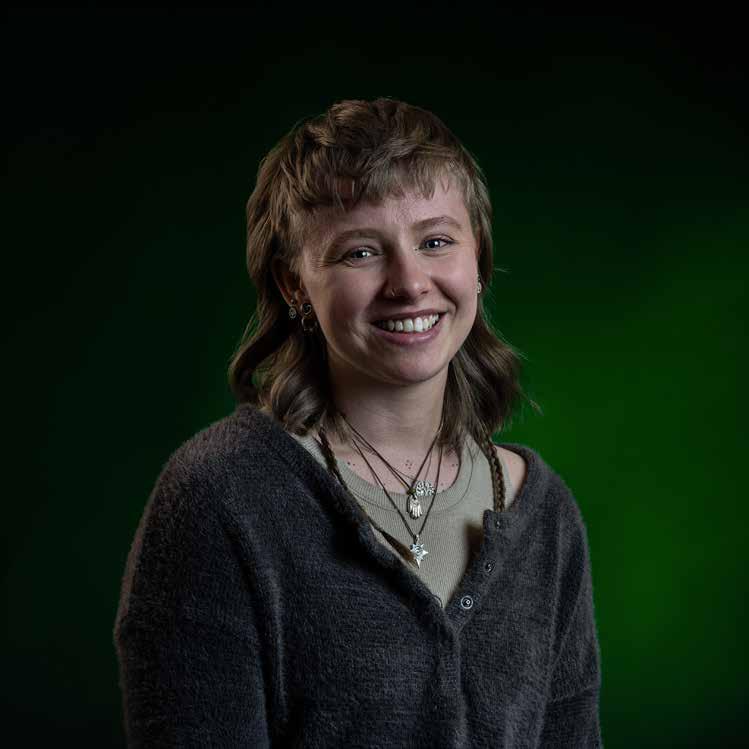
Written by Martin Angus
There’s a moment, somewhere between the trees of Thetford Forest and the glow of a phone screen, where Jodie’s world seems to come into focus. It’s not loud. It doesn’t announce itself. It’s quieter than that, a flicker, a feeling, what she calls a “ball of light.”
That light is Illuminations.ja. And like many meaningful journeys, it didn’t begin with certainty. It began with a fish.
Finding Something - Before Knowing What It Was Jodie laughs when she recalls her earliest creative memory. At Thetford Academy, somewhere between drama classes and art lessons, she painted a fish. Not a fantastical creature, not one of the intricate, otherworldly beings she now creates, just a fish.
“It wasn’t me,” she says, thoughtfully. “I was creating, but I didn’t know what I was creating for.” It’s a surprisingly familiar starting point for many artists:
making without meaning, experimenting without identity. She loved drama too, briefly imagining a future on stage, but something didn’t sit right.
“Drama was too front-facing,” she explains. “I wanted to have the thing to show people that was the art, rather than me being the art.”
And yet, in a quiet twist of irony, her growing online presence now blends both. Through carefully crafted social media posts, she performs just enough, not as the centrepiece, but as a guide, a storyteller, a middleman between her imagination and the audience it reaches.
Growing Up Different — and Letting That Matter
Thetford is not London. It’s not Brighton. It’s not widely recognised as a creative epicentre. But for Jodie, that contrast became fuel.
“There are a lot of small businesses in Thetford,” she says, “and I think I’ve always looked up to that. But I also

felt different, and I wanted that to come out in Thetford.”
That word, different, threads through her story. Sometimes gently, sometimes painfully.
School wasn’t always a place where differences were nurtured. As someone who later discovered she was dyslexic and neurodivergent, Jodie remembers moments where creativity was misunderstood, where doodling, fidgeting, or thinking sideways wasn’t encouraged, but corrected.
“There was pressure to be… normal,” she reflects. “And I don’t like that word.”
So, like many young people, she adapted. Long hair. Following trends. Blending in.
But the feeling of not quite being herself never left.
It wasn’t until Jodie was at University, and coincidentally, the isolation of COVID, and later, that something shifted.
The Turning Point: A Room, a Page, and No Noise
If there is a defining chapter in Jodie’s journey, it is this: a room, a blank page, and silence.
During the pandemic, cut off from tutors, expectations, and external opinions, she found herself alone with her creativity in its rawest form.
“No influences, no opinions,” she says. “Just me and a piece of paper. That’s when it kind of went crazy.”
It’s a moment many creatives recognise, when restriction becomes freedom, when isolation strips away performance and reveals instinct.
For Jodie, it was transformative.
“I think I’d always been creative,” she says, “but that was
the point where I realised, this is the path I want to be on.”
It wasn’t polished. It wasn’t refined. But it was hers. Entirely.
To understand Jodie’s work, you have to understand Thetford, not just as a town, but as a landscape.
“I used to go up to the forest and just sit in the car and draw,” she says.
Thetford Forest isn’t just a backdrop; it’s a collaborator. The drifting leaves, the quiet river, the hidden corners, all of it feeds into her imagination.
“You see a leaf floating down the river and think, that could be something. Maybe there’s a creature on it.”
And suddenly, the ordinary becomes a doorway.
Her creations, whimsical, peculiar, and often slightly surreal, feel like they belong to those in-between spaces. Not quite fantasy, not quite reality. Something softer. Stranger. More playful.
“They don’t always need meaning,” she says. “Sometimes they’re just… peculiar.”
In a world that often demands explanation, that’s a quiet act of rebellion.
The name Illuminations.ja isn’t just branding, it’s philosophy.
“I wanted something that represented my journey,” she explains. “Illuminations is like light… a star… a ball of light.”


• Open Monday to Friday 8.00am to 5.00pm
• Saturday morning by appointment
• Rates include VAT and Insurance
• Other vehicles available

• Customer pick-up and drop-off available
Ford Fiesta or similar from £30/day
Ford Puma or similar from £40/day
Hyundai Tucson or similar from £65/day



For Jodie, that light is deeply personal.
“I might have felt quite dark,” she says. “My art is that ball of light.”
It’s a striking image, creativity not as decoration, but as illumination. As something that pulls you forward, that helps you see.
The “ja” at the end? Simply her initials. A grounding note in an otherwise expansive idea.
Together, they form something both intimate and universal, a name that feels exactly like her work: glowing, curious, and quietly defiant.
Ask any artist about their first sale, and you’ll often hear about excitement. Pride. Relief.
Jodie remembers something slightly different.
“Pressure,” she says, immediately.
A customer had asked her to recreate and personalise one of her abstract paintings. At the time, her work was still evolving, more process than identity.
“It felt like… are you sure you want this?” she laughs.
But beneath the uncertainty was something more important: validation.
“There are people out there that connect to this,” she realised.
That moment, tentative, slightly surreal, planted a seed. Not just of confidence, but of connection.
And connection, as it turns out, would become central to everything she creates.
From Canvas to Clothing — and Everything In Between
Today, Illuminations.ja is not confined to one medium. It spills across jewellery, clothing, sculpture, and even avocado seeds.
Yes, avocado seeds.
“They just get thrown away,” Jodie explains. “So I thought. What if I dried them out? Could they become something?”
The result? Handcrafted pendants carved from what most would consider waste.
It’s practical, certainly, materials are cheaper, more accessible, but it’s also deeply philosophical.
“Not everyone can afford something expensive,” she says. “But everyone should be able to have something… a little treasure.”
That mindset runs through all her work.
Second-hand clothing becomes embroidered art. Discarded materials become jewellery. Objects are not just reused; they are reimagined.
“I like the idea that things go on a new adventure,” she says. “Even a t-shirt.”
It may sound whimsical. But it’s also quietly radical, a rethinking of value, ownership, and waste.
Creativity Within Limits
Working sustainably isn’t always easy. In fact, it often makes things harder.
“There are times you think, I want to make this, but you can’t use certain materials,” she admits.
But instead of seeing that as a barrier, she treats it as a
challenge.
“It makes you jump through hoops,” she says. “And usually, that leads to something even better.”
It’s a philosophy that echoes her wider journey: constraints don’t close doors, they reshape them.
And in that reshaping, something more thoughtful, more meaningful, often emerges.
Becoming the Brand — Without Losing Yourself
Scroll through Jodie’s social media, and one thing becomes clear: Illuminations.ja isn’t just a business. It’s an extension of her identity.
With her distinctive “pixie mullet” and unapologetic style, she has become as recognisable as her creations.
But this wasn’t always the case.
“I used to follow every trend,” she admits. “But I never felt like me.”
Finding that sense of self took time and courage.
Now, her message is simple, but powerful: “It’s pretty awesome to be yourself.”
Not because it’s easy. But because it’s worth it.
“If more people weren’t trying to be ‘normal’,” she says, “we’d have more light in the world.”
And that light, there it is again, keeps returning.
Despite her growing online reach, Jodie remains firmly rooted in Thetford.
Social media has expanded her audience, connecting her with people across the UK and beyond, but the
physical world still matters.
Markets. Fairs. Conversations.
“There are moments where it all feels real,” she says. “When someone says, ‘I’ve seen you on TikTok.’”
One of her most defining experiences came at a university exhibition in London. Surrounded by more traditional work, her peculiar, poseable creatures stood out.
She worried they might not be understood.
But then someone stopped. And stayed.
“He stood there for ages,” she recalls. “Then he came over and asked me to make one of my creature creations.”
It wasn’t just a sale. It was confirmation.
“That’s when I thought, I am on the right path.”
Thetford: The Beginning That Stays
For all its challenges, the limitations of education, and the lack of creative spaces, Thetford remains central to Jodie’s story.
“It will always be rooted here,” she says.
Because it’s not just where her business began. It’s where she walked in the forest with her mum. Where she first felt different. Where she first started creating.
Even the struggles, the pressure to conform, and the misunderstandings shaped her direction.
“If I hadn’t had that,” she reflects, “I might not be doing this at all.”
It’s a reminder that journeys are rarely straightforward. That even the difficult parts carry value.
Especially in hindsight.
Looking Back — and Forward
If she could speak to her younger self, Jodie wouldn’t hesitate.
“Don’t be so hard on yourself,” she says. “It doesn’t have to be perfect.”
It’s simple advice. But hard-won.
“Nothing really matters,” she adds, with a smile. “We’re just on a big floating rock.”
It’s both grounding and liberating, a perspective that allows space for play, for curiosity, for imperfection.
And perhaps that’s the real essence of Illuminations.ja.
Not just sustainability. Not just art.
But permission.
Permission to create without knowing exactly why. Permission to be different, even when it’s uncomfortable. Permission to find your own ball of light, and follow it, wherever it leads.
In Thetford, among the trees and the quiet corners, Jodie has done exactly that.
And in doing so, she’s created something far bigger than a business.
She’s created a way of seeing the world, one peculiar, beautiful, ever-evolving piece at a time.
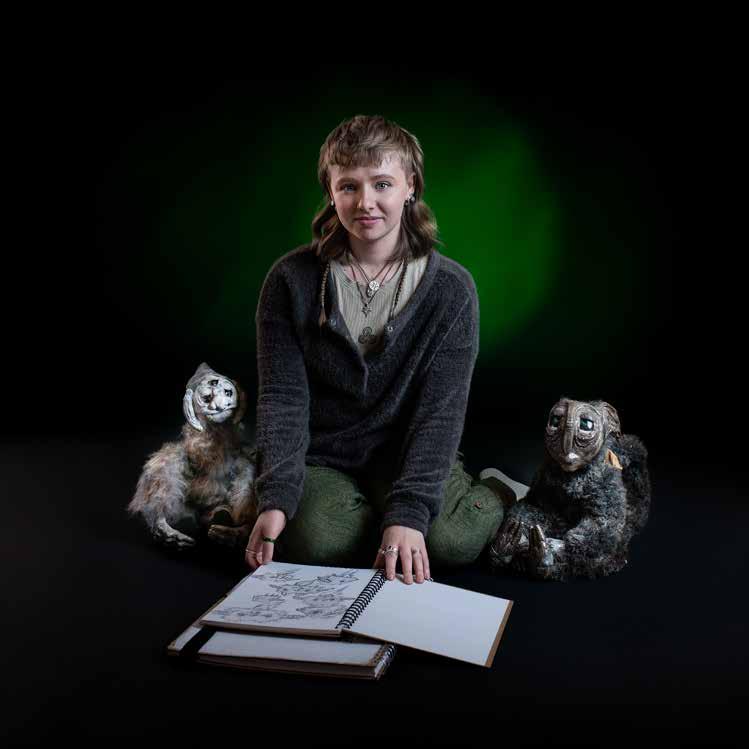

Written by Martin Angus
On a quiet street in Thetford, just beyond the familiar rhythm of shopfronts and passing traffic, something unexpected happens. You turn a corner, and there they are. Captain Mainwaring, Private Pike, and the rest of the Dad’s Army platoon stride forward through a painted landscape that feels at once theatrical and deeply local. It is a moment of recognition, nostalgia, and surprise all at once.
Behind that moment is Mark Harper.
For many in Thetford, Mark’s murals have become part of the town’s visual identity, so embedded in the landscape that it’s easy to forget they were once just blank walls. Yet speak to the artist himself, and you quickly realise that each brushstroke is the result of decades of experience, careful research, and a deep respect for both subject and setting.
“I’ve been self-employed most of my life,” Mark says, matter-of-factly. “It’s up and down, as we all know, but you learn to adapt.”
Adaptation, in many ways, defines his work. From large-scale public murals to intricate heritage pieces, Mark, through his business, Harper Art Services, has spent over 20 years mastering a wide spectrum of artistic disciplines: mural painting, scenic design, trompe l’oeil, signwriting, gilding, and fine art. His client list spans theatres, museums, and international design companies. Yet it is in Thetford that his work feels most personal, most rooted.
From Poppies to Platoons: A Thetford Beginning Mark’s connection to Thetford didn’t begin with Dad’s Army, but with something quieter, a commemorative mural of poppies.
“It started with Roz from the Town Council,” he
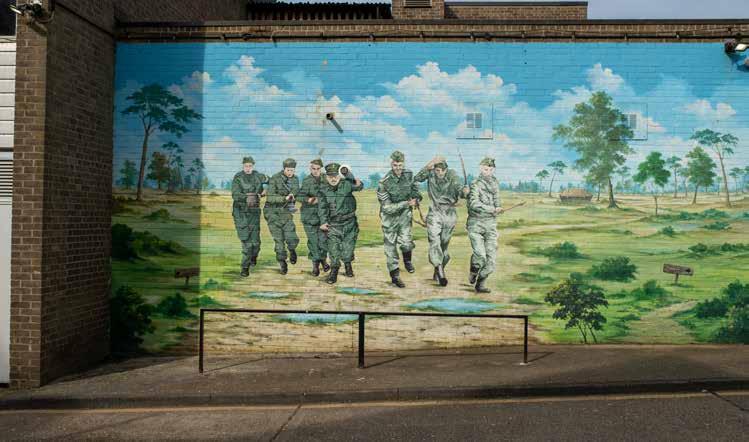
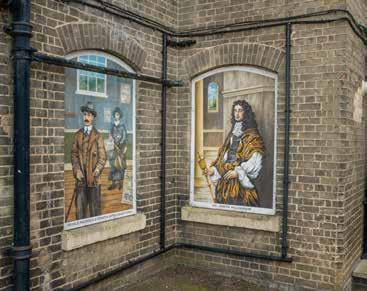
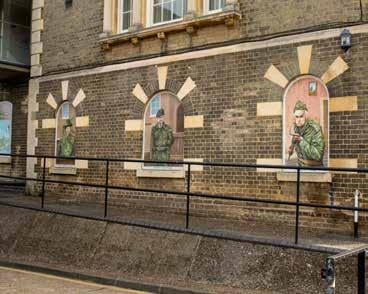
recalls. “She contacted me about doing a mural… a landscape with bricks, pine trees, flat fields with poppies.”
That first commission, marking the First World War, laid the groundwork for what would follow. Soon after, conversations with local figures, including David Brooks of Thetford Town Council and Stuart Wright from the Dad’s Army Museum, sparked a new idea: to celebrate Thetford’s unique link to the beloved BBC sitcom.
The result was the now-iconic mural on the side of the Carnegie building.
For Mark, the project was more than just another commission. Like many of his generation, he had grown up watching Dad’s Army.
“It’s such an iconic show,” he says. “Everyone’s got a favourite character. I like Mainwaring… and Fraser. You’ve got a bank manager, a butcher, an undertaker, all these everyday people. That’s what life is about in a community. You’ve got to work together.”
That sense of community, of “bumbling together,” as Mark puts it, is at the heart of both the series and the mural itself.
Capturing something as culturally embedded as Dad’s Army is no simple task. The challenge lies in balancing accuracy with atmosphere, creating recognisable figures without becoming rigid imitations.
“You’ve got to get that balance,” Mark explains. “People should come around the corner and instantly know who they are. They don’t have to be
exact portraits, but they have to feel right.” The process, as with all his work, begins with drawing.
“The skill is in the drawing,” he says. “If you draw it wrong, you’ll paint it wrong.”
Using chalk rather than pencil, a technique borrowed from theatre painting, Mark sketches directly onto the wall. The chalk allows for flexibility, softening into the surface rather than scratching it. From there, the image is built up layer by layer, guided by a gridding system that ensures accuracy at any scale.
But unlike a canvas, a wall brings its own complications.
“There’s grills, pipes, gutters… all sorts of things you don’t think about,” he says. “You might have something coming out of someone’s head if you’re not careful.”
Such constraints require constant adjustment. Faces can’t fall across window frames; key features must avoid interruptions in the brickwork. It is, in many ways, a puzzle, one that Mark solves with quiet ingenuity.
What elevates the Dad’s Army mural beyond mere tribute is its sense of place. Rather than isolating the characters, Mark situates them within a recognisable Thetford landscape, drawing inspiration from the show’s closing sequence, filmed in nearby woodland.
“I always remember that scene, walking through Thetford Forest,” he says. “So I thought, let’s put them there. People will recognise it.”

The effect is subtle but powerful. The mural doesn’t just depict Dad’s Army; it roots the series in Thetford’s geography, reinforcing the town’s connection to its television heritage.
This sensitivity to place extends to Mark’s broader view of Thetford itself.
“There’s one word for it, history,” he says. “That’s what makes it compelling.”
From Boudicca’s Iceni rebellion to the radical writings of Thomas Paine, Thetford’s past is layered and complex. Mark has immersed himself in that history, often going beyond the initial brief to deepen his understanding.
“You’ve got to have an interest in what you’re painting,” he says. “Otherwise it shows.”
Beyond the Museum Walls
That interest is vividly apparent in Mark’s more recent work at the Thomas Paine Hotel, where he has created a series of murals celebrating key historical figures associated with Thetford. Mark describes these commissions, for Rosy and Gez Chetal, as joyful. Working with them both on various murals throughout the hotel, being part of the journey, and watching the hotel develop.
Here, the tone shifts from playful nostalgia to something more reflective.
“There aren’t many colour images of Duleep Singh,” Mark explains. “So that was a challenge, bringing out the richness of the clothing, the jewels, the detail.”
Working from limited historical references, he has depicted both Maharaja Duleep Singh and Thomas
Paine at different stages of their lives, carefully selecting moments that capture them at their most compelling.
“Aesthetically, you try to show them at their peak,” he says. “That’s what people connect with.”
One particularly striking feature is a painted staircase that winds upward into an unseen space, a subtle theatrical device that invites curiosity.
“Where does it go?” Mark asks, with a smile. “That’s the idea. It’s second imagery. Some people won’t notice it straight away, but it’s there.”
This layered approach reflects Mark’s background in scenic painting, where every element, from lighting to backdrop, serves the overall narrative without overwhelming it.
“The scenery is secondary,” he explains. “But take it away, and you’ve got nothing.”
The Science of Colour, and the Art of Feeling
Much of the emotional impact of Mark’s work comes down to his mastery of colour.
In the Dad’s Army mural, the challenge was to make a group of characters dressed in muted military tones stand out against a similarly green landscape.
“If you put the same greens everywhere, it just goes flat,” he says. “So you separate them, use different tones, different hues.”
By subtly shifting the balance between blues, yellows, and earth tones, Mark creates depth and contrast, allowing the figures to “punch out” from the background. It is a technique rooted in both
classical painting and theatrical design, one that guides the viewer’s eye without them ever quite realising it.
“It’s about contrast,” he says simply. “That’s one of the basics.”
Despite his technical expertise and impressive portfolio, which includes work for theatres, museums, and international projects, Mark remains grounded in a simple philosophy: art should be for people.
“At the end of the day, it’s for the community,” he says. “Something to enjoy. Something that brightens people’s lives.”
It is a sentiment that resonates strongly in Thetford, where his murals have become informal landmarks, backdrops for photographs, meeting points, and quiet moments of appreciation.
“I don’t treat it like a sticker you can just change,” he adds. “Once it’s there, people are going to see it every day. So it has to be right.”
That sense of responsibility, to both client and community, runs through all his work. Whether painting a large public mural or a detailed interior piece, Mark approaches each project with the same care and consideration.
Asked what kind of legacy he hopes to leave in Thetford, Mark’s answer is characteristically modest.
“Just something people enjoy,” he says. “A talking point.”
But his impact is already clear. Through his murals, Thetford’s stories, its humour, its history, and its identity have been given new visibility and vibrancy.
And he’s not finished yet.
“I’d love to do a timeline of Thetford,” he says. “From Boudicca right up to the present day. Show people how it’s evolved.”
It’s an ambitious idea: a visual journey through centuries, capturing the town’s transformation in a single sweeping composition. Whether it comes to fruition will depend, as ever, on budgets, permissions, and time.
But if it does, one suspects it would become another defining feature of the town.
What makes Mark Harper’s work so compelling is not just its technical skill, but its humanity. His murals don’t simply decorate, they connect. They invite passers-by to pause, to remember, to look a little closer.
In Dad’s Army, he found a story of community. In Thetford’s history, he found a story of place. And in his own craft, he has found a way to bring those stories together, one wall at a time.
So next time you find yourself in Thetford, take a moment. Turn that corner. Stand before the mural.
And look again.
Because, as Mark knows all too well, the best art doesn’t just sit on the surface.
It stays with you.
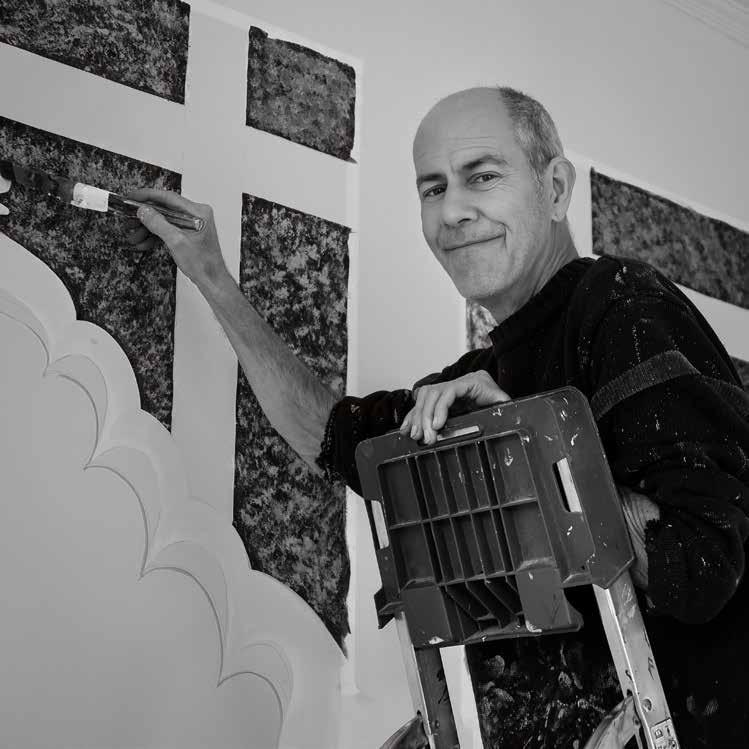

Written by Martin Angus
There are some people who do not simply do a job; they bring a place to life. On market days in Thetford, Julija Fjodorova is one of those people.
She is there early, long before many of us have thought about breakfast, welcoming traders, opening gates, solving small problems before they become big ones, answering questions, collecting paperwork, taking photographs, posting updates, and making sure Thetford Market feels not just organised, but alive.
But Julija’s story begins far from Thetford Market Place. It begins in Jelgava, Latvia, a town she remembers as beautiful, lively and full of friends.
Latvia, she says, is a small country, and Jelgava was a good place to grow up. Yet, as Julija reached adulthood, opportunities were limited. Many of her
friends began leaving, some for England, some for other places. The plan was simple: go abroad, work hard, earn money, and perhaps return home after a few months or years.
That was 22 years ago.
“I was 21 when I came to England,” Julija says. “I thought I would stay for a few years, earn some money, and go back.”
Life, of course, had other ideas.
Julija came to England with very little. Enough money for food and perhaps one or two weeks’ rent. The very next day, she went to a work agency. There was no grand arrival, no long holiday, no gentle settling-in period. She came to work.
Her first job was in a meat factory. It was hard,

practical, and immediate work. She did not speak English when she arrived, apart from a few words remembered from school. In the factory, many of the workers were also from overseas, so she found herself learning bits of Polish and Portuguese before English properly took hold.
The first six months were difficult. At 21, independence had sounded exciting. She was far from her parents, making her own way, paying bills, building a new life. But independence also meant missing home, especially her mother, who remains her best friend.
At first, Julija longed to return. But gradually, something shifted. England began to feel less like a temporary stop and more like a future.
She found work, friendship, family life and stability. Her two children were born here. Her daughter, now 20, is at university studying games art, coding, graphics, 3D design, marketing and promotion. Julija speaks of her with obvious pride.
“My daughter is my best friend,” she says. “She supports me in everything.”
That sense of family runs deeply through Julija’s story. Her mother came from Siberia to Latvia as a young woman, looking, Julija believes, for a better life. Years later, Julija herself would make her own move westwards, also searching for better opportunities.
Julija is Russian by heritage, born and raised in Latvia. Her first language is Russian, and she grew up attending Russian school. She is also an Orthodox Christian, a faith that remains important to her. Her story is not a simple one-line biography. It is layered, like so many real lives are: Latvian town, Russian roots, English home.
And why Thetford?
The answer is beautifully ordinary: friends.
A close friend was already here. Others from Jelgava had also made their way to Thetford and elsewhere in England. That familiar thread of friendship helped draw Julija to the town.
At first, Thetford could have been anywhere. But over time it became somewhere very specific and very loved.
“I love Thetford,” she says. “It’s nice, small and quiet.”
She likes its old buildings, its forest, its history, and its position between places like Norwich and Bury St Edmunds. She sees Thetford as a place where you can live quietly, but still reach the wider world. Jelgava, by comparison, was larger and busier, with nightclubs, ice skating, hotels, riverside walks, lights, fountains and festivals. Thetford was smaller, calmer. But Julija liked that.
After years of factory work, including around 14 years at Centurion Safety Products, Julija’s path changed unexpectedly.
A friend, Dania, heard that Thetford Town Council was looking for a Market Coordinator. At first, Julija dismissed the idea.
“No, no, definitely it’s not something for me,” she remembers thinking.
But then came the more important thought: why not try?
She went through Galaxy Personnel, had an interview with the Town Council, and ten minutes


later, she was told they wanted her.
It was a decision that would change not only her working life, but also her sense of herself.
“When I started the job, I didn’t expect I would love it so much,” she says. “I thought it would just be my job. But I absolutely love what I’m doing.”
That love is visible.
Thetford’s market has deep roots. Market Place has long been a central part of the town’s life, a space for trade, conversation and community. Over the years, it has changed, declined, revived and adapted, just as Thetford itself has. Today, under Julija’s coordination, it is enjoying a renewed sense of energy.
She remembers when the Saturday market might have had only five or six stalls. Now, on a strong Saturday, there can be up to 20. A recent Saturday had 15. Tuesdays, too, have grown, with traders selling fruit and vegetables, fish, toys, wax melts, crystals, food and more.
The Lower Market is now one of Julija’s big projects. She wants to see it grow, become more visible and attract more traders. She speaks of potential new food stalls, Polish food, Italian food, Lithuanian food, African food, Portuguese goods, cakes, flowers, fruit, vegetables, clothes, music and more. What emerges is not simply a market, but a small international village in the heart of Thetford.
“We try to be inclusive,” she says. “We don’t see a difference. We just want people to try themselves.”
That phrase, “try themselves”, feels central to Julija’s outlook. It is what she did when she left
Latvia. It is what she did when she applied for the Market Coordinator role. It is what she encourages traders to do when they wonder whether a stall might work.
Her working day starts at six in the morning. She greets traders, helps where she can, deals with calls and emails, explains the market to newcomers, arranges visits, collects rent, handles paperwork, manages social media, helps with parking, reports issues, and keeps the whole thing moving.
But the real work is human. It is in the relationships.
Julija talks about the traders as “one big friendly family”. She mentions Sharon, Mandy, Scott, Simon, Ron, Keith and others with warmth. She is proud of the hardworking traders who rise early, bring quality produce, support each other, and turn up week after week in all weathers.
She is also careful. She does not want traders clashing unfairly. She listens to advice, especially from experienced market people who understand what works. She wants the market to be good not just for her, but for everyone.
“I don’t want to just make it nice for me,” she says. “I want it to be nice for everyone.”
That, perhaps, is why the market feels different now. There is coordination, yes, but there is also care.
Julija’s social media work has also helped. She takes photographs, posts updates, shares videos and tries to show residents what is available. She sometimes wonders whether she posts too many pictures, but her reason is simple: she wants people

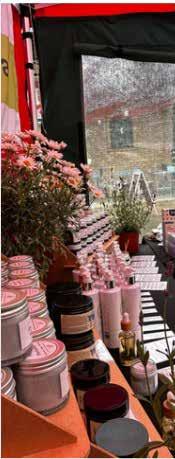

Discover beautifully crafted plant-powered skincare, handmade in small batches and available throughout Norfolk
Thetford Saturday Market 08:30 - 14:30
to know what they can find when they come into town.
At a time when high streets everywhere face challenges and shops continue to close, Thetford Market offers something hopeful. It is local, personal, colourful and immediate. You can talk to the person who baked the cake, grew the produce, arranged the flowers, cooked the food, sourced the crystals or unpacked the clothes at dawn.
For Julija, the market has also been transformative.
She says factory work was honest work, and she speaks fondly of Centurion and the people she worked with there. But the work itself was repetitive. She recalls having 40 seconds to make a helmet on the line. You did the task, quietly and efficiently, and moved to the next one.
The market is different. It asks her to think, plan, speak, solve, encourage, promote and lead.
“Thetford Market made me a different person,” she says. “I’m more talkative now. I’m more confident now. I believe in myself more.”
That confidence did not arrive all at once. It grew through doing. Through trying. Through discovering that she could manage people, organise a market, listen well, make decisions and build something visible.
Her proudest achievement is clear: growing the market, especially the Lower Market, and hearing residents say how much better it looks now.
“People come to me and tell me how good the market is now,” she says. “That makes me feel proud.”
There is something deeply fitting about Julija’s journey ending, or perhaps continuing, in a market town. Markets have always been places of movement: goods, stories, accents, recipes, bargains, gossip, news. They are where strangers become familiar faces.
Julija arrived in England as a young woman with little money, limited English and a plan that was meant to last only a few years. More than two decades later, England is home, Thetford is home, and the market has become part of who she is.
She is not planning to leave.
“I would like to stay on the market as long as I can,” she says. “I don’t want to leave my traders.”
Looking back, Julija does not regret coming to England. She says the country has given her opportunities, a home, and a life she values. Her advice to others is simple but hard-won.
“You should believe in yourself,” she says. “You should try. If you don’t try, you never know.”
It is advice that suits her story perfectly.
From Jelgava to Thetford, from factory lines to market stalls, from uncertainty to confidence, Julija Fjodorova’s journey is one of courage, work, warmth and reinvention.
And on a Tuesday and Saturday morning, when Thetford Market is busy, the music is playing, the traders are smiling, and Julija is moving from stall to stall with purpose and pride, you can see exactly what she means when she says:
“It’s my home now.”
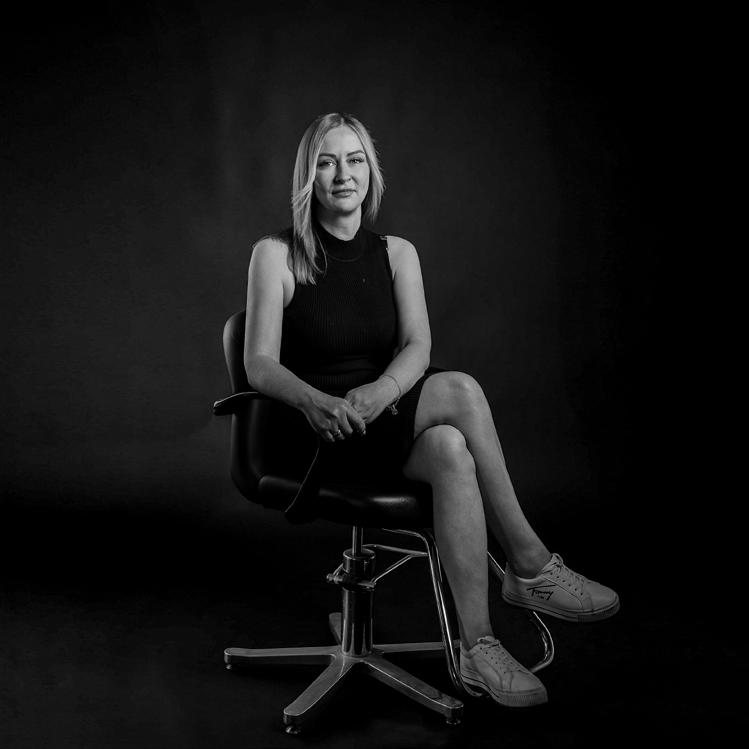

Written by Martin Angus
At just 17, Thetford-born Roxy Powell has already done something many adults only talk about doing. She has taken an unexpected idea, turned it into a real business, learned on the job, built a loyal customer base, and become a familiar Tuesday and Saturday presence on Thetford Market.
Her business, Spiritual Soaks, began not with a formal business plan, but with a conversation at home.
“I’d just left high school,” Roxy says. “There were no jobs going. I applied everywhere, Tesco’s, all sorts, and nothing was working out.”
Then her mum ordered some ingredients and suggested they make bath bags. Within a month, Roxy was trading on the market. Eight months later, she has a growing range of handmade bath
soaks, face masks, hair masks, pillow products and ideas still waiting in her notebook.
Each bath bag starts with a base of Dead Sea salt, Epsom salt and bicarbonate of soda. From there, Roxy adds herbs, powders, and natural colours, choosing ingredients for blends aimed at relaxation, sleep, muscles or sensitive skin. Her colours come from things like turmeric, beetroot and blue matcha rather than artificial dyes.
“I like knowing what’s in there,” she says. “Everything has chemicals in it now, and no one actually knows what they’re using. When I say natural, it catches people’s eyes.”
Roxy has taught herself through research, reading, trial and error, and listening carefully to customers. She laughs as she admits that the first tester was her two-year-old sister, who, once we knew the


products were safe, loved the colours. But behind the humour is a serious young trader who checks ingredients, studies what people ask for, and continues to develop her products.
The business became real for her around Christmas.
“I got a lot of events, and the Christmas event at the market,” she says. “Once I started actually making money doing all these big events, I was like, ‘Oh, this is actually a business. I own my own thing.’”
Thetford has shaped her in a more personal way, too. Roxy speaks honestly about wanting to do something with her life. Like many in her generation, her school years were disrupted by Covid. She missed out on normal milestones and says lockdown made a lot of young people lose rhythm and motivation.
But rather than drifting, she decided to build.
“I look at it like, I want to have money, I want to save, I don’t want to struggle,” she says. “If I can start young and build that up, then that’s what I’d rather do.”
Market life has become part of that growth. Roxy describes Thetford Market as friendly, lively and supportive, especially on Saturdays when music helps create a better atmosphere. She likes the routine, the conversations, and the fact that people now look for her.
On the rare occasion she misses a day, people ask where Spiritual Soaks is.
“That one day I’ve missed, everyone’s in the comments like, ‘Where’s Spiritual Soaks?’” she says.
Her stall works because it is different. It catches the eye. It gives people something to talk about. Customers often approach with curiosity: bath bags, herbs, natural powders, face masks, all laid out by a young woman who knows what she has made and why.
Roxy is not a hard seller. She talks, sometimes worries she talks too much, but her enthusiasm is part of the charm. People ask what is in a product, what it is for, how to use it, and she answers from experience.
One customer remains especially memorable. Near the end of the market day, she bought around £100 worth of products in one go.
“Everything she was picking up, she was like, ‘Oh my God, is this this?’” Roxy remembers. “She was standing in my stall telling everyone coming in, ‘Look at this, get this, buy this.’”
That customer has since returned, as has her daughter.
For Roxy, this face-to-face feedback matters. Customers have suggested smaller versions, display pots and new ideas. She has listened, adapted, and watched those ideas sell well.
“I think listening to your customers is one of the best things to do,” she says.
The “spiritual” in Spiritual Soaks is not just branding. Roxy grew up around spiritual ideas. Her mum believes strongly in energy, and family stories stretch back to a great-grandmother people apparently called a witch. Roxy smiles at that, but she does believe in energy, in atmosphere, and in giving good things out into the world.
“I try and give out things for free, or try and be really nice,” she says. “I feel like the universe will give that back to me.”
That philosophy shows in how she treats people. If someone is struggling, she might offer a product to try. She talks about wanting people to feel helped, whether they are aching after dance, struggling to sleep, or looking for a gentler bath product.
Her favourite product is the sensitive skin blend, partly because it contains sandalwood, her favourite scent, but also because it was inspired by someone close to her partner who suffers from psoriasis.
“I kept seeing her with itchy skin and complaining about it,” Roxy says. “I just thought, I wish I could help people with this.”

That was a turning point. The business stopped being simply colourful bath bags and became something with purpose.
“I wanted to do sleeping ones and muscle ones and ones that benefit you,” she says.
Like any new business owner, Roxy has learned hard lessons. The biggest early challenge was money management. At first, when money came in, she spent too much of it instead of putting enough back into stock. January and February soon taught her otherwise.
“It was a big lesson,” she says. “Do your stock, put money away. Focus on the market, not your shopping addiction, basically.”
Now she keeps notes, calculates profit, writes down stock needs and records ideas. She has a book full of future products. She wants to expand into more purposeful skincare and haircare, including oils and more targeted products.
Her dream is simple and visual: more stock, more variety, perhaps two gazebos one day, and maybe even a shop.
“I’d love to see Spiritual Soaks in a business shop,” she says. “Or with two gazebos, lots of stock, lots of different items.”
For now, she sells mainly through Thetford Market and local online orders, delivered or collected in town. Posting nationally is not yet part of the plan. Her passion is making the products and meeting people, not packaging parcels.
Social media has helped, though. Facebook keeps her visible locally, while TikTok has taken
her further, with one video reaching thousands of views.
“Everyone’s on social media nowadays,” she says. “It promotes you more.”
Still, Spiritual Soaks feels rooted in Thetford. Her mum’s local connections helped at the beginning, and Roxy’s own generation has helped spread the word too. It is a business built through family, market days, word of mouth and local trust.
There is something refreshing about Roxy’s honesty. She does not pretend the journey was perfectly planned. She does not dress it up in business jargon. She admits that she is still learning. She knows she is young, but she also knows she is doing something.
In one of the most telling moments of the interview, she says it almost felt as though the business appeared and announced itself.
“It literally just popped itself up and was like, ‘Hello, we’re doing this now,’” she says. “It felt like it was meant to be.”
That sentence may be the best description of Spiritual Soaks: unexpected, energetic, handmade, a little mystical, and very Thetford.
For a 17-year-old who started because the job market would not open a door, Roxy Powell has built her own stall instead. Every Tuesday and Saturday, among the music, fruit and veg, flowers and familiar faces, Spiritual Soaks adds colour, scent and a touch of magic to Thetford Market.
And Roxy is only eight months in.
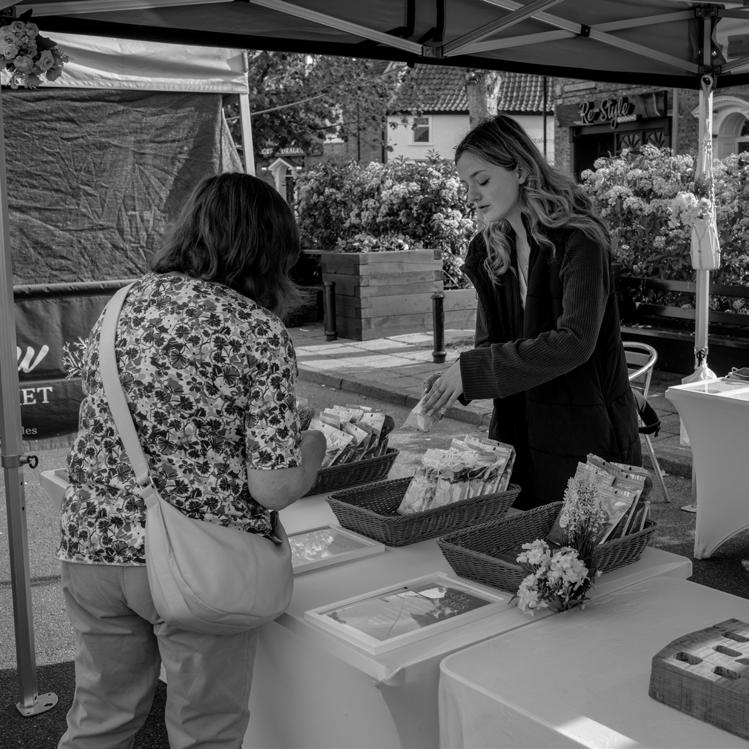
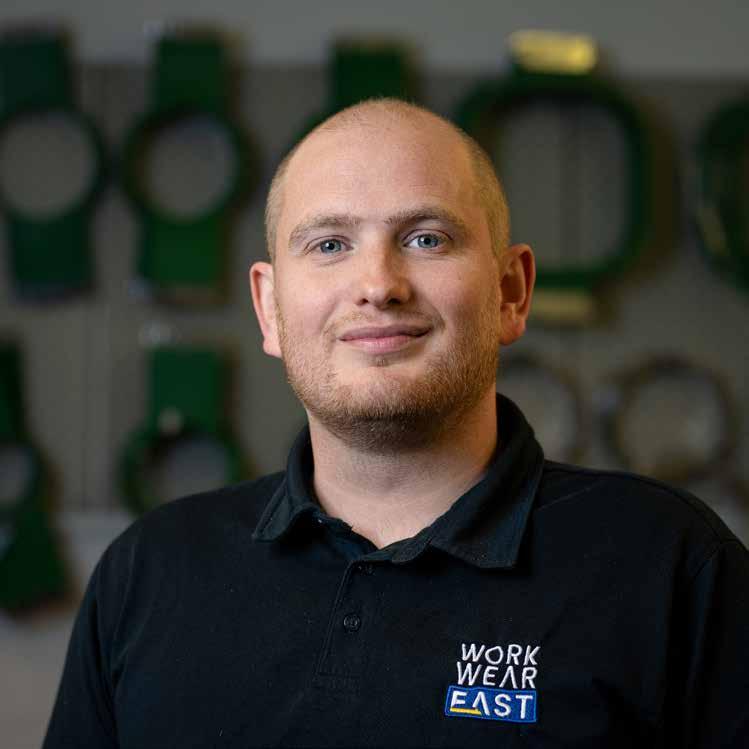
Written by Martin Angus
There is something pleasingly practical about Workwear East. It is not a business built on fuss, flash or empty promises. It is built on thread, ink, machinery, mistakes, late nights, local conversations, and the quiet satisfaction of doing a job properly.
For Jack, owner of Workwear East, the journey to Thetford was both a business decision and something closer to coming home. Having grown up locally, between Thetford and Bury St Edmunds, he already knew the area. His business had previously been based in Bury, but when the opportunity came up to buy a unit in Thetford rather than continue renting, the move made sense.
“It gave us the chance to increase capacity,” he explains. “We could get new machinery in and progress the business.”
That move marked more than a change of address. It
became the start of a new chapter.
Workwear East itself is a relatively young brand, launched around a year ago, but it grew out of years of experience in garment decoration. Jack had already built a business producing screen-printed and embroidered items for bands, clothing brands and merchandise clients. Over time, more business customers began asking for branded workwear: polos, hoodies, jackets, high-vis, uniforms and practical kit that helped teams look professional.
Rather than serving everyone under one name, Jack made a careful decision. He split the offering into two focused brands. Title Merchandise would continue to serve bands, artists, and clothing brands. Workwear East would focus on business customers.
“It’s all the same machinery and processes,” he says, “but the marketing needed to speak to different customers.”
That clarity has helped Workwear East find its feet. Its promise is simple: personal service, reliable turnaround and local expertise. In a world where so much is ordered online from faceless suppliers, Jack believes there is still real value in being able to walk through the door, feel a garment, discuss a logo and get honest advice.
Thetford, it turns out, is a good place for that.
Jack admits that getting known locally has been one of the biggest challenges. His previous work was largely online and national. Workwear East, by contrast, was created with local businesses in mind.
“The focus of Workwear East was to be more local,” he says. “Working alongside local businesses was not something I’d really done before with our marketing.”
What has helped most is something reassuringly oldfashioned: word of mouth.
One of the best twists in Jack’s Thetford story is that his next-door neighbour on the industrial estate is someone he has known since school. James, of West Brothers, has been a fixture in the local community for years and has introduced Jack to people across town.
“We used to go to parties at his house,” Jack laughs. “Now we’re next door to each other.”
Together, the two businesses have created something of a mini creative hub: signs, branding, print and workwear sitting side by side. Customers often come to one and are directed to the other. Need a sign above the door? Speak to James. Need the team to wear the same logo? Speak to Jack.
It is exactly the kind of practical collaboration that makes local business communities work.
Another important figure in the Workwear East journey is Patrick, who brought with him both industry knowledge and valuable local contacts, particularly in motorsport. That connection has helped the business serve racing teams and specialist clients, adding another strand to its growing reputation.
But the biggest turning point so far has been Baxter Healthcare.
“Getting Baxter on board has been huge for us,” Jack says.
Workwear East has been working with the company on a new uniform project, going back and forth to help design and supply the right kit. For a young local brand, that kind of trust matters. It is proof that the business can serve both small traders and major employers.
That range is important to Jack. Thanks to modern processes such as DTF printing, Workwear East can offer no minimum order. That means the business can help “Dave the plumber” with two polo shirts just as readily as a company needing hundreds of items.
“That customer who wants two items now might grow,” Jack says. “When they need 50 or 100 pieces, they come back to us because we helped them at the start.”
It is a neat philosophy: grow with your customers, rather than only chasing the biggest order.
Behind the scenes, the work is more technical than many people might imagine. Workwear East offers embroidery, screen printing and DTF printing, all inhouse. Each method has its place. Embroidery gives a durable, professional finish. Screen printing is ideal for larger runs and bold designs. DTF printing, or direct-to-film, is excellent for smaller quantities, full-

colour artwork and complex logos.
Jack’s knowledge comes from experience rather than theory. Around ten years ago, he was playing in a band and ordering T-shirts from a screen printer. After a few disappointing experiences, he decided he could learn to do it himself.
There followed the classic self-taught business apprenticeship: late nights, YouTube videos and plenty of mistakes.
Eventually, printing for his own band became printing for friends’ bands. Then it became a full-time job. Today, that same trial-and-error education gives him the confidence to advise customers properly.
“There’s no one-hat-fits-all approach,” he says. “It depends on the garment, the logo, the quantity and what the customer wants to achieve.”
That advice is a big part of the Workwear East offer. Jack is keen to avoid pushing customers towards the wrong process simply because it is the only one available. Since everything is done in-house, the team can recommend what genuinely suits the job.
This is where local service matters. A customer can visit, see garments, discuss materials, talk through colours and understand what will work before placing an order. That can save money, time and disappointment.
It also avoids one of the more modern problems in print: AI-generated logos.
Jack is not anti-AI. In fact, he uses it himself. But he has seen a rise in logos created by AI tools that look fine on a screen and fail when translated into embroidery, print or signage.
“They’re often not vector files, they’re low resolution, and they’re not designed for print,” he explains. “Trying to put them into the real world doesn’t always match up.”
It is a useful reminder that technology is only as good as the practical knowledge behind it. A logo is not just an image. It has to work on a jacket, a van, a sign, a polo shirt and perhaps a high-vis vest in the rain.

Quality, for Jack, is not simply about the final garment. It is about the whole process: choosing the right product, applying the right method, meeting the deadline and making sure the customer is proud to wear it.
“We want to be proud of the work we put out,” he says. “This business has pretty much been built on word of mouth, so our reputation matters.”
That reputation is becoming increasingly rooted in Thetford. Jack has noticed something here that feels different from Bury or Norwich. Once people know you are based in Thetford, they come in. They want to talk. They want to support local suppliers.
“There’s a real interest in working with local people,” he says. “More people have come in to see us here than anywhere else I’ve had the business.”
Thetford itself may surprise outsiders. It is not always shouted about as an industrial centre, yet it has a strong base of manufacturers, trades, organisations and growing businesses. Its position in East Anglia, with good road links and a central location, makes it a practical place to operate from.
For Workwear East, that matters. The tagline, “Outfitting East Anglia’s Hardest Workers,” fits both the business and the place. This is not about fashion for fashion’s sake. It is about helping people look











sharp while doing real work.
Jack is also conscious that branded workwear does more than clothe a team. It markets a business every time someone walks down the street, arrives on site or meets a customer.
“If your team is out there looking sharp and professional with your logo, that’s marketing that keeps working for you,” he says.
It builds recognition. It builds trust. It tells customers, before a word has been spoken, that this company has taken care over how it presents itself.
Sustainability is also becoming part of the conversation. Workwear East can offer organic cotton, recycled polyester garments, ecofriendly thread options and water-based inks. For organisations where environmental responsibility is central, that matters. Jack mentions work for the British Trust for Ornithology, based in Thetford, as an example where eco-friendly options were especially important.
“It’s great to be able to offer that,” he says. Looking ahead, Jack’s plans are ambitious but grounded. He does not want Workwear East to become a faceless online supplier. Growth matters, but not at the cost of service.
“You want to grow within your means,” he says. “You have to reinvest in machinery, space and systems so you don’t lose the ability to serve people properly.”
One of the next steps is a showroom on the mezzanine floor of the Thetford unit. The idea is to create a welcoming space where customers can come in, have a coffee, look at garment options and talk through their needs face-to-face.
It sounds simple, but it captures the whole Workwear East approach: practical, personal and built around relationships.
Jack wants the business to become known as the local go-to for branded workwear. He wants to work with more businesses, sports clubs and organisations. He wants to grow alongside customers from their first two polo shirts to their full team uniform.
After only a year in Thetford under the Workwear East name, the journey is still near the beginning. But already the signs are good: local introductions, major clients, council work, a growing reputation and a business model built on craft rather than shortcuts.
Workwear East may be dealing in garments, logos and print, but its real product is confidence. Confidence for businesses that want to look professional. Confidence for teams that need reliable kit. Confidence for local customers who would rather speak to a person than gamble online.
And for Jack, Thetford is no longer just the place where the unit happened to be available. It is becoming part of the story.
Thread by thread, logo by logo, order by order, Workwear East is stitching itself into the fabric of the town.
Some of the local customers who have already begun a relationship with Workwear East are Boniface Engineering, Beez Leisure, Thetford Town Council, Cuemasters Pool Club, C.J. Engineering, Precision Material Handling, West Brothers, Baxter Healthcare, B.T.O., Armed Forces Veterans Breakfast Club and Landwide UK.
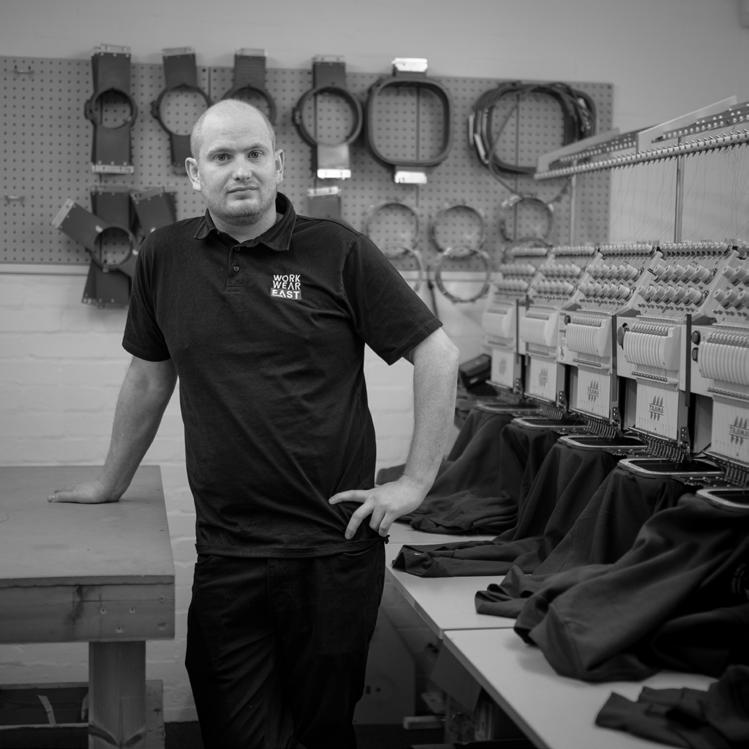
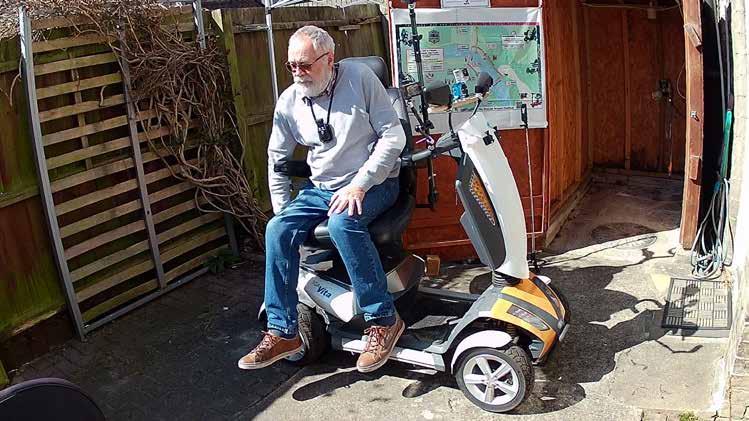


Photography, high jinks and words by Bob Blogg
Firstly: A Tribute to Tigga.
Without this wonderful mobility scooter, the Medusa Project Thetford would not exist, the Nuns’ Axe and Triangle test track would just be a boring area of scrubland outside the BTO entrance, Acceleration Avenue a dull dead end, and the Gravel Sea would just be a puddle.
There wouldn’t be a Leaderboard and certainly no WhatMobilityScooter.com.
He was born in the workshop of TGA Mobility in Sudbury, Suffolk, in 2016. Actually, that’s a total lie! TGA may have played God and designed him, but they didn’t build him.
Playing God is tricky, and not everybody has the

necessary skill set. So they had to call on the Taiwanese gods, more specifically 洲企業有限公司 (maybe). Like most obscure references to the Orient, Tigga’s origins are hidden in legend and mysticism. The actual creators may have been Weizhou, Pihsiang or even the Goddess Mazu herself!
I’d like to think Tigga was brought to life by Mazu, the Taiwanese goddess of seafarers and travellers. I can believe it, too, the way Tigga never got lost. He didn’t do a lot of sailing, though!
I acquired him in 2018 for £2000 after he had been locked away in TGA’s storeroom for nigh on two years, unloved, unwanted, unsold, neglected and abused. He was probably driven around the workshop in the dark by heartless, unfeeling and


uncaring mechanics just for a bit of fun! He never spoke about it.
Anyway, shortly after I rescued him, in 2019, I took him on a holiday by the sea in Happisburgh.
We got there thanks to my friend Ann and her van. It was his first trip in a van and his first outing into the real world. He loved it. He had freedom at last, and he wanted to go everywhere!
Along comes Covid
Well, he was stuck in a shed and locked away again for weeks on end with bouts of sporadic exercise. I tried to keep him fit and healthy, but I wasn’t really allowed to take him anywhere. I couldn’t take him into town or to the shops. I could only go around remote pathways, and if we saw anyone, we had to hide behind a tree. But during these brief moments, we hatched a plan.
When this horrible disease was finally beaten, we were going to get to the forest together no matter what.
A roundabout wouldn’t stop us, nor a motorway, nor any upstart A roads. So we started studying maps, looking for any gaps or possible routes of escape out of Thetford and into the forest.
From this, we soon saw the complexity and shape of the roads that were imprisoning us.
The Medusa Project was born.
I had to change the name to the Medusa Project Thetford because some silly girly called Sophie McKenzie has written a series of children’s books called the Medusa Project – but I forgive her.
In fact, they look like just the sort of books I love, so I have just ordered the first one called ‘The Set-Up’.
It is about babies being implanted with the medusa gene and being locked away for years.
It’s a bit like Tigga’s history, apart from the gene perhaps.
It is also aimed at readers of 11 years and up, so I might even get the plot!
The Great Escape Lockdown finally ended, and after spending a few months learning to go out again, we were ready. It was time to carry out the first step of our escape plan. A bit like NASA sending a rocket around the moon prior to attempting a landing, I send Tigga over the A11 Brandon roundabout prior to our attempt to get into the forest. What became known as the First Crossing occurred on the 25th of November, 2022. We made it over the roundabout, drove up the Brandon Road a few hundred yards, did a U-turn and then returned triumphantly back over the A11 and into Thetford.
Buoyed up by this success, on the 15th of February, 2023, we did it!
We finally escaped from the clutches of the medusa, whizzed over the roundabout on the A11 and tore up the B1107 (Brandon Rd) passed the golf club and then turned into the forest at the exit from High Lodge.
Ok, we went in by the exit, but who cares! We had made it. After years of dreaming, scheming and planning, we had now made it into the forest without having to rely on third parties and vans, cars and trailers. This opened the floodgates. Within a few months, we were all over the forest like knotweed on speed! We explored the left side, the right side and the caravan park, and we even took the drone along for the ride. Finally, our wanderlust sated, it was time

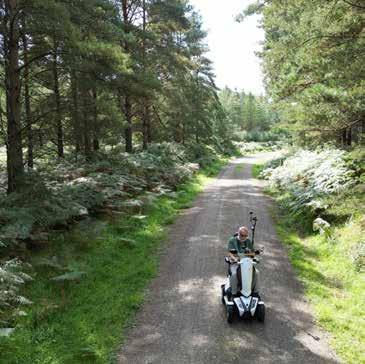
Tigga’s Trousers
Well, I said ‘Wanderlust Sated’ but what I really meant was ‘Wanderlust Redirected’.
In the latter part of 2023, Tigga went as far as Elveden in one direction, Croxton in another, Kilverstone in the east and Barnham in the south. He was still pushing the boundaries. That was when he started his seminal series “Tigga’s Trousers”
Then in 2024, he went mad with Retail Therapy, going to all the supermarkets he could think of, the garden centre, and any other shop whose doorway he could squeeze through.
He then went rolling along the river. He explored the Little River Ouse from one end of Thetford to the other, visiting the Nunnery Lakes before trying to trace the river Thet up through Cloverfield estate to Kilverstone. That was his undoing. He hit a tree stump and had an orange nose from then on.
He did a few more episodes of this series, most notably the Counter at Monte Cristo in July 2025, but his wandering days were coming to an end.
One last hurrah
But he wasn’t quite done yet. After seeing the difficulty I had finding any sensible reviews or unbiased advice while I was trying to get a replacement for him, rather than sulk and say ‘Tough!’, he devised the Nuns’ Axe & Triangle Mobility Scooter Test Track and told me to get the website WhatMobilityScooter.com.
I can now test mobility scooters myself and put all the results in a database on the website.
Simples – Yes!
I think there might be a copyright problem heading my way.
Anyway, to finish off, he set the benchmark for a lap of the track and for speeding down Acceleration Avenue. He was also the first to cross the Gravel Sea. He did all this despite my new cocky Colt scooter, a Pride Colt Executive, muscling into his home.
Tigga now lived in a storm-damaged gazebo, wrapped in a leaky tarpaulin whilst the youngster lorded it in the shed with power, lights and probably the odd floozy Scoozy!
I suppose Colt’s just a typical teenager, really, but... I didn’t want Tigga to finish like this, so I started looking around for a new home he could go to, where he could keep his dignity and put his wheels up. So I advertised him on Gumtree, not quite Sunningdale or Saga, but a sort of mobility scooter equivalent.
Well, long story short, along comes Hannah. She knows him from watching his antics on the YouTube channel, and she’s a subscriber! I think it was love at first sight. I left them alone for a bit, and the next thing I know, she has bundled him up in her car like a longlost puppy, and they are off on new adventures.
She knows his batteries are dying, his wheel bearings are broken, and his body is worn and weary, and in need of some serious TLC. But I think she is the lady to give it. She is in no hurry to do this.
Tigga is her long-term project, and I think with this great lady’s loving ministrations, she will resurrect him.
I don’t think we have seen the last of Tigga yet. I think, as Arnie might say, “He’ll be back!”
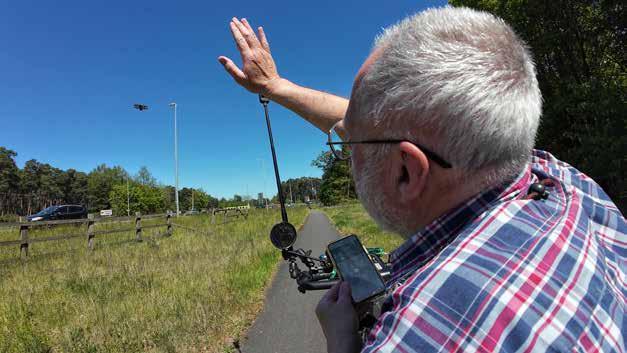
PS: I think I mean ‘PS’, but maybe it’s ‘NB’. I’m waffling again. So I checked my Latin. Post Scriptum means ‘written after’, and Nota Bene means ‘note well’. It is written after, but I think I want you to note well so it’s: NB.
Anyway, I got the first book by Sophie McKenzie in the Medusa Project series and read it in one sitting whilst hiding indoors from the ferocious 34 degrees C heat with all the curtains drawn. I am definitely getting book two. It’s almost as exciting as my Medusa Project!
Scan the QR code below to pay a... ... Tribute to Tigga

Secondly: Training Day
I introduced you to my new DJI Neo 2 drone, Nona, in the last issue. Since then, she has become my best friend. My most loving and faithful pet ever!
A lot of people would say that’s not hard. After all, I had terrible trouble with my daughter’s Tamagotchi. It was sh*tting all over the place, I kept forgetting to feed it, I didn’t play with it, and my discipline was lax. When Sophie, my daughter, was really young, I let her cat Tickle out into the garden, and it was promptly run over by a car. I discreetly buried it in the woods and explained that Tickle had probably eloped with next door’s ginger and they were now both living the ‘cream’.
Please don’t groan too much. What I am trying to say is that I am no good with pets. However, this drone has become one.




So, I decided to take Barbara Woodhouse’s advice and do some training.
I first took my drone up to the Sainsbury’s roundabout so I could teach her to stay close, keep to heel and follow me.
This was much harder than I thought. I had my phone, which allowed me to give Nona basic instructions like up, down, left and right, but I couldn’t really control where she was looking.
The old adage, ‘Look at me when I’m talking to you,’ is all very well, but the trouble was she would look at me all the time, regardless of whether I was talking or not. This is the real problem with the Neo 2 drones. They are tracking drones, therefore the camera is always pointing at the object they are tracking.
What I wanted to do was point Nona’s camera at the roundabout and not at me, so I could give a commentary on the view.
It was much harder than I thought, and I suddenly realised that it wasn’t my drone that needed training, it was me!
But I had only done one flight, in the safety of the King’s Garden, so perhaps I needed to expand gently. I had to work out how she followed me, where she went and what she was seeing. Then, perhaps, I could hope to control where she looked.
To that end, I abandoned my brief trip to the roundabout after I had pointed my finger at her angrily and moved on to Castle Park. Well, I didn’t do that immediately.
I went home and started reading her manual. Not every pet comes with a manual, so I was lucky. I think babies should come with manuals, too!
I discovered that if I wanted to give my Nona more independence, I needed to get her a digital transceiver (think of it as a pet tracker), and I had to get her a controller so I could fully control her. I thought of that as a remote training collar, but I didn’t want to give her an electric shock every time she misbehaved; I just wanted to be able to kindly suggest she pay attention and look where I pointed.
I also discovered that I should get her some more batteries. Think of these as Pedigree Biscuits!
These all cost a great deal of money, so I decided I would try to learn how to fly her properly first.
But first things first, I decide to meet Adrian for a beer and film the route. I launch Nona as I enter Castle Park because I think it is an ideal place to test her following abilities, and I can easily see where her camera is pointing.
I think that’s where I fell in love. She buzzed around my head like an eager puppy, as you can see in the picture, and then faithfully followed me through the park.
It’s a tricky route for any drone, and there is a very narrow section, like a canyon, in the middle as you pass the sheep pens. On the other side of the park, on Castle Street, there is an avenue of trees that seriously tests obstacle avoidance. Nona didn’t flinch.
It was only my second major flight, but it taught me a lot.
Nona returned some very good footage of our trip through the park, including shots of Castle Hill, but it was all from a pretty low level.
I realised then that I need much more height and training, and a controller. Time to raid my empty
piggy bank again.
I’ll probably just keep muddling around for now.
The good news is that I made it to the other end of the park in Castle Street, held out my hand and said, ‘Here, boy!’ That’s when I realised I had a new pet!
Scan the QR code below to watch the...
... Training Day

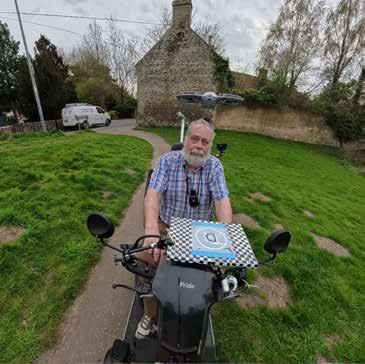
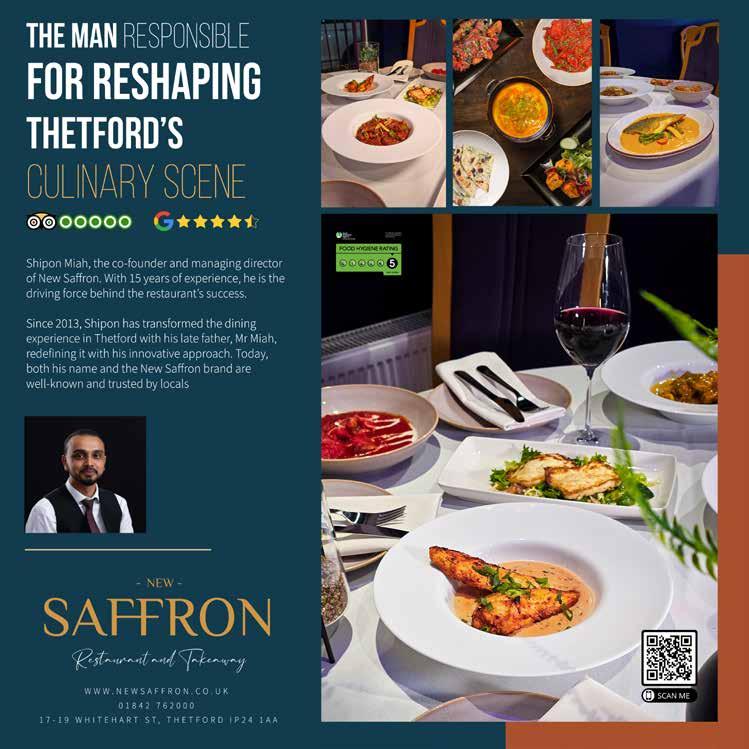
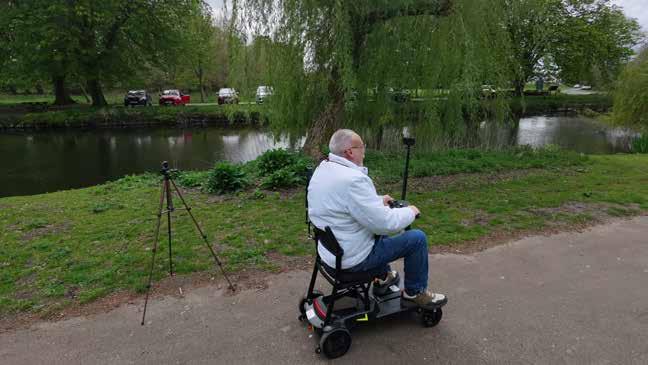
Finally: a Light Heavyweight.
T-Sport is at it again. This time, they lent us a YL 985s folding mobility scooter.
They definitely need to work on their scooter names. I own a T-Sport X5 Autofold, which I call Tiglet. They could have at least called it the Fox or the Gazelle or the Dolphin after some of the nimblest of creatures, even the Mexican (after the three-tailed bat that dives at around 100mph), actually, the Mexican sounds kinda hot! But no, their marketing team got together and decided that X5 Autofold was it.
I’m not sure if they were confusing it with a luxury car, camera, phone, drone or aircraft?
And then there is the Scote 48350 that Adrian owns. He is now called the Stoat, which is a much more sensible name.
Anyway, back to the YL 985s. It wasn’t long before I had given it the pet name of No-Nose.
The reason for that was quite simple. Most other scooters have round tillers, and it is easy to fit a variety of attachments onto them: phone holders, bottle holders and especially baskets and pet carriers.
But for some aesthetic reason, probably by the marketing team again, they decided to make the tiller in the shape of a wonky polygon. It certainly looked good, but nothing would fit on it. Hence ‘No-Nose’!
Whatever you want to call him, No-Nose or YL 985s, is no lightweight.


I’m lying again. He is a lightweight. He only weighs about 18kg, and that includes batteries!
You can probably see me in a picture below holding up a battery and pointing. What I am explaining is that there is an on/off switch on the battery. I didn’t know that, so I phoned up Simon at T-Sport and went ‘Waah!’ This scooter doesn’t work. He said, ‘Have you tried turning the battery on?’
Well, with that little hiccup sorted, it was all systems go. That scooter is a great little machine.
We took it around our Bootlace test track on a headto-head with Tiglet and Stoat, or to be totally PC with the X5 Autofold and the Scote 48350, and then we took it for a bit of off-roading up Nunnery Place and then into Arlington Way.
First of all, it handled the Bootlace test track very well. The biggest obstacle there is what we call the ‘boot bump’. This makes most little scooters hesitate. It is basically a nasty kerb that is situated right outside the Nunnery Bridges car park. It bumped up that quite happily and then went along Washboard Way with no hesitation. This surface is a worn, crumbling ruin of asphalt with the underlying steel mesh exposed, lurking like a hungry anglerfish ready to snap at the wheels of an unsuspecting scooter.
Anyway, it finished its lap easily, and you can see where it finished on our leaderboard in the video.
Next, it was off-roading time in Nunnery Place.
This pathway has a couple of very awkward and uneven bridges along it, as well as a great variety of surfaces.
It tackled some gravel, some grass, some mud and some serious bumps along the way.
Considering how light it is, it behaves like a much bigger scooter.
We took it on the pavement and all the way up Arlington Road. These are the sort of surfaces that it is really designed for, well, shopping malls too, of course!
It only has small wheels, but it is surprisingly comfortable on these surfaces.
What I like most about it is its lightness and small footprint.
Before that, we had taken it all the way to the NEC in Birmingham, on three different train lines, and down a country lane in the dark with its lights blazing.
It’s a long way for any little scooter, but it did the journey with ease.
Its lights are so good that Adrian swore the first time I turned them on. He said, ‘They’re ******G bright!’
Yes, it’s a lightweight 18kg, but really it’s a heavyweight!
Scan the QR code below to see a... ... Light Heavyweight

Happy scootering.
If you haven’t got a QR code reader, you can find all the videos by following this link.
www.youtube.com/@TheMedusaProjectThetford

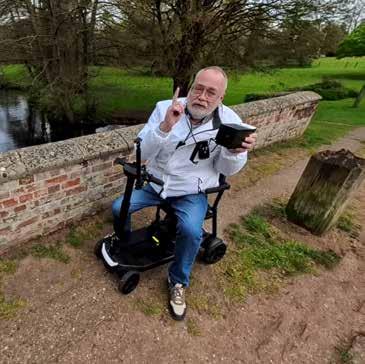
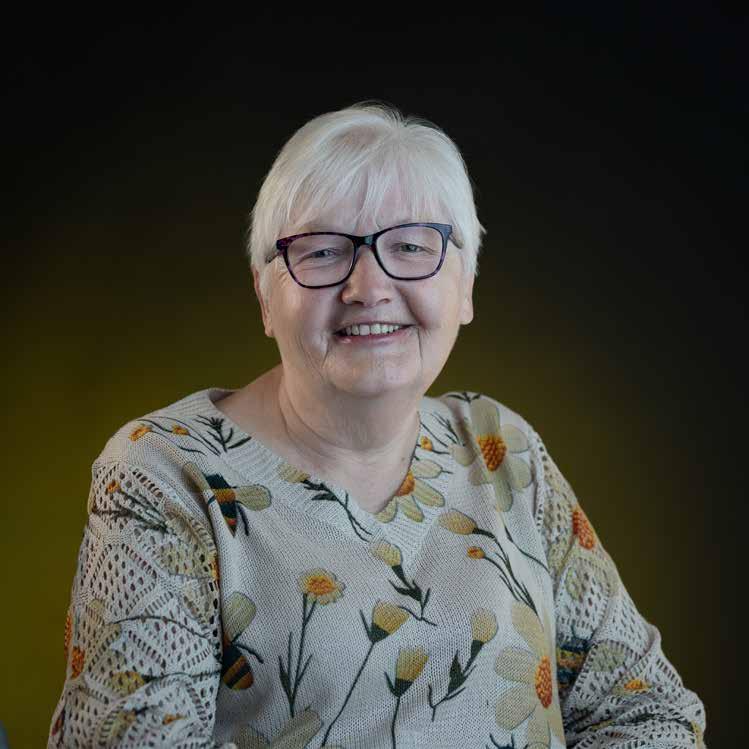

Written by Brandan Cutts
Do you ever look around at your group of friends and wonder if you will all still be friends in your twilight years, still meeting up and having fun, still creating new memories, and, most of all, proving a friendship that really can withstand the test of time?
Well, fortunately, there is a small group of people in Thetford who have proven that this is indeed possible. After many years, this group is still going strong and closer than ever, and to help maintain their bond, they have started Thetford’s first breakfast club, where the gang all travel around Thetford together, going to different cafes or restaurants to sample their culinary delights.
The group consists of ten members, Bobby, Lynn, Trevor, Pearl, Isabel, Karen, Jane, Andy and Stuart, but at the core of this group is an endearing lady called Shirley.
Shirley is the founder member of the group and has always understood the sense of a strong community spirit and being there for others. Shirley has this magical way of making friends wherever she goes and bringing people together, which is exactly how this group came into being. Shirley first moved to Thetford back in the early 70’s to Oak Close and began working at Jeyes, and this is where she met Bobby. Bobby was a very charming man, but also a bit of a joker, making jokes as often as he could, even when his jokes had people rolling their eyes. Shirley still found the funny side, and the two hit it off right away. After many years of a great friendship, they have become a lot more than just friends and are now happily married.
Before long, Shirley was out on the town meeting all sorts of people from every walk of life from and around Thetford. Her two favourite places to go were the ex-service club down by the iron bridges and the


Jeyes social club. A company’s social club was a place where employees of the company could go and relax after a long day or take their families on weekends, but what made them special was that they were only exclusive to the workers and their families, so they were really places for breaking the barrier from coworker to friend. Being such a people person, Shirley was eager to talk to anyone and listen to their story. She really made them feel listened to and welcome; she became the go-to lady when you really needed someone to talk to, or just to have someone hear you. Even if it was a friend of a friend or a relative, such as Trevor and Pearl, who are brother and sister, Shirley was always happy to meet them all and bring them together, making them feel included; that’s exactly how this group came into being.
If you asked the group how they all met, they would all have this to say: “They were a ragtag group of people who all loosely knew of each other, but ultimately it was Shirley that brought them all together, one way or another, and made them the group they are today”.
Over the years, the group enjoyed a lot of fun times together, many nights down at the ex-service club drinking and making merry, going out to watch football games, and the occasional BBQ. They all stayed in close contact. Lynn even borrowed Shirley’s wedding dress when she married Trevor, but as life does, it tends to get in the way, sometimes especially with friendships, having kids, or moving house. The group started to see each other less. One such reason was due to Bobby having an accident at work and becoming reliant on a walking stick or mobility scooter, forcing him into early retirement, subsequently meaning he was unable to get out and about as often as he used to, which hit him particularly hard because Bobby was always the adventurous, outgoing type, and now suddenly unable to walk more than a few feet without assistance. This caused him to fall into a pit of depression, not being able to
get out as much. Bobby and Shirley still met up with the odd friend down the ex-service club for a few drinks, but Bobby longed to venture further. Sadly, a similar accident befell Trevor, making his mood drop dramatically.
Regrettably, this type of thing happens to a number of our community when they hit their twilight years and can cause once bold and daring people to become reserved and depressed, retreating into themselves, becoming a shell of what they used to be.
Seeing this first-hand with Bobby and Trevor, Shirley sat down one morning, trying to think of a way to help her husband and one of her oldest friends. She reflected on the days they used to have throughout the decades and all the smiles and laughs; she wondered how she could bring back that spark and lust for life. Suddenly, it hit her, “I could get the band back together again” Shirley sat and thought of all the ways the group could meet up, and how it could also accommodate people like Bobby and Trevor.
The memories of Bobby and Trevor enjoying breakfast at the Norfolk Kitchen cafe, as they did before, Breakfast was the perfect setting, the location, spacious and easy access. Shirley jumped on the phone and got the ball rolling for the whole gang to meet up for breakfast the next morning. This was a roaring success, everyone all together again, joking and telling stories just like the old days.
Seeing how happy this made the group, another idea formed in Shirley’s head, “Why not make this a regular thing? Not only is it getting us all out of the house more often, but it’s keeping us all close and keeping us all feeling youthful inside”, so that’s exactly what Shirley did.
So formed their breakfast club, every week the group decides on somewhere different, where they are all


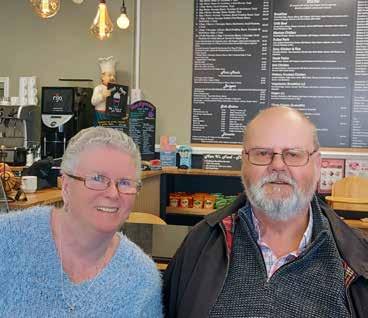
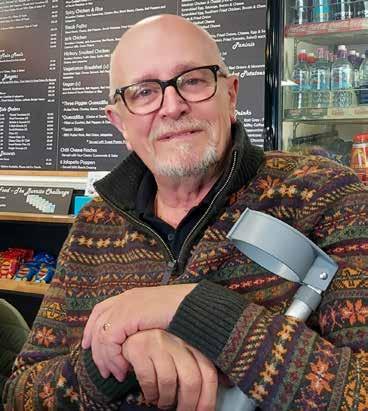
going to tuck into some lovely bacon and sausages. Their club has been going for several years now, so far they have eaten in nearly every cafe or restaurant that serves breakfast cuisine in East Anglia. I was lucky enough to join them on one such trip, and I must say the good times never stopped. There was never a quiet or dull moment; it was like being back in school at the lunch table with all of your friends. Despite there being ten of them, no one was left out. This was shown very clearly through Shirley, who made sure everyone was comfortable and that everyone was heard. It was truly a sight to behold watching this fun-filled crowd between the ages of sixty and seventy, all still acting like kids, showing they have all still have their lust for life. They even recounted times they visited a cafe where the chairs were bolted down, and none of them could fit at the table, but instead of getting annoyed, they all just erupted with laughter.
The fun doesn’t stop there, though, as they all have started to venture out for more than just breakfast; they have all started going out for lunches and dinner too, with Tall Orders being their favourite spot to stop for a quick cake and a cup of tea and the Warrener for a place to have a lovely roast. Again, the group hasn’t stopped there; they have all started going on holiday together, still getting up to mischief. One such incident involved a singer walking off the stage because she thought they were laughing at her, but of course, they were just laughing at each other.
So what started as a quick idea to help lift some spirits has now evolved into a series of adventures and unbreakable bonds, with no intention of stopping any time soon. Showing us all, it really doesn’t matter how old you are, you are never too old to have fun and that even when life feels restricted, there is always a way around it, especially when there are people out there like Shirley devoted to keeping that smile on our faces and making us feel welcome.
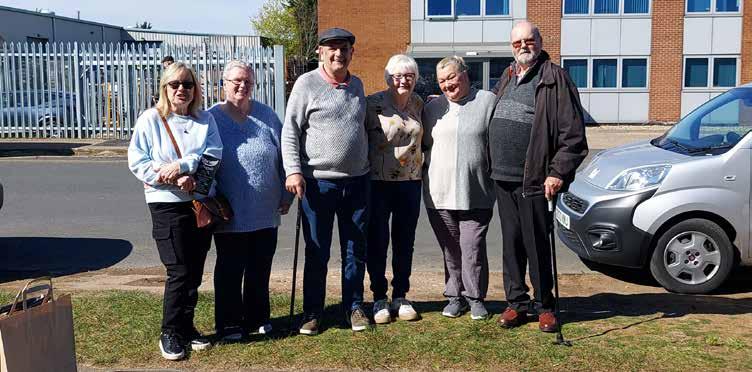
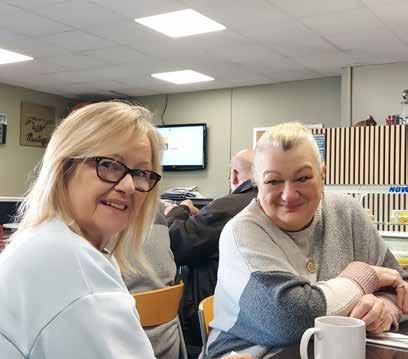
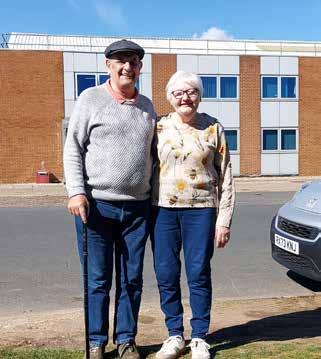
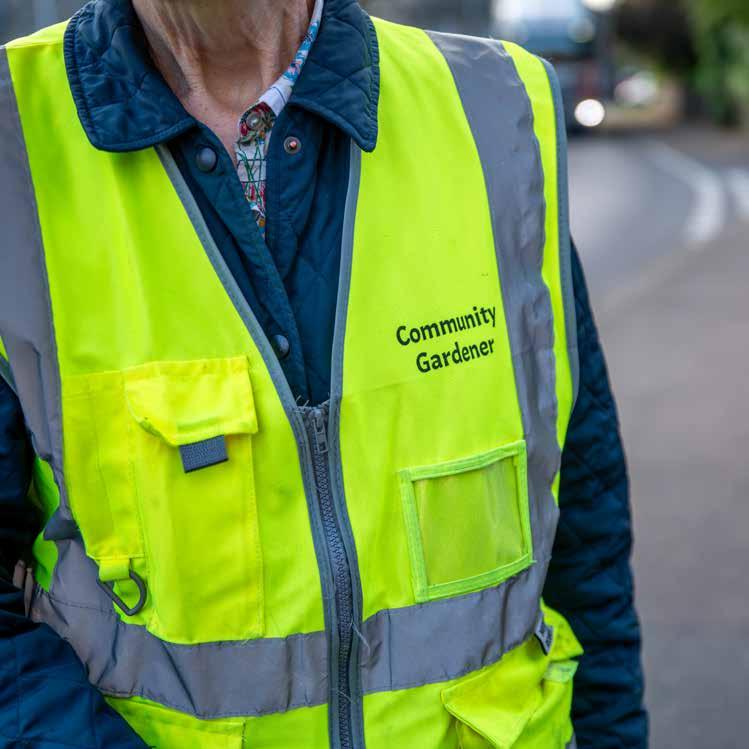
Written by Martin Angus
There is a particular kind of magic that happens in Thetford before most of us have opened the curtains.
While the town is still yawning itself awake, while kettles are being boiled, dogs are being reluctantly walked, and the first traffic begins to hum along Bury Road, a quiet figure is already out with a wheelbarrow.
Inside it: tools, plants, sacks for litter, perhaps a stool to spare her back, and the ingredients for a small act of public beauty.
She does not want her name printed. That is a shame, because what she is doing deserves applause. But it is also rather perfect. The mystery suits her. She is, by her own choice, The Early Morning Planter.
Her work can be seen all over Thetford, though
you may have passed it without realising. Beneath street signs, at bus stops, beside little corners of grass and forgotten patches of ground, she has been quietly tidying, cleaning, planting, weeding and watering.
Not once. Not as a one-off. But again and again.
“At the moment, there are 41 places that I’ve cleaned,” she says, almost as if this is a perfectly normal hobby. “I clean the sign first, just so that it looks tidy, and then do a small border underneath the sign and put plants in.”
The first was in Williamson Crescent, beneath a street sign close to her own garden. A councillor checked with Norfolk County Council, and the answer came back: as long as it was just beneath the sign, it would be fine. After all, those awkward little patches are often too fiddly to cut properly anyway.
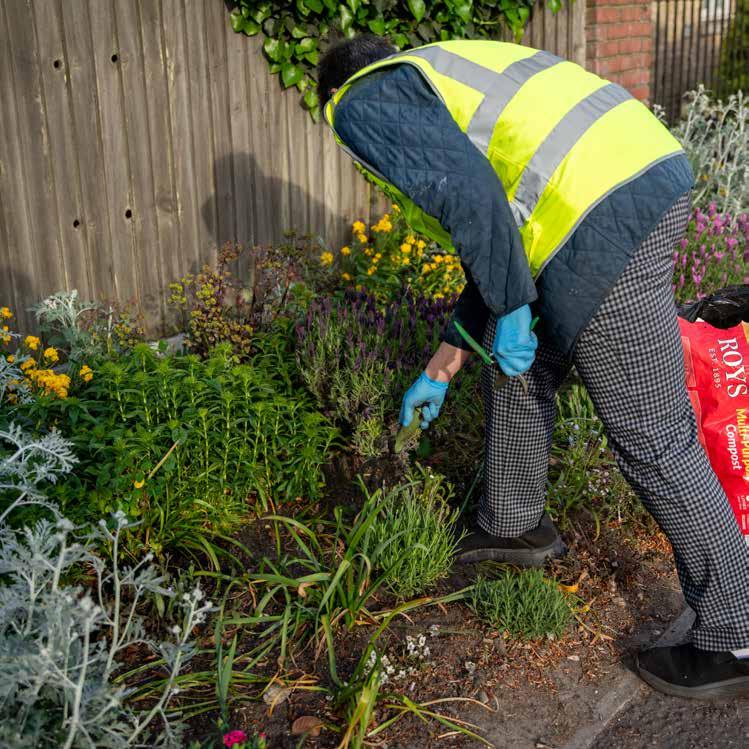
So she planted one.
Then another.
Then friends began to notice. Some said how lovely the flowers looked. Others added, with a familiar Thetford directness, “No one does it our way.”
And so, this year, she did more.
Queensway, Staniforth Road, Kingsway, Barnham Cross, Bury Road bus stop, Icknield Way, Fulmerston Road, Williamson Crescent, Dane Close, Icknield Close, Newtown, St Mary’s Court, St John’s Way, Kimms Belt, Monksgate, Grenville Way, Rosecroft Way, Arlington Way, St Michael’s Close, Minstergate, St Nicholas Street, Nether Row, London Road, Highlands, Fairfields, the list goes on.
There is also St Mary’s Church corner, waste ground on Bury Road, and the shop border at Cannons Walk.
This is not gardening for praise. It is gardening as care.
“I love gardening,” she says. “I thought it would be nice to extend that outside of our garden.”
That modest sentence does not quite cover the scale of the work. These are not simply flowers popped into the ground and abandoned. She picks up rubbish first. She cleans the signs. She chooses the plants. She returns to weed. She waters during dry spells. Last year, when summer was especially dry, she and her husband drove around with large containers of water, keeping the little beds alive.
“It was quite a feat,” she admits.
their three greenhouses. She does the weeding and planting. He helps clean the signs. Some plants are bought, funded from her state pension.
“So you could say it’s government-funded,” she says, with a wonderfully dry smile.
There is something deeply Thetford about that line: practical, funny, understated.
The Early Morning Planter is not interested in publicity. “I’m a very quiet person,” she says. “I just like to do things, but I don’t want to be known for it exactly.”
Yet people have noticed. Some have stopped to thank her. Some have given donations towards flowers. One passer-by told her, “I love coming past this corner because it looks so bright.” Another woman, walking with her son, said they loved seeing the flowers around town.
Through friends, she has heard that people are talking about “someone” doing the planting. One person apparently called her “a legend”.
She smiles at that.
But legend is not too strong a word. Legends do not always wear capes. Sometimes they wear gardening gloves and try not to wake the neighbours with a squeaky wheelbarrow.
“That is the main challenge,” she says. “Trying not to make too much noise with my wheelbarrow.”
Her work is rooted in a simple dislike of neglect. “The main thing I hate is litter,” she says. “I just like to see places look tidy. I’m a very tidy-minded person. I like to improve things if I can.”
Her husband grows many of the plants from seed in


At Cannons Walk, she tidied the shop border and asked for another bin to be installed. The council agreed. She also asked for a bin near the bus stop on Bury Road, where students wait for college, and litter can quickly gather.
These details matter. The flowers are the visible part, but underneath is something larger: civic pride.
She is keen to praise Thetford Town Council too, particularly the work around Thetford in Bloom, which has brought colour and recognition to the town. She volunteers with that as well, helping clear litter.
“It’s nice just to do little things to help,” she says.
Little things. That phrase appears often in conversations with people who are doing rather large things.
Ask her what flowers she favours, and the answer is practical as well as pretty. Lavender is a favourite because it does not need deadheading and copes with dry weather. Wallflowers are useful. Forgetme-nots are plentiful in her own garden and bring easy brightness. This year, she is also adding more pollinator-friendly plants: cornflowers, poppies, lavender, and forget-me-nots.
She has learned to think about sun, shade, watering, maintenance and even dogs.
“I did try putting curry plants on either side of the actual sign,” she says, explaining that they can help discourage dogs from watering the borders in their own way. “It does work to a certain extent.”
There is a gardener’s wisdom in all this: beauty, yes, but beauty that must survive real life.
One of her proudest achievements is on Bury Road, where she planted around 2,500 miniature daffodils in a grassed area running towards the speed camera. She chose mini daffodils because they flower early, then finish in time for the grass to be cut as normal.
“That’s a kind of legacy,” she says. “Hopefully they’ll come up each year.”
She even emailed Serco to ask if the daffodils could be avoided until the goodness had gone back into the bulbs.
This is the level of thought involved. Not just planting, planning, negotiating, nurturing, returning.
Perhaps the most touching spot is near Bury Road, close to St Mary’s Church, where there had been a piece of waste ground full of tall weeds. Her husband thought it might be too much to clear. Over a few weeks, she did it anyway.
She planted roses there.
The place has personal meaning. Her father, a carpenter, worked after the war on the building of T. H. Nice’s Garage nearby. Her mother, then widowed after her first husband died in the war, used to walk past. They saw each other, waved, and eventually met.
“So I thought I’d make it into a memory garden,” she says.
There it is: history, family, love, loss and flowers, all tucked into a corner many of us might otherwise pass without a glance.
The Early Morning Planter has lived in Thetford all her life. Her father was from here. Her roots in


the town are deep, and perhaps that is why the neglected corners trouble her.
“So many other things are going wrong in Thetford,” she says, “and I think it’s nice to have some positive things happening.”
That may be the heart of it.
Every town has frustrations. Every town has litter, tired corners, arguments, delays, empty buildings, broken promises and things that make residents sigh. But every town also has people who quietly refuse to let decline have the final word.
Some join committees. Some run clubs. Some volunteer in museums, churches, charities or schools. Some pick up litter. Some plant flowers under street signs before breakfast.
The Early Morning Planter hopes others might feel encouraged to do something too.
“It would be nice if a few more people would do something,” she says. “If they would sort of think, ‘Oh, I could do something here.’”
She is not asking everyone to take on 41 sites. Most of us would struggle to keep one hanging basket alive. But perhaps that is the point. A small patch outside a home. A bit of litter picked up. A planter watered. A tired corner noticed. A street cared for.
When asked what she hopes people feel when they see one of her floral surprises, her answer is simple.
“I hope they just enjoy looking at it. Or just smile.”
That is all.
And yet it is not all.
A smile changes a walk. A clean sign changes a street. A flower bed beneath a road sign says someone cares enough to bend down, get muddy, and make the place better for strangers.
She plans to keep going as long as she is able. There is talk of more daffodils in Newtown this September, along a grassed area before the flats. She has an eye on the other side of the Bury Road bus stop, too, though the branches and bank make it more awkward.
You suspect she will get to it eventually.
After all, this is a woman who says she cannot sit still. At home, when she is not gardening, she crochets. She also makes biscuits. At the interview, she brought shortbread dipped in chocolate, because apparently even anonymity comes with refreshments.
Her love of gardening came from her mother. Her father loved roses and wore one in his buttonhole when he went out, just as his own father had done before him.
That image lingers: a rose in a buttonhole, passed quietly through generations.
Now the roses are on Bury Road. The lavender is under street signs. The forget-me-nots are scattered around Thetford. The daffodils wait beneath the grass for another spring.
And somewhere, early in the morning, a wheelbarrow rattles softly along the pavement.
Not too loudly, of course.
The Early Morning Planter would hate to disturb anyone.
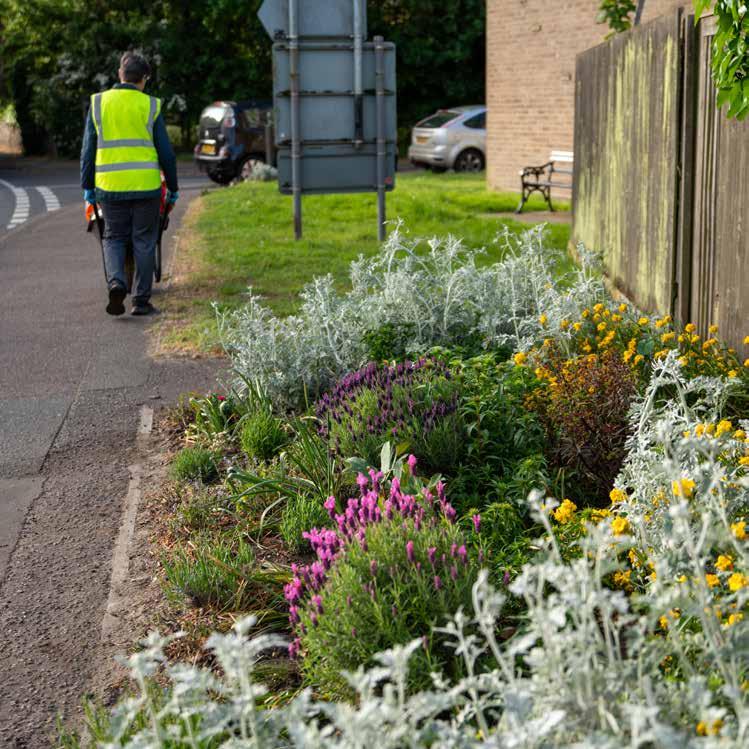
Written by Martin Angus
Two months is not a long time in business. In truth, most new ventures spend their earliest weeks simply trying to survive, quietly hoping customers will notice them before the bills arrive. Yet tucked inside the Charles Burrell Centre in Thetford, a newly opened creative studio called CreateIt already feels as though it has been woven into the town’s fabric for years. Children burst through the doors, clutching glue sticks and paintbrushes. Adults who arrived nervously, insisting they are “not artistic”, leave carrying handmade tote bags, painted ceramics, and something perhaps even more valuable: the unmistakable glow of having made something with their own hands.
Behind it all is Sarah McKenzie, decorator, creator, accidental entrepreneur, and now the driving force behind one of Thetford’s newest community spaces.
What makes the story of CreateIt especially compelling is that it was never part of some grand five-year business plan. There was no carefully choreographed
launch strategy or lifelong dream pinned to a vision board. Instead, CreateIt was born out of sudden disruption, physical injury, and an unwillingness to sit still, feeling sorry for herself.
In January 2026, Sarah suffered a serious shoulder injury that abruptly halted her career as a selfemployed decorator. For over fifteen years, she had built a reputation locally through her business, Sarah Jane Decorating, after previously working with the company Painted Ladies and even lecturing in painting and decorating at West Suffolk College. Decorating was not simply her livelihood; it was part of her identity.
Then, almost overnight, that identity was challenged.
“I broke my shoulder quite badly,” she explains matterof-factly. “I’ve got a rod and fifteen screws in my arm now. The recovery could take up to two years.”
For many people, such news would understandably lead to frustration, fear, or retreat. Sarah, however, seems

constitutionally incapable of standing still.
“I’m not very good at sitting still,” she laughs. “I needed something to keep me occupied.”
Within days of the accident, ideas began forming. By February, she was searching for premises. By early April, CreateIt had opened its doors.
The speed of it all is astonishing.
“There were moments when everyone around me was saying, ‘You can’t get this done in time,’” she says. “But I wanted it open for my daughter’s birthday party at the end of March as a sort of soft launch.”
With only one fully functioning arm, Sarah enlisted her brother, a garage door engineer from Norwich, and together they transformed a tired former art room inside the Charles Burrell Centre into the bright, welcoming studio that now exists today. Wallpapering was completed one-handed. Furniture was built. Walls were panelled. Floors were replaced. Stickers were painstakingly applied to walls, one by one, by family members the night before opening.
It is perhaps fitting that a business built around creativity was itself created through determination, improvisation, and sheer stubbornness.
Sarah was very keen to express her gratitude to all family and friends who helped her bring her vision to life. From building, decorating, helping with childcare, and collecting takeaways on late nights. There were also the hugs to gently nudge her back on track when everything was getting too much.
“I wouldn’t have been able to get CreateIt to where it is now without their help, and will be forever grateful for their help”, she adds.
The studio itself reflects Sarah perfectly. There is calmness here, but also energy. Large panoramic windows flood the room with natural light, while colourful walls, tiny paint-splattered chairs, and shelves overflowing with materials create an atmosphere that immediately lowers people’s defences. It does not feel intimidating in the way some galleries or workshops can. Instead, it feels permission-giving.
That is central to Sarah’s philosophy.
“I wanted people to feel comfortable and calm when they come in,” she says. “There’s no pressure here. You don’t need to know what you’re doing.”
That approach has struck a chord, particularly in a world increasingly dominated by screens, algorithms, and passive entertainment. While children often spend hours scrolling on tablets and adults collapse into exhausted evenings in front of streaming services, CreateIt offers something refreshingly tactile: glue, paint, paper, conversation, mess, and human interaction.
In many ways, the business feels almost quietly rebellious.
Sarah’s children’s sessions embrace chaos wholeheartedly. There are dinosaurs one week, outer space the next. Paint ends up on hands, faces, walls, and occasionally everywhere else imaginable. One little boy became so immersed in a recent session that he rubbed paint up his arms “like moisturiser,” much to his mother’s horror and Sarah’s amusement.
“The more mess, the better,” she says cheerfully. “That’s what this place is for.”
Parents, unsurprisingly, adore the concept. CreateIt removes one of the biggest barriers to creativity at home: the dreaded clean-up operation. Sarah jokes


that adults do not really mind crafts, but they mind scrubbing PVA glue out of carpets afterwards.
As both a parent and decorator, she understands this intimately.
“You can tell a three-year-old to be careful as much as you like,” she says, smiling. “But there’s going to be accidents.”
Here, accidents are welcome.
Yet CreateIt is about far more than simply keeping children entertained for a couple of hours. Underneath the glitter and glue guns lies something deeper: connection.
Sarah repeatedly returns to the importance of togetherness. Parents stay during sessions, often initially hovering anxiously before eventually relaxing and joining in themselves. Adults attend evening workshops alone and leave having spent hours chatting with complete strangers. People who arrive apologising for being “terrible at art” leave proudly carrying their creations home.
“It’s lovely watching people surprise themselves,” Sarah says. “They come in thinking they can’t do it, and then they leave proud of what they’ve made.”
That sense of achievement matters. In modern life, so much of what people consume is instant and intangible. We stream entertainment. We scroll endlessly. We tap buttons and receive parcels. But creating something physical, however imperfect, reconnects people with a quieter kind of satisfaction.
Sarah understands this instinctively.
“I think people are craving hands-on experiences again,” she says. “Or at least I hope they are.”
Judging by the reaction so far, she may be right.
Despite being open for only two months, CreateIt’s social media following has grown rapidly, with hundreds already following the studio’s journey online. More importantly, customers are returning in person. Families come back week after week. Adults book additional workshops. Some leave messages on the chalkboards reading “Best day ever.” Others can be overheard whispering to each other as they leave: “We’re definitely coming back.”
For a new independent business, there are few greater compliments.
The timing of CreateIt also feels significant for Thetford itself. Like many towns across Britain, Thetford continues navigating the challenges facing high streets and community life. Empty units, online shopping, rising costs, and shrinking opportunities for genuine social interaction have left many people searching for spaces that feel human again.
Sarah originally hoped to open inside the town centre itself, but found rental prices prohibitive. In the end, the Charles Burrell Centre proved not only affordable but unexpectedly ideal.
“There’s a real community feel here,” she says. “Everyone supports each other.”
That collaborative spirit mirrors Sarah’s own ambitions for the future. While children’s workshops remain central, CreateIt is already expanding into adult craft evenings, tote bag printing sessions, ceramics, mosaics, and plans for crochet nights led by local collaborators. Sarah is also exploring SEND-friendly sessions, birthday parties, and even corporate team-building workshops.
Importantly, she wants the studio to remain accessible. Children’s sessions cost £8 for two hours, with discounts




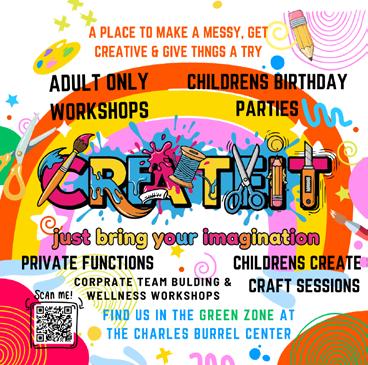
for siblings. Adult workshops are generally around £20, including materials. In an era where creative hobbies can quickly become expensive, Sarah is determined that cost should not become a barrier.
“I want people to feel they can just give something a try,” she says. “Even if it’s only every couple of months.”
That phrase, “give it a try”, appears repeatedly throughout the conversation with Sarah. It is less of a slogan than a life philosophy. She admits openly that there are days when nobody turns up, days when self-doubt creeps in, days when she wonders whether this ambitious leap was foolish. But she also refuses to let fear make decisions for her.
“If it doesn’t work,” she shrugs, “at least I tried.”
Perhaps that honesty is precisely why CreateIt already resonates so strongly. Sarah is not pretending to have built a polished creative empire overnight. She is simply offering a space built with sincerity, resilience, and optimism.
Independent businesses often succeed not because they are flawless, but because they feel real. CreateIt feels profoundly real.
It is there in the carefully chosen balance between calmness and chaos inside the studio. It is there in the recycled materials lining the cupboards, waiting for children to transform them into cranes, rockets, moon rocks, or something nobody else could possibly predict. It is there in the adults quietly rediscovering parts of themselves they had forgotten existed beneath work schedules, parenting responsibilities, and endless digital distractions.
Most of all, it is there in Sarah herself.
energised by watching other people create. Even while recovering from a serious injury, she radiates momentum. Her decorating background remains visible everywhere, in the thoughtfully designed space, the careful use of colour, the instinctive understanding of atmosphere, but CreateIt represents something bigger than a career pivot.
It represents adaptation.
What could have been a deeply discouraging chapter became an opportunity to build something communal and joyful instead. Not because Sarah had everything perfectly planned, but because she was willing to risk trying.
And perhaps that is ultimately what CreateIt offers Thetford: permission.
Permission for children to make a mess without fear. Permission for adults to reconnect with creativity without embarrassment. Permission for strangers to sit together and talk. Permission to step away from screens and schedules for a little while. Permission to fail, experiment, laugh, glue things together badly, and enjoy the process anyway.
In a society increasingly obsessed with polished outcomes and curated perfection, that feels quietly radical.
Only two months after opening, CreateIt is still in its infancy. There will undoubtedly be challenges ahead. Building a sustainable independent business is never easy, especially in uncertain economic times. Yet already, the studio feels less like a temporary venture and more like the beginning of something genuinely valuable for the town.
Because beyond the paint splatters and tote bags, CreateIt is really about people.
She speaks warmly, laughs easily, and seems genuinely
And perhaps that is why it matters.
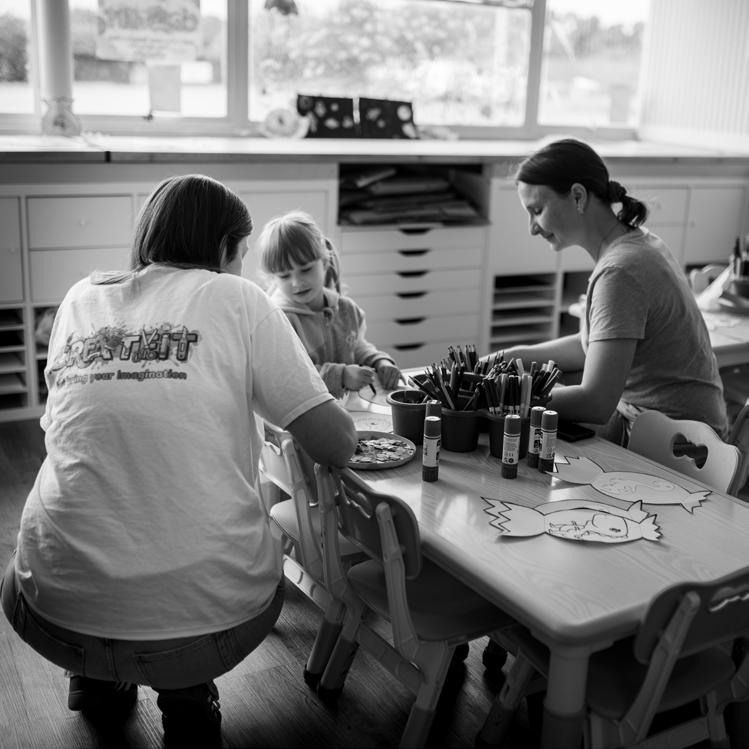
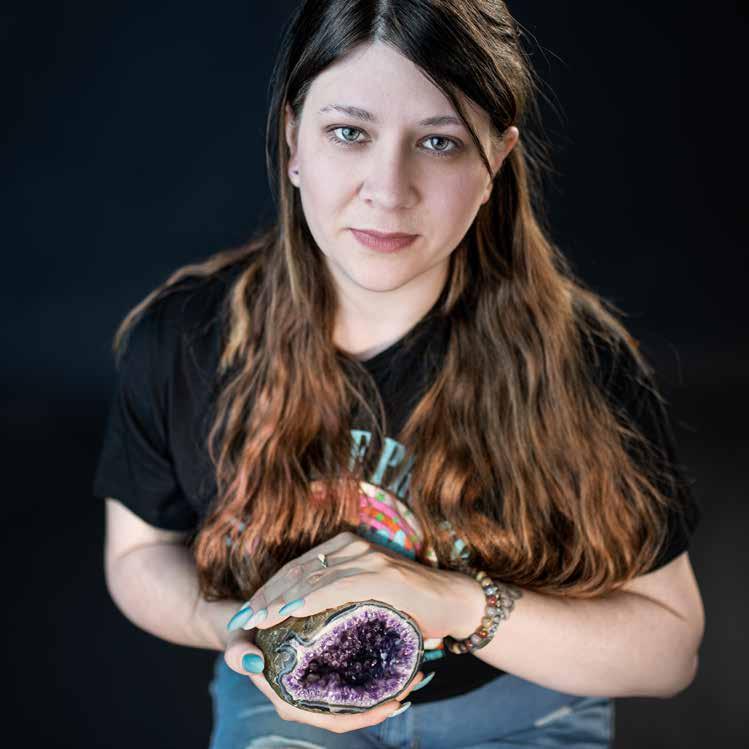
Written by Brandan Cutts
Sometimes in life, you can come across something that at the time seems insignificant, but somehow this thing that was no more than just a quick thought or a passing fancy can affect your life in the most surprising and unpredictable ways. That’s exactly what happened to Coral and her crystals.
A crystal, or crystalline solid, is a solid material whose constituents, such as atoms, molecules or ions, are arranged in a highly ordered microscopic structure, forming a crystal lattice that extends in all directions. This means they can come in a plethora of shapes and colours, stretching from some which look like a shard of glass to others which are vibrant colours or even have extremely unique patterns such as metallic strips flowing through them, almost like lightning trapped inside.
Some others have even more incredible properties than that. For example, Autunite just looks like a simple stone,
but once placed under a UV light, it suddenly glows an intense green, almost like someone has cut open a glow stick and bathed the stone in it. This is due to its uranium content. Quartz is another example. This one is actually used more often than we think. When it is mechanically stressed, it can produce an electrical charge and is often used in watches or electronics. Most people would look at crystals or geodes and simply think they are just pretty stones and rocks, but once you look deeper, there is a whole world of curiosities that feels like it’s blending science and a little bit of magic.
Coral is a very bubbly person with a really warm presence and infectious smile who currently works at Aldi, but with her deep knowledge of all things crystal, she would have been an amazing geologist. Although even with her love for these minerals, it wasn’t actually her first passion. That was, in fact, insects and arachnids.
Long before she was a local on Thetford Market Square,


she was an online seller of a whole manner of exotic creatures, most notably jumping spiders. Jumping spiders are a species of spider most notably known for their incredible jumping ability, hence their name. Although this species isn’t very big, only ranging from 1–25mm, they come in a variety of sizes and colours from muted whites, blacks and greys to vibrant blues and yellows, even sporting some metallic colours as well, and to some, such as Coral herself, they are regarded as the cutest breed of spider.
The biggest spider Coral ever owned was a salmon pink Goliath bird-eater. These are renowned for being the biggest spiders on Earth. Most people cannot stand spiders, but Coral saw the beauty in them and wanted to share them with like-minded people around Thetford and the surrounding areas, so she built up a collection and began selling them online. Unfortunately, this did not go to plan, as maintaining all of the habitats was rather costly and time-consuming, so she was forced to step away. However, Coral did keep a couple of favourites such as her velvet spider affectionately called “Shelob”, named after the giant spider from The Lord of the Rings trilogy.
Despite being named after a menacing spider, Coral’s Shelob is actually rather playful. For instance, one time Coral was feeding her, and she ran up Coral’s arm and hid on her back, requiring Coral’s husband, who isn’t overly fond of spiders, to try and trap her under a cup and manoeuvre her around Coral’s back to get her back into her enclosure.
Now, if you asked Coral what her first thought was when she first laid eyes on a box of crystals while out for the day, she would tell you she thought the same thing that most of us would think: “Oh, those are some pretty stones.” But for some reason that she couldn’t explain, she felt a pull towards them, especially Moss Agate. This is a semi-precious gemstone featuring dendritic inclusions of manganese or iron that resemble moss.
Before long, Coral had found a whole new passion, learning as much as she could about all the different types of crystals, geodes and precious gemstones. Eventually, every nook and cranny of her home was filled with as many as she could find.
As Coral puts it, “It’s a very expensive but very pretty hobby.”
Coral started to become really intrigued about all the things crystals can do, and not just the physical things, but the spiritual side of things, too. There are a lot of people out there who believe crystals can be way more than just pretty ornaments around the house. It’s believed they can actually heal you mentally or even sometimes physically. Rose Quartz, for example, promotes compassion, self-love and emotional healing, offering comfort to the heart, and Smoky Quartz grounds emotional upheaval and helps lift depression.
Now this wasn’t something Coral initially believed. She found it fascinating but did not believe it herself. Sadly, though, Coral unfortunately lost her grandfather a few years ago. She had already lost her other grandfather many years ago when she was younger, but losing another loved one will always stir up old feelings.
Although she didn’t believe crystals could help, she thought, “What’s the harm?” and found a piece of Rose Quartz. She held it close to her, and before she knew it, Coral actually did feel some sense of comfort. Now, whether this was a coincidence or the crystals actually working, Coral did not know, so she went with her instinct and trusted the crystal.
So Coral started using crystals in every way she could. Coral suffers from severe social anxiety, which she has tried to help with medication in the past, but the one thing she has found that truly helps is her crystals. Whenever Coral is feeling anxious, she always has a bit of Quartz to hand to help her feel calm and relaxed.


So one day, an idea formed. Coral wondered if she could share this with the people of Thetford, much like she had tried with the spiders, but this time do it in person on Thetford Market Square and really show people these are more than just pretty stones. It was good timing, too, because her own personal collection was starting to overflow a bit, and Coral needed to make some room.
Armed with her new plan, she sat down and started to come up with ways to set up her own market stall. Fortunately, her sister Kerry shared a similar passion for old things from the ground. Kerry has a love of fossils, most notably her prized Megalodon tooth, which is almost bigger than one of her hands. This made Kerry really appreciate the science behind crystals and how they form. Together, they made the perfect team.
On the one hand, you have Coral, the “Hoochie Woochie” lady, as her mother affectionately calls her because of her love of the spiritual side, and on the other hand, you have Kerry and her love of the science side of things.
After some back and forth over the name of their new venture and neither one being able to decide, their mum threw in a suggestion: B&B Crystals, as in Bird and Buxton, Coral and Kerry’s last names. Once they had everything in place, it was now just a case of setting up at Thetford Market.
Coral could not contain her excitement on her first morning on the market, so much so that some of the other market traders even asked her, “Are you okay? It’s not normal to be this happy at this time of the morning.” But Coral was not bothered by what time it was. She was so ecstatic to be there and could not wait for her first customer.
Luckily, this was a brilliant idea because people love her
crystals and love to hear from Coral and Kerry about how they are more than just pretty stones. That is what makes them both such a delight to see. When you go to their stall, they do not try to push you into buying a specific crystal. They both just love to explain how they are made and how certain ones can help you with struggles, and the right one will pull you in, to a point where Coral actually sells the crystals for cheaper than she buys them because she honestly feels that they can help people and that to her is priceless.
Coral and Kerry have gone from just selling their overflowing collection to having to order them in from far and wide, often running out of people’s favourites. Coral has even got her kids in on the action now by letting them make crystal goodie bags, and yet again, the public loves them.
Coral has even gone as far as tracking down very rare crystals for customers who are looking for something very exotic or a gemstone that can help with a problem that person is facing. Despite the reason, if you want it, Coral will find it for you.
In the future, Coral hopes to have her own shop, nothing too big, just a quaint little shop somewhere in town where she can adore them and help others possibly discover a love for them themselves.
It just goes to show that one day you can be passing and see something you don’t really give much thought to, but in time, that small thing has the biggest effect on your life. Like Coral seeing that box of pretty stones, except they weren’t just a box of pretty stones. They helped Coral deal with her social anxiety, she found a new passion making her consider becoming a geologist, and now spends every Tuesday on Thetford Market alongside her sister, showing they really are more than just pretty stones.
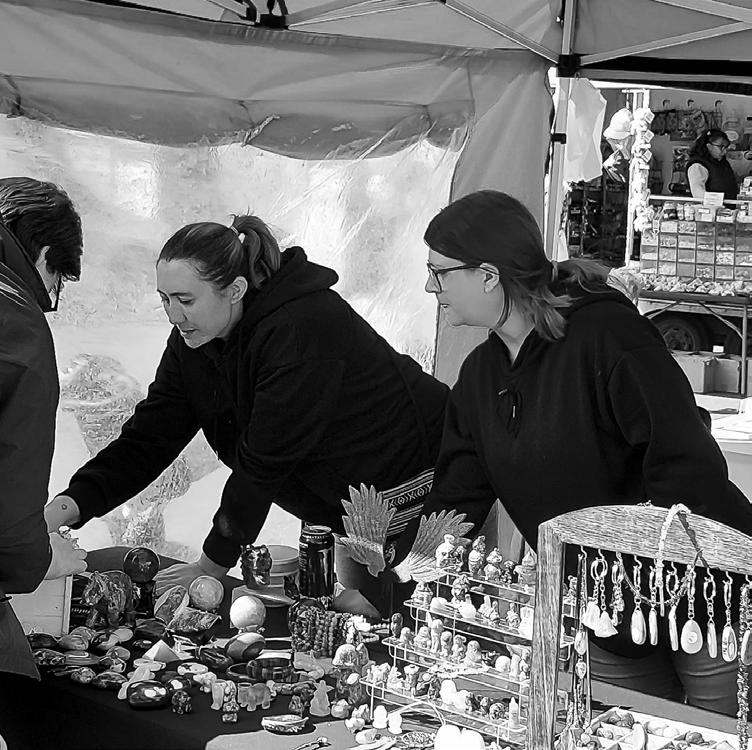

Written by Rita Thompson
Just like humans, cats and dogs can be subject to dementia. The first sign for a cat may be that the cat does lots of yowling for no reason. To first rule out kidney disease, which may cause discomfort, including increased hunger or thirst, which may lead to yowling. Cognitive issues usually develop in older cats, which can cause disorientation, leading to yowling at walls.
Your vet may suggest dietary changes, medications, or other treatments to improve the cat’s quality of life. Managing kidney disease in cats often involves a combination of these approaches to ensure they remain comfortable and healthy.
In the meantime, try to refrain from telling your cat off for being noisy. He is not deliberately trying to provoke, but is likely to be feeling unwell, and the
chastisement may well only serve to confuse and distress him further. Ensuring he has access to fresh water and a suitable diet for his condition is crucial. Regular vet check-ups will also be essential in managing his kidney disease effectively.
It is important to note that exposing a cat to any amount of second-hand smoke is bad for their health. This is particularly so for regular smokers or for those who smoke in poorly ventilated areas near their cats. This is because, just like with humans, cigarette smoke can cause respiratory issues such as asthma and bronchitis due to the smoke irritating the airway. Prolonged exposure also increases the risk of lung cancer due to the harmful chemicals in the smoke, which can damage lung tissue over time.
It is not just the lungs that are affected; cats exposed

to second-hand smoke may also suffer from eye infections and skin irritation due to the chemicals in the smoke. It is also thought that smoke can cause allergic reactions leading to symptoms like sneezing, itching and skin rashes. Third-hand smoke, which refers to the residual chemicals that settle on surfaces, including a cat’s fur, is also a health risk. When cats groom themselves, they ingest these toxic particles, leading to various health problems, including digestive issues and an increased risk of developing tumours in the mouth and throat.
Although thought by some to be less harmful than cigarette smoking, vaping poses similar risks to cats. The vapour from e-cigarettes contains harmful chemicals like formaldehyde and propylene glycol, which can lead to respiratory problems and broader health issues, including a weakened immune system and general poor health. Like with cigarette smoke, the particles from vape aerosols can settle on surfaces and be ingested by cats during grooming. It is worth noting, too, that the vape devices themselves are risky to have around cats due to the toxic nicotine they contain. Should a device become broken, the leaked e-liquid and the nicotine it contains will contaminate surfaces and can be absorbed through the skin.
To protect your cat, it’s best to avoid smoking or vaping indoors altogether. If you do smoke or vape, try to do it in a well-ventilated room, away from your cat, and wash your hands thoroughly before handling your pet.
For help or advice, or if you need assistance with the cost of neutering, please call us on 01842 810018.

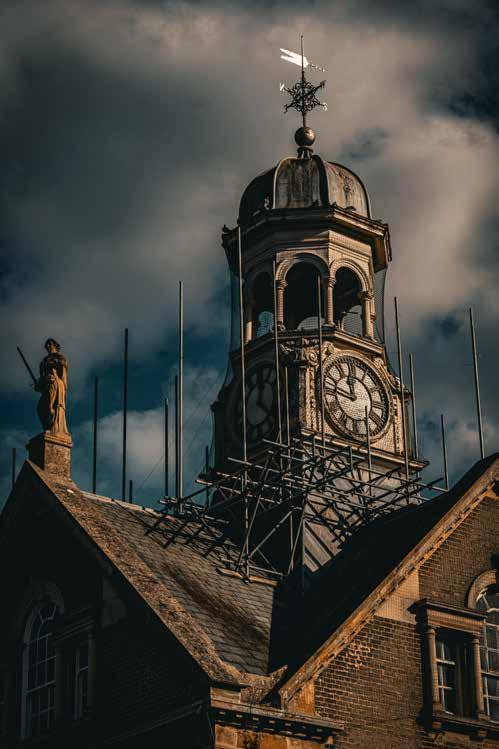


The Reflections of Thetford magazine is delighted to team up with The Thetford Photography Group, and honoured to publish the photographs of the winning entries to the recent group competition, ‘Thetford in One Frame’. If you are a budding photographer, and are interested in entering the next competition, please scan the QR code below, and join the Thetford Photography Group on Face Book. Entry is free, and the members themselves vote for the winners.
Thetford Photography Group is an open and friendly community where creativity and connection go hand in hand. Whether you’ve just started exploring photography or have spent years behind the camera, this group brings together people united by a shared passion, capturing the world around us in personal, distinctive ways.
Our subjects are as varied as our members themselves: from peaceful woodland views right here in Thetford, to lively local gatherings and the small, special moments of daily life. We welcome every style and outlook, and there’s no pressure to have topof-the-range gear or masterful skills. What matters most is your ability to spot something meaningful, and your choice to turn that sight into an image.
Within the group, you’ll find plenty of opportunities to share your work, receive kind and helpful feedback, swap practical advice and find new inspiration. You’ll see everything from dramatic landscape shots and detailed wildlife captures to thoughtful portraits and candid street scenes. Every photo shared adds something unique to our shared collection, creating
an environment where learning and development happen naturally.
What truly sets us apart is our caring, encouraging environment. There’s no such thing as a silly question, every success is celebrated, and you can progress and develop at whatever pace feels right for you. For us, photography is just as much about building friendships and sharing experiences as it is about taking great pictures.
If you love viewing the world from a fresh perspective, if you notice the play of light, the detail of texture, and those brief, precious moments that pass so quickly, you’ll fit right in here.
Kev Lamb (Group Founder and Administrator)

Or search ‘Thetford Photography Group’ on Face Book

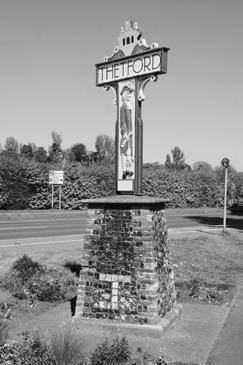
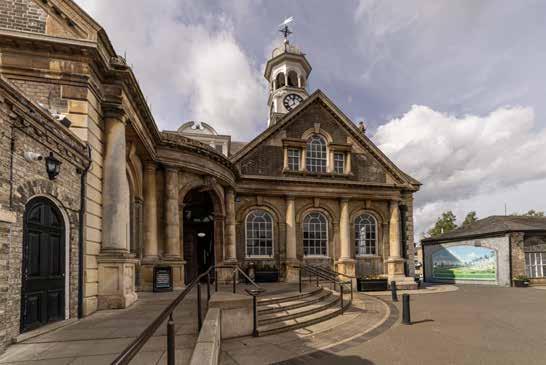

Written by Liz Gibbons
One of the wagon’s wheels dipped into a rut, causing Boudica’s eyes to flicker briefly. Lannosea, the younger of her two daughters, leaned forward hopefully, but her mother did not regain consciousness. Her sister, Heanua, slept on, even as Lannosea pulled the blankets closer around her and tried to cushion their mother’s head, as it lolled with the motion of the wagon. She had attempted to clean the blood from the Warrior Queen’s face, but some had dried in her hair in thick, congealed ropes.
The horses pulled the wagon at a steady walking pace. They dared not urge them to go any faster for fear of drawing attention. Roman troops would be scouring the countryside around the battlefield, hunting down anyone who had escaped the points of their blades.
Every muscle in Lannosea’s body ached, and the cramped position in the cart did little to ease the pain. The journey back to Theodford would be long
and arduous, and even with the potential for danger at every turn, Lannosea could feel exhaustion taking claim of her. Settling down beside her sister, Lannosea’s eyes drifted closed.
Lannosea did not dream; instead, her mind replayed everything that had befallen her family. The sudden death of their father, the King of the Iceni, that had brought Roman officials to seize the lands of the tribe. Anger had spread quickly among the Iceni, and with it, defiance. The Romans had answered with cruelty, punishing the tribe for daring to resist. Boudica had been publicly flogged, but worst of all was the unspeakable violence inflicted upon herself and her elder sister, Heanua. In her restless sleep, Lannosea’s head twitched, as though she could dislodge the memory. She tried to force her mind away from that brutal moment, yet it returned, again and again. It was this terrible ordeal that had been the final spark to ignite her mother’s fury, driving Boudica, the Queen of the Iceni tribe, to rise in vengeance.
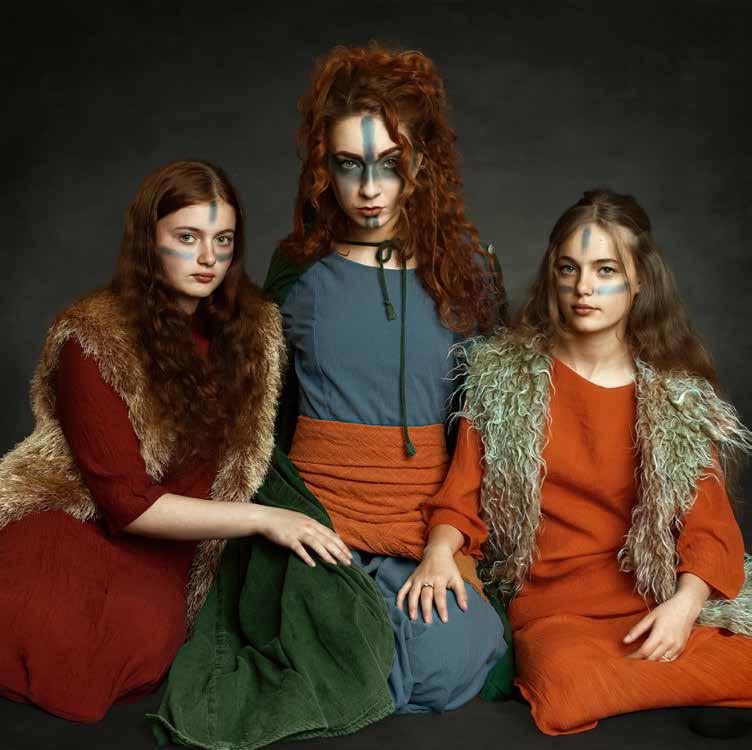
Boudica, had rallied her people and called upon the surrounding tribes to join her cause: to drive the Romans from their country, to raze their cities, and slaughter every inhabitant who served them.
At first, everything had gone well. Boudica’s followers soon numbered in the thousands and then hundreds of thousands. Her great horde of tribal warriors marched across the land, reclaiming it for its people. Camulodunum fell. Londinium was burned to the ground. Verulamium was slaughtered. Victory followed victory, and it seemed that nothing could stop them.
Families followed Boudica and the tribes in a vast train of wagons and horses; every one of them certain that they marched toward freedom. Then the news came, scouts reported Roman troops ahead, a small force, around ten thousand men. In her memory, Lannosea can picture her mother, Boudica, standing atop her chariot platform, her wild auburn hair and swirls of woad daubed on her face, sword raised to the sky. After so many victories, Boudica seemed almost divine. Some whispered that she carried the spirit of the land itself, Medigenus, god of the wild places, and that she was blessed by Andraste, the goddess of war. Spears thrust into the air, swords raised high, the voices of the tribes rose in waves of exultation. They would fight for their Queen, their land, and their gods.
Lannosea murmured a warning in her sleep as her thoughts carried her back to the charge, as thousands of warriors surged toward the waiting Roman army. Victory seemed certain. The roar of the horde filled the air, their voices and pounding feet, a thunderous prayer to Andraste.
The Romans stood in silence, unmoving, as if rooted to the earth. Then a command rang out in Latin, sharp and precise. The first volley came. Roman
spears arced into the sky, a deadly rain of iron. The triumphant cries of the charging tribes shattered into screams as bodies began to fall. Warriors stumbled, the tangled limbs of the dead dragging them down. Another volley followed. Still, the tribes surged forward, and by this time, some had reached the Roman line. Tribal warriors hacked and struck wildly, but their blows crashed uselessly against the wall of Roman shields. The formation held firm. Then, the Romans advanced. Their line moved like a single creature, shields locked together. Spears thrust through the narrow gaps, striking with brutal precision before withdrawing again, the points dipped in red. Step by relentless step, they marched forward, their voices rising in a cold, unified chant.
The tide had turned. Battle cries dissolved into screams of panic as the warriors broke and fled. Once their backs were turned, the Romans lowered their shields and surged forward with drawn short swords, cutting down those who ran.
Lannosea and Heanua had stood together, swords in hand, on the raised platform of a wagon, watching the battle unfold. When the warriors began to turn back, the sisters had understood at once, the tribes were retreating, and if the families and the wagons did not move, they would all be trapped! Together, the sisters ran along the line of the watching families, shouting for them to move, but it was already too late. The fleeing warriors burst through the line in a wave of terror, screaming and stumbling, with the Romans close behind. Chaos swallowed everything. Seeing there was nothing more to be done, Lannosea had grabbed her sister’s arm and plunged the pair of them into the bushes at the edge of the clearing.
In her fitful sleep, Lannosea’s head turned from side to side. Sweat beaded on her forehead as she relived the panic of those moments. She did not want to see what came next, did not want to relive it,

but she could not wake, and the memory continued regardless of her struggle to suppress it.
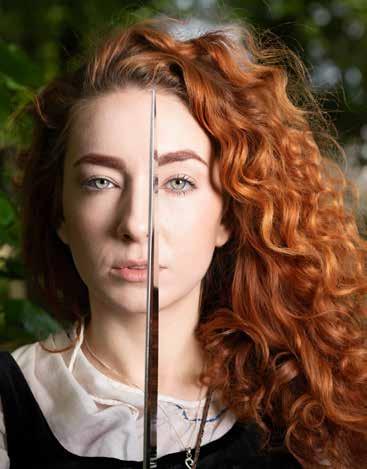
Through the twisted branches and dark leaves of their hiding place, it was Heanua who located their mother first. The Warrior Queen stood on her wooden chariot platform, her horses plunging forward into the throng. Boudica’s long auburn hair blazed in the sunlight, darkened in places with the blood of her enemies. Blue woad spiralled over her skin in sacred symbols, making her seem almost otherworldly. A small knot of warriors clustered about her as Boudica fought like a creature possessed. Cutting down Roman soldiers who fell like wheat beneath a scythe, but even she could not stand forever. A Roman spear pierced her side; the Queen staggered and fell from the chariot, one side of her dress starting to bloom red. Boudica collapsed to the ground, knocked her head against something hard, and suddenly lay very still. From their hiding place, Lannosea and her sister clung to each other, both terrified to look away in case they lost sight of their mother among the amassing dead.
Once the Roman cavalry rode past, in pursuit of the fleeing tribespeople, the sisters crawled out from the thicket. Their mother lay motionless where she had fallen, and for a moment both of them feared the worst. With trembling fingers, Lannosea found signs of life. With desperate effort, the two sisters dragged their mother across the field of the dead and into the shelter of the hedgerow. After resting a moment, heart pounding, Lannosea began removing her mother’s distinctive jewellery; the thick golden torc from her neck, bracelets and gold rings. She was about to crawl back out, when her sister stopped her. Wordlessly, Heanua took the pieces, and staying low to the ground, scoured the fallen for a dead woman with hair not too dissimilar from the Tribal Queen’s. Whispering a prayer, Heanua had slipped the torc around the corpse’s neck, but at the last moment
decided to keep hold of the rest of the adornments. Lannosea, seeing this, hoped that the torc would be enough, that the Romans would believe the great Warrior Queen had died amongst her people.
Lannosea’s heart was beating like a drum in her chest, willing her sister to move faster. If Heanua was seen… Lannosea knew, like all the tribesfolk did, of the Roman ways. The Roman centurions would leave no survivors; they were ruthless and vigilant. They would inspect each of the fallen, delivering a final thrust to their enemies with a short sword, as a grim precaution. They would then strip the dead of anything valuable and leave the bodies to rot where they lay, as a stark warning to others.
As soon as her sister rejoined her, Lannosea clung to her fiercely, and the two stayed like this for a while. The sun moved across the sky; distant screams carried on the wind as the Romans continued to slaughter the survivors. Then something changed, a sound that did not belong. Someone was coming out from the trees behind their hiding place. The sisters turned, swords in hand, as an unfamiliar man and woman emerged from the trees. The man had lowered his hood so they could make him out more clearly. Grey stubble framed his face, and a coif covered his head beneath a weathered cloak clasped at one shoulder. Beside him walked a younger woman, whose gentle eyes held no threat. Beneath the cloth wrapped around her head, hair the colour of earth after rain, framed her face. Dressed in a long skirt and layered garments against the gathering chill, she raised her hands in peace and approached with measured steps. With a few whispered words and hand gestures, they offered help.
“We mean you no harm, tribal daughters. We were not able to fight with sword and shield, but we can help you now, in your time of need.”


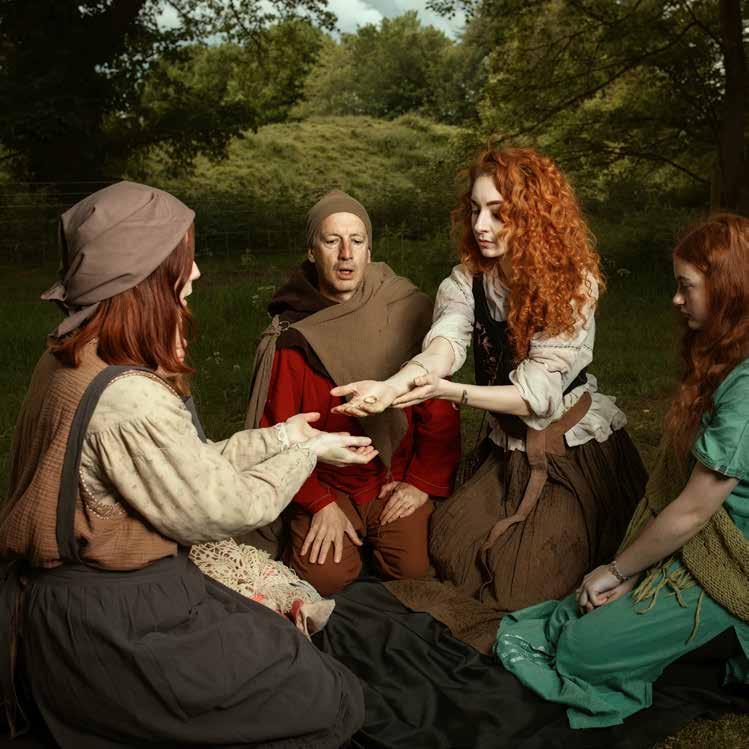
Between them, they carried the still unconscious Boudica to a small wagon hidden at the forest’s edge. The man carefully laid the Queen on blankets while the woman handed the girls up to be with their mother. Settling, Lannosea then drank gratefully from the proffered waterskin. The springwater was sweet on her tongue; she had to make herself stop so that her sister could drink too. Heanua drank her fill and then thought to wet their mother’s lips, who still did not wake. The two of them huddled together in the wagon, Heanua’s arm wrapped tightly about Lannosea. With little choice, they allowed the strangers to carry them away from the horror of the battlefield.
One of the wheels struck a large stone, causing the wagon to jolt violently, snapping Lannosea awake and back to the present.
From the front of the cart, the woman called back softly, “Almost there.”
Lannosea nudged her sister awake, tired eyes met her own, and both began to force their limbs to move and stretch. Damp night air clung to the blankets that had been thoughtfully draped over them. In the dim light, cast by the full moon and stars, Lannosea could just make out her mother’s inert features. It was not long before the wagon came to a halt.
The man came round to help. “Take my hand.”
Heanua went first, and then Lannosea, still cautious, took it gratefully, finding her legs stiff from her time in the back of the wagon.
In a gruff voice, the man spoke once more, “Now that we have put enough distance between ourselves and the Roman army, introductions are needed. My name is Erbin, and this is my wife, Fiadh.”
“We are grateful to you both for your kindness. My name is Heanua and this is my sister Lannosea, and this is our mother.” Heanua motioned to the unconscious woman wrapped in blankets. “Queen Boudica, of the Iceni tribe.”
Their rescuers expressed their wonderment at this. Carefully, with great deference, the four of them carried Boudica inside a small but well-built roundhouse.
A fire burned low at the centre of the space, but was soon coaxed back to life. Fiadh gave the sisters a piece of bread and a cup of small ale each. They ate and drank gratefully before recounting everything that had befallen them. Erbin and Fiadh listened in silence. Now and then, they exchanged a glance, though the sisters could not tell what passed between them. When they concluded their tale, Lannosea looked to her sister and took the ring from her to offer as a token of gratitude. The couple had saved their lives, and payment was due.
“Absolutely not, tribal daughter,” Fiadh says, wrapping Lannosea’s fingers back around the ring and pushing it gently back to her. “Your mother’s bravery and defiance sought to save the people of this land. We can never repay that.”
Lannosea understood and slipped her mother’s ring onto her finger. Erbin told them to rest by the fire and that, at first light, they would begin the journey to East Anglia, back to Theodford. They would travel by the old tracks and hidden paths.
When Heanua and Lannosea fell asleep beside the fire, once more the battle filled their minds. The clash of swords, the warrior’s cries, blue woad and red blood.
Light was just creeping into the world when the
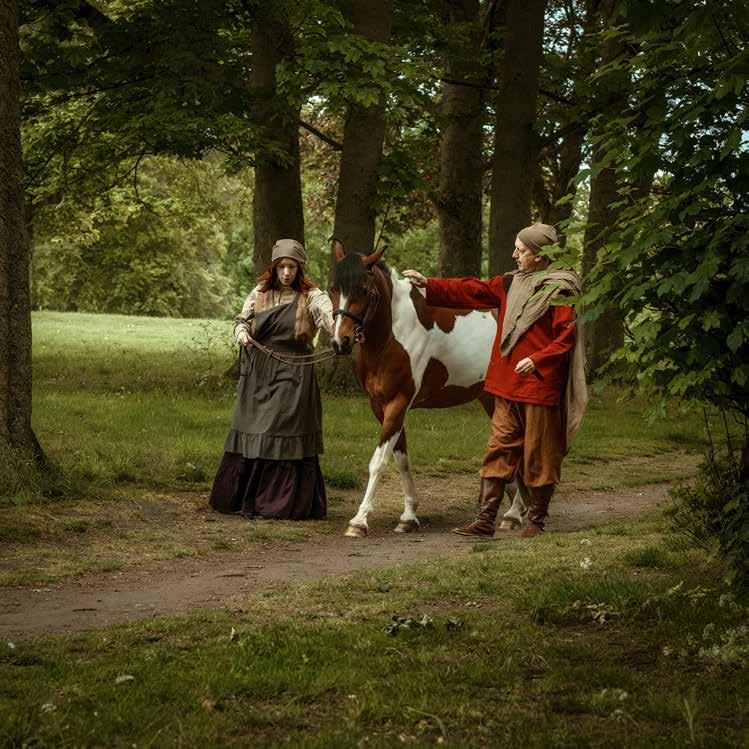
couple woke them. The woman, Fiadh, assured the sisters that their mother had been tended to during the night. The wound had been cleaned and dressed, and she had been made as comfortable as possible for the journey. Heanua and Lannosea looked at one another, feeling twin stabs of guilt that exhaustion had overcome them before tending to their mother themselves.
The wagon stood ready outside. A rough cover had been stretched over the back to shelter the three of them: Boudica, Heanua and Lannosea.
Erbin and Fiadh had packed what few belongings they could carry; neither expected to return to their home in any great hurry, if at all. As one, the sisters spoke the formal words of thanks their mother had taught them. “What you have done for us cannot be measured in words. Though the seasons change, the Queen and her people will never forget.”
The horses were rested, their ears pricked forward, alert to the sounds of the receding dark, creatures foraging in the undergrowth, the distant call of an owl. Mercifully, there was no sound of hooves or human voices. Having rested, the sisters found it easier to remain awake, taking it in turns to push aside the cover in order to keep watch.
They stopped late morning to water and feed the horses, stretch their legs and relieve themselves. All of them were exhausted, but they dared not linger long. The straight, well-built Roman roads would have made the journey faster, but they could not risk them. They would certainly have been stopped, questioned, and, after seeing the three in the back of the wagon, most likely put all of them to the sword. They kept to the narrow tracks that dipped and twisted through woodland and field, the ruts jolting the wagon mercilessly. They took turns driving the horses and watching over the Queen. On the second day of their
journey, she woke.
“H - Heanua, Lannosea.” Boudica’s voice sounded weak, her throat parched.
Her daughters were beside her in an instant, smiling with relief that their mother had returned to the world of the living. Heanua supported Boudica’s head while Lannosea helped her sip from the waterskin. Guessing what their mother wished to know, the sisters spoke concisely, recounting everything that had befallen her since being knocked unconscious. Grasping her daughter’s hands tightly, their mother spoke, “I thank the gods that they let you live, my daughters. And let the gods bless all my brave warriors. May they be at peace and know that their Queen will avenge them.” Her voice trembled, and Heanua and Lannosea knew that it was not purely grief; there also burned a deep and unassuageable anger that not even the gods could appease. Later, when the horses needed to rest once more, the sisters helped their mother sit fully upright and meet their rescuers. Erbin and Fiadh bowed their heads respectfully before the Tribal Queen. Boudica thanked them both and promised they would be rewarded.
“Your help and the risks you took in giving it, will never be forgotten. Here is a token of my heartfelt thanks,” said Boudica, handing them the same gold ring Lannosea had tried to offer before.
“My Queen, we cannot accept this,” they replied.
“You will not refuse this richly deserved gift from your Queen,” she insisted, brokering no argument. Boudica continued, saying that, should they wish it, they would have a place at her palace and temple, that they would want for nothing.
When the sun was high in the sky, Fiadh prepared

a thin broth so that Boudica could eat. Fiadh then checked the Queen’s wound, and was pleased to see it healing well, the moss she had used having drawn out any infection and cleansed the blood. They rested a little longer than was safe, for Boudica wished to walk a short distance to test her strength. On the sunrise of the eleventh day, the land gradually shifted, the undulating hills levelling out, the hard earth breaking out into marshland. Rivers split into smaller tributaries that forced the track to wind and wander, to find the crossing points, slowing them further.
At last, they began to pass small settlements that Boudica and her daughters began to recognise. Roundhouses stood, empty and abandoned; the tribesfolk having followed their Queen to war. Boudica’s face hardened as they travelled, the three of them staring out bleakly, taking in the fields, where crops had begun to rot, the blackened stalks bent and broken. Boudica drew the blanket tighter around her shoulders. There would be much work to do, to ensure the people did not starve over the coming winter. So many had answered her call. So many had sacrificed themselves. How many remained to begin again?
At last, the horses began to pull the wagon up a steep incline. Perched on the only hill above the flat landscape stood an artificial grove of felled oaks. The boundary posts were driven deep into the earth to mark the sacred border between the wild lands and the place of worship to the gods. Smoke curled upward from the centre of the enclosure, and every person in the wagon felt the same wave of relief. There was life here! Those who had remained behind, and perhaps others from adjoining tribes, had gathered at the sacred temple and palace. The wagon drew up at the entrance, and Erbin brought the horses to a halt. Boudica climbed slowly to her feet upon the wagon’s platform so that the
watchers could see her. See that their Queen had returned! Voices rose in astonishment and relief as word spread through the gathering. The gatekeepers stepped aside, allowing the wagon and its occupants to pass. By the time they reached the centre of the enclosure, a small throng had gathered. Hands lifted toward the sky, voices raised in greeting. Boudica remained standing, gazing down upon the gathered crowd. When she began to address them, the gathering fell silent, the better to hear her words, “To see the faces of my people again is a day I never thought would come. Since we last stood together, our tribe has achieved greatness unlike any before, but also… a great sorrow has befallen us.”
Every pair of eyes was fixed upon her, waiting. “We marched upon the Roman stronghold of Camulodunum, put every one of them to the sword, and burned the city to ash. Then our numbers swelled as more tribes joined the cause. We took Londinium and Verulamium. The Roman Empire was humbled by the great tribes of this land, and led by a “mere woman”!”
A thunder of cheers rose, mingled with excited voices. When it died away, Boudica spoke again, slower now, her tone grave and measured.
“But then came the final stand, the last battle. Roman numbers had been diminished, yet they are hardened soldiers, full of cunning and guile. At first, our people fought well, voices raised in a warrior cry as they charged fearlessly, swords and spears raised against our oppressors, who stood unmoving, as a forest rooted to the earth. Then spears rained down upon us, the vicious spikes of iron felling our mighty warriors.”
Boudica paused to reveal her own wound, still an angry red welt amidst cuts and bruises on the surrounding flesh.

“Your Queen survived, but many did not… The Roman army moved as one, a great beast formed of metal shields and piercing swords. Your Queen and our people sought to evade their path, but were trapped on all sides. Roman swords soon ran red, with the blood of the tribesfolk, and still that was not the end. Our people fought bravely, but to no avail. In a wave of pitiless slaughter, the Roman army pursued and slew every man, woman, and child, putting all to the sword.”
Boudica paused, mastering herself as she heard the wails of grief begin to undulate through the crowd like flood waters rising.
“It is only because of my daughters, Heanua and Lannosea.” Here, she motioned to her two daughters at her feet, “who dragged me from the battlefield, and because of these good people here, Erbin and Fiadh, healing me and bringing us home, at great cost to their own lives, that I stand before you now. We lost so many: kin, friends, our tribespeople.”
Boudica struck her breast, above her heart, with trembling breath. She continued, “Their bravery, their sacrifice, will never be forgotten.”
Tears streamed freely down her face, but her voice did not waver. “Perhaps our war with Rome is over… but our struggle for survival has only just begun. We must look to ourselves, to gather what crops we can, preserve our ways, keep alive our beliefs and our tribal spirit. We may have lost this battle, but we endure. That we stand here now proves what we can achieve together.” Boudica seized the sword proffered to her from her eldest daughter and thrust it skyward. “We will rebuild our strength, and when the gods ordain, we will rise again!”
The crowd erupted, their voices ringing with pride and fierce devotion to their Queen and loyalty to the tribes.
Heanua and Lannosea cheered with the rest. Lannosea wondered in that moment how songs and stories would one day tell of the uprising, of the victories, and of the ruin of the final battle. They had come so close to driving out the Roman foe. Though battered and broken, they had returned home to Theodford, and the line of Queens would continue. They would honour the dead and await their spirits to return to them in rebirth. The gathered tribes would remain upon this land, and though Rome believed it had crushed them, the tribal spirit endured, whatever trials lay ahead.
Author’s Historical Notes:
In Boudica’s period of history, the 1st century, there were no native written records. Everything we know of her people (the Iceni tribe) culture and daily life is thanks to archaeology; fragments unearthed from the soil that allow us to piece together the story of our past, and from Roman accounts written many years after the events they describe.
From these written Roman sources (Tacitus –historian, and Cassius Dio – senator), we know there was a Roman-allied king of the Iceni in Norfolk named Prasutagus. He married a noblewoman, and this is where Boudica first enters the historical record. The name Boudica is derived from the proto-Celtic word boudi, which translates to victory or to win. She was Prasutagus’s Queen, and bore him two daughters, whom one Roman source names as Heanua and Lannosea. Heanua appears to have Gaelic roots, possibly derived from ean, meaning bird, suggesting someone swift or free. Lannosea is more elusive in origin, though it may hold coastal associations.
When King Prasutagus died, the Romans moved to seize his lands and wealth in the name of Roman Emperor Claudius. However, Iceni custom held that title and property passed to the next of kin, and so, the tribe resisted. Rome’s punishment was swift
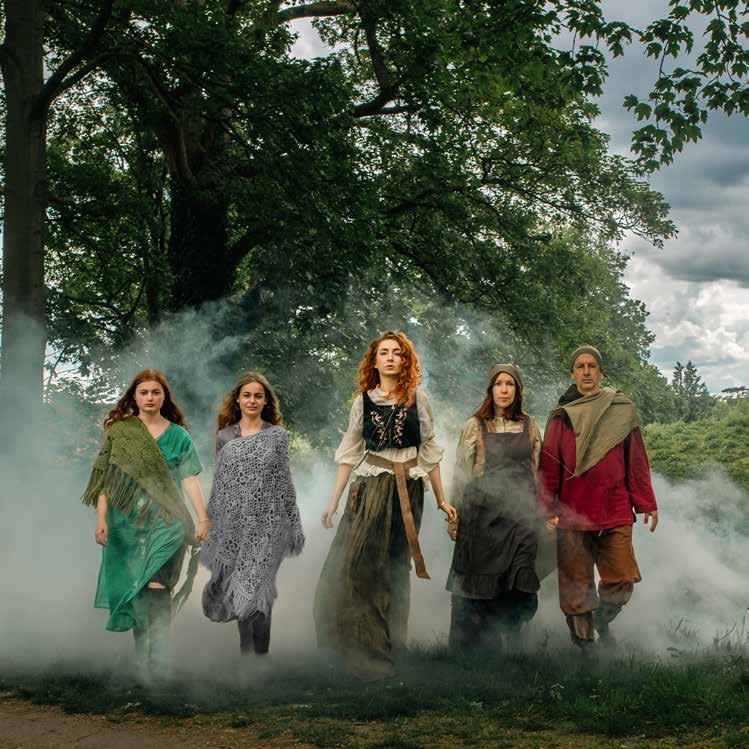
and brutal. Boudica was publicly flogged, and her daughters were violated. It was this final outrage that ignited one of the greatest uprisings ever faced by Rome.
Boudica and the vast force that gathered behind her destroyed three major Roman cities: Camulodunum (Colchester), Londinium (London) and Verulamium (St Albans) and came close to driving the Romans from Britain altogether. Yet, in the final confrontation, despite Boudica’s vast numbers (sources varying from 100,000 to 230,000), the tribal coalition was defeated by the discipline and cohesion of the Roman army of approximately 10,000 men. After that, Boudica vanishes. To this day, no one knows what became of her. Roman accounts differ wildly: some claim that she died in battle, others suggest that she took poison rather than be captured. And so, we can then start to ask: what if she survived? What if she escaped, likely wounded, and made her way back to Thetford?*
Back to those who had remained behind, to the tribes converging upon a sacred centre, that we know from archaeology, was an important and highly organised site: Gallows Hill in Thetford.
When first excavated, the site at Gallows Hill was named Boudica’s Palace; later, other archaeologists and historians referred to it as a temple. The surviving post-holes revealed an enclosure containing a two-storey roundhouse at its centre, surrounded by smaller structures. Archaeological evidence points to coin production, fine metalwork, and animal sacrifice. It was clearly a place of great significance.
* In the Boudica story, the older spelling, Theodford, is used. The modern spelling of Thetford evolved through several variations over the centuries, but its meaning has remained unchanged, literally translating to people’s ford.
Credits
Boudica - Francesca (francescaquici)
Heanue - Chelsea
Lannosea - Mikayla
Fiadh - Liz
Erbin - Dave
Horse - Matilda (amalia_2535)
Costumes - Magic Floor Productions
Jewellery - Hannah and Tigan (Chloe’s Jewellers)
Fitting - Patsy (Blessed Be Alterations)
Pyrotechnics - Onlyairsoft.com
Horse Owner - Amalia
Production Coordinator - Eva
Armaments - Brandan Cutts
Photography - Martin (mangus.co.uk)
Video - Cam Cutts
Photography Assistant - Brandan Cutts
Location - Castle Park, Thetford
Sound - Chris (mrrossi@gmx.com)
Historical research - Dave Griffiths/Stuart Wright
Back by popular demand, we are publishing a few of the letters and correspondence we have received from some of our avid local readers.
Dear Editor,
Would the Moon kindly stop following me?
For years I have noticed it lurking above Thetford whenever I walk home after dark. I have altered my route repeatedly. The Moon alters its route too.
Last Thursday I attempted to lose it in a Tesco car park. No luck.
Frankly, I find the whole thing rather possessive. Yours under observation, Pottle S
Dear Editor,
I recently attempted to use a self-service checkout. The machine informed me there was an unexpected item in the bagging area.
The unexpected item was the shopping. This struck me as a design flaw. For the next four minutes we disagreed politely but firmly.
Eventually a young assistant intervened and resolved matters with a single button. The machine immediately accepted defeat. I suspect it knew all along. Yours suspiciously, Shirley B
Dear Editor,
While enjoying a walk near the market, I encountered a tiny dog no larger than a loaf of bread.
Despite this, it was behaving as though it commanded an army.
It barked at a van. It barked at a bicycle. It barked at a Labrador approximately six times its size. The Labrador merely looked puzzled. The small dog then turned and barked at a flower pot. The flower pot wisely backed down.
I have rarely seen such confidence combined with such limited resources.
Yours admiringly, Grace P
Dear Editor,
There is a squirrel operating near Thetford Common whose behaviour raises several questions.
Unlike ordinary squirrels, which flee at the first sign of human contact, this one approaches confidently and appears to evaluate passers-by.
Yesterday it sat on a fence and watched me eat a sandwich.
Not begging. Judging.
I have never felt so thoroughly assessed by wildlife. When I finished my lunch, it shook its tail and departed with what I can only describe as disappointment. I am now considering improvements to my diet.
Yours critically reviewed, Owen J
Dear Editor,
I entered a bakery intending to purchase a sausage roll. A simple task, one might imagine. Unfortunately, while studying the display, I accidentally made prolonged eye contact with a custard slice. The assistant interpreted this as interest. Before I knew it, I was discussing pastry options with the seriousness usually reserved for mortgage applications. Five minutes later I left with two Belgian buns, a fruit turnover and what I can only describe as a lifestyle commitment to baked goods. I forgot the sausage roll entirely.
I returned home feeling victorious and slightly confused.
Yours flakily, Rahul W
Dear Editor,
I feel it is my civic duty to report an identity crisis unfolding in Castle Park.
While walking near the river last Sunday, I observed a duck following a Labrador. Not unusual, you might think. However, this duck was following the Labrador with remarkable commitment. Wherever the dog went, the duck went. If the Labrador stopped, the duck stopped. If the Labrador sat down, the duck stood nearby looking as though it was waiting for further instructions.
The Labrador seemed unaware of his new apprentice. After twenty minutes, the duck attempted to join a game of fetch. The stick was ignored, but the enthusiasm was admirable.
I don’t know how this story ends, but if anyone spots
a duck wearing a lead and answering to “Dave,” please keep me informed.
Yours intrigued, B. Taylor
Dear Editor,
Last week I accidentally brought in my neighbour’s wheelie bin.
My neighbour accidentally brought in mine. Neither of us realised for four days. This raises serious philosophical questions about ownership.
Also, apparently I owe him three empty yoghurt pots.
Yours reflectively, Zanas L
Dear Editor,
To whoever left a single garden gnome at the bus stop on Norwich Road:
He has now been there for three days.
Several residents have started greeting him. One lady left him a scarf.
At this point I believe he should be considered a local landmark.
Yours geographically, Aurimas K
Dear Editor,
There is a ginger cat operating in the vicinity of Croxton Road.
It belongs to nobody and everybody simultaneously. Yesterday it entered my house, inspected the kitchen, ignored me completely, and left.
I have never felt more thoroughly reviewed.
Yours inadequately furnished, Helen F
Dear Editor,
For years I have enjoyed sitting on the bench opposite the river to eat my sandwiches.
Last Thursday I arrived with a perfectly respectable
ham roll only to discover the bench had been moved approximately twenty feet.
I found this surprisingly upsetting.
The new location offers an equally pleasant view, but that is beside the point.
You cannot simply relocate a man’s bench and expect him to carry on as though nothing has happened.
Yours displaced, Russell J
Dear Editor,
While walking my springer spaniel near Castle Park, I noticed he stopped to sniff a single blade of grass for so long that three other dogs joined him.
Within minutes, six dogs were standing in a circle staring at the same patch of ground.
The owners exchanged polite greetings while pretending this was normal.
Nobody knows what was in that grass.
But I am convinced it was the most important thing to happen in Thetford all week.
Yours curiously, Sean H
Dear Editor,
The bus stop gnome now appears to have a companion.
I don’t know where the second one came from. What concerns me most is that both appeared overnight.
I am not suggesting anything supernatural. I am simply saying that if a third one arrives, I shall be contacting the council.
If a fourth arrives, I shall be contacting the church.
Yours increasingly concerned, Aurimus K
Dear Editor,
There is a goose near the river that behaves suspiciously like a middle manager.
Every morning it patrols the same stretch of bank, inspecting ducks, glaring at joggers and generally looking burdened by administrative responsibilities. Yesterday it stared at me for so long that I felt obliged to explain why I was there.
I have no evidence, but I am convinced it owns property.
Yours professionally intimidated, Booris, M
Dear Editor,
Further to my previous correspondence regarding wheelie bins.
I can confirm that my neighbour and I have once again taken possession of each other’s bins. This is the third occurrence.
At this stage, neither of us is entirely certain which bin originally belonged to whom.
We have agreed to stop asking questions and simply see where fate takes us.
Should either bin eventually leave us for a third household, we shall consider it a migration rather than a loss.
Yours philosophically, Zanas L
Dear Editor,
The unexplained appearance of garden gnomes in the vicinity of Norwich Road continues.
The original bus-stop gnome now has a small table, two companions and, unless my eyes deceive me, a decorative lantern.
I do not know who is responsible. What concerns me is the speed of development. Most housing estates take years to establish themselves.
This community appeared over a weekend. Should local elections be announced among the gnomes, I believe we may have left matters too late.
Monitoring closely, Aurimus K
Dear Editor,
Having just read your lovely local magazine cover to cover, it inspired me to have a rumage through my old photograph collection.
I found this photograph, taken by me in 1956, of my husband Jimmy ‘Val’ Swinger and Gary Burrell, working for Boughton Builders, cleaning and repairing guttering in Whitehart Street. The building being repaired is directly opposite St Peters Church tower. The cast iron gutters themselves were nearly indestructable, it was the retaining bolts that needed to be replaced.
This was at a time when Whitehart Street was a main road in the town, prior to the new road being built, which required us to have a safety manager, Charlie
Banham, at the foot of the ladders, to make sure no vehicles hit the ladders.
As you can see, health and safety would not allow such a practice of perching a platform onto two ladders these days.
The ladders were refered to as ‘Fireman Ladders’ and were of a very high quality.
Thank you, Mary Swinger, Thetford