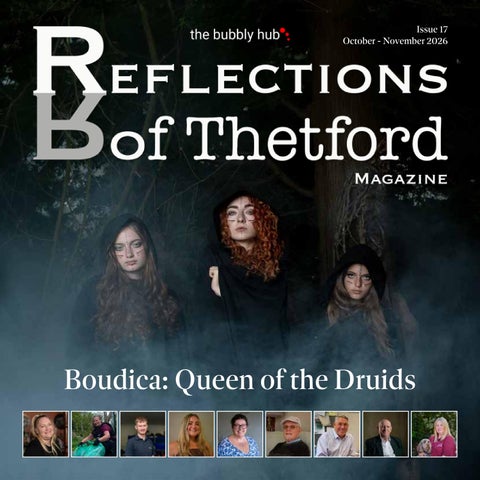
Issue 17 October - November 2026
Boudica: Queen of the Druids
Are you looking for a cozy new home this Autumn? We would love to help.... The only Thetford based agent to achieve exceptional for sales and lettings in the Best Estate Agents Guide five years running.
Call us today for a free no obligation valuation
01842 755422
34 King Street, Thetford, Norfolk IP24 2AP eMail. sales@lawsonsestateagents.co.uk
www.lawsonsestateagents.co.uk
Supply & fitting of carpets, vinyl, and luxury vinyl tile (LVT) to suit every home and budget. Free, no-obligation estimates Convenient Home Choose service Family-run business since 2010 Ask about our ‘supply only’ offers!
raphy hotog ngus P by Ma Photo
Unit 6 Faraday Place Thetford, IP24 3RG
01842 760598
Flooring... it’s what we do!
Get in touch today and let us take care of the rest
www.thetfordcarpetwarehouse.co.uk
VEHICLE HIRE • Open Monday to Friday 8.00am to 5.00pm • Saturday morning by appointment • Rates include VAT and Insurance • Other vehicles available • Customer pick-up and drop-off available Ford Fiesta or similar from £30/day Ford Puma or similar from £40/day Hyundai Tucson or similar from £65/day
Telephone: 01842 768036 or 01842 764467 2 Fison Way, Thetford IP24 1HT
www.easyfleet.co.uk
Welcome By Martin Angus (Editor)
W
elcome to Issue 17 of Reflections of Thetford! A magazine helping to make Thetford a Great Place to Live!
if you have a local business, building or individual whose history you would like to uncover, why not get in touch with him? We are also delighted to share some exclusive behind-thescenes photographs from a music video filmed right here in our lovely town last month. Australian rock band Gang of Youths descended upon The Railway Tavern in search of a traditional English pub to provide the perfect setting for their video. Naturally, Thetford was happy to oblige!
In this issue, we bring you Part III of our fascinating Boudica series, written by the talented Liz Gibbons, whom many of you will know from Thetford Library. This time, we transport you back to the period just before the death of Boudica’s husband, an event that would ultimately lead to one of the greatest uprisings, to date, against an invading force this island had ever witnessed.
Sadly, we also have some upsetting news to share. Barry Dexter, whom we had the pleasure of featuring in Issue 14, has passed away. Our heartfelt condolences go out to Barry’s family and friends. It was a privilege to share his story with our readers.
This is probably one of our most varied editions to date. We meet people just starting out on their career paths as apprentices, others still deciding which direction to take, and those who have made a complete U-turn in their working lives. We also celebrate individuals who have been running their businesses for over 40 years, alongside those who have officially retired but simply cannot sit still and have chosen to dedicate their time to volunteering.
As always, we would like to thank everyone who has helped bring another wonderful edition to life. Our magazine continues to celebrate the people who have shaped Thetford, those who contribute to its character today and those who will help shape its future.
We are delighted to welcome Julian Hammond to our pages. With deep ancestral connections to Thetford, Julian has uncovered a fascinating relative and shares a glimpse into their eventful life in Victorian Thetford.
To our writers, contributors, advertisers and, of course, our readers, we simply couldn’t do it without you. We hope you enjoy Issue 17 of Reflections of Thetford, celebrating the remarkable people, fascinating stories and wonderful things happening right here in our town.
Meanwhile, one of our regular contributors, Andy Greenhouse, has been exploring a local building, bringing its bricks and mortar to life through some fascinating historical research. Andy is even considering establishing his own research business, so
Happy reading!
©Reflections of Thetford is published by The Bubbly Hub. All rights reserved 2026. Whilst every care is taken, the publisher accepts no responsibility for loss or damage resulting from the contents of this publication, as well as being unable to guarantee the accuracy of contributions supplied as editorial, images or advertisements. No part of this publication may be reproduced, copied or transmitted in any form or by any means or stored in any information storage or retrieval system without the publishers written permission. 5
100s of samples direct to your door!
Your feet deserve luxury. Your feet deserve LVT.
showroom to you! r u o g n i We br Proud suppliers of Luxury Vinyl Tiles from Abingdon, Karndean, Invictus and more
Fancy a browse? Talk to our friendly showroom teams in Thetford and North Walsham
North Walsham: Midland Road, NR28 9JR Thetford: Mundford Rd, IP24 1NB
03302 220013
Contents 08 18 28 38 52 64 72 78 90 100 118 126 142 148 158 168 174 182 185 188
Kelly Wood Takes the Keys Protecting Jewels in the Town’s Crown Lennon Squires and the Value of Learning by Doing The Cheerful Dancer A Different Road to Learning A Life Built on Steam Boudica’s Home and the Capital of Icenia The Vision in the Flames I Just Help Them A Narrative History of a Fine Georgian Legacy More Than Feet The Thetford Marine Who Refused to Behave Penguins in Thetford The Medusa Project Thetford Artists of Thetford A New Place to Play in Thetford The Dog Who Gave Her Life Back Unneutered tomcats Thetford Photography Group Competition No.3 Winners Letters to the Editor 7
‘Kelly Wood’ by Mangus.co.uk Photography
The Railway Tavern: Kelly Wood Takes the Keys
Written by Martin Angus
T
here cannot be many new landladies whose opening day begins with an Australian rock band taking over the pub to shoot a music video. But then Kelly Wood’s arrival at The Railway Tavern was never going to be entirely conventional.
place running. When Trevor announced he was leaving, the future of the pub naturally became a talking point among its regulars.
Taking charge of one of Thetford’s traditional pubs represents a considerable change of direction for Kelly. A mum of three, she previously worked as a carer and spent time at the town’s former snooker club before family life became her main occupation. She and her husband Tom have been together for twenty years, married for five, and running a pub had remained an intriguing possibility rather than a definite ambition.
“I thought, why don’t I just give it a shot?” Kelly recalls. “If it works, it works.”
Kelly already knew The Railway from the other side of the bar. She had worked there under previous landlord Trevor, becoming familiar with the building, its customers and the practicalities of keeping the
The Railway was not the first pub she had considered. When The Terrier became available some years earlier, Kelly had been tempted, but its size made her hesitate. The Railway felt more manageable and,
That was when possibility became reality.
The decision was rather less casual than that sentence suggests. There was plenty of soulsearching and more than one moment when Kelly wondered whether she was doing the right thing. Even now, only a short way into her new life, she admits those questions occasionally return.
9
importantly, familiar. She knew many of the regulars and had gradually learned the workings of the business from Trevor.
imitation pumps, where Mason enjoyed playing bartender. Now his mum has acquired the genuine article.
That experience made the eventual handover remarkably straightforward. There was little need for the traditional tour explaining what was where because Kelly had already been working there. The area manager for Punch Pubs reportedly described it as one of his easiest handovers.
And if taking over a pub was not enough excitement, opening day brought something nobody could reasonably have planned. Gang of Youths arrived to film the music video for their track Things Take Time.
Being handed the keys, however, did not instantly make Kelly feel like a landlady.
The production team had been searching for the atmosphere of a traditional English pub. The Black Horse had initially been approached, but filming risked disrupting its food service. The Railway, which had not yet opened under Kelly, provided an alternative.
The women she now employs are people she previously worked alongside, and suddenly becoming their boss has proved one of the stranger adjustments. When preparing the staff rota, Kelly initially asked everyone when they would like to work so she could arrange herself around them.
Trevor encouraged her to accept. Kelly agreed without quite appreciating what was coming.
They reminded her that things worked slightly differently now.
“I thought they were just going to turn up with their GoPro,” she laughs.
“They keep saying to me, ‘You need to be a boss.’ I said, ‘I can’t be a boss!’”
They did not.
After years of working for somebody else, being the person responsible for ordering, staffing and making the final decisions takes some getting used to. Kelly admits there are still occasions when somebody asks what she wants to do about something and she momentarily remembers: the decision is now hers. Her children are becoming involved too. Aged 22, 17 and ten, they have already experienced aspects of pub life, although youngest son Mason occasionally requires reminding that he cannot actually serve behind the bar. His enthusiasm perhaps has some history behind it: the family once converted their garden shed into a pretend pub, complete with
The production was a substantial operation. Equipment filled the building, lighting was altered, areas were dressed, and the familiar interior temporarily became a film set. On what might otherwise have been a nerve-racking morning, Kelly discovered that the commotion provided an unexpected benefit. “It probably took a bit of pressure off,” she says. “It gave me something to do.”
11
Between filming, there were wonderfully ordinary moments. Kelly remembers standing behind the bar with members of the band on the other side
‘The Railway Tavern becomes a film set’ by Mangus.co.uk Photography
and suddenly feeling as though they were simply customers. Later, some played darts and chatted casually between scenes. What could easily have been an intrusive start to her first day became something she thoroughly enjoyed. Once the production packed up, however, another drama was unfolding. The drinks had not arrived. The delivery eventually appeared at around half past two, leaving little time to unload, organise the stock and prepare to open. Kelly had hoped to have customers through the doors around three or half past three, with darts scheduled later. For a while, the new landlady faced the intriguing prospect of opening a pub without much to serve. “We literally packed it all in, and then we were able to open the doors.” They made it. Pub management soon delivered another lesson, this time in the cellar. Kelly went downstairs to change a barrel and discovered beer escaping after a seal had slipped out of position. She called Trevor for guidance, only to be told it had never happened to him. “Wrong answer,” she remembers thinking. “You need to tell me how to fix this one!” She did. Such incidents are part of the rapid education that comes with running a pub for the first time. What Kelly does not intend to learn, however, is how to turn The Railway into something completely different.
13
‘www.gangofyouths.com to see the music video’ by Mangus.co.uk Photography
Its regulars are central to her plans. Kelly remembers visiting before she ever worked there and noticing how readily customers acknowledged newcomers. Walk through the door, and somebody would say hello; football could start a conversation between people who had never previously met. It lacked that intimidating feeling sometimes associated with traditional locals, where an unfamiliar face can feel as though it has accidentally occupied somebody’s chair. “If it weren’t for the locals, it would struggle,” Kelly says. “I want to put my own little bit on it, but I don’t want to come and change the local side.” Encouragingly, some former customers have already started returning. Kelly hopes to build on that interest while preserving the atmosphere valued by those who never left. Her plans are therefore about adding rather than replacing. Darts will feature prominently. The Railway already hosts two teams on Mondays and two on Fridays, with hopes for another team on Wednesdays and potentially a ladies’ side on Tuesdays. Kelly would also like to increase the number of pool teams. Food is likely to be introduced gradually. Coffee, rolls and straightforward hot options are possibilities, while the pub already has a pizza oven that Kelly is keen to use. She envisages bar snacks and basket meals rather than turning The Railway into a restaurant. Live entertainment is another possibility, although nothing is being imposed simply for the sake of change. Kelly is keen to hear what customers actually want. Even the music selection could become
15
communal, with a tablet connected to the sound system rather than a conventional jukebox.
They will find somewhere that can offer a quiet pint when that is what is wanted, music and conversation when things become livelier, friendly faces around the bar and, on a Sunday, perhaps even roast potatoes waiting for customers.
“I always say to my locals, it’s as much their pub as my pub.” One area she would like to develop is Saturday evening. The Railway has a strong daytime trade, but many regulars head home by early evening. Kelly sees an opportunity to attract another audience later through entertainment, sport and events, complementing rather than altering the established daytime crowd.
The Railway Tavern may now have a new landlady, but Kelly Wood is not interested in erasing what came before. She simply wants to write its next chapter. Considering the first one involved Gang of Youths, a film crew, a last-minute beer delivery and an uncooperative cellar, it has already made a rather memorable start.
Her definition of success is equally uncomplicated. Ask where she would like to be in two or three years, and there is no grand declaration about expansion or reinvention. She wants the people who supported the pub at the beginning still sitting at the bar, with plenty of new faces among them.
www.gangofyouths.com to see the music video filmed on location at The Railway Tavern, Thetford.
“If they’ve stuck with me for that long,” she says, “then I must be doing something right.” For somebody who still finds the word “boss” uncomfortable, it is perhaps an appropriate measure. Within her opening weeks, Kelly has gone from employee to landlady, dealt with cellar mishaps, chased deliveries, welcomed her first customers and watched an internationally known band turn the pub into a movie set. Yet beneath the entertaining chaos is a simpler story: someone finding her feet while taking responsibility for a place she already cared about. For those who have never visited The Railway, or have not crossed its threshold for years, Kelly’s invitation requires no elaborate sales pitch. “Just come and have a look. Come through the doors.”
16
‘“Just come and have a look.”’ by Mangus.co.uk Photography
‘Roseanne’
Thetford River Group: Protecting Jewels in the Town’s Crown
Written by Dave Griffiths All Photographs courtesy of Thetford River Group
I
me, but no amount of rotating the screen seems to work. Fortunately, a little way along Spring Walk, another excellent example of Thetford signage fixes my orientation perfectly. I see how the Coffee Mill and the site of the old Pulp Mill create breaks in the river, designed to harness the flow through their respective water wheels. There are paths around each to allow upstream water from the Little Ouse and the Thet to overflow around the breaks as needed. Armed with this new knowledge, I stride off east towards the Nun’s Bridges, and beyond!
recently spent an August evening sitting on a bench by the river in Thetford, talking to the lovely Roseanne Gough, Group Leader of Thetford Rivers Group, about the river and the work the group is doing to keep it in the best shape possible. That chat made me realise that, whilst I’d seen parts of the river from the banks and local roads, I’d never got up close and walked the riverside path. It is late morning on a beautiful sunny Saturday, with a light breeze rustling in the trees, taking the edge off the 24ºC heat, when I arrive back to put that right. I head off upstream first, on the River Thet towards Melford Bridge, the first stretch of river that the group maintains.
Crossing Nun’s Bridges road, also the route of the ancient Icknield Way, I continue on and then left away from the Little Ouse, along a neatly edged shingle path, across the land between the 2 rivers and then alongside the Thet. Indeed, the path is so smooth that I see about a dozen
Crossing in front of the coffee mill and turning left along the marked path, I resort to Google Maps on my iPhone to try and make sense of the myriad of rivers and static areas of water around 19
As I approach Melford Bridge, I spot something which really grates as out of place with everything I’ve seen so far: an empty lager can and 2 plastic Coke bottles floating midstream. I realise I haven’t seen any litter since the Nuns Bridges. The 15-year-old voice in my head wants to jump in and fish it out; the 60-year-old voice checks his watch and says, “My, is that the time?!” I turn and retrace my steps, and my mind drifts to scenes of centuries past along this stretch of river. Through the Bronze and Iron Ages, there would have been farmsteads and round houses all along this river. I wonder if youngsters back then fashioned rope swings to play on the river, as they do today. Has the scene really changed that much? By the time of the Roman invasion, Boudica’s era, sea levels
‘Cased Caddis with Shell Case’
parents pushing their young ones in pushchairs; I would imagine it would be ideal for wheelchairs too. The surroundings are idyllic, somehow transporting you back to simpler, more relaxed times. Oaks and willows and other trees line the river; the water, due to the low level and slow flow right now, is carpeted with common duckweed. I stand transfixed by a gaggle of young moorhens darting around, following their mum and leaving temporary trails in the weed behind, swallowed up as fast as they are made. On the far bank are strung rope swings; I smile at the thought that there must have been some fun had, and wet walks home, due to them. Benches allow folks to sit and enjoy the view, and wooden shuttering has been deployed strategically in places to prevent the bank from collapsing. This is clearly a wellnurtured stretch of river and a magical spot to stroll, all just a stone’s throw from the town. And it seems I’m not the only one who thinks this is a fabulous river walk. Roseanne nominated it to the walking group ‘The Ramblers’, who voted it in the top 10 of ‘Britain’s Favourite Path 2026’, coming in number 8!
21
were about 5 feet higher than they are today. The river level would have been up to my waist, and all the land across to the Little Ouse would have been submerged. The multiple crossings at Nun’s Bridges would have merged to be one, wider ford. The Great Ouse, Little Ouse and Waveney rivers would have been wider, rendering Norfolk pretty much an island, with Thetford the only point of easy access. No wonder the ford demanded the construction of the Iron Age Hillfort to guard it. Crossing the Nun’s Bridge’s Road again, I see a memorial new to me, the Far East Prisoners of War (FEPOW) tree, remembering the Japanese prisoners of war and those who didn’t come back. Thetford is so good at remembering the sacrifice of all its servicemen and women.
Mainwaring’s statues, the Riverside and Town Bridges, past the Priory and onto Abbey Weir. Here my feet tell me it is time to head back. The section I have walked was a buzz with people going about their business, walking dogs, fishing; the river is very much integrated into the life of the town. But I’ve talked too much about my walk and what I’ve seen, but I hope that it brings to life the immense importance of the river, the events it has seen, and that it is the reason Thetford, meaning ‘the people’s ford’, even exists. It is perhaps the town’s most prized asset and as such must be both treasured and enjoyed. Rewinding to the week before, I arrive at the riverside, armed with coffees, and sit on one of the benches with Roseanne Gough. I know very little of the River Group, so she starts from the beginning. The group was founded around 2015 by Sean Ready, who began pulling litter like road cones and trolleys out of the river after his mother moved into a flat that backed onto the water. He was pretty much a one-man band for a couple of years until in 2017, Claire Higson joined him. Sean was a quiet character who liked to get his hands dirty with the river work. Claire shared this passion, but she was also familiar with social media and very comfortable talking with key stakeholders. Together they launched a Facebook page, started recruiting and considering projects they might undertake. This was the point where the River Group, as it exists now, was truly formed.
Back at the car park, I take a break and sit with a drink, perusing the mill pond. Unlike the tranquil scenes upstream, I have overlapping, bustling images from different eras. Boats arriving from the Brandon direction, filling up with grain, grown and malted locally, bound for distribution far and wide. The booming tanning industry would have added the acrid smell of urine to the air and pollution to the water. In the 9th century, on a misty autumn morning, a stream of perhaps 100 Viking ships would have glided up to this point on the river, silently mooring nose to tail. It was 865 AD, and the Great Heathen Horde of 5,000-10,000 visitors arrived and overwintered on the south side of the river, before heading off to conquer Northumbria in spring. And Boudica, during her queenship in Thetford, may have bathed in these waters. Certainly the Romans would have crossed the Nun’s Bridges, arriving after King Pasutagus’ death, extorting wealth and committing outrage. Oh, the stories the river could tell, the things it has seen, the spirits it holds. Rested, I head on past the Dilip Singh and Captain
22
Roseanne had been involved in voluntary work since about 2012, first with the BTO then the RSPB, both in Thetford. Whilst sitting by the river one day, watching Sean go about his river business, she said to her mum, “I want to do that; I’m going to help Sean out”. Shortly after, and by chance, the two of them met and had a long talk on a Wellbeing Walk at Barnham Cross. In 2018
‘Bob, Andy, Kate and Kay’
‘Behind Mill Bridge’
www.mayes-uk.com +44 1842 753400 John Jones Managing Director UK Pipeline Fitting Manufacturers (50 yrs) Importers & Exporters CNC Machining Services Bespoke Manufacturing Products High Quality Components Coded Welding ISO 9001:2015 Distributors for Hy-Lok fittings
John Mayes Engineers
Est.1959
she joined the group, which engaged her passion for the environment, her enthusiasm for coming up with new ideas and her administrative skills. The group had its core team around whom around 20 or so members have since coalesced. The ethos of the group has always been very inclusive, as much about the wellbeing of its members as the work it does. They seek to get as many folks onto the river, who would otherwise not get the chance, as possible. Unfortunately, the limitations of safeguarding and health and safety mean membership is limited to 18 years old or over. As the group is too small to warrant the overhead of becoming a registered charity, and whilst it can accept donations of equipment, it cannot accept monetary donations. This makes the funding of projects quite challenging. They have, however, joined with River Care, a group under the Keep Britain Tidy organisation and funded by Anglia Water. It is through this association that the group got into river fly monitoring, a group of 8 fly species that the River Fly Partnership have picked out to be the best indicators of the health of the river. River Care provides all the consumables needed for this, as well as loaning clothing and the other equipment necessary. The relationship enables the group to do their monitoring and helps with some other activities. 85% of the UK’s rivers are in a poor ecological state, but Rosanne’s view was that the Thet/Little Ouse’s state is pretty good and was ticking along nicely before the recent foam pollution. Whilst it will take 5-10 years for the river to fully recover from the incident, it is hoped that the impact on the whole ecosystem won’t be too severe. The group thrived in its early years, attracted a lot of media attention and radio interviews. In 2022, Sean and Roseanne travelled down to the New Forest for the filming of a program called
The much-loved ‘River Man’, Sean, and Clare (2018)
25
Woodland Workshop. As part of the show, Sean was given a handmade rowboat and a film crew travelled to Thetford to film its launch from a jetty on the river, with Sean proudly aboard. One of the group’s major successes was the installation of a permanent fish pass at the mill, which was officially opened in June 2023. The pass allows eels and fish to bypass the mill’s listed structure; Roseanne reported seeing fully grown trout, chub, and eels in the river within a year of its completion. The group was also instrumental in getting life rings installed along the river stretches. Volunteers actively clean up “hotspots” along the riverbanks, including areas littered with drug paraphernalia. Just the other day, the group hosted acclaimed author, presenter and expeditionist, Will Millard for a paddle on the river upstream of The Mill. Will is currently gathering information on a new book, British Rivers, so look out once it’s published and see if the river gets a mention.
experiences. Dragonflies are notoriously skittish insects that land and move on quickly. In 4 years, Roseanne had never seen one land near her, let alone stay any amount of time. Then the first time she was out on the river after Sean’s passing, one landed on her hand. Another member had one land on her arm and another on the hood of her pushchair as she walked along the river path. They didn’t land and then go; they stayed for quite some time. It was a sign to the group that Sean is still there, in the very fabric of the river ecosystem, watching over them from above. The loss of Sean rocked the group, but it continues its important work in his memory. A practical implication of Sean’s passing for the group was the loss of boat and equipment storage at the riverside flat. Today, boats and other equipment are stashed in multiple members’ garages and front gardens, making the logistics of getting anything done complicated and adding at least an hour to the start and end of a working day. Having storage close to the river would not only help the logistics but also allow the group to set up a hub and kiosk to engage with the public, raising interest in the river and attracting new members. The group and council have been working hard over the past few years to try to make this a reality, but the wheels of local government move slowly; they aren’t quite there yet. Fingers crossed it will come soon.
In November 2022, tragedy struck the group when Sean suddenly and unexpectedly died, taken far too soon. The much-loved ‘River Man’ and a key driving force in the Safer Thetford Action Group (STAG), a great ‘under the wire’ servant of the town, was lost. The sadness of his loss was added to as he never got to use his new boat after the launch event, and he didn’t live to see the official opening of the fish ladder. A plaque dedicated to him has been placed at the fish ladder site, so if you are ever passing, do stop and take a moment to remember the man who did so much for the town. I mentioned earlier the almost palpable, spiritual feeling of history and memory you get from the river and all that it’s seen over the 1,000’s of years. Soon after Sean’s passing, Roseanne and a number of other members of the group had very similar but unconnected
I’ve thoroughly enjoyed talking with Roseanne, learning about the group and walking the river. The work they do is hugely important and a benefit to all in the town. Look them up on Facebook and get involved.
26
‘Maggie’
‘Geoff with the three limbed doll’
‘Lennon Squires’ by Mangus.co.uk Photography
From Apprentice to Engineer: Lennon Squires and the Value of Learning by Doing
Written by Martin Angus
A
helped considerably by the example of his father, who had worked as an engineer. His father didn’t drag him around factories or dismantle engines with him at weekends. Instead, it was conversations about the job, what engineering involved, the opportunities it offered and the satisfaction that came from practical work that gradually planted the idea.
t twenty years old, Lennon Squires is approaching a milestone that, only three years ago, must have seemed a long way off. Next month, he completes his engineering apprenticeship at Baxter Healthcare in Thetford, emerging not simply with an NVQ Level 3 qualification, but with something rather harder to acquire in a classroom: three years of experience solving genuine problems in a working manufacturing environment.
What particularly appealed to Lennon was something that remains at the heart of his working life today: being able to see the result of what he has done.
For Lennon, born and raised in Thetford, engineering wasn’t some grand childhood ambition mapped out before he left primary school. He attended primary school in Barnham before moving on to Thetford Academy, and admits that, in his younger teenage years, football occupied rather more of his thoughts than machinery. Engineering began to look like a possible career at around fifteen or sixteen,
“I think the thing I probably find best about engineering is the sense of achievement you get,” he explains. A breakdown presents a problem; an engineer investigates it, finds the cause and gets things working again. There is a tangible conclusion to the effort. “You can 29
actually see the result physically.”
to agree which three items would be most useful if stranded on a desert island, an apparently simple exercise designed to reveal rather more about logical thinking, communication and teamwork than survival skills. Eventually, from around 25 candidates, Lennon and fellow apprentice Sean were selected.
That suited Lennon perfectly. He describes himself as a visual learner and has little enthusiasm for the prospect of spending his career behind a desk. Give him something practical to understand, however, and his interest comes alive.
Then came the rather more intimidating business of actually starting work.
It also explains why an apprenticeship appealed far more than following the conventional route to university. Lennon was conscious of the assumption that academic success should automatically lead to university, but questioned whether that was necessarily the best choice for him.
Lennon was just seventeen. One moment he had been surrounded predominantly by people his own age at school; the next he was entering a vast industrial workplace alongside colleagues who might have twenty, thirty or forty years more experience than him.
An apprenticeship offered education alongside experience. Rather than learning the theory and then entering industry several years later, he could learn within industry from the outset.
“It was very daunting, to be honest,” he remembers. “You’re still a kid at the time, really.” The sheer scale of Baxter didn’t help. During those early days, Lennon even managed to get lost while attempting to find his way around the site. It is an amusing memory now, but behind it sits an important part of his story: the quiet seventeen-year-old trying to find his bearings, both literally and professionally, inside the company where he was about to grow up remarkably quickly.
“When I finish my apprenticeship next month, I’m going to have that three years’ experience behind me actually in the job,” he says. The opportunity at Baxter appeared online, although Lennon also had an uncle working at the company who was able to tell him something about the operation. The recruitment process itself was rather more involved than simply sending in a CV and hoping for the best.
The transition from nervous newcomer to someone trusted to tackle machinery independently has been gradual, built through repetition, observation and the willingness of experienced engineers to share what they know.
An online questionnaire was followed by a first-stage video interview and test. Successful applicants were then invited to Baxter for another assessment involving group exercises, a factory tour and an individual interview. Among the challenges was building a Lego train against the clock. Another asked the candidates
31
A typical day begins with a handover from the previous shift, identifying any problems requiring attention. Planned maintenance is checked, but engineering rarely follows a perfectly predictable
timetable. When machinery breaks down, the maintenance team responds, and getting production moving again can become the immediate priority. During his first year, Lennon would normally attend breakdowns alongside an experienced engineer. Now, approaching the end of his apprenticeship, he is increasingly sent to investigate for himself. If the problem proves beyond him, help is available; importantly, however, he is encouraged to look, think and attempt to understand the fault before asking for it. That change says much about how far he has travelled.
YOUR LOGO HERE
YOUR LOGO HERE
The machinery itself would have appeared formidable three years ago. Lennon has worked particularly around Baxter’s packing and tracking areas, including loaders, unloaders, case packers and highly automated robotic equipment. Initially, even opening an electrical control panel could present what appeared to be an incomprehensible mass of components and wiring.
YOUR LOGO HERE
YOUR LOGO HERE
YOUR LOGO HERE
YOUR LOGO HERE
YOUR LOGO HERE YOUR LOGO HERE
Experience has taught him not to view the whole thing at once. “Once you break it down into individual parts, it’s not as overwhelming,” he says. Instead, he follows the process: what does this component do, where does it lead, and why might something further along the sequence not be behaving correctly?
32
It is a useful description of engineering problemsolving, but perhaps also of an apprenticeship itself. Nobody walks through the factory doors at
seventeen understanding everything. Knowledge accumulates one component, one breakdown and one lesson at a time. Some of those lessons have been decidedly oldschool. During his initial college training, Lennon was handed a block of material, a drawing for a small sheet-metal clamp, a hacksaw and a file. The finished piece had to meet precise tolerances. He spent an entire day making his first attempt. It was wrong. The instructor told him to start again. The following day, Lennon made another. Wrong again. On his third attempt, he finally produced one within tolerance. Rather than becoming a story about failure, it has become one of his clearest memories of learning what engineering demands. “Close enough” isn’t necessarily close enough. Accuracy matters, and so does the resilience to start again when something isn’t right. His formal training has been unusual in another respect. Lennon and six others became the first students at REAGIT, a new engineering college in Norwich. In its earliest days the facility was still being developed, meaning its pioneering students found themselves helping wire sockets, install classroom lighting and effectively contribute to building the place in which they were learning. Three years later, Lennon estimates it has grown to around 150 students. Back at Baxter, another form of education was
33
taking place. Lennon is quick to acknowledge the engineers who have invested their time in him. He spent around a year within utilities before moving predominantly into engineering and believes he has learned something from virtually everybody across both departments. John Irish, particularly during Lennon’s time around Packing, has passed on a great deal of practical knowledge; Elliot has also been a consistent source of support.
Fast, Friendly, Professional Service
More recently, supervisor Richard has increasingly been able to say, in effect: go and have a look. For an established engineer, those few words might appear unremarkable. For an apprentice who remembers lacking the confidence even to approach a machine alone during his first year, they represent something considerably bigger. There have now been occasions when Lennon has walked over, diagnosed the problem and successfully put it right himself. “You know, putting that belief in me to go and have a look myself, that’s a good feeling.” And somewhere within that simple change lies the point at which an apprentice begins to realise he is becoming an engineer.
Unit 5 Faraday Place, Thetford, Norfolk IP24 3RG 01842 337447 ydsautomotive@outlook.com
That growing confidence matters particularly at Baxter because the machinery Lennon maintains isn’t producing something inconsequential. It forms part of the manufacture of healthcare products destined for patients, and that brings a responsibility he clearly understands.
www.ydsautomotive.com 34
“Everything has to be by the code,” he says. “It’s people’s lives at stake at the end of the day.” For Lennon, the thought that a Baxter product might ultimately be used by somebody in his own family puts the importance of standards into very human terms. The work must be done properly, not merely because procedures demand it, but because there is somebody at the other end depending upon it. The experience has also changed his perception of engineering itself. Modern manufacturing bears little resemblance to the traditional image of somebody simply wielding a spanner. Automation, robotics, electronics and computer programming sit alongside mechanical skills. Lennon has become fascinated by the extraordinary complexity hidden behind apparently simple movements: a robot repeatedly completing a sequence may look effortless until you consider the programming, positioning and precision required to make it happen.
Need a professional space to meet? Anglia House Business Centre offers modern, fully equipped meeting rooms, book by the half day or day, and focus on what matters.
He remains happiest on the practical side rather than writing code, but his respect for those specialising in automation is obvious. A short period working alongside automation engineer Nick gave him an insight into another level of technical expertise. Some of what he witnessed, Lennon admits, was “mind-blowing”.
Anglia House Bridge Street Thetford IP24 3AG 07342 72701
The apprenticeship hasn’t magically made every aspect of education enjoyable. Lennon freely admits that coursework and written theory remain his least favourite elements. The practical work motivates him naturally; sitting down and completing assignments requires considerably more self-discipline. Yet that, too, has been part
enquiries@angliahousebusinesscentre.co.uk
www.angliahousebusinesscentre.co.uk 35
of the education, recognising that sometimes the job isn’t about enjoying every individual task, but getting on and completing what is required.
now facing the difficult transition from school into employment. His advice is not to interpret an unsuccessful application, or a lack of immediate opportunities, as the end of the road.
Perhaps the greatest transformation, however, cannot be measured with a qualification.
“Just keep trying.”
Lennon describes the teenager who arrived at Baxter as quiet and overwhelmed. Colleagues who knew him then have since remarked on how much more confident he has become. Working alongside people of different ages and backgrounds has strengthened his communication skills, independence and willingness to express himself. He recognises that Baxter has helped shape him during an important period of his life, providing abilities that will remain useful wherever his career eventually takes him.
It is perhaps the simplest comment in the entire conversation, but it neatly captures his own progress. Ask Lennon where he expects to be in ten years and, refreshingly, there is no rehearsed answer about titles or corner offices. He would like to progress, potentially towards engineering management, but is more interested in improving himself day by day than constructing an elaborate plan for a decade he cannot predict. After all, had somebody asked him five years ago where he would be today, he doubts this would have been his answer.
If he could offer his seventeen-year-old self one piece of advice, it would be to show that confidence earlier, ask questions, stay interested and find something useful to do even when the department is quiet. If the jobs are finished, sweep the floor rather than simply waiting for the next one. It is a modest example, but Lennon understands now that attitude is noticed.
For now, there is a more immediate milestone ahead. The seventeen-year-old who once got lost finding his way around Baxter is twenty, completing his apprenticeship and being trusted to investigate faults on machinery himself. Soon he will have his qualification, three years of industrial experience and, importantly, the prospect of continuing his career with the company.
His message to other young people in Thetford is equally straightforward. University isn’t the only measure of ambition, intelligence or future success. For somebody who learns visually, enjoys practical work and wants experience alongside qualifications, an apprenticeship can offer an entirely different route. There is also encouragement for those struggling to find that first opportunity. Lennon knows that feeling. Baxter wasn’t the only apprenticeship he applied for, and he sees his younger brother
There is a pleasing symmetry to that journey. Lennon entered Baxter wanting the satisfaction of taking something complicated, understanding how it worked and seeing a result at the end. Three years later, perhaps the most impressive result of the apprenticeship is Lennon himself. 36
‘Breaking it down into individual parts’ by Mangus.co.uk Photography
‘Lily Wilson’ by Andy Greenhouse
Lily Wilson – The Cheerful Dancer: Thundercats Studio
Written by Andy Greenhouse
F
Thetford, she started at Wayland High School for her secondary education, and it didn’t take her too long to find a wonderful group of friends.
She grew up in Thetford and fell in love with gymnastics from an early age, which she stuck with throughout her primary school years.
As those friendships blossomed, Lily often found herself not wanting to go straight home at the end of the school day. Her friends would head off to a dance class afterwards and, one day, she finally took the plunge and went along with them.
or Lily Wilson, dance has never been just a hobby. It has been a way through injury, uncertainty, selfdoubt, motherhood and the enormous challenge of keeping a whole studio alive.
However, after being placed in a group with older girls based on her ability, the love of gymnastics slowly decreased through loneliness in class.
The classes were contemporary dance and street dance, and she fell in love all over again, completely, and to the point where she said this is what she wanted to do and to continue doing it.
The age difference proved to be the deciding factor in her giving up gymnastics.
She attended every lesson she could, doing multiple classes in a week, and it ‘kind of escalated from there really!’
While she was as good as they were, at a similar level of skill and ability, she had nobody of her age to talk to, and she suddenly found herself no longer enjoying something she had always loved. Soon after she stopped gymnastics, while still living in
39
Between the ages of 14 and 16, she studied dance as a GCSE and would even go and stay at her nan’s in Norwich from Monday to Wednesday so she could
attend dance classes there after school. Later, continuing her love for it, she carried on through college doing dance as a BTEC and walked away with a Triple Distinction, while also attending multiple evening dance classes in a week scattered between Norwich and Thetford.
The injury affected her right through to the end of her third year due to not managing the injury correctly initially, but one thing she’d learnt as a dancer prior to university was to push through. So she did. She kept going and consequently did quite a bit more damage. The nerve damage travelled all the way up one side of her body over time, all the way to the wrist.
But even that did not quench her need for all things dance. She took it yet another step further and went to Kingston University, where she completed a three-year course and achieved a 2:1 degree in Dance and Dance Science.
After being unable to manage the injury any longer, eventually she did go to a physiotherapist about it after being referred by the NHS and stated to the physio that it felt like a disease that was going through her body and affecting everything.
In telling me this, she suddenly remembered something her dad said to her just the other day.
For her, dance was going to be her career, a career that is based on being able to move your body. Mentally, this took its toll as, for her, there was no ‘Plan B.’ However, after lots of help from her university tutor, who explained that we went through the 7 stages of grief with an injury, she received the help she needed.
He apologised for something he had said to her years earlier when it had become plain that she intended to pursue her dreams of being a dancer. He had told her that she needed to find another career because there wasn’t going to be one for her in dance!
She went on to say, with a dancer’s clear-eyed acceptance, that she was obviously still in the sport, so it didn’t stop her from continuing past an injury, and girls still get injured. It’s the risk you take when you’re an athlete… It’s the nature of putting your body into repetitive strain daily; you’re in a position to be hurt. Dance is not a natural way to move. It takes years of training.
But the hothead in Lily had forgotten all about it. She was very likely too determined to care at the time, because she was going to do it whether he liked it or not, and whether he thought it would work or not. She was determined it was going to work — and she proved it by finishing her course with an excellent degree result. What made her university achievement even more astounding was that she completed it with an injury she sustained in her first year.
Despite the memories of her injury and the knock-on effects, Lily says she absolutely loved her time at uni. It helped her in many ways, not just academically but also personally.
Given the nature of her studies, you’d be forgiven for thinking that she broke her leg, or twisted an ankle, but no… her injury occurred under much more bizarre circumstances… she was playfighting with her housemate and got her foot trapped underneath the fridge, leaving her with a plantar plate tear!
The technical aspect of university was extremely useful to her, improving her organisation and administration skills. Learning about teaching was also invaluable, and one of her modules was devoted entirely to the subject. 41
But more importantly, she learnt a lot about herself;
how resilient she was, how to manage money, how to live independently and the importance of family and friendships. In her spare time at uni, she held down a couple of jobs. One was bar work, but the other was another important foundation stone for her future endeavours. She worked for a gymnastics company and travelled around local schools to teach the structure of gymnastics. In 2018 she finished university and, with a degree in hand, moved back home to try and figure out what she wanted to do. She went on to state that the first job interview she had was not successful. She remembers being distraught at this rejection to the point she started questioning her decisions in the career she had chosen, believing she had made a huge mistake and she should have gone down the more conventional route. Out of desperation, and with the previous bar and restaurant experience she had under her belt, she took an agency job that involved moving to Southwold for a live-in role at a hotel there. This was October 2018, and she stayed there until April the following year.
Photography by Andy Greenhouse
While she was there, she also commuted to Norwich on a regular basis to do some part-time work at The Garage, a performing arts school where she helped with their Outreach programme.
42
On top of all this, she was also coming home during her time off each week to teach at Thundercats, where she assisted a cheer class and ran her own dance competition class with the junior team! When she moved back home in April 2019, she was still doing Thundercats and still helping at The Garage. She even began auditioning, even though she never
wanted to be a professional dancer, but she felt she wasn’t where she was meant to be, as though things had come to a standstill and her career had a question mark above it.
With a youth, junior and senior team of girls in both dance and cheer to make six teams, Lily struggled to recall exactly how many girls that was but guesstimated at around 50 participants.
And then, as we all know too well, a certain virus came along, and the country went into lockdown.
They also had days when they just ran gymnastics, which, although they came without the pressure of competitive routines, all added up to a whole lot of organising.
Just before this, Lily had taken on yet another job, this time at the Bell in Thetford. She was consequently furloughed from that role and found herself, like so many other people of her age, still trying to figure out what to do with their life – and then suddenly shut away.
And of course, running a dance/cheer studio wasn’t just about arranging classes and teaching… Lily had to take on all the admin roles, not least of all getting to grips with the invoicing and how Sam had run TCS. She also realised that although she might be a dancer and gymnast, she certainly wasn’t a cheerleader, so put herself through all the necessary qualifications ready for when it reopened.
Toward the end of the Covid period, as everything was getting set to return to some kind of normality and places were reopening, Lily had a call from the owner of Thundercats. She had fallen pregnant and really wanted Lily to take it over for her, to keep it running.
She admitted that at one point she simply didn’t have a clue what she was doing, and went on an emotional rollercoaster with cheerleading, some days feeling she was getting somewhere and other days feeling like she was letting the girls down with her lack of training. However, she refused to give in and was determined to learn on the job.
Lily was elated by this. It felt like her big break and that everything she’d worked towards before was finally coming together! Sam, the owner, had started Thundercats in 2014. Lily began helping her from 2015, running workshops and choreographing routines whenever she came home from university during the summers. In fact, any time she could fit something in to help, she would. She had built a great ongoing relationship with Sam as a result of that work ethic. It was never really about the money; Lily simply loved choreographing so much that, while she did not actually want to be a professional dancer, she knew she wanted to choreograph.
And learn she did. The gymnastics side wasn’t a problem, as it was like home territory to her and she knew all the issues and how to correct them, as well as being able to effectively use her degree for cheer dance. But when it came to stunting and the pyramids (when athletes are in the air), it took her a long time to figure them out!
So she obviously jumped at the chance when Sam offered it to her, but she admitted that she struggled massively and was well out of her depth! 43
Lily explained that you not only need to understand the movement, but also how to explain the movement to a group of girls, have eyes everywhere and be able to correct a team of 4 girls when you’re not the one doing it. They move fast, and the smallest mistake can be a
big one. In her words, Cheer was another language, a language she had never considered. Everything about it was so different to Dance. It required a different structure, a whole other layer of teamwork and had five elements to it, which was all very new. In Dance, everything was free and subjective. However, Cheerleading is set to a structure and has to meet criteria. However hard this was, Lily poured countless hours into learning, watching, having guest cheerleaders to aid her, asking for help and learning on the job. But she was obviously doing something right for the girls, as many of them loved her and stuck by her.
Photography by Andy Greenhouse
By the end of the season, around April 2022, Lily took over the company entirely, after the previous owner had completely stepped back due to her new family commitments.
44
Looking back at it, it’s only now that Lily realises just how much the business was struggling financially at that time. Membership was lower than it could have been, and Lily was running blind with her sole purpose seemingly to just teach and keep growing this business that she had fallen head over heels in love with. In her words, she was ignorant of the problems around her, because she’d never had any experience in managing a business. It was pure emotion for her. Never for one moment did she consider failure, because giving up would have meant letting down the children
who came every week and saw the studio as their second home, and a safe space. Closing simply wasn’t an option. Lily mentions that in hindsight, taking over somebody else’s business can feel harder than starting your own – it’s already established, and people already know how things are run and what they like/don’t like, and previous opinions are still prevalent, particularly if they had a bad experience one time. However, this wasn’t a deterrent. She went ahead and overcame the consequent million and one hurdles, one at a time. In her first year of ownership, she put £15k of her own savings into the business. She overhauled and changed the invoicing system, added new classes including Development teams, SEND classes and toddler sessions, and realised if she was going to make the business work, then it was going to work the way she wanted it to.
Professional Piercer and High Quality Jewellery
This was the 2022/23 season. Lily recalls there were some really good teams and there was a feeling of love in what was happening. It wasn’t about winning or placing at competitions; it was what was being built in the studio and having fun (something that still holds high in her values) … and figuring out what she was doing and what she wanted! She felt the parents probably had more confidence in her and her abilities than she did in herself… stating they all believed in everything she was doing and received incredible feedback from them, but within herself she felt like a fish out of water.
6 Bridge Street, Thetford IP24 3AA 07969 585183
www.moomoospiercing.com
However, each year she understood more, her routines developed, and her teaching styles changed. 45
Photography by Andy Greenhouse
That season was one that came with a lot of stress, but her determination and willingness to succeed won the day; they walked away with some really good results, and so many students returned to do it all again for the new season. Her confidence came on in leaps and bounds regarding the Cheer side of the studio. The following season, 23/24, started with big plans afoot. The studio was completely stripped and repainted for starters, Lily said that a lot of focus went on what they looked like as a brand, and they started to plug social media. A Saturday competition prep team was introduced in readiness for new season try-outs, which ultimately proved to be a fantastic idea as a lot of the girls that homed in on this feature would go on to reap success with the World’s bids that have just recently been awarded. A lot of fundraising events were organised, along with generous donations and combined with what Lily put in herself, much was achieved to revamp and revitalise the studio at the Charles Burrell Centre, which has been their home since day 1. By the end of Lily’s third season, as well as all the redecoration, they also had a new air track, new mirrors, a sprung floor, new equipment, new cheerleading uniforms, new training wear, new t-shirts, and a completely new logo. Everything she had wanted to achieve within those four walls, she did. As well as finishing the season with some incredible placements across both Cheerleading and Dance. And then she fell pregnant. An apparently well-known adage for a woman is that if your business is thriving, then you have a family… and
47
she was the proof that it happens! But everything really was coming together. The club had more divisions in Cheerleading and Dance. A further division was in making one side competition-based against a completely separate recreational program, and it became the year of growth and development in the students and their abilities.
NMV Sweet & Savoury Elegant Cakes & Desserts for Any Occasion At NMV Sweet & Savoury, we create stunning wedding cakes, birthday cakes, and custom cakes for any occasion. Our menu also includes French mousse mini cakes, desserts, and appetizers, perfect for adding a touch of elegance to your celebration. Delivery available.
Lily had her baby in July 2025, working right up until two days before the birth. She recalled having contractions during the Monday classes, which was a brutal, if not intense, experience!
Visit us online: www.nmvsweetandsavoury.co.uk Follow us on social media: Facebook @nmvsweetandsavoury Instagram @nmv_sweetandsavoury 07936 612846
Returning to work after her maternity leave presented new challenges to her as she tried to split her time between being mum, boss, coach, admin and choreographer. Luckily, she did have assistants and other coaches on hand; they proved to be both brilliant and invaluable, whom she says she couldn’t have managed without. However, doing it all did not come without sacrifice, both within her business, with her baby and home life. With the latest season just recently finished, Lily reiterated what a tough year it had been for her as a business owner after becoming a mother for the first time, but despite this, the improvement shown by all her athletes, from their youngest girl of 5, right up to the oldest at 20, was very obvious. In May this year, at a competition in Harlow, TCS’s Under-14 Contemporary Dance team, Radiance, went on to win an Allstar Worlds bid, making history for the club and Thetford.
48
Then in July, only a few weeks later at a competition in Coventry, a further three Allstar Worlds bids were won for TCS. Their Under-10 Cheerleading team, Jaguar,
Under-10 Jazz Dance team, Illumination, and Under-12 Lyrical Dance team, Luminiosity. It was a completely unprecedented achievement. The three teams all walked away with first places and the only bids within session 1, and session 3. Both sessions were incredibly busy, with many routines. When asked how many participants were in the arena, Lily mentioned the cheerleading session was the busiest session she had seen all year, and ranged in teams from Under-6 novice, all the way to Under-12 Elite level 1 onwards. As well as this, the dance session was busy – TCS themselves brought three groups to the session and six routines. Many other teams did the exact same thing, if not more. So to walk away with the only bids within the sessions is an outstanding achievement.
Although Lily knew these bids were available to be won, she had never gone in with the intention of achieving them, as in her eyes, they weren’t a big enough studio. The girls all went in blind, and the results are just testament to their abilities and the unity of the club as a whole. To say Lily was proud of the achievement would be a gross understatement! The bids are an invitation, a golden ticket if you like, to take part in the IASF Cheerleading World Championships in Orlando, Florida. No bid means no entry and ‘At Large’ means it’s just an invitation. No funding included.
Photography by Andy Greenhouse
Three types of bid can be won, ‘Full Paid’, ‘Partial Paid’ and ‘At Large’, and Thundercats walked away with four ‘At Large’ bids throughout Season four.
49
Fundraise yourself!
And now Lily’s next hurdle is upon her, and the only way to get over it is with a big fundraising hat on!
Share with friends and family…and ask them to share it too!
With three out of the four teams attending, each athlete and parent needs to find the funds to pay things such as airfares, accommodation, travel, training, uniforms and entry fees.
Local companies who could help with corporate sponsorship would also be very welcome! Help make the dream come true for these girls.
They’re looking to raise at least £30,000 to £35,000 per team, and they need all the support they can get!
Every donation, share, sponsorship offer or fundraising idea brings them one step closer to Orlando.
Lily has appointed a fundraising committee, and they are coming up with all sorts of ideas: CrowdFunder campaigns, showcase events, Zumba nights, board game events, raffles, a sponsored “Walk to the Worlds”, where they will collectively walk the equivalent flying miles to Orlando, and a “Send-Off” fundraising party shortly before they head out.
For general information and sponsorship pledges: info@adminthundercatsstudio.com To donate £1 per week or £35 one off: https://tinyurl.com/Crowned-For-A-Pound
One idea currently proving successful is the “Crowned for a Pound” sponsorship, where people can donate either £1 a week for the next 35 weeks — the 35th week being when they are due to go — or a one-off £35 all at once.
Epilogue As previously mentioned, one of the planned fundraising events was a showcase of the dance team’s abilities. I was privileged to be asked to come along to their warm-up/rehearsal session on the day of the show, on Friday 21st August, to take some photos for inclusion in this article.
But it just can’t stop. The determination in her spirit to achieve this for the girls is plain to see.
What I witnessed was a spectacle of joy. It was obvious the girls just loved being there and doing what they had trained hard for. The room was filled with over 30 girls, and they all stood as one big team.
This is a real reward and will be the opportunity of a lifetime for them, and Lily wants to make sure they get there.
I’ve included here, within this article, a selection of the shots I took to give you a behind-the-scenes look at what they do.
And you, dear reader, you can help too! Follow them on Facebook – TCS Florida Fundraising Make a donation! Attend fundraising events!
50
‘It was what was being built in the studio and having fun’, photograph by Andy Greenhouse
‘Billie Lawler’ by Mangus.co.uk Photography
A Different Road to Learning: Billie Lawler - Open Road Thetford
Written by Martin Angus
T
did, but to help them discover that learning can take many forms.
here is something wonderfully appropriate about Billie Lawler finding herself at the helm of an organisation called Open Road. Her own route to becoming Centre Manager at its Thetford base has hardly followed a straight line.
Her own education did not proceed according to plan. Billie had intended to take four A-levels, but circumstances at home meant she needed independence and an income. She joined TSB instead. At various points, she considered becoming a vet, a teacher, running a business and even joining the military as a dog handler.
Born in Surrey, Billie spent parts of her childhood in London, Berkshire and Hampshire before her father moved the family to Norfolk when she was 13. School, she recalls, was somewhere she genuinely wanted to be. In fact, during a difficult childhood, it became her refuge.
What followed was a working life refreshingly resistant to being placed in one box. She lived in Italy for a year, spent several months in America, worked in retail management, ran her own holistic therapy business and, at 30, returned to college as a mature student. She later taught at the same college in Basingstoke.
“I loved learning, and soaked up stuff like a sponge,” she says. That experience makes her present role particularly interesting. Today she works with young people for whom school can represent almost the exact opposite, somewhere they struggle to engage, fit in or recognise their own abilities. Billie’s ambition is not necessarily to make them love education as she
Looking back, Billie sees value even in the jobs that proved completely wrong for her. Sometimes 53
discovering what you do not want to do is every bit as useful as identifying what you do.
The Norfolk Community Foundation eventually recruited her, and Billie went on to network 25 affordable food hubs across the county.
That philosophy has obvious relevance at Open Road. Teenagers are expected to make decisions about GCSEs, careers and their futures at an age when many adults would readily admit they had very little idea what they wanted from life. Billie certainly did not have one grand career plan. Instead, a common thread gradually revealed itself: community.
Then another opportunity appeared, this time much closer to home. Billie already knew that Open Road Norfolk hoped to establish a centre in Thetford and had repeatedly encouraged the idea. The Thetford site was to be modelled on the successful sister site in Kings Lynn, which has been operating since 2009. When she spotted the advertisement for Centre Manager, however, there was one fairly obvious complication.
Her return to Norfolk came during an especially significant period in her life. Billie’s partner, Erin’s father, died shortly before their daughter was born, leaving her to raise Erin as a single mother. When Erin was one, Billie returned to Thetford, where grandparents and friends offered the beginnings of a support network.
“I’m not a mechanic,” she remembers telling Open Road’s Jo Pearson. Nor, she added, was she a bricklayer.
Even then, settling back into town required a deliberate push beyond her comfort zone. She attended a coffee morning simply because she knew she needed to meet people. Some of the women she met there remain close friends today.
She applied anyway. At this point, it is important to point out that Jo Pearson is the current chairperson of the board of trustees for Open Road Norfolk, and having him so local has meant huge support from local trades in his network.
A chance conversation later led to a small job at the Charles Burrell Centre. Small, however, did not remain small for long. Billie became involved with its annual community day and subsequently helped establish Norfolk’s first affordable food hub after the Norfolk Community Foundation approached the centre to trial the idea. The project was ostensibly about giving people dignified access to good-quality affordable food. Within weeks, it became clear that something else was happening. People trusted the team enough to arrive with frightening letters, rent problems and worries they did not know how to resolve. Billie found herself listening, helping and, crucially, knowing when and where to signpost someone for specialist support.
In November 2025, Billie Lawler became Centre Manager of Open Road Thetford. The building on the Shadwell Estate was little more than an empty shell, students were already expected in January, and the task ahead was considerable. For somebody whose career had been built by repeatedly venturing into unfamiliar territory, it was perhaps the perfect next job.
55
If Billie’s appointment represented a leap into unfamiliar territory, the weeks before Open Road welcomed its first students ensured there would be no gentle introduction.
Much of the major workshop equipment had been ordered before she arrived, with delivery expected before Christmas. Then came the news nobody wanted: the supplier could not fulfil the order. Scissor lifts, wheel balancer, tyre changer, compressor and toolboxes were among the equipment needed, and five students from Thetford Academy were due through the doors on 12 January.
valuable. In a conventional classroom, admitting that you do not understand something in front of 29 other pupils can feel exposing. At Open Road, asking questions is actively encouraged. Tutors are more concerned when students remain silent. Small groups also allow staff to recognise when something is wrong. A young person arriving after a difficult morning does not necessarily have to keep pace regardless. If they need five minutes away from the workshop to collect themselves, there is room for that. Equally, somebody racing ahead can be challenged further rather than waiting for everyone else to catch up.
Billie and the team found another Norfolk supplier capable of providing almost everything. Some larger items would arrive after teaching began, so they adapted. Cars were initially raised the old-fashioned way with jacks, allowing students to learn from the basics upwards. When the new machinery arrived, the young people watched it being installed and joined staff during training on the equipment.
It is learning built around the individual rather than expecting the individual to fit the lesson.
Rather than undermining the opening, the experience helped establish something important about Open Road: things do not need to be perfect before progress can begin.
The practical nature of the work also provides an immediacy that can transform engagement. A teenager may struggle to see why a particular classroom topic matters to them, but removing a wheel, checking a tyre or constructing something produces an obvious result. The connection between knowledge and purpose is right there in front of them.
The Thetford centre now works predominantly with young people aged 14 to 19, although provision can extend to 25 for somebody with an Education, Health and Care Plan where appropriate. Students learn motor vehicle maintenance or construction in small groups, with nationally recognised qualifications available through the Institute of the Motor Industry and Pearson BTEC. The centre can currently accommodate up to 40 students across the two disciplines.
Billie saw that particularly vividly when she entrusted students with her own car. The centre receives donated write-off vehicles from Copart for students to practise on, but Billie decided to introduce something with rather more personal consequences. Her car went onto the scissor lift and the students were asked to perform a health check.
Yet describing Open Road simply as vocational training misses much of what happens there.
They discovered several issues. Most notably, although one tyre appeared perfectly healthy from the outside, its inner edge was almost completely smooth.
“We’re not school. We’re not an employer. We’re kind of hovering in between,” Billie explains. That space between the two can be enormously
57
One student stared at it before the penny dropped:
“It’s not supposed to be smooth, is it?” It most certainly was not. The tutor was sufficiently concerned to suggest Billie should not drive home on it. Two replacement tyres were duly purchased, and the students fitted them. They also identified a rear windscreen wiper and bulb requiring attention.
G N I X O B K C KI
Suddenly this was not an exercise involving a training vehicle. They had inspected a real customer’s car, identified genuine faults and potentially spotted something important enough to prevent an accident.
TRY FOR FREE!
For Billie, that relevance is precisely why vocational education can reach young people who have struggled elsewhere. Open Road does not dismiss academic subjects; quite the opposite. Staff help students understand why English and maths matter beyond examinations. Literacy means understanding a job advertisement, producing a convincing CV or reading important instructions. Numeracy has applications throughout working and everyday life.
WWW.EASTNGLIANKICKBOXING.CO.UK
The aim is not to compete with schools, but to complement them, giving students another route towards achievement. And sometimes that achievement arrives in a moment nobody in the room is likely to forget. One young man had been deeply apprehensive about taking the online element of his vocational qualification. Billie believed he was ready and persuaded him to try. Eventually she heard him coming downstairs.
58
He appeared around the corner, rigid with tension, struggling to get his words out. Billie initially wondered
whether he had hurt himself. Then came the explanation. “I’ve just passed at 80%.” Billie congratulated him and told him she was proud. His response stopped her short. “I’ve never passed anything, and certainly not at 80%.” It is difficult to imagine a certificate alone capturing what changed on those stairs. The result mattered, certainly. But something larger had happened: a young man who had become accustomed to believing achievement belonged to other people suddenly possessed evidence that he was capable of it too. And at Open Road, those moments can be every bit as important as learning how to change a tyre. Qualifications matter at Open Road, but Billie is equally interested in what happens around them: the gradual accumulation of confidence, independence and self-respect that can alter how a young person sees their future.
Your Local Trusted Cleaning Services High quality cleaning including Carpet Cleaning in T h Upholstery for over 20 y etford ears Driveways Fascias High Reach Internal Cleaning and Gutters using the Skyvac System
Another memorable example came when the Thetford centre hosted an evening for the Seed Cooperative (supported by Norfolk Community Foundation), a group of Norfolk businesses contributing regularly to a fund supporting four charities, including Open Road. Two students volunteered to carry out vehicle health checks and run a timed wheel-changing challenge for the visiting businesspeople. They were doing brilliantly until one of the boys discovered exactly who some of his temporary “customers” were.
Call David for a FREE no obligation quote Tel: 01842 550511 or Mob: 07958 395930 www.powerclean-thetford.co.uk 59
“Oh, so like CEO types,” he said.
Billie challenged him immediately. He had already spent more than an hour talking to these people, demonstrating skills and receiving excellent feedback. Why should discovering their job titles change anything?
One student approached Billie after around 12 weeks and announced that he wanted to leave. He had enjoyed Open Road and acquired useful practical skills, but the experience had also helped him realise something unexpected: motor mechanics was not his future. More importantly, he now understood that if he wanted the future he did have in mind, he needed to return to school full-time and concentrate on his maths, English and other subjects.
The message landed.
Billie was delighted.
He picked up his clipboard. “You’re absolutely right. Who’s next?”
Success, after all, is not keeping somebody at Open Road for as long as possible. It is helping them work out where they need to go next.
Suddenly, the confidence disappeared.
At the end of the evening, both students received a letter of thanks and a gift card. One, normally determined to appear unaffected by anything, became visibly emotional. The other opened his envelope in front of his mother. She read the letter, threw her arms around her son and told him how proud she was.
For another former student, that next step was an apprenticeship. During the summer holidays he walked back to the centre specifically to tell Billie he had been offered a place. “I thought you’d like to know,” he told her.
Billie had to make a considerable effort not to cry herself.
She most definitely did. Those relationships are possible because the centre deliberately creates an atmosphere in which students are known as individuals. They talk about difficult days, but they also arrive wanting to share the ordinary things that matter to teenagers: a good weekend, a new relationship or some personal triumph. One student even appeared carrying a cardboard box containing ducklings because she knew Billie would want to see them.
Such experiences explain why she strongly rejects the assumption that alternative provision is simply somewhere for “naughty” or “problem” children. Some students undoubtedly arrive with challenging behaviour, but Open Road is interested in what sits behind it. In a different environment, with smaller groups, practical learning and adults who have time to listen, staff can encounter a very different young person from the one others may have come to expect.
There are boundaries, of course, but underneath them is trust.
Not every success story ends with somebody becoming a mechanic or working in construction either.
Of the 35 young people who attended the Thetford centre from its opening in January through the 61
last academic year, Billie says 33 either stayed, achieved a qualification or were returning for the new academic year. Their vocational awards are externally recognised and verified, carrying genuine value when students move towards college, apprenticeships or employment.
in partnership with schools and other educational bodies rather than simply accepting direct enrolments. Billie’s own journey makes her an interesting figure to lead such a place. The teenager who was once told that certain ambitions were unsuitable for a girl eventually became a businesswoman, therapist, teacher, community worker, food-hub coordinator and now centre manager of workshops filled with cars, tools and construction equipment.
Funding remains one of the organisation’s greatest challenges. Schools, Norfolk County Council and other bodies generally fund placements, while businesses and charitable supporters can sometimes provide bursaries. Billie would like more people to visit the centre because seeing the workshops in action tends to make the purpose of Open Road immediately understandable.
Perhaps that explains why she is reluctant to define young people by what they cannot do. She knows careers can change direction. She knows life can overturn plans without warning. She also knows that difficult circumstances do not automatically determine what happens next. Ask Billie what she wants a student to feel when they finally leave Open Road, and the answer contains remarkably little about engines, brickwork or certificates.
For parents wondering whether it might suit their child, placements will normally need to be discussed and arranged through whoever is responsible for the young person’s education. Open Road works
She wants them to have discovered that they can learn. That they can achieve. That their confidence has grown and their opinion of themselves has changed. The qualifications, she says, are fantastic. But if a young person leaves with a stronger sense of their own worth, Open Road has accomplished something every bit as significant. For some young people, the traditional educational route simply does not lead where it should. The answer is not to assume they have reached a dead end. Sometimes they just need another road. 62
‘Billie and the team’ by Mangus.co.uk Photography
‘Derek Antrobus’ by Cutts Photography
Derek Antrobus: A Life Built on Steam
Written by Brandan Cutts
S
ome people collect photographs. Others collect souvenirs, medals or books. Derek Antrobus has collected something rather more valuable: memories.
part of Thetford’s industrial heritage continues to have a home.
Over the course of his long and fascinating life, Derek has witnessed a world that has changed almost beyond recognition. He remembers a time before the internet, before mobile phones and before technology became woven into almost every part of everyday life. He remembers factories filled with machinery, enormous steam engines, cotton mills powered by giant wheels and children spending their days outdoors. But Derek has done more than simply watch history unfold. He has been part of it.
The Antrobus name itself has a long history. Derek explains that it is centuries old, with links to the village of Antrobus in Cheshire. His father even carried Burslem as a second name, adding another connection to Britain’s industrial and historic past. Derek was born into a family where engineering and hard work were part of everyday life. His father was an engineer who worked in a cotton mill, looking after its enormous boilers. As a child, Derek was sometimes taken along to the mill, giving him an early glimpse into a world of machinery that would later influence so much of his own life.
His story, however, began much further north.
Now a familiar face in Thetford, Derek’s life has been closely intertwined with engineering, industry, photography and the preservation of local history. As one of the founders of the Charles Burrell Museum, he has helped ensure that an important
He remembers the boilers as being enormous. The Lancashire boilers his father worked with were, in Derek’s words, massive, some almost the height of a 65
house. At one point, his father would go into the mill at weekends to keep the boilers fired and the steam pressure ready for the workers returning on Monday. For a young Derek, these were extraordinary sights. He also remembers seeing the engine room, where a huge steel wheel powered the mill. His father told him that the wheel weighed around 100 tons. It was connected to an arm, and once steam set the mechanism moving, the wheel helped drive the belts and machinery throughout the mill. It is easy, today, to take machines for granted. We see the finished product and rarely stop to think about the people who designed, built and maintained the machinery that made it possible. Derek never lost that curiosity. When he left school, he entered the cotton mill himself. His first job was as a spinner and doffer, working with cotton and the machinery that transformed it. He describes the long machines, the bobbins and the physical work involved in keeping everything moving. It was demanding work, but it gave Derek an understanding of machinery from the ground up. His working life would eventually take him in many different directions. He worked at Ferranti’s, one of the world’s major engineering companies at the time, before experiencing the devastating impact of the company’s collapse. The business went under after acquiring another company and discovering substantial debts. Derek remembers the human cost of that period, when around 1,000 people found themselves out of work. It was a difficult chapter, but it was far from the end of Derek’s working life. He continued moving forward, finding new employment and new opportunities to put his practical skills to use; eventually, he came to Thetford. Derek first visited the town around 53 years ago. 66
At the time, he and his wife Maureen were visiting the area and were invited to stay with friends in Brandon. During their visit, they were shown around the surrounding countryside and eventually came into Thetford. What they saw was very different from the town people know today. Derek remembers Thetford as a smaller, quieter place, with shops that were never empty and a very different atmosphere from the modern town. Yet something about it appealed to him. The couple eventually rented a small cottage in the town, giving them the chance to experience life there before making it their home. For Derek, Thetford would become much more than simply somewhere to live. It would become the place where some of his most important work would take place. One of his earliest jobs in the town was at Smedley’s, the food canning factory. He remembers walking past the factory and seeing a notice advertising for fitters. He went through the gates, asked about the position and, after speaking with the manager, was offered a job. He stayed there until the factory closed in the late 1980s. His memories of Smedley’s are filled with details that would probably be invisible to people passing the site today. The building that now houses the museum was once part of the canning factory’s warehouse, where canned goods were stored. Derek even remembers being sent up a tower in the factory grounds to communicate with the field men. From the top, he would speak to the people working in the fields, who would report when crops such as peas and carrots were ready. Derek would then relay that information to the manager so preparations could be made for the vegetables to be brought in and processed. It was an unusual job, but one that Derek remembers with affection. Perhaps that is what makes Derek’s story so special. His memories are not simply dates and names. They are little windows into a world that 67
‘Before a Museum was born’. (Photograph courtesy Charles Burrell Museum)
much of Derek’s working life. He was someone who looked at a problem and tried to work out how to make something better. But alongside engineering, Derek developed another passion: photography.
has pretty much disappeared. After Smedley’s, Derek continued his engineering career, including working at a manufacturing company where he eventually became involved in experimental work. There, his talents really began to shine. He was given the opportunity to develop machines that had never been built before. One project involved creating a filling machine for frozen foods, a machine that could fill bags with frozen peas, seal them and send them along a conveyor. He also worked on machinery involved in putting screw caps onto milk bottles and on equipment connected with modern printing. It was work that required imagination, patience and an ability to turn ideas into something physical. Derek wasn’t simply repairing machines; he was creating them.”These were machines that had never been built before”. That sentence perhaps sums up
He became close friends with fellow Thetford photographer David Osborne. The two would travel around together taking photographs, documenting the world around them. Some of Derek’s photographs eventually found their way into the museum. It seems fitting that someone who spent so much of his life building and working with machinery would also have an instinct to preserve memories through photographs. And that instinct to preserve the past would eventually lead Derek into one of the most important chapters of his life. The Charles Burrell Museum.
69
Derek was one of the people involved in establishing the museum, working alongside David Osborne to
transform a neglected building into a place where Thetford’s industrial heritage could be protected and shared. When the two first gained access to the building, it was in a sorry state. Windows had been broken, pigeons had taken over, and the floor was covered with layers of pigeon droppings. There was no large organisation behind them and no substantial budget waiting to be spent. They were simply two men with an idea. They believed the building could become a museum dedicated to the steam engines for which Thetford had become famous. So they approached the council, then they approached the lottery. They wrote a letter explaining their plans and invited people to come and see the building for themselves. Slowly, the idea became a reality. Derek and David even painted the lower part of the building themselves, working with what they had rather than waiting for someone else to do it. Derek even went in with his blowtorch
and spent a whole day lifting the wood flooring and heating the tar-like glue underneath just to lay the wood flooring back down and make it more secure. Even the counter for the cafe was taken out of a shop in Whitehart Street that was closing down; Derek just happened to be passing by when he popped his head in and took one look at the counter and knew it would be a perfect fit. That counter is still there and in use today. Before long, their dream was realised: the museum had come together, fresh paint inside and out, a working cafe and a fleet of Charles Burrel steam engines, “the Rolls-Royce of steam engines” as Derek would put it. They gathered their engines from far and wide, most of which were from a museum near Hemsby, one of Derek’s favourite holiday spots. Over the years, the museum has enlightened thousands of visitors and hosted many events, including taking the engines out for a spin through the streets of Thetford, but through all this time Derek is still a regular face to be seen at the museum even to this day at the ripe old age of 90. For this reason, Derek was recently presented with a founder’s award. A founder’s award is a specific honour or prize given by an organisation to recognise people who show exceptional service, innovation, or leadership that reflects the core values of the group’s creator or founder. Derek is very deserving of this award because not only did he help start the Charles Burrell Museum, he also had a helping hand in setting up the Dads Army Museum in Thetford town centre; they even store their J.Jones Butcher’s van in the Charles Burrell Museum. Derek hopes that the museum will carry on for many more years, hoping to give the younger generations a glimpse into the past and maybe even inspire a few along the way, just as he was inspired when he was a small boy seeing the steam boilers with his dad. 70
‘Derek in his Man Cave’ by Cutts Photography
‘Queen of the Druids’ by Mangus.co.uk Photography
Thetford: Boudica’s Home and the Capital of Icenia
Written by Dave Griffiths
T
and four British rivers were named Icena after her. One of these was the Ouse, both the Great and the Little. The river bordered what was later named the Brecks, the region’s most populated area of land. It is not surprising therefore that the tribe took its name from that river, a river which itself was named after their mother god Ica, The Iceni. The crescent moon that appears on many Iceni coins is a water sign, and it often appears back to back with another moon, signifying the ebb and flow of the tides, a sign of Ica. Ica was also god of the cycles of life, conception and birth, sowing and reaping, of life, death and rebirth. The name Boudica, literally means ‘victory to Ica’, a name likely given at her marriage to King Pasutagus. It was in homage to the mother god of the Iceni, Ica.
he ancient region of Icenia occupied the areas we now know as Norfolk, north Suffolk and east Cambridgeshire. It was occupied by the Iceni, a people whose roots trace back to the early Bronze Age, when the hunter gatherers of the neolithic era began to clear the light soiled, lightly wooded areas of the Brecks and settle down to farm. They grew crops, herded sheep and above all raised horses; this being clear as most Iceni coins show images of horses. They were country folks not town dwellers, preferred their beer to imported wine and were not particularly interested in luxury Roman goods. They had no regal palaces and cremated their dead, committing their ashes to the river and sea. The region’s name Icenia and the tribe’s name Iceni name can be traced back to a prehistoric god, Ica, mainly associated with water, rivers and the sea (although as with most ancient gods, her portfolio stretched much further). It is believed that a French
73
The concept of rebirth or reincarnation was particularly strongly adhered to in Druidism where oak henges represented the cycle of life, death and rebirth. The oak posts signify life, the gaps between
them signify death, with offerings made on those oak posts in the hope of appeasing the gods and smoothing the path of the dead to prosperous reincarnation. The word Druid means ‘oak knower’ and around Norfolk there are many oak henges and oak lined ritual shafts dating between the 4th millennium BC and 1st century AD. Two of the early Iceni rulers were named Ece and Ecen, both German names meaning oak. Another king was named Esuprastus, meaning ‘priest of Esu’, a male god associated with trees, the father god of the Iceni. He is symbolised in every pole in a henge, every centre post in a round house, every maypole and by the tree of life. It is considered almost certain that Esuprastus was the same person as King Prasutagus, Boudica’s husband. He perhaps adjusted the name he shared with the Romans, to mask his deep Druidic roots, as the Romans feared the Druids and sought to wipe them out. All these strands lead to the conclusion that the Iceni were a Druid like people, following their ancient celtic rites and rituals. The names of their King and Queen, Esuprastus and Boudica, contain those of the most revered Druid gods; they were clearly not only political leaders, but more importantly spiritual leaders, the high priest and priestess of the Iceni. The Icenia region changed dramatically from around 250 BC as sea levels rose to around five feet above their present level. The Wash extended 20 miles further south to Wisbech, with the Great Ouse a much broader estuary leading into a wider river system. The Little Ouse and Waveney were deeper and wider, both with sources close to Lopham Fen. So, with sea to the north and east, boggy impassable fen and an estuary to the west, and an almost continuous river system bordering the south, the Norfolk portion of Icenia was effectively an Island. The island of the Iceni, perhaps a Druid ‘Holy Island’ of the Iceni. A region that Boudica and Prasutagus presided over politically and spiritually. It is easy to see how 75
this physical isolation would lead to a cultural development distinct from the surrounding tribes, and why influences from the Nordic countries across the sea could have been significant. The corridor allowing easiest land access into the Holy Island would have needed to have been a place conducive to fording, close to the sources of the Waveney and Little Ouse, where the rivers are at their narrowest and shallowest. That place is believed, from coin evidence, to have been called Caniduro, a place believed to have been in the southwest of the island. That place is believed now to be the town later named Theodford, ‘peoples’ ford’, and today Thetford.
a location needing protection. Evidence from coins suggests the name Caniduro as the site of minting of many Iceni coins. If, as is generally believed, Thetford is the current name for Caniduro, then Thetford would have been the main centre of coin production from the late Iron Age. The enormous, ceremonial, artificial oak grove at Fison’s Way is unparalleled in Europe, and whilst it doesn’t appear to have been a habitation site, exhibits signs of commerce. Was Fison’s way the site of the mint at Caniduro? The site that produced so many Druid inspired coins?
The closer you look and whatever way you dice the information, Thetford comes out as the clear front runner for the capital of Icenia, Since the last ice the land of the Iceni. age around 12,000 Where Boudica came BC, there has to be married to King been a continuous Prasutagus. Where chalk escarpment they had their royal from Holme, household. Where through Thetford, they led their people Newmarket, How East Anglia may have appeared during the time of Boudica through the rituals of Dunstable, the Goring Gap and on to Wantage and the Marlborough Downs Druid worship. Where they oversaw affairs of state and the minting of coins. Where they raised their (the site of Stonehenge). Along this escarpment sits daughters in the expectation of inheriting the throne. an ancient path called the Icknield Way, literally ‘the Where Boudica and her daughters experienced way to the Iceni’. Flint from Grimes Graves found outrage after King Prasutagus’ death. Where her at Stonehenge is an indicator as to just how long rage simmered and she plotted revenge. Where she humans have traveled this path. The intersection of the Icknield Way and the Little Ouse, at the border of amassed her army and raised her standard. Where her body returned after her final battle and is buried. what is now Norfolk, was a natural gateway into the Boudica was, and probably still lies, here in and holy Iceni island region of Icenia; at that intersection around Thetford, her presence forming yet another sits Thetford, then called Caniduro. Around (~500 chapter in the rich and varied history of the great BC), an Iron Age hill fort was built to guard that town of Thetford. crossing, demonstrating its strategic importance as 76
‘Druid Queen and Mother’ by Mangus.co.uk Photography
‘Woodsmoke from the temple clung to Boudica’ by Mangus.co.uk Photography
The Vision in the Flames: 60AD - Set just before the death of King Prasutagus of the Iceni and Boudica’s uprising
Written by Liz Gibbons
B
into the background, like the last vestiges of snow.
oudica had left the council gathering with hurried strides, though she scarcely remembered crossing the threshold of the roundhouse. The meeting had been one of trade with those across the Northern Sea, of oaths sworn and alliances forged with the local tribes. These talks were always a balancing act, honouring the gods in all things, preserving the old traditions, living in harmony with the land, and, above all, keeping their Roman overseers content, or at least sufficiently appeased… Her husband, King Prasutagus, weighed each word with measured care. Voices had risen and fallen within the confines of the temple. Likewise, Boudica had offered her counsel as she always did. Then, without warning, the sacred hearth drew her attention, as though some unseen voice had called her name. The resin-rich wood spat and crackled upon the stones, sending showers of golden sparks spiralling upward. Flames folded and unfurled like the petals of a flower opening beneath the sun. The colours had deepened; yellow and amber bled into crimson. The roundhouse and those within it melted
The fire had transformed, showing Boudica a vision, sent by the gods themselves. She witnessed hordes of tribesfolk clash with an enemy dressed in red. Swords and spears flashed, and soon the earth was stained crimson with blood. Ravens circled overhead, their black wings cloaking the vast sky. Boudica lurched to her feet, and the vision vanished as quickly as it had come. In her haste, her seat scraped violently across the packed earthen floor, and every voice in the temple fell silent, as dozens of questioning eyes turned towards her. “Forgive me,” she managed, though the words scarcely sounded like her own. Boudica dipped her head and fled before anyone could stop her. She felt her husband’s curious gaze, but had not dared meet his eye, fearing what he might see there.
79
Once outside, the cool air washed over her, but it brought little relief. Woodsmoke from the temple clung resolutely to her, like the vision in her mind. She crossed
the sacred enclosure with long strides, passing tribesfolk absorbed in the rhythm of another ordinary day. Men and women grinding grain for the day’s flatcakes, readying animals for sacrifice, striking coins and forging metalwork. Several paused to watch their Queen pass, but Boudica raised her hood and acknowledged no one. How could the world remain so unchanged when the gods had shown her such a vision? Away from prying eyes, Boudica stood upon the hilltop, the wind tugging at her cloak as she looked out across the lands of the Iceni. To the south lay Theodford, its scattered roundhouses nestled among tilled fields and grazing pastures. Beyond it, the ancient Icknield Way wound across the rolling countryside before fading into the distant horizon, leading towards the lands of the Trinovantes, where she had first drawn breath. To the east, the headwaters of the Thet and the Little Ouse slipped quietly from the wooded heights of the East Anglian plateau. She followed their winding courses as they gathered strength, joining together before turning north. Beyond the limits of her sight, Boudica knew the rivers would carry their waters to the distant sea.
Your local florist in Thetford!
Her gaze then drifted westward, beyond the broad river, to where the fens began. Dark and shapeless beneath the shifting light, a place where spirits lingered in mist and reed. Even now, the marshes filled her with a quiet unease.
t. 07891 294639 thegardenshedflorist.co.uk thegardenshed22@gmail.com 80
Lowering her eyes once more to the river as it carved its patient course through the landscape, dividing meadow from woodland on its journey towards the great estuary. From the east, Icknield Way continued, cut as straight as a spear cast across the land, meeting the river’s course near its mouth. Along these roads, and across the sea beyond, came traders from the far east and the dark north, trading goods, stories and legend. As she considered all of this, her thoughts drifted back to the
meeting. It was time to return and answer for her sudden departure. She found Prasutagus waiting alone within the temple, the meeting having concluded during her absence. Sweet herbs had been cast upon the flames, filling the roundhouse with the scent of juniper and mugwort. Their fragrant smoke drifted upward in pale ribbons. The King looked up as she entered. “You have returned, my wife... my Queen.” A faint smile touched his lips, though she saw the concern that lingered in his eyes. “I know the gods sent you a vision in the fire. Will you now share it with me?” He gestured for her to sit beside him. For a long moment, Boudica remained standing, her gaze lingering upon the hearth. The fire danced innocently, as though it had revealed nothing at all. Only when Prasutagus gently reached for her hand did she finally sit. “Forgive me for leaving so abruptly.” He dismissed the apology with a quiet shake of his head. “There is no forgiveness needed.” Silence settled between them; the only sound was the crackle of wood.
“I know the gods sent you a vision in the fire. Will you now share it with me?”
“Tell me, what did you see?” he prompted her. Boudica opened her mouth, but nothing came. Swallowing hard, she tried again, “I...” Again, the words would not come. Prasutagus, patient as always, waited. At last, she whispered, “Death. The gods showed me death.” The King’s expression tightened, and Boudica closed her eyes the better to sharpen the images in her mind’s eye. “Settlements burned. The ground, stained with blood, lay
81
strewn with the dead, like sheaves cut down at harvest. Ravens filled the skies, so many, their wings a dark cloud, blotting out the sun.”
Boudica met her daughter’s eyes. She would not tell her an untruth, and yet could not burden her with what the gods had shown.
She opened her eyes once more and looked to her husband.
“What are we studying today?” Heanua searched her mother’s face, recognising the gentle deflection, but asked no more. It was Lannosea who answered with youthful enthusiasm.
Very gently he said, “The gods have entrusted you with a burden few could bear.” He pressed his forehead against hers.
“You told us to recite every plant and its healing properties.”
“Having visions,” she said, the emotion palpable in her voice. “They are meant to be a blessing. This does not feel that way.”
“And have you gathered enough?” their father asked.
“No,” he agreed quietly. “But whether we welcome it or not, the path has already been laid before us. We can only walk it with honour.”
The girls led them to a broad standing stone where bundles of freshly gathered plants had been laid out. Yarrow, comfrey, mugwort, sage, meadowsweet and ivy. They had also managed to find some mushrooms and berries. The King nodded with quiet approval.
Boudica drew breath to answer, but then a shadow crossed the doorway. Their daughters stood waiting together. Heanua, the elder of the two, bowed her head and was the first to speak.
“You have foraged well. Most impressive, my daughters.” The four of them settled around the flat stone beside a great sacred fire at the centre of the enclosure. Heanua and Lannosea dutifully named each item and recounted their properties and uses. Both King and Queen listened with quiet pride, correcting them only when needed. Despite herself, Boudica would find her eyes drawn to the fire, but the flames revealed no more.
“Forgive the interruption, but you asked us to fetch you once we were ready.” Beside her, Lannosea looked as eager as always, and Prasutagus could not help but smile. “And so you have.” He rose, offering Boudica his hand. “Come, my Queen. It is time for the lesson.” She accepted it, using the moment to try and shield the concern from her face. Together they joined their daughters, and stepped out into the afternoon sun. As the family crossed the sacred enclosure, Heanua looked up at her mother. “Is all well, mother?” 83
By the end of the lesson, Boudica had almost begun to breathe easily again. Then Heanua cast a bundle of sage onto the sacred hearth. The leaves curled at once, hissing as they surrendered to the flames. They glowed a deep crimson, then blackened, and a swirl of ash curled upward on the warm current. For the briefest heartbeat, Boudica could swear they were wings, black wings. Her breath hitched, but then the shapes unravelled, breaking apart into weightless flecks that drifted through the smoke and vanished. Beside her, her family continued
Support you can trust when you need it most For over 100 years we have provided care, reassurance and professional support to local families when they need it most. Our friendly and experienced funeral arrangers are here to guide you through each step of your journey. Our services include: • Personalised funerals • Pre-paid funeral plans • Direct cremation • Flowers, transport and stationery • Expert guidance • Multi-faith services • Masonry • In-home consultations
Your local Funeral Arranger, Lisa
Thetford
We’re open
33-35 Bury Road, Thetford, Norfolk IP24 3DD 01842 845874
Monday to Friday 10am–3pm Saturday Closed Sunday Closed
Trusted for over
Find out more about all our services at: eastofengland.coop/funerals
FS20253295 - Reflections Ad 190x190mm.indd 1
18/11/2025 09:28
‘“What are we studying today?”’ by Mangus.co.uk Photography
archaeological finds.
talking, oblivious. Only Boudica had borne witness, and she wondered how much time remained before the vision, with the black flocks of ravens circling the fallen, would come to pass…
A coin depicting King Prasutagus, the Roman client king of the Iceni, shows him clean-shaven, a distinctly Roman fashion. Whether this reflected his personal preference or a deliberate political choice is unknown. It may have been intended to reassure the Roman authorities of his loyalty and willingness to cooperate in order to preserve peace and maintain as much independence for his people as possible. While we cannot know his character with certainty, it is reasonable to imagine Prasutagus as a skilled diplomat who held not only political authority, but also considerable religious status within Iceni society.
Author’s Historical Notes: This fictional story is set at Gallows Hill on Fison Way, where archaeological excavations beginning in 1980 uncovered a significant ceremonial enclosure. The site revealed within the oak boundary (an artificial grove) evidence of multiple roundhouses, coin production, weaving, animal bone deposits, and, in later excavations, the discovery of the Thetford Hoard. Together, these finds demonstrate that Gallows Hill was an important religious centre and a place of sustained occupation and activity. Given Norfolk’s predominantly flat landscape, it is easy to see why this site was chosen. Its elevated position commands sweeping views across the surrounding countryside, creating a strategically important vantage point. With its impressive panorama, it would have been possible to spot the approach of visitors from a great distance, making the site a significant place of security and influence for the surrounding tribes.
For the Iceni, religion was not separate from everyday life, but woven seamlessly into every aspect of it. The natural world and the divine were inseparable. Farming, healing, craftsmanship, and the changing seasons were all understood through a spiritual lens. Knowledge of the land, crops, and the cycles of nature would have been passed down through generations as naturally as breathing. Their beliefs would have been rooted in Celtic and Druidic traditions, with close attention paid to signs, visions, and messages from the gods. I found it particularly interesting to set this story shortly before King Prasutagus’s death, imagining what Boudica’s life as both a Queen and a spiritual leader might have looked like alongside her husband. Children in Iceni society would have been raised within these traditions from birth, making the scene of the King and Queen teaching their daughters about the healing properties of plants and herbs one that felt both intimate and authentic.
Archaeologists have suggested that the rare two-storey roundhouse dating from the 1st century AD may have served as a religious centre or temple. This interpretation inspired much of the setting of this story. The Iceni occupied a landscape of marshes, rivers, and waterways. Thetford, which translates to “people’s ford”, was named after the rare crossing point in the river Thet. This made the settlement’s location highly strategic, although the land’s natural features also kept the Iceni tribe relatively isolated from much of Britain. However, the rivers provided direct access to the North Sea, enabling the tribe to establish and maintain thriving trade connections with continental Europe. Evidence of Scandinavian and other northern European influences can be seen in their coinage, jewellery, and other
86
At the same time, I wanted to suggest that true peace under Roman occupation was never entirely possible. The unease beneath the surface foreshadows the events to come. Boudica’s vision alludes to the notorious uprising that followed her husband’s death, as described in Issue 15.
‘Before a vision came to pass’ by Mangus.co.uk Photography
Credits Boudica - Francesca (@francescaquici) King Prasutagus - Brandan Cutts Heanue - Chelsea Lannosea - Mikayla Fabric - Legend Textiles Costumes - Patsy (Blessed Be Alterations) Pyrotechnics - Onlyairsoft.com Flowers - The Garden Shed Crystals - Coral at Earthly Edens Flint - Grime’s Graves, English Heritage Photography - Martin (mangus.co.uk) Video - Cam Cutts Photography Asst. - Brandan Cutts/Tracey Angus Writer - Liz Gibbons Location - Thetford Historical research - Dave Griffiths 88
‘Dave Lamb’ by Andy Greenhouse
Dave Lamb: I Just Help Them
Written by Andy Greenhouse
T
Yarmouth when Dave was 14.
hey do say that everyone knows a Dave.
If you’re one of the unfortunate few who don’t, allow me to introduce you to my favourite one: Mr Dave Lamb.
Leaving school at 16, Dave was quite lucky to land a part-time job at the Pleasure Beach funfair. All he had to do was sit outside a ‘Ball-Crawl’ and let people in!
To do this, let’s meander down the murky mists of memory lane to Ipswich –– or take the A14, depending on which direction we’re coming from –– because this is where Dave was born.
One particularly miserable and rainy day, when there wasn’t much happening, the young lady by the name of Colleen, working in the Burger Bar just opposite, took pity on him and brought over a burger and a coffee.
It was 1971. Dave’s doting parents, Bob and Janet, had always lived there. Bob had several interesting jobs, but the one Dave remembers most vividly was his spell as a school caretaker. For around a year, the whole family lived at the school. To a young Dave, this was pretty cool: the school had a swimming pool and a gym, both of which he could use when the school was closed.
And now, as far as the relationship between Dave and Colleen is concerned, the rest is history!
Family holidays were always in Great Yarmouth, and they liked it there so much that they applied for a council house exchange. They moved to Great
It started with a burger! Who said romance is dead? Dave looks at it more like the way to keep a man is to feed him! But either way, the chemistry was there. They became inseparable, married at 19, had their first child at 20, and even bought their first property together at 20. 91
Dave’s career with the Pleasure Beach sadly didn’t
92
make it past his 17th birthday after he wilfully went against the company policy by attending his sister’s wedding on a Saturday after being expressly told that he wasn’t allowed to have Saturdays off!
He took to the job like a fish to water. Starting as a porter, his function was to put stuff away, which he did for about a year and then a job came up for a Stock Team Leader, for which he applied.
Dave’s dad, Bob, wasn’t exactly bothered but did insist that Dave needed to have a job!
But he didn’t get it. It went to someone external, who lasted for about three months as he didn’t like it. So Dave applied again and was successful this time, aged 18.
Cue Dave’s masterplan. With the surname Lamb, he thought it would be an excellent idea to train as a butcher. He even had visions of the shop he might one day own: Lamb’s Butchers.
He became Stock Manager by the time he was 19 and was earning about £200 a week. Just a slight difference to the slave labour wages of a couple of years previous!
So he started on a Youth Training Scheme, earning £27.50 for a 45- hour week and found himself hauling pig carcasses from one side of the warehouse to the other! He claims this was the worst two weeks of his life, as that’s how long it lasted.
He worked in that Argos store, on Great Yarmouth Marketplace, for the next 13 years. Then a vacancy came up for Assistant Store Manager. The lady who interviewed him was Sandra again, along with another called Lesley and in Dave’s words, he did a really good interview.
Sitting in the bath one night, contemplating life, as you do, he decided that he just couldn’t carry on with it. After plucking up the courage to tell his parents that he couldn’t continue, he quit.
But it wasn’t exactly clear-cut after that. Sandra wanted to refer him to Wayne, Regional Manager.
The following day he went looking for a job again, the tried and tested old-fashioned way, of walking the High Street and asking at every shop if they had any work.
Wayne wanted him to come for an assessment with a group of other candidates and be scored on various exercises throughout the day, which he duly did and scored top marks!
And thus, he met Sandra, who would change his life as he slowly melded into the local lore of Argos Plc. She offered him a 15-hour porter’s job for £35 per week. It wasn’t rocket science. He’d just walked away from a 45-hour job paying £27.50, and it didn’t take him long to realise what a massive step up this would be, so he accepted!
The next step was a one-to-one meeting with Wayne.
And there he stayed for 34 years.
It was time to leave his Great Yarmouth comfort zone, where he had perfected his retail professionalism for the last 13 years, and after a long talk with Colleen, they agreed that it was a fantastic opportunity.
Although, strictly speaking, he didn’t actually stay at Great Yarmouth.
It turned out that they considered Dave to be the best candidate for the role of Assistant Manager, but they wanted him to take on the role at the Thetford store.
93
Although very soon after came the cold, harsh reality that perhaps commuting 50 miles each way every day was not the greatest of ideas. So they relocated. I like to think that it was fate that made them our nextdoor neighbours, but apparently, they walked into Hudson’s estate agents at just the right moment, and the price was exactly in their range! Their long search for a property was over, and Thetford became their new home in the year 2000. Although leaving behind a difficult-to-sell flat and many a memory, they agreed that moving to Thetford was the best choice they’d made in their life. Within a year, Dave was offered his first manager role in Cromer of all places, which, in hindsight, would have been easier to travel to from Great Yarmouth than it was from Thetford!
Abbey Garage
But it was all about the opportunity to be a manager with Argos, so Dave went with it.
MOTOR ENGINEERS Servicing MOTs Exhausts Brakes Diagnostics Steering, Suspension and Shock Absorbers
Then he went with it to East Dereham. And then King’s Lynn.
There followed Milton Keynes, Bedford and Cambridge, all notches to his belt… all management positions, from writing training programs to coaching work, SOPs, as well as a particularly challenging exercise setting up the Next Day Delivery system of multi-drop deliveries which really opened his eyes to what firms like FedEx and DPD achieve every day.
It became a bit of a standing joke that although Dave had moved to Thetford to take up a job, apart from the initial settling-in period, he hadn’t actually worked in Thetford!
Unit 2, Millers Lane, Thetford, IP24 1AP
01842 755398 07847 182698
94
This was Dave in his retail prime. Then, to top it all, Sandra retired, and Dave ended up back where it all began, in Great Yarmouth.
weighed up his options, trying to decide his course of action after his impending redundancy. It took for his wife Colleen to remind him of the thing he’d always talked about doing, of becoming a driving instructor.
He fondly recalled one thing Sandra had asked him in his first interview those many years ago: ‘What is it you want?’, with his reply being that one day he’d like to have her job!
But the prospect of self-employment after so many years of working for the man was a scary thought to Dave, who didn’t know anything about running a business, taxes and that sort of stuff!
And so, 30 years or so later, this was indeed what happened.
But his fate was sealed in January when he received a random email from BSM offering a 50% reduction of the sign-up price in their New Year Sale.
Until, of course, Covid. A few years previously, 2016 to be precise, the Argos chain was bought out by Sainsbury’s, and many of the smaller shops were closed down to be relocated into the nearby Sainsbury’s store, although several of the larger marketplace shops were left in place as standalone shops, Great Yarmouth being one of those.
And so he did sign up. He used any spare time he had between then and March 2nd (his last day with Argos) to train for his theory test. Once Dave left Argos behind him in March, it was a case of hurry up and wait. Between passing his theory test and waiting for his car to be delivered, which would be in September, he still needed to find something to keep him occupied. He took on some temporary work with Tesco as a delivery driver but soon left when he was advised by his theory instructor that driving the truck would be detrimental to his normal driving if he wanted to be an instructor.
With Covid, all the standalone shops were closed, so Dave found himself working at Sainsbury’s in Thetford. As Covid gradually came to an end and the shops started re-opening, albeit as click-and-collect only, Dave went back to Great Yarmouth. Then, in November 2020, his Regional Manager paid a visit, and Dave was given the bombshell that the shop was going to be permanently closed and he would be made redundant. This would happen in the following March, two weeks before his 50th birthday.
For a short while, he also held down his dream job of match day steward at Ipswich Town F.C. September 8th, 2021, was when Dave’s first BSM car turned up. Although still not a fully-fledged driving instructor, he was now able to teach students as a PDI – Potential Driving Instructor, but was not allowed to charge full price and had to display his pink trainee badge in the windscreen whilst teaching.
Dave was devastated. 34 years ended just like that. Looking back on it, he says he was alright with it, though he didn’t have a plan at the time and didn’t know what he was going to do. Throughout December and into the new year, he
95
He then had six months before he was required to have passed his Part 3 to become an ADI, or Approved Driving Instructor. During this period, commonly known
as Earn and Learn, he had to carry on learning himself, as part of the conditions of the pink badge. Dave’s first student was on the 9th of September, and he described the experience as terrifying! It had nothing to do with the student’s abilities; rather, it was just Dave’s very nervous disposition at teaching his first actual student! But this was short-lived, and Dave went on to take more and more learners out for their first lessons.
Discover beautifully crafted plant-powered skincare, handmade in small batches and available throughout Norfolk
He had a bit of a setback with gaining his Part 3, though, when he narrowly failed the test on his first attempt. His second test was cancelled when he turned up with a crack in the windscreen, which had literally happened on his way to the test centre! But there was nothing he could do about that, and he had to wait for his third attempt before he finally passed.
Thetford Saturday Market 08:30 - 14:30
So in April 2022, he became a fully qualified ADI with BSM. The deal was that they would provide the car, and a supply of new learners, though Dave found increasingly that he was booking them himself without having any come from BSM. With hindsight being the evocative thing it is, Dave got quite wistful at this point and said that he wished he’d done this years ago. The self-analysis kicked in, and he said the only reason he stayed with what he was doing, with Argos, was that he was in the rut. He remembered watching the TV show, Friends, where they talked about the reasons people stay in a particular job. It’s through fear of the unknown and being comfortable.
96
He used to convince himself that he was making a difference to people’s lives, that he was a part of their
Christmases. But in reality, he was merely fetching stuff from the stockroom that people had ordered and then handing it to them. That’s how he now sees himself as he was then.
lessons, or even social evenings in a group for a meal or Go-Karting. They even have their own Christmas do with partners included. The atmosphere at these events is noticeable in how relaxed it is. Everyone’s there because they want to be, not because it’s part of a job.
The difference now is that he actually does make a difference to people’s lives.
And as Dave says in simpler terms, they’re all good people… nice people to spend time with.
He proudly stated that since he started in September 2021 until now, he’d had 90 passes, just having had his 20th this year!
We somehow got back to how much Dave enjoys the job. He came up with another reason.
That’s 90 people out there who have now got their independence, because of him.
He thinks the difference is that he doesn’t ever feel as if he’s going to work. He does, however, sometimes have a pang of guilt about this. If Colleen comes home and she’s had a bad day at the office, he’ll be sitting there thinking, ‘Well, I’ve had a good day…’
At a push he could probably remember them all, but some do stick out. He knows of some that have moved away, now living in Peterborough, or Norwich, or Ely, but all passed because of what he was doing.
He puts a lot down to the fact that he is his own boss. If he wants to work 12 hours in a day, he can, and likewise, if he only wants to work 6 hours, then so be it. It’s all up to him.
He described the gamut of emotions, of seeing their tears of happiness when they passed, or those of frustration when they failed, but doubly so when they then went back and passed the retest.
With the past and the present having been documented, our thoughts turned to the future.
I could sense the emotion in him when he said how incredible he thought the job was and how much he loved it, saying, ‘It’s the best job in the world! Genuinely!’
Dave’s contract with BSM is up in April next year (2027), and at that point Dave will transition to becoming his own boss with the introduction of ‘Lamb’s Learners’.
His pass rate certainly has been exceptional. He calculated there were only a few students he taught that never stayed to the end for one reason or another. While in the middle of extolling the virtues of his current career, Dave came up with another reason why it’s so good. He told me of the network of instructors that’s come together recently.
He’s currently getting everything ready. Paperwork, check sheets, logo, badges and booking portal. He’s also getting invaluable help from both Colleen and his daughter Taylor with admin, advertising, diary work and social media. So, yes, he’ll be his own boss, but he’ll never be alone with it.
Offering each other mutual support, whether it be a friendly wave out on the road, a quick coffee between
He’ll put the call into BSM in December to let them know he won’t be renewing, and then in January he’ll
97
go and buy his own car, ready to officially start at the end of April.
of time with his students, he gets to know them quite well and builds up some nice friendships, and he fully understands the commitment they’re making in trying to learn to drive. He admires them for their efforts in balancing work with education and learning to drive.
It holds no fears for him. It won’t be any different to what he loves doing now. He’s well versed in obtaining his own new students, so there won’t be a shortfall there.
So his rates stay the same, as they will when Lamb’s Learners takes to the roads, though he does wonder what some of the other instructors make of his pricing policy.
Plans are also afoot to expand his area of coverage with his Lowestoft-based brother, who is currently going through the training process, to cover the area from Great Yarmouth to Norwich.
But, in the words of the eternal pragmatist, it is what it is.
It is also hoped to introduce automatic cars, as there are many people who ask for this, finding them a lot easier to handle than manual cars.
As the conversation wound down, Dave had a couple more moments of reflection.
Lamb’s Learners will certainly be a force to contend with in the Driving Instructor world.
With BSM, he went through a period when he was training drivers to become driving instructors. He found this to be particularly satisfying, and he successfully trained 12 people who are now out there doing the job. Because of this, and the important function it fulfils, Dave is considering offering this service once Lamb’s Learners is well established.
One thing I was curious about was the cost. It is a bit of a horror story these days where prices of everything have just gone through the roof. I wondered if Dave was currently governed by BSM as to what he could charge, but apparently, he can charge what he likes, and at the moment he charges £40 per hour. I asked if that was top-notch, but it’s not. There is a big range of prices out there, but some will be anything from £45 to £50 an hour even.
It all revolved around Dave’s philosophy that he now truly makes a difference in people’s lives. He still remembers the first pass he had. While out with another student in Bury St. Edmunds, a van pulled up beside them, blaring its horn. The driver leant out of the window, shouting at Dave, ‘I’ve got a job!’ It was his first student, his first pass.
Dave decided that there’s a cash crisis going on with the price of petrol and the cost of living in general, and with most lessons being for two hours, that’s £80 that a lot of people can ill afford. Many of his students are actually students at college or uni, and it just didn’t feel right for him to charge more, knowing it was likely more than they earned in a week. He admits that he’s probably the worst businessman in the world, but his conscience is clear. Spending a lot
Whether it was him, or any of the many that followed, or one of the ‘new’ driving instructors he had coached, Dave’s words were simple: “It’s all of them really. I just help them. They do all the hard stuff. I just help them. It’s all I do. And I feel very, very privileged to be able to do it, if I’m honest. It’s not a job.” 98
‘Truly making a difference in people’s lives’ by Andy Greenhouse
‘The Limes’ by Andy Greenhouse
The Limes: A Narrative History of a Fine Georgian Legacy
Written by Andy Greenhouse All photos by Andy Greenhouse, unless otherwise stated. All newspaper clippings are from The Eastern Daily Press or the Thetford and Watton Times via The Newspaper Archives.
I
f you walk from the town end of Bridge Street, over the bridge and past the Grammar School on your right, you’ll come to a row of old houses, many of which are now offices. The very last one in the row is The Limes, a handsome Georgian survivor and a former upmarket home. Nowadays its address is better known as 32 Bridge Street. It became known as The Limes at some point during the 19th century, following the widespread fashion of naming residences after prominent trees planted in their grounds or along their driveways. In this case, it referred to the lime trees that were abundant around it. Constructed in an L-shape, the two-storey red brick house has a gabled slate roof with modillion eaves and some lovely sash windows, all features closely associated with the Georgian era. It has stood the test of time, running the gauntlet of planning disputes, structural updates and conversions while keeping
much of its eighteenth-century character. (Interesting side note: the two blocked-up windows to the left of the front entrance may well have been built deliberately as “blind windows”. The condition, colouration and placement of the bricks suggest they were designed to preserve the strict symmetry of Georgian architecture, while keeping tax costs manageable under the Window Tax laws in place since the late 17th century). If you’re seated comfortably, allow me to take you on a journey through the ages and introduce you to the wonders of The Limes… Don’t read it as just a list of transactions… look for the patterns of civic ambition and accomplishment, the family connections and the changing use across the years… Please step inside… 101
Thetford, 1882
The Limes, 32 Bridge Street, Thetford A Chronological Narrative Timeline of Ownership and Events c1760-c1790 Originally commissioned and built around 1760 by the Woodward family of Thetford, it was designed as an affluent domestic dwelling. It sits on what used to be London Road, the main thoroughfare through Thetford, and was likely occupied by several members of the family. c1790s-1830 It was bought and occupied by Gregory Faux in the last decade of the 1700s. Thus began its era of law and civic importance as the Faux family, and then several successive owners of the property, were solicitors or held high-ranking positions in the council. The Limes was used as their office as well as a residence, establishing it as a legal hub for years to come.
Garden view
The purchase by the Faux family was also the start of an incredible loop of circumstance that wove through history and created the Burrell family’s connection to The Limes. Gregory moved in with his wife, Bridget Burrell and their son, John Burrell Faux. Gregory, and later John, worked side-by-side in local government with members of the Burrell family and formed part of the high-ranking civic dynasty the Burrells had already created. John inherited the property after his father’s death in 1794 and went on to become Mayor no less than five times. He was the owner when The Limes was sold to the Houchens. Bridget was great-aunt to Charles Senior, although
Modillions and roofline 103
she died a few years before he was born in 1817. 1830-1920 The Limes became the office and family seat of John Houchen around 1830 and later the centre of operations of Houchen, Houchen, Greenland and Sword law firm. John Houchen was recorded as a resident in the 1831 Census. In 1888, the Burrell connection came to the fore again when John’s son Frederick Vautier Houchen married into the Burrell family when he took Fanny Eliza as his wife. She was a granddaughter of Charles Senior. In 1894 the core of an ox’s horn, along with some alleged Iron Age pottery, was found in the gardens at a depth of eight inches. When John Houchen Senior died in 1898, his son John continued to live at The Limes and carried on the family firm of Houchen and Houchen. Under John Junior, the house reached the height of its local political importance, effectively functioning as a shadow town hall during his tenure as Town Clerk and through his other civic offices, including Clerk of the Peace and County Court Registrar. Around 1900, the roofline was heightened in line with next door Number 30. If you look carefully, you can make out the difference in the bricks just under the eaves where this was done. Further support and structural alterations were made, including king-post trusses in the roof. [pic king-post trusses] In 1916, Thetford only had 39 telephone lines in the exchange. In the directory Houchen, Greenland and Co., London Road, had the number 12. 104
1920 The house stayed in the Houchen family for ninety years. In 1920 John Houchen relocated to Attleborough, selling The Limes to Francis Henry Lovell Dighton with many pieces of furniture and other items going to public auction. Although only a short residency, Dighton made an effort to continue the reputation The Limes owners had garnered. He hosted a lavish garden dance in 1921 benefiting Thetford Town FC to the tune of £5. 1923 By 1923, the Dighton residency ended with the sale of The Limes to John Chalker, who was already a prominent figure in Thetford’s high society. He was quick to promote this image of a well-to-do family with three advertisements in quick succession in the EDP situations vacant section looking for a parlourmaid, a cook and a nanny for his three young children.
The Marriage of Fanny Eliza Burrell
In 1925 Chalker was elected to serve as Town Councillor and took on the statutory role of Guardian of the Poor on the Board of Guardians. He was a leading member of the Chamber of Commerce and was a prominent figure in Thetford’s commercial, community and philanthropic life. His sudden death in 1930, at the age of 58, was unexpected and was a significant loss to Thetford. Consequently, The Limes changed hands yet again. 1931 There came a twenty-year period of solo residency by widows of the Burrell family, firstly by Annie Phillis Burrell, who bought it in 1931. More importantly, this completed the historical loop of Burrell involvement with the house. Annie was the daughter-in-law of Charles Burrell
A Lavish Garden Dance, 1921 105
Senior, the renowned Thetfordian steam engine builder. She was the second wife, and widow, of Charles Junior, who had died several years earlier.
Parting company, 1952
One can only imagine the feelings she must have had knowing she was moving into the ancestral home of her late husband’s paternal cousins, the Faux-Burrells. It is difficult to see it as a random purchase of an available property; it reads more like a deliberate, prestigious return to a historic family asset. 1941 When she died in 1941, her stepdaughter-in-law, Caroline Burrell, moved in and took control of the house. Caroline was the widow of Charles William Burrell, a grandson of Charles Senior and one of Annie’s stepsons. It was an elderly Caroline who decided to downsize in 1951 and sold The Limes to Mrs Marjorie Sutherland and her husband Hector, while also putting many of her personal possessions and pieces of furniture up for public auction. The Burrells and The Limes had parted company for the last time. 1952 Marjorie and her husband Hector moved in in 1952. They would go on to live there for almost forty years. In the ensuing years, the Sutherlands steered The Limes away from its commercial and legal/political roots towards becoming a more arts- and culturecentred community hub.
The Limes, by Hector Sutherland, 1954
They were careful to maintain its grand Georgian architectural façade but made several interior alterations and undertook a lot of botanical 106
restoration within the gardens. Marjorie continued her civic duties, serving a second tenure as mayoress in 1961. She was prominent in Thetford as a councillor, Alderman, Justice of the Peace, and Governor of the Grammar School, amongst many other roles and positions. Hector was a renowned musician and a talented artist. He often organised numerous musical interludes held in the house or in the gardens, as well as at local venues. He displayed his work at several art exhibitions, both at the house and elsewhere. He was fond of portraiture and architectural scenes from around Thetford, including a notable one of The Limes itself. Several of his paintings were donated to the Ancient House Museum, of which he was a passionate supporter, and one of Churchill was hung in the Conservative Club. Mounted on the wall of the house facing the garden is a round decorative plaque featuring a bas-relief of the head and shoulders of Peter Paul Rubens, the renowned 17th-century Flemish artist. Such plaques were popular garden ornaments in the 1960s and 70s, and it seems likely that Hector, with his passion for art and portraiture, hung it there to celebrate one of history’s great artists. 1971 On 10th March 1971, the house was first added to the statutory list as a Grade II listed historic building. This was helped in no small way by the efforts of the Sutherlands to maintain the integrity of the Georgian architecture, both inside and out, with the preservation of the open-well cut-string staircase being a prime example. Featuring two turned balusters per tread, a ramped and wreathed handrail and returning as a balcony at the first floor, it is the kind of high-quality Georgian feature that has rarely survived intact. The date was also significant because London Road,
A Second Tenure, 1961
107
as this stretch had once been known, was officially renamed Bridge Street. The address was now The Limes, 32 Bridge Street. 1988 After Marjorie Sutherland died in 1988, and after Hector had moved out, the house was sold again, this time to a local investment syndicate headed by Goddards of Thetford. 1989 After their acquisition, Goddards moved their corporate registered office into 32 Bridge Street. Working with local conservation planners, they converted the residential house into commercial suites and added an extension to the north-west gable end, completing the work later that year. One of the notable occupants at this time was the chartered accountant firm Richard Alliban & Co., which even made it onto a plaque to commemorate the opening by a local MP of the time, Gillian Shepherd. The conversion was made more difficult by some town council members who recommended that Breckland planners refuse the scheme. Even the ever-present Blackfriar, in the Thetford and Brandon Times, could not help commenting on the questionable rationale behind the objection. But the work clearly went ahead, the suites continuing to provide workspace for several years, hosting organisations ranging from software developers to MPs’ constituency offices, with management passing through various developers and community trusts such as the Keystone Development Trust and RH Developments Ltd. 108
1995 On 3rd November 1995, during some building work in the rear gardens of Stacey & Partners, a cranium and a long bone of a smallish individual were recovered at a depth of around 1.5m in a builder’s trench. The bones were seen by Dr Andrew Rogerson, who was a prominent and respected landscape archaeologist. Because of the depth at which they were found, the bones were deemed to originate from the town’s rich late Saxon or early medieval period, putting them at roughly 900 to 1,000 years old, and were likely those of a woman or an adolescent child. Stacey’s was an independent accounting firm that eventually merged with Knights Lowe at The Limes. 1998 The Limes was sold by the initial ’88 syndicate to a group of private real estate investors who began leasing office space directly to emerging community organisations. The Keystone Development Trust moved its regional admin office and operations into the building at this time. 2003 The Limes was sold again, this time to commercial property landlords seeking to stabilise the site as a corporate centre with multiple tenants. During this era, the building hosted businesses ranging from financial advisers to construction services. 2019 to present The most recent transaction in the long history of The Limes took place in March 2019, when the property was bought outright by Pearsons Capital Projects Ltd, led by Pat and Jo Pearson. Upstairs, the building remains divided into individual commercial suites, while the ground floor is used mainly by the Pearsons. 109
An Objection, 1988
Today, The Limes still houses several different companies that use it as their registered business address. Pat now takes a back seat, while son Jo Pearson has taken on the role of managing director, currently combining this role with that of Deputy Lieutenant and High Sheriff of Norfolk, restoring The Limes once more to its long-standing place as a seat of civic importance. As a natural follow-on to my research into the history and ownership of The Limes, I wanted to bring the article to its conclusion by speaking with the current occupants and, of course, the owners. Prior to meeting the business occupants, I was honoured to be given a guided tour by Jo Pearson and then left to my own devices to take some photos. The upstairs consists of eight rooms divided into three suites. The ground floor is used mostly by the Pearsons, who use the various rooms as office space, utility areas and a meeting room in the airy conservatory. The red wooden front door makes an impressive entrance. With its large brass knocker and white architrave surround, it opens into a spacious lobby. Beyond the decorated glass partition, you’re met with the grandeur of the beautiful staircase. Going from room to room, ducking under low-slung doorways, savouring every creaking floorboard, gazing through gorgeous Georgian sash windows, you just breathe in the history of this place. After almost a week of being totally immersed in the history of the house, walking through it felt less like a visit and more like stepping briefly into another century. All that was left to do was to speak with the current 110
occupants… I met with Paula Fernandes of PF Legal and Language Services, and Andy Overman of Location Location, in their respective offices one Saturday morning. Paula’s office is a little annexe off the main building accessed either from the rear of the property or by going through the main boardroom/meeting room on the ground floor. It’s immediately apparent how peaceful it is there. Her desk faces the window, which looks out over the gardens, and Paula said she has often sat out there to work. She admits the room is small, but she loves it and says it is more than enough for her needs. When she has larger groups, she can use the conference room available to all tenants, or even the small library room, which is especially useful for clients that may have access or mobility requirements. There is a shared kitchen, and internet access is available to all tenants. The location itself is ideal for her. She lives just a short walk away, and although it is central for the town, she feels quite far removed from the hubbub. I asked about her legal work and what she considered 111 her forte to be. She clarified that she wasn’t a solicitor, but a registered foreign lawyer. Paula qualified in Portugal and is therefore a Portuguese lawyer. Paula came to the UK around eighteen years ago and registered with the Solicitors Regulation Authority so that she could work in this country. Her first position was with MCP Solicitors in the town. She left after five years to set up PF Legal and Language Services around thirteen years ago. She was initially based in the annexe of Riversdale House,
Paula Fernandes
111
then moved into the Breckland Council offices before coming to The Limes three years ago after Jo told her there was a room available.
has now been in the UK for eighteen years too. She is looking forward to what the next eighteen has to offer! She recalls visiting The Limes when she first arrived in Thetford, after being told she needed to visit an organisation called Meta, which had an office there. About once a month, HMRC officials would set up an office upstairs to issue foreign nationals with National Insurance numbers.
She explained that her forte, and niche market, is working with the Portuguese community and handling matters on its behalf. She also deals with matters in Portugal for British clients and people of other nationalities who seek her services. This includes the buying and selling of property in Portugal. She said many people have holiday homes or investments there, and that many British companies open branches in Portugal to trade with the EU. She helps make that process easier for them.
In her view, the house is in far better condition now than it was then. She certainly doesn’t remember the staircase having the ‘wow’ factor it now possesses, and she feels the introduction of carpeting throughout the house has transformed it.
In English law, her focus is family law, helping families who may be experiencing difficult divorces or cases involving children. Paula was also keen to impress on me the range of other services she can provide because, as the name suggests, PF Legal and Language Services covers a broad field.
I think it’s safe to say that Paula and PF-Legal and Language Services are perfectly happy with their working environment. The Location Location offices are located up the magnificent staircase and to the side of the building on the first floor.
Being multilingual, Paula can provide translations from English into Portuguese, French, Spanish and Afrikaans, and vice versa. Additionally, she can assist with immigration law, personal injury cases, commercial matters, general civil disputes, wills, powers of attorney and authorisations for minors to travel, amongst others. Paula had mentioned that she was born in South Africa, to Portuguese parents and thus had dual nationality. I mentioned that I’d noticed a slight twang to her accent, which had puzzled me at first, but now it made sense. She said she moved to Portugal when she was eighteen, stayed there for another eighteen years, and
I was met on the landing by Andy Overman, who co-owns and runs Location Location or, as he more colloquially puts it, LL East, and we were soon sitting in their meeting-room-cum-studio to have a chat. Their suite consists of three rooms. The spacious meeting room we were in doubles up as a studio for some of their social media posts. There were some lighting units and a large ‘green screen’ along with a good-sized table and chairs. There was a nice little fridge too, stocked with some cold drinks, alongside a Nespresso machine for the colder months.
A couple of smaller rooms just across the landing make up their office requirements. One for Molly, 112
Andy’s star assistant and Sales Consultant, and the other for Andy, with a small offset alcove that serves as a printer room. While the larger room overlooks the street at the front, both the offices are to the side and overlook the gardens. Location Location was set up in 2020. Before that, Andy had spent almost thirty years in the East Anglian property market. Most notably, he was previously with Chilterns for around ten years up until the time of Covid. Like so many others, he was furloughed, and his situation became untenable. But an idea was formed, and in 2020, as normality slowly returned, he struck out on his own with the formation of Location Location. When a certain acquaintance by the name of Jo Pearson heard of this, he invited Andy along to The Limes to have a look at the available office space. Andy wasn’t sure about it at first. The idea of an estate agent tucked away in an old house was not the usual preconceived idea that most people would have about where they would expect to find them. There were other premises in the town that might have been suitable, but they were in the thick of it and would have proved noisy or busy, so after much consideration, The Limes was chosen, and Andy signed up for a year’s occupation. That was six years ago. Nowadays, he wouldn’t have it any other way. The Limes will be their home for the foreseeable future. The correct name of the business, however, is Location Location East. Andy’s business partners, Vicky and Asad, are based in London and run the Stoke
113
Photograph courtesy of Location Location Molly, Andy and Pedro.
Newington branch there, following the same business model, except the Thetford office does not deal with Lettings yet, while London does. Andy was keen to promote the team’s commitment to providing an exceptional service to prospective clients, and he highlighted this by telling me of their success at last year’s EA Masters Best Estate Agent Guide Awards, where they walked away with the title of UK’s Best Overall Sales Agency. He said that this award was always part of his vision and was something he wanted to achieve within five years of starting, which is indeed what happened. Andy attributes much of this success to the way they conduct their business, from the personal touch of decorating the front door of a buyer’s new home with a large ribbon bow to their friendly social media posts full of tips and advice about buying a house and virtual tours of the properties for sale on their books. They have found that being in The Limes has given them this freedom to express themselves digitally rather than the more mainstream high-street presence. With the decline in high street footfall as it is, Location Location has determined that an online presence is far more beneficial to clients, and this is what they are investing in. Location Location also features prominently when it comes to charitable activities within the local community. Their website names this section as ‘Local Love’. There are countless organisations and groups that have benefited from their donations, providing yet another throwback link to the historical philanthropic goodwill that has always emanated from The Limes. 114
It’s safe to say that Location Location are occupants befitting the very nature of The Limes. I had intended to meet with Jo for the concluding interview but happened to bump into him before the other two. He had twenty minutes to spare, so we went for it, although it is still his words that remain as the final stitches of this rich tapestry that is The Limes. It is well known that Jo is both Deputy Lieutenant and the High Sheriff of Norfolk, and I asked him to explain what this entailed for him. While they’re both separate royal appointments, back in time the Lieutenancy was a regional military appointment responsible for raising the army, whereas it was down to the Shrievalty to collect the taxes to pay for it! The oldest documented reference to the Sheriff is a physical written warrant that currently resides in Parker Library in Cambridge. It has the words Shire Reeve, or Reeve of the Shire, and is from the year 672. The oldest mention of a Shire Reeve of Norfolk and Suffolk is in 1066, when it is noted that Toli died. It is assumed he died at the Battle of Hastings. It was in the mid-15th to 16th centuries that it became separated into individual counties. These days, the honour is bestowed just once on a person, and after they’re declared, it’s for one year only. Jo clearly feels the privilege of the position. He was quick to point out, though, that although it is nearly a full-time role, it comes at no expense to either the exchequer or the taxpayer. He even has to buy his own uniform and sword. He agreed that it is the honour the role bestows, and the fact that no door is closed
Jo Pearson
115
to you, that makes it worthwhile. He gets invited to many functions, and it has quite a judicial bent to it. He reckons a third of his time is spent with the police and probation, going to court and visiting prisons. When his term is finished next March, he’s not sure what he’ll do to fill the time! He said that he’s always been busy, and it seems to be what he thrives on. Jo is a Member of the Chartered Institution of Waste Management and an advisor to Quercus Corporate Finance LLP. He is Chair of Trustees at Open Road Norfolk, Chair of the new Thetford Pride in Place Board, Vice Chair of Thetford Business Forum, Trustee of the Thetford Educational Foundation Trust, Trustee of the Dad’s Army Museum and retired Vice Chair of both Norfolk Community Foundation and ZSEA, the Zoological Society East Anglia. While Jo was taking care of the business, it was his father Pat who got involved with local politics. He was a long-serving, senior and influential figure of the local Conservative party, and, as well as serving as a District Councillor for Breckland Council for 28 years, was also twice mayor of Thetford. With their roles nicely defined, they eventually came to a point where they sold the business and sold it well. The Pearson Recycling empire was bought by Viridor, who eventually sold out to Biffa, though the Pearsons still own some of the properties and sites, he said, pointing to some aerial shot photos pinned to the notice board.
start, so it will remain as their offices. And he’d never spent the night in the building, so couldn’t say if there were any other occupants that might not normally be seen… As I left, we both agreed what an amazing building The Limes is. Jo and the PCP team are obviously keen to promote their office space availability, and I have to say how envious I am of anyone who might eventually operate a business from there. Over 250 years of coincidence and history repeating itself had unfolded around me. The Limes, a house that rose to prominence in Thetford as a thriving hub at the centre of a civic and legal network, intertwining some of the great families of Thetford’s past, was once again thriving. This time it had more of a commercial slant but still carried rich undertones of the legal and civic processes that had nurtured it down the years. Through it all, the one common denominator that kept cropping up was the Burrell family name. And just when you thought the last of the Burrells had left the building, there you’ll see, in one of the upstairs rooms, the contents of the Burrell Museum being archived… They’re back...
I asked if there were any more plans for The Limes in the near future, or was this it? Just offices? Jo said that under their ‘tenureship’, this was it. He had no plans to live there as there is no bathroom for a
117
‘Chioma at work’ by Cutts Photography
More Than Feet: The Friendship Behind Jo and Chioma’s Work
Written by Brandan Cutts
S
ome friendships begin at school, others through family, chance encounters or shared interests. For Jo and Chioma, theirs began through something rather less expected: feet. What started as a connection between two women working in related areas has grown into a warm, genuine friendship built on trust, professional respect, and a shared belief that sometimes the best thing you can do for someone is simply to know when they need a little extra help. Their story is one of collaboration rather than competition, of two women recognising the value in each other’s knowledge and, perhaps most importantly, understanding that they do not have to know everything themselves. For Jo, Norfolk has been home for much of her life. She moved to Thetford in 1976, when she was just 12, at a time when the town was still a much smaller market town than it is today. “I was a mere child,” she laughs, remembering those early days. She
went to school locally and, like many young people, imagined that one day she would leave. Life, however, had other plans. She eventually married a genuine Norfolk boy, born in Thetford. Chioma’s route to Norfolk was rather different. She had studied biochemistry and was working in a job that, although respectable, simply did not feel like her. Pregnant with her son, she found herself questioning what she really wanted from her career. Then, by chance, she came across a careers day. Curiosity took her through the door, where she met a woman who would introduce her to an entirely new possibility. “She said, ‘There’s a course called podiatry,’” Chioma recalls. Her response was immediate: “What the hell is that?” The answer was simple: feet. Chioma was intrigued. She began researching the profession and contacted practitioners in the area, eventually finding a husband-and-wife team 119
Delicious Tray Bakes, Gooey Brownies and Comforting Oat-Based Bakes
Hand-Crafted in Thetford sweet_squares_thetford
whom she could shadow. Their advice and honesty about the demands of the university course only strengthened her determination. She decided to go for it. After completing a foundation year to ease herself back into education, Chioma embarked on her degree studies in Durham, eventually qualifying and beginning a career that would take her through different areas of healthcare. Her professional journey has included working within the NHS, progressing through different levels of responsibility, working within a diabetic clinic and taking on additional roles supporting colleagues and staff. She has also continued developing her skills, including completing further training that has enabled her to prescribe within her professional scope. It is a career that has demanded dedication, constant learning and a willingness to keep developing. Jo’s route was different again. She had already built up a wealth of experience in other areas, including complementary therapies. She trained in herbal medicine and pharmacognosy and also studied psychology, developing a particular interest in dementia. Eventually, however, circumstances brought her into the world of foot health. Her husband, Malcolm, had worked as an electrician, but ongoing problems with his back made him realise that he would need to find another direction. He retrained and qualified as a foot health practitioner. The couple established their own clinic, initially working from smaller premises before moving into a larger space as the practice grew. In 2015, Jo joined him. She had originally planned to take a year away from work, but Malcolm had other ideas. “He said, ‘Would you like to come back and help me?’” Jo recalls. Eventually, she agreed. She went away to learn the trade, returned with her new qualifications and began working alongside 120
her husband. The practice became busy, with Jo and Malcolm running their own clinics and, as she describes it, passing like “ships in the night”. It was through this world of foot health that Jo and Chioma would eventually find each other. Their professional roles are different, and both are keen to make that distinction clear. Jo works within her own scope as a foot health practitioner, while Chioma has the broader clinical training associated with her professional qualification. But rather than allowing those differences to create distance, they have become the very thing that makes their relationship work. Jo knows what she can do, but more importantly, she knows what she cannot do. When something falls outside her scope of practice, she knows exactly who she can turn to. That person is Chioma; the same works in reverse. Chioma does not provide every service that Jo does, and Jo is able to offer things that are particularly useful to patients who may need routine foot care or, in some cases, home visits. Together they fill in the gaps for one another. “We’re not competitors,” they agree. It is a simple statement, but one that says a great deal about their approach. In a world where professional competition can sometimes overshadow collaboration, Jo and Chioma have chosen a different path. They understand that there are more than enough people who need good care, and that helping one another ultimately benefits the patients they both care about. Their friendship began in an equally uncomplicated way. An osteopath who knew Jo mentioned her to Chioma, and the pair eventually decided to meet for coffee. From there, something clicked; they began meeting several times a year, usually over food, catching up on life and checking in with one another. While their shared profession is inevitably part of the conversation, their friendship
121
is not defined by work. Sometimes they talk about their families, sometimes they talk about life, and sometimes they probably talk about absolutely nothing important at all. That, perhaps, is part of what makes the friendship special. They are two busy women with demanding lives, and having somebody who understands the pressures they face is invaluable. “Sometimes you just need to know someone’s got your back,” Chioma says. That sense of having each other’s backs extends into their professional lives too. Both women are fiercely aware of the importance of knowing their limits. For Jo, this means recognising when a patient’s condition requires a referral. For Chioma, it means knowing when a patient needs to be sent elsewhere, whether that is back to their GP, into hospital services or to another specialist. Neither sees referral as a failure. Quite the opposite. They see it as part of being good at what they do.
Ambition Baton Twirling East 07833 231339 twirlinggb@outlook.com ambitiontwirlerseast
One of Jo’s experiences demonstrates just how important that can be. A patient once came to her with what appeared to be a problem that might easily have been dismissed as a simple callus. Jo, however, was concerned that there was something much more serious beneath the surface. She referred the patient onwards, and the eventual assessment revealed something much more serious. The intervention helped save the patient’s foot. For Jo, it reinforced something she already believed strongly: you have to trust those alarm bells in your head when something does not look right. Chioma has experienced similar situations. She remembers one patient who came in requiring treatment but whose medical history turned out to be far more complicated than initially presented. The experience left her deeply shaken, even though the information she had been given at the time had not indicated the underlying problem. 122
Rather than allowing the experience to frighten her away from her work, she used it as an opportunity to learn. Today, she is even more meticulous about gathering medical histories, ensuring patients understand what is involved and making sure that the necessary documentation is in place. It is a reflection of the attitude both women share: never stop learning. For Jo and Chioma, professionalism is not simply about knowing what to do. It is knowing when not to do something. Sometimes the most responsible action is to stop. Sometimes it is to refer. Sometimes it is to ask another professional for help. And sometimes, as both women have learned, it is simply to listen. Because despite the clinical nature of their work, the reality is that their patients bring far more than their feet through the clinic door. They bring their lives, their worries, their families, their grief, their celebrations and their fears. For some patients, an appointment may be one of the few opportunities they have to speak to another person. Jo and Chioma have seen this repeatedly. Patients return every few weeks, sometimes for years. They watch children grow up and see young people who once came into the clinic frightened eventually become confident adults. They remember pregnancies, marriages, illnesses and family milestones. They become part of people’s stories. Sometimes patients arrive carrying difficult news. Sometimes they cry; sometimes they simply need somebody to listen. And sometimes the appointment is as much about conversation as it is about treatment. Chioma remembers patients asking about her family and telling her their own stories. Jo has experienced the same. One patient might arrive talking about a partner who has passed away, another might share worries about a relative, while someone else might 123
simply be delighted to have somebody to talk to. There are also moments of laughter. Patients bring biscuits, ask questions about the women’s families and remember details from previous conversations. Over time, those small interactions build relationships that go far beyond a clinical appointment.
there is strength in knowing that you do not have to do everything alone. They have different qualifications, different experiences and different areas of expertise. Yet they complement one another. More than that, they genuinely like one another. Their friendship is built on coffee, food, conversations, professional advice, laughter and the occasional moment of needing to say, “I don’t know, but I know somebody who might.” There is no rivalry. No need to prove who is better. Just mutual respect.
That is what Jo and Chioma both seem to treasure most. They are not simply treating feet. They are caring for people. And sometimes, that means noticing something that has nothing to do with the original reason for the appointment. A change in someone’s behaviour, a mark on the skin, a change in their memory, a wound that does not look right, or a patient who seems unusually anxious can all be important. They have both learned to look beyond what is immediately in front of them. For Chioma, there is enormous satisfaction in watching a patient leave feeling calmer than when they arrived. She talks about nervous young patients arriving frightened about what is going to happen, sometimes convinced that a procedure will be far worse than it actually is. Her approach is to meet the person where they are, talk to them and find common ground. Sometimes it might even be something as simple as noticing that they are wearing an anime shirt because her son likes anime too. Suddenly, the atmosphere changes. The person who arrived with their anxiety at “a hundred” can come down to a manageable two. Then treatment can begin. It is these moments that remind both women why they do what they do. Looking ahead, neither Jo nor Chioma appears ready to simply stand still because at the heart of everything is collaboration. Jo and Chioma may have taken very different routes into their careers, but they have arrived at the same conclusion:
And perhaps that is what makes their story so heartwarming. In a profession where competition can sometimes become louder than collaboration, Jo and Chioma have chosen to lift each other up. They recognise that there is room for everyone. They recognise that asking for help is not a weakness. And they understand that the best professionals are not necessarily the people who claim to know everything, but those who know when to listen, when to learn and when to pass someone on to a person better placed to help. Their friendship is proof that professional relationships do not have to remain professional. Sometimes, they become friendships. Sometimes, those friendships become support systems. And sometimes, two people working in similar worlds simply meet at the right time and realise they have found someone who understands. For Jo and Chioma, it started with feet. But it became about something much bigger: trust, kindness, community and the simple human need to know that somebody has your back.
124
‘Jo - trust, kindness, community’ by Cutts Photography
‘Julian Hammond’ by Mangus.co.uk Photography
Edward Chilley: The Thetford Marine Who Refused to Behave
Researched and Written by Julian Hammond
T
he extraordinary story of Edward Chilley — Royal Marine, reluctant disciplinarian, family man and one of Victorian Thetford’s more colourful characters “And all I ask is a tall ship and a star to steer her by…” The famous line from John Masefield’s Sea-Fever conjures an irresistible picture of life beneath canvas: towering masts, billowing sails, distant horizons and the romance of an ocean stretching endlessly ahead. For one young Thetford lad in 1843, however, going to sea was about to prove rather less romantic. His name was Edward Chilley, although, just to make life interesting for anyone attempting to trace him nearly two centuries later, he also appears in official records as Edmund Chiley. He was my great-great-grandfather, and the story I have gradually uncovered is one of
adventure, tragedy, drunkenness, fighting, imprisonment, flogging, family scandal, pigs, stolen toys and some mysteriously disappearing gold sovereigns. In other words, Edward was not a dull man. To understand what might have attracted a young Norfolk lad to military service, we need to return to Britain in 1843. Trafalgar was still within living memory. Waterloo had been fought less than 30 years earlier. Queen Victoria had been on the throne for only six years, and Britain was becoming the dominant global power of the age. For a boy from an ordinary Thetford family, the wider world must have seemed unimaginably distant, and irresistibly exciting. Edward decided to go and see it. 127
1825. Yet the 1841 census, taken only two years earlier, apparently records him as just 14.
The mystery in the green tin My own journey into Edward’s life began much more recently. Around 30 years ago, following the death of the last of my grandparents, who had lived in Thetford all their lives, I inherited an unremarkable rusty green tin. I was assured that its contents might prove useful for tracing the family tree. Inside were two yellowing, waxy documents. One was Edmund Chiley’s record of service. The other was his final pension statement. What was conspicuously absent were the gold sovereigns that family folklore insisted had once been passed down from Edward’s time. Documents: yes. Sovereigns: no.
If that census was accurate, Edward was probably only 16 or 17 when he enlisted. It seems entirely possible that our young adventurer had been economical with the truth. His enlistment papers provide something rather wonderful to the family historian: a physical description. He stood five feet eight inches tall, with dark brown hair, dark grey eyes and what was described as a “fresh complexion”. And he was about to discover that being a Royal Marine involved rather more than standing heroically on deck looking towards the horizon. Marines were fighting men. They provided security aboard ship, guarded prisoners, took part in boarding actions and formed armed parties sent ashore into hostile territory. In close combat they could also be employed as marksmen.
Somewhere along the generations, it appears, somebody may have undertaken a little independent redistribution of the family wealth.
It was dangerous, physically demanding work.
The papers revealed that Edward Chilley enlisted as a Private in the Royal Marines, under the name Edmund Chiley, at Bury St Edmunds on 3 December 1843.
Edward’s first ship was HMS Eagle, and while serving off South America, he was thousands of miles from Thetford at a time when tragedy was striking his family at home.
Then came the first puzzle. His attestation papers gave his age as 18 years and 11 months, suggesting he had been born in 1824 or
Over a relatively short period, he lost his sister Jane, his grandfather John Chilley, his two-year-old sister Ellen, his young brother John, who drowned at about six years old, and finally his father Henry, whose recorded cause of 129
death was typhoid. How, or when, Edward learned about each death is difficult to know. There were no telephone calls home, no emails and certainly no compassionate flight from South America to Norfolk. News travelled slowly. What effect those losses had upon a young man already living in the harsh environment of nineteenth-century military service can only be imagined. What we do know is that Edward subsequently developed a relationship with Royal Marine discipline that might politely be described as complicated. Private Chilley versus authority Military service records can sometimes be disappointingly dry. Edward’s are not. His misdemeanours included being “deficient of necessaries” on six occasions, essentially failing to have all the equipment he was supposed to possess. Servicemen sometimes lost items; others apparently discovered that military property could be converted rather conveniently into spending money. There were dirty accoutrements, meaning that Edward or his equipment failed to meet the required standard on parade. There was drunkenness at drill. Bad language. Fifteen instances of being absent without leave or returning late to his ship or barracks. 130
And that was merely the beginning. He was accused of making a false allegation against Colour Sergeant George H. Copeland. There was running away from a sergeant, mutinous conduct, lying down while on sentry duty and disrespect towards an officer of the watch. Another entry apparently connects him with a robbery in Kent, possibly around Sheerness. Then comes a particularly splendid catalogue of insubordination: wilfully destroying his knapsack after being ordered to carry it, refusing an awarded punishment and, finally, collaring Sergeant Jeffries on the lower deck and struggling with him. One senses that Edward and Sergeant Jeffries were not destined to exchange Christmas cards. The authorities responded with an impressive variety of punishments. His grog ration was stopped or diluted on three occasions, an interesting choice of penalty considering his record of drunkenness. He spent a total of 61 days confined to barracks. Leave was stopped, pay and privileges forfeited, and he was ordered to parade in heavy marching order, carrying his complete equipment, rifle, ammunition and knapsack. On another occasion he was ordered to take his meals alone “between the guns”, separating him from his companions. Victorian military justice had, it seems, invented the nautical equivalent of being sent to sit by yourself at lunchtime. There were ten days in solitary confinement and periods of almost continuous watch duty, including watch while
131
carrying his knapsack. Across his service, Edward spent a total of 165 days in jail. Still he apparently remained unconvinced by the benefits of good behaviour. For the more serious offences, he appeared before Divisional Courts Martial and received sentences of hard labour totalling 166 days. Two forms of punishment give a particularly vivid idea of what that meant. The first was oakum picking. Old tar-covered hemp ropes were painstakingly pulled apart, strand by strand, producing fibres that could subsequently be reused for caulking wooden ships. It was filthy, monotonous work that stained the hands while the coarse fibres cut and blistered the fingers. The second was shot drill. Imagine a 32-pound cannonball: roughly the weight of a medium suitcase compressed into a solid iron ball about six inches across. The prisoner lifted it to chest height, carried it a few paces and put it down. Once the pile had been moved, he moved every cannonball back again. Then repeated the exercise. Again. And again. For hours. There was no constructive purpose to it. The futility was part of the punishment. 132
The Victorian Navy had perfected the naughty step and made it weigh 32 pounds. But Edward experienced something far worse. The Captain’s Daughter He was flogged three times. The sentences were 48 lashes, 30 lashes and 36 lashes: 114 in total. The instrument was the notorious cat-o’-nine-tails, sometimes known as the “Captain’s Daughter”, a brutal symbol of naval authority. Edward was around his twenties when he experienced the first recorded flogging. Such punishment was deliberately public. A man could be stripped to the waist and restrained before the assembled ship’s company while the sentence was administered. There is a grim irony here. Royal Marines themselves were responsible for security and guarding prisoners, meaning men Edward served alongside may have been involved in restraining or supervising the punishment of one of their own. Whatever we make of Edward’s behaviour, and there was clearly plenty of it, punishments of this severity must have left their mark. Literally and otherwise. Yet somehow, despite drunkenness, absence, mutinous behaviour, imprisonment, hard labour, confrontations with superiors and three floggings, Private Chilley survived a remarkable military career. He enlisted on 3 December 1843 and was finally discharged on 9 April 1868. 133
After more than 24 years.
Their son, also Edward, was born in 1870 and baptised Edward Nichols because Ellen was unmarried. To avoid complete confusion, we shall call him Edward Junior.
Still a Private. And, wonderfully, possessing three good-conduct badges.
Edward Senior was then somewhere in his forties, leaving an age difference between the couple of roughly 25 years.
Quite how he acquired those may be the greatest mystery in the entire story. Edward served aboard 11 vessels and spent approximately 20 years afloat. His pension was £18 and five shillings annually for life, some of which would have been paid in gold sovereigns, bringing us neatly back to those legendary coins that failed to make it into my rusty green tin. At one stage, more than ten years of service was deducted from his pension entitlement for desertion. The deduction was subsequently restored when authorities discovered it had been made in error. Apparently even the Royal Marines could misplace a man for a decade. His later papers describe him as having brown hair and grey eyes and now standing six feet tall. After two decades at sea, Edward came home to Bury Road, Thetford, and reverted to his original Christian name. You might imagine that after such an extraordinary military career he would have welcomed a quiet retirement. You would be wrong. Edward comes home Within two years of leaving the Marines, Edward had formed a relationship with 18-year-old Ellen Nichols.
The 1871 census adds another twist. Edward Senior was living at 80 Bury Road with the Whitrod family, while Ellen, aged 18, was recorded as head of a household at 55 Abbey Green. Living with her was young Edward. Rather curiously, his relationship to Ellen was recorded as “brother”. Family historians become accustomed to census peculiarities. This one deserves a raised eyebrow. The newspapers soon provide a clearer glimpse of Edward Senior’s post-military personality. On 29 April 1873, the Bury and Norwich Post reported proceedings at Thetford Petty Sessions. Edward Chilley had been summoned for assaulting Thomas Nicholls on Good Friday. Thomas happened to be Ellen’s brother. Whether the family relationship had anything to do with the disagreement is impossible to prove, but it certainly makes the imagination work harder. Edward was fined sixpence with costs of 15 shillings and sixpence, with the alternative of 14 days’ hard labour.
Considering his previous experience, the prospect of hard labour probably held fewer surprises for Edward than it did for most defendants. 134
On 30 January 1875, Edward and Ellen finally married at St Mary’s in Thetford. By then they had three children: Edward Junior, Emma and Mary Ann, known as Polly. Domestic respectability had apparently arrived. Well, almost. The Chilleys reach the newspapers In December 1879, the family name returned to the Bury and Norwich Post, this time beneath the irresistible headline: JUVENILE THIEVES. Ten-year-old William Whitrod, nine-year-old Henry Gooch and 11-year-old Edward Chilley were accused of stealing toys worth one shilling from the general shop of Sarah Stearne in St Mary’s parish. The details read like a scene from a Victorian comedy. Mrs Stearne was upstairs when she heard somebody enter the shop. Coming downstairs, she found young Whitrod, who requested “a halfpenny cigar and box of fuzees”, matches. Leaving aside the theft for a moment, one has to admire the confidence of a ten-year-old casually purchasing a cigar. After serving him, Mrs Stearne discovered toys were missing, and a cigar case had been broken open. The police became involved, stolen articles were recovered from the churchyard, and the boys eventually found themselves before the magistrates. Because it was their first offence, the Bench decided against severe punishment. Each was fined one shilling with eight shillings costs, the money being paid by their friends.
135
Major Marsham then offered Mrs Stearne some useful retail advice. He hoped that in future she would refrain from selling cigars to such small children. Victorian Thetford clearly had its moments. By 1881 Edward Senior was living at 83 Bury Road with Ellen and their three children. But the family’s relationship with the local magistrates was not finished. In November 1883 it was Ellen’s turn. A neighbour, Eliza Clarke, complained about dirty water being poured into an overflowing drain and asked Ellen to dispose of it in the garden instead. Ellen’s response was direct. She emerged with a hand bowl and threw the dirty water over Mrs Clarke’s face and shoulders. Another neighbour, Charles Sturgeon, also received some. The magistrates fined Ellen five shillings with 14 shillings costs, with 14 days’ hard labour if she failed to pay. Clearly Edward had not married a woman easily intimidated. Barely a month later, he was before the magistrates himself. This time there was no fighting, drunkenness or dirty water. There were pigs. Edward Chilley, labourer of Bury Road, was prosecuted 136
by C. Farrow, whose magnificent official title was Inspector of Nuisances.
fitting that Edward managed one final correction on the paperwork.
Edward had been keeping two pigs within 40 feet of his cottage, contrary to new local bye-laws.
He left behind three questions that continue to intrigue me.
He pleaded guilty, was fined six shillings including costs and ordered to remove the pigs immediately.
What exactly happened during all those years aboard his 11 ships?
By now some of the magistrates must surely have recognised the surname before the clerk had finished reading it.
When was he actually born? And, perhaps most importantly from the perspective of his descendants, where did those gold sovereigns go?
One man, several birthdays Throughout all this, Edward retained one final talent: making his actual age remarkably difficult to establish.
For a while, I thought that might be where the story ended. Then I discovered Edward Junior.
Different official records produce different implied years of birth, 1825, 1826, 1827 or 1828. The 1891 census recorded him at 48 Bury Road, aged 65, living with Ellen, then 39, and daughters Emma and Polly. Edward Junior was no longer at home and appears to have been serving in the Army. Edward Senior died on 7 April 1893. His death certificate gives his age as 68, intriguingly taking us back to a birth year around 1825, close to the age he originally claimed when joining the Marines half a century earlier. His residence remained Bury Road, and his death was reported by his daughter Mary Ann French, my greatgrandmother. Even his occupation on the certificate contains a small curiosity. “Army Pensioner” was altered to “Naval Pensioner”. After a lifetime of disputed names and dates, it seems
Like father, like son? Three years after his father’s death, the younger Edward appeared in the Bury and Norwich Post. And this was not a wedding announcement. On Christmas Eve 1896, having recently been discharged from Her Majesty’s Army, Edward Junior returned to his mother’s home. According to Ellen’s evidence at the subsequent Petty Sessions, he entered the house, demanded to know who she had upstairs, searched the room with a stick and struck his mother. In one of the more bizarre details to emerge from Victorian Thetford’s court reports, Ellen also claimed her son subsequently hit her in the face with a rabbit he had taken from the pantry. Yes, a rabbit. Fearing him, she fled the house.
137
The Bench imposed a fine and costs of ten shillings, with 14 days’ hard labour in default, and instructed police to accompany Ellen home. Unfortunately, Edward Junior was only getting started. In May 1899, his name appeared in the East Anglian Daily Times in connection with the Elvedon Labourers’ Strike. A van carrying workers arrived in Thetford amid considerable tension. According to evidence presented in court, Edward Chilley and fellow labourer Jacob Macrow pulled one of the occupants, George Bradley Smith, from the vehicle and assaulted him. Witnesses described a disturbance involving dozens of people. Smith was knocked down, his coat and cap thrown onto railings, and he was attacked again as he attempted to leave. The dispute appears to have centred on men continuing to work during a strike at Elvedon. Police evidence suggested the defendants were waiting for another van and challenging men about why they had gone to work. Both Chilley and Macrow were bound over, requiring recognisances and sureties. Unable to find the necessary money, they reportedly accepted a month’s imprisonment instead. There is an intriguing difference here from his father’s youthful insubordination. Edward Senior repeatedly rebelled against military authority; Edward Junior’s confrontation took place amid an industrial dispute. Different generation. Different battle. But unmistakably another Chilley in front of the 138
magistrates. The case of the disappearing lurchers The last newspaper report I have discovered takes us to 1908 and an alleged episode of Sunday poaching on Barnham Common. Frederick Archer, Edward Chilley, Edward Lockwood and Joseph Rutterford, also known as Cooper, were accused of unlawfully using lurchers to kill hares. All four pleaded not guilty. Gamekeepers described seeing six cross-bred lurchers chasing two hares. Both animals were killed. The defendants had been seen on the common earlier, and witnesses attempted to identify which dogs belonged to which men. One under-keeper claimed that two of the dogs belonged to Ted Chilley. The defendants admitted being on the common. Their dogs, however, appeared to have developed independent alibis. Nobody, naturally, accepted that his animal had been involved. One defendant, Rutterford, had apparently appeared before the Bench 23 times previously. When this inconvenient detail arose, he informed the Mayor that he hoped those convictions would not be held against him because around 20 of them were wrong. The courtroom reportedly erupted in laughter. It is difficult not to wish somebody had recorded the Mayor’s expression. 139
The case against Rutterford was dismissed for insufficient evidence. Chilley and two of the other defendants were convicted and fined 15 shillings each, with 14 days’ hard labour as the alternative. And there, for the moment at least, the trail grows cold. A story still being written Family history is often presented as a procession of names and dates: born, married, children, occupation, died. But occasionally a person steps out from between those lines. Edward, or Edmund, Chilley certainly does. From a young Thetford lad heading into the unknown in 1843, he became a Royal Marine who spent two decades afloat, served aboard 11 vessels, endured imprisonment, hard labour and 114 lashes, repeatedly challenged authority and somehow emerged after more than 24 years with three good-conduct badges and a pension. Then he came home. There was a much younger wife, an altercation with her brother, a son accused of stealing toys, a neighbour soaked with dirty water, illegally positioned pigs and repeated appearances in the local newspapers. The next generation hardly became quieter. Edward Junior brought his own encounters with the law, an industrial dispute, a remarkable Christmas Eve involving a rabbit and, finally, the curious affair of the lurchers on Barnham Common. Yet beneath the humour of these old newspaper reports is something more valuable. 140
These fragments allow us to glimpse ordinary people who would otherwise have disappeared almost completely from history.
St Edmunds and volunteered for the Royal Marines, his adventures are still being pieced together. And judging by everything I have discovered about my great-great-grandfather so far, I suspect he has a few more surprises left for us yet.
Edward was not an admiral, politician or wealthy landowner. No grand monument records his life. He was a working-class Thetford man who lived through an extraordinary period of British history and travelled thousands of miles from the Norfolk town in which his story began and ultimately ended. His daughter Mary Ann, Polly, Chilley later married William Frederick French, my great-grandfather. Through them, Edward’s story continued down the generations until, more than a century later, a rusty green tin landed in my hands.
Julian will be presenting this extraordinary tale of Edward Chilley
And that tin opened a door.
At The Thetford Society
There is much more still to discover. I have yet to investigate properly each of Edward’s 11 vessels and the places, conflicts and events that filled those long years in the Royal Marines. Somewhere among those records there may be explanations for some of his misdemeanours, and almost certainly a few more adventures waiting to be uncovered.
on 2nd February2027 7.30pm at The Bell Hotel So if you would like to hear this story, in greater detail, and with any research updates, please contact The Thetford Society to book your place. Details can be found on Facebook.
His true date of birth remains elusive.
If you have a club, or society, and are interested in booking Julian (free of charge), or have any details to help with the research
The sovereigns remain even more elusive. Perhaps they always will.
Julian can be contacted on 07899 751528 or julian@tipsfgm.co.uk
But that is the pleasure, and occasional frustration, of family history. Just when you think you have reached the final page, another census entry, service document or yellowing newspaper report changes everything. Edward Chilley died in Thetford in 1893, but nearly two centuries after a young Norfolk lad first walked into Bury 141
Photograph ‘James, Sean and Justin’ by Heidi Teixeira
Penguins in Thetford: Being an important part of Thetford’s community.
Written by Heidi Teixeira
P
enguins are known for being flightless birds with their tuxedo-like colouring and comical waddle. However, in Thetford there is a different breed of Penguins, known as Creative Penguin. The huddle is headed up by three locally well-known directors, who, between them, have over 80 years of experience in the printing and signage industry. The directors - Sean, James and Justin are responsible for the day-to-day running of the company as well as actually getting stuck into the jobs that come in; they all muck in whether it’s running the printers, designing, installing signage or wrapping vehicles. “Just like penguins in the wild, we don’t have a hierarchy here at Creative Penguin. We are all equal and do whatever we need to do to get the job done,” says Justin. Set up in 2019, just before the lockdown, Creative Penguin originally started in Brandon, before
relocating to Telford Way, Thetford in 2022 due to expanding and outgrowing their previous location. You may well see their bright orange sign with their penguin logo from Mundford Road. Known for their large format printing services, Creative Penguin offer far more than just printing — they offer the whole package. They are able to take their client’s idea, design it, print it and install it. Their services include vehicle graphics and wraps, signage, production of exhibition and display materials, traditional printing and branded clothing and workwear. There’s no doubt that when you’re walking around town you would have seen some of their work from local shop fronts to advertising boards or car graphics for local dealerships. Their clients range from local small independent start-ups to well-known names such as McDonald’s, Warburtons and Kia. A
143
Photograph ‘James’ by Heidi Teixeira
recent project saw them producing printed materials for a Diddly Squat Farm exhibition.
installed signage and graphics and learnt how to fully wrap vehicles too.”
So, how was Creative Penguin born? All three directors previously worked together for several years, before taking the leap and branching out by themselves. Having already established a working relationship paired with their wealth of experience, they knew they could all get on and make it work. “It was something that happened quite naturally,” says Sean. “We’d worked together for years, so we already knew each other’s strengths and shared the same principles when it came to running the business. There’s a lot of trust between us, and we all wanted the same thing – to provide a good service and continue making a difference in the community. We’ve always worked well as a team, so becoming business partners just felt like the right next step.”
Justin has also worked in the industry almost his whole career and reflects on his past employments: “Each job has taught me something new, from gaining hands-on experience with a wide range of technologies to learning how to operate different types of machinery. One thing I learnt very early on is that work’s important, but so is enjoying yourself while you’re doing it - and that’s what we do well here at Creative Penguin.”
“I’ve been in the industry for over 40 years,” Sean continues. “Over that time, I’ve really enjoyed helping local businesses get their name out there with quality print and signage. One of the best things about working in a town like Thetford is the people we meet and the relationships we’ve built with our customers over the years. You get to know people, see their businesses grow, and become part of the local community.”
“We started trading in January 2020, just weeks before the talk of lockdown. As with the whole of the UK, lockdown was new to us, but we managed to adjust to the new rules despite restrictions limiting normal business activity. The support we received from local customers and the wider community played a vital role in helping us continue operating and meant we were able to continue trading,” says Sean.
James started his career as soon as he left college: “I started in the industry when I did work experience as a Graphic Designer when I was fifteen. I then went back during the summer holidays, and the company ended up employing me when I finished college.” James stayed there for 15 years and gained a huge amount of experience, not just in design, but throughout the industry as a whole: “With the skills I learnt there, I take into my everyday work here. By the time I left, I had learnt the ins and outs of how the printers and machinery work, learnt how to use an embroidery machine, and I also went out and
Not all was bad though, as the social distancing provided an opportunity to leverage their skills: “Our customer needs changed overnight – they no longer needed their promotional material, but instead signs for social distancing – everything from wearing a mask to keeping two metres apart”, reminisces James. “When the world stood still, we were busy printing as much as we could to help as many local businesses as we could. I don’t know if we could have survived as a business without their custom.”
It wasn’t as smooth sailing as they’d hoped when they first started. Just a few months into their new venture, they had to shift gears and find new directions—just like everyone else—when COVID hit and turned things upside down.
Printing ‘Keep two metres apart’ signs wasn’t 145
something they’d been expecting to do in the first few months of trading, but it did provide the boys with an opportunity to touch base with many businesses in Thetford: “We had to support the local community,” says Sean. “We always support local, but it felt extremely important during this time to do so. This support not only helped sustain revenue during a challenging period but also strengthened our connection with the community. The pandemic highlighted how important local businesses are to the local economy, and we are very grateful for the loyalty and encouragement we received.”
The Penguins enjoy tackling projects that are a bit unconventional or unexpected compared to what they normally do. In the past, they’ve transformed cars into zebras and tigers, a Nissan Qashqai into a cow, and even a JCB into a giraffe: “We had a request from a client to make a JCB look like a giraffe as it was being shipped to Africa for work. We designed, printed and installed the graphics onto the JCB arm and body. Not only was this a fun and unusual job for us, but it was nice knowing we were helping a client. To my knowledge, it’s still being used on an island just off the coast of Africa,” says James.
The Penguins have created their nest near the recycling centre in Thetford. They chose this town as their working habitat due to its central location, offering excellent connections to surrounding areas and the support for local businesses: “I lived in Thetford for many years, and it’s always been a hub for start-up businesses and has a strong business presence. The access to the A11 is ideal because we have clients further afield too and Thetford is a central point to get to many other places”, says Justin. “Everyone is friendly, and we get to know our customers personally, and many of them come back year after year. That sense of loyalty and community is something we’re really grateful for.”
Six years on, despite some initial challenges, Creative Penguin is enjoying continued success and looking ahead with confidence. All three directors agree that taking that leap was definitely a bit nerve-wracking, but it’s one of the best decisions they’ve ever made, as they collectively say: “It pushed us out of our comfort zones and forced us to learn and grow in ways we never expected. There were challenges along the way, but those experiences really helped us build a stronger, more resilient business. Overall, we’re proud of how far we’ve come and grateful we took that first step—it’s set us on a path we’re excited to continue.”
In addition to the three directors, the team is now made up of a number of designers, accounts team, print machinists, fitters and embroidery machinists – Arden, Lucy, Connor, Heidi and Lucie are also part of the penguin huddle – and each brings something unique to the close-knit team. All have built a friendly, creative vibe and a great company culture that everyone loves being part of. James says: “We try to build a culture where we come in every day and have a laugh, where we don’t take ourselves too seriously, and everyone feels part of the team and able to voice their opinions. There’s always time for a bit of banter – it helps keep us going!”
As the journey continues for Creative Penguin, their values remain unchanged: delivering quality work, building lasting customer relationships and giving back to the community. With a family-like culture and a genuine passion for supporting local businesses, they continue to be an important part of Thetford’s community.
146
Photograph ‘Sean and Justin’ by Heidi Teixeira
The Medusa Project Thetford: Just one Aldi, Three Shots to the Wind and the Boot Bump & Stoat!
Photography, high jinks and words by Bob Blogg
Firstly: Just one Aldi.
I
have made loads of Thetford Retail Therapy videos on my trusty mobility scooters over the last few years. But I had never, never ever, visited Aldi for some reason! “Why?” you might ask. “I don’t know,” I would probably reply with a shrug. “I normally use the more upmarket stores like Roy’s or Poundland, I suppose.” Anyway, it was time to rectify this oversight. So I got out my good old X5 mobility scooter, aka Tiglet, and went to the Market Place in the centre of town. I thought that was a good starting point to show the route to Aldi on a little scooter. Being such a conscientious film-maker, who would have made Francis Ford Coppola give up his career before it even got started and take up needlepoint, I set the scene in the Market Place by putting my
master Insta360 X5 camera on a stand amongst the motorcycles to give a panoramic shot of me arriving on my X5 (the real X5) with the iconic clock tower in the background. Guess what? Nature had other ideas, and just as I drove past the camera, giving a passionate, Oscarwinning performance that would have melted the hearts of audiences worldwide, the wind blew my camera over and smashed the lens! So, normal service was resumed. I picked it up, dusted it off, shed a tear and carried on with my mission. One of the trickiest parts of the journey to Aldi from Market Place is getting past the roundabout and into Magdalen Street. You have to get over Well Street first. The ramps here are not too bad for a mobility scooter but are very often blocked by cars or vans which is really annoying. Once you have got across, you have to follow the 149
pavement and cross the junction on Earl’s Street. This crossing is one of the worst I know of in Thetford. The pavement is so narrow, the bend so sharp and the ramp so rough that it is very likely that you will get stuck and get neck ache trying to avoid the cars whizzing around the bend and up this narrow lane. There is even a signpost stating that it is only >7’-0”< wide! What I do is get off the ramp outside the Phoenix House Chinese takeaway, just before the turning, where there is a bit more room to manoeuvre, and you can see the traffic heading your way. I then just dash up Magdalen Street on the road and dive onto the pavement after the Earl’s Street turning. This whole section is only about 20 feet long, but by the time I reach the pavement on Magdalen Street, I am normally sighing heavily and swearing like a trooper! Don’t confuse the “Road to Aldi” with a Bing and Bob film. This one is just me, and now we have crossed the Rubicon, so to speak; the rest of the journey is a doddle. We go along past the Con Club and turn left into Grove Lane opposite the Black Horse. Just watch out for a little drainage ditch on this turn, hop over the road at the first opportunity and drive about 100 yards until you reach a pedestrian turn-off on the right. Drive past the Mencap charity shop and, lo, you have arrived at the legendary Aldi car park! So, let’s go shopping. Whatever type of mobility scooter you have got, you should be able to get it around the shop without too much difficulty. If you have a big road scooter, you might be pushing the envelope a bit, but I saw a few in there while I was gazing around this shopping paradise – drooling drippily! The checkouts are quite narrow though, so be aware 150
of that. Anyway, I went all over the shop, picked up a few items, and then had a brainwave. I thought I would try using the automated checkout for the first time in my life. I now know exactly what “Unexpected Item in the bagging area” means! When I released this video, a lot of my viewers said that my Aldi was exactly the same as their Aldi. Lou from Eastbourne takes her Kymco Maxer around her store, and that is a big scooter. I then heard from Paul in Kingaroy telling me his Aldi store is the same as mine. My first thought was “Where on earth is Kingaroy?” Well, let me tell you. Kingaroy is a rural town in Queensland, 135 miles northwest of Brisbane and known as the peanut capital of Australia! All this stunning information got me thinking. I wondered how many Aldi stores there are in the world and in how many different countries? The answer is: 13,600 stores in 18 countries. The quiz was born. Looking at the pictures of the stores, each with a landmark clue below it, can you identify where these shops are? What country, town or city are they in? I will put the answers at the end of my articles – well, hopefully, Martin will put them somewhere! ...Please see Page 176. Scan the QR code below to visit...
151
Secondly: Three Shots to the Wind. I was on my lovely Pride Colt Executive mobility scooter, and I wanted a challenge – a Colt’s Caper. So I decided I was going to start on Button Island, by the statue of Duleep Singh, and get my drone, Nona, to follow me all the way down Spring Walk. I was then going to head to Barnham Cross Common to see if I could get my scooter onto the lakeside of the common. Failing that, I was going to launch Nona on the other side of the Bury Road to see what I could see.
I rescued her, threatened to ground her if she didn’t behave, and we tried again. This time we had a lovely meander all along the riverside and passed Spring House up to the Nuns’ Bridges Road. And Nona followed me like a faithful puppy all the way. It really is a lovely part of Thetford up there, so take yourself up there whenever you can and however you can.
From there, I drove up Nuns’ Bridges Road, passed our Nuns’ Axe and Triangle Test Track and the BTO until I reached the first entrance to the common on the right. As usual, I started as I meant to go on. My X5 camera Just before the turn-off to Barnabas Close on the fell off my scooter and fortunately landed in the long left. Can I get my scooter on the common here, I was grass, and then my faithful drone decided she had had hoping? enough of me, rushed off towards the River Thet and The short answer is no! There is only a kissing gate buried herself in a blackberry bush! there, and it didn’t seem keen to give my Colt a peck on 153
the cheek and let him through. Undeterred, I knew there was a bigger entrance on the Bury Road side of the common, so I drove up there. There I found another kissing gate that didn’t seem keen on letting Colt through either, but there is a big farm gate too, and a load of cows. The cows were happy, but the gate wasn’t. It wouldn’t open. I need to see if I can get a key from somewhere. We’ve an alternative idea; Adrian and I decided we will take our little boot scooters there sometime soon and see if the kissing gates will let them in! Blocked at the pass, it was time for plan B. I dodged over the road and into the common car park. This is a really rough surface for any mobility scooter, and it is surrounded by a rampart that is intended to prevent motorbikers from joyriding on the common. Of course, it doesn’t do this; it just prevents disabled users from accessing it. Fortunately, my Colt is a robust boy, and we found a possible passing point. So, we took a run-up and leapt over a slight dip on the ridge and landed on the path.
Metaphysical Shop Holistic Treatments On-line Shop 01842 683292
2 Bridge Street, Thetford, IP24 3AA instinctively_mystical@yahoo.com
www.instinctivelymystical.co.uk
There are other ways of getting a mobility scooter onto the common by squeezing through some awkward gates dotted around the common (I call these gates Checkpoint Charlies), but stupidly enough there aren’t any allowing access from the car park. Right, it was time for some fun. I drove to the middle of the common and got my drone out – it’s not a euphemism! I also got out my new DJI RC 2 controller. Rather than just using Nona’s automatic follow mode, or my phone to control her, I was going to use the proper wireless controller to try and get as much height as I possibly could. I was planning on pushing it to 100 metres or more to see exactly what was hiding behind those kissing gates! 154
I launched my Neo 2 drone skyward, with my finger firmly on the joystick pushing upward. Up and up and up and up it went. Then, “Strong wind warning!” screamed my controller. “Unable to return to home!” it shouted. “Landing!” it declared in a no-nonsense voice. So much for plan B. It was time for plan C. Let’s try some quick shots, I thought. I decided to start simply with just a circle. I got myself in the frame, drew a box around Colt, set the distance to just 20 metres and hit the start button. Amazingly, it worked. It wasn’t very high, and you couldn’t see much, but it was a start. I got more ambitious. I selected Helix as my next shot and looked at the options. I declined the option of 20 metres and 40 metres and went for 60. Off it went, and it did it in style with some great views. Encouraged by this and thinking the wind had eased a bit, I launched it up to an equivalent 60 metres or so, not trying for the original 100 plus I was going for, and had a wee film around. Knowing my drone’s battery must be getting low, I finished with a 60 metre backwards reveal shot, known as a Dronie, so you can see in the picture on the right exactly where I was on the common, and how parched the ground looks after our long, hot Summer. This was filmed on the August bank holiday. I was right about Nona running out of battery. At the end of this magnificent 60-metre Dronie shot, she said, “Battery level low, returning home.” And she did! Scan the QR code to watch...
155
Finally: The Boot Bump & the Stoat! T-Sport had come up trumps again, and this time they lent me the YL 996 folding mobility scooter. It is another lightweight, heavyweight, so to speak, and weighs almost the same as the 995s at about 19 kilos. But there are two important differences. The first is it has pneumatic tyres, unlike the solid ones on the other model, so the ride is smoother. The second fundamental difference is that it doesn’t ‘concertina’ fold like the YL 995s, the Scote 48350 or even my X5 (Tiglet), it just folds flat. This might seem like a trivial point. “Who cares how it folds? It folds: so get over it,” I hear you all cry! What folding flat actually means in reality is that the scooter still takes up the same amount of floor space,
regardless of whether it is open or closed. This means you really need a car to transport it. It is a proper boot scooter – and you really need a boot! You can’t wang it on and off a bus because its footprint is too big and, if you want to take it on a train, you really need a ramp because it’s tricky to pick it up and swing onboard. But if you just want a boot scooter, this baby might be the baby you really want. It is certainly a smart-looking machine; it has a big basket on the front, unlike the 995s that I nicknamed No-Nose because you couldn’t fit one. But the 996 basket is bespoke and won’t fit other scooters, so I nicknamed this scooter Odd-Nose. Anyway, enough about noses; I took this mobility racing around our bootlace test track to see where it would 156
come on our leaderboard. It hit the boot bump and got sideswiped along the kerb! Sounds painful, but it was really a bit of a laugh. The boot bump is a nasty kerb that gives access to the Nunnery Bridges car park. I regrouped and tried another lap. My drone was following me and, on the second lap ran out of juice and landed smack bang in the middle of the car park entrance. This was just the 996 on the bootlace test track.
boot scooter – having said that, I took it on an extreme range test to Elveden and back! The Stoat is a zippy, three-wheel scooter that might top the leaderboard if a twig doesn’t get in the way and Adrian’s not driving it!
Earlier that afternoon, Adrian was doing a full lap on the Nuns’ Axe & Triangle Track driving his Stoat, aka the Scote 48450. The reason for that was that he got really miffed that Gary, driving his Pride Baja Bandit scooter (see last issue), had taken first place. He demanded that, because he had a stick stuck in his spokes when he did his lap a while ago, he was allowed another go. So we let him! It didn’t start well. He hit heavy traffic on, funnily enough, the traffic turning, had to dodge a man and his dog on an off-road alley, and avoid a girl twice with her head in her phone on washboard way and the dog’s run. So, what was the result? I’m not going to tell you – look at the video.
Scan the QR code below to watch...
Watch this space, because Gary has already come back and challenged with another mobility scooter. All will be revealed in the next issue.
Happy scootering
www.youtube.com/@TheMedusaProjectThetford
I want to get back to the 996 mobility scooter. It may have come unstuck on the boot bump, but that was probably just my careless driving. I got the angle of approach all wrong. On the second attempt, I made it no problem. Also, that was actually my third attempt. On my first attempt, the 996 was actually filming Adrian coming down the dog’s run on the trail of vengeance! So this little scooter had already handled the boot bump, the rough washboard way and the lido leap before it had even started its timed lap. I am quite impressed with it and might consider it if I had a car. But I do feel its biggest letdown is that it is awkward to pick up. Let’s just sum up: The 996 is a good, robust boot scooter, but it is just a
157
‘Hope Fry’ by Andy Greenhouse
Artists of Thetford: Art is all around us
Written by Andy Greenhouse
A
rt is all around us, everywhere we look. Amongst many other things, it is the sunlight in the trees, the waves crashing against the shore, the graffiti on an alley wall, or a city street washed by rain.
Tate.
It can be paint on a canvas, chalk on a pavement, glaze on a piece of pottery, charcoal on a cave wall or a piece of chiselled granite to name but a few.
Cue the Artists of Thetford!
And throughout history, for as long as people can remember, there have always been those with the talent to bring art to life with whatever tools are available to them. But art is so subjective. For every person that loves the swirls of van Gogh, there’s one that prefers the abstract of Picasso. The Banksy or Warhol modern masterpieces are eschewed by the Monet and Rembrandt classic loving crowd, and the Spray Can Gang under the bridge wouldn’t be seen dead in the
Yes, we are all different… and it’s our uniqueness that defines what we create to give us the inalienable right to call what we do as art!
I decided to go out and discover tomorrow’s masters, today, and find out what they’re creating. In so doing, I wanted to use the Reflections Magazine as a showcase for them to show off their art. So I met with several of them and what an amazingly eclectic assortment of artists they turned out to be. Allow me to introduce them, in no particular order: Hope Fry You would be forgiven for looking at the artwork 159
of Hope Fry and believing it to be created by a professional artist; such is the quality of her output. Hope is 14 years old and has been drawing, sketching and painting for as long as she can remember, which, in the greater scheme of things given her age now, is not that long. But you would be undoubtedly astounded to learn her age! As an artist, Hope’s talent is years ahead of her age. Although she started painting on canvas when she was about 10 years old, she seems to use mainly pads and sketchbooks now, leaving the bigger projects for the canvas. But her biggest masterpiece by far was the large horse’s head she painted on her bedroom wall. It’s difficult to get the scale of it from the photo, so ignore that and just admire the depth and range of colour she used to achieve the form and shape. Especially notice the horse’s eye, for it captures the essence of sentience, something which I noticed in many of her paintings and drawings. She painted the horse in acrylics when she was 12. Unfortunately, her brother now has that bedroom, so hopefully he appreciates his sister’s art too! Looking at her other pieces, it was apparent that Hope is competent with a variety of different media. There were several sketchbooks and pads scattered on the sofa for me to look through, in which she had used plain graphite and colouring pencils, and also oil-based colouring pencils. A few pages showed unfinished sketches, or partially coloured drawings, just doodles that she’d start for practice or just got bored with to start something else, but every so often I’d turn a page and be met with another incredible piece of art. 160
Hope says that she is mostly self-taught when it comes to painting, meaning she picked up a paintbrush one day and went from there, trial and error until she got it the way she thought it should be.
Her forté is definitely in drawing animals. She is the Dr Dolittle of the art world, with her favourite, or certainly most often drawn, being dogs. Though she self-critically claims that most of them are just round and fat!
She learned the oil pencil colouring techniques from watching YouTube tutorials. The amazing picture of her dog, Romeo, was achieved after this.
That said, her canvas painting of a leopard, while definitely not a dog, is an outstanding example of layering and shading techniques.
I asked her about art at school. Hope said she is taking art as a GCSE, but when I asked if she was maybe considering taking it further, to university, she said she’s not sure yet. Earlier in the year she received one of only three Subject Awards at school, in Art and Creativity. One can only imagine that this will be the first of many awards! I did also offer her the assurance that if this was what she was capable of now, then what she could achieve later in life will be amazing! We looked again at her pictures. In almost every one of them, I was immediately drawn to the eyes. Like with the horse mentioned earlier, the way she captures eyes in both animal and human paintings and drawings is incredible. It’s her use and placement of the ‘reflections’, the small white parts, that add the utmost realism to their expressions. There are no cross-eyed looks or lazy-eye syndromes here. You can just tell exactly where they’re looking, and the effect she creates just adds so much character to the picture. Hope said she always starts with the eyes, along with the nose. And her noses are pretty realistic too, another difficult thing to draw/paint. Eyes are the only thing she can do from the top of her head, from her imagination. Most other subjects she has to copy from a reference.
The range of different colours that went into creating the realism of the texture is amazing. Sometimes it takes stepping back from a picture to truly appreciate what you’re looking at. Areas of shade are not black or dark grey… they’re made up of different hues and tints of blues, purples, reds, pinks, you name it. Real life is so colourful! The other large canvas she showed me was of a dog, a spaniel to be precise. Again in acrylics, she was apparently asked to create this one by her art teacher at school, and it took her about 30 hours, over eighteen days! Once again, she displays an amazing grasp of layering techniques to produce the soft fur effects, and once more, the eyes have it! The dog has presence, and the look gives absolute life to the painting! I asked Hope whether she actually learnt anything from her art lessons at school, or did she just go to class, then come out and think to herself, “I’m just gonna do this my way!”? Her answer was a bit of both, really! Hope Fry, take a bow. Tomorrow’s artist, today.
161
‘Alex Holmes’ by Andy Greenhouse
Alex Holmes Alex is a young man with ambition and a talent that will hopefully let him achieve it. When I met him, he was, like thousands of 18-yearolds around the country, anxiously awaiting his A-Level results. After learning that he was doing part-time kitchen work in order to save up for university, it was obvious that he had a positive feeling about his results. I asked him what he was going to do at uni. Straight away, his answer was that he was going to do concept art for gaming and films. He explained that he had been a gamer forever and just liked the idea of creating the ideas behind it. Not so much the actual game itself, but the ideas that are rooted in the lore, the characters and the environment. He reeled off a list of games that he enjoyed, and that had given him inspiration. Games such as Resident Evil, God of War and Dead Space. Some I’d heard of, others not. But we talked for a while about the various games that we had each played, extolling their virtues or recommending them as the case may be. I asked Alex if that’s the way he saw his art in the future. It goes without saying that this is what he wants. He said he probably saw himself more in an indie studio than anything, but it would be a dream come true to work for someone like Bethesda! Dreams aside, his sole aim is to create something that’s in a game.
I asked him about his journey to this point. Whilst he started drawing and painting when he was just a kid, he didn’t actually do art at school. He recalls never liking it because he didn’t like being told what style to draw in. He always preferred just doing it on his own, at home, where he could keep to his own style, rather than being controlled and marked in a classroom. But even then, it wasn’t always something that he thought would carry him forward, as he envisaged he would just one day work for the money, in a stable job. Thankfully, his older and wiser sister kind of drilled it into him that he should do something that he would love forever. It was those words that steered him onto the path he now treads. Alex is well grounded in good sense; it obviously runs in the family! It’s his intention, should he get into uni, to take a gap year in order to work as much as possible so he can pay his way at uni. No travelling the world for him until maybe his second year. Plus, he doesn’t have a passport! For him, the university of choice is going to be the UEA in Norwich. The three-year course that he wants to study revolves around video games on the whole, with a focus on both 2D and 3D art to enhance his skills, and the modelling of 3D characters and such like – everything that goes into the games. There will also be a module included where he will start to create his own game. He was always a pencil-and-paper kind of guy. He did paint for a while, with acrylics, although he found them quite hard to work with. But these days he has gone predominantly digital, having lost his 163
enthusiasm for painting. Now his canvas is a ‘tablet’, and his paintbrush a stylus. Using a program called Clip Studio, Alex easily creates his work with a series of taps and clicks and strokes across the screen. He showed me some of the pictures he’d been working on, and it was amazing to see the detail and effort that must have gone into them, each one easily taking up several hours of work. He explained that he will sometimes use a photo for reference when it comes to anatomical postures, but mostly the picture will come from his imagination. And everything he draws on the tablet is done freehand. He doesn’t upload any images to copy or draw over.
Alex seems to have mastered the technique very well. I particularly liked the head-and-shoulders picture of an American Marine soldier from WW2. The grim mood of the era is well captured, and the eyes are full of expression. It’s a piece that took a lot of hours to complete and is one of the pictures he used in his portfolio in his university application. Another piece that stood out was the sheet of weapons he drew and coloured while on a car journey 164
Artwork by Alex Holmes
The beauty of digital art is the ability to create layers to produce different aspects of the picture. For example, one layer will have the lighting values, another will be for the outlines, one for the base colours and then another for shading. The end result is when they’re all combined or viewed together.
to Norwich, each one quick and easy to do but each a good highlight of his capabilities. All of Alex’s work that I saw was equally as impressive, and I look forward to a future PC game that will feature his name somewhere in the credits! STOP PRESS – Since the time of writing this, Alex has received his results and is delighted to say he got the grades he needs and will be going to university! Well done, Alex! Connie Foreman It was Connie’s mum, Julie, who welcomed me at the front door and showed me through to the living room, where we were soon joined by Connie. I was immediately struck by the amount and variety of art dotted around the room, nestled among — and hanging beside — all the musical instruments! Connie is a bright and bubbly 17-year-old currently studying for her A-Levels. Curiously, they don’t include art, but we’ll come back to that. Before I arrived, she had struggled to decide which of her paintings to show me but eventually settled on the four large canvases standing on the floor, leaning against a cupboard. I was immediately drawn to them. Before we could start talking about them, though, she drew my attention to a piece of pottery that she said she’d produced for her EPQ. This is an Extended Project Qualification, an add-on to A-Levels that can give an extra UCAS advantage when applying to university. She actually showed me two jugs – one she had made herself and decorated as a ‘practice’ piece, and another, slightly bigger one, which had been
made by someone else but decorated by Connie. The reason was that, at the time, she was not yet proficient enough to ‘throw’ the larger jug, but she did all the 3D decoration and the glazing. The end result was astounding. After looking at several other examples of her pottery, she became self-critical about one piece, saying it wasn’t as good because it was only a practice piece. The fact that I couldn’t see anything wrong with it led me to berate her for putting herself down, to which her mum attested that she did it too often! It was time to look at her paintings. To say they’re all rather good would be something of an understatement, for she certainly has a talent. She also has a common theme running through much of her work: creatures of the sea. There were pictures of whales, octopuses, jellyfish, and even a stingray. She is very comfortable working with acrylics and is no stranger to painting on a large canvas. Some of her work is further brought to life by the small, gemlike beads she sticks onto the paintings. They also seem to have an Indian influence, much like a batik effect or as if they’ve been created using a henna technique.
To this, Connie said that her sister used to practise henna on her, so perhaps it’s understandable that she picked up on the style. She started with little doodles and ended up filling her sketchbooks with lots and lots of similar drawings. 165
‘Connie Foreman’ by Andy Greenhouse
She would then start to translate these sketches onto larger canvases, which she would prep with a base coat of acrylic. Then came all the lines and swirls with other acrylics before she went over it all with Posca pens in order to increase the detail. It’s difficult to achieve the level of detail she puts into them with just a paintbrush, and the Posca pens are perfect, especially when it comes to white areas, as she’s constantly running out of white paint. She was given a set after a visit from the birthday fairies last year and uses them extensively. We looked back at her previous art. The one of a very colourful mushroom (that looks like it could be a jellyfish) is probably her very first creation. Coloured with pencils, Connie says she was about 12 years old when she did it. You can see it as the one she is holding in her photograph. This got us back onto her education. She said that, as much as she enjoyed art at school, she switched from taking her GCSE in the subject when the teacher left, and it just wasn’t the same when the new one came in. She also felt that with having such a set style, she didn’t need anyone telling her how to do it! Carrying this forward, she is happy to continue with art as a sideline or hobby. She actually chose Biology over Art for her A-Level choices as she intends to become a Marine Biologist, which is what she’ll study when she hopefully gets into university next year. One of the most interesting aspects of Connie’s creativity came when I learned that she gets much of her inspiration from a form of synesthesia. In her words, she basically has a thing where if she
listens to music, she can see colours and whatnot and can create a visual representation based on what she sees. Apparently, there are many different forms of synesthesia, which is a phenomenon of the brain rather than a condition, and the one that involves sound and colour is referred to as chromesthesia. Many composers, writers and artists are documented as having some form of synesthesia. Connie is in the same creative bracket as people such as Mozart, Hockney and Bowie! I was not surprised to learn that Connie is quite the accomplished musician too and could have chosen that path for her A-Levels. But Marine Biology it is going to be… and she’s also very interested in the Scuba diving qualification the university offers at the end of the first year! As I was taking a few photos before I left, I urged Connie to at least consider her art as a sideline. There are places that would gladly exhibit and sell it for her, but apparently she has a problem with letting her work go! She has done the odd commission for family members, but anything else, she gets quite attached to and would rather keep hold of it. This is probably born of her notion that people wouldn’t want to pay what she considers her art is worth! But Connie seems to know what she wants from life, so one has to respect that… though you never know! If one day you spot a diver with a paintbrush, it may just be Connie having second thoughts! Please stay tuned for the next issue when there will be three more Artists of Thetford showcasing their creativity.
167
‘Louis Debenham’ by Mangus.co.uk Photography
Louie’s TableTop Games: A New Place to Play in Thetford
Written by Liz Gibbons
T
his morning, my husband Daniel, our little dog Cammy, and I are heading to 18 Guildhall Street, near Roys, to meet local business owner Louis Debenham and see his brand new board game shop, Louie’s TableTop Games, for the very first time. Just to reassure our readers and any future interviewees, I did check with Louis beforehand that bringing them both along was okay. Daniel and I are both big fans of board games, so he was particularly keen to come with me and see what was on offer. As for Cammy, she simply loves coming out with us whenever she gets the chance, so naturally she wasn’t going to miss the trip either. When I first met Louis a couple of months ago, he was still running his previous business, a vape shop, so I was intrigued to see just how much the space has changed since then. For those of you who follow Louis on Facebook, you may already feel as though you know him. He has been making regular videos in the
run-up to opening, sharing his progress and a daily update, putting his personality firmly at the heart of the new business. It’s this approach that makes Louis feel familiar to people, even before they visit the shop in person. I knock on the door and as soon as it is opened, true to form, Cammy rushes straight in. Louis is delighted to meet her, especially as a fellow dog lover, and has deliberately made the shop a dog-friendly space. Daniel and I follow behind, greeting Louis as we are drawn into the newly transformed shop. He is more than happy for us to have a proper look around before we settle down for the interview, and I’m glad we do because there is plenty to take in. The colourful and beautifully illustrated board game boxes stand out against the dark shelves, all competing for attention. There are snacks, tea, coffee and cold drinks available for purchase. At the
169
front of the shop, tables take centre stage, making it immediately clear that this is not somewhere designed simply for customers to browse, buy and then leave. This is a place to stay, sit down and play. There’s also a large television mounted on the wall, game consoles ready for future events, and an atmosphere that feels worlds away from the vape shop I remember seeing just a couple of months ago. Once Daniel has had a proper look around, he says his goodbyes and heads out. I settle Cammy onto her bed, Louis and I take our seats, and we begin the interview.
he is an avid gamer himself. “I love my board games, always have. Tabletop games, trading card games as well. I’m a big Magic: The Gathering player, and I like my video games. That’s why we’ve got a TV set up in here, so we’re going to be doing things like Mario Kart tournaments and stuff like that as well.” With his variety of gaming experience, this has helped shape what Louis wanted the shop and gaming space to become.
Louis ran the vape shop business for a decade. “The vape shop had never been the kind of forever goal. It was an opportunity to make some money to then do something I wanted to do down the road.” Although it was successful, Louis became increasingly uncomfortable with the industry choices. “It seems now that it’s really being pushed onto the younger generation. They’re not doing anything about the bright colours and the cartoon characters on the bottles. Adding flashing lights to the disposable devices.” Louis also revealed that, worryingly, products seemed to be containing higher nicotine strength. “I was very much in the market of helping people quit smoking. But then, helping them quit the vaping as well.” With the product changes, it meant that people were becoming addicted to vaping as well, and this did not sit right morally with Louis. At the same time, an idea he had been considering for around five years kept returning: opening a board game and tabletop shop. An altogether more positive and community-driven venture. Louis admits that walking away from a profitable business was difficult, but eventually Louis decided the time had come. “I thought, if I don’t do it now, I’m not going to do it,” he said. The two business ideas are worlds apart, so I am eager to ask how it came about. Louis reveals that
Next, I ask the story behind the name and the branding of Louis’s new business. “It’s a big misinterpretation, but the shop isn’t named after me,” Louis reveals. The shop, in fact, takes its name from Louis’s late French Bulldog, Louie, who they lost suddenly to cancer. For Louis and his partner Kelly, dogs are part of the family, and Louie’s memory is now woven into the business, with his image and paw print appearing throughout the shop. “Louie left a big hole, and I thought what better way to keep him than dedicate the shop to him. Use him as our logo and the brand; that way I get to see him every day.” The shop has tables where people can play from a selection of demo games, with customers initially able to use the tables free of charge. After the first 2 weeks, Louis plans to introduce a modest charge. “It won’t be much; I just need to cover the overheads, keep the lights on, etc.” He also highlights that the space is not that big, so he would look to introduce a booking system if demand becomes too high.
Customers can also bring in their own games from home. Louis wants the shop to provide opportunities for people who are interested in the hobby but perhaps do not already have a group to play with. This social element is important to Louis, particularly in a town where he feels there are limited opportunities for this kind of activity. “There is not a lot to do in this town, and I hope that this place will help,” he said. 170
He is also conscious of the existing gaming community in Thetford. Black Raven Games already has an established presence, with a stronger focus on wargaming and Warhammer. Louis is keen to stress that he sees room for both businesses and has praised the community Black Raven has built. “I really don’t want people to feel like I’m stepping on their toes.” Louis’s aim is not to compete with existing groups, but to add another option. “We’re very lucky; we now have two places for games in Thetford, one in town and one on the outskirts. Black Raven Games have built a fantastic community up there already in a fantastic space. I wish them all the best.” I think Louis’s attitude and willingness to research and perhaps offer events on alternative nights is such a positive approach. One of the practical ideas behind Louie’s is giving people the chance to try games before spending money on them. Board games can be expensive, with some titles costing £100 or more. For someone unfamiliar with a game, that can make buying one a considerable gamble. “Watching YouTube videos for game rules and set-up is fine, but I don’t think you can really get a feel for a game until you play it for yourself.” Louis believes sitting down and playing gives customers something online reviews and YouTube videos cannot, offering a try-before-you-buy experience. This philosophy has influenced the stock he has chosen. Louis is constantly researching games through reviews and wholesalers. “I always keep on researching what is out there, the latest 171games. I think you have to. Everything moves so quickly, and new products are being pushed out so frequently these days.” Louis is looking for a mixture that would appeal to complete beginners as well as experienced players. Trading cards and family and party games have already proved
popular, while parents have also been bringing their children into the shop. For Louis, that wider age range is particularly rewarding. “It’s nice to see families, to have a business that appeals across multiple age groups.” Louis’s shop and play area allow him to introduce people to a hobby that can be enjoyed across generations. More experienced gamers may already know exactly what they want and buy directly, but Louis hopes they will also make use of the tables and spend time playing. Unfortunately, I was away for the grand opening on Saturday 5th September, so I was eager to hear all about it. “As soon as we opened the doors, people were flooding in. I don’t think I stopped moving until about four o’clock!” Louis went on to say that it was a great mix of people, both playing games and also buying games. “Kelly, my partner, was helping me out for the day as well. She was very good. I didn’t ask for help; she just threw herself in.” Louis also organised a couple of special guests. “An old friend of mine; we both used to work in Blockbuster together, Chloe. She makes little crochet frogs and trinkets and such.” On the day, Louis set up an area for Chloe to sell her crochet and also invited Markus, who had developed his own flowers and bee-themed tiling game. This is a great example of the kind of atmosphere Louis hopes to encourage. Gaming alongside local creativity and people simply having somewhere to spend time together. “I want to run this for the community, by the community,” he said. This leads on nicely to the opening hours. The current timings and open days are an experiment at this stage. Louis freely admits that he is “not 171
a morning person”, so the shop opens at midday, while the planned 10 pm closing time is intended to give people the opportunity to come in after work and spend an evening gaming. Everything is subject to change, of course, as Louis learns when customers actually want to use the shop and as he balances the business with his partner Kelly’s schedule. For now, he is running the shop himself, although he hopes to employ staff once the business is able to support them. He is also open to the possibility of offering work experience in the future.
business owner, but as a positive and familiar face within the community. I leave the shop feeling hopeful about the future of new ventures in our little town. Louis’s philosophy is simple: “People like people. Sell yourself. Don’t sell your business.”
For now, Louie’s TableTop Games is a relatively small business: “I’ve made the best I can out of the space we have.” But looking to the future, Louis already has ambitions for what it could become. The immediate priority is establishing the new business, building its customer base and working out what the local gaming community wants from it. Over time, that could mean more events, more tables, a bigger premises and an even wider range of games. For the immediate future, Louis already has plans in action. “I’m currently looking to get signed up as a Wizards Play Network store, which would make us an official store able to run official Magic: The Gathering events. I’m also in talks with a few Pokémon guys about running some League nights here.” It sounds like Louis has lots of plans, and it will be interesting to see how Louie’s TableTop Games develops over the coming months. As our interview comes to an end, I have really enjoyed speaking to Louis in depth about his new enterprise. From the story behind the name to the way Louis has put himself out there, not only as a new
He goes on to say that maintaining a strong social-media presence can almost become a second job, but for Louis it is another way of building the personal connection he wants the physical shop to have. After spending time with him, it is easy to see that the business is very much an extension of the person behind it. Louis has taken an undoubtedly brave step in leaving behind a profitable business to pursue something he has wanted to do for years. There is no guarantee of where that leap will take him, but perhaps that is part of what makes the story so encouraging. He hopes that Louie’s TableTop Games becomes more than somewhere to buy a board game or a pack of trading cards. He wants it to be somewhere people can discover a new game, share a hobby, meet new people and, perhaps most importantly, have a reason to spend time together. As Cammy and I say goodbye and head off to find Daniel in town, I wish Louis every success with his brilliant new venture. It feels like the beginning of something very special, and for Louis, the game has only just begun.
172
‘A reason to spend time together’ by Mangus.co.uk Photography
‘Jennifer and Mario’ by Cutts Photography
Jennifer Brown: The Dog Who Gave Her Life Back
Written by Brandan Cutts
F
or most people, silence is something that comes and goes. For Jennifer Brown, it became a world of its own. Born hearing and having spent most of her life able to communicate normally, Jennifer never imagined that one day something as simple as walking down the street, going shopping or sitting around a table with friends and family would become a challenge. Her hearing loss was not sudden. Instead, it was a gradual process that began with ear infections when she was a toddler and continued throughout her childhood and teenage years. But at 16, an assault would make an already difficult problem considerably worse.
followed, her hearing continued to deteriorate. She carried on working and tried to adapt, but everyday communication became increasingly difficult. At around 30, after years of struggling, Jennifer was finally given hearing aids. They helped her pick up some sound, but they could not give her back the hearing she had lost. Today, Jennifer has approximately 81 per cent hearing loss in both ears.
For someone who was born hearing, adapting to that loss has been a long and often painful journey. “I was born hearing,” Jennifer explains. “I never had to learn anything.” Instead, she gradually taught herself to cope. She became increasingly reliant on lip-reading, concentrating intensely on Jennifer was walking through Thetford town when she was attacked by a man who struck her hard on people’s faces in an attempt to piece together conversations. But lip-reading is exhausting. the side of her head. The force of the blow sent her Jennifer explains that even if somebody speaks crashing into a plate-glass window. Thankfully, the ten words to her, she may only understand two or glass did not break, but the damage to Jennifer’s hearing was significant. Over the years that three. Her brain has to work out the rest from facial 175
expressions, context and whatever sounds she can make out. Sometimes, there simply isn’t enough information. That became particularly difficult in crowded places. Restaurants, parties and family gatherings could become overwhelming, with several people talking at once and background noise making it almost impossible for Jennifer to follow what was being said. She would often find herself sitting quietly to one side while everyone else carried on talking. Even though the people around her might know that she struggled to hear, Jennifer could still feel excluded. Her daughters’ weddings were particularly difficult. She could see what was happening, but she missed much of what was being said. At one wedding, she approached the registrar afterwards and explained that she had not been able to hear the ceremony. The registrar kindly gave Jennifer her notes so that she could read what had been said, but it was too late. She had already missed the moment. Experiences like these slowly chipped away at Jennifer’s confidence. Outside the home, the world could be unpredictable and, sometimes, dangerous. Because she could not hear sounds approaching from behind, Jennifer has been hit by bicycles while walking. She has also had frightening experiences crossing roads. She might look one way, then the other, believe it is safe and step forward, only to discover a car that she had never heard approaching. Electric vehicles are particularly difficult because of how quietly they can approach. The irony is that Jennifer knows Thetford extremely well. She has lived there for 57 years and knows the roads, shops and routes around the town. But knowing where you are does not necessarily make you feel safe when you cannot hear what is
happening around you. Gradually, Jennifer’s world became smaller. If she needed to travel further than her nearest shop, she would wait for someone to take her. Her husband Tony worked Monday to Wednesday, meaning that on other days she might depend on one of her daughters. She hated having to ask. Her family had their own lives, responsibilities and commitments, and Jennifer did not want to constantly rely on them simply to go somewhere. “I shouldn’t have to rely on anybody apart from myself,” she says. Then came another challenge: COVID-19. For many people, face masks were an inconvenience. For Jennifer, they removed one of the most important tools she had left — the ability to lipread. When somebody wearing a mask spoke to her, she couldn’t see their mouth. She remembers asking people to pull their masks down so she could understand them. Sometimes they didn’t understand why, and sometimes they refused. Eventually, Jennifer simply stopped going places, and her confidence fell even further. After caring for her mother until her death, Jennifer was left facing another major change in her life. She suddenly had more time, but rather than feeling free, she felt lost. She had spent so long caring for someone else that she struggled to know what came next. Going out alone seemed frightening, socialising seemed exhausting, and asking other people to take her everywhere made her feel increasingly dependent. Jennifer describes becoming severely depressed. “There were times I just sat at home and cried,” she says.
The problem was not simply that she couldn’t hear conversations. It was the constant awareness of everything she might miss. Even at home, there were dangers. When her husband Tony became seriously ill with sepsis in 2022 and 2023, Jennifer 177
spent three weeks alone. At night, she was terrified of taking out her hearing aids because she worried about not hearing the smoke alarm. But wearing her hearing aids constantly caused pain, so eventually she began sleeping during the day when she felt safer and staying awake at night. There was another invisible consequence of her hearing loss: tinnitus. When Jennifer takes her hearing aids out, the outside world becomes almost completely silent, but her brain doesn’t necessarily accept that silence. Instead, it can create sounds of its own. Jennifer describes hearing strange noises, factory-like sounds, bells and voices. Sometimes she feels as though somebody is shouting outside. They are sounds created by her brain, replaying and interpreting fragments of the noises she has experienced during the day. It can be unsettling. It was during those difficult years that the idea of a hearing dog began to take hold. Jennifer had first heard about Hearing Dogs for Deaf People through a friend who volunteered for the charity. Her friend encouraged her to apply, but Jennifer wasn’t convinced. She didn’t think her hearing was bad enough. Then she had another hearing test. The audiologist’s reaction changed her mind. Rather than telling Jennifer that her hearing was fine, the audiologist told her just how serious the situation was. “You really do need to apply,” Jennifer remembers being told. Jennifer eventually did. She travelled to Hearing Dogs for Deaf People’s centre for an assessment, where they looked at her lifestyle, her needs and what kind of dog might be suitable. The organisation warned her that finding the right match could take 18 months or even several years. Jennifer wondered whether she really wanted to wait that long. 178
Then, unexpectedly, everything moved incredibly quickly. Her assessment took place in June. By the end of July, Jennifer was told that they had found not one, but two potential matches. A photograph of the first dog was sent to her. His name was Mario. Jennifer took one look. “No need to send me another picture,” she decided. “I’ll have him!”
the microwave and other sounds. After Jennifer accidentally left a hot tap running for around five hours, she decided to teach Mario to alert her to running water too. It took only about ten minutes for him to start associating the sound with a reward. Now, when he hears running water, he can alert Jennifer. His work never really stops. Even when Mario appears to be relaxing, Jennifer knows that he is still listening. If something happens, he will respond.
Mario was a chocolate Cockapoo, and on September 11, 2023, he walked into Jennifer’s home. The next two weeks were about building their partnership. Mario had already completed extensive training, but Jennifer and Mario had to learn how to work together. It didn’t take long. He calmly explored the house before settling down with Jennifer. Soon, the pair graduated as an official partnership. Mario received his distinctive hearing dog jacket, and Jennifer received the booklet confirming their partnership and explaining their rights under the Equality Act. Then they were ready, and Jennifer’s life began to change. One of her earliest achievements was something many people might take for granted: she got on a bus by herself. For Jennifer, it was enormous. She had spent years waiting for somebody else to take her somewhere. Now she could go herself. Jennifer and Mario began travelling around Thetford and beyond. They visited shops, travelled to Norwich and went on adventures together. The woman who had once been afraid to leave the house was suddenly discovering a world that had been waiting for her. Mario’s job is not simply to make Jennifer feel better. He is trained to alert her to important sounds. If somebody rings the doorbell, Mario nudges Jennifer’s leg and leads her towards it. If the smoke alarm sounds, he alerts her and lies down, indicating danger and refusing to lead her towards it. He can alert her to kitchen timers,
He has even become a bridge between Jennifer and Tony. If Tony is downstairs and needs Jennifer, calling her name is pointless. Instead, he calls Mario. Mario comes upstairs, nudges Jennifer and waits for her to follow. He then leads her downstairs to Tony. “He will find Dad,” Jennifer says. There is something incredibly touching about the relationship between them. Mario is not simply a trained assistance dog. He is Jennifer’s companion. He helps her navigate a world that can sometimes be frightening. He walks beside her when they go into the forest, helping her with the balance problems caused by her inner-ear difficulties. Jennifer says she sometimes walks as though she is drunk because of her poor balance. When they are out, he remains focused on her. Even when other dogs run towards him, Mario knows he has a job to do. He ignores them and carries on walking. For Jennifer, this means she can enjoy being outside without constantly worrying about what might happen.
There have still been frightening moments. During one early-morning walk, Jennifer encountered three men involved in a violent confrontation near a river. Two appeared to be trying to push another man into the water. Jennifer was frightened but knew she had to act. Unable to make a conventional emergency phone call, she used the emergency text service. She quickly explained 179
what was happening and where she was. Within around four minutes, police arrived. The incident understandably knocked Jennifer’s confidence again, but this time something was different. She had Mario. Slowly, she returned to her routine. She began meeting other dog walkers. People became familiar faces. Some would stop and chat with her, while others would walk alongside her. Her world was becoming bigger again. And Jennifer wasn’t content simply to benefit from what Mario had given her. She wanted to give something back. Six months after becoming Mario’s partner, Jennifer became a volunteer for Hearing Dogs for Deaf People. She now helps with fundraising, attends events and gives talks to schools, community groups and organisations. She explains what hearing dogs do and how much they can change someone’s life. She also raises money. She bakes cakes, organises events and helps with collections. In 2024, she organised her own fundraising event at a local doggy daycare centre, raising more than £600 in just a few hours. She has continued to support fundraising efforts ever since. For Jennifer, every pound matters. She knows that training and supporting a hearing dog is a huge commitment, with the charity estimating the cost of creating and supporting each partnership throughout the dog’s life at around £70,000. That figure is enormous, but Jennifer knows what that investment can mean because she is living it. She has seen what happens when someone who has become isolated is given the right support. She has experienced what it means to regain independence. And she has discovered that sometimes the smallest things can be the biggest victories: getting on a bus, walking through town, going shopping, attending an event, meeting people, being able to respond when the doorbell rings, and knowing that if the smoke alarm sounds,
someone will tell her. For Jennifer, these are not ordinary things; they are pieces of a life she thought she had lost. There is still much she would like to do. Jennifer has considered learning British Sign Language so that she could eventually support other deaf people at events such as weddings, helping them follow what is being said. But the cost of learning BSL has been another barrier. Instead, she continues to use her voice, her experiences and her growing knowledge to educate people about hearing loss. She wants people to understand that not every deaf person looks deaf. Not everyone uses sign language. Not everyone was born deaf. And wearing hearing aids does not mean that someone can suddenly hear everything. Jennifer’s story is a reminder that disability is not always visible. Behind someone who appears to be confidently going about their day, there may be an enormous amount of effort taking place simply to understand the world around them. For years, Jennifer felt that the world was becoming smaller. Today, it is expanding again. She is travelling, volunteering, fundraising, meeting people, walking through the forest, getting on buses and going wherever she wants to go. And at the centre of that transformation is Mario. He has given Jennifer confidence, independence and companionship. But perhaps most importantly, he has given her purpose. She now spends her time helping the very charity that helped her. She tells her story so other people can understand what hearing loss can mean. She raises money so someone else might one day receive their own Mario. Jennifer has spent decades learning to live in a quieter world. Now, thanks to a remarkable partnership with a remarkable dog, she is no longer simply surviving in that world. She is thriving in it. 180
‘Tony, Mario and Jennifer ’ by Cutts Photography
Photograph ‘Norman’ - Breckland Cat Protection
Breckland Cats Protection Unneutered tomcats
Written by Rita Thompson
W
e have recently come across several unneutered tom cats who have gone into one of our traps in very poor condition. They were not neutered and not microchipped which makes them a stray. But sadly unneutered toms have a hard life. They struggle to find food and get into fights with other unneutered tom cats, often over females who are in season, and they risk contracting diseases. Some of them are in such poor condition with fly strike or really bad eye infections, as a result of contracting Feline Immunodeficiency Virus, (FIV) which is untreatable and has resulted in the poor cats being put to sleep to prevent further suffering. We have several wonderful volunteers who look out for these tom cats, and set traps for them with the reward of food. The poorly cats are taken to the vet, but often the vets advised that as they were in such
poor condition and suffering, the kindest thing is to put them to sleep. FIV is very infectious and there is no cure. Leaving them on the streets is not an option as they are likely to infect other cats they come into contact with. We only put cats to sleep who we know are infected with FIV. And the cost to us of putting a cat to sleep is £106. So not cheap and adds to our growing vet bills. There is no excuse for not neutering cats, male or female. There is help out there if you need it. We offer vouchers for £50 for a male cat and £80 for a female cat, towards the cost, which you can take to any vet. It’s the kindest thing you can do for your cat, to prevent unwanted litters of kittens, and male cats out hunting for a mate with the risk of contracting diseases. If you are in the postcode areas of IP24, IP26, IP27 and IP28, call us on the number below if you need help with the cost of neutering. If you are outside our area, google Cats 183
Protection, find a branch and you will be directed to your nearest branch. Other charities also offer vouchers towards the cost of neutering. There was also the case recently of a couple of our ladies who found a cat under a car in poor condition. It took them one and a half hours to coax the cat out from under the car. He was in a bad way and was taken to our vets. He had a broken eye socket, a broken jaw and several teeth missing. He was also unneutered and not microchipped so as far as we are concerned, he is a stray. Our ladies assumed he had been hit by a car, but the vet assured them they he had been kicked in the face. He is currently undergoing treatment, and the vets think the eye socket will heal on its own, but his eye will need to be removed at a later date. The vet also thinks the jaw will repair by itself too, although he did have to have a tooth removed. He has also now been neutered. We have named him Norman. The estimate for Norman’s treatment is around £1,000. Fortunately one of the vets who has been treating Norman, has taken a shine to him and adopted him. How lucky for Norman. So the vet is on hand to look after him and Norman in the right place when it comes to removing his eye which we will pay for. Consequently our vet fees are very high and we struggle to raise the money to pay the bills. If you would like to contribute to our vet bills, you can do so by donating directly to our bank the details of which are Barclays Bank, Cats Protection Breckland, sort code 20-42-66 account number 40599034. Any contributions, no matter how small would be greatly appreciated. Thank you so much in advance. Rita Thompson Breckland Cats Protection 01842 810018. 184
Competition No. 3 Winners The Reflections of Thetford magazine is delighted to team up with The Thetford Photography Group, and honoured to publish the photographs of the winning entries to the 3rd group competition, ‘Reflections (literal or conceptual)’. If you are a budding photographer, and are interested in entering the next competition, please scan the QR code below, and join the Thetford Photography Group on Face Book. Entry is free, and the members themselves vote for the winners. The theme for the next competition is ‘Hidden Thetford’, closing date 20th November 2026.
T
an environment where learning and development happen naturally.
hetford Photography Group is an open and friendly community where creativity and connection go hand in hand. Whether you’ve just started exploring photography or have spent years behind the camera, this group brings together people united by a shared passion, capturing the world around us in personal, distinctive ways. Our subjects are as varied as our members themselves: from peaceful woodland views right here in Thetford, to lively local gatherings and the small, special moments of daily life. We welcome every style and outlook, and there’s no pressure to have topof-the-range gear or masterful skills. What matters most is your ability to spot something meaningful, and your choice to turn that sight into an image. Within the group, you’ll find plenty of opportunities to share your work, receive kind and helpful feedback, swap practical advice and find new inspiration. You’ll see everything from dramatic landscape shots and detailed wildlife captures to thoughtful portraits and candid street scenes. Every photo shared adds something unique to our shared collection, creating
What truly sets us apart is our caring, encouraging environment. There’s no such thing as a silly question, every success is celebrated, and you can progress and develop at whatever pace feels right for you. For us, photography is just as much about building friendships and sharing experiences as it is about taking great pictures. If you love viewing the world from a fresh perspective, if you notice the play of light, the detail of texture, and those brief, precious moments that pass so quickly, you’ll fit right in here. Kev Lamb (Group Founder and Administrator)
Or search ‘Thetford Photography Group’ on Face Book
185
First Place Competition Winner by Ray Thompson
186
Joint Second Place Competition Winner by Mateusz Paturej
Joint Second Place Competition Winner by Jake Allwork-Carroll (JC Drone & Photography)
187
Letters to the Editor Back by popular demand, we are publishing a few of the letters and correspondence we have received from some of our avid local readers. Dear Editor, I recently visited Thetford Library and asked the lady behind the counter whether they had any books about paranoia. She leaned forward and whispered, “They’re right behind you.” Naturally, I turned around. Nothing. I asked her whether she was joking. She smiled. I have now spent four days wondering whether she was joking, whether someone really was behind me, or whether this was some sophisticated library initiative to encourage reading. I have decided to borrow a book on anxiety instead. Unfortunately, I’ve been told there’s a waiting list. I don’t think I can cope with the suspense. Yours apprehensively, Simone P Dear Editor, Following an interesting documentary about the benefits of meditation, I decided to undertake a scientific experiment to determine whether complete silence improves one’s mental wellbeing. I informed my wife that I would not speak for twentyfour hours. She seemed unusually enthusiastic. The first three hours passed without incident.
By lunchtime, I had discovered that communicating exclusively through gestures was considerably more complicated than anticipated. When I attempted to request a cheese sandwich, my wife thought I was demonstrating how to land an aeroplane. At approximately 4pm, I accidentally struck my thumb with a hammer and the experiment came to an abrupt conclusion. Nevertheless, I consider the trial an overwhelming success. My wife has requested that I repeat it next weekend, preferably for forty-eight hours. She has even offered to buy me a new hammer. Yours scientifically, Mike B Dear Editor, I should like to propose that Thetford hosts its own Olympic Games. Having observed the competitive behaviour at our local allotments, I believe we already possess several athletes of international standard. My neighbour, Stanley, recently grew a marrow so enormous that two people were required to lift it. Another gentleman has developed the remarkable ability to discuss compost for three consecutive hours without drawing breath. I myself hold what I believe to be the Norfolk record for 188
identifying weeds from a moving vehicle. Suggested events include Competitive Watering, Synchronised Weeding, the 100-Metre Wheelbarrow Sprint and Freestyle Complaining About the Weather. There could also be a special endurance event in which competitors attempt to leave an allotment without being offered courgettes. Nobody has successfully completed this challenge. Yours athletically, Calvin W Dear Editor, I fear my neighbour and I have become involved in an increasingly expensive conflict. It began when he purchased a new lawnmower. Not wishing to appear unsuccessful, I purchased a slightly larger one. He responded by acquiring a pressure washer. I retaliated with a leaf blower. Within three weeks, we had both purchased garden shredders, telescopic hedge trimmers and machinery neither of us fully understands. Last Tuesday, he had a skip delivered. Naturally, I ordered a larger skip. Unfortunately, neither of us has anything to put in them. We now spend our evenings looking through our curtains, waiting for the other to throw something away. My wife says this is ridiculous. However, yesterday I noticed my neighbour measuring his driveway. I suspect he’s planning a garage. I have contacted an architect. Yours competitively,Russell J Dear Editor, I am delighted to announce the launch of my latest business venture: Thetford’s first professional waiting service.
The concept is simple. If you are expecting a delivery, a tradesperson or a telephone call that could arrive at any moment between 8am and 6pm, I shall wait on your behalf. My introductory rate is £12 per hour, including tea. Unfortunately, my first customer experienced a slight difficulty. Having agreed to wait at her house for a plumber, I popped home briefly to collect my sandwiches. During my absence, the plumber arrived, found nobody at home and left. My customer has requested a refund. I have explained that waiting is an unpredictable industry and that my terms and conditions clearly state that I cannot guarantee being present. Nevertheless, I remain optimistic. I am currently developing an automated waiting machine, which consists of a mannequin positioned beside a window. Early tests have been encouraging, although the postman has asked me to stop waving it at him. Yours entrepreneurially, Dave H Dear Editor, Yesterday I visited a self-service car wash for the first time. After inserting £6, I discovered I had precisely four minutes to wash, rinse and polish my car. Under considerable pressure, I managed to wash the bonnet, rinse one door and accidentally polish a passing Labrador. The dog looked magnificent. My car remains filthy. I have since received an enquiry about my dog-grooming services. Yours under pressure, Sean H 189
Issue 3 June-July 2024
Issue 2 April-May 2024
Issue 4 August-September 2024
Issue 7 February -March 2025
Featured Inside
Featured Inside
Featured Inside
Roni Rea Dean Mick Whitman Todd Rae Carla Barreto John Hayes Caitlin Chrystal Bob Blogg Kelly Ladell Ash Simonds and much more
Urban Street Dance Mike Harding-White Lydia Turner Thetford Parkrun Stuart Wright David Osborne Bob Blogg Rosy Chetal Jo Mountjoy-Dixon and much more
The Great British Chippy A Dark Horse Animal Whisperer Shaping Our Future Thetford Netball Club A Green Haven Bob Blogg A Haircut and a Chat Ted Zipfel Collaboration Fashion Photoshoot and much more
Featured Inside
Run Breckland YMCA Thetford Grammar School New Saffron Elite Hair and Beauty Studio 5 Bob Blogg Keystone The Brecks A Viking Invasion and much more
Published by
Issue 9 June - July 2025
Anniversary Edition One Year Old
Issue 10 August - September 2025
Featured Inside
Featured Inside
Boudicca Queen and Warrior
Chris Harvey Craig’s da Flava Katie Bird Thetford Fire Service Bob Blogg Rides Again Julie Dean VJ80 Part II Chris Goddard
Lorries to Lenses Subterranean Thetford Forged in Steel Whatever it Takes Time for Reform? Bob Blogg Rides Yet Again Meet ‘n’ Eat A Town of Significance and much more
and much more
Issue 13 February 2026 - March 2026
Issue 14 April - May 2026
Featured Inside Fun with Fabrics Copper Colour Moulded in Thetford Alfie Lynch Thetford Dolphins Brett and Gemma Viking Invasion The Power of Saying “Yes” and much more
2nd Birthday Issue
Two Years Helping Make Thetford a Great Place to Live
Celebrating nearly 3 years, helping
Helping Make Thetford a Great Place to Live
make Thetford a great place to live! Issue 18 due out 1st December 2026 Be there and be square! Advertisers deadline 20th November 2026 Thanks to the amazing businesses below, you can now buy your own personal printed copy of Reflections of Thetford Magazine, available while stock last!
Advertising in Thetford? You have a choice! Issue 16 August - September 2026
A magazine FOR Thetford, BY Thetford, and ONLY Thetford!
From £15/month* for a quarter page (Prices frozen through 2026) Email: magazine@thetfordbubblyhub.com https://thetfordbubblyhub.com *£180 Quarter Page upfront yearly payment (6 editions/year, bimonthly), price valid until 31DEC2026
The Heart of any town is its people. We are actively seeking funding, sponsorship and community partners who share our vision of a stronger, more connected and more confident Thetford. Whether you are a local business, charitable organisation, educational establishment, volunteer group or simply someone who cares deeply about the future of our town, we would love to hear from you. Together, we can ensure that the heart of Thetford continues to beat strongly for generations to come. www.heartofthetford.org