




August - September 2026




















Photo by Mangus Photography





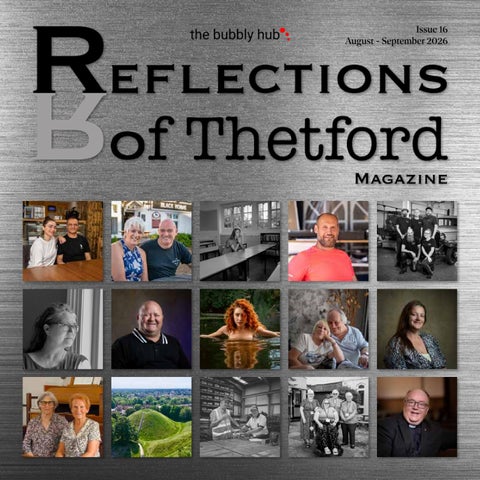
August - September 2026
By Martin Angus (Editor)
Welcome to Issue 16 of ‘Reflections of Thetford’ magazine. A magazine helping make Thetford a Great Place to Live!
This issue, we bring you part II of our Boudica series, written by the amazing Liz Gibbons, who most of you may know her from Thetford Library. This edition we jump back in time to before the uprising, a time of happiness and contentment for our very own Warrior Queen, and we visit her during her wedding ceremony.
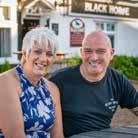
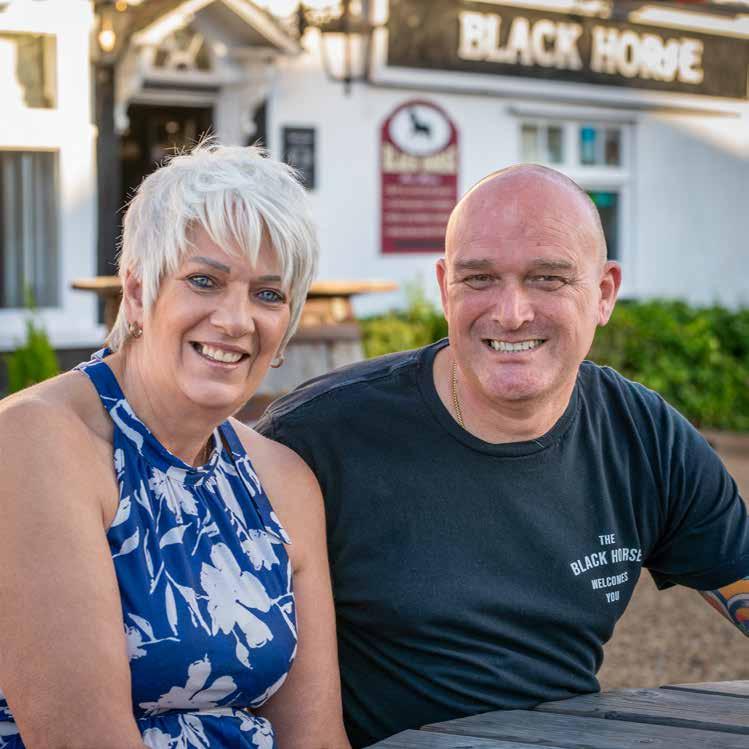
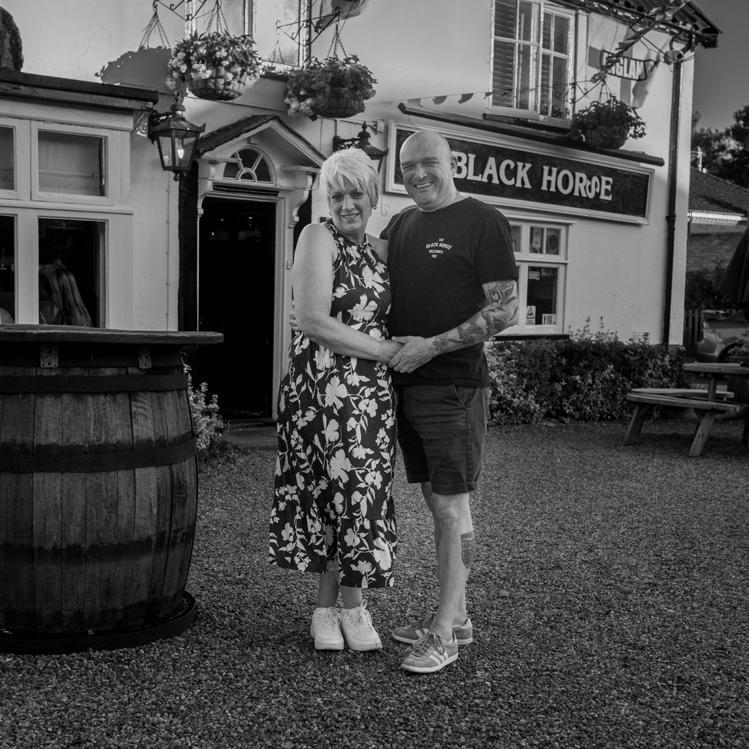
Pam and Terry join us this edition, reflecting on celebrating 12 years at The Black Horse.
A few other well known Thetford names have also joined us, Paul Dean and John Mayes. Also Ronnie Strutton bringing us part II, more tales and escapades of his past, and this time we dug a little deeper and looked for the man behind the stories.
Another local character, zak*, has also given a little insight behind the man holding the placards outside of public buildings, and more recently camping at the gates of Barnham Camp.
Andy Greenhouse brings us some tales from those
people that remember The Abbey Farm Fort, the volunteers, and the people who worked so hard for the town keeping the place open, and safe, for the kids.
Dave had a quick catch up with Amanda Fay, Headmaster of the recently closed Grammar School, reflecting on the history of the school, and the impact the closure had on the students.
As always, there is too much in the magazine to mention everyone here in the introduction.
We would like to thank all of our contributors for helping to make yet another amazing edition, reflecting on some of the folk that have, do and will, make the town an incredible place to be.
We couldn’t do it without you all, writers, contributors, advertisers and readers.
We hope you enjoy our 16th edition of ‘Reflections of Thetford’ magazine, promoting all the amazing people, doing amazing things in the town of Thetford.
*Preferred name - non capitalised.
©Reflections of Thetford is published by The Bubbly Hub. All rights reserved 2026. Whilst every care is taken, the publisher accepts no responsibility for loss or damage resulting from the contents of this publication, as well as being unable to guarantee the accuracy of contributions supplied as editorial, images or advertisements. No part of this publication may be reproduced, copied or transmitted in any form or by any means or stored in any information storage or retrieval system without the publishers written permission.







The Pub That Refused to Stand Still Thriving Through Difficult Times More Than a Charity Shop Breaking Down Barriers
The Promise That Changed Everything The Man Behind the Placards Always in Our Forts
The London boy who arrived in Thetford The Betrothal of Boudica
A Promise, a Coffee, and a New Life Giving Back More Than He Took 1,400 Years of Educational Excellence The Medusa Project Thetford Community Spirit
A Bag of Spanners and a Lifetime of Engineering
Reflecting on five years serving Thetford The Bill McKim Legacy Not Just Nags
Written by Martin Angus
On a warm summer’s evening, the garden at The Black Horse is alive with conversation. Friends share stories over pints of local ale, families settle beneath the pergolas for dinner, and somewhere in the background someone is always laughing. It feels effortless, as though it has always been this way. It hasn’t.
Twelve years ago, Pam and Terry climbed the stairs to the flat above the pub after their very first Saturday night as managers and wondered if they had made the biggest mistake of their lives.
“There were five people in the pub,” Terry recalls, still shaking his head at the memory. “We looked at each other and thought, ‘What on earth have we done?’”
It is a story that has almost become folklore at The Black Horse, because anyone who walks through its

doors today would struggle to imagine that scene. Now the pub is one of Thetford’s busiest hospitality venues, employing seven kitchen staff alone, serving hundreds of meals each week and welcoming everyone from football supporters and families to walkers, tourists and loyal locals who have made it their second home.
Nothing about that transformation happened by accident.
The Black Horse wasn’t even a pub Pam particularly wanted.
“We’d come from The Dragon,” she laughs. “It was lively, music every weekend, football, karaoke... and someone suggested we should come here. I remember saying, ‘I couldn’t think of anything worse than that bloody pub.’”
At the time, The Black Horse carried the reputation of being an old men’s drinking pub. It was quiet, tired and,

although full of history, had somehow lost its spark. Yet beneath the faded décor, Pam and Terry saw something others had overlooked: potential.
Not certainty. Potential.
The agreement was simple enough. Manage the pub for a year and, if everyone was happy, buy the lease. That timetable stretched into three frustrating years before the purchase was finally completed on exactly the same date they had first taken over, 4 June. By then, however, there was no turning back. They had already invested themselves emotionally, professionally and financially in making the place work.
The first task wasn’t grand redevelopment or expensive expansion.
It was observation.
“What do people actually want from their pub?” became the question they asked themselves every day.
The answers arrived in small details.
The menu needed fresh thinking, so they recruited a new chef. The back bar was gloomy, making the bottles almost invisible, so better lighting went in. Walls were repainted. Decorations that had gathered dust for decades quietly disappeared, one handful at a time, until regulars eventually began asking where the old horse brasses had gone.
Pam smiles at the memory.
“I took four or five down every evening. Nobody noticed for weeks.”
The changes were subtle rather than dramatic, but each one nudged the pub a little closer towards the
place they imagined it could become.
If determination was the fuel, reality quickly supplied the obstacles.
No sooner had they finally purchased the lease than the cellar cooling system failed, leaving them with a bill approaching £5,000 in their very first week as owners. It proved to be only the beginning. Refrigeration broke down. Kitchen equipment followed. The ice machine failed. Appliances seemed almost to queue up for replacement.
For many people, it would have been enough to question everything.
Pam and Terry simply carried on.
“We’d spent everything buying the place,” Terry says matter-of-factly. “So there wasn’t really an option. We had to make it work.”
That phrase comes up repeatedly during conversation. Not because it has become a rehearsed line, but because it perfectly captures their approach to business. There are no stories of overnight success or lucky breaks. Instead, there is persistence. Long days became normal. Unexpected expenses became another challenge to solve rather than a reason to complain.
Slowly, the figures began to tell a different story.
The weekly targets they once celebrated are now comfortably exceeded on an ordinary Wednesday. Food sales in a single busy day now eclipse what the pub once took across an entire week. Growth didn’t arrive with fireworks or fanfare; it arrived through consistency, attention to detail and an unwavering refusal to settle for “good enough.”




Ask either of them whether they expected to build one of Thetford’s best-loved pubs and they both laugh.
“I don’t think we dreamed it would become this,” says Pam, looking across a garden that was once little more than an underused space behind the building.
For Terry, the answer is simpler.
“We always believed there was a great community pub hiding here.”
After twelve years, few would argue that they found it.
Success at The Black Horse isn’t measured solely by how many pints leave the bar or how many Sunday lunches are served. Spend half an hour in the pub, and another measure quickly becomes obvious: names.
Pam and Terry seem to know everybody.
Not just faces, but stories. Favourite drinks. Football teams. Family milestones. Who has recently become a grandparent, whose dog is recovering from an operation, who has quietly had a difficult week and simply needs a friendly chat over a pint.
That level of familiarity isn’t accidental. It has become one of the defining principles behind everything they do.
“If someone comes into our house,” Terry says, “you welcome them. Well, this is our house.”
It’s a simple philosophy, yet one that feels increasingly rare.
In many pubs today, a QR code replaces a conversation. Customers order through their phones, food appears, drinks arrive, and interaction ends there. At The Black Horse, nothing could be further from the experience Pam and Terry want to create.
“The girls still carry a pad and pen,” Pam says. “They go to the table, they chat, they have a conversation. That’s part of coming here.”
To them, hospitality begins long before the first plate reaches the table.
That human touch has quietly transformed the pub into something far more important than a successful business. For many people, particularly those living alone, The Black Horse has become a social lifeline.
“Some aren’t really coming for the beer,” Terry explains thoughtfully. “They’re coming because they don’t want to sit at home on their own.”
Over the years, they’ve watched strangers become friends simply because they happened to occupy neighbouring bar stools often enough. Darts teams have formed. Birthday celebrations have grown from casual drinks into annual traditions. Customers who once walked through the door alone now arrive with groups they’ve met inside these walls.
That sense of belonging extends well beyond the customers.
Ask either of them about their greatest asset, and neither mentions the kitchen, the garden or even the business itself.
“It’s our staff,” they answer almost together.
Several members of the team have been with them for close to a decade, remarkable loyalty in an industry often known for constant turnover. Listening to Pam explain why, it becomes clear that titles mean very little here.
Whether someone is preparing meals, serving tables or washing plates, every role matters equally.


“You can’t serve food if there aren’t clean plates,” she says. “Everyone is part of the machine.”
Even the tips reflect that thinking. Rather than rewarding only front-of-house staff, every penny is shared according to hours worked, ensuring kitchen porters receive the same recognition as chefs and waitresses.
“It all belongs to the team,” Terry says simply.
That respect flows both ways. Staff willingly swap shifts, help cover emergencies and stay because they feel valued rather than managed.
Quality, however, never comes second to convenience.
Pam admits they would rather refuse bookings than compromise the experience people have come to expect. If the kitchen reaches capacity or staffing levels are stretched, they simply stop taking reservations, regardless of how many empty tables visitors might see.
“People think because there’s a table free we can fit them in,” she explains. “It’s not about tables. It’s about giving everyone the service they deserve.”
It is a surprisingly brave approach in an industry where maximising covers often takes priority.
Then came COVID.
Like every publican, Pam and Terry suddenly found themselves staring into the unknown.
Would customers return?
Could they keep their staff?
Would twelve years of hard work disappear almost
overnight?
Many businesses froze. Others cut back dramatically.
The Black Horse chose a different route.
The Government’s Bounce Back Loan became an investment rather than an escape fund. Staff wages were topped up to their full salaries even when furlough payments reduced, allowing everyone to return when restrictions finally lifted. Takeaway meals and deliveries kept the kitchen operating, while every decision revolved around protecting the people who depended upon the pub, both employees and customers alike.
One gamble changed everything.
Instead of shelving improvements altogether, they used the little money they had left to build a timber pergola in the garden.
It wasn’t designed as a showpiece.
It was simply a practical way of creating more safe outdoor seating.
The response exceeded every expectation.
Customers loved it.
The atmosphere changed overnight.
One pergola became two. Outdoor dining expanded. Porcelain paving replaced tired surfaces, cabins were introduced, and what had once been an overlooked yard gradually evolved into one of Thetford’s most admired pub gardens.
Today, visitors regularly walk through the building, stop in their tracks and stare.
“We never knew all this was here,” is a phrase Pam hears time and again.
Perhaps that reaction says everything.
The Black Horse has never relied on flashy advertising or gimmicks.
Instead, it has quietly grown through word of mouth, genuine hospitality and an understanding that a successful pub is never really about bricks, beams or beer.
It’s about making people feel that, for a little while at least, they’ve arrived somewhere they belong.
Every successful pub has its signature pint.
At The Black Horse, that honour belongs to Drenchfoot.
Brewed just a mile away in Thetford, the locally crafted ale has become almost inseparable from the pub itself, but its story is as much about friendship as it is about brewing.
Long before Drenchfoot appeared on the hand pumps, its creator, Paul Foot, would occasionally wander into the pub carrying a couple of bottles of homebrew, inviting Terry and a handful of regulars to sample his latest experiment.
“It was never about making money,” Terry recalls. “It was just something he loved doing.”
Recognising both Paul’s talent and his modesty, Terry persuaded him to brew a firkin for what was intended to be one of the pub’s annual beer festivals. Life had other plans when illness forced the event to be cancelled, but the beer still made it onto the bar. It disappeared in less than twenty-four hours.
That single cask marked the beginning of something much bigger.
Today, Drenchfoot enjoys permanent residence at The Black Horse, the result of nothing more complicated than a gentleman’s agreement between two local businesses determined to help each other succeed. While Terry promised a dedicated hand pump, Paul continued producing imaginative ales that have become favourites with customers and visitors alike.
For Terry, supporting local suppliers has always been about more than commerce.
“If we can keep business in Thetford, everybody benefits.”
It’s a philosophy reflected throughout the pub. Local musicians headline the annual beer festival, nearby businesses provide services wherever possible and producers from the surrounding area feature prominently whenever they can.
The beer festival itself has become something of a fixture on Thetford’s calendar.
Each year, the garden fills with marquees, live music, barbecue aromas and a remarkable sense of occasion. To outsiders it may appear effortlessly successful, but Terry smiles knowingly when people assume it must be a licence to print money.
“If only they knew,” he laughs.
Behind the scenes lies months of planning, countless supplier conversations, staffing rotas, equipment hire, brewery logistics and one unpredictable factor nobody can influence: the British weather.
Yet despite the financial risk and enormous workload, they continue staging the event because it has become
part of the town’s social fabric.
“The community loves it,” says Pam. “That’s reason enough.”
The same motivation explains why they have never closed the pub to regular customers, even when lucrative private bookings have been offered. It would certainly be easier. It might even be more profitable.
But that’s never been the point.
“Our regulars keep this place alive all year,” Terry says. “We’re not going to lock the doors on them for one function.”
That loyalty works both ways.
Over twelve years, they have celebrated weddings, anniversaries, birthdays and retirements alongside their customers. They’ve also attended funerals, checked on elderly regulars who unexpectedly failed to appear and quietly knocked on front doors simply to make sure someone was safe.
One gentleman, living alone, missed several of his usual lunchtime visits. Concerned, Terry tracked down his address and discovered he had fallen at home. On another occasion, a familiar face arrived outside the pub hours before opening, confused by dementia and convinced it was almost lunchtime. Rather than sending him away, Pam and Terry welcomed him inside until he felt settled.
Those moments rarely appear on balance sheets.
They are, however, the moments that define a community pub.


The Black Horse has also become a place of first impressions.
Visitors frequently arrive expecting little more than a traditional roadside inn before discovering the expansive garden beyond.
One wedding guest recently admitted he hadn’t crossed the threshold for thirty years because he remembered the pub as it once was. Leaving after the reception, he promised it certainly wouldn’t be another three decades before he returned.
Stories like that never lose their appeal.
Neither do the compliments from visitors who describe it as the traditional English pub they thought no longer existed.
Perhaps that’s because Pam and Terry have resisted chasing fashionable trends. They haven’t replaced conversation with technology. They haven’t forgotten that pubs are built around people rather than profits. They haven’t lost sight of the idea that hospitality should feel personal.
Ask what comes next, and neither speaks about ambitious building projects or grand expansion plans.
They’ve already created the place they once imagined.
Now the ambition is simpler.
Protect it.
Nurture it.
Continue offering somewhere that feels welcoming in an increasingly complicated world.
After twelve years, countless hours, more unexpected repair bills than either cares to remember and enough stories to fill several magazines, they remain remarkably grounded.
Neither claims to have built the pub alone.
They speak just as warmly about loyal staff, supportive suppliers and customers who have chosen The Black Horse time and again.
Without them, they insist, none of it would have been possible.
As our conversation comes to an end, the evening sun begins to dip behind the rooftops. Glasses clink across the garden. Someone calls hello from across the bar. A familiar face arrives and is greeted by name before reaching the counter.
Nothing about the exchange feels rehearsed.
It’s simply what happens here.
Pam is asked what she would say to anyone in Thetford who has never visited.
She smiles.
“You don’t know what you’re missing.”
After spending time listening to the story behind The Black Horse, it’s difficult to disagree. In twelve years, Pam and Terry haven’t simply revived a traditional English pub; they’ve created something much harder to find, a place where good food, local ale and genuine friendship still sit comfortably around the same table.
And in today’s world, that’s worth raising a glass to.
‘“You don’t know what you’re missing.”’

Written by Dave Griffiths
The sun is dipping below the horizon on a clear May evening in 1995, as I roll off the Dover to Calais ferry in my pristine 1966 MGBGT, Mavis. We’d finished work on her that morning, bolted the front seats in and headed to the MOT centre. It had been 2 years of hard work, mainly by the garage guy with me doing some of the menial work, yet I’m rather proud of my Grampian Grey classic. All is well until I approach the first traffic lights in the port and press the brakes; nothing! Pumping the brake faster than Chris Hoy can pedal and yanking on the handbrake, I manage to affect a bit of drag and execute perhaps the ugliest stop in history. A faulty reproduction servo is the problem which I can’t get fixed. So, I end up driving all the way to Le Mans for the weekend and back home, close to brakeless.
The following year I go on holiday with my girlfriend to the Cotswolds and another reproduction part failure leads to the unforgettable experience of a white-knuckle ride behind an AA van on a very short, rigid toe bar. Some of the shine of driving a classic as my only car is starting to rub off. Two years later, and clearly a glutton for punishment, we head off on a driving tour of Scotland in Mavis. What can go wrong! The answer is a sticky fuel pump, which means every time I stop at a junction, the car stalls, I jump out, reach under the car and smack the pump with a rubber mallet. On the journey back down south, as I get out of the car in a petrol station, the non-existent suspension and minimal seat cushioning takes its toll. My back goes into spasm and is never the same again. A mixture of these joyous experiences, and the fact that I
can’t bear to watch Mavis rust and revert to the state in which I found her, leads to the decision to sell to help pay for our wedding; we had suffered enough! So, why am I wittering on about my old MG? What has it got to do with the real gem of an engineering company I found when I visited Craig Harvey? Hopefully all will become clear.
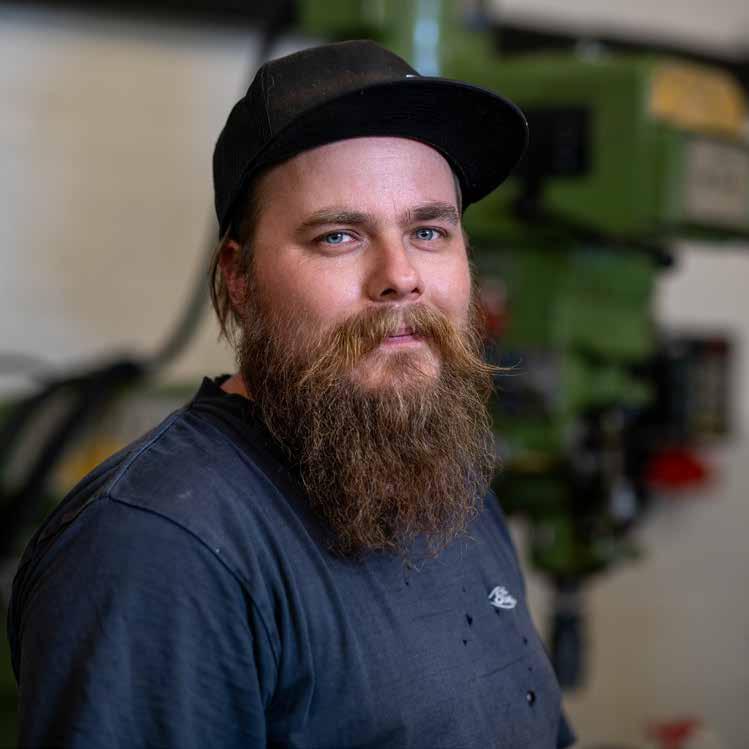
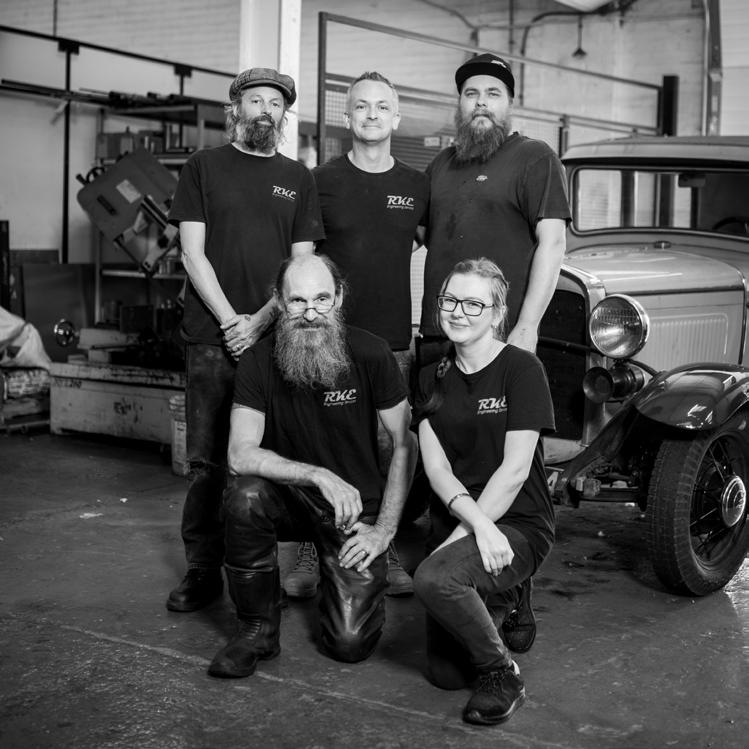
I am met with a cheery hello from Craig as I arrive at closing time at his unit in Brunel Way, a unit he’s rented since setting up his business. The smells of machine oil, milled metal and a car workshop bring back happy memories of my early telecoms career and car restoring hobby. Several of his team are winding up their day and packing away. Brief handshakes, greetings and smiles give the impression of a happy workplace. Then we get down to business and talk about Craig, about RKE engineering the business, and Rotoshim the brand. We begin with how it all started.
Following school, Craig became an apprentice tool maker at JEB Technologies in Mildenhall. It was there he learnt the engineering skills that have served him well since. JEB then got into firearms manufacture and, after he finished his apprenticeship, Craig worked for several years for a guy who made gun barrels. Alongside this, he trained as a gunsmith. Following the 2007 crash and subsequent recession, work dried up, and Craig moved to become a driver for Hayley Bearings in Bury. Following that, he got a job working on vintage cars, a job that sparked his passion for Model A Fords.
In 2017, Craig hit 30. With an apprenticeship and over a decade’s experience in engineering of various types, he decided that he had enough knowledge and experience to start his own mechanical engineering business. His intention
initially was not to focus on cars; it is a notoriously tough sector to make money in, but rather to seek a steady, sustainable stream of varied mechanical engineering work. He rented the Brunel Way unit and bought a mill and lathe. Over the next year he tooled up fully off the back of various jobs and, towards the end of that year, hired Russell and purchased a CNC machine. The work pipeline grew steadily as the business found its place in Thetford’s eco-system. Then disaster struck with Covid in 2021 and the work dried up overnight. Many businesses went to the wall in those dark days but, in a demonstration of flexibility and innovation which has become a hallmark of the business, Craig plotted how he could use his time to prepare the business to thrive once more, once lockdown restrictions were raised.
As I said, Craig had got the bug for the Ford Model A whilst working on vintage cars. But one thing that lets them down is the lever arm dampers, based on archaic 1920’s technology. Lever arm dampers were replaced many decades ago by the now familiar tubular devices. Decades of development have improved tubular damper performance massively. But fitted on a Ford Model A, they would be very exposed and look awful. So, Craig got together with business contact Pete, who had spent his career developing dampers. Together they designed a lever arm damper for the Model A that looked original but used modern materials and their expert design. It provided performance every bit as good as a modern tubular damper; a unique achievement that no one else in the world has managed. When lockdown ended, Pete joined the team, and they were ready to provide lever arm dampers for all the Fords up until 1936. The market lay mainly in the US, where they sold extremely well.

An unintended consequence of getting involved in the car world was that the business started picking up other car work. Word spread around individuals and garages that RKE was the place to come if a solution was needed to a tricky engineering problem. An issue with the Model A was that the engines could be quite fragile, especially if the car was being raced. The team started reconditioning old engines, in the process machining parts and making modifications to make them more reliable. Next, they moved into building brand new engines, with engine blocks from China, and the moving parts either machined in-house or imported from the US. All the assembly, tuning and optimisation is in-house. They give a similar performance to a tuned vintage engine but are much more reliable and cheaper. The combination of these robust engines and the dampers helps retain the look and history of the vintage car, but makes it much more drivable, more appealing to the modern motorist. Beyond engine restoration and build, the team also get involved in race preparation of engines and the mechanicals of the car. They are currently working on race prep for a car entered in the Peking to Paris rally. They are preparing the engine, the gearbox and the whole car.
And this is where I circle back to the account I gave earlier of my beloved MGB GT. A thing of beauty but, if I’m honest, a total pain in the arse to use as an everyday car. Oh, to have had modifications of the type Craig’s team have developed. I fear without such improvements to the driving experience, many classic/vintage cars will become an increasing rarity on our roads.
The business not only survived Covid, but thrived following lockdown, only to be thrown another curveball when Trump slapped 100% tariffs on the US import of car parts. The US was the biggest
market for dampers, so it was a big blow to RKE. Fortunately, the diversification into engines and dampers for vintage British cars has kept the team busy. But Craig isn’t one to rest on his laurels and is looking all the time to identify opportunities to apply the business’s skills in new areas. Building on the success of the Model A dampers, he linked up with the Aston Workshop and developed similar concept dampers for the DB5s. They are altogether more complex and expensive beasts than the Model A ones, as they incorporate electronic controllers. But Pete had the electronics expertise required, and so they were able to develop a concept model which performed well. The first order from Aston Workshop was for 15 sets of rear dampers; a month later they ordered another 30, so numbers are good and growing. The team have now completed the development of prototype front dampers for the DB4, 5 and S. They are machined in-house, bar the spring, and tests on their performance are extremely promising. Rolling with the blows and pushing on with new, innovative ideas has kept the business not just surviving but thriving through some of the most difficult operating conditions for engineering in many years.
Passing a bench while we talk, Craig picks up a car part which is a relatively new project, a 3D printed, aluminium oil pump. Now I’ve no idea how you can 3D print metal, but clearly you can. Apparently, you can even 3D print hardened steel! I wouldn’t be surprised if this becomes another important line in the RKE portfolio.
Craig doesn’t market the business anywhere other than presence on Facebook and Instagram. Business comes through word of mouth and reputation. He has no particular areas he wants to move into; he’ll just keep a close watch on what
is going on and take advantage of opportunities that come along. As a measure of the profile of the business, RKE is becoming the place to get vintage Ford parts. They import and resell parts from the US alongside their in-house developments. The unit they’ve rented since 2018 is getting a bit cramped, but there are very few of the size they need available locally.
And so, we move on to Craig’s own Model A, sat in the workshop. It immediately screams Al Capone or The Godfather to me. I look rather stupid when I ask if it is a runner; Craig had driven it to Santa Pod and back at the weekend and uses it daily!
The Model A was made between late 1927 and 1932 (following the Model T, which was produced from 1908 to 1926). Craig’s is a ’31 with, as you’d expect, some modifications to make it better for day-to-day use and for performing at events. The 3.3-litre engine on the original managed about 45 mph with a following wind (0-45 mph in about 2 weeks!) but with the modification to suspension and a more robust engine, Craig can cruise at 6570 mph quite happily. A small number were made at Dagenham for the British market, but they used a smaller 2-litre engine. He fires the old gal up; what a great noise she makes and what a greatlooking vintage car.
So, time is up. I’d had a great time talking engineering and cars and meeting Craig’s team (Craig, Russell, Pete, Zofia and Chris) forming this gem of a business. I know nothing about engineering or running my own business, but I get the sense that Craig certainly does. Very shrewd about areas to get involved in that are profitable and suit the skills base, and he’s totally committed to the business, having a breadth of interests that avoid too much reliance on any one area. I wish him and the team every success in the future.

‘Bless

An Invitation by Craig Plumley
‘The short and the long is, our play is preferred.’ - Act IV, Scene II
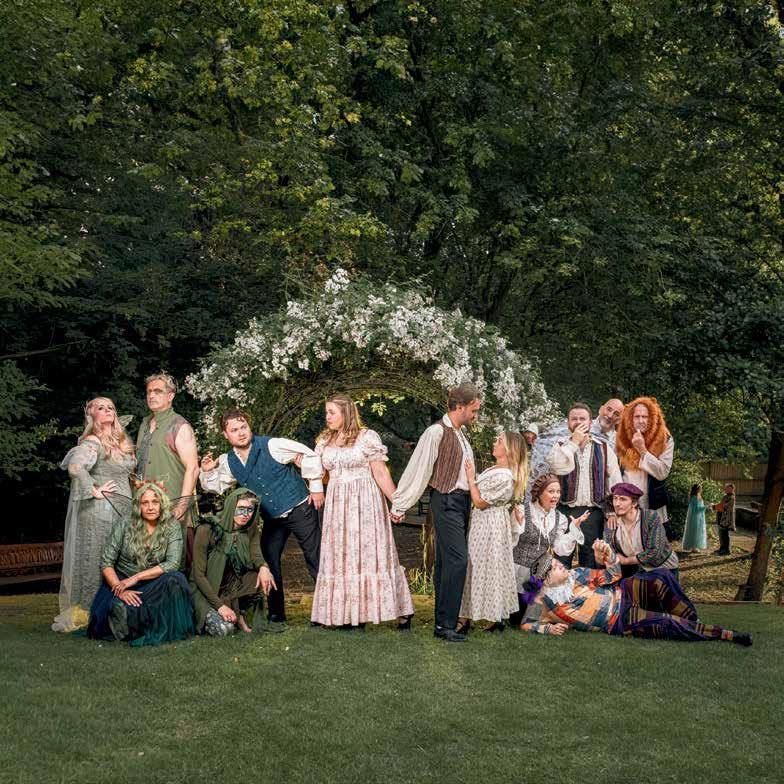
There is something uniquely fitting about staging A Midsummer Night’s Dream outdoors. Shakespeare’s tale of runaway lovers, feuding fairies, and theatrical chaos was practically built for the open air, where twilight does half the work of setting the mood. As Magic Floor Productions prepares to bring this fresh, immersive adaptation to Riversdale, the buzz isn’t just about Shakespeare, it’s about a partnership that serves as a blueprint for local collaboration.
By staging the performance in partnership with Keystone Trust at the Riversdale site, Magic Floor isn’t just picking a scenic backdrop; they are engaging in a mutually beneficial ecosystem where both the theatre company and the charity are both rewarded. In an ever changing performing arts landscape, collaborations like this are essential for the continuation of local theatre.
“Jack shall have Jill; Nought shall go ill.” Act III, Scene I Beyond the backdrop and acting, there is a deeper similarity. A Midsummer Night’s Dream is a play centered around transformation, community, and bringing order out of chaos, themes that resonate deeply with the core mission of a charitable organization like Keystone. Although coincidental, it reminds us of the role theatre can play in everyday life when given these opportunities.
“And all shall be well.” Act III, Scene II
When Magic Floor’s actors step onto the grounds at Riversdale, the line between the performance and the community blur in the best possible way. The audience gets a magical midsummer night out, Magic Floor continues to enjoy its independent theatre and Keystone gains a welcome financial injection needed to continue its vital work. It proves that when local charities, theatre and community join forces, everybody gets a happy ending.
Catch the chaos from 14th to 16th August!
Showtimes: 2:00 PM (for the morning lark) and 6:30 PM (for the clamorous owl).
Written by Martin Angus
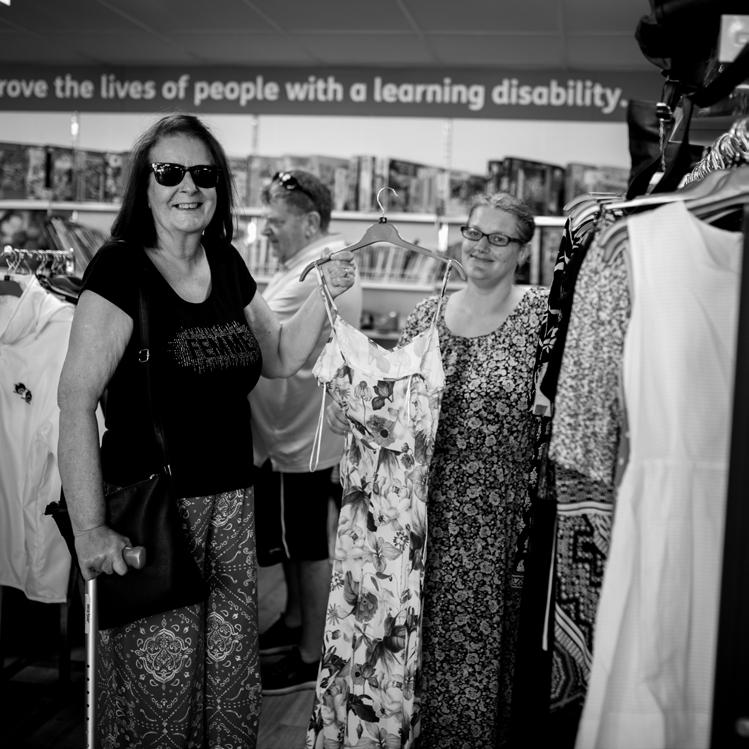
Walk into Mencap’s charity shop in Thetford, and you’ll probably notice the racks of carefully displayed clothing, shelves filled with books and bric-a-brac, and the steady stream of customers searching for an unexpected bargain. What you won’t immediately see is the remarkable story unfolding behind the scenes.
At the centre of it all is Michelle Loft, a woman whose enthusiasm is as infectious as her determination. She describes herself in three simple words: “Caring, peoplepleaser.” Those words might sound modest, but after spending time in her company, it becomes clear that they only scratch the surface.
Michelle never planned to manage a charity shop. In fact, if life had followed its original blueprint, she might have become a quantity surveyor. Armed with a Higher National Diploma in Construction Management and a head for figures, her future seemed destined to revolve around buildings, contracts and calculations rather than donated handbags and volunteer rotas.
“I like numbers,” she admits with a smile. “But I like people more.”
It is perhaps the simplest explanation for a career that has taken an unexpected, and ultimately far more rewarding, direction.
Before arriving at Mencap, Michelle worked as a shift manager at Wickes and later at a local garden centre. Along the way, she discovered something about herself that no qualification could ever have revealed. She had a remarkable appetite for helping others.
That desire first emerged through fundraising. One event helped raise money for a colleague suffering from pancreatic cancer, but another challenge would test her resilience to its limits.
Returning from maternity leave, Michelle spotted an email asking whether anyone fancied taking part in a charity event. Without reading all the details, she volunteered.

Only afterwards did she discover she had signed up to kayak more than 200 miles along the River Thames.
“It taught me one lesson,” she laughs. “Read the whole email.”
For five gruelling days she paddled the equivalent of three marathons, raising more than £50,000 alongside colleagues and sponsors for YoungMinds, the children’s mental health charity. Injury forced her to withdraw before the final tidal section into London, but the experience left a lasting impression.
“I saw what charity could actually do.”
That realisation changed everything.
Rather than chasing a higher salary, Michelle deliberately accepted a pay cut to move into the charity sector.
For many people, that decision would seem baffling. For Michelle, it simply made sense.
Every day she now sees where the money goes. She works alongside adults with a Learning disability, autism, epilepsy and a wide range of additional needs.
A learning disability is a reduced intellectual ability which means that people might need support with everyday tasks, may take longer to learn new things, and need support to develop new skills. Thetford alone is home to three Mencap-supported residential homes, giving her a daily reminder that the charity’s work extends far beyond the shop floor.
Mencap campaigns for equal rights and greater opportunities, and challenges attitudes and prejudice for the 1.5 million people with a learning disability in the UK.
Mencap’s retail stores are more than just a store. They
are a hub for the community, and each store offers people with a learning disability a chance to volunteer and gain valuable skills.
“It’s about doing something small for something so big,” she says.
Those words capture the philosophy that quietly shapes every decision she makes.
Although she arrived as assistant manager, circumstances changed quickly, and she soon found herself leading a shop that, by Mencap’s own assessment, was struggling.
“It wasn’t covering its own overheads.”
Many managers would have viewed that as an intimidating challenge.
Michelle saw possibility.
Her first priority wasn’t increasing profits. It wasn’t redesigning displays or rewriting procedures. Instead, she looked beyond the stock and focused on the people.
When she arrived, there were only three volunteers.
Today there are twenty-five active volunteers, with several more preparing to join.
That transformation began with one simple question posed to local Mencap residential homes.
“Have you got anyone who’d like to volunteer?”
One young man who used a wheelchair became the answer.
Michelle rearranged the shop layout, repositioned the till and adapted the workspace around what he could do

rather than what he couldn’t.
Looking back, she identifies that moment as the point when Mencap stopped being simply a place of work.
“That was the day I realised we were making a difference.”
The smile on that volunteer’s face, she recalls, said more than any sales figures ever could.
Listening to Michelle, one theme emerges repeatedly, not because she consciously returns to it, but because it underpins everything she does.
Everyone has something to contribute.
Whether it’s someone with Down syndrome learning new skills, an older person lacking digital confidence, or a volunteer searching for purpose after difficult life circumstances, Michelle believes society is often too quick to decide what people cannot do.
She prefers to discover what they can.
That philosophy influences her management style every bit as much as it influences the atmosphere inside the shop.
Leadership, she insists, isn’t about having all the answers. It’s about remaining willing to learn yourself.
As someone who freely admits to being a peoplepleaser, Michelle says her biggest personal challenge has been learning that kindness sometimes requires firmness.
“Telling volunteers they’re doing something the wrong way is hard because they’re giving you their time.”
Instead of assuming she always knows best, she constantly asks herself whether there might be a better approach.
Working alongside volunteers with different life experiences and sometimes neurodiverse ways of thinking has taught her that flexibility often yields better results than rigid rules.
“The hardest thing is challenging yourself.”
It is an observation that reveals far more about Michelle than any job title ever could.
Perhaps that explains why the shop has become more than a successful retail operation.
It has become a place where confidence quietly grows, friendships develop, and people who may once have felt overlooked discover they still have something valuable to offer.
If Michelle has a secret weapon, it is her ability to see potential where others might see problems.
That outlook has transformed not only the people around her, but the fortunes of the shop itself.
When she first became manager, the figures painted an uncomfortable picture. Rather than feeling overwhelmed, Michelle quietly set herself an ambitious target. During her interview, she promised senior management she would one day generate £3,000 in weekly sales.
It was an audacious goal.
She gave herself three years.
She achieved it in less than two.
“I said I’d do it,” she recalls with unmistakable pride, “and we did.”
Notice the choice of words. Not I did it.
We did it.
Michelle talks about success almost entirely in terms of the team surrounding her. Whether she’s speaking about her assistant manager Sam, the volunteers, or her area manager Karolina, individual achievements quickly become collective ones.
Karolina, in particular, has become a mentor whose influence runs through Michelle’s management style.
“She tells me exactly what I need to hear.”
It is something Michelle clearly values. Straight answers. Honest conversations. No unnecessary drama.
She laughs that Karolina has probably grown tired of her telephone calls over the years, but beneath the humour lies genuine respect for someone who believed she could achieve more than perhaps she believed herself.
Another constant presence is assistant manager Sam.
Every successful partnership has its own rhythm, and theirs appears almost instinctive.
“When I’m low, she’s my pick-me-up. When she needs encouragement, I’m there for her.”
It is a relationship built not simply on shared workloads but mutual trust. They know when to challenge each other, when to step in and, just as importantly, when to insist on a break during a sweltering summer afternoon.
Watching Michelle describe her team, one quickly
realises she measures success very differently from many managers.
Targets matter.
Numbers matter.
But people always come first.
That balance has become increasingly important as the shop has grown.
Today, hundreds of bags of donations arrive every week. The operation resembles a carefully choreographed production line, with volunteers sorting clothing, household goods, books and electrical items at remarkable speed.
Sometimes, however, the unexpected arrives.
Michelle pauses before recalling perhaps the strangest donation she has ever encountered.
Inside what appeared to be an ordinary tin were carefully preserved human teeth.
Not dentures.
Real teeth.
The sort removed by a dentist and stored individually in specimen containers.
For a brief moment, the sorting team simply stared at one another, wondering whether they had stumbled across a museum exhibit or a biological hazard.
It has since become one of the shop’s favourite stories.
Working in charity retail, Michelle says, means expecting the unexpected.
One day it may be antique pottery destined for specialist collectors.
The next, a perfectly serviceable mitre saw.
Or several large suitcases that disappear within hours of reaching the shop floor.
Even a wildly colourful 1970s-themed window display she assembled during a quiet January proved unexpectedly successful.
Within twenty-four hours almost every item had sold, forcing her to redesign the display from scratch.
“It wasn’t quite what I’d planned,” she laughs.
Behind the humour lies another lesson Michelle has learned over the years.
People enjoy surprise.
They enjoy discovery.
A charity shop is one of the few remaining places where shopping still feels like an adventure rather than a transaction.
Every shelf carries possibility.
Every donation arrives with its own untold story.
That philosophy also explains why Michelle rejects one of the most common misconceptions surrounding charity retail.
Contrary to online criticism that occasionally appears on social media, she believes modern charity shops are anything but stagnant.
Stock moves constantly.
Unsold items travel to other branches.
Very little is wasted.
Only a tiny fraction of donations ultimately cannot be reused or recycled.
“It’s all about giving things another life.”
There is something quietly satisfying about hearing someone with a background in construction management describe recycling with such enthusiasm.
Perhaps, in hindsight, her earlier studies were not wasted after all.
Sustainability, organisation and problem-solving have all found an unexpected home inside a charity shop.
Away from work, Michelle’s own escape is far removed from spreadsheets and sales targets.
She heads to her allotment.
There she grows vegetables for her family, enjoying the slower rhythm of watering plants, tending soil and encouraging her children to understand where food really comes from.
Reading offers another welcome refuge.
They are simple pleasures, but perhaps that is precisely the point.
Someone whose working day revolves around constant interaction occasionally needs quiet spaces where the world slows down.

Yet even during those moments, it is clear her thoughts rarely drift far from the people she works alongside. 6

Managers are often expected to maintain professional distance, and Michelle understands why.
Sometimes, though, that proves easier in theory than practice.
When volunteers confide worries about family, finances or health, she cannot simply stop caring at five o’clock.
Her role, she says, is not to solve every problem but to guide people towards the support they need.
Still, some conversations linger long after the shop has closed.
That empathy may well explain why volunteers continue arriving through the doors.
People are naturally drawn towards places where they feel valued.
As our conversation comes to an end, I ask Michelle what legacy she hopes to leave behind one day.
She pauses.
Not because she has never considered the question, but because she has no immediate plans to leave.
Eventually, however, she offers an answer that feels entirely consistent with everything that has come before.
She hopes people will simply say she rebuilt a community shop.
Not just financially.
Not just operationally.
But as a place where people belong.
It is a quietly ambitious aspiration.
Judging by what has already been achieved, she is well on her way.
For all the statistics, the thousands of pounds in weekly sales, the growing volunteer team and the expanding reputation of the Thetford branch, it is tempting to measure Michelle Loft’s success in numbers.
She would almost certainly disagree.
The real achievement cannot be entered onto a spreadsheet.
It is found in the confidence of a volunteer mastering a new skill, the customer who returns because they know they’ll be greeted with a smile, the family donating a loved one’s belongings knowing they will continue to do good, and the countless acts of kindness that unfold every single day beyond the shop door.
Long after fashions change and window displays are replaced, that is the story readers should remember.
Not simply that Michelle Loft turned around a struggling charity shop.
But that she quietly reminded a community that everyone, whatever their circumstances, still has something worthwhile to give.
More information about Mencap’s retail stores, including their Thetford branch, can be found here.
www.mencap.org.uk
all about giving things another life.”’
Written by Martin Angus
There is a quiet revolution taking place in Thetford. It isn’t announced by banners or speeches, nor measured in headlines or political promises. Instead, it happens every week over cups of tea, shared lunches and friendly conversation. It happens when someone who has spent days alone finds a reason to leave the house. It happens when a volunteer notices a problem that everyone else has learned to live with. Most importantly, it happens because a small group of determined people refuse to accept that growing older or living with a disability should mean becoming invisible.
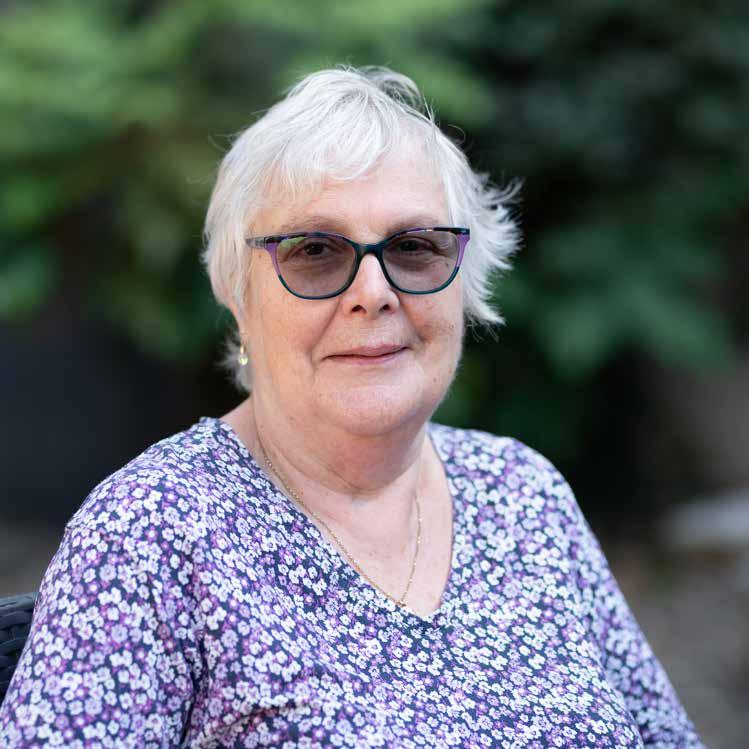
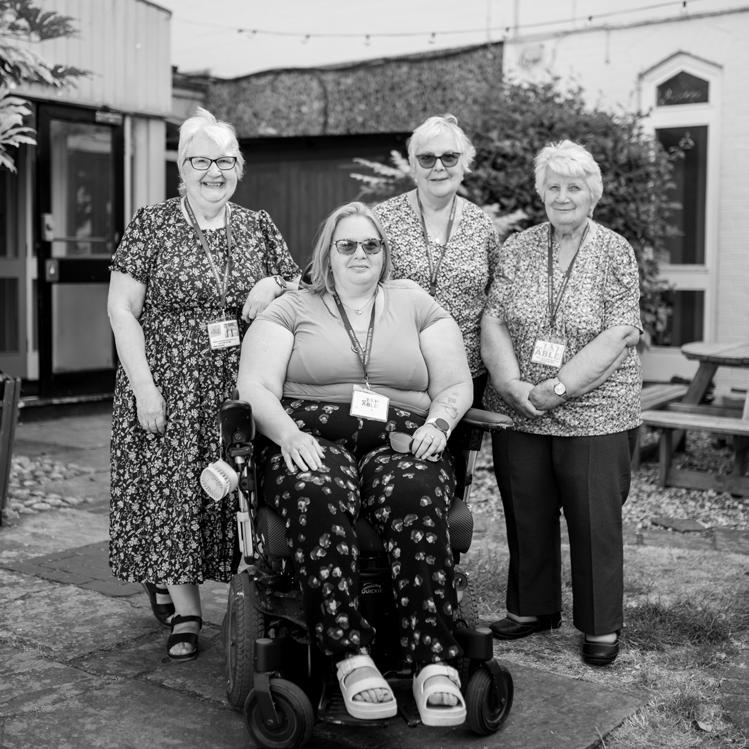
Meet enABLE Thetford.
Talking with volunteers Janet and Eileen quickly reveals that this is far more than another community organisation. It is a non-profit-making voluntary group built on lived experience, practical
compassion and a determination to make everyday life easier for people who often find themselves overlooked.
The story begins before the enABLE name existed.
In 2015, the Royal Voluntary Service launched its Local People’s Project, identifying communities where older residents faced an increased risk of loneliness and isolation. The Local People’s project in Thetford was one of 5 towns chosen from deprived areas in England. With work initially centred around Barnham Cross, Redcastle, Abbey Estate and later the Ladies Estate.
The aim was simple: help older residents remain active, connected and supported within their own community.
Coffee mornings, exercise classes, art group, and





tea parties were among the first initiatives. While they may have appeared modest, Janet explains they were never really about tea or exercise. They were about creating reasons for people to leave the house, opportunities to make friends, and a place people genuinely wanted to return to.
Those early successes led naturally to the first Wellbeing Fayre, bringing together organisations that many residents either didn’t know existed or simply didn’t know how to access.
Rather than expecting vulnerable people to navigate dozens of agencies individually, the agencies came together under one roof.
Age UK, Citizens Advice, health providers, emergency services, bereavement support, disability charities, exercise groups and financial advisers all became part of what was effectively a one-stop community support event.
The idea worked because it recognised something many organisations overlook.
Finding help is often the hardest part.
Someone may not know which organisation deals with mobility issues. Another person may be unaware they’re entitled to financial support or specialist transport. Someone recently bereaved may not even know what questions they should be asking.
The Wellbeing Fayre removes those barriers by bringing support directly to the people who need it.
That practical philosophy still runs through everything enABLE does today.
When
eventually came to an end, the volunteers refused to let years of community work disappear. Instead, they formed their own independent non-profitmaking voluntary group, adopting a constitution, opening a bank account and continuing under the name enABLE Thetford. Royal Voluntary Service generously transferred its remaining funds, giving the new organisation the foundation it needed to continue serving local residents.
Listening to Janet describe those early days, one thing becomes obvious.
enABLE isn’t driven by professional campaigners.
It’s driven by people whose own lives have taught them exactly why accessibility matters.
Janet’s husband is registered blind. Eileen has spent years documenting barriers around Thetford’s streets. Other committee members have backgrounds in nursing, caring, disability support and caring for elderly relatives, while one volunteer lives with cerebral palsy herself.
Collectively, they understand something statistics never quite capture.
Accessibility isn’t an abstract policy.
It’s everyday life.
It’s the dropped kerb that isn’t there.
It’s the bus that never arrives.
It’s wondering whether you can safely reach the doctor’s surgery or deciding today’s journey is simply too difficult to attempt.
That practical understanding has shaped enABLE’s


• Open Monday to Friday 8.00am to 5.00pm
• Saturday morning by appointment
• Rates include VAT and Insurance
• Other vehicles available

• Customer pick-up and drop-off available
Ford Fiesta or similar from £30/day
Ford Puma or similar from £40/day
Hyundai Tucson or similar from £65/day


priorities from the very beginning.
Long before accessibility became a frequent topic of national discussion, volunteers were walking around Thetford photographing dangerous crossings, uneven pavements and missing dropped kerbs. They presented evidence to councillors, highlighted hazards and quietly campaigned for improvements that many able-bodied residents never even notice.
As Eileen explains, the work continues.
Some locations have improved. Others remain frustratingly unchanged.
Progress, she says with a smile, often arrives one dropped kerb at a time.
Perhaps the most striking aspect of the conversation is how broadly the pair define accessibility.
Most people think immediately of wheelchairs and ramps.
enABLE thinks much further than that.
Hidden disabilities are just as important.
Janet recalls parking in a disabled bay with her husband. Because his visual impairment isn’t immediately obvious, she sometimes senses people questioning whether they should be using the space at all.
experience significant mobility challenges. Reduced vision, hearing loss, neurological conditions and countless other hidden disabilities can make even a short journey difficult.
The problem, Janet believes, isn’t deliberate unkindness.
It’s misunderstanding.
People are often quick to judge what they cannot immediately see.
That philosophy carries through into enABLE’s weekly accessibiliTEA lunches, running from September to May, at Thetford Methodist Church.
There is no expectation.
No judgement.
No explanation required.
People simply arrive knowing they will receive a warm welcome.
Lunch is provided free of charge, although donations are welcomed from those able to contribute. Games, puzzles, colouring activities and occasional guest speakers are available, but Janet laughs as she admits these often become secondary attractions.
“People just want to talk.”
The assumption is understandable.
It is also completely wrong.
Someone doesn’t need to use a wheelchair to
Those four simple words perhaps explain the group’s success better than any carefully written mission statement ever could.
In an age dominated by smartphones and social media, one of life’s greatest luxuries remains an

unhurried conversation.
Around the lunch tables, friendships flourish.
One volunteer first attended as a guest before discovering that helping prepare food and clear away afterwards gave her renewed purpose following changes in her family life. Another member became more isolated when she gave up driving, and her dog passed away. She made a Simnel cake for Easter AccessibiliTEA. A gentleman living with Multiple Sclerosis described the weekly gathering as “therapy”, valuing companionship as much as anything else.
There are no dramatic interventions.
No miracle cures.
Instead, enABLE understands that loneliness is often eased through consistency rather than spectacle.
A familiar face.
A hot drink.
Someone noticing when you don’t arrive one week.
It is community in its simplest, and perhaps most powerful, form.
The group keeps the AccessibiliTEA’s calendar fresh with Valentine’s teas, Pancake Day lunches, St George’s Day celebrations and Christmas gatherings, while guest speakers offer advice on subjects ranging from online safety to energy bills and digital inclusion.
Yet even these events ultimately serve one purpose.
They give people something to talk about.
The same thinking lies behind the group’s newer Winter Wellbeing Fayre.
Unlike the larger spring event, which showcases dozens of organisations, the autumn gathering is deliberately designed around conversation. Chairs are arranged throughout the hall, allowing visitors to sit comfortably with advisers instead of trying to absorb information while standing in crowded aisles.
It is another example of designing services around people’s actual needs rather than assuming what those needs might be.
If companionship forms one half of enABLE’s mission, transport undoubtedly forms the other.
The moment the subject is raised, both Janet and Eileen immediately lean forward.
Clearly, this is an issue they encounter almost daily.
For many residents, unreliable public transport is simply an inconvenience.
For older people and those living with disabilities, it can become a barrier to healthcare, shopping, social contact and independence itself.
Eileen describes waiting an hour for buses that never appeared, electronic displays confidently announcing services that quietly disappeared from the board moments before departure. Even drivers, she says, could not always explain which journeys had been cancelled.
For someone travelling to a hospital appointment or visiting the cemetery, uncertainty quickly
becomes more than frustrating.
It becomes isolating.
Transport problems extend beyond buses.
Accessible taxis remain in short supply, particularly during school transport hours, leaving many wheelchair users struggling to reach appointments when they need them most. The result is simple but significant: people stay at home, not because they want to, but because they have little alternative.
Listening to Janet explain the issue, it becomes clear that transport is about far more than moving people from one place to another.
It is about preserving independence.
If someone cannot reach the supermarket, attend a social group or visit friends without relying on family members, every missed journey chips away at confidence. Eventually, many simply stop trying.
That gradual withdrawal from community life is precisely what enABLE is determined to prevent.
Their ideas are refreshingly practical rather than ambitious for ambition’s sake.
Community minibuses serving residential estates.
Volunteer driver schemes.
Shopping services similar to those already operating successfully in neighbouring towns.
Sponsored vehicles supported by local businesses.
None of the suggestions sounds revolutionary. Indeed, they all seem remarkably achievable if

enough organisations choose to work together.
The conversation then turns to Thetford railway station, where accessibility presents another set of challenges.
For some passengers, purchasing a ticket can involve crossing to the opposite platform before retracing their steps. For an able-bodied commuter, this is little more than an inconvenience. For someone with reduced mobility, poor eyesight or heavy luggage, it can become an exhausting obstacle.
Volunteers also point to uneven access roads, puddles, overgrown vegetation and the understandable reluctance of taxi drivers to negotiate difficult approaches.
None of these issues is dramatic.
Yet collectively they determine whether someone feels confident enough to travel at all.
One thing becomes increasingly apparent throughout the interview.
Janet and Eileen rarely complain simply for the sake of complaining.
Every criticism is accompanied by a possible solution.
When discussing accessibility, they suggest practical improvements. When describing transport difficulties, they immediately begin imagining alternatives. When talking about community facilities, they instinctively consider how existing spaces might be used more effectively.
It is an outlook rooted in optimism rather than
frustration.
That same attitude can be seen in another initiative now beginning to gather momentum.
Recognising how expensive mobility equipment can be, and how often perfectly serviceable items end up sitting unused after hospital discharges, enABLE has begun working with a local church to establish an informal equipment loan scheme.
Walking frames.
Wheelchairs.
Mobility aids.
Instead of gathering dust in garages or being discarded during house clearances, they can now be passed to someone who needs them immediately.
It is still developing, Janet explains, but already demonstrates the group’s ability to identify practical gaps and fill them through community action rather than waiting indefinitely for official solutions.
The annual Wellbeing Fayre follows exactly the same philosophy.
Each year dozens of organisations gather under one roof, creating opportunities many visitors never expected to discover. Someone finds an exercise class. Another joins a choir. Someone else learns about financial support, dementia services or specialist advice they never knew existed.
Just as importantly, the organisations themselves discover one another, creating partnerships that continue long after the exhibition stands have been
packed away.
As Janet explains, feedback repeatedly shows visitors leaving with greater confidence, useful contacts and information that has genuinely improved their lives.
Our conversation occasionally widens beyond accessibility to the future of Thetford itself.
Janet is a relative newcomer to Thetford, but neither Eileen nor the other members of enABLE claim to have all the answers, but they all clearly care deeply about the town they have spent decades calling home.
Or more accurately, the shortage of them.
Considering the breadth of work enABLE undertakes, the group operates with a remarkably small committee. Organising Wellbeing Fayres, arranging weekly lunches, preparing publicity, applying for grants, managing finances, maintaining partnerships and supporting local residents requires countless unseen hours.
As Janet observes with characteristic understatement, even a single event generates an extraordinary amount of administration.
When everything runs smoothly, few people notice the work behind it.
They remember buses serving neighbourhoods now left without reliable routes. They remember a Market Place filled with independent retailers and a town centre where daily shopping could largely be done on foot.
Accessibility, they argue, is not simply about wheelchairs and dropped kerbs.
It is also about having somewhere worth travelling to.
A thriving town centre benefits everyone, but particularly older residents who may no longer drive yet still value browsing independent shops, meeting friends for coffee or simply feeling part of everyday town life.
One challenge, however, threatens almost every community organisation.
Volunteers.
Yet without volunteers, none of it happens.
The qualities they seek are not extraordinary.
Kindness.
Patience.
Friendliness.
A willingness to give a little time to neighbours who may need support.
Janet believes volunteering often gives back more than it asks. People make new friends, build confidence, discover new skills and find renewed purpose.
Watching Janet and Eileen together, it is difficult to disagree. Their enthusiasm remains infectious, their humour effortless and their affection for the people they support unmistakable.
There is no sense of obligation.
The interview also highlights something increasingly valuable within modern community life: knowing where to turn for help.
No organisation can solve every problem.
If someone has concerns about an elderly neighbour, needs safeguarding advice, has been affected by a scam or requires benefits guidance, enABLE does not pretend to have every answer. Instead, it has become exceptionally good at connecting people with those who do.
Sometimes the greatest service is simply introducing someone to the right person.
That network, built through years of collaboration, has become one of the group’s greatest strengths.
It would be easy to describe enABLE Thetford simply as a non-profit-making voluntary group for older people.
That would miss the point.
It is, perhaps more accurately, an organisation campaigning for dignity, independence and inclusion, for the belief that every resident, regardless of age or disability, deserves to participate fully in community life.
That philosophy explains why the group speaks just as passionately about hidden disabilities as visible ones, why it continues campaigning for safer streets while organising something as seemingly simple as a shared lunch.
Every initiative is connected by a single purpose.


Removing barriers.
Some barriers are physical.
Others are emotional.
Many are invisible.
All deserve attention.
As our conversation draws to a close, one sentence lingers longer than any discussion about buses, pavements or railway stations.
Janet remarks that many people simply “want somewhere they don’t feel judged.”
Perhaps that is enABLE Thetford’s greatest achievement.
Not the grants secured.
Not the events organised.
Not even the accessibility improvements it continues to pursue.
Its greatest success may simply be creating places where people feel accepted exactly as they are.
It is easy to overlook organisations like enABLE because their work rarely attracts headlines.
Yet imagine Thetford without them.
One less place to ask for advice.
One fewer opportunity to meet new friends.
whose voices are too often unheard.
The town would undoubtedly be poorer for it.
Janet admits there is a limit to what a handful of volunteers can achieve alone.
She is right.
But perhaps that observation also leaves the rest of us with a challenge.
Community is not something delivered solely by councils, charities or government departments.
It is built by neighbours who choose to care.
If more people offered even a few hours of their time, more isolated residents could be reached, more practical solutions could emerge, and more lives could be enriched through nothing more complicated than kindness, conversation and shared purpose.
Thetford is fortunate to have people like Janet, Eileen and their fellow volunteers quietly asking difficult questions while providing practical answers wherever they can.
Their work reminds us that inclusion is not measured only by ramps, buses or buildings.
It is measured by whether every member of a community feels they belong.
One less organisation speaking up for residents
Judging by the warmth around those Friday lunch tables, the determination behind every Wellbeing Fayre and the quiet dedication of the volunteers who make it all possible, enABLE Thetford is helping to ensure that, for many local people, they truly do.

Written by Brandan Cutts
Life has a remarkable way of redefining us. Sometimes it happens through triumph, but more often it arrives in the form of heartbreak, hardship, and moments that force us to discover strengths we never knew we possessed.
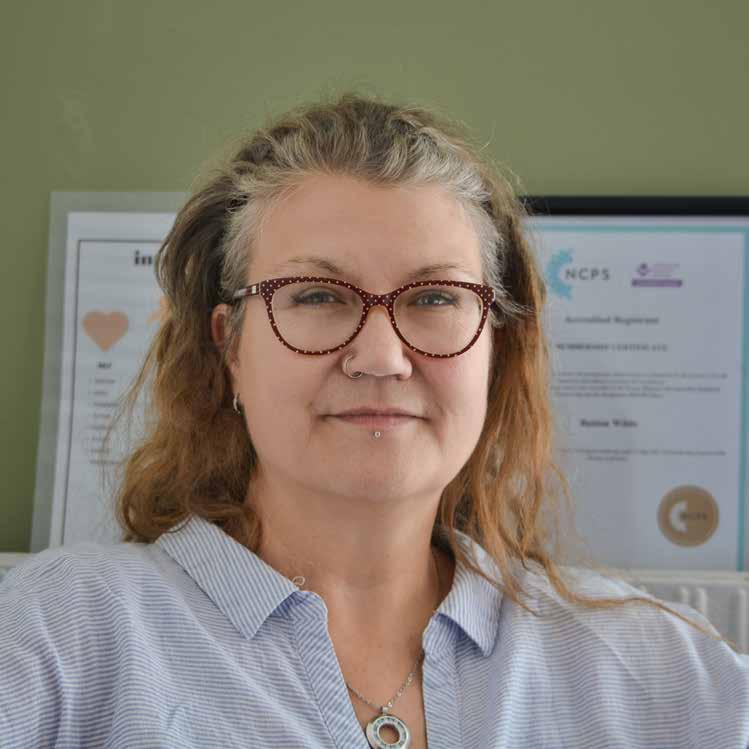
For Button Wilde, 2007 was the year everything changed.
Within a short space of time, her marriage had broken down, leaving her to face life as a single mother raising five children aged between four and eighteen. As if navigating the emotional and financial pressures of single parenthood wasn’t enough, Button then received devastating news that would test every ounce of courage she had left. She had been diagnosed with breast cancer.
It was the kind of diagnosis that stops time. Overnight, the everyday concerns of school
runs, household bills, and raising children were replaced by hospital appointments, chemotherapy treatments, fear, and uncertainty. Yet while cancer was attacking her body, life outside the hospital walls refused to pause. One of the most extraordinary chapters of this family’s story belongs to Button’s 17-year-old daughter. At an age when most teenagers are planning their futures, studying with friends and looking ahead to adulthood, she made a decision that would alter the course of her own life: she left her studies at West Suffolk College to help her mother.
Without complaint or hesitation, she stepped into a role far beyond her years, helping to raise her siblings while her mother fought for her life. It was a sacrifice born not from obligation but from love.
Cancer treatment is rarely a straightforward journey. It is physically exhausting, emotionally
draining, and mentally relentless. Every hospital visit brings uncertainty; every scan carries hope and fear in equal measure; every day demands courage.
For Button, those months became a battle not only for survival but for the future of the family she loved. Somewhere during that long journey, she found herself making a promise. She wasn’t praying in the traditional sense; she wasn’t certain whether she was speaking to God, the universe, fate, or simply some unseen cosmic force listening in the silence. But the promise was sincere.
If she survived, she would dedicate her life to doing good. She would help other people, and she would become the very best version of herself because, as she put it, “If I die right now, I will have nothing to put on my grave other than she died of cancer”. After nearly a year and a half of treatment, surgeries, recovery, and countless emotional hurdles, the clouds finally began to lift. Life didn’t instantly return to normal; perhaps it never truly could, but slowly, the family started rebuilding.
Button regained her strength and her daughter was finally able to return to West Suffolk College. She threw herself back into education and excelled. Not only did she complete her studies with outstanding results, but she later secured employment at the very college where she’d once paused her education to support her family. It was a full-circle moment that spoke volumes about perseverance, sacrifice, and determination. Yet another surprise was waiting: knowing her mother better than almost anyone, Button’s daughter quietly enrolled her on a counselling course.
At first, it may have seemed an unexpected suggestion. After everything Button had endured, beginning a completely new educational journey
might have appeared overwhelming, but then she remembered the promise she’d made during treatment.
What followed would transform not only her career but her identity. For five years, Button immersed herself in learning. She studied human behaviour, psychology, emotional wellbeing, trauma, relationships and therapeutic practice. It was demanding, challenging work requiring commitment, resilience and deep self-reflection; eventually, she graduated with a degree in psychotherapy.
For many people, a qualification is simply a certificate marking academic achievement; for Button, it represented something much greater. It represented survival. It represented finding herself again. Long before cancer entered her life, Button had struggled with her own mental health. Those battles had often left her questioning who she was, and where she belonged. Ironically, the illness that threatened to take everything away also became the catalyst for rebuilding her sense of self. Education gave her confidence, knowledge gave her purpose, and now knowing she had the tools to help people who had suffered as she had, it had given her a destiny. Instead of seeing herself solely as someone who had survived cancer, Button began to see herself as someone capable of guiding others through their own struggles.
With her qualification complete, another question emerged. Where next? Initially, she considered joining Macmillan Cancer Support. After all, she understood better than most what patients experience, not only physically but emotionally. She knew the fear that accompanies diagnosis and the loneliness that can accompany recovery. She also contemplated working with sex offenders. It might seem an unusual career path, but Button’s
reasoning reflected the compassion that had grown from her own experiences. She believed that understanding the roots of harmful behaviour might offer opportunities for rehabilitation, accountability, and ultimately preventing future harm.
But after careful reflection, her heart led her elsewhere. She realised her passion lay in helping ordinary people navigate extraordinary challenges such as anxiety, depression, loss, relationship breakdowns, trauma, confidence and self-worth. The kinds of struggles that often remain hidden behind everyday smiles.
In 2011, Button joined forces with several colleagues to establish a counselling service at Red Castle. Like many new ventures, it began modestly. There were no grand offices or lavish budgets, just dedicated professionals determined to make support more accessible to those who needed it.
As demand grew, so did Button’s confidence; eventually, she established her own independent private practice: The Norfolk Counsellor. It wasn’t simply the launch of a business. It was the fulfilment of a promise made years earlier in one of life’s darkest chapters; every client who walked through her door represented another opportunity to honour that promise.
But not just the promise; there was this part of Button that had always been missing since her childhood, and that was the ability to form raw human connections with people, and she has that now in spades. So much so that three of her regular clients have actually been with her since childhood simply because they feel this unbreakable connection with her and trust beyond all else.
At one time, Button was forced to take a two-
year absence to undergo further treatments; she was unsure if she would ever be able to return, but within just forty-eight hours of Button being back in the office, her clients were already flooding back in, proving she has a deeper connection with this community than she had ever dreamed possible.
Today, Button continues to welcome clients into her cosy office at The Riversdale in Thetford, where her work is driven not by prestige or recognition, but by a genuine desire to help people find hope when life feels overwhelming. Button is now in collaboration with Keystone; Keystone is a community resource charity working in Thetford, Brandon and Mildenhall areas. Keystone supports and delivers a diverse range of projects and services responsive to the needs of the local community; in Button’s case, they provide the workspace for Button free of charge so that Button can help trainee counsellors gain the hours required to qualify, thus helping provide an affordable counselling service for the local area.
Looking back, it is remarkable how one of the darkest periods of Button’s life became the foundation for everything that followed. A marriage ended. Cancer threatened to take her life. A teenage daughter sacrificed her own education to hold the family together. Yet from that pain emerged a woman who transformed her own suffering into a source of strength for others.
The promise she made during those long months of treatment was never about becoming successful or building a business. It was about making her life matter. It was about ensuring that, if she survived, she would spend every day trying to make someone else’s burden a little lighter. Nearly two decades later, that promise is still being kept.
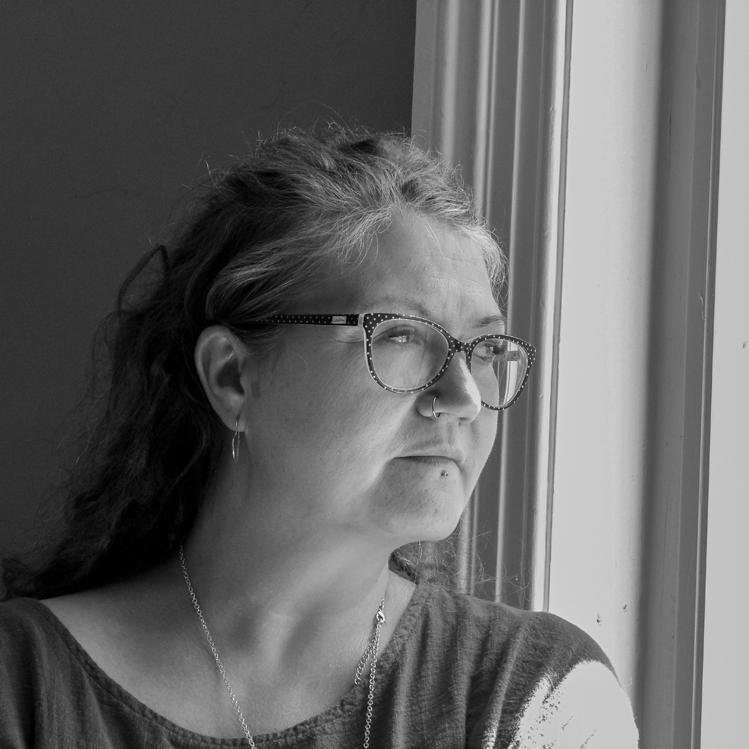
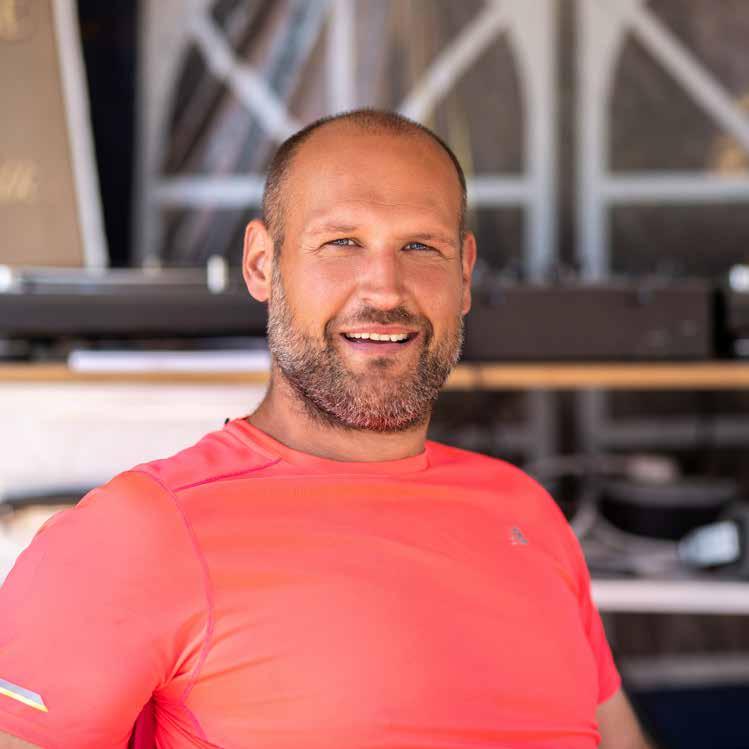
Written by Martin Angus
Whether you agree with him, disagree with him, or simply wonder what possesses someone to spend hours standing outside public buildings holding a homemade placard, chances are you’ve noticed zak.
Over recent years, he has become one of Thetford’s most recognisable campaigners. He has stood outside the police station, challenged councillors during public meetings, covered Station Road with handwritten displays and, more recently, established a prominent protest outside the former RAF camp at Barnham over proposals to accommodate asylum seekers. His face has become familiar to motorists, councillors, police officers and local residents alike.
For some, he is a determined activist willing to ask difficult questions. For others, he is a controversial figure whose opinions provoke strong disagreement. Either way, few people remain indifferent.
What interested me, however, was not another debate about the issues themselves. Those conversations have already filled council meetings, social media and countless discussions across town. Instead, I wanted to understand the person (“or corporation”, Zac gently corrects me), behind the placards. What kind of life produces someone prepared to stand publicly, often alone, expressing deeply held convictions regardless of criticism?
Meeting zak quickly reveals that interviewing him is unlike interviewing almost anyone else. Ask a straightforward question and the answer may begin in Thetford before travelling through education, philosophy, politics, technology and spirituality before eventually returning to where it started. His thoughts connect ideas rather than follow a straight line. Yet beneath the long explanations is someone entirely genuine in believing he is trying to do the right thing.

Born (or, in the words of Zak, when his birth certificate was born) and raised in Thetford, zak attended Red Castle Middle School before moving to Rosemary Musker High School. Conventional education, he admits with a smile, never really suited him.
“I was more up for mucking about. School wasn’t really for me.”
After leaving Musker, he transferred to Elm Road, where a more flexible timetable suited him far better. Looking back, he remembers the experience fondly.
“It was brilliant. I really enjoyed Elm Road.”
Art was the one subject he wishes had featured more prominently, and creativity remains an important part of his life today, whether through painting, designing protest boards or collecting music.
Music, in particular, remains a lifelong passion. Mention drum and bass or vinyl records and the conversation comes alive. He speaks enthusiastically about rave culture, garage, house, soul and classic pop, insisting that every genre contains both good and bad music.
House
72701

Friends from those years, he believes, would remember him less as an activist than as the joker in the group. Factory jobs rarely lasted long because of practical jokes rather than arguments, before he eventually trained as a painter and decorator. Self-employment suited both his practical nature and his independence, and several people I spoke to before the interview described him as an exceptionally hard worker.
Whatever else people may think of zak, laziness is not among the accusations.
Like many people, he describes it as a turning point, enquiries@angliahousebusinesscentre.co.uk www.angliahousebusinesscentre.co.uk
Then came 2020.
although his interpretation differs markedly from the mainstream narrative. He says he had already begun questioning institutions and modern technology years earlier, even giving up his smartphone in 2016 because he believed it was changing people’s relationship with the world around them.
Those private interests gradually became public.
“I wouldn’t actually say I’m political,” he tells me when I ask what first drew him into activism. “Politics is just one part of something much bigger.”
Throughout our conversation, he returns repeatedly to the belief that politics, banking, technology, food production and personal freedom are interconnected. Whether readers agree with those conclusions or not, there is no doubting the amount of thought he has devoted to them.
For zak, becoming publicly active was the culmination of years spent reading, watching discussions and questioning institutions. He describes 2020 as the point where private conversations became public action.
Much of that action began inside Thetford Town Council meetings.
Alongside others associated with Thetford Council Watch, he regularly attended meetings, questioned councillors and scrutinised local decisions.
“We’re just individuals,” he says, rejecting the idea that the group was a formal organisation.
From his perspective, the aim was simply to encourage greater transparency in local government. He believes public scrutiny should improve decision-making rather than be resisted.
Instead, relations became increasingly strained.



Arguments over filming meetings, procedures and unanswered questions convinced him that speaking inside the council chamber was no longer enough.
Social media, meanwhile, held little appeal. He believes online platforms increasingly control who sees what information, whereas standing in a public place allows anyone to engage.
That thinking gave birth to the placards.
“If you’re standing outside with a board,” he says, “the algorithms can’t stop that.”
Whether outside the police station, council offices or along Station Road, the handwritten signs became his preferred method of communication. One display outside his former home evolved into an ever-changing public noticeboard stretching across the property frontage.
Love them or loathe them, they became impossible to ignore.
Public criticism appears to concern zak surprisingly little. He readily admits there have been occasions, particularly during council meetings, when he could have handled situations differently.
“I couldn’t be right about everything,” he says.
That willingness to acknowledge imperfection sits alongside the certainty with which he expresses many of his wider beliefs, revealing someone rather more nuanced than his public image sometimes suggests.
Away from politics, there remains an individual who enjoys music, football, creativity and conversation. Friends, he believes, would still describe him as someone who likes making people laugh before calling him an
That contrast between public image and private personality is striking.
Most residents know zak only as the man with the placards, yet spending time with him reveals someone considerably more complex than any roadside sign can convey.
His current protest outside the former RAF camp at Barnham illustrates that point. He says his aim is not confrontation for its own sake, but maintaining a visible presence in the hope that decision-makers reconsider the proposals. He repeatedly stresses that demonstrations should remain peaceful.
Whether readers agree with his position or not, it is difficult to question his commitment. Maintaining a constant presence day after day requires determination few people would willingly embrace.
“I’m not doing it for my profile,” he says. “I’m doing it because I think it’s the right thing.”
Maintaining any public campaign inevitably comes at a personal cost. Time spent campaigning is time not spent working, relaxing or enjoying family life. Public visibility also brings scrutiny, and strangers often form opinions long before exchanging a word.
“You’ve got to have broad shoulders,” he reflects.
Some friendships have faded while others have strengthened. Strangers now stop to offer encouragement, ask questions or challenge him. His mother, he says, understands his determination even while worrying about him, while his brother remains less convinced, a reminder that even within families, people can see the world very differently.

Away from campaigning, he still talks enthusiastically about vinyl records, decorating, creativity and the importance of community. Again and again he returns to neighbours helping neighbours and people taking greater responsibility for the places they live.
Readers will undoubtedly agree with some of his observations while rejecting others. His interview contains views many would strongly dispute. Yet beneath those views lies a consistent motivation: he genuinely believes he is acting in the interests of future generations.
Towards the end of our conversation, I ask perhaps the simplest question of the afternoon. If he had just one minute with someone who fundamentally disagreed with him, what would he want them to understand?
His answer comes immediately.
Think for yourself.
Not necessarily to agree with him, but to ask questions, examine information critically and avoid accepting any single source without scrutiny. It is advice that, stripped of its wider context, many people across the political spectrum might endorse, even if they reach very different conclusions.
That distinction feels important.
It is easy to reduce public figures to caricatures. Protesters become “the angry one.” Councillors become “the establishment.” Campaigners become “the conspiracy theorist.” Labels often replace curiosity.
Yet conversations have a habit of restoring complexity.
Spending time with zak does not require anyone
to agree with his worldview. Nor should it. Healthy communities depend upon disagreement, evidence and respectful debate. They also benefit from understanding the people behind strongly held opinions rather than dismissing them as stereotypes.
As I packed away my recorder, I realised I had expected to write a story about protest. Instead, I had written about conviction.
Whether readers agree with zak’s views or reject them entirely, there is little doubt he believes them wholeheartedly. That conviction has carried him from council meetings to roadside protests and made him one of Thetford’s most recognisable local characters.
Perhaps his campaigns will change policy. Perhaps they will simply become another chapter in the town’s history.
Either way, he has achieved something many campaigners never do.
He has made people stop, think and talk.
For a magazine interested in the people who shape the character of Thetford, that alone makes his story worth telling.
Because behind every placard is a person, “or a corporation”, Zak gently corrects me again.
And every person (corporation) has a story worth hearing.
* zak chooses not to capitalise his name as a form of reclamation of his identity and to challenge societal norms regarding names and identity.
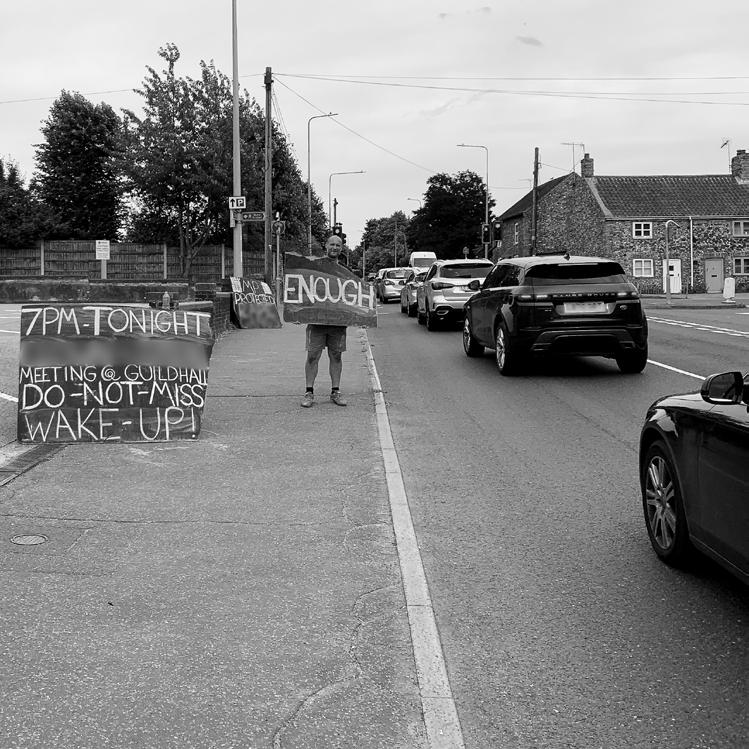
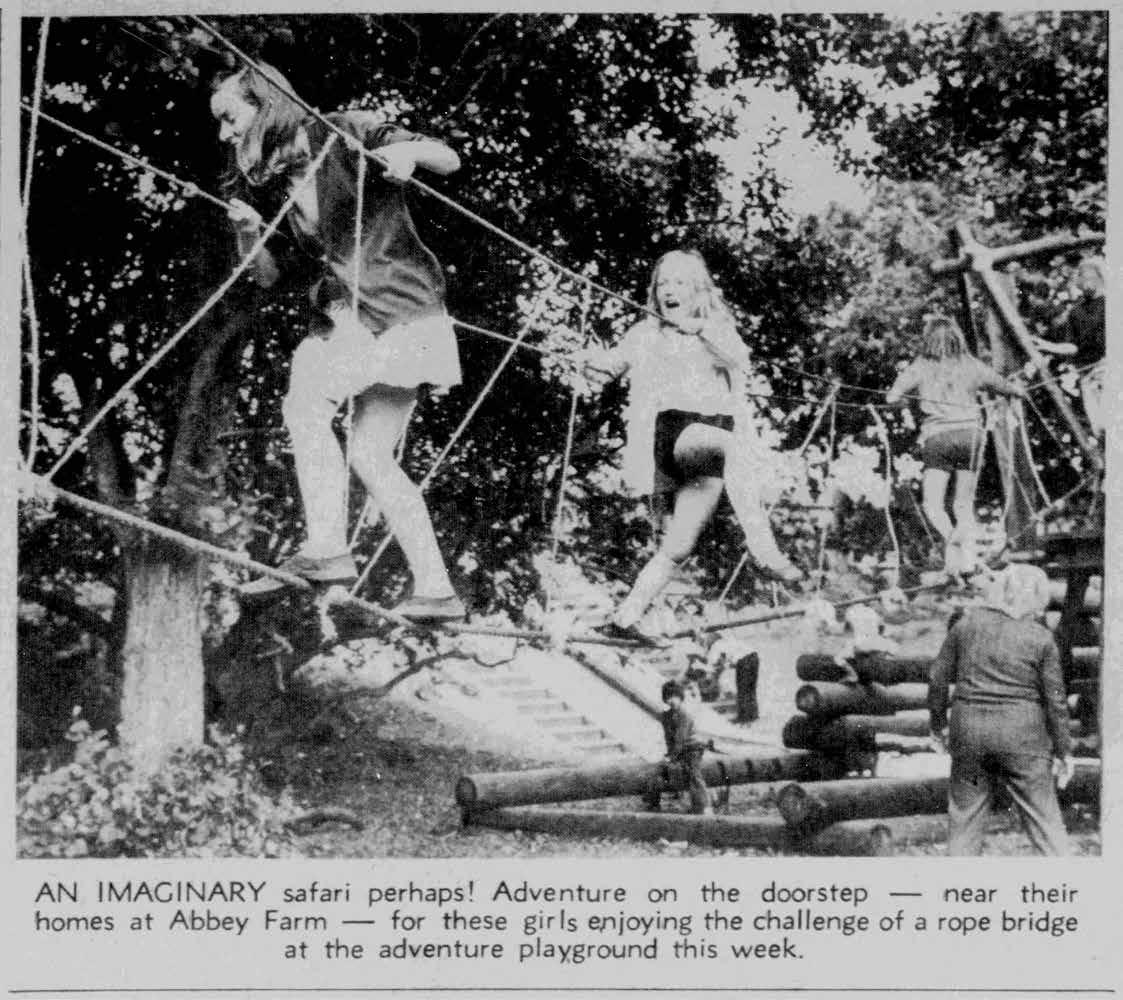

Let’s take a meander down memory lane, to the halcyon days of the early Seventies… to a carefree youth when ‘playing with your friends’ was not about deciding which Xbox game to play in an online chat room.
You’d grab your bike, if you were lucky enough to have one (a Raleigh Chopper if you were even luckier!), or maybe your football or bag of marbles, a bottle of pop and off you went with ‘be back for teatime’ ringing in your ears, go knock for your mates, and the world was your lobster.
But sometimes, that didn’t really cut the mustard. You’d get a puncture, or lose your ball in the bushes, or your ex-best friend would win all your marbles, and you’d end up kicking a tin-can or chucking stones in the river, and the perennial problem of boredom would set in.

Being a kid back then, playing out really did mean just that. For the most part, there was nothing tangible to do, other than make your own fun.
But in Thetford, all that changed in March 1972 with the opening of the Abbey Farm Adventure Playground, or as it would lovingly come to be known as, the Fort.
Long before it came to mean something else, the Rotary Club devised a scheme called Thetford Pride. It was introduced in an effort to encourage people to take more care of their surroundings.
That scheme came to fruition at a ceremony on Wednesday 22nd March 1972 to mark the grand opening of the Abbey Farm Community Centre and the Abbey Farm Adventure Playground.
In the Thetford and Watton Times of 24th March
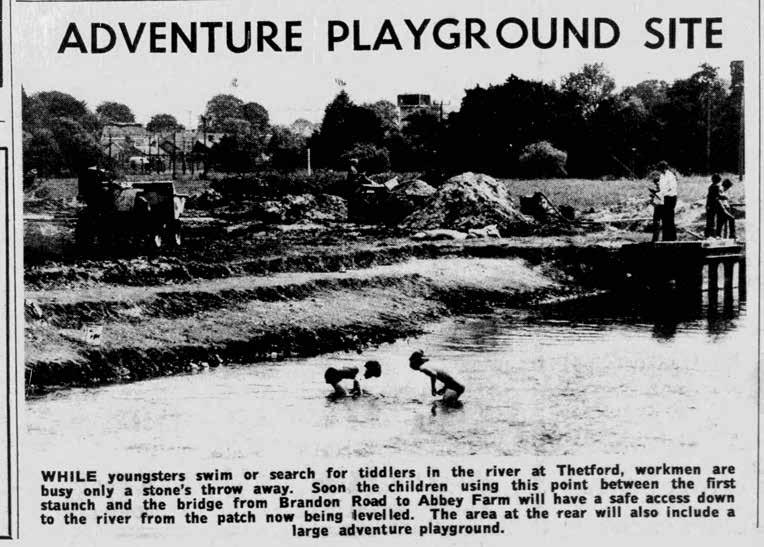
1972, the regular columnist ‘Black Friar’ commented on Thetford’s expansion agreement with London and how the completion of the Community Centre and the Adventure Playground made for a fitting climax, and that because it was new, the adventure playground stood out as the most exciting project.
From concept to creation, the process was quite drawn out.
The first mention I can find was in the T&WT edition of 2nd November 1968 when it was reported that the Thetford Town Development and Planning Committee had agreed to go ahead with two play areas on the Abbey Farm estate at a cost of £850 and £1500.
It wasn’t until almost two years later that the subject was again mentioned in the T&WT of 25th September 1970, but with the headline ‘Second
Thoughts On Play Area’ that said Thetford Borough Council was looking again at the plans for the play area, and that a GLC architect was to be asked to report to the Housing Committee about the possibility of providing a fairly large adventure playground in the open space to the north side of the Little Ouse. Members heard that this would include safety arrangements such as the erection of palisade fencing and modifications to the river bank.
Several months later, in the T&WT edition of 4th June 1971, it was reported that work on the Abbey Farm playground would likely start soon. This came hot on the heels of planning permission being granted earlier in the week.
Local residents attested to the fact that the playground was much needed to keep their children away from the hazardous areas around the estate. Mrs Weston cited the incident of her six-year-old
son Paul having to be rescued from a tree by 5 firemen!
And, sure enough, the work did start: a photo published in August ‘71 shows workmen levelling the area that would become the playground and steps to the river (image page 70).
The playground was ready by the following March, despite strong queries from the incumbent Mayor, Mr Leslie Broadhurst, as to whether £980 being earmarked for sport and leisure equipment for the playground in next year’s budget was really warranted.
But ready it was, and a thing of rugged beauty too. A strong wooden palisade topped by turrets and walkways to give it its ‘fort’ appearance, wooden decking-steps down to the river’s edge and even a moat. The large slide just inside the entrance was set into an embankment with steps cut into it to get to the top.
In later years, the slide would prove to be contentious, with many kids complaining that it burnt them due to it getting so hot in the sunshine and was ultimately removed.
The playground was completed and then officially opened on March 22nd ’72 by the mayor of the moment, Mr John Mayes, with a large crowd of dignitaries from Thetford and the GLC in attendance.
All that remained was to appoint an appropriate person to be the Play Leader.
This honour fell to a man from Corby by the name of Bill McKim.
Bill’s contribution to Thetford was immense and did Photographs
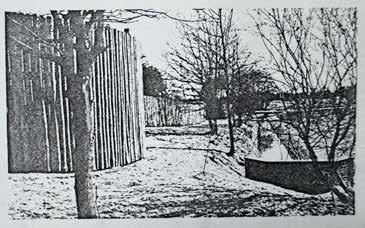
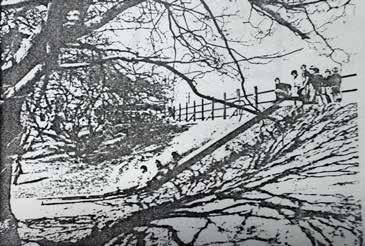
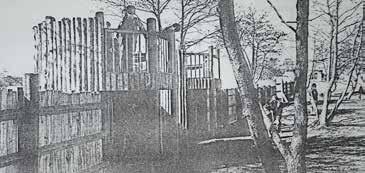
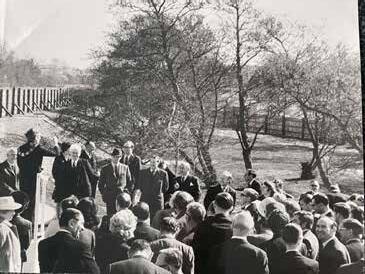
The playground was completed and then officially opened on March 22nd ’72 by the mayor, Mr John Mayes.
Photograph courtesy John Mayes
not stop at the Abbey Playground. I have written a separate article dedicated to him, so will not duplicate his background information here; suffice to say that for the purposes of this article, he was adequately qualified to take on this role!
He started in the role in the first week of April 1972 and was heralded in by the T&WT with the headline ‘Four Minute Miler is New Play Leader’.
Bill was a man driven by the urge to recognise and nurture the hidden potential in young people. To do that, his first task was to get the playground fully developed and establish it as a place where children could play in a permissive but supervised environment.
When he took it on, all that was in place was a small office and a toilet block, some swings, a big slide and the infamous witch’s hat, though one of the first things he did was to get the swings and the witch’s hat moved outside of the fencing as they were too dangerous inside.
His first interaction with the local press was to post a request for donations of rope, timber, old car tyres and anything else that could be used to make adventure equipment.
Much of the equipment and apparatus was built single-handedly by Bill. His daughter, Andrea, remembers him often coming home with red-raw and blistered hands, such was the effort he was putting into it (See image page 68).
By the summer, the playground was fully up and running. A whole range of special summer holiday activities were organised for Thetford youngsters by Bill. He’d also placed an ad in the situations vacant column for a part-time assistant play leader to help out during the school holidays, as his wife, Brenda,
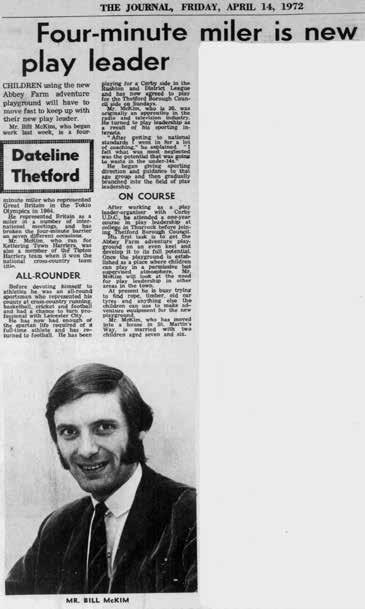
who had been helping out on a volunteer basis, would need time off during the holiday period to look after their own young children.
Football coaching sessions with an FA-qualified coach were arranged at a cost of 12½p, and there were also events such as a forest walk in Santon Downham, a tour of USAF Mildenhall, stock car racing at Snetterton and a trip to Yarmouth. Of the kids taken to Yarmouth, ten of them had never seen the sea before.
Bill felt these activities were an extension of a normal day at the playground in order to keep the children’s interests on activities other than those in their home environment. He thought that while they were organised and regimented at home and school, their ‘social education’ must have settings where they can be themselves and cope with situations as they arise.
All the while, the playground itself would remain open daily with supervision from 10 am to 9 pm with all kinds of activities available – such as aerial ropeways, climbing nets and structures along with creative work building things with tools and painting.
In April the following year (1973), plans were agreed for a wooden building for indoor activities at the playground. Subject to Department of Environment approval, the estimated cost was to be £4550, but a higher price was negotiated to build it ten feet longer in order to give 1000 square feet of indoor space for the kids to go wild in.
The hut did, of course, go on to be built, and Andrea was under the impression that the same wood as was used for the palisade was used for the hut. There was some undue criticism from town councillors over the way it had been built, but that didn’t stop the kids from playing table football,
table-tennis, darts and countless other indoor activities. Bill said, “The youngsters in the town have very little to do, but this age group has even less. They have had little or nothing provided for them until now.”
Around this time, Bill met with the BDC Recreation and Amenities Committee to provide an update on the goings-on at the playground.
He told them that in one evening he could be dealing with up to 500 youngsters at any one time in a shed on the Abbey Farm playground, with perhaps 2,000 to 3,000 youngsters passing through the centre during the course of the evening. He said the playground caters for nearly three times the number of youngsters as the youth club in town.
During the summer months he would often work 11 hours a day, seven days a week with only 3 parttime helpers, but he was firm in his belief, saying “The more we can do for these youngsters, the better it will be for the community as a whole. For these are the citizens of tomorrow.”
With each passing week and month, life carried on, and the adventure playground quietly served the purpose it was created for, still under the lead of Bill McKim.
It would occasionally get a mention for something or other in the press. There were regular columnists in the Thetford and Watton Times who wrote under pseudonyms. Two such regulars were Black Friar and Treetops. In an April 1974 edition, it was Treetops that wrote about an encounter he had that left him horrified when he came across no less than ten children aged between about 8 and 13, hitchhiking toward Thetford from Brandon.
Thinking they were going to the pool for the day as
they were clutching their towels and trunks, he gave two of them a lift and was soon informed they were all going to the ‘fortress-style’ playground on Abbey Farm. Apparently, many youngsters from Brandon used to venture over to Thetford to play in the fort, but these were taking the risk of hitching in order to save the bus fares, though their mums would kill them if they found out!
Treetops went on to suggest that something similar to Thetford’s fort play area should be built in Brandon, with the Country Park being the ideal site.
Then in August, it was the turn of Black Friar. In his comment, he admitted his reaction of extreme scepticism to the appointment of a play leader for the town was completely unfounded. He went on to praise what Bill McKim had done and is doing for the town, calling it something of the greatest value. Bill and his wife both put in prodigious hours every day of the week, and the benefit to the youngsters was large indeed, with his work bringing favourable comments from both inside and out of the town, and he certainly earns his salt for which we should be grateful.
Praise indeed! And just to reinforce this sentiment, the paper published a picture of a bunch of kids having fun with a large rubber tyre in the river by the playground.
The end of Bill’s leadership of the playground came in July 1975 when he departed the job to take up a position as Sports Officer at the Breckland Sports Centre in town, the very position he’d applied for a few years previously. He left with praise in his wake when the playground was commended by judges in the annual conservation awards sponsored by ‘The Times’ newspaper and the Royal Institute of Chartered Surveyors.
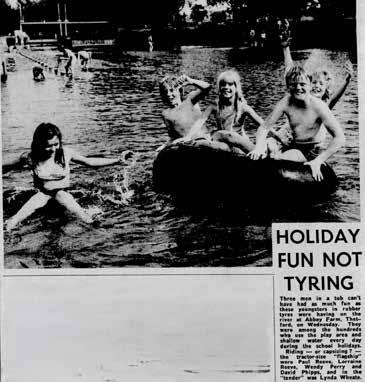
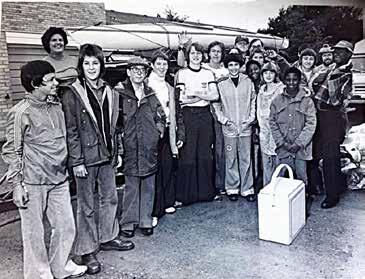
Bill’s contribution to getting the playground up and running, and his dedication to the welfare of Thetford’s youth, was immense and he left a lasting impression on many children of that time.
But the show had to go on, which it did, albeit rather falteringly for a short time. There was a period of a few months when it was uncertain who was running the playground.
Bill left in July, but the next (and only) mention that I can find of his successor was in the 5th September issue of the T&WT when a David Plummer, hailed as the ‘Abbey Farm Pied Piper’, was introduced as the new play leader. But that is all I’ve been able to find out about him. His tenure must have been very short-lived, and there is no mention of his departure or reason for it, but in the Christmas Eve issue of the newspaper, Dora Pullen is introduced as the new play leader!
Then, just six months later in the issue dated 18th June 1976, we get to meet Don Parkin, who took over the reins as the new Play Leader. In an interview with the paper, he was described as a lively 43-year-old with immense experience in physical education and outdoor activities. He spoke of mountaineering and a cross-Scotland canoe trip as being just two of the exciting projects that he’d like to involve children with, feeling that his job was to try and occupy local children with instructive and progressive play with a bias toward ecological and environmental studies.
The canoe trip is well remembered by many who went on it. I spoke with Alan Swaine about it, and he kindly let me have a photo of the group taken just before they went. The only names he could recall were Lorne Piggott (RIP), Mark Piggott (RIP), Steve Phipps, Gary Moore aka ‘Tank’, Michael Goodwin, Michael Piggott, Gary Tuson, and Ian Burris.
And so the playground went from strength to strength with a constant stream of kids through the doors, occupying themselves and having fun with everything that was on offer.
A zip wire was added at some point, and this proved to be very popular, especially during the school holidays.
With the earlier construction of the hut and the addition of more equipment, the playground had in part evolved into a kind of Youth Club, and this was obviously a big draw for the kids.
Later in 1976, more volunteer help was taken on. Alan Whitehurst became secretary of the newlyelected playground committee, and together they organised a coffee bar at the playground. Another volunteer was Assistant Play Leader, Dennis Piggott. He was responsible for building a disco unit, and there were regular disco nights after record decks and lighting were obtained.
May 1978 saw the introduction of three pool tables, kindly donated by Gordon Reid. The tables, having been vandalised in their previous locations, were soon repaired to a playable state by Dennis and Don and proved to be very popular, being played on from 10 am to 8 pm virtually non-stop every day! In September, the 1978 Abbey Farm Fort Pool Championship was won by 14-year-old Lorne Piggott, who beat 17-year-old Stephen Ball from around 100 entrants, to win a pool cue.
The summer of ’79 brought the first real signs of the troubles that would start to affect the fort through the 80s with a fire in August that badly damaged the roof of the hut, causing considerable heat and smoke damage inside and out. Activities were severely restricted, and many youngsters lent a hand in trying to clear up.
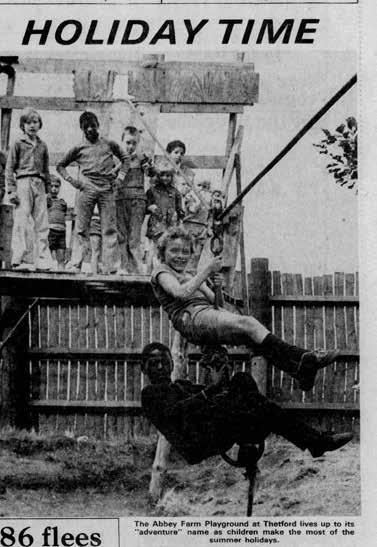
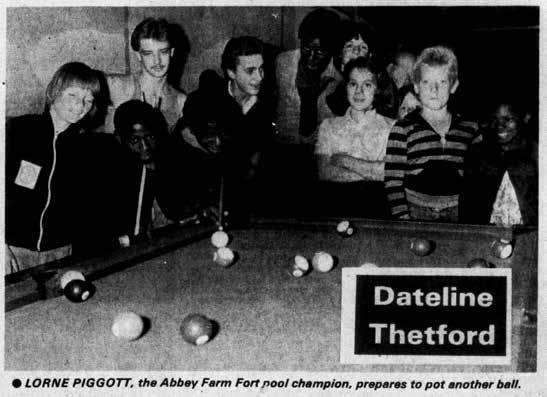
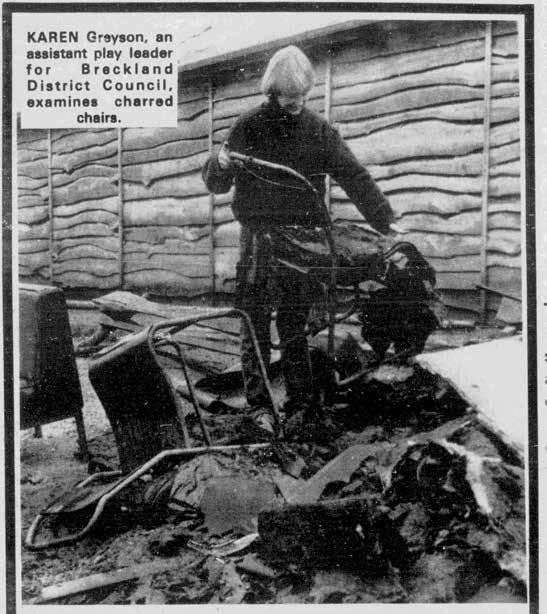
A couple of months later, and after three great years as Assistant Play Leader, Dennis Piggott decided to leave his role and move to Tower Hamlets in London to take over supervision of another playground. He was replaced by 17-yearold Karen Greyson, who had been going to the playground since she was 9 and had been helping out, on and off, for the last few years.
Fast forward a couple of years to May ’81, and the fort is again struck by disaster, though this time far more serious.
Another blaze, suspected arson, ripped through the wooden building, destroying almost all of the contents. A dejected Don Parkin was called out of bed early on a Monday morning to inspect the damage.
He said that obviously he would like to see it rebuilt, though the pragmatist in him recognised that it wasn’t going to be an easy job.
But forever the phoenix, and aided by much volunteer help and donations, the playground rose again and carried on, though the writing was on the wall.
By late 1983, much of the playground area and equipment was starting to show signs of its age, and it was reported that about 15 fifth-year pupils from the Charles Burrell High School began a project of replacement and rejuvenation of the site and apparatus. Don Parkin, now the BDC play adviser, kept a close eye on the proceedings which the youngsters were carrying out every Monday until the following Easter.
It soon became apparent that all the previous hard work would not be enough to deter the destructive intent of vandals, nor keep away the older,
troublesome element of Thetford’s youth who did not want to embrace the virtues so long extolled by the playground’s ethics and morals.
The T&WT reported in August ’85 that there were broken windows and doors off their hinges, which had been awaiting repair for a year. A council spokesman claimed not to know how long the problem had persisted and could only say it would be attended to when there was time.
The trend continued sporadically. Another report in April 1988 said there had been a break-in with tools stolen and damage caused to climbing and play equipment.
The final death knell came in September 1990. The T&WT reported that because of increasing vandalism to the hut, Breckland Recreation and Amenities Committee would be asked to make some sweeping changes at the next meeting.
The blame was pointed directly at the hut, claiming it destroyed the purpose of the playground and should go. It was attracting older teenagers, thus increasing vandalism and deterring the younger ones from using the area.
They noted that since it was closed after recent attacks, damage had slowed and the younger children and their mothers were gradually returning.
The committee would be asked to have the hut and all the fencing removed, the moat filled in and the whole area converted to one extensive play site.
It goes without saying that the committee agreed to the proposal. Black Friar took to his column again in October ’90 to lament the imminent disappearance of one of the biggest children’s play features produced in Thetford over the last 30 years.
While praising its early existence and visions, he too pointed a finger at the addition of the hut being the cause of the gradual decline in recent years.
But he lauded the fact that the idea of a properly landscaped and well-equipped play area was a pleasant one, taking the area back to the premise for which it was originally intended – that of use by the youngest members of the town.
And then it was gone.
All that remains now are the ingrained memories of thousands of Thetfordian kids who spent a wondrous childhood, enthralled by the wonders and activities to be found in an adventure playground and owed, in no small part, to the several Play Leaders, assistants and volunteers down the years.
And most of that was down to Bill McKim.
I think he can rest easy.
* * * * *
In researching this article, one of the first things I did was to write a post to three local forum pages on Facebook, to ask people to share their memories and knowledge of the fort and the play leaders.
And they didn’t hold back.
Here are just a few of the responses, in their own words, for the true measure of the Fort’s legacy lives on in the memories of those who played there.:
Susan Reeve
I remember Bill McKim. He was the person behind setting up the Fort - I can remember parts of it being created as we were already playing there. My brother Paul and I would spend all day, nearly
every day in the summer there, and the second staunch or the weir! I remember a coach trip to Yarmouth also being organised.
Bill McKim also represented Britain in the 1964 Olympics in Tokyo. I think he genuinely cared about providing a place where the kids in Thetford could play.
Debra Quick
Summer holidays spent all day there. Took jam sandwiches and crisps, then had a swim and caught fish in a net.
Great fun when kids played out in fresh air.
Good old days.
This was the early 1970s for me.
Ian Morrell
The fort was a great meeting place. It was like an adventure youth club with table tennis, zip wire and canoeing in the river on a Wednesday night with Martin Peston. Great fun back in the 70s.
Janet White
I remember falling from the monkey frame around 1976. The lady from the hut came running to me and took me into the hut to patch me up. I had a lovely scar on my forehead for months!
Dale Cooper
I can remember going to the fort in about 1978. They used to have a disco come youth club if I remember right. Always had a great time there.
Sarah Peacock
Such happy days.
Spent most of my childhood there and even met a girl with her brother who came from Stowmarket. We became pen friends.
We were lucky to have this adventure playground. Inside the fort there was a pulley that you would crash into an old mattress, and a wooden-built climbing frame and platforms.
The clubhouse with table tennis and sweets and treats to buy.
A drawbridge over the moat. Outside were the witch’s hat, swings and the slide. Then lovely wooden steps to take you onto the river to swim or take your fishing nets and bucket.
Rob O’Kane
Don, Karen, Mick Piggot and Steve Aylot - all cracking people who really made the place. Grew up there playing all the games people have mentioned. No health and safety at all, which made it even better. Headstands on top of poles, jumping off the roof onto smelly ole mattresses. Was a tremendous asset and kept loads of kids out of trouble.
Michelle Wells
Glad someone else remembered Don! He was such a nice man. I can remember him sorting the canoes out as well. He once even lent my parents his VW Beetle when their car was broken.
Mandie Pearl Mix
Me and my sis were just talking about the fort and the park and how, in summer, it would be packed with families wading in the river and having picnics with kids all over the fort. We want it back! I remember meeting there to go hiking in the Peak District with OUT AND ABOUT. So many excited kids and teachers! Seems there’s nothing anymore, but we had great times there.
Paul A Brown
Best thing ever growing up on Abbey Farm Estate! In the early days, Don would have a bonfire down at the bottom of the Fort, and we’d bring potatoes. The best part was all your friends and schoolmates getting on the log swing and seeing if we could get high enough to get over, and people jumping off when they’d reached their high limit. Great fun
inside the clubhouse playing darts, pool, table tennis, board games, or even getting on the river in one of the many canoes they had for you to use. Good days.
Janice Podd
I remember when it caught fire in 1981. We lived opposite, and the fire brigade was there all night.
Linda Bode
My children will remember it. It was a great idea when it was built, but after a while the bullies started taking over. There was mention of drug abuse in later years, and frankly it was a relief when it was demolished.
Stacey Tyler
I loved the fort. Best park ever. Falling in the moat off the moat swing, paddling in the stream further up, the island, having climbing competitions in the big trees, the clubhouse playing pool and hiring the canoes, the big slide, the witch’s hat. And spending many summers in the river on tyre inflatables, probably nicked from the tyre place by the station, sometimes lucky to have a tractor inner tube where ten of us could sit round floating down the river, jumping off into the dark unknown going under the weir, and catching catfish with our bare hands from under the rocks. Bloody loved growing up on Abbey Farm.
MissCee Atherton
I always remember the super long, steep silver metal slide that had so many steps on either side you’d race your mates up them. That slide got so hot in summer that it burnt your bum on the way down. The zip slide was great - that little wooden hut/ledge thing that you had to climb onto to set off from! It took you diagonally across the park. The canoes that you could hire to go into the river with, that were stored on the beams inside the
clubhouse that had table tennis tables in. And I remember it was all for free! Free for all!
Kim Hankin
Oh wow! Even now I talk about the days at the fort to my husband when summer was summer. You would go there with a picnic and the green would be packed out with people playing and paddling down by the steps, dodging all the duck poo, and the slippery steps holding onto the chains that looped across, because the big boulder stones were so slippery with green algae or your foot might slip in between the stones that you had to get over, to get where it was ok to walk and swim. The water was so clear you could see the little Nimos, as we would call them, as they darted about at your feet. Oh, the witch’s hat was just the best! Where kids could be kids and would all play together and let you join in, as it seemed that the more the better back then. I have many memories of each and every apparatus in that fort. And you never failed to come home without a bruise or a graze somewhere on you! They were the best days, as I remember them all and the fort so well as if it were only yesterday. Been nice to see some pictures and hear others with their stories.
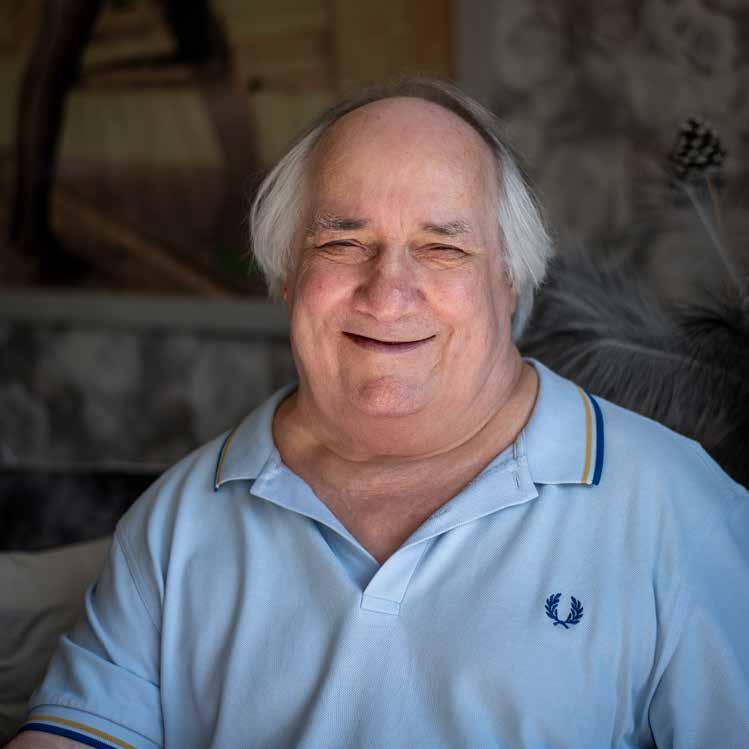
Written by Martin Angus
Every town has one. The bloke whose name still makes people smile before they’ve even finished saying it. The one whose stories have travelled further than he ever did, growing bigger with every retelling, until nobody quite knows where fact ends, and folklore begins.
In Thetford, that man is Ronnie Strutton.
Last time we spoke (Reflections of Thetford Magazine Issue 11), the stories came thick and fast: football, pubs, fights, practical jokes, stolen elephants and the characters who helped shape a town that now exists largely in memory. But underneath the laughter there were glimpses of something deeper, a restless young man who arrived from London carrying far more than anyone realised.
This time, we went back to where it all started.
Ronnie doesn’t remember London through famous landmarks or grand occasions. He remembers it through mischief.
“I nicked a scooter,” he says, laughing before the sentence has properly begun.
He was only eleven or twelve. Back then the old scooters had no ignition keys, so he and a mate simply climbed aboard one and spent an afternoon riding around west London until the police caught up with them.
“They stuck me in Notting Hill police station until my old man turned up. He came into the cell and started knocking me all round it before the sergeant pulled him off.”
It wasn’t quite the beginning of a criminal career, although Ronnie jokes that it might have looked that way at the time. A barrister called David Jakes, who knew him through the local rugby club, appeared in court to represent him free of charge. Instead of punishment, the young Ronnie was taken away for a weekend in the countryside, picking apples and climbing trees under the watchful eye of a man determined to steer troublesome youngsters towards a better path.
“It was lovely,” Ronnie says. “Never saw him again after


that, but he was a lovely man.”
Whether it changed anything is another matter.
“There were plenty more after that,” he shrugs.
Home life wasn’t easy.
His father worked as a coalman for North Thames Gas Board, while his mother spent periods working but was mostly at home. Ronnie speaks about them without bitterness, but equally without much warmth.
“I never really got on with either of them.”
There were moments that stayed with him.
His uncle, another coalman, would take him out on deliveries, letting him keep a share of the tips.
“I’d come home black as anything,” Ronnie laughs. “But my uncle always shared what he’d earned.”
His father rarely watched him play football as a youngster.
“He never came to watch me. Not until people started saying I was half decent. Then all of a sudden they started turning up.”
One memory still makes him shake his head.
“I played one game wearing my sister’s blue socks because they wouldn’t buy me a pair.”
They’re tiny details, almost throwaway remarks, but together they sketch the picture of a boy who learned early not to expect very much.
Instead, much of his education came elsewhere.
to school and riding with local rag-and-bone men through the streets of west London.
Everybody knew everybody.
Everybody seemed to know somebody who’d been inside.
“There were thieves everywhere,” Ronnie says matter-offactly. “People nicked bikes, stripped them down, sold the bits. That was just normal where we lived.”
Yet, for all the rough edges, he insists there was pride.
“We never had much, but our house was always spotless.”
He still owns two small ornaments that sat in the family home throughout his childhood, ordinary ashtrays to anybody else, priceless reminders to him.
“They’re about the only things I’ve got left.”
Growing up around colourful characters also meant growing up around extraordinary stories.
One uncle spent years in prison.
Another relative became well known on Portobello Road, where members of the family traded antiques for decades.
His grandfather, long after retirement, worked market stalls and remained such a formidable character that police officers struggled to believe complaints involving a pensioner who looked incapable of causing trouble.
“He was built like me,” Ronnie grins. “One copper turned up after he’d had a fight and just looked at him and said, ‘I don’t believe this.’”
The stories tumble into one another without warning.
He remembers jumping onto the back of dust carts for lifts
One minute Ronnie is describing visiting Wormwood


Scrubs prison as a child.
The next he’s remembering his sister attending an openair school because of her asthma.
Then he’s laughing about smoking cigarettes with both parents independently telling him, “Don’t tell your mum,” or “Don’t tell your dad.”
Looking back now, he recognises how strange some of it sounds.
“That’s where I got smoking from.”
Eventually, his parents decided enough was enough.
The family left London for Norfolk, hoping a quieter life in Thetford might steer their youngest son away from trouble.
“It didn’t work,” Ronnie laughs.
“I got into trouble straight away.”
The move itself wasn’t easy.
His older brother returned to London after only a few months.
Ronnie stayed.
Slowly, almost without noticing, Thetford stopped feeling like somewhere he’d been brought to and became somewhere he belonged.
That happened because of friendships.
Some friendships stretch back more than sixty years.
Others were forged during football matches, over pints in local pubs or simply through growing up together in a town
where everybody eventually crossed paths.
One friendship, though, stands above the rest.
Years ago, Ronnie and his first wife lost a baby only days after birth.
In the middle of the night, unable to find a taxi, Ronnie walked to Grassy’s house and knocked on the door.
His friend’s mother answered.
Within minutes, Grassy was awake, dressed and driving him to Brandon.
“He stayed with me,” Ronnie says quietly.
“He didn’t have to. He just stayed.”
It’s one of the few moments during several hours of conversation where Ronnie pauses before continuing.
For all the jokes and larger-than-life stories, it’s clear those acts of quiet loyalty have never been forgotten.
“That’s when you know who your mates are.”
The friendships survived marriages, children, changing jobs and advancing years.
They also survived countless disasters, some tragic, many ridiculous.
When Ronnie and Eve married in 1991, they did so in fancy dress.
He arrived as Prince Charming.
She came as Cinderella.
Ronnie and Eve’s fancy-dress wedding remains one of the
town’s better-known celebrations, helped considerably by the now-infamous wedding video.
A friend had volunteered to film the day.
Unfortunately, he also managed to record over part of the tape.
“When the family sat down to watch it,” Ronnie says, “the first thing that came on wasn’t our wedding.”
“The first thing everyone saw,” Ronnie laughs, “was somebody else’s adult film.”
The horrified silence that followed lasted only a few seconds before everyone erupted with laughter.
“We never let him forget that.”
It’s exactly the sort of story Ronnie loves.
Nobody gets hurt.
Nobody comes out looking particularly clever.
Everybody laughs.
That, perhaps more than anything else, explains why Ronnie remains such an enduring character.
His stories are rarely about himself being the hero.
More often, they’re about ordinary people stumbling into extraordinary situations and laughing their way back out again.
If London gave Ronnie Strutton his hard edges, Thetford gave him his people.
Ask him when the town finally felt like home, and he doesn’t mention a particular street, football match or first job.
Instead, he starts reeling off names.
Tony “Grassy” Greeno.
Doug Nimmo.
Bill Bailey.
Donut.
Riggsie.
Terry Lumley.
Some have gone. Others are still around. But all of them occupy permanent places in Ronnie’s memory, each attached to another story that still makes him laugh decades later.
“They weren’t just mates,” he says. “They were family.”
That loyalty runs through almost every tale he tells.
One of his favourites concerns Terry Lumley, a man Ronnie insists could create chaos simply by walking into a room.
One day, while travelling together after Lumley had enthusiastically sampled some cheese soup from a vending machine, events took an unfortunate turn.
According to Ronnie, Lumley suddenly realised he wasn’t going to make it home.
“He said, ‘I’ve got to go!’”
What followed has become one of Ronnie’s favourite stories to tell. Lumley disappeared behind some nearby houses in desperate search of privacy before returning, red-faced and defeated.
“He got back in the car,” Ronnie laughs, “and the smell... I’ve
never smelt anything like it.”
Ronnie claims he spent the journey home hanging as far out of the window as possible before escorting his mortified friend back to the house, where his wife was waiting with a dressing gown held out at the end of a broom handle.
“He tried to bribe me not to tell anybody,” Ronnie grins.
“I was always going to tell everybody.”
Years later, he’s still laughing before he reaches the end of the story.
Lumley appears repeatedly throughout Ronnie’s memories.
There was the day they bought a cheap car from an auction simply to drive home. It looked dreadful but seemed mechanically sound, until they decided to give it a quick wash.
“The rollers started going over it,” Ronnie remembers, “and the car literally started coming apart.”
Two French hitchhikers they’d picked up moments earlier watched in horror as welds split apart, the girls became soaked under the pressure of the car wash.
“We’re laughing,” Ronnie says.
“They weren’t.”
Another time, after buying yet another bargain vehicle, they were stopped by a police sergeant who pointed out that the tax had expired months earlier, several lights didn’t work and neither did the horn.
Lumley simply wound down the window and made the horn noise himself.
“’Honk! Honk!’”
To Ronnie’s amazement, the officer burst out laughing and waved them on.
“Go on,” the policeman reportedly said. “Off you go.”
Ronnie still can’t quite believe they got away with it.
If Lumley specialised in accidental comedy, Donut specialised in planned chaos.
One summer afternoon at Methwold village fete, a collection was taken after someone jokingly challenged Donut to run naked across the football pitch while parachutists were due to land.
“He said, ‘That’ll do,’ and off he went.”
Halfway across the pitch, a policeman emerged from a blue van and gave chase.
According to Ronnie, Donut escaped, was eventually caught, escaped again, and somehow managed to end the day at the police station before Ronnie accidentally discovered the keys left in his own cell door.
“I let Donut out.”
Instead of making a run for freedom, the pair calmly sat in another room waiting for the officer to notice.
“When he came back,” Ronnie laughs, “he couldn’t work out how we’d done it.”
The poor officer was apparently more worried about explaining the missing keys than chasing two mischievous prisoners.
Some stories only become funnier with time.
The humour wasn’t always elaborate.
Sometimes it was simply the result of Ronnie’s ability to wind people up.
He remembers one neighbour whose bedroom noises were carrying rather further than intended.
Borrowing a ladder from Doug Nimmo, Ronnie climbed up to the bedroom window.
“I shouted, ‘Oi! Keep the noise down!’”
Doug, waiting below, could barely stand up for laughing.
“They said they never heard another sound after that.”
For Ronnie, those moments summed up life in Thetford.
Everyone knew everyone.
Embarrassing moments travelled faster than the evening paper.
No story stayed secret for very long.
Yet beneath all the practical jokes lies something more revealing.
Ronnie repeatedly returns to loyalty.
He talks warmly about Terry and Pam, who still make time for him today.
He smiles when describing Bill Bailey, whose family had very little growing up but built successful lives through hard work.
He speaks fondly of neighbours who simply walk through the front door without knocking.
“Our door’s always open.”
On Mondays one friend visits.
On Tuesdays another.
The children call during the week.
Saturday brings another familiar face.
“It’s how it’s always been.”
For Ronnie, friendships were never measured by grand gestures.
They were measured by who turned up.
Who drove you somewhere when you needed them.
Who made you laugh after a bad day.
Who was still sitting beside you fifty or sixty years later.
That, more than any fight, prank or outrageous tale, may explain why Ronnie Strutton’s name still means something in Thetford.
The stories are funny.
The friendships are what made them worth telling.
Spend enough time with Ronnie Strutton, and you begin to notice something.
For all the stories about pubs, punch-ups, practical jokes and impossible scrapes, the conversation always finds its way back to people.
Not the famous ones.
Not the toughest.
Just the people who stayed.
The landlords.
The rugby players.
The neighbours.
The friends who still call in every week without knocking.
“Our door’s never locked,” Ronnie says.
“Only when we go to bed.”
It’s a sentence that says as much about him as any of the outrageous tales that came before it.
Old mates still appear for a cup of tea, a bacon roll or simply a chat.
Half of them walk straight to the fridge without asking.
“I like it like that,” Ronnie says.
“It’s always been like that.”
His wife Eve smiles.
“They just walk in and help themselves.”
After thirty-five years together, they’ve developed the easy rhythm of people who’ve laughed through almost everything life has thrown at them.
Eve admits that, when they first met, Ronnie’s reputation worried her.
Women seemed to know him wherever they went.

People greeted him in every pub.


She couldn’t quite understand it.
“I used to think, ‘What’s going on here?’”
Now she laughs about it.
“People still stop me now and say, ‘Say hello to Ronnie.’ Half the time I don’t even know who they are.”
Ronnie’s reputation has travelled far further than he ever expected.
Publicans who have never met him know the name.
People still remember stories from forty years ago.
Some are true.
Some have undoubtedly improved with age.


At NMV Sweet & Savoury, we create stunning wedding cakes, birthday cakes, and custom cakes for any occasion. Our menu also includes French mousse mini cakes, desserts, and appetizers, perfect for adding a touch of elegance to your celebration. Delivery available.
Visit us online: www.nmvsweetandsavoury.co.uk Follow us on social media: Facebook @nmvsweetandsavoury
Instagram @nmv_sweetandsavoury 07936 612846
He seems perfectly happy for others to decide which are which.
What matters more is the affection behind them.
“People know I’m only joking.”
Eve agrees.
“He takes the mickey out of everybody, but he doesn’t mean anything by it.”
She pauses before adding something much more important.
“He has never laid a finger on me.”
She speaks openly about an abusive relationship before Ronnie entered her life and says she sometimes struggled to believe someone could simply walk away from an argument.
“I’d lose my temper,” she says.
“He’d just say, ‘Finished?’ and walk off.”
Ronnie shrugs, almost embarrassed by the praise.
It isn’t bravado.
It’s simply who he is.
There are moments during our conversation when the laughter fades.
Asked about fatherhood, Ronnie becomes unusually reflective.
“I wish I’d spent more time with my girls.”
He admits he was out drinking far too often when they were growing up.
Football.
Rugby.
Pubs.
Friends.
Life moved quickly.
Looking back now, there are things he wishes he’d done differently.
“I wasn’t much of a dad then.”
There is no attempt to excuse it.
No blaming anybody else.
Just honesty.
“But they’re good girls.”
His pride is obvious.
One lives in America.
Another visits every week.
None caused trouble growing up.
“They’ve all turned out alright.”
It’s one of the few times during the afternoon where Ronnie’s voice softens completely.
Old age has brought its own challenges.
He now talks matter-of-factly about his health, hospital appointments and living with leukaemia and lymphoma.
There is no self-pity.
He tells the story in exactly the same tone as he describes broken-down cars or disastrous lock-ins.
“It’s there,” he says.
“They’ll deal with it if they have to.”
Even illness becomes another chapter rather than the whole story.
What seems to matter far more is that people continue to look after each other.
Friends arrive with pie and mash.
Neighbours cook meals.
Old rugby mates still ring to check he’s alright.
“If you need anything…”
He says he hears those words a lot.
He’s grateful for everyone.
Perhaps that’s why Ronnie never speaks about popularity.
Instead he talks about loyalty.
About the people who stood beside him after personal tragedies.
The friends who stayed long after the pubs closed.
The neighbours who became family.
The people who still make him laugh.
“I’ve got good mates.”
He says it several times.
Almost as though he still can’t quite believe his luck.
Ask Ronnie how he’d like people to remember him, and he doesn’t talk about football medals, rugby, pubs or even the legendary stories that have followed him around Thetford for half a century.
“I know I’ve been a nuisance,” he says with a grin.
“But if somebody needed help, I’d help them.”
That is probably as close as you’ll get to Ronnie Strutton writing his own epitaph.
Spend five minutes with him, and you’ll hear a funny story.
Spend an afternoon with him, and you’ll hear dozens.
Some are outrageous.
Some are unbelievable.
Some become funnier every time they’re told.
But somewhere between the laughter, the one-liners and the memories of a Thetford that has largely disappeared, another picture slowly emerges.
A London boy who arrived in Norfolk with very little.
A footballer who became known in every pub in town.
A prankster who somehow accumulated lifelong friendships instead of enemies.
A husband who still makes his wife laugh after three and a half decades.
A grandfather who now measures his wealth not in money, but in the number of people who still walk through his front door.
By the time the recorder is switched off, Ronnie is already remembering another story he forgot to tell.
There is always another one.
There probably always will be.
After all, characters like Ronnie don’t need to invent good stories. They just have to remember them. And if you’re lucky enough to pull up a chair, he’ll happily tell you another.
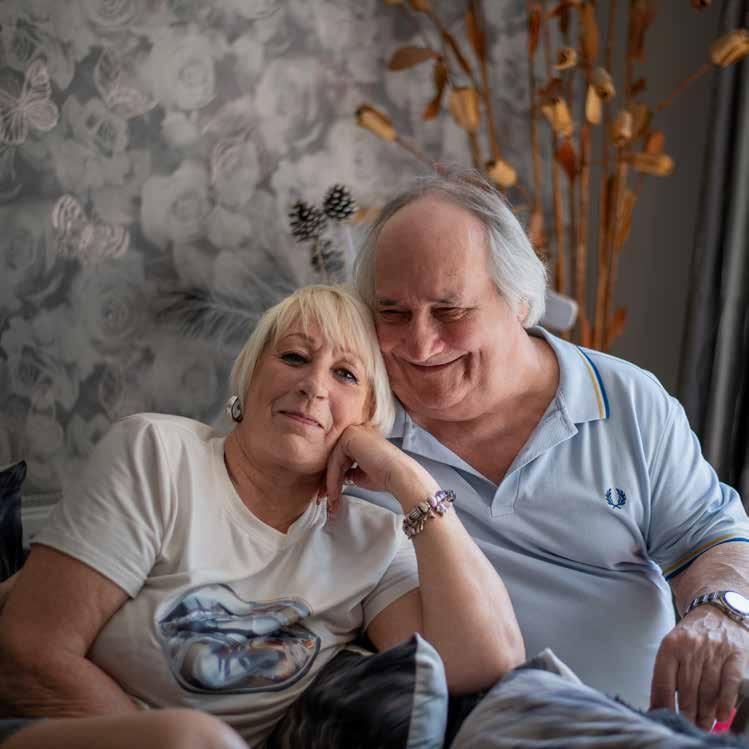


Written by Liz Gibbons
The riverbed dropped away beneath her feet, and Boudica struck out into the deeper water. The journey to Theodford had been arduous, and it felt good to stretch her long limbs at last. She dived beneath the surface into the cool embrace of the River Thet. Boudica’s long auburn hair billowed about her, drifting upward like a great crown of living fire. For a moment she remained suspended there, weightless and free, before rising once more into the light. When she emerged, the women of the Iceni tribe were waiting for her on the riverbank.
Boudica returned to the shallows before stepping from the purifying waters. As the river left glistening trails upon her naked skin, a warm breeze stirred. Its gentle caress carried the quiet certainty of divine presence, as though the gods were breathing ancient secrets into the world.
The tribal women gently squeezed the river water from her hair and dried her with soft linen. Fingers were then dipped into small clay bowls as they anointed her with scented oils. Boudica was then dressed in flowing white
and draped in a deep blue robe that set her auburn hair ablaze with colour. Boudica’s father had gifted new clasps as a marriage gift, and the tribal women pinned them to her robes. Once she was ready, they settled her beside the river and stepped back, heads bowed in reverence.
A respected member of the Iceni tribe, known as an Elder named Aislinn, moved forward and began to braid Boudica’s hair. In a wavering, melodic voice, she sang an ancient blessing to the goddess. Her hands were practised and gentle, and beneath their touch Boudica found herself drifting into a dreamlike calm. She gazed at her reflection in the gentle flow of the river as Aislinn worked. Symbolic treasures were woven into her long braids: white swan feathers for purity, blue and amber beads for wealth, prosperity, and good fortune, and slender bands of gold to signify her nobility.
When the song ended and Aislinn fell silent, Boudica realised it was her chance to ask the question that had been on her mind ever since her father had announced
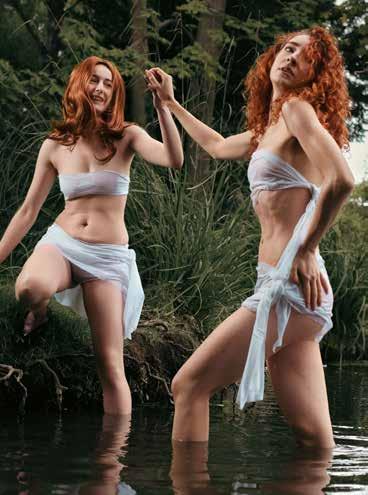
When she emerged, the women of the Iceni tribe were waiting for her on the riverbank.
her betrothal.
“Great Elder, tell me about King Prasutagus. What manner of man is he?”
“Please, call me Aislinn, my Lady.” The woman’s hands did not stop braiding as she asked, “Your father, leader Scienu, did not speak to you of this?”
Boudica let out a laugh. “My father helped the King quell a rebellion and continue diplomatic relations with Rome. I do not believe trivialities such as the nature of a man would have crossed his mind.”
A faint smile touched Aislinn’s lips. “The King saw you once, you know, when he visited your father.”
Boudica frowned. “He did?”
“The King told me so himself,” Aislinn said. “The lady with hair of fire. That is what he called you.”
A flicker of surprise passed through Boudica. She remembered the King’s visit but had thought herself unnoticed. The King’s appearance had surprised her; he wore no beard, instead opting to be clean-shaven, a Roman fashion that shortly after the meeting her father had also adopted. Her reverie was broken as Aislinn continued.
“Our King is a wise man,” Aislinn said, her fingers never ceasing their work. “He knows the old stories and remembers the names of those who came before us. He walks the sacred groves and honours the gods with proper offerings. He knows the courses of the rivers, the signs of the sky, and the turning of the seasons. When disputes arise, all seek his judgement. When counsel is needed, they seek his voice.”
Boudica smiled faintly at her reflection in the water. “Then he is a man who knows much.”
The woman’s hands still, hearing something in Boudica’s tone. “I do not know you yet, my Lady, but I sense that you are one to speak your mind, and yet you withhold it now.”
Boudica laughed at the Elder’s unexpected candour. “My father and mother raised me well. I sat in council and was asked for my opinion. I know my people, their labours, their hardships, and the lands they call home. I know of the trade between our tribes and the peoples across the sea, and of all that is done to appease the Romans.”
A trace of bitterness had crept into her voice, and Boudica quickly suppressed it.
“Do not doubt that I will come to know my husband, the King, and that I will strive to be a good wife and Queen.” She paused, the words catching unexpectedly in her throat.
Aislinn waited patiently.
“There is simply so much to learn,” Boudica admitted at last. “I only hope that I will be worthy and meet the King’s expectations. It is my fervent wish for the Iceni tribe to see me as one of their own.”
Aislinn fastened the final gold clasp into the braid and moved round to face her, resting her hands upon Boudica’s slim shoulders.
“Do not let this seed of doubt grow and suffocate you. I see strength in you, Boudica, tribal daughter of the Trinovantes. The gods have set your feet upon this path. I see that there is fire within you”
The older woman’s hands release the soon-to-beQueen. Her gaze goes out of focus, and her next words take on a different tone, “Hold fast to that fire. There will come a day when your people shall have great need of
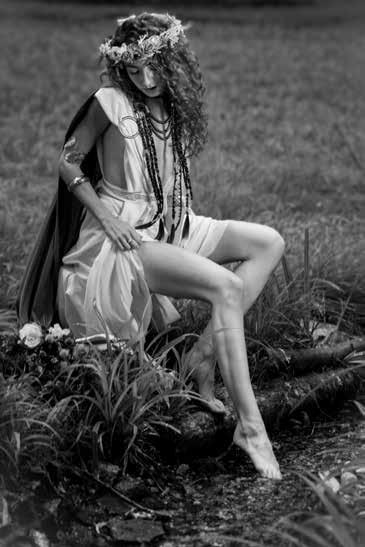
Boudica was then dressed in flowing white and draped in a deep blue robe that set her auburn hair ablaze with colour.
it.”
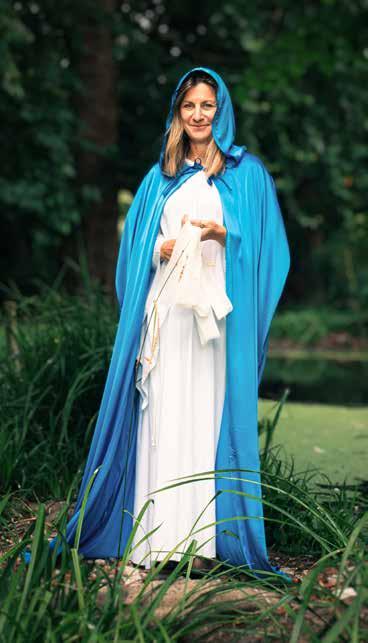
A chill prickled across Boudica’s skin. “You speak words of prophecy?”
The Elder inclined her head, her golden hair catching in the light. “I listen when the gods whisper. Sometimes they choose to speak through me.”
Both women remained still, as if sensing the solemnity of the moment. Even the river seemed to have grown quiet as it continued to flow beside them. Then Boudica rose and offered Aislinn her hand. The older woman accepted it, but once she stood, she did not immediately release her grip. Instead, her gaze met Boudica’s own.
“You shall be revered, my Queen.”
Boudica smiled. “I am not your Queen yet.”
“Not quite,” Aislinn conceded. “But I still speak the truth.”
Two young women approached, heads respectfully bowed and announced, “Your vessel awaits, my Lady; the river will carry you to the King.”
Boudica allowed herself to be guided and helped into a small boat. Once she was seated, a flaming torch was handed to her.
“May this flame light your way, and the river bear you to the destiny that awaits you.”
“Please, call me Aislinn, my Lady.”
The boat’s tether drew taut, carrying Boudica steadily across the River Thet. The current slipped silently beneath her as the opposite bank drew ever closer. Already she could see deep earthen ditches hewn into the landscape and, set between them, a couple of roundhouses. Boudica knew she had not been brought to this place by chance, for everything was symbolic and held meaning. She had left behind the unadorned
riverbank as a betrothed woman, vulnerable despite her noble birth. Here, within the King’s lands, she would become wife and Queen of the Iceni tribe, where she would be protected by King Prasutagus as well as the strength and ingenuity of her new people.
At last, the boat reached the opposite bank. Keeping the torch held aloft, Boudica stepped carefully ashore with assistance from the waiting attendants. Her family was there to greet her, their smiling faces bathed in the flickering torchlight.
“Blessings upon you, my daughter,” said her mother as she bestowed a kiss on her forehead.
Her father clasped her free hand, pressing something metal into it. As Boudica looked down, she saw that it was a golden brooch, depicting a galloping horse with bright azure stones for eyes.
“For the fire. For the gods.”
Boudica dipped her head in thanks. It was unlike him not to say more, and she wondered at it only briefly before herself and her family were helped into the wagon. From her new vantage point, Boudica admired the way the river had been incorporated into the settlement’s defences. It formed a natural barrier on one side, as well as the immense labour that had gone into digging the encircling ditches and raising the earthen ramparts.
When the wagon moved away, they passed through the main gate, where a sturdy oak palisade guarded the entrance. Then they continued along winding tracks that meandered between scattered roundhouses, through clusters of trees, and beside fields of freshly tilled earth.
Behind them, the rest of the tribesfolk followed in procession. When neither her mother nor father spoke, Boudica asked, “Is all well, father?”
He nodded, looking all around him. “This will be a fine home for you, my daughter. The gods have favoured this place with fertile fields and thriving trade, and its defences are as strong as any in the land.”
Boudica leaned back, observing him, waiting for him to say more. When her father was not forthcoming, she prompted him. “You think well of King Prasutagus also?”
Her father’s grey eyes settled upon her, steady and reassuring. “Daughter, you must know that I would never give you to a man whom I did not believe to be worthy of you.”
Relief loosened something within Boudica’s chest.
“He is a good ruler, a respected King. More importantly, he will value your counsel.” Her father leaned forward, mindful of the flaming torch clasped in his daughter’s hand. “You will not stand behind him, Boudica. You will stand beside him.”
Emotion tightened her throat unexpectedly. How long had she feared becoming little more than a political arrangement, a bargaining piece? Yet hearing her father speak now, Boudica understood there had been more consideration than she had realised. This marriage would strengthen both tribes, trade would continue to flourish and prosper, but it was not merely politics. Her father truly believed she belonged at the King’s side, and somehow that mattered more than anything else he or anyone else could have said.
As they had been talking, the incline had grown steeper, forcing Boudica and her family to brace against the wagon’s sides. After what seemed an age, the horses crested the hill, and they were back on level ground once more. When they halted, Boudica released a breath she had not realised she had been holding. Before them stood the grove, where oak posts marked the boundary of the sacred place. Beyond them, the unmistakable

glow of firelight. Boudica descended from the wagon, and with the flaming torch held aloft, she led her family and the procession into the enclosure.
Throngs of tribesfolk were already there, likely to have helped with preparations for the ceremony. Despite herself, Boudica’s eyes flicked in every direction, taking in the many roundhouses and the impressive temple, double the height of a man. It was far grander than she had imagined.
The scent of woodsmoke, crushed herbs, and roasting meat drifted enticingly on the breeze. Boudica’s gaze swept across the bustling enclosure until her eyes alighted upon the great sacred fire. For there, standing just beyond it, was her betrothed, King Prasutagus, leader and head Elder of the Iceni tribe. Boudica remembered when she had first beheld him. Prasutagus had visited her father years before, but clearly her memory had failed to capture him fully. Illuminated by firelight and the fading gold of the evening, he seemed larger somehow. Not in stature, though he was tall enough, but in presence. He carried himself like a man entirely certain of his place in the world. Woad-dyed fabric draped Prasutagus’s broad frame, with woven white garments beneath, matching Boudica’s own attire. Resting upon the King’s brow, a circlet of flowers adorned with stag antlers. As before, his face was clean shaven, and despite it being of Roman influence, Boudica found herself appreciating it, for it meant that his expression was fully open to her.
He pronounced loudly to Boudica and her family. “Welcome to our sanctuary, a place of worship and peace.”
He smiled directly at her before holding out a hand, inviting her forward. Boudica found herself moving toward him, flaming torch still held before her. His voice was deeper than she remembered, more resonant.
King Prasutagus continued, his eyes never leaving hers. “This is a place where the gods listen and see all. And oh, the things they shall see on this night as we celebrate our union.” His eyes glimmered with promise.
Already Boudica could see the appeal of him, how he was able to command so many, why all seek him for counsel. It was the way he carried himself, his voice, his words, that commanded full attention. When he took her hand in his, a ripple passed through her, like a breeze sweeping across the grasslands. His hand was calloused from sword and sacred tasks, she assumed, yet his grip was careful, as though he understood precisely what this moment meant.
Boudica bowed her head, “Thank you for your words of welcome, my King.”
A faint smile touched his lips. “Tonight, simply husband will do.”
Boudica felt her cheeks colour at his words. With her hand still in his, he raised his voice for the benefit of the gathered tribesfolk.
“Boudica, daughter of Scienu, cast your flaming branch onto the sacred flames, for it has guided you to your rightful place, by my side.”
Boudica let go of the King’s hand and followed the command, watching as the branch became one with the flames. As she stepped away, she noticed for the first time a large ring of flint spreading out from either side of the fire. Their black smooth surfaces appeared molten in the firelight.
The King then announced, “We invite all gathered here to take your places so that we may begin.”
The crowd formed the rest of the circle, using the flints on




t. 07891 294639
thegardenshedflorist.co.uk thegardenshed22@gmail.com
the ground as a guide. Around the fire, Boudica noticed three hooded figures in ceremonial robes representing the rest of the elements. One carried a shallow dish containing a small mound of earth, another bore a stone bowl filled with water, the third held feathers woven into delicate strands, a symbolic representation of the wind.
King Prasutagus scanned the assembled tribesfolk with his dark eyes. “Will Aislinn, Elder of the Iceni, step forward?”
The Elder who had braided Boudica’s hair by the river and imparted her words of wisdom stepped free from the circle. Her hands were held out before her, palms facing upward. Placed across them were long woven pieces of cloth for the hand-fasting. She bowed her head to each of them and then walked to the other side so that she too faced the tribesfolk.
With a loud, clear voice, Aislinn proclaimed, “We are gathered in this place to bear witness to the sacred union between our King, Prasutagus of the Iceni tribe and Boudica of the Trinovantes tribe.”
A murmur of approval from the people gathered. Aislinn looked to the couple before her.
“Cast your sacrificial gifts into the flames so that the gods may know the sincerity of your vows.”

In one fluid motion, the King cast a metal object into the fire, which answered with a brilliant cascade of sparks. Boudica reached into the fold of her robes to retrieve the gold brooch her father had bestowed on her for this purpose. She too cast it into the sacred fire, which released a burst of embers.
“The gods approve, and will bear witness,” Aislinn declared. In reply, a drum sounded, its slow, steady rhythm echoing the beat of a heart.
Boudica looked up at the King, her pale sage-green eyes meeting his dark, earth-brown ones. His gaze seemed to consume her. “Give me your right hand, my lady of fire.” His voice was low, meant for her alone.
She did so, willingly; her heart pulsed at the same pace as the drums that had increased their tempo. Boudica and Prasutagus’s fingers intertwined naturally, as though they had rehearsed the gesture, done it a hundred times before.
Aislinn stepped closer and began to bind the King and Boudica’s clasped hands with the cords. In a loud voice she proclaimed, “I call upon the wide sky above us. I call upon the earth beneath our feet. I call upon the rivers that purify us, the forests that shelter, and the gods in everything we say and do. I bind together this man and this woman in sacred promise.”
When Aislinn reached the end of the cord, she stepped back. The bindings felt tight, not painfully so, though Boudica was acutely aware that until she was released, she and the King would remain like this. She looked down at their right hands bound together. When she looked up again, she found the King was watching her. His eyes danced in the firelight, and she found the heat rise to her cheeks once more, but maybe it was just her proximity to the fire…
Then, the King raised their linked hands in demonstration to the witnesses and intoned, “I, King Prasutagus, stand before the gods, before kin, friends and tribesfolk of the Iceni and Trinovantes. I am bound to this woman, Boudica, now part of the Iceni tribe.”
A cheer filled the enclosure; more drums joined in with the first and a chant started up, as every voice joined in.
“My people,” said the King above the revelry. “We invite you to step forth and cast your gifts into the sacred flames.”
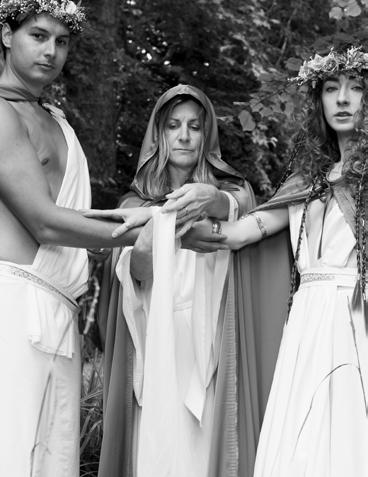
“I, King Prasutagus, stand before the gods, before kin, friends and tribesfolk of the Iceni and Trinovantes. I am bound to this woman, Boudica, now part of the Iceni tribe.”

At his words, the circle began to move. Each person would bow to the fire before they cast in their offerings: coins, jewellery, herbs and flowers.
The grip around her bound hand tightened, and she looked up to see the King. His lips moved, but Boudica heard nothing. Unthinkingly, she leaned closer, tilting her head in an effort to catch his words.

He whispered again, his breath warm against the shell of her ear. “I have dreamed of you since the first time I beheld you at your father’s council.” It was true then, Boudica realised, what Aislinn had told me on the riverbank. Boudica’s heart pounded, her throat suddenly dry. “Your life and mine are intertwined,” the King continued, squeezing her fingers beneath the binding as if to prove the sincerity of his words. “I see the truth of you, my Lady of fire. Do you see mine?”
Boudica’s eyes widened, and the words escaped her lips before she could stop herself, “I see you, not only as King, revered and respected by your people, but the man. The way you behold me, I see myself within your gaze, I …“
When Boudica did not continue, the King’s brow creased before he stated, not unkindly, “You are afraid.”
Boudica’s eyes swirled with emotion; how can he know me so well? She managed a nod and admitted, “I only hope I can become what I must be.”
Prasutagus smiled, bringing their bound hands close between them. Boudica swore she could feel the steady beat of his heart, and the quiet certainty of him grounded her.
“You are already exactly who you are meant to be. My wife, Queen of the Iceni, spiritual leader. The gods will guide you in all things. Trust in them. Trust in me.”
Boudica found herself smiling, as though Prasutagus’s
very words had washed her doubts away, carrying them off on the resolute current of a river.
Aislinn, who had waited patiently, stepped forward once more, offering a carved drinking horn.
“You must now both drink, and seal the promise of your union.”
The King accepted it but handed it straight to Boudica. She raised it to her lips and drank. The mead was rich and sweet; honey lingered on her tongue as a warmth spread down through her chest. Once she had her fill, she returned it to the King. He too drank, his gaze never once leaving hers. He passed it back to Aislinn, who took it from him and backed away with a knowing smile.
Suddenly, there was nothing left to do, nothing left to distract Boudica from the man who stood before her. The sounds of the gathering faded into the distance until only Prasutagus remained. She became acutely aware of his nearness, of his scent, woodsmoke and lavender, the warmth radiating from his body, and the lingering sweetness of mead upon her lips. He moved nearer, his face so close to hers that she could feel his warm breath upon her. Then his mouth found hers. All around them, the tribesfolk erupted into cheers and triumphant cries. Laughing, Boudica drew back, suddenly realising they had all been watching. For the briefest of moments, she had forgotten the tribes, the feast, the ceremony, everything except Prasutagus, her husband.
A smile spread across Boudica’s face, her eyes alight with merriment. Prasutagus’s own gleamed like molten bronze, filled with a longing that stirred something deep within her. Before doubt could take hold, before her courage could falter, she leaned forward and kissed him again. The King answered with equal fervour. When they finally parted, Prasutagus lifted his voice above the thunder of drums, cheers, and jubilant cries,
“Behold!” his voice was triumphant. “Your Queen, Boudica of the Iceni tribe!”
Author’s Historical Notes:
Boudica first appears in the Roman historical records as the wife of King Prasutagus. This brief mention inspired me to imagine what her life might have been like before her husband’s death and the devastating uprising that followed. I particularly enjoyed researching ancient Celtic beliefs and Druidic wedding traditions, weaving them together with what we know of the Iceni and the wider culture of Iron Age Britain.
The Iceni’s way of life was rooted in the natural world. Nature was not simply their environment; it shaped their beliefs, customs, and understanding. Daily life and religion were inseparable, and I wanted that connection to be at the heart of this story.
Boudica has captured hearts and imaginations for centuries. Knowing the suffering she endured, and the tragedy that befell her people, I wanted to imagine a period of genuine happiness in her life before history remembered her as the great Warrior Queen.
Prasutagus, historical accounts and archaeological finds tell us, was a client King, a role implemented by the Romans. Through careful diplomacy, he maintained a relationship with Rome that allowed his people a degree of autonomy.
I am not the first to suggest that Boudica may have come from a neighbouring tribe. Such a marriage would have made political sense, strengthening alliances at a time when Rome’s influence over Britain was steadily expanding. In this tale, I chose to make Boudica a noblewoman of the Trinovantes tribe.
The Trinovantes endured decades of Roman interference, displacement, and oppression. It is therefore plausible to imagine that ties between the Trinovantes and the Iceni would have become increasingly important. The Iceni remained prosperous, preserving much of their culture while benefiting from established trade across the North Sea and Prasutagus’ skill in navigating Rome’s demands.
I also wanted to explore Prasutagus’s character, to imagine the man behind the historical record: a leader and diplomat, but above all a human being with his own wants, desires, and flaws, extending beyond the brief references preserved in the Roman accounts. History is silent on the nature of Boudica and Prasutagus’s relationship, leaving room for me to imagine a partnership built on affection as well as political necessity. These same sources tell us that he and Boudica had two daughters, so there is no reason to suppose that their marriage could not have been a loving one.
Although I have hinted that Boudica never fully trusted Rome, that beneath the surface there burned a quiet fury waiting for its moment, I also wanted to give that fire another meaning. Before it became the flame of rebellion, it was the flame of love, a bond between Boudica and Prasutagus that gave her joy despite the oppression of the Roman Empire.
Credits
Boudica - Francesca (@francescaquici)
King Prasutagus - Brandan Cutts
Aislinn - Odette Tattersall
Handmaiden - Suzzie Snelling
Fabric - Legend Testiles
Costumes - Patsy (Blessed Be Alterations)
Pyrotechnics - Onlyairsoft.com
Flowers - The Garden Shed
Crystals - Coral at Earthly Edens
Flint - Grime’s Graves, English Heritage
Photography - Martin (mangus.co.uk)
Video - Cam Cutts
Photography Asst. - Brandan Cutts/Tracey Angus
Writer - Liz Gibbons
Location - River Thet, Thetford
Historical research - Dave Griffiths/Stuart Wright
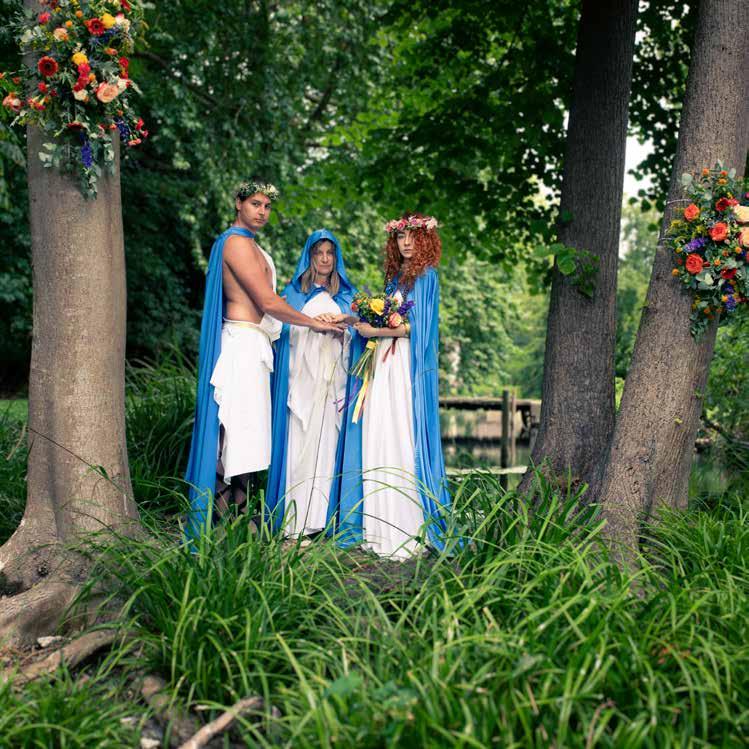
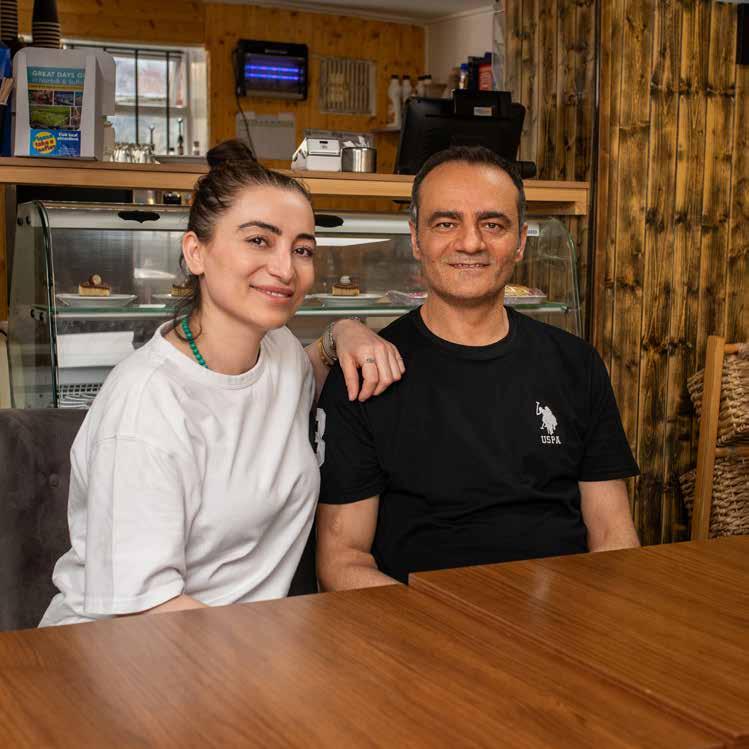
Written by Martin Angus
“Will you marry me?”
It wasn’t an elaborate proposal. There were no fireworks, no grand romantic gesture and certainly no months of planning. Medine had only been living in England for a fortnight when Okan asked the question.
Her answer was equally uncomplicated.
“Why not?”
She smiles as she remembers it, as though it happened yesterday rather than more than twenty years ago. It was the beginning of a partnership built not on dramatic declarations but on shared determination, mutual respect and an extraordinary willingness to face whatever life decided to throw at them next.
Few of the customers enjoying breakfast at Castle Café each morning would guess that the cheerful couple
behind the counter have already weathered enough challenges for several lifetimes.
They see Okan chatting to customers while carrying steaming plates from the kitchen. They see Medine calmly keeping everything moving behind the scenes. What they don’t see are the years of uncertainty, the health battles, the financial risks and the quiet resilience that brought them here.
Their story begins in a small village in Turkey.
Although their families knew one another, they were little more than familiar faces until Okan returned during a holiday. Medine had recently completed a university degree and was weighing up an important decision. Much of her family had already settled in Britain, and eventually she decided to follow them.
Within weeks she had not only started a new life in
For over 100 years we have provided care, reassurance and professional support to local families when they need it most.
Our friendly and experienced funeral arrangers are here to guide you through each step of your journey.
Our services include:
• Personalised funerals
• Pre-paid funeral plans
• Direct cremation
• Flowers, transport and stationery
• Expert guidance
• Multi-faith services
• Masonry
• In-home consultations
Your local Funeral Arranger, Lisa
Thetford
33-35 Bury Road, Thetford, Norfolk IP24 3DD
01842 845874
We’re open
Monday to Friday 10am–3pm Saturday Closed Sunday Closed
Find out more about all our services at: eastofengland.coop/funerals
another country but agreed to spend it with the man who had confidently asked her to become his wife.
Looking back now, they laugh about how straightforward it all seemed.
Life in London was anything but straightforward.
Like countless immigrant families, they worked hard because there was little alternative. Okan found his place in catering, spending years in fish and chip shops, kebab houses and market stalls. Medine’s qualifications might have pointed towards an office career, but she soon realised she preferred kitchens to desks. Hotels and care homes became the places where she learned the discipline and organisation that would later define her own business.
Neither expected to remain in London forever.
As their children grew older, so did their desire for something different.
The capital had provided opportunities, but it no longer offered the environment in which they wanted to raise a family. They longed for quieter streets, familiar faces and a stronger sense of neighbourhood.
That search eventually led them to Norfolk.
Okan joined his uncle’s fish and chip business in Watton, and the family quickly discovered that life moved at a different pace. Their children flourished, neighbours knew one another and the countryside offered exactly the breathing space they had hoped to find.
Today, their daughter is completing an engineering apprenticeship at Multimatic in Thetford, while their son is following a similarly practical path. It is something both parents speak about with unmistakable pride.
Owning their own café, however, remained an ambition rather than a plan.
For years they looked at empty premises across the region, only to find buildings that were either beyond their budget or simply unsuitable. Then they came across a neglected property on Castle Street.
It looked manageable.
It wasn’t.
The refurbishment became a lesson in patience. Hidden structural problems appeared one after another, regulations delayed progress and costs steadily mounted. What they imagined might take a matter of months eventually stretched into three long years.
During that time, the rent still had to be paid.
Friends suggested cutting their losses.
Walking away never entered Okan’s mind.
“If I say I’ll do something,” he says quietly, “I finish it.”
That determination was about to face its greatest test.
As work on the building continued, Okan’s kidneys failed. Regular dialysis became part of everyday life, adding hospital appointments and exhaustion to an already demanding routine. Opening the café seemed less certain than ever.
While he concentrated on getting well, Medine carried the dream forward. She continued planning, organising and preparing for the day they hoped would eventually arrive.
When a kidney transplant finally gave Okan a second
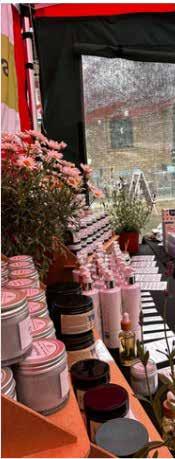

Discover beautifully crafted plant-powered skincare, handmade in small batches and available throughout Norfolk
Thetford Saturday Market 08:30 - 14:30

chance, it also gave their project new momentum.
On 1 April 2025, Castle Café welcomed its first customers.
For Okan and Medine, it wasn’t simply the opening of a business.
It was the end of one chapter of their lives and the beginning of another.
The first few days were a mixture of excitement and uncertainty.
Neither of them had ever run a café before. Okan knew takeaway catering inside out, while Medine had years of experience cooking in commercial kitchens, but serving breakfasts, lunches and homemade specials in a towncentre café brought an entirely different rhythm.
“We learned every day,” Medine says. “Sometimes we’d realise afterwards that we could have done something better. The next day we changed it.”
That willingness to improve has become one of their greatest strengths.
Nothing stands still for long. Recipes are adjusted, displays altered and ideas borrowed from conversations with customers. The café has evolved naturally, shaped as much by the people who walk through the door as by the couple themselves.
Watching them at work, it soon becomes clear that each has found their own role.
Okan rarely stays in one place for long. He’s delivering meals, clearing tables and somehow finding time to chat with almost everyone in the room. His years working behind market stalls taught him that people enjoy being recognised, and he still remembers countless names and
favourite orders without writing anything down.
Medine, meanwhile, provides the quiet structure that keeps everything moving. She oversees supplies, prepares the homemade dishes and keeps a close eye on standards. If something isn’t quite right, it doesn’t leave the kitchen until she’s satisfied.
Their different personalities complement one another perfectly.
He thrives on conversation.
She thrives on organisation.
Neither could make the café work alone.
One of the surprises has been how quickly strangers have become familiar faces.
Some customers call in every morning before work. Others arrive every Wednesday to catch up with friends over breakfast. Local groups have adopted the café as a meeting place, filling the tables with conversation, knitting projects and fundraising ideas.
Without planning it, Okan and Medine have created somewhere that encourages people to slow down.
The conversations are as varied as the menu.
One minute Okan is discussing football.
The next he’s explaining how to pronounce a Turkish greeting before recommending a homemade soup.
Laughter seems to travel easily across the room.
Their Turkish roots still influence daily life in subtle ways. Although the menu is proudly British, the instinct to look after guests remains unchanged. In Turkey, visitors are never hurried. Time is shared generously, and food is prepared with care rather than convenience.
Those values have crossed continents with them.
It also explains why Okan finds it difficult to refuse anyone.
If someone arrives just after closing time having travelled across Norfolk, he’ll usually find a way to help.
“If I can do something, I do it,” he shrugs.
It isn’t a business strategy.
It’s simply part of his character.
That relaxed atmosphere isn’t manufactured.
It’s simply the way they are.

The same generosity extends to the small details that customers often notice without realising it. A breakfast can be adapted without fuss. An extra slice of toast appears when someone needs it. Well-behaved dogs receive a treat, and returning visitors are welcomed as though they’ve been expected all morning.
Perhaps that explains why so many reviews speak not only about the food but also about the atmosphere.
Good cafés serve meals.
The best cafés create memories.
Castle Café seems to have found that balance remarkably quickly.
Looking back, neither Okan nor Medine pretend the journey has been easy. There were moments when the future felt uncertain, particularly during Okan’s illness and the seemingly endless delays before opening day. Yet neither speaks with bitterness.
Instead, they focus on what they have gained.
A business of their own.
A town that has embraced them.
Customers who have become an important part of everyday life.
For Okan, success has become surprisingly uncomplicated.
Good health.
A happy family.
A café that continues to make people smile.
Nothing more elaborate than that.
As I prepare to leave, another customer pushes open the door and is greeted before they’ve even reached the counter.
There is no rehearsed welcome.
No polished sales pitch.
Just a genuine smile from Okan and a friendly glance from Medine as she carries another freshly prepared plate from the kitchen.
It is an ordinary moment, repeated dozens of times each day.
Yet perhaps that is exactly what makes Castle Café so special.
Behind every cup of coffee and every homemade meal stand two people whose lives have been shaped by courage, persistence and an unwavering belief that treating people well is never wasted.
The café may carry their name above the door, but its real success lies in something much less visible.
It is built on trust, hard work and a partnership that began with a simple question more than twenty years ago.
Sometimes the finest stories are not found in extraordinary places.
Sometimes they are waiting in an ordinary café, over breakfast, with two people who quietly prove that kindness remains one of life’s most enduring ingredients.
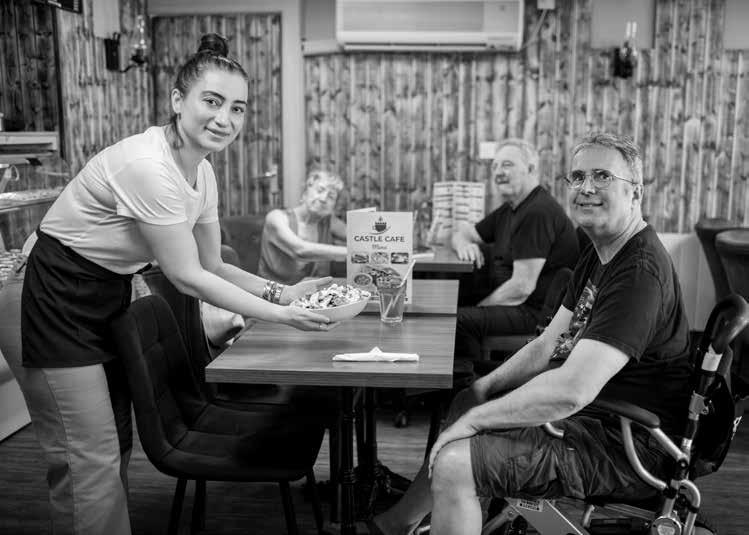
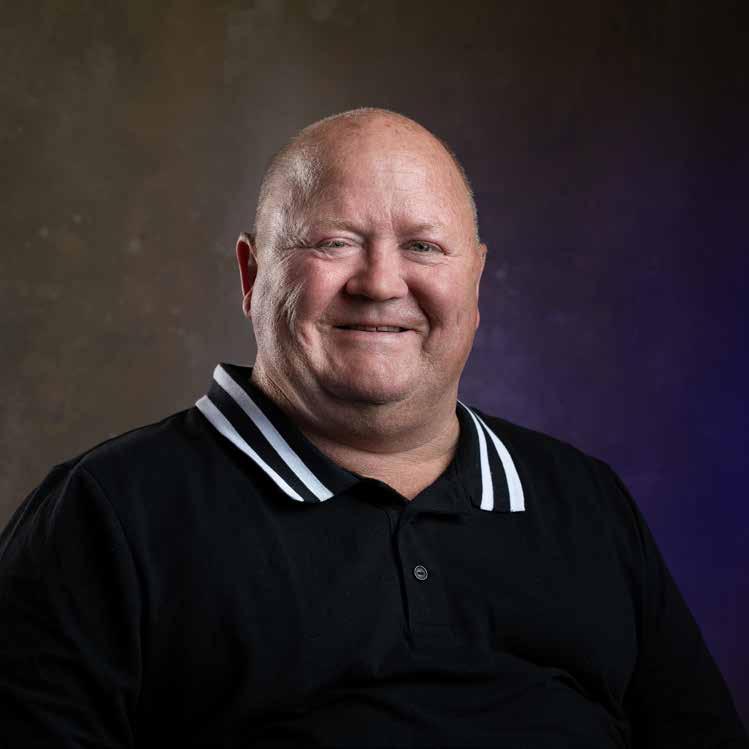
Written by Martin Angus
The rhythmic thud of gloves against pads echoes around Thetford Town Boxing Club as young hopefuls perfect their jabs under the watchful eyes of volunteer coaches. Among them is Paul Dean, quietly offering encouragement, correcting footwork and sharing the wisdom gathered from almost fifty years in the sport.
There is nothing theatrical about him. No booming voice or larger-than-life persona. Yet within minutes it becomes obvious why generations of local boxers speak of him with such affection. His knowledge has been earned, not borrowed, through decades spent inside boxing gyms from South London to Norfolk.
For Paul, boxing has never simply been about titles or trophies. It has been a lifelong education.
His story begins in the mid-1970s on the council estates of South London, where organised sport often started with whatever children could
improvise. Long before entering a boxing club, he and his friends were fascinated by the great prizefighters they had watched on television.
“The next day we’d all want to have a go ourselves,” he recalls.
A traffic island became their makeshift ring. Football posts doubled as corner markers. Wearing borrowed gloves, they boxed until somebody decided it was time to play football instead.
Those playful contests sparked something deeper.
Curiosity eventually led Paul through the doors of local boxing clubs, where enthusiasm slowly became discipline. It was at Orpington Boxing Club that everything changed.
The first months were humbling. After progressing into the senior training group, he found himself


sharing the ring with experienced fighters who effortlessly outclassed the eager teenager.
“They completely outboxed me,” he remembers.
Instead of being discouraged, he responded in the only way he knew.
“I decided I wasn’t having that anymore.”
It was not polished technique that impressed his coaches that evening, but determination. They recognised a young man who refused to surrender, even when every lesson arrived with another punch.
That resilience soon carried him into competition.
His first contest remains one of his favourite stories. Desperate to make an impression, Paul launched an ambitious left hook with such commitment that he spun full circle before landing flat on the canvas.
“It was the quickest I’ve ever got up.”
The crowd laughed. So does Paul today.
The embarrassment lasted only a few seconds because he recovered to win the bout on points, discovering that composure often matters more than perfection.
Competitive success followed quickly. Within only a handful of contests he was fighting in the Kent Novice Championships, gaining valuable experience against skilled opponents who pushed him to improve.
One coach in particular became hugely influential.
Alf Donovan possessed an old-fashioned approach that combined honesty with encouragement. At the
end of Paul’s first successful season, he presented him with the club’s Best Beginner award.
The prize was unforgettable.
Rather than handing over a medal, Donovan took his young boxer to Wembley to watch the Amateur Boxing Association Championships.
For an aspiring fighter, it was like stepping into another world.
Future champions shared the bill, and Paul watched every movement with complete fascination. The atmosphere, the noise and the standard of boxing left an impression that never faded.
“It really inspired me.”
Like many youngsters of the era, he idolised Muhammad Ali, marvelling at his confidence and extraordinary movement. Joe Frazier’s relentless determination and George Foreman’s devastating power also captured his imagination.
Yet the boxer Paul admired above all others was Rocky Marciano.
The unbeaten heavyweight champion represented courage, persistence and relentless commitment, qualities Paul would later encourage in every youngster he coached.
He was equally captivated by Roberto Durán, whose aggressive style disguised remarkable defensive skill.
Many spectators saw only fierce attacks.
“He hardly ever got hit.”
Even as a teenager, he was beginning to appreciate that boxing was never simply about throwing punches. Intelligence, patience and timing separated good fighters from exceptional ones.
As adulthood approached, work and everyday responsibilities inevitably interrupted his sporting ambitions. Like many promising amateurs, he drifted away from regular competition for a time.
Life, however, had another chapter waiting.
Family circumstances eventually brought Paul back to Thetford, the town where he had briefly lived as a child before returning to London. Now settled once again in Norfolk, he immediately began searching for somewhere to continue boxing.
That search would introduce him to a remarkable group of volunteers whose generosity would shape the rest of his life and ultimately inspire the philosophy that still guides him today.
Returning to Norfolk reignited Paul’s passion for boxing, but there was one problem. Thetford had no boxing club.
Like many local fighters during the 1980s, he found himself travelling to Watton, where an extraordinary volunteer named Barry Trainor was quietly keeping amateur boxing alive in the region.
Barry’s dedication left a lasting impression.
Paul noticed something else entirely.
Training rarely began inside the gym. Young boxers would gather at Barry’s house after work, chatting while he finished his evening meal before everyone piled into cars for the journey to Watton. It wasn’t glamorous, but nobody cared. They simply wanted
the opportunity to train.
Looking back now, Paul sees those evenings as a lesson in generosity.
“Nobody was doing it for money,” he says. “They were doing it because they loved boxing.”
Alongside Barry, experienced coaches Adrian Morley and Neil Brown helped shape his development. Each brought different strengths to the gym, creating an environment where hard work mattered far more than reputation.
Those sessions quickly transformed Paul from an enthusiastic amateur into a serious competitor. Some victories remain crystal clear after all these years.
One came during the Kent Championships against a tall, technically gifted opponent who seemed to control every exchange. Round after round, Paul struggled to close the distance.
“My coach told me I’d got to take the fight to him.”
He did exactly that.
Spotting the smallest opening, Paul unleashed a perfectly timed right hand that ended the contest dramatically.
His opponent was carried from the ring on a stretcher.
The image stayed with him, not as a moment of triumph, but as a reminder of boxing’s unforgiving nature.
“It made me realise the power you can have.”
That understanding shaped his attitude for the rest of his career. Outside the ring he avoided confrontation wherever possible, fully aware that a trained boxer carries responsibilities as well as abilities.
Another defining night arrived in the Norfolk ABA final.
Standing opposite an unbeaten local favourite renowned for stopping opponents early, Paul entered as the underdog. The atmosphere inside Norwich’s old Lads Club crackled with expectation.
Rather than rushing forward, he patiently drew his opponent into attacking first.
Everything happened in an instant.
A missed punch.
A perfectly judged slip.
A sharp uppercut.
Then a crushing body shot.
His opponent collapsed.
Even decades later, fellow boxers still remind Paul of that performance.
“It was one of those nights where everything just came together.”
Victories like these inevitably sparked conversations about turning professional.
In 1987, Paul signed with Norwich promoter Gordon Holmes, beginning an entirely different chapter in his boxing life.
Professional boxing demanded greater commitment than anything he had experienced before.
Several nights each week meant travelling from Thetford to Norwich for training, often sharing journeys with fellow local professional Dave Lawrence. Long hours in the gym were followed by even longer journeys home before starting work again the following morning.
Nobody complained.
Every mile represented another step towards a dream.
The professional circuit also introduced Paul to personalities he had previously only admired from afar.
During one televised promotion featuring Nigel Benn, Paul unexpectedly found himself performing security duties in Benn’s corner after his own contest fell through.
His job was straightforward: stop excited supporters climbing into the ring after the fight.
Benn won in devastating fashion, ending matters almost immediately.
Within seconds, crowds surged forward.
Standing his ground, Paul found himself politely but firmly refusing entry to overenthusiastic fans desperate to congratulate one of Britain’s rising stars.
It became another of those surreal moments boxing occasionally produces.
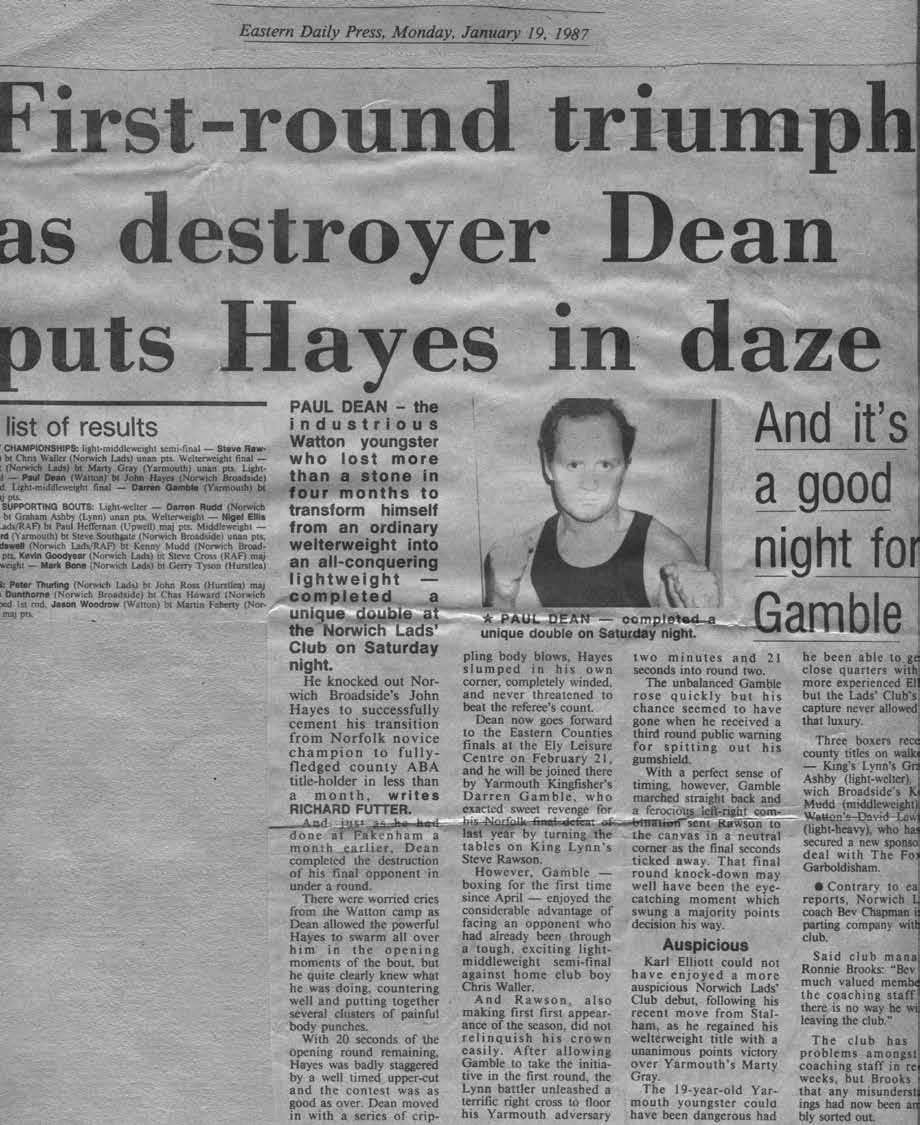
Equally memorable was meeting football legend George Best following his own professional debut in Manchester.
Fresh from the ring, Paul entered a hotel lift where Best happened to be waiting.
“He shook my hand and congratulated me.”
Simple gestures often become treasured memories. His debut itself had been encouraging, lasting into the sixth round against an accomplished opponent before a cut above the eye forced the referee’s intervention.
At the time, Paul felt frustrated.
Only later did he appreciate the official’s judgement.
The injury lay dangerously close to his eyelid.
Had the contest continued for another few moments, the damage might have threatened his eyesight.
A second contest brought similar misfortune.
The same area reopened.
Again the bleeding proved impossible to ignore.
Gradually, reality overtook ambition.
Professional boxing had always been the dream, but eyesight was something he could never replace.
“It just wasn’t worth the risk.”
He had invested years chasing the opportunity.
Yet boxing had already given him something far more valuable than a professional record.
It had introduced him to remarkable people, unforgettable experiences and lessons that extended far beyond competition.
Without fully realising it, Paul was about to discover the role that would define his contribution to the sport, not as a fighter, but as a mentor.
The next generation was waiting.
The end of a boxing career is often portrayed as the final chapter. For Paul Dean, it became the beginning of the work that has ultimately defined his life.
Leaving professional boxing was a practical decision rather than an emotional one. Persistent cuts around his eye had made him recognise that no ambition was worth risking his sight. He could have walked away from the sport altogether.
Instead, he walked into the corner.
“I realised boxing wasn’t mine,” he reflects. “It had been given to me by other people, so it was my responsibility to pass it on.”
That belief has never left him.
Walking away from the ring wasn’t easy.
Returning to work alongside Barry Trainor, Paul gradually discovered that coaching required an entirely different skill set from fighting. Winning bouts had once depended on personal discipline and courage. Coaching demanded patience, observation and the ability to bring the best from someone else.
When Barry began stepping back from day-today coaching, Paul assumed greater responsibility, taking youngsters to competitions and helping prepare them for county championships. Training sessions became inventive affairs. Old tyres were transformed into agility courses, assault circuits replaced expensive equipment, and every exercise had a purpose.
Resources were limited, but enthusiasm never was.
Like so many grassroots sports clubs, boxing survived because ordinary people volunteered extraordinary amounts of time.
Then family life intervened.
When Paul’s young son was admitted to hospital suffering from bronchiolitis, boxing naturally became secondary. Although Barry continued taking fighters to competitions, one difficult weekend convinced Paul that his attention belonged at home.
“It was where I needed to be.”
For several years he stepped away from coaching completely.
Then history repeated itself.
His nephew, Matthew Dean, approached him with plans to establish a new boxing club in Thetford.
Would he help?
Paul initially agreed to one evening each week.
One evening became two.
Before long, he was back where he belonged.
Today, Thetford Town Boxing Club has become one of the town’s quiet success stories, producing county champions, national finalists and young athletes capable of competing on the biggest amateur stages.
Ask Paul what gives him the greatest satisfaction and medals barely receive a mention.
Instead, he talks about frightened children.
Every boxer remembers the nerves before stepping through the ropes for the first time. Paul sees that same mixture of excitement and fear every season.
Watching a youngster overcome those emotions, complete the contest and return with a smile remains one of coaching’s greatest rewards.
“You can’t beat it.”
Perhaps surprisingly, much of his coaching centres on defence rather than attack.
He believes too many people misunderstand boxing, assuming success depends solely on punching harder than an opponent.
Paul teaches something different.
Learning how to avoid being hit comes first.
Only when a boxer demonstrates sound defensive habits does he feel comfortable progressing their training.
His approach extends beyond technique.
Modern boxing, he explains, bears little resemblance to the sport he entered as a teenager. Medical examinations are rigorous. Every boxer
is monitored carefully. Doctors routinely identify underlying health conditions that families may never have known existed.
Paul recalls youngsters being withdrawn from competition after routine medical checks uncovered heart abnormalities requiring hospital treatment.
Far from proving boxing dangerous, he believes such safeguards demonstrate how seriously the sport now takes welfare.
Parents occasionally arrive carrying outdated perceptions of boxing.
Paul understands their concerns. He simply invites them to watch.
Within minutes they discover a disciplined environment built upon respect, self-control and teamwork rather than aggression.
The loudest applause often follows courage rather than victory.
His advice to anyone considering the sport is refreshingly straightforward.
Find a good club.
Take time to understand the coaches.
Observe how children are treated.
Good coaching, he believes, is measured not by producing champions but by protecting every individual placed in your care.
Away from the gym, another side of Paul’s
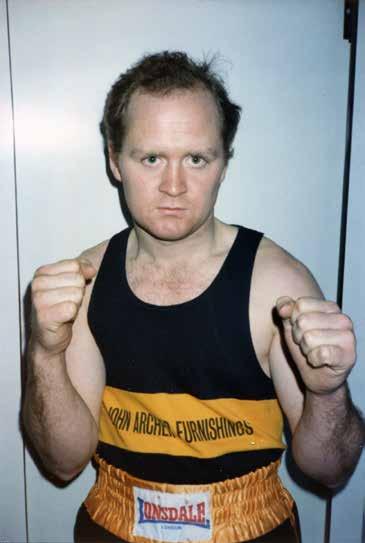
Paul Dean 1987, when the Thetford Lads were fighting out of Watton.
Photograph courtesy of P. Dean
personality quietly flourishes.
Inside his garage sits a colourful workshop filled with intricate decorative painting, handcrafted furniture and beautifully restored pieces inspired by traditional canal art.
The precision surprises nobody who has watched him coach.
The same patient attention to detail required for painting symmetrical floral designs is visible when correcting a youngster’s stance or demonstrating a combination.
After years spent in noisy gyms, the quiet concentration provides welcome balance.
“It helps switch my mind off.”
Although arthritis now limits what he can do physically, it has done nothing to diminish his enthusiasm for helping others. Several evenings each week still belong to the boxing club, despite the discomfort that follows.
For Paul, commitment has never been measured by convenience.
Looking ahead, his ambitions remain firmly focused on the next generation.
He would love to see one of Thetford’s youngsters wear an England vest.
An Olympic boxer emerging from the club would be a dream realised, but even that is not the ultimate measure of success.
If those young people leave boxing with confidence, discipline, resilience and respect, then the club has
already achieved something remarkable.
As our conversation draws to a close, I ask one final question.
If someone were writing the headline that summed up his life in boxing, what would he hope it said?
Paul pauses thoughtfully before answering with characteristic modesty.
“I’ve given back more than I’ve taken out.”
It is a simple sentence.
Yet after listening to the stories of a South London teenager who chased a dream, a professional boxer who knew when to walk away, and a volunteer who has devoted decades to helping others discover their own potential, it feels less like a headline and more like an enduring truth.
In every thriving community, there are people whose contributions rarely make the front page. They give their evenings, their weekends and, often, a lifetime of experience simply because somebody once did the same for them.
Thetford is fortunate to count Paul Dean among them. His greatest victories were never recorded on a scorecard. They can instead be found every week, inside a boxing gym, where another young person discovers that confidence, discipline and belief are skills worth fighting for.
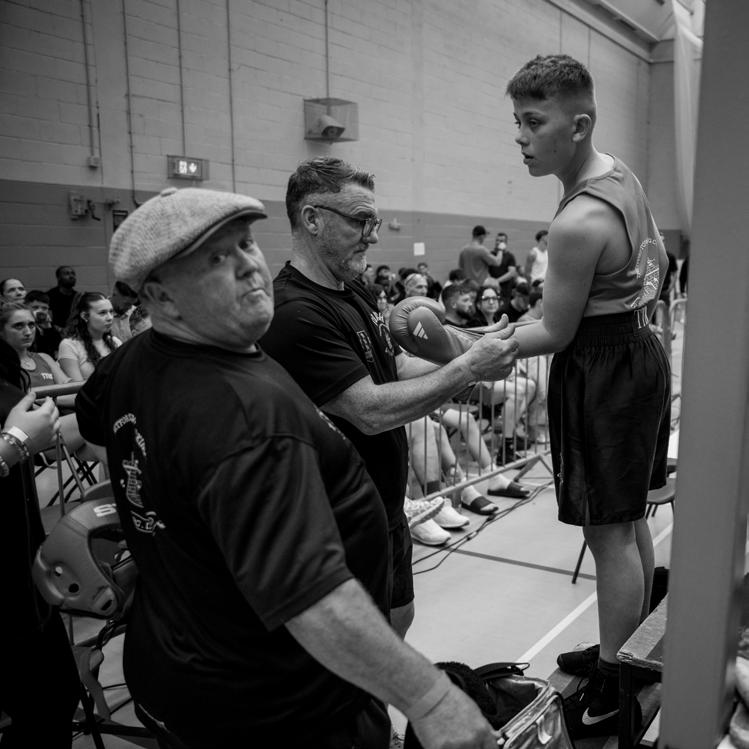
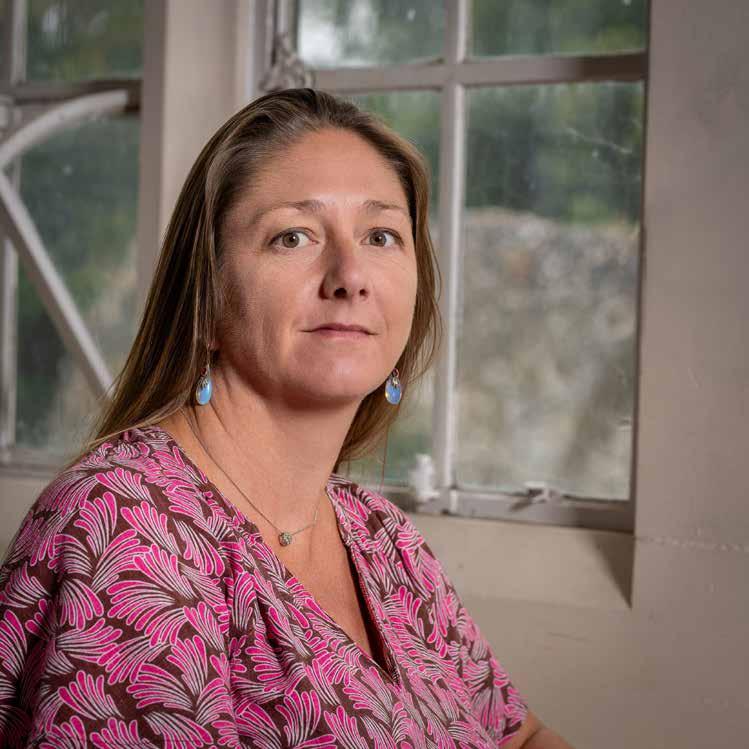
Written by Dave Griffiths
It’s 627 AD, as the sun rises on a misty autumn morning in East Suffolk. Scores of Anglo-Saxons in full ceremonial battle gear heave as one on thick, heavy ropes. They pull in silence, faces red, necks taught with the strain. Their mission is to pull an 89-foot burial ship along a hewn oak slipway to its final resting place. The cream of the ruling Wuffingas dynasty line the vessel on either side, as the richly adorned body of King Raedwald is carried out and laid to rest at the centre of the ship, surrounded by weapons, jewels and offerings to speed him to the afterlife. He is a great man, King of East Anglia, conqueror and overlord of Northumbria. His loss at a time of great religious and political upheaval is sorely felt.
Stop and let yourself drift back to that time, to that scene. It’s only 200 years after the Romans left, over 200 years before the Vikings will arrive, over 400
years before the Norman Conquest and 900 years before Henry VIII comes to the throne. An infeasibly long time ago and yet this is the point to which Thetford Grammar School can trace its roots. It is one of the 4 oldest schools in the country. In fact, no school in Britain couldn’t be significantly older, as literacy only arrived with the Gregorian Christian mission led by Augustine in 595 AD.
But there is one key character not at the site of King Raedwald’s burial, now under Mound 1 at Sutton Hoo: his stepson Siegberht. He is thought to have been banished to Gaul to ensure the unchallenged succession of Raedwald’s own son Eorpwald. On succession, Eorpwald’s first act was to be baptised, an act that angered the pagan element of his people. They had been uncomfortable with Raedwald’s political adoption of Christianity but had accepted it. Raedwald had hedged his religious

bets by maintaining both Pagan and Christian altars in his church. This appeased the increasingly Christian ruling classes, his people and, perhaps most importantly, his pagan wife. Richbert, an East Anglian pagan, rebelled and murdered Eorpwald, becoming ruler and reverting East Anglia to the pagan faith. However, 3 years later in 630 AD he died, and Siegberht returned from Gaul to rule. Having converted to a devout Gregorian Christian whilst in Gaul, he became the first King of East Anglia to be Christian at his accession.
Siegberht ruled jointly with Ecgric, an unspecified Wuffingas relation, until 634 AD when he abdicated to concentrate on his ecclesiastical calling. In 631 AD, he established a church at his court in Thetford. The church’s priests had charge of the education of boys in the study of letters, crucial to his policy for the development of Christianity. Siegberht was therefore the catalyst that set Thetford on its journey to the major ecclesiastical centre it became for centuries to come. His vision for the teaching of boys gave Thetford a pioneering role in the provision of education locally, which spread nationally. He began the Thetford Grammar School story, setting it on its 1,400-year journey to the present day. Yet another example of what a massively impactful town Thetford has been in the evolution of Britain over the centuries.
No surviving written history of the school exists for the next four centuries of what is referred to as its “first period”. The Vikings destroyed any records that may have existed in their sacking and burning of monasteries. But worship and education likely continued, in and around the same location, over this period. There is no compelling reason why it shouldn’t have. The first documentary evidence for its continuation appears in a document from 1114 under the seal of Bishop Herbert Losinga of Norwich. It states that “I have restored to Bund,
the Dean, his schools at Thetford as completely and advantageously as he ever held them”. In 1071, Bishop Herfast, newly appointed by William I, had moved the see of East Anglia to Thetford, using the existing church of St Mary the Great as a cathedral. He built a new parish church, Holy Trinity, close by to fulfil St Mary’s parochial role. Bishop Losinga succeeded Herfast in 1091 and in 1094 he moved the see of East Anglia to a cathedral in Norwich. The current Old School buildings sit on the site of the abandoned St Mary the Great, Thetford Cathedral.
Again, limited written records mean that the arrangements for church and schooling, in the period from 1114 AD through to 1496, are uncertain. The abandonment of the cathedral may have meant worship and education were led out of the neighbouring Holy Trinity Church, but it seems unlikely that the cathedral was left entirely derelict. In 1104, Roger Bigod set up the Cluniac Thetford Priory on the old cathedral site (as an offering to God to avoid him having to traipse off on pilgrimage to the holy land). The priory soon outgrew the site, however, and in 1114 was relocated to where its current ruins lie, on the Norfolk side of the river. This left the old cathedral again abandoned. The next relevant reference to schooling on the cathedral site is a record of the appointment of a bishop’s Schoolmaster, Edmund de Mendham, in 1328. Later in 1335, when the Dominican Black Friars occupied the abandoned cathedral, it was described as being “derelict”. This suggests that Mendham’s school operated out of the Holy Trinity Church and that the Black Friars may have added a second school, running in parallel on the same site, but in the old cathedral. The last record of a bishop’s Schoolmaster is from 1496, leaving the fate of schooling from then until mid-16th century dissolution unknown.
The second period of the school dates from the

1566 will of Sir Richard Fulmerston, an English politician, entrepreneur, and philanthropist. In 1537, post-dissolution, Fulmerston, a protégé of the Duke of Norfolk, found himself in the right place at the right time to be granted the buildings and land of the Dominican Friary along with several other religious houses. In his will, he instructed his executors to build a free grammar school in the Holy Trinity and Blackfriars yards, with accommodation for a schoolmaster, Usher, preacher, and a hospital for two poor men and women. A petition by the Thetford Corporation and an Act of Parliament were needed in 1610 to force his heirs to enact the full scope of the will and to have the school placed under the Corporation’s control. The school continued in its one-room Elizabethan building, with the accommodation largely unaltered for three hundred years. This late c16th building rests on the foundations of a 14th century Dominican Friary which itself was built on the site of the 11th century Thetford Cathedral. The school was governed by Thetford Corporation until 1836, when it was replaced by a board of trustees.
school took voluntary control status, and a board of Foundation Governors was put in place, dominated by county council nominees. In 1971, the Foundation Governors chose to adopt a co-educational model to allow retention of their grammar school status, a change implemented in 1975. The 1977 county council plans for comprehensive education would have led to exit from the school’s ancient site, so the Governors decided to return the school to independence. This was realised in 1981.
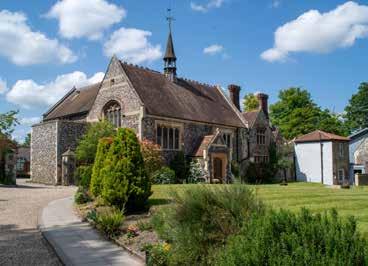
The school’s third period began in 1876 with the Endowed Schools Acts dissolving the arrangements in the 1610 Act, installing new governance and pensioning off the Schoolmaster and Usher. The 750-year model of the Bishop of Norwich licensing the Schoolmaster, in place since the 12th century, ended with Charity Commissioners taking the overseer’s role. The Act also provided for the establishment of a Girls Grammar school. In 1948 the
In recent years, the school has been under new ownership. The owners have worked tirelessly with Head, Amanda Faye, and her team to improve the fabric and running of the school. Large capital investments in both necessary unseen infrastructure as well as more visible enhancements have improved the pupil experience considerably. Pupil numbers have increased, and the associated school financials improved with them. Throughout the new ownership period, the school has run at a reducing deficit and at the start of 2025, imminent breakeven was expected. Then the world changed. The government announced that independent schools would be subject to VAT, increased Business Rates, minimum wage and pension contributions. The effect on the school (and many other independent schools) has been catastrophic. It had no choice but to pass the increased costs on to parents, a significant number of whom simply could not afford them. They have been forced to withdraw their children. At a stroke, after 1,400 years, the sharply reduced role has
meant the school is no longer a going concern. With a heavy heart, the school had to announce closure this month, August 2026.
The timing of the closure could scarcely be more poignant. The 2nd of August 1776, the day after this edition of the magazine goes to press, marks the 250th anniversary of the signing of the Declaration of Independence. The architect of that document, the architect of the philosophy of a fair republic, the author of the Crisis pamphlets that spurred the American forces to victory, the visionary of whom Napoleon said, “a golden statue of should be displayed in every major city in the world”, was Thetford Grammar School’s most famous alumnus, Thomas Paine. He was the son of a humble corset maker but, under the grammar school system, gained a free education that was a springboard to greatness. Greatness for him, for his town and across two continents. What would he think now, I wonder? He’d be desperately sad and, I’m sure, have an awful lot to say on the subject.
My personal view as author is that I just can’t see the logic of the tax changes that caused this situation. Most students’ parents aren’t the elite rich, but those on middle income, making sacrifices to give their children opportunities they themselves may not have had. They forego the bigger house, the nice car or the expensive holiday to afford it. The outcome of the changes was never going to be stable pupil numbers and a higher tax take. Rather, reduced pupil numbers, many school closures and most likely a lower overall tax take. The pupils displaced must then be funded in state schools, a double whammy of lower tax take and higher costs. I get the ‘equality of opportunity for all’ argument, but I mourn the loss of choice in the education system. From my time as a school governor, I’ve seen an obsession with targets that aspire to get
all students to an average level. But everyone is different; one size does not fit all. Trigonometry is of no use for a binman or plumber; and a B in Biology is not good enough for an aspiring brain surgeon. You need a full range of vehicles for developing skills from vocational training through to highly academic and technical. Pulling the rug from under the private school sector, for purely ideological reasons, seems to me to reduce much-needed educational choice. But I am no expert.
Speaking with Amanda, she bristled with pride at how the school has developed, how it nurtures its pupils and at its pivotal place in the history of Thetford. Many tears have been shed at the closing of the school she loves and led. Thankfully, most of the teachers have found other positions, which is a blessing. She is, however, acutely aware of how difficult and disruptive it has been for the pupils to move to new schools “mid-flight”, to settle into new environments and to fit into different grading curricula. Amanda will stay in post at TGS until December to see the site through to full closure. New roles for Heads come out in September, and she will be looking at opportunities in both independent and state sectors. Her passion is to ensure every child has the chance to reach their potential in either sector.
For me, my overriding feeling in writing this piece is one of great sadness. For the loss of the great and profoundly historic institution that I’ve learnt so much about, and that I’ve been so in awe of in the last few weeks. It sounds likely that the land and property will be split up and sold off in separate pieces for disparate uses, and the future of the main buildings is uncertain. I can only hope that the buildings and history of the place can be preserved and celebrated in Thetford for many generations to come.
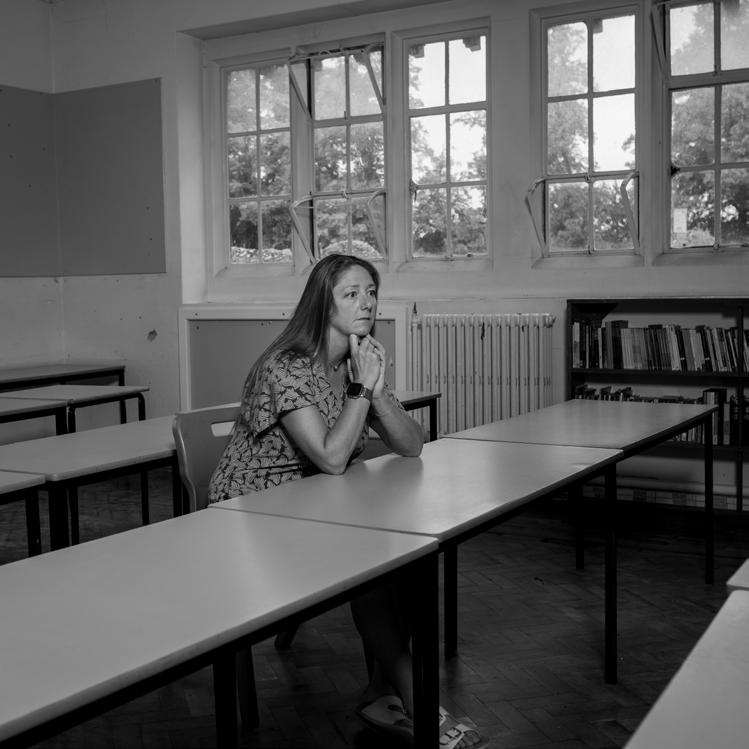
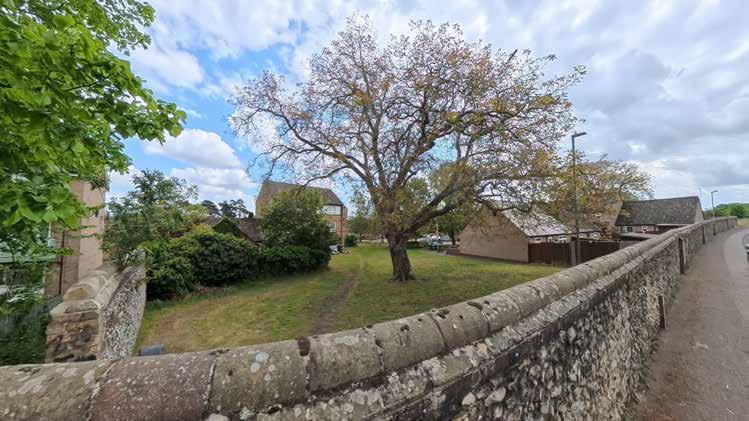


Photography, high jinks and words by Bob Blogg
Firstly: On the Trail of the Lonesome Twisted Pine.
Before I even start this article, I want to thank Adrian. He doesn’t always talk, and he doesn’t always follow instructions, but he sure does deliver some unforgettable video!
This is the 2nd Stoat Chronicles - June 2026, approx. Barnham Common
Because Adrian was driving around anywhere he fancied on his trusty mobility scooter, ignoring my instructions and the map I gave him, and being his usual taciturn self, I decided I had to be his Doctor Watson or Boswell to try and interpret what on earth he was doing and not talking about!
There’s much more to the story than just following in the wonderful footsteps of Stephanie Downes and her happy hounds. She set the benchmark in issue

7 and showed us the great walks available around Barnham Common and other places for the curious. And, yes, the tree above is probably just a Common Walnut, but this is our starting point and, despite this rosy view of suburban bliss, the history behind this wall is far from common.
What you see behind this wall today is St Barnabas Close; what you would have seen if you had dared to look over this wall in the mid-1800s is a workhouse –The Thetford Union Workhouse.
It was built in 1836–37, shortly after the Poor Law Amendment Act of 1834. It stood on the corner of Bury Rd and Nuns’ Bridges Rd.
Apparently life in the workhouse was intentionally harsh, and men, women, children and the elderly
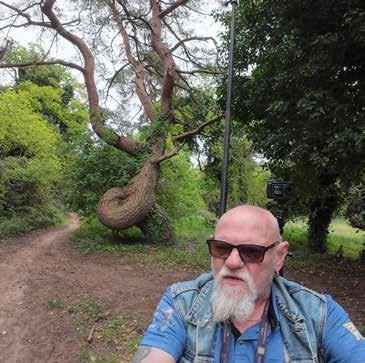
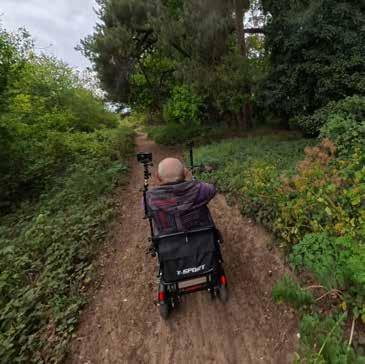
were all kept apart – it had space for 300 inmates. It sounds like a prison to me!
Its layout followed the standard Poor Law design, with a central supervisory hub and four separate wings.
A chapel dedicated to St Barnabas was added in 1863.
You entered if you were: elderly; widowed; orphaned; disabled; unemployed; or simply too poor to survive outside.
I think Adrian and I would qualify on the last three criteria – and the first!
Of course we weren’t around in the 1850s, despite our looks, but Adrian remembers it from when it was a hospital in the 1970s before it was demolished. After the workhouse system was abolished in 1929 and the NHS created in 1948, the workhouse metamorphosed into St Barnabas Hospital, taking its name from the chapel.
Now all that remains is a lonesome walnut tree.
Time to change trees and look for the twisted one.
A couple of things to mention: Adrian’s Scote 48350 mobility scooter is a seriously rugged little scooter, and he is not scared to tackle whatever terrain is thrown at him – probably because he keeps getting lost!
Anyway, going from what I am now calling the ‘Walnut Wall’, he put the pedal to the metal - well, he twisted the throttle, but you get the idea - and whizzed over the Bury Rd, all the way across Barnham Common until he got to the start of the trails at the top left of
the common.
He drove up the pathway until he reached a junction, ignored the map, and drove straight on instead of turning right!
Now the route got really narrow, uneven and difficult, but he persisted, and after having a call of nature, he spoke to some cows. I’m not sure if their directions helped. Some people say that cows have regional accents, but Adrian wasn’t sure if ‘Moo’ meant turn left, right or I’m hungry!
He reached a T junction and turned left (wrong). However, the pathway widened and soon led back to the Bury Rd with a gate across it.
Time for a U-turn. He retraced his steps and followed the right turn from the T junction.
He soon reached some open fields on the other side of the treeline. He was back on the trail of this lonesome, twisted, trysting, kissing, wishing and blasted pine tree!
Before long he came to a gap through the treeline and...
Lo, legends spoke of it, most doubted it, and yet there it was: The Twisted Pine!
After a while, Adrian drove off in a smiling, happy daze and continued his adventures.
I will publish his chronicle very soon.
Meanwhile, I am looking for any photos or postcard that anyone might have of the old St Barnabas Hospital that I can include in the video. If you have one please let Martin know.
Despite the Polaroid colour camera being release in the 1960s, photos of the hospital are as rare as hens’ teeth. That’s a strange expression. Why not Turtles’ Teeth or Ducks’ Dentures!
Scan the QR code below to see...
... The Twisted Pine


Secondly: Lend me your Ears
Anyway, I hope you’re my friends. Not sure if you’re Romans or countrymen?
And I’m not trying to incite a riot ala Mark Antony. In fact, I’m talking nonsense as usual.
To start with, I don’t need your ears anymore because mine are fixed.
But, before I start waxing lyrical about the procedure that allowed me to hear again, let me tell you the reasons for my trip around our overgrown mobility scooter test track and my
first ever visit to the Charles Burrell Centre.
First up is the test track.
Unbelievable as it may seem, some people who don’t live in Thetford watch the YouTube channel ‘The Medusa Project Thetford’. They live in distant, strange towns at the other ends of the earth.
One such viewer is Gary. He lives in Eastbourne. Eastbourne, I hear you all cry!
If you find it on the map, it probably has ‘here be dragons’ in the corner.
Rumours abound that if you go much further south you will encounter weird, garlicky frogs and snails – eek.
But let’s not dwell on the horrors of the south; let’s ask: why is this man coming to Thetford?
In short, he is coming because he wants to race his mobility scooter around our Nuns’ Axe & Triangle Mobility Scooter Test Track, and he wants to take on Acceleration Avenue and the Gravel Sea.
I’m going to tell you the full story of this brave man in the next article – because his scooter is the Mexican Bandit.
However, he is the reason why I was taking my Colt around the overgrown test track. I wanted to show him what he could expect to see and have to confront when he arrived in Thetford and wanted to challenge the leaderboard.
One other fascinating fact came to my attention while I was poodling around the track and ducking the overhanging branches on the Lido Leap. What we call the Lido Leap is actually called Gentle Bridge and was opened by the man who would be king, Prince Charles, in 1999. I think I prefer our name!
Now let’s move on. I am on my way to the Charles Burrell Centre, commonly referred to as CBC.
I had never had a reason to go there before, but I had driven past it a few times on my meanders. I went up Nuns’ Bridges Rd and crossed the Bury
Rd right by ‘Walnut Wall’ where the workhouse was (could it be a coincidence?). It was. I was just going up Kingsway. I was a good boy and took the long route to Staniforth Rd and the front of CBC. I could have gone onto the pavement and ignored the one-way sign. Instead, I did the loop around Staniforth Rd, Queensway and Fulmerston Rd, and back to Staniforth Rd
I arrived at last and decided to have a look around the back and the car park. You might think I am dithering, procrastinating or gerrymandering, but no – I’m just early for my appointment.
The first thing that springs to mind is that the car park is huge. It also seems to be partly full up with taxis.
I check the rear entrance. In all innocence, that’s my target, but I decide to check out the front first and have a wee film of what it’s all about. I go straight in the door. There is a lovely receptionist called Joanne, and a load of fresh bread!
I have 15 mins before my appointment, so I go into the building and have a nose.
It’s a fascinating place full of a huge variety of tenants and services. Bear in mind it is also an old school, so no running in the corridors! It was nearly time for my appointment, so I exited the front door and went to the back entrance again.
It’s time to explain why I am at the CBC. My left ear is completely blocked with earwax, and loads of


people have recommended that I visit Clarity and Karen and get myself sorted out.
Well, I did, and 30 minutes later, absolutely giddy with relief, here’s what I wrote about Karen’s treatment:
Karen was patient and friendly and in no time at all had my hearing sorted.
She started using gentle suction on my left ear and soon had most of the wax out in a hairy ball.
For the stubborn bit she used water treatment. Within minutes I could hear again.
Both methods were totally painless.
At only £35 an ear, her service is not only excellent but a bargain!
You could say this is an unashamed advert for Clarity, but it’s not. It’s an unashamed advert for the Charles Burrell Centre. There are lots of important services there, and even free bread in the hallway – what more could anyone want!
Scan the QR code to watch and listen to...
... Lend me your Ears

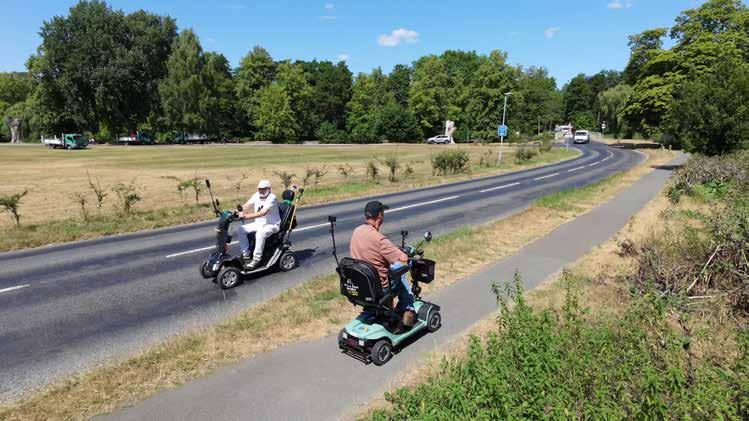
Finally: The Mexican Bandit.
Above is the Bandit, the Mexican Bandit, well actually the Baja Bandit!
It’s being driven by Gary Woods, the man from Eastbourne – already it sounds like an exciting spy thriller.
Before we proceed, let me tell you a story. Gary saw and liked our mobility scooter tests on our track and realised how we were trying to promote independent reviews, rather than just PR nonsense from manufacturers.
He could also see that we were having great fun and a laugh doing it.
Although he lives in Eastbourne, he has friends in Norfolk so was not a stranger to the area.
So, he decided, “I’ll have a go around that track!”
On Monday the 20th of July, he packed up his Bandit into his boot, if you follow me.
He then left the mythical land of Eastbourne at the crack of dawn and headed for the fabled town of Thetford, spoken of with awe and

wonder by all who visit.
After a legendary journey worthy of Odysseus, under the dammed river of woe, through the tunnel of Hades and around the road to Hell, he finally arrived at the magical town.
Now, like Hercules, his true tasks began. Unlike Hercules, he only had four – and he had a bit of help with the first one!
Task 1: Unloading and Assembling.
Let me tell you a bit about his mobility scooter. It is quite an impressive machine. It is a Pride Baja Bandit. It’s made by the same company that produces my Pride Colt Executive, and it is also an 8 mph, class 3, road scooter. But this is where it differs - It is designed to be transportable and easily dismantled. It is not a true boot scooter; some of the components alone weigh more than most scooters. That’s why I helped Gary with his first task. The chassis section itself weighs over 32 kilos, or more than 70lbs in English!
Once this section was out, Gary had it assembled in seconds and was ready for his next task.
Task 2: The Gravel Sea.
This area, near Goal House in Old Market Street, has been filled with lorry loads of gravel as a cheap alternative to paving or tarmac. It is challenging for cars, let alone mobility scooters. He thought it would sink and bury its wheels to the axles in the gravel because its ground clearance was so low (1.57”). He was wrong.
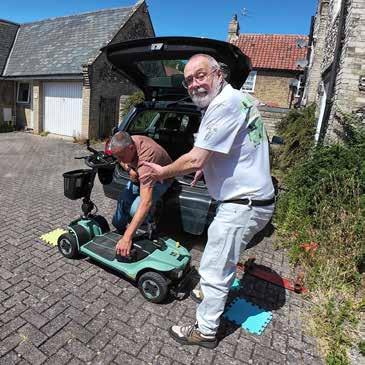
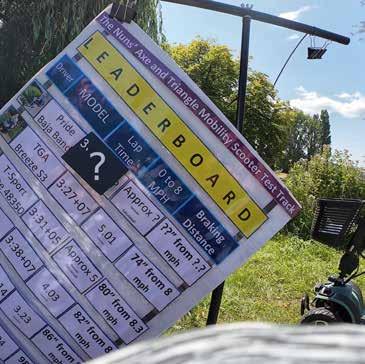


It sailed over the Gravel Sea with ease. Pride doesn’t publish a torque figure, but the Bandit’s 36-volt drive system and reduction gearbox deliver some serious pulling power. It sounds like I’m trying to sell it to you now. I’m not. It would have been much more fun if the Bandit had sunk without trace into the stony deep! Anyway, tick, task two completed with ease.
Task 3: Acceleration Avenue.
Three runs down Acc Ave. How fast could it go and how quickly could it stop?
Unfortunately, Adrian was poorly (get well soon buddy), so we didn’t have his help on this one, and because I needed the stopping distances immediately, I had to measure each run before Gary did the next.
To help with this, I used our drone, Nona, to follow the Bandit.
It wasn’t long before we had lost the drone and had to spend 5 minutes hunting for it! Gary eventually found it in a tree.
So, that was task 3 completed and the Bandit’s braking was interesting, to say the least.
It was finally time for the biggest challenge of all.
Task 4: The Lap.
This was the main reason for Gary’s epic voyage and round trip of over 300 miles.
We set it up. The drone was leading, the Bandit was in the middle, and I was chasing with the stopwatch.
Gary tore away from the start line, the drone barely keeping up until it got lost in the trees on the corner of the dog’s run and washboard way. Shortly afterwards, I reached the same spot, tore around the corner and smashed into a concrete bollard at full speed!
I recovered enough to pick up the Bandit as it approached washboard way for the second time and limped after it as Gary crossed lido leap and reached the finish line. Don’t be fooled by the wonky leaderboard; the wind blew it there, and we had to put the Bandit somewhere before we knew its finish position.
So how did Gary and his Bandit do, did my Pride Colt survive, and did the drone still work?
Scan the QR code below to find out...
... The Baja Bandit’s Tasks Happy scootering.

If you haven’t got a QR code reader, you can find all the videos by following this link. www.youtube.com/@TheMedusaProjectThetford


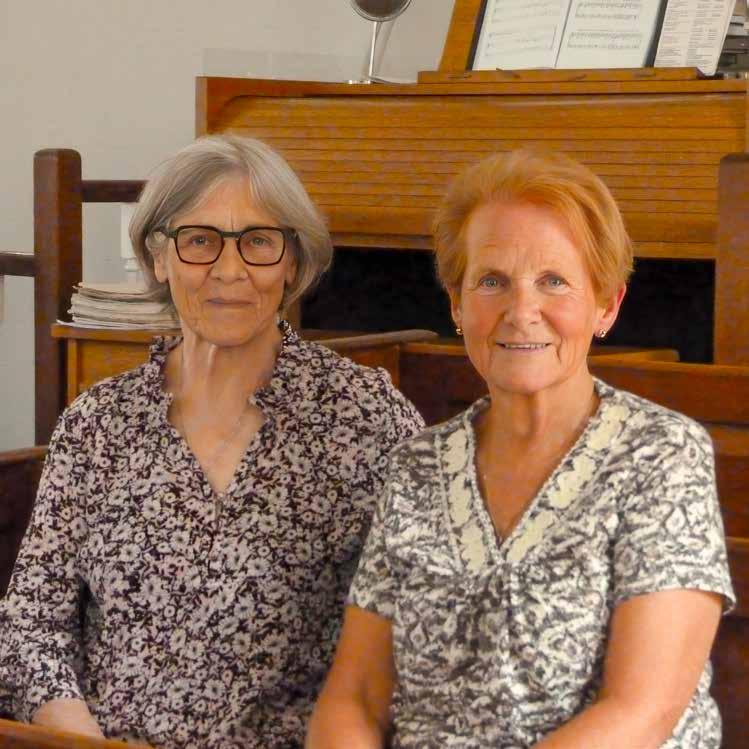
Written by Brandan Cutts
Community is not built by buildings, traditions, or even places of worship alone. It is built by the people who fill those spaces with kindness, friendship, and a willingness to help others. In Thetford, two women have spent decades doing exactly that. Mary and Sammy have dedicated much of their lives to keeping alive the sense of togetherness they were fortunate enough to experience as children growing up in Ireland. Their story is one of friendship, faith, resilience, and an unshakeable belief that no community can thrive without people willing to stand up and care for one another.
Both women were raised in the Catholic community in Ireland, where the church was much more than a place to attend Mass. It was a centre
of family life, friendship, and support.
From a young age, they witnessed the importance of neighbours looking after each other and communities coming together during both good times and difficult ones. Those early experiences shaped the women they would become and planted the seeds of a lifelong commitment to helping others.
In the 1960s, both Mary and Sammy made the move from Ireland to England, bringing with them the values and traditions they had grown up with. Sammy first settled in London, where she married and began her family life, welcoming her daughter. In 1974, she moved with her family to the Abbey Estate in Thetford, where her husband began working at Jeyes. Like many families who



moved away from their home country, Sammy was searching for a place where she could feel connected and where she could find the community spirit she knew from Ireland, which she found at St Mary’s Church.
Mary’s journey to England began in 1964 after completing her apprenticeship as a chef. She moved to Culford, and later found employment at the Central Hotel in Thetford.
Having grown up with strong Catholic roots, Mary soon discovered St Mary’s Church in Thetford, and it felt familiar. The warmth, friendship, and sense of belonging she found there reminded her of the community she had left behind in Ireland. Much like Sammy, it was a place where people knew one another, supported each other, and gathered together not only in faith but in friendship.
Mary quickly became part of the church community. She married at St Mary’s Church soon after moving to Thetford and later settled into her home on Croxton Road, where she still lives today.
Fate had already been quietly bringing Mary and Sammy’s lives closer together long before they knew it. Sammy’s husband once noticed the Irish connection on the number plate of Mary’s car and immediately suspected that it belonged to an Irish family. Curious to find out who owned it, he set out to discover the identity of the person behind the car. What he did not realise was that it belonged to Mary and that their families had known each other back in Ireland when Mary and Sammy were just young girls.
When the two women finally met, it was as though they had known each other forever. A lifelong
friendship was formed, built on shared memories, shared values, and a shared desire to bring people together.
Over the years, Mary and Sammy became the heart of St Mary’s community. When their local priest suggested holding a large annual meal for visiting priests and members of the wider church, the two women immediately volunteered to help organise it. What started as one event grew into a tradition of bringing people together around food, conversation, and friendship.
Their involvement did not stop there. They threw themselves into every aspect of church life, always ready to lend a hand wherever they were needed. Whether it was preparing events, helping others, or carrying out the smaller tasks that often go unnoticed, Mary and Sammy were always there. As Sammy once perfectly described it, “coming to Mass on a Sunday was like coming to meet your family.” That feeling of belonging was something they wanted everyone who entered the church to experience.
The pair helped create opportunities for people to socialise beyond Sunday services, organising dance nights in the Carnegie Room and arranging raffles to raise money and bring people together. They helped transform the church from simply a place of worship into a true community hub. Even the everyday responsibilities, such as keeping the church clean and welcoming, were often taken care of by Mary and Sammy. However, over time, the sense of community they had worked so hard to maintain began to fade. Fewer people became involved, and the close connections that had once been at the heart of church life slowly became harder to preserve. Then came 2020, and the

The Covid-19 pandemic had a devastating impact on communities everywhere. At St Mary’s, several members of the church sadly lost their lives, leaving behind families, friends, and a community grieving together. Restrictions meant people could no longer gather as they once had. Social distancing, cancelled services, and the inability to meet face to face created a sense of isolation. The very community spirit Mary and Sammy had spent decades protecting was at risk of disappearing. But giving up was never an option for these two women.
Determined to rebuild those connections after the pandemic, Mary and Sammy started their Tuesday coffee mornings, creating a welcoming space where people could once again come together, talk, and reconnect. They also began serving soup on Sunday mornings, encouraging people to stay, share conversations, and rebuild friendships. Slowly but surely, the community began to return. Mary used her skills as a chef to teach children how to cook, passing on not only practical skills but the joy of sharing food with others. The pair organised picnics on warmer days, giving people the chance to enjoy being together again after months of isolation and uncertainty.
Their desire to help was never limited to those inside the church. Mary and Sammy established several local charities under the name St Mary’s Charity, encouraging people from outside Thetford to become involved and supporting the wider community. Although those charities eventually came to an end after two years, their mission continued.
They turned their attention towards supporting Thetford’s Food Bank and Church in Need charity, helping to raise hundreds and, in some cases, over a thousand pounds for important local causes. Their work has provided support for people who needed it most and shown that true community spirit extends far beyond the walls of a church.
Mary’s dedication has even received recognition at the highest level, with her receiving a medal from the Pope in honour of her outstanding contributions to charity and her service to others.
Yet despite all the recognition, awards, and years of dedication, Mary and Sammy remain focused on the same thing they always have been: people. Their story is not just about two women who volunteered for decades. It is about the power of friendship, faith, and the belief that communities survive because individuals choose to care.
The world has changed greatly since Mary and Sammy first arrived in England in the 1960s, but their message remains as important as ever. A community is not measured only by its buildings or traditions, but by the people who continue to show up, lend a hand, and make others feel they belong. For generations of people in Thetford, Mary and Sammy have been those people. They have been the welcoming faces, the helping hands, and the reminder that community spirit is something worth protecting.
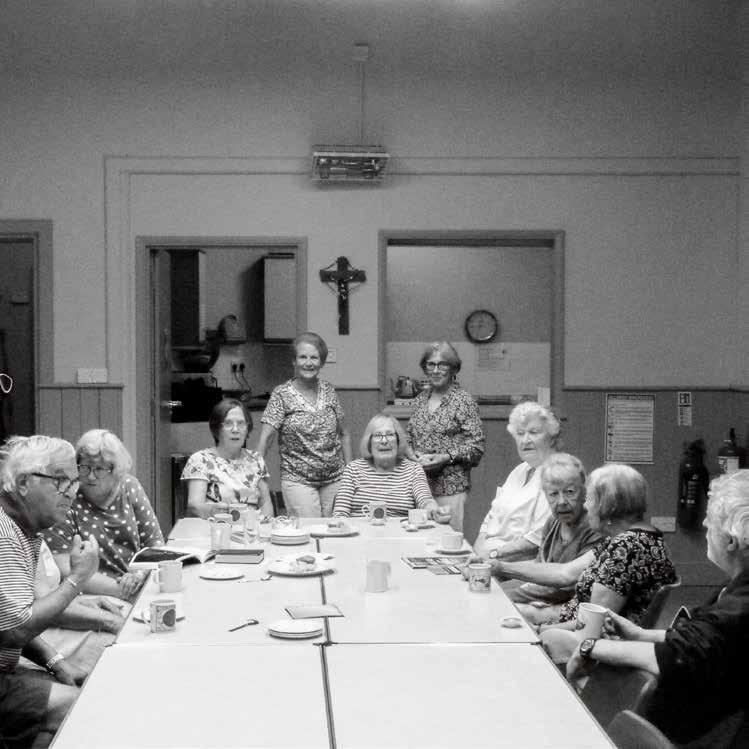
Written by Martin Angus
Every town has a handful of businesses that become woven into its identity. They aren’t necessarily the biggest or the most famous, but they’ve been there for so long that it’s difficult to imagine the place without them.
For more than sixty-five years, John Mayes Engineers has been one of those businesses.
Its story begins not with a grand business plan or an ambitious entrepreneur, but with a family disagreement, a bicycle ride to Brandon and what John Mayes still describes, with typical understatement, as “Dad picking up his bag of spanners and walking away.”
In 1959, John’s father had reached a crossroads.
He was one of four brothers running Mayes Brothers Agricultural and General Engineers, based in
Miller’s Lane, where Abbey Garage stands today. The business repaired agricultural machinery, car and lorry work, engines bored, and served many of the farms surrounding Thetford, but after years of working together, one partnership had simply run its course.
“My father always said he’d had enough,” John recalls. “He picked up his bag of spanners, rode his bike down the yard and never went back.”
It was an extraordinary gamble.
There was no workshop waiting for him. No machinery of his own. No guarantee that customers would follow.
What he did have was a reputation for honest workmanship.
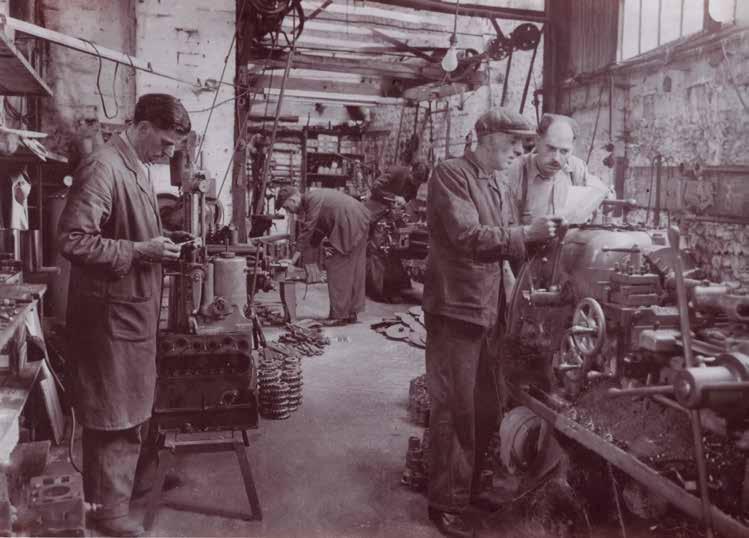
Mayes Brothers Agricultural and General Engineers, based in Miller’s Lane (where Abbey Garage stands today).
Circa 1958, photography courtesy of John Mayes
His first call was on Frank Green of Green Brothers in Brandon, a customer he had known for years. Father and son cycled over together to ask what must have seemed an impossible favour.
“Would you build me a workshop?”
Frank didn’t hesitate.
“Of course.”
When John Senior admitted he couldn’t pay until his share of the family business had been settled, the answer came just as quickly.
“Pay me when you can.”
It was a different age. Business was often built on trust rather than contracts, and a handshake carried every bit as much weight as a solicitor’s letter.
That modest timber workshop, just twenty feet by ten, was erected in School Lane, behind what is now the chemist, and near the doctors’ surgery. It would become the birthplace of one of Thetford’s longestestablished engineering companies.
Today, standing in the firm’s spacious Roman Way factory, it’s difficult to imagine everything beginning inside a building scarcely larger than a modern garage.
“We had machines everywhere,” John laughs. “You wouldn’t believe how much equipment we squeezed into that little shed.”
There was no specialisation in those early days. “If somebody wanted something repaired, Dad repaired it.”
One day it might be a lawnmower cylinder. The next,
a pair of garden shears, a tractor component or an awkward little engineering job that nobody else wanted.
Nothing was beneath consideration.
Looking back, John believes those years taught his father an important lesson: if you help people when they need you, they remember.
John himself was still at Wymondham College, returning home only during school holidays. Those visits were hardly restful.
“I’d spend the holidays working with Dad.”
By the time he left school in 1962, another important decision had arrived.
He had been offered the chance to continue his education and train as a metalwork and woodwork teacher. It promised security, a profession and a very different future.
Instead, he came home.
The partnership between father and son also created an amusing problem.
“The business couldn’t really stay as John Mayes Engineer,” he smiles. “There were now two John Mayes.”
The answer was wonderfully straightforward. John Mayes Engineer became John Mayes Engineers.
While the company was finding its feet, Thetford itself was beginning a new chapter.
“It was a town of about four and a half thousand

people,” John remembers.
The London overspill programme had only just begun. New housing was appearing, industry was arriving, and opportunities were opening for local firms prepared to grow with the town.
One of those opportunities changed everything.
A company called Sheppard Fabrications Ltd, based at Rhymer Point, had begun developing what would become Britain’s first skip-loading lorries. They needed precision engineering and were prepared to trust a small workshop in School Lane.
“They brought us the drawings,” John recalls. “We machined the parts for the first twenty.”
For a family business operating from a wooden shed, it was a remarkable breakthrough.
More importantly, it introduced a pattern that would continue throughout the decades that followed.
One satisfied customer introduced another.
As businesses expanded, new opportunities appeared. When one customer eventually disappeared through retirement, takeover or changing markets, another invariably arrived.
John calls it good fortune.
Perhaps it was.
But luck alone doesn’t explain why customers continued returning year after year.
Listening to John, one quality stands out above all others: reliability.
His father never pretended to know everything, never promised what he couldn’t deliver and never believed any job was too small to deserve proper attention.
Those values quietly shaped the culture of the business long before anyone spoke about mission statements or corporate branding.
Looking back now, it’s remarkable to think that one of Norfolk’s best-known engineering companies owes its existence to a man who simply refused to compromise his principles.
He rode away carrying a bag of spanners.
What he built with them would become part of Thetford’s story.
If the first decade of John Mayes Engineers was about survival, the years that followed were about knowing when to take the next step.
That decision came sooner than expected.
By the end of the 1960s, the little workshop in School Lane had become too small, not because the company had set out to expand aggressively, but because work kept arriving. Then came the news that forced a change. The land had been sold to the council, and the business would have to move.
Rather than searching for another old building, John’s mother suggested something far more ambitious.
“Why don’t you build your own factory?”
It was a bold idea for a family firm that had grown steadily rather than spectacularly. Renting would have been easier. Building meant borrowing money
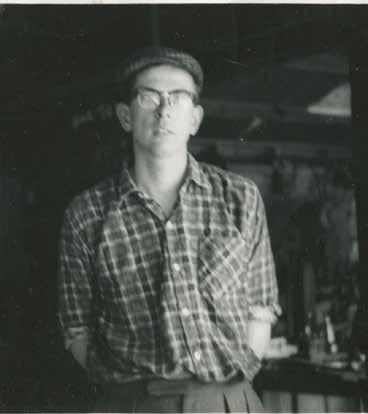


and believing that the future would justify the risk.
The family bought a quarter-acre plot on Brunel Way for £1,600 and, in 1972, moved into a purposebuilt factory of around 1,200 square feet. For the first time there was room to breathe.
“We thought we’d never fill it,” John says, smiling. Of course, they did.
As customers grew, so did the business. Extensions were added one after another until the site itself became the next limitation. By the late 1990s, machinery had become larger, production methods more sophisticated, and space was once again at a premium.
The opportunity to purchase the former Smith & Forbes premises on Roman Way arrived at exactly the right moment.
“It was one of those chances you don’t get twice.”
The move in 1998 provided the room the company needed for the next stage of its development, but it also marked a changing of the guard. John’s nephew, John Jones, joined the business after university, bringing computer skills and fresh ideas at a time when engineering itself was entering a new age.
When John first walked into his father’s workshop, engineering relied on experience, patience and a steady pair of hands. Precision depended almost entirely on the machinist standing at the lathe.
Today’s workshop is a different world.
Rows of Computer Numerical Control (CNC) machining centres quietly produce components to astonishing tolerances, while computer-aided
manufacturing (CAM) has transformed what is possible. Yet John remains convinced that technology should support craftsmanship, not replace it.
“I’ve always preferred the man running the machine to understand the whole job.”
It’s a deceptively simple observation. In many larger factories, programmes are written in an office and simply loaded onto machines. John has always believed that the engineer making the component is best placed to solve problems, improve efficiency and guarantee quality.
That respect for practical knowledge runs throughout the company.
Apprentices are encouraged to learn from experienced colleagues, while younger engineers are trusted with responsibility rather than simply following instructions. For John, attitude has always mattered as much as technical ability.
He remembers one apprentice who spent his school holidays asking if he could come into the factory simply to learn. “He is still working for us”, John proudly remarks.
“When somebody wants to learn, that’s half the battle won.”
The same philosophy applies to investment. Many business owners reward success with bigger houses or expensive cars. John chose a different route.
“I’d rather spend money on machinery than on myself.”
mind. Better equipment meant better capability, opening doors to work that many competitors couldn’t undertake.
Gradually, the company developed expertise in manufacturing highly specialised components using difficult materials for demanding industries. It wasn’t glamorous work, but it required absolute precision and meticulous attention to detail.
That attention started long before production began.
John has always insisted on buying materials from trusted suppliers with full certification and traceability. Every bar, forging or billet arriving at the factory could be traced back to its source, giving customers complete confidence in the finished component.
It is an approach that reflects John’s wider view of engineering.
“You can’t make something first-class from poorquality material.”
The same thinking influenced relationships with customers.
He never believed in competing simply by being the cheapest.
Instead, he focused on being dependable.
If a customer faced an urgent deadline, the workshop adapted. Jobs were rearranged, evenings became longer, and priorities shifted. Not because someone demanded it, but because John understood that reliability was every bit as valuable as technical skill.
Every major purchase was made with the future in
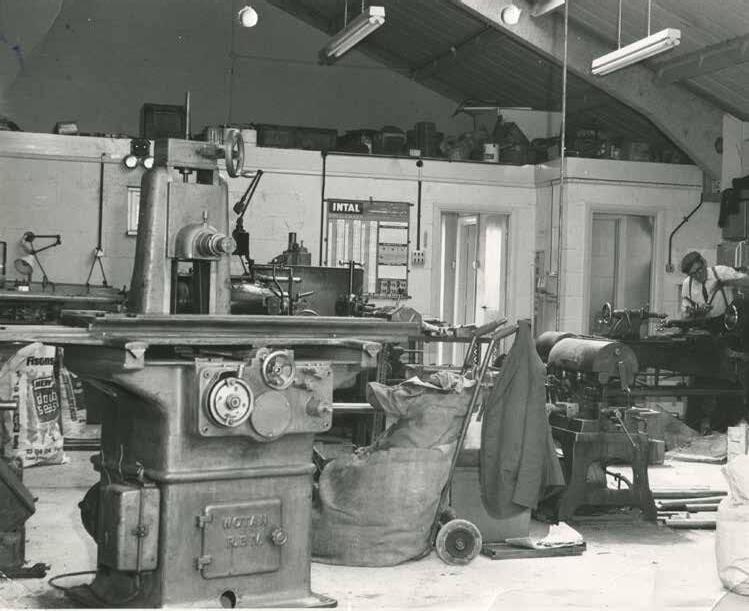
John Mayes, snr., building trust. Courtesy of John Mayes
“You can only sell something when the customer actually needs it.”
It sounds obvious, yet that simple principle shaped the company for decades. Components delivered too late were of little use, however well made they might be.
Many of those customers stayed with the company for years, not through long-term contracts but because they trusted the people behind the machines.
That trust extended beyond the factory floor.
John’s mother kept the books during the early years. Later, his sister took over the accounts, and today the next generation continues to play a central role in running the business. Family ownership has never been a marketing slogan; it has simply been the way John Mayes Engineers has operated since the beginning.
“We’ve never wanted someone else telling us how to run the company.”
It is perhaps the clearest insight into John’s character.
Throughout more than six decades, he has quietly resisted many of the pressures that transformed British manufacturing. He never chased rapid expansion, never sacrificed standards for volume and never lost sight of the belief that reputation is built over years but can be lost in a single careless decision.
From a small workshop hidden behind the High Street, the company has grown into a respected specialist manufacturer whose products travel far beyond Norfolk.
Yet success has never changed its personality.
The machines may be faster, the drawings digital and the customers international, but the principles guiding the business remain remarkably familiar.
Build it properly.
Deliver it when promised.
Let the quality speak for itself.
Spend an hour with John Mayes and you soon realise that you’re not simply listening to the history of a company. You’re hearing the history of Thetford itself.
Mention almost any street, business or family name and another story emerges. There are memories of builders and blacksmiths, councillors and cricket players, factory owners and shopkeepers. Some were well known, others remembered only by a nickname, but together they formed the character of a market town that John has watched change beyond recognition.
“When I was young,” he says, “you could drive both directions through King Street and Well Street. There was space everywhere.”
It is a simple observation, yet it captures how dramatically Thetford has evolved. Housing developments have spread across land that was once open ground, old industries have disappeared, and familiar buildings have given way to modern development. While John accepts that every town must change, he worries that pieces of its identity disappear along the way.
One loss he still regrets is the old Cottage Hospital.

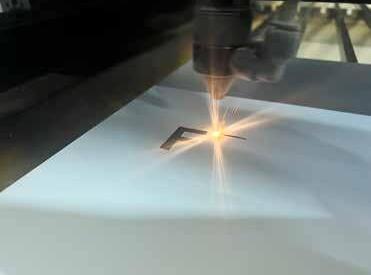


“It was a beautiful building,” he reflects. “It could have been given another purpose.”
His concern is not rooted in nostalgia for its own sake, but in the belief that places carry memories. Once they’re gone, the stories attached to them can disappear just as quickly.
That is why, if asked to introduce someone to Thetford for the first time, John wouldn’t begin with the newest parts of town.
“I’d take them around the old centre first.”
The castle earthworks, the ancient churches, the riverside and the medieval streets tell a story stretching back centuries. Understanding those places, he believes, helps people appreciate the town they see today.
He also remembers an industrial Thetford that younger generations never experienced.
Names such as Woods and Burrells were once synonymous with local employment, while smaller engineering firms, builders and workshops provided skilled work for countless families. John speaks about them not with sentimentality, but with admiration for what they contributed to the community.
The same applies to the people.
Throughout our conversation, names flowed as easily as memories. There was Terry Lamb, with whom John played cricket and whose outspoken views he respected. There were local councillors, builders, tradesmen and businessmen whose decisions helped shape the town. Then came the nicknames, characters remembered as much by those affectionate labels as by their surnames.
John smiles as he recounts them, before making a point that is impossible to ignore.
“When those people have gone, their stories go with them.”
It is perhaps the most important sentence he spoke all afternoon.
History isn’t preserved solely in archives or museum displays. It survives because someone takes the time to tell the next generation what came before. Without those conversations, places gradually lose their personality.
In many ways, that is exactly what Reflections of Thetford seeks to achieve.
Listening to John, you begin to understand that the story of a town is not simply the story of its buildings or its institutions. It is the accumulation of thousands of individual lives, each contributing something that would otherwise be forgotten.
That same perspective shapes his views on British manufacturing.
John has witnessed factories close, industries move overseas, and engineering become increasingly global. He knows how difficult it has become for smaller manufacturers, particularly those carrying the costs of premises, rates, energy and investment while competing against ever-cheaper imports.
Yet he remains remarkably practical.
A business, he says, has to make a profit, not for its owners to become wealthy, but to invest, pay staff properly and ensure there is a future for the next generation.
He is equally clear about ethics.
During his career he was once offered work on the understanding that a personal commission would smooth the process. Rather than compromise his principles, he quietly priced himself out of the contract.
“I’ve never paid anybody for work.”
There is no boast in the statement. It is simply another example of how he believes business should be conducted.
Those principles have earned something far more valuable than a single order.
They have earned respect.
Today, the day-to-day running of John Mayes Engineers rests largely with the next generation. John still takes a keen interest, but he is content to see younger hands guiding the company into the future. It seems fitting.
After all, his own career began by working alongside his father in a wooden workshop hidden behind the High Street. Now another generation is adding its own chapter to the story.
Before leaving, I ask John what he hopes people will remember.
He doesn’t talk about machinery, turnover or specialist engineering.
that cannot be measured on a balance sheet.
Walking away, I found myself thinking less about engineering than about legacy.
One day the little workshop in School Lane will exist only in photographs and memories. The people whose names rolled so effortlessly from John’s tongue will gradually become unfamiliar to younger generations. Even today’s factory will eventually become part of someone else’s history.
That is why conversations like this matter.
They remind us that the true wealth of a town is not found only in its buildings or businesses, but in the people whose determination quietly shapes its future.
John Mayes never set out to become a local figure of significance. He simply wanted to work hard, look after his customers and build something that would last.
More than sixty-five years after his father walked away carrying nothing more than a bag of spanners, it is clear that he achieved far more than that.
He helped build a business that earned the confidence of customers around the world.
More importantly, he became part of the living history of Thetford itself.
And perhaps that is the finest engineering of all.
Instead, he hopes the business continues to stand for fairness, honesty and workmanship, qualities
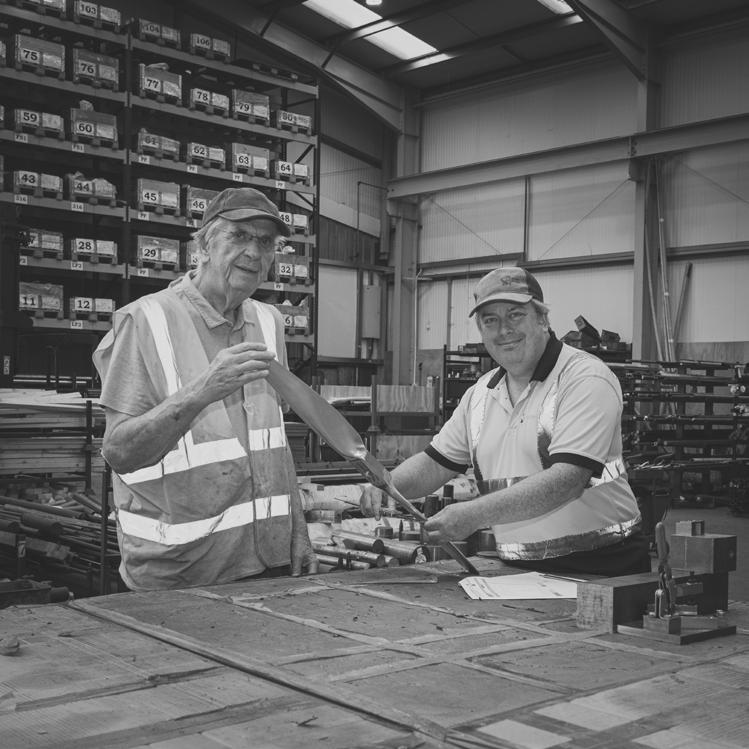
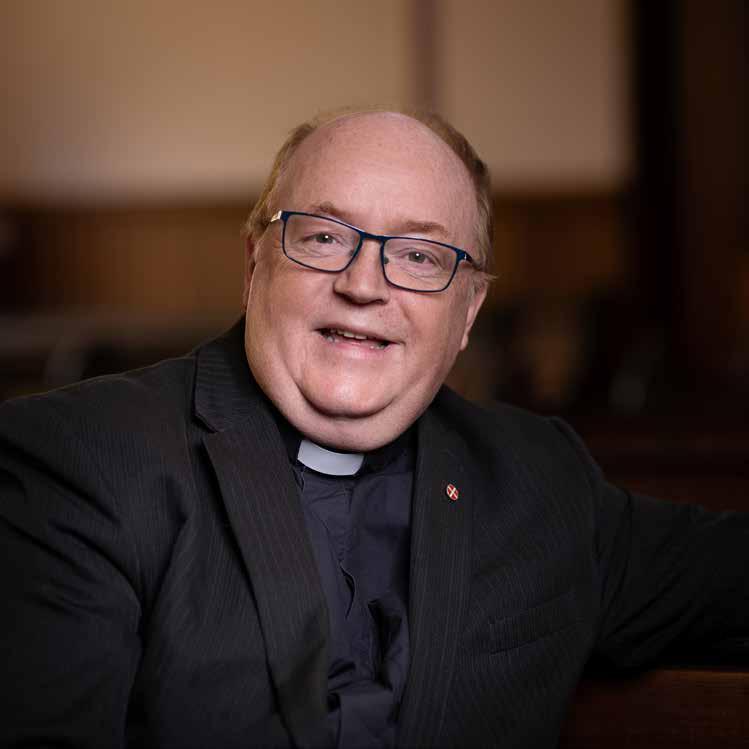

Written by Andy Eden
Five years ago, David arrived at the Methodist church in Thetford as its minister, and now it is nearly time to leave. As with all changes of this sort, it is a natural time for reflection but also for a look to the future and making plans. I met David recently to find out a little more about him and his time here.
David worked for the NHS as a hospital porter and then moved on to becoming a Health Care Worker in operating theatres for 20 years. While he enjoyed the work and found it fulfilling, it wasn’t really where his heart lay. Since he was in his mid 20’s, David had been drawn to the church and had become a member of the congregation at his local Methodist church in Bishop Auckland, Durham, where he lived.
As time moved on, David became more involved with the church, taking on the role of a steward and then a senior steward. It was during this
time, in 1999, that he started preaching as a lay preacher. After several years and as the calling grew in him, he spoke to his local minister about possible ordination. He was encouraged in this and started on the route to becoming a minister himself.
It is by no means a quick or simple path to take. Firstly, David worked through what is called ‘Discernment.’ This is where the potential candidate works with an accompanist through regional panels to test their strength of calling and suitability. They then attend interviews and selection panels before becoming an official candidate. Then the real work starts.
The candidate must complete two years of academic training held at a training centre. It was here that David discovered that he has dyslexia, ADHD and dyspraxia. This may have stopped a
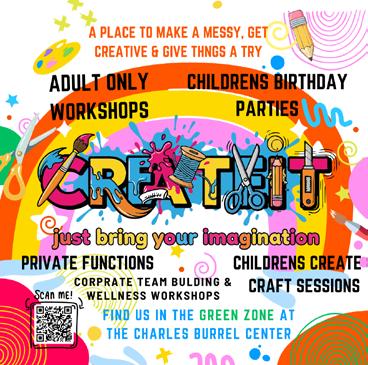
less determined person, but David received the support he needed and completed his training. There followed a two-year probation period and finally ordination into David’s first Ministry in Birmingham.
Obviously, this is not a 9-to-5 job, or in many ways a job at all. It is much more of a calling and does not in fact have a salary. Instead, the ministers are paid a ‘stipend ’, which is a sum of money designed to cover their living expenses. Ministers are called upon to keep what the rest of us might consider irregular hours. In fact, they are never really ‘off duty’ and living over, or at least near, the shop makes them readily available. Despite that, David and his wife see much more of each other now than they did when he worked for the NHS.
So, fast-forwarding to 2021, David arrived here in Thetford. It’s not just Thetford though. David is the minister in Beck Row, Holywell Row, Lakenheath, Munford, Brandon and Mildenhall as well. While each location has its own character, they all share some of the same issues and challenges. Indeed, the same challenges that all churches face.
Perhaps the first amongst these is the number of regular attendees. With congregations generally falling across the country, Thetford Methodist Church has maintained its numbers of 50 to 60 members during David’s tenure. When he arrived, David was told that the area needed ‘stability’ and that is what he has provided. Without that, the church is not able to provide support for the community.
“It’s a good place to be a minister”, says David, “The people are very open.” Open to new ways of doing things as well as new people. In comparison, he found the people of Yorkshire

to be a bit more reserved and “everyone in Birmingham is from somewhere else,” a hub of movement.
Thetford, of course, has its share of problems just as do most towns in Britain today, and it is these that David and the Methodist church work to combat. Rather than have each denomination of church provide a small amount of support for each issue, David believes in a more collaborative approach. That way the combined efforts can become greater than their component parts. As such, they strive to support the local youth services as well as providing pastoral care in Thetford’s nursing homes as part of a team of churches. To help with local poverty, they also support the food bank in Thetford as well as many other good works. This is, of course, on top of the daily work providing help and support with regular services, weddings, baptisms and funerals.
Collaborative work is one of David’s key strengths. He sees himself as an encourager and supporter of others in the good work they do. He is not there to score points over other churches or organisations; instead he is there to support and lend what weight he can to them. ‘Churches should have different points of view’ says David; after all, debate is healthy.
‘The important thing is to see what God is doing in the community and support that.’
David is not about imposing an inflexible way of living on others. As he says, you should think for yourself but understand the moral and ethical implications of your actions. Live to a standard rather than set rules. ‘God is in the ordinary’ and so ‘the ordinary is godly’ and perhaps that is
where you will find him.
So it is that after 5 years here in Thetford and the surrounding area, in August David will be moving on. He will take up his new post in Blackpool on 30th of August with three churches to run, taking with him his positivity, energy and humanitarian spirit for the benefit of his new parishioners. It goes without saying that he will be sorely missed by all those he has helped and come to know over that time.
The Methodist Church’s here will not be unmanned, though. Firstly, there is a small army of helpers and workers who attend to the dayto-day running of the Church. Without these people and the work they do, things would be very different indeed.
Secondly, the Methodist Church is sending a replacement for David in the form of The Reverend Sally Coleman. Sally will be arriving in August to allow for a handover period before she takes over on 1st September.
Perhaps now would be the right time to wish David all the best with his new adventure and to say thank you for all his hard work over the last five years. I’m sure that August would also be a good time to pop in and say hello to Sally, welcoming her to Thetford and the surrounding area.
So, one last word from David. I asked him what he would miss about his time here. He replied that he would miss the history that is woven into the area, the nearness of the coast and the easy accessibility of London, but most of all he would miss the people, their warmth and openness.
‘He will miss the people, their warmth and
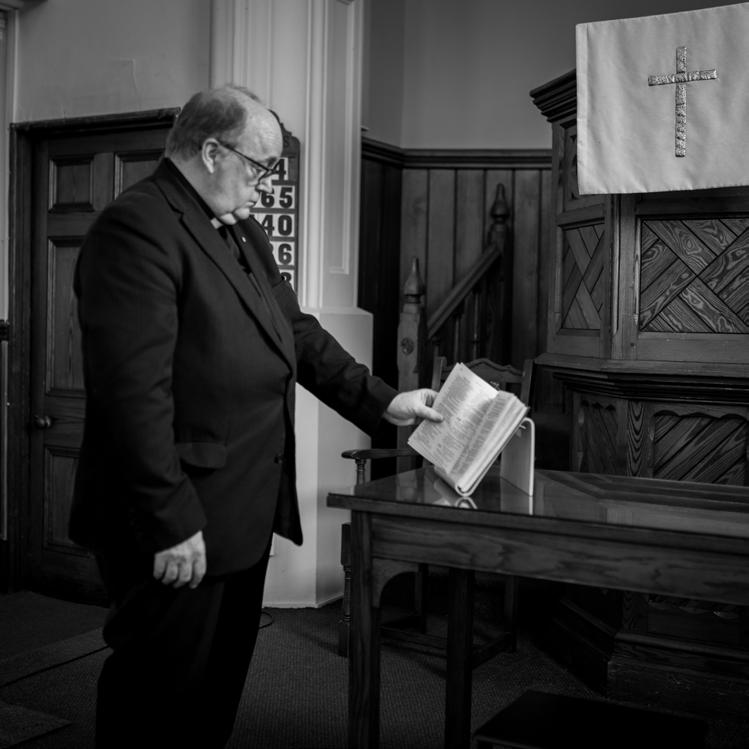
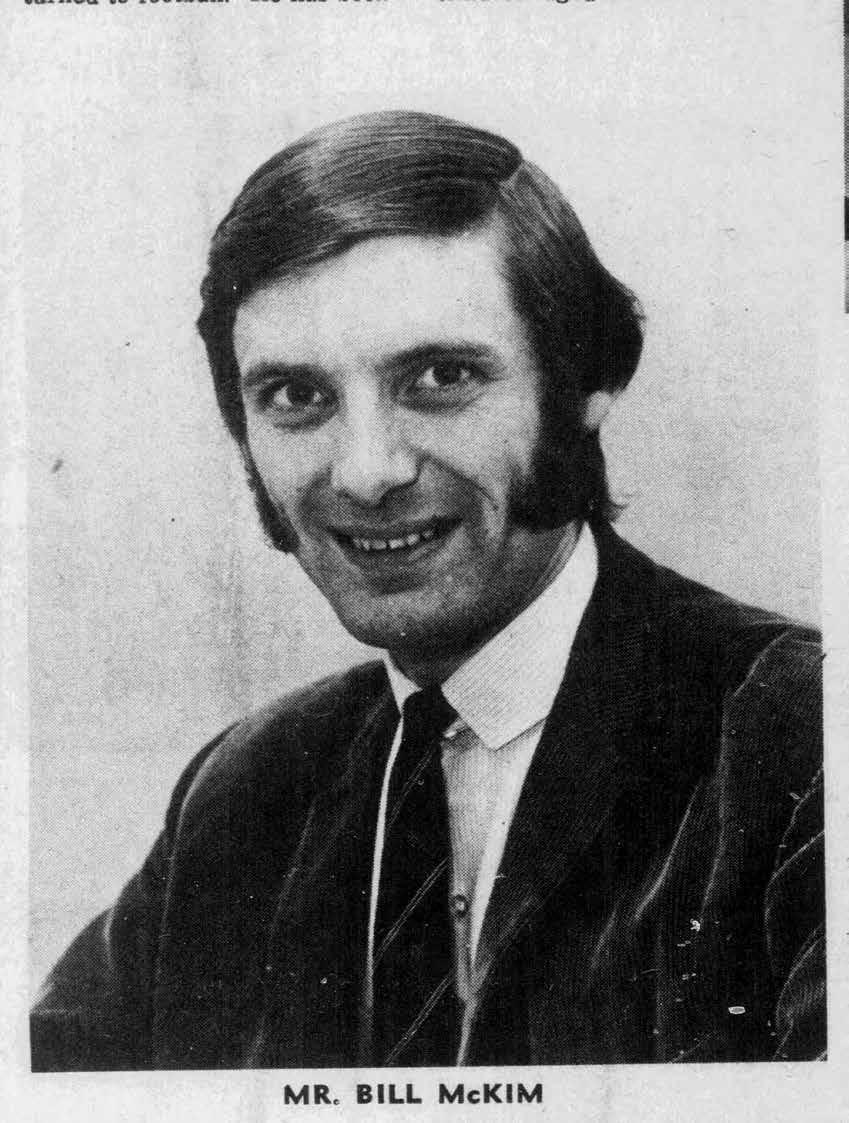
Unless otherwise stated, all photos courtesy of
IWritten by Andy Greenhouse (With contributions from Andrea Francis (nee McKim) and Carol Randall (nee Rogers))
earlier researched and wrote about the Abbey Farm adventure playground, known as The Fort. In so doing, I discovered the existence of a certain William ‘Bill’ McKim and decided that based on what I found out about him, he would be worthy of his own separate story in this magazine. He was, without doubt, quite an extraordinary individual and his contribution to Thetford in the short time he was here is quite unsung and largely unknown.
In the Census of 1961, the population of Thetford was 5,399.
By the time of the 1971 Census, that number had more than doubled to a staggering 13,727, a growth of over 8,000!
As you are no doubt aware, by the end of the 60s, the great London Overspill project was well under way, and this is what largely contributed to the population
growth in Thetford.
Many of the arrivals went to live in the new purposebuilt housing estates of Abbey Farm and St. Johns/St. Martins. As an offshoot of this, it was decided to build a community centre and adventure playground to cater for the social aspect of the new townsfolk. These were both opened on the same day in March 1972 to much fanfare, attended by many dignitaries, both local and from the Greater London Council.
Meanwhile, a certain chap in Corby, by the name of Bill McKim, was unsuccessfully applying for a job at the Sports Centre in Thetford. Two months later, completely out of the blue, he was approached by Thetford Borough Council and offered the job of Play Leader at the Adventure Playground instead.
He started in the role in the first week of April 1972 and was heralded in by the Thetford & Watton Times with
the headline ‘Four Minute Miler is New Play Leader’.
Yes, he was ‘that’ Bill McKim. A quiet and private man who eschewed grand ceremony. His training was often solitary and consisted mainly of running the ten miles from his Kettering home to work in Corby.
He was the 10th person in the UK to run a mile in under 4 minutes since Roger Bannister’s historic achievement in 1954. And it was enough to get him picked to represent Great Britain in the 1500m at the 1964 Olympic Games in Tokyo.
Bill had run in the City Charity Mile at London’s Motspur Park, recording a winning time of 3.59.4. He became the first man to go sub-four minutes in an event organised by the British Milers Club. But even though this feat put him in contention for a place at the Olympics, the process was not straightforward.
With three places available, two were filled almost straightaway, and as the Games drew closer it appeared the selection committee were dragging their heels over the third spot.
It took a stern letter from Bill’s wife, Brenda, asking why he had not yet been named before the committee finally acted...
He was invited to a dinner in London, returning late into the night to casually proclaim to his anxious wife that he was going to Tokyo! That Brenda had pointedly asked them in her letter whether it was because they deemed him of a lower class might also have had something to do with it.
In a cruel twist of fate, Bill struggled to find his form in the qualifying heat and did not make the cut.
Due to the lateness of his selection, the required inoculation jabs for going to Japan were administered
twice in six days instead of the recommended twice in six weeks. As a result, by the time of his race Bill was suffering terribly with stomach problems and lack of sleep.
With characteristic determination, he still recorded a time of 3.46.8 to finish 5th in his heat, very narrowly missing out on qualification. To make matters worse, New Zealand’s Peter Snell recorded the same time to finish fourth in his slower heat and went on to win the Gold.
In his very stoical manner, Bill shrugged this off and, about four months later, beat Peter Snell in a race, and the following year went on to run yet another sub-fourminute mile in the City Charity Mile again.
Bill was sadly destined to never have Olympic success. He was on course for the 1968 Games in Mexico but had to be ruled out due to an ankle injury, which also served to end his competitive track career.
Before his Olympic era, Bill had led a very athletic life. He almost became a professional footballer but turned down an opportunity to trial for Leicester City Football Club in favour of athletics. He ran for Kettering Harriers and then went on to be part of the Tipton Harriers team that won the National Cross Country title. He’d previously also represented his county in Cross Country, Basketball, Cricket and Football.
After the Olympics and towards the end of the 1960s, Bill served a short stint in the Staffordshire Police before starting to gravitate toward Play Leadership and undertook a lot of training in coaching skills aimed at the Under 14 bracket, as that’s where he felt that a lot of potential was going to waste.
He worked as a Play Leader with Corby District Council and then took a one-year course in leadership in Thurrock. It was when that finished that, aged 30, the
Thetford chapter of his life began.
The Thetford and Watton Times article of 14th April 1972 about his appointment showed a smiling picture of Bill (see photograph page 178), complete with magnificent sideburns, and was accompanied by a short biopic of his life up to that point. The stage was set.
As an Olympian with the strength of character to encourage youngsters across a myriad of sports, he would become an inspiration to many. His stated intention was modest but ambitious: to develop the Abbey Farm adventure playground to its full potential and establish it as a place where children could play in a permissive but supervised environment.
His first contact with the town was to reach out to ask for donations of rope, timber, old car tyres and anything else that could be used to make adventure equipment. The plea was obviously met with generosity as he went on to build amazing pieces of equipment like aerial ropeways, climbing nets and zip-lines. His daughter, Andrea, remembers he would come home with red-raw hands, such was the hard graft he was putting into the construction.
By July of that year, Bill was well and truly ensconced in the role. Aside from creating much of the equipment in the playground virtually single-handedly, he also organised many activities for the Thetford youngsters to take part in during the summer holidays.
These included football coaching by a qualified FA coach, a forest walk in Santon Downham, a tour of USAF Mildenhall, stock car racing at Snetterton and a trip to Gt. Yarmouth – all arranged by Bill to enrich the minds and social engagement of the kids in his care.
In August of the following year, the FA coaching course was reintroduced due to its previous popularity and
over 100 youngsters signed up again. He was ahead of his time in recognising the value of nurturing sporting talent in the important early teenage years and in February 1974 had an idea that would create the foundation of youth athletics in the town. He wanted to create a junior sports club to help the sportsmen and women of the future. It would require older members of already established clubs from around the town to give up a little of their time to coach the youngsters. The majority of organised sports clubs didn’t cater for youngsters until they reached the age of 14 but every effort should be made to develop interest in the U-14s. Bill said he was willing to give every assistance in enlisting members and with any financial outlay that was required.
Around March 1974, Bill met with the Breckland District Council Recreation and Amenities Committee. During the meeting, he explained his role to the Committee, describing how many youngsters he would have to deal with during the course of one day (which was into the hundreds!) and how varied his role needed to be. During the summer months he would easily work 11 hours a day, seven days a week, with only three parttime helpers to assist.
He told of how he would sometimes have to be a policeman or social worker, and at other times maybe a probation officer, but above all he had to have the confidence of both the children that came to the playground, and also their parents. This all stemmed from Bill’s firm beliefs, and a noteworthy quote of his was that “The more we can do for these youngsters, the better it will be for the community as a whole. For these are the citizens of tomorrow.”
Just a couple of months after the idea was formed, Bill brought it to fruition and formed the Junior Athletic Club in April. The inaugural meeting attracted about 30 youngsters up to the age of 14. With limited resources to start with, plans were afoot for a running track on the Mundford Road playing fields. Bill hoped that, in time,
teams of junior athletes would be able to enter and compete in East Anglian athletic meetings.
By July, just three months after its formation, club membership had grown to around 50 and would very soon form a senior section as well. There was also the addition of Alan Jones, who, like Bill, was also a qualified A.A.A. coach, and his assistance proved to be invaluable as they strove to promote the aims of the club, being to encourage, stimulate and develop athletics training.
Not long after this, it was announced that Ted Meardon was now the Athletic Club’s secretary. Along with Bill, he had been instrumental in setting the club up, becoming interested in it after his son entered a race that Bill had organised. His observation of the club was that it was the best thing to ever happen to Thetford!
As well as the FA coaching, Bill was also busy during the summer organising other activities for the youth of Thetford such as cricket and field sports after a generous donation to the club of some equipment.
In September it was reported that Bill started up a Karate Club at the Adventure Playground aimed at the over-12 age group. It’s not certain how long this club kept going.
In October 1974, Bill enhanced his coaching prowess by qualifying as a national senior athletics coach after a day-long examination process held in Welwyn Garden City. Bill added this honour to his long list of other coaching skills, including that of a full F.A. coach.
Despite this, it seemed to be a period of underlying frustrations. Bill had written to Thetford Town F.C. to invite them to the youth centre in order to give advice and answer questions about football, citing it as a golden opportunity to inject new blood into the side. But he received no reply and even made personal
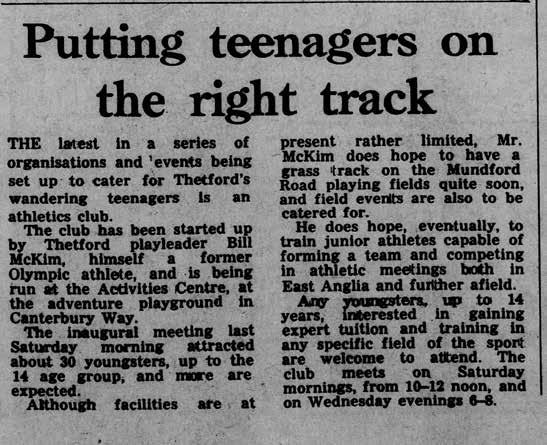
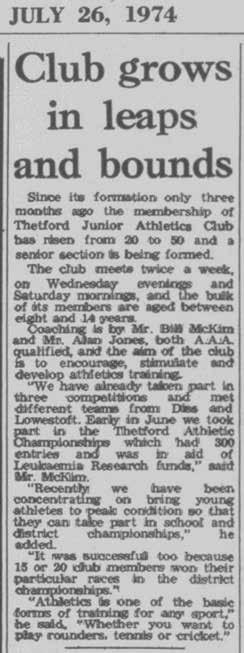
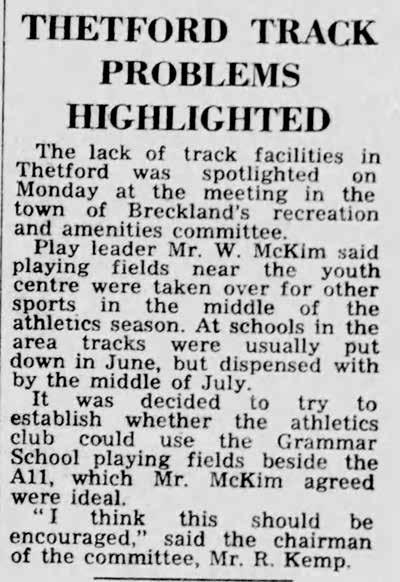
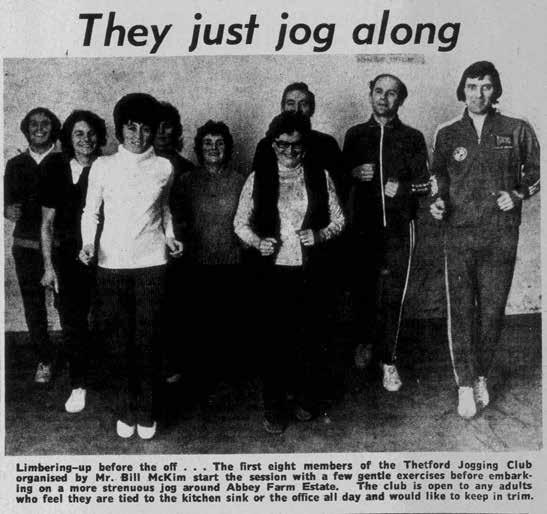
approaches to club officials.
After some to-ing and fro-ing, the club stated that they weren’t turning their backs on them; it was just that they could not take youngsters until they were aged 15 because they did not have the facilities for them.
It was at this time that Bill was also highlighting the lack of facilities for the Athletics Club, bemoaning the fact that there were no permanent facilities in the town where they could do continual training all year round.
But there was no doubt about it, Thetford Athletic Club (as it was now known) was starting to make a name for itself. Still predominantly ‘junior’ teams and members, they were constantly achieving excellent results at local, district and national level under his guidance and coaching and seemed to be in the newspaper every week, and it was always the same names making the headlines. Names such as Connichie, Flint, McKim, Ball, O’Connor, Meardon, Points, Rayment, to name but a few… all youngsters but all who were top performers for the athletic club and would continue to make headlines for several years.
Bill shared in the pride of every athlete’s success – from the England vest winner to the club runner who turned up every week, rain or shine, to win vital points in league victories.
Just a few months later, in February 1975, saw yet another of Bill’s ideas come to life in his mission to bring fitness to Thetford. He started up Thetford Jogging Club and opened it for any adults who might have felt they were tied to the kitchen sink or the office all day and wanted to keep in trim!
The following month it was reported in the T&WT that the club was struggling financially. Not helped by the excruciatingly high inflation rate of over 20% at the time, the club found that most of its funds were being


eaten up by travelling expenses and affiliate fees, and Bill came up with the idea of a 100-mile sponsored relay race to raise some much-needed funds.
Around 30 members, both juniors and seniors, took part in three teams, with each runner having to complete 10 one-mile relays. It was successfully completed on the grammar school playing fields, and the club lived on to run another day!
July of 1975 saw a big upheaval for Bill when he gave up his hugely successful role of Play Leader at the adventure playground. Leaving it in the safe hands of his successor, Bill took up a new position as a sports officer at the newly built second stage of the Breckland Sports Centre, a job not dissimilar to the one he’d originally applied for a few years before. It wasn’t until September, though, that the Centre received its official opening ceremony, with the deed being carried out by none other than Mary Peters, another famed Olympian of the time.
Bill and his wife Brenda both went to the airport to pick Mary up and bring her back to Thetford, where she stayed in the Bell Hotel.
No doubt there was very likely a small part of Bill that was grateful for the cessation of his play leader responsibilities, for that role had consumed him for the best part of three years.
Now Bill threw himself with new vigour into his sports officer job and was free to concentrate much more of his time on the emergent Thetford Athletic Club. The results kept coming in, week after week. There were always mentions and applause in the papers for the efforts of the athletes but also occasional clashes with competing authorities, teachers and parents whose views did not always align with Bill’s. One such incident was a Championship meeting in December where Bill was drawn to criticise the Norfolk A.A.A. for
failing to provide three title race winners’ trophies and medals, claiming it made a mockery of the event and presentations.
In February of 1976, Bill organised a marathon race at the Grammar School fields. But there was a slight difference… he had come up with the idea for the marathon to be a sponsored event in order to raise money for the GB Olympic team due to go to Montreal later in the year. Half of any money raised would be for this cause, whilst the other half would go to the club.
Like the previous fund-raising event, it would again be on a team relay basis, and it was hoped to achieve the total distance in under 3 hours and 15 minutes.
With typical energy and commitment to the club, Bill sent out around 180 letters to local firms, appealing for contributions, but was shocked to the point of anger at only receiving 12 donations. He was quoted in the T&WT bemoaning the town for its lack of interest and
wondered if people realised that it was only public donations that financed the team.
This drew comment from ‘Black Friar’, being the pseudonym of a regular columnist in the T&WT, who stated that while Bill was obviously an athlete of note that burned with a fervour for all things athletic, he would do well to realise that with the number of good causes that come knocking on doors, firms would be more amenable to donating to local good causes rather than something of a more national nature such as the British Olympic team. He chose to justify this with the presumptive phrase that for so many local companies, charity begins at home.
This gave cause for Bill’s wife Brenda to once more put pen to paper, and she wrote under her official title of Treasurer, Thetford Athletic Club, to the newspaper to address Black Friar’s comments.
But, once the race was run and the dust had settled,
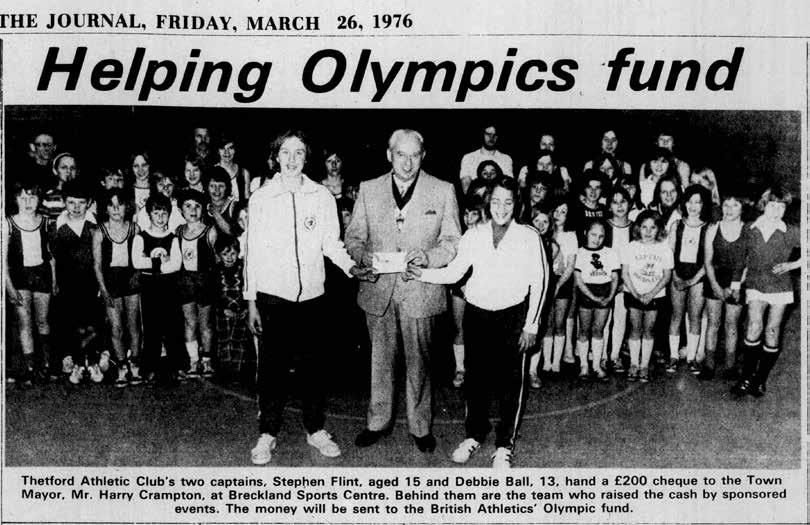
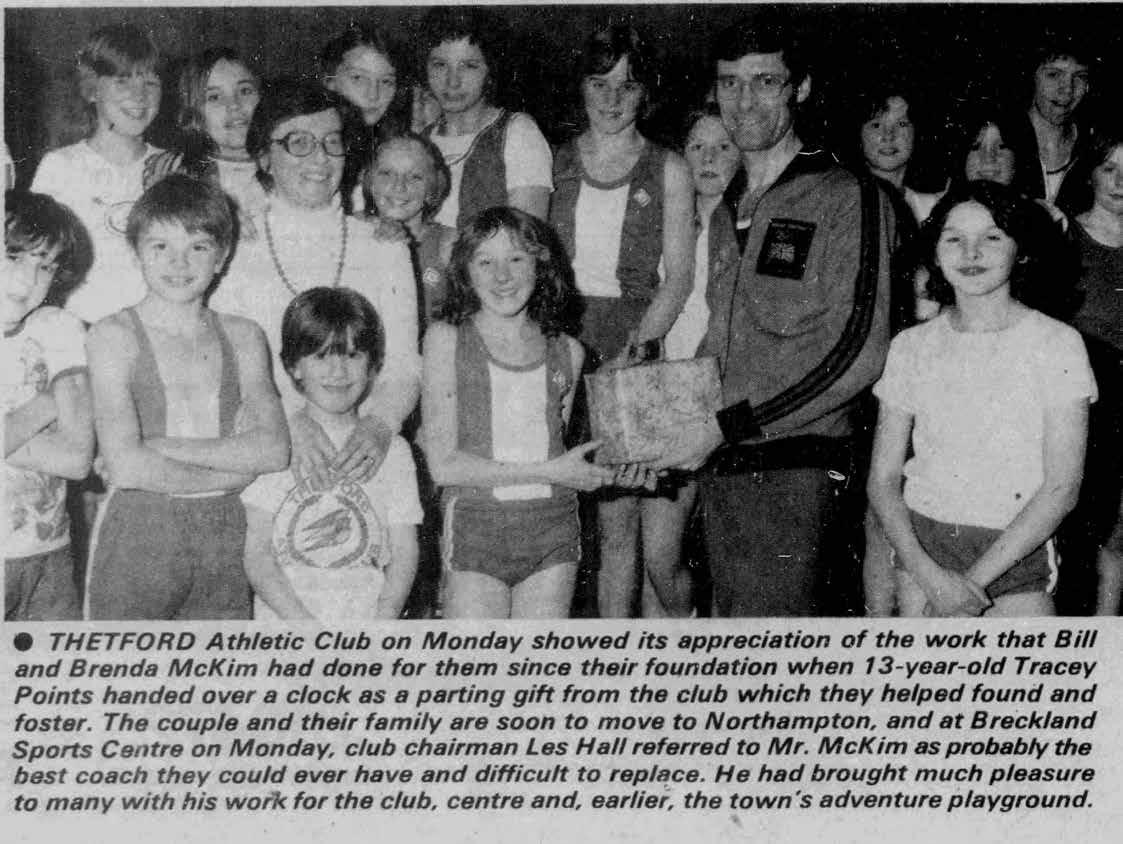
the club was proud to have raised over £200 for the Olympic fund and was shown handing over a cheque for £200 to the mayor at the time, Mr Harry Crampton.
Not forgetting that Bill also held down a job at the Sports Centre, there was a good reminder of this when he was involved in the Top Town competition organised there. The competition, the first of its kind, involved a team from Beccles Sports Centre competing against Thetford in ten events, with the Jeyes Cup going to the winners.
By August of that year, the club had gone from strength to strength and had reached almost 100 members.
One Tuesday morning, more than 40 of those members took part in a protest march outside the Thetford Sports and Toy Centre shop premises in White Hart Street.
The shop owner had controversially decided to sell the club kit at £2 a set cheaper than what the club itself was charging, claiming that they were selling them cheaper than cost price to ‘help the kids and to stop those people (the club) from coining it in.’
Bill was quite rightly concerned that the kit could be sold to anyone in the town, saying it was their own design and wanted to keep it for the members. The shop had initially refused to stock it for them two years before.
The Thetford athletes won through as their distinctive kit can still be seen today, though the shop is long gone.
A rainy day in November saw club members taking part in yet another sponsored run to raise money for the club. 37 runners took part in the ‘Guy Fawkes 20’, running 4 to 6 miles each but in teams, though Bill was one of two members who ran the whole 20 miles
individually. Bill completed his run in 2 hours and 9 seconds, which was faster than the second team home!
The club ended the year in fine condition, both financially and competitively. Their sponsored running events assisted them in banking around £300 and also the £200 for the Olympic Fund. Their team of runners had amassed a terrific collection of awards and trophies over the year, and Bill was proud to declare that although Thetford was just a small town, they had the quality available to stand up against anybody in the country.
The financial well-being was short-lived, however, and the club stumbled its way into 1977, and by April Bill was once again hat in hand appealing to the good people of the town. Without a steady income, the club was finding it increasingly difficult to cover transport, meals and accommodation costs, citing the £1300 it required last season. Bill declared to the T&WT that the club was facing a potential crisis if it couldn’t find £500 to cover their costs for the next few months.
Bill resorted to their tried and tested method of fundraising and organised another sponsored run, this time a 50 x one mile relay to be held at Fulmerston School track. Praise for the public’s generosity was quickly meted out when the sum of £319.43 was raised, which turned out to be ample to help pay for activities throughout the coming summer.
Throughout all of this and during 1976 and 1977, Bill, without the responsibilities of the playground over him, found time to get back into actually competing in the senior races at many of the meetings the club attended, running relay and individual distance and cross-country races.
1978 rolled in with some ill-health for Bill.
He was laid low in January with a duodenal stomach
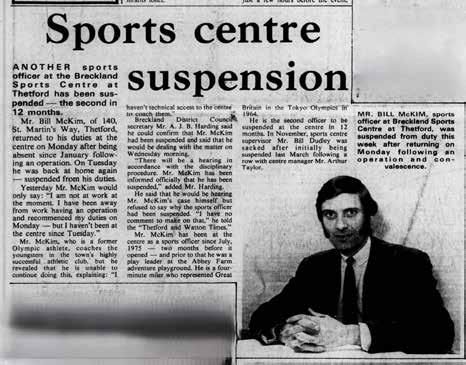
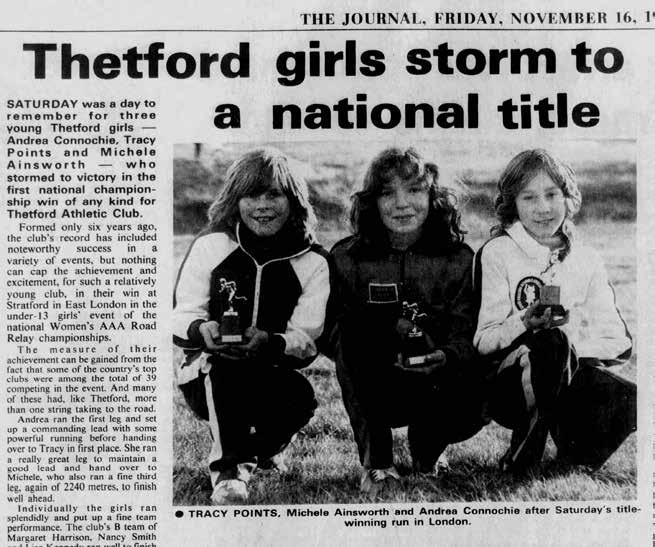
ulcer which required surgery, and he was off work for two months. After a period of convalescence, he returned to work on a Monday in early March, only to be suspended and sent home again!
After ‘no comment’ from both sides of the table as to the reason, I can reveal it! While Bill was off, the Sports Centre altered everyone’s shift rota patterns. But nobody actually told Bill about it, and when he arrived back at work, he found out that he shouldn’t be there. He was obviously not too happy about this, and the resulting suspension came as a bit of a shock and played havoc with his training and coaching duties with the Athletics Club. Not being allowed access to the Sports Centre grounds, he had to improvise his technique and ended up shouting instructions through the gate!
Thankfully Bill was reinstated the following week, and normal service was resumed.
In March 1979, Bill left his job at the Sports Centre and, with his family, moved back to Northampton where he took up the position of manager at Lings Forum Leisure Centre.
In so doing, he also left Thetford Athletic Club – the club he had founded with the help of his wife, almost six years previously.
There’s a wonderful photo of Bill and Brenda surrounded by lots of the younger members and being presented with a clock as a parting gift. Later, the club chairman, Les Ball, referred to Bill as the best coach they could have ever had and would be difficult to replace.
Bill continued to lead a full and active life. In October of the same year, at the age of 38, he ran his first marathon, in New York, and finished 73rd overall out of over 10,000 finishers and was the third Briton to
finish. His time was 2:28:24, just 16 minutes behind the winner, although he was annoyed to get passed by Grete Waitz of Norway right at the end as she crossed the line as the first female finisher!
In later life, Bill swapped running for extreme hiking. He climbed Everest twice, getting to the highest point you could get to without oxygen, and did a hike across Nevada’s Grand Canyon, completing a two-day trek in a day as he didn’t see the point in taking so long over it.
Peru’s Inca Trail was another highlight as he completed the four-day walk to Machu Picchu.
In November 1979, just six years after being formed, the club won its first national title of any kind. In Stratford, three girls, Tracey Points, Michele Ainsworth and Andrea Connochie won the U13 girls Road Relay title.
That was just the start of it…
Bill sadly passed away on May 28th 2023 at the grand old age of 81, but not before leaving an indelible mark on the world, and Thetford in particular.
He touched the lives of so many people and instilled in them a sense of pride and a confidence in knowing what they were capable of achieving.
Fast forward to May 2024 and the club celebrated its 50th anniversary. At least eight founding members joined dozens of today’s aspiring athletes. Together they honoured the memory of their founder as Bill’s eldest son, Graeme, and widow, Brenda, presented the Bill McKim Memorial Trophy.
Thetford Athletic Club has never been just an average sports club but more a true family to hundreds of children over several generations – all thanks to the legacy of ‘that’ Bill McKim.
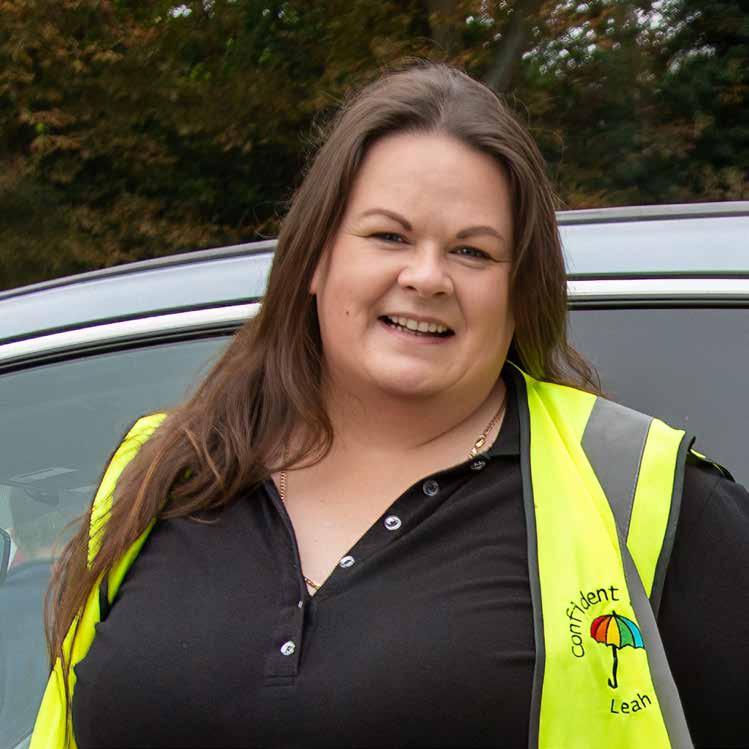
Written by Andy Greenhouse
The love of Leah Wooderson’s life is a large beast with a long face. We are, of course, talking about her horse Milly, and not the other love of her life, her partner Adrian.
Milly is a fully grown Irish Cobb mare, measuring in at 16-2 hands, with one hand being equal to four inches. This means that at the withers she’s about six feet to six feet two, and then when you add the neck and head to that height you can see that she is fairly big! Or, as Leah puts it, huge!
Despite her size, Leah says she is a very friendly horse, though she does have her moments, which is, after all, a female’s prerogative, she added jokingly.
And just in case, like me, you didn’t know, a horse’s withers are the raised ridge between the shoulder blades, at the base of the neck and just in front of where the saddle sits, and this is generally the point to which a
horse’s height is measured.
Five minutes into our meeting and I’d already learnt two things! Being the non-horsey type that I am, I was pretty sure there would be more.
I met with Leah at 8 am, on a sunny Thursday morning outside the Greggs shop in the B&M car park. She had been helping Adrian complete a litter pick in the car park as part of his duties for the firm he works for. They were meeting me before they headed off for other parts of their daily routine. After introductions, we were soon talking about all things horse.
Hailing from Scole, near Diss, Leah has been around horses for as long as she can remember. Her mum used to keep them and bought Leah her first pony when she was about four years old. She had others along the way until, aged 16, she bought her first horse. And it’s been horses all the way since then.




Her first foray into the wider world of equine mastery was when she started getting hold of ex-racehorses and ‘produced’ them. (Hint – lesson number three coming right up!)
When a trainer uses the word ‘produced’, it’s a horsey term that basically means they’ve taken a racehorse and changed its mindset, training regime and body requirements to that of their chosen discipline. This could be dressage, endurance or, as in Leah’s case, eventing and jumping. Think of it like equine rehab.
But in 2007, aged just 18, disaster struck when Leah was involved in an accident that left her with a broken back.
Riding out on the road, a car drove past too fast, scaring her horse and causing it to rear up and fall backwards on the road, with Leah still astride. As a result, her coccyx was crushed, and it took her many months to heal.
But no sooner had she recovered from this setback and overcome any fears, than she was back in the saddle only to have the same thing happen again! This time she was dragged by her arm, severely damaging her shoulder and arm muscles.
Being very philosophical about that period of her life, she thought that either the universe was trying to tell her something, or she was just plain crazy! But it was obvious that she loves riding both then and now.
Every day she still experiences a lot of pain in her back and pelvis and experiences the random loss of use in her arm. Even after all this time, it serves as a constant reminder of the hazards involved.
Her injuries played on her mind for a few years after and were no doubt what prompted Leah to ‘give up’ on the horse world when she was around 25 years old.
Not long after this, she met Adrian and moved in with him almost straightaway at his parents’ house in Thetford. That was around eleven years ago. They did briefly move into their own place in Rushford, and then about four years ago they came back to Thetford, and back in with Adrian’s dad.
Perhaps meeting Adrian was the emotional catalyst she needed; for around three months after meeting him, she bought Milly. Her philosophy for this is that if it’s in your blood, well, it’s in your blood and mad as it may be, you’re hooked!
Leah continued to tell me about her journey to this point and told me of her experience of living in Rushford.
With Adrian out at work every day, she was more or less left to her own devices along with Milly. Being such a small village, it wasn’t hard to spot that there were lots of other horses dotted around the fields.
Just down the road from where they lived was a livery yard, and there would be riders coming past their house every day.
In desperate need of some interaction and to get to know people and the area, Leah plucked up the courage one day to ask if she could ride out with them.
But the response she got was that she and her horse were not suitable to ride with them! This made her feel awful and quite unwelcome.
It was, however, from this disheartening experience that Norfolk Nutty Nags came into existence.
After being treated so horribly, Leah created the group because she didn’t want anyone else to have to feel like that and to make sure that people could make friends with others who had the same equestrian interests.
Looking back on it, although the idea was Leah’s, they agreed that it was Adrian that came up with the name. And this was around six years ago.
Their Facebook page now has around 1800 members and promotes friendship, activities and ride-outs for like-minded nutty horsey people! Just search for Norfolk Nutty Nags.
Their physical presence, when it’s not one of the several charitable or informational ride-outs, is usually out of Little Lodge on the Brandon Road just before Santon Downham. They meet up in the large parking area and ride from there, usually ending up by the river and then having something to eat, and all in all it tends to be a good fun day.
The club aims to help people who might be a little nervous, or maybe just got a new horse and need a bit of help to build confidence, not just in horse riding but in themselves too. All Leah wants to do is to help people and support them in their equestrian endeavours. It’s for free, and everyone is invited, and they try to make it a nice, fun place for anyone to go.
Leah likes to get involved in lots of other local events too.
The World Horse Welfare at Snetterton have asked her a couple of times to go and judge some of their fun shows, which she said was quite a nerve-wracking experience although she did enjoy it.
Sometimes she’ll go with Magpie Rides, which is similar to Norfolk Nutty Nags, and she has ridden out with the Suffolk Hunt too, though there’s no actual hunting involved as it’s just basically a jolly around the countryside!
Apparently, the worst mistake she ever made, though, was to wear brand new boots for the eight-mile hack
with the Hunt. Her poor little feet were really painful afterwards!
When it comes to horses, Leah certainly knows her stuff. I asked her about training them.
Horses are generally ready to be ‘broken-in’ when they’re around 4 to 5 years old, but obviously every horse is different.
It all depends on how quickly their brains mature, and also their bodies. The first ex-racehorse that she had was 16 hands when she got him, and he was just left to grow out in a field and gained another two hands in height before it was decided he was mature enough to be ‘produced’.
Apart from being ridden, this also involves such things as being walked on a lead rope, being washed and having their feet trimmed… just the everyday sort of things a horse would experience from a young age.
They would also be introduced to travel boots (which are just wraps that are used to protect their legs while they’re being transported) and tendon boots used for when they’re jumping, or having a head collar put on.
This, and all their training and procedures, is a repetitive process so the horse gets used to it from a young age so when they’re older there’s no panic at something unexpected.
I asked if they did their own farrier work, but Leah said that it was something they had thought about doing, but there’s so much involved and to know about a horse’s tendons and fetlocks that they decided to leave it to the experts, and they have a farrier come to them whenever required.
And here’s me thinking that all you need is a Boy Scout’s penknife!
It costs between £90 and £120 for a set of four horseshoes to be fitted, but Leah said her horses were mostly ‘barefoot’, i.e. not shoed, and they would pay out around £35 every four to six weeks for them to be trimmed. Farriers that come to them do mention that her horses’ feet are in very good condition and like solid rock, which is a good thing.
She went on to say that her personal opinion was that horseshoes can really mess up a horse’s feet and, wherever possible, she avoids having them fitted.
She said about ex-racehorses she’s had that had been shod from a year old but explained that if they lose a shoe, it could make them lame because their feet become so used to the shoe.
Her horse Milly (and Adrian’s Gypsy) can walk for hours without shoes, including on roads, with no adverse effects.
But in the same respect, she added that in some instances, the horse would need to undergo corrective shoeing if they’ve got something wrong with their feet that might need the shape changing or a heel lifting, or just to make them feel more comfortable. It’s all about knowing what’s best for your horse as they’re all different.
At the other end of the scale, I asked her at what age a horse would stop being ridden, and again she said that it differs for all horses.
Taking Milly as an example again, she is 17 years old now. She’s healthy, her feet are good, and she’s happy to be ridden, so Leah said she would keep riding her until she wasn’t happy with it or was uncomfortable. She also explained that boredom could manifest as a problem in a horse too if it wasn’t constantly being ridden out. It messes with their minds and can bring out
She knows of horses aged 26 to 30 years old that get taken out for hacks around the countryside with no problem, although the average lifespan for a domestic horse is usually around 30 to 32 years.
I was curious to know if horses were similar to dogs in having personalities, to which she emphatically replied yes. Reiterating what she had said earlier about all horses being different, she emphasised that every single horse has a different personality.
She explained about the bond that had grown between her and Milly.
At first, it was difficult. Milly had experienced physical abuse and had become head-shy from being hit around the head, and was not very good with people in general, and it took over two years for Leah to help Milly overcome her fears. Generally speaking, she added, horses are beautifully docile creatures and anything untoward in their character is usually from a people problem, not a horse problem.
Of course, people who keep animals of any sort need somewhere to keep them.
It turns out that Leah and Adrian have quite the menagerie between them, all safely tucked away in a paddocked field set in about eight acres of land in Blo Norton, over near Garboldisham.
There they keep their two horses (with a third due to arrive in October), three sheep, three pigs and a chicken. And two yard cats.
While most of the animals contribute to their upkeep, the sheep have become more like pets than farm animals. The chicken, once part of a thriving flock that’s been slowly decimated over time, provides eggs and
the pigs supply the bacon sandwiches. The cats do an admirable job of keeping the rat population down and also keep the rabbits away!
Leah and Adrian spend, on average, around 3 hours a day at the ‘farm’, cleaning, feeding and general tending of the animals. Though this could end up being longer if Leah gets her way, as she admitted that she would love to get a cow, preferably a mini Highland cow. And some pygmy goats. And a donkey!
As much as Leah would like to spend all her time with the animals, she does, of course, like most of us, have to make ends meet.
With a degree in catering, she was a fully qualified chef until that was cut short by her accidents. She lost strength in her arm and the feeling in her hand and found she couldn’t lift the pots and pans in the kitchen, and with a series of ongoing operations, she had to make the difficult decision of giving up on that career choice.
Not to be put off, she has gone for something completely different and is now studying for a diploma in administration of business management.
Her partner, Adrian, is in the process of setting up his own business in groundcare management and pest control, and this is something that she is helping with the administration of.
This ties in nicely with her home-based business too. Born of her love of animals and their welfare, Leah has created ‘Boody Bear Bakes’, which is a range of animal treats all created with organic ingredients.
She did point out that the ‘Bear’ part of the name is after her dog, Bear, and not an actual ingredient! They are trying to cater for most animals and have been busy sending out samples of treats that can be
given to horses, sheep, pigs, dogs and cats. Part of the range is aimed at those animals that are difficult to give medication in tablet form to, so they’re made with a little hole in the middle where the pill can be disguised!
They have all the necessary licenses and council backing and are aiming to go live very soon.
With everything that is going on in Leah’s life, one of the most important things that she makes room for in her calendar is the annual ‘Pass Wide Slow Ride’ that she organises.
Stemming from the accidents and the injuries she suffered, it is something she is passionate about.
It’s an event that happens in September and has been going for the last five years. The number of participants ranges from the lowest they had of 15 to the highest of 35.
Leah explained that she aimed to provide an occasion where riders, runners, walkers and anyone else who uses the roads travel a set route to promote road safety and raise awareness for all vulnerable road users. They try to urge drivers to use caution and respect and to pass wide and slow. There are countless examples of horses and riders or other users that have been injured or even killed by terrible accidents on the road.
She advocates the use of High-Visibility clothing, especially at night, as the lack of it is one of the most common causes of accidents.
The Pass Wide Slow Ride is certainly an event that raises public awareness. You can’t exactly miss 20-30 horses and riders, plus their entourage, riding through the town!
Starting from Melford Common, they go up Castle Street past the Albion pub, through the town and up
Well Street, then into Magdalen Street, up past Aldi’s, then right onto the Norwich Road and then right at the roundabout along Hurth Way to the Diss Road roundabout and finally right again and back onto the Common.
It usually takes around 30-45 minutes depending on traffic and who is actually taking part. They usually get several younger riders, and their ponies can be a little slower. Their parents walk beside them. But the rides are done on a Sunday when the traffic is usually lighter.
The entourage usually consists of several volunteer helpers who walk ahead, alongside and behind the procession to halt traffic at junctions and to interact with the public in general.
Ironically, there have been a few occasions in the past where cars have become impatient and attempted to disrupt the march by driving between horses or trying to scare them, which Leah has found to be totally irresponsible, resulting in some stern words being said.
All in all though, the Rides have tended to be very calm, well organised and successful in their delivery of the message, and on a positive note, the Ride also presents an opportunity for local gardeners to avail themselves of plenty of fresh manure to put on their rose beds!
This year’s event is scheduled for Sunday the 27th of September. Leah would love to get more people involved, especially cycling and running clubs. Everybody is vulnerable on the roads, and Leah wants everyone to work together to keep everyone safe.
If you feel you’d like to be involved in any capacity, whether it be to volunteer or to participate, please feel free to contact Leah via email at 776leah@gmail.com
She’d love to hear from you.
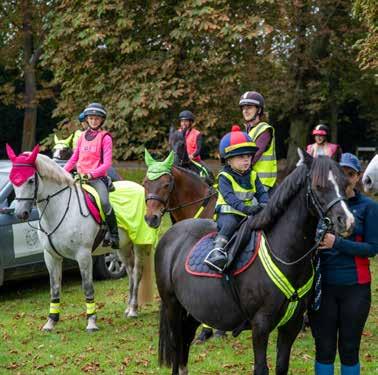
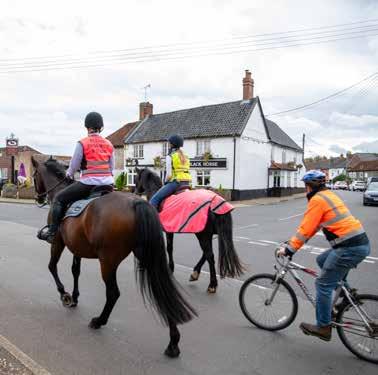
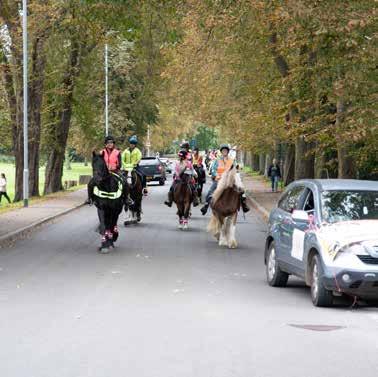
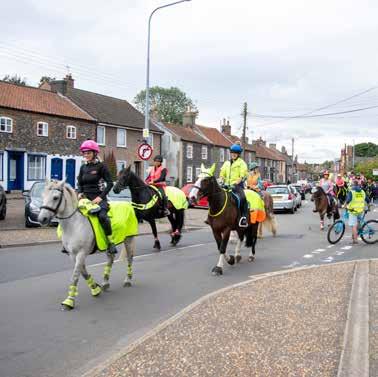
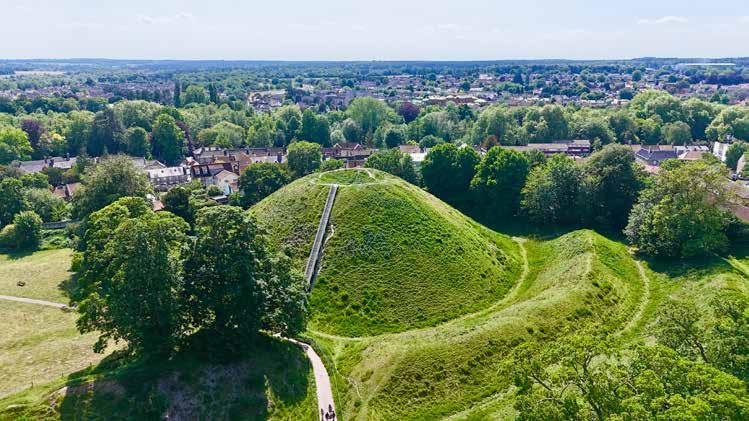
First Place


The Reflections of Thetford magazine is delighted to team up with The Thetford Photography Group, and honoured to publish the photographs of the winning entries to the 2nd group competition, ‘Echos of Thetford Past’. If you are a budding photographer, and are interested in entering the next competition, please scan the QR code below, and join the Thetford Photography Group on Face Book. Entry is free, and the members themselves vote for the winners. The theme for the next competition is Reflections (literal or conceptual), closing date 20th September 2026.
Thetford Photography Group is an open and friendly community where creativity and connection go hand in hand. Whether you’ve just started exploring photography or have spent years behind the camera, this group brings together people united by a shared passion, capturing the world around us in personal, distinctive ways.
Our subjects are as varied as our members themselves: from peaceful woodland views right here in Thetford, to lively local gatherings and the small, special moments of daily life. We welcome every style and outlook, and there’s no pressure to have topof-the-range gear or masterful skills. What matters most is your ability to spot something meaningful, and your choice to turn that sight into an image.
Within the group, you’ll find plenty of opportunities to share your work, receive kind and helpful feedback, swap practical advice and find new inspiration. You’ll see everything from dramatic landscape shots and detailed wildlife captures to thoughtful portraits and candid street scenes. Every photo shared adds something unique to our shared collection, creating
an environment where learning and development happen naturally.
What truly sets us apart is our caring, encouraging environment. There’s no such thing as a silly question, every success is celebrated, and you can progress and develop at whatever pace feels right for you. For us, photography is just as much about building friendships and sharing experiences as it is about taking great pictures.
If you love viewing the world from a fresh perspective, if you notice the play of light, the detail of texture, and those brief, precious moments that pass so quickly, you’ll fit right in here.
Kev Lamb (Group Founder and Administrator)

Or search ‘Thetford Photography Group’ on Face Book
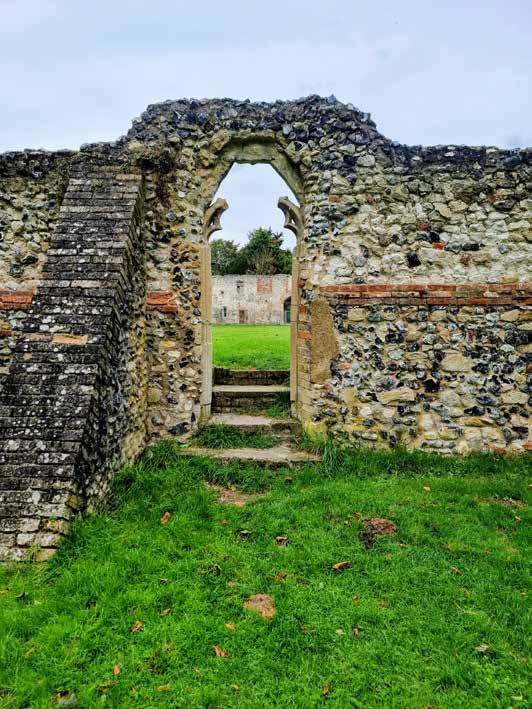
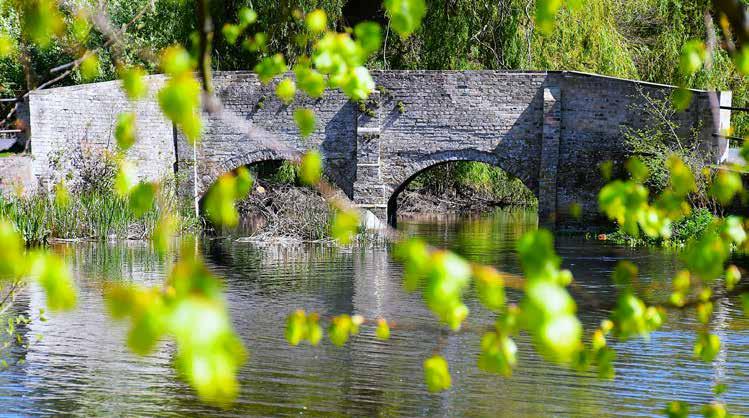
Back by popular demand, we are publishing a few of the letters and correspondence we have received from some of our avid local readers.
Dear Editor,
I should like to draw readers’ attention to a matter which, until now, I have kept entirely to myself for fear of causing unnecessary alarm.
Every Tuesday morning, at exactly 9.17, the same gentleman walks past my house carrying an empty carrier bag.
Precisely thirty-two minutes later he returns carrying what appears to be... absolutely nothing. The bag remains empty.
I have watched this for six consecutive Tuesdays. Now, I appreciate there may be an innocent explanation. Perhaps he enjoys taking the bag for exercise. Perhaps he’s shopping for invisible items.
Nevertheless, I feel it deserves looking into. If anyone else has noticed the Empty Bag Gentleman, please don’t approach him. Simply nod discreetly. He’ll know why.
Yours watchfully, Simone P
Dear Editor,
Following many years of careful research, I have finally perfected what I believe to be Britain’s first RemoteControlled Wheelie Bin.
The concept is simple. Rather than dragging the bin to the kerb, you simply
press a button and it drives there itself.
The first trial was extremely encouraging. The second trial less so.
The third trial resulted in the recycling bin making a determined attempt to join the Norwich Road. Fortunately, traffic was light and the driver of the tractor found the whole thing “the funniest thing he’d seen all week.”
Version Two is already under construction. It will have brakes.
Progress is never easy, Mike B
Dear Editor,
Many residents walk through Castle Park without appreciating its remarkable history.
Only yesterday I discovered what at first appeared to be an ordinary stone.
After turning it over, I concluded it was... ...another ordinary stone. Nevertheless, one should never dismiss these things too quickly.
History has often hidden in plain sight. I have therefore brought the stone home for further observation.
My husband has asked me to return it before someone notices.
I explained that this is precisely the attitude which has 202
held archaeology back for centuries.
Respectfully yours, Helen F
Dear Editor,
Further to my previous letter regarding the Empty Bag Gentleman...
Yesterday I saw him. The bag wasn’t empty. It contained a baguette. This changes everything. I shall begin again.
Simone P
Dear Editor,
I have always considered myself a rational man. However, I remain convinced that the third lamppost along Bury Road winked at me last Thursday evening. Not flickered.
Winked.
One light on. One light off. Then back on again.
I returned the following evening prepared to investigate. Nothing.
Perfectly innocent.
Exactly the sort of behaviour one would expect from a lamppost with something to hide.
Still watching, James S
Dear Editor,
Can someone explain decorative cushions?
I visited my niece’s house and counted seventeen on one sofa.
Seventeen.
By the time we’d moved them all so I could sit down, it was almost time to go home. A sofa should invite you to sit.
Not present an obstacle course. Firmly upright, Jamie W
Dear Editor,
I saw a man sitting on a bench eating crisps. Not a packet of crisps. One crisp.
He studied it for several moments before eating it. Then he produced another. The level of patience was extraordinary. I realised I had witnessed a man making a packet of crisps last nearly an hour.
I have never respected a stranger more.
Yours reflectively, Alex B
Dear Editor,
The hedgehog that visits my garden every evening failed to arrive on Wednesday. Naturally I became concerned. Thursday passed. Still no hedgehog. Friday evening he finally appeared. Slightly fatter.
I can only assume he’d been away on holiday. Relieved, Russell J
Dear Editor, I dropped a biscuit into my tea. Rather than retrieve it immediately, I watched to see what would happen. It dissolved with surprising dignity. I found the experience unexpectedly moving. I have decided life is rather like a rich tea biscuit. Perfectly respectable. Until circumstances become difficult. Philosophically, Sean H


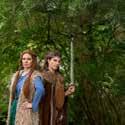








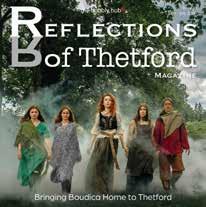












The Heart of any town is its people.
We are actively seeking funding, sponsorship and community partners who share our vision of a stronger, more connected and more confident Thetford.
Whether you are a local business, charitable organisation, educational establishment, volunteer group or simply someone who cares deeply about the future of our town, we would love to hear from you.
Together, we can ensure that the heart of Thetford continues to beat strongly for generations to come.
www.heartofthetford.org