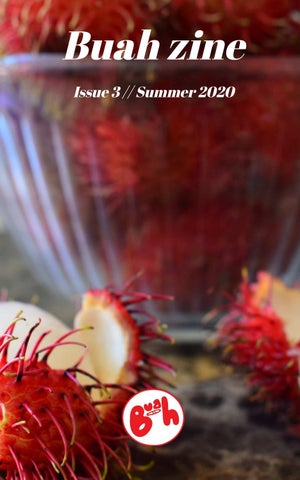
Buah zine Issue 3 // Summer 2020
Notes from Teta the editor Terima kasih teman-teman!
I'm so grateful to keep Buah zine going, and I'm super thankful for everyone who has supported the zine so far! Whether you were with me since 2018 or just joining, thank you! What started as a small idea has grown into this incredible, aďŹƒrming network that I wish I had when I was growing up in upstate New York. I'm so happy that this space can exist now. Let's hope for more years to come! Visit www.buahzine.wordpress.com for the full experience.
1
What's inside
Pg. 3.............................Interview: Denny (2020) Pg. 6............Photos: Prilly Tuelang x Buah zine collab in D.C. (2019) Pg. 10..............................Interview: Tifah (2019) Pg. 13...................................Review: Longing w/ Sayang (2019) Pg. 15...............................Interview: Ardi (2018) Pg. 17..............Interview: Rani Pramesti (2019) Pg. 20.............................Photos: Reections on ngaben (2020) Pg. 23..........................................Some thoughts
2
D E N N Y
Denny is a writer based in New York City. (2020) (Photo by Leah James) 3
Q: Tell me more about your journey as a writer. It wasn’t until college that I became an avid writer. I was two years into transitioning and I was surrounding myself with … from becoming zoned out from games and fantasy world online, it was a really hard shift to narratives that were human human human human. It was reading memoirs, watching reality TV shows, reading academic papers. I guess when something finally made sense with me, when I had some certainty about who I was, I kind of clung onto realism. I was really inspired by storytelling. So, I decided to journal and take note of what I was going through in college, but at the same time, I wanted to be smart about it. I worked with the head of the women and gender studies department to make it an independent study. So, with that, I made a blog. Within a few months, a few weeks — I think it was the same semester — I had a viral post. It was a makeup tutorial for trans women. I still get notifications about it today on Tumblr, but it’s not something I 100% stand by. It was like, “Here’s how you do this,” but at this point, I’m like, wear whatever you want to wear. I met a mentor my junior year. Melinda was the first person who was like, you don’t have to omit yourself when you’re writing an essay. I was so used to academic writing, where there’s a clear division between your thoughts and who you were. 4
Q: What has it been like sharing your writing and getting feedback from people? I think having a creative medium is my preferred way to receive any sort of praise. In undergrad, as the only openly trans person for the first three years and transitioning pretty young as a teenager, I felt like I was kind of a spectacle. So, a lot of the praises I would get really felt micro-aggressive and backhanded. Anytime someone would tell me, “You’re brave,” “You’re amazing,” for being who I was, was sort of ironic because you’re sort of accepting the fact that it was hard for me to begin with, and that’s the issue. I don’t want you to clap for me at the end of the race when you know this was a race in the first place. So, when people praise me for the things that I do, that feels a lot better as a creative person. I’m aware now that I physically respond better to, “I loved your work,” “I loved your performance,” and not like, “Werkkk!” It’s such a slap in the face. But the feedback for my work has been good. Read Denny's writing! -Allure: "What It's Like to Be Transgender and Face Dysphoria and Body Dysmorphia at the Same Time" -Them.us: "The Gap Between Glamour and Death for Trans Women of Color" -Decoding Ellipses blog 5
Prilly Tuelang x Buah zine collab in D.C. Photos by Prilly Tuelang Text by Teta
In 2019, New York City-based photographer Prilly Tuelang linked up with Buah zine in D.C., and we spent a bright, beautiful Saturday at the National Gallery of Art in this amazing, healing, uplifting, challenging space that centered our diasporic Indonesian heritage. Major thanks to Prilly, Ariel, Sultana, Pressman, Allie, and Lona for this much-needed collaboration. Here’s a glimpse of what we created from that day! 6
7
Pressman
"I’ve always been aware of how beauty can be social currency, and can either help protect or endanger you. I have been increasingly curious and hyperaware of it recently. And increasingly hyperaware of how beauty and classism intersect."
Sultana
"I know that generational trauma is such a thing that impacts a lot of us that we don’t talk about but … but so is the strength that they had to endure, all the things that they went through. That lives in me."
8
9
T I F A H Tifah grew up in Washington, D.C. and currently lives in Philadelphia. (2019) (Photo courtesy of Tifah) 10
Q: How did you start thinking of yourself as someone with Indonesian heritage? When I was younger, for me, I talk to my grandparents a lot on the phone. And throughout my childhood, I just remember hearing my mom talk on the phone with her family a lot. I think that’s how I really learned Indonesian, in a sense — I understand it and I can’t be as conversational, as good as I want, but yeah. My mom would just use Indonesian words around me. I mean, my middle name is Cinta, so that’s a conversation within itself, of me being like, “What does that mean?” But I didn’t really connect with my Indonesian heritage until I went to Indonesia and I met my other side of the family. My mom was the only one who had come to America, so all of these people that I knew, I knew from the phone or from the DVDs they’d sent, these home movies of them around the village. My dad, whenever I went to school, even as a child, he was always like, “If they ask you what your ethnicity is, you put Black and Indonesian, or Indonesian and Black, whichever is your preference. But make sure you don’t put ‘mixed’ or just one.” So, I think for me, that was a big thing, too; I knew off the rip, and my dad made it very evident and my mom made it very evident, that I was Black and Indonesian.
11
Q: What does your Indonesian heritage mean to you? It’s my identity. It’s really a whole other part of myself. Even now, I feel like after my mom passed away and I had so many people from the Indonesian communities within the DMV — it kind of amazed me how small the world really is when you’re far away from your homes, yet we’re still all connected. It tethers me; it keeps me bounded to the world and myself in the sense that I can place myself somewhere. I have a community, and it makes me feel less alone. To me, my Indonesian heritage is a way of bringing me back to earth and reminding me that there are so many people who share the things that I do and the same ancestry … although it’s so very different, it’s so alike. It gives me a different perspective of the world; it rounds me out as a person. It gives me another lens to really analyze and look at life with, with being queer, Muslim, Black, Indonesian, all these marginalized groups in one fucking person. It brings me back. It’s a reminder to myself that you are all these things and not one is bigger than the other. My Indonesian heritage is everything for me now, even more so when I feel I’m the only one who can really pass it on to my kids. What I am working on artistically that I haven’t really talked about is that I’m trying to do a series of drawings and paintings of my mom. My Indonesian heritage is, wow, I can’t even unpack it right now. It’s everything. I feel like I’ve just touched the surface of my heritage and my culture. 12
LONGING LONGING LONGING
Photos and text by Teta In 2019, I drove four hours, from D.C. to NYC, for Indonesian food. It was sooooooo worth it. Shout out to Sayang and its founder, Daisy Orlana, for a warm and delicious pop-up event! 13
14
A R D I Ardi was living in Yogyakarta, Indonesia, at the time of this interview in 2018. (Photo courtesy of Ardi) 15
Q: How did you start thinking of yourself as someone with Indonesian heritage? I’ve always abstractly known I was Indonesian. We visited Indonesia maybe, well, not that often, maybe twice before I turned 18. And only one of them I remember — one trip that I took when I was 9 years old really left an impression on me. I loved that visit to see my family here. So, I’m part Indonesian, but what does that mean? A major part of me felt like I couldn’t say that, “I am Indonesian,” because I’d never lived here and my family didn’t raise me strongly as Indonesian. Even though my mother made Indonesian food and spoke Indonesian. But, I couldn’t string a sentence in Bahasa Indonesia until I was 25 years old. I heard her speaking it to people around me, I heard her speaking Javanese on the phone constantly, but she never taught me that, so I wasn’t “raised Indonesian.” Yet, I really felt because of the way I look and because of the mother I had and just simply because I loved Indonesia, that I wanted to be able to say that I am Indonesian. And, for me, it wasn’t just reading books or watching documentaries or trying to get my mom’s stories; it meant that I had to go to Indonesia myself and figure out things on my own, like learn the language and getting to know family on my own terms without my mother, and just seeing how society here in Indonesia responded to me and if I could find a place. And I have. So now, I feel much more comfortable saying to people that I’m Indonesian, that I have Indonesian heritage. 16
Rani Pramesti
Artist Rani Pramesti was based in Australia for this interview in 2019. Visit thechinesewhispers.com now! (Left photo by Leah Jing McIntosh. Right image courtesy of Rani.)
17
Q: What kind of stories did you grow up with? It’s only in hindsight that I realized that my mother is a natural storyteller. She told stories as I was growing up and, back then — maybe this is a Virgo thing — but whenever she told stories, I’d be like, “That’s not true! That didn’t happen! Stop exaggerating!” But, in hindsight, now I realize she’s just a natural storyteller, so that she can entertain people. So, I grew up with stories from her about our family, my ancestors generations back. She also was a big part of growing a love of reading in me. I read a lot about different cultural mythologies. I had a lot of books about Chinese mythology, Indonesian mythologies, Greek mythology — all kinds of stories. (Photo courtesy of Rani)
18
Q: What advice can you give to people interested in delving deeper into their histories? Informed consent is a big part of my processes — as much as I’m able to secure informed consent, I will always touch base with that conversation with anyone who’s involved with my work. So, as I mentioned before, as the lead artist, when the intention for my work had changed, I had to go back to my sources to get their consent, because they had consented to one version of the work, about migration, but they hadn’t consented to the new work about May ‘98. So that’s a big part of taking care during the process, especially if you’re looking at a historical event that is so traumatic and continues to be an open wound. This whole process has made me question the actual possibility for healing, especially when a wound has been inflicted and there was complete impunity. I think it’s unkind to expect healing can happen when there’s been limited recourse for justice. I think the individuals, the collectives who are acknowledging May ‘98 and the sexual violence every year, doing that work, they are part of how justice can look. But, in terms of there being a judicial process, an investigation, that hasn’t been there so by and large there has been impunity. So, in terms of taking care, you know, to be honest, six years on, I don’t know that I would’ve concluded the work in the way that I concluded it in the current version, which feels a bit too neat, because actually, it’s not neat. So, maybe, that’s another way to take care in the process, like it’s OK for things to not be resolved, and that’s maybe more authentic and honest. 19
Reflections on ngaben
Photos and text by Gek Sri Wahyuni The following is an excerpt. See the full version online.
My grandma’s ngaben, or funeral, was a series of rituals to send her physical and metaphysical body off to the next life. A casket in a form of a wooden lembu (cow-like mythical creature) was carried through the village and burned in the community temple. There was a big black-and-white painting that my cousins and I (pictured above) carried around the village as well. Although my grandparents are art collectors, they chose an old charcoal sketch from decades ago. 20
21
About the author: Gek Sri Wahyuni was born in Ubud, Bali, where she lives “at once, many worlds.” She is a designer and writer, interested in uncovering the unexpected. In 2020, she promised herself that she was going to overcome her shyness and share more of her work! You can find her here. Submissions to Buah zine are open year-round. Contact Buah at buahzine@gmail.com if you’re interested in submitting your work. 22
Is it enough? What's the goal? Why must there be a goal? What am I even doing? What will my family think? Does it matter? How can I do/be better? What are my limits? What are my strengths? What have I been doing well? Does that even exist? How can I finally have a healthy relationship with femininity that isn't tied to binary, that isn't tied to harmful, gendered expectations that make me scream at the top of my lungs? How can I live my life in full, as I want to, as I yearn to? What values do I hold closest to my heart? Who will I end up disappointing and can I live with myself when that happens? Where do I see myself in a month five years? Is Where should I Why can't I sl Who cares if i I just want to My dream is When I turn 30 I want to If I could ju and then eve I just want to And maybe i So what if I It's just not that big of a deal to me! Please, I'm begging for tantetante and om-om to ask me more interesting questions that aren't tied to marriage or careers. Ask me if I ever got around to finishing that short story I started months ago but that has sat in my drafts, abandoned, crying for completion. Ask me if I ever made anything from the Indonesian cookbook I took from home besides kroket kentang. Ask me about my favorite Indonesian horror movie right now. And I promise I'll do the same for you. I'm trying, I am, and I think that's enough. I'm present, but I can also have a future. Now, I can see it better.
Some thoughts
23
Buah zine is a space by and for those with Indonesian heritage who live or have grown up abroad. Buah means "fruit" in Bahasa Indonesia. Visit www.buahzine.wordpress.com for more. Follow Buah zine on IG @buahzine