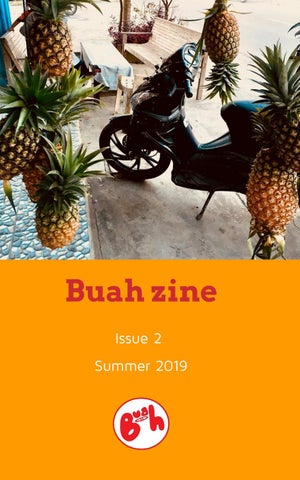
Buah zine Issue 2 Summer 2019
Editor's note Thanks for picking up Issue 2! I'm so grateful I get to continue Buah zine for at least another year! It means a lot to connect with everyone I've spoken to so far. I feel so blessed to have this informal but really significant community grow from this project. Major thanks to everyone who has been involved so far and to everyone who has shown support! It means the world to me. Please enjoy Issue 2 and check out more of Buah zine at www.buahzine. wordpress.com. Terima kasih!
1
Table of contents Interview: Ariel......................3 Photo: sugar, please..............6 Interview: Teo........................10 Interview: Dena.....................13 Notes from your early 20s......16 Interview: Elena....................20 Photo: retrospective............23
2
Ariel Putu Santikarma
(Photo courtesy of Ariel)
Ariel is studying anthropology in Washington, D.C. 3
Q: How did you start thinking of yourself as someone with Indonesian heritage?
The formative years of my life were in Bali. I spoke Indonesian and Balinese as much as I spoke English — I learned those three languages at the same time. So in that way, I always knew I was Indonesian, but also knew that something was off. And then, when I moved to the U.S., that complicated my relationship with my Indonesian heritage again. When I think about how I conceive my Indonesian heritage, when I first thought I was Indonesian, it felt like something inherent to me, but at the same time, my relationship with that identity is something that I’ve embraced sometimes, distanced myself from other times, felt very in conflict with, but also at peace with. It’s something that’s contentious; it’s never been a simple thing for me. Q: Tell me more about getting into anthropology. What is it like to be in that space that’s hard to separate from its colonial context? Both of my parents are anthropologists. My dad is a Balinese anthropologist, and my mom is an American anthropologist. So I always kind of grew up with my parents encouraging me to interrogate a lot of the things I’ve said. I’ve heard stories from people of Indonesian heritage who are also anthropologists in Indonesia having people say to them, “You’re not a real anthropologist because you’re just studying what you’re familiar with. How does that make you an anthropologist?” That’s wrong for so many reasons, so I think about how that’s still a narrative that exists today within the field I’m studying and every part of me wants to subvert that. I’m interested in finding ways for non-white people in academia to create communities of support for one another, to make knowledge and theory accessible to the public, and to find ways to subvert the classist and racist institution of academia. 4
"My advice for anybody who might be Balinese and Irish, or Indonesian in general and white in general, is to always interrogate that identity. Never want some kind of conclusion about it." — Ariel
Q: What does it mean to have Indonesian heritage to you? My own heritage, with the history of my family, and the way that they’ve been implicated in Indonesian history and politics, what that means to me is that I have this responsibility to move towards justice in every sphere of my life. On a personal level, that means recognizing the violence and trauma of the past, learning about it, but also never allowing my Indonesian identity to be uncomplicated, to be simple. Never just embracing my Indonesian-ness in some idealized, imagined, nationalist way but really breaking it down and criticizing it and interrogating my own connections to Western institutions and my own whiteness. For me, being Indonesian is also having responsibility for that part of me as well. 5
sugar, please By Teta
6
7
8
9
Teo
(Photo courtesy of Teo)
Teo is based in the Bay Area, California, and does work in community building and filmmaking. 10
Q: We first met in D.C. because you were working on a film project. Tell me more about your film work and your relationship with film. I’ve always seen film as a platform for storytelling and uplifting the voices of folks who aren’t seen as people who have “legitimate” opinions or stories to tell. Film lies in your hands in that you can create tools for social change and advocate for certain causes without anyone stopping you because once you create that, you can disseminate it. I’m still doing film in different ways and trying to pass it on to folks through workshops and stuff. There’s a lot to be said about film and I really hope that folks who take charge of the skill and use film as their medium also think about the impact on communities, because I think it’s super important to not be extractive in filmmaking and to be mutually grounded in what you want it to convey and who you want it to serve. Q: What’s your relationship with the term “AsianAmerican”? Did you connect with it early on, or was it something you had to grow into? For me, “Asian-American” definitely wasn’t something I fully identified with until I learned about the political history of it. Even to this day, I think Asian-American as a term is not something that fully resonates with me. I’m more aligned with being Southeast Asian, as descending from indigenous Batak people who were displaced. Teo's interview continues on the next page 11
Q: I wanted to ask your thoughts on how to address complex issues, such as anti-blackness, within our communities. How can we call in those in our communities? There’s such a multiplicity of identities within the Indonesian community. For me, as a former Christian and semi-brown Indonesian, who’s also queer, who’s also trans, who has these multitude of identities that exist within me, I feel like it’s always important to lean on your understanding of history. Knowing that these weapons of antiblackness and other oppressive tools are meant to drive us further apart, and that if we want to come together in solidarity with each other across our different issues, we have to really think about how we can create a reality that is more livable. I’m still struggling with how to explain this to immigrant parents or parents who have been immersed in certain ideologies for so long that it’s so hard to get across certain perspectives. But, I think maybe the best way to do that is to ground them in their history. So, being able to communicate through that hurt and create this language of healing to create a better understanding and hopefully one day create a space where we can all thrive and not just survive. It’d be super cool to have intergenerational dialogue where we don’t want to rip each other’s throats out, you know?
12
"I was very hyper-aware of being Indonesian, but I didn’t feel connected enough. It was an imposter syndrome type of thing where I wasn’t sure I could call myself Indonesian enough, but at the same time, it was projected on me." — Dena
Dena is an Indonesian-American poet based in Queens, New York.
Dena
13
Q: How’d you get into poetry? I learned, either through online videos or poems, I was just like, huh, I can write about things other than love and a really bad boyfriend! I can write about being a woman of color, huh, interesting. So I started writing journal poems about just being a woman of color and being fetishized as an Asian-American woman, and then later on, I started talking about that connection with my mom; I started talking about gentrification in New York. I just kept exploring with poems, writing, and then I soon found out that oh wow, you can do more than just talk in a microphone in a shadow. It was just this exploration of I can do more things with this other than write about [it]. So I learned about publications, I learned about fellowships, I learned about more possibilities because I met other Southeast Asians. Q: What does having Indonesian heritage mean to you? It does mean navigating your own narrative. Not only as an Indonesian-Muslim-American who’s in the Western world and trying to find your voice in the Western world, but also being hyper-aware of the nuances that are in place as an IndonesianAmerican…I feel like as a people, we all have different experiences, because of regions, ethnicities, or religion — just a lot of nuances.
14
Q: What’s your relationship with Indonesian food? I usually help my mom, but for some reason, if I try to cook it myself, it’s a disaster. That’s also another way that my family connects with Indonesian culture, through food. But especially, because a lot of things they used to just buy, they were like, “Well, we can’t make it anymore,” or, “We can’t just go down the street like we used to. We have to learn how to make it,” so that’s one of those things that they would teach me.
always on my mind....
15
Notes from your early 20s
By Teta
16
Years have passed, but somehow, you stumble upon your old blog and find the posts you had written from when you were 20, 21, 22, like an open diary.
July 14, 2014 — love is so great n i can’t believe a few years ago, i used to be so cynical, so closed off, to the idea of letting others in, thinking that it was a weakness to feel great affection for someone other than myself. i’m feeling myself open up to the idea that love is not this miserable, sordid thing that keeps u down n entraps u. it can be so healing n uplifting. n, yeah, it’s important to love urself but loving others is just as crucial. experiencing different forms of love is so important, too. loving your friends is life-affirming, n being around supportive ppl is necessary. anyway, the point is throughout the years, i’ve learned that love should not be this complicated, messy thing i always thought it was supposed to be. loving someone is actually the simplest thing in the world, and it’s one of the best feelings. Aug. 26, 2014 — i think that’s a superpower i want, to be able to see how others see me. not necessarily b/c i’m self-conscious of what others think of me, but b/c i wanna make sure that i am growing, changing for the better, n learning. i don’t wanna be the same person i was 10 years ago, n i hope i’m not. Sept. 3, 2014 — someone is talking loudly outside my window, and they said, “i laugh b/c i don’t want to cry.” 17
Nov. 23, 2014 — there is no one that really knows all of me n i think that’s fine. but sometimes, maybe just once, i would like someone to take me apart, figure out my pieces, n put me back together so everything fits. there are bits i know that stick out, that don’t go there, but i can’t decide what to do about it. Nov. 24, 2014 — called dad to talk about my bad day n he said, “sayang, if u need to cry, i’ll wait,” but i didn’t cry b/c i already felt like i was dumping too much. i cried afterwards tho. Dec. 22, 2014 — i’m honestly so in love w/ being 20 now n i can only say that w/ hindsight b/c i was so fucking reluctant to turn 20 at the beginning of this year. i’m so in love w/ the person i am right now. i love myself, n that’s not something i could’ve said at 16 or even a year ago. Dec. 23, 2014 — i remember at the beginning of the year how i really wanted to be in a relationship n i really thought being w/ someone was the thing that was gonna make it all better. but then i almost got to experience it n learned that actually, i’m still too erratic, too inconsistent to be in a long-term relationship. i run in headfirst n then quickly slip out. i still don’t know what i’m looking for, romantically, but i like warmth, i like intimacy, i like how a laugh feels on my skin, n i’ll figure it out. eventually.
18
June 29, 2015 — (i’m feeling like)(i want some affection)(in the physical sense)(but i’m also feeling like)(i wanna climb the tallest peak)(n breathe some fresh, cold air)(n feel slightly oxygen deprived) July 5, 2015 — not to overreact but i think a real live dukun (witch) came into the store tonight. i got mega heavy vibes from her like she could def put a curse on me. she read my co-worker’s fortune n predicted things about her that she was like, “this is true.” after she left, i couldn’t stop dropping things, so maybe she did leave a curse. Dec. 20, 2015 — inspired by a girl who was traveling alone around morocco. i’ve decided to follow suit. May 16, 2016 — i just wanna fumble around in love for a bit, u know? where does my being guarded even come from? just this instilled fear of failure in everything, i guess. Oct. 11, 2016 — is there an inappropriate amount of aloneness? i find that i’m by myself a lot as of late and i feel as if i should make an effort to meet more ppl but i’m also exhausted & unrooted so that takes up my time. not to be a negative nancy, but life is too much and i feel that i don’t actually have ambitions & ppl project an image of me that i feel i have to live up to. so when ppl ask “what are u doing?” most of the time, i want to answer, “being a fraud and grasping at life w/ sweaty fingers” but that’s not much for small talk. 19
(Photo courtesy of Elena)
Elena Elena grew up in Canberra, Australia, and is doing her Ph.D. field work. 20
Q: What are you studying? What do you like to do? In September, I’ll start my Ph.D. and that will be based in Central America. [Editor's note: This interview happened in June 2018.] I’m trying to learn Spanish at the moment in preparation for that. I have a trip to Mexico next month, and that trip is about meeting people and learning Spanish and seeing if it’s a place I can do my Ph.D. field work, which is broadly about the extractive industries and the livelihoods affected by it. Just the different ways we imagine mining — my supervisor likes to call this the geography of the subsoil. That’s what I’m interested in. Q: How did you get interested in that? Well, I’ve always been interested in development problems. I think it’s sort of come from that angle, that I was feeling pretty disenchanted with the way that we talk about development. I thought that it wasn’t critical enough, and it didn’t talk very much about existing power relations or past ones. There was not very much about post-colonial perspectives in the development studies that I learned at uni. So going down that route, I sort of looked at specific development failures and found that there were so many ways to look at these problems, which we don’t do. And a geographical perspective, I think, allows a broader view, or a view outside of traditional development studies, which is very static because it’s like, “These countries are like this because of these reasons.” 21
You put a geographical point of view in it, and one particularly from a field called political ecology, and you start to see that there’s so many things going on. So, I think, theoretically, that’s how I became interested in these specific projects, things like mining, agriculture, all these developing-type things intersect with these theoretical ideas about development and geography. Does that make any sense? Q: Tell me more about your Indonesian heritage. How do you connect with it or not? So, my dad is Chinese-Indonesian. My mum is Chinese-Malaysian. My stepdad is Australian. I don’t know that I would consider myself Australian-Indonesian — I don’t really like that term. But I can’t consider myself Australian in the “fullest” sense of that term, I think, especially in a country which probably wouldn’t accept me as an Australian, too, despite living here my whole life. So I think it’s a fluid identity where I’m neither this, I’m neither that, but it doesn’t mean I’m not Indonesian, it doesn’t mean that I’m not Australian or Chinese-Malaysian, either. So maybe it’s a default type of identity that I feel like I should be from here. I think that more than anything, I would say I identify as a person of colour more than any of these other terms, more than the specific nationalities of being Australian or Indonesian, and more than the fluffier terms like being a “global citizen.” That sort of thing doesn’t resonate with me as much.
22
Indonesia 2012
Indonesia 2016-2017 23
Buah zine is a space by and for those with Indonesian heritage who live or have grown up abroad. "Buah" means "fruit" in Bahasa Indonesia. Visit www.buahzine.wordpress.com Instagram: @buahzine