4 6 7 8 16 18 22
by Jeddie Sophronius Interview: Katherine Sarwopeni Antarikso Poem: an Indonesian American wanting by Winston Widjaja Lin Book Review: “Happy Stories, Mostly” Photos: Still Figuring It Out (Probably) Movie Review: A Quick Trip to Queens Interviews: Berdua Interview: Matt
his phoric, year joyful, has and I felt like I had rebuilt a elling f myself lyrics that I thought I'd lost completely. I hat a karaoke moment close to me; it glows whenever nthat Bandung. extra bit It of light. umid and al, hatsweat in mind, slidI wanted this issue to also be a my of neck, light. Ibut feel like my creative energy has ed ed considerably the mic over the last two years, but ng g on with these zines every summer always me s ofaother little boost.
you again for supporting Buah zine! May ght always be protected. xx —Teta
s MBA. My father then became a professor in Indonesia. he ‘80s, he returned to get his doctorate at Penn State, s how we ended up in State College, Pennsylvania. supposed to only stay for four years, which was the his program. We had packed our stuff in crates and go back, but we ended up choosing to stay in the U.S. in a community of other Indonesian students. When we e U.S. in 1988, it was mostly people sent by the n government or their companies. But then, after 1998 all of Suharto, I noticed a change, and it was mostly Indonesians who were coming over. I think, around that as really trying to assimilate – being surrounded by mericans, I felt like I was trying hard to become really n. I think I missed out on exploring an Asian-American especially since I felt I didn’t have a lot of exposure to it. didn’t feel like I fit into any foreign student clubs. So I elt left out. I think it was only in college and after college t other Indonesians, especially moving to Philly and big Indonesian community here. This is where I’ve met esians that I can talk to and I feel like I can relate to.
d you start thinking of yourself as someone with an heritage? How has that changed over the years? ays really proud of being Indonesian. That was instilled m a young age. I started dancing early on; having those sons made me feel really Indonesian. My mom brought e costumes here and we would perform at university was proud of being Indonesian, but I found that most ns don’t even know what Indonesia is, so I think maybe here the schism came from, like, OK, since no one else at it meant to be Indonesian, I guess I’ll just try to be merican. In college, I was very focused on my studies, so even really thinking about my identity. But I think the oint was 1998, which happened during my third year of d. Seeing people my age affect this enormous change in while I watched from a distance – it felt like I was out on something really important. After graduating took more of an interest in Indonesian history, y after 9/11. I think it was those big, historic events that think about my heritage in deeper, more critical ways.
Katherine Sarwopeni Antarikso
Katherine is an Activist-Curator Fellow through the Chronicling Resistance project from the Free Library and the Philadelphia Area Consortium of Special Collections Libraries.
“Happy Stories, Mostly”
translated from Indonesian into English by Tiffany Tsao, is one of my favorite reads this year. Reading “Happy Stories, Mostly” was a revelation. I love short story collections; I think the ability to tell a story within a discrete moment is an extraordinary talent. Some of my favorite short story collections include “The Book of Jakarta: A City in Short Fiction” (2020, translated from Indonesian by various translators), edited by Maesy Ang and Teddy W. Kusuma, and “I’m Waiting for You: and Other Stories” (2021, translated from Korean by Sophie Bowman and Sung Ryu). So, Norman’s collection was already going to get top marks from me for form alone. Norman’s writing, as conveyed through Tiffany’s translation, has a kinetic creativity that draws me in as a reader, holding me through some of the tougher stories. Longer, swirling sentences, like the ones in “Enkidu Comes Knocking on New Year’s Eve,” ebb and flow against shorter, punchier moments that gleam across the surface like a dragonfly’s wings. My shortlist of favorites are the post-Jakarta-as-the-capital future “Metaxu: Jakarta, 2038,” the bleak heavenly bureaucracy of “Welcome to the Department of Unanswered Prayers,” and the trials of a (forcibly) retired nun in “Ad maiorem Dei gloriam.” If you like the depth, textures and music of “Happy Together” (1997) but are eager to stretch your imagination more, run to “Happy Stories, Mostly” and find care and possibility with each page.
(Probably)
2022. I’m still sifting through the grains memories. Here's a glimpse of what I By Teta uring that two-week return.
A Quick Trip to Queens
ist’s journey could also include love, loss, and everything en. It was those action movies that could string together family drama, world-building, history-making, and l at once that I wanted to watch.
nce Is Mine, All Others Pay Cash” [“Seperti Dendam, Rindu bayar Tuntas”] (2021, dir. Edwin) is that lush tapestry of s action flick homage, hero’s journey, sweeping romcom, discovery and supernatural mystery that I basked in. I ager to watch it for the first time that I drove four hours w York City to catch the March 26 screening of it at the of the Moving Image. (It’s now available to stream e on Netflix, and it definitely holds up on rewatches!)
cinematographer more torn about itAkiko whenAshizawa. he meetsItthe stands love of alone, his life, andthe it also expert fighter me helped Iteung. understand the source material better. There’s no such thing as too much for me: I loved the blending of genres, Filmshifting the adaptations from usually real to surreal, stand alone the action, from their the romance, book inspirations the for me. ItInwas horror. this beautifully case, I preferred shot and thesuperbly movie over acted the—original one of novel. the Ladyamovies best CherylI’ve as the seenLast in 2022. Boss-level fighter Iteung brought so much depth and charm to the character, and Marthino Lio as Ajo Kawir was magnetic. The chemistry between not just the main leads but with each supporting character was so natural and effective — it felt like a lived-in community. It felt like built-up history and connections.
etogether from. I want calledus“Your to also Very take Annoying ownership Friends.” of everything es from our beautiful country, ancestors, etc. Side rking in the fashion industry, so many other fashion s and companies are taking our textiles and saying that eir look and making it “their own.” I want to take back resources, take back our culture, and showcase our o the world but in the eyes of Indonesians, not through of white people that have gentrified our culture. So onesian means everything to me, and I want the world about our culture through our lenses.
t it means to me is to lift up my ancestors to make ud in everything that I do. Everything that I do now, I ure Indonesian kids everywhere in the world to see that onesian is something to be proud of. It’s something re going to carry with you your entire life, so might as who you are and where you came from, where your ents came from, and where your parents came from.
Pepe: online It’szine not healthy. togetherI called know academia “Terminal in Bus.” general is never healthy but, holy shit, this country has issues clearly the way it is set up, the way it designs for some students to fail, based on your competition, based on competitiveness, you have to be competitive under whether you “publish or perish,” and I don’t want to perish! But it doesn’t mean I want to publish either! Nik: It was a shock to me, too. A master’s in the U.K. is more like a final year of undergrad, sort of, so it’s still huge classes, and seminars are like undergrad. In the U.K., if you’re a grad student, you need to know what you’re gonna write, so there’s no guidance. It’s more like independent study, in the U.K. But in the U.S., it’s very intense and very mentor-based. There’s a good side to that.
lived in Russia for a year my senior year. I think there, ng with my Russian heritage was like damn, I really need to ut my Indonesian side, too. […] Also, earlier, when I went ndonesia when I was 16, that totally changed everything. I w how to describe it, but that’s what sparked my interest sia. Then I went to Russia, where I was like, well, now I ed to learn my Indonesian. And then, I mainly started y grandma and my mom about their stories. And then, in think you just learn more about colonialism and learn out privilege and hierarchy. […] I started asking about r family is from — we’re from Padang, my grandma’s ja. My grandma on my dad’s side is actually Sundanese, ever really talked about Sunda culture.
eel like my journey just started recently. Like, this last nt to Indonesia where I really thought about what being n is for me and what being in Indonesia is like. I think, is last time, it’s always been fun and super romanticized. this last time, I went back on my own connections. This und, I was thinking about where I stand on things more.
Sally: Don’t be afraid to spread your wings out there, to live and create outside of Indonesia. It doesn’t mean you’re being less of an Indonesian. Emily: There are so many platforms that didn’t exist before for young women and minorities. And the internet plays a big part. It’s more accepting and there are more opportunities. Just remember that it’s important that we as female photographers don’t just get made into a commodity, ’cause “female photography” is never a genre.
just haven’t had access to other Indonesian people, and in part because when I have encountered other Indonesians of my generation, we’re so wrapped up in the novelty of meeting someone else with even a little shred of shared history. I continue to ponder about whether it’s important to me to be IndonesianAmerican, or whether it’s important to me to be Asian-American (and I say Asian-American as a political identity). Even now, I struggle with wanting to confidently proclaim like, “I’m AsianAmerican.” I struggle with that so much because of the lens through which institutions, I guess, and folks in power experience or discuss Asian-American-ness. It’s so hinged on representation in the media and being on the screen, and so you end up with people insulated by class dominating the narrative and giving rise to “boba liberalism.” They’re really just about representation and maintaining the status quo adjacent to whiteness. They care very little about the history of Asian-American activism and solidarity, about Grace Lee Boggs, or Yuri Kochiyama, the Third World Liberation Front, like all those things. There’s so many more grassroots organizations that have been caring about the collective security of pan-ethnic Asian people and not just East Asians, and contributing to the critical thought leadership for Asian-Americans. Q: What does your Indonesian heritage mean to you? It’s such a difficult thing for me to pin down, what it means to be Indonesian or Indonesian-American. […] It was hard and continues to be difficult for me to think about, like, what does it mean to be Indonesian in America. It becomes just an amalgamation of these very small moments. What it does mean to me, I guess, to go back to how I experienced Indonesian-ness, is my nuclear family. A lot of the story is told through food. And food is just something in general that I continue to go back to understand culture, whether that be my own or others. So like, I would say, to be Indonesian or Indonesian-American is something to me that’s very deeply personal, but that I continue to have difficulty trying to connect to a broader narrative of Asian America. But yeah, I continue to try to make a connection between the political identity of IndonesianAmericans and the political identity of Asian-Americans I guess.
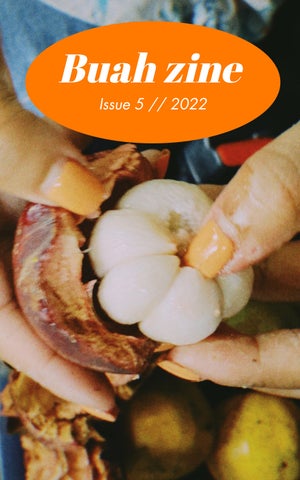
Buah zine
more, visit buahzine.wordpress.com.
Issue 5 // 2022
low Buah on Instagram @buahzine