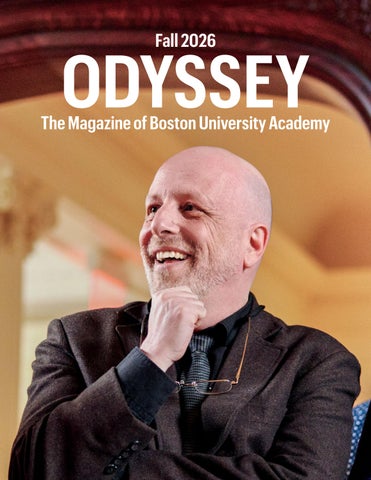
Fall 2026
ODYSSEY
The Magazine of Boston University Academy
HEAD OF SCHOOL WELCOME
At our opening faculty meetings each August, my colleagues and I take turns reciting the School’s mission statement from memory: “At Boston University Academy, kind and curious students who love learning are challenged to read deeply and think critically, to explore adventurously at Boston University, and to engage meaningfully in our community and beyond.” We have some fun with the exercise — cheering each other on through our stumbles and sometimes dramatic recitations! But we also do it for a reason: keeping the mission in working memory helps us inform our decisions, big and small. I have been lingering lately on the mission’s !nal phrase — “to engage meaningfully in our community and beyond.” The earlier portions of the mission focus largely on the self; through deep reading, inquiry, and exploration, students develop their skills, feed their curiosity, and discover new passions. The last phrase, though, is a different kind of challenge: how can students bring those skills and inclinations to bear outside of themselves? It provides a purpose — a why — for all the self-improvement and discovery. It hopefully leads them to engage with the question posed by the 1st century BCE Jewish scholar Hillel, “If I am only for myself, what am I?” Much of the evolution of BUA in the past several years has been in service to that idea. In the following pages, you will read about members of the BUA family engaging meaningfully and purposefully outside our walls. In some cases, we have created opportunities for students to see the connection between what they are learning in the classroom and the world outside. Students in 9th-grade biology take water samples from the Charles River and use the City of Boston as a living laboratory. Dozens of students traveled in March and June to sites around the world in search of deeper insights about history, politics, geology, mathematics, and music. You will also read about students actively making a difference — cohorts of BUA students traveling to local elementary and middle schools in the a$ernoons to serve as tutors and mentors; young BUA alums, building on their time at the School, who are devoting their careers to serving others in medicine, clinical research, and education. Those graduates embody my deepest hope: that our students take from their time at BUA not only the skills to do well, but also the inclination to do good. As I begin my seventh year at BUA, I want to say thank you for the opportunity to shepherd this remarkable School. This work gives me purpose. It is such a gi$ to be part of an institution that changes lives — creating a culture of belonging for students who may not !nd that in other places; offering an opportunity for young people to feed, rather than hide, their curiosity; and opening doors to a world-class education for students who might, without !nancial assistance, not have access to one. Thank you for all that you do to make that possible. Through your generosity and support, you answer Hillel’s question and show, again and again, that you are not only for yourselves, but also for others.
Chris Kolovos Head of School
ODYSSEY | FALL 2026
TABLE OF CONTENTS Dave Stone; Sinan Parsons '07; Jessica Conklin '04; Jim Davis; Chris Pappavaselio '04; Chris Kolovos
Head of School Chris Kolovos
FEATURES On Making Kindness Visible: Head of School Opening Address
2
Assistant Head of School for Enrollment Management & Institutional Advancement Nastaran Hakimi
Faculty and Sta! Milestones
4
Senior Thesis: Real-World Research on Display
5
Commencement 2026
6
Director of Development and Parent Engagement Margo Cox
Meet Our New Faculty & Sta!
7
Continents as Classrooms: Global Travel 2026
8
Forging Connection Through Service
9
From Blank Slate to Living Laboratory
10
Athletics Highlights
12
BUA Students Shine in BU Classes
14
Around Campus
16
Putting the Counselor in College Counseling
18
IMPACT REPORT
19
ALUMNI NEWS
28
Celebrating 30 Years of Jim Davis
28
Young Alumni Spotlights
30
Alumni Class Notes
32
Distinguished Alumni Award: Kelly O’Grady '09
34
“New Roman Times” with Laura Itzkowitz '05
36
PUZZLE
37
Editor Elisha Meyer Design Katie Kara’a Meg Shannon Contributors Margo Cox Jessica Jackson Paula Jurado Kailey Kennedy Chris Kolovos Colleen Krivacek Elisha Meyer Photography Dave Green Paula Jurado Dannie Lane Katie Kara’a
HEAD OF SCHOOL OPENING ADDRESS
On Making Kindness Visible On September 1, 2026, Head of School Chris Kolovos delivered his opening-of-term address at an all-school meeting. Good morning. On behalf of the faculty and staff, welcome to the 34th year of Boston University Academy. First, a few words of welcome. To the 61 ninth graders sitting to my le$, we are so glad you are with us. Throughout the August mini courses and orientation week, you have already started building a reputation among the adults here as an exceptionally mature and thoughtful group. Keep it up! To our returning 10s and 11s and to the new students in those grades, welcome. We have every con!dence in your ability to embrace the challenges and leadership opportunities that await you. And to the Class of 2027 — the small but mighty group of 49 seniors sitting in the back — we are so glad to have you leading the student body. Your engagement during the senior retreat — particularly the passion with which you thought about ways to strengthen this community — was inspiring to me and, quite directly, inspired my topic for today. In a few moments I will introduce our Student Council president, Isha Venkatesh, to offer a welcome on behalf of the student body. First, though, as I do at the start of each school year, I’d like to offer some thoughts. A quick story to get us started. MAKING KINDNESS VISIBLE Early this summer, my wife and I made the colossal mistake of adopting a puppy. You would have thought that with a six-year-old son, twin three-year-old daughters, and a 12-year old dog, we might have thought twice about bringing a fourmonth old rescue puppy home — not a small breed, mind you, but a Great Pyrenees mix with an independent streak. In a moment of delusional optimism, we named her Athena. In retrospect, Scylla would have been more appropriate. Since she joined us, she has doubled in size, shed my blood three times, and bitten through more of my joggers and t-shirts than I can count. We bought Athena a new bed recently — her third because she ate the last two. We put the bed down, and our three-yearold daughter, Penny, immediately ran over to the other side of the room. Mind you, Penny weighs about as much as the dog and has a healthy respect for Athena’s sharp little puppy teeth. But she was not running away in fear. Penny returned a few moments later with a huge smile on her face and Athena’s favorite blanket clutched in her arms, laying it out neatly on Athena’s new bed. Athena rewarded her by flopping her puppy body right on the blanket — and chewing the corner. Penny had noticed, empathized, and acted. 2 ODYSSEY | FALL 2026
My talk today centers around the small, ordinary, kind acts that manifest our care for one another, or in Penny’s case, her furry new family member. I’d like to talk with you about the everyday actions that make kindness visible. I take great pride in the kindness of our community and believe deeply that this school is !lled with kind adolescents and adults. Over pizza one day in my o&ce a few years back, one student looked at me seriously and asked, “You say BUA kids are kind and curious. You know that not everybody is kind all the time, don’t you?” Of course I do. And I still maintain that this is a community where kindness and generosity of spirit are overrepresented. That is no accident. We select for kindness in admissions. Students choose this place because they want to be with peers who value kindness like they do. You have genuinely warm hearts, and that is what we care most about. PRACTICING KINDNESS Fostering a kind community, though, takes more than !lling it with kind people. It is not enough to have kind hearts and generous intentions. Kindness takes practice. The seniors know that. During their recent retreat, the Class of 2027 engaged in a brainstorming session in response to the following prompt: “What are the behaviors we’d like to see more of to foster the community we want?” They developed a list of speci!c actions. In their view, if more people more consistently did these things, our community would be better for it. Here are some of their top behaviors — ones that came up multiple times: smiling; saying hello, and calling somebody by name; saying thank you a$er class and elsewhere; holding
HEAD OF SCHOOL OPENING ADDRESS
doors for folks coming a$er you; showing up, participating, and being present in community moments; pitching in and helping out without being asked; cleaning up a$er yourself and others in shared spaces; pulling somebody into a conversation if they seem alone; speaking up when somebody is out of line.
My charge for you this year is to !ind all the small ways to make kindness visible. I’ll try to do that too. Notice what these things have in common. They are all small acts, not grand gestures. They are within everybody’s reach. And they all require getting out of your own head, empathetically paying attention to the people around you, and — crucially — acting. Like Penny did. Those actions are what make kindness visible. Their list reminded me of some standout moments from last year. I remember at Camp Burgess, a group of students was playing cards at a picnic table. One of them noticed a classmate sitting alone on the periphery. With no fanfare or hesitation, he walked over to that classmate and asked him to join the game, which he did. No drama, just inclusion. I remember being in the gym to help set up for an event. A group of students was playing basketball on the far end of the gym. I was carrying some tables around with a few other teachers. One of the students shooting around ran over to see if we needed some help, which we did. He hustled back to the court, grabbed a few friends, and brought them back to lend a hand. I wholeheartedly agree with the seniors. These moments are us at our best. And if more of us acted this way more regularly, we would be better for it. While I don’t want to linger on it this morning, the seniors did go through the exercise in reverse. They identi!ed behaviors they wished to see less of. Some of the more popular? Swearing. Being unaware of the space you are taking up in the hallway. Talking way too loud about stuff you shouldn’t be. And — the most popular answer — being distracted by your phone when you could be present
with others. Notice that these behaviors all involve just the opposite of the previous list: a lack of awareness and consideration for those around you. These are not unkind people, but they are not practicing kindness. PRACTICE MAKES HABIT, HABIT BUILDS CHARACTER You might ask, why? If the people in this community are, at their core, kind, why does it matter that we practice with these small, everyday habits? Why should we put in the work to make the invisible visible? To borrow a term more popular in your generation than mine, is it just performative? Is it just for show? No. Engaging in these small acts — even if they seem insigni!cant — is powerful in the aggregate both for the individual and the community. For one, it feels good. I stood holding the door for folks at the GSU one day over the summer. Four people passed through, including somebody who was coming from halfway down the block. Each of them smiled and said thank you. By the time the fourth person walked through, I actually felt better — not that I was performing some kind of saintly duty, just that I was putting some positive energy into the world and having some small, positive impact. Second, it is contagious. I’ll go back to Penny. This morning, I asked her why she put the blanket on Athena’s bed. She flashed a big smile, put up her hands, and said, “because I saw mommy do it.” For her, it was as simple as that: that’s what we do in our family — we think about each other and help when we can. She had picked that up without us saying a word. Finally, and most importantly, the small acts that make kindness visible — over time — don’t just reflect inner kindness; they build it. C.S. Lewis famously wrote that “all mortals tend to turn into the thing they are pretending to be.” Aristotle, in the Nicomachean Ethics, talks about virtue as something you build through repetition. You all were not born kind. You learned to be kind — like Penny — from your parents, friends, schools, and faith communities. You practiced being kind. And now, you have a chance to do that again, here, in a community where kindness is our most sacred value. My charge for you this year is to !nd all the small ways to make kindness visible. I’ll try to do that too. ***** Thank you for listening. I wish all of you a wonderful school year.
ODYSSEY | FALL 2026 3
Faculty and Sta! Milestones Big milestones deserve big thanks. BUA celebrates our colleagues marking major anniversaries with our community this year — years of showing up, of shaping young lives, of making this place feel like home. Thank you for the warmth, the talent, and joy you bring to our school every day. Here's to many more!
5 YEARS Ms. Lisa Townley Visual Arts Instructor
Dr. Elizabeth Karnaukh “It is a testament to the kind of Science & Math Instructor community BUA is that not only Dr. Monica Alvarez STEM Research Coordinator students grow tremendously in their English Instructor Student Events Coordinator time here — so do the adults! From Director of Equity and Inclusion co-developing a standards-based grading curriculum for 10th-grade chemistry, presenting at conferences about science communication, finding new research opportunities on campus, helping train students for half-marathons, pitching in for theater productions, running our beloved student event traditions, to leading a global trip to Iceland and more, it has been a joy to grow at BUA over the past five years.”
10 YEARS
20 YEARS
“What keeps me coming back to BUA? Our students. They keep me on my toes and are always asking great questions. Our community runs on conversations — in classes, between classes, at the end of the school day — and I’m so lucky to have the opportunity to be in conversation with the amazing students who make BUA such a special place. “
“When I started here twenty years ago, I was told this would always be a part-time position and if I wanted full-time employment I should continue to look elsewhere. Twenty years later I’m still here and, with the help of so many, built a program that serves our community. I’ve loved my time at BUA and loved the students who have passed through our doors. Their curiosity, kindness, and talent continue to astound me to this day. It’s been twenty years well spent.”
Dr. Pat Larash Classics Instructor
Mr. Bill Gardiner Drama Instructor
30 YEARS Dr. Jim Davis History Instructor ODYSSEY | FALL 2026
“I can’t quite get my mind around 30 years of teaching; it may be a cliché, but time really does fly! I have been truly fortunate to have had the chance to introduce philosophy and history to generations of students. BUA is a remarkable community of talented individuals, and I am truly grateful to work with such amazing students and colleagues throughout my career.”
SENIOR THESIS SYMPOSIUM 2026
Owen Bergstein '26
Elise Despujols '26
Matthew Lashley Lynch '26
Senior Thesis
Real-World Research on Display On May 11, 2026, BUA’s 58 seniors took the stage at
The following is a partial list of senior thesis topics for the Class of 2026: • Holomorphs, Yang-Baxter, and Braids: A Through-Line • Forgotten Legacies: Jews, China, and the Untold Story of Shanghai during World War II
Metcalf Hall for our 3rd annual Senior Thesis Symposium. Senior thesis is the culmination of a BUA education and gives students an opportunity to conduct research alongside a BU professor or other university advisor. The Thesis Symposium, open to the entire BUA community, puts that work on display: seniors present posters of their key !ndings, !eld questions from a general audience, and give standalone presentations to their peers, teachers, and families.
• Automating Biology: Scalable Web Infrastructure for the DAMP Lab Work!low Manager
The range of thesis topics this year was remarkable — from bioinformatics to urban planning and everything in between. This isn’t an academic exercise for its own sake; this is realworld research on issues our students care about, and a preview of the purposeful work ahead of them in college and beyond.
• “The Problem with Comedy”: Hannah Gadsby, Trans Humor, and the Reinvention of Stand-Up
• Resonant Bodies, Resonant Streets: Singing Boston Into Protest History • From Optimization to Development: Creating a New Market for Youth Hockey Analytics • Characterizing Envelope Region Enhancer Activity in HIV-1
Scan for more Class of 2026 Senior Theses! ODYSSEY | FALL 2026 5
Commencement 2026 Will Shortz, New York Times Crossword Editor and puzzle master for NPR’s “Weekend Edition Sunday,” delivered what one longtime faculty member called the “most BUA” keynote address in memory at Commencement for the Class of 2026, held on May 18 at BU’s Tsai Performance Center. In what he himself dubbed “the nerdiest commencement speech ever,” Shortz led the graduates and assembled guests through a BUA-themed acrostic puzzle that he created specially for the occasion. The solution revealed an elided quote from BU’s most esteemed alumnus, Martin Luther King Jr.: “Those who are not looking for happiness are the most likely to !nd it . . . The surest way to be happy is to seek happiness for others.” This quotation had personal resonance for Shortz, who shared that his motivation and his life’s work in puzzles is bringing joy to others. Our hope for the Class of 2026 is that they go out into the world to ful!ll their dreams and reach their potential not at the expense of others, but in service to them. Their grid is wide open — and we can’t wait to see what they !ll it with.
Class of 2026 Matriculation The following is a list of colleges and universities where one or more members of the Class of 2026 have matriculated: Amherst College Berklee College of Music Boston College Boston University Carleton College Carnegie Mellon University Case Western Reserve University University of Chicago Colby College Colgate University Columbia University Cornell University Duke University Emory University Endicott College Florida Institute of Technology Harvard University ODYSSEY | FALL 2026
University of Massachusetts Amherst University of Massachusetts Boston University of Michigan New York University Northeastern University Northwestern University University of Pennsylvania Smith College University of St Andrews Toronto Metropolitan University University of Toronto Scarborough Tufts University Vassar College University of Virginia University of Waterloo Wesleyan University Yale University
Meet Our New Faculty & Sta! Bailey DiOrio
Associate Director of College Counseling Prior to her time at BUA, Ms. DiOrio served for nine years as an Associate Director of Admissions at Brown University and !ve years in a similar role at Princeton University. She knows BUA well, having served as Brown’s representative to BUA and having read BUA student applications. At Brown, she managed the campus visit program, the transfer admission process, and the veteran admission process. Ms. DiOrio is excited to use her admission experience to help guide students through the college process from the other side of the desk as a college counselor at BUA. A Massachusetts native, she also looks forward to being back in the Boston area close to her family. She loves dogs, live music, and Boston sports, particularly the Red Sox. Ms. DiOrio received her Bachelor of Arts in environmental geography from Colgate University.
Jackie Holmes
Athletic Trainer and Assistant Athletic Director Before joining BUA, Ms. Holmes served as Head Athletic Trainer in the City of Medford, her hometown. An independent school alumna from the Cambridge School of Weston, she received her BS in athletic training from West!eld State University, and her MS in sports leadership from Endicott College. Her primary focus is encouraging students to participate in athletics and live active and healthy lifestyles. In her free time she enjoys traveling, roller blading, and hiking with her husky!
Katie Kara’a '22
Advancement & Digital Marketing Associate A graduate of BUA, Ms. Kara’a received her BS in Media, Culture, and Communication with a minor in Studio Art from New York University. She began her career in New York City, working in guest services at the Paley Center for Media and interning with KCMConnect, a boutique fashion and beauty PR agency. Along the way, she spent semesters studying in Florence and London. She is excited to bring her media and communications experience back to BUA. A dedicated Formula 1 fan, Ms. Kara’a also loves photography and travel.
Hanna Woo
Learning Specialist & Liaison to BU Disability Access Services Ms. Woo brings deep experience to BUA as a learning specialist and executive function coach, supporting students in developing organizational, time management, study, reading, and writing skills. She previously served in student support roles in Cambridge Public Schools, Landmark College, and Lesley University. She also served in a one-year role at BUA in the 2024-25 school year. She is passionate about helping students build con!dence, independence, and the tools they need to reach their academic potential. Outside of her work with students, she enjoys watching Broadway musicals, exploring local cafés, and spending time with her husband and three daughters. Ms. Woo earned her BA in political science from Amherst College and her EdM in special education from Simmons University.
GLOBAL TRAVEL 2026
Continents as Classrooms: Global Travel 2026 In March and June of 2026, 47 intrepid students and 9 adult chaperones traveled to Spain, New Orleans, and Iceland as part of BUA’s global education program. More than just travel, each journey is an intentional, experiential learning experience, thoughtfully designed by teachers to take BUA’s curriculum o! the page and into the world.
O
SPAIN
ver the course of eight days in southern Spain, our travelers wound their way through Andalucía, making stops in Córdoba, Granada, and Sevilla. Students traced the cultural, religious, and linguistic cross-pollination of al-Andalus through visits to Islamic mosques, Catholic cathedrals, Jewish quarters, and spectacular Moorish palaces built during the height of Muslim rule. At the Alhambra and Alcázar palaces, they studied exquisitely preserved arabesques, making connections to the tessellation unit in geometry class and then recreating their own Islamic forms at plaster and tiling workshops. A visit to the Roman ruins of Italica — founded by Scipio, birthplace of Emperors Trajan and Hadrian — brought lessons from ancient history and Latin classes to life. The group took in a flamenco performance in Granada, then gave the Gitano art form a go at a dance lesson later in the trip. “I was glad to have been able to see the Roman life that I read about in my Latin classes firsthand.”
NEW ORLEANS
In New Orleans, students explored
how storytelling, art, music, cuisine, and culture shape identity and belonging in this resilient city. Travelers dove into the roots of blues and jazz with a workshop led by local musicians and a visit to the New Orleans Jazz Museum, took in a performance at the storied Preservation Hall, and even jumped into an impromptu Second Line! They engaged with local artists and activists in the Lower Ninth Ward working at the intersection of restoration, sustainability, creativity, and social justice. At the Whitney Plantation, students confronted the history of slavery and the voices that shaped Louisiana’s story, and then created their own artworks inspired by justice and freedom. “Lectures in Dr. A's Jazz Band class had direct connections to the artists we saw in New Orleans, especially at the Jazz Museum.”
ICELAND
In Iceland, students explored
the relationship between climate, energy, and geology across the country's dramatic west and south, where powerful natural forces have shaped both the landscape and the communities who live within it. The group wasted no time diving into the landscape — walking the bridge between continents, visiting a nearby !shing town, and relaxing in a geothermal pool before the real adventure began. In the days that followed, students learned to distinguish different types of lava and ice, hiked up volcanoes and across glaciers, and sailed through a glacier lagoon, spotting pu&ns along the way. Visits to communities affected by volcanic eruptions and glacial flooding, alongside a stop at a geothermal power plant, showed students how Icelanders have learned to read, respect, and harness the same natural resources that shape their daily lives. A conversation with climate-focused author Andri Snær Magnason pushed students to think beyond data and policy toward the cultural and ethical stakes of climate change. “I got to see firsthand the impact of climate change and how clean energy can be produced, which is more inspirational and informational than learning about the same things in a classroom.”
8 ODYSSEY | FALL 2026
AFTER-SCHOOL SERVICE FELLOWS
Forging Connection Through Service
Now in its third year, BUA’s A$er-
School Service Fellows Program has continued to grow into a meaningful force for connection and impact. What began as a small group of students eager to give back has developed into a cohort of 30 dedicated fellows. The A$erSchool Service Fellows have expanded their work beyond the four walls of Boston University Academy, fostering relationships with neighboring schools and communities. Grounded in the belief that service is most powerful when it is collaborative and consistent, the group has prioritized building lasting partnerships rather than one-time volunteer experiences. Over the past year, the group has visited St. Mary’s School of the Assumption
in Brookline and the Eliot School in the North End, working with students between the grades of Pre-K and 8th grade. Our fellows facilitated activities designed to engage the younger students while addressing community needs. From homework help, to 1-1 mentorship, to hands-on art projects, each visit has been intentionally designed to be both enriching and joyful. These experiences have had a meaningful impact not only on the partner schools, but also on the students leading the work. Group members have taken on responsibilities in mentorship and relationship building, strengthening their leadership skills and gaining a deeper understanding of what it means
to serve a community with deep care and intention. Regular reflection a$er each visit has allowed the group to re!ne its approach and remain thoughtful about its impact. As the program enters its third year, there is a clear sense of momentum. With successful partnerships already established at St. Mary’s and the Eliot School, and plans to expand in the future to other local schools and organizations outside of the education realm, the group remains committed to its core mission: building meaningful connections through service.
ODYSSEY | FALL 2026 9
BUILDING A BIOLOGY CURRICULUM FROM THE GROUND UP
From Blank Slate to Living Laboratory
When BUA overhauled its science sequence in 2023 — replacing ninth-grade physics with a rigorous, place-based biology course — the school sought a dedicated, visionary biology teacher to build that program from the ground up. Enter Dr. Colleen Krivacek, who arrived with 20+ years of teaching experience and a mandate to turn the City of Boston into a living laboratory. Three years in, we sat down with her to talk about designing a curriculum with no template, adapting to the capacity of BUA students, and what it looks like to take biology out of the classroom and into the real world.
You joined BUA in 2023 as our school’s inaugural biology teacher, and were tasked with building a “deeply engaging and innovative” biology program from scratch. What did that blank slate feel like, and where did you even begin? I was like a kid in a candy store! Building my own biology course where I did not have to conform to a prescribed curriculum was an absolute dream. When I set out to create the curriculum, I thought about how I would be able to deliver the basics of a sound and complete biology course and decrease the amount of time spent on units that tend to be dry and unnecessarily di&cult. In the end I cra$ed a course that contained the topics that students tend to be the most excited about, that I am the most excited about, and that best apply to and explain “real life” biology. When the students are able to understand the biology of what is happening in the world around them and their own bodies, that is the moment when the light bulb goes off, the connection is made, and a potential future scientist is born. How has the biology program evolved in its !irst three years? One of the !rst ways that the curriculum evolved was an increase in rigor and challenge in the program. When I initially designed the curriculum, I had heard about the extraordinary abilities of BUA’s students, but I had not experienced it for myself. I designed the !rst iteration of the curriculum to be somewhere in between the honors and advanced biology classes I had taught previously. A few weeks into my tenure, I quickly realized that I would have to step it up to keep up with these students. One moment stands out: we were learning about the endosymbiont hypothesis, and I noticed a pair of students focused on their laptop, talking excitedly to each other. Past experience made me suspicious of the content they were viewing, so I approached them to investigate. Instead of the non-biology-related material I expected to !nd, the students had looked up the publication that !rst described the hypothesis, and were so excited by it that they asked to share it with the class. It was then that I realized that the students I was teaching were special indeed. Since that !rst semester, the academic level of the curriculum has surpassed any other high school level I taught. 10 ODYSSEY | FALL 2026
When the biology course was !irst announced, we envisioned using the City of Boston as a “living laboratory.” What does that look like, and how has that vision come to fruition? The City of Boston is rich with resources to support the learning process. There are the obvious — museums, aquariums, laboratories. Biology is the study of life, and it should be learned by experiencing it — by living it! But there are also many other resources that are not as obvious. I engage with our community — parents, alumni — to see if they can come in and share an aspect of a topic we are studying that they use in their careers. A walk down the Esplanade is perfect for tree identi!cation, soil testing, water testing the Charles River, or a micro-habitat focus that all supports our study of ecology. The great thing about biology is that it is happening all around us, everywhere, all the time. I can turn just about anything into a biology lesson! Walk us through a speci!ic experiential learning !ield trip — where do you go, and what do you do there? One of my favorite place-based learning activities is a macromolecule scavenger hunt. Early in the fall, we learn about the four macromolecules that are the building blocks of life: proteins, lipids, carbohydrates, and nucleic acids. Because these compounds comprise the majority of all living things, it is essential to not only understand the properties and biochemistry of these molecules, but how we acquire them. I start them off with an essential question: What does the phrase ‘you are what you eat’ mean to you? We go to local restaurants and have a macromolecule scavenger hunt where students look at menu items and think about what it means, on a molecular level, when we eat certain foods. What should we eat to fuel our bodies best for a workout? Why are certain foods considered bad for you? Why are other foods considered healthy? What is a de!nition of the word healthy, biologically speaking? They collect data, sometimes consulting with restaurant employees for nutritional information, then conclude with a reflection, answering the essential question again, either rede!ning it with new knowledge, or elaborating with a deeper level of the knowledge they began with.
8
4
7 3 6
5 1
2
Office Artifacts with Dr. Colleen Krivacek 1
This squishmallow’s name is Colleen! It was a gi$ from a former student.
2
Small but powerful — a rock given to me by a former student. He said it reminded him of the ecology lessons I taught him, outside on the Esplanade, that inspired him to further study biology.
3 plant that has been in my family for 4 generations. My This is a Christmas cactus that is a descendant of a
cutting came from a plant that my mother has, that is grown from the ancestral plant directly. The original plant was grown by my Great-Great-Aunt Val, my great grandmother’s sister. Christmas cacti are terri!c examples of vegetative propagation, also known as CLONING! I use it as a demo in class, and I always offer clippings to my students, or anyone who wants one! Consequently, there are many, many versions of the plant in the homes of my friends, colleagues, and former students. My own way of spreading biology and family love.
ODYSSEY | FALL 2026
attach a pertinent (or not) meme to every email I 4 Isend to my students. They made me a collection of their favorites and laminated it!
5 pen holder is a treasured gi$ from
This personalized DNA double-helix a former student — one of the most thoughtful I have ever received!
6 — these are some of my favorites!
Every year we make models of the plasma membrane
7
8
This is a box full of notes from former students. I keep it close by, and pull out a note when I’m having a bad day, when I’m having a great day, when I’m frustrated, when I’m tired, or just whenever! Wonder Woman, my she-ro, and my dog, Tahoe, a Vizsla!
ATHLETICS HIGHLIGHTS
Athletics Highlights
BOYS SOCCER
The boys varsity soccer team brought home their second MBIL Championship in three years after defeating BISB 3-2 on a drenched Nickerson Field. The team worked hard all season, going undefeated in the league!
12 ODYSSEY | FALL 2026
ATHLETICS HIGHLIGHTS
GIRLS & BOYS VARSITY BASKETBALL Our boys and girls varsity basketball teams pulled o! a historic double-header league championship in 2026! The girls defeated Commonwealth 29–19 to secure the GIL Championship for the third straight year — the first-ever three-peat in school history. The boys beat BISB 58–50 to claim their second MBIL Championship in three years.
FENCING Freshman Aidan Tan '29 went undefeated with a 9-0 record. The BUA’s girls foil squad qualified for the state championships.
ODYSSEY | FALL 2026 13
“Peers in Every Meaningful Sense” BUA Students Shine in BU Classes
“Mature.” “Thoughtful.” “Highly motivated.” “Extraordinary.” Ask any BU professor what it's like to teach BUAers in their university courses, and you'll get some version of this response. While these superlatives don't come as a surprise to those of us within the BUA community — we know how exceptional our students are — professors are consistently struck by the ability and ambition of the high schoolers in their midst: students who hold their own alongside, and often ahead of, classmates years older. We asked five University professors across departments in BU’s College of Arts & Sciences to report back on the experience of teaching (and learning from) the youngest members of their classes.
Etsuko Okita Snyder
Master Lecturer in Japanese | World Languages & Literature I have had the pleasure of teaching generations of BUA students. I try hard not to play favorites in my classroom, but BUA students make it di&cult to maintain my professional integrity. Without fail, they are dedicated, intellectually curious, polite, compassionate, and wonderfully unique. I probably should not reveal this publicly, but many of them are also more mature and grounded than most college students. One of my favorite moments is when I casually reveal the “secret identity” of a BUA student in class: “By the way, they are actually a high school student.” Almost immediately, the entire classroom turns around in disbelief, mentally replaying every group discussion and project they had with the student who was quietly leading all along. BUA students consistently excel academically, but what impresses me even more is their broad perspective, sense of humor, creativity, and adventurous spirit. Their skits and presentations are genuinely entertaining. They bring energy and originality into the classroom in a way that inspires everyone around them, including me. They already possess many of the qualities we hope to see in future leaders, and spending time with them makes me feel surprisingly optimistic about our future. Teaching BUA students has been one of the great privileges of my career. They remind me, again and again, why teachers love what they do.
Constanza Robles
Visiting Lecturer | History of Art & Architecture BUA students bring a wonderful energy to the class and contribute thoughtfully to discussions with insight and con!dence. What stands out to me is the strength of their analytical skills. Their comments reflect careful observation, close attention to detail, and an ability to make meaningful connections across lectures, readings, and works of art. Their thoughtful questions challenge assumptions and push discussions in new directions. Their contributions create a dynamic and intellectually stimulating learning environment for everyone in the class. I also appreciate their seriousness and commitment to the course. They attend lectures regularly, come prepared, and demonstrate a strong sense of responsibility in their work. I am consistently impressed by the level of maturity and responsibility BUA students bring to their studies. They demonstrate many of the qualities one hopes to see in young people: curiosity, discipline, thoughtfulness, and independent thinking. I am glad to have the opportunity to teach them and to witness the meaningful perspectives they bring to our conversations.
David Demeritt Professor | Earth & Environment
I’m always delighted to !nd BUA students in my Environmental Change and Sustainability class. I’ll confess that I can’t reliably tell who among them is still in high school and who’s a university student. BUA students show up — literally and !guratively. They’re engaged, mature for their age, and genuinely eager to learn. But the real story is in the details. Midway through one semester, a student emailed to ask for a meeting about her essay assignments. I was genuinely stunned when I discovered she was still a junior in high school. What would have been remarkable in a university student — that combination of self-awareness, ambition, and initiative in reaching out to faculty — was extraordinary in a teenager. She was articulate, thoughtful about her own learning, and utterly unafraid to ask for help. More impressive was watching her work in a group project with university students. She didn’t look remotely out of place. She contributed meaningfully to their research planning, held her own in group deliberations, and delivered an effective poster presentation alongside them. She was a peer in every meaningful sense. BUA students typically arrive as well prepared as any of our !rst-year undergraduates and o$en show more commitment to their learning. They’re willing to put in the work, to ask for help when they need it, and to think carefully about how to improve. They are hardworking, mature, and take their education seriously. That’s no small thing.
“Mature.” “Thoughtful.” “Highly motivated.” “Extraordinary.” Cynthia A. Bradham
Associate Professor & Director of Research | Biology Teaching a BUA student in my advanced-level biology courses was an exceptional experience. This student not only rose to the level of the material, but consistently performed on par with — and at times ahead of — the doctoral students in the room. Their intellectual maturity, scienti!c curiosity, and ability to synthesize complex concepts were truly remarkable, even without taking their relative youth into account. This student approached developmental biology with a researcher’s mindset: asking incisive questions and thinking critically about experimental design and interpretation. It is unusual to see this degree of analytical rigor and scienti!c judgment in someone at the high school level; their work would have been impressive coming from any !rst- or second-year graduate student. This student consistently came prepared, engaged respectfully with peers and contributed thoughtfully to group discussions. Despite their extraordinary ability, they remained humble, open to feedback, and eager to learn. Over the course of the year, I watched this student move from initial caution to genuine intellectual courage: even when their views differed from those of older, more advanced peers, they engaged respectfully with the science, demonstrating growing con!dence without losing their openness to learning. The PhD students treated them as a peer, which is a testament to their performance and demeanor. This student demonstrated that, with the right preparation and disposition, a high school student can thrive in a rigorous university environment and provide valuable in-class contributions to high-level scienti!c conversations.
ODYSSEY | FALL 2026
Armaan Mehta '26
presented a poster entitled “Stress Evolution During Low Energy Ar+ Bombardment of Si” at the Materials Research Society’s fall meeting at the Hynes Convention Center.
Alexandros Paschalidis '27 was awarded the Antonis Fragoudakis Memorial Award, given annually to a student who demonstrated “excellence in the study of Modern Greek language and culture at Boston University.”
10th in the nation
The Ethics Bowl team earned a spot at the National Championship Bowl at the University of North Carolina, finishing 10th in the nation!
Three BUA students quali!ied for the American Invitational Mathematics Examination (AIME). Only the top 2.5 percent of students nationwide earn an invitation, placing these students among the strongest young mathematicians in the country.
AROUND Artists at work BUA juniors Dora Mou '27 and Cici Ye '27 curated an art exhibition at Boston’s Lunar New Year Spring Gala at City Hall entitled “Identity in Transformation” and featuring artworks from 40 young Asian American artists from across the region.
Miss Massachusetts Teen 2026 Lyahnnette Morales '27 was crowned Miss Massachusetts Teen 2026 and participated in the national Miss America’s Teen stage!
93 Latinists and 15 Hellenists
took part in this year’s National Latin and Greek Exams. In Latin: 15 students earned “cum laude” certi!icates; 22 earned “magna cum laude” certi!icates; 17 earned “maxima cum laude” certi!icates with silver medals; and 13 earned “summa cum laude” certi!icates with gold medals. In Greek: 3 earned “merit”; 3 earned “high honors”; and 1 earned “highest honors.”
Poetry Slam BUA's !irst-ever slam poetry team participated in Mass Poetry's Teen Spoken Word Festival at Emerson College, earning some of the highest marks of the competition. Team member Petra Jones-McKeon '28 placed 3rd at the Mass Poetry Individual Youth Slam !inals, earning a spot as one of !ive members of the Mass Poetry slam team.
8 BUA students & 2 teachers competed in the Enjoy Your Life Happy Half Marathon. Nearly all who raced achieved personal records!
BUA’s Chess Team won
second place
in the 2026 Hurvitz Cup tournament – the !irst trophy that BUA’s Chess Team has taken home since 2016!
Dora Mou '27
competed in the National Junior Olympic competition in Air Pistol in Colorado Springs, earning a bronze medal in the female U18 category.
CAMPUS Xavier Soong '27 and Shaun Ng '27
presented at the 2026 MA Region V Science & Engineering Fair. Xavier received a 2nd-place award for his project, “3D Printed Static/Dynamic Finger Fracture Fixator.” Shaun received a 3rd-place award for his project, “Incorporating Differential Geometric Feature Learning into Deep Learning Models for Lung Cancer Screening.” ODYSSEY | FALL 2026
This season, the Lobstah Bots showcased “Puffer!ish,” their 2026 competition robot at two regional tournaments, netting an
Imagery Award
for their attractive robot design. BUA’s new National History Day Team earned Regional Champion in the Documentary category and two Honorable Mentions in the Exhibit and Website categories at their !irst-ever competition, securing them a spot at the State Championship!
COLLEGE COUNSELING
Putting the Counselor in College Counseling
Director of College Counseling Jessica Jackson on self-discovery in the college process.
W
hen people learn I work in college counseling, they are eager to talk about the hot-button issues: selectivity, rankings, acceptance rates. In truth, while these conversations are important, they are o$en the least exciting parts of my job. The work of a college counselor can be more like that of a therapist: creating space to listen and reflect, sitting with uncertainty, and guiding students to make sense of who they are before they make any decisions about where they’re going. For me, the most ful!lling part of college counseling is building relationships with students, supporting them in the process of selfdiscovery, and helping them land at the school that is the right !t for them. In BUA’s college counseling o&ce, we place a lot of emphasis on this concept of !t: !nding a school that aligns with one’s values, preferences, and goals. Students and families o$en start the college process with a handful of familiar, name-brand schools in mind — many located right in our own backyard. We believe that maximizing a student’s potential means helping them reach for the most ambitious, selective schools while also ensuring those schools genuinely reflect their priorities. These aren’t competing goals; they’re interdependent. Before giving students the research tools to look outward — planning college visits, building a balanced list of schools, writing essays — we cultivate the skills and practice of selfreflection and ask them to look inward: When have they felt challenged? How do they see themselves as a leader? What is the impact they’re having in their family, at school, and in their communities? Inevitably, thinking about these questions brings up tricky feelings: this is where the counseling in college counseling comes in. As college counselors, we have to be willing and able to sit in the discomfort of these moments with young people. The skills 18 ODYSSEY | FALL 2026
of deep listening, social-emotional counseling, and bringing our own hearts into the equation allow us to be there for our students. When students begin to build their college lists, we encourage them to get excited about schools that will like them back. Having put in the time to reflect deeply on their own strengths and goals, we urge students to keep an open mind about the literally thousands of postsecondary options available to them, and to apply only to schools where they can envision themselves happy and thriving.
So, how do we de!ne success in our o&ce? Members of the Class of 2026 are attending Amherst, BU, Carnegie Mellon, Colgate, Columbia, Northeastern, Harvard, Tu$s, UChicago, UPenn, and Vassar, among many other institutions. Of course, the matriculation list is one tangible source of outcomes that’s easy to highlight. It’s something we’re proud of and work hard to achieve. And there’s also a deeper story underneath each outcome: the journey that got that student there, and why that particular school is the right !t for their authentic self. When I think about the recent grad attending the Florida Institute of Technology, I remember the
conversations I had with that student — a budding pilot — about how !nding a school with a stellar aviation program was the most important factor in his process. A$er a lifetime of cold Boston winters, he was looking for a warmer climate in which to log his pilot training hours — plus, his parents were moving to Florida a$er graduation and he wanted to be close to them. The alum enrolled in The Creative School at Toronto Metropolitan University is passionate about theater production and had extensive experience working on sets and lighting. When it came time to build a college list, this student was intentional about seeking out schools where he could continue to hone his cra$. TMU’s renowned theater tech program, which connects students to work on real productions across the multicultural city of Toronto, was a no-brainer and absolutely the right next step for him. By thinking critically about their career goals and personal preferences, and staying curious about the myriad options available to them, these students are two of many who found a school that is the perfect !t for them. Knowing that they’re the !rst BUA students to attend these institutions is a nice reminder that there’s a vast world of colleges and universities out there to consider. To me, a successful college outcome is a senior emerging on the other side of the process having found a new home that’s a great match and with a better understanding of themselves, their strengths, and their aspirations. My hope for all BUA students in the college process is that they had a trusted adult to listen to them; hold space for them when they felt overwhelmed; helped them shut out the noise when external voices got too loud; and, most importantly, that they felt known and cared for while in our community.
IMPACT REPORT 2025-2026 ODYSSEY | FALL 2026
2025-2026 Giving Snapshot The generosity of the BUA community touches every aspect of our school. Each year, gi$s of all sizes come together to strengthen the student experience — supporting !nancial aid, faculty, curricular innovation, the arts, athletics, student life, and so much more. While the dollars raised are essential, the true strength of BUA lies in our high level of community participation. When you make a gi$, you send a resounding message of con!dence in our school, our mission, and our students. Ultimately, this impact report is a celebration of that collective generosity, showing how every donor, every gi$, and every act of kindness helps create an environment where BUA’s curious students are supported and inspired. Thank you for being part of this shared commitment to BUA.
$977,731
WHY WE GIVE “BUA was there for me when I needed it, and I’m honored to be able to give back. As one of our earliest graduates, I’ve been delighted to watch the school grow and thrive. I’m grateful for the opportunities BUA gave me, and the best way I can express that gratitude is to pay it forward so that the school will be there for future generations of students.” - John Leen '96
Annual Fund
$1,292,758
686
Total Giving
Donors
The Annual Fund at Work Every gift strengthens the BUA experience. The Annual Fund is BUA’s top fundraising priority each year. It provides flexible, immediate support for the people, programs, and opportunities that de!ne the BUA experience. Annual Fund gi$s help bridge the gap between tuition and the full cost of a BUA education, supporting exceptional teaching, !nancial aid, academic programs, student life, arts, athletics, and strategic priorities.
Annual Fund gifts support: Financial Aid
Faculty Support
Arts
Academic Programs
Athletics
“I give to BUA every year because it was my professional home for more than 20 years. What keeps me connected is the same thing that anchored me there for so long: the people. I was surrounded by faculty who constantly rethought their teaching and collaborated across disciplines to challenge students to become thoughtful scholars and critical thinkers. Jennifer Formichelli embodied that spirit, and I honor her memory through my support of BUA. I worked alongside administrators committed to supporting students, investing in faculty, and strengthening our partnership with Boston University. And I was inspired every day by students who forged unique educational paths driven by their own interests and curiosity. They say knowledge is power. But at BUA, what set the community apart was that knowledge was always paired with ethics, integrity, and a commitment to the common good.” - Ellen Evans, Former Assistant Director of College Counseling and Co-Director of Student Support
“We donate every year because this school has made a really positive difference in our son’s life. His curiosity isn’t just encouraged, it’s truly nurtured. The small environment means he’s not just a student, he’s part of a tight-knit community where people really get him. It feels good to give back to a place that sees and supports kids as they grow into themselves.” - Lee Family, Class of 2016
A Look at the Impact of Giving on Financial Aid Because of the generosity of our community, the average financial aid grant has increased by 70% over the past decade. In the past six years, no admissible student has been turned away due to financial aid limitations — a rarity in independent schools.
$2.9 million Financial Aid Budget “We support the Annual Fund to give Chris and his team the ability to make the greatest strategic impact, whether that means strengthening !inancial aid, investing in our amazing teachers, helping students learn in and out of the classroom, or upgrading BUA’s technology and learning spaces.” - Amy Markov and Tom Wieand, P'27, Annual Fund Co-Chairs
$44,654 Average Need-Based Award 61 Students Received Financial Aid Average Financial Aid Grant
Average Financial Aid Grant
$38,255
$39,700
$39,679
2023 0
2024
$44,550
$44,654
2025 0
2026 0
$32,780 $30,457
“We contribute to BUA every year for two important reasons. The !irst is that BUA was extremely generous with !inancial support, allowing our son to attend, when we otherwise would not have been able to afford it. And secondly, BUA was such a foundational experience for our son. Not only did he learn critical reading, writing, and thinking skills, but the warmth of the BUA community instilled in him the values of kindness, acceptance, and curiosity that make him the wellrounded person he is today. (Not to mention learning the bene!its of self- reliance, as he got up at 4:15 in the morning to catch the commuter rail into Boston every day of his high school years!)” - Wilson Family, Class of 2018 ODYSSEY | FALL 2026
$26,326
$26,778
2017 0
2018 0
$27,863
2019 0
2020 0
2021 0
2022 0
Holistic financial aid helps cover expenses such as:
' LAPTOPS ' MBTA PASSES ' LUNCH GRANTS ' STUDENT ACTIVITY FEES ' YEARBOOKS ' COLLEGE APPLICATION FEES ' BOOKS AND SCHOOL SUPPLIES ' INTERNATIONAL TRIPS
Celebrating 30 Years of Jim Davis O
n Saturday, May 2, the community gathered to celebrate Dr. James (Jim) Davis, longtime history, English, and philosophy teacher, on the occasion of his 30th year at Boston University Academy. The event also marked the launch of the Sapere Aude Scholarship Fund, an endowed fund established by a BUA family in honor of Dr. Davis’s extraordinary impact on generations of students. Since joining BUA in 1996, Dr. Davis has helped shape the school through his incisive intellect, encyclopedic knowledge, student-centered pedagogy, and thoughtful presence as a teacher, advisor, colleague, mentor, and friend. In addition to teaching Makings of the Modern World (tenth-grade history), he has offered philosophy seminars on topics ranging from neoliberalism to existentialism to Tolkien, advised numerous student clubs, and helped lead BUA’s mindfulness program.
Recently, Dr. Davis has helped reform BUA’s history curriculum, broadening the course to include more recent history and global traditions while preserving its core commitments: close engagement with foundational primary texts, rigorous intellectual history, clear analytical writing, and respectful exchange around the seminar table.
Alumni o$en name Dr. Davis among the teachers who most shaped their lives, citing his passion for and deep knowledge of his subject; his principled positions on politics and current events; his animated philosophical discourses; his championing of equity; his respect for student voice; and, perhaps above all, his genuine warmth and empathy. Many remain connected to him long a$er graduation, and some have pursued lifelong interests — and careers — in history, philosophy, and politics because of his influence. Named for the Latin phrase “dare to be wise,” the Sapere Aude Scholarship Fund will provide need-based !nancial aid to BUA students who demonstrate the intellectual curiosity and critical thinking Dr. Davis inspires in every class. The May 2 celebration was both a tribute to an extraordinary educator and the beginning of a lasting legacy for future generations of BUA students.
YOUNG ALUMNI SPOTLIGHTS
Young Alumni Spotlights
This issue’s Young Alumni Spotlights trace the paths of four recent graduates on two parallel tracks. Classmates Cecelia Noel '22 and Katie Kara’a '22 found their way back to BUA, returning as sta! members giving back to the community that shaped them. Suzanna Luptakova '24 and Aditya Venkatesh '23, undergraduates at BU, have both been accepted into BU's MMEDIC program, an early track to medical school.
Cecelia Noel '22
my own, and even substituting when she was out, which gave me far more hands-on responsibility than many of my peers had in their placements. I am currently enrolled in an EdM program at Harvard Graduate School of Education on a mentorship-focused track that will give me extensive student-teaching experience. I’m also pursuing a teaching license in English for grades 5-12 because my plan is still to be a high school English teacher, potentially in public schools.
I
graduated from BUA in 2022 and !nished my undergraduate degree at BU in January of 2026, majoring in education and human development at Wheelock College. During a semester abroad in London, I took English literature courses, including a Shakespeare class where I had the opportunity to see productions at the Globe and Barbican theaters. Between BUA and BU, I had an eight-year arc to !gure out that I wanted to pursue education while still diving deeply into English. My path to teaching really crystallized at BUA. I arrived thinking I’d do something related to writing – maybe editorial work – and even imagined myself as a “STEM-y” student a$er attending the Girl Power event. But as school got harder I realized my strengths lay elsewhere. By senior year I knew, “This is it. I’m going to be a teacher.” I returned to BUA in the fall of 2025 to intern with Dr. Monica Alvarez. Over the course of the semester, I attended all of her ninth- and tenthgrade English classes, moving from observation to lesson planning, coteaching, teaching some classes on 30 ODYSSEY | FALL 2026
During the summer, I work at a sleepaway camp in Maine where I help campers – especially girls – practice naming what they’re good at and brag a little bit about themselves. My advice to BUA students is to try new things, be honest (but humble) about their strengths, and follow paths they both enjoy and excel in.
Katie Kara'a '22
O
ne of the most important things I learned while at BUA is to try new things. Through clubs like Model UN, sports like rowing, and classes like Latin (which I did not, honestly, have
much interest in but ended up really enjoying), I got to experience an array of things that I probably would not have otherwise. I always felt supported by everyone around me, especially my advisors, which made it all a lot less scary. By the time I was deciding where to go to college, I had a pretty good idea of what I wanted to study, because I had already tried out different interests. I thought about exploring journalism, so I took two classes in the College of Communication: History and Principles of Journalism and Visual Storytelling. I loved those classes, and they helped me realize that I wanted to study something broader than journalism that combined aspects of communication and media. I found exactly that in NYU’s Media, Culture, and Communication department. The flexibility that I learned at BUA helped me to be open to any and all opportunities, which is how I’ve ended up doing all of the most impactful things in my life, like studying abroad in Florence. I took classes in fashion, photography, drawing, and, of course, Italian. This unlocked my creative side, and, while my major stayed the same, I leaned into these new interests and eventually added on a minor in studio art. I could not be more excited to be returning to BUA as a full-time staff member. !is community has been crucial in my development as a person, and to be back here on staff is like coming home. I cannot wait to bring everything that I’ve learned, both at BUA and beyond, back to this place that has given me so much.
YOUNG ALUMNI SPOTLIGHTS
Suzanna Luptakova '24
A
t BUA, I was encouraged to explore my academic interests with con!dence. My teachers pushed me to think more deeply and ask better questions, which I have carried with me in both my undergraduate education and clinical experiences. One of the most meaningful projects was my senior thesis, in which I studied how a type 2 diabetes medication affects cellular energetics and heart failure-associated remodeling in rat cardiomyocytes. Seeing how basic science research could connect to future patient care helped solidify my interest in medicine and a career combining clinical care with research. Taking BU classes as a BUA student gave me an early sense of what it was like to learn in a university environment, which shaped my interest in BU’s Modular Medical/Dental Integrated Curriculum (MMEDIC). I was drawn to the program because it allows me to continue integrating more specialized medical coursework into my undergraduate education. I am especially excited about the opportunity to continue training at BU’s Chobanian & Avedisian School of Medicine, where the mission of serving diverse patient populations closely aligns with the kind of physician I hope to become. I did not enter college with a completely clear plan, but I knew I loved biology, chemistry, math, and making a
difference in people’s lives, so I began following the pre-med track. My clinical research work at Boston Medical Center helped me see how much patient care depends on relationships, communication, and understanding the barriers patients face outside the hospital. For current BUA students interested in medicine, my advice would be to take advantage of being in Boston, whether through labs, volunteering, clinical experiences, or simply exploring what interests you. I did not start any medicine-related activities until college, but staying kind and curious can take you a long way! I am grateful for the foundation BUA gave me, and am excited to carry that same curiosity, compassion, and sense of purpose forward through MMEDIC and into medical school.
Aditya Venkatesh '23
T
aking courses at BU while in high school enabled me to step outside the conventional structure of college requirements and explore the range of my interests. While at BUA, I took courses in philosophy and medical ethics alongside core sciences like neuroscience and biology. This combination nudged me toward a more humanistic approach to science which eventually grew into my pursuit of medicine.
One project that was especially formative was BUA's senior thesis, which gave me a real foundation in, and head start on, college-level research. My path to medicine was a slow burn. I knew I was drawn to the biological and chemical sciences. Over time, hospital volunteering, physician shadowing, and working as an EMT in the Boston area helped me see how those interests could translate into patient care. I loved being able to apply scienti!c knowledge to real people and situations. By the time I entered college, I knew medicine was my goal. Choosing early admission to medical school through MMEDIC felt natural. BU’s Chobanian & Avedisian School of Medicine was already my top choice because I wanted to remain close to home and admired its culture of academic excellence, service, and social justice, as well as its lasting impact on the Boston community. What I miss most about BUA is the rich, wide-ranging conversation that takes place every day, both inside and outside the classroom. Students at BUA have such varied and profound interests, which makes for a truly unique environment. If I could offer one piece of advice to current BUA students interested in medicine, it would be to embrace failures and bounce back from them. The medical path is an extremely long one that tests you in many ways and puts you in situations outside your comfort zone. I think having a love of learning and continuously improving yourself is a fundamental tenet of success in medicine.
ODYSSEY | FALL 2026 31
CLASS NOTES
Alumni Class Notes
Bennett Vogt '13 and Lia Kaynor '13, surrounded by their BUA alumni friends Back row (left to right): Mia Dana '13; Ella Cohen '13; Sarah Rose '10; Olivia Sullivan '13; Sophia Wedeen '13; Simon Nichols '13; Caroline O’Leary '13; Leah Magid '13; Samira Alam '13; Asmeret Daniel '13; Ella Hathaway '13 Front row (left to right): Carlos Rotger '13; Nathan Hyde '13; Will Rose '13; Victor Kamenker '13
2004 Nathan Yurko '04 and his family welcomed Zachary, born in November 2025! Zachary is pictured sporting his BUA gear at the Orchid Show at the New York Botanical Garden. 2006 Natan Magid '06 (BU'10) married Kelly Balavender (BU'10) on September 20, 2025 in Montauk, NY. The o&ciant was Aaron Schein '06 and Natan’s witness was Jon Freeman '04. BUA was well represented with several friends of the couple from the classes of 2004-2008, along with Natan’s three siblings: Jacob Magid '09, Leah Magid '13, and Benny Magid '19.
Surgery at UNC Chapel Hill and has joined a private practice group in Pinehurst, NC, as a urologist. During his fellowship, Curran overlapped at UNC with friend and fellow BUA alum Gino Carpinito '10, who was completing a fellowship in urologic oncology. Curran and his wife also recently welcomed Arya, pictured here sporting his BUA T-shirt! 2012 L Dana '12 presented to a packed crowd of about 1,000 people in Pasadena at the demo show during the American Association of Physics Teachers Summer Meeting, where L also ran into former BUA physics teacher Gary Garber.
2007
2013
Curt Ganeles '07 married Gillian Porter in August 2024. The couple also bought a house and welcomed a new puppy!
Lia Kaynor '13 and Bennett Vogt '13 met in freshman year English class with Mr. Gambone. Ten years later, they reconnected at Jillian’s for BUA New Year. Last fall, they got married in Belmont/Watertown, with MBTA-themed place-settings, flowers made from book pages, and surrounded by BUA friends!
2009 Curran Uppaluri '09 recently completed his fellowship in Endourology & Minimally Invasive 32 ODYSSEY | FALL 2026
2015 Adeline Um '15 and her husband welcomed Ezra Kiseok Allen born on 4/21 at 5:11am weighing 7lbs and 1oz! 2016 Nadia Bulekova '16 recently married her husband, Sam Zhou, on May 24, 2026 in Tops!eld, MA. They both met in undergrad at BU as General Chemistry Learning Assistants. Also pictured are some familiar BUA faces from Nadia’s wedding party: Habiba Shaheed '16, Olek Peraire-Bueno '16, and Kevin Hu '16. Dheekshita Kumar '16 had a big year! She married her best friend, Keertan Kini, whom she met at MIT while he was starring in Jekyll & Hyde. They married in Chennai, India, in July 2025 and later celebrated with a US reception attended by many members of the BUA Class of 2016. She also sold CivCheck, her AI permitting company serving cities from Honolulu and Denver to New York City.
2020 William Brown '20 and his wife, Victoria, welcomed their daughter, Adelaide, on March 13, 2026. Easwer Raman '20 joined the Physiology, Pharmacology, and Therapeutics PhD Program at Johns Hopkins University. 2021 Nathan Medros '21 has been pursuing a Master of Science in Computer Science at the University of Oxford. 2023 Sally Jamrog '23 was awarded the Bryn Mawr College Hanna Holborn Gray Research Fellowship and used it over the course of summer 2026 to pursue an independent research project in Bulgaria, Serbia, Türkiye, and Greece (via an internship with the Museum of Cycladic Art in Athens) studying Byzantine iconography in monumental frescoes and mosaics!
CLASS NOTES Nandini Lal '23 presented two posters, “Patient-Reported Outcomes A$er Microfracture With and Without Biologic Augmentation for Talar Osteochondral Defects” and “Predictors of Surgical Management in Weber B Ankle Fractures with a Radiographically Symmetric Medial Clear Space: A Multicenter Evaluation of Clinical and Imaging-Based DecisionMaking,” at the Orthopaedic Research Society 2026 Annual Meeting. Ajay Raman '23 joined the Federal Reserve Bank of San Francisco as a Predoctoral Research Associate in the Economics Research department. Lizzie Seward '23 presented her research at the American Physical Society Division of Atomic, Molecular, and Optical Physics (DAMOP) meeting. 2024 Joelangie Arias Soto '24 spent part of this past summer studying sustainability at the University of Gastronomic Sciences in Pollenzo, Italy. She gives a special shoutout to the BUA Global Travel Program, which !rst introduced her to Italy! Robbie Mulroy '24 graduated from UCLA with a BS in Math. Moreover, he’s jumped into the real world working as an analyst in the commercial operations of a Bostonbased biotech company. Nicole Qian '24 presented her research at the 2026 American Society for Engineering Education (ASEE) Annual Conference. She also published her paper, “Optimizing Question Bank Size to Influence ‘Gaming the System’ Behavior,” in the ASEE Computers in Education (CoEd) division. Adam Quackenbush '24 recently completed his second year at the University of Chicago, where he is majoring in Environmental Science
and Anthropology. He chose this combination because he believes addressing climate change requires not only sound science but also understanding how to engage communities and build support for environmental solutions. This year, Adam was admitted to the University of Chicago’s competitive 4+1 Master’s program, allowing him to earn both bachelor’s and master’s degrees in an accelerated course of study. During the summer, he is conducting research at the University of Southern California’s Wrigley Marine Science Center on Catalina Island, investigating antibiotic resistance in naturally occurring Vibrio bacteria from coastal environments. By comparing isolates from the Port of Los Angeles and Santa Catalina Island, his research explores how human activities may influence antibiotic resistance in marine ecosystems, with implications for marine mammals, including California sea lions susceptible to Vibrio infections. 2025 Alex Furman '25 published her research in the University of Michigan Undergraduate Research Journal. Her paper, “Direct Conversion of Centenarian PBMCs as an In Vitro Model of Aging and Resilience: DNA Extraction Protocol Optimization,” focuses on optimizing DNA extraction methods for aging and longevity research, speci!cally for iPSC and direct conversion models. Sophia Tang '25 published a peerreviewed article titled “Speci!c Genetic Factors in PTSD and Comorbidities” in the October 2025 issue of the International Journal of High School Research. Her research identi!es several genes and genetic pathways linked to PTSD and related disorders and suggests the possibility of customized pharmacological treatments based on these !ndings.
L Dana '12 and Gary Garber
Adam Quackenbush '24
Dheekshita Kumar '16
Curran Uppaluri '09
Joelangie Arias Soto '24
Lizzie Seward '23
Nadia Bulekova '16
Nandini Lal '23
Nicole Qian '24
William Brown '20
Robbie Mulroy '24
Nathan Yurko '04
Natan Magid '06
Adeline Um '15 ODYSSEY | FALL 2026 33
DISTINGUISHED ALUMNI AWARD
Distinguished Alumni Award: Kelly O'Grady '09 Boston University Academy is proud to name Kelly O’Grady ‘09 recipient of the 2026-2027 Distinguished Alumni Award for her influential work at the intersection of journalism, business, and technology. This annual award, launched in 2022, goes to an alumnus/a who best exemplifies the values of BUA and has used those qualities to make an impact on the community and world around them. Recipients are nominated and selected by the BUA Alumni Council. After graduating from BUA in 2009, Kelly earned her BA in Social Studies and East Asian Studies from Harvard University. She later returned for graduate school, receiving her MBA from Harvard Business School. Kelly now works at CBS News, where she is the co-host of CBS Saturday Morning. She also serves as a correspondent covering business, economics, and technology, and as an anchor for CBS News 24/7 Mornings on the network’s streaming service. Before joining CBS News, she worked at McKinsey & Company and on Disney’s Corporate Strategy team. Kelly also held the title of Miss Massachusetts USA. She lives in New York with her husband, Caleb, and French bulldog Biggie. Congratulations on being the recipient of the 2026–2027 BUA Distinguished Alumni Award! What does this award mean to you?
You’ve built a career that spans journalism, corporate strategy, and consulting. How did your BUA experience shape your path?
It is deeply humbling to be recognized by BUA. This is the place where I !rst learned that being intensely curious, intellectually restless, and unapologetically nerdy was not something to smooth over. It was something to celebrate.
BUA normalized intellectual rigor at a young age. Studying classics and primary texts taught me to read closely, understand context, challenge assumptions, and build an argument rather than simply state an opinion. Writing a thesis taught me how to take a large, ambiguous subject, conduct serious research, and defend my conclusions. Those are the same muscles I use every day as a journalist.
My path has not followed a perfectly straight line, so this award feels like a recognition not simply of a particular job or accomplishment, but of the willingness to keep taking risks. It also comes with a sense of responsibility to remain connected to the school and to support the next generation of BUA students. 34 ODYSSEY | FALL 2026
BUA also gave me permission to be multidimensional. You can be interested in ancient history and emerging technology, or storytelling and business strategy, and allow those
interests to inform one another. My career may seem eclectic, but the through-line has always been curiosity and a desire to make complicated ideas understandable. AI is one of your core beats. What should BUA students understand about how AI is reshaping the media landscape — and their own news habits? The most important thing to understand is that convenience and credibility are not the same. My advice is to treat AI and social media as a starting point rather than a !nal authority. Use AI to expand your curiosity, not outsource your judgment. The very skills BUA emphasizes, like primary-source research, intellectual
skepticism, and thoughtful argument, are becoming more valuable, not less.
through many different voices and forms.
How do you think BUA has changed since your time here?
As someone who has worked across broadcast, digital, and corporate media, where do you see traditional journalism heading, and what gives you optimism about its future?
What lessons from BUA do you still carry with you today?
BUA has grown in ways that reflect both its students and the world they are entering. The curriculum is more global and deliberately inclusive, placing the Western canon in conversation with a wider variety of traditions and perspectives.
The enduring value of journalism is original reporting, veri!cation, context, accountability, and the willingness to correct the record. Call me an idealist, but in a world in which anyone can publish — and AI can produce persuasive material almost instantly — those functions become even more important. What gives me optimism is that audiences still seek out credible information when the stakes are high. The opportunity is to bring rigorous journalism into the formats in which people now live, without allowing the demands of those platforms to erode the reporting itself. The future is not necessarily traditional institutions versus independent creators; it is trustworthy reporting learning to travel
The !rst is to go to the original text. Whether that means reading an ancient work, a company’s !nancial !ling, a piece of legislation, or the transcript of an interview, there is no substitute for examining the source yourself. The second is to make an argument, not simply have a reaction. BUA taught us to explain why we believed something, identify the evidence behind it, and remain open to the possibility that a better argument could change our minds. Perhaps most importantly, BUA showed me that rigor and joy do not have to be opposites. You can take ideas seriously without taking yourself too seriously. That combination, the freedom to care deeply, debate energetically, and remain fully yourself, is something I still carry with me.
Z Thakkar '27
Many of the teachers that de!ned my experience have of course retired or moved on: I fear there is no opera club with Mr. Gambone or Harry Potter houses in Physics (my section was Gry&ndor, though I have discovered over time I am in fact a Slytherin). I certainly hope the sophomore English students still have to recite the Canterbury Tales in Middle English…if we had to do it, so should everyone else. At the same time, the heart of the school feels remarkably familiar. I am particularly glad that the school continues to protect a culture where students can care enthusiastically about something obscure or unconventional – and !nd classmates who want to hear all about it.
Leo Thorati '28
Maya Chen
Sam Freifeld '26
Trisha Sinha '28
Katie Zurlo '28
Leyan Adem '28
ODYSSEY | FALL 2026 35
“New Roman Times” with Laura Itzkowitz '05 You write about travel for major publications while based in Rome. What’s a typical day look like for you? It varies! I !nd that I do my best writing in the morning, so if I’m working from home I usually dra$ articles in the morning and then catch up on emails or admin work, or schedule calls, interviews with sources, or meetings in the a$ernoon. If I’m traveling, all bets are off and I just have to try to squeeze in a bit of writing or emailing whenever I can. Depending on the destination, I might be out and about for most or all of the day, scouting out hotels, restaurants, bars, museums, shops, and other things to do. How did you end up as a travel writer? How did you end up living in Rome? I’ve always loved writing, traveling, and learning languages. In college, I was planning to double major in French and psychology, but during my study abroad year in Paris, I visited Italy for the !rst time and fell in love with Rome. When I returned for my senior year, I dropped the psych major in order to study Italian instead. I moved to Rome as soon as I graduated and lived there for a couple of years teaching English while writing on the side just for myself. That led me to do an MFA in creative writing and start writing and editing a blog with one of my classmates. When I graduated, I got a job as a fact checker at Travel + Leisure and eventually became a digital editor there. Getting laid off was the push I needed to go freelance. I never looked back. That’s when I started going on press trips, which is how I ended up back in Rome and met my husband. For three years we maintained a long distance relationship by meeting up around Europe whenever I was traveling on assignment. In 2019, I decided to move back to Rome to see if I could take my career and relationship to the next level — and the rest is history.
Lightning Round! Favorite neighborhood in Rome- and why? Probably Monti because it’s just uphill from the Colosseum, but it doesn’t feel too touristy. It’s full of artisans, indie boutiques, and vintage stores in addition to restaurants and bars. Must visit site(s) in Italy and why?
Xenia is an ancient Greek term for hospitality or guest-friendship. How does that concept play out in modern travel and in your experience living as an American in Italy? I think it’s important to remember that the guest-host relationship goes both ways. Most of the people I’ve met on my travels have been very welcoming and I always try to be a gracious guest. I’m very grateful to be able to live in Italy and travel as part of my career. How did your BUA experience influence your career? I think my BUA education made me a well-rounded person and a critical thinker. Studying Latin gave me a base for learning romance languages like French and Italian. And studying ancient history has served me well living in Rome, where I’m constantly surrounded by the past and am endlessly fascinated by it. I also found a creative outlet as an editor of the lit mag at BUA. For a BUA alum thinking about writing or journalism as a career, what’s one piece of advice? To make it as a journalist, you need to develop a thick skin. Don’t take rejection personally or give up too easily. Perseverance pays off. And networking is crucial, so always be kind, gracious, and collaborative.
Too many to list! One of my favorite under-theradar sites is the Tarot Garden in Tuscany by Niki de Saint Phalle. It’s an incredible sculpture park full of larger-than-life sculptures inspired by the !igures of the tarot deck and covered in colorful mosaic tiles. Pasta or pizza? Impossible to choose! I don’t think I could give either of them up. Best gelato !lavor? I love variegato all’amarena, which is sweet cream gelato with black cherry syrup and whole cherries mixed in. One thing you always pack; one thing you never pack? I always pack an adaptor. I know lots of people who bring a portable charger, but I never do. Solo or group travel? I prefer to travel with just one other person; usually my husband, sometimes a friend or other family member. One destination everyone should visit? Sicily. It has everything you could want: big bustling cities, charming little villages, ancient history, baroque architecture, beautiful beaches, rural countryside, vineyards, and amazing food and wine. One destination that’s overrated? Positano isn’t overrated per se, but it is overtouristed, so I would not recommend going in the summer. Visit in the spring or fall instead. ODYSSEY | FALL 2026 36
PUZZLE
Welcome Home Anacrostic-Style Puzzle by Harry Wieand '27
Answer the clues below by filling in the blanks. As you do so, put those same letters in the correspondingly numbered squares in the grid. You might be able to fill some words in the grid from just a few letters, in which case you can go back and forth between the clues and the grid until both are filled. A black square indicates the end of a word, but a single word can loop from the end of one row to the start of another. When finished, the grid will spell out a quote from a familiar text, with the author and work listed in the bottom row. 1 20
21
39
40
2
3
4
5
6
22
23
24
25
41
42
58
59
57
7
.8
8
9
10
11
12
13
14
15
16
17
18
26
27
28
29
30
31
32
33
34
35
36
37
38
43
44
45
46
47
48
60
61
62
63
49 64
A.
Boston University Police __ __ __ __ Dog 50 64 21 15
H.
B.
Location of page numbers __ __ __ __ __ __ in an MLA paper 38 60 12 7 28 56
I. Cortisol, e.g.
C. Prickly
__ __ __ __ __ __ 10 46 35 18 39 67
__ __ __ __ __ __
D.
Sources of fear for BUA students
E.
How one may prepare for __ __ __ __ __ the previous answer 43 53 14 23 71
F. Obey, as a warning
G.
Near BUA, the Charles River's is 340 feet
2 32 25 49 41 69
__ __ __ __ 27 5 55 16
J.
65
50
51
52
53
54
55
56
66
67
68
69
70
71
.
Echolocation system used by bats
.
__ __ __ __ __ 68 58 22 47 36
__ __ __ __ __ __ __ 63 52 30 59 40 13 70
Area of BUA containing __ __ __ __ __ __ __ __ the Black Box (2 wds.) 1 51 62 19 34 4 48 26
K. Hackneyed
L. Excessively critical
M.
19
Longest-tenured BUA faculty member
__ __ __ __ __ 37 61 9 20 42
__ __ __ __ __ 54 29 3 44 11
__ __ __ __ __ 33 45 65 6 17
__ __ __ __ __ 8 24 66 31 57
ODYSSEY | FALL 2026 37
1 University Road Boston, MA 02215
Lizzie Elliot '26