Modifying Dulong’s Equation to Better Predict HHV for Hydrochars
Sam Fisher
Senior Thesis | 2026

ModifyingDulong’sEquationtoBetterPredictHHVfor Hydrochars
SamFisher Abstract
Dulong’sequationhashistoricallybeenusedtopredict higherheatingvalue(HHV),theamountofenergystoredina substance.Thisequation’saccuracyhasoftenbeenquestioned.In thispaperwesoughttoresolvetheinconsistenciesbetween observedhigherheatingvaluesandthosepredictedbyDulong’s equation.Thedataweusedforthispurposeisexperimentaldata collectedfromavarietyofpublishedpapers.Inthisresearch,we focusedonthehigherheatingvaluesofhydrochars,asolidbiofuel producedbyhydrothermallyprocessingorganicwastetohigh temperatureandpressureundersubcriticalwater.Inourstatistical analysisweconsiderednewvariables,suchasthepercentagesof ash,nitrogen,andsulfurinthetotalmass.Weusedacenteredlog normaldistribution,atoolthatisdeployedtodealwithvariables thatarehighlycorrelated.Usingthistool,wefoundthatthe nitrogenwasnotasignificantfactorinfluencingthehigherheating value.Overall,wewereabletoincreasetheR2 ineveryfit comparedtothevaluespredictedbyDulong’sequation,evenwhile consideringfewervariables.
Introduction
UnderstandingHydrothermalCarbonization
Tocombatclimatechange,researchershavelookedfor sustainablealternativestofossilfuels,andbiomasshasemergedas anoption.Ahydrochar,atypeofbiomass,isasolidformedat moderatetemperatures(160-220degreescelsius)andmoderate pressures(2-7atm)inwaterthroughaprocesscalledhydrothermal carbonization(HTC).Duringthisprocess,carbonaceousbiomasses suchasfoodwaste,sewagesludgeorsugarcanebagasselundergo hydrothermalcarbonizationandareconvertedintohydrochars.
Hydrothermalcarbonizationcanbebrokendownintosixmain steps:hydration,hydrolysis,dehydration,decarboxylation, polymerization,andfinallyseparation.
Thefirststep,hydration,involvesaddingwatertothewet biomasstoraiseitswatercontenttoabout70%.Forsome substancesthisisnotnecessary,asitalreadycontainsenough water.Thebiomassandthewatercaneitherbemixedornotmixed andinthedataweanalysedbothtypesoftrials.Thesecondstep, hydrolysis,isaprocessbywhichlongpolymersarebrokendown bywater,heatandpressuretoformsmallermolecules.Initsmost simpleformisaglucanpolymerbecomingglucose,whichcanbe representedbytheequation,
Thethirdstepisdehydrationinwhichhydroxylgroupsare removedfromtheglucose,andformwater.Thisdecreasesthe oxygencontentandincreasestheenergydensity.Theoxygen contentlowerstheenergyasifcarbonisalreadyboundtooxygen, itcan’tbeboundagain,meaningnoextraenergycanbereleased.
Thefourthstepiscalleddecarboxylationinwhichcarbon intheformofcarboxylgroupsisremovedfromthemoleculesin theformofCO2.ThishelpsoptimizetheHHV,asthepercentage ofoxygenisfurthermorereduced.
Inthefifthstep,thesemoleculesrepolymerizeandthen connecttoformchainsonceagain,formingacarbonrichsolid. Finallythehydrocharisseparatedfromthemixture.
ThereasonthatthisprocessisimportantisthattheHHV increasesdrasticallythroughthisprocess,andtheproductbecomes morecondensedandhasahighercarbonpercentagemeaningit storesenergymoredenselythantheoriginalform.Hydrochars couldreplacealesssustainableoptionsuchascoalandtocreate energy.Studyingandoptimizingthisprocessgivesmethodsto
optimizetheenergyyieldthroughgivingamoreaccuratewayto studywhichmaterialsandsetupshavehigherenergyyield.
HHVanditsrelationtoDulong'sequation
TheHHVforasubstancereferstotheenergyreleased whenasubstanceiscompletelyoxidized.TheHHVisoftenfound throughcalorimetryinwhichasubstanceisoxidizedfullyunder water,andtheenergyreleasedheatsupthewater.Theamountof energyreleasedcanbefoundfromthevolumeofthewater,andthe changeintemperature.TheHHVeffectivelyindicateshowmuch energyasubstancecanstore,inordertobereleasedlater. UnderstandingtheHHVallowsforoptimizationintheprocessof hydrothermalcarbonizationtomaximizeenergycontent.TheHHV isoftenpredictedinpaperswithDulong’sequation,whichpredicts thisHHVfromitsproportionofelementalcarbon,oxygen, hydrogen,andsulfur.Howeverthisequationhasoftenbeen questionedwhenitcomestohydrochars,forwhichitoften overpredictstheHHV.Whiletherehavebeenpaperstotryand reconcilethisproblembymodifyingthelinearcoefficients,there havebeenlimitedattemptstodothisconsideringotherfactors besidestheproportionsofthefourcoreelements.Despitebeingan overestimation,Dulong’sequationisoftenusedtocalculatethe HHV.Dulong’sequationpredictstheHHVinMJ/kgwiththe linearfit, , ������ = 0.333�� + 1.444�� 0.181�� + 0.935�� whereC,H,O,S,aretheelementalpercentagesofcarbon, hydrogen,oxygenandsulfurrespectively.
ApplicationsofHydrochars
Hydrocharsareoftenaddedtosoiltoaddstructuretothe soilandtopreventthesoilfrombeingcompacted.Whenthesoil getscompacteditmakesitmuchharderforrootstogrow,andso addinghydrocharshelpsnegatethis.Hydrocharscanalsostore water,sowhenthereisadrought,thestoredwatercanbereleased
intothesoilslowly,whichallowsforplantstothriveinamore harshenvironment.Hydrocharsalsostorenutrients,andcouldbea substituteasafertilizerthatreleasesnutrientsoveralongerperiod oftime.Italsogivesacarbonsourceformicrobeswhichcan createabetterenvironmentforbacteriainsoil.
Hydrocharsarealsoaneffectivewaytostoreenergy.While itisplausibletojustdirectlycombustwaste,theprocessof hydrothermalcarbonizationincreasestheenergydensityand reducesthecontentofwatermakingitamoreefficientfuel.Italso addressesenvironmentalconcernsasitoffersawaytousewaste productivelyandpreventslandfilling.
Financiallyhydrocharsareoftenmoreexpensivethancoal, howeveroptimizingtheprocessforhydrothermalcarbonizationto enhancehydrocharHHV,couldincreasetheeconomicbenefitof thisrenewableenergysource.
Background
TheflawswithDulong’sequation
Dulong’sequationwascreatedinthe1800sfromprinciples ofquantummechanics.ItpredictstheHHVfromthepercent weightofelementalhydrogen,oxygen,sulfurandcarbonina substance.Howeverthereareissueswiththepracticalityofthe equation.Theequationdoesn’taccountfortheunderlyingstructure ofthecompound.Twocompoundscanhavethesameelemental composition,buthavedifferentHHVs.
Furthermoretheequationmakesthreekeyassumptionsthat arenotcorrectspecificallyforhydrochars.Firstitassumesthat carbonisinalowoxygenationstate,meaningthatthecarbonwill bemoreeffectiveandproduceenergy.Italsomakesthe assumptionthatalloxygenisboundonlytohydrogen.Thisiswhy theequationhasafactorof(H-O/8),astherearetwohydrogenfor everyoxygeninawatermolecule,andoxygenis16timesmore massive.Howeverthisassumptionisincorrect,asalargeamount
ofoxygencouplestocarbon,somuchmorehydrogenisactiveand abletobeused.Themainflaw isacombinationofthetwoabove, beingthattwocompoundswithidenticalcomponentscanhave differentHHV,iftheyhavedifferentoxygenfunctionality. Howeverwhilethisproblemimpliesthereisnoperfectwayto calculatetheHHV,therearemethodsthatcanbeusedtobetter approximateit.
Pastresearchtofixthisproblem
Therehavebeenmanyattemptstofindbettervaluesfor HHVinhydrocharsbymodifyingthecoefficientsofthelinear terms.However,itcouldbemoreaccuratetouseacenteredlog ratioregressionasthismodelbetteraccountsforthefactthatthe variablesarecorrelatedinthesensethefractionofallthevariables adduptoone.Whiletherehavebeenmanyattemptstomodifythe coefficientsortoaddnewcoefficientssuchasnitrogenorash, therehavebeenfewattemptstodothisforhydrocharsspecifically. Whilepastfitsareconsideredinthispaper,theyarenotspecificto hydrochars,andarethusslightlyinaccurateinpredictingHHV.
Methods
Datacollection
Forourresearchwedidnotrunourownexperiments,but ratherlookedatdatacollectedbyotherresearchers,inthepeer reviewed-literature.Whilealotoftrialshavelookedathydrochars, veryfewpapershadmorethanonetrialwhichoftenyielded4-20 datapoints.SomepapersthatwelookedatusedDulong’sequation tofindHHV,andofcoursethosecouldn’tbeusedinanupdated modelastheyareusingtheapproximationweseektofix.However manypapersusedanoxygenbombcalorimeterwhichfindshow muchenergyisreleasedwhenasampleiscompletelycombusted. Afterremovingpapersthatdidn’treporttheactualHHV,wehada
bigenoughdatasetwith96datapointstoconsiderresolvingthe problemofDulong’sequation.
Consideringcorrelation
Thefirstthingthatwascrucialtounderstandingwasthe correlationbetweenvariables.Thisisbecauseiftwovariableshad ahighcorrelation,itwouldbemeaninglesstoincludethembothin afit,astheybecomesomewhatinterchangeable,andthusthe equationcanbefitbyonelessvariable.Italsoisimportantto considercorrelationbecauseitgivessomeinsightintowhatistruly goingonbetweenthevariables.
FittingthedatabyconsideringtheresidualsfromDulong’s equation
ThegoalofourresearchwasnottojustmodifyDulong’s equation,buttoaddnewtermsinordertoseeiftherewerenew variablesthatcouldexplainthisunderestimation.Themain approachtoresolvingthisdifferencewascomparingdifferent factorswiththeresidualdifferencesbetweenthetrueHHVvalue andtheHHVpredictedbyDulong’sequation.Thefourfactorsthat weconsideredwerethepercentofashthatwasleftover,the percentageofthefinalproductthatwasfixedcarbon,the percentagethatwasvolatilematter,andthepercentagethatwas nitrogen.Thegoalofthiswastoseeifconsideringanynew elementscouldexplainthediscrepancybetweenDulong’s equation,andtherealobservedvaluesforHHV.
UsingalinearfittopredictHHV
Forthesecondpartofthe,ratherthankeepingthe coefficientsthesameasinthefirstpart;welookedatwhatwould happenifweallowedthecoefficientsforourvariablestochange. Inthiscasewetriedtoexplainthediscrepancybyrefittingthe equationbasedonourdata.Howeverwealsoconsidereddifferent
variationsofwhatvariablesareconsidered.Firstly,weconsidered thesamevariablesasDulong’sequation:carbon,oxygen,sulfur andhydrogen.Thenweconsideredtakingoutsulfurasbiomass containsasmallamountofsulfur.However,weconsideredbothof thosecases,whilealsoconsideringnitrogeninbothcasestoseeif theamountofnitrogenhadanimpactontheHHV.
UsingacenteredlogratiofittopredictHHV
Secondlyweconsideredusingacenteredlogratiofit (CLR)whereitattemptstoaccountforthefactthatthevariables arecorrelated.Thisfitisnotlinear,butratherfitstheequation usinglogarithms,whichalsomeansthatithasanintercepts,and behavesbadlyforverysmallvaluesofeachelement.Howeverit accountsfortheissuewithhighcorrelationwhiletheotherfitsdo not. Weconsideredtwotrialsfitsusingthecenteredlogratio. Firstlyconsideringcarbon,oxygenandhydrogen,thenadding nitrogenaswell.Wedidn’tconsidersulfur,duetoitssmallfraction ofthebiomass.
Thecenteredlogratioregressioniscalculatedby modifyingalltheindependentvariablesforthefit.Forevery elementconsidered,thenewvalueisfoundwiththeequation,
thefitisruncoefficients ,andthere’saninterceptisb.
Fromthistheyvariablecanbepredictedfromtheequation
Resultsanddiscussion
Correlationbetweenvariables:
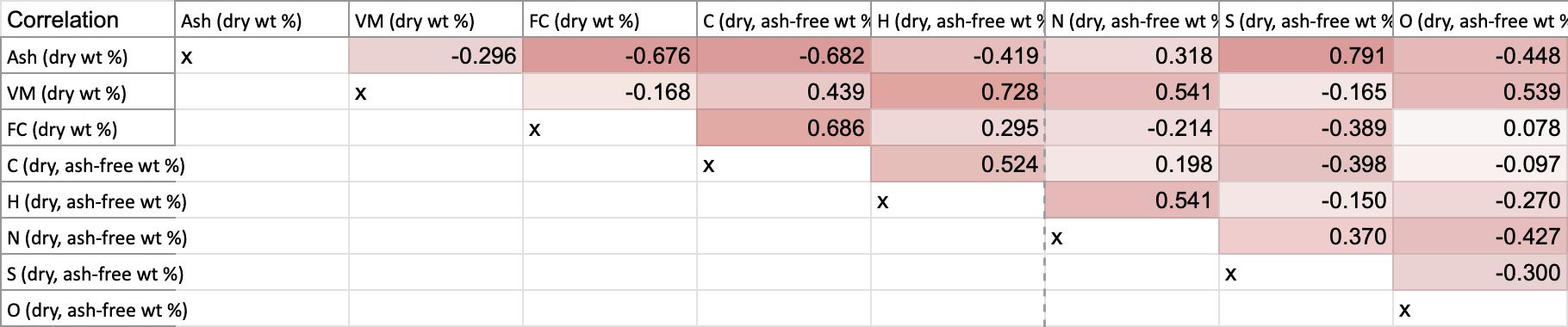
Figure1:Correlationbetweenvariables
Discussionofcorrelation
Asshowninfigure1,somevariableshaveextremelyhigh correlationwitheachother.Variablemassforexamplecanbe explainedbyhydrogen,nitrogen,andoxygenmeaningthatmodels containingtheseelementswouldhavelessofaneedtoincludea variablemasscomponent.Thisistobeexpected,asthevariable massiscomposedoftheseelements.
Secondly,itisimportanttonoticethatnitrogenisnot correlatedwithanyoftheelementsparticularlyhighly,meaningits impactcan’tbeexplainedextremelywellbyanyoftheother variables.Thismeansthatitisworthconsideringifitdoeshavean impact,becausethatcouldexplainsomeofthereasonsthatthe othervariablesstruggletopredictthetrueHHV.
LinearfitstoexplaindifferencebetweenDulong’sequationand truevalues
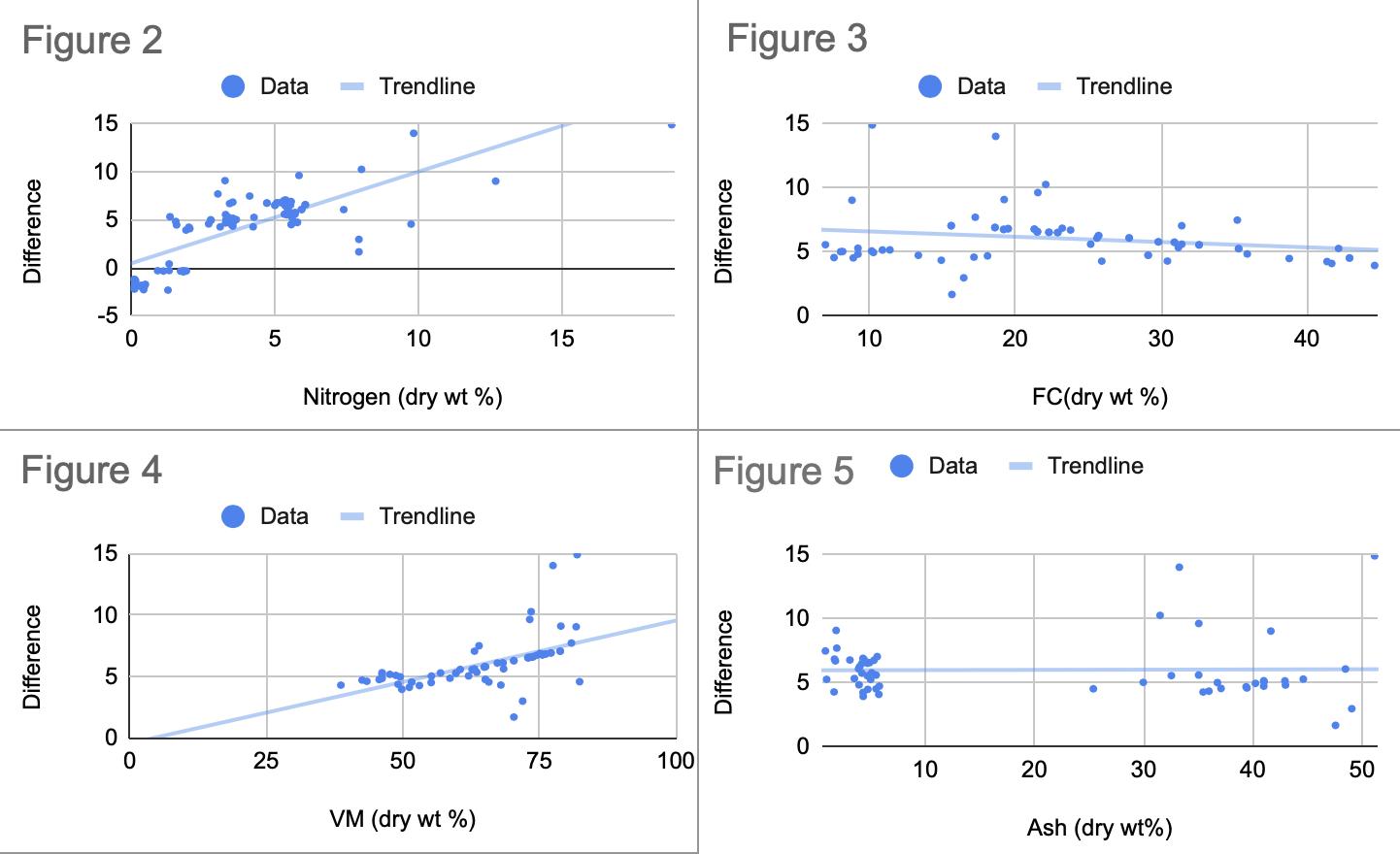
Figure2-5:Linearfits,nitrogen,fixedcarbon,variablemass, ashvsdifferenceintrueandpredictedvalue
Equationsand forFigure2-5 ��2
Discussionoffigures2-6 Nitrogen
Infigures2and6,itisshownthataddingNitrogencanfit thedatawitharelativelyhigh meaningitisverylikelyafactor ��2 anddeterminingthevalueforHHV.Whileitsvaluecanbe
predictedfromtheothervariables,astheyhavetosumto100%, withoutconsideringanintercept,itisnecessarytoincludenitrogen asatermifnitrogeniscorrelatedwiththetruevalueforHHV.It alsohasaninterceptthatisprettysmallwhichistobeexpectedfor acompositionalequation,aswhentherearenoelementsthe equationshouldpredictzero.Furthermoreitcanbeconcludedwith highcertaintythatnitrogenandthedifferencearenegatively correlatedastheratiobetweentheslopeandthestandarderrorfor slopeareextremelylarge,andthusitcanbeconcludedthatthereis apositivecorrelationbetweennitrogenandthedifference.
Fixedcarbon
Infigure3and6,whenconsideringfixedcarbon,firstoffit hasanextremelyhighy-interceptwhichalreadyhastheproblem thatwhentherearenoelementsthereshouldbenoenergystored. Ithasanegativecorrelation,itisveryslightasitisbeingtwicethe standarderror,itlikelyshowsthatthereisanegativeslope. Howeverit’ssmallandthe islow.Thismeansthatitlikelyis ��2 notworthusinginamodel.
Variablemass
Whenlookingatfigure4,itisclearthattherearemany outliers,howeverforthemostpartthedatafitextremelywellby consideringthevariablemass.Thiscouldbeexplainedbythefact thatvariablemassaccountsforalotofthecomponents,andsoit likelyexplainsanoverestimationverywell.Sincetheratioofthe slopetothestandarderrorisextremelyhigh,itcanbeconcluded withveryhighcertaintythatvariablemassispositivelycorrelated. Howeverasdiscussedinthesectionaboutcorrelation,this variable,whileimportant,canbeexplainedbytheelemental components.
Ash
Lastlyinfigures5and6itisclearthatashhasalimited impactontheHHVofahydrocharsincetheslopeisverysmall andthey-interceptishigh.Itisworthnotingthatthisisan extremelyunexpectedresultastheashwouldbeexpectedtolimit theamountofenergyreleasedsignificantlybytherestofthe hydrochar,howeverthisisnotthecase.
Overall,ofthefourvariablesanalysed,itonlyreallymakes sensetoanalysenitrogenwithrespecttoamodelforpredicting HHV,asitistheonlyvariablethatcanexplainthisdifference.
ModifyingDulong’sequation
WhileaddingnewtermstomodifyDulong’sequationcan beusefultodo,itisalsohelpfultoconsidermodifyingthe coefficientsofDulong’sequationinordertocometoabetter result.Firstlywetriedmodifyingstrictlythecoefficientsin Dulong’sequationinordertoseeifourdatamatchestheequation wearetryingtomodify.Thiswasourresult:
Thechangeinthecarboncoefficientwasn’ttoobig. Howeverboththeoxygenandhydrogencoefficientbothincreased byabout37%,howeverremainedrelativelyproportionaltoeach other.Thiscouldbeexplainedinafewways.
Howeverthecoefficientforsulfurwasextremelyhigh,and hadtheoppositesigntowhatwaspredictedinDulong’sequation. Thiscouldbeforafewreasons.Firstlyinourmodeltheamountof sulfurwasextremelysmall,andsothesulfurcoefficientcouldbe influencedbysomethingelsethatwasabiggerfactor.For example,theamountofashiscorrelatedwiththeamountofsulfur. Theoreticallymoreashcouldlimittheamountofenergythatis abletobereleased.Thesulfurcoefficientcouldeffectivelybe tryingtoexplainthisdiscrepancy.Whileashcausedasmall differenceintheHHV,itispossiblethatthissmalldifferencecould
bemagnifiedbythefactthatsulfurissuchasmallpercentageof thetotalsubstance,andthusthecoefficientisseeminglybigeven whenexplainingasmalldifference.
Becauseofthis,wecouldtrytoexplainthistermwith nitrogeninsteadofsulfur.Whenwedothiswegettheequation:
ThisequationismuchsimilartoDulong’sequation,howeverit replacesnitrogenwithsulfur.Bydoingthisitincreasesthe from
0.935to0.945fromourfirsttosecondfit,andthecoefficients matchclosertowhatwouldbepredictedquantummechanically. Carbondiffersby0.1%,Hydrogen8.8%,oxygen8.9%fromthe predictedvalues.Thisequationcouldprovetobeusefulasmany papersdon’treportthequantityofsulfurasit’ssuchasmall percentage,howeverthereisalwaysenoughnitrogenpresentthat basicallyeverypaperwillreportit.Thismodifiedequationyields aneffectivewaytotryandpredictthesevalueswhensulfurisnot given.Chemicallyitmakeslesssense.Onereasonwhythisfit couldbeclosertothetruevalues,isbecausetherewasless reportedpointswithsulfur,andthusthefitnaturallywillbeless accurate.Howeverifweconsidersulfuraswellwecanaddan extratermyieldingtheequation:
Incorporatingsulfurallowsforslightlyincreasingthe
Howeversincesulfurisoftennotreported,sometimesthis equationcouldn’tbeused.Alsoitoverestimatesthecoefficientsof HandOcomparedtowhatispredictedtheoreticallymeaningthat likelythecoefficientshavelessmeaning,comparedtowhensulfur isn’tincluded.
Incorporatingcenterlognormalfit
Duetothepercentagesallneedingtoaddupto100,itis besttouseacenteredlognormalfit,asitdealswiththecorrelation
betweenthevariables.Fortheequationwealsokeptitintheform withthegeometricmeaninthedenominatorofthelogarithm.This isnotnecessary,butitbetterillustrateswhateachtermis.From thiswederivedtwoequations,
Forthefirstequationthe errorwas2.29,whereasin������ thesecondoneitonlydroppedto2.27,showingthataddingthe nitrogentermisn’timportantonceweswitchtoacenteredlog normaldistribution.ThisimpliesthatthespiritofDulong’s equationnotincludingnitrogenwashelpful,butneededadifferent typeoffittobeaccurate.
Interpretingthemodels
Predictionsby
Predictions bymodel
Figure7:FitsandtheirRMSerror
Firstlyitisimportanttonotethateveryfityielded significantlybetterresultscomparedtowhatwouldbepredictedby Dulong’sequation.Howeversomevariablesweremuchmore crucialtoaddthanothers.Forlinearfits,itwasimportanttoadd eithernitrogenorsulfur,howeveraddingthembothdidn’tyield muchmorepositiveresultsthanjustaddingone.Howeveradding justnitrogentotheequationhadaslightlybetterimpactthan addingjustsulfur.Howeverwhenconsideringthecenteredlog ratio,itisnotimportanttoincludenitrogenwhichiswhatwould bepredictedbyDulong’sequation.Nitrogencouldappear importantasastatisticalmeansforlinearfits.Andwhilethiscan
behelpfulinfittingthedata,ittakesawayfromtheactualmeaning oftheslopesinalinearfitasnitrogencontributesverylittleenergy totheactualsubstance.
Conclusion
Inthelabwewereabletofindmodelsthatwereableto betterupdateDulong’sequationspecificallyforhydrochars.Firstly weshowedthatthediscrepancycan’tbesettledwithconsidering theashpercentage,whereasweshowedthatitcouldbehelpfulto considernitrogen.Fromthiswewereabletofitthedataand showedthatitwassomewhatunnecessarytoincludesulfurwhen doingalinearfit.Thenweconsideredusingacenteredlogratioto betterfitthedata,andthisyieldedthefactthatitwasnotnecessary toconsidernitrogen,showingthatthephilosophybehindDulong’s equationwascorrectregardingnitrogen.
WhileupdatingDulong’sequationishelpfulbyitself,itis importanttoconsidertheimplicationsonmaximizingtheprocess ofHTC.Ultimatelyeveryfitsupportswhatwaspreviously predicted,thattoincreasetheHHVofhydrochars,itisimportant tomaximizetheamountofcarbon,andminimizetheamountof oxygen.Todothis,itiscrucialtomaximizetheprocessof dehydrationanddecarboxylationwhicharetheprocessesthat removeoxygen.Tomaximizetheseprocesses,heatcanbe increased.Furthermore,biomassesthatcontainmorecarbon shouldbeconsidered.
Inthefuturetherearestillmanyquestionsleftunanswered suchasamorepreciseformulathatconsidersmoredatapoints, andmaybetriestoconsiderothervariablesthatweren’tconsidered inthislabsuchastimeofreaction,orvolumeofreactor.Aswellas consideringthingsthataren’tvaluessuchaswhetherornotthe reactorwasstirred.Furthermoreafuturelabcouldconsiderthe equationfornonhydrochars.Overallthelabshowedthatadjusting
themodelfrombeinglinear,ultimatelycouldsolvesomeofthe underlyingproblemswithDulong’sequation.
Bibliography
(1)
Hosokai,S.;Matsuoka,K.;Kuramoto,K.;Suzuki,Y.Modification ofDulong’sFormulatoEstimateHeatingValueofGas,Liquidand SolidFuels. Fuel Processing Technology 2016, 152 (152), 399–405.https://doi.org/10.1016/j.fuproc.2016.06.040.
(2)
Sheng,C.;Azevedo,J.L.T.EstimatingtheHigherHeatingValue ofBiomassFuelsfromBasicAnalysisData. Biomass and Bioenergy 2005, 28 (5),499–507.
https://doi.org/10.1016/j.biombioe.2004.11.008.
(3)
Demirbaş,A.CalculationofHigherHeatingValuesofBiomass Fuels. Fuel 1997, 76 (5),431–434.
https://doi.org/10.1016/s0016-2361(97)85520-2. (4)
Channiwala,S.A.;Parikh,P.P.AUnifiedCorrelationfor EstimatingHHVofSolid,LiquidandGaseousFuels. Fuel2002, 81 (8),1051–1063.https://doi.org/10.1016/s0016-2361(01)00131-4. (5)
Jiang,P.;Li,L.;Lin,H.;Ji,T.;Mu,L.;Ji,Y.;Lu,X.;Zhu,J. EstablishingaGeneralizedModelforAccuratePredictionof HigherHeatingValuesofSubstanceswithLargeAshFractions. Green Chemical Engineering 2024, 6 (3),372–379. https://doi.org/10.1016/j.gce.2024.08.002.
(6)
Adeniyi,A.G.;Iwuozor,K.O.;Emenike,E.C.;Ajala,O.J.; Ogunniyi,S.;Muritala,K.B.ThermochemicalCo-Conversionof Biomass-PlasticWastetohydrochar:AReview. Green Chemical Engineering 2023, 5 (1).https://doi.org/10.1016/j.gce.2023.03.002. (7)
Cheng,B.-H.;Huang,B.-C.;Zhang,R.;Chen,Y.-L.;Jiang,S.-F.; Lu,Y.;Zhang,X.-S.;Jiang,H.;Yu,H.-Q.Bio-Coal:ARenewable andMassivelyProducibleFuelfromLignocellulosicBiomass. Science Advances 2020, 6 (1),eaay0748. https://doi.org/10.1126/sciadv.aay0748. (8)
Dashti,A.;Noushabadi,A.S.;Raji,M.;Razmi,A.;Ceylan,S.; Mohammadi,A.H.EstimationofBiomassHigherHeatingValue (HHV)BasedontheProximateAnalysis:SmartModelingand Correlation. Fuel 2019, 257 (6),115931. https://doi.org/10.1016/j.fuel.2019.115931. (9)
Maksimuk,Y.;Antonava,Z.;Krouk,V.;Korsakova,A.; Kursevich,V.PredictionofHigherHeatingValueBasedon ElementalCompositionforLigninandOtherFuels. Fuel 2019, 263 (263),116727.https://doi.org/10.1016/j.fuel.2019.116727. (10)
Puri,L.;Hu,Y.;Naterer,G.CriticalReviewoftheRoleofAsh ContentandCompositioninBiomassPyrolysis. Frontiers in fuels 2024, 2 (2).https://doi.org/10.3389/ffuel.2024.1378361. (11)
Chen,X.;Gao,X.;Wu,H.CharacterizationofAshesfrom Co-FiringhydrocharwithCoalunderPulverized-FuelConditions. ACS Engineering Au 2022, 2 (5). https://doi.org/10.1021/acsengineeringau.2c00012. (12)
Boumanchar,I.;Chhiti,Y.;M’hamdiAlaoui,F.E.;ElOuinani,A.; Sahibed-Dine,A.;Bentiss,F.;Jama,C.;Bensitel,M.Effectof
MaterialsMixtureontheHigherHeatingValue:CaseofBiomass, hydrocharandMunicipalSolidWaste. Waste Management 2017, 61,78–86.https://doi.org/10.1016/j.wasman.2016.11.012. (13)
AleksandraPetrovič;TjašaCenčičPredikaka;Vohl,S.;Gregor Hostnik;MatjažFinšgar;LidijaČuček.HydrothermalConversion ofOilseedCakesintoValuableProducts:InfluenceofOperating ConditionsandWheyasanAlternativeProcessLiquidonProduct PropertiesandTheirUtilization. Energy Conversion and Management 2024, 313,118640–118640. https://doi.org/10.1016/j.enconman.2024.118640. (14)
Odales-Bernal,L.;González,L.M.L.;Ghysels,S.;Lobanov,V.; DeVrieze,J.;Barrera,E.L.;Ronsse,F.OptimizedHydrothermal CarbonizationofChickenManureandAnaerobicDigestionofIts ProcessWaterforBetterEnergyManagement. Journal of Environmental Management 2025, 375,124191. https://doi.org/10.1016/j.jenvman.2025.124191. (15)
Sandeep,A.;Ravindra,A.V.HighlyEfficientPeanutShell ActivatedCarbonviaHydrothermalCarbonizationandChemical ActivationforEnergyStorageApplications. Diamond and Related Materials 2024, 146,111158.
https://doi.org/10.1016/j.diamond.2024.111158. (16)
Zhao,S.;Sun,K.;Xie,P.;Zhang,S.;Zhang,J.;Zhu,Y.;Sun,Z. MercuryRemovalfromCoalCombustionFlueGasby MechanochemicallySulfurModifiedStrawCokeandItsMercury Stability. Fuel 2024, 355,129498–129498.
https://doi.org/10.1016/j.fuel.2023.129498. (17)
Pengpit,P.;Chotchutima,S.;Chaiprapat,S.;Yoyrurob,S.; Charnnok,B.EnhancingBioenergyandFeedProductionin
SouthernThailand:AnApproachthroughLeucaenaCultivation andHydrothermalCarbonization. Renewable Energy2024, 237, 121673.https://doi.org/10.1016/j.renene.2024.121673.