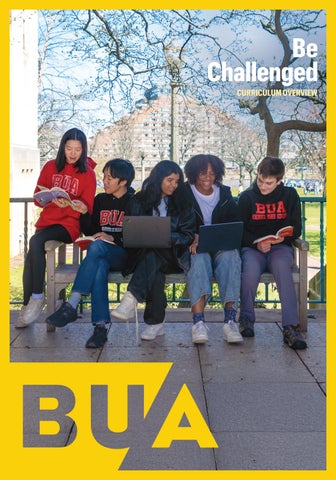

Be Challenged CURRICULUM

Our Distinctive Program
At Boston University Academy, students who love learning are challenged to read deeply and think critically, to explore adventurously at Boston University, and to engage meaningfully in our community and beyond.
Boston University Academy’s academic program pairs a liberal arts high school curriculum with courses at Boston University. It’s an optimal blend of small classes and individualized teacher attention at BUA and the vast educational resources available through BU. Students’ zeal for learning can take them as far as they are capable: there are no limits to learning at BUA.
Learning Without Limits

The BUA curriculum — the only one of its kind in New England — enables students to gain exposure to new disciplines and to pursue their particular interests at advanced levels. It is a program built for students’ growth as thinkers and as individuals. By design, the curriculum evolves to provide an appropriate level of challenge and support for each grade level, preparing students for the myriad of opportunities offered at BU in their junior and senior years. Boston University Academy’s program is mindful of each student’s unique interests and needs.
Best of Both Worlds
Boston University Academy classes are all honors level. Every student gains a solid foundation in the humanities — English, history, and language. Ninth and tenth graders also study biology and chemistry, a visual or performing art, and the level of problembased mathematics that’s right for them. BUA’s core curriculum prepares students for in-depth study of just about anything.
While ninth- and tenth-grade students follow a classically-based, globally-focused liberal arts curriculum, eleventh and twelfth graders have the freedom to choose from more than 2,000 classes from Boston University’s course catalog. In their BU courses, eleventh- and twelfth-grade students build upon their underclassmen experience to pursue their individual interests at advanced levels.
Grades 9 and 10
X Liberal arts curriculum that includes English, history, science, mathematics, classical language, the arts, and physical education
X Two-year study of Latin or ancient Greek; tenth graders who test into the third semester of a modern language may apply to take that course at BU instead of the second year of classical language
X Elective online modern language courses offered in ninth and tenth grades, in addition to a classical language at BUA
X Ninth- and Tenth-Grade Seminars, courses on issues of relevance to today’s teenagers
X Interdisciplinary approach to humanities through immersion in the classic works of Western civilization in conversation with global texts and with emphasis on close reading and writing
X A shared academic experience to support study across a wide variety of disciplines in eleventh and twelfth grades
The BUA approach prompts students to understand historical perspectives, to think critically and delve deeply, to master the use of primary texts, and to hone their interpretive skills. BUA students learn to question what they read, to craft a well-reasoned argument, and to appreciate the connections between literature, history, philosophy, religion, science, and political theory. Classes focus on the debate of “why” and “how.”
Sample Ninth-Grade Schedule
8:55-9:55
Algebraic Thinking & Coordinate Geometry
10:05-11:05
The Literary Canon in Conversation: Self in Society 9:30-10:45 ( long)
( long)
Algebraic Thinking & Coordinate Geometry 10:05-11:05
The Literary Canon in Conversation: Self in
Algebraic Thinking & Coordinate Geometry 9:35-10:50 ( long)
8:55-9:55
The Literary Canon in Conversation: Self in Society 10:05-11:05
12:20-1:10 Visual Art I: Drawing and Painting 12:30-1:45
Visual Art I:
Sample Tenth-Grade Schedule
Chorus 8:55-9:55 All-School Meeting 8:30-9:20
Euclidean Geometry, Functions, & Graphs 10:05-11:05
Makings of the Modern World 9:30-10:45 ( long)
8:30-9:45 ( long) Makings of the Modern World 8:30-9:30
Euclidean Geometry, Functions, & Graphs 10:05-11:05
Euclidean Geometry, Functions, & Graphs 9:35-10:50 ( long)
8:55-9:55
Makings of the Modern World 10:05-11:05
10th-Grade Seminar 12:20-1:10
British Literature: Global Citizenship 12:30-1:45 ( long) British Literature: Global Citizenship 12:15-1:15
Grades 11 and 12
All eleventh and twelfth graders enroll in courses at BUA and BU; juniors typically take two courses a semester at the University, while seniors can take as many as four courses per semester at BU Students can pick from over 2,000 BU courses including 27 modern languages
All University courses are taken for credit with Boston University faculty and students; most students earn as many as 48 college credits (the equivalent of 12 college courses or 1 ½ years) prior to graduating
Course credits may be transferred or used for placement at the discretion of the college at which a student matriculates
Most students graduate with proficiency in two languages: one classical and one modern (students often achieve in two years the equivalent of four years of high school language study)
All students must complete calculus by the end of their senior year
Most juniors enroll in a lab-based science at BU, completing the science sequence that began with biology and chemistry at BUA
All seniors complete a year-long thesis project under the guidance of a University professor and a BUA faculty advisor
Sample Eleventh-Grade Schedule
Calculus I
8:55-9:55
US History 10:05-11:05
College Counseling Seminar 11:15-12:05
Spanish Through Film & Media 12:20-1:10
General Physics
Discussion 1:25-2:15
All-School Meeting 8:30-9:20
American Literature: Identity and Belonging 9:30-10:45 ( long)
General Physics 11:00-12:15
Junior Research Seminar: HEAR 2:00-3:50 (elective)
Calculus I 8:30-9:45 ( long)
US History 10:05-11:05
Spanish Through Film & Media 12:20-1:10
Music Theory 2:00-4:20 (elective)
Sample Twelfth-Grade Schedule
Social Psychology 10:10-11:00
Senior Thesis 11:15-12:05
Senior Seminar: Global Literature 12:20-1:10
All-School Meeting
8:30-9:20
Baroque Arts in Northern Europe 9:30-10:45 Social Psychology 10:10-11:00
Intro to Data Science 12:30-1:45
Senior Seminar: Global Literature 12:20-1:10
Intro to Data Science Discussion 1:25-2:15
US History 8:30-9:30
American Literature: Identity and Belonging 9:35-10:50 ( long)
General Physics 11:00-12:15
Physics Lab 12:30-3:15
Calculus I 8:55-9:55
American Literature: Identity and Belonging 10:05-11:05
Spanish Through Film & Media 1:25-2:15
College Counseling Seminar 8:30-9:20
Baroque Arts in Northern Europe 9:30-10:45 Social Psychology 10:10-11:00
Intro to Data Science 12:30-1:45
Senior Seminar: Global Literature 12:20-1:10
The courses shaded in red are undergraduate-level classes taken at Boston University. Juniors and seniors do not have assigned lunch blocks. Rather, they eat lunch at the time that works best with their schedule.
Curriculum Overview
English The Literary Canon in Conversation: Self in Society
History
Language
British Literature: Global Citizenship
Power and Wisdom in the Ancient World Makings of the Modern World
Latin or Ancient Greek Latin or Ancient Greek
Modern Language Program Modern Language Program
Science Biology Chemistry
Math
American Literature: Identity and Belonging
Senior Seminar at BUA or an English course at BU
United States History BU Course
27 modern languages offered at BU; placement is determined by exam (not grade level)
BU Course (Physics if appropriate) BU Course (Physics if appropriate)
Placement is determined by ability and exposure, not grade level; completion of Calculus I is a graduation requirement. Students can take up to Multivariate Calculus at BUA, after which higher level math courses are available at BU.
Arts Chamber Ensemble, Chorus, Jazz Band, Drama, or Visual Art
Additional Coursework
Ninth-Grade Seminar
Tenth-Grade Seminar
Advanced seminars available at BUA and BU
Junior Research Seminar (optional) Senior Thesis
The non-shaded areas represent graduation requirements, while the shaded boxes represent elective options. All BUA courses are honors level and there is no tracking.

BUA Course Offerings
X Classics
CL20: Latin I
CL40: Latin II
CL60: Latin III: Reading Prose and Poetry
CG20: Ancient Greek I
CG40: Ancient Greek II
CG60: Ancient Greek III: Reading Prose and Poetry
X English
EN20: The Literary Canon in Conversation: Self in Society
EN40: British Literature: Global Citizenship
EN60: American Literature: Identity and Belonging
EN80A: Suspicious Literature: The Challenge of Becoming Who We Are
EN80B: Global Literature
JSHEAR: Humanities, Experiential Learning, and Arts Research Seminar
X History
HI20: Power and Wisdom in the Ancient World
HI40: Makings of the Modern World
HI60: United States History
X Mathematics
MA20: Algebraic Thinking & Coordinate Geometry: Integrated Math I
MA40: Euclidean Geometry, Functions, & Graphs: Integrated Math II
MA60: Precalculus: Integrated Math III
MA80: Calculus I
MA85: Calculus I & II
MA90: Calculus II
MA95: Multivariate Calculus
X Performing Arts
DR20: Introduction to Drama
DR40: Advanced Drama
DR80: Advanced Drama Seminar
MU20A: Chamber Orchestra
MU20B: Chorus
MU20C: Jazz Band
MU80A: Music Theory
MU80B: Musicianship
MU80C: Independent Study in Composition
MU80D: The Development of Operatic Style
MU80E: Swamp Cats (Advanced Jazz Ensemble)
MU80F: Music of the Woodstock Generation
X Science
BI20: Biology
CH40: Chemistry
JSEAI: Entrepreneurship and Innovation Seminar
JSSCI: Science, Technology, Engineering, and Mathematics Research Seminar
X Visual Arts
AR20A: Visual Art I: Drawing and Painting
AR20B: Visual Art I: Drawing and Digital Art
AR40A: Visual Art II: Drawing and Painting
AR40B: Visual Art II: Drawing and Digital Art
AR80: Advanced Art Seminar

Ninth- and Tenth-Grade Seminars: A Deeper Dive
Educating and supporting the whole student is a fundamental part of our philosophy at BUA.
The Health & Wellness unit offers engaging lessons on physical and emotional health and wellbeing with special attention to topics of relevance to today’s teenagers, including nutrition; mental health; sexual health; social interactions; and social media and technology use.
Foundations in Language and Logic introduces students to concepts of written argument and style. This unit aims to develop an early awareness in students of words as both fun and powerful, and of the ways in which language and logic are working on us every waking hour.
Public Speaking helps students learn how to craft and give a speech. Each student writes and delivers two short talks to their classmates: a personal narrative sharing some lesson or insight; and a persuasive speech advocating for a change at BUA to help the community more fully live up to our mission and core values.
In Introduction to Research, students learn a number of skills that are transferable across disciplines and bear fruit throughout their academic careers: finding reliable and relevant sources; navigating research databases; and reading journal articles and other academic literature.
In Python & Machine Learning, students work with researchers from BU’s Software & Application Innovation Lab (SAIL) to learn the fundamentals of coding through interactive lessons in Python and doing hands-on work in machine learning.
In Entrepreneurial Leadership, students explore teamwork and leadership that foster creative thinking and entrepreneurship under the guidance of a professor from BU’s Questrom School of Business. Students discover their strengths and weaknesses in their personal leadership styles and delve into strategies that will help them become more effective leaders and team members.
Engineering & Design Thinking leverages two partnerships at BU. For half of the unit, students learn the basics of fabrication at BU’s 15,000-square-foot makerspace, the Engineering Product Innovation Center (EPIC). In the other session, students work with mentors at Innovate@BU, the University’s innovation and entrepreneurship center, practicing design thinking and applying that methodology to real-world problems.
Community Moments
All-School Meeting (ASM) takes place every Tuesday morning during the academic year and is an essential part of the BUA program. It is a time for the BUA community to come together to learn, share announcements, discuss issues of the day – and also to have fun! These weekly gatherings include talks given by BU professors or visiting scholars, and sometimes feature community-building games and activities led by BUA’s Student Council.
Academic Block provides opportunities for students to get a jump-start on homework and to seek out support from teachers and tutors. Academic Blocks are quiet, proctored hours carved out of the school day for all underclassmen.
Advising and Student Support takes on many forms at BUA. Every student is paired with an advisor who supports and encourages that student’s academic and social-emotional wellbeing. Ninth- and tenth-grade students meet with their advisor and advising group twice per week. Class advisors coordinate weekly grade-wide meetings that focus on community norms, adjusting to life at BUA, as well as student health and wellness. The BUA Student Support team includes the school psychologist, learning specialist, and the University liaison who serves as a conduit of communication between BUA and BU instructors.
Student Clubs and Activities provide meaningful ways for students to pursue non-academic interests, enjoy creative outlets, reduce stress, and build community. With more than 50 clubs and 15 interscholastic and recreational sports to choose from, there are more extracurricular opportunities than there are hours in a day!
University Connections

BUA’s connection to Boston University opens all kinds of doors for our curious and motivated students. BU’s resources are our resources, including cutting-edge learning and athletic facilities, an expansive course catalog, and distinguished faculty.
BU Course Catalog
When it comes time to choose courses at the University, there are over 2,000 available to BUA students. From Stellar and Galactic Astrophysics to the History of Piracy, Philosophy and Film to Foundations of Data Science, if a student is passionate about something, they will be able to pursue it. The active partnership we maintain with Boston University offers
one-of-a-kind possibilities: BUA students have the opportunity to gain exposure to new disciplines as well as to follow their passions and pursue particular interests at advanced levels. All University courses are taken with Boston University faculty and students; BUA students must meet all prerequisites listed in the BU course catalog.
Laboratories
Because we’re part of a major research university, BUA students utilize resources that other high schoolers can only dream of. Our unrivaled access to Boston University’s professional laboratories and research facilities allows BUA students interested in STEM to explore their interests in actual—not virtual—reality.
Libraries
BUA students have more than 2.4 million physical volumes and 77,000 media titles available to them through BU’s library system. In addition to books, BU Libraries provide limitless search tools, access to databases and global resources, research materials and tutorials, and specialty subject research guides developed in-house by librarian experts.
Athletics and Fitness
Students enjoy access to University resources both inside and out of the classroom. Our physical education classes take place at BU’s 270,000-squarefoot Fitness & Recreation Center (FitRec), where
students choose from more than 25 physical education electives. Students 16 and older are also able to work out independently at FitRec, where they have access to weight rooms; multipurpose fitness studios; aquatic facilities; and squash, racquetball, and basketball courts.
BUA’s 15 interscholastic and recreational sports also utilize BU’s world-class athletic facilities, from Nickerson Field for soccer, to rowing out of the DeWolfe Boathouse.
Dining Options
BUA students can opt to buy lunch from BU’s George Sherman Union (GSU) next door—not your average high school cafeteria. Choices include sushi, fresh salads, global street food, gourmet sandwiches, and much more. Ninth and tenth graders eat in a reserved dining room, while eleventh and twelfth graders can explore the restaurants and cafes along Commonwealth Avenue.
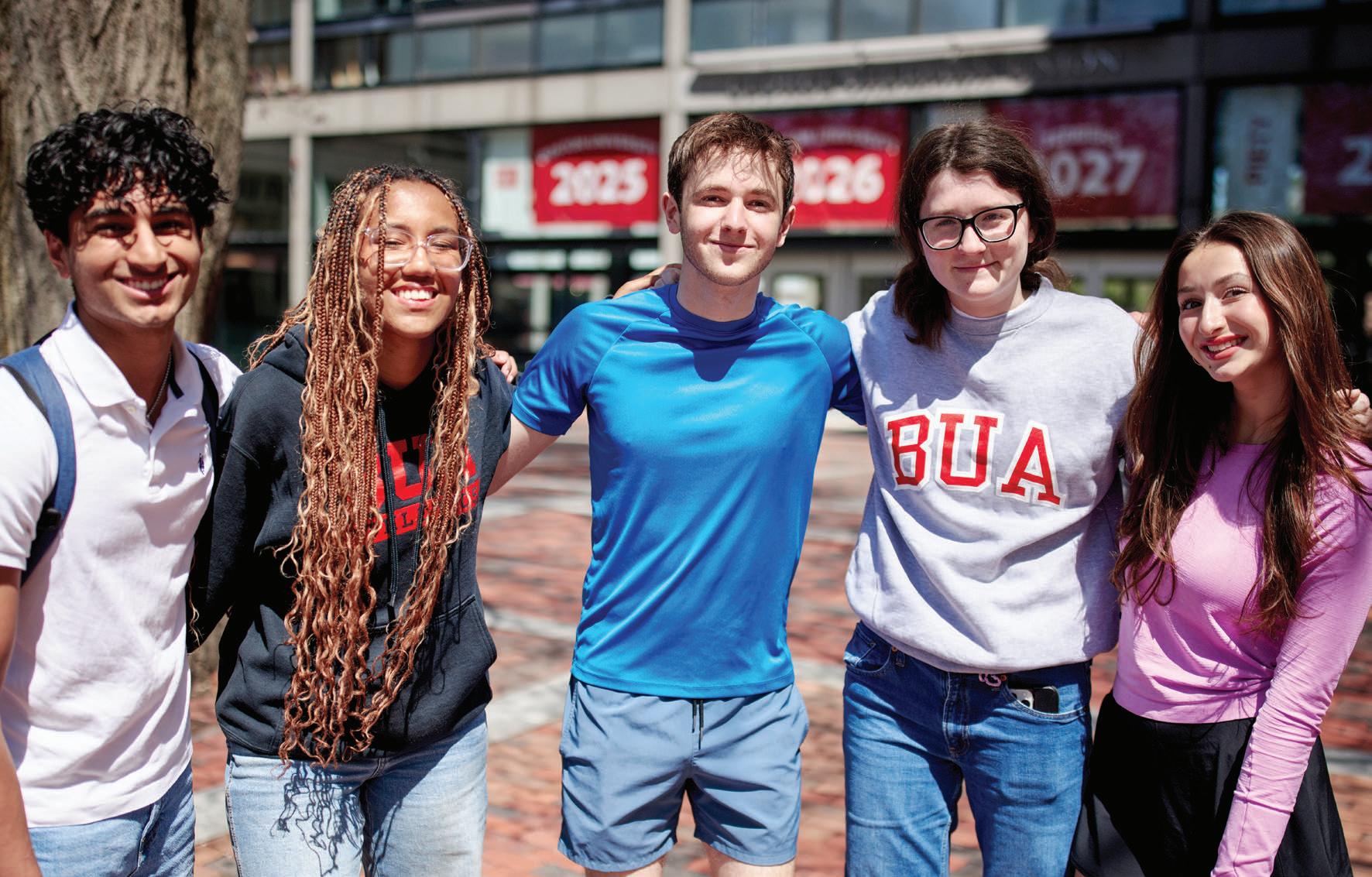
Boston University Admission Agreement
All BUA students in good academic and disciplinary standing are ensured admission to most of BU’s four-year undergraduate programs with a financial aid package that meets 100% of their calculated need. How’s that for a perk?
Imagine going into the competitive college application process with the certainty that you will be admitted to one of the nation’s top research universities. Of all our peer schools, Boston University Academy alone is able to offer this assurance to our students.
Boston University Academy students must complete an application and submit all required testing in full if they wish to be considered for admission to BU. BUA students who apply to BU will be granted admission to most of BU’s undergraduate 4-year programs if they meet the following criteria:
X Earn a 3.0 cumulative GPA in Academy and University coursework by the time of application
X Have no grade of D or F in any BUA or University course(s)
X Have no reportable disciplinary infraction(s)
Tuition Remission for BU Employees
Boston University employees may be eligible to apply their tuition remission benefit toward a portion of their child’s tuition at Boston University Academy. Because seniors at BUA take the majority of their coursework at the University, BU allows employees to participate in the tuition remission program during this year. University families who enroll at BUA may also apply for need-based financial aid to assist in the cost of tuition for all four years.
College Credit at BU
In eleventh and twelfth grade, students regularly complete up to 12 courses (equivalent to approximately 48 college credits) from the University’s undergraduate curriculum. For students who matriculate at BU, these credits represent a value of $109,536 based on the current undergraduate tuition cost, and thereby potentially minimize future college tuition costs.

BUA students arrive as well prepared as any of our first-year undergraduates. They’re willing to put in the work, ask for help when they need it, and think carefully about how to improve. They are hardworking, mature, and take their education seriously.”
— BU Professor
OVER THE PAST FIVE YEARS, BOSTON UNIVERSITY
ACADEMY STUDENTS HAVE ENROLLED IN A COMBINED THIS FIGURE REPRESENTS AN IMPRESSIVE
2968
CLASSES AT BOSTON UNIVERSITY
52671
ACROSS
DISTINCT COURSES DEPARTMENTS & INTERDISCIPLINARY PROGRAMS
University Coursework
The following is a complete list of the Boston University courses in which BUA students enrolled in the past five academic years. Most students take as many as two University courses a semester as juniors and up to four classes a semester during senior year. BUA graduates are likely to have completed up to 12 courses for 48 college credits. All University courses are taken with Boston University faculty and students. Students graduate with transcripts from Boston University Academy and from Boston University.
X African American Studies
CAS AA 225 Topics in Religion & Music
CAS AA 234 African Americans in Global Perspective
CAS AA 237 Reconstructing the African Past
CAS AA 300 Topics in African American Studies
CAS AA 316 African Diaspora Arts in the Americas
X Art History
CAS AH 112 Intro to Art in Europe & the United States
CAS AH 201 Understanding Architecture
CAS AH 210 Learning to See
CAS AH 240 Medieval Art
CAS AH 284 Arts in America
CAS AH 365 Baroque Arts in Northern Europe
CAS AH 367 Material Culture
CAS AH 386 Modern American Art
CAS AH 395 History of Photography
X Anthropology
CAS AN 101 Intro to Cultural Anthropology
CAS AN 102 Human Behavioral Biology & Evolution
CAS AN 210 Intro to Medical Anthropology
CAS AN 233 The Evolutionary Biology of Human Variation
CAS AN 240 Legal Anthropology
CAS AN 260 Sex & Gender in Anthropological Perspective
CAS AN 262 Evolution of Culture & Society
CAS AN 263 Behavioral Biology of Women
CAS AN 290 Children & Culture
CAS AN 330 From Conception to Death
CAS AN 335 Great Apes & the Evolution of Human Behavior
CAS AN 336 Primate Evolutionary Ecology
CAS AN 349 Challenging Xenophobia
CAS AN 351 Language, Culture, & Society
CAS AN 556 Evolution of the Human Diet
X Archaeology
CAS AR 100 Great Discoveries in Archaeology
CAS AR 150 Archaeology of Cities
CAS AR 190 Intro to Archaeology
CAS AR 202 Archaeological Mysteries
CAS AR 210 Minoan & Mycenaean Civilizations
CAS AR 290 Human Impacts on Ancient Environments
CAS AR 301 African Diaspora Archaeology
CAS AR 305 Paleolithic Archaeology
CAS AR 507 Low Impact Field Methods in Archaeology
CAS AR 508 Landscape Archaeology
CAS AR 520 Methods in Environmental Archaeology
X Astronomy
CAS AS 100 Cosmic Controversy
CAS AS 101 The Solar System
CAS AS 102 The Astronomical Universe
CAS AS 105 Alien Worlds
CAS AS 107 Life Beyond Earth
CAS AS 109 Cosmology
CAS AS 202 Principles of Astronomy I
CAS AS 203 Principles of Astronomy II
CAS AS 311 Planetary Physics
CAS AS 312 Stellar & Galactic Astrophysics
X Biology
CAS BI 107 Biology I
CAS BI 108 Biology II
CAS BI 114 Human Infectious Diseases
CAS BI 126 Human Genetics
CAS BI 203 Cell Biology
CAS BI 206 Genetics
CAS BI 210 Human Anatomy
CAS BI 211 Human Physiology
CAS BI 213 Intensive Cell Biology
CAS BI 216 Intensive Genetics
CAS BI 260 Marine Biology
CAS BI 306 Biology of Global Change
CAS BI 309 Evolution
CAS BI 325 Principles of Neuroscience
CAS BI 385 Immunology
CAS BI 394 Topics in Biology III
CAS BI 408 Insect Biology
CAS BI 410 Developmental Biology
CAS BI 413 Microbial Ecology
CAS BI 414 Ornithology
X Chemistry
CAS CH 101 General Chemistry I
CAS CH 102 General Chemistry II
CAS CH 109 General & Quantitative Analytical Chemistry
CAS CH 110 Advanced General Chemistry II
CAS CH 174 Principles of Organic Chemistry
CAS CH 203 Organic Chemistry I
CAS CH 204 Organic Chemistry II
CAS CH 211 Intensive Organic Chemistry I
CAS CH 212 Intensive Organic Chemistry II
CAS CH 225 Mathematical Methods for Molecular Science
CAS CH 232 Inorganic Chemistry
CAS CH 351 Physical Chemistry I
X Cinema & Media Studies
CAS CI 101 Global Cinema I
CAS CI 102 Global Cinema II
CAS CI 268 Religion & Film
CAS CI 390 Special Topics in Cinema & Media Studies
X Classical Studies
CAS CG 101 Modern Greek Language, Culture, & Literature
CAS CG 211 Intermediate Modern Greek I
CAS CG 212 Intermediate Modern Greek II
CAS CG 357 Modern Greek Culture & Film
CAS CL 101 Classical Civilization: Greece
CAS CL 102 Classical Civilization: Rome
CAS CL 111 Latin I
CAS CL 206 Women in Antiquity
CAS CL 207 Sexuality in Ancient Greece & Rome
CAS CL 211 Latin III: Prose
CAS CL 212 Latin IV: Verse
CAS CL 213 Greek & Roman Mythology
CAS CL 224 Greek Drama in Translation
CAS CL 228 The History of Medicine in Ancient Greece and Rome
CAS CL 229 Roman Comedy
CAS CL 237 Race & Ethnicity in Ancient Greece and Rome
CAS CL 261 Intermediate Greek III: Prose
CAS CL 262 Greek IV: Homer
CAS CL 321 Greek History
CAS CL 351 Latin Seminar
CAS CL 391 Greek Seminar: Thucydides
CAS CL 451 Advanced Latin Seminar
CAS CL 493 Directed Study in Greek
X Comparative Literature
CAS XL 100 Leaving Home: Explorations in World Literature
CAS XL 230 Topics in Big Fat Books
CAS XL 281 Holocaust Literature & Film
CAS XL 344 Global Shakespeare
CAS XL 397 World Cities: Istanbul
X Computer Science
CAS CS 101 Intro to Computing
CAS CS 103 Intro to Technologies & Web Programming
CAS CS 105 Databases
CAS CS 108 Programming for Non-CS Majors
CAS CS 111 Intro to Computer Science I
CAS CS 112 Intro to Computer Science II
CAS CS 131 Combinatoric Structures
CAS CS 132 Geometric Algorithms
CAS CS 210 Computer Systems
CAS CS 235 Algebraic Algorithms
CAS CS 237 Probability in Computing
CAS CS 330 Analysis of Algorithms
CAS CS 332 Elements of the Theory of Computation
CAS CS 411 Software Engineering
CAS CS 440 Intro to AI
CAS CS 537 Randomness in Computing
CAS CS 538 Cryptography
X Earth & Environment
CAS EE 100 Environmental Change & Sustainability
CAS EE 105 Crises of Planet Earth
CAS EE 107 Intro to Climate & Earth System Science
CAS EE 140 Natural Disasters
CAS EE 144 Oceanography
CAS EE 150 Sustainable Energy: Technology, Resources, Society, & Environment
CAS EE 201 World Regional Geography
CAS EE 304 Environmentally Sustainable Development
CAS EE 512 Urban Climate
X Economics
CAS EC 101 Introductory Microeconomic Analysis
CAS EC 102 Introductory Macroeconomic Analysis
CAS EC 201 Intermediate Microeconomic Analysis
CAS EC 202 Intermediate Macroeconomic Analysis
CAS EC 203 Empirical Economics I
CAS EC 204 Empirical Economics II
CAS EC 348 Dynamic Macroeconomics
CAS EC 356 Economics of the Labor Market
CAS EC 403 Game Theory
X English
CAS EN 120 Freshman Seminar in Literature
CAS EN 121 Readings in World Literature
CAS EN 122 Medieval Worlds
CAS EN 126 Jewish Literature
CAS EN 127 Readings in American Literature I
CAS EN 130 Science/Fiction
CAS EN 141 Literary Types: Fiction
CAS EN 155 Myth of Family-Classical American Lit, Film, TV
CAS EN 162 The Ethics of Art
CAS EN 163 Readings in Shakespeare
CAS EN 170 The Graphic Novel
CAS EN 176 Introduction to Film & Media Aesthetics
CAS EN 177 Asian American Literature
CAS EN 178 Intro to Latinx Literature
CAS EN 179 Intro to Trans Literature
CAS EN 180 Post-Apocalyptic Narratives
CAS EN 195 Literature and Ideas
CAS EN 202 Intro to Creative Writing
CAS EN 220 Seminar in Literature
CAS EN 306 Writing of Plays
CAS EN 323 British Literature II
CAS EN 341 History of the Novel in English
CAS EN 345 Nineteenth-Century American Fiction
CAS EN 364 Shakespeare II
CAS EN 373 Detective Fiction
CAS EN 546 Modern American Novel
X History
CAS HI 112 Black Power in the Classroom: History of Black Studies
CAS HI 176 World History II: 1500 to the Present
CAS HI 190 History of Boston
CAS HI 191 What Is Europe?
CAS HI 203 Magic, Science, & Religion
CAS HI 209 The Reformation: Religious Conflict in Early Modern
CAS HI 214 History of Piracy
CAS HI 218 Power & Authority in Europe since World War I
CAS HI 226 Cities & Culture
CAS HI 247 Making of Modern Britain
CAS HI 248 Modern Britain
CAS HI 287 US Foreign Relationships Since 1898
CAS HI 338 Repression, Revolution, Rock n’ Roll: US in 1950s & 1960s
CAS HI 339 A History of the Present: The United States since 1968
X International Relations
CAS IR 230 Intro to International Politics
CAS IR 234 Fundamentals of Strategic Intelligence
CAS IR 251 Intro to Comparative Politics
CAS IR 271 Intro to International Relations
CAS IR 300 Topics in International Relations
CAS IR 304 Environmentally Sustainable Development
CAS IR 307 Intro to Middle East Politics
CAS IR 315 International Nuclear Politics
CAS IR 341 Central Europe
CAS IR 350 History of International Relations since 1945
CAS IR 354 Gender & Global Politics
CAS IR 500 Topics in International Relations
CAS IR 516 Homeland Security
CAS IR 517 Balkan Politics & International Relations
CAS IR 531 Intercultural Communication
X Jewish Studies
CAS JS 136 Jewish Literature
X Linguistics
CAS LX 110 Accents, Dialects, & Society
CAS LX 120 Language & Music
CAS LX 250 Intro to Linguistics
CAS LX 321 Syntax
CAS LX 331 Semantics & Pragmatics: Intro to Linguistic Meaning
CAS LX 360 Comparative Linguistics
CAS LX 390 Topics in Linguistics
CAS LX 391 Linguistic Field Methods
CAS LX 432 Intermediate Semantics
X Mathematics & Statistics
CAS MA 113 Elementary Statistics
CAS MA 115 Statistics I
CAS MA 116 Statistics II
CAS MA 119 Applied Mathematics for Personal Finance
CAS MA 123 Calculus I
CAS MA 124 Calculus II
CAS MA 213 Basic Statistics & Probability
CAS MA 214 Applied Statistics
CAS MA 225 Multivariate Calculus
CAS MA 226 Differential Equations
CAS MA 231 Honors-Level Differential Equations
CAS MA 242 Linear Algebra
CAS MA 293 Discrete Mathematics
CAS MA 294 Applied Abstract Algebra
CAS MA 411 Advanced Calculus
CAS MA 412 Complex Variables
CAS MA 416 Analysis of Variance
CAS MA 433 Graph Theory
CAS MA 442 Honors-Level Linear Algebra
CAS MA 511 Intro to Analysis I
CAS MA 512 Intro to Analysis II
CAS MA 531 Mathematical Logic
CAS MA 532 Foundations of Mathematics
CAS MA 541 Modern Algebra I
CAS MA 542 Modern Algebra II
CAS MA 563 Intro to Differential Geometry
CAS MA 564 Intro to Topology
CAS MA 581 Probability
CAS MA 741 Algebra I
CAS MA 745 Algebraic Geometry I
X Neuroscience
CAS NE 101 Intro to Neuroscience
CAS NE 102 Intro to Cellular & Molecular Biology
CAS NE 349 Neurotoxins in Biology, Medicine, Agriculture, & War
CAS NE 525 Biology of Neurodegenerative Diseases
X Philosophy
CAS PH 100 Intro to Philosophy
CAS PH 110 Great Philosophers
CAS PH 150 Intro to Ethics
CAS PH 155 Politics & Philosophy
CAS PH 159 Philosophy & Film
CAS PH 160 Reasoning & Argumentation
CAS PH 247 Intro to Chinese Philosophy
CAS PH 248 Existentialism
CAS PH 251 Medical Ethics
CAS PH 253 Social Philosophy
CAS PH 255 Law, Philosophy, & Society
CAS PH 256 Philosophy of Gender & Sexuality
CAS PH 261 Puzzles & Paradoxes
CAS PH 272 Science & Technology Values
CAS PH 310 History of Modern Philosophy
CAS PH 350 History of Ethics
CAS PH 360 Symbolic Logic
CAS PH 446 Philosophy of Religion
X Physics
CAS PY 105 Elementary Physics I
CAS PY 106 Elementary Physics II
CAS PY 107 Physics of Food & Cooking
CAS PY 211 General Physics I
CAS PY 212 General Physics II
CAS PY 241 Principles of General Physics I
CAS PY 242 Principles of General Physics II
CAS PY 251 Principles of Physics I
CAS PY 252 Principles of Physics II
CAS PY 313 Waves & Modern Physics
CAS PY 351 Modern Physics I
CAS PY 355 Methods of Theoretical Physics
CAS PY 371 Electronics for Scientists
CAS PY 408 Intermediate Mechanics
CAS PY 410 Therm/Stat Physics
CAS PY 421 Intro to Computational Physics
CAS PY 451 Quantum Physics I
X Political Science
CAS PO 141 Intro to Public Policy
CAS PO 151 Intro to Comparative Politics
CAS PO 171 Intro to International Relations
CAS PO 191 Intro to Political Theory
CAS PO 309 Women & Politics
CAS PO 333 Democratic Erosion
CAS PO 341 European Union Politics
CAS PO 358 International Nuclear Politics
CAS PO 390 Special Topics in Political Theory
CAS PO 393 The European Enlightenment
CAS PO 597 Foucault/Arendt
X Psychological & Brain Sciences
CAS PS 101 General Psychology
CAS PS 222 Perception & Behavior
CAS PS 231 Physiological Psychology
CAS PS 234 Psychology of Learning
CAS PS 241 Developmental Psychology
CAS PS 251 Psychology of Personality
CAS PS 261 Social Psychology
CAS PS 339 Intro to Cognitive Neuroscience
CAS PS 371 Abnormal Psychology
X Religion
CAS RN 100 Intro to Religion
CAS RN 105 Intro to the World’s Religions
CAS RN 205 Topics in Religion and Music
CAS RN 242 Magic, Science, & Religion
CAS RN 248 Food & Religion
X Romance Studies
CAS LF 111 First-Semester French
CAS LF 112 Second-Semester French
CAS LF 211 Third-Semester French
CAS LF 212 Fourth-Semester French
CAS LF 307 French Arts and Society
CAS LF 308 French through Film & Media
CAS LF 309 French in the World
CAS LF 310 French for the Professions
CAS LF 312 French Language & Identity
CAS LF 313 French through Translation
CAS LF 323 Creative Writing in French
CAS LF 324 Advanced Spoken French
CAS LF 341 Topics & Culture in French
CAS LF 350 Intro to French Texts
CAS LF 462 Cinema-Monde: Mapping French Film
CAS LF 478 Gender & Authorship
CAS LI 111 First-Semester Italian
CAS LI 112 Second-Semester Italian
CAS LI 211 Third-Semester Italian
CAS LI 212 Fourth-Semester Italian
CAS LI 313 Italian Media & Popular Culture
CAS LP 111 First-Semester Portuguese
CAS LP 211 Third-Semester Portuguese
CAS LP 212 Fourth-Semester Portuguese
CAS LP 305 Portuguese Topics in Language & Culture
CAS LP 307 Portuguese for Business & Professional Life
CAS LP 308 Brazilian History
CAS LP 352 Tropical Metropolis & Brazilian Modernity
CAS LP 362 Inventing Brazil
CAS LS 111 First-Semester Spanish
CAS LS 112 Second-Semester Spanish
CAS LS 211 Third-Semester Spanish
CAS LS 212 Fourth-Semester Spanish
CAS LS 306 Spanish Translation
CAS LS 307 Spanish Literature & Arts
CAS LS 308 Spanish Film & Media
CAS LS 309 Spanish for Heritage & Native Speakers
CAS LS 310 Spanish for the Professions
CAS LS 311 Spanish through Performance
CAS LS 318 Spanish Public Speaking
CAS LS 350 Intro to Analysis of Hispanic Texts
CAS LS 456 Medieval & Early Modern Iberian Literature
X Sociology
CAS SO 100 Principles in Sociology
CAS SO 203 Sociological Theories
CAS SO 205 American Family
CAS SO 207 Intro to Ethnic, Race, & Minority Relations
CAS SO 208 Sociological Approaches to Current Issues
CAS SO 215 Sociology of Healthcare
CAS SO 230 Crime & Justice
CAS SO 242 Globalization & World Poverty
CAS SO 244 Urban Sociology
CAS SO 315 Social Nature of Technology
CAS SO 390 Topics in Sociology
X World Languages & Literatures
CAS LC 111 First-Semester Chinese
CAS LC 112 Second-Semester Chinese
CAS LC 116 Reading and Writing Chinese I
CAS LC 211 Third-Semester Chinese
CAS LC 212 Fourth-Semester Chinese
CAS LC 216 Reading and Writing Chinese II
CAS LC 250 Premodern Chinese Literature
CAS LC 251 Modern Chinese Literature
CAS LC 281 Chinese Theater
CAS LC 286 Topics in Chinese Culture
CAS LC 287 Screening Modern China
CAS LC 311 Third-Year Modern Chinese
CAS LC 313 Chinese through Theater & Performance
CAS LC 315 Classical Chinese
CAS LC 316 Chinese Reading & Writing III
CAS LC 317 Chinese in Modern Society
CAS LC 318 Chinese through Public Speaking
CAS LC 319 Chinese in Intercultural Communications
CAS LC 320 Advanced Classical Chinese
CAS LC 322 Business Chinese
CAS LC 420 Topics in Chinese through Media
CAS LC 426 Chinese American Stories
CAS LC 486 Chinese Translation
CAS LG 111 First-Semester German
CAS LG 112 Second-Semester German
CAS LG 211 Third-Semester German
CAS LG 212 Fourth-Semester German
CAS LG 220 Introduction to German Linguistics
CAS LG 250 Masterpieces of German Literature
CAS LG 305 Science & Culture
CAS LG 307 Modern Society & Culture
CAS LG 308 Food Culture in GermanSpeaking Countries
CAS LG 309 German for the Professions
CAS LG 310 German Translation & Interpretation
CAS LG 335 Music, Art, & History in the German-Speaking World
CAS LG 350 Intro to German Literature
CAS LG 463 German Theater
CAS LG 492 Directed Study: German
CAS LH 111 First-Semester Hebrew
CAS LH 112 Second-Semester Hebrew
CAS LH 211 Third-Semester Hebrew
CAS LH 212 Fourth-Semester Hebrew
CAS LH 283 Israeli Culture through Film
CAS LH 311 Voices in Israeli Society
CAS LH 312
Sixth-Semester Hebrew
CAS LH 330 Israeli Popular Music
CAS LH 340 Israeli Media
CAS LJ 111
CAS LJ 112
First-Semester Japanese
Second-Semester Japanese
CAS LJ 211 Third-Semester Japanese
CAS LJ 212 Fourth-Semester Japanese
CAS LJ 250 Masterpieces of Japanese Literature
CAS LJ 251 Modern Japanese Literature
CAS LJ 441 Japanese through Media
CAS LK 111
First-Semester Korean
CAS LK 112 Second-Semester Korean
CAS LK 116 First-Year Korean for Heritage Speakers
CAS LK 211 Third-Semester Korean
CAS LK 212 Fourth-Semester Korean
CAS LK 216 Second-Year Korean for Heritage Speakers
CAS LK 250 Intro to Korean Literature
CAS LK 313 Korean through TV Drama
CAS LK 322 Korean for the Professions
CAS LK 383 Modern Korean Culture Through Cinema
CAS LN 111 First-Semester Hindi-Urdu
CAS LN 112 Second-Semester Hindi-Urdu
CAS LN 211 Third-Semester Hindi-Urdu
CAS LN 212 Fourth-Semester Hindi-Urdu
CAS LN 492 Directed Study: Hindi-Urdu
CAS LR 111 First-Semester Russian
CAS LR 112 Second-Semester Russian
CAS LR 211 Third-Semester Russian
CAS LR 212 Fourth-Semester Russian
CAS LR 250 Classics of Russian Prose
CAS LR 280 Dostoevsky (in English translation)
CAS LR 281 Tolstoy (in English translation)
CAS LR 288 Dostoevsky’s Brothers Karamazov
CAS LR 442 Russian Media
CAS LW 494 Directed Study: Akan Twi
CAS LY 111 First-Semester Arabic
CAS LY 112 Second-Semester Arabic
CAS LY 211 Third-Semester Arabic
CAS LY 212 Fourth-Semester Arabic
CAS LY 214 Levantine Arabic I
CAS LY 215 Levantine Arabic II
X Writing Program
CAS WR 120 First-Year Writing Seminar
CAS WR 151 Writing, Research, & Inquiry
CAS WR 152 Digital/Multimedia Expression
CAS WR 153 Creativity/Innovation
X Women’s, Gender, & Sexuality Studies
CAS WS 101 Gender & Sexuality
CAS WS 200 Thinking Queerly
CAS WS 233 The Evolutionary Biology of Human Variation
CAS WS 263 The Behavioral Biology of Women
CAS WS 297 African American Women’s History
CAS WS 319 Disability & Queerness Fiction
CAS WS 335 Sociology of Race, Class & Gender
The following are courses taken in BU schools and colleges other than the College of Arts & Sciences
X Communications
COM CM 189 Understanding Media
COM CM 215 Principles & Practices of Public Relations
COM CM 217 Intro to Advertising
COM CO 305 Photography Fundamentals
COM FT 201 Screen Language
COM JO 150 History & Principles of Journalism
COM JO 205 Visual Storytelling
X Computing & Data Sciences
CDS DS 100 Data Speaks Louder Than Words
CDS DS 110 Intro to Data Science with Python
CDS DS 120 Foundations of Data Science I
CDS DS 121 Foundations of Data Science II
CDS DS 199 Computing & Data Science Workshop
CDS DS 210 Programming for Data Science
CDS DS 320 Algorithms for Data Science
CDS DS 340 Intro to Machine Learning & AI
X Fine Arts
CFA AR 131 Drawing I
CFA FA 520 Career Development in the Arts
CFA MP 442 String Literature II: Solo
CFA MP 444 String Literature II: Chamber
CFA MT 472 Music Perception & Cognition
CFA MU 092 Concert Band
CFA MU 097 All-Campus Orchestra
CFA TH 120 Acting & Performance I
CFA TH 157 Intro to Design I
CFA TH 173 2D Drafting & Visual Communication I
CFA TH 220 Acting & Performance II
CFA TH 333 Figure Drawing
CFA TH 353 Autocad I
X Engineering
ENG BE 209 Principles of Molecular Cell Biology and Biotechnology
ENG EK 103 Computational Linear Algebra
ENG EK 125 Intro to Programming for Engineers
ENG EK 301 Engineering Mechanics I
ENG EK 307 Electric Circuits
ENG ME 306 Intro to Materials Science
X Graduate School of Arts & Sciences
GRS BI 735 Advanced Cellular Biology
GRS MA 711 Real Analysis
GRS MA 713 Functions of a Complex Variable I
GRS MA 742 Algebra II
X Physical Development
PDP DA 229 Ballet, Low Intermediate
PDP DA 240 Modern Dance
PDP DA 329 Ballet, High Intermediate
PDP DA 340 Modern Dance, High Intermediate
PDP DA 380 Jazz, High Intermediate
X Questrom School of Business
QST AC 221 Financial Accounting
QST FE 200 Principles of Finance
QST IS 223 Intro to Information Systems
QST MK 200 Principles of Marketing
QST SI 250 Ideas to Impact
QST SM 131 Business, Ethics, & the Creation of Value
QST SM 275 Management Communications
X Sargent College of Health & Rehabilitation Sciences
SAR HS 251 Human Nutrition Science
SAR HS 325 Global Health
SAR HS 369 Gross Human Anatomy
SAR HS 464 Immigrant Health & Wellbeing
SAR SH 335 Neurobiology of Language
X School of Education
SED DE 381 American Sign Language I
SED DE 382 American Sign Language II
SED DE 383 American Sign Language III
SED DE 384 American Sign Language IV
SED HD 354 Challenging Educational Inequality
X School of Hospitality Administration
SHA HF 100 Intro to Hospitality
SHA HF 150 Experience Management
SHA HF 231 Talent & People Strategies
SHA HF 250 Hospitality Law
Research Opportunities
Being a part of a major research university means BUA students utilize resources that other high schoolers can only dream about. Our Junior Research Seminar exposes students to research at Boston University and provides students with the opportunity to begin initial research on their thesis work.
Entrepreneurship & Innovation Seminar (EAI)
What does it take to develop a disruptive innovation and bring it to life? Students in this junior research seminar will explore this question through a combination of readings, discussions, and interactive sessions with real-world entrepreneurs and innovators. In the process, they will learn the basics of the startup ecosystem, business planning, and the role of AI in innovation.
Humanities, Experiential Learning, & Arts Research Seminar (HEAR)
How can we use humanities and social science research to drive change? This junior research seminar answers this essential question while exploring the City of Boston and the resources of Boston University. The seminar includes classroom discussions on research tools and methods, critical analyses of current research, meetings with professionals in social impact fields employing the humanities and social sciences, visits to BU libraries and archives, and field trips to museums and historical societies.
Science, Technology, Engineering, & Math (STEM)
Students learn how to read and discuss scholarly research articles and current topics in a variety of STEM disciplines, then visit research labs at BU and beyond to get on-site inspiration and lay the groundwork for their Senior Thesis projects. The following is a list of participating labs in the 2025–2026 academic year:
Biological Anthropology
Professor Christopher Schmitt, Sensory Morphology & Anthropological Genomics Lab
Biochemistry & Bioinformatics
Professor Daniel Segre, Biochemistry
Chemistry
Professor Joseph Derosa, Transition Metal Catalysis & Organic Synthesis
Engineering
Dr. Andrew Bennett, MIT Sea Grant Lab
Immunology & Microbiology
Professor Andrew Henderson, Medicine & Virology
Physics
Professor Kirit Karkare, Experimental Cosmology
Psychology & Neuroscience
Professor Heather Brenhouse, Northeastern Developmental Neuropsychology Lab
Senior Thesis
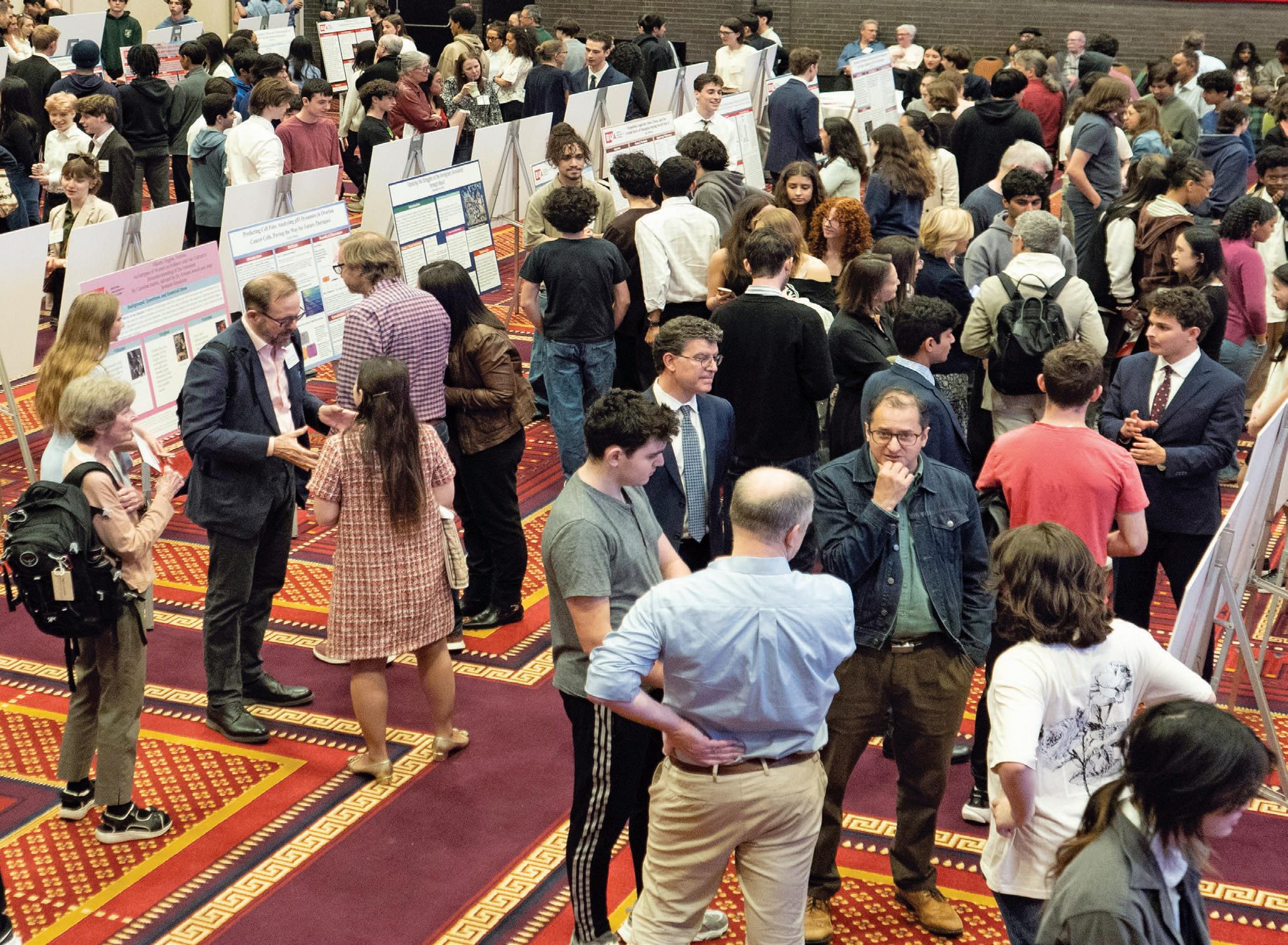
A culminating experience for all BUA students, Senior Thesis is an independent research project that provides students with the opportunity to follow an intellectual passion in depth with the guidance of a university professor. The year-long project is designed to demonstrate students’ ability to read closely, research thoroughly, think analytically, and write coherently in a scholarly fashion.
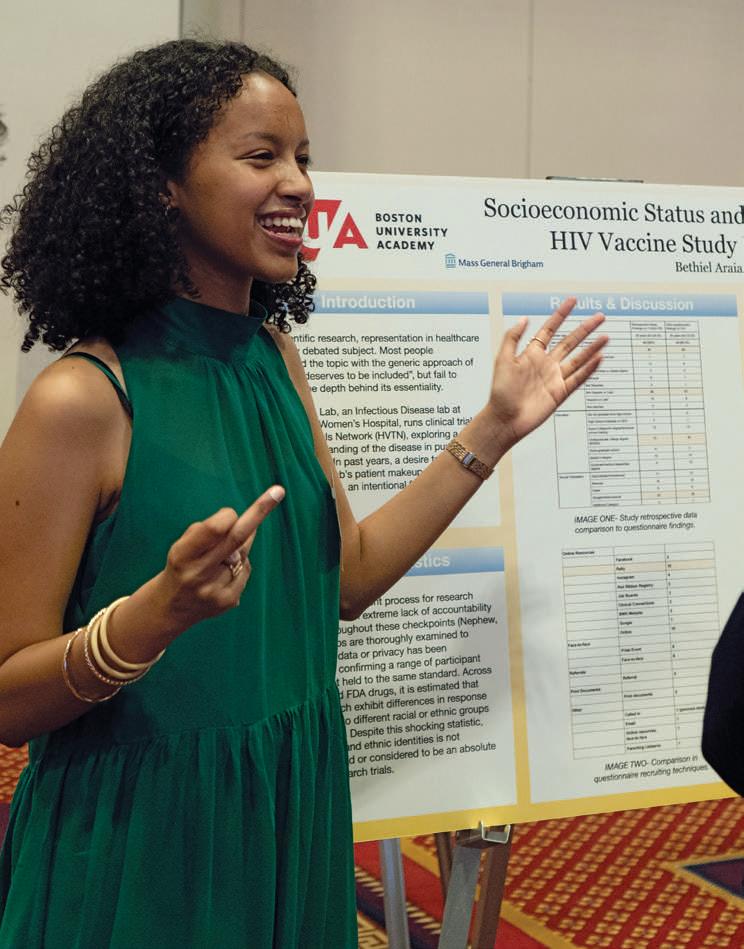
Socioeconomic Status and Demographics of HIV Vaccine Study
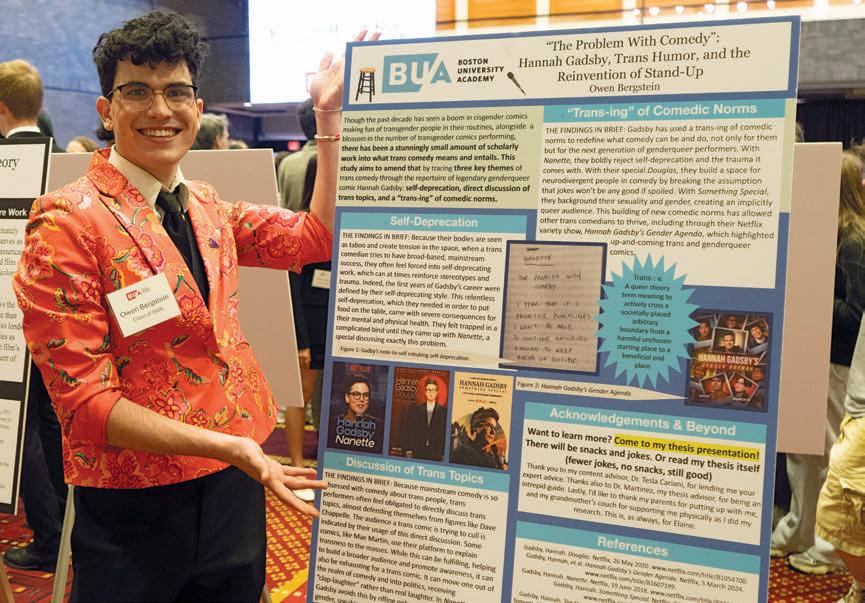
“The Problem With Comedy”: Hannah Gadsby, Trans Humor, and the Reinvention of Stand-Up
All students present their research to the BUA community at the Senior Thesis Symposium prior to graduation. Thesis topics run the gamut of academic and artistic fields and disciplines, and reflect the many and varied interests and passions of BUA students.
The following is a partial list of senior thesis topics for the Class of 2026:
X “Holomorphs, Yang-Baxter, and Braids: A Through-line”
X “Forgotten Legacies: Jews, China, and the Untold Story of Shanghai during World War II”
X “Socioeconomic Status and Demographics of HIV Vaccine Study Participants”
X “Automating Biology: Scalable Web Infrastructure for the DAMP Lab Workflow Manager”
X “‘The Problem With Comedy’: Hannah Gadsby, Trans Humor, and the Reinvention of Stand-Up”
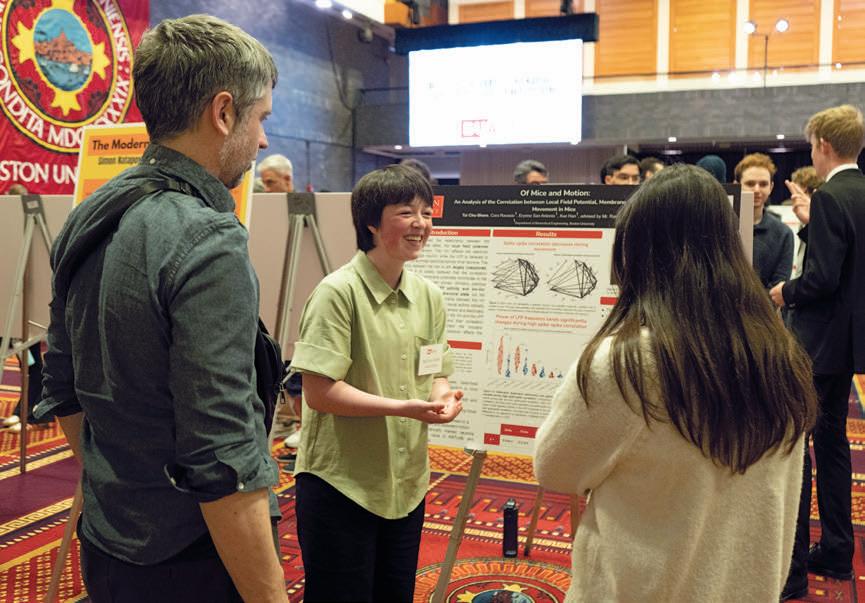
X “Of Mice and Motion: An Analysis of the Correlation between Local Field Potential, Membrane Potential, and Movement in Mice”
X “From Optimization to Development: Creating a New Market for Youth Hockey Analytics”
X “Equalizer or Enabler: Investigating Generative AI in Professional Networking”
X “Uses of Adalimumab and its Future Application to the Treatment of Autoimmune Disease”
X “Resonant Bodies, Resonant Streets: Singing Boston Into Protest History”
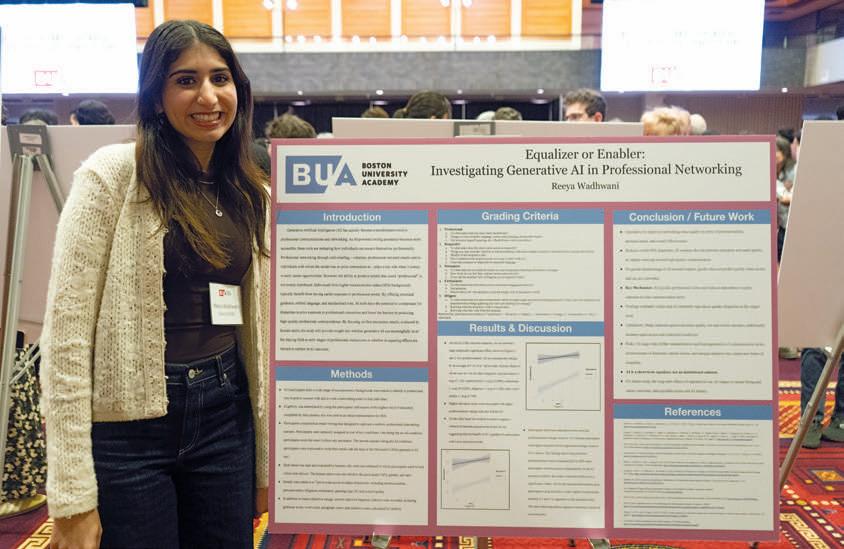
Equalizer or Enabler: Investigating Generative AI in Professional Networking
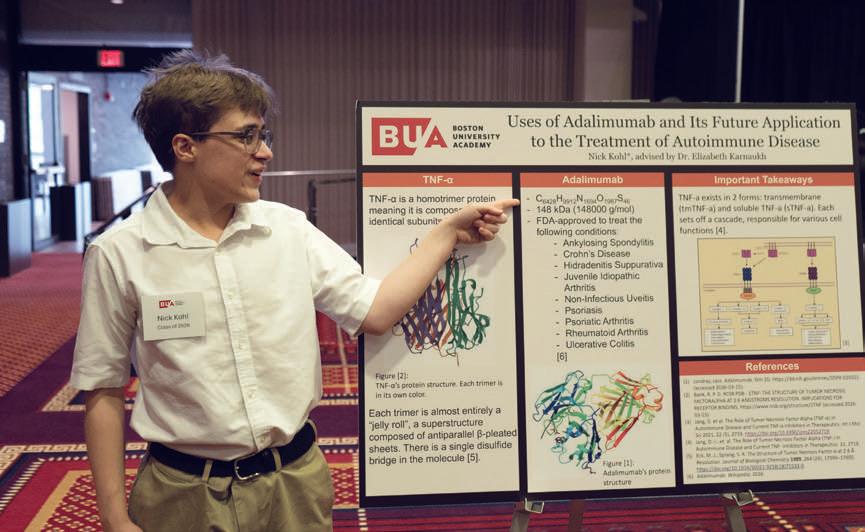
Uses of Adalimumab and its Future Application to the Treatment of Autoimmune Disease
To read the full text of these theses and more, scan this QR code and prepare for your mind to explode!

Of Mice and Motion: An Analysis of the Correlation between Local Field Potential, Membrane Potential, and Movement in Mice