Asher Adams Transcription Factor Regulation, Cofactor Regulation, the Development of a Liquid-Based ProteinBinding Microarray Assay and its Applications to Biomedical Research
Senior Thesis | 2026

By AsherWestonAdams
1.Introduction
1a.TF-COFSignificanceandtheMethodologicalGap
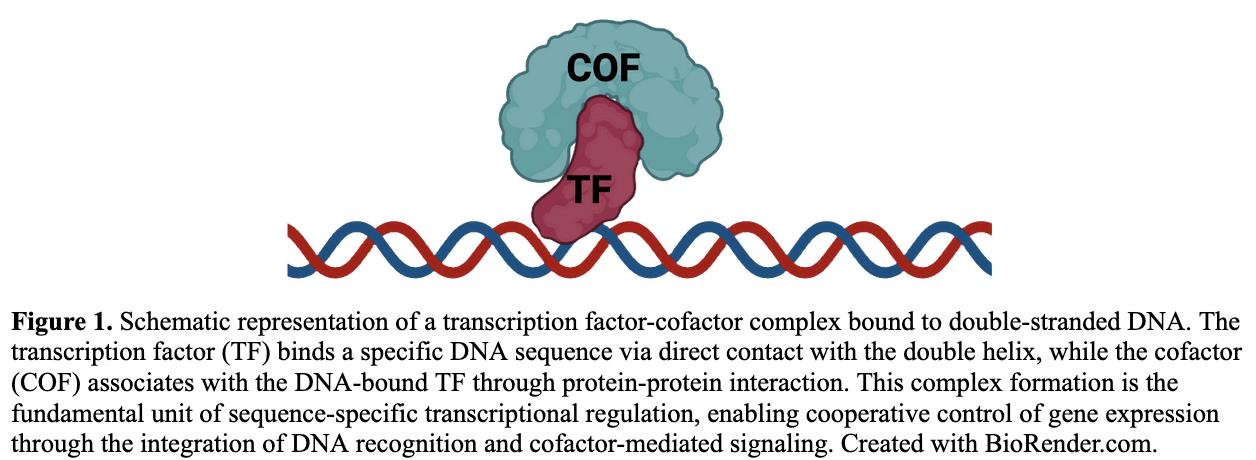
Transcriptionfactors(TFs)andcofactors(COFs)formthecore regulatorymachinerythatgovernsgeneexpression.TFsrecognize specificDNAsequencesandrecruitCOFs,whichinturnmodulate chromatinstructure,stabilizeprotein-DNAinteractions,andrecruit enzymaticcomplexesthatactivateorrepresstranscription.These interactionsoperatewithinamultilayeredregulatoryenvironment,where DNAaccessibility,histonemodifications,andcooperativebinding networkscollectivelydeterminewhenandwheregenesareexpressed. UnderstandingTF-COFinteractionsisthereforeessentialfor understandingtranscriptionalregulationitself,asthesepartnerships shapethespecificity,strength,andcontextdependenceofgene expressionacrosscelltypesanddevelopmentalstates [1]
Despitetheirimportance,TF-COFinteractionsremaindifficulttostudy quantitatively.ManyexistingmethodscaptureDNAbindingprofilesor protein-proteininteractions,butfewcanmeasurehowTFsandCOFs cooperateonDNAundercontrolledconditions.Traditionalbiochemical assaysoftenlackscalabilityorrequirepurificationstrategiesthatremove essentialCOFs.Genomicassaysperformedincellsofferarichbiological contextbutmakeitchallengingtoisolatedirectinteractionsorindirect, secondaryeffects.Theselimitationscreateamethodologicalgap,and
AsherAdams,3 researchersneedtoolsthatcanmoredeeplyanalyzeTF-COFbindingina systematic,high-throughput,andcontrolledenvironment.[2]
1b.PBMsasaPlatformandtheirCoreLimitations
ProteinBindingMicroarrays(PBMs)haveemergedasamajorplatform formappingTF-DNAbindingspecificity,thedegreetowhicha transcriptionfactorpreferentiallyrecognizesandbindsoneDNA sequenceoverallothers,withhighresolutionbyimmobilizinga comprehensivelibraryofDNAsequencesonamicroarrayandmeasuring TFbindingthroughfluorescence.PBMsallowforrapiddiscoveryof bindingmotifs,theshort,characteristicDNAsequencesthatagivenTF recognizesandbinds,aswellasquantitativecomparisonacrosslargeTF families.However,PBMsalsoimposedvariousconstraints.Theyrequire customarrayfabricationandlargeamountsofpurifiedprotein,andtheir short,surface-boundDNAprobeslimittherangeofinteractionsthatcan beobserved.Mostimportantly,PBMsarefundamentallysolid-phase assays,whichmeanstheycannotfullycapturethedynamics,flexibility, andmulticomponentassemblythatcharacterizeTF-COFinteractionsin solution.[3]
1c.ProjectPurposeandPrimaryResearchQuestion
Theselimitationsmotivatethecentralproblemaddressedinmythesis. WhilePBMsarepowerful,theyarealsocostly,material-intensive,and constrainedbyprobelengthandimmobilization,restrictingtheir adaptabilityandmakingthempoorlysuitedforstudyingTF-COF complexes.[3]Critically,thefieldcurrentlylackshigh-throughputtools capableofmeasuringTF-COFbindinginteractionssystematicallyandat scale,agapthatlimitsbothbasicresearchintotranscriptionalregulation andappliedeffortsindrugdiscovery.Thegoalofthisstudyistherefore todevelopandoptimizealiquid-basedPBM,asolution-phaseassay designthatpreservesthequantitativestrengthsofPBMswhileaffording amorerealisticbiochemicalenvironmentforinteraction,andreducing theresourceburdenassociatedwiththetraditionalplatform.
ThepurposeofthisprojectistodeterminewhetheraliquidPBMcan serveasaflexible,scalable,andcost-effectivecomplementto solid-phasePBMs Specifically,thisworkseekstodeterminewhetherthe liquidassaycangeneratereproducibleandbiologicallymeaningful readoutsofTF-COFinteractionswhilerequiringlessmaterialand avoidingthestructuralconstraintsimposedbyimmobilizedDNA.The primaryresearchquestionguidingthisstudyis:Canaliquid-basedPBM achieveconsistentandspecificdetectionofTF-COFinteractionswhile reducingthematerial,cost,andtechnicalbarriersassociatedwith traditionalPBMs?
1d.ProjectGoals
Thefirstgoalistodefinereactionconditionsunderwhichtheliquid PBMcanreliablydetecttrue,antibody-mediated,proximityligation events,ratherthanbackgroundornon-specificligation.Thisincludes identifyingthebufferconditions,incubationparameters,andreaction temperaturesthatproducestable,interpretablebandsacrossrepeated experiments,ensuringthattheassaybehavesconsistently.Becausethe liquidPBMishighlysensitivetocomponentconcentrations,theproject systematicallyvarieseachreagenttofindconditionsthatmaximize signalwhileminimizingnonspecificbackground.Theresultisasetof workingconcentrationsthatcanactasastandardizedbaselineonwhich futureexperimentscanbebased.Thisworkexaminespotentialsources ofexperimentalnoise,includingPCRcontamination,endogenousligase activityinnuclearextracts,pipettingerror,andenzymatic(DNase) activity.Throughtargetedcontrolsandtroubleshooting,theprojectaims todeterminewhichfactorsmoststronglydisruptthereadoutandhowto reduceoreliminatethesesourcesoferror.Beyondoptimization,the projectassesseswhethertheliquidPBMcanfunctionasascalable, lower-costcomplementtotraditionalslide-basedPBMs.Thisincludes comparingtherequirements,workflowcomplexity,anddataquality acrossbothformatsanddeterminingwhethertheassaycan,inprinciple, beexpandedtoprofilemultipleTF-COFpairssystematically.
2.Background
2a.TF-COFRegulatoryBiologyandChromatinContext
TounderstandthemotivationanddesignoftheliquidPBM,itis necessarytofirstexaminethebiologyofTF-COFinteractionsandthe landscapeofexistingtoolsusedtostudythem.Thehumangenome encodesover1600TFswithdiversebindingdomainsandfunctions,each withcharacteristicbindingconditionsandroles,illustratingthescaleof transcriptionalcontrol.[4]Theseproteinsfunctionwithinlarger complexesthatcoordinatetranscriptioninitiation,elongation,and chromatinaccessibility.[5]Cofactors(COFs)aregenerally non-DNA-bindingpartnersthatinteractwithTFstostabilizecomplexes, remodelchromatin,orallowforenzymaticactivitiesthatmodifyhistones orthetranscriptionalmachinery.ExperimentssuchasthosebySiggerset al showedthatCOFscanenhancetheDNA-bindingspecificityofaTF [6]WorkbyWangandcoauthorsdemonstratedthatparticular combinationsofTFsandCOFsdeterminewhichtypesofbloodcells developfromstemcellsthroughlineage-specificgeneregulation,a processcalledhematopoiesis.[7]COFsoftenbridgeTFstotheenzymes thatplaceorremovehistonemodifications,couplingsequence-specific recognitionwithbroaderchromatinremodeling.[8]Thislayered structuremeansthattranscriptionaloutputdependsnotexclusivelyon DNAbindingaffinitybutalsoonthechromatinstatesurroundingthe bindingsite,makingepigeneticregulationinseparablefromTFfunction.
2b.QuantificationChallengesandCoRec
Despiteprogressinidentifyingtranscriptionalregulators,itremains challengingtoquantifyTF-COFnetworks.Theirinteractionsarebrief, context-dependent,andinfluencedbythesurroundingenvironment, leadingtovariabilitythattraditionalbiochemicalorgenomicassays cannotfullycapture.Arecentlydevelopedhigh-throughputsystemto profilethesenetworks,calledCoRec,revealedorganizingprinciplesof epigeneticregulationthroughitsprotein-bindingmicroarray(PBM) approach.Itdemonstratedstrongreproducibilityacrossreplicatesand
AsherAdams,6 successfullyquantifiedtheefficiencyofcofactorrecruitment,DNA bindingaffinity,andTF-COFinteractionaffinity.However,likeother microarray-basedmethods,CoRecusesshort,unchromatinizedDNA probes,meaningnakedDNAnotwrappedaroundhistoneproteinsand thereforelackingthenucleosomestructureandepigeneticmodifications presentinlivingcells.Asaresult,theseprobescannotfullysimulatethe bindingdynamicsthatoccurontimescalesofsecondsinvivo.[2]These limitationsexposethecentralmethodologicalgapinthefield:existing approachesprovidestaticsnapshotsofaggregatebindingunderfixed conditions,butcannotresolvethekineticparameters,including associationanddissociationrates,residencetimes,anddynamiccofactor exchange,thatgoverntranscriptionaloutputinphysiologicallycomplex environments.
2c.PBMHistory,Design,andWorkflow
ThePBMemergedinthemid-2000sasasystematichigh-throughput platformformeasuringTF-DNAbindingspecificity.[9]The“universal” PBM,firstintroducedin2006,isamicroarraydesignincorporating syntheticdouble-strandedDNAprobesthatcollectivelyrepresentall possible10-basepairsequences.[10]Thisallowssimultaneous measurementofaTF'sbindingtoeverypotentialshortmotifonasingle array.Thisapproachprovidesanalternativetotheseriallow-throughput methodsthatwerethendominant,suchaselectrophoreticmobilityshift assays,byquantifyingTFbindingacrossthousandsofuniquesequences inparallel.[11]Thefollow-upprotocolpaperstandardizedtheworkflow, detailingeachstepfromTFpurificationandfluorescentlabelingto hybridization,washing,andscanning.[3]Theprotocolalsoformalized computationalprocessing,includingthecalculationofenrichmentscores, whichrankeachDNAsequencebyhowstronglyaTFbindsrelativeto background,andthederivationofpositionweightmatrices,quantitative modelsthatcapturetheprobabilityofeachnucleotideappearingateach positionwithinabindingsiteandtogethersummarizeaTF'ssequence preferenceacrossthefullprobeset.Together,theseworksestablished PBMsasthereferenceframeworkforinvitroquantitativeassessmentof TF-DNAinteractionandprovidedthebasisforsubsequentlarge-scale
AsherAdams,7 bindingdatabases.Becausetheprobesetisexhaustive,PBMscanalso revealsubtlevariationsinbindingspecificityarisingfromaminoacid substitutionsorpost-translationalmodifications,givingtheman advantageoverpurelybinarybindingassays.[3]
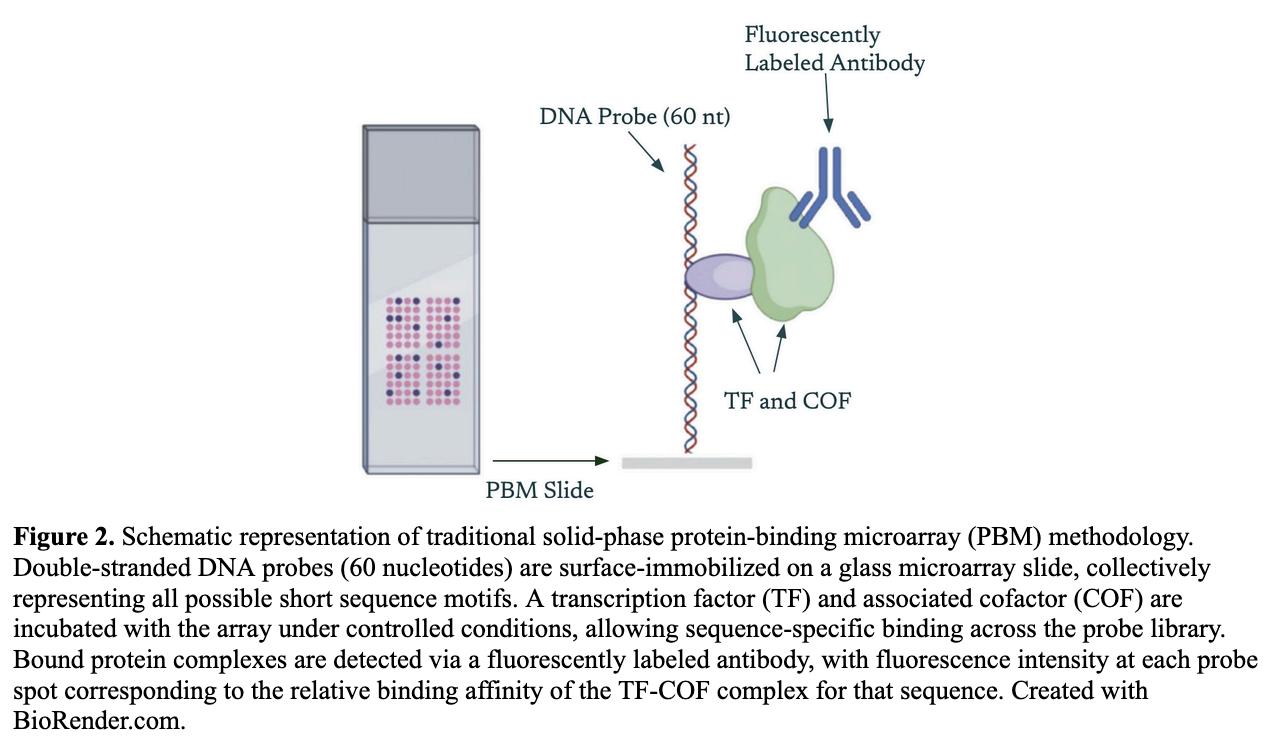
AtypicalPBMexperimentusesaglassmicroarrayslidecontainingtens ofthousandsofdouble-strandedDNAprobes,60nucleotideslong,with sequenceschosensothateverypossiblek-mersite(ashortDNA sequenceoflengthk)isrepresentedmultipletimes.PurifiedTFs,often expressedwithanaffinitytag(aguideforanantibody),areincubated withthearrayundercontrolledconditions.Afterbindingandwashing, theproteinisdetectedwithafluorescentlylabeledantibodyspecificto thetag.Thefluorescenceintensityateachspotcorrespondstothe relativeaffinityoftheTFforthatprobesequence,allowingquantitative comparisonacrosstheentiresequencespace.Followingdataacquisition, enrichmentscoresarecomputedforeachbindingsiteandaggregatedto generatesequencelogos toolstodeterminehowofteneachnucleotide appearsateachpositioninabindingsite,summarizingatranscription factor’sDNApreference ThekeystrengthsofthePBMdesignare reproducibility,throughput,anduniversality:asinglearraycancapture bothknownandpreviouslyuncharacterizedmotifs,andparallelassays allowdirectcomparisonofTFfamilies.Becausetheprobesetis
AsherAdams,8 exhaustive,PBMscanrevealsubtlevariationsinspecificityarisingfrom aminoacidsubstitutions,post-translationalmodifications,orthepresence ofcofactorswhentheseareincludedexperimentally The fluorescence-basedquantificationalsoenablesasemi-quantitative estimationofrelativeaffinity,givingPBMsanadvantageoverpurely binarybindingassays.[3]
2d.PBMStructuralConstraints
Protein-DNAinteractionsonarigidsubstratemaydisplayaltered affinitiesorreducedflexibilitycomparedtothoseinathree-dimensional nuclearenvironment.Eachexperimentdemandspurifiedproteinat relativelyhighconcentration,specializedmicroarrayfabrication,and fluorescencescanningequipment.Thesedemandslimitscalability outsidededicatedfacilities,especiallyforsmallerlabs.Addressingthese shortcomingsmotivatesthedevelopmentofalternateapproaches,suchas theliquid-basedPBMexploredinthisstudy,whichseektopreservethe high-throughput,quantitativeadvantagesofPBMswhileintroducinga morephysiologicallyrelevant,dynamicsolutionenvironmentfor measuringTF-COFinteractions.
2e.RecentInnovationsandFieldTrajectory
RecentdevelopmentshaveextendedthecapabilitiesoftraditionalPBMs byintroducingdesignsthatmorecloselyapproximatecellularconditions. OneexampleisNextPBM,whichadaptsthePBMplatformtomeasure transcriptionfactorbindinginamorecell-specificandcontext-dependent manner.NextPBMincorporatesfeaturessuchascell-derivednuclear extracts,modifiedprobedesigns,andconditionsthatallowcooperative interactionsbetweentranscriptionfactorstobeobservedmoreeffectively thanintheoriginaluniversalPBMformat.Thisinnovationdemonstrates thatPBMtechnologycontinuestoevolvebeyonditsearlyrigid framework,movingtowardassaysthatcancapturemorebiologically realisticregulatorybehavior.[12]
Acrossthefield,thereisabroaderpushtodesigntranscriptionalassays thatarebothhighlyscalableandmoreaccessible.TraditionalPBMs,
SELEX-basedmethods,andcomplexchromatinassaysoftenrequire largeamountsofprotein,numerousreagents,andspecializedequipment, limitingtheiruseandadoptiontowell-fundedlaboratories Newer platformsseektoreducethesebarriersbyminimizingmaterial requirements,automatingstepsoftheworkflow,andleveragingmore efficientdetectionstrategies.High-throughputmethods,suchasbarcoded libraries,microfluidicsystems,andrapidprofilingtoolslikethose describedinrecenthigh-throughputstudies,illustrateasharedobjective: togenerateregulatorybindingdataatasignificantlylowercostandwith fewertechnicalconstraints.[13]Theseeffortsunderscoretheneedfor assaysthatmaintainprecisionwhileimprovingexperimental accessibility.
2f.LEF1asaModelSystem
TodevelopandvalidatetheliquidPBM,thisprojectusedLymphoid Enhancer-bindingFactor1(LEF1)asthemodeltranscriptionfactor. LEF1isamemberoftheHMG-boxfamilyofTFsandplaysacentral roleintheWntsignalingpathway,whereitrecruitscofactorssuchas β-catenintoactivatetargetgeneprogramsinvolvedinlymphoid development,cellproliferation,anddifferentiation.Itswell-characterized bindingmotifandestablishedcofactorinteractionsmakeitatractable modelsystemforassaydevelopment:thebindingsitesequenceis known,avalidatedantibodyreagentisavailablefortherelevantcofactor, andpriorworkintheSiggersLabprovidesareferenceframework againstwhichliquidPBMperformancecanbeassessed.Allbinding oligosusedinthisprojectweredesignedaroundtheLEF1consensus bindingsite,withasequence-disruptedmutatedversionservingasthe negativecontrolthroughout.
3.Methods
3a.LabSettingandAssayDesignFramework
AlloftheworkforthisprojectwascarriedoutattheSiggersLabat BostonUniversity,asettingequippedfordetailedbiochemicaland
AsherAdams,10 molecularanalysisoftranscriptionalregulation.Workinginthis environmentprovidedaccesstothefullrangeoftoolsneededforassay development,includingfacilitiesforDNApreparation,cellcultivation, controlledincubation,PCRamplification,andgelelectrophoresis.The lab’sestablishedprotocolsandtechnicalsupportensuredthateach experimentalsetupwasperformedunderconditionsthatminimized variabilityandmaintainedexperimentalintegrity.
TheassaywasdesignedbyadaptingtheconceptualframeworkofaPBM intoaliquid-basedformatthatcouldtestTF-COFinteractionsunder morephysiologicallyrealisticconditions.Thisrequiredconstructinga multistepworkflowmodeledontheCoRecproximityligationframework developedbyIngeandcolleaguesintheSiggersLab.[2]Eachstageof theprojectdesign,execution,troubleshooting,andinterpretation reflectedtheprocessofbuildinganexperimentalsystemfromtheground uptodeterminewhethertheessentialstrengthsofPBMscouldbe preservedinsolutionratherthanonafixedmicroarraysurface.
3b.ProximityLigationMechanism
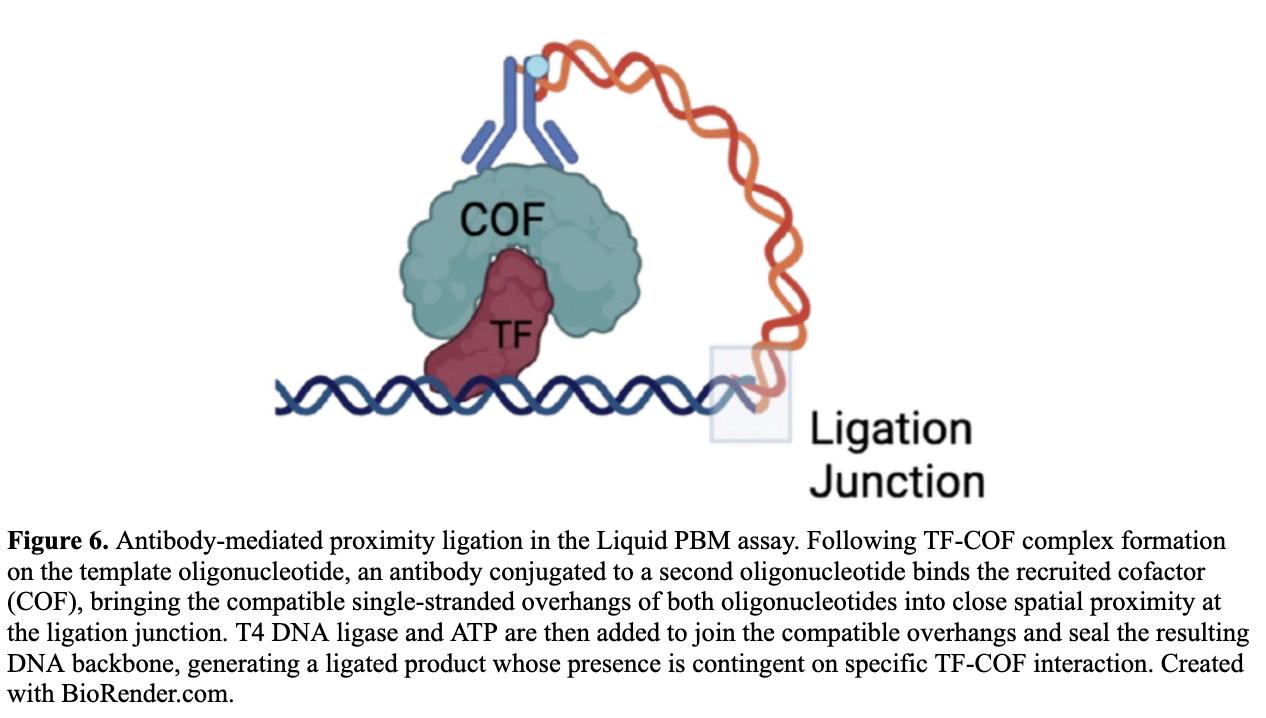
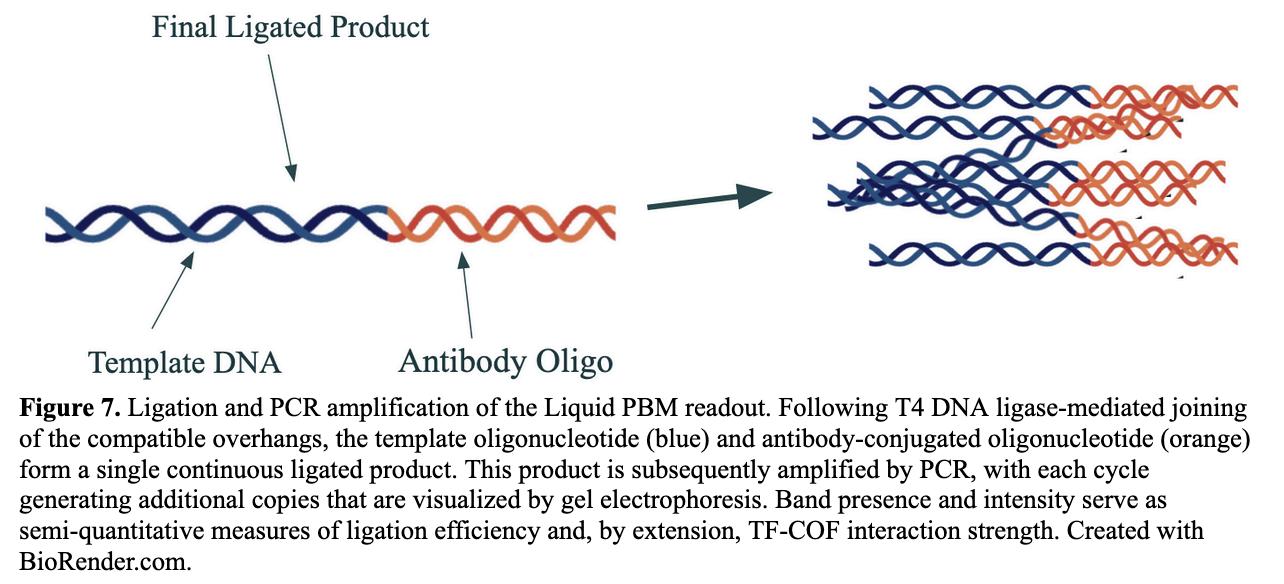
TheliquidPBMemploysaproximityligationstrategytodetectTF-COF interactionsinsolution.[14]Theassayisbasedontwopre-digested DNAoligonucleotides,shortsyntheticsingle-ordouble-strandedDNA sequencesdesignedtobindspecificmoleculartargets,withcompatible restrictionoverhangs:atemplateoligonucleotidecontainingtheTF bindingmotifofinterest,andanantibody-conjugatedoligonucleotide bearingacovalentlyattachedantibodyspecifictotheCOFbeingtested. Whennuclearextract,acell-derivedmixturecontainingendogenous transcriptionfactors,cofactors,andassociatedproteinsintheirnative form,isaddedtothereaction,theTFbindstoitsassignedmotifonthe templateoligonucleotide.IftheCOFinteractswiththeDNA-boundTF, theCOF-specificantibodyattachestotheCOF,therebybringingthe antibody-conjugatedoligonucleotideinproximitytothetemplate oligonucleotide.ThisproximityenablesT4DNAligasetojointhe compatibleoverhangsofthetwooligonucleotides,creatingasingle longerDNAstrand.[15]TheligatedDNAproductservesasthedirect
AsherAdams,11 readoutofTF-COFinteraction;itisamplifiedbyPCRandvisualizedby gelelectrophoresis.Thepresenceofabandattheexpectedsizeforthe ligatedproductindicatesthattheTFandCOFinteractedinsolution, whilebandintensityreflectstheefficiencyoftheinteraction.Inthe absenceofTF-COFbinding,thetwooligonucleotidesremainspatially separated,andligationefficiencyisminimal,producinglittletonoPCR productofthedesiredlength.
3c.ComponentPreparation
Thefollowingsectionsdescribethepreparationofassaycomponents, experimentalworkflow,andoptimizationstrategyusedtodevelopthis liquidPBMplatform.
Templateandantibody-conjugatedDNAoligonucleotideswereprepared byrestrictiondigestiontogeneratethecompatiblesingle-stranded overhangsrequiredforproximityligation.Tworestrictionenzyme systems,PaqCIandBsaI,weretestedinparallelduringtheearlyphaseof theproject(FebruarythroughMarch)tocomparethequalityand consistencyoftheoverhangseachproduced.BothareTypeIISenzymes thatcutoutsidetheirrecognitionsequence,allowingthegenerationof defined,asymmetricoverhangswithoutleavingenzymerecognitionsite sequencesattheligationjunction.EarlyexperimentsranPaqCI-cutand BsaI-cutbindingoligosinseparatetubesets(Tubes01-06and07-12, respectively)todirectlycompareperformanceongel.ByJune,theBsaI systemwasselectedexclusivelybasedonmoreconsistentdigestion efficiencyandcleaneroverhanggenerationobservedacrosstheseparallel comparisons.
Bindingoligosusedacrosstheprojectincludedthewild-typeLEF1 bindingsite(WildTypeBS)andasequence-disruptedmutatedversion (MutatedBS),whichservedasthenegativecontrolthroughout.A blunt-endligationvariantwasalsotestedinlateJuneandJuly,using uncutbindingoligo(312bp,31.4ng/μLstock)pairedwithprecut antibody-oligotoassesswhetherblunt-endligationcouldsubstitutefor thecohesive-endsystem.Theseexperimentsdidnotproduceabetter
AsherAdams,12 signalthantheBsaI-cutcohesive-endapproach,andtheprojectreturned toprecutBsaIbindingoligosforallsubsequentexperimentsbeginning July10

3d.BindingandLigationPhases
Inthebindingphaseoftheassay,TFspresentinthenuclearextract interactwiththetemplateDNAandrecruittheirassociatedCOFs throughnativeinteractions.Anantibody-linkedoligonucleotide, designedsothatitsattachedantibodyrecognizesaspecificCOF,then bindstotherecruitedCOF.ThisbringstheDNAtemplateandthe antibodyoligointoclosespatialproximity.Theresultingarrangement createsthephysicalsetupnecessaryforantibody-mediatedproximity ligationandenablestheassaytodetectTF-COFinteractionsthrough laterevents.
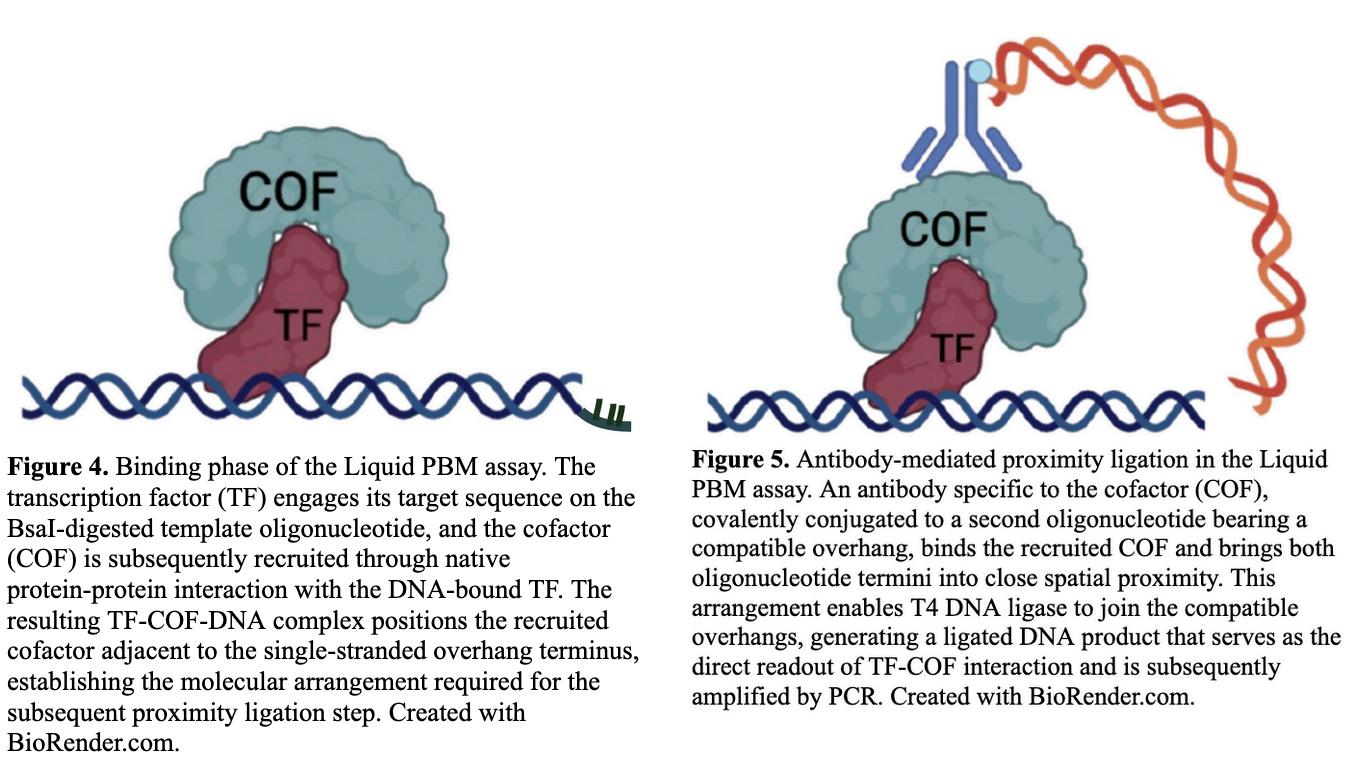
Oncethebindingcomplexisformed,T4DNAligaseandATPareadded tojointhecompatibleoverhangsandsealthenicksintheresultingDNA backbone.Acentralchallengeinthisstagewasdistinguishingtrue
AsherAdams,13 antibody-mediatedligationeventsfromnonspecificornon-specific ligationthatcouldoccurindependentlyofTF-COFinteractions.Careful controlreactionsandrepeatedtestingwerethereforeessentialtoconfirm thatligationsignalsreflectedbiologicallymeaningfulbindingratherthan non-specificligationandbackgroundnoise.
3e.PCRAmplificationandControls
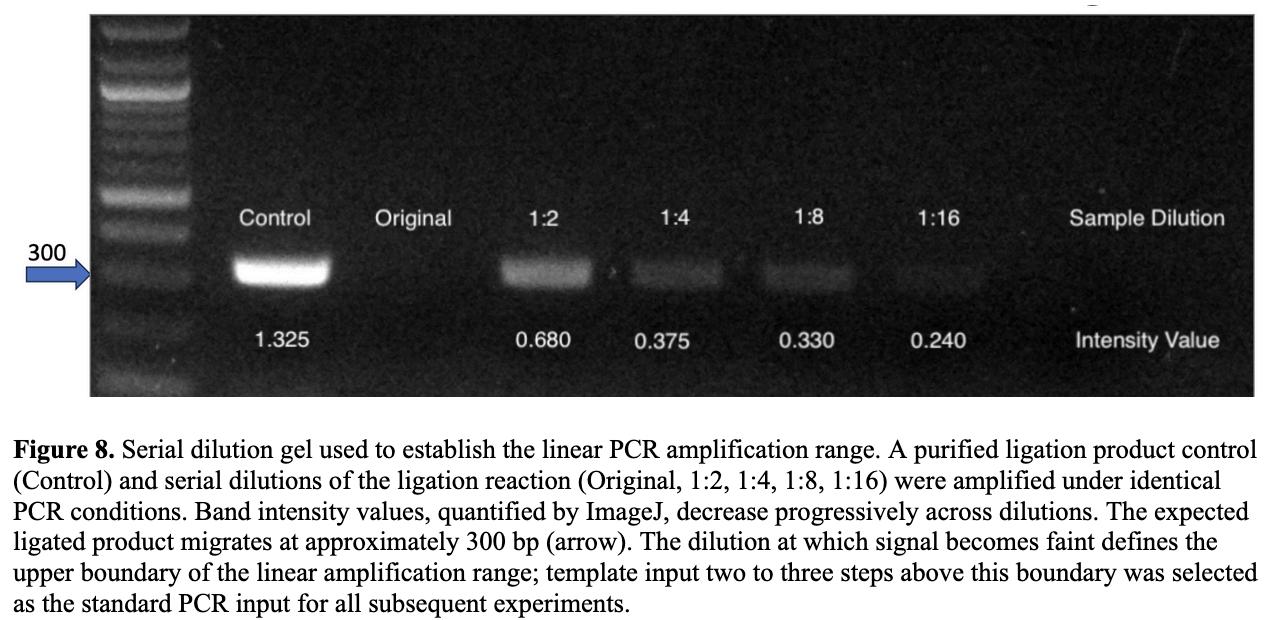
Followingligation,thejoinedDNAproductwasamplifiedusingPCR. Theintensityoftheamplifiedbandservedasasemi-quantitative measureoftheligationefficiency,and,byextension,thestrengthofthe TF-COFinteractionbeingtested.Aspartofmyoptimizationofthe protocol,IestablishedtheappropriatenumberofPCRcyclesthrough serialdilutionoftheDNAtemplate.Thisinvolvedtakingafixedvolume ofligationproduct,dilutingitacrossarange(initially0.1,0.25,0.5,1.0, 2.0,and5.0μLtemplateperreactioninMarch,laterstandardizedto1:2 through1:16serialdilutionsinJuneonward),andrunningalldilutions throughidenticalPCRconditionsinparallel.Thedilutionatwhichthe amplificationproductbecamefaintorabsentonthegeldefinedtheupper boundaryofthelinearrange.Thetemplatevolumethatproducedaclear bandtwotothreedilutionstepsabovethisboundarywasselectedasthe standardinput.Thisprocedurewasrepeatedacrossexperimentdatesto accountforvariationinligationefficiencyandproductconcentration
AsherAdams,14 betweenruns.ThePCRtemplatevolumewasultimatelystandardizedat 0.5μLfroma1:5dilution(2μLligationinto8μLwater)throughJuly, andlaterupdatedto2μLfromalarger1:20dilution(2μLligationinto 38μLwater)beginninginAugusttofurtherreducetemplate concentrationandavoidsaturation,whichwouldmaskdifferences betweenspecificandnonspecificbindingeventsandobscuremeaningful variationinthedata.
TodistinguishspecificTF-mediatedbindingfrombackgroundligation, experimentsincludedbothwild-type(WT)DNAsequencescontaining theauthenticTFbindingmotifandmutatedsequenceswithdisrupted bindingsites.WTsequencesshouldproducearobustligationsignal, whilemutatedsequences,whichpreventTFbinding,serveasnegative controls,establishingbaselinebackgroundligationlevels.
3f.GelAnalysisandOptimizationStrategy
PCRproductswereanalyzedbygelelectrophoresistovisualizeligation events.Initially,differencesinbandpresenceandintensityguided optimizationofreagentconcentrations,andoncethoseconcentrations wereestablished,gelanalysisallowedthecomparisonofwild-type sequences(specificbinding)andmutatedsequences (nonspecific/backgroundligation),confirmingthatthemajorityofthe signaldependedonspecificprotein-DNAinteractionsratherthan nonspecificligation.Gelimagingprovidedthefinalreadoutofeach assayiterationandguidedtheongoingoptimizationofreaction conditions.
ThemajorpartofdevelopingtheliquidPBMinvolvedsystematically testingandadjustingtheconcentrationsofthecorereaction components T4DNAligase,theantibodyoligonucleotide,andthe nuclearextract.Eachreagentstronglyinfluencedthestrength,clarity, andreproducibilityoftheresults.Experimentswereperformedincycles: concentrationswerevariedacrossacontrolledrange,resultswere evaluatedongels,andthemostpromisingconditionswerecarried forwardintothenextroundoftesting.Throughthisiterativeapproach, theassaygraduallymovedfrominconsistentandweaksignalstoward conditionsthatproducedclearerandmorereliableligationproducts.
4.Results
4a.EarlyDevelopmentandInconsistency
ThefirstexperimentsconductedinFebruary2025servedprimarilyas proof-of-mechanismtestsratherthanoptimizedassays.Usinga50μL bindingvolume,anuclearextractstockof8.12μg/μLadjustedto1 μg/μLfinal,andbothPaqCIandBsaIenzymesystemsrunninginparallel acrosstwelvetubes,theseexperimentsaimedtodeterminewhetherany ligationproductcouldbedetectedatall.ATPwasaddedseparatelyat1 mMfinalconcentration,andNaClwasadjustedto110mMfinal, accountingforthesaltcontributionofBufferC(357.7mM).Theseearly
AsherAdams,16 gelswereinconsistent:bandsappearedinsomereplicatesandnotothers, andthemutated-sequencecontrolsshowednonspecificsignals comparableinintensitytothewild-typelanes,makingitimpossibleto claimspecificity.TheFebruaryexperimentsestablishedthattheassay mechanismcouldproduceaPCRproductinprinciple,butthatthe concentrations,bufferconditions,andligationparametersrequired substantialrefinementbeforeanyresultcouldbeinterpreted.
Thedevelopmenttimelineshowedclearprogressioninassayresult quality.EarlyexperimentsinJune2025producedgelswithweakbands andsubstantialvariabilityacrossreplicates,withbandsappearinginthe mutantoligosaswell,makingitdifficulttodistinguishtruespecific ligationeventsfromchanceandbackgroundligation.BylateAugust, aftermultipleroundsofoptimization,theassaygeneratednoticeably strongerbandintensities,sharperbandsforligatedproducts,andgreater consistencyandreproducibilityacrossreplicateandadjacentreactions. Thisimprovementreflectedbothoptimizedreagentconcentrationsand bettercontrolovertechnicalvariables.
4b.IdentifiedErrorSources
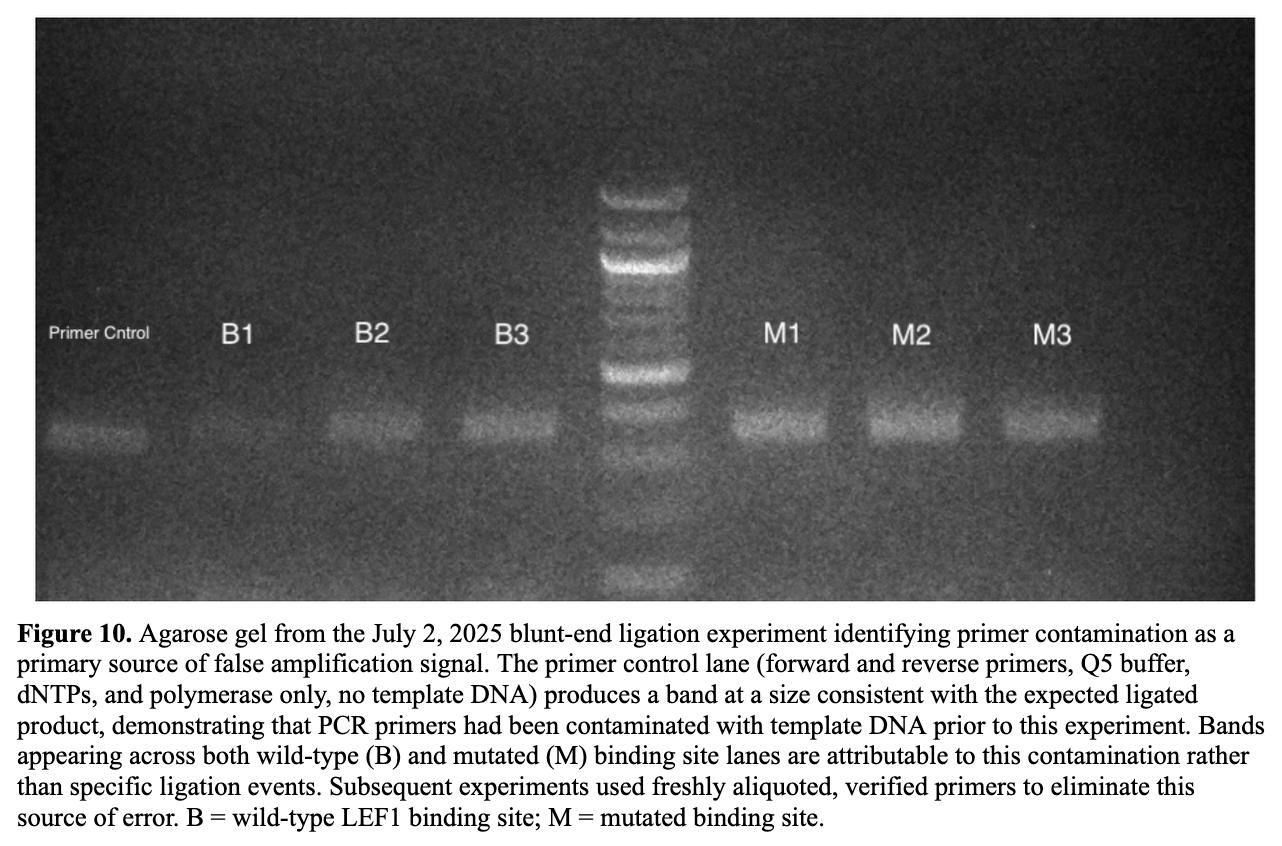
Astheprojectprogressed,itbecameclearthatseveraltechnicalerrors werecontributingtotheinconsistentresults.Onemajorissueseenearlier
AsherAdams,17 wasprimercontamination,wheretemplateDNAfounditswayintothe PCRprimersandproducedfalseamplificationproductsvisibleongel readouts,obfuscatingthetrueligationsignal Additionalvariabilityarose fromhumanerrorinpipetting,particularlywithsmallvolumeadditions ofligase,whichproducedfluctuationsinbandintensityacrossreplicates. Toruleouttheseconfoundingfactors,thenuclearextractwasalsotested forendogenousligaseactivity,whichcould,inprinciple,create backgroundligationproductsindependentoftheintended antibody-mediatedligation.Identifyingandcontrollingthesesourcesof errorwasessentialtoachievingtheimprovedreproducibilityobserved laterintheproject.
4c.Mid-projectRefinements
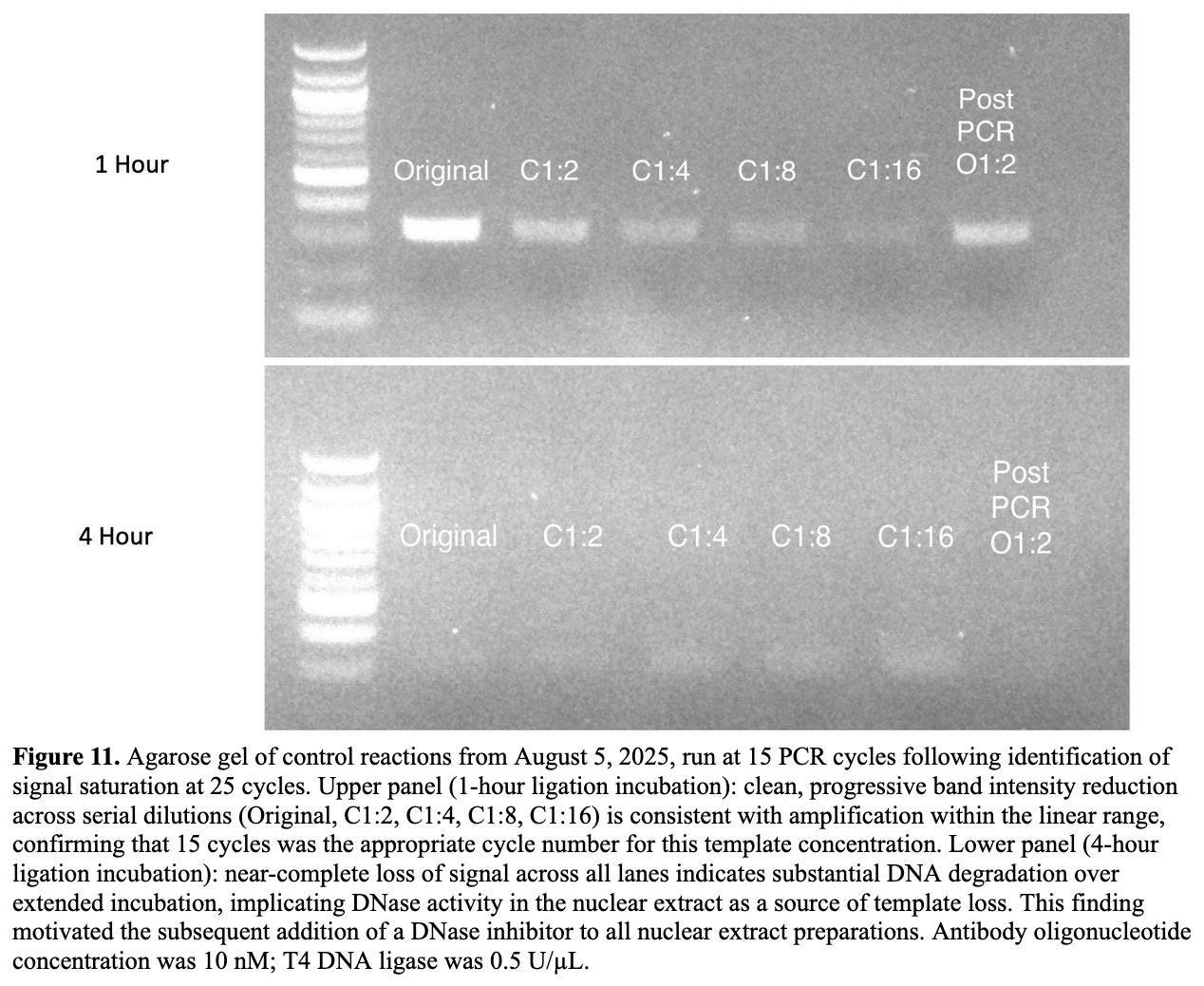
InJuly,theassaybegantoshowclearimprovementsaskeytechnical parameterswererefined.Serialdilutionswereusedtodeterminethe optimalnumberofPCRcycles,ensuringthatamplificationremained withinthelinearrangeandeliminatingthesignalsaturationthathad previouslyobscuredmeaningfuldifferencesbetweenreactions.Atthe sametime,adjustmentstotheconcentrationofT4DNAligaseandthe antibodyoligonucleotideproducedstrongerandmoreconsistentbands
AsherAdams,18 acrossreplicates.Theserefinementsreducedbackgroundnoise, improvedoverallsignalclarity,andmarkedatransitionfromtheearly stagesoftheprojecttoamorecontrolledandinterpretableassay workflow.
4d.Late-stageOptimizationandFinalWorkingConditions
BylateAugust,theassayshowedmarkedimprovementinboth reproducibilityandinterpretability.Reactionsperformedunderthe optimizedconditionsproducedconsistentbandingpatternsacross instances,andadjustmentstotheagaroseconcentrationimprovedband resolutionattherelevantsizerange.Amoredeliberateorganizationof lanes,systematicallycomparingwild-type,mutant,andno-protein controlssidebyside,madeitsubstantiallyeasiertodistinguish proximity-mediatedligationfrombackgroundsignal.Underthese conditions,bandintensitiesalignedwithwhatwouldbeexpectedfrom genuineantibody-mediatedligationratherthannon-specificligation. Thisconvergencebetweenpredictedandobservedresultsindicatedthat
AsherAdams,19 theliquidPBMdesignwasbeginningtofunctionasintended,providing preliminaryevidencethattheassaycouldcaptureTF-COFinteractionsin acontrolledandquantitativemanner
Eachofthethreecorereagents(T4DNAligase,theantibody-conjugated oligonucleotide,andthenuclearextract)requiredsystematic concentrationscreeningbeforetheassayproducedinterpretableresults. Identifyingworkingconcentrationswasnotasingledecisionbutan iterativeprocessthatunfoldedoverseveralmonthsofsuccessive experiments,eachroundguidedbythegelreadoutsofthepreviousone.
T4DNAligasewasthefirstvariabletorequirecarefultitration.Early experimentsinFebruaryuseda400,000U/mLstock,adding0.5µLper tube,astartingpointinheritedfromexistingproximityligationprotocols. ByMarch,thiswasincreasedto2.5µLpertubeafterearlygelsshowed insufficientligationproduct ByApril,afurtherincreaseto3µLwas testedalongsideatemperaturecomparison(25°Cforonehourversus 16°Covernight),whichrevealedthataroom-temperature,one-hour incubationproducedcleanerresultswithouttheriskofovernight evaporationorreagentdegradation.Aswitchtoa20U/µLworkingstock inJuneenabledmoreprecisevolumecontrol,andsubsequent experimentsscreenedfinalconcentrationsof0U/µL(no-ligasecontrol), 1U/µL,and0.5U/µLwithinthe30µLligationvolume.The0.5U/µL condition,establishedbylateJuly(July28),consistentlyyieldedthebest ratioofspecifictononspecificligationproductandwasfixedforall subsequentexperiments.Higherconcentrationsamplifiedbackground ligation;lowerconcentrationsfailedtodrivesufficientligationofthe proximitycomplex.
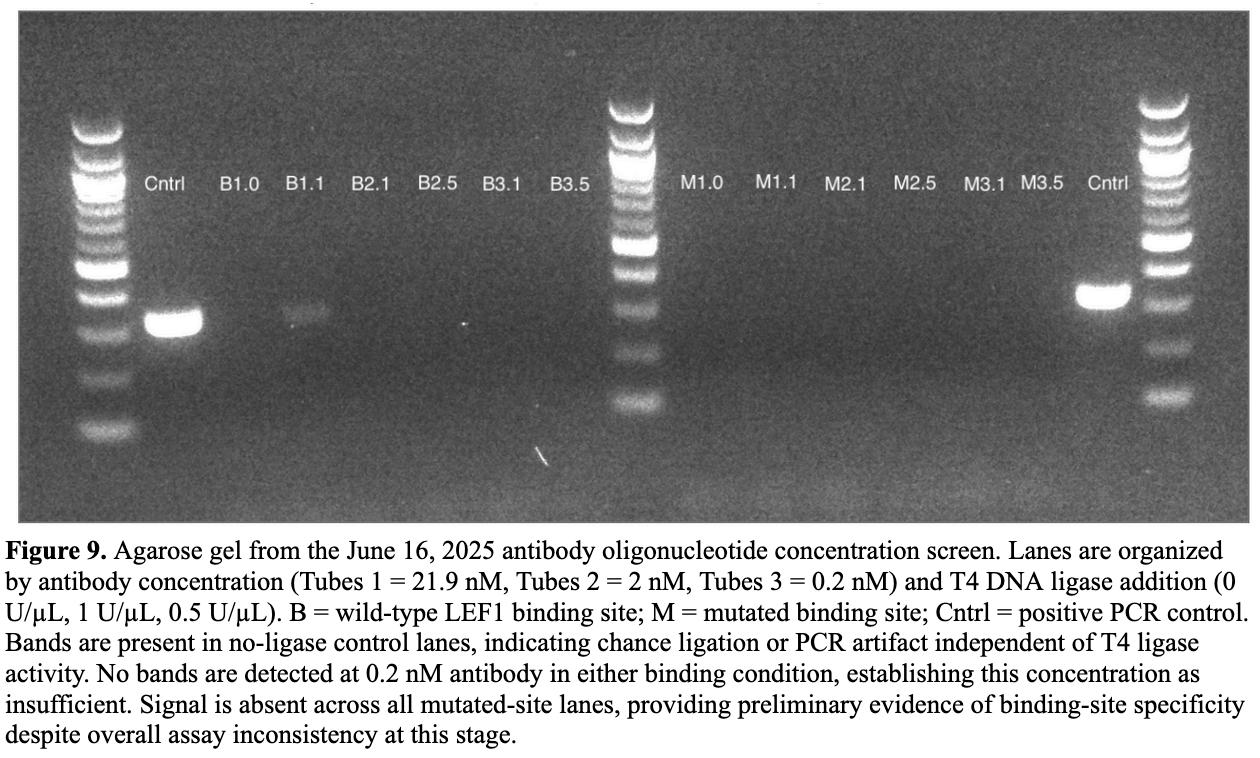
Theantibodyoligonucleotideconcentrationrequiredaparallelbut independentoptimization.AninitialmolarratioscreeninFebruarytested 1Xand10Xexcessantibody-oligorelativetothebindingoligo.In March,thiswasadjustedto3X,andbyAprilthescreenshiftedtoa directvolumeratioapproach(1:1,1:0.5,and1:0.25binding-to-antibody oligo).BeginninginJune,concentrationsweretrackedexplicitlyin nanomolar:threeconditions(21.9nM,2nM,and0.2nM)wererunin
AsherAdams,20 parallelacrosstheLEF1WTandMutatedbindingsitedesigns.Gels fromtheseexperimentsshowedthat21.9nMproducedanelevated backgroundinthemutatedcontrols,suggestingnonspecific antibody-oligoproximityeventsathigherconcentrations,while0.2nM producedaweakorabsentWTsignal.OnJuly28,asingleconcentration of2nMwastested;onedaylater,July29,theconcentrationwas increasedto10nMfollowingaweaksignalinthe2nMcondition,and thisvaluewasretainedwithoutfurthervariationthroughallsubsequent experiments.The10nMconditionproducedthestrongestandmost consistentWT-specificsignalwhilekeepingthemutantbackgroundat interpretablelevels.
Thenuclearextractconcentrationwassetearlyat1µg/µLfinal concentrationinthebindingreaction,atargetmaintainedthroughoutthe projectbyadjustingthevolumeaddedbasedonthestockconcentration ofeachnewbatch Stockconcentrationsvariedacrossbatches(812,92, 11.83,11.28,9.37,and8.66µg/µLacrosssuccessivepreps),requiring recalculationoftheadditionalvolumeforeachnewextraction.Higher nuclearextractconcentrationswerenotsystematicallyscreened,asthe1 µg/µLtargetwasinheritedfrompriorlabprotocolsandconsistently producedadetectablebindingsignal.Anadditionalbuffervariable,the NaClconcentration,wasalsocorrectedlateintheproject:earlier experimentsused4µLof1MNaClinthe30µLreaction,buta recalculationinlateAugustthataccountedforthesaltcontributionfrom thebufferreducedthisto1.87µL(August28),correctingwhathadbeen asaltexcessthroughoutmuchofthesummer.
Together,thesethreeoptimizedvalues(0.5U/µLT4DNAligase,10nM antibody-oligonucleotide,and1µg/µLnuclearextractatcorrectedNaCl) definedthefinalworkingconditionfortheliquidPBMandservedasthe baselinefromwhichreplicatedesignsweresubsequentlybuilt.
5a.CoreFindingsandProofofConcept
Thisprojecthasthusfardemonstratedthataliquid-basedPBMcan generateclearandreproduciblereadoutswhilepotentiallyrequiring substantiallylessmaterialthanatraditionalslide-basedPBM.Underthe optimizedconditionsidentifiedoverthecourseofthesummer,theassay consistentlyproducedligationsignalsthatreflectedTF-COF-dependent interactionsratherthanbackgroundactivity.Thisshiftfromweak, unstablebandstowell-defined,repeatableproductsindicatesthatthe coreconceptofusingantibody-mediatedproximityligationasthecentral readoutisviableinasolution-basedenvironment.Inpracticalterms,the assaysucceededinpreservingakeyadvantageofPBMs,motif-level specificity,whilereducingseveralofthebarriersthatlimitPBM accessibility,mostnotablytheadvancedequipmentandpotentiallythe largequantitiesofpurifiedprotein.
5b.RemainingChallenges
Atthesametime,thefindingsmakeclearthatimportantchallenges remainbeforetheliquidPBMcanbeconsideredafullymatureassay. Themostsignificantbarrieristhediscriminationbetweengenuine, antibody-mediatedligationeventsandnonspecificligationthatoccursby chanceproximity.Althoughoptimizationhasimprovedthis discrimination,andratesaretrendingintherightdirection,theassayis stillsensitivetominorvariationsincomponentquality,incubation conditions,andpipettingaccuracy.Inparticular,smallvolumeerrorsin T4DNAligaseadditiontranslatedirectlyintodisproportionatechanges inligationefficiency,shiftingtheratioofspecifictononspecificligation productsdetectedonthegel.Thesedependenciesshowthecentral difficultyoftranslatingasurface-immobilizedassayintosolution:once DNAandproteinsarefreetodiffusebetweeneachother,thekinetic landscapebecomesmorecomplexandvariable,andunintended interactionsbecomefarmorelikely.Inaddition,theworkrepeatedly showedthatcontaminationcanalsoconfoundrealligationevents,
makingstringentreagenthandlingandcontrolreactionsessentialfor futureuse.Theseissuesdonotinvalidatetheassaybuthelphighlight wheremethodologicalrefinementisstillrequired
5c.TechnicalInterventionsandPathForward
Severaltechnicalinterventionsdirectlyimprovedthestabilityand interpretabilityoftheassay,suggestingaclearpathforward.Optimizing PCRcyclesthroughdilutiongradientssubstantiallylimited oversaturationasasourceofsignaldistortion,whileinhibitingDNase activityproducedminorimprovementsbyreducingDNAdegradation. Theseimprovementsshowthatmanyoftheassay'sweaknessesarisenot fromtheconceptualdesignoftheliquidPBMbutfromtechnical variablesthatcanbesystematicallyidentifiedandcorrected.Inthis sense,thefindingspointtowardafutureprototypethatwillbefully functional,promising,andincreasinglyreliable,providedthatfurther workisconductedtorefinetheligationefficiency,standardize components,andexpandthepanelofTF-COFpairsusedtovalidatethe system.
5d.FieldPositioning
Viewedagainstthecurrentlandscapeoftranscriptionalassay development,theliquidPBMrepresentsapromisingearly-stage prototyperatherthanaready,directsubstituteforestablishedPBM platforms.TraditionalslidePBMscontinuetoofferunparalleled performanceinsequencecoverageandhighlystandardizedmotif discoverypipelines,andtheliquidassaydoesnotreplicatethose capabilitiesinfulljustyet.Instead,itoccupiesacomplementaryspace, adaptingthePBM’scoreprincipleofsystematic,quantitativereadouts intoaformatthatallowsTFs,COFs,andDNAtointeractundersolution conditionsthatmorecloselyresemblethebiochemicalenvironmentin whichthesecomplexesnormallyassemble.Thisdistinctionisessential. Manyregulatoryinteractions,particularlythoseinvolvingCOFs,depend ondynamics,diffusion,andmulticomponentassemblythatafixed microarraysurfacecannotadequatelycapture.Byplacingthose interactionsinsolution,theliquidPBMalignswithagrowing
recognitionthatTFfunctioncannotbeunderstoodsolelythroughstatic bindingprofiles.[3]
5e.AlignmentwithFieldTrends
Thisshifttowardmoredynamicassaysmirrorsbroadertrendsin high-throughputregulatorybiology.Recentworkemphasizestheneed forapproachesthatmapTF-COFnetworksinamannersensitiveto cellularcontext,whileeffortslikeNextPBMadaptPBMlogicto incorporatecell-derivedfactorsandcondition-dependentbehavior.The liquidPBMfitsclearlywithinthismovement.Itparticipatesinthesame pushtowardassaysthatreducetechnicalrigidity,incorporatemore realisticbiochemicalconditions,andgeneratedatathatconnectsequence specificitywiththecooperativeprocessesthatshapegeneregulation.In thissense,theassaydevelopedhereisnotanoutlierbutpartofabroader methodologicalshiftinthefield.[2]
5f.PracticalAdvantagesandAccessibility
ThetechnicalresultsfromthisprojectsuggestthataliquidPBMcould offeralow-cost,high-throughputplatformforprofilingTF-COF interactions.Thisdirectlyaddressesoneofthemostpressingunmet needsintranscriptionalbiology:thefieldhaslongrequiredtoolscapable ofmeasuringTF-COFbindingsystematicallyacrosslargenumbersof proteinpairs,butexistingplatformsimposeinfrastructurerequirements thatrestrictthiskindofprofilingtoasmallnumberofspecialized facilities.Byeliminatingtheneedforcustommicroarraysandlarge amountsofpurifiedprotein,theassayisdesignedtolowerbothmaterial andinfrastructurerequirements.Thisopensthepossibilityfor laboratorieswithoutaccesstomicroarrayfabricationordedicatedPBM scannerstoconductTF-COFstudiesusingstandardmolecularbiology equipment,suchasgelelectrophoresis.Ifrefinedfurther,theassaycould scaleintopanelsthatscreendozensofTF-COFcombinationsinparallel, offeringamoreaccessiblepathtomappingregulatoryinteractionsat scale.
5g.BiomedicalApplications
Thesepracticaladvantagespointtowardimportantapplicationsin biomedicalresearch.Manydiseases,includingcancer,Alzheimer's, developmentaldisorders,andautoimmuneconditions,involvedisrupted transcriptionfactornetworksthatcanonlybemeaningfullyinterrogated withtoolscapableofprofilingmanyTF-COFcombinationsinparallel. [16]AscalableassaycapableofquantifyingTF-COFinteractionscould thereforesupportdrugdiscoveryeffortstargetingtranscriptional regulation,especiallysmall-moleculeinhibitorsorstabilizersofTF-COF complexes.Inoncology,manycancersaredrivenbyaberrantTF-COF interactionsthathijacknormalgeneexpressionprograms,andidentifying whichspecificpartnershipsaredisruptedinagiventumortypecould guidethedevelopmentofmoretargetedtherapeuticswithfewer off-targeteffectsthanbroadtranscriptionalinhibitorscurrentlyinuse.In neurodegenerativedisease,wheretranscriptionaldysregulation contributestoprogressivelossofcell-type-specificgeneexpression, high-throughputmappingofCOF-dependentTFbehavioracross neuronalsubtypescouldhelppinpointwhereregulatorynetworksbegin tobreakdown,openingearlierwindowsforintervention.Inaddition,the assaycouldbeappliedtocomparativestudiesacrosscelltypesordisease states,enablingmoresystematicevaluationofhowCOFsalterTF behaviorunderdifferentbiologicalconditions.Eveninitsearlyform,the liquidPBMshowsthepotentialtoserveasaversatiletoolfordissecting regulatorymechanismsandexpandingtheexperimentalreachof transcriptionalbiology.
Beyondindividualapplications,thebroadersocietalimplicationsof accessibleTF-COFprofilingaresignificant Currentplatformbarriers concentratetranscriptionalregulatoryresearchinwell-funded institutions,limitingthediversityofscientificquestionsbeingasked.A liquidPBMoperablewithstandardlaboratoryequipmentcouldenable smallerresearchgroupsandlower-resourceinstitutionstocontributeto mappingtheregulatorynetworksunderlyinghumandevelopmentand disease.Inthelongerterm,acomprehensivemapofTF-COF interactionsacrosscelltypesanddiseasestateswouldserveasa
foundationalresourceforprecisionmedicine,wheretherapeutic strategiesaretailorednotjusttoapatient'sgenomebuttothespecific regulatorylandscapeoftheirdisease
5h.FutureDirections
Lookingtothefuture,severalstepswouldstrengthenandbroadenthe impactoftheliquidPBMplatform.Akeypriorityafterfinalizingthe currentiterationoftheliquidPBMwouldbetoexpandtestingbeyond theLEF1systemtoincludemultipleTF-COFpairs,allowingassessment ofwhethertheassay'sperformancegeneralizesacrossdifferent regulatorycomplexes.Itwillalsobeimportanttobenchmarktheliquid PBMdirectlyagainstthetraditionalsolid-phasePBM,comparing accuracy,reproducibility,andmaterialefficiencyundermatched conditionstobettercharacterizeitsperformancerelativetotraditional PBMs.Astheassaymatures,thereispotentialtointegratecomputational modeling,usingpredictedbindingmotifsorenergeticstoguideprobe designandinterpretligationdatainamorequantitativeframework. Finally,theprogressmadehereprovidesafoundationforcontributingto futuregrantproposals,wherecontinuedrefinementoftheassay(its sensitivity,throughput,andapplicability)couldpositiontheliquidPBM asaviablecomplementarytoolforstudyingtranscriptionalregulationen masse.
5i.PersonalReflection
WorkingonthisprojectintheSiggersLabprovidedmyfirstsustained experiencewithmolecularbiologyataprofessionalresearchlevel,and myroleevolvedsubstantiallyasIbecamemorecomfortablewiththe techniquesandexpectationsofthelab.Muchofmyday-to-daywork involvedPCRreactions,pouringandrunninggels,makingmastermixes, andpipettingvariouscomponentsofexperiments.Althoughthesesteps arelargelyroutine,eachonedemandedprecision,repetition,andan understandingofhowsmallvariationscouldaltertheoutcomeofthe entireassay.Learningthesetechniquesasahighschoolresearcher requiredbothtechnicaltrainingandaresilientmindset.Experiments werenolongerisolatedclassroomexerciseswithpredictableoutcomes,
butopen-endedinvestigationsinwhichuncertaintyandtroubleshooting werecorepartsoftheprocess.
Thecollaborativeenvironmentofthelabplayedacrucialroleinthis learningcurve.Graduatestudentsprovidedastrongsupportsystem,and theirguidance,answers,anddemonstratedabilitiesshapedhowI approachexperimentalsetbacks.Throughthismentorship,Icameto appreciatehowscientificdiscoveryadvancesthroughiterativecyclesof design,testing,failure,andrefinement.Thisprojecttaughtmethat progressinresearchoftencomesfromunderstandingwhyanexperiment didnotproducetheexpectedresultandusingthattoredesignthenext attempt,ratherthanbuildingincrementallyonaninitialsuccess.The experiencedeepenedmyappreciationfortherigorandcreativityrequired inexperimentalscienceandstrengthenedmyinterestincontinuing researchattheintersectionofmolecularbiologyandregulatory mechanisms
6.Conclusion
ThisprojectsetouttoaskwhetherthelogicofaPBMcouldbe reimaginedinsolutiontostudyTF-COFinteractionsinawaythatisboth technicallyaccessibleandstatisticallyinformative.Startingfromthe limitationsofsolid-phasePBMs(shortprobelength,highmaterialand equipmentdemands,andtheinabilitytofullycapturedynamic, multicomponentassembly),theworkheredevelopedandtestedaliquid PBMframeworkemployingproximityligationwithaPCR-based readout.Theassaywasdesigned,implemented,anditerativelyrefinedin theSiggersLab,witheachstageofdigestion,binding,ligation, amplification,andanalysisadjustedtobalancespecificity,sensitivity, andreproducibility
Underoptimizedconditions,theliquidPBMproducedconsistentligation signalsthatreflectedTF-COF-dependentinteractions,whilebeing designedtouselessmaterialandsimplerinfrastructurethanatraditional slide-basedPBM.Serialoptimizationofligase,antibodyoligonucleotide, andnuclearextractconcentrationscoupledwithcarefulcontrolofPCR
AsherAdams,27 conditionsandcontaminationconvertedaninitiallynoisy,unstable systemintoonecapableofgeneratingreproducible,interpretablebands alignedwithexpectedantibody-mediatedligation Atthesametime,the workmadeclearthatkeychallengesremain:theassayisstillsensitiveto pipettingvariability,andfullyresolvingspecificligationfromchance proximityligationwillrequirefurtherrefinementofbothchemistryand workflow.TheliquidPBMdevelopedhereshouldthereforebe understoodasanearly-stageprototype.Itistechnicallyviable, empiricallyvalidated,andpromising,butnotyetacompletecomplement forestablishedPBMplatforms.Itdemonstratesproof-of-conceptfor solution-phasePBMmethodologybutrequiresfurthervalidationbefore widespreadadoptionasacomplementaryplatform.
Eveninthispreliminaryform,theassayspeakstoabroaderscientific andpracticalgoal.BymovingPBMprinciplesintoaliquidformat,this workcontributestoongoingeffortstocreatehigh-throughput, quantitative,andmoreaffordabletoolsforstudyinggeneregulation.A liquidPBMthatcanberunwithstandardmolecularbiologyequipment lowersthebarriertosystematicTF-COFprofilingandopensspacefor laboratorieswithoutaccesstomicroarrayfabricationorspecialized scannerstoparticipateinmappingregulatoryframeworks.Withfurther validationacrossadditionalTF-COFpairsandbenchmarkingagainst solid-phasePBMs,theliquidPBMhasthepotentialtobecomeauseful complementaryassayforprobingthearchitectureoftranscriptional control.Inthatsense,inadditiontoservingasaproofofconcept,this projectservedasasteptowardmoreaccessible,scalablemodelsfor understandinghowTFs,COFs,andtheirinteractionsshapegene expression.
7.References
[1]Roeder,R.G.(2019).50+yearsofeukaryotictranscription:An expandinguniverseoffactorsandmechanisms. Nature Structural & Molecular Biology, 26(9),783–791. https://doi.org/10.1038/s41594-019-0287-x
AsherAdams,28
[2]Inge,M.,Miller,R.,Hook,H.,Bray,D.,Keenan,J.,Zhao,R., Gilmore,T.,&Siggers,T.(2024).Rapidprofilingoftranscription factor–cofactorinteractionnetworksrevealsprinciplesofepigenetic regulation. Nucleic Acids Research. https://doi.org/10.1093/nar/gkae706
[3]Berger,M.F.,&Bulyk,M.L.(2009).Universalprotein-binding microarraysforthecomprehensivecharacterizationoftheDNA-binding specificitiesoftranscriptionfactors. Nature Protocols, 4(3),393–411. https://doi.org/10.1038/nprot.2008.195
[4]Lambert,S.A.,Jolma,A.,Campitelli,L.F.,Das,P.K.,Yin,Y.,Albu, M.,Chen,X.,Taipale,J.,Hughes,T.R.,&Weirauch,M.T.(2018).The humantranscriptionfactors. Cell, 172(4),650–665. https://doi.org/10.1016/j.cell.2018.01.029
[5]Richter,W.F.,Nayak,S.,Iwasa,J.,&Taatjes,D.J.(2022).The MediatorcomplexasamasterregulatoroftranscriptionbyRNA polymeraseII. Nature Reviews Molecular Cell Biology, 23(11),732–749. https://doi.org/10.1038/s41580-022-00498-3
[6]Siggers,T.,Duyzend,M.H.,Reddy,J.,Khan,S.,&Bulyk,M.L. (2011).Non-DNA-bindingcofactorsenhanceDNA-bindingspecificity ofatranscriptionalregulatorycomplex. Molecular Systems Biology, 7(1). https://doi.org/10.1038/msb.2011.89
[7]Wang,Z.,Wang,P.,Li,Y.,Peng,H.,Zhu,Y.,Mohandas,N.,&Liu,J. (2021).Interplaybetweencofactorsandtranscriptionfactorsin hematopoiesisandhematologicalmalignancies. Signal Transduction and Targeted Therapy, 6(1).https://doi.org/10.1038/s41392-020-00422-1
[8]Bannister,A.J.,&Kouzarides,T.(2011).Regulationofchromatinby histonemodifications. Cell Research, 21(3),381–395. https://doi.org/10.1038/cr.2011.22
[9]Stormo,G.D.,&Zhao,Y.(2010).Determiningthespecificityof protein-DNAinteractions. Nature Reviews Genetics, 11(11),751–760. https://doiorg/101038/nrg2845
AsherAdams,29
[10]Berger,M.F.,Philippakis,A.A.,Qureshi,A.M.,He,F.S.,Estep,P. W.,&Bulyk,M.L.(2006).Compact,universalDNAmicroarraysto comprehensivelydeterminetranscription-factorbindingsitespecificities Nature Biotechnology, 24(11),1429–1435. https://doi.org/10.1038/nbt1246
[11]Ritzefeld,M.,&Sewald,N.(2012).Real-timeanalysisofspecific protein-DNAinteractionswithsurfaceplasmonresonance. Journal of Amino Acids, 2012, 816032.https://doi.org/10.1155/2012/816032
[12]Mohaghegh,N.,Bray,D.,Keenan,J.,Penvose,A.,Andrilenas,K. K.,Ramlall,V.,&Siggers,T.(2019).NextPBM:aplatformtostudy cell-specifictranscriptionfactorbindingandcooperativity. Nucleic Acids Research, 47(6),e31.https://doi.org/10.1093/nar/gkz020
[13]Orenstein,Y.,&Shamir,R.(2017).Modelingprotein-DNAbinding viahigh-throughputinvitrotechnologies. Briefings in Functional Genomics, 16(3),171–180.https://doi.org/10.1093/bfgp/elw030
[14]Hegazy,M.,Cohen-Barak,E.,Koetsier,J.L.,Najor,N.A.,Gruber, R.,Pfendner,E.G.,Uitto,J.,Gat,A.,Sprecher,E.,&Green,K.J. (2020).Proximityligationassayfordetectingprotein-proteininteractions andproteinmodificationsincellsandtissuesinsitu. Current Protocols in Cell Biology, 89(1),e115.https://doi.org/10.1002/cpcb.115
[15]Nong,R.Y.,Wu,D.,Yan,J.,Hammond,M.,Gu,G.J., Kamali-Moghaddam,M.,Landegren,U.,&Darmanis,S.(2013). Solid-phaseproximityligationassaysforindividualorparallelprotein analyseswithreadoutviareal-timePCRorsequencing. Nature Protocols, 8(6),1234–1248.https://doi.org/10.1038/nprot.2013.070
[16]Lee,T.I.,&Young,R.A.(2013).Transcriptionalregulationandits misregulationindisease. Cell, 152(6),1237–1251. https://doi.org/10.1016/j.cell.2013.02.014
[17]Adams,A.(2025).Schematicrepresentationoftraditional solid-phaseprotein-bindingmicroarraymethodology[Illustration]. CreatedwithBioRendercom
[18]Adams,A.(2025).Restriction-digestedDNAoligonucleotide bearingacompatiblesingle-strandedoverhang[Illustration].Created withBioRender.com.
[19]Adams,A.(2025).LigationandPCRamplificationoftheliquid PBMreadout[Illustration].CreatedwithBioRender.com.
[20]Levine,E.(2025).Transcriptionfactor-cofactorcomplexboundto double-strandedDNA[Illustration].CreatedwithBioRender.com.
[21]Levine,E.(2025).BindingphaseoftheliquidPBMassay [Illustration].CreatedwithBioRender.com.
[22]Levine,E.(2025).Antibody-mediatedproximityligationinthe liquidPBMassay[Illustration].CreatedwithBioRender.com.
[23]Adams,A.(2025).AgarosegelfromtheJune16,2025antibody oligonucleotideconcentrationscreen[Unpublishedexperimentaldata]. SiggersLaboratory,BostonUniversity.
[24]Adams,A.(2025).Serialdilutiongelusedtoestablishthelinear PCRamplificationrange[Unpublishedexperimentaldata].Siggers Laboratory,BostonUniversity.
[25]Adams,A.(2025).AgarosegelfromtheJuly2,2025blunt-end ligationexperimentidentifyingprimercontamination[Unpublished experimentaldata].SiggersLaboratory,BostonUniversity.
[26]Adams,A.(2025).AgarosegelofcontrolreactionsfromAugust5, 2025comparing1-hourand4-hourligationincubationconditions [Unpublishedexperimentaldata].SiggersLaboratory,BostonUniversity.