21 minute read
CHAPTER TWO

from Nonprofit Report
by Sarah Steil

Seeking Agreement on
Defining the Discipline Core
Advertisement
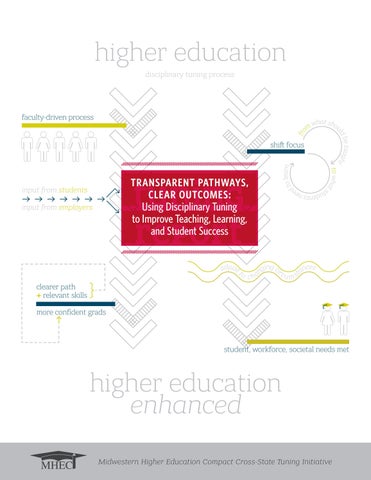
While Tuning conversations can occur within single departments, fostering dialogue among faculty from di erent types of institutions focuses conversations on commonalities for each degree level irrespective of program location. Tuning does not result in a standardized curriculum; rather, it provides a common framework and foundation for student mastery in a particular field. Using this foundation, institutions and departments can determine locally the breadth and depth of their curriculum and make choices about materials and course assignments, teaching styles, specializations, and areas of excellence to establish a particular niche.

ATTENDING TO IMPORTANT PROCESS CHALLENGES
Since tuners from different institutions are often meeting each other for the first time, they must develop as a viable team while also trying to reach consensus about their discipline’s core. It is important early on to address common challenges associated with group dynamics including norms for group discussions, tools for communicating in the time between face-to-face meetings, and processes for conflict resolution and reaching consensus. Tuners may want and need to spend time with each other in a social or non-work context simply to get to know each other and to establish a level of trust and professional understanding that is required to be successful as a team.
Using Tuning experts to provide a solid orientation helps beginning tuners establish a foundation upon which to do their work. Familiarity with each of the major Tuning activities is essential to internalize a holistic view of the process. While there are five separate activities or “steps” in the Tuning process, they are not intended to be linear or sequential. Some activities require completion of earlier actions, e.g., seeking formal stakeholder feedback and using Tuning products to review local decisions about programs. Other tasks, e.g., mapping career pathways, developing tools for formal stakeholder feedback, and drafting initial competencies and learning outcomes, can be pursued concurrently, especially if the team breaks into sub-groups.
It is important to break down the reluctance that faculty often have of sharing initial drafts of their work with peers. As part of this process, tuners should be encouraged to distinguish between formal and informal feedback. Although seeking formal feedback requires creation of an agreed-upon initial list of competencies and learning outcomes by degree level, this should not preclude gathering informal feedback early and often. By regularly communicating with stakeholders informally, especially department colleagues, tuners increase their understanding of substantive disagreements about the discipline’s core among their peers as well as among those who might hire their graduates. Tuners are also increasing potential ownership and buy-in for their processes and eventual products. Tuning is an ongoing process that has no definitive end point. Departments that are committed to Tuning are expected to use products from Tuning groups to review and potentially change their professional practices, curriculum content, and degree requirements. With time, it is envisioned that regular and systematic evaluation with input from various stakeholders will become more normative for professional practice across all disciplines within collegiate environments.
GENERATING KEY COMPONENTS
Tuners bring a wealth of experience to the task at hand, which can function as both a resource and a hindrance. Relying on the way individual departments have approached course development can help to generate initial conversation. Sharing syllabi also provides a tool to generate “lists” of core concepts as a foundation for developing recommendations about competencies and learning outcomes. Tuners can become aware early on that a great deal of variation exists in program structure both within and across institutional sectors (particularly between two-year and four-year institutions). In grappling with the task of defining their discipline core, both marketing and psychology tuners in the Compact’s Tuning initiative experienced difficulty in getting beyond individual experiences. Tuners commented often in early discussions to the effect of “…but this is the way we do it on my campus.” Tuners also admitted to possessing limited information about how other departments approached their discipline and to having stereotypes about their colleagues from other sectors. By incorporating purely social time during face-to-face meetings, tuners learn to confront preconceived attitudes and opinions about their teammates that help them emerge as genuine colleagues. As expressed by one Compact tuner, “gaining respect for the expertise and professionalism of colleagues makes it easier to disagree and work on common solutions as we face challenges to meeting our charge.”
As with most creative endeavors, it is more difficult to start from scratch than to follow some predetermined logical process, formula, or “how to” guide. The resource “Tuning American Higher Education: The Process” (available on the Tuning USA Website) describes the complexity of Tuning processes, demonstrates that numerous options and approaches exist for accomplishing this work, and provides practical advice with provocative questions that tuners should ask about each of the major Tuning activities.
According to Tuning USA, Defining the Discipline Core involves:
JJ Describing the nature of the discipline; JJ Identifying the bodies of knowledge and skill that comprise the core of the discipline; and JJ Identifying what learning is expected at each degree level and the ways in which students can demonstrate their learning
Adelman (2013) suggests that when identifying a discipline’s core, tuners could identify key reference points by describing the discipline’s content and methodologies as well as its relationship to other disciplines. He further suggests that Tuning reference points might include principles and concepts, dominant methods, tools, and information sources as well as a description of the physical environments in which practice occurs.
During this initial phase of Tuning, faculty are encouraged to use a multitude of resources including traditional approaches in the discipline as well as new and emerging fields of inquiry; informal conversations with disciplinary peers, students, alumni, and employers; and recommendations about the discipline’s core issued by learned societies, professional associations, and accrediting bodies.
CORE DEFINITIONS, NUANCES, AND DEGREES
In defining their discipline’s core, both of the Compact’s Tuning teams utilized definitions promoted by a professional association in their discipline, suggested nuances about their discipline, and identified the scope of degree programs offered to prospective students. Sections from both the marketing and the psychology final team reports about their discipline’s core are provided as illustrations for future tuners.
Marketing
The American Marketing Association offers the following formal definition for the discipline of Marketing:
Marketing is the activity, set of institutions, and processes for creating, communicating, delivering, and exchanging offerings that have value for customers, clients, partners, and society at large. (Approved October 2007) (http://www.marketingpower. com/aboutama/pages/definitionofmarketing.aspx)
According to the Compact marketing tuners, the discipline of marketing focuses on identifying and meeting human and social needs as well as organizational needs. Marketing is based on thinking about business in terms of customer needs and their satisfaction. For example, when eBay recognized that people were unable to locate items they desired most, it created an online auction clearinghouse to facilitate consumer acquisition. Likewise, when IKEA observed that consumers desired good furniture at substantially lower prices, they created “knockdown” or “ready-to-assemble” furniture. These two firms
demonstrated marketing savvy and turned a private or social need into a profitable business opportunity.
To prepare students for careers in marketing, academic programs provide training in basic business knowledge as well as education in marketing areas such as sales, advertising, marketing research, consumer behavior, and communications. For students wishing to pursue careers in some aspect of marketing, several degree options are available.
JJ ASSOCIATE DEGREES (A.A., A.A.S)
Currently, there are two distinctly di erent Associate Degrees available to students.
J Associate of Applied Science (A.A.S.) This is a two-year degree program requiring 60 +/- hours that typically includes minimal general education requirements. This program is designed for students seeking employment immediately upon graduation.
Emphasis is placed on courses (e.g., sales, retail management) that enable the student to gain knowledge and skills important for working in a professional business environment. The A.A.S. degree can lead to entry-level positions in areas such as customer service, advertising, or retail sales, and as a marketing management trainee.
J Associate of Science/Associate of Arts (A.S.,
A.A.) These are two-year degree programs requiring 60 +/- hours, including approximately 40 hours of a general education block. Students complete general education requirements and take business courses that have proven to be academically transferrable to four-year institutions. Ideally, completion of all requirements allows a student to enter a fouryear institution’s business program seamlessly (in marketing, accounting, management, etc.) to complete a bachelor’s degree rather than immediately entering the workforce.
JJ BACHELOR’S DEGREE (B.A., B.S.) For future
marketing professionals, a four-year bachelor’s degree program in marketing can help students develop an understanding of how businesses develop relationships with their customers, and how their customers’ needs can be satisfactorily fulfilled. The bachelor’s degree in marketing provides students with an understanding of the important concepts of marketing, emphasizing emerging technologies and the practice of marketing in an ever-changing global environment. The degree also prepares students for careers in such roles as media planner, buyer,
advertising manager, and marketing research analyst among many others. JJ MASTER’S DEGREE (M.B.A., E.M.B.A., M.S.,
M.A., M.M.R.) These advanced degrees are for individuals who want to move into a managerial or consulting marketing role. As marketing is a competitive field, a master’s degree will also give degree holders an advantage in obtaining more coveted jobs. As noted, there are several di erent types of master’s degree programs o ered for marketing students seeking advanced education. These have substantively di erent characteristics and can be roughly divided into the following two groups.
J Master of Business Administration, Executive
M.B.A. Typically a two-year program, the Master of Business Administration (M.B.A.) degree attracts individuals from a wide range of academic disciplines because it provides wide-spectrum theoretical and practical training to help graduates gain a broad-based understanding of general business management functions. While the M.B.A. degree can have a specific focus such as accounting, finance, marketing, or global business, its primary purpose is to help students understand the interrelationships among the various business disciplines rather than provide in-depth training in a single business area.
Executive M.B.A. programs are specifically designed for managers and executives with a significant amount of business experience who wish to earn an M.B.A. while working full-time.
J Master of Science/Master of Arts (M.S./M.A.) This category of advanced marketing degrees represents a more “traditional” master’s program in which students concentrate on a specific field of study (e.g., marketing research) and thus, upon program completion, can demonstrate advanced knowledge of a specialized body of theoretical and applied topics. While existing
M.S./M.A. programs are only a fraction of the number of M.B.A. programs in the United States, they offer significantly more depth in specific areas of study than do their broader-scope M.B.A. counterparts.
Moreover, while M.B.A. programs have generally similar content requirements, M.S./M.A. programs vary widely with respect to their academic focus. To wit, master’s programs include concentrations in such areas as marketing strategy and planning, marketing communication, integrated marketing, marketing and technical innovation, and marketing research.
JJ DOCTORAL DEGREE (Ph.D., D.B.A) The Doctor

of Philosophy degree (Ph.D.) is the highest academic degree attainable, requiring extended study and intense intellectual e ort. To earn a Ph.D. with a concentration in marketing, two things must be accomplished: 1) mastery of a specific marketingrelated subject, and, 2) extension of the body of knowledge about that subject. The D.B.A., while substantively similar to the Ph.D. in most respects, typically focuses more on the application of theory rather than the generation of new theory.
Psychology
According to the American Psychological Association (APA), psychology is defined as:
The study of the mind and behavior. The discipline embraces all aspects of the human experience – from the functions of the brain to the actions of nations, from child development to care for the aged. In every conceivable setting from scientific research centers to mental healthcare services, “the understanding of behavior” is the enterprise of psychologists. (http://www.apa.org/support/about/apa/psychology.aspx answer)
Compact psychology tuners struggled initially with expanding on the APA definition of psychology based on the breadth of their discipline. After extensive discourse they determined that the APA definition was sufficient as a context for their work. When identifying degree programs for students in psychology, tuners from four-year institutions were initially confused about the associate-level degrees in the field given the variation in options across campuses. On many two-year campuses students pursue general areas of interest or concentrations rather than “majors,” which furthered confusion at the front end of discussions.
The psychology tuners clarified that at the associate level, students interested in using their degree to pursue a job/ career have options for three different pathways, while at the baccalaureate level both B.A. and B.S. degrees are offered. A single institution does not necessarily offer all options. Psychology tuners described each of the degree pathways up through the doctorate as follows: JJ ASSOCIATE OF ARTS (A.A.) This pathway is for
students who intend to transfer into a baccalaureate program. Consequently, students pursuing this degree have varied interests across many disciplines. The core of an A.A. degree, which is a traditional twoyear transfer degree, cuts across several disciplines. It is usually comprised of 30 to 45 hours of general education course requirements that introduce students to various disciplines in the natural sciences, social sciences, and humanities. Beyond these degree requirements students can use elective hours to explore a particular discipline in greater depth prior to transfer.
JJ ASSOCIATE OF SCIENCE (A.S.) This pathway
is also for students who intend to transfer into a baccalaureate program. Unlike the A.A. degree, this degree often is built upon a specific articulation agreement in a discipline (sometimes between specific individual institutions and sometimes among a collection of institutions within a given state). A.S. degrees are intended to provide students with smooth transfer for both general education and disciplinespecific course credits. JJ ASSOCIATE OF APPLIED SCIENCE (A.A.S.)
This pathway is for students who intend to enter the workforce upon completion of the degree; thus the degree has traditionally been labeled a terminal degree. Students pursuing this degree generally have fewer general education hours available to them than
A.A. students, which results in more hours being devoted to their area of specialization or interest.
Increasingly, institutions and states have revised their transfer policies in acknowledgement that students completing A.A.S. degrees may immediately enter the workforce upon degree completion but then return to pursue a baccalaureate degree or certificate at a later date. In these situations, students expect that their formal training at the two-year level will transfer smoothly once they matriculate into another degree program. JJ BACHELOR OF ARTS (B.A.) OR BACHELOR
OF SCIENCE (B.S.) Students at the four-year level who major in psychology can earn either a B.A. or a B.S. degree. A major di erence is that students pursuing a B.A. usually must complete a foreign language requirement while B.S. students do not, although some institutions do require foreign language for graduates in both degree programs. In addition, many B.S. programs include required courses in other disciplines such as mathematics, computer science, and biology/chemistry/physical science. Some institutions also require courses in cognition, neuroscience, tests and measurement, advanced statistics, and advanced research methodology, although these requirements are not uniform.
JJ MASTER’S DEGREES (M.S.) Some master’s
programs in psychology are o ered as terminal degrees. This type of degree is designed to prepare graduates for professional practice in their specialty area. In other cases, a master’s degree may serve as preparation for further study at the doctoral level. Many states are now granting certifications at the master’s level so graduates are able to practice psychology on a limited basis. The states vary in how psychologists are licensed. Many psychology graduate programs have been developed to meet requirements outlined by the state, especially at the master’s level.
Specific course requirements can vary considerably.
For example, in many programs both thesis and nonthesis options are available. A thesis is typically the option of choice for students interested in further graduate study, while the non-thesis alternative is often considered by students who are more interested in entering the workforce immediately after graduation. JJ DOCTORAL DEGREE (Ph.D.) The doctoral
degree is considered the primary terminal degree in psychology. The psychology doctoral degree provides the most mobility and access to careers in the psychology discipline, which can include research and teaching positions in academic or in clinical settings as well as in other health, education, corrections, research, and social service sectors.
As faculty grapple with the charge of identifying the core essence of their discipline they eventually are confronted with the challenging task of generating an agreedupon list of initial competencies and student learning outcomes differentiated by degree level. Conversations about traditional core concepts of a discipline tend to emphasize the commonality among tuners, all of who have formal training in the same discipline. In contrast, the identification of different types of competencies and learning outcomes highlights layers of specializations or concentrations that are not as widely shared among the team members.
Furthermore, a lack of agreement about the meaning of both terms—in particular “competencies”—can undermine whatever comfort level new tuners have with this particular aspect of their charge. Both marketing and psychology tuners expressed confusion over understanding the major differences between competencies and learning outcomes early in the process
The fact that the concept of competencies has multiple definitions in the literature and is applied in different contexts adds to the confusion. According to Kennedy, Hyland and Ryan (2009), “there is wide variation in the
literature regarding the interpretation of the meaning of the term competence. This interpretation ranges from a description of competence in terms of performance and skills acquired by training to a broad overarching view that encompasses knowledge, understanding, skills, abilities, and attitudes” (p. 1).

The Council for Adult and Experiential Education (CAEL, 2012) provides an illustration of the variety of approaches used by US institutions that are developing some aspect of a competency-based or competency-focused higher education model. While the commonality across such programs is the identification of competencies expected of graduates, clearly institutions are defining and utilizing “competencies” in different ways. Some institutions discuss competencies and learning outcomes as if the terms are synonymous while others make clear distinctions. In some instances, competencies are developed at the course level, while in others program is used as the appropriate unit. The utilization of competencies also varies, with some institutions embracing traditional delivery models while others recognize learning that occurs outside traditional class time thereby permitting students to demonstrate competencies without formal coursework. While there is more consistency in the use of the label “learning outcomes” many faculty admit to having little experience in developing crisp outcome statements that can serve as a basis for assessment of student learning in the discipline.
Of particular help to both marketing and psychology tuners in the Compact initiative was a workshop presented by IEBC about the differences between competencies and learning outcomes. According to IEBC, in the context of Tuning, competencies are “benchmarks of mastery” while student learning outcomes are “discrete behaviors that, together, indicate that the benchmarks have been reached.” Tuners learned that competency statements are expected to be general in nature and not directly measurable. In contrast, learning outcomes focus on what a learner is able to do as a result of their learning. Learning outcomes let students know in advance what actions they are expected to perform, are action-oriented, and serve as a foundation for the type of evidence that would demonstrate that learning has occurred.
Providing tuners with a list of action verbs helps them build confidence in developing learning outcomes that can serve as a foundation for assessment in their discipline. After exposure to training on how to write learning outcomes, tuners begin to see the differences between words or phrases like “appreciation for,” “ability to,” or “understanding of” in contrast to action verbs like “explain,” “define,” or “compare.” While the former are vague and difficult to measure, the latter are specific
about what a student is expected to demonstrate. Tuners were also reminded to avoid using wordy statements or including too many components in one outcome statement. Tuners were encouraged to utilize the moniker of “ABC” as a reminder of three essential components of learning outcomes: audience, behavior, and context. IEBC staff also offered “SMART” as an acronym for remembering the collective characteristics of good learning outcome statements: student centered, measurable, actionoriented, results driven, and tailored to specific degree levels.
Several additional challenges emerged for tuners during the process of developing an initial set of competencies and learning outcomes. One challenge involved the appropriate unit of analysis for Tuning. Discussions that center on course-level competencies/outcomes have value for tuners, since this is an arena where they often have the most experience and confidence. However, the unit of analysis for Tuning is at the program or degree level, and not the course level. Once program-level competencies/ outcomes are identified they can easily be mapped back to courses, whereas the reverse can be problematic by potentially overlooking important aspects of the discipline since the whole is greater than the sum of its parts. Another challenge involved determining which competencies/outcomes are specific to the discipline and which are more general to higher education overall. General competencies, e.g., written and oral communication, teamwork, civic engagement, and others are often associated with an institution’s general education program required of all students. Compact tuners struggled with several questions associated with general competencies and learning outcomes, (e.g., “Should these competencies and their associated learning outcomes be treated as pre-requisites that students are required to demonstrate prior to entering a major or area of concentration? Should they be arrayed as a separate category within the discipline or should they be infused throughout the discipline”)? Since these skills are not taught in a vacuum but in the context of a discipline, tuners are expected to determine their relationship to the discipline as well as the ways they should be reflected in their work. The Compact teams demonstrated that there is no single answer to these questions. Marketing tuners ended up putting all general education type skills and outcomes under one competency with several subcomponents, while psychology tuners infused general education skills/outcomes throughout their major competencies. Other Tuning groups may very well identify additional structures for ways to describe how general competencies/outcomes are translated for a particular discipline. As Tuning matures, prototypes describing different treatments will likely emerge.

As is often the case in making lists, levels of abstraction need to be taken into consideration. Having first worked broadly on competencies, Compact tuners then faced the challenge of how to group their lists of competencies in a meaningful way. The more general the category is the greater the likelihood that the category could include several sub-competencies. Compact tuners grappled with questions such as “should skills like reading and writing be listed separately or together? Should they be considered a subcomponent of a general competency on communication and interpersonal skills or should they be elevated into a separate competency?” It soon became clear to both of the Compact’s Tuning groups that rather than reach agreement on an exact number of competencies, it would be best to keep moving forward by generating learning outcomes associated with particular competencies and address later how to group and/or present them.
Eventually tuners must make decisions not only on the number of competencies and learning outcomes to include but also on how to array their work. In making formatting decisions, tuners begin to realize that the way information is organized and presented sends several messages, not all of which are necessarily intended. At one point in the process, Compact psychology tuners had intense debates about whether to present separate charts for two- and four-year degrees in their discipline or to present them in a single chart, with the latter more clearly communicating the developmental nature of learning in their discipline. As work progresses in Tuning, faculty teams must achieve at least initial closure to both formatting and content issues for their products to move forward. Both Compact Tuning groups were aware that many of their proposed learning outcomes used terminology that denoted a specific level along Bloom’s hierarchy of skills. Pressing questions emerged and were discussed in detail, such as “Should all learning outcomes start in some rudimentary way at the lower-division level or should some not even be introduced until later in the curriculum? To what extent should the skills students acquire be considered developmental or hierarchical? Should some learning outcomes be the same for different degree levels?”
By going public with requests for formal feedback, tuners must also determine the number of degree levels that they will include in their initial work product. Both Compact Tuning groups included associate and baccalaureate degree levels. The marketing group also included the master’s level. While the psychology team began work on the master’s level, they determined that the diversity of approaches and complexity of psychology master’s programs rendered the work very difficult to complete. Neither Compact Tuning group addressed competencies or learning outcomes for doctoral degrees.
The next chapter addresses the challenges and opportunities associated with mapping career pathways in the discipline.