01OT1026.indd 1
9/30/26 4:20 PM
SEFall26FP.indd 1
10/1/26 3:18 PM
CET ad Sept-Oct 26.indd 1
9/24/26 12:58 PM
CONTENTS Volume 32 • No. 3
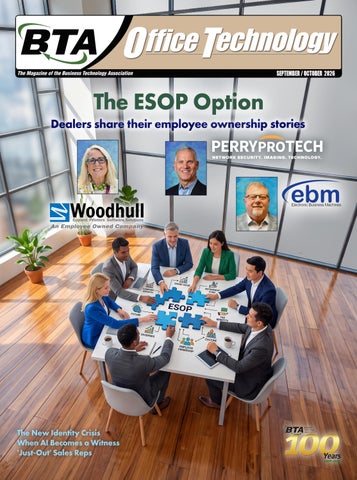
FEATURE ARTICLES The ESOP Option
LEGAL PERSPECTIVE When AI Becomes a Witness
10 Dealers share their employee
25 Protect confidential info
by Brent Hoskins Office Technology Magazine
by Greg Goldberg BTA General Counsel
ownership stories
with policies & training
If you are a dealership owner looking to retire, you may want to establish an employee stock ownership plan (ESOP).
Employers and employees routinely use large language models to draft emails, summarize documents, analyze contracts, prepare presentations and solve day-to-day problems. The productivity gains are substantial, but so are the legal risks.
Celebrating BTA’s 1st Century
16 BTA hosts educational
& networking events Sept. 1-3 by Elizabeth Marvel Office Technology Magazine
More than 450 people gathered Sept. 1-3 in Kansas City, Missouri, for BTA IGNITE Kansas City and BTA at 100: A Celebration.
SERVICE CONNEC TIONS A House Divided?
27 Business decisions should benefit sales & service by Jack Duncan Jack Duncan Consulting
The New Identity Crisis
I have encountered far too many dealerships where the sales and service teams operate at odds, even though both are critical to the dealerships’ success. Both sides of the house have a vested interest in the overall success of the business.
20 Don’t sell new services with old messaging
by Jenna Miller Emerald Strategic Marketing
Customers may see new capabilities listed on your website, but many still associate you with one thing: copiers.
B T A A T 10 0 23
SELLING SOLUTIONS ‘Just-Out’ Sales Reps
29 Why your onboarding
process is not built for them
‘A Remarkable Achievement’ A century of BTA through the eyes of its members
by Troy Harrison Troy Harrison & Associates
More organizations are hiring “justouts” — people who are just out of college and hired for their first professional jobs. These are not typical entry-level hires. If companies treat them as such, they are setting them up to fail.
Compiled by Brent Hoskins Office Technology Magazine
As the Business Technology Association (BTA) celebrates its 100th year, it is gathering testimonials from its members.
DEALERS HELPING DEALERS Sales & Service In Sync
24 How to keep sales from selling unsupported products Compiled by Elizabeth Marvel Office Technology Magazine
This feature includes a question and answers from BTA’s Dealers Helping Dealers resource.
DEPARTMENT S Technology Association 26 Business • BTA Highlights 6
Executive Director’s Page
8
BTA President’s Message
30
Advertiser Index
4 | w ww.of ficetechnologymag.com | September/October 2026
TOC Sept-Oct 26.indd 1
10/1/26 3:20 PM
YOUR PARTNER,
NOT JUST
A SUPPLIER. High Performance Copier Parts & Supplies Established in 1983
About Us Over 40 years of experience have helped us build a trusted catalog of compatible copier parts and supplies for many of the industry's leading copier brands.
Recycling Cores Program NATT provides an eco-friendly solution for dealers to dispose of cores responsibly. With our program, dealers can contribute to environmental sustainability by ensuring that these components are recycled efficiently, minimizing waste, and reducing their ecological footprint.
Testing & Quality
High Value Parts
Customer Service
Each product is carefully tested to deliver the compatibility, reliability, and performance dealers expect.
NATT’s commitment to value ensures you can achieve substantial cost savings without compromising quality or performance.
Our dedicated team is committed to providing quick and personalized assistance, ensuring dealers receive the support they need.
For more info Or Visit www.natrading.com
NA Trading ad Sept 26.indd 1
Phone Number:
800 231 8434
7/13/26 9:13 AM
EXECUTIVE DIRECTOR’S PAGE
BTA, KMBS Discuss National Accounts
W
hen Business Technology Association (BTA) dealer members report what they view as unfair treatment by an OEM, we take note. With that in mind, in July of this year, BTA sent a quick survey to its Konica Minolta Business Solutions (KMBS) member dealers, in light of the OEM’s reassignment of certain national accounts from dealerships to mega dealership Marco, allowing it to expand its service reach, as required by a newly won, significant national account. While it is only a small sample, the survey results reveal the notable frustration of some of the 20 dealers responding to the survey regarding the reassignment of the accounts. Thirteen of the 20 respondents indicated they had experienced account reassignments since Jan. 1, 2026, with at least nine indicating that the accounts were being moved to Marco. The annual revenues associated with the respondents’ account(s) prior to reassignment ranged from $500 to thousands of dollars. Most of the financial impact was on supply and service revenue. Some respondents expressed frustration with the short notice regarding the reassignments and the manner of communication. Several indicated frustration with the resulting recruitment of at least one of their service techs by Marco. In July, BTA requested a Teams meeting with KMBS leadership to discuss the survey results and national accounts reassignment project. Due to scheduling conflicts at KMBS, the meeting did not take place until Sept. 22. BTA leadership greatly appreciates the KMBS executives attending the meeting: Sam Errigo, president & CEO; Laura Blackmer, president, channel sales; Michael Mathé, executive
vice president & COO; and Steve Rhorer, vice president, direct and dealer service. I attended the meeting along with BTA President Mike Boyle, President-Elect Mike Hicks and Immediate Past President Debra Dennis. The KMBS leaders reported that the reassignment project, now completed, affected only about 8,000 devices across the United States, representing between about 75 and 150 business transactions. All the devices were sold directly by Konica Minolta and serviced/supported by dealers. Errigo emphasized that KMBS’s ITT (interterritorial) program remains strongly in effect and that the company is focused on growth for small, mid-sized and mega dealerships. Regarding any tech recruitment by Marco, the KMBS leaders shared that Errigo had “substantive conversations with executives” at Marco, making it clear that such poaching will not be tolerated, and that any poaching that did occur was “made right.” KMBS leaders also noted that the “person of record designated by the dealer” at each dealership affected was the individual notified by the OEM of the pending reassignments. They acknowledged that, in some cases, the announcement was either not opened or was not relayed to the dealership owner(s). The KMBS leaders explained that the short notice of the reassignments reflected a desire to minimize any negative effect on the customer experience. BTA leadership left the meeting with an understanding of the business reasons for the reassignments of the national accounts and appreciates the candid explanations shared by the KMBS leaders. [In a follow-up email, KMBS reported that is has had 40 dealerships (with no mega dealerships included in the number) add 725 counties to their territories since April 1, 2025.] n — Brent Hoskins
Executive Director/BTA Editor/Office Technology Brent Hoskins brent@bta.org (816) 303-4040 Associate Editor Elizabeth Marvel elizabeth@bta.org (816) 303-4060 Contributing Writers Jack Duncan, Jack Duncan Consulting www.jackduncanconsulting.com Greg Goldberg, BTA General Counsel Business Technology Association Troy Harrison, Troy Harrison & Associates www.troyharrison.com Jenna Miller, Emerald Strategic Marketing www.emeraldstrategicmarketing.com
Business Technology Association 12411 Wornall Road Kansas City, MO 64145 (816) 941-3100 www.bta.org Member Services: (800) 505-2821 BTA Legal Hotline: (847) 922-0945 Valerie Briseno Marketing Director valerie@bta.org Brian Smith Membership Sales Representative brian@bta.org Naomi Garza Administrative Assistant naomi@bta.org Photo Credits: Adobe Stock. Cover created by Bruce Quade, Brand X Studio. ©2026 by the Business Technology Association. All Rights Reserved. No part of this publication may be reproduced by any means without the written permission of the publisher. Every effort is made to ensure the accuracy of published material. However, the publisher assumes no liability for errors in articles nor are opinions expressed necessarily those of the publisher.
FLASHBACK
The association’s magazine cover 41 years ago this month — the NOMDA Spokesman, October 1985.
6 | www.of ficetechnologymag.com | September/October 2026
ED Sept-Oct 26.indd 1
10/1/26 3:32 PM
TTR Shipping ad Sept-Oct 26.indd 1
9/24/26 10:54 AM
BTA PRESIDENT’S MESSAGE
2026-2027 Board of Directors President
Here’s to the First — And Next —100 Years
I
t is difficult to put 100 years into perspective, but after gathering Sept. 1-3 in Kansas City, Missouri, to celebrate the Business Technology Association’s (BTA’s) centennial, I came home thinking less about the number itself and more about what it represents: generations of people who believed our industry was stronger when everyone came together. That was the idea behind BTA when independent dealers first gathered in Kansas City in 1926 and, 100 years later, it is still at the heart of the association. Our businesses look very different today, but BTA has remained a place where dealers can learn from one another, build relationships, share what is working and figure out what comes next. That spirit was everywhere in Kansas City. We were there to celebrate our history, but what struck me most was how much of the conversation was focused on the future and the skills we need to keep moving forward. During the BTA IGNITE Kansas City event at the Westin Kansas City at Crown Center, keynoter Jim Kwik challenged us to think about our ability to learn and focus in an age of constant information and distraction. One of his reminders, “Brain before browser, mind before media, intention before interruption,” has stayed with me. At a time when technology can answer almost any question instantly and artificial intelligence (AI) is increasingly capable of doing work alongside us, Jim’s message was a useful reminder that curiosity, judgment, attention and our own capacity to learn still matter enormously. West McDonald’s breakout brought the conversation directly to AI. His advice was memorable because it was so practical:
“Find the work that sucks.” Rather than starting with AI, he challenged us to start with the work itself. Look for the repetitive task, the bottleneck, the process that consumes too much time or frustrates employees and customers, and then determine whether technology can make it better. Pablos Holman asked us to look farther ahead. His session focused on the value of thinking on a longer timeline, beyond the headlines and anxieties of the moment, and toward what people can accomplish over decades and generations — much like how BTA has endured because generations of people were willing to keep learning and adapting. That connection between the past and the future came to life in a very literal way during the Sept. 2 BTA at 100: A Celebration event at Union Station Kansas City. Throughout the evening, we looked back at the people and moments that helped build the association, and AI was used to bring historic photographs to life and help create music for the celebration. I thought that was a wonderful way to mark the occasion — we were celebrating a 100-year-old organization while using a technology that would have been unimaginable to its founders to tell their story in a new way. In many respects, that is what BTA has always done: Honor what came before us while continuing to look ahead. For me, the biggest takeaway from our 100th anniversary was that technology has changed enormously, but relationships are what have carried the association through all of it. If we continue to share what we know, stay curious, challenge ourselves, adapt and help each other succeed, I believe the qualities that brought BTA through its first century will carry it well into its second. That is the legacy we inherited and, now, it is our turn to build on it. Here’s to the first 100 years — and to the next 100. n — Mike Boyle
Mike Boyle BASE Technologies Bethel, Connecticut mboyle@baseinc.com President-Elect
Mike Hicks Electronic Business Machines Inc. Lexington, Kentucky mhicks@ebmky.com Vice President
Blake Renegar Kelly Office Solutions Winston-Salem, North Carolina tbrenegar@kellyofficesolutions.com Immediate Past President
Debra Dennis CopyPro Inc. Greenville, North Carolina ddennis@copypro.net BTA East
Tim Seeley Jr. Seeley Office Systems Inc. Glens Falls, New York tseeleyjr@seeleyoffice.com Susan Pangborn Automated Business Solutions Warwick, Rhode Island spangborn@absne.com BTA Mid-America
Grant Goldsmith Regal Business Machines/Gateway Business Systems Chicago, Illinois goldsmithg@gateway-biz.com Chip Miceli Pulse Technology Schaumburg, Illinois chip@pulsetechnology.com BTA Southeast
Richie Creech CopyPro Inc. Greenville, North Carolina rcreech@copypro.net Tim Renegar Kelly Office Solutions Winston-Salem, North Carolina trenegar@kellyofficesolutions.com BTA West
Richard Van Dyke Advanced Office Irvine, California rvandyke@goadvanced.com Pamela Feld Triumph Technology Group Tustin, California pam@triumphoffice.com Ex-Officio/General Counsel
Greg Goldberg Barta | Goldberg West Hollywood, California ggoldberg@bartagoldberg.com
8 | w ww.of ficetechnologymag.com | September/October 2026
President Sept-Oct 26.indd 1
10/1/26 3:36 PM
NEXERA ad Sept-Oct 26.indd 1
9/24/26 9:55 AM
The ESOP Option
Dealers share their employee ownership stories by: Brent Hoskins, Office Technology Magazine
I
f you are an office technology dealership owner looking to retire, have no children pursuing ownership, and want to keep your company independent and dedicated to taking care of its employees, then you may want to establish an employee stock ownership plan (ESOP). It could be a better alternative for you than a traditional exit strategy. An ESOP is a plan that gives employees ownership in a business through company stock. They typically earn shares over time, the quantity often based on salary and years of service. The exiting owner earns a payout as if the company is being sold, while the ESOP helps employees build wealth for retirement. In the following three dealership profiles, company leaders share their employee ownership stories. Perhaps the details and insight they provide will lead you to take a closer look at the ESOP option.
Electronic Business Machines In 2001, Carl Jason was preparing to retire from Electronic Business Machines (EBM), the Lexington, Kentucky, dealership he founded in 1970. “He wanted to provide an opportunity to the team members who helped him build the business,” says Mike Hicks, president of EBM. “He wanted to give us an opportunity to prove that we could forge our own futures.” The result was the establishment of an ESOP. At the time, Jason selected Hicks, who had served as service manager since 1991, to assume the presidency. “Carl had received offers to buy EBM; IKON, for example, was trying to buy the dealership for a while,” he recalls. “But one day he called me into his office and said, ‘This is what I’ve decided to do; it will be effective 65 days from today.’” The ESOP learning curve was immediately underway for Hicks. “I had 65 days; I was learning and teaching at the same time,” he says, noting that he quickly joined The ESOP Association (TEA) for guidance. “To be honest, explaining
the ESOP in plain English — vesting, allocations, distributions, and the relationship between company performance and employee retirement — was more difficult than I thought it would be.” Today, 25 years later, Hicks fully understands ESOP development and is accustomed to the process of maintaining and explaining the plan. “With the involvement of an attorney and the trust department at a local bank, we did a non-leveraged ESOP,” he says, noting that the non-leveraged structure transferred company ownership to EBM employees without acquisition debt. Following the establishment of the ESOP, Jason was paid over multiple years as the ESOP trust gradually acquired his ownership shares. All of EBM’s stock shares are now fully owned by current employees. “At the end of each fiscal year, a valuation CPA [which must be a different person than EBM’s regular CPA] determines EBM’s current value and the value of the stock. Our trustee then divides nonallocated shares among the participants based on the ESOP rules, acting as the fiduciary of the plan’s trust, holding company stock and managing assets solely in the best financial interest of the employee participants.” EBM allocates a certain dollar amount to the ESOP each November to further strengthen the trust’s cash position. The amount is determined by the company’s earnings for the prior year, Hicks says. The number of shares owned by each employee is based on the employee’s percentage of the dealership’s total annual payroll expenditure. “So, for example, if annual payroll is $1 million and my salary is 8% of payroll, then my ownership of a $1-million allocation to the ESOP would be $8,000 in shares,” he explains. “We settled on 1,000 shares total companywide.” Hicks says anytime an employee leaves, retires or begins diversification after age 55, those excess shares go back into a pool and are distributed each year to current and new employees. “New employees have a two- to seven-
10 | w ww.of ficetechnologymag.com | September/October 2026
Cover Story Sept-Oct 26.indd 1
10/1/26 3:44 PM
MORE THAN
MAILING
We’re not just here to move mail - we’re here to move business forward. From smart automation to secure digital workflows, FP’s impact reaches far beyond the envelope.
STREAMLINE YOUR BUSINESS
ONLINE SHIPPING SOLUTION FP Parcel Shipping gives you access to multiple carriers, built-in address validation, and real-time tracking so you can streamline your logistics, reduce manual errors, and deliver a smoother experience to your customers.
PARCEL MANAGEMENT & TRACKING SOFTWARE FP Smart Lockers & TRAXsuite Software streamlines how your organization receives, logs, stores, and tracks packages - so nothing gets lost, delayed, or overlooked.
www.fp-usa.com
DIGITAL SIGNATURE SOLUTION Empower your business with FP Sign to complete agreements faster, eliminate manual bottlenecks, and stay compliant with industry regulations.
2025_BTAMagazine_Ad_8x10.75_MoreThanMailing.indd FP ad May 25.indd 1 1
5/12/25 3:37 3:34 PM
year vesting period, so if they for a position at PERRY proleave us before seven years, TECH, we send him or her “Nothing drives an they only get the vested porsome information on our ESOP like performance. tion of their ESOP accounts employee ownership and Our ‘magic elixir’ is: ... An employee at EBM can what that means.” We perform. never own more than 20% During the interview proof the stock, so when a longcess, PERRY proTECH shares If your company term employee gets close to a document that shows a performs at a high level, 20% — or anytime all 1,000 candidate “how much money so will your ESOP.” shares are allocated — we they could have for retire— Pat Summers ment with an average [ESOP] start diversifying retirement funds into conservative muPERRY proTECH stock appreciation value at tual funds.” 8% — ‘This is what you could The level of enthusiasm for have in 20 years,’” Summers employee ownership tends to vary by age group, Hicks ac- says. “Then we show the candidate what the average perknowledges. When EBM hires employees who are at least 50 son who only has a 401(k) might have for retirement after years old, “they see the stock value as a true, tangible num- 20 years.” ber, since they are only 10 years or so away from approachWhile some younger recruits may not be focused on reing retirement,” he says. “However, younger people just see tirement, “we have people right out of college who are all it as a ‘pie-in-the-sky’ number, not as real, tangible cash. So, over this,” Summers says, noting that they may have initially we are currently in the process of implementing a matching asked a parent or sibling about ESOPs. “That person might 401(k) plan in addition to the ESOP; we’re going to match up have said, ‘Oh my gosh, you have got to really dig into this to 4% ... Together, the ESOP and 401(k) will make our retire- because it can be unbelievably powerful.’” ment package better than some major corporations.” Once on board, the educational process continues. “On Hicks readily shares the benefits to any dealership own- the day of onboarding, a lot of information on the ESOP is er who is considering an ESOP: “Why an ESOP? It provides shared,” Taylor continues. “By six months into their employowner retirement succession. There are potential tax advan- ment, they will have attended a new hire orientation for the tages. You are keeping the company independent. You are re- ESOP [to understand the vesting process, etc.] ... Throughout warding and retaining the employees who helped you grow the year, there are different activities focused on employee the company. It’s a matter of taking care of your people.” ownership, including ‘ESOP Month’ in October, managed by the Employee Owners Communications Committee ... There is also an annual event — our shareholders meeting.” PERRY proTECH Summers emphasizes that all employees — as owners — In 1985, 20 years after founding what is today PERRY proTECH, Rex Perry was diagnosed with a serious illness. “The ex- remain very informed on the performance of the dealership. perience led him to consider the company’s future,” says Becky “The way we communicate with our employees is probably Taylor, chief financial officer for the dealership, based in Lima, a little different than most companies,” he says. “We have a Ohio. “He decided to look at two options — sell to an outside monthly call with all of our shareholders to talk about the performance of the business. We share openly about how we investor or determine the right path to employee ownership.” Perry opted to establish an ESOP, Taylor says. It was a 10- are doing.” In the monthly calls, the focus, in part, is on four key peryear structure. In 1996, the company became 100% employee owned. At the time of the transition, PERRY proTECH formance areas driving the company’s growth, Summers had approximately 50 employees; today, it has nearly 300 says — production print placements; imaging aftermarket revenue; net-new business; and managed network services. employes in Ohio, Indiana and Michigan. The ESOP has paid off in a big way for the dealership’s em- PERRY proTECH’s successful ESOP is directly related to sucployees. “Many people have retired from PERRY proTECH as cess in the key performance areas, he says. “Nothing drives millionaires,” says Pat Summers, president. “Some of them an ESOP like performance. Our ‘magic elixir’ is: We perform. If your company performs at a high level, so will your ESOP.” have retired as multimillionaires.” The strong performance of PERRY proTECH’s ESOP has Employees are fully aware of the value of the ESOP long before retirement. In fact, the education process begins driven high employee retention, Taylor explains. “Twenduring recruitment, “prior to a candidate stepping foot in ty percent of our employees have been here more than 20 our door,” Taylor says. “When someone is being considered years; 25.6% of our employees are currently at the 15-plus12 | w ww.of ficetechnologymag.com | September/October 2026
Cover Story Sept-Oct 26.indd 2
10/2/26 1:25 PM
Predictive InSight ad Sept-Oct 26.indd 1
9/23/26 4:12 PM
years mark,” she says. “That Penny, a local food service builds confidence in those equipment manufacturer that “You get the biggest bang employees and expertise. It is had set up its ESOP in 2014. for the buck if you go 100% also a cost-saving measure, “I talked to them and peoESOP, which is what we did — minimizing turnover costs.” ple they had worked with, it’s 100% federal and [Ohio] Being an employee-owned and started down the path,” company “affects our cusshe says. “I also met with state tax free. It costs a lot of tomer relationships because the president of a local PNC money to run it, but we’re they know our people,” SumBank, which, nationally, is paying millions less in taxes.” mers says. “We have salesone of the largest lenders to — Susie Woodhull ESOPs in the United States people and sales leaders who have been selling to the same Woodhull LLC ... He recommended that I folks for 20 to 30 years ... We work with the same people like people to know we are an Henny Penny had worked employee-owned business — [salespeople can say] “You’re with — CGS Partners LLC — to help set up our ESOP.” talking to an owner right now.” There are other companies involved in supporting the dealership’s ESOP. “Blue Ridge Associates is our third-party adWoodhull LLC ministrator,” Woodhull says. “And GreatBanc Trust Company Jay Woodhull purchased his father’s dealership in the is our trustee; GreatBanc is the nation’s leading ESOP trustee, late 1980s. He sold it to Alco Standard (later IKON) in 1996; relied upon by 500-plus employee-owned companies.” it did not go well. “That experience was awful,” says Susie The dealership opted for a highly leveraged ESOP, initialWoodhull, Jay’s wife, who was vice president of service for ly financed by a loan from PNC, in order to pay Woodhull the dealership. “We stayed on until June 1999.” over many years for her ownership, she says, noting that as Jay had a five-year noncompete; his career then went in the debt is paid down, the value of employee shares will inanother direction. After her one-year noncompete ended, crease. Even so, she says, one 20-year employee’s shares are Woodhull acquired another dealership (with nine employ- already valued at “just over $12,000” after only one year. Woodhull says the many details involved in setting up ees) near Cincinnati, Ohio, renaming it Woodhull LLC, now headquartered in Springboro (Dayton), Ohio, with loca- the ESOP “blew my mind” with “almost a thousand pages” tions in the Cincinnati and Columbus, Ohio, areas as well. of documentation. “It took every moment of a year; that’s At the time of the acquisition, the dealership was at about literally what I was consumed with doing,” she says, noting, $900,000 in revenues. Today, it is a $28-million dealership too, that it was also an expensive process. “It cost about a with 80 employees. million dollars to set up, plus we pay our third-party adminWoodhull’s son, Robert, joined the dealership 14 years istrator about $6,500 a quarter.” ago, working his way up to his current role as president. However, with a 100% ESOP (an ESOP owning all of an S With an eye on her eventual exit from the company, Wood- corporation’s stock; lesser-percentage ESOPs are an option) hull, who serves as CEO, began considering the options. there is a major tax advantage. “You get the biggest bang for Remembering the IKON experience, she knew she “couldn’t the buck if you go 100% ESOP, which is what we did — it’s sell the company to a conglomerate ... Having been through 100% federal and [Ohio] state tax free,” Woodhull says. “It that once, I couldn’t do it again.” So, she and Robert were in costs a lot of money to run it, but we’re paying millions less a quandary. “I said to him, ‘We’re at $28 million; I can’t ask in taxes. That frees up the money to do other things, like reyou to go to the bank and borrow that kind of money.’” invest back into the company.” A May 2024 “60 Minutes” story provided Woodhull the That includes reinvestment further benefitting employanswer. The story focused on C.H.I. Overhead Doors, which ees; the company recently launched a 401(k) with “a much had implemented an employee-ownership arrangement. better match” than the SIMPLE IRA it replaced. “So, now we “The company was acquired in 2015 for $700 million [the have two retirement plans,” Woodhull says. employee ownership arrangement went into effect at that “That’s been very positive for recruiting.” n time] and sold in 2022 for $3 billion,” she says. “Those factoBrent Hoskins, executive director ry workers became rich overnight. It was a great story ... We of the Business Technology Association, both came into the office Monday morning and said, ‘What is editor of Office Technology magazine. about an ESOP?’ That’s how the idea was born.” He can be reached at (816) 303-4040 or brent@bta.org. Soon thereafter, Woodhull met with leadership at Henny 14 | w ww.of ficetechnologymag.com | September/October 2026
Cover Story Sept-Oct 26.indd 3
10/1/26 3:45 PM
Turn Your Referrals into Revenue. From Connections to Commissions
Zero risk and zero ongoing commitment. Grow your business as a DocuWare Referral Partner.
Become a Referral Partner
www.of ficetechnologymag.com | September/October 2026 | 15
DocuWare - Source Technologies ads Sept-Oct 26.indd 1
9/21/26 5:20 PM
Celebrating BTA’s 1st Century BTA hosts educational & networking events Sept. 1-3
by: Elizabeth Marvel, Office Technology Magazine
M
ore than 450 people gathered Sept. 1-3 in the Business Technology Association’s (BTA’s) hometown of Kansas City, Missouri, for BTA IGNITE Kansas City and BTA at 100: A Celebration. IGNITE kicked off on Sept. 1 with a reception at the National WWI Museum and Memorial, followed by the educational portion of the event Sept. 2-3 at the Westin Kansas City at Crown Center. On the night of Sept. 2, attendees gathered at Union Station Kansas City to celebrate BTA’s 100th anniversary, featuring a stand-up performance by the legendary Jay Leno. The IGNITE event included four main-stage sessions: “Master Your Mind & Memory,” presented by Jim Kwik, Kwik Brain Universe; “Innovate or Die Trying,” presented by hacker, inventor and technology futurist Pablos Holman; “Future-Proofing Your Dealership: Technology Investments That Pay Off,” presented by Arvind Rao, GreatAmerica; and a dealer panel, “Who Needs Print Management Now That We Have WMPP, MUP & WPP?” moderated by Deborah Hawkins, Keypoint Intelligence. There were also four breakout sessions: “The Information Imbalance: How to Sell to Today’s Younger, Better-Informed Buyer,” presented by Troy Harrison, Troy Harrison & Associates; “Modernizing Prospecting Leadership: Drive More Net-New Meetings Without Burning Out Your Sales Managers,” presented by Kate Kingston, Kingston Training Group; “AI in the Dealer Channel: What’s Working, What’s Missing & What Must Change Before 2027,” presented by West McDonald, GoWest.ai; and “The Future of Office Printing Hardware & the Role of the AI MFP,” presented by Robert Palmer, IDC. The event also included time to network with fellow dealers and 58 exhibiting sponsors. BTA’s next event, the Fall Colors Retreat, will be held Oct. 29-30 at the Omni Grove Park Inn in Asheville, North Carolina. For more information, see the ad on page two and visit www.bta. org/BTAAsheville to register. n Elizabeth Marvel is associate editor of Office Technology magazine. She can be reached at elizabeth@bta.org or (816) 303-4060.
Clockwise from top: More than 450 people gather for BTA IGNITE Kansas City and BTA at 100: A Celebration; Holman presents the featured speaker session; and Kwik presents the keynote address.
Above: Several BTA and industry leaders give opening comments at BTA IGNITE Kansas City, including (left to right) 2026-27 BTA President Mike Boyle; 2026-27 IBPI President Rob Richardson (the IBPI Connect meeting was held in conjunction with BTA IGNITE Kansas City); 2026-27 BTA Immediate Past President Debra Dennis; and 2026-27 BTA West Representative on the BTA Board of Directors Richard Van Dyke. Left: Attendees had the opportunity to visit with 58 exhibiting sponsors during the event.
16 | w ww.of ficetechnologymag.com | September/October 2026
BTA IGNITE KC Sept 26.indd 1
10/1/26 4:16 PM
The Technology Future
W
Above photos: Attendees enjoyed an evening at the National WWI Museum and Memorial on Sept. 1, where they had the opportunity to network with their fellow dealers, walk through the museum, and take an elevator to the top of the Liberty Memorial Tower, which offers amazing views of the Kansas City skyline.
Above photos: The breakout sessions were presented by (clockwise from top left) Harrison, Kingston, McDonald and Palmer.
Above left: Rao presents his main-stage session. Above right: Hawkins (left) moderates the dealer panel with panelists (left to right) Russell Kromminga, print management expert; Sarah Henderson, director of managed service intelligence, Pacific Office Automation, Beaverton, Oregon; and Chip Miceli, president, Pulse Technology, Schaumburg, Illinois.
ith concerns about the rapid pace of technology innovation top of mind for many attendees, the featured speaker session at BTA IGNITE Kansas City, “Innovate or Die Trying,” attempted to assuage their concerns. Hacker, inventor and technology futurist Pablos Holman started the session by explaining that things are better today than they were 10 years ago and will continue to improve. “There’s no reason to believe that in the future, 10 years from now, things are going to be worse than they are today,” Holman said. “You can hardly find anything that’s worse today than it was decades ago when we were born — or try a hundred years ... Almost nothing. And, so, in spite of all the general malaise ... the future is actually [going to be] pretty awesome.” He supported this claim by showing that human civilization has always been on an upward trajectory — in population growth, in medical advances so “survival of the fittest” no longer applies, in the evolution of technology, and in energy production, where although we have made great strides, we actually need 10 times more production to satisfy the needs of everyone on Earth. “In the last century, we humans have increased global energy production tenfold,” Holman said. “And we did it mostly by burning more coal, oil, gas and trees. But hopefully we learned our lesson ... We want to figure out if there is a cleaner way, a cheaper way, an easier way.” The solution: new nuclear reactors that operate at the bottom of mile-deep boreholes where “literally nothing could go wrong, and if it did, there would be no radioactivity at the surface,” Holman said. “One of these things can produce enough energy for a neighborhood or a skyscraper or a data center. And if you need more energy, just drill more holes ... ” He then shared that a stockpile of nuclear waste in Kentucky containing 700,000 metric tons of depleted uranium has enough energy left in it to power the entire planet for the next 1,000 years using these types of reactors. Holman also addressed concerns specific to the office technology industry. “I think there’s a little bit of consternation about what’s happening in this industry and in your businesses,” he said. “I think the only way out is through. You guys should be proud ... This is a history of successes. This is evolution. You guys adapted to the market ... And what I think is missing in the discourse here is, ‘Yeah, looks like people are all using screens. They have laptops. They have phones in their pockets ... Why do they need to print anything anymore? Maybe our business is doomed.’ “I think you guys are missing the big picture,” Holman continued. “Every single thing in the world will be made the way copies are made right now — on demand, at the point of consumption, by the user who needs it ... Your business is about to get a thousand times bigger in the next generation ... The future is about making the right thing, at the right time, right now ... We need you more than ever because we’re bringing these capabilities into the world.” He also discussed the use of AI as a tool — not a technology that will doom humanity. “Every technology is a tool,” Holman said. “The hammer is a tool. I can smash your head with it or I can build you a home ... With AI, we’re barely in preschool. With the hammer, we’re in retirement. Everybody gets a hammer; there’s basically no problem. [So with AI] we’re going through these developmental stages. We will learn to wield these tools for mostly positive uses. And even though we’re doing a lot of stupid things with AI ... that’s a temporary condition and we will mature out. So look, I hope you will join me and boycott dystopia ... we’re going to use these tools.” n — Elizabeth Marvel www.of ficetecthnologymag.com | September/October 2026 | 17
BTA IGNITE KC Sept 26.indd 2
10/1/26 4:15 PM
Clockwise from top left: Attendees participate in an activity challenging their beliefs during Kwik’s keynote address; Don Risser (left) of DCS Technologies Corp., Franklin, Ohio, visits with (left to right) Harris Eckstrom, Wiley Hutchins and Shelby Clark of LEAF Commercial Capital during exhibit time; Myra Flynn of Source Technologies visits with Richard Piechocki of Digital Business Solutions, Fort Smith, Arkansas, during exhibit time; 2026-27 BTA Mid-America President Jeff Foley serves as emcee during the afternoon of Sept. 2; and (left to right) Emma Bruno and Jucelia Rosseti of CET Group visit with Ingrid Charlton of BXI Consultants Inc., Tonawanda, New York, during exhibit time.
A Look Back at BTA at 100: A Celebration
Left: Attendees gather on the evening of Sept. 2 at Union Station Kansas City for BTA at 100: A Celebration. Above: Boyle toasts to 100 years after his opening comments. Right: Attendees look at a timeline of 100 years of BTA history during the reception held before dinner. Far right: Avaniko representatives pose in front of a 1926 Ford Model T Roadster Pickup, one of two 1926 vehicles on display (a Model T Coupe was also displayed). 18 | w ww.of ficetechnologymag.com | September/October 2026
BTA IGNITE KC Sept 26.indd 3
10/2/26 1:27 PM
A Look Back at BTA at 100: A Celebration
Above: Current BTA President Mike Boyle ( far left) and 16 past BTA presidents were recognized at the event — (left to right) Debra Dennis, Adam Gregory, Don Risser, Tim Renegar, Bob Evans, John Eckstrom, Rob Richardson, Ron Hulett, Todd Fitzsimons, Terry Chapman, Tom Ouellette, Bill James, Mark Naylor, Jeff Jehn, Dennis Hunter and John Kuchta.
Above: Boyle ( far right) also recognized 12 of BTA’s longest-term members during the celebration. The dealership representatives and their companies (left to right): Art Wagner, Wagner Office Machines, Burr Ridge, Illinois ( joined 1941); Mike Nierman, Eakes Office Solutions, Grand Island, Nebraska (1958); Mark Naylor, ABM Automation, Oklahoma City, Oklahoma (1958); Scott Leitzel and Steve McMahon, Central Office Service & Supply Inc., Clay Center, Kansas (1959); Chap Breard, MOEbiz, Monroe, Louisiana (1964); Scott Columbia, Plus Inc., Greenville, South Carolina (1969); Johnny Leftwich, Dustin Office Machines, Gainesville, Texas (1970), Samantha and Clint Winchell, Forbes Office Solutions Inc., Newton, Iowa (1971); Debra Dennis, CopyPro Inc., Greenville, North Carolina (1973); Luke Maucher, ABM Office Resources, Fort Wayne, Indiana (1974); and Jeff Jehn, Waltz Business Solutions, Crestview Hills, Kentucky (1956).
Above left: Dennis (left) and Boyle (right) present the 2026 Volunteer of the Year Award to Chip Denlinger, vice president of DCS Technologies Corp., Franklin, Ohio. Above right: Boyle (left) recognizes BTA staff members for their long-term service to the association. From left to right: Brent Hoskins (40 years), Valerie Briseno (20 years), Elizabeth Marvel (19 years) and Brian Smith (18 years).
Clockwise from top: Attendees pose in the photobooth during the reception; champagne is served from a “ballgown” between the reception and dinner; BTA Ambassador Bob Goldberg serves as the BTA at 100 emcee; Kansas City’s Quixotic, a performance art collective, takes to the rings while a video of BTA’s history plays; Jay Leno performs a stand-up comedy set and answers audience questions at the end of the evening; Dennis receives the BTA Past President’s Award; and the dinner table setting. www.of ficetecthnologymag.com | September/October 2026 | 19
BTA IGNITE KC Sept 26.indd 4
10/2/26 1:56 PM
The New Identity Crisis
Don’t sell new services with old messaging by: Jenna Miller, Emerald Strategic Marketing
F
or decades, office technology dealers have built successful businesses around print. Multifunction devices, managed print services, supplies and service contracts have formed the foundation of the industry. Customers knew exactly who you were, what you sold and why you mattered. Today, the industry is looking very different. Across the country, dealers have expanded beyond print into managed IT services, cybersecurity, digital document management, workflow automation, cloud solutions, AI readiness consulting, communications platforms and other recurring-revenue offerings. As print volumes decline and customer technology needs continue to evolve, you and your fellow dealership leaders recognize these services as critical growth opportunities. However, with this evolution comes an unexpected challenge that you may have overlooked. While your service portfolios have changed, your market perception has not. And that is a major problem. Customers may see new capabilities listed on your website or hear them mentioned during a sales conversation, but many still associate you with one thing: copiers. This disconnect is creating what may be the industry’s newest growth challenge: an identity crisis.
The Industry Evolved Faster Than Its Messaging You have done the difficult part already. You invested in talent, acquired companies, developed new service lines and expanded your technology expertise. But like many organizations, you may have never fully updated the story you tell the market. Your website still leads with equipment. Your messaging still focuses on products rather than business outcomes. Your marketing materials often position managed IT and other new services as secondary offerings rather than strategic solutions. As a result, prospects frequently struggle to understand the full value your dealership can provide. The challenge is not your lack of capabilities. It is that
buyers do not yet connect those capabilities with your brand. Adding a service line does not automatically change customer perception.
Why This Hurts Growth When you are known primarily for print, every new service sale starts with a steep uphill battle. Prospects may wonder: “Why is a copier dealership offering cybersecurity? What expertise does it have in managed IT? Can it really support our advancing technology environment? How long has it been providing these services?” These questions create friction. Trust takes longer to build. Sales cycles become more complicated. Cross-selling opportunities are missed. Marketing campaigns generate awareness, but fail to generate confidence. Meanwhile, competitors that are already perceived as IT providers or workflow specialists enter the conversation with established credibility. The issue is not service quality; it is your positioning.
Four Ways You Can Modernize Your Messaging (1) Lead With Business Outcomes, Not Service Categories — Many dealership websites list services like managed IT, cybersecurity, cloud solutions and workflow automation. While accurate, these descriptions focus on what you do rather than why customers should care. Messaging should focus on outcomes: n Reducing downtime n Improving security n Eliminating technology bottlenecks n Increasing employee productivity n Simplifying operations Business leaders do not buy services. They buy outcomes. Put yourself in your clients’ shoes. Would you rather hear a list of workflow automation features, or learn how your team can eliminate bottlenecks, reduce frustration and get hours back every week?
20 | w ww.of ficetechnologymag.com | September/October 2026
Miller Sept-Oct 26.indd 1
10/2/26 1:31 PM
www.of ficetecthnologymag.com | September/October 2026 | 21
Aster - BPO ads Sept-Oct 26.indd 1
9/25/26 11:39 AM
Your customers care less about what Many diversification efforts fail because your solution does and more about what your departments tell different stories. Dealerships that it does for them. Marketing promotes innovation. Sales successfully evolve their (2) Create Content That Demonconversations revolve around devices. messaging achieve strates Expertise — Customers need Customer service talks about support something much more evidence before they change their pertickets. Leadership discusses strategic valuable than awareness. ception of your company. Thought transformation. The result is a fragleadership can help close that gap. You mented brand experience. They change how the should consistently educate your audiEvery customer-facing team should market sees them. ence about topics such as: be able to clearly explain: n Cybersecurity threats n Why the company expanded n AI adoption n What problems it now resolves n Digital transformation n How its expertise has evolved n Compliance requirements n Why customers should trust those new capabilities n Workflow optimization Consistency is what ultimately changes perception. n Holistic technology strategies The objective is not promotion — it is becoming a trusted The Payoff: Becoming a Technology Advisor advisor. And to do that, it is imperative to also show social Dealerships that successfully evolve their messaging proof, such as customer reviews, testimonials and case achieve something much more valuable than awareness. studies to demonstrate your authority and experience in They change how the market sees them. Instead of being the industry. When prospects repeatedly encounter valu- viewed as equipment providers, they become strategic techable insights and social proof from you, they begin to view nology partners. Conversations about managed IT, cyberyour business in a new light. security, workflow automation, cloud solutions and AI be(3) Define What You Want to Be Known For — One of come more natural because customers already expect those the biggest mistakes you can make is trying to market ev- services to be part of the discussion. Marketing becomes ery service equally. The result is often a confusing and over- more efficient. Cross-selling becomes easier. Recurring revwhelming message. Instead, you should ask, “What do we enue services gain traction faster. And, perhaps most imwant customers to immediately think of when they hear our portantly, your business becomes less dependent on print name in three years?” The answer is not “everything,” but it volume and hardware margins alone. could be: n Workplace technology optimization The Identity Gap n Secure digital workflows The challenge facing today’s office technology dealern Managed technology services ships is not finding new services to sell — most have already done that. The real challenge is helping customers undern Business process automation stand what they have become. n IT and print convergence The dealerships that thrive during the next phase of inA focused position is easier for the market — and search engines — to understand and remember. To do this, you dustry transformation will not simply diversify their service need to have a strong and specific unique selling proposi- offerings. They will deliberately reshape their identities, ention (USP), which is a detailed statement that shares how suring that their market perception matches their business your business helps clients in a unique way. This is the state- reality. Diversification does not truly begin when a new service is added. It begins when customers believe you are the ment that sets you apart from competitors. Try writing your USP using this formula: “We help [indus- right company to deliver it. n Jenna Miller is the CEO of Emerald Strategic try/company size] reduce [specific technology frustration] Marketing, a digital marketing agency in by [unique way you deliver service], so they can [business Tampa Bay, Florida, that delivers outcome they care about].” custom solutions like SEO, Here is an example of a strong and specific USP statesocial media management and ment: “We help midsized commercial businesses eliminate other marketing services. downtime and unexpected IT costs by combining managed She can be reached at print and IT support into a single service model so your info@emeraldstrategicmarketing.com. team can focus on work, not workarounds.” Visit www.emeraldstrategicmarketing.com. (4) Align Sales & Marketing Around the Same Story — 22 | w ww.of ficetechnologymag.com | September/October 2026
Miller Sept-Oct 26.indd 2
10/1/26 4:30 PM
BTA AT 100!
‘A Remarkable Achievement’ A century of BTA through the eyes of its members
Compiled by: Brent Hoskins, Office Technology magazine
A
s the Business Technology Association (BTA) celebrates its 100th year, it is gathering testimonials that reflect on the people, businesses and experiences that have shaped BTA across the decades. Office Technology asked BTA members to share what the association has meant to them and their businesses — favorite memories, experiences when BTA made a difference for them, the value of membership, their perspective on BTA’s role in the industry, words of congratulations, etc. Responses have been published in this feature throughout 2026. Below are additional responses received. If you would like to share your BTA story, email it to Brent Hoskins at brent@bta.org. “On behalf of the entire IBPI team, our board and our dealer members across the country, I want to send a massive congratulations to the Business Technology Association on an extraordinary milestone — 100 years of outstanding service to the office technology industry! “Reaching a centennial anniversary is a remarkable achievement. For a century, BTA has been a pillar of strength for the independent dealer channel — driving education, fostering community, providing crucial advocacy and helping businesses adapt through generations of technological change. “At IBPI, we are immensely proud of our shared mission to support independent dealers and help them thrive. We see firsthand the incredible value BTA brings to our industry every single day. “Thank you to the BTA leadership, staff and members — past and present — for 100 years of leadership, dedication and partnership. Here’s to celebrating a century of success and to the next 100 years of moving our industry forward together. Congratulations BTA!” Mark Grice, executive director IBPI, Jacksonville, Florida “Congratulations to BTA on 100 years of serving and supporting the office technology industry. “Over the years, I have had the opportunity to work with BTA on several important issues affecting our industry, including hard drive data security, lease return programs and the challenges surrounding the remarketing of A4 equipment. In these
areas, BTA has provided valuable education, guidance and support to help the industry navigate complex and evolving issues. “A common thread throughout these efforts has been the tremendous support of [Former BTA General Counsel] Bob Goldberg and Brent Hoskins. Both have consistently demonstrated a high level of professionalism, knowledge and, perhaps most importantly, a very balanced approach to addressing industry issues. Their willingness to listen to different perspectives and work toward practical solutions has been greatly appreciated. “For 100 years, BTA has played an important role in bringing our industry together and helping its members navigate change. The education, guidance, advocacy and relationships that BTA provides are a tremendous asset to the office technology community. “Congratulations to BTA on this remarkable milestone, and thank you for all you have done — and continue to do — for our industry.” Raj Thadani, president Mars International Inc., Clifton, New Jersey “A major congratulations to Brent Hoskins and the entire BTA team, plus all members who both believe in and support BTA. “My first introduction was to NOMDA back in the early 1980s when I was vice president of Advanced Information Systems here in Columbus, Ohio. Over the years since then, in my key positions with Kyocera and then Sharp Electronics, I found interesting information that I was able to use overall in our everyday business. “The past four or five years I have attended more of the BTA National Conferences and it is always great to learn more about our exciting industry, plus seeing the many faces I have known or worked for in all of my years. Now, in building our new company and with the critical importance of enhancing most areas in the printing arena, we are confident that BTA and its members will all benefit by working together to build all businesses during these challenging times in our industry. Best to BTA!” Gary Russ, president & CEO, the Americas The Ascension Group, Columbus, Ohio n Brent Hoskins, executive director of the Business Technology Association, is editor of Office Technology magazine. He can be reached at (816) 303-4040 or brent@bta.org. www.of ficetechnologymag.com | September/October 2026 | 23
BTA at 100 Sept-Oct 26.indd 1
10/2/26 1:29 PM
DEALERS HELPING DEALERS
Sales & Service in Sync
How to keep sales from selling unsupported products Compiled by: Elizabeth Marvel, Office Technology Magazine
F
ollowing is a question submitted by a dealer member as part of BTA’s Dealers Helping Dealers resource and many of the answers received. These answers and others can be found in the members-only section of the BTA website. Visit www.bta.org/DealersHelping Dealers. You will need your username and password to access this member resource.
What tips can you give to stop salespeople from selling things that service has not been trained on and/or has never even seen? “When you sell said item, make it a training moment. When the item comes in, have your service team members take the time to look at and use the item. This way they will at least understand how to use it. Every day is a day to learn something new; it helps you be a better you.” Don Lucas, general manager Purvis Business Machines, Meridian, Mississippi “Do formal product kickoffs and get training done immediately. Communicate to your team and make sure you have a plan to deplete current stock before you have a formal product kickoff.” Louis Usherwood, CEO Usherwood Office Technology, Boston, Massachusetts “If you cannot support it, do not sell it. Unless, perhaps, you can partner with another resource to outsource the support. This is very common with PaperCut and finishing solutions.” Dave Aulisio, vice president of business development Automated Business Solutions, Warwick, Rhode Island “We use an inventory list. If a salesperson has a request, it must be approved by the general managers, service manager and sales manager.” Cody Webster, general manager JQ Office, Omaha, Nebraska “We use Salesforce with AgentDealer X to control our price books, and what we can and cannot sell.” Tommy McCrury, owner/partner Total Office Solution of West Texas, Odessa, Texas
“Do not pay them for it. Remove those items from the commission plan. However, if the items in question fall under your core competencies and align with the products you want to sell, service needs to be trained.” Luke Maucher, president ABM Office Resources, Fort Wayne, Indiana “As new product lines appear, we typically have our techs get ready for training. Our service manager attends the weekly sales meeting, so there is always good communication between the two departments. If sales does sell something we are not trained on, we arrange the training.” Jeffrey Taylor, president Kingsport Imaging Systems Inc., Kingsport, Tennessee “Implement a ‘no training, no selling’ policy. New products or services should only be released to the sales team after service training is completed, support materials are available and both departments have signed off. Regular meetings between the sales and service teams can also ensure everyone stays aligned on new offerings and customer expectations.” Kiara Brown, marketing coordinator Dove Technologies, Florence, South Carolina “Hire a strong sales manager who prohibits rogue behavior. Executive management should set what is available to sell. Suggestions are welcome to consider expanding the scope of product offerings.” Mike Boyle, president Base Technologies, Bethel, Connecticut “Do not tell them about the products. Give them a list of products to sell from that service is trained on.” Stephen Valenta, president/owner Offix, Gainesville, Virginia “Do not put them in the price book. If they are part of the regular line of products (i.e., a new model), then it is service’s responsibility to stay up to date with training.” Ron Hulett, president & CEO U.S. Business Systems Inc., Elkhart, Indiana n Elizabeth Marvel is associate editor of Office Technology magazine. She can be reached at (816) 303-4060 or elizabeth@bta.org.
24 | w ww.of ficetechnologymag.com | September/October 2026
DHD Sept-Oct 26.indd 1
9/29/26 10:53 AM
LEGAL PERSPECTIVE
When AI Becomes a Witness Protect confidential info with policies & training
by: Greg Goldberg, BTA General Counsel
A
rtificial intelligence (AI) has entered the marketplace at a blazing speed. Employers and employees alike now routinely use large language models such as ChatGPT, Claude, Gemini and other AI platforms to draft emails, summarize documents, analyze contracts, prepare presentations and solve day-today problems. The productivity gains are substantial, but so are the legal risks. Some of the noted downsides previously highlighted in this space include automated decision-making bias, data leakage and hallucinations. The United States District Court for the Southern District of New York has added a significant new risk that should serve as a stark warning for businesses that have not yet established acceptable AI use policies. The recent decision in United States v. Heppner holds that communications and documents generated through public AI platforms are not protected by the attorney-client privilege or the attorney work product doctrine. Heppner involved an increasingly common fact pattern. Bradley Heppner, a corporate executive charged with securities and wire fraud, used Claude to generate more than 30 documents outlining the strategic details of his criminal defense. During an authorized search of his home, federal agents seized the documents and prosecutors sought to introduce them as evidence at his trial. Heppner’s attorneys objected, citing the attorney-client privilege and attorney work product doctrine. Historically, the attorney-client privilege applies to confidential communications between attorneys and clients made for the purpose of obtaining legal advice. The attorney work product doctrine generally protects materials prepared by an attorney in preparation for litigation. Rejecting both arguments, the court reasoned that information voluntarily disclosed to third-party AI providers lacks the confidentiality required for privilege protection, and that materials independently created through AI without counsel’s explicit direction are not protected work product. In other words, AI chatbots are not attorneys, so communications with AI chatbots do not fall under the attorney-client privilege. Moreover, AI outputs are not prepared by attorneys in anticipation of litigation, so those outputs are not attorney work product. Although Heppner arose in a criminal context, its implications extend far beyond the parties involved. Business owners should view the decision as a wake-up call regarding the information their employees may be entering into AI systems every
day. The court’s ruling suggests that many publicly available AI platforms may be treated as third parties for privilege purposes. Thus, an employee who copies confidential legal advice into an AI chatbot and asks for a summary or strategic analysis may waive privilege over that information. Likewise, an executive who uploads sensitive facts and asks an AI model to evaluate legal exposure may find those communications subject to discovery in future litigation. If employees routinely feed confidential information into consumer-grade AI systems without restrictions, future litigants may argue that the company failed to take adequate steps to protect its proprietary information. Consider a couple of common workplace scenarios: (1) A sales manager uploads a confidential customer list and asks an AI model to identify cross-selling opportunities. (2) An HR employee pastes an internal investigation report into an AI platform and requests a summary. In each case, information that the company would ordinarily treat as highly confidential has been transmitted to an outside platform whose terms of service may permit data retention, review or disclosure. Many employees may not appreciate the distinction between using AI as a productivity tool and communicating with a trusted internal system. They may assume that because the interaction feels private, it is legally protected. Heppner underscores that such assumptions can be dangerous. Courts are likely to continue applying traditional confidentiality principles to emerging technologies rather than creating entirely new privilege rules for AI. Business leaders should not interpret this development as a reason to prohibit AI altogether. Instead, companies should focus on implementing data governance tools and adopting acceptable AI usage policies. The lesson from Heppner is straightforward: If an employee would not freely hand a document to a stranger outside the company, that employee should think carefully before handing it to an AI chatbot. In the age of AI, protecting confidential information requires more than locking file cabinets and securing networks. It requires clear policies, employee training and recognition that every AI prompt may someday become discoverable evidence. n Greg Goldberg, partner at Barta | Goldberg, is general counsel for the Business Technology Association. He can be reached at ggoldberg@bartagoldberg.com or (847) 922-0945. www.of ficetecthnologymag.com | September/October 2026 | 25
Goldberg Sept-Oct 26.indd 1
10/1/26 4:34 PM
BTA HIGHLIGHTS BTA would like to welcome the following new members to the association:
Dealer Members Anza Business Systems Inc., Cary, NC DEC Office Solutions, Haverstraw, NY Keytech Systems LLC, Austin, TX Midwest Data Systems Inc., St. Joseph, MO Pear Tree Enterprises, Baton Rouge, LA RDI Solutions LLC, New York, NY Consultant/Trainer Members PrintCentric Solutions, Mooresville, NC revenueify, Vinton, IA Vendor Members ECHO Inc., Zurich, IL Zuro AI, Lewes, DE For full contact information of these new members, visit www.bta.org.
UPS Shipping Discounts As a BTA member, you now have access to new and improved flat-rate pricing through UPS, no matter how much you ship, when you ship or where it is going. Members-only savings include: • 10% on UPS Next Day Air Early • 50% on Next Day/Deferred • 30% on Ground Commercial • International: 50% on Export/40% on Import/25% on Canada Standard • And more! For more information, visit www.bta.org/Shipping. For information on BTA member benefits, visit www.bta.org/MemberBenefits.
Each month, BTA features two of its vendor or consultant/trainer members in this space. BTA recommends due diligence when choosing a partner. As part of the
Yamabiko group, ECHO Robotics has been redefining the maintenance of green spaces for more than 20 years. It designs innovative robotic mowers, golf ball pickers and gardening equipment for professionals. Nextgen automation delivers quiet, consistent lawn care without the manual work. Echo’s robotic mowers combine smart navigation with professional results — perfect for residential and commercial properties. www.echorobotics.com Revenueify is a revenue operations firm that helps organizations train, manage and build high-performing sales teams through a single partner. Its services include sales training, outsourced sales management and sales recruiting, all built on the Customer-Focused Selling methodology, which has been in use for more than 30 years. Revenueify adds Everything DiSC behavioral insights, a data-driven A.I.M. Assessment, and ongoing reinforcement through its REVUP Portal and AI sales coaching. It serves B2B and B2C clients, with deep expertise in office technology dealerships, commercial integrators, health care and HVAC. https://revenueify.today A full list of BTA vendor members can be found online at www.bta.org.
For more information, visit www.bta.org. 26 | w ww.of ficetechnologymag.com | September/October 2026
Highlights Sept-Oct 26.indd 1
10/1/26 4:35 PM
SERVICE CONNECTIONS
A House Divided?
Business decisions should benefit sales & service by: Jack Duncan, Jack Duncan Consulting
O
n a recent call with the BTA Service Management Discussion Group, the conversation evolved into an age-old topic: “We have to service it, no matter what they sold the contract for.” In my more than 50 years in the industry, I have encountered far too many dealerships where the sales and service teams operate at odds with one another, even though both are critical to the dealerships’ success. When the sales team tends to generate most of the profits at the expense of the aftermarket (service and supplies), those dealerships seem to survive on cash flow. The result: When sales team members have a down month, they may struggle to meet their obligations. In the most successful dealerships, aftermarket pricing is designed so profits are in an acceptable range to meet benchmark targets while not pricing the company out of the market. When discounts are offered based on a mutual decision by sales and service team members, the model that is most widely used would call for service (aftermarket) to be made whole from the profit of the equipment sale. In this scenario, when sales has a down month (like every year in December, for example), the aftermarket revenue stream keeps everything rolling. To simplify, sales is expected to make a profit once — when the equipment is sold. Service (or aftermarket) must make a profit somewhere between 36 and 60 times. I can share a real-world example from my own career in Dallas, Texas, some time ago. I was the vice president of service and another gentleman was vice president of sales. We each had a potential quarterly bonus based on the success of our respective departments. We did not always get along because, in many ways, our goals were not aligned. In a move that firmly convinced both of us that ownership had made a grievous error in judgment, our bonus plans were tied together at the hip. If either one of us failed to meet our target, neither of us received a bonus. It was crazy. But it later became a stroke of genius. The two of us began to work together after the first quarter was not good (i.e., we failed). We began making decisions on sales gross profit (GP) and service pricing based on what was best for the company — not just for one or the other of us. Sometimes the service margins had to be slim to get the deal, but we were able to shift some of the GP from the equipment over to service
to keep the margins whole. Other times, we decided we should walk away from a deal when there was no money to be made on either side of the house. We were once offered a chance to bid on the sale of a fax machine for each office in a national chain that you would certainly recognize. The sales revenue was going to be huge. Then we began to look at the fine print so we could really see what the benefit would be after all the contract obligations were met. Again, we were deciding for the business, not my department or his. The deal called for an extra 50 machines to be warehoused at our repair facility and loaners to be shipped overnight whenever a machine was down. In the end, we walked away from the deal, gave the lead to our manufacturer representatives and wished them luck. So, what is the meaning of all this? For a dealership to be truly successful, it must not only have sales revenue, but also a solid contracted revenue stream from the aftermarket. When businesses are valued for sale, for example, a higher value is placed on a contracted monthly revenue stream rather than sales revenue. The most successful dealerships will not sacrifice aftermarket revenue and support just to get deals. So, are you a house divided, or do your sales and service teams work together, making business decisions that benefit your company — and not just the individual departments? If you decide that this approach makes sense for your business, where do you go to get started on this “joint adventure?” Obviously, goals and incentives must be set so the organization has common objectives that bring everyone together. Next, a pricing strategy must be agreed upon based on target margins working in conjunction with the industry benchmarks. An agreed-upon level of discount can be allowed on either side to avoid having to scrutinize every deal. However, when that agreed-upon level is exceeded, everyone must come together to work out a solution. Representatives from both sides of the house must sign off on discounted deals. The solution may be as simple as moving some of the GP from the sale of the equipment to aftermarket, and then deferred and recognized monthly so contract profitability can be tracked. This was the suggested way to handle discounts when “The Model” for our industry as taught in BTA’s ProFinance workshop was conceived. Other times, there may www.of ficetecthnologymag.com | September/October 2026 | 27
Duncan Sept-Oct 26.indd 1
10/1/26 4:37 PM
of the house have a vested interest in the simply not be enough margin across both overall success of the business by virtue of sides of the deal and the smart decision is What we are talking common goals. n to walk away. It is tough, but sometimes it about ... has been Jack Duncan’s career in the office technology is the right thing to do. I would add that proven to build more industry spans more than 50 years, beginning sometimes it just makes good business successful dealerships, in 1972 after his return from the Vietnam War. sense to take a deal that is skinny on both Beginning as a service technician in Kansas sides. I have done that to be able to puras well as foster a City, Missouri, he rose to service manager and chase additional equipment at a price I much stronger team then spent time as a senior regional technical could not get otherwise. atmosphere. manager for Ricoh. From there, Duncan spent Any way we look at a deal, both sides of the 15 years at a large dealership in Arkansas, house should be set up for success, not failwhere he was responsible for all service, ure. Sales should be able to make reasonable supply and inventory operations, and moved from director of profit at the time of the sale. However, aftermarket must also be service to vice president of service. After the Arkansas dealership able to make margins somewhere between 36 and 60 times. was purchased, Duncan moved to Dallas, Texas, where he served This is validated by looking at the ProFinance model where both service and supply GP margin targets are considerably as a service manager and vice president of service. higher than equipment sales. It serves to illustrate that the In 2004, he started Jack Duncan Consulting (JDC). He has taught approximately 350 to 400 students role of sales should be to set up the recurring revenue stream during his career and still actively works with and keep it profitable. two dealerships. He can be reached at What we are talking about here is a bit of a culture shift, jack@jackduncanconsulting.com. but it has been proven to build more successful dealerships, as well as foster a much stronger team atmosphere. Both sides Visit www.jackduncanconsulting.com.
28 | w ww.of ficetechnologymag.com | September/October 2026
Duncan Sept-Oct 26.indd 2
10/1/26 4:37 PM
SELLING SOLUTIONS
‘Just-Out’ Sales Reps
Why your onboarding process is not built for them by: Troy Harrison, Troy Harrison & Associates
T
here is a generational trend reshaping B2B sales hiring and most companies are not prepared for it. You probably aren’t either. More organizations are hiring “justouts” — people who are just out of college and hired for their first professional jobs. These are not typical entry-level hires who worked through college or spent time in another industry. These are people who went from graduation to sales floors with essentially no meaningful work experience. If companies treat them like traditional entry-level hires, they are setting them up to fail.
Where Most Companies Go Wrong
When hiring a just-out, a sales manager is not just teaching him (or her) how to sell a product or navigate a sales process. He is teaching him how to be a professional salesperson — how to manage time, how to handle rejection, how to prioritize competing demands and how to conduct himself in business conversations. In reality, Gen Z is probably less prepared for this than past generations, but Gen-Z hires can be big wins, too. Past entry-level salespeople might have been young and inexperienced, but they knew how to show up, manage a workload and handle professional interactions. Just-outs do not. They are bright, enthusiastic and eager, but they are starting from zero. This distinction matters enormously for onboarding, training, coaching and ramp-up expectations. The onboarding process that works for someone with two years of experience will not work for someone whose previous job was organizing study groups.
n Compressed Onboarding — The biggest mistake is rushing just-outs into live prospect interactions. Some companies put young salespeople on the phone making cold calls within their first week or two. This might work with experienced hires, but it is disastrous with just-outs who lack the foundational knowledge and professional confidence to handle live conversations. The result is persistent insecurity rooted in “not knowing what they do not know.” n Lack of Structure and Tools — Just-outs understand they need to hit activity metrics. In fact, they like the road map that comes with good activity metrics (which you have, right?). What they do not have is the process knowledge and tools to consistently achieve those targets. They need documented processes, quick-reference guides, standard timelines and procedures, and a structured weekly routine. Without these, they are constantly making decisions that experienced salespeople make instinctively. Just-outs do not have those instincts yet. n The Mentorship Gap — Leaders have good intentions, but multiple responsibilities mean accessibility becomes an issue. Just-outs generate a high volume of questions about processes, products, pricing and professional norms. They need someone they can go to without worrying about interrupting something more important. Without that designated resource, they either hesitate to ask and make mistakes, or they interrupt leaders constantly and slow everyone down.
What Companies Are Getting Right
Action Steps That Actually Work
The Critical Difference
Companies hiring just-outs are likely to select well. These young professionals are intelligent, coachable and genuinely enthusiastic about learning. They are not jaded. They have not picked up bad habits from previous sales roles. More importantly, just-outs crave structure, knowledge and training. They want experienced mentors — probably to a greater degree than past generations. They are not resisting accountability or metrics. They are actively seeking them. This is an enormous asset. The window to capitalize on this eagerness is narrow. Companies need to act before frustration sets in or bad habits develop.
n Create Quick-Reference Resources — Develop internal guides covering products, services and common FAQs. Include product attributes, common objections and responses, pricing guidelines and answers to questions that come up on most calls. These guides should cover 80% of what they will encounter in their first six months on the job. Call them FAQ guides, call them cheat sheets, call them what you want — just have them available. n Document the Sales Process — Write down the steps and stages from initial outreach through close. Include standard timelines, clear definitions of each stage and criteria for www.of ficetecthnologymag.com | September/October 2026 | 29
Harrison Sept-Oct 26.indd 1
10/1/26 4:42 PM
moving opportunities forward. A docuThe Wins Are There to Be Had mented playbook becomes a training asset Just-outs require more investment up Just-outs require for every future hire. front than traditional entry-level hires, but more investment up n Establish a Structured Prospectthey bring enthusiasm, coachability and front than traditional ing Cadence — Create a defined outreach fresh energy that experienced salespeople entry-level hires, cadence that incorporates phone calls, often lack. The companies that figure out LinkedIn and emails. Specify the timbut they bring how to properly onboard, train and develop ing, sequencing and messaging for each just-outs will build loyal, high-performing enthusiasm, coachability touchpoint. Just-outs struggle with “What sales teams. The companies that treat them and fresh energy ... should I do next?” A structured cadence relike traditional hires will burn through talmoves that ambiguity. ented young people who deserve better. n Build a Buddy System — Pair each The difference is not the people being hired. It is the infrajust-out with an experienced salesperson who serves as his structure being built to support them. Get that infrastructure designated go-to for day-to-day questions. Formalize this with right and eager college graduates become productive salesscheduled ride-alongs, call observations and regular check- people more quickly than expected. Get it wrong and you will ins. The best learning happens when just-outs can shadow ex- wonder why these young professionals cannot figure it out. perienced salespeople and debrief what they observed. The choice — and the responsibility — belongs to leadership. n Invest in Real Sales Training — Role-playing exercises That is you. n are useful, but they are not a substitute for structured sales Troy Harrison is a sales navigator, speaker and the author of “Sell training. Just-outs need formal instruction in prospecting Like You Mean It” and “The Pocket Sales Manager.” He has trained methodology, discovery questioning, objection handling, salespeople from 23 countries who live on three continents, and LinkedIn outreach and full-cycle sales management. has presented all over North America and Europe. n Define a Weekly Routine — At this stage, just-outs Harrison helps companies navigate the elements need structure. Define what a productive week looks like: daiof sales on their journeys to success. He offers a ly LinkedIn engagement, dedicated prospecting blocks, field free 45-minute Sales Strategy Review. To schedule, time for in-person visits, networking events and sufficient acvisit www.troyharrison.com/ssr. Harrison can tivity to generate meeting targets. Providing this structure is be reached at troy@troyharrison.com. not micromanaging; it is responsible development. Visit www.troyharrison.com.
ADVERTISER INDEX 21 • Aster Graphics
2 • Fall Colors Retreat
28 • Print Releaf
www.goaster.com/us/index.jsp
(800) 843-5059 / www.bta.org/BTAAsheville
https://printreleaf.com
21 • BPO Media
11 • FP
31 • SalesChain
www.workflowotg.com / www.theimagingchannel.com
www.fp-usa.com
https://saleschain.com
3 • CET Group
5 • NA Trading and Technology
32 • Sharp
www.cetgroupusa.com
(800) 231-8434 / www.natrading.com
https://business.sharpusa.com
15 • DocuWare
9 • Nexera
15 • Source Technologies
https://start.docuware.com/partner-referral
https://tfa.nexera.net
(412) 522-0515 / www.sourcetech.com/channel-partners
31 • ENX Magazine
13 • Predictive InSight
7 • TTR Shipping
(818) 505-0022 / www.enxmag.com
https://predictive-insight.com
(888) 333-6865 / www.ttrshipping.com
30 | w ww.of ficetechnologymag.com | September/October 2026
Harrison Sept-Oct 26.indd 2
10/1/26 4:42 PM
CRM | Quoting | Lease Automation | Quote to Cash
The preferred CRM and Quoting Integration Partner for:
Learn More Here:
READ ABOUT THE
2026 ELITE DEALERS IN THE DECEMBER ISSUE OF
www.of ficetecthnologymag.com | September/October 2026 | 31
SalesChain - ENX ads Sept 26.indd 1
10/2/26 1:30 PM
Simply Smarter Business
Small & Large Office Printers
Laptops
Production Printers
Projectors
Interactive Displays
Desktop Monitors
IT & Cybersecurity Services
& more…
Scan to learn more at: business.sharpusa.com
Sharp ad Aug 26.indd 1
8/7/26 10:11 AM