Dealers embrace the ‘other’ print technology by Brent Hoskins Office Technology Magazine
Are you seeking to expand your product line? If so, it may be time to take another look at inkjet printing. The “other” printing technology likely presents a bigger opportunity than you think. Energy efficiency, reliability and, often, a competitive advantage, are the hallmarks of the product category.
Sustainability in Print
A broader ink-tank conversation for the industry by Kris Alvarez
Keypoint Intelligence
Sustainability in print is still often explained through the most visible forms of waste: spent cartridges, excess packaging and the service friction that comes with frequent consumable changes. That framing has helped refillable inktank systems build credibility across the U.S. market.
BTA IGNITE Orlando & Elevate
BTA hosts events March 19-21 in Orlando, Florida by Elizabeth Marvel Office Technology Magazine
The Business Technology Association’s (BTA’s) IGNITE Orlando event was held March 20-21 at Disney’s Yacht Club Resort in Orlando, Florida. In conjunction, BTA hosted e-automate Elevate: A BTA Dealers Helping Dealers Best Practices Event on March 19.
22 The New Search Engine
What you need to do to stay discoverable by AI by Jenna
Miller Emerald Strategic Marketing
For years, buyers typed keywords into Google, skimmed a list of links and clicked through websites. That era is ending. According to SearchEngineLand.com, 37% of buyers now start searching with artificial intelligence (AI) instead of Google.
‘A Connective Thread’
BTA members share a century of connection & success
Compiled by Brent Hoskins Office Technology Magazine
BTA is gathering testimonials that reflect on what has shaped it over the last 100 years.
Supply Chain Disruption
How are dealers preparing for potential impacts?
Compiled by Elizabeth Marvel Office Technology Magazine
This feature includes a question submitted by a dealer member and answers received.
LEGAL PERSPECTIVE
Employee Classifications
Take a look at how work is actually performed by Greg Goldberg
BTA General Counsel
One area that deserves special attention from business owners is employee classification.
Role Playing
How it should be administered in sales training by Troy Harrison
Troy Harrison & Associates
Role playing, when done correctly, is one of the most powerful tools in your training arsenal.
n recent issues of Office Technology magazine, I have written about various aspects of the Business Technology Association’s (BTA’s) history as we celebrate its 100th anniversary. In the April issue, I shared some memories from the first NOMDA Convention I attended back in 1987. This month, we’ll take a quick look at a few of BTA’s historical items we have in our archives.
Shortly after being named executive director of the association back in 2006, I came across a large envelope of very old photographs taken at various association events through the years. I had them framed for both preservation and protection. I have since come across similar photos that need to be framed. Written on one of the framed group photos in my office: “18th Annual Meeting, National Typewriter and Office Machine Dealers Association War Conference, June 21-22, 1943, Kansas City, Mo.” How cool is that? You can see this photo and others like it via the “Photos Archive” tab at www.bta.org/about-us.
Another treasure is a large leather-bound ledger for the association’s handwritten bookkeeping at the time. Written across the top of the first page: “Receipts and Disbursements, August-December 1938.” The page lists the members paying their $10 annual dues at the time. Among them: General Typewriter Company of Kansas City; Cleveland Typewriter Company; Highland Typewriter Company, Detroit; and Reliable Typewriter and Adding Machine Company, Chicago. I’m seeing a very distinct similarity here in the company names. Clearly, the now lowly typewriter was center stage at the time. Moving on, we have a copy of a document titled: “National Office Machine Dealers
Association, National Convention at Springfield, Missouri, February 22, 23 and 24, 1948, MINUTES.” Tucked inside is a Western Union telegram to the NOMDA national president at the time, Irving R. Ritchie. It is dated “1948 Feb. 21 p.m. 6:25.” It begins with an apology: “To occupy a position of honor and respect in this association and fail to fulfill the duties attached thereto is tantamount to being a pretender unless reason can be given for absence from this important meeting. I therefore present my apologies to you for not being present.” It is signed (using a title long since discontinued by the association), “Leon I. Walling, regional governor, State of Michigan.” I would say Mr. Walling had a way with words, but I suspect his style was common parlance at the time.
We also have the first edition of the association’s monthly publication titled: “Dealers Topics, National Typewriter & Office Machine Dealers Association, November 1938.” The first page features a column titled “It’s Your Baby,” written by the association’s president at the time, Lamont H. Wood, introducing the new publication. The entire publication is 12 pages in length. (It says the editorial office is at 800 Grand Avenue, Kansas City, Missouri. I Googled the address; there is a boarded-up building visible that is about to be demolished, but it doesn’t appear to be of the 1938 variety.) You can flip through the pages of the first issue of Dealers Topics on the BTA website via the History tab (scroll to the bottom of the page) at www.bta.org/about-us.
Plan to attend BTA at 100: A Celebration, set for Sept. 2 at Union Station Kansas City. We will have some of these archives on display during the reception that evening. Register for the BTA IGNITE Kansas City event, scheduled for Sept. 1-3, at www.bta.org/ IGNITEKC. IGNITE registration includes the celebratory event. n
— Brent Hoskins
Greg Goldberg, BTA General Counsel Business Technology Association
Troy Harrison, Troy Harrison & Associates www.troyharrison.com
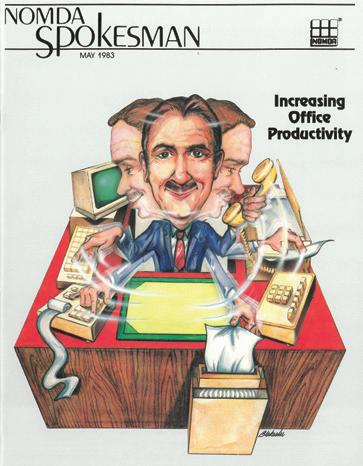
The association’s magazine cover 43 years ago this month — the NOMDA Spokesman, May 1983.
Vendor Finance
Enterprise Account Expertise
•Onboarding
•Devoted
•Deal structuring expertise
•Dedicated bid review resource
• Documentation
• Customized
•Specialized
Education at the Core of Your Association
E2025-2026 Board of Directors
President
Debra Dennis CopyPro Inc. Greenville, North Carolina ddennis@copypro.net
President-Elect
Mike Boyle
BASE Technologies Inc. Bethel, Connecticut mboyle@baseinc.com
Vice President
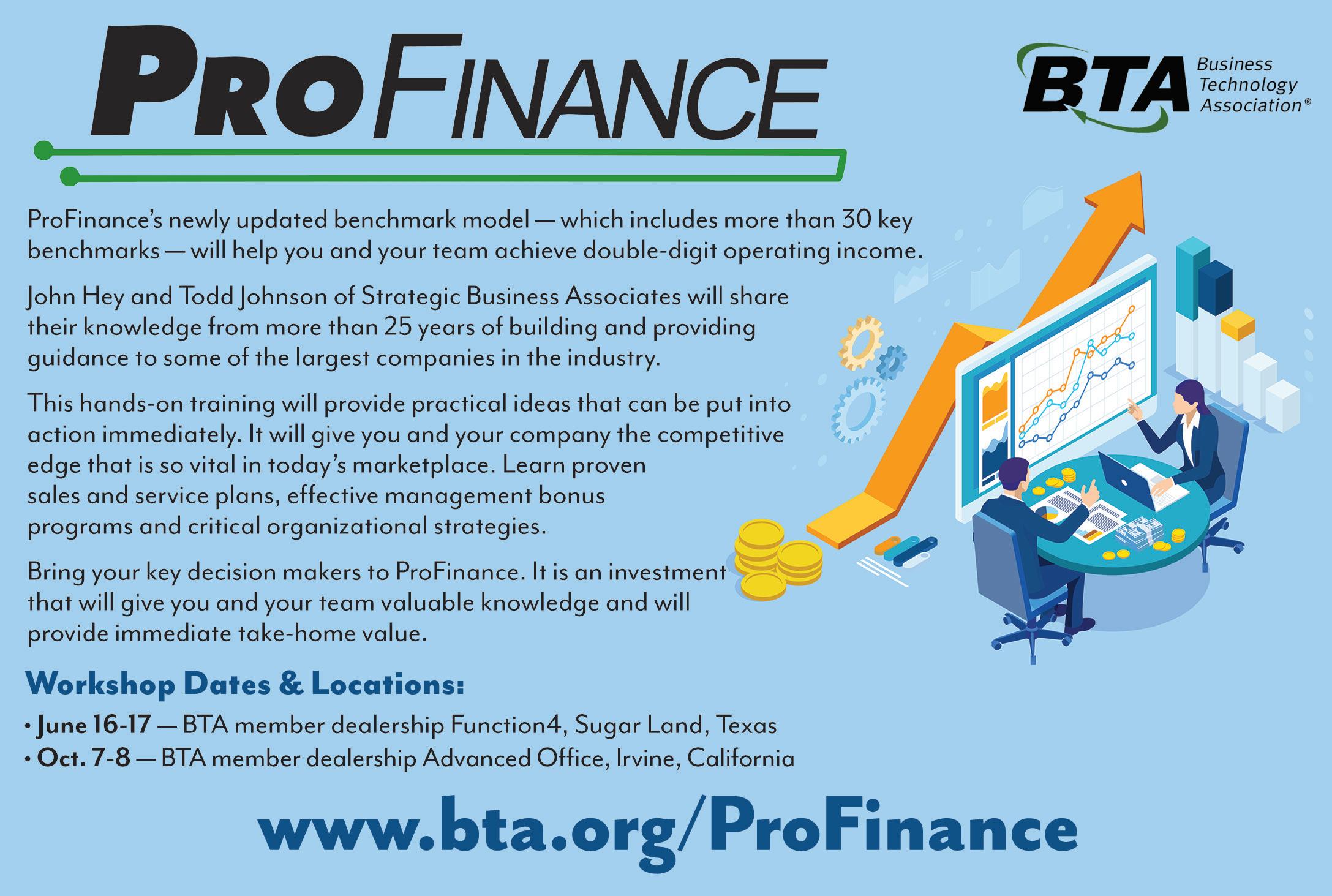
ducation has always been one of the foundational pillars of the Business Technology Association (BTA). The months ahead are filled with opportunities designed to provide both strategic insights and practical, actionable takeaways. Our ProFinance workshops will continue to deliver critical financial guidance, with sessions scheduled for June 16-17 at Function4 in Sugar Land, Texas, and Oct. 7-8 at Advanced Office in Irvine, California. ProFinance remains essential for dealers looking to strengthen their dealerships’ financial performance and long-term stability.
We also look forward to vCIO University, with upcoming sessions June 23-25, Sept. 22-24 and Dec. 8-10 in Tampa, Florida. This workshop is designed to help dealers expand their roles as strategic technology advisors — an area of increasing importance as client expectations continue to evolve.
Building on the success of the FIX: Cost Management for Service 3.0 workshop, instructor Jack Duncan has introduced a new follow-up program: e-automate Inventory Essentials, taking place July 14-16 via Microsoft Teams. This workshop addresses one of the most underutilized yet impactful tools within e-automate — the Inventory Logistics Console. For many dealerships, thousands of dollars remain tied up in excess or obsolete inventory. This course is designed to help dealers better manage inventory through proper item setup, effective use of e-agent tasks and ongoing optimization of minimum/maximum levels. Like the FIX course, it also includes a follow-up session tailored to each dealership.
In addition, we are excited to be developing Coaches Corner, a new initiative that
will provide customized training based on the highly successful sessions from our e-automate Elevate event. This program will be taught by Jack, as well as e-automate experts Dondra Bott, Jason Plott and Duane Walker, offering deeper, more personalized learning opportunities for our members via Teams.
We are also proud to announce a new partnership with GoWest.ai’s West McDonald to bring the BTA AI Readiness Assessment Workshop to the dealer community. This six-week program (held via Teams) is designed to help dealers move from uncertainty to action when it comes to artificial intelligence (AI). Participants will learn how to identify high-value AI opportunities, avoid costly missteps, measure ROI and build a practical road map for implementation. This training also equips dealers to guide their own customers through the AI journey — creating a new revenue stream and strengthening their positions as trusted advisors.
To complement the workshop, West will offer an informative AI webinar on June 18 that will include a preview of the program, its expected outcomes and why AI readiness is critical. As AI continues to reshape how businesses operate, dealers who can lead these conversations will be better positioned to remain relevant and competitive. Dates for the workshop will be announced soon.
At BTA, our goal is simple: to provide education that delivers real value. Whether it is financial management, service optimization, marketing, leadership development or emerging technologies like AI, we are committed to equipping our members with the tools they need to succeed.
I encourage you to take full advantage of these opportunities and stay informed about upcoming workshops by visiting www.bta.org/Education. Together, we will continue to learn, grow and lead. n
— Debra Dennis
Mike Hicks Electronic Business Machines Inc. Lexington, Kentucky mhicks@ebmky.com
Tim Seeley Jr. Seeley Office Systems Inc. Glens Falls, New York tseeleyjr@seeleyoffice.com
BTA Mid-America
Brett Blake Corporate Business Systems LLC Madison, Wisconsin bblake@corpbussystems.com
Grant Goldsmith
Regal Business Machines/Gateway Business Systems Chicago, Illinois goldsmithg@gateway-biz.com
BTA Southeast
Blake Renegar
Kelly Office Solutions Winston-Salem, North Carolina tbrenegar@kellyofficesolutions.com
Richie Creech CopyPro Inc. Greenville, North Carolina rcreech@copypro.net
BTA West
Scott Reynolds Imagine Technology Group LLC Chandler, Arizona sreynolds@itgarizona.com
Richard Van Dyke Advanced Office Irvine, California rvandyke@goadvanced.com
Ex-Officio/General Counsel
Greg Goldberg
Barta | Goldberg West Hollywood, California ggoldberg@bartagoldberg.com
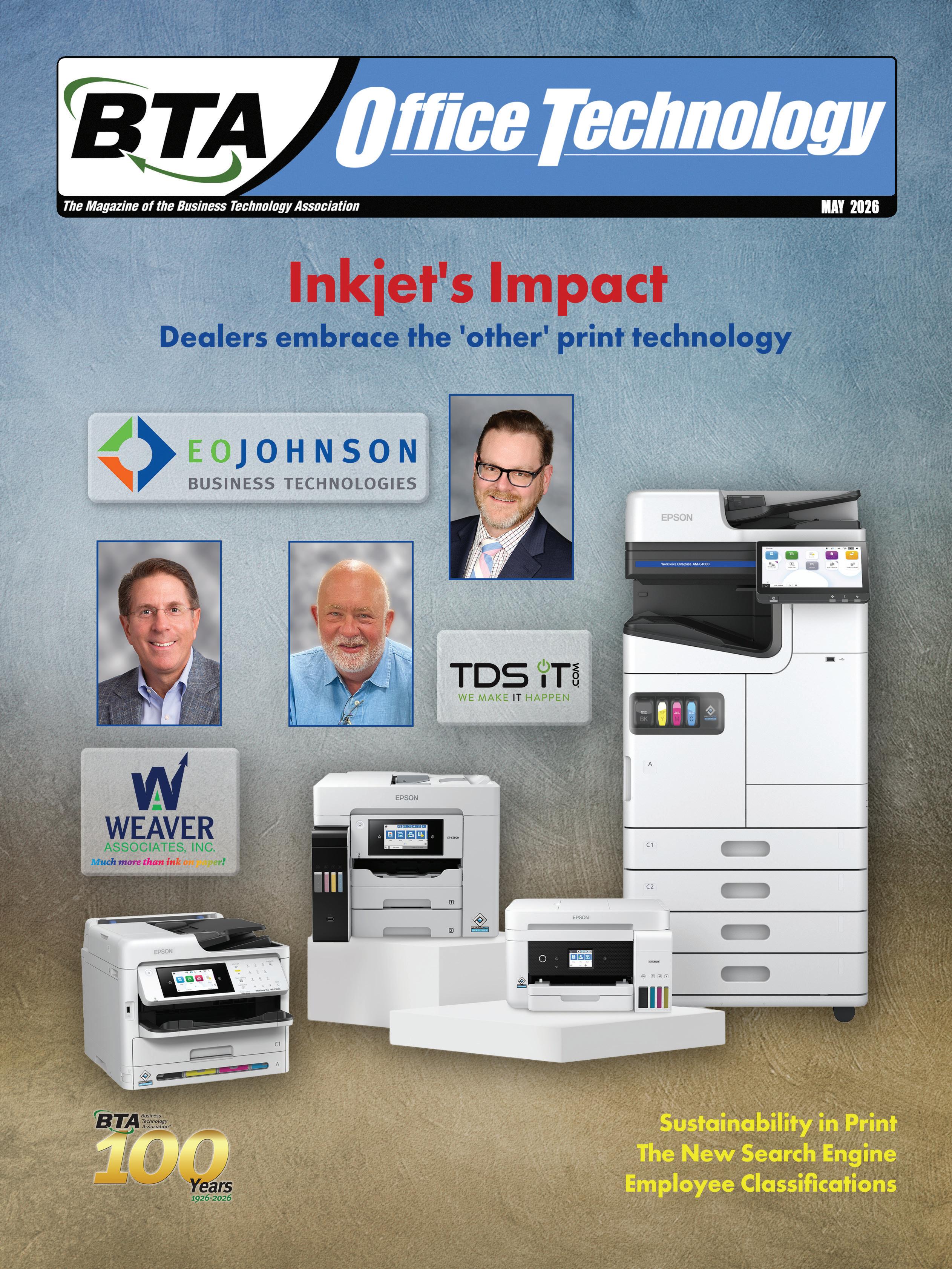
Inkjet’s Impact
Dealers embrace the ‘other’ print technology
by: Brent Hoskins, Office Technology Magazine
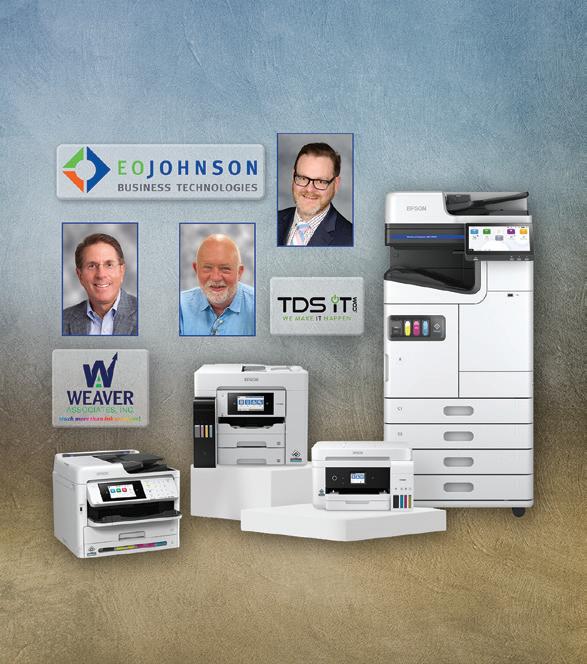
Are you seeking to expand your imaging product line? If so, it may be time to take another look at inkjet printing. The “other” printing technology likely presents a bigger opportunity than you think. Energy efficiency, reliability and, often, a competitive advantage, are the hallmarks of the product category. If you have been giving inkjet printing some thought, perhaps the insight shared in the three dealership profiles below will assist you.
EO Johnson Business Technologies
EO Johnson Business Technologies, based in Wausau, Wisconsin, one of three locations in the state, with additional locations in Michigan, Minnesota and Iowa, has been selling RISO products for 30-plus years. Initially, the focus was on duplicators. “We had a good number of machines in the field on the duplicator side for a long, long time,” says Jeff Reuter, director of production print. “We were selling them like hotcakes ... So, when they came out with their first inkjet printer, we were one of the first to get on board.”
Today, RISO inkjet printers are a key part of the production print lineup at EO Johnson, which also includes Ricoh toner and inkjet products [Ricoh handles the service for the inkjet products; EO Johnson earns revenue from ink sales], and Canon toner and, soon, inkjet [effective later this year with the availability to select dealerships of the inkjet varioPRINT ix1700] products. “We do between $8 million and $10 million a year” in toner and inkjet production print hardware, Reuter says. “When you add in service revenue, that brings the numbers up to $20 million to $25 million a year.”
Between 75% and 85% of EO Johnson’s production print business comes from toner models, Reuter estimates. “But that’s starting to shift, because inkjet products have grown in capabilities in the last five years with new products coming out,” he says. “We have replaced some toner devices
with inkjet. That shift is taking place now. They’ve said for the last 15 years ‘inkjet is coming.’ We are at the inflection point now where it’s here.”
Reuter shares the example of the transition from toner to inkjet at a mortgage company that was using six monochrome Xerox production printers [capable of printing one spot color] to print mortgage origination packets with a yellow highlight where the documents were to be signed; the models were being discontinued. “RISO inkjet production printers were the best [replacement] option for them,” he says. “When we told them about the RISOs, they liked that they would keep their cost per page low. It also gave them a much more compact footprint than the giant Xerox machines. And since the [lowheat producing] RISOs only require 120-volt power, they didn’t need any special power.”
Beyond their low heat, low cost per page and smaller footprint, Reuter emphasizes other benefits provided by RISO inkjet printers. “There are not a lot of components; it’s a very simple machine,” he says. “The paper path is basically straight through. So, if you get a jam, it’s not difficult to clear ... In addition, if there is enough volume on the machine, the ROI is going to be good ... The customer gets a very highspeed printer at a decent price.”
Reuter cites a few key verticals that are good targets for RISO inkjet printers. “Education is a good one because of the low cost of operation and they work great, with very little down time,” he says. “If you’re printing a workbook for students and it will be thrown away at the end the semester, it doesn’t have to be a museum-quality piece.”
In addition, RISO inkjet printers are a good fit for both the banking and insurance industries, which print high volumes of statements, Reuter says. He cites the example of a bank using Ricoh inkjet roll-fed printers, noting that on occasion there are errors where a reprint is necessary. They
don’t like to “fire up those giant roll-fed printers to print five sheets,” he says. “So, we put some sheet-fed RISO printers alongside the Ricoh roll-fed printers to do the reprints; we are able to color match the output.”
Whatever the vertical pursued with inkjet production printers, Reuter says it is very important to be prepared. “You need to understand those verticals and where the inkjet product fits,” he says. “If you don’t take the time to build that knowledge, you will never sell one.”
TDSiT
“We have replaced some toner devices with inkjet. That shift is taking place now. They’ve said for the last 15 years ‘inkjet is coming.’ We are at the inflection point now where it’s here.”
— Jeff Reuter
EO Johnson Business Technologies
Now in its 30th year, TDSiT, based in Lowell, Arkansas, with a second location in North Little Rock, Arkansas, offers both Epson and RISO inkjet printers, as well as Xerox imaging equipment. “I’m enjoying everything Xerox has to offer, but we do sometimes find ourselves saying to them things like, ‘You know, we went with some Epson A3s into this account,’” says Tim Stanley, owner and founder of the dealership, noting that offering only one imaging line is not a good idea. “For any dealer, having an alternate, like inkjet, is just a smart business decision.”
One of the areas of guidance that Stanley has received from his industry peers is product diversification. “They would say, ‘Try Epson,’” he says. “So, we did, adding the brand to our lineup four years ago. We’ve had a lot of success ... Their desktops are solid printers; you can look a customer straight in the eye and honestly say, ‘These printers work well.’ Every now and then, a customer must have laser, and we can accommodate, but the Epson desktops are phenomenal. Lately, we’ve put a lot of A3 inkjets into law firms and schools ... I would advise other dealers, ‘Before you add another laser line, add inkjet to your offerings.’”
Epson has been helpful in optimizing TDSiT’s level of success with inkjet, Stanley says. “One of the things I enjoy about Epson is that it seems like they are always in our office,” he says. “They’re old school as far as their local teams on the ground. They were just at our leadership team meeting in Little Rock and went out of their way to let us know what’s going on with Epson.”
As is often pointed out, one of the key values of Epson printers is the low number of components, minimizing the need for repairs and boosting reliability. “For example, Epson offers a 100-page-per-minute machine that has only 13 components,” Stanley says. “Compare that to a 100-page-
per-minute Kodak I was involved with 38 years ago that had 3,000 parts; they literally called their technicians ‘field engineers’ because you had to be an engineer to work on it.”
The lower number of components “means fewer components on the shelf [at the customer location],” Stanley says. “With laser, you’ve got customer replaceable modules, including drums, toner and waste toner containers, etc. If you have a fleet of laser devices, you must have a storage cabinet for all the components. Epson printers don’t require that much space. So, that’s a conversation to have with prospective customers.”
Another often-touted benefit of Epson printers is the lack of heat. Stanley notes the practice of many workers placing small laser printers under their desks. “That is terrible for reliability,” he says. “You can put an inkjet anywhere you want and it will just keep printing. Plus, it’s quiet.”
While Stanley emphasizes the reliability of Epson products due, in part, to the lack of heat — and, so, low energy consumption — it is not a primary selling point in his market from a sustainability perspective. “That pitch adds fire to why a prospect wants to go with us, but I don’t know that it has ever been the primary reason at TDSiT for an Epson printer placement.”
As noted, TDSiT also offers RISO inkjet printers, but only for less than a year and, so, is working toward finding its stride with the product line. “I added RISO because it can do different applications in a print-shop production environment that a laser or an Epson cannot,” Stanley says. “[They are great for] statement printing and can handle NCR [forms/paper] at a really high speed, and they handle envelopes.”
Everyone in sales at TDSiT can sell inkjet printers — including the owner. “About a year ago, Epson unveiled an A4 at 55 pages per minute,” Stanley says. “I’m preparing to submit a quote at a meeting at a school tomorrow for three of those A4s.”
Weaver Associates Inc.
Just before the COVID-19 pandemic, Weaver Associates Inc., based in Lancaster, Pennsylvania, with two other locations in the state, began selling Epson inkjet printers. “Today, I would say 95% of my sales are Epson,” says Ron Weaver, president of the dealership, noting that while toner-only competitors are quick to characterize inkjet as “no good,” he can quickly prove them wrong by way of first providing
customers the use of a trial inkjet printer. “‘Here’s a machine; take it and use it for two weeks.’ Our success rate is about 99%.”
Yes, about 99% of the trial Epson printers lead to sales at Weaver Associates, representing 95% of the dealership’s imaging placements overall; the dealership also offers Brother, HP and Lexmark products. The inkjet printing industry may not have a greater fan than Weaver. “You can’t imagine how successful we are; we can take out a laser printer in minutes,” he says. “I have more than 3,500 units in the marketplace and I don’t even have two service calls a week on the Epson product.”
“The Epson desktops are phenomenal. Lately, we’ve put a lot of A3 inkjets into law firms and schools ... I would advise other dealers, ‘Before you add another laser line, add inkjet to your offerings.’”
— Tim Stanley TDSiT
printers have no fusers and drum units — an advantage, but not what he sees as the number-one advantage. “The number-one advantage of inkjet over laser is there is [essentially] no waiting for the first page to print. So, when you put my printer behind the counter of an auto dealership or the front desk at a hotel [as examples], that first page comes out in three to four seconds.”
Product reliability is only part of the value proposition, Weaver says. “We have 21 fewer parts than in a traditional laser printer,” he says, citing, as examples, that Epson inkjet
There is also the appeal of the inkjet’s environmental sustainability, given that Epson printers do not generate heat, Weaver says. “The entire sustainability package, including power consumption, is important,” he says, noting that “laser printers are at 400 to 425 degrees” when printing a page. “We have situations [with high print volumes] where we have been able to show savings of $300 to $400 a month [in energy costs].”
“We say to customers, ‘The good news is you’re not going to know our service people by name.’ We have customers that have had machines for two years that have never had a service call.“
— Ron Weaver Weaver Associates Inc.
From a profitability perspective, Weaver emphasizes the minimal number of service calls required for inkjet. “The first copy speed is important for customers, but for us what is really important is the lack of service calls,” he says. “We say to customers, ‘The good news is you’re not going to know our service people by name.’ We have customers that have had machines for two years that have never had a service call.”
Weaver says his experience with inkjet is enhanced by the level of support he receives from Epson. “They’re the best company I have ever done business with,” he says. “From [Epson] sales, service, customer service and service training all the way up to management, they have done nothing but provided us great information ... They’ve given us tools to be successful through training and support — and [when you call Epson] you always speak to a human being.”
Acknowledging that inkjet printers do not offer graphics color, Weaver says the shortcoming is seldom an issue. “If you want graphics color, we don’t talk to you about Epson,” he says. “However, I would say 90% of our deals do not need graphics color. A funny story; we have an automobile dealership where we installed around 50 Epson printers. The service manager was not happy, saying the ‘red is not red enough.’ The owner got wind of this and walked over to the printer. He asked, ‘Is that red?’ The service manager answered ‘yes,’ but said she wanted it to be brighter. The owner said, ‘For what I am saving, the red is perfect.’”
Weaver encourages other dealers to take a look at inkjet, if they have not already done so. “There are very few service calls and oh, by the way, it’s cheaper to operate than laser,” he says. “If you want to make money and have a problem-free environment, this is it.” n
Brent Hoskins, executive director of the Business Technology Association, is editor of Office Technology magazine. He can be reached at (816) 303-4040 or brent@bta.org.
Sustainability in Print A broader ink-tank conversation for the industry
by: Kris Alvarez, Keypoint Intelligence
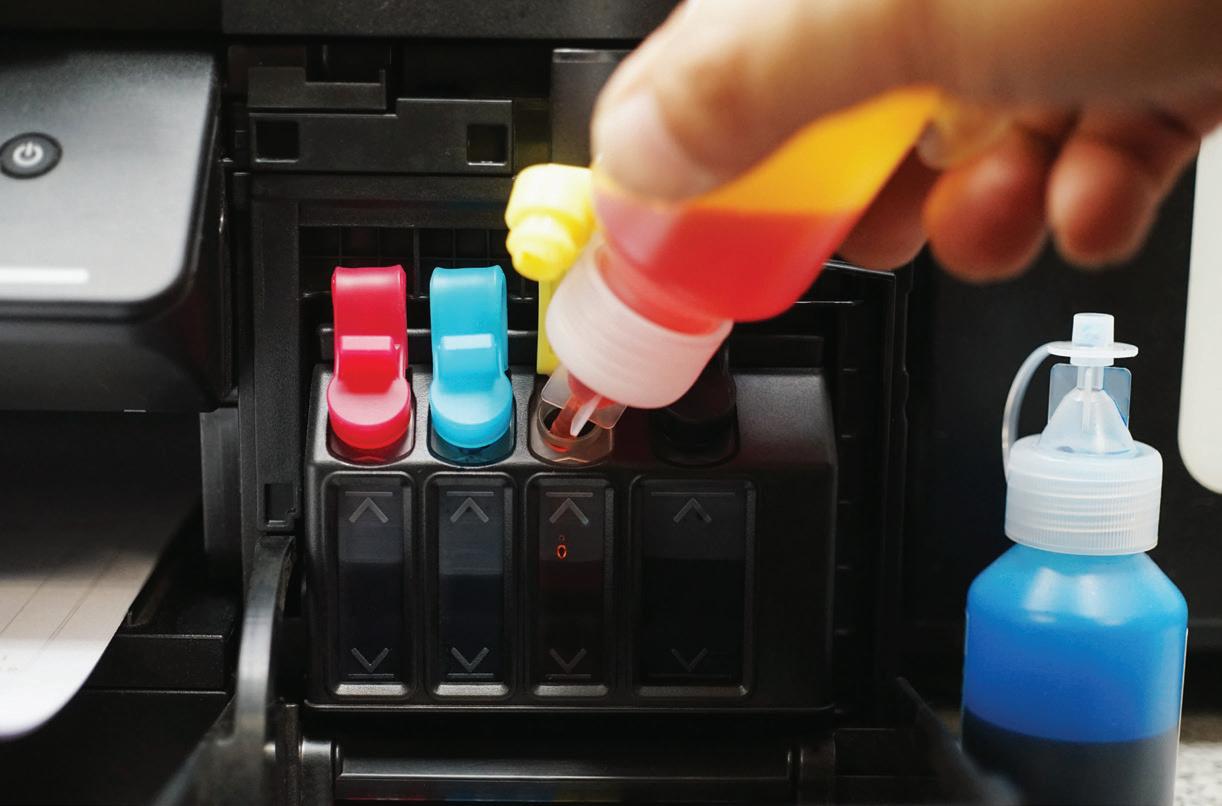
Sustainability in print is still often explained through the most visible forms of waste: spent cartridges, excess packaging and the service friction that comes with frequent consumable changes. That framing has helped refillable ink-tank systems build credibility across the U.S. market, and recent industry research suggests the category is beginning to enter a state of maturity. As ink-tank printing gains ground across home office, SMB and distributed work environments, energy use is becoming a more meaningful part of the sustainability conversation for manufacturers, dealers, resellers and managed service providers.
High-capacity ink-tank printers accounted for roughly 45% of global office and home inkjet shipments as of 2024, a number that could reach an estimated 49% by the end of 2026. Refillable ink-tank systems are expected to continue gaining share even as the broader printer market remains under pressure, suggesting the shift is becoming less about recovering page volume and more about changing device mix and buyer priorities.
Two Sides: Perception & Evaluation
be the headline claim in the U.S. market, it surely matters when buyers compare alternatives more formally.
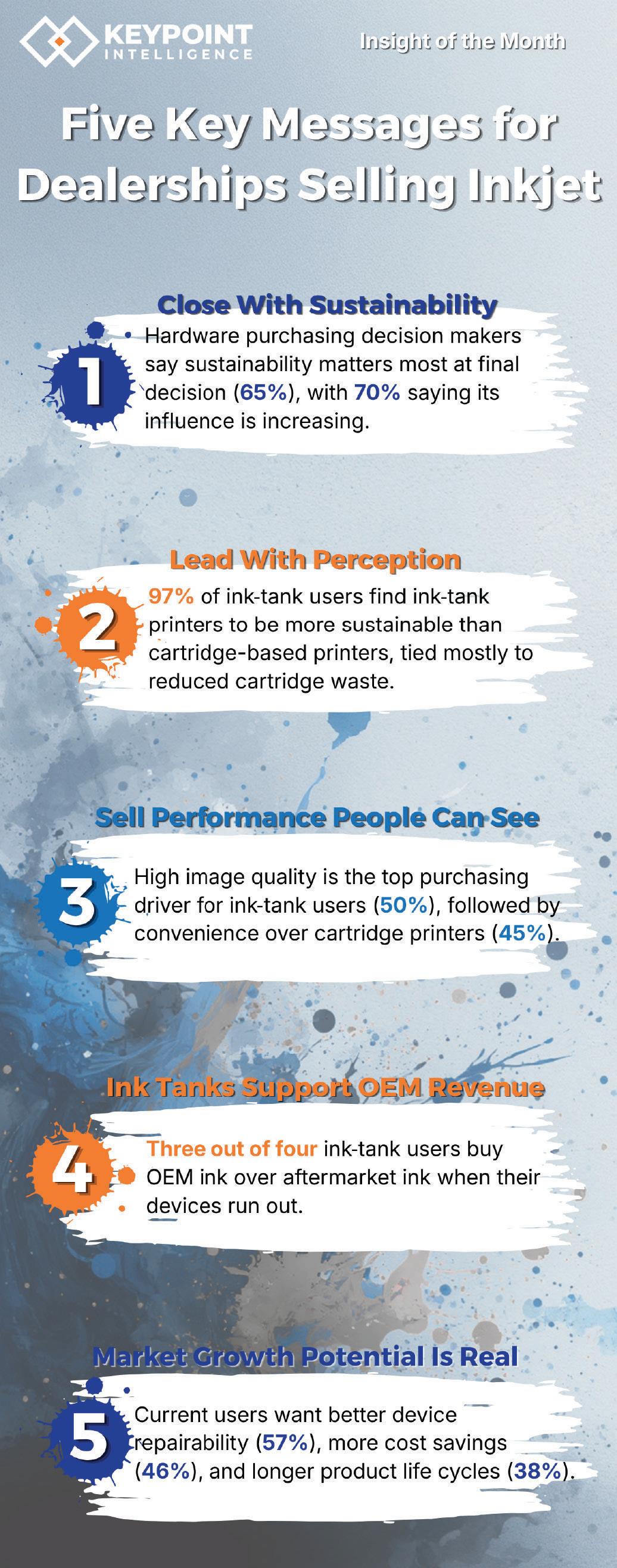
Keypoint Intelligence’s primary research among organizations already using ink-tank printers helps explain why. Sustainability credibility is already well established: Not surprisingly, 97% of respondents said ink-tank printers are more sustainable than cartridge-based devices. Yet the benefits buyers most readily associate with ink-tank systems are reduced plastic waste from cartridges and less packaging waste. Lower energy consumption is part of the conversation, but it is not the first attribute most users mention.
At the same time, when respondents were asked to rank sustainability characteristics during evaluation, lower energy consumption emerged as the second leading factor, behind reduced plastic waste. That gap between perception and procurement is important, in that while energy may not
For the dealer channel, that distinction has practical consequences. Ink-tank systems are often positioned using two familiar arguments: lower TCO and less consumables waste. Both remain valid, though there are indications in the market that ink-tank printers are increasingly competing with low-end laser devices by offering cost-per-page (CPP) parity and better energy efficiency, a distinction that is particularly relevant in hybrid and distributed print environments where operating cost is evaluated more holistically. In that context, energy use becomes a greater part of the business case.
Image quality ranked as the top purchase driver for inktank users surveyed, followed by convenience relative to cartridge printers and ease of replacing empty supplies. Preference for higher page yields ranked lowest. What is more, satisfaction among current ink-tank users was also exceptionally high (98%), illustrating how the high-capacity ink-tank system has moved beyond its original role as a “print-more-for-less” proposition. Buyers are increasingly evaluating these systems as mainstream print infrastructure,
where usability, reliability and total operating efficiency matter as much as (or even more than) page yield itself.
Energy Efficiency Is Bigger Than Rated Power
Those
who continue positioning the ink-tank printer as a primarily supplies-saving device may undersell its broader value as long-term print infrastructure.
That broader “efficiency” lens is where energy consumption deserves a little more attention. In practice, sustainability is not determined only by rated power consumption, but also by cleaning cycle design, frequency of maintenance, device downtime, ink waste and whether eco/ink saving modes remain usable for business output. Thankfully, there is a bit more visibility into these considerations thanks to hands-on lab testing.
In both consumer- and office-class testing, one tank platform showed fewer nozzle blockages, more efficient cleaning routines and much less degradation in eco mode than its competitor. In the office-class evaluation, one device preserved business-ready output and OCR accuracy in eco mode, while the other lost enough quality to make economy printing less viable for professional use.
While testing revealed differences between different machines by different OEMs, the key takeaway is not that inktank printers perform differently from one another, but that claims around sustainability, especially in the expanding ink-tank space, become more credible when supported by real-world scenarios that effectively illustrate reliability and resource efficiency.
Next Differentiators: Life Cycle & Serviceability
There are clear implications for OEMs and the greater dealer community here. Future differentiation in ink-tank printing will depend less on headline yield claims and more on reliability under real workloads, intelligent maintenance design, eco-mode usability and regulatory readiness.
It is also consistent with a regulatory backdrop in which ENERGY STAR remains a de facto requirement in many public-sector tenders, while packaging and producer responsibility rules continue to influence procurement expectations. This direction aligns with what U.S. ink-tank printer users are saying. When asked what would make ink-tank printers more appealing, respondents put ease of repairability first, followed by cost savings, longer product life cycle and lower energy consumption during use. Larger organizations showed the strongest likelihood of expanding ink-tank deployments over the next two to three years.
So, it stands to reason that the next phase of growth will be won less through consumables rhetoric alone and more through life-cycle value, serviceability and measurable operating performance.
Speaking specifically about consumables rhetoric, ink-tank models do not eliminate the supplies strategy entirely as much as they change the logic of it. Even in a refillable model, the OEM supply ecosystem remains resilient: Among surveyed U.S. ink-tank users, 74% said they purchase new OEM ink supplies rather than aftermarket alternatives. This means that the installed base becomes even more valuable when a device in use is durable, easy to support and trusted to deliver consistent output over time.
Ink Tank & Sustainability: What Is Next?
In summation, one of the clearest takeaways given recent survey and test data is that ink-tank printing has already established itself as a more sustainable alternative to cartridge-based inkjets in principle. The more important consideration for dealers is how that sustainability story evolves. Reduced plastic waste will remain the most visible proof point, yet energy use is becoming a more relevant part of the evaluation process, particularly when tied to repairability, maintenance efficiency, device longevity and competition with low-end laser.
For dealers and OEMs alike, a clear opportunity presents itself: Those who continue positioning the ink-tank printer as a primarily supplies-saving device may undersell its broader value as long-term print infrastructure. The next phase of market growth is sure to favor providers that frame ink-tank systems more holistically. To achieve this, devices will have to offer not only lower consumables intervention, but stronger life-cycle efficiency, serviceability and operational value across SMB, home office, education and distributed work environments, too. The OEMs (and dealers, for that matter) that communicate the full picture will be better positioned to present ink-tank printing as a more credible, long-term print architecture for SMBs, home office, education and distributed office environments alongside their positioning as simply a lower-intervention consumables model. n
Kris Alvarez is a senior analyst for the workplace team at Keypoint Intelligence. He specializes in the print supplies and consumables market, which includes ink and toner cartridges, as well as pulp and paper trends, with a particular focus in the ink-tank printer space. Alvarez provides research and analysis that helps vendors and partners understand shifts in demand, production and overall market dynamics. He can be reached at kris.alvarez@keypointintelligence.com. Visit www.keypointintelligence.com.
BTA IGNITE Orlando & Elevate
BTA hosts events March 19-21 in Orlando, Florida
by: Elizabeth Marvel, Office Technology Magazine
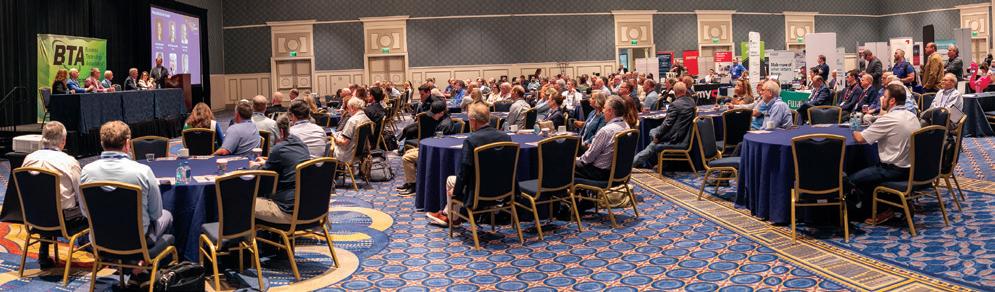
The Business Technology Association’s (BTA’s) IGNITE Orlando event was held March 20-21 at Disney’s Yacht Club Resort in Orlando, Florida. In conjunction, BTA hosted e-automate Elevate: A BTA Dealers Helping Dealers Best Practices Event on March 19.
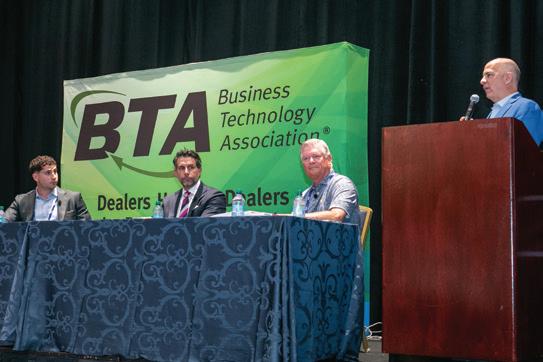
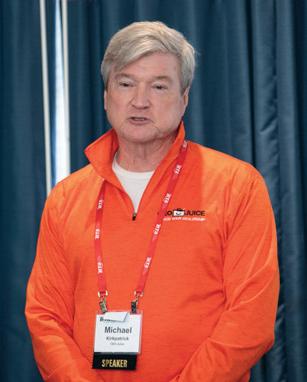
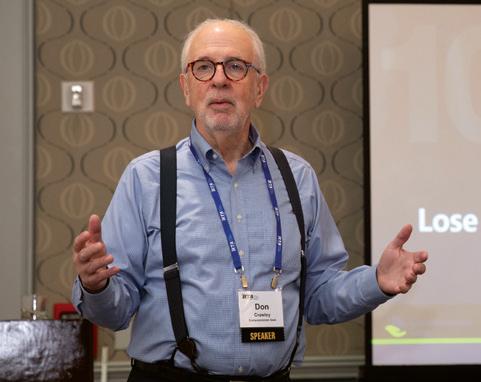
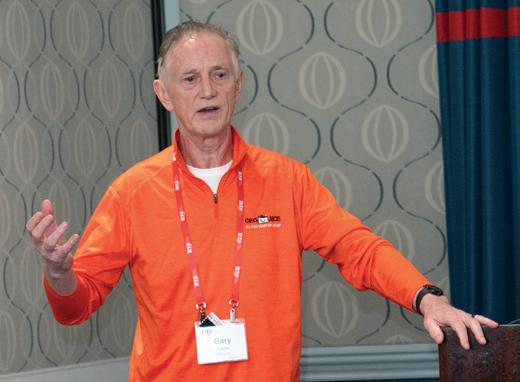
The IGNITE event included four main-stage sessions: a manufacturer panel, “CEO Insights: Marketplace Changes, Tariffs, Tough Choices & the Future of the Office Technology Industry,” moderated by BTA Ambassador Bob Goldberg; a dealer panel, “Practical Uses for AI in Your Dealership,” moderated by Laura Blackmer, Konica Minolta Business Solutions U.S.A. Inc.; a second dealer panel, “How Is Your Culture?” moderated by Mike Marusic, Sharp Imaging and Information Company of America; and the keynote address, “How Leadership Affects Customer Service & How Customer Service Affects Your Bottom Line,” presented by Don Crawley, Compassionate Geek. The breakout sessions included: “Sales vs. Service: The Heavyweight Showdown,” with Sarah Henderson, Pacific Office Automation; “The Practical Use of Power BI to Monitor Key KPIs,” with Jack Duncan, Jack Duncan Consulting, and Mike Kirkpatrick and Gary Lavin, CEO Juice; and “How to Be a Better Listener,” with Crawley.
BTA’s next event, BTA IGNITE Kansas City (including BTA at 100: A Celebration), will be held Sept. 1-3 in Kansas City, Missouri. For more information, see the ad on pages two and three, and visit www.bta.org/IGNITEKC to register. n
Elizabeth Marvel is associate editor of Office Technology magazine. She can be reached at elizabeth@bta.org or (816) 303-4060.
Southeast
an emcee on March 20; the BTA IGNITE Orlando event featured a keynote address, a manufacturer panel, two dealer panels, three breakout sessions, time to visit with peers and exhibiting sponsors, and a reception and dinner on the first evening.
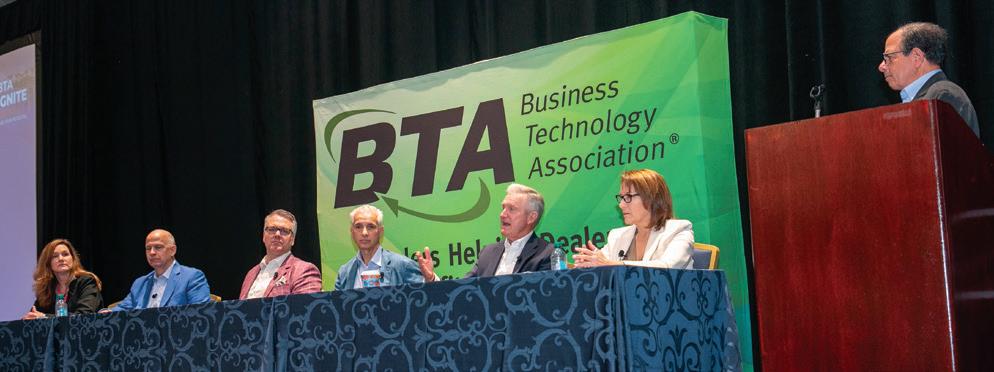
executive panelists
Mary Hart of HP Inc., Mike Marusic of Sharp Imaging and Information Company of America, Karl Boissonneault of Xerox Corp., Jim Coriddi of Ricoh USA Inc., Larry White of Toshiba America Business Solutions Inc. and Laura Blackmer of Konica Minolta Business Solutions U.S.A. Inc.
Clockwise from top left: Crawley presents the keynote address; 2025-26 BTA
President Richie Creech serves as
Above: Goldberg (far right) moderates the manufacturer panel with
(left to right):
C2C R ESOURCES
C2C Resources has helped more than 40,000 businesses collect more than $500 million in past-due balances.
Executive Insights
The first day of BTA IGNITE Orlando kicked off with the manufacturer panel, where five OEM executives shared their insights on the current and future state of the industry. The panelists included Laura Blackmer, president of dealer sales, Konica Minolta Business Solutions U.S.A. Inc.; Karl Boissonneault, president of North America channels and partners, Xerox Corp.; Jim Coriddi, chief dealer officer, Ricoh USA Inc.; Mary Hart, head of the U.S. Commercial Print Channel, HP Inc.; Mike Marusic, president and CEO, Sharp Imaging and Information Company of America; and Larry White, president and CEO, Toshiba America Business Solutions Inc.
The first question put to the panel revolved around manufacturer consolidation. Most of the executives agreed consolidation is coming, but that it will likely take the form of behind-the-scenes partnerships. “I think what we will experience some in the next 18 to 24 months will be a bit quieter [than the Xerox/Lexmark acquisition] ... I think it’s a good assumption that there’s a lot of conversations happening,” Blackmer said. “It’ll be a little bit more back office, similar to the Ricoh/Toshiba [partnership], which ... was a very good thing for the dealers.”
Despite potential consolidation, the executives emphasized their commitment to the dealer channel. “Whether consolidation happens or doesn’t happen, I think one thing that dealers can count on is that the folks who are sitting up here at this table are committed to this channel and making sure that we are bringing the best products forward to help you be successful,” Hart said.
“What you’re hearing more than anything is that the dealer channel is going to be more and more important to the manufacturers as we go forward,” Coriddi said after being asked about dealer versus direct sales forces and territories. “When I look at Ricoh, in 2017 we did something relatively unprecedented and eliminated 1,700 direct salespeople and sold off the lion’s share of the MIF, plus opened up all of our dealers to really being our major play in SMB.”
“We’ve been publicly saying that 80% of our print business will be fulfilled through the channels,” Boissonneault said. “In the U.S. we also transferred four states from a [direct] service and sales coverage model to a dealer model ... we’re going to do the same thing in five other states ... Even though our enterprise reps might be engaging in accounts, the print fulfillment will move through our dealers as we go forward.”
All of the executives emphasized the importance of growth beyond print into IT services, software, A/V and other technologies, as well as artificial intelligence (AI). “For all of us, I think AI’s going to be the biggest driver,” Marusic said. “You see a gigantic investment in AI, which is able to drive software development. So a lot of our coding now is done with AI — coding drivers, security platforms and things like that. The biggest albatross we had in our business was our former LCD plants ... a couple of those now have been converted into AI data centers.”
“We’re investing a lot into AI in our business to support our customers,” White said. “One of the things that we’re doing is creating an AI agent that will be able to capture meter reads for non-cloud devices ... We’ll be producing that soon and spending money on our own DCA ... So our predictive analytics and our AI tools on that side are paying off tremendously, and our dealers can use those to have a really close idea of when a product’s going to break. In fact, our predict rate right now — and it’s learning more every day — is 80% within two weeks.” n — Elizabeth Marvel
Above left: Blackmer (far right) moderates the AI dealer panel with panelists (left to right) Chelsea Bode, CEO, Pearson-Kelly Technology, Springfield, Missouri; Lauren Hanna, president, Blue Technologies, Cleveland, Ohio; and Jenna Stramaglio, channel development manager, ConnectWise. Above right: Marusic (far right) moderates the culture dealer panel with panelists (left to right) Anthony Cucco, COO, Impact Networking, Lake Forest, Illinois; Anthony DelGrosso, vice president and general manager, Milner Inc., Peachtree Corners, Georgia; and John Lowery, CEO, Applied Innovation, Grand Rapids, Michigan.
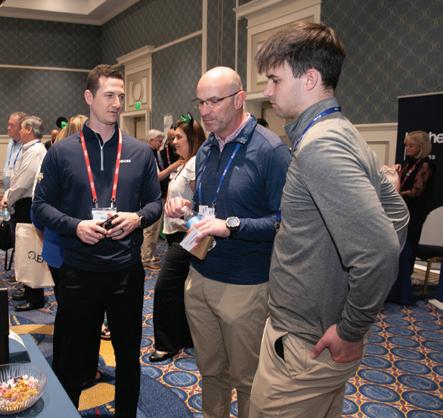
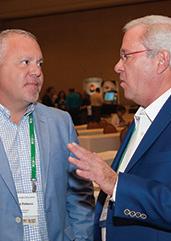
Above left: Kaylie Williams (left) of Kyle Office Products, College Station, Texas, visits with Jennifer Muller of ecoprintQ during a break between sessions. Above right (left to right): Nick Augeri of Toshiba visits with Erik Skadberg and Michael Skadberg of CPI Business Solutions, Lafayette, Indiana, during a break.
Above: The breakout session presenters were (clockwise from top left) Henderson, Duncan, Kirkpatrick, Lavin and Crawley.
The New Search Engine
What you need to do to stay discoverable by AI
by: Jenna Miller, Emerald Strategic Marketing
For years, search was simple: buyers typed keywords into Google, skimmed a list of links and clicked through websites. That era is ending. According to SearchEngineLand. com, 37% of buyers now start searching with artificial intelligence (AI) instead of Google, which means tools like ChatGPT and Microsoft Copilot are becoming go-tos for buyers who want quick answers.
This shift is more than a trend. It is a visibility shift. If AI engines do not understand your business, they will not recommend you. And if they do not recommend you, your competitors will gladly take that spot.
So, what can you do about it? In this article, I will break down what is changing and then discuss what you need to do to stay discoverable.
The Shift From Links to Answers
Buyers are not searching the old way anymore. They are asking AI questions like:
n “What’s the best managed print provider near me?”
n “How do I reduce downtime in my office?”
n “Who can help me modernize my document workflow?”
AI engines do not show 10 blue links like traditional search engines. They respond with single, synthesized answers, which is why buyers prefer them. They choose the most clear, trustworthy source and present it as the recommendation. This is great for the user, but not always great for businesses.
This means your visibility now depends on how well AI can interpret your digital presence, not how well you rank on Google alone. If your content is vague, outdated or unclear, AI engines simply skip you.
Why Your Digital Presence Matters
AI engines do not “guess” what your business does. They pull from what they can understand, trust and verify. If your website, Google Business Profile and online content (this includes social media) do not clearly communicate who you are and why you are credible, AI will not push your content and brand. For office technology dealerships, where services often sound similar across competitor companies, clarity becomes a differentiator. If your competitor explains its services more clearly, AI will choose it over your company — not because it is better, but because its website is easier to understand.
The New Rules of Being Discoverable
Rule No. 1: Be clear about who you are and what you do. AI engines do not respond well to jargon or fluffy marketing language. They need simple, direct explanations of what services your company offers, who it serves and where it operates.
If your homepage says your company “empowers digital transformation through innovative solutions,” AI has no idea what that means. But if it says you “provide managed print, office technology and workflow automation for businesses in [City],” AI can use that.
Rule No. 2: Answer real questions your buyers ask. AI prioritizes content that mirrors natural, conversational questions. That means your website should include short, helpful explanations, FAQ sections and “How it works” breakdowns. Think about the questions your sales team members hear every week. Those should be written on your website in plain language.
Rule No. 3: Strengthen your trust signals. AI engines look for proof that you are legitimate and credible. They scan for case studies, testimonials, industry experience, consistent business information and a clear, authoritative “About Us” page. If your “About Us” page is two sentences long and your case studies are outdated — or worse, nonexistent — it will assume you are not a strong recommendation.
Rule No. 4: Organize your content so AI can follow it. AI reads structure. It understands headings, short paragraphs, clear sections and focused pages. If your website is cluttered, confusing or trying to cover too many topics on one page, it cannot extract real meaning and you lose visibility.
Your Website Is Your Home Base
Even in an AI-first world, your website remains the source of truth. AI checks it for clarity, credibility and accuracy. A modern, fast, mobile-friendly site signals professionalism and reliability. For office technology companies, this is especially important. Buyers are evaluating you for reliability, uptime and support. A slow or outdated website sends the wrong message. Your service pages should be accurate, up-to-date and easy to understand.
Your Google Business Profile Still Matters
AI engines use your company’s Google Business Profile to confirm your legitimacy. They look at your reviews, photos, updated business information, service areas and categories.
For businesses, this profile is often the deciding factor in whether Google recommends you for “near me” searches.
Content That AI Loves
AI engines reward content that is helpful, valuable, human-sounding, clear and practical. They prefer real examples, stories, definitions and step-by-step explanations. They do not reward keyword stuffing or vague marketing copy. If your content solves a real problem, AI will surface it. If it sounds like it was written for a brochure, it is more likely to ignore it.
Next Steps
In the age of AI-powered discovery, being “findable” is not about gaming algorithms — it is about being clear, credible and easy to understand.
Here is where CEOs and business leaders should focus:
n Audit your company’s website for clarity, accuracy and outdated content.
n Add FAQ sections to your core service pages.
n Refresh your Google Business Profile with new photos, reviews and updated details.
n Create “pillar pages” that clearly explain your core services.
n Strengthen your brand story so AI engines understand your expertise.
The Bottom Line
Companies that adapt now will be the ones AI recommends. In the age of AI-powered discovery, being “findable” is not about gaming algorithms — it is about being clear, credible and easy to understand. The businesses that embrace this shift will win more visibility, more trust and more opportunities. The ones that do not will quietly disappear from the answers buyers see. n Jenna Miller is the CEO of Emerald Strategic Marketing, a digital marketing agency in Tampa Bay, Florida, that delivers custom solutions like SEO, social media management and other marketing services. She can be reached at info@emeraldstrategicmarketing.com. Visit www.emeraldstrategicmarketing.com.
‘A Connective Thread‘
BTA members share a century of connection & success
As the Business Technology Association (BTA) celebrates its 100th year, it is gathering testimonials that reflect on the people, businesses and experiences that have shaped BTA across the decades. Office Technology asked BTA members to share what the association has meant to them and their businesses — favorite memories, experiences when BTA made a difference for them, the value of membership, their perspective on BTA’s role in the industry, words of congratulations, etc. Below are additional responses received. More responses will be published in this feature throughout 2026. If you would like to share your BTA story, email it to Brent Hoskins at brent@bta.org.
“It has been about 15 years since I started attending BTA events. For me, it has always been about the knowledge I gain from the speakers and the chance to meet with vendors up close. Over the years, those conversations have been just as valuable as the presentations themselves.
“BTA has given me the opportunity to adapt, expand my knowledge, and learn from others in the industry who are facing many of the same changes and challenges. Every event brings new ideas, new perspectives and, often, a reminder that the technology business never stays the same for long.
“BTA is THE technology group and technology never stands still. Neither does BTA.”
Art Post, founder
Print4Pay Hotel, Highlands, New Jersey
“[My company] being a BTA member and, specifically, a PRO Dealer Group member, has allowed me to grow and develop my business with the peer knowledge and expertise I need to ensure success.”
Tim Stanley, CEO/owner/problem solver
TDSiT, Lowell, Arkansas
“NOMDA [National Office Machine Dealers Association]/ BTA has literally been a major part of my entire professional and personal life, playing a significant role in shaping my life. After a while it is difficult to distinguish between what is personal or professional. Imagine the incredible impact BTA has had throughout its history and consider what has happened
in the world during its 100 years, as well as the history of America from every perspective during this window in time. Yet, here we are, still standing and driving business forward with great enthusiasm — from pencils, paper, typewriters and a cornucopia of technologies, all the way to artificial intelligence (AI) and so much more to come! This 100-year-birthday celebration is sure to be one of excitement for the future and respect for the past.
“Thinking back on my career, BTA supported me with a great education, provided incredible mentorship opportunities and set a standard of excellence that shaped my life. I think about the people who guided me, lifted me and helped me through the challenges of my life. There have been so many incredible individuals who made BTA what it is today and still do. The list of volunteers is endless, but the one who led the charge with dignity, grace and intelligence is none other than [Former BTA General Counsel] Robert Goldberg. To this day, he is the guy I never want to disappoint! Of course, the many past presidents must be recognized, as well as [BTA Executive Director] Brent Hoskins and [BTA Marketing Director] Valerie Briseno, who hold down the fort every single day.
“The one personal moment I remember and hold dear is when I shared the stage with the highly respected Murase-san as BTA honored us with our respective ‘Lifetime Achievement Awards.’ That is a moment I will cherish forever!”
Mike Stramaglio, president and CEO Stramaglio Consulting, Scottsdale, Arizona
“Accolades to BTA for a century of member-led support assisting members and vendors with leading-edge office technology and successful outcomes.
“I have such great memories of time well spent on BTA’s boards of directors, and working at the district and national levels as president.
“BTA has produced so many effective dealer and vendor relationships since 1926 — always for the mutual benefit of its members.
“Legal services were always the most important. Bob Goldberg and his team’s advice helped so many members navigate vendors, employees and even COVID-19 pandemic concerns
to proper resolutions. There have been many accomplishments, including the BEQI [Business Equipment Quota Index], BTA-approved contracts and positive personal connections. BTA peer groups are also a great way to share best practices to increase profits and revenues while navigating technology changes.
“I remember voting with [“Yes” and “No”] paddles at the NOMDA National Convention to approve the name change to BTA, selling the BTA property above the asking price with free rent throughout the duration of the note (Thank you, [Former BTA Executive Director] Bert Darling), taking BTA education to the members locally and providing future funding with the Russo Fund. Finally, I remember the excellent entertainment/ speakers at the national conventions, such as The Beach Boys, George H.W. Bush and Dean Martin.
“Considering the BTA community’s willingness to share and the ... dedication of the BTA staff, there ... wasn’t any question about reaching the century mark.”
learning from one another, strengthening the channel and helping shape the future of office technology.”
Dave
Mueller, chief strategy officer NATIONAL Business Technologies Albany, New York
“I attended my first BTA show in 2017 when I was new to (and a little intimidated by) the office technology industry. That experience quickly showed me I was in the right place. I met so many people who were welcoming, encouraging and willing to share their knowledge. It made me feel comfortable asking questions and learning more about the industry and the people who make it so impactful.
“BTA has performed successfully as a dealer-led educational and learning organization for 100 years. Thank you, Brent [Hoskins], members and vendors for steering BTA toward the next century.”
Dennis Hunter, 2002-2003 BTA president Lee’s Summit, Missouri
“Teaching ProFinance for the last 25 years has been the most rewarding part of my BTA experience. By sharing the principles of the Strategic Business Associates (SBA) Model, ProFinance has helped dealers learn how to drive profitable growth in their companies. My business partner Todd Johnson and I have been honored by the hundreds of stories from attendees who have made dramatic improvements in their businesses. For a quarter of a century, BTA’s ProFinance training has had a positive impact on its members and the imaging industry. Still going strong.”
John Hey, partner Strategic Business Associates, Minneapolis, Minnesota
“The Business Technology Association has served as a connective thread for our industry, bringing together peers, partners and ideas that help all of us operate better businesses and deliver greater value to our customers. BTA has been instrumental in fostering trusted relationships, encouraging collaboration over competition, and keeping members informed as technology and client expectations continue to evolve.
“At NATIONAL Business Technologies, those relationships and shared insights have played a meaningful role in our growth and long-term perspective. We are especially proud to be approaching our own 100-year milestone alongside BTA during this historic period, reinforcing the importance of continuity, adaptability and community in an ever-changing industry.
“Congratulations to BTA on this remarkable achievement. We look forward to continuing the journey together —
“This year, I started my own business, RockRoot, and one of the first things I did was reach out to become a BTA member. I am excited to continue growing within the BTA community and to give back in the same way others did for me when I was just getting started.”
Kristal Cook, founder RockRoot, Little Rock, Arkansas
“
‘How do I love thee? Let me count the ways’*
“BTA offers its members both professional growth and operational efficiencies:
n Access to industry-specific conferences, webinars and business-building workshops
n The ability to speak directly with peers who have already addressed the issues you face
n A wealth of forms, contracts and legal documents to immediately apply to your needs
n An immediate source of reputable local service for your distant, multilocation customers
n Discounts on business essentials like insurance, logistics, subscriptions and products
n Industry-specific skill-building and training certificates
n BTA’s Office Technology magazine, which is always a must-read
n BTA Legal Services
n The BTA Scholarship Program
n And a PARTY (sometimes, it seems)!
“Considering the BTA community’s willingness to share, and the professionalism and dedication of the BTA staff, there really wasn’t any question about reaching the century mark. Congratulations on celebrating 100 years young!
“*Apologies to Elizabeth Barrett Browning and her Sonnet 43.”
Robert Moore, president Lockwood Moore Inc., Reno, Nevada n Brent Hoskins, executive director of the Business Technology Association, is editor of Office Technology magazine. He can be reached at (816) 303-4040 or brent@bta.org.
DEALERS HELPING DEALERS
Supply Chain Disruption
How are dealers preparing for potential impacts?
Compiled by: Elizabeth Marvel, Office Technology Magazine
Following is a question submitted by a dealer member as part of BTA’s Dealers Helping Dealers resource and many of the answers received. These answers and others can be found in the members-only section of the BTA website. Visit www.bta.org/DealersHelping Dealers. You will need your username and password to access this member resource.
How are you preparing for the supply chain impacts expected in the next three to nine months?
“We are taking a proactive and diversified approach to prepare for potential supply chain disruptions over the next three to nine months. Key steps include:
n Increasing inventory on critical SKUs — We are prioritizing high-demand and high-margin products to avoid stockouts and protect revenue.
n Diversifying suppliers — We are reducing our reliance on single vendors and identifying secondary and backup sources where possible.
n Strengthening vendor communication — We are maintaining close, frequent contact with manufacturers and distributors to stay ahead of delays and allocation changes.
n Adjusting sales strategy — We are steering customers toward in-stock or more readily available alternatives when it is necessary.
n Reviewing pricing regularly — We are accounting for potential cost increases and protecting margins where it is appropriate.
n Improving forecasting — We are using historical data and current trends to better anticipate demand and plan purchases. Additionally, we are setting clear expectations with customers around lead times and availability to maintain trust and avoid surprises.”
Keith Anselmo, territory manager Appalachia Business Communications, Johnson City, Tennessee
“[It will be helpful to] have multiple lines and make sure you have a fleet of rentals and used equipment to support back orders.”
Alec Bean, president Gray & Creech Office Solutions, Greensboro, North Carolina
“[We are] being hyperaware of product availability, taking in more inventory in certain areas and staying in touch with our suppliers.”
Gary Foote, president HBM, Reno, Nevada
“[We are] talking to our vendors to make sure they are prepared and stocking more inventory.”
Chip Miceli, CEO
Pulse Technology, Schaumburg, Illinois
“We just have to rely on our suppliers. We cannot justify huge on-site inventories. We are using Predictive InSight to help control supplies. We have engaged Jack Duncan to look at all parts and service.”
Tim Stanley, owner TDSiT, Lowell, Arkansas
“We upped our annual increase to cover the price increases from last year. [I am] thinking we are going to hold for now. We are automating payables and using NEXERA to try and automate service a little.”
Nick Lioce, president The Lioce Group, Huntsville, Alabama
“[We are] buying extra inventory to help with the delays.”
Dan Detrick, vice president CopyLady Inc., Fort Myers, Florida
“We are going with the flow. We are notifying our customers of the disruption and are planning to acquire new customers in the managed IT space as a problem solver to assist them with mitigating the impact.”
Jeffrey Foley, COO Apollo Office Systems, Alvin, Texas
“Forecast, forecast, forecast!”
Clint Feybusch, president Office Concepts, Pipersville, Pennsylvania n Elizabeth Marvel is associate editor of Office Technology magazine. She can be reached at (816) 303-4060 or elizabeth@bta.org.
Employee Classifications
Take a look at how work is actually performed
by: Greg Goldberg, BTA General Counsel
When it comes to assessing legal risk, business owners in the dealer channel may feel like there is danger lurking around every corner. Nevertheless, while it is important to develop appropriate systems and documentation to help manage risk, an owner’s time is best spent charting a path forward, not watching the business’s back. One area that deserves special attention, however, is employee classification.
Sales representatives work on commission, technicians travel from site to site, and managed IT providers often rely on a network of specialists who appear, solve a problem and vanish to the next service call. In the best-case scenario, the arrangement feels dynamic, modern and efficient — even inevitable. But in Washington, the question of who is truly an independent contractor and who is an employee is again under review, and the answer may prove less flexible than many in the industry would like.
On Feb. 26, 2026, the U.S. Department of Labor proposed a new rule addressing worker classification under three federal statutes, including the Fair Labor Standards Act. The proposal seeks to revive a framework first introduced in 2021 and effectively replaces a broader, more ambiguous rule that was finalized in 2024. For businesses deft at navigating regulatory shifts, the change might seem like small potatoes. But for those whose operations depend on independent contractors, the implications are more structural than cosmetic.
At the heart of the proposed rule are two questions: “Who controls the work?” and “Who stands to profit from it?” These are the “core factors” that inform proper classifications and they carry more weight than the surrounding considerations. For example, if a company dictates how, when and where a technician services a copier fleet, or if a company sets rigid protocols for a contractor’s day-to-day tasks, the balance tilts toward employee status. But if the worker exercises meaningful discretion — choosing clients, setting rates, bearing risk and pursuing profit — the case for independent contractor status strengthens.
The entrepreneurial opportunity factor is particularly resonant in the dealer channel. The independent service tech who invests in tools, cultivates a book of business and negotiates contracts may indeed resemble a small business owner. But the technician who works exclusively for one dealership, follows prescribed workflows and has little ability to influence earnings beyond logging more hours begins to look like an employee.
There are three additional considerations: the level of skill
required, the permanence of the relationship and whether the work performed is integral to the business. None of these considerations are new and none operates in isolation. A skilled network engineer may still be an employee if the relationship is indefinite and the work — maintaining client systems — is central to the company’s core offering. In this sense, the rule does not so much invent a new test as rebalance an old one, placing emphasis where the Department of Labor believes it has always belonged.
The practical question is not how the rule is phrased, but how to ensure compliance. Many dealerships have built hybrid workforces, blending employees with contractors to maintain flexibility and control costs. The proposed rule does not prohibit that model, but it does significantly narrow the margin for error. Classification is no longer a matter of labeling or contract language; it is, as the rule repeatedly suggests, a matter of economic reality.
Misclassifying workers is not a technical violation tucked away in a compliance manual; it is a liability that compounds quietly and then typically arrives in the form of a lawsuit, oftentimes a class action. Unpaid overtime, minimum wage shortfalls, tax exposure and potential penalties can accumulate over years, often triggered by a single audit or complaint. In industries where margins are already under pressure — from hardware commoditization to the relentless demand for managed services — such liabilities can be destabilizing.
There is also a subtler cost. Businesses that rely too heavily on nominal contractors may find themselves constrained in how they manage and grow. The more control a company exerts to ensure quality and consistency — which customers demand — the more it risks undermining the independent status of the workers it depends on. It is a paradox familiar to many in the field: the desire to standardize service can, over time, erode the legal foundation of the contractor model.
The proposed rule is not yet final and, like its predecessors, it may face challenges before it takes full effect. But waiting for certainty is not a sound compliance strategy. This is a moment to look at how work is actually performed, not merely how it is described. n
Greg Goldberg, partner at Barta | Goldberg, is general counsel for the Business Technology Association. He can be reached at ggoldberg@bartagoldberg.com or (847) 922-0945.
BTA HIGHLIGHTS
BTA would like to welcome the following new members to the association:
Dealer Members
Michigan Computer Supplies, Ann Arbor, MI
MP Copiers, Manassas, VA
SWFL Office Solutions (SOS), North Venice, FL
Consultant/Trainer Member
Infinite Limit LLC, Cornwall, NY
Vendor Members
ARCOA Group, Waukegan, IL
Global Payments, Atlanta, GA
For full contact information of these new members, visit www.bta.org.
AEO Website Readiness Report
Keypoint Engage is an AIpowered execution service that transforms trusted industry insights into measurable business results. It builds on Keypoint Intelligence’s legacy of trusted market research, independent testing and data-driven insight — taking that expertise a step further by turning intelligence into action. Through a combination of AI-powered tools, automated workflows and hands-on advisory support, Engage helps companies move faster from insight to measurable results.
BTA members can get a free personalized answer engine optimization (AEO) website assessment to see how their digital presences can be optimized.
For more information, visit www.bta.org/KeypointEngage.
For information on BTA member benefits, visit www.bta.org/MemberBenefits.
Each month, BTA features two of its vendor or consultant/trainer members in this space. BTA recommends due diligence when choosing a partner.
AMETEK ESP is a leading provider of power filtering solutions, offering advanced products designed to protect and optimize electrical systems across various industries. With a strong presence in office environments and white goods (major appliances), ESP’s solutions ensure reliable power quality, enhancing equipment performance and longevity. ESP specializes in mitigating electrical disturbances, reducing downtime and improving energy efficiency. It is a trusted partner for businesses seeking to safeguard their operations.
www.ametekesp.com
ARCOA Group is a leader in the asset remarketing and electronics recycling industry with three locations, including its headquarters and 100,000-square-foot operations hub in Waukegan, Illinois. ARCOA’s solutions not only meet sustainability standards, but also help businesses with their environmental, social and governance (ESG) efforts through its revenuegenerating ERaaS program for the dealer channel. ARCOA provides secure, 100% data destruction. In addition, it focuses on the reuse of working devices whenever feasible and performs materials recovery for end-of-life electronics when reuse is not an option.
www.thinkarcoa.com
A full list of BTA vendor members can be found online at www.bta.org.
SELLING SOLUTIONS
Role Playing How it should be administered in sales training
by: Troy Harrison, Troy Harrison & Associates
Ihave a confession to make. I enjoy role playing in sales training meetings. I know, I know — that puts me in a very small minority. Most salespeople would rather have a root canal than participate in role-playing exercises. And honestly? I do not blame them.
Here is the thing most sales managers miss: Salespeople do not hate role playing because it does not work. They hate it because managers typically do it incorrectly. When I bring up role playing in a training session, I can practically see the energy drain from the room. Top performers suddenly become reluctant participants, dreading what feels like an artificial performance in front of their peers.
But role playing, when done correctly, is one of the most powerful tools in your training arsenal. When done incorrectly it can be absolutely devastating — not just to performance, but to relationships and careers.
Let me tell you about someone I used to know. She was a national training manager for a company I worked for years ago and she had a particular approach to role playing that I will never forget. This woman took genuine pleasure in making role plays as tough as she possibly could, regardless of how well the participant executed the lessons she had just taught. If he (or she) nailed the technique perfectly, she would still find ways to grind him down. She seemed to enjoy watching people squirm, stumble and, ultimately, fail in front of their colleagues.
I watched her reduce seasoned sales professionals to nervous wrecks. People who could handle the toughest customers with ease would move to the back of the room when she announced role-playing time. She would keep pushing and pushing until even the most confident salesperson looked incompetent. And she would do it with a smile, as if the public humiliation was just part of the learning process. She was making the role play about her, not about learning.
Here is the thing about role playing that this training manager never understood: It is an intensely personal experience. When you force someone to perform in front of his peers and then systematically tear him apart, you are not just critiquing his sales technique, you are attacking his professional competence, confidence and, ultimately, sense of self-worth. People do not just walk away thinking, “Well, that was tough but educational.” They walk away thinking, “I was just humiliated in front of my colleagues.”
The story does not end there. A few years later, this training manager was reassigned to a different position within the
company — one where she needed the cooperation and support of the very people she used to grind into dust during those role-playing sessions. And guess what happened? They chose not to help her. In fact, some of them even went out of their way to make her job more difficult. She eventually failed in that role and left the company.
You see, this was not just about professional differences. She had made people look bad enough in front of their peers that they severely disliked her. A few even hated her. That is the power of poorly executed role playing — it does not just fail as a training tool, but actively damages relationships and creates lasting resentment.
Think of role playing as resistance training for your sales team members. You know how a baseball player in the ondeck circle swings a bat with a weighted donut on it? When he steps up to the plate and removes that weight, the bat feels as light as a toothpick. That is exactly what effective role playing should do — make the real sales call feel easier because your people have practiced under more challenging conditions.
The key insight is this: Role playing is inherently more difficult than actual customer interactions. In real sales calls, your salespeople are confident, comfortable and building genuine rapport. During role plays, they are performing in front of colleagues, dealing with contrived scenarios and too often facing unnecessarily brutal feedback. The last thing they need is a manager who makes it even more difficult than it needs to be.
So how do we fix this? There are three fundamental principles that will transform role playing from a dreaded interruption into something your team values.
(1) Set the stage properly. Before diving into any scenario, I always tell my team that perfection is not the objective. This is a safe space for learning and reinforcing important techniques. When salespeople know they will not be judged harshly for missteps, they engage authentically and absorb lessons more effectively. It is a simple concept, but most managers skip this step entirely. They jump straight into the exercise without establishing psychological safety.
not just learning a sales technique — he is exposing himself to potential embarrassment in front of his peers.
(2) Keep it focused. Here is where a lot of managers go wrong — they try to role play entire sales calls. Do not do that. Instead, isolate specific components. Maybe it is two strategic questions, a brief product demonstration or a particular objection-handling technique. This targeted approach allows for deeper practice and clearer feedback without overwhelming participants or eating up your entire meeting. It also reduces the opportunities for public failure.
(3) Run the role play correctly when you are playing the “customer.” This is critical. As the sales manager, your job is not to be the toughest prospect your salespeople will ever encounter. My philosophy is simple: Make it easy for them to succeed when they are executing the technique correctly. Only become a challenging customer when they veer off course — and even then, stop quickly before you grind them into powder.
When salespeople nail the technique, reward them with a cooperative “customer” response. When they struggle, provide
just enough resistance to highlight the learning opportunity, then course-correct before frustration sets in. The goal is to build confidence and competence, not break spirits or demonstrate your own superiority. Remember, the person participating in your role play is not just learning a sales technique — he is exposing himself to potential embarrassment in front of his peers. That takes courage. Respect that courage. Honor it. Use it to build him up, not tear him down.
Master these three elements and you will see your team members’ attitudes toward role playing completely transform. Instead of groaning when you announce practice time, they will start seeing it as valuable preparation that makes their real sales calls feel effortless. More importantly, they will see you as someone who invests in their success rather than someone who enjoys their failure. That is when role play becomes what it was always meant to be: a competitive advantage disguised as training, not a weapon disguised as development. n Troy Harrison is the author of “Sell Like You Mean It” and “The Pocket Sales Manager.”
He helps companies navigate the elements of sales on their journeys to success.
To schedule a free 45-minute Sales Strategy Review, call (913) 645-3603 or email troy@troyharrison.com. Visit www.troyharrison.com.