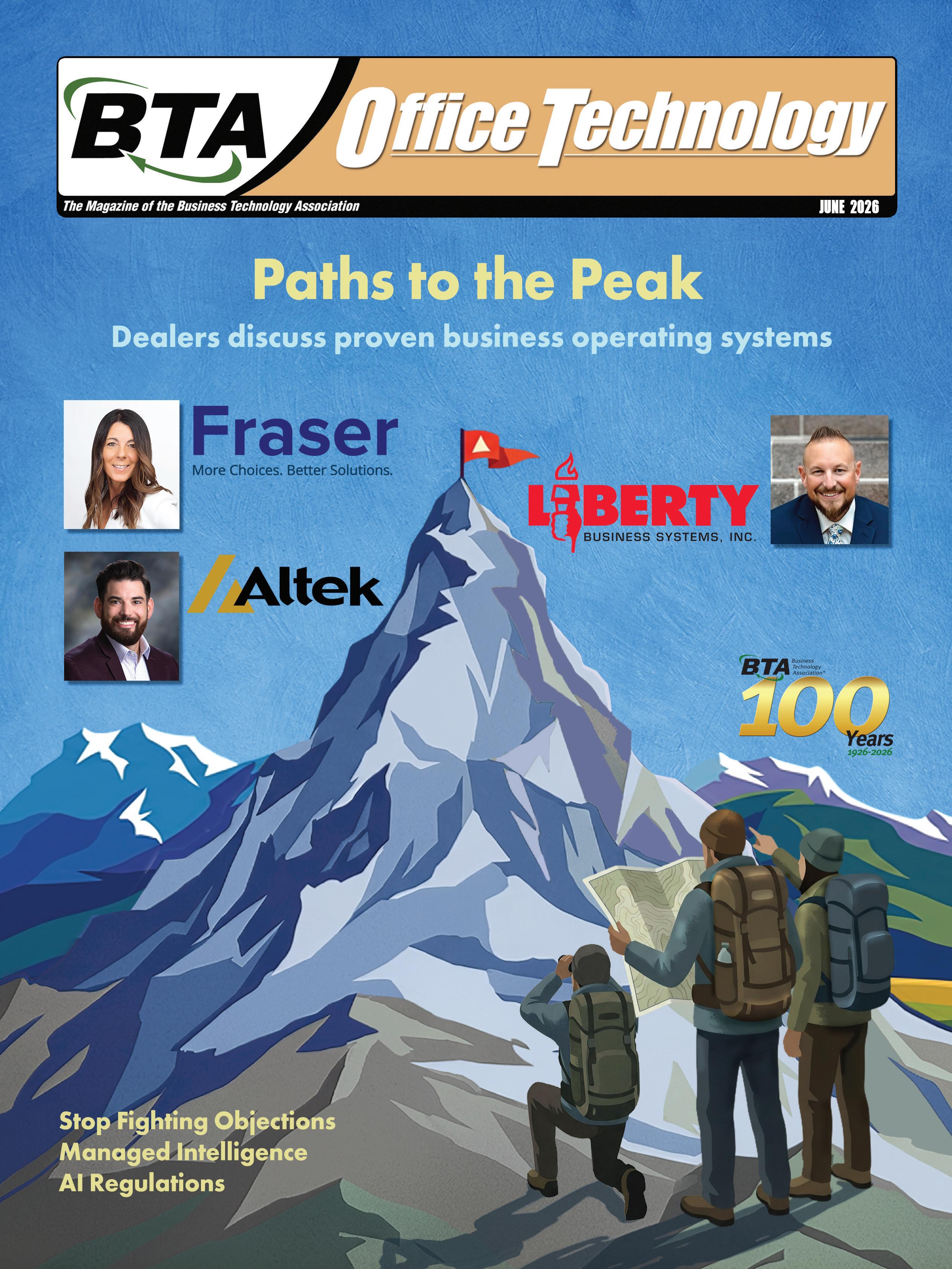

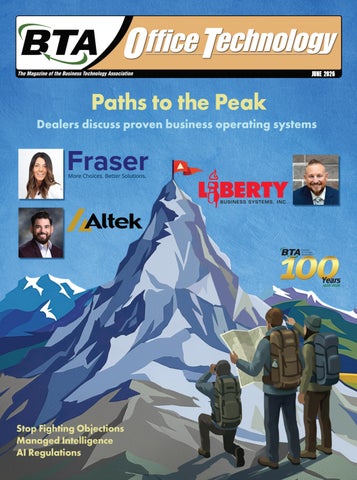
Paths to the Peak
Dealers discuss proven business operating systems by Brent Hoskins
Office Technology Magazine

Could your dealership benefit from a structured management framework that serves to help you execute strategy more consistently? This article includes brief profiles of three dealerships, providing a look at the operating systems they have adopted.
Stop Fighting Objections
How to neutralize pushback before it happens by Kate Kingston Kingston Training Group

If you sell office technology for a living, you already know this truth: Prospecting is not difficult because you cannot find people. It is difficult because once you do get someone live, he (or she) throws the same four objections at you repeatedly.
Managed Intelligence
Stake your claim on a new source of recurring revenue by Jonathan Blakey Technology Assurance Group (TAG)
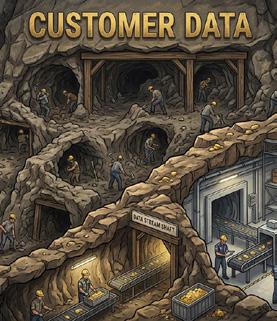
For years, managed IT services providers and office technology dealerships have focused on infrastructure — copier/MFPs, printers, networks, servers, cybersecurity, backups and patching. But the next evolution is not about managing hardware. It is about managing intelligence.
25 AI Regulations
Dealers should take notice of California’s new rules by Greg Goldberg BTA General Counsel

In practice, public policies that are successful at the state level often lend themselves to frameworks for broader national initiatives and laws. Therefore, in order to get a handle on the future of AI regulation, it is important to consider what is happening in the individual states.

‘An Exceptional Force’
Members reflect on BTA’s enduring industry presence
Compiled by Brent Hoskins Office Technology Magazine
As the Business Technology Association (BTA) celebrates its 100th year, it is gathering testimonials that reflect on the people, businesses and experiences that have shaped the association across the decades.
Bonuses & Lead Generation Dealers answer questions from fellow dealers
Compiled by Elizabeth Marvel Office Technology Magazine

This feature includes two questions submitted by dealer members as part of BTA’s Dealers Helping Dealers resource and many of the answers received. These answers and others can be found in the members-only section of the BTA website.
‘Delivering the Future’ DocuWare hosts partner conference May 20-21 by Elizabeth Marvel Office Technology Magazine
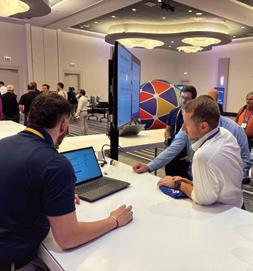
On May 20-21, DocuWare hosted its DocuWorld 2026 partner conference at the Loews Chicago O’Hare Hotel in Chicago, Illinois. The soldout event brought 350 attendees together from across the Americas.

FP Parcel Shipping gives you access to multiple carriers, built-in address validation, and real-time tracking so you can streamline your logistics, reduce manual errors, and deliver a smoother experience to your customers.
FP Smart Lockers & TRAXsuite Software streamlines how your organization receives, logs, stores, and tracks packages - so nothing gets lost, delayed, or overlooked.
Empower your business with FP Sign to complete agreements faster, eliminate manual bottlenecks, and stay compliant with industry regulations.


CExecutive Director/BTA Editor/Office Technology
Brent Hoskins brent@bta.org (816) 303-4040
Associate Editor Elizabeth Marvel elizabeth@bta.org (816) 303-4060

ontinuing with my focus in this space throughout 2026 on the Business Technology Association’s (BTA’s) 100th anniversary year, it is appropriate to take the opportunity to thank the many vendors that have been members of the association through the years. They have exhibited at our events, advertised in our publications, sponsored various association programs and donated to our Scholarship Foundation — all demonstrating their support of the association and commitment to the dealer channel.
In the May issue of Office Technology I wrote about the association’s first magazine, launched in November 1938. There are only two vendor ads in that inaugural issue. One was placed by the U.S. Typewriter Ribbon Manufacturing Company. The ad provided a mailing address, encouraging readers to write “for free samples” and a “Dealer’s Price List.” The other ad, appearing on the back cover, featured a full-page illustration of Santa Claus with seven words: “Watch for Royal’s Extra Special Christmas Material.”
The November 1938 issue does include a few articles about vendors. Some of the headlines: “Speed-O-Print Presents New Duplicator,” “Underwood Introduces New Models” and “Sherman-Mason Opens New Factory.” We know duplicators and that Underwood made typewriters, but who remembers Sherman-Mason? The ad says the company made “tubular stands” for business machines.
Fast forward 48 years to the January 1987 issue, featuring the first article I wrote for the association. The full-page ad on the back cover: ibico, makers of the ibimatic binding machine. Other advertisers include: Olympus, featuring its Pearlcorder Microcassette Systems; Swintec, promoting its
electronic typewriters; and Pilot, promoting its printer and typewriter ribbons.
In my early days at the association, we had several typewriter vendor members; I met with some of their executives at our NOMDA Conventions. I do remember Swintec (the January 1987 advertiser). Other typewriter-only vendors exhibiting at the first convention I attended: Adler-Royal, Olivetti, Silver-Reed and Smith Corona. (For those of you under 40 years of age or so: Typewriters used to be a big deal.)
Fast forward to the present. Hats off to our vendor members for their support of the association and the channel, following in the tradition of the many vendors that paved the way through the decades. Today’s BTA vendor members: ACDI, Actionable Intelligence, AgentDealer, AMETEK ESP, ARCOA Group, Avaniko Technologies, Avision Labs, CEO Juice, CET USA, Clover Imaging Group, ConnectWise, Crexendo, Culligan Quench USA, Dealer Site Builder, Distribution Management, DLL, DocuWare, DXone, ECI, ecoprintQ, eGoldFax, EKM/Predictive InSight, ELATEC, Epson America, Evolved Office, First Citizens Bank, FlexPoint, FMD Distribution, FP, Fujifilm, Global Payments, GreatAmerica, HP, Hytec, Image Star, Impression Solutions, International Imaging Technology Council, In Time Tec, in2communications, Industry Analysts, Intermedia, Katun, Keypoint Intelligence, Konica Minolta, Kyocera, LEAF Commercial Capital, Lumana, Mars International, Miracle Service, Moving Office Equipment, MPS Monitor, MyQ, NA Trading and Technology, NEXERA, Noetics, Nuworld Business Systems, Oracle NetSuite, PEAC Solutions, PFU America, Polek & Polek, PrintReleaf, Ricoh, RISO, SalesChain, Sharp, Source Technologies, Square 9, Static Control, TAG, TD SYNNEX, Toshiba, TTR Shipping, Wells Fargo, Xerox, Y Soft and Zultys. n — Brent Hoskins
Contributing Writers
Jonathan Blakey, Technology Assurance Group (TAG) www.tagnational.com
Greg Goldberg, BTA General Counsel Business Technology Association
Kate Kingston, Kingston Training Group www.kingstontraining.com
Business Technology Association 12411 Wornall Road Kansas City, MO 64145 (816) 941-3100 www.bta.org
Member Services: (800) 505-2821
BTA Legal Hotline: (847) 922-0945
Valerie Briseno Marketing Director valerie@bta.org
Brian Smith Membership Sales Representative brian@bta.org
Naomi Garza Administrative Assistant naomi@bta.org
Photo Credits: Adobe Stock. Cover created by Bruce Quade, Brand X Studio. ©2026 by the Business Technology Association. All Rights Reserved. No part of this publication may be reproduced by any means without the written permission of the publisher. Every effort is made to ensure the accuracy of published material. However, the publisher assumes no liability for errors in articles nor are opinions expressed necessarily those of the publisher.
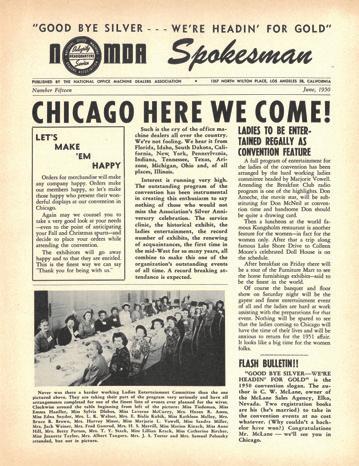
The association’s magazine cover 76 years ago this month — the NOMDA Spokesman, June 1950.


A2025-2026 Board of Directors
President
Debra Dennis CopyPro Inc. Greenville, North Carolina ddennis@copypro.net
President-Elect
Mike Boyle
BASE Technologies Inc. Bethel, Connecticut mboyle@baseinc.com
Vice President
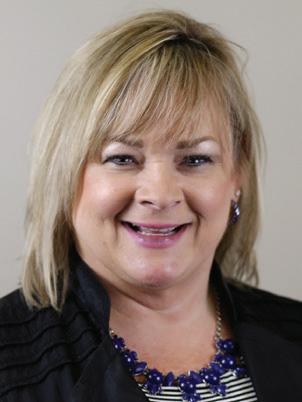
s I prepared to write my final President’s Message for Office Technology magazine, I found myself reflecting on what an incredible year this has been for the Business Technology Association (BTA). One thing that stands out more than anything else is the dedication of BTA’s staff and leadership team members to staying connected, informed and engaged within our industry.
Throughout the year, BTA staff members attended numerous dealer, vendor and industry events across the country. These events are far more than trade shows — they are opportunities to gather valuable insight, strengthen relationships, and better understand the challenges and opportunities facing our members every day. Whether it is educational sessions, technology demonstrations, peer discussions or networking conversations in the hallways, there is tremendous value in being present and actively involved.
I was personally blessed to attend several outstanding industry events during my presidency. Along with the 2025 BTA National Conference in New Mexico and the BTA IGNITE Orlando 2026 event, I attended the Ricoh and Konica Minolta dealer meetings, IT Nation Connect, the Executive Connection Summit, the DocuWorld partner conference and the Cannata Report’s Annual Awards & Charities Gala. Each event offered a unique perspective on where our industry is heading — from managed IT and cybersecurity to workflow automation, AI-driven processes, document management and the continued evolution of the office technology space. More importantly, each event reinforced how
important relationships and collaboration continue to be in our industry.
What impressed me most throughout the year was seeing BTA’s staff members attending these events and many others. Their commitment to learning, listening and building relationships directly benefits our membership. They consistently return with fresh ideas, valuable industry knowledge, and a deeper understanding of the needs of our dealers and vendor partners.
I would also like to personally thank Brent, Valerie, Elizabeth, Brian, Naomi and Greg, our general counsel, for their dedication to BTA and its members. Their professionalism, hard work and willingness to support both our leadership team and membership base do not go unnoticed. They represent the association exceptionally well and are a major reason BTA continues to provide such value to our industry.
In addition, I would like to thank the members of the BTA Board of Directors for their support, leadership and dedication throughout the year. Serving on the board requires a tremendous commitment of time and energy, and I deeply appreciate the willingness of each board member to give his (or her) time, share his expertise, and work together for the betterment of the association and our industry.
As I conclude my term as president, I am grateful for the opportunity to serve alongside such dedicated individuals. The strength of BTA has always been its people — our members, our volunteers, our leadership team members, and especially the staff members and partners who work tirelessly behind the scenes to support this association every day. Thank you for allowing me to be part of such a meaningful organization, and for the friendships and experiences that made this year so rewarding. n — Debra Dennis
Mike Hicks Electronic Business Machines Inc. Lexington, Kentucky mhicks@ebmky.com
Immediate Past President
Adam Gregory Advanced Business Solutions LLC
St. Augustine, Florida adam@goabsinc.com
BTA East
Chip Denlinger DCS Technologies Corp. Franklin, Ohio chip.denlinger@dcs-tech.com
Tim Seeley Jr. Seeley Office Systems Inc. Glens Falls, New York tseeleyjr@seeleyoffice.com
BTA Mid-America
Brett Blake Corporate Business Systems LLC Madison, Wisconsin bblake@corpbussystems.com
Grant Goldsmith
Regal Business Machines/Gateway Business Systems Chicago, Illinois goldsmithg@gateway-biz.com
BTA Southeast
Blake Renegar
Kelly Office Solutions Winston-Salem, North Carolina tbrenegar@kellyofficesolutions.com
Richie Creech CopyPro Inc. Greenville, North Carolina rcreech@copypro.net
BTA West Scott Reynolds Imagine Technology Group LLC Chandler, Arizona sreynolds@itgarizona.com
Richard Van Dyke
Advanced Office Irvine, California rvandyke@goadvanced.com
Ex-Officio/General Counsel
Greg Goldberg
Barta | Goldberg West Hollywood, California ggoldberg@bartagoldberg.com

by: Brent Hoskins, Office Technology Magazine
Could your dealership benefit from a structured management framework that serves to help you execute strategy more consistently by way of better alignment around goals and greater employee accountability? If so, it may be time for you to take a look at a business operating system that provides you with a path to the peak success you have been seeking.
Following are brief profiles of three dealerships providing a look at the operating systems they have adopted. Perhaps the insight they share will lead you to take similar steps to improve the way your dealership operates.

In 2018, Altek Business Systems, headquartered in Telford, Pennsylvania, hired a consultant to help the dealership chart a course for its future. Among the consultant’s areas of expertise introduced to the Altek management team: The Entrepreneurial Operating System, more commonly known as EOS. The system was created by Gino Wickman, first introduced in his book, “Traction: Get a Grip on Your Business.”
At about the same time the consultant’s work was underway, Scott Flaherty was hired by Altek. Now the president of the dealership, he recalls the first order of business as Altek began its EOS journey. “He [the consultant] took us step by step through the V/TO [Vision/Traction Organizer], the blueprint of what your business looks like,” he says. “He helped us identify our core values, what our marketing should look like, what kinds of customers we want, etc. In the end, the consultant asked, ‘If you brought someone in for an interview and he or she fit all of your core values, would you hire that person?’ We said, ‘Yes, in a heartbeat.’”
The consultant’s next question forever changed the trajectory of Altek. “He asked, ‘If you look at your core values and some of your current employees don’t fit those values, would you fire them?’” Flaherty explains. “That was our
first ‘Oh, wow!’ moment with EOS ... So, we started changing the culture, with the thought that if people don’t fit with the culture, they will leave. We decided to speed that up and let a few people go. By the middle of 2019, the entire culture of the company had changed.”
As the culture has changed under EOS, the expectations have changed, too. “The ‘average’ employee has changed dramatically,” Flaherty says. “The changed culture has allowed us to get more out of our employees than we thought possible and it has allowed us to grow. We have experienced 214% growth over the last four years.”
Plenty has changed at Altek as a result of EOS. “I would say that we have rolled EOS out to about 95% of the company,” Flaherty says. Today, L10s (standard weekly EOS-guided meetings) are held by each department at Altek, he says. “Plus, our VP of sales, service manager — all our middle management — meet once a week, where they discuss what is going on in every department. The C-level team also meets weekly.”
Today, nearly every Altek employee has EOS “rocks,” says Lexi Clemmer, COO. “Rocks are projects outside of normal job tasks that are to be completed within 90 days,” she says, noting that rocks are regularly discussed in the L10s. “‘Are you on track or off track with your rocks? How can we help you get there?’ Discussion on employee rocks in the meetings keeps everyone accountable ... Without their rocks, employees would just do their day to day and then it’s, ‘I can go home now.’ But this [rocks] gives them ways to exceed expectations, which feels good to everyone.”
Flaherty shares what he sees as the primary EOS benefit. “The aspect that has brought the most value to Altek is the principle of finding the right person for the right seat,” he says, noting that it often means promotions from within and, occasionally, the creation of new positions. “The right person in the right seat doesn’t mean you put that person in the right seat and you’re done. One day, there may be a better seat for
that employee. For example, our delivery driver from five years ago is now our parts and facilities manager.”
Reflecting on the past and present, “Altek has established that we are EOS and EOS is Altek,” Flaherty says. “When I first read the [Traction] book, I thought it was like he [Gino Wickman] had written the book about us; ‘oh my gosh, these are all of the problems we’re having’ ... We had an entrepreneur, but no entrepreneurial operating system ... Looking back, it was the right consultant at the right time with the right book.”
“When I first read the [Traction] book, I thought it was like he [Gino Wickman] had written the book about us ... Looking back, it was the right consultant at the right time with the right book.”

— Scott Flaherty Altek Business Systems
Twelve years ago, members of the management team at Fraser Advanced Information Systems, headquartered in West Reading, Pennsylvania, attended training on the principles of Scaling Up, the business operating system developed by Vern Harnish, author of the book “Scaling Up: How a Few Companies Make It ... and Why the Rest Don’t.” Today, Scaling Up continues to effectively guide the dealership on a daily basis.
Following the training, the dealership engaged a certified Scaling Up coach to work with the management team, says Melissa Confalone, president of Fraser. “He helped us build our first plan,” she says, noting that the plan provided Fraser a business process to follow. The Scaling Up coach “walked us through every step of the process — team alignment, who is responsible for what, and our goals, missions and quarterly targets.”
The framework of Scaling Up is focused on four key areas — people, strategy, execution and cash, Confalone says. When Fraser first adopted the use of the operating system, it became clear that while the dealership’s leadership team members “rolled up their sleeves and worked hard, we had not been getting everyone on the same page in terms of how to run the business,” she says. “If you want to be very successful and grow revenue, you must be very strategic about it. It’s not just ‘sell, bill and service clients.’ Scaling Up provides a simple way for Fraser to lay out a plan that makes sure everyone on the team understands what really impacts our business, rather than just hoping that the sales department comes through with big orders.”
Scaling Up has guided Fraser to “analyze every little piece of our business and not let the bigger number hide what might be flawed in a small bucket,” Confalone says. If one of your critical priorities, for example, “is to grow MPS by 12%, one
of the very specific benefits of Scaling Up is that it helps you dig into the layers, making sure you are pulling everything in on managed print to get to the right number,” she says. “You may find that it is not 12%, but that it must be 20%. Scaling Up makes you dig for the data.”
Confalone says another key tenet of Scaling Up is impactful, consistent meetings, such as Fraser’s quarterly executive team [eight people] meetings to review the dealership’s One-Page Strategic Plan (OPSP). “These meetings are very focused on what you are doing in the current quarter,” she says. “We discuss and tweak our OPSP at each one of these meetings.” In addition, Fraser hosts All-Managers Meetings [around 22 people] on a regular basis, including two off-site overnight meetings each year. Plus, “we are religious about daily team huddles,” she says. “As president of the company, I join one of the team huddles every day at 8:30 a.m.”
Scaling Up has guided Fraser management “to be diligent about not being reactive; that’s the whole point,” Confalone says, noting that the operating system helps ensure necessary pivots occur well before they are simply the reaction to problems. “We don’t wait a month or more to pivot, but immediately respond to such questions as, ‘Is this the right person? Do we need help here? Do we need software to make it happen?’ Having a written plan that everyone is looking at makes pivoting simple. It is simple and brilliant at the same time.”
Confalone shares one more key benefit of Scaling Up. “Previously, when we were running after goals and objectives, we always had a lot of cooks in the kitchen,” she says. “Now, if we want to achieve X revenue in net-new business and there are three things we need to do to achieve it, there is an ‘owner’ of that goal. That owner is not [solely] responsible for the revenue, but is responsible for reporting back to everybody about what is working, what is not working and what must change to achieve the targeting revenue number.”
When Steven Ness first joined Liberty Business Systems, headquartered in Fargo, North Dakota, he reached out to a mentor of his about becoming the dealership’s new EOS implementor. He quickly learned that his mentor had switched to Pinnacle, a business operating system most closely associated with Gregory Cleary and Michael Erath, authors of the book “The Path to the Pinnacle: Using Customized Business Operating Systems to Drive Growth.”
Today, Liberty has fully embraced the system, and Ness, now the dealership’s CEO, is a certified Pinnacle Business Guide [guiding not only Liberty, but other companies as well]. “It has become a passion of mine,” he says. “Giving people a framework to guide them in their decisions, asking tough questions, ‘serving hard’ — a little tough love — and seeing them succeed is the absolute best part of what I do.”
“We
everyone is
at makes pivoting simple. It is simple and brilliant at the same time.”

are getting in the way of progressing our business? What does our strategy look like? What does branding look like for us? How do we create a rhythm of accountability? How do we actually get something out of meetings?’”
— Melissa Confalone Fraser Advanced
The main areas of focus with the operating system are the “Pinnacle principles — people, purpose, playbooks and performance, and that all equals profits,” Ness says. He lists some of the critical questions that Pinnacle will help business owners address. “‘What’s our vision? Where are we going? What are the few priorities that matter the most right now? What issues
Information Systems
Leveraging the operating system begins with a Pinnacle Guide helping a company’s owners develop a Strategic Vision Execution Plan, Ness says. “This is a living, breathing document for them to use day in and day out; it makes sure they are clear on what their purpose is, what their core values are, what their one-year goal is, what their quarterly goal is,” he says. “On one side, it’s, ‘This is who we are, this is what we do, this is why we do it.’ On the other side, it’s, ‘This is how we do it, this is what our branding is,’ and how we stay accountable.”


“A
lot of companies want to wait. Owners think: ‘We can do this once things slow down’ or ‘once this or that happens first.’ You are never going to ‘have time.’ You’ve got to ‘make time.’“

— Steven Ness Liberty Business Systems
As noted, meetings are particularly crucial under Pinnacle. “We embrace meetings,” Ness says. “You should be holding weekly meetings within your organization ... We also believe in implementing ‘stand-ups’ — quick, hard hitters just to get everyone on the same page. In addition, we believe in meetings where teams are focused on roadblocks and issues that are more tactical in nature. And, finally, we believe that strategy should be addressed in other dedicated meetings; at Liberty, those meetings are held quarterly.”
Beyond frequent, effective meetings, among the other practices within a Pinnacle-guided business is the use of the 3-2-1 Model by which there are “three obsessions to every seat [employee role],” Ness says. “‘What seats do I need? What are their obsessions? What is it that each seat owns? I need you to own things, so that you can take away tasks from me and do your job well. In addition, I need two measurables for each seat’s three obsessions, so we know how well you are doing.’”
For dealers interested in implementing an operating system like Pinnacle, Ness advises they do not delay. “A lot of companies want to wait,” he says. “Owners think: ‘We can do this once things slow down’ or ‘once this or that happens first.’ You are never going to ‘have time.’ You’ve got to ‘make time.’ If you want to improve your business, now is the right time to implement an operating system.”
Oftentimes, the delay in implementing an operating system is the result of being reactive and not proactive, Ness adds. “Many dealers have a ‘firefighter mentality,’” he says, referencing the practice of routinely just addressing one problem after another. “What I wanted to do was become a smoke detector. I wanted to figure out ‘where the smoke is coming from’ before it ‘becomes a fire.’ That’s what Pinnacle did for us.” n
Brent Hoskins, executive director of the Business Technology Association, is editor of Office Technology magazine. He can be reached at (816) 303-4040 or brent@bta.org.


C2C Resources has helped more than 40,000 businesses collect more than $500 million in past-due balances.


by: Kate Kingston, Kingston Training Group
If you sell office technology for a living — copier/MFPs, managed print, IT services, workflow software, document management or cloud solutions — you already know this truth: Prospecting is not difficult because you cannot find people. It is difficult because once you do get someone live, he (or she) throws the same four objections at you repeatedly:
n “We already have a vendor.”

n “We’re all set.” (Or however he says: “No thank you.”)
n “Just send me some information.”
n “We just purchased.”
Most salespeople spend their careers trying to get better at responding to these objections. That is a mistake. In my work as president of Kingston Training Group and as a sales trainer for the office technology industry, I teach something very different: Do not just handle objections. Make them irrelevant by addressing them before your prospect ever says them.
This technique is called “preemptive objection handling” or “inoculation.” When you do it correctly, your calls become smoother, your credibility jumps and you book more meetings with far less resistance. This article will show you exactly how to do that, step by step, using the four objections you hear every day.
Let’s talk psychology for a minute. When a prospect answers the phone, his mental script sounds like this:
n “This is a sales call.”
n “I need to protect my time.”
n “I know what to say to get off the call quickly.”
So, he reaches for one of the four safe phrases: “We’re all set,” “We have a vendor,” “Just send me something” and “We just bought.”
These are not thoughtful responses. They are automatic defense mechanisms. When you wait for him to throw those walls up and try to argue your way around them, you put yourself in a defensive posture. You are reacting, but he is in
control and the energy shifts from curiosity to conflict.
Preemptive objection handling changes that completely. When you bring up his concerns before he does, you:
n Lower his guard; you are not pretending those issues do not exist
n Reframe the objection as a reason to meet rather than a reason to end the call
n Position yourself as a trusted advisor, not a pushy sales rep
n Maintain control of the flow of the conversation instead of getting derailed
You are essentially saying: “I know how firms like yours think, I respect that and this meeting is designed with that reality in mind.” That is incredibly calming to a busy executive.
We are going to take the four most common objections and move them from defense to offense by embedding the response right into your opening pitch.
(1) “We already have a vendor.” This is the king of shutdown lines. In our industry, almost everyone already has “a guy” or “a company” handling their technology. Most reps wait until the prospect says it and then respond with something like, “That’s fine. I’m not looking to replace your current vendor.” By that point, it is too late. The prospect has already mentally ended the call.
Instead, bring it up first — right after you say who you help. For example: “I work with mid-sized law firms here in the city that are looking to tighten security and reduce document-related expenses — all of which have current technology partnerships in place — but still wanted to identify hidden costs and strengthen security around their technology workflows.”
You have just:
n Acknowledged that the prospect likely has a vendor
n Normalized it (using “all of which ... ”)

Expand your public sector reach by helping eligible school districts, municipalities, and agencies acquire the essential office and technology equipment they need.
By partnering with DLL Public Finance, you can provide access to essential-use equipment while ensuring your customers benefit from the widest array of payment solutions available.
Why partner with DLL?
– Flexible financing aligned to customer budgets and payment schedules.
– Access the full benefit of government tax-exempt status* to offer the lowest possible rates.
– Dedicated public sector experts with deep knowledge of regulations, policies, and incentives.


Now if he tries to say, “We already have a vendor,” it does not feel like a mic drop. You have already calmly addressed it.
(2) “We’re all set.” This is the cousin of “We have a vendor” — same instinct, different words. It is just a way of saying “no.” You neutralize this one by adding a second sentence immediately after the vendor inoculation: “We partner with other [insert vertical — banks, manufacturers, schools, law firms] that think things are mostly working, but still want a second opinion to make sure their technology is truly driving the business forward.”
Now you have reframed the meeting as:
If you lead a sales team in the office technology space ... this is not just a “nice idea.” It is a repeatable process you can build into your culture.
n A smart, low risk double-check, not a desperate fix
n A “best practice” used by other organizations like his
n A way to confirm that “We’re all set” is true — not just a comfortable way of saying “no”
The prospect hears this and thinks, “OK, this doesn’t mean I’m admitting something is broken. I’m just being thorough.” That is a much easier “yes.”
(3) “Just send me some information.” This one is often the “polite goodbye” line. It sounds cooperative, but what he is really saying is: “I don’t want to give you time on my calendar.” The key here is to define how you work before he can use this escape hatch. You do that just before you make your ask: “As I shared in my email, my firm doesn’t just send generic marketing information. The way we save our clients time is by spending 20 to 25 minutes looking at how your current infrastructure supports your compliance, security and profitability goals, and then giving you a short list of recommendations you can use with your existing provider or with us.”
Now, when he thinks, “I’ll just ask him to send something,” his brain already has a different frame:
n You do not send generic information.
n You protect his time with a focused, consultative conversation.
n The outcome will be practical recommendations, not a brochure.
You have gently taken “Send me information” off the table before he can play that card.
(4) “We just purchased.” This objection is especially common in copier/MFP, printer and hardware-heavy environments. The lease is new, the boxes are shiny and the prospect thinks his company is off the hook for years. Here is the truth: a recent purchase is not a barrier. It is an opportunity.
You neutralize this one by describing who you meet with and why, linking it explicitly to technology he already owns: “We meet with organizations that want to leverage more
results from the technology they’ve already leased or purchased — things like MFPs, printers and document management solutions — and turn what they’ve already paid for into stronger security, better workflows and lower operating costs through software, automation and service.”
Now, “We just purchased” becomes:
n Exactly why a meeting makes sense
n A way to maximize ROI on an existing investment
n Not something that disqualifies his company, but qualifies it
You have turned a stopping point into a compelling reason to keep talking.
Let’s put this together as one flowing pitch. Adjust the vertical, outcomes and timing to fit your world, but pay attention to the order:
(1) Who you help
(2) “We already have a vendor” inoculated
(3) “We’re all set” inoculated
(4) “Send information” inoculated
(5) “We just purchased” inoculated
(6) A clear, confident ask
Example: “Hi Jordan, this is Alex with [Company]. I look forward to coordinating a time to stop by because my company represents 127 other prominent law firms here in [State]. They all had a current technology partnership in place where things were working mostly well, but they had a second opinion to ensure technology was driving every billable component possible through their case matter. We were able to uncover opportunities for better compliance case archival, reducing document review, interrogatory costs and timelines. I would welcome the opportunity to share with you what your colleagues are doing to accomplish these goals. Would Tuesday the 15th at 9:45 work for me to stop by?”
Read that again and notice:
n Any potential objections have already been acknowledged and reframed.
n The prospect never has to stop you with “We’re all set,” because you already said it.
n You sound like someone who understands his world, not someone trying to bulldoze on his reality.
That is the power of inoculation.
If you lead a sales team in the office technology space —


a dealership, VAR, MSP, SaaS or service provider — this is not just a “nice idea.” It is a repeatable process you can build into your culture. Here is how to implement it:
(1) Identify your top four to six objections. For most technology organizations, the four we have covered are universal. You may also hear:
n “We handle that in-house.”
n “We’re in a contract.”
n “This isn’t a priority right now.”
Do not wait to get better at fighting objections — get better at preventing them. And when you do, you will ... have a stronger, more confident sales force ...
List them all and then commit to never waiting to hear them again.
(2) Write your inoculation lines. For each objection, answer this question: “How can we acknowledge this concern up front in a way that makes the meeting more logical, not less?” Your lines should:
n Normalize the situation (“Other firms like yours ... ”)
n Connect their reality to the value of the meeting
n Reduce risk and fear (“second opinion,” “maximize what you already have,” “time-efficient,” etc.)
Then decide where each line belongs in the flow:
n After “who we help” (“We have a vendor.”/“We’re all set.”)
n Just before the ask (“Send information.”)
n When describing who you meet with and why (“We just purchased.”)
(3) Script, practice and refine. This is where many teams fall. They draft language and then never make it muscle memory. I recommend:
n Every rep writes his version of the pitch using this structure.
n You run role plays where the prospect is not allowed to give objections — because they have already been addressed in the script.
n You record calls and listen for whether the inoculation lines sound natural, confident and conversational.
If it sounds like legal boilerplate, rewrite it. If it sounds like something you would say in a real conversation, you are there.
(4) Measure the impact. Within a few weeks of consistent use, you should see:
n Fewer “We’re all set,” “We have a vendor,” “Just send information,” and “We just purchased” responses
n A higher conversion from live conversations to booked meetings
n Shorter, smoother prospecting calls with less arguing and more exploring
Have your reps track:
n How many calls included the full inoculation script
n How many of the “big four objections” they heard that day
You want those objection counts dropping as script adherence goes up.
The real change here is not just the words. It is the identity shift behind them. Most salespeople on prospecting calls see themselves as defenders, where the prospect attacks with objections and the rep defends with clever comebacks. That is exhausting for both sides. When you use preemptive objection handling, you step into the role of trusted guide:
n You know the terrain.
n You know where the fears live.
n You proactively say, “You’re going to see this up ahead — here’s how we’ll handle it.”
Prospects feel that difference immediately and are far more likely to stay with you and explore than to shut you down.
If you are a sales executive or a sales manager in the office technology industry, here is my challenge to you:
(1) Today, sit down and rewrite your prospecting opening using this structure.
(2) Build in inoculation for: “We already have a vendor,” “We’re all set,” “Just send me some information” and “We just purchased.”
(3) Practice it out loud at least 10 times, until it feels like your natural voice.
(4) Use it on every prospecting call for the next two weeks.
(5) Track the change in objections and meetings booked. I have trained thousands of office technology sales professionals across the country and I can tell you: The reps who master inoculation move more quickly, close more and feel more in control of their days.
Do not wait to get better at fighting objections — get better at preventing them. And when you do, you will not just have smoother prospecting calls, you will have a stronger, more confident sales force driving better results for your entire organization. n
For more than 25 years, Kate Kingston has been exclusively educating office technology sales executives on every type of prospect across 60-plus industries and how they proprietarily use technology. She is a recognized authority on lead generation, recruiting new hires from a prospecting skill-based perspective and new business development. Join Kingston at BTA IGNITE Kansas City for a breakout session on how to drive more net-new meetings without burning out your sales managers. Register at www.bta.org/IGNITEKC. She can be reached at kkingston@kingstontraining.com. Visit www.kingstontraining.com.







by: Jonathan Blakey, Technology Assurance Group (TAG)
In the early 2000s, many IT providers saw cloud computing coming. Microsoft, Amazon and Google were all signaling where the market was heading. But many technology providers hesitated, saying things like: “Our clients like servers,” “The cloud isn’t secure” and “We’ll wait and see.”
While they waited, others leaned in. Microsoft built Azure. Amazon built Amazon Web Services (AWS). Entire MSP businesses were built around cloud migration. Those companies did not just sell technology — they became the trusted advisors guiding clients through the cloud transition. By the time late adopters caught up, the biggest margins and market positions were already taken.
Artificial intelligence (AI) is following the same trajectory and AI-powered managed intelligence may become for data what office technology dealerships became for hardware.
For years, managed IT services providers and office technology dealerships have focused on infrastructure — copier/MFPs, printers, networks, servers, cybersecurity, backups and patching.
But the next evolution is not about managing hardware. It is about managing intelligence. Today, your customer’s most valuable asset is not its printer fleet or firewall — it is its data. And that data is scattered across multiple systems: Microsoft 365, SharePoint, CRM platforms, email systems, cloud drives, local servers, individual laptops and industryspecific applications.
All of that information contains valuable insight, but when it is fragmented across platforms, it is incredibly difficult to use. If you asked a customer to manually mine its institutional knowledge — contracts, customer conversations, service tickets, internal documentation, meeting notes, etc. — how long would it take? Days? Weeks? And even then, the results would likely be incomplete.
When company information — some of it private, some of
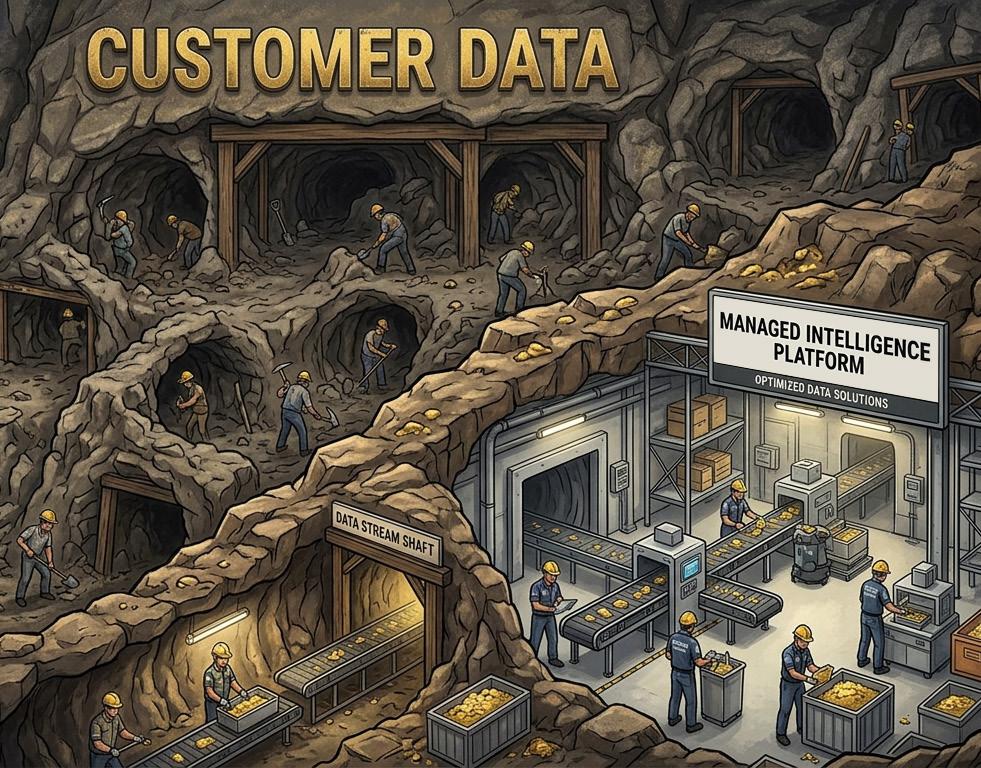
it sensitive — is spread across systems, databases, laptops and employees, it takes enormous effort to bring it together and make it useful.
Ironically, companies believe they have “lots of data,” but very little of it can actually drive decisions. For example, imagine the owner of a service company asking a simple question: “Which customers are most likely to cancel their contracts in the next 90 days?”
Today, that answer is buried across multiple systems — email conversations, support tickets, billing records, CRM notes and contract databases. Pulling and analyzing that information manually could take days, and by the time the analysis is complete, the opportunity to intervene may already be gone.
Now imagine asking a secure internal AI system: “Which customers are showing early signs of cancellation?” Within seconds, the system could identify patterns such as:
n Increased support tickets
n Payment delays
n Reduced communication from decision makers
n Contracts that are approaching renewal with declining engagement
Instead of reacting after a customer leaves, the business owner can intervene early.
That is the difference between having data and having intelligence. Data fills cloud storage. Intelligence drives decisions. Businesses do not need more chatbots. They need private, secure intelligence engines that can mine their data while respecting permissions and privacy controls.
The next evolution of managed IT is not just automation. It is managed intelligence. Dealerships that embrace it will become indispensable to their clients’ future growth.
Right now, SMBs and mid-market companies are experimenting with AI on their own. Employees are pasting company data into public tools. Teams are building quick automations. People are experimenting without oversight.
Samsung learned the hard way what can happen in that environment. Engineers who were troubleshooting software uploaded proprietary source code into a public AI system (ChatGPT). Once that information entered the model, it could not be retrieved. In other words, valuable intellectual property was exposed simply because employees were trying to work more quickly.
Your customers can make the same mistake. The difference is they will not have Samsung’s resources to recover from it. They know AI can help them operate more efficiently and unlock insights from their data. What they do not know is how to use it responsibly. That creates a gap in the market — and someone will be paid very well to fill it. I recommend that be you.
Instead of simply managing devices or networks, dealerships now have the opportunity to help clients understand and use their information. Dealerships can help their customers:
n Find answers more quickly
n Protect sensitive data
n Avoid costly mistakes
n Make better decisions
When your dealership’s AI managed intelligence platform becomes the place where clients can search, analyze and understand their own business data, your company becomes much more difficult to replace. It moves from vendor to strategic partner. It becomes the trusted advisor.
Office technology dealers have seen this pattern before. Years ago, revenue came primarily from hardware sales. Then managed print services emerged, creating predictable
recurring revenue and deeper customer relationships. Managed intelligence represents a similar shift.
The opportunity is not selling AI tools. It is becoming the trusted guide that helps businesses use AI safely while protecting their most valuable asset — their data. Dealerships that step into that role early will help define the category.
When a dealership manages a company’s AI intelligence platform, it becomes part of the organization’s operational backbone. This creates recurring revenue, increases customer stickiness and elevates the dealership into executive conversations. In effect, your company becomes a private intelligence engine for your clients — a secure environment that allows them to search, analyze and understand their own data.
The companies that define new categories usually enter early — before the market becomes crowded. Your customers are already experimenting with AI. If you do not guide them, they will try to build these systems themselves, often without the proper safeguards. Eventually someone will have to fix those mistakes. Dealerships that step in now can help clients adopt AI responsibly while positioning themselves at the center of one of the most valuable assets in any business: its data.
Managed IT services evolved from break/fix support to proactive monitoring. Now it is evolving again — from managing infrastructure to managing intelligence. Dealerships that step into this role will help protect clients from internal mistakes and external threats while providing foresight into risks and opportunities hidden inside their data.
The next evolution of managed IT is not just automation. It is managed intelligence. Dealerships that embrace it will become indispensable to their clients’ future growth. Dealerships that ignore it may spend the next decade trying to catch up. n
Jonathan Blakey is vice president of technology at Technology Assurance Group (TAG). He is responsible for driving the implementation of operational best practices, adoption of new technology and enhancing service delivery. Blakey can be reached at jonathan@tagnational.com. Visit www.tagnational.com.


by: Greg Goldberg, BTA General Counsel
An appropriate word to describe the Trump administration’s approach to comprehensive federal artificial intelligence (AI) regulation is “hostile.” In December 2025, the president issued an executive order urging federal agencies to scrutinize and discourage state-level AI regulation. The order framed the emerging patchwork of AI laws across the states as a threat to innovation, competitiveness and national cohesion. Silicon Valley applauded, but state regulators heard a call to arms.

In practice, public policies at the state level often become the framework for broader national initiatives. Therefore, in order to understand the future of AI regulation, it is important to consider what states are doing. Around the time of the president’s executive order, the California Privacy Protection Agency finalized sweeping regulations governing automated decisionmaking technology (ADMT) under the California Consumer Privacy Act (CCPA). The rules became effective earlier this year, though key compliance obligations for certain AI-driven decision systems will not go live until Jan. 1, 2027.
Like many California regulations, the ADMT rules are both narrower and broader than critics initially feared. Narrower, because they do not regulate every use of AI. Broader, because they reach deeply into the ordinary machinery of modern business. The regulations apply when a company uses AI technology to replace or substantially influence human decisionmaking for “significant decisions” about consumers, employees, applicants, students, tenants or independent contractors. This development is significant for the dealer channel where AI is quickly migrating from a novelty item to critical infrastructure. Our industry routinely deploys AI-enabled monitoring software, automated help-desk ticketing, predictive service dispatch, customer scoring systems and machine-learning tools that evaluate employee productivity. The result is that AI blurs the lines between workflow optimization and automated governance.
Consider a managed print services company that utilizes AI tools to determine which technician receives overtime opportunities based on historical response times, customer sentiment analysis and GPS efficiency metrics. If managers merely rubber-stamp recommendations generated by an algorithm, states like California may view that process as ADMT making a “significant decision” concerning employment. Now imagine a managed IT services provider using AI software to rank prospective sales hires by analyzing speech cadence during
recorded interviews. That system, too, likely falls within the California regulation’s orbit.
The same applies to customer-facing systems. An equipment finance company that uses AI to assess creditworthiness or to predict default risk for lease applicants could trigger ADMT obligations. So could a service provider that uses behavioral analytics to determine which customers receive premium support tiers, escalated cybersecurity monitoring or discounts.
Businesses covered by these rules must provide consumers with detailed notices explaining how ADMT is used, what categories of personal information feed the system and how individuals may opt out. Businesses must also conduct formal risk assessments before deploying certain high-risk processing activities involving ADMT.
The risk-assessment requirement may be the most significant feature of the new regulatory regime because it forces companies to document something many would prefer to remain implicit: why the algorithm exists, what risks it creates, whether safeguards actually work and whether the commercial benefits outweigh the potential privacy intrusions. California is, in effect, compelling every business to create a paper trail of its own AI conscience.
The penalties are not theoretical. Violations of the CCPA already carry civil penalties of up to $2,500 per violation, which may increase to $7,500 per violation. In turn, a single flawed algorithmic workflow may affect thousands of applicants, customers or employees, and exponentially increase potential risk.
The takeaway is that AI-enabled CRM tools, dispatch platforms, cybersecurity suites and analytics engines from third-party vendors may fall within California’s new regulations beginning next year, and other states may enact similar rules in the near future. The irony is that California’s move may ultimately accomplish the opposite of what the Trump administration hoped to avoid. BTA members in California should adopt compliance measures by the end of the year. Those outside of California should consider themselves on notice that implementing AI-enabled tools may involve additional auditing or compliance requirements sooner than later. n
Greg Goldberg, partner at Barta | Goldberg, is general counsel for the Business Technology Association. He can be reached at ggoldberg@bartagoldberg.com or (847) 922-0945.


BTA would like to welcome the following new members to the association:
Allied Business Solutions, Boise, ID
JBM Office Systems Ltd., St. Catharines, ON, Canada
For full contact information of these new members, visit www.bta.org.
Seeking information and insight regarding office technology industry trends and developments? BTA can help.
Through an alliance with Keypoint Intelligence, a global data and market intelligence leader for the digital imaging industry, BTA members can simply submit their questions for a Keypoint Intelligence analyst to address.
There is no charge. Rather, BTA’s Ask the Analyst feature is FREE to the association’s dealer members.
It’s simple — just visit the link below, fill out the form to submit your question and a Keypoint Intelligence analyst will respond. (You will need your username and password to submit your question.) Your question and the response you receive will be archived on the BTA website as a resource for other dealer members.
For more information, visit www.bta.org/AsktheAnalyst.
For information on BTA member benefits, visit www.bta.org/MemberBenefits.
Each month, BTA features two of its vendor or consultant/trainer members in this space. BTA recommends due diligence when choosing a partner.

Global Payments is a worldwide leader in payment technology and software solutions, helping businesses of all sizes accept payments, streamline operations and grow through innovative commerce technology. From payment processing and Genius point-of-sale systems to analytics and business management tools, Global Payments delivers flexible solutions designed to power modern business. Serving millions of merchants across more than 100 countries, Global Payments is committed to helping businesses operate smarter.
www.globalpayments.com

Infinite Limit LLC (IL) specializes in IT project implementation, offering advisory and program/project management services. Infinite Limit | Business Services (ILBS) offers integration services directly to dealers who also offer managed IT services and are using both e-automate and ConnectWise Manage.
Working closely with the CEO Juice team, ILBS provides these integration services to its dealer clients by offering a methodical approach to implementing the CEO Juice syncs to meet their business needs. In addition, clients receive insights, guidance and improvement recommendations.
https://infinitelimit.com
A full list of BTA vendor members can be found online at www.bta.org.

Compiled by: Brent Hoskins, Office Technology magazine
As the Business Technology Association (BTA) celebrates its 100th year, it is gathering testimonials that reflect on the people, businesses and experiences that have shaped BTA across the decades. Office Technology asked BTA members to share what the association has meant to them and their businesses — favorite memories, experiences when BTA made a difference for them, the value of membership, their perspective on BTA’s role in the industry, words of congratulations, etc. Below are additional responses received. More responses will be published in this feature throughout 2026. If you would like to share your BTA story, email it to Brent Hoskins at brent@bta.org.
“I really love the continuity that BTA provides, whether through the events or the educational webinars. It is a constant in our industry that we can all depend on, and we enjoy contributing to and being part of [the association]. The BTA community is a respectful place to network and build contacts.”
Deborah Hawkins, group director, workplace team
Keypoint Intelligence, Fairfield, New Jersey
“Although I joined BTA only last year as a consultant/ trainer member, the experience has already been extremely valuable. Through BTA, I’ve had the opportunity to engage in meaningful conversations with dealers from across the country, gain insight into the trends shaping our industry and build relationships with professionals who are passionate about the future of office technology.
“What stands out most is the openness and willingness of members to share ideas and experiences for the benefit of the industry as a whole. I congratulate BTA on its 100th anniversary and appreciate the important role the association continues to play in bringing our industry together.”
Felix Villanueva, president & founder Field Management Consulting, Gasburg, Virginia
“I deeply appreciate BTA because it truly embodies the spirit of ‘dealers helping dealers.’ BTA not only educates and connects our community, it creates a trusted space where dealers openly share ideas, challenges and best practices so we can all become better together.
“The in-person events are especially valuable because they give us the opportunity to build genuine relationships, learn from one another face-to-face and return home with new perspectives we can put into practice. It has been an honor to support that mission over the years by providing dealer education at BTA events as both a moderator and a speaker, and to be part of the conversations that help move our industry forward.”
Sarah Henderson, director of managed service intelligence Pacific Office Automation, Beaverton, Oregon
“Congratulations to BTA on 100 years of bringing the dealer community together — your commitment to education, collaboration and shared success has had a lasting impact on this industry and me personally. Over my 31 years, both on the vendor and analyst sides, I have always admired how BTA fosters a spirit of support and idea-sharing, even in a competitive landscape.”
Anne Valaitis, principal analyst Keypoint Intelligence, Fairfield, New Jersey
“Congratulations on the 100th anniversary of BTA. Before I retired, I was a BTA member for 30 years. My BTA membership was one of the best investments I made. I learned many things to help my business grow and prosper; about half of that came from BTA and the other half from fellow BTA members. I also made lifetime friendships that are still important to me today.
“I rarely needed legal advice or help, but there was a situation where BTA’s legal services were extremely valuable. A vendor manager decided to void a legal agreement I had with the vendor. This was going to be very expensive for me, so I contacted Bob Goldberg. He asked to see the agreement. After looking over the agreement, he said, ‘You are right. They are wrong. I know the president of that company and I will give him a call.’ The problem was solved in just a few minutes and at no cost to me. The vendor never tried to change any agreements again.
“Thanks again for helping me succeed in the industry.”
Alan Disher, former president Duplicator Sales Co., Cincinnati, Ohio n Brent Hoskins, executive director of the Business Technology Association, is editor of Office Technology magazine. He can be reached at (816) 303-4040 or brent@bta.org.
Compiled by: Elizabeth Marvel, Office Technology Magazine
Following are two questions submitted by dealer members as part of BTA’s Dealers Helping Dealers resource and many of the answers received. These answers and others can be found in the members-only section of the BTA website. Visit www.bta.org/DealersHelping Dealers. You will need your username and password to access this member resource.

What sort of bonus plans do you have in place for service department personnel — both MFP and IT employees?
“We’ve structured our service department bonus plans to reward productivity, quality and customer satisfaction while keeping them simple and measurable. For MFP/field service technicians:
n Productivity-based bonuses tied to billable hours, calls completed and efficiency metrics
n First-call-effectiveness incentives for resolving issues on the first visit
n Parts/labor control — Rewarding technicians who manage costs without sacrificing quality
n Customer satisfaction (CSAT) bonuses tied to service feedback and low callback rates
“For the IT/managed service team:
n Ticket resolution metrics — Incentives based on response time, resolution time and SLA compliance
n Utilization rates — Rewarding high billable or productive time
n Project completion — Bonuses for delivering projects on time and within a scope
n Client retention & satisfaction — Tying performance to long-term customer success
“Additional components:
n Team-based bonuses to encourage collaboration and not just individual performance
n Quarterly or monthly payouts to keep motivation consistent
n Clear KPIs and transparency so everyone understands how bonuses are earned”
Keith Anselmo, territory manager
Appalachia Business Communications
Johnson City, Tennessee
“We bonus $100 [each] on first-call efficiency, response time and an average of three or more calls per day. [They] must hit all three to get the bonus — $300 per month.”
Stephen Valenta, president/owner OFFIX, Gainesville, Virginia
“[We are] using the NEXERA bonus plan.”
Jeffrey Taylor, president
Kingsport Imaging Systems Inc., Kingsport, Tennessee
What can you share about successes with lead generators/telemarketers?
“We have had mixed results with lead generators and telemarketers, but success has come down to tight targeting, strong follow-up and clear accountability. The overall takeaway: Lead generators can be effective, but only when treated as a managed channel, not a “set-it-and-forget-it” solution. The best results come from ongoing optimization, tight feedback loops and strong alignment with the sales team. The bottom line: It is not about more leads — it is about better leads and faster execution.”
Keith Anselmo, territory manager
Appalachia Business Communications, Johnson City, Tennessee
“We are using Technology Assurance Group’s (TAG’s) Connect Outbound program for imaging leads. We signed on with Josh Fedie for SalesReach.”
Tim Stanley, owner
TDSiT, Lowell, Arkansas
“We hired a physical hunter to make calls on prospects, doing about 60 per week and generating two to three leads a week.”
Nick Lioce, president
The Lioce Group, Huntsville, Alabama
“Hope springs eternal. We had some success with 360Connect out of Austin, Texas, but discontinued using them years ago. We have not had success with any lead generators and we have hired a number of them. We are trying a new company next quarter.”
Jeffrey Foley, COO
Apollo Office Systems, Alvin, Texas n Elizabeth Marvel is associate editor of Office Technology magazine. She can be reached at (816) 303-4060 or elizabeth@bta.org.

by: Elizabeth Marvel, Office Technology Magazine
On May 20-21, DocuWare hosted its DocuWorld 2026 partner conference at the Loews Chicago O’Hare Hotel in Chicago, Illinois. The sold-out event brought around 350 attendees together from across the Americas to hear about DocuWare’s successes in the last year, experience the newest innovations within the software suite, participate in a variety of breakout sessions, and enjoy a “Night of Champions” that included a reception, dinner, casino night and partner awards.
CEO Dr. Michael Berger kicked off the event with his general session presentation, where he gave an overview of the current market and a summary of the year’s financial results.
“The world is becoming more complex, more uncertain,” Berger said in his opening comments, setting the scene of today’s reality. “So much of what was long considered stable is becoming less reliable. We see shifts in priorities and perspectives. Geopolitical alliances are being realigned, and even facts and information are sometimes more difficult to navigate. At the same time, broader economic, environmental and social disruptions are intensifying. These are having an increasing direct impact on economic stability and business continuity in operations.
“We are also experiencing a technological and economic disruption of enormous momentum,” he continued. “Digitization and automation — which DocuWare is a part of — are fundamentally transforming markets and business models. Alongside new dependencies, they are also creating new opportunities.”
He noted that many companies are floundering, attempting to manage and plan around uncertainty and complex situations. “They are struggling with unstable supply chains, material and energy provisioning, inflationary rising costs, interest rates and tariffs, and the constant pressure to adapt faster,” Berger said. “At the same time, they face a generational shift with shortages in workforces, as well as changing buyer and working behavior. And they experience an exponentially growing volume of data, complex regulations and, finally, rising demands on governance, cybersecurity and infrastructure performance ... Many companies are losing the ability to develop on their own. They are losing their direction. They are losing momentum and, ultimately, their competitiveness.”
Berger emphasized that DocuWare is helping customers manage this increasing complexity through improvements in its intelligent document processing (IDP), automation and artificial intelligence (AI)-powered digital processes — all of which were featured during the conference. “Let’s confront this ever-growing chaos with what truly makes us strong —
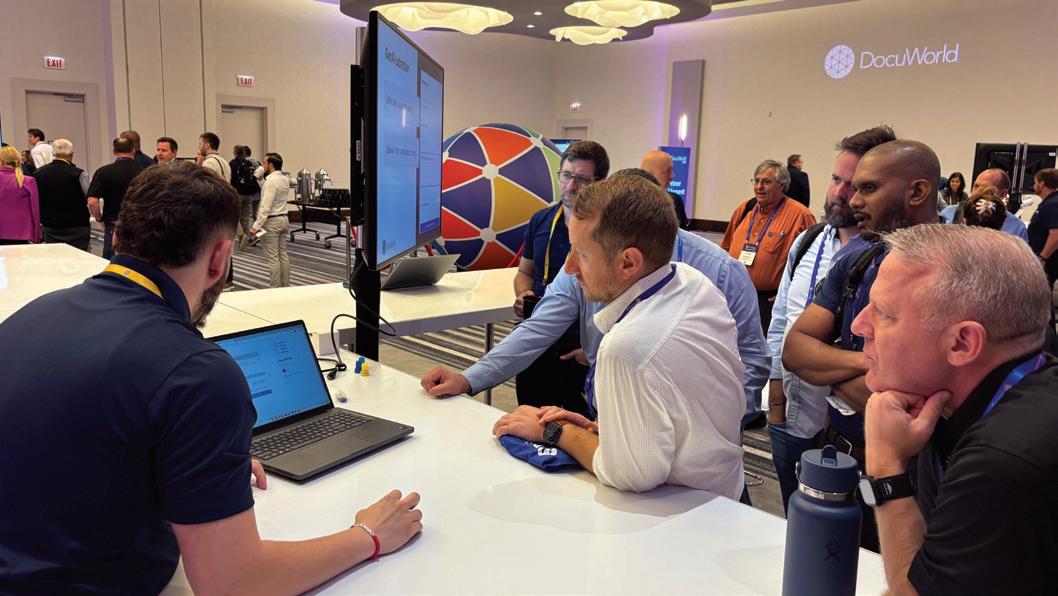
Above: Attendees visit the Experience Zones at DocuWorld 2026, where product experts gave demos of the new DocuWare platform and DocuWare IDP; automation and integration options; and the new Partner Portal. Right: Dr. Michael Berger gives his general session presentation.
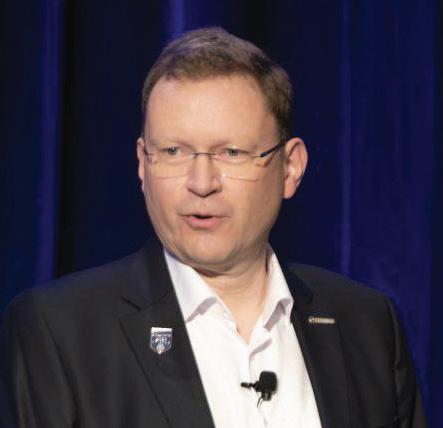
with what DocuWare has built up and what makes our partnership successful,” Berger said. “With the best remedy for the complexity of our times: structure and order. In practical terms, this means stable and flexible digital processes. This is our contribution, which enables companies to manage growing complexity. Our products and services help them manage structure and understand information. They make processes transparent for them and help them design flexible systems. With that, our customers will be able to again focus on their core businesses so they regain their stability and can look toward the future with clarity and competition.”
During his presentation, Berger announced that the company now has 800 employees and 21,000 customers worldwide, and has experienced significant revenue growth over the last fiscal year. Reasons cited for the revenue increase include investments in DocuScan, natif.ai, Axon Ivy and the Ricoh Software Business Unit, along with the company’s work on its software’s security, high scalability, modern processes and the user experience.
“Dear partners, we cannot afford to leave the future to chaos,” Berger said, concluding his presentation. “Our customers are facing a level of complexity they cannot handle on their own. In this room, we together have the technology, the expertise and the network that will enable our customers to successfully shape the future ... We will bring structure, order and, finally,
stability and flexibility. We have the solutions for the challenges ahead and we are ready to tackle them. Not alone — together. Not tomorrow — right now, right here.”
Chief Product and Technology Officer Michael Bochmann explained the theme of the event — “delivering the future” — during his general session presentation. “We needed something new, but still familiar,” he said, discussing the revamp of the DocuWare user experience and interface. “We chose this year’s theme ... because we’re bringing the future, the next generation of DocuWare. It’s not a facelift; it’s an evolution — one experience across any device, reduced cognitive load, faster onboarding, accessibility by design and technically state of the art.”
“We will bring structure, order and, finally, stability and flexibility. We have the solutions for the challenges ahead and we are ready to tackle them.”
Bochmann announced the release of DocuWare’s new AI tool, DocuWare Aura, which allows direct access to DocuWare file cabinets. “Our brand-new AI suite is deeply integrated in the next-generation experience — in the viewer and the results list, or as a powerful chat interface that allows natural language search, which is the new way to access information,” he said. “Aura helps users to search smarter, summarize documents, draw conclusions, translate content, compare versions and even draft email replies, all directly within DocuWare.”
He also noted changes to DocuWare IDP, which now offers tighter integration by supporting both Classic Extraction and the new generative AI-powered GenAI Extraction, which produces immediate baseline results without the need for training.
GenAI Extraction is a prompt-driven, AIbased approach designed for fast startup and flexible use. Zero-shot extraction refers to its ability to deliver results immediately during document processing based on field instructions, skipping the annotation process and eliminating the need for traditional template-based configuration. Another new feature in IDP is master data matching, which allows extraction results to be cleaned up and enriched by comparing them with master data from external sources.
Finally, Bochmann introduced the DocuWare Integration Platform, which will allow standardized, out-of-the-box integrations with third-party systems like ERPs, CRMs and more.
The event’s theme was also evident in many of the other general session presentations, as well as the new “Experience Zones,” where attendees could learn more about four areas of DocuWare in-depth: New DocuWare (with a look at the newest iteration of the software, as well as its companion app); DocuWare IDP; Automation and Integration; and Partner Enablement. Product experts were available in each of the zones throughout the event, giving partners a chance to get a hands-on look at new features and offerings. n
Elizabeth Marvel is associate editor of Office Technology magazine. She can be reached at elizabeth@bta.org or (816) 303-4060.

9 • AgentDealer www.agentdealer.com
31 • American Fidelity (800) 843-5059 / www.bta.org/Insurance
31 • BPO Media www.workflowotg.com / www.theimagingchannel.com
13 • BTA AI Readiness Assessment (800) 843-5059 / www.bta.org/AIReadiness
2-3 • BTA IGNITE Kansas City/BTA at 100 (800) 843-5059 / www.bta.org/IGNITEKC
15 • C2C Resources (866) 341-6316 / www.c2cresources.com
21 • Celiveo 365 www.celiveo.com
23 • Coaches’ Corner (800) 843-5059 / www.bta.org/CoachesCorner
17 • DLL (484) 238-8284 / www.dllgroup.com
23 • e-automate Inventory Essentials (800) 843-5059 / www.bta.org/InventoryEssentials
21 • ENX Magazine (818) 505-0022 / www.enxmag.com
5 • FP www.fp-usa.com
7 • HP www.hp.com/us-en/home.html
19 • Hytec Solutions (800) 883-1001 / www.hytecsolutions.com
11 • Kyocera www.kyoceradocumentsolutions.us/nova
32 • MyQ www.myq-solution.com
14 • RISO https://us.riso.com
17 • Source Technologies (412) 522-0515 / www.sourcetech.com
19 • UPS (800) 636-2377 / www.savewithups.com/bta