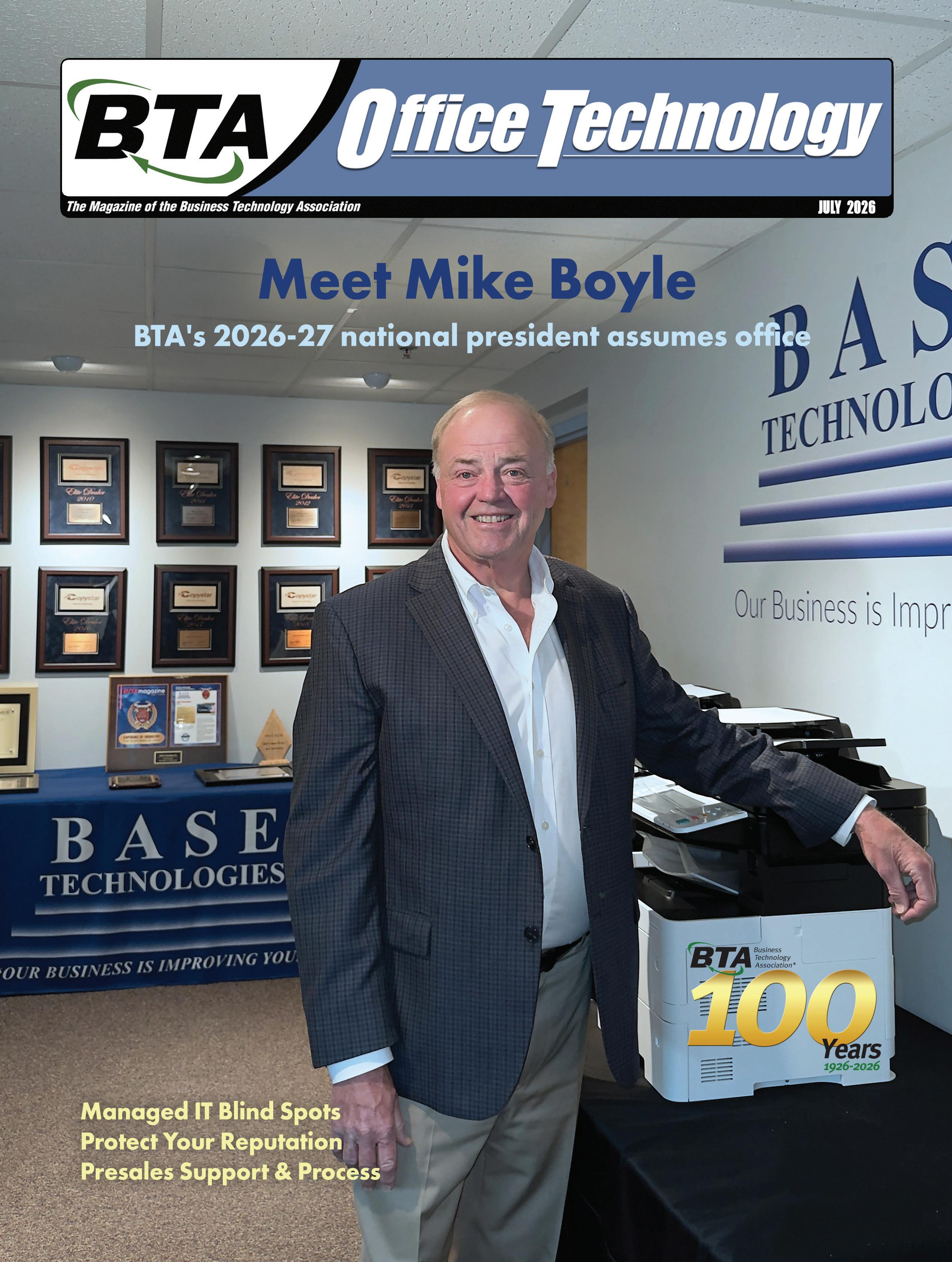
BTA’s 2026-27 national president assumes office by Brent Hoskins
Office Technology Magazine
On July 1 Mike Boyle became the 91st national president of the Business Technology Association (BTA).
Managed IT Blind Spots
They will put your office technology dealership at risk by Jonathan Blakey
Technology Assurance Group (TAG)
A surprising number of dealerships are one neglected IT process away from a catastrophic business interruption.
Label Printing Why it belongs in the dealer conversation by Anne Valaitis
Keypoint Intelligence
For many dealers, labeling may feel like new territory — but it is already in their accounts.
AT 100
‘Absolutely the Best’ Members reflect on a century of service & support
Compiled by Brent Hoskins
Office Technology Magazine
As the Business Technology Association (BTA) celebrates its 100th year, it is gathering testimonials from its members.
LEGAL PERSPECTIVE
24 Protect Your Reputation Formalize your workplace social media policy by Greg Goldberg
BTA General Counsel
A carefully drafted social media policy recognizes that public conduct can affect legitimate business interests.
DEALERS HELPING DEALERS
Owning Buildings & Marketing Dealers answer questions from fellow dealers
Compiled by Elizabeth Marvel Office Technology Magazine
This feature includes two questions submitted by dealer members as part of BTA’s Dealers Helping Dealers resource and many of the answers received. These answers and others can be found in the members-only section of the BTA website.
Sales Versus Service
Why customers do not care about your org chart by Troy Harrison
Troy Harrison & Associates
Start thinking about sales and service as different phases of the same customer relationship. And watch what happens when your customers start experiencing your company as one unified, competent team.
Presales Support & Process
The missing links in software sales by Kristal Cook RockRoot
Most dealerships already have strong sales teams, solid customer relationships and valuable software offerings. What they often lack is a clear structure for supporting software opportunities as they move through the sales cycle. 29
25 Business Technology Association • BTA Highlights
Correction: The third-to-last paragraph in June’s “Delivering the Future” article has been updated online to reflect correct information on GenAI Extraction. Please see the changes in the online version of the magazine at www.bta.org/otjun26.
The Halfway Point, Let’s Take a Look
SExecutive Director/BTA
Editor/Office Technology
Brent Hoskins brent@bta.org (816) 303-4040
Associate Editor Elizabeth Marvel elizabeth@bta.org (816) 303-4060
Contributing Writers
Jonathan Blakey, Technology Assurance Group (TAG) www.tagnational.com
Kristal Cook, RockRoot https://rockroot.biz
ince January 2026, I have focused on the Business Technology Association’s (BTA’s) 100th anniversary year in this space. That focus continues. This month’s Flashback, seen in the bottom right corner of this page, features the cover of the July 1975 issue of the NOMDA Spokesman magazine, a predecessor to Office Technology. The issue provides a celebration, of sorts, of the halfway point to our 100th year. On the cover, you can see “50” surrounded by “Our Golden Anniversary Convention” and “1926 NOMDA 1975.”
1975? Not 1976? It does say “Convention” and not “Year.” With a convention held each year starting in 1926, that is 50 conventions. Plus, the convention occurred in the first month of the 1975-1976 year for the association, then the National Office Machine Dealers Association (NOMDA). In that same 1975-1976 year, the association reached its 50th anniversary in January 1976. So, yes, “50” with “1975” works. That settled, let’s move on, looking inside the vintage issue.
Let’s start with a quick look at the preview of the 50th Anniversary Convention. It took place July 30 to Aug. 2, 1975, at the Minneapolis Auditorium & Convention Hall in Minneapolis, Minnesota. The schedule included a variety of educational sessions. Some of the session titles still resonate (somewhat) today, such as “The Right Way & The Wrong Way to Sell Copying Machines.” Others are a bit more dated, such as “A Place for the Dealer in Microfilm.” The entertainment the first evening: Glenn Ash & Jeanne Steel. Who? The closing night entertainment: Tex Beneke and The Modernaires. I have heard of Tex Beneke; no doubt his backup singers would not sound too modern today.
Moving on to my favorite discovery in this
issue: An image of the front of the program from the association’s first convention. The full text reads. “Program, First Annual Convention, National Association of Typewriter Dealers, (Organized at Kansas City, Missouri, January 22-23, 1926), Chicago, Ill., August 26, 27, 28, 1926, Convention Hall, Palmer House.” There you have it — an image documenting the start of our association. Where is the hard copy of that program today? I don’t know. As I write this, I am looking at the image for the first time. I will keep my eye out as I search through the association’s archives in the coming weeks. There is also the image of a convention program cover that reads: “National Office Machine Dealers Association, 25th Anniversary, International Convention and Trade Exhibit, June 28July 1, 1950, Palmer House, Chicago, Illinois.” I will look for a hard copy of that program, too. Note that the two conventions, nearly 24 years apart, were held at the same venue.
The vintage issue also lists the locations of the association’s first 49 conventions. Only one convention on the list occurred in Kansas City, Missouri, BTA’s home today. The 1936 convention took place at the Muehlebach Hotel in downtown Kansas City. ChatGPT tells me the hotel still stands today (I live here, but was uncertain), but it is not serving as a hotel. However, its historic lobby, ballrooms and meeting spaces are part of the adjacent Kansas City Marriott Downtown.
I am almost out of space here, so one more nugget. In the vintage issue, then NOMDA President-Elect Bob Kuykendall (I had dinner with him and his wife in Abilene, Texas, in the summer of 1994) wrote about his enthusiasm for “the potential of NOMDA during the next 50 years.” Yes, he was thinking through to us and the association of 2026. Bob’s enthusiasm has proven to be well placed. n — Brent Hoskins
Greg Goldberg, BTA General Counsel Business Technology Association
Troy Harrison, Troy Harrison & Associates www.troyharrison.com
Anne Valaitis, Keypoint Intelligence www.keypointintelligence.com
Business Technology Association 12411 Wornall Road Kansas City, MO 64145 (816) 941-3100 www.bta.org
Member Services: (800) 505-2821 BTA Legal Hotline: (847) 922-0945
Valerie Briseno Marketing Director valerie@bta.org
Brian Smith Membership Sales Representative brian@bta.org
The association’s magazine cover 51 years ago this month — the NOMDA Spokesman, July 1975.
Welcome 2026-2027 BTA Board Members
I2026-2027 Board of Directors
President
Mike Boyle BASE Technologies Bethel, Connecticut mboyle@baseinc.com
President-Elect
Mike Hicks Electronic Business Machines Inc. Lexington, Kentucky mhicks@ebmky.com
Vice President
would like to introduce myself as the new Business Technology Association (BTA) president serving during the 100th anniversary year of the oldest and most distinguished association in our industry. It is with honor and respect that all of BTA’s volunteers and I continue the legacy of those who blazed the trail before us. With the next 100 years in our sights, we must make sure that BTA continues to be a guiding light for so many in our industry. Thank you, Debra Dennis, our 2025-2026 president, for setting the course for change and the challenges that come with it. Many of us have had success in this industry, which has taken determination and effort to achieve. I would encourage those who can to give back and become volunteers in our association to steady its course for the next 100 years.
I would like to recognize and thank the following volunteers who have stepped forward to help guide the association alongside me during the 2026-2027 year:
n National President-Elect and Board Member Mike Hicks, Electronic Business Machines Inc., Lexington, Kentucky
n National Vice President and Board Member Blake Renegar, Kelly Office Solutions, Winston-Salem, North Carolina
n National Immediate Past President and Board Member Debra Dennis, CopyPro Inc., Greenville, North Carolina
n BTA East President and National Board
Member Susan Pangborn, Automated Business Solutions, Warwick, Rhode Island
n BTA East President-Elect Lisa Emmons, BASE Technologies, Bethel, Connecticut
n BTA East Vice President Bob Heffelfinger, Advanced Office Systems Inc., Johnstown, Pennsylvania
n BTA East Immediate Past President and National Board Member Tim Seeley Jr., Seeley Office Systems Inc., Glens Falls, New York
n BTA Mid-America President Jeffrey Foley, Apollo Office Systems, Alvin, Texas
n BTA Mid-America President-Elect Scott Vonderharr, Midwest Imaging Solutions, Blaine, Minnesota
n BTA Mid-America Vice President Ron Hulett, U.S. Business Systems Inc., Elkhart, Indiana
n BTA Mid-America Immediate Past President and National Board Member Chip Miceli, Pulse Technology, Schaumburg, Illinois
n National Board Member representing BTA Mid-America Grant Goldsmith, Regal Business Machines/Gateway Business Systems Inc., Chicago, Illinois
n BTA Southeast President and National Board Member Tim Renegar, Kelly Office Solutions, Winston-Salem, North Carolina
n BTA Southeast President-Elect Brice Renegar, Kelly Office Solutions, WinstonSalem, North Carolina
n BTA Southeast Vice President Ashley Whisonant, Capital Office Products Inc., Columbia, South Carolina
n BTA Southeast Secretary/Treasurer Bill James, Jefferson, Louisiana
n BTA Southeast Immediate Past President and National Board Member Richie Creech, CopyPro Inc., Greenville, North Carolina
n BTA West President and National Board Member Pamela Feld, Triumph Technology Group, Tustin, California
n BTA West President-Elect Robert Moore, Lockwood Moore Inc., Reno, Nevada
n BTA West Vice President Ben Johnson, Woodburn Company, Everett, Washington
n BTA West Immediate Past President and National Board Member Richard Van Dyke, Advanced Office, Irvine, California n — Mike Boyle
Blake Renegar Kelly Office Solutions Winston-Salem, North Carolina tbrenegar@kellyofficesolutions.com
Immediate Past President
Debra Dennis CopyPro Inc. Greenville, North Carolina ddennis@copypro.net
BTA East
Tim Seeley Jr. Seeley Office Systems Inc. Glens Falls, New York tseeleyjr@seeleyoffice.com
Susan Pangborn Automated Business Solutions Warwick, Rhode Island spangborn@absne.com
BTA Mid-America
Grant Goldsmith Regal Business Machines/Gateway Business Systems Chicago, Illinois goldsmithg@gateway-biz.com
Richie Creech CopyPro Inc. Greenville, North Carolina rcreech@copypro.net
Tim Renegar Kelly Office Solutions Winston-Salem, North Carolina trenegar@kellyofficesolutions.com
BTA West
Richard Van Dyke Advanced Office Irvine, California rvandyke@goadvanced.com
Pamela Feld Triumph Technology Group Tustin, California pam@triumphoffice.com
Ex-Officio/General Counsel
Greg Goldberg
Barta | Goldberg West Hollywood, California ggoldberg@bartagoldberg.com
Meet Mike Boyle
BTA’s 2026-27 national president assumes office
by: Brent Hoskins, Office Technology Magazine
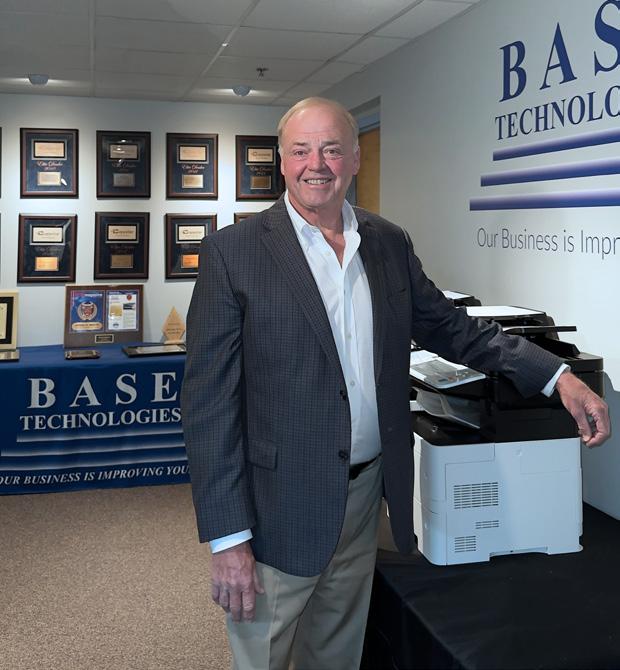
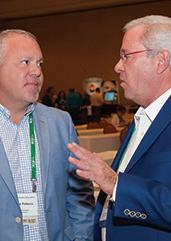
With 47 years of experience in the office technology industry, on July 1 Mike Boyle became the 91st national president of the Business Technology Association (BTA). In 1992, he established BASE Technologies, based in Bethel, Connecticut. He serves as the dealership’s president.
Initially, BASE largely served the telecommunications industry. Today, it offers both imaging hardware and document solutions software, as well as VoIP systems. In 2025, BASE acquired The Office Works Inc., based in Plainville, Connecticut, offering end-to-end document management solutions, and serving Connecticut and western Massachusetts. BASE is known for its active participation in various charitable events and local mentorship programs, reflecting Boyle’s dedication to giving back to the community.
Kyocera primarily, but also do some business with HP and Xerox. We also offer VoIP, primarily doing business with Intermedia, and we are big in software solutions, such as Square 9, PaperCut and many applications. We are very solutions driven.
OT: What do you like best about the industry?
Boyle: In a nutshell, I enjoy the people and personalities. Plus, I like helping others in the industry whenever I can and, of course, learning from others.
OT: What led you to first step forward as a BTA volunteer? How has serving as a volunteer benefited you?
Recently, Office Technology magazine had the opportunity to interview Boyle, asking about his career in the industry, his role as a volunteer and the value of BTA membership. Following are his responses to the interview questions.
OT: How did you get started in the industry? Walk us through the various roles you have served in through the years.
Boyle: I’ve been in the business since 1979, starting with 13 years in roles at Graphic Sciences, Burroughs and Fujitsu, where I started in fax sales and eventually worked my way up to become the national sales director for all major accounts at the company. As it turns out, that corporate experience gave me experience in “big-picture stuff” that is helping me today as an entrepreneur.
Fujitsu exited the business in 1992. I always wanted to be an entrepreneur, so that led to the establishment of BASE, which started in my living room. We then grew our dealership from nothing to something. Today, we offer Toshiba and
Boyle: I felt a degree of obligation to give back to the industry, based on the unique experiences that I’ve had in my career. It also gives me an opportunity to learn from others in the industry. I always look forward to learning from the smarter people in the room.
I sized BTA up as a good organization. It’s all about: “What can we do? What can we learn from each other? How can we help each other?” I was attracted to that. BTA opened the door for me to serve as a volunteer first within BTA East and then as a member of the national BTA Board of Directors.
I have benefited greatly. As a volunteer, I have attended many BTA events. At every single one of them, I walked away with nuggets that I could bring back to my business. My company has been improved because of my involvement with BTA.
OT: What is your message to those dealers who, for whatever reason, are not currently members of BTA?
Boyle: I don’t understand why you would not want to position your company to potentially grow another 10% or
15%. There is no doubt that as a member you will learn new ways to grow your dealership. Many non-members do not realize this about the association.
OT: While BTA helps its members in many ways, what do you see as one of the most important ways it assists its members?
All dealers need to take a deep dive into AI ... learn it, understand it and be trained on it. You need to know all the nuances of protocol, security and information.
Boyle: I believe that being an advocate for all members is one of the most important roles that we play. When I say members, keep in mind that our association is comprised of dealer members, manufacturer members, service members and solution provider members. We serve a diverse membership. But at the same time, if one of our members has “gone off the rails” and is potentially hurting others members of BTA, after proper due diligence, we must point that out.
Say, for example, that a manufacturer is not treating its dealers as it should. In such a situation, BTA must be the voice for those who do not have a voice in the industry, such as individual dealers complaining to a manufacturer’s district sales manager. Even if BTA takes a financial ding from a vendor for calling it out [losing exhibiting fee revenues, for example], the bottom line is, you must “tell it like it is,”
being honest with what the feedback is from the dealer community. Also, the same goes for a dealer member who may be doing something deceptive. We must not be afraid to call somebody out if it is deserving.
OT: What are your thoughts on how today’s office technology dealerships can best continue to thrive and grow?
Boyle: All dealers need to take a deep dive into AI. You need to learn it, understand it and be trained on it. You need to know all the nuances of protocol, security and information. In my company, I’ve established an AI Task Force. Already, I’m seeing results in short order in terms of systems that we’re using; we’re looking into the operations of the company. I’ve got people coming to me with, “Wow, this used to take me three days. I can now do this in 20 minutes.”
We’re still at the early stage of AI implementation. I would guess that my company is probably in the middle of the pack, but I don’t really know. I do know that I can’t take any chances. If I don’t get into AI and the guy across the street from me does, he’ll have an edge over me.
So, the near-term thing that will have the most impact
BTA 2026-27 President-Elect Mike Hicks
Mike Hicks, BTA’s 2026-27 presidentelect, is president and CEO of Electronic Business Machines Inc. (EBM), which is based in Lexington, Kentucky. He has spent 42 years at the company, where he held positions in the board repair/design lab and as a service manager before he assumed his current role in 2001 when EBM became an ESOP. Prior to serving on the national BTA Board of Directors, Hicks served on the BTA Southeast Board of Directors and the BTA Southeast Advisory Board.
“Our previous owner was heavily involved in the local BTA chapter and as he promoted people into management, he encouraged them to get involved with BTA and showed them why it was important,” Hicks says, explaining how he became a BTA volunteer and why he continues to serve. “I went through the FIX workshop and probably wouldn’t be in the position I am today without it. Later, I was convinced to join the BTA Southeast Advisory Board and I went from there. I’ve now spent 15 years volunteering.
”The importance of supporting independent dealers was ingrained in us,” Hicks adds. “I’ve continued to volunteer because I enjoy the people I’ve gotten to know and I learn from them. I value the relationships and support the organization provides.”
Hicks’ BTA volunteerism and his company’s membership has had a profound effect on his business. “All of the peer-to-peer networking [through board service and at BTA events] has given me people
to bounce ideas off of,” he says. “These relationships have been tremendous in helping me work through problems [in my business]. Over the years we have also benefited from programs ranging from health insurance offerings to freight discounts. And when we became an ESOP, [former BTA General Counsel] Bob Goldberg helped us rewrite our company doctrine and employee handbook, and provided trusted advice during a major transition.
“Beyond the programs it offers, BTA’s advocacy on behalf of independent dealers is extremely valuable,” Hicks continues. “As president and CEO of a smaller dealership, I need that voice because mine isn’t always loud enough on its own.”
Hicks notes that the association has been crucial to the industry over its 100-year history. “I think BTA has been vital to keeping all sizes of dealerships and the manufacturers connected, updated and understanding each other,” he says. “It seems to be a very good twoway street. The manufacturers can hear what’s happening to not only the larger dealerships, but the smaller ones, too. BTA is trying to make sure all dealers have a seat at the table so everyone can get better. The communication between the vendors and the dealers, and the education and networking BTA offers dealers, has been instrumental.”
Hicks encourages member dealers to check out the BTA website and take a look at everything the association has to offer (www.bta. org/MemberBenefits). “I want to remind people that all of these tools are right there at their fingertips,” he says. “You pay $500 a year; that’s nothing for all the resources BTA offers.”
— Elizabeth Marvel
on a dealership’s ability to thrive and grow — and I’ve seen it in my own company — is introducing AI as quickly as you can in a sensible, controllable way that will show results, such as with internal processes. That affects service, administration, sales — everything.
The other path to a dealership’s ability to thrive and grow is to diversify its product and services offerings. We are all fighting over a pie that is forever shrinking in terms of volumes. So, you must diversify and you need to have a creative offer. You must change how you’re doing business.
You must have a more robust offering for your customers ... Diversifying intelligently is the path to getting more attention from your existing and potential customers.
However, the biggest challenge I see for dealers today is how and where to diversify. For example, we have dealerships in this industry providing managed services. Some people say that it’s fantastic. Others say it’s the worst mistake anybody could make, because there are a lot of pitfalls if you don’t do it right.
There are also dealerships going into water or surveillance cameras or digital displays. Other dealerships, like BASE, are going into VoIP and software solutions in a big way. You must have a more robust offering for your customers so that you can become much more valuable to them.
Diversifying intelligently is the path to getting more attention from your existing and potential customers. Whatever it is, you’ve got to diversify.
When seeking to invest into diversification, it is important to make sure your core business is locked up and protected. In other words, you cannot diversify at the expense of losing your core business. Yes, you need to diversify, but you must make sure you have proper processes and procedures in place to effectively support your current customers and new opportunities in your core business. That will give you the finances to pursue diversification.
OT: How can BTA play a role in helping dealers address the challenges they face?
Boyle: BTA must stay ahead of the challenges by way of dialog with the people whose expertise can help dealers face a particular challenge. BTA can then get the right information into the hands of those in the dealer community who need it to assist them.
Much of what we do is serve as a vehicle to push information out to dealers to help them address challenges, through educational sessions at our events and otherwise. We are
BTA 2026-27 Vice President Blake Renegar
BTA’s 2026-27 vice president, Blake Renegar, is vice president of Kelly Office Solutions, Winston-Salem, North Carolina. He started his career at the family business while he was attending North Carolina State University, working in the warehouse and in Pure Water Technology sales during the summers. After starting full-time at the dealership, he single-handedly formed the company’s managed network services division and was named director of managed network services in 2016 before being named vice president in 2025.
Renegar began his BTA volunteerism during the 2020-21 fiscal year when he joined the BTA Southeast Board of Directors as a board member. “My father [BTA Southeast President Tim Renegar] served as a longtime board member and he introduced me to the group,” he says. “I immediately saw and understood the value of being part of such an organization.”
There are several benefits Renegar says he and his company have received from BTA membership. “There are so many advantages of being a BTA member that’s it difficult to name them all, but the most important to me have been the development of dealer and vendor relationships, access to best practices, and the opportunity to explore new solutions and technologies that can help our business thrive,” he says.
Renegar encourages members to take advantage of all of the association’s offerings. “BTA offers so much to its members: educational
and networking events, workshops, peer groups like the Dealers Helping Dealers Discussion Groups, as well as our fantastic legal services,” he says. “It is key that our members know about all of these resources and take advantage of them. The association currently offers its members a tremendous value for the money, which is a major plus in an inflationary environment. I only see BTA becoming more important as trends shift and develop.”
When thinking about BTA’s 100th anniversary, Renegar also notes the importance of BTA to the industry as a whole. “I firmly believe that the impact of BTA has been enormous in ways that are difficult to quantify in its 100-year history,” he says. “The shared dealer experiences and knowledge alone are monumental.”
Renegar highlights the revamp of BTA events as one of the biggest successes for the association in the past year. “I believe we have brought our shows to a whole new level, and the upcoming BTA IGNITE Kansas City and 100th anniversary events will be shining examples of that,” he says. “We will continue this momentum by providing maximum value to our members.”
What does Renegar see in the future for the industry and the association? “In the industry overall, I see continued diversification into other service offerings and technologies beyond traditional print, while still streamlining our core businesses,” he says. “I see a bright future for BTA where it helps its members maintain success within their core businesses, as well as assists them in ushering in a new era of service technologies.”
— Elizabeth Marvel
I believe BTA will continue to be the gold standard in our space in terms of education, support and services for the dealer community.
continually working to provide content related to the challenges the dealer community faces.
OT: You are entering your BTA presidency during the association’s 100th year. Have you considered the significance of that?
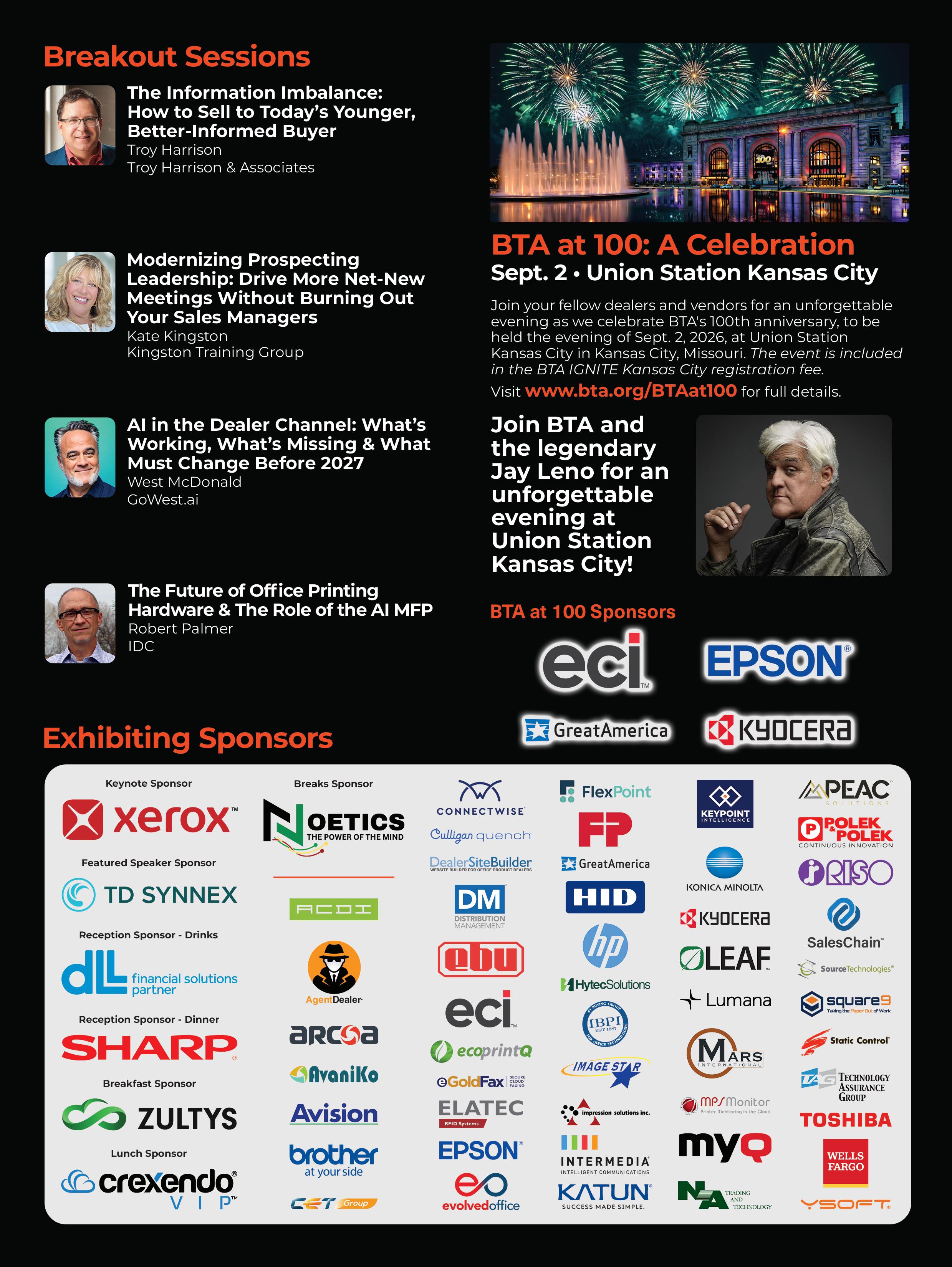
Boyle: Yes, I’ve thought about it quite a bit. The celebration we are planning for Sept. 2 in Kansas City, Missouri, is our way of paying respect to all the people who came before us, serving our association and the dealer community, helping to make us what we are today. Their accomplishments and efforts have ensured the association would last not just a couple of years, but 100 years. That is the mantle that has been passed to me as the president during our 100th year. I want to make sure that BTA is in good — if not better — shape when I leave the presidency as we start our second 100 years.
OT: Looking out five to 10 years from now, what is your vision of how BTA will be best described at that point?
Boyle: I believe BTA will continue to be the gold standard in our space in terms of education, support and services for the dealer community. The BTA Board of Directors is comprised of owners and senior managers who work in dealerships around the country. Channeling that knowhow and energy will continue to help our members, their people and their businesses.
In terms of where technology will be in five to 10 years, as an industry, big picture, we are solution providers; we see areas that have problems and we provide solutions. Where is that going to be 10 years from now with the advent of AI? If you asked me 20 years ago, I may not have been able to provide an accurate answer, but I would have been able to provide the semblance of an answer. With AI, I don’t know. However, whatever the technology is in 10 years, I am certain that we will still be offering technology solutions to address business problems. That will continue to occur profitably for all our members. n Brent Hoskins, executive director of the Business Technology Association, is editor of Office Technology magazine. He can be reached at (816) 303-4040 or brent@bta.org.
Managed IT Blind Spots
They will put your office technology dealership at risk
by: Jonathan Blakey, Technology Assurance Group (TAG)
There is an uncomfortable reality many office technology dealers do not want to admit: A surprising number of dealerships are one neglected IT process away from a catastrophic business interruption. And the scary part? Most owners would never see it coming. Why? Because most successful office technology dealers are not deeply technical.
Once a dealer hires an IT manager to run his (or her) managed IT services division, he assumes the basics are being handled properly. But “assuming” and “verifying” are two very different things. And in managed IT, the basics are everything — one forgotten process, one unchecked backup or one compromised account is all it takes.
There was a recent case where an office technology dealership delivering managed IT services “assumed” backups were functioning correctly — until ransomware hit one of its clients. When the dealership employees attempted to restore the environment, they discovered the backups had not actually been working properly.
The client’s systems were locked. Operations stopped. The business was crippled. And the client may go out of business.
That kind of failure does not just hurt the customer. It can destroy reputations overnight. So if you are an office technology dealer selling managed IT services, these are the kinds of mistakes that can put your dealership out of business.
When a client trusts you with his technology infrastructure, he trusts you with the operational heartbeat of his business. If you are not obsessively focused on the fundamentals of properly running a managed IT services business, your client does not have an IT strategy. He has a liability.
Here are the bottom-line fundamentals every office technology dealer offering managed IT services should verify regularly. If a prospective client’s provider is not doing these
things, it is your way into a sales conversation.
(1) Backups are not enough. You must verify they actually work — One of the biggest misconceptions in managed IT is believing that “having backups” means you are protected. It does not. A backup that has not been verified is just a theory. Many organizations discover this the hard way after ransomware, accidental deletion, hardware failure or a cyberattack. They assume their systems are recoverable — until they actually try restoring them. That is why mature IT organizations do not just run backups; they constantly test them.
Office technology dealership owners should be asking questions like:
n “Are backups being checked and how frequently?”
n “Are backup reports being reviewed by leadership?”
n “When was the last time we did a full restore to a virtual environment to prove recovery actually works for all of our customers?”
If those conversations are not happening in your business,
that is a major red flag. Because when disaster strikes, “We thought it was backing up” is not a strategy.
Here is a useful question to ask your IT manager: “When was the last time we fully test-restored our customer backups — and could they confidently get their businesses operational again if something catastrophic happened tomorrow?” That question tends to separate providers that simply run backups from those that actually verify business continuity.
Your IT leadership team members should be conducting strategic business reviews with your accounts, and discussing strategy and customer objectives.
(2) Weak multifactor authentication (MFA) policies are leaving the front door open — Many cyberattacks do not begin with sophisticated hacking. They begin with a stolen password. That is why MFA has become one of the most important baseline protections in modern IT environments. And, yet, many office technology dealerships have not implemented MFA on all of their customers’ IT networks.
Sometimes MFA is enabled for email but not remote access. Sometimes executives bypass it because it is “inconvenient.” Sometimes legacy systems are left exposed. Those gaps matter because cybercriminals do not need every door unlocked. They only need one.
For office technology dealers, this is especially important because your business is likely to have access to:
n Customer data
n Financial information
n Device credentials
n Admin access across multiple environments
n Sensitive employee information
A compromised customer could quickly become a compromise across your client base. That is why strong MFA policies should not be optional. They should be nonnegotiable.
A useful question to ask your IT manager: “Are all of our managed IT services accounts leveraging MFA?” That question alone can reveal a lot.
(3) If your managed IT services team members are not talking strategy, they are probably just reacting — Most office technology dealerships’ IT service departments spend all day putting out fires — tickets, password resets, printer issues, software problems, etc. But great IT leaders do not just react to problems, they prepare customers for what is coming next.
Your IT leadership team members should be conducting strategic business reviews with your accounts, and discussing strategy and customer objectives. If those strategic conversations never happen, your dealership may be stuck in reactive mode instead of building a long-term technology road map. That becomes dangerous very quickly in an industry evolving as quickly as managed IT. A useful question to ask is:
“How often are we meeting with customers to discuss a strategic technology plan for the next year?”
Are You Checking the Boxes?
The question many office technology dealership owners eventually need to ask themselves: “Are these basics truly being handled — or am I simply assuming they are?”
Many owners hand technology responsibility to their IT managers and trust that everything is covered. But trust without verification can create blind spots, and those blind spots can put customers and, ultimately, you, out of business. Some internal IT team members become very good at sounding technical without consistently executing basic operational disciplines that keep businesses protected. The fundamentals may not be flashy, but they are what keep companies operational.
No Basics, No Business
Managed IT is not just another revenue stream for office technology dealerships anymore. It has become a foundational part of the dealership business model. And with that opportunity comes responsibility. Because when clients trust you with their technology, they trust you with:
n Their operations
n Their productivity
n Their customer data
n Their financial systems
n Their reputations
n Their livelihoods
It is very easy for your IT manager to skip the basics. If you do not ask, you do not know. You are the leader and ultimately responsible and liable, not your IT manager. The office technology dealerships that will thrive in managed IT services in the coming years have already made a commitment to implementing sound IT processes, cybersecurity protocols, achieving compliance like ISO 27001 and HIPAA, and ensuring their customers’ IT environments are checked consistently. Those that do not have already put their dealerships at risk. n
Jonathan Blakey is vice president of technology at Technology Assurance Group (TAG). He is responsible for driving the implementation of operational best practices, adoption of new technology and enhancing service delivery. Blakey can be reached at jonathan@tagnational.com. Visit www.tagnational.com.
Winning
Why
– Connect
– Improve
– Deliver
Label Printing
Why it belongs in the dealer conversation
by: Anne Valaitis, Keypoint Intelligence
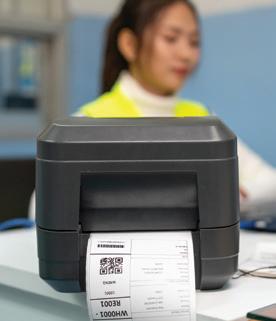
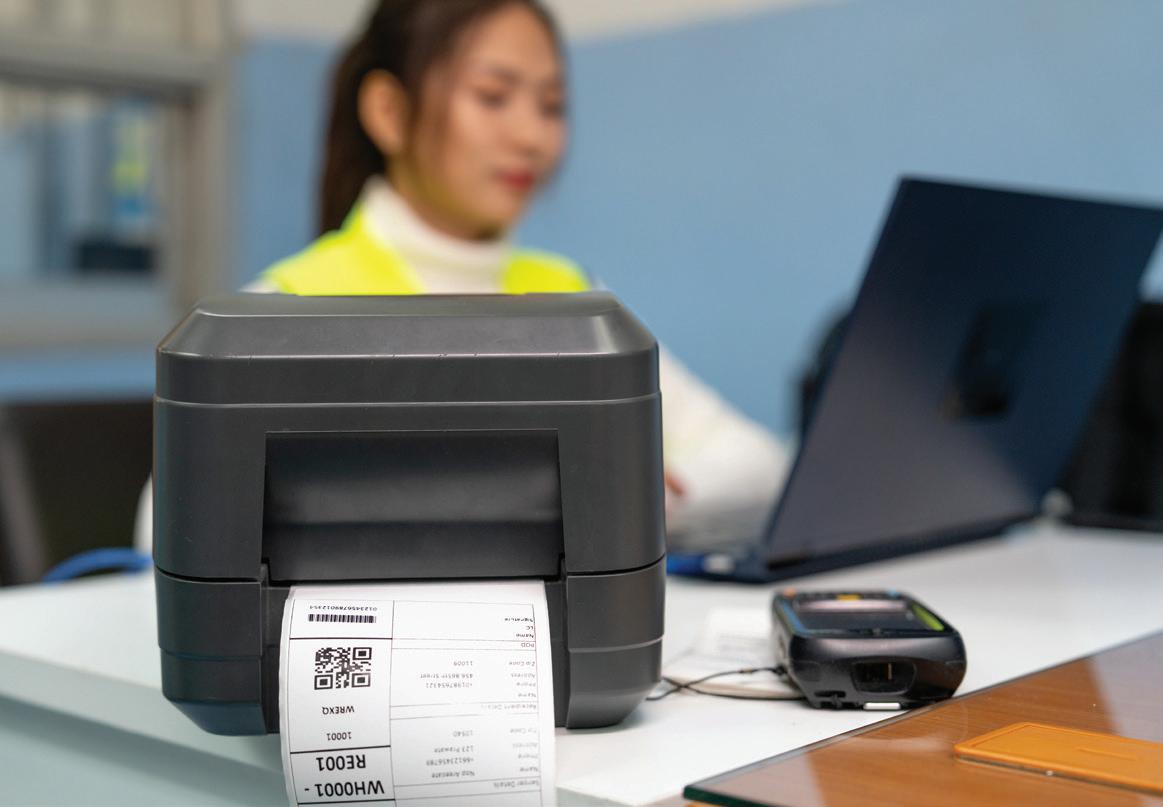
Labeling tends to sit just outside the traditional office print conversation. It shows up in shipping, retail operations, health-care workflows and compliance requirements. It is present in many customer environments, but rarely part of what dealers are asked to manage.
The technology behind many of these use cases is dedicated label printing. While thermal technologies remain the dominant choice for shipping, retail and compliance applications, the broader label printing market encompasses a range of solutions designed for different media, durability and business needs.
Every day, labels produced by dedicated label printers move packages through delivery networks, track inventory, identify products and support compliance processes across businesses of all sizes — including many of the customers dealers already serve.
That reliability is part of the reason labeling has not attracted much attention from the channel. It works, it gets left alone and no one asks questions. But as customer environments become more connected and workflows more distributed, that hands-off approach is starting to create gaps.
For many dealers, labeling may feel like new territory — but it is already in their accounts. Customers are using label printers in shipping areas, front offices, retail spaces and back-office workflows. In most cases, those devices got there without dealer involvement: they were sourced through IT, purchased online or bundled with a specific application. That is precisely why they have stayed off the radar.
These devices are smaller, task-specific and relatively low cost — and easy to overlook until something goes wrong. But when they stop working, workflows stop. Dealers are deeply involved in managing print environments, workflows and service delivery, yet labeling often exists just beyond that scope, even within the same customer.
Shipping is the most visible entry point. As e-commerce continues to grow, even small and medium-sized businesses are producing a steady volume of shipping labels — and
across offices, branches and remote locations.
Retail environments are evolving in a similar direction. As stores take on more fulfillment responsibilities, labeling touches pricing, markdowns and order pickup workflows in ways it did not before. In health care, the stakes are higher — labeling is tied directly to patient identification and compliance, where a misread or failed print has immediate consequences.
What is changing is how closely labeling is tied to broader operational and technology decisions. It increasingly intersects with systems and environments that dealers are already managing elsewhere in the same accounts.
Labeling spans a wide spectrum — from highly specialized industrial environments to everyday desktop applications. The segment most relevant to office technology dealers sits at the desktop and light industrial level, where the use cases — shipping, retail operations and compliance labeling — are familiar and accessible.
One of the reasons labeling has remained separate from the traditional print conversation is that it behaves differently. The conversation does not start with the device. It
what was once centralized is now distributed
starts with the application. What needs to be labeled, where it will be used and what the environment requires all come into play. Media, durability and integration matter as much as the hardware.
Dealers will recognize that dynamic. It is not unlike how copier/MFP evaluations work. The difference is that labeling conversations tend to start with the workflow itself, which aligns well with how many dealers are already engaging customers around solutions and service.
Labeling may not carry the same volume or visibility as traditional office print, but it plays a critical role in processes where failure is not easily tolerated.
The labeling market is well established but has long been fragmented, with multiple vendors, overlapping product lines and a channel landscape that has never fully consolidated. Historically, labeling has been served by specialized automatic identification and data capture (AIDC) resellers, but that is changing. IT providers, managed service providers and office technology dealerships are increasingly active in the same spaces, often serving the same accounts.
That overlap is also changing how labeling is introduced
and supported within customer environments. In some cases, it arrives bundled with a specific application — shipping software, a retail system or a health-care platform — and the hardware is almost an afterthought. In others, it is a standalone purchase made quickly to solve an immediate operational problem.
Over time, this creates inconsistency. Different locations may use different devices, media or workflows. Support is fragmented and visibility into how labeling is used across the organization is limited. As businesses scale and workflows become more distributed, that inconsistency becomes difficult to ignore — and easier to address with the right partner involved. Labeling may not carry the same volume or visibility as traditional office print, but it plays a critical role in processes where failure is not easily tolerated. A mislabeled shipment, an unreadable bar code or a failed print job can have immediate operational consequences — the kind that get noticed right away.
Where Dealers Fit
For dealers, this calls for a different kind of conversation — one that is less about device replacement and more about understanding how labeling fits into specific workflows. That means starting with different questions: Where are labels being produced and how frequently? What systems do they connect to? What happens when something goes wrong?
For dealers, this is not about chasing a new market. It is about recognizing that one has been in their accounts all along — and deciding what to do about it.
From there, the conversation can expand into standardization, media selection, integration and ongoing service. These are areas where dealers already have a lot to offer.
Label printing may also require developing some familiarity with industry-specific requirements: the compliance standards that govern health-care labeling, the terminology used in logistics and warehousing, or the regulatory requirements that apply in certain verticals. That kind of contextual knowledge is what separates a vendor from a trusted advisor.
This aligns with a broader shift already underway in the channel. Dealers are increasingly engaging around workflow, integration and service rather than focusing solely on hardware — and many are building out industry-specific solutions tailored to health care, retail, manufacturing and other verticals. Labeling fits squarely into that model. It is operational, service-dependent and the requirements vary enough by industry that vertical expertise becomes a real advantage.
The considerations in labeling are not entirely foreign to dealers. Media selection, integration with business systems and configuration all play a significant role in performance and reliability — and dealers have been navigating similar decisions in traditional print environments for years. The difference is in the specifics: label stock behaves differently than paper, adhesives and coatings matter, and the consequences of getting it wrong tend to show up more quickly. That is familiar territory with a new vocabulary.
A Practical Starting Point
None of this requires a complete reinvention of the dealer model, but it does suggest an opportunity to extend existing strengths into adjacent areas of the customer environment — particularly where print, workflow and operations converge. There is also a natural connection between labeling and the core strengths of the office technology channel. Dealers are accustomed to managing large installed bases of devices under contract, supporting workflows and providing ongoing service across customer environments. Labeling touches many of the same areas — it is workflow-dependent,
sensitive to downtime and often deployed across multiple locations. The difference is that many label printers today are purchased transactionally, outside of any managed contract. That is both the gap and the opportunity.
In many cases, labeling is already present within the accounts dealers serve. But it can also open doors to customer relationships that have not developed through traditional office print channels, creating an opportunity to demonstrate the kind of service-oriented, workflow-focused approach that dealers do well.
For dealers exploring this space, the starting point is not mastering every type of labeling — it is knowing where to look. Labeling is already present in most customer environments. The first step is simply making it visible: understanding where labels are being produced, how those workflows operate and where there are gaps that are not currently being addressed. Once that picture comes into focus, patterns emerge quickly — and the path to a more structured, service-oriented conversation becomes clear.
What This Means for the Channel
Label printing has been part of the broader print landscape for decades. While thermal technologies continue to dominate many operational applications, labeling as a whole is becoming increasingly integrated into connected business workflows and service-oriented environments. For dealers, this is not about chasing a new market. It is about recognizing that one has been in their accounts all along — and deciding what to do about it. n
Anne Valaitis is a principal analyst at Keypoint Intelligence, covering workplace solutions, services and customer communications. She leverages her extensive expertise in document workflow management and customer engagement to help clients optimize operations, enhance communications and drive business growth. With 30 years of industry experience, Valaitis has led numerous research projects that have shaped the document solutions and customer communications landscape. Her background in product management at leading hardcopy vendors, including product life-cycle management and go-to-market strategy, provides her with a deep understanding of technology and market dynamics.
She can be reached at anne.valaitis@keypointintelligence.com. Visit www.keypointintelligence.com.
‘Absolutely the Best’
Members reflect on a century of service & support
Compiled
by: Brent Hoskins, Office Technology magazine
As the Business Technology Association (BTA) celebrates its 100th year, it is gathering testimonials that reflect on the people, businesses and experiences that have shaped BTA across the decades. Office Technology asked BTA members to share what the association has meant to them and their businesses — favorite memories, experiences when BTA made a difference for them, the value of membership, their perspective on BTA’s role in the industry, words of congratulations, etc. Below are additional responses received. More responses will be published in this feature throughout 2026. If you would like to share your BTA story, email it to Brent Hoskins at brent@bta.org.
vice president during my term. Back in those days you became a national board member of NOMDA when you were a leader of your chapter. The meetings that SEROMDA put on in Florida were what seemed like Printing United in size — every manufacturer in our industry was there. I will never forget those days. They were absolutely the best. I must say, the closest thing to that camaraderie for me today are the BTA meetings in Asheville, North Carolina, which attract a lot of nearby dealers. There is a lot of sharing of information and ideas.”
David Carson, president Plus Inc., Greenville, South Carolina
“First, I would like to congratulate you all on this exciting milestone! Successfully operating for more than 10 decades is an amazing accomplishment and we are pleased to be a member of an organization that continues to be an exceptional force in the office technology industry. Through partnerships, businesses can reach new audiences, industries or regions that would otherwise take significant time and cost to enter independently. BTA has been instrumental in helping us expand our reach and increase visibility with our target audience. Customers feel more confident knowing multiple trusted teams are collaborating to support their success, and our partnership with your team clearly reflects that. Congratulations again!”
Kiara Brown, marketing coordinator Dove Technologies, Florence, South Carolina
“I was initiated into the office equipment industry through the old NOMDA [National Office Machine Dealers Association; now BTA], which my father introduced me to. This would have been in the 1970s and 1980s when I started [in the business]. Back than it was the one and only [group] to be a part of. There was SEROMDA and then the local chapters. I would attend all the meetings for the South Carolina OMDA and some of the joint meetings with North Carolina and Georgia. They were absolutely the best. The camaraderie and learning were second to none.
“I eventually became the president of the South Carolina chapter. I remember that Dru Baker of Ricoh was the incoming
“The biggest part for me is the networking and nice people you meet through BTA. I haven’t attended a ton of events, but for the several I did, I always walked out with a good story about the show and some ancillary pieces about people and their companies.
“My best as always and big time congrats!”
Carl Schell, vice president of content strategy Keypoint Intelligence, Fairfield, New Jersey
“One of my favorite BTA memories is the old ‘Train the Trainers’ programs and the subsequent presentations that we delivered to the local meetings. I met a lot of quality people at those meetings.”
Mark Naylor, president ABM Automation, Edmond, Oklahoma
“BTA has been one of the most valuable resources in my career — providing guidance, perspective and relationships that have helped me avoid countless missteps.
“If I could quantify BTA’s impact, it would rank among the most important influences in my professional journey. I’m proud to have served the association and am honored to celebrate its 100-year legacy.”
David Polimeni, CEO RITE Technology, Sarasota, Florida n Brent Hoskins, executive director of the Business Technology Association, is editor of Office Technology magazine. He can be reached at (816) 303-4040 or brent@bta.org.
Protect Your Reputation
Formalize your workplace
social media policy
by: Greg Goldberg, BTA General Counsel
Near the top of the list of HR headaches for business owners are employee separations. Whether an employee resigns, is laid off or is fired for cause, the risk of facing an employment lawsuit is uncomfortably high. As a first line of defense, employers often utilize separation agreements — contracts that provide a defined amount of compensation in exchange for a full release of all potential claims against the employer.
Although separation agreements are generally effective, departing employees are not legally required to sign them. Moreover, these agreements can create the problem of appearing to reward undeserving employees. As a second line of defense, it is important for business owners to carry employment practices liability insurance — a policy that covers legal defense, settlements and judgments arising from employment cases.
Broadly speaking, employers are all too familiar with terminations resulting from poor performance on the job. Increasingly, however, they are also faced with terminating employees who engage in conduct detrimental to their companies outside of work. For example, employees who create social media posts that celebrate violence, spread conspiracy theories, or amplify hateful or threatening content may harm employers sufficiently to justify dismissal. In other words, although employees may assume that “personal” speech online exists in a realm insulated from professional consequences, this is simply not the case.
When business relationships are built on trust like they are in the dealer channel, individual business transactions take a back seat to the overall confidence, consistency and reliability of knowing that the customer’s needs will always be met. In this context, a single social media post by a rogue employee has the power to destroy something that may have taken years to establish.
Whether it starts from a personal Facebook post or LinkedIn comment, sometimes all it takes for an employer to be harmed is a link to the employer in an online bio or a reference to the employer’s business. Regardless, bad news travels much faster than any formal corporate response seeking to do damage control. Screenshots circulate. Customers complain. Competitors whisper. Internal morale deteriorates.
Many employees assume that the U.S. Constitution — specifically the First Amendment — protects them from employment consequences arising from political speech. It does not. The constitutional guarantee of free speech restricts government action, not that of a private company. Privately owned
companies retain broad discretion to terminate employees whose conduct harms the business, undermines workplace culture or jeopardizes customer relationships.
In this context, it is important for employers to ensure the termination process does not run afoul of discrimination or retaliation laws. Terminated employees are quick to argue that disciplinary enforcement for online conduct is selective, inconsistent or pretextual. An employee terminated for politically charged posts may claim that similarly situated coworkers expressing opposite viewpoints are treated more favorably. Others may allege religious, national origin or disability discrimination, or retaliation tied to unrelated workplace complaints. In other words, controversies that start on social media can result in the same traditional employment law claims stemming from ordinary workplace misconduct.
Business owners should consider formalizing workplace social media policies, even if employees’ social media usage has evolved informally. A carefully drafted social media policy distinguishes between personal and professional social media accounts while recognizing that public conduct can still affect legitimate business interests. Policies should prohibit harassment, threats, discriminatory commentary, disclosure of confidential information, and conduct reasonably likely to damage customer relationships or workplace safety. Employers should also define expectations for identifying affiliation with the company online, clarify whether employees may speak on behalf of the business and establish procedures for investigating complaints consistently.
Policies must also be enforced uniformly. If an employer disciplines one employee for offensive political speech but ignores comparable conduct from another employee whose views management finds more agreeable, the company may inadvertently create evidence supporting a discrimination claim. Consistency — not ideology — is what courts and juries examine most closely.
Above all, a robust social media policy will help avoid the worst possible result: being forced to pay off a former employee whose undisciplined online behavior harms the employer’s reputation. n
Greg Goldberg, partner at Barta | Goldberg, is general counsel for the Business Technology Association. He can be reached at ggoldberg@bartagoldberg.com or (847) 922-0945.
BTA HIGHLIGHTS
BTA would like to welcome the following new members to the association:
Dealer Members
Hagan Business Machines of Meadville Inc., Meadville, PA
Scott Technology Group, Rohnert Park, CA
For full contact information of this new member, visit www.bta.org.
Travel Booking Platform
Whether it is a conference, national event, chapter meeting or certification program, travel is a big part of your business. If you are ready to upgrade the way you book travel, say hello to Engine, a travel booking platform available through your BTA membership that gives you access to prenegotiated hotel rates you will not find on public sites.
Members save an average of 26% on hotels, all while booking flights, hotels and rental cars together in one place.
Why do BTA members use Engine?
• Search and book hotels, flights and rental cars in one place.
• Access exclusive hotel savings up to 60% off public rates.
• Keep earning your Hilton, Marriott, Delta and other loyalty rewards.
• Book with confidence through an intuitive experience built for real travelers.
• Get 24/7 support if plans change.
For more information, visit www.bta.org/TravelBooking.
For information on BTA member benefits, visit www.bta.org/MemberBenefits.
Each month, BTA features two of its vendor or consultant/trainer members in this space. BTA recommends due diligence when choosing a partner.
ConnectWise is a leading business management platform made for companies that sell, service and support technology. Leveraging the cloud, the platform fully integrates business-process automation, help desk and customer service, sales, marketing, project management and business analytics that dramatically streamline a company’s operations. ConnectWise also gives its users access to a powerful network of ideas, experts and solutions.
www.connectwise.com
Predictive InSight works to help office technology companies improve the “people-to-process” ratio. It sources the best data collection tools available and supplements them with algorithms that turn that data into knowledge, enabling service providers to predict consumable replenishment and service alerts, and track moves and changes. Predictive InSight provides the source for knowledge building, and its precision accurately permits the prediction of your next required steps. Its e-commerce platform is a true B2B, allowing for an enhanced customer experience and sales process automation. https://predictive-insight.com
A full list of BTA vendor members can be found online at www.bta.org. For more information, visit www.bta.org.
Owning Buildings & Marketing Dealers answer questions from fellow dealers
Compiled by: Elizabeth Marvel, Office Technology Magazine
Following are two questions submitted by dealer members as part of BTA’s Dealers Helping Dealers resource and many of the answers received. These answers and others can be found in the members-only section of the BTA website. Visit www.bta.org/DealersHelping Dealers. You will need your username and password to access this member resource.
If you own your building, at what point did you make the decision to own and what were the factors helping to make that decision?
“We made the decision to own our building once we reached a point of stable revenue, consistent cash flow and long-term confidence in our market.
“Key factors:
n Cost comparison versus leasing — Ownership allowed us to build equity while keeping monthly costs comparable to (or better than) rent over time.
n Long-term stability — Ownership eliminated concerns around lease increases, renewals or relocation.
n Control over the space — We now have the ability to customize the facility to fit our operations.
n Investment value — We viewed the building as both an operational asset and a long-term investment.”
Keith Anselmo, territory manager Appalachia Business Communications, Johnson City, Tennessee
“I have owned my headquarters building for about 25 years. It just made sense. We rent a warehouse and an office/warehouse building in Little Rock.”
Tim Stanley, owner TDSiT, Lowell, Arkansas
“We decided to buy our building because of the increasing rents in our area.”
Dan Detrick, vice president CopyLady Inc., Fort Myers, Florida
“My grandfather built the building, my aunt inherited it and I bought it from her (under a separate LLC). Having rent stability was my motivation. No one else is in control of that
aspect of my business.”
Gary Foote, president HBM Technology Partners, Reno, Nevada
“[We have owned our building] from the beginning. It gives us the ability to do whatever we want with it, and we’ll have income when we retire.”
Chip Miceli, CEO
Pulse Technology, Schaumburg, Illinois
“[We owned it] immediately — day one! Owning your own building is vital. It provides many tax advantages, a hedge against inflation, and custom design and control for your business.”
Clint Feybusch, president Office Concepts, Pipersville, Pennsylvania
What kind of marketing are you doing for managed IT services?
“We’re taking a multichannel approach to marketing our managed IT services focused on education, trust building and consistent lead generation.
“What’s working for us: Targeted digital marketing, email campaigns, educational content, referral programs, and local networking and events.”
Keith Anselmo, territory manager Appalachia Business Communications, Johnson City, Tennessee
“Some marginally effective social media.”
Gary Foote, president HBM Technology Partners, Reno, Nevada
“Facebook and LinkedIn.”
Jeff Eaves, president Appalachia Business Communications of Kingsport Gray, Tennessee
“Email, telemarketing and our chamber of commerce.”
Jeffrey Foley, COO Apollo Office Systems, Alvin, Texas n Elizabeth Marvel is associate editor of Office Technology magazine. She can be reached at (816) 303-4060 or elizabeth@bta.org.
Sales Versus Service
Why customers do not care about your org chart
by: Troy Harrison, Troy Harrison & Associates
Iwas in a meeting last week with a company that was having what they called a “handoff problem.” Sales team members would close deals and then toss them over the wall to the service team members, who would promptly fumble the relationships because they did not understand what had been promised or why the customer bought in the first place. Does this sound familiar?
Here is what really got me: This company’s leaders spent months reorganizing its departments, creating new processes and building elaborate handoff procedures. They were treating the symptoms while completely missing the disease.
The real problem? They were thinking about sales and service as completely separate functions when, in reality, there is far more overlap than most people realize. And, more importantly, their customers do not care about the company’s internal org chart.
The False Division
n Potentially upselling and cross-selling
Walk into most companies and you will find sales and service employees living in different worlds. Sales sits over here, service sits over there and never the twain shall meet. Salespeople think service folks do not understand business development. Service people think sales folks make promises they cannot keep. Both sides are probably right. But here is what is crazy: We create this artificial division in our own minds, then act like it is some law of nature.
Let me break down what we typically think sales does:
n Prospecting and building relationships (usually at the decision-maker level)
n Diagnosing customer needs and issues
n Solving those needs and issues
n Proposing solutions and talking money
n Closing the sale
n Ongoing relationship building and upselling/cross-selling
Now, here is what we typically think service does:
n Product and/or service delivery
n Establishing and building relationships (usually at the operational level)
n Solving problems and addressing customer complaints
Look at those lists for a minute. Really look at them. See the overlap? Both functions build relationships. Both solve problems. Both potentially upsell and cross-sell. The main differences are timing and the level of contact within the customer organization.
Those are not two completely different jobs. That is one customer experience that we have artificially chopped into pieces.
Your Customer’s Reality Check
Here is the thing that should keep every manager awake at night: While sales and service might be separate and distinct in your mind, they are usually not distinct in your customer’s mind. When a customer calls your company, he (or she) does not care if he is talking to “sales” or “service.” He cares about getting his problem solved by someone who understands his business and can help him succeed.
When your service person cannot answer a question about pricing or contract terms, the customer does not think, “Oh, that’s not his department.” They think, “This person doesn’t know what he’s doing.”
When your salesperson promises something that service cannot deliver, the customer does not blame the handoff process. He blames your company.
Your customer sees one company, one relationship and one experience. The fact that you have divided responsibilities based on your internal convenience is your problem, not his.
The Real Cost of Artificial Division
I have seen this division cost companies in ways they do not even realize. First, there is the obvious stuff — missed upselling opportunities, frustrated customers and relationships that die during handoffs. Service people who could be identifying expansion opportunities do not because “That’s sales’ job.” Salespeople who could be preventing churn by staying involved postsale do not, because “That’s service’s job.”
Stop thinking about sales and service as separate functions. Start thinking about them as different phases of the same customer relationship.
But the hidden costs are even worse. You are essentially training your people to think in silos. You are rewarding them for staying in their lanes instead of thinking about the total customer experience. You are creating a culture where passing the buck is standard operating procedure.
And here is the kicker: Your competition might not be making the same mistake. While you are fumbling handoffs, they are providing seamless experiences that make you look amateur by comparison.
What Good Managers Actually Do
The best managers I know understand that the Venn diagram of sales and service is not two separate circles, but there is way more intersection than most people think. And they manage accordingly.
They train their salespeople on service delivery. Not because salespeople need to become service technicians, but because they need to understand what they are promising and how it gets delivered.
They train their service people on business development. Not because service people need to become closers, but because they need to recognize opportunities and understand how to have business-level conversations.
They create compensation plans that reward collaboration instead of territorial behavior. Service people get credit for identifying upsell opportunities. Salespeople get credit for customer retention metrics.
Most importantly, they train both groups to think like business consultants instead of order-takers or problem-fixers.
The Skills That Cross Over
When you really think about it, the core skills of sales and service are remarkably similar. Both require the ability to listen — really listen — to what customers are saying and what they are not saying.
Both require problem-solving skills. Salespeople diagnose
business problems and propose solutions. Service people diagnose operational problems and fix them.
Both require relationship-building skills. The conversation might be different, but the fundamentals are the same.
Both require the ability to communicate value. Salespeople communicate the value of making a purchase. Service people communicate the value of the ongoing relationship.
The main difference is not capability — it is context and timing.
Building Functional Teams
Here is what I have seen work: Instead of thinking about sales teams and service teams, start thinking about customer teams. Create integrated teams where sales and service people work together on the same accounts. Let them sit together, plan together and succeed or fail together. Have your service people participate in initial sales calls. Have your salespeople participate in implementation meetings. Cross-train ruthlessly.
Most importantly, measure and reward the things that matter to customers — total relationship value, customer satisfaction, retention and growth — instead of the things that matter to your org chart.
The Bottom Line
Your customers do not care about your internal divisions. They care about results. They want to work with people who understand their businesses, can solve their problems and help them succeed.
The companies that figure this out — those that blur the lines between sales and service, and create seamless customer experiences — are going to win. The companies that cling to artificial divisions and continue fumbling handoffs are going to lose customers to competitors that get it.
So, here is my challenge: Stop thinking about sales and service as separate functions. Start thinking about them as different phases of the same customer relationship. Train your people accordingly. Measure what matters. And watch what happens when your customers start experiencing your company as one unified, competent team instead of a collection of separate departments. Trust me, your customers will notice the difference. And so will your bottom line. n
Troy Harrison is the author of “Sell Like You Mean It” and “The Pocket Sales Manager.”
He helps companies navigate the elements of sales on their journeys to success.
To schedule a free 45-minute Sales Strategy Review, call (913) 645-3603 or email troy@troyharrison.com. Visit www.troyharrison.com.
Presales Support & Process
The missing links in software sales
One of the biggest challenges dealerships face when trying to grow software revenue usually has very little to do with the software itself. A lot of dealerships look for software that “sells itself.” The reality is, how you sell software is just as important as the software itself. In many cases, the real issue is what happens between identifying an opportunity and successfully closing and implementing it. Those missing pieces are often presales support and process.
Most dealerships already have strong sales teams, solid customer relationships and valuable software offerings. What they often lack is a clear structure for supporting software opportunities as they move through the sales cycle. Without that structure, software becomes inconsistent, difficult to scale and overly dependent on the software vendor or a few technical individuals.
This is one of the most common gaps in software sales strategies across the office technology industry. A rep uncovers a potential software opportunity but is unsure how to position it confidently. He (or she) may hesitate to bring it up because he does not want to get too technical or feel like he needs every answer immediately. If the opportunity does move forward, the process often becomes unclear. Who handles discovery? Who schedules the demo? Who owns the proof of concept? Who coordinates the installation? What happens after the sale? When those answers are not clearly defined, opportunities tend to stall.
One of the biggest misconceptions in the office technology space is that sales reps need to become software experts. They do not. The goal is not to turn copier/MFP reps into engineers. The goal is to help reps recognize business problems, start meaningful conversations and confidently pull in the right resources at the right time. That is where presales support becomes critical.
Strong presales support gives reps confidence because they know they are not handling opportunities alone. They understand who to involve in demos, technical validation, pricing assistance, implementation planning and customer onboarding. Instead of avoiding software conversations because they feel too technical, reps begin viewing software as a natural extension of the customer conversation.
One of the most effective ways to improve software consistency is by building a repeatable support structure around the sales process. This includes clearly defining:
n Discovery and qualification processes
by: Kristal Cook, RockRoot
n Demo request workflows
n Vendor coordination
n Proof-of-concept expectations
n Installation ownership
n Customer success follow-up
n Renewal and recurring revenue management
When these areas are organized, software opportunities move more quickly and more consistently.
I also recommend creating simple one-pagers for each part of the process that are both sales rep and customer facing. This gives sales reps a talk track and a process they can comfortably follow, while also helping to set realistic expectations for the customer. It keeps everyone aligned and creates a more smooth experience from discovery through implementation. Most software vendors are willing to help build these resources; all you need to do is ask them.
Another challenge a lot of dealerships run into is treating software support reactively instead of proactively. Reps are often expected to “figure it out” as opportunities arise. Over time, that creates delays, inconsistent customer experiences, and burnout for both sales and technical teams. Software sales should function more like a system.
For example, if a rep identifies a health-care customer struggling with secure document workflows, there should already be a defined path:
(1) Identify the business problem
(2) Pull in the appropriate internal or vendor resources
(3) Schedule discovery and demo support
(4) Build a simple packaged solution
(5) Define implementation ownership
(6) Plan onboarding and customer success follow-up
This structure removes uncertainty and allows dealerships to scale software sales more effectively.
The best software opportunities typically happen when dealerships collaborate with vendors from the beginning of the sales process. Bringing vendors into the process early allows them to assist with discovery, positioning, demos and technical guidance before opportunities become rushed or reactive. Coordinated communication, qualified opportunities and clear expectations create a better experience for the dealership, the vendor and, ultimately, the customer.
Perhaps most importantly, a strong support process improves customer confidence. Customers do not want to feel like they are navigating multiple disconnected teams just to solve one business problem. They want a trusted expert who can guide them through the process clearly and professionally.
That is one of the reasons RockRoot focuses heavily on simplifying software sales. The dealerships that grow software successfully are rarely those with the most products. They are usually the dealerships with the most clear processes, the strongest alignments and the best support structures behind their sales teams.
Software growth rarely happens through random activity. It happens through repeatable systems, clear ownership, and
strong support before and after the sale. The dealers who understand that are the ones building stronger recurring revenue, larger bundled deals and better long-term customer relationships for the future. n
31 • American Fidelity
(800) 843-5059 / www.bta.org/Insurance
21 • BPO Media www.workflowotg.com / www.theimagingchannel.com
17 • Diversifying My Business Webinars (800) 843-5059 / www.bta.org/DiversifyingMyBusiness
Kristal Cook is a solutions sales executive and the founder of RockRoot, where she helps office technology dealerships grow profitable software revenue with confidence. Through RockRoot, Cook serves as a virtual solutions director, providing leadership alignment and onboarding, solutions portfolio evaluation, vendor coordination, sales enablement and presales support. Her work includes assistance with demos, trials and POCs, installation supervision, customer training, and the creation of customized sell sheets and sales resources. With a dealer-first approach, Cook aligns software strategy to each dealership’s KPIs, goals and priorities. RockRoot offers a “Virtual Solutions Director” package for dealers who would like to bring a software veteran on board to help them drive software growth. If you would like training and alignment for your current leadership, RockRoot offers a software sales growth course with a workbook to create a tangible, actionable plan to implement, and includes coaching sessions. Cook can be reached at kcook@rockroot.biz. Visit https://rockroot.biz. Software growth rarely
ADVERTISER INDEX
19 • DLL (484) 682-5083 / www.dllgroup.com
31 • ENX Magazine (818) 505-0022 / www.enxmag.com
9 • Fall Colors Retreat (800) 843-5059 / www.bta.org/BTAEvents
32 • FMD Distribution (201) 997-8100 / www.fmddistribution.com
15 • Global Payments (800) 619-5301 / www.globalpayments.com