Table
Shore and Sea
Meris walks along the edge of the world Well, not exactly. She walks along the edge of her world. A shoreline.
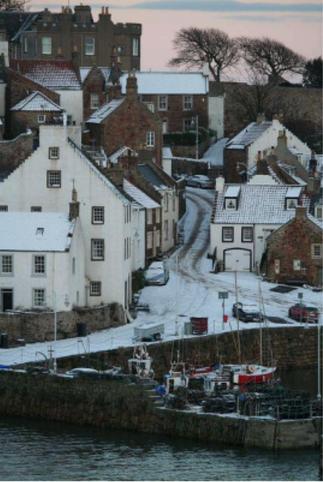
Behind her, snow-covered rooftops decorate the space at various heights, giving a glimpse of the small town of humble houses and humbler people. Beyond them are pine trees as far as the eye can see
In front of her, drowsy, dark blue waves lap against the stone docks and roll the white boats along in their rhythm. They collide with a nearly gray sky, the color suggesting rain and eventual snowfall in the near future. The farthest point of Meris’s vision is the pier occupying the white lighthouse, long since out of order, but it remains a town landmark all the same.
That is all. Meris knows there is more to life than a quiet coastal town built on the small successes of its fishery. Her mind is set for greater things. Somewhere in Europe, she is certain Perhaps a prestigious university boasting the great ancient architecture that has always captivated her eye. Meris is drawn to beautiful things.
Yet there are several definitions of that word. Almost any person who stumbles upon her town would call it beautiful.
The way the reds and browns and grays of the rooftops are sprawled in levels, surrounded by pines, and met with a dark sprawling sea could even be considered picturesque. Meris sees this, too.
Day by day, her heart is conflicted. The comforts of her life are small, and they are here, in this coastal town. In the hardworking fishermen and the tight-knit neighbors, in the fresh sea air and the climate that is almost perpetually foreshadowed in winter. Meris doesn’t know of a single townsperson who has gone off to live somewhere other than here. Why would they have reason to?
But bigger things call to her. Bigger things than this small town and small community. Bigger experiences. Things that will shape her character and her memories for years to come.
Change is difficult, Meris knows. Especially if you’ve lived the same way all your life This is why she is still here, walking the same path above the rocky shoreline that she does every day.
As she places one foot thoughtfully in front of the other, avoiding the dampest rocks or the occasional lap of the tide, Meris is met once again with the familiar tug of her conscience Her thoughts and many questions pull her mind away from the shore and into the unknown lands across the ocean.
How will she know the extent of the world if she never reaches what is beyond? Surely not everything can be conceived in the written words of others’ lived experiences. To be told that the sun of the Mediterranean is pleasant and transformative is not to feel its breath on your skin nor to see that the waters shimmer a magnificent blue when its glow is beheld.
Her world, beyond the coast and its people, is comprised of books They overflow the shelves of her carefully cluttered bedroom. Meris has more words and worlds confined in one space than she knows she will ever experience firsthand. Beneath the leather covers lie her unwritten stories, if only she would find a way out of her own head and into the action of taking a boat far out into the sea’s unknown expanses.
The rain begins with no warning, except perhaps by the darkening sky that Meris had recognized a bit too late after pulling herself back to her surroundings and out of her thoughts She watches white fishing boats return from their day’s work to the docks, men and women hurrying to pass crates to and fro in a nonsensical business Meris never could wrap her mind around. The bustle of the docks is one that she would prefer to observe from afar, either to avoid being trampled or smelling of the harvests of the sea. Which, she decides, she will deliberately avoid in favor of traversing to the pier.
The old lighthouse’s lock has weakened from years of rust and lack of maintenance. It’s easily bypassed whenever Meris pays a weekly visit and clamors when fiddled with. The noise is drowned out by the wind and rain’s growing intensity, though there is no one around to care about the volume either way. The long-abandoned lighthouse is lonely without a keeper.
Meris is met with the dusty and damp scent of the lighthouse’s interior upon opening the door It always draws from her a complex mixture of familiarity and loneliness. She runs her fingers over the smooth stone wall, places her feet on the rickety wooden step, then continues up the spiral staircase. To think that such a structure was once crucial for the guidance of ships, and is now only a notable feature for its simple existence, in memoriam of a purpose it no longer serves.
Upon reaching the cupola of the lighthouse, Meris startles at the sight of a figure leaning over the far railing. A boy, looking to be around her age, turns around at the sound of her footsteps He gives her a nod and a warm smile in greeting, and the friendly gesture fills Meris with a sense of guilt for not recognizing him. She’s sure she has never seen him in town. It isn’t very large, and for the nineteen years she’s been living in the same place, no face passes unbeknownst to her. Except, of course, for the occasional traveler. A traveler.
The stranger confirms her conjecture with an unprompted explanation.
He sheepishly runs a hand down the back of his neck and says,
“I’m sorry if I disrupted any plans you had up here. I just wanted to check the place out while I had the chance. I’m headed out later tonight.”
I’m headed out later tonight It’s as simple as that. One decided sentence, one that Meris could have easily told the townsfolk, her family, and herself time and time again.
“Where are you going?” Meris blurts before she can tamp down her rising curiosity. The boy smiles, and it's difficult to miss the twinkle in his eyes, the extra squint at their corners.
“Five if the wind works in my favor,” he replies, bracing himself casually against the lighthouse’s railing, that same enthusiastic smile livening his otherwise lax demeanor.
“Cobh, Ireland. I’ve been living there for two years now. It’s a seaport town, like yours, but it’s home, so I can’t really compare it to anything here.” Meris can’t help but reciprocate his smile, his excitement like a charged contagion in the atmosphere. The part inside of her that has always advocated for her dreams that lie in Europe, the part that has always lost the internal battle, implores her to ask further questions.
“How far is it? You traveled by boat, right?” She realizes how offhanded she’s being, but the boy doesn’t seem to mind. In fact, his expression only brightens at the possibility of discussing his journey.
“I did And it’s around the upper twothousands in nautical miles. The trip usually takes me six days.
Meris’s heart pounds as endless possibilities float within her grasp. After only a short conversation with a stranger, her dreams no longer feel abstract. The person standing before her plans to make the trip that would change her life forever, beginning as soon as nightfall. In five or six days, she could bridge the gap between her stationary life and her perpetual endeavors. Of course, this is all comprised of an entirely hypothetical situation No amount of hope can change the fact that she has no way off the coast.
Startling Meris from her thoughts, the boy snaps his fingers and points at her, eyes wide with some newfound idea
“You would want to go, wouldn’t you? I get it completely, a lot of folks living in Cobh don’t like to leave either. But if you want, I can easily get you there! I wouldn’t mind at all!”
Meris almost laughs at how quickly and remarkably he was able to catch on to her precise thoughts, and how simple the solution seemed. Just go with a stranger on a six-day boat ride to the world beyond, it’s as easy as that Though she couldn’t deny the temptation to believe in this opportunity handed to her through such a strange coincidence. After all, what if this is her chance?
The sign she’s been waiting for to move forward with her life and achieve greater things? If the boy in front of her really is a sign, then passing it up and waiting for a clearer one seems suddenly absurd
With every preceding question she has, Meris grows more and more convinced. How do the waves usually fare on the trip? Would there be plenty of places to stay for visitors in Cobh? You’re sure you wouldn’t mind taking me along? Her original hesitancy subsides along with the daylight, and soon, after every confident answer of the boy, she finds herself forming a plan of immediate action
Packing isn’t an issue, and she has a suitcase in hand in no time at all once she parts from the boy and the lighthouse. Meris’s heart grows heavier in the action of saying goodbye to her family and neighbors, though their words of encouragement fuel her steps. Now, she walks towards the dock with a lantern in hand, her eyes floating over the inky waves that reflect the brilliant shine of the moon. Her gaze then finds the bright rays of the boat’s navigation light.
The image of herself that stares back at her is not clear, and she is not certain she knows what it looks like at all. Her future self is more veiled than ever before, and the idea frightens her
Returning to the present, Meris steels herself with a breath. She looks out once more and sees the boat. She takes one step forward, with her other foot remaining planted firmly behind her.
In this moment, she is not a girl approaching a boat. She is facing herself. She imagines herself holding a lantern not only to shield from the night, but to hold out to what lies ahead In her mind’s eye, the beams in front of her belong to a twin lantern held right back out to her by her own reflection.
-Emma Cella, ‘27
Untitled
Sofia Coppola and the Female
Gaze: A Study of the Virgin Suicides and Priscilla
“We felt the imprisonment of being a girl. The way it made your mind active and dreamy and how you ended up knowing which colors went together ” -Jeffery Eugenides
The Female experience is unique yet shared by generations of women. Girlhood and womanhood shape women and change our life experiences and our view of the world. There are countless books, shows, paintings, and movies that try to capture the female experience, however no one does it as well as Sofia Coppola The famed director uses storytelling and female perspectives to illuminate the female experience. As a director she expertly uses the “female gaze” to highlight women and the complex world they live in.
The idea of the “female gaze” has become more widely acknowledged in pop culture in the past decades. It’s a direct contrast to what critics call “the male gaze” which is generally described as objectifying and simplifying women characters. In earlier decades female characters in media have generally been shown in the male gaze–often being included simply for romance subplots or sexually objectified Critics often point to movies like the James Bond franchise–where the main female character always dies– or female superheroes like Wonder Woman and Catgirl.
The majority of these characters are written by men and often wear skimpy clothing and are hyper-sexualized. However female characters portrayed through female gaze are more complex and are shown from multiple perspectives. The female gaze also illuminates the female experience. For example these female characters are affected by things that the everyday woman can relate to– things like beauty standards, crushes, depression, sexual violence, fist loves, etc
The first time I watched one of Coppola's films I was 13 and leaving my childhood years behind. I was entering a new space for a girl, one where you feel hopelessly misunderstood, and feelings suddenly become complicated. 13 is the same age as one of one of the main characters in Coppolas renowned film The Virgin Suicides. At 13 I watched as Lex and the rest of the Lisbon girls struggled with the confines of being a woman in American society, something I was now beginning to understand. The film follows the 5 Lisbon girls growing up in a religious family in suburban America in the 1970s, suffocated by gender roles and strict parents. Based on the famous book by Jeffery Eugenides, the film is a distinctive glimpse into the female psyche. Coppola uses the female gaze in several scenes throughout the movie; she shows the girls as complex characters with strong emotions and an urge to fully experience life. The film itself feels nostalgic in a way, and unlike any other film about girlhood. She shows girlhood in domestic America as almost dreamy, but in a way that traps the girls.
Where other movies of the time romanticize girlhood and show women from one perspective, Coppola shows her characters as complex and breaks the veil over girlhood. Before The Virgin Suicides–which realeased in 2000, 1990s coming of age movies mostly featured homogenous female characters and plots. For example in the films Clueless and She's All That the main plot is the cliché “unknown girl gets a makeover and becomes popular ” The majority of the films and their characters focused on surface level aspects of being a girl like fashion, attractiveness, and popularity, instead of diving deep into the female perspective. In contrast The Virgin Suicides communicates how harsh the world can be to adolescent girls while also capturing the multifaceted experience that is girlhood.
Coppola complicates the girls and their lives by showcasing feminine scenes of them brushing each other's hair or writing in a diary, but then reveals them in a depressed state barely eating, stuck in their house. She displays the girls as excited to do simple things like dress up and go to dances, but gives them dual sides in the way she shows their mental health issues and their emotions One of the most distinctive and compelling lines in the film is after the youngest Lisbon girl, Cecilia, attempts to kill herself. The scene shows Cecilia in a hospital bed when the doctor asks why she tried to kill herself, "you're not even old enough to know how bad life can get” and Cecilia monotonously replies “Well doctor, I guess you've never been a 13 year old girl”.
Coppola's film with its dreamy airs yet complex emotions captures what girlhood feels like. Its no wonder The Virgin Suicides catapulted Copolla’s career and established her aesthetic as a director, the film has a almost indescribable undertone of feminine understanding that has resonated with millions of female fans around the world.
Coppola's most recent project Priscilla focuses on Priscilla Presley, who is often overshadowed by her famous yet turbulent husband Elvis Presley A fairly recent example of this being the movie Elvis (2022) with lead actor Austin Butler, which focuses solely on Elvis and his rise to fame. Instead, in Priscilla Coppola brings to light Priscilla’s experience, her own girlhood, her coming of age, her marriage to Elvis, and their eventual divorce Coppola uses the "feminine gaze” to manifest the complexity of Priscilla's character. The film itself has an innocent tone in the first few scenes- we see Priscilla lying on her bed looking lovesick after Elvis calls her, sad when they are apart, and writing in a diary– all stereotypical signs of a young girl in love But later scenes exhibit more complex emotions and intricate character development, when Coppola unveils not only the girl– but the woman she becomes. As the film progresses the viewer witnesses Elvis giving Priscilla drugs–which starts out innocently–to him then physically and mentally abusing her.
Despite the serious issues and emotions it displays, Priscilla is decidedly feminine in its undertone–Coppola includes several “soft” feminine scenes of Priscilla experimenting with makeup, new clothes and hair styles.
However, she also highlights Priscilla’s loss of self while attempting to meet societal beauty standards. These scenes are shot via the female gaze–they shine light on the female experience in connection to beauty and the societal standards women are expected to uphold. There are several scenes where Elvis makes comments about Priscillla’s appearance or her body. Eventually Elvis becomes extremely controlling; keeping Priscilla in constant limbo while exploiting her feelings. This is obvious in the scene where Elvis takes Priscilla shopping Here we see Priscilla looking confident and happy in a patterned dress before Elvis tells her she looks bad in patterns and he likes her in blue. Her smile fades and throughout the rest of the film Priscilla is only seen in solid colors, never any patterned clothing Its profound scenes like these that define the second half of the movie and relate to universal female experiences.
In conclusion, Sofia Coppola’s use of the female gaze in The Virgin Suicides and Priscilla adds depth and perspective to her female characters. Her deliberate use of feminine tones with emotional undertones allows for her female characters to be relatable and complex at the same time–something rare in the film industry. Coppola's female characters are unique and heterogeneous in not only their character but their perspectives. Her portrayal of women continues to be relevant and has led to her worldwide popularity
-Ellie Kinkead, ‘27
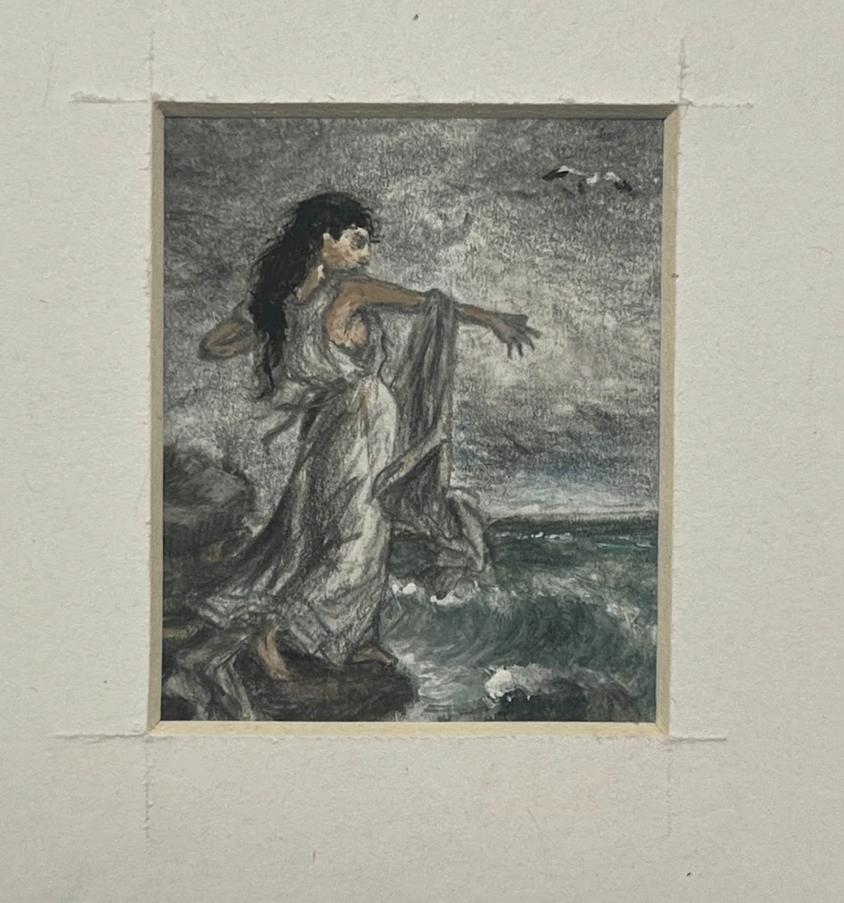
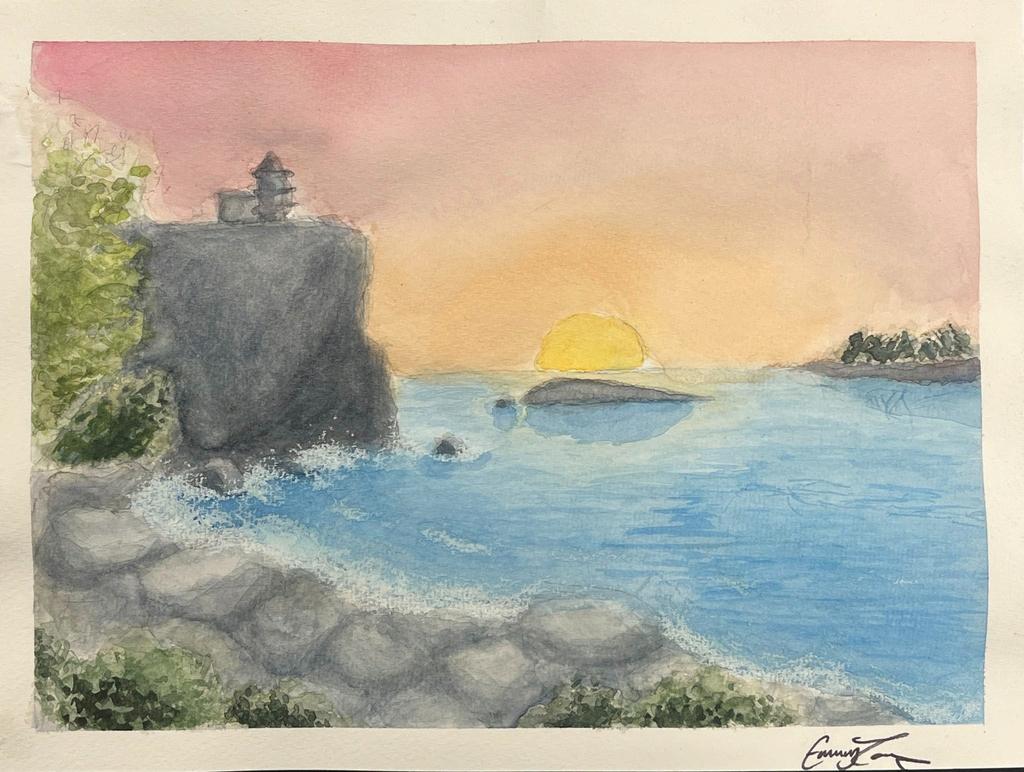
Death at Sunset for Sappho & Untitled -Emmy Tang, ‘29
Untitled -Emmy Tang, ‘28
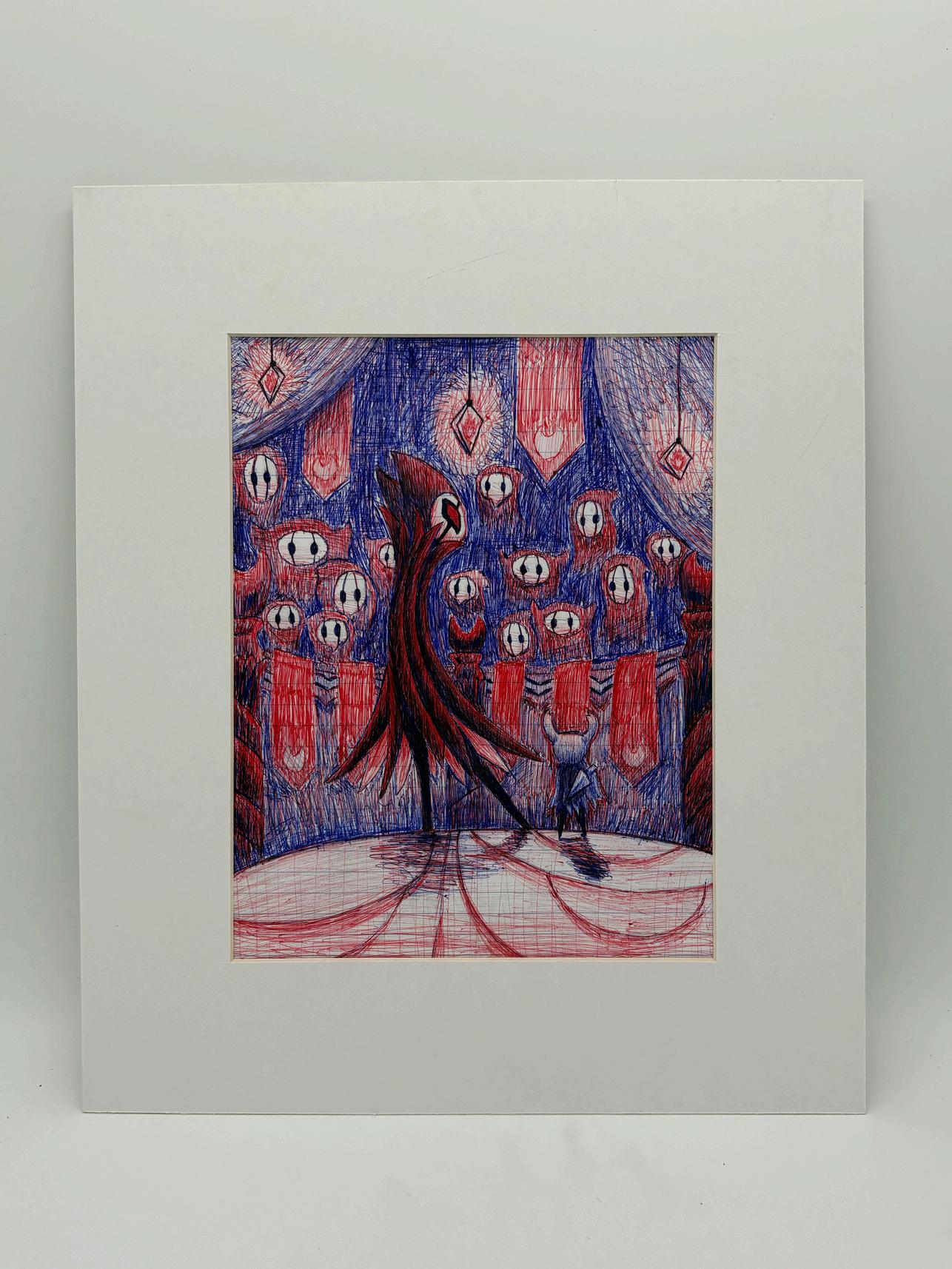
The Troupe Master
The characters in this one are Grimm and the Knight, also from Hollow Knight. This drawing was made with red and blue ballpoint pens. It took a few tries to get the pens to work in the way I wanted to, and I found that angling them pretty harshly worked the best for getting the scratchy look. My favorite thing about these pens is how you can layer them and get them pretty close to black with some hints of blue or red
-Addison Winters, ‘29
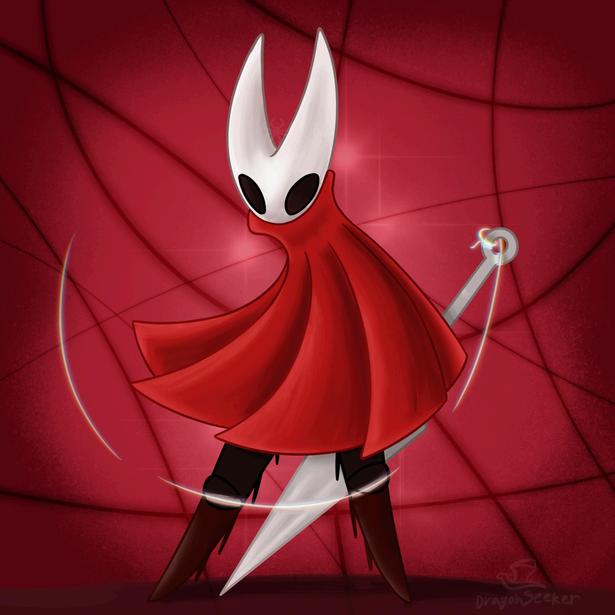
Daughter of Hallownest
The character I drew here is Hornet from a video game called Hollow Knight She is one of my favorite characters because she is simple yet fun to draw. This was a practice piece for some brushes I found, and I think it turned out well.
I was around 5 or 6 years old, sitting in the dark of the living room only slightly illuminated by the kitchen light that leaked over the island. I laid on the scratchy rug decorated with woven horseback riding archers and flowers, playing with my toys. At that moment I was most interested in this little circus truck with a tiger inside that clicked as it wheeled along, a souvenir from a vacation to Costa Rica in the past year or so. A shadow of a moving figure from the kitchen danced across my play area, and whipping my head around, I noticed my sister had sat down at the counter “Come play with me!” I asked her, but she snapped back that she had homework to do. In fact, I was lucky I still had time to play because soon enough I would have so much work to do that playing on the living room floor before dinner wouldn’t be a possibility. I shrugged her off, believing she was simply being dramatic. How bad could a little bit of homework possibly be! But now it’s 11:45 at night, the desk light in my bedroom hallway the only light left in the house For some reason it makes an awful buzzing noise, one that no one has been able to fix. Even the dog has long been asleep, lounging in my spot under the covers that I should’ve retreated to hours ago. I still have an hour of homework left. Still have so much more I need to do, so much more I won’t get done.
Somewhere between that childhood evening and this one, playtime disappeared Each day is a miserable, never-ending loop of commitments. I leave the house at 7:15, the sun still rising and a layer of mist sitting on the road as I wait at the stoplights. I get home from work at 6:15, change into sweats then sit for an awkward dinner with my parents. Turns out family dinner ’s a lot quieter when your sibling’s in college. I help wash the dishes, then start homework at about 7:30. I walk back to my desk to begin working, and catch a glimpse of a box full of art supplies I haven’t touched in weeks Unfinished paintings begging to be given their final details, a roll of film with half the shots left, a sketch of a sculpture I’ve been itching to start, all shoved aside for later. I have work to do. I shift my weight around the uncomfortable desk chair looking at my to-do list A seemingly unconquerable checklist that can never be finished on time, bleeding into the next night and making the problem exponentially worse. Always something more to do, an endless loop of commitments that all seem to demand more attention than I can feasibly give. Reschedule the ACT tutoring zoom I forgot about and thus missed, finish making the posters for the upcoming speech season, take the APUSH notes, read the chapters of Gatsby, make cards for conferences, research for debate, email that teacher, schedule the meeting, get the assignment submitted by 11:59, find a time to sign up for volunteering, study for that test, and revise the essay.
My dad, who runs his own business, left the house at eight, enjoyed a peaceful night watching football, and went to bed hours ago. Meanwhile, I’m fighting to keep my head above water alone at my desk with two hours of work left to do
Life wasn’t always this intense, but real responsibilities started with homework and so it’s always left a lingering pressure in the back of my mind at all times. My first homework assignment was handed to me near the beginning of the year in first grade, where it was neatly placed into my green homework folder then into my pink flower backpack with my initials embroidered on the front. I took it home on the bus, and anxiously started to work on it at the kitchen island counter, just as I had seen my sister do countless times before. The final activity of the night was counting the amount of lions in a picture of the savannah. I finished, double checked my answers, placed it back into my folder and my folder back into my backpack, and proudly turned it in the next morning with a smile. But then I was called to meet with Mrs. Brekke, the sickeningly sweet yet strict teacher I would find myself at odds with the rest of the year. Disturbed at my presence in a private meeting at her desk, she let me know that I had counted the incorrect number of lions. I had failed my first homework assignment. I needed to work harder and pay more attention. Even though I had tried my best and double checked my work, I needed to do more. And since then, that idea of more has followed me throughout every experience in school More classes, more credits, more extracurriculars, and more late nights.
I knew that the increased level of effort needed was coming when I reached junior year. I used to see my sister sitting out until the wee hours working away. I was warned. But the warning didn’t prepare me for the exhaustion that comes when you never stop doing more. Sometimes, when I’m working late at night on boring assignments for classes I don’t care about, I think it’s literally killing me. Slowly draining my life force away drop by drop. Every night I sit at my desk I feel like I’m getting the modern version of the lobotomy my great aunt had in the sixties. But the adults around me keep reaffirming how proud they are of me. They’re proud of my ability to seemingly never stop, to always take on more, I'm taking difficult classes, holding down a job, in a sport, and involved in extracurriculars that include giving up my entire Saturday every week. This amount of more is the right amount. Any less on my plate and I would be a slacker, but no one’s quite sure the average human is capable of having a fuller plate And it’s all to prepare for the future, to set myself up for success. But sometimes I wonder what kind of success I’m setting myself up for, if my current success means entirely giving up my ability to play.
Though I still believe my sister was being dramatic when talking about her homework load that night as I played on the living room rug (she was in second grade, after all), now I understand there was some truth in her message. I was wrong, I wouldn’t make time to play. I can’t.
Somewhere between that childhood evening and this one, the time I used to spend doing what I loved was traded for hours of mind numbing studying and the need to always do more. More involvement. More time. More effort But that just leaves less of myself left over for anything other than more. A husk of a person who’s biding her time until she reaches greener pastures, wanting to rip out her hair as the buzzing noise the desk light exudes ceaselessly drones on and on. The simple joy of doing the activities I loved was replaced with a checklist, and while that checklist might make me look amazing on paper, I’m just tired.
-Tessa Erickson, ‘27
Untitled 1 & 2 -Rose Dixon, ‘28
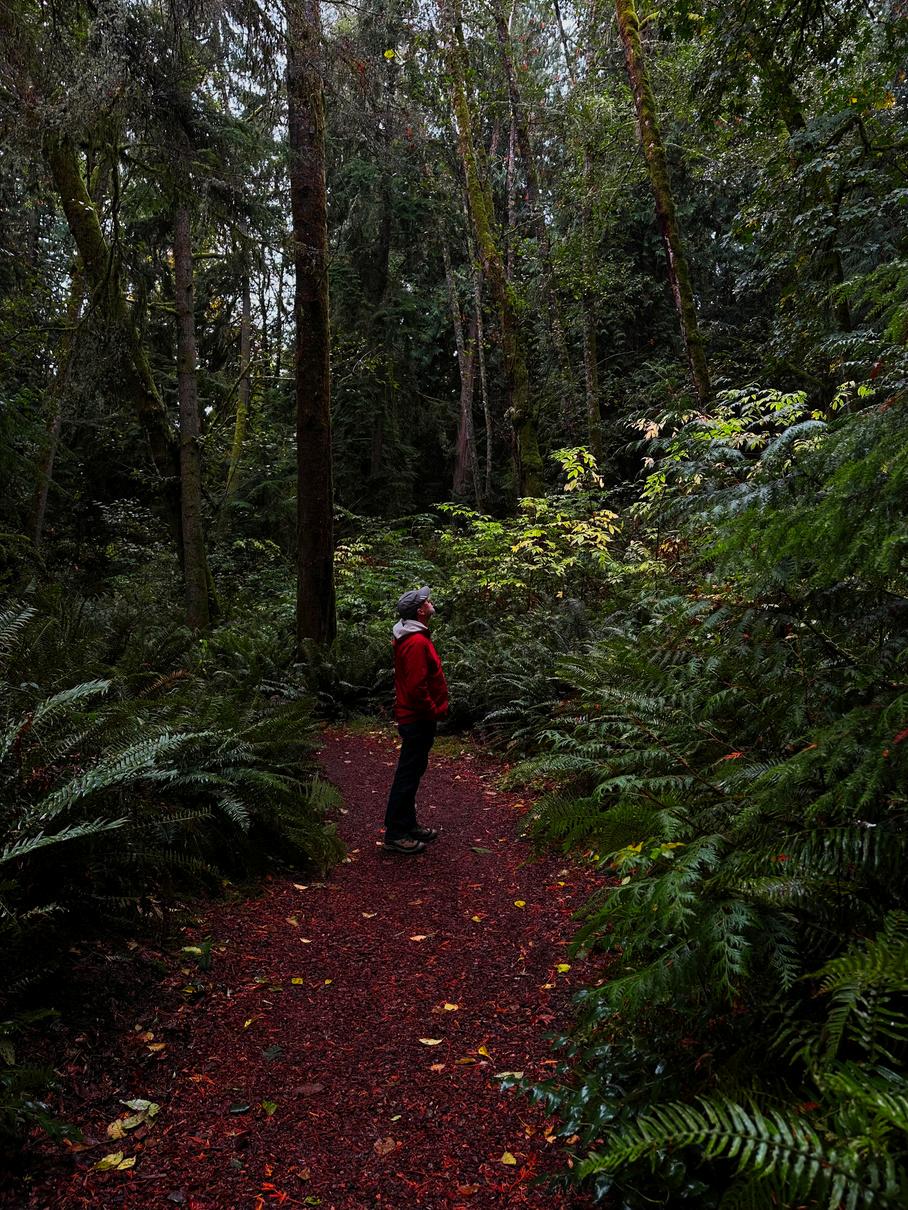
Beautiful Banff -Eleanor Porisch, ‘26
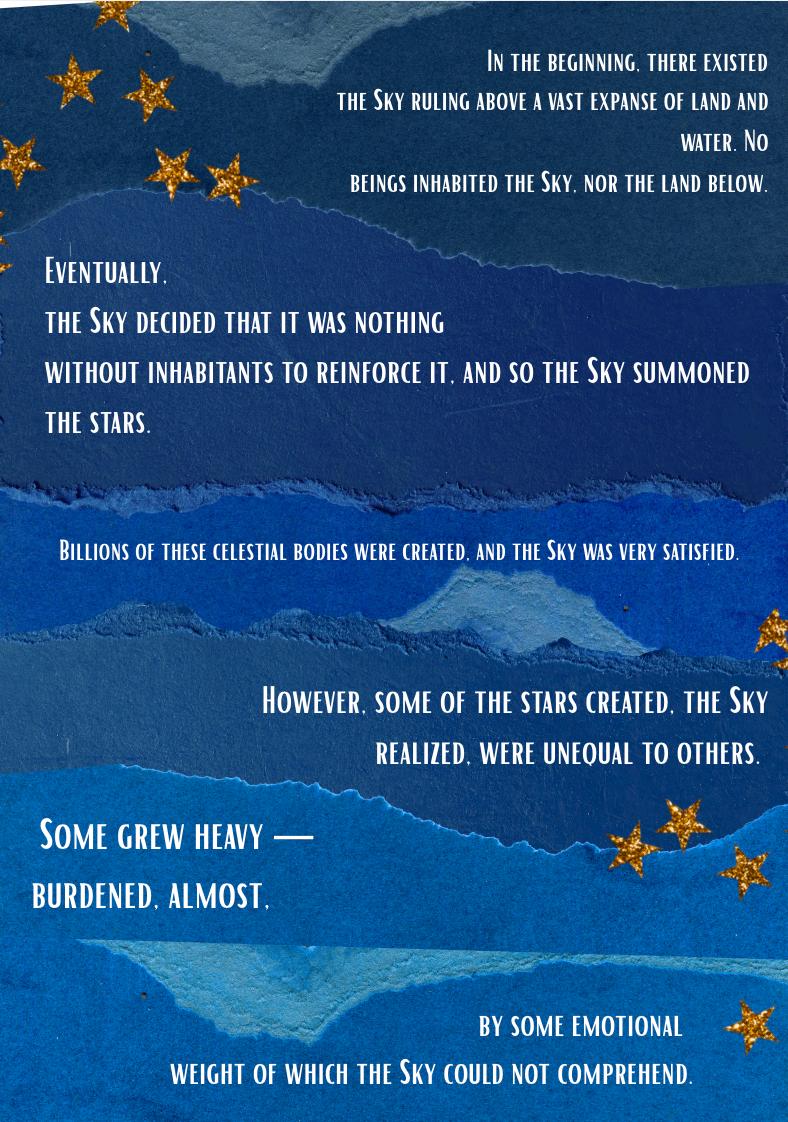
A Creation Myth
In the beginning, there existed the Sky ruling above a vast expanse of land and water. No beings inhabited the Sky, nor the land below. Eventually, the Sky decided that it was nothing without inhabitants to reinforce it, and so the Sky summoned the stars Billions of these celestial bodies were created, and the Sky was very satisfied. However, some of the stars created, the Sky realized, were unequal to others. Some grew heavy burdened, almost, by some emotional weight of which the Sky could not comprehend These heavier stars inevitably fell from the Sky and down to the land. The Sky was very saddened that so many of its creations were no longer within its reach. The fallen stars seemed so meaningless on the empty land. As a solution, the Sky decided to gift the fallen stars with consciousness. This proved not to be difficult given that they had already seemed to possess emotional depth from which they fell.
Through the Sky, the fallen stars became humans, and they populated plentifully amidst the expanse of earth. The Sky gave them plants to cultivate and animals to herd and eat. With every means of survival at their disposal, the humans discovered how to manipulate the materials of the land. They built civilizations and formed societies. However, these societies were not complex. They lacked true knowledge and passion. The Sky saw this. It also noticed how unending the world of the humans seemed
The Sky saw no means by which it could order the human world, at least not by itself. And so it created Time, and with Time, also the Sun and Moon. Though Time was only a concept and not a being, the Sun and Moon both possessed emotional consciousness, like the fallen stars.
The Sun and Moon soon fell in love and were inseparable. When the Sky told them each on behalf of the humans to create aspects to rule over, the Sun chose to hold dominion over knowledge, science, education, and the like, and the Moon chose to hold dominion over passion, the arts, dreams, and the like. Once introduced to the humans, these aspects changed the way they lived forever. They educated themselves and flourished in their professions, they made many creations, and they were each filled with a passion to discover and achieve greatness, though some more so than others.
The Sun and Moon watched over the humans in satisfaction...for a time. All too shortly, they grew jealous of one another The Moon was unhappy with the Sun holding dominion over such important practicalities like sciences and medicines and inventions. The Sun was unhappy with the Moon holding dominion over such important creativities like the arts and music and imaginations. Their jealousy grew so profound that they fell out of love with one another and begged the Sky to be separated.
The Sky warned them that it would be an eternal separation, one that could never be undone and one that they would likely grow to regret. The Sun and Moon did not listen. And so, reluctantly, the Sky created the Great Divide, where the Sun and Moon were split on complete opposite ends of the Sky. They could not even see each other, and so became day and night The Sun ruled the day, where the scientists, mathematicians, and inventors all found themselves in their element. The artists, musicians, and dreamers thrived in the night, ruled by the Moon.
There was also Time, which, in its concern for the Sun and Moon, the Sky had since forgotten about. Time was cruel by nature, though it had no emotional intentions, no sense of humor. It was only a concept, after all. But it was immensely powerful. It was the source of the humans’ suffering They either grew bored when they felt they had too much Time, or panicked when they thought they didn’t have enough. In the end, Time was the decider of the lifespans of the humans, the fuel of the life cycle.
It did not understand their bitterness and wished to give them a chance of reconciliation So the Sky created the Solar Eclipse, which was the Sky’s attempt at reuniting the Sun and Moon, if only for a rare moment. In the fleeting seconds of the universe’s first Solar Eclipse, the Sun and Moon viewed each other opposites, lovers long ago They were reminded then of their past love, and the spark flared in themselves once more after ages of never having seen the other.
The Sky was conflicted. It recognized that it could not stop Time from its overarching rule over the lives of humans But there was the problem between the Sun and Moon. It observed how each human remarkably grew in individuality, each with their own interests and talents, thanks to the vast differences between the dominion of the Sun and Moon But it also remembered the time before the Great Divide, when the Sun and Moon were two exquisitely inseparable lovers.
But the moment was far too brief, and although the boundless love between the Sun and Moon returned, they were once again forced to be separated. They cried to the Sky, asking that it would reunite them and end this divide. But the Sky only apologized regretfully and told them what it had before the Great Divide: that their separation is permanent. There was nothing to be done in the Sky’s power to reverse the Great Divide. And if it could, it would alter the function of the human world forever. There would be no more day and night, no distinction between each individual. The separation was destined to remain. Only the Solar Eclipse could return the tragic lovers to each other, but the occurrence was much too infrequent.
From this tradgedy bore the tragedy of human relations. Unrequited love, romances happening in the right place but at the wrong time, and all other love that is inevitably entangled with loss became encumbered upon the world.
Thus, it is from the Sun and Moon that humans thrive with their passions and knowledge and all other things that drive their humanity. But it is also from the Sun and Moon that humans know grief and heartbreak that upend their daily ongoings Without all of these, without Time, and indeed without the Sky, none of the world would function as we know it today. Neither, too, would it be if the stars had not fallen.
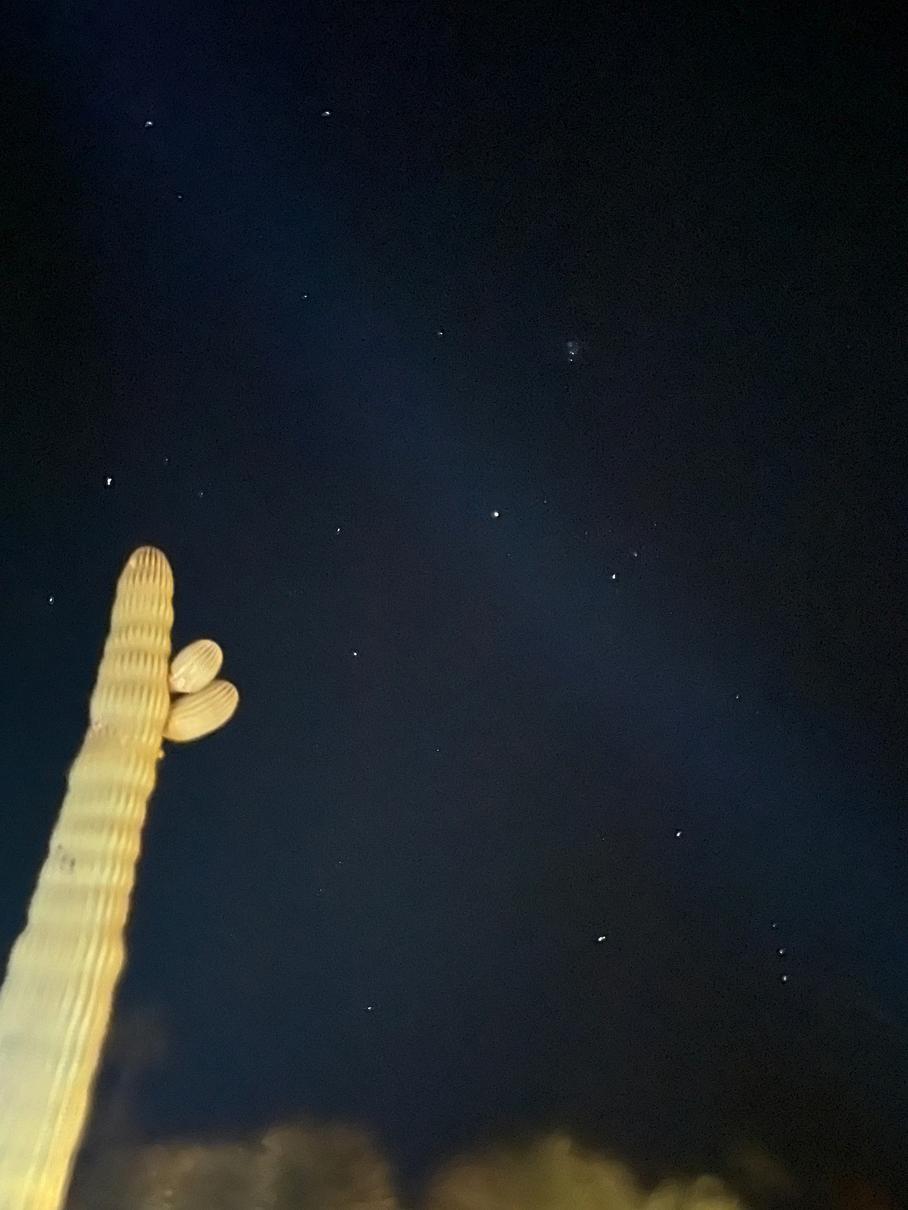
Arizonan Sky -Tobi Ingwalson, ‘26
This piece was intended as a birthday gift, but I drifted away from my friend before I could finish it.
Friendship -Tobi Ingwalson, ‘26
Re: New Update, Subject:
Concerned members, please take action, To: Mr. Google
I write to you on behalf of the concerned citizens of the Tinfoil Hat Committee. In short, we are concerned, Mr. Google, to have discovered you may be reading our thoughts. Yesterday over breakfast, one of our members wondered briefly what quinoa was made out of, and after only the first what typed in the search bar, you had already finished their question.
This morning, I complained that I had a slight pain in my chest, and you told me that I was to die gruesomely in three days time penniless and alone Every time my friend thinks about texting her ex, you advertise La La Land posters and “Unique Gifts That Will Make Your Special Someone Swoon.” I asked you for a vegetarian pad thai recipe and during lunch, I opened a fortune cookie with an ad for HelloFresh; I think I heard Jeff Bezos popping champagne
In these trying times, we ask, Mr. Google, that you simply update your services to reflect the needs of the people. If you are to intrude on our lives, our data, our mental processes, it would do you some good to improve the quality of your system. For starters, we’d like a dictionary of perfect comebacks for every single argument we’ll ever have, and a Wiki of articles solely on the social lives of childhood friends. A news network that will only publish fairy tales. A blog praising our fashion and intellect.
There should also be an AI feature, one that will instruct with the gentleness of my grandmother ’s mantras and the finality of my father ’s dictums. f it could speak briefly, that would be fine as well, as I am afraid I can’t stand reading passages longer than five sentences, and words bigger than seven letters will confuse my thoughts.
I know people say you’re just a machine, Mr. Google, that you’re nothing but a container for the spewed abyss of chat logs and forgotten files and pirated movies, but I know you try your best. Twitter is X and Shein’s got a discount and McDonald’s Loves To See You Smile and, and, and crap, what was I saying? It’s a wonder anyone gets anything done these days. Trust me, Mr. Google, we need your help Just one word sent into your great maw, and you’ll echo back the frantic phrases of everyone who has solicited your advice. How... to crochet, to cook gluten-free pasta, to use the damn remote, to apologize, to remember your grandpa's voice, to tell someone you love them without saying or seeing or talking or trying. People say that you’re endless, that TM you’re as ever expanding as the universe we live in, when in fact I don’t believe that there’s a supercomputer big enough in the world to hold all of our curious woes If you can’t answer these simple questions, what good are you as a thinking machine?
In truth, Mr Google, I fear I’ve been somewhat rude to you during this message. I stare at the poll questions asking for what I like about myself, three descriptive adjectives, and a fun fact no one would know about me; I tilt my ear listening for your voice to fill me in When someone asks how I’m doing, I run the dice on your engine. I’m feeling lucky. I’m feeling playful. I’m feeling a little bit of everything. I’m feeling afraid it’s going to last forever. In truth, I wait for you to autofill my restless thoughts, and autocorrect my hapless drawl of errors and stuttering into something comprehensible. In truth, I think we hope one day we’ll create a machine that will cradle us with a sympathy others lack, that will feed us the ads to ease our worries and donate the perfect advice to solve our problems. I feel we’d let ourselves be absorbed into the spinning world of dank memes and vegan recipes and Karen freakouts and crying influencers and angry politicians and hey, look at this funny cat ... if it meant we’d never have to spend our time without the overfilling sweetness of your care. Your algorithm frightens me, Mr. Google, because if even you fall short of our questions, who would be left to answer them? On behalf of the Committee, we’d gladly let you chip us, Mr Google, if you provided these services When you come out with these updates, please let us know at your earliest convienencce.
Sincerely, Your faithful users
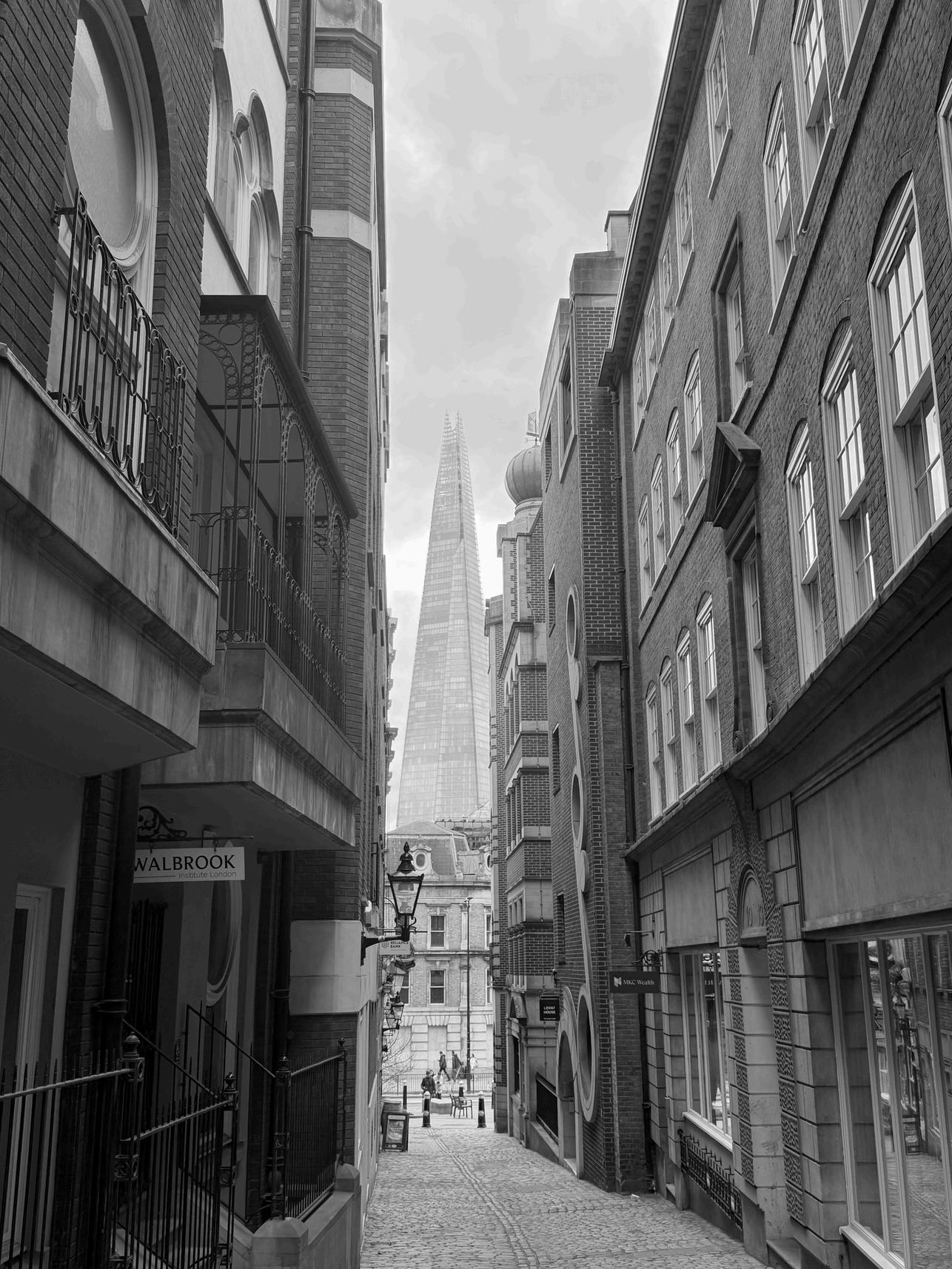
The Shard -Kate Meyer, ‘26
-Henry Moen, ‘26
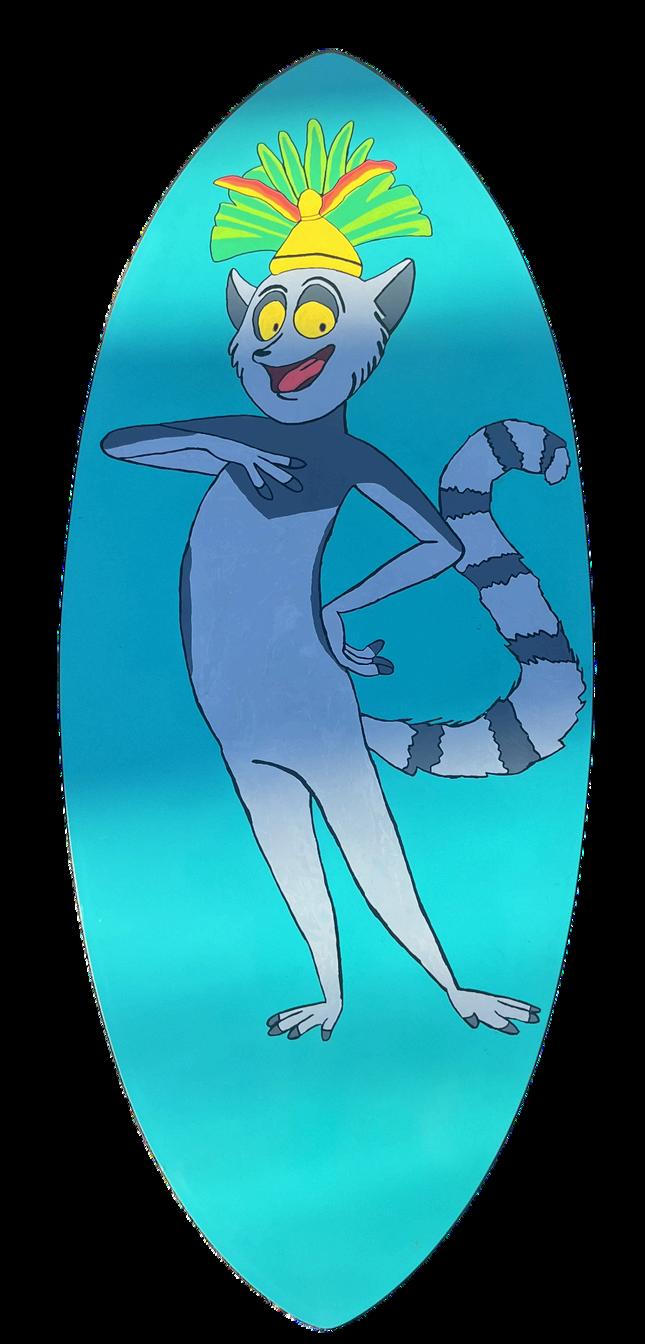
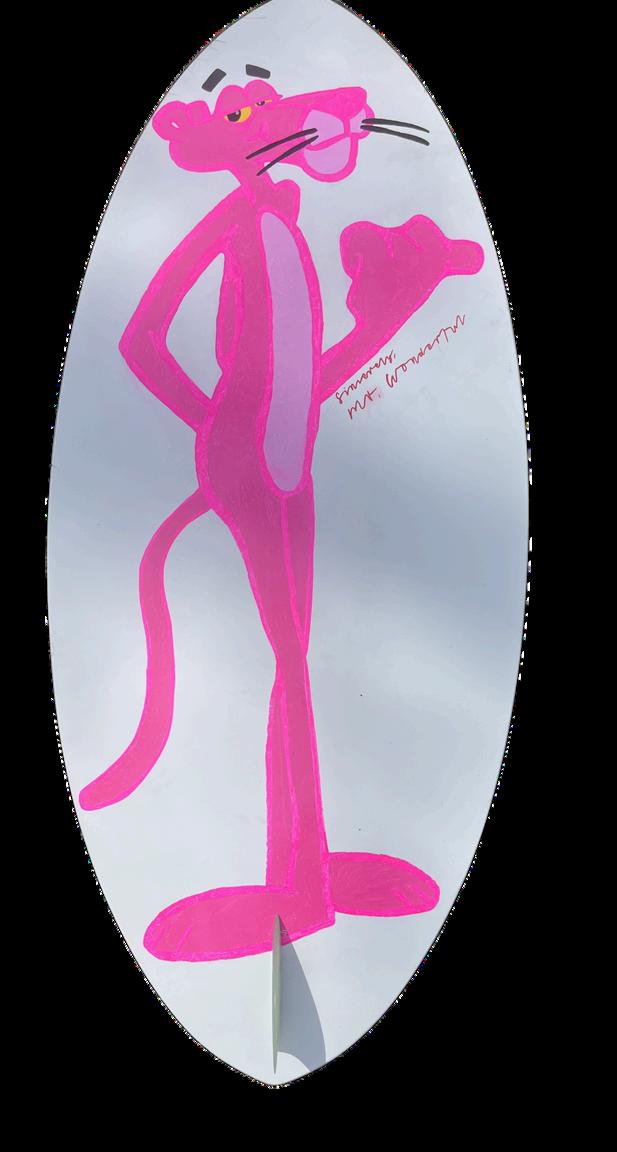
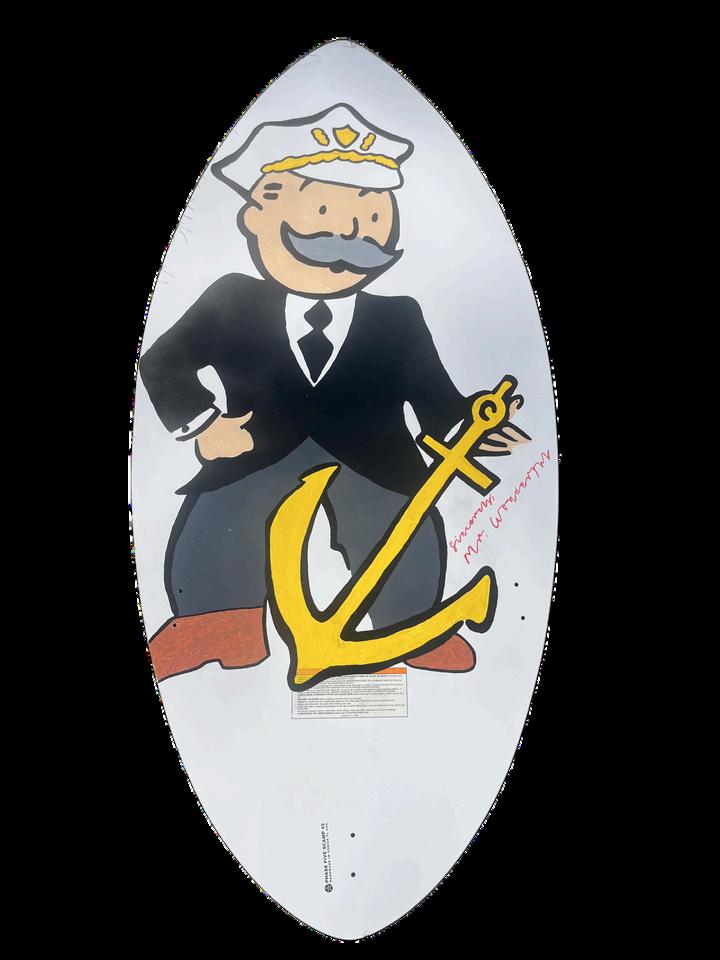
Paintings on Skimboards -Henry Moen, ‘26
The Day I Left
I decided to leave on a cloudy Saturday morning. I packed my backpack light, leaving most of my possessions in my room, which was clean for once. I didn’t leave a note I walked downstairs, my Doc Martens stomping heavily on each step. Nobody was home, as usual. That was fine, I liked it that way.
I opened the back door and was instantly embraced by the humidity hanging in the air. It had stormed last night, lightning flashing and thunder booming–it had been so powerful, I felt the house’s foundation shake beneath me. But now, there was a stillness, almost as if the world was holding its breath, waiting to see what I would do next I closed the door behind me, locking it with my key, the key my dad had given to me when I turned 12, when he said I was old enough to handle the responsibility. I stared at the key, turning it over in my hands, studying the etchings in the metal, the very etchings I would trace on the way home from school Then I turned, pulled my arm back, and threw the key into the backyard, watching as the shiny golden metal disappeared into the wet, dewy grass.
When I stepped out of my driveway onto the sidewalk, I noticed my neighbor from across the street, Kyle, taking his dog out on a walk. We were childhood playmates–I would go over to his house to swim in his tiny pool, he would come over to my house to play on our tiny jungle gym
He looked up, noticing me watching him, and raised his hand in a wave. I gave him a nod of acknowledgement, then turned to the left as he turned to the right, listening to his footsteps and the jangle of the dog collar fading further away. I focused on putting one foot in front of the other, counting the sidewalk cracks beneath me. We used to have contests to see who could run fastest without stepping on any cracks. Kyle always won, and I was a sore loser, so I would push him so he’d accidentally step on one. The result was crying, of course, and both of us getting scolded. I wonder if I’d miss him. Probably not, we’d grown apart during the years.
I kept following the sidewalk through the rather empty neighborhood. It was early, after all, and in our small town, most things didn’t start until the afternoon. There was the sound of a door sliding open, and I looked up, watching the mailman check his roster, then select a package from his truck, turning to attempt to avoid the large puddle right by his feet. He noticed me walking and moved to the side to let me pass. I didn’t try to avoid the puddle; instead, I walked straight through it, feeling only the smallest amount of water manage to soak through my boots I finally reached dry sidewalk, the persistent sound of squelching following me down, and I knew I was leaving a trail of wet footprints, but that didn’t matter. Once the sun came out, they would be gone in no time, and no one would ever know they were there to begin with
After 5 minutes of brisk walking, the sidewalk came to an end, and instead of smooth pavement beneath my feet, it was gravel. I ignored the signs telling me to stop, to turn back, to leave due to the hazards, but I continued on, ducking under the rope that marked the border between a public space and a private space. The construction site was long abandoned, and tools and machines were left carelessly lying around. Pipes and wires stubbornly stuck out of the ground, and I moved around a giant hole, peering down at the sad attempt of a basement foundation beneath. There was a small stream of steam rising from beneath one of the bricks that I suppose was placed to stop it from escaping, but clearly, it wasn’t working. I wove through the maze of stacked wood, noting the rainbow puddle of oil off to my left. My reflection stared at me as I slipped by, and I looked her directly in the eye, raising an eyebrow to see if she had anything to say She didn’t.
The gentle crunching of the ground went silent after I stepped over the rope and into the waiting forest, my sleeve brushing against a branch, the hem coming away wet from the dew. Everything was damp in the woods–it made everything feel more sticky. The soft buzz of cicadas echoed around me, the insects never seeming to tire from their endless droning It must be nice to do something and never tire from it, to never get bored, to never give it up. A soft breeze blew by in a whisper, raising my hair off the back of my neck, a welcome coolness from the growing heat that came with wearing such a thick jacket
The trees above me swayed in response, releasing the thousands of raindrops they had collected in their leaves I tilted my face up, closing my eyes as I felt them hit my skin in quick, sudden bursts of cold. There was a quiet hush as the forest settled down once more, and I strained my ears to hear through the sounds of birds calling to each other for the familiar hum of the highway Once I found it, I turned, changing my course toward it. The hum was as persistent as the cicadas, drawing me towards it blindly until I could see the gray cement poking through the green leaves of the bushes. I pushed the plants aside, stumbling from the undergrowth out into the open, stopping directly next to the road.
For a highway, it was relatively empty, but then again, there aren’t any major cities nearby, only rural farms and forests. I held up my thumb as a car drove by, the lights harsh and bright compared to the dimness of the trees and the sky The driver didn’t stop, instead choosing to continue down the winding road. I watched the car drive around the corner, and a new one came from the opposite direction, speeding past. My arm grew tired from being held up, my hand cold from the mist that had crawled in from the fields on the other side of the road. I pulled up the hood of my jacket, stuffing my clammy hands into my pockets, feeling one of them brush up against an empty gum wrapper.
My stomach growled at the thought of chewing something, and I contemplated pulling out my container of trail mix, but then a rusty old truck slowed down, pulling over to the side of the road where I was standing. I squinted, raising my hand to shield my eyes from the bright headlights, and I could see the condensation in the air, glistening through the yellow hue. I stepped away from the front of the car, making my way to the side where the passenger seat was, peering through the window at the driver. I had expected a man, or someone old, but it was a woman in her 40s with an afro 3 times the size of her head.
She asked me if I needed a ride, and I nodded my head, teeth chattering too much to say anything. She told me to hop in, leaning over to manually unlock the door. I pulled it open with some resistance and watched some of the rust flake off onto the damp ground beneath me I stepped inside, sitting on the lumpy seat, and set my bag down at my feet, noting how cramped the space was. I shut the door firmly, and the woman instructed me on how to lock it. The truck smelled like metal, oil, and vintage fabrics, and I traced the seat pattern, the texture rough beneath my fingertips. We pulled away from the shoulder, the truck bouncing and creaking as we gained speed, and I watched in the crooked side mirror as the spot where I had been standing only minutes before faded from view The woman didn’t ask any questions aside from where I was going, and to that I answered “somewhere far away”.
I didn’t care where we ended up; all I cared about was going somewhere new, somewhere that I could be and start waking up, start shaking off the shackles of the life I had known. But as I sat in that car and listened to the whine of the windshield wipers and the humming of the woman, I felt them start to loosen, and I knew that this was the beginning of my freedom.
The End.
-Nora Weigand, ‘28
-Hugh Sansone, ‘27
-Hugh Sansone, ‘27
Mardi
C’était un mardi, un mardi comme les autres, c’est-à-dire déjà inutile. Pas encore le milieu de semaine, pas encore le week-end, juste ce ventre mou du calendrier où rien ne bouge. J’ai décidé de me réfugier dans la bibliothèque du coin pour “travailler.”
Traduction: c’est que je me suis assise devant mon ordinateur, j'ai ouvert un document blanc, et puis je passé deux heures à scroller sur des sites machinal et douteux
En arrivant, j’ai repéré un type assis à l’entrée Lui, je l’avais vu des dizaines de fois. Sa veste élimée, son cheveux collés par la pluie, un sac en plastique qui semblait avoir sa vie entière. Je ne l’avais jamais vraiment regardé, je m’étais contenté de le ranger dans la catégorie “les types qu’on évite ” C’est pratique, les catégories, ça fait gagner du temps, ça évite les remords.
J’ai déjà préparé mon façade fermé, l’un qui a dit, “désolé j’ai pas d'argent.” Mais il ne m’a pas demandé d’argent Il m’a demandé si je pouvais l’aider à trouver un livre. Oui, un livre. Pas une cigarette, pas un café, pas un dollar. Un livre. Ça m’a presque agacé: j’ai venue précisément à la bibliothèque pour ne pas lire.
Alors nous sommes entrés ensemble Il cherchait un manuel sur la mécanique des vélos. Il m’a expliqué qu’avant, il réparait des bicyclettes, que c’était son truc. J’ai fait semblant d’y connaître, mais en réalité, pour moi une chaîne, c’est juste un collier en métal qui graissent les mains
Le bibliothécaire a retrouvé le manuel, un livre aux schémas compliqués L’homme l’a feuilleté avec une concentration presque religieuse. Moi, je l’ai observé en douce. Je m’étais toujours imaginé que ce genre de personnes vivaient sans passion, sans histoire, juste une succession de journées interchangeables C’était mon cauchemar: être un échec, faire partie de ce bétail sans avenir que mon père avait toujours détesté avec tant de véhémence. Mais il avait une vie. Il avait un métier, des compétences, une routine. Peut-être même un certain bonheur.
Je me suis sentie bête, franchement. Tout ce temps, j’ai cru que je savais déjà qui il était. J’avais cru qu’il n’y avait rien derrière sa silhouette fatiguée. J’avais tort. En sortant de la bibliothèque, il m’a remercié Il avait ce sourire tranquille, pas le genre qui mendie un compliment ni qui joue la comédie. Et moi, j’ai marché jusqu’à chez moi avec une gêne collée aux chaussures, comme une semelle mouillée qui grince.
Depuis, je fais un peu plus attention aux gens que je croise Enfin, pas toujours, je ne vais pas mentir: la plupart du temps je reste absorbée par mon téléphone. Mais parfois, quand je reste silencieuse et immobile, je me souviens de lui. Et de son manuel de vélos, plus précieux d’après lui qu’un repas C’est fou, quand même Je suis venue à la bibliothèque pour perdre du temps. I’y ai trouvé une leçon.
It was a Tuesday, a Tuesday just like any others, which meant it was pointless Not quite mid week, not quite the weekend, just that soft, flabby middle of the calendar where nothing ever moves. I decided to take refuge in the local library to “work.” Translation: I sat down in front of my computer, opened a blank document, and then spent two hours mindlessly scrolling through dubious websites.
When I arrived, I spotted a guy sitting by the entrance. I had seen him dozens of times before, his jacket threadbare, his hair plastered to his head by the rain, clutching a plastic bag that looked as if it had been with him his entire life. I had never really looked at him; I simply filed him away in the category of “guys to avoid.” Categories are handy things, they save time, and spare you the pangs of guilt
I had already put up my usual defensive front, the kind that says, “sorry, I don’t have any money.” But he didn’t ask me for money. He asked me if I could help him find a book Yes, a book Not a cigarette, not a coffee, not a dollar. A book. It was almost annoying; I had come to the library for the express purpose of not reading.
So we went inside together. He was looking for a manual on bycicles He explained to me that he used to repair bikes, it was his thing. I pretended to know a thing or two about bikes, but in reality, to me, a chain is just a metal necklace that gets your hands greasy.
The librarian located the manual, a book filled with complex diagrams He leafed through it with an almost religious concentration while I watched. I had always imagined that people like him lived without passion, without a story. Just a succession of interchangeable days. That was my nightmare To be a failure, to be part of that herd with no future that my father had always detested with such vehemence. But he did have a life. He had a trade, skills, a routine. Maybe even happiness.
I felt foolish, quite frankly All this time I had already believed I knew who he was. I had believed there was nothing behind that weary silhouette of his. But I was wrong. As we left the library, he thanked me. He wore a quiet smile, not the kind that begs for a compliment, nor the kind that puts on an act I walked home with a sense of awkwardness clinging to my shoes, like a wet sole that squeaks.
Since then, I pay a little more attention to the people I pass by. Well, not always, I won’t lie Most of the time I remain absorbed in my phone. But sometimes, when I stand silent and still, I remember that man. And his bycicle manual, more precious to him, by his own account, than a meal. It’s crazy, really. I had gone to the library to kill time. Instead, I found a lesson
-Patrick McDonald, ‘26
Roll Red & Reaching
-Patrick McDonald, ‘26
Blooming & Cloaked
-Patrick McDonald, ‘26