Since 1836,
for everyone who cares about wild plants
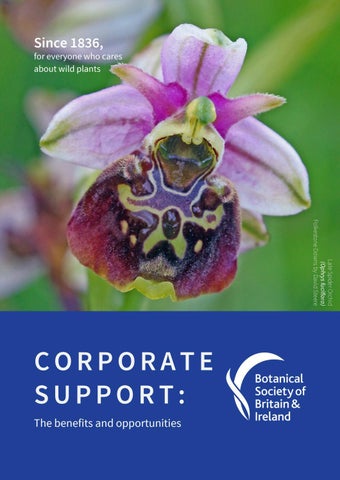
Late Spider Orchid (Ophrys fuciflora) Folkestone Downs by David Steere
CORPORATE SUPPORT: The benefits and opportunities
BOTANICAL SOCIETY OF BRITAIN & IRELAND
CORPORATE SUPPORT WHO WE ARE For 185 years, the Botanical Society of Britain & Ireland (BSBI) has promoted the study, understanding and enjoyment of botany, wild plants and flowers.
CONTENTS
01
WHAT
03
WHY
05
IMPACT
do we do
is our work needed
a case study
02
WHO
04
YOU
do we work with
Your support: Why it is needed What we can do together Who it will reach Levels of support Alternatives
Pennyroyal (Mentha pulegium) Hampshire by Tristan Norton
Now a registered charity (England and Wales 1152954, and Scotland SC038675), from our earliest days we have welcomed both professional and amateur members: BSBI remains the biggest and most active organisation devoted to the study of botany in Britain, Ireland, the Channel Isles and the Isle of Man.
BOTANICAL SOCIETY OF BRITAIN & IRELAND
01
WHAT DO WE DO BSBI's vision is a world where wild plants thrive and are valued. To achieve this mission, we have three core aims: Drive engagement and share information to drive a passion for wild plants
Provide high quality impartial data and scientific analysis
We are one of the world's largest contributors of biological records, contributing over 1 million records annually. We deliver plant monitoring and citizen science through our network of 154 vicecounties and over 200 vice-county recorders*, who lead a wider community of over 30 local groups and 3,500 members. *A vice-county is a geographical division used for the purposes of scientific data-gathering.
WHO DO WE WORK WITH Amongst many others:
02
Star sedge (Carex echinata) Killarney, County Kerry by Mary Mahony
Deliver the training and skills needed to develop a diverse community of botanists
03
BOTANICAL SOCIETY OF BRITAIN & IRELAND
Twinflower (Linnaea borealis) Tentsmuir by A Edwards
WHY IS OUR WORK NEEDED Our data inform scientific research and underpin evidence-based conservation internationally as the future of the natural world takes centre stage in our time. Investment in our work is equal to investment in: Research to combat the impact of climate change at both local and national levels. Information to help organisations make the correct choices in combating biodiversity loss, e.g. planting the right tree in the right place. Promotion of citizen science and the understanding of nature through volunteers, communities and the wider public, empowering them to be involved in conservation. Pioneering technological advances in mapping and recording the distribution of species in the wild. Without BSBI, resources such as the Red Lists of critically endangered plants would simply not exist and we would be blind to the health of our native species. Students, universities, consultancies, local authorities and government agencies all rely on our data. BSBI makes real change happen in the real world.
BOTANICAL SOCIETY OF BRITAIN & IRELAND
YOUR SUPPORT
04
WHY IT IS NEEDED In the past, botany provided an important way to learn about and engage with the natural world. Today it is rarely taught in schools, colleges or even universities and few children can name more than a handful of common wildflowers.
Pennyroyal (Mentha pulegium) Hampshire by Tristan Norton
Essential skills in identifying plants as well as understanding their ecology, taxonomy, uses and wider benefits to society are in danger of being lost. Everything the BSBI does improves these skills, through formal training, providing resources and materials, and facilitating a network of like-minded people. But this takes time and investment.
Spiked Speedwell (Veronica spicata) Cambridgeshire by Andy Symes
WHAT WE CAN DO TOGETHER
As one of the most respected names in the field of nature conservation, sponsorship and partnership with the BSBI provides a raft of current, relevant CSR, ESG and brand opportunities, foregrounding an investment in evidence-based sustainability in communities throughout the UK and Ireland, and in the natural world, that corresponds to the UN SDGs. BSBI's Fundraising Manager can actively assist you in celebrating your support, ensuring that you get the best ROI, as well as creating measurable impact.
WHO IT WILL REACH The BSBI has one of the most engaged and fastest growing audiences in its field:
@BSBIbotany 37.7k followers +5% in quarter
Botanical Society of Britain & Ireland 7.8k likes 25% aged 35-44
Membership 3.5k members +7.4% vs LY Ave 17.3yr tenure 46% female, 54% male
@BSBIbotany 5.3k followers +30% in quarter 45k impressions per month 65% female, 35% male
eNewsletter 4k subscribers >57% open rate >27% click thru
04
Cow Parsley (Anthriscus sylvestris) by Josie Zhou
BOTANICAL SOCIETY OF BRITAIN & IRELAND
CHOOSE YOUR SUPPORT Choose to either make a donation to BSBI, or to become a sponsor of our work. Various levels of support and benefits are available. Donations freely given are not subject to VAT, and will be acknowledged on our website and in relevant publications. If additional benefits are desired, the price is then subject to VAT.
Level 1: Lady's Slipper Orchid Annual Support: £3,000 / €3,500
Level 3: Early Forget-me-not £500 / €580
Examples of benefits include: Access to resources and training Newsletter subscription Logo for your website
Level 2: Spreading Bellflower £1,500 / €1,750
Level 4: Bluebell £250 / €290
Priority notification of new projects Invitations to events Alternative sponsorships (see below)
04
BOTANICAL SOCIETY OF BRITAIN & IRELAND
Changing Forget-me-not (Myosotis discolor) Maidscross Hill, Suffolk by Alan Wake
ALTERNATIVES REGIONAL SPONSORSHIP Be our primary supporter across a significant geographic area, helping us reach new conservation goals, increase local impact and strengthen existing work. ROLE SPONSORSHIP Directly support the core costs of one of our expert staff members, allowing them to carry out our work and support our volunteers. PROJECT SPONSORSHIP Play a transformative role in a botanical project, such as the delivery of Red Lists, the surveying of a particular species, or our engagement work. TRAINING SPONSORSHIP Support our training offering, bringing botanical expertise to all, from beginners to professionals. Support generalised outreach, or specialise in CPD. AWARDS SPONSORSHIP Celebrate botanical excellence whilst demonstrating your commitment to research and engagement, or support specific grant awards for future study.
BOTANICAL SOCIETY OF BRITAIN & IRELAND
THE IMPACT
05
A CASE STUDY:
ATLAS 2020 - CITIZEN SCIENCE FOR A CRUCIAL NEW RESOURCE Since 2017, the BSBI has devoted itself to mapping the current state of all plants in the UK and Ireland, to produce a new, comprehensive ‘Atlas 2020’.
Pennyroyal (Mentha pulegium) Hampshire by Tristan Norton
The first Atlas of the British flora, published by BSBI in 1962, was hugely influential, leading to the first Red Data List for Great Britain. An updated version was published in 2002. These findings contributed to wide-scale changes in conservation thinking and environmental policy after 2000, including the greater emphasis on threat in plant conservation, tighter regulations over the sale of invasive non-native species (such as Japanese Knotweed or Giant Hogweed) and more recent government commitments to reduce damaging climate change and air pollution impacts.
Squinancywort (Asperula cynanchica) Caheranne by Jessica Hamilton
The new Atlas 2020 is underpinned by over 25 million plant records which have been collected by our network of volunteer botanical recorders between 2000 and 2019, and verified and analysed by our Science Team.
The final article, including detailed distribution maps which give the publication its name, will show the distribution of around 1600 native plants and an equal number of non-natives, how these distributions have changed over time, and the main drivers of these changes. This comprehensive survey, interpretation and analysis will: Contribute towards the next Red List for Great Britain, determining which species are most threatened and identifying which most need conservation at both national and local levels. Identify which non-native species are increasing, helping to identify those that may require control/eradication/regulation in the future. Identify those species which are adapting and recovering well, quantifying the success of conservation and environmental policy from the past 20 years. Provide a baseline from which future changes can be measured. Our data is used by decision makers, land owners and managers such as Natural England, NatureScot, Natural Resources Wales, Joint Nature Conservancy Council, the National Parks and Wildlife Service, and the National Trust. With 60 years of comparative data behind it, we expect Atlas 2020 to have a profound impact on publication, leading to both long- and short-term change. Delayed by the COVID-19 pandemic, publication is expected in Spring 2022.
CONTACT US
For more information, or to sign up, contact us today.
Sarah Woods FUNDRAISING MANAGER EMAIL
+44 (0)7570 254619
sarah.woods@bsbi.org
GENERAL ENQUIRIES PHONE
+44 (0)7725 862957
enquiries@bsbi.org
WEBSITE www.bsbi.org
Version 08.11.21
Pyramidal Orchid (Anacamptis pyramidalis) Noar Hill by Leif Bersweden
PHONE