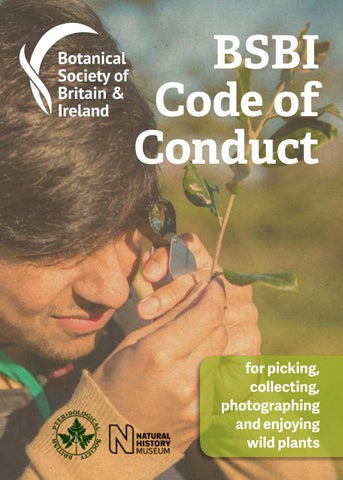
BSBI Code of Conduct
for picking, collecting, photographing and enjoying wild plants
BSBI Code of Conduct
for picking, collecting, photographing and enjoying wild plants
The heavy but important bit This leaflet is intended for guidance and information and whilst every effort has been made to ensure that the information it contains is as accurate as possible, it should not be taken as a definitive statement of the law, nor can responsibility be accepted for any errors or omissions.
Summary of main points Yes, you can usually pick a few wild flowers for study and/or enjoyment, if none of the following caveats apply (but take only 1 in 20). The same applies for foraging (for yourself) – only take 1 in 20. Uprooting any plant is illegal unless you have the landowner’s permission. Some plants are specifically protected by law and cannot be picked or disturbed unless you have the appropriate licence (see Schedule 8 at the back). On legally protected sites such as Sites of Special Scientific Interest, there may be a blanket ban on picking any vegetation. Some non-native invasive plant species cannot be introduced into the wild except by licence (see Schedule 9), so do not introduce any species into the wild. When picking wild flowers or foraging, be mindful of the consequences of your action on other wildlife (some birds need berries for winter survival – do you?).
BSBI Code of Conduct – who is it for? Are you a forager? A plant photographer? Do you like a walk in the countryside to look at wild flowers? Do you lead wildlife walks? Are you a plant recorder? Are you a natural history/ biology teacher or trainer? Then this guide is for you.
There are laws protecting ALL wild plants, but by following the guidelines in this Code you should be able to enjoy wild flowers and plants, stay on the right side of the law AND pick wild flowers and fruits responsibly. Generally, uprooting is harmful, but picking with care and in moderation usually does little damage and can help to enthuse and engender an appreciation of wild plants, which in turn benefits their conservation. In some cases, however, picking can be harmful and may even be illegal. This Code is written specifically for vascular plants (flowering plants and ferns, horsetails, clubmosses and quillworts). There are codes produced by The British Mycological Society for collecting wild mushrooms and other fungi; the British Lichen Society for collecting lichens; the British Bryological Society for mosses and liverworts. However, the legal interpretation below applies to all plants, lichens and fungi.
Wild plants and the law All wild plants are given some protection under the laws of the United Kingdom and the Republic of Ireland. This leaflet summarises the relevant legislation in the UK, but does not attempt to cover that of the Republic of Ireland, The Isle of Man, or the Channel Islands. Under the Wildlife and Countryside Act (1981) which covers England, Scotland and Wales, it is illegal to uproot any wild plant without permission from the landowner or occupier. Uproot is defined as to ‘dig up or otherwise remove the plant from the land on which it is growing’, whether or not it actually has roots; and, for the purposes of the legislation, the term ‘plant’ includes algae, lichens and fungi as well as bryophytes (mosses and liverworts), and vascular plants. Similar general protection is given to all plants in Northern Ireland, under the Wildlife (Northern Ireland) Order, 1985.
All plants growing wild are the legal property of somebody: under the Theft Act, 1968, it is an offence to uproot plants for commercial purposes without authorisation (by the land owner/occupier). This protection is in addition to that offered by the Wildlife and Countryside Act.
Plants in Protected Areas A variety of statutory designations is used for sites of high nature conservation interest, including National Nature Reserves, Sites of Special Scientific Interest (SSSIs) in Britain and Areas of Special Scientific Interest (ASSIs) in Northern Ireland. Owners and occupiers may be prosecuted if they destroy plants growing in these sites, or remove plant material, unless they have first consulted the statutory conservation agencies (Natural England, Natural Resources Wales, Scottish Natural Heritage or the Environment and Heritage Service, Northern Ireland). However, since the Natural Environment and Rural Communities Act (2006), it is now an offence for all third parties to damage features of importance on SSSIs – so anyone collecting plants on a SSSI may be acting illegally unless there is a consent in place for their activity. It is illegal to pick, uproot or remove plants where by-laws forbidding these activities are in operation, for example on some Local Nature Reserves, Ministry of Defence property or National Trust land.
Specially protected plants Both the Wildlife and Countryside Act, and the Wildlife (Northern Ireland) Order contain a list (Schedule 8) of plants, which are specially protected against intentional picking, uprooting, and destruction (unless a licence is obtained from the relevant authorities, or the damage is a result of a lawful activity and could not reasonably have been avoided). These plants are also protected against sale. In addition, there are two species (native Bluebell in Britain and Primrose in Northern Ireland) that are listed for protection only against sale. All parts of the plant are protected, including seeds and spores. Schedule 8 of the Wildlife and Countryside Act is reviewed every five years.
International protection Certain internationally rare wild plants are given legal protection throughout the European Union, as a result of the ‘Habitats’ Directive (Council Directive 92/43/EEC). Regulations apply to all stages in the biological cycle of these plants, so seeds and spores are protected as well as mature specimens. All these species are also included in Schedule 8 of the Wildlife and Countryside Act. We must wait to see how Brexit affects these Directives, but currently they are implemented through our domestic statutes.
Some wild plants are protected against international trade under the Convention on International Trade in Endangered Species (CITES). The only UK species to which CITES applies are all orchids. It should be noted that this applies not only to fresh specimens but to herbarium material too, so do check if a CITES permit is required if you are sending herbarium material over international borders.
Introduction of alien plants It is an offence, without a licence, to plant or cause to grow in the wild any plant listed on Schedule 9 (ii) of the Wildlife and Countryside Act, or on Schedule 9 of the Wildlife (Northern Ireland) Order. These schedules list alien plants that may pose a threat to our native flora. In April 2010 the list of species on Schedule 9 of the Wildlife and Countryside Act was extended considerably (see list under Schedule 9 at the end of this document).
Picking and collecting IF NOT protected by law This section provides guidance for people who wish to pick plants for pleasure, pursue botanical studies, collect specimens for educational purposes or gather wild food for individual or family use. It does not address commercial gathering of plant material. The aim is to promote the conservation of wild plants, whilst encouraging the enjoyment of the countryside. This means that picking is acceptable in some cases, but in other circumstances plants are better left for others to enjoy. If in doubt always follow the ‘one in twenty rule’ unless the plants are covered by any legislation. If there are twenty, it is reasonable to take one. If you wish to take two, there should be forty, etc and do not uproot.
Rare and threatened plants not on protected Schedules or sites Information on plants in danger of extinction nationally or locally is published in national Red Data Lists and Books, and County Rare Plant Registers. Rare plants are not necessarily protected by law, but none of them should be picked for pleasure. If you are not a specialist it may be difficult to know which they are: a good rule of thumb is that if a plant looks unusual, or if there is very little of it, resist the temptation to pick it. Pick only those plants with which you are familiar and which you know are widespread and plentiful in the area. Most specimens can be reliably identified from good quality photographs of flowers and vegetative features and this should be the default for any unknown species present in small numbers but if you need to take a specimen for identification, follow all of the preceding advice.
For any plant, try to follow the ‘one in twenty’ rule – for every one you pick, there should be twenty present. Lists of rare and threatened species can be obtained from the Joint Nature Conservation Committee, or viewed on its website.
Botanical collecting Collecting small amounts of plant material for identification purposes, for private herbaria, for research or as voucher specimens is usually acceptable, except in the case of protected or rare species. Indeed, collecting is often necessary if botanical expertise is to be developed and passed on across generations via herbaria. If a plant can be named in the field take the field guide to it, not vice versa. If a specimen really is needed, remove the minimum quantity of material for identification, and also take a photo. It is worth knowing what part of the plant is needed for identification purposes. When collecting specimens for identification or research bear in mind whether the most could be made of your dead plant by making it available to local and national public herbaria; if so careful selection, processing and curation would be valuable and collection of duplicates may be appropriate.
Where and how much to pick Be careful not to trespass when picking plants and never take material from a nature reserve or protected site without permission and formal consent if necessary. Take flowers and foliage only from large patches of the plant. Always pick in moderation so that plenty is left for others to enjoy (always observe the one in twenty rule). Do not pick flowers such as poppies as they will wilt before you get them home. Be careful not to damage other vegetation when picking flowers. If permission has been not been obtained from the landowner or occupier, gathering fruit, foliage etc must be restricted to the minimum needed for personal use and must not be used for commercial gain. Follow the ‘one in twenty’ rule.
Educational and training groups Teachers and leaders of field meetings are reminded that it is their responsibility to obtain permission from landowners, ensure that groups comply with the law and follow these guidelines. A large group of people can unwittingly do considerable damage, so be careful. Unrestricted collecting by enthusiastic students may endanger local plant populations so do make it clear to your group to follow your guidance on what and how much to collect.
Fruits, seeds and fungi Non-commercial gathering of berries, nuts and mushrooms for the table is a traditional use of the countryside and probably does no harm to the plant, providing it is carried out in moderation and the plant is common. However, many plants and fungi are poisonous, so never eat anything unless you are sure that it is safe to do so. Collecting wild flower seed for private gardening must also be done sparingly and only common species should be gathered. The British Mycological Society has produced a separate code for the conservation of fungi, together with guidance for those who collect mushrooms to eat.
Photography Please take care before photographing plants, as ‘gardening’ before taking photographs can expose a plant to grazing, or you might inadvertently remove rarer plants or alter the microclimate of the plant you are photographing. Try not to crush vegetation too much and please have regard for mosses, liverworts, lichens and fungi growing around your target plant.
Safeguarding habitats Please take special care when visiting fragile habitats, such as dune slacks, tufa (calcium-encrusted wet spring vegetation), raised bogs and other uncommon and vulnerable plant communities. Inform your BSBI Vice-County Recorder (contact details are available on the BSBI website), your local Wildlife Trust, or the relevant statutory conservation agency about new finds, as they can help to safeguard the plants and their habitats. Respect requests from conservation bodies or landowners not to visit particular sites at certain times of year.
Introducing plants to the wild As mentioned above, it is an offence to introduce to the wild any seeds, propagules or mature plants of a ‘Schedule 9’ species. There are many other alien species that are invasive and can be detrimental to our native flora, so alien plants should never be introduced to the wild. Aquatic plants such as Curly Waterweed Lagarosiphon major and New Zealand Pigmyweed Crassula helmsii may be particularly damaging, so do not tip unwanted material from aquaria into streams or ponds, or throw garden waste over your fence. Even introducing or planting out native plants can be unwise, as it may blur natural patterns of distribution, so the simple rule is: if in doubt, don’t plant it out.
Enjoying plants abroad Wild plants and their habitats around the world are threatened. Remember to follow the principles of this code when visiting other countries. Make sure that you are familiar with the nature protection laws of your host country and check whether it is permissible to bring specimens back – please do not assume that you can. Please be aware of CITES, especially with respect to all orchids and to bulbs, and be aware that any plant material taken over international borders can have biosecurity implications, as pests and diseases may be inadvertently imported or exported.
Statutory agencies responsible for plant conservation Joint Nature Conservation Committee www.jncc.defra.gov.uk Natural England www.gov.uk/government/organisations/natural-england Scottish Natural Heritage www.snh.gov.uk Natural Resources Wales www.naturalresources.wales Northern Ireland Environment Agency, Department of Agriculture, Environment and Rural Affairs www.daera-ni.gov.uk/topics/biodiversityv The Department of Arts, Culture & Gaeltacht, Republic of Ireland www.ahrrga.gov.ie
Vascular plants protected under Schedule 8 of the Wildlife and Countryside Act (1981) as amended Ajuga chamaepitys Alisma gramineum Allium sphaerocephalon Althaea hirsuta Alyssum alyssoides Apium repens Arabis alpina Arabis scabra Arenaria norvegica Artemisia campestris Atriplex pedunculata Bupleurum baldense Bupleurum falcatum Carex depauperata Centaurium tenuiflorum Cephalanthera rubra Chenopodium vulvaria Cicerbita alpina Clinopodium menthifolium Coincya wrightii Corrigiola litoralis Cotoneaster cambricus Crassula aquatica Crepis foetida Cynoglossum germanicum Cyperus fuscus Cypripedium calceolus Cystopteris dickieana Damasonium alisma Dianthus armeria 1 Dianthus gratianopolitanus Diapensia lapponica Eleocharis parvula Epipogium aphyllum Equisetum ramosissimum Erigeron borealis Eriophorum gracile Eryngium campestre Filago lutescens Filago pyramidata Fumaria reuteri Gagea bohemica
Ground-pine Ribbon-leaved Water-plantain Round-headed Leek Rough Marsh-mallow Small Alison Creeping Marshwort Alpine Rock-cress Bristol Rock-cress Norwegian Sandwort Field Wormwood Stalked Orache Small Hare’s-ear Sickle-leaved Hare’s-ear Starved Wood-sedge Slender Centaury Red Helleborine Stinking Goosefoot Alpine Sow-thistle Wood Calamint Lundy Cabbage Strapwort Wild Cotoneaster Pigmyweed Stinking Hawk’s-beard Green Hound’s-tongue Brown Galingale Lady’s-slipper Dickie’s Bladder-fern Starfruit Deptford Pink Cheddar Pink Diapensia Dwarf Spike-rush Ghost Orchid Branched Horsetail Alpine Fleabane Slender Cottongrass Field Eryngo Red-tipped Cudweed Broad-leaved Cudweed Martin’s Ramping-fumitory Early Star-of-Bethlehem
Gentiana nivalis Gentiana verna Gentianella anglica Gentianella ciliata Gentianella uliginosa Gladiolus illyricus Gnaphalium luteoalbum Hieracium attenuatifolium Hieracium northroense Hieracium zetlandicum Himantoglossum hircinum Homogyne alpina Hyacinthoides non-scripta 2 Lactuca saligna Leersia oryzoides Limosella australis Liparis loeselii Lloydia serotina Luronium natans Lychnis alpina Lythrum hyssopifolium Melampyrum arvense Mentha pulegium Minuartia stricta Najas flexilis Najas marina Ononis reclinata Ophioglossum lusitanicum Ophrys fuciflora Ophrys sphegodes Orchis militaris Orchis simia Orobanche artemisiae-campestris Orobanche caryophyllacea Orobanche reticulata Petroraghia nanteuilii Phyllodoce caerulea Phyteuma spicatum Polygonatum verticillatum Polygonum maritimum Potentilla rupestris Pulicaria vulgaris Pyrus cordata Ranunculus ophioglossifolius Rhinanthus angustifolius
Alpine Gentian Spring Gentian Early Gentian Fringed Gentian Dune Gentian Wild Gladiolus Jersey Cudweed Weak-leaved Hawkweed Northroe Hawkweed Shetland Hawkweed Lizard Orchid Purple Colt’s-foot Bluebell Least Lettuce Cut-grass Welsh Mudwort Fen Orchid Snowdon Lily Floating Water-plantain Alpine Catchfly Grass-poly Field Cow-wheat Pennyroyal Teesdale Sandwort Slender Naiad Holly-leaved Naiad Small Restharrow Least Adder’s-tongue Late Spider-orchid Early Spider-orchid Military Orchid Monkey Orchid Oxtongue Broomrape Bedstraw Broomrape Thistle Broomrape Childing Pink Blue Heath Spiked Rampion Whorled Solomon’s-seal Sea Knotgrass Rock Cinquefoil Small Fleabane Plymouth Pear Adder’s-tongue Spearwort Greater Yellow-rattle
Romulea columnae Rumex rupestris Salvia pratensis Saxifraga cernua Saxifraga cespitosa Saxifraga hirculus Schoenoplectus triqueter Scleranthus perennis Scorzonera humilis Selinum carvifolia Senecio paludosus Stachys alpina Stachys germanica Tephroseris integrifolia subsp. maritima Teucrium botrys Teucrium scordium Thlaspi perfoliatum Trichomanes speciosum Veronica spicata Veronica triphyllos Viola persicifolia Woodsia alpina Woodsia ilvensis
Sand Crocus Shore Dock Meadow Clary Drooping Saxifrage Tufted Saxifrage Yellow Marsh-saxifrage Triangular Club-rush Perennial Knawel Viper’s-grass Cambridge Milk-parsley Fen Ragwort Limestone Woundwort Downy Woundwort South Stack Fleawort Cut-leaved Germander Water Germander Perfoliate Penny-cress Killarney Fern Spiked Speedwell Fingered Speedwell Fen Violet Alpine Woodsia Oblong Woodsia
1 Protected in England & Wales only 2 Protected only against sale
Plants on Schedule 8 of the Wildlife (Northern Ireland) Order, 1985 Adoxa moschatellina Ajuga pyramidalis Andromeda polifolia Calamagrostis stricta Carex magellanica Carex pauciflora Centaurium littorale Cirsium heterophyllum Dactylorhiza traunsteinerioides Dryas octopetala Elatine hydropiper Eleocharis parvula Epipactis palustris Epipactis phyllanthes Erica vagans Erigeron acer
Moschatel Pyramidal Bugle Bog-rosemary Narrow Small-reed Tall Bog-sedge Few-flowered Sedge Seaside Centaury Melancholy Thistle Narrow-leaved Marsh-orchid Mountain Avens Eight-stamened Waterwort Dwarf Spike-rush Marsh Helleborine Green-flowered Helleborine Cornish Heath Blue Fleabane
Frangula alnus Geranium sylvaticum Gymnocarpium dryopteris Hammarbya paludosa Hierochloe odorata Hordelymus europaeus Hottonia palustris Hypochaeris glabra Lathyrus palustris Limonium binervosum s.l. Limosella aquatica Melampyrum sylvaticum Mentha pulegium Mertensia maritima Monotropa hypopitys Neottia nidus-avis Ophrys apifera Orchis morio Orobanche hederae Orthilia secunda Pilularia globulifera Polystichum lonchitis Primula veris Primula vulgaris 1 Pseudorchis albida Ranunculus fluitans Rubus chamaemorus Saussurea alpina Saxifraga aizoides Saxifraga oppositifolia Silene acaulis Sisyrinchium bermudiana Spiranthes romanzoffiana Stachys officinalis Teesdalia nudicaulis Trollius europaeus Viola persicifolia 1 Protected only against sale
Alder Buckthorn Wood Crane’s-bill Oak Fern Bog Orchid Holy-grass Wood Barley Water-violet Smooth Cat’s-ear Marsh Pea Rock Sea-lavender Mudwort Small Cow-wheat Pennyroyal Oysterplant Yellow Bird’s-nest Bird’s-nest Orchid Bee Orchid Green-winged Orchid Ivy Broomrape Serrated Wintergreen Pillwort Holly Fern Cowslip Primrose Small-white Orchid River Water-crowfoot Cloudberry Alpine Saw-wort Yellow Saxifrage Purple Saxifrage Moss Campion Blue-eyed Grass Irish Lady’s-tresses Betony Shepherd’s Cress Globe-flower Fen Violet
Plants included in Schedule 9 of the Wildlife and Countryside Act, 1981 Vascular plants that cannot be planted, or otherwise caused to grow, in the wild, in Great Britain (schedule reviewed in 2010). Allium paradoxum Allium triquetrum Azolla filiculoides Cabomba caroliniana Carpobrotus edulis Cotoneaster bullatus Cotoneaster horizontalis Cotoneaster integrifolius Cotoneaster microphyllus Cotoneaster simonsii Crassula helmsii Crocosmia × crocosmiiflora Disphyma crassifolium Eichhornia crassipes Elodea (all species) Fallopia japonica Fallopia japonica × Fallopia sachalinensis Fallopia sachalinensis Gunnera tinctoria Heracleum mantegazzianum Hydrocotyle ranunculoides Impatiens glandulifera Lagarosiphon major Lamiastrum galeobdolon subsp. argentatum Ludwigia grandiflora Ludwigia peploides Ludwigia uruguayensis Myriophyllum aquaticum Parthenocissus inserta Parthenocissus quinquefolia Pistia stratiotes Rhododendron luteum Rhododendron ponticum Rhododendron ponticum × R. maximum Rosa rugosa Sagittaria latifolia Salvinia molesta Smyrnium perfoliatum
Few-flowered Leek Three-cornered Garlic Water Fern Fanwort (Carolina Water-Shield) Hottentot Fig Cotoneaster, Hollyberry Cotoneaster Cotoneaster, Entire-leaved Cotoneaster, Small-leaved Cotoneaster, Himalayan New Zealand Pigmyweed Montbretia Purple Dewplant Water Hyacinth Waterweeds Japanese Knotweed Hybrid Knotweed Giant Knotweed Giant Rhubarb Giant Hogweed Floating Pennywort Himalayan Balsam Curly Waterweed Variegated Yellow Archangel Water Primrose Floating Water Primrose Water Primrose Parrot’s Feather False Virginia Creeper Virginia Creeper Water Lettuce Yellow Azalea Rhododendron Rhododendron Japanese Rose Duck Potato Giant Salvinia Perfoliate Alexanders
Republic of Ireland No attempt has been made here to explain how Irish law differs from Great Britain and Northern Ireland in respect to wildlife protection. The relevant legislation in Ireland is the Wildlife Act, 1976 and Statutory Instruments are issued under this Act. The relevant Government Department is called The Department of Arts, Culture & Gaeltacht and copies of the relevant legislation are obtainable from the Government Publications Office, Molesworth Street, Dublin 2. The latest list of protected species in the Republic of Ireland under the Republic of Ireland Flora Protection Order 2015 are listed below Acinos arvensis Allium schoenoprasum Alopecurus aequalis Arenaria ciliata Arthrocnemum perenne Asparagus officinalis Asplenium obovatum subsp. lanceolatum Asplenium septentrionale Astragalus danicus Calamagrostis epigejos Callitriche truncata Cardamine impatiens Cardaminopsis petraea Carex depauperata Carex divisa Centaurium pulchellum Cephalanthera longifolia Colchicum autumnale Cryptogramma crispa Deschampsia setacea Epilobium alsinifolium Equisetum × moorei Eriophorum gracile Galeopsis angustifolia Groenlandia densa Gymnocarpium robertianum Hammarbya paludosa Helianthemum nummularium Hordeum secalinum Hydrilla verticillata Hypericum canadense Hypericum hirsutum Inula salicina
Basil Thyme Chives Orange Foxtail Fringed Sandwort Perennial Glasswort Wild Asparagus Lanceolate Spleenwort Forked Spleenwort Purple Milk Vetch Wood Small-reed Short-leaved Water-Starwort Narrow-leaved Bitter Cress Northern Rockcress Starved Wood-sedge Divided Sedge Lesser Centaury Narrow-leaved Helleborine Autumn Crocus Parsley Fern Bog Hair-grass Chickweed Willowherb Moore’s Horsetail Slender Cotton Grass Red Hemp Nettle Opposite-leaved Pondweed Limestone Fern Bog Orchid Common Rockrose Meadow Barley Irish Hydrilla Canadian St. John’s-wort Hairy St. John’s-wort Irish Fleabane
Lathyrus japonicus Limosella aquatica Logfia minima Lotus subbiflorus Lycopodiella inundata Mentha pulegium Mertensia maritima Minuartia recurva Misopates orontium Najas flexilis Omalotheca sylvatica Otanthus maritimus Papaver hybridum Pilularia globulifera Polygonum viviparum Pseudorchis albida Puccinellia fasciculata Pyrola rotundifolia subsp. maritima Sanguisorba officinalis Saxifraga granulata Saxifraga hartii Saxifraga hirculus Saxifraga nivalis Scirpus triqueter Scleranthus annuus Simethis planifolia Spiranthes romanzoffiana Stachys officinalis Trichomanes speciosum Trifolium glomeratum Trifolium subterraneum Trollius europaeus Vicia orobus Viola hirta Viola lactea
Sea Pea Mudwort Slender Cudweed Hairy Bird’s-foot-trefoil Marsh Clubmoss Penny Royal Oyster Plant Recurved Sandwort Lesser Snapdragon Slender Naiad Wood Cudweed Cottonweed Round Prickly-headed Poppy Pillwort Alpine Bistort Small-white Orchid Tufted Salt-marsh Grass Round-leaved Wintergreen Great Burnet Meadow Saxifrage Harts Saxifrage Marsh Saxifrage Alpine Saxifrage Triangular Club-rush Annual Knawel Kerry Lily Irish Lady’s-tresses Betony Killarney Fern Clustered Clover Subterranean Clover Globe Flower Bitter Vetch Hairy Violet Pale Dog-violet
Authors: Sarah Whild and Fred Rumsey, 2010, with comments on the schedules and legal aspects by Anna Robinson and Ant Maddock of the JNCC. Updated by Sarah Whild, 2017, with input from Ian Taylor, John Martin, and Alex Prendergast of Natural England. Original 1999 Code of Conduct by Margaret Palmer and Katherine Hearn. © Botanical Society of Britain and Ireland 2017 This Code has been produced by the BSBI with support, advice and financial contributions from the Natural History Museum, and the British Pteridological Society.
www.bsbi.org
Designed by www.MACreative.co.uk