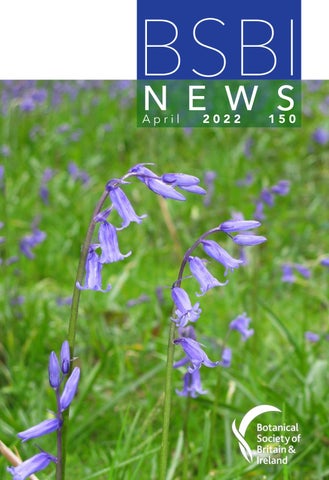
BSBI N E W S April
2022
150
BSBI ADMINISTRATION President
LYNNE FARRELL 1 Inglemere Drive, Arnside, Carnforth LA5 0BY
lynneonmull@btinternet.com Tel. 01524 761064
President-elect
MICHELINE SHEEHY SKEFFINGTON ‘Seagal’, Ballynacourty, Clarinbridge, Co. Galway, Ireland
micheline.sheehy@nuigalway.ie Tel. 00 353 91 790311
Hon. General Secretary and BSBI STEVE GATER Company Secretary 28 Chipchase Grove, Durham DH1 3FA.
steve.gater@bsbi.org Tel. 07823 384083
Chair of the Trustees
CHRIS MILES Braeside, Boreland, Lockerbie DG11 2LL
chris.miles01@btinternet.com Tel. 01576 610303
Hon. Treasurer
Holding
Membership Secretary (Payment of subscriptions and changes of address) and BSBI News distribution
GWYNN ELLIS gwynn.ellis@bsbi.org 41 Marlborough Road, Roath, Cardiff Tel. 02920 332338 CF23 5BU Please quote membership number on all correspondence; see address label on post.
Hon. Field Meetings Secretary (including enquiries about field meetings)
JONATHAN SHANKLIN 11 City Road, Cambridge CB1 1DP
fieldmeetings@bsbi.org Tel. 01223 571250
Panel of Referees & Specialists (comments and/or changes of address)
MARTIN RAND (with assistance from Jo Parmenter) 3 Kings Close, Chandler’s Ford, Eastleigh SO53 2FF
VC11recorder@hantsplants.net Tel. 07531 461442
BSBI News – Editor
JOHN NORTON 215 Forton Road, Gosport PO12 3HB
john.norton@bsbi.org Tel. 02392 520828
British & Irish Botany – Editorin-Chief
IAN DENHOLM 3 Osier Close, Melton, Woodbridge IP12 1SH
bib@bsbi.org Tel. 07725 862957
BSBI Chief Executive Officer
JULIA HANMER 65 Sotheby Road, London N5 2UP
julia.hanmer@bsbi.org Tel. 07757 244651
BSBI Finance Manager (all financial matters except Membership)
JULIE ETHERINGTON Church Folde, 2 New Street, Mawdesley, Ormskirk L40 2QP
julie.etherington@bsbi.org Tel. 07944 990399
BSBI Communications Officer (including publicity, outreach and website; British & Irish Botany)
LOUISE MARSH
louise.marsh@bsbi.org Tel. 07725 862957
BSBI Fundraising Manager SARAH WOODS (including donations, legacies, 23 Bank Parade, Otley, West Yorkshire grants and organisational support) LS21 3DY
sarah.woods@bsbi.org Tel. 07570 254619
BSBI Head of Science
kevin.walker@bsbi.org Tel. 01423 858327 or 07807 526856
KEVIN WALKER Suite 14, Bridge House, 1–2 Station Bridge, Harrogate HG1 1SS
BSBI Scientific and England PETE STROH Officer c/o Cambridge University Botanic Garden, (& V.c. Recorders – comments and/ 1 Brookside, Cambridge CB2 1JE or changes of address)
peter.stroh@bsbi.org Tel. 01832 720327 or 01223 762054
BSBI Scotland Officer
JIM MCINTOSH c/o Royal Botanic Garden, Inverleith Row, Edinburgh EH3 5LR
jim.mcintosh@bsbi.org Tel. 07917 152580
BSBI Wales Officer
Vacant
BSBI Ireland Officer
PAUL GREEN Yoletown, Ballycullane, New Ross, Co. Wexford Y34 XW62
paul.green@bsbi.org Tel. 00 353 87 7782496
BSBI Database Officer
TOM HUMPHREY
tom.humphrey@bsbi.org
BSBI Book Sales Agent
PAUL O’HARA Summerfield Books, The Old Coach House, Skirsgill Business Park, Penrith CA11 0DJ
info@summerfieldbooks.com Tel. 01768 210793
BSBI website: bsbi.org BSBI News: bsbi.org/bsbi-news
CONTENTS
April 2022 No. 150
FROM THE PRESIDENT / EDITORIAL
1
ARTICLES Contributions to a history of BSBI News Part 1. Now we are 50: overview, changing appearance and access Clive Lovatt 3 BSBI New Year Plant Hunt 2022 Louise Marsh Flora of a Wirral garden Eric Greenwood
8
10
Recognising Poa infirma: spotting features and identification characters Bob Leaney 18 What are British elm species? John Richards
22
Catabrosa aquatica var. uniflora (Whorl-grass) at Hightown sand dunes, Merseyside (v.c. 59) Phil Smith 24 Glands on Dryopteris carthusiana and D. dilatata John Crossley & Fred Rumsey Is Scarce Tufted-sedge, Carex cespitosa L., really confined to a single location in Britain and Ireland? Ian Denholm & Richard Lansdown
28
30
A revised dichotomous key to native and alien species of Rosa L. Roger Maskew 31
Sarracenia purpurea (Pitcherplant) in Scotland Sarah Smyth 62 ‘Tanks for the Memory’? Thalictrum simplex L. subsp. galioides (DC.) Korsh. – first record for Great Britain Dave Green 64 The status of Pancratium maritimum L. (Sea Daffodil) in Britain and Ireland David Pearman
67
Plant introductions with coco peat Alan Leslie
69
An overlooked form of Digitaria sanguinalis (L.) Scop.? Matthew Berry
71
Plant Alert – March 2022 update April Webb
72
NOTICES Including notes on paperless membership, progress towards Plant Atlas 2020 and the contents of British & Irish Botany 3:4 & 4.1.
73
OBITUARIES Compiled by Chris Preston
78
REVIEWS Compiled by Clive Stace
85
How Irish place names can be used to locate rare species Micheline Sheehy Skeffington & Nick Scott 34 Discovery of Alpine Clubmoss (Diphasiastrum alpinum) in the North York Moors after a 33-year gap in recording Ambroise Baker 37 Right tree, right place: using botanical heatmaps to inform tree planting Kevin Walker, Becky Trippier & Clare Pinches
40
INTRODUCING MY VICE-COUNTY Co. Fermanagh v.c. H33 Robert Northridge
45
ADVENTIVES AND ALIENS Adventives and Aliens News 26 Compiled by Matthew Berry
50
Centranthus ruber: Spread of a non-native in the British Isles, with a focus on v.c. 57 (Derbyshire) David P. Blowers
58
Cover photo: Bluebells (Hyacinthoides nonscripta) in a Hampshire woodland. Debbie Allan Contributions for future issues should be sent to the Editor, John Norton (john.norton@bsbi.org) BSBI ©2022 ISSN 0309-930X
All text and illustrations in BSBI News are copyright and no reproduction in any form may be made without written permission from the Editor. The views expressed by contributors to BSBI News are not necessarily those of the Editor, the Trustees of the BSBI or its committees. Printed by Blackmore Ltd on FSC certified paper using biodegradeable inks.
FROM THE PRESIDENT / EDITORIAL
FROM THE PRESIDENT
W
e are all looking forward to being able to meet up at some forthcoming events. Virtual meetings continue to be held, such as the England Annual Meeting on 27 February. By the time you read this a General Spring Meeting will have taken place on 26 March and the Irish Spring Conference on 2 April. These events are recorded so even if you were not able to attend on the actual day, you can visit the BSBI website and hear the talks and see the exhibits. This has proved a very popular way of being able to share our interest in botany, with many members from all over Britain and Ireland zooming together. In early March we held a BSBI Forum over three days, which included representatives from committees, officers and staff. It is intended that this will be an annual discussion event, allowing feed in from the various interest groups. It was based around celebrating what’s good, discussing the future with free-flowing ideas, and exploring what this means in terms of action for next year. The three workshops were: ‘Learning from each other about what works for botanists, wild plants
and botanists’; ‘New ideas – creative thinking about innovations for botanists, wild plants and botany’ and ‘Nurturing our seedlings and looking to the future’. In a future issue of BSBI News our CEO, Julia Hanmer, will provide feedback on the ideas and how the Society plans to take them forward. Spring is now on its way, which is very welcome after more storms and wet weather. This year my early, local survey species was Mistletoe. There were a few, not very recent, records for Cumbria and N. Lancashire. The months of January and February are a good time to spot it before the leaves come on the host trees. Whilst walking around the local villages several residents came out to enquire what I was doing, and all were keen to share their knowledge of the species. It does have a mystique and is a good example oh how to involve local people, who are not necessarily botanists. I am sure that BSBI recorders and members can find other species on interest in their local patches to encourage wider participation, and to increase and update records.
Lynne Farrell
lynneonmull@btinternet.com
EDITORIAL
W
elcome to the 150th issue of BSBI News! By the time you read this the Bluebells pictured on the front cover (and the inspiration for our logo) should be in full flower. For this milestone issue I am extremely grateful to Clive Lovatt, a former Administrative Officer of the Society, for writing a potted history of BSBI News, which appears opposite. Sadly, Clive died suddenly shortly after sending me the final version, and on behalf of the BSBI I would like to send sincere condolences to his family. Also in this ‘bumper’ 88-page issue we have a summary of the BSBI’s 2022 New Year Plant Hunt by Louise Marsh and an article by Kevin Walker concerning BSBI’s involvement in a project to advise where to plant and where not to plant trees – a
2
BSBI NEWS 150 | April 2022
subject of increasing concern to botanists now that tree planting is being seen as a lucrative way of generating carbon credits. See also the important announcement regarding the option of paperless membership (p. 73). There is also a varied mix of members’ articles on both native species and aliens, including an update on the Plant Alert project. Country Roundups has been postponed until the September issue, but Introducing my Vice-county has returned with a look at Co. Fermanagh, the first time Northern Ireland has been featured. As always, please contact me if you need advice on writing or submitting an article for BSBI News.
John Norton
john.norton@bsbi.org
Contributions to a history of BSBI News. Part 1.
Contributions to a history of BSBI News Part 1. Now we are 50: overview, changing appearance and access CLIVE LOVATT
T
he first issue of BSBI News was dated January 1972 and was headed as Volume 1 No. 1 (Figure 1). Accordingly its 50th anniversary fell in January 2021, an occasion, so far as I know, otherwise unheralded. It seems to be a good time to look back. In this first part of these occasional contributions to a history of BSBI News, and our Society through that lens, I look at the changing appearance of BSBI News and how it can be accessed. The next part will cover how the need for BSBI News arose, and how over its first six years in the face of a certain amount of disagreement within the Society it became established and helped BSBI to grow.
entitled BSBI News 100 not out! With some regret, I have decided to commemorate age rather than issue. From 1972 to 1974, the individual parts were intended to form annual volumes. For the first two years the volumes are numbered continuously but in Volume 3 (1974) each part (or ‘issue’) is paginated
Overview
So how is it that the current issue, No. 150, is dated April 2022? In 1973, there were only two issues, as News was between editors (see Table 1) and ‘things were somewhat chaotic’ (BSBI News issue 7, for May 1974). Otherwise it has always been published three times a year, most recently in January, April, and September. There was also one Supplement, to issue 44 (December 1986), a guide to vascular plant identification manuals for Western Europe and the Mediterranean. Mary Briggs wrote a short historical piece in BSBI News 100 (September 2005)
Figure 1. Issue 1 came out in January 1972 as Volume 1 No. 1, the first of the three consecutively paginated parts in the calendar year. It was typewritten with ‘B.S.B.I. News’ printed in red in a classic font.
BSBI NEWS 150 | April 2022
3
Contributions to a history of BSBI News. Part 1.
independently. After Volume 3 part 3, the January 1975 issue came out as No. 9, and consecutive numbering has been the rule ever since. For simplicity, in this article I refer to these early issues by their retrospective numbers. Where important historically, the month of publication from the cover page is also given. My complete unbound set of 149 issues and one supplement, but excluding the 12 printed indexes to No. 130, occupies a shelf length of 50 cm. Some parts are made to bulge to accommodate some of the ephemera sent out with them. The total number of pages must be not far short of 10,000 given that the page length grew to 40 pages after 15 years and has oscillated around 80 for the past 35 years (Table 1). Colour inserts and the cover leaf were not always paginated. In the days when some members would bind their periodicals, three indexes were compiled and printed for the first 48 issues, rather illogically for 16, 15 and 17 parts respectively. After that, any formal references to Volumes were dropped, though the appearance of an index for issues 49–60, and thereafter at intervals of ten issues might have led a few libraries or members to bind another physical volume, or informally bundle the issues
and the related index together. The most recent index published was for issues 121–130. The named indexers were A.E. Moon (notionally issues 17–31 but in fact 17–30), George Hutchinson until issue 100, when he assisted Gwynn Ellis for the next, and then Gwynn Ellis became the sole indexer. They deserve great credit for their painstaking work.
The changing appearance of BSBI News Editors It might be expected that a change of appearance might occur at or near a change of editor, but in BSBI’s case, the Publications Committee and at various times Council, the Board, and salaried management might also have had influence. The main formats of BSBI News BSBI News has been issued in three different page sizes, broad (issues 1–16, see Figures 1 and 2), narrow (issues 17–100, see Figure 3) and large, matching Watsonia and the Yearbook (issues 101 and continuing, see Figures 4 and 5). At first, BSBI News was entirely unillustrated (Figure 1). Line drawings were added to the cover, firstly in issue 9 in March 1975 (Figure 2), and
Table 1. The Editors of BSBI News and their ‘periods of office’. J.E. Elsley*
Name
Issue numbers Dates 1–5 January 1972–May 1973
Page range 12–24
Kenneth A. Beckett Edgar D. Wiggins† R. Gwynn Ellis‡
6–14 15–42 43–91
20–32 32–40 32–96
Leander Wolstenholme§ & Gwynn Ellis Gwynn Ellis Trevor James§ & Gwynn Ellis Andrew Branson John Norton
92–105
January 1974–December 1976 April 1977–April 1986 September 1986–September 2002 January 2003–April 2007
106 107–136 137–142 143–continuing
September 2007 January 2008–September 2017 January 2018–September 2019 January 2020–continuing
56–84 small format; 55–80+ large format 76+ 52–96+ 80–81+ 80–85+
* John Elsley, who had been aged only 31 when he took on the editorship, moved to USA to work at the St Louis Botanic Garden Missouri. His successor was to be Dr Cecil Prime, famous for his studies on British Arum, Lords-and-Ladies, but he was seriously ill in summer 1973 and was obliged to withdraw. † ‘Wiggy’ as he was apparently known, retired due to ‘a serious loss of eyesight’. ‡ Gwynn Ellis dropped the initial R from issue 85 (September 2000). § Receiving Editor; Gwynn Ellis was General Editor. + Cover pages excluded from page count except where a run-over to the inside cover was numbered.
4
BSBI NEWS 150 | April 2022
Contributions to a history of BSBI News. Part 1.
The title was originally printed in a rather arterial red (issues 1–5, Figure 1), then in a slaty blue (issues 6–14), and it was black until issue 100 (see Figure 3). Whether by accident or design, these changes each occurred at the appointment of a new editor. For issues 101–136 it was in blue (Figure 4), and thereafter it has been white on blue (BSBI, above) and green (News, below). This might represent the banded colours of the sky with vegetation below, or more likely, bluebell flowers and their leaves (Figure 5 and the current issue). Long after its adoption as the Society’s logo and its use on ties, brooches, and pendants, as well as on a rubber stamp (‘Please leave Wild Flowers for others to enjoy’ – see issue 23 December 1979), and for franking commemorative stamps on First Day Covers (5 June 1990), Olga Stewart’s bluebell line drawing, minus any bulb of course, made its debut on the cover of BSBI News in issue 69 (April 1995). For this once it was to the right of the title Figure 2. Issue 9 (March 1975) was the first to have a line drawing of a plant on the cover (Amsinckia sp. by Jocelyn name but then it migrated to the left, and Russell). The title is now in a slate-blue. The format of the sometimes the Society’s initials were placed cover remained more or less the same for 30 years, whilst the beneath it. Just as mysteriously, this logo number of pages more than doubled. disappeared after issue 81 (April 1999) only later internally too. A 4-page colour section was to reappear in its contemporary stylised form in introduced in issue 85 (September 2000) initially green and blue on issue 101 (January 2006), together as an experiment for use ‘when appropriate’. with the real thing, nodding in the other direction Starting with issue 101 (January 2006), there was (Figure 4). BSBI News 100. This logo was planted a makeover incorporating two-column text and a at the top right, on a white background. When the colour photograph on the cover became the norm, colour cover illustration lost its white margins, the the first appropriately being a Bluebell (Figure 4.) stylised bluebell became chlorotic and separated Plant portraits in the wild predominate, occasionally from the title, dropped to the bottom right of the with botanists in admiration. Issue 137 (January cover (Figure 5), before migrating from right to left 2018) introduced colour printing throughout. with the current editor! In BSBI News 100, the Society’s Director of Variations in the presentation of title and logo Development [who was he?] explained how the Originally the title used the explicit abbreviation logo was designed. He had proposed for brevity B.S.B.I. News but from issue 66 (April 1994) it was and impact the use of the ‘informal’ name, ‘The always BSBI News. Before it became all-colour in Botanical Society’ under the nodding stylised 2018, there were discussions whether to change the bluebell, on the right. This name, with equal name, but by then the Society was attached to it. brevity, was not approved, and by way of revision, BSBI NEWS 150 | April 2022
5
Contributions to a history of BSBI News. Part 1.
a thin modernistic font was used. As a result of all these modifications, there are at least 18 different stylistic combinations of title and logo with which the Society presented BSBI News to its members.
Accessing and searching BSBI News digitally
All issues of BSBI News, except for the single Supplement, are available for reading and downloading on the BSBI website as machine-searchable PDFs. Issues 1 (January 1972) to 126 (April 2014) may be found at bsbi.org/publications/ archive/bsbi-news-archive, whilst the more recent issues are downloadable from the Members’ section. The BSBI News archive also includes links to the consolidated 672page index for issues 1–110 (1972–2009) and the indexes for issues 111–120 (2009– 2012) and 121–130 (2012–2015). The major limitation with the online copies is that issues up to and including No. 112, save for No. 102, seem to be from paper copies scanned in black & white, so any colour pages or black and white photographs from these parts would need Figure 3. Issue 81 (April 1999) has a busy cover with unusual to be viewed on paper for proper definition. occurrences of the initials BSBI under Olga Stewart’s bluebell Google searching, whether direct or using logo, and of the plant, Amsinckia lycopsoides by G.M.S. Easy, the search facility on the BSBI website may in its habitat, with a pair of Arctic Terns. also be less efficient for these scanned the leaf was redirected and distinctly narrowed, copies (especially the earlier typed issues) than presumably lest it be taken for a hybrid. Finally, when using the indexes but has to be tried when looking the Society’s name was changed, the text associated for a half-remembered article including an unusual with the logo had of course to change too. The first combination of words. attempt in issue 125 (January 2014) was regarded by There is no stand-alone catalogue for all the some as ‘unauthorised’ and disliked for its vertically line drawings of alien plants included in BSBI News stretched name. The current ‘square’ format of our but searching bsbi.org/illustrations-of-alien-plants for Society’s name was professionally designed for issue ‘BSBI News’ (602 taxa) or ‘colour photo’ (234 taxa), 126 (April 2014). Of all the three versions, this one indicates that there are at least 368 taxa on line has the least distinct rendition of BSBI’s initials. drawings, plus any included in both forms. Using As well as all this, the title font was at first classical, the underlying spreadsheet kindly made available then modernistic, then classical again with a once-off by David Pearman, I estimate that the line drawings special purpose reversion. Then when the all-colour represent about 18% of the alien plant taxa in format was adopted from issue 137, (January 2018), Stace’s New Flora of the British Isles (2019), and some 6
BSBI NEWS 150 | April 2022
Contributions to a history of BSBI News. Part 1.
Figure 4. Issue 101 (January 2006) shows the ‘new look news’ with its large format and colour cover and logo. The choice of a bluebell for the photo-cover cannot have been an accident. At that time we were the Botanical Society of the British Isles. This format lasted 11 years. Figure 5. With issue 137 (January 2018), BSBI had a thorough redesign and used colour printing throughout. The blue and green banding behind the attention-grabbing title echo those used in the coloured logo. The logo shows the new name of the Society, first unveiled in issue 125 of January 2014, albeit in a different presentation. As Ian Bonner had pointed out to the Board, the Society needed to give explicit credit to Irish members and the island of Ireland and had to keep the same initials.
are the only source catalogued by David Pearman and Gwynn Ellis. It seems to me that they could usefully be collected into book form, even if virtual or print on demand, as a supplement to the 444 plates in BSBI’s Illustrations of Alien Plants of the British Isles (2005). Clearly, and I myself have sometimes failed to look, anyone trying to identify an unfamiliar alien plant would do themselves a disservice if they do not refer to BSBI News.
Dedication
For the late Mary Briggs, who wrote BSBI News 100 not out! in issue 100 (September 2005), and left me the difficult to obtain first issue, and to David Allen who continuously encouraged and inspired
my interest in the history of the BSBI and of the history of botany, and of course still does.
Clive Lovatt
32 London Road, Stroud GL5 2AJ A short time after receiving the final version of this article I received sad news that Clive Lovatt had died suddenly of a heart attack whilst out botanising. Clive was the Administrative Officer of the Society between 2011 and 2016. He was pleased that I was happy with Part 1 of what he hoped might become an occasional series and he had already sent me a ‘working draft’ of Part 2 (see his Introduction on p. 3), which will therefore appear in the September issue of BSBI News. John Norton, Editor
BSBI NEWS 150 | April 2022
7
BSBI New Year Plant Hunt 2022
BSBI New Year Plant Hunt 2022 LOUISE MARSH
T
he BSBI’s eleventh New Year Plant Hunt (NYPH) took place between Saturday 1st and Tuesday 4th January 2022. The event attracted 1,895 volunteers who used smartphones and an online recording form to submit lists of native and non-native plants they found in bloom in the wild during a three-hour walk at locations throughout Britain and Ireland. In total, 1,256 lists were submitted, comprising 20,612 records of 669 plant species in bloom. This total excludes six lists where, despite assiduous searching at altitude and/or in inclement weather, the hunts yielded no records of plants in flower. Full breakdowns and analyses of results from this and previous years’ hunts, along with the methodology, press coverage, etc. can be found at bsbi.org/new-year-plant-hunt. You can also visit the NYPH micro-site at /nyph.bsbi.org where you will find an interactive map – clicking on a marker will bring up a list of the species recorded at that location. The micro-site also features a Results page where you can see at a glance the Top 20 Longest Lists and Most frequently Recorded Taxa. The aim of this article, however, is to look at the differences and similarities between 2022’s results and those of previous years, and to consider what the underlying reasons might be.
Similarities to previous years
The four species most frequently recorded in flower in 2022, in rank order, were Daisy Bellis perennis, Dandelion Taraxacum agg., Groundsel Senecio vulgaris and Annual Meadow-grass Poa annua. This is identical to previous years and these four species appeared in more than 56% of 2022 lists. In 2022, as in previous years, more species were flowering late (53%) rather than early (25%), as opposed to 22% which would either be expected to flower at New Year or are typical ‘all-year-rounders’. These proportions of species flowering early, late or 8
BSBI NEWS 150 | April 2022
as expected were similar to previous years, suggesting that the majority of plant species flowering out of season are ‘autumn stragglers’ that continue to flower in the winter due to mild weather.
What was different – and why?
Although the proportions of species flowering early or late were very similar to previous years, with 53% of species flowering late, 25% flowering early and 7% flowering as expected at New Year, the picture changed when we considered only native species, with a greater proportion flowering early (24%) in 2022 as opposed to late (61%) when compared to previous years. We also saw a difference this year in the proportions of native to non-native species recorded. While the breakdown of individual records is similar to previous years (62% native vs 38% non-native), we were surprised to see that 53% of the total plant species recorded in 2022 were non-native; results from 2016 to 2021 showed the opposite picture, with native species comprising more than 50% of records. The reasons for these differences are unclear. 2022 provided the second highest number of flowering species (669) to be recorded during the New Year Plant Hunts so far, and although we received the highest ever number of lists this year (1,256 lists, an increase of 6% compared to 2021) collected by the highest ever number of participants (1,895, an increase of 4.65 compared to 2021), we saw a decrease in the total number of records (–3.8% compared to 2021). These results could be due to several reasons: firstly, the ongoing impact of the pandemic on how people participated in the hunt and secondly, changes in autumn and winter weather patterns. Although some group hunts took place in 2022, ongoing restrictions around Covid-19 meant that there were far fewer group hunts than pre-pandemic and they were not advertised on the BSBI website,
BSBI New Year Plant Hunt 2022
so they were less likely to attract such a wide range of skill levels. Group hunts organised by local flora groups, or by small groups of regular participants in NYPH over the years, dominated the list of Longest Lists on the results website, but the majority of the lists we received came from individuals or small family groups, who would not have benefited from the ‘extra pairs of eyes’ or the plant ID advice available in a large group of plant hunters with a range of skill levels. Overall numbers of plants in flower increase during milder winters, most notably in 2016 and 2021, and to a lesser extent 2015 and 2019, when temperatures were well above average in November and December. The temperatures leading up to the NYPH in 2022 were 1.1 degrees above average (Figure 1). December 2021 faced unsettled and chilly weather with average rainfall, although the last few days of the month were unusually mild and, as was widely reported in the media, New Year’s Day itself was the warmest on record. In summary, while the pandemic continued to impact on 2022 NYPH results, and some of the results around native vs non-native plants were puzzling, the data provided by our intrepid plant hunters are still crucial in helping us build up a clearer picture of how our wild and naturalised plants are responding to changes in autumn and
winter weather patterns. So, if you are one of the thousands of people who have contributed to NYPH over the years, we’d like to say a huge thank you to you, and hope that you will take part in our twelfth Hunt in January 2023 – watch out for details on the BSBI website.
Acknowledgments
2022 saw the highest ever number of volunteers working with BSBI staff members to support the highest ever number of New Year Plant Hunters. Volunteers Brian Laney, Laurel Mayne, Moira O’Donnell, Jo Parmenter, Holly Sayer, Hannah Udall, April Webb and Rebecca Wheeler worked alongside BSBI staff members to promote the event across social media, to offer identification help and to provide support on the Help Desk over the busy New Year period; special thanks go to volunteer Andrew Rowley who analysed the NYPH results and to Tom Humphrey (BSBI Database Officer) who developed and supported the app/online recording form and the Results website and offered IT support throughout the Hunt.
Louise Marsh
BSBI Communications Officer louise.marsh@bsbi.org
Figure 1. The combined UK mean temperature anomalies (departures from the average temperatures) for November and December plotted against the average New Year Plant Hunt list lengths, 2015– 2022. Temperature data from the UK Met Office (www. metoffice.gov.uk/research/ climate/maps-and-data/ uk-temperature-rainfall-andsunshine-anomaly-graphs)
BSBI NEWS 150 | April 2022
9
Flora of a Wirral garden
Flora of a Wirral garden ERIC GREENWOOD
F
ollowing the decline of heavy industries in Britain and Ireland, largely in the second half of the 20th century, abandoned post-industrial sites became a refuge for a wide variety of wildlife. Many such sites became the home for rare species and even those lost from the surrounding landscape. In recognition of its nature conservation value in the UK ‘Open mosaic habitats on previously developed land’ was added to the UK Biodiversity Action Plan (UK BAP) as a Priority Habitat listed in Section 41 of the Natural Environment and Rural Communities Act 2006 (NERC Act). However, the urban environment contains many more habitats than those described as ‘open mosaic’. Gilbert (1989) reviewed these and included gardens. He pointed out that compared with the rest of Europe England and Wales had a high proportion of houses with private gardens but that they varied enormously in size, vegetation and management, etc. Nevertheless, cultivated gardens cover a larger area in towns than any other land use. Within the habitats contained in gardens Gilbert selected lawns, ponds and walls for special mention. He also pointed out that some had regarded gardens as almost biological deserts. Citing the work of Jennifer Owen over 25 years to 1973 it was shown that her Leicestershire garden was full of interesting species (plants and animals, etc), including many rare ones and even others new to science. It was suggested a good case could be made for scheduling her garden as a Site of Special Scientific Interest. It was also a misconception that to be rich in wildlife a substantial part of a garden needed to be a wilderness. Also, in 1973, Tutin published an account of the flora of his large (0.5 ha) garden, recording 95 weed species of vascular plants. It included neophytes and archaeophytes. Tutin’s list is relatively short and perhaps does not include other species that grew in the garden but were neither weedy nor deliberately cultivated. 10
BSBI NEWS 150 | April 2022
Buczacki (2007) published a comprehensive account of garden natural history. In his book he cited the work of a team at Sheffield University who published a series of papers from 2003–2008. In their survey of 61 Sheffield gardens they recorded 1176 species, most of them aliens (neophytes). The native plants were mostly weedy species.
A Wirral Garden Flora Background My garden is situated on the west coast of England in the centre of the Wirral peninsula (SJ2880, v.c. 58) and is close to the geographic centre of Britain and Ireland. The detached dormer bungalow and garage was built in 1962 on a plot of land of about 600 m2. Previously the area was pastoral farmland on boulder clay. In building the house three foul water drains crossed the back garden with severe disruption to the original soil surface and possible removal of topsoil. The garden was landscaped with shrubs and small trees around the periphery with paved areas surrounding the house and between the house and garage. A paved drive led to the public highway at the front of the house. In addition, there was a small shed on a paved area in the back garden and two small flower beds in the front garden. Most of both the front and back garden were close cut lawns. I have occupied the house since 1973 and at that time the garden was largely free of weeds both in the borders and lawns. The trees and shrubs were small and did not cast any significant shade. It is presumed the garden was treated regularly with pesticides and herbicides. Since 1973 herbicides have not been used and minimal use has been made of pesticides. The lawns have been mown regularly, keeping a short sward (3 cm) but with all the cut grass removed. However, over the years the layout has been changed from time to time. Today there are small cultivated areas for
Flora of a Wirral garden
Back garden photos taken March 1974 and January 2022. In 1974 the back garden was laid out with lawn, vegetable plot and greenhouse. By 2022 the garden layout had changed but significantly the Beech saplings are mature trees, the willow has died and various shrubs and trees have also matured to provide much shade. Photographs by Eric and Barbara Greenwood
Front garden photos taken March 1974 and January 2022. The spring flowers in the borders in 1974 are largely replaced by ferns in 2022. The nearest street tree has died as has the tree in the corner of the garden. In 2022 the remaining street tree has matured and other bushes and trees have appeared in the garden.
vegetables and flowers, a greenhouse replaced the shed, a small rockery was introduced to the front garden and most recently a small pond (110 × 60 cm) and decked area was built in the back garden. More significantly some of the shrubs and trees around the garden’s periphery, especially on the north side of the property, have grown into large trees, casting significant shade. The Flora A total of 125 vascular plant species and hybrids was recorded as growing wild in the garden. Table 1 lists these, and apart from six species all were noted in 2021. Given the background to the garden’s
history most of the recorded plants are immigrants since 1973. All the records are, therefore, treated as introductions. They may have spread into the garden naturally or accidentally with deliberately introduced garden plants. However, all are now reproducing, mostly by seed or spores, without intentional intervention and may appear anywhere in the garden where the habitat is suitable. The native species spread into the garden naturally or were contaminants with introduced garden species. However, Asplenium scolopendrium may have spread within the garden from introduced plants or from nearby wild plants. The only rare species recorded in the garden was Orobanche hederae. It was BSBI NEWS 150 | April 2022
11
Flora of a Wirral garden Table 1. Plants growing wild in the garden (* = not seen in 2021). Taxon Agrostis capillaris Agrostis gigantea Agrostis vinealis Alchemilla mollis
English name Common Bent Black Bent Brown Bent Soft Lady’s-mantle
UK status Native Native Native Neophyte
Amaranthus sp. Antirrhinum majus Anthoxanthum odoratum Aquilegia vulgaris Arabidopsis thaliana Asplenium scolopendrium
Amaranth Snapdragon Sweet Vernal-grass Columbine Thale Cress Hart’s-tongue
Neophyte Neophyte Native Neophyte Native Native
Athyrium filix-femina
Lady-fern
Native
Bellis perennis Betula pubescens Buddleja davidii Calystegia sepium
Daisy Downy Birch Butterfly-bush Hedge Bindweed
Native Native Neophyte Native
Capsella bursa-pastoris Cardamine hirsuta Cardamine pratensis Carex pendula Catapodium marinum
Shepherd’s-purse Hairy Bitter-cress Cuckooflower Pendulous Sedge Sea Fern-grass
Native Native Native Native Native
Centranthus ruber Cerastium glomeratum Cerastium fontanum Cirsium vulgare Corylus avellana Cotoneaster franchetii Cotoneaster henryanus Cotoneaster horizontalis *Dactylorhiza fuchsii
Red Valerian Sticky Mouse-ear Common Mouse-ear Spear Thistle Hazel Franchet’s Cotoneaster Henry’s Cotoneaster Wall Cotoneaster Common Spotted-orchid
Neophyte Native Native Native Native Neophyte Neophyte Neophyte Native
Digitalis purpurea Dryopteris dilatata
Foxglove Broad Buckler-fern
Native Native
Dryopteris filix-mas
Male-fern
Native
Elymus repens Epilobium ciliatum Epilobium × interjectum (E. ciliatum × montanum) Epilobium montanum Epilobium obscurum Epilobium roseum Epilobium × brachiatum (E. obscurum × E. roseum) *Equisetum arvense Erigeron canadensis
Common Couch American Willowherb Willowherb hybrid
Native Neophyte Neophyte
Broad-leaved Willowherb Short-fruited Willowherb Pale Willowherb Willowherb hybrid
Native Native Native Native
Field Horsetail Canadian Fleabane
Native Neophyte
12
BSBI NEWS 150 | April 2022
Comments
Imported as a garden plant from which it has spread A single plant without flowers Natural spread from garden introduction Natural spread from introduced garden plants Natural spread from deliberately introduced plants or from neighbouring gardens Imported into garden as a young plant from which it has spread Natural spread from neighbouring gardens Natural spread Accidentally introduced with blackberry bushes
Spread from neighbouring gardens Natural spread of a salt tolerant species common near the NW coast of Wirral
Seedling Natural spread from neighbouring gardens Natural spread from neighbouring gardens Natural spread from neighbouring gardens Natural spread from garden plants Occasional plants appear from time to time. Last seen 2020. Imported into garden as a seedling from which it has spread Imported into garden as a seedling from which it has spread
Probably arose within the garden
Possibly this but needs confirmation. Probably arose within the garden
Flora of a Wirral garden
Taxon Erinus alpinus Erophila glabrescens Erophila verna Euphorbia peplus Fagus sylvatica Festuca rubra s.l. Fragaria vesca Fraxinus excelsior Galium aparine Geranium molle Geranium robertianum Geum urbanum Hedera helix Holcus lanatus Hypericum androsaemum Hypericum humifusum Hypericum olympicum Ilex aquifolium Iris foetidissima
English name Fairy Foxglove Glabrous Whitlowgrass Whitlowgrass Petty Spurge Beech Red Fescue Wild Strawberry Ash Cleavers Dove’s-foot Crane’s-bill Herb-Robert Wood Avens Ivy Yorkshire-fog Tutsan Trailing St John’s-wort Olympic St John’s-wort Holly Stinking Iris
Jacobaea vulgaris Juncus bufonius Juncus bulbosus Juncus effusus Lamium hybridum Lemna minor Leycesteria formosa Linaria purpurea *Linum bienne
Common Ragwort Toad Rush Bulbous Rush Soft Rush Cut-leaved Dead-nettle Common Duckweed Himalayan Honeysuckle Purple Toadflax Pale Flax
Lolium perenne Luma apiculata Luzula campestris Lysimachia arvensis Melissa officinalis *Montia fontana subsp. chondrosperma *Orobanche hederae Oxalis corniculata Papaver cambricum Phalaris canariensis Pilosella aurantiaca Poa annua Plantago lanceolata Plantago major Polystichum aculeatum Primula sp. (PrimrosePolyanthus groups)
UK status Neophyte Native Native Archaeophyte Native Native Native Native Native Native Native Native Native Native Native Native Neophyte Native Native
Comments Natural spread from rockery
Natural spread from planted trees Natural spread from neighbouring garden Natural spread from neighbouring garden
Accidentally introduced with garden plants
Natural spread from rockery introduction First record in VC 58 at Burton, Wirral in 1985. By 2000 widespread in Wirral and spread naturally into the garden.
Native Native Native Accidentally introduced Native Archaeophyte Native Natural spread Neophyte Neophyte Native Several plants appeared in front lawn in 1992 but not since Perennial Rye-grass Native Lawn grass Chilean Myrtle Neophyte 2 plants of garden origin but source unknown Field Wood-rush Native Scarlet Pimpernel Native Balm Neophyte Natural spread from garden introduction Blinks Native Recorded for many years up to and including 2020 Ivy Broomrape Native Recorded for several years up to and including 2020 Procumbent Yellow-sorrel Neophyte Invasive Welsh Poppy Native Natural spread from garden introduction Canary-grass Neophyte Bird seed introduction Fox-and-cubs Neophyte Annual Meadow-grass Native Ribwort Plantain Native Greater Plantain Native Hard Shield-fern Native Imported into garden as a seedling from which it has spread Primrose/Primula Neophyte Natural spread from garden introductions
BSBI NEWS 150 | April 2022
13
Flora of a Wirral garden
Taxon Prunella vulgaris Quercus robur / × rosacea Ranunculus acris Ranunculus repens Ribes rubrum Ribes sanguineum Rosa canina s.s.
English name Selfheal Oak Meadow Buttercup Creeping Buttercup Red Currant Flowering Currant Dog Rose
UK status Native Native Native Native Native Neophyte Native
Rosa × dumalis (R. squarrosa × R. vosagiaca) Rubus fruticosus agg. Rubus armeniacus
Rose
Native
Bramble ‘Himalayan Giant’ Bramble Bramble hybrid
Native Neophyte
Bramble Raspberry Annual Pearlwort Slender Pearlwort Procumbent Pearlwort Grey Willow
Native Native Native Native Native Native
Elder Groundsel Prickly Sow-thistle Smooth Sow-thistle Rowan Orange Whitebeam Lesser Stitchwort Common Chickweed Dandelion
Native Native Native Native Native Neophyte Native Native Neophyte?
Trifolium dubium Trifolium micranthum Trifolium repens Triteleia laxa
Lesser Trefoil Slender Trefoil White Clover Triplet Lily
Native Native Native Neophyte
Urtica dioica Verbascum thapsus Verbena bonariensis
Common Nettle Great Mullein Argentinian Vervain
Native Native Neophyte
Veronica filiformis Veronica hederifolia subsp. lucorum Veronica persica Veronica serpyllifolia Viburnum opulus Viola riviniana complex
Slender Speedwell Ivy-leaved Speedwell
Neophyte Archaeophyte
Common Field-speedwell Thyme-leaved Speedwell Guelder-rose Dog-violet
Neophyte Native Native Native
Rubus armeniacus × R. section Corylifolii Rubus section Corylifolii Rubus idaeus Sagina apetala Sagina filicaulis Sagina procumbens Salix cinerea subsp. oleifolia Sambucus nigra Senecio vulgaris Sonchus asper Sonchus oleraceus Sorbus aucuparia *Sorbus croceocarpa Stellaria graminea Stellaria media Taraxacum section Taraxacum
14
BSBI NEWS 150 | April 2022
Neophyte?
Comments
Natural spread from cultivated plants Natural spread from nearby gardens Used as rootstock for cultivated roses which have since died. Regenerating from seed Used as rootstock for cultivated roses which have since died. Regenerating from seed. Vegetative spread from introduced garden plants Probably arose within the garden Am pernicious weed Probably a cultivar
Natural spread from planted street trees Occasional seedlings from nearby street tree
Common in the garden and probably more than two species present (T. undulatiflorum and T. acutifrons at least)
One plant. Natural spread from nearby garden
Natural spread from cultivated plants within the garden but also occurs in the area as a pavement weed.
Natural spread Accidentally introduced with rockery stones. Fertile plants with V. riviniana and V. reichenbachiana characters (see Porter & Foley, 2017)
Flora of a Wirral garden
noteworthy, being one of only a few records north of the River Dee. Yet the light seeds must surely be carried frequently on the prevailing westerly winds from substantial populations of O. hederae across the R. Dee in Wales. Of the neophyte and archaeophyte species eight were derived from deliberately introduced garden plants, whilst three came in accidentally as contaminants. However, most (20) arrived by natural spread and with the exception of Taraxacum spp., Epilobium ciliatum and Linaria purpurea, which are garden escapes. The origin of most can be traced to cultivated plants in neighbouring gardens or, in the case of Sorbus croceocarpa, from a nearby street tree. Phalaris canariensis is a bird seed alien. Of the garden plants a few are noteworthy. Oxalis corniculata (Procumbent Yellow-sorrel) is a particularly invasive weed and is proving difficult to eradicate. A single plant of Triteleia laxa (Triplet Lily) (see photograph) has persisted for several years and its origin can be traced to a neighbouring garden where there is a large group of this attractive species. It is a rare garden escape but makes a fine display in Crosby Coastal Park (SJ3198) (Smith c. 2020) on the Sefton coast (v.c. 59). Several bushes of Luma apiculata appeared a few years ago but the garden from which they originated has not been identified. This is another rare garden escape. It is a native of South America but it has been recorded in warmer parts of Britain, Ireland and the Isle of Man with a
Triteleia laxa (Triplet Lily). One of the more attractive neophytes that has appeared spontaneously in the garden.
few scattered records elsewhere (BSBI Distribution Database). A small number of plants were introduced as garden plants and although they have not spread within the garden they self-perpetuate by seed. They include: Saxifraga hypnoides (Mossy Saxifrage), Pulsatilla vulgaris (Pasqueflower), Erysimum cheiri (Wallflower), Sisyrinchium montanum (American Blue-eyed-grass), Muscari armeniacum (Garden Grape-hyacinth), Allium schoenoprasum (Chives), Salix × friesiana (escaped from a cultivation experiment), Veronica × franciscana (Hedge Veronica) and Myosotis sylvatica (Wood Forget-menot). Muscari armeniacum is a frequent garden escape in Britain and Ireland but so far has not spread within the garden whilst Erysimum cheiri has a long history of escaping into the wild. Table 2 column 1 lists the most commonly occurring species from a survey of Sheffield gardens (Buczacki, 2007; citing the work of the Sheffield group) whilst column 2 lists the species from a survey of gardens in Britain and Ireland organised by the BSBI in 2020. Both lists only show native species. Remarkably only two species, Ranunculus repens (Creeping Buttercup) and Taraxacum agg. (Dandelion) were common to both lists. However, with the exception of two species they were all found in the Wirral garden. Primula vulgaris (Primrose) was recorded in Sheffield but in Wirral a complex hybrid swarm based on Primula spp. (Primrose/Polyanthus groups) was found. Ficaria verna (Lesser Celandine) recorded by the BSBI was not found in the Wirral garden. Garden habitats If records of garden floras are relatively few, attempts at describing garden habitats are even fewer. However, some habitats have been recognised. Walters (1993) refers to lawns as a distinct garden habitat whilst Buczacki (2007) has specific sections in his book for lawns, paths and paving, garden walls, open soil, mulched soil, rock gardens, cloches and greenhouses, orchards and garden ponds. In the Wirral garden three broad categories are recognised: Lawns – grasslands cut short without pesticide or herbicide treatment
•
BSBI NEWS 150 | April 2022
15
Flora of a Wirral garden Table 2. Most common garden weeds Species Epilobium montanum Taraxacum spp. Aquilegia vulgaris Festuca rubra Ranunculus repens Cardamine hirsuta Elymus repens Primula vulgaris Holcus lanatus Rubus fruticosus Bellis perennis Geranium robertianum Galium aparine Utica dioica Geum urbanum Ficaria verna Digitalis purpurea Hedera helix
English name Broad-leaved Willowherb Dandelion Columbine Red Fescue Creeping Buttercup Hairy Bitter-cress Common Couch Primrose Yorkshire-fog Bramble Daisy Herb-Robert Cleavers Common Nettle Wood Avens Lesser Celandine Foxglove Ivy
Sheffield + + + + + + + + + +
BSBI +
+
+ + + + + + + +
Wirral + + + + + + + + + + + + + + + +
Table 3. Species characteristic of garden habitats (see Table 1 for English names). Lawn species Agrostis capillaris Agrostis vinealis Bellis perennis Cardamine pratensis Cerastium fontanum Dactylorhiza fuchsii Festuca rubra s.l. Holcus lanatus Hypericum humifusum Linum bienne Lolium perenne Montia fontana subsp. chondrosperma Pilosella aurantiaca Poa annua Plantago lanceolata Prunella vulgaris Ranunculus repens Taraxacum spp. Trifolium dubium Trifolium micranthum Trifolium repens Veronica filiformis Veronica serpyllifolia
Hard surfaces Alchemilla mollis Antirrhinum majus Asplenium scolopendrium Buddleja davidii Catapodium marinum Epilobium ciliatum Epilobium montanum Erigeron canadensis Erinus alpinus Erophila glabrescens Erophila verna s.s. Fragaria vesca Hypericum androsaemum Hypericum olympicum Juncus bufonius Oxalis corniculata Papaver cambricum Sagina filicaulis Sagina ciliata Sagina procumbens Taraxacum spp.
• Hard surfaces – mostly paved areas and the base of walls • Borders – including shrubbery areas, flower
and vegetable beds. In addition, the Wirral garden has small areas of rock garden, pond and greenhouse. 16
BSBI NEWS 150 | April 2022
Disturbed soil Alchemilla mollis Arabidopsis thaliana Capsella bursa-pastoris Cardamine hirsuta Euphorbia peplus Lamium hybridum Linaria purpurea Lysimachia arvensis Oxalis corniculata Poa annua Senecio vulgaris Stellaria media Taraxacum spp. Veronica persica
Table 3 lists species occurring in the garden which I consider are characteristic of lawns, hard surfaces and disturbed soil in flower and vegetable areas. Some species occur in more than one habitat. Also, the bryophyte, Rhytidiadelphus squarrosus, dominates the vegetation on the front lawn.
Flora of a Wirral garden
Discussion
No attempt was made to record taxa of other plant groups, fungi or animals. Simply recording the flora yields a substantial list of 124 species and hybrids, demonstrating the diversity and richness of the urban or suburban garden. Species native to somewhere in Britain and Ireland numbered 90 (73%) whilst 31 species (25%) were neophytes. Only three species were archaeophytes. In Sheffield, of 438 taxa recorded in quadrat surveys only 43% were native species (Buczacki, 2007). Loram et al. (2008) in a survey of 267 urban domestic gardens in Belfast, Cardiff, Edinburgh, Leicester and Oxford found that 30% of the species were native and 34% of the 50 most frequently recorded species were also native. There was little variation within the cities. These figures for the preponderance of neophyte species in urban gardens contrasts with the situation in the Wirral garden. The importance in the urban flora of garden escapes is well known but perhaps the significance of the migration of horticultural species between gardens is less appreciated. Botanists have not regarded gardens as localities for wild plants and in any case they are private. Although observations of front gardens can be made from the public highway, back gardens and often the larger part of a garden, are off limits. In the early 1990s (Walters, 1993) contemplated the implications for climate warming, suggesting that warmer summers and especially winters was enabling people in south-eastern England to grow species favouring warmer climates, citing Eucalyptus species, but suggested that they would not grow into large trees as they would be killed by hard winters. In the Wirral such trees are common, successfully flowering and producing copious amounts of seed. It is not surprising, therefore, that the tender Luma apiculata colonised the Wirral garden. By including in this account all the species noted as self-perpetuating mostly by seed, an indication is obtained not only of the species that have already spread from other gardens but also of the potential for others to do so.
Gardens are dynamic places and how people manage them will dictate what occurs. A warming climate may provide for more tender species to selfperpetuate and invade other gardens and urban habitats. The Wirral garden is no different to many others except that the front lawn in particular has been deliberately impoverished by weekly close cutting by a rotary mower. It has gradually changed from a lush grassy sward with few weed species to a more diverse flora. Gradually it has become more heathy, with Hypericum humifusum and Luzula campestris appearing. For years the only nutrient input has been through nitrogen fixing species and atmospheric deposition. The recent dominance of Rhytidiadelphus squarrosus reflects a further change. The close cutting management mimics a grazed pasture and demonstrates that the lawn does not need to be left uncut, mimicking a meadow, to be floristically rich. In particular the abundance of Trifolium repens and Prunella vulgaris, which are allowed to flower, provide a rich source of nectar for foraging insects.
Acknowledgements
My thanks are due to my wife, Barbara, for helpful comments and corrections.
References
Buczacki, S. 2007. Garden Natural History. The New Naturalist Library 102. HarperCollins, London. Gilbert, O.L. 1989. The Ecology of Urban Habitats. Chapman and Hall, London & New York. Loram, A., Thompson, K., Warren, P.H. & Gaston, K.J. 2008. Urban domestic gardens (X11): the richness and composition of the flora in five UK cities. Journal of Vegetation Science 19: 321–330. Porter, M. & Foley, M. 2017. Violas of Britain and Ireland. BSBI Handbook No. 17. Botanical Society of Britain & Ireland, Bristol. Smith, P.H. 2021. Wildflowers of the Sefton Coast. Lancashire & Cheshire Fauna Society, Rishton. Tutin, T.G. 1973. Weeds of a Leicester garden. Watsonia 9:263–267. Walters, M. 1993. Wild and Garden Plants. The New Naturalist library 80. HarperCollins, London.
Eric F. Greenwood
efgreenwood@aol.com
BSBI NEWS 150 | April 2022
17
Recognising Poa infirma: spotting features and identification characters BOB LEANEY
P
oa infirma (Early Meadow-grass) was thought until only about 15 years ago to be largely restricted to Cornwall, the Scilly Islands and the Channel Isles, but since the publication of the New Atlas (Preston, et al. 2002) has suddenly been recorded from scores of hectads south of a line between south Wales and south Lincolnshire, as well as on the Irish south coast (BSBI maps website). It was once thought to be a coastal plant, but around half of these recent records have been inland, with numerous confluent inland hectads in Kent and the London area. Although global warming has almost certainly contributed to a real spread of P. infirma northwards and eastwards from its native range along the south coast, increased dispersal by traffic must also be a crucial factor. In Norfolk the species has been found in over 20 monads, most of them urban and inland, and many in car parks or other heavily trafficked man-made habitats.
18
BSBI NEWS 150 | April 2022
Poa infirma (Early Meadow-grass) in full flower, Gosport, S. Hants (v.c. 11), March 2014. John Norton
Most of these 21st century records have been made in the last five years or so, and we can now find P. infirma populations almost at will in Norwich, with increasingly frequent records elsewhere as well. However, looking at the most recent national records across the south and Midlands, there are large gaps in the distribution in regions which have higher levels of traffic and larger urban centres than we have here, and so under-recording would still seem to be taking place. What could be the reasons for this?
Recognising Poa infirma
Three main reasons for under-recording come to mind: first and foremost not being aware of the right spotting features; secondly not looking in the right habitats; and thirdly, not examining suspicious Poa annua-like plants early enough in the year.
Recognising Poa infirma: spotting features and identification characters
As regards search image, it may be relevant that available illustrations (Clapham et al., 1965; Hubbard, 1984; Cope & Gray, 2009) all show P. infirma as quite a tall, erect plant, with fairly long panicle branches and a culm length much as in P. annua (Annual Meadow-grass). In fact nearly all the examples we have found have been minute, with culms only 1.5–3 cm long, and with very short branched, contracted panicles. The habit of our plants is also quite different from that usual in P. annua, for the leaves are strikingly short and proportionately broad, whilst the whole plant, including the culms, is more or less appressed to the ground, with the culms radiating outwards when viewed from above (see photograph at foot of column). Most plants have a striking yellow-green colouration, by far the most useful spotting character. Most authorities describe P. infirma as being a plant of sandy places, dunes, cliff tops and paths, (especially trampled grassy paths), in semi-natural communities, usually near the sea (see Stace, 2019). Our experience in Norfolk has been that sites are as likely to be inland as on the coast and are mostly in man-made habitats, hardly ever occurring on ‘proper soil’ or sand, but much more likely to be found in pavement cracks, in depressions on eroded concrete, or on gravelly or cindery substrates at the edge of car parks, urban road sides, or industrial estates. An especially favoured habitat is in the depressions between the flint cobbles on decorative
paving, where just enough road silt and organic debris can collect to support P. infirma, but where virtually nothing else is able to survive. Recently, we have found a few large populations in rural areas on thinly silted concrete such as ‘sugar-beet pads’. As regards flowering season, whereas P. annua can flower in any month, P. infirma is typically found in flower over a very restricted period, from late February through to early May in the Norfolk region.
Upright and prostrate forms of Poa infirma The above observations on spotting characters for P. infirma apply also to plants found in Suffolk, where they are described as only about 1 cm high, pale yellow-green, flattened and with short panicle branches (Sanford, 2010). It would seem that the main genotype in our region is capable of germinating in the late winter or early spring despite our more continental climate, but only in (comparatively) warm, shallow deposits overlying gravel, stone or concrete. However the small size, procumbent habit and narrow panicle shape, with short panicle branches, would seem to be partly phenotypic, due to nutrient deficiency associated with such a minimal growth medium. A large population of this form found in central Norwich, growing in the depressions of a cobbled pavement, had a few large, erect plants with broad panicles and longer panicle branches, growing in deeper
Prostrate form of Poa infirma (Early Meadow-grass). Left: young plant. Bob Leaney. Right: older plant showing pale, yellow-green colour and elongated panicles after flowering. John Norton
BSBI NEWS 150 | April 2022
19
Recognising Poa infirma: spotting features and identification characters
POA INFIRMA Erect southern form
Field characters • Yellow-green leaves and tiny translucent greenish-buff spikelets • Erect form has longish leaves and patent to ascending panicle branches • Procumbent form has very short leaves and dense lanceolate panicle
Floret
• Lemma veins long hairy to ½-way up
• Anthers ovate (l:b ratio <1.5)
• Lemmas pale translucent greenish-buff
Lemma length 1.8–2.3 mm
0.15– 0.4 mm
Spikelet • Rhachilla elongating post anthesis • Floret bases hardly overlapping, often with exposed rachilla
Tiny procumbent ‘northern’ form
• Usually 3–4 flowered Anthesis
Post anthesis
POA ANNUA Typical erect form
Field characters • Long, dark green leaves • Panicles broadly triangular with patent to reflexed basal branches
Floret • Lemmas opaque, silvery green Lemma length 2.5–3.8 mm
• Spikelets large, opaque, silvery green Spikelet
• Lemma veins sparsely short hairy only at base • Anthers cigar shaped (l:b ratio >2.5) 0.6– 1.1 mm
Procumbent pavement form
20
BSBI NEWS 150 | April 2022
• Usually (3) 4–6 flowered • Lemma bases overlapping at base
Recognising Poa infirma: spotting features and identification characters
Left: Poa infirma – the two phenotypes from same population (central Norwich, v.c. 27) and typical form of Poa annua (above). Bob Leaney
‘soil’ which had collected against a telephone box (see photographs). Alan Leslie (pers. comm.) also feels that there are two genotypes in Cambridge; the predominant one being tall and erect with a broad diffuse panicle and the other like those described above for Norfolk and Suffolk. He took one of the procumbent, tiny plants and transplanted it into his garden, where it grew tall and erect, with a broader, long-branched panicle. Large, usually erect plants, with long patent to ascending panicle branches, would seem to be the norm south of London and have been described from Middlesex (see illustration in Spencer, 2020). In the last year I have found two such populations for the first time in central Norwich, one on street cobbles and the other at the base of a wall. These plants were growing in much the same nutrient poor conditions as the tiny narrow panicled forms found up to now, so I think were a different genotype.
Spotting characters
The two genotypes require quite different search images. Botanists in East Anglia and the Midlands will probably find more P. infirma by looking for tiny, procumbent, pale yellowish-green plants; P. annua can have a very similar habit when growing in pavement cracks and other such sites, but the leaves
are darker green and longer and the panicles much longer-branched. Further to the south and west, the taller genotype with a broader and more diffuse panicle is a more likely find; this form should again be more yellowish-green than P. annua but differs in its finer stems, patent to ascending rather than patent to reflexed panicle branches, and tiny translucent spikelets.
Confirmatory characters
In the field one can provisionally confirm P. infirma by looking at spikelet characters with a ×10 lens. The spikelets of P. annua are nearly always 4–6 flowered with tightly packed opaque green florets often with a purplish zone near the scarious lemma tip. In contrast those of P. infirma usually have 3–4 florets which are loosely arranged, translucent and greenish-buff in colour. The best confirmatory feature for P. infirma in the field is anther shape: egg shaped and scarcely longer than wide in P. infirma; cigar shaped in P. annua. The anthers may be very difficult to find because they often remain hidden in the hooded tip of the lemma, but one or two can usually be found on any one plant, and they can always be teased out from the lemma tips under a microscope.
BSBI NEWS 150 | April 2022
21
What are British elm species?
Until one has seen P. infirma many times, one should always take a plant home for microscopic examination and measurement of the floral parts. Lemma length and anther length are especially useful, without any overlap in both cases (see Cope & Gray, 2009; Stace, 2019). Under the microscope one can more easily see the hairy, papery thin translucent lemmas, with florets that are non-imbricate (not folded inside each other at the base) – often with the florets so separated that one can see the rhachillae beneath the second or third floret. After anthesis the spikelet rhachilla elongates and the florets become strung out distantly along its axis (see illustration). This appearance, shown in the Hubbard and BSBI Handbook illustrations, is very characteristic, but should not be expected earlier on. As elongation of the spikelet rhachilla takes place the narrowly ascending panicle branches also elongate enormously, giving the panicle an entirely different and very characteristic appearance.
References
Clapham, A.R., Tutin, T.G. & Warburg, E.F. 1965. Flora of the British Isles, Illustrations. Cambridge University Press, Cambridge. Cope, T. & Gray, A. 2009. Grasses of the British Isles. B.S.B.I. Handbook No. 13. Botanical Society of the British Isles, London. Hubbard, C.E. 1984 Grasses (3rd edn). Penguin Books, London. Preston, C.D., Pearman, D.A. & Dines, T.D. (eds) 2020. New Atlas of the British and Irish Flora. Oxford University Press, Oxford. Sanford M. & Fisk R. 2010. A Flora of Suffolk. D.K & M.N. Sanford, Ipswich. Spencer, M. 2020. Introducing my Vice-county. Middlesex (v.c. 21). BSBI News 145: 33–38. Stace, C.A. 2019 New Flora of the British Isles (4th edn). C & M Floristics, Suffolk.
Bob Leaney
122 Norwich Road, Wroxham, Norwich NR12 8SA
What are British elm species? JOHN RICHARDS
F
ollowing links in the BSBI December online Newsletter to exhibits in the previous month’s virtual Exhibition Meeting, I accessed Brian Eversham’s ‘Identifying British Elms’ www.wildlifebcn. org/sites/default/files/2021-07/Complete key to native and naturalised elms.pdf. This led me, entranced, into the fascinating and complex world of British elms (Ulmus spp.). This very thorough and well-illustrated document presents detailed keys and descriptions for no less than 62 Ulmus species, a treatment which originated in Sell & Murrell (2018). This in turn is based on a postgraduate thesis by Jayne Armstrong, supervised by Sell, which gave rise to Armstrong & Sell (1996). This treatment differs fundamentally from all previous accounts of British elms in which anything from two to seven species (and from three to 16 taxa) were enumerated. As a life-long student of Taraxacum (dandelions), I am no stranger to a ‘microspecies’ approach, and I 22
BSBI NEWS 150 | April 2022
have long argued for ‘horses for courses’; taxonomic philosophies should depend on the mating system adopted by a given group of plants (Richards, 1997). Agamospermous apomicts such as many Taraxacum, Hieracium (hawkweeds), Rubus (brambles), Sorbus (whitebeams) or Alchemilla (lady’s-mantles) will generate relatively invariable seed-clones. In the complete (or partial) absence of sexual reproduction it is reasonable and useful to recognise these clones or groups of related clones as species, while accepting that such ‘agamospecies’ have a different scope and rationale compared with variable, outbreeding sexual species. In the same way, in groups that are largely or completely autogamous (selfing), such as Atriplex or Euphrasia, taxonomists recognise that invariable populations are also best suited by a narrow species concept. This has caused me to wonder what reproductive strategies have led to the pattern of variation which
What are British elm species?
has encouraged the creation of so many elm microspecies? It is accepted that Wych Elm (Ulmus glabra) and, one presumes, Southern Wych Elm (U. scabra) are highly fertile sexuals which reproduce by seed. For most other British elms (U. minor agg. of Richens [1983] and Clapham et al. [1987] and their hybrids) it seems that reproduction by seed is at best unusual and for many elms occurs rarely if at all. There appear to be several reasons for this sterility, and all may be true to varying degrees for a particular microspecies. A microspecies is a hybrid clone which is sterile by virtue of its hybridity. A microspecies is a clone, hybrid or not, which has been selected for its sterility, possibly associated with vegetative vigour and suckering. A microspecies is composed of a single selfincompatible clone, or contains only a single s-i allele, so that if only one microspecies is present in a locality, no seed is set. Populations are regularly coppiced (as in hedges) so that they never flower. Richens (1983) advanced the notion that all our elms apart from U. glabra (and one assumes U. scabra) have been introduced into Britain by man, presumably as selected vegetative clones, ever since the Neolithic. (To me, this summons a picture of a planning meeting, pre-raid, where some Angle or Saxon pipes up ‘I bet there are no decent elms over there, we better pack some decent scions into the longship, just in case’.) But, doubtless, raiders took some beasts with them to serve as packed lunches, together with elm branches for their fodder. It is interesting to compare the microspecies approach for Ulmus with the taxonomy of willows (Salix). There are many similarities between the two genera. Many willows which are grown economically (for baskets, fencing, bats, mats, horticulture) are single, often hybrid clones which are effectively sterile, just as most elms are. However, willow clones, many of which, like elms, are typical of limited geographical regions where they have been intentionally introduced by man, are named as varieties or cultivars of hybrid binomials rather
• • • •
than microspecies. Confusingly, very similar patterns of variation in the two genera have been given very different taxonomic treatments. Although it is possible to argue that vegetative propagation of elm and willow clones has resulted in a type of apomictic (i.e. asexual) reproduction, the resultant clonal population structures are entirely anthropomorphic, man-made. This is very different from the seed-clones which result from agamospermy in Taraxacum or Hieracium. Personally, I would like to limit the microspecies concept to agamospermous or autogamous groups. As yet I understand that there is little scientific evidence for Richens’ model. In order to demonstrate that most of our elms (excluding U. glabra and U. scabra) are essentially asexual clones which have been distributed vegetatively by man, a major survey of their DNA is needed. However, Gil et al. (2004) have demonstrated that the widespread British elm microspecies U. procera is genetically identical to an Italian clone, suggesting that it was introduced to Britain by the Romans as a support for their imported vines. If Richens’ model is essentially correct, as this study suggests, there would be a good case for renaming all our elm microspecies as varieties of U. minor or U. × hollandica.
References
Armstrong, J.V. & Sell, P.D. 1996. A revision of the British elms (Ulmus L., Ulmaceae): the historical background. Bot. J. Linn. Soc. 120: 39–50. Clapham, A.R., Tutin, T.G. & Moore, D.M. 1987. Flora of the British Isles (3rd edn). Cambridge University Press, Cambridge. Gil, L., Fuentes-Utrilla, P., Soto, A., Cervera, M.T. & Collada, C. (2004). English Elm is a 2000 year old Roman clone. Nature 431: 1053. Richards, A.J. 1997. Plant Breeding Systems (2nd edn). Chapham Hall, London. Richens, R.H. 1983 (paperback 2012). Elm. Cambridge University Press, Cambridge. Sell, P.D. & Murrell, G. 2018. Flora of Great Britain and Ireland. Vol. 1. Cambridge University Press, Cambridge.
John Richards
High Trees, South Park, Hexham NE46 1BT hightreesgarden@btinternet.com
BSBI NEWS 150 | April 2022
23
Catabrosa aquatica var. uniflora (Whorl-grass) at Hightown sand dunes, Merseyside (v.c. 59) PHILIP H. SMITH
C
atabrosa aquatica (Whorl-grass) is a stoloniferous aquatic grass of muddy pond margins, slowrunning streams, canals, ditches and swamps, sometimes floating in shallow water. Plants with shorter culms, eaves and panicles and mostly oneflowered spikelets from poor, wet, sandy soils near the sea on west and northern coasts are referred to as var. uniflora (formerly var. littoralis or subsp. minor), this variety being a British and Irish endemic (Sell & Murrell, 1995). C. aquatica is irregularly distributed in the British Isles, being rather uncommon, of local occurrence and, in some districts, rare. However, var. uniflora is thought to be widespread in western and northern Scotland and may be under-recorded. The species has declined in recent decades due to drainage, infilling of ponds and canalisation of water-courses (Cope & Grey, 2009; Hubbard, 1954; Leach, 2001); accordingly it is Red-listed as ‘Vulnerable’ in England (Stroh et al., 2014). While investigating a botanically-rich seepage zone on Hightown beach, Sefton Coast, north 24
BSBI NEWS 150 | April 2022
Bolboschoenus maritimus (Sea Club-rush) swamp on seepage zone at Hightown shore, Merseyside, August 2021 and the habitat of Catabrosa aquatica var. uniflora (Whorl-grass) in foreground. Phil Smith
Merseyside (v.c.59, South Lancashire) on 30 July 2021, I found a few stems with inflorescences of Catabrosa aquatica (Whorl-grass) at OS grid reference SD29600275 in vegetation dominated by Bolboschoenus maritimus (Sea Club-rush). C. aquatica is uncommon on the Sefton Coast and is regionally notable (Regional Biodiversity Steering Group, 1999). I thought it might be var. uniflora, rather than the more widespread variety aquatica. Photographs were therefore taken, with the aim of returning later for more comprehensive surveys. These took place during August 2021. The Bolboschoenus stand was searched several times, all vascular taxa being listed with their relative abundance on the DAFOR scale. Ellenberg salinity (S) and nitrogen (N) indicator values for these taxa were obtained from Hill et al. (2004). The Catabrosa site was examined to establish
Catabrosa aquatica var. uniflora at Hightown sand dunes, Merseyside
Catabrosa aquatica var. uniflora stems and leaves (left) and panicle (right), Hightown shore, Merseyside, July 2021. Phil Smith
the extent of the colony; attributes Table 1. Vascular taxa associated with the Bolboschoenus stand at and measurements being recorded Hightown. * = non-native. Frequency: r = rare; o = occasional; f = frequent; a = abundant; to determine its taxonomic status. l = locally; v = very. Status: VU = Red-listed ‘Vulnerable’ in England; SCI = A soil sample was taken for pH Species of Conservation Importance in North West England. S & N = Ellenberg Indicator Values for salinity and nitrogen. determination.
Results
A dense stand of Bolboschoenus maritimus (Plate 1), measuring about 80 × 18 m, extended along the upper shore at the northern end of Hightown’s ‘shingle’ beach. The latter feature is composed of water-worn house bricks and other rubble eroding from a coast defence revetment dumped here, mostly just after the Second World War (Smith, 2021). The substrate in the Bolboschoenus stand consisted of a mixture of sand and brick rubble. A cliffed dune frontage to the east sloped gently westwards towards a sand/silt intertidal zone. Freshwater seepage from the adjacent dunes produced localised surface-water flooding up to 1 cm deep. The flooded sand had a pH of 7.3. The Bolboschoenus stand included a diverse assemblage of
Taxon Agrimonia eupatoria Agrostis stolonifera Ammi majus* Angelica archangelica* Apium nodiflorum Atriplex prostrata Berula erecta Beta vulgaris subsp. maritima Bidens tripartita Bolboschoenus maritimus Calystegia sepium Carex arenaria Carex extensa Carex otrubae Catabrosa aquatica var. uniflora Chenopodium album Elymus repens Epilobium hirsutum Galium palustre Helianthus annuus* Impatiens sp. Iris pseudacorus Juncus bufonius Juncus gerardii
English name Freq. Stat. Agrimony r Creeping Bent la Bullwort r Garden Angelica r Fool’s Water-cress o Spear-leaved Orache o Lesser Water-parsnip r Sea Beet r
S 0 1 1 0 0 2 0 3
N 4 6 7 9 7 6 7 8
Trifid Bur-marigold Sea Club-rush
o a
0 4
7 7
Hedge Bindweed Sand Sedge Long-bracted Sedge False Fox-sedge Whorl-grass
o o lf r vlo
1 1 4 2 1
7 2 5 7 7
Fat-hen Common Couch Great Willowherb Marsh Bedstraw Sunflower Balsam Yellow Iris Toad Rush Saltmarsh Rush
o lf r r r r r r vla
1 2 0 0 0
7 7 7 4 7
1 1 3
6 5 6
VU SCI
BSBI NEWS 150 | April 2022
25
Catabrosa aquatica var. uniflora at Hightown sand dunes, Merseyside
Leymus arenarius Lycopus europaeus Lysimachia maritima Medicago lupulina Myosotis laxa Oenanthe crocata Oenothera × fallax*
Lyme-grass Gypsywort Sea Milkwort Black Medick Tufted Forget-menot Hemlock Waterdropwort Intermediate Evening-primrose Common Restharrow Hard-grass Pellitory-of-the-wall Common Reed Buck’s-horn Plantain Ribwort Plantain Great Plantain Ray’s Knotgrass
vlf lf la r r o o
Ononis repens la Parapholis strigosa vlf Parietaria judaica r Phragmites australis lf Plantago coronopus r Plantago lanceolata r Plantago major o Polygonum r oxyspermum subsp. raii Potentilla anserina Silverweed lo Puccinellia maritima Common Saltmarsho grass Ranunculus sceleratus Celery-leaved o Buttercup Rumex conglomeratus Clustered Dock r Rumex crispus Curled Dock o Sinapis arvensis Charlock r Smyrnium olusatrum Alexanders r Sonchus arvensis Perennial Sowthistle o Sonchus asper Prickly Sowthistle r Spartina anglica Common Cord-grass o Trifolium repens White Clover vla Triglochin maritima Sea Arrow-grass o Tripleurospermum Sea Mayweed o maritimum Tripolium pannonicum Sea Aster r 53 taxa Mean Ellenberg values:
vascular plants, totalling 53 taxa, only four (8%) being non-native (Table 1). Ellenberg S values ranged from 0 to 7 with a mean of 1.5, while the lowest N value was 2 and the highest 9, the mean being 6.04. Near to its northern extent, the Bolboschoenus sward was more open. Here, straggling, procumbent stems of Catabrosa aquatica, supporting five inflorescences, were found over an area of 85 × 50 cm (Plates 3–5). Attributes and measurements of the Hightown plants compared with var. uniflora and var. aquatica (Rich & Jermy, 1998) are shown in Table 2. 26
BSBI NEWS 150 | April 2022
3 0 4 0 0
6 6 5 4 5
Discussion
The identification of C. aquatica var. uniflora is strongly supported by the attributes shown in Table 2, with leaf length and shape, panicle length and number of 1 7 florets per spikelets being closer to 0 5 var. uniflora than var. aquatica. The habitat occupied by the Hightown 0 3 population resembles that outlined 5 6 for var. uniflora on western and 1 5 2 6 northern coasts of Scotland, 2 4 namely coastal sand flushed by 0 4 freshwater (Cope & Grey, 2009; 0 7 Hubbard, 1954). 3 8 Var. uniflora seems to have been rarely recorded in England (BSBI 2 6 maps). For the Sefton Coast, the 5 6 BSBI database includes six 19th 2 8 century records for var. uniflora between 1820 and 1880. None 0 7 of thirty-one 20th and 21st century 2 6 records of C. aquatica specifies var. 0 7 uniflora. Between 2003 and 2013, 0 7 1 6 I had seven records of the species 0 6 in a Birkdale frontal dunes drain 7 6 (tetrad SD31B) and in ponds 0 6 and a ditch at Freshfield Dune 4 5 Heath Nature Reserve (SD20Z). 1 6 Although I did not record the variety, photographs and my 5 6 1.5 6.04 recollections indicate that all were var. aquatica. In 2020, var. uniflora was recorded in freshwater seepages on an open sand/silt foreshore at Hoylake, north Wirral (v.c.58, Cheshire) with 107 vascular associates, 27 of which also occur at Hightown (J. Styles, pers. comm.). The only other English record of this variety that I have been able to trace is for Sandscale Haws, South Cumbria (v.c.69), in 1993/96. However, it is likely that this taxon has been under-recorded and should be looked for in suitable habitat, especially on the west coasts of England and Wales.
Catabrosa aquatica var. uniflora at Hightown sand dunes, Merseyside Table 2. Attributes of Catabrosa aquatica plants at Hightown compared with two varieties in Rich & Jermy (1998). Culm habit Leaf shape Leaf length Panicle length Florets
Hightown procumbent gradually taping to a blunt tip
var. uniflora procumbent gradually taping to a blunt tip
1.5–4.5 cm 7.5 cm 1 (2)
1.5–4 cm 3–6.5 (8) cm 1–2
The plant community in which the Hightown colony of C. aquatica var. uniflora was found is described by Rodwell (1995) as S21: Scirpus maritimus (now Bolboschoenus maritimus) swamp. S21 is associated with ill-drained, brackish, coastal sites, for example in pans, borrow-pits and besides creeks in saltmarshes. Stands are often inundated by tidal waters but a distinctive feature, according to Rodwell (1995), is the absence of a throughput of water, either brackish or fresh. The Agrostis stolonifera sub-community (S21c) supports an open carpet of A. stolonifera (Creeping Bent), together with a variety of upper saltmarsh species, such as Triglochin maritima (Sea Arrow-grass), Juncus gerardii (Saltmarsh Rush) and Lysimachia maritima (Sea Milkwort), as at Hightown. In general, S21 has a relatively low species richness, with rarely more than 10 associates (Rodwell, 1995). However, this was evidently not the case at Hightown, though many of the recorded plants were restricted to the edges of the Bolboschoenus swamp, where competition for light and other resources was likely to be lower. In addition to species typical of saltmarshes, the associates included a variety of freshwater, sand dune and ruderal plants (Table 1). A single plant of Impatiens sp. resembled I. noli-tangere (Touchme-not Balsam) but, as no flowers were found, I. capensis (Orange Balsam) could not be entirely ruled out. Rodwell does not list Catabrosa aquatica as a component of S21, nor indeed of any other plant community in his UK National Vegetation Classification. Ellenberg Indicator Values show that the plants associated with the Catabrosa habitat had widely differing adaptations to saline conditions, ranging from non-halophytes (S = 0), such as Lycopus
europaeus (Gypsywort) to the saltmarsh species Spartina var. aquatica anglica (Common Cord-grass) erect (S = 7) and Puccinellia maritima parallel but (Common Saltmarsh-grass) tapering to a (S = 5). The mean S value blunt tip 5–13 cm of 1.5 was typical of plants 7.5–14 cm occurring in both saline and 1–2 freshwater conditions (Hill et al., 2004). Both Bolboschoenus maritimus and Catabrosa aquatica have Ellenberg N values of 7, indicating adaptation to richly fertile conditions. Sixteen of their recorded associates also had N values of 7 or over. The mean value of 6.04 was indicative of sites between intermediate and rich fertility (Hill et al., 2004). These data suggest that the seepages at Hightown are enriched by nutrients, though no direct evidence for this was found, other than the presence of green algae on the adjacent foreshore. The soil pH value of 7.3 is similar to those published by Millington et al. (2010) for Sefton Coast dune slack habitats, reflecting the presence of calcium carbonate derived from marine mollusc shells. At Hoylake, there is run-off from a busy road and neighbouring properties; abundant green algae on the foreshore indicates probable nutrient enrichment (J. Styles, pers. comm.) but further studies are desirable to clarify this.
Acknowledgements
I am grateful to Mike Wilcox for access to the BSBI Database and to Joshua Styles for providing details of his Hoylake study. Thanks are also due to Eric Greenwood for useful correspondence and for drawing my attention to relevant information in the Plant Crib. Peter Gateley and Joshua Styles helped to identify some associated species.
References
Cope, T. & Gray, A. 2009. Grasses of the British Isles. BSBI Handbook no. 13. Botanical Society of the British Isles, London. Hill, M.O., Preston, C.D. & Roy, D.B. 2004. PLANTATT. Attributes of British and Irish Plants: Status, Size, Life History, Geography and Habitats. Centre for Ecology & Hydrology, Monks Wood, Cambridgeshire.
BSBI NEWS 150 | April 2022
27
Glands on Dryopteris carthusiana and D. dilatata
Hubbard, C. E. 1954. Grasses. Penguin Books, Harmondsworth. Leach, S.J. 2001. Catabrosa aquatica Whorl-grass. In: Preston, C.D., Pearman, D.A. & Dines, T.D. (eds) New atlas of the British and Irish Flora, p. 761. Oxford University Press, Oxford. Millington, J.A., Booth, C.A., Fullen, M.A., Trueman, I.C. & Worsley, A.T. 2010. Distinguishing dune environments based on topsoil characteristics: a case study on the Sefton Coast. In: Worsley, A.T., Lymbery, G., Holden V.J.C. & Newton, M. (eds) Sefton’s Dynamic Coast, pp. 116–130. Sefton Technical Services Department, Southport. Regional Biodiversity Steering Group 1999. A Biodiversity Audit of North West England. 2 vols. Merseyside Environmental Advisory Service, Bootle. Rich, J.C.G. & Jermy, A.C. 1998. Plant Crib. Botanical Society of the British Isles, London. Rodwell, J.S. (ed) 1995. British Plant Communities Volume 4. Aquatic Communities, Swamps and Tall-herb Fens. Cambridge University Press, Cambridge.
Sell, P. & Murrell, G. 1996. Flora of Great Britain and Ireland. Volume 5 Butomaceae-Orchidaceae. Cambridge University Press, Cambridge. Smith, P.H. 2021. Wildflowers of the Sefton Coast. Lancashire & Cheshire Fauna Society, Rishton. Stroh, P.A., Leach, S.J., August, T.A., Walker, K.J., Pearman, D.A., Rumsey, F.J., Harrower, C.A., Fay, M.F., Martin, J.P., Pankhurst, T., Preston, C.D. & Taylor, I. 2014. A Vascular Plant Red List for England. Botanical Society of Britain & Ireland, Bristol.
Philip H. Smith
9 Hayward Court, Watchyard Lane, Formby, Liverpool L37 3QP philsmith1941@tiscali.co.uk
Glands on Dryopteris carthusiana and D. dilatata JOHN CROSSLEY & FRED RUMSEY
D
escriptions of ferns in the Dryopteris genus in widely used modern texts, e.g. Stace (2019), refer to the presence of glands to varying degree in D. submontana, D. aemula, D. dilatata, D. oreades and sometimes in D. expansa. For instance the key in Stace, having first separated out the singular D. cristata and the obviously very glandular D. submontana, directs that the others are ‘not or slightly glandular’. Of the latter, D. aemula has numerous minute stalked glands, their distribution and abundance variously described in the different texts, on the underside of pinnules and sometimes a few on the upper side (Stace), to densely covering rachis, petioles and midribs and extending less densely to the underside and sometimes upper side of the leaf (Clapham, Tutin & Moore, 1987). Glands on the indusia only are described in D. dilatata and D. oreades, and sometimes in D. expansa. In the other British and Irish species glandulosity is not generally acknowledged, though Hyde, Wade & Harrison (1978) found that D. carthusiana may rarely have minute glandular hairs 28
BSBI NEWS 150 | April 2022
on the frond under-surface and very rarely a few stalked glands on the indusium. In 2018 JC and fellow fern enthusiast Brian Ribbands found a single plant of what appeared to be D. carthusiana and several D. × deweveri (D. carthusiana × D. dilatata) with many minute glands on the underside of the leaves, in a neutral flush among heathland at Waulkmill Bay, Orkney, HY3706 (v.c. 111). Later in the year JC found a single plant of what appeared to be D. carthusiana, also with glands, in wet modified bog near Dounby (HY3220), several kilometres from Waulkmill Bay. However, it was a very small plant and a bit shrivelled, so further investigation was left until the following year. The sites were revisited in July 2019 and 2020. Plants were again found at both places, including many well-grown ones at Dounby. They had numerous, though hardly dense, minute stalked glands on the undersides of the upper rachis, petiole, midrib, leaf and fringing the indusium. None could be found on the upper side. Comparison was made with
Glands on Dryopteris carthusiana and D. dilatata
Orkney D. aemula plants; no difference in the form, distribution or abundance of glands was apparent. The hybrid D. × deweveri was similar, though with slightly fewer glands. Specimens were collected and sent to FR who confirmed the identifications. An example of D. carthusiana with glands is shown in the accompanying photograph. Incidentally, it was very difficult to see glands on dried specimens. D. carthusiana has a widespread though scattered distribution in Orkney, and is very locally frequent. Oddly, it was first recorded in the vice-county only in 2014. Plants from three other sites were examined for glands in 2020 but none were found. D. dilatata may also be much more glandular than typical plants with glandular indusia only. Newman (1854) recognised as distinct from his Lophodium multiflorum [= D. dilatata] a strikingly glandular plant which he called Lophodium glandulosum. This differed too in its concolorous scales, a feature of D. expansa and D. carthusiana, but it has generally been dismissed subsequently, when considered at all, as synonymous with D. dilatata. Newman in considering its relationships remarks that its glandulosity renders it very distinct from Lophodium spinosum [=D. carthusiana]. That D. dilatata can be more distinctly glandular than the standard Floras acknowledge is the cause of much confusion and the over-recording of these uncommon and patchily distributed glandular forms as D. aemula. While it is tempting to consider that foliar glandulosity in these predominantly eglandular species might be indicative of hybridisation or past introgression with the glandular D. aemula, there is no evidence that this is so. While the glandular Orkney D. carthusiana plants are sympatric with D. aemula most examples of glandular D. dilatata are from sites where that species is absent. Indeed F1 hybrids of D. aemula are virtually unknown, although several derived allopolyploids: D. crispifolia, D. guanchica and D. corleyi demonstrate that past hybridisation has occurred elsewhere in that species range. The genetic basis of the rare glandular condition in the predominantly eglandular species remains to be investigated.
Fresh specimen of Dryopteris carthusiana, showing the stalked glands. John Crossley
References
Clapham, A.R., Tutin, T.G. & Moore, D.M. 1987. Flora of the British Isles (3rd edn). Cambridge University Press, Cambridge. Hyde, H.A., Wade, A.E. & Harrison, S.G. 1978. Welsh Ferns, Clubmosses, Quillworts & Horsetails (6th edn). The National Museum of Wales, Cardiff. Newman, E. 1854. A History of British Ferns. John Van Voorst, London. Stace, C.A. 2019. New Flora of the British Isles (4th edn). C & M Floristics, Middlewood Green, Suffolk.
John Crossley
North Flaws, South Ronaldsay, Orkney KW17 2RW flawsjohn@gmail.com
Fred Rumsey
f.rumsey@nhm.ac.uk
BSBI NEWS 150 | April 2022
29
Is Scarce Tuftedsedge, Carex cespitosa L., really confined to a single location in Britain and Ireland? IAN DENHOLM & RICHARD LANSDOWN
Flowering spike of Carex cespitosa (Scarce Tufted-sedge) at Braughing Meads, Hertfordshire (v.c. 20), May 2021. Ian Denholm
I
n a paper published in New Journal of Botany in 2012, Trevor James and colleagues announced the discovery in Hertfordshire (v.c. 20) of Scarce Tufted-sedge, Carex cespitosa L., a species hitherto unrecorded in Britain and Ireland (James et al., 2012). The species (presumed native) formed two sub-colonies in grazed wet pasture and a soligenous mire on the outskirts of the village of Braughing, where it had previously been mistakenly recorded for Tufted-sedge, C. elata All. In view of this, James et al. (2012) recommended that other colonies of ‘C. elata’ in Britain and Ireland be carefully checked for the possible occurrence of the rarer species. However, to date there have no other confirmed records of C. cespitosa. In May 2021 we, accompanied by Fred Rumsey, Pete Stroh and representatives of the landowner, the Herts and Middlesex Wildlife Trust and a local volunteer group, visited the Braughing site to assess the current status of the sedge as well as the prevailing ecological conditions and any potential threats to its persistence. The plant was gratifyingly 30
BSBI NEWS 150 | April 2022
still present in appreciable quantity (c. 250 plants in total) although there were grounds for concern due to the recent exclusion of grazing, over-shading by trees and shrubs and a large-scale invasion by Himalayan Balsam (Impatiens glandulifera). While the site owners are very receptive to measures needed to conserve the sedge, identification of such measures is hampered by lack of knowledge of its precise ecological requirements and resilience to changing conditions. Some inferences could doubt be drawn by visiting extent locations in mainland Europe, but the discovery of additional colonies in Britain or Ireland would be invaluable for comparative work on ecology and land management regimes. At the start of a new season it is therefore opportune to reinforce the value of VCRs and other members with access to sites for ‘C. elata’ to pay careful attention to the possibility that C. cespitosa is being overlooked elsewhere. Vegetatively the two species are similar, with the best distinguishing feature being the leaf sheaths that are yellow-brown in C. elata and purple-brown in C. cespitosa (James et
A revised dichotomous key to native and alien species of Rosa L.
al., 2012; Stace, 2019). In flower or fruit, C. cespitosa invariably has a single male spike (1–3 in C. elata), much shorter females spikes (up to 30 mm) and unnerved utricles (see photograph above). At Braughing C. cespitosa is in peak flower in May when the tufts are also still clearly visible. The Hertfordshire site for C. cespitosa is on private land, but anyone wishing to inspect plants in situ is invited to contact ID, to whom responses to this note should also be addressed.
References
James, T.J., Jiménez-Mejias, P. & Porter, M.S. 2012. The occurrence in Britain of Carex cespitosa, a Eurasian sedge rare in western Europe. New Journal of Botany 2: 20–25. Stace, C.A. 2019. New Flora of the British Isles (4th edn). C & M Floristics, Middlewood Green, Suffolk.
Ian Denholm
Joint-VCR for Hertfordshire (v.c. 20) i.denholm@herts.ac.uk
Richard Lansdown
rvlansdown@gmail.com
A tussock of Carex cespitosa at Braughing Meads (with Fred Rumsey and Pete Stroh in background). Richard Lansdown
A revised dichotomous key to native and alien species of Rosa L. ROGER MASKEW
A
few years ago I published a new dichotomous key (Maskew, 2017b) to coincide with the changes that had been made in taxonomy and nomenclature at this time (Maskew, 2017a). Although the hybrid R. canina × R. vosagiaca (R. × subcanina) was included, unfortunately the equally widespread and common hybrid R. squarrosa × R. vosagiaca (R. × dumalis) was not. This is now included in the revised key presented here (overleaf), together with many other amendments. I would advise that this key should now be used, or alternatively the one in Stace ed. 4, and not the ones in ed. 1 of the Rosa handbook, which are now out of date.
References
Maskew, R. 2017a. Recent taxonomic and nomenclatural changes in Rosa L. BSBI News 135: 46. Maskew, R. 2017b. New dichotomous key to native and alien species of Rosa L. BSBI News 135: 47–48.
Roger Maskew
Coppice House, Bannals Lane, Stoke Bliss, Worcestershire WR15 8RZ h.maskew@btinternet.com
BSBI NEWS 150 | April 2022
31
A revised dichotomous key to native and alien species of Rosa L.
1 1
Leaflets glabrous, or occasionally a few sparse hairs on the subfoliar veins Leaflets conspicuously hairy at least on the undersides
2 2
Styles exserted and fused into a column Styles free not exserted into a column
3 3
Leaflets usually 3, mostly more than 4 cm wide Leaflets 5–9, mostly less than 4 cm wide
4 4
Styles pubescent; stems ± procumbent; semi-evergreen Styles glabrous; stems decumbent or scrambling; deciduous
5 5
Flowers in groups of at least 6, often numerous; stipules fimbriate; stems scrambling and strongly spreading Flowers in groups of 1–6; stipules ± entire; stems decumbent to ascending
6 6
Hips purplish-black when ripe; stems erect to 75 cm, strongly suckering; leaflets 9–11 R. spinosissima Hips red when ripe; stems climbing and arching to 2.5 m; leaflets 5–7 7
7 7
Leaflets glaucous and at least partly red-tinged Leaflets green, not red-tinged
8 8
Pedicels and hips densely glandular Pedicels and hips eglandular
9
Sepals erecto-patent, persistent at least until the hips are ripe; stylar orifice at least 1/3 diameter of hip disc; leaflets folding on young stems; styles villous in a large rounded head usually covering hip disc; pedicels 0.5–1 cm, covered by large bracts R. vosagiaca Sepals patent or reflexed, falling before the hips are ripe; stylar orifice 1/5–1/3 diameter of hip disc; leaflets eglandular-uniserrate or at least partly glandular-biserrate; styles villous or glabrous in a small rounded head partly covering hip disc; pedicels 1–2 cm, not or partly covered by bracts 10
9
10 10
2 13 3 6 R. setigera 4 R. luciae 5 R. multiflora R. arvensis
R. glauca 8 R. virginiana 9
Leaflets ± eglandular-uniserrate; petioles and rachides ± eglandular, usually a few glands on the stipules Leaflets at least partly glandular-biserrate; stipules, petioles and rachides with few to many red non-scented glands
11 12
11
Leaflets green; pedicels 1–2 (2.5) cm, not covered by bracts; stylar orifice c. 1/5 diameter of hip disc R. canina 11 Leaflets glaucous tinged, much paler beneath, often folding on young stems; pedicels 0.5–1(1.5) cm, at least partly covered by bracts; stylar orifice 1/5–1/3 diameter of hip disc R. canina × R. vosagiaca 12
Leaflets green, glandular-biserrate or multiserrate; stipules, petioles and rachides with many red non-scented glands; pedicels 1–2 cm, not covered by bracts; stylar orifice c. 1/5 diameter of hip disc R. squarrosa 12 Leaflets glaucous tinged, much paler beneath, often folding on young stems, at least partly glandular-biserrate; stipules, petioles and rachides with at least a few red glands; pedicels 0.5–1 cm, at least partly covered by bracts; stylar orifice 1/5–1/3 the diameter of hip disc R. squarrosa × R. vosagiaca 13 13
Hip disc strongly conical; styles exserted and fused into a column, occasionally becoming separated later R. stylosa Hip disc concave, flat or convex; styles not exserted into a column 14
14 14
Petiole and rachis distinctly furrowed; flowers 6–8 cm across, white, usually flore pleno Petiole and rachis not furrowed; flowers 3–5 cm across, pink, very rarely flore pleno
15
Leaflets with large, short-stalked, viscid, fruity-scented glands
32
BSBI NEWS 150 | April 2022
R. × alba 15 16
A revised dichotomous key to native and alien species of Rosa L.
15
Leaflets eglandular or with either small, ± sessile, non-scented or resinous-scented glands
16
Sepals erecto-patent, persistent at least until the hips are ripe; stylar orifice c. 1/3 diameter of hip disc R. rubiginosa Sepals reflexed, falling before the hips are ripe; stylar orifice c. 1/5 diameter of hip disc 17
16
18
17 17
Pedicels glandular; prickles strongly curved; leaflets mostly rounded at base R. micrantha Pedicels eglandular; prickles curved with wide bases or deltate; leaflets mostly cuneate at base R. agrestis
18 18
Acicles absent Stems with numerous acicles
19 19
Sepals reflexed, falling before the hips are ripe Sepals erecto-patent or erect, persistent until after the hips are ripe
20
Hips depressed-globose, 1.5–3.0 cm across; leaflets broadly ovate, dark shiny green and strongly rugose above R. rugosa Hips ovoid, 0.8–1.5 cm across; leaflets narrowly elliptic or ovate, light green, matt and scarcely rugose above R. ‘Hollandica’
20
21 19 R. gallica 20
21 21
Pedicels eglandular; leaflets pubescent at least on the subfoliar veins Pedicels glandular; leaflets pubescent or tomentose
22 25
22
Stylar orifice c. 1/5 diameter of hip disc; styles glabrous or pubescent not covering the disc; pedicels 0.5–2 cm, not covered by bracts; sepals reflexed, falling before the hips are ripe
23
22
Stylar orifice 1/5–1/3 diameter of hip disc; styles in a domed densely pubescent head, partly or completely covering hip disc; pedicels 0.5–1.5 cm, at least partly covered by bracts; sepals reflexed to erecto-patent, at least some persistent until the hips are ripe
24
23
Leaflets glandular-biserrate or multiserrate; stipules, petioles and rachides glandular; sepals glandular bi-pinnate, appressed reflexed; pedicels 0.5–1.0 cm R. tomentella Leaflets eglandular-uniserrate; petioles and rachides ± eglandular, stipules usually with a few glands; sepals pinnate, ± eglandular, loosely reflexed; pedicels 1.0–2.0 cm R. corymbifera
23 24
24
25 25 26 26 27
27
Sepals erecto-patent, persistent at least until the hips are ripe; stylar orifice at least c. 1/3 the diameter of hip disc; styles villous in a large rounded head usually covering hip disc; pedicels 0.5–1 cm, covered by large bracts R. caesia Sepals patent or reflexed, mostly falling before the hips are ripe; stylar orifice 1/5–1/3 the diameter of hip disc; styles pubescent in a rounded head partly covering hip disc; pedicels 1–2 cm, partly covered by bracts R. caesia × R. canina Stylar orifice c. 1/5 diameter of the disc; pedicels 2–3.5 cm; sepals reflexed to erecto-patent, mostly falling before the hips are ripe R. tomentosa Stylar orifice at least 1/3 diameter of hip disc; pedicels 0.5–2 cm; sepals erecto-patent or erect, persistent until after the hips are ripe 26 Prickles slightly curved; sepals pinnate, erecto-patent; stems often zigzag in lower parts, sometimes suckering; stylar orifice at least 1/3 diameter of flat hip disc R. sherardii Prickles completely straight, subulate; sepals ± entire, erect; stems straight in lower parts, usually strongly suckering; stylar orifice 1/2 or more the diameter of concave hip disc 27 Petal margins eglandular; pedicels 0.5–1 cm; hips globose to broadly ellipsoid, mostly 1.0–1.5 cm across, bright red or maroon, often at least partly glandular; leaflets elliptic to ovate, terminal leaflet 2.5–4.5 cm long R. mollis Petals stipitate-glandular on distal margin; pedicels 1–2 cm; hips globose to pyriform, mostly 2.0–3.0 cm across, dullish maroon, strongly glandular-aciculate; leaflets broadly ovate, or oblong with parallel sides, terminal leaflet 5.0–7.0 cm long R. villosa
BSBI NEWS 150 | April 2022
33
How Irish place names can be used to locate rare species MICHELINE SHEEHY SKEFFINGTON & NICK SCOTT
I
n carrying out field work for our recent paper examining the possible Bronze Age origins in Ireland of the Strawberry-tree, Arbutus unedo (Sheehy Skeffington & Scott, 2021), we were particularly interested in mapping the extent of A. unedo in its more remote areas, since such trees are unlikely to be recent introductions. In this, Irish place names proved helpful, not least as they can date back centuries. So we thought to share an example to illustrate this potential in searching for other rare or unusual plant species. Checking the BSBI Distribution Database, we noted a few records at the eastern end of Lough Currane in the west of the Iveragh Peninsula in S. Kerry (v.c. H1). This is some 50 km south-west of Lough Leane, Killarney (in v.c. H2), where the majority of A. unedo trees can be found today. Sporadic, mainly single trees were located by Scully (1916) on the shores of Lough Currane, most of which have since been found again (Garvey & Flynn, 1995), and one on the adjacent mountains, that has not so far been re-found. 34
BSBI NEWS 150 | April 2022
Cliff line to east of stream with several Arbutus unedo trees (dark green) at Eisc na gCaithne, S. Kerry (v.c. H1), October 2021. M. Sheehy Skeffington
On the Ordnance Survey Discovery Series 1:50,000 map, we noted a smaller lake just to the east of Lough Currane named Isknagahiny Lake, and suspecting this name may have been derived from an Irish name referring to caithne (the Irish for A. unedo) we checked the government sponsored place name database (www.logainm.ie). This gave the original Irish name as Eisc na gCaithne and its interpretation as ‘the fissure of the arbutuses’, as well as its first occurrence in the 1735 Registry of Deeds. Notes on a scanned record card for this name also mentioned another place name for the same area, Log bán na gCaithne recorded by a field worker in 1968, translated since as ‘the white hollow of the arbutuses’ or ‘fallow land with arbutuses’ (P. Ó Cearbhaill, pers. comm.). Another field note tantalisingly said ‘it [the arbutus] is still growing there’, but that was in 1968.
How Irish place names can be used to locate rare species
An initial search of the area last autumn proved fruitless. The small lake’s shores appeared bereft of trees and shrubs and the mountainside was heavily grazed commonage. At the top end of the valley, we stopped at a remote farm cottage partly to ask permission to enter their land but also to find out if they might know where Log bán na gCaithne might be. Here we struck lucky. The cottage was owned by the sister of the present farmer, who was intrigued by our story. She didn’t know Log bán na gCaithne, but did tell us that the local name for the small lake was Loch an Chapaill (Lake of the Horse), while Eisc na gCaithne was their name for the mountainside behind the lake to the north and west. By now we had noted the small gorge below her cottage, with cliffs, through which that valley’s stream flowed. Perhaps this was an ‘eisc’ and if so then what we were looking for was another such gorge or cleft. Examining Google Maps
in satellite view, we saw that a stream descended the mountainside behind the lake, with a line of trees that could be on a small cliff. From a road just to the west of this stream, we spotted the line of low cliffs and there, hanging off one of them, visible for its wiry crown against the skyline, was a tree of A. unedo. We eventually found fifteen trees on the crags and cliffs along that gorge, which more than doubled the number of individuals originally known for the locality. This is a good example of how Irish place names have the potential for establishing the occurrence, or at least the past occurrence, of a rare or notable species. Presumably this is also possible in Britain. Our example also shows the necessity for checking with local people, at least here in Ireland, where the original mapping often applied sometimes erroneous place names to the wrong sites. This is because the
A particularly large Arbutus unedo in a typical location in Ireland; a cliff providing access to light, ample drainage and a refuge from grazing, at Eisc na gCaithne, S. Kerry (v.c. H1), October 2021. Nick Scott
BSBI NEWS 150 | April 2022
35
How Irish place names can be used to locate rare species
mapping was undertaken by the British military with a ‘colonialist attempt to render the sounds of one language in the spelling of another’ (Robinson, 2006) and a failure to understand the landscape context. As Tim Robinson put it ‘Irish place names dry out when anglicised, like twigs snapped off from a tree’. In the case of A. unedo there has been further place name confusion. This goes back to 19th century interpretations of place names such as Quin (Co. Clare, v.c. H9), said to derive from cuinche meaning ‘arbutus land’ (Joyce, 1875) but since dismissed as not possible (Kelly, 1999). This was then repeated as evidence that A. unedo was previously more widespread in Ireland, which is something we debunk in our paper by reference to www.logainm.ie and Kelly (1976; 1999). There are equivalent reference sites for Welsh and Scottish Gaelic place names on the UK Ordnance Survey web page (getoutside.ordnancesurvey.co.uk/guides/ the-gaelic-origins-of-place-names-in-britain and getoutside. ordnancesurvey.co.uk/guides/the-welsh-origins-of-placenames-in-britain). These may yield some places of interest, but also local knowledge of place names and their origins is invaluable. We and the local VCRs, Rory Hodd (v.c. H1 & v.c. H2) and Clare Heardman (v.c. H3), continue to look for outlying individuals of A. unedo in Kerry and West Cork. We didn’t manage to locate Log bán na gCaithne but intend returning to the Lough Currane area to search further and ask other farms about the name. The detailed mapping of these remote clusters of A. unedo, nearly all of which proved to have a Bronze Age copper mine nearby, is important evidence for our hypothesis that Bronze Age copper miners could have brought and helped spread A. unedo in Ireland. We have created an online map with all the records found so far, including place names, as well as the known Bronze Age copper mines, in the hope that others might contribute records, either to us or to the VCRs. There is a link to the map in our recent publication, online, in British & Irish Botany (Sheehy Skeffington & Scott, 2021).
36
BSBI NEWS 150 | April 2022
Acknowledgements
We are grateful to Pádraig Ó Cearbhall for help and advice on Irish place names.
References
Garvey, L.M. & Flynn, D.P. 1995. Distribution of the strawberry tree Arbutus unedo at its lesser stations in southwest Ireland. Bulletin of the British Ecological Society 26(2): 87–92. Joyce, P.W. 1875. The origin and history of Irish names of places (2nd Series). Dublin: McGlashan & Gill. Kelly, F. 1976. The Old Irish tree-list. Celtica 11: 107–124. Kelly, F. 1999. Trees in early Ireland. Irish Forestry 56 (1): 39–57. Robinson, T. 2006. Connemara: Listening to the wind. Penguin Ireland, Dublin. Scully, R. 1916. Flora of County Kerry, including the Flowering Plants, Ferns, Characeae, &c. Hodges Figgis, Dublin. Sheehy Skeffington, M. & Scott, N. 2021. Is the Strawberry Tree, Arbutus unedo (Ericaceae), native to Ireland, or was it brought by the first copper miners? British & Irish Botany 3(4): 385–418. DOI: doi.org/10.33928/bib.2021.03.385
Micheline Sheehy Skeffington
Ballynacourty, Clarinbridge, Co. Galway, Ireland michelinesheehy@gmail.com
Nick Scott
Robins are among the birds that feed on Arbutus fruit. Eisc na gCaithne, October 2021. M. Sheehy Skeffington
Discovery of Alpine Clubmoss (Diphasiastrum alpinum) in the North York Moors after a 33-year gap in recording AMBROISE BAKER
T
his note describes a new locality for Alpine Clubmoss (Diphasiastrum alpinum) discovered in 2021, 33 years after the species was last recorded in the North York Moors national park (NYM). Management considerations are briefly discussed. We refer the reader to Stace (2019) for identifying Alpine Clubmoss and to Rumsey et al. (2021), and references within, for further identification characters when telling Alpine Clubmoss from Issler’s Clubmoss (D. × issleri).
Alpine Clubmoss in Vice-county 62 (N.E. Yorks)
Alpine Clubmoss has been recorded three times in the past from the NYM and a further two 19th century specimens from v.c. 62, one possibly from the NYM, are confirmed as Alpine Clubmoss by Rumsey et al. (2021) (Table 1). Prior to 2021, the most recent record was dated 1988. Moreover, the new location is probably the most easterly extant
Alpine Clubmoss (Diphasiastrum alpinum) at Danby Beacon, v.c. 62. Ambroise Baker
site for this species in mainland Britain. The identity of the plant has been confirmed by Fred Rumsey (with grateful thanks). Significantly, only one plant of Alpine Clubmoss was found at the new site, Danby Beacon (NZ 7364 0932). Following the initial discovery, a party of four experienced field botanists (Dave Barlow, Wendy English, Alan Ritson, Ambroise Baker – see photograph) met at the site; however, this search party was not successful in finding any further individual plants. Similarly, there was only one plant recorded in 1988 (Table 1).
Habitat
The plant is located in a patch of mature heathland (Gimingham, 1975) recently managed by cutting. Prior to cutting in 2021, this stand of BSBI NEWS 150 | April 2022
37
Discovery of Alpine Clubmoss (Diphasiastrum alpinum) in the North York Moors Table 1. Records of Alpine Clubmoss from v.c. 62. Source 1 1 2 2 2 3
Date
Date extinct
1843 1846 09/09/1965 1969 1988 1991 10/2021
Location Hutton Buscel Moor Strensall nr York Dalby
Grid ref
SE98 SE6360 SE8587 SE99 West Arnecliff Wood NZ782047 Danby Beacon NZ 7364 0932
Recorder
Altitude (m)
Abundance
S. Thompson Perks Thompson 90–180 K. Trewren Ambroise Baker
130 298
1 plant 1 plant (Figure 1)
1: Rumsey et al. (2021); 2: NBN Atlas; 3: This article.
heathland was dominated by maturing Calluna vulgaris (Heather), as illustrated by the quadrats collected in 14/10/2019 by students from Teesside University as part of their practical ecology skills training (Table 2). Based on the experience of the author, this stand of mature heathland is typical of those found in the NYM, in terms of plant biodiversity and vegetation structure. While the 1969 record does not have associated information to my knowledge, there is some
information attached to the two other 20th century records. The 1965 record is from a monad partly planted with conifer plantations and partly vegetated with open habitats, since at least 1950 and to date (Ordnance Survey, 1952–1970). The 1988 record was located in ‘steep shale bank beside track’ in what appears to be deciduous woodland according to the maps consulted and aerial photograph available at the time of writing.
From right to left: Wendy English, Dave Barlow and Alan Ritson at Danby Beacon observing the plant of Alpine Clubmoss amongst cut heath.
38
BSBI NEWS 150 | April 2022
Discovery of Alpine Clubmoss (Diphasiastrum alpinum) in the North York Moors Table 2. Summary of 13 quadrats collected by students in the mature heathland stand where Alpine Clubmoss was found.
Management of the site
The cutting management of this patch of heather contrasts with the usual burning method Quadrat average height (cm) 41 33 58 currently applied across the Vascular plants (% cover) NYM. It can be argued that Calluna vulgaris 82 10 100 13 the plant would not have been Erica cinerea 2 0 20 2 Betula sapling 0 0 2 2 observed if the stand had been Bryophytes (% cover) burnt, and that the chances for Hypnum 46 0 100 11 survival would have been lower Dicranum scoparium 0 0 5 1 following fire. However, the farPleurozium schreberi 0 0 5 1 creeping rhizomes of Alpine Lophocolea sp. 1 0 10 1 Clubmoss may enable it to survive Lichens (% cover) fire. Cladonia cf. portentosa 2 0 20 3 Alpine Clubmoss is obviously Cladonia sp. (cup-forming) 1 0 10 3 very rare in the NYM and it is hard to predict where and if other Based on this information, the habitat favoured plants remain undiscovered. For this reason it is in the NYM is unclear. However, it may well contrast difficult to make any recommendations regarding with the classic open, exposed habitat where the management before abundance and distribution is plant is found in Britain (Preston et al., 2002). It better known. could be speculated that habitats such as woodland Burning methods in upland Britain are and tall Calluna stands, are better suited to Alpine increasingly under scrutiny because of the potential Clubmoss in the NYM where rainfall is typically counter-productive effect they may have on lower than other upland locations of this species biodiversity and climate change. It is possible that in Britain, because of their influence on limiting a management switch towards cutting instead of evapotranspiration. burning would enable better recording and survival of Alpine Clubmoss in the NYM. Mean
Abundance at the site
Min
Max
In addition to supervising students collecting quadrats, I brought other student parties to the site and visited it on several occasions on my own. I believe I walked across this patch of mature heathland on at least six occasions and never noticed the plant before. However, after cutting was carried out, I spotted the plant from a distance, as it was more visible. Given the unsuccessful 2021 search party and the fact that it was not spotted before cutting, it can be concluded that the species it is certainly not abundant at the site but it may be present at very low abundance and undetected across the hills.
Frequency out of 13 13
References
Gimingham C. 1975. An Introduction to Heathland Ecology. Oliver & Boyd, Edinburgh. Ordnance Survey 1952–1970. Sheet 92 – Pickering, A Edition. One-inch to the mile, 7th Series. Revised: 1950, Published: 1955. Preston, C.D., Pearman, D.A. & Dines, T.D. (eds) 2002. New Atlas of the British and Irish Flora. Oxford University Press, Oxford. Rumsey, F., Metherell, C. & Metherell, H. 2021. Diphasiastrum × issleri (Lycopodiaceae) in England and Wales. British & Irish Botany 3(1): 33–51. Stace, C.A. 2019. New Flora of the British Isles (4th edn). C & M Floristics.
Ambroise Baker
24 Windsor Road, Saltburn TS12 1BG ambroise.baker@gmail.com
BSBI NEWS 150 | April 2022
39
Right tree, right place: using botanical heat-maps to inform tree planting
Right tree, right place: using botanical heat-maps to inform tree planting KEVIN WALKER, BECKY TRIPPIER & CLARE PINCHES
I
n 2021, the UK government published its ambitious plan to achieve ‘Net Zero’ decarbonisation by 2050 (UK Government, 2021a). In England, this includes planting around 30,000 hectares of trees every year (equivalent to around 74,000 football pitches) to sequester carbon and produce environmental benefits, such as nature recovery, flood alleviation and improvements to water and air quality (UK Government, 2021b). This is an unprecedented scale of tree planting and will largely be achieved by encouraging private and public landowners to plant trees on their land, often as part of government schemes, e.g. the Forestry Commission’s new England Woodland Creation Offer (EWCO) or Community Forests that provide financial incentives. Whilst tree planting will help to reduce our net carbon emissions, it could be disastrous for nature recovery ambitions if trees are planted on areas of
existing wildlife value. The starkest recent example of such inappropriate planting was the conversion of large parts of the Flow Country in Scotland to commercial forestry in the 1980s, which had farreaching and long-lasting repercussions for both forestry and conservation (Warren, 2000). Since 2020, we have seen inappropriate planting of trees on several species rich grasslands and blanket bogs of high wildlife value in England (Figure 1). Frequently such areas have low agricultural value, so the income provided by trees, through comparatively generous incentive schemes and woodland carbon and timber incomes is attractive. For this reason, it is vital that those administering tree planting schemes are able to access high quality environmental information to help screen sites prior to planting. In response to this need, BSBI has been working with Natural England, Woodland Trust and Forestry Commission, to provide ‘heat-maps’ that help identify the most important areas for plants, so that trees are not established in the wrong place. In this note we describe the development and use of these heatmaps.
Development
Figure 1. Example of inappropriate tree planting near to Greystoke, Cumbria, where planting was due to take place on deep peat supporting bog species such as Cranberry Vaccinium oxycoccos, sundews Drosera spp. and Creeping Forget-me-not Myosotis stolonifera. Keith Watson
40
BSBI NEWS 150 | April 2022
Following some high-profile cases of inappropriate tree planting in Cumbria (Figure 1), it became obvious that BSBI data could have been used to screen woodland creation proposals, so ruling sites out for planting. To avoid further damage and losses BSBI, Woodland Trust, Forestry Commission and Natural England explored how these data could be used to screen planting proposals. Part of this ‘brief ’ was that any resultant product would provide a remote and easily interpretable assessment of botanical interest that could be used by decisionmakers to inform next steps (ideally on a geo-spatial web-based portal).
Right tree, right place: using botanical heat-maps to inform tree planting
The first stage of this work was to identify the species likely to be indicative of areas of high botanical quality. For this we used two groups of species: Species of conservation priority – comprising the rarest and most threatened plant species in Great Britain, i.e. Nationally Rare (Wigginton, 1999), Nationally Scarce (Stewart et al., 2004) and GB threatened species (Critically Endangered, Endangered, Vulnerable, Near Threatened; Cheffings & Farrell, 2005). Positive habitat indicators – comprising species most likely to indicate the presence of high-quality habitat, including species used for site condition monitoring of UK Priority Habitats (JNCC, 2004), BSBI axiophytes (Walker, 2018) and ancient woodland indicators (Glaves et al., 2009). These species were assigned to 10 broad habitat types using Hill et al. (2004) (Table 1). Crucially, this gave us the flexibility to produce heat-maps for individual habitats, as well as for all priority or indicator species combined.
Heat-maps
Over the last six months Natural England, working closely with BSBI staff, have been further developing the heat-maps as part of the Natural Capital Ecosystem Assessment (NCEA) programme. They have used BSBI records of the priority and habitat indicator species (collected between 1970–2021) to produce the following heat-maps that can be used to support woodland creation proposals on geo-spatial web-based portals.
Priority species heat-map – this provides a map of the number of priority species present at 100 m (hectare) grid square resolution and is intended to be used as an initial screen to see if a proposed planting site is known to support any species of national importance (Figure 2), which could be deleteriously impacted by woodland establishment. Botanical indicator heat-map – this provides a heatmap of the number of positive habitat indicator species present within each 1 × 1 km grid square. This aims to support landscape scale decisions on land management decisions and can be used to help identify likely presence of high-quality habitats where tree planting should be avoided. An example indicator heat-map is shown for Bog and Heath in Figure 3. Ancient woodland indicator heat-map – this provides a heat-map of the number of ancient woodland indicators within each 1 × 1 km grid square. This was developed specifically to support the update of the ancient woodland inventory and to identify areas most suitable for native wooded habitat creation. To ensure ease of use for decision-makers, a simple ‘traffic light’ scale of botanical value (low, medium, high) was developed based the number of indicators present signalling a habitat of high quality. To account for spatial (latitudinal) bias in the distribution of indicators in England, habitat quality was assessed by comparison to the proportion of indicators found in the surrounding regional species-pool (here defined as a ‘moving window’ of monads within 25 km of the focal monad). A critical
Table 1. Broad habitats used for heat-maps with number of positive indicators selected. Broad habitat Woodland Arable Boundary & linear Grassland Fen, marsh, swamp Heath & bog Montane Inland rock Water Coast
Indicators 223 80 189 352 217 95 98 248 185 162
Plantatt Broad habitats (after Hill et al., 2004) Broadleaved, mixed, yew & coniferous woodland Arable and horticultural (includes orchards, excludes domestic gardens) Boundary and linear features Neutral, calcareous & acid grassland, bracken, improved grassland Fen, marsh and swamp Dwarf shrub heath, bog Montane habitats (acid grassland and heath with montane species) Inland rock Standing water, canals, rivers and streams Supralittoral rock and sediment, littoral sediment (saltmarsh), inshore sublittoral sediment
BSBI NEWS 150 | April 2022
41
Right tree, right place: using botanical heat-maps to inform tree planting
Figure 2 (top left). Heat-map of priority plant species at the monad scale. The yellow areas indicate the most important areas for these species in England. Figure 3 (top right). Heat-map of positive habitat indicators for Heath and Bog at the monad scale. Figure 4 (bottom left). Map of botanical value at the monad scale. This map combines the priority species and habitat indicators. Data provided by BSBI. Contains OS data © Crown copyright and database right 2022. Source: Office for National Statistics licenced under the Open Government Licence v.3.0.
assessment was carried out of a range of thresholds to use for the boundaries between the categories. Finally, an overall ‘botanical value map’ was produced to provide a high-level strategic overview that combines information in the priority species and habitat indicator maps described above (Figure 4). This took the highest broad habitat ‘traffic light’ value (low, medium, high) for each monad and the presence of priority species. If priority species were present then the monad is automatically flagged 42
BSBI NEWS 150 | April 2022
as of high value. This approach ensures that the overall botanical interest at the monad scale is easily understood as well as highlighting the need to drill down into the more detailed heat-map spatial layers for high and medium value maps.
Survey coverage
The absence of records of priority species or habitat indicators for a given hectare or monad in the BSBI database is not conclusive proof of absence, as sites
Right tree, right place: using botanical heat-maps to inform tree planting
or squares may not have been visited or if they have, then they may not have been well recorded. The reasons for poor survey coverage at the monad level are likely to be varied, including the accessibility and remoteness of the square, its terrain, and the numbers of botanical recorders in the vicinity. To account for this variation, we produced a measure of recording coverage for each monad, the number of ‘recording days’, with a recording day defined as a day when 40 or more species had been recorded during a single visit. An analysis of recording days compared with all taxa recorded within a monad showed that it usually took three recording days to achieve a reasonable list of 200 or more taxa for a monad. We therefore categorised monads with three or more recording days as well recorded and those with less as requiring further survey. This is very important when assessing tree planting proposals as it indicates when additional information, including field survey, will be needed to confidently establish whether sites proposed for tree planting support habitats of high wildlife value.
How will the maps be used?
The heat-maps will be provided, under licence, to a range of land management organisations involved in tree planting decision-making in England. These will be supplied as geopackages containing attribute tables with species lists for each hectare or monad and the year the species were last recorded. It is envisaged that these organisations will load the data onto their own (or possibly shared), geo-spatial web interfaces, so that staff can access them when advising on, or screening, tree planting proposals. Specific operational guidance will be developed to inform use of the heat-maps by staff with Natural England, the Woodland Trust and Forestry Commission working to agree a consistent approach. In June of this year, for example, they will be made available to all Natural England staff on an internal web interface. In terms of assessing tree planting proposals, the priority species map (at 100 m resolution) is the most important, as it will indicate whether any national rarities or threatened species occur on or close to the proposed planting site. Clearly, if any of these
species are present a detailed field survey and impact assessment must take place to identify the key areas of wildlife value and how the impacts of any tree planting on these can be mitigated. Clearly in some situations tree planting will be incompatible with the conservation and restoration of rare, scare and threatened plants or habitats. Where the priority heat-map layer suggests an absence of priority species, the second habitat indicator heat-map should provide some indication of whether the proposed woodland establishment site occurs within a monad with significant interest from a botanical perspective. This may flag where the establishment of trees and woodland is likely to be inappropriate or at least suggest that a site survey is required before the proposed tree planting can go ahead. Where both maps suggest that there is little botanical interest in the monad and the survey coverage is good (i.e. if it has had more than three ‘recording days’), then the proposed site is unlikely to be of botanical interest and in all likelihood tree planting will go ahead, although local knowledge of the site, assessment of aerial photographs, field survey and discussions with the owners is always advisable when changes in land use are planned. The botanical value map will be shared openly on an Open Government Licence (OGL) via the MAGIC website, which provides the general public with free access to a wide range of spatial datasets relating to conservation and land management (magic.defra.gov.uk). Unlike the heat-maps this will be shared as a simple visualised layer with no associated geodatabase information, such as species or the year of last record. It is hoped that this heat-map will be widely used for strategic conservation and land management spatial planning. Although these heat-map layers have been developed in response to the threat posed by inappropriate afforestation, they clearly have much wider applications for conservation land management and achievement of nature recovery ambitions in the future. An obvious example is the new Environmental Land Management Scheme (ELMS) due to be introduced over the coming years, where the heat-maps could be used to target or BSBI NEWS 150 | April 2022
43
Right tree, right place: using botanical heat-maps to inform tree planting
inform advice on land management options at the farm-scale. The heat-maps could also inform the development of Local Nature Recovery Strategies and a desk based assessment of the notified vascular plant interest on protected sites.
Next steps
Currently the botanical heat-maps are only available to BSBI and Natural England, but we hope to make them more widely available to other organisations in the future, as well as explore their potential for other land management activities. The initial work has also raised many questions, for example, how the maps could be improved by incorporating tetrad records in areas where very little monad data are available (e.g. Devon, Sussex, Herefordshire, Northeast Yorkshire). We would also like to see a similar approach extended to Wales and Scotland, where pressures on wildlife-rich sites from afforestation are arguably greater. The BSBI has always been a strong advocate for plant conservation; so it is great to see its data being used in partnership with a range of conservation bodies to influence land management policies and to safeguard our most valued wildlife habitats – put simply, helping to ensure that the new trees and woodlands are planted in the right place.
Acknowledgements
We would like to thank the legions of botanical recorders who have contributed records to the BSBI over may years. We would also like to thank Saul Herbert and Chris Reid of the Woodland Trust who had the foresight to fund the initial phase of this work; and to Jay Doyle at the Forestry Commission for his support and advice. We would also like to thank Tom Humphrey who extracted the data from the BSBI database and to Rachel Wade at Natural England for her work on licensing. We would also like to thank the Natural England habitat specialists who provided much useful feedback on the methodology. Natural England’s work on this project has been funded as part of the Natural Capital Ecosystem Assessment (NCEA). The NCEA is a transformative programme led by Defra to understand the extent, 44
BSBI NEWS 150 | April 2022
condition and change over time of environmental assets across England’s land and water environments.
References
Cheffings, C.M. & Farrell, L. (eds) 2005. The Vascular Plant Red Data List for Great Britain. Species Status, 7: 1–116. Joint Nature Conservation Committee: Peterborough. Glaves, P., Rotherham, I.D., Wright, B., Handley, C. & Birkbeck, J. 2009. A survey of the coverage, use and application of ancient woodland indicator lists in the UK. Hallam Environmental Consultants Ltd., Biodiversity and Landscape History Research Institute and the Geography, Tourism and Environment Change Research Unit, Sheffield Hallam University: Sheffield. Hill, M.O., Preston C.D. & Roy D.B. 2004. PLANTATT. Attributes of British and Irish Plants: Status, Size, Life history, Geography and Habitats. NERC Centre for Ecology and Hydrology: Huntingdon. JNCC 2004. Common Standards Monitoring guidance. Available from: jncc.gov.uk/our-work/common-standards-monitoringguidance [Accessed 10/01/2021]. Stewart, A., Pearman, D.A. & Preston, C.D. (eds) 2004. Scarce Plants in Britain. Joint Nature Conservation Committee: Peterborough. UK Government, 2021a. Net Zero Strategy: Build Back Greener. Her Majesty’s Stationery Office: London. UK Government, 2021b. The England Trees Action Plan 2021– 2024. Her Majesty’s Stationery Office: London. Walker, K.J. 2018. Vascular plant ‘axiophyte’ scores for Great Britain, derived from the assessments of the vice-county recorders of the Botanical Society of Britain and Ireland (May 2016). NERC Environmental Information Data Centre. (Dataset). doi. org/10.5285/af2ac4af-12c6-4152-8ed7-e886ed19622b Warren, C. 2000. Birds, bogs and forestry revisited: The significance of the Flow Country controversy. Scottish Geographical Journal, 116: 315–337. Wigginton M.J. (ed.) 1999. British Red Data Books. Volume 1. Vascular Plants. Third edition. Joint Nature Conservation Committee: Peterborough.
Kevin Walker
Botanical Society of Britain and Ireland, Room 14 Bridge House, 1-2 Station Bridge, Harrogate HG1 1SS kevin.walker@bsbi.org
Becky Trippier
Natural England, Horizon House, Deanery Road, Bristol BS1 5TL
Clare Pinches
Natural England, Lateral, 8 City Walk, Leeds LS11 9AT
INTRODUCING MY VICE-COUNTY Co. Fermanagh v.c. H33 ROBERT NORTHRIDGE (Recorders: Robert Northridge & Ralph Forbes) Fermanagh is the most westerly county in Northern Ireland reaching to within three miles of the Atlantic Ocean. This proximity to the sea affects the climate which in turn affects the plants of the county. A map of Fermanagh is dominated by Lower Lough and Upper Lough Erne; the lower lough is the second largest lake by area in the UK and the upper lough is the fifth. The other dominant feature of the county is Cuilcagh Mountain which rises to 665 metres and whose summit ridge forms the border with County Cavan and the Republic of Ireland. Making up the rest of the county are limestone uplands, sandstone scarps, lowland raised bogs, upland blanket bogs, flower-rich meadows, wooded estates, small remnant patches of woodland on limestone and sandstone, and a large variety of lakes: inter-drumlin lakes, lakes in the uplands, and largish bodies of water in the south-west of the county.
Upper and Lower Lough Erne
These two lakes are very different; the upper lake has numerous islands separated by narrow channels
The Cliffs of Magho above Lower Lough Erne. Robert Thompson
which enable a very rich and varied vegetation to flourish under water and to emerge in the shallow water along the shores. Many of the inter-drumlin lakes in the Upper Lough Erne basin have a similar vegetation to the main lake, and many of the plants found here continue to occur south along the River Shannon as far as Limerick. These lakes are rich in species of Potamogeton (Pondweeds; ten species and two hybrids have been found in a hectad at the southern end of Upper Lough Erne. Stratiotes aloides (Water-soldier) can be found in many of the lakes and two recent unwelcome arrivals are Elodea nuttallii (Nuttall’s Pondweed) and Ceratophyllum demersum (Rigid Hornwort). The floating vegetation includes both Nymphaea alba (White Water-lily) and Nuphar lutea (Yellow Water-lily), as well as Hydrocharis morsus-ranae (Frogbit) and various duckweeds. The most striking emergent plant is Sium latifolium (Great Water-parsnip) but there is also plentiful Cicuta virosa (Cowbane), Butomus umbellatus BSBI NEWS 150 | April 2022
45
INTRODUCING MY VICE-COUNTY: Co. Fermanagh v.c. H33
(Flowering Rush), Sagittaria sagittifolia (Arrowhead) and occasional Oenanthe fistulosa (Tubular Waterdropwort). Thalictrum flavum (Common Meadowrue), Lathyrus palustris (Marsh Pea), Stellaria palustris (Marsh Stitchwort) and Spiranthes romanzoffiana (Irish Lady’s-tresses) have all been found in the wet pastures around Upper Lough Erne. Most of Lower Lough Erne is very open with a wind-swept rocky shore and few sheltered bays for emergent vegetation. The main interest is the band of woodland which grows around the lake on ground which was exposed when the lake was lowered in the nineteenth century. There are spectacular swathes of Hyacinthoides non-scripta (Bluebell) at Castle Cauldwell, while Listera nidus-avis (Bird’s-nest Orchid) and Monotropa hypopitys (Yellow Bird’s-nest) also occur there as well as at other sites around this body of water. Both Equisetum variegetum (Variegated Horsetail) and Equisetum × trachyodon (Mackay’s Horsetail) can occasionally be found not far from the lake shore.
Other Lakes
Top: Lower Lough Erne with Devenish Island and its round tower in the foreground. Robert Thompson. Bottom: Kilroosky Lough with submerged stoneworts. Hannah Northridge
Lathyrus palustris (Marsh Pea) in a meadow by Upper Lough Erne. Hannah Northridge
46
BSBI NEWS 150 | April 2022
The smaller lakes in the west of the county have various species of Utricularia (Bladderwort), Isoetes lacustris (Quillwort), Lobelia dortmanna (Water Lobelia) and Elatine hexandra (Six-stamened Waterwort) as submerged plants, while Carex lasiocarpa (Slender Sedge), Carex limosa (Bog-sedge) and Cladium mariscus (Great Fen-sedge) occur as emergents. Limosella aquatica (Mudwort) has its only Northern Ireland station at Ross Lough near Monea.
Limosella aquatica (Mudwort) at Ross Lough. Hannah Northridge
INTRODUCING MY VICE-COUNTY: Co. Fermanagh v.c. H33
The marl lakes on the Fermanagh/Monaghan border used to be well-known for their stoneworts with eight species being recorded from Kilroosky Lough, but these have greatly declined due to the intensification of farming in the area. Twelve species of Carex (Sedges) have been recorded at Rose Lough, and Parnassia palustris (Grass-of-Parnassus) and Epipactis palustris (Marsh Helleborine) have been recorded at several lakes in the area. The shore-lines of the Loughs Macnean and Melvin contain many interesting plants of which the most notable is Trollius europaeus (Globeflower), known in Ireland only from a few lake and river-side sites in the north-western counties of Fermanagh, Leitrim, Cavan and East and West Donegal.
Peatlands
Most of the raised bogs in Fermanagh have long since been lost to turf cutting, though there are still a couple in the south of the county with tiny patches of Andromeda polifolia (Bog-rosemary), occasional Vaccinium oxycoccus (Cranberry) and all three species of Drosera (sundews).
Drosera anglica (Great Sundew) on a bog near Killadeas. Hannah Northridge
Many of Fermanagh’s blanket bogs have been forested, and the remaining ones of any extent are on the lower slopes of Cuilcagh and on the Pettigo Plateau in the north-west of the county. Again, Vaccinium oxycoccus (Cranberry) and all three species of Drosera can be searched for as well as looking in the pools for the straggling stems of Utricularia minor (Lesser Bladderwort); the last species seems to flower most profusely after a period of warm weather.
Limestone grasslands
Fermanagh has the only substantial areas of limestone in Northern Ireland so in a local context this is an important habitat. The largest area of limestone is centred on the Knockmore, Doagh Lough and Monawilkin area but the only public access to limestone is on the Marlbank Loop north of Cuilcagh. On the damper limestone cliffs, especially if they are wooded, can be found Papaver cambricum (Welsh Poppy), while on more open ground can be found plentiful Saxifrage hypnoides (Mossy Saxifrage) and Galium verum (Lady’s Bedstraw); other species that
Pseudorchis albida (Small-white Orchid) on the limestone at Callow Hill. Hannah Northridge
BSBI NEWS 150 | April 2022
47
INTRODUCING MY VICE-COUNTY: Co. Fermanagh v.c. H33
Orchid rich limestone grassland overlooking Lough Macnean and with Cuilcagh in the distance. Hannah Northridge
occur occasionally are both species of Gentianella (Gentians), Pseudorchis albida (Small-white Orchid), Dryas octopetala (Mountain Avens) and, at two sites, Neotinea maculata (Dense-flowered Orchid) a Mediterranean orchid that occurs in Ireland but not in Britain.
Correl Glen and Lough Navar Forest
These are situated in the west of the county where the sandstone bedding planes are sloping upwards
Cuilcagh Mountain
The summit ridge of Cuilcagh runs from east to west with all the botanical interest being on the steep scarps on the northern (Fermanagh) side of the mountain. Three clubmosses have been found on the slopes; Huperzia selago (Fir Clubmoss) is abundant, there are two known patches of Diphasiastrum alpinum (Alpine Clubmoss), and Lycopodium clavatum (Stag’shorn Clubmoss) has not been seen since 1991. Saxifraga stellaris (Starry Saxifrage) occurs at four sites, while both Phegopteris connectilis (Beech Fern) and Salix herbacea (Dwarf Willow) occur in a huge cleft in the rock on the summit plateau. 48
BSBI NEWS 150 | April 2022
Neotinea maculata (Dense-flowered Orchid) at Knockninny. Hannah Northridge
INTRODUCING MY VICE-COUNTY: Co. Fermanagh v.c. H33
to the north resulting in a series of north-facing scarps, often with a stream or a lake at the base. The Correl Glen is an oak/birch wood just ten kilometres from the Atlantic and so it is a wonderland of mosses and ferns; Dryopteris aemula (Hay-scented Buckler-fern) carpets the ground while the stems of many trees are covered in Hymenophyllum wilsonii (Wilson’s filmy-fern). Hymenophyllum tunbrigense (Tunbridge Filmy-fern) occurs on dark sheltered rock faces while the gametophyte of Trichomanes speciosum (Killarney Fern) should be searched for under rocks where there is no passage of air to desiccate it. The sporophyte of this fern was first found in Fermanagh in the Correl Glen in 1899 and was not seen again until 2005. The north facing scarps in Lough Navar Forest are exposed to strong wet winds sweeping in from the ocean and, despite this, are the habitat for species usually found at more northern latitudes. On one of these scarps, under overhanging rocks, seventeen kilometres from the sea and at an altitude of 210 metres, there are several patches of Asplenium marinum (Sea Spleenwort); this is probably the species’ most inland site in Britain and Ireland. On most of these scarps can be found Orthilia secunda (Serrated
Wintergreen) this being the Irish headquarters for this northern species; a 2008 genetic study showed that all the patches examined were monoclonal. On one of the scarps can be found six plants of Polystichum lonchitis (Holly Fern), first found here in 1977 and at its only site in Northern Ireland. Asplenium viride (Green Spleenwort) can occasionally be found and, especially on the slope overlooking Lower Lough Erne, there are stands of Equisetum pratense (Shady Horsetail)as well as several sites for Saxifraga aizoides (Yellow Saxifrage) and the Irish endemic Hieracium basalticola (Hawkweed species). Some sites with public access in Fermanagh are shown in the box below.
Robert Northridge
9 Coole Drive, Enniskillen, Co. Fermanagh BT74 6BS robhannort@aol.com Joint recorder: Ralph Forbes, 26 Castleward Road, Strangford, Co. Down BT30 7LU forbes.ralph@gmail.com
Sites to visit
• Carrickreagh Lakeshore Path H180514 – woodland and lakeshore.
• Castle Archdale Country Park H1758 – woodland and lake shore.
• Castle Cauldwell Forest H0060 – woodland and lake shore.
• Correl Glen Nature Reserve H075547 – oak/ birch woodland with ferns and mosses.
• Crom Estate (National Trust) H3725 – woodland and Upper Lough Erne shore.
• Cuilcagh Mountain H1133 – blanket bog, lake, cliffs and summit plateau.
• Florencecourt Estate (National Trust) H185349 – woodland plants
• Hanging Rock NR H1036 – limestone cliff and ash wood.
• Killykeegan NNR H107341 – limestone pasture. • Lough Navar Forest H075547 – lakes, scarps Orthilia secunda (Serrated or One-sided Wintergreen) on a scarp in Lough Navar Forest. Robert Northridge
and arctic-alpines.
• Reilly and Gole Woods H3336255 – oak wood by Upper Lough Erne.
BSBI NEWS 150 | April 2022
49
ADVENTIVES AND ALIENS: Adventives & Aliens News 26
ADVENTIVES AND ALIENS Adventives and Aliens News 26 Compiled by Matthew Berry
Flat 2, Lascelles Mansions, 8–10 Lascelles Terrace, Eastbourne BN21 4BJ m.berry15100@btinternet.com
T
wo records of Silene dichotoma (Forked Catchfly) brought to my attention in 2021 clearly result from the inclusion of its seeds in so-called wild flower mixes, one on a suburban roadside and the other in an arable field margin, see v.cc.11 and 12 respectively. This is a means of introduction quite distinct from that implicated in v.c. 10 recently, where it had been found growing presumably as an impurity amongst a clover crop. What exactly this will mean for future records of the species remains to be seen but it is certainly an interesting development. In 2021, Brighton-based botanist Tony Spiers reported having found Salvia hispanica (Chia) in five tetrads of his home town (TQ30C, G, H, J and P) with the typical habitat being wall bases. Some of the plants came very close to flowering, unlike those I have seen in Eastbourne. He also made reference to a 2018 article on the Hodmedod’s British Wholefoods website, in which it was revealed that two farmers from Great Tey in Essex had successfully grown the first ever crop of British Chia, a species previously not thought to grow to maturity in the British climate. This feat involved the selection of a suitable strain capable of yielding seeds in our growing conditions. Does this help to explain the recent mini explosion of records (15 in the DDb, 2013–2021), or does it predict the appearance of even more plants of flowering Chia in our streets?
growing species with a graceful, open mature growth form up to 30 m, the adult leaves are lanceolate with a blue-grey bloom (the juvenile leaves more or less orbicular) and apparently virtually odourless when crushed. As it does well in most parts of the country and on most soil types, it has become particularly popular as an ornamental species. The woody, urnlike capsules occur in threes and contain many small seeds. Even so it only seems to self-sow rarely outside gardens. Stace (2019): 391. Eryngium variifolium (Moroccan Eryngo). Weston-super-Mare (ST31246181, ST31256183), 30/10/2021, SRPG (comm. H.J. Crouch): one vegetative plant in paving and one fruiting plant beneath a boat against a low sea wall. The parent was in a flower bed nearby. New to v.c. 6 and Somerset. A garden plant (Apiaceae) native to Morocco, also planted in municipal beds, etc. and self-sowing from them quite readily. It was recorded in a similar situation for the first time in Eastbourne, v.c. 14, in 2020 (M. Berry), and a few years before
V.c. 6 (N. Somerset)
Eucalyptus gunnii (Cider Gum). Weston-super-Mare (ST31466193), 30/10/2021, Somerset Rare Plant Group (comm. H.J. Crouch): one sapling on west side of Greenfield Place, self-sown from trees nearby. New to v.c. 6. An evergreen tree (Myrtaceae) native to temperate, mountainous areas of Tasmania. A fast50
BSBI NEWS 150 | April 2022
Eryngium variifolium, Weston-super-Mare, North Somerset (v.c. 6). Helena Crouch
ADVENTIVES AND ALIENS: Adventives & Aliens News 26
in Hastings (J. Rose); neither record in the DDb. See BSBI News 122, pp. 39–40. Stace (2019): 850. Miscanthus × giganteus (Giant Silver-grass). Cheddar Head (ST51095199), 24/6/2021, E.J. McDonnell (comm. H.J. Crouch): one huge clump in rough grassland near scrub. A presumed escape rather than relic of cultivation, a very rare event apparently as widely planted in the area. New to v.c. 6 and Somerset. A rhizomatous perennial hybrid grass originating in Japan, planted in gardens and municipal beds, etc., it differs from M. sinensis (Chinese Silver-grass), one of the parents, in being more robust and in having unawned lemmas. It is increasingly grown as a biomass crop. Stace (2019): 1112.
V.c. 9 (Dorset)
Akebia quinata (Houtt.) Decne. (Chocolate Vine). Near Swanage (SZ00528080), 29/10/2021, D. Leadbetter: clambering over vegetation on east side of lane, north of Knitson Old Farmhouse. A deciduous woody climber (Lardizabalaceae) with palmate leaves usually of five, glabrous, oblongobovate leaflets and racemes of reddish-brown flowers, the larger female flowers being positioned at the base. The flowers consist of three or four petaloid sepals and have a chocolatey aroma, thus accounting for the English name. It is a native of east Asia and an invasive introduction in the US. It will most probably be found as a reject of cultivation or
ramping out of gardens, although the large, sausageshaped fruits, up to 10 cm in length, do apparently sometimes develop in this country. Callistephus chinensis (China Aster). Swanage (SZ03068044), 19/10/2021, D. Leadbetter: one on pavement, Bay Close. An erect, branched annual garden plant (Asteraceae), native to China. The large, showy, radiate capitula (one per branch) and an involucre of very leafy, outer phyllaries (the inner ones are chaffy) make this plant quite distinctive. It was formerly in the genus Aster. Stace (2019): 786.
V.c. 11 (S. Hants)
Silene dichotoma (Forked Catchfly). Milford (SZ27349239), 7/9/2021, M. Rowe (det. E.J. Clement): sown with other ‘wild’ flowers on a road side, West Road (Studland Common area). Stace (2019): 503. See Adventives & Aliens News 23, v.c. 10 and v.c. 12 below. Artemisia scoparia Waldst. & Kit. (Redstem Wor mwood). Lymington (SZ32809546), 12/10/2021, M. Rowe (det. E.J. Clement): one erect bushy plant in road side gutter, Nelson Place. It resembles A. annua (Annual Mugwort) in being (usually) glabrous and having a diffuse, paniculate inflorescence, but it is scarcely aromatic and all of its leaf segments are filiform. A Eurasian native (Asteraceae), it was a wool alien but the vector in this case can only be guessed at.
V.c. 12 (N. Hants)
Callistephus chinensis, Swanage, Dorset (v.c. 9). David Leadbetter
Vicia villosa (Fodder Vetch). Aldershot (SU85855078), 16/8/2021, F. Rumsey: on bank by the underpass to Tesco. This is almost exactly where Tony Mundell recorded V. villosa in 1990, although the area was then a large, botanically rich area of sandy waste ground that has since been developed. Stace (2019): 169. Acer pensylvanicum L. (Moosewood). Hurstbourne Tarrant (SU39165628), 20/10/2021, P. Billinghurst (det. C. Crook): on verge of minor road through Faccombe Wood. New to Hampshire and only the eleventh record for Britain. A small deciduous tree (Sapindaceae) native to N. America, which has broad, BSBI NEWS 150 | April 2022
51
ADVENTIVES AND ALIENS: Adventives & Aliens News 26
Vicia villosa, Aldershot, North Hampshire (v.c. 12). Fred Rumsey
soft leaves each with three obvious, caudate lobes. It can be distinguished from A. cappadocicum and A. monspessulanum by the serrate leaf lobe margins, from A. rufinerve by the absence from the young shoots of a whitish bloom, and from A. tataricum by the bivalvate bud scales, invariably three-lobed leaves and distinctly striped bark. Cardamine raphanifolia (Greater Cuckooflower). Fleet Pond (SU81855471), 4/5/2021, A. Mundell: a few patches on stream bank, Brookly Stream. It has increased since first recorded here by Tony Mundell in 2015. A relatively robust, rhizomatous, more or less unbranched perennial crucifer with purplish-red petals, glabrous stems rooting at the lower nodes and Barbarea-like basal and stem leaves. A southern European native grown occasionally in gardens. The bulk of records are scattered in more northern and western v.cc. and it is almost absent, as an escape, from south-east England. Clement et al. (2005): 105. Stace (2019): 425. See v.c. 64. Silene dichotoma (Forked Catchfly). Crawley (SU432347), 30/6/2021, T. Norton: frequent in sown pollinator/bird-seed margin. 52
BSBI NEWS 150 | April 2022
Acer pensylvanicum, Hurstbourne Tarrant, North Hampshire (v.c. 12). Peter Billinghurst
V.c. 13 (W. Sussex)
Ballota acetabulosa (False Dittany). Bognor Regis (SZ93449884), 2021, D.M. Donovan: three plants on shingle close to entrance of Pier; Littlehampton (TQ00F), 2021, D.M. Donovan: one smaller overwintering plant, Pier Road. It is much planted by Arun District Council on the most exposed parts of the coast in Littlehampton and Bognor Regis (pers. comm.). David Donovan thinks that the plants probably derived from shoots that have broken off and rooted. A perennial garden plant (Lamiaceae),
ADVENTIVES AND ALIENS: Adventives & Aliens News 26
native to south-eastern Europe. Adventives & Aliens News 12, v.c. 5. Stace (2019): 657. Crocus speciosus (Bieberstein’s Crocus). Widewater (TQ20100417), 27/8/2021, Sussex Botanical Recording Society (det. S. Denness/conf. M. Berry): three small groups, probably planted originally. Stace (2019): 934.
V.c. 14 (E. Sussex)
Convolvulus cneorum L. (Shrubby Bindweed). Lewes (TQ4010), 7/2021, P. Harmes: self-sown plant by path, Fitzjohns Road. The first Sussex record. Adventives & Aliens News 13, v.c. 9. Cymbalaria pallida (Italian Toadflax). Cooden Beach (TQ71050664), 26/10/2021, J. Clark, J. Rose & E. Campbell: one plant on strip of ground between base of wall and pavement, apparently escaped from nearby garden. A new tetrad record and only the third site for Sussex. This species has been known in TQ70I/N since at least 1988. A shortly hairy, decumbent, patch-forming perennial (Veronicaceae, formerly in Scrophulariaceae) native to Italy. It is far less frequently grown than C. muralis (Ivy-leaved Toadflax) and as an escape is seen far less often in south-east England. Clement et al. (2005): 246. Stace (2019): 628. Mentha × villosonervata (Sharp-toothed Mint). Eastbourne (TQ62800175), 20/7/2020, M. Berry (conf. R.M. Harley): a large patch in long grass by cycle path, St. Anthony’s Hill, Langney, where it is likely a garden throw-out. It is probably the first confirmed Sussex record. This sterile triploid hybrid (Lamiaceae) could be overlooked for hairy forms of M. spicata (Spearmint). Stace (2019): 673.
Geranium palmatum, Holt, East Norfolk (v.c. 27). Suki Pryce
V.c. 27 (E. Norfolk)
Geranium palmatum Cav. (Canary Island Cranesbill). Holt (TG08103859), 25/2/2021, T. Doncaster & S. Pryce: seeding along a road side hedge. A garden plant (Geraniaceae) found as a native species in Madeira. The first Norfolk record. One gardener who has had a chance to compare G. palmatum and the rather similar G. maderense (Giant Herb-Robert) (also a Madeiran native) growing side by side, observed that the former is a longer lived perennial,
Agastache rugosa, Sheringham, East Norfolk (v.c. 27). Mick Lacey
somewhat more hardy, with smaller, fresher applegreen leaves which lack the reddish tinge seen in the latter. In the DDb there are also records for BSBI NEWS 150 | April 2022
53
ADVENTIVES AND ALIENS: Adventives & Aliens News 26
v.cc.1 (1978), 5 (2012, 2021), 21 (2011), 33 (2019), 83 (2016, 2017 and 2019) and H6 (2006). Agastache rugosa (Fischer & Meyer) Kuntze (Korean Mint). Sheringham (TG14694307), 12/10/2021, M. Lacey (comm. M. Lacey): one flowering and several non-flowering seedlings in gravel path bisecting allotments, with Erigeron sumatrensis (Guernsey Fleabane) and E. floribundus (Bilbao’s Fleabane). It did not seem to be in cultivation anywhere nearby (Mick Lacey pers. comm.). See Adventives & Aliens News 3, v.c. H39 and v.c. 47 below.
Clerodendrum bungei Steud. (Glory Flower). Kenninghall (TM03498638), 9/10/2021, Norfolk Flora Group: a population spread over c.10 m of rural road verge outside a garden. The first Norfolk record. The status is somewhat uncertain and an initial deliberate introduction cannot be categorically excluded. See Adventives & Aliens News 18, v.c. 17 and Adventives & Aliens News 22, v.c. 9.
V.c. 28 (W. Norfolk)
Erodium manescavii (Garden Stork’s-bill), Swaffham (TF81970795), 16/10/2021, Norfolk Flora Group: a single plant on a mown suburban verge c. 2 m from garden boundary, growing with local E. moschatum (Musk Stork’s-bill), a robust version of which it was seen to somewhat resemble. The first Norfolk record. A stemless, perennial garden plant (Geraniaceae) native to the Pyrenees with bracts fused in a cupule and glandless apical mericarp-pits. The magentapurple flowers are c. 3 cm across. Stace (2019): 375.
Clerodendrum bungei, Kenninghall, West Norfolk (v.c. 28). Jo Parmenter
V.c. 35 (Mons)
Laphangium luteoalbum (Jersey Cudweed). Garndiffaith (SO26600472), 8/8/2021, L. Gregory (comm. S. Tyler): growing in a plant pot with a large dying conifer at a school. The first v.c. record. It has also recently colonised pavements in Cardiff Bay in East Glamorgan.
V.c. 38 (Warks)
Erodium manescavii, Swaffham, West Norfolk (v.c. 28). Jo Parmenter
54
BSBI NEWS 150 | April 2022
Marsilea hirsuta R. Br. (Bristly Water-Clover). Baddesley Ensor (SP27299838), 29/10/2015, J. & M. Walton (conf. F. Rumsey & H. Schaefer, 11/10/2021): introduced in a newly dug wildlife pond on Baddesley Common. It was tentatively identified as M. quadrifolia L. (Clover Fern), a native of the Mediterranean region found in seasonal pools. It was not until 2021, after Fred Rumsey
ADVENTIVES AND ALIENS: Adventives & Aliens News 26
Marsilea hirsuta, Baddesley Ensor, Warwickshire (v.c. 38). John Roberts
had sent material to Hanno Schaefer in Munich that the plant’s identity was settled definitively using molecular methods. M. hirsuta (Marsileaceae) is a native of Australia and an invasive alien in N. America and in the Azores where they had called it M. azorica Launert & Paiva. John Walton comments that M. hirsuta is widely available to buy for aquarium and terrarium use. The fern has survived in this site for seven years and this is quite possibly the first record of it for Britain and Ireland. Pilularia globulifera (Pillwort) is, of course, a native representative of the family in this country.
V.c. 47 (Monts)
Agastache rugosa (Fischer & Meyer) Kuntze (Korean Mint). Machynlleth (SH74620080), 28/10/2021, D. Elias (det. M. Berry): one plant growing in a crack between a south-facing wall and the pavement in high street. There are no other records for v.c. 47 in DDb.
V.c. 50 (Denbs)
Anchusa azurea (Garden Anchusa). Pensarn (SH92917822), 25/5/2021, T. Cumberlidge (det. D. Williams): established on beach, Hen Wrych Farm; Pentre Mawr Park (SH94167855), 16/6/2021, D. Williams & M.O. Stead: single large plant in flower
on right-hand side of gate below and just west of road bridge (more plants were found at this site later in the season). The first and second v.c. records respectively. It later emerged it has been present at the Hen Wrych site for years (Delyth Williams pers. comm.). An erect, thick-stemmed, much branched perennial garden plant (Boraginaceae) that has hispid leaves up to 30 cm long (the lower stalked, the upper not), bracteate cymes of rich blue flowers (the limbs c. 10–20 mm across, the corolla lobes about as long as the tube and the throat obscured by tufts of white hairs) and calyces divided almost to the base into lanceolate lobes. The mature nutlets are 6–10 mm long. A native of Eurasia and N. Africa where its habitats include fields, vineyards and waysides. As well as escaping from gardens it has also been recorded as a grain and bird-seed casual. ‘An established fodder alien naturalised since 1914–18 war on dunes at Upton Towans (v.c. 1)’, Clement & Foster (1994). The last record of it in this area in DDb, for 2013. Stace (2019): 592.
V.c. 57 (Derbys)
Chenopodium striatiforme Murr (a Goosefoot). Gladwin’s Mark (SK30526680), 15/8/2021, M. Lacey (conf. J. Akeroyd): a weed in a field of fodder beet, Beeley Lane. Mick Lacey commented that the most distinctive feature of the plant was its diminutive size (30–60 cm tall, leaves 3–6 cm wide). C. strictum/C. striatiforme are probably best distinguished from C. album (Fat-hen) and C. suecicum (Swedish Goosefoot) by differences in leaf shape. C. strictum (Striped Goosefoot) is a much larger plant than C. striatiforme with red-striped stems. C. striatiforme is not recognised as being distinct from C. strictum in Stace (2019), however it is treated as a separate species in Sell & Murrell (2018).
V.c. 63 (S.W. Yorks)
Erysimum × marshallii (Siberian Wallflower). Woodlesford (SE36452935), 6/6/2021, D.A. Broughton: on footbridge over railway. It has persisted here for several years. As well as occasional seedlings it can be seen on tips and where there has been garden dumping. A biennial garden hybrid BSBI NEWS 150 | April 2022
55
ADVENTIVES AND ALIENS: Adventives & Aliens News 26
(Brassicaceae) with uniformly orange, sweetly scented flowers. Stace (2019): 417. Chenopodium opulifolium (Grey Goosefoot). Rothwell (SE34532666), 22/8/2021, D.A. Broughton: locally frequent by muck heaps for the stables, Swithen’s Farm. A Eurasian, N. African native found on tips and waste ground with various vectors implicated, including grain, bird-seed and wool. It superficially resembles an unusually mealy C. album (Fat-hen) and has rather distinctive leaves – the blades are relatively short, almost as wide as long, often threelobed, roughly rhombic in outline, few-toothed or entire and densely mealy or glaucous on both sides. Stace (2019): 517.
Chenopodium opulifolium, Rothwell, S.W. Yorkshire (v.c. 63). David Broughton
V.c. 64 (M.W. Yorks)
Chenopodium striatiforme, Gladwin’s Mark, Derbyshire (v.c. 57). Mick Lacey
56
BSBI NEWS 150 | April 2022
Cardamine raphanifolia (Greater Cuckooflower). Dangerous Corner (SE20305578), 19/6/2021, M.P. Wilcox (comm. D.A. Broughton): on mounds near entrance to Long Stoop Farm. Bromopsis inermis subsp. inermis (Hungarian Brome). Aberford (SE43004000), 21/7/2021, M.P. Wilcox: near A1, Junction 44. A rhizomatous spreading perennial grass with culms up to 1.5 m, widespread as a native in Europe and Asia (subsp. inermis). It has been grown as a fodder crop and to provide food for pheasants, as well as being a wool alien and an (accidental?) introduction with grass
ADVENTIVES AND ALIENS: Adventives & Aliens News 26
also found in quantity in a cleared greenhouse site at the other end of the island on the Route Militaire by the botany section of La Société Guernesiaise. These are the first Guernsey records, although it is already known in Jersey. Stace (2019): 359. Asparagus densiflorus (Kunth) Jessop Sprengeri Group (Plume Asparagus). Guernsey, 9/2021, J. Grange (det. E.J. Clement/comm. H. Litchfield): on a hedge bank below a reclamation reserve, as a relic of cultivation for the floristry trade, with Tradescantia fluminensis (Wandering-jew) and Sedum cf. kimnachii (Kimnach Stonecrop), Ruette de la Hougue, Castel. The first v.c. 113 record. A S. African native (Asparagaceae) which because of its cascading habit and needle-like foliage has decorative value as an indoor potted plant Erysimum × marshallii, Woodlesford, S.W. Yorkshire (v.c. 63). David and in cut flower arrangements. In Broughton Clement & Foster (1994), where it seed. The origin of any given occurrence is not is listed as Asparagus aethiopicus L., it is described as always obvious, however. Clement et al. (2005): 398. being ‘a casual greenhouse escape’. Stace (2019): 1094. See v.c. 79.
V.c. 79 (Selkirks)
Bromopsis inermis (Hungarian Brome). Galashiels (NT47483735), 5/6/2020, L. Gaskell (conf. A. Copping): patch spreading by rhizomes, wooded bank near Gala Water, next to A72. Luke Gaskell observed that the spikelets contained no viable seed when checked in the autumn. The lemmas were short-awned (they can be completely unawned) and the leaf sheaths were glabrous, indicating subsp. inermis. Its origin is unknown.
V.c. 113 (Channel Islands)
References
Clement, E.J. & Foster, M.C. 1994. Alien Plants of the British Isles. Botanical Society of the British Isles, London. Clement, E.J., Smith, D.P.J. & Thirlwell, I.R. 2005. Illustrations of Alien Plants of the British Isles. Botanical Society of the British Isles, London. Poland, J. & Clement, E.J. 2020. The Vegetative Key to the British Flora (2nd edn). John Poland, Southampton. Ryves, T.B., Clement, E.J. & Foster, M.C. 1996. Alien grasses of the British Isles. Botanical Society of the British Isles, London. Sell, P.D. & Murrell, G. 2018. Flora of Great Britain and Ireland, Vol. 1. Cambridge University Press, Cambridge. Stace, C.A. 2019. New Flora of the British Isles (4th edn). C & M Floristics, Middlewood Green, Suffolk.
Euphorbia maculata (Spotted Spurge). Guernsey, 8/2021, J. Grange (comm. H. Litchfield): one plant in a gateway in the Rue des Goddards, Castel. It was BSBI NEWS 150 | April 2022
57
ADVENTIVES AND ALIENS: Spread of Centranthus ruber in the British Isles and Derbyshire
Centranthus ruber: Spread of a non-native in the British Isles, with a focus on v.c. 57 (Derbyshire) DAVID P. BLOWERS
C
entranthus ruber (Red Valerian) is a naturalised neophyte that has its origins in the Mediterranean region and, in the British Isles, is commonly found on walls, dry rocky, shingly or sandy places, cliffs and banks (Stace, 2019). Its red,
pink or white flowers add a touch of colour to many places from June to August (Rose & O’Reilly, 2006). Casual observations in and around my ‘home’ hectad, SK08 within v.c. 57 (Derbyshire), seemed to give the impression that C. ruber was increasing in abundance. Encouraged by the drive to explore the records within the BSBI Distribution Database (DDb) (Walker, 2021), an analysis of the distribution and temporal spread of C. ruber was undertaken. In addition, a more detailed analysis was performed for v.c. 57. The DDb was interrogated for all records containing C. ruber. Those records with a year entry (‘year from’ field) were then divided by region. Table 1 shows the earliest such records for C. ruber in regions of the British Isles. The earliest such record is for v.c. 2 in 1758 (near Truro in Cornwall) where it was probably introduced as a garden ornamental. The downloaded records reveal the increase in vice-counties (v.cc.) containing C. ruber. Figure 1 summarises these data in terms of the number of v.cc. (Figure 1a) and the percentage of v.cc. within a region (Figure 1b). For England, Scotland & Wales the upward trend in records begins around the 1950s, followed by Northern Ireland and Eire in the early 1990s. Having just a single v.c., the Channel Islands is represented from 1900 onwards with no trend as such. Within these data it is also interesting to note a spike in v.cc. for 1950 (reason unknown) and the drop in v.cc. towards the end of the time Table 1. Earliest records for C. ruber in the DDb.
Centranthus ruber (Red Valerian) on a roadside in SK08, Derbyshire (v.c. 57), June 2021. Angela Caunce
58
BSBI NEWS 150 | April 2022
Area England Scotland N. Ireland & Eire Wales Isle of Man Channel Islands
Earliest year 1758 1840 1866 1877 1880 1900
Vice-county 2 (E. Cornwall) 85 (Fife) H12 (Co. Wexford) 47 (Monts.) 71 113
ADVENTIVES AND ALIENS: Spread of Centranthus ruber in the British Isles and Derbyshire
The dramatic spread of C. ruber is clearly evident. However, these 90 data could contain bias due to 80 England, Scotland & Wales increased recording in general as N. Ireland & Eire 70 well as more recent interest in nonChannel Islands natives. In an attempt to address 60 such bias, a detailed analysis of 50 change in v.c. 57 was performed. 40 The Flora of Derbyshire (Willmot 30 & Moyes, 2015) states that the first 20 record for the vice-county was in 1889, with 277 records up to 2013 10 when the Flora was prepared. At 0 the time of publication C. ruber was not above the selected threshold Year recorded of 2.4 for Relative Apparent Change (see below for details) 100 and, therefore, did not appear (b) 90 on the list of taxa exhibiting 80 and increase in abundance when England, Scotland & Wales comparing the time periods 1965– N. Ireland & Eire 70 1986 and 1987–2008. To address Channel Islands 60 the question of a more recent 50 perceived increase of C. ruber in 40 v.c. 57, a new analysis of Relative Apparent Change (RAC) was 30 performed following the method 20 used by Willmot & Moyes (2015). 10 In brief, for selected time 0 periods, distinct monad data grouped by taxa were downloaded from the DDb. These data were Year recorded then used to generate a condensed Figure 1. Monad and Year specific records from the DDb for C. ruber list of taxa that had records in plotted as (a) number of v.cc. with records and (b) percentage of v.cc. both of the time periods to be within each region. compared (n = number of taxa in the list). The count of distinct period (presumably due to lower recording activity monads reported to contain each taxon within a during the Covid-19 pandemic). time period (Distinct Monad Count, DMC) were Figure 2 is a geographical representation of the then used to calculate the Apparent Change (AC) data, with records from three 25-year time periods as a percentage (Equation 1), i.e. divide the later mapped on to the British Isles (note that, for clarity, DMC by the earlier and multiply by 100. With the only records with monad precision are shown and, AC for each taxon in the list calculated, the Average thus, some of the earliest recordings listed in Table 1 Apparent Change (AAC) was obtained by dividing could be absent). the sum of all of the ACs by n (Equation 2). Lastly, (a)
1750
1777
1804
1831
1858
1886
1913
1940
1967
1994
2021
1777
1804
1831
1858
1886
1913
1940
1967
1994
2021
% of Total Vice-counties
1750
Number of Vice-counties
100
BSBI NEWS 150 | April 2022
59
ADVENTIVES AND ALIENS: Spread of Centranthus ruber in the British Isles and Derbyshire
1944–1969
1970–1995
1996–2021
Figure 2. Distribution of C. ruber records over time. Each red square represents a hectad that contains monad specific data in the DDb. 1990–1999
2000–2009
2010–2019
Figure 3. Distribution of monad specific C. ruber records by decade in v.c. 57. Each black square represents a monad.
the Relative Apparent Change (RAC) was calculated by dividing the AC for C. ruber by the AAC for the two time periods being compared (Equation 3). RAC is thus a measure of fold change in the number of monads found to contain the chosen taxon when comparing the two time periods. i = time period j = taxon n = number of taxa common to time periods (with monad specific data)
60
BSBI NEWS 150 | April 2022
Equation 1 – Apparent Change (AC)
Equation 2 – Average Apparent Change (AAC)
Equation 3 – Relative Apparent Change (RAC)
ADVENTIVES AND ALIENS: Spread of Centranthus ruber in the British Isles and Derbyshire Table 2. Supporting data for, and the calculation of, C. ruber Relative Apparent Change in v.c. 57 comparing selected time periods. Time period
Number of taxa (n)
Apparent Change (AC)
1602 1602
Distinct Monad Count (DMC) 51 395
(a)
1978–1999 2000–2021
(b)
1990–1999 2000–2009 2010–2019
1326 1326 1326
50 123 304
The results of these analyses are presented in Table 2. Comparing the time period of 2000–2021 with 1978–1999 (selected to represent more current versions of the 21-year periods used in The Flora of Derbyshire (Willmot & Moyes, 2015) produces a Relative Apparent Change value of 2.7 for C. ruber, i.e. the taxon is estimated to be present in 2.7 times more monads in the second time period versus the first (Table 2a). Performing change analysis by recent decades indicates Relative Apparent Change values of 1.9 for 2000–2009 vs 1990–1999 and 1.4 for 2010–2019 vs 2000–2009 (Table 2b). These analyses appear to confirm the casual perception that C. ruber has increased in v.c. 57 in recent times. Figure 3 is a geographical representation of the decades presented in Table 2b. In The Flora of Derbyshire (Willmot & Moyes, 2015), C. ruber is described as occurring ‘throughout the county, but more frequently recorded in the eastern half ’. C. ruber would appear be heading towards a more uniform distribution in v.c. 57.
Final thoughts
Whilst C. ruber is not currently classified as an invasive taxon in the British Isles, in South Africa it has been recognised as such for some time (Geerts et al., 2017). With seeds that are wind dispersed, deep roots and an ability to regrow after being cut back to ground level (personal observation), it is likely to invade more and more of the British Isles. Its spread could be related to global warming and
– 775%
Average Apparent Change (AAC) – 290%
Relative Apparent Change (RAC) – 2.7
– 246% 247%
– 130% 182%
– 1.9 1.4
a quick analysis (not shown) appears to indicate a trend to higher altitudes over time. However, the seeds can also be purchased from multiple sources, so gardening trends could also contribute to its spread. Whilst C. ruber does provide nectar for insects, it is possible that it could out-compete some native taxa in certain habitats and only time will tell.
Acknowledgements
I would like to thank Alan Willmot for his advice and comments during the preparation of this article. Thanks also to Angela Caunce for the photograph of C. ruber in SK08 and help with mathematical notation.
References
Geerts, et al. 2017. Emerging ornamental plant invaders in urban areas – Centranthus ruber in Cape Town, South Africa as a case study. Invasive Plant Science and Management 10, Issue 4. Rose, F. & O’Reilly, C. 2006. The Wild Flower Key (updated 2nd edn). Penguin Books, London. Stace, C.A. 2019. New Flora of the British Isles (4th edn). C & M Floristics, Middlewood Green, Suffolk. Walker, K. 2021. The BSBI and plant conservation – a response. BSBI News 149: 88–89. Willmot, A. & Moyes, N. 2015. The Flora of Derbyshire. Pisces Publications.
David P. Blowers
New Mills, Derbyshire davidp.blowers@gmail.com
BSBI NEWS 150 | April 2022
61
ADVENTIVES AND ALIENS: Sarracenia purpurea in Scotland
Sarracenia purpurea (Pitcherplant) in Scotland SARAH SMYTH
T
he stunning photo in the last issue of BSBI News (No. 149, January 2022) of the Sarracenia purpurea (Pitcherplant) on Rannoch Moor caused a great stir in invasive species circles and it stimulated a database check for locations in Scotland. Two current locations were thrown up – the Rannoch population and a new location. A bit of digging to verify the new location thankfully revealed that it was a transcription error somewhere along the way, which was easily sorted. That just left the Rannoch population which NatureScot has known about for many years. NatureScot has a taken keen interest in Sarracenia purpurea in Scotland, since the Programme Board on Non-Native Species identified it in 2016 as a priority for eradication from the wild in Great Britain. It is a fairly recent arrival, first recorded as established in Scotland in 1991, and almost certainly planted
deliberately. It was recorded on Rannoch Moor in 1992 and has been regularly recorded ever since. A smaller population was recorded from Abernethy Forest, which consisted of around 15 plants. In 2006, RSPB took the management decision to remove it by hand, while this was still a viable option. A seed bank had not established, meaning this relatively simple intervention prevented the Sarracenia population from continuing at Abernethy, allowing the native species to thrive. The populations on Rannoch Moor were recorded from within a designated site, nationally important for amongst other features its beetle populations and wetland/aquatic habitats of international importance, including the blanket bog where the Sarracenia had established. Sarracenia purpurea is a fascinating plant; other deliberate introductions throughout the UK and Ireland were allowed to persist, offering a chance to observe and study. For example, ‘pitchers’ from Abernethy Forest contained several species of beetles, one of which was quite unusual. The individual plants can be long lived, though not all seem to be thriving as well as they do within their native range of North America. Discussions with NatureScot staff, landowners and partners suggested that although the population at Rannoch did not seem to be fluctuating very much, nor was there evidence of seeding, our responsibility to protect Sites Dead colony of Sarracenia purpurea (Pitcherplant) in 2020 following of Special Scientific Interest meant herbicide treatment in 2019. A great illustration of how early we should take action. interventions can result in effective and cost efficient eradication. The success is reliant on awareness and demonstrates why recorders Climate change also has submitting records are invaluable to conservation. A. MacMaster an influence. We can look to
62
BSBI NEWS 150 | April 2022
ADVENTIVES AND ALIENS: Sarracenia purpurea in Scotland
populations in southern Britain and Ireland where conditions are slightly milder (representing what the climate in Rannoch may be like in years to come) and in these areas there are ‘problem’ populations where repeated attempts at eradication have been challenging and expensive. Sarracenia purpurea has been shown to thrive at the expense of the associated bryophyte communities; it can compete for the mossy cushion niches favoured by native Drosera spp. (Sundews) as well as actually shade out the bryophytes it is growing around. This could change the surrounding habitat. Rannoch Moor is internationally important as one of the most extensive and undisturbed blanket bog and fen complexes in Britain and the only place where the Rannoch-rush (Scheuchzeria palustris) is found. In light of all these considerations control was decided as the best course of action; to treat the populations with a herbicide that was safe to use in wetlands. With landowner support this was done in 2019 and checking the site in 2020 and 2021 resulted in no sign of the Sarracenia. The photograph on the previous page shows a dead plant in 2021. As noted the seeds can remain viable for some time, so although seeds or seedlings were not noted from the population in Rannoch in recent years, another follow up check in 2022 is planned to confirm eradication. Invasive non-native species cost Scotland more that £250 million a year in terms of control costs and economic damage, as well as causing significant harm to biodiversity and ecosystems. Yet to stop species establishing in the early stages can cost relatively little. Two species that we would also like to hear about are Myriophyllum aquaticum (Parrot’s-feather): www. nonnativespecies.org/factsheet/factsheet.cfm?speciesId=2285 (see screengrab below) and Hydrocotyle ranunculoides (Floating Pennywort): www.nonnativespecies.org/ factsheet/factsheet.cfm?speciesId=1766. At present in Scotland Parrot’s-feather is only known from Glasgow and Floating Pennywort from Elgin. Aquatic species are often overlooked so any records of these would be of particular interest.
Sarracenia purpurea (Pitcherplant). Lorne Gill
Reference
Walker, K.J. 2014. Sarracenia purpurea subsp. purpurea (Sarraceniaceae) naturalised in Britain and Ireland: distribution, ecology, impacts and control, New Journal of Botany 4:(1): 33–41. DOI: doi.org/10.1179/20423497 14Y.0000000035
Sarah Smyth
Biodiversity and Geodiversity Adviser, NatureScot, Dingwall Business Park, Dingwall IV15 9XB sarah.smyth@nature.scot
BSBI NEWS 150 | April 2022
63
ADVENTIVES AND ALIENS: Thalictrum simplex subsp. galioides – first record for Great Britain
‘Tanks for the Memory’? Thalictrum simplex L. subsp. galioides (DC.) Korsh. – first record for Great Britain DAVE GREEN
I
n September 1997 I was undertaking ecological survey work on the MoD at SPTA (Salisbury Plain Training Area) in v.c. 8 (South Wiltshire). The site, although criss-crossed by a limited number of public footpaths is only open certain days of the year; otherwise, the area is completely out of bounds to the public to allow for army troop training and live firing; ‘The Plain’ as it is universally known, is off-limits. However, a limited number of passes are issued for access annually and so it was with ‘Red Card’ approval in hand I was stood looking at a plant that I could not identify. As it was late in the botanical season, the colony that was around 5 m², had finished flowering. I speculated that I was looking at either an umbellifer or a Thalictrum. I took specimens and using (as at that time) one of the new scanners on the market, scanned an image (Plate 1) and sent it to the late Mike Mullen, keeper at that time, of the herbarium at the Natural History Museum. He tentatively named the plant as Thalictrum simplex, but did not have any material in the Museum’s collection to compare it with. Mike suggested that I bring a specimen to the forthcoming BSBI Exhibition meeting that autumn. During that day, Francis Rose, passing me on his way to obtain a much-needed cup of tea, recognised it immediately. He confirmed that it was T. simplex and then added, whilst continuing his approach to the tea urn, that there were several subspecies! I forwarded material to Eric Clement who determined that it was in fact Thalictrum simplex subsp. galioides. The colony of plants was revisited the following year with the relevant MoD conservation officers and notes on the habitat, together with a 6-figure grid reference were taken. Eric, in a later note, asked me to publish the record; this article finally fulfils that request. At that time, I was also Vice-county Recorder for North 64
BSBI NEWS 150 | April 2022
Plate 1. The original scan of the September 1997 Thalictrum simplex specimen. Dave Green
Wiltshire (v.c. 7), but as this Thalictrum record was in South Wiltshire (v.c. 8), I packaged up all the relevant information and sent it off to my opposite number, Ann Hutchinson, and in due course this record reached the local and national record centres. Alas, nothing else emerged from the record; the data I had sent was not returned and life and time went on.
Location
The site where I found the Thalictrum is contained within the Salisbury Plain SSSI which extends over 19,689 ha, 12,933 ha of which is unimproved
ADVENTIVES AND ALIENS: Thalictrum simplex subsp. galioides – first record for Great Britain
and forms the largest known expanse of chalk downland, not only in the UK but in Europe. The location of the colony lies within the Central Section of the SPTA, south-east of the village of Tilshead. This is part of the huge SSSI that consists of extensive, unfenced and unimproved chalk downland that has been under the MoD ownership, in some cases from the late 19th century. As mentioned earlier, much of this area has been used for infantry but also tank training since its purchase and churned up turves and tracks still seen today shows the ongoing use, with tree shelterbelts acting as hideaway areas for tanks on manoeuvres. This downland was, until the early 20th century, sheep grazed grassland for a considerable time prior to its compulsory purchase by the MoD. Salisbury Plain is now managed for its unique grassland and for those species that inhabit it. There had been little tree cover originally, but in the last 30 years or so the downland has been ‘augmented’ by the MoD by the planting of shelterbelts. The single Thalictrum colony was growing in species rich download turf in a matrix of NVC grassland types: CG3 Bromus erectus, CG2 Festuca ovina-Avenula pratensis and MG5 Cynosurus cristatus-Centaurea nigra grasslands. There were areas of recent disturbance with bare soil and turves thrown up in places.
Update of 1997 record to the present day
In 2014, I had the sad task of helping to sort through the botanical storage of the retired and recently deceased v.c. 8 recorder, Ann Hutchinson. She had given over 30 years’ service and in that time had accrued much in the way of reference books and recording data. Whilst searching through one of the boxes I found the details of the Thalictrum I had sent to Ann all those years before. This re-ignited my interest. In 2015, I applied and was issued with a new SPTA ‘Red Card’ pass that allowed me access to the site. Historical recall is a wonderful idea but on the ground it does not work that well! On my return to the area, I strode out confident that even without
using the grid reference I would walk up to the location without a problem. Oh dear! I was so wrong. You will recall that I said that Salisbury Plain is huge and there I was standing in a very small part of it. That wonderful unimproved chalk grassland, looking identical to everything else I could see in all directions. What were my clues in relocating the colony? There had been a piece of MoD rusting hardware in the immediate vicinity 18 years previously but clearly someone had moved it or blown it up as I couldn’t find it. I re-visited the Plain five times over the next four years, sometimes alone or with fellow botanists. It was not hard work hunting this plant on this wonderful sloping download as you never knew whether you were going to walk over clumps of Carex humilis (Dwarf Sedge), Orobanche elatior (Knapweed Broomrape), Linum bienne (Pale Flax), Genista tinctoria (Dyer’s-greenweed), Gentianella amarella (Autumn Gentian) or walk through drifts of Betonica officinalis (Betony), Fiilipendula vulgaris (Dropwort) or Succisa pratensis (Devil’s-bit Scabious). All rather distracting though. The site had been revisited in 2002 by MoD conservation ecologists and an 8-figure grid reference had been taken. This second location was within several 100 metres of the first. Why was it so difficult to refind the location in 2015? Well, 1997 was prior to commercial GPS devices being available and you just calculated a six-figure grid reference the best as you could using a map and a couple of rulers. However, a 6-figure grid ref covers an area that is 100 × 100 metres and that is a big chunk of downland to search, especially if you are not convinced you are in the right place when you start and if you’ve got your grid reference right in the first place. I never did refind it, nor the second site. Why not? Eventually by powers of deduction, I realised the first colony had been in the middle of a relatively newly created tank track. A track that has been used for many years and was now ground down to pure chalk. And there was no sign of the plant at the second locality, which is presumed lost.
BSBI NEWS 150 | April 2022
65
ADVENTIVES AND ALIENS: The status of Pancratium maritimum in Britain and Ireland
Assessment
Was the Thalictrum simplex native, or was it an introduction, well naturalised and spreading? When found in 1997 it was growing up to 60 cm in height and had flowered at mid-season, late June/July. It was rhizomatous and appeared to have perpetuated itself by this means. Due to the size of the clump, this colony had apparently been in this location for some years. There were no outlying specimens, with all plants appearing to be associated within the one colony, and no seedlings were observed. Prior to finding the Thalictrum in 1997, the British Army had been returning all its hardware including its tanks from central Europe to Salisbury Plain, amongst other sites (the Berlin wall fell in 1989). Thalictrum simplex subsp galioides is a native of mainland Europe, occurring on the central European plain, an area used by the British Army to train on. It can only be conjectured that the plant was brought back to this country as roots or seeds on the tracks of armoured vehicles and subsequently transferred itself to the SPTA.
Based on the European databases, Thalictrum simplex occurs from eastern France, through all of central and southern Europe, including Scandinavia, Asia to Mongolia and on through Siberia. T. simplex subsp. galioides has a much more limited distribution, but includes all of France, the Baltic states, parts of Scandinavia, Romania, Hungary, Ukraine and Yugoslavia. Based on these findings I believe my hypothesis still stands true for a Central European origin. My supposition then is that it was an unintentional imported species or it was a completely unknown member of the native British flora, waiting to be discovered. You choose. In my mind, is the plant still there? Yes, somewhere, after all it is a big place. Oh well, ‘Tanks for the Memory’!
Acknowledgment
My thanks to Martin Buckland for commenting on this text.
Dave Green
36 Budbury Close, Bradford on Avon BA15 1QG d.green7@btinternet.com
The status of Pancratium maritimum L. (Sea Daffodil) in Britain and Ireland DAVID PEARMAN
P
ancratium maritimum is a large bulb, almost confined to the Mediterranean, but also found up the western and northern coasts of Spain and Portugal, and then more scattered, up the western coast of France north to southern Brittany (Morbihan, islands of Houat and Hoedic). The records from England and Wales are all recent – Slapton Sands (v.c. 3) from 1994 (but see below); Marazion (v.c. 1) from 2006; Dawlish Warren (v.c. 3) from 2008; Merthyr Mawr, Bridgend (v.c. 41) in 2018 and Sandbanks (v.c. 9) in 2019. These five sites are summarised as follows: 66
BSBI NEWS 150 | April 2022
Slapton, South Devon. The Flora of Devon (Smith et al., 2016) states that it has been noted there since 1994. But much better background has been received from the original finder, Ailsa Burns, who ran FSC courses at Slapton for many years. She writes (May 2019): “I’m sure I knew the leaves, large and untidy and generally tarty when I was working at Slapton in 1960–62. But I had no idea what they were, until a passing tourist brought a flower in to the Field Centre, many years later. I don’t have that date. All this will seem very casual to you but I can only say that I have always regarded it as of garden origin
ADVENTIVES AND ALIENS: The status of Pancratium maritimum in Britain and Ireland
and it was outwith the Nature Reserve. The small clumps were/are in fact on the beach of fine shingle at Strete Gate at the northern end of the spit. I haven’t seen it since 2002 which was the last Wildflower Course I had at Slapton. The vegetation on the beach there is open but coarse and ‘weedy’, spectacular sheets of Echium, Centranthus, as well as nettle, docks, etc. There are some astonishingly nice houses with large gardens on the cliff top at Strete and I have always wondered if the plant came from one of those, presumably by a lucky seeding because the bulb is so huge it would be unlikely to have been a casual introduction. I cannot believe it was a natural occurrence.” Marazion, West Cornwall. First found in 2006, just below the sandy path through the dunes, which led from the car park at Long Rock to the bridge at Marazion. In 2007 there were three clumps with five plants. At that time there was a chestnut paling fence below the site, at the top of the beach (which was washed away in later storms). I always thought it was very unlikely that the bulb could have been washed up from the sea, and found its way through the fence, up to a site about two metres above the level of the beach. I do not know when the fence was erected. It might have been a different matter with seeds. There have been persistent rumours of a nursery at Marazion that specialised in succulents and bulbs, from which this might have arrived. The owner has recently died, and nothing further has been traced. Dawlish, South Devon. The recent Flora of Devon (Smith et al., 2016) notes that it was ‘found with other garden species on the site of an old chalet garden at Dawlish Warren NNR’. However, there is another story which indicated that it was not on the site of a hut! Sandbanks, Dorset. One plant on dunes. See BSBI News 143 (January 2020), p. 45. In 2020 there were four plants, in 2021 three. It was near gardens, in a site above the line of mean high water spring tides (as in Marazion and Slapton). Merthyr Mawr Burrows near Bridgend, Glamorgan. Discovered in 2018. In the area there have been years of concerted effort to remove most of the Sea-buckthorn (Hippophae rhamnoides) on the dunes here and indeed near the site of the Pancratium.
Pancratium maritimum (Sea Daffodil), Marazion, Cornwall (v.c. 1). Fred Rumsey
There are a few non-native trees around. Frankenia laevis (Sea-heath) (assumed to be introduced as a very long way from native sites which are deemed to be native) turned up on the saltmarsh nearby in 1980 and has spread quite widely here. There is also a colony of Asarum europaeum (Asarabacca) in the dunes that is quite large but may be expanding slowly and probably has been for years or decades (first seen in 1936). Other more recent arrivals include Erigeron floribundus (Bilbao Fleabane) and Cotula coronopifolia (Buttonweed).
Habitats
A French correspondent writes (2007) that ‘it grows there on the white dune (mobile/fore dune) or on the edge of the grey (stabilised); the back of mobile dunes with Elymus sp.; stable dunes with Helichrysum stoechas, Koeleria macrantha; decalcified dunes with BSBI NEWS 150 | April 2022
67
ADVENTIVES AND ALIENS: The status of Pancratium maritimum in Britain and Ireland
lichens and Corynephorus canescens; and even in the bracken, and also in enriched areas with nitrophilous plants (Beta, Raphanus, Matricaria)’. The Marazion site is a very open, almost a pure Ammophila (Marram) dominated site, with Elymus (Couch grasses), and small areas of Carex arenaria (Sand Sedge) and Euphorbia paralias (Sea Spurge). The associates at Slapton and Dawlish are of ruderal plants.
Discussion
The Red List Group is the body charged by JNCC to maintain the list of IUCN Threat statuses of all native plants in Great Britain (for background see Pearman & Leach, 2017). We use the following ten criteria from Pearman (2007), adapted from Webb (1985), when assessing claims of status:
• First date in cultivation – Pancratium • • • • • • • • •
maritimum has been grown in British gardens for over 400 years. John Gerard grew in his garden by 1596. There were only five suppliers in the RHS Plantfinder 2019. First date in the wild – 1990s, possibly 1960s. Presence in semi-natural habitats and in plant communities – It occurs in seminatural habitat. Spatial coherence in Britain and Ireland – None. Trends in frequency (dynamism) – Too few to assess. Persistence – It has persisted for almost 30 years, or more, at Slapton and at least 15 in Marazion. Use – A garden plant, albeit uncommon. European range – Pancratium is perceived as native up to the coast of southern Brittany, albeit rare in the north of its range. Archaeological evidence – None. Genetics – None to our knowledge, but any work might be of interest.
The Red List Group considered the available evidence, which really came down to whether it arrived by natural means, on ocean currents, or 68
BSBI NEWS 150 | April 2022
was planted. Whilst the former was possible, it was thought that the rarity of the North-west France populations and the considerable distance from the more widespread populations in Spain and Portugal made this unlikely, though the seeds at least must have buoyancy. All the evidence points to a very recent arrival. The Narcissus-like leaves are persistent throughout the year, are very obvious on the strandlines, and are unlikely to have been overlooked by botanists in the past. We do not know enough about warming seas and milder winters in England and Wales to be able to say whether these might make natural colonisation more likely. All the current sites are near or fairly near to habitation. The Red List Group regularly reviews species on the Waiting List, which is viewed as a short-term treatment, so as to encourage further research. At their meeting in November 2021 the Group decided that there seemed very little likelihood of further evidence emerging for the foreseeable future, that all the current evidence pointed to introductions, and decided to move this species from the Waiting List this onto the Parking List. We do acknowledge that a changing climate is leading to arrivals, especially of orchids, and it is difficult to separate natural arrivals from introductions.
References
Pearman, D.A. 2007. “Far from any house” – assessing the status of doubtfully native species in the flora of the British Isles. Watsonia 26: 271–290. Pearman, D & Leach, S. 2017. The Red List group and their work. BSBI News 134: 62–63. Smith, R, Hodgson, R. & Ison, J. 2016. A New Flora of Devon. Devonshire Association, Exeter. Webb, D.A. 1985. What are the criteria for presuming native status? Watsonia 15: 231–236.
Acknowledgements
Members of the RL group, particularly Fred Rumsey, Pete Stroh and Julian Woodman, together with Roger Smith, Ian Bennallick and David Leadbetter.
David Pearman
Algiers, Feock, Truro TR3 6RA dpearman4@gmail.com
ADVENTIVES AND ALIENS: Plant introductions with coco peat
Plant introductions with coco peat ALAN C. LESLIE
C
oir is a coarse, very durable fibre, which is slow to degrade even in water, and is derived from the husk of coconuts (Cocos nucifera). The traditional production process to extract the fibres involves sundrying of the husks followed by a long period of immersion in water to swell and soften the fibres (a process known as ‘retting’), followed by the physical extraction of the fibres. The residual pith remaining after most of the fibre has been extracted, is milled, compacted and marketed as ‘coco peat’. It is this that has become popular as a substitute for moss peat in commercial potting composts and is the source of a range of introduced plants whose seeds have inadvertently become incorporated within the coco peat. Coir fibre can also be imported as the coarse fibre, or in chip form, as well as already made into a variety of products such as doormats and planting pots, and is also used in hydroponic cultivation. It is also now quite widely seen in the wider countryside, used as mats or rolls implanted with native plants and laid on banks or margins of aquatic habitats to assist in revegetation and the stabilisation of banks and slopes. A significant proportion of the supply originates in India or Sri Lanka, where its production is an important industry and where it is used to make a wide variety of other products such as ropes, mattresses, floor tiles, brushes, sacking and fishing nets. One of the most detailed studies of the accidental introduction of plants with coco peat was described by James et al. (2012) from New Zealand, following the discovery by an observant nurseryman of ‘some strange looking plants’ growing from his potting mix. Further investigations revealed similar plants in other nurseries and these were traced to the coco peat used in the potting mixes, imported in this instance from Sri Lanka. The Ruakura Research Centre in New Zealand grew on all these plants to establish their identities and also laid out the soil to see what
more might emerge from the compost. They finally listed 44 species derived from this source, many of which were new to the country, and instituted remedial measures to reduce the instance of further introductions. Relatively few observations seem to have been made in this country or in Europe, although Cleome gynandra was reported by JuradoMcallister et al. (2020) as introduced in this way in southern Spain, as were Dactyloctenium aegyptium and Glinus oppositifolius in the Balearic Islands, as noted by Cerrato et al. (2021). Clement & Foster (1994) mention coir as a source of alien plants in the British Isles and specifically note this as a potential source under the entries for Amaranthus blitum, A. spinosus and Ricinus communis. The introductions reported below have all occurred on Monksilver Nursery, at Cottenham, Cambridgeshire (v.c. 29, TL4366) between 2018 and 2021, the majority called to my attention by the proprietor Joe Sharman, although I have been responsible for their determination. The commercial nursery compost has incorporated a coir element for some years and although this material is supposed to arrive in a sterilised condition, there have been reports of a live scorpion being found in it on one occasion! The following species, which have occurred on the nursery as pot weeds, are believed to derive from this source: Amaranthus viridis (Amaranthaceae). Known as Green Amaranth, this South American annual is widely naturalised throughout the tropics and is cultivated as a vegetable in India. It has long, narrow, terminal inflorescences, slightly emarginate leaves and muricate fruits. One plant in 2021. Bidens ferulifolia (Asteraceae). Known as Apache or Fern-leaf Beggarticks, this yellowflowered perennial, with finely divided foliage, has become a popular garden plant in this country in recent years, where it is frequently grown as an BSBI NEWS 150 | April 2022
69
ADVENTIVES AND ALIENS: Plant introductions with coco peat
annual. It has not been grown previously on the nursery. It is also known as a garden ornamental and escape in India. One plant in 2021. Cleome viscosa (Cleomaceae). Known under various names such as Dog Mustard or Yellow Spider-flower, this yellow-flowered, glandular annual is probably of tropical African origin but is widely naturalised across the tropics. It is sometimes treated as Arevela viscosa. At least six plants occurred in 2021, but some very tiny plants seen the previous year, which defied identification at the time, may have been this. In Sri Lanka the seeds are sometimes used as a cumin substitute. Malvastrum coromandelianum (Malvaceae). Known variously as Broom Weed or Prickly Malvastrum (there are spines on the fruits), this is considered native in tropical America, but is naturalised throughout the tropics. It is an annual or short-lived perennial with small, yellow or orange-yellow mallow-like flowers and has reputed medicinal properties. One plant in 2018. Mollugo nudicaulis (Molluginaceae). Known as Naked Stem Carpetweed, this annual is another pantropical weed, thought to be native of parts of Africa and Asia. It also has established medicinal uses. It makes a loose basal rosette of narrowly obovate leaves, from which springs a leafless stem
Mollugo nudicaulis, Monksilver Nursery, Cottenham, Cambridgeshire (v.c. 29). Joe Sharman
70
BSBI NEWS 150 | April 2022
with a much-branched cymose inflorescence with tiny white flowers. One plant in 2021. Phyla nodiflora (Verbenaceae). This rejoices in, amongst others, the soubriquets Sawtooth Frogfruit or Turkey Tangle Frogfruit and is widely distributed in the warmer regions of the world. It was at one time treated as Lippia nodiflora. In habit it is a low perennial carpeter, with serrate leaves and white flowers in a small tight head. In some areas it is grown as a ground cover, but is considered invasive in others, and has, very rarely, been recorded as a garden weed in the British Isles. One plant in 2021. Phyllanthus maderaspatensis (Phyllanthaceae). The Madras Leaf Flower is considered native across parts of Africa and Asia, south to Australia, but is otherwise a widespread weed in warmer parts of the world. It is another with known medicinal uses. It is perennial, but can flower in its first year from seed (as it did here) and resembles an odd-looking, erect version of one of the little prostrate alien spurges, such as Euphorbia prostrata. One plant in 2021. The records for Phyllanthus maderaspatensis, Cleome viscosa and Mollugo nudicaulis may be the first British records for these species. Specimens of all the records mentioned above will be placed in CGE in due course. The New Zealand list included both M. nudicaulis and C. viscosa, as well as other species of Amaranthus and Phyllanthus. It is notable that it also recorded 14 species belonging to either the Cyperaceae or the Poaceae and so far none of these have been seen here, but it is more than likely that they may have been weeded out before they could be recognised as of interest, a situation which leaves those weeding in the nursery with quite a dilemma in future! It is unlikely that this crop of new British aliens is unique and that other nurseries and gardens will have these or other species to add to the list. Recorders should keep an eagle eye out in the latter part of the year, the period when most of these have come to light on the nursery.
ADVENTIVES AND ALIENS: An overlooked form of Digitaria sanguinalis?
References
Cerrato, M.D., Ribas-Sera, A., Cardona, C. & Gil, L. 2021. Species introductions through coconut fibre: Dactyloctenium aegyptium and Glinus oppositifolius, new records for the Balearic Islands, Spain. Acta Botanica Croatica 80(2): 221– 224. Clement, E.J. & Foster, M.C. 1994. Alien Plants of the British Isles. Botanical Society of the British Isles, London. James, T.K., Champion, P.D., Bullians, M. & Rahman, A. 2012. Weed biosecurity breach through coco peat imports.
Pakistan Journal of Weed Science Research 18: 249–256, Special Issue. Jurado-Mcallister, A., Blanquer, I., Romero-Rubira, C., Laguna Lumbreras, E. & Ferrer-Gallego, P.P. 2020. Cleome gynandra L. (Cleomaceae), nueva especie aloctona en la flora continental Europea. Flora Montiberica 77: 86–90.
Alan C. Leslie
109 York Street, Cambridge CB1 2PZ alanleslie53@gmail.com
An overlooked form of Digitaria sanguinalis (L.) Scop.? MATTHEW BERRY
I
n October 2020, after having been in Eastbourne to do some survey work, John Norton informed me of a population of a probable Digitaria species he had seen in the area of sandy ground that lies close to Martello Tower no. 66 on the west side of the harbour mouth, a little way east of Langney Point (TQ64300123). John was busy meeting a client and had not been able to have a closer look, so I made my way to the location as soon as I could. The plants keyed out as D. sanguinalis (Hairy Finger-grass) but the spikelets had a very ‘whiskered’ appearance which I could not remember ever having seen in other populations of this species. The plants actually looked a very good fit for D. sanguinalis subsp. pectiniformis Henrard. According to the couplet in Manual of the Alien Plants of Belgium (alienplantsbelgium. myspecies.info/content/digitaria-sanguinalis), it differs from subsp. sanguinalis in having ‘long, glassy, more or less divergent bristles emerging from crateriform protrusions’ on margins of the mature lower lemmas.
The spikelets of the most extreme examples in the Eastbourne population were a good match for the drawings depicting subsp. pectiniformis on the website. There is also a link there to a 2010 paper in a Czech journal detailing the distribution of this infraspecific taxon on the railways of northern Moravia and Silesia. It contains a good black and white photo showing the characteristic ‘whiskered’ spikelets of subsp. pectiniformis. There are no records in the DDb but it seems quite unlikely that this is truly the first and/or only site in Britain, thus my quizzical title for this short note. I’d be interested to hear about any other records. The small Eastbourne population was still observable in 2021.
Matthew Berry
Flat 2, Lascelles Mansions, 8–10 Lascelles Terrace, Eastbourne BN21 4BJ m.berry15100@btinternet.com
BSBI NEWS 150 | April 2022
71
ADVENTIVES AND ALIENS: Plant Alert – March 2022 update
Plant Alert – March 2022 update APRIL WEBB
S
pring has sprung on another year of Plant Alert! Now in our third year and with the growing season in full swing, it is time to get out in the garden or allotment and spread the word to horticultural friends, neighbours and colleagues to do their part. For members who may not be familiar with Plant Alert, we are a long-term citizen science partnership between the BSBI and Coventry University aiming to identify the potential invasive ornamental plants of the future. While maintaining the benefits and contributions of non-native plants to our gardens, we need to know at an early stage which of those plants might go on to endanger habitats outside gardens. There is an approximate 125-year time lag between a new plant being introduced in horticulture and it first being found outside of gardens. By inviting gardeners to report troublesome ornamentals in their gardens, Plant Alert aims to understand the behaviours of the ornamentals we are buying and planting before they have had a chance to escape and become a problem. As botanists, we often encounter escapees and unfortunately come across some with severe long term environmental and economic impacts. Data collected from Plant Alert is used in risk assessments of species and to provide gardeners and nurseries with advice on which plants could also become difficult to manage in gardens. We invite all gardeners to use the Plant Alert website and report ornamentals that are spreading to an extent that you have to control them to prevent them overgrowing other plants or to parts of your garden where you do not want them. We ask for these traits as they are general indications of strong growth. To take part visit www.plantalert.org.
BBC Wildlife magazine, and presented webinars for the Non-Native Species Secretariat and a live educational session by the Field Studies Council BioLinks Live, covering gardening with noninvasive ornamentals. The Plant Alert team has also been involved in supporting the Non-native Species Secretariat with their revision of a brochure ‘gardening without invasive plants’ using Plant Alert records. For those wanting to learn more the presentations can be found at the links below.
April Webb
support@plantalert.org
Presentation from May 2021 for Non Native Species Secretariat – Invasive Species Week ‘Gardening for wildlife with Non-invasive Ornamentals’: youtu.be/ pwLKa2lH_74.
2021 Achievements
The year 2022 has a lot to live up to, with last year being a proactive year for gardener and scientist engagement. The project featured in New Scientist, 72
BSBI NEWS 150 | April 2022
Field Studies Council BioLinks Live ‘Finding the Invasive Plants of the Future’: youtu.be/ jn4pZyCTMls.
NOTICES
NOTICES PAPERLESS MEMBERSHIP
F
ollowing feedback on ways BSBI could improve the environmental options available to our members, we are happy to announce that it is now possible to opt to receive all BSBI publications in digital format rather than by post. Members with an email address were contacted at the end of February to ask if they would like to take up this option. If any member would like to update their preferences, please email: membership@bsbi.org.
Sarah Woods
Fundraising Manager sarah.woods@bsbi.org
FROM THE MEMBERSHIP SECRETARY
T
o comply with GDPR regulations, BSBI no longer offers a List of Members. If you have any query regarding members details, including lists of members in your area, please contact our CEO Julia Hanmer (julia.hanmer@bsbi.org) in the first instance. Following new postal regulations for all international destinations, including Ireland and the Channel Islands, full customs labels are now obligatory on all mailings. It would be useful to know if any overseas member has experienced delays or any problems with customs, not just for regular mailings but also for books. When sending change of address details please remember to give your membership number or your old address, especially postcode and include any new phone number. I would also ask all Irish members to please let me have their Eircode if they have not done so already. If you don’t know it, visit https://finder.eircode.ie/#/ to find out.
Book orders
All orders for the BSBI’s Handbook ‘Alchemilla Lady’s-mantles of Britain and Ireland’ should have been posted by the time you read this. If you have not received your copy please notify me at the address below.
Gwynn Ellis
BSBI Membership Secretary 41 Marlborough Road, Roath, Cardiff CF23 5BU gwynn.ellis@bsbi.com
THE BRITISH & IRISH BOTANICAL CONFERENCE
A
t the end of the 2021 Annual Exhibition Meeting, I announced a new name for this muchloved BSBI event, chosen following discussions by our Events & Communications Committee. In future the event will be called the British and Irish Botanical Conference, and the theme for 2022 will be ‘A Festival of Plants’. Our November meeting has long been a feature of our Society’s calendar. The Botanical Exchange Club, the fore-runner of the BSBI, held annual meetings in the 19th century where members could share and swap pressed plant specimens; there is also an account in the very first issue of BSBI News, from 1972, of an Exhibition Meeting at the Natural History Museum with taxonomic exhibits and ‘slides on a variety of topics’. The technology may have changed but the aim is the same: ‘a social meeting, enabling members to make new friends and renew old acquaintanceships’, although nowadays we welcome our growing numbers of supporters as well as our members. The presentations have become an important part of the day, and more recently, online exhibits and videos of the talks are helping us reach a wider audience than ever before. Since 1836, our Society has repeatedly re-focused and evolved to meet the demands of the times: this name change helps us renew our annual showcase for the 21st century. We hope that you will continue to support and enjoy this event and we look forward to welcoming you this Autumn. If you are interested in offering an exhibit or a talk, please contact the Events & Communications Committee as soon as possible to discuss your idea: meetings@bsbi.org.
Julia Hanmer
Chief Executive Officer julia.hanmer@bsbi.org
A PROJECT FOR ENGLAND
E
ngland is following in the footsteps of Ireland and Scotland in choosing a project involving searching for missing plants in a hectad. LORE (LOst Rarities in England) is a project aimed at all levels of botanist, from beginners to experts. There are multiple objectives too, so that there should be benefits for everyone.
BSBI NEWS 150 | April 2022
73
NOTICES
A rarity is a plant that doesn’t occur frequently in an area, so even common plants can become rarities in habitats that don’t suit them. An example is Bellis perennis (Daisy), which is uncommon in the fenland habitats of Cambridgeshire. Equally, there will be plants in county Rare Plant Registers that have only ever been recorded from a few sites and whilst these will often be checked on a regular basis there may be some sites where the plant hasn’t been seen for some years. Is it still there? The project will look for plants recorded in a hectad prior to 2000 and not seen since, though VCRs are free to choose other time periods to suit their county needs. The primary target species are those of conservation concern that should be included in a Rare Plant Register according the 2017 BSBI guidance (see the Rare Plant Registers web page: bsbi.org/rare-plant-registers), but you can also look for common species. Hunting for easy to identify but relatively common species that are missing from your home area could be a choice for an individual. A group might want to travel further afield, perhaps looking for a missing plant at a wildlife site and recording other species at the same time. A more expert botanist might want to concentrate on a habitat and the species that are associated with it. There are opportunities for a coordinator – ideally this should be someone with computer as well as botanical skills. The coordinator would also help to generate the species lists for those that need them. The detailed guidance is on the BSBI England web page: bsbi.org/england-project, and I do encourage members in England to take part. In the first instance ask your VCR, but if you would like a list of target species for a hectad I can generate one for you until a coordinator is in place. I am sure that there will be some surprising discoveries that come from it, as well as filling in a few gaps. If you send me a paragraph about your experiences during your hunts – whether successes or failures – they can be published in English Botanical News, with the next issue expected to be available in May.
Jonathan Shanklin
Chair, Committee for England fieldmeetings@bsbi.org
PARTNERSHIP WITH GREENWINGS
B
SBI is happy to announce that Greenwings Wildlife Holidays have pledged to donate 10% of the profits from their specialist botanical holidays towards BSBI’s work. For more information on Greenwings’ offering, approach and guides, visit https://greenwings.co or see their advert at the back of this issue.
Sarah Woods
NEW IRELAND OFFICER
I
am sad to have to report that Sarah Pierce has stepped down as the Ireland Officer due to continuing ill health. Sarah has done an exceptional job over the last three years, and will be missed by all. I have returned as the Ireland Officer. My full contact details are on the inside front cover.
Paul Green
Ireland Officer paul.green@bsbi.org
FINANCE MANAGER FUNDRAISING FOR BSBI’S HARDSHIP FUND
B
SBI Finance Manager, Julie Etherington, will be lacing up her running shoes for 13.1 miles in and around the village of Freckleton in Lancashire this June. Julie will be taking on the half marathon distance to raise money for BSBI’s newly launched Hardship Fund, which aims to provide a bridging grant to Members who find themselves in circumstances where they can no longer afford their membership subscription, so that they may remain part of the BSBI community. This small avenue of support for botanists has emerged thanks to a constructive challenge made through last summer’s Member’s Survey, and has now been given the backing of trustees. To sponsor Julie in her efforts, visit www.justgiving.com/Julie-Etherington.
Sarah Woods
PROGRESS TOWARDS PLANT ATLAS 2020
I
t has certainly been an atlas-focused autumn and winter, and I thought you might be interested in a condensed summary of how we are progressing since my update in BSBI News 148 (September 2021). The online atlas design is in an advanced state, thanks to Rich Burkmar at UKCEH, with
74
BSBI NEWS 150 | April 2022
NOTICES
novel graphs for altitude and phenology nearing completion. Many tens of thousands of stunning photos for the website have been very generously provided by Rob Still at WILDguides. The text for all alien captions that will accompany the maps has been completed. Hybrid maps have been checked, and captions written, with the text leaning heavily on a summarised version of the Hybrid Flora accounts thanks to permission granted by its authors. All native vascular plant captions have been drafted, and we are currently working on finalising the text. In addition, Nick Stewart is busy writing captions for our honorary non-vascular plants, charophytes, a group that will be included in an atlas for the first time. Nick has also painstakingly compiled and provided to us a ‘clean’ dataset for mapping purposes. The ‘exciting’ task of formatting and standardising references for all captions has begun, and by the time you are reading this note Oli Pescott at UKCEH will have sent us the results from his analysis of the atlas dataset. Introductory chapters for the book will be written this spring and summer, and four proof-readers have volunteered (with surprisingly little persuasion) to check all text before publication. Later this year the Summary Report that distils the results of all your hard work into key messages will be written; there will be one report for Britain, and one for Ireland, with the latter being coordinated by the Committee for Ireland. I’m pleased to say that Princeton University Press have offered to publish the atlas book. Princeton have an excellent track record in producing high quality natural history publications, and will be organising design, printing and postage, as well as publicising the book far and wide. There will be a pre-publication discount of 50% for BSBI members, and a running discount post-publication of 30%. That’s progress in a nutshell. The slightly lessgood news is that the previously advertised date for publication was, with hindsight, incredibly optimistic (you have to be an optimist to work in ecology, after all). The daunting amount of work still to do, combined with the time it will take to design and print the book, has meant that we have had to revise the publication date forward to March 2023. The online atlas, and the summary reports, will be published at the same time. This date is firmly fixed. I hope you will find that the end products are worth the wait!
Pete Stroh
Scientific and England Officer peter.stroh@bsbi.org
BRITISH & IRISH BOTANY 3:4 & 4.1
T
he final issue of the 2021 volume of British & Irish Botany, BSBI’s open access, online scientific journal, was published in December and the first issue of 2022 was published in February. You can view or download the papers free of charge, as well as previous issues and guidelines for submissions, from the B&IB website: britishandirishbotany.org/ index.php/bib. You can also phone us on 07725 862 957 to discuss a proposal.
Ian Denholm & Louise Marsh bib@bsbi.org
British & Irish Botany Vol. 3 No. 4 (2021) Is the Strawberry Tree, Arbutus unedo (Ericaceae), native to Ireland, or was it brought by the first copper miners? – Micheline Sheehy Skeffington, Nick Scott Mistletoe, Viscum album (Santalaceae) in Britain and Ireland; a discussion and review of current status and trends – Jonathan Briggs Expansion of a localized population of the introduced Stratiotes aloides (Hydrocharitaceae) in Lough Derg, Ireland – Dan Minchin, David Higgins British hybrids involving Epilobium tetragonum subsp. tournefortii (Onagraceae), Tournefort’s Willowherb – Geoffrey Kitchener, Alan Leslie, Peter Leonard The Status of Carex elongata (Cyperaceae) in Yorkshire – Alastair Fitter, Martin Hammond, Meg Huby, Kevin Walker, Phillip Whelpdale British & Irish Botany Vol. 4 No. 1 (2022) Status of a Limonium binervosum agg. segregant in an Anglesey saltmarsh – E. Ivor S. Rees Wolffia columbiana and W. globosa (Araceae) new to Britain – Richard Lansdown, Geoffrey Kitchener, Evan Jones Elymus athericus (Sea Couch) (Poaceae) and coastal hybrid couch grasses in Scotland – Michael Wilcox Orchids in Scotland: changes in their occurrence since 1950 – David Trudgill Subspecies in Vulpia geniculata (Poaceae) – Clive A. Stace Examining Tripleurospermum inodorum (Scentless Mayweed) (Asteraceae) inland – Michael Wilcox
BSBI NEWS 150 | April 2022
75
NOTICES
PANEL OF VCRS
S
ylvia Reynolds has retired after nearly 40 years as VCR for Limerick (v.c. H8). Sylvia has been an active member of the BSBI since her appointment in 1983, served on the Committee for Ireland and on Council for many years, and during this time has made a huge contribution to botany in Ireland, and to a multitude of BSBI projects, including recent recording for the forthcoming atlas, covering not just Limerick but also Longford and Wicklow. Sylvia published two major works during her time as VCR – the Catalogue of alien plants in Ireland in 2002, and the Flora of County Limerick in 2013 – as well as compiling an Inventory of Limerick sites of botanical and habitat interest in 2020, and in 2021 producing a Rare Plant Register for Limerick. The latter two documents are available on the BSBI website (bsbi. org/limerick), and are enormously useful references for assisting plant conservation in the county. Sylvia will be greatly missed, and we thank her very much for her substantial and valuable work for the Society. I’m sad to report the death of Don Cotton, who was appointed as VCR for Co. Sligo (v.c. H28) in 2006. Don contributed enormously to recording and conservation in the county, and beyond, and will be greatly missed. His obituary will appear in a future issue of BSBI News. In Merionethshire (v.c. 48), Heather Garrett has been appointed as joint VCR with Jo Clark. Heather worked for the Nature Conservancy Council and the Countryside Council for Wales (now Natural Resources Wales), and has been involved with the ‘Meirionnydd Naturalists’ group since its inception in 2010. And in North Lincolnshire, James Harding-Morris succeeds Paul Kirby as VCR for the vice-county. James has just finished working on the collaborative ‘Back from the Brink’ project as Communications and Engagement Manager, and now works for the RSPB as a Programme Manager. He is very keen to encourage and support recording in the county, so do get in touch with him at northlincsflora@gmail.com if you want to get involved. Many thanks to James, and to Heather, for volunteering for the roles. Inexplicably, we published an old email address in the Yearbook for Edwina Cole (East Cork, v.c. H5). Edwina’s correct address is coleedwina@gmail.com. In England, there are vacancies for Buckinghamshire, Dorset (alongside Robin Walls), Essex (North and South), Surrey and East & West Sussex. In Scotland, there are vacancies in Argyll (alongside Gordon Rothero), Banffshire and Midlothian. And in Ireland, Cavan, Limerick, Sligo
76
BSBI NEWS 150 | April 2022
and Waterford are currently without a VCR in post. If you, or someone you know, is interested in taking up the role of VCR (or perhaps first trying it out as a trainee VCR), and would like to discuss what is involved, then please do get in touch with me, or the relevant Country Officer, using the contact details given on the inside front cover.
Pete Stroh
PANEL OF REFEREES AND SPECIALISTS: UPDATES AND AMENDMENTS Responsibilities
Biographical Details of British Botanists: now Mr D.A. Pearman.
Contact details
Lansdown, Mr R.V., please note that all material for Batrachian Ranunculus and Heracleum, as for other groups, should now be sent to his home address by prior arrangement: 45 The Bridle, Stroud GL5 4SQ. Prendergast, Mr A., email address is now Alex. Prendergast@naturalengland.org.uk. Rayner, Dr T.G.J., postal address is now Bronant, Cellan, Lampeter SA48 8JA.
Martin Rand
Panel of Referees & Specialists VC11recorder@hantsplants.net
THE BSBI ARCHIVE
P
robably few of today’s members know about the BSBI Archive, but it has been in existence for around 50 years. The aim was to conserve a record of the publications of the BSBI by depositing hard copy in one place, where it could be consulted by future generations of bibliographers, biographers and historians, etc. It is quite separate from the archive of certain items now being stored electronically, which has a different purpose. It was for a long time stored at the Natural History Museum, where it was kept up to date by Mary Briggs (Hon. Gen. Sec, 1972–1997). Several years ago the NHM decided it could no longer house the Archive and it was eventually transferred to its present location at the BSBI office in Harrogate. A recent census of the Archive revealed a sorry picture. Much 20th century literature had never been archived, and little had been added since then. It was decided that it would be a very worthwhile project to remedy that situation. Due to some senior members downsizing their libraries, many of these
NOTICES
missing publications were accumulated, and nearly 50 titles (involving nearly 300 items) have now been transferred to Harrogate. At present the Archive contains over 120 titles, and the total of individual items (e.g. BSBI News 1–149) numbers about 800. There are, however, about 45 titles still missing from the Archive, and efforts are being made to obtain them. One of those efforts is this present appeal to members to contribute any items that they feel they could donate to a good cause. A complete list of all known relevant publications has been compiled in which the present holdings and desiderata are distinguished by a colour-code. Electronic copies of this 7-page document can be supplied on request to cstace@btinternet.com. You might be simply interested in the list, or wish to scan it to see if there is anything you could add. If you cannot use an electronic list I would be glad to answer individual queries on receipt of a SAE. The list of BSBI publications described above is divided into four categories (periodicals, handbooks, conference reports, one-off items), but there is in addition a fifth category of publications which were not published by BSBI, or on behalf of BSBI, but which are nonetheless intimately associated with us, e.g. Clapham’s 1946 Checklist of British vascular plants, and the Red Data book (1999). This last list is obviously rather open-ended, but is also colourcoded as above; the items on it are not included in the above figures. As an indication of publications still needed in the Archive (including the fifth category), here is a subjective and selective list of 20 that we think members are quite likely to possess and might feel able to donate: Handbook 9 – Dandelions of Great Britain and Ireland (1997) (not the latest version) Handbook 14 – Whitebeams, Rowans and Servicetrees (2010) British and Irish Herbaria, ed. 2 (1984) Critical Supplement to Atlas of the British Flora (1968) Hybridization and the Flora of the British Isles (1975) English Names of Wild Flowers, ed. 2 (1986) Alien Plants of the British Isles (Clement) (1994) Alien Grasses of the British Isles (Ryves) (1996) Vice-county Census Catalogue of Vascular Plants (2003) Atlas of British and Irish Brambles (2004)
Illustrations of Alien Plants of the British Isles (2005) The Vegetative Key to the British Flora, ed. 1 (2009) The Field Key to Winter Twigs, ed. 1 (2018) Atlas of British and Irish Hawkweeds, ed. 1 (2011) Flora of the British Isles (CTW), ed. 2 (1962) Flora of the British Isles (CTM), ed. 3 hardback (1987) Flora of the British Isles (CTM), ed. 3 paperback with corrections (1989) A Bibliographical Index of the British Flora (Simpson) (1960) BSBI Monitoring Scheme 1987–1988 (UK Nature Conservation No. 8) (1995) Catalogue of Alien Plants in Ireland (2002) If you can contribute to the BSBI Archive you will be doing a service to the BSBI, especially to future generations. Your response would be very welcome; please notify me by email or post if you think you can help.
Clive Stace
Appletree House, Larter’s lane, Middlewood Green, Stowmarket IP14 5HB cstace@btinternet.com
MEMBER NOTICES Free journals available
The following unbound journal runs are available on request: Reports of the Botanical Society and Exchange Club of the British Isles (‘BEC Reports’). Complete run Vols 1(1)–13(4) (1879–1947). Watsonia. Complete run Vols 1(1)–28(2) (1949–2010). Proceedings of the Botanical Society of the British Isles. Complete run Vols 1(1)–7(4) (1954–1969). Taxon. Complete run Vols 1(1)–62(6) (1951–2013). This is a bulky item but it is the world’s leading plant taxonomy journal and it is not available online free of charge. After 2013 subscribers received only e-copies. I shall be delighted to give any of these to a good home; please enquire by email or post.
Clive Stace
Appletree House, Larter’s Lane, Middlewood Green, Stowmarket, Suffolk IP14 5HB cstace@btinternet.com BSBI NEWS 150 | April 2022
77
OBITUARIES
OBITUARIES Compiled by Chris D. Preston, Obituaries Editor 19 Green’s Road, Cambridge CB4 3EF cdpr@ceh.ac.uk
PHYLLIS PATRICIA ABBOTT (1936–2021)
B
orn Phyllis Patricia Rockley in Newton, Derbyshire, on 31 October 1936, to Lily and John (known as Jack) Rockley, Phyl spent her early life in Teversal, North Nottinghamshire, close to Silverhill Colliery where her father worked as a miner. The house backed on to open fields which Phyl loved to wander over as a young girl and where she must have delighted in the diversity of wildflowers at a time before the growth of intensive agriculture took its toll. This early close encounter must have played a part in her developing botanical interests. Phyl attended Teversal Primary School and then, after passing the 11 plus, Brunts Grammar School, Mansfield, where she met Cedric Abbott. She was persuaded by a teacher there that, with her aptitude for languages, she should consider going to university and so, while Cedric went to Birmingham University to study medicine, Phyl went to Sheffield where she gained a First Class Honours degree in French, after also studying German and Latin, the latter proving very useful as Phyl’s botanical activities increased. After graduating in 1958 she went to Birmingham to study for a Postgraduate Certificate in Education and then taught French at Rowley Regis Grammar School. She married Cedric in 1959. When he joined the Pathology Department at Leeds General Infirmary in 1963 they moved to Cookridge, North Leeds, with easy access to fields and woods for further botanising. In 1970, when Phyl’s daughter Jackie and son Mike were old enough, she returned to teaching in Leeds, eventually retiring from the profession in 1991. In 1972 Phyl joined Leeds Naturalists’ Club and was soon afterwards made President and, after that, Secretary, a role she fulfilled from 1978 to 1991. Also in the 1970s, she joined the Wild Flower Society (WFS), BSBI, Swarthmore Botany Club, Bradford Botany Group, the Yorkshire Naturalists’ Union 78
BSBI NEWS 150 | April 2022
Phyl Abbott photographing Eleocharis acicularis at Semerwater, Yorkshire, July 2005. Judith Allinson
(YNU) and several other relevant conservation organisations. Phyl’s first WFS Field Botanist’s diary, for 1972–73, records wildflowers from around Leeds, Nottinghamshire and Derbyshire, near her parents’ house, locations in the Yorkshire Dales, and from family holidays wider afield. In 1974 Phyl’s WFS diary recorded 796 species and contained a letter from Barbara Garratt, who oversaw the diaries, congratulating her for getting into Valhalla (!), an exclusive group within the WFS, entry to which is granted on the basis of the number and quality of species’ records. Living in Leeds, Phyl benefited greatly from membership of Leeds Naturalists’ Club, which was then well supported by academics from Leeds University, and from a number of natural history mentors including Drs Nelson and Sledge from the University, Mrs Houseman, Miss Kilby from the
OBITUARIES
Swarthmoor Botany Club and Adrian Norris and John Armitage from Leeds Museum. Phyl’s first WFS diary also contains a letter from Mrs Garratt, and which made reference to the Lady’sslipper Cypripedium calceolus, indicating Phyl’s early involvement with the very secretive project to conserve and reintroduce this species to its former sites. She was a member of the Cypridedium Committee, which co-ordinates work on the species, for at least 15 years (retiring in 2017). With her in-depth knowledge of the Yorkshire Dales, Phyl was very involved with the reintroduction programme, aimed at re-establishing the orchid across its native range in northern England. She identified potential new reintroduction sites and, in partnership with landowners, helped plant out Lady’s-slippers such as those that delight visitors to Kilnsey Park in Upper Wharfedale each summer. It is probably true to say that Phyl’s heart never wholly lay in teaching French and she was far happier botanising. By the time she retired from teaching her botanical knowledge and reputation had grown to the extent that she was offered a number of professional botanical survey contracts, particularly during the 1990s. These included land in Upper Wharfedale and Langstrothdale for the National Trust, potential Natural Heritage Sites in Barnsley District, a Phase 1 habitat survey for Harrogate District, rare canal plants of north-west England, drains of Hatfield Chase, a Phase 1 survey of Potteric Carr environs in 1995, an ecological survey of Saxton Cross, Tingley, and, for English Nature, surveys of Thistle Broomrape Orobanche reticulata. Complementing this, in 1996 Phyl became YNU Botanical Recorder for v.c. 64, Midwest Yorkshire, a role she continued in until 2018; she was BSBI Recorder for the same county from 1997 until 2008. During the early 1980s Phyl had perceived a gap in the local botanical literature since, although floras focusing on Leeds and Harrogate had been published in 1963 and 1978 respectively, nothing had been published on the whole of the West Riding since 1888! Consequently, Phyl embarked on the recording required for a tetrad atlas for v.c. 64. She originally envisaged that the project would take about five years. Despite the assistance of other volunteer
botanists, the Plant Atlas of Mid-west Yorkshire, Phyl’s magnum opus, took rather longer than anticipated, as is so often the case (she claimed four times as long), and was not ready for publishing by the YNU until 2005. It is clear from the introduction that compiling the Atlas was a mammoth task, not only of recording plants but also collaborating with a very large number of people, both of which were executed superbly by Phyl. The Atlas is described as filling ‘a huge gap in our knowledge of one of the prime botanical regions of the British Isles’ (Wilmore, 2006). Phyl also wrote for botanical bulletins, as well as authoring and co-authoring scholarly articles for The Naturalist and regularly giving talks to a variety of organisations. The year after the Atlas was published, Phyl was made President of the YNU for 2006–07. Her Presidential Address was entitled ‘Rare plants in Mid-west Yorkshire: why are they only on limestone?’ (Abbott, 2008). Despite being primarily a Yorkshire botanist, Phyl was an enthusiastic participant in several of the BSBI’s overseas excursions, including visits to Turkey (1997), Cyprus (2004), Transylvania (2009) and Estonia (2010). She and Cedric were very welcome members of these groups, particularly as they were such excellent photographers. Phyl was often to be found shoulder to the ground capturing a good shot of a plant that had caught her eye, with Cedric offering advice close by. She was also a most assiduous note taker, characteristically armed with her tiny notebook and stubby pencil as she listened to the group leader giving information at the start of a visit. This meant that later she could always be relied upon to confirm details of a site or a species name. In Transylvania Phyl had a lucky escape when the overhead light above her bed came crashing down in the middle of the night but, seemingly unfazed by this, she produced some of her best photos the next day on the alpine slopes around Lake Balea. Phyl was a quiet, unassuming, very reliable person who worked tirelessly and determinedly at everything she did. She participated actively in the many organisations she belonged to and made a major contribution to our knowledge of Yorkshire’s flora and its distribution. She remained active up until BSBI NEWS 150 | April 2022
79
OBITUARIES
2019, when, on a holiday with her brother, Howard, and sister-in-law Marion, in South Africa, one of Phyl’s favourite overseas botanical hunting grounds, she was still able to ascend a rickety ladder in search of plants. In November of the same year, she suffered a stroke which very sadly curtailed her activities and affected her ability to remember plant names, which before then had been encyclopaedic. It transpired in a hospital admission for (non-Covid) pneumonia in February 2021 that the gradually deteriorating shortness of breath Phyl had been experiencing for a couple of years was due to pulmonary fibrosis. The pneumonia severely exacerbated her existing condition and Phyl died peacefully in her sleep in a Lichfield nursing home on 18 April 2021, with Jackie and Mike at her side. At her funeral the coffin was
a memorable sight, covered by coloured photos of Cypripedium. This obituary is based on one originally published in The Naturalist (Millard, 2021). I am grateful to Jane Croft and Colin Newlands for providing additional material.
References
Abbott, P.P. 2008. Rare plants in Mid-west Yorkshire: why are they only on limestone? The Naturalist 133: 3–8. Millard, A. 2021. Obituary: Phyl Abbott 1936–2021. The Naturalist 146: 156–158. Wilmore, G.T.D. 2006. Plant Atlas of Mid-west Yorkshire [Review]. The Naturalist 131: 154–155.
Andy Millard
YVONNE JUNE LEONARD (1940–2021)
Y
vonne Leonard died of cancer on 4 August 2021, a few weeks after entering Mildenhall Lodge Care Home where her husband David was already residing following a stroke, and a week after their sixtieth wedding anniversary. Born on 31 October 1940 as Yvonne Pettitt and brought up in Dalham and then in Mildenhall, Yvonne lived in Suffolk all her life except for the period at Bletchley Park Teacher Training College. In Mildenhall she taught first at St Mary’s Primary and later at Riverside Middle School. On arrival there she took over the greenhouse and provided plants that were on window sills all over the school. Pupils in her class were responsible for their care and watering. In the early 1980s Yvonne hosted at her home and garden a nature study group, under the auspices of the Suffolk Wildlife Trust, for children aged five to eight years. The youngsters loved it and absorbed the enthusiasm she had for wildlife. Yvonne had been staunch supporter of Mildenhall Museum since its early years, she and David even undertaking some Sunday afternoon duties in their courting days, and after retirement Yvonne did a regular duty until a few years ago. For the Parish Council, in millennium year, she wrote The Flowers and Wildlife of Mildenhall Parish. 80
BSBI NEWS 150 | April 2022
David and Yvonne Leonard, Northern Ireland, 2011. Jenny Reeve
For many years Yvonne recorded Breckland plants for Natural England. This work began with Rare plant survey of the Suffolk Breckland, 1991, a contract survey she undertook with David. She subsequently continued with a rolling programme of species’ surveys, as well as recording sites such as SSSIs, county wildlife sites, churchyards and roadside verges and devising conservation plans for them. Her ‘patch’ included the
OBITUARIES
vast Elveden Estate, and she obtained permission to visit other private areas which many recorders found it difficult to access. She contributed accounts of four of the region’s rarities, Artemisia campestris, Muscari neglectum, Scleranthus perennis and Thymus serpyllum, to the third edition of the British Red Data Book edited by M.J. Wigginton (1999). In 2020 she was received the NBN Award for Wildlife Recording – Terrestrial for her ‘regular and sustained recording of rare plants in the Suffolk Brecklands for over 30 years’. For fourteen years she and David also monitored the Military Orchids (Orchis militaris) in the Suffolk Wildlife Trust Reserve in Mildenhall Woods and organised several very successful annual open days there, many botanists making long journeys to see this rarity. Working as a team, Yvonne speaking and David showing his excellent colour transparencies, they gave countless talks to Wildlife Trust groups. During the years when the Mildenhall group of the SWT held plant sales David and Yvonne gave many specimens from the beautiful and productive garden they had created at their home called ‘Crossbills’, so named because these birds were nesting in the Scots pines on the perimeter of the plot on which the house was built. Scleranthus perennis (an especial favourite of hers) and Euphorbia peplis colonised the gravel paths
of the garden and there was a colony of the rare Sandy Stiltball (Battarea phalloides) under the hedge. From 2008 until 2021 Yvonne was a county team member of the National Garden Scheme. She attended regional meetings and annual conferences in London with great enthusiasm. Yvonne and David opened their own garden four times – 2006, 2008, 2010 and 2014 – raising substantial sums for the charity. During her tenure, Yvonne supported her friend Jenny Reeve, county organiser for the Scheme, driving her to locations across Suffolk to assess their suitability (and the quality of the home-made cakes) for inclusion in the Scheme, which supports many medical charities. Yvonne and David visited gardens with Jenny and her late husband every weekend throughout the season and thoroughly enjoyed the experience of seeing gardens across the county and meeting their owners, many of whom became friends. The photo shows them on a ’gardens holiday’. She is greatly missed by Jenny, who always relied on her to give sound advice when problems occurred, and by all the members of the Suffolk team and many other friends as well as by David and their daughter Jane.
Norma Chapman
NORMAN KEITH BONNER ROBSON (1928–2021)
T
he name Norman Robson probably means little to many BSBI members, but, for over 30 years, he was much involved in the society’s activities. Norman was born in Aberdeen on 31 March 1928, the only child of Norman Keith Robson, a professional plantsman and director of W. Smith & Son, a firm founded in 1842, and his wife Adeline Hastings Bonner. Ill health and World War II disrupted Norman’s schooling, but in 1946 he was able to commence a degree in agriculture at Aberdeen University. However, after a year he transferred to botany, his final honours project being on the British species of Hypericum, the genus which was to dominate his professional life. His PhD studies at the University of Edinburgh extended his earlier work, leading to
his 1956 thesis ‘Studies in the genus Hypericum’. From 1956 to 1962 Norman worked as a Scientific Officer at Kew, moving to what was then known as the British Museum (Natural History) in 1962. Here he took charge of Section 1 (Families 1, Ranunculaceae to 66, Combretaceae, according to Bentham & Hooker’s Genera Plantarum) in the General Herbarium (nonEuropean flowering plants and gymnosperms). John Cannon, another BSBI stalwart, was in charge of Section 2, William Stearn of Botanical Latin fame in charge of Section 3, and John Lewis, in charge of Section 4 (monocotyledons). Norman continued in this role until retirement in 1988, but regularly came into the Museum as a Scientific Associate until Covid restrictions prevented access. Although most BSBI NEWS 150 | April 2022
81
OBITUARIES
Norman Robson c.1962. By permission of the Trustees of the Natural History Museum
of Norman’s career was spent in the Museum it often seemed as though his heart remained at Kew; when asked for curatorial or other advice, his usual reply was that when he next visited Kew he would ask how things were done there. Some of these Kew visits resulted from his service on the Family Planning Committee, a name which provided Norman with quiet amusement, set up so that botanists at Kew and the Natural History Museum could discuss minor adaptations to the Bentham and Hooker system. Major adaptations which might involve moving hundreds or thousands of specimens were considered impractical. Norman’s great respect for Kew was part of his steadfast regard for what might be called the establishment – the monarchy, the Conservative Party (considered to be ‘the natural party of government’), the Royal Horticultural Society, the All England Lawn Tennis Club, the National Trust, the Linnean Society, the BSBI and the Museum’s Senior Common Room (a dingy, almost windowless, smoke-filled room off 82
BSBI NEWS 150 | April 2022
a corridor in the Museum’s basement). When the Museum authorities decided that cars would no longer be allowed to park in the Museum’s forecourt, Norman suggested that an exception should be made for senior members of staff who might need to go on to the Linnean Society, despite the fact you could get there quickly and easily in only three stops on the Piccadilly line. Norman’s monograph of Hypericum, covering almost 500 species, was published in nine parts, initially in the Bulletin of the British Museum (Natural History) Botany, between 1977 and 2012. There was talk of a revised, semi-popular version being produced for the Timber Press, but sadly this never materialised. Once the Hypericum monograph was completed it was planned to produce a synopsis of the neotropical genus Vismia, but, despite identifying hundreds of specimens sent from the Missouri Botanical Garden and elsewhere, this never came to fruition. According to the Tropicos database, Norman was responsible for the production of 228 plant names – new species or new combinations. Other members of the Botany Department frequently sought his advice when preparing Latin descriptions of new species, or on the interpretation of the International Code of Botanical Nomenclature. He also tried to teach junior members of staff how to identify plant families, placing great importance on the presence or absence of stipules. These sessions involved the use of herbarium sheets, most of which had filing numbers written on their bottom left-hand corner. Thus 1/10 indicated that a sheet should be filed as family 1, Ranunculaceae, genus 10, Ranunculus. Norman tried to erase such numbers before each session, but it was not always easy to do this, and often his students looked more closely at the corner of the sheet than at the plant under discussion. Norman joined the BSBI in 1951, and served in many roles including that of an editor of the society’s journal Watsonia from 1968 to 1988, functioning as reviews editor for much of that time. He was also a member of Meetings Committee from 1991 to 2008 (serving as its chairman in 1992–93), a vice-president 1985–89, and a member of the Executive Committee in 1991–93. He served as referee for various genera:
OBITUARIES
Oxycoccus (1983–92), Malva and Vaccinium (1983–95), and Hypericum (1983 until his death). He was elected as an honorary member in 1988. From 1968 to 1976 he also served as editor of the Botanical Journal of the Linnean Society, and it was usual for him to devote his mornings to editorial work before moving on to Hypericum research and museum duties in the afternoon. From 1963 to 1988 the BSBI’s Annual Exhibition Meetings were held in the old General Herbarium of the Natural History Museum. This entailed a great clearing up of the area which Norman oversaw, ensuring that bench tops were cleared and polished. When the AEM moved to elsewhere in the Museum, and then to nearby Baden Powell House, Norman’s interest in the event and the BSBI in general gradually declined. Possibly with most of the older generation for whom he had great respect, and many of his contemporaries, no longer active, BSBI events lacked the social appeal which he had previously enjoyed. Beyond botany Norman’s interests included music and gardening, and he was a regular church-goer. He played the violin with a small group of Museum
musicians, and with the Royal Orchestral Society, where he met his wife Eve, who survives him. He took care of his possessions; if he lent you a book you would immediately place it on the cleanest available surface and read it as quickly as possible so that it could be returned unharmed. He saved odd lengths of string and used envelopes and took them along to the departmental office for others to re-use. His attitude to money was typically Aberdonian; he would pay his fair share but carefully avoid unnecessary expenditure. However, Norman, who died on 6 September 2021, will be remembered mainly as a quiet, ever courteous and unflappable colleague to whom one could turn for advice, which was sometimes enlivened by subtle humour. And, of course, his work on Hypericum will remain the firm foundation for any future work on St John’s-worts. I am grateful to Alison Paul, Jenny Bryant, Mark Carine and other past and present NHM colleagues who generously shared their knowledge of Norman.
Roy Vickery
JOHN PETER SAVIDGE (1933–2021)
J
ohn Savidge was born on 10 February 1933 on the Wirral, joined the BSBI in 1951 and remained a member for 66 years. He studied at the University of Liverpool, and got his PhD there on the cytotaxonomy of Callitriche. He wrote this up (Savidge, 1960a; 1960b) and for a time was a BSBI referee for the genus. At Liverpool he was the lead editor of Travis’s Flora of South Lancashire (1963), working with Vernon Heywood and Vera Gordon and writing most of the introductory chapters as well as an innovative key to the Rubus species. Fumaria was another of his taxonomic interests (Wilson et al., 1990). He came to lecture at the Botany Department of the University College of Wales in Aberystwyth in 1959 and remained in the area for the rest of his life. Climate in relation to plants, a subject he was BSBI referee for during most of his time, was a great interest, and he wrote
John Savidge, 2009. Arthur Chater
a chapter on it for Gwynn Ellis’s Flowering Plants of Wales (Savidge, 1983). He was a significant figure in the early days of the BSBI Committee for Wales, being the Chairman in 1966–1967, and the editor of the first eleven issues of the Welsh Region Bulletin BSBI NEWS 150 | April 2022
83
OBITUARIES / OBITUARY NOTES
(1964–1969). In 1964 he made detailed proposals for ‘A “00” Survey of Plant Diversity in Wales’, in which the 221 bottom left hand 1 km squares in each hectad in Wales were to be surveyed for species presence, habitats, etc. Another scheme, that he proposed in 1965, was a Flora of Central Wales, covering v.cc. 43, 46, 47 and at least part of 42. Neither scheme actually got off the ground, but they attracted a good deal of interest. John was an early expert on computing, and accumulated a great quantity of information and records, although little of this was written up or submitted to VCRs. From 1967 until the mid-1970s he was Recorder for Cardiganshire (v.c. 46). Among contract surveys he did for the Nature Conservancy Council was a major one on the Cors Caron National Nature Reserve, a large raised mire complex. He was consulted and involved in the development of the National Botanic Garden of Wales in the 1990s. After retirement in 1998 he became a very significant figure in the Welsh Historic Gardens Trust, an expert on apple varieties, and ran the volunteer gardeners’ group at Llanerchaeron for the National Trust, as well as being active, especially with his wife Pam, in the local Wildlife Trust. He died on 18 October 2021 and will be much missed in these circles, as well as among
older members of the BSBI, for his friendliness and knowledge. I am grateful to Gareth Griffith, John Hedger, Penny David and Gwynn Ellis for helpful information.
References
Savidge, J.P. 1958. Distribution of Callitriche in North-West Europe. Proceedings of the Botanical Society of the British Isles 3: 103. Savidge, J.P. 1959. An interspecific hybrid in European Callitriche. Proceedings of the Botanical Society of the British Isles 3: 335. Savidge, J.P. 1960a. The experimental taxonomy of European Callitriche. Botanical Journal of the Linnean Society 171: 128– 130. Savidge, J.P. 1960b. Studies in European Callitriche. Proceedings of the Botanical Society of the British Isles 3: 466. Savidge, J.P., Heywood, V.H & Gordon, V., eds 1963. Travis’s Flora of South Lancashire. Liverpool Botanical Society, Liverpool. Savidge, J.P. 1983. The effects of climate, past and present, on plant distribution in Wales, in: R.G. Ellis, Flowering Plants of Wales, pp. 18–32. National Museum of Wales, Cardiff. Wilson, J.B., Daker, M.G. & Savidge, J.P. 1990. A phenetic comparison of some Fumaria spp. (Fumariaceae). Plant Systematics and Evolution 172: 51–63.
Arthur Chater
OBITUARY NOTES
S
ince we compiled the last Obituary Notes, news has reached us of the death of the following members or former members, including several of very long standing. We send our sympathy to their families and friends. Mr D. Amatt of Bramcote, Nottinghamshire; a member for 25 years. Dr L.A. Boorman of Holywell, Cambridgeshire; a member for 60 years. Dr D.C.F. Cotton of Rathcormack, Co. Sligo; a member for 28 years. Dr M.J.Y. Foley of Claytonle-Dale, Lancashire; a member for 41 years. Mr C.G. Hanson of Ware, Hertfordshire; a member for 54 years. Mr D. Hinson of Chesham, Buckinghamshire; a member for 8 years. Mr I.J. Hopkins of Stokeon-Trent, Staffordshire; a member for 39 years. Mr P.W. Lambley of Lyng, Norfolk; a member for 15 84
BSBI NEWS 150 | April 2022
years. Dr A. Lean of Upper Harbledown, Kent; a member for 55 years. Dr C.M. Lovatt of Stroud, Gloucestershire; a member for 45 years, Recorder for v.c. 34 since 2014 and BSBI Administrative Officer 2011–2016. Mr J.D. Oxenford of Blakeney, Norfolk; a member for 33 years. Mr J.L. Presland of Bradford-on-Avon, Wiltshire; a member for 38 years. Dr J.P. Savidge of Trawscoed, near Aberystwyth, Cardiganshire; a member between 1951 and 2017 (see obituary above). Mr M.J. Tuit of Edmonton, London; a member for 38 years.
Chris D. Preston, Obituaries Editor
Assisted by the Membership Secretary, Gwynn Ellis. Date of compilation 3 March 2022.
REVIEWS
REVIEWS Compiled by Clive Stace, Book Reviews Editor
Appletree House, Larters Lane, Middlewood Green, Stowmarket IP14 5HB cstace@btinternet.com
Nova Flora Neerlandica. Lycopodiopsida & Polypodiopsida
R. Haveman, R.H.M.J. Lemmens, E.L.A.N. Simons, I. de Ronde & J.H.J. Schaminée (eds) KNNV Uitgeverij, Zeist, Netherlands, 2021; pp. 275, with many coloured illustrations; hbk £38.99. ISBN 9789050118026
T
he current standard Flora of the Netherlands is the singlevolume 24th edition of Heukels’ Flora van Nederland (2020), edited by Leni Duistermaat. The book under review is the first fruits of a project to produce a far more detailed account of the Dutch flora, in which 25 volumes are envisaged (fide the main editor). This is not the first attempt to publish a detailed Dutch flora: Flora Neerlandica was commenced in 1948 by T. Weevers et al., but it finished in 1982 well short of completion after 12 volumes had appeared. The very detailed treatment in the latest effort suggests a very protracted appearance of the Nova Flora, and one hopes that this time it will be completed, even if that is in 25 years’ time. The present volume,
although the first to appear and at the obvious start of the systematic sequence, is not numbered. The ferns and fern allies are here treated in the modern molecularderived sequence, and each taxon (from family downwards) is given a fairly extensive introduction by the total of ten authors. There are keys to the families, genera, species and subspecies. A family key to ferns is not easily constructed and results in several families keying out in different places; I suggest that a single key to all the genera would have been a more user-friendly approach. The species descriptions are fairly detailed (similar in length to those in Sell & Murrell’s Flora) and are followed by often lengthy texts under the headings habitat, distribution, biology, variation and miscellaneous other details. This format provides a very full account of the species in the Netherlands, except that biosystematic data (especially chromosome cytology), which are very extensive in the ferns, particularly in Asplenium and Dryopteris, are in my opinion rather under-represented. All hybrids and aliens are treated. The Dutch fern flora is less rich than the British, and this account does not provide us with any unexpected shocks. A major feature of the Nova Flora is the numerous, beautiful and valuable coloured drawings by W.P. de Winter, covering every species in a whole-page illustration, supplemented here and there by separate coloured photographs of plants in situ. These are, to my knowledge, unparalleled in modern Floras, and I wonder whether the editors have set themselves an impossibly high standard for future
volumes. Whether or not this is so, the present volume is one to be admired and enjoyed as well as providing an authoritative account of Dutch pteridophytes.
Clive Stace
Field Handbook to British and Irish Dandelions
A.J. Richards Botanical Society of Britain and Ireland, BSBI Handbook No. 23, Durham, 2021; pp. vi + 302, with many coloured photographs; pbk £20.00. ISBN 9780901158604
I
dentification of dandelion (Taraxacum) species is difficult, mainly due to their phenotypic plasticity and subtle distinguishing features. This new Field Handbook, a successor to BSBI Handbook No. 9 (1997), describes all the dandelion microspecies recorded in Britain and Ireland. Whereas the earlier account was illustrated by black silhouettes of pressed plants and the features described were more orientated to those visible in the herbarium, this volume
BSBI NEWS 150 | April 2022
85
REVIEWS
concentrates on the identification of living plants and uses coloured photographs. Of the 240 species fully described, two, T. dooguei and T. dudmanianum, were only published as newly described species in September 2021, so the taxonomy is fully up to date. About 150 species are thought to be natives, of which about a third are British and Irish endemics. The accounts, one page per species, include between two and seven photographs per species (median five). The overwhelming majority of the photographs are of fresh material. All species, except one St. Kilda endemic, have a hectad distribution map of specimens verified by John Richards or the late Chris Haworth. The maps do not indicate the date class of the records. The account splits the species into nine Sections, the same as in the previous Handbook and in the New Flora, except for two nomenclatural changes caused by a change in the designated type species of the genus. The montane Section Taraxacum is now Section Crocea, while the widespread Section Ruderalia is now Section Taraxacum. The Sections differ widely in the number of species. Four Sections have from only two to five species, while Section Taraxacum has 117. The latter is subdivided into 12 artificial groups in the key. Even so, some keys to Sections still have rather a large number of species, e.g. Celtica with 44 species and Erythrosperma with 29 species. The volume is perfect bound, B5 format, larger than any of the other soft-back BSBI Handbooks. The binding appears to be robust. The generous B5 format gives (just) sufficient space to the photographs. Typographic errors appear to be very few; the only one I have noticed is the reference (p. 3) to the page numbering of the synonymy in the previous Handbook, which should be 334–337, not 134–137.
86
BSBI NEWS 150 | April 2022
The text of each species usually refers to other similar species that should be checked when considering an identification. It would have aided usability if their species numbers had been included in the text, saving searching of the index. To include multiple photographs of all species is remarkable. The photographs, more than 1000, inevitably vary in quality, but do usually give an impression of the jizz of each species. However, whether due to lighting, image resolution or printed size, photographs of species with bordered exterior bracts quite often show no border. Exterior bract orientation is an important identification feature, but the text uses a very large number of descriptive combinations that I found hard to square with the selected photographs. Identification of dandelion species is indeed difficult! Analysis of the BSBI Distribution Database shows that dandelion recording (at species rank) in Britain and Ireland peaked in the late 1970s to early 1980s, with a gradual subsequent decline to its nadir in 2001. Indeed, the author lists 43 major collectors of dandelions, of whom 23 are now dead. While publication of the previous BSBI Handbook did not lead to an increase in recording, this excellent new Field Handbook deserves to be a spur to existing and potential taraxacologists. However, users should not expect, initially, to achieve a high degree of success in their identifications. It will remain essential that identifications are confirmed or refuted by an expert. I hope that the author is prepared for an influx of images of specimens to his inbox this spring.
Andy Amphlett
Ash
Edward Parker Reaktion Books, London, 2021; pp. 216, with 103 illustrations; hbk £16. ISBN 9781789143560
T
here are perhaps 200 million ash trees in Britain and Ireland alone, forming a backbone to our physical landscapes that we now know to be alarmingly threatened. They are also embedded in our cultural heritage, entwined with the history and folklore of our own islands and of many other parts of the world too. The qualities of the ash have spurred complex relationships between ash and people, which augurs well for the latest in the ‘Botanical’ series from Reaktion Books, known for its interdisciplinary approach. Despite each book being written by a different expert, Reaktion have achieved pleasingly consistent style and breadth of perspective. Edward Parker begins his volume with the botany that unites all 48 known species in the Fraxinus genus. There are significant sections on North American and Eurasian Ash, but he also includes delightfully obscure species such as the small shrub-like F. gooddingii from the semi-desert terrain of Mexico and Central America, and there is an especially detailed casestudy of our own familiar European
REVIEWS
Ash, F. excelsior. While Parker deals systematically with every aspect of ash morphology and reproduction, the crispness of his writing and the choice of revealing detail, complemented by relevant photography, ensure that this section is never dull. The chapter on threats such as Chalara and the emerald tree borer are sobering. ‘One of the great tree extinctions of human time’ will affect more than three quarters of ash trees and decimate the biodiversity that depends on them – from charismatic mammals to butterflies, snails and lichens. The rest of the book is about human relationships with this remarkable genus; practical and emotional. Our species’ ingenuity in the use of ash timber has been boundless; for construction, for tools and weapons, for furniture and musical instruments. And although everyone knows that ash makes great firewood, I’d never really stopped to think why! With human dependence on the trees’ physical attributes, it’s no wonder that mythology surrounds them, and many cultures associate the ash with Creation and the origins of humanity. I had previously known about Yggdrasil, the tree that spans the cosmos in Germanic, Norse and Celtic mythology. But I’d hardly registered the ash in GraecoRoman or other Indo-European cultures and knew nothing of the fascinating mythology of Black Ash, F. nigra, among North America’s First Peoples. The section on the uses of ash for healing is especially well judged. Parker navigates respectfully between superstition, age-old practice, and peer-reviewed science, being neither dismissive nor breathlessly over-indulgent, citing evidence where it is available. The link between ash trees, snakes and the treatment of their bites, for example, is surprising. The final section contains a useful glossary, detailed references and suggestions for further reading.
A timeline combines serious events (50 myo, North America: First Fraxinus species appeared), with the bizarre (1272 BC, Iceland: The Battle of Moytur involved ash hurling bats) and pub-quiz fun (1982, UK: The last tennis player to use an ash-wood racquet in the Wimbledon final was John McEnroe). In Ash, we hear the authoritative voice of an expert and genuine enthusiast. Tree aficionados will love the detail, but there’s plenty to satisfy anyone with a broad interest in nature; the botanical story is enjoyably told and there is much of joyful human interest.
Jonathan Drori
Flora Iberica. Plantas Vasculares de la Península Ibérica e Islas Baleares, Volume XIX (2), Gramineae (partim)
S. Castroviejo (Coordinador General); C. Romero Zarco et al. (eds of this volume) Real Jardín Botánico, CSIC, Madrid, 2021; pp. xxi + 756 (741–1496), with many line drawings; hbk 33.65 Euros. ISBN 9788400108175
S
uccess stories are always welcome news, and this is a major example. In the 1960s and 1970s, to accompany one’s botanical trips to Spain, there were no Floras for the identification of the bewildering number of new
plants encountered. The standard Flora was the three volumes of Willkomm & Lange’s Prodromus Florae Hispanicae (1861–1880), hopelessly incomplete, out of date and error-strewn 100 years later, when the first popular picture-books began to appear. But even Polunin & Smythies’ Flowers of South-West Europe (1973) covered barely one-third of Iberian species. Since then there has been a revolution in Spanish plant taxonomy, with many young scientists trained in all aspects of the subject, from Flora-writing to molecular genetics, so that Spain is now among the leading European nations in this field, albeit now sadly in decline along with Britain and the rest of the Continent. In 1979 the project Flora Iberica was initiated, with Volume 1 published in 1986, and over the next 35 years the 25-volume work was completed. The volumes are numbered 1–21, but the Fabaceae and Poaceae occupy two and the Asteraceae three separate volumes. The botanical statistics of Flora Iberica are impressive and fully explain the attraction of the area to more northern botanists. The editors estimate that the flora comprises 6948 species and subspecies (6176 species). In a previous survey the estimate was 6276 species, of which 739 are established aliens and 1258 are endemic (22.8% of native species). In total there have been 255 authors of the accounts, from 72 institutions and 14 countries. Volume 19(2) alone has 41 authors. The descriptive part of the two grass volumes (volumes 19[1] and 19[2]) occupies 1263 pages. Accounts are detailed and provide much welcome information and discussion outside the formal description of taxa. Typically a species occupies at least a page of text, but sometimes much more. For example, the abundant Mediterranean lawngrass Stenotaphrum secundatum (an alien from subtropical America) occupies over four pages. Perhaps
BSBI NEWS 150 | April 2022
87
REVIEWS
a representative example is Agrostis (14 species) which occupies 25 pages. Apart from the obvious achievement of a complete coverage of the Iberian flora, in my opinion the three most praiseworthy aspects of the Flora are the detailed descriptions, the valuable text that supplements the formal descriptions, and the excellent illustrations. The whole Flora is liberally supplied with accurate and detailed whole-page line drawings; every genus is illustrated, often with several plates according to the number of species (e.g. four in Agrostis). Typical of works started before the molecular era, Flora Iberica remains little affected by molecular systematics, and sometimes appears somewhat outdated. Orchis remains intact, Vulpia and Chenopodiaceae are still maintained, and the classical families are known as Gramineae and Compositae, etc. And of course any systematist will find plenty of opportunities to argue with its taxonomic decisions. But none of this is of importance – all the taxa are there, they can all be found and keyed down, and a regional Flora is not necessarily the vehicle to display the most modern ideas on classification. Volume 19(2) is selfcontained in that it includes a key to all the grass genera (repeated from 19[1]), and ends with three Appendices of lists of authorities, journals and books. Flora Iberica is a magnificent achievement on a par with Flora Europaea and Flora of Turkey, and the editorial team is to be congratulated on bringing it to completion. It is sad that Santiago Castroviejo, ‘main driver and coordinator’ of the project, passed away too young and did not live to see the final chapter. I am grateful to Juan A. Devesa (Córdoba), one of the editors, for useful background information.
Clive Stace
88
BSBI NEWS 150 | April 2022
Illustrated Plant Glossary
Enid Mayfield CSIRO Publishing, Victoria, Australia & CABI, Wallingford, 2021. pp. ix + 321, with many illustrations by author; pbk £37.50. ISBN 9781486303533
M
any of us struggle to memorise the meanings of technical terms used in plant identification books. Glossary sections are often brief and sparsely illustrated and different books sometimes use different terminology for the same features. A comprehensive, illustrated glossary ought to be a useful addition to every botanist’s library. The author is based in Australia and has a background in teaching and technical plant illustration. She aims high and wants the book to be exceptionally thorough and useful for anyone with an interest in plants anywhere in the world. Over 4,000 terms are included, covering most aspects of plant sciences. The A4 size and uncrowded layout, with the terms arranged alphabetically and highlighted in bold font, make the book easy to use. The text is in plain English, except where reference to other technical terms is unavoidable. Similar and related terms, as well as synonyms are listed after the definitions where relevant. The attractive watercolour illustrations are diagrammatic, which mostly works very well, although
I found some grass illustrations a bit too unrealistic. The pages illustrating related terms side by side (e.g. for different leaf shapes, leaf tips, fruits, etc.) look particularly useful. Vascular plant anatomy is covered comprehensively. Where examples of particular species are used they are mostly Australian plants, but this did not seem like a major drawback to me. Bryophytes and algae are included, although the bryophyte anatomy terminology is not comprehensive. The coverage of other aspects of plant sciences is mixed. Cytology, genetics and systematics seem to be well covered, but other subjects less so. Some definitions of habitat terminology will seem strange to British and Irish readers. The definitions of bog and swamp are quite different from the common understanding of these terms here. This is not really the fault of the book, as these terms are interpreted and used differently in different parts of the world. Some other habitats familiar to us (e.g. fen, hedge and scrub) are not included at all. It is unfortunate that the definition for the first entry in the book contains an error. The text definition for ‘2n’ in the first sentence is correct, but in the mathematical formulae for the examples given, ‘n’ is defined incorrectly and ‘x’ is not defined at all. The formula for hexaploid species is then given as ‘n = 7 and 2n = 6x = 42’, but should read ‘x = 7, n = 21, and 2n = 6x = 42.’ This book is likely to be most useful for less experienced botanists while working through plant identification keys with specimens at home, rather than for students of plant sciences. Overall, despite my criticisms above, the main subject matter vascular plant morphology is covered well and the book looks attractive and is easy to use.
John O’Reilly
Join us in exploring the flora and fauna of two iconic European destinations... The Vercors with Richard Lewington
24th June - 1st July 2022
Enjoy a summer butterfly & flower tour in the wonderful surroundings of the Vercors massif in southeast France, led by the highly acclaimed natural history illustrator & wildlife expert, Richard Lewington. Flora may include a range of orchids including Coral Root & Lady’s Slipper, alpines such as Gentians & Saxifrages, & a host of other beauties. Butterflies such as Apollo, Pearly Heath & Almond-Eyed Ringlet will be on the wing, while Citril Finch, Griffon Vulture & Alpine Swift may be seen over slopes harbouring Marmots & Chamois.
£1,495
The Dolomites with Martin Warren
30th June - 7th July 2022
Follow in the footsteps of Reginal Farrer, plant explorer & collector & author of The Dolomites: King Laurin’s Garden. Led by expert botanist Dr Yiannis Christofides & lepidopterist, Dr Martin Warren. The Dolomites are a distinctive & beautiful mountain landscape replete with scpecialist plant communities. Wander through incredible meadows with Lilium bulbiferum, Black Vanilla, Burnt-tip & Round-headed Orchids plus butterflies including False Heath, Titania’s & Shepherd’s Fritillaries, Alpine Heath & Amanda’s Blue among others.
£1,395
Greenwings are delighted to support BSBI with a donation of 10% of the profits from each booking on a flora-based holiday.
enquiries@greenwings.co.uk | +44 (0)1473 254658 | www.greenwings.co.uk
Identify Mountain Flowers of Britain and Ireland *104 species of upland and montane herbs at one per page with: photograph; line drawing; text description; distribution map. *Terms illustrated; simple key; index & content tables. Download open-source PDF to use on phone, tablet, or to print at A5 scale from:
www.alanrwalker.com
CREATE YOUR LEGACY WITH THE BSBI We know that botany is more than just a hobby for our members; for many, it is a life-long passion inspired by family, mentors and the natural world. A gift to BSBI in your Will helps continue this legacy, ensuring future generations of botanists can realise their passion. It is now easier than ever to leave a lasting impact.
Visit www.bsbi.org/legacies to create a Will free of charge in as little as 30 minutes, with the support of solicitors Kwil. There is no obligation to include BSBI in your Will.
"Having been a member for 54 years, I am leaving a gift in my Will as I want to ensure that future botanists can have the delight of seeing and studying our plants that I have known." Lynne Farrell, Member and BSBI President Alpine Forget-me-not (Myosotis alpestris), Ben Lawers by Amy Moscrop