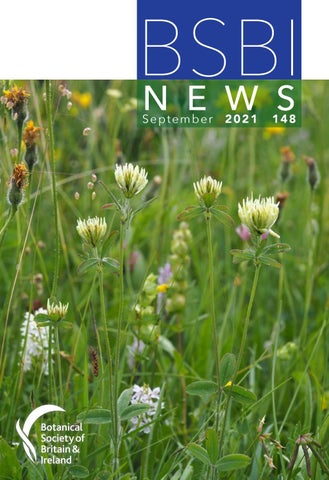
BSBI N E W S September
2021
148
ADMINISTRATION AND IMPORTANT ADDRESSES President
LYNNE FARRELL 1 Inglemere Drive, Arnside, Carnforth LA5 0BY
lynneonmull@btinternet.com Tel. 01524 761064
Hon. General Secretary and BSBI STEVE GATER Company Secretary 28 Chipchase Grove, Durham DH1 3FA.
steve.gater@bsbi.org Tel. 07823 384083
Chair of the Trustees
CHRIS MILES Braeside, Boreland, Lockerbie DG11 2LL
chris.miles01@btinternet.com Tel. 01576 610303
Hon. Treasurer
Holding
Membership Secretary (Payment of subscriptions and changes of address) and BSBI News distribution
GWYNN ELLIS gwynn.ellis@bsbi.org 41 Marlborough Road, Roath, Cardiff Tel. 02920 332338 CF23 5BU Please quote membership number on all correspondence; see address label on post, or Members List.
Hon. Field Meetings Secretary (including enquiries about field meetings)
JONATHAN SHANKLIN 11 City Road, Cambridge CB1 1DP
fieldmeetings@bsbi.org Tel. 01223 571250
Panel of Referees & Specialists (comments and/or changes of address)
MARTIN RAND (with assistance from Jo Parmenter) 3 Kings Close, Chandler’s Ford, Eastleigh SO53 2FF
VC11recorder@hantsplants.net Tel. 07531 461442
BSBI News – Editor
JOHN NORTON 215 Forton Road, Gosport PO12 3HB
john.norton@bsbi.org Tel. 02392 520828
BSBI News – Book Reviews Editor CLIVE STACE Appletree House, Larters Lane, Middlewood Green, Stowmarket IP14 5HB
cstace@btinternet.com Tel. 01449 710087
British & Irish Botany – Editorin-Chief
IAN DENHOLM 3 Osier Close, Melton, Woodbridge IP12 1SH
bib@bsbi.org
BSBI Finance Manager (all financial matters except Membership)
JULIE ETHERINGTON Church Folde, 2 New Street, Mawdesley, Ormskirk L40 2QP
julie.etherington@bsbi.org Tel. 07944 990399
BSBI Communications Officer (including publicity, outreach and website; British & Irish Botany)
LOUISE MARSH
louise.marsh@bsbi.org Tel. 07725 862957
BSBI Fundraising Manager SARAH WOODS (including donations, legacies, grants and organisational support)
sarah.woods@bsbi.org Tel. 07570 254619
BSBI Head of Science
kevin.walker@bsbi.org Tel. 01423 858327 or 07807 526856
KEVIN WALKER Suite 14, Bridge House, 1–2 Station Bridge, Harrogate HG1 1SS
BSBI Scientific Officer and PETE STROH England Officer c/o Cambridge University Botanic Garden, (& V.c. Recorders – comments and/ 1 Brookside, Cambridge CB2 1JE or changes of address)
peter.stroh@bsbi.org Tel. 01832 720327 or 01223 762054
BSBI Scotland Officer
JIM MCINTOSH c/o Royal Botanic Garden, Inverleith Row, Edinburgh EH3 5LR
jim.mcintosh@bsbi.org Tel. 01312 482894
BSBI Wales Officer
Vacant
BSBI Ireland Officer (Acting)
PAUL GREEN Yoletown, Ballyculane, New Ross, Co. Wexford, Y34 XW62, Ireland
paul.green@bsbi.org Tel. 00 353 87 77 82496
BSBI Database Officer
TOM HUMPHREY
tom.humphrey@bsbi.org
BSBI Book Sales Agent
PAUL O’HARA Summerfield Books, The Old Coach House, Skirsgill Business Park, Penrith CA11 0DJ
info@summerfieldbooks.com Tel. 01768 210793
BSBI WEBSITE bsbi.org BSBI NEWS bsbi.org/bsbi-news
CONTENTS
September 2021 No. 148
FROM THE PRESIDENT / EDITORIAL
1
ARTICLES Dryopteris pseudodisjuncta in England Anthony Pigott
3
Some observations on leaf phenology Michael Braithwaite
6
Native status and Mibora minima (Early Sandgrass) James Robertson 10 Subspecies of Mibora minima (L.) Desv. (Early Sand-grass) in Britain Michael Wilcox 15 A population of Mibora minima (Early Sandgrass) in urban Thetford (v.c. 28) – a first for Norfolk Ian Woodward
17
Common problems with field identification – the Polygonum aviculare aggregate Bob Leaney 19 Elm recording – a window of opportunity Max Coleman
23
Planning fieldwork targeting vanishing habitats Geoff Toone
25
NOTICES Notice of BSBI Annual General Meeting and Exhibition Meeting; supporter survey; New Year Plant Hunt 2022; updates on field meetings programme and atlas progress; Panel of Vicecounty Recorders; contents of British & Irish Botany 3: 2 59 BOTANICAL NOTES Short notes and notices on botanical topics 62 COUNTRY ROUNDUPS Botanical news from around England, Wales, Scotland and Ireland Compiled by Pete Stroh
65
OBITUARIES Compiled by Chris Preston
75
REVIEWS Compiled by Clive Stace
81
LETTERS
87
A puzzling unrecorded herbarium and some related mysteries Philip Oswald 31 National Plant Monitoring Scheme: Species lists and interactions Sarah Shuttleworth ADVENTIVES AND ALIENS Adventives and Aliens News 24 Compiled by Matthew Berry
35
37
Rumex thyrsiflorus Fingerh. in Surrey (v.c. 17) George Hounsome 45 Eremopoa persica (Trin.) Roshev. (Persian Meadow-grass) re-found in Britain after a 60year absence Bob Leaney, Jo Parmenter & Oli Pescott 47 Three aliens from the Isles of Scilly Rosemary Parslow & Ian Bennallick
51
Notes on Pilosella flagellaris (Willd.) P.D. Sell & C. West in the British Isles Rodney Burton 54
Cover image: Trifolium ochroleucon (Sulphur Clover) at Sudborough Green Lodge Meadows SSSI, Northants (v.c. 32). Pete Stroh (see England roundup, p. 65). Contributions for the next issue of BSBI News (no. 149) should be sent to the Editor, John Norton (john.norton@bsbi.org) by 25 November 2021. BSBI ©2021 ISSN 0309-930X
All text and illustrations in BSBI News are copyright and no reproduction in any form may be made without written permission from the Editor. The views expressed by contributors to BSBI News are not necessarily those of the Editor, the Trustees of the BSBI or its committees. Printed by Blackmore Ltd on FSC certified paper using biodegradeable inks.
FROM THE PRESIDENT / EDITORIAL
FROM THE PRESIDENT
T
here has definitely been a surge of plant growth in the past few months, with the early cold, dry spell being replaced by hot, sunny days reminding us what summer is usually like, and enabling us to get out and explore once again since most restrictions have been lifted now, and many groups and organisations have resumed meetings. These may well have been still with limited numbers and with limited travelling, but nevertheless we have been able to see each other and discuss items in the field. BSBI committee meetings are still being held by Zoom though. The Welsh AGM was held virtually in early July with some excellent talks, and we look forward to the England, Ireland and Scotland autumnal meetings, which will also be held virtually, including the talks and exhibits. It has been decided to hold the main AGM by Zoom in mid-November and details of that are to be found in this issue. Our CEO, Julia Hanmer, and Fundraising manager, Sarah Woods, have now had time to settle into their respective roles, and tackle some major issues facing the Society with help from many BSBI members who both serve on committees or are involved in other roles in the BSBI. One of these items, that of database access, has generated many different and varied views and has also raised some other very important issues. These are subjects of which other societies are now aware, and we are working together to take things forward in a sensible way. Some of these issues are inter-connected and
some need clarification, and therefore solutions will not be imminent. Our Strategy and Governance Policy outlined the overall setting for the next five years. Implementing and actually putting it into practice are different aspects and will take more effort and time. Thank you to those who are helping with these. We do value members’ views, and this year we have definitely been receiving a complete range of views and opinions from many people. I have learnt to be a bit more patient than usual, and I hope our members will be also whilst we work out acceptable solutions. On some of these aspects we are actually leading other related societies, and they have welcomed our approach, so please do not think we are dragging our heels. Life as a president has been very different from the previous years, and you will be pleased to know that we have now identified a president-elect, to be approved by the members at the November AGM. The Presidents Prize, agreed by the Wild Flower Society and the BSBI, has been awarded to Dr James Merryweather for his book Britain’s Ferns, in the WildGuides series, published in 2020. This is well-illustrated and will encourage many members to tackle the ‘greener’, and some would say, less spectacular but not less interesting, species in our flora. Lynne Farrell
lynneonmull@btinternet.com
EDITORIAL
W
elcome to my sixth issue as Editor. Following on from an article in BSBI News 146 (January 2021) we have no fewer than three more articles on Mibora minima (Early Sand-grass), all very different and interesting I’m glad to say. In lieu of Beginner’s Corner, and held over from the last issue, we have another in Bob Leaney’s series of illustrated notes on the identification of some commonly confused species – this time he tackles the commoner Polygonum species. 2
BSBI NEWS 148 | September 2021
We also have another batch of interesting reports of aliens, include new finds on the Isles of Scilly. With the flowering season almost over and daylight hours fast diminishing now is the time to get those articles written. Please keep them short and informative, include some photographs if you can, and do contact me if you need any advice or help. John Norton
john.norton@bsbi.org
Dryopteris pseudodisjuncta in England ANTHONY PIGOTT
A
bout two years ago, while attending to a potted section of my large Dryopteris living collection, I noticed a plant which struck me as looking like Dryopteris pseudodisjuncta. I knew I had one living plant of pseudodisjuncta, from Norway, but I soon realised that this was not it. It was on my database just as ‘D. affinis complex’ from the South Lakes in 1995, but on checking my original field notes, I found that I’d noted that it was not obvious what morphotype it was but that its pinnule shape was rather like pseudodisjuncta. I’d taken a frond for an herbarium specimen and taken a small piece to propagate. The fact that my son and daughter were born in 1995 and 1996 respectively may explain why I’d not paid more attention to it nearer the time! The propagated plant had probably languished in its early years and remained small and unnoticed. Having had a good look at the now quite strongly growing plant, I was quite convinced it
One of two plants of Dryopteris pseudodisjuncta found at the original location in the Lake District (Cumberland, v.c. 70), photographed July 2020. Alison Evans
was pseudodisjuncta but I thought that I should apply the usual ‘due diligence’, so I found the original herbarium specimen to check it was the same and went through the published descriptions for the taxon and looked at any verified images I could find. All worked out well. The DNA ploidy level has since been confirmed to be triploid, as it has for the Norwegian plant. This meant that this find is the only known record for England and the earliest known date for the British Isles. I informed the local county recorders of the record and we agreed not to publish the exact location due to the rarity and lack of any knowledge of population size. My original notes had only mentioned one plant. A recent search at the original site found two specimens. BSBI NEWS 148 | September 2021
3
Dryopteris pseudodisjuncta in England
Taxonomy
The taxonomy of the Dryopteris affinis complex has been controversial and is often confusing. There are at least 20 forms or morphotypes known that have been described and can reasonably be distinguished, of which around 12 have been recorded in the British Isles. Many of these have been formally described, variously as species, subspecies and varieties usually combined in supposed hierarchies. The most commonly followed formal scheme is probably that of Fraser-Jenkins from 2007. This scheme was adopted in Stace’s third edition of his Flora. In that, D. pseudodisjuncta is recognised at species level. Unqualified formal names in this article follow this treatment for clarity. More recently, formal treatments have gone in opposite directions with Stace (2019) reverting to one aggregate species in his 4th edition and Sell (2018) raising all recent formal subspecific names to species. Dryopteris pseudodisjuncta was first named by Oberholzer and von Tavel in 1937 as ‘D. borreri var. pseudodisjuncta’. It was described as having the ‘habit of var. disjuncta [and the] indusia of D. filix-mas’. The taxon was treated as a synonym of D. affinis subsp. borreri by Fraser-Jenkins in 1980 and as Dryopteris pseudodisjuncta in 2007. It appeared in ‘Stace 3’ as D. pseudodisjuncta and in ‘Stace 4’ as D. affinis subsp. pseudodisjuncta.
Appearance
Whilst Dryopteris pseudodisjuncta has been associated with D. borreri and D. cambrensis, it is probably most likely to be confused in the field with D. affinis sensu stricto. This is, perhaps, no surprise given its name (disjuncta is the name of a form of D. affinis that is common in continental Europe). It shares a ‘neat’ appearance, flat fronds and a somewhat glossy upper surface. However, it is distinctive in that the indusium is noticeably thin and only just encloses the sporangia at maturity. The frond outline is obovate and it also has a distinctive pinnule shape, most noticeable in the lowest basiscopic one on each pinna, which is difficult to describe but which becomes easily recognisable with familiarity: a sort of kinked extended oval. See photographs on opposite page. 4
BSBI NEWS 148 | September 2021
Distribution
The distribution of Dryopteris pseudodisjuncta in Europe is primarily in Germany, Austria, Norway, France and Switzerland with more recent reports from The Netherlands and Poland. It is better known in continental Europe, especially Germany where it has been more extensively written about, e.g. Döpp et al. (1963). In Britain, it was discovered near Dumfries in 2008 (Trewren, 2010) and has since been reported from Arran. Numbers at the three known sites appear to be very small, so although it may well be under recorded, there is clearly serious conservation concern in Britain.
Acknowledgements
I am very grateful to Libor Ekrt for working with me, in particular in measuring the genome size of many plants in my living collection.
References
Fraser-Jenkins, C.R. 1980. Dryopteris affinis: a new treatment for a complex species in the European Pteridophyte Flora. Willdenowia 10: 107–15. Fraser-Jenkins, C.R. 2007. The species and subspecies in the Dryopteris affinis group. Fern Gazette (UK) 18: 1–26. Pigott, A. 1997. Morphotypes of the Dryopteris affinis complex in Britain and Ireland. Affinis Watch, Special Issue (April 1997): 1–4. Sell, P.D. & Murrell, G. 2018. Flora of Great Britain and Ireland. Volume 1. Cambridge University Press, Cambridge. Stace, C. 2010. New Flora of the British Isles (3rd edn). Cambridge University Press, Cambridge. Stace, C.A. 2019. New Flora of the British Isles (4th edn). C & M Floristics, Middlewood Green, Suffolk. Trewren, K. 2010. Dryopteris pseudodisjuncta – a new fern for Britain. Pteridologist 5: 205–206. Von Tavel, F. 1937. Dryopteris borreri Newman und ihr Formenkreis. Formenkreis Verhandlungen Der Schweizerischen Naturforschenden Gesellschaft 118: 153–54. Döpp, W., Gätzi, W. & Oberholzer, E. 1963. Dryopteris borreri Newman (D. paleacea Hand.-Mazz.) var. pseudodisjuncta v. Tavel. Berichte Der Deutschen Botanischen Gesellschaft 76, no. 4.
Anthony Pigott
BSBI Referee for the Dryopteris affinis complex anthony.pigott@btinternet.com
Dryopteris pseudodisjuncta in England
Herbarium specimen from the original record (top left); composite image of frond from plant propagated from original specimen (top right); lowest pinnae of frond from plant propagated from original specimen (bottom). Anthony Pigott
Immature (top) and ripe (bottom) sori on frond from plant propagated from original specimen. Anthony Pigott
Second of two plants found recently near the original location. Alison Evans
Mid-frond pinnae of plant recently found. Alison Evans
BSBI NEWS 148 | September 2021
5
Some observations on leaf phenology MICHAEL BRAITHWAITE
Myrrhis odorata (Sweet Cicely), in the lane at Clarilaw. Nicola Nixon
M
ost of us are not trained ecologists, so, while we are used to reading studies of flowering times in plants, especially records of first-flowering in relation to climate change, it is seldom that we meet studies of how the leaves and stems develop over the season. I have long enjoyed the abridged version of Comparative Plant Ecology (Grime et al., 1988). This did much to develop my desire to learn more, so in 2020 I selected twelve common species to follow through the season in a short stretch of lane by my house at Clarilaw, Hawick (v.c. 80). I divided each month into four equal parts, of which there are 48 in the year. In each of these parts I observed for each species whether there were basal leaves and whether they were growing or resting, whether there was a stem and whether it was growing, and whether there were flowers. Due to health issues, the study was cut short in mid-August 2020, but, as the plants of all the chosen species were nearly ready to die back by then, not much was lost. I enjoyed the project and learnt much, though nothing ground-breaking. I now present detailed accounts of four of my twelve species, together with short notes on the other eight, in the hope of encouraging others to carry out similar studies. 6
BSBI NEWS 148 | September 2021
Ficaria verna (Lesser Celandine)
One of the species I chose was Ficaria verna, and I selected a dense colony under a hedge to follow. It proved to be full of surprises (Figure 1). Leaves started to appear in the second week of January and ground-cover was complete by the second week of February. Then nothing happened above ground for a long while, though I suspect that the root-tubers were swelling underground. Not until the third week of March did the first flowers appear. The early flowers were borne on leafless stems. At the same time leaf-bearing stems started to grow until it was almost as if there was a second layer of leaves jostling for light with the early leaves. The leaf-bearing stems usually grow a flower at the tip and may branch, by means of a branch-stem growing out of one of the leaf-axils. The branch will also flower. The flowering was sparse to begin with, but for three weeks from the beginning of April flowers were more plentiful. Then the flowering tailed off abruptly over a single week. Meanwhile the leaf-bearing stems were producing bulbils in the axils of the stem-leaves and, having done so, died off quickly over the first two weeks of May. The leaf-bearing stems grow at an angle and flop down to deposit their bulbils in a neat line radiating out from the base. The stems
Some observations on leaf phenology
the beginning of March, but, as they expanded, were heavy enough to flatten any competing vegetation. The Myrrhis flowered prolifically, especially in three weeks from mid-April to early May. Although there were some flowers open on the Anthriscus for two months, the main flowering season was short, just two weeks in the second half of May. There was very little overlap with the flowering of the Heracleum. There were some Heracleum flowers open for three months while the main flowering season was four weeks from mid-June to mid-July. After the lane verge was cut at the end of June the response of the three species differed (Figure 3). Myrrhis odorata, Anthriscus sylvestris All three produced new basal rosettes to reclaim and Heracleum sphondylium their ground-space but only the Heracleum flowered These three species were known to flower in again. It was just beginning its main flowering period succession, maximising the chance of cross when the verge was cut. The plants that had been pollination to flowers of the same species, but I was cut threw up new flowering stems very quickly and, ignorant about the leaf growth. My observations, although only half the height of stems that had as recorded in the chart (where the column bars are not been cut, they opened their flowers in time to the flowers) confirmed the succession (Figure 2). The synchronise with the later part of the main flowering first basal leaves of Myrrhis odorata (Sweet Cicely) period. Meanwhile the basal rosettes remained small appeared in the last week of January, after which it until the flowering was more or less finished. The grew fast and quickly claimed a wide ground-space. Heracleum relies on its stem leaves much more than Indeed the main colony excluded all other vegetation the other two species. This enables it to flourish except for the occasional Galium aparine (Cleavers). among coarse grasses which more or less shade out Anthriscus sylvestris (Cow Parsley) is the only one of the basal leaves. the three with an over-wintering basal rosette and, Such is the abundance of flowers on umbellifers having already secured its ground-space, it grew that they would make excessive energy demands on unspectacularly until its flowering season, starting the plant if all had nectar and all set seed, so only a at the end of April. In contrast the basal leaves of proportion of the flowers are hermaphrodite and the Heracleum sphondylium (Hogweed) did not emerge until rest are male. The anthers mature before the stigmas to encourage cross-pollination. 100 The patterns differ from species to species and are not even 80 constant on a single plant. The 60 Myrrhis most often has an umbel of hermaphrodite flowers on a 40 stout stalk flanked by two umbels 20 on slender stalks bearing male flowers only. The Anthriscus usually 0 Jan Mar Apr May Jun Feb has a hermaphrodite umbel at the Flowers Stem leaves Basal leaves edge of the flower cluster with the other umbels a mixture of Figure 1. Phenology of Ficaria verna subsp. verna (Lesser Celandine). male and hermaphrodite. The % fully open
may be as much as 20 cm long, though 5–10 cm is more usual, so the bulbils are dispersed over quite a wide area. Very few of the flowers produce viable achenes. The basal leaves last longer than the stem leaves and, during a long spell of dry weather, died back in stages until they were all dead by the end of the first week of June. The fact that the Ficaria verna produced bulbils demonstrated that it is Ficaria verna subsp. verna. I became intrigued by the two Ficaria subspecies and went on to study their distributions (Braithwaite, 2020).
BSBI NEWS 148 | September 2021
7
Some observations on leaf phenology
100
% fully open
80 60 40 20 0
Jan
Feb
H. sph fls
Mar
A. syl fls
Apr
May
M. odo fls
H. sph lvs
Jun
Jul
A. syl lvs
Aug
M. odo lvs
Figure 2. Phenology of three umbellifers: Myrrhis odorata (Sweet Cicely), Anthriscus sylvestris (Cow Parsley) and Heracleum sphondylium (Hogweed). 100
% fully open
80 60 40 20 0
Jan
H. sph fls
Feb
Mar
A. syl fls
Apr
M. odo fls
May
H. sph lvs
Jun
A. syl lvs
Jul
Aug
M. odo lvs
Figure 3. Regrowth of Myrrhis odorata, Anthriscus sylvestris and Heracleum sphondylium.
Heracleum has several hermaphrodite umbels towards the centre with male or mixed umbels adjacent. The Anthriscus has such a diffuse flower structure that it creates the effect of great drifts of white down a lane. In contrast the umbels of Heracleum always appear distinct, though they are ranked in tiers and vary from flat to dome-shaped to saucershaped. They overtop other vegetation, in particular Arrhenatherum elatius (False Oat-grass). The Myrrhis is an archaeophyte and its large fruits are not readily dispersed from the point of introduction. However roadside colonies have been spreading recently, taking advantage of huge tractors 8
BSBI NEWS 148 | September 2021
whose massive tyres are often driven over the verges allowing the fruits to hitch a lift. The following notes on a further eight species are presented in pairs with features in common.
Vicia sepium and Vicia cracca
Vicia sepium (Bush Vetch) was more than a month earlier than Vicia cracca (Tufted Vetch) in the growth of both leaves and flowers. Vicia sepium was growing under partial shade in relatively short vegetation where it scrambled around. It flowered throughout May and June. Vicia
Some observations on leaf phenology
cracca is more strictly a climber and, by delaying its growth, ensured that the adjacent vegetation was tall enough to climb in.
Urtica dioica and Chamaenerion angustifolium Urtica dioica (Common Nettle) had formed dense patches which did not shoot leaves until the end of February. They did not grow especially fast and did not flower until mid-summer. The extension of the rhizome system was not recorded. Chamaenerion angustifolium (Rosebay Willowherb) did not shoot until the second half of March, but then overpowered any competitors by growing into a tall, dense colony. It had a long flowering season in the latter half of the summer, flowering synchronously with neighbouring colonies. The colonies of both species more or less escaped verge-cutting.
Geum urbanum and Stellaria holostea
Geum urbanum (Wood Avens) plants had overwintered as basal rosettes and added new leaves in April and May. The flowering stems which developed were in no hurry to flower, but, once flowering had begun in late May, it continued unspectacularly until early August. Some of the Stellaria holostea (Greater Stitchwort) had leaves which had overwintered but most grew afresh at the end of March. They quickly developed flowers and, though the main flowering season was over by early May, there were some flowers until the end of May. The leaves remained green throughout the summer. The colonies of both species more or less escaped verge-cutting.
Lamium album and Plantago lanceolata Lamium album (White Dead-nettle) and Plantago lanceolata (Ribwort Plantain) had both overwintered, the Lamium as stem leaves and the Plantago as a basal rosette. The Lamium album stems started growing in mid-February and flowering began in mid-March. Flowering peaked in late April and again in mid-July but the June verge-cutting interrupted flowering for a month. By early June the foliage had become almost swamped by coarse grasses, so the verge-cutting was beneficial as the grasses did not swamp the plants to such an extent on re-growing. The rosette of Plantago lanceolata was largely inactive until March, but produced new leaves during March and April. The leaves in the overwintering rosette had been held horizontal, but the spring leaves adapted to the surrounding vegetation, growing nearly erect when faced with competition from grasses. Flowering began in midApril and peaked early in May, but then continued intermittently throughout the summer, except for a fortnight after the taller leaves and all the flowering stems had fallen to the verge-cutting. Regrowth was rapid.
References
Braithwaite, M.E. 2020. The history and distribution of the bulbil-bearing Ficaria verna subsp. verna (Ranunculaceae) in Britain, British & Irish Botany 2: 215–222. Grime, J.P., Hodgson, J.G. & Hunt, R., 1988. Comparative Plant Ecology, Unwin Hyman, London.
Michael Braithwaite
Clarilaw Farmhouse, Hawick TD9 8PT mebraithwaite@btinternet.com
BSBI NEWS 148 | September 2021
9
Native status and Mibora minima (Early Sand-grass) JAMES ROBERTSON
I
was intrigued to read about a second site for Ireland of Mibora minima (Early Sand-grass) in BSBI News 146 (Lyons, 2021). Mibora and I became neighbours when I moved to Anglesey three decades ago, but I was already interested in this tiny but attractive grass. It flowers before spring has truly arrived; the dazzle of its silver and purple spikelets and rigid posture belie its ‘minimal’ nomenclature. Anglesey is arguably its only native mainland location, and I take pride in this. But is it truly native and what does this term mean in these newly-formed inter-glacial islands in which human and natural history are so substantially woven together? I first encountered Mibora minima in 1983 with the then BSBI Hon Meetings secretary, Joanna Martin. It was growing abundantly on bare sandy ground in a nursery at West End in Surrey. It was also in an adjacent garden, formerly part of the nursery, a dense carpet in full flower in March where turf had been lifted to establish a soft fruit bed. There are old records from two nearby Surrey nurseries (Lousley, 1976). At the time it was well established at other sandy sites in Hampshire, and BSBI’s online Atlas 10
BSBI NEWS 148 | September 2021
Dark and pale forms of Mibora minima (Early Sandgrass) at Aberffraw Dunes. Jane Rees
of the British and Irish Flora notes that it is recorded inland as a casual plant in nurseries and gardens. Some years later I learned of its honoured status as a rare native plant on Anglesey. The first record for Mibora minima is in Hudson’s Flora Anglica (1762), written under the auspices of Benjamin Stillingfleet, who provided the record, but without a named location. Since it was recorded as Knappia in Welsh Botanology (1813), mainly at the outlet of Llyn Coron, at the edge of Aberffraw sand dunes, but also at Tywyn Trewan to the north, its native status on Anglesey has never been in doubt. There is no evidence that Stillingfleet ever visited Anglesey, although there were a number of prominent naturalists active on Anglesey in the late 18th century. I will come to one of these, William Morris, later. Griffiths (1895) describes it as ‘native; on dry, sandy pastures. Rare.’ He notes two locations: on Aberffraw Common and near Maelog Lake
Native status and Mibora minima
Hotel. Both of these are along Anglesey’s southwest, sand-dune enriched coast, as are all its current populations. Anglesey’s Rare Plant Register (Bonner, 2006) lists about 20 extant sites, which are all more or less subdivisions of those given by Griffiths, noting also the decline near Newborough. It is currently known from 23 monads between Cymeran, across the strait from Holy Island, and Newborough, a substantial distance, for which all but five are post2000 records. Although the number of plants may run into thousands, for example on Aberffraw sand dunes, it is extremely local within this area and absent from swathes of apparently suitable dry but winter-damp sand. Mibora minima has a restricted natural global distribution in south-west and southern Europe, including Portugal and western France, and northwest Africa, but it has been a successful global traveller. It has colonised a substantial area on the border between Canada and USA, where it has been described as an invasive alien, and has been recorded in Western Australia and South Island, New Zealand. In Europe it is widely naturalised, with a disjunct population in Ukraine. It may have spread to some of its scattered inland locations as an early introduction, over a period of several millennia, taking advantage of continuous and growing human traffic from southern Europe northwards. It also grows on the Channel Isles: on Jersey, for example on a sloping hillside with open vegetation at Quernevais; on Guernsey, for example abundantly on dry slopes at Pleinmont Headland; and on Herm. These locations are undoubtedly native and fit with its other native locations in south-west Europe. It is interesting that the habitat is somewhat different from the dry but winter-damp sandy sites on Anglesey. In 1964 Mibora minima was found on sandy turf at Whiteford Burrows, Gower (v.c. 41) where it was considered to be native (Cope & Gray, 2009). This assumption was made in the absence of evidence to the contrary. Currently there are 36 records for Mibora minima at Whiteford on the BSBI database, at different scales and overlapping localities. The status was entered as unknown for 23 of these, native
for 11 and casual (present briefly – less than five years) for 2. Only once, in 1988, was a population described as abundant, with thousands of plants. Very small numbers are recorded for all but one of the nine post-2000 records. A substantial area of sand dunes at Whiteford was planted with conifers between 1955 and 1964. Young trees provide a possible route for plant introductions on sand dunes; for example the spread of Round-leaved Wintergreen (Pyrola rotundifolia), first recorded on the dunes at Newborough Warren NNR in 1955, coincides with the planting of Corsican Pine (Pinus nigra) in the 1950s. In 1993 Mibora minima turned up on Studland Heath NNR, Dorset, where it is thought to be an introduction. It has also been recorded as an alien in Suffolk and in 1996 it was discovered on relict sand dunes on the Sefton Coast (Smith et al., 2011) in v.c. 59. There, the area colonised by it was monitored and mapped in 1999 and 2004 (Smith, 2005) during which time the area it occupied had increased by almost 50%. This points to a relatively recent introduction. It has been suggested (Preston et al., 2002) that it is most likely to be the result of spread from the native sites in Wales. The authors add that it is almost impossible to say whether several new populations discovered since 1980 are native or alien. A further population of over 1,000 Mibora minima (Early Sand-grass) at Aberffraw Dunes. Jane Rees
BSBI NEWS 148 | September 2021
11
Native status and Mibora minima
Mibora searcher at Newborough Warren. Ivor Rees
plants across two hectads was discovered in 2015 on North Uist (Smith et al., 2015). Here the authors consider that ‘on balance it is perhaps most likely to be native’. Previous records in Scotland, believed to be deliberate introductions in the Aberlady Bay area in East Lothian, date back to 1851. The first record in Ireland was made in 2005 (O’Mahony, 2009) where it was found at Barley Cove, by Mizen Head in far West Cork. Its discoverer, Tony O’Mahony, considers it to be a native which has been overlooked because of its small stature, early flowering and the inhospitable nature of the terrain. However he also points out that it is a distinctive little grass, and he estimated the population at approximately 100,000 plants. The discovery in 2020 of this tiny grass on North Bull Island, Dublin (Lyons, 2021) adds a further twist to the ‘native or alien’ dichotomy. Its author, Mandy Lyons, gives it the status of native, but makes the fair comment that ‘the route by which this species might have reached the island and whether human activity – unwitting or otherwise – played a part in its 12
BSBI NEWS 148 | September 2021
arrival is unknown’. Acceptance of the Cork population as native is taken to support the idea that the newly discovered population is also native. The difficulty with this is that, as the author points out, North Bull Island is relatively young, having been formed within the last 200 years. Captain Bligh of Mutiny on the Bounty fame drew up plans for breakwaters to channel tidal flows in order to scour and deepen the channel through the sand bar to facilitate access by boats up the river Liffey to the Port of Dublin. North Bull Wall was completed in 1825 but it took many decades before North Bull Island was formed from accreting sand. It might also be significant that the location of the discovery is close to a roundabout and environmental centre. Transport links between Anglesey and Dublin have been greatly improved in recent years, notably after the introduction of roll-on roll-off ferries to and from Dublin Port. Ivor Rees (pers. com.) speculates that camper vans are often present close to Mibora minima populations on Anglesey; some of these then cross the Irish Sea, and may stop off at North Bull Island. Seed could be transported in this way. The status of Mibora minima as a native on Anglesey depends on its appearance in Welsh Botanology (Davies, 1813). This gives it more than two centuries of provenance. Despite the absence of early records from any other coastal sites, this is taken as evidence of its true native status on Anglesey: a species which arrived under its own steam at some time in the post-glacial period. The opportunity for such natural colonisation would be greater had there been reasonably close refugia where the species could have persisted until the end of the last glaciation; and if its distribution were continuous or connected enough to indicate how
Native status and Mibora minima
a slow-spreading species had reached its current locations. Neither of these pertains, so it is worth considering other possibilities. There are many ways in which Mibora minima could have been transported from its native sites outside England and Wales, such as in the Channel Isles, to its main ‘native’ station on Anglesey. Here I explore just one of these, the horticultural trade, which indicates the extent of human transportation of plants and soils over several centuries. William Morris (1705–1763), a formidable letter-writer, along with his brothers, was a keen gardener, botanist and naturalist (Ramage, 1987). He was Controller of His Majesty’s Customs, Holyhead, and constructed a residence on Holy Island. From his letters we know that there was a brisk trade in shrubs and plants between nurseries in the south of England, the Channel Isles (he mentions Guernsey Lily in manuscript notes) and Anglesey. There was much exchanging of plants between gardeners in those counties in southern England where Mibora minima has been recorded. The nursery where I first encountered it belonged to the rose specialist Henry Street, and there were many other nurseries on Hampshire and Surrey sands which grew shrubs for export around the country. Morris also received many exotic seeds and plants from sea captains who dealt with him as Customs Controller. He made a catalogue of all the plants in and around Holyhead although did not find Mibora minima. Hugh Davies (1739–1812) described Morris as ‘an ingenious and skilful naturalist’ and used his plant catalogue as a source for Welsh Botanology (Davies, 1813). The late 17th century saw an upsurge in the construction or reconstruction of large houses and gardens, such as Bodorgan Hall (1779–82). Aberffaw Common lies close to Bodorgan Hall and belongs to the Bodorgan estate to this day. This extensive area of dunes includes 6 of 20 listed locations for Mibora minima (Bonner, 2006). Here it is numerous and extensive, looks natural and these dunes are exceptionally plant-rich. Genetic variation is not as great as in plants on Guernsey but it is not ‘in-bred’ (John et al., 1989). On the other hand, it favours a
relatively transient habitat with much bare sand, accompanied by other pioneer annuals such as Sea Mouse-ear Cerastium diffusum; and its populations are usually close to estate roads or beside long established footpaths. The same picture is true of most of the other locations. These dunes have, or have had, large rabbit populations, which provide the disturbance which the grass exploits. (In nurseries humans provide the required disturbance.) Efforts to split the species into two possible subspecies or forms (minima and littorea) do not work well with Anglesey plants (Jones, 2005), which are generally intermediate. Michael Wilcox is currently looking at these two forms and this could shed light on the origin of the Anglesey population (see article, p. 15). By contrast it is easy to spot the two colour forms, one bright greenish yellow, and a darker one with reddish-bronze spikes. Whether or not a plant is considered native gains importance when prioritising conservation efforts, although it is generally much better to focus action on habitats rather than on individual rare species. When I set out evidence to suggest that Deptford Pink (Dianthus armeria) was probably an introduction in these islands, spread by humans (Robertson, 2016), there was a reaction from those engaged in conservation efforts for this species, who felt that my arguments undermined their work and the plant’s standing as a protected species. Deptford Pink was discovered for the first time in Ireland in 1993 on Horse Island, Co Cork, but Tony O’Mahony is doubtful about its native status (O’Mahony, 2009). Deptford Pink is an international traveller, widespread as a result of accidental translocations, and this facility is also a factor to consider in the case of Mibora minima. A binary view of plants as being either native, which means they arrived here long ago by natural means, or non-native, everything else, encourages botanists to seek to categorise much-loved plants (axiophtes) as native. Yet their cultural context offers another rich vein of value and interest. Conservation looks for support to both science and culture. More evidence will no doubt come to light (for example from post-glacial pollen analysis) to defuse BSBI NEWS 148 | September 2021
13
Native status and Mibora minima
doubts about the native status of some species. David Pearman (pers. comm.) has pointed out that one of the criteria for the new Atlas of the British Flora accords native status to species ‘on the grounds that they are accidentally dispersed from a native site by foot or vehicle, which is a natural colonisation’. These are difficult grounds, because once you decide that a site is native because plants have colonised it through accidental human dispersal, plants dispersed from that site to new locations can be given native status. There is also the problem of ascribing human intentions to the dispersal. We are some way from acceptance of such a definition, even though it would seem sensible to accord native status to long-term colonists. After all, nature is not static, and time does not stand still. Species which have reached our shores via human activities at some point in the distant past, and have established themselves here, occupy an environment which is substantially different from the one that greeted the early post-glacial arrivals. Sea level changes have contributed to the reshaping of our coasts and sand dunes, the climate has altered and changing patterns of disturbance have created new opportunities for plants. We cannot be sure of the exact status of Mibora minima but it was almost certainly not in the first wave of post-glacial spread; it may not be strictly ‘native’ outside the Channel Isles. But it is a long way from deserving the somewhat pejorative term ‘alien’. Several attempts have been made to soften existing plant categories (Walker et al., 2019). Extending the definition of ‘native’ to embrace long-established plants which are well-integrated into the flora and behave as natives would be one way to go. As for conservation priorities, it is much better to emphasise the value of plant communities which are essentially natural in character, and conserve these. They may include occasional additions made over time as a result of the incessant activities of our species. These additions add another layer of interest to our flora, drawing together the threads of human and natural history.
14
BSBI NEWS 148 | September 2021
Acknowledgements
My thanks go to Ian Bonner, Nigel Brown, David Pearman and Ivor Rees for advice and help with this paper.
References
Bonner, I. 2006. Anglesey Rare Plant Register. Cope, T. & Gray, A. 2009. Grasses of the British Isles, BSBI Handbook No. 13. Botanical Society of the British Isles, London. Davies, H. 1813. Welsh Botanology. London. Griffith, J.E. 1895. Flora of Anglesey & Carnarvonshire. Bangor. John, M.R., & Kay, Q.O.N. 1989. Population structure and inter-relationships in a rare British annual grass: Mibora minima. BSBI News 51: 49. Jones, A. 2005. Lusitanian affinities in Welsh Early Sandgrass? BSBI Welsh Bulletin 76: 16. Lousely, J.E. 1976. Flora of Surrey. David and Charles. Lyons, M. 2021. Mibora minima (Early Sand-grass) on North Bull Island, Dublin – second record for Ireland. BSBI News 146: 17–20. O’Mahony, T., 2009. Wildflowers of Cork City and County. The Collins Press. Preston, C.D., Pearman, D.A. & Dines, T.D. (eds) 2002. New Atlas of the British and Irish Flora. Oxford University Press, Oxford. Ramage, H. 1987. Portrait of an Island. Anglesey Antiquarian Society. Robertson, J. 2016. A Study in Pink. British Wildlife 27: 154–160. Smith, P.A., Prescott, O. & Bungard, J. 2015. Mibora minima in the north-west of Scotland, on Baleshare Island, North Uist (v.c. 110). BSBI News 130: 26–27. Smith, P.H., Caulfield, C.M., & Lockwood, P.A. 2011. Changing status of Mibora minima on the Sefton Coast. BSBI News 118: 28–32. Smith, P.H. 2005. Mibora minima on the Sefton Coast, Merseyside. BSBI News 99: 33–34. Walker, K.J., Leach, S.J., Preston, C.D., Humphrey, T.A., James, T.J., Pearman, D.A., & Smith, P.A. 2019. Recording plant status and regeneration during single visits. British & Irish Botany 1: 283–291.
James Robertson
Tyddyn Adda, Llanddaniel, Anglesey LL60 6HB jamrobertson@gmail.com
Subspecies of Mibora minima in Britain
Subspecies of Mibora minima (L.) Desv. (Early Sand-grass) in Britain MICHAEL WILCOX
S
ometimes described as the smallest grass in the world, Mibora minima (Early Sand-grass) is a rare grass in Britain, which may be overlooked due to its early flowering time. A study on European plants concluded that some populations from the NW Iberian Peninsula were separable as M. minima subsp. littorea. In Britain, plants from Anglesey and North Uist have been considered to be like subsp. littorea, with most other colonies in Britain belonging to subsp. minima. The plants examined in this study, from several colonies including those from Anglesey, were essentially found to be within the range of subsp. minima. It is without doubt M. minima is a very small grass indeed, and perhaps considered to be the smallest grass in the world (see Rich, 1997), though other species can be as small in some forms (e.g. Poa infirma Early Meadow-grass) and certainly some of the parts of M. minima (such as stomata and anthers for example) are much larger than those in species such as P. infirma. Ortiz et al. (1999) studied Mibora minima across populations in Europe (including some from Britain) and concluded that there is a taxon that has measurable differences to the usual form. This was separated at subspecies level (subsp. littorea (Samp.) S. Ortiz, J. Rodrígeuz-oubiña & P. Guitián) and is only known from the NW Iberian Peninsula (Ortiz et al., 1999). It is now accepted as a subspecies in Flora iberica (Castroviejo, 2021). Some populations in Britain have been studied in terms of their distribution at a local scale (see Smith, 2005; 2007; Smith et al., 2011; Smith et al., 2015). However, few have been considered as one subspecies or another. In Britain, Cope & Gray (2009) state (based on Ortiz et al., 1999) that plants from Anglesey belonged to M. minima subsp. littorea. Specimens from North Uist (v.c. 110) have also been identified as subsp. littorea (Smith et al., 2015).
Essentially, Mibora minima is a species where each spike is a one-sided raceme of one or two rows of spikelets. In essence, it was separated as subsp. littorea (Ortiz et al., 1999) based on the following (main) characteristics: Spikelets (2.2)2.5–3.5 mm (maximum 4 mm) – not 1.7–2.5 mm (maximum 3 mm) Spikelets in two rows where the 1st and 3rd overlap (and most subsequent rows) such that spikelets appear in two rows side-by-side (with a biseriate appearance from the front) – not a single row where the 1st and 3rd do not overlap (spikelets more or less with a uniseriate appearance; there is some overlap between the two subspecies [see Ortiz et al., 1999]). Essentially, subsp. littorea has larger, overlapping spikelets which appear in two rows compared to the smaller spikelets in a more or less single row (not overlapping) in subsp. minima. Subsp. littorea is also said to have the basal pedicel of the inflorescence conspicuously rugose (being slightly rugose or smooth in subsp. minima). More technical data on adaxial and abaxial cell shapes and sizes is given in Ortiz et al. (1999) in which (using absolute extreme values) the cells are clearly larger and more rectangular at the adaxial leaf surface in subsp. littorea. Plants from several colonies from Britain were examined to see if any fit the description of subsp. littorea. Being rare this was limited to ten or fewer plants but with more than five spikes per plant. North Bull, Dublin: These plants were clearly like M. minima subsp. minima with primarily onesided racemes. They have pollen with the average size of 20 µm (appears not to have been measured in Ortiz et al. [1999] but plants of both subspecies were said to be diploid, 2n = 14). The lemma (c. 1.4 mm) has long hairs to about 0.5(6) mm. Glumes 2.5–2.7 mm; the apex is truncate and frayed; the BSBI NEWS 148 | September 2021
15
Subspecies of Mibora minima in Britain
inferior glume often emarginate. Being a diploid it has unusually large stomata for such a small grass with small leaves. In Britain the stomata were about 40–42 µm. Interestingly, the size given by Ortiz et al. (1999), was written ‘0.065–0.069 mm’ (= 65–69 µm) but this is said to be an absolute extreme value, which appears to be different to those measured here. However, stomata from only a few leaves were measured so the value for plants here might be a minimum value. The anthers were on average c. 1.5 mm in these specimens, probably a typical size (see Cope & Gray, 2009). It was thought these plants could have come across from the mainland via Anglesey. However, all plants had small spikelets mostly in single rows. The glumes were a maximum of 2.7 mm but in general were ≤2.5 mm. These are within the range of M. minima subsp. minima. Anglesey: Similarly, plants from here were received from a few sites in Anglesey and were very similar to the Dublin plants (rather than larger, cf. statement in Cope & Gray). Primarily, the spikelets were in single rows with only a few having spikes that appeared to have the 1st and 3rd spikelet overlapping. They had glumes with a maximum size of 2.8 mm but were clearly mostly <2.5 mm. Ortiz et al. (1999) did not place the plants from Anglesey in subsp. littorea, they stated that plants from Anglesey, ‘generally present an
imbricate [overlapping] spikelet arrangement, giving a biseriate appearance, but spikelet length is generally less than 2.5 mm (though some individuals from Anglesey show a mean spikelet length of 3 mm)’. This was generally the case but as with their study in those seen, all spikelets were generally less than 2.5 mm and barely had any that were overlapping. Sefton Coast: Several plants were received from this part of the coast where Smith (2005; 2007) and Smith et al. (2011) have studied this local population over several years. In some of the photographs a few spikes show overlapping spikelets (of at least the 1st and 3rd) but most appear single-rowed. This feature may in part relate to the maturity of a spike. The spikelets are well within the range of subsp. minima, being quite small at ≤ 2.5 mm. Plants from the site on North Uist (Smith et al., 2015), which were said to fit subsp. littorea (like Anglesey) also seem unlikely in view of the others. However, as no material has been seen from this site they cannot be measured and technical characters looked for at present. In at least two quite different populations, those from the Sefton Coast and some from Anglesey, some plants are a pallid form in which the whole plant is yellow-green (see photographs), totally lacking anthocyanin (no purplish colour at all). It is uncertain as to what causes this (perhaps edaphic conditions) however, it could be genetically controlled by one or
Mibora minima (Early Sand-grass), Southport, Sefton Coast (v.c. 59). Phil Smith Left: typical form, spikelets strongly laden with anthocyanin (distinctly purple), within the range of subsp. minima, March 2009. Right: distinctly pallid yellow-green form with no anthocyanin purple colouration, April 2013. A few plants from Anglesey also showed this form.
16
BSBI NEWS 148 | September 2021
A population of Mibora minima in urban Thetford – a first for Norfolk
two alleles. If more plants can be found in other quite disparate colonies, it could feasibly be given a rank at forma (e.g. f. pallida). Thus if encountered, plants could be marked in the comments when recording as ‘pallid form’ or ‘f. pallida name pending’. Ortiz et al. (1999) did not specifically place the Anglesey plants in subsp. littorea. They stated that most had spikelets ≤2.5 mm, with a few being 3 mm, and that such populations needed more study. This places them well within the range of their version of subsp. minima (in which they allow for some overlap between the two subspecies). It seems that it can be concluded, that most if not all populations of Mibora minima here in the UK clearly fall into the range of subsp. minima. Further study at a larger scale may show more overlap with subsp. littorea and it may be of interest that the size of the stomata appeared to be smaller here. However, at present subsp. littorea is rare and only occurs on parts of the NW Iberian Peninsula (Galicia and NW Portugal; Ortiz et al. [1999]; Flora iberica [Castroviejo, 2021]).
Acknowledgements
I would like to thank Nigel Brown, Melinda Lyons, Ian Bonner, Phil Smith, Clive Stace, Robin Walls and Oliver Pescott for their help in preparing this article.
References
Castroviejo, S. (ed) 2021. Flora iberica, Vol. XIX (1): Gramineae: 52. Mibora minima, pp. 591–595. Consejo Superior de Investigaciones Cientficas (CSIC). Cope, T.A. & Gray, A. (2009). Grasses of the British Isles. London: Botanical Society of the British Isles. Ortiz, S., Rodrígeuz-oubiña, J. & Guitián, P. 1999. Taxonomic characterization of littoral sabuline populations of Mibora minima (Poaceae) in the northwestern Iberian Peninsula. Nordic Journal of Botany 19: 581–586. Rich, T.C.G. 1997. Wildlife reports: flowering plants – England. British Wildlife 8: 328. Smith, P.H, Highfield, C.M. & Lockwood, P.A. 2011. Changing status of Mibora minima on the Sefton Coast, Merseyside (v.c. 59). BSBI News 118: 28–34. Smith, P., Pescott, O. & Bungard, S.J. 2015. Mibora minima in the north-west of Scotland, on Baleshare Island. BSBI News 130: 26–27. Smith, P.H. 2005. Mibora minima on the Sefton Coast, Merseyside. BSBI News 99: 33–34. Smith, P.H. 2007. Recent works at Southport Marine Lake sand-dunes. Report to Sefton Coast Partnership.
Michael Wilcox
43 Roundwood Glen, Greengates, Bradford BD10 0HW michaelpw22@hotmail.com
A population of Mibora minima (Early Sand-grass) in urban Thetford (v.c. 28) – a first for Norfolk IAN WOODWARD
A
fter having avoided urban botanising (and people!) during much of 2020, I resolved in 2021 to undertake some ‘square-bashing’, focusing on visiting some of the 1-km squares in Thetford to see how many species I could find over the course of the year. On one such visit, on 24 April, I visited a part of the British Trust for Ornithology’s Nunnery Lakes reserve before using a narrow pathway between two houses leading from the reserve onto a residential cul-de-sac.
At the base of the fence alongside this path I spotted around 5–10 plants of an unfamiliar small grass in flower, with distinctive flowering spikes. It was clearly not an Aira or any of the other Breckland species, so assuming it was of garden origin I took some photos and moved on. When I reviewed the photos it seemed to closely resemble Mibora minima (Early Sand-grass) but I managed to convince myself that it wasn’t this species as the spikelets didn’t seem to be arranged on one side of the pedicel (at least to BSBI NEWS 148 | September 2021
17
A population of Mibora minima in urban Thetford – a first for Norfolk
Flowering Mibora minima (Early Sand-grass), Thetford, Norfolk (v.c. 28). Ian Woodward
my eyes). It was two weeks later before I tried again to identify the grass by looking on the internet, and then posted the photos on Twitter. Twitter users confirmed quickly that it was Mibora minima. I met Jo Parmenter and Bob Leaney at the site on 8 May, and found that, in addition to the plants I had previously noticed at the base of the fence, the species was also growing in the gutter and pavement cracks further along the road, and in at least three different garden lawns, each of which were unimproved and typical of Breckland habitat, i.e. characterised by a high abundance of mosses and barer patches. JP estimated that the population consisted of at least 125–150 individual plants in total. The population seems to be well-established and it is likely that it has been here for at least 2–3 years or longer. The species has previously been recorded in urban areas elsewhere including, in East Anglia, a population which persisted in Woodbridge from 1939 to at least 1986, and a record from Cambridge in 1989. So where did these plants come from? The romantic option would be that they represent a relict population that has somehow survived in the area within the sandy Brecks habitat that has 18
BSBI NEWS 148 | September 2021
enabled so many other rare annual species to persist. Whilst this possibility can perhaps not be entirely excluded, it seems fanciful and highly unlikely given the urban location of this population, the fact that Breckland has been well-studied and the lack of any pre-1900 records of the species from East Anglia. A recent, human-assisted arrival seems much more likely, either through the activities and movements of local residents (or botanists?) or brought in along with garden material. There is no obvious reason for botanists to have previously visited this particular cul-de-sac, and movements of local residents or their families/friends seems the most likely explanation. Indeed, JP spoke to a resident whose brother owns a campervan which, when he visits, is parked on the street immediately adjacent to the lawn with the highest density of Mibora minima (50–70 plants). This individual has travelled widely including (pre-Covid) to southern Europe. It seems very plausible that this could have been the vector of arrival.
Acknowledgements
Thanks to Jo Parmenter for her comments on an earlier draft of this article.
Ian Woodward
c/o British Trust for Ornithology, The Nunnery, Thetford IP24 2PU iwoodward.birder@gmail.com Mibora minima colony in a garden lawn. Ian Woodward
Common problems with field identification – the Polygonum aviculare aggregate BOB LEANEY
A • • • •
s defined by Stace (2019), this aggregate includes four taxa: Polygonum depressum (syn. P. arenastrum) – Equalleaved Knotgrass; Polygonum aviculare s.s. – Knotgrass; Polygonum boreale – Northern Knotgrass; and Polygonum rurivagum – Cornfield Knotgrass.
The aggregate continues to cause problems on almost every meeting of the Norfolk Flora Group, both in separating P. depressum from P. aviculare s.s., and also in attempting to recognise P. rurivagum. The former problem is made worse by the fact that the main stem leaves subtending the branches, which are needed to demonstrate heterophylly or lack thereof, have usually fallen by the time the diagnostic floral and fruiting characters are apparent; but there are also frequent plants that seem intermediate and cannot be assigned to the usual species concept. Attempts to find P. rurivagum are virtually always fruitless, mainly I feel because this taxon, at least nowadays, is actually very rare!
Polygonum depressum (Equal-leaved Knotgrass): Low, decumbent form with all small, dark green, elliptic, blunt-tipped leaves. Bob Leaney
I have no experience of P. boreale, which is confined to Scotland, so will not deal with this taxon. It differs from the other three taxa within the complex mainly in having obovate leaves with quite long petioles that are well exserted from the ochreae (fused stipules). Our usual nomenclature and identification characters derive from a large morphometric study by Styles almost 60 years ago (Styles, 1962). He recognised P. aviculare s.l. as being comprised of the four species listed above, and considered species status for P. aviculare and P. depressum as being ‘beyond doubt’. However, he was less sure of the specific status for P. rurivagum, and experienced considerable difficulty in tracing populations, either in the field or in herbarium collections. Styles’ study suggests that P. rurivagum was very scarce even in his time, and confirms the supposition that the species is rare rather than under-recorded nowadays. BSBI NEWS 148 | September 2021
19
Common problems with field identification – the Polygonum aviculare aggregate
POLYGONUM AVICULARE S.S.
POLYGONUM RURIVAGUM
• Procumbent to erect
• Usually ascending to erect; occasionally protuberant
• Leaves lanceolate, paleish grey-green, acute tipped, some large
• Leaves linear to linearlanceolate; some over 25 mm long and ≤4 mm wide
• Heterophyllous Achene hardly protuberant; petaloid margins of perianth segments expanded
• Heterophyllous Ochrea teeth short (c.5 mm)
Perianth dissected to c. 2/3 Ochrea teeth long (c. 10 mm)
Perianth dissected to c. 2/3
Ochrea
Fruit length 2.5–3.5 mm
Fruit length 2.5–3.5 mm
Main stem leaves often lost (applies to all spp.)
Heterophyllous
Heterophyllous
Main stem leaves
Achene slightly protuberant; perianth segments narrow at tips, not overlapping
Main stem leaves
POLYGONUM DEPRESSUM • Densely leafy with short internodes. • Plant usually procumbent or low decumbent.
Perianth dissection to c. ½ way.
Ochrea teeth short (c. 3 mm)
Fruit length <2.5 mm
• Leaves elliptic, dark green, blunttipped.
Main stem leaves
20
BSBI NEWS 148 | September 2021
Branch
• Leaves all small; main stem leaves same size as those on branches (but usually lost) (isophyllous).
Common problems with field identification – the Polygonum aviculare aggregate
Interestingly, another extensive morphometric study of the complex, by Meerts et al. (1990) in Belgium, found no plants corresponding to P. rurivagum and only enough clustering to assign P. aviculare and P. aequale (P. depressum) to subspecies status; similarly, Stace in his 4th edition Flora (Stace, 2019) states that the four taxa might be better treated as subspecies; the second Docks and Knotweeds Handbook (Akeroyd, 2014) takes a similar approach.
Polygonum aviculare and P. depressum
P. rurivagum The main spotting feature for P. rurivagum is the very long, narrow leaf shape, which should be linear or linear-lanceolate, with a parallel-sided central section, not elliptic or broadly lanceolate. Short leaves with a width of below 4 mm are not diagnostic; the leaves should be at least 25 mm long for a maximum width of 4 mm to be indicative of P. rurivagum. Another misconception that causes problems is the belief that red flower colour is diagnostic for P. rurivagum. Styles did describe the flowers of P. aviculare s.s. and P. depressum as ‘pink-purple’ and those of P. rurivagum as ‘red’, but dismissed flower colour as a reliable diagnostic character. Another common assumption is that the achenes of P. rurivagum are protuberant, but the degree of protuberance is very variable and not nearly as marked as in P. oxyspermum (Ray’s Knotgrass). The exposure of the achenes in P. rurivagum is mainly between the perianth segment tips, which are narrower and with less expanded, white petaloid margins than the other two taxa. Long ochreae teeth are another feature of P. rurivagum that is worth looking for (Poland & Clement, 2020).
Polygonum aviculare and P. depressum can usually be separated by a combination of habit, leaf shape and leaf colour. P. depressum is characteristically procumbent to decumbent, and densely leafy, with short internodes; P. aviculare s.s. is usually ascending to erect and has a more open structure, but is frequently procumbent or decumbent on pavements or other trampled substrates. Looking for heterophylly is usually precluded by the fact that the main stem leaves fall off early in both taxa, but the branch leaves are also very different: small, elliptic and dark green, with rounded to sub-acute tips in P. depressum and usually much larger, lanceolate to narrowly ovate and pale grey-green, with acute tips in P. aviculare s.s. Perianth dissection usually correlates well with these leaf characters: to about half way down in P. depressum and about two-thirds in P. aviculare. If leaf and perianth characters are equivocal, fruit length and shape can be very useful in this paring (but not in P. aviculare vs P. rurivagum). The achenes can be Above: Polygonum depressum – low, decumbent form, all obtained by rubbing the flowers small, dark green, elliptic, bluntvigorously between the fingers tipped leaves and isophylly; and thumb, and the characteristic right top: P. aviculare – long shape is best viewed by holding internodes, large, mid green, ovate to lanceolate, acute-tipped the fruit by the base and looking leaves and heterophylly; bottom down at the pointed apex, or by right: P. rurivagum – long lineartransection with a scalpel blade lanceolate leaves <4 mm wide and heterophylly. Bob Leaney at home later.
BSBI NEWS 148 | September 2021
21
Common problems with field identification – the Polygonum aviculare aggregate
However, plants that fit P. rurivagum as regards leaf and flora characters can lack this feature, and often the teeth are so frayed and randomly directed as to be impossible to measure.
Conclusion
The majority of plants within the P. aviculare complex can be readily identified in the field using the bullet points shown in the illustration. However, one finds a lot of intermediates between P. aviculare s.s. and P. depressum, mainly with regard to habit and leaf shape. The most frequent intermediates we seen in Norfolk have the ascending or erect habit and acute-tipped leaves of P. aviculare s.s., but the leaves are crowded together and uniformly small as in P. depressum. Such forms should usually be recorded as P. aviculare agg., but if it seems important to make the separation, material should be taken home for further examination. Perianth dissection, achene length and shape on transection should all point in one direction for a reliable identification to be made. Suspected P. rurivagum should always be taken home, for this taxon is probably being overrecorded and in reality very scarce. Crucial to this determination is the finding of long, linear leaves, some at least 2.5 cm long, but <4 mm wide. Narrow tips to the perianth segments exposing the achenes should also be present on the majority of the flowers.
References
Akeroyd, J.R. 2014. Docks and Knotweeds of Britain and Ireland (2nd edn). Botanical Society of Britain & Ireland, London. Meerts , P. Briane, J.-P. & Lefebvre, C. 1990. A numerical taxonomic study of the Polygonum aviculare complex (Polygonaceae) in Belgium. Plant Syst. Evol. 173: 71–89. Poland, J. & Clement, E.J. 2020. The Vegetative Key to the British Flora (2nd edn). John Poland, Southampton. Stace, C.A. 2019. New Flora of the British Isles (4th edn). C & M Floristics, Middlewood Green, Suffolk. Styles, B.T. 1962. The taxonomy of Polygonum aviculare and its allies in Britain. Watsonia 5: 177–214.
Polygonum aviculare s.s. Note long internodes, large, mid green, ovate to lanceolate, acute-tipped leaves and heterophylly. John Norton
Polygonum depressum. Showing low, procumbent habit and all small, dark green, elliptic, blunt-tipped leaves. Mike Crewe
Bob Leaney
122 Norwich Road, Wroxham, Norwich NR12 8SD
22
BSBI NEWS 148 | September 2021
Polygonum rurivagum. Long linear-lanceolate leaves, <4 mm wide and heterophylly. This photo also shows the slightly protruding achenes. John Norton
Elm recording – a window of opportunity MAX COLEMAN
A Wych Elm (Ulmus glabra) tree in fruit in April (with a leafless Sycamore (Acer pseudoplatanus) on right of image. Max Coleman
O
n 20 April, despite the national lockdown, I had a legitimate reason to travel between London and Edinburgh and I took the opportunity to spot elms from the train window as I went. This was not just idle high-speed botany as I had a purpose in mind. I have always been sceptical of the Wych Elm (Ulmus glabra) distribution map in the Atlas as it shows almost blanket coverage with a few gaps in the Scottish Highlands. It is not the gaps in the north that bother me. Rather, it is the absence of gaps in the south. In my experience Wych Elm is quite uncommon in many parts of southern Britain. There are, however, some notable exceptions on calcareous rocks; for example, the Yorkshire Dales. Anyway, as I was travelling at a time when all elms are easily spotted by their fruit clusters, I thought I would make a continuous observation to see if any patterns emerged. It is worth saying that elm fruits turn the trees green by their abundance, making them stand out against the other tree species that are still leafless. This time is a narrow window of opportunity for elm recording. The rail journey approximates to a north/south transect and this is useful as Wych Elm is said to
be more common in the north. The published hectad map by itself would give you the opposite impression. South of Newcastle I could see few elms in the trackside land or the discernible distance. Field Elm (U. minor) and hybrids (U. minor × U. glabra) are the taxa you would expect to find in the south. Field elms are not known to be good colonists via seed and the very widespread English Elm clone (U. minor ‘Atinia’, formerly U. procera) is known to be sterile. Nevertheless, some elms are present, and these tend to be of quite narrow habit, even as young trees. Although I cannot be certain at over 100 mph, I suspect these southern elms are Field Elms. In contrast, north of Newcastle elms become quite common and even abundant in suitable areas as you continue north. These elms look different to the southern elms as they are broad spreading from an early age. Coppicing of trackside trees is standard practice, and this does tend to encourage multiple stems and a broad habit. However, all trackside elms get the same treatment and the elms north of Newcastle do seem to have a broader habit of growth. Again, I cannot be certain, but my suspicion BSBI NEWS 148 | September 2021
23
Elm recording – a window of opportunity
is that these northern elms are Wych Elm. Wych Elm produces abundant seed that easily disperses on the wind and could colonise railway land in suitable areas. This is what appears to be happening. What do I conclude? This evidence does point to Wych Elm being a species with a distinct northern bias; something which is not communicated by the records. I think southern records could easily be misidentifications of sucker regrowth from Field Elms and hybrids. Suckers have larger, hairy leaves typical of the juvenile growth form in most elms. They also have short petioles. All these characters point to Wych Elm. I, for one, would not blame anyone unfamiliar with elms if they made this simple mistake. In summary, I would put a health warning on southern Wych Elm records as there is a chance that
many of these records are misidentifications. Another factor to consider is the extent to which hectad mapping obscures patterns of regional variation. However, elms do have a real reputation for being hard to identify for the beginner. Hybridisation, past selection and planting of clones and adult/ juvenile leaf variation all contribute to this, although such problems are largely restricted to the south where both elm diversity and the history of human influence is greatest.
Max Coleman
BSBI Elm referee Royal Botanic Garden Edinburgh, 20A Inverleith Row, Edinburgh EH3 5LR mcoleman@rbge.ac.uk
Wych Elm (Ulmus glabra) fruits. This image shows that the seed is well away from the apical notch in the samara (wing). Typically, it is positioned in the centre of the samara or even slightly closer to the base than the apex. In Field Elms and hybrids, the seed is displaced towards the apex and is often in contact with the apical notch. Max Coleman
24
BSBI NEWS 148 | September 2021
Planning fieldwork targeting vanishing habitats GEOFF TOONE
O
ur most threatened plant species are those of habitats which are themselves dwindling and especially vulnerable to the effects of exploitative agriculture, neglect and changing climate. To know, and perhaps protect, what remains well defined search criteria are our most useful resource. Arable and wetland habitats, those of disturbed ground and undamaged wetland top the list. The historical records of our botanical forbears are better than those of any other part of the world. From them we can see what has been lost and from where. Where the habitats remain unchanged, plants will usually persist, often surviving isolated amid miles of monoculture where only the most resistant of weeds like Anthriscus sylvestris (Cow Parsley) and Galium aparine (Cleavers) thrive. The search for lost species becomes primarily the search for suitable remaining habitats. This requires an understanding of geology, hydrology, autecology and the subtleties of identification, preferably beyond simple species level. Across our islands there are anomalies which deserve investigation. Optimism is decidedly
Glebionis segetum (Corn Marigold) in a field corner on the Isle of Wight. Photographs by the author
unfashionable after seventy years of often ruinous decline and yet, here on the Isle of Wight (v.c. 10), taxa thought to be absent like Carex humilis (Dwarf Sedge) and Polygala calcarea (Chalk Milkwort), regarded as extinct, for example Persicaria minor (Small Water-pepper) and Carex acuta (Slender Tufted-sedge) or overlooked like Aethusa cynapium subsp. agrestis (Fool’s Parsley) or Galium palustre subsp. elongatum (Great Marsh-bedstraw) have all been found since the turn of the century and this is not an exhaustive list. There are species with interestingly disjunct distributions across the country and the tendency we have to see only what we know can make the unfamiliar easy to overlook. A classic case of disjunction is Epipogium aphyllum (Ghost Orchid), occurring in the Welsh Marches and the Chilterns but not in the Cotswolds. Carex muricata subsp. muricata (Large-fruited Prickly-sedge) also leaps that gap. Bupleurum baldense (Small Hare’s-ear) on BSBI NEWS 148 | September 2021
25
Planning fieldwork targeting vanishing habitats
coastal limestone in its two mainland localities, Beachy Head in Sussex and Berry Head in Devon, seemingly ignores the intervening chalk cliffs of the Isle of Wight and Dorset and the older limestones of Purbeck and the Isle of Portland. Each of these species is difficult to detect and unlikely to be found without targeted searches of what we know to be suitable habitats. Even then…, good luck with Epipogium! Inevitably, in the following I favour examples from my own local area, the Isle of Wight but, excepting some extremes, the Island can be seen as a microcosm of large parts of southern England; strata are tilted like books on a shelf and represent a compression of the more horizontal geology of much of SE England. The line of transition between the Middle and Lower Chalk (h5',") running east along the central chalk ridge, for instance, describes quite closely the distribution of Valerianella eriocarpa (Hairy-fruited Cornsalad)1, both here and in Dorset. Easton Field, beside Freshwater Bay, on the Isle of Wight, lies on chalk at the foot of Tennyson Down and has historical records of both the arable species Silene noctiflora (Night-flowering Catchfly) and S. gallica (Small-flowered Catchfly): plants of baserich and base-poor soils respectively. The reason becomes clear with a glance at the geology. Part of the field is covered by periglacial drift deposits of gravel. It is possible to see this in vertical-section on the nearby sea cliffs. Our few, rare, base-poor valley bogs were all situated below periglacial gravel2 aquifers and only one remains. Those aquifers are widely scattered across the Island and some still have pockets of heathland. Using the geological map it has been possible to record species of this scarce acid habitat which would otherwise have been missed. Many subtleties of local knowledge, of stewardship and husbandry, were lost when farming became an ‘industry’, with all the underlying simplistic assumptions of mining and manufacture. What we see now is the homogenisation created by sixty 1 Mostly known in v.c. 10 through the work of Paul Stanley. 2 Now called ‘Older River Gravels’, previously ‘Plateau Gravels’ and shown in pink on GS 1:50,000 maps.
26
BSBI NEWS 148 | September 2021
Fruits of Valerianella eriocarpa (Hairy-fruited Cornsalad), Compton Down, Isle of Wight.
years of acceptance of an inappropriate metaphor (the average age of the British farm holder is now about 603). Only with its demonstrated inadequacy and the death of pollinators, spray-resistance of weeds, import of pathogens and massive habitat and species’ losses do we begin to see the problems. As a species we have seldom failed to act long before we think4. Several factors contribute to the homogenisation of soils and depletion of the organisms adapted to them. The construction industry is responsible for much of the random distribution of topsoil, removed and sold off-site, often leaving only subsoil and consequent problems of rapid surface drainage. Similarly the use of chalk gravel as a free-draining filler for farm tracks can have visible effects upon species’ composition, disadvantaging those adapted to a low pH level. The widespread use of cement in construction and for paving has still further hardened ground waters and changed hydrologies which were previously of much lower base levels.
Arable recording
Until the turn of the 19th century many of the small chalk pits at the upper edge of the arable farmland 3 Annual statistics about agriculture in the United Kingdom to 2014: Department for Environment, Food & Rural Affairs Published 28 May 2015. 4 One is reminded of Bertrand Russell’s comment ‘Many people would rather die than think: many do.’
Planning fieldwork targeting vanishing habitats
beneath our downs were still in use. Lime kilns, now an object of interest to industrial archaeologists, were making powdered lime to treat ‘sour’ ground. The continued open conditions might have maintained refugia for plants like Filago pyramidata (Broadleaved Cudweed) or Iberis amara (Wild Candytuft), explaining their prolonged appearance in some arable fields at the time and their disproportionate survival in chalk pits now. To narrow and define searches within the vast areas devoted to arable these few considerations might be useful. Acute angled field corners – The machines used for crop spraying have booms with a wide sweep, requiring a larger turning-circle than more power-demanding cultivators like the plough or harrow. This can result in field corners escaping the sprays whilst remaining under cultivation. An arable field here on Lower Greensand with no other such species has, in a 50⁰ corner, the three notable species: Glebionis segetum (Corn Marigold), Anthemis cotula (Stinking Mayweed) and Scleranthus annuus subsp. annuus (Annual Knawel). The effect is accentuated by the acuteness of the angle, up to the point where it is so inconvenient that it is left fallow by the farmer. The acute angle of a field is often made the entrance point and may undergo Myosurus minimus (Mouse-tail)
both disturbance and rutting, with soil compression impeding drainage. These conditions favour their own suites of species like Myosurus minimus (Mousetail) and Ranunculus sceleratus (Celery-leaved Buttercup). Small fields – Historically the trend has been of an increase in field sizes. This was greatly encouraged in the past by central government grants given for the removal of field boundaries – the reinstatement of which are now funded by central government grants. Where field sizes are small it is worth checking old six inch maps to see if anything has changed. Intensive cultivation like market gardening favours division, as does the keeping of horses for recreation. The varied uses of traditional small fields and the difficulties with their mechanical cultivation can favour diverse and uncommon species assemblages and some relict small field systems retain archaeophytes which might have been with us since the bronze age. Steep slopes – Within fields which have been historically arable there can be areas which escape the plough and are refuges for species of disturbed land. The slope increases soil movement and maintains a scarce habitat. Viola tricolor subsp. tricolor (Wild Pansy) for instance, rare in v.c. 10, managed to survive in a pasture field taken out of arable usage not less than 30 years before, in an area where a steep slope and rabbit activity had maintained open conditions. Early spraying – Tall crops, like Zea mays (Maize) can usually be sprayed only early in the year, giving some annuals an opportunity from midseason onwards. Origin of seed – It’s not often that this can be discovered, even with the assistance of farmers. If the status of aliens appearing in the crop is noted as a ‘probable crop seed contaminant’ a coincidence map of those species’ distributions with the crop involved can help to establish reasonable correlations. Echinochloa crus-galli (Cockspur) correlates very well with planted Zea mays for instance. Recording the crop as ‘Status: Planted’ – From known, dated crops it is possible to correlate occurrences of threatened and endangered species and their coincidence with certain crop cultivation regimes. Rotational systems can also sometimes be BSBI NEWS 148 | September 2021
27
Planning fieldwork targeting vanishing habitats
deduced, allowing better targeting of searches for particular species, bearing in mind that Google Earth might show previous years but not the current one.
Satellite image uses
Interpretation from known habitats – Known sites can be used as comparators to seek areas of similar appearance, where the satellite images were taken at the same time. Areas of intensive monoculture show little variation, like the square miles of wheat or all the emerald ‘improved’ fields of Lolium perenne (Perennial Rye-grass), whilst un- or partially-improved pastures are as dappled as any lichen covered rock. Marshes and bogs are generally darker than adjacent ground, the former often emphasised by Chenopodium quinoa (Quinoa) in a border sown for game birds.
a fringe of pale Phragmites (Common Reed). Water clarity of pools can sometimes be judged, if they are new or have recently been cleared of vegetation. Finding stewardship arable margins – These are often the richest source of arable weeds when ploughed but unsown. Arable margins are, however, often planted with aliens like Chenopodium quinoa (Quinoa) for game birds and occasionally sown with ‘wild’ flower mixes from eastern Europe having Anthemis austriaca (Austrian Chamomile), for instance, and alien but masquerading as archaeophytes or natives: examples of genetic pollution. New and old detail – Switching between dated satellite views can give an idea of the periodic changes land has undergone. New ponds will show suddenly between successive years and comparing old and recent maps and satellite images allows the history of past usage to be inferred, for example things like switches away from arable in the mid 20th century or the age and management of ditches and watercourses. Google Streetview – This is useful for (large) roadside rarities. Clive Lovatt (pers. comm, 2017) instances its use in v.c. 33 to refind an old record of Ulmus plotii from Riddelsdell’s 1948 Flora. It is helpful when planning visits for recognition of places, like field gateways or obscure lanes.
Historical records and maps
Old OS maps and grid referencing satellite imagery – An instance is the 1862 first British record of Lamprothamnium papulosum (Foxtail Stonewort) by A.G. More at the estuary of the Newtown river on the northwest coast of the Island. Described as ‘Covering the bottom of the shallow brine-pans at the west mouth of Newtown Creek, close to the boiling houses.’ and shown on the OS map of 1862. This allowed the location to be mapped to a 100 m square. Unfortunately it could not be found there when search was made in 2002. Confirmation of named historical areas – 19th century six inch OS maps5 can show fine detail of local place names, like small copses or erased 5 Available online from the National Museum of Scotland.
28
BSBI NEWS 148 | September 2021
Planning fieldwork targeting vanishing habitats
buildings, helping locate otherwise vague historical records. Fred Stratton’s mention (Morey, 1909) of ‘Becksfield Barn’ as a location of Filago pyramidata (Broad-leaved Cudweed), then a new site, is traceable on the contemporary (1861, rev. 1906–7) map but not on more recent ones, the barn being long gone. Limited historical vegetation data is available from map legend symbols – bracken, rough ground, orchard, conifers, broadleaves, swamp, estuarine marsh, etc., can often give one an ecological baseline or show transitions from biotic to climatic climax vegetation. The difficulty of defining ‘near’ – Many of us think it’s a long way to the chemist at the end of the high street but people of our rural past thought nothing of walking several miles to drop in on a friend or post a letter. Thus ‘near’ or ‘close to’ loses much of its immediacy and can mean merely ‘the nearest named place’ on what might have been a very simple map. The apparently very spry D.M. Heath, on a visit to v.c. 10 in 1918, found Wahlenbergia hederacea (Ivy-leaved Bellflower)6 at ‘Godshill near Ventnor’, which it certainly is not, their being separated by 5.5 km and a range of hills. Searching for the 1812 locus classicus of Cirsium tuberosum (Tuberous Thistle) on the Wiltshire downs Ted Lousley and J.D. Grose, after looking near the named site (a wood), turned to the nearby downs where they found a (perhaps the) colony. To describe the site, however, Lousley says ‘I had no hesitation in following the original discoverer’s example and using the name of the nearest wood as the locality on my labels’ (Lousley, 1950). Even now, with GPS, it’s easy to misread a grid reference, and in a featureless landscape it still is worth noting distance and direction from an enduring landmark. Landmarks, named roads, signposts, houses, were all fewer, and long descriptions of localities in Floras, save for publication by the wealthy, were curtailed by the costs of publication. To reduce page counts, elaborate systems of notation were devised and not always with explanatory text. Early record localities 6 Heath, Rev., D.M. BIRM herbarium sheets 003263, 003264.
Filago pyramidata (Broad-leaved Cudweed) in an Isle of Wight chalkpit.
Figure 1. Watershed map of the Isle of Wight, from Townsend, F. 1883. The Flora of Hampshire including the Isle of Wight. London. Reeve & Co.
were usually based on parish map boundaries and seldom more definitive than that. Later, systems like that used by Townsend (Figure 1) were adopted, defined by watersheds, where boundaries run along the tops of ridges and hills. The ‘fern craze’ of the 1840s7 had alerted botanists to the dangers of over-collecting and a culture of secrecy developed. Locations were often passed on only by word of mouth. This persisted well into the 20th century and intense secrecy has 7 Stimulated by the invention of the ‘Wardian Case’ which allowed plants to be cultivated in a sealed glass box, protected from dessication and the atmospheric pollution of the time.
BSBI NEWS 148 | September 2021
29
Planning fieldwork targeting vanishing habitats
led to the loss of known sites8 when the memories of them died with their stewards. Emily Sibley, a noted botanist, narrates in her diary9 being led blindfolded to the only known Island site of Centaurium tenuiflorum (Slender Centaury) by the elderly botanist in sole possession of the knowledge. The seemingly cavalier attitude of those who did collect – one thinks of the hundreds of specimens of Liparis loeselii (Fen Orchid) or Spiranthes aestivalis (Summer Ladies-tresses) in herbaria – persisted from the cultural paradigm which preceded Darwin, where the protean products of nature were seen as inexhaustible and ‘given’ to us in perpetuity. Anecdotal information describing location – The roads, tracks and footpaths which have been straightened, widened, metalled and moved are visible in their beginnings on early maps, now often fragmentary or demoted to lanes. Distances given from towns and villages commonly follow the convention which measures from the parish or principal church. In the case of Bath this was Bath Abbey. Contemporary accounts of the whereabouts of Carex davalliana (Davall’s Sedge) describe it as ‘on the rise of a hill on which there is a clump of firs about 1¼ miles from Bath’ (Forster), ‘On Lansdown in a boggy place on the south side of a hill about one and a half mile from Bath’ (Groult, 1809), both confirming it to be in the district of Bath called Lansdown rather than the village of that name three miles away. Further confirmation is found on the 1815 OS map where a clump of firs is shown at the crest of the slope above Sion Hill, to the immediate west of Lansdown Road above what is now Kingswood school. The sedge probably grew in a springline-flushed wetland and became extinct in the British Isles when the land was drained. The BSBI sedges handbook (Jermy et al., 2007) says ‘its habitat has completely disappeared’, an assertion which ignores the near insuperable difficulties of 8 The fourth and final site (1931) for Gladiolus illyricus in v.c. 10 was known and searched with the others but no record of it remains. The specimen is likely to be amongst the >20 boxes of J.W. Long’s herbarium held at the BMNH. 9 Held at NMW.
30
BSBI NEWS 148 | September 2021
proving a universal negative. There are still springline flushes on slopes of the hills behind Bath.
Access
Land ownership can be difficult to ascertain and the borders of farms uncertain, though many farmers are genially ready to allow botanists onto their land. Those who demur, fearing a discovery which could change the way they farm, can often be reassured that, if anything rare is found, that would mean that already they are doing the right thing. The isolation and loneliness of farming as an occupation can make some farmers almost garrulous and lead to the odd situation where conversation can limit the time spent recording. It’s worth asking for general future permissions when this happens. It is also worth enquiring the reason when permission is refused: we need to know what motivates the denials and address such issues. A straightforward way of discovering the ownership of a field is simply to enter it. After only a dozen or so species have been recorded a farmer will appear, offering help. On public footpaths and CROW10 land, however, one occasionally encounters an officious attitude: botanists’ random searches often looking somewhere between suspicious and mildly insane. A friendly response to an enquiry will often help. After watching someone stump across a large field to ask ‘Can I help you?’ ‘How kind of you to come all that way just to help me!’
Wetlands
Apart from arable, another very under-recorded habitat is wetlands. The botanical limiting factor here appears to be footwear. Wellington boots are seldom taken into water deeper than 20 cm. The economies of scale resulting from the huge number of people who spend their leisure in attempts to outwit fish have made waders nearly as inexpensive as wellies. Equipped with waders, recording is often possible in habitats last searched many years ago. Take a stick to check the depth if it is uncertain and, if you use one, beware of grapnel-punctures. 10 Countryside & Rights of Way Act 2000.
A puzzling unrecorded herbarium and some related mysteries
Having received a mobile call whilst waist-deep I recommend stowing the phone (and GPS) in an outer pocket unless you have contortionist’s skills. A further caution: very hot weather can make them a personalised sauna, rather defeating their intended purpose. Some of our rarest natives rely upon seasonally fluctuating water levels to grow, flower, and set and spread seed or other propagules, e.g. Damasonium alisma (Starfruit), Eleocharis parvula (Dwarf Spike rush), Pilularia globulifera (Pillwort). Management of watercourses, lakes and ponds for decorative and leisure purposes favours a small draw-down zone and no open mud. Trench cutting of banks truncates the diversity of riparian habitat zones and canalisation destroys entirely those habitats dependent upon river meanders. In the New Forest the return of a watercourse to its original bed, after Victorian canalisation, has brought back a population of Wahlenbergia hederacea (Ivy-leaved Bellflower) and in recent BSBI News articles the discovery of Lythrum hyssopifolia (Grass-poly) demonstrates the degree to which many species rely upon the traditional historical management and uses of ponds and ditches. Seed banks present in anaerobic conditions
can, particularly for opportunistic short-lived species, survive for many years. Pilularia globulifera, for instance, turned up in a heathland pond here in 2002 after an absence of 80 years, following clearance by the Hampshire & Isle of Wight Wildlife Trust the previous year. My son tells me that, if I have a super-power it is that of stating the completely obvious. I am hoping this is not entirely the case here and that these notes will, at least in part, prove helpful, particularly to those beginning botanical recording.
References
Jermy, A.C., Simpson, D.A., Foley, M.J.Y. & Porter, M.S. 2007. Sedges of the British Isles, BSBI Handbook No. 1 (3rd edn). Botanical Society of the British Isles, London. Lousley, J.E. 1950. Wild Flowers of Chalk and Limestone, New Naturalist 16. Collins, London. Morey, F. (ed) 1909. A guide to the Natural History of the Isle of Wight, F. section ‘Flowering Plants’. Stratton. Riddelsdell, H.J. 1948. Flora of Gloucestershire. The Cotteswold Naturalists Field Club, Buncle & Co.
Geoff Toone
geoff.toone@mail.com
A puzzling unrecorded herbarium and some related mysteries PHILIP OSWALD
T
he purpose of this article is twofold. Principally it is to draw British botanists’ attention to a complex and puzzling collection of plant specimens stored in Cambridge University Herbarium (CGE) which is currently unrecorded. It has long been intended that the specimens included in it should be integrated into the Herbarium’s British collection, but this has not yet happened owing to a shortage of labour to achieve it, and the collection’s contents have not yet been fully examined. The second objective is to give some account of the life of the Revd Thomas Stephenson (1866–1948), who has
proved of particular importance in connection with the collection and is the subject of an intriguing mystery of his own. The collection of several hundred specimens, stored in folders for each botanical family, was discovered in a cupboard in the former butler’s pantry at Adcote School in Little Ness, five miles from Shrewsbury, but its source and contents pose many problems that are as yet unsolved. As a result of the current Coronavirus restrictions it is not at present possible to look at it, but in due course a full examination of it will, I am sure, reveal many BSBI NEWS 148 | September 2021
31
A puzzling unrecorded herbarium and some related mysteries
previously unknown locations for British plant species – an ideal project for a volunteer. What follows is some of the information that I have assembled that relates to this collection and to Thomas Stephenson, but I have not been able to resolve the uncertainty of whether part of the collection was made by William Edgar Gough or the greater mystery of how plants collected by Stephenson found their way to the school. While I was living in Shropshire from 1965 to 1976 I collaborated in many projects with the late Charles Sinker of the Field Studies Council, who was very well known in Shropshire, so that he was an obvious person for Mrs Susan Cecchet, then Headmistress of Adcote School, to ask for advice in 1985 about an old collection of pressed plants in a cupboard there which the School Governors thought would be more appropriately housed in a professionally managed herbarium. Charles knew that, having moved to Cambridge, I was in close touch with the late Peter Sell, who was in charge of Cambridge University Herbarium, so he asked me whether I could visit Adcote to assess the collection and, if this was acceptable to the School Governors, transport it to Cambridge. I discussed this with Peter, who agreed to incorporate the collection into Cambridge University Herbarium. I was finally able to transport the specimens to Cambridge in November 1988. It was believed at the school that the plants had been collected by William Edgar Gough (1864– 1930), the husband of the first Headmistress, Amy Gough (née Halliday, 1865–1947). He is described by Lowe (1987: 6) as ‘a keen student of local and natural history, filling notebooks with observations for talks and articles and making a valuable collection of herbs, recently rediscovered at Adcote!’. The final phrase clearly relates to the pressed plants found in the cupboard, the origin of which was doubtless being discussed at the time Lowe’s book was being written, so the suggestion that the plants were Gough’s is certainly questionable. Amy Halliday married Edgar Gough on 18 January 1894 (Lowe, 1987: 10) and 13 years later she opened her own school in Glenmore House, 32
BSBI NEWS 148 | September 2021
Doseley, near Dawley, moving it to Innage House, Shifnal, in 1915 and then to Haughton Hall on the outskirts of Shifnal in 1919, before the final transfer to Adcote in September 1927 (Lowe, 1987: 18, 38, 47, 92). One of the arguments against any of the herbarium specimens being Gough’s is the improbability of his having moved the collection from house to house; it seems more believable that it was already in the butler’s pantry at Adcote when the school moved there, even though the reason for this is obscure. Having read about the transfer of the collection to Cambridge, the late Rachel, Lady Labouchere wrote to Mrs Cecchet suggesting that part of the collection could have been made by one of the Darby family. Adcote, a splendid Tudor-style house (now Grade 1 listed) designed by Richard Norman Shaw, was built to the specification of Rebecca Darby, née Christy (1821–1909), in 1881 (Lowe, 1987: 76–77) and inherited from her by her son, Alfred Darby the second, in 1909 (Lowe, 1987: 79). His father, Alfred Darby the first, cannot have been the collector because he died in 1852 (Lowe, 1987: 77), but perhaps his son was, though there is no record of his being a botanist; or possibly a relative was. It might be possible to match the handwriting on the labels with an example in the Darby papers in the Ironbridge Gorge Museum Library and Archives. There was in fact a collecting tradition in the Christy family, Rebecca’s brother William being a well-known botanist, but, since he died in 1867 (Lowe, 1987: 76), the specimens cannot be his. Alfred Darby the second died unexpectedly on 3 July 1925 (Lowe, 1987: 90), leaving Adcote unoccupied and making it possible for Amy Gough to move her school there two years later. Even a rapid inspection of the herbarium indicates that it contains specimens collected by more than one botanist which have been brought together into a single systematic order. For example, some of the sheets suggest a beginner’s collection of common species, and others, while having no collector’s name on them, carry a distinctive label with crosses in its four corners. Examples include plants collected in Spalding (1884), Blandford (1889),
A puzzling unrecorded herbarium and some related mysteries
Askham Bog, York (1890), Hob-moor, York (1890), Richmond, Surrey (1894), Middleton-in-Teesdale (1894 and 1895) and Buxton (1895 and 1896). I have not checked this collection thoroughly, but I have not found any specimens from Shropshire, as might be expected if these sheets are Gough’s. Most interestingly, there are many specimens collected by the Revd Thomas Stephenson, who was described in his obituary by Brokenshire (1949) as ‘one of those stalwarts among Wesleyan ministers who distinguished themselves not only in their vocation, but also in the ranks of critical field botanists’. The various places where he lived as a schoolmaster and the changes of residence typical of the career of a Wesleyan minister after his ordination in 1895 are reflected in his collection and it is possible to match some of his plant locations with one of his own known residences: he and his family were living in Wood Lane, Timperley, Cheshire at the time of the 1911 census and the list below includes three specimens collected in Cheshire in 1912–1914. Thirteen years previously he was living at Burnhamon-Sea, Somerset, where his son, T.A. Stephenson, was born on 19 January 1898 (Yonge, 1962: 137), from which he presumably visited the Cheddar Gorge in 1897. Examples of Stephenson’s specimens are from Alderney (1897), Cheddar (1897), Dorking (1899), Wrexham (1908), Ellesmere, Denbigh, but correctly Shropshire (1909), Great Orme, Llandudno (1910), Nant-y-ffrith, Denbighshire (1911), Waen Fawr, Holyhead (1912), Redesmere, Cheshire (1912), Arley Mill, Cheshire (1913), Timperley, Cheshire (1914), Aberystwyth (1915), Gogerddan, Cardiganshire (1915 and 1916), Devil’s Dyke, Newmarket (1921) and Winchester (1924). There are also numerous specimens of rare and/or critical species that he had received from other botanists through the Botanical Exchange Club at least until 1920, including C. Bucknall (1907), W.C. Barton (1912 and 1915), A.R. Horwood of Leicester Museum (1916), H.J. Riddelsdell (1918), Fred Robinson with F.C. Newton (1918), R.S. Anderson (1919), H.E. Fox (1919), C.E. Britton (1919 and 1920) and Jas. W. White (1920). If Stephenson was separated from his herbarium
during the 1920s, it is unclear how and why this separation occurred. Whereas Edgar Gough, if he was indeed a botanist, seems to have been unknown to the ‘botanical establishment’ of his day, Thomas Stephenson was well known for his special interest in two groups of orchids, the Dactylorchis [now Dactylorhiza] group and the genus Epipactis, publishing ‘a series of over twenty papers over the years 1918–1942’ (Brokenshire, 1949). ‘The revision which was involved resulted in the recognition of three new British species, Orchis purpurella T. & T.A. Stephenson [now Dactylorhiza purpurella (T. & T.A. Stephenson) Soó], Epipactis vectensis (T. & T.A. Stephenson) Brooke & Rose and Epipactis dunensis (T. & T.A. Stephenson) Godfery’ (Brokenshire, 1949). This work was carried out jointly with his son, Thomas Alan Stephenson (1898–1961), who was primarily a marine zoologist; this is indicated by the ‘T.A.’ in the authorship of the species. During the 1930s Thomas Stephenson went to live in Devon and ‘took an active part on the Editorial Committee of the Botanical Section of the Devonshire Association in the preparation of the first volume of Flora of Devon (1939)’, as well as doing valuable work for the Botanical Section of the Torquay Natural History Society (Brokenshire, 1949). A report on a quarterly meeting of the Botanical Section in Devon and Exeter Gazette of 23 September 1938 mentions sending sympathy to him in the loss of his wife and gives his location as Kingskerswell (rather than Penzance, as Brokenshire states). Stephenson’s obituarist reports that in 1941 he donated his herbarium to Torquay Natural History Society Museum (TOR) and left Devon to live with his son, T.A. Stephenson, who had recently been appointed Professor of Zoology at the University College of Wales, Aberystwyth (Yonge, 1962: 137), but that he returned to Devon in 1944. Brokenshire (who gives Stephenson’s dates as 1855–1948) claims that he then took an active part in a botanical excursion at the age of 90. However, the England and Wales, Civil Registration Birth Index for 1837 to 1915 shows that Stephenson was born in Brackley in 1866, and the Death Index for BSBI NEWS 148 | September 2021
33
A puzzling unrecorded herbarium and some related mysteries
1916 to 2007 records his death in Surrey in 1948. (Brokenshire writes that he died at Hindhead on 15 April 1948.) It is another of the puzzles relating to Thomas Stephenson that his obituarist gives his year of birth as 1855, so that he would have died at the age of 92, when it is clear from these records that his true age was 82. This is also confirmed by the returns of the 1901 and 1911 censuses, where Stephenson’s age is given as 35 and 45 respectively. The incorrect date of his birth is all the more remarkable because Brokenshire expresses his gratitude to Stephenson’s son ‘for assistance in preparing this appreciation’. Could it really be that Thomas Stephenson’s botanist friends in Devon believed that he was ten years older than he actually was? According to Kent & Allen (1984: 250) Stephenson’s donation numbered 900 specimens, 500 of them collected in Devon, while Brokenshire writes of ‘his collection of orchids and foreign plants (770 sheets)’. This recorded herbarium seems to represent a new start in Stephenson’s collecting. I believed that there had to be an explanation for how specimens collected by Thomas Stephenson ended up at Adcote. It seemed to me possible that his daughter, Ellen Mary, whom Brokenshire mentions in her father’s obituary as ‘a lecturer on biology at the University College of the South-West, Exeter’, might have taught at one of Mrs Gough’s schools and have taken some of her father’s specimens there, perhaps as a teaching aid, especially since Lowe (1987: 67) refers to a new Science Mistress at Haughton in 1925 but without supplying her name. Nevertheless, it seems that Ellen Mary was never a member of the teaching staff. However, a letter numbered 2942 in the archives of Bedford College for Women (where she was a student from 1920 to 1923) which she wrote to its Principal, Miss Tuke, probably in 1925 or 1926, was headed ‘17 Shrewsbury Rd, Shifnal, Salop, July 25th’. The Staffordshire Advertiser of 11 February 1928 mentions Shifnal as Thomas Stephenson’s location, so it appears that 17 Shrewsbury Road was his residence
34
BSBI NEWS 148 | September 2021
at this time and that Ellen Mary was at home for the vacation from the Municipal College, Portsmouth, where she was a Lecturer in Biology. This location is so close to Haughton Hall that it is improbable that the Stephensons were not acquainted with Mr and Mrs Gough, who were Wesleyans like themselves, but the mystery remains unsolved.
Acknowledgements
I am very grateful to the late Mrs Susan Cecchet, the Headmistress of Adcote School in 1988, and Mrs Diane Browne, the present Headmistress, for the interest that they have shown in the collection found in their school, to the late Rachel, Lady Labouchere, for suggesting an alternative collector of the specimens attributed to Ernest Gough, and to Gill Smith for investigating the dates of the birth and death of Thomas Stephenson, finding relevant references to him in newspapers, researching his daughter, Ellen Mary, and discovering the letter that she wrote from 17 Shrewsbury Road, Shifnal, in 1925 or 1926, and to Lauren Gardiner, now in charge of Cambridge University Herbarium, for her consent to my publishing this article.
References
Brokenshire, F.A. 1949. Obituary. The Rev. Thomas Stephenson, B.A., D.D. (1855–1948). Watsonia 1: 187–189. [Note the incorrect date of birth.] Kent, D.H. & Allen, D.E. (compilers) 1984. British and Irish Herbaria. Botanical Society of the British Isles, London. Lowe, R. 1987. The History of Adcote School. Adcote Old Girls’ Association, Shrewsbury. Yonge, M. 1962. Obituary. Thomas Alan Stephenson, 1898– 1961. Biographical Memoirs of Fellows of the Royal Society 8: 136–148.
Philip H. Oswald We are sad to report that Philip Oswald died after the final version of this article was submitted in March 2021. His obituary is published on p. 77. Enquiries about the article may be addressed to Chris Preston whose contact details are on p. 75.
National Plant Monitoring Scheme: Species lists and interactions
National Plant Monitoring Scheme: Species lists and interactions SARAH SHUTTLEWORTH
I
n my role as Volunteer Manager for the National Plant Monitoring Scheme (NPMS), I was recently leading a training session for some of our volunteers. The location was a beautiful spot in Wiltshire, with excellent Dry Calcareous grassland habitat which supports some interesting invertebrates as well as some great plants. This was a perfect spot to set up a mock plot (5 × 5 metre quadrat) and record the species from the lists. A feature of the NPMS is that recording can be done at different levels, depending on the surveyor’s ID skills: there are 30 species for Dry Calcareous grassland at Indicator level and 23 at Wildflower level. We also covered additional species not on the fine habitat list for those wanting to record at Inventory level (that’s where you do a list of all the plants), but also to look at confusion species. Species of particular note included Filipendula vulgaris (Dropwort), which was abundant. Despite mostly having finished flowering, the volunteers managed to get their eye in, so they could identify the leaves, and even distinguish them from the very similar Sanguisorba minor (Salad Burnet) leaves. Other highlights included Campanula glomerata (Clustered Bellflower), Campanula rotundifolia (Harebell), Cirsium acaule (Dwarf Thistle), Linum catharticum (Fairy Flax), Scabiosa columbaria (Small Scabious) and Bromopsis erecta (Upright Brome). Many of these species are not only indicative of good quality calcareous habitat, but also have fascinating plant and animal interactions through the evolution of monophagous (eats only one type of food/species or genus) insects reliant on them. In many cases these species are from the family Lepidoptera (moths and butterflies) including many leaf mining species. For example, Blackstonia perfoliata (Yellow-wort) is important for Stenoptilia sophodactylus the Dowdy Plume-moth, whose larvae mine into a basal leaf and then feed on the flower buds. Although
Dr Oli Pescott and NPMS volunteers at our recent quality assurance event. Sarah Shuttleworth
Filipendula vulgaris (Dropwort). Sarah Shuttleworth
widely distributed, it is a local species restricted to sparsely vegetated habitats that Blackstonia and Centaurium erythraea (Common Centaury) grow in abundance (UKmoths website, https://ukmoths.org. uk). Filipendula vulgaris (Dropwort) is important for the nationally scarce Stigmella filipendulae, known as the Dropwort Pigmy (https://westmidlandsmoths.co.uk). Pilosella officinarum (Mouse-ear Hawkweed) even has an aphid dependent on it, the Green Mouse-ear Hawkweed Aphid Aphis pilosellae, which lives under BSBI NEWS 148 | September 2021
35
National Plant Monitoring Scheme: Species lists and interactions
Thyme Plume-moth (Merrifeldia leucodactyla). Martin Kennard
the rosette leaves and is sheltered by ants, under tents of soil particles (https://influentialpoints.com). The micro moth Rhopobota stagnana larvae feed exclusively on Scabiosa columbaria (Small Scabious) or Succisa pratensis (Devil’s-bit Scabious). The two species of thymes, Thymus drucei and T. pulegioides (Wild Thyme and Large Thyme), which are NPMS indicators as an aggregate, are a food plant for several moths including Thyme Plume Merrifeldia leucodactyla, Pyrausta cingulata and P. sanguinalis, all beautiful and local or scarce (UKmoths website). Our lists of NPMS indicator species are not only important for monitoring long term change in habitat condition but are also integral components of species-specific plant/animal interactions. By monitoring the change in our habitats, we have the potential to model changes in populations of some of these local and scarce species, if we use these data in conjunction with other recording schemes and databases. Plant species and their communities form the basis of our habitats that other taxa are dependent on. Monitoring change in these plant communities and habitats is therefore essential to understand more about the pressures on our sometimes fragile ecosystems. If you feel you could contribute to the scheme then please visit our website to find out how to register to take part and where your nearest square is: https://www.npms.org.uk. We also have a recording of a webinar on the survey methodology on our YouTube channel, entitled ‘Introduction to NPMS Survey and Methodology Webinar 25th May 2021’ 36
BSBI NEWS 148 | September 2021
The National Plant Monitoring Scheme is a UK wide, citizen science, habitat-based, plant monitoring scheme that covers the major freshwater and terrestrial semi-natural habitats. The NPMS provides an indication of changes in plant diversity and abundance, across the UK’s habitats, through time and was designed to meet the need for a standardised approach to plant monitoring which was identified as high priority within the terrestrial biodiversity surveillance strategy published by JNCC in 2008. The NPMS was designed and developed by the BSBI, UKCEH, JNCC and Plantlife and recently we expanded the Scheme into Northern Ireland with partners DAERA. The four original partners came together in 2012 to devise the scheme and the methodologies, before a pilot was run in 2014. In 2015 the NPMS was launched, making 2021 the seventh year for the scheme. 2020 was a pivotal year for the Scheme, as there was enough data to start looking at trends and indicators. The basis of the NPMS is that across the UK, monads (1km squares) have been randomly designated. Volunteers can allocate themselves one or more to survey, up to five plots, twice a year. NPMS focuses on semi-natural habitats with 11 broad habitats divided into 28 fine habitats, including Broad-leaved Woodland, Coastal Habitats, Bog and Wet Heath, Lowland Grassland and Freshwater. Each habitat has a list of indicator species, including negative indicators. Find out more about the NPMS by visiting the website: www.npms.org.uk.
(to find us on YouTube search for ‘NPMS Support’ and please subscribe). We are always looking for new Mentors for the scheme that could help with species and habitat identification in your local area. Many current mentors are BSBI members and a good proportion of those are County Recorders. We are very grateful to them for the support they offer. Mentoring can be very rewarding and can take up as little or as much time as you want to offer. Contact us if you would like to find out more or have any questions about the scheme.
Sarah Shuttleworth
NPMS Volunteer Manager support@npms.org.uk
ADVENTIVES AND ALIENS: Adventives & Aliens News 24
ADVENTIVES AND ALIENS Adventives and Aliens News 24 Compiled by Matthew Berry
Flat 2, Lascelles Mansions, 8–10 Lascelles Terrace, Eastbourne BN21 4BJ m.berry15100@btinternet.com
I
f I pick out a few records from what follows, it is by way of an introduction and should not be seen to detract in any way from the other records, all of which have their particular interest and importance. Nevertheless, I trust members will be fascinated to read about the occurrence of two unfamiliar Himalayan species, one woody and one herbaceous, which have been found in ‘wild’ situations, both in Scottish vice-counties (see v.cc. 96 & 104); and a S. African grass seen flowering remarkably early in the year in v.cc. 17 and 21, and with which we might like to familiarise ourselves in case it becomes more widespread. I have also included some more of Paul Stanley’s remarkable alien finds from the farmed landscapes of v.c. 10. Many thanks.
V.c. 4 (N. Devon)
Verbena incompta P.W. Michael (Purpletop Vervain). Northam (SS4500227855), 4/1/2021, R.I. Kirby: one c. 2 m tall plant growing at side of green track, Hanson Park. The first county record. See v.c. 15.
V.c. 9 (Dorset)
Nemophila menziesii (Baby-blue-eyes). Swanage (SZ0210879409), 1/5/2021, D. Leadbetter: three plants on verge south of sewage works, likely where soil had been imported the previous year. See Adventives & Aliens News 21, v.c. 14. Collinsia heterophylla Buist ex Graham (Chinesehouses). Swanage (SZ0210779409), 16/5/2021, D. Leadbetter: a number of plants on verge south of sewage works. At a somewhat later date 20 plants were seen in flower (D. Leadbetter pers. comm.). An annual (Plantaginaceae) native to California sometimes grown as a garden plant. The twolipped flowers have an unusual structure with a
Nemophila menziesii (left) and Collinsia heterophylla (right), Swanage, Dorset (v.c. 9). David Leadbetter
BSBI NEWS 148 | September 2021
37
ADVENTIVES AND ALIENS: Adventives & Aliens News 24
short asymmetrical (dorsally inflated) corolla tube, two white upper corolla lobes and two purple lower corolla lobes, the latter concealing a third yellow central lobe which is longitudinally folded and encloses the stamens and style. The synonym C. bicolor Benth. dwelt on the plant’s bicolorous flowers rather than its heterophylly, with the lower leaves being more stalked, toothed and/or lobed than the middle and upper ones. A v.c. 13 record from 2002 was associated with a wild flower seed mix, BSBI News 96, pp. 44–46.
V.c. 10 (Isle of Wight)
Lathyrus sativus (Indian Pea). Swainston (SZ458881), 8/9/2020, P. Stanley (conf. E.J. Clement): one blueflowered plant in a crop of Trifolium alexandrinum (Egyptian Clover), Great Park. The only v.c. 10 record in the DDb. A glabrous annual native to the Mediterranean region. Even without flowers, the leaves of one pair of narrowly elliptic, grey-green leaflets are quite distinctive. See Adventives & Aliens News 10, v.c. 2. Stace (2019): 174. Trifolium echinatum (Hedgehog Clover). Swainston (SZ458881), 8/9/2020, P. Stanley (conf. E.J. Clement): a few plants in T. alexandrinum crop, Great Park. There are only two other post-2000 records in the DDb, both for v.c. 59 and perhaps for the same site. There are only 23 records in total. An annual native to south-east Europe and south-west Asia, known in this country as a wool and bird-seed alien. Stace (2019): 189.
Malva multiflora (Smaller Tree-mallow) (det. E.J. Clement), Malva parviflora (Least Mallow) (conf. E.J. Clement), Malva pusilla (Small Mallow) (conf. E.J. Clement), Havenstreet (SZ559881), 11/8/2020, P. Stanley: numerous plants of all three species growing with six plants of Oxybasis urbica (Upright Goosefoot) on dung heaps on the site of old chicken sheds, Little Duxmore Farm. All three are rather similar to other more frequently occurring Malva species and could be overlooked. The nutlet characters used in the keys seem to work most reliably on dried material. Stace (2019): 401, 403.
V.c. 11 (S. Hants)
Galium murale (Small Goosegrass). Priddy’s Hard (SU613015), 8/1/2021; Leonard Road/George Street (SU612002), 16/1/2021; Alexandra Street (SU604005), 15/4/2021; Hill Park Road/Park Close (SU596005), 23/5/2021, J. Norton & D. Allan (also the recorders for preceding sites): all for Gosport with plants growing in pavements, cracks in tarmac roads and concrete, as well as bare soil along the edge of a grass verge. It was found new to v.c. 11 by Paul Stanley in 2017 at two sites in Portsmouth (SU637048, SZ630997), where it is presumably extant. It was then recorded from an industrial estate in Chandlers Ford in 2019 by Martin Rand (SU426200), growing on a disturbed road verge. There have also been two further Portsmouth records, on a beach at Whale Island (SU641022, 27/8/2020) and at Esplanade Gardens
Galium murale, Gosport, S. Hants (v.c. 11); young plants in block paving, Priddy’s Hard, 8 January 2021 (left); flowering and fruiting plants, Alexandra Street, 15 April 2021 (right). John Norton
38
BSBI NEWS 148 | September 2021
ADVENTIVES AND ALIENS: Adventives & Aliens News 24
(SZ672988, 2/2/2021), Eastney, both found by R. Wardell. For details of records from other v.cc. up to September 2017, see BSBI News 136, pp. 59–60. There are now c.50 records in the DDb. The small size and unobtrusive habit probably mean the full extent of its recent spread is under-appreciated. Stace (2019): 574. Nerine bowdenii (Bowden Lily). Hayling Island (SU711002), 18/10/2020, R. Wardell: by the Hayling Billy Line. A bulbous S. African perennial (Amaryllidaceae) with pink flowers (c. 8 cm long) in a terminal umbel and the stamens and style obviously deflexed (vs not so in N. sarniensis). Much grown in gardens, it very rarely escapes or survives as a discard. New to v.c. Stace (2019): 942.
V.c. 12 (N. Hants)
Armeria maritima subsp. elongata (Thrift). Aldershot (SU85165040), 28/5/2020, F.J. Rumsey (comm. A. Mundell): in pavement of Pavilion Road, seeddispersed from garden. This is better known as a native taxon of very restricted distribution. It is distinguished from subsp. maritima by the glabrous stem, longer bract sheath and the outer bracts being of equal or greater length than the inner. Stace (2019): 461.
V.c. 14 (E. Sussex)
Cotinus coggygria (Smoke-tree). Lewes (TQ40E), 29/4/2020, P. Harmes: numerous seedlings along path edge, The Convent Field and Priory Mound. A native (Anacardiaceae) of southern Europe, this is very familiar as a planted shrub but far less so as a self-sown/regenerating alien. Stace (2019): 393. Rumex scutatus (French Sorrel). Brighton (TQ321056), 21/8/2018, A. Spiers: two plants at base of wall at the corner of Pevensey Road and Hastings Road. It has leaves that are petiolate and almost as wide as long, otherwise it resembles R. acetosa (Common Sorrel). There have been very few Sussex records. A perennial (Polygonaceae) native to central and southern Europe, west Asia and north Africa. Its native habitats are rocky places, including cliffs, so it is hardly surprising that so many British records should be associated
with walls. Its occurrence in new sites must partly reflect the waxing and waning of its popularity as a culinary herb. It was known for several centuries at Craigmillar Castle in Edinburgh (v.c. 83), Clement & Foster (1994) – the most recent record of it there in the DDb being from 1955. Stace (2019): 475. Ipomoea purpurea (Common Morning-glory). Eastbourne (TV6159898938), 24/6/2021, M. Berry (conf. E.J. Clement): one plant at base of steps and another at base of adjacent wall, building at west end (north side) of Elms Avenue. A climbing annual (Convolvulaceae), native to N. America, it has been in wool, bird-seed and soya bean waste. It is also certainly a garden plant. The individual flowers last for less than a day, thus the English name. The first Sussex record of this or any other Ipomoea species. Clement et al. (2005): 224. Stace (2019): 603. Carthamus tinctorius (Safflower). Polegate (TQ5773705117, TQ5774104930), 26/6/2021, M. Berry: two plants on imported soil, south verge of Polegate By-pass. The plant at the first grid reference was close to var. inermis. An annual (Asteraceae) from south-west Asia and a classic bird-seed alien of tips and waste places. It has also lately been in some wild flower seed mixes. A number of the more recent v.c. 14 records have been from the Brighton area. Clement et al. (2005): 298. Stace (2019): 737.
V.c. 15 (E. Kent)
Verbena incompta P.W. Michael (Purpletop Vervain). Near Oare (TR00466422), 4/9/2019, L. Rooney & D. Chesterman: two plants at a disused gravel pit, with V. bonariensis (Argentine Vervain). Its source here is unknown. For an account of the taxonomic history and present European status of this S. American native (Verbenaceae), see p. 25 of Kent Botany 2019, where there is a key separating it from the closely related V. brasiliensis Vell. (Brazillian Vervain) and V. bonariensis (taken from a referenced 2011 paper by F. Verloove), and with photos of the Oare plants on p. 26. It might be overlooked elsewhere as V. bonariensis, from which it basically differs in having smaller corollas and longer, narrower inflorescence spikes. The first record for v.c. 15 and for the county.
BSBI NEWS 148 | September 2021
39
ADVENTIVES AND ALIENS: Adventives & Aliens News 24
Avena barbata (Slender Oat). East of Boughton (TR0956158688 to TR0961458675), 7/12/2019, L. Rooney: in large quantity on verge and hedge line of the coast-bound carriageway of the A2, first noticed but not confirmed in July. The first v.c. 15 record and for Kent as a whole. See pp. 10–11 of Kent Botany 2019. It is described in Ryves et al. (1996) as ‘a wool and grain alien; established in the Channel Islands’, and in Stace (2019) as a ‘rare grain-alien’, ‘naturalised in Guernsey since 1970’; it might be increasing with recent single records from v.cc. 54 (2010) and 57 (2020), and three from v.c. 6 (2015 and 2017) – all from habitats such as arable fields and road verges. Stace (2019): 1065.
V.c. 17 (Surrey)
Corydalis cheilanthifolia (Fern-leaved Corydalis). North Sheen (TQ19507498), 14/7/2017, C.M. Bateman & G. Hounsome: several plants self-sown on the boundary wall of a house at the junction with Sheen Common Drive, Orchard Rise. A rhizomatous garden plant (Papaveraceae), native to China, with pale yellow flowers in racemes and fern-like leaves. In the garden it is a species that does well in damp, shaded situations. Stace (2019): 98. Potentilla inclinata (Grey Cinquefoil). Witley (SU94583973), 13/6/2017, E.J. Clement & G. Hounsome: one plant by path in churchyard. A perennial garden plant (Rosaceae) from Eurasia, which can persist as an escape. I am not sure enough is made of the often bolt upright habit of this species in the various keys and descriptions. Clement et al. (2005): 153. Stace (2019): 271. Thladiantha dubia Bunge (Manchu Tubergourd). Kingston (TQ1815070500), 19/4/2018, M. Christenhusz (conf. M.J. Crawley): in ‘suburbia’, but status uncertain. An east Asian native (Cucurbitaceae) which seems to be commercially available as a garden curiosity. This predates the Newhaven (v.c. 14) record by some months. See BSBI News 141, pp. 47–50. Ehrharta erecta Lam. (Panic Veldtgrass). Wimbledon (TQ24177097), 23/3/2021, P.M. Maculan (conf. M.A. Spencer & E.J. Clement): established and flowering well along road side retaining wall, 40
BSBI NEWS 148 | September 2021
Ehrharta erecta, Kensal Town, Middlesex (v.c. 21). Mario Maculan
Wimbledon Hill Road. The first county record. A decumbent, tuft-forming perennial S. African grass known in this country as a wool and possible container alien. The panicle branches are often ascending or even appressed to the axis giving the inflorescence an almost linear appearance. The spikelets arise singly, they are oblong, laterally compressed, c. 4–6 mm long, with three florets (the lower two sterile) and slightly unequal, persistent glumes which are shorter than the florets. The leaf blades are 4–20 × c. 1.5 cm. The leaf sheaths have sickle-shaped auricles and the membranous ligule (2–7 mm long) can be lacerate or entire, truncate or obtuse. It is an invasive introduction in N. America, Australasia and southern Europe. There have also been recent records in v.cc. 25 (2016 and 2019), H21 (2017) and 113 (2019). BSBI News 60, pp. 38–40, where it is also fully illustrated. See v.c. 21.
V.c. 21 (Middlesex)
Ehrharta erecta Lam. (Panic Veldtgrass). Kensal Town (TQ24648208), 9/1/2021, P.M. Maculan (conf. M.A. Spencer & E.J. Clement): well established along wall close to Grand Union Canal, ‘possibly
ADVENTIVES AND ALIENS: Adventives & Aliens News 24
a bird-seed escape’. The first v.c. record. The early (January) flowering of the species in this country is not without precedent. It once flowered throughout the year in an unheated greenhouse in Kingston (v.c. 17), where it had ‘seeded and persisted in quantity for over 20 years’, Ryves et al. (1996).
V.c. 27 (E. Norfolk)
Urtica membranacea (Mediterranean Nettle). Caisteron-Sea (TG52591205, TG52581205), 24/3/2021, J.M. Parmenter & R.M. Leaney: c.20 plants in a suburban area between pavement and a cottage wall and to the side of the same building. The first Norfolk record. Stace (2019): 305. Cotula australis (Annual Buttonweed). Rollesby (TG45461577, TG45501578), 27/2/2021, J.M. Parmenter & R.M. Leaney: two suburban populations growing in road gutters – the recorders’ inquiries traced the source to a caravan park in Skegness, where a local caravan owner had holidayed not long before; Caister-on-Sea (TG523118, TG52601205), 2021, J.M. Parmenter & R.M. Leaney: two further suburban populations in a pavement crack and consolidated gravel of a driveway, respectively. Clement et al. (2005): 334. Stace (2019): 799. Gaillardia × grandiflora (Blanketflower). Sheringham (TG1668743189), 3/1/2021, S. Pryce (det. M. Ghullam): one plant in pavement crack outside garden where its parent was growing, west side and north end of Lawson Way close to Beeston Bump. The first Norfolk record and found during a New Year Plant Hunt. See Adventives & Aliens News 7, v.c. 15. Clement et al. (2005): 364. Stace (2019): 821.
V.c. 31 (Hunts)
Polypogon maritimus (Southern Beard-grass). Fletton (TL197978), 24/6/2015, S. Lambert & P. Kirby (det. S. Lambert): many thousands of plants on site of former Peterborough East Station. A wool and grain alien native to the Mediterranean and southwest Asia. There are six other records in the DDb, five post-2000. See Fig. 29, Ryves et al. (1996), for diagnostic drawings of Polypogon spikelets, including P. maritimus. Stace (2019): 1081.
Saxifraga cuneifolia, Blacko, South Lancashire (v.c. 59). Howard Beck
Geranium × oxonianum f. thurstonianum, Nelson, South Lancashire (v.c. 59). Howard Beck
V.c. 44 (Carms)
Salvia hispanica L. (Chia). Llanelli (SN50), 2020, I. Morgan (comm. S. Tyler): large non-flowering population, junction of boundary wall and pavement near supermarket. It seems to be the first Welsh record. Ian Morgan grew on a cutting which flowered in December 2020, thus allowing BSBI NEWS 148 | September 2021
41
ADVENTIVES AND ALIENS: Adventives & Aliens News 24
confirmation of the plant’s identity. See Adventives & Aliens News 23, v.c. 3.
V.c. 59 (S. Lancs)
Saxifraga cuneifolia (Lesser Londonpride). Blacko (SD8598541219), 11/5/2020, H.M. Beck (comm. H.M. Beck): on a dry-stone wall by a lane. There are six other v.c. 59 records in the DDb. In addition to those given in Stace (2019), other distinctive features include yellow spots on the petals and leaves with a narrow translucent margin and rose-violet underside. Stace (2019): 139. Geranium × oxonianum f. thurstonianum (Turrill) Mike L. Grant (Thurston’s Crane’s-bill). Nelson (SD8671938737), 21/6/2020, H.M. Beck (comm. H.M. Beck): large colony on an overgrown verge, Lee Road. It can be distinguished from the ‘standard’ plant by the narrower, darker pink petals. There is one other v.c. 59 record in the DDb for 25/7/2020. Chaenorhinum origanifolium (Malling Toadflax). Nelson (SD8697338613, SD8697738610),
21/6/2020, H.M. Beck (conf. D. Earle/comm. H.M. Beck): on outhouse roof and outer face of a nearby back yard wall. The second v.c. record. See Adventives & Aliens News 22, v.c. 55. Linaria maroccana (Annual Toadflax). Pendle (SD8671138743), 21/6/2020, H.M. Beck (conf. D. Earle/comm. H.M. Beck): two plants on an overgrown trackside verge, Lee Road. Clement et al. (2005): 249. There are eight other v.c. 59 records in the DDb, the earliest from 1964; three refer to deliberate introductions. Stace (2019): 630.
V.c. 63 (S.W. Yorks)
Petrosedum rupestre ‘Angelina’ (Reflexed Stonecrop). Methley Lanes (SE3624325460), 8/9/2020, D.A. Broughton: in derelict area of hardstanding with lots of other garden escapes. A cultivar with golden yellow leaves. See https://botanyhuntsyorks.blogspot. com/2020/09/petrosedum-rupestre-angelina.html. Medicago arabica ‘Early Giant’ (Spotted Medick). Royds Green (SE3462726988, SE3466327086),
Medicago arabica ‘Early Giant’, Royds Green, S.W. Yorkshire (v.c. 63). David Broughton
42
BSBI NEWS 148 | September 2021
ADVENTIVES AND ALIENS: Adventives & Aliens News 24
20/9/2020, D.A. Broughton: abundant in horse paddocks and at track edges, St. Swithens Farm (on or close to Leeds County Way). A giant, early flowering fodder form for which there seems to be scant information generally and little or no distributional data in particular. See https:// botanyhuntsyorks.blogspot.com/2020/09/giant-spottedmedick.html for a brief description of how David Broughton arrived at the cultivar name. See v.c. 64.
V.c. 64 (M.W. Yorks)
Medicago arabica ‘Early Giant’ (Spotted Medick). Swillington Park (SE38652929), 6/4/2019, D.A. Broughton: on or near the Leeds County Way, colonising naturally from St. Aidan’s National Park, where it was sown into pasture and still persists; St. Aidan’s (SE386289), 5/9/2020, D.A. Broughton: established; St. Aidan’s (SE39062903), 5/9/2020, D.A. Broughton: established, The Hillside; Little Preston (SE38642932), 7/9/2020, D.A. Broughton: along footpath from Flecklingley Bridge, escaped from St. Aidan’s National Park.
V.c. 67 (S. Northumb)
Viburnum rhytidophyllum (Wrinkled Viburnum). Hexham (NY947630), 24/3/2021, A.J. Richards: two seedlings in deep mixed woodland near edge of a long access road, with no aliens or escapes nearby and a big house with a garden c. 700 m away. An evergreen garden shrub (Adoxaceae, formerly Caprifoliaceae) native to China. Widely planted, it is perhaps surprising bird-dispersed specimens are not more commonly recorded. Stace (2019): 825.
V.c. 83 (Midlothian)
Allium tuberosum Rottler ex Spreng. (Chinese Chives). Edinburgh (NT25487496), 10/9/2019, R.I. Milne (det. P. Green): in pavement, north-east side of Rodney Street. The first Scottish record. See Adventives & Aliens News 11, v.c. 14.
V.c. 87 (W. Perth)
Darmera peltata (Indian Rhubarb). Brig o’ Turk (NN532065), 5/6/2018, J.R. Jones: plants in damp area by the drive to the Byre Inn. It was also recorded
Darmera peltata, Brig O’ Turk, West Perth (v.c. 87). Jane Jones
independently at this site by M. Harding (4/5/2018). Jane Jones commented that there are records for the general area (west of Callandar) going back to 1970, so it has probably persisted without becoming invasive. See Adventives & Aliens News 22, v.c. 3.
V.c. 96 (Easterness)
Rhododendron thomsonii Hook. f. (Thomson’s Rhododendron). Fornighty area (NH93875160), 20/5/2021, A. Amphlett (det. M.J. Crawley): one large bush in woodland beside footpath on the south-east side of the Muckle Burn, downstream of Fornighty Ford. Andy Amphlett describes the location as being on the opposite side of the burn from the policies of Lethen House. Although naturalised R. ponticum abounds nearby, he thinks on balance that the bush was probably planted. It is the first record from a wild location in Britain or Ireland. An evergreen shrub (Ericaceae) growing up to 4 m in height and native to the Himalayan region. The rich, blood-red, glossy campanulate corollas (4–5 cm long), leathery suborbicular leaves (37 × 2–6 cm) and liberally peeling/flaking bark give it obvious ornamental appeal. Two subspecies BSBI NEWS 148 | September 2021
43
ADVENTIVES AND ALIENS: Adventives & Aliens News 24
Rhododendron thomsonii, Fornighty, Easterness (v.c. 96). Andy Amphlett (see previous page)
are recognised, differing mainly in leaf blade shape and calyx length.
V.c. 104 (N. Ebudes)
Euphorbia sikkimensis Boiss. (Sikkim Spurge). Portree (NG48684400), 26/7/2019, S.J. Bungard (det. T. Walker): one clump in area of well-vegetated river bank where garden rubbish is thrown. A glabrous perennial garden plant native to the eastern Himalayas, with pinkish immature shoots and clustered stems, growing to 80 cm. The mature leaves are rather uniform, 6–10 × 1–2 cm, linearoblong to oblong-elliptic, somewhat like those of E. lathyris (Caper Spurge), but alternate rather than opposite. It can be distinguished from E. mellifera (Canary Spurge) by its being herbaceous and having bright yellow bracts and smooth capsules. It is a species of alpine and steppe meadows, as well as scrub and more open forests. The root has medicinal uses. There is only one other record in the DDb for v.c. 21 (2009).
References
Clement, E.J. & Foster, M.C. 1994. Alien Plants of the British Isles. Botanical Society of the British Isles, London.
44
BSBI NEWS 148 | September 2021
Euphorbia sikkimensis, Portree, North Ebudes (v.c. 104). Stephen Bungard
Clement, E.J., Smith, D.P.J. & Thirlwell, I.R. 2005. Illustrations of Alien Plants of the British Isles. Botanical Society of the British Isles, London. Poland, J. & Clement, E.J. 2020. The Vegetative Key to the British Flora (2nd edn). John Poland, Southampton. Ryves, T.B., Clement, E.J. & Foster, M.C. 1996. Alien grasses of the British Isles. Botanical Society of the British Isles, London. Stace, C.A. 2019. New Flora of the British Isles (4th edn). C & M Floristics, Middlewood Green, Suffolk.
ADVENTIVES AND ALIENS: Rumex thyrsiflorus in Surrey
Rumex thyrsiflorus Fingerh. in Surrey (v.c. 17) GEORGE HOUNSOME
W
hile walking along the cycleway on the west side of the Guildford Road north of Ottershaw, Surrey in July 2020, I noticed a plant with an unfamiliar jizz on the ‘wrong’ side of a fence, so I leapt over for a closer inspection. It was a sorrel (Rumex sp.) unlike any I’d seen before, multistemmed and about 45 cm tall. The basal leaves were virtually gone but the stem leaves were narrow, much longer than wide, strongly sagittate, acute and with very wavy edges. The inflorescence was diffuse, much-branched with very small flowers and female. It was growing in a forest of Melilotus albus (White Melilot) and other ruderals. I later found another plant a few metres away on the ‘right’ side of that fence, at TQ 02414 64255, also female and with a few dilapidated basal leaves. A conversation with Eric Clement produced the name Rumex thyrsiflorus Fingerh., a taxon completely new to me, so I sent photographs to Geoffrey Kitchener and John Akeroyd, the BSBI Rumex referees, for their opinions and they agreed that the name was correct, confirmed by Eric on receipt of a pressed specimen. It is closely related to the variable Rumex acetosa L. and may be confused with it, but the narrow, undulate, cauline leaves, becoming progressively narrower towards the top of the plant, and generally smaller valves of the fruit, 2.5–3 mm rather than 3–4.5 mm, set it apart. It also looks quite different, with a denser, mistierlooking inflorescence, although I must confess that this observation is based on a sample of only two plants. They set no ripe seeds. Flora Europaea has a description and key, and Blamey & Grey-Wilson (1989) has a drawing. There are descriptions in several online floras. There are no records in the BSBI Distribution Database but Clement & Foster (1994) mentions an unconfirmed pre-1930 record from Sark in the Channel Islands; the stated islet of Brechou is incorrect (E.J. Clement, pers. comm.). There is a
Rumex thyrsiflorus at Ottershaw, Surrey (v.c. 17), showing general habit. Photographs by the author
confirmed record from Lanarkshire (Macpherson & McKean, 2014). The plant is a native of Central and Eastern Europe and is spreading across the rest of the continent as predicted in Lousley & Kent (1981), Akeroyd (2014) and, incidentally, by Rechinger, K.H. fil. personally to John Akerord in 1987! Sites on the internet give it the vernacular name Pyramidal Sorrel, but as it is not (yet) a British plant, how can it have an English name? Maybe that’s a translation from the name in one of the BSBI NEWS 148 | September 2021
45
ADVENTIVES AND ALIENS: Rumex thyrsiflorus in Surrey
many countries in its native range? John suggests that Thyrse Sorrel might be more appropriate, a thyrse being a type of inflorescence in which the main axis grows indeterminately but the branches have determinate growth. The origin of the Ottershaw plants is unclear but this sorrel is a classic roadside weed of Central Europe and the plants were near a Christmas Tree farm. I don’t know from whence they source their saplings but they certainly employ Polish temporary staff in December so, as John suggests, maybe it came in on Polish car or lorry wheels. The plant on the right side of the fence was strimmed by the council in late summer, but the other is untouched. The species is perennial so I returned in July 2021 to see if they were still there. They were, looking very much as they did in 2020. I would like to thank Eric Clement for bringing the species and the two other British records to
Basal leaf (top) and cauline leaves (bottom).
46
BSBI NEWS 148 | September 2021
my attention, and John Akeroyd and Geoffrey Kitchener for confirming the ID and giving me helpful comments on this note.
References
Akeroyd, J.R. 2014. Docks and Knotweeds of Britain and Ireland (2nd edn). Botanical Society of Britain and Ireland, London. Blamey, M. & Grey-Wilson, C. 1989. The Illustrated Flora of Britain and Northern Europe. Hodder & Stoughton, London. Clement, E.J. & Foster, M.C. 1994. Alien Plants of the British Isles. Botanical Society of the British Isles, London. Lousley, J.E. & Kent, D.H. 1981. Docks and Knotweeds of the British Isles. Botanical Society of the British Isles, London. Macpherson, P. & McKean, D.G. 2014. BSBI Scottish Newsletter 36, p. 33.
George Hounsome
14 St John’s Rise, Woking, GU21 7PW george.hounsome@btinternet.com
Female flowers and developing fruits.
ADVENTIVES AND ALIENS: Eremopoa persica re-found in Britain after a 60-year absence
Eremopoa persica (Trin.) Roshev. (Persian Meadowgrass) re-found in Britain after a 60-year absence BOB LEANEY, JO PARMENTER & OLI PESCOTT
I
n December 2020, a single plant of a mystery grass species was found growing on part of the medieval town wall of Great Yarmouth (v.c. 27), close to the historic quayside, by Bob Leaney and Jo Parmenter. After all attempts to identify it failed, the specimen was sent to the referee for alien grasses, Oli Pescott. The general morphology and appearance initially suggested an Eragrostis, although our plant lacked the fringe of hairs which very often forms the ligule in many members of this genus, and there were some other unusual features: OP observed that our specimen had long anthers at c. 1.4 mm, thus ruling out the most commonly found annual Eragrostis species listed in Cope & Gray (2009); this feature also appeared to be somewhat atypical for the whole genus, at least for those c. 90 members that have been found in western Europe (Portal & Duhem, 2002). Initially too, our specimen was thought to have only two anthers, again, a less common state in European Eragrostis, and indeed in grasses generally (Clayton, 1990). The issue with there being only two anthers was eventually resolved by dissecting a number of other florets, which showed that at least some had three (so, some florets had undeveloped anthers, which is apparently not uncommon in Poa; Soreng et al., 2020). OP then started to key the plant out ‘from scratch’, using the tribe and genus keys in the first edition of Genera Graminum (Clayton & Renvoize, 1986): here it keyed to Eremopoa. Once the genus was determined, it was a relatively simple matter to assign the specimen to Eremopoa persica using the recently published key of Gillespie et al. (2018). These authors sink Eremopoa and a number of other taxa into Poa subgenus Pseudopoa. Under this treatment the Yarmouth plant would be named Poa persica subsp. persica.
Figure 1. Specimen of Eremopoa persica from Galashiels, Selkirk (v.c. 79), held at the British Museum.
Unfortunately the process of identification mutilated the specimen to a degree where a photograph would not be particularly informative; however, Figure 1 shows a pressed specimen held by the British Museum. BSBI NEWS 148 | September 2021
47
ADVENTIVES AND ALIENS: Eremopoa persica re-found in Britain after a 60-year absence
Identification characters
Eremopoa is distinguished from Poa on the basis of the panicle branches being whorled (usually unwhorled in Poa, at least when considered on a global basis), and the lemmas being lanceolate to narrowly oblong in side view (as opposed to ovate in Poa; Clayton & Renvoize, 1986). It is this last feature which at least partly accounts for the superficial similarity to Eragrostis. Clayton & Renvoize also consider that, whilst Eremopoa has a ‘recognisable facies’, it is also ‘barely distinct’ from Poa. Ibrahim et al. (2016) describe the plant as a tufted annual, with culms 5–50 cm tall, erect, geniculate, and with glabrous sheaths. The leaves are basal and cauline, and the sheaths longer than adjacent internodes, glabrous, ribbed, margins smooth. Ligules are 1–3 mm long, membranous, with a lacerate apex. Leaf blades are 2–8 cm long, 1–2 mm wide linear, flat, flaccid, ascending, ribbed, scabrous, margins smooth, apex acute. Panicles are 6–17 cm long, (1.5–)3–5 cm wide, open, ovate. Spikelets are 4–8.5 mm long, elliptic, laterally compressed; lemmas 3–3.5 mm long, mucronate, awnless; anthers 1.4–2.6 mm long. See Figure 2 for illustration. Eremopoa persica has often been subdivided into two taxa, variously assigned at different ranks depending on the treatment. For example, Gillespie et al. (2018) distinguish these (within Poa persica in their case) at the subspecies level, giving subsp. persica, with pubescent lemmas and a relatively narrower panicle length to plant height ratio, and subsp. multiflora, with glabrous lemmas and a relatively greater panicle length to plant height ratio, and often more flowers per spikelet. The Great Yarmouth specimen keyed to subsp. persica. Other authors prefer not to recognise this distinction based on intergradation of characters in their areas (e.g. Rahmanian et al., 2014; Missouri Botanical Garden, 2021).
Eremopoa persica distribution
Eremopoa is a small genus of annual grasses distributed from Egypt to western China (Gillespie et al., 2018), and E. persica is native within this range across southwestern Asia, occurring eastwards to Pakistan and westwards into Turkey and Lebanon. In its 48
BSBI NEWS 148 | September 2021
Figure 2. Eremopoa persica (Poa persica). (A) habit; (B) ligule, sheath and blade; (C) inflorescence; (D) spikelet. From an illustration in Ibrahim et al. (2016) Grasses of Egypt. Reproduced by kind permission of the Smithsonian Institution Scholarly Press
native range it generally occurs in montane habitats: for example, the altitudinal range in Pakistan is given as between 1400 and 1900 metres (Missouri Botanical Garden, 2021); lower altitudes are noted for Iran (Rahmanian et al., 2014). Its natural habitat is sandy and stony soils (Ibrahim et al., 2016). It has spread into the eastern Mediterranean, including northern Egypt (Gillespie et al., 2018) and has also been recorded from Belgium (as a grain alien; Verloove, 2006), France (introduced in wool) and Norway (Greuter et al., 1984–2011).
Habitat and status in the UK
Eremopoa persica is described as ‘a casual of wool, docks and wasteland’ by Ryves et al. in Alien Grasses of the British Isles (1996); however it does not feature in
ADVENTIVES AND ALIENS: Eremopoa persica re-found in Britain after a 60-year absence
the 4th edition of Stace (2019) and does not appear in the BSBI’s Distribution Database. Ryves et al. noted that herbarium specimens are held by the British Museum (BM), Bristol Museum (BRISTM), Oxford University (OXF), South London Botanical Institute (SLBI), University of Reading (RNG) and Kew (K). The NBN Atlas shows that specimens are also held by the Royal Botanic Garden Edinburgh Herbarium (E) and records from the Bristol area by Bristol Regional Environmental Records Centre (BRERC). The latter proved to be derived from the specimens held by BRISTM. The previous records, including those from herbaria, are from the Scottish Borders, Leith Docks and close to the River Avon near Bristol (see Table 1). The first record was from 1906 and the most recent dates from 1961, a specimen from Galashiels, near Selkirk (Figure 1). The Yarmouth specimen was rooted in moss and loose lime mortar on a sheltered west-facing ledge built into the medieval town wall, and so is likely to have experienced warm and very dry conditions for much of the year. The other specimens have variously been found on tips and docks.
Discussion
This is the first record of the species for Norfolk; however, as it is a rather unassuming little grass, it is possible that it may have previously been overlooked. Ryves et al. note an association with wasteland and docks. Could it have persisted in the area around Yarmouth quayside for all these years, or is it a new arrival? Eremopoa persica, as with many of the species listed in Ryves et al., has always been considered to be
a wool alien in the British Isles, and this mode of introduction is the likely one for the four previous records of the species. Wool aliens used to arrive in imported fleeces from New Zealand and Australia, other locations in the southern hemisphere and from Central Asia. This last region is the one in which E. persica is known to occur (Gillespie et al., 2018). Stace & Crawley (2015) identify the pathways by which wool aliens can escape into the wild: At the port of entry during handling: this is the likely source of the record from Leith docks and perhaps also Avonmouth. In wool washing effluent from riverside woollen mills: the Galashiels record appears to fit this dispersal mechanism. From wool shoddy, which is then used as a soil improver, either during the rail transport or when material is spread: this mechanism may explain the second Bristol record. It is tempting to assume that the Great Yarmouth record could be a recent or indeed historic introduction with wool, but this is considered unlikely. There is no evidence to suggest the importation of wool via the port of Great Yarmouth in recent times and modern wool transport is typically containerised. The vast majority of the ‘wool aliens’ from the early 20th century have not been recorded for over half a century and it is probable that their historic presence, particularly in the case of the annual species, relied on regular introduction. It is noteworthy that many of those alien grass species which have persisted in the British Isles and Ireland, and which have a similar native distribution to Eremopoa persica (for example Eragrostis cilianensis, Setaria viridis and Digitaria sanguinalis), are associated with three modes
• • •
Table 1. Past records of Eremopoa persica in Great Britain Date
Collector
28 June 1906 30 May 1937
J. Fraser
27 May 1939
Cecil I. Sandwith, J.P.M. Brenan C.I. Sandwith
18 June 1961
Location/habitat
Vicecounty Leith docks (wasteground) 83 Ashton Gate, Bristol (tip) 34
Type
Held by
Avonmouth docks
34
Herbarium* BRISTM
Galashiels, Selkirk
79
Herbarium
Herbarium E Herbarium* BRISTM
BM
* record also on BRERC
BSBI NEWS 148 | September 2021
49
ADVENTIVES AND ALIENS: Eremopoa persica re-found in Britain after a 60-year absence
of introduction: birdseed, oilseed and grain (Cope & Gray, 2009). Grain imports to Great Yarmouth are from locations outside the native range of Eremopoa persica. The most likely scenario, given the urban location in which the Great Yarmouth plant was found, is that it arrived in the town quite recently as a contaminant of birdseed. Around half of the world’s production of sunflower, one of the eleven types of seed most frequently occurring in birdseed mixtures, is grown in the Ukraine and Russia, within the native range of Eremopoa persica.
Conclusion
This is the first record of Eremeopoa persica for Norfolk and the first for the UK for over half a century. Unlike the historic records, which are likely associated with wool imports, the Great Yarmouth plant is probably a bird seed alien. Given the rate at which other non-native grasses from warmer climes have spread in recent years (Pescott & Baker, 2014), and the popularity of bird-feeding, this may be a species that recorders should have on their radars.
Acknowledgements
Fred Rumsey and John Hunnex for locating and providing the image of the British Museum specimen. Rhian Rowson for locating specimens within the Bristol Museum herbarium. The Smithsonian Institution for permission to reproduce an illustration from Grasses of Egypt. The British Museum for permission to reproduce an image of an herbarium specimen.
References
Clayton, W.D. 1990. The spikelet, in G.P. Chapman (ed), Reproductive Versatility in the Grasses. Cambridge University Press, Cambridge, pp. 32–51. Clayton, W.D. & Renvoize, S.A. 1986. Genera Graminum: Grasses of the World. Royal Botanic Gardens, Kew. Cope, T. & Gray, A. 2009. Grasses of the British Isles, BSBI Handbook No. 13. Botanical Society of the British Isles, London. Gillespie, L.J., Soreng, R.J., Cabi, E., & Amiri, N. 2018. Phylogeny and taxonomic synopsis of Poa subgenus
50
BSBI NEWS 148 | September 2021
Pseudopoa (including Eremopoa and Lindbergella) (Poaceae, Poeae, Poinae). Phytokeys 111: 69–102. Greuter, W., Heywood, V., Jury, S., Marhold, K., Pertti U. & Valdés B. (eds) 1984–2011. Euro+Med PlantBase: www. emplantbase.org/home.html [accessed 5 February 2021]. Ibrahim, K.M., Hosni, H.A. & Peterson, P.M. 2016. Grasses of Egypt. Smithsonian Institution, Washington. Missouri Botanical Garden, 2021. Online Flora of Pakistan: http://legacy.tropicos.org/Project/Pakistan [accessed 4 February 2021]. Pescott, O. & Baker, A. 2014. Alien grasses in urban Sheffield: An update on Water Bent and some predicted colonists. Sorby Record 50: 62–65. Portal, R., & Duhem, B. 2002. Eragrostis de France et de l’Europe Occidentale. Portal, Vals-près-le-Puy. Rahmanian, S., Saeidi, H., Assadi, M. & Rahiminejad, M.R., 2014. A taxonomic revision of the genus Eremopoa Roschv. (Poaceae, Poeae) in Iran. Iranian Journal of Botany 20: 8–15. Ryves, T.B., Clement, E.J. & Foster, M.C. 1996. Alien grasses of the British Isles. Botanical Society of the British Isles, London. Soreng, R.J., Olonova, M.V., Probatova, N.S. & Gillespie, L.J. 2020. Breeding systems and phylogeny in Poa, with special attention to Northeast Asia: The problem of Poa shumushuensis and sect. Nivicolae (Poaceae). Journal of Systematics and Evolution: https://doi.org/10.1111/jse.12647 Stace, C.A. & Crawley, M.J. 2015. Alien Plants. William Collins, London. Stace, C.A. 2019. New Flora of the British Isles (4th edn). C & M Floristics, Middlewood Green, Suffolk. Verloove, F. 2006. Catalogue of neophytes in Belgium (1800– 2005). Scripta Botanica Belgica 39: 1–89. www.researchgate. net/publication/287920501_Catalogue_of_neophytes_in_ Belgium_1800–2005
Bob Leaney
122 Norwich Road, Wroxham, Norwich NR12 8SD
Jo Parmenter
The Landscape Partnership, Holland Court, Norwich NR1 4DY jo.parmenter@tlp.uk.com
Oli Pescott
BSBI Referee for alien grasses UKCEH, Wallingford, OX10 8BB olipes@ceh.ac.uk
ADVENTIVES AND ALIENS: Three aliens from the Isles of Scilly
Three aliens from the Isles of Scilly ROSEMARY PARSLOW & IAN BENNALLICK
T
he Isles of Scilly are the sort of place where anything might turn up. This small archipelago of c.200 rocks and islands (five of which are inhabited) is some 40km off the mainland of Cornwall. Blessed with a mild and usually frostfree climate and surrounded by the Atlantic Ocean, the low-lying islands are subject to fierce salt-laden winds. But despite that, many plants from more temperate climates can thrive there. This leads to an unusual flora with native plants growing alongside species from warmer climes. The Abbey Gardens on Tresco have usually been identified (or blamed) as the source of many established aliens, but this is not always so. When flower farming was the main source of the economy many kinds of plants were trialled as possible alternatives to the winter-flowering Narcissus. Some of these plants, although rejected as no use commercially, accidentally became established as ‘weeds’ – for example Gladiolus communis subsp. byzantinus. Some weeds arrived as contaminants in seed mixes or with goods. Scilly islanders are keen gardeners and often introduce tender plants to their
gardens. Other plants just appear and we have no idea how they arrived or where from. Although RP had spent winter 2019–20 living on St Mary’s she had returned to the mainland and was in lockdown when news of three unusual plant finds were brought to her attention. They had been reported by birdwatchers visiting Scilly in October 2020. The first plant was found by Jon Holt, and after his photos were posted on Facebook several different identifications were suggested. RP recognised it as possibly the same plant found growing on Tresco since 2007 and identified as Pearly Everlasting Anaphalis margaritacea, a garden escape. That identification now seemed doubtful and some kind of cudweed seemed more likely. Comparison with photos on the internet found that Gnaphalium stramineum Kunth, now known as Pseudognaphalium stramineum (Kunth) Anderb., was the most likely candidate. Voucher specimens and photographs were sent to Eric Clement who was eventually able to confirm the identification, although he pointed out that although the plant was most likely this,
Pseudognaphalium stramineum growing in a rough field on St Mary’s, Isles of Scilly. Left: Jon Holt. Right: with Laphangium luteoalbum at bottom left of image. Liz Askins
BSBI NEWS 148 | September 2021
51
ADVENTIVES AND ALIENS: Three aliens from the Isles of Scilly
and several specialists also identified the plant as Cyperus ustulatus. It does not appear to be grown as a garden plant although it is quite striking. There is a slight concern it could invade the adjoining Lower Moors SSSI. Liz Askins visited the site later to take photos and found there were two plants.
Pressed specimen of Pseudognaphalium stramineum from St Mary’s. Rosemary Parslow
the nomenclature of the group is fairly confused. The plant is native to California and is found in many habitats including roadsides. The habitats on Tresco are gravelly path edges and a rubbish dump. More Pseudognaphalium stramineum plants were later discovered on another island, St Mary’s, growing beside Laphangium luteoalbum (Jersey Cudweed). Then a large Cyperus was found in a damp field near Lower Moors (SV 90959 10490) by John Martin while looking for a Radde’s Warbler! He contacted a number of aquatic plant specialists including Gerhard Wiegleb who identified the plant as Cyperus ustulatus A. Rich., native of New Zealand, and abundant in the North Island and northern South Island. A photo was circulated to the members of the IUCN SSC Freshwater Plant Specialist Group 52
BSBI NEWS 148 | September 2021
Cyperus ustulatus found in a wet field near Lower Moors, St Mary’s, Isles of Scilly. Liz Askins
The third plant is very puzzling as it was found in some quantity in two fields on a bulb farm but does not appear to have seen previously. Initial research led to the plants being identified as Calandrinia ciliata (Ruiz & Pav.) DC. but after correspondence with Mark Hershkovitz, an expert in Montiaceae, the plants in Scilly have been identified as Calandrinia menziesii (Hook.) Torr. & A. Gray. This species is native to western North America (California to New Mexico and Baja California). Marks says that ‘Calandrinia menziesii was classified into many species in the mid-20th century, eventually treated as the same as Calandrinia ciliata (e.g., the FNA website) or merely a variety. My DNA paper in 2006 showed that lowland weedy plants from the US Pacific states, mainly California, are genetically
ADVENTIVES AND ALIENS: Three aliens from the Isles of Scilly
Calandrinia menziesii growing in fallow field on St Mary’s, Isles of Scilly. Left: Tim Harrison; middle, right: Liz Askins
quite diverged from the tropical mountain C. ciliata, and, just as importantly, menziesii is more closely related to C. breweri than it is to C. ciliata. This is why I recognized menziesii as a distinct species from ciliata.’ Calandrinia menziesii is included under C. ciliata in Clement & Foster (1994). Interestingly, Calandrinia umbellata (Ruíz Lopez & Pavón) DC. is also listed in Clement & Foster (1994) for Scilly. This was apparently recorded from a field on St Mary’s in around 1983 by Clare Harvey, the previous botanical recorder on the Isles of Scilly. However, with no other details or recent records of the occurrence of C. umbellata, this led us to wonder if the C. umbellata record was an error, and in fact the plants were C. menziesii. The plants seen in 2020 seem an unlikely garden escape: Liz Askins who collected voucher specimens described it as being ‘weedy and tangled, only when the flowers open in sunshine does it become noticeable’. C. ciliata has been recorded as a grain and seed alien from sandy ground in Norfolk (in 2019), Devon (in 1955) and on Sark (Channel Islands) in 1957. It would be interesting to see if the plants recorded as C. ciliata are actually C. menziesii. Mark Hershkovitz notes that ‘C. menziesii plants are generally larger and with more stamens than C. ciliata, but small and less well-developed plants of C. menziesii cannot be distinguished visually from C. ciliata. Besides genetics, however, the species are also distinct ecologically. C. menziesii is rather aggressive and naturalized in lowland sites in the Falkland Islands, New Zealand, Australia and South Africa. I would agree that the introduction in Scilly most likely is recent, as seeds of the species are sold commercially, sometimes alone, sometimes in wild flower mixes*. The question is whether
it is truly naturalized on Scilly. There are collections of this species from several localities in Europe, including Czechia and Finland. All of these records seem to be associated with ornamental gardens, rather than with natural or agricultural areas. But it does not appear be naturalized anywhere in Europe, not even in the Mediterranean region, which is its native climate and physiognomy. It would be necessary to examine the site for a few years and note especially whether there are more or fewer or no plants.’ *Although seeds of C. mezenesii or C. ciliata are available in America we have not found any supplier in Britain, so it is unlikely the plants were a garden introduction to Scilly. Many people became involved in this very unusual plant hunt. We are grateful for all the help, offers of help, photos and parcels of live plants that we received. John Martin found, photographed and sent a voucher specimen of the Cyperus. He also contacted others to confirm the identification: Gerhard Wiegleb, Isabel Larridon (a specialist in tropical Cyperaceae at Kew), Paul Champion (wetland plant specialist working for the National Institute of Water and Atmospheric Research Ltd., New Zealand) and also Mark Duffel and Richard Landsdown. Jon Holt and others, including Martin Goodey, put photographs of the Pseudognaphalium on Facebook. Jon also went on to find more Pseudognaphalium in a field on St Mary’s growing with Laphangium luteoalbum. Then Tim Harrison sent photographs of the Calandrina menziesii that he had found in a couple of fields on St Mary’s (SV914110). Liz Askins, RP’s BSBI colleague on St Mary’s, was BSBI NEWS 148 | September 2021
53
ADVENTIVES AND ALIENS: Notes on Pilosella flagellaris in the British Isles
able to take photographs and specimens of the St Mary’s plants. Eric Clement very enthusiastically received the specimens and suggested the Calandrinia identification, with Mark Hershkovitz confirming it as C. menziesii. Sandy Steinman and Celia Ronis from San Francisco, California, gave us some advice on Californian native plants. Just a final note: the farms on Scilly are private, except where access is marked for birdwatchers in autumn, so please ask permission to visit.
References
Clement, E.J. & Foster, M.C. 1994. Alien Plants of the British Isles. Botanical Society of the British Isles, London. Guilliams, C.M. & Miller, J.M. 2014. Calandrinia menziesii, in Jepson Flora Project (eds), Jepson eFlora, Revision 2. https://ucjeps.berkeley.edu/eflora/eflora_display.php?tid=95066 [accessed 21 February 2021].
Nesom, G.L. 2012. Pseudognaphalium stramineum, in: Jepson Flora Project (eds) Jepson eFlora. https://ucjeps.berkeley.edu/ eflora/eflora_display.php?tid=40045 [accessed 21 February 2021]. New Zealand Plant Conservation Network. 2021. Cyperus ustulatus. [online] Available at: www.nzpcn.org.nz/flora/ species/cyperus-ustulatus [accessed 21 February 2021].
Rosemary Parslow
Recorder for Scilly rosemaryparslow72@gmail.com
Ian Bennallick
Vice-county Recorder for East Cornwall (v.c.2) ianbennallick1@gmail.com
Notes on Pilosella flagellaris (Willd.) P.D. Sell & C. West in the British Isles RODNEY BURTON
I
first noticed Pilosella flagellaris in about 2016, when it consisted of a single rosette of leaves, possibly with a length of root hanging into the permanently damp atmosphere under a drain cover behind my house. I was happy to wait until it put up a flowering stem before trying to identify it. In 2020, after much early rain and the period of dry and very warm weather in May, it did not grow upwards, as hoped, but sideways, producing several more rosettes, each on the end of a long stolon. For months I still hoped for a flowering stem and did nothing, until eventually I tried to identify it using Poland & Clement (2009) but failed, through no fault of the authors. A leaf posted to John Poland with a print of my first photograph (Plate 1) came up with an answer quite unlike anything I might have expected. If I had picked a leaf earlier in the year I would have seen the white latex, and the steps towards identification might have started on the right foot. John’s determination as Pilosella flagellaris, previously known to me only as a name, was a 54
BSBI NEWS 148 | September 2021
surprise, not least because it was a new species for Kent. Reading what I could about this species at home I was struck by the unusual habitat of my plant and its remoteness from any other known sites, and speculated on how it might have got to Eynsford. I had got as far as getting a submission to the BSBI’s 2020 Annual Exhibition ‘Meeting’ in September 2020 accepted, when an event caused me to withdraw it. This was the discovery of a similar plant (Plate 2) in a driveway about 200 metres away, which risked invalidating some of my speculations. I had first seen this plant not long after the other one, when much of it was hidden by a disused car. I had noticed it as something to come back to later when the car had gone, and then forgotten about it. I spent a lot of time trying to confirm that the two plants were identical. This was important because the existence of two identical plants close to one another might imply an undiscovered seed source nearby. The obvious difference was that the second plant was the only one to have leaves on a stolon,
ADVENTIVES AND ALIENS: Notes on Pilosella flagellaris in the British Isles
but they were etiolated leaves discovered by lifting up a younger rosette. There were also differences in the appearance of the stolons of the two plants, the first having few long red-tinged stolons held clear of the ground, the second more numerous short green stolons; I put these differences down to the fact that the first plant was in a place where almost no sunlight could reach it over the tall houses on the other side of the road uphill from mine and through the gap between mine and the nextdoor house, whereas the second was in a place receiving plenty of morning sunshine across a wide expanse of road. It is rooted in cracks in concrete along which it can spread in a linear fashion, and it has also been able to spread twodimensionally from a crack onto a patch of moss. It has about 100 rosettes, but many of those on the moss patch overlap and are not easy to count. In April, in a period of damp and sunless weather, I took the entire plant from beside the drain cover, with as much root as I could, and planted it in a more open situation in my garden, hoping that it would there be able to produce a flowering stem. I could not do anything similar with the driveway plant without trespassing. (It is now clear to me that it is P. aurantiaca (L.) F.W. Schultz & Sch. Plate 1 (top). Pilosella flagellaris leaf rosettes next to author’s house at Eynsford, Kent (v.c. 16). Plate 2 (bottom). Large plant of P. aurantiaca Bip. subsp. carpathicola (Nägeli & subsp. carpathicola on concrete driveway of nearby property (originally Peter) Soják. In July, a plant of the thought to be P. flagellaris). latter subspecies, now with several Next I looked for potential sources of the Eynsford rosettes, appeared in the drain cover site, part of an extremely rapid spread at the time in the immediate plant of P. flagellaris in the BSBI’s Distribution database (DDb). None of the records I found there neighbourhood).
BSBI NEWS 148 | September 2021
55
ADVENTIVES AND ALIENS: Notes on Pilosella flagellaris in the British Isles
specify that the plants seen were flowering, but it is a reasonable assumption that plants like mine which had not flowered and would not qualify as potential sources have gone unremarked. The closest are near Chobham in Surrey, on a roadside verge in 2020, 56 km west, about 300 m from a similar site in 1996, and in 1996–2000 (not looked for since) at Berwick railway station, East Sussex, on rough ground behind the up platform, 58 km south. Having had recourse to the BSBI Distribution Database (DDb), I gathered data which might help to discern a pattern in the records nationally. I looked first in counties around London and then north into East Anglia, and found nothing more recent than 1969 until two in Berks, one in the extreme north of Bucks and then the very isolated site near the eastern margin of Cambridge, with a good history in Leslie (2019). That population grew from one address represented by a 1971 herbarium specimen to eight nearby addresses in front lawns on both sides of the road in 2015 and since. Essex, Suffolk and Norfolk have none. Going west from Surrey and Sussex, in Hants there are no records after 1970 from Winchester northwards, but in the Southampton area there were records from a group of sites in 2004–12, in lawns, a cemetery, and ‘1000’ on the premises of a building materials supplier, perhaps implying a single very large clone. There are four recent sites around Clifton, some with good numbers, and an outlier on the Somerset side of the Avon Gorge. Beyond that, there is no P. flagellaris all the way down to Cornwall. Nor has there ever been any in Wales or adjacent English counties. Most of the Midlands has a thin scattering of records, but Notts, with extensions into Leics and SW Yorks, is very different. Here there are about 90 sites in a great variety of habitats, in which collieries and dismantled railways figure strongly. After that there is nothing until reaching Scotland, which deserves to be in a separate paragraph. The first British record of this species was made in 1869 ‘on the Granton railway banks near Edinburgh, where it was growing in great profusion and may have escaped from the Edinburgh Botanical Garden’ (Pugsley, 1948). In 1869 the Royal Botanic Garden was at the very edge of the built-up part of 56
BSBI NEWS 148 | September 2021
Edinburgh, separated from the railway to Granton Harbour by a little under 2 km, so the finders’ speculation is not unreasonable, but leaves open the question of when this escape occurred. The botanic garden moved to its present site in the early 1820s but the railway did not open until 1846. This early profusion may be the ultimate source of almost all other Scottish records in the DDb, but very few of those records were made less than a century after 1869. They are concentrated in the Lothians, in more numerous sites before 2000 than in 2000– 2019, though in the later period they reached into Glasgow; from the Lothians they reach north and (very thinly) south by about 30 km. I cannot find a single explanation to all these occurrences. An old botanic garden source might conceivably be behind the large Cambridge population, but none of the others. The second British record was made by Druce thirty years after the first on a railway bank near Hanslope in Bucks, where it was increasing in 1923 (Pugsley, 1948). Pugsley suggested that it ‘probably still persists’, but there are no subsequent observations from this site, and no modern records from anywhere near. A connection with railways is evident in many other sites, notably those in the Lothians, but not in many others. Clement & Foster (1994) and Stace (2019) call P. flagellaris a garden escape, but Alan Leslie (pers. comm.) kindly searched the abundant horticultural literature at his disposal and could find no mention of it, nor could it conceivably be recommended as a garden subject. There is, however, general agreement that P. flagellaris is not native in Britain. My next step was to consider how it could have got here from its native range. Researching the species’ native range was not easy during lockdown, but I believe I can get a good enough idea using the resources I have at home. The obvious starting point is Zahn (1921–23), the masterwork on the genus Hieracium, of which Pilosella was for long considered to be a subgenus. Zahn tells us that P. flagellaris can be very common, especially in the Sudeten and Carpathian Mountains at altitudes up to 1360 metres, rarely up to 2000 metres. He divides it into 22 subspecies, of which subsp. flagellare
ADVENTIVES AND ALIENS: Notes on Pilosella flagellaris in the British Isles
is by far the most widespread, extending as a native plant north as far as Vologda 3°18' north of Moscow (which is as far north as he could easily get from Moscow), west as far as Nierstein south of Mainz and south as far as southern Bavaria and Croatia; the last country is distant from other places mentioned for the species by Zahn. The other subspecies, several of which are of very limited distribution, add nothing to the range of the species except for four from Finland and north Russia described by Norrlin. Sell & West (1976) describe fully their treatment of Zahn’s subspecies, which results in the inclusion of all of them in subsp. flagellare and the addition of their own subsp. bicapitatum from the Shetland Islands, far distant from any of the previously known sites. To the list of countries with subsp. flagellare they add Austria, which seems quite reasonable though the species is not mentioned by Adler et al. (1994), Spain, which is excluded by Mateo et al. (2017) for the lack of any known specimen, and France; Belgium and the Netherlands are shown as having introduced populations. Zahn had seen two specimens from France but he reported both as escapes from cultivation. The one from Toulouse could well have been an escape from the botanic garden founded by Lapeyrouse in about 1821, and the one from La Rochelle is assumed by Tison (pers. comm.) to have been an obvious casual introduction near a large commercial harbour. The modern French flora (Tison & de Foucault, 2014) records it from north-east, east and formerly south-west France, as a relatively frequent casual capable of becoming naturalised in recently open, rather dry wastelands. The only post-Zahn data I have for Germany are in Gottschlich (1996), where there are four scattered records from the extreme south-west of the country, the most recent dating from 1939. One of them, taken from Zahn (1898) is of some interest: ‘Discovered in May 1897 by A. Vonnoh in magnificent colonies on the bank of the Neckar near Heidelberg, and communicated to me. Perhaps spread to here from the Heidelberg Botanic Garden.’ It is not easy to draw conclusions from this confused mass of data, but I will do my best. I can start by assuming that all the records refer to flowering
plants, with the exception of my own. In general, it can be assumed that isolated non-flowering plants of P. flagellaris have been universally overlooked; they are no interest except to some botanists, and they will always be casual. New populations will probably all start from seed, and can then quickly spread by stolons. Some large populations (e.g. at Cambridge) are demonstrably created by a combination of seed dispersed a short distance then rapidly expanded by vegetative spread, a situation which Alan Leslie has replicated in his own garden. Other populations alongside paths and possibly railway tracks cannot spread onto the surrounding vegetation on one side or the unbroken hard surface on the other, but can spread lengthwise by stolons. No European country has been more densely searched than Britain in the last twenty years, but there may still be some populations that have been overlooked. Even so, it will remain the case that there are wide gaps between known sites. I now have enough data to sketch the whole history of the species P. flagellaris. It was described by Willdenow (1814) in an enumeration of the plants grown in the Berlin botanic garden, of which he was director. Only those species without already published descriptions got them here, without any provenance, though it is likely that the material came from the Sudeten Mountains. It is also likely that the Berlin garden exchanged seeds with other botanic gardens. Zahn regarded P. flagellaris as a product of the hybridisation of P. caespitosum and P. officinarum, both widely distributed species, though the western limit of the former in Zahn’s day was in Alsace. Even before Willdenow’s time, the Sudetes had suffered serious degradation from mining and quarrying, creating conditions in which a single hybridisation event could be the foundation of a large population of a new species, building up an amount of variation by occasional local mutations. This species can then be dispersed in its usual fashion, and it can also be recreated by further hybridisation events. Tison (pers. comm.) regards the French plants of P. flagellaris as neo-hybrids in areas where P. caespitosum has become established, which can, though rarely, form massive but short-lived populations. P. caespitosum also occurs BSBI NEWS 148 | September 2021
57
ADVENTIVES AND ALIENS: Notes on Pilosella flagellaris in the British Isles
in Britain, where it was first recorded in 1868, also by Balfour in Scotland, and has increased its range in much the same way as P. flagellaris in Britain, whereas in France it has become invasive in some areas. There is nothing to support any suggestion that British P. flagellaris could have arisen from a P. caespitosa/officinarum hybridisation event. I find it difficult to avoid the conclusion that P. flagellaris is capable of unusually long-distance dispersal. It has spread this way overland to Finland, and over sea at least from Denmark or perhaps a lost population in southern Norway to Shetland, but it has not crossed the Alps or spread to the Carpathians of Romania. This conclusion takes me back to my first speculation, which was that the source of the plant in Plate 1 was somewhere to the south or south-west, based on the way the gap between my house and the next related to the line of the road beyond, which here comes out of its length of long smooth surface and goes downhill – south would have come from the Sussex plant. If this long-distance capability is indeed unusual, it may be the consequence of some minor detail of the disseminule, which in the case of P. flagellaris and many other Asteraceae consists of an achene held vertically below the pappus spreading in a circle. This has been compared to a parachute, but the function of a parachute, which is closed at the top, is to slow down the rate of fall of the parachutist, whereas the function of the pappus is to maintain the altitude of the disseminule, achieved by the presence of small gaps between the hairs of the pappus, which create a vortex around the achene. Further explanation by me is impossible because of my total ignorance of fluid dynamics. The classic description of the operation of this function is in Druce (1927): ‘I have seen them [the achenes of Oxford ragwort] enter a railway-carriage window near Oxford and remain suspended in the air in the compartment until they found an exit at Tilehurst’.
58
BSBI NEWS 148 | September 2021
Acknowledgements
I am indebted to Geoffrey Kitchener, Alan Leslie and Clive Stace for their assistance in various ways.
References
Adler, W., Oswald, K. & Fischer, R. 1994. Exkursionsflora von Österreich. Eugen Ulmer, Stuttgart und Wien. Clement, E.J. & Foster, M.C. 1994. Alien Plants of the British Isles. Botanical Society of the British Isles, London. Coste, H.J. 1900–1906. Flore descriptive et illustrée de la France. Albert Blanchard, Paris. Druce, G.C. 1927. The Flora of Oxfordshire (2nd edn). Clarendon, Oxford. Gottschlich, G. 1996. 67. Hieracium L. 1753, in Sebald et al. (eds), Die Farn- und Blütenpflanzen Baden-Württembergs, Band 6, pp. 393–535. Eugen Ulmer, Stuttgart. Lambinon, J., Delvosalle, L. & Duvigneaud, J. 2004. Nouvelle flore de la Belgique, du Grand-Duché de Luxembourg, du nord de la France et des régions voisines. Patrimoine du Jardin botanique national de Belgique, Meise. Leslie, A.C. 2019. Flora of Cambridgeshire. RHS, London. Mateo, G., Talavera, S. & Egido, F. del 2017. 63. Pilosella Vaill, in Talavera, S. et al. (eds), Flora iberica, Vol. XVI (II): 1261–1294. Poland, J. & Clement, E. 2009. The Vegetative Key to the British Flora. John Poland, Southampton. Pugsley, H.W. 1948. A prodromus of the British Hieracia. J. Linn. Soc. London (Botany) 54: 1–356. Sell, P.D. & West, C. 1976. 181. Hieracium L., in: Tutin, T.G. et al. (eds), Flora Europaea Vol. 4, pp. 358–410. Stace, C.A. 2019. New Flora of the British Isles (4th edn). C & M Floristics, Middlewood Green, Suffolk. Sussex Botanical Recording Society 2018. Flora of Sussex. Pisces Publications, Newbury. Tison, J.-M. & de Foucault, B. 2014. Flora Gallica. Biotope, Mèze. Willdenow, C.L. 1814. Enumeratio plantarum horti regii botanici berolinensis. Supplementum. Berolini. Zahn, K.H. 1899. Hieracia Vulpina. Mitt. Bad. Bot. Ver. 165–168: 123–153. Zahn, K.H. 1921–23. Compositae – Hieracium, in: Engler, Das Pflanzenreich, pp. 75–77, 79, 82. [Seen in a 1975 reprint by H.R. Engelmann, Weinheim].
Rodney Burton
40 Pollyhaugh, Eynsford, Dartford, DA4 0HF rodneyburton@plus.com
NOTICES
NOTICES MEETINGS 2021 BSBI Annual General Meeting
I
nside this issue of BSBI News you should find a flyer with an invitation to attend the 2021 BSBI Annual General Meeting (AGM). It will be held at 7.15 pm on Friday 19 November 2021. The AGM will be preceded by talks from 6.00 pm. The talks and AGM will be held electronically because of ongoing uncertainties of the Covid-19 pandemic and I am sure that you will accept this exceptional decision based upon health and safety risk. There will be one link to join the meeting on Friday 19 November and this will be made available after you register to attend. Details will be posted on the BSBI website: www.bsbi.org/annual-generalmeeting. You may join the meeting when you wish, but only BSBI members are eligible to vote in the AGM. Any member interested in becoming a Trustee may find more information on the BSBI website.
Steve Gater
BSBI Company Secretary
BSBI Annual Exhibition Meeting 2021
T
his year’s Annual Exhibition Meeting will be held on Saturday 20 November and it will once again be a virtual event, hosted via Zoom and a dedicated AEM micro-site. Find out more in the flyer (inside this issue of BSBI News) which sets out the draft programme for the day. We have some great talks lined up for you, including several botanical authors and a session where speakers from organisations such as the National Trust, Natural England and the Forestry Commission are invited to tell us how BSBI data and interpretation are being used to help address biodiversity loss and climate change. We’ll also have a panel discussion and virtual exhibits – it should be a great day! You’ll need to register for the event and you can do this, and book exhibitor space, via the BSBI website: www.bsbi.org/annual-exhibition-meeting.
Louise Marsh
BSBI Communications Officer louise.marsh@bsbi.org
Scottish Botanists’ Conference 2021
T
his year’s Scottish Botanists’ Conference will take place on Saturday 6 November and will be online only. The draft programme includes talks on two of Scotland’s most important and iconic National
Nature Reserves. Ian Sargent, NatureScot Nature Reserves Manager will talk about Beinn Eighe, the UK’s first National Nature Reserve, currently celebrating its 70th anniversary; and Sarah Watts, Conservation Manager at Corrour, will tell us about 40 years of rare plant monitoring on Ben Lawers. There will also be a variety of short talks, a selection of virtual exhibitions and posters, the Scottish AGM and the photographic competition. For fuller details see the flyer inside this issue of BSBI News. You’ll need to register for the event and you can do this, and book exhibitor space, via the BSBI website: www.bsbi.org/scottish-annual-meeting.
Jim McIntosh
BSBI Scotland Officer
Field Meetings Update
I
t was with great excitement that the field meetings programme restarted in May, when a group of beginners met at Trumpington Meadows. A full account of the meeting will appear in the 2022 Yearbook, as will accounts of the others that managed to go ahead as Covid lockdowns relaxed. By the time you read this, the main meetings programme will be over, but local meetings may well still be taking place. Do take part in one if you can, as they always produce records of interest as well as introducing people to their local flora. Hopefully those meetings that weren’t able to take place this year will happen in 2022 and your country field meetings secretary would welcome offers of meetings for the future. Meetings can be half day to week long events and cover anything from an elementary introduction for beginners to detailed workshops on a single genus. Do get in touch if you would like help in organising a meeting or have a look through the guidance for leaders on the BSBI meetings web page. We plan to arrange a few virtual meetings over the winter period. These will be held by Zoom and details will be advertised in the BSBI eNewsletter and on the BSBI web pages. We would like to encourage members who don’t currently make use of electronic communication systems to consider trying them out – you are missing out on receiving a lot of interesting information!
Jonathan Shanklin
Hon. Field Meetings Secretary fieldmeetings@bsbi.org
BSBI NEWS 148 | September 2021
59
NOTICES
NEW YEAR PLANT HUNT
B
SBI’s eleventh New Year Plant Hunt will run from Saturday 1st to Tuesday 4th January 2022. Last year’s Hunt, held under Covid restrictions, saw 1,811 people taking part and they generated 21,419 records of 710 taxa in bloom. We’re hoping that this winter we will be allowed to go out plant-hunting in groups, as we used to before the pandemic – for many of us, this is one of the most enjoyable aspects of the Hunt. Keep an eye on our webpage for further info nearer the time: www.bsbi.org/new-year-plant-hunt.
Louise Marsh
SUPPORTER SURVEY 2021
T
he BSBI is pleased to be running its first survey of members and supporters, to hear feedback on what we’re doing at present and to inform the future direction of the Society. More than 500 individuals took the opportunity to respond in the first 24 hours, but to ensure everyone has time to reply, the Survey will remain open until the end of September. The Survey can be accessed via our website: bsbi. org/membership-survey-2021 but if you would prefer to complete it in another format, for example by post or over the phone, please contact Sarah Woods on +44 (0) 7570 254619 or by the email given below.
Sarah Woods
BSBI Fundraising Manager sarah.woods@bsbi.org
ATLAS UPDATE
A
brief note to let you know how the Atlas is progressing. We have now completed the checking of maps for all alien and native species that will appear in the Atlas. This was not an insignificant task! Thank you to everyone who has helped, and especially VCRs who checked so many records and responded promptly to numerous queries. The data is now with the UK Centre for Ecology and Hydrology (UKCEH), and we hope to have results of the analyses to check in the next month or so. This is a big step forward, but there is still much to be done until we can publish, including the completion of captions for all (c. 3,400) mapped taxa, the drafting and completion of introductory chapters and the drafting and completion of the Summary Report. As you are hopefully all aware, the main output from the project will be an online Atlas. We’ve been working with some fantastic colleagues at CEH/BRC
60
BSBI NEWS 148 | September 2021
over the past year, and the design element for the maps page is coming along nicely. Over the autumn and winter, we’ll be working on additional pages to accompany each taxon (e.g. ecology, conservation status, gallery). A variety of maps will be available for each taxon, showing, for example, distribution over time, change over time and tetrad frequency. There will also be a printed Atlas, published in two volumes to distribute the weight! Most of the costs for design and printing have been raised, and so the book will be heavily subsidised for members, who will have the chance to pre-order in spring 2022. A Summary Report (digital-only) will also be available; one will cover GB, and one will cover Ireland. The summary report will be short (c. 12 pages), colourful and contain the headline findings. We aim to publish all of the above in the late spring/early summer of 2022. Thank you again for all your incredible efforts in collecting the millions of records that underpin the Atlas. It goes without saying, but is worth saying anyway, that there wouldn’t be an Atlas without you.
Pete Stroh
BSBI Scientific Officer peter.stroh@bsbi.org
PANEL OF VICE-COUNTY RECORDERS
P
aul Kirby, VCR for North Lincolnshire (v.c. 54), has retired after 20 years of service. Paul submitted an enormous number of records during this time, and was instrumental in digitising, summarising and curating historical data for the county, most notably the works of Woodruffe-Peacock and Joan Gibbons. These efforts shone through when, during the map checking process for the Atlas, it was soon apparent that there were hundreds if not thousands of historical records in ‘new’ hectad locations added since 2000, greatly adding to our knowledge of the past distribution of many taxa. Paul also produced a county list of axiophytes for Lincolnshire, and a draft list of rare species for v.c. 54, all of which have been used by the Wildlife Trust and Lincolnshire Environmental Records Centre, and have been a key source of information for the LoveLincsPlants project (see www.lincstrust.org.uk/what-we-do/lovelincs-plants). Paul will be greatly missed, we thank him very much for all his work, including assisting in South Lincolnshire (v.c. 53) for many years, and wish him well in his ‘retirement’. Rosaleen Fitzgerald, VCR for South Tipperary (v.c. H7), has a new email address: rfitzger53@
NOTICES
outlook.com. This replaces the previous email contact listed in the 2021 Yearbook. Vacancies: In England, there are vacancies for Buckinghamshire, East and West Sussex, Dorset (alongside Robin Walls) and, as mentioned above, North Lincolnshire. In Scotland, there are vacancies in Argyll (alongside Gordon Rothero), Banffshire, Dunbartonshire and Midlothian. And in Ireland, Cavan and Waterford are currently without a VCR in post. If you, or someone you know, is interested in taking up the role of VCR (or perhaps first trying it out as a trainee VCR), and would like to discuss what is involved, then please do get in touch with me, or the relevant Country Officer, using the contact details given on the inside front cover.
Pete Stroh
BOTANICAL VIDEOS ON BSBI’S YOUTUBE CHANNEL
L
aunched during the 2020 lockdown, our YouTube channel now boasts videos of all BSBI training webinars, the talks from all our conferences and country meetings, and a selection of botanical videos by BSBI and partners grouped under more than 20 different playlists. There are currently 26 videos on the National Plant Monitoring playlist (BSBI is proud to be a partner in the Scheme – find out more about it on p. 35); there are eight videos on the Herbaria playlist; and on our Plant ID: short videos playlist, you’ll find links to 61 short videos featuring BSBI members such as Fred Rumsey, Leif Bersweden and Chris Metherell. Last summer’s ‘Introduction to Grass Identification’ video has already been viewed almost 7,000 times; Matt Parratt’s’ Introduction to Conifer ID’, Lynda Weekes’ ‘Introduction to Sedge Identification’ and Mark Duffell’s ‘Introduction to Winter Tree ID’ have each been viewed more than 2,000 times; and for the more advanced botanist, our webinars on water-crowfoots, water-starworts and stoneworts, under the banner of the Irish Aquatic Plant Project, are helping botanists become more confident with identifying and recording aquatic plants. Subscribing to our YouTube channel, as more than 1,400 people have done already, means that you will get a notification any time we upload a new video, so you’ll never miss out on the latest webinars. If you haven’t already, why not take a look here: www. youtube.com/botanicalsocietyofbritainandireland.
Louise Marsh
BRITISH & IRISH BOTANY 3: 2
T
he second issue of the 2021 volume of British & Irish Botany, BSBI’s open access, online scientific journal, was published in February. You can view or download the papers free of charge, as well as previous issues and guidelines for submission, from the B&IB website: britishandirishbotany.org/index. php/bib. You can also phone us on 07725 862957 to discuss a proposal.
Ian Denholm & Louise Marsh bib@bsbi.org
British & Irish Botany Vol. 3 No. 2 (2021) Identification and taxonomy of Betula (Betulaceae) in Great Britain and Ireland – Andy Amphlett Current status of the rare British endemic Gentianella amarella subsp. occidentalis, Dune Gentian (Gentianaceae) – Lyn Evans, Timothy C.G. Rich Arable weeds of the Scottish Borders – Michael E. Braithwaite, Luke W. Gaskell Conservation status of the rare endemic Centaurium tenuiflorum subsp. anglicum, English Centaury (Gentianaceae) – Elizabeth L. Downey, David A. Pearman, Timothy C.G. Rich Conservation of Britain’s biodiversity: Hieracium angustatiforme, Small-leaved Hawkweed (Asteraceae) – Timothy C.G. Rich The first British record of Veronica filiformis (Veronicaceae) – C.D. Preston The rare Scottish endemic Hieracium fulvocaesium orange-flowered hawkweed (Asteraceae) is on the verge of extinction – Tim Rich A new species of Rubus L. (Rosaceae) from NE Scotland – David Welch Distinguishing between Epipactis leptochila (Narrow-lipped Helleborine), Epipactis helleborine (Broad-leaved Helleborine) and their putative hybrid, Epipactis × stephensonii at the Warburg reserve, Oxfordshire – Terry Swainbank, Keith Boseley Conservation of Britain’s biodiversity: Distribution and status of the British endemic Hieracium subbritannicum, Limestone Hawkweed (Asteraceae) – Sarah J. Lee, Timothy C.G. Rich Fifteen years of habitat, floristic and vegetation change on a pioneer sand-dune and slack system at Ainsdale, north Merseyside, UK – Philip Howard Smith, Patricia A. Lockwood Iris × hollandica (Iridaceae): a valid name for Dutch Iris – Julian M.H. Shaw
BSBI NEWS 148 | September 2021
61
BOTANICAL NOTES
BOTANICAL NOTES NEW FLORA OF THE BRITISH ISLES
T
his autumn the New Flora of the British Isles is 30 years old. The current fourth (and final) edition was published in January 2019; it was reprinted in August 2019, when a number of minor corrections were inserted. A second reprint is scheduled for October 2021, again incorporating corrections, but if ever further reprints are produced in future years no further corrections will be made. Electronic versions of the correction lists for both reprints can be obtained from me free of charge, and for those who cannot use these I can supply hard copy on receipt of an s.a.e. (email and postal addresses below). Please state the list(s) required. Whenever a new Flora is produced after a long gap (39 years in this case) there are inevitably a good number of name changes that have accumulated in the interim, to which non-taxonomists are suddenly exposed in the new Flora. I can well remember the (not entirely adverse) reactions that these provoked among field botanists when CTW was first published in 1952; in that case it was 82 years since the first publication of the last major British Flora (J.D. Hooker’s The Student’s Flora of the British Islands, 1870). The pros and cons of name changes have been much debated, and I will not add to the discussion here. However, now seems to me a good opportunity to quantify the rate of changes using the past 30 year interval, between the first edition in November 1991 and the second reprint of the fourth edition in 2021. In that period a major driver of name changing has come on the scene: molecular classification (DNA sequencing). Mainly for that reason I have attempted to divide the changes into three classes: those caused (a) by the adoption of molecular classification, (b) by other taxonomic investigations, and (c) by the more accurate application of nomenclatural rules. Quite often the changes have been due to a mixture of two or even three of these, but almost always a major cause is evident. The molecular-driven changes are usually at the generic rather than specific level, so one discovery can affect many specific names and
Total species and subspecies Total name changes Molecular changes Taxonomic changes Nomenclatural changes
62
BSBI NEWS 148 | September 2021
thereby exaggerate the effect, e.g. the splitting of Chenopodium resulted in name changes to 14 species. I counted the number of species and subspecies in the 1991 publication, and then the number of these that had been allocated a different name in the 2021 reprint, and divided the latter into the three categories. Taxa that are not included in both issues are therefore omitted, even though some would have revealed a name change if they had been in both, e.g. Celtica gigantea would have been Stipa gigantea in 1991. Also omitted are those few taxa whose names changed but then changed back to the 1991 state (e.g. Erodium lebelii – E. aethiopicum – E. lebelii and Polygonum arenastrum – P. depressum – P. arenastrum). The taxa counted cover all of those mentioned in the 1991 text, including those under ‘other spp.’, some of which have never occurred in the British Isles. Hybrids are excluded, because many do not have binomials. Simple splits or amalgamations of species or subspecies are not counted. Changes in the authorities are ignored. Finally, two caveats are relevant. Firstly, the name changes that have been made are only a selection of those that could have been made; more or fewer could have been selected. For example, our 11 species of Scilla could be segregated into four genera. The changes that have been adopted are wholly my own selection. Secondly, the counts of total taxa and of those whose names have changed must be subject to an unknown degree of error by me, but surely of very few percent. The numbers presented below should not be taken as the number of taxa treated in the Flora. My analysis is shown in the table below. In summary, fewer than 10% of taxa have had a name change, of which more than a half is due to the results of molecular taxonomy.
Clive Stace
Appletree House, Larters Lane, Middlewood Green, Suffolk IP14 5HB cstace@btinternet.com Number 3472 322 197 79 46
% of total
% of changes
9.27% 5.67% 2.28% 1.32%
61.18% 24.54% 14.28%
BOTANICAL NOTES
‘MOLLY HAS HAIRY KNEES’ AND OTHER CURIOUS WAYS TO REMEMBER PLANTS
F
or the beginner, whether on a university course, training day or group excursion, learning botanical identification can sometimes feel like an overwhelming challenge. So many characteristics to remember and each must be linked to the correct scientific and/or common name! In teaching botany, we strive to impart the most knowledge possible during our always-too-short time together in the field. Learning to key out an unfamiliar specimen is crucial, of course, but we also want to remember many plants without looking them up (again!) and for our trainees to do the same. We find that beginner botanists respond well to off-the-wall word play: rhymes, alliteration and jokes associating some characteristic of a plant with its name. The slightly rude ones seem to be the most memorable! It injects a bit of extra fun into the learning process – surely a good way of attracting and retaining new botanists of all ages – and provides a little step up to help learners remember a little bit more of what they were shown on that field trip, or means that one only has to key out Veronica persica six times instead of seven and more. We plan to build a resource of these aidemémoires and make it available to learners and teachers. Do you have any silly or fun ways of remembering a specific plant, recognising a member of a plant group or telling the difference between similar species? For example, the classic: ‘grasses are round and sedges have edges’. Or for species, another oft-repeated: ‘Molly has hairy knees’ to distinguish Holcus lanatus (Yorkshire-fog) and H. mollis (Creeping Soft-grass). H. lanatus wears striped pyjamas, because of the pink stripes on the basal leaf sheath and is hairy all over, while H. mollis has a bare stem with hairy nodes, hence ‘Molly has hairy knees’. Less famous but equally useful: Dryopteris filix-mas (Male Fern) looks superficially similar to Athyrium filix-femina (Lady Fern) but by describing the male fern circular sori as being like ‘balls’, while lady fern’s sori are curvy, identification is easier. Furthermore, lady fern edges are dissected and ‘frilly’ while male
fern pinnules are nearly entire. Hence, male ferns have balls and lady ferns are frilly. Sketches are even better, since looking at the characteristics of plants lends itself to visual memory (see illustration for a further example). As you can see, minimal or no artistic ability is required! We have made up many of these over the years but many of you must have done likewise or come across examples. If you have any aids that help you remember plants and would like to share them, please email them (sketches can be photographed and emailed as image files) to Kathy Velander or Jay Mackinnon, or post to Jay Mackinnon (contact details below). Please include your full name and the source of the meme (if known, and not yourself) so we know who to attribute in every reproduction of the resource. We plan a poster for the Scottish Botanists’ Conference in November 2021 and, longer-term, an online resource. Contributions will need to be received before 15 October 2021 to be included on the poster.
Jay Mackinnon
47 Spinnaker Way, Dalgety Bay, Dunfermline KY11 9GH j.mackinnon@napier.ac.uk
Kathy Velander
k.velander@napier.ac.uk
Luke Gaskell
BSBI NEWS 148 | September 2021
63
BOTANICAL NOTES
SALIX VIMINALIS HYBRIDS: BEWARE NAME SWITCHING
B
ob Leaney’s helpful account of some Salix viminalis hybrids (BSBI News 147) leaves one small but important matter unmentioned. Bob wisely advises using the key in Stace (2019) and checking against the drawings and descriptions in the BSBI Handbook (Meikle, 1984). However, this will lead to confusion if one is not aware that one of the binomials has been switched around between the dates of these publications. The situation is this: In Meikle (1984), Stace 1 (1990) and 2 (1997), S. cinerea × viminalis is called S. × smithiana Willd., while caprea × viminalis is S. × sericans Tausch ex A. Kerner (though Meikle incidentally causes further potential for confusion by his suggestion that S. × holosericea Willd. may be the correct name for this taxon). In Stace 3 and 4 (and in Sell and Murrell) S. × smithiana Willd. has become the name for the caprea/viminalis hybrid, while cinerea × viminalis is now called S. × holosericea Willd. I hope this makes it clear. Perhaps the most prudent course is to avoid these binomials where possible and focus on the parental names.
References Meikle, R.D. 1984. Willows and Poplars of Great Britain and Ireland. BSBI Handbook No. 4. Botanical Society of the British Isles, London. Stace, C.A. 2019. New Flora of the British Isles (4th edn). C & M Floristics, Middlewood Green, Suffolk.
Angus Hannah
Vice-county Recorder for the Clyde Isles (v.c. 100) butesedge@yahoo.co.uk
REQUEST FOR SPECIMENS
T
olmiea menziesii (Pick-a-back-plant) and Tellima grandiflora (Fringecups) are two fairly frequently recorded plants these days. The latter perhaps more so as it is more conspicuous. If recording these, I would welcome fresh specimens (perhaps with a basal clump including rooting part). Any similar taxa (Heuchera, Tiarella, etc. would also be welcome, even if in cultivation, but with known name/provenance). Please email me if you have any queries.
Michael Wilcox
43 Roundwood Glen, Greengates, Bradford BD10 0HW michaelpw22@hotmail.com
BIRD-FEEDER ALIENS
A
photo sent by Clive Stace to show the diversity of alien plants growing from spilt Niger seed under his garden bird feeder. The main plants are Guizotia abyssinica, G. scabra and Echinochloa crus-galli; the broad leaves in the bottom centre and bottom right are an as yet unidentified grass which Gordon Hanson is looking at (see his paper on Niger bird seed aliens in British & Irish Botany Vol. 1 No. 4). The whole patch is being parasitised by Cuscuta campestris (the yellow strings visible bottom right).
64
BSBI NEWS 148 | September 2021
COUNTRY ROUNDUPS: England
COUNTRY ROUNDUPS Compiled by Pete Stroh peter.stroh@bsbi.org
ENGLAND
T
he definition of a ‘good year’ for plants is often subjective, but at least in term of flowering performance this year really does seem to have been a good year for many species, even if the reasons for this are often unclear, and will differ between species, and regions. That’s a long-winded way of saying that in my local area (v.c. 32), and beyond, there have been some spectacular displays this spring and summer. As an example, within walking distance of my house there is a wonderful SSSI hay meadow that has the only county population of Trifolium ochroleucon (Sulphur Clover). I visit this field often, and have done so over the past 15 years with the specific aim of recording the clover. I never find more than a handful of flowering plants. This year, there were thousands of blooms across the majority of the meadow (see cover image). I’m completely stumped about the reasons for this seemingly stunning increase in numbers. True, the unusually cold May restricted grass growth, and a lot of grasses would have also struggled with the drought last year which might have helped deeper rooting species or species needing more space, but could I really have missed so many flowering plants in previous years? Does Sulphur Clover flower each year? I assume so. Answers on a postcard, please. In South Hampshire, Martin Rand sent me photos of a downland slope blue with Phyteuma orbiculare (Round-
headed Rampion) on the south side of the Iron Age fort at Old Winchester Hill. In late spring, areas of limestone pavement at Sulber, Mid-west Yorkshire (v.c. 64) were turned pink with Primula farinosa (Bird’s-eye Primrose), almost certainly a result of the spring weather this year in combination with a shift from sheep to cattle grazing, started about 15 years ago. At Knocking Hoe in Bedfordshire (v.c. 30), the hillside was painted lemon-yellow with hundreds, if not thousands of flowering Hypochaeris maculata (Spotted Cat’s-ear). There were record numbers of Anacamptis morio (Green-winged Orchid) plants at Upwood Meadows NNR in Huntingdonshire (v.c. 31), in a field where vegetative and flowering plants have been systematically recorded for over 40 years. On the Isle of Wight (v.c. 10), Colin Pope let me know
Phyteuma orbiculare (Roundheaded Rampion), Old Winchester Hill, Hampshire (v.c. 11). Martin Rand
that Melampyrum arvense (Field Cow-wheat) has had its best flowering season for over 20 years. Keith Robson reported
Primula farinosa (Bird’s-eye Primrose), Sulber, Mid-west Yorkshire (v.c. 64). Kevin Walker
BSBI NEWS 148 | September 2021
65
COUNTRY ROUNDUPS: England
that close to 2,500 Epipactis atrorubens (Dark-red Helleborine) plants were counted at Bishop Middleham Quarry, its main site in County Durham (v.c. 66), the second highest total recorded here, and more than ever were in flower, including some in new areas within the quarry. Seven plants were also found at Hastings Hill SSSI, its most northerly outpost in England, where it has not been seen, despite searching, since 2011. And in Guernsey (v.c. 113), Helen Litchfield has reported that Bupleurum baldense (Small Hare’s-ear) put on as dramatic a display as a plant of its stature can manage, with hundreds of plants covering a headland where usually only one or two specimens are seen. Anacamptis laxiflora (Looseflowered Orchid) also excelled with an amazing display. I’m sure that many of you will have similar observations about such flowering abundance in your area. Whatever the reasons, it’s fair to say that we deserved these treats after such a cold spring, and a fairly bleak 2020. As far as new finds are concerned, it’s hard to beat the discovery of a previously unknown population of Cephalanthera rubra (Red Helleborine) in West Gloucestershire (v.c. 34). This is one of our rarest plants, with only a handful of flowering individuals in the country, so the find by Jon and Sarah Kemp of one flowering and one vegetative individual was exceptional. The helleborine was minding its own business by a narrow footpath on the edge of light woodland on a chalky slope, and although precise details are not currently in the public domain, the VCR, landowner, and those that have expertise in managing for this species have been informed. In normal years the detection of a single flowering spike of
66
Orchis simia (Monkey Orchid) as a county first would probably be the lead story. The plant was found by Natasha Clark in species rich chalk grassland near Petworth, West Sussex (v.c.13). Wolley-Dod, in his 1937 Flora, mentioned this orchid as occurring at Petworth, a record that was later discredited as a Sussex record because the finder, the Reverend Sockett, who was originally from Petworth, lived almost all his life on the edge of the Chilterns, where the plant was (and still is) known. Richard Bateman has suggested that the plant found this year has an unusual morphology, remarkably like that of the Hartslock (Oxfordshire) plants. Did the orchid remain overlooked for all this time? Perhaps the seed travelled 80 km via a southerly breeze? It’s not unknown for Monkey Orchid to be introduced – just this year David Pearman was sent photos of several spikes on a road verge in Cornwall – but in the case of the Sussex plant it seems it was almost certainly not a planted tuber. Attempting to determine how a plant arrived at a site is often tricky, especially for those that
Cephalanthera rubra (Red Helleborine) (v.c. 34). Fred Rumsey
BSBI NEWS 148 | September 2021
produce tiny seeds capable of being carried long distances on the wind. Himantoglossum hircinum (Lizard Orchid) appears to be spreading naturally, and increasingly successfully, probably from continental sources and from established populations in this country. In South Hampshire (v.c. 11), a single spike was found this summer by Jeremy Cullen, the first in the county for 90 years. But in the case of Serapias (Tongue-orchid) species, it’s getting to the stage where it is almost impossible to know whether new locations for this increasingly popular homegrown species have derived from continental material, or from windowsill ‘escapes’. It’s likely that S. cordigera (Heart-flowered Tongue-orchid), found in a garden lawn in Sheffield, germinated from wind-blown seed derived from a garden centre source, but it’s not inconceivable that two new occurrences of S. parviflora (Smallflowered Tongue-orchid) – one on a high-rise green roof in London and another in grassland near to a vineyard in Suffolk – originated from plants from native locations that shed their seed on the other side of the channel. If this was the case, then they would be considered native here too, and so be assessed and potentially protected using the Red Listing criteria. If they were thought to have come from plant pots, they would be considered alien and so have no formal threat status. If all this seems like semantics, then what can be said with some certainty is that the climate now appears suitable for Serapias species to germinate and persist in the wild, at least for a time, in England. Myosurus minimus (Mousetail) has popped up in Kent, where it was regarded as probably extinct after last having been
COUNTRY ROUNDUPS: England
seen in 1975. The population, found in May by Jane Lawson, was present in the margins of an arable field about 250 m from the Medway estuary, and is a first record for West Kent (v.c. 16) since 1873. Visits by botanists shortly afterwards estimated c. 22,500 plants in a corner of a field that had been inundated in the winter months, providing open conditions with little competition. In Northamptonshire (v.c. 32), Brian Laney has found Mousetail in Hunsbury near Northampton, where it was last recorded in 1877. Plants were growing in a gravel strip near to a car park, again with little in the way of competition from other plants. A species that requires similarly disturbed and open conditions, Lythrum hyssopifolium (Grass-poly), has turned up after an apparent 50year absence in North Hampshire (v.c. 12) in a fenced Army Danger Area. It was found by Caroline Reid growing with Centaurium pulchellum (Lesser Centaury) and Filago germanica (Common Cudweed), and with Illecebrum verticillatum (Coral-necklace) not far away on another damp sandy track. Grass-poly has also been found by David Morris in Oxfordshire (v.c. 23), growing in gateways and a watering area in a floodplain meadow. This is the first county record since 1948. During the same survey David also found three plants of Oenanthe pimpinelloides (Corky-fruited Water-dropwort), which is the first county record of this species ‘in the wild’ – the previous record was a casual occurrence in the botanist Jo Dunn’s garden, which was assumed to have arrived with farm machinery. Hypericum montanum (Pale St John’s-wort), a vanishingly rare species in central and eastern England, was spotted by the eagle-eyed Sarah Lambert on an
excursion to Bonemills Hollow SSSI (v.c. 32), accompanied by Brian Laney, Alison Freeman and myself. It was a real pleasure exploring this private reserve in the Soke of Peterborough, owned by Burghley Estate. The plants were in full flower a month later (see photo). We didn’t know it at the time, but Frank Perring was the last person to record the St John’s-wort at this site in 1980, and in recent years it was presumed to be extinct in Northamptonshire. In North Essex (v.c. 19), six spikes of Cephalanthera damasonium (White Helleborine) were found by Jeremy Lanfear on a road verge in Saffron Walden, a species not seen in the vice-county since Francis Rose found it in Ring Hill Camp wood about a mile to the west in 1952. Astragalus danicus (Purple Milk-vetch), always a good grassland indicator, has been found at Magog Down, a new site for Cambridgeshire (v.c. 29), in an area that was cleared of scrub a couple of years ago. New Crepis mollis (Northern Hawk’s-beard) sites continue to be found in South Northumberland (v.c. 67), the latest on the main road to Allendale by Richard Friend who has been researching local populations. A third New Forest (v.c. 11) site has been found for Equisetum × font-queri (E. palustre × telmateia) by Phil Collier. In Surrey (v.c. 17), Steve Mellor found a large colony of Melampyrum pratense subsp. commutatum (Common Cowwheat) on the chalk at The Sheepleas, not recorded in the county since 1932, and in North-east Yorkshire (v.c. 62) an eagle-eyed member of the botany group spotted a record by David Worth, submitted on iNaturalist, of Gentiana pneumonanthe (Marsh Gentian), found in the
Hypericum montanum (Pale St John’s-wort). Pete Stroh
North York Moors National Park. It would seem that the species was last recorded somewhere near to this site in 1957, and is the only recent record for the county away from Strensall Common near York. The sightings noted above are just the tip of the iceberg, and my apologies for not being able to include all the finds that were reported to me due to a lack of space.
Pete Stroh
Scientific and England Officer
BSBI NEWS 148 | September 2021
67
COUNTRY ROUNDUPS: Wales
WALES In Monmouthshire (v.c. 35) some wonderful meadows have been discovered whilst undertaking survey work for the Monmouthshire Meadows Group, and at least six warrant Local Wildlife status, if not SSSI status. In one meadow Genista tinctoria (Dyer’s Greenweed) was abundant, and a total of 36 good indicator species of unimproved species rich grassland were present. It must be among the very best in the county. At Blaentrothy meadows, an SSSI, eleven species of sedge were found on a June visit by the Botany Group. A large lawn meadow near Devauden sported a huge range of species including over 200 Neottia ovata (Common Twayblade) whilst a site near St Maughans had a small patch of Oenanthe pimpinelloides (Corkyfruited Water-dropwort); this is a rare species in Monmouthshire and the find was in a new hectad. The flowers are strikingly white, a character not included in the field guides. Bromus secalinus (Rye Brome) turned up in an oat field near Cross Ash and was almost as prolific as the sown oats. Shelley Cross found a patch of Dactylorhiza praetermissa subsp. junialis (Leopard Orchid) in Caerwent quarry as well as adding Anacamptis pyramidalis (Pyramidal Orchid) as a new hectad record. John Crellin reported that a successful visit to a peaty flush by the mountain road on Mynydd Llangynidr, Breconshire (v.c. 42) produced Carex limosa (Bog-sedge) first reported by Barry Stewart in 2000, along with other welcome finds such as Vaccinium oxycoccos (Cranberry). The Bog-sedge is about 50 km from its nearest site at Swansea. A group of Brecknock botanists
68
Genista tinctoria (Dyer’s Greenweed), Monmouthshire (v.c. 35). Elsa Wood
Carex limosa (Bog-sedge). Pete Stroh
stayed overnight at Dolgoch Hostel (in Ceredigion) near the Upper Tywi to do some extended explorations up in the remote north-west of the county. They found a field resplendent with Viola lutea (Mountain Pansy) in many large patches as well as other good records on rocks above. They then trekked up the old road to Strata Florida, finding Carex montana (Soft-leaved Sedge) on the bank of the Tywi where the road enters Ceredigion. Steve Chambers reported from Ceredigion (v.c. 46) that
BSBI NEWS 148 | September 2021
Vaccinium oxycoccus (Cranberry), Breconshire (v.c. 42). John Crellin
Polypogon viridis (Water Bent) has at last arrived, later rather than sooner as the species has been spreading rapidly in Wales in recent years. Another novel grass, found earlier in the year, was Lagurus ovatus (Hare’s-tail), which popped up as a pavement weed below Pen Dinas, also in Aberystwyth. Recently disturbed ground is a magnet for botanists and an exploration of a newly installed length of cycle path in Llanbadarn Fawr produced Arctium lappa (Greater Burdock) (A. lappa subsp. lappa in S&M
COUNTRY ROUNDUPS: Wales
taxonomy), the second record for the county and a species previously considered extinct, having not been seen since 1993. Brian Burrow (BSBI Hieracium referee) examined material of a Hieracium coming close to H. daedalolepioides collected last year from a remote gorgelet below Llyn Gwngu. In his opinion it differs sufficiently enough to perhaps merit recognition as a distinct species and recorders are encouraged to sample populations recorded under this name should they have any in their areas. Chloe Griffiths let us know that Dactylorhiza praetermissa (Southern Marsh-orchid) has been steadily increasing on the superb hay meadows of Denmark Farm Conservation Trust near Lampeter. During a recent botanical survey, she and colleagues noted a whopping 453 flowering spikes, the most ever seen at this site. It is even more impressive when you consider that this 40-acre site used to be conventionally farmed until 1987, when it was taken on by the Shared Earth Trust. The site, which has a mosaic of flushes, hay meadow, pasture and ponds, is well worth exploring and is a good place to see an interesting assembly of sedges and rushes, including Carex binervis (Greenribbed Sedge) and Isolepis setacea (Bristle Club-rush).
Surveying at Denmark Farm, near Lampeter, Ceredigion (v.c. 46). Chloe Griffiths
In Denbighshire (v.c. 50) Delyth Williams reported that the year started with an attempt to update the Rare Plant Register. Weather and other restrictions prevented a trip to look for Myosurus minimus (Mousetail) but the diminutive Cerastium pumilum (Dwarf Mouse-ear) was refound on the limestone of Mynydd Marian SSSI, and further searching on the nearby bare paths and loose rubble of Rhyd-y-foel SSSI revealed several new sites. A new patch of Hordelymus europaeus (Wood Barley) was found by Tom Knight near Rhewl, as was Datura stramonium (Thorn-apple) on a verge near Sontley. A new record for Lathyrus nissolia (Grass Vetchling) in SH87 confirms its westward spread. There are numerous records in the DDb for Gymnadenia conopsea (Chalk Fragrant-orchid) in Minera Quarry, but there are many claims that they are in fact Gymnadenia densiflora (Marsh Fragrant-orchid). In Delyth’s quest to establish which species are present, a student from Bangor University is counting and measuring morphological features whilst taking samples for DNA analysis. At the time of writing, we do not have an answer, but whatever it is, it will be most interesting. In Anglesey (v.c. 52), there have been three first records for the county, all neophytes: Alstroemeria aurea (Alstroemeria), Potentilla indica (Yellow Strawberry) and Vitis vinifera (Grape-vine), and sixteen new hectad records. Among the latter are extensions to the range of some natives from Amlwch on the north coast, all from an old industrial site to west of the port: Ammophila arenaria (Marram) on non-sandy waste c. 75 m. from the coast, Centaurium littorale (Seaside Centaury) and Carduus nutans (Musk Thistle). The Vitis
vinifera was also from here. Also, a new location for Hypericum montanum (Pale St John’s-wort), which is especially welcome as otherwise this is one of the declining species on Anglesey. There is no public access to Castell Prysor, a ruined motte and bailey high above the Prysor valley in Merionethshire (v.c. 48), north of the main road from Bala to Trawsfynydd. Gaining the owner’s permission, however, a group led by Jo Clark began on the motte and were excited to find Arabis hirsuta (Hairy Rockcress), Geranium lucidum (Shining Cranesbill) and Alchemilla filicaulis (Hairy Lady’s-mantle). At the last minute as they turned for home, Andrew Graham found one plant of Crepis paludosa (Marsh Hawk’s-beard), one of Serratula tinctoria (Saw-wort) and Gethin Elias spotted Geum rivale (Water Avens) which is always a favourite. The June meeting at Morfa Dyffryn was a highlight as Sarah Stille joined the group for the day. Parentucellia viscosa (Yellow Bartsia) was almost immediately spotted, and soon after a field full of Dactylorhiza incarnata (Early Marsh-orchid) and Euphrasia (Eyebright) species kept the group happy for quite some time. Later in the day, amongst the sand dunes, were Epipactis phyllanthes (Green-flowered Helleborine), Pyrola rotundifolia (Round-leaved wintergreen) and Catapodium rigidum (Fern-grass) and amongst the willow scrub, Agrimonia procera (Fragrant Agrimony) and Neottia ovata (Common Twayblade). In the west of the county a group of small walled fields of semi-improved grasslands known as Muriau Gweddylod (‘Irish Walls’) are located on a shelf of land high above the sea, so that no part of the town of Harlech is visible. This area was explored in the
BSBI NEWS 148 | September 2021
69
COUNTRY ROUNDUPS: Wales / Scotland
hope of re-finding Coeloglossum viride (Frog Orchid). Years ago, hundreds of these had been seen there, but no attempt had been made to count them on a field-by-field basis. Setting up a baseline count is something that was overdue, so ten members of the Meirionnydd Naturalists set about this task at their July meeting, and were very pleased with a total count of 248 plants. The cows that graze the fields extensively do a tremendous job keeping the bracken at bay and the Group reflected that sheep would probably have eaten the Frog Orchid spikes long ago. Wendy McCarthy reports that the most important record of the year in Caernarvonshire (v.c. 49) so far this year is Robbie Blackhall-Miles’ excellent find of Paris quadrifolia (Herb-Paris), only the second county record as a native plant. The first was noted in Griffith’s Flora of Anglesey and Caernarvonshire, published in 1894, but with no apparent further record. Robbie also checked the Cwm Idwal site for Saxifraga cespitosa (Tufted Saxifrage) and reported its continued survival, and was pleased to record 42 plants of Hammarbya paludosa (Bog Orchid), 33 of which were in flower. Monitoring of other scarce species included a visit to a disused quarry near Trefriw which supports Hypopitys monotropa (Yellow Bird’s-nest) and Pyrola rotundifolia subsp. maritima. Good numbers of both were found and it was pleasing to see that the population of the Pyrola has increased since its discovery in 2007. There were many fine specimens of Epipactis helleborine (Broadleaved Helleborine) present here too. On the Great Orme, Hypochaeris maculata (Spotted Cat’s-ear) produced the largest number of flowering plants for
70
several years, no doubt due to the wet spring weather. Epipactis atrorubens (Dark-red Helleborine) and Neottia nidus-avis (Bird’s-nest Orchid) also fared well with good numbers counted. Two curious pale-cream specimens of the latter were found in woodland at Gloddaeth, looking almost ghostly in the shade.
Steph Tyler
Vice-county Recorder for Monmouthshire (v.c. 35)
SCOTLAND This has been a good year so far in Scotland, with an increasing number of botany groups as well as individuals managing to get out recording. Here are some highlights. Several new sites for Gagea lutea (Yellow Star-of-Bethlehem) were found in the spring. This attractive species is a shy flowerer and is only visible early in the season so is easily overlooked. Luke Gaskell found two new sites, about 5 km apart, on the River Tweed in Roxburghshire (v.c. 80), whilst another new population was discovered near Murthly, close to the Tay – a new hectad record for Mid-Perthshire (v.c. 88). In Kirkcudbrightshire (v.c. 73), Anna White spotted the bramble Rubus cockburnianus growing prolifically on a disused rail bed, alongside what is now a public walkway near the River Nith. This is the first record for south-west Scotland. On Cairnsmore of Carsphairn, Jan and Duncan Davidson found a colony of Sedum villosum (Hairy Stonecrop) in a small flush on the slopes of Standing Stone Rig, with at least 260 plants within a 10 m × 1 m area. This is the first vicecounty record since 1997 (when just one plant was found not far from this site) and there are only three other records, all pre-1900.
BSBI NEWS 148 | September 2021
Meanwhile, in the adjacent county of Dumfries-shire (v.c. 72), Chris Miles reports that it has been a good year for re-finding both Sedum villosum and Myosotis stolonifera (Pale Forgetme-not) in several places in the Lowther Hills near Wanlockhead. These hills have particularly strong populations of both these Southern Upland specialists. Earlier in the year he found new hectad populations of Lathraea squamaria (Toothwort) beside the Moffat Water at Dumcrieff and beside the Liddel Water on the Scottish border. Jeff Waddell also refound this species at Cleghorn Glen NNR in Lanarkshire (v.c. 77), where it was last recorded in 1953. Across in East Lothian (v.c. 82) the local botany group found Torilis nodosa (Knotted Hedgeparsley) on the top of a stone wall near Tantallon Castle. This annual umbellifer with spiny fruits occurs in dry, sparsely vegetated habitats. It is rare in Scotland where it is mainly coastal. There is a record for Tantallon from 1869 but none
Lathraea squamaria (Toothwort). Jeff Waddell
COUNTRY ROUNDUPS: Scotland
subsequently, with only one ‘modern’ record (1982) elsewhere in the vice-county. In Fife & Kinross (v.c. 85) another scarce annual of dry habitats, Geranium columbinum (Long-stalked Cranesbill), was found at Kinross on a joint outing of the Perthshire Society of Natural Science and Dundee Naturalists’ Society. This may well be the only extant site in the vice-county as two older records have not been refound. Also, a new site for Platanthera bifolia (Lesser Butterfly-orchid) was found by Clare Reany, on Auchtermuchty Common. There are only two well-established sites for this species elsewhere in Fife. Dunbartonshire (v.c. 99) has a wonderful diversity of landscape within a relatively compact area. It is currently without a vice-county recorder but Michael Philip is covering this in an ‘acting’ capacity meantime. A new Botany Network was established earlier this year, with the ambitious target of achieving a fresh, in-depth record for each of the 700 monads in the vice-county by 2030. More than 50 monads already have much-expanded or improved records, including 20 with no previous record at all. Over 10,000
records have been made this year, more than half of which are new monad records. More details can be found on the Dunbartonshire page of the BSBI website – do contact Michael if you are interested or willing to help. In Westerness (v.c. 97) I stumbled upon Corallorhiza trifida (Coralroot Orchid) in the Woodland Trust’s Scots Pine forest by Loch Arkaig, while recording insects there. This was only the third site in the vice-county for this rather elusive orchid. The day got even better when I came across a large population of Lycopodiella inundata (Marsh Clubmoss) on the loch margin – a first record for the north of the vice-county. One of Scotland’s largest populations of Melampyrum sylvaticum (Small Cow-wheat) occurs on Corrour Estate in the ancient birchwood of Leitir Dhubh, beside Loch Ossian. In June, Jim McIntosh and I helped the estate’s new Conservation Manager, Sarah Watts, to survey its distribution and abundance. It was very pleasing that the population of this annual, which has declined nationally, appears to be stable; we counted 1,452 plants compared with the most recent
Sarah Watts and Jim McIntosh monitoring Melampyrum sylvaticum (Small Cow-wheat ) by Loch Ossian, Westerness (v.c. 97). Ian Strachan
Lycopodiella inundata (Marsh Clubmoss) on peaty margin of Loch Arkaig, Westerness (v.c. 97). Ian Strachan
previous count of c. 1,500 in 2012. We also found new sites in the wood for Pyrola minor (Common Wintergreen) and Corallorhiza trifida (which seems to be having a good year) and visited the site of Linnaea borealis (Twinflower) discovered last year at the end of the loch by Jonny Hughes. This is the first modern record for Twinflower in the vice-county, although I suspect it may have come in with the original tree plantings by Sir John Stirling Maxwell. Corrour has some rich mountain habitats too, and new finds this summer include the first record of Juncus castaneus (Chestnut Rush) on Chno Dearg, and a third large population of Lycopodium lagopus (Hare’s-foot Clubmoss) on Sron na Garbhbheinne. In Coire Lochain Jim McIntosh and I were delighted to refind the Nationally Rare Woodsia alpina (Alpine Woodsia) at its only site in Westerness, together with three Nationally Scarce species, Potentilla crantzii (Alpine
BSBI NEWS 148 | September 2021
71
COUNTRY ROUNDUPS: Scotland
Cinquefoil), Carex vaginata (Sheathed Sedge) and C. capillaris (Hair Sedge). None of these had been recorded there since the 1990s. I also found Chara virgata (Delicate Stonewort) in the lochan (a new hectad record) though at the expense of a favourite hand lens which was carried off by my grapnel – a lesson learnt!
at least 20 flowering plants in an otherwise inaccessible cave, away from the previously known sites – excellent news for this vulnerable species. In East Ross (v.c. 106), Andy Amphlett was pleased to find both Polypodium interjectum (Intermediate Polypody) and its hybrid with Common Polypody P. × mantoniae (P. interjectum × vulgare) within a couple of hundred metres of each other on Ord Hill by North Kessock. These are only the second vice-county records for each taxon; both are rare or overlooked in north-east Scotland. The spread of Ophrys apifera (Bee Orchid) into Scotland in the last two decades has been remarkable. First recorded here in 2003, there are now records in the DDb for 11 hectads across southern Scotland. It was first noticed in Kintyre (v.c. 101) in 2019, when a single flowering spike was found on Machrihanish airfield. Since then, there has been a dramatic increase with a population of more than 200 counted in June over a wide area. The site is a large business/industrial park with much disturbed ground, and joint recorder Dave Batty thinks
this may be the largest Scottish population to date. In addition to the bee orchid there are large numbers of Anacamptis pyramidalis (Pyramidal Orchid). Another exciting discovery was Astragalus danicus (Purple Milk-vetch) on the Isle of Gigha, another ‘first’ for Kintyre. The Western Isles are well known for their flora (see BSBI News 146) especially that associated with the dunes and machair, where the Pyramidal Orchids seemed to be particularly vivid this summer. I had the good fortune to spend a week on South Uist in July surveying for the Open University Floodplain Meadows project, focusing on the wetter fields behind the better-known dry machair. These areas are colourful with much Caltha palustris (Marshmarigold) and Silene flos-cuculi (Ragged-Robin) as well as Carex nigra (Common Sedge) and other grasses and sedges. The flora can be very diverse with more than 30 species per square metre. The project is investigating the plant communities, soils, hydrology and management of these distinctive Scottish ‘Calthion’ grasslands, which are an increasingly rare habitat.
Woodsia alpina (Alpine Woodsia) and Carex vaginata (Sheathed Sedge), Coire Lochain, Westerness (v.c. 97). Ian Strachan
Arabis alpina (Alpine Rockcress) is one of our rarest mountain plants, restricted in Britain to the Cuillin Hills on Skye (v.c. 104. It was very exciting therefore to hear that a new location had been found there, by chance, in June. Whilst with a climbing guide, Lynn Youngs spotted a healthy population of
72
Damp machair sward with Pyramidal orchids, South Uist. Ian Strachan
BSBI NEWS 148 | September 2021
COUNTRY ROUNDUPS: Ireland
Finally to Orkney (v.c. 111), where John Crossley found a new population of Polystichum lonchitis (Holly Fern) on Ward Hill, Hoy, at a site last recorded in 1914. He counted at least 30 plants on precipitous crags. This scarce fern has been recorded at only one other site in Orkney in recent years, also on Ward Hill. The ‘new’ site had been overlooked until John found an herbarium sheet at the RBGE. An exciting new project has just been launched in Scotland, the Scottish Hectad Rare Plant Project (search online for ’BSBI SHARPP’ for more information). It aims to refind records of particularly notable rare populations that have been not been seen this century and make detailed ecological records of them. We hope this will make a valuable contribution to the DDb, County Rare Plant Registers and future Scottish roundups. The Botanical Society of Scotland set up a blog site last year, botsocscot.wordpress. com which includes a ‘Plant of the Week’ column that I can thoroughly recommend. It features a wide selection of species, from Bluebell to Fewflowered Garlic, with lots of fascinating information about each one written by a range of experts. Finally, congratulations are due to Brian Ballinger, VCR for Easter Ross, who was awarded the Dr Patrick Neill Memorial Medal by the Royal Caledonian Horticultural Society (RHCS), which is presented biennially to a Scottish botanist or cultivator. We heard too late to include in the last issue.
Ian Strachan
Vice-county Recorder for Westerness (v.c. 97) Imstrachan55@gmail.com
IRELAND It has been a busy summer in Ireland with the Aquatic Plants Project and the Irish Grasslands Project running again, both funded by the National Parks and Wildlife Service. There has been a number of online webinar training events, including Callitriche (Water-starworts), Watercrowfoots, eight yellow members of the Asteraceae family that occur in grassland, and several field training days on grasses for beginners, including how to identify and survey aquatic plants. We also launched an exciting new project in the summer, the Rare Plant Project Ireland (Google ‘BSBI RPPI’) which aims to refind records of Irish Red List populations that have not been seen since 1999. We hope it will make a useful contribution to the DDb, any future updates of the Red Data List – and future Ireland roundups! Carrying on the grass theme on our first training day at Doneraile Park, Co. Cork we found Bromus racemosus (Smooth Brome), new for East Cork (v.c. H5), and the first record for the county since 1993. It was also found new for Co. Kilkenny (v.c. H11) in a disused quarry at Thomastown. Here the owner Rebecca Nolan found Pyrola rotundifolia (Round-leaved Wintergreen) and asked if I would visit the site to confirm the identity as this site is 60 km from the nearest known population on the Co. Wexford coast. In the neighbouring county of Laois (v.c. H14) on a BSBI field meeting at Clonaslee, led by the joint Vicecounty Recorder Mark McCorry, on an esker, Euphorbia exigua (Dwarf Spurge) and Gentianella amarella (Autumn Gentian) were found, both not seen in the county since the 1950s, and while trying out the walk Mark refound
Bromus racemosus (Smooth Brome), Doneraile, Co. Cork (v.c. H5). Paul Green
Pyrola rotundifolia (Round-leaved Wintergreen), Co. Kilkenny (v.c. H11). Rebecca Nolan
Clinopodium acinos (Basil Thyme), last seen at the site in 1991. Moving north-west into the Wicklow Mountains in Co. Wicklow (v.c. H20) I found Neottia cordata (Lesser Twayblade) in large quantities on Camaderry, a new hectad record, and only the second site in the county. On the margin of this range stands the impressive peak of
BSBI NEWS 148 | September 2021
73
COUNTRY ROUNDUPS: Ireland
Great Sugar Loaf where Barbara Devine found a new county record for Sisyrinchium bermudiana (Blue-eyed-grass), a plant that is normally associated with the western side of Ireland, and hasn’t been recorded from the eastern side since 1991. Dropping down to the coast at Arklow, Tom Curtis found Salvia verbenaca (Wild Clary), a species which hasn’t been seen in the county since before 1866.
Sisyrinchium bermudiana (Blue-eyed-grass), Co. Wicklow (v.c. H20) Barbara Devine
Lesser Twayblades were found by Andrew Malcolm in Co. Waterford (v.c. H6) under conifers. This is the first time this tiny orchid has been seen in this habitat in the county. As at all other sites, it grows under heather on open mountain moorland. Also, on the Knockmealdown Mountains Andrew found the second county site for Rhynchospora alba (White
74
Beak-sedge), along with Cirsium dissectum (Meadow Thistle), a rare thistle in the county which was new for the hectad, and Dactylorhiza purpurella (Northern Marsh-orchid), the first county record since 1973. The most interesting record, and the one I should probably have started my report with, is Potamogeton trichoides (Hairlike Pondweed) from the canal in Newry City Centre, Co. Armagh (v.c. H37). This is a new native species for Ireland. First found by John Faulkner in 2020, and with better specimens collected this year, it was confirmed by Chris Preston. Also in Co. Armagh, John, with Robert and Hannah Northridge, refound Solidago virgaurea (Goldenrod) at the only known county site on Slieve Gullion, where it was last reported in 1993. While on the summit of Slieve Gullion they found only the second county site for Hymenophyllum tunbrigense (Tunbridge Filmy-fern) growing with H. wilsonii (Wilson’s Filmyfern). From the centre of Ireland Carex laevigata (Smooth-stalked Sedge) was seen on Glenafelly, Slieve Bloom Mountain by Fiona Devery, a species last reported from Co. Offaly (v.c. H18) by Robert Praeger in 1900. Over in West Galway (v.c. H16), while John Conaghan was leading a BSBI field trip they found Carex divulsa subsp. divulsa (Grey Sedge) and Luzula pilosa (Hairy Wood-rush) at Moycullen Ross Lake, both rare plants in the county. Still on the west coast Donncha Ó Catháin found the most southern site for Viola persicifolia (Fen Violet) in Ireland by a small turlough at Ballymaley near Ennis. He also had Carex canescens (White Sedge) at Redmeadow Lake, Kilmaley, and near Lough Drumcullaun, Inagh, both new
BSBI NEWS 148 | September 2021
Rhynchospora alba (White Beak-sedge), Knockmealdown Mountains, Co. Waterford (v.c. H6). Andrew Malcolm
hectad records for a species that is seemingly rare (or under recorded?) in Co. Clare (v.c. H9). Donncha also had a new site for all three native Drosera species – D. anglica (Great Sundew), D. intermedia (Oblong-leaved Sundew) and D. rotundifolia (Round-leaved Sundew) – as well as Vaccinium oxycoccos (Cranberry) at two small loughs in a bog at Acres townland on the border with Co. Galway. I’m going to finish with three non-native species in this roundup. From Co. Down (v.c. H38) Graham Day found Erica lusitanica (Portuguese Heath) self-sown at Newtownards, and Roy Anderson had Clematis cirrhosa (Early Virgin’s-bower) selfseeded on an old wall at Mount Stewart, a new alien for Ireland. And finally, Ian McNeill reports Potentilla intermedia (Russian Cinquefoil) from an old railway yard at Cookstown, Co. Tyrone, the second record for Ireland, and the first since 1859.
Paul Green
Ireland Officer paul.green@bsbi.org
OBITUARIES
OBITUARIES Compiled by Chris D. Preston, Obituaries Editor 19 Green’s Road, Cambridge CB4 3EF cdpr@ceh.ac.uk
TREVOR JOHN JAMES (1947–2020)
D
espite being widely travelled (partly as a tour leader for Naturetrek) and a significant player on the national biological recording stage, Trevor James’ most enduring legacy is surely his work to describe, record and conserve the natural history of his beloved home county of Hertfordshire. He was the quintessential county naturalist with an encyclopaedic knowledge of its flora and fauna, habitats, geography and history, and fought tirelessly in support of conservation goals and organisations. He produced two superlative monographs: Flora of Hertfordshire (James, 2009) and Beetles of Hertfordshire (James, 2018), the latter being the first ever county Coleoptera fauna for the UK covering over 2,500 species, and utilised as avidly by entomologists in adjacent counties as in Herts itself. A separate obituary by Paul Harding (Harding, 2020) contains an appreciation of Trevor as an entomologist. He inspired and mentored generations of enthusiasts keen to improve their identification and recording skills. Indeed, some of the most moving tributes following his death in 2020 come from those who attended excursions and workshops organised by Trevor and his wife Chris over several decades. For example: ‘he was the leader of the gang’ (William Bishop) and ‘he was the most amazing person I have ever known’ (June Crew). Trevor was born on 16 September 1947 in Kenton, Middlesex, the son of Joseph William and Ivy Verdun James (both were born in 1916). The James family relocated to Cuffley in South-east Herts when he was five years old. The new house needed extensive modernisation and this benefited from his father’s occupation as a concrete engineer. Here, easy access (at that time) to open countryside stimulated a consuming interest in all facets of natural history. His initial passion was for birds and he became involved
Trevor James: entomologist as well as botanist! June Crew
in producing a newsletter for a local bird club. However, supported initially by a like-minded teacher at Cuffley Primary School his interests expanded rapidly to encompass all groups of organisms, as well as broader aspects of ecology, local history and land management. Although his quota of A-levels obtained at Hertford Grammar School included Biology, his subject of choice as an undergraduate at the University of York was English Literature. University life promoted additional enthusiasms including amateur dramatics (behind rather than on the stage!) and archaeology. Attendance during several summer vacations at an excavation on the north coast of Mainland, Orkney initiated a lifeBSBI NEWS 148 | September 2021
75
OBITUARIES
long affection for that archipelago and the Scottish Islands in general. Like many facing the end of a degree course, Trevor was confronted with the question of what to do next. There was a brief excursion into librarianship but the novelty soon wore off. A series of chance events led to his appointment in 1973 as Keeper of Natural History at the Hitchin Museum, where John Dony retained an association as ‘Honorary Keeper of Botany’. In collaboration with a fellow employee, Brian Sawford, Trevor applied his emerging skills in record-keeping and curation to overhaul the recording infrastructure in what became a semi-autonomous county ‘Natural History Unit’. An unexpected inheritance at this time enabled the purchase of a property in Ashwell, north Hertfordshire, where he was based for the rest of his life. He was an enthusiastic participant in voluntary work on local nature reserves. At one such event he admits in a recent memoir (see below) to being captivated by the lady leading the work party. The lady in question was Chris Smith, who became Trevor’s wife two years later in 1979 and they had a son Edward in 1987. His appointment in 1988 as Head of Ecology in a fledgling Herts Environmental Records Centre (HERC) was a logical step on from the museum post and despite frustrations imposed by local government politics he contributed hugely to consolidating HERC as the county’s main repository of biological data supported by appropriate IT technology. However, his experience and skills in these areas were soon to become manifest on a national scale. He assisted with consolidating ‘Recorder’ software as the platform of choice within a fledgling National Federation of Biological Recording (NFBR), and his subsequent appointment in 1995 as chair of NFBR gave him a pivotal role in founding and funding the National Biodiversity Network (NBN) as a UK-wide and taxon-wide data-sharing partnership. He initially served as an NBN trustee but resigned that position in 2001 to take up the post of NBN Project Officer, working alongside the Chief Executive Jim Munford and based at the Centre for Ecology and Hydrology (CEH) at Monks Wood. He retired as a CEH employee in 2012. 76
BSBI NEWS 148 | September 2021
Trevor became plant recorder for the Herts Natural History Society in 1978 and in 1982 he (initially with Brian Sawford) succeeded John Dony as BSBI vice-county recorder for Hertfordshire (v.c.20). My first significant encounter with Trevor after I moved to the county was at a meeting he convened in 1987 to launch a programme of recording in support of a new county Flora (James, 2009). Use of the same tetrad mapping system pioneered by Dony in his 1967 Flora of Hertfordshire allowed a quantitative assessment of declines and increases in plant distributions over the intervening decades. Regrettably there were considerably more of the former than of the latter, a feature shared by most counties subject to ongoing urbanisation and agricultural intensification. There have nonetheless been exciting new finds, one highlight being Trevor’s discovery in east Herts of a native sedge, Carex cespitosa, new to Britain and Ireland (James et al., 2012). This species continues to thrive in its sole location and is one of the county’s botanical treasures. As well as being a vice-county recorder, Trevor served for many years on BSBI’s Publications and Records Committees and as a member of BSBI Council. For some members, his name may be most familiar for adorning the front cover of BSBI News, which he co-edited with Gwynn Ellis between 2008 and 2017. His multiple and long-standing contributions to our society were recognised through election as an Honorary Member at the 2017 AGM. Other accolades and awards include the prestigious 1875 Medal given by the HNHS to outstanding Herts naturalists, NBN’s Gilbert White medal, an honorary Masters degree from the University of Hertfordshire and a thoroughly deserved British Empire Medal in the 2020 New Year Honours list. Trevor was diagnosed with cancer in 2016. Treatment and surgery initially gave a favourable prognosis but ensuing complications required frequent and debilitating bouts of therapy at Addenbrookes Hospital, Cambridge. Confronted by such life-threatening developments, Trevor was determined above all else to bring his beetles monograph to fruition. Periods confined to bed at Addenbrookes were spent proof-reading the
OBITUARIES
manuscript, while his walks in the hospital grounds provided the BSBI recorder for Cambs, Jonathan Shanklin, with several new botanical records. He passed away on 5 June 2020 and was buried in Ashwell village cemetery, very fittingly attired in field clothes and bush hat, accompanied by notebook, hand-lens and binoculars! Shortly before his death Trevor completed work on a memoir entitled ‘Chance Encounters – following nature’s lead’ (James, 2020). Copies are available from Chris James (chrisjames56@btinternet.com) in exchange for a donation of £10 (or preferably more) to the Garden House Hospice in Letchworth, where Trevor spent his final days.
References
Harding, P. 2020. Obituary: Trevor John James 1947–2020. British Journal of Entomology and Natural History 33: 295–298. James, T.J. 2009. Flora of Hertfordshire. Hertfordshire Natural History Society, Welwyn Garden City. James, T.J. 2018. Beetles of Hertfordshire. Hertfordshire Natural History Society, St Albans. James, T.J. 2020. Chance encounters – following nature’s lead. Privately published, Ashwell. James, T.J., Jiménez-Mejias, P. & Porter, M.S. 2012. The occurrence in Britain of Carex cespitosa, a Eurasian sedge rare in western Europe. New Journal of Botany 2: 20–25.
Ian Denholm
PHILIP HARRISON OSWALD (1933–2021)
P
hilip Oswald, who died on 5 May 2021, possessed most of the attributes which John Ray thought were required if one were to investigate botanical matters in a worthwhile and praiseworthy manner. Such a botanist, according to Ray (1670), must have an outstanding intellect and memory, be skilled in languages, both Latin and Greek, and read the writings of Ancient and Modern authors carefully and compare them studiously; he must also be prepared to examine the plants themselves diligently, paying attention to all their parts and exploring their resemblances, differences, tastes, smells and properties. These qualities did indeed make Philip a fine botanist, albeit one who by the time of his death in 2021 was (as he would acknowledge) cast in rather an old-fashioned mould. However, it was not as a botanist but as a superb editor that he made his primary contribution to the work of the BSBI, and for which he was elected to honorary membership of the Society in 2008. Philip was born in London on 13 April 1933. His paternal grandfather Philip Stanley Oswald and his father, William Harrison Oswald, were Anglican clergymen and his mother Joan Stuart (née Wilson) was the daughter of a clergyman. His parents were living in Nigeria, where his father worked as a missionary, until his mother returned to England
Philip Oswald, July 2013, at Arthur’s Meadow, Hunts., a nature reserve named after his uncle Arthur Stanley Oswald. Bridget R. Smith
for Philip’s birth. His father returned to England permanently in the 1935/36 winter to become Vicar of St Mark’s, Oulton Broad, Suffolk, moving to Holy Trinity, Norwich in 1941 and Angmering, Sussex, in 1949. Philip became interested in wild BSBI NEWS 148 | September 2021
77
OBITUARIES
flowers at an early age, and his first flower book, Wild Flowers of the Wayside and Woodland (1936), was purloined from his sister after she had been given it as a birthday present in March 1945. He soon found species which were not included in it, and for these he had to contact his maternal grandmother for help; she was interested in wild flowers and had a copy of C.A. Johns’ Flowers of the Field. Philip won a scholarship to Eton College in 1946 and made friends with another King’s Scholar in the same year, Mark Birchall; by 1950 they were botanising together and Mark persuaded Philip to join the Wild Flower Society. Wilfred Blunt, author of the New Naturalist The Art of Botanical Illustration (1950), taught art at Eton and was able to show Philip Helleborus viridis and Leucojum aestivum. However, the science teaching at Eton was so poor that Philip decided that he would need to specialise in classics if he was to get into university, and it was as a classicist that he won an exhibition to King’s College, Cambridge in 1951. He joined the BSBI in 1952. At King’s Philip was fortunate to find that his supervisor in classics was John Raven, an exceptionally able and enthusiastic amateur botanist. Raven invited Philip to join a botanical party which toured Snowdonia, the Yorkshire Dales, Upper Teesdale and the Lake District in the summer of 1953; a photograph in the memoir John Raven by his friends (1981) shows the young Philip on this expedition with John Raven, his father Canon Charles Raven, Evan Roberts and Dick Burges. Philip returned to the Lake District in a hawkweed-hunting party led by John Raven in 1954, and in 1955 David Dupree, a friend from Trinity College who was later to rediscover Senecio paludosus in England, drove him round Scotland and Ireland in his sports car. At Cambridge Philip read classics for two years and then, bored with the subject, he studied theology in his third year. He remained an active member of the Church of England throughout his life, but was never tempted to follow the family tradition and seek ordination. After graduating he taught for six years at a range of schools. One of these was a short-lived spell in 1956 at Victoria College, Maadi, Cairo, where the staff were put under house arrest 78
BSBI NEWS 148 | September 2021
and later expelled during the Suez Crisis. It was under these circumstances that Philip got to know his future wife Janet Margaret Leigh; they married in 1957 and went to teach in Cyprus. They returned to England in 1960, when Philip joined the Nature Conservancy as the warden of the Rostherne Mere NNR. This was the highest rank he was allowed to hold without a science qualification; however for the first two years he combined his work with study at Stockport College of Further Education to obtain A levels in Botany and Zoology, and thus qualify at the minimum level for the scientific civil service. This allowed him to advance through the Nature Conservancy (later Nature Conservancy Council) as Assistant Regional Officer, then Head of the Education Advisory Sector, Head of the Interpretative Branch, Head of Publicity and finally Communications Officer of the Chief Scientist Directorate. He was based at Attingham Park, Shrewsbury, from 1965 until he reluctantly left Shropshire to live in Cambridge in 1976 and work in the NCC offices at Godwin House, Huntingdon and later in Peterborough. It was in his final post that he was responsible for editing, with the Chief Scientist, Derek Ratcliffe, such influential reports as Birds, bogs and forestry: The peatlands of Caithness and Sutherland and The Flow Country: The peatlands of Caithness and Sutherland (1988). He also helped negotiate the arrangements for the publication, from 1991 onwards, of the British Plant Communities volumes. He retired when NCC was divided into country agencies in 1991, a reorganisation which many suspected had been precipitated by the outspoken reports on the afforestation of the Flow Country. Philip edited the local journal Nature in Cambridgeshire between 1979 and 2000 and he joined the BSBI Publications Committee in 1986, serving until 2018. In 1993, after his retirement, he took over from Arthur Chater as editor of the BSBI Handbooks series, arranging reprints, negotiating with authors about future titles and editing those that came to fruition. He started by seeing Pondweeds though the press (1995) and continued with Dandelions (1997), Sea Beans and Nickar Nuts (2000), the third edition of Sedges (2007) and Water-starworts (2008). He also edited Richard Mabey’s Flora Britannica (1996),
OBITUARIES
contributing ‘a wealth of anecdotes, historical notes and stylistic improvements’. In dealing with authors he had to tackle some tricky situations, especially in his career at NCC, and he coped with them calmly and dispassionately, able to see the point of view of all sides and skilled at finding a way of satisfying them; in this he was helped by his obvious honesty and integrity. As a copy editor he had the highest standards and was ever-vigilant in ensuring that his authors complied with them, not only checking for obvious errors but also spotting subtle internal contradictions which often allowed him to unearth further problems. When computers came along Philip was quick to appreciate their potential, consistently using characters few of us would employ (such as non-breaking hyphens and spaces) in the documents he submitted for publication. As well as ensuring that the details were correct, he also had the ability to view a book as a whole, appreciating the impact of any one change on other sections. This made him a superb editor, the best I have ever encountered. My one criticism would be that he expected authors to write in a style characteristic of a product of Eton and King’s in the 1950s and tended to edit their prose accordingly. Philip was surprised and delighted when Clive Jermy presented him with a case of wine on behalf of the authors of the Sedges handbook, to thank him for all the work he had done for them, but not all authors found it as easy to deal with the intensive and sometimes time-consuming scrutiny to which their text was subjected. Philip was perhaps bemused rather than upset when authors on whose work he spent a great deal of time failed to offer him a single word of thanks. In addition to his editing, he wrote many Latin descriptions and diagnoses and acted as a referee for several journals, taking particular responsibility for checking the Latin descriptions of others. Philip was, with John Packham, Frank Perring and Charles Sinker, one of a team who initiated the recording for a new flora of the Shropshire region in 1975. They gave a great deal of thought to the recording methods (Packham et al., 1979) although whether they reached the right conclusions is perhaps debateable. Philip contributed a detailed
history of recording in the county to the published flora (Oswald 1985) and to the sister volume for Montgomeryshire (Oswald 1995). After his move to Cambridge his personal botanical work tended to consist of detailed case studies, such as the historical investigation which corrected the persistent misinterpretation of John Ray’s Lactuca records (Oswald 2000) or the field survey of the street weeds round his home in Panton Street, Cambridge (Chater et al., 2000). However, he did take on one project of broader scope, translating Ray’s Catalogus plantarum circa Cantabrigiam nascentium for an annotated edition which we worked on together (Oswald & Preston 2011). I was particularly pleased that much of the information he had accumulated in a lifetime of study of botany and the classical languages, and hitherto only passed on in conversation, was neatly incorporated into the 2,065 footnotes in that book. He clearly took great satisfaction in writing a book himself after spending so much time editing the works of others, and he was delighted when it was awarded the Society for the History of Natural History’s Thackray medal for 2012. I have given more details of this and his other Cambridgeshire work elsewhere (Preston 2021). Philip’s time in Cyprus had given him an enthusiasm for the Mediterranean world and he became particularly interested in the flora of Mount Athos, the autonomous monastic peninsula in Greece. He was initially invited in December 1990 to report to the World Wide Fund for Nature on the consequences of a particularly devastating forest fire in the preceding August. He made several later visits, developing an interest which neatly combined his commitments to Christianity, the Greek language and botany. On his final visit, in 2011, he was joined by his son Christopher and grandson Timothy. One of his final publications dealt with the flora of the ‘Holy Mountain’ (Oswald 2020). When Peter Sell died in 2013, leaving the text for the last two volumes of the Flora of Great Britain and Ireland in manuscript, a small group of his friends undertook to see the remaining volumes through the press. Philip became the driving force in the group, co-ordinating the activities, assembling our comments BSBI NEWS 148 | September 2021
79
OBITUARIES / OBITUARY NOTES
on the text and proof corrections, and liaising with Cambridge University Press. The successful completion of the Flora, with the publication of the final volumes in 2014 and 2018, thus owed much to his efforts. It was his last major editing job. By then his wife Janet was in poor health and she died in December 2019. Philip’s own health deteriorated in 2020, as his prostate cancer ceased to respond to treatment, and when it became clear that he had not long to live he completed several short papers which he had been intending to write for years, and which are now appearing in print. He was satisfied that he had tied up all these loose ends by the time that he died in Cambridge on 5 May 2021. He will be greatly missed by many botanists, not only as an expert on the classical languages who could be relied upon to devote his full attention to any problems that were referred to him but also as a wise advisor and good friend.
References
Chater, A.O., Oswald, P.H. & Preston, C.D. 2000. Street floras in Cambridge and Aberystwyth. Nature in Cambridgeshire 42: 3–26.
Oswald, P. 1985. History of botanical recording, in C.A. Sinker, J.R. Packham, I.C. Trueman, P.H. Oswald, F.H. Perring & W.V. Prestwood, Ecological Flora of the Shropshire Region, pp. 11–40. Shropshire Trust for Nature Conservation, Shrewsbury. Oswald, P. 1995. History of botanical recording in Montgomeryshire, in I. Trueman, A. Morton & M. Wainwright (eds), The Flora of Montgomeryshire, pp. 1–24. Montgomeryshire Field Society & Montgomeryshire Wildlife Trust, Welshpool. Oswald, P.H. 2000. Historical records of Lactuca serriola L. and L. virosa L. in Britain, with special reference to Cambridgeshire (v.c. 29). Watsonia 23: 149–159. Oswald, P.H. 2020. From the shore to the summit. The Vegetation and Flora of the Holy Mountain, in P. Howorth & C. Thomas (eds), Encounters on the Holy Mountain. Stories from Mount Athos, pp. 270–283. Brepols, Turnhout. Oswald, P.H. & Preston, C.D. (eds) 2011. John Ray’s Cambridge Catalogue (1660). Ray Society, London. Packham, J.R., Oswald, P.H., Perring, F.H., Sinker, C.A. & Trueman, I.C. 1979. Preparing a new Flora of the Shropshire region using a federal system of recording. Watsonia 12: 239–247. Preston, C.D. 2021. Philip Harrison Oswald (1933–2021). Nature in Cambridgeshire 63: 88–91. Ray, J. 1670. Catalogus plantarum Angliae, and insularum adjacentium. London.
C.D. Preston
OBITUARY NOTES
S
ince we compiled the last Obituary Notes, news has reached us of the death of the following members or former members, many of long standing. We send our sympathy to their families and friends. An obituary of Philip Oswald is included in this issue. Mrs P.P. (Phyl) Abbott of Bradford, a member for 47 years and Vice-county Recorder for Mid-West Yorkshire from 1987 to 2008. Mr A.E. Ashworth of Helston, Cornwall, a member for 10 years. Mr J.R. Davis of Soham, Cambridgeshire, a member for 15 years. Dr P.K. Evans of King’s Sutton, Northamptonshire, a member for 33 years. Dr D.M. George of Biddenham, Bedford, a member for 48 years. Mr K.H. Hyatt of Llandovery, Carmarthenshire, a member for 32 years. Mrs S.M. Luce of Putney, London, a member for 46 years. 80
BSBI NEWS 148 | September 2021
Mrs M. Nagle of Twickenham, a member for 18 years. Mr P.H. Oswald of Cambridge, a member for 69 years. Dr R.C. Radley-Smith of Langrish, Petersfield, Hampshire, a member for 23 years. Dr J.A. Rogers of Peebles, a member for 66 years and Vice-county Recorder for West Sutherland from 1972 to 1993. Dr R.C. Scorer of Cardiff, a member for 18 years. Mr A. Swinscoe of Bubbenhall, Warwickshire, a member for 47 years. Miss E.J. Taylor of Epsom, Surrey, a member for 34 years. Mrs P.K. Verrall of Dorking, Surrey, a member for 39 years. Mr A. Young of Penzance, Cornwall, a member for 5 years.
Chris D. Preston, Obituaries Editor
Assisted by the Membership Secretary, Gwynn Ellis. Date of compilation: 4 August 2021.
REVIEWS
REVIEWS Compiled by Clive Stace, Book Reviews Editor
Appletree House, Larters Lane, Middlewood Green, Stowmarket IP14 5HB cstace@btinternet.com
Foraging Pocket Guide
Marlow Renton & Eric Biggane WildFoodUK, in association with Otherwise, Byford, 2019; pp. 351, numerous photographs; pbk, £14.99. ISBN 9781999922221
I
n this attractive and well planned book the authors use their many years of experience to introduce others to the joys of foraging plants and fungi (seaweeds are not included). After clearly introducing their subject, three sections follow, devoted to trees, plants and fungi that can be collected for food. Also included within these sections are poisonous plants, especially those which might be confused with edible look-a-likes. Trees and plants occupy 142 pages, fungi occupy 185. Each entry consists of a page of text and a page of one to six well-chosen photographs of the species discussed. The text includes a description of the plant, alternative names, edible parts, flavour, habitat and foraging season. Recipes are not provided, but a concise ‘how to use’
paragraph is given for each edible species. One assumes that the authors activities are mainly inland; widely collected maritime species such sea beet (Beta vulgaris subsp. maritima), glasswort (Salicornia spp.) and sea-kale (Crambe maritima) are omitted. There is some incorrect information. Smallleaved lime cannot be ‘easily identified by the dense clusters of suckers or side shoots’, and a forager hoping to find shepherd’s purse in ‘woodland’ would have a lengthy search, and find it much easier ‘almost everywhere’ else. What value is this book to BSBI members? As the division into ‘trees’ and ‘plants’ indicates, the work is not intended for people with botanical knowledge, and botanists will be irritated by the description of ‘two important flower shapes’, these being ‘cruciform’ (Brassicaceae) and ‘umbel’ (Apiaceae), equating flower with inflorescence. The authors make it clear that their intent is ‘to encourage parents and teachers to get children foraging’. They fully succeed in doing this. Leaders of plant walks might find the book useful to help extend their repertoire, but the book is probably most useful for parents or grandparents with little knowledge of plants who have recently moved to, or frequently visit, the countryside. The book is exceptionally attractive and sturdily produced. People who dream of producing publications, such as floras of their local area, might be interested in contacting Otherwise, who
according to their blurb ‘specialise in turning information and ideas into compelling, beautiful books’.
Roy Vickery
Herbarium. The Quest to Preserve & Classify the World’s Plants
Barbara M. Thiers Timber Press, Portland, Oregon, 2020; pp. 279, with many illustrations; hbk, £30. ISBN 9781604699302
T
his sumptuously illustrated book will delight all botanists, whether their hearts lie in the field or in the herbarium. The author is a world-renowned bryophyte taxonomist and curator of the herbarium at the New York Botanical Garden, and her breadth of knowledge across all plant groups shines through; this is not a book just about flowering plants. Thiers takes the reader on a journey through the beginnings of herbaria in Italy, through their early history and development as Europeans spread out to explore and then colonise the world, to the future use of herbaria in providing the evidence and information to help solve some of society’s pressing problems.
BSBI NEWS 148 | September 2021
81
REVIEWS
The stories of exploration and their role in development of European herbaria are told through the personalities and adventures of the fascinating men (and women!) who did them – people like the pirate-buccaneer William Dampier, the ‘father of taxonomy’ Carl Linnaeus, the navigator Louis-Antoine de Bougainville, and the great New World botanist José Celestino Mutis. The interweaving of cultural and historical detail with botanical discoveries brings this period – in which herbaria really came into their own – to vivid life. About a third of the book is devoted to the development of herbaria in the United States and the concomitant flowering of taxonomy there. Key botanical moments are described in the context of the personalities – the pioneering Lewis and Clark expeditions to the newly purchased Louisiana territories, and the tragic fate of many of the specimens collected, or the chaotic influence of Constantine Rafinesque who introduced so many names to plant taxonomy that have not stood the test of time. Maybe I missed it, but one thing I failed to find the answer to is who so influenced the community of institutions in the USA that all herbarium specimens are mounted on the same size paper, rather than on the higgledy-piggledy sizes we find in Europe? Maybe it’s just one of those things we will never know. The development of taxonomy and herbaria in different parts of the world is treated in separate sections: Australia, China, Brazil, South Africa – with algae, fungi and plants all making cameo appearances, along with the founding botanists in each region. The final section of the book deals with the future of herbaria – their role in providing high quality
82
data for documentation and identification but increasingly for examining climate and other environmental change. Herbaria provide the permanent record for plant observations, and over centuries have become the models of the world’s algal, fungal and plant diversity. How we, as botanists professional or amateur, can help herbaria is beautifully outlined by Thiers at the end. This is a book that belongs on every botanist’s bookshelf, for the wonderful stories contained within and for the marvellous illustrations of specimens that grace its pages.
Sandra Knapp
Monograph of the British and Irish Hieracium section Foliosa and section Prenanthoidea Timothy C.G. Rich & David McCosh Botanical Society of Britain and Ireland, BSBI Handbook No. 21, Durham, 2021; pp. vi + 106, 176 illustrations (incl. 17 maps); hbk £30.00. ISBN 9780901158581
F
or many decades I have felt pretty sharp at telling any Hieracium from anything else, yet admit peering doubtfully into the genus. This background (not unusual?) might fit me for a wary approach to the twelve species in Hieracium section Foliosa and
BSBI NEWS 148 | September 2021
one in Prenanthoidea treated so admirably here. Following earlier volumes for sections Alpestria (by Rich & Scott, 2011) and Alpina (by Tennant & Rich, 2008), and with those local guides, for Yorkshire by Vince Jones (2014), and southeast England by Mike Shaw (2020), this volume nibbles away a little further into the 412 species on offer. Most Foliosa have their main known distributions in Scotland north of the Central Lowlands, with a few leaking southwards to Wales and Ireland. The one Prenanthoidea, H. prenanthoides itself, has a wide continental range, but is here treated sensu lato – our British representative may ‘merit taxonomic recognition in its own right’. The sumptuous A4 format allows full-page views, some breath-taking, of plants in habitat – informative and revealing. H. maritimum has an exquisite illustration by F.J. Hanbury’s wife Mary for his never-completed Illustrated Monograph of British Hieracia (1889–1898). The nowextinct H. pycnotrichum has its herbarium sheet shown, as has H. jurassicum (H. borreri Syme), rejected here as ‘not proven’ as a wild plant. Sixteen pages cover introduction, a most detailed description of characters, taxonomy and keys. (In spring, and with Covid restrictions, I have not tried the keys on actual plants, growing or pressed.) Speciesaccounts occupy five to seven sides per plant. Text takes up to one-and-a-half sides, leaving ample space for marvellous sets of illustrations – the meat of the book. We get photos of habitats; silhouettes of whole plants; photos and drawings of ranges of leaves from base to apex, inflorescences, flowers, close-ups of peduncles and involucral bracts
REVIEWS
with the ‘five main types of hairs’; and map(s). Descriptions largely follow Sell & Murrell (Flora of Great Britain and Ireland, Vol. 4, 2006), obviously amended where necessary. Further sections cover history, taxonomy/ variation, distribution, biology/ ecology, conservation status and separation from similar taxa. These are succinct models of lucidity, and with the abundance of illustrations – and quality of production – this is an essential volume for deeper delving into a challenging genus. Many of these species are revealed to have declining populations, some close to extinction. With whole-plant collection necessarily deprecated, I am unclear over practicalities if encountering a putative example, i.e. how to bring book and plant together. We are unlikely to carry the former off into the hills ‘on the off-chance’, so will copious close photos of all parts be adequate for confirmation ‘back home’, or indeed for the referee’s purposes? Perhaps a combination of photos with (judicious) sampling/pressing of leaves/peduncles/flowers? How are such materials then to be archived?
Jeremy Roberts Grasses: A Guide to Identification Using Vegetative Characters
Hilary Wallace Field Studies Council Publications, Telford, 2021; pp. iv + 107, c.200 illustrations, c.200 colour photographs; pbk £16.00. ISBN 9781908819550
G
rasses present identification problems to all botanists, even the most experienced, so any new key that has a simple yet effective approach to identification should find a
substantial readership amongst botanists, plant ecologists, and especially ecological consultants. The Field Studies Council’s AIDGAP guides have an excellent reputation for filling the need for field identification keys for the beginner and improver, and often for the more experienced biological recorder. The guides are usually extensively illustrated, and this guide is no exception. There is an excellent ‘naming of parts’ section, with line drawings of tillers, culms, ligules and auricles. Every point in the long dichotomous key is illustrated, so any ‘technical’ term in the couplet should be made clear. In addition to this, there is an extensive glossary, also illustrated. Every species that is keyed out has a colour photograph to help confirmation. The author has dedicated her book to Mike Proctor, who first started work on this key in the 1970s, and this is a splendid tribute to a great plant ecologist. The key covers 90 species, around 80% of the number of native species listed by Cope & Gray (2009), who covered 220 species in total. This seems like a huge omission, but it is aimed at identifying grasses during habitat assessment, particularly in seminatural habitats, rather than in the marginal and urban habitats where most of the neophytes and
casuals mentioned in Cope & Gray would be found. I tested it on ten species, and it worked quickly and well on each one, apart from Polypogon viridis (Water Bent). This species is not included in the book, as aliens are omitted, making it a simpler guide for use in seminatural habitats. However, as P. viridis is allegedly the fastest spreading alien species in Britain, there could be a case for its inclusion. Lolium multiflorum, Italian Rye-grass is included – but not L. × boucheanum – which I suspect is more common than L. multiflorum, but, as the BRC Online Atlas of the British and Irish Flora states, ‘is dramatically under-recorded’. Apart from the exclusion of these two species, I found this an excellent pictorial key to vegetative grasses – it does just what it sets out to do. There is no reliance on taxonomy, just on morphological features, and I suspect that this will be very popular with long-suffering ecological consultants who have to carry out habitat surveys in all months of the year. If I were still teaching identification, I would certainly use this with students as it is a great stepping stone to more technical works. I searched for typos – the only one I found was in the spelling of Cope & Gray (‘Grey’). There are very few faults in general; some of the line illustrations could be bolder, and possibly executed a little better, but they all do their job of illustrating the features defined in the key. I would recommend this for any beginner and improver botanists, and I would advise all ecological consultants to have a copy stashed away for winter surveys. It is very reasonably priced, and is a great asset to the Field Studies Council’s range of AIDGAP
BSBI NEWS 148 | September 2021
83
REVIEWS
publications, and to anyone who teaches grass identification.
Sarah Whild
Pasque-Flowers. The Genus Pulsatilla. A Guide for Gardeners, Horticulturists and Botanists (second edition) Christopher Grey-Wilson Alpine Garden Society, Pershore, 2020; pp. 216, numerous coloured photographs; hbk £45.00. ISBN 9781913845001
F
or botanists focused on the British flora with its single species of Pulsatilla this may seem a superfluous book, but for those interested in the diversity of an undoubtedly charismatic genus it is a useful guide. Pulsatilla is circumpolar in distribution, and surprisingly diverse; this work recognises 36 species, in four subgenera, with further subdivisions into Sections and Series, though not all authorities are cited for these. There are keys to all ranks and taxa; a ‘Pulsatilla vulgaris’ in my garden keys out there, with just enough uncertainty to support the author’s view that such plants often include genes from P. halleri and P. grandis. Lockdown prevented a wider sampling of the key. Descriptions are full and accompanied by a commentary on the species’
84
variation and occurrence in the wild, frequently informed by personal observations. Often, seductive images are provided for almost every taxon, a remarkable achievement; the only species not illustrated is the poorly known Korean P. tonkangensis. As befits a former editor of the Alpine Garden Society’s publications, and in accordance with the subtitle, the book is written with a strong horticultural slant and there is much useful information regarding propagation, should it be needed for habitat restoration or population reinforcement. From the British botanist’s perspective it is regrettable that very little is said about Pulsatilla vulgaris in England, as much has been written on its ecology and former distribution, and its ongoing conservation threats, surely all of interest to readers of this book. It is also regrettable that there is no scholarly discussion of molecular studies into the anemonoid Ranunculaceae; the author disapproves in principle, and inveighs against them here, but they need to be addressed in a monograph aimed, at least in part, at ‘botanists.’ He might even be pleasantly surprised by the current view that Pulsatilla should be segregated from Anemone – though perhaps not for the reasons why. Apart from details in the preliminaries it is difficult to detect any difference from the first edition, including some embarrassing typos, and bibliographers may indeed wonder when that was (self-) published; the first edition is dated 2014, cited as 2013 here, while the bibliography antedates it to 1914! The bibliography is itself ‘selected’, although many sources are indicated within the text.
John Grimshaw
BSBI NEWS 148 | September 2021
Heathland
Clive Chatters Bloomsbury Publishing, London, British Wildlife Collection 9, 2021; pp. 432, with many coloured photographs; hbk £35.00. ISBN 9781472964748
T
he first thing you might wonder when you see the title of this book is how the author defines ‘heathland’. The answer is rather surprising. Clive Chatters plumps for ‘landscapes associated with pastoral economies,’ a description that depends more on social than ecological characteristics. This gives him scope to include a vast swathe of the countryside within the scope of the work, and he does so with gusto, boldly staking claim to bogs and mires, fens, moors, wood pasture, flushes, streams, ponds, lakes, even dune systems and mining waste in places. Essentially only woods and farmland are available as alternatives available under his classification. It is a radical but very interesting perspective. This is a heavyweight (1.3 kg) tome, beautifully and glossily illustrated in colour throughout, but do not make the mistake of thinking it is just for decoration. As you might expect in an overview like this, Heathland begins with a foreword by an appropriate luminary (Andy Byfield), who reminds us how
REVIEWS
urgent and important the subject matter is. Then there are three introductory chapters, seven for a celebrity tour of (largely botanical) hotspots around Britain, and two summary chapters about the risks and opportunities of the future. Largely what you might expect, except that Chatters has a very radical view of what heaths are about. In the olden days we were taught Tansley’s account, in which heaths were relics of ancient wildwood that had been grazed down to ground level by livestock. This is quite wrong, apparently. Heathland (unshaded wild habitats of all types) has existed in NW Europe for millions of years, as herds of grazing Elk and Aurochs kept the trees at bay, until the megafauna was exterminated by early humans. Apparently there never was wildwood over vast areas of the continent. Our heathland fauna and flora didn’t just adapt to this habitat, they evolved with it. I like this bold revision of our ecosystem and I enjoyed the multifarious arguments that Chatters deploys in support of it. His is not a scientific approach, carefully balancing the evidence for and against. Instead, you will find sources from history, politics, poetry and even fiction drawn in to support his case. There is fantastic detail as far as the Home Counties are concerned, but readers north of the SevernHumber line should be prepared for the inevitable: despite a valiant effort to include the whole country, it becomes gradually more anecdotal and second-hand as we progress northwards. For example, in Shropshire, Bomere Pool is mistakenly assigned to Bomere Heath and, in the Foreword, Byfield says that the county’s heaths are largely gone. Spend a day on the Long Mynd
and the Stiperstones and see if you still think that. But who could possibly know the whole of Britain? This is not really a criticism, more a warning that some readers will have to use their own experience to flesh out the detail for their areas. This book is essential reading for anyone who wants to keep up with the conservation debate and, in a way, it provides a philosophy and a vision that I feel has been lacking from the movement. My copy has already been passed on, with strict instructions to read it and then do the same, because it is full of ideas that everyone should know about. From the botanist’s perspective, it shows how good management can restore, protect and enhance our best nature reserves.
Alex Lockton
Who Discovered the “Teesdale Rarities”?
Frank Horsman Self published 2021; pp. 153; pbk £19.00 plus postage (UK £3.20). Obtainable from the author, 10 Park Avenue, Leeds LS8 2JH, frankhorsman304@gmail.com. No ISBN
T
he time-frame for this attractive title is defined by the author as lasting from 1760 until 1830. It is labelled ‘Linnaean
Britain’ and emanates from the popular acceptance of the use of Linnaeus’ Sexual System of plant classification and of descriptive Latin binomials. Horsman argues that during this period it was first recognised that an unusually high number of rare plant species grew in Upper Teesdale, that most had been discovered after 1783, and that, in this sense, the actual ‘Teesdale rarities’ or the ‘Teesdale assemblage’ is the thirty-six vascular plants defined by the Quaker botanist and linen draper Edward Robson (1763–1813) in Plantae rariores agro Dunelmensi indigenae (1798). These species are eventually listed on page 93 with their original Latin binomials and modern names translated according to Stace (first edition, 1991) in brackets. Unfortunately some species have metamorphosed with later editions of Stace, such as Thlaspi alpestre – Thlaspi caerulescens – Noccaea caerulescens. Although mentioned in the text, rarities such as the eponymous Teesdale Violet (Viola rupestris) and Teesdale Sandwort (Minuartia stricta) are absent from the list; and the inclusion of Chamaenerion angustifolium is a heritage tale in itself. Horsman’s investigation originated in a deeply scholarly, meticulously researched, doctorate thesis entitled Botanising in Linnaean Britain: a study of Upper Teesdale in northern England, in the Department of Philosophy of Durham University in 1998. Subsequently, his thesis was transcribed and deposited in the Durham University Library as an e-thesis on 26 July 2011, and thus effectively published and available to all. Apparently anxious to show that his extraordinary academic product was deserving
BSBI NEWS 148 | September 2021
85
REVIEWS
of a more readily available source for a wider readership, he self-published his thesis, virtually verbatim, as the book under review. Thus, bracketed by an enlightening Introduction and clear Conclusions, the role of the local botanical illuminati – the Backhouses and John Binks, William Oliver, Rev John Harriman and Edward Robson – are discussed in a detail worthy of a forensic inquest. An Index, expertly compiled by Gwynn Ellis, greatly facilitates a ready reference to the book. Unfortunately, the text has its drawbacks. First, the illustrative plates are not reproduced and for these the reader is required to consult his e-thesis. Second, the dense and detailed text is printed in a small font that demands a close concentration, which many readers might find difficult to sustain for a protracted period. Third, there is but a single post-1998 reference in the bibliography and this to a lichen herbarium, when surely at least the paper by Margaret Bradshaw (Four centuries of plant hunting in Upper Teesdale, in Teesdale Record Society Journal 2012: 33– 47), for which Horsman granted full and free access to his research findings, should be referenced. For botanists and philosophers, the book may most certainly be regarded as a collector’s item, especially for those readers interested in the interpretation of archives of natural history and forensic document analysis. For bibliophiles in general, the path to self-publication in its own special, nay unique, form of presentation recommends its presence on their shelves of erudition. Such high-minded attributes apart, the spectacular front cover of the book – a photograph of Spring Gentian (Gentiana verna), perhaps the most iconic of all the ‘Teesdale
86
Rarities’, in itself recommends purchase. Alas, the image was acquired by the author from the Alamy stock photography agency and originates from the subalpine grasslands of the French Pyrenees.
David Shimwell
Driven by Nature
Peter H. Raven Missouri Botanical Garden Press, St Louis, Missouri, 2021; pp. xvi + 359, with 50 coloured and many B & W photographs; hbk £35.00. ISBN 9781935641193
I
first came across Peter Raven in 1960, when I was a research student and he a visiting postdoctoral fellow at the Natural History Museum. I can hardly say ‘met him’, for there was no way this callow and rather shy student was going to demand attention from the Californian whizz-kid. My strongest memory of him was the loud clackety-clack of his manual typewriter echoing through the normally deathly silence of the main herbarium, not to all the inhabitants’ pleasure. But in some ways our first years were similar – we both got hooked on natural history, at first butterflies, at age 7 or 8, both joined junior branches of local natural history societies, and by the age of 10 ‘graduated’ to plants as our main focus. There
BSBI NEWS 148 | September 2021
similarities end, for Raven, of Irish Catholic ancestry, was born in Shanghai in 1936 to wealthy, well-educated and much travelled parents. Moreover, through his local society at an early age he met world-leading experts in plant taxonomy, and made excursions with none other than Ledyard Stebbins when 14, Edgar Anderson when 15, and Harlan Lewis when 17. Such beginnings could not fail to nourish excellence. Astragalus ravenii was named after him at age 20, and over 30 other species followed. As a teenager he became an avid collector, with intriguing tales of his activities. Some translation of vernacular names is necessary in order to follow this closely, e.g. for Coltsfoot read Petasites palmatus. He soon discovered that ‘collecting served an important scientific function, because a record without a voucher specimen is just a rumo[u]r’. BSBI recorders, please note. After graduating from the University of California Berkeley in 1957, Raven became a research student under the world Onagraceae expert, Harlan Lewis, at the University of California Los Angeles. He co-authored his first book, A Flora of San Francisco, California in 1958. After his postdoc year in London he worked briefly at the Rancho Santa Ana Botanical Garden, where he came to realise that his future lay not in dedicated individual research on one topic but in a series of collaborative projects with other experts. This realisation was to become the characteristic of his future modus operandi. I will leave the reader to discover the details of this fascinating story, involving truly era-splitting projects. His first major post was at Stanford University, California, but he is
REVIEWS / LETTERS
best known for his Directorship of the Missouri Botanical Garden, St Louis, from 1971 until retirement, where he had distinguished predecessors such as Edgar Anderson, who had investigated and coined the term ‘introgessive hybridisation’. During this period Raven built the M.B.G. into one of the world’s leading botanical establishments, and developed a truly world-wide vision (Chapter 10 is entitled ‘Global Reach’) involving repeated travel to all continents (a year was spent in New Zealand) and the initiation or development of major international projects in
floristics and conservation based wholly or jointly at the M.B.G. These included Flora of Panama, Flora de Nicaragua, Flora of the Venezuelan Guayana, Flora Mesoamericana, Flora of North America and, most notable of all, a Sino-American project to revise the 80-volume Flora of China, including an English language version; all are completed or in an advanced state. It is certainly illuminating to discover the background to Raven’s many exploits and achievements, including the award of a huge number of national and international awards
and medals. But to my mind one of the most encouraging aspects to emerge, in these days when many of the world’s leading taxonomists are essentially technologists who have often never seen (and might not even recognise) the plants on whose relationships they pronounce, is that here we have a major success story based on a love of natural history from the age of 7 and a career that never lost that devotion, but which produced one of the most influential botanists of the past century.
Clive Stace
LETTERS PLANT CONSERVATION – THE BSBI DATABASE IS UNDER-EXPLOITED
A
s a relatively new member I was surprised to learn that the BSBI does not have, or seek to have an active role in plant conservation (see the article on BSBI’s conservation policy in BSBI News 147). In his introduction Kevin Walker clearly identifies the threats to plants but, according to the Policy Statement, the role of the BSBI is mainly to support, react and respond to initiatives by others. It lacked ideas on how to increase the profile of the BSBI and its impact on plant conservation. I appreciate that several organisations such as Wildlife Trusts, Plantlife, RSPB, etc. actively manage reserves of high conservation value, thereby limiting the scope for the BSBI. However, these reserves encompass only a tiny fraction of the total land area of the British Isles and it seems likely that future conservation policy will increasingly focus on areas currently of a lower conservation value. The new Environmental Land Management Schemes (ELMS) in England will include funding for ‘local nature recovery’, potentially offering land owners,
users and managers more funding opportunities for conservation. However, access to these funds will depend on the applicant being well-informed and having a clear plan of action. Conversely, other elements of Government policy, such as increased forestry, pose potential threats to sites with a valuable, but unappreciated flora. I suggest that the BSBI needs to consider how it might respond to these opportunities and challenges. The BSBI has two unique strengths. The first is the Distribution Database (DDb) that is currently structured to informing its members – mostly botanists – and to provide a basis for academic studies. Access is restricted, it is complex to interrogate and interpret. It targets single species rather than communities and is not designed to informing and supporting policy-makers, landowners and those who use and manage the land. I suggest that the vast store of c. 50 million records is under exploited and that another, new program for interrogating the DDb is needed that can provide information on specific parcels of land regarding their plant communities, biodiversity and conservation requirements. This version needs to BSBI NEWS 148 | September 2021
87
LETTERS
be much simpler to interrogate, and designed to inform those taking a broad view such as planners, those providing the funds for conservation and tree planting, and those seeking to deliver conservation projects. The Vice-county Recorders are the second unique strength of the BSBI but, again their ‘work’ and knowledge is generally little known. They have been outstandingly successful at surveying and mapping the flora of the British Isles and provide much of the data for the DDb. But I suggest that surveying and mapping are a ‘means to an end’, not an end in its self. I am not sufficiently knowledgeable to prescribe what the BSBI should focus on in the future, but it seems to me that there needs to be more of an ecological approach with greater focus on habitats and plant communities. Most Vice-county Recorders will have developed an exceptional knowledge of the plants in their areas, including areas that are botanically rich, and those with potential conservation value if appropriately managed. Together with the DDb, they are uniquely well-placed to assist and influence conservation proposals. For this to be a success I believe the BSBI needs to consider how it can greatly raise its profile and peoples’ awareness of the DDb and the work of the Recorders. One major element of doing this is to increase the relevance of it to potential users. With regard to active conservation, my experience of working at one special orchid site with Roy Sexton and Martin Robinson (the Vice-county Recorder for East Perthshire) convinced me of the importance of working with the owners/managers of the land. At the end of the day they are the custodians of the land and their actions can make or break conservation projects. When I first went to this site, that was a small part of a much larger field, I had difficulty finding any orchids because of grazing by sheep. Funding for additional fencing was obtained and grazing of the orchid area is now effectively managed and restricted to autumn and winter. The site now it is one of the best for orchids in Scotland, of which the farmer and his son are immensely proud.
88
BSBI NEWS 148 | September 2021
Any change in priorities by the BSBI will require a corresponding change in the use of limited resources, unless the available resources are increased. The mapping activities of the Vice-county Recorders and the resulting database represent an extraordinary success story and must continue, but perhaps at a lower intensity to allow more time for monitoring change and identifying areas and plant communities that are botanically important? In doing so, it makes sense to work even more closely with other organisations actively involved in all aspects of conservation.
Dave Trudgill
The Steading, Newmill, Blairgowrie PH10 6SU davetrudgill@googlemail.com
THE BSBI AND PLANT CONSERVATION – A RESPONSE
A
s always David Trudgill makes some valuable points regarding the BSBI and plant conservation. Quite rightly he asks how the BSBI will respond to the opportunities and challenges posed by future changes in land management (e.g. Environmental Land Management Scheme (ELMS), tree planting) not to mention the threats from climate change and habitat loss. His view is that the BSBI is too passive given the scale of the challenges ahead and that our data are currently under-exploited. Whilst the BSBI is not a conservation organisation per se it has and continues to make a significant contribution. BSBI records have been informing plant conservation policy and practice since the early 1970s through Red Lists and threat assessments which in themselves have underpinned national and international biodiversity commitments. The BSBI has also contributed to all three UK State of Nature reports as well as numerous initiatives to safeguard our native flora ranging from collecting seed for ex situ conservation to improving our understanding of the distribution and impacts of invasive non-native and native species. Possibly most encouraging of all is that all the UK and Irish conservation agencies as well as number of
LETTERS
large charities are now using our records routinely to support their work including for carrying out site assessments, targeting wildlife friendly activities and restoring or guiding land management. The backbone of the BSBI – our county recorders – have also produced scores of Rare Plant Registers that have been used widely by Local Authorities to underpin planning decisions. We have also provided assessments and advice on a wide range of construction projects such as wind farms, road schemes, pipelines, solar farms and most famously the plans to develop a golf course on Coul Links SSSI in Scotland. David suggests that our data is under-exploited and challenges us to make it more widely (and easily) available so it can be used by land managers on the ground. I offer one recent example. Since early 2020 we have been working with the Woodland Trust, Natural England and the Forestry Commission to ensure that government targets for tree planting do not inadvertently damage wildlife-rich open habitats that are home to rare or threatened plants. This ‘botanical heat-map’ aims to identify the best areas for wild plants so that they can be avoided when planting schemes are proposed. But our vision for this tool extends much wider than tree planting. One could envisage it being used in other ways to benefit wildlife and tackle climate change, for example in identifying important areas for carbon capture (peatlands), restoring habitats to improve connectivity or buffer important sites, targeting of agri-environment scheme options, and mitigating the impacts of climate changes by protecting refugia where microclimates are cooler. I wholeheartedly agree with David that to make a much more significant contribution the BSBI needs to be far more ambitious in providing its data to others. After 70 years of ‘square-bashing’ we have an extraordinarily powerful dataset at our disposal. It is a botanical and ecological gold-mine and we should make sure others have access to it. As David hints we need to focus our efforts on using it more wisely and much more effectively for the benefit of wildlife and people more generally.
Kevin Walker
BSBI Head of Science kevin.walker@bsbi.org
LOOKING BACK WITH A GRIMACE
M
y experience concerning Cypripedium calceolus is not as happy as Goronwy Wynne’s in his letter in BSBI News 147. I cannot date it, but it might have been in the 1980s. I remember that I was answering questions after a London Natural History Society event. I cannot recall what the topic for the evening had been, but presumably this question was relevant, or it would not have been allowed. I was asked if I knew where Lady’s-slipper grew in England. I answered by telling the questioner all I knew, but I cannot remember where I had got the information from. I named an area of about 400 km², of which perhaps one-sixth could be considered suitable habitat, and suggested that he searched all of that area until he found an inconspicuously sited tent where a person was on guard duty. I still believe that no one with any sense would interpret this answer as a recommendation that such a search should be attempted. I thought no more of it until a few weeks later I received a letter from someone in the Yorkshire Naturalists’ Union accusing me of having revealed the Cypripedium location, the most heinous crime imaginable. I have not kept the letter, but I can remember being deeply upset by its aggressive wording. I have avoided having anything to do with the YNU since. At the time I assumed that somebody present at the LNHS meeting had directly or indirectly reported question and answer to someone in Yorkshire, but it has since occurred to me that the questioner might have acted on my answer, found the tent and given my name to the orchid’s guardian.
Rodney Burton
40 Pollyhaugh, Eynsford, Dartford, Kent DA4 0HF rmb@rodneyburton.plus.com
BSBI NEWS 148 | September 2021
89
SECURING THE FUTURE OF BOTANY: SUPPORTING THE BSBI Every donation to the Botanical Society of Britain and Ireland directly supports our mission to advance the understanding and appreciation of wild plants and support their conservation in Britain and Ireland. Through your membership of BSBI, you are already directly helping this work to continue; thank you. But to ensure we continue to advance the cause of botany, we need to invest. • Invest in a future generation of trained, engaged, diverse botanists. • Invest in the technology and systems that allow us to gather and interrogate high quality data to address biodiversity loss. • Invest in sharing our findings, work and passion with policy makers, conservationists and our communities at large. Support the work you care about today by making a donation. The BSBI currently has a number of funding priorities: • Our Atlas Appeal: bsbi.org/appeal • Donations to our core work: bsbi.org/donations • Legacies: bsbi.org/legacies For more information or to discuss your support, please contact Sarah Woods, BSBI’s Fundraising Manager, on 07570 254619 or via sarah.woods@bsbi.org