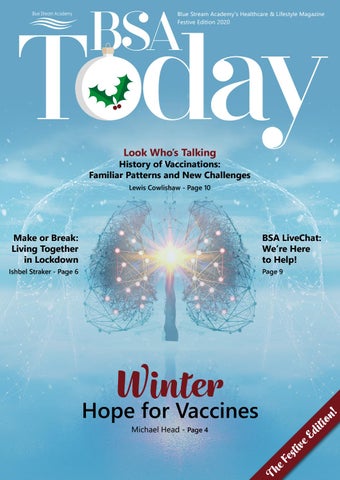
BSA
Today Blue Stream Academy's Healthcare & Lifestyle Magazine Festive Edition 2020
Look Who’s Talking
History of Vaccinations: Familiar Patterns and New Challenges Lewis Cowlishaw - Page 10
Make or Break: Living Together in Lockdown
BSA LiveChat: We’re Here to Help!
Ishbel Straker - Page 6
Page 9
Winter
Hope for Vaccines
! n io
Michael Head - Page 4
e
Th
v i t es F e
it d E
Festive Edition 2020 Front Cover
BSA Today is the exciting Healthcare & Lifestyle magazine from Blue Stream Academy - the UK’s leading provider of online training for GP Practices, Nursing & Care Homes, Hospices and Urgent Care Centres. Our mission is to standardise healthcare training to ensure consistent delivery of quality care, through better staff education and development. Providing over 100 hours of eLearning, Blue Stream Academy’s suite of interactive training modules is easy to use, cost-effective and in line with CQC guidelines – our modules are also RCGP accredited and CPD certified. If you have any comments, suggestions or ideas for future articles, please contact our editor, Brady Braddock, by email: brady@bluestreamacademy.com Alternatively, you can write to us, phone us, or visit our website: Blue Stream Academy Suites 11, 12 & 16 Riverside Business Centre Foundry Lane Milford Derbyshire DE56 0RN 01773 822549 www.bluestreamacademy.com The views and opinions expressed within this publication are that of the original authors of the relevant content and do not necessarily reflect the official views and opinions of Blue Stream Academy Ltd. © 2020 Blue Stream Academy
02
*See website for details. You may need to download a QR Code reader app on your device.
SUBSCRIBE
Would you like to join our exclusive subscribers club to be the first to hear about future issues, offers and competitions? If so, please phone 01773 822549 or email bsatoday@bluestreamacademy.com
BSA Today | Festive Edition 2020
In this issue From the Editor's Desk...
I
f 2020 has taught us one thing, it is that we should be immensely proud of the wonderful work and dedication of our National Health Service and indeed everyone working in health and social care. The COVID-19 pandemic hasn’t been fun for anyone, but it’s been especially hard for those working tirelessly to provide care and support to the nation in unprecedented circumstances. We have seen major changes in the delivery of routine care, with many procedures postponed or replaced to help prevent the further spread of the virus. Throughout the pandemic, Blue Stream Academy has worked closely with leading governing bodies to provide information and guidance efficiently and accommodate the training and management needs of health and social care professionals. We have covered many key coronavirus topics in our magazine, while responding with practical developments like our COVID-19 Vaccination Training and new system features.
of vaccines through the ages that might surprise even our most well-informed readers. Last but not least, we pilot a new healthcare-inspired short stories feature as a way to channel creativity and make the best we can of social isolation. Alongside this, we chat to our industry-renowned support team about all the wonderful feedback they have been receiving lately. We talk about the release of our new Foot Care module in @BlueStreamNews and we recap the events of the last 12 months with #TeamBSA. On behalf of Blue Stream Academy, we’d like to take this opportunity to wish our readers lots of goodwill and festive cheer and let you know that we’ll be back in the new year with even more exciting news and developments as BSA Today continues to grow and gather momentum. We hope you enjoy reading this issue!
Brady
In the final issue of 2020, we hear from Dr Michael Head about why the latest vaccine announcement from Oxford University is a global game changer. Consultant Prescribing Nurse and wellbeing specialist Ishbel Straker talks about what lockdown could mean for couples living together in a thought-provoking feature article. Plus, we take a fascinating look at the history
Brady Braddock BSA Today Editor
Contents 04 Winter Hope for Vaccines Michael Head, Senior Research Fellow in Global Health at the University of Southampton, talks about why the Oxford AstraZeneca vaccine is a global gamechanger. 06 Make or Break: Living Together in Lockdown Consultant Prescribing Nurse and wellbeing specialist Ishbel Straker tells us about some of the more troubling effects of lockdown on couples living together. 09 BSA Live Chat: We’re Here to Help! At the heart of our eLearning training and Management of Information System (MIS) is our dedicated support team. We celebrate the positive feedback they received from customers during lockdown. 16
18
Telling Tales Our brand-new creative writing feature is here! To keep you occupied during the winter evenings. We hope it will inspire you to send us your own healthcare-themed short story – we’d love to read it and we might just publish it! Winter Warmers Get into the festive spirit with our delicious winter warmer recipes! Follow our step-by-step guides to making your own hot sausage rolls and scrumptious cinnamon swirls. www.bluestreamacademy.com
10
18
06
20 Ask Abi & #TeamBSA Our agony aunt gives her advice on a familiar workplace woe, and #Team BSA share their thoughts on the year gone by. 21
@BlueStreamNews Keep up to date with the latest Blue Stream Academy news, developments and module releases. In this issue we talk about our new Foot Care module, which is out now!
Look Who’s Talking: History of Vaccinations: Familiar Patterns and New Challenges
Content Development Manager, Lewis Cowlishaw, provides a fascinating 10 feature length article. Invented in the eighteenth century, vaccines are now pivotal in medicine. From practices in Imperial China to British physician Edward Jenner, we take a look at how vaccinations have developed through the ages.
03
In the long dark tunnel that has been 2020, November stands out as the month that light appeared. Some might see it as a bright light, others as a faint light – but it is unmistakably a light.
O
n November 9, Pfizer announced the interim results of its candidate vaccine, showing it to be “more than 90% effective” in preventing symptomatic COVID-19 in late-stage human trials. The news was greeted with joy. A couple of days later, the Russian Direct Investment Fund announced that the candidate vaccine they are funding – dubbed Sputnik V – showed 92% efficacy in late-stage trials. Not to be outdone, Moderna then announced that its candidate vaccine showed 94.5% efficacy. The latest COVID-19 vaccine announcement comes from Oxford University. And, as with all of the above announcements, it came via press release. Its vaccine candidate, developed in partnership with AstraZeneca, showed an overall effectiveness of 70.4%. In case that 04
sounds disappointing, bear in mind that these are interim results and the figures might change.
to wait for the final breakdown of results to get clarification on that.
Also, the Oxford vaccine was given to one group of volunteers as two standard doses, which showed 62% effectiveness, and another group of volunteers as a smaller dose followed by a standard second dose. This raised effectiveness to 90%.
Not the Only Measure Despite the Oxford vaccine having lower overall effectiveness than the Pfizer or Moderna vaccines – at least at this interim stage – there are other success factors to consider. Safety is one, and the Oxford vaccine is so far reported to have a good safety record with no serious side-effects.
It’s not immediately clear why this is the case. Professor Andrew Pollard, one of the lead researchers on the project, described the results as “intriguing”. He also highlighted that the use of lower doses means that there would be more vaccine doses available. There were no cases of severe COVID-19 in those who received the vaccine. And it seems to generate a protective immune response in older people. Although we’ll have
Another crucial factor is storage. The Oxford vaccine can be stored in a domestic fridge. The need for sustained freezing across the whole vaccine journey from factory to clinic at ultra-low temperatures – as seen with the Pfizer vaccine – may be a problem for many countries, but especially poorer countries. The Oxford vaccine, based on a viral vector, is also cheaper (around
US$4) than Pfizer and Moderna’s mRNA vaccines – around US$20 and $33, respectively. AstraZeneca has made a “no profit pledge”. Equitable Distribution As I have previously discussed, equitable distribution of new vaccines is vital, especially for low- and middle-income countries which don’t have the profile or purchasing power of wealthier countries. GAVI – a global health partnership that aims to increase access to immunisation in poor countries – has worked for years to address this very point. It set up the COVAX initiative in 2020, which has access to 700 million doses of COVID vaccine if clinical trials are successful. Oxford and AstraZeneca have previously made their own commitments to provide a billion doses of their vaccine for low- and middle-income countries, with a commitment to provide 400 www.bluestreamacademy.com
million doses before the end of 2020. Certainly, AstraZeneca has committed to provide more doses to countries outside of Europe and the US than any of its nearest competitors.
vaccine candidates. Even when those hurdles are cleared, we still need to vaccinate the world, which requires successfully navigating the complex obstacles of distance, terrain, politics, cold-chain logistics and human behaviour.
An Excellent Start These commitments will clearly not be enough for immediate global coverage, but it is an excellent start. Around 9% of the world’s population live in extreme poverty, and the health systems around them are fragile. With promises for equitable vaccine distribution, there is hope that the poorer populations around the world will not be forgotten. The global health community must keep its focus on this area.
The global pandemic is not over and won’t be for a long time yet – but the light is getting brighter
What does this announcement mean for the world? Potentially a huge amount. But remember that the trials are not yet complete and, at the time of writing, the regulators have yet to approve any of the new
Article by Michael Head Senior Research Fellow in Global Health, University of Southampton Michael Head is an employee of the University of Southampton, which is part of the Oxford-led vaccine trials. Michael is not involved in the study. He has previously received funding from the Bill & Melinda Gates Foundation, and the UK Department for International Development. This article was originally published in The Conversation (theconversation.com). Source: Head M.
(2020), Why the Oxford AstraZeneca Vaccine is Now a Global Gamechanger. https://theconversation.com/why-the-oxfordastrazeneca-vaccine-is-now-a-global-gamechanger-150660
05
Look Who’s Talking - Ishobel Straker
Make or Break: Living Together in Lockdown ‘My marriage won’t survive another lockdown’; the words I hear echoing through many of my patient sessions since Boris’ announcement in early November.
Ishbel Straker Consultant Prescribing Nurse www.ishbelstraker.co.uk Ishbel Straker is a Consultant Prescribing Nurse and CEO of IStraker Consultants, a private practice in Liverpool. As an expert in the field of addiction and mental wellbeing, Ishbel works with people who are physically or psychologically affected by mental health issues. She offers a bespoke service to her patients, combining clinically evidenced therapies with a prescribing service when appropriate. Ishbel also writes a mental health column for the Liverpool Echo, is an experienced expert witness for APEX and supervises senior nurses in various organisations. 06
C
onventional wisdom says that around half of marriages end in divorce, and many people believe this has increased in recent years. In fact, the divorce rate is at its lowest in over 40 years and seems to be continuing to fall – yet we are clearly seeing a strain on partnerships this year. The main factors I observe when it comes to the current pressures on relationships are proximity (having to spend more time together), increased alcohol consumption, money worries, co-parenting issues and major life events.
Let’s consider the proximity of a partner. Take a 35-year-old couple, married for 10 years and both working – although one of them might have been on maternity leave during those 10 years. The time they spent together used to be limited to evenings and weekends, with 28 days’ annual leave in between. That’s an average of 44 hours together a week, without taking into account any activities that involve social time away from each other. Since the COVID-19 pandemic, the time the couple are spending together has almost doubled to 79 hours a week. What’s more, because of restrictions to stop the spread of COVID, any additional activities that could separate the couple are no longer possible. The only situation this can be likened to is reaching the age of retirement, which, in my clinical
experience, most people have the time to prepare for – mentally and physically. But people did not have the opportunity to prepare for the intensity of lockdown, and the restrictions have limited the coping and management strategies they can use, such as spending time with friends. If we then bring alcohol into the mix, this adds fuel to a roaring fire. According to the second Institute of Alcohol Studies (IAS) briefing on alcohol consumption during the pandemic, general population survey results suggest that although more people are avoiding alcohol altogether, many are drinking more than they used to and more of us are at a higher risk of becoming addicted than before. In my private practice I am seeing a growing number of people whose habitual alcohol use has increased throughout COVID, with a drink becoming the full stop at the end of an uneventful day. This combined with financial concerns stemming from furlough, job losses, pay cuts and less childcare, is compounding the pressure on already fractured relationships It has become impossible for people to self-manage these elements, as some of the options we would usually consider are no longer available in lockdown.
All of these elements have their own challenges, but scheduling time for mindful behaviours, together and separately, is key to surviving lockdown marriage fatigue. Going for a run alone is important, but a walk at the end of the day with the children is also essential for reducing stress. Looking at activities to do apart allows the partners to find things to talk about as well as giving them time for a break from each other. None of these changes are simple – they take time and energy, with a smattering of difficult conversations – but if you and your partner want to come out of lockdown together, you should start looking at them urgently. One of the most unpleasant impacts of lockdown on relationships is the rise in domestic violence. Emotions are running high and we no longer have the avenues to alleviate them, leaving us feeling trapped. Continued on Page 8
How do we resolve such issues? In my private practice, I am asking people to go back to basics: looking at how they give and receive love and affection to ensure their relationship needs are being met; using communication strategies and listening skills to reduce misunderstandings and avoid arguments; limiting alcohol or removing it altogether, depending on levels of volatility; and communicating around budgeting and financial management.
www.bluestreamacademy.com
07
Continued from Page 7
According to the Guardian, one call about domestic abuse was made to the police every 30 seconds in the first 7 weeks of our first lockdown. That is a shocking statistic. Why is this? Well, the resources are thinly spread under normal circumstances, but we are now living in a world where they have been stretched even further. That has made reporting harder and limited places of safety. Making the decision to report and leave an abusive partner has never been easy, but restricting people’s movement has made it almost impossible. Many of those who are in the most vulnerable position are no longer being seen in person at work or in activities outside school, so bruises are not being monitored and trips to A&E are discouraged. Women’s welfare groups warned that a lockdown would result in an increase in domestic abuse and violence. Nineteen days after the first lockdown began, the government announced it would give an additional £2 million to domestic abuse helplines and launched a social media campaign to encourage people to report domestic abuse.
08
However, this is not just a UK issue: the UN has described the worldwide increase in domestic abuse as a “shadow pandemic” accompanying COVID-19. It is thought that cases have increased by 20% during the lockdown. Psychiatric symptoms are prominent in tragic accounts of domestic homicide: among 1431 cases in England and Wales, 23% of perpetrators of family homicide had been in contact with mental health services in the year leading up to the offence, and 34% had psychiatric symptoms at the time of the offence. According to the Lancet, although there may be a concentration of mental health needs among those who carry out domestic abuse, and there is evidence that a substantial amount of domestic abuse is carried out by people seen by mental health services, there are concerns about how mental health services are responding to this challenge.
A recent evaluation of perpetrator programmes for the general population suggested that many of their mental health needs were not met. This is a controversial viewpoint when we think of domestic violence, but we cannot ignore the impact of reducing mental health resources on the everincreasing number of domestic violence incidents. Therefore, as much as we may need to manage our own mental health by using the resources we have to hand, incorporating sleep, diet and exercise into our wellbeing plans during lockdown, we surely have to consider that the emphasis of funding needs to return to our local mental health provision
BSA LiveChat:
We’re Here to Help! Here at Blue Stream Academy HQ, we pride ourselves on exceptional customer support that is hosted in-house by our friendly team of system specialists. Each year, our LiveChat team handles around 25,000 queries, resolving 95% of these within 24 hours. Throughout the year, members of the team have gone above and beyond to support health and social care professionals across the UK. We understand that any issues need to be sorted quickly and easily, and sometimes you might not want to call us at the office. So, if you ever get stuck, be sure to visit our website and speak with one of our team, who will be more than happy to assist. Below are just a few of the kind comments left by people who used our LiveChat service in 2020.
From all at Team BSA, thank you to all of the health and social care professionals who have been working so hard, day and night, throughout 2020!
“
Brilliant, so good to get a real person responding and so quick too.
“
Sorted perfectly with zero fuss!
“
Supportive and amazing! It was very quick and was a simple solution.
“
As always issue solved in no time. Many thanks!
“
Very helpful and sorted out my query in double quick time, allowing me to get back to eLearning.
“
Simple, quick and straight to the point!
“
Brilliant. I’ll use it again if I need to because it was really easy to do, and the person I spoke to was so helpful.
“
Brilliant service 10 out of 10.
“
Really helpful and able to answer all my queries with very quick responses.
Our Livechat service is available Monday Friday between 9:00am - 5:30pm www.bluestreamacademy.com
13
Look Who’s Talking
History of Vaccinations: Familiar Patterns and New Challenges Lewis Cowlishaw Content Development Manager at Blue Stream Academy Lewis Cowlishaw is the Content Development Manager at Blue Stream Academy and oversees the research, writing and development of our eLearning content while liaising with subject matter experts from across the UK. “Our enthusiastic in-house development team ensure we stay on top of the latest developments” says Lewis, “The key to success at BSA is about being on the pulse of the healthcare sector, having a devoted following of passionate users certainly helps!” 10
With more than 50 potential COVID-19 vaccines in human trials across the globe, we take a look at the origins of vaccines for other infectious diseases. Some strange and often unethical experiments paved the way to our current understanding of virology, which, thankfully, is far removed from that of years gone by!
1100 - 1500
The Chinese practised the earliest form of inoculation – variolation, which was first documented in the fifteenth century. Three or four scabs from a person mildly infected with smallpox were left to dry, ground up and blown through a silver tube into the nostril. Once the (hopefully mild) symptoms had passed, the person was considered immune to further infection.
1648
A situation now familiar to us all: After an outbreak of yellow fever outbreak, all vessels ships arriving in Boston, Massachusetts from the West Indies were ordered to quarantine because to prevent the spread of “ye plague or like in[fectious] disease”. Public concern continued until the quarantine was repealed in 1649, “seeing it hath pleased God to stay the Sickness there”. 1
1661
Having survived Smallpox, Emperor K’ang of China wrote to his descendants in support of inoculation:
“The method of inoculation having been brought to light during my reign, I had it used upon you, my sons Em per and daughters, and my descendants, or K’ang and you all passed through the smallpox in the happiest possible manner…. In the beginning, when I had it tested on one or two people, some old women taxed me with extravagance, and spoke very strongly against inoculation. The courage which I summoned up to insist on its practice has saved the lives and health of millions of men. This is an extremely important thing, of which I am very proud.” 2
I’ll inoculate you with this; with a pox to you.” 4 In the same year, Lady Montague, wife of a British diplomat in Constantinople, discovered that inoculation was widely used throughout Turkey, where it was considered safe and effective. She had her son inoculated in Constantinople, and after returning to England she instructed a Scottish surgeon to inoculate her daughter. The inoculation attracted immense interest and speculation throughout England and led to a multi-national study.
- The Life and Death of Smallpox Ian Glynn and Jenifer Glynn.
1721
An African-born man known as Onesimus, who was enslaved and given to Cotton Mather (of the Salem witch trials), helped deal with an outbreak of smallpox by explaining a practice that was used throughout Africa to protect people from the disease. Mather recounted: “Onesimus… told me that he had undergone an operation, which had given him something of the smallpox and would forever preserve him Co from it; adding that it was often tto n Mather used among the Guramantese and whoever had the courage to use it was forever free of the fear of contagion.” 3 This practice became known as inoculation. Mather promoted it throughout Massachusetts, but he was vilified by the local population. All but one of the town’s doctors were opposed, including the only one with an MD degree, Dr William Douglass. He formed the Society of Physicians Anti-Inoculators (the first established antivaxxers), which published attacks in Boston publications with the help of James Franklin and a young Benjamin Franklin, who would become a founding father of the United States and a signatory of the Declaration of Independence. In November 1721, a small bomb was thrown through a window in Mather’s house. It landed next to his nephew, who was recovering from inoculation. Fortunately, the fuse burned out. The attached note read: “Cotton Mather, you dog, dam you! www.bluestreamacademy.com
1796
The English scientist Edward Jenner tested his hypothesis that a previous infection from cowpox would protect a person from the effects of smallpox.
Jenner inoculated an 8-year-old boy, James Phipps, with matter from cowpox sores taken from the hand of a milkmaid, Sarah Nelmes, who had caught the disease from a cow named Blossom (Blossom’s hide now hangs on the wall of St. Georges Medical School). Phipps suffered a reaction and spent several days recuperating, but made a full recovery. After several weeks, Jenner introduced Phipps to samples from fresh smallpox sores, and Phipps remained healthy. Jenner then demonstrated that cowpox could be transferred from person to person and still provide immunity to the deadly smallpox. Although his research was initially rejected by the Royal Society, Jenner Edw ard Jenner was eventually credited with inventing the world’s first vaccine, resulting in the eradication of smallpox. He is said to have saved more lives than anybody before or since. 5 Continued on Page 12
11
Continued from Page 11
1870’s
The concept of the ‘animal vaccine’ was brought to the United States by Dr Henry Austin Martin. Lymph from calves infected with the cowpox virus were harvested for use as a vaccine. The New York Board of Health established its first ‘vaccine farm’ in New Jersey. Vaccine farms had many advantages over previous techniques. They would not transmit syphilis, leprosy or other human diseases; they made it possible to produce a large quantity of vaccine material; and they ensured a continuous supply in the absence of local cowpox outbreaks. 6
Soon, hundreds of people made their way to Pasteur for post-exposure vaccinations. Due to the long incubation time of the virus, they sometimes even travelled from America for the treatment. Later in life, Meister worked as caretaker of Pasteur’s tomb at the Institut Pasteur in Paris.
“Pasteur … was absolutely fearless. Anxious to secure a sample of saliva straight from the jaws of a rabid dog, I once saw him with the glass tube held between his lips draw a few drops of the deadly saliva from the mouth of a rabid bull-dog, held on the table by two assistants, their hands protected by leather gloves.” 8 - The Story of San Michele, Axel Munthe.
1879
French biologist Louis Pasteur accidentally produced the first laboratory-developed attenuated vaccine for chicken cholera.
Pasteur was studying this form of cholera by injecting chickens with the bacteria and documenting the progression of the disease. He usually ‘refreshed’ his cultures frequently to ensure a high virulence, so before he left for a holiday he instructed his assistant to inject the chickens with the bacteria. The assistant forgot and went on holiday himself.
Fig 1 - M. Pasteur’s Laboratory at the Normal School. - The microwave for the culture of microbes.
1921
Upon the assistant’s return, he injected the chickens as instructed. Surprisingly, although the chickens became ill, none of them succumbed to the illness.
French physicians Albert Calmette and Camille Guérin began human trials of their tuberculosis vaccine at the Institut Pasteur in Lille.
n ma Hu
1885
To suppress the virulence of the tuberculosis strain, the pair produced around 230 successive subcultures of the vaccine ria over 13 years – even during ls ub t of the occupation of Lille by the ’s Cal mette nd Guérin German army. a er cu los is v accine
Once the chickens were healthy again, Pasteur injected them with fresh bacteria and discovered that not one of them became ill. He reasoned that exposure to oxygen made the bacteria less deadly. 7
t
Rabies presented many new obstacles for a vaccine. After successful trials with monkeys and dogs, Pasteur reluctantly agreed to attempt the first rabies vaccination on a human.
That human was a 9-year-old boy, Joseph Meister, who had been badly mauled by a rabid dog, meaning he was almost guaranteed to have a gruesome death. Over 11 days, Pasteur oversaw the administration of 13 inoculations, each one stronger than the last. Three months later, he found Meister to be in good health and any potential legal charges (as Pasteur was not a licensed physician) were not pursued. 12
1935
Two different polio vaccines described by their developers as “safe and effective” were tested on children, with disastrous consequences. John Kolmer, an American immunologist, tested his live vaccine on monkeys before using it on himself and his children. He then tested his vaccine on 300 other children.
1971
A new trivalent vaccine for measles, mumps and rubella (MMR) was licensed for use in the United States.
ild Ch
ce ivi ng a
re
Meanwhile, Maurice Brodie, from another American laboratory, produced a vaccine that was tested on himself and six volunteers. The trials ended when more than 20,000 children had been exposed to one of the two experimental vaccines. Nine children who received Kolmer’s live vaccine died from polio. The Brodie vaccine failed to produce immunity to the disease.
Combination vaccines have many advantages over singular vaccines. The trivalent vaccine reduced the costs of manufacturing, transport, storage and administration, and the simplified process led to increased vaccination rates across the globe.
Polio vaccine These tragic results strengthened public opinion against using orphans in medical trials, and helped to reinforce rigorous testing of medicines 1980 before more general use. Almost two centuries after Jenner published his hope that vaccination could eliminate smallpox, on 8th May 1980, the 33rd World Health Assembly 1945 officially declared the world free of the The first influenza vaccine was disease. The eradication of smallpox is approved for military use, considered to be the biggest achievement with civilian use approved in in international public health. 1946. American virologists Thomas Francis Jr and Jonas Salk created the first 1998 approved modern vaccine Andrew Wakefield, a British researcher, along with 12 using fertilised chicken eggs. co-authors, published a paper in the Lancet claiming The method they used is almost evidence of the measles virus in the digestive tract of exactly the same today, although the data used to guide autistic children. the development has changed dramatically. In a press conference afterwards, he suggested a relationship between the MMR vaccine and autism. 1954
Following a massive increase in polio infections, a largescale trial was arranged for the United States, using a new vaccine produced by Jonas Salk. Involving 1.3 million children, the randomised doubleblind test aimed to evaluate the effectiveness of a new vaccine in paralytic cases of poliovirus. The results were released in 1955 and showed that the vaccine was 80–90% effective. 9 In 1953, the average number of polio cases was 45,000. By 1962, this had been reduced to 910. When asked who owns the patent for the vaccine, Salk replied, “Well, the people, I would say… There is no patent. Could you patent the sun?”
In 2004, it was reported that the subjects in the trial had been recruited by a lawyer involved in a case against vaccine manufacturers. This, along with a catalogue of errors throughout the trial, encouraged 10 of the 12 co-authors to retract their statements. In 2010, the General Medical Council ruled that Wakefield had engaged in misconduct during the course of conducting and publishing the study. He was banned from practising medicine in Britain. 10 Despite numerous subsequent studies showing that no link exists between the MMR vaccine and autism, some groups remained convinced of the allegations that had been raised by Wakefield in 1998. In 1996, there were 94 recorded cases of mumps in Britain. By 2019, this had risen to 5558 cases. Continued on Page 14
Polio Vaccinations, Robert Henninger aged 7. 1954 CSU Archives
www.bluestreamacademy.com
13
Continued from Page 13
2007
The human papillomavirus (HPV) vaccine Cervarix was licensed for use in the UK.
HPVs cause almost all cervical cancers, so Cervarix was included in the national vaccination programme until 2012. It was then replaced with a newer vaccine, Gardasil, which is more cost-effective and protects against some types of genital warts.
2019
The World Health Organization declared that the UK had lost its ‘measles-free’ status. The assumption that measles had been eradicated, combined with the rise of anti-vax conspiracies, contributed to a lower vaccination rate and increases in infection in the UK. Since then, efforts have been made to meet the government’s target of 95% people having the twodose vaccine.
On December 2nd 2020, the UK drugs regulator, the Medicines and Healthcare products Regulatory Agency (MHRA), set out conditions for the authorisation of the Pfizer vaccine. On Tuesday 9th December 2020, the first batch of the Pfizer COVID-19 vaccine has arrived in the UK, as the NHS embarked on the largest vaccination campaign in the country’s history! 11 As there are only a limited number of doses (800,000), the government have prioritised the rollout to the most vulnerable people, by vaccinating the over-80s and some health and care staff first. Grandmother Margaret Keenan, aged 91, was the first to receive it in England.
“I feel so privileged to be the first person vaccinated against Covid-19. It’s the best early birthday present I could wish for because it means I can finally look forward to spending time with my family and friends in the new year, after being on my own for most of the year… My advice to ne cci a V C s o ronavriu anyone offered the vaccine is to take it. If I can have it at 90, then you can have it too” 12 To be fully protected from symptomatic disease, people will need two doses three weeks apart. This means stock needs to be available for both vaccine doses to avoid vaccination delays. Orders have been placed for 40 million in total - enough for 20 million people, as two courses are needed. However, most supplies are not expected to become available until next year. Our COVID-19 Staff Support Toolkit has proven invaluable to our customers by providing up-to-date and relevant information throughout the pandemic. Be sure to keep an eye out for updates as the vaccine situation progresses
2020
Where do we start? With COVID-19 at the front of everyone’s minds this year, leading drug manufacturers raced to roll out a vaccine to save the world.We’ve all had to change the way we live and work, but such pressures are a catalyst for human imagination and ingenuity.
Sources: 1 Blake, J. B. (1959). Public Health in the Town of Boston, 1630-1822. Boston: Harvard University Press.
V CO
A new concept, mRNA vaccines, aims to revolutionise vaccine production. By ID -1 altering genetic material called mRNA, 9T est ing C scientists can instruct cells to produce entre proteins that mimic those found in a virus. Our immune system then produces antibodies to protect us from these proteins so that if we are exposed to the real virus, our immune system can detect and destroy it before it causes illness. 14
2 Glynn and Glynn, in The Life and Death of Smallpox - ISBN 0521845424, 9780521845427 - 2004 3 Wisecup, Kelly (2011). “African Medical Knowledge, the Plain Style, and Satire in the 1721 Boston Inoculation Controversy” 4 “Cotton Mather, you dog, dam you! I’l inoculate you with this; with a pox to you”: smallpox inoculation, Boston, 1721 - M Best, D Neuhauser, L Slavin 2004 5 Translational Mini-Review Series on Vaccines: The Edward Jenner Museum and the history of vaccination - A J Morgan and S Parker 2007 6 Early smallpox vaccine manufacturing in the United States: Introduction of the “animal vaccine” in 1870, establishment of “vaccine farms”, and the beginnings of the vaccine industry - José Esparza, Seth Lederman, Andreas Nitsche, and Clarissa R. Damaso - 2020
7 Dixon, Bernard (1980). “The hundred years of Louis Pasteur”. New Scientist. No. 1221. Reed Business Information. pp. 30–32. 8 The Story of San Michele - Axel Munthe – 1929 9 Offit, Paul A. (2005). The Cutter Incident: How America’s First Polio Vaccine Led to the Growing Vaccine Crisis. Yale University Press. pp. 4–18. ISBN 0300130376. 10 Wakefield’s article linking MMR vaccine and autism was fraudulent - BMJ 2011 11 Schiffling, S. & Breen, L. (2020). COVID vaccines are starting to arrive – here’s how everyone will get them. Available: https:// theconversation.com/covid-vaccines-are-starting-to-arrive-heres-how-everyone-will-get-them-151498 12 BBC. (2020). Covid-19 vaccine: First person receives Pfizer jab in UK. Available: https://www.bbc.co.uk/news/uk-55227325.
COVID-19 Vaccination
Training Module
Blue Stream Academy is pleased to announce the release of our COVID-19 Vaccination Training Module, available now on our GP, Nursing & Care Home, Hospice and Urgent & Tailored Care eLearning Suites.
About the Module
Our COVID-19 Vaccination Training module has been designed to support the health and care workforce involved in the national COVID-19 vaccination programme.
This module can assist in delivering the knowledge they will need to communicate with individuals successfully and maximise the uptake of the COVID-19 vaccine.
The module collates required information on the ‘COVID-19 Vaccination Programme’ that is published by Public Health England (PHE). Information on the ‘Storage and Preparation’ of the Pfizer/BioNTech vaccine is also included.
The COVID-19 Vaccination Training module covers:
Each trainee should be confident in delivering the vaccine programme safely and effectively.
• Competency Assessment Tool
• developing a COVID-19 vaccine
• the COVID-19 Vaccination Programme • communication
• storage and preparation of the Pfizer/BioNTech vaccine.
Due to high demand, Blue Stream Academy is proud to be one of the first providers to offer this highly anticipated eLearning module. Not only this, but in order to support healthcare providers throughout the UK, we have decided to share this eLearning module with all healthcare professionals, including those without a Blue Stream www.bluestreamacademy.com Academy subscription!
For more information or to register for free access, get in touch with us on: 01773 822549 or info@bluestreamacademy.com 09
! n o
it ti
e p m
co
Telling Tales:
SWEEPERS By Rob Bown, Content Developer
Telling Tales
We’re a creative bunch here at Blue Stream Academy, and to keep his mind active during lockdown, one of our module developers started writing short stories. We enjoyed reading them so much that we decided to try out a new idea and invite you to send in your own fictional healthcare-inspired short stories. Think of it as a creative outlet and let your thoughts run free. If we like your story, we might just publish it – plus, the winning entry will receive a year’s subscription to Audible worth over £70*! To kick things off, here is Sweepers by Rob Bown, a story about a fictional virus and a dystopian future. *Maximum of 1000 words per entry. Deadline is 23:59 on 22 January 2021. Entries after this date will not be counted. The winning entry will be chosen by us and announced in Issue 8 of BSA Today (set to land in spring 2021). For the full terms and conditions, please see our website.
16
T
he siren blared out. Arien almost soiled himself as it blasted into his ears through his headphones. He put down the controller and looked down at the street; from up here he could see the panic as people scuttled around like ants trying to get their affairs in order. When curfew was signalled, you had half an hour before the ‘sweepers’ came round. Since the outbreak four years ago the sweepers had become more aggressive, with fewer people returning from their encounters with them. Arien knew this and made sure he was always stocked up on everything he’d need. He had a cupboard full of ramen, and another stocked with tinned food. The one thing he didn’t stockpile was toiletries; he wasn’t going to be one of those crazy people waddling out of the shop under the weight of 50 rolls of toilet paper because they were worried that it would cease to exist. The government had switched to a ‘clear streets’ policy about 18 months after the original
spread of the virus. For the most part it had proved successful – cases dropped, areas went into remission – but the virus never disappeared. It wasn’t like Eoliant or Tryckets, where cases were cured and that was that.. It came back in waves: a person got infected, they headed out to work or the shop, and the next thing you knew, the siren was blaring and Arien was gazing out of his window, like a mortal god looking down on his creations. The next day Arien makes himself a coffee – “damn, no milk, black it is” – takes it away and drinks it with a cigarette. The smoke loops over and over in the air as it gradually dissipates, giving the light an ethereal quality. Arien goes to relieve himself, and sneezes after entering the
bathroom. He looks down at the sticky green web now connecting his fingers and reaches for the toilet roll. His hand grasps at the empty cardboard roll. No problem, he thinks, as he stoops down to get some more from the cupboard. He opens the door and is greeted by a sad-looking wrapper, deflated without its contents. He washes his hands at the sink, and a few minutes later he is pulling on his trainers to go to the shop. At the shop he grabs some cigarette papers and a chocolate bar. Three blocks away, Arien realises he hadn’t got the milk he wanted in the first place; he curses and breaks into a jog back to the shop. He gets there just as the sign has been switched to ‘Closed’. He’s worked in retail before, so he knows better than to bang on the door in the vain hope they will reopen for just him. Then the siren starts. Arien can hear his breathing, heavy, not quite laboured but definitely not that of someone who is concerned about fitness. His footsteps are
heavy, and his heartbeat pounds away in his ears. He’s almost home, just another block and no sign of the sweepers yet. He’s seen people in this scenario before; from his perch atop Olympus he has looked down on the woman with three kids, struggling to get them back into her apartment, the homeless man trying not to be picked up, desperation writ across his face. Now he is one of them. His panic rises like bile as he rounds the final corner before his building and sees the large black-and-green van outside his apartment. The sweepers have made it there before him. Arien sat bolt upright in his bed, covered in sweat. The dream still lingered, but the fine details eluded him. He swung his legs out of bed; it must have been a warm night. He walked into his living room and flicked on the computer. An urgent announcement flashed up on the screen. The headline read, “New Government Powers Enabled
to Stop Spread of Virus.” Arien read on and came across the full name of the programme: Safety With External Excursions Public Endangerment Ruling. His eyes darted over the name three more times: the programme title spelt out SWEEPER. He went to the sink and splashed his face with water.
Snap out of it Arien, you’re still sleeping. If he was, the feeling of cold water beading at the end of his nose was quite the trick of the mind. He pinched himself, winced, and walked over to the window to look down on the people below. As he opened the window a siren sounded in the distance, followed by a chorus of others
DO YOU WANT TO GROW
Your Business? ADVERTISE HERE!
For more information please get in touch with us!
01773 822549 • brady@bluestreamacademy.com
winter warmers
Winter nights, snowy scenes, twinkling lights, festive dreams! After a surreal 2020, we think comfort food is in order, and we’ve got plenty to offer you this festive season with our delicious winter warmer recipes. Our National Trainer and Care Certificate Manager (and former bake-off entrant) Ellie Stanton gives her step-by-step guide to making delicious sausage rolls and scrumptious cinnamon swirls. Keep cosy indoors with these top winter dishes from BSA Today!
Cinnamon Rolls
Prep: 1hr 30mins Cook: 25mins Serves: 16
1. Mix 500g bread flour and 1tsp salt in a large bowl and sprinkle in 7g (1 sachet) of fast-action dried yeast.
2. In a pan, warm 300ml milk and 40g butter (or vegan alternatives) until the butter has melted and the milk is lukewarm. Then stir in 1tsp of vanilla extract. Add the milk and butter mixture, 1 egg (alternatively mix 1tbsp ground flax seed and 3tbsp water for vegans, rest for 5 minutes) and 100g caster sugar to the flour and yeast, and stir the mixture until it forms a soft dough. 3. Tip the dough onto a floured surface and knead
until the dough is smooth and no longer sticky. Place into a lightly oiled bowl, cover with cling film. Then set to one side in a warm place for roughly an hour or until the dough has doubled in size.
4. For the filling, melt 25g butter (or dairy-free
alternative) and place to one side. Mix 75g soft brown sugar and 2tsp ground cinnamon together in another bowl and place to one side.
5. Once the dough has doubled in size, knock it
back to its original size and place on a well-floured surface. Then roll out to a large rectangle, roughly 1cm thick. With a pastry brush, brush the dough with the melted butter, then sprinkle over with the sugar and cinnamon mix. Scatter 200g mixed dried fruit over the dough, then roll into a long tight cylinder.
6. Slice into 2cm–3cm rounds (this makes roughly
16 rolls) and place onto a tray lined with greaseproof paper. Cover with cling film and leave to rise for 30 minutes. Heat the oven to 180C fan/Gas Mark 6. Bake the rolls for 20-25 minutes or until golden.
7. To make the glaze, place 50g sugar with 4tbsp
water into a pan, and warm until it forms a syrup texture. Brush the glaze over the cooked rolls. Then mix the 200g icing sugar with 2tbsp water and drizzle over the cooled rolls. Break apart and serve.
18
Sausage Rolls
Prep: 1hr 30min Cook: 25mins Serves: 4-6
1. Using your fingers, mix 250g plain flour, 1tsp
salt and 250g butter or vegan alternative (cut into cubes) in a large bowl. Make sure the butter is still visible in the mixture as chunks.
2. Pour two-thirds of the 150ml cold water into the flour and butter mixture and knead to form a dough. Add the remaining water if needed. Cover in cling film and leave in the fridge for 20 minutes. 3. Place the pastry on a lightly floured surface and knead gently. Form into a rectangle then roll the pastry out until it is roughly 3 times the size. Make sure you can see a marbled effect with the butter. Fold the top third down to the centre and bottom third up. Quarter turn the pastry and roll out and repeat the folds. Chill in the fridge for 30 minutes.
4. Roll the pastry out and form 400g sausage meat (or squeeze the filling out of 1 pack fresh vegan sausages) into a long sausage shape down the middle of the pastry (slightly to one side). Brush some of the 1 beaten egg (alternatively mix 1tbsp ground flax seed and 3tbsp water for vegans, rest for 5 minutes) down one side of the sausage meat and fold the pastry over the top of the sausage meat.
5. Seal and crimp the edge with a fork and slice into sausage rolls (you can make as many as you wish, depending on the desired size). 6. Add a splash of milk (or vegan alternative) to
the remaining beaten egg mixture and brush the top of the sausage rolls. Place in a pre-heated oven (180C fan/Gas Mark 6) for 20–25 minutes or until golden.
Optional extras – Before you put the sausage rolls in the oven, sprinkle them with sesame seeds. You can also add onion chutney next to the sausage meat, for extra flavour, before you seal the pastry. www.bluestreamacademy.com
19
Q
Ask Abi...
Blue Stream Academy team member, Abi, is here to answer your questions and give advice to our readers. If you have a question or problem and would like some advice, please feel free to contact Abi via email at: bsatoday@bluestreamacademy.com
Dear Abi,
I have a dilemma and I’m hoping you can help. The week before last, while I was on my coffee break, I noticed one of my colleagues taking a stack of paper from the office photocopier and putting it in her bag. This is not out of the ordinary where I work, and I’m sure others are taking things too. Do you think I should report her for or not? It is only paper but to me, this is outand-out theft! What do you think I should?
A
Thanks, Anon. Dear Reader,
Office supplies add up to a considerable expense over the year and technically, this is stealing from your employer. There are two simple ways to stop this happening. First, consider locking up all the supplies. Find a spare cupboard and
put a lock on it, making sure you give a key or the combination to the office manager or somebody who is trusted with looking after inventory. There’s no need to make a formal announcement, and this will remove any temptation to walk away with supplies that are within easy reach. Second, think about putting in place a requisition process, where employees sign for any supplies they use. You want to avoid bureaucracy, so keep it simple. It could involve just a knock on the door of the office manager, or a short requisition form to complete. The point is to make the employee go through a step or two to get hold of the supplies, and involving another person ensures there’s always an extra pair of eyes around to help. I hope this will solve your dilemma. Stay safe,
#TeamBSA
A
s 2020 draws to a close, all of the team here Blue Stream Academy have been looking back and reflecting on a year like no other. Although 2020 was certainly not what we expected, we’ve really come together as a team to support each other and our wonderful customers. In March, we adapted to working from home for the first time. Along with a change of scene, being away from the office brought countless video calls and quizzes (too many quizzes, some of our team might say), some questionable home haircuts and plenty of pet involvement in our virtual meetings! Throughout the year, we’ve been working hard to add new and exciting features and modules to the system, like our Blue StreamNet platform and the COVID-19 Staff Support Toolkit. We’ve also loved helping our customers – it’s been great speaking with everyone and getting to know new faces (virtually of course!) Now, as we head towards Christmas, we’re getting into the festive spirit and looking forward to continuing our fundraising efforts. As part of that, our team took part in Christmas Jumper Day 2020 to raise money for Save the Children. Mostly, as we look back, we want to say the biggest thank you to all the UK’s health and social care professionals for working and caring for our loved ones through the most difficult time. Here’s hoping that 2021 brings some normality for us all. Wishing you a happy Christmas and a wonderful new year! 20
Abi
Congratulations! 30,000+ people have now completed our free-to-all COVID-19 Staff Support Toolkit so far! We have now launched our COVID-19 Vaccination Training module, for more information please get in touch with us here.
@BlueStreamNews
A
s the leading provider of CPD-certified eLearning to health and care professionals throughout the UK, we are constantly looking to add to our extensive library of training modules. Here’s an update on our latest release. COVID-19 Vaccination Training - Out Now! Our COVID-19 Vaccination Training module has been designed to support the health and care workforce involved in the national COVID-19 vaccination programme. The module collates required information on the ‘COVID-19 Vaccination Programme’ that is published by Public Health England (PHE). Information on the ‘Storage and Preparation’ of the Pfizer/BioNTech vaccine is also included. Each trainee should be confident in delivering the vaccine programme safely and effectively. This module can assist in delivering the knowledge they will need to communicate with individuals successfully and maximise the uptake of the COVID-19 vaccine. The COVID-19 Vaccination Training module covers: • Developing a COVID-19 vaccine • The COVID-19 Vaccination Programme • Communication • Competency Assessment Tool • Storage and preparation of the Pfizer/BioNTech vaccine Due to high demand, Blue Stream Academy is proud to be one of the first providers to offer this highly anticipated eLearning module. Not only this, but in order to support healthcare providers throughout the UK, we have decided to share this eLearning module with all healthcare professionals, including those without a Blue Stream Academy subscription.
www.bluestreamacademy.com
If you would like assistance while adding this module or working around the system, our team are always on hand and happy to help at info@bluestreamacademy.com, or on 01773 822549. Be sure to follow us on Twitter (@BlueStreamNews) to get our updates and module announcements as soon as they happen!
29
Introducing
The New Blue StreamNet Platform Training and Management Solutions at Your Fingertips
Over the years, as the healthcare landscape has changed and organisations have needed to adapt, many new challenges have arisen for managers, their organisations and the staff who power them. At Blue Stream Academy, we have listened carefully to our customers to ensure that the system we provide contains the features that are needed.
Our aim has always been to improve user experience, reduce wasted time and be as economical as possible. We have now developed Blue StreamNet to help streamline an organisation’s business needs into one easy-to-use platform. It couldn’t be easier!
Blue Stream eLearning
Blue Hub MIS
Blue People HR System
Blue Recruit Recruitment System
Blue Books Bookkeeping
Blue Check DBS Checking System
Blue Pay Payroll System
Blue Connect Video Conferencing
Our team is on hand to discuss the different ways that we can support your organisation and transform your daily processes. Please get in touch by emailing info@bluestreamacademy.com to 18 16 26 13 findwww.bluestreamacademy.com out more about our effective, efficient and easy-to-use new platform.