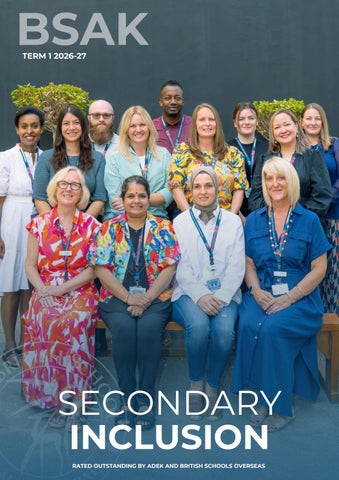
BSAK TERM 1 2026-27
SECONDARY INCLUSION RATED OUTSTANDING BY ADEK AND BRITISH SCHOOLS OVERSEAS
CONTENTS Welcome & Introduction Meet the Team Support Pathways Referral & Identification Process
ASESSMENTS & ACCESS ARRANGEMENTS
8
SUPPORT PATHWAYS
6
Assessments & Access Arrangements Planning & Documentation Parent Workshops & Events Key Contacts
WELCOME FROM THE HEAD OF SECONDARY INCLUSION At BSAK, we believe that every child is unique and brings their own strengths, interests, and learning profile to our school community. Secondary Inclusion at BSAK is rooted in a holistic and child-centred philosophy. Our provision is done collaboratively with parents and is tailored to meet the unique needs of every child. We are proud to offer inclusion provision which is personalised, responsive, and respectful of individual differences. Whether you are navigating a new diagnosis, considering appropriate support and guidance for your child, or need more information on your child’s learning needs, our team is here to work collaboratively with you We hope that this handbook provides you with a useful guide to inform you about the available support at BSAK. It should also answer any questions you may have about our inclusive approach and different pathways. It aims to showcase and explain our collaborative, multi-disciplinary approach and the way in which we provide coordinated support for our students..
If you have any further questions, please don’t hesitate to reach out to me or other members of the team. Our contact details are included in the staff section at the end of this handbook. We are always keen to collaborate and happy to help. Fran Marshall Head of Inclusion
MEET THE TEAM
HEAD OF INCLUSION & INCLUSION TEACHERS
Fran Marshall Head of Secondary Inclusion
Rachel Miller-Cork Inclusion Teacher English Inclusion Subject Lead/Specialist
Justyna Skowronski Inclusion Teacher EAL Inclusion Subject Lead/Specialist
Alex Howard Inclusion Teacher Science Inclusion Subject Lead/Specialist
Elrina Sinton Inclusion Teacher Maths Inclusion Subject Lead/Specialist
MEET THE TEAM
INCLUSION ASSISTANTS & 1:1 INCLUSION ASSISTANTS
Nadia Laribi HLIA Maths Inclusion Subject Specialist
Jo Sandilands HLIA English Inclusion Subject Specialist and Access Arrangements Administrator
Rachel Larkin Inclusion Assistant Science Inclusion Subject Specialist
Abeba Kibrom EAL Assistant EAL Inclusion Subject Specialist
Thea Reyes 1:1 Inclusion Assistant
Aruna Peri 1:1 Inclusion Assistant
Dayle Thompson 1:1 Inclusion Assistant
INDIVIDUAL SUPPORT PATHWAYS
TIERED MODEL OF INCLUSION SUPPORT
TIER 2 – TARGETED EXTRACTION SUPPORT
At BSAK, we use a three-tiered model to ensure that all students receive appropriate support during their learning journey. This is always child centred and constantly reviewed. By being flexible with support, we can effectively address unique individual needs and strengthen inclusion both in the classroom and throughout the school. We are blessed to have an extensive team of specialist inclusion teachers and assistants.
Tier 2 involves small-group support sessions delivered by Inclusion Teachers or HLIAs. These will be extraction intervention sessions with subjects specialists. Some students may require additional help to address specific academic challenges in the core subjects. Sessions will typically pre teach and revise concepts to supplement learning in the mainstream classroom. These interventions are reviewed regularly.
TIER 1 - UNIVERSAL SUPPORT
TIER 3 – 1:1 SUPPORT
Tier 1 support is the universal baseline for inclusive teaching. It's designed to provide benefits for all students and focuses on highquality classroom practices. This includes strategies like adaptive and structured teaching, using visual aids and providing clear examples, maintaining clear routines, and providing flexible seating. Teachers constantly make supportive modifications so every child can access learning in a way that truly works for them. Additionally, some students may receive short-term, targeted help at this tier to ensure their success in the classroom. These students may have a Pupil Profile and/or Access Arrangements, if appropriate.
Tier 3 support is provided for students with the most significant or persistent needs. It offers highly personalised, 1:1 intervention which is formalised through an Individual Learning Plan (ILP), custom learning goals, and close collaboration with outside specialists. This level of support requires 1:1 support from a dedicated team of Individual Inclusion Assistants. The school employs and supports these assistants, but parents fund the cost. If this level of care is required, the Inclusion Team will partner closely with families throughout the process. Our aim for Tier 3 is to help the child to become as independent as they can be by supporting them to access the curriculum while boosting their confidence, independence, and wellbeing.
REFERRAL
& IDENTIFICATION PROCESS HOW TO REFER
At BSAK, the Inclusion referral process can be initiated by a teacher or a parent. This could be done due to concerns about a child’s learning, behaviour, or emotional development. At this point we would need to meet with parents to discuss the best way to support the challenges being faced, this is a decision we would make collaboratively.
HOW WE GATHER INFORMATION
Once a concern is raised, as an Inclusion Team we undertake a detailed process to gather information, observe the child, and determine the most appropriate support. This might include surveys from your child’s teachers to gain an overall perspective of their presentation in school. To help us better understand a child’s learning profile, Inclusion Teachers may also undertake classroom observations and use a range of screening tools. These might include standardised assessments which help us to identify specific strengths and areas that may need support.
WHAT WILL HAPPEN NEXT
At this point we may make a recommendation for an external assessment with an appropriate professional. This is only done in the best interests of the child and when we feel an external assessment will help the child, parents, and school to provide the right support strategies.
HOW IT WILL HELP YOUR CHILD
No two cognitive profiles are the same. A detailed report and subsequent diagnosis can potentially bring many benefits for the child. It can help to explain why they are finding some areas more challenging and also by leading us to implement the most effective strategies for the individual child.
ESSENTIALS
A formal diagnostic report is required once a child enters Secondary and begins preparing for examinations such as GCSEs, as this is necessary to secure Exam Access Arrangements in line with official guidelines produced by the JCQ. For this reason, and also to support a robust and successful process, it’s essential that you collaborate with us from the beginning by contacting Mrs Marshall before you begin the process. This can also help to make the process more efficient by us making a direct referral for you.
ASSESSMENTS & ACCESS ARRANGEMENTS CENTRE REFERRALS We have to work with centres whose reports meet the strict requirements of the JCQ guidance, for the purpose of Exams Access Arrangements. We usually refer to the following professionals: General assessments Maudsley Health (https://maudsleyhealth.com/), please let me know and I will make the referral, (if your child is in Y9 or above then check that the assessor has experience of the Form 8). The American Centre (https://americancenteruae.com/ specifically Fungisai Muchenje), please let me know and I will make the referral. Insights Psychology in Dubai (https://www.insightspsychology.com/). Reem Neuroscience (https://reemneuroscience.com/ specifically Agnieszka Montgomery), please let me know and I will make the referral. Cognitive testing for Access Arrangements (or as an alternative for the above) Insights Psychology in Dubai (https://www.insightspsychology.com/) Dyslexia Assessments Online testing with a BDA (British Dyslexia Association) approved dyslexia specialist in the UK, Sarah McCahon (smdyslexia@gmail.com).
ASSESSMENTS & ACCESS ARRANGEMENTS
WHAT OUR CURRICULUM HANDBOOK SAYS: If you are seeking a diagnostic report then you should contact Mrs. Marshall directly; we work with specific centres to ensure that reports use a range of diagnostic tests so that they are robust and useful. For exams access arrangements, it is essential that you use one of these centres to ensure that they provide the evidence required by the examination boards. If you choose to seek a report without our consultation then we can not necessarily accept this as evidence and do not take responsibility for this, you may be asked to provide an alternative report with an alternative centre. Please let me know which centre you would like to work with and I can make a direct referral, this is essential for a smooth and collaborative progress and will also ensure that you get an appointment swiftly and efficiently.
WHAT OUR ACCESS ARRANGEMENTS POLICY SAYS: External Report Recommendations When seeking a diagnosis or looking at diagnostic work, JCQ regulations are that this must be a collaborative approach with home, school and the assessor. If a collaborative approach is not taken then we may not be able to provide Exams Access Arrangements (EAA). Recommendations in reports are exactly that, JCQ regulations state that a professional completing a report is not responsible for determining EAA. Requests for 25% Extra Time JCQ regulations state that school based evidence forms the basis for decisions on 25% extra time, this is not determined by a diagnosis. For students who have a medical diagnosis, which includes such as ASC (Autism Spectrum Condition), ADHD (Attention Deficit aHyperactivity Disorder) and Severe Anxiety, JCQ guidance is that 25% extra time is not the most appropriate EAA. In cases of a medical diagnosis supervised rest breaks must be trialled and exhausted (with extensive evidence to demonstrate this) before any other arrangements are considered.
PLANNING & DOCUMENTATION
DOCUMENTED LEARNING PLANS (DLPS) In line with ADEK policy, all children on the BSAK Inclusion Register will have a Documented Learning Plan (DLP). This ensures that their individual needs are clearly identified and appropriately supported. A DLP may take the form of a Pupil Profile (PP) or an Individual Learning Plan (ILP), or a combination of these, depending on the nature and level of the child’s needs. The ILP will be used by specialists from the Inclusion Team to implement appropriate and carefully planned support for the student.
INDIVIDUAL LEARNING PLANS (ILPs) PUPIL PROFILES (PPs) The PP is designed to support teachers in understanding the needs of the child and how to support these needs effectively in the classroom. It is a school-based document which outlines the support a child may need to help them access learning in the classroom. PPs highlight key strengths, areas of challenge, and the strategies used in class to support progress. PPs are developed by the Inclusion Team in collaboration with parents and the child. and they are shared with teachers.
An Individual Education Plan (IEP) is a more detailed, personalised plan designed for children with identified and often more complex special educational needs. IEPs include specific learning targets, agreed strategies, and any interventions or specialist input being provided. These plans are developed collaboratively with input from class teachers, Inclusion staff, external professionals (if applicable), and parents. The IEP helps to ensure that everyone involved in supporting the child is working towards clear and consistent goals.
PARENT
WORKSHOPS & EVENTS INCLUSION FOCUSED WEEKS NEURODIVERSITY WEEK We proudly celebrate Neurodiversity Week each year to raise awareness, promote understanding, and celebrate the unique strengths of all learners. Rather than marking different forms of neurodiversity at different dates through the year, we choose to put all of our efforts into one day and celebrate the whole neurodiverse community together!
PARENT INVOLVEMENT & SCHEDULE OF WORKSHOPS Throughout the year, our Inclusion Department offer termly coffee mornings. These are a lovely opportunity for parents and staff to come together in an informal and relaxed environment. Topics will be presented, these may include areas such as supporting sensory regulation, understanding ADHD or dyslexia, or guidance on Access Arrangements, with sessions led by our Inclusion Team and, at times, visiting specialists. These events are more than just information sessions; they provide a supportive space where parents can connect with one another, share experiences, discuss challenges, and exchange practical strategies that work both at home and in school. By taking part, families not only gain valuable knowledge but also become part of a wider community that listens, encourages, and empowers each other on their inclusion journey. Invitations are sent by email each term, and all parents are warmly encouraged to attend. These events include themed assemblies, classroom activities during tutor time, and guest speakers, as well as opportunities for parents to get involved. We also hold our annual ‘Time to Shine’ day. These events help foster a more inclusive school community where differences are not only accepted, but valued and celebrated. It’s also a brilliant way to bring the school community together to celebrate our differences.
KEY CONTACTS HEAD OF INCLUSION (SECONDARY) - FRAN MARSHALL Email: fmarshall@britishschool.sch.ae Tel: +971 22040200
ENGLISH INCLUSION SPECIALIST - RACHEL MILLER-CORK Email: rmiller-cork@britishschool.sch.ae Tel: +971 22040200
EAL INCLUSION SPECIALIST - JUSTYNA SKOWRONSKI Email: jskowronski@britishschool.sch.ae Tel: +971 22040200
SCIENCE INCLUSION SPECIALIST - ALEX HOWARD Email: ahoward@britishschool.sch.ae Tel: +971 22040200
SECONDARY RECEPTION Tel: +971 22040200
SCHOOL NURSES Email: nurses@britishschool.sch.ae Tel: +971 24462280
SCHOOL COUNSELLORS Email: counsellor@britishschool.sch.ae Tel: +971 24462280
EXCEEDING EXPECTATIONS
BSAKAbuDhabi
BSAK_AbuDhabi
Britishschool.sch.ae