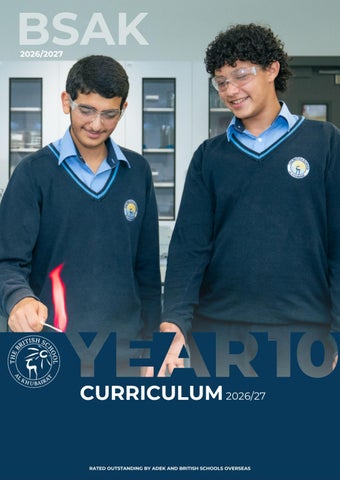
FOREWORD BY DEPUTY HEAD Dear Parents & Students, As we approach the end of the academic year, I hope you are looking forward to the next stage of your child’s education as much as we are. Year 10 marks the beginning of Key Stage 4 and the start of each student’s GCSE courses, representing an exciting and important milestone in their academic journey. At BSAK, we are proud to offer a curriculum that is thoughtfully planned and continually refined. It reflects both the best of educational research and the experience of our staff, ensuring that it responds to the needs, interests and ambitions of every student. Our aim is not only to support academic success, but also to develop confident, curious and resilient learners. The Year 10 curriculum introduces students to the depth and rigour of GCSE study. Our Heads of Department have carefully planned each course to ensure clear progression in knowledge and skills, while equipping students with the study habits, organisation and resilience required for success over the next two years. Alongside this, we place a strong emphasis on high expectations, consistent effort and positive learning habits. We recognise the importance of working in partnership with parents. Your support plays a vital role in helping students establish strong routines and make a successful start to their GCSE courses. We hope this booklet provides a clear overview of what to expect and how best to support learning at home. We very much look forward to working together to ensure that every student makes a confident and successful start to Key Stage 4 and continues to thrive academically, socially and personally. With my very best wishes Mr Gareth Jones Deputy Head
gjones@britishschool.sch.ae
YEAR 10 CURRICULUM BOOKLET 2026/2027 CONTENTS Subjects In Alphabetical Order P06 P07 P08 P09 P10 P11 P12 P14 P16 P17 P18 P20 P22 P24 P25 P26
Ministry Arabic Arabic GCSE Biology Business Studies Chemistry Combined Science Computer Science Design Technology (Product Design) Drama Economics English Language English Literature Fine Art Food Preparation & Nutrition French Geography
P27 P29 P30 P31 P32 P35 P36 P37 P38 P39 P41 P42 P43 P44 P45
Graphic Communication History Islamic Studies A Islamic Studies B Inclusion Mathematics Media Studies MELS Music Photography Physical Education PE (Core) & Games Physics Spanish Textiles
MINISTRY ARABIC The Ministry of Education Arabic course targets the native speakers of the language. It aims to help all students to develop their linguistic skills, expose them to many classical and modern literary works and deepen their understanding of Arabic and Islamic culture.
COURSE CONTENT The course content is based on a wide range of selected literary texts that relate to different eras as well as extracts from the Holy Quran and the Sayings of the Prophet (PBUH). The course content will draw heavily on: ● Reading texts: literary and factual texts ● Writing practice in line with what was covered during reading lessons ● Conversational drills where students use and apply the skills they acquired ● The structure of the language: applied rather than theoretical syntax and morphology SKILLS DEVELOPED ● Native understanding and analysis of written and spoken Classical Arabic ● Knowledge and application of language skills ● Writing for different purposes ● Conversing in Classical Arabic on a given topic SPECIFICATION LINK
ASSESSMENTS Half termly assessments take place as well as a final exam at the end of each academic year. In Year 13 students will undertake the Ministry of Education Arabic Exam at the end of the academic year.
ARABIC GCSE Arabic is one of the world’s great languages. Spoken by more than 400 million people, it has been the vehicle of many significant contributions to the development of science and culture, from the earliest odes of the pre-Islamic poets through to the cutting-edge research of the philosophers and mathematicians of Islam’s golden age, to the novels of Nobel laureate Naguib Mahfouz. It is also one of the official languages of the United Nations and was recently identified as one of the ten most important languages for the UK's future.
COURSE CONTENT Knowing Arabic is vital for understanding the UAE and its culture. Therefore, students follow both the Ministry of Education Arabic curriculum and the Pearson Edexcel GCSE specification, with additions and adaptations to meet their learning needs. The Year 10 curriculum will build on previous knowledge acquired in Year 9 and indeed Year 8 by developing listening, speaking, reading and writing skills as well as including a focus on skills such as translation, understanding authentic and literary texts and spontaneous speaking. This course will also emphasise the fact that learning Arabic is not just about vocabulary and grammar but having an appreciation of Arabic culture and customs. We aim to foster an inquisitive and curious student who can take advantage of where we are and foster a genuine passion for Arabic as well as a sense of enjoyment and curiosity about the subject.
Term 1
Term 2
Term 3
Theme 1: Identity and Culture
Theme 1: Identity and Culture
Theme 2: Local Area, Holiday & Travel
Who am I?
Cultural Life
Travel and Tourist Transactions (cont.):
Daily Life
Theme 2: Local Area, Holiday & Travel
Town, region 7 Country: ( Weather / Places to see / Things to do )
SKILLS DEVELOPED
Town, region and country Holidays Travel and tourist transactions
Students are required to develop confidence in: ● Knowledge and application of language skills; writing for different purposes; conversing in Classical Arabic on a given topic
RESOURCES ● ●
GCSE Arabic (My Language is my Identity) Coursebook, GCSE Library. Click here and Languagenut digital learning platform
SPECIFICATION LINK: Click here.
ASSESSMENT ● GCSE Arabic will be assessed by topic and / or by GCSE skills on a regular basis. ● Regular formative assessment includes vocabulary and grammar tests.
BIOLOGY This IGCSE course aims to inspire, motivate, and challenge students by fostering curiosity about the living world and offering meaningful insight into how science works. It equips students to engage with Biology in everyday life and make informed decisions about further study in Biology and related fields.
COURSE CONTENT ● Gas exchange ● Respiration and Photosynthesis ● Transport in multicellular organisms ● Environmental Biology SKILLS DEVELOPED ● Application of knowledge ● Data analysis ● Evaluation ● Extended writing skills FURTHER STUDY To continue Biology to A Level, students will need to attain the compulsory ‘7-9’ grade at IGCSE. A ‘7-9’ in Chemistry is also strongly recommended. It is a facilitating subject which is highly regarded by all universities and all courses. Biology is essential to those wishing to read: Medicine; Veterinary Medicine; Dentistry; Pharmacology RESOURCES ● Course textbook (an electronic version is available to students): ○ Pearson Edexcel International GCSE (9-1) - BIOLOGY - Student Book; Bradfield and Potter; 978-0-435-18508-4 ● CGP revision guide (highly recommended): Amazon link ○ Edexcel International GCSE Biology - Complete Revision & Practice; CGP; 978-1-78908082-7 ● CGP also produce revision flashcards which are also useful for revision for assessments: Amazon link. ● Seneca learning is a free online platform (there is also a paid version with additional functionality and AI guided learning) - remember to select Edexcel IGCSE Biology. ● Please note that any paid resources listed above are not compulsory. ●
SPECIFICATION LINK
ASSESSMENTS An internal end of year exam and regular end-of-topic assessments to monitor progress.
BUSINESS STUDIES Business, it's everywhere.Think about the last thing you bought, the app you used this morning, or the place where someone in your family works. Behind all of it? A business. Whether you dream of launching your own brand one day, climbing the career ladder, or just want to understand how the world around you actually works, this course has you covered. You'll find out how businesses are built from the ground up, what it takes to keep them running, and why some become household names while others disappear without a trace.
COURSE CONTENT Unit 1 - Business Activity & influences on business ● 1.1 Business objectives ● 1.2 Types of organisations ● 1.3 Classification of businesses ● 1.4 Decisions on location ● 1.5 Business and the international economy ● 1.6 Government objectives and policies ● 1.7 External factors ● 1.8 What makes a business successful Unit 2 - People in Business ● 2.1 Internal and external communication ● 2.2 Recruitment and selection process ● 2.3 Training ● 2.4 Motivation and rewards ● 2.5 Organisation structure and employees Unit 3 - Business Finance ● 3.1 Business finance-sources ● 3.2 Cash flow forecasting ● 3.3 Costs and break-even analysis ● 3.4 Financial documents ● 3.5 Accounts analysis SKILLS DEVELOPED The following are the essential skills required for success and will be built upon during the course: ● Problem solving ● Abstract-thinking ● Ability to complete multi step calculations SPECIFICATION LINK
ASSESSMENTS Assessments will be ongoing throughout the year, with a major assessment at the end of each topic. These iGCSE style assessments will be taken from past examination papers to ensure students have practical experience of examination questions at the earliest opportunity. The assessment process will culminate in an end of year mock examination. Note: The examination taken will be online.
CHEMISTRY In this IGCSE students explore the fundamentals of Chemistry, including atomic structure, chemical bonding, quantitative and qualitative analysis, and key chemical processes that shape our world, such as those involving crude oil, fuels and equilibrium. The course encourages curiosity about the material and physical world while building a strong foundation for A Level study.
COURSE CONTENT ● Structure and bonding ● Chemical calculations ● Chemical changes ● Electrolysis ● Energy changes ● Organic chemistry SKILLS DEVELOPED ● Problem-solving, abstract-thinking ● Ability to complete multi step calculations ● Data analysis ● Evaluation & extended writing skills FURTHER STUDY To continue their study of Chemistry, students will need to attain the compulsory ‘7-9’ grade at IGCSE. A 7 or above in Mathematics is also strongly recommended. Chemistry is a facilitating subject and it is held in high regard by all universities regardless of the course being applied to and is essential for those wanting to read Medicine, Veterinary Medicine, Dentistry, Pharmacology, Chemical Engineering. RESOURCES ● Course textbook (an electronic version is available to students): ○ Pearson Edexcel International GCSE (9-1) - CHEMISTRY - Student Book; Clark, Owen and Yu; 978-0-435-18516-9 ● CGP revision guide (highly recommended): Amazon link ○ Edexcel International GCSE Chemistry - Complete Revision & Practice; CGP; 978-1-78908083-4 ● CGP also produce revision flashcards which are also useful for revision for assessments: Amazon link. ● Seneca learning is a free online platform (there is also a paid version with additional functionality and AI guided learning) - remember to select Edexcel IGCSE Chemistry. ● Please note that any paid resources listed above are not compulsory. ●
SPECIFICATION LINK
ASSESSMENTS Internal end of year exams and regular end-of-topic assessments to monitor progress.
COMBINED SCIENCE This course equips students with the key concepts and skills needed to apply a scientific approach to problem-solving. It covers the fundamental principles of Biology, Chemistry, and Physics, leading to the award of two IGCSE Science grades. The content provides a broad but less detailed overview of core scientific ideas compared to the separate sciences.
COURSE CONTENT Chemistry Physics Teaching in Year 10 builds on the foundations laid in Year 9, covering the following topics: ● Forces and motion ● Structure and bonding Biology ● Electricity ● Chemical calculations ● Gas exchange ● Waves ● Chemical changes ● Respiration and Photosynthesis ● Solids, liquids and gases ● Electrolysis ● Transport in multicellular ● Energy changes organisms ● Organic chemistry ● Environmental Biology
SKILLS DEVELOPED ● Problem-solving; abstract thinking; ability to complete multi step calculations; application of knowledge; data analysis; evaluation; extended writing skills FURTHER STUDY The content of this course gives students a secure grounding in the fundamentals of Biology, Chemistry and Physics and prepares students for progression in Science related disciplines beyond IGCSE. RESOURCES ● Course textbook (an electronic version is available to students): ○ Pearson Edexcel International GCSE (9-1) - SCIENCE DOUBLE AWARD - Student Book; Arnold, Bradfield, et al.; 978-0-435-18528-2 ● CGP revision guide (highly recommended): Amazon links - Biology; Chemistry; Physics ○ Edexcel International GCSE Biology - Complete Revision & Practice; CGP; 978-1-78908082-7 ○ Edexcel International GCSE Chemistry - Complete Revision & Practice; CGP; 978-1-78908083-4 ○ Edexcel International GCSE Physics - Complete Revision & Practice; CGP; 978-1-78908084-1 ● CGP also produce revision flashcards which are also useful for revision for assessments: Amazon links Biology; Chemistry; Physics. ● Seneca learning is a free online platform (there is also a paid version with additional functionality and AI guided learning) - remember to select Edexcel IGCSE Double Award Science. ● Please note that any paid resources listed above are not compulsory. ●
SPECIFICATION LINK
ASSESSMENTS Internal end of year exams and regular end-of-topic assessments to monitor progress.
COMPUTER SCIENCE Ever wondered how apps work, how computers make decisions, or what really happens behind the screen when you search online or send a message? That’s Computer Science. This course helps you think like a Computer Scientist, solving problems logically, breaking down complex ideas, and understanding the technology that shapes modern life.
You’ll explore how computers process data, how networks connect the world, and how programming can be used to create real solutions. From cybersecurity and artificial intelligence to algorithms and game design, you’ll investigate the technology behind the systems we use every day while developing practical coding and problem-solving skills that are valuable for almost any future career. From the course content you will see certain units are examined in both papers. COURSE CONTENT Paper 1 – Principles of Computer Science Paper 1 focuses on building your understanding of how computer systems work and the key theory behind modern computing. You will study how data is represented and stored, including binary, hexadecimal, images, and sound, as well as how information can be encrypted and kept secure. The paper also explores how computers process instructions through hardware and software, including the fetch-execute cycle, memory, operating systems, and computer architecture. Alongside this, you will develop your understanding of networks and the internet, including how data is transmitted, how systems stay secure, and how the internet works in everyday life. You will also learn about Boolean logic, which underpins decision-making in computing, and explore the wider impact of technology on society, including ethical, legal, environmental, and emerging technologies. Paper 2: Application of Computational Thinking Paper 2 is all about applying your knowledge to solve problems using programming and computational thinking. You will learn how to break down complex problems into smaller steps, design algorithms using pseudocode and flowcharts, and create efficient solutions using programming techniques such as selection, iteration, functions, and arrays. You will also study how data is organised using structures like files and databases, and how to use SQL to retrieve and manage information. A key focus is developing practical programming skills, including writing, testing, debugging, and improving code. You will also explore the software development life cycle and learn how real-world software is designed, developed, and maintained.
ASSESSMENTS There will be end of topic tests for each topic, which will also be examined collectively in an end of year summer exam.
COMPUTER SCIENCE SKILLS DEVELOPED Students should be able to implement a systematic approach to problem solving and to develop algorithms. Students will learn to design, write, test and refine programs with a textual program definition. They must be able to apply their computational thinking skills effectively to model selected aspects of the external world, in a program, to solve a problem. FURTHER STUDY To study A Level Computer Science a minimum Grade 7 in GCSE Mathematics is required. GCSE Computer Science is not essential but extremely useful for A Level Computer Science study. Russell Group Universities recommend A Level Computer Science for the following courses: ● ● ● ● ● ● ● ● ● ● ●
Biology Chemistry Physics Engineering (civil, mechanical, electronic and aeronautical) Economics Mathematics Medicine Optometry Pharmacy Psychology Sociology
ADDITIONAL EQUIPMENT NEEDED Students will be expected to bring a set of headphones to lessons. SPECIFICATION LINK
ASSESSMENTS Term 1 Term 2 End of year exam
D&T - PRODUCT DESIGN (EDEXCEL) Students will love Design Technology (Product Design) if they enjoy being creative, solving real-world problems and bringing ideas to life. This exciting course combines imagination with technical skills, giving students the chance to design, create and manufacture their own products while developing skills used by real designers and engineers. The course places an emphasis on the design and manufacture of quality products, as well as a study of the commercial production of everyday items.
COURSE CONTENT - 1DT0/1F Component 1 Written examination: 1 hour and 45 minutes 50% of the qualification 100 marks Section A: Core This section is 40 marks and contains a mixture of different question styles, including open-response, graphical, calculation and extended-open-response questions. There will be 10 marks of calculation questions in Section A. Section B: Material categories This section is 60 marks and contains a mixture of different question styles, including open-response, graphical, calculation and extended-open-response questions. There will be 5 marks of calculation questions in Section B. Component 2 Non-examined assessment 50% of the qualification 100 marks There are four parts to the assessment: 1. Investigate This includes investigation of needs and research, and a product specification 2. Design This includes producing different design ideas, review of initial ideas, development of design ideas into a chosen design, communication of design ideas and review of the chosen design 3. Make This includes manufacture, and quality and accuracy 4. Evaluate This includes testing and evaluation. Assessment overview ● Students will undertake a project based on a contextual challenge released by us a year before certification. ● This will be released on 1st June and will be available on our website. ● The project will test students’ skills in investigating, designing, making and evaluating a prototype of a product. ● Task will be internally assessed and externally moderated.
ASSESSMENTS Students in Year 10 will complete a series of focused practical ‘Design and Make’ tasks. There will also be an internal end of year exam and complete regular end-of-topic assessments to monitor their progress.
D&T - PRODUCT DESIGN Links to other relevant subjects In addition to Maths and Science, the GCSE in Design and Technology embeds knowledge, techniques and practices from a wide range of subjects, including art and design, business, computer science and geography. FURTHER STUDY GCSE grade 6 or above is required to study Product Design at A Level. Design Technology is an important foundation for many jobs and courses that students may pursue in employment or further education. Some of the more obvious careers benefiting from Design & Technology include: ● ● ● ● ● ● ● ●
Design Interior Design Industrial Design Furniture Design Graphic Design Materials Science Engineering Architecture and Automotive Design
SPECIFICATION LINK
DRAMA This course will enable students to explore a wide range of themes and issues through the use of a variety of dramatic strategies. Students will create, perform and respond to drama informed by their theoretical knowledge of Drama and Theatre.
COURSE CONTENT Introduction to Drama and Theatre Component 1: Understanding Drama - Students will study a set text - Blood Brothers - by Willy Russell Component 2: Devising Drama - Practical process of creating and evaluating devised drama. This section of the course is internally assessed and externally moderated by AQA examiners. SKILLS DEVELOPED This qualification will further develop a students ability to: ● Rehearse and perform effectively ● Work creatively as individuals and in a team ● Understand the characteristics of performance text(s) and dramatic work(s) ● Collaborate and communicate ● Analyse and evaluate theatre performance FURTHER STUDY This course is strongly recommended for any path involving communication and interpersonal skills. It is a perfect foundation for a substantial number of A Levels: ● Theatre / Film / Design ● Marketing ● Public relations ● Journalism ● Education A grade 6 at GCSE is required to study this subject at A Level. SPECIFICATION LINK
ASSESSMENTS Component 2: Devising Drama (40%) Practical process of creating and evaluating devised Drama. This section of the course is internally and externally moderated by AQA Examiners
ECONOMICS So, what's Economics actually about?Ever wondered why prices go up, why some countries are richer than others, or how your spending habits affect the wider world? That's Economics. This course gives you the skills to think like an Economist, helping you understand how you fit into the bigger picture, whether that's as a shopper, a future employee, or simply someone living in today's world. You'll dig into real issues happening right now, from inflation and unemployment to climate change and globalisation and learn how to weigh up evidence and form your own views. COURSE CONTENT Section 1.2: The Market System ● The economic problem ● Economic assumptions ● Demand, supply and market equilibrium ● Elasticity ● The mixed economy ● Externalities Section 1.2: Business Economics ● Production ● Productivity and division of labour ● Business costs, revenues and profit ● Business competition ● The labour market ● Government intervention FURTHER STUDY If you wish to continue with your studies at A Level, a minimum grade 6 at iGCSE will be required. In addition, due to the mathematical concepts studies at A Level, a grade 6 in Mathematics is strongly recommended. An A Level in Economics is recommended for a degree in Economics as well as a range of related courses including: ● Maths ● Finance ● Business ● Law ● Politics The lifelong skills developed will be an asset to further study whichever career path you choose. SPECIFICATION LINK
ASSESSMENTS Assessments will be ongoing throughout the year, with a major assessment at the end of each topic. These iGCSE style assessments will be taken from past examination papers to ensure students have practical experience of examination questions at the earliest opportunity. The assessment process will culminate in an end of year mock examination.
ENGLISH LANGUAGE The challenging content of this key iGCSE qualification will equip students with high quality literacy skills, knowledge and understanding to support the demands of further study and future employment. Students will study and practise the use of language within a range of diverse forms and contexts, designed to build skills of reading, writing, speaking and listening, progressively over time. The course encourages a fascination with language and communication and the development of an enquiring and independent mind. COURSE CONTENT The course is taught in conjunction with the English Literature iGCSE provision across Key Stage 4. Work in Year 10 focuses on developing key skills of literary analysis, along with specific exam preparation and revision. Specific Language components are: ● Non-fiction texts (from Pearson Edexcel International GCSE English Anthology) ● Poetry and prose texts (from Pearson Edexcel International GCSE English Anthology) ● Unseen non-fiction texts ● Imaginative writing ● Transactional writing Term 1 ● Anthology Part 1 Term 2 ● Anthology Poetry and Prose Part 2 Term 3 ● Anthology Part 1 continued ● Transactional Writing skills SKILLS DEVELOPED ● Read a wide range of texts fluently and with good understanding, taking critical approaches ● Use knowledge gained from wider reading to inform and improve their own writing ● Write effectively and coherently using standard English appropriately ● Use grammar correctly, punctuate and spell accurately ● Acquire and apply a wide vocabulary alongside knowledge and understanding of grammatical terminology, and linguistic conventions for reading, writing and spoken language
ASSESSMENTS Students are assessed via internal assessment / coursework (40% of the total marks) which will consist of Poetry and Prose texts and Imaginative Writing and an examination (60% of total marks) which will consist of Non-fiction texts and unseen non-fiction texts and Transactional Writing. Students will complete some coursework in Year 10 and complete a timed examination at the end of the year.
ENGLISH LANGUAGE FURTHER STUDY It is compulsory for students to gain a minimum of Grade 6 in both of their English GCSE qualifications, in order to study either specialism at A Level. Most educational providers specify a minimum English GCSE grade in order to proceed with any A Level or degree course. Excellent achievement in English is highly regarded by employers. Success in English can support exciting career opportunities in: ● ● ● ● ● ● ● ● ● ● ● ●
Publishing Teaching Public Relations Law Journalism Content creator Political communications Screenwriter Author Social Work Management consulting Advertising executive
Perhaps most importantly though, this qualification will establish and nourish a deep understanding and appreciation of language and the necessary confidence in communication for success in any field of academic study or employment. ADDITIONAL RESOURCES Pearson Edexcel International GCSE (9-1) English Language A Student Book SPECIFICATION LINK
ENGLISH LITERATURE The inspiring and engaging content of this key iGCSE qualification will support the development of key literacy skills, knowledge and understanding in conjunction with GCSE English Language study. Students will study, analyse and critique a range of fiction texts and the course encourages and nurtures a love of reading and creative language use, along with an appreciation of the impact of literature in representing and highlighting aspects of society.
COURSE CONTENT The course is taught in conjunction with the English Language iGCSE provision across Key Stage 4. Year 10 forms an introduction to each of the key texts below, as well as an introduction to coursework. ● Poetry (from Pearson Edexcel International GCSE English Anthology) ● Modern Drama: An Inspector Calls ● Literary Heritage Texts: Macbeth ● Modern Prose: Of Mice and Men Term 1 ● An Inspector Calls Term 2 ● Unseen Poetry Term 3 ● Anthology Poetry Part 3 SKILLS DEVELOPED This qualification will further develop a students ability to: ● Read a wide range of classic literature fluently and with good understanding, and make connections across their reading ● Read in depth, critically and evaluatively, so that they are able to discuss and explain their understanding and ideas ● Develop the habit of reading widely and often appreciate the depth and power of the English literary heritage ● Write accurately, effectively and analytically about their reading, using standard English ● Acquire and use a wide vocabulary, including grammatical terminology, and other literary and linguistic terms.
ASSESSMENTS Students are assessed via internal assessment / coursework (40% of the total marks) which will consist of Modern Drama and Literary Heritage Texts and one examination (60% of total marks) which will consist of Poetry and Modern Prose. Students will complete some coursework in Year 10 and complete a timed examination at the end of the year.
ENGLISH LITERATURE FURTHER STUDY It is compulsory for students to gain a minimum of Grade 6 in both of their English IGCSE qualifications, in order to study either specialism at A Level. Excellent achievement in English is highly regarded by employers. Success in English can support exciting career opportunities in: ● ● ● ● ● ● ● ● ● ● ● ●
Publishing Teaching Public Relations Law Journalism Content creator Political communications Screenwriter Author Social Work Management consulting Advertising executive
Perhaps most importantly though, this qualification will establish and nourish a deep understanding and appreciation of literature and its impact and importance in the world around us. ADDITIONAL RESOURCES ● Pearson Edexcel International GCSE (9-1) English Literature Student Book ● Lit Fix SPECIFICATION LINK
FINE ART The GCSE Fine Art course will enable students to investigate and record the visual world using a range of creative techniques and processes to explore highly personal interpretations and responses. Students will develop and refine visual and written literacy, self expression, risk taking creativity and broaden their appreciation of emotional, moral and social awareness. The course is delivered to actively engage and promote independent creativity in the context of local, regional and international culture and the art community. Fine Art may be defined as work developed primarily to communicate aesthetic, intellectual or purely conceptual ideas and meaning. For example, work could be the outcome of personal experiences, thoughts and feelings, or simply to observe and record people, places and things in new and unique ways. Fine Art work will demonstrate an understanding and application of formal elements and creative skills, including mark-making. Students will use visual communication sensitively and thoughtfully to document their artistic investigations and fully support their intentions. Students will also understand that Fine Art practitioners may work to client commissions or undertake self-directed projects. They will need good communication skills in order to collaborate with peers, teachers, and promote and exhibit their own work. Students will use a wide range of 2D and 3D materials and combine traditional and contemporary techniques, processes and methods. Disciplines will include art foundation skills creating, using and applying the formal elements and a wide range of topic themes designed to develop and foster independent, thoughtful, confident and dynamic young artists. WHY FINE ART? Supports progression to A Level, the GCSE and the A Level course have a common structure and titles, and follow a similar approach to the Externally Set Assignment and the assessment grid to ensure smooth progression to A Level at the end of the GCSE course. Develops transferable skills students will learn to: ● ● ● ● ●
apply a creative approach to problem solving consider and develop original ideas from initiation to realisation analyse critically their own work and the work of others express individual thoughts and choices confidently take risks, experiment and learn and develop from creative risk taking and mistakes
SPECIFICATION LINK . An Em
ASSESSMENT AND FEEDBACK: Assessment and feedback is ongoing throughout the course. A mixture of self, peer and teacher assessment and feedback is used to inform, consolidate and identify areas for development and creative progression. All assessment and feedback is structured around and reflects the Edexcel Art, Craft and Design Assessment Objectives and Assessment Taxonomy.
FINE ART COURSE CONTENT Component 1 - Personal Portfolio 60% Undertaken throughout Year 10 and Year 11, students will complete projects, investigating a range of themes to develop skills, knowledge and understanding within Fine Art. Themes, projects and resulting work, may be separate in focus or be interconnected. Students will develop skills to investigate, analyse and experiment. Students will develop and refine ideas supported by contextual research, resulting in a personal portfolio of exciting, thought provoking and dynamic practical work. The four Assessment Objectives must be covered equally and in full. Component 2 - ESA - Externally Set Assignment 40% This component is set externally by Edexcel and is started in the January of Year 11. There is a title theme which students then explore in the ‘preparation’ period. This is then followed by the 10 hour practical exam. This is where students will realise their intentions and produce an outcome or outcomes based on their preparation studies. All art based exams are held in the art studios. Both components are fully assessed, moderated and standardardised internally by the Art Department and then externally moderated by Edexcel by a visiting moderator or digital submission. The Art Department has an excellent record, recognised by Edexcel of highly accurate assessment and course design and delivery. SKILLS DEVELOPED ● Observational drawing and recording skills using a wide range of media. ● Experimentation with materials, processes and techniques including painting, drawing, printmaking, mixed-media and three-dimensional practices. ● Develop and refine personal ideas through investigations and creative exploration. ● Understanding of composition, visual language, formal elements in producing outcomes. ● Research skills, including the study and analysis of artists, movements and cultural influences. ● Critical thinking and reflective practice through evaluation and critiques. ● Planning and development of ideas through sketchbooks, visual journals and portfolio work. ● Visual problem solving skills through iterative making, testing and refinement of outcomes. ● Safe and appropriate use of specialist tools, materials and studio practices. FURTHER STUDY Students will be required to achieve at least GCSE grade 6 for entry consideration to Art A Level. The course is strongly recommended for all career paths, especially those that include creativity, visual communication, interpersonal, presentation and problem solving skills. Specific careers may include: Artist, Architecture, Design, Conceptual and Commercial Art roles and Education. SUGGESTED EQUIPMENT LIST Whilst the Art Department has excellent facilities, equipment, materials and provision, it is highly recommended that all Fine Art Students have the below equipment. ● Drawing pencils - HB/2B/3B/4B/9B. ● Eraser, sharpener, ruler - (For home use scissors) we do not recommend carrying sharp items around school. ● Basic paint sets - watercolour and acrylic - maybe oils - but are expensive so best to wait. ● Black Fine liners - different sizes. Paint brushes - watercolour and Acrylic. ● Digital media is or can be used on the course with the school providing licenses to use Adobe CC. An iPAD that can run Photoshop, Procreate and Illustrator is recommended.
FOOD PREP & NUTRITION Through the preparation and cooking of food, students will gain the knowledge, understanding and skills needed to apply the principles of food science, food safety, nutrition and healthy eating. Students will develop confidence in vital life skills and have opportunities to cook with ingredients from across the globe. An array of culinary techniques and food preparation skills are learned through 5 key areas: Nutrition and Health, Food Science, Food Safety, Food Choice and Food Provenance.
COURSE CONTENT ● Principles of food safety ● Food spoilage and contamination ● Macronutrients ● Micronutrients ● Nutritional needs and health ● Cooking of food and heat transfer ● Functional and chemical properties of food ● Food preparation and cooking skills SKILLS DEVELOPED ● Interest in food preparation ● Ability to work quickly under pressure ● Interest and aptitude in Science ● Good organisational skills FURTHER STUDY BTEC in Hospitality provides a foundation for students wishing to follow a career path in Business and Catering. Food Preparation and Nutrition is considered a Science as well as a creative, practical subject. Related degree courses and careers in Nutrition, Food Science, Dietetics, Food Technology and Health Education require A Level study, preferably in Chemistry and Biology. Catering courses offered in the UK can also be accessed after this GCSE. SPECIFICATION LINK
ASSESSMENTS End of topic written tests End of topic practical assessment End of year summer term exam
FRENCH Bradley Cooper, when asked live on French TV why he spoke French so well said, ‘I just want to communicate, it doesn’t bother me if I make mistakes. I know my grammar is not great.’ This approach to learning a language is admirable and we hope we can improve your grammar! COURSE CONTENT COURSE CONTENT There are of course numerous benefits to learning a language. They are a skill for life and something students should enjoy and find rewarding. Research suggests that those who speak two or more languages have significantly better cognitive abilities than those who speak just one. If you are multilingual, you see the world from different viewpoints and you enhance your ability to communicate in today’s globally connected world. Term 1 Friends and family ● Friends and family ● Making arrangements ● House chores ● Role models
Term 2 Term 3 Leisure Home ● Sport ● Life in town and rural life ● Technology ● Pros and cons of my area ● TV ● Asking for information ● Cinema ● Weather Social activities, fitness and health ● Services ● Food and drink ● Special occasions
SKILLS DEVELOPED ● Listening and Speaking, Reading and Writing ● Grammar - There is a greater emphasis on grammar, requiring students to use and manipulate a variety of key grammar structures and patterns. ● Vocabulary - There is also a greater emphasis on vocabulary including vocabulary that goes beyond a student’s’ immediate needs and interests. FURTHER STUDY For students wishing to pursue French at A Level, we would expect a minimum of Grade 6 at GCSE. Longer term, students who combine their degree with a Modern Language are increasingly in demand in business. Degrees such as Law and French or Accountancy and French are becoming more and more sought after. SPECIFICATION LINK
ASSESSMENTS Students in Year 10 will be assessed summatively by way of end of module exams and formatively by vocabulary and grammar tests. The Year 10 Summer Exam will cover Modules 1-5 building on prior learning from Year 9.
GEOGRAPHY This Geography course covers a variety of geographical processes and concepts and their application in the real world, including the use of fieldwork. It is designed as a two-year course for teaching in international schools and colleges, and UK independent schools. Geography is one of the most relevant subjects you could choose to study, dealing with vital issues such as climate change, migration, environmental degradation, social issues and natural hazards.
COURSE CONTENT ● Coastal Environments ● Hazardous Environments ● Economic Activity and Energy ● Completion of a field trip to investigate how coastal processes affect a stretch of coastline in the UAE SKILLS DEVELOPED ● Geography is a fairly unique subject because it looks at both the physical structure of the planet and the social structure (i.e. how we affect our environment and how it affects us) in the past, present and future. ● Learn how to analysis and evaluate both graphical sources and data resources. ● Practical enquiries using the ‘route through an enquiry’. ● Use of qualitative and quantitative data from both primary and secondary sources to obtain, illustrate, communicate, interpret, analyse and evaluate geographical information. ● Other skills such as - statistical analysis, conflict resolution and management skills. FURTHER STUDY Employers and universities see geography as a robust academic subject rich in skills, knowledge and understanding. As a subject linking the arts and the sciences it is highly flexible in terms of what you can combine it with, both at GCSE and A Level. To consider Geography at A Level, a grade 6 or its equivalent will be required at iGCSE Geography. It is also recommended that the equivalent of a grade 6 is obtained in one of the English courses. Geography is considered a Science, as well as a study of the physical world and anthropology. Therefore, being able in both Science and English will be an advantage. Geographers move on to an extremely wide ranging set of career paths. It is a facilitating subject at A Level and as such is looked upon very favourably by the top universities. SPECIFICATION LINK
ASSESSMENTS
Students are assessed throughout the course with a mixture of knowledge checkers, essay examples, mid unit checks and finally an end of unit assessment for each of the 3 units covered in Year 10. An end of year exam based around questions using the format of the IGCSE paper is used to assess students focusing on what they have covered throughout the year.
GRAPHIC COMMUNICATION The GCSE Graphic Communication course will enable students to investigate and record the visual and designed world using a range of creative analog and digital techniques and processes to explore highly personal interpretations and responses. Students will develop and refine visual and written literacy, self expression, risk taking, creativity and broaden their appreciation of emotional, moral and social awareness. The course is delivered to actively engage and promote independent creativity in the context of local, regional and international culture and the design community. Graphic Communication introduces students to a visual way of conveying information, ideas and emotions, using a range of graphic media, processes, techniques and elements such as colour, icons, images, typography and photographs. Students will conduct primary and secondary investigations during their design development, and explore traditional and/or new technologies. They will also consider the use of signs and symbols, and the balance between aesthetic, functional and commercial decisions. Students will learn to understand that Graphic Design practitioners may work within a small team environment or work as freelance practitioners. They may be responsible for a particular aspect of the Design or Production process or for the entire design cycle. Students will use a wide range of 2D and 3D materials and combine traditional analog and contemporary digital techniques, processes and methods. Disciplines will include Graphic Communication Foundation Skills, Typography and how to create and use the Formal Elements applying them considering the Design Principles. A wide range of topic themes and design briefs designed to develop and foster independent, thoughtful, confident and dynamic young designers. WHY GRAPHIC COMMUNICATION? Supports progression to A Level. The GCSE and the A Level courses have a common structure and titles, and follow a similar approach to the Externally Set Assignment and the assessment process to ensure smooth progression to A Level at the end of the GCSE course. Develops transferable skills students will learn to: ● apply a creative visual approach to problem solving ● consider and develop original ideas from initiation to realisation ● analyse critically their own work and the work of others verbally, visually and in writing ● express and articulate individual thoughts and choices confidently ● take risks, experiment, learn and develop from creative risk taking and mistakes. SPECIFICATION LINK
ASSESSMENT AND FEEDBACK: Assessment and feedback is ongoing throughout the course. A mixture of self, peer and teacher assessment and feedback is used to inform, consolidate and identify areas for development and creative progression. All assessment and feedback is structured around and reflects the Edexcel Art, Craft and Design Assessment Objectives, Performance Levels and Assessment Taxonomy.
GRAPHIC COMMUNICATION COURSE CONTENT Component 1 - Personal Portfolio 60% Undertaken throughout Year 10 and Year 11, students will complete projects, investigating a range of themes to develop skills, knowledge and understanding within Graphic Communication. Themes, projects and resulting work, may be separate in focus or be interconnected. Students will develop skills to investigate, analyse and experiment. Students will develop and refine ideas supported by contextual research, resulting in a personal portfolio of exciting, thought provoking and dynamic practical work. The four Assessment Objectives must be covered equally and in full. Component 2 - ESA - Externally Set Assignment 40% This component is set externally by Edexcel and is started in the January of Year 11. There is a title theme which students then explore in the ‘preparation’ period leading to a 10 hr practical exam. This is where students will realise their intentions and produce an outcome or outcomes based on their preparatory work. All Art Dept based exams are held in the art studios. Both components are fully assessed, moderated and standardardised internally by the Art Department staff and then externally moderated by Edexcel. The Art Department has an excellent record, recognised by Edexcel of highly accurate assessment and course design and delivery with past students achieving the Highest Grades in the UAE and Middle East for Graphic Communication GCSE. SKILLS DEVELOPED ● Communication of ideas through visual language. ● Typography and layout design. ● Branding and identity design. ● Graphical drawing and mark making skills by hand and digitally ● How to create and use Formal Elements applying them considering specific Design Principles ● Creative risk taking, critical thinking and evaluation skills. ● Development of design based traditional and contemporary processes, materials and techniques ● Research and contextual analysis of designers and design movements. ● Visual, digital and verbal communication, presentation and critique skills FURTHER STUDY Students will be required to achieve at least GCSE grade 6 for entry consideration to an Art based A Level. The course is strongly recommended for all career paths, especially those that include creativity, visual communication, interpersonal, presentation and problem solving skills. Specific careers may include: Graphic Designer, Architect, Advertising, UX/UI Designer, Illustrator, Motion Graphics, Education. SUGGESTED EQUIPMENT LIST Whilst the Art Department has excellent facilities, equipment, materials and provision, it is highly recommended that all Graphic Communication students have the below equipment to maximise success. ● iPAD that runs Adobe Creative Cloud apps (Illustrator, Photoshop) and tablet pencil. ○ Students have access to a class set of iPADs during the school day. ○ The school provides students on this course with a license to use Adobe CC apps. ● A4 size guillotine and cutting mat ● Spray mount adhesive ● Craft knife (for home use) ● Drawing equipment - pencils F/HB/2B/4B/6B/9B, markers, fine liners, Tipp-Ex
c
HISTORY As Cicero said, ‘to be ignorant of what occurred before you were born, is to remain always a child’. History enables students to study different aspects of the past so they can engage with bigger issues like conflict, understand what drives change and how the past influences the world around us today. The course builds upon the History covered in Years 7, 8 and 9, while introducing a range of new topics.
COURSE CONTENT Year 10 Paper 1 - Depth Studies: ● Germany - Development of Dictatorship, 1918-45 Year 10 Paper 2 - Investigation and Breadth Studies: ● The Vietnam Conflict, 1945-75 ● Changes in medicine, c1848-c1948 SKILLS DEVELOPED ● Demonstrate knowledge and understandings of key features and characteristics of the periods of history studied. (AO1) ● Explain and analyse historical events and periods using second-order concepts like cause, consequence, change,continuity and significance. (AO2) ● Analyse, evaluate and use sources (contemporary to the period) and interpretations (written after a period) to make substantiated judgements in the context of historical events studied. (AO3 and AO4) FURTHER STUDY Students require at least a grade 6 in GCSE History to continue to A Level. History is recognised as a rigorous, academic subject by educational institutions and provides an excellent enabling degree for a range of careers including: ● Historians ● Teaching and Lecturing ● Law ● Commerce ● Business Government and Politics ● Journalism ● Media ● Marketing SPECIFICATION LINK
ASSESSMENTS At the end of each major topic area, internal tests will be set based on exam-style questions.
ISLAMIC STUDIES A This is a compulsory course within the UAE for all those of Muslim faith. Students follow the Ministry of Education curriculum, with additions and adaptations to meet their learning needs. COURSE CONTENT
COURSE CONTENT As per the Ministry of Education curriculum, the course covers a range of topics that allow students to: ● ● ●
Practice recitation and memorisation of the Holy Quran and Hadith Learn different rulings related to the five pillars of Islam Learn about the life of Prophets and their companions
The course content is based on linking between the values of Islam and how to apply them in real life situations. In addition, the content allows students to develop different skills such as Holy Quran recitation and memorisation of the sayings of the Prophet (PBUH). SKILLS DEVELOPED ● ● ● ●
Holy Quranic pronunciation and recitation. Hadeeth memorisation. Knowledge and application of Islamic values in real life situations. Understanding of acts of worship and basic rules of dealings.
RESOURCES: ●
Ministry textbooks and the teacher’s own resources
ASSESSMENTS ● Half term test ● End of term exam ● End of year examination
ISLAMIC STUDIES B This is a course within the UAE for all those of Muslim faith. Students follow the Ministry of Education curriculum with additions and adaptations to meet their learning needs. The Islamic values education curriculum called for focus on personality and character development of students, close attention to the real needs and concerns of students, and preparation of students with the critical thinking and problem-solving skills needed to function successfully as Muslims in society. COURSE CONTENT As per the Ministry of Education curriculum, the course covers a range of topics that allow students to: ● ● ●
Practice recitation and memorisation of the Holy Quran and Hadith Learn different rulings related to the five pillars of Islam Learn about the life of Prophets and their companions
The course content is based on linking between the values of Islam and how to apply them in real life situations. In addition, the content allows students to develop different skills such as Holy Quran recitation and memorisation of the sayings of the Prophet (PBUH). SKILLS DEVELOPED ● ● ● ●
The rules of recitation for the Holy Quran Understanding and comprehension for the significance of the the Holy Quran and Hadith Memorising some verses from the Holy Quran and the Hadith Understanding of acts of worship and basic rules of dealings
RESOURCES ●
Ministry textbooks and the teacher’s own resources
ASSESSMENTS ● Half term Exam ● End of term Exam ● End of year Exam
INCLUSION The Inclusion Department is an integral part of the Secondary School at BSAK and our approach is entirely child-centred according to students’ individual needs. We are very fortunate to have a caring and highly skilled Secondary Inclusion team dedicated to supporting students throughout their Secondary School journey.The Inclusion team are experienced in finding solutions to the difficulties faced by our students in busy classrooms. We like to help students build on their strengths and reach their goals in a practical, sensible way. We also support teachers to understand specific learning challenges and how to support these in the classroom.
●
● ● ●
●
We support students who experience a range of specific learning difficulties, such as dyslexia, dyspraxia, dysgraphia and dyscalculia. Other students have difficulties with speech, language and communication, managing anxiety or social relationships. We provide targeted interventions in order to equip students with the necessary key skills to access the curriculum to the best of their ability and with confidence. Learning is hands on and fun, and aims to develop visual and auditory processing, phonological skills, memory and concentration, as well as core subject vocabulary and knowledge. Students supported by Inclusion follow personalised programme of study during which they work on key concepts and skills from their mainstream core subjects. We teach them to understand their specific challenges and support them to find tools and strategies to overcome these. We also teach techniques to help them cope with examinations, alternative revision skills and how to manage their workload more effectively.
AIMING HIGH Two of our main priorities are showing students how to persevere when they experience difficulties, and that there should be no limit to their aspirations, whatever those may be, whether achieving a Sporting award or winning a Poetry performance competition. Together we create a secure learning environment so that students acquire the courage to take risks and accept challenges. They realise that they are expected to try their best, to stretch themselves and that the our team is there to help them to build a reliable problem-solving skillset.
‘My Inclusion teacher makes learning fun in a way that it helps me understand and remember for my next mainstream lesson..’
INCLUSION PEOPLE OF DETERMINATION (PoD) CARD Background Information ● Issued by the Ministry of Community Development. ● Gives access to a package of services and privileges. ● It aims to improve the quality and well being of individuals. ● It is an official document indicating that the card holder is a PoD (adults and children). ● It is a free service which is processed in around 10 working days. ● Contact the call center on 800623 for more information or apply here Eligibility This gives the holder rights and services outlined in the Person with Disabilities law 2006. People of determination from the following categories are eligible: (mental, auditory, visual, physical, autistic, multiple, psychological, communication, attention deficit and hyperactivity, specific learning difficulties) of citizens and residents. Required Documents ● Copy of the ID card (front and back). ● Medical report (physical, visual, hearing, communication disabilities) psychological (mental disabilities, autism, attention deficit hyperactivity, and psychological) from a government hospitals authorised official body stating the existence of the disability. ● Personal photo with a white background. Benefits ● Support for insurance from the MoH. ● Priority housing support for UAE Nationals. ● Discounts for certain public services and facilities including RTA Salik, NoI Card, Etisalat and Du, Insurance from Ministry of Health, parking permits and discounts on a range of facilities and attractions across the UAE. ● (Terms and conditions apply, some discounts are only available for persons of determination with specific conditions). Parental Concerns If you have any concerns around your child or questions about inclusion then you can contact The Secondary Head of Inclusion (Mrs Fran Marshall) directly using her email address which is: fmarshall@britishschool.sch.ae. If you are seeking a diagnostic report then you should contact Mrs. Marshall directly; we refer to specific centres to ensure that reports use a range of diagnostic tests so that they are robust and useful. For exams access arrangements, it is essential that you collaborate fully with the Inclusion Team to ensure that they provide the evidence required by the examination boards. If you choose to seek a report without our consultation then we can not necessarily accept this as evidence and do not take responsibility for this, you may be asked to provide an alternative report with one of our partner centres.
Please be aware that recommendations made on a report are only recommendations and not an entitlement to exams access arrangements, we also need to provide a wealth of evidence including cognitive and academic performance which is collected in school.
INCLUSION
MATHEMATICS Mathematics is for everyone. It is diverse, engaging and essential in equipping students with the right skills to reach their future destination. Students studying Mathematics will further develop their knowledge and understanding of mathematical concepts and techniques, as well as using and applying them to solve a variety of problems and in the process develop an appreciation for the importance of Mathematics in society, employment and study. COURSE CONTENT In Year 10 and 11 students will develop their knowledge, understanding and skills in the following areas: ● Numbers and the number system ● Equations, formulae and identities ● Sequences, functions and graphs ● Geometry and trigonometry ● Vectors and transformations ● Statistics and probability SKILLS DEVELOPED ● Acquire, select and apply mathematical techniques to solve problems ● Reason mathematically ● Make deductions and inferences and draw conclusions ● Comprehend, interpret and communicate mathematical information in a variety of forms FURTHER STUDY Students wishing to study Mathematics at A Level will require a grade 7 or above in their iGCSE Mathematics. Those wishing to study Further Mathematics will require a grade 9 in Mathematics at iGCSE. Maths develops a wide range of useful skills for those seeking a career in Accountancy, Computing, Engineering, Psychology, Medicine, Nursing, Teaching, Pharmacy, Agriculture, Horticulture, Chemical Engineering and many other fields. ADDITIONAL EQUIPMENT NEEDED ● Geometry set ● Scientific calculator - we recommend the Casio FX-991CW calculator RESOURCES BSAK Maths Website Pearson Edexcel IG Mathematics A Student Book 1. ISBN - 9780435181444 Pearson Edexcel IG Mathematics A Student Book 2. ISBN - 9780435183059 SPECIFICATION LINK
ASSESSMENTS There will be an internal assessment carried out each half term that is made up of IGCSE style questions.
MEDIA STUDIES Media Studies is a contemporary and interactive subject which encourages students to develop their creative, analytical, research and communication skills, through exploring a range of media forms and perspectives. At BSAK, Media Studies is one of the flagship departments, consistently achieving excellent value added results and in the most recent school inspection receiving ADEK commendation for our integration of UAE culture into the curriculum. COURSE CONTENT Year 10 Media Studies requires the application of a theoretical framework which comprises four key concepts: ● Media Language ● Media Representation ● Media Industries ● Media Audiences These concepts will be explored through the following platforms in Year 10: ● Advertising and marketing, the film industry, music videos online, social and participatory media, radio, video, games, magazines Study of each platform will involve exploration of constituent elements, exam board set texts (close study products) and for many topics an element of practical media production. SKILLS DEVELOPED ● Ability to research and summarise ● Analyse and respond ● Applying key concepts ● Developing and creating practical work FURTHER STUDY To continue the study of Media Studies at A Level, students need to attain a grade 6 at GCSE. If students have not studied the GCSE beforehand, a grade 6 in English is strongly recommended. Students from BSAK have gone into jobs such as: Film Production, Graphic Design, Public Relations, Events Management, Fashion Marketing, Web Design, Partnership and Events at NHS, Entertainment Law, Online Editor, Fashion Blogger (Founder of Fashion Hub), Working in Social Media, Stylist at Harvey Nichols, Pilot for Etihad and International Marketing Coordinator at Christie’s. SPECIFICATION LINK
ASSESSMENTS How It’s Assessed in Year 10 - Internal end of year exam. Exam-style assessments at the end of each platform, approximately every three to eight weeks, to act as a checkpoint for the development in student’s knowledge, understanding and progress.
MELS MELS is an essential part of modern day education. It covers content on personal wellbeing, economic well being, careers guidance, digital safety, morality and community wellbeing. Whilst the theory is important, MELS also helps to develop vital skills that can help the students in the wider world and in all of their academic subjects.
COURSE CONTENT This subject is not examined, but is a compulsory part of UK and UAE curriculum and its importance has been highlighted in a number of educational studies including the Oxford Impact Study, 2020, by Dr Lindorff. This is one of the most robust studies into student wellbeing. The results found a clear correlation between wellbeing, which MELS promotes, and academic success. As part of our commitment at BSAK to a whole school approach to wellbeing we have worked to provide a framework for MELS that runs throughout Year 7-11 giving students a chance to learn, practice and extend their own knowledge and skills based on 6 important areas: Careers, Living in the Wider World, Mental and Physical Health, Mindfulness, Relationships and Study Skills. Linked here you are able to access information on the objectives and projects undertaken in each of the year group areas. MELS also incorporates the UAE Federal Government's Moral Education initiative, designed to promote tolerance and instill universal principles and values shared by humanity. The specific topics covered within your child's year group are listed below: TOPICS ● Living a moderate life ● Being a responsible adult ● Intercultural Relationships - Communication and Listening Skills SKILLS DEVELOPED ● Positive psychology and techniques to benefit wellbeing ● Problem solving, critical thinking, resilience, positive decision making, engaging positively in the world around them SETTING Lessons are taught in form groups once per week.
ASSESSMENTS No formal assessment. The impact of the program is seen through the interactions, beliefs and behaviours of those in the school community. Work and reflections can be recorded in the MELS workbook.
MUSIC The course develops performing, composing, listening and appraising skills. The four ‘Areas of Study ’(Instrumental Music, Vocal Music, Music for Stage and Screen and Fusions) each contain two set works, which enable students to understand and appreciate a range of musical genres. The set works form the basis of study, allowing students to develop their individual strengths and interests. COURSE CONTENT - IS DIVIDED INTO 3 COMPONENTS Component 1 ● Performance (30% - internally assessed) : A solo performance and an ensemble performance, lasting at least four minutes combined total. Component 2 ● Composition (30% - internally assessed): Two compositions of at least one minute each, totalling a minimum of three minutes combined duration. One piece is composed from a given brief and the second is a ‘free composition’. Component 3 ● Listening exam (40%- externally assessed): Six listening questions based on the set works studied throughout the course and one unfamiliar piece. One essay question comparing one of the set works to another unfamiliar piece. Year 10 Students receive an introduction to the History of Western Music before beginning analysis of the set works. Composition skills are taught in preparation for Year 11. The Performance component is ongoing with the instrumental teachers. SKILLS DEVELOPED A knowledge and understanding of music can enhance the quality of life, regardless of one's career. Universities hold musicians in high regard as they offer a wider ranging skillset to university life. Music engenders the qualities of maturity, self-discipline, analytical thinking and sensitivity–all sought after in many walks of life. FURTHER STUDY To continue the study of Music at A Level, students need to attain a level 6 at GCSE. If students have not studied the GCSE beforehand, a grade 6 in any instrument (or voice) is strongly recommended. SPECIFICATION LINK
ASSESSMENTS Ongoing assessment throughout Year 10 includes regular testing of key musical terminology and listening tests with a GCSE-style end of year exam based on the set works covered. Solo Performance will also be assessed at the end of Year 10.
PHOTOGRAPHY The GCSE Photography course will enable students to investigate and record the visual world using a range of creative techniques and processes to explore highly personal interpretations and responses. Students will develop and refine visual and written literacy, self expression, risk taking, creativity and broaden their appreciation of emotional, moral and social awareness. The course is delivered to actively engage and promote independent creativity in the context of local, regional and international culture and the art community. Photography may be defined as the creative journey through the process of lens and light-based media. This could include work created using film, video, digital imaging or light sensitive materials. With the developments of new affordable lens-based technologies, students will use photographic mediums to explore and create a portfolio of work, which develops and refines both the process and the concept. Students will also understand that Photography practitioners may work to client commissions within a commercial photography studio, or work as freelance photographers. They will need photo manipulation and graphic design skills, and good communication skills in order to liaise with clients and to promote themselves as photographers. Students will use a wide range of 2D and 3D materials and combine traditional, contemporary, analog and digital techniques, processes and methods. Disciplines will include Photography Foundation Skills, Theory and Genres of Photography, how to use a DSLR camera through skills based assignments, photo books, how to capture and create the formal elements and a wide range of topic themes designe to develop and foster independent, thoughtful, confident and dynamic young photographers. WHY PHOTOGRAPHY? Supports progression to A Level. The GCSE and the A Level course have a common structure and titles, and follow a similar approach to the Externally Set Assignment and the assessment grid to ensure smooth progression to A Level at the end of the GCSE course. Develops transferable skills students will learn to: ● apply a creative approach to problem solving ● consider and develop original ideas from initiation to realisation ● analyse critically their own work and the work of others ● express individual thoughts and choices confidently ● take risks, experiment and learn and develop from creative risk taking and mistakes SPECIFICATION LINK
ASSESSMENT AND FEEDBACK: Assessment and feedback is ongoing throughout the course. A mixture of self, peer and teacher assessment and feedback is used to inform, consolidate and identify areas for development and creative progression. All assessment and feedback is structured around and reflects the Edexcel Art, Craft and Design Assessment Objectives, Performance Levels and Assessment Taxonomy.
PHOTOGRAPHY COURSE CONTENT Component 1 - Personal Portfolio 60% Undertaken throughout Year 10 and Year 11, students will complete projects, investigating a range of themes to develop skills, knowledge and understanding within Graphic Communication. Themes, projects and resulting work, may be separate in focus or be interconnected. Students will develop skills to investigate, analyse and experiment. Students will develop and refine ideas supported by contextual research, resulting in a personal portfolio of exciting, thought provoking and dynamic practical work. The four Assessment Objectives must be covered equally and in full. Component 2 - ESA - Externally Set Assignment 40% This component is set externally by Edexcel and is started in the January of Year 11. There is a title theme which students then explore in the ‘preparation’ period. This is then followed by the 10 hour practical exam. This is where students will produce an outcome or outcomes based on their preparation studies. All art based exams are held in the art studios. Both components are fully assessed, moderated and standardardised internally by the Art Department and then externally moderated by Edexcel through a visiting moderator or digital submission. The Art Department has an excellent record, recognised by Edexcel of highly accurate assessment and course design and delivery. SKILLS DEVELOPED ● Communication of ideas through imagery. ● Camera operation and technical control understanding Aperture, Shutter Speed and ISO. ● Studio lighting and composition. ● Visual storytelling and sequencing creating screen and print based photographic solutions. ● Mixed media approaches incorporating analog media, techniques and processes in 2D and 3D. ● Image editing and post-production including use of Adobe Photoshop and Lightroom. ● Analytical and critical thinking exploring photographic genres and photographers. ● Capturing the world around you through observational recording and visual research. ● Planning and developing photographic shoots. ● Self and peer critiques, written reflection using specialist vocabulary. FURTHER STUDY Students will be required to achieve at least GCSE grade 6 for entry consideration to an Art based A Level. The course is strongly recommended for all career paths, especially those that include creativity, visual communication, interpersonal, presentation and problem solving skills. Specific careers may include: Photographer, Photojournalist, Videographer/Filmmaker, Cinematographer, Artist, Architect, Editorial Photographer, Advertising, Education. SUGGESTED EQUIPMENT LIST Whilst the Art Department has excellent facilities, equipment, materials and provision, it is highly recommended that all Photography students have the below equipment: ● Own DSLR camera and camera bag. ● SD card with card reader. ● The Department has a full suite of DSLRs for in school use only. ● Students on the course will be given a license to use Adobe CC including Photoshop and Lightroom. ● Optional - Tripod, Lenses, Filters, Hotshoe Flashgun.
PHYSICAL EDUCATION The GCSE Physical Education (PE) Course develops knowledge and understanding of sport and exercise through practical application. It consists of both theory and practical lessons, providing students with a well - rounded and full introduction to the world of PE, sport and sport science.
Students will be required to complete three practical physical activities from a set list. One must be a team game, another an individual activity and the final activity can be either team or individual. In addition to this students will plan, perform, monitor and evaluate a personal exercise program. The course develops a holistic understanding of Physical Education. COURSE CONTENT ● Component 1: Fitness and Body Systems – Written examination (36%) ● Component 2: Health and Performance - Written examination (24%) ● Component 3: Practical Performance - Three assessed practical activities (30%) ● Component 4: Personal Exercise Program – Assessed coursework (10%) Year 10 ● Skeletal system and muscular system ● Movement analysis and physical training ● Aerobic and Anaerobic exercise and short term effects of exercise SKILLS DEVELOPED ● Analysis and evaluative skills ● Self reflection Skills and improvement strategies As the course is 60% theoretical, students must be motivated to learn in a classroom setting about the theoretical concepts that underpin sporting performance at the elite level. FURTHER STUDY GCSE PE enables students to develop a range of transferable skills for progression to the next level. It encourages teamwork, leadership, co-operation and communication, as well as encompassing practical, scientific and social areas of knowledge. PE offers a wide choice of careers in fields such as Sport and Exercise Science, Sports Medicine and professional level sport. SPECIFICATION LINK
ASSESSMENTS: Three Theoretical Assessments: • December – Muscular & Skeletal System, • March – Physical Training & Movement Analysis • June – Aerobic, Anaerobic exercise & short term effects of exercise Two Practical Assessments: • January – 1 Team Sport & 1 individual sport • May – 1 Team sport, 1 individual and 1 sport of their choice
PHYSICAL EDUCATION / GAMES (CORE)
Holistic Physical Education & Games allows the students to develop their physical fitness, sporting performance, coaching & Leadership skills and knowledge of Sports Science. Providing students with opportunities to improve their health and well-being and have the knowledge to maintain a healthy, active lifestyle throughout their lifetime.
COURSE CONTENT ● Performing at maximal levels ● Outwitting opponents ● Accurate replication of performance ● Exercising safely & effectively A variety of Sports will be offered: First term Girls - netball Boys - football, shin pads, long socks (sky blue) and football boots Second term Girls - football, shin pads, long socks (sky blue) and football boots Boys - rugby, gum shield (compulsory) and long socks SKILLS DEVELOPED ● Improved confidence ● Improved Fitness and improvement in components of fitness ● Reduced stress levels ● Critical thinking and decision making FURTHER STUDY ● BTEC SPORT ● A Level Physical Education ● Sports Science Qualifications ADDITIONAL EQUIPMENT REQUIRED: ● Click here to see the BSAK PE & games kit ● Pref. white trainers
PHYSICS This IGCSE course equips students with the tools and concepts needed to approach problems scientifically, with a focus on understanding the fundamental laws of Physics. They will learn to ask and answer questions about the forces, energy, and interactions that govern the natural world. COURSE CONTENT ● Forces and motion ● Electricity ● Waves ● Solids, liquids and gases SKILLS DEVELOPED ● Problem-solving ● Good mathematical skills ● Ability to describe and explain observations and patterns ● Application of knowledge and understanding to unfamiliar situations FURTHER STUDY IGCSE Physics would be compulsory for any student wishing to continue onto A Level Physics and the entry requirement is a Grade 7-9 at IGCSE. A GCSE Maths Grade 7-9 at GCSE is also compulsory. Physics A Level is compulsory for students wishing to pursue university courses in Physics or any of the Engineering disciplines. It is also recommended for students wishing to follow the other sciences or medicine. RESOURCES ● Course textbook (an electronic version is available to students): ○ Pearson Edexcel International GCSE (9-1) - PHYSICS - Student Book; Arnold, Johnson and Woolley; 978-0-435-18527-5 ● CGP revision guide (highly recommended): Amazon link ○ Edexcel International GCSE Physics - Complete Revision & Practice; CGP; 978-1-78908084-1 ● CGP also produce revision flashcards which are also useful for revision for assessments: Amazon link. ● Seneca learning is a free online platform (there is also a paid version with additional functionality and AI guided learning) - remember to select Edexcel IGCSE Physics. ● Please note that any paid resources listed above are not compulsory. ●
SPECIFICATION LINK
ASSESSMENTS Internal end of year exams and regular end-of-topic assessments to monitor progress.
SPANISH Gary Lineker, former Barcelona and England footballer said, ‘learning Spanish has opened doors in my career and helped me to bridge cultural differences...during my football career I realised quickly what difference language skills can make.’ There are numerous benefits to learning a language. They are a skill for life and something students should enjoy and find rewarding. Research suggests that those who speak two or more languages have significantly better cognitive abilities than those who speak just one. If you are multilingual, you see the world from different viewpoints just as Gary did and you enhance your ability to communicate in today’s globally connected world. COURSE CONTENT Term 1 Holidays ● Holiday preferences ● Past holidays ● Booking accommodation School ● Opinions about school ● School subjects and teachers ● School rules and problems ● School trips and exchanges ● Extracurricular activities and achievements
Term 2 My friends and I ● Social networks ● Making arrangements ● Reading preferences ● Talking about friends and family Term 3 Interests ● What you usually do ● Sports ● Talking about what is trending ● Types of entertainment ● Role models
SKILLS DEVELOPED ● Listening and Speaking ● Reading and Writing ● Grammar - There is a greater emphasis on grammar, requiring students to use and manipulate a variety of key grammar structures and patterns. ● Vocabulary - There is also a greater emphasis on vocabulary including vocabulary that goes beyond a student’s immediate needs and interests. FURTHER STUDY For students wishing to pursue Spanish at A Level, we would expect a minimum of Grade 6. Longer term, students who combine their degree with a Modern Language are increasingly in demand in business. Degrees such as Law and Spanish or Accountancy and Spanish are becoming more and more sought after. SPECIFICATION LINK
ASSESSMENTS: Students in Year 10 will be assessed summatively at the end of each module. The Year 10 Summer Exam will cover modules 1-4 building on prior learning from Year 9.
D&T - TEXTILES A creative and technical course in which students design and make textiles products. The course places an emphasis on a broad range of technical and industrial principles related to the commercial production of everyday items.
COURSE CONTENT Core Technical Principles ● New and emerging technologies ● Energy storage and generation ● Modern and smart materials ● Systems approach to designing ● Materials and their working properties Specialist Technical Principles ● Forces and stresses ● Ecological and social footprint ● Scales of production ● Sources and origins ● Using and working with materials ● Stock forms, types and sizes ● Specialist techniques ● Surface treatments and finishes
Designing & Making Principles ● Investigation, primary and secondary data ● Environmental, social and economic challenge ● The work of others ● Design strategies ● Communication of design ideas ● Prototype development ● Selection of materials and components ● Tolerances ● Material management ● Tools and equipment ● Techniques and processes
SKILLS DEVELOPED ● Creativity and an ability to design and create innovative solutions ● Confidence in using a range of material ● Good communication, organisational and ICT skills are an advantage FURTHER STUDY A Level Fashion and Textiles provides a foundation for students wishing to follow a career in the fashion industry, interior design and the textiles industry. Due to the creative nature of the subject, this course could also lead to further studies in Product Design and Art Design SPECIFICATION LINK
ASSESSMENTS Students in Year 10 will complete a series of ‘design and make’ textiles tasks. There will also be an internal end of year exam and regular end-of-topic assessments to monitor progress.