Winter 2021
Issue 37
The official newsletter of the British Society for Allergy and Clinical Immunology
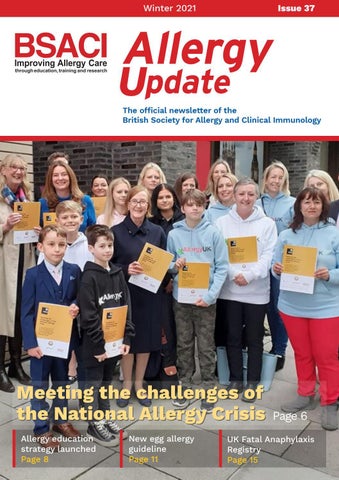
Meeting the challenges of the National Allergy Crisis Allergy education strategy launched Page 8
New egg allergy guideline Page 11
Page 6
UK Fatal Anaphylaxis Registry Page 15
ADVERTORIAL
A NEW THERAPY FOR THE TREATMENT OF PEANUT ALLERGY INTRODUCING PALFORZIA PALFORZIA, a new oral immunotherapy (OIT) for peanut allergy, indicated for the treatment of patients aged 4 to 17 with a confirmed diagnosis of peanut allergy. For the Prescribing Information, please click here.
PALFORZIA WEBINAR SERIES
(These webinars are organised and funded by Aimmune Therapeutics and are intended for UK healthcare professionals) Aimmune Therapeutics held a series of webinars during 2021 to facilitate peer-to-peer learning on the use of PALFORZIA. These webinars focused on the sharing of practical experience regarding PALFORZIA treatment adoption into the clinic, the identification of suitable patients for PALFORZIA, how to manage patients on treatment, how to support patient adherence, as well as sharing the treatment experience of both patients and caregivers based on experience in the US, where PALFORZIA was approved in January 2020. OVERVIEW OF THE PALFORZIA CLINICAL DEVELOPMENT PROGRAMME Sharing experience with PALFORZIA
PRACTICAL TIPS FOR STARTING TREATMENT WITH PALFORZIA PALFORZIA: key data
Prof George Du Toit (UK)
Prof Katharina Blümchen (Germany)
Practical experience with PALFORZIA
Learning from US experience with PALFORZIA
Dr Shahzad Mustafa (USA)
Dr Jay Portnoy (USA)
LONG-TERM CLINICAL TRIAL DATA & US EXPERIENCE PALFORZIA: longitudinal data Prof Jonathan Hourihane (Ireland)
US patient follow-up Dr Janet Beausoleil (USA)
The recorded presentations from the three 2021 webinars can now be viewed on-demand. Live webinars are also planned for 2022, incorporating opportunities to put your own questions to leading PALFORZIA experts via interactive, live question and answer sessions. You can register via the link below.
TO REGISTER TO WATCH ON-DEMAND, PLEASE VISIT:
https://aimmuneinstitute.org/uk-home/
Aimmune: Developing and providing treatment options for people with food allergies
Aimmune Therapeutics is a biopharmaceutical company founded specifically to address an unmet need to standardise OIT treatments. We are committed to developing and commercialising new treatments for people with food-mediated conditions and potentially life-threatening food allergies. For more information, please visit www.aimmune.co.uk.
Adverse events should be reported. Reporting forms and information can be found at https://yellowcard.mhra.gov.uk/. Adverse events should also be reported to Aimmune Therapeutics UK Ltd. on 0800 0487 217 or at medinfo-eu@aimmune.com © 2021 Aimmune Therapeutics. All rights reserved. PALF-PM-UK-0029 November 2021
Editorial
Allergy Update
I
Contents
We warmly welcome Professor Graham Roberts in his position as President – in his message overleaf he maps out his plans for the next 3 years.
New plans for BSACI leadership structure 5
am delighted to present the 2021 winter issue of Allergy Update – as we enter the holiday season I wish you all the very best for 2022.
Dr Erika Harnik Consultant in Paediatric Allergy, Imperial College Healthcare NHS Trust
Our feature article this issue is the report from the All Party Parliamentary Group for Allergy and the National Allergy Strategy Group “Meeting the Challenges of the National Allergy Crisis”, which recognises the support and investment required to improve allergy care from the community setting through to specialist hospital services.
The launch of the BSACI Allergy Education Strategy, led by Professor Judith Holloway, will be sure to help address some of these challenges. Sian Ludman takes us through the aims of the strategy as well as next steps planned. Vibha Sharma writes about how BSACI members can contribute to the UK Fatal Anaphylaxis Registry and help further our understanding about fatal anaphylaxis. Thanks to Georgios Gkimpas and his team, we were able to meet safely together in Harrogate for the BSACI 2021 Annual Meeting and his article this issue includes all the highlights from the meeting. We also take a moment to celebrate the life of Marta Krawiec, a colleague who will be dearly missed. I hope you enjoy this digital issue - if you have any comments about Allergy Update or would like to contribute to the magazine, please do not hesitate to contact me at erika.harnik@nhs.net
Contributions should be e-mailed to: info@bsaci.org Editor of Allergy Update Dr Erika Harnik Layout INQ Design Ltd (020 7737 5775)
BSACI Trustees BSACI President Professor Graham Roberts Past President Professor Adam Fox Secretary Dr Deb Marriage Treasurer Dr Susan Leech Co-Editors of Clinical and Experimental Allergy Dr Robert Boyle & Dr Mohamed Shamji
Elected Council Members Dr Steve Jenkins Dr. George Gkimpas, BSACI Meeting Scientific Programme Lead Mrs Lucy Common Dr Dinusha Chandratilleke Dr Louise Michaelis Dr Rubaiyat Haque Dr Sophie Farooque Representatives and Leads of Committees Dr Mich Lajeunesse - Chair of BRIT Registry Committee Mrs Hannah Kramer - Chair of Nurses Committee Dr Nick Makwana - Chair of Paediatric Allergy Committee Professor Paul Ciclitira - Chair of Adult Allergy Committee Dr David Luyt - Chair of BSACI Standards of Care Committee Dr Tomaz Garcez - Chair of the Clinical Immunology Committee Dr Matt Doyle - Chair of Primary Care Committee) Co-opted Members Dr Louise Savic - Expert Working Party lead for Improving the provision of care in perioperative allergy Dr Thirumala Krishna - Equality Diversity & Inclusivity Group Lead Dr Rebecca Knibb - Psychology Working Group Lead Dr Andrew Whyte - BSACI Rep on the RCP Medical Specialties Board (MSB) Dr Richard Pumphrey - Chair of Anaphylaxis Committee Professor Michael Rudenko - EAACI Rep Professor Helen Smith - BSACI Ethics Champion Ms Hannah Hunter - Representative of the FASG of the BDA Dr Neha Christian/Dr Cherry Alviani - Junior Members Representatives Dr Elizabeth Griffiths - Chair of Allergy Specialist Advisory Committee Dr Pamela Ewan - Allergy Services Lead and Co-Chair of the NASG Professor Judith Holloway - Chair of BSACI Allergy Education Network
Message from the President
4
Meeting the Challenges of the National Allergy Crisis 6 BAEN strategy launched
8
BRIT: preparing for Phase Two 10 BSACI egg allergy guideline
11
BSACI Annual Conference 2021 12 Fatal Anaphylaxis Registry
15
New ACI/ACLI curriculum
16
EDI Working Party update
16
WAO & BSACI 2022 UK Conference
17
Home penicillin challenge
18
Marta Krawiec obituary
18
Committee and group news
19
BSACI team Chief Executive: Fiona Rayner fiona@bsaci.org
Clinical Guidelines Research Officer: Erinn Gallagher erinn@bsaci.org Finance & Administration Officer: Sandie Campbell sandie@bsaci.org Membership Officer: Ben King ben@bsaci.org Marketing & Communications Manager: Louise Colonnese louise@bsaci.org Training & Education Coordinator: Marie Gibbs marie@bsaci.org Managing Editor, Clinical & Experimental Allergy: Catherine Hyland catherine@bsaci.org BSACI Studio 16, Cloisters House 8 Battersea Park Road London SW8 4BG info@bsaci.org 0207 501 3910 0207 627 2599 www.bsaci.org Registered charity no: 1069199
3
President’s message
Allergy Update
Priorities for the BSACI I
Professor Graham Roberts President pandemic.
t doesn’t seem very long ago that you elected me as president of the society. I’ve had a very steep learning curve as President Elect, learning how everything works!
allergy in the minds of policymakers. We need to look after ourselves in these difficult times and be supportive to one another. We also need to work to restore the allergy clinical trials work which has been markedly affected by the pandemic.
It was great to see everyone at the Harrogate meeting and thanks to George Gkimpas and the programme committee for putting together such a successful programme. It was particularly good to see an allergy education and diversity session. The BSACI has shown how to safely run a face to face meeting during a
When I campaigned to be President of the society I highlighted three priorities. The first is to support the membership with new ways of delivering allergy services.
We all thank Adam Fox for his excellent three years as President. He has provided first class leadership during the challenges of this pandemic ensuring that the BSACI has played an important role in delivering the medical response. I would also like to thank Nicola Brathwaite for her term as Secretary of the society. In particular for her work modernising the committee structure, this places the society in a very good place to navigate what’s likely to be another few challenging years. The pandemic continues to deliver challenges for allergy, particularly as it’s not being prioritised in the recovery program. Raised patients expectations combined with longer waiting times are far from ideal. As a profession, we haven’t had as much impact on NHS policies as we’d like. With the recent National Allergy Service Group (NASG) report, we have an opportunity to engage Government in a dialogue. It’s going to be critical to frame allergy within the current NHS policy framework with its emphasis on working with community teams. One of the few positives of the pandemic has been the use of virtual technology to widen participation in the society. The grand rounds have been particularly successful with over 100 members accessing each. Committee meetings have been virtual and this may have helped our long-held goal of diversifying the leadership team. None of the new Council members are from the South East and our new Secretary, Deb Marriage, is from Bristol. As the country returns to normal, there’s going to be considerable competition for resources to restore and improve services. It’s critical that the BSACI works with our patient partners to keep
4
The second is to join with other stakeholders to ensure allergy features in the NHS long-term plan. The NASG report is a good starting place for these first priorities, however we have a lot more work to do. The third priority is to broaden participation in BSACI activities. To that end we plan a mixture of virtual and face-to-face meetings in the future. This should ensure that the BSACI remains as accessible for everyone as your society was during the pandemic and ensure that we have participation from colleagues from all four home nations. I would like to add one further personal priority - transition care for adolescents moving towards adulthood. With a number of colleagues, we have put together a European blueprint to deliver successful transition. I look forward to working with colleagues from across the society to translate this into a UK context. Finally I need to mention our 2022 annual meeting. Instead of our usual October meeting, we are going to have it six months earlier in April. This is because the meeting will be held jointly with the World Allergy Organization. We’ve used this
As the country returns to normal, there’s going to be considerable competition for resources to restore and improve services. It’s critical that the BSACI works with our patient partners to keep allergy in the minds of policymakers. opportunity to move the meeting to Edinburgh for 2022. This will provide a great backdrop to what is likely to be one of the few large face-toface international allergy meetings in 2022. I look forward to seeing you there!
News
Allergy Update
New plans for BSACI leadership structure
T
Nicola Brathwaite Consultant in Paediatric Allergy King’s College Hospital London
he leadership structure of the BSACI has remained largely unchanged as the society has grown in membership and activity. The Trustees recognised a need for a review of the leadership structure to allow it to adapt to support the strategic and operational aims of the society. During my term as BSACI Secretary I worked with the Trustees on a proposal for an expanded leadership structure for the society. At the October BSACI Council meeting the proposal was discussed and it was agreed to pursue this.
The current leadership structure of BSACI Council has 3-4 Trustees (president, secretary, treasurer and past president or president elect). Seven council members are elected by the BSACI membership. These are voting members. Other members of Council include Chairs of the BSACI committees and coopted members (non-voting). We have recently
reviewed and updated the job descriptions and terms of reference for all these roles. We proposed to council that 3-5 new vice president roles are developed with a strategic JD as agreed annually by Council. This would involve increasing the elected council members to 8. Council approved this in principle with 3 of the elected positions to be developed into VP roles and 5 council members. Potential portfolios for VPs could include Education and Knowledge, Science, Workforce and Services. A period of transition is envisioned as current elected Council members complete their terms of office. As part of an annual strategic review, the BSACI will identify skills needed in new council members to encourage suitable applicants. Generic council roles will continue to be included to encourage application by junior members wanting to develop their leadership in the organisation. We hope that as this is taken forward it will allow the BSACI to continue to grow and flourish.
Announcement
Please support research through the British Paediatric Surveillance Unit Background: This British Paediatric Surveillance Unit (BPSU) study aims to establish incidence rates of ARFID in children and young people presenting to secondary health care since March 2021 in the UK and Ireland. Importance: To date very little is known about this disorder and its associated behaviours and outcomes in British and Irish children and adolescents and, as a recent diagnosis, it is of great international interest. The aim of generating new priority research questions could also inform decision making to better match patient need with sufficient funding allocations. How to get involved: Please report any young person aged 5-15 with persistent restriction of quantity and/or range of food intake, associated with one or both of the following: • Nutritional deficiency that requires additional clinical investigation or treatment that is not fully accounted for by poverty or neglect, cultural practice or an existing medical condition or another mental disorder* • Interference with day-to-day functioning due to eating behaviour
Not explained by ANY of the following: • Lack of available food (e.g. from poverty, famine or neglect) • Culturally sanctioned practice (e.g. endorsed religious and cultural practice) • Other known diagnosis e.g. Allergy to specific food group (e.g. dairy), gastrointestinal disorder, constipation, swallowing difficulties, other eating disorder e.g. anorexia nervosa, bulimia nervosa, or other medical or psychiatric disorder that fully explains food restriction (not requiring additional clinical attention) e.g. depression, anxiety, OCD, malignancy, diabetes mellitus, inflammatory bowel disease, thyroid disease *If eating disturbance occurs in the context of another condition/disorder, then in order to meet case definition for ARFID, the severity of eating disturbance should exceed that routinely associated with the particular condition/disorder - and warrant additional clinical attention. More info at BPSU study - Avoidant/Restrictive Food Intake Disorder (ARFID) | RCPCH or please contact us at arfid.study@imperial.ac.uk
5
APPG publication launch
Allergy Update
Meeting the challenges of the National Allergy Crisis
A report from the All-Party Parliamentary Group for Allergy and the National Allergy Strategy Group
O
representatives from the patient groups Allergy n October 27th the All-Party Parliamentary Group UK and the Anaphylaxis Campaign; members for Allergy in conjunction of the BSACI and the All-Party Group chair Jon Cruddas MP with the National Allergy appg in the hope that Ministers will Strategy Group (NASG) pay attention to the growing Meeting launched a report th challeng e es of the epidemic and the lack of NHS “Meeting the Challenges Nationa l Allergy Crisis services available. Ms Keegan of the National Allergy A report from the All Party Pa spent time with the youngsters rli am entary Crisis” which calls for Group fo r Allergy and the Natio nal Aller hearing about their multiple gy Strategy an influential lead for Group allergies and how they manage allergy to be appointed their day to day lives and also Mandy East who can implement a spoke with Dr Pam Ewan, chair National Allergy new national strategy of the National Allergy Strategy Strategy Group to help the millions of Group. people across the UK affected by allergic The core problem is the very disease. The report small number of consultants in was delivered to Gillian Keegan MP, Secretary adult and paediatric allergy and the of State for Care and Mental Health outside fact that most GPs receive no training in allergy. the Department of Health by nine year old Arlo This mismatch has continued despite millions Gillard Moss and seven year old Monty Martin of patients having significant allergic disease in the presence of a group of people of varying and that allergy is a complex specialty involving many areas. ages who are living with allergic disease; This Repor t was resear ched and funded or the House of Lords. It by the Members OCTO BER of both House has not been approv Na�onal Allergy Strateg 2021 ed by either s with a comm y Group This House is on interes t in par�cular or its commi�ees. not an official publica All-Par ty Parliam �on of issues. The views expres entary Group the House of Comm sed in this ons s are inform report are al groups of those of the group.
Delivering the report - patient representatives from Allergy UK with Gillian Keegan, MP, and members of the BSACI
6
APPG publication launch
Allergy Update
Gillian Keegan MP, Secretary of State for Care and Mental Health, receiving the report from Arlo Gillard Moss and Monty Martin
Over the last two decades a series of reports reviewed the prevalence of allergic diseases, consequent patient need and service provision. The reports were:
• Allergy: the unmet need, Royal College of Physicians, 2003
• The Provision of Allergy Services, House of
Commons Health Select Committee, 2004
Jon Cruddas, Deb Marriage, Pam Ewan, Fiona Rayner and Adam Fox
Health, 2006
2. Specialist Care
• A Review of Services for Allergy, Department of • The Nature and Extent of Allergy in the UK,
evidence to the DH report, British Society for Allergy and Clinical Immunology, 2006
Expand the specialist workforce as a priority. Ensure training programmes prioritise allergy so that specialists of the future are appropriately trained and can safely deliver care.
Technology Committee, 2007
3. Primary Care
• Allergy, House of Lords Science and
• Allergy Services: Still not meeting the unmet need, Royal College of Physicians and Royal College of Pathologists, 2010
The findings and recommendations were similar across all these reports and highlighted that allergy was poorly managed across the NHS due to a lack of training and manpower with expertise. The recommendations were that specialist services needed significant improvement and improved knowledge and awareness was required in primary care. This current report makes the following recommendations for action:
1. A National Plan for allergy Make allergy a priority and invest in a National Plan led by a designated DHCS or NHS lead with sufficient authority to implement change. Bring together medical professionals and patient support organisations to work together to develop the strategy and help steer the work required to improve allergy services.
Ensure all GPs and health care professionals in primary care have knowledge of allergic disease (8% of GP consultations are for allergy). Ensure allergy is included in the GP curriculum (RCGP have recently added allergy for new GP exams) and exit examination and improve allergy education for the already qualified GPs. Appoint a health visitor and/ or a practice nurse with sufficient training to be responsible for allergy in each practice
4. Commissioning For local commissioners to understand the allergy needs of their population; and that it is not adequate to assume that other specialties can deliver specialist allergy care. Commissioners should ensure access to adult and paediatric allergy consultants and pathways of allergy care. The report is available to read on the NASG website: www.nasguk.org
7
Allergy Education
Allergy Update
BSACI Allergy Education Networks strategy launched
A
Dr Siân Ludman Consultant in Paediatric Allergy Royal Devon and Exeter NHS Foundation Trust
t the inaugural Allergy Education session (in memory of Professor Tony Frew) delivered during lunch on the second day of BSACI meeting, I was delighted to be sitting with Prof Gill Vance and Dr Liz Angier presenting the BSACI Allergy Education Network’s (BAEN) first tentative steps out of theory and into practice. The concept of the BAEN has been discussed in an article in CEA1 last year, however I am glad of the space in this edition of Allergy Update to have more opportunity to show people where we go from here.
The BAEN strategy has now been ratified by the BSACI council, and whilst to this point Gill, Liz and I have taken the lead on certain sections, it has taken a village of people to create this document. This has all been ably led and enthusiastically driven by Prof Judith Holloway who has really enabled this strategy to come to life. Figure 1 below summarises how this document was initially created.
The main working party found that the strategy easily broke down in to three different parts to focus on: Undergraduate, Community and Hospital. Each part has been designed to provide and showcase: Benefits for patients Benefits for you Benefits for your institution
• • •
To give a little more information on these three strands we presented three slides captured below at the education session. You can see from these images that there are common themes throughout the document. These main themes include sustainability, guidance on quality education and resources from day 1 of undergraduate training to retirement as well as collaboration and networking around the entire UK. Working strictly in the three sections of Undergraduate, Community and Hospital does not best serve the next phase of implementation. Cross cutting themes were identified including marketing, curricula, competencies and educational resources. These are working across each section to provide inclusive and seamless
Figure 1. Summary of the creation of the BSACI Allergy Education Networks strategy
8
Allergy Education
Allergy Update
Undergraduate education strategy
Hospital education strategy
Key target area (‘why’) • To enable sustainable, high-quality allergy care • Anticipate future practice needs and systems of working • To encourage allergy as an exciting career destination
Key target area (‘why’) • Increase the number of HCPs who have recognized training and clinical expertise in allergy
Our aims (‘what’) • Embed allergy-related outcomes in curricula • Provide teaching/learning resources to support curriculum delivery • Support career development Our plan (‘how’) • Set of strategic objectives – Collaboration, engagement, ‘community-building’ activities information and support. The role of implementation is not to re-invent the wheel, more to identify what is presently available in the UK and abroad which can be amalgamated and utilised by us all. Nor can everything be achieved at once. There has been considerable work done between groups, such as the marketing group creating content for the website www.bsaci.org/educationand-events/bsaci-national-allergy-educationstrategy which will host not only the strategy but also all of the educational resources we have amalgamated. We hope in time that the BSACI will accredit the resources that we have collated to sign post all health care professionals to a course or event which will support their curriculum and competencies. Now that the document is due to be launched, it is time for involvement in the implementation phase. Below you will find a QR code. Please scan this; it takes you to a simple survey where we are trying to collate local, regional, national and international educational events of any form which can be evaluated and collated on our landing page. Not only that, we are looking for more people to get involved at a national and grass roots level. If you are interested in joining the BAEN network please email Judith on info@bsaci.org. More than that, we are looking specifically for people to be Allergy Education Champions. It is our fervent desire that we have an education champion in each region and from a variety of health professional roles. If you are interested in becoming a champion, or even just learning a little
Our aims (‘what’) • Guidance on the breadth and level of allergy knowledge and clinical skills HCPs are expected to attain and maintain Our plan (‘how’) • Access to accredited, evidence-based educational programmes and accredited national, local and online educational platforms • BSACI support educational activities • To establish a regional network of allergy education champions
Community education strategy Key target area (‘why’) • Support community workers to treat allergy across the life cycle Our aims (‘what’) • Empower system change, support population health, consider community context Our plan (‘how’) • Integrated care, networking, leadership, research, curricula, accessible resources more about the role please email marie@bsaci.org. When the champions are in place the BSACI BAEN page will hold a list of names in each region, each of whom will be able to support and sign post people to relevant educational opportunities and give simple, supportive career advice. This is an exciting time in the world of Allergy education and we very much hope you will step forward and become part of the BAEN vision and help to raise the standard of allergy education for all healthcare professionals who care for patients with allergy. Hopefully see you at the Allergy Education Showcase session next year too! For more information visit the website www.bsaci.org/education-and-events/bsacinational-allergy-education-strategy 1. Vance G, Ludman S, Angier E, et al. Time to act to solve gaps in practice: The BSACI National Allergy Education Strategy. Clin Exp Allergy 2021;51(1):6-8.
9
News
Allergy Update
Preparing for Phase Two A BRIT Registry update
A
t conference this October the BSACI registry for Immunotherapy celebrated its third anniversary. Since 2018 it has grown from a concept into an active national registry with over a thousand participants. The registry has become established as part of allergy care in the UK.
During this time immunotherapy practice has not stood still but has Dr Mich also changed. For instance, new Lajeunesse products such as house dust mite Consultant in immunotherapy with Paediatric Allergy sublingual Acarizax (ALK) have been licensed, & Immunology older products such as the venom Southampton mainstay Pharmalgen (ALK) have Children’s been withdrawn, and Xolair (Novartis) Hospital has been licensed for home therapy. The most notable arrival has been the licensing of Palforzia (Aimmune) as oral immunotherapy for peanut allergy in children. We are also learning more about the use of component resolved diagnostics in the selection and response to allergen immunotherapy. Phase two of the registry includes all of these changes including a new “arm” for peanut immunotherapy, the first food immunotherapy to be included. The registry may help to answer some of the unresolved questions that any new treatment brings to clinical practice.
10
brit
BSACI registry for immunotherapy improving allergy care
You can see that BRIT remains an accurate representation of treatment in the UK, yet we continue to innovate. We have designed a new adherence patient reported outcome measure (PROM) for sublingual allergen immunotherapy. This will tell you if your participants are taking it and why not. We have also done the same for peanut immunotherapy, taking into consideration factors that will impact on its more widespread use in the UK. BRIT has always been about sharing data. Many registries act like a data black hole with no access to your data once it has been entered, and in consequence very little if no personal gain from entering the data. This has never been the case for BRIT, in fact registry users always have access to their own dataset for audit and service evaluation. IQAS have recognised the importance of this function of the registry to help accrediting centres. In phase two we have added a quality dashboard for all users to do the hard work for you. This tool will summarise metrics on your clinical practice and will also compare them to national data trends in the registry. For instance, if you have 15 active participants on SLIT it will show how this compares to the national average. The registry has a long way to go but we are off to a great start - visit the BSACI website to find out more and download the first report www.bsaci.org/ professional-resources/immunotherapyregistry We have a foundation that will start to make a difference for our clinical services and our patients. Real world evidence is being recognised as increasingly important and valid way of assessing effectiveness of treatment. Our aim is to use registry data to enhance the evidence base for our specialist treatments, to provide safety data in large, unselected participant groups and to highlight issues in equality of access to treatment. If you are not already a regular BRIT user, perhaps phase two is the time for you to consider the benefits of being part of the registry. If you have a large practice and feel a bit overwhelmed by the thought of using the registry do get in touch and we can help you to get started.
News
Allergy Update
BSACI egg allergy guideline comes of age
T
he Standards of Care Committee have recently updated their 2010 Guideline for the management of egg allergy. You can read it in the October issue of Clinical and Experimental Allergy and on the BSACI website www.bsaci.org/guidelines/bsaciguidelines/egg-allergy-2021.
Sue Leech Paediatric Allergy Consultant, King’s College Hospital NHS Foundation Trust
This guideline has been a long time in production. It was one of the first guidelines which had significant input from the patient groups, Anaphylaxis Campaign and Allergy UK. They reviewed our section of topics and
suggested additions, such as breastfeeding infants with egg allergy, labelling, cross reactivity between different species of egg and cross reactivity between egg and chicken, management of egg allergy in nurseries and schools and the psychological and social implications of egg allergy. Our allergy dieticians, Isabel Skypala and Heidi Ball were keen to include guidance on home introduction of egg into the diet of children outgrowing egg allergy. So this section
was expanded. There are plenty of case examples and patient information leaflets in the online appendix. The guideline includes a 9 step egg introduction ladder, colour coded to match the 3 stage classification of egg containing foods (which is similar to the egg ladder in the 2010 guideline). Isabel expanded the section on egg allergy in adult patients. We get a lot of enquiries about immunising egg allergic children. Mich LaJeunesse updated the section on immunisations and included a section on rabies immunisation. Sarah Heath, paediatric allergy dietician, wrote a section on egg allergy in schools and nurseries, whilst Polly James and Karen Murphy, paediatric allergy psychologists, wrote the section on psychological and social implications of egg allergy. We hope you enjoy using the new guideline and find it helpful. The ladder and table of egg containing foods look good when printed out in colour. The appendices with the case examples are well worth reading and we hope you find the patient information leaflets useful.
11
BSACI Annual Conference
Allergy Update
BSACI Annual Conference: meeting face-to-face again A
s we leave the 2021 BSACI Meeting in Harrogate behind us, we can now reflect on what has been a challenging but ultimately very successful undertaking. This Meeting was one of the first completely face-to-face conferences of a major scientific society, so we were treading on uncharted territory. However, we knew that, as we slowly return Dr Georgios to normality after the pandemic, Gkimpas most people are eager to see their Consultant colleagues and friends in person, Allergist, Royal and this was indeed demonstrated Preston Hospital by the Meeting’s success, both in the number of delegates that it BSACI 2021 Meeting Scientific attracted, and in their experience. In an environment where everybody’s Program Lead safety was the main priority, we worked closely with the conference centre and delivered an event where delegates and speakers enjoyed the rich programme and the social interaction that has been missed for too long. The 2021 Conference focused on the development and presentation of allergy throughout life, and further touched upon Transition and unified practice issues for paediatric and adult allergy. The opening plenary set the stage of what was to follow, with powerful talks by Dr Andrew Whyte discussing our COVID experience throughout this last difficult year, Professor Graham Roberts, BSACI President, detailing his view
of how we can establish seamless Transition practices, and Professor Sir Stephen Holgate, sharing his experience of working with and supporting Rosamund Kissi-Debrah, the coFounder of the Ella Roberta Family Foundation and mother of nine-year-old Ella who was the first person in the UK whose death certificate listed air pollution to be a contributory factor to their death. Rosamund herself closed the plenary with a powerful and moving talk about her struggles trying to navigate the system to investigate the cause of Ella’s passing, which triggered a several-minute-long standing ovation by all attendees. This year, Allergy Education was also celebrated in a novel session that included showcasing educational projects across the UK, and an expert panel discussing their implementation. Very worthy projects were presented and discussed in this session which took place in the memory of our greatly missed colleague, Professor Tony Frew, and the top project was selected and awarded the Education Award by his wife Professor Helen Smith. Professor Krishna, TK, delivered an outstanding Jack Pepys Lecture, Dr Nandinee Patel was Speaker’s Corner
Sandie Campbell, Fiona Rayner and Ben King
BSACI were awarded a Business Events Domestic Support Grant for the BSACI 2021 Meeting from Visit Britain.
12
BSACI Annual Conference
Allergy Update
The exhibition hall; break out rooms and the main stage
awarded the Jonathan Brostoff Young Researcher Award and delivered a remarkable talk about her recent work, and Professor Graham Roberts was awarded the William Frankland Award. Outstanding abstract presenters were also awarded the Barry Kay Awards in a well-attended session in the main Auditorium. To see the Barry Kay winners and all accepted abstracts visit www.bsaci.org/aboutbsaci/bsaci-awards/barry-kay-awards In this Meeting we also highlighted the importance of input from all parts of society and stakeholders: We gave a platform to the Natasha Allergy Research Foundation (NARF) to discuss updates in protecting the allergic public and the Natasha Law which very recently came in effect. There was also a research-focused session with the collaboration of the Health Research Authority (HRA) and a Joint session with BPAIIG, where Allergy, Immunology and Infection were discussed and highlighted. Following the very well-received ‘Diversity’ talks last year, this year’s meeting again underscored Equality, Diversity and Inclusivity in Healthcare, which sit at the very top of BSACI priorities. Mental health was put under the spotlight, an issue that affected not only our patients, but also ourselves, in the midst of the pandemic. As always, the BSACI Meeting provided a platform to British and overseas speakers of international calibre who sit at the cutting edge of their respective fields, and who delivered high-quality talks for all issues around Allergy & Immunology. All facets of clinics and science were showcased with a variety of talks including asthma, food/drug/skin allergy, clinical disease, laboratory/transitional allergy & immunology and research. As was expected for a BSACI Annual Meeting, there were several informative workshops
where practical issues of our everyday practice were highlighted in an engaging environment. As we now leave the 2021 Meeting behind us, we are already deep into preparations for the WAO BSACI 2022 Meeting in Edinburg this April. This will again be a physical face-to-face Meeting where WAO and BSACI will combine their expertise and experience to create an unparalleled global event which will be an experience not to be missed, both from a scientific and a social & networking viewpoint. We are looking forward to welcoming you at WAOBSACI 2022 UK Conference in Edinburgh from 25th-27th April. To find out more and register visit www.wao-bsaci.org
Take a look at the photos from the 2021 conference: www.bsaci.org/education-and-events/meetings/past-bsaci-conference-photos/2021-bsaci-conference
13
Allergy Update
UK Anaphylaxis Registry
B
Dr Paul Turner Reader and Consultant in Paediatric Allergy and Immunology, Imperial College London
SACI is working with Imperial College London to establish a prospective UK Anaphylaxis Registry, supported by UK Food Standards Agency (FSA) and Food Standards Scotland (FSS), to collect data relating to unintended allergic reactions. The Registry is fully integrated into the existing European Anaphylaxis Registry Network for Online Registration of Anaphylaxis (NORA) www.anaphylaxie.net.
Information about the frequency and triggers of severe allergic reactions in the UK and Europe is limited, therefore we are working with the NORA team to better understand the causes of anaphylaxis in the UK, and to help protect those with food and other potentially severe allergies. Summary data will be shared with the FSA and FSS to help evaluate the circumstances of food-induced reactions in the UK and identify common triggers which might not currently be required for allergen disclosure under the relevant legislation. We also hope the Registry will provide information as to risk factors for severe reactions in the UK. BSACI members (as well as other Healthcare Professionals) are encouraged to register for access to the online platform, and then submit data relating to unintended allergic reactions occurring in adults and children, to both food and non-food triggers, for example:
• Patients presenting with acute symptoms to Accident & Emergency departments.
• Patients presenting to outpatient clinics for follow-up.
Participation in the UK Anaphylaxis Registry is jointly coordinated through the BSACI and Imperial College London (Principal Investigator: Dr Paul Turner). UK Healthcare Professionals
14
(Contributors) can apply using an online form to gain access to the Registry. Once approved, they will receive an email from the NORA team with a username and password. There are no costs to participate in the UK Anaphylaxis Registry and registering as a Contributor to the Registry is voluntary. If you decide to participate, we ask you to:
• Provide your consent so that Imperial
College London and the NORA team can store your first and last name, as well as your (NHS) email address.
• Agree to receive the “Anaphylaxis” newsletter and other updates that will be published on a quarterly basis.
• Agree that your Hospital Department/Unit
can be listed as a participating centre in the UK Anaphylaxis Registry on the website www.anaphylaxie.net
Once your account has been approved, we will email you a User ID and Password which will give you access to the online platform. Should you have any questions please email Dr Alessia Baseggio Conrado at anaphylaxis.registry@imperial.ac.uk Please use the QR code below to the registry or go directly to www.bit.ly/UK-anaphylaxis to register.
Anaphylaxis registries
Allergy Update
UK Fatal Anaphylaxis Registry T he UK Fatal Anaphylaxis Registry (UKFAR), founded by Richard Pumphrey in the early 1990s, seeks to assemble details of every fatality in the UK since 1992 for which anaphylaxis is considered a possible cause of death. Near-fatal reactions with subsequent death due to brain damage or other resuscitation sequelae are included. The registry aims to collect detailed information about every case, typically 20-40 each year. The data in the registry has improved understanding of fatal anaphylaxis and the clinical circumstances leading to fatalities..
No two anaphylactic fatalities are identical and each one studied adds to our understanding of the causes and the ways in which avoidance and treatment may fail; the more detailed the information, the greater the chance of learning something new. Continuing to collect this data in the UK is important to allow comparison with data in other countries, add to the overall understanding on fatal anaphylaxis. Enhanced understanding will enable us to improve the advice on avoidance strategies and management of anaphylaxis to reduce fatalities. This approach is particularly important considering the reported increase in prevalence of allergy in the UK population.
The Food Standards Agency (FSA) has provided UKFAR with funding support for a year to update cases in the registry. This is supported by the BSACI.
We are looking for BSACI members to support UKFAR Any information you can provide on fatal cases of anaphylaxis you have been involved with will be helpful. Additionally, for any on-going evaluations, you can request involvement of the registry team directly with the Coroner. Direct involvement of the registry team with the Coroner, investigation of cases gives the richest possible information. To find out more about UKFAR visit www.bsaci.org/professional-resources/ukfar/ Dr Vibha Sharma, Dr Tomaz Garcez and and Dr Andrew Parkes can be contacted to support case investigation: email mft.fatal.anaphylaxis@nhs.net Dr Vibha Sharma, Consultant in Paediatric Allergy, Royal Manchester Children’s Hospital; Dr Tomaz Garcez, Consultant Immunologist; Dr Andrew Parkes, Consultant Anaesthetist, Manchester University NHS Foundation Trust
Updates to members area of the website We have made some improvements to the members area of the website. When you sign into your account, you will see your membership details including your membership number. The member-only content is now arranged on this landing page, so you can access the information you need easily - including forms, publications, guidelines in progress and paediatric grand rounds. This content is only available to members so please take a look www.bsaci.org/login
15
Curriculum
Allergy Update
New ACI and ACLI curriculum T he last year affected the internal workings of the Joint Royal College of Physicians Training Board (JRCPTB) much like it has our own services. The Specialist Advisory Committee chairs of these various groups met virtually to discuss matters of national development and delivery of training. The work to write two entirely new curricula was a long journey but has Elizabeth now officially finished. The decision Griffiths of the GMC has been to accept the Consultant new Allergy & Clinical Immunology Adult Allergist, (ACI) and Allergy & Clinical Laboratory Southampton Immunology (ACLI) curricula. In August, the first trainees started on these new routes to CCT. The key messages from this activity and the two new curricula can be found at https://www. jrcptb.org.uk/sites/default/ files/Rough%20guide%20Allergy%20and%20 Immunology%202021%20curricula.pdf along with pages offering a “rough guide to the Allergy and Immunology 2021 curricula”. The curricula will continue to be named “Allergy” and “Immunology” until this can be changed legally. Doctors in their final 2 years of training will be able to complete on the 2010 allergy curriculum. This will take into account that the new Allergy
and Clinical Immunology Certificate Examination (ACICE) will not be available prior to 2023 and this exam is a mandatory summative assessment in the new ACI curriculum. Those applying to CCT viva the CESR route will have until 31st July 2024 to apply to CESR against the old curricula. There is a difference between CCT applicants and CESR applicants which is a recognition of the difficulties that the latter group may have in accruing evidence that each candidate meets competencies in newly added areas of the curricula. It is likely that a request will be circulated soon for question writers and examiners from the Allergy community. The RCPath has agreed that examiners and question writers for the new “Allergy” examination (ACICE) will not need to hold FRCPath. It has been considered that the volunteers will want/need training in appropriate question writing and it is hoped that the RCPath may be able to support this training need. The RCPath team are working on a current examination diet, but it is expected that an invitation will come from them directly shortly. We need to have Allergy short answer questions in time for the first sitting of the exam in 2023 and a pilot in 2022. If you are interested in helping volunteer, please do get in touch at Elizabeth.Griffiths@uhs.nhs.uk
BSACI Equality Diversity and Inclusivity (EDI) Working Party update The BSACI have been addressing issues around Equality, Diversity and Inclusion (EDI). With the profound inequalities that many in our society still face, BSACI are committed to playing its part in minimizing these by developing a policy around ‘Equality, Diversity and Inclusion.’ The policy will be developed by the newly formed EDI Working Party, Chaired by Professor Thirumala Krishna. Work begun with reviewing BSACI ToRs and identifying and addressing any potential gaps with respect to ‘Equality, Diversity and Inclusivity’ within the society. Now planning has begun on the creation of Podcasts in English (followed by translation into native languages) for omalizumab (for chronic spontaneous urticaria) and sublingual immunotherapy (for allergic rhinitis). The podcasts will help inform those whose first language isn’t English to
16
understand more about their treatment, the podcasts will involve visuals to aid this process. Work has also begun on translating the new BSACI anaphylaxis patient Information leaflet (PIL) into Urdu, Punjabi, Bengali and Gujarati. The PIL was developed by BSACI with stakeholder engagement from our patient organisation partners Anaphylaxis Campaign and Allergy UK. It is envisaged that this work will be extended to translation of top 5 PILs accessed by patients. So that we don’t unintentionally exclude groups within BSACI, but ensure we are reaching all groups proportionately, and that we are able to identify areas of our work that are possibly underrepresented, we shall be collecting protected characteristics from the membership. Further details of this and all our work will be conveyed to the membership in due course. Professor Thirumala Krishna
WAO/BSACI Joint Conference 2022
Allergy Update
WAO & BSACI UK Conference 25th-27th April 2022 – Edinburgh International Conference Centre (EICC) A fter the huge success of BSACI 2021 face-to-face conference in Harrogate this year, we are now moving forward with our plans organizing the joint World Allergy Organization and BSACI conference. BSACI are working closely with the WAO Senior leadership to bring to the UK world class cutting edge topical research Fiona Rayner on behalf of the from across the world delivered by WAO-BSACI 2021 internationally renowned experts all conference team from the heart of the beautiful historic city of Edinburgh. Registration opened on November 1st 2021 and already we have had registrations from the USA, South Korea, India and Norway as well as the UK, etc. We have a packed programme and we kick off the conference at the slightly earlier time next year of 10am on the first day. We start by covering global trends in epidemiology of food allergy followed by the ‘Impact of globalization in the management of Anaphylaxis’ and discuss the challenges of managing allergies and asthma in low, middle-income countries. We continue with a session on allergy and the environment and finding out what the effects of aeroallergens are around the world in a temperate versus a tropical climate. Our COVID session looks at the challenges we face tackling ethnicity in relation to the related risks during the COVID-pandemic; the TH2 response to COVID 19; and whether we should have zero tolerance of the infection or live with it! We will be discussing novel approaches with regards to allergen modification/delivery plus passive immunotherapy without allergens and SLIT as a mainstream management for seasonal perennial allergies. In allergy management, the GINA 2021 report will be presented and we are excited to hear what the impact of the DRACMA guidelines has had globally and what the nutritional challenges in food allergy are. In ‘food allergy’ we shall be discussing identifying and managing the risk of anaphylaxis and what impact food allergy has had on the quality of life in the UK: Presentation of the Food Sensitive Study. New to this year we have a unique clinical immunology session and a charity partners symposium. Our awards ceremony celebrates those who have shown excellence in Allergy Care and Research, by the delivery of the Jack Pepys
and Harry Morrow Brown Lectures; the Barry Kay Award abstracts winners will be announced, and last but by no means least, the William Frankland Award winner announcement. We have joint sessions with the Japanese Society of Allergy (JSA), EAACI ENT Section and the AAAAI. We have our ‘Speakers Corner’ sessions and hands on practical workshops. The Presidents’ Plenary covers ‘a comprehensive approach to food allergy’ and ‘Oral and sublingual Immunotherapy for food allergy’ and viral infections and allergy interactions in the post-COVID era. We finish the last day with a plenary on ‘Climate change and environmental determinants of allergic disease’ opposed sessions on respiratory allergy, global allergy and a joint JSA session. The finale is an unopposed Year in Review. There will be a variety of specialty meetings taking place, satellite symposiums and social events!!! There is a welcome reception on Monday evening at the conference centre and the Presidents’ dinner on Tuesday 26th for which this year delegates wil be able to buy tickets to. Like the 2021 BSACI conference we shall be putting together a variety of COVID safety measures details of which can be found at www.wao-bsaci.org/venue-accommodation This will be the only BSACI Conference in 2022 so to ensure you get a seat at the unmissable 2022 WAO & BSACI joint Conference next year, register now www.wao-bsaci.org/registration We look forward to seeing you all in Edinburgh! To register for the conference and to book your ticket for the Presidents’ dinner, visit www.wao-bsaci.org/registration
17
COVID service innovations
Allergy Update
Virtual Home Penicillin Challenge during COVID-19 M D, a 12 year old girl, had a history of developing a rash while on penicillin at age two. She has a range of complex issues including autism, pathological avoidance disorder, dyspraxia, sensory processing issues, mannose binding protein lectin deficiency, and pendulaphobia. Her mother explained her condition and how difficult it would be to Rebecca Batt travel to London for a challenge. Clinical Nurse Even if she got to the hospital, her Specialist in Paediatric Allergy pendulaphobia would most likely cause her to become very agitated Evelina London Children’s Hospital and she would not be able to cope with the environment. Her mother and I discussed all practical options, but we were unable to come up with a suitable plan within the hospital setting. Following discussion within the multidisciplinary team, we agreed MD was low risk and in this exceptional case we would consider a supervised home challenge. I contacted her GP, Dr Baskaran, to discuss if there were any local teams which could support us but due to the pandemic this would be very
Marta Krawiec (1980-2021) Marta graduated from Medical University of Warsaw, Poland with honours in 2005. She continued her medical training in one of the leading teaching hospitals in Poland, the Department of Paediatric Pneumonology and Allergy in Warsaw, where she completed both her paediatrics and allergology training. After completion of her PhD on systemic safety of topical corticosteroids in Warsaw, in 2016, Marta joined King’s College London and Evelina London Children’s Hospital, St Thomas’. She quickly became an integral and much-loved part of the Research and NHS Allergy service, taking on the
18
difficult to arrange. Her GP offered to help and supervise the challenge at MD’s home.
Prior to the date, her Dr Lavan Baskaran, parents were given full James O’Riordan details of the plan for the Medical Centre day and were sent a prewritten consent form in the post. Phenoxymethylpenicillin, Cetirizine and two AAI’s were prescribed by her GP. We arranged an Attend Anywhere Virtual appointment and the GP and an advanced paramedic who was based at the practice, also attended. I was visible and on-line with MD and her parents while the GP performed a clinical assessment. We proceeded to give MD a test dose of 25mg of Phenoxymethylpenicillin and twenty minutes later the full dose of 500mg was given. The GP and the paramedic stayed in the home for one hour while I remained on-line. MD continued to successfully complete a three-day course with no reactions and we have now successfully de-labelled Penicillin allergy for this child.
post of Consultant in Paediatric Allergy in 2018. In addition to food allergy, Marta had a strong interest in drug allergy with special skills in intradermal testing. A session in drug Allergy was dedicated to Marta at this year’s BSACI conference. Marta was actively involved in a series of research trials focusing on allergy prevention (LEAP-Trio and EAT-On), allergy diagnosis (The BAT-2 Studies) and primarily the treatment trials (Epitope patch and Palforzia OIT trials). Marta will be sorely missed by so many and in many ways. The wider allergy community have lost a most brilliant, caring and dedicated Paediatric Allergist, her legacy will however live on through the legacy left by her contribution to research. Professor George du Toit
Committee and group news
Allergy Update
Food Allergy Specialist Group
O
ur Food Allergy Specialist Group (FASG) of the BDA now has 436 dietitian members. We continue to share news, clinical queries and updates through the Basecamp platform.
We have continued our programme of webinars with Isabel Skypala delivering one on oral allergy syndrome/ lipid transfer protein Hannah Hunter allergy and another by Hannah Specialist Hunter on anti-candida diets. On 3rd Dietitian in November 2021 we supported the Allergy, Guy’s Hospital, London; Allergy Academy in running the online Food Allergy Study day. Our 30 diet BSACI Dietetic sheets continue to be open access Representative to all BDA dietitians and are regularly updated. We recently released a diet sheet to support dietary management of FPIES. We have also recently reviewed and updated the BDA Food Fact sheets on food allergy. We will shortly be surveying our membership about use of ‘ladders’ for allergen introduction. As part of our group’s goal to improve
Nurses in Allergy I
Lucy Common Advanced Clinical Nurse Specialist (Salford); Past Chair of the Nurse in Allergy Committee
t was fantastic to see so many nurses attending the Nurses Open Meeting at the BSACI meeting in Harrogate. There were 32 nurses attending the meeting with four joining us on Zoom. We had the opportunity to discuss the work of the group over the last year including Zoom support meetings, updating the relevant content on the BSACI website and our Year of the Nurse survey. We also had the chance to catch up with colleagues we hadn’t seen for nearly two years. It gave us all a boost to make those valuable connections and share experiences with allergy nurses in our network after such a challenging time.
We also gathered some feedback about what the BSACI nurse members wanted on the next joint WAO/BSACI conference in April 2022 in Edinburgh. We will take that forward
RECENT ACTIVITIES: • Online networking through Basecamp • Exciting programme of webinars and virtual events • New online learning modules under development education for allergy dietitians, we plan to pilot an online learning module in 2022. The first proposed topic will be “taking an allergy focussed diet history”. The module would be delivered live to up to 12 dietitians with less than 3 years’ experience in allergy. It will be set up and run by our group via the BDA. Other topics we are considering developing modules are in Allergy Prevention and Eosinophilic Gastrointestinal disorders. . Twitter: @BDA_FASG Website: www.bsaci.org/about-bsaci/bsacicouncil-and-executive/bsaci-subcommittees/ dietitian/
to the scientific committee for the conference. Thank-you to the nurses who have shown interest and applied for our vacant post on the nurses committee. We hope to appoint the newest member. Hannah Kramer has now taken over as Chair of the Committee and will make an excellent leader, taking the work and activity of the group further over the next 2 years. Our current e-mail address remains bsacinurses@gmail.com which will soon become nurses@bsaci.org to make our communications with the nurse and allied health members of BSACI even more accessible, centralised and responsive. We also have an active Twitter account so please follow us for support and information #BSACInurses www.bsaci.org/about-bsaci/bsaci-counciland-executive/bsaci-subcommittees/nursesin-allergy-group/
19
Committee and group news
Allergy Update
New BSACI Psychology Working Group
P
Dr Rebecca Knibb Associate Professor in Health Psychology Aston University; Psychology Working Group Lead
sychologists make an important contribution to the multidisciplinary clinical care team for patients with allergies and their families. The number of psychologists working with allergy services in the UK is growing and there are many psychologists working in private practice, research, teaching and training, with an interest in asthma and allergy. This has been recognised by the formation of a new BSACI Psychology working group. The group is chaired by Dr Rebecca Knibb, a health psychologist with over 25 years’ experience working in this area. The group has seven further members from research and clinical practice, spanning paediatric and adult allergy.
The aim of the group is to promote the psychological care and well-being of patients with allergies and their families. The working group
have set out key objectives to work towards over the next few years. We will promote awareness of the working group and the psychological impact of allergy, at key events such as the BSACI conference and by providing training days. More information about the work we are doing will be available on the BSACI website soon. Please take part in this survey to help understand more about the current level of provision of psychology services within the paediatric and adult allergy services across the UK for food allergy. For Psychologists https://forms.office.com/r/gW6UtKFicY For Clinicians https://forms.office.com/r/uZKhPJPNDe This research is a collaboration between Exeter, London, Southampton and Newcastle and is linked to international research on psychological support required by allergy patients and families with food allergies which is being undertaken by the University of Aston under the aegis of Dr Rebecca Knibb.
Clinical Immunology Committee The work: T Dr Tomaz Garcez Consultant Immunologist, Manchester University NHS Foundation Trust; Chair of the Clinical Immunology Committee
he committee has aimed to not duplicate work in other committees in the BSACI or other allied professional organisation and Royal Colleges but is keen to focus on bringing Clinical Immunology and Allergy professional communities closer, ideally by more joint working.
In line with the aims the committee requested a meeting between BSACI, UKPIN and BSI. This meeting has been deferred until UKPIN and BSI have completed their discussions on harmonisation. It has been agreed that BSACI and the newly formed clinical immunology professional network within BSI will meet once the new group is formed.
The committee is supporting a broad trainee led education sub group (with stakeholders at trainee level from all of the involved organisations) to look at the delivery of training across clinical immunology and allergy and to see if there are any gaps (or duplicated efforts)
20
• education and training across clinical immunology and allergy
• development of new Terms of Reference
• working towards re-constitution of the committee, ensuring appropriate representation and supporting education
that could be minimised by joint working. The group has now met twice, including once at the BSACI 2021 congress. In line with engagement with the clinical immunology scientific community the committee is inviting a clinical scientist to the next CIC meeting to discuss views on joint working, particularly in, but not limited to, the area of education. The intention then would be to go out to the membership with a request for expression of interest for a clinical scientist to join the CIC.
Committee and group news
Allergy Update
Paediatric Allergy Committee
T
he paediatric allergy virtual grand rounds continue to be a huge success with representation from health professionals across the UK. Previous grand rounds can be viewed at www.bsaci.org/education-andevents/paediatric-grand-round/.
With the recommendation from the UK government as of September 2021 that all children age 12+ years Dr Paul Turner are vaccinated against COVID-19, the Reader and Consultant in BSACI has published vaccine advice for Paediatric Allergy children with egg allergy and/or asthma and Immunology, with regards to the COVID-19 vaccine, Imperial College but also influenza and MMR vaccines: London w w w. b s a c i .o rg / v a c c i n e recommendations-for-children/ An action plan for the management of FPIES reactions has been submitted to the Standards of Care Committee for review – once approved this will be published alongside the allergy action plans for children at risk of anaphylaxis.
RECENT ACTIVITIES: • Virtual grand rounds have been a huge success • Updated vaccine information for children on BSACI website • FPIES action plan awaiting approval from BSACI Standards of Care Committee Next steps for the committee include restarting the work suspended due to COVID-19 on PRAGMATicall (guidance for food challenges in children) and the development of national accreditation standards for Paediatric Allergy Services together with RCPCH. I have now stepped down as chair and my thanks go to Kate Swan for all her support as secretary and Marie Gibbs for all her support during my tenure. I now leave the committee in the very capable hands of Nick Makwana and I wish him the best, as well as Tom Marrs, who has taken the position of Secretary.
Standards of Care Committee RECENT ACTIVITIES: T
Dr David Luyt Consultant in Paediatric Allergy Leicester General Hospital; Chair of the Standards of Care Committee
wo further guidelines are now completed, two are in progress and two are currently planned. The egg allergy guideline led by Sue Leech was published in CEA in October. The Primary Care Adrenaline autoinjector (AAI) prescription guideline for anaphylaxis in adults and children led by Liz Angier and Deepa Choudhury is nearing completion. Colleagues who attended the annual conference in Harrogate had the opportunity to hear Liz present the guideline to the delegates.
The Pollen Food Syndrome guidelines led by Isabel Skypala is nearing completion and will soon be ready to be sent out for BSACI membership consultation. Members are encouraged to look out for this as we would value feedback on this document. Also well into development is the guideline on Penicillin delabelling led by Louise Savic. This too hopefully will be ready for circulation for consultation.
• Two further guidelines complete • Egg allergy guideline published in October • AAI prescription guideline nears completion
Proposed guidelines in the early stages of preparation are a revision of the Urticaria guideline and a new guideline of Non-steroidal anti-inflammatory drug hypersensitivity; to be led respectively by Chris Rutkowski and Rita Mirakian. We hope soon to decide on working group members and review the PICO questions before the real work begins. Calls for expressions of interest in these respective working groups have already been circulated in the society. www.bsaci.org/about-bsaci/bsaci-counciland-executive/bsaci-subcommittees/ standards-of-care-com
21
Register now World Allergy Organization & BSACI
2022 UK Conference EICC Edinburgh 25-27 April 2022
www.wao-bsaci.org