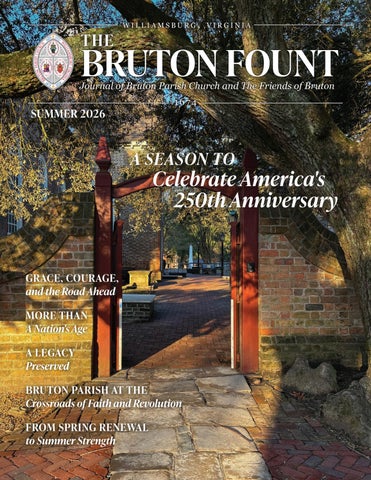
THE
WILLIAMSBURG, VIRGINIA
BRUTON FOUNT
Journal of Bruton Parish Church and The Friends of Bruton 1674
SUMMER 2026
A SEASON TO
Celebrate America's 250th Anniversary
GRACE, COURAGE, and the Road Ahead MORE THAN A Nation's Age A LEGACY Preserved BRUTON PARISH AT THE Crossroads of Faith and Revolution FROM SPRING RENEWAL to Summer Strength
CONTENTS
THE
3
Grace, Courage, and the Road Ahead t h e r e v . w i l l i a m j . wat s o n , i i i
Journal of Bruton Parish Church and The Friends of Bruton
4
A Season of Discernment diane r. howerton
Bruton Parish Church
5
Inside the Vestry: From Spring Renewal to Summer Strength b. michael smith
The Rev. William J. Watson, III Interim Rector
6 8
10
More Than a Nation's Age
t h e r e v . j o n a t h a n e va n s
Bruton Parish at the Crossroads of Faith and Revolution j o n at h a n l . s t o l z Revolutionary Patriots at Rest in Bruton Parish Churchyard—Part II
WILLIAMSBURG, VIRGINIA
BRUTON FOUNT 1674
Clergy
The Rev. Charles H. Bauer Associate Rector, Christian Formation The Rev. Lauren M. McDonald Associate Rector, Outreach & Women’s Ministries Vestry Members John Morgan, Senior Warden Randy Hobbs, Junior Warden
lianne johnson boller
Michael Smith, Register
14
Presidents in the Pews j o n at h a n l . s t o l z
Taylor Banks, Carlyle Campbell, Robyn Hansen, Kathy Harper, Ron Hurst, Anna Martin, Lori Forcucci Smith, Sue Saunders, and Larry Zensinger
17
Book Review: Margaret Guenther's The Practice of Prayer lori forcucci smith
18
A Legacy Preserved l e i t h m e r r o w m u l l ay a n d s u s a n wa r n e r
20
Caring for the Caregivers elizabeth w. welk
21
Annual & Planned Giving: Welcoming New Faces margaret m. driscoll
22
Children and Youth Formation: Growing Young Hearts in Faith meghan o. brewer
Friends of Bruton Committee Jonathan L. Stolz, Chairman Donald Bogus, Lianne Johnson Boller, Isabel Burch, Lynn Clark, Anne Conkling, Hilary Cooley, Catherine Stapleton, John Fogarty, James Morford, Rev. William J. Watson, III, and Larry Zensinger The Bruton Fount Editorial Board Jonathan L. Stolz, Editor Lianne Johnson Boller, Lynn Clark, Anne Conkling, Hilary Cooley, Margaret Driscoll, and Rev. William J. Watson, III the bruton fount email
23
Friends of Bruton: Sustaining Faith and History
BrutonFount@brutonparish.org
24
2026 Annual Gala and Silent Auction
Bruton Parish Church
25
Voices from the Pews
26
Special Events & Regular Worship Services
Williamsburg, Virginia, 23187-3520 phone 757-229-2891
fax (757) 221-0290
email BPC@brutonparish.org website www.brutonparish.org
Contents ©2026 by Bruton Parish Church. All rights reserved. Reproduction in whole or in part without written permission is prohibited. Design by Christina Hancock
2
GRACE, COURAGE, AND THE ROAD AHEAD Discerning God's Call Together in a Time of Transition
C
oming through a cold winter, as Lent concluded, I found myself enjoying the arrival of spring. I am always struck by the bright lime-green color of emerging leaves.
On Palm Sunday morning, before the 8 a.m. service, I was sitting in the chancel in prayer. As I looked up through the large south-facing windows, the sunlight was bright, striking the emerging maple seed pods and giving them an orange-yellow glow. For a moment, I thought, what a lovely tree in fall color. I sat in awe and wonder, then slowly refocused. I caught myself, realizing this was not fall at all—but spring. Here was an unexpected, disorienting vision: seeing the world in a new light. That, I think, is something of how the Spirit works. We encounter moments that stretch our imagination in new directions. In the midst of our daily routines, we are suddenly reminded of the divine in our midst.
At every turn, I see faithful disciples walking with grace and courage into the future to which Jesus leads us—finding ourselves, sometimes quite suddenly, in a vibrant new season filled with unexpected revelation. I am deeply grateful that the Spirit has brought us together on this sacred journey.
Bil
t h e r e v . w i l l i a m j . wat s o n , i i i interim rector
I am continually fascinated by the work of the Holy Spirit in our lives—opening us to new insights, new ways of seeing. In this interim season, we have been praying each Sunday for the work of the Search Committee. I have been especially struck by the wisdom of the Search Discernment Prayer, and one line in particular: “As we look to the future, grant us the grace and courage to imagine new directions and ways of being.” This beautifully captures this season at Bruton Parish. It is a time of transition, a time to reimagine who and what God is calling us to be. I sense the parish moving forward with purpose and excitement as we embrace these “new directions and ways of being.”
Grace, Courage, and the Road Ahead
s u m m e r 2026 || The Bruton Fount
3
A SEASON OF DISCERNMENT Prayer, Listening, and the Search for a New Rector
T
he Bruton Parish Search Committee was selected by the Vestry and commissioned on March 8, 2026. The members entrusted with the search for the next Rector of Bruton Parish are: Isabel Burch, Colly Burgwyn, Brian Hanlon, Diane Howerton (Chair), Alison Lennarz, Sara Meldrum, Evie Scally, Griff Steel, and Sue Warner.
To help answer these questions, we have completed an initial phase of information gathering. We have sought to hear from as many parishioners as possible through a variety of means. Beginning in April, Committee members met with fourteen ministry focus groups. A parish-wide gathering was held on May 9, and a comprehensive parish survey was conducted.
The Committee began meeting weekly before its “official” commissioning to learn about the search process and to determine the best ways to gather parish-wide input. Our work is guided by On the Road to Emmaus by the Rev. Dr. Mary Brennan Thorpe, together with the Episcopal Diocese’s Parish Transitions Manual.
The insights gained from these conversations and the survey will help us discern both the qualities we seek in a new rector and the gifts and strengths we already possess as a parish.
At the heart of our work is prayer. We seek God’s guidance and grace as we discern the call for a new rector. As a first step, the Committee prepared a Search Prayer, which is now included in the Prayers of the People. Our work centers on three essential questions: • Who have we been? • Who are we now? • Who is God calling us to be?
4
A Season of Discernment
Using what you have shared, we will prepare the Parish Profile over the summer, with the goal of submitting it to the Diocese by August. The Diocese will then post the position for the next Rector of Bruton Parish Church. We are deeply grateful for your participation in this important process. Thank you for your continued prayers and support as we move forward together in the search undertaking for a new rector. diane r. howerton
c h a i r , t h e bru ton pa r i s h search committee
FROM SPRING RENEWAL to Summer Strength The Vestry's Ongoing Mission and Initiatives
A
s the vivid colors of spring foliage give way to the steady shades of summer green, the Vestry of Bruton Parish continues its mission to guide the parish in bringing the Good News of Jesus Christ to the surrounding community.
pated in a foundational exercise—a scavenger hunt of sorts—that invited them to experience the Parish House with fresh eyes: as a visiting family searching for the nursery, as new college students looking for the Canterbury Room, or as parishioners with mobility challenges seeking the finance office. The insights gained from this exercise were illuminating.
The Vestry continues to benefit from the counsel and insight of the Rev. Bill Watson. With his guidance, several significant initiatives are underway and will be brought forward in the coming months.
As a result, the Vestry has begun taking steps to improve both hospitality and accessibility within the Parish House. In the coming months, renovations will create a more welcoming entrance to the parish offices, including improved signage, displays highlighting parish events, and exhibits of artwork by parishioners and local community members. In addition, a new position—Coordinator of Hospitality—will be established to ensure a warm and inviting presence for visitors, newcomers, and longtime members alike.
At the start of the year, the Vestry entered into a period of prayerful and thoughtful discernment—guided by the Holy Spirit—to call individuals to serve on a Rector Search Committee. That committee is now actively engaged in developing surveys and organizing focus groups, which will ultimately constitute a Parish Profile. The Vestry is also moving forward with plans to build a new playground for children in the Rectory yard. This space will offer a welcoming and joyful place for play, fellowship, and community life for our youth and their families. It also serves as a visible sign to both the parish and the wider Williamsburg community that Bruton Parish places a high value on young families, as well as those who may be seeking a church home. In addition, the Vestry has undertaken conversations and exercises to rethink and reprioritize the use of space within the Parish House, with the goal of making it both more efficient and more inviting. At the March Stated Meeting, members partici-
Inside the Vestry: From Spring Renewal to Summer Strength
While many changes are underway at Bruton Parish, your Vestry remains steadfast in its commitment to ensuring that these efforts serve the good of all and support our shared calling to bring the Kingdom of Heaven into the life of our community here and now. b. michael smith
r e g i s t e r , bru ton pa r i s h v e s t ry
s u m m e r 2026 || The Bruton Fount
5
MORE THAN A NATION'S AGE
An English Perspective on America at 250
250
years is a very long time in human terms, even for Methuselah, but how do we assess this measure of time in the life of a nation and a people? For many countries and peoples, 250 years is only a small segment of the story of their identity. Take Persia, Egypt or China, for example. These countries have a known cultural history which goes back many centuries and which, in various ways, still shapes their national identity today. I do not pretend to any authentic knowledge of the United States of America, whether as it is today or as it was at the time it gained its independence from what was then the British Empire. I am no historian, and I have only ever visited America as a tourist, and that only a few times, and only ever briefly. So, in offering these reflections and observations on modern-day America, on the 250th anniversary of Independence, I write from my own perspective (don’t we all?), as someone born in England who has lived his whole life in England. This is, therefore, an outsider’s perspective.
The story of America did not, of course, begin in 1776, any more than the story of Britain began with the invasion of the Angles in the 5th century. There is always the time before, and the people before. Without wishing to be too reductionist, if we truly seek the origins of any nation, any people, any place, we must begin with the impenetrable mystery of the moment of the original creative act of God, when from nothing something was born. This reminder of our shared common origin, when our proto-ancestors emerged from the primeval swamp in a somewhat less biologically advanced state of cellular complexity than we boast of today, perhaps acts as a useful corrective to our human tendency to frame and reinforce our identity—as individuals and as nations—by emphasizing the differences and distinctions between us. I know that I am English, and what it is to be English, because I am not (say) French. The USA is what it is because it is not [in-
6
More Than a Nation's Age
sert foreign country of your choice]. I am who I am because I am not like that Other person. You know the score here: we craft our identity, often in unhelpful ways, by contra-distinction, excluding other people from our tribal story. This may have delivered benefits as regards the survival of our tribe in times when life was even more brutal, ugly and short than it is today, but it is not a sound model for human flourishing under the gaze of a loving God, who is creator and sustainer of us all.
So, as we celebrate 250 years of the development of a most wonderful people and nation, we would be wise, I think, not to do so by emphasizing our differences—whether that is between the America of 1776 and the America of 2026, or between the independent USA and its former colonial ruler. There are, of course, many differences between then and now, and between you and us, whether they be considered in terms of politics, industry, sport, cuisine, music or religion. But me airing my views about the superiority of one as against the other, or how the USA has done things better or worse than England over the last 250 years, would tend only to feed the narrative of competition and social rivalry, which risks fanning the flames of conflict. And our purpose, as disciples of Christ, is not to promote conflict, but to promote peace. In these turbulent times, and notwithstanding the currently somewhat strained nature of US/ UK relations at a political level, I would therefore prefer to identify a few things which it seems to me we hold in common.
for the good of another is anything other than foolishness. If we make protection of the self and the enhancement of self-interest the touchstone of the moral purpose of life, then sacrificial love becomes not merely questionable, but irrational. Yet who are our heroes? It is not the rich, nor the garlanded champions. Rather, it is those who give of themselves for the benefit of others who are our true heroes. The person who puts the welfare of others before their own—that is what we celebrate and admire (or at least, it is if we are behaving at our best). For both nations, our ultimate moral good, surely, is sacrificial love.
St. Mary the Virgin Church in Bruton, Somerset, England
In both our countries, the notion of justice is central to our society. There is outrage when perceived injustice is laid bare, and there are loud demands for justice to be done when wrongdoing occurs. There are, of course, disputes and debates about what constitutes justice in any given situation. That is not only to be expected but to be welcomed, as it ensures that we constantly question and test our understanding of the requirements of true justice, hopefully thereby improving it. But the point is that justice is important in US culture and UK culture. It is something foundational, without which we would not be who we are. Both of us recognize and value the inalienable dignity of the human person. This is codified, usually imperfectly, in our ascription to each citizen of individual human rights. This is perhaps more contested terrain. As we look backwards in our shared history, we all too quickly come upon egregious failures to treat every human being with the innate dignity which is theirs by birth. Both our nations were complicit in chattel slavery. Both our nations used violent conquest to subjugate indigenous peoples. Both our nations have been slower than we should have been to recognize the equality of women. Looking forwards, we are not always sure about what should be recognized as a basic human right. Both our nations have some way to go on this front, but again, the important thing is that we accept the principle: every single human being is a person of equal value. And now I must break my self-imposed rule about not drawing comparisons, because it seems to me that people in the USA are, generally speaking, much better than we are in the UK at being generous. You have a strong culture of philanthropy. You are good at hospitality. We Brits have much to learn from you, and indeed from other nations, about generosity. But once again, we both regard generosity as a good thing and not as foolishness.
As most of the world knows, NASA recently completed the successful Artemis II mission to the moon—an astonishing technological achievement. Views about space programs differ. There are those who consider the exploration of space to be a vitally important scientific advancement, so that future generations may be able to continue human life elsewhere in the universe once our degradation of this planet, or its natural evolution, means that Earth is no longer inhabitable by humans. Others take the view that the vast amounts of money being expended on pushing further into space could be better spent ameliorating living conditions on this planet and finding long-term solutions to the problems of preventable disease and diminishing natural resources. But let us not set up another antagonistic duality. Instead, might we dare to hope that 250 years after this recent NASA mission our descendants might be looking back, as they publish another celebratory edition of The Bruton Fount, and identifying this as an example of the USA acting not in self-interest, but in the interests of our shared humanity? Could this be a time not for flag-planting imperialism or staking a claim to mineral rights in new territories, but for a recognition that our shared virtues of global justice, fundamental human dignity, generosity and self-sacrifice are more important and more enduring than the advancement of any individual nation or people? Let us travel hopefully into the next 250 years, together.
t h e r e v e r e n d j o n a t h a n e va n s r e c tor , s t . m a ry t h e v i rg i n c h u rc h bruton, somerset, england
Speaking of foolishness, a strictly applied code of rationalist materialism struggles to avoid the conclusion that self-sacrifice
s u m m e r 2026 || The Bruton Fount
7
BRUTON PARISH AT THE CROSSROADS OF FAITH AND REVOLUTION
Where Worship, Community, and the Birth of a Nation Converged
S
ince 1674, Bruton Parish Church has stood at the heart of Williamsburg. In its pews, at its doors, and along its pathways gathered the men and women who shaped Virginia’s journey from a royal colony to a state seeking independence. Few places so clearly reflect the interweaving of faith, civic life, and the birth of a nation. The story of Bruton Parish is inseparable from the story of America’s beginnings. In colonial Williamsburg, government, education, and religion were closely linked. Bruton Parish Church stood only steps from the Capitol and the Governor’s Palace, placing it at the center of daily life in the capital. Leaders, students, merchants, and travelers crossed its threshold, making the parish a natural meeting place for conversation and community during a time of growing political uncertainty. As the official church of the Colony of Virginia, Bruton Parish’s role extended far beyond weekly worship. Attendance was expected of all, drawing together people from every level of society. Services, vestry meetings, and parish gatherings provided opportunities for neighbors and leaders alike to share news, exchange ideas, and respond collectively to events unfolding across the colonies. In this way, faith and public life were shaped side by side within the parish walls. Because Williamsburg was the capital, the church became an integral part of the colony’s political world. Members of the General Assembly and the Governor’s Council occupied pews built with public funds, a visible reminder
8
of the close connection between church and government. Many officials attended worship before beginning their work at the Capitol, and conversations often continued along the churchyard paths. In this shared space, local concerns and imperial policies were discussed long before they reached the floor of any assembly. Many of the leaders who guided colonial Virginia toward independence worshiped at Bruton Parish Church. George Washington, Thomas Jefferson, Patrick Henry, and George Mason all attended services there while carrying out their duties in Williamsburg. Inside the church and beyond its doors, these figures encountered one another regularly. Their exchanges contributed to a growing climate of ideas about liberty, rights, and the future of the colonies—ideas that would soon take center stage in America’s struggle for independence. As tensions with Great Britain intensified, Bruton Parish became a place where the community gathered to confront troubling news. In 1774, after the Boston Port Act closed Boston Harbor, Virginians observed a day of fasting and prayer at Bruton, seeking guidance and unity. Two years later, on May 15, 1776, when Virginia voted to support independence, the Tarpley bell rang out in celebration. Remembered as the moment the “Liberty Bell of Virginia” declared the colony’s new course, its sound marked a turning point in both civic and spiritual life. Through these pivotal years, Bruton Parish Church served not only as a house of worship but also as a place where Virginians wrestled with the meaning of freedom
Bruton Parish at the Crossroads of Faith and Revolution
The page from Bruton’s 1752 Book of Common Prayer where the prayer for the Congress of the United States is substituted for the prayer for Britain's Parliament and King.
and the responsibilities of forming a new nation. This transformation is poignantly reflected in Bruton’s 1752 Book of Common Prayer, in which the prayer for Britain’s Parliament and king was replaced with a prayer for the Congress of the United States. The change underscored the profound cost of the American Revolution: it meant leaving behind not only British rule, but also long-standing ties to the Church of England. Today, Bruton Parish Church stands as a witness to that extraordinary moment when faith and history converged. Its walls remind us that the quest for independence was not only a political struggle, but also a spiritual journey—one shaped by prayer, community, and a shared hope for a future guided by both conscience and conviction.
j o n at h a n l . s t o l z References: George Carrington Mason, “Historic Parishes of America: Bruton Parish,” Historical Magazine of the Protestant Episcopal Church 14, no. 4 (1945) Parke S. Rouse, Jr., Bruton Parish Church – A Concise History (Williamsburg: privately printed by Bruton Parish Church, 1967) Diana L. Bailey, The Bruton Parish Story (Brookfield, MO: The Donning Company Publishers, 2020) William A. R. Goodwin, Bruton Parish Church – Restored and Its Historic Environment (Petersburg, VA: The Franklin Press, 1907)
s u m m e r 2026 || The Bruton Fount
9
Revolutionary Patriots at Rest IN BRUTON PARISH CHURCHYARD Part II: David Meade Randolph, Hon. James Blair II, and Edmund Pendleton
I
n the second installment of this two-part series, the exploration of the Revolutionary patriots buried at Bruton Parish Church continues. Within its historic churchyard and church lie the graves of three remarkable 18th century Virginians whose service— military, judicial, and legislative—helped shape the young nation. The tombs with their epitaphs are readily visible today, testifying to lives devoted to liberty, law, and public duty.
David Meade Randolph David Meade Randolph was born on March 14, 1759, in Chesterfield County, Virginia. He served as a cavalry officer in the Revolutionary War and was remembered decades later for his contributions in “both person and purse to the promotion of our Revolution. “In 1782 Randolph married his cousin, Mary Randolph, the sister of Thomas Jefferson’s son-in-law, Thomas Mann Randolph. The couple settled at Randolph’s James River plantation, Presqu’ile. Randolph proved to be an outstanding farmer and a noted inventor, developing equipment for boot-making, candle-making, and shipbuilding.
ended their estrangement when Randolph testified on Jefferson’s behalf in a legal case. Randolph died at Stony Point, near Yorktown, on September 22, 1830, at the home of his son Richard (d. 1859). Richard may have arranged for his father’s burial
At Jefferson’s recommendation, George Washington appointed Randolph as Virginia’s marshal in 1791. By 1798 the couple had moved to their Richmond home, Moldavia. Though David and Mary often visited Monticello, Randolph was an outspoken Federalist and a vocal critic of Jefferson and the Democratic-Republican Party. Shortly after Jefferson became president in 1801, he removed Randolph from office, citing suspicions that he had packed a jury with Federalists. The loss of his position forced Randolph to sell much of his property. Hoping to restore the family’s fortunes, he became a partner in a coal mine and sought patents for several inventions. By 1808 he was living in England in search of investors for his ideas, while his wife managed a boardinghouse in Richmond. Randolph returned to Richmond by 1815, and in 1823 he and Jefferson finally
10
i m a g e : “ d av i d m e a d e r a n d o l p h ”, d r a w i n g & e n g r av i n g b y c h a r l e s b . j . f é v r e t d e s a i n t - m é m i , 18 0 7 , n at i o n a l g a l l e r y o f a r t , wa s h i n g t o n , d c
Revolutionary Patriots at Rest in Bruton Parish Churchyard
he represented the College of William & Mary, and he soon became clerk of the Governor’s Council. As tensions between Great Britain and the American colonies intensified, Blair resigned from the Council to help draft the non-importation agreements protesting British taxation. He also assisted in drafting Virginia’s Constitution of 1776 and served on the committee that approved the Virginia Declaration of Rights. In 1778 the Virginia legislature appointed Blair to the General Court. His rise in the judiciary was swift: he became chief justice of the General Court in 1779, chancellor of the High Court of Chancery by the end of 1780, and later a member of the Virginia Court of Appeals. In 1786 the legislature appointed him to succeed Thomas Jefferson on a committee established to revise Virginia’s statutes. The following year he served as a delegate to the federal Constitutional Convention.
i m a g e : “ j o h n b l a i r , j r . , au g u s t 30, 1779- c i r c a s e p t e m b e r 3 0 , 1 7 8 9 ”, o i l o n c a n v a s , 2 9 x 2 3 i n , b y r o b b i e l . n u r n b e r g e r , 19 6 3 . v i r g i n i a a p p e l l at e cou rt ro om foy e r
in Bruton churchyard, as the Episcopal church in Yorktown burned in 1814 and was not rebuilt until 1845 (later renamed Grace Episcopal Church). Randolph’s ledger grave lies outside the northeast corner of Bruton Church’s 1683 boundary. Hon. John Blair II Hon. John Blair II was a Virginian with deep Williamsburg roots. His great-uncle, James Blair, founded the College of William & Mary and served as its first president, as well as rector of Bruton Parish Church. Blair’s father, John Blair, served as president of the Governor’s Council and acted as governor of Virginia four times. Blair was educated at William & Mary, graduating with honors in 1754. He went on to study law at London’s Middle Temple, earning his degree in 1756. His early career included a seat in the House of Burgesses, where
In September 1789, when President George Washington nominated Blair to serve on the first United States Supreme Court, the Senate confirmed him in just two days. Blair’s tenure on the Court was relatively brief. A few years after his appointment, his health began to decline, and he feared he could no longer serve effectively. He resigned on October 25, 1795. Nevertheless, his judicial work helped establish enduring principles of constitutional interpretation, separation of powers, and judicial review. Blair died on August 31, 1800, at the age of sixty-eight years and ten months. He is buried in the churchyard on the east-northeast side of the church beside his wife Jane, two of their children, and three grandchildren. Edmund Pendleton Edmund Pendleton was one of the most accomplished attorneys in Virginia during the American Revolution and a sterling example of public service to a fledgling nation. Born on September 9, 1721, in Caroline County, Virginia, Pendleton was orphaned at a young age. He received little formal education but grew up as the ward of the county clerk. In the clerk’s office he studied law and gained introductions to many wealthy and influential Virginians. He was admitted to the bar in 1741 and became a justice of the peace in 1751. The following year he was elected to the House of Burgesses, where he served until the House was dissolved. Before the Revolution, Pendleton was politically conservative, like many wealthy Tidewater planters. In 1773 he was chosen to serve on Virginia’s Committee of Correspondence, which coordinated intercolonial resistance to British policies. The follow-
s u m m e r 2026 || The Bruton Fount
11
ing year he represented the colony at the First Continental Congress. Pendleton frequently clashed with Patrick Henry—whom he regarded as a demagogue—over Henry’s radical opposition to the Stamp Act and other contentious measures. Yet Pendleton himself charged that Parliament had exceeded its authority, and he soon emerged as a leading patriot voice. During the Second Continental Congress, Pendleton also served as president of the Virginia Committee of Safety, making him the most powerful man in Virginia during much of 1775. He later presided over the Fourth and Fifth Virginia Conventions and helped draft several important resolutions, including one instructing Virginia’s congressional delegates to introduce a motion for independence. In 1776 he became the first speaker of Virginia’s newly created House of Delegates and played a significant role in organizing the state’s judiciary. He later assisted in revising Virginia’s laws and in drafting the state’s first constitution. In March 1777 Pendleton suffered a life-altering injury when he fell from his horse and dislocated his hip. The accident left him permanently crippled, but he continued his public service with the aid of crutches. When the Court of Chancery was established in 1778, Pendleton was appointed a judge and the following year was elected president (chief judge) of the court. After the Revolution, Pendleton presided over Virginia’s Ratifying Convention in 1788 and strongly supported adoption of the new federal Constitution. A self-made man, he declared: “I am an advocate for fixing our Government on true republican principles, giving to the poor man free liberty in his person and property. Whether a man be great or small he is equally dear to me.” Pendleton later declined several
12
i m a g e : “ j u d g e e d m u n d p e n d l e t o n ,” e t c h i n g , b y h . b . h a l l , m o r r i s a n i a , n y , h t t p : // c o m m o n s . w i k i m e d i a . o r g /
national appointments offered by his longtime friend George Washington and spent his final years at his Virginia estate. How did Pendleton come to be buried at Bruton Church? After his death in 1803, he was originally interred at his Caroline County plantation, Edmundsbury. Over time the gravesite became overgrown. On July 16, 1907, his descendants petitioned the Bruton vestry to move his remains—along with those of his first wife, Elizabeth Roy; his second wife, Sarah Pollard; and a newborn son—to Williamsburg, the center of Pendleton’s public life. The reinterment took place on September 23, 1907. Today
Revolutionary Patriots at Rest in Bruton Parish Churchyard
his ledger stone lies in the north transept of the church, to the left of the Roosevelt lectern. Together, Randolph, Blair, and Pendleton represent three distinct yet complementary strands of Revolutionary leadership. Their graves are more than memorials; they are enduring witnesses to sacrifice, intellect, and conviction. As this two-part series concludes, the churchyard and sanctuary stand not only as sacred ground but also as a testament to the courage and character of the generation that secured American liberty. lianne johnson boller
References: “David M. Randolph to Thomas Jefferson, 17 October 1815,” Founders Online, National Archives, https://founders.archives.gov/documents/Jefferson/03-09-02-0076 Raleigh Weekly Register, Oct. 7, 1830 Rowe, Linda, former Colonial Williamsburg historian Fernandez, Mark F. “John Blair (1731–1800),” Dictionary of Virginia Biography, Library of Virginia (1998– ), published 1998 Armstrong, Walter P. “Edmund Pendleton: The Conservative of the Revolution.” American Bar Association Journal 39, no. 7 (1953): 544–615 “Edmund Pendleton, United States Politician and Military Leader.” Britannica, https://www.britannica.com/biography/Edmund-Pendleton “Edmund Pendleton, Member of the Virginia House of Burgesses.” USHistory.org, https://www.ushistory.org/declaration/related/pendleton. html?srsltid=AfmBOorfIvLZVLuw4BtgyYkIOC2iW4qdM5egVGSZY2t4exV4lbJxN1iR “Edmund Pendleton.” On-Line Classroom, Shaping the Constitution, Education @ The Library of Virginia https://www.lva.virginia.gov/collections/educator-resources/ online-classroom/stc/people/edmund-pendleton-(1721-1803) “Edmund Pendleton.” Virginia Museum of History and Culture, https://virginiahistory. org/learn/edmund-pendleton MsV6: Vestry Minutes, #158, 1889–1913, Bruton Parish Church (Williamsburg, Va.) Records (01/Mss. 91 B38), Series 1: Administrative Records, Manuscript Volume Records, id18779, vol. 45:437, 439, Swem Library Special Collections Research Center, College of William & Mary, Williamsburg, VA. Pendleton, Caroline “Edmund Pendleton Epitaph.” Bruton Parish Church, Williamsburg, VA (1907) Rouse, Parke “Pendleton: A Forgotten Revolutionary.” https://www.dailypress. com/1993/09/19/pendleton-a-forgotten-revolutionary/ Strother, David H. "Edmund Pendleton of Virginia.” The Pennsylvania Magazine of History and Biography 3, no. 2 (1879): 177–79. http://www.jstor.org/ stable/20084396
s u m m e r 2026 || The Bruton Fount
13
PRESIDENTS in the PEWS The Remarkable Legacy of Bruton Parish Church
F
ew American churches outside Washington, D.C., and the nation’s early capital in Philadelphia can claim as many connections with Founding Fathers and other presidents as Bruton Parish Church. Over its long history, nearly a quarter of men who would become, or already were, Commanders in Chief have passed through the doors of this historic Williamsburg sanctuary.
In the 18th and 19th centuries, Bruton Parish counted among its congregants five future U.S. presidents: George Washington, Thomas Jefferson, James Madison, James Monroe, and John Tyler. George and Martha Washington Before marrying George Washington, Martha Dandridge Custis had strong family ties to Bruton Parish Church through her first husband, Daniel Parke Custis. They married in 1750, when Martha was eighteen and Daniel thirty-eight, both descended from families involved in Bruton’s founding. Daniel’s father, John Custis IV, was a prominent Williamsburg figure active in colonial government and the Bruton vestry. Martha’s great-grandfather, Reverend Rowland Jones, was Bruton’s first rector in 1674. After Daniel’s death in 1757, Martha was widowed with two surviving children. She remained a widow for only a year and a half. On January 6, 1759, she married Colonel George Washington. The couple spent part of their early marriage in Williamsburg, where Washington visited at least fifty-five times between 1752 and 1774. With a strong spiritual heritage of churchmen including a great-great-grandfather who was a minister in the Church of England,
14
Presidents in the Pews
Washington’s presence in Bruton Parish Church during those many stays would not be unusual. While there is testimony to his attendance at many churches later in life, only one direct personal reference for participating at a Bruton service exists. On June 1, 1774, Washington recorded attending church and fasting in response to a colony-wide day of prayer protesting the closing of Boston’s port. A brief entry in his diary: “June 1st, Wednesday, - went to church, and fasted all day.” Thomas and Martha Jefferson Unlike George Washington, Thomas Jefferson was among the most forceful of the Founders on the subject of religion, though he rejected key doctrines of the Church of England in which he was raised. He regularly attended services and participated in responses and prayers in many different places of worship including Bruton Parish. Jefferson entered William and Mary in 1760 at age seventeen. The school had a very close connection with Bruton prior to the American Revolution. Students were required to attend Sunday services, where they were seated together in a locked gallery— many famously carving their names there. After completing his studies, Jefferson remained in Williamsburg to study law under George Wythe and frequently returned for sessions of the House of Burgesses. As it was an obligation at the time for legislators to attend church, he would have worshiped at Bruton when the group convened. He married Martha Wayles Skelton in 1772. During legislative sessions, she joined him in Williamsburg, likely participating in Bruton’s social and worship life, though no records confirm this. Of their six children, only their eldest daughter, Martha “Patsy,” survived into adulthood. Martha Jefferson died in 1782, leaving Jefferson in a deep depression. James Madison James Madison’s presence at Bruton Parish was rare compared with Jefferson, in large part because Madison matriculated at the College of New Jersey (now Princeton) rather than William
and Mary. He first came to Williamsburg in 1776 as a 25-yearold new member of the House of Burgess where he met Jefferson—it sparked a lifelong friendship. During legislative sessions, Madison likely attended Bruton with fellow delegates as was the established protocol. After the Revolution, Madison associated with the Episcopal Church, the American successor to the Church of England. He was married to Dolley by an Episcopal priest, regularly participated in Episcopal services when president and the Episcopal liturgy marked his funeral. Yet, Madison never made a public profession of faith or became a full communicant in the church. James Monroe Bruton Parish Church and the Episcopal denomination was important to James Monroe throughout his life. At sixteen, he enrolled at the College of William and Mary, where students attended daily prayers in the college chapel and Sunday services at Bruton Parish. Though Monroe remained an active Episcopalian throughout his life, scholars note he may have held deistic leanings, prioritizing civic virtue over strict religious observance. John Tyler John Tyler, born in 1790, came from a distinguished Episcopalian family with deep English roots in Williamsburg. Early ancestors served on the Bruton vestry, reflecting long-standing family ties. At age 12, Tyler entered the preparatory department of William and Mary, where his father had graduated and roomed with Thomas Jefferson. As a student, young John Tyler regularly attended service at Bruton. He continued to identify with the Episcopal Church throughout his life, though he was not known to attend regularly.
While at William & Mary, Thomas Jefferson and his classmates were compelled to attend Bruton on Sundays. i m a g e : w h i t e h o u s e h i s t o r i c a l a s s o c i at i o n
Twentieth-Century Presidential Visits Following its decline as Virginia’s “court church,” Bruton became a modest local chapel. From 1840 to 1910, no U.S. presidents visited as the building fell into disrepair. Restoration efforts in the early twentieth century, led by Rector W.A.R. Goodwin, revived the church and Williamsburg, renewing its historical prominence. President William Howard Taft on November 22, 1910, became the first sitting president to visit Bruton, stopping briefly while traveling by train from Fort Monroe to Richmond. He came expressly to see the historic church to which his predecessor Theodore Roosevelt presented a lectern, from which he made a short address. President Woodrow Wilson made a surprise Sunday visit on May 14, 1916, stopping in Williamsburg during a cruise up the James River. He spent thirty minutes touring the church before continuing to William and Mary.
James Monroe attended Bruton while at William & Mary and was an active Episcopalian throughout his 73 years. i m a g e : n at i o n a l p o r t r a i t g a l l e r y
s u m m e r 2026 || The Bruton Fount
15
President Franklin D. Roosevelt and First Lady Eleanor Roosevelt attended a service on July 5, 1936, after arriving by the presidential yacht Potomac in Jamestown and then by car to Bruton. Reverend Goodwin delivered the sermon. Future President Dwight D. Eisenhower on March 8, 1946, was escorting Winston Churchill around Colonial Williamsburg in a landau when flashbulbs frightened the horses nearly causing an accident. Unhurt and out of the carriage, they retreated to nearby Bruton for a few moments of sanctuary before continuing the tour—this time in a car. President Lyndon B. Johnson and Lady Bird Johnson attended a service on November 12, 1967. He was displeased when the rector, Reverend Cotesworth Lewis, addressed the Vietnam War; the vestry later issued an apology. President Ronald Reagan and foreign leaders, on May 29,1983, attended Bruton during an economic summit, hearing a restrained sermon from Reverend Lewis that focused on peace.
In 1936 President Franklin D, Roosevelt attended services at Bruton. Here he is with his aid and Rev. W.A.R. Goodwin. i m a g e : c o l o n i a l w i l l i a m s b u r g f o u n d at i o n
Bruton Parish Church stands as a living testament to the entwined history of faith and leadership in America. From the earliest presidents of the Republic to modern occupants of the White House, its walls have witnessed moments of devotion, reflection, and national significance. As both a spiritual sanctuary and historical landmark, Bruton continues to connect Americans to the faith, heritage, and civic values of their forebears. j o n at h a n l . s t o l z
Source: Portions of this story where reprinted—with permission—from an article by the author: Jonathan L. Stolz, “Bruton Parish and the Presidents,” White House History Journal, no.81, White House Historical Association (2026).
16
Presidents in the Pews
book review
Margaret Guenther's The Practice of Prayer
Exploring Conversation, Silence, and Spiritual Growth
H
ow many of us would love to have a realtime conversation with God? If only there were a 1-800 number to call—an angelic voice assuring us, “There are three calls ahead of you. Your waiting time is fifteen minutes. If you wish to leave a callback number, God will return your call in the order in which it was received.” Is prayer the low-tech version of such a phone call? And does the way we pray really make a difference? The Rev. Margaret Guenther, an Episcopal priest and author of The Practice of Prayer, would answer with a resounding yes. “The practice of prayer is the work of a lifetime, touching every aspect of our life. . . . You are how you pray. How we practice our prayer makes a difference in who we are and what we become” (p. 5). We might take her insight a step further: Does the way we pray also influence how we perceive God? Guenther draws an important distinction between knowing about God and knowing God. “There are many resources for learning about God; there are books, courses, and study groups on scripture, theology, and history. But to know the unknowable God is the impossible yet irresistible undertaking of a lifetime” (p. 18). As a retired professor of ascetical theology—the study of spiritual disciplines that foster growth and maturity—Guenther chooses the word practice with care. “‘Practice’ is a reassuringly downto-earth word. We practice because we are not yet perfect, because we know that we have much to learn. To be fruitful, practice must be faithfully sustained over a long period” (p. 3). Part One of The Practice of Prayer, titled Spirituality and Prayer, explores themes such as Prayer as Conversation, Varieties of Prayer, Prayer Through the Centuries, and Practices
of Prayer. Part Two, Praying in the Midst of Life, turns to everyday realities: Finding God in the Ordinary, Prayer and Parenting, Learning Simplicity, Praying Through Desolation, and Praying in Community. Though the book resists easy summarization, its opening section provides a compelling entry point. In “Prayer as Conversation,” Guenther likens a good conversation to a dance, with each partner attentive and responsive to the other (p. 20). Our role in this dance, she suggests, is not merely to speak but to listen. True listening requires quieting the inner noise that so often drowns out God’s voice. Recalling her own experience of solitude and silence, she writes: “This kind of listening invites us to pray boldly, to accept new images of God and find our own language. . . .God is multilingual and does not always use the language we are used to hearing. And God’s word to us can be surprising and unexpected, if we are willing to listen” (p. 27). If you desire to deepen your prayer life and discover how faithful, attentive practice can shape both who you are and how you encounter God, read Rev. Guenther’s book. It is available at the Hennage Memorial Library at Bruton Parish.
lori forcucci smith
Recommend a Book You Like Have you recently read a book you think readers of The Fount may enjoy? We invite you to share your suggestion in a short review to inform and inspire fellow parishioners. Please send your blurb to the Editor at BrutonFount@brutonparish.org. Thank You!
Book Review: Margaret Guenther's The Practice of Prayer
s u m m e r 2026 || The Bruton Fount
17
A Legacy Preserved Bruton Parish Church's 350th Anniversary Time Capsule Sealed for Future Generations
I
n 2024, Bruton Parish Church commemorated 350 years of faithful worship and service to our Lord. This milestone year featured a rich array of programs reflecting the depth of Bruton’s history. Distinguished speakers explored topics including the parish’s support of Native American education, its role in the history of slavery, its service as a hospital during the Civil War, and its enduring relationship with William and Mary.
The year also included many joyful celebrations. It began with a Eucharist using the 1662 Book of Common Prayer, with parishioners in colonial attire, followed by fellowship and a colonial-inspired meal. Other highlights included a lively “Sunday Sundae” for all ages, a festive Ministry Fair, and a special Friends of Bruton Day co-sponsored by the 350th Committee.
The term “time capsule” is a relatively modern invention. It was coined by the Westinghouse Electric Corporation in connection with their exhibit at the 1939 New York World’s Fair. Seeking a name that captured the idea of preserving everyday life for the future, they chose “time capsule” to suggest a sealed container carrying the present forward through time—much like a capsule in medicine encloses and protects what is inside. The phrase quickly entered common use, and today it describes any collection of items intentionally preserved for future generations. Bruton Parish’s Time Capsule stands within this tradition, carrying the story of today’s faith and community into the years ahead.
18
A Legacy Preserved
The Vision of a Time Capsule The anniversary year was planned by a 350th Steering Committee appointed by the rector. Early in the 18-month planning process, Bruton Organist JanEl Will proposed creating a Time Capsule to preserve the spirit of the year. The idea was warmly embraced.
Catherine Freemon Stapleton, serving as Canterbury representative on the 350th Committee, led the project in collaboration with archivists from William and Mary to ensure the careful preservation of materials. A list of committee members is included within the capsule itself. Capturing the Life of the Parish The Time Capsule contains a rich and varied collection of materials that reflect the vibrancy of parish life. Photo collages document key moments such as the opening 1662 Prayer Book service, the Youth Mission Trip, the Ministry Fair, the Fall Festival, the Advent Wreath workshop, the geothermal HVAC groundbreaking, and Friends of Bruton Day.
Documents include issues of The Bruton Fount, the Newcomer Reception invitation, the Annual Meeting brochure, the 350th Anniversary Hymn, and the program from the commemorative concert with First Baptist Church of Williamsburg (est. 1776), one of the oldest Black churches in the nation. Artifacts add a tangible dimension to the collection, including an engraved pewter Jefferson Cup presented to guest speakers and bells used by the Children’s Choir.
Ministries in Action The capsule also preserves reports from many of Bruton’s ministries, some accompanied by photographs. These include Bruton Builders, the Children’s Choir, the Altar Guild, the Gift Shop & Heritage Center, and the Mission & Outreach Committee’s 2024 grants. The Christmas “Care Closet” project, supporting local schoolchildren and teens, is also included. Sealed for the Future The Steering Committee determined that the Time Capsule will be opened in 2074. Catherine Stapleton, along with the committee’s two youngest members—Jackson Banks (9th grade) and Charlotte Fitton (12th grade)—hope to be present for that future celebration.
left to right Leith Mullay, Catherine Stapleton and Susan Warner
The capsule itself is a handcrafted wooden box created by Bob Morrison, Chair of Bruton Builders. It was sealed on February 5, 2026, and placed in a protected location within the church. On February 15, 2026, the Rev. William Watson, Interim Rector, blessed the Time Capsule and placed it beneath the pulpit. A brass plaque now marks its location for generations to come. It is our hope that those who open this capsule in 2074 glimpse not only who we were, but the faith that sustained us. And may they give thanks, as we do, for God’s enduring presence across every generation. l e i t h m e r r o w m u l l ay and s u s a n wa r n e r
Bob Morrison handcrafted the Wooden box
s u m m e r 2026 || The Bruton Fount
19
Caring for the Caregivers At Bruton Parish, a new support ministry offers connection, guidance and faith for those caring for loved ones.
“Y
ou don’t need to take on all the problems of others,” was the first response offered when the idea of beginning a caregivers’ support group at Bruton Parish was raised. The comment held truth, yet it also revealed a common misunderstanding about what such a group provides. A support group is not about carrying everyone’s burdens alone—it is about sharing them within a community.
The need for connection within the parish community of faith remained clear. After prayerful reflection and conversations with clergy, the vision for a caregivers’ support group quickly received strong affirmation. The “Bruton Parish Caregivers Support Group” began meeting in October 2025 and continues to gather on the last Wednesday of each month from noon to 1:00 p.m. in the Parish House’s “Coffee, Tea, and Thee” room. The gathering offers a space for those caring for someone with a chronic illness to come together and talk openly about concerns and challenges. Members support loved ones and family members living with cancer, Alzheimer’s, Parkinson’s, dementia, and other long-term conditions. The group provides a safe and confidential environment where emotions can be expressed, practical advice shared, and encouragement offered. Participants listen, learn from one another, and remind each other that caregiving need not be a solitary journey. As a retired licensed professional counselor, I help facilitate the gathering alongside John Fogarty, a trained Stephen Minister, and the Rev. Lauren McDonald. Community speakers have also
joined the fold to share local resources available in Williamsburg, and volunteers periodically discuss services that can assist families navigating caregiving responsibilities. Meetings often explore practical and emotional aspects of caregiving: balancing care for oneself and for a loved one, finding helpful shortcuts in daily routines, remaining flexible as needs change, planning for the future, and identifying opportunities for respite. Conversations include safety tips, life skills, and homemaking strategies that can make everyday tasks more manageable. Currently, 27 individuals are on the roster, with about 15 attending each month. Participants join as they are able, offering and receiving support in ways that fit their schedules and needs. Some members choose to stay connected between meetings, extending the circle of care beyond the monthly gathering.
Carry each other’s burdens, and in this way, you will fulfill the law of Christ —Galatians 6:2 What makes this ministry distinctive is the foundation of faith on which it rests. Participants come from different churches, denominations, and synagogues, yet the shared strength of faith binds the community together. Each person’s caregiving journey is unique, with its own concerns and challenges, but within this group there is a shared commitment to compassion and presence. In that spirit, the caregivers’ support group seeks to embody faith in action—serving as hands, feet, and voice for one another, and holding each other in love along the way.
elizabeth w. welk s u p p o r t g r o u p f a c i l i tat o r
20
Caring for the Caregivers
annual and planned giving
Welcoming New Faces The Gift of Newcomers in Parish Life
I
n my role as Director of Stewardship and Newcomer Engagement, I have the distinct pleasure of helping to welcome many newcomers to our parish each year. It is one of the most enjoyable parts of my position.
Every newcomer who walks through our doors brings a unique story and fresh perspective. Some are new to Williamsburg, some are exploring church for the first time in a while, and others are simply looking for a place to belong. No matter what brings them here, their presence strengthens our parish in meaningful and practical ways. Newcomers often see things with fresh eyes. Their questions and observations help us grow and ensure that we are creating an environment that is accessible and inviting to everyone. They also bring new energy. As they begin to get involved, attending services and events, volunteering, and joining small groups, they add to the life of the parish. Over time, many become leaders, volunteers, and active participants who help sustain and shape our parish. Welcoming newcomers is not just about a first impression; it is about building connections. A simple conversation, an introduction, or an invitation to join a
Annual and Planned Giving: Welcoming New Faces
ministry can make a meaningful difference in whether someone feels comfortable returning. These small, everyday interactions are what turn a first visit into a sense of belonging. From a stewardship perspective, newcomer engagement is essential to the long-term health of the parish. When people feel connected, they are more likely to share their time, skills, and resources. More importantly, they become part of a community of relationships that supports and enriches everyone involved. Bruton is a welcoming place; I hear this many times from our newer members. So, I thank you. Thank you for your warm greetings to new faces in the pews on Sundays, thank you for your willingness to reach out, and for the care you show for our parish family. margaret m. driscoll director of development and newcomer engagement
s u m m e r 2026 || The Bruton Fount
21
children and youth formation
Growing Young Hearts in Faith
Summer Reflection and Autumn Renewal in Children and Youth Ministry
A
s another program year of Bruton’s children and youth activities comes to a close, we are reminded of the importance of practicing mindfulness. Taking even a few minutes each day to be fully present—attending to what we see, hear, and feel—can restore a sense of peace that is often lost in the blur of busy and overscheduled lives.
This week of learning and fellowship remains a cornerstone of our shared ministry. Throughout the warm weather, many functions continue: Children’s Church on Sunday mornings, nursery care, youth gatherings, and preparations for the upcoming fall season. Our youth also contribute by assisting with the annual book sale, demonstrating their commitment to service within the parish.
Summer offers a sacred invitation to slow down. It is a time to step away from constant digital connection, reduce reliance on social media and technology, and rediscover the presence of God. Whether through swimming, hiking, biking, or quiet reflection, we can cultivate stillness and deepen our awareness of the Lord’s nearness. Summer also brings joyful anticipation and opportunities for connection within our life at Bruton Parish. In July, the rectory backyard will welcome a new playground, open to all parishioners. Alongside the playground, benches and picnic tables will provide spaces for prayer, reading, and fellowship across generations. We look forward to celebrating this addition with a summer ice cream social and ribbon-cutting, marking a place that will serve our community for years to come. Also in July, our youth will travel to Asheville, North Carolina, partnering with the Asheville Youth Mission to assist in rebuilding efforts following the devastation caused by Hurricane Helene. This mission offers an opportunity to serve others while growing in faith and compassion. In early August, the parish hall will come alive with Vacation Bible School, welcoming children, youth, and volunteers from our parish and our sister churches, Hickory Neck and St. Martin’s.
22
St. Mary's Chapel in the Parish House hosts the regular Children's Church service on Sundays
Children and Youth Formation: Growing Young Hearts in Faith
In September full programming resumes, including Children’s Church, Sunday School, choir, and acolyte teams. We will gather for a family ministry cookout by the new playground, celebrating both community and the start of a new season. The Parish’s outreach efforts, including support for local schools through the care closet program, will also return with renewed energy. October will bring the beloved traditions of the Blessing of the Animals, the Fall Fellowship Festival, and opportunities for local mission work. Plans for the upcoming holiday months will also be under way, including the Thanksgiving Feast, Advent activities, St. Nicholas’s visit, and the Christmas pageant. In Summer and all season, there are a range of possibilities to participate in the activities of Bruton’s children and youth ministry. Each act of engagement, no matter how small, helps nurture the faith of the young hearts in our care and strengthens the bonds of our parish community. meghan o. brewer c o o r d i n at o r o f c h i l d r e n a n d y o u t h f o r m at i o n
Sustaining Faith and History F
or more than a decade, the Friends of Bruton has united people in Williamsburg and beyond who value the rich history and spiritual legacy of Bruton Parish Church. You are warmly invited to join this effort through the Cornerstone Circle and show your commitment to Bruton’s heritage, faith, and community.
To become a member, please send a check for $100 or more per person (with Cornerstone in the memo line) to: Bruton Parish Church P.O. Box 3520 Williamsburg, Virginia 23187
Save the Date Invitation Coming Soon Friends of Bruton Day Luncheon Williamsburg Inn—Regency Room Saturday, September 26, 2026, 11:30 am–2:00 pm Program: “Founding Fathers’ Personal Faith and Religion”
Friends of Bruton: Sustaining Faith and History
s u m m e r 2026 || The Bruton Fount
23
2026 Annual Gala and Silent Auction Christopher Wren Building—William & Mary
24
2026 Annual Gala and Silent Auction
Voices from the Pews Your Feedback is Needed This issue marks the third printed edition of The Bruton Fount, first introduced in Fall 2025. We invite your feedback on whether it has been a useful communication tool for the church. • Have you found the Fount enjoyable and informative to read? • What content or features have you found most meaningful? • In what ways could future issues be improved? Please send your comments to: BrutonFount@brutonparish.org. Thank You! The Bruton Fount Editorial Board
Voices from the Pews
s u m m e r 2026 || The Bruton Fount
25
REGULAR WOR S H I P S E RV IC E S U N DAY 8:00am
Holy Eucharist, Rite I
9:15 am
Children’s Church (St. Mary’s Chapel)
9:15 am
Holy Eucharist, Rite II*
11:15am
Holy Eucharist, Rite II
5:30pm
Holy Eucharist, Rite II (held when W&M is in session)
W E DN E S DAY 11:00am
Holy Eucharist, Rite II
S PE C I A L E V E N TS J U LY 4 The Sons of the Republic Independence Day Service of Prayer and Thanksgiving at 10:00am 5, 12 Sunday Worship at 8:00am, 9:15 am*, and 11:15am in the church No Children's Programming (holiday weekend) 10 First Fridays Recovery Eucharist at 5:30pm* 12–17 Youth Mission Trip to Asheville, NC 19 Sunday Worship at 8:00am, 9:15 am*, and 11:15am in the church Children's Church at 9:15 am in St. Mary's Chapel Choral Evensong at 5:30 pm 24–26 Bruton Parish Gift Shop Annual Pre-Owned Jewelry Sale 10:00 am —5:00 pm
AUG US T 2, 9, Sunday Worship at 8:00am, 9:15 am*, 16, 30 and 11:15am in the church Children's Church at 9:15 am in St. Mary's Chapel 3–7 Vacation Bible School at Bruton Parish Church 9:00am —12:00pm
An updated schedule of the Regular Worship Schedule and Special Events are listed on the Homepage of the church’s website, www.brutonparish.org, for the coming Sunday.
*live-streamed on YouTube
26
7 First Friday’s Recovery Eucharist at 5:30pm* 23 Sunday Worship at 8:00am, 9:15 am*, and 11:15am in the church Children's Church at 9:15 am in St. Mary's Chapel Opening Canterbury Eucharist at 10:15 am in W&M Wren Chapel
S E P T E M BE R 3 Annual Labor Day Weekend Book Sale Early Bird Special; $5 entry fee; 5:00—7:00pm 4 Annual Labor Day Weekend Book Sale 10:00am —5:00pm First Fridays Recovery Eucharist at 5:30 pm* 5 Annual Labor Day Weekend Book Sale 8:30am —4:00pm 6 Sunday Worship at 8:00am, 9:15 am*, 11:15am, and 5:30pm in the church No Children's Programming Annual Labor Day Weekend Book Sale
10:30am —2:30pm 13 Children & Youth Ministry Luncheon at 11:30am 13, 20, 27 Sunday Worship at 8:00am, 9:15 am*, 11:15am , and 5:30pm in the church Children's Church at 9:15 am in St. Mary's Chapel 26 Annual Friends of Bruton Day
O C TOBE R 2 First Fridays Recovery Eucharist at 5:30pm* 4 Sunday Worship at 8:00am, 9:15 am*, 11:15am, and 5:30pm in the church Blessing of the Animals at 9:15am No Children's Church 11 Sunday Worship at 8:00am, 9:15 am*, and 11:15am in the church Children's Church at 9:15 am in St. Mary's Chapel Fall Fellowship Festival 4:30—7:00 pm 18 Sunday Worship at 8:00am, 9:15 am*, 11:15am, and 5:30pm in the church Children's Church at 9:15 am in St. Mary's Chapel 25 Sunday Worship at 8:00am, 9:15 am*, and 11:15am in the church Children's Church at 9:15 am in St. Mary's Chapel Choral Evensong of Remembrance at 5:30 pm William & Mary Homecoming Weekend
s u m m e r 2026 || The Bruton Fount
27
Bruton Parish Episcopal Church 331 Duke of Gloucester St, Williamsburg VA 23185
THE ROOSEVELT LECTERN
I
n 1907, President Theodore Roosevelt presented this lectern to Bruton Parish Church to support a Bible gifted by King Edward VII, commemorating the 300th anniversary of English settlement at Jamestown. The lectern features the Angel of Peace—a draped female figure standing on a globe, with one foot on Great Britain and the other on the United States. The globe is supported by a British lion and an American eagle, with the English Washington family coat of arms between them. Three inscribed tablets at the base honor God, the Jamestown tercentenary, and Roosevelt’s donation.
28