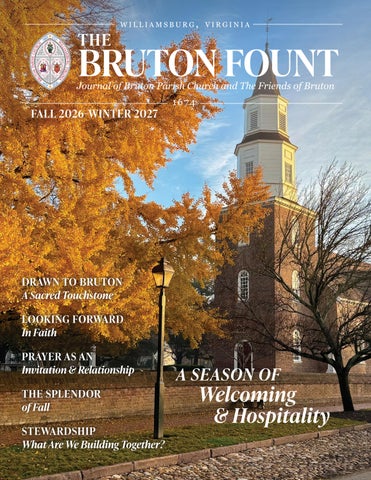
THE
WILLIAMSBURG, VIRGINIA
BRUTON FOUNT
Journal of Bruton Parish Church and The Friends of Bruton
FALL 2026–WINTER 2027
1674
DRAWN TO BRUTON A Sacred Touchstone LOOKING FORWARD In Faith PRAYER AS AN Invitation & Relationship THE SPLENDOR of Fall STEWARDSHIP What Are We Building Together?
A SEASON OF
Welcoming & Hospitality
THE
CONTENTS 3 5 6
Drawn to Bruton—A Sacred Touchstone t h e r e v . w i l l i a m j . wat s o n , i i i Spiritual Pilgrimage
t h e r e v . c h a r l e s h . bau e r
Pilgrim, What Ails Thee?
t h e r e v . l au r e n m . m cd ona l d
8
Inside the Vestry: A Steadfast Path Ahead b. michael smith
9
Looking Forward in Faith diane r. howerton
10
Living by the Liturgical Calendar
the rev. steven e. woolley
12
Bound Across the Sea douglas g. boller
13
Music Ministry: A Jubilee of Sound r e b e c c a e . d av y
15
Prayer as an Invitation & Relationship
WILLIAMSBURG, VIRGINIA
BRUTON FOUNT
Journal of Bruton Parish Church and The Friends of Bruton 1674
Bruton Parish Church Clergy The Rev. William J. Watson, III Interim Rector The Rev. Charles H. Bauer, Associate Rector, Christian Formation & College Ministries The Rev. Lauren M. McDonald, Associate Rector, Outreach & Women’s Ministries & Pastoral Care The Rev. Cynthia Stravers, Pastoral Care & Children's and Youth Ministries Vestry Members John Morgan, Senior Warden Randy Hobbs, Junior Warden Michael Smith, Register Taylor Banks, Carlyle Campbell, Robyn Hansen, Kathy Harper, Ron Hurst, Anna Martin, Lori Forcucci, Sue Saunders, and Larry Zensinger
lori forcucci
17
Echoes of Folk, Acts of Service heide elam
18
John Bracken: Faith, Leadership, and Perseverance lianne johnson boller
20 22
The Splendor of Fall michael h. miller Stewardship: What Are We Building Together? margaret m. driscoll
23
Bruton Parish Crossword Puzzle
24
Friends of Bruton
25
Voices From the Pews
26
Special Events & Regular Worship Services
Friends of Bruton Committee Jonathan L. Stolz, Chairman Donald Bogus, Lianne Johnson Boller, Isabel Burch, Anne Conkling, Hilary Cooley, Catherine Stapleton, John Fogarty, James Morford, Rev. William J. Watson, III, Larry Zensinger, and Scott Spence The Bruton Fount Editorial Board Jonathan L. Stolz, Editor Lianne Johnson Boller, Anne Conkling, Hilary Cooley, Margaret Driscoll, and Rev. William J. Watson, III the bruton fount email
BrutonFount@brutonparish.org Bruton Parish Church Williamsburg, Virginia, 23187-3520 phone 757-229-2891
fax (757) 221-0290
email BPC@brutonparish.org website www.brutonparish.org
Contents ©2026 by Bruton Parish Church. All rights reserved. Reproduction in whole or in part without written permission is prohibited. Design by Christina Hancock
2
DRAWN TO BRUTON— A SACRED TOUCHSTONE Reflections on Hospitality, Pilgrimage and Historic Connections
T
his spring, Bruton was fortunate to send two groups on pilgrimage to Canterbury Cathedral and other sites in England. Each group was led by the Rev. Charlie Bauer. In April, our Canterburians spent their spring break in England. Then, in early June, a group of parishioners went on a pilgrimage for ten days to Canterbury and beyond. This second group regathered two weeks later to reflect on their experience.
Ringing the Tarpley Bell
One question stood out for me: “What had they observed that might be incorporated at Bruton?” This follows the theme that has energized this interim period, found in our Prayer for Search Discernment: “As we look to the future, grant us the grace and courage to imagine new directions and ways of being.” So many of this year’s initiatives have been undergirded by this spirit of grace, adventure, and courage. As our pilgrims reflected, they recognized that Bruton Parish Church is a significant site of pilgrimage. With that in mind, they proceeded to share several possibilities to enhance our hospitality to those who are drawn here. This struck me as profound: seeing those who are drawn here not merely as visitors to an historic church, but as seekers hoping to connect with the sacred core of this amazing community of Christians. I continued to reflect upon this as I had conversations with our outstanding guides. They shared story after story of their encounters with those seeking the heart of this spiritual center. Some are drawn here because relatives have worshipped and served here as clergy and parishioners. Some have relatives buried in the church building or the churchyard. Still others have been married here and return on key anniversaries. And some are former students at William & Mary who worshipped here and long to do so again. People arrive here from far and wide, many of whom are seeking a renewed connection with this sacred church of historic significance in their lives.
The Tarpley Family
Then, over the Independence Day holiday weekend, several events converged that drove this understanding home for me. A key element of our 250th anniversary celebration was ringing the Tarpley Bell hourly on Saturday, July 4. The next morning, Senator and Mrs. Timothy Kaine worshipped with us. In speaking with him, he said he was drawn here to worship again in remembrance of worshipping here 20 years earlier, prior to his gubernatorial inauguration. Early that afternoon, as I walked around the historic area, I heard the Tarpley Bell ringing unexpectedly. John Fogarty was guiding
Drawn to Bruton—A Sacred Touchstone
Ray Tarpley and his wife
f a l l 2026–w i n t e r 2027 || The Bruton Fount
3
that afternoon. As he welcomed visitors to the Tower entrance, the Tarpley family all wearing the same Tarpley Tee shirts came in. Ed and three generations had come to experience Bruton and the Tarpley bell. So, John allowed them to ring the bell and sent me photos of the event. I thought that might be the end of the Tarpley pilgrimage story. However, on August 21, another pilgrim, Ray Tarpley, and his wife visited with a story of another Tarpley family connection. This gentleman’s ancestors were some of those formerly enslaved by the Tarpley family. He had a meaningful conversation with our guides, Sue Saunders and Peg Zensinger. He, too, had the experience of ringing the Tarpley Bell. Here, in the span of six weeks, were visits from descendants from two streams of people who have been in conversation and trace their lineage to the Tarpley family. They had come here on a pilgrimage to a sacred touchstone of their family story. And our guides received them with gracious hospitality, welcoming them to connect in a tangible way with Bruton Parish Church. Through many conversations with our guides and in greeting those who worship with us, I have come to understand that Bruton is indeed a site of historic and spiritual pilgrimage for many reasons. As we continue to focus on hospitality to our guests, I suspect our understanding of the sacred privilege of worshipping and serving at this historic site of pilgrimage that is Bruton Parish Church will increase. I am deeply grateful to our guides, ushers, and fellow parishioners whose greeting of those in our midst is of deepest significance. I hope that each of our guests can travel home accompanied by experiences and feelings of profound sacred encounter after visiting and worshipping at Bruton Parish Church.
Bil
t h e r e v . w i l l i a m j . wat s o n , i i i interim rector
The Tarpley's with Bruton guide John Fogarty
4
Drawn to Bruton—A Sacred Touchstone
left
Christ Church Gate Canterbury Salisbury Cathedral
below
SPIRITUAL PILGRIMAGE A Pictorial Essay
Old Coventry Cathedral b e l o w New Coventry Cathedral above
F
or twelve days in June 2026, a group of Bruton Parish parishioners undertook a spiritual pilgrimage throughout England. Led by the Rev. Charlie Bauer, they visited historic places of worship from Durham and York in northern England to Canterbury and Salisbury in the south. Along the way, the pilgrims made a special visit to St. Mary the Virgin Church in Bruton, Somerset.
t h e r e v . c h a r l e s h . bau e r
a s s o c i at e r e c t o r , c h r i s t i a n f o r m at i o n & college ministries
Canterbury Cathedral St. Mary the Virgin Church Bruton, Somerset, England above left
Spiritual Pilgrimage
f a l l 2026–w i n t e r 2027 || The Bruton Fount
5
Pilgrim, What Ails Thee? A Spiritual Journey on the Sacred Island of Iona
A
s the ferry approached the Island of Iona, I peered through mist and drizzle, eagerly seeking my first glimpse of this place I had longed to visit for almost 30 years. When I finally saw it, I tried not to feel disappointed. The island appeared flat and bleak, with a low hill on one end and Iona Abbey looking like a tiny, speckled replica of a church. There were no sparkling blue seas, just low clouds, grey sea, and barren land. A monochrome vista instead of the larger-than-life, vivid colors I had been imagining. This was Iona?
Ever since I first heard about the tiny island in the Inner Hebrides off the western coast of Scotland, the “thin space” of ancient Celtic saints has called to me. When I began thinking about taking a sabbatical last year, I knew that was where I wanted to go. I found an eight-day pilgrimage on the island, with writing time, conversations with local artisans, daily Iona Abbey prayer services, teaching on Celtic Christianity and eco-spirituality, adventures to lesser-known spots on the island, and a day spent in silence on our own. I signed up, expecting to have my life transformed. Sometimes experiences do not bring us what we want. Sometimes they bring us what we need. St. Columba and twelve companions left Ireland in small coracles and landed on Iona in 563 A.D., where they built a Celtic church and established a monastic community and center of learning that helped to spread Christianity to Scotland and beyond. Pilgrims have been traveling there ever since. They are drawn to the land itself, with its stones so ancient they do not contain fossils, its hills and coves, and the Abbey, which had been built by Benedictines in 1200 after centuries of Viking attacks and which became the burial site for Scottish kings. It fell into disrepair during the Scottish Reformation and was restored by the Iona Community, which was
Celtic Cross outside Iona Abbey
founded in 1938 as an intentional, ecumenical community working for justice and peace. Today, the Iona Community hosts daily prayer services in the morning and evening. Pilgrimages often take us to holy sites, can involve challenging travel, and usually include some preparation in which pilgrims contemplate what they are seeking. Perhaps it is healing of some kind, the answer to a question, guidance for a life transition, or a deeper connection to the divine. Before we left our homes, our pilgrimage guide, Mary, invited us to consider the ancient questions: “Pilgrim, what ails thee? What is your tale of woe?” The first thing we did on the island was walk to the ruins of the Augustinian nunnery, where we sat on low stone walls amid wildflowers and wrote our answers to those questions on pieces of paper. The papers were transported to St. Oran’s Chapel and placed on the altar. The Iona Community prayed over all the prayer requests gathered there until they were shared with those attending the evening healing prayer service later in the week. Each of us attending that service— not only our pilgrim group—received four or five papers to pray over during the service.
The Well of Eternal Youth on Iona
6
Pilgrim, What Ails Thee?
The Author at St. Brigid’s Well
We carried our questions in our hearts and shared them with each other in our Council Circle on that first night, and with the sea when we took a late-night plunge into the cold waters that took our breath away and brought our bodies and souls awake and alive. We held them as we met each morning to learn about Celtic Christianity and the spirituality of earth, air, fire, and water. We took our questions through the roads of the town, across rainsoaked, sheep-dung-laden fields and slick rocky paths, until we descended singing “Now I Walk in Beauty”—dots of color bobbing through the lush green “Valley of the Shadow of Ferns”—to Columba’s Bay, where the sea tumbles the rocks like a natural washing machine. One question I held as we hiked to the bay was this: What am I supposed to be writing, God? I always feel this call to write, but I do not know what. And the response: It does not matter what you write. Write what you want. Just write, and I will help you get it out there. Relief washed over me like the rain that kept collecting on the hood of my raincoat and splashing down on my face and glasses. I continue to be afraid that I am not hearing God’s call correctly or doing it right. Could it really be as simple as writing what I want and then trusting God to work through that writing? I always think that I am supposed to be writing about grand themes that will bring about world peace, when it is the specific things I am thinking, experiencing, and witnessing that speak to others. At Columba’s Bay, we walked the stone labyrinth with our questions, and then we chose stones. One was a stone for grief that we cast into the sea, symbolizing things we wanted to release or needed help carrying. The other was a stone of gratitude to take back
with us. I found my gratitude stone first, a deep forest green stone that fit perfectly in the palm of my hand. When I threw my grief stone into the sea, I imagined releasing all the exhaustion and overwhelm I had felt in the past several years. On our day of silence, I spent the better part of the day trudging through boggy pasture and heather, trying to reach the Hermit’s Cell, a circle of stones where monks reportedly went for solitude. I then found myself literally fenced in, with no gates, when trying to get to the hill of Dun I and the Well of Eternal Youth, also known as St. Brigid’s Well. When I eventually reached the Well, I sat by the pool of still, dark water with my back against rock, enchanted by the beauty of bright pink rose petals and St. Brigid’s straw crosses floating along the edge of the pool. Presumably, another group of pilgrims had left them as an offering. My own offering was a stone I had brought from home, one that I had found on the banks of the James River. I gently tossed it in and watched it sink into the depths of the pool. On February 1, 2008, the feast day of St. Brigid, I was ordained a deacon with five others at Bruton Parish. It was the culmination of a journey that had begun when I felt called to go on my first pilgrimage to the Holy Land with my church in 2000. In Israel, I did not get the answer to my question, “What next?” while I was there, but seeds were planted that led me to discern a call to ordination. At St. Brigid’s Well, on the sacred island of Iona, I realized that I was not going to find a definitive answer to my questions while I was there either. Instead, as happens so often in life, seeds were being sown amid the sea and bogs and fences and Celtic crosses and ancient stones, and even in the mist and rain, that would one day bear fruit. I said a prayer of gratitude to God and to St. Brigid and started the descent down Dun I, looking out over the Abbey and imagining all the gifts I would be taking home.
t h e r e v . l au r e n m . m cd ona l d
a s s o c i at e r e c t o r , o u t r e a c h & w o m e n ' s m i n i s t r i e s & p at o r a l c a r e
View of Iona Abbey
f a l l 2026–w i n t e r 2027 || The Bruton Fount
7
A Steadfast Path Ahead Fostering Change While Building on Our Strengths
S
oon, a chilly breeze will blow through Duke of Gloucester Street, and the deep green leaves will turn to vivid shades of orange, red, and yellow. Change is—quite literally—in the air, and your Vestry of Bruton Parish remains vigilant at the tiller as we guide the parish through this season.
A More Welcoming Bruton With the steady guidance of the Rev. Bill Watson, we are upgrading our facilities to make Bruton even more hospitable and welcoming to all. A revised Welcome Center in the Parish House and offices has been completed; fresh coffee is being brewed; and a new Coordinator of Hospitality has been hired to serve as the welcoming face of Bruton for current and prospective parishioners alike. Before long, the Parish House hallways will feature the work of local artists, and new, improved signage will be installed. Strengthening Our Connections The Vestry is also seeking new ways to expand Bruton’s presence in our local community and the wider world. We are shaping new opportunities to communicate through updated digital and social media, developing plans to engage more fully with Colonial Williamsburg, and strengthening our relationship with St. Mary the Virgin Church in Bruton, Somerset, England. Search Process Advances The Rector Search Committee is moving forward faithfully in its ministry. Drawing on the prayerful and thoughtful feedback gathered through focus groups earlier this year, as well as the Holy Cow surveys, the committee is preparing a Parish Profile to send to the Diocese. The search for a new rector will soon enter its next phase. As the Vestry reflects on the feedback from the surveys and focus groups, we are prayerfully considering how the parish’s hopes and priorities may be brought to fruition. A Call to Vestry Service One of the most important ways parishioners can support Bruton during this changing year is by thoughtfully and prayerfully considering service on the Vestry—either by nominating themselves or others. Each fall, the Vestry Nominating Committee carefully considers a new slate of members, who are then affirmed at the parish-wide meeting in November. This year offers a particularly meaningful opportunity to serve: not only as a representative of the parish at large, but also as someone who can help shape our ministries and welcome and support the new rector when called to serve. Our Vestry members remain deeply grateful for the privilege of serving Bruton Parish Church as we strive to bring the Kingdom of Heaven into the here and now.
b. michael smith
r e g i s t e r , bru ton pa r i s h v e s t ry Looking through the church from North to South b r u c e m . w h i t e f o r t h e w h i t e h o u s e h i s t o r i c a l a s s o c i at i o n
8
Inside the Vestry: A Steadfast Path Ahead
Looking Forward in Faith An Update from the Search Committee
B
ruton Parish has witnessed the Holy Spirit at work in the Search Committee’s prayerful discernment of who we are and who God is calling us to be. From the Committee’s information-gathering phase, a pathway has emerged that points Bruton Parish in new directions and suggests alternative ways of being. While the results confirm that we are a healthy, active parish with meaningful aspirations and areas of strength, they also reveal opportunities for growth and renewal.
Parishioner focus group and survey responses were also essential to preparing an accurate Bruton Parish Community Profile. The Parish Profile describes Bruton Parish’s history, ministries, leadership culture, congregational liturgical styles, spiritual identity, outreach ministries, pastoral care needs, stewardship, values, and strategic priorities, as well as the leadership and ministry skills we seek in a new rector. In addition to providing an Parishioner responses in focus group meetings and to the opportunity for the Search Committee to update parishparish-wide survey indicate that Bruton Parish enjoys ioners on its progress, the well-attended All-Parish gathhigh levels of satisfaction and energy. The responses also ering on August 23 demonstrated Bruton’s collaborative indicate that Bruton Parish is in a “transformation phase.” spirit, with many people working together in Maintaining these high levels of satisfaction and energy multiple ministries. will require a rector who will work with us to build on our The Search Committee is now in the candidate-interview strengths, address our challenges, and provide spiritual phase of discernment. Committee members are required guidance. A rector who can lead Bruton Parish forward into this vision will ideally embody the following qualities to maintain strict confidentiality regarding all information related to this phase until the new rector is anand skills: nounced. The Committee appreciates your understanding 1. A warm, compassionate pastoral leader who is deeply and is especially grateful for your prayers. involved in the life of the parish; 2. An inspiring preacher with deep knowledge of Scripture, who has the courage to engage with difficult topics and is prepared to share the ways they have experienced God at work in their own life;
diane r. howerton
c h a i r , t h e bru ton pa r i s h search committee
3. An excellent listener who is transparent, honest, and communicates well; 4. A collaborator skilled in discerning gifts and willing to share leadership, as appropriate, to accomplish Bruton’s mission and vision; 5. A competent administrator with strong organizational skills, personnel management experience, financial and operational understanding, and the ability to make difficult decisions when needed. Vestry’s Senior Warden John Morgan at The Search Committee’s All Parish Update above
Three Members of the Search Committee: Diane Howerton, Alison Lennarz and Sue Warner fa r l e f t
Attendees at All Parish Update enjoying a light luncheon left
Looking Forward in Faith
f a l l 2026–w i n t e r 2027 || The Bruton Fount
9
Living by the Liturgical Calendar finding christ amid the celebrations and seasons that shape our lives
N
ew Year's Day may be the official beginning of a new year, but for most of us, the year begins in September with the opening of school, the new fall athletic season, the promise of glorious autumn weather, and the anticipation of the holidays just ahead. For congregations across the country, it is also a time for reenergizing Sunday schools, youth programs, adult formation, and parish life in all its richness. A new year begins with energetic optimism about what lies ahead.
In the midst of all this, Christians are called to observe with joyful reverence the sacred seasons of Advent, Christmas, and Epiphany.
The holidays are the capstone of the season. Big-box stores begin putting up displays as soon as they think they can get away with it, but for most of us, the season begins with Halloween on October 31. It used to begin with Thanksgiving, but Halloween has now joined Christmas and New Year's Eve as one of the nation's major occasions for celebration and parties. Thanksgiving, of course, marks the run-up to Christmas, which for many Americans lasts until New Year's Eve. Somewhere around
Advent, the season of preparation for celebrating the birth of our Savior, takes us through the four weeks leading to Christmas. We are reminded of the human condition in its fallen weakness and of our great need for God's saving grace to bring us safely through this life and into the greater life yet to come. Along the way, we are called to follow Jesus as faithfully as we can, participating with him in making a little more of the Kingdom of God present in this world and more available to others. In many
10
Living by the Liturgical Calendar
the second or third week of January, the winter doldrums begin to set in, along with the dreary business of getting through the dark months ahead. At least that is the general pattern across North America, perhaps more so in the far north than in the southern coastal states.
The Adoration of the Magi by Botticelli n at i o n a l g a l l e r y o f a r t
ways, Advent is a short course in Christian formation, preparing us for the joyful celebration of Christmas itself, which continues until the Feast of the Epiphany on January 6. Epiphany remembers the visit of the Magi, representing the light of Christ extending into the Gentile world. From January 6 until the beginning of Lent, we continue celebrating Epiphany as a season in which that light spreads throughout God's creation through the hands of faithful people guided by the Holy Spirit. Scripture tells us that the darkness could not overcome the light of Christ, and perhaps there is no better time of year, at least in the Northern Hemisphere, for a season proclaiming Christ's light throughout the dark and often dreary months of winter. You have heard it said that "we need to get Christ back into Christmas," as though all the other religious and secular celebrations surrounding us should simply disappear. It is worth remembering that the ancient cultures of the Mediterranean world, extending as far north as Germany and as far west as Britain, observed a wide variety of midwinter festivals celebrating the gradual return of the sun with earlier dawns and later sunsets. The Church placed the celebrations of Advent, Christmas, and Epiphany within this same season in the hope that they would eventually replace the pagan festivals, especially the extravagances of the Roman Saturnalia. Well, it did not happen. In one form or another, those celebrations are still with us.
The Liturgical Calendar st. aiden’s anglican church
demonstrated what it means to live a Christian life—not through the words of a prophet or wise teacher, but through the words of God incarnate, our ultimate authority, beyond whom there is no other.
Many of us enjoy them. We enjoy the parties, the family meals, the decorations, those atrocious Hallmark movies, and everything else that accompanies the secular holiday season. For some, the schedule of football bowl games nearly eclipses everything else. In other words, many of us live with one foot in the secular celebration of the holidays and the other in the sacred observance of Advent, Christmas, and Epiphany.
Then comes the great celebration of Easter, extending not for a single day but for fifty days. By the time the Easter season concludes, nearly six months have passed since Advent began. In that sense, the Christian holiday season lasts fully half the year.
As Christians, we are called to maintain that balance, but it is a balance that must always be tilted toward the sacred. Our attention, our prayers, our time, and our efforts should be intentionally devoted to preparing for the celebration of Christ's birth and to participating in the work of making the Kingdom of God more present in our own lives and, especially, in the lives of others as we go about the ordinary business of each day.
Afterward comes what we call Ordinary Time, when our weekly worship focuses on a single Gospel and its related Scriptures, leading us ever deeper into understanding what Jesus meant when he commanded us to love one another as he has loved us. In that sense, there is no ordinary time.
The secular holiday calendar continues with joyful anticipation of spring, marked most notably by St. Patrick's Day, which now has almost nothing to do with the saint himself, and by Opening Day of baseball. Added excitement comes with March Madness and the final race toward professional basketball and hockey championships.
the rev. steven e. woolley
The Christian calendar continues in a very different way. The six-week season of Lent prepares us to gain a deeper understanding of what it means that death has been defeated through the resurrection of Jesus Christ. It also leads us to a fuller recognition that Jesus not only accomplished our redemption but taught and
f a l l 2026–w i n t e r 2027 || The Bruton Fount
11
BOUND ACROSS THE SEA The Enduring Link Between Scottish and American Episcopalians
D
uring Virginia’s colonial period, church and state were inseparably linked, following the traditions, customs, and laws of England. The original 1606 charter of the Royal Colony of Virginia firmly established the Church of England as the official church of the colony—the largest and most influential religious body in British North America. The counties and parishes created by the colonial assembly were all subject to the authority of the Bishop of London. Indeed, from an Anglican perspective, the entire American continent fell within the Diocese of London.
Yet the Bishop of London never visited the colonies. As a result, any colonist seeking ordination to the clergy was required to undertake the long journey to England. Despite this distance, newcomers to Bruton Parish Church in eighteenth-century Williamsburg would have found much that was familiar in the sacraments and worship, even if expressed in a simpler colonial setting.
The outcome of the American Revolution brought sweeping changes, not least for the Church. Some Anglican loyalists—both clergy and laity—departed for Canada or returned to England. Others, who supported independence, were content to continue worshiping in the Anglican tradition they knew. A serious problem, however, soon became evident. Anglican clergy could be ordained only by bishops in apostolic succession, and with independence, the Bishop of London no longer had jurisdiction in the former colonies. The link between church and state had been severed, and the fledgling Church found itself without bishops. In 1783, a gathering of ten clergy in Connecticut resolved not to adopt any temporary or irregular form of ordination. Instead, they elected one of their number to seek consecration from English bishops. Their choice fell upon Samuel Seabury, a Connecticut priest with extensive experience in colonial ministry. Ironically, Seabury was known for his loyalist sympathies; he had written in defense of the British cause, endured imprisonment by Patriots, and later served as chaplain to a Loyalist regiment. Nevertheless, he had remained in Connecticut after the war. Upon arriving in London, Seabury encountered an unexpected obstacle. English law required that any candidate for consecration swear allegiance to the British Crown—an oath he could not take as an American citizen. Undeterred, Seabury turned to Scotland, traveling to Aberdeen in search of a solution.
St. Andrew’s Cathedral–Aberdeen, Scotland scotland’s churches trust
12
Bound Across the Sea
There he found willing partners in the bishops of the Scottish Episcopal Church, who themselves stood outside the authority of the Crown. Following the Glorious Revolution of 1688, when King James II was deposed and replaced by William and Mary, many Scottish bishops and clergy—known as Non-Jurors—refused to transfer their allegiance. As a result, the Presbyterian Church became the established Church of Scotland, and the Episcopal Church, no longer recognized by the state, gained the freedom to consecrate bishops independently.
In 1784, at St Andrew’s Cathedral in Aberdeen, Samuel Seabury was consecrated bishop by three Scottish bishops. In doing so, he became the first Anglican bishop to serve outside the British Isles—a moment often regarded as a foundational step in the emergence of the worldwide Anglican Communion. This Scottish connection carried an enduring influence. As a condition of his consecration, Seabury agreed to promote the adoption of the Scottish Eucharistic rite rather than relying solely on the 1662 English Prayer Book. This promise was fulfilled, and elements of the Scottish rite continue to shape the liturgy of the Episcopal Church in the United States today.
Bishop Samuel Seabury s m i t h s o n i a n i n s t i t u t e
St Andrew’s Cathedral still bears witness to this shared heritage. A memorial window honors Seabury, while the north aisle ceiling displays the coats of arms of forty-eight American states—visual testimony, as historian Todd Wilkinson observes, to “the bond between American and Scottish Episcopalians.” That bond is further symbolized in the Episcopal Church’s official shield and flag. The red cross on a white field recalls the Church of England, while the nine cross-crosslets represent the original dioceses. Their arrangement in the form of a saltire on a blue canton evokes the Scottish Episcopal Church, preserving in heraldry the story of a vital and enduring connection.
The Official Shield of the Episcopal Church
douglas g. boller
music ministry
A Jubilee of Sound Celebrating Seven Years of the Dobson Organ at Bruton Parish
T
his September marked the seventh anniversary of the installation and dedication of the Dobson Organ, Opus 96, at Bruton Parish. The instrument, comprising 45 ranks and four divisions, was built by Lynn Dobson Pipe Organ Builders of Lake City, Iowa. It was the result of more than a decade of careful planning, the generosity of many supporters, and a far-sighted vision for the Parish’s future. Arrival and Installation The new organ arrived in Williamsburg by large truck to considerable fanfare in mid-February 2019. Its substantial case above the altar, internal components, nearly 3,000 pipes, and console were carefully unloaded and
Music Ministry: A Jubilee of Sound
brought into the church on ramps specially constructed for the front steps. For several weeks, the congregation worshiped in Lewis Hall while the sanctuary was filled with organ parts. Following the physical installation, a rotating crew voiced each pipe so that it would sound its best in our space. We introduced the organ’s new sounds one rank, or set of pipes, at a time during services. The work was completed in August and celebrated with four inaugural events: a performance by guest organist Gordon Stewart; a Choral Evensong; a concert featuring guest instrumentalists; and a solo-and-duet program of new
f a l l 2026–w i n t e r 2027 || The Bruton Fount
13
music. Two CDs from those performances remain available in the Parish Gift Shop. Music for Worship As a parish, we rejoice through music and remain grateful for the support and variety the pipe organ brings to our vibrant congregation. The Dobson organ has found a complete home at Bruton Parish. It encourages hymn singing, accompanies our choirs, and brings both solace and joy to those who attend Candlelight Concerts throughout the year. The Meaning of Jubilee The idea for a Jubilee celebration draws on the Old Testament account in Leviticus, which outlines a sequence of seven-year cycles marked by the blowing of a ram’s horn, called a yovel. Jubilee was a time of rejoicing, reflection, redemption, and restoration.
Bruton, and Cecilia McDowall’s “First Flight,” originally commissioned for the new organ. The program concluded with a surprise birthday toccata. Gratitude and Hope As we reflect on the past seven years, we are grateful for the leadership of the Organ Committee and clergy throughout the lengthy process of selecting a builder, overseeing the installation, and dedicating this remarkable instrument to the glory of God.
We also look to the future during this time of transition. As we search for a new rector and begin another cycle of ministry, sacred music offers consistency, comfort, and connection. May the next season of Jubilee bring renewed joy and faithful hope to Bruton Parish. r e b e c c a e . d av y music director and organist
With this in mind, JanEl Will and I recently presented a September Jubilee Concert as part of the Candlelight Concert series. We performed duets, including a work by California composer Craig Phillips, commissioned to celebrate our combined years of ministry at
Installation
Arrival
Completion
14
Music Ministry: A Jubilee of Sound
Prayer as an Invitation & Relationship Exploring the Many Ways Prayer Draws Us Toward God and One Another humans on the planet.” In her spiritual journey, Rev. McDonald experiences great awe in the world God created, with its infinite variety. “No two of us have the exact same experience of God. Just as we relate to people differently, it only makes sense that we have different ways of talking to God. Jesus taught us to pray with the prayer that we know as the Lord’s Prayer, but we also pray by singing, experiencing creation, walking the labyrinth or reading and thinking about what scripture has to tell us. Those following twelve step programs may look to step eleven, asking to know God’s will and for the ability to carry it out. God’s presence may be found in contemplative prayer. Prayer does not have to look a particular way.”
The Book of Common Prayer t h e e p i s c o p a l d i o c e s e o f s o u t h d a k o t a
L
et us pray.” Why is this often-heard invitation so soothing? We are familiar with prayer, possibly having learned our first prayers before we learned to read. If we look beyond that familiar- Associate Rector, The Rev. Charlie Bauer exity, might there be more to understand? Might there be unrecogpands that idea. nized aspects of prayer? Bruton Parish Church’s clergy offer “Prayer is relationship with God. It’s the way their insights. we experience relationship with God. Only in The Rev. William J. Watson, III, Interim Rector, believes that God relationship can there be a two-way conversacalls us to prayer. He points to the Collect for Purity in the Book tion. The duality of talking and listening does not of Common Prayer as a foundational expression of God’s intimate happen outside of relationship. The goal is not knowledge of each of us: prayer itself. The goal is engaging in relationship with God. The act of praying is what matters, “Almighty God, to you all hearts are open, all desires known, and whether that is a structural practice, a random from you, no secrets are hid.” conversation, or a time taken to sit in silence. Therefore, there is no wrong way to pray.” “This Collect highlights God’s intimate knowledge of each of us— our hearts, our thoughts, and our needs. When we choose to pray, we may perceive that choice as a self-initiated desire, whether as the desire to pray for a loved one, for a person in need, or for our own need.
However, our prayer is really our response to hearing God call us by name, our response to God opening us to possibility, opening us to God’s desire that we pray. This realization will bring about a dynamic increase in our prayer life. We are not praying into an abyss, hoping our prayer arrives at a moment when God is not too busy to hear us. Our prayer, in fact, arrives at the very moment God is inviting us to pray. When we respond to the call to pray, we want to be fully present.” Associate Rector, The Rev. Lauren McDonald agrees. At its most basic level, she says, prayer is talking to, listening to, and being present to God. “There are as many ways to pray as there are
Prayer as an Invitation & Relationship
The Rev. Lauren McDonald, The Rev. William J. Watson, III, and The Rev. Charlie Bauer
f a l l 2026–w i n t e r 2027 || The Bruton Fount
15
“Praying Hands” by Albrecht Durer w i k i p e d i a
“God is creative, and in that creativity, God’s voice may not arrive in words, or in the time frame that we hope for, but we are heard. The Prayer of the People in the Book of Common Prayer embodies God’s promise to hear us: ‘Heavenly Father, you have promised to hear what we ask in the Name of your Son: Accept and fulfill our petitions, we pray not as we ask in our ignorance, nor as we deserve in our sinfulness, but as you know and love us in your Son Jesus Christ our Lord.’” Rev. McDonald also acknowledges God’s creative presence in hard times. “We are healed by prayer, though healing may arrive in creative and unexpected ways. With prayer, we find ourselves accepting and forgiving difficult past life events. In this way, we are more likely to recognize when healing takes place. There is a Greek word, sozo, which is translated to mean to heal, but it can also mean to save, or to make whole. Healing prayer works, but it may not be a healing in the specific way we expect.” “Prayer is mysterious by its very nature,” Rev. Bauer says. “In prayer, we ponder the mysteries. Prayer is unlike human conversation where we expect concrete responses. Rather, in prayer we engage the mystery of God, and we may expect the response to come in a myriad of ways.”
“Listening,” Rev. McDonald emphasizes, is essential. “When we ask God for guidance, we sometimes forget the ‘listening to God part.’ If we’re askers and talkers, how will we hear God’s response? God speaks in ways other than delivering answers to our heads and hearts, maybe in ways we don’t want to hear. We may be praying for something too small and God wants us to think bigger. We may be praying for God to tell us what to do, but God wants us to look at options we already have, to recognize our own agency.” Rev. Bauer poses an important question: What tells us that we have a relationship in prayer with God? He offers a quotation from Thomas Merton: “I believe that the desire to please you, does in fact please you.” In life’s hard moments, however, we may question that relationship, Rev. Bauer recognizes. “Offering up our hearts to God can be difficult, but hard moments are the moments that need to be lifted up to God. We put a lot of weight on whether God answers our prayers as we want them to be answered. We may believe that if God’s answer arrives as we want it to, we are worthy or favored.” The danger, he says, lies on the other side of that belief. “We may feel unworthy or unfavored if we don’t receive an answer we expect.” Yet, Rev. Bauer assures us, we are heard.
16
Prayer as an Invitation & Relationship
Similarly, Rev. McDonald believes that “prayer changes us collectively when we turn our attention to God, to the community, and the well-being of the community.” She cites Steven Charleston, retired Episcopal Bishop and Native American elder, who describes a community of Native American women who pray for spiritual transformation and stepping up through emergence: “Collective prayer changes our reality and consciousness, creating space for an emergence to take place, for an evolutionary step up to the next level of hope. We find that inner well that can sustain us, the complete trust in God, accepting what happens and forgiving what has happened in the past.” Rev. Watson reminds us that God is interested in each of us because we are God’s own people. “Bruton Parish Church welcomes visitors in worship each week. Each of them has been drawn here by the Divine. Each encounter we have is undergirded with God's hope that we will make connection. God, you see, is always drawing us into relationship and connection. These relationships connect us in community so that when the inevitable events of life strike us, we are surrounded by a fabric of loving care on every side. Never take an interaction casually.”
lori forcucci
Echoes of Folk, ACTS OF SERVICE E
THE THREE JOLLY COACHMEN’S COFFEE HOUSE CONCERT SERIES AT BRUTON
very other month since September 2022—typically on the second Friday—Bruton’s Lewis Hall has been transformed into a 1960s-style coffee house. The room fills with the sounds of an era when American folk music briefly rode high atop the pop charts, drawing sellout crowds eager for a journey down musical memory lane.
At the heart of this revival is Greg Davy, a Bruton parishioner and the creator of the Three Jolly Coachmen’s Coffee House concert series. His deep connection to folk music began early, though its origins remain something of a mystery even to him. “My parents had some of the records lying around when I was six or seven years old,” Davy recalls. “I was much too young to understand what most of the songs meant . . . I just loved the tunes and played them constantly.” Recognizing that enthusiasm, his parents took him to concerts by Peter, Paul & Mary and The Weavers. As the years passed, those early influences took root. By age 12, he was performing folk songs on his father’s guitar, already imagining a future in music. That vision took decades to fully materialize. At age 42, while living in Southern California, Davy found two like-minded musicians and formed a group called The Shipmates. After relocating to Williamsburg in 2004—where his wife, Beckie, had accepted a position at Bruton Parish Church—he began searching for a new musical outlet. The opportunity emerged through First Night—Williamsburg, where Davy met solo performer Peter Budnikas. Budnikas had long hoped to form a Kingston Trio tribute group and had previously connected with fellow enthusiast Gary Allen, a recent arrival from Washington, D.C. The pieces were suddenly in place. Their first session in the winter of 2007 proved electric. The chemistry was immediate; the shared repertoire so familiar that several songs could have been performed on the spot. The trio adopted the name The Three Jolly Coachmen, drawn from a centuries-old British drinking song recorded by the Kingston Trio on its debut album. Nearly two decades later, the group continues to entertain Williamsburg audiences. Today, the ensemble includes Davy, Budnikas, and Allen, along with guitarist and banjo player Joe Duggan and bassist Andy Petkofsky. The idea for the Coffee House series took shape in 2019. With the conclusion of First Night—Williamsburg in 2017, the group began exploring new performance venues. Davy approached Father
Echoes of Folk, Acts of Service
Three Jolly Coachmen Coffee House began a Fifth Season in September 2026
Community Care Project Check Presentation
Chris Epperson at Bruton Parish Church and received approval to host concerts in Lewis Hall, with the understanding that a portion of ticket sales would support church programs or local charities such as FISH, SpiritWorks, and Grove Christian Outreach Center. Following delays caused by the pandemic, the series launched in September 2022 with an opening performance by The Three Jolly Coachmen. What has followed has exceeded all expectations.
Each of you should use whatever gift you have received to serve others, as faithful stewards of God’s grace in its various forms ... so that in all things God may be praised through Jesus Christ. —Peter 4:10-11 For decades, Davy had reflected on how his musical talents might serve a greater purpose. That search—spanning nearly half a century—found its answer in the Coffee House. Local charities, now numbering 19 partners, have responded with gratitude to the donations generated by the concerts, which have collectively exceeded $26,000. Audience members, too, frequently express how deeply the music resonates, evoking both nostalgia and a sense of shared experience. With humility and gratitude, Davy has come to see the Coffee House as more than a performance series. It is, in essence, a ministry—one that brings together music, community, and service in a way that uplifts performers, audiences, and beneficiaries alike.
heide elam
f a l l 2026–w i n t e r 2027 || The Bruton Fount
17
John Bracken Faith, Leadership, and Perseverance
T
he Rev. Dr. John Bracken served as rector of Bruton Parish (1773–1818) for forty-five years, was third bishop-elect of the Diocese of Virginia (1812– 1813) and was ninth president of William & Mary (1812–1814). He played a prominent role in colonial and early-republic Williamsburg. Born in England, Bracken came to Virginia about 1769 and, in 1772, returned to England to be ordained. He did well upon returning to Virginia, succeeding the Rev. Josiah Johnson, who had been chosen Bruton Parish rector in July 1772. Johnson died in April 1773, and two months later, twenty-six-year-old Bracken was elected rector of Bruton. His election sparked immediate controversy, particularly a public dispute with William & Mary professor the Rev. Samuel Henley, who had also sought the rectorship. The conflict was widely attacked and debated in the press among factions within the colonial church, but Bracken maintained his post. In September 1776, Bracken married Sarah (Sally) Burwell, daughter of Carter Burwell of Carter’s Grove plantation. Three children were born of this marriage: John, born 1779; Julia Carter, born 1781; and Sarah, born 1785. All of these births were recorded in the Bruton Parish Register. Bracken’s marriage afforded him social prestige and influential connections, along with the funding to purchase four acres on Frances Street in 1778 and, over the years, large amounts of property and plantations in Williamsburg, Gloucester, York and James City counties. Bracken’s ties to William & Mary ran deep and long. In November 1775, he succeeded Thomas Gwatkin, a loyalist, as master of the college’s Grammar School. In 1777, he was formally appointed professor of humanity and took charge of the college library. However, the grammar school was abolished in 1779 as part of institutional reforms. Bracken’s opposition to these actions incurred the enmity of Gov. Thomas Jefferson. The reorganization then terminated Bracken’s professorship. Starting in 1780, he ran private schools from his Williamsburg home, and later from the old Capitol building. When the grammar school reopened in 1792, he was reappointed to the faculty and awarded a Doctor of Divinity degree in 1793.
18
John Bracken: Faith, Leadership, and Perseverance
Illustration of John Bracken h i s t o r i c a - w i k i / f a n d o m
Bracken was steadfast in his role as Bruton rector. In response to the Continental Congress’s June 12, 1775, proclamation recommending that July 20, 1775, be observed as a day of public humiliation, fasting, and prayer, the Virginia Gazette reported, “The reverend Mr. Bracken preached a sermon suitable to the occasion.” Bracken’s continued presence in the colony underscored his patriotic leanings at a time when the Revolution prompted the departure of ardent loyalist sympathizers—such as William & Mary’s president, the Rev. John Camm, who was dismissed for loyalist sympathies and actions. After the Revolution, Bracken played a foundational role in the emergence of the Protestant Episcopal Church in Virginia. In 1785, he delivered the opening sermon at the state’s first convention and later served as its secretary. In 1789, he was elected the convention’s president and became a regular delegate from Bruton Parish in the 1790s. It is likely that Bruton’s 1751 Book of Common Prayer (now housed in William & Mary’s Swem Library Special Collections) was edited by Bracken. The handwritten edits include crossing out the king’s name and substituting “P[resident] of the United States”. These revisions align with those directed in 1789 by the General Convention of the Bishops, Clergy, and Laity of the Protestant Episcopal Church in the U.S.—the year George Washington was elected president. Two months after Bracken preached the funeral sermon for Bishop James Madison, he presided over a special Episcopal convention on May 14, 1812, where he was named bishop-elect of Virginia to succeed Madison. Several younger delegates—including future Bruton rector William H. Wilmer—objected that Bracken was above, by title
"Your most obedient Servant, John Bracken" Bracken’s signature in an October 25, 1811, letter to Thomas Jefferson. l i b r a r y o f c o n g r e s s
too old (about 65) and lacked the vigor to revive the languishing church. He declined consecration and resigned on May 26, 1813. In 1812, he was selected as the ninth president of William & Mary amid institutional decline; only about thirty-five students remained. Upon learning of his selection, Thomas Jefferson, who had no love for Bracken, called him a “simpleton” in private correspondence. Bracken struggled in the role—possibly due to health issues and/or excessive drinking—and resigned at the board’s request in June 1814. Beyond his ecclesiastical and academic pursuits, Bracken was named mayor of Williamsburg in 1796 and again in 1800. He served as president of the board of the Public Hospital (now Eastern State Hospital) from 1790 to 1791, succeeding Rev. James Madison. Bracken’s involvement on the hospital’s board extended at least through 1805, and he addressed critical issues such as facility expansions, patient accommodations, and financial reporting.
John Bracken’s restored tenement house in Colonial Williamsburg c o l o n i a l w i l l i a m s b u r g f o u n d a t i o n
Bracken’s health continued to decline in his later years. At approximately age 71, he died in Williamsburg in July 1818. On July 30, 1818, Robert Saunders of Williamsburg wrote to Joseph Prentis, Suffolk, “Our old pastor too, Mr Bracken has passed to the world of Spirits—tranquil and resigned as Job.” His remains were buried at Carter’s Grove. There is no grave stone.
Bruton & Middleton Parish Register 1662–1797, pp. 56–57. Bruton Parish Church Records. 01/Mss. 91 B38. Earl Greg Swem Library Special Collections Research Center. College of William & Mary, Williamsburg, VA.
The best tribute to John Bracken is his persistence and stability. He held the rectorship of Bruton Parish Church for 45 years—the longest tenure in the parish’s history—guiding the congregation through the Revolutionary War, the disestablishment of the Anglican Church, and the shaky birth of the Protestant Episcopal Church in Virginia. No portrait of him is known to have survived.
lianne johnson boller
References:
Gentry, Daphne & Dictionary of Virginia Biography. “John Bracken (bap. 1747–1818),” (2020, December 07). In Encyclopedia Virginia. https://encyclopediavirginia. org/entries/bracken-john-bap-1747–1818. Gibbs, Patricia A. and Linda H. Rowe. “The Public Hospital, 1766–1885,” May 2014, Colonial Williamsburg Foundation Library Report Series – 240. John D. Rockefeller Jr. Library, Williamsburg, VA, 1990. Goodwin, Rutherfoord. “The Reverend John Bracken (1745–1818): Rector of Bruton Parish and President of William and Mary College in Virginia.” Historical Magazine of the Protestant Episcopal Church, vol. 10, no. 4, 1941, pp. 354–89. Stephenson, Mary A. “Chiswell-Bucktrout House Historical Report, Block 2, Building 17, Lot 253–254,” July 1959. Colonial Williamsburg Foundation Library Report Series – 1018. John D. Rockefeller Jr. Library, Williamsburg, VA, 1990. Stephenson, Mary A. “Lightfoot House Historical Report, Block 3 Building 10,” July 1958. Colonial Williamsburg Foundation Library Report Series – 1058. John D. Rockefeller Jr. Library, Williamsburg, VA, 1990. Williamsburg Government, “Past Mayors”. https://www. williamsburgva.gov/573/Past-Mayors-Governors
Edited Evening Prayer from the Bruton Parish 1752 Book of Common Prayer t h o m a s b a s k e t t , p r i n t e r t o t h e k i n g ’ s m o s t e x c e l l e n t m a j e s t y , l o n d o n , e n g l a n d , 1751 . e a r l g r e g s w e m l i b r a r y s p e c i a l col l ec t ions r e se a rc h c e n t e r , col l ege of w i l l i a m & m a ry .
f a l l 2026–w i n t e r 2027 || The Bruton Fount
19
The Splendor of Fall Gathering Color, Sound, and Beauty from the Autumn Garden
T
he air we breathe and the trees we see all begin to tell us that the splendor of fall is approaching. Leaves on trees become more rustic, and the colors of grasses and foliage slowly change to royal oranges, purples, and scarlet reds. Who cannot be moved by the approaching season and the splendor of fall?
Pods and berries of all kinds and shapes begin to appear. Our homes take on the look and feel of the fall season, and some of our favorite materials might include cattails, pyracanthas, wheat, and grasses in all kinds of colors and shapes. All of these materials make splendid fall collectibles for later use. We can use them in cool-weather arrangements. Help yourself to fall dried materials early, while they are still available. Feel free to gather wild goldenrod, and let your imagination carry you to parks, trails, and other places that show signs of fall to use with your fall collectibles. Choose from a wide range of baskets, metal urns, and other containers to hold fall-gathered materials. For a delightful surprise, with the help of wind blowing through fall gardens and foliage, a certain musical sound is present and obvious in the rustling of garden materials. Quietly listen, and you may hear a musical rhythm from the grasses, dried pods, flowers, and foliage. The quietness of the fall garden is really a gentle natural sound, lulling you into relaxation and peace. Even more magical is the whispering sound of fall leaves rubbing together in the gentle breezes. All of this can put one into a reflective mood or can be energizing and restore balance, happiness, and productivity. Welcome the beautiful fall season, because it is not with us for very long. “Enjoy!” Facts and Signs of Fall 1. When leaves begin to drop from trees, it is a sign that Indian summer will be a short season and winter will be mild. 2. When sugar maple buds are fat in the fall, winter will be very cold. 3. If squirrels gather nuts in the fall season, then winter is coming soon. 4. Singing crickets in the fall are a sign that winter will be long. 5. In the fall, if moss forms on the north side of trees, it will be a mild winter. 6. Fruit trees are helpful in keeping birds around longer in the fall season. 7. Early fall is a great time to add shed leaves and grass to plant beds for mulch.
20
The Splendor of Fall
Popular and Magical Fall Flowers MUMS—Fall bloomers with bright colors for the fall garden. DAYLILIES—Plant in the fall for best results. DAISIES—Fall bloomers in a variety of colors. They last a long time in fall arrangements. HARDY CHRYSANTHEMUMS—Nice fall colors. They hold up well in fresh and dried fall arrangements. HYDRANGEA—Blossoms should stay on the stem until the shade you want appears. HELLEBORUS—Flat-leaf foliage. Good foliage to cover mechanics in fall arrangements. CAMELLIA—A variety of colors in the fall. To keep blooms from dropping, insert a pin in the center of the flower. A few grains of salt dropped in the center of the bloom will prevent the bloom from turning brown. JAPANESE MAPLE—Foliage turns fall colors and is very good to use in large displays and arrangements in the fall. HOLLY—All varieties and shapes are useful in the fall. Used for holiday decorating. MAGNOLIA—A winner any time for decorating. This foliage is a fall staple. NANDINA—They have beautiful berries of different colors for fall. The foliage also changes colors in the fall. SALVIA—It reaches full height in the fall with beautiful fall colors of orange and seasonal yellow.
michael h. miller
f a l l 2026–w i n t e r 2027 || The Bruton Fount
21
STEWARDSHIP STEWARDSHIP What Are We Building Together? What Are We Building Together?
E
very fall, we are asked to discern our annual financial commitment to Bruton. We all prayerfully consider what that amount is and what it represents to us individually. I wonder whether if the more important question we should be asking is: What are we building together?
Bruton Parish is, of course, a church and a place. We worship in our sacred space each week, gather for fellowship and ministries in the Parish House, and enjoy these places that have been cared for by many generations before us. But the true work of our parish is much bigger than its physical spaces. Together, we are building a community where we can encounter God and find welcome. We are building a place where adults and children can learn and grow in faith; where worship and music lift our hearts; where pastoral care meets us in joy and sorrow; and where we are called to go beyond our walls to serve our neighbors. Much of what we build is not immediately visible. It may be a conversation that gives someone hope, a meal shared with someone who is lonely, or a ministry that quietly makes a difference in someone’s day-to-day existence. These are things that cannot be quantified on a financial balance sheet,
22
Stewardship: What Are We Building Together?
but they are at the heart of what our stewardship makes possible. As Development Director, I have the privilege of seeing firsthand how individual acts of generosity become something much larger when they are shared. Each gift, each hour of service, each prayer, and each act of participation becomes part of the larger work we are doing together. So, during this stewardship season, I ask that we look not only at what we graciously give, but also at what our giving helps us build. May the gifts we offer today help sustain and strengthen the parish we already are—a place where faith flourishes, lives are changed, and generations to come can find a place of welcome and belonging. margaret m. driscoll c h i e f o f s ta f f a n d director of development
Bruton Parish Church Crossword Words Associated With Bruton Parish Church Easy • 25 × 25
1
2 3
4
5
6
7
10
13
14
8
11
9
12
15
16
18
19
17
20
21
22 23
24
25
26
27
28 29
30
31
32
33 34
35
36
37 38
39
40
41
42 43
44
45 46
Fill the grid using the Across and Down clues. All answers are associated with Bruton Parish Church.
ACROSS
Across 4. Financed Restoration of Bruton
39. A Sermon
DOWN
17. Where Governor's seat is located 1. Wrote Declaration of Independence 41. Name of Dr. Goodwin's 18. 8. A type of tomb 2. dog The Gift of King Edward VIIShape of 1715 church 4. Financed Restoration of Bruton 10. Gift of President Teddy Roosevelt 3. Part of church where worshippers sit 42. Donated land for church in 1678 19. Eucharist 8. type ofParishioners tomb 12.A Where sit 5. Group that sings in church 43. Precedes Easter 20. President who attended a service in 1936 10. of President Teddy Roosevelt 13.Gift Colonial Legislators 6. Name on oldest stone in Churchyard 45. John D. Rockefeller, Jr. son 24. Remembers the Visit of the Magi 15.Where Capel'sparishioners Chapel's name nameinin inParish Parish House 7. Bruton's First Rector 12. sit House 15. Chapel's name Parish House 46. Season before Christmas 25. Where Sermons are given 16. Longest Serving 9. Future president who accompanied Churchill in Bruton 16.Colonial Longest legislators Serving Rector Rector 13. 28. Governor who drew plans for 21. Type of Pews 11. Bell in Tower Down 15. Chapel's name in Parish House "Court"Building Church 22. Inspiration for Colonial Williamsburg 13. Material of 1684 Bruton Church 16. Longest serving rector 30. First name of a Temporary First Lady 23. Name of Episcopal Group for students at W&M1. Wrote Declaration of Independence 14. Street where Bruton is Located buried at Bruton 21. of pews 26.Type Became Virginia's Capital in 1699 17. Where Governor's seat is located 2. The Gift of King Edward VII 27. Inspiration Last Name of Washington's First Husband 18. Shape ofsit 1715 Church31. Use of church in Civil War 22. forMartha Colonial Williamsburg 3. Part of church where worshippers 29. Name RecentofRector who group became Bishop 19. Eucharist 32. Day of the week that Christ was Crucified 23. Episcopal fora students 5. Group that sings in church 35.atTurkey 20. President who attended service inpipes 1936 W&MDay 33.aMultiple 6. Name on oldest stone in 36. Became Bruton'sVirginia's Magazine capital in 1699 24.Churchyard Remembers the Visit of the Magi 26. 34. Head of the Diocese 7. Bruton's First Rector 25. Where Sermons are given 39. A Sermon 27. Last name of Martha Washington's 37. Founded William & Mary 41. first Name of Dr. Goodwin's dog 28. Governor who drew Plans for “Court” Church 9. Future president who accompanied husband 38. Bruton's first organist Churchill in Bruton 30. First name of a Temporary 42. Donated land for church in 1678 First Lady buried at Bruton 29. Recent Rector who became a Bishop 43. Precedes Easter 31. Use of Church in Civil40. WarRector whose sermon upset LBJ 11. Bell in Tower 35. 45.Turkey John D.Day Rockefeller, Jr. son 32.Church Day of the week that Christ wassitting Crucified 44. First president to visit Bruton 13. Material of 1684 Bruton Building 36. Magazine 46.Bruton's Season before Christmas 33. Multiple Pipes 14. Street where Bruton is located 34. Head of the Diocese 37. Founded William & Mary 38. Bruton's First Organist 40. whose sermon LBJ || The Bruton Fount 23 Bruton Parish Church Crossword f aRector l l 2026– w i n tupset e r 2027 44. First Sitting President to visit Bruton
Faith and Freedom in Revolutionary America Friends of Bruton Day—September 19, 2026
A
large and enthusiastic audience gathered in the Regency Room of the Williamsburg Inn to hear Andrew J. O'Shaughnessy, Professor of History at the University of Virginia, deliver an engaging presentation on the role of religion in the era leading to the American Revolution.
p h o t o s c o u r t e s y o f g r e g o r y d av y
Donald W. Bogus Named Chair of Friends of Bruton
L
ongtime Friends of Bruton Committee member Donald W. Bogus will assume leadership of the group as its chair in 2027, succeeding Jonathan L. Stolz, who will step down after three years in the role.
Since arriving in Williamsburg in 2009 following a successful business career, Don has been involved within the community including leadership positions with both Jamestown Settlement and Colonial Williamsburg. A tireless advocate for the Friends of Bruton and its mission, he has been an active and dedicated member of the committee. In his new role as chair, Don will build upon the accomplishments of recent years while helping to guide this important Bruton ministry into the future.
24
Friends of Bruton
Voices from the Pews To the Editor: I very much like receiving The Bruton Fount. Living in Roanoke, I appreciate the long distance relationship with the church. I especially enjoy the history related articles. Regards, k e v i n c . d o n o va n
Bruton Parish Church Crossword • Answer Key
Y
ou are invited to share your thoughts—whether in response to an articles or any topic related to Bruton Parish Church. Please email your letter to: brutonfount@brutonparish.org.
S 45 D A V
D O W S
T
T
I
O
R
P
P
E
L
S
C U S T
27
P
S
25
I
28
K
W L Y
I
Y
36
M
A
R
H P W I
L L
E
P
C R
U
C
O
I
L
R
N
L
18
L
B U R 14G E S S E S R
I
E
O
F
H
U
E
1
J
I N M
E
O T 31H
L
C
19
S
A
E V
A N
3
J
N
S V
R
38
A
I
N G
B
R
34
F
O
33
L E
R
R
C
F
20
E
N
W
A
B O X
21
H
H
B R A 17C K E N
16
E
P E W S
12
O
7
P
H
32
L E C 11T E R N
10
O
D
22 G O O D W I
M A R Y
R O 5C K E F E 6 L L E R
4
Y
M P
15
W D
P
L P A G E
42
A
A M S B U R G
C A N T 24E R B U R Y O
I O
F I
T
T H A N K S G I
35
H O L 30L E R
29
23
C 13
L B
37
I
N
H
43 L E N 44T
A L A S K A
41
A
A
I
40
M
F
R
F O U N T
26
E
A D V E N T
46
D
E
H O M I
39
I
Bruton Parish Church Crossword Answer Key
8
L
I
T A B L 9E I
B
2
Answer Key
Words Associated With Bruton Parish Church Voices from the Pews // Crossword Answer Key
f a l l 2026–w i n t e r 2027 || The Bruton Fount
25
REGULAR WOR S H I P S E RV IC E S U N DAY 8:00am
Holy Eucharist, Rite I
9:15 am
Holy Eucharist, Rite II*
9:15 am
Children’s Church (St. Mary’s Chapel)
10:30am
Children's Sunday School
11:00am
Children's Choir
11:15am
Holy Eucharist, Rite II
5:30pm
Holy Eucharist, Rite II (held when W&M is in session)
W E DN E S DAY 11:00am
Holy Eucharist, Rite II
An updated schedule of the Regular Worship Schedule and Special Events are listed on the Homepage of the church’s website, www.brutonparish.org, for the coming Sunday.
S PE C I A L E V E N TS NOV E M BE R 1 All Saints' Sunday (Daylight Saving Time ends) Full Worship & Programming 2 Lament, Repent, Reconcile, Heal: A Service of Remembrance and Reinterment at 10:00am All Faithful Departed at 3:00pm 6 First Fridays Recovery Eucharist at 5:30pm* 8 Full Worship & Programming 15 Pledge Ingathering Sunday Full Worship & Programming Parish-wide Thanksgiving Feast at 5:30pm 22 Full Worship & Programming Annual Meeting at 10:15am 25 Thanksgiving Eve Holy Eucharist at 6:00pm* 29 Holy Eucharist, Rite I at 8:00am Holy Eucharist, Rite II at 9:15 am Holy Eucharist, Rite II at 11:15am Advent Lessons & Carols at 5:30pm
DE C E M BE R 1 Bruton Tarpley Ringers Advent & Christmas Concert at 8:00pm 4 First Friday’s Recovery Eucharist at 5:30pm* 6 Full Worship & Programming at 8:00am (St. Nicholas at 9:15am) 8 Bruton Parish Choirs & Orchestra Advent & Christmas Concert at 8:00pm
*live-streamed on YouTube
13 Full Worship & Programming (children singing in the church at 9:15am) 20 Full Worship & Programming at 8:00am (pageant rehearsal at 12:30pm)
26
DE C E M BE R C ON T. 24 Christmas Eve Children's Pageant & Holy Eucharist at 4:00pm* Christmas Eve Holy Eucharist at 6:30pm* Christmas Eve Holy Eucharist at 8:30pm Christmas Eve Holy Eucharist at 10:30pm 25 Christmas Day Holy Eucharist at 11:00am 27 Holy Eucharist, Rite I at 8:00am Festival of Nine Lessons & Carols at 9:15 am* Festival of Nine Lessons & Carols at 11:15 am*
JA N UA RY 3 Holy Eucharist, Rite I at 8:00am Holy Eucharist, Rite II & Epiphany Pageant at 9:15 am* Children's Sunday School at 10:30am Children's Choir at 11:00am Holy Eucharist, Rite II at 11:15am Holy Eucharist, Rite II at 5:30pm 8 First Fridays Recovery Eucharist at 5:30pm* 10, 17, 24, 31 Full Worship & Programming
F E BRUA RY 5 First Fridays Recovery Eucharist at 5:30pm* 7 Holy Eucharist, Rite I at 8:00am Holy Eucharist, Rite II (children singing) at 9:15 am* Children's Sunday School at 10:30am Children's Choir at 11:00am Holy Eucharist, Rite II at 11:15am Holy Eucharist, Rite II at 5:30pm 9 Shrove Tuesday Pancake Supper at 5:30pm 10 Ash Wednesday Holy Eucharist, Rite II & Imposition of Ashes at 11:00am Ash Wednesday Holy Eucharist, Rite II & Imposition of Ashes at 6:00pm 14, 21, 28 Full Worship & Programming
f a l l 2026–w i n t e r 2027 || The Bruton Fount
27
Bruton Parish Episcopal Church 331 Duke of Gloucester St, Williamsburg VA 23185
THE PULPIT
A Sacred Landmark at Bruton Parish Church
owering above the rector’s pew today T is a restored walnut pulpit crafted in the eighteenth-century style. It features a
sweeping staircase, refined molding and a cantilever-supported sounding board.
The first mention of a pulpit in Bruton Parish appears in an account relating to work completed on the new church building in 1715. The vestry recorded that it be “placed in the South-East corner.” That original sacred stand remained in use until the drastic interior alterations were undertaken between 1837 and 1840. Toward the end of the nineteenth century, following a dispute between the rector and vestry, a pulpit was restored to the present location. It stayed there until the church’s restoration in 1938–39 when the current pulpit was constructed.
28