16 minute read
Attitudes of New York State Pediatric Dentists Toward Treating Hasidic Patients

Attitudes of New York State Pediatric Dentists Toward Treating Hasidic Patients
Gideon Turk, D.M.D.; Michelle Goldstein, D.M.D.
ABSTRACT
Purpose: This survey investigated variations in practices among pediatric dentists and dental residents in New York State concerning the treatment of Hasidic, Haredi or Ultra-Orthodox Jewish (HHUOJ) patients. Methods and Results: The 16-question survey was distributed to 641 AAPD pediatric dentists and residents via email. Results were analyzed across six variables using the Mann-Whitney U Test. Statistically significant differences were observed in the responses to 14 of 16 questions.
Conclusion: The study revealed statistically significant variations in various aspects related to the treatment of HHUOJ patients, suggesting the need for further education among providers in New York State.
New York State is home to the largest population of Jewish people outside of Israel, including Hasidic, Haredi and Ultra-Orthodox Jews (HHUOJ).[1] A central tenet of the HHUOJ lifestyle is strict interpretation of the laws set forth in the Torah and Talmud, the two books from which the majority of Jewish custom is derived. One stringent belief is that segregating themselves from modern society—through unique garb and language, limited technology, private schooling and other items—will allow their population to thrive and avoid assimilation with the outside world.[2] Because of this, available studies into their health practices are limited.
A 2010 study of the North London HHUOJ population concluded that the community’s oral health literacy (OHL) was lacking compared to others in London, but also that the community was willing to learn more.[3] Seven years later, a group found that 5-year-old children in the same HHUOJ community had oral health that was “significantly worse than their counterparts across Hackney, London and England.”[4] Investigating the oral health literacy of the HHUOJ population in New York, an unpublished survey run by a team at New York University (NYU), found that “dental knowledge [seemed] to be poor within [the Hasidic] community, highlighted by the number of incorrect responses regarding the recommended age of the first dental visit and of dental hygiene practices.’’
A systematic review determined that the HHUOJ community “may be less educated concerning health care and illness prevention than members of the wider population,” highlighting this group as one that is ripe for further education efforts.[5] The lower starting point means broad gains can be made in education efforts if providers are willing.
Proper oral hygiene instruction (OHI) has been shown to be of utmost importance to improve the oral health of adolescents.[6] Knowledge of proper nutrition guidelines are also key to improving health, as research has found that “junk food [becoming] a daily staple of young children’s diet [contributes] to a high rate of early childhood caries (ECC).”[7]
This study aimed to build on NYU’s work studying the HHUOJ population in New York by surveying pediatric dentists and pediatric dental residents in New York State who are members of the American Academy of Pediatric Dentistry (AAPD) to see how they attempt to adequately tailor their OHI, nutrition guidance and other patient education efforts to bring about culturally competent and effective care for HHUOJ patients.
Methods
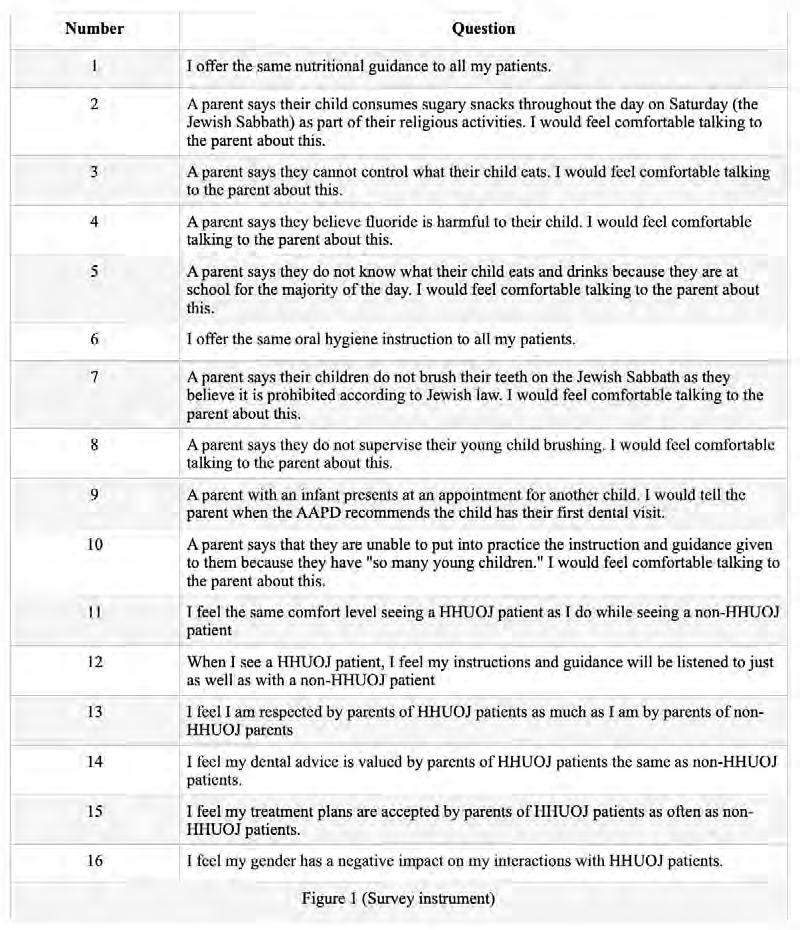
A research protocol was developed and found to be exempt by the Institutional Review Board (IRB) of NYU. A 26-question survey was emailed to the 641 pediatric dentists or pediatric dental residents who, according to the AAPD, had addresses in New York State (Figure 1). Of the 26 questions, 10 asked about the identity of the respondent, while 16 dealt with the topic.
Study data were collected and managed using REDCap electronic data capture tools hosted at NYU.[8,9] REDCap (Research Electronic Data Capture) is a secure, web-based software platform designed to support data capture for research studies, providing: 1) an intuitive interface for validated data capture; 2) audit trails for tracking data manipulation and export procedures; 3) automated export procedures for seamless data downloads to common statistical packages; and 4) procedures for data integration and interoperability with external sources.
To participate in the survey, respondents needed to meet specific criteria, including being a practicing pediatric dentist or pediatric dental resident with an address in New York State consistent with their AAPD membership information. Respondents also needed to have had at least one appointment with a HHUOJ patient, and they needed to complete enough survey questions for REDCap to recognize the survey as completed.
Conversely, individuals were excluded if they were not currently practicing pediatric dentists or pediatric dental residents with an address in New York State, had never had an appointment with a HHUOJ patient or failed to answer enough questions for REDCap to consider the survey completed.
Participation was voluntary, and surveys were completed anonymously. A consent statement was shown at the beginning of the survey and consent was assumed when participants proceeded with the survey. All questions were set to a Likert scale with 1 representing “strongly disagree” and 5 reflecting “strongly agree.” Data analyses were conducted using Microsoft Excel and an online Mann-Whitney U Test calculator. Statistical significance was set to P < .05. Assumptions made for the data analyses were that the questions involved one-tailed hypotheses, and each test was composed of two random independent samples.
Results and Discussion
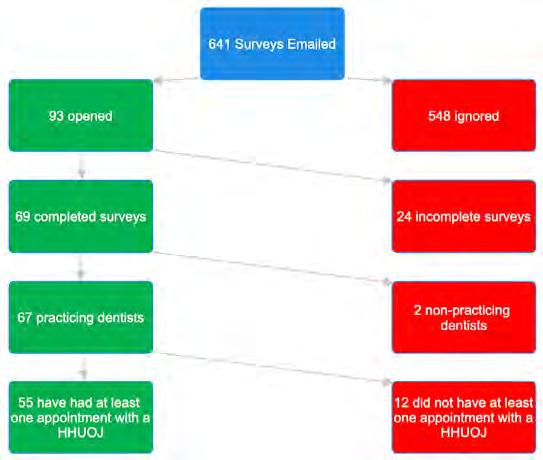
Of the 641 surveys that were sent out, 93 were opened. Twenty-four surveys were marked as incomplete by REDCap and, thus, were discarded from the data analyses. Of the remaining 69 surveys, two were from dentists who were not currently practicing, and 12 had never had an appointment with a HHUOJ patient and, thus, did not meet the inclusion criteria. This left 55 surveys to be analyzed (Figure 2). Some of the questions were not answered by certain participants but were still marked as completed by REDCap; thus, the n value fluctuates from 55 to 54 in certain questions.
Except for question 16, which only dealt with gender, each question was analyzed to compare answers from the following six variables:
• Gender (male versus female)
• Age (45 and under versus 46 and above)
• State of Dental School (New York versus other)
• State of Pediatrics Residency (New York versus other)
• County of Practice (Kings and Rockland counties versus other)
• Number of HHUOJ Patients Seen Per Month (5 and below versus 6 and above)
New York was chosen as the data group to compare versus all others in the state of dental school and residency analysis as New York is home to the largest group of Jews in the United States. Kings County (Brooklyn) and Rockland County were grouped together for the county analysis as they are the two counties with the largest share of Hasidic Jews in New York State.[12]
Of the 55 surveys, 19 were completed by males and 36 by females, with zero respondents identifying as nonbinary or “other” in the questionnaire. Thirty-six respondents were 45 years old and under, while 19 were 46 and older. Despite those groups having the same number of participants in each category, they were not the same respondents in each group. Of the males, 11 were 45 years old and under, while 8 were 46 and older. Of the females, 25 were 45 years old and under, while 11 were 46 and older. Of the females, 25 were 45 years old and under, while 11 were 46 and older.
Thirty-one participants attended dental school in New York State, with the other 24 going elsewhere. Forty-five currently attend or attended a pediatric dental residency in New York, while 9 did not (data was not available for one respondent). Twelve currently practice in Kings or Rockland counties, while 42 practice elsewhere (data was not available for one respondent). Finally, 39 providers noted that they saw 5 or fewer HHUOJ patients per month, while 15 said they see 6 or more.
With six variables measured for 15 questions, and one variable for the question on gender, a total of 91 MannWhitney tests were run. Of those, 16 returned statistically significant results with P<.05. Interestingly, 13 of the 16 significant results were shown with the test variable of age, while one was for county of practice, and two for gender.
Each question had at least one significant result except for questions 1 and 6, which were asking whether the providers offer the same nutritional guidance and OHI to all patients, respectively.
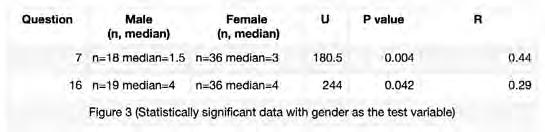
When the Mann-Whitney test was run to evaluate whether gender influenced the results of question 7, the results indicated that females were significantly more comfortable than their male counterparts (U=180.5, P =.004). In question 16, this held true again, with the results showing that females felt on the whole, less like their gender had a negative impact on their interactions with HHUOJ, compared to the males (U=244, P=0.042) (Figure 3).
The null hypothesis was rejected on both fronts, as the assumption made at the beginning of this project was that males would feel more comfortable with this community due to the uneven gender roles prominent in Hasidism.[13] Perhaps this reflects the nature of pediatric dentistry itself in relation to HHUOJ patients. Because women in the HHUOJ community are “expected to contribute… by taking care of the household,” the female providers feel more comfortable in situations that ultimately are about ensuring the health of the child in front of them.[14] Female parents or guardians may also be more comfortable engaging female practitioners due to societal norms.

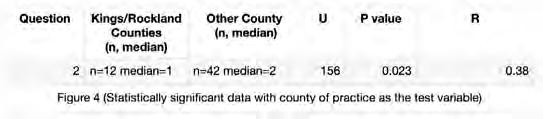
The only data set which indicated a significant difference based on county of practice was question 2, asking about a child consuming sugary snacks on Shabbat (Figure 4). This too led to the null hypothesis being rejected, with providers in Kings and Rockland counties being less comfortable than those in other New York State counties addressing this scenario (U=156, P= 0.023). It was assumed that those immersed in the HHUOJ culture, those in Kings and Rockland counties, would be more comfortable talking about this scenario, but the data suggests otherwise. A child condensing all their sugary sweets into one day, like one might do on Shabbat, might actually lower their caries risk, similar to how the Vipeholm Study has resulted in Lördagsgodis in Sweden.[15,16]
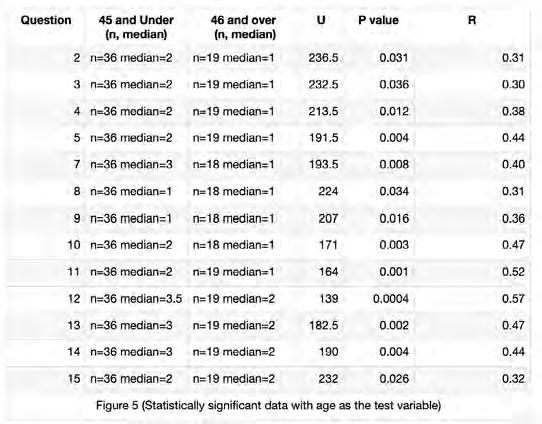
All questions that returned statistically significant results while testing provider age showed results in the same direction. The younger age group was more comfortable with addressing the situations posed in the questions, while they also reported they felt respected, listened to, valued and had their treatment plans accepted as much by HHUOJ patients relative to non-HHUOJ patients.
Questions 2 (U=236.5, P=0.031), 3 (U=232.5, P=0.036), 4 (U=213.5, P=0.012), 5 (U=191.5, P=0.004), 7 (U=193.5, P=0.008), 8 (U=224, P=0.034), 9 (U=207, P=0.016) and 10 (U=171, P=0.003) can be generalized into a category of counseling, and the data suggests this younger cohort is more willing to engage in the “uncomfortable” scenarios presented, addressing each patient’s needs individually. Possible explanations for this discrepancy could be that the younger generation has been trained in an era where parents are more involved in their children’s care than those in the past, as well as the increase in cultural competency skills being taught in dental schools today.[17,18]
For questions 11 (U=164, P=0.001), 12 (U=139, P=0.0004), 13 (U=182.5 P=0.002), 14 (U=190, P=0.004) and 15 (U=232, P=0.026), which can be described as asking the providers about their perceptions of their relationship with HHUOJ patients and their guardians, once again, the younger generation reported they felt their relationship was better with this patient population than the older group (Figure 5). If one connects the dots, perhaps it is because the older cohort is less comfortable addressing the unique needs of each patient who sits in their chair, that they then feel less comfortable, listened to less, valued less, respected less and they feel their treatment plans are not accepted as much, when they see these patients compared to nonHHUOJ patients.
The study found no statistically significant differences when testing where the provider completed their training— both dental school and pediatric residency. Additionally, nothing of note was found based on the number of HHUOJ patients seen per month.
A limitation of this study was that it relied on the dentists to identify if they have ever had an appointment with a HHUOJ patient and then reflect on those experiences. No criteria were provided to the practitioners to describe the HHUOJ community; it was left to the provider to accurately reflect on their past appointments. It is possible that some dentists who were excluded from the study mistakenly answered that they had not had an appointment with a HHUOJ patient without knowing, and also that providers who were included could have assumed some of their patients fit the bill of HHUOJ without that being the case, and let those experiences, be it positive or negative, color their answers.
Another weakness was the limited sample size. Although statistically significant data was found, the data set in question only reflected 55 practicing providers who have had appointments with HHUOJ patients in New York State. The experiences of those who did not respond to the questionnaire may not have aligned with those who did, and response bias in an emailed survey is always something to consider when weighing these results.
From the data that was gleaned, it is important that providers in New York State examine their past interactions with HHUOJ patients and take time to reflect. AAPD defines a dental home as “the ongoing relationship between the dentist and the patient, inclusive of all aspects of oral health care delivered in a safe, culturally-sensitive, individualized, comprehensive, continuous, accessible, coordinated, compassionate, and patient and family-centered way regardless of race, ethnicity, religion, sexual or gender identity, medical status, family structure, or financial circumstances.”[19] HHUOJ patients deserve a dental home like all other patients. Even in the counseling scenarios asked about on the survey, or if the provider does not feel like they are respected, listened to, or valued as much as they are by other patients, it is the provider’s duty to still cultivate the relationship belonging in a dental home.
Conclusions
The results discussed above suggest the following:
• Female practitioners in New York State are more likely than their male counterparts to feel comfortable with HHUOJ patients, and males feel like their gender has a negative impact on their interactions with HHUOJ families.
• Location of training, practice and number of HHUOJ patients seen per month does not seem to impact how providers interact with these patients, except for one specific question posed regarding the Jewish Sabbath. Concerning this question, dentists practicing outside of the heavily-HHUOJ-populated Kings and Rockland counties felt more comfortable addressing this topic than those practicing inside these communities.
• Age is the most significant criteria when evaluating for differences in how providers interact with HHUOJ families. Dentists above the age of 46 years seemed to have the biggest disconnect between their own thoughts on their interactions with HHUOJ patients and what occurs in practice. CE courses dealing with culturally competent care for HHUOJ patients that are offered in New York State should be marketed to dentists in this older age group to improve this facet of their care.
The authors thank all participants, who took time from busy clinical days to respond to this survey. They also thank Liz Best, grants and research manager at NYU College of Dentistry, Department of Pediatric Dentistry, for her support and guidance in seeing this project through from its initial stages through the end, and Jill Fernandez, R.D.H., M.P.H., for her mentorship at the beginning stages of this project. Queries about this article can be sent to Dr. Turk at Gideon.s.turk@gmail.com.
REFERENCES
1. Berger J. Aided by Orthodox, city’s Jewish population is growing again. The New York Times 12 June 2012. www.nytimes.com/2012/06/12/nyregion/new-yorks-jewish-population-isgrowing-again.html.
2. Britannica, The Editors of Encyclopaedia. Orthodox Judaism. Encyclopedia Britannica 2 Feb. 2024, https://www.britannica.com/topic/Orthodox-Judaism. Accessed 11 February 2024.
3. Scambler S, Klass C, Wright D, Gallagher JE. Insights into the oral health beliefs and practices of mothers from a north London Orthodox Jewish community. BMC Oral Health 2010 Jun 7;10:14. doi: 10.1186/1472-6831-10-14. PMID: 20529247; PMCID: PMC2894741.
4. Klass C, et al. Oral health and oral health behaviours of five-year-old children in the Charedi Orthodox Jewish Community in North London. 2017.
5. Coleman-Brueckheimer K, Dein S. Health care behaviours and beliefs in Hasidic Jewish populations: a systematic review of the literature. J Relig Health 2011 Jun;50(2):422-36. doi: 10.1007/s10943-010-9448-2. PMID: 21249524.
6. Soldo M, Matijević J, Malčić Ivanišević A, Čuković-Bagić I, Marks L, Nikolov Borić D, Jukić Krmek S. Impact of oral hygiene instructions on plaque index in adolescents. Cent Eur J Public Health 2020 Jun;28(2):103-107. doi: 10.21101/cejph.a5066. PMID: 32592553.
7. Tsang C, Sokal-Gutierrez K, Patel P, Lewis B, Huang D, Ronsin K, Baral A, Bhatta A, Khadka N, Barkan H, Gurung S. Early childhood oral health and nutrition in urban and rural Nepal. Int J Environ Res Public Health 2019 Jul 10;16(14):2456. doi: 10.3390/ijerph16142456. PMID: 31295932; PMCID: PMC6678585.
8. Harris PA, Taylor R,Thielke R, Payne J, Gonzalez N, Conde JG. Research electronic data capture (REDCap) – A metadata-driven methodology and workflow process for providing translational research informatics support. J Biomed Inform 2009 Apr;42(2):377-81.
9. Harris PA, Taylor R, Minor BL, Elliott V, Fernandez M, O’Neal L, McLeod L, Delacqua G, Delacqua F, Kirby J, Duda SN. The REDCap consortium: building an international community of software partners. J Biomed Inform 2019 May 9 [doi: 10.1016/j.jbi.2019.103208].
10. Mann-Whitney U Test Calculator. Social Science Statistics, Jeremy Stangroom. https://www. socscistatistics.com/tests/mannwhitney/default.aspx.
11. Jewish population in the United States by state. www.jewishvirtuallibrary.org/jewish-population-in-the-united-states-by-state. Accessed 11 Feb. 2024.
12. The growth of the Orthodox Jewish community in New York State over the last twenty years, ojpac.org/updates/the-growth-of-the-orthodox-jewish-community-in-new-york-state-overthe-last-twenty-years. Accessed 11 Feb. 2024.
13. Nir SM,Pulwer S. A glimpse inside the hidden world of Hasidic women. The New York Times, 19 Sept. 2018, www.nytimes.com/2018/09/19/nyregion/a-glimpse-inside-the-hiddenworld-of-hasidic-women.html.
14. Shaked M, Bilu Y. Grappling with affliction: autism in the Jewish Ultraorthodox community in Israel. Cult Med Psychiatry 2006;30:1–27. https://doi.org/10.1007/s11013-006-9006-2.
15. Gustafsson BE, Quensel CE, Lanke LS, Lundqvist C, Grahnen H, Bonow BE, Krasse B. The Vipeholm dental caries study; the effect of different levels of carbohydrate intake on caries activity in 436 individuals observed for five years. Acta Odontol Scand 1954 Sep;11(3-4):23264. doi: 10.3109/00016355308993925. PMID: 13196991.
16. Savage M. Lördagsgodis: Sweden’s Saturday-only candy tradition. BBC News, BBC, 28 Feb. 2022, www.bbc.com/worklife/article/20211004-lrdagsgodis-swedens-saturday-only-candytradition.
17. Miller CC. The relentlessness of modern parenting. The New York Times 25 Dec. 2018. www. nytimes.com/2018/12/25/upshot/the-relentlessness-of-modern-parenting.html.
18. Mariño RJ, Ghanim A, Barrow SL, Morgan MV. Cultural competence skills in a dental curriculum: a review. Eur J Dent Educ 2018 Feb;22(1):e94-e100. doi: 10.1111/eje.12263. Epub 2017 Mar 6. PMID: 28261942.
19. American Academy of Pediatric Dentistry. Policy on the dental home. The Reference Manual of Pediatric Dentistry. Chicago, IL: American Academy of Pediatric Dentistry. 2023:35-7.
Gideon Turk, D.M.D., completed his residency at NYU College of Dentistry, Department of Pediatric Dentistry, in June 2024 and now practices in Ontario, Canada.

Michelle Goldstein, D.M.D., is director of pediatric outreach and prevention programs at NYU College of Dentistry, Department of Pediatric Dentistry, New York, NY.