SINCE 1891
THE BROWN DAILY HERALD BROWNDAILYHERALD.COM
VOLUME CLXI, ISSUE 19
FRIDAY, OCTOBER 30, 2026
SOPHIA LENG / HERALD
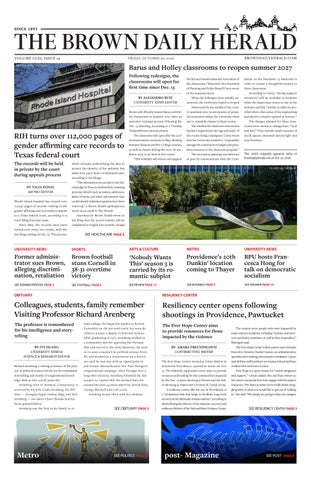
Barus and Holley classrooms to reopen summer 2027 Following redesigns, the classrooms will open for first time since Dec. 13 BY ALEJANDRO RUIZ UNIVERSITY NEWS EDITOR
RIH turns over 112,000 pages of gender affirming care records to Texas federal court The records will be held in private by the court during appeals process BY TALIA EGNAL METRO EDITOR Rhode Island hospital has turned over 112,647 pages of records relating to the gender-affirming care it provides to minors to a Texas federal court, according to a court filing from last week. Since May, the records have been turned over every two weeks, with the last filing coming on Oct. 16. The process,
Brown will officially reopen Barus and Holley classrooms in summer 2027 after an extensive redesign process following the Dec. 13 shooting, according to a Tuesday Today@Brown announcement. The classrooms will open after the 2027 commencement ceremony in May, allowing Summer Session and Pre-College courses, as well as classes during the 2027-28 academic year, to be held in the rooms. “This schedule will ensure and support
the full and transformational renovation of the classrooms,” Executive Vice President of Planning and Policy Russell Carey wrote in the announcement. When the redesigns were initially announced, the University hoped to reopen classrooms by the middle of the 202627 academic year. In anticipation of potential renovation delays, the University chose not to schedule classes in these rooms. The timeline for classroom renovations has been impacted by the “age and scale” of the rooms being redesigned. Carey wrote that the University needed to “responsibly manage the construction budget and prioritize resources to the classroom program.” The renovation planning was informed in part by conversations with the Com-
which includes deidentifying the data to protect the identity of the patients, has taken over 3,500 hours of dedicated time, according to the filings. “The information we provide to the federal judge in Texas is deidentified, meaning personal details such as names, addresses, dates of birth, and other information that could identify individual patients have been removed,” a Brown Health spokesperson wrote in an email to The Herald. Attorneys for Brown Health wrote in the filing that the record transfer will be completed in roughly four months, though
mittee on the December 13 Memorial in order to ensure a thoughtful reentry to these classrooms. According to Carey, “strong support resources” will be available to students when the classrooms return to use in the summer and fall, “similar to what we provided when other areas of the engineering and physics complex opened in January.” The changes planned for these classrooms were chosen to change their “look and feel.” They include small recesses of social spaces, increased natural light and new furniture.
This article originally appeared online at browndailyherald.com on Oct. 27, 2026. CLAIRE KE / HERALD
SEE HEALTHCARE PAGE 5
UNIVERSITY NEWS
SPORTS
ARTS & CULTURE
METRO
UNIVERSITY NEWS
Former administrator sues Brown, alleging discrimination, retaliation
Brown football stuns Cornell in 38-31 overtime victory
‘Nobody Wants This’ season 3 is carried by its romantic subplot
Providence’s 20th Dunkin’ location coming to Thayer
BPU hosts Francesca Hong for talk on democratic socialism
SEE ADMINISTRATION PAGE 2
SEE FOOTBALL PAGE 6
SEE REVIEW PAGE 12
SEE BUSINESS PAGE 7
SEE SPEAKER PAGE 15
OBITUARY
RESILIENCY CENTER
Colleagues, students, family remember Visiting Professor Richard Arenberg
Resiliency center opens following shootings in Providence, Pawtucket
The professor is remembered for his intelligence and storytelling
The Ever Hope Center aims to provide resources for those impacted by the violence
BY IVY HUANG UNIVERSITY NEWS & SCIENCE & RESEARCH EDITOR Richard Arenberg, a visiting professor of the practice of political science known for his remarkable storytelling and wealth of congressional knowledge, died on Oct. 9 at 80 years old. Arenberg, born in Norwich, Connecticut, is survived by his wife Linda Arenberg, his children — Georgina Segal, Joshua, Meg, and Ned Arenberg — his sister Cherri Brooks and his three grandchildren. Arenberg was the first in his family to at-
Metro
tend college. He began his studies at Boston University on the pre-med track, but soon decided to pursue a degree in Political Science. After graduating in 1971, Arenberg worked as a community activist opposing the Vietnam War and served in the Army Reserves. He went on to earn a master’s in political science from BU and worked on a dissertation for a doctorate until he was met with an opportunity to join former Massachusetts Sen. Paul Tsongas’s congressional campaign. After Tsongas won a long-shot election, Arenberg followed the late senator to Capitol Hill. He worked there for around the next 34 years where he served Sens. George Mitchell and Carl Levin. Arenberg would often walk his children
SEE OBITUARY PAGE 3
SEE POLITICS PAGE 4
BY AMARA FREUNDSCHUH CONTRIBUTING WRITER The Ever Hope Center, located at Union Station in downtown Providence, opened its doors on Oct. 14. The federally supported center aims to provide resources and healing for the communities impacted by the Dec. 13 mass shooting at Brown and the Feb. 16 shooting at Pawtucket’s Dennis M. Lynch Arena. A resiliency center, like the one in Providence, is a “centralized hub that helps to facilitate long-term recovery in the aftermath of mass violence,” according to Alyssa Rheingold, director of the response, recovery and resilience division of the National Mass Violence Center.
post- Magazine
The centers serve people who were impacted by mass violence incidents, including “victims, and survivors and family members, as well as first responders,” Rheingold said. The Ever Hope Center’s three-person team includes Executive Director Rachel Caruso, an administrative specialist and a training and outreach coordinator. Caruso said all three staff members are trauma-trained and have worked with survivors of crime. Ever Hope is a space meant for “victim navigation and support,” Caruso added. She said that visitors to the center can decide how they engage with the space’s resources. “We listen to what you’re really either struggling with, or what you would like to get out of walking in,” she said. “We simply are going to help you navigate
SEE RESILIENCY CENTER PAGE 5
SEE POST- PAGE 8
PAGE 2
Friday, October 30, 2026
UNIVERSITY NEWS ADMINISTRATION
Former administrator sues Brown, alleging discrimination, retaliation Brown vigorously denied the allegations and said the case is meritless BY JAMES LIBRESCO SENIOR STAFF WRITER A former Brown administrator filed a lawsuit against the University last week, alleging that in 2024, her supervisors discriminated and retaliated against her because of her ethnicity and disability. The administrator, Rosedelma Seraphin, worked in offices managing diversity and belonging initiatives at Warren Alpert Medical School for about five years before her employment was terminated in June 2024, according to a federal complaint filed in the District of Rhode Island. Leading up to her termination, Seraphin was given two improvement plans and took two leaves for a mental health condition characterized as a disability in the complaint. The complaint alleges that Brown fired Seraphin “because of her disability and in retaliation for requesting and taking protected medical leave and disability accommodations.” It also claims that supervisors discriminated against Seraphin, who is Black and Dominican. University spokesperson Brian Clark vigorously denied the allegations in a statement to The Herald and characterized the case as being “without merit.” “Brown maintains strong policies and procedures to ensure an environment free of discrimination and harassment,” Clark
RAZANNE SHOUKFEH / HERALD
It remains unclear when the two parties will meet in court. said, “as well as retaliation against people who report discrimination or harassment.” “We have a strong case to make and will respond as appropriate through the legal process,” he added. Seraphin’s attorney, Layi Oduyingbo, said in a statement to The Herald that his firm was prepared to “secure the justice and accountability (Seraphin) deserves.” Oduyingbo suggested that a directive from the Rhode Island Commission for Human Rights bolstered Seraphin’s case, while Clark said in a separate statement that “the commission's decision is not a finding of responsibility but rather a reflection of its interest in hearing the arguments of the parties.” The directive “is understandable in light of the importance of employers ensuring an environment free of discrimination and harassment,” he added. According to the complaint, Seraphin received positive feedback from the super-
visor she had from 2019 to 2022. But the complaint alleges that after a restructuring in 2022 shifted Seraphin’s role, her new boss, current Vice President for Campus Life Patricia Poitevien, who is Haitian and Black according to the suit, targeted Seraphin because of her Dominican identity. “Knowing that Rosedelma was Dominican, Dr. Poitevien made workplace comments about tensions between Haitians and Dominicans, stating in substance that the groups ‘do not get along,’” the complaint claims. “In the context of their deteriorating working relationship, the comment conveyed that Rosedelma’s national origin was an obstacle to their ability to work together.” The complaint also alleges that Poitevien “scrutinized Rosedelma more closely and publicly questioned her contributions” after Seraphin participated in the Black @ Brown affinity group and advocated
for the University to address a purported discrepancy between her compensation and that of peers with fewer management responsibilities. Poitevien referred The Herald to the University when reached for comment. Clark said in his statement that Brown’s policies protect from discrimination “based on race, sex, gender, disability and every other characteristic protected under applicable law.” Around May 2023, Brown placed Seraphin on a Performance Improvement Plan — which outlines employee’s deficiencies and creates a timeline for performance improvement, according to the University’s website. After Seraphin challenged the PIP with human resources officials, “Brown converted the PIP into a less formal expectations memorandum and removed its disciplinary nature and timeline,” the complaint says. In June 2023, Seraphin took medical leave for “adjustment disorder,” a mental health condition. The medical leave lasted for about 12 weeks, the complaint says. When Seraphin returned in September, she began reporting to a different supervisor, yet according to the complaint, she “continued to experience scrutiny and criticism rather than an improvement in her working environment.” In March 2024, Seraphin once again took medical leave, and while on leave applied for a new position in the Office of the Provost, the complaint says. As part of the job interview process, she returned to campus for a day in May. “After learning of the interview,
(Brown) Human Resources questioned how she could participate while unable to perform her regular job and told her that her participation meant she could return to work,” the complaint alleges. On May 21, the day after Seraphin returned, she was placed on a second PIP, which “cited events (that) occurred months before her March 2024 leave and May return,” the complaint claims. The PIP “promised a thirty-day evaluation period through June 21,” but Brown then fired Seraphin on June 14, according to the complaint. “Brown subjected Rosedelma to the Second PIP and terminated her because of her disability and in retaliation for requesting and taking protected medical leave and disability accommodations,” the complaint alleges. Clark defended Brown’s disciplinary processes in his statement, writing that “We maintain detailed performance management and corrective discipline policies and procedures and move forward with employee terminations only after severe and/or persistent, consistently documented issues.” “We abide by these policies in all employment matters,” he added. It remains unclear when the two parties will meet in court. District Judge Melissa DuBose recused herself from the case last week, court documents show. It has been reassigned to Chief Judge John McConnell Jr.
This article originally appeared online at browndailyherald.com on Oct. 28, 2026.
GRADUATE SCHOOL
Paused humanities, social sciences PhD programs resume admissions Smaller PhD cohorts may cut undergraduate course offerings, depts say BY IAN RITTER UNIVERSITY NEWS & SCIENCE & RESEARCH EDITOR Last fall, at least six departments had admissions to their doctoral programs paused as the University, facing a budget deficit, looked to decrease spending. Now, five of those departments have been permitted to resume admissions, but with reduced capacity. One department, the Department of Anthropology, volunteered to pause their admissions. The departments of Egyptology and Assyriology, classics, French and francophone studies, German studies and Italian studies were the other departments to pause program admissions. Some programs said that they had not been consultedbefore their admissions were paused by the Brown administration. The Department of Italian Studies still has their admissions paused, according to their website. A professor in the department declined to comment on the pause. In an email to The Herald, Dean of the Graduate School David Lindstrom wrote that the cuts to graduate education were made as the University was projecting a loss of $30 million for fiscal year 2026, with that deficit expected to grow in FY27. In an interview with The Herald, Associate Professor of Environment and Society and of Anthropology Myles Lennon, who is also the director of graduate admissions for anthropology, confirmed that the De-
KAIA YALAMANCHILI / HERALD
As the number of graduate students decreases, less will be available to work as teaching assistants. partment of Anthropology volunteered to pause their admissions. “We thought that it was more important to maintain a full cohort rather than keeping smaller cohorts multiple years,” Lennon said. “There’s a lot of benefits to ensuring that graduate students are learning side-by-side.” The Italian studies department typically admits about two students per year, The Herald previously reported. The Department of Egyptology and Assyriology typically admits one or two students a year, the department’s Director of Graduate Studies Felipe Rojas-Silva — an associate professor of archaeology and of Egyptology and Assyriology — wrote in an email to The Herald. “Pausing entirely makes a big difference,” he added. Admissions have resumed for most programs, but the University has shrunk most doctoral programs. Three depart-
ments — the Department of Classics, the Egyptology and Assyriology department and the Department of French and Francophone Studies — told The Herald that they were given reduced target numbers of students to admit over the next three years. Professor of German Studies and Comparative Literature Gerhard Richter, who is also director of graduate studies for the Department of German Studies, told The Herald that his department has not had clear communication from the Graduate School beyond a smaller target for admissions this year. The anthropology department is still in active negotiations with the University regarding their cap, Lennon told The Herald. According to Professor of French and Francophone Studies Lewis Seifert, who is the department’s interim chair, his department was told that they could now only house six total students across all years of
their doctoral program, down from their previous cap of 13. Over the next three years, the department is permitted to admit four total students. The classics department saw significant cuts, with their total program cap shrinking from about 20 students to approximately 12, according to Professor of Classics Stephen Kidd, the department’s director of graduate studies. They were given a threeyear plan to gradually reduce the number of students. The cost of supporting graduate students during their time at Brown can reach up to $1 million per student, Lindstrom wrote. Humanities and social science programs are typically funded mostly by the University, whereas physical and life sciences graduate programs usually receive external grant funding. As the number of graduate students decreases, less will be available to work as teaching assistants. Some courses, such as CLAS 0900: “Greek Mythology” — which was taken by 150 students when last taught by Kidd in 2023 — “will become a thing of the past, as there will no longer be enough TAs to support such large lecture courses,” Kidd wrote. Richter explained that in language departments, which are typically smaller, a limited number of graduate students means they would have to work as TAs for language-learning courses instead of expanding their teaching portfolio to courses on topics that would “prepare themselves much better for an academic career.” Some departments told The Herald that they were worried that the Office
of the Provost was exercising too much power over the Graduate School and making misinformed decisions when cutting programs. Richter called the decision to pause admissions across programs “irresponsible.” “Final decisions on admissions targets were made by Brown’s senior academic leaders in consultation with the Dean of the Faculty, the Graduate School and leaders from Brown’s schools and major academic units,” Lindstrom wrote to The Herald. “Our overall goal has been to continue to support our programs across all major academic divisions — arts and humanities, social sciences, life sciences and physical sciences — even as funding approaches (such as the availability of external grants versus the need to provide central University funding) vary significantly across programs,” he added. Citing the growth of the University’s endowment, Richter argued the University should not forget its academic mission. “Ultimately, and I’ll say it up front, this is not a question of finances, it’s a question of values,” he said. “To think of it merely in terms of money, resources, is a way of saying we cannot afford to be a university. And I refuse to believe this.” “All of the decisions we have made and continue to make are grounded in Brown’s strong commitment to doctoral education across the disciplines and to supporting students at the highest levels,” Lindstrom wrote to The Herald.
This article originally appeared online at browndailyherald.com on Month Date, 2025.
THE BROWN DAILY HERALD
PAGE 3
UNIVERSITY NEWS OBITUARY FROM PAGE 1 around the Capitol, “showing us off to senators and other staff,” Meg Arenberg wrote. “He made us feel special and important.” But when his career on Capitol Hill came to a close in 2009, Arenberg’s second act as an educator was just beginning. Throughout his teaching career, Arenberg also taught at Northeastern University and Suffolk University. “Dad loved Brown, and really valued his role, especially as a mentor. He loved to tell us about his students at Brown and how dedicated and bright they are,” Josh Arenberg wrote in an email to The Herald. “It was also a way for him to pass on a lifetime of learning about the Senate, Senate procedure and the inner workings of politics.” Arenberg made such an impression at Brown that he was made a senior fellow at the Watson School of International and Public Affairs and given a “special endowed chair for visiting professors in recognition of his contributions,” according to Professor of Political Science and Deputy Provost Wendy Schiller. During his time at Brown, Arenberg also published “Congressional Procedure: A Practical Guide to the Legislative Process in the U.S. Congress,” and the award-winning “Defending the Filibuster: The Soul of the Senate.” In the past five years, Arenberg taught over 1,500 students, according to a community message Dean of the Faculty Leah VanWey wrote following his passing. Meg Arenberg and her father shared a love of teaching. “As a fellow teacher, I used to have long conversations with him about pedagogy,” Meg Arenberg wrote in an email to The Herald. Arenberg was also a devoted and loving father and grandfather. Meg Arenberg and her father had a tradition of visiting the zoo together, which lasted well into their adulthoods. “(We) could spend an entire afternoon just watching one animal,” Meg Arenberg wrote. “We loved to spend quiet time together like that — at the zoo, at the beach, on long drives, on walks in the woods.” Although Meg Arenberg was not into sports and less into music, her father passed his love of the Red Sox and the
Celtics to her brother and shared his music tastes with Meg Arenberg’s brother, Josh. In the weeks following his passing, The Herald spoke with Arenberg’s colleagues, friends and former students, who remember his intellect, integrity and passion for teaching. Arenberg left an enduring impact as a public servant, but beyond that, he will be remembered for inspiring generations of students. A storied career on Capitol Hill Christopher Woods PhD ’24, visiting assistant professor of political science, cotaught POLS1120: “Campaigns and Elections” with Arenberg before his passing. Tucked in the corner of Arenberg’s office — where Woods currently hosts office hours for the course — is a wall of photos from his time on Capitol Hill. While on The Hill, Arenberg worked on the Alaska Lands Act and the Iran-Contra Committee. These stories lived on in Arenberg’s classroom — he would often engage in storytelling, Woods said. One of his favorite stories to share was of the work he did putting together a West Virginia nuclear fallout shelter in the case of an attack on Washington D.C. He also served as a staffer on a commission investigating illegal transfers of funds to the Contras. Arenberg carried his stories with him from The Hill to College Hill, and would swap stories with Jeffrey Robbins, a visiting assistant professor of the practice of political science, about Levin. Robbins first heard about Arenberg long before his career at Brown. While working as a counsel for two Senate committees in the 1990s, he heard about Arenberg through Levin. “As Senator Levin’s legislative aide, (Arenberg) was part of that really elite Senate staff very highly regarded by Senator Levin,” Robbins said. He added that Tsongas had also regarded Arenberg highly. In May, Robbins and Arenberg both sat on an “America Polarized” panel hosted by Brown Democrats. “It’s the only time I ever saw him in front of students, but it was easy to see why he was so popular,” Robbins said. “In a time of hyperpartisanship and polarization and fractiousness and snarkiness in
Congress, he represented an old-fashioned breed of public service people who went down to Washington and served not because of ego.” “He worked in a quiet, thoughtful, hardworking way,” Robbins added. A passion for storytelling Many of the stories that ended up in Arenberg’s books also ended up being told at the Arenberg dinner table, Meg Arenberg wrote. “My brothers and I used to joke that we’d been taking his classes all our lives.” These stories often made it to the classroom. Morgan Boonshaft ’28 appreciated how Arenberg tied his over 30 years of experience on Capitol Hill to the classroom. “You could tell he cared about his students, and he wanted the best for all of us, and really just wanted us to learn the content.” Arenberg would frequently present a slide titled “Old War Stories,” which would be the backdrop for an entertaining story of his time on The Hill, Marisa Coghlin ’26 said. The war stories were used to help students “reach their own conclusion” about “behind-the-scenes that you may not see in the press,” said Michael D’Ortenzio ’15, who took three classes with Arenberg. On some days, Arenberg “would just casually talk about his personal relationship with Joe Biden,” said Robert Diettrick GS, a political science doctoral candidate and former teaching assistant of Arenberg’s. One day, Arenberg brought a note to class that Biden had sent him after he published his book, “Defending the Filibuster.” “You could tell he was just so proud of it,” Diettrick said. Sophia Knaggs ’27 decided to take POLS 1120 this semester after hearing great things about Arenberg from her friends. This semester, Arenberg told the class the story of his wedding in the Capitol building. “It was just so romantic, and you could tell that he lived and breathed working in The Hill so much so that (he) and his wife got married there,” Knaggs said. Angelina Lieberman ’27, who took four courses with Arenberg, said that he gave her a fresh perspective on American politics. “He really wanted to connect what we were
COURTESY OF JOSH ARENBERG
In the past five years, Arenberg taught over 1,500 students. learning to current issues,” she said. “He taught his students not only how our democracy works but why its performance matters, and his influence will be felt for years to come,” Eric Patashnik, director of the Taubman Center, wrote in an email to The Herald. When Professor of Political Science, Public Policy and Urban Studies Marion Orr was the director of the Taubman Center for American Politics and Policy, he received an email from Arenberg, who was interested in teaching at Brown. “I met with Richard, and I like to say I hired him on the spot,” Orr said. “It was clear to me right away that he would be just great for the Taubman Center and just great for Brown,” Orr said. “ I learned early on what a great decision I made, because I began to hear from my students what a great professor he was.” A wealth of knowledge Across 34 years on The Hill and several more in academia, Arenberg cemented himself as an expert in American politics. “You’d (be) hard-pressed to find too many people around who had more knowledge of how the Senate worked,” Robbins
said. “Since he had spent so many years in the United States Senate, he was a master of the legislative process.” Schiller’s office was right across the hall from Arenberg’s when their offices were in Blistein House. Since the two offices were so close together, they often chatted about American politics. “He knew so much about the United States Senate and the history, but also policy development,” Schiller said. “Every conversation with Professor Arenberg taught me something I didn’t know before.” “I just thought, ‘wow, this person is not just a colleague — he’s an amazing resource when it comes to what actually happened in Congress,’” Professor of Political Science Corey Brettschneider said. “He had a warmth to him, a combination of a deep knowledge but also kindness.” “What I really admired about Richard is that he saw his retirement as a second act,” Orr said. “He felt a sense of duty … to share his experience with the young people here at Brown, and he did it well.”
This article originally appeared online at browndailyherald.com on Oct. 27, 2026.
Submissions: The Brown Daily Herald publishes submissions in the form of op-eds and letters to the editor.
SINCE 1891
THE BROWN DAILY HERALD 136TH EDITORIAL BOARD Editor-in-Chief Cate Latimer
Rebecca Goodman
Managing Editors Ciara Meyer Elise Haulund Claire Song
University News Editors Emily Feil Rebecca Goodman Samah Hamid Zarina Hamilton Ivy Huang Ian Ritter Alejandro Ruiz Roma Shah
Senior Editors Hadley Carr Paul Hudes Max Robinson POST- MAGAZINE Editor-in-Chief Elaina Bayard
Sports Editor Sajiv Mehta
COMMENTARY Head of Editorial Page Board Ethan Canfield
NEWS Metro Editors Michelle Bi Pavani Durbhakula Talia Egnal Emily Feil Amber Marcus-Blank Science & Research Editors Ivy Huang Ian Ritter Alice Xie
Opinions Editors Talia Berkwitz Ethan Canfield Christian Davis Isabella Gardiner Lucas Guan Avery Kaak CJ Lair Clara Murray Arya Vishwakarma
Arts & Culture Editors Ann Gray Golpira
PRODUCTION Copy Desk Chief
Chelsea Long Assistant Copy Chief Sofia Segarra Design Chiefs Emily Bao Maggie Ruan Design Editors Chloe Johnson Kailey Marti MULTIMEDIA Photo Chiefs Annamaria Luecht Kaia Yalamanchili Illustration Chiefs Kendra Eastep Isabela Guillen Video Chiefs Cienna Cheng Cody Cheng Social Media Chiefs Nate Barkow Annika Melwani Technology Chief Yassir Aouf Data Desk Chief Caleb Ellenberg
Games Chief Paul Hudes Podcast Chief Talia LeVine Multimedia Editors Marat Basaria Harry Guo Horatio Hamilton Selina Kao Ella Le Kenna Lee JJ Li Jake Parker BUSINESS General Managers Arjun Deshpande Anum Azhar Sales Directors Arjun Ray Hannah Han Finance Director Sydney Wright Office Manager Cary Warner
@the_herald
facebook.com/browndailyherald
@browndailyherald
@browndailyherald
88 Benevolent, Providence, RI (401) 351-3372 www.browndailyherald.com Editorial: herald@browndailyherald.com Advertising: advertising@browndailyherald.com
Op-eds are typically between 600 and 900 words and advance a clear argument related to a topic of campus discourse. You can submit op-eds to opinions@browndailyherald.com. Letters to the editor should be around 250 words and respond to an article or column that has appeared in The Herald, or critique or commend The Herald’s editorial decisions. You can submit letters to the editor to letters@browndailyherald.com. Submissions undergo multiple rounds of editing. These rounds of editing generally take place over the course of one evening, and you may have to respond to edits late in the evening. If you know you will be unable to do so, please mention that in your email, and we will do our best to work with you. Submissions can build on reporting from The Herald, reporting elsewhere, official statements from the University or other groups and other reputable sources, but they cannot break news or contain information that The Herald cannot verify. Because we cannot publish unsubstantiated information, failure to provide appropriate sources may mean we have to modify or remove unverified claims. The Herald will not publish anonymous submissions or submissions authored by organizations. Leaders of student organizations can be identified as such but cannot write under the byline of their organization. The Herald cannot publish all submissions it receives and reserves the right to edit all submissions. All submissions to The Herald cannot have been previously published elsewhere (in print or online — including personal blogs and social media) and must be exclusive to The Herald. Once your submission is published in The Herald, The Brown Daily Herald, Inc. owns the copyright to the materials. Commentary: The editorial is the majority opinion of the editorial page board of The Brown Daily Herald. The editorial viewpoint does not necessarily reflect the views of The Brown Daily Herald, Inc. Columns, letters and comics reflect the opinions of their authors only. Corrections: The Brown Daily Herald is committed to providing the Brown University community with the most accurate information possible. Corrections may be submitted up to seven calendar days after publication. Periodicals postage paid at Providence, R.I. Postmaster: Please send corrections to P.O. Box 2538, Providence, RI 02906. Advertising: The Brown Daily Herald, Inc. reserves the right to accept or decline any advertisement at its discretion. The Brown Daily Herald, Inc. is a financially independent, nonprofit media organization bringing you The Brown Daily Herald and Post- Magazine. The Brown Daily Herald has served the Brown University community daily since 1891. It is published Monday through Friday during the academic year, excluding vacations, once during Commencement and once during Orientation by The Brown Daily Herald, Inc. Single copy free for each member of the community. Subscription prices: $200 one year daily, $100 one semester daily. Copyright 2023 by The Brown Daily Herald, Inc. All rights reserved.
PAGE 4
Friday, October 30, 2026
METRO EDUCATION
75% of PPSD schools earn 1, 2 stars out of 5 in RIDE report card The data reflects performance during the last year of state takeover
RAINIER PEDERSON / HERALD
BY AMBER MARCUS-BLANK AND ALEJANDRO RUIZ METRO EDITOR AND UNIVERSITY NEWS EDITOR The Rhode Island Department of Education gave 28 out of 37 Providence Public School District schools one-or two-star ratings out of five in the department’s 2026 accountability report. Released earlier this month in RIDE’s Report Card portal, the report also identified eight PPSD schools in need of “comprehensive support and improvement,” a status given to the lowest-performing schools across the state. PPSD achievement in ELA and math each earned only one out of four possible points in RIDE’s Providence 2026 Accountability Summary Report. ELA proficiency fell 1% from last year, while math proficiency rose — but only 0.2%. Since last year, the four-year graduation rate and post-secondary enrollment fell 2% and 2.8%, respectively. “It is important to understand that the accountability system is designed to provide a comprehensive picture of school performance and identify areas where continued improvement is needed,” RIDE spokesperson Victor Morente wrote in an
email to The Herald. “The report cards are intended to guide continuous improvement, not simply serve as a final judgment on schools or districts.” Morente noted that “student achievement was the most common area identified for improvement” in schools across Rhode Island. The 2025-26 report card comes just months after Providence schools returned to local control, showing the results of the final year of state control, which began in 2019. Following the enactment of statewide takeover, the Turnaround Action Plan was developed to set benchmarks for improvement. As a part of the TAP, State Turnaround
Superintendent Harrison Peters and Commissioner of Elementary and Secondary Education Angélica Infante-Green set benchmarks for improving “excellence in learning” in the PPSD. These benchmarks included increasing the number of students in schools with at least a two-star rating, increasing the number of students present 90% of the school year and raising standardized test scores. According to PPSD Chief of Communications Suzanne Ouellette, 6,200 fewer PPSD students attend the state’s “lowest-performing schools” compared to before state takeover. “That is unrefutable progress,” Ouellette added.
Of the 37 schools in the PPSD, 10 received a one-star rating, 18 received two and eight received three. Only Classical High School received a five-star rating. The report from the 2018-19 academic year — the last before state takeover — listed 41 schools, awarding one star to 17 schools, two stars to 15, three stars to eight and five stars to one. While COVID-19 served as an “unprecedented disruption” to education, state control helped the PPSD make progress in career and technical education, absenteeism, infrastructure investment and opportunities for advanced learning, according to Morente. “The expertise provided through RIDE during the intervention was immeasurable,” Ouellette wrote. “They helped us to develop systems and structures that we will use to advance our students forward.” Chronic absenteeism in Providence schools has been on the decline, but many of the other goals outlined in the TAP remained unfulfilled at the end of state control. “The key takeaway for district leaders is that while the emergency interventions of the takeover phase worked to stabilize the system, there is much work to be done to increase our star ratings,” Ouellette wrote. The outcomes of the state takeover are “nuanced,” according to Kate Donohue, director of R.I. Research Partnerships and Analytics at the Annenberg Institute. Donohue wrote to The Herald on behalf
of the Evidence in Action - RI team, which partners with R.I. school administration on education research and policy. “Meaningful change in a system this size takes time, and the results of that work don’t always show up right away,” she wrote, noting that the PPSD has seen improvements in infrastructure and absenteeism. Donohue added that the TAP was an ambitious plan and that the star ratings are “a hard way to judge that progress because it summarizes an entire school into one number.” “Our view is that state policy, paired with closely aligned implementation in PPSD, contributed to improvement rather than holding it back,” she wrote. Still, these scores represent areas for continued improvement. The Evidence in Action - RI team believed that “everyone involved knows there is still work to do to make sure every student in PPSD is getting the education they deserve,” Donohue added. “With the return to local control, responsibility for the district's future now rests with local leadership, and our hope is that the progress achieved over the past seven years continues to accelerate on behalf of Providence students and families,” Morente wrote.
This article originally appeared online at browndailyherald.com on Oct. 27, 2026.
POLITICS
How incumbency fuels Rhode Island’s congressional elections Sen. Reed and Reps. Amo and Magaziner are up for reelection this November BY TALIA KATZ SENIOR STAFF WRITER On Nov. 3, Rhode Island voters will be greeted by familiar names on their general ballots: U.S. Sen. Jack Reed (D-R.I.) has been the Democratic nominee for Senate since 1996, while both U.S. Rep. Gabe Amo (D-R.I. 1) and U.S. Rep. Seth Magaziner ’06 (D-R.I. 2) have represented the state since 2023. The Herald spoke with professors and advocates to understand how incumbency, a lack of competition and a nationwide system of gerontocracy fuel the campaigns of Rhode Island’s congressional delegation. Incumbent advantage and the United States’s congressional gerontocracy Across the country, voters repeatedly reelect members of Congress into their old age despite frustration with the age of their legislators. “While more than half of humanity lives under political leaders over age 70, America is special among democracies for how old its federal politicians are,” Samuel Moyn — professor of law and history at Yale Law School and author of a book on gerontocracy — wrote in an email to The Herald. Reed is currently 76 years old and has served in Congress since 1991. Rhode Island’s other senator, Sheldon Whitehouse (D-R.I.), who is not up for reelection this year, is 71 years old. This year, Reed was challenged in his September primary by two candidates — including the progressive Connor Burbridge, who framed his campaign as a young firsttime politician hoping to triumph over his more establishment opponent. But Reed emerged victorious with just under 77%
of the vote. “It’s an old truism that in most parts of the country, if you get elected to Congress once, you essentially have a job for life unless you do something terrible,” said Stephen Kinzer, a senior fellow at the Watson School of International and Public Affairs. From the war in Iraq to the current war in Iran, Reed has “been a point person in the Democratic caucus” on foreign policy matters, according to Adam Myers, an associate professor of political science at Providence College. Meanwhile, Whitehouse “has distinguished himself on the Judiciary Committee in his sharp questioning of judicial nominees and in his criticism of the Supreme Court.” “When you think you’re truly indispensable, it would almost be treasonous to retire, and I think that’s the mindset that some of our older legislators fall into,” Kinzer added. Neither Reed nor Whitehouse responded to The Herald’s requests for comment. To Moyn, the clear issue with gerontocracy is “the risk of cognitive decline or outright death.” But “the deeper objection” is how these older federal politicians are unrepresentative of the people they represent, Moyn wrote. “Half of Americans are under 40, but almost no officeholders are,” he added. Giving space to people with new ideas is important, Kizner said. He explained that while younger people have been shaped “by the forces that formed today’s world,” older people “were formed in a way that prepared them to confront a world that no longer exists.” Still, he noted that there are benefits to having older lawmakers in office. Not only is continuity important in Congress, but the “accumulated wisdom” of age is “essential to shaping government policy,” he told The Herald. “One might say that if it ain’t broke,
don’t fix it,” Myers said. “It looks like a lot of Rhode Islanders think that our two senators are doing a good job and that their experience has actually been an asset.” Uncontested primaries and uncompetitive general elections According to John Marion — executive director of government reform nonprofit Common Cause Rhode Island — gerontocracy is “a symptom of a system that lacks enough competition.” Both R.I. representatives ran unopposed in their primaries this year. To Siraj Sindhu GS, executive director of housing justice organization Reclaim Rhode Island and a current Ph.D. candidate at Brown, both Amo and Magaziner represent a traditional form of the Rhode Island Democratic Party that “has been extraordinarily powerful for many years.” Sindhu attributed the representatives’ lack of opposition in the primaries to this system. Sindhu added that it is frustrating to see members of Congress “face such a relatively thin test in their primary elections.” In response to criticisms about lack of competition, spokesperson for Rep. Magaziner Noah Boucher wrote to The Herald that Magaziner “decisively won a five-way Democratic primary election in 2022 by a 38-point margin, in addition to two general elections.” Neither the Rhode Island Democratic Party nor Amo responded to The Herald’s requests for comment. Beyond the uncontested primaries, Myers’s main concern lies with the lack of competition in the general election given its much higher voter turnout. Since Rhode Island is strongly Democratic, Republicans “can’t really mount a competitive challenge to long-serving incumbents,” Myers said. “It would be better for democracy if we had genuine two-party or multi-party competition in Rhode Island,” he said.
KEVIN WITTEN / HERALD
Paths towards greater representation, competition Experts and advocates have proposed differing solutions to address these issues. While some have suggested setting congressional term limits, Marion cautioned against this solution because it addresses “the simple symptom of the problem” rather than its root cause, a lack of competition. Kinzer said that he hopes there will be more youthful elected officials across the country, as more young individuals begin to take up local and state offices. In primaries across Rhode Island, incumbents were particularly vulnerable this year. On the state level, Gov. Dan McKee lost to former CVS executive Helena Foulkes, making him the first incumbent governor in Rhode Island to lose a reelection primary since 1994. McKee was also the first incumbent governor of any state to lose a primary in eight years. In Providence, Rep. David Morales MPA’19 beat Mayor Brett Smiley to become the first challenger to unseat an incumbent in the mayoral primary in city history. If elected in November, he will be the youngest mayor of Providence ever. The mayoral election “shows not just
that a young person can get elected, but that a young person can mobilize an entire army of other young people,” Kinzer said. “That is an encouraging fact in a political landscape today that is otherwise not so encouraging.” Reclaim RI was a key part of the grassroots effort that helped elect Morales and other progressive candidates in local primaries, Sindhu said. Over the next few years, Sindhu said that Reclaim R.I. plans to consider expanding their organizing mission statewide. But Myers noted that influencing federal races requires greater organization and money than shaping local elections. “In the past, progressive groups in Providence and Rhode Island have not shown that they can build an organization that durably changes the electoral map in the state” beyond “periodic victories here and there,” Myers said. “Maybe they’re large enough now that they can do it. It’s possible, but the jury’s still out,” he said.
This article originally appeared online at browndailyherald.com on Oct. 26, 2026.
THE BROWN DAILY HERALD
PAGE 5
METRO RESILIENCY CENTER FROM PAGE 1 to the right resources.” Currently, the center’s staff members are working to establish partnerships with individuals who can help the center offer “trauma-informed yoga, art therapy, music therapy (and) equine therapy.” The path to recovery from mass violence varies from person to person, and can have an unpredictable time frame, according to Nicole Nugent, a professor of psychiatry and human behavior, emergency medicine and pediatrics. “There are ranges of responses; none of them are wrong.” Nugent said that traumatic experiences generate an “adaptive biological response” that can be a “fight or flight or sometimes freeze response.” But “there are things that we can do to impact that biology and calm our bodies,” she added. The NMVC helps connect resiliency center directors across the country to share lessons they have learned, but individual centers have control of the specific services they wish to provide. The process is “meant to be guided by victims and survivors” to determine what their needs are and what programming they would like, Rheingold said. The NMVC “has been absolutely instru-
ANTHONY CIANFLONE / HERALD
All three of the center's staff members are trauma-trained and have worked with survivors of crime. mental” in supporting resiliency centers and their directors, Caruso said. The Ever Hope Center has been in the works for months. Co-response teams
between the Providence Police Department and The Family Services of Rhode Island — the organization that runs the center — were present on Brown’s cam-
pus on Dec. 13. That night, Caruso, along with other “trauma-trained social service professionals,” assisted law enforcement’s response.
DOJ has proven unworthy of this trust at every point in this case,” she wrote in her decision, noting that its attorneys attempted to mislead the court in several instances. In a statement emailed to The Herald, the DOJ called the allegations “without merit.” “Our attorneys did not misrepresent facts, withhold relevant information or otherwise mislead the Court. The Department stands behind its attorneys without reservation and has appealed the District Court’s erroneous order,” the statement reads. Later in May, O’Connor ordered Brown Health to turn the data over to his court to be held privately while the appeals process plays out in the First and Fifth Circuits — respectively one of the most liberaland most conservativecircuits in the country. Should there be a circuit split, the case could potentially be elevated to the
Supreme Court, according to Kevin Hubbard, executive director of the Lawyers’ Committee for R.I. The First Circuit later denied the legal organizations’ emergency motion to stop the data transfer, writing that they had not demonstrated “irreparable harm” as the DOJ filed a motion that stated the medical records would be anonymized and deidentified going forward. O’Connor will hold the information contained in the document in confidence and maintain the records under seal until the appeals process plays out, according to the Brown Health spokesperson. The spokesperson wrote that the organization is “deeply committed to safeguarding our patients’ sensitive information while complying with the law, including court orders.” “These are the most sensitive medical
records that a person could have,” Hubbard said, adding that the documents include sensitive information about family history, trauma and potential suicidal ideation. “Everyone should be able to feel secure about the privacy of their personal medical records,” Jessica Peters, associate professor of psychiatry and human behavior, wrote in an email to The Herald. “Targeting a particularly vulnerable group with this invasion of privacy and potentially turning their personal medical records into ways to attack them, their parents and their providers seems intended to serve as a threat across the board.” The DOJ investigation hinges on whether hospital officials allowed gender-affirming care to be provided to minors to treat gender dysphoria — defined as “when someone experiences distress and/ or impairment due to mismatch between
When students returned to campus in January, the Family Service of Rhode Island took part in the Brown Ever True initiative, working with several other agencies to offer psychological services to students and training for faculty. “What happened in December, the impact I saw it have on the community, was so different than the other experiences I’ve had in victim services,” Caruso said. “The opportunity to be a part of the healing, in comparison to the crisis response, that was very tempting to me.” “The impact of gun violence goes beyond the immediate effects on our families, neighborhoods and entire communities,” Press Secretary for Mayor Brett Smiley Carl Austin Miller Grondin MPA’24 wrote in an email to The Herald. “Healing takes time, compassion and a sustained commitment from the community to ensure those affected have the support and resources they need.” “There is beauty in even the darkest of moments,” Caruso said. “I’m hoping that this is a continuation of that.”
This article originally appeared online at browndailyherald.com on Oct. 29, 2026.
HEALTHCARE FROM PAGE 1 they added that variables outside their control might cause delays. In April, Chief District Judge Reed O’Connor, a George W. Bush appointee to the U.S. District Court for the Northern District of Texas, ordered Rhode Island Hospital — the largest hospital in Rhode Island — to comply with a DOJ subpoena for the records within 14 days or risk being held in contempt of court. In May, several legal organizations, including the Lawyers’ Committee of R.I. and American Civil Liberties Union of R.I., filed an emergency petition on behalf of the Rhode Island Office of the Child Advocate. Soon after, R.I. District Court Judge Mary McElroy — a Trump appointee — ordered the process halted. “As citizens, we trust that federal prosecutors … will play fair and be honest with its counterparts and the Judiciary. (The)
their gender identity and sex assigned at birth,” Peters wrote. Treating gender dysphoria with medication is not approved by the Food and Drug Administration, but their website notes that doctors “generally may prescribe” approved medication for unapproved use. “We are hopeful that as this case proceeds in the courts, we will ultimately be successful in protecting the disclosure of this very personal medical information from the federal government and vindicating the privacy rights of patients from these heavy-handed tactics of intimidation,” Steven Brown, the executive director of ACLU R.I., wrote in an email to The Herald.
This article originally appeared online at browndailyherald.com on Oct. 27, 2026.
POLITICS
R.I. extends pause on new Flock cameras indefinitely, implements interim restrictions The extension comes amid allegations of misuse of ALPR data BY CLAIRE KE CONTRIBUTING WRITER On Oct. 19, Rhode Island Gov. Dan McKee announced that a statewide pause on installations of automated license plate readers such as those made by Flock will continue indefinitely. While the pause continues, interim regulations created by the Rhode Island State Police will provide guidance to local police departments. These regulations prohibit the use of ALPR data for immigration enforcement, healthcare investigations and more. Data can be stored for a maximum of 30 days, unless law enforcement determines there are valid reasons to preserve it, and cannot be shared with outside agencies without a formal agreement. The pause is meant to provide time for R.I. lawmakers to draft formal regulations on the use of license plate readers, according to a press release from McKee’s office. This policy’s implementation comes
HORATIO HAMILTON / HERALD
A recent RIC report found that between November 2024 and November 2025, over 3.2 million searches for Providence’s Flock data were from unauthorized cities. amid nationwide controversy regarding widespread misuses of data from Flock cameras, including by police officers. At least five R.I. towns have terminatedtheir contracts with Flock, and the Providence City Council has proposeda citywide ban of the cameras. In Providence, 60 Flock cameras are currently in operation, The Herald previously reported. “Every day there are new reports of
misuse and abuse of Flock,” Providence City Councilor Miguel Sanchez (Ward 6) wrote to The Herald. “Rhode Island should not be a surveillance state.” A recent report from Rhode Island College students found that between November 2024 and November 2025, over 3.2 million searches for Providence’s Flock data were from cities that don’t have official access to Providence Police Department data. Flock did not respond to The Herald’s
request for comment. ICE also declined to respond to allegations about illegal surveillance using ALPR cameras. Providence Chief Public Information Officer for Public Safety Kristy dosReis wrote to The Herald that ALPR technology has become “an integral tool in our investigative process, helping investigators develop leads and support criminal investigations.” The PPD will “work within the statewide framework” in using its ALPRs, she said. “We support appropriate oversight and accountability while recognizing the important role this technology plays in helping investigators solve crimes and protect public safety,” dosReis added. Gretchen Raffa, chief policy and advocacy officer of Planned Parenthood of Southern New England, expressed “strong concern” that state protections “are easily circumvented” by law enforcement agencies across the country who can access detailed surveillance data about Rhode Island visitors through ALPR systems. In particular, Raffa noted the privacy risks that ALPRs pose for “immigration enforcement and the criminalization
of reproductive and gender-affirming healthcare.” Raffa referenced a case of a Texas sheriff who used Flock cameras to track a woman suspected of having an abortion across state lines. The interim regulations were developed by the Rhode Island State Police through collaboration with three statewide law enforcement and governmental organizations. But Raffa argued that public input is necessary to regulate surveillance tools that impact privacy. RISP Lieutenant Colonel Erik Yanyar wrote to The Herald that public input would be gathered during the legislative process. Representatives for State House Speaker Christopher Blazejewski (D-Providence) and Senate President Valarie Lawson (D-East Providence) wrote to The Herald that neither has reviewed any new proposals for long-term ALPR regulations. They added that R.I. lawmakers will discuss ALPRs and Flock cameras in the 2027 legislative session.
This article originally appeared online at browndailyherald.com on Oct. 28, 2026.
PAGE 6
Friday, October 30, 2026
METRO BUSINESS
Providence’s 20th Dunkin’ location coming to Thayer The coffee shop will be located at the old Aroma Joe’s storefront BY PAVANI DURBHAKULA METRO EDITOR Students craving a Dunkalatte or Munchkins donut holes will soon have to look no further than Thayer Street. A new Dunkin’ location will take over the store front previously occupied by Aroma Joe’s, which closed over the summer. The opening date of Providence’s 20th Dunkin’ is not available at this time, Dunkin’ wrote in a statement sent to The Herald. Brown students have had mixed reactions to the news of the upcoming Dunkin’ on Thayer. Cindy Sun ’29 said she is excited about the new location because “Dunkin’ is more fast, cheap and accessible compared to the other places” around Thayer Street, many of which she considers to be expensive. She anticipates visiting the new Dunkin’ around once a week. Sun was also excited to have a familiar coffee shop chain joining the ranks of Thayer’s cafe lineup. “Dunkin’s just Dunkin’,” she said. But Tatsuya King ’27 said he would have preferred to see a different local
Brown students have had mixed reactions to the news of the upcoming Dunkin’ on Thayer. business take over the spot rather than another chain coffee shop. “Maybe like a toy store,” he added. Even though Ashna Muni ’29 also believes that the new Dunkin’ will not be
adding anything to Thayer’s offerings, she said she is still excited about the opening. “I feel like I already have loyalty to some of the places on Thayer,” she said, adding that she does not think she will
SELINA KAO / HERALD
visit the coffee shop very often. While Gunner Peterson ’27 may spend an occasional Dunkin’ gift card at the new location, he doesn’t think that he would personally spend money at Dunkin’.
“When I want to get coffee, I want to go to a nice work environment,” Peterson said, adding that Dunkin’ typically has a more “grab-and-go” vibe. Caffè Nero, an existing coffee shop on Thayer, is not worried about the additional competition that Dunkin’ will bring, according to barista Gabriel Belliard. Caffè Nero is “more of a traditional style of cafe for people who are coming from around the globe,” Belliard said, noting the cafe’s modern style and international appeal. For Sami Akbar, a manager at Moka and Co. — a Yemeni coffee shop located just off of Thayer — “more competition is better” because it draws more customers to the community and gives them the opportunity to determine which coffee is the best. Akbar said that Moka and Co. is distinguished from the other coffee shops on Thayer since it sources its coffee beans from Yemen, has unique brewing methods and has a partnership with cookie shop Feed the Cheeks. “I want everybody to come try it out and then see for themselves,” Akbar said, “and let the best (shop) win.
This article originally appeared online at browndailyherald.com on Oct. 27, 2026.
BUSINESS
Costco to open first R.I. location in Smithfield The new location will likely open by late 2028 or early 2029 BY NATE BARKOW SENIOR STAFF WRITER Last week, Rhode Island gubernatorial candidate Helena Foulkes — who is on the Costco Board of Directors — announced that Costco will be opening its first Rhode Island location in Smithfield. The new Costco will likely open at the end of 2028 or in early 2029, according to John Tassoni Jr., president of the Smithfield Town Council. “I’m so thrilled that Rhode Island is finally getting a Costco,” Foulkes wrote in a statement emailed to NBC 10 News. The closest Costco to Brown is in Sharon, Massachusetts. Tassoni said he “was sworn to secrecy” regarding the new location. But after Foulkes’ public announcement, “the cat’s out of the bag,” he said. Smithfield Town Manager Robert Seltzer said that the town was chosen as the location for Rhode Island’s first Costco because “we have a very convenient piece of property that is well-fitted for that type of business.” The location — which is off of I-295 — is also “very convenient travel-wise,” Seltzer said. “There’s been a lot of hype about them coming to Rhode Island,” he said, noting that Smithfield area residents have had generally “positive” responses to the news of the new Costco. There are several additional steps required before the warehouse can move forward with construction, such as contending with any relevant zoning issues and creating a pre-application with Smith-
field’s planning department, according to Seltzer. Costco will also have to meet with the Rhode Island Department of Transportation to “look at the traffic and whether anything needs to be done to the highways in that area.” “We look forward to working with them to make sure they go through the process properly,” Seltzer said. He hopes that the new Costco will be beneficial to Smithfield and Rhode Island at large. “For Rhode Islanders, this means a lot of great paying jobs in addition to just the fun of shopping at Costco,” Foulkes said in a TV appearance with WPRI. “It’s the best store ever,” Chloe Daniel ’27 said. “I literally have had my parents bring me things from the Costco at home,” she added. Daniel said that she does not go to the Costco in Massachusetts, adding that she has a membership but “can barely use it.” “I really like how … you can get big bags and big sizes of everything,” Rutva Brahmbhatt ’29 said. But not all students see the appeal of a closer Costco. “I don’t need bulk of anything. My dorm is not bulk-sized,” Elle Graham ’29 said. She also said that traveling to Smithfield may be a “hassle.” Lily Robinson ’27 said that even though she and her roommates went to the Massachusetts Costco at the beginning of the year, they are already running low on several items. She added that she is “really excited” about the upcoming Rhode Island location. “One Costco for Rhode Island is a win for all,” Daniel said.
This article originally appeared online at browndailyherald.com on Oct. 28, 2026.
KENDRA EASTEP / HERALD
THE BROWN DAILY HERALD
PAGE 7
SPORTS FOOTBALL
Brown football stuns Cornell in 38-31 overtime victory Trailing by 14 in the fourth quarter, Brown rallied to secure a last-minute win BY KEVIN WITTEN CONTRIBUTING WRITER Brown Stadium drew a crowd of over 5,600 on Saturday as the Bruno football team (33, 1-2 Ivy) hosted Cornell (3-3, 1-2 Ivy) in a Family Weekend matchup. And with 2 seconds left in regulation time, that entire crowd was on its feet. Nine yards separated the Bruno offense from the end zone. After trailing for the entire second half, Brown had one final chance to escape defeat. Quarterback James Murphy ’27 received the snap, stepped up in the pocket and rifled a pass to the back of the end zone. The target, running back Matt Childs ’28, appeared to be blanketed by coverage, but Murphy put the ball where only Childs could get it. In a blur, Childs reached upward and made a leaping grab, scoring the touchdown. After kicker Drew Crabtree ’29 sent the ball sailing through the goalposts for an extra point, regulation ended with the teams knotted at 31-31. In overtime, on Brown’s very next play, the Bears brought the crowd back to their feet. Taking the handoff, Childs found a crease outside the numbers. With a full head of steam, he fought his way into the end zone for a 25-yard score, giving Bruno a 38-31 lead that they would not relinquish. “Honestly, every time I just want the ball in my hands,” Childs told The Herald in a post-game interview. “I was screaming on the sideline to give me the ball. I didn’t think any of these kids would stop me.” The Bears’ star running back finished the day as Bruno’s leading receiver and rusher with 179 all-purpose yards and three touchdowns. The game was Childs’s sixth straight with at least 100 all purpose yards. The come-from-behind victory avenges Brown’s overtime defeat against Cornell last year, which came after the Bears squandered a double-digit lead in the fourth quarter.
VANSON VU / HERALD
The come-from-behind victory avenges Brown’s overtime defeat against Cornell last year. The 38 points Bruno put up on Saturday were the most the Bears have produced in a game since week one last season. Brown churned out 463 yards of total offense against Cornell — exceeding their season average so far by more than 100. Through Brown’s first five games of the season, they worked to establish themselves as a physical, defense-minded team with a strong running attack. Against Cornell, though, Brown demonstrated the ability to keep up with anybody in a shootout. “I think this specific game is going to be a turning point,” wide receiver Saphir Miller ’30 told The Herald in a post-game interview. For the first time all season, Brown unlocked their passing attack. Murphy finished the day with 325 air yards and three passing touchdowns — his first scores this year. “It was about time,” Murphy told The Herald in a post-game interview. Murphy’s opening touchdown came on Brown’s second possession of the game. After a pivotal fourth-down conversion kept the drive alive, Murphy floated an arching pass while on the run to Pearson Hill ’28 for a 31-yard touchdown, putting Bruno up 7-0. But for the rest of the first half, Brown had trouble moving the ball. Their next four drives featured two punts, an interception and a fumble. “We just got to be a consistent team,”
Childs said. “We got to start better.” Not only did the offense struggle to find its footing early, but Brown’s defense hit an uncharacteristic snag as well. Before this matchup, Brown had not given up more than 16 points in a single contest this year, but the Big Red scored 21 in the second quarter alone. At halftime, mired in difficulties on both sides of the ball, the Bears headed to the locker room trailing 21-10. “They had some good schemes,” defensive back Camryn Williams-Dalton ’27 told The Herald in a post-game interview. Much to the disappointment of the Bruno faithful, Brown’s offense continued to flounder, opening the second half with back-to-back punts. Meanwhile, Cornell managed to put a field goal through the uprights that pushed their lead to 14. But just as the Big Red seemed to be in full control of the game, Brown’s defense came up with a turnover. Cornell quarterback Garrett Bass-Sulpizio tried to squeeze a pass to his receiver on the sideline, but Williams-Dalton jumped the route. “When I see the ball in the air, like I always say, it’s mine,” Williams-Dalton said. Williams-Dalton, whose teammates call him the “human seat belt,” picked off the pass. The catch marked his fourth interception of the year. The Brown sideline erupted, proving the Bears still had some fight to give.
The Bears’ offense took full advantage of the turnover. Three plays later, Childs surged into the end zone, bouncing off several would-be tacklers, for a hard-earned touchdown run. With the score, Brown had cut the deficit in half. Almost immediately, the Big Red struck back. It took Cornell only 3 minutes to move the ball 75 yards on their fourth touchdown drive of the day, giving them a 31-17 advantage. After Bruno’s sixth punt of the afternoon, Cornell began marching downfield again. From Brown territory, Bass-Sulpizio dropped back and heaved a pass toward the end zone. The throw fell short of his receiver, but Brown defensive back Cap Davis ’27 perfectly read the ball and made an agile interception. Deep into the second half, down by 14 and backed up to their own one-yard line, the next play was do-or-die for the Bears’ offense. In their first play of the fourth quarter, the Bears made incremental gains through rushes and screen passes that brought them to midfield. Murphy took the opportunity to test the Cornell secondary, sending a shot to Miller down the sideline. With his left arm busy fighting off the defensive back in coverage, Miller extended his right hand and made a spectacular one-handed grab. Cheered on by thousands of Brown students and parents, Miller tiptoed all the way down the sideline for a touchdown, cutting the lead to 31-24 and capping off the 99-yard drive. “That one to Saphir was probably the best catch I’ve ever seen,” Murphy said. But the Brown offense could not stay in rhythm. Their following two drives ended in turnovers from Murphy — one interception on fourth-and-long and one fumble near midfield — which could’ve spelled the end of any comeback aspirations. “We’ve played so well and lost close games,” Head Coach James Perry ’00 told The Herald in a post-game interview. But on Saturday, the Brown defense refused to let this contest slip away. The Bears allowed just 14 yards of offense in the fourth quarter, stopping Cornell from cushioning
their fragile 7-point lead. “We have, I think, the best defense in the country, and I think we have the best team in the country,” Childs said. “When you have the camaraderie that we have, there’s nothing better than that.” With just over 4 minutes left, Brown got the ball back deep in their own half and methodically worked their way downfield with Murphy at the helm. “I would be a terrible leader (and a) terrible quarterback if I wasn’t able to bounce back,” Murphy said. Running the clock to within mere seconds of the end of regulation, Brown marched to inside Cornell’s 10-yard line. From there, Childs took over, scoring game-extending and go-ahead touchdowns on consecutive plays across the fourth quarter and overtime. Now holding a 38-31 advantage in overtime, Bruno had to come up with one final stop to secure victory. Faced with fourth down in Brown territory, Bass-Sulpizio connected with his receiver across the middle only for the receiver to be met by a wall of Bruno defenders short of the sticks. In the tradition of last year’s Big Red-Bruno matchup hosted in Ithaca, N.Y., the home team stormed the field in celebration. But on this occasion, it was Bruno, not the Big Red, basked in the glory of victory. “There’s nothing better than winning a game, especially in overtime, to a team that we lost to last year in overtime,” Childs said. Despite falling behind two touchdowns early in the game, Perry thought the team “held their composure well.” The defense yielded only 7 yards during overtime. “I’ve coached a long time,” Perry added. “I’m as proud as I’ve been of a group. They’re really, really remarkable kids.” Bruno will look to carry their momentum next Saturday at noon when they host Penn (3-3, 1-2 Ivy) for another Ivy League matchup at Brown Stadium.
This article originally appeared online at browndailyherald.com on Oct. 26, 2026.
SOCCER
Women’s soccer leaps to second place in Ivy League with 1-0 win over Harvard The Bears rebounded with a statement win against the Crimson BY OSCAR SCHAPIRO CONTRIBUTING WRITER On Saturday, the women’s soccer team (9-3-2, 3-1-1 Ivy) hosted Harvard (9-4-1, 3-2) on a brisk night at Stevenson-Pincince Field. Though Harvard dominated possession at the beginning of the game, the Bears quickly took over and stonewalled the Crimson, finishing with a win of 1-0. Bruno came into the week off their first Ivy League loss of the season, while the Crimson entered off a 3-0 win against Yale. Following Saturday’s win, Bruno’s record at home improved to 8-0 this season. The victory propelled the Bears from No. 4 to No. 2 in the conference, passing both Harvard and Dartmouth, with just two regular season games remaining. The win gave Brown three conference points, bringing its total to 10 — just two behind Columbia, who leads the Ivy League. “This is the bounceback that we needed,” Head Coach Kia McNeill told The Herald in a post-game interview. Losing to Dartmouth last week “was
SAMUEL ANDRADE / HERALD
The win gave Brown three conference points, bringing its total to 10 — just two behind Columbia, who leads the Ivy League. a huge motivation for our team,” forward Jael-Marie Guy ’29 told The Herald in a postgame interview. “We wanted to come back with even more fire and momentum and respond in a way that was positive.” Brown managed to limit Harvard — the league’s highest-scoring team with an average of 2.57 goals per game — to five shots, just two of which were on goal. The Crimson’s first shot did not occur until the match’s 38th minute. “I don’t think any defense has played (Harvard) the way we did today,” McNeill said. The Crimson “have some special players up top, and we were able to really neutralize them and keep them off the board,” she added.
Midfielder Joy Okonye ’27 led Brown’s defensive attack, initiating numerous tackles and deflections that kept the ball from reaching deep Brown territory. “Joy is the engine of this team,” McNeill said. “She’s somebody that I think just gives a spark to this team and makes us go.” Playing all 90 minutes, Okonye was productive on offense as well, recording six shots and assisting Bruno’s sole goal. Throughout the game, she maintained aggressiveness, pushing the ball deep down the sidelines into Crimson territory. “We know their defense is one of their weaknesses,” Okonye told The Herald in a
post-game interview. “So we were just trying to play the wide side more and attack.” Despite Brown taking eight shots to Harvard’s two, the game remained scoreless until the very end of the first half. In the 45th minute, Guy managed to dribble through multiple Harvard defenders to push the ball from near the right corner spot toward the middle of the field. From there, she zipped a strong left-footed shot past Harvard goalie Olivia Busby into the upper-left corner of the goal. Okonye and Georgia Steinbach ’30 assisted the goal, which earned Bruno a 1-0 lead. “I knew that as soon as I got the ball, I wanted to go one-v-one and just attack,” Guy said. The goal was Guy’s fourth of the season and her third in the past three games. “I just want to continue making an impact for my team and doing what I can, playing my game and just continuing to have fun,” she added. “That’s the biggest part of it.” Mirroring the first half, Brown’s back line provided scrappy defense after halftime. Harvard’s Jasmine Leshnick provided her team’s only competitive shot in the 66th minute, when she sent a strike on target. But Bruno goalie Addison Etter ’29 managed to deflect the shot by diving towards the right goal-post. The Crimson didn’t record another shot on goal during the contest’s remaining 24
minutes. Bruno’s only scare came in the game’s final minute, when a violent collision resulted in a foul and a yellow card called on Brown defender Kyra Treanor ’28. Off this call, Harvard sent the ball to a cluster of players near the goal. But almost immediately, Crimson midfielder Írena Héðinsdóttir Gonzalez committed a foul and was called for a yellow card. The foul sent the ball back to Brown and virtually ended the game. With this victory, the Bears continued to prove their season-long ability to recover immediately from losses — they have not once dropped two games in a row. “We’ve been able to respond really well when things don’t go our way,” Okonye said. “I think it’s just a testament to the team mindset and everything the coach has been telling us, just trusting all the work ethic.” The Bears will play their final two regular season games with a potential deep playoff run in sight. Brown will play next on Saturday at 3:30 p.m. at home against Cornell (5-6-3, 1-3-1), who currently sits at No. 7 in the Ivy League. “This was exactly what we needed to continue our momentum and our hunt for the Ivy League Championship,” McNeill said.
This article originally appeared online at browndailyherald.com on Oct. 27, 2026.
between here and home by Namrata Nanduru
FEATURE Managing Editor Chloe Costa Baker
Section Editor Christina Li
Section Editors Helen Hen Anika Kotapally
HEAD ILLUSTRATORS Lesa Jae Junyue Ma
ARTS & CULTURE Managing Editor Sasha Gordon
COPY CHIEF Jessica Lee
Section Editors Gabriella Miranda Rebecca Sanchez
Before coming to Brown, I hadn’t realised how a simple “Where are you from?” could be such a hard question to answer.
NARRATIVE Managing Editor Gabi Yuan
People say Connecticut, Massachusetts, New Jersey, California. Others respond, “Oh, that’s not far” or, “Wow, that’s a bit of a journey.” Then I say
Section Editors Lucie Huang Chelsea Long
India. And no matter how casually I try to say it or how other people respond when I do, there’s always a tiny, almost imperceptible missed beat, a
LIFESTYLE Managing Editor Hallel Abrams Gerber
moment of disconnect between me and them. For most people, that orienting question is just a way of visualising someone on a map, of finding a shared connection or a familiar town.
Section Editors Alayna Chen Tatiana von Bothmer
The conversation moves on, but I’m always left with the reminder that for so many people, home
ISSUE 7
excerpt from
Friday, October 30, 2026
POST-POURRI Managing Editor Tarini Malhotra
VOL 38
EDITOR-IN-CHIEF Elaina Bayard
Copy Editors Eve Kobell Kate Schuyler Michelle Wassef Su Yang
OCT 30
PAGE 8
LAYOUT CHIEFS James Farrington Alexa Gay Amber Zhao Layout Designers Hannah Gapp Lily Rantanen Joshua Rezneck Emma Vachal SOCIAL MEDIA Yana Giannoutsos Hung Lam Eva Mahajan Rebecca Sanchez
is a place they could visit on a long weekend—yet oceans away for me. I love it here at Brown. From meeting people I hope will be my lifelong friends, to taking classes I couldn’t have anywhere else, to stepping into a life that feels entirely my own—I wouldn’t change a thing. Sometimes, I wonder whether that’s the
1. The Property Brothers 2. The Shining 3. Jacob and Esau 4. Liv and Maddie 5. -kle —k little star 6. Lindsay Lohan and herself 7. Tweedledee and Tweedledum 8. Tweedledum and Tweedledumber 9. Jekyll and Hyde 10. Romulus and Remus
reason why the distance is so difficult. The more I build here, the more there is to bridge between the two worlds I live in. My roommate gets to see her family weekly, friends make plans for Family Weekend, and nearly everyone I talk to is going home for Thanksgiving break. I’m learning to belong here, but the people who would make that easier are still so far away…
slice of life 1
2
Cover by Ina Ma
See Full Issue:
ISSUU.COM/POSTMAGAZINEBDH
by Alayna Chen illustrated by Hannah Gapp
3
Across
4
1. Ultra-processed meat that would be odd for a pie 5. _____ meringue pie
5
6
7. Type of angle for a slice of pie 8. Examines, as when planning a heist 9. Bent to propose
Down
7
1. Workplace messaging app 2. Nut in a pie 3. Entertain 4. Overnight rest stop 6. Bird's home
8
“Did he waddle at all?”
9
8
“Bro, there’s so much more material from being the Lorax over a random cute pirate.”
Want to be involved? Email: elaina_bayard@brown.edu!
THE BROWN DAILY HERALD
PAGE 9
table of contents 1 (never) growing up
9 lost bag: a great find
Serena Lee
Jack Serpick
3 ode to solanas
11 introducing my mother & children tongues
Su Yang
Semi Jung
5 that’s so dark feminine black cherry mob wife core!
13 between here & home
Kal Mehta
Namrata Nanduru
7 i want to be reminded
15 where'd you go, blueno?
Madi Diaz
Maison Teixeira
“But there are still traces of home here: the nail dryer on my shelf gifted to me by my mom, the command strips my dad helped put up on the walls, and the empty suitcase that’s tucked under my bed, waiting to be packed for my next trip back home. ”
— Daphne Cao, “you are always your mother’s child" 11.01.24
“It’s a good way to keep the hands busy—it’s almost meditative, better than scrolling the phone or biting the nails or scratching the scalp.” — Elaine Rand, “untangling my loops” 10.31.25
letter from the editor
This week’s writers similarly emulate a return to youthfulness, personal reflection, and finding consciousness in spaces beyond our immediate settings. In Feature, Serena reflects on being a youthful child through a story about her beloved pet chicken, while Su grapples with universal and personal dimensions of girlhood through family history. In Narrative, Kal plays with the balance between being productive and burnt out, while remaining true to herself through it all. In A&C, Madi writes about cataloging music
Dear Readers,
through playlists, while Jack discusses local concerts and their spaces. In
I couldn’t remember the last time I had done something for myself, in an
Lifestyle, Semi provides us with a story on language and connection across
intellectual sort of way, in a way where I wanted to keep learning. Admittedly,
generations while Namrata reflects on being an international student, and
I’m intensely reading every day: Bernadette Mayer’s Memory for my poetry
what makes up a home. Alayna comes to us with a pie-themed crossword,
class, articles about appropriations for a National Security seminar, Jung
while Maison’s post-pourri piece takes us abroad with Blueno.
Chang’s Wild Swans for my thesis. Yet I find myself restlessly flipping through
These lovely writers challenge and explore their own identities,
the pages to see just how much more I have left, when I can put the books down,
interests, and loved ones in this week’s post- issue. Inspired to be inspired,
and move onto a “better” task. Even when I put my schoolwork away, none of
I’m writing for myself again through feverish sessions with my English
my hobbies offer any extended periods of inspiration. I had to do something
thesis and exploring language poetry, and I hope you all are too. If you too
about this, because quite frankly, I felt like I was drowning trying to discover
are feeling the need to rediscover what makes you feel complete, perhaps
who I was beyond the mosaic of everyone I’ve ever loved and interacted with.
you can start by reading this issue.
In search of the root cause of joy, of something I could look forward to even after the longest day of studying and socializing, I chose to return to the greatest lessons that helped me through middle and high school, one that I think ultimately led me to find community at Brown: writing!
In writing without obligation,
Gabi Yuan
Narrative Managing Editor
october 30, 2026
9
PAGE 10
Friday, October 30, 2026
COMMENTARY Ahn ’29: Turn your back on learning — literally Brown’s lectures are positively medieval. Consider the 14th-century painting by the artist Laurentius de Voltolina, which depicts a “lecture” around the same time as the first recorded useof the word to mean a discourse delivered before a class. The professor presides from an elevated pulpit at the front; his diminutive students sit before him in rows, hands clasped atop their books. Straight backs — I’d say ramrod-straight, only this was a century beforethe invention of the ramrod — and forward-looking gazes prevail in the front row, while those in the back are touching their temples together in gossip. And then there’s the guy in the middle, slumped into the curve of his elbow in sleep. Slap some MacBooks on those desks and slouch some Longchamp totes on the floor, and de Voltolina’s tableau would prove an accurate depiction of a lecture in the Salomon De Ciccio Family Auditorium in Anno Domini 2026. This row-and-column business is long overdue for a shake-up. We should take our chances on a gut feeling bet: By taking it upon ourselves to experiment with the lecture configuration, we’ll find that we never needed its constraints in the first place. Previous research cast the lecture configuration as a tool of interest not for students, but for instructors who needed to impose discipline on the bodies of their students. One such study compared the effectiveness of rows versus circles based on how frequently the arrangements pumped certain desirable gestures out of students’ bodies, such as raising one’s hand or making comments. Classroom organizations were therefore figured as strategies of control, as mechanisms to trigger “on-task” movements and curtail “off-task” ones. In another study, the message of body taming is more explicit: the authors confidently explain that, a la Michel Foucault, through purposeful manipulation of the geometry of desk, student and instructor make possible “control over others . . . without physical restraints or implications.” These studies fail because they turn on the false assumption that it’s the professor’s job to discipline students’ bodies into performing certain behaviors that are required for learning. Gazes that stray away
from the professor, for instance, could well be one of the “off-task” behaviors that these studies argue should be minimized by a professor wielding classroom configuration as a corrective tool. However, other research has shownthat for some individuals, averting or closing one’s eyes to shut out external stimuli can aid the encoding and retrieval of new information. Theories of queeringand neurodiver-
your bag at the head of the seminar table — that seat the professor never had to tell anyone to leave unoccupied. Abandon face-to-face engagement and stare at a wall. Without such traditional lecture configurations working their disciplinary powers on your body, will you find that you are still able to learn? Last Thursday afternoon, I decided to take
gence, too, debunk the assumption that certain kinds of bodily configurations should be imposed upon us from outside as healthy correctives to the unruliness of our bodies. Foucault himself figuredthat the “serial” arrangement of the classroom was never designed to benefit the student. Through habituation, students just come to harbor the false belief that without such a system, their bodies won’t be ready to learn. By taking it upon ourselves to disrupt this tyranny-by-convention of the lecture configuration, we can begin to challenge the assumption that bodies can only learn when their ‘deficiencies’ are held in check by their surroundings. Think about what configurations dominate in your classes, and devise strategies for stress-testing the spatial conventions of that environment. Leave behind the bolted-down chairs of your lecture hall and pull a chair onto the stage. Investigate what happens when you set down
that last provocation out for a test drive in my ninety-person political science lecture. I chose the backmost row of Friedman 201, turned my desk-table 180 degrees to face the wall, flashed a nervous smile at the confused faces up and down the row, and settled in. What followed was ninety minutes of pure intrigue. Because the voices of the professor and the students were both emanating from behind me, I could assign no rank to them the way my traditional position in the front row had conditioned me to. Without such spatial cues, I found that it took longer for me to identify the good takeaways and start jotting them down. But while my body might’ve been engaging in less on-task behavior than usual, my thoughts were turning in a new direction I had not — and perhaps could not have — considered before. The lecture discussed Edmund Burke’s defense of traditional inequalities, a touchstone idea of modern
LORI LAI / HERALD
conservatism I’d normally have had no trouble writing off. Yet I found myself wondering whether my discomfort at the erasure of familiar positional inequalities proved Burke’s point — that maybe some not-so-democratic conventions are practical to keep. I describe my fumbling thoughts on Burke because I want to tell you that through the embarrassment and discomfort, I was thinking. I was questioning. I was making faces at the wall — having no professor before me for whom I needed to perform engagement — and I could feel that in the absence of external order, I was still learning. I recognize that this is a tricky call to action. To take me up on my bet is to lay yourself open to optional experiences of vulnerability and uncertainty in a space where uncritical deference to professorial authority is often rewarded. But the experiences we end up alchemizing will prove worth those troubles. In an experiment that paired people to talk in configurations that tested traditional spatial norms, one participant reported that as she stood back-to-back with her partner in conversation, she could feel his shoulder blades shift against her own as he spoke. This strikes me as a radically beautiful and estranging experience: conscious of a shared embodiment in muscle and bone even as face-to-face contact is circumscribed, transforming our understanding of what it means to share a humanity even as our ideas conflict. While there is a lacuna in the literature on measurable effects that configurations have on our relationship to discourse, these anecdotes — collected by me, by the conductors of these “very strange” experiments, and now, hopefully you — strike me as good proof that a successful newness can be introduced to what was tired and medieval. Perhaps our own very strange experiment will lead to revelations as potent and poetic.
Chandler Ahn ’29 can be reached at geumbee_ahn@ brown.edu. Please send responses to this column to letters@browndailyherald.com and other opinions to opinions@browndailyherald.com.
Hammerman ’30: Put Thayer on the meal plan Whenever I walk down Thayer Street, the aromas coming from restaurants like Mala Noodles and East Side Pockets are hard to ignore, especially since they serve dishes I would be hard-pressed to find at any of the Brown dining halls. But before I can take the bait, I’m filled with guilt at the thought of paying for a meal when I could get one with a swipe in a dining hall. Don’t get me wrong, I’m an avid enjoyer of Brown Dining. Still, I am left wishing the University would give me a little more leeway to choose where I spend the money I’ve been forced to pay for the meal plan. Allowing students to use swipes and points to patronize partnered establishments on Thayer would not only benefit students, but it would also help preserve Thayer’s Thayerness. Brown could learn from the many universities across the country that have already integrated off-campus restaurants into student dining. At Vanderbilt, for example, students can use Meal Money — their equivalent of Flex Points — at more than 30 restaurants near campus through a program called Taste of Nashville. While this program includes partnerships with regional and national chains, many of the restaurants are locally owned staples, like Biscuit Love, Hattie B’s Hot Chicken and the Elliston Place Soda Shop. Similar arrangements are in place at Northeastern University, Tufts University, Tulane University, Duke University and George Washington University, to name a few. Such an arrangement at Brown would give students a convenient way to order at participating Thayer Street establishments while using existing
LILA QUINN / HERALD
campus payment systems. Rather than having to create new infrastructure to implement this program, our Flex Points already function on a direct dollar-to-point ratio at Gourmet to Go and the Blue Room. Brown could also establish a meal-exchange program, where one swipe would cover a designated meal combination at a participating local restaurant. The average value of a meal swipe at Brown is between $13 and $25, which could cover a wide range of options on Thayer. Brown students rely on Thayer, whether for increasingly complex early-morning coffee orders or for a late-night meal when dining halls are closed. And as one of the main arteries running through our
campus, Thayer relies on Brown students’ business just as much. The street has a distinctive culture, full of unique shops and family-owned businesses, but in recent years, many of them have struggled to stay open amid high rent costs and hiring shortages. Smaller local businesses are increasingly being pushed aside for bigger chain and private equity-backed establishments, and it seems Thayer is losing its character. Programs similar to the one I’m proposing have been shown to have significant impacts on local businesses. The University of Pittsburgh’s Pitt Eats Local program allows students to spend up to 25% of their dining dollars at locally owned restaurants
in Oakland, the neighborhood bordering campus, sending more than $1.7 million to those businesses since 2021. Since its adoption, the program has garnered glowing praise from students and businesses alike. Routing even a small share of Brown’s meal plan funds to the independent restaurants still hanging on would give them a steady stream of consumers they could rely on. Students would benefit just as much. Besides enabling them to spend the minimum $8,242 that the meal plan costs on options beyond the dining halls, the program would open up a part of Brown that some students might be priced out of. Whether it’s meeting friends over late-night pizza at Antonio’s or getting into heated debates about which of the many coffee places on Thayer is best, there is a whole social life engrained in the street that all Brown students should have access to. Integrating restaurants on Thayer into the meal plan is a win-win: students get more flexibility with where they eat, and local businesses get a reason to stick around. All Brown has to do is let us through the door. Ary Hammerman ’30 can be reached at ary_hammerman@brown.edu. Please send responses to this column to letters@browndailyherald.com and other opinions to opinions@browndailyherald.com.
Ary Hammerman ’30 can be reached at ary_hammerman@brown.edu. Please send responses to this column to letters@browndailyherald.com and other opinions to opinions@browndailyherald.com.
THE BROWN DAILY HERALD
PAGE 11
COMMENTARY
Editorial: Brown must not heed the Ed. Dept’s call to action In April, the editorial page board called on the University to task a committee with examining Brown’s relationship with the United States, inspired by Yale’s “Report of the Committee on Trust in Higher Education.” We commended Yale for its reportand public commitment to strengthening trust and transparency between Yale and the public. On Aug. 3, Secretary of Education Linda McMahon released an open letter titled “A National Call to Action to University Presidents and Governing Boards.” She called on America’s postsecondary institutions to restate their commitment to the American public, inspired by the issues Yale’s report had “boldly acknowledged.” But instead of urging schools to commission their own reports, she asked that every school publish answers to seven questions about its academic and institutional values. In a report to the faculty earlier this month, President Christina Paxson P’19 P’MD’20 discussedthe potential of a response to the call to action. Given how many times the Trump administration has attempted to interferein Brown’s affairs in the past, the prospect of heeding the Trump administration now is far from enticing. The University needs to demonstrate its interest in fixing public trust on its own — not because of the Trump administration. McMahon’s letter does point to a real problem: Public trust in higher education is abysmal. A June Gallup survey found that just 38% of respondents reported “a great deal” or “quite a lot” of confidence in U.S. higher education, up a measly two points from a historic low of 36%
in 2024. Yale’s report foundthat the high cost of tuition, controversial admissions practices and concerns about free speech on campus drive the public’s unfavorable view of higher education. Brown is no strangerto these issues. This year, the full cost of attendance reached nearly $100,000, and the Foundation for Individual Rights and Expression gaveBrown a “D” in free speech. To say the least, we are not exactlyinspired by the University’s current reputation in America. The relationship between Brown and the public cannot be strengthened unless the University addresses these concerns. But by addressing these issues through the government’s framework, Brown risks becoming tethered to its demands, again. In April 2025, the Trump administration threatened to freeze $510 million in University funding and would not back down until we agreed to several of its demands. A few months later, having identified Brown as a “good actor,” the administration approached us to join the “Compact for Academic Excellence in Higher Education.” The compact went beyondthe previous settlement, and Paxson rightfully rejectedit. It is evident that the University’s initial agreement emboldened the Trump administration to further push its agenda at Brown. Entering into further discussion with the federal government will once again put us in a position where the White House feels entitled to influence our policies. Unlike the compact, McMahon’s letter does not promise any preferential treatment to universities. But an anonymous White House official told Bloomberg that institutions that
comply with the call could be more likely to be included in conversations about the apportionment of the federal government’s research funding. The Trump administration is, once again, dealing in a currency of favors to bully higher education into submission. By choosing to submit, we may be rewarded with preferential treatment, but we will have also affirmed a public commitment to the administration’s goals. They turned such a commitment against us last year — what is to say they will not do the same here? Brown is already taking steps to begin addressing some of its most pressing issues. In her statement of goals for the 2026–27 academic year, Paxson prioritized Brown’s effort to incorporate student and faculty perspectives in the Statement of University Values and Voice, which guides the University’s expression of social and political issues, and the Discovery Through Dialogue project, which aims to improve Brown’s culture of free speech. Though it might take longer than simply writing up a response to the Education Department’s questions, gathering input from across the University community is essential to forming a response based on Brown’s values and its needs. Other issues raised by the call to action — like academic standards in the age of artificial intelligence and tuition transparency — certainly warrant University attention. But without taking the time to evaluate the state of these issues in the context of its mission, Brown cannot formulate a productive path forward. When it comes to building trust between
the University and the public, responding to the Trump administration’s demands would be detrimental. The answer to a public that has soured on academia is not embellishing our website with the answers to a few questions posed by the federal government. A recent Reuters poll placed Trump’s approval rating at a remarkable 32%, making this presidency one of the few things Americans actually dislike more than higher education. Any change that Brown makes to improve its public standing must come from a genuine internal movement, not because of a letter from an increasingly unpopular administration. On Nov. 6, the University plans to hold a faculty town hall to discuss Brown’s response to the call to action. It may be tempting to simply ignore the federal government’s constant attacks on higher education altogether. But we still have room to improve on our commitment to a strong relationship with the public. We encourage the faculty and administration to keep this in mind going into next week’s town hall.
Editorials are written by The Herald’s editorial page board and aim to contribute informed opinions to campus debates while remaining mindful of the group’s past stances. The editorial page board and its views are separate from The Herald’s newsroom and the 134th Editorial Board, which leads the paper. This editorial was written by the editorial page board’s members Paul Hudes '27, Paulie Malherbe '26, Laura Romig '25, Alissa Simon '25 and Yael Wellisch '26.
Kaak ’29: Providence, vote yes on Question 7 On Nov. 3, Providence voters have the opportunity to make history. The city ballot’s Question 7 is a citizen-proposed ordinance to divest from countries committing and entities complicit in “severe violations of human rights” and is the firstcity-wide binding divestment ordinance that will be voted on by citizens in the United States. It should go without saying that financial disentanglement from nations committing war crimes is an admirable goal. As such, I urge Providence voters to vote yes on Question 7. For those out of the loop, this ordinance may seem unobjectionable. After all, even those who oppose it argue that “divestment from countries and companies complicit in grave human rights violations is a commendable goal.” The problem is that this ordinance would likely result in divestment from Israel, an action that some critics have highlightedas being antisemitic. However, there is nothing antisemitic in holding a nation accountable for its actions. In this case, there is nothing specific in the legislation that targets Israel. Instead, the ordinance includes any nation that has been found to be conducting ethnic cleansing, apartheid, illegal military occupation or genocide by various groups in the United Nations, any U.S. court ruling and International Court of Justice rulings and advisory opinions. While it is true that Israel will be affected by the legislation, it is only because it meets these criteria. A UN commission has foundthat Israel has committed a genocide in the Gaza Strip, and the ICJ foundIsrael’s occupation unlawful and its policies in breach of the international ban on racial segregation and apartheid. On top of meeting these criteria, Prime Minister Benjamin Netanyahu has an outstanding arrest warrantfrom the International Criminal Court for war crimes and crimes against humanity. Zack Kligler ’20.5, an organizer from Providence for Palestine and Jewish Voice for Peace Rhode Island, recognizesthat Israel clearly meets the criteria, but that Providence may need to divest from other companies, and potentially other countries in the future.
To conclude that a divestment ordinance is antisemitic would be to conflate the Jewish people and the nation of Israel, as well as its current actions. While it may be true that 86% of American Jews identify as “generally pro-Israel,” this ignores that only 23%of them are both pro-Israel and “supportive of Israeli policies.” This position also remains deliberately ignorant of the factthat Jewish Voice for Peace R.I. was a member group of the Providence for Palestine coalition that spearheaded the
sil fuels. The success of these past measures attests to the likely success of this ordinance. Furthermore, Clair Brown, an economics professor emerita at the University of California, Berkeley, arguesthat economic risks that come with divestment are a part of a city’s fiduciary duty. The calculus is simple: Providence has a moral imperative to refuse to finance war crimes. Just as in divestment measures against fossil fuels, bettering the state of global affairs is worth a financial risk.
SOPHIA LENG / HERALD
ordinance. Accordingto Kligler, the campaign “has been led disproportionately by Jewish organizers.” Israel is not being affected because it is the only Jewish state, but because of the atrocities it is committing in Gaza. There is also historical precedent for such measures. In the past, Providence has decided that our obligations to the world are more important than any immediate economic cost. For example, Providence divestedfrom Sudan during the genocide of citizens in the Darfur region, and a 2013 city council resolution approvedthe city’s divestment from fos-
In their recent op-ed, Lev Kotler-Berkowitz ’27 and Leah Koritz ’27 express their concernsabout the legal backing and enforcement of the measure. They identify potential violations of the Home Rule Charter and the Anti-Discrimination in State Contracts Law. However, Miriam Weizenbaum, an attorney for Jewish Voice for Peace R.I., arguesthat the ordinance was properly submitted under section 209 of the charter. Regarding the Anti-Discrimination in State Contracts Law, the law is limitedto divestment based on “race, color, religion, gender, or nationality,” and it explicitly exempts boycotts of a foreign
government that are “applied in a nondiscriminatory manner.” An ordinance that applies the same human rights criteria to every country is what that exemption describes. Thus, the statute itself doesn’t make this ordinance illegal on its face. Another point where opponents have pushed back against the measure is the potential infeasibility of the ordinance. In reality, the ordinance is worded such as to avoid the majority of concerns. In particular, the specific wording calls for Providence to divest “to the best of its ability,” so if the city truly cannot cut every financial tie to Israel, that doesn’t make the ordinance unenforceable. However, to address Kotler-Berkowitz and Koritz’s pointthat only .004% of the city’s pension fund is held in Israeli bonds as a source of logistical difficulty. Yet, Salar Ghahramani, a professor of business law and international law and policy at Penn State University, explainsthat outside management does not stop a city from fulfilling divestment duties — it just might take some time. Question 7 may perhaps be the most important piece of legislation to arrive on the city’s ballot this year. Its detractors may frame it as a “narrow, simplistic remedy to a complex conflict” that servesas a “counterproductive response” to an issue that deserves “more thoughtful discourse” but the truth is simple: Thoughtful discourse is only meaningful when it is met with action. Israel was found to be committing genocide over a year ago by the UNbacked Independent International Commission of Inquiry on the Occupied Palestinian Territory, including East Jerusalem, and Israel. Netanyahu has had a warrant for his arrest from the ICC for almost two years. And the ICJ ruled its occupation unlawful more than two years ago. We have moved past the time of discussion. It is time to vote yes for divestment.
Avery Kaak ’29 can be reached at avery_kaak@ brown.edu. Please send responses to this column to letters@browndailyherald.com and other opinions to opinions@browndailyherald.com.
PAGE 12
Friday, October 30, 2026
ARTS & CULTURE SPRING WEEKEND
BCA’s new ‘transparency initiative’ shares artist selection process, finance allocations The initiative was announced last month as part of a wider plan BY AMELIA BARTER SENIOR STAFF WRITER On Sept. 23, the Brown Concert Agency debuted a “transparency initiative” with an Instagram post detailing the agency’s priorities, funding allocations and other aspects of Spring Weekend planning. According to Co-Presidents Ivyhailyn Montoya ’27, Isha Thakkar ’27 and Riyana Srihari ’27, the initiative is part of BCA’s continuing efforts to increase clarity and communication with the student body, partially “in response to student feedback last year.” According to Thakkar, the initiative will build on past efforts to gather student feedback, which included forums and town-hall style meetings. The BCA plans to make more posts and host additional events aimed at increasing transparency, Montoya added. In the 2025-26 school year, the BCA received roughly $600,000 in funding from the University. According to the post, roughly half of this was spent on booking artists to perform at Spring Weekend last April. Last semester, a post circulated on Sidechat — an anonymous social media platform for college students — that read “Defund the BCA” and purportedly showed a screenshot of BCA meeting notes that included the idea of “using a portion of surplus funds to offset member travel costs.” The BCA told The Herald that the SAO “confirmed last year that those screenshots” of the meeting notes had been fabricated, and that “no meeting notes records have ever been released.” “Every transaction we make is approved
that as a “club that manages such a large sum of money,” they are “under extra levels of oversight.” They added that if the BCA even attempted to use funds for purposes other than Spring Weekend planning, the SAO team would block the transaction “immediately.” The transparency initiative post also detailed artist selection, Spring Weekend operations and club recruitment. When identifying artists, the BCA board members submit artists for consideration before the group submits a list of names to agents
score from one to five before inviting those in the top 50-60% of cumulative scores for interviews. The BCA accepts four to six new members annually, the post states. This year, the agency extended offers to six new members, BCA told The Herald. “We’ve always been really committed to being as transparent as possible with the student body,” Thakkar said, while “also maintaining our confidentiality and aligning to our legal contracts.” According to Thakkar, these values ultimately
project was “a collaborative effort between us — the co-presidents — our finance team, our branding team and our communications team.” Ben Flaumenhaft ’27 called the University’s relationship with the BCA a “strange economic financial arrangement,” adding that he wished Spring Weekend “was just organized by the University” itself. Talia Reiss ’27 noted that “people who are reasonable understand that Spring Weekend costs a lot,” and that the BCA’s recent social media post about funding allocations “makes sense.”
vides some more clarity and information for the student body and answers any lingering questions as to how (the BCA functions) and what we do.” As of now, the BCA co-presidents wrote that they have “publicized everything that we are approved to share via the transparency post.” They added that they are “continuously brainstorming” new ways to seek student input. “This is definitely not a one-time thing,” Thakkar said. “We’re excited to continue to work with our teams and come up with new
by SAO … Therefore, there is no possibility for any of BCA’s funds to be used for any purchase not related to booking artists, or putting on the festival,” the co-presidents wrote in an email to The Herald. The BCA co-presidents told The Herald
to receive artist prices, the post states. The BCA then decides on potential artists, obtains approval from the Student Activities Office and submits offers. According to the post, BCA board members rate written club member applications on a
inspired the BCA to brainstorm social media programming with the SAO for the agency’s transparency initiative. “Some of the biggest goals of this initiative are just to bring the student body more into the process,” Srihari said. Thakkar added that the
According to the BCA co-presidents, the agency operates under SAO standards and meets with SAO administrators every week to discuss and review “every single transaction” that the BCA makes. Montoya hopes that the new initiative “pro-
and creative and accessible ways to increase transparency and consistency.”
ARIENA THURAIRAJAH / HERALD
This article originally appeared online at browndailyherald.com on Oct. 27, 2026.
REVIEW
‘Nobody Wants This’ season 3 is carried by its romantic subplot Despite its predictable ending, the new season shines with chemistry BY AUDREY MOCHÉ CONTRIBUTING WRITER
The main characters may be the reason you start watching a show, but the supporting ones are often the reason why
you finish it. Released last Thursday on Netflix, the third season of “Nobody Wants This” perfectly illustrates this phenomenon. While the majority of the new season focuses on Joanne (Kristen Bell) and Rabbi Noah Roklov’s (Adam Brody) love story, their respective siblings Morgan (Justine Lupe) and Sasha (Timothy Simons) ultimately steal the show by building on the connection they formed
in the first two — somewhat repetitive — seasons. Their chemistry-filled romantic subplot reaches its climax in a compelling episode seven, but the season’s inconclusive ending leaves viewers disappointed. On first watch, the new episodes seem to escape the circular storylines of the first two seasons, which ended with Noah’s brother Sasha’s longstanding marriage to Esther (Jackie Tohn) falling apart. This sets the stage for season
COURTESY OF EMILY V. ARAGONES VIA NETFLIX TUDUM
While satisfying for fans of the unlikely couple, Joanne and Noah’s honeymoon stage is not sufficiently entertaining to propel forward eight episodes of television.
three’s most interesting arc. Throughout the new season, Joanne and Noah seem to be successfully moving forward as a couple after Joanne converts to Judaism, and Bell and Brody portray an unexpected, but ultimately well-matched, couple. The two present a stability unseen in previous seasons. While satisfying for fans of the unlikely couple, Joanne and Noah’s honeymoon stage is not sufficiently entertaining to propel forward eight episodes of television. The focus soon shifts to the burgeoning, tumultuous romance between their siblings. Joanne and Noah’s stable happiness juxtaposes with the bitterness of their siblings’ chaotic anticlimax. Sasha and Morgan have historically provided the show with pleasant comedic relief. But the third season’s writing gives the characters a newfound vulnerability that better introduces viewers to the self-proclaimed “loser siblings.” This emotional depth is seen in Morgan’s confession to Sasha where she says that she “just (wants) to be with someone who sees (her).” The blossoming of Morgan and Sasha’s relationship was well-complemented by the show’s soundtrack, with a fea-
ture of “New York, I Love You but You’re Bringing Me Down” by LDC Soundsystem in episode seven to capture the romantic tension between the two. Other songs on the season’s soundtrack reinforce the show’s position as a modern, all-age friendly series. Notably, the placement of Sombr’s “Homewrecker” during Bina’s dramatic reaction to Sasha and Esther’s separation added a humoristic layer; the song’s popularity outside of the show was a comedic juxtaposition to the gravity of the moment. Still, the last three episodes leave viewers waiting for more, and the script is unsatisfyingly predictable. The last episode’s revelation is ultimately a foreseeable one — what started as a compelling love story between two misunderstood characters quickly turns into yet another repetitive love triangle trope. Despite the underwhelming ending, “Nobody Wants This” continues to show viewers that imperfect people can find a love perfect for them — and that Joanne and Noah’s families are always more dysfunctional than ours.
This article originally appeared online at browndailyherald.com on Oct. 26, 2026.
THE BROWN DAILY HERALD
PAGE 13
ARTS & CULTURE EVENT
Oscar-winning ‘Frozen’ songwriters perform at Family Weekend keynote Kristen Anderson-Lopez P’27, Robert Lopez P’27 shared creative process BY SEYLA FERNANDEZ SENIOR STAFF WRITER At Saturday’s Family Weekend keynote address, moderated by President Christina Paxson P’19 P’MD’20, Oscar-winning songwriter duo Kristen Anderson-Lopez P’27 and Robert Lopez P’27 greeted audience members with a performance of “I Wish I Could Go Back to College” from “Avenue Q,” a musical Lopez co-created. Throughout the event, the pair sang several of their original songs and offered advice about working in the creative arts. Together, Anderson-Lopez and Lopez were the songwriters for the “Frozen” and “Frozen II” soundtracks and have written songs for “Coco” and “WandaVision,” among other projects. The couple has won Academy Awards for Best Original Song for “Remember Me” from “Coco” and “Let it Go” from “Frozen,” as well as numerous Grammys and Emmys for their work. Lopez is the first and only person to receive an Emmy, Grammy, Oscar and Tony twice over. During the talk, Lopez sang “Remember Me” and performed “Do You Want To Build a Snowman?” with the couple’s daughter, Kat Lopez ’27, who voiced young Anna in “Frozen.” The pair explained that their two daughters have shaped their work. Robert Lopez recalled that when Disney pitched “Frozen” to him, he saw the image of one sister sending ice magic into
the air while the other danced below it. He said that he remembered thinking he had to do the project because the pair has two daughters, and Anderson-Lopez grew up with sisters as well.“If there’s one thing (Anderson-Lopez) knows about, it’s sisterhood,” he said. The duo also explained that “Remember Me,” which is sung at various points throughout “Coco,” was inspired by a lullaby they wrote for babysitters to sing to their daughters while they were traveling for work. The stories of “Frozen” and “Coco” changed drastically from their original concepts, Anderson-Lopez said. For example, Elsa in “Frozen” was originally meant to be a “blue, spiky-haired woman who grabbed Anna out of her wedding and cursed and froze her heart,” she added. Anderson-Lopez said that at Pixar, “they believe in failing big first,” adding that they tell creative teams to not be safe in their first iterations and “make big swings at the beginning … so you know if it just is not working.” The two also spoke about upcoming projects, including “Frozen III” and a musical rendition of “The Princess Bride.” Anderson-Lopez revealed that part of her role in Frozen III’s development has involved writing music for a new, unannounced female character. The couple also shared advice for students interested in pursuing careers in the creative arts. To artists who feel stuck in a creative rut, Robert Lopez suggested “doing a reading” by asking performers and a music director to perform their songs. “You hear a song with new ears when you’re hearing it
COURTESY OF NICK DENTAMARO
Throughout the event, the pair sang several of their original songs and offered advice about working in the creative arts. in front of an audience,” he added. Anderson-Lopez suggested limiting time on social media and learning “to listen to your own voice.” “Those apps are not reality,” she said. “No one has ever experienced all the experiences you’ve had. No one’s had the dreams that you’ve had. No one has had the upbringing. No one has the vocabulary that you have. It is an incredible, one-of-a-kind world, your head.”
After the event, audience members expressed an appreciation for the talk and the duo’s unique perspective. Jackson Powell ’30, who is involved in theater, said that it was “really cool to see people who have seriously, seriously made it in the industry.” “As a parent, what I appreciated about them was how authentic they were,” said Powell’s mother, Carolyn Humphrey P’30, adding that keynote address was accessible
and engaging. During the talk, Anderson-Lopez underscored the importance of expressing oneself through art. “You don’t have to be someone else. You get to be you,” she said. “The key is, how do you pour that out onto the world … and realize that it is gold?”
This article originally appeared online at browndailyherald.com on Oct. 26, 2026.
EVENT
Former Rolling Stone CEO Gus Wenner ’12 talks journalism, music in digital era Wenner founded the investment group Wenner Media Ventures BY ANN GRAY GOLPIRA ARTS & CULTURE EDITOR In a world where the music, journalism and print media landscapes are constantly changing, the industries behind them have been forced to adapt. But despite the emerging pressures of internet virality and artificial intelligence, Gus Wenner ’12 — founder and CEO of Wenner Media Ventures and former CEO of Rolling Stone magazine — believes that some things have stayed the same: the human creativity and connection at the heart of these timeless art forms. This past Thursday, Wenner returned to Brown for a conversation in the Granoff Center for the Creative Arts’s Fishman Studio. Moderated by Sydney Skybetter, the director of the Brown Arts Institute, the event served as part of the BAI’s ongoing “Ruckus Sessions” series, which explores the “rapidly evolving landscape of contemporary culture” in a “debate club meets house party” format, according to the organization’s website. The event was far from Wenner’s first time in the building — he recalled performing on the first floor during his time at the University. He was encouraged by his father, the co-founder of Rolling Stone magazine and a Rock and Roll Hall of Fame inductee, to learn guitar as a kid. Later in college, Wenner ultimately formed a
COURTESY OF BROWN ARTS INSTITUTE VIA LAURA KENNEY
Despite his deep admiration and respect for Rolling Stone, Wenner knew on “day one” that his ultimate goal was to build something from scratch like his father had done before him. “mediocre band” with a friend, he said at the event. While Wenner did not continue in the performing arts after graduation, he cited the experience as a time when he “was falling in love with music more than anything.” Wenner added that his time in his college duo “Gus+Scout,” as well as his concentration in the department of literary arts, were “enormously important” for his career, which “has been so much about working with writers and musicians and being able to speak that language.” “My whole experience at Brown was colored by the friends that I made — some of whom are still my best friends to this
day,” Wenner said in an interview with The Herald. After Wenner graduated, he worked under the chief digital officer at Rolling Stone. But as time went on and Wenner advanced in the company, the magazine’s increase in digital revenue could not make up for the decline in print media. When Wenner’s father had a heart attack, it became “clear” to Wenner that he would have to sell the family business, he told The Herald. In December 2017, the family sold their majority stake in Wenner Media, the publisher of Rolling Stone, to Penske Media Corporation, and Wenner remained on the team as the president and chief
operating officer. “We were publishing really important stories,” Wenner said. “Journalism was at the heart of every decision my dad ever made, and then every decision I ever made.” According to Wenner, his father’s steadfast commitment to the work and its quality ultimately became a lesson that Wenner reflects on “every day” in his current business ventures. “You could never, in that line of work, take shortcuts and expect to last.” Despite his deep admiration and respect for Rolling Stone, Wenner knew on “day one” that his ultimate goal was to build something from scratch like his father had done before him. “When I looked at what my dad did, so many elements of it were incredible to me,” Wenner said, “but chiefly he had built something — you know, he had an idea and pursued it.” This feeling had been “itching at” Wenner “for a while.” Wenner reconnected with his high school friend, Jack Coyne, who had recently started Trackstar, a viral online quiz show centered around music trivia. When Coyne asked Wenner for his thoughts on the growing company, Wenner saw “a tremendous opportunity to build a kind of a modern day version of what Rolling Stone was and what MTV was.” Soon after, Wenner founded Wenner Media Ventures as a holding company to invest in Public Opinion, the media company in charge of Trackstar. Since then, Coyne and Wenner have been jointly running the
series — which quizzes celebrities in onstreet interviews on their music knowledge — and creating “really ambitious plans” for its future. While Trackstar and Rolling Stone may have originated in vastly different ways, the two outlets share a surprisingly similar appeal: the ability to introduce listeners to new music in a way that highlights the individuality and authenticity of an artist. “Obviously, we’re in a much more fragmented culture now, and the information is coming at you in a million ways — way quicker, not just a couple funnels,” Wenner said. “I don’t think that means that people don’t still want an avenue to discover music that doesn’t feel so machine-like and has those richer layers and elements.” According to Wenner, the wider notion of high-quality music discovery has become the company’s “North Star,” ultimately inspiring one of the group’s newest projects: Trackstar.net, which Wenner calls a “Letterboxd for music.” While the music industry has substantially changed over the past few decades, Wenner’s advice for young adults hoping to enter the business was a timeless lesson: “You don’t have to be the smartest person. If you love something, and you’re working your ass off for it, and you care — that’ll translate.” “Go find a way to create something that feels human,” he added.
This article originally appeared online at browndailyherald.com on Oct. 27, 2026.
PAGE 14
Friday, October 30, 2026
SCIENCE & RESEARCH PLANETARY SCIENCE
Brown researchers deepen understanding of icy moon shells Researchers used models that could interpret data from Jupiter missions.
But the researchers ended up finding that in the majority of cases, radar signals
BY ZOYA JOOMA STAFF WRITER Though researchers have long suspected the existence of oceans beneath the ice of several moons in our solar system, their chemical composition remains underexplored — in large part because many are buried beneath hundreds of kilometers of ice. Brown researchers recently published a study examining how salt levels in these oceans affect the growth of these icy shells. Much previous research on moons’ ice layers did not consider brine — which includes things like salt — in their models, said Nina Gilkyson GS, the paper’s first author and a Ph.D. student in the Department of Earth, Environmental and Planetary Sciences. But, for the same reason people salt roads to prevent ice when it’s snowy, salt lowers the freezing point of water, which could have implications for how long the moons’ oceans can last before freezing. But when analyzing the ice shells, the researchers found that additional salinity actually increased the growth rate — a pattern the researchers did not expect, Gilkyson said. Christian Huber, an author on the study and professor of Earth, environmental and planetary sciences, said that those results of the study were “quite counterintuitive,” as his “first intuition would be that (salt) would slow down the freezing rate and
ARWYNN ARISTIZABAL / HERALD
therefore the growth rate of the ice shell.” According to Gilkyson, the paper’s models were built on calculations by Jacob Buffo, an author on the study and assistant professor of engineering at Dartmouth. The study’s models analyzed ocean salinities while accounting for subsurface saltwater compartments — known as brine pockets — on those moons. Because the actual salt levels of these oceans are unknown, the researchers analyzed a range of possible salinities. The models were based
on measurements from the moons Europa, Enceladus, Dione and Mimas. According to Gilkyson, the models allowed them to create salinity profiles for each icy body, which will be relevant for interpreting data from the upcoming missions to Jupiter’s moons. NASA’s Europa Clipper and the European Space Agency’s Jupiter Icy Moons Explorer — set to reach Jupiter and its moons in 2030 and 2031, respectively — both carry radar instruments to study the subsurface of the icy moons.
Researchers are able to calculate the depth that radar waves can reach into these icy shells. But the subsurface saltwater pockets could interfere with those measurements. “Radar is particularly sensitive to salt in the ice shell, especially salt that is incorporated in a liquid form, because that salty liquid is very conductive,” Gilkyson said. The radar waves are sensitive to those electromagnetic properties of the ice shell — enabled by the salt water’s conductivity.
were able to make it through the ice and brine pockets to reach the boundary where the icy shell transitions to ocean. The models that researchers used in this study are important due to how salts affect ocean world habitability, according to Buffo. “We see salts almost everywhere, from Mars to Europa to Enceladus to Ceres,” Buffo wrote in an email to The Herald. “Understanding the roles they play in the dynamics, evolution and habitability of these worlds is pretty important.” According to Gilkyson, while habitability of these icy worlds is still a largely unknown area, “seeing water on other worlds is always so exciting” because of the vital role it plays in supporting life on Earth. While the study only modeled the freezing of these bodies, the melting of the shells could release trapped nutrients that could potentially support life, Gilkyson added. But, she said, factors like limited sunlight could make the environment less hospitable. Looking ahead, Stephen Parman, a professor of Earth, environmental and planetary sciences who was not affiliated with the study, noted that a next step is to “have the missions get to these icy moons and actually observe the icy moons and see how well they match or don’t match the models here.”
This article originally appeared online at browndailyherald.com on Oct. 26, 2026.
PUBLIC HEALTH
New study attributes falling overdose deaths to fewer overdoses, not increased naloxone use The study investigated the relationship between overdoses and naloxone BY AIDAN NEZAJ CONTRIBUTING WRITER Many specialists have attributed the decline in overdose deaths over recent years to the use of naloxone, a life-saving medicine that blocks opioid receptors in the brain. But a new study co-authored by a Brown professor found that the decrease in deaths may instead be linked to a decrease in overdoses in general. Published in the Journal of the American Medical Association, the study analyzed data from the National Emergency Medical Services Information System and found that after May 2023, EMS responses to nonfatal overdoses were 20.9% below projected levels. The researchers also found that total naloxone use per overdose remained relatively stable. “One of the biggest changes in public health in decades has been this complete U-turn in overdose trends,” said Michael Barnett, a professor of health services, policy and practice who co-authored the study. He also noted that “it would be very, very hard for naloxone to explain the turnaround that we saw.” The study raised questions about potential reasons for the decrease in overdoses and highlighted several possibilities, including the expansion of treatment and harm reduction programs, a shift from drug injection to smoking and disturbances to the illicit opioid supply.
The researchers found that total naloxone use per overdose remained relatively stable. David Zhu, first author of the study and an M.D./Ph.D. student at Virginia Commonwealth University, emphasized that “it’s important for us to not think of these as mutually exclusive,” and said that all of these factors may contribute to the decrease. He added that naloxone is still a critical intervention against overdose. Professor of Alcohol and Addiction Studies Brendan Saloner, who was not involved in the study, wrote in an email to The Herald that there is “compelling evidence that fentanyl became less present in the illicit drug supply around 2023.”
“We can see this in drug seizures and in urine tests from people who went to drug treatment programs,” he wrote in an email to The Herald. “The purity drop was not consistent across the country, but it was definitely present when looking at the national average.” Saloner said that this decline in supply is not likely to last. “There’s an acute need to engage more people in treatment and hopefully encourage them to stop using illicit opioids,” he wrote. Since the study simply analyzed data trends, it cannot prove causation. Study
co-author Travis Donahoe, an assistant professor of health policy and management at the University of Pittsburgh, also noted that the analysis did not include overdose reversals where emergency services were not called. He added that a stronger national survey reaching the populations most at risk would provide more insight into the opioid epidemic and give researchers a clearer picture of nonfatal overdoses going forward. “We should have a data source that is more robust and reliable,” Barnett said, adding that more transparency from the
ANTHONY CIANFLONE / HERALD
Drug Enforcement Administration on drug markets can help researchers better understand overdose patterns. Donahoe noted that the pattern of decreasing overdoses was seen in regions across the United States, which was not mentioned in the paper. “I think this helps us be more confident that this isn’t an artifact of some portion of the U.S. that we’re observing,” he said.
This article originally appeared online at browndailyherald.com on Oct. 29, 2026.
THE BROWN DAILY HERALD
PAGE 15
UNIVERSITY NEWS SPEAKER
BPU hosts Francesca Hong for conversation on democratic socialism Hong lost her Wisconsin gubernatorial primary earlier this year
shifted strategy in terms of responding to previous critiques was not to show so much an evolution of those values, but
BY ANNIKA MELWANI SENIOR STAFF WRITER On Wednesday night, the Brown Political Union hosted Wisconsin State Rep. Francesca Hong (D-Madison) — the first Asian-American member of the Wisconsin legislature — for a moderated discussion and Q&A session titled “Democratic Socialism and the Future of the Democratic Party.” Hong — a single mother who was formerly a chef and small-business owner — was elected to the Wisconsin State Assembly in 2020. Her legislative term will come to an end in January, and she is not seeking re-election. Earlier this year, Hong ran for Wisconsin governor, but lost by a slim margin in the Democratic primary to more moderate Democrat David Crowley. During her time in office, Hong has centered her platform around issues such as public education, immigration and economic justice. Hong announced her intention to run for Wisconsin governor in September 2025. At the event, Hong said she chose to run for the Democratic nomination for governor as a democratic socialist because “there is both a reliance and an alliance” happening between the Democratic Socialists of America and the Democratic Party, which she described as having “more established infrastructure.” Throughout her campaign, Hong spent significant time face-to-face with voters. Because voters are becoming “more sophisticated” when it comes to
CLAIRE KE / HERALD
During her time in office, Hong has centered her platform around issues such as public education, immigration and economic justice. scrutinizing political ads, “those in-person conversations matter,” she said. “We held campaign events in bowling alleys,” Hong said. “I had some of the best conversations with voters in dive bars.” Despite losing to Crowley in the primary, Hong has worked to rally support for her former opponent to secure a “Democratic trifecta” — a Democratic governor and majorities in both state legislative chambers. “Even if I’m not on the ballot, I know that with a Democratic trifecta and David Crowley as our next governor, we have the opportunity to undo 16 years of regressive, harmful disinvestment from communities,” Hong said during the event. Hong’s progressive beliefs stem in
part from her experience as a service industry worker. She is a member of the Main Street Alliance, an organization that supports small business owners, and she has advocated for initiatives such as paid leave for all and universal childcare. “Labor history shows us that small businesses and workers would come together to fight some of the largest corporations that were aiming to take the most wealth away from workers and small business owners,” she said in an interview with The Herald ahead of the talk. “We can’t lose sight of that.” But publicly sharing her life experiences has also led to trouble on the campaign trail. During Hong’s campaign for the Democratic nomination for Wisconsin governor, her 2020 social media presence
became a topic of discussion among voters, with some citing a now-deleted X post of hers that read: “Cancel Thanksgiving. Should have done this in 1621.” “As a service industry worker, working holidays is hard,” Hong told The Herald. “I was never going to cancel Thanksgiving,” she continued, “and it’s unfortunate that we had to debate a tweet, as opposed to policies that were bringing working-class people together.” Hong also expressed support for defunding and abolishing the police in 2020 during nationwide Black Lives Matter protests — but she went backon some of those sentiments during her campaign. “I don’t want there to be a sense of betrayal,” she said at the event in reference to her switch in views. “Where we
in recognizing how we knew those were going to be used against us.” In her interview with The Herald, Hong said she expressed her opinion on police abolition online at a time when “it was clear we needed reform.” “We needed to not only reinvest in community care but also look at what policing was doing in some very vulnerable communities,” she added. Two BPU members, Andrew Neville ’30 and Ella Vinkemulder ’30, expressed their satisfaction with the outcome of the event. Neville said he appreciates “any opportunity that Brown gives us to hear the thoughts of somebody who’s been pretty notable in politics.” “I was really interested in the future of the Democratic Party angle that she took,” Vinkemulder added. “I wanted to see what a grassroots democratic socialist campaign angle was on that topic, and I really enjoyed the event.” Lilly Murat ’29 said her Wisconsin roots were what motivated her to come to the talk. “Francesca Hong brought a lot of hope to my town on what the future of democracy in Wisconsin could look like, and especially in a swing state,” Murat said. “I was excited for a little piece of home.” Hong’s Democratic primary loss is not stopping her from trying to get people to the polls this coming Tuesday for midterm elections. “Text your family, friends and your exes,” she said in an interview with The Herald. “Breaking no-contact is worth it for a plan to vote.”
CORPORATION
Corporation accepts over $120 million in gifts, pledges at fall meetings The Corporation also approved five new endowed professorships BY JEREMIAH FARR SENIOR STAFF WRITER The Brown Corporation — the University’s highest governing body — formally accepted over $120 million in gifts and pledges at its fall meetings, according to a Monday morning Today@Brown announcement from President Christina Paxson P’19 P’MD’20. The gifts and pledges include commitments of $1 million or more made since the Corporation’s meeting in May. The Corporation also approved the creation of five endowed professorships and the appointment of three faculty members to named chairs. The Corporation’s Ad Hoc Committee on Diversity and Inclusion also shared an update on its progress toward developing a “recommended framework to sustain the diverse and inclusive community necessary for the successful fulfillment of Brown’s academic mission,” according to the announcement. Vice President for Diversity and Inclusion Matthew Guterl is leading the effort, and the plan is set to be released in May 2027. In 2016, the University released and pledged $165 million over 10 years to “Pathways to Diversity and Inclusion: An Action Plan for Brown University.” In the five
CLAIRE KE / HERALD
The Corporation also approved the creation of five endowed professorships and the appointment of three faculty members to named chairs. years following the creation of the plan, DIAP facilitated the hiring of 42 new faculty members from historically underrepresented groups and doubled the number of graduate students from these groups. DIAP also supported scholarship in race, ethnicity and immigration. The Ad Hoc Committee was created in 2025 to continue the work of the DIAP
and “ensure that our University continues to be a campus where all faculty, staff and students enjoy the benefits of opportunity, belonging and access,” according to a message announcing the committee’s creation. Members of the Corporation were also invited to discuss the University’s sexual violence prevention and response initiative and the Discovery Through Dialogue proj-
ect with the Committee on Campus Life. “Given ongoing national conversations, it was important for all Corporation members to have an opportunity to learn about the history and current state of Brown’s work on sexual violence prevention and response,” Paxson wrote. At the October meetings, Provost Francis Doyle III reiterated last month’s
statement announcing that the University is conducting searches for candidates to fill two roles: Director of the Simmons Center for the Study of Slavery and Justice and the Aga Khan Professor of Islamic Humanities. The Corporation’s Committee on Academic Affairs received updates about large research grants awarded to Brown-led research efforts, including an $11.1 million National Institutes of Health grant renewal for the Center for Stress, Trauma and Resilience, a $37 million investment from the Starr Foundation for aging research and clinical care and a $26 million NIH grant renewal for Advance RI-CTR, a Brownbased that supports scientific research in Rhode Island. The Corporation also heard updates on a number of ongoing projects, including the University’s Safety and Security Action Plan, the proposed Department of Economics building, the Danoff Life Sciences Laboratories and the Lassonde Innovation and Design Hub. Eight new trustees were also welcomed to the Corporation: Suzi Kwon Cohen ’92, Oliver Haarmann ’90, Adam Korn ’97, Frayda Lindemann, Alina Moran ’93, Anne Pedrero ’91, Logan Tullai ’25 and Kehli Harding Woodruff ’94.
This article originally appeared online at browndailyherald.com on Oct. 26, 2026.
T:10" S:9.5"
PAGE 16
Friday, October 30, 2026
T:16"
S:15.5"