SINCE 1891
THE BROWN DAILY HERALD VOLUME CLXI, ISSUE 17
BROWNDAILYHERALD.COM
FRIDAY, OCTOBER 16, 2026
Brown’s endowment reaches $9.5 billion, likely subjecting University to 4% endowment tax
er strategy” focused on durability, rather than forecasting future economic con-
which equates to a $6.3 billion year-overyear gain, the largest in recent Penn his-
ditions. The office also aims to mitigate risk through diversification and diligence. “Diversification means that the portfolio is spread across a wide range of financial assets that react in different ways to macroeconomic circumstances,” he wrote. “Diligence means that we do extensive research into the managers and opportunities where Brown is invested, and monitor the progress of those investments constantly.” Penn — the only other Ivy League university to have released its investment returns for FY26 — had a 27.4% return,
tory. Since 2018, Brown’s endowment has been managed by Chief Investment Officer Jane Dietze. Dietze will be leaving the University on Dec. 31, and will be succeeded by Kennedy, who has served as deputy chief investment officer since 2022.
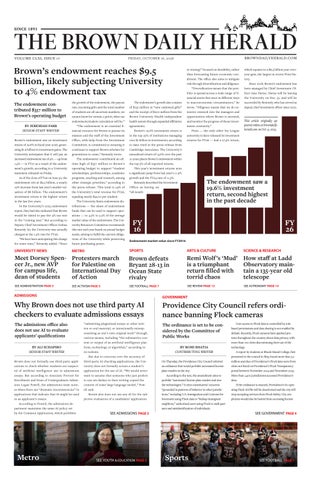
Brown’s endowment saw an investment return of 19.6% in fiscal year 2026, generating $1.6 billion in investment gains. The University anticipates that it will pay an increased endowment tax of 4% — up from 1.4% — in FY27 as a result of the endowment’s growth, according to a University statement released on Friday. As of the close of FY26 on June 30, the endowment sits at $9.5 billion, a nearly 19% increase from last year’s market valuation of $8 billion. The endowment’s investment return is the highest return in the last five years. In the University’s 2025 endowment report, they had also indicated that Brown would be slated to pay the 4% tax rate in the “coming year.” But according to Deputy Chief Investment Officer Joshua Kennedy ’97, the University was actually charged at the 1.4% rate for FY26. “We have been anticipating this change for some time,” Kennedy added. “Since
the growth of the endowment, the payout rate, incoming gifts and the total number of students are all uncertain numbers, we cannot know for certain, a priori, what our endowment/student calculation will be.” “The endowment is an essential financial resource for Brown to pursue its mission and the staff of the Investment Office, with help from the Investment Committee, is committed to ensuring it continues to support Brown scholars for generations to come,” Kennedy wrote. The endowment contributed an alltime high of $357 million to Brown’s operating budget to support “student scholarships, professorships, academic programs, teaching and research, among other strategic priorities,” according to the press release. This total is 24% of the University’s total revenue for FY26, equaling nearly $32,00 per student. The University limits endowment distributions — the share of endowment funds that can be used to support operations — to 4.5% to 5.5% of the average market value of the endowment. The University Resources Committee recommends this rate each year based on annual budget needs, aiming to fulfill the current obligations of the University while preserving future purchasing power.
The endowment’s growth also consists of $135 million in “new endowed gifts” and the receipt of $200 million from the Brown University Health independent health system through expanded affiliation agreements. Brown’s 19.6% investment return is in the top 25% of institutions managing over $1 billion in investments, according to data cited in the press release from Cambridge Associates. The University’s annualized return of 13.6% over the past 10 years places Brown’s endowment within the top 5% of all reported returns. This year’s investment returns note a significant jump from last year’s 11.9% growth and the FY24 rate of 11.3%. Kennedy described the Investment Office as having an “all-weath-
UNIVERSITY NEWS
METRO
SPORTS
ARTS & CULTURE
SCIENCE & RESEARCH
Meet Dorsey Spencer Jr., new AVP for campus life, dean of students
Protesters march for Palestine on International Day of Action
Brown defeats Bryant 28-13 in Ocean State rivalry
Remi Wolf’s ‘Mud’ is a triumphant return filled with torrid chaos
How staff at Ladd Observatory maintain a 135-year old telescope
SEE ADMINISTRATION PAGE 3
SEE ACTIVISM PAGE 5
SEE FOOTBALL PAGE 7
SEE REVIEW PAGE 12
SEE ASTRONOMY PAGE 14
The endowment contributed $357 million to Brown’s operating budget BY JEREMIAH FARR SENIOR STAFF WRITER
This article originally appeared online at browndailyherald.com on Oct. 9, 2025.
The endowment saw a 19.6% investment return, second highest in the past decade
FY 16
FY 26
Endowment market value since FY2016
ADMISSIONS
GOVERNMENT
Why Brown does not use third party AI checkers to evaluate admissions essays
Providence City Council refers ordinance banning Flock cameras
The admissions office also does not use AI to evaluate applicants’ qualifications
The ordinance is set to be considered by the Committee of Public Works
BY ALI SCHAPIRO SENIOR STAFF WRITER Brown does not formally use third-party applications to check whether students are suspected of artificial intelligence use in admissions essays. But according to Associate Provost for Enrollment and Dean of Undergraduate Admission Logan Powell, the admissions team notices when there are “dramatic inconsistencies” in applications that indicate that AI might be used in an applicant’s essays. According to Powell, the admissions department maintains the same AI policy set by the Common Application, which prohibits
Metro
“submitting plagiarized essays or other written or oral material, or intentionally misrepresenting as one’s own original work” through various means, including “the substantive content or output of an artificial intelligence platform, technology or algorithm,” according to its website. But due to concerns over the accuracy of third-party AI-checking applications, the University does not formally screen a student’s application for the use of AI. “We would never want to assume that someone who just prefers to use em dashes in their writing copied the content of some large language model,” Powell said. Brown also does not use any AI for the subjective evaluation of a candidates’ application.
BY ROMI BHATIA CONTRIBUTING WRITER On Thursday, the Providence City Council referred an ordinance that would prohibit automated license plate readers in the city. According to the text, the amendment aims to prohibit “automated license plate readers and similar technologies.” It cites constituents’ concerns “grounded in patterns of behavior in other jurisdictions,” including U.S. Immigration and Customs Enforcement using Flock data to “kidnap immigrant neighbors,” authorized users using Flock to stalk partners and misidentification of individuals.
SEE ADMISSIONS PAGE 3
SEE YOUTH & EDUCATION PAGE 5
User access to Flock data is controlled by rolebased permissions and data sharing is not enabled by default. Recently, Flock cameras have sparked protests throughout the country about data privacy, with more than 100 cities discontinuing their use of the technology. A report by students at Rhode Island College, first presented to the council in May, found more than 3.2 million searches of Providence’s Flock data were from cities not listed on Providence’s Flock Transparency portal between November 2024 and November 2025. More than 1,400 jurisdictions accessed Providence’s data. If the ordinance is enacted, Providence’s 60 operating Flock ALPRs will be deactivated and the city will stop accepting services from Flock Safety. City employees would also be barred from accessing license
SEE GOVERNMENT PAGE 4
Sports
SEE FOOTBALL PAGE 7
PAGE 2
Friday, October 16, 2026
UNIVERSITY NEWS FACULTY
Music professor Eric Nathan serves as inaugural composer in residence for R.I. Philharmonic The orchestra premiered Nathan’s violin concerto in September
Over winter break, Associate Professor of Music Eric Nathan was at a mountain retreat in Italy when he got inspiration for
a long time.” The R.I. Philharmonic performed Nathan’s violin concerto for the first time on Sept. 18 and 19. While in the role, Nathan — who continues to teach classes such as MUSC 1050: “Advanced Music Theory II” and MUSC 1100: “Introduction to Composition” — plans to compose two other “dream projects”: a symphony and a requiem.
a violin concerto. Nathan celebrated New Year’s Eve with two poets who were refugees from Ukraine. “As the clock struck midnight, I went to the piano to play ‘Auld Lang Syne,’” he said. “It wasn’t a song that they knew, and somehow I turned to the hymn ‘Amazing Grace,’ and I played that through.” As Nathan rang in a new year, he also laid the groundwork for “The Mountains We Climb,” which plays with elements of “Amazing Grace.” Nathan finds that “he can’t help but be inspired” by his personal experiences and societal issues when composing. “Perhaps the hardest mountain to climb is to truly see each other,” he said. The concerto will be one of Nathan’s three projects for his three-year position as an inaugural composer in residence for the R.I. Philharmonic — a role he assumed in September. While Nathan is not a violinist himself, he said he’s “kind of been in love with the violin for
“These are all really big pieces that one doesn’t get the opportunity to work on often,” he said, noting that more modern compositions tend to be shorter due to rehearsal time constraints, while the pieces he’s working on are longer works like many older compositions. For the requiem, Nathan plans to work with ideas that have “connections to the sense of loss,” drawing from the Dec. 13 mass shooting at Brown while also incorporating “more global thinking about gun violence in the U.S.” Beyond composing, Nathan will also be working with the R.I. Philharmonic’s Orchestra and Music School. He hopes to connect students with the creative aspects of music and teach them how to compose their own pieces. “With all this, I am very busy, and have lots of music to write, but it’s exactly the type of work I love to do,” he wrote in an email to The Herald. He views his new position as “another
BY SEYLA FERNANDEZ SENIOR STAFF WRITER
HORATIO HAMILTON / HERALD
The concerto will be one of Nathan’s three projects for his three-year position as an inaugural composer in residence for the R.I. Philharmonic. way of connecting with audiences,” as he draws musical inspiration from his experiences living in Providence. Emily Dolan, chair of the music department, described Nathan as “deeply engaged in our campus community and also active beyond Brown.” “All of this enriches our courses and events and makes Brown a more exciting
place to be,” she wrote in an email to The Herald. Nathan’s proximity to the R.I. Philharmonic makes his position “unique,” said Ruth Reinhardt, the R.I. Philharmonic’s music director. “We have somebody who’s a fantastic composer, but also lives here, knows the audience, knows the community, knows
what people are like and what this community will appreciate,” she added. “He’s been to so many of our concerts,” Reinhardt said. “So he knows the audience so well.”
This article originally appeared online at browndailyherald.com on Oct. 14, 2026.
ADMINISTRATION
Meet Dorsey Spencer Jr., new AVP for campus life, dean of students Spencer succeeded Koren Bakkegard, who left Brown earlier this year BY ALEJANDRO RUIZ UNIVERSITY NEWS EDITOR When students step into the office of Brown’s new Associate Vice President for Campus Life and Dean of Students Dorsey Spencer Jr., they will find walls and bookshelves laden with art and memorabilia. From a nostalgic painting of a jazz band to former Brown president Ruth J. Simmons’s memoir, the office boasts a collection of keepsakes that gives a peek into his personality. Spencer thinks that his decorations help students feel more welcome. “They’re not coming to meet with me in a sterile environment,” he added. This past July, the University welcomed Spencer to his new role, succeeding Koren Bakkegard, who left the position earlier this year. Now that the academic year is in full swing, The Herald sat down with Spencer to learn more about his journey to the position and his priorities in the new role. Spencer wasn’t always planning to serve as an academic administrator. He initially planned to study film in hopes of becoming a music video director, taking inspiration from “old-school-bad-boy” music videos. But when a faculty mentor “stressed the idea that (he) should expect to be socioeconomically disadvantaged for an extended period of time” until he could successfully break into the film industry, Spencer decided to consider other majors. Because he enjoyed sports and also ran track at Temple University, he decided to study sport and recreation management with the intention of becoming a collegiate
athletic director. The sports management program also encouraged students to get involved with other activities, so Spencer became the chair of the student-run homecoming committee. When he applied, he didn’t realize that he would spend more time working with student affairs than he did the school’s athletic department. “I really enjoyed the work that we were doing,” he said, noting the ability to “create or establish the student experience from outside the classroom and help students get engaged with the university,” he said. He continued to help shape student life at Temple, overseeing a campus concert featuring The Roots. His passion for student affairs stuck with him. His mentors encouraged him to continue a career in the field, so after graduating, he pursued a master’s in higher education at the University of Massachusetts Amherst. Spencer then worked at Florida State University, where he also completed a Ph.D. Even now, he is finishing his MBA at Alcorn State University. Spencer’s Ph.D research focused on how identity and upbringing can shape people’s leadership approaches. He said he was intrigued by how Black undergraduate men learn leadership. Through his research, he found that an important aspect that made students “lean into leadership” was that they “self-identify as leaders.” For Spencer, his research reinforced that “it’s important to account for identity in leadership development.” “You should embrace your identity and your background in your leadership style (and) not necessarily skew away from that background or the things that make you who you are,” he added. Spencer comes to Brown with extensive experience in student-facing positions. He has held similar roles at five other universities, including the American University
KAIA YALAMANCHILI / HERALD
Dorsey Spencer Jr. has held similar roles at five other universities, including the American University of Nigeria. of Nigeria. When Spencer was working at the programming board for Bucknell University, one of his mentors was looking for someone to develop a strong student affairs department at AUN, a private university in Yola, Nigeria. The university was in a more rural part of Nigeria, so many students “didn’t have a ton to do” when they finished classes. His job was to “pull students in to help shape” co-curricular and extracurricular experiences. Spencer said he was intrigued by the position at Brown because it presented a “balance between the student engagement side (and) the student support side,” which he thought would be an interesting combination. During the hiring process, one of the first things Spencer noticed was the “authenticity” of the students at Brown. “Students are comfortable being who they are, and that was really enticing for me,” he said.
He said he is especially excited to engage the graduate and medical students. “I think sometimes (they) are forgotten,” he said, noting that student affairs often prioritizes the undergraduate student experience. Brown also enticed Spencer because of its connection to the city of Providence. “I am a fan of urban institutions,” he said, adding that “there is a fascinating synergy that occurs when a student… (engages) with the city they are in.” Spencer’s first priority at Brown is “listening and building connections.” He began his tenure by meeting with faculty and staff across departments, and he’s also launching a “Dining with the Dean of Students” program. “What I am looking for with that initiative is the non-student leader to come and engage with me,” he added. His second goal is to increase outreach related to the offices he oversees, which include the Student Activities Office, Student Support Services and Student Accessibility Services. “I am pushing for us
to have more of a presence and outreach to students before they engage with those offices so that they are aware of what those offices do.” Spencer also works with the Office of Student Recovery and Care — the primary office for students directly impacted by the Dec. 13 shooting — to facilitate coordination with any services provided by Student Support Services. His role is ensuring that students “are aware of what Brown is providing in order to support them.” Spencer emphasized that the word “students” is built into his title. “I want (students) to understand that I am an ambassador to them. I’m an advocate for them.” “If they are looking for someone to connect with, I am happy to be that person,” he said.
This article originally appeared online at browndailyherald.com on Oct. 13, 2026.
THE BROWN DAILY HERALD
PAGE 3
UNIVERSITY NEWS LECTURE
Historians share how historical context can shape understandings of gun violence Speakers described the role of media in sensationalizing shootings
The talk came as part of the Office of Diversity and Inclusion's Honest Conversations series. about,” said Vice President for Diversity exponential increase in mass shootings. and Inclusion Matthew Guterl, who intro- But she emphasized that each instance of duced the speakers. “If this violence has a violence is “singular and can’t be collapsed history, it can be understood, and what can in with any other experience.” be understood can be changed.” “I don’t think we need one solution,” Belew, who is an associate professor Belew said. “I think we need thousands of history at Northwestern University, of solutions.” cited the 1999 shooting at Columbine Martinez, an associate professor of hisHigh School as the beginning of an “era tory at the University of Texas at Austin, of thoughts and prayers,” marked by an has applied her background studying the
history of mass violence to her related to the 2022 mass shooting at Robb Elementary School in Uvalde, Texas. She explained that it is important to consider both the history and individualized needs of a community after a traumatic event. “Cultures of violence — when they’re not addressed — they continue,” Martinez said. “We can bring that historical perspective … to mass violence and shootings at large.” Both speakers drew attention to the role of the media in sensationalizing mass shootings. Columbine, Belew said, was the first school shooting to be recorded and publicized. “We’re in a cycle where we consume horror in a really specific way,” she added. Martinez said she received multiple calls from journalists “pleading with (her) to convince parents who lost children in Uvalde to publish photographs of their bodies.” Belew explained that while recording
oral histories, it is important to “actually create a story that’s in partnership with the people that are telling” the story. In conversations for her book “Home at the End of the World,” Belew said she conducted multiple interviews over the course of a few weeks and provided transcript checks so that individuals could “decide if they really wanted to share information.” “One of the reasons that I think Columbine is such a devastating break that leads us into this period of gun violence is because the community was already torn apart and polarized and isolated,” Belew said. “We find ourselves unable to respond.” Looking forward, Belew said she believes a grassroots shift in mindset is necessary before significant legislative change occurs. With Colorado in particular, she explained, there is a “push-pull” relationship where an act of violence leads to gun control legislation, which then faces backlash. “It’s a conversation we have to approach from a different direction,” she said.
At UNC Chapel Hill, “essays are computer-scored on a scale from one to four based on writing quality,” according to an article published by The Daily Tar Heel. At Brown, the admissions office has opted against this strategy, instead training staff to look for evidence of “consistency and authenticity” in writing, Powell said. While discrepancies in an applicant’s voice are a cause of concern, Powell said that this is not a new issue specific to the use of AI. “There has always been the question of who wrote the essay, and that could certainly be individuals other than the applicant,” he said. “We’re always attuned to that because we always want to know that the person who completed the application is the person we’re reviewing and who we’re ultimately going to render a decision about.” If there is reason to suspect an appli-
remained on the application. “There is no way that AI can tell a compelling story about a student’s personal experiences because it doesn’t know their story,” Powell said. “We would rather have an essay with a misplaced comma that has a really genuine heartfelt narrative rather than a perfectly grammatically-correct essay that doesn’t tell us anything about the applicant themselves,” he said. Lex Ababon ’30 has also found that “there’s a certain kind of AI writing that really just doesn’t give much information about the student in the context of college admissions.” Ababon says she would “draw the line” at students using AI to generate their writing, but added that there is “more nuance” in areas like brainstorming ideas or proofreading. She added that she also believes that admissions officers should not use AI checkers because of the risk of
“false positives.” Alexa Theodoropoulos ’27 said that third-party checkers are not always accurate and added that scoring or evaluating essays using AI is “kind of offensive” to applicants who write each essay. A lot of “good writing techniques are seen as AI,” said Chris Park ’29, citing semicolons and em dashes as examples of good punctuation that is often seen as a sign of large language model use. Students should not be penalized for being “good writers,” he added. But Park thinks that admissions officers could use AI for verification purposes, such as confirming students’ achievements. “I think that it’s too good of a tool not to use for efficiency’s sake,” he added.
BY ZARINA HAMILTON UNIVERSITY NEWS EDITOR In a conversation hosted by the Office of Diversity and Inclusion Thursday afternoon, historians Kathleen Belew and Monica Muñoz Martinez shared how historical perspectives can help frame gun violence and inform paths to community recovery. The talk, titled “Honest Conversations: To Name the Terror (Gun Violence in America),” came as part of the ODI’s Honest Conversations series, which aims to cultivate discussion across a wide range of perspectives. “Mass shootings and gun violence are not isolated aberrations; they are connected to longer histories of racial terror, paramilitary culture, state-sanctioned violence and to the stories we choose to tell or forget
ADMISSIONS FROM PAGE 1 “So many of our applicants are so extraordinarily talented and have achieved so many things,” so AI would “say the entire applicant pool is highly competitive,” Powell said. “The distinctions that we make are very nuanced, and that is where the human judgment is still necessary in our process.” Powell noted that AI evaluation of applicants is “happening at other institutions right now” and mentioned Virginia Tech as an example. There, the admissions team has started “integrating a new approach to evaluating applicant essays that pairs human reviewers with an artificial intelligence-supported model” to provide applicants with their decisions faster, according to their website. Powell also noted that UNC Chapel Hill “has been open about their use of AI to evaluate grammar and writing style.”
COURTESY OF DAVID DELPOIO
cant’s work is not their own — whether it be from AI or another human — admissions officers look to other aspects of their application in their assessment. “The important part of that is that we verify,” Powell said. Powell said that every year, his team asks themselves if Brown’s supplemental essay questions are susceptible to AI use. For the 2026-27 admissions cycle, the University removed two questions: “What three words best describe you?” and “In one sentence, Why Brown?” While AI was not the reason for cutting those questions from the application, the admissions team “certainly considered how AI could have been used to generate responses to those questions in a way that probably would have led to more inauthentic responses,” Powell said. Other supplemental questions, such as one about community and upbringing,
This article originally appeared online at browndailyherald.com on Oct. 14, 2026.
Submissions: The Brown Daily Herald publishes submissions in the form of op-eds and letters to the editor.
SINCE 1891
THE BROWN DAILY HERALD 136TH EDITORIAL BOARD Editor-in-Chief Cate Latimer
Rebecca Goodman
Managing Editors Ciara Meyer Elise Haulund Claire Song
University News Editors Emily Feil Rebecca Goodman Samah Hamid Zarina Hamilton Ivy Huang Ian Ritter Alejandro Ruiz Roma Shah
Senior Editors Hadley Carr Paul Hudes Max Robinson POST- MAGAZINE Editor-in-Chief Elaina Bayard
Sports Editor Sajiv Mehta
COMMENTARY Head of Editorial Page Board Ethan Canfield
NEWS Metro Editors Michelle Bi Pavani Durbhakula Talia Egnal Emily Feil Amber Marcus-Blank Science & Research Editors Ivy Huang Ian Ritter Alice Xie
Opinions Editors Talia Berkwitz Ethan Canfield Christian Davis Isabella Gardiner Lucas Guan Avery Kaak CJ Lair Clara Murray Arya Vishwakarma
Arts & Culture Editors Ann Gray Golpira
PRODUCTION Copy Desk Chief
Chelsea Long Assistant Copy Chief Sofia Segarra Design Chiefs Emily Bao Maggie Ruan Design Editors Chloe Johnson Kailey Marti MULTIMEDIA Photo Chiefs Annamaria Luecht Kaia Yalamanchili Illustration Chiefs Kendra Eastep Isabela Guillen Video Chiefs Cienna Cheng Cody Cheng Social Media Chiefs Nate Barkow Annika Melwani Technology Chief Yassir Aouf Data Desk Chief Caleb Ellenberg
Games Chief Paul Hudes Podcast Chief Talia LeVine Multimedia Editors Marat Basaria Harry Guo Horatio Hamilton Selina Kao Ella Le Kenna Lee JJ Li Jake Parker BUSINESS General Managers Arjun Deshpande Anum Azhar Sales Directors Arjun Ray Hannah Han Finance Director Sydney Wright Office Manager Cary Warner
@the_herald
facebook.com/browndailyherald
@browndailyherald
@browndailyherald
88 Benevolent, Providence, RI (401) 351-3372 www.browndailyherald.com Editorial: herald@browndailyherald.com Advertising: advertising@browndailyherald.com
Op-eds are typically between 600 and 900 words and advance a clear argument related to a topic of campus discourse. You can submit op-eds to opinions@browndailyherald.com. Letters to the editor should be around 250 words and respond to an article or column that has appeared in The Herald, or critique or commend The Herald’s editorial decisions. You can submit letters to the editor to letters@browndailyherald.com. Submissions undergo multiple rounds of editing. These rounds of editing generally take place over the course of one evening, and you may have to respond to edits late in the evening. If you know you will be unable to do so, please mention that in your email, and we will do our best to work with you. Submissions can build on reporting from The Herald, reporting elsewhere, official statements from the University or other groups and other reputable sources, but they cannot break news or contain information that The Herald cannot verify. Because we cannot publish unsubstantiated information, failure to provide appropriate sources may mean we have to modify or remove unverified claims. The Herald will not publish anonymous submissions or submissions authored by organizations. Leaders of student organizations can be identified as such but cannot write under the byline of their organization. The Herald cannot publish all submissions it receives and reserves the right to edit all submissions. All submissions to The Herald cannot have been previously published elsewhere (in print or online — including personal blogs and social media) and must be exclusive to The Herald. Once your submission is published in The Herald, The Brown Daily Herald, Inc. owns the copyright to the materials. Commentary: The editorial is the majority opinion of the editorial page board of The Brown Daily Herald. The editorial viewpoint does not necessarily reflect the views of The Brown Daily Herald, Inc. Columns, letters and comics reflect the opinions of their authors only. Corrections: The Brown Daily Herald is committed to providing the Brown University community with the most accurate information possible. Corrections may be submitted up to seven calendar days after publication. Periodicals postage paid at Providence, R.I. Postmaster: Please send corrections to P.O. Box 2538, Providence, RI 02906. Advertising: The Brown Daily Herald, Inc. reserves the right to accept or decline any advertisement at its discretion. The Brown Daily Herald, Inc. is a financially independent, nonprofit media organization bringing you The Brown Daily Herald and Post- Magazine. The Brown Daily Herald has served the Brown University community daily since 1891. It is published Monday through Friday during the academic year, excluding vacations, once during Commencement and once during Orientation by The Brown Daily Herald, Inc. Single copy free for each member of the community. Subscription prices: $200 one year daily, $100 one semester daily. Copyright 2023 by The Brown Daily Herald, Inc. All rights reserved.
PAGE 4
Friday, October 16, 2026
METRO GOVERNMENT FROM PAGE 1 plate reader data from any system, including ones the city doesn’t own. These cameras record “every single passing vehicle continuously, including their location, the time they were seen, regardless of whether anyone is suspected of a crime,” said Ward 1 councilor John Goncalves ’13 MA’15 during the meeting.
In “a city that’s disproportionately Black and brown,” Goncalves added, surveillance systems like Flock can be used to further harm already-marginalized communities. He said Flock’s additional capabilities, including drone and AI-powered technology, are “only expanding your surveillance network.”
Providence Chief of Police Oscar Perez was not consulted before the ordinance was introduced in the City Council, wrote Kristy dosReis, Providence chief public information officer, on behalf of Perez. “There is a difference between writing legislation and understanding its operational consequences,” the statement read.
“I would have welcomed the opportunity to provide input before language affecting police operations and criminal investigations was drafted.” “Decisions of this magnitude should be informed by the professionals responsible for carrying them out,” the statement continued. Goncalves said he trusts the Providence
Police Department to “act professionally with this technology,” but argued that “the usefulness of this tool does not place a surveillance system beyond scrutiny.” After review by the Committee of Public Works, the ordinance will return to the full council, where it must pass two majority votes before going to the mayor, who can sign or veto the legislation.
BUSINESS
After serving custom cakes since 2007, Sin Desserts prepares to close its doors The Providence bakery will close at the end of October BY SELINA KAO STAFF WRITER Since 2007, Sin Desserts has been serving up sweet treats and custom cakes with eccentric designs — such as zombies and dragons — to the Providence community. The bakery began by selling specialty cakes. Since expanding their dessert offerings, they have learned how to “do almost anything” a customer requests, Jennifer Luxmoore, the owner of Sin, told The Herald. But after years of creating custom cakes, the bakery will be closing its doors on Oct. 31. Babes Pie Co., a pie shop currently based in Pawtucket, will be taking over the space. Sin first opened on Allens Avenue in Lower South Providence in 2007 before moving to its current location on Westminster Street in 2016, according to Luxmoore. Over almost two decades, the bakery has won many awards, including being a 12time Best of Rhode Island winner, according to Sin’s website. The staff, whether front of house or back of house (were) just really good people who really loved what they did and delved into design and taste,” Luxmoore said. “If it wasn’t for them, we would not
Over almost two decades, the bakery has won many awards, including being a 12-time Best of Rhode Island winner.
SELINA KAO / HERALD
have been here this long.” But earlier this year, Luxmoore realized that after years of owning and operating the bakery, she wasn’t sure she wanted to continue. With none of her employees interested in taking on ownership, “we decided back then that this was going to be our final year,” Luxmoore said. Luxmoore originally worked in radio
but dreamt of opening a bakery. After studying at Johnson and Wales University, she started a wedding cake business out of her home. Eventually, she decided to find her own baking space and opened Sin Bakery. She said that the bakery’s name comes from the experience of “(feeling) really guilty about eating something incredibly
good.” “It feels like a sin, but it really isn’t,” she added. When the bakery first opened, its customer base grew by word of mouth. “We did stuff for one wedding, and people saw it and recommended us,” Luxmoore said. They then expanded to create cakes for birthdays, showers, special events and be-
yond. “We really have an incredibly loyal following,” she said. Sin customers Greg Baldwin and Tonay Gooday-Ervin stopped by the bakery to visit before it closed and to see if they could purchase any kitchen equipment that the bakery was selling. “We’ve been really appreciative to be able to patron the establishment over the years,” Gooday-Ervin said. Baldwin said that he has visited Bakery Sin dozens of times, often coming with Gooday-Ervin and their dog. At Sin, “it’s not gonna be a regular cinnamon bun,” Baldwin said. “It’s gonna be a memorable cinnamon bun.” For Yolande Muoio, Sin has been a gathering spot for her and her friends and family. “We’re all sweet people for dessert, so we’d opt to come here over bacon or eggs any day,” she said, adding that she will miss “the nostalgia of some of these childhood treats.” She appreciates the bakery’s “neighborhood vibe,” recalling that on some evenings, Sin has hosted bar nights for community members and local artists. “I have loved being part of the food scene in Providence,” Luxmoore said. “The talent that is in this state is incredible, and I have loved being a part of that.”
This article originally appeared online at browndailyherald.com on Oct. 13, 2026.
HOUSING
RI AnchorHome to enter third phase of mortgage assistance efforts The programs aims to improve affordability for first-time homeowners
LORI LAI / HERALD
BY KELLY DING SENIOR STAFF WRITER Last week, Rhode Island General Treasurer James Diossa announced that RI AnchorHome — which provides first-time homebuyers with affordable mortgage options — would be expanding into its third phase. The third phrase of the program — which was created in response to rising housing prices and interest rates in the state — introduces new partnerships with BayCoast Bank, Bristol County Savings Bank and Westerly Credit Union, according to a press release from the R.I. Office of the General Treasurer. When eligible homebuyers are approved for a mortgage through a partner financial institution, the state deposits matching funds at the same institution, enabling lenders to offer more affordable mortgage products. Since the initial launch last December, 119 first-time homebuyers have benefitted from the program’s assistance. According to Tim Chaves, executive vice president and chief revenue officer at Bristol County Savings Bank, their bank
works closely with first-time homebuyers who are in the pre-approval and mortgage stage to create a “full financial picture and identify the best available options,” Chaves wrote in an email to The Herald. This can involve offering a discounted interest rate, which would lower monthly payments and can “make a meaningful difference in whether homeownership feels within reach,” Chaves added. The program is restricted to first-time homebuyers whose household income is capped at 110% of the statewide income
limit. As part of the program, participants have a 30-year fixed-rate mortgage with a starting interest rate of 3.99%, and they are not subjected to private mortgage insurance. Participants also must engage in homeownership counseling, where they learn about how to navigate the mortgage process in the long-term. Executive Director of HousingWorks RI Brenda Clement applauded the program’s housing counseling requirement, adding that having first-time homebuyers learn more about the mortgage pro-
cess is good for “long-term financial success.” When Bristol County Savings Bank learned about the RI AnchorHome, they immediately reached out to get involved. “Supporting homeownership is a key part of our mission as a community bank, so we were eager to be part of a solution that can make a meaningful difference for local families,” Chaves wrote. John McMahon, senior vice president of community engagement at BayCoast Bank, wrote in an email to The Herald
that the BayCoast Bank’s partnership with RI AnchorHome “brings together public and private resources to help make homeownership more attainable for Rhode Islanders.” Through the program, BayCoast Bank will be able to contribute to “stronger neighborhoods and a healthier, local economy,” McMahon added. “At BayCoast, we’re about opening doors (and) creating opportunities.” RI AnchorHome’s assistance helps “first-time homebuyers get their foot in the door,” Clement said. “Home ownership costs have greatly outpaced the average worker wage,” Clement said. “As mortgage rates change or go up, every percentage point kind of knocks an income level out of the ability to buy and purchase a home,” she added. Diossa said the Office of the General Treasurer often thinks about scaling the program. “Our hope is that we could continue this program, but we’re very limited as to funding,” he said. “There might be opportunities to go talk to the legislature to see if there’s ways to get some support to continue the program on the production side.”
This article originally appeared online at browndailyherald.com on Oct. 14, 2026.
THE BROWN DAILY HERALD
PAGE 5
METRO YOUTH & EDUCATION
PPSD speech pathologists advocate for vacancies to be filled SLPs advocated for the adoption of long-term recruitment strategies
BY AMBER MARCUS-BLANK METRO EDITOR For 20 years, Meredith Alger has worked as a speech and language pathologist in the Providence Public School District. While SLP staffing issues have existed for a while, Alger said that “there’s been a significant, drastic shortage in the last probably 10 years.” Currently, Alger’s caseload sits at 78 students — 18 more than the contract-negotiated cap. In July, she and other SLPs sat down with the district to come up with a solution to the shortage, but according to Alger, “they said they weren’t going to do any of the things that we requested.” The SLPs felt the logical next step was speaking out at a recent school board meeting. “SLPs are here tonight because we are concerned that the rights of our students who receive speech and language services are at risk,” Lauri Chung, who has been an SLP in Providence for 20 years, said in her testimony at a Sept. 23 school board meeting. “Our district currently has a significant SLP shortage.” “PPSD currently has 16 Speech-Language Pathologist vacancies,” PPSD spokesperson Alex Torres-Perez wrote in a statement to The Herald. “Given the specialized nature of these roles, we are implementing targeted, ongoing recruitment efforts to expand the candidate pool, accelerate placement and strengthen longterm recruitment pipelines.”
ANNAMARIA LUECHT / HERALD
SLPs are seeking longer-term solutions to attract talent to the district and support current employees. Currently, the SLPs are asking for overage pay if they are assigned more cases than the 60 student maximum. They are also seeking longer-term solutions to attract talent to the district and support current employees. “If our building has 85 kids that we need to serve, then we just have to do it,” Jessica Pollard, an SLP who has worked in the PPSD for seven years, wrote in a message to The Herald. “Our job is a lot more than just sitting down with students. There’s a lot of meetings, paperwork, planning and Medicaid billing involved.” “With a larger caseload you have to see larger groups in order to make the mandate work,” Pollard explained. “I find any group over four or five can be challenging because each student has different goals. Some kids really do need to be seen in groups of two or three.” According to the American Speech-Lan-
guage-Hearing Association, in 2024, speech pathologists nationwide had a median monthly caseload of 50 students. In New England, the average caseload was 40. SLPs are asking for the reinstatement of paid professional development and more serious recruitment strategies to ensure vacancies are filled with urgency. Some have mentioned that an incentive program, such as one where SLPs get their graduate degrees paid for in exchange for working a certain number of years, could help attract talent to the PPSD. Torres-Perez noted that the PPSD is starting to explore partnerships with “college and university preparation programs to support future SLP recruitment.” “Our immediate priorities are to maintain targeted sourcing activity, prioritize qualified SLP candidates for school-level review, leverage upcoming recruitment events and strengthen relationships with
university preparation programs,” Torres Perez wrote. “We will continue monitoring candidate pipeline growth and hiring outcomes to assess progress toward filling the district's 16 current SLP vacancies.” One current solution to the SLP shortage has been to employ virtual speech pathologists from out of state, according to Judith Dixon, who has been a SLP for nine years in Providence. But she said at the Sept. 23 meeting that “virtual services are not interchangeable with an SLP who is physically present — particularly for our youngest students.” The SLPs have also suggested a $5,500 bonus for pathologists that are nationally certified. Currently, PPSD teachers who have a national board certification earn a $5,500 bonus. SLPs have also advocated for therapy and evaluation materials that reflect caseload needs. Pollard, who currently works with a
caseload of 55 middle school-aged adolescents, noted that the materials she needs differ from other SLPs. “Right now we have a very limited array of testing materials and I have absolutely no materials that are given to me,” she added. “I make my own or buy my own.” This summer marked the shift of SLP advocacy, according to Alger, with a new president of the Providence Teachers Union. Alger noted that there are almost 2,000 teachers in the PTU, compared to only 38 SLPs when she started — which has decreased to just 25 today. She added that the typical response from the Union previously has been “we’re not really worried about you guys. There’s only 38 of you.” “When the SLPs reached out with their concerns, it was easy to see the patterns in other areas of special education and some of our hard-to-fill positions.” Lindsay Paiva, president of the PTU, wrote in a statement to The Herald. “The shortages and vacancies in any position in our district can be directly linked to working conditions, and we have a shared responsibility to move in solidarity with one another because an affront to one is an affront to all.” Pollard said that, in the ASHA code of ethics, speech pathologists need to advocate for the needs of students who are most vulnerable whenever possible. “I see speaking out to the board part of this ethical obligation to advocate for those who need it,” she said.
This article originally appeared online at browndailyherald.com on Oct 14, 2026.
ACTIVISM
Protesters march for Palestine on International Day of Action Brown SJP called for an end to study abroad programs in Israel BY TALIA KATZ SENIOR STAFF WRITER On Saturday, about 50 students gathered on the Main Green for Brown Students for Justice in Palestine’s Rally for Palestine as a plane towing a banner that read “Brown 4 Israel” circled overhead. Following several student speeches, demonstrators marched downtown to join the Rhode Island Party for Socialism and Liberation’s International Day of Action March for Palestine. Brown SJP gathered to officially launch its campaign calling for an end to study abroad programs in Israel, which it says the University relaunched this year following their suspension in October 2023. According to Brian Clark, University spokesperson, “no undergraduate study abroad participation in Israel has been authorized since the war was declared in October 2023, and Brown continues to assess the viability of resuming approvals for the semesters ahead.” All Brown-related travel to Israel “has required case-by-case review by Brown’s Global Risk Assessment Committee” since 2023. Though applications have remained open, “Brown’s advisors continue to make clear to applicants that there is a possibility of cancellation based on safety assessments close to program start dates,” Clark wrote in an email to The Herald. The University’s website currently states that it generally approves study abroad programs at five schools in Israel. “Our demands are not just for divest-
ELEANOR RODGERS / HERALD
The University’s website currently states that it generally approves study abroad programs at five schools in Israel. ment, but for the University to disaffiliate from apartheid and genocidal entities,” Ashe Shirazi ’28, a member of SJP and the emcee of the rally, told The Herald in an interview. “We are protesting to not allow these years of genocide to be forgotten,” she added. The Israeli government did not reply to a request for comment. Israeli officials have denied that Israel’s actions in Gaza constitute a genocide, while several United Nations affiliates and independent bodies have deemed it one. “While individual members of our community are free to express their own views of the Israel-Palestinian conflict, Brown University does not support academic boycotts against Israel or any other country,” Clark wrote in an email to The Herald. The rally included a series of speeches, poetry readings and chants. Throughout, speakers emphasized the intersection of issues facing Palestinians with a range of other causes, such as U.S. Immigration
and Customs Enforcement activity, police brutality, U.S. imperialism and collective labor. “In the 1980s and ’90s, Brown students fought to disaffiliate the University from apartheid South Africa. Like them, we fight to be on the right side of history,” Shirazi said during a speech. Speakers also levied criticisms at some Israeli universities with which Brown has generally approved study abroad programs. For example, they denounced the Technion Israel Institute of Technology’s contributions to development of a remote-controlled “caterpillar bulldozer” that the Israeli military uses extensively and Tel Aviv University’s joint research centers with the Israeli Air Force. Neither university immediately responded to a request for comment. “Choosing to interact with institutions on the front line of genocide is the antithesis of ‘communicating and preserving knowledge and understanding in a spirit of free inquiry,’” Brandon Ateke ’30 said in a
speech, referencing a part of the University’s stated mission. “Bombed schools can’t preserve knowledge. Dead children cannot live curious lives.” Afterward, protestors marched down the hill to join R.I. PSL’s protest at Memorial Park. Along the way, they recited chants such as “Not another nickel, not another dime, no more money for Israel’s crimes” and “There is only one solution, working class revolution.” The plane displaying a “Brown 4 Israel” banner followed the rally down to Memorial Park and continued to circle during the demonstration. Candelaria Beatty ’28, a member of SJP, said that the plane “shows the kind of energy that the Brown for Israel movement has,” as they lack the “people power” of the pro-Palestine movement. “They show up in a way that is just a monetary investment in something that is loud and disruptive, but not powerful,” she said. The Rhode Island Coalition for Israel,
which previously flew the “Brown 4 Israel” plane during convocation, did not immediately respond to The Herald’s request for comment. At the PSL rally, speakers included Muhammad Akhtar from Doctors Against Genocide, Raya Gupta ’29 from Brown SJP and Reem Said-Awad from American Muslims for Palestine. In an emotional ending, speaker Sterk Zaza brought out a young Palestinian girl named Nadia who she described as “representing the children of Palestine,” as Zaza spoke about the extreme death toll in Gaza. “What happens to a child who watches their mother die? What happens to a child who is pulled from the rubble, only to discover that their whole entire family is gone?” she said, holding back tears. The protest then marched through downtown Providence, as people waved Palestinian flags, held signs and recited chants. Members of PSL approached passersby throughout to discuss the movement with them and hand out flyers. The march ended at the world headquarters of Textron, an industrial conglomerate that has produced weapons systems used by Israel, in downtown Providence. As a PSL organizer addressed the crowd and led them in chants for the final time that afternoon, four police officers emerged and stood in front of the crowd. “Palestine has changed people’s consciousness forever, and there is no going back,” the organizer said. “Our answer cannot only be outrage. Our answer is organization.”
This article originally appeared online at browndailyherald.com on Oct 13, 2026.
PAGE 6
Friday, October 16, 2026
SPORTS SOCCER
Men’s soccer falls 2-1 to Harvard after surrendering second-half lead Following the loss, the Bears dropped to last place in the Ivy League BY HARRY GUO SENIOR STAFF WRITER Playing its third Ivy League game in just one week, the men’s soccer team (4-4-2, 0-2-1 Ivy) took on Harvard (3-5-2, 2-1-0) on a cold, breezy Saturday evening at Stevenson-Pincince Field. Despite taking an early lead, the Bears were unable to hold on, falling 2-1 to the Crimson after conceding two second-half goals. The loss moved Bruno to the bottom of the Ivy League standings. Though Brown began the game with possession, Harvard quickly created the first opportunity of the night. In the fifth minute, forward Lorenzo Amaral ’27 misplaced a pass back to Brown’s defense, and Harvard’s forward intercepted the ball to fire toward Bruno’s net. Defender Sergio Canos Seneci ’28 blocked the initial attempt, allowing goalkeeper Max Pfaffman ’28 to collect the deflected ball to keep the game scoreless. Both sides continued searching for an opening, but a combination of offside calls, fouls and off-target attempts kept offensive opportunities scarce throughout the early minutes. In the 23rd minute, Bruno broke through the offensive drought. Near midfield, forward Carlo Brown ’27 outran a Harvard defender to dish the ball to Amaral on the left flank. After winning a one-on-one against another Crimson defender, Amaral cut a pass into
the penalty area, where midfielder Ethan Rabel ’30 calmly slotted the ball into the bottom-right corner of the net. The goal, Rabel’s first of his collegiate career, gave Bruno a 1-0 advantage midway through the first half. “It felt surreal to score my first collegiate goal against an Ivy rival and in my first start,” Rabel wrote in an email to The Herald. “Everyone’s been working and pushing each other during training, and I think that goal was a display of the work that we’ve all been putting in.” But Harvard fought back. In the 31st minute, Carlo Brown fiercely battled with a Crimson player near Brown’s defensive corner, attempting to win back possession. The Harvard offender won the match-up and brought the ball to the edge of the penalty area to fire a low shot toward the bottom-left corner of the net. Pfaffman reacted quickly, diving to make the save and preserve Brown’s narrow lead. Despite several attacking sequences from both sides, neither team managed another goal before halftime. With just two shots apiece in the opening 45 minutes, both teams emerged from the break with renewed offensive urgency. Within the first five minutes of the second half, the Bears and the Crimson each created promising opportunities. But in the 58th minute, Harvard finally capitalized on a costly Brown mistake. Defender Shayne Thompson ’27 attempted a back pass toward the middle of Brown’s defensive third, but the weak delivery was intercepted by Harvard’s Adam Poliakov. With only Seneci and Pfaffman standing between Poliakov and the net, the Crimson forward successfully took on
VANSON VU / HERALD
Despite several attacking sequences from both sides, neither team managed another goal before halftime. the two and delivered a low shot into the bottom-left corner. “Harvard sent more numbers forward in their press, and we struggled to build out,” Pfaffman wrote in an email to The Herald. “We ultimately hurt ourselves with the goals we gave up, and it was frustrating that we couldn’t control the game in the second half.” With momentum shifting in Harvard’s favor, the Crimson continued pushing forward in search of a go-ahead goal. Pfaffman initially rose to the Crimson’s challenge,
making three impressive saves to keep the Bears in contention until the 75th minute, when Harvard’s barrage got past the Bruno goalkeeper. A Crimson player launched a long ball from inside Harvard’s own half to Brown’s penalty area. The pass took an awkward bounce just outside the box, where Poliakov battled Seneci for possession. Poliakov got the better of the Brown defender, firing the ball to the back of the net, giving Harvard a 2-1 advantage with just 15 minutes remaining. “We need to focus on our process every
day and find a way to continue to execute our principles after halftime so that we can complete games for 90 minutes,” Head Coach Chase Wileman wrote in an email to The Herald. Suddenly trailing after leading for much of the evening, Bruno urgently searched for an equalizer. In the 89th minute, forward Mateo Pereyra ’29 received a long pass just outside Harvard’s penalty area. But as Pereyra prepared to shoot, he slipped, and his shot was collected by the Crimson goalkeeper with relative ease. The Bears continued to push forward in the final moments of the contest. Amaral weaved his way through a sea of Crimson defenders to Harvard’s penalty area. Though a foul initially appeared to award Brown a penalty kick, with a Crimson defender receiving a yellow card for the challenge, Harvard called for a VAR review. After a lengthy review, the referee overturned the decision, taking back the yellow card and denying Brown the penalty kick and a chance to come back. In the final minutes, the Crimson held on to hand the Bears a 2-1 defeat. “There are always positives and the first half as a whole was solid being 1-0 up,” Wileman wrote. “We just have to keep working, stick together and the results will come.” Brown will look to bounce back on Tuesday for an away matchup at Lehigh University (4-3-5, 4-0-1 Patriot League) for a non-conference matchup.
This article originally appeared online at browndailyherald.com on Oct. 12, 2026.
SOCCER
Women’s soccer prevails 3-2 over Yale, rises to first place in Ivy League The Bears had to play down a player for 88 minutes BY OSCAR SCHAPIRO CONTRIBUTING WRITER On Saturday afternoon, the women’s soccer team (8-2-2, 2-0-1 Ivy) hosted Yale (5-7, 0-3) at Stevenson-Pincince Field. Despite an early red card that forced them to play with only 10 players for almost the entire contest, Bruno emerged victorious 3-2 over the Bulldogs. Forward Jael-Marie Guy ’29 led Brown to success with two unassisted corner-kick goals. The Bears came into the week off a draw against Penn and earned their fifth straight win over the Bulldogs, who came into Saturday’s game off two consecutive losses. Brown’s win kept them undefeated in the conference and pushed them to first place in the Ivy League. Just over two minutes into the game, forward Corine Gregory ’27 collided with Yale defender Andie Miller, leaving Miller’s face bloody. Following a long review, the officials gave Gregory a red card, forcing her out of the game and suspending her for Brown’s next game. The red card “was definitely scary and unexpected,” goalkeeper Addison Etter ’29 told The Herald in a post-game interview. Brown’s defense held, though, led by midfielder Brooke Birtwistle ’28. With Brown down a player, Birtwistle took on a more defensive role, helping the Bears hold Yale without a shot until the 34th minute. “Our whole back line has been tremen-
ANNAMARIA LUECHT / HERALD
The Bears came into the week off a draw against Penn and earned their fifth straight win over the Bulldogs, who came into Saturday’s game off two consecutive losses. dous this entire year, and Brooke’s really the leader,” Head Coach Kia McNeill told The Herald in a post-game interview. McNeill maintained confidence in her team’s resilience. “We’ve talked a lot as a team about adversity and riding through those moments, and not making that moment bigger than what it is,” she said.
Strong defensive play kept the game deadlocked at 0-0 until the 29th minute, when Guy entered the game for a left-side corner kick. Guy’s shot cut through the air, across the middle of the field and into the top right corner of the goal, just past the outstretched arms of Yale goalie Isabel Willems. “I came on knowing that I wanted to
make an immediate impact,” Guy told The Herald in a post-game interview. “We had that red card, and we were down players, so I wanted to work 110% and play like everything was on the line.” Brown maintained the 1-0 lead through to halftime. Throughout the first half, McNeill utilized substitutions to her advantage, playing seven off of the bench to Yale’s three. As the second half began, rolling dark gray clouds started to fill the sky. As the sky darkened, just nine minutes after halftime, Yale defender Alex Chang scored a direct goal from the same corner that Guy had, curling the ball into the net’s bottom-right corner to tie the game at 1-1. After review, the goal stood. For a moment, it seemed that playing with 10 might finally be catching up to Brown. But the Bears continued controlling the ball, pressuring Yale by pushing deep into Bulldog territory. On one such possession, forward Angelina Vargas ’27 managed two shots on goal that were saved and a third that veered just wide of the right goalpost. “At halftime, we talked about (how) the game plan doesn’t necessarily change,” McNeill said. “We wanted to be a team that dominates possession. We wanted to pressure hard with Yale.” The pressure soon paid off. Just around seven minutes after Chang’s goal, in minute 61, Guy took another corner kick. Even though Willems managed to get a hand on the ball, Guy’s shot once again curled into the goal to give Brown a 2-1 lead. Guy’s brace marked her second and third goals of the season. “I was a little bit annoyed that (Yale)
scored the same way that I scored,” Guy said after the game. “So I was like, I want to do it a second time.” A third Bruno goal in the 76th minute padded the lead to 3-1. Vargas intercepted a Yale pass before leading standout midfielder Joy Okonye ’27 with a cross in front of the goal for an easy score. Though Yale forward Anita Thorvaldsdottir scored just minutes after Okonye did, cutting Brown’s lead to 3-2, the Bears managed to hold off all subsequent threats. The final 10 minutes of the game proved especially difficult for the Bears’ noticeably tiring squad, but McNeill continued to take advantage of her strong bench. “Our subs are just as good as our starters,” McNeill said. “We know that when we sub, the level’s not dropping.” After a chaotic final two minutes that featured fouls, injuries and a Yale shot that missed just high, Brown finished off the win over the Bulldogs. Though the early red card was a hindrance for the Bears, it gave them the opportunity to prove their mettle. “Anytime you get a win through that type of adversity, it’s a confidence booster for this team,” McNeill explained. “It just makes us want to play that much harder for each other and play with that much more pride.” The Bears will play next on Saturday at 6 p.m. against Dartmouth (8-2-2, 2-1 Ivy), who currently sits at No. 2 in the Ivy League.
This article originally appeared online at browndailyherald.com on Oct. 13, 2026.
THE BROWN DAILY HERALD
PAGE 7
SPORTS FOOTBALL
Brown defeats Bryant 28-13 in Ocean State rivalry For the first time all season, Brown found a crucial bounce-back win BY KEVIN WITTEN CONTRIBUTING WRITER This Saturday, a bright blue sky shone down as the Bears (2-2, 0-1 Ivy) ran onto their home field for the first time in the 2026 season. Fresh off back-to-back losses against Harvard (4-0, 2-0 Ivy) and the University of Rhode Island (3-3, 1-2 Coastal Athletic Association), Bruno was looking to bounce back against Bryant University (4-2, 2-0 Coastal Athletic Association ), who entered the day undefeated in Football Championship Subdivision play. By the time the clock hit zero, those tough losses were a thing of the past for Bruno, who triumphed 28-13 against Bryant. “Just a great day for Brown football,” Head Coach James Perry ’00 said in a post-game press conference. “Lots to be proud of.” The win — made up of 185 rushing yards and four touchdowns — gave the Bruno a taste of how prolific Brown’s rushing attack can be. “We know good things happen when you play physically,” Perry added. Brown received the opening kick and was forced to punt shortly after. Bryant’s offense returned the favor, giving Bruno the ball back close to midfield — an opportunity they did not let go to waste. Early in the drive, quarterback James
Murphy ’27 lofted the ball downfield to wide receiver Carson Hill ’29, who reeled in the pass for a near 30-yard gain deep into Bryant territory. From there, running back Matt Childs ’28 went to work. Consecutive rushes of eight and two yards set the Bears up with first and goal inside the 10. On the next play, Childs found a crease up the middle and surged into the endzone practically untouched, putting Brown ahead 7-0 around halfway through the first quarter. “All week, we’ve been working on trying to finish drives,” Childs said after the game. Brown finished the day with touchdowns on four of their five trips to the red zone. Bryant wasted no time stringing together a nice drive of their own. Mixing the running game with some quick passes, the Bulldogs found themselves with a first down on the edge of the red zone. But the Brown defense fought back. After a pair of short runs and an untimely offensive holding penalty, Bryant was faced with a third and long on the cusp of field goal range. Bryant’s quarterback Brennan Myer tried to hand the ball off, but the exchange was bobbled. A swarm of Bears — led by defensive lineman Nate Hohlfeld ’29 — shot into the backfield, denying a field goal and forcing Bryant to punt. Picking up right where they left off, the Brown offense unleashed four rushes. Just when it seemed that the Bears were content to keep running up the gut, Murphy dropped back to pass and hit wide receiver Pearson Hill ’28 in stride on a 56-yard slant — Bruno’s longest offensive play of the day. After a couple short gains inside the
Bryant 10, Brown faced fourth and goal from the one. Running back Qwentin Brown ’26.5 lined up under center, took the direct snap and bullied his way in for the score. The Bears’s momentum carried over to the other side of the ball, where Brown’s defense forced a third Bryant punt. On a third down early in the Bears’s next possession, the offensive line gave Murphy a fantastic pocket. After sidestepping Bryant defenders, he was able to flip the ball to Childs for a 30-yard gain. A few plays later, Qwentin Brown once again handled the snap. He faked a handoff to the right before giving the ball to Childs on an end-around that left the Bryant defense scratching their heads.When Qwentin Brown got the tote, he lowered his head for a bulldozing touchdown run. But just when all momentum was in Brown’s favor, the Bryant offense decided to wake up. It only took the Bulldogs five plays and a 35-yard screen pass to Bryant’s Shamar Fowles for a touchdown, bringing the score to 21-7. Inside the two-minute warning, Brown’s offense got the ball back near midfield and immediately started to march downfield. After two big completions to tight end Levi Linowes ’27 for eight and 29 yards, Murphy and the offense looked destined to extend their lead before halftime. This time, it was Bryant’s turn to come up with a defensive stand. With mere seconds left in the half, Murphy threw an interception in the endzone. “Obviously, a red zone turnover is un-
acceptable,” Murphy said after the game. Bryant received the second half kick and methodically worked the ball down the field until a failed rush attempt caused Bryant to settle for a field goal. “You can’t let them score a touchdown because that’s not the standard,” linebacker Stefano Montella ’27 said. But the Bruno defense couldn’t get much of a break. The Bears’s offense punted the ball away after failing to pick up even one first down. Only four plays into Bryant’s next drive, captain and linebacker Max Malo ’27 — who logged 19 tackles against URI — was ejected from the game for targeting. The Bulldogs capitalized on the advantage, and moved the ball effectively against an exhausted Brown defense. But Bruno’s defense found a way to tighten up in the red zone. After two incomplete passes and a rush for no gain, Bryant’s kicker trotted back onto the field to make it 21-13. The defense’s response was “insane,” Perry reflected. “(Montella) is a great leader.” Despite possessing the ball for nearly 13 minutes — compared to Bruno’s two minutes of possession — the Bulldogs could only muster 6 points. The Brown defense did their job — and now, it was time for the offense to step up and put the game out of reach. After an unnecessary roughness penalty against the Bulldogs, Brown found themselves in the heart of Bryant territory. Childs led the charge with five carries in
succession, and the last one landed Bruno in the endzone for a touchdown that put the Bears ahead 28-13 with 10 minutes left. Childs would end the day with over 100 yards on the ground, 45 through the air and two touchdowns to boot. It marked his fourth game in a row tallying triple-digit total yards. In a final attempt at a counter, Bryant’s offense marched the ball to Brown’s side of the field. But just like the previous two sequences, the Bruno defense stood firm. This time, the Bulldogs wouldn’t even be able to muster a field goal, as Myer’s fourth down pass was picked off by defensive back Camryn Williams-Dalton ’27. This play marked Williams-Dalton’s second interception in two weeks, and his third this year. From there, Brown chewed up more than five minutes on a drive that left Bryant no time to attempt a comeback. While the defense has been dominant all season long, Saturday marked the first time the Bruno offense truly found its footing this season. “Vibes were incredible,” Murphy noted. “Everybody’s very happy.” “As an alum, I’m proud. As their coach, I’m proud. As someone who wore the uniform, I’m proud,” Perry said. The Bears will look to ride this momentum as they head to face Princeton (3-1, 1-0 Ivy) to kick off the first of six straight Ivy League matchups.
This article originally appeared online at browndailyherald.com on Oct. 13, 2026. VANSON VU / HERALD
excerpt from
not couture
Section Editor Christina Li
Section Editors Helen Hen Anika Kotapally
HEAD ILLUSTRATORS Lesa Jae Junyue Ma
ARTS & CULTURE Managing Editor Sasha Gordon
COPY CHIEF Jessica Lee Copy Editors Eve Kobell Kate Schuyler Michelle Wassef Su Yang
NARRATIVE Managing Editor Gabi Yuan
I’m running a few minutes late for my 10 a.m., as usual, and I don’t have the time to wash my hair. I don’t really have the privilege of throwing it up
LAYOUT CHIEFS James Farrington Alexa Gay Amber Zhao
Section Editors Lucie Huang Chelsea Long
in a bun, either, since I’ve opted for the “hi-I-amtransgender” curly mullet, so I sacrifice doing my makeup in favor of assembling some vertical
Layout Designers Hannah Gapp Lily Rantanen Joshua Rezneck Emma Vachal
LIFESTYLE Managing Editor Hallel Abrams Gerber
monstrosity from three claw clips and lots of curl cream. I definitely didn’t get enough sleep, so I slap on blush and pray that some color in my cheeks and the giant lenses of my glasses will lend
Section Editors Alayna Chen Tatiana von Bothmer
me some illusion of wakefulness, grab my reliable leather jacket, and sprint out the door.
ISSUE 5
FEATURE Managing Editor Chloe Costa Baker
Section Editors Gabriella Miranda Rebecca Sanchez
by Kal Mehta
Friday, October 16, 2026
POST-POURRI Managing Editor Tarini Malhotra
VOL 38
EDITOR-IN-CHIEF Elaina Bayard
OCT 16
PAGE 8
SOCIAL MEDIA Yana Giannoutsos Hung Lam Eva Mahajan Rebecca Sanchez
Realistically, this is what college fashion is: a creature born of ideas and raised by cheap
emil ys
detergent, rushed mornings, and infinitely hostile weather. You’re faced with the concept of having to construct a new outfit every day (or most days; hey, the Tuesday-Thursday people don’t
1. Dickinson 2. Brontë 3. Guan #emilie 4. Blunt 5. Indirect 6. Not the one in Paris 7. Elizabeth (of Clifford fame) 8. The corpse bride from Corpse Bride 9. That one Austen novel you misremember 10. Emily Post- (1872–1960), American author on etiquette
have to know what you wear on your MondayWednesday-Friday circuit), within an infinite other constraints. This is the environment that breeds functional fashion: clothing that does its job without sacrificing style. As someone who likes to pretend they’re fashion-conscious, but is burdened with the inability to actually wake up on time, I had set three rules for getting ready by the end of my freshman year. This is how I, and most Brown students I see around campus, seem to approach our functional fashion...
1
2
Cover by julia park
See Full Issue:
ISSUU.COM/POSTMAGAZINEBDH
show business by Dolma Arow illustrated by Robin Goldfarb
Across
1. Stage performances 3. Game of chance 7. Broadcast studio sign 8. How you might feel after
3
4
5
6
watching a drama
Down 1. TV standalone test episode 2. Not a soundtrack, but a _____ 4. Single
7
5. What you might get before a
“It’s organic.” “I can taste it.”
premiere 6. "___ the season..."
8
8
Want to be involved? Email: elaina_bayard@brown.edu!
“A vagina-cologist”
THE BROWN DAILY HERALD
PAGE 9
table of contents 1 community in the dark Beatrice Hackett
9 not couture Kal Mehta
3 vagina mania
11 i miss church.
Ivy Rockmore
Acadia Phillips
5 experiments in dreaming
13 unknown origins unveiled
vanessa tao
Crystal Zamora
7 hide and seek
15 digital junk drawer
Margaret Li
Claire Zhong
“Because the trees really are gorgeous, and chai really is delicious, and there’s nothing quite like the feel of cool October wind slipping through your fingertips, like something alive in and of itself.”
—Michelle Bi, “in defense of pumpkin spice lattes” 10.18.24
“I am hesitant to take anything from this box without something to contribute back, but my mom reminds me that this art is meant to be shared. And besides, she’ll leave a drawing there tomorrow.” — Alyssa Sherry, “take art leave art share art!” 10.17.25
letter from the editor Dear Readers,
permanence in this week’s issue. In Feature, Beatrice reflects on movie theaters as points of connection, while Ivy discusses womanhood and self. Vanessa compiles stories and dreams for Narrative, using the structure set by her English professor. In A&C, Margaret discusses pseudoscience and sisterhood, and Kal defines how to express functional fashion. In Lifestyle, Acadia reflects on religion, and Crystal takes us on a tour of Nostalgia Antiques. For a boost of inspiration, Dolma has provided us with a beautiful
I am falling back in love with our campus: its many trees and stapled posters
show-business-themed crossword. Finally, as we explore intentions and
from last spring and crowded entryways on the Main Green. This appreciation,
follow-through, post-pourri has Claire take us through our long forgotten
prompted by many a day stranded in my room by the cold that would never end,
photos.
has made me acutely aware of time passing and the fact that I didn’t notice. We’re officially at week six, where resolutions fall away and leave life as it stands. And, like the weather, we officially settle into routines (hopefully
As we motivate ourselves through this middle bit of time, I hope you find some connection—or distraction—amidst our pages this week. Take this issue to the park while you still can, and enjoy!
soon, we will see, as it is currently 80 degrees). Seeing friends, making connections, and making memories now come alongside the slog of midterms and aforementioned ailments that love to accompany the fall. I am who I will be for the semester, theoretically. This week’s writers similarly contemplate selfhood, connection, and
Meandering through the quads,
Halleli Abrams Gerber Lifestyle Managing Editor
october 16, 2026
9
PAGE 10
Friday, October 16, 2026
OPINIONS Editorial: UCS has caught our attention The editorial page board has historically been critical of the Undergraduate Council of Students. In the board’s 17-year tenure, we have written on low turnout in UCS elections, convoluted referendums, chaotic elections and consistent apathy toward student government. We offered these critiques in an effort to ensure the student body has capable leaders who represent its interests. The current administration, under the leadership of UCS President Ariel Shifrin ’27, may have finally answered our calls. On Monday, the UCS announced a $25,000 pilot participatory budget program that allows students to pitch and vote on campus upgrades. The program — which is funded through the Office of the President — aims to make upgrades such as adding new furniture to lounges, increasing access to electrical outlets or expanding the number of water bottle fillers around campus. After students submit their proposals by Oct. 15, the UCS will assess the feasibility of the purchases and then conduct a student-wide vote on which projects should be made a reality. This is exactly what Brunonians deserve from their leaders: a democratic program that allows students to decide how to improve campus and a strong indication of productive cooperation between campus leaders. We remain cautious in our assessment of the health of student government, but it seems like the UCS is turning over a new leaf in effectively “improving the Brown experi-
ence.” Since 1989, cities have used participatory budgeting to increase transparency and include the public in decision-making. More recently, organizations like the Participatory Budgeting Project have aimed to implement this process for communities across the United States and Canada. A global study examining these programs from 2020 to 2024 found that “participatory budgeting fosters financial prudence, reduces corruption risks and strengthens public engagement in governance.” The study also explains that government accountability is critical to the success of participatory budgeting. Public trust in government had the strongest gains when the program was paired with community oversight and transparent spending. Brown can learn from these findings. According to The Herald’s Spring 2026 Poll, 43.8% of students neither approve nor disapprove of the UCS, likely demonstrating that a significant portion of the student body is disconnected from their student leaders. Participatory budgeting offers the UCS a practical way to capture students’ engagement and trust in the work the Council is doing. The UCS’s leaders seem committed to providing as much transparency on the initiative as possible. In an email to students, they explained that all proposals will be assessed by a UCS Participatory Budgeting working group, the Office of Campus Life and Facilities and Campus
Operations. This collaboration will ensure that the $25,000 is managed responsibly and effectively. As Shifrin has noted, it is up to the next president of the University to ensure that the program becomes a lasting Brown tradition. Previously, the UCS was not able to use its funding for campus improvements. The council is normally funded by the student activities fee, which has specific restrictions set by the Student Activities Office. This means that the UCS primarily uses its funding to support student groups, provide legal services for students and implement various initiatives such as free shuttles to airports during breaks and social events. These initiatives are admirable, but they do not include necessities like electrical outlets or repaired sidewalks. We are impressed with the current Council’s ability to find an alternative stream of cash to fund new initiatives and are hopeful that students will capitalize on this opportunity to direct University funding toward actual results. This initiative is especially impressive, as it represents a stronger relationship between the UCS and the University administration. In 2024, the UCS held a referendum that stated, “The undergraduate student body lacks confidence in the leadership of the University by the Brown University Corporation.” This statement demonstrates the past tension between the UCS and University leadership. While there is nothing wrong with
UCS leaders pushing Brown to listen to its students, the current collaboration is a prime example of the benefits a cooperative relationship can bring everyone. Another truly commendable aspect of the proposal is its inclusion of Rhode Island nonprofits that students can vote to fund. Brown giving back to the state is certainly an issue that many students care deeply about. The Office of Community Engagement will contribute $5,000 to the students’ chosen organizations on the condition that more than 50% of Brown undergraduates vote. After years of low turnout in elections across campus, it is clear that both the Council and the University are seeking a change. If the UCS manages to drive historic turnout for the program, they will have silenced their critics, and more importantly, engaged the student body. We wish them luck. Students, the UCS has listened to your demands. It is your turn to respond by voting.
Editorials are written by The Herald’s editorial page board, and its views are separate from those of The Herald’s newsroom and the 136th Editorial Board, which leads the paper. A majority of the editorial page board voted in favor of this piece. Please send responses to this editorial to letters@browndailyherald.com and other opinions to opinions@browndailyherald.com.
Hilzenrath ’28: Trump’s J-1 probe is about everything but American workers Last week, Vice President JD Vance announced an investigation into Brown — and eight other universities — on suspicion the University is exploiting the J-1 visa program by bringing foreign researchers to the country at lower wages than American workers earn. And honestly, I’m bored. The Trump administration has repeatedly targeted higher education and immigrants, often simultaneously. In 2025 alone, the administration slashed at least $8 million worth of research grants to Brown and planned a $510 million freeze in federal funding, suspended or terminated $400 million in research funding to Columbia and attempted to revoke Harvard’s ability to enroll international students and sponsor certain visa holders. Just last Monday, a federal appeals court in Boston heard arguments over the administration’s attempt to terminate more than $2 billion in Harvard research funding. This latest attack on Brown is just another page in an all-too-familiar playbook. Given the administration’s history of undermining higher education, restricting immigration and disrupting American research, it’s hard to believe this latest battle is really about making things fair for American academics. In his Thursday press conference, Vance claimed that J-1 visa holders account for roughly 61% of researchers on federally funded projects at the nine universities being investigated, compared to a national average of 38%. He also said that foreign researchers earn $20,000 less than their American counterparts, implying the universities in question are outsourcing labor to save money. But Vance did not explain where those figures came from, nor the methodologies used to acquire them. We don’t know whether the researchers with higher and lower salaries are conducting comparable research or doing equivalent work. And we don’t know that a higher rate of J-1 participation necessarily displaces or exploits American workers. As of 2024, 58.3% of the country’s postdoc-
MAX ROBINSON / HERALD
toral researchers in science, engineering and health held temporary visas, which is considerably closer to Vance’s 61% figure than his stated 38% comparison. Vance’s central claim in the investigation is that these universities’ use of J-1 visas disadvantages American workers. But hiring an international researcher does not necessarily mean depriving an American researcher of an equivalent opportunity since academic research is highly specialized. Researchers develop expertise in narrow fields, methodologies and projects. Recruitment may require an international search with the purpose of finding candidates with the relevant qualifications. To claim that international researchers are stealing American jobs assumes that researchers in similar disciplines are simply interchangeable or that there are plenty of Americans who fit the position. Oftentimes, neither is true. A 2017 study by the National Bureau of Economic Research found that restricting H1-B visas did not increase comparable American employment at the affected employers, and interpreted the
finding as consistent with a low degree of substitutability between American and international workers. The J-1 program is explicitly intended to facilitate academic and scientific exchange, which has evidently been widely beneficial. Researchers in the United States on J-1 visas have helped us detect cancers and model pediatric brain tumors, according to comments submitted from Boston Children’s Hospital to the government in response to other federal actions targeting visa-holding researchers. Furthermore, the spirit of international collaboration is central to research in the United States. It took the collaboration of scientists from six countries to sequence the human genome, and international collaboration cultivates the same innovation right here at Brown, where the Human RNome Project Consortium is working to publish the first-ever complete sequence of the body’s RNA. In addition, it is important to note that just because a university hires a high proportion of international researchers does not mean they are committing visa fraud.
As of 2024, four of the targeted schools ranked among the country’s 20 largest university research performers. If they employ relatively more postdoctoral scientists in fields that often recruit internationally, their workforce composition could look different than schools with less extensive research operations. It is not uncommon for the government to investigate university visa appointments to ensure foreign funding transparency, research security, visa compliance, fair labor practices and protections against exploitation. But the rhetoric around this investigation makes it stand out. At Thursday’s press conference, Anthony D’Esposito, the Labor Department inspector general leading the investigation, threatened that he will “personally cuff” anyone who “break(s) the law and screw(s) the American people.” That certainly doesn’t sound like a routine compliance check, and harsh language like his can shape public opinion on higher education before allegations have been substantiated. Plus, given how Trump’s other tussles
with academia have harmed American researchers, it feels unlikely that helping them is the real goal of this latest action. In May 2025, Columbia announced that nearly 180 employees would receive termination or nonrenewal notices following approximately $400 million in federal funding cancellations. The same year, when millions were withheld from research reimbursements for active federal grants at Brown, the University implemented a staff hiring freeze, canceled several faculty searches and reduced doctoral admissions targets. These hiring restrictions meant fewer employment opportunities for international and American researchers alike. Just as funding freezes limit resources, public accusations and threats of prosecution can make institutions more cautious of sponsoring lawful international appointments and make international researchers more hesitant to come here. When international research collaboration is threatened and universities face difficulty recruiting and retaining specialized researchers, universities face understaffed labs and delayed projects. When our country makes extreme threats towards higher education, it weakens the very collaboration that makes American science so impactful. Time and time again, the Trump administration seems to be targeting higher education, looking for reasons to cut funding and diminish academics. But the predictability of the administration’s actions doesn’t diminish the seriousness of their consequences. In the face of countless accusations of wrongdoing that could distract from the work that makes us so powerful, Brown should continue to voice its support for the visa-holding researchers contributing so crucially to our vibrant campus community and research ecosystem.
Annabel Hilzenrath ’28 can be reached at annabel_hilzenrath@brown.edu. Please send responses to this column to letters@browndailyherald.com and other opinions to opinions@browndailyherald.com.
THE BROWN DAILY HERALD
PAGE 11
OPINIONS
Tao ’27: Moral Ambition isn’t the solution to Brown’s corporate pipeline Brown has a brain drain problem. A survey of the class of 2025 found that 44% of students marched from the Van Wickle gates into the loving arms of the finance, tech and consulting industries. One need not view these industries as villains to recognize that this number is too high. Brown fashions itself a school of creative free spirits, not corporate conformists. Further, many of these sectors — especially management consulting, hedge funds and investment banking — primarily exist to help rich clients become richer, contradicting our progressive values. In response, an international movement known as the School for Moral Ambition was founded in 2024 by Dutch historian Rutger Bregman, aiming to bring elite students into humanitarian work. The organization’s goal is to persuade talented professionals to stop “wasting” their talent in “boring” industries like finance, consulting and corporate law, which he dubs the “Bermuda Triangle of talent.” Instead, they should devote their skills to finding entrepreneurial solutions to global problems like climate change, world hunger and economic inequality. Students from at least nine universities, including Brown, have started Moral Ambition chapters. This fall, the SMA will offer $15,000 stipends to 12 Brown juniors and place them in internships with nonprofits dedicated to social impact. Last year, 8% of Harvard’s junior class applied to the fellowship. One of the Brown chapter’s goals is to scale up these fellowships so that the SMA is a force for good comparable in scale to the “Bermuda Triangle.” I chose to write about the SMA because I agree with much of their mission. More Brunonians should choose public service careers. By virtue of our education and privilege, we have an increased responsi-
CAROLYN NAKAWUNGU / HERALD
bility to do good in the world. However, by leveraging ambition and status anxiety to incentivize moral careers, the group risks reinforcing the inequality it seeks to solve. What strikes me about Moral Ambition is its inherent contradictions — even its name is an oxymoron. A core value of the organization seems to be creating a more equal society: They want to redirect talented students from helping the rich to helping the poor; one of their first issue areas was progressive taxation; their role models are abolitionists, suffragettes, and civil rights activists. At the same time, the movement’s driving force is an appeal to elite ambitions for personal success and status, which is inherently exclusive and zero-sum. Social equality is one of their goals, but they are powered by social inequality. There’s nothing inherently bad about holding contradictory beliefs; many people do. But unless we critically examine these tensions, they can impede our ability to do good. To understand the SMA’s diagnosis of
the brain drain problem, I spoke with the founder of the Brown chapter, Mia Reyn ’28. In Reyn’s view, Brown students enter elite industries because they are our community’s definition of success. “It’s almost drilled into you that success equals landing a job at one of these firms for a summer … Many people wrote essays about wanting to change the world in their college apps, (but) I think the rules of the game change when you come into college.” Audience is important for SMA: Reyn stated that the fellowship aims to “poach talent” from finance, tech, and consulting, targeting students bound for those industries. This strategy explicitly appeals to ego and status anxiety. To Bregman, the SMA’s founder, the quintessential example of moral ambition is the 19th century British abolitionist Thomas Clarkson, a man with a “mix of idealism and vanity within him. He deeply cares about the suffering of enslaved people, but he also likes to see himself as this historical hero.” Laura Clancy, the fellowship director, adds: “For
better or worse, prestige really matters to people, and we just have to be realistic with that … We’re trying to say ambition can be a really good thing if it’s directed in the right way.” Ambition, as the SMA defines it, is a morally neutral “raw energy” directed towards success. Their goal is to reframe career success away from having a high income or an office on Wall Street towards having a quantifiable social impact, harnessing vanity towards good. In Bregman’s words, they seek to make “doing good fashionable once again.” But this idea that ambition can be moral is where I believe the SMA is fundamentally wrong. By attempting to harness elite ambition, the SMA feeds the status anxiety that fueled this problem in the first place and arguably worsens it by sweetening it with talk of moral import. The problem with prestige is that it is inherently exclusive. The SMA fellowship is prestigious because it follows the same logic as elite university admissions and corporate recruitment by having an extremely selective, merit-based application process. Only 12 students are accepted from each school; the acceptance rate for applicants from Harvard was less than 10%. The SMA intends to grow rapidly, taking more students from more schools, yet Bregman says part of the “branding” is that the fellowships are “only for the best of the best … it’s easier to get that placement at McKinsey or J.P. Morgan or whatever.” This selectivity is in tension with the morals of equality the SMA supports. If the SMA desires a more equal society, why does it operate as a selective clique for a privileged minority? In practice, the organization will have to keep its fellowships artificially scarce to protect their acceptance rate, limiting their social impact. The other problem with prestige is that
it’s easy to virtue signal — and elites are especially incentivized to do so. If the SMA succeeds in making “doing good fashionable” among elites, it will have only created a new status symbol that the “Bermuda Triangle” industries will co-opt to attract idealistic applicants and justify their extreme wealth and influence. Arguably, this is already happening: Many leading consulting firms and financial institutions tout their “social impact” as a key part of their organizational mission. In this way, SMA isn’t quite as revolutionary as they seem. Another problem with Bregman’s goal of making humanitarian work fashionable is that fashion is definitionally fleeting. Just as corporations have rolled back their diversity, equity and inclusion initiatives in response to right-wing political pressure over the last two years, a movement built on leveraging peer pressure will evaporate the moment that doing good becomes socially costly. Ultimately, I do think the School for Moral Ambition is a net good for Brown, and for the world, in that their goal is preferable to the status quo. I encourage current juniors to apply to the fellowship by Oct. 21. But before jumping on the hype train, consider where your intentions come from. What would the world look like if we chose our own definitions of success — instead of accepting what is preached to us by peers, parents, corporations or Dutch philanthropists? The ethos of Brown’s Open Curriculum is that each of us has the autonomy to decide our own goals. What if we started using it?
Evan Tao ’27 can be reached at evan_tao@ brown.edu. Please send responses to this column to letters@browndailyherald.com and other opinions to opinions@browndailyherald.com.
Kleinman ’30: Keep your political discourse on the ground In the minutes preceding this year’s Opening Convocation, first-years — still taking in the wonders of College Hill — wandered the Main Green with new friends. A cacophony of bagpipes, bell-ringing and cheering permeated the air leading up to the main event. As the ceremony began, a quiet excitement imbued its proceedings. However, one thing stood out against the bright sky, discordant with the day’s light-hearted sentiment: a loud plane hauling an Israeli flag, an American flag and a banner reading “Brown 4 Israel.” The plane circled the Main Green throughout the entire ceremony. Last week, on Oct. 7, it flew above campus again. The protest plane was funded by the Rhode Island Coalition for Israel, which organized the demonstration to show support for Jewish students in a moment of perceived threat. It has circled campus at least five times over the past two years, but has done little to sway individuals, according to student reactions documented by Herald reporting. I am not writing this column to proffer my views about Israel. I am writing to criticize a culture — national, and present at Brown — that communicates slogans from a distance. This practice is antithetical to the principles that should define constructive political discourse. The plane offers no opportunity for engagement from students. Rather, by introducing contentious topics to apolitical events, it likely intensifies previously held animus and polarization on the issue. Such ideological proselytizing reinforces a culture of expressing beliefs without discourse. Without a major change, our campus may deviate further toward strongly
KAIA YALAMANCHILI / HERALD
expressed dogma and hyperpolarization. Instead, we should be pursuing nuanced ideological interchange. While the funders of the plane are unaffiliated with Brown, such ideological proselytizing has also come from Brunonians, on social media and across campus bulletin boards. Chanted slogans and passionate political displays have often been chosen over rational dialogue. But — unlike most
political hot topics — the Israel-Palestine conflict provides a rare opportunity for discourse because it is a topic upon which Brown’s student body is ideologically split. In an October 2024 poll conducted by The Herald, more than 60% of Brown undergraduates expressed support for a proposal to divest from companies affiliated with Israel. Pro-Israel sentiment is also present on campus, with an open letter in support
of Israel receiving more than 980 signatures from alums and students. Brown Students for Justice in Palestine and Brown Students for Israel are active student organizations, both of which organize programming throughout the year. Given this diversity of opinion, rhetoric surrounding this issue should not be uncompromising or unequivocal. Categorical statements — commentaries that are
absolute and leave zero room for debate — should not have a place in political life, particularly not in a subject area in which there is an exigent need for discussion. In a recent editorial about Brown’s meager placement in the Foundation for Individual Rights and Expression free speech ranking, the editorial page board argues, “If students want to stop their peers from self-censoring, they should take the time to understand their perspectives, open up conversations and listen.” I could not agree more. That is exactly why we should view the protest plane as a warning. Trumpeting messages without engaging in conversation is dangerous. It is how we become politically polarized and begin dehumanizing those with opposing views. Campus tension over the Israel-Hamas war will not be resolved through a series of community discussions — this is clear. That said, we all need to do a better job of examining our political activity and discerning its true aim: Does it tangibly improve on-the-ground conditions, or does it, like the plane, reinforce an ideological bubble and stymie open conversation? This is a quandary every student should grapple with in their time at Brown. To sway one another on any range of issues, we should choose multidimensional, empathetic discussion over the imposition of ideological dogma.
Anya Kleinman ’30 can be reached at anya_ kleinman@brown.edu. Please send responses to this column to letters@browndailyherald. com and other opinions to opinions@browndailyherald.com.
PAGE 12
Friday, October 16, 2026
ARTS & CULTURE REVIEW
Out with pop, in with indie: 3 new songs perfect for fall Bleachers, Carly Rae Jepsen, Lizzy McAlpine depict love
use of repetition falls flat, feeling lazy rather than intentional. The song’s ending line of “I wanna be more than friends for the week” may have been satisfying on its own, but it loses steam considering it comes directly after another 20 seconds of uninspiring, repeated, “I want you’s.”
BY ANN GRAY GOLPIRA ARTS & CULTURE EDITOR This summer, the Billboard Hot 100 witnessed a slew of unique and evocative albums, including releases from Olivia Rodrigo and Gracie Abrams. While these stand-out pop records dominated the charts, recent fall releases have offered listeners a taste of genres from moody indie-rock to lovesick singer-songwriter. New tracks from Bleachers, Carly Rae Jepsen and Lizzy McAlpine play with genre to provide varied descriptions of the nuances of modern romance. COURTESY OF RANDI CASS VIA SACKS & CO, BRANDON ROSS VIA UNIVERSAL MUSIC GROUP AND CHLOE STUDIO VIA WIKIMEDIA COMMONS
Bleachers’s “Blood Brothers” The recency of his public split from Emmy-nominated actress Margaret Qualley had fans of Jack Antonoff analyzing each syllable of Bleachers’s latest single, “Blood Brothers.” Antonoff announced the single on Instagram just a day before its release on Wednesday, foreshadowing the piece as a “very intense one to release” — an emotional warning that seems even more intriguing in light of his publicized love life. The song begins with an eerie, scratchy synth sound that ultimately breaks into a more acoustic, indie-rock instrumental. Sporting an iconically “Bleachers” combination of warm saxophone, moody guitars and mellow drums, the song perfectly blends into the singer’s existing discography and inevitably transports listeners to a cinematic
Lizzy McAlpine, Carly Rae Jepsen and Bleachers (pictured left to right) play with genre to provide varied descriptions of the nuances of modern romance. supercut of their own lives. The lyrics, though lacking much visual imagery, reminisce on a complicated relationship that is coming to an end. Antonoff melancholically sings, “Oh, God, please make it over slow / Bring back peace, the radio,” during the song’s chorus. Just before the final minute of the track, which is filled with stirring instrumentals and distorted, sci-fi-sounding synth, the artist sings, “Oh, blood brother, it’s over soon / And I can’t carry you.” While it’s unclear exactly who the song is for, the possible comparison of a past lover to a “blood brother” — a term often used to signify someone with whom one shares
a lifelong bond but not blood relation — is an especially evocative idiom. The singer attests to this inveterate bond, emphasizing that love and memories will remain even in the absence of the song’s muse. Carly Rae Jepsen’s “On Wires” Last week, Carly Rae Jepsen released the deluxe edition of her September record, “Day and Night.” With a whopping 32 tracks, the extended release begs the question of whether the original record was worthy of a continuation. “On Wires” — the album’s lead single — features unique and captivating instrumentals, but its bland lyrics feel more reminiscent
of a teenage text chain than a thoughtful artistic dialogue. Starting with an intriguing mixture of distorted voices and a singular, repeated piano key, the track catches listeners’ attention with its unique musical theatre-like backing. Later, the instrumentation transitions into a more expected, yet still delightfully brooding, chorus of electric guitars. The first few lines feel both invigorating and full of longing, but as time goes on and the line “I want you” is repeated over and over, what once felt bold and atmospheric soon feels banal. While repeating a line multiple times throughout a track can make the lyric feel more impactful and self-reflective, Jepsen’s
Lizzy McAlpine’s “Over country” Known as a singer-songwriter with devastating lyricism, Lizzy McAlpine certainly delivered with the track “Over country” off of her latest record, “Angel.” While the song remains consistent with McAlpine’s typical writing prowess, it also offers a deviant theme from her typical releases: pure, uninterrupted comfort in a romantic relationship. Whether you’re musing over your own far-away partner or simply daydreaming of romantic potentials, “Over country” pokes at heartstrings and prods at nostalgia. It highlights the simple beauty of someone continuously loving another despite physical distances. The simple acoustic guitar paired with McAlpine’s soft, intimate vocals only heightens the song’s emotional depth. In a world where physical distance has been conquered by technology, McAlpine highlights the awe-inspiring beauty of something that seems so simple in modern society: the ability to love, choose and continuously show up for someone no matter what terrain divides you. The song is a testament to the rare immutability of certain loves, and how, despite an ever-changing world, some bonds are something even “time and space” can’t alter.
This article originally appeared online at browndailyherald.com on Oct. 15, 2026.
REVIEW
Remi Wolf’s ‘Mud’ is a triumphant return filled with torrid, potent chaos The singer’s third studio album injects vitality into the pop music scene BY ALYSSIA OUHOCINE SENIOR STAFF WRITER The rollout for Remi Wolf’s latest album, “Mud,” is an example for pop musicians to follow. Three singles, each released around a month apart from each other, teased the richness of this new era in Wolf’s discography. By the time “Mud” came out on Oct. 9, listeners already had a taste of Wolf’s ambition, now displayed across 11 tracks. In just 43 minutes, the havoc of heartbreak and love is traced against a prodigious soundscape. Wolf puts her powerhouse vocals on full display in “Bottle,” the album’s opening track and second single. The breakup narrated in the song beckons listeners into a hypnotic universe where woes are endlessly expounded upon. Next comes “Champagne,” a self-effacing lament of thorny behavior patterns backed by a funky beat. The track’s lighthearted sound stands at odds with the dejected tenor of lyrics like “If you’re such a big star / Show me what you’re made of / Show me what I miss you for.” The album’s provocative lead single, “Twiggy,” is one of its shining points. Wolf laces every lyric with venomous barbs for a former lover. The song’s intense build explodes into a gritty climax, where Wolf’s vocals become central to the track’s frenetic atmosphere. Her voice is raw by the time she arrives at the bridge and cries,
COURTESY OF BRANDON ROSS VIA UNIVERSAL MUSIC GROUP
In just 43 minutes, the havoc of heartbreak and love is traced against a prodigious soundscape. “You don’t f—ing miss me, you don’t f—ing miss me / You just miss your mother, you forgot who raised you.” The turbulent track reveals just how daring Wolf is willing to be on this record. “Burn Me Blue” is a pop-rock anthem, with Wolf ’s vocals underlaid by an echo that turns the song into an explosive sonic experience. The track is the closest the record gets to a love song. The clever lyrics perfectly balance notes of obsession, desire and toxicity that are only augmented by the crashing drums that beat across the track. The opening of “Jamie,” which immediately follows “Burn Me Blue,” suggests an energetic shift in the album. The spoken-word lyrics are an ode to the song’s eponymous subject, whose favorable description is tinged with a hint of darkness. Typical of
“Mud,” the song transforms into an obsessive call as Wolf’s piercing vocals reach a fever pitch. The track is somewhat of a difficult listen, demanding patience and a willingness to overlook cringeworthy lyrics like “Oh, let’s do hot yoga / In the building below your apartment / Let’s go get Zyn at the market.” The next song, “Covered In Mud,” is fast-paced and anxiety-inducing, and lyrics like “Nothing I do, nothing I write sounds like all the hits on the radio” produce visceral images and slow down time with their clarity. The album’s quality falters on “Moon So High,” a collaboration between Wolf and Grammy-award-winning artist John Mayer. The track is forgettable, and Mayer’s verse is an unimpressive addition to
an already uninspired song. Luckily, listeners are immediately given a reason to keep the album playing — the shortcomings of “Moon So High” are redeemed by “I Won’t Cry,” the album’s third single. The song exemplifies everything Wolf does best with its melancholic atmosphere, rolling sound and frighteningly precise portrayal of the worst phase of heartbreak. There is a disarming vulnerability in Wolf ’s admission of “I miss you, and I can’t move on / But if you change your mind / Give me one more try / You can spin me like a record, babe / Run me back and press replay / I could be your favorite track, I know I can.” Clear-eyed in her portrayal, Wolf captures the humiliating parts of falling in and out of love in this forlorn and emotional track.
But “Mud” doesn’t stay down for long: The upbeat sound and tongue-in-cheek lyrics of “Wine Drunk” are sustained by a thrumming beat. While there’s nothing particularly awe-inspiring about the song, it’s a satisfying supporting act in the record’s narrative cohesion. The album’s penultimate track, “Guess,” is its hidden gem. Here, Wolf traces the disorienting nature of a crumbling relationship. A ballad with an enchanting melody, the song is deeply reflective. Lyrics like “Yeah, I was supposed to cling on to every word you said / But I’m nothing like your mother / Yeah, you were supposed to lose your head / But you’re nothing like my father” are sublime moments of storytelling that cut through the surrounding tracks’ dramatics. Although “Guess” is stripped down in comparison to the rest of the record, it brilliantly showcases how evocative the album’s universe is. Closing with “Yellow Rose,” Wolf gives one last flex of her vocal prowess. The artist once again calls forth the complicated relational dynamics at play across the record. The song is unsettling and austere before ascending in its final moments to a crashing symphony. “Yellow Rose” marks the end of a chaotic journey across substances, toxic relationships and contemplation. The confessional nature of “Mud” bares the good, the bad and the ugly, marking a triumphant and embodied return to music for Remi Wolf.
This article originally appeared online at browndailyherald.com on Oct. 15, 2026.
THE BROWN DAILY HERALD
PAGE 13
ARTS & CULTURE SCREENING
newportFILM hosts early ‘Avedon’ screening at Avon with film’s cinematographer The documentary film follows the life of the prolific photographer BY LIZE DENG STAFF WRITER At the Avon Cinema on Thursday, cinematographer Robert Chappell recalled that when he first met with filmmaker Ron Howard virtually, he was concerned about what his Zoom background should be: “Should it be a blank wall? Should it be art directed?” Hosted by newportFILM, the Thayer Street theater housed an early screening of “Avedon” — Howard’s new documentary about the prolific 20th-century photographer Richard Avedon — ahead of its release on Netflix later this year. The screening was followed by a conversation between Chappell, the film’s director of photography, and Thaddeus Russell, senior critic of photography at the Rhode Island School of Design. Avedon was famous for his confrontational portraits shot against stark white backgrounds. By decontextualizing his subjects, he aimed to create a greater sense of intimacy — and question where meaning lies in a portrait. “We were so excited because newportFILM always does try and have film talent, however they’re associated with the film,” Cathleen Carr, executive director of newportFILM, said in an interview with the Herald. “It was a delightful layer to learn that (Chappell) hadn’t seen the film yet.” Chappell said that selecting a cinematographer is not unlike casting an actor. As the director of photography, he hoped he was able to provide something to Howard
that the director would not otherwise have
ALEX DICICCIO / HERALD
Avedon was famous for his confrontational portraits shot against stark white backgrounds.
been able to “anticipate or articulate.” Howard was interested in Chappell’s work as a cinematographer in the 2003 documentary “The Fog of War,” which won the Academy Award for Best Documentary Feature. Directed by Errol Morris, the film utilized the Interrotron, a two-way mirror system invented by Morris that allowed the subject to make direct eye contact with the camera while speaking to an off-screen interviewer. Twenty years later, Howard enlisted Chappell for “Avedon” because he was interested in creating a similar effect.
Chappell recalled how Howard “came in sweatpants every day, wanted to hang out (and) wanted to have lunch with the small crew.” “Avedon is a consummate artist. Ron Howard is a consummate artist… and I think that there’s an affinity between them,” Chappell said. “He’s looking for subjects and characters who he feels identifi(ed) with.” One challenge for Chappell was creating a visual style that would pay homage to Avedon’s work without “competing” with
ered shooting the film entirely in black and white, but he decided against it because he did not want to “mimic” Avedon. “If my lighting and backgrounds were totally forgettable, I’ve accomplished what I should have,” Chappell said. “(“Avedon”) inspires me to keep going,” Chappell added. “I’m sure he went through periods where he felt like he’s never going to work again. And he kept going and he kept making beautiful things.” “It was a real delight to see two deep image-centered professionals talking about
it. He explained that he initially consid-
craft and being so thoughtful about Ave-
don,” Carr said. She hopes that the documentary will introduce a new generation to Avedon’s work and his “painstaking” approach to image creation, in “contrast to the proliferation of images today.” “It was just a wonderful evening to bring people together who love photography, love images, but also love the weight of Avedon’s cultural impact in this country,” she added.
This article originally appeared online at browndailyherald.com on Oct 14, 2026.
REVIEW
‘Animals’ struggles to live up to the weight of its many ambitions The film rarely devotes sufficient attention to any of its themes BY TIMOTHY RO SENIOR STAFF WRITER A failing political campaign, a marriage on the cusp of collapsing and a dramatic kidnapping are all storylines that can each easily sustain a feature-length film on their own. But because Netflix’s “Animals” attempts to pursue all three, the result is a disjointed thriller that struggles to develop its characters or provide any sense of meaningful commentary on the issues the film grapples with. Directed by Ben Affleck, “Animals” follows Mark Kimball (Affleck), a wealthy attorney running for mayor of Los Angeles, whose unhealthy political ambitions are suddenly threatened when he receives an ambiguous phone call that his son has been kidnapped. As the kidnapper demands a substantial ransom, Kimball must find a way to secure his son’s release while attempting to keep the very crisis from destroying his campaign. But as Mark struggles to gather the ransom, long-hidden secrets surrounding his marriage with his wife, Abigail Kimball (Kerry Washington), and personal life begin to unravel, further threatening his political future as well as his meticulously maintained image of his family. The film also draws attention to Mark’s housekeeper, Cecilia Trujillo (Adriana Paz) and her undocumented immigrant
COURTESY OF NETFLIX
The film rarely devotes sufficient attention to any of issues it introduces, which makes it difficult to have any memorable takeaways from "Animals." husband, Ramon (Luis Gerardo Méndez), whose son becomes entangled in the kidnapping. Throughout the film, there is a complicated dynamic between the two families, with one being wealthy and influential and the other constantly living in fear under the constant threat of deportation. The central problem with “Animals” is its relentless determination to address far more than a two-hour film can reasonably tackle. The film introduces a broken marriage and gradually reveals predictable secrets that challenge the perception of a seemingly perfect couple. But this conflict fails to address the root problem of the expectations surrounding marriage and the extent to which married couples can conceal parts of themselves from one
another. Meanwhile, the screenplay attempts to examine political corruption, the shortcomings of the American immigration system and the constant feelings of uncertainty experienced by immigrants under the threat of deportation. Although all these subjects are individually important and worthy of exploration, the film rarely devotes sufficient attention to any of them, which makes it difficult to have any memorable takeaways from this film. In particular, the commentary on immigration feels more like a passing acknowledgement rather than a meaningful examination of the challenges immigrants face. Rather than allowing these concerns to come to life, “Animals” uses them as a
bridge into other conflicts. The product is a film that repeatedly gestures toward these important notions while refusing to actually engage with them. Despite his reputation as a renowned actor and director, Affleck struggles to produce a convincing portrayal of Mark, a political candidate whose life is falling apart. For a successful attorney, there are expectations of a baseline level-headedness and composure. But those qualities seem to be nonexistent in Mark from the moment the film begins. In addition, even though Mark relies heavily on the people around him, the film’s treatment of its supporting characters is lacking. For example, Abigail is greatly reduced to reacting to her husband’s secrets
and desperate decisions. Rather than examining her own problems with her role in maintaining the family’s constructed public image, the film gives her very little autonomy beyond confronting Mark. The characters surrounding Mark remain largely underdeveloped, often only existing in relation to Mark and his predicament. The film introduces seemingly complicated characters but rarely allows viewers to understand their motivations beyond what is necessary to move the plot forward. The exception is Gillian Anderson’s commanding performance as Dayle Burton, a mysterious figure who is brought in by Mark’s manager Sam Allison (Steven Yeun) to help Mark and Abigail navigate the kidnappers’ demands. Her composure provides a striking contrast to the persistent chaos in the film — Anderson portrays Burton with an almost unsettling confidence, delivering each sharp line with the precision of someone who has been through far worse. Burton also offers one of the few closeto-poignant lines in the film, when she remarks, “Humans are animals who tell stories,” suggesting a broader commentary about what differentiates human beings from each other and how the stories that people create shape their understanding of morality. But amid an overwhelmed plot and a poorly developed cast of characters, Burton’s slightly philosophical observation dissolves into the background.
This article originally appeared online at browndailyherald.com on Oct. 13, 2026.
PAGE 14
Friday, October 16, 2026
SCIENCE & RESEARCH ASTRONOMY
How staff at Ladd Observatory maintain a 135-year old telescope Robert Horton, set to retire, has maintained the telescope for 25 years BY WYATT FOSTER CONTRIBUTING WRITER When Robert Horton was 14 years old, he visited the Ladd Observatory for the first time. Standing under the building’s vast domed ceiling, he was awestruck by the 15-foot-long telescope. He never imagined that he would be the observatory’s manager years later. After 25 years of taking care of the observatory’s refracting telescope, Horton will retire from this position at the end of the fall semester, leaving the telescope to a future generation of caretakers. The telescope delivers exceptional views of far away objects in space. “You can see divisions within the rings of Saturn, the polar ice caps on Mars, a lot of detail on Jupiter’s storms,” said Horton, who is also the manager of astronomy labs. In order to keep the historic telescope functional, Horton works alongside Mahmoud Hallak ’25 to clean its gears and lubricate its bearings. But when a part breaks, Hallak and Horton need to dive into the telescope’s patents to understand its engineering and work with Brown’s machine shop to manufacture replacements. “There are no owners’ manuals,” Horton said. One of the most stressful repairs is the cleaning of the telescope’s 12-inch lens, which takes place about every three
SAMANTHA BURNS / HERALD
The telescope delivers exceptional views of far away objects in space. years. “The first few times you do that, you can feel the sweat beading up on your forehead,” Horton said. The lens — which contains two fragile pieces of glass separated by postage stamps to create a thin air gap — is removed from the end of the telescope and brought downstairs, where the dust is cleared. If not properly handled, the glass can easily be damaged — the lens’s curvature is ground and polished to an accuracy within a millionth of an inch. Before Horton joined the Ladd’s staff 37 years ago, someone chipped the edge of the lens.
“The key thing is to be methodical, to think before you act… you just do everything systematically, step by step,” he told The Herald. If the lens — crafted by the prominent optician John Brashear — were to break, it would be extremely difficult to replace. “There’s no other one like this, and without the lens, this is just a showpiece,” Hallak said. “This is really the heart of the telescope,” he added. When looking into space, the telescope’s mount can compensate for the rotation of the Earth, tracking objects
as they move across the sky. This mechanism does not involve any electricity. Instead, it is driven by hundreds of pounds of weights, which are reset before each demonstration. “So many of these old telescopes lost all the (original mechanical) parts,” Horton said. “It’s a shame, and they have electric motors on them now. But this is an original.” While Brown students and faculty have access to more modern astronomical equipment at the observatory on the roof of Barus and Holley, Ladd remains an
opportunity to step back in time. Currently, students are designing new exhibits to display Ladd’s extensive collection of antique astronomical instruments. Horton explained that he tries to “use their energy and their creativity” to create “more of a museum experience.” “If you ignore the history of how these early scientists figured things out, you can’t fully appreciate what we know today,” Horton said. When the stories behind scientific facts fade into obscurity, people are not encouraged to “to look forward and continue asking questions.” Beyond protecting the past, Ladd tries to keep the observatory as accessible as possible. Most Tuesday evenings during the academic year, student workers roll open Ladd’s shutters for viewings open to students and community members alike. Ryan Seeb ’27, a student worker at Ladd and a coordinator for the Brown Astronomy Club, said that the group hosts events at the observatory several times per semester, giving tours of the facility and using the telescope for demonstrations. When Horton retires, Hallak — who became involved in the operation and maintenance of the observatory as an undergraduate worker — will step into his role. But Horton plans to stay involved in a part-time capacity. “I look at us as temporary custodians. We have this awesome responsibility to make sure the next generation can continue on enjoying this,” Horton said. “These craftsmen built something that would last many, many generations,” he added.
LIBRARY
Hay exhibit traces history of patent medicine through over 200 medicinal bottles “Remedy and Risk” reprises a 1975 exhibit on a similar topic BY ELIZABETH ROSENBAUM SENIOR STAFF WRITER David Greer, Brown’s second dean of medicine, was an avid collector of old medicine bottles, collecting over 200 from the mid-19th to the early 20th century. Greer’s collection was donated to the University after his passing, and a selection of the assemblage is now on display in the John Hay Library’s Willis Reading Room until June 2027. “Remedy and Risk: Patent Bottle Medicine Collection,” a reprisal of a 1975 Brown Library exhibition, opened in September and explores the history of medicine through the breadth and depth of Greer’s collection, according to Tiffini Bowers, assistant director of collections care for art and exhibitions and the Annmary Brown Memorial collections care. The exhibit examines the marketing and culture around medicine bottles during a time of “economic opportunity, fear of illness, few expensive medical professionals and a lack of any legal regulation,” one of the display’s signs reads. “It’s a fascinating collection that allows everyday people to put their hands on living history,” said Lauren Fletcher, a medical education librarian and head of health sciences evidence synthesis services. “You can learn so much about how people lived, how they thought, how they thought about medicine, about their
SAMANTHA BIRNS
Brown's second Dean of Medicine David Greer’s collection of medicinal bottles was donated to the University after his passing. own health, from something as simple as a medication.” According to the exhibit, the medicines’ ingredients didn’t have to be identified before the passage of the Pure Food and Drug Act of 1906 and the 1912 Sherley Amend-
ment, and as a result, medical suppliers could falsely advertise their products. For example, soothing syrups that were used to pacify babies often contained opium or morphine, and were dubbed “baby killers” because infants became addicted to these
substances. The collection also includes the period’s bestselling patent medicines such as Carleton and Hovey’s “Father John’s Medicine.” These bottles were first sold around 1860 and were considered a “whole-
some family medicine for colds and flu,” according to the exhibit. Some sellers had previous careers before entering the world of medicine. Another bestselling product was named for H.H. Warner, who sold physical safes before his career in medicine. After being cured of liver disease from a patent medicine, Warner purchased the rights to the medicine’s rights and its formula, later promoting it as “Warner’s Safe Kidney and Liver Cure” with a large iron safe as its logo. Lydia Pinkham was a nurse before her career as a marketer and inventor of herbal medicines for “women’s ailments,” when she spent an estimated $40 million to market her products globally, an exhibit sign reads. “The more we can learn about what people experienced, felt, dealt with in the past, (the more) we can learn a little bit more about how to handle those similar issues today in the present,” Fletcher said, noting that the issues discussed in the exhibit — such as health misinformation or distrust — are still present in today’s healthcare system. “History does not have to be old books or boring papers,” Fletcher added. “Anything can be history.” Working in the Hay has taught Senior Library Specialist Roland Harper about the importance of historical objects. “It’s not just the stuff and print — the actual objects matter.”
This article originally appeared online at browndailyherald.com on Oct. 14, 2026.
THE BROWN DAILY HERALD
PAGE 15
UNIVERSITY NEWS SCHOLARSHIP
Four Brunonians join 2026-2028 Obama-Chesky Voyager Scholarship cohort The scholarship includes a $10,000 stipend for a work-travel experience
he teaches local residents about personal finance. He hopes that students can be “more interactive with the community about support.”
BY SOFIA TIMPONE CONTRIBUTING WRITER This year, four Brown students were awarded the prestigious Obama-Chesky Voyager Scholarship for Public Service. The scholarship provides up to $50,000 in financial aid to students who can “demonstrate an expansive view of what’s possible through public service,” according to the Obama Foundation website. In addition to helping alleviate college expenses, the scholarship provides a $10,000 stipend to fund a work-travel experience between recipients’ junior and senior years of college. After graduation, participants are given a $2,000 Airbnb travel credit every year for 10 years. The Herald spoke with the four Brown students who were awarded this year’s scholarship about their backgrounds, goals and plans for the program. Lillian Gale ’28: Creating actionable change through voter access When Lillian Gale ’28 was in high school, she founded her school’s gender equality club, where she organized feminine product drives to support a local domestic violence shelter and hosted educational talks on gender equality. So it was only fitting for Gale to learn she was accepted into the program while getting coffee with her high school English teacher, who advised the gender equality club.
ANNAMARIA LUECHT / HERALD
From left to right: Lillian Gale ’28, Shine Gerkariah ’28, Raymond Hu ’28 and Sophia Leng ’28 Courtesy of Lillian Gale, Shine Gerkariah and Sophia Leng. “It was this beautiful divine timing moment,” Gale said. “She’s what really started my personal journey with public service and being able to see actionable change that I create.” Now, Gale works with Brown Votes, an organization whose mission is to increase voter registration and promote civic engagement among students. Gale plans to focus her summer on how “institutional design shapes ballot access, representation and economic opportunity.” “Wherever I end up, I want to meet as many people as possible … to see how all different people from different backgrounds operate within the civic space,” Gale said. Shine Gerkariah ’28: Regulating the intersection of artificial intelligence and healthcare Shine Gerkariah ’28 is planning to go to med-
ical school. But before that, Gerkariah plans to travel in Texas and Mexico drafting an AI healthcare governance proposal designed to protect undocumented individuals. Gerkariah really wants to “be in those rooms when they’re making the laws on how AI is used in healthcare in order to protect undocumented communities,” Shine told The Herald. Last winter, Gerkariah worked at Viewing Our Children as Emerging Leaders, a nonprofit organization providing early childhood education support to economically limited families, where Shine worked with families and individuals who were undocumented. While interning, Gerkariah developed an AI governance policy for the organization which outlined the best practices for privacy protection. VOCEL was “scared that if they started using AI like tools within their corporation,
that they were going to be potentially putting a target on the parents of the students they help,” Shine said. Raymond Hu ’28: Food security, from sandwiches to Finland When a historic blizzard hit Providence last winter, Raymond Hu ’28 and other members of the Food Recovery Network made and hand-delivered roughly 150 sandwiches. While working with the organization, Hu said he realized that “in America and all around the world, there is a food insecurity crisis.” This summer, Hu hopes to travel to Finland — which ranks first on the Global Food Security Index — and Singapore. Hu plans to go to medical school, but he recognizes that a large portion of healthcare is preventative care. This January, he founded the Personal Finance Initiative, where
Sophia Leng ’28: Taking academia into the sphere of public service Sophia Leng ’28, a former Herald photographer, has long had an interest in health equity, but only recently discovered her interest in healthcare policy. “I just was learning a lot about different humanistic issues,” Leng said. “So I wanted to do something actionable like through public service.” Inspired by this newfound interest, Leng joined Brown Initiative for Policy this spring, where she works on the cancer prevention and screening policy team. The team advocates for a waived cost on secondary breast cancer screenings, which can cost anywhere from hundreds to thousands of dollars. For Leng, the scholarship “aligns with a lot of my interests and would give me the opportunity to explore things I wouldn’t otherwise get to.” she told The Herald. Although she has not yet decided where she will go, Leng is hoping to collect data and conduct interviews for her senior thesis. Beyond her individual project, Leng is also looking forward to meeting the other scholarship recipients. “I think an important part of the program is mentorship and developing your public service journey,” she said.
This article originally appeared online at browndailyherald.com on Oct 13, 2026.
COMMUNITY COUNCIL
BUCC emphasizes University’s sexual violence support systems amid Cornell lawsuit BUCC also gave updates on security and efforts to foster open dialogue BY JEREMIAH FARR SENIOR STAFF WRITER At the October meeting of the Brown University Community Council — a forum for Brown community members to discuss University-related issues — University policy and support systems related to sexual violence and misconduct were at the forefront of the discussion. The topic of conversation at the council’s first meeting of the academic year comes amid a national conversation surrounding sexual violence on campus after former Cornell student Jane Doe filed a lawsuit alleging she was gang-raped and sexually assaulted by several members of a campus fraternity in 2024. Associate Vice President for Institutional Equity, Accessibility and Compliance Martha Alexander shared what she called a “Care Compliance Continuum,” a system to alleviate the disconnect between mandatory federal Title IX regulations and person-centered care in sexual violence cases. Alexander was joined by BWell Health Promotion Director Tanya Purdy and firstyear Ph.D. student Siddharth Yende ’26 GS, who is a sexual assault prevention education peer facilitator. The two shared available education resources such as the BWell and Office of Equity Compliance and Reporting workshops and BWell’s peer education groups. They also discussed survivor support
CLAIRE KE / HERALD
The meeting included presentations on the Community Dialogue Project and updates on the University’s security measures. resources, including the BWell Sexual Harm majority of other programming is optional. the incident at Cornell is highlighting the Acute Response and Empowerment advoThe reasoning provided by Yende and importance of this work, but it’s not the cates, compliance and mandated Title IX Purdy for most trainings being optional was start of this work at Brown.” reporters and broader community support. that building connections with invested The meeting then transitioned to pre“We all play a part in this, and so how we do attendees is more productive than “having sentations on the Community Dialogue that is by training a lot of our community 200 people half-listen to us,” which is more Project and updates on the University’s partners across the entire institution to likely at compulsory meetings, Yende said. security measures. understand their role in survivor support,” In an interview with The Herald followExecutive Vice President for Finance Purdy said at the meeting. ing the meeting, Undergraduate Council of and Administration Sarah Latham shared “We will always support people who Students President Ariel Shifrin ’27 said security updates from the summer, includexperience violence, regardless of whether that the UCS plays an important role in ing the release of an executive summary there is an internal resolution option avail- improving the campus environment sur- of the Dec. 13 after-action review and a able,” Alexander said during the meeting. rounding sexual assault and misconduct. security action plan, both conducted by After their presentation, the meeting “What I’m very sensitive to this year global consulting firm Teneo. was opened up for questions. The discus- is thinking about how UCS can add to the Latham discussed the new Safety and sion that followed centered on why the conversation rather than talk over people Security Steering Committee, which is only mandatory sexual misconduct training who have a more valid reason to be in the advised by the Campus Safety Advisory is for incoming first-years, while the vast conversation,” Shifrin said. “I know that Committee. These committees will discuss
ongoing security topics including the use of body cameras on Brown security officers, whether officers take their firearms with them when off the job and whether Brown should connect to the Providence Real Time Crime Center. Chief of Staff to the President Dacia Read then spoke about the Ever True Roadmap to Recovery. She shared three facets of recovery systems: safety and security; targeted comprehensive support for students, faculty and staff; and public health programming. The meeting ended with a presentation on the Community Dialogue Project from Director Anthony Medeiros and Dean of the College Ethan Pollock. The CDP holds trainings, facilitated dialogues and group experiences for faculty and students to increase the level of discourse on campus. “Our goal in these dialogues is not to get people to agree, not even close. It’s for folks to get comfortable with divergence,” Medeiros said in an interview after the meeting. “It’s to create a space where people can share totally different points of view and hear what are the stories, values and experiences underlying that, and not just focus on that top-line position.” Student organizations can bring in the CDP to run a dialogue workshop with their members. “I would personally encourage any student organizations on campus that want to have CDP run a module at their meetings to do so,” Shifrin said.
This article originally appeared online at browndailyherald.com on Oct. 15, 2026.
PAGE 16
Friday, October 16, 2026
METRO RISD
RISD Craft connects artists, visitors on Benefit Street The art sale lets alums and students sell work to the community BY ELLIOTT BIERN CONTRIBUTING WRITER On a closed-off section of Benefit Street, over 100 Rhode Island School of Design-affiliated artists sold prints, paintings, ceramics, glasswork and other handmade crafts for a biannual tradition: RISD Craft. Thousands of visitors gathered this Saturday to attend the art sale, which overlapped with RISD’s family weekend. First held in 1988, the sale occurs twice a year in the spring and fall. Malda Smadi, a project coordinator in
RISD’s alumni and family relations office, said that preparation for the event takes about six to eight months. Applications to
around his home in Connecticut, but also returns to Providence for inspiration. Unlike alums, current RISD students
draws between 5,000 and 7,000 attendees, including RISD families and alumni, Providence residents and visitors from outside
opportunity to connect with the community more intimately. At RISD Craft, Ma sold 3D-printed sculptures that were inspired
operate a booth are open for a month, and reviews of submitted work take another three weeks. For RISD alums, the selection process is conducted by a select panel of alums. Smadi said that the jurors — who are chosen by RISD — use “a very straightforward scoring system,” and the criteria is available for applicants online. The jury focuses on the craftsmanship, originality, quality and attention to detail of the work when selecting the works. According to Charles Reyburn, a painting alum who graduated in 1978, the process is “almost like applying to RISD.” Reyburn said he largely paints landscapes
and 2026 graduates can secure a spot through a lottery system. The fall application advertised roughly 80 alum places and 30 lottery spots. Reported booth fees are $250 for alums, $125 for 2026 graduates and $55 for current students. Artists retain all of the money made from their sales. Anjali Gauld, a 2026 RISD graduate, sold blown and cast glass work at this year’s RISD Craft. “I’ve been walking through (the fair) for the past four years,” Gauld said. The fair is “a really nice forum to sell craft-based work,” Gauld added. While attendance is difficult to quantify, Smadi estimated that the event generally
Rhode Island. With so many people visiting the booths, artists “have been able to build a lot of relationships and connections,” she said. For Kai Gietzen, a RISD alum and illustrator now living in New York, participating offers an opportunity to return to Providence. He first sold his works — which includes narrative illustrations and prints — at the fair as a student. “I think I’ve been back almost every year since I graduated,” he said. David Ma, a RISD ceramics MFA student who participated for the first time this year, said that the gathering represents an
by artifacts from ancient China. “Craft sales are a way for me to sell my work to people outside of the gallery system” and “interact with people on a one-on-one basis,” he said. To celebrate RISD’s 150th anniversary, the school will host a special two-day craft sale on Feb. 13 and 14 at the WaterFire Arts Center in Providence. Smadi said that the sale will include upwards of 150 vendors and expand participation to RISD faculty and staff members.
This article originally appeared online at browndailyherald.com on Oct. 13, 2026. ELEANOR RODGERS / HERALD