SINCE 1891
THE BROWN DAILY HERALD VOLUME CLXI, ISSUE 20
BROWNDAILYHERALD.COM
FRIDAY, NOVEMBER 6, 2026
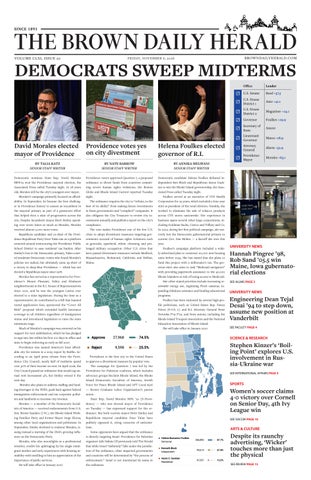
DEMOCRATS SWEEP MIDTERMS Office
Leader
☑ U.S. Senate
Reed +37.5
U.S. House
☑ District 1
U.S. House
☑ District 2
Magaziner +24.1
☑ Governor
Foulkes +29.9
Secretary of
☑ State HORATIO HAMILTON / HERALD
David Morales elected mayor of Providence
SELINA KAO / HERALD
Providence votes yes on city divestment
HORATIO HAMILTON / HERALD
Helena Foulkes elected governor of R.I.
BY TALIA KATZ SENIOR STAFF WRITER
BY NATE BARKOW SENIOR STAFF WRITER
BY ANNIKA MELWANI SENIOR STAFF WRITER
Democratic nominee State Rep. David Morales MPA’19 won the Providence mayoral election, the Associated Press called Tuesday night. At 28 years old, Morales will be the city’s youngest-ever mayor. Morales’s campaign primarily focused on affordability. In September, he became the first challenger in Providence history to unseat an incumbent in the mayoral primary as part of a grassroots effort that helped elect a slate of progressives across the city. Despite incumbent mayor Brett Smiley spending over seven times as much as Morales, Morales received almost 2,000 more votes. Republican candidate and co-chair of the Providence Republican Party Dave Talan ran on a platform centered around restructuring the Providence Public School District to ease residents’ tax burden. After Smiley’s loss in the Democratic primary, Talan courted moderate Democratic voters who found Morales’s policies too radical, but ultimately came up short of a victory in deep-blue Providence — which has not elected a Republican mayor since 1978. Morales has served as a representative for Providence’s Mount Pleasant, Valley and Elmhurst neighborhoods in the R.I. House of Representatives since 2021, and he was the youngest Latino ever elected to a state legislature. During his time as a representative, he contributed to a bill that banned rental application fees, sponsored the “Cover All Kids” proposal which extended health insurance coverage to all children regardless of immigration status and introduced legislation to raise the state minimum wage. Much of Morales’s campaign was centered on his support for rent stabilization, which he has pledged to sign into law within his first 100 days in office and aims to begin enforcing as early as fall 2027. Providence was named America’s least affordable city for renters in a 2025 report by Redfin. According to an April press release from the Providence City Council, nearly half of residents spend over 30% of their income on rent. In April 2026, the City Council passed an ordinance that would cap annual rent increasesat 4%, but Smiley vetoed it the next day. Morales also plans to address staffing and funding shortages in the PPSD, push back against federal immigration enforcement and tax corporate polluters and landlords to increase city revenue. Morales — a member of the Democratic Socialists of America — received endorsements from U.S. Sen. Bernie Sanders (I-Vt.), the Rhode Island Working Families Party and former Mayor Jorge Elorza, among other local organizations and politicians. In September, Smiley declined to endorse Morales, issuing instead a warning of the DSA’s growing influence on the Democratic Party. Morales, who also moonlights as a professional wrestler, credits his upbringing by his single immigrant mother and early experiences with housing instability with instilling in him an appreciation of the importance of public services. He will take office in January 2027.
Providence voters approved Question 7, a proposed ordinance to divest funds from countries committing severe human rights violations, the Boston Globe and Rhode Island Current reported Tuesday night. The ordinance requires the city to “refrain, to the best of its ability” from making future investments in these governments and “complicit” companies. It also obligates the City Treasurer to review city investments annually and publish a report on the city’s compliance. The vote makes Providence one of the few U.S. cities to adopt divestment measures targeting governments accused of human rights violations such as genocide, apartheid, ethnic cleansing and prolonged military occupation. Other U.S. cities that have passed divestment measures include Medford, Massachusetts, Richmond, California and Belfast, Maine.
Democratic candidate Helena Foulkes defeated independent Ken Block and Republican Aaron Guckian to win the Rhode Island governorship, the Associated Press called Tuesday night. Foulkes served as an executive of CVS Health Corporation for 25 years, which included a four-year stint as president of the retail division. Notably, she worked to eliminate the sale of tobacco products across CVS stores nationwide. Her experience in business spans several other large corporations, including Goldman Sachs, Costco and Tiffany and Co. In 2022, during her first political campaign, she narrowly lost the Democratic gubernatorial primary to current Gov. Dan McKee — a faceoff she won this year. Foulkes’s campaign platform included a widely-advertised plan to construct 20,000 new housing units before 2034. She has stated that she plans to fund this project with a millionaire’s tax. The governor-elect also aims to task “Medicaid navigators” with providing paperwork assistance to the 40,000 Rhode Islanders at risk of losing access to Medicaid. Her other stated priorities include increasing renewable energy use, regulating Flock cameras, expanding childcare asistance and funding educational programs. Foulkes has been endorsed by several high-profile politicians, such as United States Rep. Nancy Pelosi (D-CA 11) and R.I. Attorney General Peter Neronha P’19 P’22, and from unions, including the Rhode Island Troopers Association and the National Education Association of Rhode Island. She will take office in January 2027.
Amo +41.1
Lieutenant
☑ Governor Attorney
☑ General
Providence
☑ Mayor
Amore Matos +18.9 Ahern +32.9 Morales +63.1
JAKE PARKER / HERALD
'()*$+,)-.%($/,
Hannah Pingree ’98, Rob Sand ’05.5 win Maine, Iowa gubernatorial elections !""#$%&'!#!"#$%&
'()*$+,)-.%($/,
Engineering Dean Tejal Desai ’94 to step down, assume new position at Vanderbilt !""#($)&%*+#!"#$%0
,2)$(2$%3%+$,$"+24
Providence is the first city in the United States to approve a divestment measure by popular vote. The campaign for Question 7 was led by the Providence for Palestine coalition, which includes advocacy groups Reclaim Rhode Island, the Rhode Island Democratic Socialists of America, Jewish Voice for Peace Rhode Island and AFT Local 6516 — Brown Graduate Labor Organization’s parent union. State Rep. David Morales MPA ’19 (D-Providence) — who was elected mayor of Providence on Tuesday — has expressed support for the ordinance. But both current mayor Brett Smiley and Republican mayoral candidate Dave Talan have publicly opposed it, citing concerns of antisemitism. Some opponents have argued that the ordinance is directly targeting Israel. Providence for Palestine organizer Adit Sabnis GS previously told The Herald that while Israel “definitely” falls under the jurisdiction of the ordinance, other impacted governments and countries will be determined by “the process of enforcement.” Israel is not mentioned by name in the ordinance.
Stephen Kinzer’s ‘Boiling Point’ explores U.S. involvement in Russia-Ukraine war !""#,-*".-$*,/-$%#$(($,.!#!"#$%1
,!7+-,
Women’s soccer claims 4-0 victory over Cornell on Senior Day, 4th Ivy League win !""#!/))".#!"#$%56
"+-,%3%2'8-'+$
Despite its raunchy advertising, ‘Wicker’ touches more than just the physical !""#."0,"1#!"#$%51
PAGE 2
FRIDAY, NOVEMBER 6, 2026
UNIVERSITY NEWS ,-'9$(-%8):$
Students react to midterm election ‘blue wave’ with surprise, excitement Students emphasized that change is necessary to continue momentum BY RACHEL WICKER SENIOR STAFF WRITER
On Tuesday, voters across the country cast their ballots in what became a blue wave of Democrats flipping previously Republican seats and retaking control of both the House of Representatives and the Senate. Democrats won by even larger margins than polls predicted and overtook counties and states where Trump led significantly in the 2024 election. Rhode Island saw similar Democratic victories, with Democrat Helena Foulkes elected as governor and U.S. Sen. Jack Reed (D-R.I.), U.S. Rep. Gabe Amo (D-R.I. 1) and U.S. Rep. Seth Magaziner ’06 (D-R.I. 2) reelected to their respective Congressional seats. In Providence, voters electedprogressive State Rep. David Morales MPA’19 as the next mayor, and the city became the first to approve a divestment measureby popular vote. The Herald spoke to students across campus about their reactions to the midterm election results as well as their hopes and expectations for the political future of the United States. Will Thomas ’28, who voted by mail in Virginia, said that he was “not surprised, but excited” that Morales won the Providence mayoral election. He added that he thinks Morales represents “a new genera-
tion of leadership.” At 28 years old, Morales is Providence’s youngest elected mayor. “I also think it’s kind of a celebratory night for Brown,” Thomas added, noting that Brown alums Rob Sand ’05.5 and Hannah Pingree ’98were elected as governors of Iowa and Maine, respectively. Bountou Keita ’28 said she was “happily shocked” by the midterm election results, adding that she did not expect the nationwide shift toward Democrats would be as large as it was, but she said she’s “so happy” about the results. “It’s great that you see a much more diverse group of people being elected,” she added. Across the nation, voters elected several candidates who are historic firsts, including the country’s first Black female governor, first Native American female governorand first Muslim U.S. senator. Azlyn Haley ’28 said she was happy to see that, in addition to the general shift left, there was also a leftward shift within demographic groups such as younger voters. “I also think there were a lot of really strong candidates in this election … that people could really get excited about and stand behind,” she added. Finn Kehoe ’29 voted “straight blue” via mail-in ballot in his home state of Georgia. “I was expecting obviously (a) blue victory, but I thought the scale of it was impressive,” he said, adding that it was “crazy” that Democrats flipped a South Carolina Senate seat. “I think that people are really unhappy and upset with how our current govern-
SAMANTHA BIRNS / HERALD
-;<%4<=>?@%ABCD<%EC%AEF@<GEA%>H=CAA%H>IBFA%>JCFE%E;<K=%=<>HEKCGA%EC%E;<%IK@E<=I%<?<HEKCG%=<AF?EA%>A%L<??%>A%E;<K=% ;CB<A%>G@%<MB<HE>EKCGA%NC=%E;<%BC?KEKH>?%NFEF=<%CN%E;<%'GKE<@%,E>E<AO ment is run and the choices being made,” different people doesn’t mean that change be changed with the power of our voice, Keita said. exists yet. our vote.” Kehoe emphasized that tangible change Although Max Ekstein ’30 said he was “We do have power in these elections,” is necessary “to continue the momentum” “pretty happy” with the results, he added To added. of the midterm results. “I hope that this that he expects seats to flip back and forth Gui Sequeira ’28 is hopeful that the will be one of the first of many blue waves,” in the years to come. “We have a tenden- election outcomes “(inspire) more advohe said. But he noted that if voters do not cy to blame those in power for whatever cacy and more leadership from college see a significant change between a Republi- inconveniences we go through,” he said, students at Brown and colleges in general.” can-led government and a Democratic one, but “change takes … at least two to three “After the presidential elections, it kind they might wonder “‘why did we even vote years to take effect.” of felt like it was all for nothing,” Sequeira for these people?’” Some students are hopeful that the said, but now “it feels like a change is acMatthew To ’30 echoed this sentiment. election results will positively impact the tually possible.” “The first step is obviously putting the Brown community. right people in the positions of power,” To said the results can help show stuhe said. “But the second part is, we still dents that even the outcomes we expect This article originally appeared online at desire change, and just because there’s — such as Texas always going red — “can browndailyherald.com on Nov. 5, 2026.
!+7:)8$
Meet Joshua Kennedy ’97, Brown’s next CIO Kennedy will become the University’s chief investment officer on Dec. 31 BY JEREMIAH FARR SENIOR STAFF WRITER During his undergraduate years at Brown, Joshua Kennedy ’97 worked as a bartender at the then-student-run pub the Underground. After graduation, Kennedy worked on the news staff of the Wall Street Journal. Nearly three decades later, Kennedy is set to become the University’s next chief investment officer and help oversee the University’s $9.5 billion endowment. Kennedy first joined the University’s investment office in 2016, and he has served as deputy chief investment officer since 2022. He will succeed current CIO Jane Dietze in January. Drawn to Brown for its “spirit of intellectual freedom,” Kennedy said that he did not have much interest in finance as a student and instead concentrated in religious studies. Kennedy saw his time at the WSJ as “kind of a second undergrad in the sense that I learned all about business, finance, basically everything the Wall Street Journal writes about,” Kennedy said. Following his time at the WSJ, Kennedy studied accounting and finance at the New York University Stern School of Business, where he earned his master’s of business administration. “I’m kind of like an accidental financier,” he said in an interview with The Herald. “If I had done a job at Sports Illustrated instead of the Wall Street Journal, I might be doing something entirely different.” Vice Chair of the Department of Economics Bradford Gibbs ’93 MA’18 attributed Kennedy’s “non-traditional background” in
RAZANNE SHOUKFEH / HERALD
P<GG<@Q%R=AE%SCKG<@%E;<%'GKT<=AKEQUA%KGT<AEI<GE%CVH<%KG%W65XY%>G@%;<%;>A%A<=T<@%>A%@<BFEQ%H;K<N%KGT<AEI<GE%CVH<=% AKGH<%W6WWO finance to the Open Curriculum. He added that Kennedy’s unconventional path makes him “a really impactful speaker as well as mentor for students contemplating a career in investment management.” Kennedy has come to speak at Gibbs’s finance classes on multiple occasions. After attending Stern, Kennedy worked at Liberty Square Asset Management and later worked as a managing partner at Sonian Capital Management, a Boston-based
global value manager. When Kennedy met Dietze, the two initially discussed the University’s ability to invest in the investment partnership Kennedy was managing at the time. The conversation “turned from that to the prospect of joining Brown as an investment professional, which is an obviously fantastic opportunity,” he said. He said that the department is “not likely to be dramatically different” amid
the leadership transition. “I’ve learned this trade from Jane, and we have worked very well together.” Kennedy also credited the investment office’s sustained success to proper governance, hard work, innovation and “a great deal of good fortune,” he said. Gibbs noted that the University’s investment office has a “surprisingly large number of Brown graduates who share a sense of mission of Brown in doing what
they do.” “Josh is one of the most thoughtful and insightful people I know,” Managing Director of the Investment Office Peter Levine ’95 — who will take over as deputy CIO when Kennedy ascends to his new role — wrote in an email to The Herald. “He is an excellent learner, with highly developed observational and analytic skills that inform his deliberate approach to investing.” Levine met Kennedy during Kennedy’s first year at Brown. Their spouses, both of whom also attended Brown, met in their first week at the University, and the two couples have remained friends since. Levine described Kennedy as “a great listener who welcomes debate and discussion.” “These are key qualities for a CIO who has to evaluate a lot of dynamic and subjective information in order to manage Brown’s all-weather portfolio,” he added. Gibbs said that Kennedy is a “WYSIWYG,” or a person with whom what you see is what you get. “He’s the real deal. We’re lucky to have him as a part of this community,” Gibbs added. On campus, Kennedy is also a guitarist for Funkademic, a Rhode Island-based cover band. A few years ago, Kennedy wrote and performed personalized songs for a number of colleagues, which Levine said was a huge hit. “He knew the team so well he could riff about their individual strengths and occasional quirks,” Levine wrote. “That says a lot about Josh — he knows his team extraordinarily well and transformed that knowledge into something amazing and creative.” “This is the dream job, so I feel very privileged that I get to do this for Brown,” Kennedy said. “This is where I’ve made my home,” he said.
THE BROWN DAILY HERALD
PAGE 3
UNIVERSITY NEWS "8'Z,
Hannah Pingree ’98 wins Maine gubernatorial election Pingree’s campaign focused on affordability issues for Mainers BY REBECCA GOODMAN UNIVERSITY NEWS & ARTS & CULTURE EDITOR Hannah Pingree ’98 defeated Republican nominee Bobby Charles and Independent Maine State Sen. Rick Bennett (I-Oxford) in the Maine gubernatorial election, the Associated Press called late Tuesday night. Pingree was first elected to the Maine House of Representatives in 2002, at 26 years old. In 2008, she became the youngest woman in U.S. history to serve as a state House speaker, and the second woman to hold the position in Maine. After leaving the legislature in 2010, Pingree worked as business manager for a lodge and farm in North Haven, the island where she grew up, and as campaign director for a local housing nonprofit. In 2019, Gov. Janet Mills tapped her to run the Governor’s Office of Policy Innovation and the Future, which she led until
2025 when she announced her plan to run for governor. Her time at Brown gave her “the confidence to figure out how to get things done,” Pingree told The Herald in a 2025 interview. She added that her time on College Hill taught her how to “engage with all kinds of people.” Pingree’s campaign focused on affordability, from housing costs to grocery prices. She has campaigned on expanding access to childcare, growing economic opportunity, supporting public education and protecting the state’s environment. Pingree has also been outspoken against the Trump administration. After President Donald Trump said “Maine is bad” while discussing alleged fraud in the state in September, Pingree responded at a Labor Day event in Portland, Maine. “We are great. We don’t need to be made great again,” she said. In June, Pingree won the Democratic nomination for governor over four other candidates after a five-day rank-choice tabulation, overtaking former Maine Center for Disease Control Director Nirav Shah, who had led in first-choice votes.
COURTESY OF HANNAH PINGREE, PHOTO BY TRIXIE BETZ
)G%W66[Y%A;<%J<H>I<%E;<%QCFG\<AE%LCI>G%KG%'O,O%;KAEC=Q%EC%A<=T<%>A%>%AE>E<%4CFA<%AB<>D<=Y%>G@%E;<%A<HCG@%LCI>G%EC% ;C?@%E;<%BCAKEKCG%KG%Z>KG<O Pingree gave her victory speech at the Maine Democrats’ election night party in Portland, joined on stage by her husband and two children. She congratulated her mother, U.S. Rep. Chellie Pingree (D-Maine), who won a 10th term representing Maine’s 1st Congressional District.
“I know this has been a hard and ugly year in politics. So many people are anxious about what’s happening in Washington and what comes next,” she said. “But I want you to hear me say this: You were right to care so much. Your worry was never wasted. Tonight we turned our worry into
something big and important, all across this country — not just for Maine — but for all of us.’”
This article originally appeared online at browndailyherald.com on Nov. 4, 2026.
"8'Z,
Rob Sand ’05.5 wins Iowa gubernatorial election Sand was victorious over Republican nominee Zach Lahn
Rob Sand ’05.5, a former opinions contributor for The Herald, won the Iowa
to his home state and received his law degree at the University of Iowa College of Law. He worked on campaigns for Iowans Ed Fallon and Denise O’Brien before becoming Assistant Iowa Attorney General in 2010. In 2018, he was elected State Auditor, which he served for two terms. He announced his candidacy for governor in May 2025 with no competitors in the primaries.
paign drew from the work he did as state auditor to uncover cases of fraud and abuse in the state. Sand promises that, as governor, he will protect taxpayers’ money. He has also pledged to create more job opportunities, invest in universal Pre-K and hold big corporations and data centers accountable to Iowa taxpayers. Throughout his campaign, Sand has
COURTESY OF ROB SAND
gubernatorial election, defeating Republican nominee Zach Lahn, the Associated Press called on Tuesday night. After he graduated from Brown with a degree in political science, Sand returned
According to his campaign website, Sand’s priorities include strengthening the state’s economy and public education, decreasing costs and helping “Iowans live better, healthier lives.” Much of his cam-
emphasized that although he is running as a Democrat, he is primarily running as an Iowan, often expressing his disinterest in the two-party system. In May, Elaine Godfrey wrote in The Atlantic that “one
-;=CF\;CFE%;KA%H>IB>K\GY%,>G@% ;>A%<IB;>AK]<@%E;>E%>?E;CF\;% ;<%KA%=FGGKG\%>A%>%9<ICH=>EY%;<%KA% B=KI>=K?Q%=FGGKG\%>A%>G%)CL>GY%CNE<G% <MB=<AAKG\%;KA%@KAKGE<=<AE%KG%E;<%ELC^ B>=EQ%AQAE<IO
BY REBECCA GOODMAN UNIVERSITY NEWS AND ARTS & CULTURE EDITOR
gets the impression that Sand is a Democrat in the same way that a platypus is a mammal: only technically.” In a Tuesday Instagram post, Sand reiterated his belief in Iowans and called on them to vote. “Now is our time to win this race,” Sand said in the video. “Now is our time to reshape the direction of the state of Iowa. Now is our time to restore an Iowa tradition of balanced government and common sense.”
This article originally appeared online at browndailyherald.com on Nov. 3, 2026.
J=<9,55,')5L$!"#$%&'()$*+,-.$/#&+-0$7=<-,5"#5$5=<9,55,')5$,)$8"#$K'&9$'K$'7?#05$+)0$-#88#&5$8'$8"#$ #0,8'&4$
SINCE 1891
THE BROWN DAILY HERALD 136TH EDITORIAL BOARD Editor-in-Chief Cate Latimer
Rebecca Goodman
Managing Editors Ciara Meyer Elise Haulund Claire Song
University News Editors Emily Feil Rebecca Goodman Samah Hamid Zarina Hamilton Ivy Huang Ian Ritter Alejandro Ruiz Roma Shah
Senior Editors Hadley Carr Paul Hudes Max Robinson POST- MAGAZINE Editor-in-Chief Elaina Bayard
Sports Editor Sajiv Mehta
COMMENTARY Head of Editorial Page Board Ethan Canfield
NEWS Metro Editors Michelle Bi Pavani Durbhakula Talia Egnal Emily Feil Amber Marcus-Blank Science & Research Editors Ivy Huang Ian Ritter Alice Xie
Opinions Editors Talia Berkwitz Ethan Canfield Christian Davis Isabella Gardiner Lucas Guan Avery Kaak CJ Lair Clara Murray Arya Vishwakarma
Arts & Culture Editors Ann Gray Golpira
PRODUCTION Copy Desk Chief
Chelsea Long Assistant Copy Chief Sofia Segarra Design Chiefs Emily Bao Maggie Ruan Design Editors Chloe Johnson Kailey Marti MULTIMEDIA Photo Chiefs Annamaria Luecht Kaia Yalamanchili Illustration Chiefs Kendra Eastep Isabela Guillen Video Chiefs Cienna Cheng Cody Cheng Social Media Chiefs Nate Barkow Annika Melwani Technology Chief Yassir Aouf Data Desk Chief Caleb Ellenberg
Games Chief Paul Hudes Podcast Chief Talia LeVine Multimedia Editors Marat Basaria Harry Guo Horatio Hamilton Selina Kao Ella Le Kenna Lee JJ Li Jake Parker BUSINESS General Managers Arjun Deshpande Anum Azhar Sales Directors Arjun Ray Hannah Han Finance Director Sydney Wright Office Manager Cary Warner
!"#$_#$%&'(
)&*$+,,-.*,/0+%,12(&3'4#$%&'(
!+%,12(&3'4#$%&'(
!+%,12(&3'4#$%&'(
DD$%#)#A'-#)81$>&'A,0#)3#1$`2$$$$$[aOC]$PVC?PPbN$$$$$(((4<&'()0+,-."#&+-043'9 c0,8'&,+-L$"#&+-0T<&'()0+,-."#&+-043'9$$$$$Q0A#&8,5,):L$+0A#&8,5,):T<&'()0+,-."#&+-043'9
I7?#05$+&#$8.7,3+--.$<#8(##)$ROO$+)0$EOO$('&05$+)0$+0A+)3#$+$3-#+&$+&:=9#)8$&#-+8#0$8'$+$8'7,3$'K$ 3+97=5$0,53'=&5#4$S'=$3+)$5=<9,8$'7?#05$8'$'7,),')5T<&'()0+,-."#&+-043'94$ U#88#&5$8'$8"#$#0,8'&$5"'=-0$<#$+&'=)0$NVO$('&05$+)0$9')0$8'$+)$+&8,3-#$'&$3'-=9)$8"+8$"+5$+77#+�$ ,)$!"#$/#&+-01$'&$3&,8,W=#$'&$3'99#)0$!"#$/#&+-0X5$#0,8'&,+-$0#3,5,')54$S'=$3+)$5=<9,8$-#88#&5$8'$8"#$#0,8'&$ 8'$-#88#&5T<&'()0+,-."#&+-043'94 J=<9,55,')5$=)0#&:'$9=-8,7-#$&'=)05$'K$#0,8,):4$!"#5#$&'=)05$'K$#0,8,):$:#)#&+--.$8+Y#$7-+3#$'A#&$8"#$ 3'=&5#$'K$')#$#A#),):1$+)0$.'=$9+.$"+A#$8'$9')0$8'$#0,85$-+8#$,)$8"#$#A#),):4$2K$.'=$Y)'($.'=$(,--$<#$ =)+<-#$8'$0'$5'1$7-#+5#$9#)8,')$8"+8$,)$.'=&$#9+,-1$+)0$(#$(,--$0'$'=&$<#58$8'$('&Y$(,8"$.'=4 J=<9,55,')5$3+)$<=,-0$')$'&8,):$K&'9$!"#$/#&+-01$'&8,):$#-5#("#$'Z3,+-$58+8#9#)85$K&'9$ 8"#$B),A#&5,8.$'&$'8"#&$:&'=75$+)0$'8"#&$=8+<-#$5'=&3#51$<=8$8"#.$3+))'8$<&#+Y$)#(5$'&$3')8+,)$ ,)K'&9+8,')$8"+8$!"#$/#&+-0$3+))'8$A#&,K.4$%#3+=5#$(#$3+))'8$7=<-,5"$=)5=<58+)8,+8#0$,)K'&9+8,')1$ K+,-=&#$8'$7&'A,0#$+77&'7&,+8#$5'=&3#5$9+.$9#+)$(#$"+A#$8'$9'0,K.$'&$	'A#$=)A#&,6#0$3-+,954 !"#$/#&+-0$(,--$)'8$7=<-,5"$+)').9'=5$5=<9,55,')5$'&$5=<9,55,')5$+=8"'�$<.$'&:+),;+8,')54$U#+0#&5$ 'K$58=0#)8$'&:+),;+8,')5$3+)$<#$,0#)8,6#0$+5$5=3"$<=8$3+))'8$(&,8#$=)0#&$8"#$<.-,)#$'K$8"#,&$'&:+),;+8,')4$ !"#$/#&+-0$3+))'8$7=<-,5"$+--$5=<9,55,')5$,8$#,A#5$+)0$#&A#5$8"#$&,:"8$8'$#0,8$+--$5=<9,55,')54$ Q--$5=<9,55,')5$8'$!"#$/#&+-0$3+))'8$"+A#$<##)$7&#A,'=5-.$7=<-,5"#0$#-5#("#&#$[,)$7&,)8$'&$')-,)#$\$ ,)3-=0,):$7#&5')+-$<-':5$+)0$5'3,+-$9#0,+]$+)0$9=58$<#$#G3-=5,A#$8'$!"#$/#&+-04$I)3#$.'=&$5=<9,55,')$,5$ 7=<-,5"#0$,)$!"#$/#&+-01$!"#$%&'()$*+,-.$/#&+-01$2)34$'()5$8"#$3'7.&,:"8$8'$8"#$9+8#&,+-54$ H'99#)8+&.L$!"#$#0,8'&,+-$,5$8"#$9+^'&,8.$'7,),')$'K$8"#$#0,8'&,+-$7+:#$<'+&0$'K$!"#$%&'()$*+,-.$/#&+-04$ !"#$#0,8'&,+-$A,#(7',)8$0'#5$)'8$)#3#55+&,-.$&#_#38$8"#$A,#(5$'K$!"#$%&'()$*+,-.$/#&+-01$2)34$H'-=9)51$ -#88#&5$+)0$3'9,35$&#_#38$8"#$'7,),')5$'K$8"#,&$+=8"'&5$')-.4 H'&&,')5L$!"#$%&'()$*+,-.$/#&+-0$,5$3'99,88#0$8'$7&'A,0,):$8"#$%&'()$B),A#&5,8.$3'99=),8.$(,8"$ 8"#$9'58$+33=&+8#$,)K'&9+8,')$7'55,<-#4$H'&&,')5$9+.$<#$5=<9,88#0$=7$8'$5#A#)$3+-#)0+&$0+.5$+K8#&$ 7=<-,3+8,')4$>#&,'0,3+-5$7'58+:#$7+,0$+8$>&'A,0#)3#1$`424$>'589+58#&L$>-#+5#$5#)0$3'&&,')5$8'$>4I4$%'G$ NVPD1$>&'A,0#)3#1$`2$ONEOR4 Q0A#&8,5,):L$!"#$%&'()$*+,-.$/#&+-01$2)34$#&A#5$8"#$&,:"8$8'$+33#78$'&$0#3-,)#$+).$+0A#&8,5#9#)8$+8$,85$ 0,53,')4 !"#$%&'()$*+,-.$/#&+-01$2)34$,5$+$6)+)3,+--.$,)0#7#)0#)81$)')7&'68$9#0,+$'&:+),;+8,')$<&,):,):$.'=$ !"#$%&'()$*+,-.$/#&+-0$+)0$>'58?$@+:+;,)#4$!"#$%&'()$*+,-.$/#&+-0$"+5$5#&A#0$8"#$%&'()$B),A#&5,8.$ 3'99=),8.$0+,-.$5,)3#$CDEC4$28$,5$7=<-,5"#0$@')0+.$8"&'=:"$F&,0+.$0=&,):$8"#$+3+0#9,3$.#+&1$#G3-=0,):$ A+3+8,')51$')3#$0=&,):$H'99#)3#9#)8$+)0$')3#$0=&,):$I&,#)8+8,')$<.$!"#$%&'()$*+,-.$/#&+-01$2)34$ J,):-#$3'7.$K&##$K'&$#+3"$9#9<#&$'K$8"#$3'99=),8.4$J=<53&,78,')$7&,3#5L$MNOO$')#$.#+&$0+,-.1$MCOO$')#$ 5#9#58#&$0+,-.4 H'7.&,:"8$NONP$<.$!"#$%&'()$*+,-.$/#&+-01$2)34$Q--$&,:"85$#&A#04
PAGE 4
FRIDAY, NOVEMBER 6, 2026
UNIVERSITY NEWS :"2'8-.
Engineering Dean Tejal Desai ’94 to step down, assume new position at Vanderbilt Desai has served as dean of the SOE for over four years BY SAMAH HAMID UNIVERSITY NEWS EDITOR Tejal Desai ’94 will step down from her position as dean of engineering and depart the University on Dec. 31, according to a Thursday announcement. Since Desai assumed her leadership position at Brown, the School of Engineering has more than doubled the number of engineering concentrators in the past three years and recruited a dozen new faculty members. The school has also seen a 23% increase in master’s student matriculation in the last two years and a 40% increase in research funding awards from 2022 to 2025. Under her leadership, the school has
begun a renovation to turn the Prince Lab into the Lassonde Innovation and Design Hub. She has also overseen the launch of new programs such as the Initiative for Sustainable Energy, a new Master of Science in Sustainable Energy and an undergraduate concentration in design engineering. Desai has published over 250 patents and peer-reviewed articles. She was elected to the National Academy of Engineering in 2024 and named a fellow of the American Association for the Advancement of Sciencein 2026. Desai will be the founding executive director of the Institute of Innovation, Technology and Translation at Vanderbilt San Francisco, a new campus that Vanderbilt University intends to open in fall 2027. She will also be a tenured faculty member at Vanderbilt’s School of Engineering. Desai, who graduated from Brown with a Bachelor of Science in biomedical engi-
neering, has served as dean of the SOE since 2022, after serving as chair from 2014 to 2021 of the Department of Bioengineering and Therapeutic Sciences at the University of California, San Francisco. She currently serves as principal investigator for the Desai Lab for Therapeutic Micro and Nanotechnology, which focuses on developing novel mechanisms for medicine deliveryand supporting self-healing processes in the body. The lab has received more than $4 million in research funds since her arrival as dean. Provost Francis Doyle is currently considering candidates to serve as interim dean and anticipates an update on a new appointment in the coming weeks, according to the University news release. COURTESY OF TEJAL DESAI
This article originally appeared online at browndailyherald.com on Nov. 5, 2022.
9<A>K%L>A%<?<HE<@%EC%E;<%(>EKCG>?%"H>@<IQ%CN%$G\KG<<=KG\%KG%W6W0%>G@% G>I<@%>%N<??CL%CN%E;<%"I<=KH>G%"AACHK>EKCG%NC=%E;<%"@T>GH<I<GE%CN%,HK<GH<% KG%W6WXO
:"2'8-.
How a Brown professor emeritus created one of TIME’s Best Innovations of 2026 Derek Stein launched his product “Lilypad” earlier this year BY JEFFREY KUNZWEILER CONTRIBUTING WRITER When Professor Emeritus of Physics Derek Stein was seeking research funding to help buildings manage moisture, one program manager told him the idea sounded like magic. Stein was ultimately told it wouldn’t work, and that even if it did, no one would care. Now, Lilypad, the paint and primer system developed by Stein’s company Adept Materials, has been named one of TIME’s best inventions of 2026. Lilypad is a two-layer paint and primer system designed to absorb excess water vapor in the air when indoor humidity rises and release vapor when humidity falls. The system is meant to protect buildings from deterioration caused by water damage. For Stein, the journey towards creating Lilypad involved much more than the invention of a new material — it involved learning how to build a company as well as leaving his professorship. The idea for the product emerged from a Brown student project. Around 2012, engineering students approached Stein for help with an international challenge to design and build a sustainable house. As they strove to build an energy-efficient home, Stein noticed a tension emerging: While energy-efficient buildings are well insulated to reduce air-conditioning and heating costs, these same properties have the unintended side effect of trapping moisture as well. “So the very same buildings that are getting more efficient can actually get less comfortable, less durable and less healthy,” Stein said. Stein turned to plants for inspiration. Unlike houses, plants respond to changing conditions while regulating their own moisture. Initially, Stein pursued potential solutions for the issue through familiar academic channels by applying for grants to support his research. While these applications did not ultimately pan out, individuals in other sectors — such as the construction industry — expressed interest. Danny Warshay ’87 P’20 P’23.5, executive director of the Nelson Center for
KENNA LEE / HERALD
8K?QB>@Y%E;<%B>KGE%>G@%B=KI<=%AQAE<I%@<T<?CB<@%JQ%,E<KGUA%HCIB>GQ%"@<BE%Z>E<=K>?AY%;>A%J<<G%G>I<@%CG<%CN%-)Z$UA%J<AE%KGT<GEKCGA%CN%W6WXO Entrepreneurship, encouraged Stein to consider creating a startup for the product while remaining a full-time faculty member. “I think my role can be best described as a cheerleader,” Warshay said. “I was trying to encourage him, mostly to help him understand that he could do what he was envisioning … that he could, even while being a professor, pursue starting a venture.” Brian Demers ’85, senior director of business development at Brown Technology Innovations, helped Stein identify which discoveries could be patented and connected him with investors and other industry contacts. “(Stein is) great at being able to talk to and present to different audiences and get them to understand what he’s up to,” Demers said.
Jason Harry, professor of the practice of technology and entrepreneurship, helped review Stein’s early pitch presentations. Paint was not the focus of the first presentations, he said, as Stein was exploring many other materials that could potentially incorporate the technology. For solutions with multiple possible approaches, finding the right first application is a central challenge, Harry explained. “It’s where the unmet need is the most acute.” With the support and advice from his colleagues, Stein took additional steps towards turning his technology into a product. He enrolled in the Cleantech Open accelerator, an entrepreneurship training program, to learn the basics of entrepreneurship.
Stein retired from his professorship in 2024 to focus on Adept Materials. Despite his departure from academia, he compared his experience launching Lilypad to how he used to feel when publishing research papers. “I was super nervous when (Lilypad) came out,” Stein said. “You’re doing all this work, and you don’t want it to all fall apart.” But early positive feedback offered reassurance. Stein recalled hearing assessments from a professional painter who praised the paint’s artistic value as well as from customers who said their bathroom stayed dry after a hot shower. These accounts, he said, were especially rewarding because these people had no reason to praise him. “This isn’t my mom telling me, ‘I really
like your thing,’” he said. The recognition has since grown — Adept Materials won Startup of the Year at the 2025 Innovations@Brown showcase, and Lilypad received a Fast Company Innovation by Design award in September. Stein is already thinking about going beyond interior walls and expanding the product line. Lilypad recently added colors beyond their initial release, which only offered white, he said. Adept Materials is also exploring the potential to produce exterior paint, food packaging and clothing apparel regulated for humidity, Stein said.
This article originally appeared online at browndailyherald.com on Nov. 5, 2026.
THE BROWN DAILY HERALD
PAGE 5
SCIENCE & RESEARCH :$9$+"8%:'(9)(#
As federal research priorities shift, Brown’s Division of Research considers how AI fits in A Trump administration report identified AI as a research funding priority BY ANGEL LOPEZ SENIOR STAFF WRITER In July, the Trump administration released a report proclaiming a “new golden age of American innovation.” The report, which redefines the United States’s research funding priorities and how federal research funding is allocated to universities and industry, emphasizes the potential of artificial intelligencein furthering scientific innovation and de-emphasizes “life sciences” research. At Brown, the Division of Research is working to adapt to these shifting priorities — as they have adapted to the past two years of federal research challenges, including freezes of federal grants for scientific research. Even after a dealwith the Trump administration to restore most funding, grants to some universities have been slowing. Meanwhile, AI and machine-learning research have begun to dominateNational Institutes of Health-funded research. According to Greg Hirth, Brown’s vice president for research, this phenomenon is “particularly obvious” in the National
RAINIER PEDERSON / HERALD
-;<%9KTKAKCG%CN%+<A<>=H;%;>A%;CAE<@%E;=<<%")%_%`%A<AAKCGA%KG%E;<%B>AE%Q<>=Y% LKE;%>%NCF=E;Y%NCHFAKG\%CG%")%>G@%E;<%;FI>GKEK<AY%HF==<GE?Q%KG%E;<%LC=DAO Science Foundation’s allocation of grants, a little more emphasis in one direction in which funds have been reallocated to or another,” Littman said. But under the projects that use AI. Though Brown Trump administration, he believes that faculty researchers are working toward the sentiment is “if you’re not doing one leveraging AI more in their projects al- of four things that were listed as priorities, ready, this means that researchers have then we don’t want to give you money.” The seen decreased funding from the NSF to administration’s proposed mechanisms for conduct non-AI research that they would a “new era of scientific discovery” center “normally” be doing. around AI development. Michael Littman, the associate provost In a statement sent to The Herald, a for artificial intelligence, said that this is a NSF spokesperson wrote that the NSF rebreak from the previous modes of thought mains committed to advancing national at the NSF. interests and providing funding to research Previously, “the NSF would always try proposals that are “aligned with agency to support all research, all the things that priorities.” researchers were doing, but maybe put “NSF’s funding decisions reflect a
strategic alignment of resources in a constrained fiscal environment, prioritizing investments that address the most critical, high-priority challenges and opportunities identified by the Administration, Congress and the science and technology community,” the spokesperson wrote. Littman noted that the Trump administration has decreased research funding more broadly and cut already allocated funds. “In addition to that redistribution where AI gets more of the pie, the pie got smaller.” “At face value, it’s a good thing to get more university faculty engaged in solving problems of the day, and no one would argue that,” Hirth said. “To my perspective, a better way of doing that would be to provide additional funding for those activities.” To help faculty understand how to use AI in their research, the University is hosting networking events as part of a series called “AI + X” that seek to foster relationships between AI researchers and Brown researchers to “ensure strong, credible technical foundations,” Edel Minogue, senior director of research strategy and development at the Division of Research, wrote in an email to The Herald. The Division of Research has hosted three AI + X sessions in the past year, with
a fourth, focusing on AI and the humanities, currently in the works. In May, the University’s National Labs Day, the second since the event’s inception in 2024, focused AI’s potential in research. The event highlighted the U.S. Department of Energy’s Genesis Mission, which seeks to incorporate AI into scientific research. According to Minogue, the University also increased its seed funding for AI-related research this year. “Ultimately, research teams that thoughtfully and responsibly integrate AI into their workflows will be able to iterate much faster, and that speed and efficiency will become the new standard in the funding world,” Minogue wrote. With the decrease in the certainty of funding, the Division of Research is also looking at external sources of funding, Hirth said. “Part of that is to redouble efforts to engage with industry,” he added. The Division of Research is “trying to help people understand what opportunities that they might not have anticipated before,” he added. Ian Ritter contributed reporting.
This article originally appeared online at browndailyherald.com on Nov. 1, 2026.
)(-$+("-)7("8%"::")+,
Stephen Kinzer’s ‘Boiling Point’ explores U.S. involvement in Russia-Ukraine war The book details the role the CIA and NATO have played in the conflict BY ALICE XIE SCIENCE & RESEARCH EDITOR On Tuesday, Stephen Kinzer, a senior fellow in international and public affairs, released his new book “Boiling Point: How America Brought War to Ukraine,” which argues that the Russian invasion of Ukraine was not unprovoked, but catalyzed by long-standing conflict between the United States and Russia. Kinzer described his motivation for writing the book as “very simple.” “I just heard the word unprovoked too many times,” Kinzer said in an interview with The Herald. “The Russian invasion of Ukraine might have been wrong. It was certainly aggressive. You can call it evil or horrible or whatever you think of it, but it was definitely not unprovoked.” “We created this narrative that it was just one evil figure — Putin — who created this war. In fact, as my book points out, (the United States) worked for 75 years to provoke Russia,” Kinzer said. Before his career as an academic and author, Kinzer worked as a New York Times correspondent covering the Contra War in Nicaragua. While reporting, he realized that the war “had nothing to do with Nicaragua.” Instead, Nicaragua just had the “bad luck” be the location of outsiders’ conflict. “I see the same thing in Ukraine. This war has nothing to do with Ukraine. It’s all about the U.S.-Russia conflict,” Kinzer said. “We have been trying for 75 years to use Ukraine as a battering ram against Russia, and my book is the story of all the pieces of that campaign.” In “Boiling Point,” Kinzer traces the origins of U.S. intervention in Ukraine back to the late 1940s, when the CIA sent soldiers into Ukraine “in the hope of setting off a rebellion against Moscow.” According to Kinzer, the CIA started
a publishing house in the 1950s to create propaganda for Ukrainian nationalism and promote anti-Russian feelings. By the end of World War II, the United States “set out to establish an espionage network in the Soviet Union.” “Boiling Point” also looks at how the United States recruited former Nazis with anti-Soviet sentiments to that espionage network. Kinzer specifically mentioned Reinhard Gehlen, the chief of Adolf Hitler’s intelligence service for the Eastern Front, who defected to the United States and became a key figure in the CIA’s Ukraine project by turning over the Nazis’ anti-Soviet network. This covert spying operation continued through Ukraine’s independence in 1991, Kinzer said. According to Kinzer, the CIA effort was first directed at “producing a government in Ukraine that would be pro-American, pro-NATO and anti-Russia,” despite the fact that public opinion polls in the years after Ukrainian independence showed that a slight majority of the population did not want to join NATO. Ukraine is still not a member of the alliance, though it has pursued membership in recent years. Kinzer said that the United States “pushed relentlessly to get a government into power in Ukraine that would support the NATO anti-Russia project that finally succeeded with the uprising in 2014.” The White House did not immediately respond to The Herald’s request for comment. After the CIA’s operations became increasingly publicized in the 1970s, the United States switched from covert to overt intervention through the creation of the National Endowment for Democracy, which “is empowered to go out and set up organizations, committees, groups inside whatever country it is that we want to subvert,” Kinzer said. “Ukraine is one of the first examples of a kind of postmodern form of intervention.” Kinzer said once the United States had a favorable government in power in
Ukraine, Americans “became very excited about the possibility of confrontation” with Russia, particularly because it would not involve the loss of U.S. troops. Regardless of whether Russia accepted Ukraine joining NATO or chose to invade, those involved in U.S. intervention believed it would be good for the United States “because it allows us to portray Russia as the evil figure,” Kinzer said. Mark Kramer, director of the Cold War Studies Project at Harvard, criticized Kinzer’s argument. “The notion that the United States should somehow be blamed for (Russia’s invasion of Ukraine) strikes me as really contemptible.” He added that Kinzer’s book portrays a “fanciful argument” that “the West was really steering Ukraine into NATO, and that provoked Russia again. It just doesn’t hold up to reality.” Kramer said that a series of events, including Russia’s attempt to rig Ukrainian elections in 2004 and a low-level war instigated by Russia following its 2014 occupation and annexation of Crimea, caused the invasion of Ukraine. “It had nothing to do with the United States. It really had to do with Russia’s disaffection with what was going on in Ukraine, which was that Ukraine was moving closer to a democracy, true democracy,” Kramer said. The Russian and Ukrainian governments did not immediately respond to The Herald’s request for comment. In a follow-up email to The Herald, Kinzer asserted that “If Joe Biden had simply pronounced five words — ‘Ukraine will not join NATO’ — this war would probably never have happened.” “Expecting Russia to accept a hostile military alliance in Ukraine is equivalent to expecting the U.S. to accept Mexico joining an alliance with China, and allowing the Chinese to build a naval base in Veracruz — 800 miles from Texas,” he said. “We would never tolerate that, nor should we.” The Office of Joe and Jill Biden did not immediately respond to The Herald’s
COURTESY OF STEPHEN KINZER
)G%;KA%JCCDY%PKG]<=%E=>H<A%E;<%C=K\KGA%CN%'O,O%KGE<=T<GEKCG%KG%'D=>KG<%J>HD%EC% E;<%?>E<%5a06AO request for comment. Cameron Zytkewicz Ray ’26 GS, who helped Kinzer with “Boiling Point,” explained that the process of researching helped her “further understand the historical context behind contemporary foreign policy issues, and it was kind of a reminder that international relations are rarely as straightforward as they may initially appear.” Kinzer said that his books are targeted at an audience of “ordinary interested readers.” “I like my books to be page-turners, so I always have an eye for a good story, for a good sentence, for a good person, for a good episode,” he added. According to Kinzer, the process of creating “Boiling Point” was also aided by many undergraduate students. Leah Freedman ’27 took IAPA 1203: “History of American Intervention” with Kinzer in fall 2024. She explained that at the time, Kinzer was looking for research assistants to help him gather “any historical documents for his writing process.” The documents informing Kinzer’s research included declassified CIA documents.
Kerem Koyluoglu ’27 worked as a photo research assistant for Kinzer. “Whatever photos he wanted, I had to go hunt down where they were from,” Koyluoglu said. He also worked to get licenses for the photos so “Boiling Point” would not face any copyright issues. “I don’t even agree with the book. I don’t think that it’s true what he’s saying that American NATO expansion was what cornered Russians invading Ukraine. I don’t actually believe that as an argument,” Koyluoglu said. “I think that 99% of the time, Professor Kinzer has great takes, but on this one I actually don’t agree with him.” Kinzer wrote in an email to The Herald that he expects criticism of his books because “they tend to challenge established narratives.” “I think it’s important for people who are interested in the world not to accept the mantras and the government-fabricated narratives that explain what happens in the world beyond them,” he said. “That’s exactly what my book is trying to do.”
This article originally appeared online at browndailyherald.com on Nov. 3, 2026.
PAGE 6
FRIDAY, NOVEMBER 6, 2026
METRO $8$2-)7(,
Election day, hour by hour After months of campaigning, polls are now open across Rhode Island until 8 p.m. today.
!"#$%&'('
As of Tuesday morning, more than 150,000 Rhode Islanders have cast their ballots in races across the state. BY MICHELLE BI
)"*)%&'('
Polls closed across Rhode Island.
$"$+%,'('
-"#)%,'('
Federal monitors were present at Pawtucket polling stations on Election Day, a source told The Herald Tuesday afternoon. Around one thousand monitors were sent to all 50 states by the Department of Justice to observe voting processes — the largest monitoring effort in election history. BY MICHELLE BI
U.S. Sen. Jack Reed (D-R.I.) reelected
!"++%,'('
Helena Foulkes to serve as next governor of R.I. Democratic candidate Helena Foulkes defeated independent Ken Block and Republican Aaron Guckian to win the Rhode Island governorship, the Associated Press called Tuesday night. BY ANNIKA MELWANI
Democratic candidates comfortably lead their Republican and independent opponents in the closely-followed races for governor, lieutenant governor and senate, according to the latest data from the University of New Hampshire. BY JAMES LIBRESCO
Federal election observers present at Pawtucket polling locations
Rhode Island sees hefty increase in early voting More than 112,000 Rhode Islanders cast their ballots early for today’s election, an increase of 56% from the 2022 midterms, when about 72,000 residents voted in-person before Election Day, according to preliminary state data. Generally, Democrats vote earlier more often than Republicans. BY JAMES LIBRESCO
Democrats lead in polls
!"./%,'('
U.S. Sen. Jack Reed (D-R.I.) was reelected to his seat in the Senate, the Associated Press called Tuesday night. BY MICHELLE BI
David Morales MPA’19 elected mayor of Providence
!"*0%,'(' !"*-%,'('
Amo, Magaziner re-elected to U.S. House of Representatives
Democratic nominee State Rep. David Morales MPA’19 won the Providence mayoral election, the Associated Press called Tuesday night. At 28 years old, Morales will be the city’s youngest-ever mayor. BY TALIA KATZ
U.S. Rep. Gabe Amo (D-R.I. 1) and U.S. Rep. Seth Magaziner ’06 (D-R.I. 2) were reelected to their seats in the U.S. House of Representatives, the Associated Press called Tuesday night.
!"0/%,'('
BY MICHELLE BI
Kimberly Ahern elected R.I. Attorney General
)"#-%,'('
Providence voters approve city divestment ordinance U.S. Rep. Gabe Amo (D-R.I. 1) and U.S. Rep. Seth Magaziner ’06 (D-R.I. 2) were reelected to their seats in the U.S. House of Representatives, the Associated Press called Tuesday night. BY NATE BARKOW
Rob Sand ’05.5, a former opinions contributor for The Herald, won the Iowa gubernatorial election, defeating Republican nominee Zach Lahn, the Associated Press called on Tuesday night. BY REBECCA GOODMAN
Governor-elect Foulkes talks Brown-Providence connection
#+"*0%,'(' #+"0/%,'('
Rob Sand ’05.5 wins Iowa gubernatorial election
#."+-%&'('
Democrat Kimberly Ahern was elected R.I. Attorney General, the Associated Press called Tuesday night. BY MICHELLE BI
During a press gaggle, Democratic Governor-elect Helena Foulkes said she sees potential for deepening Brown’s connection with Providence. “I love Providence, and I love Brown,” Foulkes said. “I think there are … ways that we can leverage not just the financial strength of Brown, but the expertise and the sense of caring. I mean, Brown does care deeply about making Providence a better place, and I want to tap into that.” BY JAMES LIBRESCO
THE BROWN DAILY HERALD
PAGE 7
METRO $8$2-)7(,
Election day in Providence, as seen by poll workers The Herald spoke to poll workers at voting sites on and near College Hill BY ANNIKA MELWANI AND TALIA KATZ SENIOR STAFF WRITERS On Tuesday, poll workers across Providence reported for their approximately 15-hour shifts to oversee the voting process for the 2026 midterm elections. The Herald spoke with poll workers at three voting centers to learn why they signed up to work the polls and hear about the trends they’ve observed. Joy Little was one of the poll workers stationed at City Hall on Election Day. Little, who previously staffed a voting site during the primary elections in September, cited a belief in political participation as her motivation for working the polls. “It’s really important to be involved politically in your municipality,” Little said, adding that people are “always very conscious of what’s going on nationally,”
but that it’s “really important” to be involved on the local level as well. At the Joseph A. Doorley Jr. Municipal Building poll site in downtown Providence, Kenneth Kalu ’27 said that they had “an oversupply of poll workers” — an improvement compared to the September primaries, which saw staffing shortages. Kalu, a first-time poll worker who was inspired to work the polls by a message from Brown Votes, said that the experience was “a lot easier” than he anticipated. “Coming from Texas, I expected a lot more opprobrium,” he said. But “everybody that I’ve met today has been positive about the polls and in their approach to electoral participation.” Kalu, who considers himself to be a politically-engaged person, said that he thinks it’s important to “approach every opportunity for political involvement with openness.” He added that being a poll worker offers an opportunity for him to “directly observe the political process.” For Michael Citarella ’27, his work
with Brown Votes compelled him to sign up to be a poll worker at City Hall. “Getting to just sit and work with people the same way I do on the Main Green or different club fairs and stuff like that — to be able to do that and get paid to do it on an important election day just felt very natural to do,” he said. On election day, the City Hall site was only expected to receive 15 to 20 voters, said Michelle Narducci, a poll worker stationed there. “We’ve had 19. That’s up from 15 in 2024,” Citarella said at 6:22 p.m. on election night — less than two hours before the polls closed. “We are a transient city, ” Narducci said. “We have a lot of colleges, we have a lot of people abroad, we have a ton of businesses,” she added. “We do all of our voting, almost, by early voting.” This year, Rhode Island reached a record number of in-person votes cast during the early voting period. The 111,901 individuals who voted at designated early voting polling places account for more than double the early voting
ANTHONY CIANFLONE / HERALD
!C??%LC=D<=A%>E%E;=<<%TCEKG\%H<GE<=A%A;>=<@%L;Q%E;<Q%AK\G<@%FB%EC%LC=D%E;<% BC??A%>G@%;<>=%>JCFE%E;<%E=<G@A%E;<QUT<%CJA<=T<@O% turnout from two years ago. For Kalu, “the highlight of doing this work is solving problems that people have with regards to their votes” and “ensuring that people with complex situations,” such as disabilities, “are still able to exercise their civic rights.” Ultimately, Kalu said that his primary takeaway is that “people care a lot.”
“People are deeply, deeply interested in their communities and changing things” through their vote, he explained. “It demonstrates a level of love and care that I think is admirable.”
This article originally appeared online at browndailyherald.com on Nov. 4, 2026.
$8$2-)7(,
R.I. Democrats revel at Election Night watch party as they sweep state, U.S. About 300 Democrats gathered in downtown Providence
HORATIO HAMILTON / HERALD
HORATIO HAMILTON / HERALD
BY JAMES LIBRESCO SENIOR STAFF WRITER As a blue wave swept the nation on Tuesday, bringing the Democrats their most widespread victories in decades, hundreds of Rhode Island Democrats gathered in downtown Providence at the state party’s election night reception. The Herald documented the state Democrats’ celebration of the historic night. 7:45 p.m. With polls predicting widespread victories for Democrats, energy was high in the cavernous Biltmore Ballroom at the Graduate Hilton hotel as the reception kicked off just before 8 p.m. Eager attendees milled between tables littered with campaign signs and television hosts went live from elevated seats opposite the podium. 8:00 p.m. As polls closed, the crowd gathered with anticipation in front of television screens. On one side of the room, the TV displayed local WPRI-12, while the other tuned into NBC News. NBC had already called several national races in favor of the Democrats, including the Senate race in swing state Georgia. But local results had yet to come in on WPRI12, leaving attendees glued to the screen. 8:12 p.m. As the first results from the Rhode Island
/KE;%BC??A%B=<@KHEKG\%LK@<AB=<>@%TKHEC=K<A%NC=%9<ICH=>EAY%<G<=\Q%L>A%;K\;% KG%E;<%H>T<=GCFA%bK?EIC=<%b>??=CCI%>E%E;<%#=>@F>E<%4K?ECG%;CE<?%>A%E;<% =<H<BEKCG%DKHD<@%Cc%SFAE%J<NC=<%[%BOIO governor’s race flashed on screen, cheers broke through the chatter. According to the WPRI-12 broadcast, Democrat Helena Foulkes was up early with 47% of the vote, followed by independent Ken Block with 33% and Republican Aaron Guckian with the remaining 20%. A few minutes later, early numbers indicated that Democrat Sabina Matos, the incumbent lieutenant governor, was neck and neck with her Republican opponent John Loughlin. Several murmurs and gasps broke through the crowd but shortly afterward, a new batch of votes came in, indicating that Matos had taken a strong lead. 8:30 p.m. Around 8:30 p.m., television anchors projected that Foulkes would cruise to the governorship — the Associated Press later called the race. Antony Calenda, who helped with Foulkes’s campaign, said he didn’t expect the HORATIO HAMILTON / HERALD
anchors to project her victory so early in the night. “I hope she can do a lot of things for this wonderful state of Rhode Island,” he said. He expressed a particular interest in Foulkes’s focus on housing and jobs. 8:50 p.m. State Rep. Jenny Furtado (D-East Providence, Pawtucket) — who is also chair of the Rhode Island Democratic Party — and House Speaker Christopher Blazejewski (D-Providence) were the first two to take the stage and address the roaring crowd. Soon after, Sen. Sheldon Whitehouse (D-R.I.), who was not up for re-election, took the stage. Following Whitehouse’s remarks, Sen. Jack Reed (D-R.I.) proclaimed his victory. The Associated Press had officially called his win at 8:15 p.m.. “We don’t need billionaires telling us what we need,” Reed said to the crowd. “We need the people of America, and tonight
they are speaking all the way.” 9:09 p.m. As attendees noticed Foulkes walking up the stairs in the back of the ballroom, the crowd erupted. “This is an incredible night,” she said in her victory speech. “What a night for our country and our state, and an amazing turnout, and a clear, clear message that change is coming.” “And to those of you who did not vote for me tonight, I will be a governor for you too,” she added. “I will be a governor for everyone, and I want every one of you to hold me to it.” 10 p.m. By now, victorious candidates including Matos, R.I. Secretary of State Gregg Amore and U.S. Reps. Gabe Amo (D-R.I. 1) and Seth Magaziner ’06 (D-R.I. 2) had delivered speeches. After walking out to Kendrick Lamar’s “Not Like Us,” Amo announced to the crowd that he was “feeling something in HORATIO HAMILTON / HERALD
Rhode Island.” “Today, our country made it very clear we are ready for change,” he added. 10:07 Morales — Providence’s incoming mayor — took the stage for the final speech of the evening. “Hi, neighbors,” Morales told the ravenous crowd. “What a joy it is to be here in celebration together as a community.” He added, “It has been absolutely clear that — across Rhode Island and right here in our capital city of Providence — our neighbors voted overwhelmingly for the change that they deserved.” 10:15 Fil Eden — who worked for a slew of local Democratic campaigns this cycle — said he was “feeling very optimistic” after listening to Morales’s speech that the mayor-elect and his team are “going to do a good job for the city.” “I’ve been doing electoral work for a long time, and the last time that I felt this hopeful was probably 2008,” Eden said. “It’s been a long time.” “I think there’s a lot of hurt in Rhode Island. There’s a lot of people struggling,” he added. “There’s a lot of things that we need to be doing better, and the only way to do that is to get involved in your community, get involved in politics.”
This article originally appeared online at browndailyherald.com on Nov. 5, 2026.
by Sara Harley
…When I heard about Nathan Fielder’s directorial debut You Can See Everything, I was curious about
Section Editor Christina Li
Section Editors Helen Hen Anika Kotapally
HEAD ILLUSTRATORS Lesa Jae Junyue Ma
ARTS & CULTURE Managing Editor Sasha Gordon
COPY CHIEF Jessica Lee Copy Editors Eve Kobell Kate Schuyler Michelle Wassef Su Yang
Section Editors Gabriella Miranda Rebecca Sanchez
what I could learn from a documentary about a female felon. A victim of sexual violence and male domination herself, the film creates a platform for
NARRATIVE Managing Editor Gabi Yuan
Holmes to give testimony—without the anxiety of being under oath in a courtroom—about her convictions of a deceptive crime: fraud.
LAYOUT CHIEFS James Farrington Alexa Gay Amber Zhao
Section Editors Lucie Huang Chelsea Long
Since Holmes’s conviction in 2022, she largely faded from the spotlight. While I was familiar with the buzz surrounding the movie,
Layout Designers Hannah Gapp Lily Rantanen Joshua Rezneck Emma Vachal
LIFESTYLE Managing Editor Hallel Abrams Gerber
I decided to approach the movie with as little background knowledge as possible in order to notice the character that the documentary presented of Holmes. Trading her signature Steve
SOCIAL MEDIA Yana Giannoutsos Hung Lam Eva Mahajan Rebecca Sanchez
Section Editors Alayna Chen Tatiana von Bothmer
Jobs turtlenecks for jeans and exercise clothes, Elizabeth became “Liz.”
ISSUE 8
now you see me, now you don’t
FEATURE Managing Editor Chloe Costa Baker
NOV 6
excerpt from
POST-POURRI Managing Editor Tarini Malhotra
VOL 38
EDITOR-IN-CHIEF Elaina Bayard
Without her lab coat, I found Holmes’s casual appearance and relaxed demeanor helped
Blues
to create an environment more apt for truthtelling. She appears comfortable, often sitting by the beach or in her living room during interviews. Even so, without the pressure of being under oath, the documentary poses unique questions
1JDBTTPhT QFSJPE Clues Once in a ____ moon Raspberry “Rhapsody in…” “Mr. ____ Sky” Red fish, ____ fish –no #seewhathesbeenupto –cifer (Da Ba Dee)
of whether telling the truth is possible under the circumstances. During and after her trial, Holmes expresses her innocence relentlessly. Importantly, the documentary filmed hundreds of hours of tape with Holmes before and after she left for prison. Over so many hours, the probability of performance felt highly improbable. In pursuit of the truth, it appeared that Fielder was playing the long game with her…
después de halloween 1
2
3
Cover by Jingyi Lin
See Full Issue:
ISSUU.COM/POSTMAGAZINEBDH
by Jack Serpick illustrated by Lesa Jae
4
Across
1. Balance checkers 5. Scarecrow innards
6. Place for a showdown 7. "I _____ to tell you..."
5
8. Como _____?
Down
1. Response to your HISP0100 classmate asking what time Blue
6
Room is open until? 2. It ain't a trick 3. Biblical (or magical) energy 4. Waves hand at flies
7
5. "Me too"
“Pre-nup my ass. I mean, things happen.”
8
8
“Worse…my exsituationship will be there.”
Want to be involved? Email: elaina_bayard@brown.edu!
table of contents 1 my lifelong love of getting lost
11 sobering up before i ever started Reece Goldman
Fiona Lui Martin
13 dorm diaries
3 all that remains
Crystal Zamora
Sona Kempner
5 turning twenty twice
15 how post- are you?
Emma Savarese
Alayna Chen
7 the teen-drama love triangle
16 después de halloween Jack Serpick
Ann Gray Golpira
9 now you see me, now you don't Sara Harley
“Well, in my earlier days, I measured my love for all adults by how many apples they peeled and sliced for me.” — Zoe Park, “how do you like them apples” 11.08.24
“I said all week that I wasn’t going to write a piece that started with two lines from a song that unexpectedly has deep and personal relevance to me, cut to some narrative, cut back to two lines from later in the song, rinse and repeat.” — Sasha Gordon, “picture a raven with a kodak” 11.07.25
Dear Readers,
letter from the editor
attention, and Sara wrestles with the layers of You Can See Everything and how Holmes manages to capture the audience’s empathy. In Lifestyle, Reece reflects on staying sober in college and fitting in (or not), while Crystal shares about her deeply heartfelt late-night conversations in each of her dorms, knowing that there are multitudes happening across dorm rooms at Brown. Our very own was happening on the top floor of 88 Benevolent Street. In post-pourri, Alayna will tell you just how post- you are.In Crossword, enjoy some POST-Halloween fun. See if you can beat our PR for the crossword! Between the seven of us on the design
Tonight, on this POST-Halloween Wednesday night, the three of us find ourselves POSTed in Amber’s Young O 2 dorm, listening to unimportant music, writing this note POSThaste. For the first time in our four years (three for James) of being in post-,
team, we finished a crossword in seventeen seconds three issues ago. We’re eagerly anticipating entering the POST-production stage to lay out this very editor’s note.
we’re working on Google Docs instead of Adobe InDesign. We’re feeling a little like imPOSTers right now because we don’t usually write words, but before we graduate, we felt it was important to finally write our own. Our work is usually done behind the scenes. (Did you notice? We recently added “designed by” to the byline). It’s during these delirious, famished (@Josh and @Emma)
late-night hours after the other editors leave that we break baguettes.
The change was imPOSTceptible for the three of us; sometime between being scared to ask Joe Maffa (who is Joe Maffa?) to pass the snacks to now being the designated clean-up crew, 9 p.m. production night times became less of an obligation and more of a “wanna hang out…socially?” (Even if our hang outs keep getting POSTponed because Amber’s schedule keeps changing…bruh)
POSTmortemly as post-’s POSTer children sitting on a fencePOST in the comPOST bin, P O S T -,
James Farrington,
Alexa Gay, and Amber Zhao Design Chiefs
Here are our POST-thoughts from this week’s writers: In Feature, Fiona reminisces on the benefits of getting lost. In Narrative, Sona reappraises a place from her past, and Emma grapples with a birthday that spans the globe. In A&C, Ann Gray muses on how Netflix rom-com love triangles capture her
P.S. Shoutout DaFont.com for the hyperspecific Top 10 font choices. P.P.S. Shoutout Trader Joe’s Dark Chocolate Pretzels. P.P.P.S. This is one of the longer editor’s notes; we might use -50 tracking. Don’t tell anyone if you read this far down. P.(the POST important of all)S. We’d probably be very lonely were it not for post-.
november 6, 2026.9
PAGE 10
FRIDAY, NOVEMBER 6, 2026
SPORTS !"##$%
Women’s soccer claims 4-0 victory over Cornell on Senior Day The Bears clinched their fourth consecutive Ivy League Tournament win BY HARRY GUO SENIOR STAFF WRITER On a crisp, windy Saturday afternoon at Stevenson-Pincince Field, the women’s soccer team (10-3-2, 4-1-1 Ivy) closed out its regular season home schedule in dominant fashion, cruising past Cornell (5-7-3, 1-4-1) 4-0 on Senior Day. Coming off a 1-0 victory against Harvard (9-4-2, 3-2-1) last Saturday, the Bears entered the contest against the Big Red sitting second in the Ivy League. Honoring eight seniors this Saturday, Bruno leapt to first place in the conference and earned a berth to the Ivy League Tournament for the fourth year in a row. Brown finished its regular-season home slate with a perfect 9-0-0 record, outscoring opponents 32-3 across those nine games. The win marked the program’s
20th 10-win season and its sixth under Head Coach Kia McNeill. Despite Cornell taking possession during kickoff, Brown wasted little time creating its first offensive opportunities. Less than a minute into the contest, forward Corine Gregory ’27 fired a low shot toward the net, but her attempt was saved by the Cornell goalkeeper. Just before the five-minute mark, defender Kyra Treanor ’28 almost scored off a corner. Brown’s early pressure paid off in the 17th minute. Forward Claire Silverman ’27 threw the ball in to Gregory on the left side of the field, who maneuvered around two Cornell defenders before laying the ball off to midfielder Joy Okonye ’27. Okonye quickly dribbled past another defender inside the penalty area and sent a cross toward the middle of the box, where forward Angelina Vargas ’27 was waiting to tap the ball into the back of the net. “I saw that Joy was running in line. So I was like, someone needs to make the near post,” Vargas told The Herald in a
VANSON VU / HERALD
!&'()*&+,-&)./*,'0/,123'0,'2-/,'021,1/&145,'0&',6)(54,5/''/*,74(),4),-4)/, 84&91,&',04-/:,
post-game interview, explaining that the team had emphasized making runs into the box throughout practice last week. “I saw that spot open, and I just went for it.” Vargas’ scoring push was not yet finished. Just seven minutes later, she received the ball from midfield and dished a pass to Gregory outside the penalty area. Gregory spun away from a Cornell defender inside the box before sending the ball back to Vargas, who cut inside onto her left foot and slotted a low shot that clipped the right post on its way in. The goal doubled Brown’s advantage to 2-0 in the 24th minute. “I saw that they were overplaying the outside. So I cut in and just took my chance,” Vargas explained. Despite more pressure on Brown’s defense in the final 10 minutes of the first half, the Big Red continued to struggle to contain Bruno’s relentless offense. With less than four minutes before halftime, Silverman once again initiated an attack with a throw-in from the left sideline. This time, she found Okonye, who dribbled past one Cornell defender before firing a shot past another into the bottom-left corner of the net. The goal extended Brown’s lead to 3-0, capping off a commanding first-half performance. At the whistle, the Bears had registered 13 shots without allowing Cornell to shoot one. After halftime, the Big Red came out chasing possession with renewed urgency. Cornell increased its off-ball pressure, but the visitors continued to struggle to generate meaningful offensive opportunities. Despite Cornell’s adjustments, Bruno continued finding ways to break through. In the 62nd minute, forward and midfielder Maja Cenanovic ’30 collected a
VANSON VU / HERALD
deflected ball in the air and calmly turned to thread a pass between two Cornell defenders to Gregory. With a clear look at the goal, Gregory drilled a low shot into the bottom-right corner, extending the Bears’ advantage to 4-0. “I was itching in the first half to try and get a goal,” Gregory told The Herald in a post-game interview. “I knew the moment would come.” With just over 15 minutes remaining in the contest, Cornell finally recorded its first shot on goal with a free kick just outside the penalty area. But the attempt posed little trouble for Brown goalkeeper Addison Etter ’29, who comfortably made the save to preserve Bruno’s clean sheet. The Big Red ultimately had no answer for the Bears, who held on to secure a commanding 4-0 victory. “Angelina and Corine and really the whole senior class were playing like true seniors. You could see it with the fire, the energy that they played with,” McNeill told The Herald in a post-game interview. “They’ve left everything on the field all season long.”
“I’m just happy that they could reward themselves on such a special night,” McNeill added. Saturday marked the sixth time this season that Bruno netted four or more goals at home. Bruno’s berth in the Ivy League Tournament was confirmed later on Saturday after Harvard drew with Penn (6-5-4, 1-2-3). The tournament, hosted by the conference’s top seed, is scheduled for Nov. 12 and 15. “We knew that we’re in a position where we can compete for a championship,” McNeill said. “And we just wanted to live up to that standard that we hold ourselves accountable to.” Brown will face one final regular-season challenge when it travels to Princeton (75-2, 3-2-1) next Saturday. “We’re the same team at home as we are away, so we just got to bring our grit and our determination,” Vargas said.
This article originally appeared online at browndailyherald.com on Nov. 2, 2026.
;%$!<=>?@
Brown wrestling kicks off season at Princeton Open Led by Max Norman ’29, the Bears combined for a 19-29 record BY RIESS LING CONTRIBUTING WRITER The Bruno squad opened the 2026-27 men’s wrestling season on strong footing at Sunday’s Princeton Open hosted by the Tigers, highlighted by a dominant five-pin performance by captain Max Norman ’29, who is ranked No. 35 according to WrestleStat. The tournament served as an early measuring stick for Brown’s relatively new roster — 12 of 15 competing wrestlers were either first-years or sophomores. First-year No. 42 Nevin Mattessich ’30 was a standout, recording three technical falls in his collegiate debut. With no official team standings at the Princeton Open, Bruno’s 15 men’s wrestlers combined for a 19-29 record. Norman led the team with a 5-1 performance, reaching the Round of 16 in the 174-pound weight class. In the consolation bracket, Norman reached the 5th-place match but recorded a no-contest loss. Mattessich earned a victory in the Round of 32 in the winner’s bracket and finished 3-2 in the 184-pound category, and No. 75 Khimari Manns ’29 claimed the same 3-2 record in the 157-pound category. Norman started his campaign in dominant fashion, pinning Binghamton’s Timur Beksultan at 1:51 into the first period. But momentum shifted against Norman
in the Round of 16, where he fell behind early to Army West Point’s No. 33 Gunner Filipowicz. Although Norman battled back to level the score at a tense 4-4 tie in the beginning of the second period, a decisive three-point takedown by Filipowicz handed Norman a defeat of 8-4 and sent him into the consolation bracket. In his first consolation match against Rider’s No. 116 Liam Scrivanich, Norman found himself trailing by 6-2 early in the first period. Rallying back, Norman executed an escape, a takedown and four near-fall points to propel himself to a 10-6 lead, ultimately securing the pin at 5:50 into the match. Catching fire, Norman continued his streak with three more pins against Hofstra’s No. 118 Matthew Waddell, Lehigh’s No. 95 Zeke Dubler — who he pinned within two minutes of the match’s opening — and Penn’s No. 85 Elliott Humphries. Norman’s strong performance marked a distinct improvement from last year’s Princeton Open, where he went 2-2. Impressively, Norman’s five pins on Sunday nearly matched the Bears’ total of six at the 2025 tournament. “We believe this was the first time in program history where someone has recorded five pins in one day,” Head Coach Jordan Leen wrote in an email to The Herald. Mattessich also impressed in his Brown debut: All three of his wins came by technical fall. After a commanding 18-3 win over Rid-
COURTESY OF GEOFFREY RICCIO OF BROWN WRESTLING
A2)1'B+/&),?4:,CD,?/E25,F&''/112G0,HIJ,K&1,&,1'&5*4('L,)/G4)*258,'0)//,'/G052G&9,7&991,25,021,G499/82&'/,*/M(': er’s No. 100 JP Hangey, Mattessich was 0-3 in the first period after a takedown. But of action and bring fight to each match.” overwhelmed in an 11-2 defeat to Lehigh’s there was still time for Manns to take the The team’s “effort and attitude” allow Rylan Rogers in the Round of 16. lead. Despite a late push by Hicks, Manns the coaching staff to focus on the technical Bouncing back, Mattessich recorded held on to win the bout at a close 7-6. aspects of the sport, Leen wrote. two 16-0 technical falls against Penn’s In a later round, Manns lost 17-2 to No. The wrestling team will return to the No. 104 Xander Kuokkanen and Franklin 46 Joseph Antonio of Army West Point spotlight on Nov. 15, when they will take and Marshall’s No. 96 Brandon Carr in narrowly missing a chance to wrestle in on Hofstra and West Virginia University the consolation bracket. But Mattessich the fifth-place match. in their home dual opener. would eventually lose to Binghamton’s No. No. 225 Charlie Trujillo ’30 won mulLeen wrote that the team will be “fo102 Deakon Bailey in a narrow 3-0 defeat tiple matches in the 133-pound class and cusing on head-hands defense and using during the second Consolation of 8 round. registered a 2-2 record in the Round of our fakes from (the) neutral” position. Manns also collected several wins. De- 16. But in the quarterfinals, Trujillo was “After every time we practice or compete, spite an opening loss to Rider’s Kage Jones eclipsed by Army West Point’s No. 32 Jake we assess what was going well, what wasn’t in the winner’s bracket, Manns opened Crapps. He recorded a consolation win going well, and what we are going to do his consolation rounds with a dominant before losing by decision to Penn’s No. about it.” 15-0 technical fall performance to defeat 52 Spencer Barnhart in the Consolation Princeton’s George Dennis. of 4 round. Manns faced a slow start against Army In spite of the mixed results, Leen not- This article originally appeared online at West Point’s No. 123 Owen Hicks, falling to ed he enjoys seeing the team “create a lot browndailyherald.com on Nov. 4, 2026.
THE BROWN DAILY HERALD
PAGE 11
METRO N$O=<N#O%$
SPH Medicaid fellows program aims to help Rhode Islanders navigate changing regulations The fellows work with local organizations to support those impacted
at this point, to the point where I’ve passed businesses on Broad Street, and I’ve seen the flyers,” Shihipar said. “They’ve really covered a lot of ground.” Fellows are also working with R.I. or-
that have turned to the fellows for help, thinking they had lost Medicaid access, are actually still eligible. “Things are so confusing,” he said. The fellows also work to educate families that have mixed docu-
coverage. According to Professor of Epidemiology Brandon Marshall, the founding director of the People, Place and Health Collective, another aspect of the fellowship program
Marshall also noted the unique benefits of having college students, as opposed to state officials, involved in community activism. “We have students who speak multiple
BY MAXWELL SILVER SENIOR STAFF WRITER
ganizations that provide aid to populations affected by the Medicaid changes, such as Dorcas International and Clinica Esperanza, Shihipar said. “We’re basically providing the administrative and one-on-one support for people who are impacted and organizations that are impacted, and understanding the nuances of what these changes mean for, say, an individual’s ability to to receive healthcare” said fellow Aidan Choi ’26 GS. “We are at these organizations weekly. People have grown to recognize us and hopefully trust us to be able to listen to their concerns and needs,” Choi added. Fellows spend up to 15 hours a week in their roles. They have undergone “pretty extensive training,” according to fellow Pierre Jolin ’26 GS, who has recently begun working at Dorcas International. Jolin said that fellows were taught the policy details of the changes and what can be done to help impacted individuals. The fellows also became certified application counselors, which allows them to assist individuals navigating Medicaid applications, renewals and supplements. “We’re getting people equipped with the information first, and then the second piece is actually being a resource to help patients one-on-one navigate their options,” Jolin added. Shihipar noted that some individuals
mentation statuses and age groups and are thus affected by the changes differently. H.R.1 will also introduce new work requirements for Medicaid beginning 2027. Under the legislation, only those who complete at least 80 hours per month of community engagement, such as work or education, or make at least $580 per month, will qualify for Medicaid. It is estimated this change will put 24,600 Rhode Islanders at risk of lost
will be training “employers or sponsoring organizations” on how to certify the hours from qualifying activities or community engagement once the work requirements are implemented. “The changes to Medicaid are not so much fundamental restructuring as instituting a ton more paperwork and requirements. And so, the goal is to help people meet these requirements or to approve various exemptions,” Marshall added.
languages. They are from Rhode Island, or they have experience doing this kind of community engaged work, and so they can be on the ground and engage directly with people who are going to be impacted by these changes in ways that would be difficult for government staff to do,” he said.
On Oct. 1, newly imposed Medicaid legislation under H.R.1, commonly known as the One Big Beautiful Bill Act, went into effect and Medicaid coverage for immigrants of various statuses was repealed across the country. A team of students from the School of Public Health are working to inform Rhode Islanders about the changes and help them navigate new regulations. The People, Place and Health Collective at the SPH — in partnership with Rhode Island Medicaid — launched the Stay Covered Medicaid Fellows initiative last month. SPH Research Associate Abdullah Shihipar, who oversees the program, said its primary aims are for fellows to provide “education” and “assistance” regarding the newly imposed regulations. “As Rhode Island’s only school of public health, we have a special responsibility to put the knowledge, expertise and resources of our school to work addressing the public health challenges facing our communities,” SPH Dean Francesca Beaudoin PhD’17 wrote in an email to The Herald. According to Shihipar, the fellowship involves running workshops and presentations, canvassing across Providence and tabling at community events. “They’ve distributed hundreds of flyers
This article originally appeared online at browndailyherald.com on Nov. 2, 2026.
NAYANA KUNDU / HERALD
<0/,P/4Q9/L,P9&G/,&5*,N/&9'0,#499/G'2E/,&','0/,!PN,R,25,Q&)'5/)102Q,K2'0,%04*/,>19&5*,F/*2G&2*,R,9&(5G0/*,'0/,!'&+, #4E/)/*,F/*2G&2*,A/994K1,252'2&'2E/,/&)92/),9&1',-45'0:
$ST#O<>"?
PPSD superintendent announces early resignation The announcement comes after the PPSD’s return to local control BY AMBER MARCUS-BLANK METRO EDITOR On Friday, Providence Public Schools Superintendent Javier Montañez announced plans to resign and leave the Providence Public School District. His contract was originally set to end on June 30, 2027. Montañez is at least the fourth senior PPSD administrator to leave the district since the PPSD returned to local control this summer. His departure follows the exit of three Providence Deputy Superintendent of Operations Zack Scott, Chief of Staff Lisa DiMartinoand Deputy Superintendent of Academics Paula Dillon. “After laying the foundation, it’s now time for me to move on and allow the next generation of leaders to take Providence Public Schools to the next level,” Montañez wrote in a statement to The Herald. “It is my hope that no matter the circumstances and challenges, district leaders continue to put students first in all their decisions. Providence is becoming a destination for education, and I will always be available to support the school district that gave so much to me." Details regarding Montañez’s resignation and final day as superintendent are still being discussed, according to PPSD spokesperson Alex Torres-Perez. The Providence School Board is expected to publish a job posting for the interim superintendent position this week. Prior to assuming the role of interim superintendent in 2021 and taking on the permanenttitle in 2022, Montañez worked
as a bilingual elementary school teacher, assistant principal and principal in the PPSD. Montañez himself was a PPSD student who dropped out of Hope High School before going back to school to receive his GED diploma. The superintendent’s “commitment to our students, our schools and our community has not gone unnoticed,” President of the Providence School Board Ty’Relle Stephens wrote in a statement sent to The Herald. “His historic leadership as the first Hispanic male to serve as superintendent of our district represents an important milestone in our city’s history.” “For his service, his leadership and his contributions to generations of Providence students, we owe him our sincere gratitude,” Stephens added. For Lindsay Paiva, president of the Providence Teachers Union, Montañez’s resignation is “unsurprising.” She said that she believed his decision was connected to the tensions surrounding the end of state takeover and the challenges that have continued through the change in school governance. “From our perspective, a lot of the difficulty lies in the fact that RIDE is still trying to have some level of control over what happens day to day in PPSD,” Paiva said. The Rhode Island Department of Education did not immediately respond to a request for comment. According to Torres-Perez, the superintendent’s decision to step down was “not related to RIDE oversight, a lack of support or any disagreement about the district’s direction.” She added that, “throughout his tenure, including during state intervention and following the return to local control, Dr. Montañez continued to lead
CLAIRE KE / HERALD
F45'&U/VW1,*/Q&)'()/,74994K1,'0/,/32',47,P)4E2*/5G/,S/Q('+,!(Q/)25'/5*/5',47,"Q/)&'2451,X&G.,!G4''L,#02/7,47,!'&Y, =21&,S2F&)'254,&5*,S/Q('+,!(Q/)25'/5*/5',47,OG&*/-2G1,P&(9&,S29945:, the district’s work, establish priorities and work alongside school and district leaders to advance initiatives focused on student achievement, operations and the future of PPSD.” According to Paiva, the school board has created a “community council of partners” — which includes educators, board members and families in the PPSD — to support the search for the next superintendent. This is part of the school board’s shift in approach to one that integrates community feedback, Paiva said. “I’m very grateful to have been invited into that space and to be able to support this search effort,” Paiva said. She added
that she thinks it’s important that decision-making power is granted to educators, families and students. Despite tensions at the over six-hour school board meeting on Oct. 21, where the potential removal of the board president was discussed, the board is now focused on creating as much stability as possible in leadership, Stephens wrote. “I remain confident in our board’s ability to find common ground, move forward together and get back to work on behalf of the students of Providence while ensuring a smooth transition,” he added. According to Stephens, the posting for interim superintendent will be opened first
for “internal candidates who hold the appropriate superintendent licensure and meet the required qualifications.” Following the interview process, the board may elect to include external candidates in the selection process. “Everyone on the school board has come together around this important moment,” Paiva said. “I do feel like they are prioritizing this right now because they know that the community requires this support, and this is a really critical moment.”
This article originally appeared online at browndailyherald.com on Nov. 2, 2026.
PAGE 12
FRIDAY, NOVEMBER 6, 2026
COMMENTARY
Miller ’29: IAPA 1002 shows how AI can be effectively used in the classroom This semester, I enrolled in Visiting Fellow in International and Public Affairs Dany Bahar’s course IAPA 1002: “Foundations of Policy and Governance.” Before the class began, I read the first line under the course’s artificial intelligence policy: “Artificial intelligence is now a fact of professional life, and students will be expected to use AI tools as fluent collaborators throughout the semester.” I, like many of my peers, had to read the line again. It was the first time in my education that I had seen such a forward-looking AI policy, and, after years of using it on my own, I was excited to finally have a class that intended to use it deliberately. For others in the course, this unconventional approach has been controversial — three weeks ago, The Herald reported some students’ pushback against Bahar’s requirement of AI usage. Those criticisms might be rooted in a valid nostalgia for analog learning, but they neglect the reality that AI has become a fixture of both the workforce and daily life — and an education which ignores that fact can no longer deliver what the traditional model once did. Any Brown policy that prohibits or neglects AI fails to recognize that students will turn to it regardless of what the syllabus allows. Refusing to engage with it hurts both parties — students lose the discipline-specific guidance they need to use AI well, which undercuts their learning, and professors forfeit any insight or influence into how the technology shapes their students’ education. The only way to ensure AI is used to complement learning rather than obstruct it is through tailored implementation. In a 2025 survey, 85% of college students nationwide said they had used generative AI for coursework within the past year. At Brown, over 60% of students believe that AI
use should be permitted for research support and helping with homework problems, accordingto The Herald’s Spring 2026 Poll. At that scale, students’ AI use is so widespread that it is clear guide rails and structure must be put in place. Studies suggest that such intentional uses of AI in the classroom can be beneficial. Researchers at Penn found that high schoolers in Turkey who used GPT-4 to practice math problems scored 17%worse than their AIfree peers when the tool was taken away. But in a second group that used a version of ChatGPT built to give hints instead of answers, students scored similarly to the students who used no AI. Similarly, in a randomized trialof 194 students in a Harvard physics course, a custom AI tutor that walked them through problems one step at a time produced more than double the learning gains of an active-learning class, and the typical student finished in 49 minutes instead of an hour. This is the purposeful integration we need. Rather than blaming AI for deficits in the classroom and undercutting the value of a resource that, used well, can dramatically improve how we learn, courses should either supply students with tools built to teach them, or design assignments that teach them how to use everyday AI tools effectively. And the benefits of learning productive ways to use AI extends beyond students’ time on College Hill. According to a McKinsey survey, 89% of respondents said their organization uses AI in “at least one business function” in 2026, and in a 2026 international surveyon the future of business education by the consultancy group CarringtonCrisp, 77% of employers said they expect new graduates to have experience with AI tools, but 58% said universities aren’t doing enough to build those skills.
Brown’s goal to prepare students for the world beyond College Hill loses credibility if students graduate without knowing how to use a tool that the vast majority of employers rely on. As it is, students themselves have to compensate for the gap in their AI education. Seven in ten college graduates surveyed by CarringtonCrisp said they taught themselves AI by downloading tools and experimenting. However, effective AI usage is difficult to learn from AI itself. This self teaching risks a deteriorating feedback loop — students who learn from AI have no outside reference of what good usage looks like so a habit that feels efficient, like asking for an answer and copying it down, faces no pushback. The more a student leans on AI, the less they understand the concepts they are exploring, and the less they understand, the more they lean on AI. Ironically, this is the same phenomenon that engineers try to avoid in AI, where models trained on AI generated data gradually degrade over time. Just as AI needs constant human input and outside reference points, students need professors to show them what proper use looks like. College is the perfect setting to teach students how to use this technology properly. Professors have the resources and freedom to structure courses that use AI as a complement to their instruction. Students have the flexibility to experiment with the versatility of AI alongside peers and faculty across disciplines, each of whom adapts it to their own field. Sharing those approaches exposes students to the countless applications of AI, and that cross-pollination accelerates the growth and dissemination of AI literacy. And unlike a job, where stakes tend to be larger, college gives students the flexibility for more trial and error.
It is in this setting that IAPA 1002 is able to excel. While there are many assignments that encourage AI to aid writing and research, students are also graded on three in person debates and two in person exams, neither of which allow any technology. This shifts the focus to using AI to prepare, having it stress-test policy reports and digest information that you can later fact check or having it streamline part of the writing process for pre-assessment submissions. Ultimately, students still have to articulate their argument well and pull necessary information at appropriate times. The course may not use a custom tutor like the one in the Harvard study, but it follows the same model the researchers recommend, using AI for first contact with the material and class time to test whether we understand it. Brown, of all places, should be willing and ready to adapt to the changing field of higher education. The Open Curriculum is built on the premise that students learn best when given the freedom to design their own education. Applied to AI, that principle means giving students room to experiment inside courses built to guide them. Brown students will go on to shape policy, build companies and lead institutions that are still figuring out how to use AI, and those institutions will need people who can use the tools responsibly. IAPA 1002 is one of the first to model this — and it shouldn’t be the last.
Angus Miller ’29 can be reached at angus_miller@brown. edu. Please send responses to this op-ed to letters@browndailyherald.com and other opinions to opinions@browndailyherald.com.
Editorial: Send the external security guards home Last month, Allied Universal, a private security contractor, settled a lawsuit brought by Scott Amaral, who alleged that while he was working as a nurse at Rhode Island Hospital, nearby Allied Universal security staff failed to intervene as he suffered “blows to his head, neck and chest” from a psychiatric patient, which eventually led to cardiac arrest. Amaral’s lawyer did not provide details on the settlement due to a non-disclosure agreement, but in a statement to The Herald, he saidthat these types of cases usually have to do with a “systematic deficit by the employer who fails to hire the right people, fails to supervise them properly and lo and behold, the mistakes occur.” Yet Brown continues to employ this same company to patrol our campus. Following the tragic Dec. 13 mass shooting, Brown hurried to address numerous concerns surrounding campus security. One significant change was deploying additional guards from Allied Universal and USENTRA Security Services. In January, the editorial page board wrotethat the University should “prioritize hiring public safety officers, who understand and are a part of the Brown community, over private contractors.” While the University has begun to scale back its use of these private security forces, they still remain at specific posts around campus. Clements described the shiftas “right-sizing” the use of contracted security on campus. We applaud the Department of Public Safety and Emergency Management’s efforts to reduce our reliance on private security companies, but, in light of their recent failure at the RIH and other quality complaints they have received, the University should cease to use these private contractors altogether. Considering the poor service records, unfortunate worker treatment and overall ineffectiveness of private security forces in protecting college campuses, it is time to send these security guards home. According to a 2023 TIME article, Allied Universal’s profit-centric mentality and lack of public accountability have allowed the company to “deploy underpaid and under-trained guards in cities
across America, where they put themselves and the general public at risk.” Standard guards are typically only paidjust above minimumwage. This fits into a pattern identified by an Allied Universal Guard on Penn’s campus. He statedthat the company’s management is “worried about how many contracts they get, not about hiring good, quality people.” That same guard said that he had not received de-escalation or self-defense training from
December, Derek Lisi, a custodian who works at Brown, told The Herald that he had reported a man believed to be the shooter weeks before Dec. 13. Lisi recalled reporting the suspicious man to a staff member of Event Staff Services — another private company that the University contracts for events. Lisi had expected the ESS worker to at least check the suspicious person for a Brown ID, but, allegedly, no such action was taken. In
MIA SANTOMASSIMO / HERALD
his employer. In 2020, research from the University of Pennsylvania Carey Law School looked into the effectiveness of unarmed observe-and-report security guards. Their findings led them to conclude that the minimal benefits of these services were “short-lived at best,” likely because criminals would eventually learn the sad fact that “security guards could not do anything more than generic citizens always could do,” such as reporting the crime to the police. Brown has personally felt the pains of ineffective security. Following the tragic events of last
a statement to The Herald, the president of ESS stated that their role is “strictly to assist with on campus events … to check IDs, search bags and ensure a room doesn’t go over capacity.” He also stated that “the individual was told to provide that information to Brown Police” — a claim that Lisi has denied. Regardless of the specifics of that exchange, that a member of Brown University staff specifically pointed out a suspicious and ultimately dangerous person to an external contractor agent and it did not lead to any action being taken to secure our campus is troubling at the very least — but it is not out of the ordinary.
Allied Universal claims that their “trained specialists bring human brains to the table,” “calm down angry fights” and “call the cops fast.” But evidently, “trained specialists” sounds like an overstatement. On Dec. 13, police were alertedand began to arrive at Barus and Holley almost immediately. In a world where every student on Brown’s campus carries a phone capable of alerting the DPSEM or dialing 911, paying private security to observe and report is little more than burning money just for the feigning of improved security. Considering the track record of private security companies in protecting communities, including Brown, it is clear that the way to ensure student safety is to invest in properly trained and armed DPSEM officers, who are selected and employed by the University itself. Through their actions to scale back in October, Brown seems to have recognized that private security presence is not a long-term solution for our campus. The DPSEM currently faces around 12 officer vacancies. That number of vacancies has remained approximately the same since last March. Clements defended the lengthy hiring process in an interview: “It takes a long time to onboard a police officer.” But as the University continues to work toward improving surveillance and filling these gaps in our DPSEM system, maintaining a force of external private security on campus is not keeping us safer. As Clements aptly puts it, “It’s not measured by the shared numbers of security standing on the corner, but by the quality, the readiness and the integration.” Allied Universal and security forces like it have demonstrated time and time again an utter lack of both quality and readiness — it’s time the University replaces them with trained police officers.
Editorials are written by The Herald’s editorial page board, and its views are separate from those of The Herald’s newsroom and the 136th Editorial Board, which leads the paper. A majority of the editorial page board voted in favor of this piece. Please send responses to this editorial to letters@browndailyherald.com and other opinions to opinions@browndailyherald.com.
THE BROWN DAILY HERALD
PAGE 13
COMMENTARY
Ahn ’29: SciLi Supreme for UCS President Brown’s student government has an apathy problem. Multiple elections have been besetby low turnout, uncontestedraces for key positions and mishandlingof election procedure, prompting criticism that the Student Government Association has failedto provide students with competent representation. Slug-
information framed in humorous ways with other voters, which can enhance campus-wide discussion and debate of candidates’ platforms. Unlike comic but unrealistic promises such as yearlong summer break, zany promises with factual spine can point to discontents deserving of solu-
gish elections have produced sluggish governments: Instead of attempting to cut through the fatigue and reach students with confident calls to action, last year’s Undergraduate Council of Students rolled out an ill-timed referendumthat didn’t engage students so much as confuse them. Brown’s elections need to be refreshed, and I think a novelty candidate could do just that. To put it more precisely, our elections need you to put a giant trash can on your head. A novelty candidate is a person — or alien, or iceberg or stack of beloved diner staples— who runs in elections as a form of political satire or protest. A favorite across the pond is Count Binface, a self-styled “intergalactic space warrior” from the planet Sigma IX and archrivalof British politician Nigel Farage. Hailing from closer to homeis Vermin Supreme, an artist and activist who wears a boot on his head and has runfor the presidency on the promise of free ponies for all. Done right, a Brownthemed novelty candidate has the potential to inject all the right kinds of intrigue into our tired student government. To do novelty candidacy right, we must draw a bold and clear line between cynical mockery and political satire. The former depresses turnout by sending the message that elections are a farce, while the latter stimulates political participation by using humor to engage critical thinking about the status quo, sending the message that voting does matter. Further, political satire enhancesvoters’ retention of information, meaning witty platforms have a greater chance of sticking around in Brunonians’ busy brains. Voters are also more likely to sharepolitical
tions. Count Binface, for instance, ran on a platform of “building at least one affordable house and capping croissants at £1.10,” using droll humor to point up the British voting public’s concernwith rising costs of living. Think of today’s hot-button campus issues: mini fridges, free speech concerns, the Sciences Library’s slashed hoursor even the SGA’s election process itself. Then, try and put a witty bite on the solution that draws people’s attention to the direnessof the issue. Example: “As President of UCS, I promise to radically expand spaces for conservative discourse from area untouched by sun under one dying tree to two dying trees.” The outlandishness of your novelty persona will carry the joke the rest of the way. The goal? Locking a student’s attention on the fact that her student representatives have the power to make change, and that she holds in her hand — or the footprint of her Qualtrics poll — the power to mandate them to do so. While the novelty candidate will surely generate buzz for themselves, student government as a whole will benefit from being in the candidate’s vicinity. Many student candidates use Instagram to launch their bids for election. Say less — the novelty candidate is on that. The possibilities here are pretty endless. For instance, the novelty candidate’s Instagram could be used to draw attention to a webpage listing all candidates’ platforms, and humorously engage with points raised by other candidates, highlighting the cogency — or the inanity — of their campaign promises through contrast. All campaign promises could gain exposure, and promises would be subjected to greater scrutiny as a result. By tak-
KENNA LEE / HERALD
ing on the role of nattily dresseddigital town crier, the novelty candidate can help undergraduate elections prioritize innovative and actionable ideas over marketing tacks. All that’s left to do, then, is crown a novelty candidate fit for Brown’s campus, culture and history. While I’m not averse to the idea of a rotating crop of topical kooks, I think that to assure greater longevity and student engagement, Brown would be best served by one legacy figure who establishes themselves as an institution in student elections. In doing so, they would make themselves — and, by extension, the healthy habit of voting — an integral part of Brown’s culture. And I don’t think we need to look much further than 201 Thayer St. The SciLi is perhaps Brown’s most controversial institution. Some students call it “effervescent” when the light hits it right. Others, like my colleague Avery Kaak ’29, think it’s plain ugly. But
despite its polarizing reputation, the SciLi is here to stay for many more election cycles to come, by virtue of its being rooted to the earth with rebar and concrete in a very — some would say too — prominent location on campus. Such willingness to embrace controversy, to put oneself out there every day in the face of criticism, is a quality which Brown needs in its inaugural novelty candidate. I endorse SciLi Supreme for UCS President, not in the hopes that it will win ballots but in the hopes that it will encourage thought. And when I see you at the polls (fill out the Google Form), we’ll know that the SciLi has succeeded.
Chandler Ahn ’29 can be reached at geumbee_ahn@ brown.edu. Please send responses to this column to letters@browndailyherald.com and other opinions to opinions@browndailyherald.com.
Souweine ’01: Brown needs a president who will fight for the University’s values The search for Brown’s next president is well underway, and the Corporation is actively soliciting input about the qualities Brunonians want in our 20th president. In response, nearly 600 alumni, students, faculty, parents and staff have signed an open letter calling on the Corporation to hire someone who will vigorously defend Brown’s independence and core values — including academic freedom, free speech and diversity — against attacks from the federal government. As one of the authors of this letter, I want to explain why those qualities are so important for Brown’s next leader. The next president will join Brown in the midst of a dangerous national slide toward authoritarianism. That’s not just my view: The 2026 V-Dem Institute report, which tracks democracy worldwide, now lists the United States as “autocratizing.” As in Hungary and other backsliding democracies, higher education has become one of the Trump adminis-
tration’s key targets. During the past two years, the federal government has used grant cancellations, baseless investigationsand other coercive threatsto pressure Brown and other higher education institutions into limiting student speech, withdrawing supportfrom historically marginalized communities and restricting what can be taught in the classroom. Official messages about the presidential search make little mention of these threats; they obliquely reference “dramatic policy changes for higher education” and trumpet Brown’s “position of tremendous strength.” Perhaps the Corporation believes that with Brown’s 2025 settlement, the threat has passed. It hasn’t. After settling, Brown was one of nine schools invitedto join the Trump administration’s “Compact for Academic Excellence in Higher Education,” explicitly because Brown was viewed as a potential “good actor.” And while Brown and
KENNA LEE / HERALD
most other invitees rejectedthat proposal, the attacks have continued and expanded in scope. On Oct. 29 the Department of Education finalizeda new ruleto inject its ideological priorities into the college accreditation system. And in September, the Department of the Treasury proposed a rule to strip tax-exempt statusfrom private colleges and universities with race-based preferences or race-conscious programs — a change that could affect up to 18,000 educational institutions, including Brown. President Christina Paxson P’19 P’MD’20 led Brown through an extraordinarily difficult stretch. I empathize with the pressures her administration faced, and I know that many view the settlement she oversaw as the least-bad option. But history tells us that rising authoritarianism is only checked when major institutions and large components of society stand up and fight — and fighting means taking risks. Harvard chose to sue rather than settle. It won a significant rulingin federal court, had most of its funding restored and showed its community and the nation that resistance is possible. Brown needs a leader who will show the same fighting spirit. That means bringing lawsuits that directly challenge federal overreach and taking courageous, proactive stances to defend its values. First and foremost among those values should be maintaining a diverse campus — Brown’s first-year class has grown less racially diverse since 2023 — and making sure all members of the community feel welcome and supported. When assessing prospective candidates, the Corporation should prioritize those with a proven track record of adopting values-based positions even under financial or political pressure. Brown has gotten this right before. Ruth Simmons arrived in 2001 and showed that a president willing to confront hard truths, such as Brown’s connections to slavery, can strengthen the University’s standing rather than weaken it. I know that a president who takes a stronger
stance against authoritarian attacks may put research grants at risk, invite retaliation and force hard financial choices. Harvard has spent tens of millions fighting the Trump administration, a cost that would be harder for Brown to bear given its smaller endowment. But the alternative carries a greater risk: that universities will gradually surrender their independence, one ostensibly prudent compromise at a time. Institutions such as Brown exist in part to preserve the conditions in which knowledge can be pursued and authority can be questioned. If Brown won’t defend those conditions during a period of democratic erosion, who will? My greatest fear is that the Corporation will convert its recent policy of accommodation into a permanent strategy by hiring a president chosen mainly because the current administration would find them acceptable. We cannot afford a president who promises to keep federal money flowing, whatever the cost to Brown’s values and independence. The selection of Brown’s 20th president is more than a leadership transition. It is a decision about what kind of institution Brown wants to be in a period of profound national uncertainty. Hiring a president willing to fight would not just protect Brown; it would renew Brown’s reputation as the Ivy League’s most independent-minded school and inspire other institutions to stand up too. The country needs universities willing to lead this fight. The Corporation should choose a president who will make Brown one of them.
Daniel Souweine ’01 is the founder of Stand Strong Brown, which organizes members of the Brown community to defend academic freedom and free speech. He can be reached at dsouweine@gmail.com. Please send responses to this op-ed to letters@browndailyherald.com and other op-eds to opinions@browndailyherald.com
PAGE 14
FRIDAY, NOVEMBER 6, 2026
ARTS & CULTURE
=$#<T%$
2026 MacArthur Fellow Christine Sun Kim talks overcoming institutional barriers The Berlin-based artist spoke at RISD’s 48th Gail Silver Memorial Lecture BY LIZE DENG STAFF WRITER When Christine Sun Kim was asked to create a mural for the Queens Museum in 2022, she turned to the American Sign Language books she read growing up as a source of inspiration. Like comic strips, ASL books use motion lines to illustrate movement, translating a three-dimensional language onto a two-dimensional plane. The resulting mural, roughly 35 feet tall and 100 feet wide, is composed of four drawings, which together represent a poem in ASL: “Time Owes Me Rest Again.” Kim, who is based in Berlin, delivered remarks at RISD’s 48th Gail Silver Memorial Lecture at the Rhode Island School of Design Auditorium last Wednesday. Kim, who was born deaf, gave her talk in ASL with interpretation by two interpreters. Over the hour-long lecture, she provided background on her methodology and artworks, many of which examine issues around accessibility barriers for the Deaf community. Throughout 2025, Kim’s mid-career retrospective, “Christine Sun Kim: All Day All Night,” was on display at the Whitney Museum of American Art in New York City, New York and the Walker Art Center in Minneapolis, Minnesota. In September, she was announced as one of this year’s MacArthur Fellows. Rest and fatigue are recurring themes in Kim’s work. A major part of one of her most recent exhibitions is “Community Sigh,” a sound installation composed of a set of vinyl records, which continuously replay recordings of over sixty Deaf people
sighing. The result is a chorus of sighs — a fugue of fatigue. Kim played a video of the installation on Wednesday and explained that sighing, which demonstrates labour and resilience, is a political act that signals hope. “If you’re encountering barrier over barrier, again and again, it helps to pause,” Kim explained. “Breathe in. Make space in your lungs. Exhale it to build yourself up to try again.” Kim often imagines emotions and ASL signs as characters who move and interact with each other. In 2017, Kim created a billboard for the Whitney Museum based on the sign for “future,” which is composed of two arching movements. “I got obsessed with the movement of the hand forming the sign, and I started to look at it so much that the sign for ‘future’ became a person with its own personality,” she noted at the lecture. The resulting work, “Too Much Future,” depicts two thick semicircles that bounce across the canvas. Kim wanted the thickness of the black line to hold emotions such as “fear, anxiety, joy (and) anger,” she said. “I love to think of anxiety as a person, anxiety as a deaf person, anxiety as a mom,” Kim added. She said a lot of her anxiety is related to making requests for accessibility — a frustrating and laborious experience that often leads to Kim feeling “ghosted.” Her “FOMO Scores” project plays on the idea of musical scores as systems that provide strict instructions for a performance. It consists of a series of canvases shaped into the ASL sign for “score,” onto which Kim has pasted several of her unanswered email requests for accessibility measures. The white text, imposed on a stark white background, represents how her messages often fall into the “abyss.” “Society is very much entrenched and fixed in its ideas of what society should be,
MEDIA BY LIZE DENG / HERALD
#0)21'25/,!(5,Z2-,47'/5,2-&825/1,/-4'2451,&5*,O!=,12851,&1,G0&)&G'/)1,K04,-4E/,&5*,25'/)&G',K2'0,/&G0,4'0/):, how people should be (and) how information should be communicated,” Kim said. “In the Deaf community, we are a marginalized group with horizontal oppression, with a lot of baggage (and) a lot of trauma that has been passed through generations.” One of Kim’s requirements when working with an art gallery is that they commit to providing sign language access as part of the “institution’s practice from then on.” When she creates a sound installation, Kim ensures that she provides materials for deaf viewers to understand her work. Kim, who studied painting at the School of Visual Arts before completing a Master of Fine Arts in sound and music at Bard College, recalled that when she first start-
ed working with sound art, she was worried that her work was inaccessible to the Deaf community and that it made her “less Deaf.” But she realized that the focus of her work is not about the audience, rather about how she can best express her ideas — for her, that happens to be through sound. “My hot take on the Deaf community is that I don’t see the Deaf community as something that will be around forever,” she said, pointing to the advent of new technologies like gene therapy that could eradicate deafness. In her mind, the Deaf community is “running out of forever.” “I feel like sign language is forever, but the deaf community is not,” she added during the question-and-answer session.
“People love sign language. They just don’t love deaf people as much.” As Kim closed her lecture, she emphasized that she not only has to do “twice as much work to get something across,” but that she often experiences a lag in communications when interacting with hearing people. “I have to wait for the interpreter to then interpret it for me to finally get the information. So I’m never in the now, I’m always behind,” she explained. “Except for tonight. Forever is behind us now,” Kim said.
This article originally appeared online at browndailyherald.com on Nov. 2, 2026.
!N";
Providence Medical Orchestra begins season with energetic fall concert The orchestra includes musicians from Brown and Providence BY TIMOTHY SULLIVAN STAFF WRITER
On Sunday, the Providence Medical Orchestra took to Sayles Hall to kick off its 2026 season with its fall concert: “Autumn Romance.” Entering its third year under the leadership of conductor Julian Gau ’19, the orchestra played a diverse range of compositions that brought a vibrant energy to the well-attended performance. The Providence Medical Orchestra includes musicians from the Warren Alpert Medical School, the School of Public Health and the Division of Biology and Medicine. Entering its ninth season, the orchestra features a collection of performers across all levels of medicine, including undergraduates, graduate students, trainees, physicians, faculty, staff and members of the broader Providence medical community. For its first show of the season, the orchestra directed its talents toward a collection of tracks themed around the romance and beauty of autumn. The orchestra played three compositions, each of which brought a new life and energy to the seasons and stories it sought to describe. The orchestra demonstrated its remarkable range and force with its first song, “William Tell Overture,” by Gioachino Rossini. Among the most famous classical
TIMOTHY SULLIVAN / HERALD
A4),2'1,[)1',104K,47,'0/,1/&145L,'0/,4)G0/1')&,*2)/G'/*,2'1,'&9/5'1,'4K&)*,&,G499/G'245,47,')&G.1,'0/-/*,&)4(5*,'0/,)4-&5G/,&5*,M/&('+,47,&('(-5: compositions in modern pop culture, the “William Tell Overture” requires both a playful gentleness and a decisive power, and the members of the orchestra expertly delivered both. The deft focus with which the musicians navigated the swells and rises of the composition’s calmer sections made the moments of sonic explosion energizing and engaging. While one is almost certain to encounter the “William Tell Overture” in media, the orchestra’s delivery impressed a
power only accessible through live music. The group’s next piece: Pietro Mascagni’s interlude from “Cavalleria Rusticana” juxtaposed with the stirring thrills of the “William Tell Overture.” Emerging from one of Italy’s classic operas, the interlude served as a calming quietude between the show’s two longer, more energetic performances. The orchestra resolved each phrase of the striking number with grace, and the interlude created a peaceful ambiance that filled the hall.
As the interlude swelled, Gau’s physical conducting style engaged the audience with an energy mirroring the piece itself. Ending with the longest piece of the afternoon, the orchestra performed Louise Farrenc’s Symphony No. 3 in G minor. Farrenc was the Paris Conservatory’s only female professor of music during the nineteenth century, and she represented a more graceful and restricted voice in contemporary classical composition. Nonetheless, her third and final symphony possesses a
strong drama and intensity. The orchestra expertly performed each section of the sonically diverse piece, from the dance-like main body to the flowing river-like movement toward the end. This final piece brought a focus back to Sayles, a space with acoustics and aesthetics fit for such a nuanced and powerful performance.
This article originally appeared online at browndailyherald.com on Nov. 1, 2026.
THE BROWN DAILY HERALD
PAGE 15
ARTS & CULTURE %$\>$;
Despite its raunchy advertising, ‘Wicker’ touches more than just the physical The film weaves romance, magic and humor into a social critique
ues that have formed their very existence in pursuit of purer connection. There are moments when the film’s adaptation from a short story falters, and the dialogue and themes seem inadequate-
BY RACHEL WICKER SENIOR STAFF WRITER “Wicker” begins with a fable of a fish catching a glimpse of its reflection in an ice cap, after which it rams into its mirrored self and dies. “Safer not to see your fishy self at all,” a voiceover by Peter Dinklage says. In a society built on shame and repression, it is easier to hide than face the risk of uncovering who you really are and what you truly desire. In “Wicker,” the protagonist (Olivia Coleman) finds value in taking the harder path. Directed by Alex Huston Fischer and Eleanor Wilson and based on the short story “The Wicker Husband” by Ursula Wills, “Wicker” stars Coleman as a recluse fisherwoman in an isolated, patriarchal village and Alexander Skarsgård as “the wicker husband” who brings love to her life and turmoil to the town. Caught between scorn for the village’s obsession with marriage and an aching loneliness, the fisherwoman implores the village basketmaker (Dinklage) to make her a husband. His response? A look of appraisal and a succinct order to be ready in a month. True to his promise, one full moon later a man made entirely out of wicker meets the fisherwoman at the chapel. While marketing for the film took off its eccentric raunchiness — with posters of hands wrapped around a wicker chest and slogans such as “big wick energy” taking the internet by storm — the film leans more into the genuine affection between the couple than their physical relationship.
when coupled with the film’s humor: The wicker husband’s body creaks as he moves, a choice creatively employed during the film’s intimate scenes. “Wicker” shines the brightest in its satirical depiction of social traditions and constructs. One of the film’s first scenes involves a wedding ceremony where the groom fastens a metal collar to the bride’s neck, who chokes out a smile as she completes this celebrated rite of passage. Scenes like this are easy to laugh at, yet prompt the viewer to reconsider the traditions so easily accepted in our own society and the absurdity we may have just
Much of the film centers around the village’s response to the wicker husband’s arrival, which disrupts the steady acceptance of contractual and convenient relationships. Village women look longingly at the wicker husband, drawn not just to his tall stature and woven muscles, but also his plain, unguarded devotion to the fisherwoman. Once satisfied with — or at least accepting — their lackluster marriages, the wicker husband shows the women of the village the desire and affection they could be both receiving and giving. Not everyone is happy with this disruption. The film’s primary antagonist, the
disapproves of the fisherwoman and her husband, despite her own dissatisfactions with the constraints of her role as a woman. In one scene, the husbands gather in the village bar to gripe about their wives’ new, ostensibly unfeasible expectations, like clear communication of their affection. But “Wicker” manages to avoid a cliche portrayal of a patriarchal society, instead revealing how both husbands and wives can be hurt by its restrictions and denials. One young husband attempts to learn from the wicker husband to better please his wife. His spectacular failure, while darkly humorous, questions the extent to which
Its eroticism is still undeniable, especially
become accustomed to.
tailor’s wife (Elizabeth Debicki) maliciously
both men and women can unlearn the val-
KENDRA EASTEP / HERALD
ly translated from the written word. The romance itself between the fisherwoman and the wicker husband also falls flat in its execution and development, more touching in what it represents than what it is. But the film's stunning set design and natural imagery — setting suns, a tree changing through the seasons, fish squirming in a clear stream — create a dreamy setting both visually appealing and thematically constructive, as the utopic setting juxtaposes with the bleak village traditions. The isolated, claustrophobic village setting contrasts with the wilderness of the outside world, with the wicker husband symbolizing a connection between nature and humanity that allows a transcendent love free from society’s corruption. As a complete outsider to society, the wicker husband brings a vulnerable and uninhibited approach to love and intimacy that our modern world could learn from. Ultimately, the film questions the feasibility of this kind of love if one remains trapped in a society that rewards shame and punishes desire and vulnerability. Its answer? The film’s ending suggests that once you are bound to the values of a society, it is nearly impossible to break away. When men are taught to demand and women are taught to accept, there are stark limits not just to reality, but to imagination. And even in a world touched by fantasy, magic is only there if you ask for it.
This article originally appeared online at browndailyherald.com on Nov. 2, 2026.
%$\>$;
‘Club Kid’ is a hilarious, heartwarmingly emotional story of queer father and son Jordan Firstman’s directorial debut is funny and emotional BY AMELIE CHIN STAFF WRITER Flashing lights, thumping music and pounding bass — this is how viewers are brought into the world of “Club Kid,” A24’s newest release written by, directed by and starring Jordan Firstman. On Oct. 29 at the Avon Cinema, the Ivy Film Festival hosted an early screening of the hilarious and deeply emotional comedy-drama about a struggling father and son’s healing journey, set against the vibrant and messy realities of LGBTQ+ life. The movie opens with a scene of a younger Peter (Firstman) and his friends at a party, using hard drugs while dancing and mingling with partygoers. When we next meet Peter 10 years later, he has hit rock bottom. Barely conscious and coherent, he is caught in an endless loop of drug abuse that leads him to be fired from his job as a club promoter by his business partner Sophie (Cara Delevingne). On this — the worst day of his life — Peter is met with an unexpected surprise when he returns to his apartment and finds his previously-unknown 10-year-old son Arlo (Reggie Absolom). Arlo is Peter’s biological son from a drunk, forgotten club hookup with Arlo’s British mother, Leonora (Paris Petitjean). Edison, a friend of Leonora played by Kirby
Howell-Baptiste, delivers Arlo to Peter’s doorstep and explains that Leonora recently passed away. While Peter initially refuses to take Arlo in, Edison slips back to London, leaving the struggling and clueless Peter to look after his long-lost son. With a British accent and impeccable music taste, Arlo instantly strikes the audience and works his way into our hearts. In Absolom’s movie debut, Arlo starts off as shy and painfully quiet, before growing into a playful, funny and spunky kid. Firstman and Absolom have incredible chemistry in the film, creating a refreshing and wildly funny depiction of a father-son dynamic. In one scene, Peter and Arlo silently eat pizza until Arlo tells Peter he can’t eat dairy, leading to a chaotic episode in the bathroom. In another, Arlo shows off his love for Elliott Smith while they pick out vinyls at a local record store. The two take long walks along the boardwalk while joking and swearing, to the dismay of a passerby. For the most part, we see moments of happiness and healing between Peter and Arlo, though the character development can feel flat or rushed at times. Arlo is mostly portrayed as a well-behaved and funny kid, with few scenes exploring his childhood trauma. Similarly, Peter almost instantly adopts the role of the responsible, sober adult, breaking out of his addiction with little relapse or struggle. But while his character arcs could use some work, Firstman has a stellar ability to craft beloved supporting characters that shine in their own way. Saffron (Saturn
COURTESY OF A24
A2)1'-&5,)/*/[5/1,'0/,7&'0/)B&5*B145,-4E2/,45,021,4K5,'/)-1L,G)/&'258,&,[9-,'0&',*/&91,*//Q9+,K2'0,'0/,1')(889/1,47, &**2G'245,&5*,](//)5/11,+/',21,)2*2G(94(19+,7(55+,&5*,Q&11245&'/9+,0/&)'7/9':, Risin9) is a warm and motherly friend of lights that flash on and off, surrounding centered on his queer identity. Firstman Peter’s who acts as a constant support the audience in the darkness of the theater redefines the father-and-son movie on throughout the movie and even teaches before illuminating the room, emulating his own terms, creating a film that deals Arlo to DJ. Nicky (Eldar Isgandarov) is the experience of chaotic, limited visibility deeply with the struggles of addiction and Peter’s quirky, unemployed aspiring-philos- in a real club. The soundtrack adds to the queerness yet is ridiculously funny and opher roommate, who adds an element of immersive club experience, featuring an passionately heartfelt. laugh-out-loud comic relief to every scene. upbeat mix of electronic, alternative and “Club Kid” also stands out for its cre- pop tracks. ative use of light and sound in the club “Club Kid” is without a doubt, clas- This article originally appeared online at sequences. The movie plays with colored sically Firstman: funny, emotional and browndailyherald.com on Nov. 2, 2026.
PAGE 16
FRIDAY, NOVEMBER 6, 2026
UNIVERSITY NEWS JAKE PARKER / HERALD
KAIA YALAMANCHILI / HERALD SELINA KAO / HERALD
Inside Halloween at Brown
ELEANOR RODGERS / HERALD
The Herald captured how students celebrated Halloween this weekend BY ALEJANDRO RUIZ & EMILY FEIL UNIVERSITY NEWS EDITR & UNIVERSITY NEWS & METRO EDITOR The Halloween spirit began to fill the air on Thursday, with students dressing up for their classes and ending their nights at a party or haunted house. The Herald followed members of the Brown community as they organized and attended Halloween celebrations throughout the weekend. ANNAMARIA LUECHT / HERALD HORATIO HAMILTON / HERALD
CUNYAN MA / HERALD ELLA LE / HERALD
CUNYAN MA / HERALD
SELINA KAO / HERALD
KAIA YALAMANCHILI / HERALD