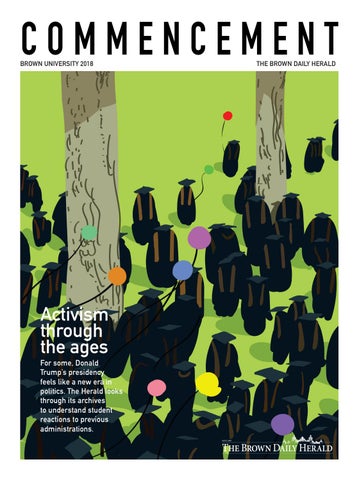
COMMENCEMENT
BROWN UNIVERSITY 2018
Activism through the ages
For some, Donald Trump’s presidency feels like a new era in politics. The Herald looks through its archives to understand student reactions to previous administrations.
THE BROWN DAILY HERALD
Jason Klein ’00 gives back & pays it forward AS YOU LAUNCH INTO
THE FUTURE
Jason has served as a long-time Brown volunteer and has donated each year since he graduated. He earmarked money for Brown in his first will, drafted at age 24 when he started his first business. “It wasn’t all that impressive, but it was something that I wanted to make a part of my giving,” Jason says. “As I’ve gotten older and created an income for myself, I’ve continued to make Brown a larger part of my philanthropy. Hopefully I can be a reminder that even when life is just ramping up, it’s never too early to think about where and how you can give and plan your estate.”
DON’T FORGET TO
LOOK BACK
You can follow in Jason’s footsteps and support future Brown students with an estate gift— no matter what stage of life you’re in. Contact The Office of Planned Giving at 401-863-9119 or Planned_Giving@brown.edu today to discuss your options.
Congrats Class of 2018! Best wishes from Brown’s Office of Planned Giving
Planned_Giving_ad 2018.indd 1
4/11/18 5:06 PM
MAY 25-27, 2018
COMMENCEMENT MAGAZINE
T
his year marks the University’s 250th Commencement. When considering Brown’s expansive history, our four years here start to seem short. We have seen history repeat at Brown. After a female student said she was sexually assaulted at a frat party our freshman year, we stood up to the University’s sexual assault policies in campus-wide protests on the Main Green, just as students did in the ’80s to protest a similar case. Our sophomore year, we stood in solidarity with black students across the country to push the University to become more diverse and inclusive, as students did in the 1968 Black Student Walkout. Now, the world beyond the gates awaits. Into it, we carry that same energy that pushed us to improve our small little corner of Providence. We have an opportunity to shape institutions much larger. From our vantage point at The Herald we see how time has a tendency to move at the University cyclically rather than linearly. This magazine is a reflection of that. In it, our writers tell stories about the activism that has repeated year after year. The constant push and pull with the Providence Preservation Society as Brown tests its limits with the Providence Community. The excitement and experimentation that occurs as students get their first taste of college, and the quiet comfort we settle into by our final years. Brown is unique in that it hosts Reunion Weekend and Commencement Weekend at the same time. It’s a beautiful convergence of graduates who are all at once frightened and enthusiastic to take their first steps out of the gates, and they do so with those who found their way back. It makes the prospect of leaving a little less unknown — as if to say that no matter how long we’ve been gone, Brown will always be home.
Commencement 4
Schedule of major events
6
Senior orators
7
Honorary degree recipients
Features 10 The resistance repeats 14 The preservationists & the provokers 17 The College Effect
The year in photos
20
Voices of 2018
23
Senior survey
38
— The 127th Editorial Board
editors Lauren Aratani Kate Talerico Rebecca Ellis Matthew Brownsword
design Christy Leung Ameer Malik Jessica Yu
writers Eric Choi Sophie Culpepper Celia Hack Jacob Lockwood
photo
Melanie Pincus Chris Schutte Alex Smolar Lydia DeFusto
Eli White
copy Abigail Borges
Cover illustration by Roland High
SCHEDULE OF MAJOR EVENTS Fr i d a y, M a y 2 5 9:00 p.m. – 1:00 a.m. Campus Dance, sponsored by the Brown Alumni Association. Main Green, Ruth J. Simmons Quadrangle
S a t u rd a y, M a y 2 6 9:00 a.m. Commencement Forums A series of academic colloquia with faculty, alums and distinguished guests. Various locations 1:30 p.m. Baccalaureate Procession Line-up Graduates assemble on Waterman Street, facing east toward Thayer Street, with the line beginning at Faunce Arch, wearing caps and gowns. Waterman Street 2:30 p.m. Baccalaureate Service A multi-faith service featuring music, dance, spiritual readings and a speech by Beverly Ledbetter. The First Baptist Church in America 4:00 p.m. Brown Daily Herald Alumni Reunion 195 Angell St.
4 THE BROWN DAILY HERALD
S u n d a y, M a y 2 7 9:45 a.m. Commencement Procession Waterman Street, north of Faunce Arch 10:15 a.m. (estimated) Graduate School Ceremonies Ruth J. Simmons Quadrangle (Doctoral) Pembroke Field (Master’s) 10:15 a.m. (estimated) Medical School Ceremony First Unitarian Church of Providence 11:55 a.m. (estimated) College Ceremony Live simulcast to the Main Green, Salomon Center and Sayles Hall. The First Baptist Church in America 12:45 p.m. (estimated) University Ceremony Senior orations and awarding of honorary degrees. Main Green 2:30 p.m. (estimated) Diploma Ceremonies for each department at assigned locations, as listed in the Commencement program.
In the event of severe storm conditions, the Baccalaureate and Commencement processions will be canceled and storm plans will go into effect. A message will be posted on the Brown website and sent via text message to all seniors. The Van Wickle Gates will remain open until Monday, May 28 at 6 p.m. ..
Congratulations to Lauren Aratani and the 127th Editorial Board! Lauren, We are so proud of you! Mom, Dad and Tyler
COMMENCEMENT 2018
SENIOR ORATORS Naomi Chasek-Macfoy ’18 & Lexi Lerner ’18 MD’23 BY CELIA HACK For the past three years, Naomi ChasekMacfoy ’18 has retold the story of the 1968 black student walkout as a workshop facilitator for the Third World Transition Program. During the walkout, 65 black students from Brown and Pembroke walked from Faunce to the Congdon Street Baptist Church to protest the University’s treatment toward them. Chasek-Macfoy first learned about the walkout when she was in TWTP as a freshman herself, and it is a story she has shared every year. “It’s part of this storytelling tradition, this oral history tradition amongst students of color at Brown, which I’ve been super honored to have been a part of,” said ChasekMacfoy, an Africana studies concentrator from New York. Now, she will detail the central demands of the walkout to a larger audience: the attendees of the 250th Commencement Ceremony on May 27. Chasek-Macfoy and Lexi Lerner ’18 MD’23, from New Jersey, are the senior commencement speakers for the class of 2018, upholding the 250-year-old practice of student-delivered commencement addresses. Chasek-Macfoy hopes to encourage the audience to consider the progress that has been made since the walkout 50 years ago and to understand what progress remains. One of the central demands of the students who walked out in 1968 was to increase the black student enrollment at Brown to match the percentage of the black population in America. Today, the population is 12 percent nationally, yet the black student enrollment in the undergraduate population is currently about 6 percent, Chasek-Macfoy said. “Students of color and other marginalized students know that conditions of marginalization at Brown, and in general, haven’t really moved,” Chasek-Macfoy said. Threaded throughout the speech is a message of urgency to continue racial justice work outside of Brown in a way that centers around the voices of people of color, ChasekMacfoy said. “It’s our responsibility to listen closely to people who are being particularly silenced.” Lerner’s speech, to be delivered second, is one response to this call for the inclusion of diverse voices. “Naomi’s message pertains a lot to listening, just like mine does,” Lerner said. “In some ways, she poses a historical question, and I provide one answer to that question in terms of how that can be achieved.”
6 THE BROWN DAILY HERALD
ELI WHITE / HERALD
Lexi Lerner ’18 MD’23, left, and Naomi Chasek-Macfoy ’18, right, will deliver the commencement speeches at the 250th Commencement ceremony on the Main Green May 27.
Lerner’s speech examines building bridges on different scales. From biological systems within the human body (Lerner is a biology concentrator) to bridges students built in the wake of the 2016 presidential election, Lerner eventually arrives at how soon-to-be college graduates will connect with their new communities. “Now we’re leaving Brown — we’re going to either go home or go to a place we’ve never been before,” Lerner said. “How do we think about bridging the distance between ourselves and what we learned at Brown to our new communities?” The commencement speakers are chosen by the Senior Commencement Speaker Selection Committee, with Assistant Dean of the College Shannon O’Neill as the convener of the committee and Associate Professor of East Asian Studies Samuel Perry as the faculty chair. Anyone in the senior class can be nominated by a faculty member or graduating students. Lerner was initially hesitant to submit a draft after they were nominated. “I thought very long and hard about what it would mean for me in particular to give a speech at Brown, what I had to give the Brown community and also what kind of space I would be taking up by presenting,” Lerner said. But her grandparents encour-
aged her that everybody had a story to tell, and Lerner decided to write the first draft, which they described as “a disaster — the first half was entirely about immunology.” Eight to 10 finalists are selected to deliver a complete speech to the committee in early April, O’Neill wrote in an email to The Herald. Revision and feedback are encouraged by the committee, which “requires nomineess to solicit feedback from at least one person prior to submission,” O’Neill wrote. Lerner credited Richard Bungiro, senior lecturer in molecular microbiology and immunology, and Stacy Kastner, associate director of the Writing Support Programs, among others, for proofreading and editing their speech. Chasek-Macfoy said she reviewed her speech closely with friends. “(Their) ideas and critical thoughts have been integral to me forming my own sense of politics over the past four years,” ChasekMacfoy said. “I rely on my friends the most for my political education.” Following graduation, Chasek-Macfoy is preparing to work as a paralegal for the Human Rights Practice Group with a law firm in Washington D.C. before going to law school. Lerner will take a year off before dedicating four years to the Alpert Medical School. They hope to become an infectious disease doctor.
HONORARY DEGREE RECIPIENTS The University will award honorary degrees to seven individuals at the 250th Commencement ceremony May 27. Beverly Ledbetter will deliver the Baccalaureate address to the class of 2018 on May 26. The Corporation’s Board of Fellows selects the honorary degree recipients. Photos courtesy of Brown University and Wikimedia Commons. Lonnie Bunch III is a renowned historian, author and curator. He is the founding director of the Smithsonian’s National Museum of African American History and Culture in Washington, D.C. Bunch was appointed the director’s museum in 2005.
Lonnie Bunch III
J. Michael Kosterlitz
J. Michael Kosterlitz is the Harrison E. Farnsworth Professor of Physics and a 2016 Nobel Prize winner. Kosterlitz helped discover the Kosterlitz-Thouless transition that has been used as the basis of other research in physics.
Beverly Ledbetter Beverly Ledbetter, the University’s longtime chief legal officer, has served in her position since 1978. As chief legal officer, Ledbetter leads a team of attorneys who provide the University with legal counsel and representation.
Nancy Northup ’81 P’16 Nancy Northup ’81 P’16 is the president and CEO of the Center for Reproductive Rights and is a global leader in the field of reproductive rights. Northup graduate from Brown magna cum laude in 1981. She received her law degree from Columbia Law School, where she was managing editor of the Columbia Law Journal.
Giuseppe Penone
Giuseppe Penone is a prominent figure of the 1960s Italian avant-garde movement, Arte Povera, which uses materials such as stone or newspapers in protest of art’s commercialization. His piece, “the Idee di Pietra” (Ideas of stone), is a tree that stands 27-feet-tall on the University’s Main Green and has a large boulder balanced amongst its branches. The piece was installed in 2016.
Sting
Sting is a Grammy-award winning artist who formed the band The Police with Stewart Copeland and Andy Summers in 1977. The band earned six Grammy award and was inducted into the Rock and Roll Hall of Fame. As a solo artist, Sting has won numerous awards, including 10 Grammy Awards, a Golden Globe and an Emmy.
Trudie Styler Trudie Styler is an actress, film producer, director and activist. Trained at the Bristol Old Vic Theatre School, Styler has starred in numerous theater productions with the Royal Shakespeare Company. Styler is also the founder of two production companies, Xingu Films and Maven Pictures. Styler and her husband, Sting, established the Rainforest Foundation Fund.
COMMENCEMENT 2018
7
Congratulations Quinn! Love, Your Family
Congratulations to 2018 Seniors Graduating with Independent Concentrations! Håkon "Ari" Bard, Bioethics Martha Epstein, The Art and Science of Human Behavior Anne Fosburg '17.5, Critical Pedagogy
Conor Regan, Philosophy, Politics and Economics
Adrian Grant-Alfieri, Social Innovation
Anna Schwartz, Music Cognition
Brett Halperin, Government and Economics Andrew Stamboulidis, Philosophy, Politics and Economics Anne Prusky, Socio-Cultural Linguistics
Christian Suarez, Animal Studies Alex Vidmar, Western Esoteric Studies Michele Winter, Cognitive Neuroscience (ScB)
Congratulations Ryan! Love, Dad and Mom Derek, Erin and Lara
THE RESISTANCE REPEATS BY JACOB LOCKWOOD, LYDIA DEFUSTO & ERIC CHOI The votes were in, and the result was outrage. The newly elected Republican administration left many students fearing the nation’s future. To Brown’s liberal student body, the new president looked like a step backwards, a danger to the country, a threat to their values. Some took this as a call to action. In response to the seismic political shift, student activists mobilized. This was the scene after 1980. And 2000. And 2016. In the wake of President Trump’s election, student activists have been reacting to a barrage of controversies and political issues. Though some students feel they are navigating uncharted territory in American politics under the Trump administration, these turbulent waters come in waves. The Herald looked back through its archives to understand how students have reacted to shifting political climates since the 1980s.
10 BROWN DAILY HERALD
Since the 1960s, Brown has been known as a hotbed of activism, but student mobilization has ebbed and flowed throughout the decades. The 1980s saw a flood of political movements that reflected the tumult of the era. Groups like the Brown Free Southern Africa Coalition pushed the Corporation to divest from companies that did business with South Africa. Students Against Nuclear Suicide demonstrated against the proliferation of nuclear weapons. People Against the CIA worked to resist CIA recruitment on campus. Citizens in Solidarity with the People of El Salvador protested American interference in Central America. Across this alphabet soup of activist movements, students staged a number of high-profile demonstrations, often making headlines in The Herald and, occasionally, the national news. Looking back on their time as student activ-
ists, several alums noted that former President Ronald Reagan’s foreign policy — supporting anti-communist guerilla rebels in Central America, maintaining ties with South Africa’s amidst apartheid, accelerating the nuclear arms race — fueled the fire of their activism. Reagan’s victory felt like “the end of the world,” said Jason Salzman ’86. “He was exactly the wrong person at the wrong time, especially if you thought the world was going to self-destruct at any moment.” The resistance gathered. “Buildings were taken over, and people went on hunger strikes,” said Andrew Meyer ’89. Students who came to Brown during the death throes of the Cold War felt especially threatened by national politics, and their movements developed a sense of urgency, Meyer said. But by the ’90s, the political climate had calmed. Gregory Cooper ’01, a current high school government teacher, recalls that in the post-Cold War, pre-9/11 era, he felt less of the “sense of urgency with respect to our politics that I think people feel today.” But the urgency that drove activists in the ’80s has seen a resurgence today, some activists say. In the last year, students have staged protests against Trump’s threats to Deferred Action for Childhood Arrivals, his immigration ban, gun
Students occupy University Hall in 1992 to in protest of the University’s need-aware admissions policy for all students.
violence and Trump’s election itself. But Brown has not seen activism regarding national affairs as pervasive as the movements that swept College Hill in the 1980s. “There are bigger fires to put out right now than the stuff internal to the campus,” said Emma Galvin ’18.5, an organizer for the Brown Student Labor Alliance. In the last year, Galvin has worked on campaigns for migrant justice, Temporary Protected Status and #DisruptJ20 — a movement to protest Trump’s inauguration. “There’s been a large resurgence,” Krissia Rivera Perla ’15 MD’21 said, citing medical students’ work to support immigrants and the work of the Brown Immigrant Rights Coalition. “When injustice happens, students will rise up and lead.” But Trump’s victory demoralized some activists, overwhelming them and dispersing their efforts, Galvin said. As a result, activism at Brown seems to have calmed compared to earlier years, she said. The 1980s saw a surge in student activism, said Jeremy Varon ’89, a former student activist who now studies the history of social movements. Students then “weren’t so stunned and paralyzed and overwhelmed with rage and shock” as they seem to be in 2016, Varon said, so " it was easier to enter into activism." Many alums remembered the 1980s as a more active time. “In the atmosphere in which I went to school — with what’s going on in Washington, D.C. now — the campus would be on fire,” Meyer said. But “every generation thinks that they were more active than the newest generation,” said Scott Warren ’09, who was once arrested for protesting the Darfur genocide. Salzman echoed this sentiment. “The activism is always greener,” he said. During his activist years, Salzman recalls thinking, “Shit, if only we had been at Brown in the ’60s.” Some alums called the mobilization of the ’80s a product of their ’70s upbringing — a decade rocked by anti-war uprisings and political scandals. “Our childhoods were Vietnam War, Watergate,” said Maria Testa ’86. “We basically hit campus with a degree of mistrust.” Today, the activism of the 1960s is a much more distant memory. Current students came of age during a far more stable time — the era of former President Barack Obama — than the turbulent political climate that propelled students activists in the 1980s. “The reality is that young people (today) are really active,” Warren said. “They just take action in different ways.” Though national and international issues ignite many protests, life on College Hill has similarly been the focus of student activism
throughout the years. “Universities are best when the students are taking on the injustices in the University itself,” Varon added. “If you’re a student, starting in your own neighborhood makes sense.” As Reagan’s term neared its end, controversy surrounding sexual assault erupted on campus. Rallies for divestment from South Africa gave way to marches against sexual assault and date rape. Many also fought for a need-blind admission policy, culminating in a takeover of University Hall in 1992 that ended with 253 student activists arrested. While the activist atmosphere persisted, the focus on geopolitical issues that consumed the campus for much of Reagan’s presidency fell by the wayside. “I needed something that I could get my head around or feel like I could do something about,” said Naomi Sachs ’92. “For me, global politics just seemed too big and too unwieldy.” But even when protests are directed toward issues on campus, national and international political issues remain relevant to student activism. In many cases, students have pushed the University to act in support of political or social causes. The most influential movements “were the ones in which students found ways to connect these larger political issues to the University community in some way,” Salzman said. In 1984, Salzman spearheaded a campaign to stock the University with suicide pills for optional use in the event of a nuclear war. Other students in the ’80s who opposed American interference in Central America focused on preventing the CIA from recruiting students at Brown. “This was a local struggle on a single campus that, in our minds, was deeply connected to a larger post-Vietnam anti-intervention politics,” Varon said. Ever since the 1980s movement to divest from companies doing business with South Africa, students have targeted Brown’s investments as a method of linking the University to issues abroad. During the Darfur genocide, students successfully pushed the University to divest from companies doing business in Sudan. Alongside schools nationwide, students encouraged the University to divest from coal companies in 2012 and 2013. More recently, students on campus and around the country have pushed for divestment from Israeli companies. Before she became involved with the movement to divest from South Africa, Colette Matzzie ’88.5 worked with Walter Mondale’s unsuccessful 1984 presidential campaign. “It was such a huge defeat,” Matzzie said. “For me, at least, it sparked the need for protests outside of the electoral system.” It’s no coincidence that political activism among students has flared up during administrations that oppose students’ predominantly liberal interests. “Activism felt like the only way
to get your voice heard,” Matzzie said. “We’re going to have to organize outside of the system to pressure the system.” Yet, even under liberal administrations, students’ faith in the system has wavered. David Wade ’97, a student during former President Bill Clinton’s presidency, said students debated “about whether or not traditional politics was worthwhile and whether the two-party system was broken.” The presidential election of 2000 — when former President George W. Bush won the electoral college but not the popular vote — particularly shook students’ confidence in the electoral system. Today, faith in the political process seems to have reached a new low. Young people participate less in politics than previous generations, Warren said. “I don’t trust political processes,” Galvin said. The view isn’t uncommon on campus. Fewer and fewer students seem to believe that government action leads to progressive change. But not all activists have given up hope in working within the political process. Perla’s immigrant rights group organized a phone bank in December to advocate for the “DREAM Act and to advocate for keeping Temporary Protected Status.” She added that U.S. Sen. Sheldon Whitehouse, D-R.I., has backed their work, too. Some students question whether activism is any more effective at making change happen than working within the system. As a student, John Crouch ’91.5 worked with Brown’s chapter of the American Civil Liberties Union. Though he supported many of the causes promoted by activists, he objected to civil disobedience tactics used by more radical students such as staging die-ins, and chaining themselves to fences. Instead, he found that partnering with the administration produced more results. Sachs, who started her freshman year protesting CIA recruitment and ended her Brown career demonstrating in support of need-blind admission, felt similarly. “Pretending to die in front of the building where the CIA was recruiting didn’t feel like it was having a measurable impact,” Sachs said. “Doing a sit-in and actually carrying on a discussion with the administration for changes in Brown’s policies — that felt more productive.” “To be taken seriously, you need to be at the table, but without the protests and the groundswell, I don’t think we would have gotten to the table,” said Testa. During her time at Brown, she met with Corporation members, urging them to divest from South Africa. But responsiveness of the University’s administration depended largely on who lead it. While some activists from the 1980s saw University many administrators as enemies — “We were all extremely anti-President Howard Swearer,” Testa said — Meyer noted that the University administration was always “somewhere between encouraging and tolerant” of
COMMENCEMENT 2018
11
student activism. “Often you have campaigns targeting the University just because that’s a way for students to use the power that they have,” explained Emily Kirkland '13, a former member of Brown Divest Coal. Riana Good ’03 thought that the University was supportive of activism partially because of its “liberal lean,” but also because “it took the tension off of activism that had been directed particularly at the Corporation,” for issues like need-blind admission. Whatever the motive, “I rarely got the sense that the administration was trying to intimidate people or disincentivize them from activism,” Meyer said. “It always seemed like they were just trying to get through the moment without anybody getting hurt.” But the University does not always respond to student activism. In spite of the intense student activism pushing for divestment from South Africa in the 1980s, the Corporation refused. By the time apartheid finally fell, the University still maintained holdings in companies linked to South Africa. Some students fatigued by activism — by fighting what may feel like losing battles — turn instead to more direct means of making change. “My personal tendency was to move away from activism and move toward actual advocacy, like working in a community,” said Nerissa Wu ’89. In the face of an overwhelming wave of controversy surrounding sexual assault on campus, Sachs favored a similar approach. “Getting involved with the Sexual Assault Prevention Education program, that was a way to engage in a more positive productive way rather than just feel like I was just banging my head against the wall,” Sachs said. To many outside of campus, frequent headlines publicizing Main Green rallies can make Brown’s entire student body seem mobilized. But most activists would agree that movements are led by a “small but vocal” group of students, as Galvin put it. Across several movements, student activists weren’t just a minority — they were also a close-knit group of friends (Brown Divest Coal’s leadership comprised just 10 to 15 students around 2012, Kirkland said.) The challenge student activists face is mobilizing the rest of the student body. Although Brown’s student body has never been universally liberal, alums generally agreed that most students sympathized with activist causes. But in spite of this broad support, some activist leaders saw many peers as apathetic. “As an activist, the climate always seems less active than you want,” Salzman said. Not all alums agreed. “I met very few truly apathetic people,” Daniel Sherrell ’14 said. Instead of apathy, a lack of awareness may have contributed to lulls in student activism. For
12 THE BROWN DAILY HERALD
Perla, in her undergraduate years under the Obama administration, people were generally “more complacent with the administration.” Now, after Trump’s election, “there’s a kind of hyper-awareness,” Perla said. But Galvin argues that apathy still pervades campus. “Most people, students included, go along to get along,” said David Goldsmith ’85. “Their courseloads are full, their exams are worrisome and their primary concerns are doing as well as they can for the thousands and thousands of dollars that they’re paying.” And while students come out in droves for an afternoon rally, those protests are “a single facet of what it means to do social justice work,” Sherrell explained. “People will be super down to put on the mask and march in University Hall, and I’m all for it,” Galvin said. “But I think that there also needs to be relationship-building.” Many former activists compared the work of sustaining a movement to a full-time job, with some working 20 to 50 hours a week. “I don’t remember going to class a lot during these days,” Testa said. How she fit the Brown education in between protests and meetings with the Corporation, Testa can’t recall. Activist movements thrive on publicity. That’s what demonstrations are for — they’re “meant for public consumption,” Todd Weir ’88 explained. To attract attention, activists need to be media savvy. “You have to talk in sound bites,” Weir remembered a fellow activist telling him. But Brown being Brown — an Ivy League institution — students don’t need to try too hard to draw media attention. “We could get eyes and ears on what we were doing, and we used it,” Testa said. In 1984, Brown made national headlines when the majority of students voted in favor of a referendum to stock the University with suicide pills to use in case of a nuclear strike. Students took advantage of the shock factor to draw attention to the issue of nuclear war. “Nobody ever thought anyone was going to be committing suicide,” said Colette Matzzie ’88.5, admiring the publicity generated by the suicide pill campaign at its peak in 1984. Later, Matzzie coordinated press contacts for another instance of radical activism — a 10day fast for divestment from South Africa. She called media outlets, letting them know about the students who were refusing to eat after Brown refused to divest. “It was the only way to get your voice heard,” Matzzie said. But students today face a vastly different media landscape. “There was no such thing as social media,” Matzzie noted. “There was no way to get your voice heard online. ... So pulling people together in a rally, signing petitions, having a hunger strike in Manning Chapel — which got national press — was the way.” Student activists in the 1980s prid-
ed themselves on the creativity and intensity of their demonstrations. “It was all very theatrical,” said Todd Weir ’88, who joined more than 60 students in placing CIA recruiters under citizen’s arrest in 1984. In another form of performance protest, students have occasionally held die-ins — rallies where scores of students would pretend to be dead on the green — to protest issues like nuclear warfare in the 1980s and the Darfur genocide in 2006. For a more light-hearted demonstration, the Young Communist League once organized “Dance Dance Revolution,” which assembled over a thousand students for a conga line protest “against the Undergraduate Council of Students, President George W. Bush, his war against Iraq and world order in general,” The Herald reported in 2003. Students throughout the years have gone so far as getting arrested for demonstrations at places like University Hall, the State House and the White House. “We wanted press attention,” said Warren, who was arrested for protesting the lack of U.S. involvement in the Darfur genocide. “We wanted to demonstrate the extent to which we thought this was urgent and that we would be willing to get arrested.” While the internet makes gathering a crowd and marshaling media attention easier, it may also make these radical activist actions less necessary, Varon said. Just go on Facebook. Still, protests remain a crucial part of presentday activist movements, such as Brown Divest Coal. By mobilizing students and reaching out to the press, the campaign to divest from fossil fuels amassed momentum, enough to get featured on NPR. “Right after that story aired, (President Christina Paxson P’19) sat down with us personally and invited us to present to the Brown Corporation,” Kirkland said. “I learned through working on fossil fuel divestment that it’s not about making the case. It’s about building enough power that you don’t give the administration a choice.” “The things that were loud and made trouble got covered,” said Wu. But creative demonstrations and radical tactics aside, the core of organizing hasn’t changed
for activist movements over the decades. “Organizing is fancy words for talking to people,” Galvin said. To spread awareness of Brown Divest Coal, “we did dorm storms, asking people to sign a petition, held rallies, reached out to the press,” Kirkland said. For decades, students involved in activist movements have done these exact same things. And — as the appearance of Brown Divest Coal on NPR in 2013 goes to show — student activists don’t need shocking demonstrations to score national press. Several former student activists acknowledged that they lost many of their battles. But they still saw their activism as successful in sparking conversation. “We were not successful in the short-term, immediate goal of getting Brown to divest,” said Paul Zimmerman ’88. “But I think in the benefit of hindsight, we were absolutely successful — the student
movement, the general anti-apartheid movement — in changing public opinion.” Brown’s legacy for activism is self-perpetuating. Students inclined toward advocacy gravitate toward the University for its activist reputation, and those same students come to lead the movements that cement Brown’s status as an activist institution. And the University accepts its position as a leader in student activism
— not only by fostering an active culture, but also by admitting activists-to-be. “They knew who they were admitting. They knew it was a bunch of curious, crazy, precocious rebels. At some level, they were welcoming all the grief that we gave them,” Varon said. “That’s the sense in which my activism feels like a legacy of Brown and not just a legacy of protesting Brown.”
PUSH TO DIVEST Below, on Valentine’s Day in 1986, corporation members leave a meeting in Rhode Island Hall where they heard students present arguments for why the University should divest from South Africa.
CYCLIC CHANGE Above, students protest the University’s treatment of black students in 1985. A student leaves the John Carter Brown library following a sit-in to push the University to take action on demands agreed to in 1975 and address racist incidents on campus.
Photos courtesy of Raymond Butti, University Archives.
COMMENCEMENT 2018
13
THE PRESERVATIONISTS & THE PROVOKERS BY SOPHIE CULPEPPER & MELANIE PINCUS Six buildings listed in the National Register of Historic Places stand on a plot of land along the Walk — the path between Olive and Angell St. connecting Pembroke to main campus. They have stood there nearly 150 years, since 1870. But in 2017, the University proposed its state-of-the-art performing arts center should be constructed where those buildings stand. Four of them, including the beloved Urban Environmental Lab, were slated to be demolished with a fifth to be relocated. The decision was met with a wave of opposition from the Brown community. Students and faculty launched a movement to save the UEL in spring 2017. Led by Lauren Maunus ’19 and Jon Gewirtzman ’17, students circulated petitions, created a page for testimonials and wrote letters to the president. Bikes at Brown, a club in the UEL that would have been displaced, held shop hours in performing arts spaces in protest. Mock “for sale” signs appeared on exterior walls of the UEL. Students were not the only ones opposed to the University’s
14 THE BROWN DAILY HERALD
intention to demolish the UEL and other threatened buildings. Alongside other community members, Emma Illick-Frank ’18 and Austen Sharpe ‘18 both testified at a City Plan Commission hearing on Dec. 19. There, they met Providence Preservation Society Executive Director Brent Runyon. From December through the early months of 2018, the students kept in close contact with Runyon. He offered context and advice on which zoning codes to reference in an op-ed defending the UEL. During the first months of advocacy, “administrators and professors” had been “quick to tell us that it was a lost cause,” she wrote to The Herald. But Runyon encouraged them to hold on even as everyone else gave up hope, Illick-Frank said. When the op-ed ran on Feb. 7, Illick-Frank and Sharpe met with Runyon and both Preservation Society and Brown trustee members. The Preservation Society and students had different reasons for wanting to preserve the UEL; “ours was for function, theirs more posterity,” Illick-Frank wrote.
That month, the University announced a change: The center would instead be built on a space between Angell Street and Olive Street — a smaller area facing the Granoff Center for the Creative Arts. “This meeting, along with the op-ed, were the most important turning points in the fight to save the UEL,” Illick-Frank wrote. “It’s my impression that (Brown) decided against demolishing these properties after they saw the outpouring of opposition that was led by the Preservation Society,” said Robert Azar, Providence deputy director of planning and development and visiting associate professor of urban studies. The Providence Preservation Society has been organizing community members for over half a century to advocate for the preservation of Providence’s historic buildings that capture the city’s character and heritage. The organization began as a neighborhood association that met in local residents’ living rooms to plan opposition against Brown’s expansion on College Hill. Today, it receives funding from approximately 450 household members, along with about 25 corporate partners, Runyon said. These partners include construction and property companies and Rhode Island businesses ,such as Alex and Ani and the Bank of Rhode Island, according to the Preservation Society 's website. The organization prioritizes advocacy throughout neighborhoods included in the National Register of Historic
Places. Preservation Society members attend public meetings of city development committees, such as the City Plan Commission, and collaborate with smaller neighborhood associations and individuals, including architects, developers and owners. Besides defending properties threatened by construction projects, the Preservation Society also offers concrete advice on how to repurpose historic buildings. Each year, the Preservation Society also publishes a list of the city’s “Most Endangered Properties.” This year, their list included all five buildings in the path of the proposed performing arts center. The outcome of this debate over the performing arts center’s site reflects the influence of historic preservation on the University’s approach to campus planning. “The University is very preservation-minded,” said Chris Marsella, president of the Preservation Society board and a local developer. Though the relationship between Brown and the Preservation Society is “very collaborative and very collegial” today, it has been “much more contentious” in the past, said Executive Vice President for Planning and Policy Russell Carey ’91 MA’06. Even before the Preservation Society was established, the University began to take preservation into consideration under former University President Henry Wriston, who oversaw a period of dramatic expansion on College HIll. 1n 1951, the construction of Wriston Quad, began. The University demolished 50 buildings, the majority of which were homes. But Brown decided to relocate six homes among these, said Visiting Scholar in American Studies Robert Emlen, who also served as a member of the Preservation Society’s board from 1989 to 1995 and has lived around College Hill for 30 years. At this point, historic preservation “was a new idea. Most cities were out there just demolishing old houses,” Emlen said. But many neighborhood homeowners recognized “how important they (were) to the health of a community,” he added. Brown continued to purchase properties that became available as the city’s textile industry moved south. They were “land-banking,” Emlen said — buying historic properties without specific plans to develop them. Preservationists frown on such practices. Under Wriston’s leadership, this banked land was channeled toward a specific project driven by his wish to transform Brown into a world-class university. Rather than living in private homes off campus, Wriston imagined students would experience a residential community in on-campus dormitories. With this vision, Wriston Quad was born. The University continued to purchase properties under former University President Barnaby Keeney for another residential quad, causing tension between the University and the
preservation-minded of Providence. “Brown had used and bought, found, scrounged, every available building site in the '40s (to preserve) the houses on Wriston Quad, so there just wasn’t any place left to move a house to,” Emlen said. College Hill residents John Nicholas Brown and Elizabeth Allen were not thrilled that the view of their “lovely neighborhood of little houses” would be obstructed by the brick walls of college dormitories. The two gathered a group of neighbors into their living rooms for the first meeting of the Providence Preservation Society in February 1956. A few years later, in 1960, Antoinette Downing, an architectural historian and resident, worked with John Nicholas Brown to have the city declare College Hill a historic district. This status helped protect some of the neighborhood’s historic houses from demolition. The University itself would become more involved with preservation in the mid-1980s when Robert Reichley, then the executive vice president of the University, served as president of the Preservation Society Board. For Emlen, Reichley represented the University’s conscious effort to work with the Preservation Society as it decided that collaboration would help it achieve its own goals. While Reichley wanted to build bridges as a resident by holding neighborhood meetings, he also acted strategically. By leading the committee to select the next Preservation Society director, Reichley could find someone who might continue to hold Brown in its favors. Although there are currently no members of the University administration on the board of Preservation Society, the Brown community is not wholly separate from the preservationist movement.
“They have had their differences from time to time, but my impression is that they agree more often than they disagree.” BOB AZAR, CITY PLANNER
For instance, “we always have Brown professors and Brown families who are involved with the Preservation Society,” Runyon said, though as individuals they “may or may not always agree with the position the (Preservation Society) takes.” The four buildings that would have been eliminated to construct the performing arts center are all within the University’s “institutional zone” — meaning Brown has the legal right to demolish any existing structures, Azar said. Still, the City of Providence Zoning Ordi-
nance mandates that the University describe a “public participation process” for projects like the performing arts center in its institutional master plan, a document that outlines Brown’s long-term development goals. During that process, Brown works “in a very close partnership” with community actors like the Providence Preservation Society, Carey said. “The process of engaging typically produces information that you didn’t have before,” Carey said. That information enables the University to address small concerns, like helping local businesses by changing the access point for a construction project, and consider large requests, like moving a proposed site completely, he added. As Brown sought to expand its Wellness Center and the School of Engineering in recent years, it knocked down four buildings on Brook Street and another two on Manning Street. The Preservation Society opposed the demolition of all four houses, The Herald previously reported, but also lauded Brown’s community building efforts and acknowledged that not all buildings could be saved. In both cases, the process for Brown to demolish the buildings “was relatively easy,” Azar added. Though the University plans to construct a new dorm where the Brook Street houses once stood, they have paved over the space with parking for now. Of the destroyed homes, Runyon told The Herald in February, “Brown almost always gets what it wants.” At the same time, the University has taken on projects to protect many of the historic properties that it owns. Smith-Buonanno Hall, a former gymnasium built in 1907, was renovated two decades ago and turned into an academic building. Rhode Island Hall, built in 1840 as a lecture hall, underwent extensive renovation in 2008 and 2009. Wilson Hall is currently undergoing a $24 million renovation to become Friedman Hall. Brown could still do more to preserve the “vibrant” neighborhood that overlaps with the University’s campus, Runyon said. “Brown does a lot of historic preservation for buildings they have designated as important on their campus,” Runyon said. “Where I think they could do better is realizing that … retaining the character of (the neighborhood) is important, even if the buildings are owned by Brown.” Though Runyon noted that the Preservation Society’s “relationship with Brown varies over time based on the leadership” of the Preservation Society and Brown, Marsella said the University’s “current administration has shown dedication to preservation.” Runyon agreed. “It’s gone from very adversarial at times with no communication to ... very strong communication,” Runyon said. Though the Preservation Society cannot di-
COMMENCEMENT 2018
15
rectly regulate the University’s actions, they have “a major sity, Preservation Society and city officials, Carey said. impact on city public policy of establishing historic dis“As the University engages in large construction projtricts and regulating historic preservation,” ects in the College Hill area, it “has to have Azar said. The organization “can justifiably the goodwill of the neighbors,” Emlen take credit for the preservation of entire said. “It can’t go around offending people.” neighborhoods in” Providence, he added. “The neighbors are people like us,” he “The University is very Despite certain intractable tensions added. “They just live here, and care about preservation-minded.” between the University’s needs and presBrown, and care about the neighborhood, CHRIS MARSELLA, ervationist objectives, today the Preservaso there’s no point in having a contentious PRESIDENT, PROVIDENCE tion Society and Brown are “partners” and relationship.” PRESERVATION SOCIETY “neighbors,” Marsella said. In the case of the performing arts center, “They have had their differences from “I think all in all it worked out extremely time to time, but my impression is that well,” Carey said. The new location for the they agree more often than they disagree,” center is “a better site for the project, and Azar said. This positive relationship is bolstered by the it’s a better site in terms of addressing community con"constant ongoing communication” between the Univer- cerns,” he added.
16 THE BROWN DAILY HERALD
Illustration
As throngs of students coming from pre-games and “darties” swarmed the Main Green for Spring Weekend, another group was avoiding the muddy mess altogether. At the W. Alton Jones Camp in West Greenwich, around 70 substance-free students went hiking, played sports and even found some time for homework. Though events like Spring Weekend and Halloween may make substance use feel prevalent on campus, around 20 percent of students identify as substance-free, according to Tanya Purdy, the director of BWell Health Promotion. But according to The Herald’s Fall 2017 undergraduate poll, the number might be closer to 8 percent. That poll found that four in five Brown students drink alcohol, whereas a 2014 national survey found just three in five college students do. The pressures to drink or use drugs can shift over students’ time at Brown, pushing them toward communities of people who share their values. Within these disparate friend groups, certain on-campus groups provide a college experience removed from the substance use that is typical to Brown. Founded this year, the club “SoBear” has become a refuge for substancefree students on Brown’s campus. “Most clubs I found, if there wasn’t substance use happening at the clubs, kids were talking about it,” said AJ Davis ’20, the president and founder of SoBear. Davis spent his time with friends he had made in his substancefree housing, often heading off campus on weekends “because (campus) was a bit toxic.” He founded SoBear to create a strong community of sub-free students by hosting events like the Spring Weekend camping retreat. Sub-free communities exist beyond SoBear, too. This year, the University gave students the opportunity to live in Donovan House, a substance free program house located in the former Plantations House. “The house itself fosters a community for students who are sub-free (and whose) subfree identity is very important to them to the point where it affects how they want to live,”
said Kiana Phillips ’19, a residential assistant in Donovan House. While these groups help sub-free students connect with each other, freshmen new to Brown are often left searching for friends that hold similar interests and values. “I have seen the aftermath of someone who has had too much alcohol and gone beyond their limits,” said Poom Pipatjarasgit ’21, a subfree student. “It does sometimes get lonely on weekend nights.” While freshmen can be lost in the mix, older sub-free students can attest that the pressure of using substances fades over the years of attending the University. “As you get older and spend more time here, you solidify your friend groups,” Davis said, echoing the experiences of other sub-free students who became more comfortable throughout their time at Brown. “You know how to navigate those situations better.” Freshmen feel the most pressure to overuse substances. To combat this, BWell ensures that all first-years receive alcohol training, Purdy said. Many students try substances for the first time at college. Those who did drink or use drugs in high school are more likely to do so in college, according to Angelo DiBello, assistant professor of behavioral and social sciences. Health Services sees binge drinking rates increase during a student’s first semester, especially the first six weeks, a phenomenon Purdy referred to as “The College Effect.” “We try to be careful and provide really intentional education during that time,” she added. Manny Dallas ’18, said that he spent more time drinking during his first two years, when it felt more “novel then than it is now.” “Your freshman year, you’re not cemented in these friendships … (and) there is an element of wanting to feel comfortable with people you don’t know so well,” he added. “As you mature, you’re more comfortable being sober with people you don’t know.” “There’s definitely a unique American college culture, which is not unique to Brown in
erico
by Kate Tal
any way, that makes that high-risk drinking seem more appealing and make it look like more people are doing it,” DiBello said. Societal norms influence drinking behavior more than gender or participation in Greek life, he noted. Within its educational initiatives, the University attempts to encourage safe drinking rather than cracking down on drinking entirely. Students can use substances in a healthy way, Purdy said. Brown’s rates of substance use align with peer institutions and New England in general, which sees higher rates of alcohol and marijuana use compared to the rest of the United States. Henry, a senior who asked only to be identified by his first name because he feared professional repercussions, had little experience with drinking before he arrived at Brown, yet he quickly found himself immersed in nightly parties full of new people. At one of these parties, Henry had his first real drink. But Henry found that parties are not a necessity when it comes to social life. “You meet people when you go out, but you don’t necessarily get to know somebody,” Henry said. As students’ time at Brown goes by, some may feel that they outgrow substance use. One student, granted anonymity by The Herald because he feared professional repercussions, began smoking marijuana in high school. He started dealing drugs during his sophomore year of college for income and to supplement his own drug use. But after his grades suffered, the student decided to stop dealing and even began using less to focus on his schoolwork. After four years at Brown, Henry ultimately feels nonchalant towards substance use. “If you do it responsibly and you’re not getting into patterns of clear abuse … alcohol and drugs can find a role in your life that helps you keep a balance,” he said. Once Henry made friends, any pressure to drink disappeared. “Over time you realize that you don’t need to,” Henry said. “There’s much less of that (pressure) once you start making friends and having a group where you’re comfortably able to have a more quiet weekend.”
COMMENCEMENT 2018
17
Congratulations Axel! Love, The Getz and Fitzpatrick families
CONGRATS, NICOLA! We woof you!
Yoda and the gang
Congratulations Aliyah Olaniyan We are so proud of you!
Congratulations Frank!
We are so proud of your accomplishments and wish God’s favor on your life! We are beyond any words that can adequately convey just how proud we are. It has been such an honor to watch you grow. Just continue to be the shining star that you are! Love, Mom, Dad, Little Sister and Family
Love, Mom, Chuck and Logan
Congratulations Nick!
The Brown Daily Herald Congratulates the Class of 2018!
We are so very proud of you and all you have accomplished!
With lots of love from your family
YEAR IN REVIEW COURTESY OF BROWN UNIVERSITY
U.S. Supreme Court Justice Sonia Sotomayor spoke in Februrary to a packed Pizzitola Center about her experiences as a first-generation college student and the importance of understanding different perspectives.
SAM BERUBE / HERALD
COURTESY OF BROWN UNIVERSITY
Former Florida Governor Jeb Bush delivered the 97th Stephen A. Ogden Jr. ’60 Memorial Lecture in Brown fell to Dartmouth 33-10 under the lights of April. He spoke about American values and the lack of socioeconomic mobility in the United States. Fenway Park in November.
COURTESY OF NICHOLAS DENTAMARO
ELI WHITE / HERALD
Students held fundraisers to support rebuilding efforts in the The Engineering Research Center opened Oct. 20, three months ahead of its predicted aftermath of Hurricane María in Puerto Rico. completion date. The 80,000 square-foot building cost $88 million to complete.
20 THE BROWN DAILY HERALD
TIFFANY DING / HERALD
Against the backdrop of a nation-wide school walkout, members of the Brown community gathered on the Main Green to show solidarity against gun violence and advocate for gun safety regulation. The event commemorated the one-month anniversary of the shooting in Parkland, Florida.
COURTESY OF BROWN UNIVERSITY
President Christina Paxson P’19 joined city officials and developers to break ground on the new Wexford Innovation Center in the Jewelry District in September.
CALEIGH AVIV / HERALD
After the Pokanoket Nation occupied University-owned land in Bristol, the University put a portion of the land in a trust for the Pokanoket Nation.
ELI WHITE / HERALD
GUS REED / HERALD
In March, a red scarf knitted by Willa Tracy ’18 appeared around Urs Fischers’ Local activists, elected officials and Brown students protested President Trump’s “Untitled (Lamp/Bear).” decision in September to end the Deferred Action for Childhood Arrivals program.
COMMENCEMENT 2018
21
The Parents of Bowie Lee ‘18 wish to thank the
CONGRATULATIONS ALEX! You have worked so hard and have accomplished so much during your years at Brown. We are so proud of you and wish you joy and happiness in all of your new adventures!
Chemstry Department Education Department & Financial Office of Brown University for their continuous support in making an education dream a reality!
Look out New York City!
Love you so much! Mom, Dad, Hannah, Jo and Pop
Good Luck to the 2018 Brown Graduates!
Congratulations Callie! You make us proud! Computer Science
All our love, Mom and Chas
Congratulations Michelle!
We are so proud of you!
Middle East Studies
Alexander Comer Abuaita Class of 2018
&ODULVVD &OHPP &RQJUDWXODWLRQV
:H FRXOGQ·W EH DQ\ SURXGHU RI \RX DQG DOO WKDW \RX KDYH DFFRPSOLVKHG :H DUH H[FLWHG WR VHH ZKDW \RXU IXWXUH KROGV :H ORYH \RX 0DPD 3DSD DQG &KULVWRSKHU
&RQJUDWXODWLRQV /LOLWK 7RGG %URZQ &ODVV RI :H DUH YHU\ SURXG RI \RX /RYH 0RP 'DG 6DPXHO
VOICES OF 2018 Thoughts and reflections from 12 members of the graduating class
Embracing discomfort Like many first-year students, I arrived at Brown with bright eyes, elated to begin college at what I considered the perfect school. This was my chance to live the dream: the American dream my parents had worked so hard to realize, immigrating to the United States so their children could have a better education; the collegiate dream of getting accepted to an Ivy League school; my own teenage dreams of learning and living with like-minded, enthusiastic and interesting people. I lived in paradise. I was so lucky, and I had to be grateful for everything. This was the story I kept telling myself during my early years at Brown. I thought I loved Brown. I threw myself into every opportunity — classes, socializing, sports, research, acting, editing. But something was off. I kept learning hard truths that I couldn’t reconcile with my idyllic love of Brown. It occurred to me that what I loved was not Brown itself, but the idea of Brown as a perfect, safe haven of a school with students ranked as the happiest in the country. As I spent more years here, Brown demanded that I confront uncomfortable truths about what I held dear. This is the America of my parents’ dreams, where every child has an equal chance at going to school and living a good life; but I learned that it is also a place that has exploited my ancestors’ homeland and carries out systemic violence on a regular basis. This is the Brown of my dreams, where I have a world of disciplines at my fingertips and fellow students who support one another; but I learned that it is also a place susceptible to discrimination and silencing student voices — a place where people have hurt me in ways that will scar forever. The self of my dreams is caring, empathetic, responsible and proactive; but I learned I also can be someone who makes mistakes, who lashes out at people out of frustration and who doesn’t always come forward to apologize. Over time, I saw myself as flawed, I saw Brown as flawed, I saw America as flawed, and it made me hurt. And while I know it is unrealistic to expect things to be perfect or unproblematic, it was the fact that my previous optimism felt so foolish that put me at a loss. I saw a concrete shift in the way I approached the unknown. My outlook switched from one of excitement to wariness; from automatically seeing the good in others to always looking for the caveats, knowing that flaws must exist. Did that make me a cynic? Is optimism always marked by naiveté? I study cognitive neuroscience, so I know that as humans we dislike ambiguity and uncertainty
MARGARET HU
Memory ghosts
MILI MITRA
— it’s uncomfortable. We are instinctually wired to sort things into simple positive or negative categories. We are much worse at confronting entities that encompass aspects of both: seeing people, places and communities with all of the complexity and contradiction with which they naturally exist. It is why relationships can become more difficult the more intimately we get to know ourselves, friends, partners and homes. Proximity forces faults to be placed squarely in view, yet that very intimacy makes you prone to turning a blind eye. It is hard to accept that what you hold dear may hurt you or others. It means questioning whether your love, derived from the picturesque veneer that originally enchanted you, is strong enough to confront painful nuances. The full weight of this realization can be devastating. You feel betrayed. You feel guilty for not realizing sooner the terrible, systemic injustices that govern the world. And it can be hard not to simply let yourself spiral into disdain or apathy. But if there’s anything Brown has taught me, it is that we should not shy away from this discomfort. Our moral outrage at the disparity between the world as it is and the world as it ought to be should not be dismissed, as it indicates our commitment to personal values and justice. We must give ourselves the space to process those feelings of discomfort. Yet anger cannot be our sole motivator. If we allow it to be the primary fuel for our efforts, we will inevitably burn out. However, subduing this rage leaves a void. Without it, what can motivate us to commit to the long, hard work necessary to pursue justice,
Continued on page 27
The summer before my first year at Brown, whilst deep in the throes of high school nostalgia, I stumbled across a Huffington Post blog titled, “Letting Go of Your Memory Ghost.” It began: “Do you know what a memory ghost is? It’s not an actual ghost of course. It’s the pizzeria that takes you back to your first kiss. It’s the song that brings back those long summer nights. It’s the movie you can’t see without missing your best friend. It’s the book you used as an escape during a rough time. A memory ghost is a memory that is so strong, it’s left an invisible mark so it can never be forgotten.” The paragraph stayed in my mind for days thereafter. Perhaps it was because certain memories were at the forefront of my mind: I was clinging to my childhood for dear life, willing the days to slow down so I could enjoy my time at home in Singapore for as long as I could. I began to collect my own memory ghosts that summer before college. The sound of Indian folk songs and the flutter of bird wings on weekend mornings with my parents. The smell of peanut butter and waffles, my snacks at the end of a long school day. Before I knew it, I had a hefty list of ghosts to carry around with me. This winter, I came across the note containing my memory ghosts on my old phone. Reading it, I felt like a 17-year old on the cusp of moving halfway across the world all over again. I couldn’t help but ask myself: What are my memory ghosts from Brown? What moments, experiences and fragments of time will jolt me back to Brown long after I pack my bags and leave College Hill? It starts with the image of colorful Post-Its peeping out of the pages of crumbling old
Continued on page 24 COMMENCEMENT 2018
23
VOICES OF 2018
Something new
A magazine cover inspired me to change my concentration from the sciences to the humanities. Had someone told me then, as a freshman, I would never have believed it. But here I am, more satisfied than ever with my decision. I started Brown set on concentrating in health and human biology. As soon as I came to campus, I began the race toward medical school. Though I had never gotten lower than an A- in high school, I quickly found myself struggling to keep up with Brown’s rigorous math and science courses. At the end of the year, after hardly passing my classes, I went to University Chaplain Janet Cooper Nelson, my academic advisor, desperate for help. I frantically asked her about pre-med courses, retaking classes and switching majors. Instead of giving me answers, she presented me with two questions: “What are your academic interests? What do you like to do?” Her questions caught me off guard. That was the first time I had actually thought about what I wanted. The whole time, I had been trying to do what I thought would impress my Continued from page 23
paperback books. I’ve carried the small, arrowshaped Post-Its in my pencil case every day for the past four years, pasting them onto everything from comics to textbooks. They line all the books that changed my life over the past four years — “The New Jim Crow,” “One Hundred Years of Solitude,” “The Marriage Plot” (could I be any more of a Brown student?) — and cover my desk, floor and bag like pointed confetti. They will always remind me of all that I have learned and all that I have yet to understand. There’s the smell of breakfast sandwiches and coffee in the morning (let’s be honest, we’ve all subsisted on bagels and coffee at some point or the other). Wherever I go after graduation, I am convinced these scents will always bring me back to the long lines at Blue State and Bagel Gourmet Ole. And then there are the songs that played in
24 THE BROWN DAILY HERALD
SAMANTHA SAVELLO parents and my friends back home. I never had concrete reasons for pursuing pre-med; it just seemed like the reputable thing to do. “Do you want to do science for another seven years?” Janet asked me. I froze up as I thought back to all the courses I had taken so far. Math, biology, chemistry — I hated all of them. I distinctly remember sitting in Calculus, drawing pictures of the student in front of me because I was so bored by the content. I would rush through my dreaded three-hour long chemistry labs and leave without collecting the proper data. The thought of dragging myself through even more science and math classes for another seven years seemed absolutely unbearable to me. I shook my head. “Okay, so were there any classes you took that were not in science that you enjoyed?” she pressed further. I racked my brain for what felt like hours, but I couldn’t think of anything. Then, as I looked over at the table next to me, I saw a magazine with Juanes, one of my favorite Latinx singers, on the cover. That’s when it hit me: Spanish. Spanish had fascinated me since high school. I enjoyed learning a new language and culture. Though my maternal grandfather is from Puerto Rico, my mother has lost touch with her Spanish, as well as her father, so studying Spanish also felt like a way to recover the language and my Latinx heritage. Talking to Janet, I realized that more than anything else, I wanted to continue this immersion. My sophomore fall, I started fresh. I enrolled in an upper level Spanish literature
course and began to tentatively pursue Hispanic studies. I also enrolled in a studio art course, a Latin American studies seminar and a psychology course. Throughout the semester, I grappled with conflicting feelings of contentment and anxiety surrounding my identity. For once, I actually enjoyed my schoolwork. I found overlaps between my courses and got to know my professors — a nearly impossible task in STEM lectures. But the constant disapproving emails from my parents begging me to reconsider STEM, frequent judgement from my peers and the ambiguity surrounding the career applications of my new major made me want to rethink my choices. Was I making progress or moving backwards? By the end of the semester, with the support of my friends and a lot of soul-searching, I was beginning to make up my mind. I knew I wasn’t a science kid, but I wasn’t a humanities kid either. In fact, it was those very labels that were making my journey so difficult in the first place, labels that Brown encourages students to break down. In retrospect, my approach had been all wrong. For so long, I had been looking to fit in by doing pre-med, when I really should have been looking to stand out by doing what I truly enjoyed. By the end of my second year, I realized I was my own breed of student, with a mixture of interests and hobbies, ranging from mental health activism to salsa music to
the background all through my time at Brown. The Disney songs that my friends and I used to sing at night in J. Walter Wilson — and once, embarrassingly, in the Brown Evening Shuttle — to drown out the sorrows and stresses of freshman year. The Hamilton songs that were the soundtrack of my sophomore year (“Take a Break” and “[I Will Never Be] Satisfied” were two song titles that particularly resonated). The awkward mix of pop-rock and country that flooded my playlists in junior year, and the sappy ballads that mirrored my mood swings this past year. The songs I listened to at Brown are like time capsules to specific moments and emotions. There are so many other ghosts: the smell of morning dew on grass and Blue Room muffins; the “CAUTION: BUS IS TURNING” announcement that wakes me up each morning; the taste of overly sweet bubble tea. As I started to count them up, I realized that this list dwarfed my old list from high school. In
just four years, Brown seems to have become even more embedded in my psyche than Singapore, my home of 18 years. And in a way, that makes sense: College is a transformative period in every student’s life. We grew up at Brown, discovered who we are, and withstood some of the greatest challenges of our lives so far. My memories of college are littered with moments of strong emotion — both elation and despair. The ghosts that arise from these memories are all the more vivid and tangible. I don’t know where life will take me in the future, but I am absolutely sure that my memory ghosts from Brown will always come with me. For the rest of my life, I will be transported back to campus when I smell fresh muffins as I walk down the street, or hear the tunes of Hamilton on my phone. Maybe one day I will return to Providence and relive all these memories again. But until then, I am proud to treasure these moments and remain Ever True.
Continued on page 26
VOICES OF 2018
Making a house a home My apartment building’s superintendent is the most reliable man in my life right now. Paul is an employee of Mitrelis Enterprises, a business housed in the basement of our building. Our landlord, Andy Mitrelis, is an 88-year-old Greek man who owns eight properties in Rhode Island, a mix of residential and commercial buildings, along with a handful of restaurants, including Andreas and Paragon on Thayer Street. A crucial player behind the scenes of this aging real estate mogul’s business operations is Paul. With his thin frame and soft Syrian accent, he drives Mr. Mitrelis to the office every day and then comes and goes from the house as he tends to various odd jobs. His chief responsibility, as he happily explained to me, is to respond to all of the calls for repairs and maintenance at Mitrelis’s properties. In other words, he’s the super. The first time I experienced his excellent service was back in September, when we had a bit of an urgent problem that needed fixing. One of the many fun things about living in an old house is the equally old pipes. Moving into our apartment unit this past fall, we quickly learned that, with regular use, our toilet clogged, on average, once every two days. The first time this happened, I tried to plunge and flush the problem away before finally caving and texting Paul. He arrived within an hour, grinning widely, and explained to me that these pipes required a solution far larger than a plunger: the snake. A long, winding, metal contraption that extends down into the pipe, the snake reaches farther than a household plunger. The snake lives in the basement office, and only Paul knows how to use it. Paul suggested we throw our toilet paper away rather than flushing it, but we eventually settled on a happy medium: septic-safe toilet paper, the single-ply tissue that is minimally absorbent, the stuff that they stock the dorm hall bathrooms with here at Brown. In this way, we brought a memory of on-campus living into our off-campus life, square by scratchy square. If we painstakingly make sure that septic-safe toilet paper is the only paper product getting flushed down our toilet, it only clogs about once a month, which is luxuriously infrequent. And every four or five weeks, when the bowl’s water level rises, Paul dutifully arrives with a smile on his face and the snake in his hand. “We just want you to be happy,” he always says on his way out, the task quickly put behind him. The house’s rag-tag plumbing is almost kind of nice because it brings this father figure into our home, someone who is here to help us and make us feel safe, an adult who knows how to fix problems. We learned that Paul’s service is truly around
BAYLOR KNOBLOCH
the clock when, during a windstorm this winter, our power went out at around 2 a.m. When the lights zapped to black, my roommates and I huddled together in the dark living room, and, of course, I called Paul. He would know what to do. He picked up after a few rings, and my first question was whether or not I had woken him. “No,” he lied as he cleared his throat, patiently asking what was wrong. I explained the problem at hand, and in return, his first question was whether or not we had called National Grid. College sometimes feels like this experiment where a bunch of children are set loose and everyone just hopes for the best. So no, Paul, we hadn’t called National Grid. That thought hadn’t even crossed our minds. I politely thanked him for picking up the phone so late at night and said I would call the National Grid and text him with any updates. He wished me luck and said goodnight. Unlike Paul, National Grid was no help. I didn’t even get to speak with a real human. The recording let me know service would be restored in the area within one to eight hours. So there Paul Ashkar was nothing to do but wait. Fearing we would be powerless indefinitely, a temporary parking lot. my roommates and I began to worry that all the I can only imagine that the University would food in the fridge would go bad. The obvious be interested in buying Mitrelis’s property as well, solution was to eat it. which would allow the University to eliminate Making my way through my third slice of the last hodge-podge, multi-family home on American cheese, I shrieked when the lights the block and incorporate the land into develflashed back on. I had sort of accepted that it opment plans for the proposed wellness dorm wouldn’t happen anytime soon, so it came as a at 450 Brook Street, a project already slated to great shock when our little universe restored its eventually replace the parking lot. balance so quickly. When the lights came on, Throughout my time as a news reporter and we saw ourselves: three girls, sitting around the inquisitive student at Brown University, I have kitchen table, eating cheese and ice cream and developed a complicated relationship with this deli meat with no abandon. I texted Paul the school. Firstly, I have loved my time here and feel wonderful news. We all slept well that night. such a connection to my peers and teachers, and I College is strange for a number of reasons, understand why, as an institution, the University one of them being that you move every year wants to expand. I wish that more people could for four years, each time reconstructing a new experience the magic of this school. But this wish sense of home. The tapestries and fairy lights get loses some of its clarity when I realize the cost of unboxed and re-hung, old and new roommates the school’s growth, when I run up against the settle into each other’s daily routines. You carve questions of local displacement around which out a particular route home from class until Brown so carefully tiptoes. the motions become automatic, all in time for I do agree that more housing is needed for the year to end and you to pack it all up and students living on campus, and the proposal to move on. integrate health services into dormitory spaces is As my fourth and final year of college comes a progressive innovation. And space on College to a close and yet another phase of change barrels Hill, particularly around Thayer Street, is limited. towards me, questions of home remain in the It’s a reality that we all have to face. forefront of my mind. On top of this, there is the At the same time, I can’t help but wonder question of what will become of the large plot what happens to people like Paul as Mitrelis of land directly behind our house, stretching all Enterprises continues shrinking. I hope that, if the way up the block, where seven multi-family Brown decides to use the property for a health homes once stood. Brown bought the lots in July 2014 and razed the structures, making way for Continued on page 26
COMMENCEMENT 2018
25
VOICES OF 2018
Insecurities I distinctly remember the dread that filled me when I sat down to write my “Why Brown?” essay five years ago. Scattered across my desk were brochures collected from dozens of college fairs, and my browser was clogged with 20 or so tabs of college websites and student forums that I had been scouring for days. I had spent the past week in a state of frustration, juggling a series of questions that flickered endlessly in my mind. Why Northwestern? Why Penn? Why Tufts? And now, Why Brown? The entire idea of “college” had obscured into a huge blur. My pessimistic and easily homesick high-school-self saw college as just another four years of school — an in-between phase before entering into the real world — and, unlike many of my friends, I never grew up having a dream school of any sort. At some point, all the “big name” American schools began to evoke the same array of images in my mind: sprawling patches of grass, ivy-clad brick buildings lined up adjacently, students lounging outdoors playing frisbee, spacious cafeterias with American buffets of fries and burgers. My distinct lack of creativity and disillusionment with the entire application process inevitably shone through in my 200-word “Why Brown?” essay. Like most Brown applicants, I had thought it a wise idea to detail my enthusiasm about the open curriculum and my excitement toward unparalleled academic freedom. Looking back, I feel freshly embarrassed about how little I knew about Brown at the time. On decision day, I shared with my sister my concerns that Brown might not be the right place for me. I had concluded from a cursory Google “Things to Do in Providence” search that transitioning from Hong Kong to Providence would be like moving into a rural village, and I had also begun to question if I was mentally ready for the kind of independence that Brown students all seemed to effortlessly embody. A rising junior at Penn at the time, she assured me, “Don’t worry. You’ll
AGNES CHAN end up wherever you belong.” I wondered if that would be true. I arrived on College Hill with three overweight suitcases and a sinking feeling of uncertainty about what life at Brown would be like. Fall semester only increased my insecurities. When shopping period came, friends and acquaintances alike gushed about shopping more than 20 classes. Far from the much-advertised imagery of basking in the unparalleled freedom of the open curriculum, I found myself slumped in front of my laptop, staring blankly at the three classes in my cart and feeling pathetically stressed about not being the daring and experimental student that Brown has long prided itself on. These questions resurfaced when in my comparative literature first-year-seminar, all the students in the class spoke with a kind of confidence and clarity I found I could not imitate. I worried incessantly about whether I could ever muster the courage to add my voice to this class. Even little things like language exacerbated feelings of foreignness. When I asked a girl in my unit where the rubbish bin was and she replied with a laugh, “Where are you from? You mean the trash can?” When a girl shot me a confused look when I asked her where the lift was. And, unforgettably, when I taught a creative art class at D’Abate Elementary School, and a first grader asked me, “Do you speak like this at home? Ching-chong-ling-long?” But Brown has really grown on me since the anxious early moments of freshman fall, and looking back, it is the exciting moments of growth and self-discovery that define my time here. I can’t put my finger on a specific time when I began to feel a true sense of belonging on College Hill, but it might have been when I got my first byline at The Herald for a story on the homeless population in Providence, or when, after a month of tirelessly conducting interviews, I finally completed a lengthy feature on police violence in the city. Or it might have been in an interesting politics lecture, or
Continued from page 24
weight lifting. I liked singing in the shower and writing essays for fun. My future held grad school or law school or study abroad. Or maybe something completely different. I didn’t necessarily fit in a specific niche or have a concrete plan — and that was okay. Today, four years after walking through the Van Wickle gates the first time, I will not
26 THE BROWN DAILY HERALD
in a heated discussion in a religious studies seminar. Or it might have even been at a moment much less monumental but memorable nonetheless — a run to Blackstone Park or a walk on the Main Green. Somewhere between Chicken Finger Fridays and sophomore year Waterfires, and somewhere between sifting through the subtleties of Ice Palace and Beloved in Rites of Passage, I felt both relieved and grateful to have found a place like Brown where I could be myself, carve my own path, and discover what I love. Here, as I sit in my apartment, the walk through Van Wickle Gates is barely two weeks away, and the prospect of embarking on fullfledged adult life is far too close for comfort. As I walk through the gates I know I will be again filled with insecurities about what life off College Hill will bring. But at the same time I know I feel deeply lucky to have discovered a sense of belonging defined by the people I brunch with on Sundays and line up with for Free Cone Day, the books I complain about reading for class but secretly love, the familiar strangers I share awkward smiles with on Thayer … a sense of belonging to Brown. Continued from page 25
graduate with a science degree as I intended. Instead, I will emerge from Brown as a student proud to have studied abroad in Spain, written for The Herald, tutored and completed a thesis about my family heritage. My journey through Brown may have started off shaky and taken me in a completely unexpected direction, but I wouldn’t change it if I had the chance.
and wellness dorm, whoever lives in the space has a support system as loving as the one I experienced in this home. Ultimately, whatever becomes of this land, I will remember it as it is today: an ugly blue house with bad pipes and an excellent super, a home that made my time at college forever sweeter.
VOICES OF 2018
Learning how to imagine I am a member of Brown’s 250th graduating class. This means I entered Brown in 2014 to those “Imagine Brown 250+” signs, which hung from lampposts and academic buildings all over campus. And I remember thinking: What a lame slogan. What an annoying phrase to see everywhere. It sounded so corny and clichéd. These signs are long gone, but I find myself returning to this idea of imagination during my final year. Perhaps things have come full circle. This past year, I struggled with a terrible stretch of depression. I’ve dealt with spans of depression throughout much of my life. The most recent one seemed to be exacerbated by the way I saw the state of the world, the geopolitical crises within and outside the United States. My areas of study sometimes made my depression a bit harder to deal with. It was difficult trying to find ways to feel better when matters such as the history and ramifications of colonialism, the entrenched systems of structural racism in the United States and the persistent violence and brutality throughout human history all weighed on my mind. Thinking about these topics while grappling with the painful aspects of my own personal history made a recipe for deep, emotional pain. I’m grateful that the worst of this stretch of depression seems to have passed. I’m thankful for all the help I’ve received from my family, my friends, my teachers, my therapist and my psychiatrist. Also, I’ve gained insight into what I had been going through thanks to amazing, soulful works of art, including Mohsin Hamid’s phenomenal novel “Exit West,” which I read for a fantastic Literary Arts class. Hamid’s book is a powerful magic realist tale about the current migrant crisis. Hamid imagines a world where portals appear out of the blue, allowing people to instantly transport from one location to another. These portals allow for mass migrations, causing national borders to change and new communities to form. The following passage from “Exit West” really struck me and provided an angle Continued from page 23
to fight the good fight? I find that motivation in the belief that each small struggle towards justice means fewer people will experience the pain that we know. We must continue to hold onto hope while also remaining critical — to not get caught up in solely proving all the ways that the world is bad, but to use that knowledge to propose new solutions, help each other heal and make the world we envisioned become a reality. We have all experienced a Brown education. We
through which I was able to view my depression: “It has been said that depression is a failure to imagine a plausible desirable future for oneself, and … in the whole region, in the Bay Area, and in many other places too, places both near and far, the apocalypse appeared to have arrived and yet it was not apocalyptic, which is to say that while the changes were jarring they were not the end, and life went on, and people found things to do and ways to be and people to be with, and plausible desirable futures began to emerge.” Here, Hamid defines depression as the inability to imagine a preferable future, an apt description of what goes on in my mind when I’m feeling at my worst. At my lowest, I think that there’s no use doing anything, to even try to do anything, since everything is terrible and is only going to get worse. I envision that all the horrible things I’ve faced in my life will continue to happen to me over and over again, and there will be no way out. The way that Hamid connects personal depression to a societal or global fear of catastrophe parallels how I envision, when I feel at my lowest, that all the horrible have all been awakened to the flawed reality. We must now become empowered agents that may bring about positive change. What makes me believe that we can do this? I believe because I know that I am not alone. I believe because I can contribute to a legacy of powerful solidarities formed between Brown students, who showed up at protests, in statehouses, at meetings and on the streets. I believe because I witnessed the difficult conversations that are negotiated in dorm hallways, on social media and in print. I believe because I learned
AMEER MALIK occurrences throughout the world will persist and get worse. But Hamid reminds me that the way I experience depression is tied to a problem of imagination. During my time at Brown, I’ve learned how to imagine in better, more useful ways. I learned better ways of imagining in the classroom, when my professors taught me about writers and theorists and workers who have gone against the grain to open up new possibilities for how to be. Gilles Deleuze and Félix Guattari, for instance, oppose dominating structures and patterns that limit human beings, such as hierarchies and binaries. The two put forward alternative models for organizing thoughts and actions, models that they see as allowing humans to live more freely. These two are among the many writers and thinkers I’ve learned about who have taught me new ways to imagine the world. I also learned, from my teachers, friends and peers what it looks like to care about something and to pursue meaningful goals. I’m inspired by those around me who strive to work toward a better world. Furthermore, I learned how to imagine a better future for myself. During a particularly difficult day, I met with a dear friend and told him I could not see what my future looked like. He told me that he could see my future, that he could see me signing his copy of my first published book. He helped me to expand my imagination to allow for a favorable possibility. My friends, through their compassion and kindness, have taught me how to imagine a better future for myself. Problems in imagination often spell disaster; an inability to imagine an expansive view of the world can lead to intolerance, aggression, animosity and violence. I see a poverty of imagination when I think about exclusionary nationalist movements popping up in the world. I see this constricted worldview when I see the fear mongers on television, convinced that violence and conflict are necessary to defend against what
Continued on page 30 from my peers the value in each voice and the importance in listening. I believe because I have felt the power in exposing vulnerabilities and the tenacity with which we support each other, no matter how we do so. I believe because I know that many of the unique and cherished parts of Brown only exist because of students’ efforts. I still love Brown, no longer as the flawless ideal I saw before, but as a place where students had the imagination to conceive of something better and the grit to make it so. This is what we should celebrate.
COMMENCEMENT 2018
27
VOICES OF 2018
Writing as Writing, as Rioting, as Righting
My first day at Brown, I remember excitement and nerves. The smell of a fresh coat of paint as I walked into my dorm, the flash of a camera bulb as I took my ID picture. But most of all, I remember stepping into my first modern culture and media class. Opening the heavy oak door of Wilson Hall, pushing past crowded rows of wide-eyed students. I waited alongside my peers as our professor walked in, larger than life, carrying with her the secrets of the silver screen. She started with a question. “What is the power of your words?” My pen hung over my notebook, unable to answer. How could I sift through the infinite uses of language? She looked around the room, watching the question linger. Then, quietly, she spoke: “See, the way I see the community at Brown, we are all a network of individuals, spaced evenly apart, buffered by our own experiences and silent histories. The only thing that connects us is an invisible network made up of the stories we tell one another; the words we speak into existence, and by extension, what we write on paper to share beyond the boundaries of our community.” If this is the case, then the power of our words is in how we use them, if only because each of us weaves our story into others, knitting this community together. Which then begs the question; how will we use the power of our words? I’ve thought about this lesson many times as I grapple with existing in the space between being a student of color and a screenwriter on this campus. I am often reminded of a quote by storyteller, Teju Cole, who said “writing as writing, writing as rioting, writing as righting.
28 THE BROWN DAILY HERALD
On the best day, all three.” My personal history as a storyteller started at age nine. Much to my parents’ frustration, I used to write on my hands as a child. Ballpoint pen tattoos; hastily scrawled from fragments of creative inspiration. Potential stories were woven around sketches. Narrative arcs ran perpendicular to lines of dialogue. My hands told the physical story that my mind was still processing; an amalgam of ideas across genres, informed by the stories I read and heard. By the time I reached 19, I had transferred to Brown, ready to pull my words from the physicality of my hands and reconstruct these threads along the lines of art, literature and emotion to form screenplays. But I found it much harder to write the stories of my lived experiences among the artist communities at Brown. I would go from one student film set to another and encounter variations of the same narratives. Whether it was for a mystery or romance or adventure film, every casting call always ended with pale skin, every scene was framed through blue eyes. Faced with an internalized pressure of wanting to fit in — wanting to write work that others saw as valuable — my words slowly began to conform. I followed Hollywood’s biggest narratives, choosing stories that featured white men, marginalized white women, erased people of color completely. When I finally wrote my first screenplay, I traced the words from the palms of someone else’s hands. I was writing, but my words were only operating at the most basic level. Writing was used to construct text, nothing more. Perhaps it was serendipitous then that Brown gave its second important lesson in the back of another classroom. In a screenwriting course my junior year, we were tasked with an assignment. “Find a story that magnifies one part of your identity and build on it”. Upon hearing this, the guilt and longing for my Indian heritage built up inside of me, and I reached for the first author I thought of: Salman Rushdie. After I finished Rushdie’s “Midnight’s Children,” I realized how much I had lost of my identity in the last few years. I picked up another, filled with more words of an Indian author. And the more I read, the more I discovered characters that I recognized in myself. These stories had names with the same syntax as my parents’, it contained humor in words with double meanings in Hindi and English and wrote of grandmothers who peeled mangoes in the same way mine did. These stories gave me comfort in belonging. More importantly, they showed me how to use my words in a way that saved me from the singular narratives of
MARISA CHIB mainstream entertainment. I began to work with a community of minority filmmakers at Brown who questioned the assumptions of Western writing and explored how to represent diverse narratives. We wrote together, filling page after page with worlds that contained characters of all shades and sizes. Finally, Brown offered a space where women were not objects, immigrants were not helpless and people were not just statistics. The mere existence of powerful women and people of color in film became a tool of protest. At Brown, my writing became rioting. The summer before senior year, Brown gave its third lesson. For my thesis, I interviewed communities that had been historically silenced in an attempt to bring their stories to light. I spoke with members of the homeless population, undocumented students and those living below the poverty line. I gathered conversations and bore witness to generational trauma. But beyond asking what stories I should tell, the Brown curriculum urged me to ask how these communities would like to be portrayed. I sat with one woman as she relied tales of her life and shed light on stories of endemic drug use, violence and discriminatory public policy. At the end of our conversation, I asked how she would like herself imagined as a character. She paused, startled, and began to cry, as she was so flattered that someone thought to ask her how she would like to interrogate her own story. The simple act of transferring the narrative role to the subject gave her the agency to determine her own depiction for the first time. That day, Brown showed me how to use words to right injustice. As I reflect on these lessons, it seems as if so much of how the world is perceived is constituted in the way it is written — the characters highlighted, the narratives chosen, the settings given preference. Yet equally important are the voices that are conspicuously missing, whether purposefully or gradually. Since arriving at Brown, we have all been asked to question narratives of history: Who has been given the right to speak up? To address this question, we must select the narratives of the present that represent the world we hope to see. We must question which stories have not been told and demand their creation. We must examine our role within society, and give and make space accordingly. If there is one thing that the sociopolitical climate of the last few years has taught us, it is that we cannot simply wait for a more equitable world. We have come of age at the cusp of a civil rights movement, and it is up to us to interrogate the assumptions of a single narrative.
VOICES OF 2018
Dad jokes I’ll never forget my father’s last words to me before I started college: “Michelle, every single person at this school is going to be smarter than you.” I still remember that moment so clearly, standing on the sidewalk outside of Keeney Quad in the relentless August heat. I was in a beloved teal blouse that I have long since outgrown, he was in a navy t-shirt with “MOTOR CITY” emblazoned across the front. I blinked at him in the sunlight, unsure if he was trying to encourage or scare me. Perhaps it was both. Dads. You can never really tell with them. Reading the confusion on my face, after a moment, he continued. “Everyone at this school might be smarter than you, but you know how to work just as hard as they do. You always have.” Though his explanation did nothing to assuage my confusion, his words caught my attention. They seemed awfully weighty as we stood together on the sun-bleached brick sidewalk of an institution I never believed I’d be able to attend. My parents grew up far from Providence, in Manila and Mandaluyong in the Philippines. When they came to the United States, they settled in Michigan — a place where they were the only brown Filipino faces in a sea of white, generations-old Midwestern families. There, my younger brother and I grew up, raised in a family dependent on the automotive industry. We started to grow up a little faster once the automotive industry withered in the aftermath of the 2008 economic crisis. Most of my adolescence was spent waiting with baited breath as the life my parents had built for us swayed on its shaky foundation. Throughout it all, they held firm to that classic American belief that hard work begets success, and they repeated this mantra to my brother and me time and time again. For so long, I believed them. I cried tears of joy when I opened my Brown acceptance letter. But my father cried too, and I remember the way that misery crept into his voice as he replied, “It doesn’t matter, Michelle. We can’t afford it.” I spent the next month selfishly wrapped up in my sadness and anger, my days full of tears. But unbeknownst to me, while I spent my time wallowing, my parents spent theirs figuring out how to make Brown possible for me. With Brown unwilling to reconsider the financial aid package they offered, my parents spent those few weeks marking out what necessities they could learn to reconsider as luxuries. On the last day before my response was due, as I resigned myself to turning down Brown for the sake of my family’s well-being, my father looked over
MICHELLE ZABAT at me from across our tiny kitchen. “Michelle, I will have nothing to leave to you when I die,” he said. “But while I’m alive I can try and help pay for your education.” Somehow, some way, he made it work. And since the day I walked through the Van Wickle Gates, I wake up each morning thinking about how my parents pushed aside their own dreams so that I might have the chance to pursue mine. Each day I remind myself that my success might be the only way I am able to repay them. Their sacrifice emphasizes how much faith they’ve placed in me and in my Brown education — and to this day, that still terrifies me. As I began my freshman year, I told myself that finding success at Brown would somehow justify my parents’ sacrifices. But as I quickly realized, things don’t often go according to plan in college. The differences between my little Michigan public high school and Brown’s ivory towers were startling. I felt inadequately prepared for my classes compared to my prep-school-primed peers. I felt unworthy of friendship, for I felt that I had so little to offer compared to my classmates. I felt an exacerbated sense of disconnection with my Filipino identity, and I didn’t know how to go about understanding it. Although I didn’t yet know that mental illness had a name, I learned what it was like for anxiety to wake me at 4 a.m. and tell me to wander around Providence alone, in the dark, for hours. I learned what it was like to cry on the floor of the Keeney hallway hoping that someone — anyone — would find me and save me from being alone with my thoughts. I learned what it was like to drown so deeply in an eating disorder that I would spend days thinking only of food. When I returned home after freshman year, I meant to keep these things locked away, unseen and unheard. Not because I wasn’t wildly, desperately in need of help that I didn’t know how to ask for, but because I was terrified that admitting these things would be akin to failing my parents. They might feel that everything they had given up and hoped for had been for naught. Perhaps they would believe our deepest fears had been right: Brown was never meant for people like us. I told myself that if I never talked about it, it would be as if it wasn’t happening. I would need to convince my parents that I was living an idyllic college dream, just as they had always envisioned for me. I should have known that plan was doomed from the start. One glance at me was all my dad needed to know that something was wrong. He drove me to the airport at the end of that summer after freshman year, the car quiet aside from
the chatter of NPR. The only words between us were the ones he left me at the ticket counter with: “Work hard, but more importantly, be happy. That’s all that really counts.” Then, the lesson I realized he’d been teaching me my whole life: “We love you.” Somehow, slowly, thankfully, I remembered that his words were true. This reminder made all the difference for me. Success — whatever that might mean — comes and goes, but happiness is non-negotiable. Over the last few years, I’ve learned how to talk about the things that weigh heavy on my mind, to trust myself and my abilities despite my modest roots and to believe in my worth as a student and a friend. I learned that laughter and love work miracles, and I realized that both these and others were lessons I’d already learned as a little girl. Four years later, I am grateful to be able to say: Dad, I’m happy. I am so, so happy. College has been harder than I ever imagined it would be, and I have had to survive things that I never dreamed I would need to endure. But there is so much light and love to be had in this world, and I am thankful that you’ve spent the last few decades of your life teaching me how to seek it. Graduation holds so much unknown, and it guarantees change. I have no idea what those changes might be. Perhaps I’ll encounter forces that I cannot fight, or situations that I cannot control. Maybe everyone I encounter after walking out of the Van Wickle Gates will still be smarter than me. But what I know now, and what I wish I would have known standing on Benevolent Street all those years ago, is that no matter what, I’ll be okay. I am so lucky to be loved by both family and dear friends, and that is enough.
COMMENCEMENT 2018
29
VOICES OF 2018
Unpacking Brown in less than a year
CORAL MURPHY
On Sept. 20, 2017, the biggest hurricane to ever hit Puerto Rico destroyed part of my home, left my community with a lack of interconnectivity for weeks and forced millions to live without necessities, including food and water. As a third-year student at the University of Puerto Rico, I was uncertain whether I would be able to continue my semester in the months that followed. We had only taken two days of classes before Hurricane María hit. At that point, I thought I had the rest of my college years figured out. But in the aftermath of the disaster, with my faculty’s roof torn off and debris overlaying the Río Piedras campus, I had to face the fact that things would be difficult. Little did I know that a month after the hurricane hit, I would be accepted to Brown to continue my academic year. At the time, I didn’t know anything about Brown, except that it was an Ivy League school and Emma Watson was a student a few years ago. I applied to Brown’s hurricane relief program not expecting much, since I had grown used to my life post-María. A few days after applying, I received an email congratulating me for being accepted to Brown and alerting me that my flight would leave the next day. In a span of 24 hours, I left my job, said goodbye to everyone I could and packed my bags with clothing I had never used before to face the winter weather I had never experienced. On the plane headed to Providence, I quickly bonded with a few of the other students in the program. We were all from various parts of the island but all had been affected by the hurricane one way or another. It felt like a short plane ride thanks to the stories we shared on how our family dealt with the hurricane and its aftermath. None of us expected to be on that plane, headed to Providence, to one of the most prestigious universities in the world after going through one of the most traumatic events in Puerto Rico’s history. Although we were all excited for what awaited, some of us couldn’t help but feel guilty for leaving the island and our families in those conditions. Upon my arrival in Providence, I immediately felt the cold New England air. I thought that was as bad as it was going to get, but now
I understand that 60 degrees is a warm day. Everything was red. Fall was in its peak, and the leaves matched the colonial bricks of the buildings around me. As the driver dropped us off at the Watson Institute for International and Public Affairs, members of the Brown administration were waiting for us in a semicircle formation with big smiles on their faces. In the middle was Marisa Quinn, chief of staff to the Provost, who later became “our mom” during the year. I quickly learned that the University’s community is extremely cordial, friendly and helpful. As soon as I arrived at my room, I was greeted by residential peer leaders, and was later taken to the Ratty, which, in that moment, looked like Hogwarts to me. The day after I arrived, I was oriented on all the resources Brown had, met all the deans, and emailed professors to ask to join their classes, explaining my situation. Most of the professors were understanding, and asked me to join the class as soon as possible. I will forever be grateful for the professors that decided to accept me in their classes under such abrupt circumstances. I imagine it must have been strange for students to have a new student midway through the semester, especially when the new classmate is here for unfortunate reasons. The other Puerto Rican students joined their classes comfortably, piling on clubs and organizations that welcomed them with open arms. Most of us had never even visited an Ivy League institution. Phrases like “meal plan,” “pass fail courses” and “extensions” were foreign to us. Calling professors by their first names and being asked my pronouns were completely new practices to me. I fell in love with how open-minded and inclusive Brown seemed to be. Though these new experiences were exciting, it was hard to process everything that was going on around me, especially when things were happening so quickly. I went from rationing my food to having a buffet three times a day; from having a mid-tier education to attending an Ivy league school; from living in a 24/7 sun-filled environment to seeing snow for the first time. Everything was within my reach,
and I had no idea how to take advantage of it. Though Puerto Rico is a U.S. territory, the cultures are completely different from one another. Small things like not greeting someone with a hug and a kiss on the cheek were a shock. I also felt like I was interacting with some of the most educated and hard-working people the world has to offer. This in itself created another type of culture shock. But I’m thankful that I encountered this shock at Brown and not anywhere else. There were several safe spaces on campus, such as the Brown Center for Students of Color, that allowed me to bond with people who had already experienced this culture shock when they first arrived. I also had the support of the other UPR students who came with me. Some were going through the same adjustment period I was or were feeling it more intensely. The fact that we could understand each other because of our experiences before and after Hurricane María made me feel like I wasn’t alone. It made everything much more bearable. There are things I didn’t get a chance to experience in my brief time on campus, of that I’m certain. There were many places unvisited, clubs I may never join and so many interesting people left unmet. But fully aware that my time here had a quickly approaching expiration date, I managed to squeeze my four Brunonian years into one.
Continued from page 27
their views of the world become more expansive and inclusive. This might be the most important thing I’ve learned after my four years at Brown: how to imagine better. Imagine that things might be okay, that things could get better, that striving
toward a goal is worthwhile, that our efforts might not be in vain, that the ways of the world might change for the better. Openness and possibility are the values with which I want to guide my ways of thinking as I move toward whatever lies in my future.
they fear. To me, these patterns all involve an intense cynicism and an inability to picture a brighter future. Perhaps, people might act with less hostility if they imagine more broadly, if
30 THE BROWN DAILY HERALD
VOICES OF 2018
On discord
Seeking value
GILLIAN LEE
As an applied math-economics concentrator, I’ve spent my undergraduate career learning about different ways to quantify the difference between an expected value and a true value. I’ve spent hours poring over notes and problem sets on concepts from mean squared error, which measures how close an estimated value is to the true value, to the Kullback–Leibler divergence, which measures the distance between a probability distribution and the true distribution. Though I could never quantify how much Brown means to me, I’ve begun to reflect on the difference between the expected and the true in my time here. Before coming to campus, I spent months listening to my parents and teachers share stories their college memories. Friends who came home after their first year of college with thrilling stories about their new lives. As orientation neared, I could hardly wait to begin what I expected would be four years of self-discovery. But my first night at Brown, I called my parents crying, feeling completely alone as I haphazardly tried to turn my room in Woolley into a place I could call home. That loneliness lingered for a while. When spring of my freshman year came, I questioned my belonging here in a way I had never experienced before. Though I was struggling and barely sleeping, I tried to convince myself that I loved Brown and that this was the perfect place to be. After all, it seemed everyone was supposed to feel that way about college. I eventually found the answer to that nagging doubt, though it’s hard to put a finger on exactly what changed. By junior year, as the leaves fell and grew back again, I realized I was engulfed in the familiarity of life on campus. I found I loved Brown beyond the expectations I had placed on it. As my days on campus wind down, I’ve been trying to map out my memories here to think
Continued on page 32
When I left Puerto Rico to go to college, I had no intention of returning. I never felt quite at home there, in part because I did not look, speak or think like those around me. My mother is Iranian, my father is a Jew from Argentina, and I grew up speaking primarily English. This made it hard to relate to my mostly Catholic, Spanish-speaking peers. Though people took interest in my mixed background, I was also teased for what made me different. In grade school, I often confused the English word “embarrassed” for the Spanish term “embarazar” which means to be pregnant. Thinking back now, I can see why people laughed. Missi, tell fulano to stop impregnating me! As I grew older, I became impatient, and the mere idea of college had me itching to leave. Before I ever stepped foot on Brown’s campus, I had begun to imagine it as my new home with my island far, far in the distance. My first couple of years in Brown were their own brand of chaos. After years of feeling like an outsider, it was a great relief to be around so many like-minded people. It was a time of rigorous self-investigation and self-exploration. Poor fashion choices were made, as were questionable hairstyles. There was a time freshman year where I think I went through four ideological transformations in a single week. I had successfully escaped the clutches of my former home. I remember flying back to Puerto Rico that first summer after freshman year thinking I was unrecognizable, that I had outgrown my old community. What could this island possibly do for me besides hold me back? The liberal arts education teaches a person how to think. Learning, in this view, is not the absorption of facts but of skills — how to analyze information, communicate your data, organize evidence and write persuasively. It is the act of taking an idea, whether it be a literary argument or scientific discovery, and placing it in conversation with others. In sophomore year, I decided to concentrate in history with a focus in modern America. While most of my classes were about Europe and the United States, I found myself repeatedly making connections to Puerto Rico. Brown gave me the tools to imagine new ways of relating to Puerto Rico. I started to consider how other Puerto Ricans related to the island and why they might have perceived me as an intruder. It’s not that my feelings of discomfort weren’t real, but that I was stuck there, unable to see past it. I came to Brown to learn who I could be outside of Puerto Rico, only to find that my identity was inextricably tied to it.
SORAYA FERDMAN
This past October, a category-five hurricane devastated my island. The days following the hurricane were extremely difficult. News seemed to only get worse. Suddenly, every complaint I had made of my home felt cruel in the face of such loss. I craved my community but felt shameful to either ask or offer support to people I had left behind. I had spent so much time differentiating myself from them, it felt hypocritical to take part in our shared grief. And so I waited, for the lights to turn back on, for some roads to be fixed, but even then, my shame persisted. That winter, I took a plane home. In the seat next to me, a man with thick Puerto Rican accent — instead of rolling his r’s, he produced a guttural sound not unlike Hebrew — struck up a conversation. He asked me if I was Puerto Rican and I said yes. I waited for the eye twitch, the “but you don’t sound Puerto Rican!” Surely, this man, with his impenetrable Puertoricanness wouldn’t let a gringa like me call herself boricua without some kind of certification. But there was none of this. Instead, he asked me if my family was okay, and after I assured him they were, I asked him the same question. For the rest of the plane ride we spoke here and there, sharing memories of our childhood. At one point, he nearly teared up. I was sure he would change seats. “You felt ashamed?” he asked me. “I still do,” I said. “Shame is no good,” he told me, looking at me almost too close. “It’s just a failed pride.” Puerto Rico is not just a place, it is the people. People who I resented for having opinions other than my own. High school friends I dismissed as unimportant or unhelpful, family members I considered outdated. What person would want to speak to someone who thinks of them in these terms? The past four years have shown me that I’m tired of choosing pride over relationships. I am tired of thinking I’m right. Brown students are passionate. It is this
Continued on page 32 COMMENCEMENT 2018
31
VOICES OF 2018
Pulled from the archives
I have spent hours flipping through past versions of Brown. The walls of The Herald’s office are lined with copies of the paper’s bound volumes dating back to 1892. Looking through them, I get swallowed up by the names of familiar places shrouded in unfamiliar sentiments. In 1968, one student said that his dorm in the newly-constructed Grad Center felt like “living in the future.” In 1985, the GCB struggled to compete with the Underground when it opened as a campus bar and music venue. And in the ’40s, colonial-style East Side homes lined the quaint streets where Wriston Quad now stands. Just as these places change with time, so do our traditions. The Young Communist League once gathered a thousand students in a “Dance, Dance, Revolution” conga line to protest Bush and “world order in general.” Zeta Delta Xi hosted its annual spaghetti party, Spagfest, during Spring Weekends of the late 2000’s. The Herald’s kickball games with our College Hill rival, The Indy, were once the “Greeze Bowl,” a football matchup against WBRU. Institutional memory is a funny thing. Every four years, Brown’s population turns over entirely — it’s no wonder that so many of these memories are lost along the way. But somehow, certain time-honored traditions remain: Spring Weekend. The midnight organ concert. Passing through the Van Wickle Gates. And at organizations like The Herald, upperclassmen teach underclassmen to be the leaders that they were. Last February, a month into my tenure as managing editor of The Herald, we received a visit from Sudeep Reddy, who held my position at the paper two decades ago. He paced around the office — a place where he spent hundreds of hours of his college career, as did the editors before him, as do the editors now. He smiled when he spotted our “slug board” — where the staff keeps track of the stories in the next day’s paper. “You still have this?” he asked. “I made this!” I had never really thought of The Herald existing without the slug board — how else would editors have organized their work throughout the night? And yet, all those practices that seem woven into the fabric of the institution, were
32 THE BROWN DAILY HERALD
KATE TALERICO
at one time the idea of a single student, given permanency by those who came after. I have been thinking about my legacy at this university, and if anything I’ve made here will stay around after I leave through the Van Wickle gates. My friends joke that my legacy is cemented in the words I’ve written in this paper. It’s true — one day, maybe, a student flipping through the archives will read articles with my byline. The stories I’ve told will form an understanding of our time for students 10, 20, 30 years from now. But I think it’s a different question that’s beneath all that: is my time here special? I sometimes imagine all of the monuments on this campus I would erect if I could: next to the tree on Charlesfield, a monument to my first kiss during Summer@Brown. At the carrels on the third floor of the Rock looking out over University Hall, a monument to the place I finished my series on mental health. In the back office of The Herald, the site of 127’s hardest conversations, a monument to where I cried and argued and laughed with Lauren on too many late nights to recall. I could map a million overlapping memories under my favorite tree on the Main Green, overlay the silhouettes of countless students hunched over theses at the John Hay. But these places aren’t mine. They can’t be claimed with monuments. If we all got to erect our little monuments — the campus would be littered with them. This place has held layers and layers of memories for the last 250 years for people before and after us. When I read The Herald’s archives, the faces and names change, but the places don’t. At least, not fundamentally. While my writing may offer some permanent record of our time here, Brown itself is a palimpsest: a manuscript constantly rewritten by the thousands of people that pass through it every four years. Their ambitions, their friendships, their monuments that sometimes brush up against my own. The word “fugue” can mean two things: a state of losing your identity, usually linked to leaving your usual environment; or a melody introduced in one part of a musical composition and then interwoven successively through the rest of the piece. As I leave Brown, I’m starting to wonder if the two definitions can be connected. That, even as I leave some of my identity behind on Brown’s campus, perhaps those parts will endure. They will be picked up by someone else during their time here — the writers who have taken my spot at the office, the editor 10 years from now who, on a late night in The Herald, flips through the 2018 bound volumes and finds this piece — and they will be strung back into the composition of the campus. The song plays on and on and on.
Continued from page 31
of what exceeded these expectations. There were ceremonious occasion like Convocation, when my roommate and I took a picture together right before we walked through the open gates. There was the time my roommates and I signed our lease for our senior year apartment, and all the fanfare of the last game I cheered after four years as a cheerleader. But I also find myself longing for the days that passed by quietly. It’s not a discrete memory that could be easily tied to a location, but rather a feeling of endless days spent with the most wonderful of people. I can’t put into words how familiar the cracks and crevices of the sidewalks, narrow stairs of Robinson Hall and the SciLi and, above all, the faces on campus feel now. This was truly what made Brown feel like my home, more than I ever could have expected. I couldn’t be happier that the love I expected to have for Brown is so much different than the actual love I have for it now. Brown taught me how to dream, and the people I’ve met here have inspired and encouraged me to do so. Though I’m excited for what lies outside the gates, I also know that it took time to realize how special Brown is. With these memories, I wish that the flowers could hold back from blossoming and that we could stay suspended in time for just a little longer. Continued from page 31
passion that you hear in our voices when we protest sexual assault on campus, the lack of diverse university faculty and the potential deportation of DACA recipients. But it is also this passion that has garnered us the reputation for being difficult to speak with. Though at times I have disputed this accusation, and spiraled into a defensive or silent resentment, I know that I have not been exempt. To communicate our ideas, we must consider our audience: to interpret a text, we are involving ourselves with another’s ideas; to write persuasively, we shape an argument for others to better understand us. All these skills imply not one, but many minds at work. Is it not imperative that we face the problem of conversation with the same creativity, thoughtfulness, and passion for which we are known? I’d like to think I’ve grown a great deal since I first left Puerto Rico, though it’s more likely the tip of the iceberg. One would think that an Ivy League education might encourage a person to talk over people and seek out only the most insular of spaces. I’m resisting this habit. Because real learning occurs when we enter discussions, especially ones that scare us, with shared honesty and vulnerability.
CONGRATULATIONS BROWN MEN’S CLUB SOCCER IVY LEAGUE CHAMPIONS
2016 - 2017
2017 - 2018
Congratulations Will!
Love, Mom and Dad
&' & ' ! '#%% '' "''# ' '' &'
&$' &$'''''''''''''''
' ! '#% "
Proudly Serving All Sexual Orientations
mistersistertoys.com
HOURS Monday: 12 noon-8pm Tue.-Thur. 11am-9pm Fri. & Sat. 11am-10pm Sunday: 12 noon - 8pm
&RQJUDWXODWLRQV WR WKH FODVV RI 2018!
campus fine wines Cultivating thirst
3URYLGHQFH·V OLTXRU VWRUH VLQFH ZLQH EHHU VSLULWV • LeLo • Vibratex • Vixen • Fetish Wear • Andrew Christian
ZZZ FDPSXVÀQHZLQHV FRP %URRN 6WUHHW 3URYLGHQFH 401-621-9650
Congratulations Graduating Veterans
"OESFX 4 $BNQCFMM 'SFEFSJDL $BSMTPO $ISJTUPQIFS $BTBSFT +POBUIBO % $IBOH "OHFMB $VOOJOHIBN .BVSJDF & %FDBVM +FGGSFZ $ 'PXMLFT +FGGSFZ 8 )BMM 1IJMMJQ , )JDLTPO 5SJTUBO . )PPE 5JNPUIZ + +PIOTUPO +POBUIBO .BDPNCFS #FOKBNJO .BZOBSE +PIO , .D$SJMMJT $BUSJOB . .VFMMFS -FPOIBSE .POJDB 4 .VOP[ .JDIBFM 5 1FSSPUUFU +BDPC % 1PNQFZ +VTUJO $ 3ZBO .BSZ 3 4DIFVTOFS 4UFWFO 5FEFTDIJ "EBN 3 8JDINBO BOE -BVSB 8PPET
& New Officers
.BINPVE 4BNPSJ 1 ) % DBOEJEBUF $MBTTJDT "SNZ 305$ $BMFC 8BMUFST 4 $ # /FVSPTDJFODF "SNZ 305$ 4QFODFS (PPESJDI . 1 " "JS 'PSDF 305$
Good luck and best wishes from Karen & the Office of Student Veterans and Commissioning Programs
RhodeIslandRedFoodTours.com
BROWN UNIVERSIT Y ON CAMPUS JUNE 25 and ONLINE AUGUST 10
PRE-REGISTRATION OPENS APRIL 2
brown.edu/summersession Experience College This Summer Students in Grades 7-12 Prepare for College Success with: Q
Challenging Ivy League Academics
The Independence of College Life
Q
Exceptional Students from Around the World
Q
300+ Credit and NonCredit Course Options Online Courses Liberal and Creative Arts
Leadership STEM Programs Also Available: Sports Camps
Location-Based Programs
www.brown.edu/precollege
S E N I O R S U RV E Y Over the course of your time at Brown, did you... write an honors thesis?
If you had to do it all over again... Would you choose Brown?
undertake any research?
Yes
go to Louis at 5 a.m.?
No 0
have sex in the SciLi?
20
40
60
80
100
Percentage
Would you choose the same concentration?
steal food from a dining hall? climb the roof of Metcalf?
Yes
hook up with your TA?
No 0
10
20
30
40
Percentage
50
60
70
80
0
10
20
30
40
50
Percentage
How did Brown change your self-indentified political viewpoint? before Brown
50
after Brown
40 30 20 10 0
Very Liberal
38 THE BROWN DAILY HERALD
Somewhat Liberal
Moderate
Somewhat Conservative
Very Conservative
60
70
80
S E N I O R S U RV E Y What did you consider your sexual orientation before Brown...
Questioning Queer Asexual Bisexual Gay
Heterosexual ...and what do you consider it to be now?
At Brown, how satisfied were you with...
6.4
Christina Paxson?
4.7
Advising? the Undergraduate Council of Students?
Other5.2
the Department of Public Safety?
Graduate School
Providence?
Unsure 6.5
7.9 Employment 7.6
Teaching? (out of 10)
The Herald’s unscientific survey was conducted April 22 to May 11. 116 seniors completed the survey, though not everyone responded to every question. The data was not adjusted for self-selection bias.
What are your plans following graduation? Other Graduate School
Unsure
What follow Employment
COMMENCEMENT 2018
39
From the Watson Institute and its affiliated Centers, Initiatives, and Programs
Africa Initiative
Brazil Initiative
Center for Contemporary South Asia
Center for Latin American and Caribbean Studies
China Initiative
Development Studies
Humanitarian Innovation Initiative
International Relations
Master of Public Affairs
Middle East Studies
Public Policy
Taubman Center for American Politics and Policy
Stay in touch! Follow us on social media and sign up for our quarterly newsletter at watson.brown.edu/newsletter
@WatsonInstitute
40 THE BROWN DAILY HERALD
TRENDING GLOBALLY: POLITICS AND POLICY
A Watson Institute Podcast Series WHAT'S GOING ON? Chemical warfare. Women's rights. Tariffs. Gun violence. Rising populism. Bipartisan politics. Mass surveillance. Climate change. Disaster relief. Borders and immigration. Explore these topics and more on
TRENDING GLOBALLY: POLITICS AND POLICY You can learn a whole lot in just half an hour. Available on iTunes, SoundCloud, Stitcher, or wherever you get your podcasts.
watson.brown.edu COMMENCEMENT 2018
41
Mary & Jerome Vascellaro ’74, P’07 and Matt Vascellaro ’07 Welcome all Brown University Alumni, Alumnae, Students, Parents, Faculty, Staff and Friends to a Reception on Martha’s Vineyard with Brown University President Christina Paxson Wednesday, August 8, 2018 5:30 P.M. to 8:00 P.M. For more information, please contact Special_Events@brown.edu or 401.863.6010
Alumni Reunion Forum Taking Action in the Public Square Sponsored by the Brown University Library and Brown Alumni Association
Have you engaged in organizing for change at Brown? Will you continue to strive for change? Join a lively conversation with Brown alumni to discuss the rewards and challenges of social change after Brown.
participants: Jane Beckett (Class of 1968), Jane Beckett & Associates Bob Cohen (Class of 1968), Federal Mine Safety and Health Review Commission Katie Cohen (Class of 2013), North Shore (Massachusetts) Labor Council, AFL-CIO Jim Dickson (Class of 1968), National Council on Independent Living Voting Rights Committee Ken Galdston (Class of 1968), InterValley Project Rinku Sen (Class of 1988), Race Forward
Saturday, May 26, 2018 • 3:30 – 4:30 pm Lownes Room, John Hay Library 20 Prospect Street, Providence, RI 02912 Share your Commencement & Reunion Weekend with
#Brown2018
CONGRATULATIONS TO OUR 2018 GRADUATES! World-Class Executive Education at Brown Executive Master’s degrees at Brown prepare you to lead your organization, transform your field, and build a powerful lifelong professional network.
Executive Masters Programs
The results can be seen in the graduating classes of 2018 - proven leaders who will impact their organizations and the world.
IE Brown Executive MBA
Cybersecurity Healthcare Leadership Science and Technology Leadership
brown.edu/professional
The Brown Alumni Association congratulates the Class of 2018.
It’s a lifelong connection. Discover the Brown alumni community • Find your nearest Brown Club • Follow the Brown Alumni Association on FaceBook, Twitter, and LinkedIn
Log in for online services • Search BrownConnect for career contacts • Update your personal profile to hear about Brown events near you
• Use the Brown alumni job board Get great value and convenience • Auto and renters’ insurance • Bank of America credit card and deposit products
Help Brown and its future students • Interview applicants or share your career experience
• Give back through the Brown Annual Fund to help the next Brown generation
brown.edu/go/newgrads
P.S. Carry Brown with you!