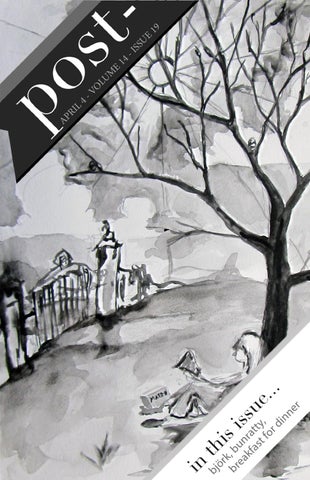
is
t ö h
r
ne
e. ..
su
is
rk br , b ea un kf ra as tty tf , or di n
bj
in
L
AP RI 4-
VO LU M
E
14
SS U
-I
E
19
2
upfront
Editors-in-Chief Zoë Hoffman Claire Luchette Managing Editor of Features Kathy Nguyen Managing Editor of Arts & Culture Ben Resnik Managing Editor of Lifestyle Lily Goodspeed Features Editors Mintaka Angell Piper French Arts & Culture Editors Adam Asher Caitlin Kennedy Lifestyle Editor Caroline Bologna Copy Chief Kyle Giddon Serif Sheriffs Clara Beyer Allison Hamburger Large Plaid Asian Phil F*ckin’ Lai Web Editor Sam Knowles Staff Writers Jane Brendlinger Adam Davis Dillon O’Carroll Rémy Robert Tanya Singh Ben Wofford
contents 3 upfront
puking politeness Allison Morgan army of björk Andrew Smyth
4 feature
immigration ills Victoria Spencer
5 arts & culture crypt creepers Emilio Leanza from the seven kingdoms to the fifty states Teodora Shaleva
6 arts & culture bunratty, bernstein, and beer Cait Mylchreest
7 lifestyle stacks on stacks Adam Davis sexicon MM
8 lifestyle
top ten post- it notes pipe dreams Rachel Bishop
editors’ note Dear readers, Welcome back! It’s April! Soon Providence will be a veritable meadow, complete with grassy knolls and smiling, sunny faces. Maybe even a lamb. Speaking of fuzzy animals, how ‘bout them Wolverines? Will you be watching on Monday? We won’t. We’ll be at IHOP instead, sharing a stack with Adam Davis, and talking about everything except basketball. March Madness has become April Apathy. But only for sports. We’re heading into the last few weeks invigorated and ready to rock. We’re on top of our game, people, and we want to shout it from the rooftops. Academics? More like: Smack-ademics! Romance? More like: Whoa, pants! Future? More like: Booze, sure! In all seriousness, we have some great stuff for you to read this week. Andrew Smyth touts the merits of our favorite Icelandic idol, Björk. Emilio Leanza suggests some additions for your bucket list—extra points for getting caught. We’re taking next week off, but have no fear. We’ll be back with our big, fat Spring Weekend issue. Get ready for full coverage of the bands, the bashes, and the bongs, along with a few surprises thrown in for good measure. Impatiently and in-patiently,
claire and zoë
Staff Illustrators Madeleine Denman Marissa Ilardi Emily Reif Sheila Sitaram Grace Sun Robyn Sundlee Adela Wu
illustrations by Cover Emily Reif
Army of Björk Sheila Sitaram Immigration Ills Grace Sun Crypt Creepers Robyn Sundlee From the Seven Kingdoms to the Fifty States Phil Lai
naked photo
Bunratty, Berstein, and Beer Grace Sun
“From forth the fatal loins of these fair actors...” Romeo and Juliet, directed by Emma Johnson at Production Workshop, April 12 to 15. Tickets available at pw.brown.edu/tickets at 11:59 p.m. on Wednesday, April 10.
Stacks on Stacks Allison Hamburger
upfront
3
puking politeness
ready for the rocky road
ALLISON MORGAN
staff writer
For those of us who have ever endured a four-hour-long car ride with family, there are those road trip traditions. You listen to a certain set of CDs on infinite repeat (dreaded are the trips when the complete works of Johnny Cash are packed). You stop at certain rest stops known from experience to be the cleanest (Ohio bathrooms are remarkably immaculate). You pack a few pack three-course meals (sandwiches, carrots, and lemon heads) to ensure proper nourishment. For those families with several children, traditions further apply to sibling preferences and behaviors. Some request stops at TCBY or Starbucks, others risk lives with poor driving skills. My 15-year-old sister, however, has a tradition a bit more demanding than most. Without fail, like clockwork, she vomits at least once per trip. Take the most recent car ride to Providence, earlier this week. She was seemingly fine, in a peaceful state of passenger rest. Or so it seemed. Without warning, she bolted upright in her seat, her cheeks alarmingly full. She thrust her right arm in my direction—my cue and a millisecond warning
that regurgitation had begun. My family, which has taken over 30 road trips—28 of which my sister has gotten sick on—is prepared for this moment. We stock the car with recycled newspaper bags and Wet Ones anticipating this exact moment. The moment I saw the inevitable coming, I grabbed a newspaper bag and prepared it below her. Unfortunately, at some point I had to shout towards the parental units in the front seat, “We need another bag!” I’m sorry to gross you out, but I was there and need to work through the trauma. The entire back seat was covered with, from my observation, the reappearance of pesto panini and mango smoothie. I’ll save you further description but will mention that every time we enter the car we enter the thick, sweet aroma of upholstery soaked in … you know. Visual traces are occasionally discovered as well, in unexpected nooks and crannies of the car. I tell this tale not to offend or disgust but to warn those of us embarking on weekend road trips or excursions as the weather improves. The semester ends in roughly a
month, and for some of us this requires a lengthy car ride out of Providence. You may have your packed lunch, your terrific music already burned. But do you have a backup plan for involuntary spasmodic stomach movements? Ways to Prevent and Maintain Gastronomic Order on a Road Trip: Before Embarkment –Pack Wet Ones, paper towels, several plastic bags, a change of clothes, and consider motion sickness bands and pills. –Avoid consumption of heavy foods or alcohol (and for other’s sake, consider what the food will look like a second time around. Bland, basic foods are easier to clean up than, say, a chunky chili). Sour foods can decrease nausea symptoms. On the Road –Look out the window at a far-away distance, preferably the sky, and avoid turning around or side to side. –Listen to music to keep the mind dis-
tracted. –Be the driver or sit in the front if you have a known history of sickness. –Try sleeping, and if necessary, take melatonin supplements. –Avoid reading. –Increase air circulation, via ventilation or windows. –Try consuming peppermint products, which soothe the stomach. –Smell the disinfecting wipes on hand or a newspaper. For some reason, this is supposed to help. –With one hand, gently apply pressure to the opposite wrist, in between the two veins, a self-conducted acupressure exercise. After –Ingest something with ginger, be it a soda or candy. –Saltines and Gatorade are ideal postvomit snacks. –Apologize to your fellow passengers, and offer to rub sodium bicarbonate on the ‘spilled’ surfaces.
army of björk
giving voice to politics
ANDREW SMYTH contributing writer I lost my virginity by sea. That is, the first time I heard Björk, she was performing “Oceania” off Medulla at the opening ceremonies for the 2004 Summer Olympics in Athens. Why the government of Greece defaulted (ha) to an Icelandic pop star to celebrate their cultural heritage on the world stage is beyond me, but I am very grateful for their decision. At the concert, I stared wide-eyed as she unleashed her enormous voice, gesticulating like some primeval sea witch in a gown that swelled to embrace the entire stadium. I was entranced. “Your sweat is salty,” she cried, cat-like, “I am why.” That night, my innocence was washed away. If Björk was the sea, then I was an adoring barnacle. I have since expanded my understanding of and respect for her kaleidoscopic oeuvre. Once you’ve caught the Björk bug, there is no going back. You find yourself rummaging through YouTube late at night in search of live performances and documentary footage. You smile creepily to yourself in libraries watching her delightfully bizarre interviews, relishing in that Icelandic, pseudo-Elvish accent, those blissfully rolled Rs. Eventually you’ll have listened to everything she’s ever done—which is quite a lot, mind you—and float wearily back to earth, hungry for more. So what’s all the fuss about? We can start with that voice, a polarizing instrument if ever there was one. It’s soaring and piercing, guttural yet flexible. She manipulates every corner of her range to achieve a sound alternately ferocious and tender, juvenile and alien. It’s not conventionally pretty, but it is beautiful. I like to compare her songs to Rubik’s Cubes: They can be complex and difficult, but they operate with an inherent logic that might be obscured by unexpected arrangements and funky haircuts. I have attempted, mostly unsuccessfully, to recruit my friends to her camp. Try as I might to shun the nonbelievers, I admit that
it can be difficult to get past her public image as the eccentric Nordic fairy in a swan dress. “There’s a serious musician under that orange wig!” I want to tell them. “She’s a beautiful mother goddess, and you should love her!” But being a Björk fan does involve submitting to a little crazy in order to access the musical and cultural iconoclast within. Kristen Wiig’s impersonation of her on SNL notwithstanding, listening to “Jóga” really does make me want to cast away to Iceland and celebrate pagan rites in the shadow of a volcano. That is not to say that Björk is some whimsical pixie knitting scarves on the periphery of alternative music. She is a shrewd businesswoman and a relentlessly innovative musician. She’s sold more than 15 million records and earned 13 Grammy nominations. With Biophilia (2011), she released the world’s first album-as-iPad-app. Her video for “All is Full of Love,” surely the most beautiful robot lovin’ the world has ever seen, is in the permanent collection of the Museum of Modern Art. She’s rounding 25 years in the music industry, and she’s still producing the most fearlessly bold and compelling content out there. In the last decade, she has sent signals that her music could accomplish something beyond art. Her engagement with human rights, social justice, and the environment has only deepened my fascination with her. Certainly she has always been mindful of politics; her early work radiates with the liberal ethos of her punk days with The Sugarcubes, and this political sensibility has only grown louder in recent years. In the wake of the Pussy Riot! arrests and convictions, she mobilized her fan base to support the imprisoned lady-rockers by publishing a statement, selling T-shirts, and dedicating performances to the group. During a 2008 performance in Shanghai, she shouted “Tibet! Tibet!” after performing “Declare Independence,” much
to the chagrin of the Chinese Ministry of Culture. Her music has become a platform not only for aesthetic experimentation (though that clearly remains the primary aim), but also for voicing dissent, arousing resistance, and inspiring action. During “Mouths Cradle,’’ off of Medulla, she intones, “I need a shelter to build an altar away from Osamas and Bushes.” Musically, Volta (2007) is the closest she has ever come to a protest album, albeit one with a pretty convoluted message. Sure, “Earth Intruders” is probably a call for the oppressed to rise up, but it’s too messy, loud, thick, and aggressive to read as politically productive. “On Volta I was moaning about everything, so Biophilia is me going, ‘OK, I cannot complain anymore. Now I have to come up with solutions,’” she told Pitchfork in 2011. While Biophilia is a meditation on the boundaries of musicology and technology, it’s also a love letter to the environment. “Nature is my religion,” she says, and she has the political chops to prove it. Repulsed by the proliferation of aluminum smelters in her native Iceland, she has petitioned the
government, held benefit concerts, and spoken at the UN in support of reform. I see Björk from a different angle every time I look. She inhabits an ecstatic prism of music, eccentricity, and activism that demands our attention. She isn’t doling out tangible policy measures on the campaign trail, but the political dimension of her music should clue us in to the depth of her creative ambition. Her music will challenge, confound, and delight you. But let her in, and she might change your world. Illustration by Sheila Sitaram
4
feature
immigration ills
policy on the fence
VICTORIA SPENCER contributing writer Sitting at a corner table in the restaurant I worked at through high school in Santa Fe, New Mexico, I realize that this probably isn’t the best place to write an article about illegal immigration. It was here that when I was 16, one of the food runners asked me if I knew the meaning of the word mojado—a derogatory Mexican slang term for an undocumented immigrant, particularly someone who crossed into the United States by swimming across the Rio Grande. He motioned towards himself, the cooks, the dishwasher, and one of the servers: “Todos son mojados.” Although most of my coworkers had lived in the United States for years, many of them came here illegally from Mexico, building lives for themselves on this side of the border. They have families here and send their kids to local schools. Their roots in the U.S. extend past the paperwork: Several of the people I worked with became like brothers to me. They interrogated my boyfriends, took me on trips to the lake, and fixed me special hangover cures during my early morning shifts. Sitting here, watching them throw toothpicks at each other in the kitchen, I’m not sure that I can write about them—or any others who have crossed into America illegally— with any sense of objectivity. A couple of years ago, my friend Carlos was deported. He spoke perfect English, lived in a nice neighborhood, and sent his kids to summer camp. In the summer of 2011, he was sent back to Mexico when his brother’s illegal immigrant status was discovered, spurring an investigation into the rest of his family. Two years later, he is still in Mexico trying to “get legal,” and now it seems doubtful that he will be here to see his kids, not yet teenagers, graduate high school. Sometimes it feels as if immigration policy has been discussed to death. Solutions have been proposed; articles have been written; fences have been built. De-
spite this endless discourse, an estimated 11 million undocumented immigrants still live in the United States. These 11 million people worry every day about being kicked out of their homes and shipped away from their families, and that is something no one should have to worry about. In Rhode Island, the number of undocumented immigrants is close to 35,000, or 3.3 percent of the population. Like in most of the U.S., the majority of undocumented workers have come over from Mexico and other Latin American countries. The state government’s response to this number has been erratic—in the last five years, it has changed its attitude towards illegal immigration multiple times, establishing drastically new policies with each adjustment. In 2008, Governor Don Carcieri signed an executive order comprising several strict measures to curb immigration, including denying healthcare to illegal immigrants and sending landlords and business owners who harbor illegal immigrants to jail. The act was repealed in 2011, but in a study conducted that year by Brown, the sentiment of many Rhode Islanders had not changed along with that of their state government: 54 percent of Rhode Islanders agreed with Arizona-style immigration reform, which requires local police to enforce federal immigration laws and to arrest anyone who cannot produce proper documentation. The state seems split, and many remain uneasily divided on the issue: 62 percent say that undocumented immigrants aren’t a burden on state resources, but 80 percent say they aren’t a benefit either. While many remain ambivalent regarding the presence of illegal immigrants in America, the 62 percent who tolerate the presence of undocumented immigrants still prefer that they remain inconspicuous. According to the Brown study, seven in ten Rhode Islanders believe that immigrants should change culturally in order
to blend in with American society—not attract attention by asserting a unique cultural identity. From what I saw in my hometown, this statistic seems to represent the national sentiment. At the restaurant, the more conventionally “American” someone seemed, the more they were paid and the more tips they earned. Though I had no previous experience, my starting wages at the restaurant were nearly twice as much as those of several people who had worked there for years, simply because I was white, female, and spoke fluent English. The other employees who assimilated quickly into American society—who knew English and could chat with customers about the results of the last election or the health benefits of soy milk versus regular milk—were promoted to the front counter. Those who didn’t fit in so easily stayed in the kitchen. The latest federal legislation, which the White House predicts will be unveiled next week, seems more concerned with keeping undocumented immigrants out than with promoting equal treatment once they arrive in the United States. The bill, written by a bipartisan group of eight senators, proposes increased security on the border—meaning taller fences, deeper trenches, and overall increased physical difficulty of crossing the southern border, which remains the gateway for most illegal immigrants from Latin America. The bill will also make it impossible for business owners to hire illegal immigrants as employees. President Obama claims that the bill will provide undocumented workers presently living the United States a clear path toward citizenship, but he highlights that it will be a difficult one, and has not yet volunteered any conclusive details of how the process, already obscure and convoluted, will change. While the concept of new immigration policies seems promising, I wonder how such a bill will work in reality. The
enormity of the Mexico border will keep it from ever being totally blocked off; people will still try to cross it, dying of hyperthermia in the Sonoran desert and drowning in the Rio Grande in their attempts. As long as people remain unhappy in their home countries, and as long as the U.S. promises more opportunities and a better quality of life, the physical border will never be secure. Similarly, as long as it is possible to live in America without being an American citizen or a legal resident, I suspect that people will continue to do it, especially if the path towards citizenship is “difficult,” as the President has asserted. For my friends in Santa Fe, as long as deportation is a necessary step towards achieving citizenship—as is the case now—they will elect to stay with their families illegally rather than become legalized American citizens. On the other hand, I certainly am not an expert on immigration policy. I am a middle-class white girl who happened to grow up near the border, and because of that I have been exposed to the very human side of an issue all too often sensationalized in both politics and media. It is incredibly frustrating to see my friends and colleagues being treated poorly simply because they sought better lives for their families and did not, or could not, get the proper paperwork. Above all, I’m worried that it will not get better for them because society has trained many of us to be indifferent. We allow those who have come to the U.S. illegally to fade into the background while the government imposes new, and potentially inappropriate or inhumane, legislation on them. Regardless of what those eight senators come up with, I’m hoping that when I go back to Santa Fe this summer, my friends will all still be there—if not as American citizens, then at least as equals. Illustration by Grace Sun
arts & culture
crypt creepers EMILIO LEANZA contributing writer
The Dilemma If you’re anything like me, you spend a good chunk of your life at Brown in a sleep-deprived, zombielike state darting back and forth from room to class to the Ratty. Insert small talk and chit chat along the way, plus or minus homework and occasional drunken misadventures, and you’ve solved the equation for any given day in the life of a sophomore in the midst of a hard slump. This semester I found out a person can only stand eating alone in the back cave of the Ratty for so many lunches before reaching a breaking point. My own came when, after pulling an all-nighter to finish an essay well past the deadline, I passed out on a plate of burnt grilled cheese and bacon cheddar pizza. Various sauces covered my greasy face but it was the shame on the inside that really stung. On that day I finally decided, once and for all, to break this soulwrenching cycle and shake the dust by venturing well beyond my normal routine to explore the places on campus where no one goes. My goal: to unceasingly hunt for interesting and obscure things, hidden in plain sight, that I’ve been selectively ignoring the past two years. Socrates says the unexamined life is not worth living, so I started to examine the shit out of it.
The List Like most great adventures (and trips to the grocery store) it began with a list. I chose to call it ‘Unexamined Spaces’ with the alternative title ‘Hook-Up Hot Spots’ for obvious, but also very practical reasons. Along with a friend, we quickly jotted down all of the areas on campus secluded enough to have an amorous tryst but public enough to worry about being caught in the act (it’s no fun without a slight amount of risk involved). In other words, how willing we were to have public sex in an area (room,
5
exploring brown’s hidden spaces
supply closet, etc.) proved a useful litmus test for determining the crevices [Editor’s note: lol crevices] worth exploring. The presence of security cameras (one campus under ‘CCTV’) was an immediate disqualifier. As a general rule, though, the stranger and more unexpected— the better. Some locales, though, were thrown in simply for their sheer ridiculousness. To give you an idea of what I’m talking about, I’ve included the best of the best below: • The basement of the Rock (love in a hopeless place) • Behind Marcus Aurelius (self-explanatory) • The Main Green (a calculated twenty meters distance from a tour group) • Chancellor’s Dining Room in the Ratty (a touch of class) • Manning Chapel fire escape (you might find salvation) • The backseat of a SafeRide van (you might find loose change) • Kasper Multipurpose Room (puts ‘multipurpose’ to the test) • Keeney study lounges (one for old time’s sake) The Pact Next came the pact—a meticulously drafted constitution laying the ground rules and a code of conduct for those seriously interested in twisting the structure of their average day (through rigorously seeking the unknown). The club started off small, existing almost solely in the subterranean caverns of Grad Center B, but quickly attracted a core group of enthusiasts. Early members were mostly other lost souls drawn to the completely esoteric yet subversive nature of what we were doing. Our midnight raids to see and feel what
we didn’t know shot a rush of adrenaline equivalent to scoring the winning goal at a little league soccer match, but without the added disappointment of discovering our parents left in the first quarter. Thus, what started as an existential crisis became an alternative to finding a real hobby, like beekeeping, or joining a sports team. UFB surprisingly refused our request for funding. And, of course, we were blacklisted from occupying a table at the activities fair. The arguments against us gaining official student group status were numerous. Yet, that didn’t stop us from trying and—also unsurprisingly—failing. The Anti-Climax Once the magic of the first few weeks faded away, internal divisions within the group began to emerge. Stark creative differences over the direction of the club made meetings incredibly uncomfortable. Some thought the constitution, biweekly meetings, and listserv defeated our original purpose to encourage spontaneity and oppose routine. Others simply found better things to do after we finished hanging out at all the places on the list. For a while it seemed our name, the Ratty Recovery Program (RRP), was the only thing we could agree on anymore. Towards the end we were just sitting in Grad Center, drinking and listening to music. (As an aside, Grad Center is for all intents and purposes a riot-proof chicken coop designed to inhibit raw emotion
of any kind.) But perhaps it’s because of the dorm’s nauseating tube lights and drab concrete walls that, at our last and final gathering, we realized the freedom we were desperately seeking in obscure spaces was inside us all along. I like to think what’s written above is true, that the RRP made me a better person, and, like in romantic comedies, I learned some invaluable lesson at the end. But maybe some things enter our lives with no explanation or purpose to leave us with little more than a long list of regrets and a now utterly useless box of T-shirts. Illustration by Robyn Sundlee
from the seven kingdoms to the fifty states how game of thrones is making fantasy mainstream
TEODORA SHALEVA contributing writer
Last June, the phrase “winter is coming” chilled the bones of avid TV viewers everywhere, both because of its meaning in a certain epic fantasy series and because of the prospect of eight bleak months without that series. On March 31, however, as spring finally started to creep into even the dreariest of New England climates, winter descended upon our television screens. Really, if I have to tell you this, you must have spent your spring break stranded on a deserted island because, big fantasy fan or not, chances are that you’ve at least heard people talking about Sunday night’s long-awaited television event: the Game of Thrones thirdseason premiere. Since its first season hit screens back in April 2011, HBO’s Game of Thrones has become one of the most talked about shows on television and has won the critical acclaim to back up all the hype (including several Emmys and two Television Critics Association Awards for Outstanding New Program and Program of the Year). Based on George R. R. Martin’s series of fantasy novels A Song of Ice and Fire, Game of Thrones explores issues of war, religion, sexuality, loyalty, and class struggles—basically all the themes that a good drama needs. The show has contributed greatly to the popularity of the fantasy genre in mainstream media, and its format has opened up a whole new world of possibilities for filmmakers looking to undertake the daunting task of adapting a fantasy
novel or series. What’s really interesting, however, is that A Song of Ice and Fire has been around for quite awhile. The first book in the series, A Game of Thrones, was published all the way back in 1996. Although the second and third book did make New York Times best seller lists in 1999 and 2000 respectively, the series was mainly popular within the fantasy readers’ community. The television show, on the other hand, has won the hearts of people of all genders and ages (although it certainly shouldn’t be watched by all ages, since the show has been accused of featuring gratuitous nudity). It’s also worth noting that the show has significantly expanded Martin’s readership—millions of copies of A Game of Thrones were sold in the months following the show’s premiere in 2011. On the whole, however, the TV series seems to have reached a much wider and more diverse audience than the books. What accounts for such significant differences in audience receptivity when the same stories are adapted to different mediums? And why is fantasy in particular more popular on TV or the big screen than it is on paper? Does it all come down to the fact that people are just reading much less these days, or is there something inherent in the fantasy genre that makes those stories more attractive when they are presented visually? Most importantly, how has a TV show that embodies a genre previ-
ously associated with geek culture defied that stereotype and emerged as one of the coolest shows on air? I think the first reason we should consider is probably the most obvious one: the length of fantasy books. The first two installments of A Song of Ice and Fire check in at just under 1,000 pages, and each of the final three volumes surpasses that 1,000-page mark. Obviously, reading a book this long is time consuming. Now, personally, I think that the level of detail this length allows for is what makes Martin’s fantasy world so real, but I’m sure many would argue that all of the long descriptions, vaguely relevant secondary characters, and complicated subplots are too much. If that’s where you’re coming from, then it certainly makes sense to trade in a dense paperback for a straight-to-thechase, concise, and action-packed television series. What’s more, the television show capitalizes on its visual format, using elaborate costumes and special effects to capture and maintain viewers’ interest. While some readers might prefer to picture all of Martin’s epic battle scenes and out-of-this-world characters for themselves, many (and perhaps most) would rather leave that up to the show’s EmmyAward-winning teams of special effect engineers, costume designers, and makeup artists. But there’s one final reason that Game of Thrones has achieved mainstream success on
TV but not in print: the show is a pillar of popular culture, whereas fantasy novels are still considered the realm of nerdy and slightly socially awkward teenage boys. Thus, somehow, the show has achieved what was previously unimaginable: It has transformed fantasy fandom into a sign of belonging rather than of outsider status. Now, seventeen years after the first book of the series was published, Martin’s stories are sending a second, more seismic wave of shock across the entertainment landscape. You don’t have to be a fan of the fantasy genre to like Game of Thrones—you just have to be a fan of genuine entertainment (and who isn‘t?). Illustration by Phil Lai
6
arts & culture
bunratty, bernstein, and beer brown university orchestra in ireland
CAIT MYLCHREEST contributing writer Brown University Orchestra just returned from our Spring Break tour of Ireland. Go to Bermuda for a beach getaway. Go to Ireland if you’re ready for biting, cold-as-shit winds and sideways-blowing snow. But, the Irish make up for it in spades with their warm hospitality. Day 1: Dublin What does one do after a six-hour plane ride? Take a nap Why, go to the Guinness Storehouse, of course! 11:30 a.m. found me sitting in the rooftop bar of this functional factory with a 360° degree view of the city, free beer in hand. Go try a Guinness, you might like it—I, however, liken it to a cup o’dirt. After visiting Phoenix Park, the largest park in Europe, stopping at a cute little café for tea and scones, and viewing the Ross Tapestry (a big-ass blanket showing scenes of Irish heritage), it was time for bed … at 2:30 p.m. We took a break from our napping to channel-surf some Irish television, which included strange Irish slang (“lettuce” is apparently a nasty word for “vagina.” Personally, I’m a bit offended—my vagina looks nothing like a hunk of vegetable) and full-frontal male nudity (I choked on some Cadbury chocolate in surprise—why, hello there!). Day 2: Dublin We began the day with a visit to Trinity College, founded in the sixteenth century. The trip included a tour to see the beautiful Book of Kells, one of the oldest printed books in the world, and other sights ripe with history, my favorite being a fancy construction crane, circa the twenty-first century. Then, it was off to the National Concert Hall for our first concert. It was easy to forget that the trip’s purpose was to drink serenade the Irish public with a celebration of American music, including George Gershwin’s American in Paris and Leonard Bernstein’s Symphonic Dances from West Side Story. The Irish are such gracious folk and huge fans of music—we received our first standing ovation of the tour. Post-concert, we hit the pub, which bore a striking resemblance the Three Broomsticks. Day 3: Limerick I’m not normally an outdoorsy kind of gal. Strangely enough, one of my favorite activities was a visit to the Causey Farm in County Meath. We watched sheepherding, did a little Irish dancing, and attempted to smuggle out some Border Collie puppies. We also tried our hand at hurling—some of us might have perfected the American meaning as we pub-hopped across Ireland, but Irish hurling refers to a fast-paced sport played with clubs, sort of like lacrosse except less WASPy. Don’t know whose idea it was to make musicians play a sport—the farm must not get cable. The ordeal was followed by a deli-
cious lunch, which included vegetable soup (apparently a favorite in Ireland—we had it, along with taters, every day. I guess I shouldn’t be surprised, with Ireland being one big farm and all). We hit the road and engaged in fun games such as “Pronounce Irish-Gaelic Road Signs” (contrary to popular belief, it’s not like Latin, but a real language that sounds similar to angry German) and “Make Your Own Madlibs.” (All were inevitably centered around our completely charming yet absented-minded tour guide. He’s so Irish, he must be a leprechaun.) It was also time for a new hotel … and a new toilet. European toilets—not one flushes exactly the same. It’s like a Sudoku puzzle that leaves you doing the pottydance if you fail. Day 4: Limerick A few friends and I were ready for an adventure—we ditched a panoramic bus tour of Limerick (a city which prompted a new bus game, “There Once was a Man from Nantucket”) and instead took a restful walk along the River Shannon to prepare for a long concert that evening. Of our three concerts, this was by far the most breathtaking. The University Concert Hall of Limerick was packed with Irish of all ages (not just the old geezers that one might see at an orchestra concert in the U.S.) who came out to see us perform with the Limerick Choral Union. This kind of musical experience is impossible to replicate in the States. If I were to ask a random American where I could find Symphony Hall (the concert hall in Boston), I might be directed to a discount furniture store. The Irish, however, appreciate musical culture. They were on their feet with beaming smiles and demanded two encores, one of which, “Danny Boy,” prompted unreserved tears from many. The Choral Union—some of the more gra-
cious musicians I have ever had the honor to work with— threw us a big brouhaha afterwards and spent the duration congratulating us profusely (the Irish are definitely of the glass-is-half-full variety and speak mostly in compliments). I spent the duration engrossed in an old lass’s telling of some highly explicit, dirty ditties. Day 5: Limerick Upon striking up a conversation with a gent in a café, I was told the Irish use the title “The Eighth Wonder of the World” to describe the Cliffs of Moher. He couldn’t be more right. Even in the most bone-rattling winds, I was in awe. In between snapping pictures and climbing (and climbing and climbing some more), I couldn’t help but feel small. What followed was the bravest feat of the trip—cramming 100 musicians into a tiny boat, “The Happy Hooker” (no worries, jokes a plenty were exchanged), as we travelled to the Aran Islands, population 1200, where only Irish is spoken. Walking on a beach bundled up in sweaters and mittens was a strange contradiction, yet the place was peaceful beyond comparison. The tour company proved to be on a mission to provide American college kids free alcohol at the strangest of times—first, at Guinness post-six-hour flight; then, at a happening medieval banquet held at the historic Bunratty Castle. (The food was leagues better than our own beloved Ratty.) Mead and bottomless jugs of wine were aplenty to accompany the entertainments of a miserable violinist clad in tights (I was the smartass who spent time pointing out inaccuracies—we were in a 14th century castle where a violinist played pieces from 200 years later. Performing in front of an orchestra … poor bloke). I lost my napkin pretty early and there are no utensils at medieval banquets … I would be the Pig-Pen of the medieval ages.
Day 6: Waterford Yes, as in Waterford Crystal. Now, for those of you who don’t have a grandmother with a penchant for expensive trinkets like mine, Waterford produces very pricey crystal vases, several sports trophies (the Masters), and the current New Year’s ball hanging in Times Square. I witnessed the actual manufacture of crystal—these workers undergo a rigorous 5-year training to become qualified craftsmen and another three to become masters—and handled impressive works of art (apparently, Waterford has more confidence in American college kids than I do when it comes to dropage). The highlight of my tour? Seeing the mold for a work commissioned by Justin Timberlake—JT gets around. Day 7: Wexford First up was a visit to the Dunbrody Famine Ship, a replica of a real ship that was used to transfer passengers to the Americas during the Great Potato Famine. It was a Disney ride of excitement, complete with fake cups of vomit and creepy figures. Afterwards, I shamelessly gulped down a sandwich and giant hot chocolate. Our last concert took place at the Wexford Opera House, an impressive modern hall that I had been hearing about from the Irish all week long. The flawless acoustics are far from our usual home in Sayles. It was the perfect note on which to end a successful tour as we received another welcoming standing ovation.* * Day 8: Dublin Airport Of course, you can never end on the perfect note, can you? Aer Lingus was having technical difficulties with our plane, so we were delayed for six hours (Bananagrams proved short lived). Brown was a welcome site … at 3:00 a.m. the first day back from Spring Break. Illustration by Grace Sun
lifestyle
7
stacks on stacks
we all hop for ihop
ADAM DAVIS staff writer The first time I went to the Providence IHOP was a complete accident. It was a random Saturday night during sophomore year, one of those slow weekend nights where all you do is laze around in someone’s dorm room until deciding you might as well go to bed. But I wasn’t really in the mood for sitting in an uncomfortably cramped Diman double while Miley Cyrus blared in the background (can you blame me?) and neither was my friend living in the room next door. You know how Brown students always say they’re going to explore Providence but then never actually do? Well that night, we decided to follow through. Fifteen minutes later, we were wandering through the heart of downtown. Eventually, we hit an impasse. The choices were clear: either turn around and walk back the way we came, or walk along the side of a highway turnoff and just hope for the best. We went with the latter. Neither of us had a smartphone (#thehorror) so we were essentially walking blind. But after a couple minutes, we saw a beacon of light just down to the right. It was magnificent, a deep blue background upon which the letters I H O and P shone in white like the glow of an angel. And just below, it read “Open 24 hours.” The food
gods were smiling down on us. The night, needless to say, was a success. I’ve been back to the Providence IHOP quite a few times since that night. Sometimes just for a random dinner, sometimes for a latenight snack, sometimes as post-GCB nourishment. And let me tell you—there ain’t no house of pancakes like an International House of Pancakes, (‘cause an International House of Pancakes is mandatory?). It is impossible to pin down a single factor that makes IHOP such a glorious place; the beauty of IHOP lies in the perfect confluence of design, taste, and value. First, design. IHOP is unapologetically unassuming from an aesthetic standpoint. That’s not to say that it is a complete dive— on the contrary, IHOP strikes the perfect balance between comfort and casualness. Entering IHOP feels like you’ve walked in the front door of a good friend’s house, albeit one with way more strangers inside. The colors are soothing, the tables clean, and the artwork on the walls manages to capture 50s diner kitsch while still looking modern and inviting. I know what you’re thinking—who actually pays attention to the décor at IHOP? And who would ever use the word “décor” to de-
scribe the inside of an IHOP? The answer to both of those questions is: me. So deal with it. Even if you’re unconvinced by the ambiance of IHOP, there’s no way you can deny the importance of taste. In my humble opinion, this is where IHOP shines. Sure, it’s not like IHOP is a Michelin-starred gastronomic hotspot, but what it does, it does well. The eggs are outstanding, the bacon is crispy, and the syrup is free-flowing. My favorite thing about IHOP’s menu, though, is its willingness to take chances. In my past few trips to IHOP I’ve enjoyed the Cinn-a-stack pancakes: four pancakes covered in cinnamon icing, drizzled with even more icing and smothered in whipped cream. The picture of this astounding creation that they put in the menu looks like it’s the world’s either most delicious or disgusting concoction. That’s the beauty of IHOP. Where other restaurants shirk away from this kind of pure decadence, IHOP revels in it. The result is a menu filled with possibilities, where classic breakfast dishes exist alongside heart-stopping guilty pleasures, and everything is guaranteed to taste amazing. If I still haven’t convinced you of IHOP’s genius, let me turn to my last point—value. Where else can you get hash browns, sausage,
eggs, bacon, and as many pancakes as you can eat for under $10? The last time I went with this option, I made it to eight pancakes before my stomach gave out. I’m hoping to make it to at least ten next time. Nothing on the menu is going to make a huge dent in your wallet, but everything on the menu will make a huge dent in your appetite. It’s a win-win. Ever since that first fateful trip to the Providence IHOP, I’ve relished each and every pancake-filled experience. Each new journey is unique and unpredictable: During one trip to an IHOP back at home, instead of adding my name to a waiting list for a table, they gave me a picture of a Disney character who would serve as my stand-in on the list. Another time, here in Providence, my tablemates and I had a pow-wow with the strangers sitting behind us about possible uses for the term “PJs” (conclusion: it does not, and will never, mean “private jets.”). The design, taste, and value of IHOP make it great; it is the people who make it exceptional. And so, to all you naysayers, go ahead and enjoy your meal at Chez Pascal—but I’ll be at IHOP if you need me. Illustration by Allison Hamburger
telecelibacy MM
n.the decision of television stars to abstain from sex
sexpert
Everyone has a guilty pleasure, and mine is The Bachelor. The most recent season, which ended in March, occupied a lot of my time this semester. I’d finish my homework, crawl into bed, and prepare for that mix of enthrallment and nausea that accompanies every episode’s canned narrative and slew of truisms. While it’s morally indefensible, the show is also absolutely entertaining. When Sean sent home Jackie in lieu of Tierra, I shouted at the screen like a Raiders fan. When he got the cold shoulder from Ashlee, I fist-pumped. And when he proposed to Catherine, I actually cried. I’m not ashamed to be a Bachelor fan, but I’m aware of the discrepancies between the show’s politics and my own. The Bachelor consistently underrepresents people of color, exploits the personal lives of its participants, and reduces complex interpersonal relationships to superficial fictions devoid of emotional depth and personal agency. The show is predicated on ideas that I just don’t buy: that everyone has a soul mate, that love precedes and precipitates sex, that the road to marriage is paved with polyamory. When I read a mean edi-
torial or a scathing critique of The Bachelor, I almost always agree. In the past few weeks, however, the show’s producers have received an onslaught of criticism over their choice to omit certain details of Sean’s sex life: namely, that it doesn’t exist. It turns out that The Bachelor, who is a deeply religious dude, identifies as a “born-again virgin”—that is, a person who has decided to be celibate after losing his virginity. So, although Sean took three women on intimate, untelevised dates in the “Fantasy Suite,” he didn’t actually have sex with any of them. Instead of foregrounding his celibacy, the show leads us to believe that Sean might have slept with these women. A lot of watchers were infuriated by this misrepresentation: How could a show that exploits and scandalizes the details of participants’ private lives ignore such a juicy piece of gossip? The answer, of course, is that producers of The Bachelor didn’t want to alienate their fanbase—or rather, do anything that would potentially decrease their ratings. Regardless of their reasoning, I think the decision to elide Sean’s celibacy is actually
a compelling one. I’m not indignant; I’m unsurprised, and I’m entertained. After all, if we begin to criticize the sexual politics of the show—if we start to hold it morally accountable—we open a huge can of ideological worms. If we start complaining about The Bachelor’s one-time omission of sexual details, we might realize that the show is fundamentally based on the omission of sexual details. We might realize that what’s messed up about The Bachelor isn’t its recent lapse in reportage but its consistent failure to include sexual relations in its romantic narratives. Here’s a rundown of a typical season: The Bachelor is introduced to twenty-five women, a few of whom he eliminates every episode until the seventh week, when he visits the remaining four women’s hometowns and families. From here on out, he eliminates one woman per date, introducing the final two to his family and finally choosing one to propose to. During the eighth week, The Bachelor and each of his three lady-friends are given an opportunity to spend the night together in a “Fantasy Suite,” which means “Apartment with
Hot-Tub.” Since the “Fantasy Suite” dates are untelevised and weirdly dramatized, it’s generally assumed that they involve sex. And reportedly, they usually do. For me, what’s problematic about the Fantasy Suite dates is not that they provide couples with a venue for sex, but that they occur only three weeks before the anticipated proposal. Unless you’re like Sean, who chooses to be celibate, you probably want to be having sex long before you tie the knot. In a serious relationship, sex is an opportunity to share pleasure and to access new levels of intimacy, vulnerability, and trust. It’s about connection. Communicative and consensual sex is, in my experience, one of the best ways to give and receive love. So actually, the fact that this year’s bachelor is celibate might mean that the show provides a true-to-life setting for him to find love. Rather than rushing his relationship’s progress or physically estranging him from his partners, The Bachelor allowed Sean the sexual distance he prefers in all his relationships. In my opinion, that doesn’t make this season of the show more problematic than usual. It makes it better.
8
lifestyle
music is
humming “Here Comes the Princeton Bride.”
film is
awaiting the next zombie apocalypse movie.
tv is
remembering who Ser Barristan is.
books is
scrying into Clara’s life.
food is
craving Café du Monde beignets.
booze is
choosing anything but pear cider.
weekendfive Straight White Men @ Leeds Theatre, April 4–7, 10–12 & 14, Wed– Sat, 8 p.m.; Sunday, 2 p.m. Global Indigenity: A Mini-Conference on Indigenous Music and Performance, Watson Institute, McKinney Room, Fri, 1-5 p.m. WE TAKE WHAT’S OURS: Herald womps the Indy in Kickball @ Pembroke Field, Sat 2 p.m. Casey Shearer Memorial Lecture, an evening with filmmaker Jeff Zimbalist, DeCiccio Family Auditorium, Saloman, Fri, 7 p.m. Live Bait: True Stories from Real People @ 95 Empire Street, AS220, Fri, 10 p.m.
topten
months (in descending order)
1. December. 2. October. 3. June. 4. May. 5. July. 6. September. 7. April. 8. November. 9. January. 10. February.
pipe dreams
an arresting experience
RACHEL BISHOP contributing writer “The police are asking you to leave.” I had imagined this command would come from a surly, scowling cop. Instead it came in a tone of calm explanation from Marla, our motherly police liaison. I’ve had unexpected run-ins with law enforcement before, but as Marla’s presence made evident, this time was different. On this day, I sat locked to 24 other people in a TransCanada office in Westborough, Massachusetts, joining dozens more students and local activists in an act of civil disobedience to protest the construction of the Keystone XL pipeline. The protest took the form of a “funeral for our future,” the idea being that, if built, the pipeline will lock us into catastrophic warming that will destroy any possibility of a livable climate. If carrying a flower-covered coffin into a suburban office complex sounds cliché or alarmist to you, welcome to the club. I wasn’t part of the group who planned the action, and my first thought was something along the lines of, “I know global warming is a serious threat, but it’s not like it’s going to kill me.” I didn’t want to look self-centered or hysterical. Until recently my understanding of global warming was a vague compilation of windmills, quasiapocalyptic scenarios, and impotent international protocols, cultivated from occasional exposure to Al Gore TED Talks and New York Times articles. I considered climate change a dire problem, but had kept it at a mental distance where I felt neither emotionally affected by its implications nor morally responsible for its prevention. Since I became involved in climate activism, that distance has shrunk to an almost suffocating degree. I’ve started to process the inescapable fact that unless we wake up in the next decade, the floods, food shortages,
and resource wars that climate change will wreak are going to kill millions of people around the world, and will turn the planet into an unrecognizable place for my children. So far, this inexpressibly terrifying prospect has been met with apathy and political paralysis. If this isn’t cause for alarm, I don’t know what is. I was willing to look a little hysterical. Whether I was willing to get arrested was a tougher decision. A criminal conviction I could manage—I’m pursuing a career as a neuroscientist, a path relatively unthreatened by having a record, and I was prepared (although not thrilled) to show up to an unpredictable slew of trial dates at the Westborough courthouse. The outcome that had me freaked was the possibility of going to jail. The odds were admittedly slim, but I found myself spending unproductive SciLi hours preoccupied with visions of American History X. I couldn’t help making a mental list of everything I’d miss if I received even a small sentence—my birthday, my last spring weekend, my thesis due date, graduation. My chances of going to jail hinged partly on how the arrestees would lock ourselves together during the sit-in. Making this decision with 24 sleepdeprived strangers the night beforehand, I started to panic. By the last few practice runs with the handcuffs I was pretty sure we were all on the same page, but how could I be certain one of these people wouldn’t lose it and literally drag me along with him into a charge of resisting arrest or assaulting an officer? I would have backed out, if I’d had even a glimmer of a doubt that this was an important risk for me to take. As scared as I was to go to jail, climate change scares me more. I tried to slow my heartbeat down by thinking about the careful design of the
whole operation: the tightly scheduled day of preparation, the neon hats to identify legal support on the scene, the charts with car assignments. I thought about the all the incredible organizers and allies committed to making sure I’d be okay, and about the friends from Brown who’d wait all day to bail me out and drive me home. And, of course, I called my mom. The next morning I made the painful decision to forgo coffee for fear of spending all day in a jail cell having to pee, but I still felt like jumping out of my skin as I sat waiting in the Marshalls parking lot across from TransCanada’s office. Thankfully, as we began the procession my nerves melted away, calmed by the social effervescence of group singing. Holding hands and looking into the eyes of those around me, I felt an overwhelming sense of solidarity, which persisted as the police gradually arrested us one by one. My experience in jail turned out to be about as far from badass as can be imagined. The police made small talk as they took our fingerprints, and laughingly reminded me that I could smile for my mug shot. (I was recently emailed that shot, which—in an almost inconceivable feat—is even worse than my senior portrait). My jail time amounted to 8 hours in a holding cell playing improv games, teaching Mánde, and singing incessantly. The room buzzed with the energy of 25 people exhilarated by having had the chance to turn our feelings of fear and moral responsibility into action. I’ve never felt such a sense of instant community, nor such a powerful feeling of mutual gratitude and admiration. I’ve never felt so certain that what I was doing was right. I left with a renewed sense of hope and fierce determination to keep fighting. Some things are worth the risk.