Daily
Herald
the Brown
vol. cxxii, no. 46
Monday, April 9, 2012
Since 1891
Novelist Last-second heroics secure first Ivy win over Penn explores Dominican identity M. Lacrosse
By sam wickham Sports Staff Writer
The final shot of the game proved to be the most important one for the men’s lacrosse team against Penn Saturday. Co-captain Rob Schlesinger ’12 scored with 11 seconds remaining to give the Bears (4-6, 1-2 Ivy) an 11-10 victory over the Quakers (1-7, 0-4) at Frank10 lin Field. Penn The win, Brown 11 B r u n o’s first conference victory of the season, puts the squad back into the hunt for a spot in the Ivy League playoffs. “There is a tremendous sense of reward with earning this victory,” said Head Coach Lars Tiffany
’90. “We have been in many close games this year and have been on the wrong end three times. I told the men that we don’t want to define ourselves as a program that gets close — we’ve got to make it happen.” The Bears got on the board first when attacker Dan O’Brien ’12 ripped a shot past the Penn goalie. But the Quakers responded with three unanswered goals to take a 3-1 lead, and a goal from Nick Piroli ’15 was offset by two more Penn goals to put Penn up 5-2 by the end of the quarter. But the Bears slowly clawed their way back into the game, as two goals from the team’s leading scorer Sam Hurster ’14 sandcontinued on page 4
By Emma Wohl Arts & Culture Editor
“You have different masks, depending on who you’re talking to,” author, professor and activist Junot Diaz told an audience that filled Salomon 101 Saturday night in the keynote address of the National Dominican Student Conference.
arts & culture Jesse Schwimmer / Herald
eager to talk about their media and experiences. People are using invisible lasers to make art, developing their own photos or stamping designs onto T-shirts. Zimmerman readily offered a demonstration of the laser cutting machine he was using to make tiny models of the Cottage Industries logo — which is, aptly,
The audience, which mostly comprised Dominican and Dominican-American students from around the country, responded with raucous cheers as Diaz told his story. Their frequent cheers and laughter suggested that they recognized themselves in his childhood tales of mediating between his Spanish-speaking immigrant parents and teachers, doctors and the police. “Story of my life,” an audience member murmured to his friend, as Diaz imitated his mother trying to convince him not to leave home for college. In his speech, Diaz wore the masks of artist and activist, rather than academic. But he employed his own particular brand of art
continued on page 5
continued on page 4
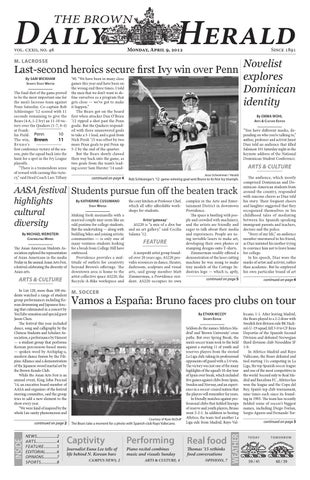
Rob Schlesinger’s ‘12 game-winning goal sent Bruno to its first Ivy triumph.
AASA festival Students pursue fun off the beaten track the cozy kitchen at Professor Chef, complex in the Arts and Enterhighlights which all offer affordable work- tainment District in downtown shops for students. Providence. cultural Making fresh mozzarella with a The space is bustling with peomarried couple may seem like an ple and crowded with machinery, odd pastime for college students. AS220 is “a mix of a dive bar and the artists are friendly and diversity By kATHERINE CUSUMANO Staff Writer
Artist ‘gateway’
The Asian American Students Association explored the representation of Asian Americans in the media Friday in the annual Asian Arts Fest, a festival celebrating the diversity of Asian arts.
arts & culture In List 120, more than 100 students watched a range of student group performances including Korean drumming and Japanese fencing that culminated in a concert by YouTube sensation and special guest Jason Chen. The festival this year included dance, song and calligraphy by the Chinese Students and Scholars Association, a performance by Hansori — a student group that performs Korean percussion-based music — spoken word by Archiplag-a, modern dance fusion by the Filipino Alliance and a demonstration of the Japanese sword martial art by the Brown Kendo Club. While the Asian Arts Fest is an annual event, King John Pascual ’14, an executive board member of AASA and organizer of the festival steering committee, said the group tries to add a new element to the show every year. “We were kind of inspired by the whole Lin-sanity phenomenon and
inside
continued on page 2
news....................2 arts.................4 feature...........5 editorial............6 opinions...............7 sports..............8
But the undertaking — along with building bikes and joining artistic communities — is only one of many ventures students looking for a break from College Hill have embraced. Providence provides a multitude of outlets for creativity beyond Brown’s offerings. The downtown area is home to the artist collective space AS220, the Recycle-A-Bike workspace and
and an art gallery,” said Cecilia Salama ’12.
feature A nonprofit artist group founded over 20 years ago, AS220 provides resources indance, theater, darkroom, sculpture and visual arts, said group member Matt Zimmerman, a Providence resident. AS220 occupies its own
m. soccer
Vamos a España: Bruno faces pro clubs on tour By Ethan Mccoy Sports Editor
Courtesy of Ryan McDuff
The Bears take a moment for a photo with Spanish club Rayo Vallecano.
Captivity
Journalist Euna Lee tells of life behind N. Korean bars campus News, 2
Performing
Piano recital combines music and visuals Sunday Arts & Culture, 4
Seldom do the names ‘Atletico Madrid’ and ‘Brown University’ cross paths. But over Spring Break, the men’s soccer team took to the field against a starting 11 of youth and reserves players from the storied La Liga club, taking its professional opponents off guard with a 2-0 win. The victory was just one of the many highlights of the squad’s 10-day tour of Spain over break, which included five games against clubs from Spain, Sweden and Norway, and an experience in a soccer-crazed nation that the players will remember for years. In friendly matches against professional clubs that fielded lineups of reserve and youth players, Bruno went 2-2-1. In addition to besting Atletico, the team tied another La Liga side from Madrid, Rayo Val-
Real food
Thomas ’15 rethinks food conversations
opinions, 7
weather
By Michael Weinstein Contributing Writer
lecano, 1-1. After leaving Madrid, the Bears played to a 2-2 draw with Swedish first division side BK Hacken’s U-19 squad, fell 3-0 to CF Reus Deportiu of the Spanish Second Division and defeated Norwegian third division club Nesodden IF 1-0. In Atletico Madrid and Rayo Vallecano, the Bears defeated and tied starting 11s competing in La Liga, the top Spanish soccer league and one of the most competitive in the world. Second only to Real Madrid and Barcelona FC , Atletico has won the league and the Copa del Rey, Spain’s top club tournament, nine times each since its founding in 1903. The team has recently fielded some of soccer’s biggest names, including Diego Forlan, Sergio Aguero and Fernando Torcontinued on page 3
t o d ay
tomorrow
59 / 41
60 / 39
2 Campus News
Writer tells story of captivity in N. Korea
calendar Today
April 9
ToMORROW
4 P.m.
April 10 12 p.m.
China and Europe Lecture Watson Institute
Mexico City Archeology Lecture Rhode Island Hall, Room 108
4 p.m.
5:30 p.m.
“Othello” Screening Barus and Holley, Room 166
R.I. Medieval Circle Lecture Annmary Brown Memorial Library
menu SHARPE REFECTORY
VERNEy-WOOLLEY DINING HALL LUNCH
Gnocchi alla Sorrentina, Chicken Fajitas, Italian Vegetable Saute, Moroccan Beans with Raisins
French Bread Pepperoni Pizza, French Fried Potatoes, Fresh French Green Beans
DINNER Vegan Oven Roasted Tofu, Sustainable Seafood Cavatelli, Roasted Red Potatoes with Herbs
Cajun Chicken Pasta, Green Pepper Steak, Edamame Beans, Stir Fry Vegan Vegetables
Sudoku
Crossword
The Brown Daily Herald Monday, April 9, 2012
By Sinclair Target Contributing Writer
When journalist Euna Lee was seized by two North Korean soldiers near the Chinese border in 2009, she remembers telling her captors, “Please don’t kill me.” Lee and her colleague Laura Ling had gone to China to film a documentary about North Korean refugees for Current TV, a news channel co-founded by former Vice President Al Gore, she told about 80 people Saturday in Kassar House’s Foxboro Auditorium during a talk organized by Liberty in North Korea at Brown and the Korean American Students Association. Early in the morning March 17, they went to Tumen River, which separates China from North Korea, to get footage of the routes refugees use to cross the border. Their Korean-Chinese guide motioned for them to follow him. “I knew it was a risky move, but I was so intent on getting the story out that I did not focus on the danger,” Lee said. She and Ling were crossing back into China, she said, when the two soldiers appeared and captured them. They were ultimately kept as prisoners in North Korea for almost five months, until former President Bill Clinton was able to secure their release Aug. 4, 2009. Lee focused her talk on what she said was “the purpose to her life” — telling the stories of those who do not have a voice. She spoke at length about the people she interviewed in China for the documentary she was
making before her capture but never finished. Many of the North Korean refugees in China are women, she said, because they are the ones being exploited by human traffickers near the border. She said these women are being sold as sex workers or as brides to poor Chinese farmers, who have a hard time finding wives because of China’s gender imbalance. Lee mentioned one girl she met who was in her early 20s. The girl had decided to leave North Korea for China because she had heard life was better there. But when she arrived, the man who had offered to help her find a job took her to a small room where he made her work in front of a computer, undressing herself for strangers over the Internet. Lee said the story depressed her. “Under different circumstances, she might have been going to school with you guys,” she said. The North Korean refugees Lee interviewed are in China illegally, she said, since they are not considered refugees by the Chinese government. She said this made things difficult, since Chinese men often have children with their North Korean brides, but these children are unable to go to school without some kind of parental registration. She added that if the mother is deported, these children are often abandoned by their fathers. After talking to these refugees, she “felt responsible for telling their true story,” she said. For the first three days of their captivity, Lee said she and Ling “still had journalistic spirit.” Since many
of the refugees they had interviewed for the documentary still had family in North Korea, they tried to protect their sources by destroying the papers and tapes they had with them. But they were soon moved to Pyongyang, where Lee said she was interrogated for eight hours a day. Lee said she was often interrogated by the same officer, whom she called “Officer Lee.” He wanted her to admit to being part of a government plot to slander North Korea and seemed to have a hard time understanding she worked for a private company, she said. “He did not abuse me physically,” Lee said. “But he knew how to threaten me and intimidate me.” She said it was psychologically exhausting going through the interrogations every day, trying to figure out if she had revealed anyone. Yet Lee was surprisingly goodnatured about her captivity. “Even though my time in Pyongyang was so difficult, I didn’t want to hold any bitterness toward the country,” she said. Lee told stories about little moments of kindness she surprisingly experienced. She said one officer lent his coat to her when it was cold — she had ditched hers earlier because there had been some phone numbers in a pocket. One guard gave her a boiled egg, telling her it was “good nutrition.” Lee concluded her talk by saying she was grateful for the outcry that followed her capture. “It was important to have people like you keeping our story alive,” she said.
Stereotypes reexamined in song and dance continued from page 1 how he has been perceived in the media as kind of this model minority for Asian Americans,” said Pascual, a Herald business staffer. “We wanted to put out the stereotypes and perceptions of Asian Americans in the media to the student body here at Brown.” Members of each student group that performed were asked questions about the portrayal of Asian Americans in the media, and the video of their answer was played prior to their performance. Multiple performers touched upon the salient characteristics of the Asian American stereotype, particularly as studious and hardworking, but not very multidimensional. “We don’t just study,” a member of Hansori said in the video.
Daily
the Brown
“Asian American communities are so heterogeneous,” Pascual said. “We have Asian Americans that actually come from really low socio-economic backgrounds that are mostly marginalized, but no one knows about them.” One member from Archipelag-a — a spoken word group comprised of Filipina women —was particularly insightful about the unique cultural limbo in which Asian Americans often reside. “In America, I’m expected to act like an Asian, and in Asia, I’m expected to act like an American,” she said. One student in the Chinese Students and Scholars Association said Asian Americans “are still foreigners in this country.” Charles Abe ’14 of the Brown Kendo Club said he is not personally concerned with the representation of Asian Americans in the media.
Herald
www.browndailyherald.com 195 Angell St., Providence, R.I.
Claire Peracchio, President Rebecca Ballhaus, Vice President
Danielle Marshak, Treasurer Siena DeLisser, Secretary
The Brown Daily Herald (USPS 067.740) is an independent newspaper serving the Brown University community daily since 1891. It is published Monday through Friday during the academic year, excluding vacations, once during Commencement and once during Orientation by The Brown Daily Herald, Inc. Single copy free for each member of the community. POSTMASTER please send corrections to P.O. Box 2538, Providence, RI 02906. Periodicals postage paid at Providence, R.I. Subscription prices: $280 one year daily, $140 one semester daily. Copyright 2011 by The Brown Daily Herald, Inc. All rights reserved. editorial
(401) 351-3372 herald@browndailyherald.com
Business
(401) 351-3260 gm@browndailyherald.com
“Where I’m from, the stereotype is usually all positive,” Abe said. “I’m actually not very sure what the image that they’re trying to change is.” He said a lot of the labels associated with Asian Americans, such as being studious and good at piano, actually apply to him, and he does not see it as harmful. Nevertheless, Pascual said AASA members hope the audience will start to question and explore the role the media plays in cultural perception as a result of the festival. “Overall, we just hope that the students leave with this consciousness and awareness of how the media shapes perception of particular cultural groups and how we could challenge those discourses and become really aware of how you’re perceived,” he said. The crowd was of mixed race, though Asian Americans made up the majority. Alec Brownridge ’12 and Le Tran ’13 emceed the event, and both had a little trouble quieting an eager audience. It was a full house, despite the event taking place on a Friday night, though a few people in the back rows compromised by drinking wine during the performances. The audience was audibly excited for Chen, who concluded the night after all of the student groups performed. From the heart-stopping concert by Hansori to the pop-star performance by Chen, the oftenoverlooked diversity of Asian culture was highlighted through the sheer variety of acts featured.
Sports Monday 3
The Brown Daily Herald Monday, April 9, 2012
Bears travel to Spain to take on European clubs continued from page 1 res, who was signed by the club at the age of 11 and rose through their youth system. The matches against Rayo Vallecano and Atletico were the Bears’ first of the trip, and Bruno was eager to go toe-to-toe with players who might in a few years’ time be lining up against the likes of Lionel Messi and Cristiano Ronaldo. Midfielder Jack Kuntz ’14 said he thought the Bears were able to surprise their opponents with their play and in doing so make a statement about the growth of the sport in the U.S. “You always want to match yourself up against the best,” Kuntz said. “I think a lot of the Spanish players knew we were Americans and might have thought it was going to be an easy game. … We were able to show them that American soccer is still pretty quality compared to what they were doing over there.” Daniel Taylor ’15 said that though they were playing youth and reserve players, the level of talent of the opposing sides were some of the most impressive the team had ever encountered. “The talent was pretty incredible,” Taylor said. “You see some
of these kids and they’re 17 years old, and they’re really young, but they’re keeping up with us, if not … more skilled than a lot of guys on our own team.” Though some of the Brown players had played against international sides in the past, goalkeeper Sam Kernan-Schloss ’13 said “by far, this is the highest level any of us have ever played in terms of international competition.” In addition to the level of play, the Bears also noted the differences in the style of play between American college soccer and the European game, including “the way they pass and move and how comfortable they all are on the ball,” Kuntz said. In NCAA soccer, play is much more physical, and referees tend to allow more contact between players. But as the Bears soon learned, the refs overseas had a much quicker whistle. “Towards the beginning of the trip, we just got called for a lot of fouls,” Kuntz said. “Collegiate American soccer is very physical, and we kind of tried to bring that to Spain. Our first game we got called for everything, and we were arguing because we thought it was fair play.”
The team had to adapt its style of play, but Kernan-Schloss said it was also important that the Bears did not change their identity. “We stuck to who we are as Brown men’s soccer, which is a gritty team,” Kernan-Schloss said. While the trip was a new and exciting experience for the team, the players also viewed it as a key 10 days in the team’s growth and progression toward next fall’s campaign, both in terms of on-field performance and off-the-field camaraderie. This past fall, the team split the Ivy League championship with Dartmouth before making an impressive run in the NCAA tournament to the third round, but key seniors graduating in May will include forwards Sean Rosa ’12.5 and T.J. Popolizio ’12, as well as midfielders Rob Medairos ’12 and Taylor Gorman ’12. “It’s massive, because we got five extra games and five extra practices,” Kernan-Schloss said. “That doesn’t seem like a lot. It’s a week’s worth of practice in the fall, but for the Ivy League where we’re so limited in offseason practices, that’s huge.” For Taylor, a first-year, the trip was especially critical — he and
some of the team’s other younger players were able to get real game experience alongside their more seasoned teammates. “Especially for some guys who didn’t get to play a lot in the fall, it was definitely an opportunity,” he said. “To actually play a full 70 minutes or a full half was a really good opportunity for us to play with the guys on the team, have an impact, develop throughout the game — I think that will help us so much the rest of the spring and into next year in terms of confidence.” Off the pitch, the team was equally enthusiastic about its opportunities to learn about Spanish history and culture, from strolling the streets and bartering with vendors to spending time with the family of Madrid-native Jose Salama ’14. Players also were able to experience a whole new level of soccer culture. The players relished the opportunity to spend time in a country whose devotion to the game of football borders on religious. The team was able to practice in Madrid at the Spanish national team’s training complex and see the team’s 2010 World Cup trophy. The Bears also attended a Barcelona FC match at
Why can’t we be friends? facebook.com/browndailyherald
Camp Nou, one of international soccer’s most hallowed grounds. “I don’t think any of us have been to a stadium quite like that for soccer,” Kernan-Schloss said. “American football stadiums here hold a lot of people, but to watch the sport you love and be watching it with 100,000 people is pretty cool.” The trip was one that has been a tradition for Brown men’s soccer. Every four years, through fundraising and donations from alumni, the team embarks on an international tour. In the past, the team has travelled to Argentina, Brazil, England and Scandinavia. Kernan-Schloss said the team is grateful for the unique opportunity, and that he believes efforts like these on the part of American soccer teams may prove integral to the sport’s attempt to breakthrough into the mainstream of the U.S. sports world. “It’s their American football, it’s their basketball — all combined,” Kernan-Schloss said. “When we were there, we didn’t see any other sports being played. It’s huge there and for Americans to go see that and hopefully bring that spirit back to the U.S. will be huge for the growth of soccer in the U.S.”
4 Arts & Culture
The Brown Daily Herald Monday, April 9, 2012
Diaz discusses power of Piano recital features Bach, Mozart pieces ‘global youth movement’ continued from page 1 — the art of the fringe, of the everyday, even of the profane. Much like his 2007 Pulitzer Prize-winning novel, “The Brief Wondrous Life of Oscar Wao,” which created poetry out of the combination of profanity, Dominican slang and obscure references to several different cultures, hardly a sentence of Diaz’s speech was free of profanity. That profanity was not selfindulgent — it served a purpose. Speaking how he wanted, without restraint, illustrated his message of rejecting labels, marginalization and the erasure of its cultural heritage, which the Dominican diaspora has been taught to accept both by its own older generations and by the American education system. As open as he was about the difficulties, he — and, he presumed, his audience — had faced, he emphasized unity over the type of dissension that comes from people telling each other, “You don’t look Dominican.” He compared Dominicans today who attempt to define the identities of others to “the Perejil Men,” agents of a genocide in the 1930s and ’40s Dominican Republic who massacred people who did not pronounce a word to their satisfaction. The antidote, to Diaz, was straightforward. “If you say you’re Dominican, that’s (expletive) good enough for me,” he said. He reminded his audience that Dominicans, no matter who fits within the label, will always be outnumbered and so need all the support they can get. But he acknowledged the uphill battle against both external per-
ceptions and internal prejudice to a culture of unity. Part of the problem, he said, was the perception around the world that the Dominican Republic is “pathologized around issues of race” — that the country has a particular self-hate toward the African portion of its identity. Diaz rejected that assumption. He called out black activists and academics such as Henry Louis Gates Jr. for never dating women whose skin was darker than their own. He recalled his experience growing up in New Jersey — where his peers told him he could be black or Dominican, but he had to pick a side — to argue that the Dominican Republic is more comfortable with its black identity than the United States or almost any other nation is. Maria Lantigua, a student at Columbia, noted a persistent racial divide within the country, asking what she and her peers could do to change the ingrained prejudice of Dominicans against their Haitian neighbors. “Some of us have to be artists, some of us have to be on the ground, some of us have to argue with our parents” when they use anti-Haitian slurs, Diaz responded. Overall, he said, he believed in the power of a “global youth movement” — the same movement that brought about the Arab Spring, the Occupy movement and student-worker alliances in South America in the past year — to make the kind of changes necessary for a more open, accepting world. “I have no doubt that we are not only going to win, but that we’re going to create the kind of country we can live in,” he said.
Find free food blogdailyherald.com
By james johnson Contributing Writer
Jessie Ning, a junior at Rhode Island School of Design, and four of her piano students performed classical piano works at a recital Sunday afternoon in Grant Recital Hall. The program for the recital, entitled “Our Piano,” prominently featured music composed by Johann Sebastian Bach and Wolfgang Amadeus Mozart. Ning — a pupil of Arlene Cole, adjunct lecturer in music at Brown — studies graphic design. Her vision for the afternoon was all-encompassing, including her self-made dress and handmade programs — all in hues of black and gold with hints of silver that matched the Steinway and Sons grand concert piano on which she played. Ning said she has historically been a lover of the Romantic period in classical music, which displays pronounced expressions of emotion. With the exception of Franz Liszt, composers from this time were conspicuously absent from her program. Ning said her inspiration for the selection of pieces had been to explore the music of the two periods immediately preceding Romanticism — Baroque and Classical — whose main figures were Bach and Mozart, respectively. Despite the lesser emotional content, she
has found playing their music to be rewarding as well, she said. Preceding Ning were the performances of her four students — Aunjoli Das, a student in the fifth grade at Moses Brown, Xinghui Zhong PhD ’12, Luis Castillo ’15 and Dulma Altan ’14. Ten-year-old Das began the afternoon with Bach’s Two-Part Invention No. 8 in F major, BWV 779, as well as Friedrich Kuhlau’s Sonatina in C major, Op. 55 No. 3. Both were shorter pieces, played impeccably by Das. Zhong followed, performing a traditional Chinese tune entitled “Butterfly Lovers.” The music was gentle and invoked the ephemeral stay of a butterfly upon a flower petal. Castillo then played Frederic Chopin’s Waltz in A minor and Felix Mendelssohn’s “Venezianisches Gondellied No.3.” Altan concluded the students’ performances with Robert Schumann’s “Traumerei” from his collection “Kinderszenen” (meaning, “Scenes from Childhood,”) as well as Ludwig van Beethoven’s waltz, “Le Desir.” She described the pieces as “exceptionally pretty” and did justice to their emotional richness. Ning began with the Fantasia and Fugue in A minor by Bach, the master of writing music that could be more easily played by someone with three arms. The Fantasia was an unusually laid
back piece by Bach standards. The Fugue was far more intricate, with the pianist’s hands always trading off rhythm and lead parts, the music in constant motion. Next Ning played the entirety of Mozart’s final piano sonata, the Sonata in D major, K. 576. This was a highlight of the show, as Ning effortlessly went through Mozart’s never-ending scale runs and finger acrobatics. As can usually be predicted, Mozart’s music was the most joyful of the afternoon. After a brief exit from the stage, Ning returned to perform Liszt’s “Sonetto 104 del Petrarca” and Wanghua Chu’s “Xinjiang Capriccio.” At this point, audience members could recognize a young woman who had put in her time studying the more academic work of Bach and Mozart and was now ready to have her fun. Liszt’s Sonetto was nearly perfect, walking the line between art and virtuosity, as Liszt’s music often does. Chu’s music was intense, with rare moments of classical melodicism. Ning’s hands ran up and down the keyboard, and she was often playing the highest notes with her right hand and pounding the lowest with her left. Ning’s performance was a pleasure to see and to hear — a panoramic view of the talent of a graphic designer and pianist of over 16 years.
Captains lead team to victory continued from page 1 wiched a Roger Ferguson ’13 goal to bring the teams level at 5-5 going into halftime. “We dropped down 5-2, but then we won some faceoffs,” Tiffany said. “I think the score over the next two quarters really had to do a lot with Tommy Capone (’14) stepping up and winning some faceoffs.” Penn opened the scoring in the second half, but a goal from Bears co-captain Parker Brown ’12 kept the game tight at 6-6 seven minutes into the quarter. Brown’s goal set the Bears off on a small scoring streak, as Piroli and
O’Brien each scored their second goals over the next minute and a half. The Quakers managed one more goal before the quarter’s end, but a strike from Hurster brought the score to 9-7 in the Bears’ favor with a quarter to go. But the lead did not hold. “We’re up 9-7 with 10 minutes, and Penn just exploded for three goals,” Tiffany said. “All of a sudden, we were down one.” The first of these Quaker goals came seven minutes into the fourth quarter, and three minutes later, Bruno was down 10-9. But the Bears kept fighting, and clutch play from the two captains helped steal the win. Parker Brown scored his second of the game with three minutes remaining to level the score at 10. “Our two captains put the team on their shoulders and made huge plays in the last four minutes of the game,” Tiffany said. Bruno controlled possession for the rest of regulation leading up to Schlesinger’s last minute heroics. After receiving the ball,
Schlesinger wrapped around the left side of the goal and fired home the game-winner from a tough angle. “We finally pulled out a close game,” Tiffany said. “Losing by one to Harvard, losing by one to Duke, losing by one to Bryant — in all those games we had a shot to tie it or win it, so this is certainly rewarding.” Tiffany noted the atmosphere of an Ivy match-up under the lights at Penn’s historic Franklin Field. “The game certainly matched the splendor of the stadium,” he said. The Bears will be back under the lights Friday, but this time at home, when they face Yale (5-4, 2-2) at Stevenson Field at 7 p.m. “We know we’ve got a very talented team coming to Brown Friday night,” Tiffany said. “The biggest thing for us is defending our own turf. We’re winless at home. We’ve got a great fan base, and they deserve better. We better step up and show them Friday night against a very good Yale team.”
Follow The Herald on Twitter twitter.com/the_herald
Feature 5
The Brown Daily Herald Monday, April 9, 2012
Husband-wife team develops creative cooking courses continued from page 1 a cottage. The Cottage Industries division of AS220, home to the AS220 print shop, media arts and lab space, provides “facility resources” to its artists, Zimmerman said. Within this department, workshops are offered each month that cover a multitude of media. In the print shop, students can choose from classes in letterpress and silkscreen. Letterpress courses instruct students in the art of stamping designs onto paper — creating items such as wedding invitations and business cards. The most popular class is silkscreen, said Lara Henderson, the printshop’s manager. The technique is similar to letterpress in that designs are stamped onto material — but instead of paper, the material is fabric. Photographic projects vary from medium format and pinhole film to digital. AS220 also hosts dance and theater classes at their 95 Empire Street location. Workshops cover both introductory and more advanced applications of the Cottage Industries equipment. “People hop around,” Henderson said. Students tend to take an introductory class and become invested in their medium, seeking to further their knowledge of lab techniques. “Workshops are kind of our gateway into the space,” said James Rutter, labs coordinator at AS220. Many students who initially participate in AS220 workshops become members of the organization. Members are the first to be notified when a new workshop is available. Students are eager to work with a new application of a learned skill or with a familiar instructor, Rutter said. From Rhode Island School of Design and Brown students to professors, from amateurs to creative professionals, there is a broad range of participants from the Providence community in AS220 workshops, Henderson said. Culinary extra-credit
For those with a more culinary bent, Professor Chef, a husbandwife cooking instructor duo that offers classes at their home in North Providence, offers personalized instruction in a variety of cooking topics and techniques. “Our motto is: we teach you how to play with your food,” said Phillip Griffin, one half of Professor Chef. Griffin has been cooking since age 15. After years of informally teaching small cooking classes for friends and family, he and his wife Malinda Coletta decided to apply their culinary passions to professional teaching. They formed Professor Chef two years ago, and the couple teaches around 20 different classes out of their own kitchen, Griffin said. The classes cost $50 to $75 per person. “We continually change our offerings based upon what our clients want as well,” Coletta said. Griffin has a background in education, as a former Johnson and Wales Culinary School instructor, and Coletta has a background in nutrition and the science of food preparation. Their individual specialities allow them to gear several courses toward vegan, vegetarian or lactose-free diets. The most popular class recently has been mozzarella-making, Coletta said. Cooking pizza and bread are also popular classes, Griffin added. “We teach from the ground up,” Griffin said. Coletta explained that they make their own cheese, beer, wine and vinegar, and they even smoke their own salmon. In their classes, they aim to give students the skills to prepare these ingredients on their own, she said. The majority of college students who attend the classes are Brown students, but Coletta also noted that the “cross-section of people is amazing.” Some people come solely for entertainment, with no prior cooking knowledge. Others are “true foodies,” she said. “The interesting thing about taking a class with Phil and I is we’re a husband-wife team,” Coletta said. “There’s a lot of humor. It’s a very relaxed atmosphere.” “We don’t pull any punches,” Griffin added. He compared their
Courtesy of Malinda Coletta
Malinda Coletta and Phillip Griffin have teamed up to provide cooking lessons in their Providence home.
dynamic to Lucille Ball and Desi Arnaz from the classic TV show “I Love Lucy.” “I’m Lucy, she’s Desi,” he said. The workshops are designed to be informal but educational. Because of the small size — usually less than six participants — they are also very personal. Typically a class commences with an offer of homemade wine or beer, Coletta said. Every class has a lesson plan with recipes and a phone number to call for any future cooking problems, a free service from Coletta and Griffin called “Rescue Chef.” “Julia Child always kept her phone number open in the Cambridge phone book,” Coletta said. These cooking courses are taught out of the couple’s North Providence home, where the small group of students gather around a central counter in a real kitchen, without the sterility of a commercial kitchen, Griffin said. Courses are taught from the couple’s own recipes. “If I give you a recipe, it will work,” Griffin said. (Re)cycling
Olneyville’s Recycle-A-Bike, a nonprofit organization that has
been teaching mechanics and community bike repair since 2001. At the cost of only a suggested donation, students can participate in their six-week Build a Bike program, in which they build two bikes — donating one back to Recyle-A-Bike and keeping the other for themselves. An on-site volunteer mechanic at the workshop teaches participants to fix the bikes by themselves. In each two-hour session on Wednesday nights, the program focuses on a particular aspect of bike mechanics. Students then put this knowledge to practice on Thursday night during open workshop time, when participants can work on their bikes in the workshop space. Though it is a significant time commitment — a half-hour bus ride for a two-hour class twice a week — Liza Carroll ’14 said it was a worthwhile experience that
she has recommended to others. “It was definitely a good way to make myself get off of College Hill,” she said.“It allowed me to help out at Bikes at Brown,” a student group that rents bikes and offers free repairs to the Brown community, she added. After completion of the sixweek program, students can also stay involved at Recycle-A-Bike. “There’s a million things to do around the shop,” said Jenna Johns-Yu, Recycle-A-Bike’s development director. Volunteers are constantly being trained in a variety of tasks. Brown students tend to be very involved in campus programs, so they do not remain as involved as other community members, Johns-Yu said. But she said she hopes to “create a foundation for the partnership,” through Carroll and her connection to Bikes at Brown.
6 Editorial & Letter Editorial
The Brown Daily Herald Monday, April 9, 2012
Editorial cartoon by Rachel HAberstroh
Allergic to B’s We have reached the crucial point in the semester: the second midterm. You’ve gotten the first one back, and maybe you didn’t do so well. But you told yourself you’d make up for it the next time around. So now this second test, paper or weird existential photography project could be your saving grace — or it could be your downfall. But what do we mean by downfall? At any another university, a “downfall” in academic performance might mean actual failure, or at least a C. But at Brown, what many students fear most is not a D (which doesn’t exist) or an F (which doesn’t appear on our transcripts), but a B grade. We believe this is an extremely unhealthy cultural phenomenon endemic to Brown, and urge the University to discuss some possible solutions to remedy it. The Brunonian fear of B’s is so strong that students will drop essential classes that have already taken up a lot of their time to avoid a sub-par grade. Last week, when discussing a midterm for a class in his concentration, Eddie Angus ’14 shrugged and said, “Whatever. Might just drop it.” When asked why, Angus answered, “Well, it’s not like I can get an A, so why bother?” Angus had already spent half a semester doing the work, but he was willing to drop it if completing it means he will not get the best grade Brown has to offer. We commend Brown students for holding themselves to high standards — but this attitude, prevalent among too many, is ridiculous. With Brown’s academic culture already standing out due to its lack of core requirements, we believe the time has come for our administration to consider modifications to the grading policy that would help students to focus more on learning than grades and hopefully eradicate the stigma of the B. Maybe this means instituting pluses or minuses, which could introduce greater nuance into the grading system and make the fall from an A less drastic. Perhaps this means expanding the use of Course Performance Reports, which give students the option of written evaluations rather than a grade. Maybe this means taking measures to combat growing grade inflation. After all, if there are fewer and fewer B’s handed out, this puts greater pressure on students to get the A and greater pressure on professors not to give them out — a self-reinforcing cycle. We are not trying to advocate any particular policy, and all of the above solutions have their fair share of problems. But the current system has problems of its own — problems that the University needs to confront to avoid a failure of its institutional mission. The New Curriculum aimed to foster an environment where students devise their educational philosophy solely for the sake of learning. The rapidity with which so many Brunonians flee from the B suggests that perhaps this noble goal is still being imperfectly realized.
letter to the editor
Column offers incomplete definition of ‘hope’ To the Editor: In the ongoing debate over Brown’s motto, the concept of “hope in God” as being too wishy-washy has come up several times. As Spencer Gordon ’14 wrote in Friday’s Herald (“Brown’s motto should change,” April 6), “Hope suggests a desire held passively and uncertainty about its fulfillment.” However, the concept of hope in a New England Puritan context of the seventeenth and eighteenth centuries is entirely different from the normal day-to-day definition we tend to use, and to properly understand the meaning of our school’s motto, you have to get inside the minds of the Puritan ministers who founded the University. The hope that our motto speaks of, if it is to be taken in the traditional Puritan sense (and I think that it is), is not considered a passive desire or uncertainty, but a firm conviction of future events. This concept of hope comes from places in the Bible like Romans 8, where it says, “For in this hope we were saved. Now hope that is seen is not hope. For who hopes for what he sees? But if we hope for what we do
Editorials are written by The Herald’s editorial page board. Send comments to editorials@browndailyherald.com.
not see, we wait for it with patience.” The hope invoked in our motto is not uncertainty but certainty: “In this hope we are saved” not, “I think I might be saved — and while I’m at it I hope I didn’t leave the iron on.” This sort of thing is reflected in the Hebrew Bible as well: Prophets would often speak about future events in the perfect tense because the events they were foretelling were understood to be so certain it was as if they had already happened. Thus, in Romans the Bible states, “If we hope for what we do not see, we wait for it with patience.” In this sense — which by the way is still commonly held by many Christians today — the “hope in God” of our motto is antithetical neither to religious faith nor to active pursuit of knowledge. I agree with Gordon that the typical usage of “hope” as a desire for something uncertain is quite antithetical to both religious faith, and certainly to pursuit of truth, but if a proper critique of Brown’s motto is to be given, then it is necessary to first fully understand what “In Deo Speramus” actually means. Gabriel Wingfield ’12
Correction An photo in Friday’s Herald (“New color-changing installation lights up Granoff,” April 6) was incorrectly credited to Maddie Berg. In fact, the photo was courtesy of Brown University. The Herald regrets the error.
t h e b r ow n da i ly h e r a l d Editor-in-Chief
Managing Editors
Senior Editors
Claire Peracchio
Rebecca Ballhaus Nicole Boucher
Tony Bakshi Natalie Villacorta
editorial
Business
Arts & Culture Editor Sarah Mancone Arts & Culture Editor Emma Wohl City & State Editor Elizabeth Carr City & State Editor Kat Thornton Features Editor Aparna Bansal Assistant Features Editor Jordan Hendricks News Editor David Chung News Editor Lucy Feldman News Editor Greg Jordan-Detamore News Editor Shefali Luthra Science Editor Sahil Luthra Sports Editor Ethan McCoy Sports Editor Ashley McDonnell Assistant Sports Editor Sam Rubinroit Editorial Page Editor Jonathan Topaz Opinions Editor Charles Lebovitz Opinions Editor Jared Moffat Graphics & Photos Eva Chen Emily Gilbert Rachel Kaplan Jesse Schwimmer
Graphics Editor Photo Editor Photo Editor Sports Photo Editor
Copy Desk Chief Design Editor Design Editor Web Producer
Office Manager Shawn Reilly
Julia Kuwahara Samuel Plotner Nikita Khadloya Angel Lee
Sales Finance Alumni Relations Business Development Managers
Justin Lee Kaivan Shroff Gregory Chatzinoff Mahima Chawla Luka Ursic Alison Pruzan Elizabeth Gordon David Winer
Human Resources Research & Development Collections Collections Finance Operations Alumni Engagement Fundraising Marketing
Post- magazine Editor-in-Chief
BLOG DAILY HERALD Jennifer Bloom Matt Klimerman
“Even though my time in Pyongyang was so difficult, I didn’t want to hold any bitterness toward the
Directors
Sam Knowles
Production Olivia Conetta Kyle McNamara Julia Shube Neal Poole
General Managers Siena DeLisser Danielle Marshak
quote of the day
Editor-in-Chief Managing Editor
”
country. — Journalist Euna Lee See Captivity on page 2.
C O R R E C T I O N S P olicy The Brown Daily Herald is committed to providing the Brown University community with the most accurate information possible. Corrections may be submitted up to seven calendar days after publication. C ommentary P O L I C Y The editorial is the majority opinion of the editorial page board of The Brown Daily Herald. The editorial viewpoint does not necessarily reflect the views of The Brown Daily Herald, Inc. Columns, letters and comics reflect the opinions of their authors only. L etters to the E ditor P olicy Send letters to letters@browndailyherald.com. Include a telephone number with all letters. The Herald reserves the right to edit all letters for length and clarity and cannot assure the publication of any letter. Please limit letters to 250 words. Under special circumstances writers may request anonymity, but no letter will be printed if the author’s identity is unknown to the editors. Announcements of events will not be printed. advertising P olicy The Brown Daily Herald, Inc. reserves the right to accept or decline any advertisement at its discretion.
Opinions 7
The Brown Daily Herald Monday, April 9, 2012
Changing the dialogue around food by leigh thomas Opinions Columnist This spring, some 2,760 bright high school seniors anxiously and excitedly received acceptance letters from the University. Many of these eager young minds also received similar letters from our peer institutions and are now faced with the important question, “Why Brown?” As Brown students, we are happy to rattle off reasons to attend. We pride ourselves on our academic rigor, our inclusive community and our active and engaged student body. We also have beautiful buildings — from the outside, at least — a comfortable geographic location and a unique curriculum that emphasizes student choice and agency. One aspect of our college life, however, that we will probably not hear passed on as encouragement to come to Brown is, unfortunately, the food. Complaints about Brown dining abound. A significant aspect of my freshman experience has been learning to navigate the food offerings across campus, a process that has been strongly influenced by upperclassmen’s advice that was frequently more akin to whining. The Verney-Woolley Dining Hall isn’t open on weekends. The sushi is overpriced. The meat is mysterious. It’s not called the Ratty for nothing. We learn to limit indulgent lunches at the Blue Room, shaking our heads that meal credits can’t be used until after four. We
avoid tasteless steamed vegetables. The list is long. Despite this gold mine of opinion material, I don’t want to spend a whole column complaining about food. Rather, I think it’s time to give some recognition to some things Brown Dining Services is doing right that merit examination and encouragement. And in doing so, I hope to change the focus of our dialogue on food. Specifically, I’m referring to Dining Services’ commitment to sustainability. It is certainly a less discussed facet of our food,
than from larger corporate food sources not only provides support to local businesses and farms that promote sustainable practices, but it also cuts down on the environmentally detrimental process of transporting food over long distances. Additionally, 100 percent of our milk is fresh and local. We have a composting program. This list is encouraging. Also notable is how quickly Brown has adhered to the local food trend. Our community harvest program has existed for almost 10 years, giving local farms the invalu-
Rather than limiting our point of critique to just the quality of the meals presented to us, students should also be concerned about where that food came from and how it was acquired.
but in truth the University makes impressive investments in local produce and locally processed food. I label it impressive because of the logistic difficulties that accompany selecting local, and perhaps more expensive, options when operating on such a macro scale. And yet, according to its website, Dining Services is connected with over 30 local fairtrade farms and receives the rest of its produce from local processors that themselves draw from local sources. Buying local rather
able support of a large purchaser. And yet there is also much room for improvement. A closer look at Brown’s Real Food initiative, which is “committed to buying foods that are local, ecological, fair and humane,” reveals its potential for expansion. At the moment, the Real Food section of the Dining Services’ website boasts, “15 percent of our food meets at least one of these Real Food criteria,” and that, “by 2014 we will serve upwards of 35 percent Real Food.” Take a moment to appreciate the humor in
that statement — hint: right now we are eating 85 percent non-real food. This brings me to why we should all talk more about Dining Services’ sustainability and perhaps less about our day-to-day inconveniences at mealtimes. Rather than limiting our point of critique to just the quality of the meals presented to us, students should also concern themselves with where that food came from and how it was acquired. In doing so, we will help the local community while also helping ourselves. Locally grown sustainable food is fresher and tastier than packaged food shipped from larger corporate farms. Pushing for sustainable practices might be one of the best ways that we can address our other dining concerns. Brown is an enormous purchaser of food. We have the capability to catalyze and sustain positive trends in food production and consumption within our local community. The demands that we make on Dining Services will make a difference as to how sustainable food can be produced with success. Hopefully, the result will be delicious, satisfying food that meets the needs of our student body and is constructive for our community. For right now, we’ll continue to tell incoming students about the academics, social life and great food selection on Thayer Street.
Leigh Thomas ’15 is from Irvington, N.Y. She can be reached at leigh_thomas@brown.edu.
Rethinking social entrepreneurship by ian eppler Opinions Columnist If there were a list of things Brown students say, “social entrepreneurship” would be up there with “hegemony” and “spicy with.” Social entrepreneurship has attracted a great deal of institutional attention. Countless extracurricular programs, fellowships, courses, conferences and other initiatives focus on the topic. But what does “social entrepreneurship” even mean? Brown and its students have embraced social entrepreneurship wholeheartedly, but should they? A valuable first step to understanding “social entrepreneurship” is to look to its practitioners’ self-definition. The Skoll Foundation, a large philanthropic supporter of social entrepreneurship initiatives, defines “social entrepreneurs” as “society’s change agents: creators of innovations that disrupt the status quo and transform our world for the better.” This definition is so over-inclusive that it’s meaningless. Steve Jobs fits this description, but the Skoll Foundation’s list of grantees suggests that the founder of an electronics company would not be considered a social entrepreneur. Similarly, Martin Luther King Jr. fits the description as well, but the Skoll Foundation’s list of grantees also suggests that an advocate, organizer, writer and orator such as King would not be considered a social entrepreneur. We must look elsewhere for a satisfactory definition. Academia also fails to provide a satis-
factory definition of social entrepreneurship. In a widely cited 2007 article in the Stanford Social Innovation Review, Roger Martin, dean of the University of Toronto’s business school, and Sally Osberg, chief executive officer of the Skoll Foundation, attempted to define social entrepreneurship for an academic audience. They base their definition on economist Joseph Schumpeter’s definition of entrepreneurship, arguing that a social entrepreneur identifies an unjust social equilibrium, identifies a means of changing it and implements the change,
about it? I posit that the answer lies with its connotations, specifically those of the “entrepreneurship” component. The popular understanding of “entrepreneur” is “someone who has interesting ideas and makes a great deal of money from them.” Our society prizes the traditional form of entrepreneurship and respects its practitioners in a way that our society doesn’t necessarily support advocates of social change. In using the term “social entrepreneurship,” those who use it attempt to de-emphasize the “social” component in favor of the
If “social entrepreneurship” does not differ from other forms of social change advocacy, why do we care about it?
forming a new social equilibrium. Though this definition is more specific than the Skoll Foundation’s, it still bears little meaning. King, a “conventional” social change advocate, would fit under this definition, just as he would fit under the Skoll Foundation’s. Definitions of “social entrepreneurship” fail to indicate how the term differs from past social change advocacy. Given that the term “social entrepreneurship” denotes almost no meaning, why would anyone use it? If social entrepreneurship does not differ from other forms of social change advocacy, why do we care
more accepted “entrepreneurship” component, signaling that they share mainstream values. While this respect may be important to participants, the benefits also extend beyond intangible respect, however. People who are capable of providing tangible benefits are also the targets of the “social entrepreneurship” signaling phenomenon. “Social entrepreneurship” signals to parents, employers, admissions committees and other responsible adults that, although one may be interested in social change, one is solidly part of the mainstream. A social entrepreneur is not one
of those scary people who does things like camping out in parks. Calling oneself a “social entrepreneur” signals that one shares the values and norms of people who supposedly matter, helping one receive the tangible benefits they offer. “Social entrepreneurship” allows for social change advocacy without the potential external consequences that come with being an activist. There’s nothing wrong with projecting an image for the sake of external validation. Given that most of the people reading this column have been accepted by Brown, it’s fair to say that we’re quite good at doing so. But we should be honest about what we’re doing and why we’re doing it. There’s a lot of good that can be done under the guise of “social entrepreneurship,” but that doesn’t excuse our collective failure to recognize and acknowledge its purposes and its limitations. Honesty about the purposes and limitations of “social entrepreneurship” would begin with rejection of the term itself. It is the epitome of a buzzword — a term that means something slightly different to everyone and ultimately nothing to anyone, facilitating obfuscation and equivocation. As members of an intellectual community, we should prize clear thinking, writing and expression. Social entrepreneurship is incompatible with these values. It is high time for us to retire social entrepreneurship from our lexicon. Ian Eppler ’13 is a social entrepreneur, and so can you! He may be contacted at ian_eppler@brown.edu.
Daily Herald Sports Monday the Brown
Monday, April 9, 2012
Softball
Bears drop three but outlast Tigers for lone win on weekend By alexandra conway Contributing Writer
Jesse Schwimmer / Herald
Stephanie Thompson ‘13 hit the tying home run that helped lead Brown to its extra-inning win over Princeton.
The women’s softball team went 1-3 in league play this weekend in doubleheaders against Cornell and Princeton. The Bears dropped two games to Cornell (16-13, 7-1 Ivy) before losing a one-run decision to Princeton (9-20, 5-3) in game one Saturday. But in game two, Bruno (6-16, 3-5) bounced back to salvage a win from the weekend, outlasting the Tigers in a 2-1, 11-inning thriller to split the series. Bruno fell to the Big Red 11-9 in game one Friday afternoon, followed by an 8-4 loss in game two. In the first game, the Bears started off strong with a 2-0 lead after Kate Strobel ’12 and Trish Melvin ’12 tallied solo home runs in the third and fourth innings, respectively. But the lead was short-lived, as Cornell exploded for nine runs in the fifth inning to grab a 9-2 lead. The Big Red scored twice more, but the Bears refused to go down without a fight. In the last three innings, the Bears scored seven more runs, three courtesy of Misa Wong’s ’15 three-run homer, but the offensive onslaught was not enough to overcome the deficit. The second game of the afternoon was a back-and-forth affair, and Bruno again came up short. By the third inning, Cornell built a 3-1 lead, but the Bears were able to even the score at the bottom of the inning.
In the next three innings, Cornell shut down the Bears and scored five runs of its own. “We scored a lot of runs on one of the most experienced and talented pitching staffs in the Ivy League,” said Head Coach DeeDee Enabenter-Omidiji. “The challenge that we have in front of us is that our young, inexperienced — but determined — staff is giving up too many runs. Hopefully, they will continue to work toward some consistency, and the offense will continue to produce runs.” Against Princeton, EnabenterOmidiji said she thought the team displayed a never-say-die attitude in both games. The Tigers topped the Bears 6-5 Saturday, but Bruno came back in the second game to win 2-1. In the first game, Bruno was down 4-1 heading into the bottom of the fifth inning. But the Bears rallied back thanks to a three-run home run by Melvin and another run, making it 5-4 in Bruno’s favor. Princeton then scored two runs of its own, giving the Tigers a 6-5 lead and ultimately the win after Brown’s bats were silenced in the bottom of the seventh. The second game went on for a grueling 11 innings, and this time the Bears scraped out a 2-1 victory. Pitcher Jessica Cherness ’15 was on the mound the entire game. “Jessica pitched one of the best games I have seen in my time here at Brown,” shortstop Stephanie Thomp-
son ’13 said. “She kept her composure and didn’t show any weaknesses for 11 innings, which is amazing, especially from a freshman.” After seven innings, the scoreboard remained blank. Princeton tallied a run in the top of the 10th and put the pressure on the Bruno bats, but Thompson tied the game with a clutch solo homer. After blanking Princeton in the 11th, Alyssa Caplan ’13 stepped up to the plate and provided the heroics for the Bears. Down to two strikes, Caplan blasted a walk-off home run to give the Bears a 2-1 victory. “Those are the kind of situations you dream about, so it was really exciting ,” Caplan said. “Our pitcher threw such a great game, and our team showed so much focus. It felt good to walk away with a win, and I think that win will definitely give us momentum going into next weekend.” Overall, Enabenter-Omidiji said she thought the team played well and showed signs of improvement. “What (this weekend) showed us as a team, even though we came up short, is we have a lot of fight in us,” Enabenter-Omidiji said. “We are going to fight to the last strike or out of the game, and we hope to take that same attitude into the rest of our season.” The Bears will play University of Rhode Island Wednesday before continuing their Ivy campaign over the weekend.
Inspired by poetry, senior textures paintings with hair By Meia Geddes Staff Writer
This semester, people began giving hair to Cecilia Salama ’12. The visual arts concentrator — who previously went to barbershops to collect hair — has made good use of the donations in her current exhibition, “In My Absence: A Senior Visual Arts Thesis Exhibition,” that features work created this semester.
Arts & Culture Salama’s pieces tend to skirt the traditional two-dimensional canvas to explore a more sculptural approach to painting. Hair, as well as other materials like sheep’s wool, air conditioning filters, metal and handmade white frames distinguish her work. Hair is “a little bit revolting, but we all have it,” Salama said. The exhibition explores her fascination with the body, though Salama does not portray the full human figure. Salama said she hopes the work will speak for itself in her absence. There is a “performative aspect” to her art, she said. She feels the pieces are “trying to confront” audience members. Salama has trouble with language and has always been told she is too quiet, she said. “I have
trouble finishing my sentences sometimes,” she said, laughing. The studio has provided a space for her to express her feelings, she said, adding, “I just feel so much better after” being in the studio. Poetry has also helped Salama vocalize her feelings, she said. She uses poetry she has written to name her pieces. The poem that guides this exhibit, written this year, is about how she feels about “art in general,” she said. Salama said Brown visual arts classes allowed her to experiment. As an honors student, she had her own studio to practice in. “You always want to try new things,” she said. Salama has transitioned from liking “natural, fleshy colors,” produced using materials like soil, rubber, latex and coffee grounds, to using brighter colors. Her work has also become more contemporary, she said. Salama said she relates to contemporary artists such as Gedi Sibony ’95, who makes minimal pieces. He often uses frames in his work, similarly to Salama, whose work includes empty wood frames, long pieces of wood that create a border outside the canvas. “The way that I paint is quite similar to abstract expressionism — there’s a lot of energy,” Salama said. “I’ll scratch the canvas with my hands,” she added.
Jane Hu / Herald
Cecilia Salama ’12 described her work as “similar to abstract expressionism.”
Salama has experienced conflict over what constitutes a painting, she said. She employs unconventional materials and juxtaposes different elements, like a cast of her friend’s head alongside a canvas in its oversized frame. Her work is heavy
— air conditioning filters painted with latex, pantyhose coated in resin and thick, hanging wool. But working with resins and rubbers can be dangerous. To avoid dying early like one resinenthusiast artist, Salama said, she uses a respirator and is careful
about ventilation. For Salama, her work is only complete after installing her shows. “Hopefully, I’ve put things together that people can get something out of,” she said. “In My Absence” runs from April 6-13 in List 221.