Daily
Herald
the Brown
vol. cxxii, no. 31
Friday, March 9, 2012
Since 1891
Debate examines U. contributions to the city Corp. By phoebe draper Senior Staff Writer
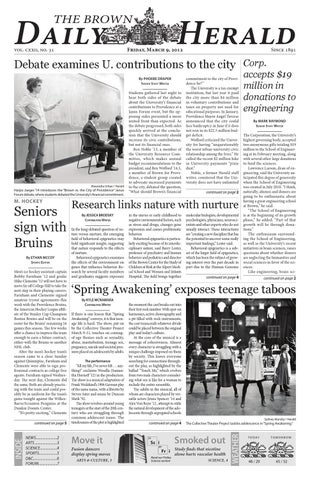
Alexandra Urban / Herald
Harpo Jaeger ‘14 introduces the “Brown vs. the City of Providence” Janus Forum debate, where students debated the University’s financial commitment.
Seniors sign with Bruins By ethan mccoy Sports Editor
Men’s ice hockey assistant captain Bobby Farnham ’12 and goalie Mike Clemente ’12 will not have to move far off College Hill to take the next step in their playing careers. Farnham and Clemente signed amateur tryout agreements this week with the Providence Bruins, the American Hockey League affiliate of the Stanley Cup Champion Boston Bruins and will be on the roster for the Bruins’ remaining 16 games this season. The few weeks offer a chance to impress the team enough to earn a future contract, either with the Bruins or another NHL club. After the men’s hockey team’s season came to a close Sunday against Quinnipiac, Farnham and Clemente were able to sign professional contracts as college free agents. Farnham signed Wednesday. The next day, Clemente did the same. Both are already practicing with the team and could possibly be in uniform for the team’s game tonight against the WilkesBarre/Scranton Penguins at the Dunkin Donuts Center. “It’s pretty exciting,” Clemente
inside
continued on page 5
news.........................2 Arts ..........................3 Science....................4 Sports.....................5 D&C............................6 Forum......................7
continued on page 2
Research links nature with nurture By Jessica Brodsky Contributing Writer
In the long-debated question of nature versus nurture, the emerging field of behavioral epigenetics may hold significant insight, suggesting that nature responds to the effects of nurture. Behavioral epigenetics examines the effects of the environment on genes that influence behavior. Research by several faculty members and graduates suggests exposure
in the uterus or early childhood to negative environmental factors, such as stress and drugs, changes gene expression and causes problematic behavior. Behavioral epigenetics is particularly exciting because of its interdisciplinary nature, said Barry Lester, professor of psychiatry and human behavior and pediatrics and director of the Brown Center for the Study of Children at Risk at the Alpert Medical School and Women and Infants Hospital. The field brings together
molecular biologists, developmental psychologists, physicians, neuroscientists and other experts who do not usually interact. These interactions are “creating a new discipline that has the potential to uncover some really important findings,” Lester said. Behavioral epigenetics is a subset of the larger field of epigenetics, which has been the subject of growing interest over the past decade in part due to the Human Genome
accepts $19 million in donations to engineering By mark raymond Senior Staff Writer
The Corporation, the University’s highest governing body, accepted two anonymous gifts totaling $19 million to the School of Engineering at its February meeting, along with several other large donations to fund the sciences. Lawrence Larson, dean of engineering, said the University anticipated this degree of generosity when the School of Engineering was created in July 2010. “I think, naturally, alumni and donors are going to be enthusiastic about having a great engineering school at Brown,” he said. “The School of Engineering is at the beginning of its growth phase,” he added. “Part of that growth will be through donations.” The enthusiasm surrounding the School of Engineering, as well as the University’s recent initiatives in brain sciences, raises questions about whether donors are neglecting the humanities and social sciences in favor of the sciences. Like engineering, brain sci-
continued on page 4
continued on page 2
‘Spring Awakening’ exposes teenage taboos By Kyle McNamara Contributing Writer
If there is one lesson that “Spring Awakening” conveys, it is that teenage life is hard. The show, put on by the Collective Theater Project March 9-11, touches on comingof-age themes such as sexuality, abuse, masturbation, teenage sex, pregnancy, suicide and societal pressures placed on adolescents by adults. The performance
“All my life, I’ve never felt … anything!” exclaims Wendla (Samantha Horneff ’12) in the production. The show is a musical adaptation of Frank Wedekind’s 1906 German play of the same name, with a libretto by Steven Sater and music by Duncan Sheik ’92. The show revolves around young teenagers at the start of the 20th century who are struggling through common adolescent issues. The timelessness of the plot is highlighted
Move it
Fusion dancers display spring moves Arts & culture, 3
the moment the cast breaks out into their first rock number. With spot-on harmonies, active choreography and a pit filled with rock instruments, the cast transcends whatever divide could be placed between the original play and today’s culture. At the core of the musical is a message of cohesiveness. Almost every character is struggling with a unique challenge imposed on them by society. This leaves everyone searching for connections throughout the play, as highlighted by the ballad “Touch Me,” which evolves from two male characters considering what sex is like for a woman to include the entire ensemble. The adults in the musical, all of whom are characters played by versatile actors Jenna Spencer ’14 and Alex Von Reyn ’12 , attempt to stifle the natural development of the adolescents through segregated schools continued on page 4
Sydney Mondry / Herald
The Collective Theater Project tackles adolescence in “Spring Awakening.”
Smoked out
Study finds that nicotine alone hurts vascular health Science, 4
weather
M. Hockey
Students gathered last night to hear both sides of the debate about the University’s financial contributions to Providence at a Janus Forum event, but the opposing sides presented a more united front than expected. As the debate progressed, both sides quickly arrived at the conclusion that the University should increase its civic contributions, but not its financial ones. Ben Noble ’13, a member of the University Resource Committee, which makes annual budget recommendations to the president, and Ben Wofford ’14.5, a member of Brown for Providence, a student group created to advocate increased payments to the city, debated the question, “What should Brown’s financial
commitment to the city of Providence be?” The University is a tax-exempt institution, but last year it paid the city more than $4 million in voluntary contributions and taxes on property not used for educational purposes. In January, Providence Mayor Angel Taveras announced that the city could face bankruptcy in June if it does not rein in its $22.5 million budget deficit. Wofford criticized the University for having “unquestionably the worst urban-university civic relationship among the Ivies.” He called the recent $2 million hike in University payments “pixie dust.” Noble, a former Herald staff writer, countered that the University does not have unlimited
t o d ay
tomorrow
48 / 29
45 / 32
2 Campus News calendar Today
March 9
6 P.m.
ToMORROW
March 10
3 p.m. Film Screening: A Separation,
Meet the Media: Hearst Magazines,
Smith-Buonanno 106
CareerLAB Library
10 p.m.
8 p.m. Dance Workshop Clinic,
Out of Bounds: March Salomadness,
Ashamu Dance Studio
Salomon 101
menu SHARPE REFECTORY
VERNEy-WOOLLEY DINING HALL LUNCH
Vegan Vegetable Bean Stew, Bulgur Stuffed Pepper, BBQ Beef Sandwich, Cajun Potatoes
Vegan Nuggets, Breaded Chicken Fingers, Vegan Warm Spicy Dhal, Rice Krispie Treats
DINNER Pasta with Fresh Basil Pesto, Baked Acorn Squash, Orange Teriyaki Salmon, Baked Sweet Potatoes
Orange Pad Thai, Seafood Cavettelli, Red Potato Frittata, California Blend Veggies
Sudoku
The Brown Daily Herald Friday, March 9, 2012
Donors target engineering, sciences continued from page 1 ences has seen a number of large gifts since the Institute for Brain Science was established three years ago. Last month, The Herald reported that the University is looking to raise $50 million over the next five years to support further growth in the field. “Investment in the (Science, Technology, Engineering, Math) fields can lead universities to get distracted from the humanities and the social sciences, but I don’t think that’s what’s happening here,” said Kevin McLaughlin P’12, dean of the faculty. McLaughlin, who helped launch the Humanities Initiative — an effort to strengthen teaching and research in the humanities — in 2010, said the sciences may appear to receive more attention simply due to the high costs associated with certain fields of study. “In order for neuroscientists and engineers to do the work that they need to do, it’s expensive and requires a lot of money,” he said. “We don’t need to raise huge amounts of money to do things in the humanities.” Michael Steinberg, director of
the Cogut Center for the Humanities and professor of history and music, said the humanities’ “most important resource” is its faculty. “I think the humanities initiative has been designated as the third major initiative along with engineering and brain science,” he said. “Obviously it will cost less money, but that doesn’t make it less important.” The Humanities Initiative, funded through a 2010 $3 million anonymous donation and through grants from the Andrew W. Mellon Foundation, will be hiring six new faculty members, the first of whom has already been selected. In addition to the already existing support for the humanities, McLaughlin urged the University to do more to explain the importance of research in the humanities to those not in academic fields, which will in turn attract more support from potential donors. “In some fields, like neuroscience, it might be very self-evident what the value of that research is, but there are huge parts of the University where there isn’t that sort of self-evidence,” he said. “We need to do more to explain why certain kinds of research are
important.” Steinberg said he believes Brown pays unique attention to the humanities, citing the Cogut Center and the Humanities Initiative as prime examples. “I think the climate here is really very healthy,” he said. The Public Health Program is also actively seeking to become a school, a move that could potentially lead to a similar influx of gifts. While this new school could raise similar concerns about resource diversion, the University as a whole is likely to benefit from the publicity generated from its establishment, according to Terrie Wetle, associate dean of medicine for public health and public policy. “I think that donations will increase, but I don’t believe that charitable giving is a zero-sum game,” she said. Wetle described donor enthusiasm as “contagious,” adding that “one big donor will bring in other big donors.” “We see it as an exciting opportunity,” she said. — With additional reporting by Phoebe Draper
Debaters cite need for civic ‘commitment’ continued from page 1
Crossword
resources. “Every dollar that we give the city of Providence means less stuff we can do here,” he said. Noble added that 60 percent of the University’s operating budget comes from tuition. “Is this where our tuition dollars should be going?” he asked. “To covering public sector employee pensions? … Diverting more money to Providence here means less for our education.” Wofford, a Post- staff writer, disagreed. “You can’t separate the University from its community,” he said. To side with the University in this debate is like “commending Goliath when David has two broken ankles,” he added. While the debate was meant to focus on the ideal size of the University’s financial commitment, it shifted to a more general discussion of the University’s responsibility to support the community. “The issue isn’t about money, it’s about commitment,” Wofford said. “Great universities don’t
Daily
the Brown
make excuses. Great universities make commitments.” Wofford did not explicitly argue that the University should increase its financial contributions, instead advocating that students should ramp up their civic service and institute widespread “service learning” initiatives. “Our contribution to Providence should be qualitatively higher and shouldn’t be financial at all,” he said. Noble said he could not argue with the benefit of increasing civic involvement and said the real question at hand was a financial one. “As someone with a firsthand look into all the things we have to postpone every year, it can be a little depressing. If people realized all the things the University would be giving up with these tough choices, they might think twice,” he said. “We have to make tough choices. I know it’s a cliche, but it’s the truth.” Students in the audience said it can be difficult to feel invested in the long-term relationship be-
Herald
www.browndailyherald.com 195 Angell St., Providence, R.I.
Claire Peracchio, President Rebecca Ballhaus, Vice President
Danielle Marshak, Treasurer Siena DeLisser, Secretary
The Brown Daily Herald (USPS 067.740) is an independent newspaper serving the Brown University community daily since 1891. It is published Monday through Friday during the academic year, excluding vacations, once during Commencement and once during Orientation by The Brown Daily Herald, Inc. Single copy free for each member of the community. POSTMASTER please send corrections to P.O. Box 2538, Providence, RI 02906. Periodicals postage paid at Providence, R.I. Subscription prices: $280 one year daily, $140 one semester daily. Copyright 2011 by The Brown Daily Herald, Inc. All rights reserved. editorial
(401) 351-3372 herald@browndailyherald.com
Business
(401) 351-3260 gm@browndailyherald.com
tween the University and Providence. “As a student who’s here for only four years … it’s in everyone’s best interest to maximize what they get out of Brown, rather than what Brown gets out of a relationship with Providence,” said Alyssa Garrett ’15. But others defended the city. “Brown is an institution that can pay but isn’t,” said Aaron Regunberg ’12. The debate was put on by the Janus Political Union and was triggered by a “lack of public rigorous discussion” on the topic, said Harpo Jaeger ’12, director of the union. Debaters and audience alike were aware of the implications of Brown’s actions in the coming months. “Brown’s decision will affect the action of other institutions,” Regunberg said. “These debates aren’t happening in a vacuum,” Wofford said. “The whole world is really watching what we’re doing.”
Arts & Culture 3
The Brown Daily Herald Friday, March 9, 2012
Fusion Dance spring show both moody and moving By jennifer Kaplan Contributing Writer
With crowd-pleasing hip-hop numbers and tragic modern pieces, Fusion Dance Company’s 29th annual spring show keeps the audience on its toes for its entire two-hour duration. The show, running through Sunday, includes pieces in a variety of different styles, all choreographed by students. “Whatever someone wants to choreograph is put in,” said Julia Cabral ’12, the group’s publicity manager. “Hopefully, for the audience, they get a little taste of different things throughout the show,” said Fusion Company Manager Natalie Inoue ’12. The diversity of pieces is furthered with a wide range of musical choices. From Billie Holiday’s “They Can’t Take That Away From Me” to “Howl” by Florence and the Machine to a medley of Top 40 hits,
the songs matched the mood of the movements in each piece, whether somber, joyful or violent. Student choreographers worked with other members of the 23-person group to realize their creations. “I liked seeing my movement done by other people and having it come together and actually being proud of myself,” said Jenny Sevy ’14. Sevy danced in many of the pieces and choreographed a poignant contemporary modern piece featuring four female dancers in the second act. Choreographing peers is inspiring, Inoue said. “Each person kind of has their own style and with that, at least for me, I definitely wanted to try and bring that out in every dancer,” he said. The dancers in the group have a wide range of experience. “We just look for people with good performance quality, if they have some type of spark when they’re performing, no matter where they come from,” said Artis-
tic Director Alyssa Thelemaque ’12. Though some pieces are more tightly put together than others, the show as a whole showcases the impressive choreographing and dance talent of the group. The variation of styles and mood are paired with interesting use of costumes and lights, like the fun use of silhouettes — harkening back to mid-2000s iTunes commercials — in a flirty piece called “Loving…So Deeply,” set to a medley of hip-hop songs. The dancers are emotive in their movements, particularly in more somber pieces such as “At the Dance,” set to a Billie Holiday song, and “Watch” to “All Alright” by Sigur Ros. From the first number to the finale, the dancers reflect a genuine joy in their performance. “We just want to put on a good show, and we’re here to give the audience something that’s worth their money, especially for college students,” Thelemaque said.
Rachel A. Kaplan / Herald
The 23-person company orchestrated a wide variety of pieces to suit all tastes.
Filmmaker calls Hollywood a stifling place for black cinema By meia geddes Staff Writer
Black cinema will become sustainable when it separates itself from Hollywood, filmmaker Arthur Jafa told roughly 30 people Wednesday. The event, hosted by the Department of Africana Studies, was entitled “The Critical Sorrow, Catastrophic Ecstasy and Convulsive Beauty of Modern Black Cinema and Visual Practice.” Held at the George Houston Bass Performing Arts Space at Churchill House, the dialogue was part of a series of conversations about the arts in black culture. The discussion involved perspectives that often get “eclipsed in public discourse,” said Corey Walker, associate professor and chair of Africana studies. Greg Tate, visiting professor of Africana studies, proposed the discussion to Walker and suggested his old friends Arthur Jafa and Richard Blint as participants, he told The Herald. Black cinema “actively engages all the expressive traditions” in the black community, said Jafa, a filmmaker, cinematographer and visual artist who lives in Los Angeles. While film was once less conservative, today’s forms do not allow for as much room for play, he added. “In the context of media, black people are not able to say what they feel,” Jafa said. Black cinema is very “preoccupied” and “curious” about the black experience, said Blint, a writer, critic, educator and lecturer who lives in New York City. “Cinema is the mechanism for the mediation of reality,” Jafa said. Motioning with his hands, he spoke of the need to create “a space for black people to play” without limitations. But it is a challenge to sustain black cinema in an environment of capitalism and Hollywood, Jafa said. The constraints of authority figures and power dynamics can nega-
tively affect cinematic freedom, he added. “We have so many stories to tell,” Jafa said of the black community. People in Hollywood do not want, and even fear, a greater presence of black people in cinema, he said. Black cinema has a history of “one-offs,” successful one-time endeavors that are not repeated, Jafa said. Two examples of one-off films are Bill Gun’s “Ganja and Hess” and Theodore Witcher’s “Love Jones,” Tate said. Though the University of California at Los Angeles had an “incredible outpouring of black cinema” at one point, nobody has sustained this success — a feat that would require significant funding, Jafa said. Andrew Colarusso MAT’13 disagreed with Jafa on this point. “Money is not the crucial element to sustainability,” he said. “The creative vision is always ours,” he added, citing Dave Chappelle as an example of a black man who started with a vision and little money. Charles Cobb Jr., visiting pro-
fessor of Africana studies, expressed concern about creating a space in Hollywood for black cinema. “I don’t know if there is any good news” regarding sustaining black cinema in the future, Tate said. While Jafa said he does not “have a problem with what Hollywood is doing,” there needs to be cinema that offers something different. Tate, Jafa and Blint all chose not to see “The Help,” a Hollywood film that features black maids during the Civil Rights era, Tate told The Herald. The movie seems like a “racist reactionary throwback to a time when the only roles for actresses were maids,” he said. “Don’t pay for it,” Blint said. There is work to be done in black cinema when it comes to the differing narrative expectations from practitioners and audiences, Blint said. “Black filmmakers are waiting for black audiences.” The three made many cultural references to influential black figures. Jafa said he was “profoundly impacted” as a child seeing come-
dian Richard Pryor recite poetry. Pryor had the “freedom to do what he wanted to do,” Jafa said. Blint quoted novelist James Baldwin, who influenced Blint’s PhD dissertation. Jafa referenced the “mindboggling” Chappelle, who made frequent references to race on
his television show. Many people embrace Chappelle in popular culture, he said. Blint said he “laughed in complicated ways” while watching Chappelle perform, prompting laughter from the audience. “I love Dave Chappelle,” he added.
4 Science Friday
The Brown Daily Herald Friday, March 9, 2012
Nicotine itself may threaten cardiovascular health Pollution By Alyssa Self Contributing Writer
The link between cigarette smoke and cardiac disease is well-established, but research conducted by Professor of Medical Science Chi-Ming Hai found that nicotine alone has negative effects on vascular health. While nicotine replacement products such as patches or gums have long been considered safe alternatives to cigarettes, the results of Hai’s study show that nicotine may be a key culprit in the development of atherosclerosis, the hardening of the arteries. Hai presented his results in San Diego at the Biophysical Society 56th Annual Meeting Feb. 26. Atherosclerosis is the accumulation of plaque in blood vessels caused by an invasion of vascular smooth
muscle cells. Plaque formation in blood vessels can contribute to heart disease by stiffening and narrowing vessels. When these plaques break loose, they can lodge in other vessels and deprive the brain or heart of oxygen, leading to heart attack or stroke. Hai’s findings reveal that nicotine may contribute to cardiovascular disease by inducing cellular migration and changes in cell structure. Normally, the layers of blood vessels are separated by extracellular matrix, which serves to prevent cell migration. But in the presence of nicotine, invading smooth muscle cells can remodel the cytoskeleton into structures called podosomes, Hai’s research shows. These structures release enzymes that degrade the extracellular matrix, compromising
the vessel’s integrity and permitting the muscle cells to migrate into the vessel’s interior. “Substituting smoking with nicotine may have limited beneficial effects on atherosclerosis,” Hai said. The study used rat vascular smooth muscle cells, and Hai is now examining this phenomenon using human smooth muscle cells with the help of Patricia Melvin ’12. Melvin described Hai as “a great teacher” and said the projects are progressing smoothly. Preliminary results from her work demonstrate increased cellular migration in the presence of nicotine, thus providing evidence for nicotine-induced risk of atherosclerosis in humans as well. Melvin plans to present her results at the thesis poster day at the end of the semester.
Hai said many people came to view his poster presentation at the Biophysical Society conference, and the society deemed Hai’s abstract a highlight of the meeting. Albert Wang, senior scientist at the Boston Biomedical Research Institute, said the study is a good start but is limited because it has only been carried out at the cellular level. Wang recommended Hai study the effects of nicotine in animal models or arteries in culture. Nicotine products should bear a warning label, Hai added. “Nicotine is not a benign substance,” Hai said. “It has detrimental effects, especially on blood vessels.” While the use of nicotine patches or gums can help smokers stop the habit, long-term use of nicotine-containing products may be harmful, he said.
Study examines gene-environment interplay continued from page 1 Project, said Audrey Tyrka, assistant professor of psychiatry and human behavior at the Med School. The sequencing of the human genome suggests humans are not that genetically different from chimpanzees or even roundworms. The key lies in epigenetic mechanisms, which turn different genes on and off in different species and cells without changing the genes themselves. Animal studies suggest that changes in gene expression are both heritable and reversible. In a recently published paper, Tyrka studied the effects of childhood adversity, including maltreatment and parental loss, on stress and risk for mental illness. This preliminary study suggested childhood adversity may cause changes in stress response due to epigenetic changes, Tyrka said. Previous research in rats had suggested that when pups are in a negative environment — such as receiving less motherly care — a specific
epigenetic mechanism kicks in. This mechanism is methylation, inhibiting the expression of a gene that regulates cortisol — a hormone that controls the stress response. As a result, the pups showed more extreme responses to stress. Tyrka’s study looked at cortisol responses in healthy adults with histories of childhood adversity. Tyrka found a link between childhood adversity and increased methylation, though she said it is difficult to say for sure the cortisol regulation gene is at fault, as there is no access to subjects’ brains. Both Lester and Tyrka agree the inaccessibility of the brain is a challenge in studying behavior-related epigenetic changes in humans. They depend on other specimens, such as saliva, blood and placenta to indirectly study the changes. In his research, Lester examines genes in the placenta to determine the adverse effects of a pregnant mother’s exposure to negative environmental
factors — such as stress, drugs and depression — on fetal development. “This is a dream to be able to go back and actually untangle how this whole process potentially unfolds, ” Lester said. While at Brown, Cailey Bromer ’11 worked with Lester on studying genes in the placenta regulating maternal cortisol, including the same gene Tyrka studied. Changes in the activation of these two genes due to negative environmental factors overexpose the fetus to cortisol, affecting fetal development, therefore putting the child at risk for behavioral and cognitive problems. Bromer will be publishing a paper on her work with Lester in the near future. Behavioral epigenetic findings have long-term implications for determining and helping “at-risk” individuals. “When we establish that stressful environments have an effect on your genome, it becomes much more com-
pelling to make environments better,” Tyrka said. In addition to preventive measures addressing environments where adversity may occur, treatments targeting epigenetic changes may be developed. For example, Lester suggested treatments that may, in the future, inhibit addiction genes in the children of drug addicts. Additionally, it is unknown whether stress interventions such as psychotherapy, medication, mindfulness and yoga may affect, or even reverse, the effects of negative environmental factors on gene expression. While the argument of nature versus nurture rages on, developments in the field of epigenetics, particularly behavioral epigenetics, have implications for better understanding the underlying mechanisms of geneenvironment interactions. “We’re hopeful, and probably, when it comes down to it, everything that happens in our body is actually about gene expression,” Tyrka said.
New theater group calls for consistency continued from page 1 and lack of sexual education. But Melchior Gabor (Michael Gale ’14) has grown up in a more progressive household and attempts to awaken and educate his classmates. What unfolds from this catalytic influence is a series of character arcs, from those struggling to break free, like Ilse and Moritz, portrayed by Emily Kassie ’14 and Ryan Glassman ’15, to those struggling to keep their burdens hidden. Perhaps the most haunting tale of secrecy is given by Martha (Christina Ames ’15). In the musical number “The Dark I Know Well,” Martha tells of the nightly abuse her father inflicts on her and how her mother pretends not to notice. Afraid of getting removed from her home like Ilse, who was also abused by her family, Martha swears her friends to secrecy when they notice the welts forming on her forearm. Throughout the production, the cast gives a series of impressive vocal performances coupled with emotionally draining dialogues that leave the audience stunned. It is hard to
pinpoint one breakout performance, as the whole cast puts all its energy into the production. For almost every musical number, no matter the soloist, the entire cast participates with a series of background harmonies to add depth to the performance. The cast sits in the front row on all three sides throughout the musical, in a move of solidarity to show that everyone is together in the exploration. It is at times difficult to remember that they are a separate entity from the audience. This simple gesture reiterates the musical’s message that everyone is searching for connections and there are those around who want to help. At the sight of Martha’s welts, Wendla exclaims, “I just wish I could somehow go through it for you.” This musical attempts to do just that, leaving no adolescent taboo untouched. The Collective Theater Project
“Spring Awakening” marks the first production by the Collective Theater Project, which was created because the troupe felt there was “not enough musical theater on campus,”
said Horneff , who plays Wendla and serves as the production administrator. Horneff looked to her cousin’s involvement in the theater company Fiasco Theater — where people typically take on both a production role and a character in each show — for inspiration to form the Collective Theater Project. “Why be just an actor when you can be an artist?” Horneff said. Horneff began collaborating on the idea last semester with Emily Kassie, the musical’s choreographer who additionally performs in the role of Ilse. Horneff had been dreaming about putting on “Spring Awakening” for a long time, and Kassie jumped at the opportunity, they said. Since the idea behind the theater company is that of a family that stays together from production to production, the duo began to cast not only “Spring Awakening,” but the theater company itself, half of which was cast in one day. “I was terrified going into it,” Kassie said. “Group projects can get hectic.” But Kassie and Horneff found
that once they got started, the group became so involved that ownership of the show multiplied, they said. “No one has the final say,” Kassie said. Working on the show “brings us together as a family … as a cast … as a theater company.” The funding for the show is currently being provided by the cast while the company waits to hear back from grants for which it applied. The group kept the production costs low by borrowing microphones from Musical Forum, working together to build the set and focusing the show on the characters, not a flashy production. The group received some funding from Production Workshop, which also provided the space for the production. After “Spring Awakening,” the Collective Theater Project will lose three members who are graduating this semester, but they plan to continue the company. Their goal for the future is to perform shows that are not usually picked for Brown theater, Horneff said. Kassie added that they look forward to the “consistency of a group among shows.”
may trigger strokes, research finds By Sofia Castello Y Tickell Contributing Writer
Even at levels that comply with federal regulations set by the Environmental Protection Agency, air pollution may increase the risk of stroke, according to research led by Gregory Wellenius, assistant professor of epidemiology. Wellenius’ study was published last month in Archives of Internal Medicine. Wellenius and his team retrieved the medical records of 1,705 patients at Beth Israel Deaconess Medical Center in Boston hospitalized with ischemic stroke — a condition often caused by the blockage of an artery to the brain — and compared the timing of the onset of their symptoms with air pollution values. Previous studies had used the date of hospital admission rather than timing the onset of symptoms, a methodology more “prone to error” as half of patients had their strokes on a different calendar day than the date of their hospitalization, Wellenius said. Boston was “always in compliance with federal standards” for air pollution during the study, Wellenius said, and yet the team found a 34 percent higher risk of stroke on days with “moderate” levels of pollution, as compared to “good” days. Pollution, as defined by the EPA, includes measurements of ozone, carbon monoxide, sulfur dioxide and nitrogen dioxide, as well as different size fractions of particles and lead, though this last component is not as prevalent since it ceased to be present in gasoline. “At levels that the EPA considers to be generally safe, we’re seeing a large increase in rate of stroke, which suggests that the EPA may not be adequately protecting the public,” Wellenius said. “This really is a public health problem.” Wellenius offered the tightening of regulations as a potential solution. “I certainly can imagine where air quality will affect all sorts of things health-wise,” said Elaine Jones, who specializes in stroke at Roger Williams Medical Center. “Why there should be a direct effect on strokes is a little surprising to me.” Even though the study suggests a correlation between air quality and stroke risk, there may not be a direct cause-and-effect relationship between the two, Jones said. “In science, you can have things that appear to be related but have nothing to do with each other,” she continued. “On days of poor air quality, perhaps people will eat differently, you know?” Jones added she would not change her patients’ care or public policy based on Wellenius’s study. Wellenius’ next goal is to replicate his findings in different cities across the country, as they may have different health risks. “Pollution mixtures change in different cities,” he said. “So the pollution in (Los Angeles) is very different from the pollution in Boston.”
Sports Friday 5
The Brown Daily Herald Friday, March 9, 2012
‘Moneyball’ generation Seniors take on pro athlete schedule they needed both of us.” edged the new atmosphere playing juggles loyalty and success continued from page 1 thatFarnham finished third on the in a bigger arena with new teamcontinued from page 8
Colts owner Jim Irsay would meet with the cocky Luck 15 minutes before the end of the movie and realize what a horrible mistake he’s made. He would show up at Peyton’s house and recount the famous speech from Jerry Maguire, before Manning cuts him off to tearfully reply, “You had me at hello.” In the movies, feelings and relationships triumph over the obstacles that are thrown in people’s way and the characters realize the human condition is defined by those around them. Sports are not a movie. Sports are real life. Real life is about existing within civilization and exchanging your specific skill set for that of others. Money is how we carry out these transactions. Business is application of Darwinian law to money. The most efficient and best working model will succeed, whether that means surviving or making money. For sports executives, the best business model is to win games. I have known these points for a long time. They are ideas that I don’t think are wrong or morally incorrect because they are facts that got us to this stage of human evolution. I’m a Moneyball generation kid. A guy who wanted to trade Rajon Rondo for Chris Paul in the offseason because he had superior numbers. I’ve always understood what winning takes in professional sports. I’ve always
known the puppeteers were behind the curtain the whole time. So why does it bother me so much that the puppeteers have torn the curtain away? Over Christmas break, I had settled in to watch the Boston Celtics’ season opener against the New York Knicks. Halfway through the second quarter, my 19-year-old sister took a seat on the couch and patiently waited for the game to hit the halfway mark so she could watch her DVR’d episode of “How I Met Your Mother.” After a pan down the Celtics’ bench by the camera, she looked at me, puzzled and asked, “Where is Big Baby?” I scoffed and told her that the player in question, Glen Davis, had been traded in the offseason. She was horrified by my dismissive tone and replied, “That’s awful!” I shrugged and explained to her that we had flipped Davis for the better Brandon Bass and that I was behind it 100 percent. Bass was better then Davis at pretty much everything. She looked at me and said, “But Big Baby was a Celtic.” But we had a chance to turn him into one more rebound a game and a better shooting percentage. We had to do it. That’s how you win games after all. Sam Sheehan ’12 is probably just bitter about Peyton Manning coming to the AFC East. Talk sports with him at sam_sheehan@brown.edu or follow him on Twitter @SamSheehan.
Men’s lacrosse team shaken by loss continued from page 8 maining in the half to stop the bleeding, but Hartford answered less than a minute later to cap a one-sided half. Things did not let up in the third quarter. After letting in three more goals, Round was pulled in favor of first-year Corbin Booker ’15, who was recruited as a midfielder but converted into a goalie in the fall. Booker made two athletic saves in quick succession, but could only do so much to slow down the relentless Hartford attack. Brown scored twice in the quarter with goals from Sam Hurster ’14 and Nick Piroli ’15, but the Hawks closed out the third with three goals to make the lead 17-5 headed into the final 15 minutes.
In the fourth, both teams mixed up their personnel, and the Hawks closed the game out with two straight goals to make the final score 20-6. “It’s better than having it late in the season, but you never want to have a game like this,” Ford said. The loss opens up a lot of questions in the young season that Tiffany said the coaching staff must address. While these adjustments may take some time, the Bears won’t have long to wait before they get the chance to redeem themselves as they take on St. Joseph’s (2-3) tomorrow. A win in Philadelphia would move Bruno’s out-of-conference record back to .500 and give the team a boost before heading into its Ivy opener at Harvard (2-1) March 17.
said. “It’s crazy, especially because the four years have gone by so fast and it’s the next step in our hockey careers. It’s even better that we’re staying in Providence and we don’t have to leave school. It’s just a perfect situation.” The two will not have to drop any courses or leave campus, but will have the unique challenge of balancing the academic work of their final semester with the newly added schedule of full-time professional athletes. Both players said it was coincidental that the opportunity presented itself for both of them to join a team that plays just a mile away from the Brown campus. If the Bruins’ goalie Tuukka Rask had not been injured recently, which changed the personnel needs of the organization, the opportunity in Providence may not have been available, Clemente said. “I had no idea where I was going to end up, and I honestly didn’t think it was going to be in Providence,” Farnham said. “But then I heard that Providence might be the best fit since they needed forwards, and, as it turns out, we’re right here. I don’t think there’s any personal preference involved, though.” “It’s just whoever can fill the need,” Clemente said. “A lot of things have to line up for it to work, and it’s really just by luck
team in points with 21 this season and has been a consistent presence on the ice, playing in every game save two in the last four seasons. A Massachusetts native, Farnham is joining a Bruins’ organization he has been a fan of since he was a kid. “For me, I think it’s awesome that we get to stay close by and play within an organization that I grew up watching,” Farnham said. “It’s pretty special, and I’m excited to just be a part of it.” Clemente has been a familiar man behind the mask at Meehan Auditorium, starting the majority of Brown’s games in net for the past four seasons. This year, Clemente had a 2.68 goals against average and .907 save percentage, and he finished his career second all-time in saves in University history. No goalie has started more games in a Brown uniform than Clemente. Both Clemente and Farnham said playing hockey professionally has been something they dreamed of since childhood, but had only considered a real possibility recently. “It’s always been a lifelong goal of mine,” Clemente said. “It was probably during this summer that I started realizing that something could happen when the season ended.” From their first few practices with the P-Bruins, both acknowl-
mates and also pointed out the jump in level of play between the ECAC and the AHL. “It’s just a little different,” Clemente said. “Everything’s just a little bit quicker and they just have some skill and ability that you don’t see as much at the college level.” Farnham and Clemente join a trend of Bears making the jump to the pros. Two years ago, Aaron Volpatti ’10 signed with the Vancouver Canucks and joined their AHL affiliate the Manitoba Moose before moving up to the NHL club. Last season, Harry Zolnierczyk ’11 signed with the Philadelphia Flyers, and, after spending time with the Adirondack Phantoms, has played in 36 games with Philly. Though he did not sign with an NHL organization out of college, Ryan Garbutt ’09 has worked his way through several minor leagues and made his NHL debut for the Dallas Stars in February. Another Brown hockey player from the class of 2012 is expected to finalize a professional spot soon. Captain Jack Maclellan ’12 has been impressive the past two seasons as a Bear, leading the team in both goals and assists this season and earning a spot on the Hobey Baker Award watch list. According to the Providence Journal, Maclellan is close to signing a contract with the Nashville Predators, but nothing has been finalized yet.
Foxen ’12 heads to nationals after historic win continued from page 8 possibly three, guys to Nationals in St. Louis in two weeks. And it’s just really great to be a part of that. What got you started in wrestling in the first place? My father was a wrestler. He wrestled at SUNY Brockport in college, and then he competed internationally in freestyle after that. He was a two-time collegiate AllAmerican at Brockport, and he was also a multi-time All-American at
the senior freestyle level. He was the first one to get me involved in the sport. My first tournament — the first match that I ever had — I got pinned in about 30 seconds. And then I felt pretty bad. And then the next match, I got a pin, and then from that moment on, I was hooked. I thought it was the coolest thing ever. This is the first time you’ve qualified for the NCAA tournament. How does it feel to have that opportunity?
It’s awesome. I’m a senior too, and this is my first time. So I’ve kind of worked my entire life for this, to be able to go and compete at the highest stage in wrestling, which is NCAAs and give myself a chance to be All-American. I’ve been through a lot, too, because coming from high school, I never even placed in my state tournament. Never even qualified, actually. So I’ve worked really hard throughout my college career to get to that next level. And it’s nice to see my hard work’s finally paying off.
comics Fraternity of Evil | Eshan Mitra, Brendan Hainline and Hector Ramirez
Role Reversal | Samantha Cheung
6 Diamonds & Coal Diamonds & Coal
The Brown Daily Herald Friday, March 9, 2012
Editorial cartoon by lo r e n f u lto n
A diamond to incoming President Christina Paxson, who told an audience in Sayles Hall last Friday that she realized the effects of spending time at Brown when her formerly “clean-cut, studious” brother “had long hair,” started “listening to new music” and debated “the ethics of eating meat” after coming to the University. President-elect Paxson, we can’t wait to watch your transformation. Cubic zirconium to the senior who originally thought the naked masturbator recently spotted on John Street was wearing skintight, nude-colored pants. In case you were wondering, students on Brown Bares aren’t wearing those either. A diamond to past leaders of the Undergraduate Council of Students and the Undergraduate Finance Board who described the relationship between the two groups as “rival,” “bitter” and “overly dramatic.” Call Bravo, it looks like we’ve found the next hot reality show: “The Real Student Government of Brown University.” Coal to the junior who started Meatless Mondays, an initiative to abstain from eating meat on Mondays, at Brown and said, “A lot of the time, food is there, and we just eat it.” Yes, but why else would we stomach the Ratty’s cheese and corn strata? A diamond to the University for planning to introduce academic offerings for mid-career professionals, a move one graduate called “exclusively for making money.” Why stop there? We want to be able to get our modern culture and media studies degree and scuba diving accreditation in the same place. Coal to Chandan Reddy, who said in a lecture Monday about the nature of violence that we need to “undo this pedestrian understanding of the relationship.” Funny, that line didn’t go over so well when we used it in our last breakup. A diamond to the member of Brown for Providence, a student group created to advocate increased payments to the city, who said of the debate over the University’s contributions to the city, “The whole world is really watching what we’re doing.” Sounds like what the naked masturbator must have muttered to himself when he was up and about Wednesday night. Coal to President Obama for omitting President Ruth Simmons from his shortlist for candidates to head the World Bank but including former Harvard President Larry Summers. Your previous president may have been director of the National Economics Council, Harvard, but our future president used her economics expertise to conclude that tall people are usually smarter than short ones. A diamond to Ruth Rosenberg, the new ombudsperson, who said at Tuesday’s faculty meeting that she is open to all suggestions about improving the University. We applaud her spirit and suggest that she start with, in the oft-misquoted words of former President Herbert Hoover, “a batch of Jo’s mozzarella sticks in every pot and an exit sign for every Keeney freshman.”
le tter to the editor Housing changes to erode Perkins community To the Editor: In regards to the article about campus housing renovations (“Campus housing to be renovated, transformed,” Feb. 13), I feel compelled to write a brief note about the conversion of Perkins Hall from first-year to upperclassman housing. As Margaret Klawunn, vice president for campus life and student services, stated in the article, Perkins is very far from the center of campus. However, I was disappointed to read her general statement that “most students dislike living in Perkins” due to the geography of the dorm. On the contrary, I believe the location of Perkins provides a truly unique first-year experience that not only isn’t replicated elsewhere at Brown, but is also a tremendously positive one for its first-year residents. The community and friendships that are naturally
formed at Perkins each freshman year are formidable. Case in point: During my senior year, more than 50 percent of my freshman year unit still lived together. What other dorm or unit can boast that incredible retention of first-year relationships? Plus, we had the best freshman access to the real Bagel Gourmet just down the street. I understand the University’s struggle with upperclassman housing, and admittedly Perkins does present an attractive option. I only wish to defend the first-year experience that Perkins provided to years of Brown’s finest and to celebrate its tenure as a home for first-years. A unique and formative part of the Brown experience will no longer be available, and it is bittersweet to this alum to hear of its conversion. Ben Friedman ’09
Corrections
An article in Thursday’s Herald (“UCS-UFB committee moves forward with review,” March 8) stated that Ben Farber ’12 said he believed the council needed a discretionary fund. In fact, Farber was explaining that others believe the council needs a discretionary fund, while he himself does not share the opinion. The Herald regrets the error. An article in Monday’s Herald (“Jockapella athlete-singers team up on stage and football field,” March 5)
t h e b r ow n da i ly h e r a l d incorrectly referred to the group as the Jockapellas. In fact, the group is called Jockapella. The Herald regrets Editor-in-Chief
Managing Editors
Senior Editors
Claire Peracchio
Rebecca Ballhaus Nicole Boucher
Tony Bakshi Natalie Villacorta
editorial
Business
Arts & Culture Editor Sarah Mancone Arts & Culture Editor Emma Wohl City & State Editor Elizabeth Carr City & State Editor Kat Thornton Features Editor Aparna Bansal Assistant Features Editor Jordan Hendricks News Editor David Chung News Editor Lucy Feldman News Editor Greg Jordan-Detamore News Editor Shefali Luthra Science Editor Sahil Luthra Sports Editor Ethan McCoy Sports Editor Ashley McDonnell Assistant Sports Editor Sam Rubinroit Editorial Page Editor Jonathan Topaz Opinions Editor Charles Lebovitz Opinions Editor Jared Moffat Graphics & Photos Eva Chen Emily Gilbert Rachel Kaplan Jesse Schwimmer
Graphics Editor Photo Editor Photo Editor Sports Photo Editor
Copy Desk Chief Design Editor Design Editor Web Producer
Office Manager Shawn Reilly
Directors Julia Kuwahara Samuel Plotner Nikita Khadloya Angel Lee
Sales Finance Alumni Relations Business Development Managers
Justin Lee Kaivan Shroff Gregory Chatzinoff Mahima Chawla Matthew Hill Alison Pruzan Elizabeth Gordon David Winer
Human Resources Research & Development Collections Collections Finance Operations Alumni Engagement Fundraising Marketing
Post- magazine Sam Knowles
Production Olivia Conetta Kyle McNamara Julia Shube Neal Poole
General Managers Siena DeLisser Danielle Marshak
Editor-in-Chief
BLOG DAILY HERALD Jennifer Bloom Matt Klimerman
Editor-in-Chief Managing Editor
the error.
quote of the day
“It’s like commending Goliath when David has two broken ankles.” — Ben Wofford ’14.5, on the U.’s relationship with the city See Debate on page 1. C O R R E C T I O N S P olicy The Brown Daily Herald is committed to providing the Brown University community with the most accurate information possible. Corrections may be submitted up to seven calendar days after publication. C ommentary P O L I C Y The editorial is the majority opinion of the editorial page board of The Brown Daily Herald. The editorial viewpoint does not necessarily reflect the views of The Brown Daily Herald, Inc. Columns, letters and comics reflect the opinions of their authors only. L etters to the E ditor P olicy Send letters to letters@browndailyherald.com. Include a telephone number with all letters. The Herald reserves the right to edit all letters for length and clarity and cannot assure the publication of any letter. Please limit letters to 250 words. Under special circumstances writers may request anonymity, but no letter will be printed if the author’s identity is unknown to the editors. Announcements of events will not be printed. advertising P olicy The Brown Daily Herald, Inc. reserves the right to accept or decline any advertisement at its discretion.
Taking Sides 7
The Brown Daily Herald Friday, March 9, 2012
Are “study drugs” a form of cheating? Yes
No
by which we are expected to be assessed through a specific test of skill, is less clear and certainly less discussed. At a univerBy kevin carty sity, each student is also being tested on an Opinions Columnist amount of stamina, an amount of vigor that stands independent of the will to study and simple knowledge. To state the obvious, Ritalin and Adderall Hard academic work necessarily inmake studying easier. They provide for un- volves petty and large-scale frustration. It natural focus and absurd alertness during has inherent amounts of complexity. It will times of high stress and little sleep, to the often bring boredom. It can be sidetracked benefit of thousands of improved grades by emotional difficulties. In other words, and to the detriment of countless study hard academic work is a synecdoche for life habits. Going to a university that provides itself. for and believes in the pursuit of academic The student on Adderall is tested on her knowledge involves will and her knowlan academic agreeedge. The student ment. This agree- When a student uses Adderall who goes her way ment, which is nec- or Ritalin … he or she is taking without chemical essarily meritocrathelp is passing an ic, relies on fairness. a full 50 percent of the test entirely additional Study drugs, which test, one that evalprevent their users that the unaided student is. uates her ability to from being assessed bypass frustration, on certain important skills, do constitute delve into complexity, defy boredom and cheating, as they violate this agreement by succeed independent of emotional turbumaking academics unfairly harder for some lence. We all know that this test is imporand easier for others. tant. We feel it in the hundreds of pages of Some of the academic agreement is ob- readings we have a week and when we exvious. As part of going here, we agree, and perience a breakup the day before a paper are expected, to pursue and demonstrate is due. academic knowledge. I guess, in a way, AdSo when a student uses Adderall or derall and Ritalin don’t subvert this either. Ritalin, artificially manipulating his neuWhile on such a stimulant high and in pos- rotransmitters to do the work his stamina session of such a seemingly unstoppable po- and willpower should have done already, he tential to focus, one could easily direct his is taking a full 50 percent of the test that the focus toward non-academic pursuits. To unaided student is. I challenge anybody to gain the benefits of the drug, the student still call that anything but cheating. needs the will to study. And at the close of a test or a conclusion of a paper, a study drug Kevin Carty ’15 is a political science conuser has still demonstrated the same knowlcentrator from Washington. He would edge that everyone else has. love to hear any responses and can be The other portion of this agreement, reached at kevin_carty@brown.edu.
one else’s future academic success. Curing cancer, solving the energy crisis, deconstructing postmodernism — these By jared moffat are not contests. Rather, these are pursuits of Opinions Editor universal human interest, and the achievement of these goals is inherently valuable, whether or not someone used study drugs Cheating applies to situations in which to get us there. Furthermore, Kevin’s argusome standard of fairness is violated. This ment necessarily devolves into an absurd usually involves a game or competition of view, as it leads us down the proverbial slipsome sort. A cheater is someone who pos- pery slope. sesses an unfair advantage over her comIf we buy Kevin’s logic, why should we petitors that is prohibited by the rules of the stop at drugs like Adderall and Ritalin? Sevgame. eral writer friends of mine have mentioned To suggest that using study drugs is a that they produce some of their most honform of cheating, est and visceral then, is to imply work after they’ve that this cheating The pursuit of knowledge and imbibed a bit of takes place in the the mastery of intellectual alcohol. Or, supcontext of some pose someone gets kind of competi- virtues is not a competition, an idea for a pation. My argument per after they eat a is simple: The pur- but a cooperative enterprise. cannabis brownie. suit of knowledge And let’s not forget and the mastery of intellectual virtues is not the academics’ favorite drug of all — cafa competition, but a cooperative enterprise, feine. Even if we forget drugs, it’s rumored and therefore, the use of study drugs does that Noam Chomsky only needs one hour not qualify as an unfair advantage. of sleep every night, allowing him to be a Note that I don’t want to suggest that the tremendously more prolific writer than his use of powerful stimulants is safe or wise, peers. Should we consider all of these activionly that it’s not a form of cheating. ties cheating, too? The fundamental error in Kevin’s posiIt’s going to be very challenging to draw tion lies in the presumption that the aca- a principled line between study drugs and demic arena is a sort of competitive enter- a host of other socially acceptable forms prise in which some win, and others lose. of productivity enhancement like the ones But, learning and education are not com- I just mentioned. To avoid this unintuitive petitions. Rather, the college experience conclusion, we must reject the assertion embodies symbiotic relationships in which that using study drugs is a form of cheating. the increased intellectual savvy of my peers benefits me and does not put me in an unfair disadvantage — a rising tide lifts all boats. Jared Moffat ’13 drank three cups of In other words, the increased academic succoffee while writing this. He can be cess of one individual never precludes any- contacted at jared_moffat@brown.edu.
Moffat’s rebuttal
Carter’s rebuttal
Carty argues that part of the “test” of college involves stamina and willpower, something that study drugs can induce artificially and, therefore, unfairly. There are a number of problems with this position. First, I wonder why Carty doesn’t consider the consumption of coffee a form of cheating. More than a handful of academics are addicted to caffeine. Aren’t Red Bull and Five Hour Energy also artificial enhancers of cognitive stamina? Carty doesn’t give us a reason to think there is a difference between study drugs and these other stimulants. But I’d bet that many people are unwilling to say that consuming caffeine and other overthe-counter stimulants constitute a form of cheating. Second, I think we should be skeptical about Carty’s characterization of college as some sort of obstacle course. Professors don’t directly assign grades based on how much time and attention we allocate to a paper or problem set — they grade the quality of what a student submits. Furthermore, the point of a taking a course isn’t to spend some arbitrary amount of time studying outside of class. Rather, the aim is to master either some skill set or some corpus of knowledge. If you have learned and internalized the essential lessons of the course, then you
deserve an A, whether or not you used a stimulant to do so. In other words, knowledge itself — not the amount of stamina required to comprehend that knowledge — is what matters in college. Third, let’s think about genuine cases of academic misconduct. The most obvious examples that come to mind involve copying another person’s work or passing off someone else’s work as your own. Bringing in answers to a test — that is, using a ‘cheat sheet’ — is another paradigm case of cheating in an academic setting. In these situations, the cheater has helped herself to resources beyond her own mind. But, using study drugs doesn’t seem at all analogous to these classic examples of cheating. Taking a study drug isn’t like downloading the answers to a test into your brain. You still have to study for tests in order to know the material. You still have to adequately understand the relevant concepts to perform well on the assignment. Again, I do not want to suggest that the use of study drugs should be encouraged. There are in fact many severe health risks involved with using drugs like Adderall and Ritalin. There might even be other moral reasons for prohibiting the unprescribed use of study drugs. It’s clear though that we shouldn’t consider the use of study drugs a form of cheating.
The point that the academic arena is a cooperative, not a competitive enterprise is a compelling one. But I believe that it is incorrect, as the academic arena has an element of meritocracy inherent to it that is important to society as a whole. How does this process act itself out? The testing and grading system is something to which we all subscribe and, by virtue of our admittance to Brown, something in which we have all succeeded. As I describe above, it endeavors to examine, assess and grade each one of us on our will to study, our academic knowledge and our willingness to overcome the pitfalls inherent in hard academic work as well as life itself. But why shouldn’t this instead be a cooperative adventure? Why shouldn’t we endorse Moffat’s view? The answer is that study drugs undermine a meritocracy, and Moffat vastly underestimates the importance of this meritocracy. The most successful students, those who study well, overcome difficulties and innovate successfully, will one day be offered positions in the highest echelons of their field. The best sociologist will receive generous funding and substantial academic freedom. The groundbreaking writer will gain publishing opportunities. The financier will gain a large market share to implement his investing decisions. The meritocracy begun in school and continued throughout adult-
hood matches ability and effort with the means and materials to realize those traits. Despite its flaws, it is the most efficient way for society to direct its resources to those most able to make use of them. Cheating allows for one to fake the abilities rewarded by a meritocracy. Study drugs, as I contend above, constitute cheating, as they artificially replicate the stamina and vigor necessary to triumph the challenges of hard, boring work. In doing so, the Adderall user makes it harder for the unaided student to rise in a system where other contenders have succeeded while being tested on fewer skills. That is fundamentally unfair. Furthermore, those using study drugs attack the meritocracy that matches productive ability with the means to be productive, placing unqualified individuals in positions that require skills they don’t have. Lastly, Moffat discusses how challenging it would be to draw “a principled line between study drugs and a host of other socially acceptable forms of productivity enhancement.” I agree. To reach such a conclusion is not intuitive, but I don’t think a principled conclusion is impossible. I would rather take on that challenge than accept all performance enhancers as fair, thereby accepting drugs that hurt the hard-working, assault beneficent social structures and stop us from doing difficult, necessary and important things.
Daily Herald Sports Friday the Brown
M. LACrosse
Hartford Hawks crush Bears By ethan mccoy Sports Editor
When co-captain Rob Schlesinger ’12 fired home the first shot of the game to put the men’s lacrosse team on top of Hartford 1-0 only 43 seconds in, it looked as if it might be another long day for the previously winless Hawks. But Hartford (1-3) had other plans, controlling the game for the remaining 59 minutes and handing the Bears (1-2) a deflating 20-6 defeat at Meister-Kavan Field Wednesday afternoon. “We just weren’t ready to play,” said defenseman Sam Ford ’13. “That’s what it comes down to. We weren’t ready to play and they were, and the score showed it.” The Bears came into the game off a hard-fought defeat against No. 5 UMass (5-0) Saturday that left the team disappointed, but still encouraged by a number of things the team did well. But Wednesday’s performance was a step in the other direction. “As a coaching staff, we did not do our job preparing the men to play a very good team,” said Head Coach Lars Tiffany ’90. “We as a staff have to reassess everything we’re doing from schemes to personnel to maybe even the pregame meal. Getting beat like this is humbling.” Hartford worked the ball around well and strong passing led to a number of easy finishes from close range. The Hawks’ attack was spearheaded by five goals from Aidan Genik and three goals and two assists from Kevin O’Shea. As the game opened up, Hartford pressed in its transition game, and converted a number of chances on the break. “We let them run, and they’re a very good transition team,” Tif-
fany said. “We didn’t do our best to prevent their transition, and letting a good team like Hartford run and gun is going to yield the results we saw.” On the other end of the field, the Bears again ran into stellar goalie play. UMass’s Tim McCormack made 15 saves Saturday, and Scott Bement turned in a 19-save performance for Hartford Wednesday, with 11 saves coming in the first half alone. But the Bears were not helping themselves either by turning the ball over and failing to bury a few opportunities. “We came out and it felt like a practice almost,” Ford said. “They came out intense and we didn’t and it showed.” After Schlesinger opened up the scoring for the Bears, Hartford quickly answered back to tie the game, before taking the lead 2-1 on a transition goal from Tate Klidonas. A pair of goals only six seconds apart extended the lead to 4-1, with the second goal coming on an impressive individual effort from the Hawks’ Justin Bentivegna. Bentivegna won the faceoff before sprinting downfield and firing home the score past goalie Will Round ’14. In the second quarter, the Hawks put the game out of reach, outscoring the Bears 7-2 to take a 11-3 lead at the break. The Bears started the quarter just as did the first, as midfielder Alex Jones ’13 beat Bement with a low shot only 37 seconds into the quarter, cutting the deficit to 4-2. But the Hawks responded in a big way, scoring six in a row to open up an eight-goal advantage. John DePeters ’13 got a goal back for the Bears with four minutes recontinued on page 5
Friday, March 9, 2012
Eastern champion Foxen ’12 defeats seeds By nikhil parasher Sports Staff Writer
In the final seconds of his championship match, wrestler Dave Foxen ’12 upset the No. 4 seed in the 174-pound weight class at the Eastern Intercollegiate Wrestling Association Championship March 4. In doing so, he became the first unseeded wrestler in any weight class to win the championship since 1963 and will represent Brown in the NCAA Championship. For his historic upset victory, The Herald has named Foxen Athlete of the Week. Herald: No unseeded wrestler has won in any weight class at EIWA Championship since 1963. How does it make you feel to accomplish such a historic feat? Foxen: It was really cool, definitely. I only heard that right after my match. I got my hand raised, and the announcer on the side of the mat announced it over on the loudspeaker. It made it through the headgear, and it was pretty cool because wrestling, it is a very top-heavy sport, so it’s kind of hard to break through as an unseeded athlete. But I’ve never been afraid to play the underdog role. I’ve always liked flying in under the radar. I’m comfortable there. Your victory in the championships seemed to be very hardfought and wasn’t decided until the closing seconds. What happened at the end of that match, and what was going through your mind? It was a very physical match, right from the beginning. My opponent from Navy — he was very strong and he was very heavy on the back of my head the entire match. Actually, the back of my neck was pretty sore when I got up (Monday) morning. Takedowns were very hard to come by. I pretty much knew that the match was going to be decided by one takedown. I was kind of chasing my one move — which is my underhook,
Lindsey Mechalik / Herald
Unseeded wrestler Foxen ‘12 will represent the U. at the NCAA championship.
my underhook-to-knee pick — the whole match. I was getting closer and closer each time I hit it. And I knew that if I kept on chasing after that move, and I didn’t stray away from my strategy that I’d eventually get it. And, sure enough, that’s what secured me the match in the end. You did not compete in the 2009–10 season. Why was that? I took a year away from school and actually went up to Iowa. And I trained there with the Hawkeye Wrestling Club at the University of Iowa for a year, which was a really great experience. It helped me. I think it helped me grow as a wrestler, gave me a little bit more time to mature physically and was a big influence in my success this year. What went into making that decision? I didn’t have the best year my sophomore year. You know, I had a decent year, but I went to (the EIWA Championship) and I went 0–2. And I wasn’t happy with where I was (as) a wrestler. And I thought that taking some time off and giving myself an extra year to train would help me a lot. You were in the 141-pound
weight class as a first-year. How have you been able to bulk up and be successful in larger classes? I’ve definitely spent a lot of time in the weight room. I’ve also grown up … a little bit with my time here. My family kind of has a history of being late bloomers. So there’s always kind of a getting-used-to period with that, because you’re wrestling guys with different body types and different styles of wrestling, so you kind of have to adjust to that and acclimate to the different styles. But after a while, you start to get a feel for what it’s like wrestling at the heavier weights. And it’s not easy because I’ve never wrestled the same weight class any two consecutive years in college. But my body’s adjusted well, and I have my coaches and strength coaches to thank to help me along in that route.
What’s your proudest wrestling achievement? It would have to be (Sunday). It was really awesome, especially considering everything that I’ve been through and that our team has been through the past year — coming from almost being cut just last April. … We’re sending two, continued on page 5
The business of sports: What’s behind the curtain By sam sheehan Sports Columnist
“Sports are a business.” This is the quote that is always thrown out when a team imposes something particularly cold or ruthless on a player or vice versa. If sports is a children’s puppet show, then the executives who own and operate the league are the balding puppeteers who are nursing a healthy buzz behind the curtains. Though we know the business executives are there, we as fans traditionally tend to pretend they aren’t. A television show doesn’t pan around the set
showing make-up artists, cameramen and personal assistants, even though they are essential to producing the entertainment on screen. Likewise, people are interested in sports teams not because of the money involved, but for the athletes playing the game. Then came the “Moneyball” generation — my generation. Following in the footsteps of Bill James’ turning athletes into stats and numbers, financial writer Michael Lewis wrote a book about baseball and how the Oakland A’s used knowledge only they had to make a winning team with limited resources. This was genius to fans of this generation. Maybe we couldn’t play the sports we loved so much, but we could absolutely get to know them better than anyone else. After all, isn’t that what a business is about? Getting information no one else has — by
being smarter or otherwise — to gain a competitive advantage? So everyone, myself included, sat around on message boards and stats websites, figuring out which players would be best for our teams and discussing them with other people. Suddenly, these human beings that we had come to love as players dissolved into shooting percentages, yards after carry, on-base percentages or some other stat. Winning was suddenly the only important part of having a team, and these cold numbers contained the formula to do that. Then Peyton Manning announced he wasn’t coming back to the Indianapolis Colts. In that moment, everything about sports, winning and business became all too real. As a New England Patriots fan — and by extension a Tom Brady fan — I’ve disliked
Manning for much of his career. He’s the sole roadblock to Brady’s claim of “greatest quarterback of all time.” During the good old days, I would acknowledge how silly it was for me to dislike a class act like Peyton. He played in a town not known for it’s football chops. I never doubted that he was the hardest working guy on the field. He was always goofy, humble and polite, and that made him tremendously accessible. He was also so ingrained in his franchise that I couldn’t possibly imagine him anywhere else. He was a Colt. Now, to save money and give themselves a better chance to win, the Colts are going to drop Manning and likely draft Andrew Luck. They will cut the man who did more for that franchise than any other player did for their own. Already reports are rolling
in about other teams calling in to sell themselves to Peyton. I tell myself that the whole thing makes me sick. It seems disrespectful to such a great career to lower it to some sort of SportsCenter sideshow. It’s like hitting on a widow at a funeral. Is winning really more important than the positive feelings and nostalgia created by enduring the highs and lows with these athletes? Are these larger-than-life figures our champions whom we place our unwavering support in, or are they assets to be used to push our symbolic colors and logo to the highest winning percentage before shedding them for better ones? That’s when it hits me — I want sports to be television and movies. If this were a Hollywood script, continued on page 5