Daily Herald the Brown
vol. cxlv, no. 72 | Friday, September 17, 2010 | Serving the community daily since 1891
Hicks ’11 Religion and spirituality collide in PW’s ‘Judas’ honored in service By Kristina Fazzalaro Senior Staff Writer
By Anne Speyer Arts & Culture Editor
Friends and family of Paige Hicks ’11 gathered in Manning Chapel on Thursday night to share in a service of thanksgiving for the life of a beloved member of the Brown community. Hicks, who was killed July 20 during a cross-country trip for the charitable organization Bike and Build, was remembered by those who knew her as an exuberant, loving person who could not help but leave a mark on everyone she met. After a musical performance of The Beatles’ “Yesterday” by Christiana Stephenson ’11, Chaplain of the University Janet Cooper Nelson addressed the overflowing chapel. Cooper Nelson said Hicks had tied together the lives of the members of the audience with a “thread I would be hard-pressed to label.” Referring to a magical device used to process thoughts and memories in “Harry Potter and the Goblet of Fire,” a favorite book of Hicks’, Nelson invited the audience to think of the service as a sort of Pensieve, “a place where we can put all our feelings and thoughts and let them swirl.” Those feelings and thoughts took the form of remembrances, musical and spoken word performances and a slideshow set to some of Hicks’ favorite mucontinued on page 4
Set in the courtroom bowels of purgatory, “The Last Days of Judas Iscariot” opens Friday at Production Workshop. Exploring controversial issues of religion, forgiveness and spirituality, “Judas” invites audience members to continuously question the paradoxes and contradictions that characters face, even after the
ARTS & CULTURE last curtain call. Judas Iscariot, played by John Racioppo ’11, has been in hell since the day he hung himself in a potter’s field over the shame of betraying Jesus. Now his case is being appealed, but does he want it to be? Calling forth a long list of witnesses, including apostles, Mother Teresa, Sigmund Freud and Satan himself, the court debates religion, politics and motive. continued on page 6
David Chung / Herald
Elana Siegel ’11 plays Judas’ attorney in Production Workshop’s play opening today.
Online newspaper planned at RISD By Rebecca Ballhaus Senior Staff Writer
Three Rhode Island School of Design juniors are planning to launch an online newspaper called the AllNighter on Oct. 1. The paper will include school news, an opinions section and other components that will be discussed in the upcoming weeks. “Our goal is to increase the dialogue that happens between students on campus, and make it more central,” said Micah Barrett, one of the paper’s editors. The editors — Rachel Hallock, Erica Morse and
Barrett — said they hope to make the paper a true RISD creation by incorporating all areas of student life. For example, they are planning to create a section called “Inspiration,” in which students will be able to upload their work to the website and receive comments from other students underneath, Morse said. “One problem with RISD is that people don’t communicate between different majors,” Morse said. “I’m most excited about the collaboration opportunities (the paper) offers.” Morse added that the newspa-
per is a good way to communicate both with other students and with the administration. “Right now, everyone is excited about sharing in some way, but it’s very scattered,” she said, noting that various members of the school’s faculty, including President John Maeda, have their own blogs. “This is one unified place where people can come to.” The idea for the All-Nighter came when the director of RISD’s student life program approached Hallock last year, while she was
Courtesy of Jim Head
inside
Jim Head led a team of researchers in mapping the moon’s surface.
News.....1–4 Sports........5 Arts.......6–7 Editorial....10 Opinion.....11 Today........12
www.browndailyherald.com
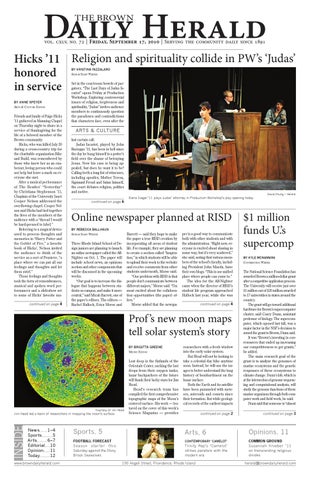
Lost deep in the flatlands of the Orientale Crater, sucking the last drops from their oxygen tanks, lunar backpackers of the future will thank their lucky stars for Jim Head. Head’s research team has compiled the first comprehensive topographic maps of the Moon’s cratered surface. His work — featured on the cover of this week’s Science Magazine — provides
By Kyle McNamara Contributing Writer
researchers with a fresh window into the early solar system. But Head will not be looking to take a celestial day hike anytime soon. Instead, he will use the images to better understand the long history of bombardment on the lunar surface. Both the Earth and its satellite have been pummeled with meteors, asteroids and comets since their formation. But while geological records of the earliest impacts
The National Science Foundation has awarded Brown a million-dollar grant after a competitive application process. The University will receive just over $1 million out of $20 million awarded to 17 universities in states around the country. The grant will go toward additional hardware for Brown’s supercomputer cluster, said Casey Dunn, assistant professor of biology. The supercomputer, which opened last fall, was a major factor in the NSF’s decision to award the grant to Brown, Dunn said. It was “Brown’s investing in core resources that ended up increasing our competitiveness to get grants,” he added. The main research goal of the grant is to analyze the genomes of marine ecosystems and the genetic responses of these ecosystems to climate change. Dunn’s lab, which is at the intersection of genome sequencing and computational analysis, will study the genome functions of these marine organisms through both computer work and field work, he said. Dunn said that someone is “almost
continued on page 2
continued on page 3
continued on page 4
Prof ’s new moon maps tell solar system’s story By Brigitta Greene Metro Editor
$1 million funds U.’s supercomp
Sports, 5
Arts, 6
Opinions, 11
football forecast Season star ter this Saturday against the Stony Brook Seawolves
Contemporary ‘camelot’
common Ground Susannah Kroeber ’11 on transcending religious divides
Trinity Rep’s ‘Camelot’ strikes parallels with the modern era 195 Angell Street, Providence, Rhode Island
herald@browndailyherald.com
Page 2
THE BROWN DAILY HERALD
C ampus N EWS
Friday, September 17, 2010
“iPhones wouldn’t work — you know, real crisis.” — Jim Head, professor of geological sciences
New director of CDC Meiklejohns work on community expands center’s hours By Kristina Klara Staff Writer
By Thomas Jarus Staff Writer
After taking over as director of the Career Development Center on July 1, Andrew Simmons is implementing new initiatives this fall. In a Sept. 10 e-mail to the student body, Simmons outlined the changes that would occur this semester. They include “improved advising for students interested in careers in the common good, weekend and evening advising, a renewed focus on internships, enhanced health careers planning” and a career series entitled “Coffee and Careers.” The changes are a result of student feedback, Simmons said. Dean of the College Katherine Bergeron said she approves of Simmons’s initiatives. “I am thrilled that he is instituting some evening and weekend hours. This is something that students have been asking for for quite a while, and he made it a priority,” she said. Over the summer, the center hired Jim Amspacher as a new career adviser. Simmons said Amspacher brings a nonprofit and public interest perspective to the CDC in a way that had not been present before. Bergeron said that Simmons and the CDC are working toward goals that the University has long hoped to meet. She said she would like to see
the CDC become “part of a network of advising opportunities for students.” Simmons said he has been working in university student affairs and academic advising since 1994. Prior to working as the director of the CDC, he ser ved as the Associate Dean of the College for Health and Law Careers. Before the start of his tenure at Brown, he worked at Brandeis, where he worked in residential life before becoming their Assistant Dean for Academic Affairs. “His vantage point from being in the college will really, I think, help us reach that goal of making life beyond Brown part of the four-year advising experience,” Bergeron said. Simmons said this is one of his interests. “How do you use your educational experience to build toward some par ticular career goals? And then how do you talk about that as a liberal arts graduate?” he said. Simmons said he also brings to the table “an understanding of careers within the academic context.” “Where I add value to this office is my knowledge of the curriculum,” he added. Though Simmons is not new to Brown, he said he is excited about the future of the CDC. “I think we will cer tainly evolve over time,” he said. “We’re going in a really positive direction.”
sudoku
Daily Herald the Brown
Editorial Phone: 401.351.3372 | Business Phone: 401.351.3260 George Miller, President Claire Kiely, Vice President
Katie Koh, Treasurer Chaz Kelsh, Secretary
The Brown Daily Herald (USPS 067.740) is an independent newspaper serving the Brown University community daily since 1891. It is published Monday through Friday during the academic year, excluding vacations, once during Commencement, once during Orientation and once in July by The Brown Daily Herald, Inc. Single copy free for each member of the community. POSTMASTER please send corrections to P.O. Box 2538, Providence, RI 02906. Periodicals postage paid at Providence, R.I. Offices are located at 195 Angell St., Providence, R.I. E-mail herald@browndailyherald.com. World Wide Web: http://www.browndailyherald.com. Subscription prices: $319 one year daily, $139 one semester daily. Copyright 2010 by The Brown Daily Herald, Inc. All rights reserved.
Small changes to the Meiklejohn program this year are intended to instill a sense of community among peer advisers and to make Meiklejohns more aware of the issues firstyears may encounter. Freshmen can communicate with their peer advisers before they even arrive on campus through the online Advising Sidekick tool. “We are making what is already a great program even better,” said Dean Ann Gaylin, Associate Dean of the College for First-Year and Sophomore Studies. No radical changes have been made, but “over 500 students applied to be Meiklejohns last year,” Gaylin said. “We really tried to choose people who were going to be committed to the program,” which is “one of the cornerstones of first-year advising,” she added. The Meiklejohn program is composed of 12 leaders, each responsible for 25-30 Meiklejohns. “I feel privileged to work with a really great group of leaders this year,” Gaylin said. “We just have an outstanding group of Meiks,” said
Megan Tuohy ’12, one of the twelve Meiklejohn leaders. The program “embodies Brown ideals” of friendliness and warmth, she added. This year has been focused on fostering a greater sense of community within the program, Gaylin said. For the Meiklejohn orientation this year, each leader and his or her group participated in Meiklejohn group wars, akin to freshman unit wars. Also, the advising leaders will meet with their Meiklejohns a few times throughout the year, Gaylin said. “We beefed up the fall orientation,” Gaylin said. Meiklejohns now have access to more information. They are “fully informed of resources and opportunities made available to first-years,” Gaylin said. A faculty panel on different academic disciplines and advising in those particular fields was added along with an academic resource panel and two sessions on academic integrity, she said. In addition, the Meiklejohn guidebook was completely revised. But “Meiklejohns aren’t expected to know everything,” Gaylin said. Sometimes the best help can
be putting students in touch with the resources they need, and the Office of the Dean of the College is making sure Meiklejohns are more aware of what these resources are, Gaylin said. “As a technical change, we gave Meiklejohns and their advisees the ability to talk to each other through the ASK Advising Sidekick,” said Gaylin. Students write letters to their Meiklejohns during the summer before they come for orientation. “It forced me to start thinking about the things that I hadn’t yet thought about,” said Zoe Downes ’14 of writing the letter. She said she also e-mailed her Meiklejohn a few times in addition to the letter, asking about “little anxieties,” she said. “It was a good way to ask all of the little questions that an academic adviser would never know because he hasn’t been a student at Brown,” said Downes. Meiklejohns can now see the course preferences their advisees record over the summer. This will jump-start the initial advising conversation, Gaylin said.
Geology prof. maps moon craters continued from page 1 have been obscured by erosion and tectonic activity on Earth, the lunar surface remains largely intact. “It sounds silly but we actually have to leave Earth to understand the former years of our own planet,” said Head, a professor in the Geological Sciences Department. “That’s why we go to the moon … it’s right there.” Cratering, the effect of huge impacts, can have far-reaching effects on the formation and evolution of life, he said, pointing to the demise of the dinosaurs following a large impact on the Yucatan peninsula. “One of those, and we’d be toast,” he said. “iPhones wouldn’t work — you know, real crisis.” About a year ago, NASA placed in orbit around the moon a Lunar Reconnaissance Orbiter spacecraft with the ability to take highly detailed measurements of surface topography, Head said. The spacecraft shot laser pulses at the moon’s surface, measuring the time it took for these pulses to reflect back. Over the past several months, Head’s lab worked with researchers from the Massachusetts Institute of Technology and the NASA Goddard Space Flight Center to translate over 2.5 billion of these laser data points into a comprehensive topographic map. The Orbiter craft will most likely continue to collect data for the next few years, Head said. Topographic maps of the lunar surface existed prior to the craft’s mission, but the data was variable and low-resolution. “The key here is that the data set we have now is completely constant in its characteristics,” Head said, pointing to the new detailed, multicolored images. “It’s a perfect data set for a global analysis. ... It’s
Courtesy of Jim Head
Lunar craters provide a record of the evolution of the solar system.
incredible.” Researchers identified and mapped over 5,000 craters that are equal to or greater than 20 kilometers in diameter. They also identified the two most heavily cratered, and therefore the oldest, areas. Future lunar voyages — much like the earlier Apollo missions — can now target these regions, collecting samples from the earliest impacts, Head said. There is no way to directly measure the rate of bombardment from meteors or asteroids, but samples taken from surfaces of a known origin can be dated radiometrically in lab. By comparing the age and density of the impacts, researchers can calculate the rate of bombardment over time and develop an absolute chronology of impacts and impact frequency. “The rate of bombardment is low now, much lower than it was in the early years,” Head said. “But we still we get things falling to the Earth all
the time.” It’s unclear which of Professor Head’s collections he enjoys more: eccentric beer bottles or geological fragments — both of which adorn his office cabinets. But as he shuffles through his meteorite collection, it’s obvious that the sparkling rocks tell a story much grander than they initially suggest. In a broad sense, the new data brings researchers one step closer to the grand question of “how we got to be how we are today,” Head said. “If we want to predict the future, knowing the past is really important. ... Was the bombardment history so great that life didn’t get started until a certain time — or did these big projectiles bring in life from somewhere else?” “These are big issues,” he added. “This paper doesn’t answer those, but it starts to talk about the earth in its infancy in a way that brings a lot more meaning.”
Friday, September 17, 2010
THE BROWN DAILY HERALD
Page 3
C ampus N EWS
New nanopore DNA sequencing method may reduce costs
By Emily Rosen Staff Writer
Scientists may soon have a cheaper alternative to current methods of DNA sequencing, thanks to new research by Professor of Physics Xinsheng Sean Ling and his group published in July’s issue of Nanotechnology. ‘The team has shown that solid-state nanopores — very thin membranes with holes — can be used to detect regions of doublestranded DNA on a molecule consisting mostly of single-stranded DNA — a development that will eventually lead to an easier method of DNA sequencing. This research is “related to an ongoing worldwide effort to develop nanopore sequencing,” Ling said. According to Ling, the Sanger method of DNA sequencing, which is the current, widely used DNA sequencing procedure, has its own procedural difficulties and can be expensive. While taking a sabbatical in 2002, Ling became involved with the research, which he said is new and different from previous work
he has done. Ling’s group, including Senior Research Associate in Physics Venkat Balagurusamy and Paul Weinger GS, has been able to use nanopores to detect the location of a 12-base-pair-long segment of double-stranded DNA surrounded on both sides by segments of singlestranded DNA, called a 12-mer. Balagurusamy said that a nanopore is an “ultra-thin membrane with a small hole.” When a molecule of DNA passes through the nanopore, the electrical current drops in comparison to the current measured when there is no DNA going through the nanopore. “If DNA blocks the pore, you get a signal,” he said. According to Balagurusamy, because the diameter of single-stranded DNA is much smaller than the diameter of double-stranded DNA, the drop in current when each of these types of DNA passes through the nanopore will be different. This allows for the discrimination of double- and single-stranded regions of a DNA molecule passing through a nanopore. Ling’s group is therefore able to
detect locations of hybridization, a complex process used to identify the presence of certain DNA sequences. “With this positional information of hybridization, one should be able to sequence the whole genome,” Ling wrote in an e-mail to The Herald. Ling said his group would ultimately like to be able to detect a six-mer of double-stranded DNA, a feat that has not yet been achieved. A six-mer of double-stranded DNA “is not stable at room temperature,” Ling said. “We need to build a new experimental setup” in order to detect a six-mer, he added. Balagurusamy said the ability to detect a six-mer of double-stranded DNA would be more beneficial for nanopore DNA sequencing than would the ability to detect a 12-mer, which Ling’s group has recently achieved. Before Ling’s group detected a double-stranded 12-mer, researchers had not been able to detect double-stranded DNA sequences of under about 1,000 base pairs among single-stranded sequences using nanopores, Balagurusamy said.
Warren Cheng / Herald
Physics Professor Xinsheng Sean Ling led research to sequence DNA with nanopores, above.
Adults head back to school, for fun Supercomputing power By John Ewoldt Star Tribune (Minneapolis)
“It’s about forgetting about real life and doing something fun with friends.” That’s how Kristen Stuenkel, director of community education in the Columbia Heights, Minn., school district, describes the popular classes for adults enrolling in community-education programs this fall. “People don’t take the classes in a recession that you would think,” she said. “Classes about how to increase fuel economy and how to budget just aren’t cutting it.” Scrap “50 Ways to a Frugal Life,” and put on your “So You Think You Can Dance” shoes and cha-cha the pounds off with Zumba dance fitness classes. Forget collecting fallen limbs in the back yard to make an occasional chair, and belly up to “Scotch Talk and Tasting” — for those who give a dram. Remember those community
education staples about writing your will, clipping coupons and comparing life insurance policies? They’re still around, but most of those frugal folks are probably watching the scotch drinkers, salsa dancers and deer gutters with their noses pressed against the glass. Wait a minute — deer gutting? Besides the scotch tasting, it’s another way that many community education classes are trying to attract
WORLD & NATION more men to a predominantly female pursuit, said Marsha Buchok, coordinator for Edina Community Education. A roadkill deer is brought in to show how to field-dress, skin and clean the carcass properly. In Columbia Heights, a companion class, “Intro to Sausage Making,” is offered a week later. In the spirit of good, cheap fun, let’: Learning through entertainment in community education classes saves big bucks.
Some of the most common classes include fitness, cooking and dance, all offered at prices that are often substantially lower than at fitness clubs or dedicated schools. In Anoka-Hennepin’s adult program, for example, some fitness and yoga classes can be taken for less than $5 per session with no annual membership required. Cooking classes that are $19 to $45 through community ed can cost $60 to $100 at cooking academies. Some communities such as Columbia Heights offer free or $5 classes, too. Hastings Community Education offers free online classes for the unemployed. The reason for the low fees isn’t because the classes are taxpayersupported. It’s because the classes are offered in a not-for-profit structure. “We just try to cover our costs with the registration fees,” Stuenkel said. Classes that fail to attract enough students to break even are often canceled.
shared with R.I. schools continued from page 1 always” using the supercomputer to run hour-long jobs related to both big and small projects. He said training students to use highperformance computers for computational analysis is “becoming integral to most fields of biology.” The grant is expected to accelerate current student research projects and provide new opportunities for student research. The grant will build local computational expertise, as well as impact other computational techniques in Rhode Island, he said. In turn, this will bolster the
“knowledge economy” initiative, an ambitious collaboration between public and private organizations to attract researchers and academics to the city and state. The speed of the connections used to share data between campuses will also be improved. Data will be available across universities in Rhode Island due to “improved collaboration infrastructure,” Dunn said. The University of Rhode Island, the Rhode Island School of Design and Rhode Island College are expected to participate. With such a small distance between these schools, this grant is expected to facilitate statewide cooperation.
The other BDH blogdailyherald.com
Page 4
THE BROWN DAILY HERALD
C ampus N EWS
Friday, September 17, 2010
“That’s perfect. That’s so RISD.”
— Rachel Hallock, Editor of RISD’s The All-Nighter
‘The All-Nighter’ to keep RISD informed continued from page 1 working as an orientation leader, with the idea of having a website advertising the school’s various events. “Over time, we morphed the idea into a school newspaper, since we didn’t have any regularly published school newspaper with actual news instead of creative writing,” Hallock said. The three editors are all studying graphic design at the design school, and while they don’t have an extensive background in journalism, they have already recruited a large staff. At an activities fair on Benefit Street Sept. 14 — where the three wore “The All-Nighter Is All of Us” T-shirts and gleefully handed out packages of coffee, “Awake” tea and chocolate — their table had gathered the names of 80 interested students after only an hour. Erica Ehrenbard, a RISD junior, said she would be interested in reading the paper since it would offer “a nice way to be aware of the
world — not just RISD news, but the world through RISD’s (eyes).” Suzanne Geary, a sophomore at RISD, added that the newspaper would be helpful to “find out what’s going on,” she said. “Sometimes it’s all a little disorganized.” The newspaper is currently being funded by the Office of Student Life, but the editors “are looking to find advertisements so we can become a little more independent from our school,” Hallock said. But she added that the paper’s budget is small since it will only be available online, a choice she said was made for a few reasons. “It’ll save on production costs, it’s more ecofriendly and we can update more frequently,” she explained. As for the paper’s name, Hallock said it embodied the nature of RISD students. “It’s kind of notorious (here) to have people pulling all-nighters all the time,” she said. “We had some brainstorming sessions where we threw out names — someone said that one and we said, ‘That’s perfect. That’s so RISD.’ ”
Why can’t we be friends? facebook.com/browndailyherald
Hilary Rosenthal / Herald
The memorial service for Paige Hicks ’11 took place in Manning Chapel.
Community remembers Hicks ’11 continued from page 1 sic as her professors, roommates, teammates, friends and family came together to celebrate her life. Associate Director of Residential Life Natalie Basil described Hicks, who was a Women Peer Counselor, as “approachable, compassionate, helpful and a team player,” someone who was “not just a good listener, but a doer” and “loved by all for her honesty and her genuine, fun-loving personality.” Two of Hicks’ co-WPCs, Akinyi Shapiro ’11 and Amina Sheikh ’11, performed original spoken-word pieces addressed to Hicks, in which they remembered their experiences
as WPCs with Hicks and celebrated the strength and warmth Hicks brought to the position. Matt Vitorla ’11, who spent a semester abroad in Barcelona in the fall of 2009 with Hicks, described her as a “muse.” “She brought out the ideas, music, beauty and light in all of us,” he said. Katie Silverstein ’11 and Emmy Liss ’11 also remembered their time in Barcelona with Hicks, describing her as fun-loving and adventurous, someone who loved dance parties, music, chocolate bars and running — and sharing those loves with her friends. “From Paige, I learned how many barriers are just boundaries we set for ourselves … and how to push through,” Silverstein said. “She gave everything, whether it was a stolen pair of sunglasses or a piece of her heart,” said Liss, who is a deputy managing editor for The Herald. Michelle Levinson ’11 and Julia Ellis-Kahana ’13, Hicks’ teammates from the women’s club frisbee team, Disco Inferno, emphasized her kindness, determination and passion. Levinson shared one of the team’s favorite quotes — Lady Gaga’s declaration, “I’m just trying to change the world, one sequin at a time.” Levinson said the quote fit both Hicks’ love of flashy clothes and her infectious personality, referring to “the sequins of words and actions (which) have touched so many people.” “She taught me how to be fearless,” Ellis-Kahana said. The slideshow of pictures and videos of Hicks was also shown at the ser vice, accompanied by a soundtrack that included Lady Gaga’s “Bad Romance,” Tracy Chapman’s “Fast Car” and a biol-
ogy-themed rap written by Hicks herself entitled “Let’s Talk About Cells, Baby.” The presentation, arranged by Casie Horgan ’11 and Serin Seckin ’11, showed Hicks singing, dancing and laughing with her friends. Following the slideshow, Fred and Mallory Hicks, Paige Hicks’ father and one of her older sisters, thanked the audience for their memories and added their own. Mallory Hicks recalled a day of fun the two shared in New York on Paige Hicks’ 21st birthday, and her father led the chapel in singing “F.U.N.,” a song from SpongeBob SquarePants celebrating time spent with friends. Cooper Nelson then invited the audience out onto the Quiet Green, where a dogwood tree has been planted in Hicks’ memor y. “We wanted something that would flower on,” Cooper Nelson said. The tree will eventually feature a plaque to Hicks, with a quote from Albus Dumbledore in “Harry Potter and the Sorcerer’s Stone”: “After all, to the well-organized mind, death is but the next great adventure.” Hicks’ friends and family circled the young tree while the Brown Band played their rendition of “Bad Romance.” By candlelight, members of the circle read aloud remembrances and notes to Hicks that had been written during the ser vice. Many notes mentioned cherished memories of Hicks. One simply read, “You are an infectious spirit.” In her remembrance, Basil read a quote from Hicks’ application to be a Residential Peer Leader, in which Hicks wrote, “My greatest triumph is knowing I have helped someone succeed.” The testimonies of the many people she touched with her spirit and vivacity made Hicks’ tri-
SportsWeekend The Brown Daily Herald
FRIDay, SEPTEMBER 17, 2010 | Page 5
FOOTBALL
Bruno looks to avenge 2009 one-point loss BY Ethan McCoy Contributing Writer
After an 0-2 start to its 2009 season, the football team is aware of the importance of a strong start to this fall’s campaign. The Bears’ journey starts Saturday with a clash against the Stony Brook Seawolves in a rematch of last year’s 21-20 loss, a defeat that has left a “bad taste in our mouth up to this point,” according to starting quarterback and tri-captain Kyle Newhall-Caballero ’11. “We felt awful after the game at Stony Brook last year,” NewhallCaballero wrote in an e-mail to The Herald. “We made plays but we did not make enough to earn a win that game.” Running back Zach Tronti ’11 shared the sentiment that last year’s loss has stuck with the team, but wrote in an e-mail that he sees Saturday’s game as not only a chance to “get revenge … but also (to) set the tone for the entire season.” For Tronti, a member of the 2009 All-Ivy second team, the first game of the season could not come soon enough. The senior back has been working all offseason to return healthy from a “disappointing” ACL injury that cut short his junior season after eight games. “I’ve been full go ever since the first day of camp,” Tronti wrote. “I’m excited to just get back out on the field with my teammates and play as hard as I can to help us win a championship.” Winning a championship is a long journey, though, and early games this season will prove key to building the foundation for a successful year — a belief that the team strongly holds. “It’s a lot easier to keep positive momentum rolling than it is to battle
through a rough start, so a strong first game is critical,” Newhall-Caballero wrote. The first team All-Ivy quarterback explained that this being his last season as Bear is a motivating factor as well. “As a senior, you have a completely different perspective on things,” he wrote. “We take a lot of pride in this being our year. We want people to look at and admire the 2010 football season, and it all starts with our first game this Saturday.” But who are these Seawolves that handed Brown a single-point defeat a year ago? Having clashed with Stony Brook during the past two seasons, Bruno regards the Long Island squad as a familiar foe. “Stony Brook is a big and physical football team,” Tronti wrote. “They are athletic and quick on defense.” The Seawolves boasted a 6-5 record in 2009 on their way to claiming the Big South Conference title. While this is the first game of the season for Brown, Stony Brook is 1-1 in 2010 and is coming off a win over American International. In their opening game, the Seawolves fell convincingly to Big East giants South Florida in a lopsided 59-14 defeat. Finally, the 2010 football season has arrived, and the Bears are hungry for a title run. The team knows that it all starts here. “We’ll have to overcome any first game jitters early on and get back to playing Brown football, something that our entire team has been waiting to unveil for a while,“ NewhallCaballero wrote. Expect the Bears to come out firing Saturday, looking to set the tone early for the team’s 133rd year of intercollegiate football. Kickoff is set for 12:30 p.m.
Soccer Preview
Friday, 7:00 p.m., Stevenson Field Indiana (2-2) vs. Brown (2-0-2) No. 24 Indiana Hoosiers Key Wins: No. 5 UCLA (5-1) No. 22 Drake(2-0) Key Losses: Cal Poly (1-0) California (2-1) 2OT Key Players: #11 Will Bruin - 4 goals #10 Andy Adlard - 2 goals
The last time these two teams met was September 12, 1999. The Hoosiers won the game 5-0.
Brown Bears Key Wins: Bryant (4-0) South Carolina (1-0) Ties: Providence College (0-0) Hofstra (0-0) Key Players: #10 Sean Rosa - 2 goals #15 Taylor Gorman - 2 goals #1 Paul Grandstrand - No goals allowed in 4 starts
Arts & Culture The Brown Daily Herald
Kathryn Schulz ’96: wrong is the new right By Amy Chen Staff Writer
“Being Wrong,” the first book by Kathryn Schulz ’96, challenges its readers to truly examine the idea of being wrong in action or belief instead of simply treating it instinctively as negative and damaging to character. Published this past June, the book explores the nature and cultural conception of error. It also raises important, fascinating questions about the benefits accrued from making mistakes and how they affect our relationships with people and our knowledge about ourselves. Schulz said she explored the “weird” way our culture “thinks about the idea of error” and “how individuals think about experiences as being wrong.” The book also offers error’s intellectual history, philosophy and psychology, exploring how error has been viewed throughout time by thinkers like Freud and Descartes. Schulz added that she wants readers to learn and understand the value of taking a step back and questioning whether we might be wrong in believing or doing the things we so firmly believe to be right. “There are lots of complexities and nuisances in our lives,” Schulz said. “It’s easy to detect the psychological phenomenon in other people … but we are very bad in detecting it in ourselves. We are attached to the sense of being right.” The idea for the book, meant to provoke self-reflection and reevaluation, first took seed in 2004 — not from a life-altering personal story, but rather from a culmination of carefully observed experiences over a period of time. For example, Schulz was struck by how divisive Americans were as they debated political issues with the goal of definitively proving their opponents wrong. “We are right and everyone else is wrong. There is no possibility to step back to think about your own beliefs,” Schulz said, explaining the sort of view she explores in her book. On an assignment for the New York Times to interview a group of conservatives in Dallas, Schulz experienced the conscious acknowledgment of the possibility that she might have to reevaluate her beliefs. She described herself as these people’s “enemy” because she not only worked for the media, the liberal New York Times, but also came from an ultra-liberal educational
background. “It was striking to be in that position. God, I wished the people would shut up for a minute,” Schulz remembered. “But then I asked: Am I capable of shutting up? Can I think about their political views?” Schulz is a freelance journalist who has written for the New York Times, the Boston Globe and Foreign Policy, among many other newspapers, and a regular contributor to the blog on Slate Magazine, which gives her an opportunity to discuss making mistakes with celebrities. With all her experience, it would be easy to assume that writing the book came easily to her. But “writing is hard,” she said firmly. “The most challenging aspect was how to organize it.” “The best part was going out and getting materials,” she said, “and spending a year talking to people.” Always interested in language and ideas, Schulz said writing a book pushed her to enhance her skills as a reporter and her ability to get people to tell their stories. In the end, Schutz said, she feels “very happy and fortunate to say that I really love this book. It’s a hard enough process … I felt really blessed and honored.” Schulz described her experience at Brown, where she concentrated in history, as “highly influential” in motivating the kind of writer and individual she is today. “In the most basic and fundamental level, Brown makes me feel like someone who has the right to make intellectual contributions,” Schulz said. “I have the right to have my own thoughts.” This intellectual freedom allowed her to “step back and look at the world,” an opportunity for openmindedness which she capitalizes on in her book. Schulz said students in high school — worried about perfect SAT scores and entering the best college — often create a checklist of things to do and want to know precisely “what decision leads to (what) outcome.” College is the last phase of life when this attitude works, said Schulz, referring to the “messiness after college.” Career paths change constantly, and “this new environment has no checklist,” she said. While there is nothing wrong with being a perfectionist — Schulz admitted that she is one — the expectation of total success “is really, really hard to deal with,” she said. “The important thing is to accept that something’s going to happen
Friday, September 17, 2010 | Page 6
Round Table as political commentary By Suzannah Weiss Arts & Culture Editor
“Camelot” is a self-conscious musical, the characters constantly referring to themselves and their predicaments in the third person — take the number “I Wonder What the King is Doing Tonight,” sung by none
other than King Arthur (Stephen Thorne) in his introductory scene, as an example. Trinity Repertory Company’s current production expands this self-consciousness into the audience, as viewers become characters and the theater becomes scenery. For long-time fans, the ability to
see and be seen by other enthusiasts while singing along to the opening number could be a bonding experience. And Lancelot’s exhibitionism as he holds his arm out to the front row and instructs spectators to “touch it” could be charming and continued on page 7
Biblical villain comes to PW’s stage continued from page 1 The play addresses “the difference between religion and spirituality,” said director Jacob Combs ’11. It asks the question, “Have we lost the connection to the spiritual through the institutionalism?” he added. The characters are so well developed and embodied by the actors that even double-casting does not impede the audience’s understanding of the text. When Caiaphas the Elder is called to the stand, for example, the judge, played by Doug Eacho ’11, excuses himself from the courtroom on grounds of conflict of interest. A minute later, Eacho is back, but now he is no longer the loud, Southern judge he has been, but the aristocratic, 613-laws-of-the-Torah-abiding Jewish high priest of millennia past. Other show-stopping characters include a sassy Saint Monica played by Chantel Whittle ’12 and confident, smooth and, above all, smug Satan played by Brady Waibel ’12. Whittle describes her character as a “powerful and opinionated, but soft and motherly black woman.” Waibel’s Satan, familiarly known as Lou, is anything by soft. Complete with a Gucci suit, graceful stride and twisted smirk, not to mention an unfailingly chilly delivery of disparagements, he leaves viewers more than a little wary themselves. The two lawyers are equally important to the show. The hilarious, fast-talking and overly flirtatious prosecutor Yusef El-Fayoumy, played by Jonathan Gordon ’11, is a joy to watch. His comedic timing is on point throughout the show. Judas’ lawyer, Fabiana Aziza Cunningham is a different type of character altogether. “I was really worried because my character isn’t outlandish or comedic,” said Elana Siegel ’11, who plays Cunningham. “She is the voice of the playwright … and I didn’t want that to get lost in the mix. Understanding what Cunningham says is what you leave thinking about.” Cunningham’s impassioned
David Chung / Herald
A softer side of Judas portrayed in PW’s play.
speech toward the end of the second act questions Satan on the nature of God and demands answers — to receive none. This is what the play is about: people have to answer their own questions, no matter how hard that might be. Such is the case with Judas. Driven into a catatonic state of despair by the guilt of his betrayal, Judas awaits salvation from Jesus. But he cannot forgive himself and muster the strength to leave his personal hell. Combs said he hopes the play will open new conversations and thoughts about something most Brown students stray away from — religion. “By not talking about it, we’ve made it a sacred subject,” Combs said, citing the awkward moments that occur when religion enters the dialogue. Combs, brought up by a Jewish mother and a Christian father, said this religious perspective piqued his interest in religious communities at Brown and their associated stereotypes. After reading “Judas,” Combs knew he wanted it staged at Brown to expand that conversation. Consequently, one of Combs’ biggest goals for the production is to tackle the stereotype that students are just a bunch of atheists and agnostics who are cruel to people who practice a structured religion, he said. With a cast of 14, getting everyone to agree on the message the play puts forth would appear to be a challenge — one that Combs said was very important to him. Returning to campus a week before the semester began, the cast and crew, selected in May, had a two-hour discussion about the play, its message and their own religious backgrounds, said Helen Diagama
’12, the show’s stage manager. “People were really open,” she said. “They recognized they had to be.” The cast also met with Reverend Janet Cooper Nelson, chaplain of the University, to discuss the story they were going to present onstage, Combs said. Cooper Nelson will participate in a talk-back after Saturday’s performance. The end result is a show that delivers a powerful message packaged amidst a score of comedic dialogue. Finding just the right balance between humor and gravity, playwright Stephen Adly Guirgis has produced a hilarious dark comedy. “Working with — playing with really — this cast is amazing,” Siegel said. “They make me laugh out loud on stage every day against my will.” The play presents an interesting picture of Judas, often portrayed as evil in literature. Instead, this Judas is in the most acute of pains over his actions. In addition, the audience gets a glimpse into the life of Judas before his betrayal and leaves unable to not feel compassion for the man. Racioppo easily weaves his way throughout Judas’ life, drawing the audience into one young man’s story of hope, loss and anguish. Maybe Judas’ moral standing is up to the court after all. He did not realize that violence was never part of Jesus’ plan — and that cost him dearly. But if he cannot forgive himself, how can the jury? This comedic controversy leaves audiences thinking and, at the same time, laughing as they leave the theater. “The Last Days of Judas Iscariot” is playing Sept. 17, 18 and 20 at 8 p.m. and Sept. 19 at 4 p.m. and 9 p.m. at Production Workshop.
Page 7
THE BROWN DAILY HERALD
Friday, September 17, 2010
A rts &C ulture
Critiquing self-consciousness in Trinity’s ‘Camelot’ continued from page 6 humorous. But the actors’ lack of regard for the fourth wall could also elicit selfconsciousness, in the more common sense of the word, in the crowd. Indeed, being put on the spot and in the spotlight is unsettling until one realizes why: because the show is really about the audience and their similarities to King Arthur’s subjects. “We consider how the forces of barbarism and outrage, masquerading as the powers of justice, have dragged at the foundation of our civilization,” Artistic Director Curt Columbus wrote in the playbill’s introduction. To illustrate the timelessness and relevance of the medieval legend, T.H. White’s 1958 book “The Once and Future King” and the classic 1960 musical that made the tale accessible to theatergoers, the Trinity team embellished an otherwise medieval setting with British subway signs, nuclear warfare sound effects and intentionally anachronistic wall decorations. As Arthur resolves in the end to never again let his round table stray from “right and honor and justice,” he invites memories and premonitions of past and future powers fighting in the name of these virtues. Just as Arthur recreates the violence
the Round Table knights intended to resist, modern governments and citizens live under the fanciful delusion that their wars are “to end war” (Woodrow Wilson, 1914), fulfilling a “duty to be a fighter for truth and justice” (Adolf Hitler, 1922) or inaugurating “an era of new hope” (George W. Bush, 2002). Hence, the viewers’ embarrassment: modern civilizations haven’t progressed much since Arthur’s time. Indeed, the world has perhaps become even more replete with idealism gone awry. The dissonance between the ye-olde-times-inspired script and up-to-date scenery in Trinity Rep’s production can get a bit confusing. Arthur’s song about how it feels to be hiding out in a tree the night before his anxiety-provoking wedding, sung from the top of a bunk bed, begs the question, “Where is the aforementioned tree?” Enter Guinevere, who ironically stumbles upon this “tree” while escaping her impending marriage to Arthur. Like any character originated by Julie Andrews, Guinevere is hard to like or relate to, especially when portrayed by Rebecca Gibel as a selfpitying bimbo with pretty voice and a naive rebellious streak. Resisting a queen’s traditional role, Guinevere yearns for “The Simple Joys of Maidenhood”: knights
who “let their blood be spilt for me,” the chance to “be on a pedestal” and other typical maiden activities. Perhaps 50 years ago, nostalgic older women and hopeful single ladies could relate to these fantasies, which now are painfully outdated. Even Guinevere’s dream of total privacy — the freedom to do everything naked — turns into Arthur’s anachronistic frat-boy fantasy. The only ambition of hers that is worth pursuing is to “be carried off” — off the stage, one can only hope. But she and Arthur are meant for each other. He is not the most charismatic character, either, and the two share their ignorant hypotheses on the lives of ordinary folks. In an astounding feat of meta-reflection, the two puzzle over the question, “What Do the Simple Folk Do?” until they conclude that simple folk must pass their hours wondering about royalty. If King Arthur is the typical dimwitted popular guy in high school, Lancelot (Joe Wilson Jr.) is his jock best friend, who develops a secret affair with Guinevere and launches the Round Table into war. Exchanges between Guinevere and Lancelot in which they declare their love, including the famous songs “If Ever Would I Leave You” and “I Loved You Once in Silence,” prove that overexposure to love stories incites melodrama. The highlights of the show are the
Courtesy of Marilyn Busch
Trinity Repertory Company’s ‘Camelot’ breaks the fourth wall.
cryptic Merlyn (Mauro Hantman), a fitting narrator with his captivating perspective on time and tortured relationship with a long-lost love; the comical Pellinore, portrayed by Barbara Meek as the Shakespearean fool who actually knows what is happening; and the candy-addicted sorceress Morgan Le Fay, depicted with flair by Janice Duclos. Whether to go buy a ticket depends on one’s view of the script, which Trinity Rep’s production sticks to faithfully but complements with
modern-day scenery and interactive staging. Coming from somebody who has not seen other productions or the film, Trinity Rep’s take on “Camelot” makes some valid observations, like the incongruity between noble ideas and ignoble actions, and is entertaining enough. But “Camelot” appeals to an older audience, and the music, romance and humor extract their joy from the nostalgia they invoke. “Camelot” is playing at Trinity Repertory Theatre now through Oct. 10.
World & Nation The Brown Daily Herald
Friday, September 17, 2010 | Page 8
Recession sent millions into poverty, Census Bureau finds By Tony Pugh McClatchy Newspapers
WASHINGTON — The withering recession pushed the number of Americans who are living in poverty to a 51-year high in 2009 and left a record 50.7 million people without health insurance last year, the Census Bureau announced Thursday. The 43.6 million Americans who were poor in 2009 — up from 39.8 million the year before — was the highest number since poverty estimates were first published in 1959. The national poverty rate of 14.3 percent, up from 13.2 percent in 2008, was the highest since 1994. Were it not for federal intervention in the form of extended unemployment insurance benefits, 3.3 million more people would have fallen into poverty last year, said David Johnson, the chief of the Census
Bureau’s division on housing and household economics. Massive job losses and work reductions for hourly employees led the number of uninsured Americans to rise from 46.3 million people in 2008 to 50.7 million in 2009. Most of that decline stemmed from a loss in the percentage of people who have private and jobbased coverage. The percentage with job-based coverage fell from 58.5 percent in 2008 to 55.8 percent last year, the lowest coverage rate since 1987. As more people lost jobs and were unable to afford private coverage, enrollment spiked in government insurance programs such as Medicaid and the Children’s Health Insurance Program. In all, the number of people with government-sponsored coverage went from 87.4 million in 2008 to 93.2 million last year.
Got something to say? Leave a comment online! Visit www.browndailyherald.com to comment on opinion and editorial content.
Editorial & Letters The Brown Daily Herald
Page 10 | Friday, September 17, 2010
l e t t e r to t h e e d i to r
Campus trash not just caused by laziness To the Editor: As a Keeney Quadrangle exresident/sur vivor, I read Deniz Ilgen’s ’13 column (“Brown: clean campus?” Sept. 8) with all too much familiarity with the Keeney scum she described, from dangling exit signs with eviscerated wires to someone passed out in the corridor in his own vomit. My friends and I are indeed offended by such inconsiderate slobs. Ilgen rightfully calls for a thoughtful and observant approach to property management. I, however, seek more concrete solutions for facilities maintenance. I see students performing origami as they attempt to stuff take-out boxes into the awkwardly shaped cans outside before shrugging and walking away from the mountains of garbage. Clearly, they make an effort to contain their trash, but they physically cannot. This isn’t an issue of not bothering; it’s one of inadequate infrastructure. Likewise, at the Gate and the new Blue Room, plates and boxes are too large to fit into mysterious countertop holes. Thus, the University should rethink the design and implementation of its trash receptacles and their storage capacity.
Sustainable Food Initiative and Brown EcoReps already do important innovative work in waste control, and I’m a big fan of the Sharpe Refectory’s new trayless option. Another neat idea is providing rooms with separate recycling buckets for paper and plastic (or allowing interested students to pick up an extra one) so that emptying recycling into the appropriate larger bins doesn’t require manually sorting through old bottles and newspapers. Perhaps we need to consider ashtrays, not to promote smoking, but to reduce litter from people who already and will continue to smoke and would otherwise flick their cigarette butts to create a solid layer of debris (I’m looking at you, Keeney heater). For all this trash-talking, there will be individuals who just always refuse to properly dispose of their refuse. But for those of us who aren’t so persistently careless, the University must examine how to make it easier — the desire is already there — to keep our campus clean and beautiful, the way Brown should be, and so a little bit easier for our dedicated custodians to do their jobs. Kathy Nguyen ’13 Sept. 9
t h e b r o w n d a i ly h e r a l d Editor-in-Chief
Managing Editor Chaz Kelsh
George Miller
Deputy Managing Editors Emmy Liss Joanna Wohlmuth
editorial Anne Speyer Suzannah Weiss Sara Luxenberg Brian Mastroianni Brigitta Greene Ben Schreckinger Sydney Ember Zack Bahr Tony Bakshi Ashley McDonnell Erika Mueller
Arts & Culture Editor Arts & Culture Editor Features Editor Features Editor Metro Editor Metro Editor News Editor Sports Editor Sports Editor Asst. Sports Editor Asst. Sports Editor
Graphics & Photos Graphics Editor Stephen Lichenstein Graphics Editor Alex Yuly Photo Editor Stephanie London Photo Editor Max Monn Photo Editor Hilary Rosenthal Sports Photo Editor Jonathan Bateman Asst. Sports Photo Editor Jesse Morgan Production Copy Desk Chief Kelly Mallahan Design Editor Julien Ouellet Asst. Design Editor Gili Kliger Asst. Design Editor Katie Wilson Web Editor Neal Poole Post- magazine Editor-in-Chief Sam Carter Editor-in-Chief Kate Doyle Editor-in-Chief Marshall Katheder
Senior Editors Ben Hyman Seth Motel
Business General Managers Office Manager Shawn Reilly Claire Kiely Katie Koh Directors Sales Kelly Wess Finance Matthew Burrows Client Relations Margaret Watson Alumni Relations Christiana Stephenson Managers Local Sales Isha Gulati Local Sales Arjun Vaidya National Sales Rajiv Iyengar University Sales Aditi Bhatia University Sales Jared Davis Recruiter Sales Trenten Nelson-Rivers Maximilian Barrows Business Operations Business Analytics Jilyn Chao Credit and Collections Danielle Marshak Special Projects Alexander Carrere Staff Kathy Bui
E rik S tayton and evan donahue
d i a m o n d s a n d c oa l Coal to Ratty frankenfoods “French fusion taco sandwich” and “corn cobbets” — and a grateful diamond to the undergraduate population for removing them from the ecosystem.
A diamond of confused admiration to Brown bookkeeper Beppie Huidekoper, who told us, “There are a lot of buildings we are willing to name if you are willing to give X.” That’s a bold move, Beppie, looking for illegal drugs in our pages.
Cubic zirconium to Banner for eliminating long lines in U. Hall during shopping period. Because waking up at 8 a.m. to preregister is so much better.
A diamond to Sidney Frank ’42, who knows this University is built on booze money, not party drugs.
Diamond to Dahlia the dairy cow, who appeared Wednesday on Wriston, for giving fraternity row something wholesome to drink. Gets those cobbets out of your system.
Coal to the upstart RISD kids starting the online-only newspaper they’re calling the All-Nighter. Unless we’re mistaken, RISD is already served by an illustrious publication: the College Hill ’Dependent.
A diamond of encouragement to Marisa Quinn, vice president for public affairs and University relations, who said of social networking, “I’m 46 and don’t know how.” Don’t lie, we’ve seen you liking all of Ruth’s statuses. (P.S. Facebook suggests you should be friends with our mom.)
A diamond to people who “don’t smoke but hold a cigarette in their hands and feel better about themselves.” Maybe the diamond will improve their self-esteem. Diamonds and Coal is written by Herald staffers. Share your own at diamondsandcoal.com.
Opinions Opinions Editor Michael Fitzpatrick Opinions Editor Alyssa Ratledge Editorial Page Board Matt Aks Editorial Page Editor Anita Mathews Board member Tyler Rosenbaum Board member Melissa Shube Board member Gaurie Tilak Board member
Gili Kliger, Designer Mrinal Kapoor, Dan Towne, Copy Editors Nicole Boucher, Sydney Ember, Claire Peracchio, Luisa Robledo, Anne Speyer, Night Editors Senior Staff Writers Ana Alvarez, Ashley Aydin, Rebecca Ballhaus, Alexander Bell, Nicole Boucher, Fei Cai, Alicia Chen, Kristina Fazzalaro, Sarah Mancone, Claire Peracchio, Lindor Qunaj, Mark Raymond, Luisa Robledo, Caitlin Trujillo, Alexandra Ulmer Staff Writers Anna Andreeva, Anne Artley, Shara Azad, Casey Bleho, Sofia Castello, Amy Chen, Sarah Forman, Miriam Furst, Max Godnick, Thomas Jarus, Sarah Julian, Julia Kim, Emily Rosen, Bradley Silverman, Anne Simons, Qian Yin Senior Sales Executives Katie Galvin, Liana Nisimova, Isha Gulati, Samantha Wong Sales Associates Roshni Assomull, Brady Caspar, Anna Cook, Siena deLisser, Begum Ersan, Tommy Fink, Ryan Fleming, Evan Gill, Debbie Lai, Jason Lee, Katie Lynch, Sean Maroongroge, Zahra Merchant, Edjola Ruci, Webber Xu Senior Finance Associates Jason Beckman, Lauren Bosso, Mae Cadao, Margot Grinberg, Adam Fern Finance Associates Lisa Berlin, Mahima Chawla, Mark Hu, Jason Lee, Nicholas Robbins, Daniel Slutsky, Emily Zheng Design Staff Caleigh Forbes, Jessica Kirschner, Leor Shtull-Leber Web Staff Andrew Chen, Warren Jin, Claire Kwong, Ethan Richman, Adam Zethraeus Photo Staff Qidong Chen, Janine Cheng, Alex DePaoli, Frederic Lu, Quinn Savit Copy Editors Nicole Boucher, Zoe Chaves, Greg Conyers, Claire Gianotti, Aida Haile-Mariam, Victoria Hartman, Tiffany Hsu, Christine Joyce, Mrinal Kapoor, Abby Kerson, Juhee Kwon, Matthew Lim, Alexandra McFarlane, Joe Milner, Rajan Mittal, Lindor Qunaj, Kate-Lyn Scott, Carmen Shulman, Rebecca Specking, Dan Towne, Carolina Veltri
correction An article in Tuesday’s Herald (“What’s in a name: behind the building,” Sept. 14) stated that Sidney Frank ’42 entered the war. Though he took a war-time assignment overseas with Pratt & Whitney Motors, he did not serve in the armed forces. Also, Anthony Ittleson’s ’68 P’89 P’90 name was misspelled. The Herald regrets the error.
C O R R E C T I O N S P olicy The Brown Daily Herald is committed to providing the Brown University community with the most accurate information possible. Corrections may be submitted up to seven calendar days after publication. C ommentary P O L I C Y The editorial is the majority opinion of the editorial page board of The Brown Daily Herald. The editorial viewpoint does not necessarily reflect the views of The Brown Daily Herald, Inc. Columns, letters and comics reflect the opinions of their authors only. L etters to the E ditor P olicy Send letters to letters@browndailyherald.com. Include a telephone number with all letters. The Herald reserves the right to edit all letters for length and clarity and cannot assure the publication of any letter. Please limit letters to 250 words. Under special circumstances writers may request anonymity, but no letter will be printed if the author’s identity is unknown to the editors. Announcements of events will not be printed. advertising P olicy The Brown Daily Herald, Inc. reserves the right to accept or decline any advertisement at its discretion.
Opinions The Brown Daily Herald
FRIDay, SEPTEMBER 17, 2010 | Page 11
America’s better angels BY SUSANNAH KROEBER Opinions Columnist Cynicism runs rampant at Brown. We are taught to question everything we hear in the classroom, and we often turn this cynicism into inaction, into a belief that the really big issues are the ones we shouldn’t work on by virtue of how monumental the problems facing us are. Dr. Eboo Patel, in his talk on Wednesday night in Salomon 101, offered an option based on action, one directed specifically at students here when he said, “I don’t think there is a better place in America to implement this than right here at Brown University.” The “this” he was referring to was the doctrine of multifaith. He spoke to the students gathered in Salomon 101 about what is at stake, about “the cut of hate” that is deeper now than at any point in recent American history. He rallied us with stories of “the forces of inclusiveness,” of the Muslim community in Gainesville, Fla., who responded to a threat of Quran burning with an interfaith book drive. Dr. Patel’s message was one of profound belief in today’s youth to use the opportunity presented by the “forces of bigotry” to find the common ground of shared values. Interfaith is about “equal dignity and mutual loyalty.” It is about finding the shared stories, the shared beliefs, the shared fundamental principles that transcend personal religious practice and are rooted in all of us who believe in tolerance and an inclusive defi-
nition of what America is. Where I felt most at fault, as if I personally hadn’t done enough for these undeniably good forces, is when Dr. Patel said, “The song of pluralism isn’t being sung.” Dr. Patel’s remarks were a rallying cry for those in this community who have been looking for someone with a positive message towards progressive change in the social norms of America. They were also searing. His words remembered the promise of a generation before us, and asked us to find “a new version
people don’t even know what interfaith means. No one has a picture of what an “Interfaith” America would look like. In response to a question about how we begin, Dr. Patel said, “This is about having a conversation with your twelve-year-old brother.” His challenge for youth is to start putting words and examples and stories of a new definition of what it is to be American — a definition that is entirely inclusive. In my last column, I worried about America’s seeming desire to abdicate global leader-
Dr. Patel has challenged us to build from the Cordoba House and Quran burning scandals, saying that “America should never go through the embarrassment that we’ve felt in the last two months.” of ‘never again’.” He asked us to help rephrase the discourse in society, to change from an “us versus them” where the “them” means “Muslims,” and instead substitute “extremists.” “The extremists of all traditions belong to one tradition: the tradition of extremism,” he said, warning those assembled that those extremists will always show up prepared. The challenge that Dr. Patel brings to the Brown community is one of building a knowledge base of interfaith understanding and language. The biggest problem we face is that
ship in matters of religious freedom, especially in regards to the Cordoba House, otherwise known as Park51 or the so-called “ground-zero mosque.” Rather than take a negative stance, Dr. Patel has challenged us to build from the Cordoba House and Quran burning scandals, saying that “America should never go through the embarrassment that we’ve felt in the last two months.” In my conversation with Dr. Patel, he told me that a college campus is “a model for what good looks like.” By creating a dialogue and by teaching others the language of multifaith,
maybe the media will realize they are “getting played by terrorists” every time they show a beheading on television. There couldn’t be more at stake. We should be fighting to build an America where no child of any religion is taught that it is right and good to hate those of other religions. We can all agree on multiculturalism. At Brown, we have the Third World Center and programs during freshman orientation about a dozen different kinds of plurality. Why can’t we take the next step and embrace the idea of a multifaith community, regardless of our level of observance or lack of religion? Dr. Patel told me of a Jewish and a Muslim student at Wesleyan who realized that in both of their faiths, fasting was about justice. They organized a multifaith school-wide fast where the money that would have been spent on lunch that day was donated to a food bank. These small acts of coming together and inclusion are phenomenally simple. But enough people choose the didactic path of extremism, and they have been entrenched in the United States for so long, that the rest of the population needs to counter them. We need to abolish the religion line. We need to stop watching as fundamental rights and values are crushed by the smallest of minorities. Brown students are not exempt.
Susannah Kroeber ’11 hopes that next time an interfaith speaker comes to Brown, the message will be so familiar it will be almost redundant information.
Tradition: good or bad? BY DENIZ ILGEN Opinions Columnist While Brown has been doing an excellent job of renovating the campus by remodeling the Blue Room and beginning construction on the Metcalf Lab, it needs to seriously consider refurbishing certain older dorms around campus. Not ever yone enjoys waking up to scratched, dirty walls or viciously beaten up desks and drawers. Moving into dorms at the beginning of each school year can be an unpleasant surprise for some. Looking for ward to a single this semester, Julia Metzger ’13 had high hopes for her new residence in the Graduate Center. However, she was disappointed when she entered her room to find shabby furniture, peeling walls, and musty curtains. Her suitemates were also in for a big surprise when they encountered a bloodstained mattress, splotches of unknown substances on the bathroom door and a pair of dirty under wear in the drawers. Metzger also stated that her mother, Brown alum Wendy Pollard ’81, noted that the dorms look “exactly the same as they did twenty years ago.” Not to be misunderstood as an admirable thing, this observation is actually somewhat alarming; I’m sure none of the students would be ecstatic to discover they use decades-old furniture on a daily basis. Keeping up with the tradition of ancient,
rustic buildings may seem like the right thing to do in order to maintain Brown’s status as a well established Ivy League institution. However, tradition isn’t always a good thing, especially when it comes to living conditions for students. Brown is aware of this to some degree as shown by its work on the Metcalf Lab, but its priorities need to be rearranged slightly. Students deser ve respectable housing conditions and should be able to feel relaxed in their own rooms, not alarmed by the decrepit states of the buildings.
perience of living in an unusually cold room his freshman year in Keeney. His old room, a converted lounge, unfortunately had multiple doors, one of them connecting straight to the outdoors. This door caused an immense temperature decrease in the room during cold weather, which is all too frequent on the East Coast. The main problem with this situation was the fact that no extra measures were taken to make sure the room was well insulated; the only adjustment made was to block off the door from the outside. Forney shared, “My room was so poorly insulated
Students deserve respectable housing conditions and should be able to feel relaxed in their own rooms, not alarmed by the decrepit states of the buildings. Metzger “(loves) having a single, but the walls are peeling off and the furniture is extremely beat up.” She realizes that the Grad Center is one of the older dorms and recognizes the superior quality of the newer dorms. Machado House, for example, is a building in mint condition and even has air conditioning; this is a colossal step ahead of older buildings like Keeney Quad, which has ancient furniture and heating systems that leave the rooms too hot or too cold and never in between. Alex Forney ’13 recalls his personal ex-
that I could seriously see my breath in my room. People would come into my room and then leave because it was so freezing.” Allowing the students to put up with such circumstances is not something I would have thought Brown would do. It is understandable that the University can’t remodel ever y altered building or spend the time and money to renovate the entire campus, but the fact that the Office of Residential Life doesn’t even periodically check the dorm rooms for habitability is astonishing. As Forney pointed out, “how hard would it
have been to put cement or dr ywall there?” According to Metzger, “there’s even a huge disparity between New Dorm and Grad Center,” which comes as a surprise considering the buildings are across the street from each other. Brown doesn’t necessarily have to reconstruct the older buildings, of course, but the least it could do is replace the chipped, molding furniture or even repaint the stained walls. I feel that on the whole, students would work better and be more productive if they resided in places where they feel comfortable and at home rather than distracted by their less than ideal surroundings. And, as this is a university with a primar y goal of promoting academic excellence, it should be Brown’s duty to at least make an effort to refurbish its dorms. As Metzger aptly put it, “for so much money we live in such run-down living conditions.” I appreciate Brown’s solid attempt to renovate the campus. The Blue Room and Metcalf Lab were both in dire need of a fixing up. However, I also feel that the University should allocate some time and money to improving student dorms first. After all, “home is where the heart is.”
Deniz Ilgen ’13 is a civil engineering concentrator from Los Gatos, California. She can be reached at deniz_ilgen@brown. edu
Today The Brown Daily Herald
3
New method in DNA sequencing
5
c a l e n da r 10 a.m. — “A Conversation With Ludmila Ryba and Michal Kobialka about the Theatre of Tadeusz Kantor,” Pembroke Hall
1 p.m. — “Exhibition: ‘Pictures from the Hay: Celebrating the John Hay at 100,’” List Art Building
12 p.m. — “Mesa de Conversacion,“ Sharpe Refectory, Dining Room 6
8 P.M. — “Production Workshop: The Last Days of Judas Iscariot,” T.F. Green
6
menu Sharpe Refectory
Verney-Woolley Dining Hall
Lunch — Parmesan and Herb Pepperoni Pizza, Bulgur Stuffed Pepper, Coconut and Ginger Rice
Lunch — Zucchini, Carrot and Garlic Medley, Chicken Fingers, Rice Krispie Treats
Dinner — Gnocchi with Arugula and Spinach Pesto, Grilled Key West Chicken, Baked Sweet Potatoes
Dinner — Pollock Putanesca, Golden Corn and Rice Casserole, Spaghetti
69 / 55
71 / 56
FRIDay, SEPTEMBER 17, 2010
1 tomorrow, september 18
to m o r r o w
Football kicks off its season this weekend
t h e n e w s i n i m ag e s
Today, September 17
to day
comics Cabernet Voltaire | Abe Pressman
crossword
Dot Comic | Eshan Mitra and Brendan Hainline
Fruitopia | Andy Kim
The Adventures of Team Vag | Wendy Kwartin
Page 12